


Abstract
Background: Physical control of a resistant person imposes substantial cardiovascular and upper-limb demands, yet integrated evidence from grappling-based law-enforcement restraint tasks is limited. This pilot study characterized acute responses and explored associations with physical fitness. Methods: Thirty male tactical law enforcement trainees formed 15 two-person patrols. Physical fitness was assessed 48 h before the simulation using push-up, pull-up, sit-up, and 12 min Cooper tests. Heart rate and handgrip strength were assessed before and during the immediate post-simulation sequence, with Borg CR10 recorded at its end. Paired t-tests evaluated acute changes; 12 exploratory Spearman correlations were FDR-adjusted, with patrol-aggregated sensitivity analyses. Results: Heart rate increased from 74.2 ± 11.5 to 142.9 ± 27.0 beats·min−1 (p < 0.001; d = 2.73). Dominant- and non-dominant-hand handgrip strength decreased by 5.67 kg (p < 0.001; d = −1.14) and 3.66 kg (p = 0.002; d = −0.63). Borg CR10 was 7.1 ± 2.0, and the median completion time was 435 s. Higher pull-up performance was associated with lower perceived exertion and better handgrip preservation, while higher push-up performance was associated with lower perceived exertion; sensitivity analyses supported these patterns except for non-dominant-hand handgrip preservation. Conclusions: The simulation was accompanied by marked cardiovascular activation, bilateral reductions in handgrip strength, and high perceived exertion. These pilot findings characterize key acute demands of two-officer operational restraint and support further investigation of upper-body muscular endurance in task tolerance.
1. Introduction
Law enforcement personnel may transition abruptly from relatively low-intensity duties to pursuits, load carriage, victim movement, physical confrontation, and the control of non-compliant individuals. Such tasks require combinations of aerobic and anaerobic fitness, strength, muscular endurance, power, coordination, and technical skill, making occupational readiness inherently multidimensional [1]. In simulated apprehensions of non-compliant suspects, grappling movements and control tactics are frequently used, whereas striking actions may be comparatively uncommon, underscoring the importance of hands-on physical control [2]. In a large cohort of 646 Danish police students, physical capacity was positively associated with performance in a use-of-force and arrest simulation involving an intractable subject [3]. Observational heart-rate monitoring during routine police encounters has documented marked cardiovascular reactivity, with arrest, weapon-related factors, and use-of-force events associated with elevations in heart rate [4]. Together, these findings support the need to characterize the specific cardiovascular, handgrip-strength, and perceptual responses associated with realistic restraint tasks. Quantifying the immediate physiological demands of such tasks can also inform the design and supervision of realistic training scenarios, including consideration of acute fatigue and recovery; this study did not directly measure injury risk.
Grappling-based restraint methods are particularly relevant to non-striking physical control because they rely on body positioning, leverage, pulling, gripping, limb control, positional transitions, and immobilization. These characteristics overlap with technical-tactical patterns observed during simulated apprehensions of non-compliant suspects [2]. Evidence from police populations also suggests that supplemental martial-arts experience may be associated with better performance in physical-control situations, although the available designs do not establish the superiority of any specific discipline. Officers with additional kickboxing, karate, or jiu-jitsu experience performed better under high-anxiety arrest and self-defense conditions than officers relying only on standard police training [5]. More recently, a quasi-experimental study of Brazilian police cadets reported better simulated use-of-force performance among cadets with supplemental Brazilian jiu-jitsu or Muay Thai experience than among controls, with no meaningful performance difference between the two martial-arts groups [6]. From a physical-performance perspective, upper-limb strength and non-dominant handgrip strength have predicted specialist police occupational-assessment performance [7], while lower grip strength has been associated with poorer tactical-task performance in police recruits [8]. Acute changes in handgrip strength may therefore provide useful information on post-task reductions in maximal grip-force capacity and the upper-limb strength demands associated with restraint. Although these investigations concern related physical-control tasks, they do not quantify how force or work is distributed between two cooperating operators during a single restraint; that distribution was not measured in the present study.
Acute physical load may also affect subsequent tactical performance. In police students, both anaerobic and aerobic running protocols impaired subsequent change-of-direction performance [9], while a fixed-order acute-load protocol in security-force applicants was associated with lower post-load first-shot shooting performance, although the absence of a no-load control condition precluded causal attribution to the physical load itself [10]. Occupation-specific patterns in handgrip neuromuscular characteristics have also been reported across tactical-athlete populations [11]. Evidence from Brazilian jiu-jitsu provides complementary physiological context. The sport is characterized by intermittent activity and substantial demands on muscular endurance and sustained gripping [12]. Simulated Brazilian jiu-jitsu tournaments have elicited high perceived exertion together with reductions in grip-specific performance [13], while simulated competition has produced marked metabolic and heart-rate responses [14]. However, these sport-specific findings cannot be assumed to translate directly to a two-officer operational restraint task.
Despite the growing literature on police physical fitness, use-of-force performance, tactical load, and grappling-related demands, evidence integrating acute cardiovascular response, bilateral handgrip-strength changes, perceived exertion, and patrol-level completion time within the same two-officer grappling-based operational restraint simulation remains limited. The present two-officer task was intended to represent an established training scenario, rather than to compare the mechanical effectiveness of one-officer versus two-officer tactics. Therefore, the primary aim of this pilot study was to characterize acute changes in heart rate and bilateral handgrip strength, post-task perceived exertion, and patrol-level completion time during a grappling-based operational restraint simulation in tactical law enforcement trainees. A secondary exploratory aim was to examine whether selected general physical-fitness characteristics were associated with acute heart-rate and handgrip responses and perceived exertion and, descriptively at the patrol level, with completion time. Because no pre-training baseline or comparator group was available, the preceding operational training was treated solely as participant background rather than as an intervention whose effectiveness was being evaluated.
2. Materials and Methods
2.1. Study Design and Participants
This was a pilot field study with an acute repeated-measures design. Thirty male trainees attending the specialist training course for the Antiterrorismo e Pronto Impiego (AT.-P.I.) specialty of the Italian Guardia di Finanza at the Scuola Addestramento di Specializzazione in Orvieto, Italy, participated in the study. Participants were 21.9 ± 1.2 years old, 175.2 ± 4.4 cm tall, and had a body mass of 75.5 ± 2.7 kg. Given the pilot nature of the study, the sample comprised the full available cohort of 30 trainees and was intended to provide preliminary estimates of task-related responses, variability, and effect sizes for future investigations. Inclusion criteria were: (i) current enrollment in the AT.-P.I. training course; (ii) completion of the prescribed operational training program preceding the study; (iii) medical fitness for unrestricted participation in the physical and operational activities required by the course; (iv) absence of acute illness or musculoskeletal injury that could limit performance during the physical-fitness tests or restraint simulation; (v) ability to complete all study assessments; and (vi) provision of written informed consent. Exclusion criteria were any medical restriction precluding full participation, acute illness or injury at the time of testing, inability to complete any of the required assessments, or withdrawal of consent. All 30 trainees meeting the eligibility criteria participated and completed the study protocol, with no dropouts or missing participant-level outcome data. Individual-level cardiovascular, handgrip-strength, perceptual, and physical-fitness variables were analyzed in 30 participants. Because completion time was jointly determined by the two operators comprising each patrol, this outcome was analyzed at the patrol level (n = 15). Ethical approval was obtained before participant recruitment, and study assessments and data collection were conducted on 5 and 7 February 2025. None of the trainees reported prior experience in martial arts or combat sports before entering this operational training program.
Participation was voluntary and was independent of the participants’ formal course assessment; participation or non-participation had no consequences for training evaluation. Written informed consent was obtained from all participants before participation. Study procedures and data collection were authorized by the Commander of the Scuola Addestramento di Specializzazione in Orvieto, Italy. The study was conducted in accordance with the Declaration of Helsinki and approved by the Ethics Committee of the University of Bari Aldo Moro (protocol code 0030611; 28 March 2023).
2.2. Operational Training Background
Participants began the prescribed operational training curriculum on 15 June 2024 and had completed approximately eight months of training by the study assessments in February 2025. The curriculum was the same for all participants and included use-of-force and self-defense instruction. This training incorporated grappling-based immobilization and control techniques derived from elements of Brazilian jiu-jitsu and grappling. The present study did not include a pre-training assessment or a comparator group and was not designed to evaluate the effectiveness of the preceding training. Accordingly, this training history was considered part of the participants’ operational background rather than an intervention evaluated in the present study.
2.3. Operational Restraint Simulation
The 30 trainees were allocated to 15 two-person patrols using a random sequence generated with the randomization function in Microsoft Excel; each participant completed one simulation. Pairings were not matched or stratified by height, age, muscular strength, muscular endurance, or aerobic fitness. Operator body masses were relatively homogeneous (approximately 70–80 kg), but no individual body-mass matching rule was applied. Each patrol completed one operational restraint simulation against a resistant role player selected from other military personnel undergoing training at the School. Ten role players were used across the 15 simulations and had body masses ranging from approximately 80 to 90 kg. The participating operators had body masses within a 70–80 kg range, whereas the resistant role players were deliberately selected within the higher 80–90 kg range to provide a moderate additional physical challenge while maintaining a broadly comparable task across patrols. Role players were randomly allocated to patrols across the simulation sequence. Because 10 role players were used across 15 simulations, some role players participated in more than one simulation. Any role player participating more than once was provided with a standardized 20-min recovery interval between simulations.
Role players were instructed to provide as consistent a level of physical resistance as possible across simulations. Before data collection, all role players received the same standardized instructions and familiarization with the permitted resistance behavior. During each scenario, examiner supervision was used to reinforce compliance with these instructions. The two trainees were free to select and combine previously taught grappling-based techniques, including takedowns, positional control, limb control, joint-manipulation techniques, and non-striking pressure-based control; no fixed sequence of techniques or predetermined operator role was imposed. Resistance by the role player was restricted to attempting to prevent placement in the prone position and, once on the ground, attempting to prevent immobilization. Role players were not permitted to flee or use striking techniques, and striking techniques were likewise prohibited for the participating officers.
The two-officer versus one-role-player configuration reflected a standardized training scenario used at the School and the usual two-person staffing structure of territorial patrols; it was not presented as a formally mandated Guardia di Finanza use-of-force procedure. The objective of each patrol was to establish physical and positional control of the resistant role player, place the individual in a prone position with the arms behind the back, and secure both wrists with handcuffs. Each simulation began on the examiner’s start signal and ended when the role player had been placed in the prone position, both arms had been positioned behind the back, and both wrists had been secured with handcuffs. Completion time was recorded using a Binloo digital stopwatch (model XL-009A; Binloo, Zhangzhou, China). All simulations were directly supervised by the examiners. The scenario was stopped if continuation was considered unsafe or if a participant or role player reported pain or requested termination. No injuries or adverse events occurred during any of the 15 simulations. Because both operators contributed to task completion, the patrol rather than the individual operator constituted the unit of analysis for completion time.
2.4. Cardiovascular, Handgrip-Strength, and Perceptual Measures
Before the simulation, measurements were obtained in the following order: heart rate followed by bilateral handgrip strength. After task completion, the assessment sequence was completion time, heart rate, dominant-hand handgrip strength, non-dominant-hand handgrip strength, and Borg CR10. For participant safety, a common approximately 10 min warm-up was performed before the series of simulations. The first patrol began approximately 15–20 min after the warm-up while study instructions and organization were completed; later patrols had longer intervals because the 15 simulations were conducted sequentially. Pre-simulation heart rate was therefore obtained immediately before each patrol’s own task, rather than after an identical standardized seated-rest period.
Heart rate was assessed immediately before and immediately after the simulation by carotid-pulse palpation. Post-simulation heart-rate assessment commenced immediately upon achievement of the predefined restraint endpoint and constituted the first physiological measurement of the post-simulation assessment sequence. The simulations were conducted one patrol at a time, allowing the same two examiners to measure the respective patrol members concurrently immediately after task completion, each using a separate Sunlux digital stopwatch (model XL-013A; Sunlux, Fuzhou, China). The index and middle fingers were positioned over the carotid artery adjacent to the larynx. The time required to detect 30 consecutive heartbeats was recorded, and heart rate was calculated as (30/time in seconds) × 60 and expressed in beats·min−1 [15]. The fixed-beat method provides an estimate over a relatively short immediate post-task interval without waiting for a full 60 s count, during which the heart rate could already be recovering. Manual palpation was chosen because the close-contact grappling, ground control, and body-pressure actions could displace chest-strap monitors; however, it did not provide continuous or peak heart-rate data. Accordingly, heart rate represented a discrete immediate post-simulation measurement obtained over the period required to detect 30 consecutive beats, rather than continuously monitored mean or peak heart rate.
Maximal isometric handgrip strength was assessed before and after the simulation for both the dominant and non-dominant hands using a GRIPX EH101YL digital hand dynamometer (GRIPX, model EH101YL, Zhongshan, China; maximum capacity 90 kg; resolution 0.1 kg). In an external validation study of the related CAMRY EH101 dynamometer in adults aged over 50 years, agreement with Jamar measurements showed intraclass correlation coefficients of 0.815–0.854 and rank correlations of 0.810–0.855, with an average bias of approximately 0.5–0.6 kg [16]. These published estimates pertain to the CAMRY EH101, not the exact GRIPX EH101YL model or the present trainee cohort, and should not be interpreted as instrument-specific validation for this study. Before each testing sequence, the dynamometer display was checked at zero before maximal contractions were performed. Hand dominance was determined from the participant’s self-reported preferred hand for routine manual tasks. The adjustable handle was individualized to the participant’s hand size before testing. Participants performed the test while standing upright, with the tested arm extended alongside the body toward the floor and the elbow fully extended at approximately 180°. The dominant hand was tested first, followed by the non-dominant hand. Three maximal voluntary isometric contractions were performed with each hand. For each trial, participants were instructed to squeeze the dynamometer maximally for several seconds until peak force was reached. A 10 s recovery interval was provided between consecutive trials, and the highest value from the three trials for each hand was retained for analysis. The same standardized procedure was used at the pre- and post-simulation assessments. Because the testing order was fixed, the post-simulation non-dominant-hand assessment occurred later within the immediate post-simulation assessment sequence than the dominant-hand assessment; consequently, no inferential comparison of the magnitude of change between hands was performed.
Acute handgrip change was calculated as post-simulation minus pre-simulation strength. For the exploratory association analyses, percentage change was calculated as [(post − pre)/pre] × 100, such that negative values represented a reduction in handgrip strength.
At the end of the immediate post-simulation assessment sequence, after heart-rate and bilateral handgrip testing, participants rated whole-task perceived exertion using the Borg category-ratio 10 scale (Borg CR10), ranging from 0 to 10 [17]. The rating was obtained approximately 1–2 min after task completion. Participants were explicitly instructed to rate the overall perceived intensity of the restraint simulation rather than the effort associated with the intervening measurements. No pre-simulation Borg CR10 rating was collected because the study assessed retrospective perceived exertion for the completed restraint task.
2.5. Anthropometry and General Physical-Fitness Assessment
Anthropometry and general physical fitness were characterized using body mass index (BMI), a 12 min Cooper run test, and maximum-repetition push-up, pull-up, and sit-up tests. These tests corresponded to the end-of-course physical examinations prescribed by the internal assessment criteria of the Scuola Addestramento di Specializzazione. The physical-fitness battery was conducted on 5 February 2025, 48 h before the operational restraint simulation performed on 7 February 2025, to minimize potential acute carryover from fitness testing to the restraint-simulation measurements.
Anthropometric measurements were obtained with participants barefoot and wearing only underwear. Body mass was recorded to the nearest 0.1 kg using a digital scale (model 813; seca, Hamburg, Germany) positioned on a firm, level surface. Standing height was measured using a flexible measuring tape (model 201; seca, Hamburg, Germany). Participants stood barefoot against a vertical wall with the heels in contact with the wall and the head positioned against the wall. The highest point of the head was marked horizontally on the wall using a pencil, after which the vertical distance between the floor and the mark was measured to the nearest centimeter. BMI was calculated as body mass divided by height squared (kg·m−2).
Before the physical-fitness battery, participants completed a standardized 10 min warm-up comprising light jogging, dynamic joint-mobility exercises, and dynamic movements involving the upper and lower limbs. Tests were subsequently administered to all participants in the same fixed order: push-ups, pull-ups, sit-ups, and the 12 min Cooper run. A 5 min recovery interval was provided between consecutive tests.
Upper-body pushing muscular endurance was assessed first using a maximal-repetition push-up test without a prescribed time limit. Participants began in a prone-support position supported by the palms and toes, with the knees off the floor, the feet together, the body maintained in a straight alignment, the elbows fully extended, and the hands placed flat on the floor approximately one palm-width lateral to the chest. During the eccentric phase, a repetition was considered valid when the participant lowered the body until the chest contacted the examiner’s open hand placed flat on the floor. The participant then returned to the starting position by fully extending the elbows while maintaining the prescribed body alignment. The score corresponded to the maximum number of consecutive valid repetitions without a rest pause; momentary contact of the examiner’s hand with the chest at the bottom position was part of the prescribed movement, whereas sustained resting on the floor or loss of the required posture was not permitted. The test was terminated when the participant was unable to maintain the prescribed body position or rested the body completely on the floor.
Following 5 min of recovery, upper-body pulling muscular endurance was assessed using a maximal-repetition pull-up test without a prescribed time limit. Participants began suspended from the bar with the arms and legs fully extended and the hands in a pronated grip approximately shoulder-width apart. A repetition was considered valid when the chin passed both above and beyond the bar while the trunk and lower limbs remained extended, followed by a return to the starting position with full elbow extension. The score corresponded to the maximum number of consecutive valid repetitions. The test was terminated when the participant was unable to raise the chin above and beyond the bar, released the bar, or altered the prescribed body position.
After a further 5 min of recovery, dynamic trunk muscular endurance was assessed using a maximal-repetition sit-up test without a prescribed time limit. Participants began in a supine position with both shoulders in contact with the floor, the knees flexed, the feet parallel and stabilized by another participant, and the hands maintained behind the head. A repetition was considered valid when the participant flexed the trunk until approximately 90° relative to the floor and subsequently returned to the starting position with both shoulders contacting the floor. The hands were required to remain behind the head throughout the test. The score corresponded to the maximum number of consecutive valid repetitions. The test was terminated when the participant was unable to reach the required trunk position or altered the prescribed technique, including removing the hands from behind the head.
Following another 5 min of recovery, aerobic fitness was assessed using the 12 min Cooper run test. The test was performed on a standard 400 m athletics track. Participants were instructed to cover the greatest possible distance within 12 min, and the total distance completed was recorded in meters. Test duration was monitored using a Binloo digital stopwatch (model XL-009A; Binloo). Estimated maximal oxygen uptake (VO2max) was calculated from the distance covered according to the equation VO2max = (distance in meters − 504.9)/44.73 and expressed as mL·kg−1·min−1 [18]. Accordingly, VO2max represented an indirect field-test estimate rather than directly measured oxygen uptake.
2.6. Statistical Analysis
Data were screened for completeness, plausible ranges, and internal consistency before statistical analysis. Continuous variables are presented as mean ± standard deviation (SD), whereas median, interquartile range (IQR), and range are additionally reported for markedly skewed or ordinal outcomes. The normality of paired change scores and patrol completion time was assessed using the Shapiro–Wilk test.
Pre- to post-simulation changes in heart rate and dominant- and non-dominant-hand handgrip strength were examined using two-sided paired-samples t-tests after confirming that the corresponding change scores did not significantly deviate from normality. Mean paired changes are reported with 95% confidence intervals (CIs). Within-participant effect sizes were quantified using Cohen’s d for paired samples, calculated as the mean paired change divided by the standard deviation of the paired change scores [19]. Heart rate and dominant- and non-dominant-hand handgrip strength were treated as three distinct prespecified acute response outcomes; therefore, no multiplicity adjustment was applied across these comparisons. Effect sizes and 95% CIs were considered together with the corresponding p-values. All three comparisons also remained below a Bonferroni-adjusted threshold of p = 0.0167. Because patrol completion time showed a markedly skewed distribution, it was summarized primarily using the median, IQR, and range, with the mean ± SD also provided descriptively.
A focused exploratory individual-level analysis comprised 12 Spearman rank correlations. The predictor set was restricted to pull-up performance, push-up performance, and estimated VO2max because these measures represented task-relevant upper-body muscular endurance and cardiorespiratory fitness while limiting the size of the exploratory testing family. Sit-up performance was measured as part of the standardized course fitness battery and retained to describe dynamic trunk muscular endurance. It was not included in the focused exploratory correlation family because it was considered less directly related than pull-up and push-up performance to the gripping and upper-body control demands of the restraint task. This focused predictor set was defined independently of the observed correlation results. Pull-up performance, push-up performance, and estimated VO2max were each examined in relation to Borg CR10, percentage change in dominant-hand handgrip strength, percentage change in non-dominant-hand handgrip strength, and heart-rate change. To account for multiplicity across these 12 exploratory tests, p-values were adjusted using the Benjamini–Hochberg false discovery rate (FDR) procedure [20]. Positive correlations involving percentage handgrip change indicate a smaller negative decrement and therefore better preservation of handgrip strength. To retain the original test definitions and avoid introducing non-standard ratio-scaled performance variables in a small homogeneous cohort, inferential analyses used absolute pull-up and push-up repetition counts and within-participant percentage changes in handgrip strength; anthropometric measurements are reported descriptively.
At the patrol level, explicit patrol identifiers were not available in the analysis dataset. Patrol membership was therefore reconstructed from the completion-time records, in which each of the 15 unique completion times occurred for exactly two operators, consistent with the documented two-person patrol structure. Pair-mean pull-up performance, push-up performance, and estimated VO2max were calculated for each reconstructed patrol and examined descriptively in relation to completion time using Spearman rank correlations. These patrol-level analyses were not included in the 12-test individual-level FDR family.
Because the two operators within each patrol shared the same role player, task duration, and scenario dynamics, patrol-aggregated sensitivity analyses were additionally conducted to assess the robustness of the individual-level findings to within-patrol dependence. For the three acute response outcomes, individual change scores were averaged within each reconstructed patrol, and the 15 patrol-mean change scores were tested against zero using two-sided one-sample t-tests. The 12 exploratory fitness–response correlations were also repeated using patrol-mean predictor and outcome values, with Benjamini–Hochberg adjustment applied across the same 12-test family. These analyses were considered sensitivity analyses because patrol membership was reconstructed from completion-time records rather than prospectively coded.
Ninety-five percent confidence intervals for Spearman correlation coefficients were estimated using 5000 nonparametric bootstrap resamples. Participant-level observations were resampled for the individual-level correlation analyses, whereas patrols constituted the resampling unit for patrol-level analyses. No multivariable analyses were performed because only 15 patrols were available. All statistical tests were two-sided, and statistical significance was set at p < 0.05, with FDR-adjusted p-values used to determine statistical support for the individual-level exploratory correlation family. Statistical analyses were performed using JASP (version 0.98.1; JASP Team, Amsterdam, The Netherlands).
3. Results
3.1. Participant Characteristics and General Physical Fitness
Participant characteristics and general physical-fitness measures are presented in Table 1.
Table 1.
Participant Characteristics and General Physical Fitness.
3.2. Acute Cardiovascular and Handgrip-Strength Responses
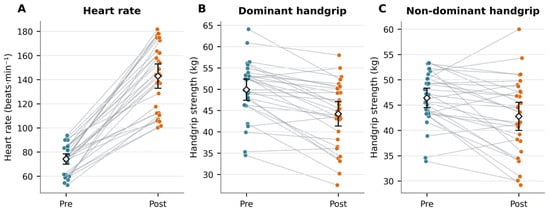
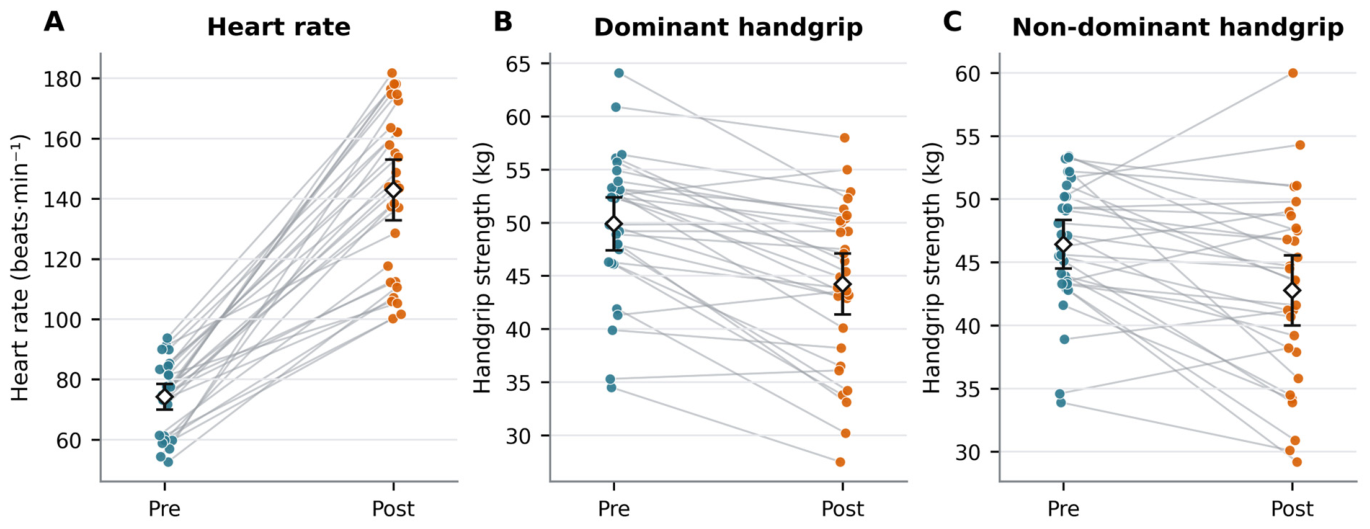
Shapiro–Wilk tests did not indicate significant departures from normality for any of the three paired change scores (all p ≥ 0.228). Heart rate increased after the operational restraint simulation, whereas dominant- and non-dominant-hand handgrip strength decreased; the corresponding paired estimates, confidence intervals, effect sizes, and p-values are given in Table 2. Individual pre-to-post responses are shown in Figure 1.
Table 2.
Acute Cardiovascular and Handgrip-Strength Responses Before and After the Operational Restraint Simulation.
Figure 1.
Individual acute cardiovascular and handgrip-strength responses to the operational restraint simulation. (A) Heart rate; (B) dominant-hand handgrip strength; and (C) non-dominant-hand handgrip strength measured before (Pre) and during the immediate post-simulation assessment sequence (Post). Each line connecting Pre and Post observations represents one of the 30 individual participants. Open diamonds represent group means, and vertical error bars represent 95% confidence intervals for the means at each time point. Two-sided paired-samples t-tests showed significant pre-to-post changes in heart rate (p < 0.001), dominant-hand handgrip strength (p < 0.001), and non-dominant-hand handgrip strength (p = 0.002).
Heart rate increased in all 30 participants. Dominant-hand handgrip strength decreased in 25 participants, remained unchanged in one, and increased in four, whereas non-dominant-hand handgrip strength decreased in 23 participants and increased in seven. The mean within-participant percentage changes relative to each participant’s own baseline were −11.4 ± 10.3% for dominant-hand handgrip strength and −7.8 ± 12.6% for non-dominant-hand handgrip strength; these percentages are distinct from the absolute changes in kilograms reported in Table 2. Patrol-aggregated sensitivity analyses accounting for the shared two-operator scenario yielded the same direction and statistical support for all three acute responses (all p ≤ 0.003; Supplementary Table S1).
3.3. Perceived Exertion and Simulation Completion Time
Post-simulation Borg CR10 was 7.1 ± 2.0, with a median of 8.0 (IQR 5.25–9.00; range 3–10). Patrol completion time showed a markedly right-skewed distribution (Shapiro–Wilk W = 0.722, p < 0.001). Across the 15 patrols, median completion time was 435 s (7:15 min:s), with an IQR of 366.5–805.0 s (approximately 6:07–13:25 min:s) and a range of 255–2402 s (4:15–40:02 min:s). Mean completion time was 713.9 ± 616.5 s. Individual completion times for all 15 patrols are provided in Supplementary Table S2. The longest trial (2402 s; 40:02 min:s) was retained because it was completed according to the same predefined protocol and reached the same restraint endpoint as the other simulations. The trial was completed without interruption, equipment or handcuffing problems, safety events, or other protocol deviations.
3.4. Exploratory Associations with Physical Fitness
Four of the 12 individual-level exploratory correlations remained below the prespecified Benjamini–Hochberg false-discovery-rate threshold (Table 3). Higher pull-up performance was associated with lower perceived exertion and better preservation of dominant- and non-dominant-hand handgrip strength, whereas higher push-up performance was associated with lower perceived exertion. No association involving estimated VO2max or heart-rate change remained below the FDR threshold. Complete results for all 12 individual-level exploratory correlations, including bootstrap 95% confidence intervals and exact raw p-values, are provided in Supplementary Table S3.
Table 3.
Exploratory Associations Remaining below the Benjamini–Hochberg False-Discovery-Rate Threshold.
Patrol-aggregated sensitivity analyses supported three of the four individual-level association patterns: pull-up performance remained associated with lower Borg CR10 (ρ = −0.670; FDR-adjusted p = 0.038) and better dominant-hand handgrip preservation (ρ = 0.630; FDR-adjusted p = 0.048), while push-up performance remained associated with lower Borg CR10 (ρ = −0.703; FDR-adjusted p = 0.038). In contrast, the individual-level association between pull-up performance and non-dominant-hand handgrip preservation was attenuated after patrol aggregation (ρ = 0.321; FDR-adjusted p = 0.487). Complete patrol-aggregated sensitivity analyses are reported in Supplementary Table S1.
For the descriptive patrol-level completion-time analyses, pair-mean pull-up performance was correlated with completion time at ρ = −0.230 (95% CI −0.708 to 0.376; p = 0.410), pair-mean push-up performance at ρ = 0.000 (95% CI −0.589 to 0.613; p = 1.000), and pair-mean estimated VO2max at ρ = −0.168 (95% CI −0.722 to 0.458; p = 0.550). These analyses were based on 15 patrols and were not included in the individual-level FDR-adjusted correlation family.
4. Discussion
This pilot field study provides a preliminary task-specific characterization of the acute responses associated with a grappling-based operational restraint simulation. The principal findings were a marked increase in immediate post-task heart rate, bilateral reductions in handgrip strength, and high perceived exertion. In addition, greater upper-body muscular-endurance performance was associated with lower perceived exertion, while pull-up performance was also associated with better handgrip preservation. Patrol-aggregated sensitivity analyses supported the associations involving perceived exertion and dominant-hand handgrip preservation, whereas the individual-level association with non-dominant-hand handgrip preservation was attenuated. Patrol completion time varied considerably and was not significantly associated with the selected pair-level fitness measures. Given the pilot design, these results should be interpreted as preliminary estimates that require confirmation in larger samples.
The substantial cardiovascular response observed after the simulation is consistent with the high physiological demands reported during police encounters involving arrest and use of force. Naturalistic monitoring has shown marked elevations in heart rate during operational encounters, particularly when arrest, use of force, or weapon-related events occur [4]. Similarly, active-duty officers exposed to a highly realistic lethal-force scenario reached heart rates of approximately 150 beats·min−1 during its most demanding phase [21]. Grappling-based combat also involves intermittent high-intensity actions and substantial cardiovascular and metabolic stress [12,14]. These comparisons should nevertheless be interpreted cautiously. Heart rate in the present study was assessed manually beginning immediately after task completion rather than continuously throughout the simulation; consequently, it cannot be interpreted as mean exercise intensity or peak heart rate. Because each estimate was based on the time required to detect 30 consecutive beats, the measurement itself necessarily spanned several seconds of the immediate post-task period. Furthermore, the cardiovascular response likely reflected a combination of dynamic movement, sustained and intermittent muscular effort, isometric actions, and psychophysiological arousal, the relative contributions of which could not be distinguished with the present design.
The practical meaning of the bilateral reduction in handgrip strength is an immediate post-task reduction in the capacity to generate maximal grip force, a potentially relevant physical resource for subsequent gripping, holding, and manual-control actions. Simulated apprehensions of non-compliant individuals frequently involve grappling, pulling, limb control, and other hands-on control actions [2], all of which require force transmission through the hands and forearms. Previous police research has linked lower handgrip strength with poorer performance in occupational tasks among recruits [8], while non-dominant handgrip and upper-body strength have contributed to performance in specialist police physical assessments [7]. Absolute and relative strength have also been associated with loaded task performance in specialist tactical police personnel [22]. In addition, occupation-specific differences in handgrip neuromuscular characteristics have been reported across tactical populations [11], while Brazilian jiu-jitsu studies have consistently identified gripping as an important physical demand and have documented decrements in grip-related performance across simulated competition [12,13]. However, the occupational relevance of maximal grip strength is task-specific rather than universal. For example, a police study by Orr et al. found no significant linear relationship between maximal grip strength and pistol marksmanship despite clear associations between hand dimensions and grip strength [23]. Accordingly, the present handgrip reductions should be interpreted as post-task reductions in maximal grip-force capacity consistent with grip fatigue, not as a direct measurement of neuromuscular function or as evidence that technical restraint performance deteriorated. Thus, the handgrip outcome provides a simple marker of acute upper-limb loading after a controlled task; it does not by itself show poorer technical performance, greater injury risk, or persisting impairment over a subsequent duty shift.
Although the standardized reduction appeared greater in the dominant than in the non-dominant hand, no direct inferential comparison between hands was planned. Interpretation is further limited by the fixed post-simulation testing order: the dominant hand was always assessed before the non-dominant hand, so the two measurements occurred at different points within the immediate post-simulation recovery sequence. The apparent asymmetry should therefore not be interpreted as evidence of preferential fatigue. Differential hand use, operator role, baseline strength, technical actions, or normal measurement variability could all contribute. Because hand-specific actions and operator roles during the simulation were not recorded, the mechanisms underlying this difference cannot be determined. Future protocols incorporating hand-specific task coding and continuous or repeated grip-force measurements would help distinguish generalized fatigue from task-dependent unilateral loading.
The high perceived exertion and its associations with upper-body muscular endurance provide a complementary perspective on the internal demands of the task. Borg CR10 was obtained at the end of the immediate post-simulation assessment sequence, after heart-rate and bilateral handgrip measurements rather than at the instant of task completion. The intervening maximal handgrip contractions and short post-task interval may therefore have influenced the rating, although participants were explicitly instructed to rate the restraint task as a whole. At the individual level, participants who completed more pull-ups reported lower perceived exertion and showed better preservation of both dominant- and non-dominant-hand handgrip strength, while greater push-up performance was also associated with lower perceived exertion. The patrol-aggregated sensitivity analysis supported the pull-up association with perceived exertion and dominant-hand handgrip preservation, but not the corresponding non-dominant-hand association. Pull-ups combine sustained gripping with elbow-flexor, shoulder-girdle, and trunk involvement, whereas push-ups provide a broader indicator of upper-body muscular endurance. These relationships are therefore physiologically plausible, but their cross-sectional nature precludes causal interpretation: the present results do not demonstrate that improving pull-up or push-up performance would necessarily reduce perceived strain or grip fatigue during restraint. Likewise, the absence of FDR-supported associations involving estimated VO2max should not be interpreted as evidence that aerobic fitness is unimportant. Metabolic fitness has been associated with performance across several police occupational tasks, with particularly strong relationships for anaerobic measures but also smaller associations with aerobic fitness [24]. The multidimensional nature of police fitness has similarly been emphasized in recent international reviews [1]. In the present study, the indirect estimation of VO2max, the substantial upper-body demands of the control task, and the absence of continuous metabolic measurements may have reduced the ability to detect relationships with aerobic capacity. The contribution beyond established fitness–performance associations is the observation of these relationships alongside bilateral post-task grip-force changes and Borg CR10 responses within the same realistic paired control task, with sensitivity checks for partner dependence; this remains exploratory and does not demonstrate the benefits of any specific grappling-training program. The restricted spread of estimated VO2max in this relatively young, highly fit trainee cohort (52.3 ± 2.9 mL·kg−1·min−1) may also have limited the detectable association with heart-rate change or perceived exertion; a restricted-range or ceiling-type explanation remains a hypothesis rather than an established mechanism.
Patrol completion time was highly variable and was not significantly associated with pair-mean pull-up performance, push-up performance, or estimated VO2max. The 255–2402 s range indicates substantial scenario-to-scenario variability and suggests that completion time was influenced by factors extending beyond general physical fitness. This differs from evidence obtained in a much larger cohort of police students, in which greater composite physical capacity was associated with better-rated performance during a use-of-force simulation [3]. However, the outcomes are fundamentally different. The present measure represented elapsed time to task completion by a two-person patrol, whereas occupational-performance ratings may incorporate technical execution, tactical decision-making, and control quality. Technical-tactical analyses of non-compliant suspect apprehensions further demonstrate that these encounters consist of multiple interacting actions and transitions rather than a single physical task [2]. Technical proficiency, partner coordination and communication, role allocation, positional control, resistance behavior, transitions, and handcuffing efficiency may all have contributed to the observed variability. None of these factors was quantitatively assessed. Consequently, completion time should not be interpreted as a simple index of physical capacity, and faster completion should not be equated with better, safer, or more technically appropriate performance. The median completion time was 435 s (7:15), whereas the arithmetic mean was 713.9 s (approximately 11:54) because of the strongly right-skewed distribution. Accordingly, the scenario should not be characterized as uniformly lasting approximately 12 min.
From an applied perspective, the combined cardiovascular, handgrip-strength, and perceptual responses support a multidimensional approach to preparation for physical-control duties. The contemporary police-fitness literature emphasizes that occupational readiness cannot be represented by a single physical quality [1]. These preliminary findings support further investigation of occupational preparation that integrates cardiorespiratory fitness, upper-body muscular endurance, grip-strength development, and technically supervised control and restraint practice. An earlier field-based study in Italian State Police Mobile Units similarly illustrated the feasibility of integrating multiple physical qualities with tactical actions while monitoring cardiovascular and perceptual responses [25]. Reality-based two-officer scenarios may also provide opportunities to practice communication, role allocation, positional transitions, and handcuffing under fatigue. Recent evidence from Brazilian police cadets has reported better simulated use-of-force performance among participants with supplemental Brazilian jiu-jitsu or Muay Thai experience than among those without supplemental martial-arts experience, while showing no meaningful performance advantage of one martial art over the other [6]. Together with previous work on martial-arts experience during high-anxiety arrest and self-defense tasks [5], these observations support further investigation of realistic control training but do not establish the superiority of Brazilian jiu-jitsu or any other specific system. In practice, these observations suggest that training staff may consider combining technical-control instruction with upper-body muscular-endurance development, individualized monitoring of acute strain, appropriate recovery opportunities, and close supervision of repeated restraint simulations. Such considerations are training-design implications, not evidence that measured grip decrements cause injuries or impaired performance during a later patrol shift.
As a pilot study, the principal contribution of the present work is the provision of preliminary task-specific estimates of cardiovascular response, bilateral handgrip-strength change, perceived exertion, completion-time variability, and selected fitness associations during a realistic two-officer restraint simulation. Additional strengths include the within-participant assessment of cardiovascular and bilateral handgrip responses, the visualization of individual changes, explicit control of multiplicity in the exploratory correlation analysis, and separation of participant-level outcomes from the patrol-level completion-time analysis. Several limitations must also be considered, but they do not require removal of the descriptive patrol-level task time, which captures an aspect of scenario duration distinct from individual physiological change. The pilot nature of the study and the resulting sample of 30 participants and 15 patrols limit the precision and generalizability of the estimates. The sample was exclusively male, narrowly distributed in age, and drawn from a relatively homogeneous tactical trainee population. Police populations may differ according to age and occupational role in terms of body composition and habitual physical activity [26], further limiting generalization beyond the present cohort. There was no comparator group or pre-training baseline; therefore, the effects of the preceding operational training cannot be evaluated. The scenario was simulated, resistance intensity was not objectively standardized, and 10 different role players were used across the 15 simulations. The design intentionally did not constrain individual techniques or compare one-officer with two-officer restraint, and the contribution of each operator to force production was not measured. Because some role players participated in more than one simulation, repeated role-player exposure may have introduced additional scenario-level dependency despite the use of standardized behavioral instructions. Technical quality, individual operator roles, pair coordination, and resistance behavior were not quantitatively assessed. In addition, the two operators within each patrol shared the same role player, task duration, resistance conditions, and cooperative interaction, creating potential within-patrol dependence among individual-level observations. Patrol-aggregated sensitivity analyses supported all three acute pre-to-post findings and three of the four individual-level association patterns that remained below the FDR threshold; however, the association between pull-up performance and non-dominant-hand handgrip preservation was attenuated after patrol aggregation. Heart rate was measured only before and immediately after the task by manual pulse assessment, preventing determination of peak, mean, or phase-specific cardiovascular responses. Post-simulation handgrip assessments were also sequential, with the dominant hand always tested before the non-dominant hand, so the two hands were evaluated at different points within the immediate recovery sequence. Borg CR10 was recorded only after completion of the bilateral handgrip assessment and therefore may have been influenced by both the short delay and the intervening maximal contractions. Direct oxygen uptake, blood lactate, biomechanical force, continuous grip-force, and time-motion measures were also unavailable. Future studies should incorporate larger and more diverse samples, standardized resistance protocols, continuous physiological monitoring, direct metabolic measures, repeated grip-force assessment, objective technical-performance scoring, and time-motion or motion-analysis methods. Designs incorporating repeated scenarios and multilevel analyses could additionally separate individual physical capacity from patrol-level coordination and scenario-specific factors. The preliminary estimates generated by this pilot study may assist in the design and sample-size planning of adequately powered confirmatory investigations. Because trainee participants were young and physically fit, extrapolation to older or less fit active-duty personnel is inappropriate. The safety of demanding restraint simulations should be evaluated with population-appropriate screening, supervision, and safeguards, with particular attention to avoiding unnecessary prolonged prone pressure and monitoring the restrained person’s condition [27].
5. Conclusions
In tactical law enforcement trainees, a grappling-based operational restraint simulation was accompanied by marked acute cardiovascular activation, bilateral reductions in handgrip strength, and high perceived exertion. Greater upper-body muscular-endurance performance was associated with lower perceived exertion, while pull-up performance was also associated with better handgrip preservation at the individual level. Patrol-aggregated sensitivity analyses supported the principal acute-response findings and most, but not all, exploratory association patterns. These associations do not establish causality. As a pilot study, the present findings provide preliminary estimates of the cardiovascular, handgrip-strength, perceptual, and performance characteristics of a realistic two-officer restraint task and require confirmation in larger and more diverse samples. The findings support further investigation of integrated physical and technical preparation for realistic two-officer restraint tasks and may help inform the design of larger confirmatory studies.
Supplementary Materials
The following supporting information can be downloaded at https://www.mdpi.com/article/10.3390/jfmk11040490/s1. Table S1: Patrol-Aggregated Sensitivity Analyses Accounting for Within-Patrol Dependence. Table S2: Patrol-Level Operational Restraint Simulation Completion Times. Table S3: Complete Individual-Level Exploratory and Patrol-Level Descriptive Correlation Analyses.
Author Contributions
Conceptualization, G.G., G.T. and F.F.; methodology, G.G., G.T. and F.F.; software, G.G.; validation, G.G. and F.F.; formal analysis, G.G.; investigation, G.G. and G.T.; resources, G.T.; data curation, G.G. and G.T.; writing—original draft preparation, G.G. and G.T.; writing—review and editing, G.G., G.T. and F.F.; visualization, G.G.; supervision, F.F.; project administration, G.G. and G.T. All authors have read and agreed to the published version of the manuscript.
Funding
This research received no external funding.
Institutional Review Board Statement
This study was conducted in accordance with the Declaration of Helsinki and was approved by the Ethics Committee of the University of Bari Aldo Moro (protocol code: 0030611; 28 March 2023).
Informed Consent Statement
Informed consent was obtained from all participants involved in this study.
Data Availability Statement
The data presented in this study are available from the first author upon reasonable request. The data are not publicly available due to privacy restrictions.
Acknowledgments
The authors thank Colonel Andrea Girella, Commander of the Scuola Addestramento di Specializzazione (Guardia di Finanza), Orvieto, Italy, for his institutional support and authorization of the study, as well as all participating trainees and role players for their cooperation during data collection.
Conflicts of Interest
The authors declare no conflicts of interest.
References
- Orr, R.; Canetti, E.F.D.; Gough, S.; Macdonald, K.; Dulla, J.; Lockie, R.G.; Dawes, J.J.; Blacker, S.D.; Milligan, G.S.; Schram, B. Police Fitness: An International Perspective on Current and Future Challenges. Sports 2025, 13, 219. [Google Scholar] [CrossRef] [Scilit]
- Poirier, M.P.; Blacklock, R.; Cao, M.; Théoret, D.; Frei, L.; Gagnon, P. Technical-Tactical Behavior Analysis of General Duty Police Officers during Non-Compliant Suspect Apprehensions: A Novel Approach to Establish Minimum Force Requirements. Work 2024, 77, 1341–1357. [Google Scholar] [CrossRef] [Scilit]
- Henze, K.M.; Klausen, L.K.; Martín, G.F.; Thorsen, L.; Dillern, T. Does Physical Capacity Affect the Ability to Apply Use of Force? Nord. J. Stud. Polic. 2022, 8, 1–14. [Google Scholar] [CrossRef] [Scilit]
- Baldwin, S.; Bennell, C.; Andersen, J.P.; Semple, T.; Jenkins, B. Stress-Activity Mapping: Physiological Responses during General Duty Police Encounters. Front. Psychol. 2019, 10, 2216. [Google Scholar] [CrossRef] [Scilit]
- Renden, P.G.; Landman, A.; Savelsbergh, G.J.P.; Oudejans, R.R.D. Police Arrest and Self-Defence Skills: Performance under Anxiety of Officers with and without Additional Experience in Martial Arts. Ergonomics 2015, 58, 1496–1506. [Google Scholar] [CrossRef] [Scilit]
- Del-Colle, H.; Eleuterio-da-Rocha, J. Police Officers With Supplemental Martial Arts Training Perform Better: A Quasi-Experimental Study With Brazilian Cadets. J. Police Crim. Psychol. 2026. [Google Scholar] [CrossRef] [Scilit]
- Strader, J.; Schram, B.; Irving, S.; Robinson, J.; Orr, R.M. Special Weapons and Tactics Occupational-Specific Physical Assessments and Fitness Measures. Int. J. Environ. Res. Public Health 2020, 17, 8070. [Google Scholar] [CrossRef] [Scilit]
- Orr, R.; Pope, R.; Stierli, M.; Hinton, B. Grip Strength and Its Relationship to Police Recruit Task Performance and Injury Risk: A Retrospective Cohort Study. Int. J. Environ. Res. Public Health 2017, 14, 941. [Google Scholar] [CrossRef] [Scilit]
- Rajović, R.; Koropanovski, N.; Kukić, F.; Radošević, I.; Milošević, M.; Dopsaj, M. Running Speed and Mental Toughness: Effects on Change-of-Direction Speed in Police Students. J. Funct. Morphol. Kinesiol. 2026, 11, 268. [Google Scholar] [CrossRef] [Scilit]
- Němá, K.; Kačúr, P.; Kozák, T.; Pohlod, J.; Ružbarský, P. Pre–Post Motor–Cognitive and Shooting Performance Patterns in Security-Force Applicants during a Fixed-Order Acute-Load Protocol: A Descriptive Pilot Study. J. Funct. Morphol. Kinesiol. 2026, 11, 183. [Google Scholar] [CrossRef] [Scilit]
- Milošević, M.M.; Koropanovski, N.; Vuković, M.; Božović, B.; Kukić, F.; Mudrić, M.R.; Stamatis, A.; Dopsaj, M. Exploring the Interplay of Handgrip Neuromuscular, Morphological, and Psychological Characteristics in Tactical Athletes and General Population: Gender- and Occupation-Based Specific Patterns. J. Funct. Morphol. Kinesiol. 2025, 10, 22. [Google Scholar] [CrossRef] [Scilit]
- Andreato, L.V.; Díaz Lara, F.J.; Andrade, A.; Branco, B.H.M. Physical and Physiological Profiles of Brazilian Jiu-Jitsu Athletes: A Systematic Review. Sports Med. Open 2017, 3, 9. [Google Scholar] [CrossRef] [Scilit]
- Detanico, D.; Dellagrana, R.A.; Athayde, M.S.S.; Kons, R.L.; Góes, A. Effect of a Brazilian Jiu-Jitsu-Simulated Tournament on Strength Parameters and Perceptual Responses. Sports Biomech. 2017, 16, 115–126. [Google Scholar] [CrossRef] [Scilit]
- Andreato, L.V.; Julio, U.F.; Panissa, V.L.G.; Esteves, J.V.D.C.; Hardt, F.; de Moraes, S.M.F.; de Souza, C.O.; Franchini, E. Brazilian Jiu-Jitsu Simulated Competition Part I: Metabolic, Hormonal, Cellular Damage, and Heart Rate Responses. J. Strength Cond. Res. 2015, 29, 2538–2549. [Google Scholar] [CrossRef] [Scilit]
- Miller, T.A. (Ed.) NSCA’s Guide to Tests and Assessments; Human Kinetics: Champaign, IL, USA, 2012. [Google Scholar]
- Huang, L.; Liu, Y.; Lin, T.; Hou, L.; Song, Q.; Ge, N.; Yue, J. Reliability and Validity of Two Hand Dynamometers When Used by Community-Dwelling Adults Aged over 50 Years. BMC Geriatr. 2022, 22, 580. [Google Scholar] [CrossRef] [Scilit]
- Borg, G. Borg’s Perceived Exertion and Pain Scales; Human Kinetics: Champaign, IL, USA, 1998. [Google Scholar]
- Cooper, K.H. A Means of Assessing Maximal Oxygen Intake: Correlation between Field and Treadmill Testing. JAMA 1968, 203, 201–204. [Google Scholar] [CrossRef] [Scilit]
- Lakens, D. Calculating and Reporting Effect Sizes to Facilitate Cumulative Science: A Practical Primer for t-Tests and ANOVAs. Front. Psychol. 2013, 4, 863. [Google Scholar] [CrossRef] [Scilit]
- Benjamini, Y.; Hochberg, Y. Controlling the False Discovery Rate: A Practical and Powerful Approach to Multiple Testing. J. R. Stat. Soc. Ser. B 1995, 57, 289–300. [Google Scholar] [CrossRef] [Scilit]
- Baldwin, S.; Bennell, C.; Blaskovits, B.; Brown, A.; Jenkins, B.; Lawrence, C.; McGale, H.; Semple, T.; Andersen, J.P. A Reasonable Officer: Examining the Relationships among Stress, Training, and Performance in a Highly Realistic Lethal Force Scenario. Front. Psychol. 2022, 12, 759132. [Google Scholar] [CrossRef] [Scilit]
- Orr, R.M.; Robinson, J.; Hasanki, K.; Talaber, K.A.; Schram, B.; Roberts, A. The Relationship between Strength Measures and Task Performance in Specialist Tactical Police. J. Strength Cond. Res. 2022, 36, 757–762. [Google Scholar] [CrossRef] [Scilit]
- Orr, R.M.; Rofe, A.; Hinton, B.; Dawes, J.; Greco, G.; Lockie, R.G. Effect of Grip Size and Grip Strength on Pistol Marksmanship in Police Officers: A Pilot Study. Nauka Bezb. Polic. 2021, 26, 61–72. [Google Scholar] [CrossRef] [Scilit]
- Canetti, E.F.D.; Dawes, J.J.; Drysdale, P.H.; Lockie, R.G.; Kornhauser, C.; Holmes, R.; Schram, B.; Orr, R.M. Relationship between Metabolic Fitness and Performance in Police Occupational Tasks. J. Sci. Sport Exerc. 2021, 3, 179–185. [Google Scholar] [CrossRef] [Scilit]
- De Ronzi, R.; Andriani, O.; Greco, G. Designing a Multifunctional Tactical Training Method to Improve the Physical and Occupational Performance of Italian State Police Mobile Units: A Brief Report. J. Phys. Educ. Sport 2021, 21, 3222–3228. [Google Scholar] [CrossRef] [Scilit]
- Kukić, F.; Heinrich, K.M.; Koropanovski, N.; Greco, G.; Cataldi, S.; Dopsaj, M. Body Composition and Physical Activity of Female Police Officers: Do Occupation and Age Matter? Sustainability 2022, 14, 10589. [Google Scholar] [CrossRef] [Scilit]
- Police Executive Research Forum. 15 Principles for Reducing the Risk of Restraint-Related Death; Police Executive Research Forum: Washington, DC, USA, 2024; Available online: https://www.policeforum.org/assets/Restraint.pdf (accessed on 22 October 2026).

Disclaimer/Publisher’s Note: The statements, opinions and data contained in all publications are solely those of the individual author(s) and contributor(s) and not of MDPI and/or the editor(s). MDPI and/or the editor(s) disclaim responsibility for any injury to people or property resulting from any ideas, methods, instructions or products referred to in the content. |
© 2026 by the authors. Licensee MDPI, Basel, Switzerland. This article is an open access article distributed under the terms and conditions of the Creative Commons Attribution (CC BY) license.