


Abstract
Background: Performing and maintaining high-altitude cardiopulmonary resuscitation (CPR) could pose a significant physical challenge for rescuers. The objective of this study is to analyse the effects of reducing the oxygen fraction at altitudes of 3000 m and 5000 m above sea level (asl), with and without conditioning to hypoxia, on the quality of resuscitation performed in adults. Methods: An analytical before–after study in which 56 students with a Degree in Nursing between 18 and 30 years old perform 10 min of resuscitation on a mannequin at different altitudes (670, 3000 and 5000 m asl) will be carried out. Subsequently completing an intermittent hypoxia conditioning programme, the participants will perform the resuscitation manoeuvres at previously referenced altitudes. Sociodemographics, CPR quality, self-perception CPR, adequate anthropometric data, physical condition, blood tests, oxygenation in muscular tissue, biceps, brachii and erector spinae, subjective perception of effort, anxiety levels and quality of resuscitation will be measured in all participants at different altitudes. Discussion: Although CPR is a submaximal effort manoeuvre, it is subject to being performed by anyone without motor disabilities. Our study will also provide evidence as to whether this characteristic continues to hold true in a hostile environment such as medium and high altitudes. Our study aims to demonstrate that the improvement in physical performance and recovery capacity induced by intermittent hypoxia conditioning programmes increases the quality of CPR in prolonged cardiac arrests and in adverse conditions, such as at high altitudes. The proposed study will contribute as a novelty to the estimation of the influence of high altitudes and conditioning on performing basic CPR manoeuvres. If the hypothesis turns out to be true, recommendations about the practice of moderate-intensity physical exercise could be incorporated into the CPR guidelines as one of the important aspects in the training of rescuers to conduct CPR.
1. Introduction
Cardiac arrest (CA) is understood to be the sudden, unexpected and potentially reversible interruption of spontaneous breathing and circulation, which can be caused by many different factors [1].
The CA time and the duration of cardiopulmonary resuscitation (CPR) manoeuvres are the major determinants of cerebral blood flow generated by chest compressions (CCs) [2,3].
With differences between and within countries, the annual incidence of out-of-hospital cardiac arrest (OHCA) in Europe ranges from 67 to 170 cases per 100,000 inhabitants [4]. In Spain, in more than half of the cases (56.7%), basic life support was performed before the arrival of Prehospital Medical Emergency Services [5]. Survival rates after OHCA range from 5.0% to 30.0% across different European countries, increasing considerably in those cases where early CPR is performed [6,7].
CCs are the recommended technique for enabling emergency artificial blood circulation. In order to perform CCs effectively and minimise the risk of injury, it is necessary to press the centre of the thorax, on the sternum, with sufficient force to produce a good artificial carotid or femoral pulse. The CCs must be regular, uniform and uninterrupted [1].
Once the first recommendations were developed, multiple investigations were conducted, culminating in the proposals made by the American Heart Association (AHA) and by the European Resuscitation Council (ERC) in 2025 [8,9]. To achieve blood flow through the CCs, the compression/decompression ratio must be 50:50, which is achieved by performing compressions at a rate of 100–120 per minute. The compression depth for adults is between 5 and 6 cm [9]. Ventilations should have a volume and air pressure sufficient to make the victim’s chest rise. Each ventilation should have a duration of approximately 1 s and an insufflated air volume of approximately 500–600 mL (6–7 mL/kg−1) [9].
There are several causes that affect survival rates after a CA. One of the main causes is the interruption of the CCs, which produces a rapid decrease in cerebral perfusion and the ineffectiveness of the efforts made [10].
All recommendations are based on the fact that anyone should start CPR in the case of an CA, and rescuers are told that they should only stop CPR when their exhaustion prevents them from continuing, even if the victim is not recovering [11,12,13]. Several authors report the ineffectiveness of the CCs performed when fatigue appears. However, the recommendations do not determine when resuscitation should stop, suggesting that fatigue appears between the first and fifth minutes of CPR, decreasing its quality [13,14,15,16,17]. Under optimal environmental conditions, the exercise performed by the rescuer during CPR is fundamentally aerobic and submaximal, being well tolerated from the cardiorespiratory perspective. The quality and duration of CPR depend on the fitness level of the rescuer [17]. However, the influence that other factors have on the correct performance of CPR has not been sufficiently established [18,19].
Liu S et al. [19] and López-González, A et al. [16,20] have reported that subjects with a higher BMI performed a greater number of compressions with adequate depth and compression/decompression ratio, as well as a mean percentage of correct CCs. However, they did not perform better on the other criteria of adequate CPR (compression rate, location, adequate release pressure on the chest). There are no studies that have shown the influence of age on the performance of CCs. However, as the physical capacity of an individual decreases with age, as quantified by the maximum oxygen uptake (VO2max), so does the ability to perform quality CPR [17,20].
The influence of extreme temperatures on the quality of the CPR has been studied by Barcala-Furelos et al. and Martín-Conty et al. [21,22], who concluded that working in these highly unstable environments implies an extra expenditure of energy on the part of the rescuers. In addition to performing CPR according to quality criteria, rescuers must do so in environments and conditions that directly affect their physiological and psychological capacity [23,24]. Previous studies on CPR using medium- and high-fidelity mannequins, demonstrated that, in both men and women, the trait anxiety score (STAI-TA) could be categorised as low, which indicates a low tendency to perceive situations as threatening. In contrast, state anxiety (STAI-SA) was high, reflecting a temporary emotional state of tension at the end of the CPR manoeuvres [24,25].
There are numerous high-altitude regions around the world. Asia is home to the world’s highest point, Mount Everest in the Himalayas, at 8848 m above sea level (m asl). Around 400 million people worldwide live at altitudes above 1500 m asl [26,27], while around 140 million live permanently at altitudes between 2500 and 5500 m asl [28,29]. In addition, it is estimated that more than 100 million tourists visit mountainous areas around the world each year [30,31]. People’s interest in outdoor activities at high altitudes, such as hiking, mountaineering, skiing, and even following of these sports by amateurs, has increased considerably in recent years [32].
Being and moving at high altitudes produces various physiological effects, including an increase in cardiac and respiratory workload, especially during exercise [33,34]. Performing and maintaining quality CPR at high altitude could pose a significant physical challenge for rescuers. Preliminary studies have shown that, in resuscitators, after five minutes of CPR at altitude, arterial blood oxygen saturation (SaO2) decreases, and heart rate (HR) and the rating of perceived exertion (RPE) increase. This fact negatively affects the number of effective CCs, ultimately decreasing the quality of the CPR [27,28,29,30]. These variations have been studied by various authors at altitudes between 3100 and 3700 m asl [34,35,36,37,38,39].
Currently, it is not uncommon to find sports teams and supporters that exceed these altitudes during practice or monitoring. However, there are no studies analysing the quality of CPR performed at very high altitudes or how CPR results change after programmed conditioning at that altitude.
Normobaric intermittent hypoxia (NIH) involves breathing air with a low oxygen concentration at sea level. Its goal is to produce improvements typically associated with altitude acclimatisation, such as enhanced performance (increased oxygen transport, greater muscle efficiency and improved metabolic function), as well as haematological benefits (increased secretion of erythropoietin, haemoglobin and erythrocytes) [40]. However, haematological changes should be interpreted with caution, as it is likely that most protocols do not achieve the level of hypoxia required to induce meaningful erythropoiesis or lasting increases in haemoglobin mass [41].
The main aim of the study is to analyse the effect of reducing the fraction of inspired oxygen (FiO2) at medium and high altitudes (3000 and 5000 m asl) on the quality of the basic CPR performed on adults. The secondary objectives are (a) to assess the perception of effort and levels of anxiety involved in performing CPR at these altitudes; (b) to determine whether there is an association between altitude, body mass index (BMI) and physical fitness and the proportion of correct CCs achieved at the proposed altitudes; (c) to analyse the muscle oxygen saturation (SmO2) values during CPR at the proposed altitudes; (d) to determine the blood variations produced (lactate, haematocrit (Hct), haemoglobin (Hgb), creatine phosphokinase (CPK), and myoglobin (Mb)); and (e) to assess the quality of the CPR components (CCs and ventilations), the ratings of perceived exertion (RPE), and associations between BMI, SmO2 and anxiety levels at 670, 3000 and 5000 m asl after an adaptation programme to intermittent hypoxia.
2. Materials and Methods
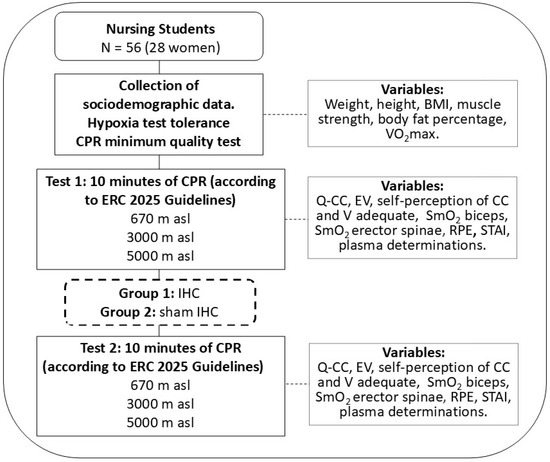
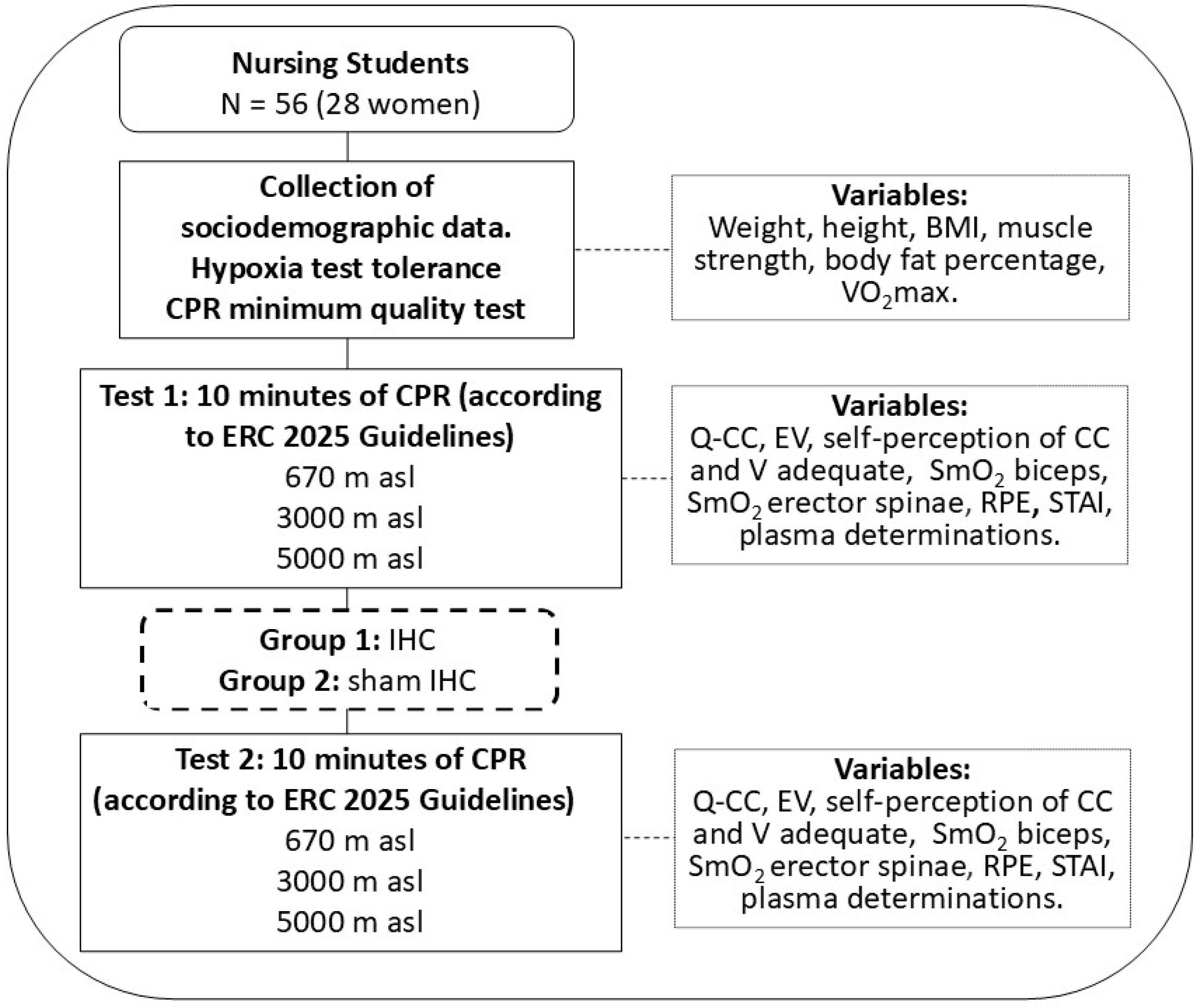
A randomised, controlled, parallel-group experimental study will be conducted at the Faculty of Nursing of Albacete, University of Castilla-La Mancha, Spain (Figure 1). After, the participants will perform CPR manoeuvres on a mannequin at different altitudes (670, 3000 and 5000 m asl). Participants will be randomly assigned to one of two groups: (1) an intermittent hypoxia conditioning group (IHC), and (2) a sham conditioning control group. Subsequently, the participants will perform the CPR manoeuvres again at the aforementioned altitudes.
Figure 1.
Flow chart. m asl: m above sea level; IHC: intermittent hypoxia conditioning; BMI: body mass index; VO2max: peak or maximum oxygen uptake; Q-CC: quality CC; EV: effective ventilation; SmO2: muscle oxygen saturation; RPE; rating of perceived exertion; STAI: State–Trait Anxiety Inventory.
The population object of the study will be students with in their second year of the Degree in Nursing from the Faculty of Nursing of Albacete, University of Castilla-La Mancha, aged between 18 and 30 years, who agree to participate voluntarily after they understand the objectives of the study.
2.1. Inclusion and Exclusion Criteria
Inclusion criteria will include the ability to read and write in Spanish to complete the sociodemographic questionnaire and the ability to perform the ergospirometry test. The exclusion criteria will exclude those performing physical activity with an intensity >9 METS/min more than three times a week and those for whom the anamnesis advises against sports, as well as evidence of intolerance to altitude (determined with physiological parameters during the simulation of CPR at height). In addition, the following conditions were considered contraindications for inclusion in the study: chronic or acute bacterial infections, severe psychiatric disorders, neoplastic diseases, unstable or uncontrolled hypertension, severe balance problems, altitude sickness, unstable cardiovascular disease, chronic obstructive pulmonary disease, pregnancy, and other mental disorders or alterations that would prevent participants from taking the tests.
2.2. Ethical Considerations
All participants will agree to participate with written informed consent. This study respects the ethical principles of the Declaration of Helsinki. The protocol for the study was approved by the Ethics Committee for Investigation with medicinal products of the Integrated Care Management of Albacete, Spain (5 October 2021, code 2021-094).
2.3. Sample Size
Participants will be recruited using a convenience sampling approach among eligible nursing students. After baseline assessment, participants will be randomly allocated to one of two parallel groups: (1) an intermittent hypoxia conditioning group or (2) a sham control group. The random allocation sequence will be generated using a computer-based random number generator with a 1:1 allocation ratio. To ensure balance between groups, block randomisation will be applied with variable block sizes. Allocation concealment will be guaranteed using sealed, opaque, and sequentially numbered envelopes prepared by an independent researcher not involved in participant recruitment or assessment.
The assignment of participants to study groups will be conducted by a researcher not involved in outcome assessment or data analysis. Due to the nature of the intervention, participants and intervention supervisors cannot be blinded to group allocation. However, outcome assessors and data analysts will be blinded to group allocation to minimise detection and analysis bias. Specifically, outcome assessors will evaluate CPR performance using anonymised, coded data with no group identifiers, ensuring that group allocation remains concealed. The randomisation sequence generation and allocation concealment will be performed by an independent researcher, who will have no involvement in outcome assessment or data analysis.
To control for potential confounding variables, a multivariate model (multiple linear regression) will be applied. The change in Q-CC following the intervention will be considered as the dependent variable, while potential confounders (e.g., age, sex, BMI, physical fitness, and blood parameters) will be included as covariates. Interactions between these variables and altitude conditions will also be explored.
The sample size calculation is based on an expected baseline proportion of correct compressions of 52%, according to a previous study [16]. Using Epidat 4.2 software, assuming paired comparisons, a 95% confidence level, and 80% statistical power, a total of 56 participants is required to detect an increase in the proportion of correct compressions to 78%. To account for potential dropouts or non-responses, the total sample size will be increased by 10%.
Given the need to assess specific physiological parameters, including ergospirometry and simulated high-altitude exposure, participants will be recruited based on feasibility. A balanced distribution by sex (approximately 50% per group) will be ensured.
2.4. Interventions
Training CPR Programme
Participants without prior CPR training will undergo a standardised training programme designed in accordance with current European Resuscitation Council (ERC) guidelines. The training programme will consist of: (1) a theoretical session (60 min), including basic life support principles, recognition of cardiac arrest, and CPR sequence; (2) a practical hands-on training session (120 min), during which participants will practice chest compressions and ventilations using feedback-enabled mannequins under instructor supervision; and (3) a supervised skill consolidation session (30 min) focused on correcting technique and ensuring adherence to guideline criteria (compression depth, rate, recoil, and ventilation quality). The total training duration will therefore be approximately 3.5 h. Training will be delivered by certified instructors following a structured protocol to ensure standardisation across participants. Objective feedback devices will be used to facilitate motor skill acquisition and improve CPR quality performance. This training duration is consistent with previous literature demonstrating that structured sessions of at least 2–4 h are required for adequate acquisition of basic CPR skills and retention of performance quality.
Stage 1: An initial baseline assessment will be carried out in all participants (n = 56), consisting of collection of parentage data and anamnesis, as well as the measurement of physiological variables at rest (resting electrocardiogram and pulmonary function test), which will allow ruling out the existence of pathologies that contraindicate the performance of ergospirometry. Other measurements include diastolic blood pressure (DBP) and systolic blood pressure (SPB), anthropometry, ergospirometry to determine the maximal HR achieved and VO2max, muscle strength, and initial hypoxia tolerance test.
Stage 2: All participants (n = 56) will perform 10 uninterrupted minutes of CPR (with a CC/ventilation ratio of 30:2) on a mannequin with a quality measurement device for CTE and ventilations (Q-CPR) in the following situations:
Test M1: CPR at 670 m asl, FiO2 of 0.21.
Test M2: CPR at normal pressure simulating 3000 m asl, FiO2 of 0.14.
Test M3: CPR at normal pressure simulating 5000 m asl, FiO2 of 0.11.
Prior to M2 and M3, each participant will have an acclimatisation period of 10 min to FiO2 corresponding to each of the altitudes.
To minimise the effect of fatigue between tests, each participant will have a 24 h rest period.
Stage 3: Participants assigned to the intervention group will undergo a standardised intermittent hypoxia conditioning programme (13 sessions, 45–75 min/session), including alternating cycles of hypoxia (FiO2 progressively reduced from 0.14 to 0.11) and normoxia, resulting in a total hypoxic exposure of approximately 728 min. The control group will undergo a sham protocol consisting of identical session structure and duration under normoxic conditions. Three to five weekly sessions will be held according to tolerance and the iAltitude® protocol [42].
Stage 4: After the intervention, all the participants (n = 56) will perform three uninterrupted 10 min sessions of CPR: the first at 670 (P1), the second (P2) at 3000, and the third (P3) at 5000 m asl. To minimise the effect of fatigue between tests, each participant will have a 24 h rest period [42]. The criteria for completing the different CPR tests will be determined by reaching 10 min or by the physical and/or physiological limitations of the rescuer (physical exhaustion or pain, SatO2 < 75).
Throughout all stages, heart rate and peripheral oxygen saturation (SpO2) will be continuously monitored using an ear clip pulse oximeter. The training programme instructs the participant to breathe ambient air if the SpO2 level exceeds the limit specified in Table 1 (Lim SpO2). During hypoxia tests, as well as during conditioning, a nurse and/or a doctor with experience in emergency care will be present.
Table 1.
Description of normobaric hypoxia training sessions.
To minimise potential confounding due to independent practice, participants will be explicitly instructed not to perform any additional CPR training or practice outside the study protocol during the study period.
The pre-conditioning protocol for high-altitude exposure was designed based on experience and knowledge regarding the use of normobaric intermittent hypoxia (IHT) to enhance sporting performance. To this end, the following data were collected from each participant: age, sex, height, weight, body fat percentage, sport practised (if applicable), number of weekly training sessions, time spent training, and ability to perform CPR manoeuvres in accordance with the study design.
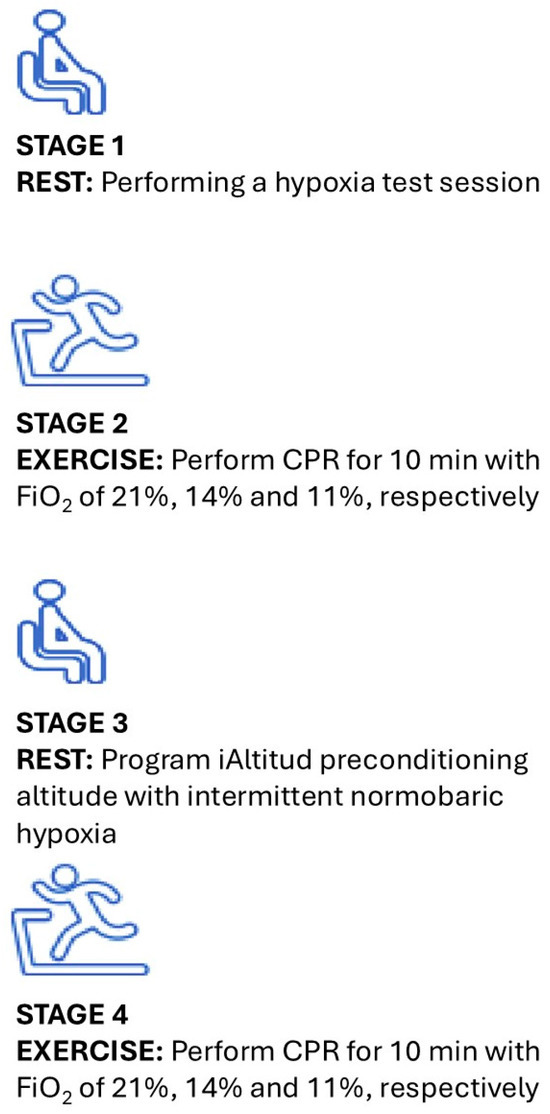
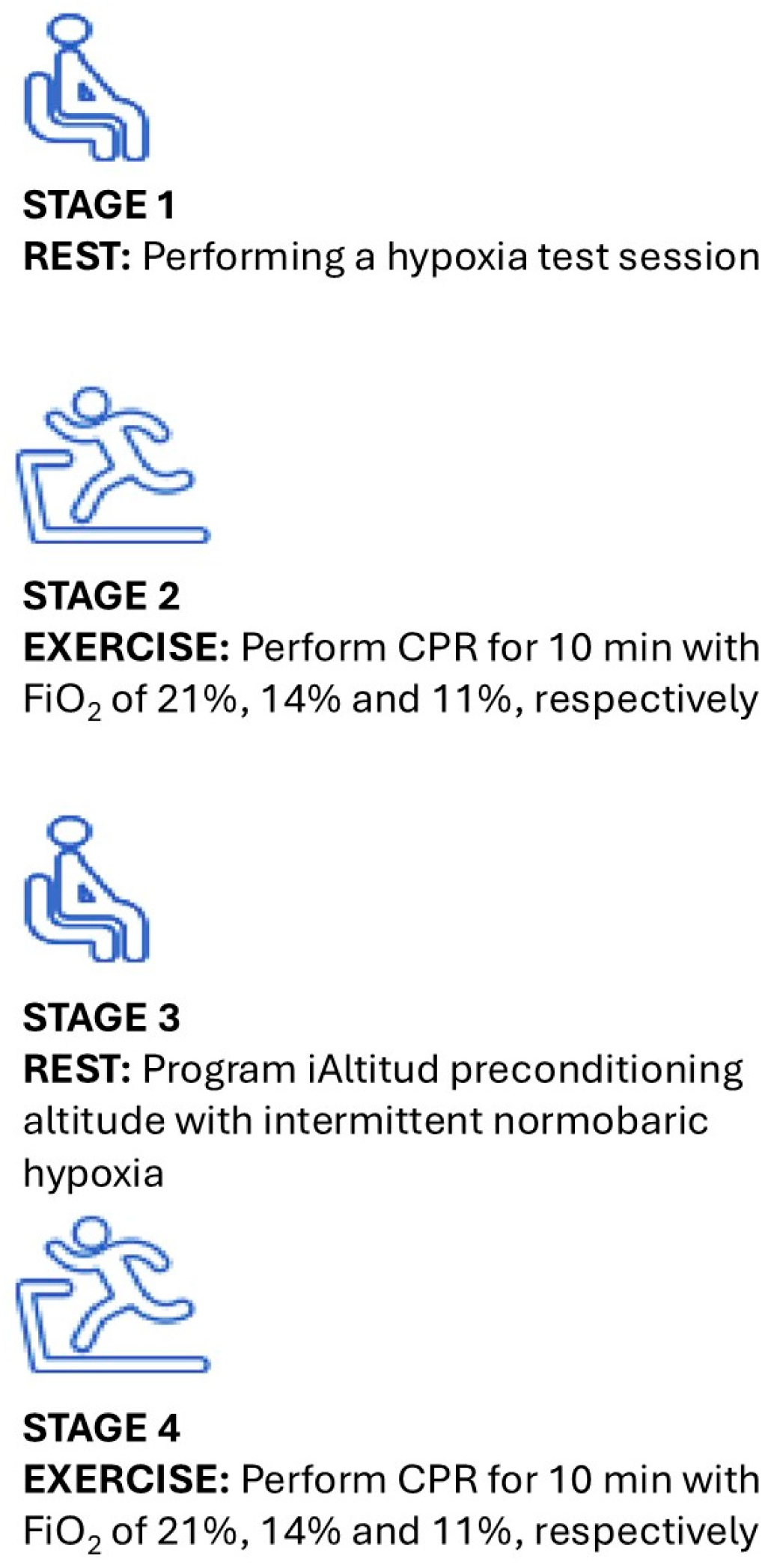
As indicated in the text and illustrated in Figure 2, the study protocol comprises four stages. The first stage involves performing a hypoxia tolerance test. The second stage involves carrying out CPR tests without hypoxia conditioning at different altitudes. The third stage consists of 15 sessions of IHT conditioning. Finally, the fourth stage involves performing CPR tests at the specified altitudes.
Figure 2.
Pre-conditioning protocol. FiO2: fraction of inspired oxygen.
The Hypoxic Training Index (HTI) and the Hypoxic Recovery Index (HRI) are monitored in both phase 1 and phase 3. The HTI is a measure of the cumulative hypoxic stress experienced during a session and over successive sessions of the protocol. This index is calculated as an integral value of SPO2 readings below 90%. The HRI is used as an indicator of the individual’s recovery capacity following hypoxic stress during a session, and cumulatively across subsequent sessions of the protocol. It is calculated during periods when SPO2 readings are above 90%, and its value increases more rapidly the better an individual recovers from the hypoxic load to which the individual is exposed. The HTI is calculated as the area under the curve (AUC) of SpO2 values below 90%, expressed as %·min, representing the cumulative magnitude and duration of hypoxic stress. The HRI is calculated as the area above 90% SpO2 during recovery periods (also expressed as %·min), reflecting the extent and rate of reoxygenation.
In order to complete the designed IHT pre-conditioning protocol, participants will need to complete the 15 sessions detailed in Table 1. These sessions will be conducted under the supervision of a trained supervisor who will be responsible for ensuring that: (1) throughout all sessions, participants are monitored via pulse oximetry and follow the instructions provided by the iAltitude software (Hypoxiahome Trainer 4.1) at all times in order to ensure safety and achieve the expected results; (2) a minimum interval of at least 24 h is maintained between sessions, with no more than 72 h elapsing between them; (3) more than 2 h have elapsed between the participant’s last meal and the start of the session; and (4) the breathing pattern during the sessions remains natural. The breathing rate should not be increased, and the breaths should not be deep, so that the amount of oxygen inhaled corresponds to the level required for the session, based on the specified FiO2 percentage.
SPO2 Limit: This value indicates how many times the SPO2 has exceeded the safety limit set for the current session. The lower limit for blood oxygen saturation is set for each session in line with its objective. Whenever the limit is exceeded, the software alerts the user to remove their mask and recover in normoxia until they receive a new notification to put the mask back on.
2.5. Study Variables
Sociodemographic variables (age, sex and place of residence) will be measured in all participants.
BMI: The quotient of weight (kg) and height2 (m). BMI will be categorised according to the age and gender cut-off points defined by the World Health Organization in underweight (<18.5 kg/m2), normal weight (18.5–24.9 kg/m2) and overweight/obesity (≥25 kg/m2) [43].
Body fat percentage: A calibrated multifrequency signal bioimpedance meter with electrodes on the feet and a grip on both hands will be used for measurement. The participant will remain barefoot with the heels and soles of the feet located on the sensors of the equipment and the grip of the hands in the most appropriate grip position for their height. The bioimpedance analysis will be performed after a fast of at least 5 h, without having performed physical exercise or ingested alcohol in the previous 48 h and having previously emptied the urinary bladder—Seca-770 (SECA Gmbh & Co. Kg, Hamburg, Germany).
Muscle strength: Measured with a Takei TKK 5101 (Takei Scientific Instruments Co., Ltd., Tokyo, Japan) dynamometer, the muscular strength will be categorised as excellent, good, medium, bad or very bad. Muscular strength will be dichotomised, taking the cut-off point of the 25th percentile, by sex.
CPR quality: Upon performing the CPR manoeuvre, on the basis of previous studies [44,45], quality CC (Q-CC) will be evaluated via the following formula:
In the equation, CCcD is the CC with correct depth (between 5 and 6 cm), CCcR is the CC with correct rhythm (100-/min) and CCchR is the CC with complete chest re-expansion.
Q-CC (%) = [% CCcD + % CCcR + % CCchR]/3.
Effective ventilation (EV) is evaluated as
where NEV is the number of effective ventilations and NTV is the total number of ventilations.
EV (%) = (NEV × 100)/NTV
These parameters are based on the ERC-2021 [9] recommendations and are recorded by phantom software (Laerdal Resusci Anne CPR-D and SkillRepoter®; Medical Laerdal; Stavanger, Norway).
Adequate self-perception of CC and ventilations: Asking the participants if they think they have performed them correctly, with the possible answers being CC: YES/NO, V: YES/NO.
The results will be tabulated at different altitudes.
SO2m: This will be measured with near-infrared spectrophotometry in biceps brachii and erector spinae. The data will be categorised into four phases: baseline, phase close to fatigue, the fatigue phase and the recovery phase—Humon Hex® (Humon Inc., Cambridge, MA, United States).
VO2max: Using ergospirometry, this will be categorised as very bad, bad, medium, good and very good level of cardiorespiratory fitness. It will be measured with a treadmill ergometer (HP-Cosmos, mod. Pulsar 3P) (h/p/cosmos sports & medical GmbH, Nussdorf-Traunstein, Germany), Cardinal Health electrocardiograph mod. Ergoline ER800 (ergoline GmbH, Bitz, Germany) and an automatic breathing gas analysis system (mod. Oxycom Alpha-Jaeger) (Erich Jaeger GmbH, Höchberg, Germany).
Cardiorespiratory fitness will be dichotomised as higher and lower using the Cooper Institute cut-off points for 20–30-year-old adults (VO2max ≥38 mL/kg/min for women and ≥43 mL/kg/min for men) [46].
Blood determinations: Before the start and after the completion of each test (pre and post) Hgb, Hct, Mb, and lactate levels in venous blood will be determined with Epoc® Blood Analysis System devices (Siemens Healthineers, Ottawa, ON, Canada).
RPE: At the end of each of the CPR tests, the participants will be asked to rate the perception of the effort made using the Borg scale. It consists of numbers from 6 to 20, where each number represents a level of perceived exertion. The number 6 on the scale is associated with very light effort, whereas the number 20 is associated with maximum effort. The intermediate numbers on the scale represent increasing levels of perceived exertion [47].
Anxiety levels: The State–Trait Anxiety Inventory (STAI) questionnaire will be used [48]. This questionnaire measures anxiety in healthy adults. It consists of two scales: SA (which reflects the subjective and transitory feelings of tension, apprehension and fear that can vary with time and fluctuate in intensity) and TA (which reflects a relatively stable anxious propensity that characterises individuals with a tendency to perceive situations as threatening). The questionnaire provides a numerical value for the TA and another for the SA. The total STAI is the sum of SA and TA. Each subscale is made up of a total of 20 items in a 4-point Likert response system according to intensity (0 = almost never/not at all; 1 = somewhat/sometimes; 2 = quite/often; 3 = a lot/almost always). The total score for each of the subscales ranges from 0 to 60 points. STAI-TA will be administered at the beginning of the investigation and STAI-SA at the end of pre-conditioning and post-conditioning CPR at 670 m asl and 5000 m asl.
2.6. Statistical Analysis
First, a descriptive analysis of the study variables will be carried out, along with the appropriate tabulation and graphical representation of the data. Qualitative variables will be expressed as proportions with 95% confidence intervals, and quantitative variables will be described using means and standard deviations or medians and interquartile ranges, as appropriate. Prior to the application of parametric tests, the assumption of normality will be assessed for all continuous variables using the Shapiro–Wilk test.
For comparisons involving paired quantitative data, Student’s t-test for paired samples will be used when the normality assumption is met. If this assumption is violated, the non-parametric Wilcoxon signed-rank test will be applied.
For between-group comparisons (intervention vs. control), independent-sample t-tests will be used for normally distributed variables, while the Mann–Whitney U test will be used for non-normally distributed variables.
To evaluate the effect of the intervention across time and altitude conditions, a mixed-model ANOVA will be used, including group (intervention vs. control) as a between-subject factor and time (pre vs. post) and altitude as within-subject factors.
For categorical variables, McNemar or chi-square tests will be applied as appropriate.
A multivariate linear regression analysis will be performed to adjust for potential confounding variables (age, sex, BMI, and physical fitness), including group allocation as an independent variable. Model assumptions (normality, homoscedasticity, and independence of residuals) will be checked.
Statistical significance will be set at p < 0.05. All statistical analyses will be performed using IBM® SPSS® Statistics 28 software.
3. Discussion
The results of this study will have the practical utility of demonstrating that CPR, even though it is a submaximal effort manoeuvre, is subject to being performed by anyone without motor disabilities regardless of the environment in which it is performed. Our study will also provide evidence as to whether this characteristic continues to hold true in a hostile environment such as medium and high altitudes.
Our study aims to demonstrate that improvement in physical performance and recovery capacity induced by intermittent hypoxia conditioning programmes increases the quality of CPR in prolonged cardiac arrests and in adverse conditions, such as at high altitudes.
In the same way, information will be given about how often the exchange of resuscitators is recommended to avoid errors in CPR manoeuvres as a result of rescuer fatigue under such adverse conditions.
The proposed study will contribute as a novelty to the estimation of the influence of high altitudes and conditioning on performing basic CPR manoeuvres.
If the hypothesis turns out to be true, recommendations about the practice of moderate-intensity physical exercise could be incorporated into the CPR guidelines as one of the important aspects in the training of rescuers to face CPR.
Limitations of this study include the fact that CPR will be performed not on a patient, but on a mannequin. However, a better performance under “real” conditions would have been more likely to occur since chest compressions are easier to perform on human beings. Similarly, simulating high altitude by reducing FiO2 in the laboratory eliminates other factors associated with high altitude, such as ambient temperature and reduced O2 pressure, the time of year of assessment, geographical conditions, the type and quality of food and the presence of unhealthy habits. On the other hand, the laboratory environment is very different from what usually surrounds sudden cardiac arrest in the community setting, and rescuers might vary their response when a sense of urgency appears.
A second limitation could be the effect that real-time audio-visual feedback during CPR manoeuvres has on the performance of the study participants, which may limit the generalisability of our findings to situations where this feedback procedure is not used.
Another limitation is the potential for bias when using an analytical pre–post comparison study, as well as the need for further validation of the generalisability of the results due to the small sample size.
It is worth mentioning the difficulty of conducting a trial with a large number of participants among the obstacles to achieving the planned objectives. As a consequence, the trial’s internal validity is threatened by the lack of representativeness of the sample. Another threat may be errors in the measurements; to minimise them, the variability of the interviewers and the nurses responsible for the measurements will be minimised through previous training [8,9].
4. Conclusions
The results of this study will have the practical utility of demonstrating that CPR can be performed by anyone without motor disabilities, regardless of the environment in which it is performed.
Author Contributions
Conceptualisation, Á.L.-G., J.R.-S., J.L.-T.-H. and V.F.-L.; methodology, Á.L.-G., J.R.-S., J.L.-T.-H., C.M.G.-A., J.L.-T. and V.F.-L.; software, Á.L.-G., J.R.-S. and J.L.-T.; validation, Á.L.-G., J.R.-S., J.L.-T.-H. and V.F.-L.; formal analysis, Á.L.-G., J.R.-S., S.P.-S., F.G.-A., J.L.-T.-H. and C.M.G.-A.; investigation, Á.L.-G., J.R.-S., S.P.-S., F.G.-A., J.L.-T.-H., C.M.G.-A., J.L.-T. and V.F.-L.; resources, Á.L.-G., J.R.-S., F.G.-A., C.M.G.-A. and J.L.-T.; data curation, Á.L.-G., J.R.-S., S.P.-S., F.G.-A., J.L.-T.-H., C.M.G.-A., J.L.-T. and V.F.-L.; writing—original draft preparation, Á.L.-G., J.R.-S., S.P.-S., J.L.-T.-H., C.M.G.-A., J.L.-T. and V.F.-L.; writing—review and editing, Á.L.-G., J.R.-S., S.P.-S., F.G.-A., J.L.-T.-H., C.M.G.-A., J.L.-T. and V.F.-L.; visualisation, Á.L.-G., J.R.-S., S.P.-S., F.G.-A., J.L.-T.-H., C.M.G.-A., J.L.-T. and V.F.-L.; supervision, Á.L.-G. and J.R.-S.; project administration, Á.L.-G. and J.R.-S.; funding acquisition, Á.L.-G., J.R.-S. and F.G.-A. All authors have read and agreed to the published version of the manuscript.
Funding
This research was funded by a grant from the European Regional Development Fund (grant number SBPLY/23/180225/000107).
Institutional Review Board Statement
This study respected the ethical principles of the Declaration of Helsinki. The protocol for the study was approved by the Ethics Committee for Investigation with medicinal products of the Integrated Care Management of Albacete, Spain (code 2021-094), approval date: 5 October 2021.
Informed Consent Statement
All participants will provide their written informed consent to participate.
Data Availability Statement
The original contributions presented in this study are included in the article. Further inquiries can be directed to the corresponding author.
Conflicts of Interest
The authors declare no conflicts of interest.
Abbreviations
The following abbreviations are used in this manuscript:
| AHA | American Heart Association |
| asl | Above sea level |
| BMI | Body mass index |
| CA | Cardiac arrest |
| CC | Chest compression |
| CPK | Creatine phosphokinase |
| CPR | Cardiopulmonary resuscitation |
| DBP | Diastolic blood pressure |
| ERC | European Resuscitation Council |
| FiO2 | Oxygen fraction inspirated |
| Hct | Haematocrit |
| Hgb | Haemoglobin |
| HR | Heart rate |
| Mb | Myoglobin |
| METs | Metabolic equivalents |
| NEV | Number of effective ventilations |
| NTV | Total number of ventilations |
| OHCA | Out-of-hospital cardiac arrest |
| RPE | Rating of perceived exertion |
| SaO2 | Arterial oxygen saturation |
| SBP | Systolic blood pressure |
| SmO2 | Muscular oxygen saturation |
References
- Safar, P.; Brown, T.C.; Holtey, W.H.; Wilder, R.J. Ventilation and circulation with closed chest cardiac massage in man. JAMA 1961, 176, 574–576. [Google Scholar] [CrossRef] [Scilit] [PubMed]
- Larsen, M.P.; Eisenberg, M.S.; Cummig, R.O.; Hallstrom, A.P. Predicting survival from out of hospital cardiac arrest. A graphic model. Ann. Emerg. Med. 1993, 22, 1625–1658. [Google Scholar] [CrossRef] [Scilit] [PubMed]
- Roth, R.; Stewart, R.D.; Rogers, K.; Cannon, G.M. Out-of-hospital cardiac arrest: Factors associated with survival. Ann. Emerg. Med. 1984, 13, 237–243. [Google Scholar] [CrossRef] [Scilit] [PubMed]
- Baldi, E.; Wnent, J.; Caputo, M.L.; Haywood, K.L.; Lilja, G.; Masterson, S.; Nehme, Z.; Perkins, G.D.; Rosell-Ortiz, F.; Strömsöe, A.; et al. European Resuscitation Council Guidelines 2025 Epidemiology in Resuscitation. Resuscitation 2025, 215, 110733. [Google Scholar] [CrossRef] [Scilit] [PubMed]
- Requena-Morales, R.; Palazón-Bru, A.; Rizo-Baeza, M.M.; Adsuar-Quesada, J.M.; Gil-Guillén, V.F.; Cortés-Castell, E. Mortality after out-of-hospital cardiac arrest in a Spanish Region. PLoS ONE 2017, 12, e0175818. [Google Scholar] [CrossRef] [Scilit] [PubMed]
- Gräsner, J.T.; Lefering, R.; Koster, R.W.; Masterson, S.; Böttiger, B.W.; Herlitz, J.; Wnent, J.; Tjelmeland, I.B.; Ortiz, F.R.; Maurer, H.; et al. EuReCa ONE—27 Nations, ONE Europe, ONE Registry. A prospective one month analysis of out-of-hospital cardiac arrest outcomes in 27 countries in Europe. Resuscitation 2016, 105, 188–195. [Google Scholar] [CrossRef] [Scilit] [PubMed]
- Smyth, M.A.; Gunson, I.; Coppola, A.; Johnson, S.; Greif, R.; Lauridsen, K.G.; Taylor-Philips, S.; Perkins, G.D. Termination of Resuscitation Rules and Survival Among Patients With Out-of-Hospital Cardiac Arrest: A Systematic Review and Meta-Analysis. JAMA Netw. Open 2024, 7, e2420040. [Google Scholar] [CrossRef] [Scilit] [PubMed]
- Kleinman, M.E.; Buick, J.E.; Huber, N.; Idris, A.H.; Levy, M.; Morgan, S.G.; Nassal, M.M.; Neth, M.R.; Norii, T.; Nunnally, M.E.; et al. Part 7: Adult Basic Life Support: 2025 American Heart Association Guidelines for Cardiopulmonary Resuscitation and Emergency Cardiovascular Care. Circulation 2025, 152, S448–S478. [Google Scholar] [CrossRef] [Scilit] [PubMed]
- Smyth, M.A.; van Goor, S.; Hansen, C.M.; Fijačko, N.; Nakagawa, N.K.; Raffay, V.; Ristagno, G.; Rogers, J.; Scquizzato, T.; Smith, C.M.; et al. European Resuscitation Council Guidelines 2025 Adult Basic Life Support. Resuscitation 2025, 215, 110771. [Google Scholar] [CrossRef] [Scilit] [PubMed]
- Cheskes, S.; Schmicker, R.H.; Rea, T.; Morrison, L.J.; Grunau, B.; Drennan, I.R.; Leroux, B.; Vaillancourt, C.; Schmidt, T.A.; Koller, A.C.; et al. The association between AHA CPR quality guideline compliance and clinical outcomes from out-of-hospital cardiac arrest. Resuscitation 2017, 116, 39–45. [Google Scholar] [CrossRef] [Scilit] [PubMed]
- Abraldes, J.A.; Fernandes, R.J.; Rodríguez, N.; Sousa, A. Is Rescuer Cardiopulmonary Resuscitation Jeopardised by Previous Fatiguing Exercise? Int. J. Environ. Res. Public Health 2020, 17, 6668. [Google Scholar] [CrossRef] [Scilit] [PubMed]
- Ho, L.S.T.; Jones, A.Y.M.; Rainer, T.H. Predicted VO2max and effectiveness of external chest compression by Chinese nurses. Eur. J. Emerg. Med. 2017, 24, 268–271. [Google Scholar] [CrossRef] [Scilit] [PubMed]
- Nayak, V.R.; Akhila, A.; Unnikrishnan, R.; Babu, A.S.; Krishna, H.M. Influence of Physical Activity of the Rescuer on Chest Compression Duration and its Effects on Hemodynamics and Fatigue Levels of the Rescuer: A Simulation-based Study. Indian. J. Crit. Care Med. 2020, 24, 409–413. [Google Scholar] [CrossRef] [Scilit] [PubMed]
- Alvarez-Cebreiro, N.; Abelairas-Gómez, C.; Barcala-Furelos, R.; González-Salvado, V.; Rodríguez-Núñez, A. Resuscitation and physical exercise: Can a strength training program help to improve quality? Resuscitation 2016, 106, e30. [Google Scholar] [CrossRef] [Scilit]
- Marta, F.L.; Javier, M.L.; Pilar, P.P.; Miguel, F.T.; Luis, S.S.; Antonio, E.G.; Ramon, N.P.; Antonio, I.V.J. Chest compressions and cardiopulmonary resuscitation. Why do we need technical or physical training? Resuscitation 2015, 96, 13. [Google Scholar] [CrossRef] [Scilit]
- López-González, A.; Sánchez-López, M.; Rovira-Gil, E.; Ferrer-López, V.; Martínez-Vizcaíno, V. Influencia del índice de masa corporal y la forma física de jóvenes universitarios en la capacidad de realizar compresiones torácicas externas de calidad sobre maniquí. Emergencias 2014, 26, 195–201. [Google Scholar]
- Sawee, C.; Churuangsuk, C.; Vattanavanit, V. Effect of Compression Rotation Intervals on Cardiopulmonary Resuscitation Quality: A Systematic Review and Meta-Analysis. Arch. Acad. Emerg. Med. 2025, 13, e58. [Google Scholar] [CrossRef] [Scilit] [PubMed]
- Greif, R.; Lauridsen, K.G.; Djärv, T.; Ek, J.E.; Monnelly, V.; Monsieurs, K.G.; Nikolaou, N.; Olasveengen, T.M.; Semeraro, F.; Spartinou, A.; et al. European Resuscitation Council Guidelines 2025 Executive Summary. Resuscitation 2025, 215, 110770. [Google Scholar] [CrossRef] [Scilit] [PubMed]
- Liu, S.; Vaillancourt, C.; Kasaboski, A.; Taljaard, M. Bystander fatigue and CPR quality by older bystanders: A randomized crossover trial comparing continuous chest compressions and 30:2 compressions to ventilations. Can. J. Emerg. Med. 2016, 18, 461–468. [Google Scholar] [CrossRef] [Scilit] [PubMed]
- López-González, A.; Sanchez-López, M.; Rovira-Gil, E.; González-García, A.; Ferrer, V.; Martínez-Vizcaino, V. Sex differences in the effort indicators during cardiopulmonary resuscitation manoeuvres on manikins. Eur. J. Emerg. Med. 2015, 22, 62–65. [Google Scholar] [CrossRef] [Scilit] [PubMed]
- Barcala-Furelos, R.; Fernández-Méndez, M.; Cano-Noguera, F.; Otero-Agra, M.; Morán-Navarro, R.; Martínez-Isasi, S. Measuring the physiological impact of extreme heat on lifeguards during cardiopulmonary resuscitation. Randomized simulation study. Am. J. Emerg. Med. 2020, 38, 2019–2027. [Google Scholar] [CrossRef] [Scilit] [PubMed]
- Martin-Conty, J.L.; Polonio-López, B.; Maestre-Miquel, C.; Mohedano-Moriano, A.; Durantez-Fernández, C.; Mordillo-Mateos, L.; Jurado-Palomo, J.; Viñuela, A.; Bernal-Jiménez, J.J.; Martin-Rodríguez, F. Physiological Response of Quality Cardiopulmonary Resuscitation, Crossover Trial on Mannequin in Extreme Temperature Conditions. Int. J. Environ. Res. Public Health 2020, 17, 5835. [Google Scholar] [CrossRef] [Scilit] [PubMed]
- Blewer, A.L.; Ibrahim, S.A.; Leary, M.; Dutwin, D.; Mcnally, B.; Anderson, M.L.; Morrison, L.J.; Aufderheide, T.P.; Daya, M.; Idris, A.H.; et al. Cardiopulmonary Resuscitation Training Disparities in the United States. J. Am. Heart Assoc. Cardiovasc. Cerebrovasc. Dis. 2017, 6, e006124. [Google Scholar] [CrossRef] [Scilit] [PubMed]
- Martin-Conty, J.L.; Martin-Rodríguez, F.; Criado-Álvarez, J.J.; Romo-Barrientos, C.; Maestre-Miquel, C.; Viñuela, A.; Polonio-López, B.; Durantez-Fernández, C.; Marcos-Tejedor, F.; Mohedano-Moriano, A. Do Rescuers’ Physiological Responses and Anxiety Influence Quality Resuscitation under Extreme Temperatures? Int. J. Environ. Res. Public Health 2020, 17, 4241. [Google Scholar] [CrossRef] [Scilit] [PubMed]
- Maestre-Miquel, C.; Martín-Rodríguez, F.; Durantez-Fernández, C.; Martín-Conty, J.L.; Viñuela, A.; Polonio-López, B.; Romo Barrientos, C.; Criado-Álvarez, J.J.; Torres-Falguera, F.; Conty-Serrano, R.; et al. Gender Differences in Anxiety, Attitudes, and Fear among Nursing Undergraduates Coping with CPR Training with PPE Kit for COVID. Int. J. Environ. Res. Public Health 2022, 19, 15713. [Google Scholar] [CrossRef] [Scilit] [PubMed]
- Netzer, N.; Strohl, K.; Faulhaber, M.; Gatterer, H.; Burtscher, M. Hypoxia-related altitude illnesses. J. Travel Med. 2013, 20, 247–255. [Google Scholar] [CrossRef] [Scilit] [PubMed]
- Mallet, R.T.; Burtscher, J.; Richalet, J.P.; Millet, G.P.; Burtscher, M. Impact of high altitude on cardiovascular health: Current perspectives. Vasc. Health Risk Manag. 2021, 17, 317–335. [Google Scholar] [CrossRef] [Scilit]
- Mikołajczak, K.; Czerwińska, K.; Pilecki, W.; Poręba, R.; Gać, P.; Poręba, M. The impact of temporary stay at high altitude on the circulatory system. J. Clin. Med. 2021, 10, 1622. [Google Scholar] [CrossRef] [Scilit] [PubMed]
- Sharma, P.; Mohanty, S.; Ahmad, Y. A study of survival strategies for improving acclimatization of lowlanders at high-altitude. Heliyon 2023, 9, e14929. [Google Scholar] [CrossRef] [Scilit] [PubMed]
- Mallet, R.T.; Burtscher, J.; Pialoux, V.; Pasha, Q.; Ahmad, Y.; Millet, G.P.; Burtscher, M. Molecular mechanisms of high-altitude acclimatization. Int. J. Mol. Sci. 2023, 24, 1698. [Google Scholar] [CrossRef] [Scilit] [PubMed]
- Jung, E.; Park, J.H.; Kong, S.Y.; Hong, K.J.; Ro, Y.S.; Song, K.J.; Ryu, H.H.; Shin, S.D. Cardiac arrest while exercising on mountains in national or provincial parks: A national observational study from 2012 to 2015. Am. J. Emerg. Med. 2018, 36, 1350–1355. [Google Scholar] [CrossRef] [Scilit] [PubMed]
- De Aquino-Lemos, V.; Antunes, H.K.; Dos Santos, R.V.; Lira, F.S.; Tufik, S.; De Mello, M.T. High altitude exposure impairs sleep patterns, mood, and cognitive functions. Psychophysiology 2012, 49, 1298–1306. [Google Scholar] [CrossRef] [Scilit] [PubMed]
- Chalkias, A.; Georgiou, M.; Böttiger, B.; Monsieurs, K.; Svavarsdottir, H.; Raffay, V.; Iacovidou, N.; Xanthos, T. Recommendations for resuscitation after ascent to high altitude and aircrafts. Int. J. Cardiol. 2013, 167, 1703–1711. [Google Scholar] [CrossRef] [Scilit] [PubMed]
- Suto, T.; Saito, S. Considerations for resuscitation at high altitude in elderly and untrained populations and rescuers. Am. J. Emerg. Med. 2014, 32, 270–276. [Google Scholar] [CrossRef] [Scilit] [PubMed]
- Wang, J.C.; Tsai, S.H.; Chen, Y.L.; Hsu, C.W.; Lai, K.C.; Liao, W.I.; Li, L.Y.; Kao, W.F.; Fan, J.S.; Chen, Y.H. The physiological effects and quality of chest compressions during CPR at sea level and high altitude. Am. J. Emerg. Med. 2014, 32, 1183–1188. [Google Scholar] [CrossRef] [Scilit] [PubMed]
- Narahara, H.; Kimura, M.; Suto, T.; Saito, H.; Tobe, M.; Aso, C.; Nishihara, F.; Saito, S. Effects of cardiopulmonary resuscitation at high altitudes on the physical condition of untrained and unac-climatized rescuers. Wilderness Environ. Med. 2012, 23, 161–164. [Google Scholar] [CrossRef] [Scilit] [PubMed]
- Sato, T.; Takazawa, T.; Inoue, M.; Tada, Y.; Suto, T.; Tobe, M.; Saito, S. Cardiorespiratory dynamics of rescuers during cardiopulmonary resuscitation in a hypoxic environment. Am. J. Emerg. Med. 2018, 36, 1561–1564. [Google Scholar] [CrossRef] [Scilit] [PubMed]
- Carballo-Fazanes, A.; Barcala-Furelos, R.; Eiroa-Bermúdez, J.; Fernández-Méndez, M.; Abelairas-Gómez, C.; Martínez-Isasi, S.; Murciano, M.; Fernández-Méndez, F.; Rodríguez-Núñez, A. Physiological demands of quality cardiopulmonary resuscitation performed at simulated 3250 meters high. Am. J. Emerg. Med. 2020, 38, 2580–2585. [Google Scholar] [CrossRef] [Scilit] [PubMed]
- Egger, A.; Niederer, M.; Tscherny, K.; Burger, J.; Fuhrmann, V.; Kienbacher, C.; Roth, D.; Schreiber, W.; Herkner, H. Influence of physical strain at high altitude on the quality of cardiopulmonary resuscitation. Scand. J. Trauma Resusc. Emerg. Med. 2020, 28, 19. [Google Scholar] [CrossRef] [Scilit] [PubMed]
- Levine, B.D. Intermittent Hypoxic Training: Fact and fancy. High Alt. Med. Biol. 2002, 3, 177–193. [Google Scholar] [CrossRef] [Scilit] [PubMed]
- Boulares, A.; Dupuy, O.; Bragazzi, N.L.; Pichon, A. Effects of Intermittent Hypoxia Protocols on Physical Performance in Trained and Untrained Individuals: An Umbrella Review of Systematic Reviews and Meta-Analyses. Sports Med. Open 2025, 11, 145. [Google Scholar] [CrossRef] [Scilit] [PubMed]
- iAltitude. Protocolo Preacondicionamiento a Hipoxia Normobarica; iAltitude: Madrid, Spain, 2019. (In Spanish) [Google Scholar]
- Expert Panel on the Identification, Evaluation, and Treatment of Overweight in Adults. Clinical guidelines on the identification, evaluation, and treatment of overweight and obesity in adults: Executive summary. Am. J. Clin. 1998, 68, 899–917. [CrossRef] [Scilit]
- Barcala-Furelos, R.; Abelairas-Gomez, C.; Palacios-Aguilar, J.; Rey, E.; Costas-Veiga, J.; Lopez-Garcia, S.; Rodriguez-Nunez, A. Can surf-lifeguards perform a quality cardiopulmonary resuscitation sailing on a lifeboat? A quasi-experimental study. Emerg. Med. J. 2017, 34, 370–375. [Google Scholar] [CrossRef] [Scilit] [PubMed]
- Fungueiriño-Suárez, R.; Barcala-Furelos, R.; González-Fermoso, M.; Martínez-Isasi, S.; Fernández-Méndez, F.; González-Salvado, V.; Navarro-Patón, R.; Rodríguez-Núñez, A. Coastal fishermen as lifesavers while sailing at high speed: A crossover study. BioMed Res. Int. 2018, 2018, 2747046. [Google Scholar] [CrossRef] [Scilit] [PubMed]
- Farrell, S.W.; Kampert, J.B.; Kohl, H.W.; Barlow, C.E.; Macera, C.A.; Paffenbarger, R.S.; Gibbons, L.W.; Blair, S.N. Influences of cardiorespiratory fitness levels and other predictors on cardiovascular disease mortality in men. Med. Sci. Sports Exerc. 1998, 30, 899–905. [Google Scholar] [CrossRef] [Scilit] [PubMed]
- Borg, G.A. Psychophysical bases of perceived exertion. Med. Sci. Sports Exerc. 1982, 14, 377–381. [Google Scholar] [CrossRef] [Scilit] [PubMed]
- Fonseca-Pedrero, E.; Paino, M.; Sierra-Baigrie, S.; Lemos-Giráldez, S.; Muñiz, J. Propiedades psicométricas del “Cuestionario de Ansiedad Estado-Rasgo” (STAI) en Universitarios. Behav. Psychol. 2012, 20, 547–561. [Google Scholar]

Disclaimer/Publisher’s Note: The statements, opinions and data contained in all publications are solely those of the individual author(s) and contributor(s) and not of MDPI and/or the editor(s). MDPI and/or the editor(s) disclaim responsibility for any injury to people or property resulting from any ideas, methods, instructions or products referred to in the content. |
© 2026 by the authors. Licensee MDPI, Basel, Switzerland. This article is an open access article distributed under the terms and conditions of the Creative Commons Attribution (CC BY) license.