


Abstract
Background: Blood flow restriction (BFR) resistance exercise has emerged as a training methodology capable of inducing muscular adaptations comparable to traditional high-load training despite substantially lower mechanical loads. While low-load BFR protocols (20–50% 1RM) are well-established, emerging evidence supports applications across the full loading spectrum, including moderate-to-high loads (>50–90% 1RM), contralateral training effects, and proximal–distal adaptations. In this second installment of the Blood Flow Restriction in Athletic Populations series, we review current evidence on BFR resistance exercise in athletic populations, with emphasis on morphological, neuromuscular, and functional adaptations across diverse application contexts. Methods: A narrative review of research examining BFR resistance exercise in trained and athletic populations was conducted via a PubMed/MEDLINE search. Search terms: (“blood flow restriction” OR “BFR” OR “occlusion training” OR “KAATSU”) AND (“resistance training” OR “resistance exercise” OR “strength training”) AND (“athletes” OR “athletic” OR “trained” OR “elite” OR “sport”) AND (“cross-education” OR “contralateral” OR “cross transfer” OR “proximal” OR “distal”). Studies investigating low-load (20–50% 1RM) and moderate-to-high load (>50% 1RM) protocols, contralateral cross-education effects, and proximal–distal adaptations were evaluated. Primary outcomes included muscle hypertrophy, strength, power, and sport-specific performance measures. Results: Low-load BFR resistance exercise has been shown to produce significant improvements in muscle hypertrophy and strength gains over 4–12 week interventions compared to low-load control conditions. Moderate-to-high load BFR enhanced barbell velocity and power output, particularly at loads > 80% 1RM with intermittent inflation protocols. Contralateral and cross-transfer effects of BFR training demonstrate variable efficacy across muscle groups, with the most consistent evidence supporting cross-transfer enhancement of training adaptations when BFR is applied to one body region while exercising another. Proximal BFR application induced adaptations in both proximal and distal musculature, suggesting systemic mechanisms beyond local vascular restriction. Conclusions: BFR resistance exercise represents a versatile training modality producing meaningful morphological and neuromuscular adaptations across the loading spectrum. Contralateral and proximal–distal effects expand practical applications for injury rehabilitation and targeted adaptation. These findings support BFR integration within periodized training programs when mechanical load management is prioritized.
1. Introduction
In Part 1 of this series, we established the physiological basis of blood flow restriction (BFR) training alongside key safety considerations, including contraindication screening, risk stratification, and safety application principles. We also outlined the methodological frameworks for BFR use, including individualized pressure determination, cuff selection, and real-time monitoring strategies to optimize safety and effectiveness. In this second installment of the Blood Flow Restriction in Athletics Populations series, we review BFR within resistance exercise across the full loading spectrum. Readers unfamiliar with general BFR methodology are encouraged to consult Part 1. In this section, the evidence for low-load and moderate-to-high-load BFR resistance exercise is examined, with an emphasis on protocol design, performance outcomes, and applied programming considerations relevant to coaches and practitioners.
Resistance exercise combined with blood flow restriction (BFR-RE) has been demonstrated to enhance both strength and hypertrophy across a wide spectrum of loading intensities. Early research focused on how low-load protocols (20–40% 1RM) influence muscular adaptations [1,2,3]. Recent studies demonstrated safe and efficacious application of BFR-RE during moderate-to-high loadings (>50% 1RM) [4,5,6,7], thereby expanding its utility in athletic populations and rehabilitation contexts [8]. The underlying mechanisms driving BFR-RE adaptations involve a synergistic interaction between mechanical tension, metabolic stress, and cellular swelling, with downstream effects on mTOR pathway activation, muscle protein synthesis, and satellite cell recruitment [9]. Notably, low-load BFR-RE can elicit muscle responses similar to high-intensity lifting, which suggests comparable neuromuscular engagement despite reduced external load [10].
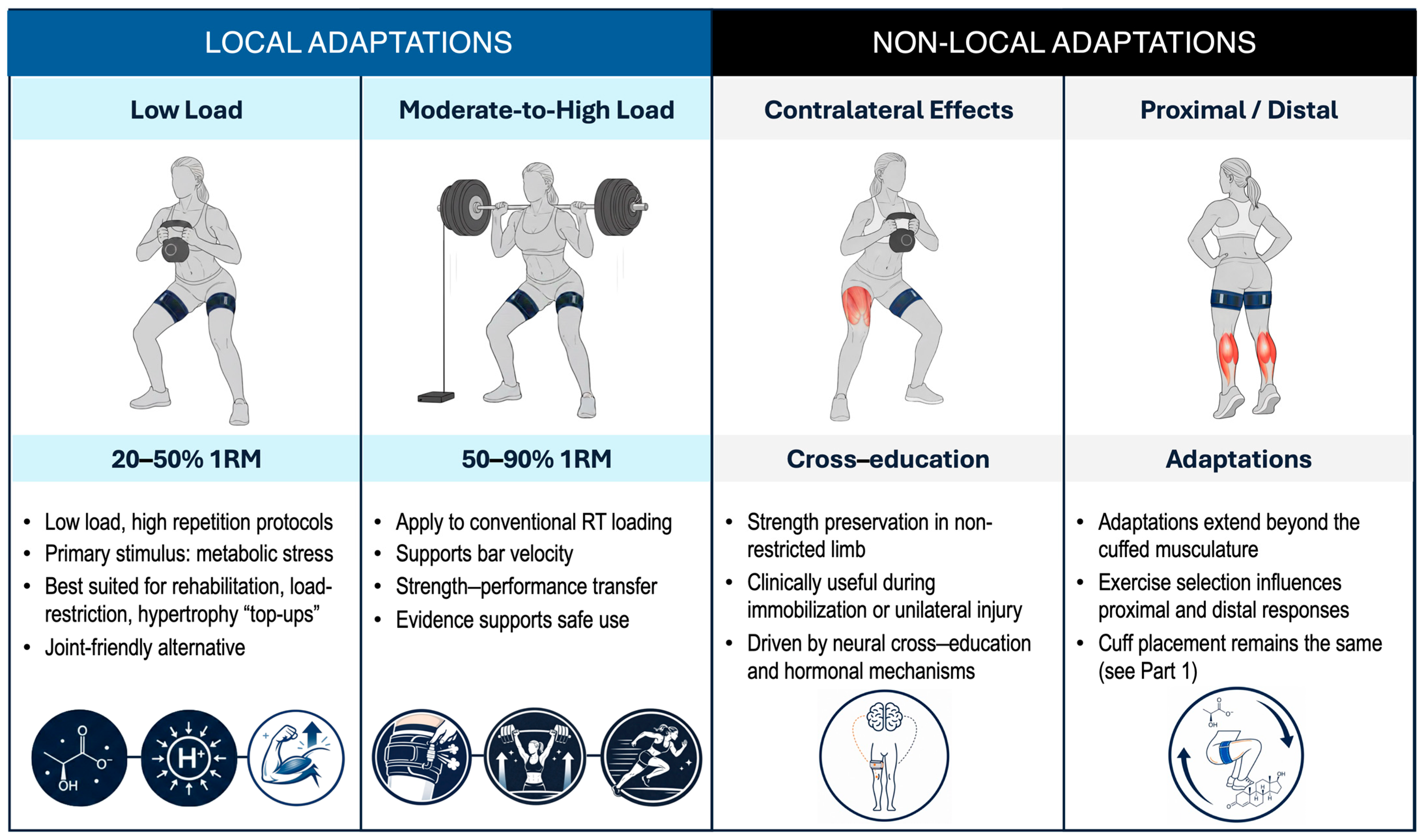
To contextualize the acute response and chronic adaptations discussed in this paper, BFR-RE can be broadly defined according to both the loading intensity and spatial distribution of training adaptations. Across the resistance exercise loading continuum [11], BFR may be applied during low-load resistance exercise, or during moderate-to-high load resistance exercise, using intermittent cuff application to support strength- and performance-related outcomes. In addition to local adaptations within the restricted limb, BFR-RE has also been shown to elicit non-local responses, including contralateral cross-education effects and proximal–distal adaptations extending beyond the cuff site. These local and non-local adaptations, presented in Figure 1, provide a framework for the subsequent sections of this review. This framework provides the structural basis for the present review, with subsequent sections synthesizing evidence according to loading condition and the spatial distribution of adaptations.
Figure 1.
Local and non-local adaptations to BFR exercise across loading conditions. Schematic representation showing direct muscular adaptations in restricted limbs during low-load (20–50% 1RM) and moderate-to-high load (>50% 1RM) BFR protocols; contralateral cross-education effects showing ipsilateral strength preservation during unilateral BFR training; and proximal–distal adaptations demonstrating systemic effects beyond the site of cuff restriction. Arrows indicate direction and magnitude of adaptive responses. RT, resistance training; 1RM, one-repetition maximum.
2. Methods
2.1. Search Strategy
A narrative review of research examining BFR resistance exercise in trained and athletic populations was conducted. A comprehensive literature search of PubMed/MEDLINE was performed using combinations of the following search terms: (“blood flow restriction” OR “BFR” OR “occlusion training” OR “KAATSU”) AND (“resistance training” OR “resistance exercise” OR “strength training”) AND (“athletes” OR “athletic” OR “trained” OR “elite” OR “sport”).
To capture literature examining non-local adaptations, additional searches included terms such as (“cross-education” OR “contralateral” OR “remote adaptation” OR “proximal” OR “distal”). The reference lists of the retrieved articles were also manually searched to identify additional relevant studies. As this review was designed as a narrative synthesis focused on applied resistance training, studies were selected based on their relevance to BFR-RE protocol design, adaptations, and practical application.
2.2. Study Selection
Studies were included if they met the following criteria:
- Low-load BFR-RE protocols (20–50% 1RM).
- Moderate-to-high load BFR-RE protocols (>50% 1RM).
- Study design: Randomized controlled trials, controlled trials, case studies, or within-subjects designs.
- Contralateral cross-education effects.
- Proximal–distal adaptations.
- Studies involving trained or athletic populations (individuals with ≥1 year of structured resistance training or competitive sport participation).
Exclusion criteria:
- Studies exclusively in untrained, clinical, or elderly populations.
- Studies without a clear BFR methodology.
- Studies not available in English.
While the primary focus of this review was research conducted in trained or athletic populations, additional studies examining non-local adaptations to BFR resistance exercise (e.g., contralateral, proximal, or distal effects) were considered where relevant mechanistic insights or training implications could be inferred for athletic populations.
A single reviewer (primary author) conducted the search and study selection, with consultation among all authors for ambiguous cases. We acknowledge that this selective approach may introduce bias toward positive findings and well-established research groups and may favor studies with positive or applied outcomes.
2.3. Data Extraction and Synthesis
For each included study, we extracted:
- Population characteristics (training status, sport, sample size);
- BFR-RE protocol details (cuff pressure, load, volume, frequency, duration);
- Outcome measures (hypertrophy, strength, power, performance);
Where reported in the original publications, effect sizes were extracted to assist in the interpretation of the magnitude of responses. Standardized effect sizes were not calculated independently due to inconsistent reporting across studies and the limited availability of original data. As this review was designed as a narrative synthesis, no formal quality assessment tool or pooled statistical analysis was applied. Findings were synthesized narratively and organized thematically by loading condition and adaptation type.
2.4. Coverage of Available Literature
While this review is narrative in design, our search strategy was comprehensive for the specific population of interest (trained individuals and competitive athletes). A scoping assessment of the literature revealed that studies of BFR-RE in athletic populations (as opposed to untrained or recreationally active individuals) are relatively limited in number compared to the broader BFR literature. Our search strategy, combined with manual reference list screening, captured the majority of studies meeting our inclusion criteria. Therefore, we provide practitioners with a comprehensive overview of the current evidence base in trained and athletic populations, organized by loading condition and adaptation type for practical application. While we did not employ formal systematic review methodology (PRISMA guidelines, multiple independent reviewers, quality assessment tools), the relatively focused nature of the literature in athletic populations meant that our narrative approach yielded thorough coverage of available evidence.
3. Low-Load BFR Resistance Exercise (20–50% 1RM)
Low-load BFR (LL-BFR) resistance exercise (20–50% 1RM) represents the most established and widely researched form of BFR training [12,13,14]. It has consistently been shown to produce muscle hypertrophy and strength improvements comparable to traditional high-load resistance exercise, despite substantially reduced mechanical stress. For athletes managing high training volumes, recovering from injury, or during in-season phases where heavy loading may compromise performance or recovery, this approach offers a viable and effective alternative. The evidence base spans diverse athletic populations, including team sport athletes (rugby, football, netball), individual sport athletes (track and field, weightlifting), and resistance-trained individuals, demonstrating broad applicability across training contexts (Table 1).
Table 1.
Low-load BFR Resistance Exercise Training Studies in Athletic Populations (≤50% 1RM).
Foundational studies have demonstrated that low-load BFR-RE can induce muscle hypertrophy and strength gains comparable to traditional heavy resistance training. For example, Takarada et al. [1] observed significant increases in bilateral knee extension torque (14.3%) and muscle cross-sectional area (12.3%) following 8 weeks of BFR-RE at 50% 1RM in elite rugby players, while Abe et al. [2] reported improvements in 1RM leg press (9.6%) and sprint performance in trained track and field athletes performing twice-daily sessions at 20% 1RM over just 8 days. Five weeks of low-load BFR-RE at 20% 1RM improved isometric strength (9.3–13.3%), endurance (87.7%), and muscle thigh cross-sectional area (6.6%) in female netball players [3]. Collectively, these studies support low-load BFR as a potent stimulus to promote hypertrophic adaptations, strength expression, and sport-specific performance while minimizing mechanical joint stress. Across these studies, hypertrophic responses (typically ~4–12% increases in muscle cross-sectional area) and strength gains (~6–15% improvements in 1RM) appear to be achieved using loads of 20–50% 1RM, relatively high repetition volumes, and short inter-set rest periods. Higher training frequencies and protocols incorporating sets to or near failure may further augment these adaptations.
Primary considerations around BFR-RE protocols include cuff inflation pressure (typically 50–80% AOP), total training volume (sets and repetitions), inter-set rest, and cuff inflation modality (i.e., continuous vs. intermittent). For low-load BFR-RE, the goal is to potentiate physiological responses rather than replicate the mechanical outcomes associated with traditional high-load strength training. Although no universal protocol exists for scaling BFR-RE parameters with incremental loads, it is plausible that optimal results arise from the cumulative effect of both mechanical stress (external resistance) and metabolic stress (occlusion-induced hypoxia). Accordingly, at low loads (20–40% 1RM), protocols should favor high repetitions, continuous pressure, and higher relative restriction pressures (≈70–80% AOP) to maximize the metabolic environment for muscle adaptation. As training loads increase (>50% 1RM), the emphasis may shift toward lower repetitions and intermittent restriction to sustain performance while limiting excessive fatigue. Collectively, these findings demonstrate that low-load BFR-RE consistently produces hypertrophic and strength adaptations across a range of athletic populations, with protocol variability primarily influencing the magnitude rather than the direction of response.
3.1. Manipulation of Acute Program Variables
3.1.1. Volume (Repetitions and Sets)
A common set and repetition scheme used in the literature involves a cumulative total of 75 repetitions across four sets of exercises, with 30 repetitions in the first set and 15 repetitions in each subsequent set (75-rep protocol) [12,19,20]. Another common scheme is 3–5 sets to concentric failure [1,21]; however, in applied settings, repetitions to absolute failure may not be necessary. In contrast, in KAATSU protocols, the first set typically targets 25 to 30 repetitions, followed by descending repetition counts according to accumulated fatigue, and the fourth set is optional [22]. Overall, the goal is to perform a repetition maximum to a point of local muscle failure while maintaining proficient technique. The associated lactate accumulation leads to transduction of growth factors that assist with the physiological changes observed with BFR-RE (as detailed in Part 1 of this article series) [23,24]. Subsequent sets should result in a decrease in repetitions, and this should be monitored and regulated in conjunction with control parameters and termination criteria. Furthermore, in applied strength and conditioning practice, athletes typically complete multiple exercises within a single session, in contrast to the majority of BFR-RE laboratory-based studies that examine only one or two exercises in isolation (see Table 1).
Consequently, a practical modification in applied settings would be to select a load that allows the athlete to complete 15 repetitions per set with good technique, as an alternative to rigid adherence to the canonical 75–rep protocol [13,14,25]. This approach provides sufficient metabolic stress to promote anabolic signaling and hypertrophic adaptations while potentially reducing the monotony and extended session duration by applying a fixed 75–repetition protocol to every exercise within a training session. Such considerations may influence athlete adherence and training consistency, though systematic investigation of psychological responses (e.g., enjoyment, motivation) to different BFR-RE protocols in athletic populations is limited and warrants future research. Direct comparisons between fixed-repetition (30-15-15-15) and failure-based protocols in athletic populations are currently lacking; therefore, practitioners should monitor individual responses when deviating from established protocols.
3.1.2. Inter-Set Rest
Inter-set rest periods utilized during low-load BFR-RE are typically short and involve maintaining a continuous cuff pressure restriction throughout the training sets [26]. Physiological responses are potentiated through the accumulation of metabolites and intracellular swelling under sustained vascular restriction [27,28]. Thus, rest periods of both 30 s [29,30] and 30–60 s [31,32] are common within the BFR-RE literature. Although both continuous and intermittent pressure during rest periods have demonstrated positive effects, continuous pressure is recommended in low-load BFR-RE (as tolerated) to maximize the metabolic and cell-swelling stress for adaptation [26].
3.1.3. Frequency
Traditional (non-BFR) resistance training is often prescribed two to three sessions per week; however, low-load BFR-RE can be performed more frequently without impairing performance. High-frequency training (e.g., 4–5 sessions per week) has been shown to accelerate hypertrophy and strength development [1,33,34]. Similarly, short-term (2 weeks) twice-daily BFR-RE has produced significant increases in muscle strength and hypertrophy [2,13,35], which may be advantageous during periods of intensive conditioning or rehabilitation [36]. Table 2 presents clear guidelines for low-load BFR-RE prescription. These reflect a consistent evidence-based approach and practical reference for the manipulation of the acute program variables within athletic programs. The following guidelines represent a synthesis of the available evidence alongside established BFR practice and should be interpreted as applied recommendations rather than prescriptive protocols.
Table 2.
Guidelines for Low-Load BFR-RE: Acute Program Variables.
4. Moderate to High Load BFR Resistance Exercise (> 50% 1RM)
While the majority of BFR-RE research has focused on low-load training protocols (20–40% 1RM), an emerging body of literature has investigated the acute and longitudinal effects of applying BFR during moderate to high-load resistance exercise (>50% 1RM) (Table 3). Most acute BFR-RE studies utilizing moderate to high loads have focused on barbell velocity as the primary outcome, reflecting its strong relationship with power output and neuromuscular performance. The findings reveal a complex, load-dependent relationship between BFR applications, cuff width, and cuff inflation mode (i.e., continuous vs. intermittent).
Table 3.
Moderate- to High-load BFR Resistance Exercise Training Studies in Athletic Populations (>50% 1RM).
4.1. Barbell Velocity
Several investigations have demonstrated that the addition of BFR can maintain or even enhance barbell velocity under specific conditions. Wilk et al. [5] examined squat performance across multiple loads (40–90% 1RM) using both intermittent and continuous BFR-RE protocols. Although there were no statistical differences between BFR-RE protocols, small to moderate effects were noted in favor of wearing BFR cuffs. Notably, at 90% 1RM, intermittent BFR produced a moderate velocity improvement (ES: 0.67) compared to no-BFR conditions, suggesting that properly timed cuff restriction-reperfusion cycles may improve barbell velocity at maximal loads
4.2. Intermittent and Continuous Cuff Inflation
In a similar study design investigating upper body responses, bench press velocities were compared using an intermittent (I-BFR) and continuous (C-BFR) cuff inflation. There was a significant effect for peak barbell velocity for both the C-BFR and I-BFR conditions when compared to the control (no-BFR) [4]. Despite barbell velocities at 50%, 60%, 80%, and 90% 1RM for both BFR conditions being faster than the no-BFR condition, only the 50% 1RM load reached significance. The practical application aligns with the broader velocity-based training literature, demonstrating that training with maximal intended velocity produces superior adaptations in strength, power, and speed compared to slower movements [40]. For practitioners, providing velocity-based feedback may help maintain movement quality and neural drive during BFR-RE; however, this application has not been empirically tested.
4.3. Fatigue and Recovery Considerations
A concern when performing high-load BFR-RE using maximal repetitions is the potential for excessive fatigue accumulation. Studies examining muscle fatigue during high-intensity BFR-RE have reported increased ratings of perceived exertion and greater metabolite accumulation (i.e., lactate, hydrogen ions) [6,7]. Despite these findings, there were no post-exercise performance decrements as a result of the fatiguing stimulus when compared to the control (no-BFR) condition. Therefore, intermittent BFR cuff inflation is recommended to mitigate fatigue-related impairments compared to continuous cuff restriction, likely due to improved metabolite clearance and oxygen resupply during rest periods [6]. This has important practical implications for programming BFR-RE with high loads, suggesting that intermittent protocols may offer a better balance between metabolic stress and performance preservation. Importantly, differences in reported fatigue and performance outcomes across studies are likely explained by variations in protocol design. Higher-volume or AMRAP-based protocols tend to induce greater metabolic stress, perceptual fatigue, and discomfort, whereas lower-volume, strength-oriented protocols appear to maintain performance without excessive fatigue accumulation. Therefore, these findings should not be viewed as contradictory, but rather as reflective of the interaction between BFR application and program design.
4.4. Program Variable Guidelines
Table 4 presents guidelines for moderate-to-high load BFR-RE prescription. These recommendations are consistent with manipulation of established acute program variables and strength-training principles, while incorporating BFR-specific considerations. These studies suggest that moderate-to-high-load BFR-RE does not impair performance and may enhance velocity and power under specific loading and cuff-application conditions, although responses appear load- and protocol-dependent. The following guidelines represent a synthesis of the available evidence alongside established BFR practice and should be interpreted as applied recommendations rather than prescriptive protocols.
Table 4.
Guidelines for Moderate-to-High BFR-RE: Acute Program Variables.
5. Non-Local Adaptations to BFR-RE
The preceding sections have focused on direct adaptations within the limb exposed to BFR. However, BFR can influence musculature beyond the cuff site, offering expanded applicability in situations where unilateral injury, immobilization, or loading restrictions impose constraints. Two key phenomena, contralateral/cross-transfer effects and proximal/distal adaptations, demonstrate that BFR can facilitate improvements in muscle size and strength adaptation in regions not directly placed under restriction.
5.1. Contralateral and Cross-Transfer Effects
The application of BFR to unilateral training has been investigated through two distinct paradigms: direct contralateral effects and cross-transfer effects. The concept of contralateral strength training describes the phenomenon where training one limb improves strength in the contralateral homologous muscle group [41]. This has been well studied with respect to conventional (non-BFR) resistance training, with meta-analytic data indicating that performing unilateral resistance training at intensities ≥ 50% 1RM for at least 2 weeks results in moderate contralateral strength gains (~7.8%, ES~0.5–0.6) in healthy young adults [41]. This cross-education effect appears independent of contraction mode (i.e., isometric vs. dynamic) and applies to both upper- and lower-limb musculature [41].
Within BFR research, two related phenomena have been described. Direct contralateral effects refer to adaptations in the contralateral homologous limb when BFR is applied during unilateral training. In contrast, cross-transfer effects describe adaptations that occur when BFR is applied to one body region (e.g., lower body) and enhances training responses in a different body region (e.g., upper body) that is also being trained [33].
5.1.1. Evidence for Contralateral Effects
Low-load BFR-RE training has demonstrated contralateral effects for strength-related outcomes, in both the upper [42,43] and lower [43,44] body when compared to low-load training alone. For the upper body, recreational-level athletes completed 6 weeks of bilateral shoulder and elbow exercises with BFR applied to one limb, while a control group performed the same program without BFR [42]. Despite significant improvements in the BFR restricted limb, the only significant contralateral effect was observed in grip strength, with the non-BFR limb demonstrating a 6 ± 2% increase compared to a 3 ± 3% decrease in controls (p < 0.01) [42]. No significant contralateral changes were observed in shoulder strength measures despite small numerical increases.
Using a similar unilateral training design, 6 weeks of lower-body resistance exercise resulted in significant improvements in lower-body strength and circumference in the BFR limb. Contralateral effects were observed for thigh circumference (2.3 ± 1.6% vs. 0.8 ± 2.0% in controls, p = 0.01), knee extension peak torque (8 ± 9% vs. 3 ± 9%, p = 0.04), and single-leg heel raises (16 ± 18% vs. 4 ± 18%, p = 0.02) [44]. However, substantial inter-individual variability was reported, with standard deviations often approaching or exceeding mean changes, indicating inconsistent responses across participants.
5.1.2. Evidence for Cross-Transfer Effects
Cross-transfer effects represent a distinct phenomenon where BFR applied to one body region during exercise enhances training adaptations in a different body region that is also being trained [33,43,45]. To illustrate this, Madarame et al. used a design in which participants performed unilateral arm curls (3 × 10 repetitions at 50% 1RM) while the opposite arm remained untrained, followed by lower-body resistance exercise (knee extension and flexion; 30/15/15 repetitions at 30% 1RM) with or without BFR applied to the legs [33].
After 10 weeks of training, significant increases in muscle size and isometric strength were observed only when arm training was combined with BFR leg exercise, whereas the untrained contralateral arm showed no significant changes. In the non-BFR condition, arm training improved 1RM strength, but did not produce significant hypertrophy or isometric strength gain. The untrained contralateral arm showed no significant changes in either group, indicating that the effect was not a direct contralateral transfer but rather a cross-transfer enhancement of the trained limb’s response [33].
This cross-transfer effect has been hypothesized to arise from a combination of systemic hormonal and metabolic responses induced by BFR. Madarame et al. reported significantly elevated post-exercise noradrenaline levels in the BFR group compared to controls (p < 0.05), while growth hormone showed a trend toward elevation that did not reach statistical significance (p = 0.12) [33]. These findings suggest that systemic factors may augment training responses in muscles that are being actively trained, even when BFR is applied to a different body region. However, the lack of adaptation in the untrained contralateral arm highlights that local mechanical loading remains important for meaningful strength and hypertrophy adaptations, even in the presence of elevated systemic anabolic factors [33]. The relative contribution of neural versus hormonal mechanisms remains unclear, and the inconsistent findings across muscle groups suggest that these effects may be influenced by factors such as muscle size, training status, and proximity to the site of BFR application.
5.1.3. Practical Implications
Despite the limited and inconsistent evidence for direct contralateral effects, the application of BFR to the contralateral limb or to a different body region may have practical utility in specific clinical contexts. In operative and non-operative orthopedic conditions where direct training of an injured limb is contraindicated or not tolerated, contralateral or cross-transfer BFR training may provide a modest protective effect against strength loss and muscle atrophy. The cross-transfer approach, where BFR is applied to an uninjured body region during exercise while also performing low-intensity exercise of the injured limb (when appropriate), may be particularly promising given the evidence that systemic factors can enhance training responses in muscles receiving direct mechanical stimulus.
Practical implementation of contralateral or cross-transfer BFR training requires careful consideration of injury status, loading tolerance, and the rehabilitation stage. Clinicians should recognize that these approaches are unlikely to fully prevent detraining and should be viewed as adjunctive strategies rather than replacements for direct training when feasible. Table 5 provides scenario-specific guidelines for applying BFR to maximize potential cross-education and cross-transfer effects while respecting injury-related constraints. The following guidelines are based on a synthesis of the available evidence and the applied experience of the authors and should be interpreted as expert-informed recommendations rather than prescriptive protocols.
Table 5.
Practical Guidelines for Implementing Contralateral BFR Training.
5.2. Proximal and Distal Effects
It has been originally speculated that the direct muscular effect from the BFR stimulus is distal to the location of the pressure cuff and that the muscles that are proximal or not placed under direct restriction may not see any benefit from the application of BFR [46]. However, BFR-RE for both upper and lower body has reported increases in muscle size and recruitment located both proximal and distal to the placement of the cuff, although methodological heterogeneity across studies (e.g., cuff width, inflation pressure, training intervention) affects direct comparison and may contribute to variability in reported outcomes.
In upper body resistance exercise training, several studies have reported significant increases in triceps brachii (4.9–8%) and pectoralis major (8.3–16%) muscle hypertrophy following low-load (30% 1RM) BFR bench press performed under two distinct protocols: a short-term high-frequency protocol (twice daily, 6 days·week−1 for two weeks) and a moderate-frequency protocol (3 sessions·week−1 for six weeks) [12,47,48]. For example, the addition of BFR to low-load bench press (30% 1RM; 75-repetitions) using a short-term high-frequency protocol resulted in the pectoralis major and triceps brachii muscle thickness increased 16% and 8% (p < 0.01) respectively, but not in the control condition (2% and −1% respectively) [12]. Similarly, 3 weeks of low-load bench press using a moderate-frequency protocol reported an increase in pectoralis major and triceps brachii muscle thickness (8.3% and 4.9%, p < 0.01) [48].
In lower-body BFR-RE squat training (20% 1RM, twice daily, 6 days·week−1 for two weeks), the gluteus maximus (which acts synergistically during the squat exercise) significantly increased in muscle size (9.1%) concomitantly with increases in the quadriceps (7.7%) and biceps femoris (10.1%) muscle groups [14]. Performing 14 weeks of low load BFR-RE calf raises (seated and standing; 20–35% 1RM; 30-15-15-15; 3 days·week−1) with the BFR cuffs placed on the thigh, resulted in significant increases in gastrocnemius medialis muscle cross-sectional area (9.1%), plantar flexor strength (9.8%) as well as significant increases in Achilles tendon stiffness (36.1%) and tendon cross-sectional area (7.8%) [49]. The observed changes were comparable with a high load training group (70–85% 1RM; 3 × 6–12; 7.7%, 13.5%, 40.7%, 4.6% respectively). Aside from the distal effect on muscle hypertrophy and strength, the additional findings from this study provide evidence that low-load BFR-RE may increase tendon mechanical and morphological properties to a similar extent as conventional high-load RE. This may be of particular importance for individuals who may not tolerate high-load training but still require improvements in myotendinous function. Based on these findings, BFR-RE may represent a potential alternative for treating tendinopathies in individuals unable to tolerate high-load isometric and eccentric resistance exercise [50,51,52]; however, its application in tendinopathy management is based on mechanistic rationale rather than direct evidence.
These findings illustrate that BFR-RE can increase muscle size and strength of various muscle groups, both proximal and distal to the cuff placement. These changes are not strictly limited to the limbs and the muscle groups that are directly distal to the cuff placement, but rather are reflective of the muscles that are activated through exercise. Therefore, exercise selection should consider the muscle groups that need to be targeted. Additionally, these studies have also highlighted that these muscle groups may require additional repetitions or progressive loadings to elicit significant changes that are comparable to higher loading parameters.
The mechanisms underlying these divergent patterns of proximal versus distal adaptations to BFR are not well understood. Proposed explanations include systemic hormonal responses, local metabolic stress, and mechanical loading effects, but these mechanisms have not been directly tested in the context of these studies. It has been proposed that in multi-joint tasks, distal fatigue may increase the force demand on more proximal muscles, potentially increasing mechanical tension and motor unit recruitment across the kinetic chain; alternatively, local paracrine signaling from the BFR application may contribute to adaptations in nearby tissues [12,47,48]. However, these ideas remain speculative and require direct measurement during BFR resistance exercise.
6. Practical Recommendations
For coaches and practitioners implementing BFR-RE, it is recommended to begin with well-established low-load protocols before progressing to more advanced applications. Wherever possible, cuff pressures should be individualized using objective measurement, and BFR-RE should be integrated strategically within periodized training programs to complement, rather than replace, traditional resistance training. Rigorous safety screening and contraindication assessment should be applied, as outlined in Part 1, alongside ongoing monitoring of individual responses to allow protocols to be adjusted as required, with athletes appropriately educated regarding the expected sensations and perceptual demands associated with BFR-RE. Importantly, BFR-RE should be viewed as a complementary training tool that expands programming options, providing coaches and practitioners with flexibility to maintain training-induced adaptations during periods when conventional high-load training is limited, contraindicated, or strategically reduced.
7. Conclusions
BFR-RE represents a validated training modality for coaches and practitioners working with athletic populations across the full loading spectrum. Evidence from several controlled studies indicates that low-load BFR-RE (20–50% 1RM) can elicit hypertrophy and strength adaptations approaching those observed with traditional high-load methods while reducing overall mechanical stress. These characteristics make low-load BFR-RE particularly suited to rehabilitation, in-season maintenance, congested competition periods, and situations in which joint loading must be constrained. Moreover, low-load BFR-RE offers additional utility when integrated as supplementary hypertrophic volume following traditional strength sessions or during deloads and high-frequency training blocks. For moderate-to-high loads (>50% 1RM), evidence supports BFR use with strength and power objectives. When strategically implemented, the addition of BFR can preserve or improve barbell velocity and facilitate neuromuscular qualities relevant to velocity-based training. Although the evidence base is emerging, such findings indicate that BFR-RE can complement, rather than replace, conventional strength programming in advanced athletes.
The inclusion of contralateral cross-education effects and proximal–distal adaptations expands the physiological outcomes of BFR-RE in circumstances involving unilateral injury, immobilization, or restricted limb loading. Contralateral training effects demonstrate ipsilateral strength preservation or enhancement during unilateral BFR-RE compared to controls. While these effects are smaller than direct training, they offer practical utility during injury rehabilitation when direct training of the affected limb is contraindicated. Likewise, proximal–distal adaptations confirm that hypertrophic and tendon-related responses are driven by recruitment demands rather than distal cuff placement alone, permitting targeted intervention in musculature that may not directly lie beneath the cuff.
Despite these advantages, several implementation considerations remain. Appropriate screening, accurate determination of individualized arterial occlusion pressure, informed cuff selection, progressive familiarization, and active monitoring of perceptual responses are required to ensure safety and efficacy. Furthermore, long-term effects and performance transfer to sport-specific outcomes remain understudied. BFR-RE should be positioned as a complement to established loading strategies, acknowledging that maximal-strength development in athletic populations still requires exposure to traditional high-load training where it is tolerated. Collectively, BFR-RE across the loading spectrum provides coaches and practitioners with an adaptable training tool that promotes morphological and neuromuscular adaptations under conditions where conventional loading is not feasible or must be modified. The strategic use of BFR-RE, guided by individual constraints, performance objectives, and phase-specific demands, will enable practitioners to apply this method confidently within athletic populations.
Author Contributions
Conceptualization, C.G., C.J.C. and S.P.B.; data collection, C.G.; formal analysis, C.G.; project administration, C.G.; writing—original draft preparation, C.G.; writing—review and editing, C.G., C.J.C. and S.P.B.; visualization, C.G., C.J.C. and S.P.B. All authors have read and agreed to the published version of the manuscript.
Funding
This research received no external funding.
Data Availability Statement
As this is a narrative review, no new data were generated. All data discussed are available in the cited original publications.
Conflicts of Interest
The authors declare no conflicts of interest.
Abbreviations
The following abbreviations are used in this manuscript:
| AOP | arterial occlusion pressure |
| BFR | blood flow restriction |
| CON | control |
| C-BFR | continuous blood flow restriction |
| ES | effect size |
| HT | hypoxic training |
| HL | high load |
| TRT | traditional resistance training |
| HL+S | high load and supplemental program |
| I-BFR | intermittent blood flow restriction |
| LB | lower body |
| LL | low load |
| LL-BFR | low-load blood flow restriction |
| MTH | muscle thigh thickness |
| mmHg | millimeters of mercury |
| PV | peak (barbell) velocity |
| rep/reps | repetition/repetitions |
| RM | repetition maximum |
| RST | repeat sprint test |
| SJ | squat jump |
| UB | upper body |
| VBT | velocity-based training |
| wk | week |
| 1RM | one-repetition maximum |
| [La−]b | blood lactate |
References
- Takarada, Y.; Sato, Y.; Ishii, N. Effects of resistance exercise combined with vascular occlusion on muscle function in athletes. Eur. J. Appl. Physiol. 2002, 86, 308–314. [Google Scholar] [CrossRef] [Scilit]
- Abe, T.; Kawamoto, K.; Yasuda, T.; Kearns, C.F.; Midorikawa, T.; Sato, Y. Eight days KAATSU-resistance training improved sprint but not jump performance in collegiate male track and field athletes. Int. J. KAATSU Train. Res. 2005, 1, 19–23. [Google Scholar] [CrossRef] [Scilit]
- Manimmanakorn, A.; Manimmanakorn, N.; Taylor, R.; Draper, N.; Billaut, F.; Shearman, J.P.; Hamlin, M.J. Effects of resistance training combined with vascular occlusion or hypoxia on neuromuscular function in athletes. Eur. J. Appl. Physiol. 2013, 113, 1767–1774. [Google Scholar] [CrossRef] [Scilit] [PubMed]
- Wilk, M.; Gepfert, M.; Krzysztofik, M.; Stastny, P.; Zajac, A.; Bogdanis, G.C. Acute effects of continuous and intermittent blood flow restriction on movement velocity during bench press exercise against different loads. Front. Physiol. 2020, 11, 569915. [Google Scholar] [CrossRef] [Scilit] [PubMed]
- Wilk, M.; Trybulski, R.; Krzysztofik, M.; Wojdala, G.; Campos, Y.; Zajac, A.; Lulińska, E.; Stastny, P. Acute effects of different blood flow restriction protocols on bar velocity during the squat exercise. Front. Physiol. 2021, 12, 652896. [Google Scholar] [CrossRef] [Scilit]
- Hornikel, B.; Saffold, K.S.; Esco, M.R.; Mota, J.A.; Fedewa, M.V.; Wind, S.A.; Adams, T.L.; Winchester, L.J. Acute responses to high-intensity back squats with bilateral blood flow restriction. Int. J. Environ. Res. Public Health 2023, 20, 3555. [Google Scholar] [CrossRef] [Scilit]
- Neto, G.R.; Santos, H.H.; Sousa, J.B.; Júnior, A.T.; Araújo, J.P.; Aniceto, R.R.; Sousa, M.S. Effects of high-intensity blood flow restriction exercise on muscle fatigue. J. Hum. Kinet. 2014, 41, 163–172. [Google Scholar] [CrossRef] [Scilit]
- Su, C.; Zhang, Z.; Liang, B.; Zhou, S.; Long, X. Effects of blood flow restriction combined with high-load training on muscle strength and sports performance in athletes: A systematic review and meta-analysis. Front. Physiol. 2025, 16, 1603568. [Google Scholar] [CrossRef] [Scilit]
- de Freitas, M.C.; Gerosa-Neto, J.; Zanchi, N.E.; Lira, F.S.; Rossi, F.E. Role of metabolic stress for enhancing muscle adaptations: Practical applications. World J. Methodol. 2017, 7, 46–54. [Google Scholar] [CrossRef] [Scilit]
- Cerqueira, M.S.; Maciel, D.G.; Barboza, J.A.M.; Centner, C.; Lira, M.; Pereira, R.; De Brito Vieira, W.H. Low-load blood-flow restriction exercise to failure and nonfailure and myoelectric activity: A meta-analysis. J. Athl. Train. 2022, 57, 402–417. [Google Scholar] [CrossRef] [Scilit]
- Bird, S.P.; Tarpenning, K.M.; Marino, F.E. Designing resistance training programmes to enhance muscular fitness: A review of the acute programme variables. Sports Med. 2005, 35, 841–851. [Google Scholar] [CrossRef] [Scilit]
- Yasuda, T.; Fujita, S.; Ogasawara, R.; Sato, Y.; Abe, T. Effects of low-intensity bench press training with restricted arm muscle blood flow on chest muscle hypertrophy: A pilot study. Clin. Physiol. Funct. Imaging 2010, 30, 338–343. [Google Scholar] [CrossRef] [Scilit]
- Yasuda, T.; Abe, T.; Sato, Y.; Midorikawa, T.; Kearns, C.F.; Inoue, K.; Ryushi, T.; Ishii, N. Muscle fiber cross-sectional area is increased after two weeks of twice daily KAATSU-resistance training. Int. J. KAATSU Train. Res. 2005, 1, 65–70. [Google Scholar] [CrossRef] [Scilit]
- Abe, T.; Yasuda, T.; Midorikawa, T.; Sato, Y.; Kearns, C.F.; Inoue, K.; Koizumi, K.; Ishii, N. Skeletal muscle size and circulating IGF-1 are increased after two weeks of twice daily “KAATSU” resistance training. Int. J. KAATSU Train. Res. 2005, 1, 6–12. [Google Scholar] [CrossRef] [Scilit]
- Yamanaka, T.; Farley, R.S.; Caputo, J.L. Occlusion training increases muscular strength in division IA football players. J. Strength Cond. Res. 2012, 26, 2523–2529. [Google Scholar] [CrossRef] [Scilit] [PubMed]
- Luebbers, P.E.; Fry, A.C.; Kriley, L.M.; Butler, M.S. Effects of practical blood flow restriction training on adolescent lower-body strength. J. Strength Cond. Res. 2019, 33, 2674–2683. [Google Scholar] [CrossRef] [Scilit] [PubMed]
- Luebbers, P.E.; Fry, A.C.; Kriley, L.M.; Butler, M.S. The effects of a 7-week practical blood flow restriction program on well-trained collegiate athletes. J. Strength Cond. Res. 2014, 28, 2270–2280. [Google Scholar] [CrossRef] [Scilit] [PubMed]
- Bjørnsen, T.; Wernbom, M.; Kirketeig, A.; Paulsen, G.; Samnøy, L.; Bækken, L.; Cameron-Smith, D.; Berntsen, S.; Raastad, T. Type 1 muscle fiber hypertrophy after blood flow-restricted training in powerlifters. Med. Sci. Sports Exerc. 2019, 51, 288–298. [Google Scholar] [CrossRef] [Scilit]
- Yasuda, T.; Fujita, T.; Miyagi, Y.; Kubota, Y.; Sato, Y.; Nakajima, T.; Bemben, M.G.; Abe, T. Electromyographic responses of arm and chest muscle during bench press exercise with and without KAATSU. Int. J. KAATSU Training Res. 2006, 2, 15–18. [Google Scholar] [CrossRef] [Scilit]
- May, A.K.; Brandner, C.R.; Warmington, S.A. Hemodynamic responses are reduced with aerobic compared with resistance blood flow restriction exercise. Physiol. Rep. 2017, 5, e13142. [Google Scholar] [CrossRef] [Scilit]
- Loenneke, J.P.; Wilson, J.M.; Marín, P.J.; Zourdos, M.C.; Bemben, M.G. Low intensity blood flow restriction training: A meta-analysis. Eur. J. Appl. Physiol. 2012, 112, 1849–1859. [Google Scholar] [CrossRef] [Scilit]
- Heiduk, R. KAATSU—The Pressure Training from Japan: New Perspectives in Sport, Therapy and Health Promotion; Eisenklinik: Bochum, Germany, 2019. [Google Scholar]
- Philp, A.; Macdonald, A.L.; Watt, P.W. Lactate—A signal coordinating cell and systemic function. J. Exp. Biol. 2005, 208, 4561–4575. [Google Scholar] [CrossRef] [Scilit]
- Brooks, G.A. Lactate shuttles in nature. Biochem. Soc. Trans. 2002, 30, 258–264. [Google Scholar] [CrossRef]
- Macedo, A.G.; Massini, D.A.; Almeida, T.A.F.; Santos, A.T.S.; Galdino, G.; de Oliveira, D.M.; Pessôa Filho, D.M. Perceptual and metabolic responses during resistance training sessions: Comparing low-load plus blood flow restriction with high-load plans. Sports 2025, 13, 148. [Google Scholar] [CrossRef] [Scilit]
- Patterson, S.D.; Hughes, L.; Warmington, S.; Burr, J.; Scott, B.R.; Owens, J.; Abe, T.; Nielsen, J.L.; Libardi, C.A.; Laurentino, G.; et al. Blood flow restriction exercise position stand: Considerations of methodology, application, and safety. Front. Physiol. 2019, 10, 533. [Google Scholar]
- Loenneke, J.P.; Wilson, G.J.; Wilson, J.M. A mechanistic approach to blood flow occlusion. Int. J. Sports Med. 2010, 31, 1–4. [Google Scholar] [CrossRef] [Scilit]
- Scott, B.R.; Loenneke, J.P.; Slattery, K.M.; Dascombe, B.J. Exercise with blood flow restriction: An updated evidence-based approach for enhanced muscular development. Sports Med. 2015, 45, 313–325. [Google Scholar] [CrossRef] [Scilit] [PubMed]
- Loenneke, J.P.; Balapur, A.; Thrower, A.D.; Barnes, J.T.; Pujol, T.J. The perceptual responses to occluded exercise. Int. J. Sports Med. 2011, 32, 181–184. [Google Scholar] [CrossRef] [Scilit]
- Yasuda, T.; Abe, T.; Brechue, W.F.; Iida, H.; Takano, H.; Meguro, K.; Kurano, M.; Fujita, S.; Nakajima, T. Venous blood gas and metabolite response to low-intensity muscle contractions with external limb compression. Metabolism 2010, 59, 1510–1519. [Google Scholar] [CrossRef] [Scilit]
- Yasuda, T.; Fukumura, K.; Uchida, Y.; Koshi, H.; Iida, H.; Masamune, K.; Yamasoba, T.; Sato, Y.; Nakajima, T. Effects of low-load, elastic band resistance training combined with blood flow restriction on muscle size and arterial stiffness in older adults. J. Gerontol. A Biol. Sci. Med. Sci. 2015, 70, 950–958. [Google Scholar] [CrossRef] [Scilit] [PubMed]
- Ladlow, P.; Coppack, R.J.; Dharm-Datta, S.; Conway, D.; Sellon, E.; Patterson, S.D.; Bennett, A.N. Low-load resistance training with blood flow restriction improves clinical outcomes in musculoskeletal rehabilitation: A single-blind randomized controlled trial. Front. Physiol. 2018, 9, 1269. [Google Scholar] [CrossRef] [Scilit]
- Madarame, H.; Neya, M.; Ochi, E.; Nakazato, K.; Sato, Y.; Ishii, N. Cross-transfer effects of resistance training with blood flow restriction. Med. Sci. Sports Exerc. 2008, 40, 258–263. [Google Scholar] [CrossRef] [Scilit]
- Kubo, K.; Komuro, T.; Ishiguro, N.; Tsunoda, N.; Sato, Y.; Ishii, N.; Kanehisa, H.; Fukunaga, T. Effects of low-load resistance training with vascular occlusion on the mechanical properties of muscle and tendon. J. Appl. Biomech. 2006, 22, 112–119. [Google Scholar] [CrossRef] [Scilit]
- Nielsen, J.L.; Aagaard, P.; Bech, R.D.; Nygaard, T.; Hvid, L.G.; Wernbom, M.; Suetta, C.; Frandsen, U. Proliferation of myogenic stem cells in human skeletal muscle in response to low-load resistance training with blood flow restriction. J. Physiol. 2012, 590, 4351–4361. [Google Scholar] [CrossRef] [Scilit]
- Gaviglio, C.; Bird, S.P. Accelerating an Olympic Decathlete’s Return to Competition Using High-Frequency Blood Flow Restriction Training: A Case Report. Sports 2025, 13, 436. [Google Scholar] [CrossRef] [Scilit]
- Wilk, M.; Krzysztofik, M.; Filip, A.; Zajac, A.; Bogdanis, G.C.; Lockie, R.G. Short-term blood flow restriction increases power output and bar velocity during the bench press. J. Strength Cond. Res. 2022, 36, 2082–2088. [Google Scholar] [CrossRef] [Scilit] [PubMed]
- Wang, J.; Fu, H.; Zhang, Q.; Zhang, M.; Fan, Y. Effect of leg half-squat training with blood flow restriction under different external loads on strength and vertical jumping performance in well-trained volleyball players. Dose-Response 2022, 20, 15593258221123672. [Google Scholar] [CrossRef] [Scilit] [PubMed]
- Cook, C.J.; Kilduff, L.P.; Beaven, C.M. Improving strength and power in trained athletes with 3 weeks of occlusion training. Int. J. Sports Physiol. Perform. 2014, 9, 166–172. [Google Scholar] [CrossRef] [Scilit]
- Włodarczyk, M.; Adamus, P.; Zieliński, J.; Kantanista, A. Effects of Velocity-Based Training on Strength and Power in Elite Athletes—A Systematic Review. Int. J. Environ. Res. Public Health 2021, 18, 5257. [Google Scholar] [CrossRef] [Scilit] [PubMed]
- Munn, J.; Herbert, R.D.; Gandevia, S.C. Contralateral effects of unilateral resistance training: A meta-analysis. J. Appl. Physiol. 2004, 96, 1861–1866. [Google Scholar] [CrossRef] [Scilit]
- Bowman, E.N.; Elshaar, R.; Milligan, H.; Jue, G.; Mohr, K.; Brown, P.; Watanabe, D.M.; Limpisvasti, O. Upper-extremity blood flow restriction: The proximal, distal, and contralateral effects—A randomized controlled trial. J. Shoulder Elb. Surg. 2020, 29, 1267–1274. [Google Scholar] [CrossRef] [Scilit]
- Bowman, E.N.; Elshaar, R.; Mohr, K.; Watanabe, D.; Jue, G.; Milligan, H.; Brown, P.; Limpisvasti, O. The Effects of Blood Flow Restriction Training on Upper and Lower Extremity Strengthening. Arthroscopy 2019, 35, e31. [Google Scholar] [CrossRef] [Scilit]
- Bowman, E.N.; Elshaar, R.; Milligan, H.; Jue, G.; Mohr, K.; Brown, P.; Watanabe, D.M.; Limpisvasti, O. Proximal, Distal, and Contralateral Effects of Blood Flow Restriction Training on the Lower Extremities: A Randomized Controlled Trial. Sports Health 2019, 11, 149–156. [Google Scholar] [CrossRef] [Scilit] [PubMed]
- May, A.K.; Russell, A.P.; Warmington, S.A. Lower body blood flow restriction training may induce remote muscle strength adaptations in an active unrestricted arm. Eur. J. Appl. Physiol. 2018, 118, 617–627. [Google Scholar] [CrossRef] [Scilit] [PubMed]
- Dankel, S.J.; Jessee, M.B.; Abe, T.; Loenneke, J.P. The Effects of Blood Flow Restriction on Upper-Body Musculature Located Distal and Proximal to Applied Pressure. Sports Med. 2016, 46, 23–33. [Google Scholar] [CrossRef] [Scilit]
- Yasuda, T.; Ogasawara, R.; Sakamaki, M.; Ozaki, H.; Sato, Y.; Abe, T. Combined effects of low-intensity blood flow restriction training and high-intensity resistance training on muscle strength and size. Eur. J. Appl. Physiol. 2011, 111, 2525–2533. [Google Scholar] [CrossRef] [Scilit]
- Yasuda, T.; Ogasawara, R.; Sakamaki, M.; Bemben, M.G.; Abe, T. Relationship between limb and trunk muscle hypertrophy following high-intensity resistance training and blood flow-restricted low-intensity resistance training. Clin. Physiol. Funct. Imaging 2011, 31, 347–351. [Google Scholar] [CrossRef] [Scilit]
- Centner, C.; Lauber, B.; Seynnes, O.R.; Jerger, S.; Sohnius, T.; Gollhofer, A.; König, D. Low-load blood flow restriction training induces similar morphological and mechanical Achilles tendon adaptations compared with high-load resistance training. J. Appl. Physiol. 2019, 127, 1660–1667. [Google Scholar] [CrossRef] [Scilit]
- Everhart, J.S.; Cole, D.; Sojka, J.H.; Higgins, J.D.; Magnussen, R.A.; Schmitt, L.C.; Flanigan, D.C. Treatment Options for Patellar Tendinopathy: A Systematic Review. Arthroscopy 2017, 33, 861–872. [Google Scholar] [CrossRef] [Scilit] [PubMed]
- van Ark, M.; Cook, J.L.; Docking, S.I.; Zwerver, J.; Gaida, J.E.; van den Akker-Scheek, I.; Rio, E. Do isometric and isotonic exercise programs reduce pain in athletes with patellar tendinopathy in-season? A randomised clinical trial. J. Sci. Med. Sport 2016, 19, 702–706. [Google Scholar] [CrossRef] [Scilit]
- Lim, H.Y.; Wong, S.H. Effects of isometric, eccentric, or heavy slow resistance exercises on pain and function in individuals with patellar tendinopathy: A systematic review. Physiother. Res. Int. 2018, 23, e1721. [Google Scholar] [CrossRef] [Scilit] [PubMed]

Disclaimer/Publisher’s Note: The statements, opinions and data contained in all publications are solely those of the individual author(s) and contributor(s) and not of MDPI and/or the editor(s). MDPI and/or the editor(s) disclaim responsibility for any injury to people or property resulting from any ideas, methods, instructions or products referred to in the content. |
© 2026 by the authors. Licensee MDPI, Basel, Switzerland. This article is an open access article distributed under the terms and conditions of the Creative Commons Attribution (CC BY) license.