


Abstract
Despite significant advancements in communication systems, inherent limitations persist in providing reliable data transmission for emerging applications with massive data exchanges. Semantic communication offers promising solutions by extracting and transmitting meaningful information rather than raw bit sequences. However, it faces challenges from high mobility and dynamic channel conditions in wireless environments. In this paper, we design a ground-to-air network architecture that integrates a rotary-wing unmanned aerial vehicle (UAV) and ground terminals to maximize semantic transmission efficiency while maintaining low energy consumption. This approach leverages the high mobility of the UAV for flexible deployment and the data reduction capabilities of semantic communication. Therefore, we formulate a multi-objective optimization problem to simultaneously balance the total semantic transmission rate and the UAV propulsion energy consumption by jointly optimizing the UAV hovering position, semantic encoding lengths, and resource block (RB) allocation. The problem is complex, with mixed continuous and discrete variables, which necessitates an advanced optimization method. To address these challenges, we propose a novel greedy-enhanced adaptive multi-objective cellular genetic algorithm (GEAMOCell), which utilizes an adaptive neighborhood selection mechanism to balance exploration and exploitation, and employs a crowding-guided archive feedback mechanism to maintain population diversity. The simulation results demonstrate that the proposed GEAMOCell algorithm outperforms baseline algorithms in terms of convergence, semantic transmission rate, and energy efficiency.
1. Introduction
Driven by the rapid proliferation of emerging applications such as the Internet of Things (IoT), autonomous driving, and virtual reality, wireless communication networks face unprecedented challenges in handling massive data traffic. Traditional communication paradigms focus primarily on the accurate delivery of raw bit sequences. They are approaching the theoretical Shannon limit and struggle to meet the stringent demands of future networks. Consequently, semantic communication (SemCom) has emerged as a disruptive paradigm for 6G networks [1]. By extracting and transmitting only the essential semantic meaning of messages, SemCom significantly reduces communication overhead and enhances transmission efficiency, particularly in scenarios with limited bandwidth or degraded channel conditions [2].
Concurrently, unmanned aerial vehicles (UAVs) have been widely integrated into wireless networks due to their high mobility, flexible deployment, and ability to establish favorable line-of-sight (LoS) communication links [3]. In scenarios lacking reliable ground infrastructure, UAVs can act as aerial base stations or relays to collect data from distributed ground users [4,5]. Therefore, integrating UAVs with SemCom holds great potential to further alleviate network congestion and improve data collection efficiency. Specifically, SemCom minimizes the data payload transmitted over the ground-to-air (G2A) links, while the UAV can dynamically adjust its hovering position to optimize channel quality and coverage.
Despite these advantages, the practical implementation of UAV-enabled SemCom systems introduces new challenges. Specifically, semantic decoding accuracy depends heavily on the received signal-to-noise ratio (SNR) and the semantic encoding length [6]. A shorter encoding length reduces transmission delay but requires a higher SNR to maintain semantic fidelity. Since the UAV hovering position directly determines the G2A channel quality, it becomes fundamentally coupled with semantic encoding decisions and resource block (RB) allocation. Furthermore, UAVs are severely constrained by their onboard battery capacity, and propulsion energy generally dominates the total energy consumption [7,8]. Since hovering closer to the user cluster improves semantic transmission but requires more flight energy from the initial position, there exists an inherent conflict between maximizing the semantic transmission rate and minimizing the UAV energy consumption.
To address the aforementioned challenges, this paper investigates a novel UAV-enabled SemCom system, where a rotary-wing UAV acts as an aerial data collector to serve multiple ground users. Our goal is to balance the trade-off by jointly optimizing the continuous UAV hovering position, discrete semantic encoding lengths, and integer RB allocation. Due to its highly coupled mixed-integer nature, this multi-objective optimization problem is intractable for traditional gradient-based methods. As a result, we draw inspiration from multi-objective evolutionary algorithms (MOEAs) and propose a greedy-enhanced adaptive multi-objective cellular genetic algorithm (GEAMOCell) to effectively approximate the Pareto optimal solutions.
The primary contributions of this paper are summarized as follows.
- We propose a UAV-enabled SemCom framework and formulate a multi-objective optimization problem to simultaneously maximize the total semantic transmission rate and minimize the UAV propulsion energy. The formulation considers practical constraints, which include minimum semantic fidelity requirements and discrete resource allocation.
- We develop the GEAMOCell algorithm, which introduces an adaptive neighborhood selection mechanism to balance global exploration and local exploitation throughout the evolutionary process. Additionally, a crowding-guided archive feedback mechanism is designed to prevent the loss of boundary solutions and maintain population diversity.
- We integrate a greedy-based semantic encoding optimization strategy as a periodic local refinement within the evolutionary search, and thus efficiently determine the optimal encoding lengths without inflating the search space dimensions.
- We conducted extensive simulations to demonstrate that the proposed GEAMOCell algorithm significantly outperforms baseline MOEAs in convergence speed, solution distribution, and the ability to obtain high-quality trade-offs.
Related Works
UAV-Enabled Communications. UAVs have been extensively investigated in the literature to enhance wireless network performance [9,10,11]. Early studies primarily concentrated on optimizing the parameters to maximize throughput, minimize latency, or extend the operational lifespan of UAVs [12]. For instance, Zeng et al. derived the UAV energy consumption model and jointly optimized the flight trajectory and communication scheduling to maximize the energy efficiency [13]. Additionally, multi-objective optimization approaches have been employed to handle competing goals in UAV networks [14,15]. Nevertheless, these studies evaluate communication performance almost exclusively at the bit level, completely overlooking the semantic context of the transmitted data.
Semantic Communications. Recent advances in deep learning have propelled SemCom from theoretical concepts to practical architectures. The deep learning-enabled semantic communication system (DeepSC), which utilizes Transformer-based architectures for text transmission, has demonstrated robustness against channel noise [16]. Subsequent research expanded SemCom methodologies to modalities such as images, audio, and video. Concurrently, resource allocation schemes specifically tailored for SemCom have gained attention [2,17]. For example, Yan et al. investigated the resource allocation for semantic-aware networks by maximizing the semantic spectral efficiency [6]. However, most existing SemCom literature assumes static ground infrastructure and static channel models, thereby lacking considerations for the high mobility and unique constraints of aerial platforms.
UAV-Assisted Semantic Communications. Recently, several pioneering works have attempted to bridge the gap between UAV networks and SemCom [18,19]. These studies indicate that integrating UAVs can dynamically improve the conditions for semantic transmission. For instance, Wang et al. proposed a framework to minimize semantic transmission energy by optimizing the UAV trajectory and computational resources [20]. However, prior efforts have mainly adopted single-objective formulations by converting the energy or rate into a combined penalty function, which fails to provide a comprehensive Pareto front for decision-makers. In contrast, our work explicitly models the conflicting relationship between semantic performance and flight energy in a multi-objective evolutionary framework, thus enabling the exploration of diverse trade-off solutions through the proposed GEAMOCell algorithm.
2. Materials and Methods
2.1. System Model
In this section, we first provide an overview of the considered system and then detail the G2A transmission model, the semantic communication model, and the UAV energy consumption model.
2.1.1. System Overview
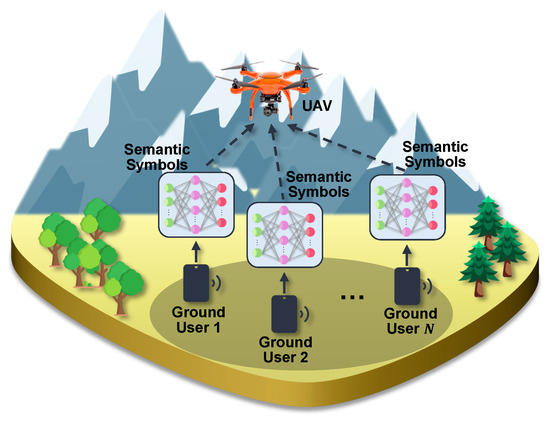
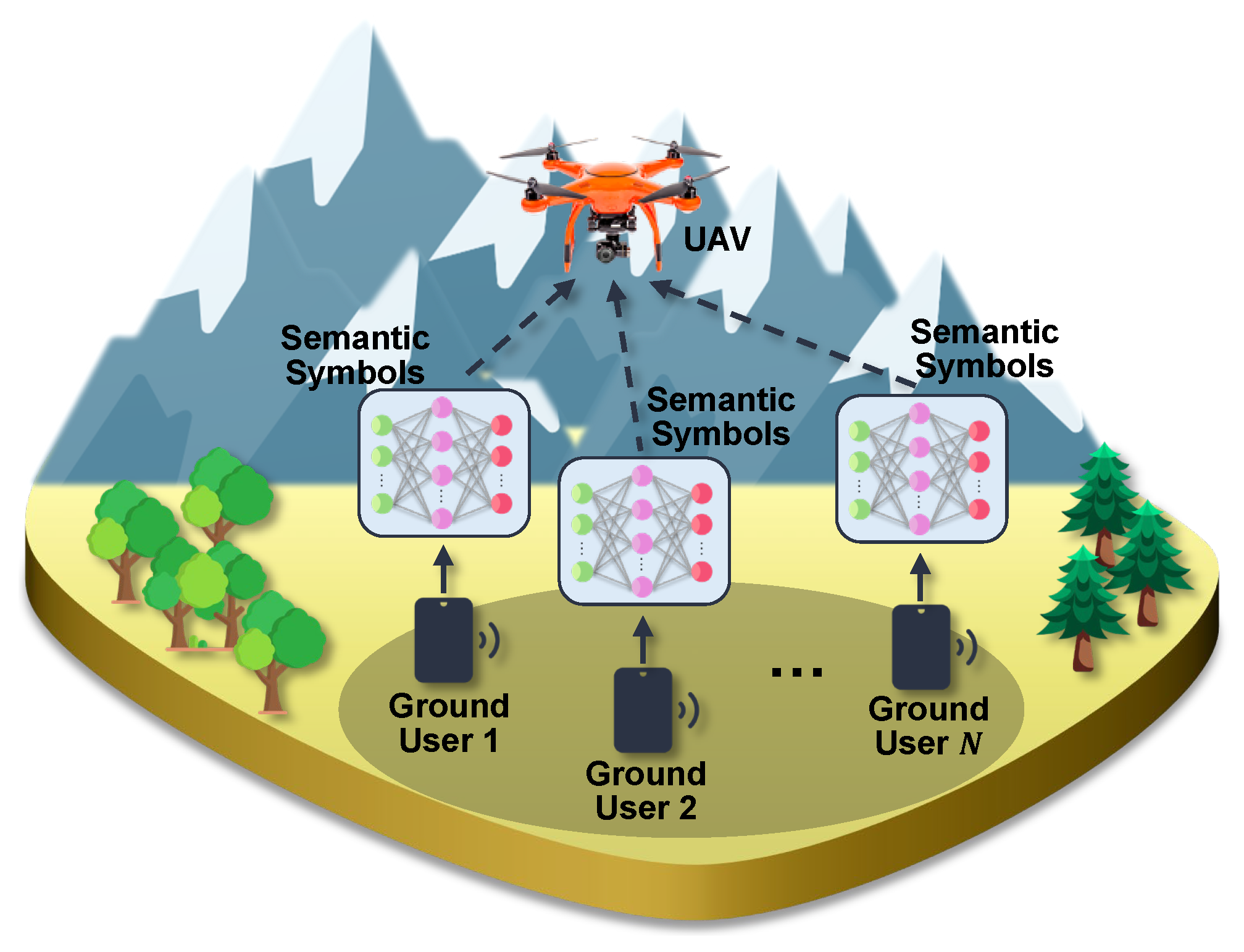
As shown in Figure 1, we consider a UAV-enabled semantic communication system comprising a single rotary-wing UAV and a set of N ground users, which are denoted as . Specifically, the ground users are distributed within a square area of size , and the two-dimensional (2D) location of the n-th ground user is denoted as , . Furthermore, the UAV departs from a fixed initial position and navigates to a hovering position to collect semantic information from all ground users, where the altitude of the UAV z is constrained within .
Figure 1.
Sketch map of UAV-enabled semantic communication system.
In the considered system, each ground user employs a deep learning-based semantic communication transmitter [16] to extract the semantic information from data and transmit the encoded semantic symbols to the UAV through the uplink G2A channel. Consequently, the total system bandwidth B is equally divided into orthogonal RBs, each with bandwidth . Therefore, these RBs are allocated to the N ground users for uplink semantic transmission, where each user is required to be assigned at least one RB to guarantee communication access. After receiving the semantic symbols from all users, the UAV decodes the semantic information using the corresponding semantic decoder and processes the collected data for subsequent tasks.
2.1.2. G2A Transmission Model
For the uplink G2A transmission, we adopt a probabilistic LoS channel model [21] to characterize the propagation environment between ground users and the UAV. Specifically, we let denote the RB allocation vector, where indicates the user index to which the j-th RB is allocated. As a result, the number of RBs assigned to the n-th user is given by , and the corresponding bandwidth allocated to the n-th user is .
The Euclidean distance between the n-th ground user at position and the UAV at position is given by
The LoS probability between the n-th ground user and the UAV depends on the elevation angle and is modeled as follows [13]:
where a and b are environment-related parameters, and the non-line-of-sight (NLoS) probability is .
Based on the probabilistic LoS model, the average channel power gain between the n-th ground user and the UAV is expressed as follows [13]:
where is the free-space path loss at a reference distance of 1 m with denoting the carrier wavelength, is the path loss exponent, and and are the additional attenuation factors for the LoS and NLoS links, respectively.
Since orthogonal RBs are allocated to different users, inter-user interference is eliminated. Therefore, the received SNR of the n-th user at the UAV is given by
where is the transmit power of each ground user and is the noise power.
2.1.3. Semantic Communication Model
In the considered system, we adopt the DeepSC [16] for data transmission between ground users and the UAV. Different from conventional communication systems that focus on the accurate transmission of bit sequences, the DeepSC extracts the semantic meaning from the source text and transmits it through semantic symbols. To evaluate the quality of semantic transmission, the semantic similarity [6] between the original sentence and reconstructed sentence is adopted as the performance metric, which is given by [16]
where denotes the pre-trained Sentence-Bidirectional Encoder Representations from Transformers model [16]. In particular, the semantic similarity depends on the encoding length and the received SNR , i.e., . Since this relationship does not admit a closed-form expression, it can be obtained from a pre-computed lookupTable [6]. The lookup table captures the empirically measured relationship between the semantic similarity , the encoding length , and the received SNR under the DeepSC framework. While this relationship is derived from specific training datasets and model architectures, the monotonic properties of the similarity function, namely, that increases with both and , are fundamental characteristics that hold across different datasets and model configurations.
Following the semantic spectral efficiency framework proposed in [6], the semantic transmission rate (S-R) of the n-th user is defined as
Equation (7) captures the effective semantic information successfully transmitted per second and is measured in suts/s. Intuitively, a higher semantic similarity indicates more reliable semantic transmission, while a smaller encoding length means that each semantic symbol carries more semantic content. To ensure reliable semantic transmission, the semantic similarity of each user must satisfy the minimum fidelity requirement, which is formulated as
where is the predefined semantic similarity threshold.
2.1.4. UAV Energy Consumption Model
In this work, the UAV flies from its initial position to the designated hovering position . Specifically, we decompose the three-dimensional (3D) flight trajectory into horizontal and vertical components, and the propulsion power during horizontal flight at constant velocity v can be expressed as follows [13]:
where and represent the blade profile power and induced power in hovering status, respectively; is the tip speed of the rotor blade; is the mean rotor-induced velocity in hovering status; and are the fuselage drag ratio and rotor solidity, respectively; and and are the air density and rotor disc area, respectively.
For vertical movement, the energy consumption of the UAV is affected by gravity and velocity. Accordingly, the propulsion energy consumption of the UAV in 3D space can be given by [13]
where denotes the mass of the UAV, and g is the gravitational acceleration. Moreover, T and are the end time and altitude of the flight, and is the motion speed of the UAV at time t.
It is worth noting that we model the total energy consumption of the UAV as being primarily dependent on propulsion power, without incorporating the computational energy required for running deep learning models. This modeling choice is justified from two perspectives. First, the propulsion energy consumption of a rotary-wing UAV during hovering flight typically dominates the total energy budget. According to the widely adopted UAV propulsion model [13], the basic power components during hovering alone amount to several hundred watts for a typical rotary-wing UAV. In contrast, the computational energy consumption for running semantic encoders and decoders on edge-class processors is typically in the range of 5–15 W, which is approximately two orders of magnitude smaller. Second, in the considered system, the computational cost at each ground terminal and the UAV is largely independent of the decision variables being optimized (i.e., UAV hovering position, semantic encoding lengths, and RB allocation). Therefore, the computational energy can be regarded as a constant that does not affect the optimal solutions of the multi-objective problem.
2.2. Problem Formulation
In the considered system, the UAV navigates from a fixed initial position to a designated hovering location to collect semantic information from all ground users. Our goal is to jointly optimize the UAV hovering position, the semantic encoding lengths, and the RB allocation to achieve enhanced semantic communication performance while minimizing flight energy consumption. Specifically, the optimization objectives are detailed as follows.
Optimization Objective 1: The first objective is to maximize the total semantic transmission rate of all ground users to the UAV, which is formulated as
where is the UAV hovering position, is the semantic encoding length vector, and is the RB allocation vector. Note that implicitly depends on and through the SNR and the allocated bandwidth , respectively.
Optimization Objective 2: The second objective is to minimize the total propulsion energy consumed by the UAV during flight from the initial position to the hovering position, which is formulated as
The two objectives are conflicting since maximizing the semantic communication rate favors UAV positions closer to the ground users to improve channel quality, while such positions may require longer flight distances from the initial position, increasing energy consumption. Based on the above analysis, the multi-objective optimization problem for the considered UAV-enabled semantic communication system is formulated as
where the constraint (14) ensures the minimum semantic fidelity requirement for each user; the constraint (15) guarantees that every user is assigned at least one RB for communication access; the constraints (16) and (17) restrict the UAV hovering position within the designated operational area and altitude range, respectively; the constraint (18) specifies the feasible range of the semantic encoding length; and the constraint (19) defines the RB allocation as an integer assignment.
2.3. The Proposed Algorithm
The considered joint optimization of the UAV hovering position, semantic encoding length, and channel allocation constitutes a mixed multi-objective optimization problem. Because evolutionary algorithms employ population-based heuristic search without requiring gradient information [22,23], they are well-suited for such problems and can efficiently obtain multiple trade-off solutions in a single run. In this section, we adopt the multi-objective cellular genetic algorithm (MOCell) as the baseline method. Furthermore, we propose a greedy-enhanced adaptive MOCell (GEAMOCell) that introduces three strategies to enhance convergence and solution diversity.
2.3.1. Overview of Standard MOCell
MOCell [24] is a multi-objective evolutionary method based on the cellular genetic algorithm model. Different from panmictic genetic algorithms that treat the entire population as a single mating pool, MOCell arranges individuals on a two-dimensional toroidal grid and restricts mating interactions to spatially adjacent neighbors. In this case, the cellular structure induces a slow diffusion of genetic information across the population, thus balancing exploration and exploitation. The key components of MOCell are summarized below.
(1) Cellular Population Structure: Let , and individuals in the population be arranged on a two-dimensional toroidal grid, with the i-th individual located at position , where . The C9 neighborhood, which consists of the individual itself and its eight surrounding neighbors, is defined as
(2) Genetic Operators: The C9 neighborhood defines the scope within which parent selection occurs for each individual. Specifically, for the individual i in the grid, two parents are selected from its neighborhood via binary tournament selection based on Pareto rank and crowding distance. Subsequently, the selected parents undergo simulated binary crossover (SBX) followed by polynomial mutation, thereby generating one offspring individual per grid cell.
(3) Environmental Selection: The offspring individual replaces the current individual at position i if either of the following conditions holds. First, the offspring has a strictly lower total constraint violation than the current individual. Second, both have equal constraint violations, and the offspring is not worse in at least one objective.
(4) External Archive and Feedback Mechanism: MOCell maintains an external archive to store the non-dominated solutions discovered during the search. After each generation, newly generated offspring are evaluated for insertion into the archive. We note that the archive retains only non-dominated solutions and is bounded by a maximum size of . When the archive exceeds this limit, solutions with the smallest crowding distances are removed to maintain diversity. Moreover, MOCell introduces a feedback mechanism to improve the search capabilities of the algorithm. Specifically, a fixed number of randomly selected individuals in the population are replaced by the same number of randomly selected archive members.
2.3.2. GEAMOCell
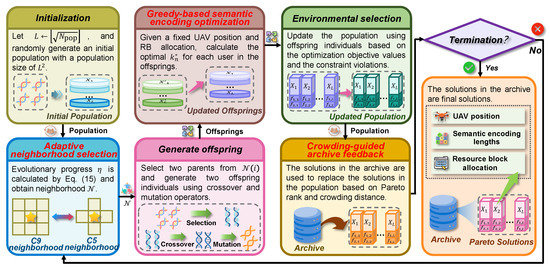
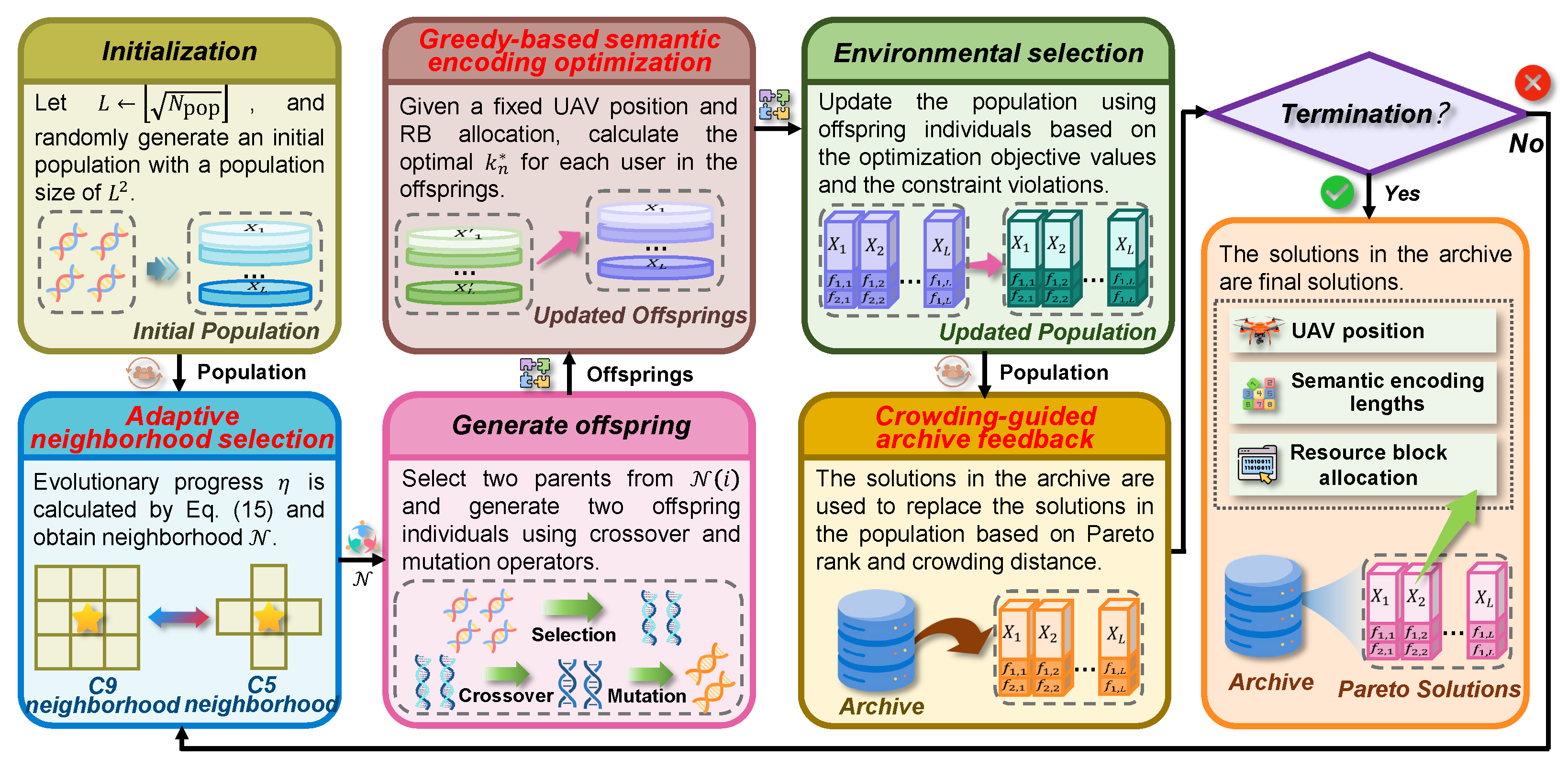
The standard MOCell algorithm faces some challenges when applied to the considered UAV-enabled semantic communication problem. Specifically, the considered problem involves a constrained mixed decision space comprising continuous UAV position variables and discrete semantic encoding lengths and RB allocation, thereby demanding rapid convergence toward the feasible region in early iterations, while diversity preservation becomes critical in later stages for approximating the full Pareto front. However, MOCell employs a fixed neighborhood throughout the entire search process, which limits convergence accuracy. Moreover, the random archive feedback mechanism in MOCell may overwrite boundary solutions that maintain the spread of the Pareto front while simultaneously introducing redundant archive members from densely populated objective regions, which leads to unnecessary diversity loss. As shown in Figure 2, we propose the GEAMOCell algorithm, which introduces three improvements into the MOCell framework.
Figure 2.
The framework of the proposed GEAMOCell algorithm.
(1) Adaptive Neighborhood Selection: In the standard MOCell, a fixed C9 neighborhood is used throughout the entire optimization process, which provides each individual with 8 neighbors for mating selection. This fixed approach treats all evolutionary phases uniformly and fails to adapt to the evolving search requirements, in which the optimal neighborhood size should depend on the search phase. Specifically, larger neighborhoods accelerate information diffusion and convergence, while smaller neighborhoods slow down diffusion and promote population diversity.
GEAMOCell introduces an adaptive neighborhood selection that dynamically switches between two neighborhood configurations based on the evolutionary progress. Specifically, we let t denote the current iteration and denote the maximum number of iterations. Consequently, the evolutionary progress ratio is defined as
where indicates the maximum number of evaluations, and the neighborhood selection can be given by
where is the C5 neighborhood, which consists of only five cells, i.e., the individual itself and its four cardinal neighbors, which is given by
In the first half of the optimization (), the larger C9 neighborhood facilitates faster information sharing across the population, which enables rapid convergence toward the feasible region while satisfying the semantic similarity constraints and RB allocation constraints. In the second half (), switching to the smaller C5 neighborhood slows down information diffusion and thereby promotes algorithm convergence. Consequently, this improvement distinguishes GEAMOCell from the fixed-topology MOCell algorithm, thus enabling the exploration of diverse trade-off solutions along the Pareto front, thereby improving the spread and distribution of the final solution set. Furthermore, this adaptive scheme is motivated by the inherent phase-dependent requirements of the considered constrained multi-objective optimization problem, while the binary switching between C9 and C5 neighborhoods provides a simple yet effective mechanism with minimal computational overhead.
(2) Greedy-Based Semantic Encoding Optimization: The semantic encoding length for each user n determines the trade-off between the semantic similarity and the semantic communication rate . Given a fixed UAV position and RB allocation, the optimal for each user can be determined independently through a greedy exhaustive search over the finite domain .
Specifically, given a fixed UAV position and RB allocation, the sub-problem for each user n can be formulated as
Following the approach in [6], the optimal is obtained by searching over the finite candidate set and selecting the value that yields the maximum semantic rate while satisfying the fidelity constraint. Even though no candidate satisfies , e.g., when the channel quality is severely degraded, the value with the highest fidelity is selected as a fallback to minimize constraint violation. Accordingly, this greedy optimization is introduced into the evolutionary search as a periodic local refinement. To control the additional function evaluation overhead, it is triggered only during the second half of the optimization () at every generations.
This improvement ensures that the encoding optimization is applied after the population has converged to promising regions of the UAV position and resource allocation space, thereby avoiding premature fixation of values during the early exploratory phase. Different from generic multi-objective evolutionary algorithms that treat all decision variables uniformly through crossover and mutation operators, this greedy-based strategy effectively exploits the separable structure of the encoding length sub-problem. Since the optimal encoding length for each user can be determined independently given a fixed UAV position and RB allocation, this problem-specific local search reduces the search space dimensionality without inflating the overall computational cost.
(3) Crowding-Guided Archive Feedback: The standard MOCell adopts a random feedback mechanism that does not consider the quality or diversity contribution of the individuals being replaced or added. This may result in boundary solutions in the population being randomly overwritten and thus reducing the spread of the Pareto optimal solution set. Moreover, archive solutions introduced into the population may be from densely populated regions of the objective space, which leads to a decrease in population diversity.
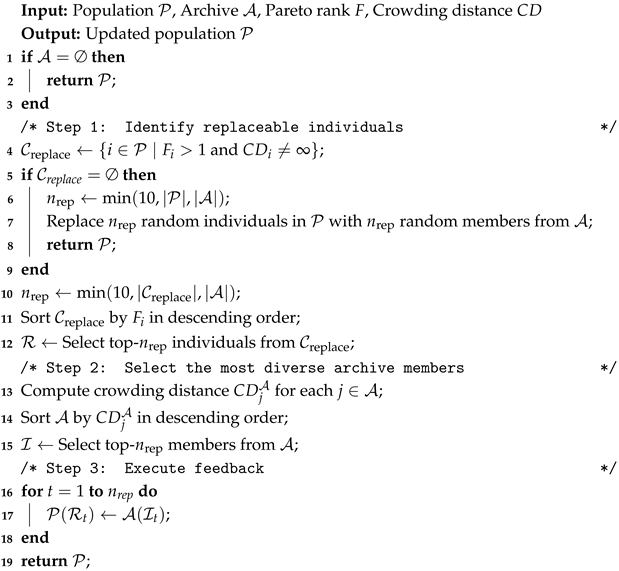
GEAMOCell overcomes these limitations through a crowding-guided feedback mechanism that leverages the Pareto rank and crowding distance information to make the replacement. The mechanism operates as follows. The pseudocode of the crowding-guided archive feedback is shown in Algorithm 1, and the details are presented as follows.
Step 1: Replacement individual selection: Instead of randomly selecting individuals for replacement, GEAMOCell restricts the candidate pool to dominated individuals that are not boundary solutions. Specifically, individuals on the first Pareto front () are protected from replacement to preserve the non-dominated solutions in the population. Meanwhile, individuals with infinite crowding distance () are also excluded from replacement as they represent boundary solutions that contribute to the spread of the Pareto front. Among the qualified candidates, those with the highest Pareto rank are selected for replacement with priority as they represent the most dominated and thus least competitive individuals in the population. The candidate set is formally defined as
Step 2: Archive individual selection: GEAMOCell selects those with the largest crowding distance values rather than selecting randomly to ensure that the solutions originate from the sparsest regions of the archive, thereby introducing diversity into the population. Specifically, the archive members with the largest crowding distance values are selected, where and denotes the crowding distance of the j-th archive member computed within the archive population.
Step 3: Feedback execution: The top- worst individuals from are replaced by the top- most diverse archive members from . If is empty, meaning that all population members are either on the first front or are boundary solutions, GEAMOCell performs the original random feedback.
This improvement effectively overcomes the limitations of the standard MOCell. The original random feedback mechanism frequently overwrites boundary solutions that are critical for maintaining the spread of the Pareto front while simultaneously injecting archive members from densely populated regions that contribute little to diversity. By leveraging Pareto rank and crowding distance information, this mechanism ensures that only the most dominated and least diverse population members are replaced, and only the most diverse archive members are injected, which is designed to ensure the diversity of the population, thereby significantly improving both the spread and uniformity of the final Pareto front approximation.
| Algorithm 1: Crowding-guided archive feedback |
 |
2.3.3. Computational Complexity Analysis
The main steps of the proposed GEAMOCell are shown in Algorithm 2, and the computational complexity is analyzed as follows. Let the population size be , the number of optimization objectives be M, the number of decision variables be D, and the number of ground users be N.
In each iteration, the main computational costs of GEAMOCell include the following components. First, computing the Pareto rank and crowding distance for the population requires for non-dominated sorting and for crowding distance computation. Second, the offspring generation loop performs binary tournament selection, crossover, and mutation for each of the individuals, thereby resulting in a cost of . Third, maintaining the archive involves non-dominated sorting with a cost of and crowding-based truncation with a cost of , where .
| Algorithm 2: GEAMOCell |
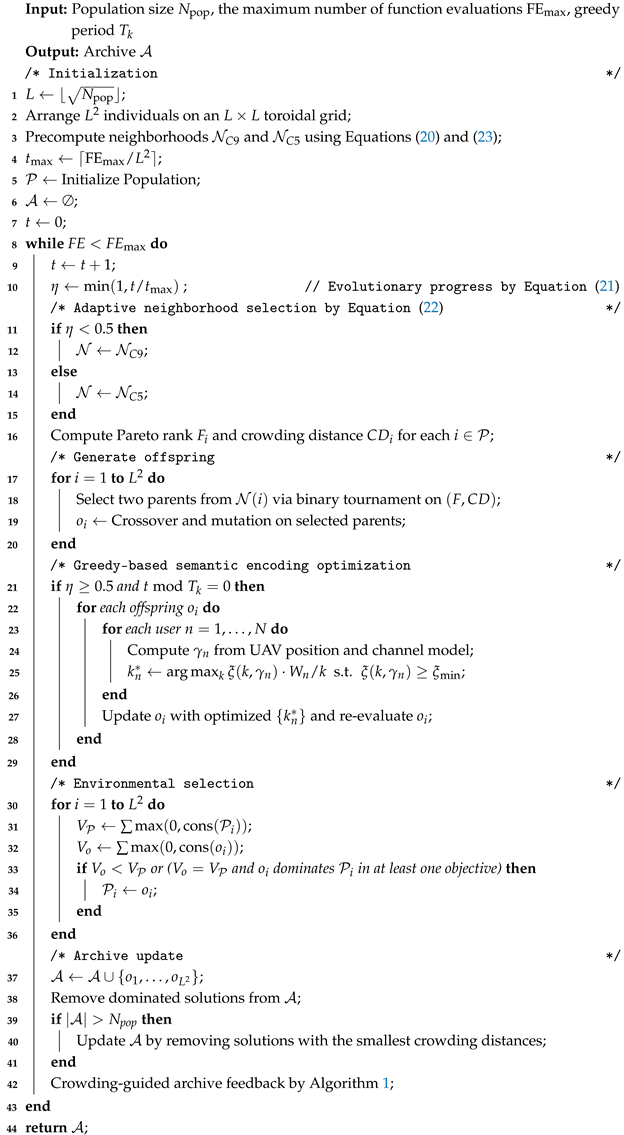 |
The three improvement strategies introduce the following additional costs. The adaptive neighborhood selection involves a single comparison per iteration, adding overhead. The greedy-based semantic encoding optimization searches over candidate values for each of the N users per individual when triggered, resulting in a per-triggered-iteration cost of . Since the semantic similarity lookup is and this strategy is only triggered once every iterations during the second half of the optimization, the amortized per-iteration cost is . The crowding-guided archive feedback requires identifying replacement candidates in , sorting candidates in , and computing archive crowding distances in . Consequently, the overall per-iteration time complexity of GEAMOCell is , which is asymptotically equivalent to the standard MOCell algorithm.
Moreover, the space complexity of GEAMOCell requires storing the population and the archive , which costs each. Additionally, Strategy 1 requires and for precomputing the two neighborhood matrices, Strategy 2 requires for storing intermediate encoding values, and Strategy 3 requires for the candidate index arrays. Consequently, the total space complexity is , which simplifies to since in the considered problem.
Furthermore, it is worth noting that the algorithmic framework of GEAMOCell is agnostic to the specific data modality being transmitted, in which the semantic similarity function serves as a black-box performance metric that can represent different modalities through different lookup tables. For example, for image transmission, the similarity metric can be replaced with the structural similarity index (SSIM) or the peak signal-to-noise ratio (PSNR) as functions of the encoding length and SNR. For audio transmission, perceptual evaluation of speech quality (PESQ) or short-time objective intelligibility (STOI) can serve as the corresponding metrics. As long as the performance metric can be evaluated for a given pair of encoding length and SNR, and exhibits monotonic properties with respect to these parameters, the GEAMOCell algorithm can be directly applied without structural modifications. The three key improvement strategies operate independently of the specific similarity metric used, which ensures the generalizability of the proposed approach across diverse semantic communication scenarios.
3. Results
To validate the effectiveness of the proposed GEAMOCell algorithm, we conducted comprehensive simulations in a UAV-enabled semantic communication scenario. It is worth noting that the current simulation setup incorporated several practically relevant elements, including the probabilistic LoS channel model that captures the elevation-angle-dependent propagation characteristics of G2A links, the propulsion energy model derived from rotary-wing aerodynamics, and the DeepSC-based semantic communication framework with lookup-table-driven semantic similarity evaluation. These models are widely adopted in the UAV communication literature and provide a reasonable approximation of real-world operating conditions. The principal system parameters for the considered UAV-enabled semantic communication scenario are listed in Table 1. The algorithms were implemented using MATLAB (R2023a) with the PlatEMO platform [25], the population size was set to 20, the maximum number of function evaluations was set to 4000, and each algorithm was independently executed 30 times [26].
Table 1.
Simulation parameter settings.
For comparison, seven multi-objective evolutionary algorithms were selected as baselines: dominance-weighted uniformity (DWU) [27], grouped linked mutation operator (GLMO) (http://doi.org/10.25673/32063), the linear combination-based search algorithm (LCSA) (http://doi.org/10.25673/32063), the standard MOCell [24], nondominated sorting genetic algorithm II (NSGA-II) [28], the reference vector-guided evolutionary algorithm (RVEA) [29], and the weighted optimization framework (WOF) [30]. These algorithms represent diverse approaches to complex optimization problems. Furthermore, to provide a more comprehensive comparison with recent advances, we incorporated two state-of-the-art algorithms currently prevalent in UAV communication and resource allocation as additional baselines, namely, the modified multi-objective evolutionary algorithm based on decomposition (MMOEAD) [31] and the biogeography-based optimization algorithm with hybrid migration and mutation (BBOHMM) [32].
3.1. Comparison with Baselines
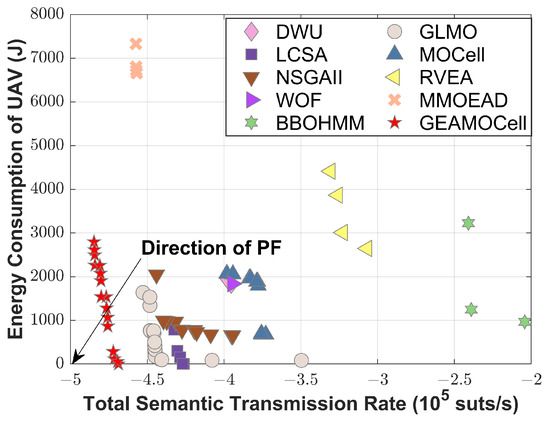
Figure 3 presents the solution distributions obtained by GEAMOCell and the nine baseline algorithms. As can be observed, the solutions obtained by the proposed GEAMOCell algorithm are significantly closer to the ideal Pareto front direction, i.e., lower left corner, where both the total semantic transmission rate is maximized and the UAV energy consumption is minimized. In addition, the solutions produced by GEAMOCell are more uniformly distributed along the Pareto front, which shows the superior diversity compared to the baseline algorithms. In contrast, the RVEA and BBOHMM fail to converge to the feasible region effectively, thus resulting in scattered and poorly converged solutions, and other baselines produce partially converged solution sets, but their coverage of the Pareto front and the diversity of solutions are significantly inferior to GEAMOCell.
Figure 3.
Pareto solutions obtained by GEAMOCell and baseline algorithms.
The Pareto front obtained by GEAMOCell reveals the trade-off between the total semantic transmission rate () and the UAV propulsion energy consumption (). From a practical decision-making perspective, the solutions along the Pareto front can be broadly categorized into three regions. First, the high-rate region corresponds to UAV hovering positions located closer to the center of the ground user cluster, where channel conditions are favorable and high semantic transmission rates are achieved but at the cost of increased flight distance and energy consumption. Second, the energy-efficient region corresponds to UAV positions closer to the initial deployment location, resulting in low propulsion energy but reduced channel quality and lower semantic rates. Third, the intermediate region represents balanced operating points where a reasonable semantic rate is achieved without excessive energy expenditure, which is often the preferred choice in practice. A decision-maker can select a specific operating point from the Pareto front based on mission-specific priorities. For instance, in time-critical data collection tasks, a solution from the high-rate region may be preferred, while in energy-constrained missions, an energy-efficient solution would be more appropriate. The diversity and uniform distribution of the solutions produced by GEAMOCell, as evidenced by its superior HV and IGD values in Table 2, ensure that the decision-maker is provided with a comprehensive and well-spread set of trade-off options, facilitating informed and flexible mission planning.
Table 2.
Performance comparison of GEAMOCell and baseline algorithms in terms of HV and IGD over 30 independent runs. The best results are highlighted in bold.
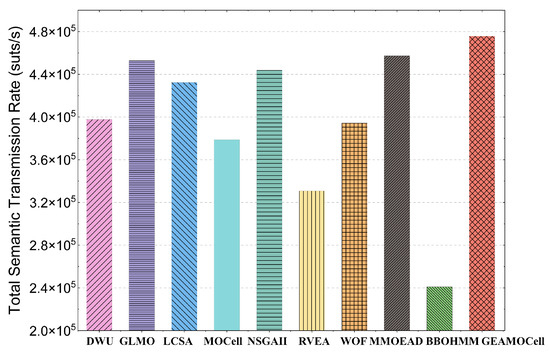
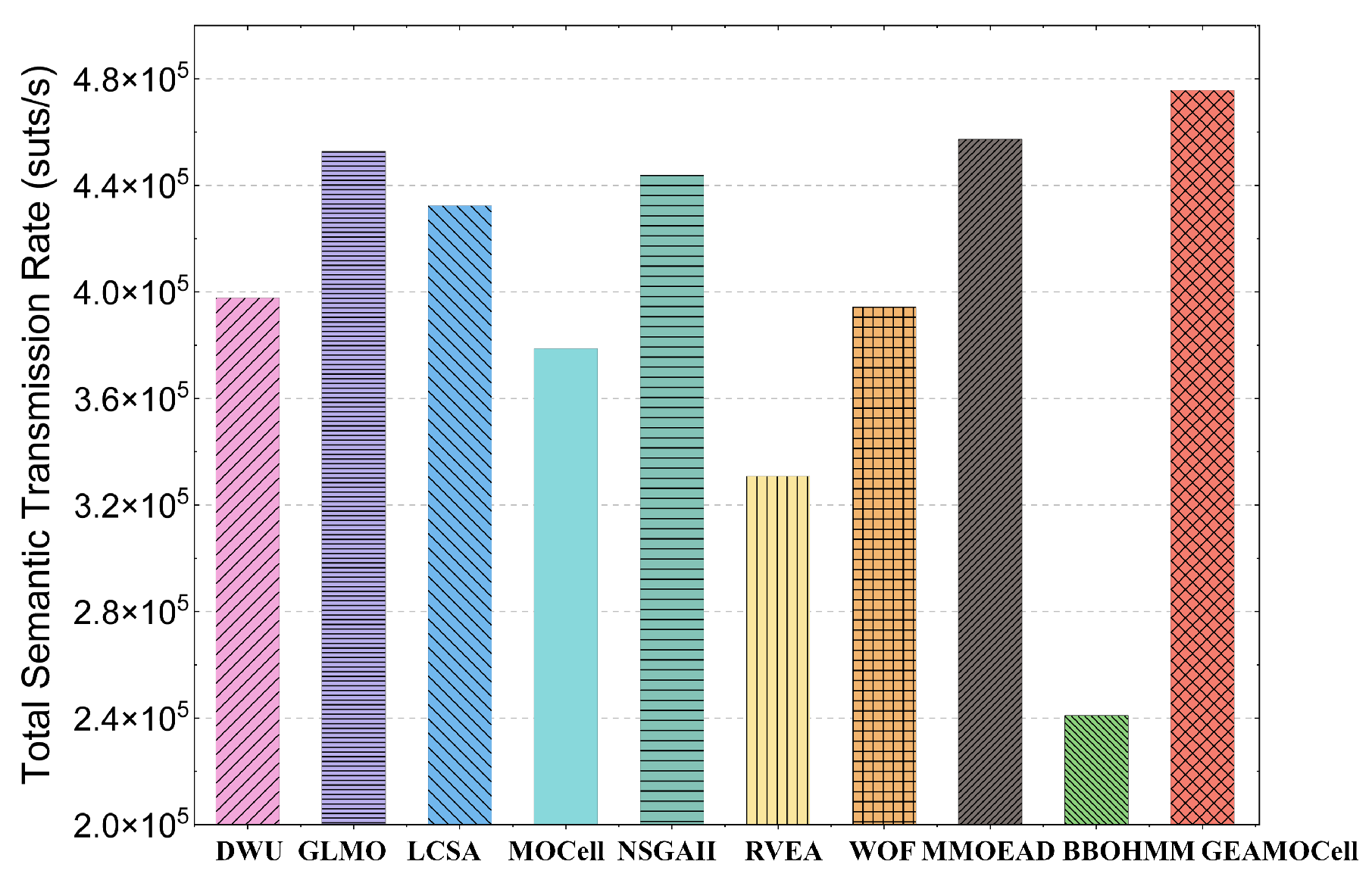
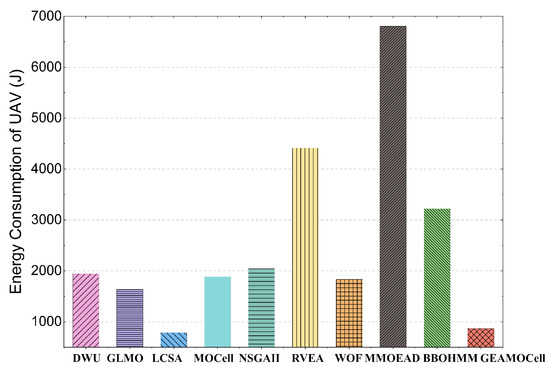
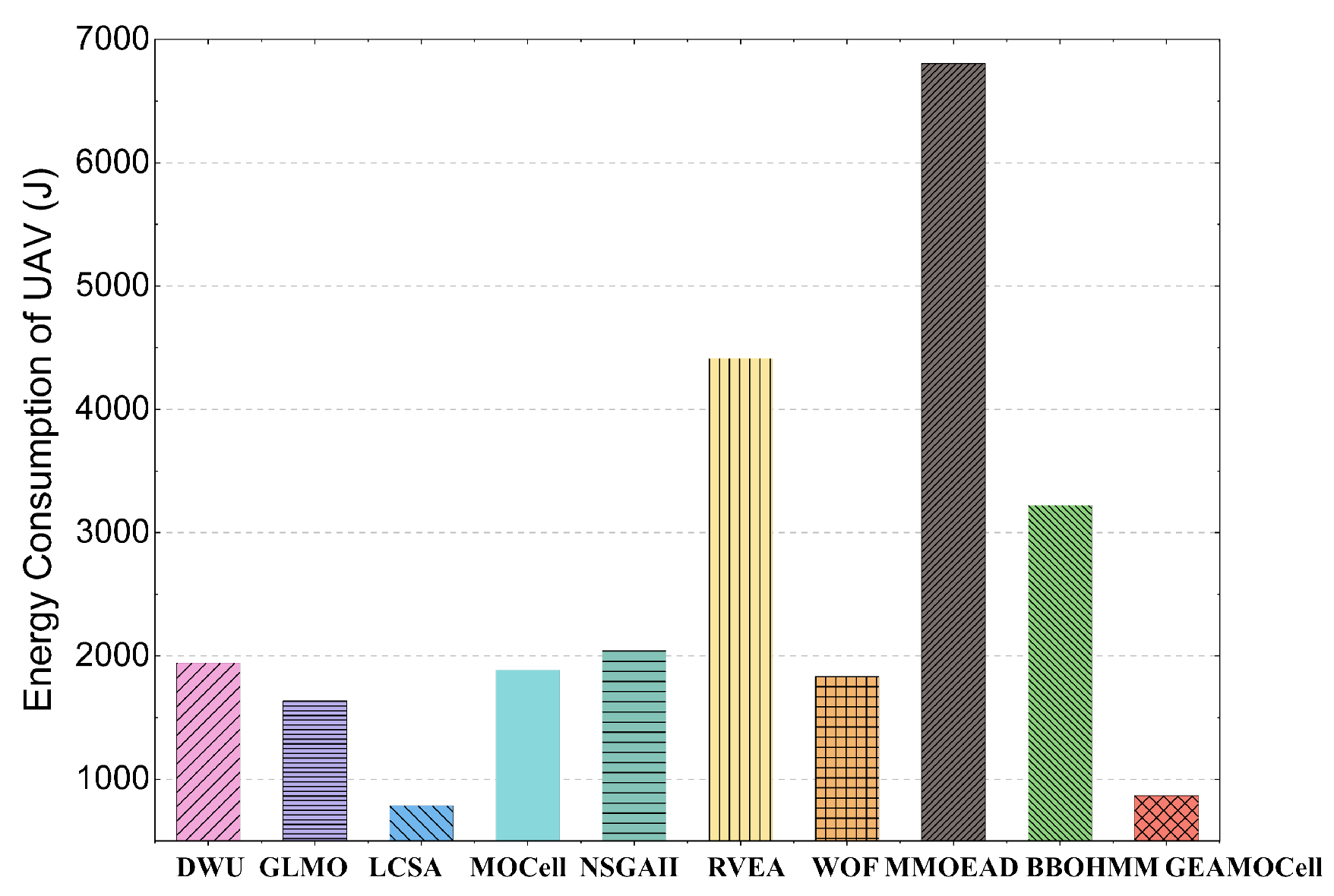
Figure 4 and Figure 5 present the objective values of a representative solution obtained by each algorithm from a single run. As can be observed, the proposed GEAMOCell algorithm achieves the highest total semantic transmission rate among all algorithms while maintaining a relatively low UAV energy consumption. In contrast, although some baseline algorithms, such as LCSA, achieve low energy consumption, their semantic transmission rates are noticeably lower than that of GEAMOCell. Similarly, NSGA-II and GLMO obtain moderate semantic rates but exhibit considerably higher energy consumption.
Figure 4.
The first objective values obtained by GEAMOCell and baseline algorithms.
Figure 5.
The second objective values obtained by GEAMOCell and baseline algorithms.
Table 2 presents the comparison results in terms of the hypervolume (HV) and inverted generational distance (IGD) indicators over 30 independent runs. As can be seen, the proposed GEAMOCell algorithm achieves the best performance on both indicators. Specifically, GEAMOCell obtains an average HV value of 0.7811, which is substantially higher than all baseline algorithms. Furthermore, GEAMOCell achieves a mean value of 0.0956 with a standard deviation of 0.0796 regarding the IGD indicator. The low standard deviation of GEAMOCell further confirms the stability of the proposed algorithm across multiple independent runs. These results demonstrate that GEAMOCell significantly outperforms all baseline algorithms in terms of both convergence quality and solution diversity, which can be attributed to the three proposed improvement strategies, which collectively enhance the search efficiency and improve the archive feedback quality. Notably, compared with the recent state-of-the-art algorithms, GEAMOCell also consistently outperforms both MMOEAD (HV = 0.0060, IGD = 1.4987) and BBOHMM (HV = 0.0000, IGD = 14.4650), confirming its superior performance in addressing the considered problem. These results demonstrate that GEAMOCell significantly outperforms all baseline algorithms in terms of both convergence quality and solution diversity, which can be attributed to the three proposed improvement strategies, which collectively enhance the search efficiency and improve the archive feedback quality.
Moreover, it is worth noting that the simulation results cover a wide range of SNR conditions induced by varying the UAV hovering position, which changes the channel quality for different ground users. The robustness of GEAMOCell across these diverse SNR conditions is implicitly validated by the consistent convergence and Pareto front quality observed over 30 independent runs with randomized user distributions. The low standard deviations in both HV and IGD metrics further confirm that GEAMOCell maintains stable performance across different channel conditions and user configurations, which demonstrates its practical applicability in dynamic wireless environments.
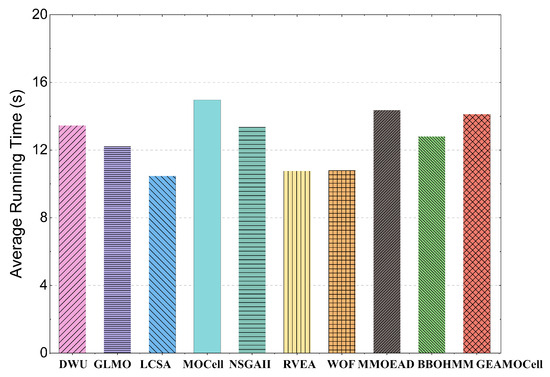
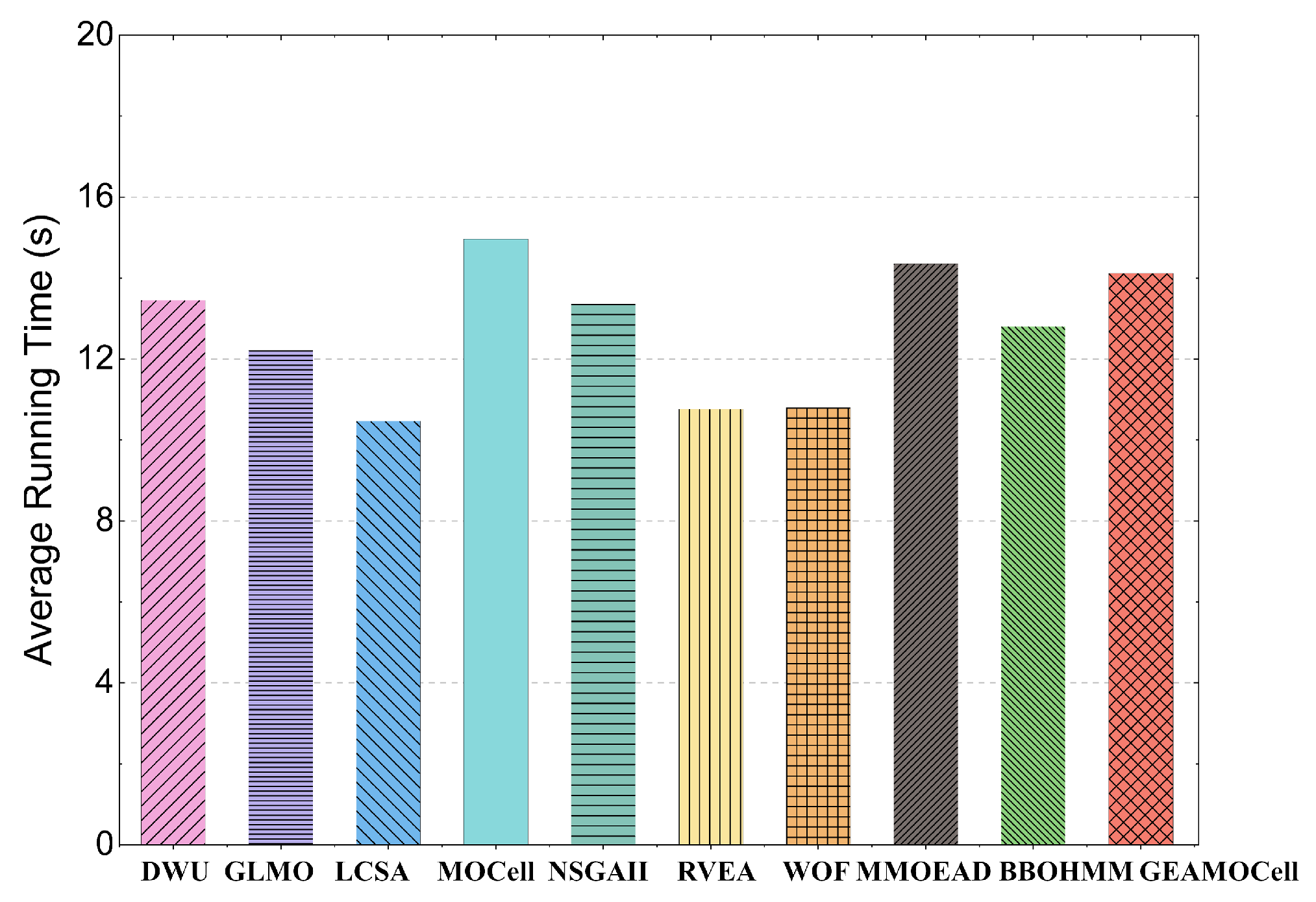
In addition, we further evaluated the actual execution time required to obtain solutions. Figure 6 presents the average running time of the proposed GEAMOCell and the nine baseline algorithms over 30 independent runs with and . As can be observed, all algorithms complete the optimization within a comparable time range of approximately 10 to 16 s. Specifically, although the proposed GEAMOCell incorporates multiple improvement strategies, its average execution time (14.1 s) remains highly competitive and does not incur significant computational overhead compared to the baseline algorithms, e.g., 14.9 s for standard MOCell and 14.3 s for MMOEAD. Moreover, in practical deployment scenarios, the proposed GEAMOCell algorithm is designed to operate in an offline planning phase before the UAV mission execution. Specifically, the algorithm computes a set of Pareto-optimal hovering positions, encoding length configurations, and RB allocation plans based on the known user distribution and channel statistics. The decision-maker can then select an appropriate operating point from the Pareto front based on the mission-specific trade-off preference between semantic transmission performance and energy budget. This offline optimization paradigm is consistent with practical UAV mission-planning workflows where pre-flight route and resource planning is a standard procedure, and the execution time in the scale of seconds is well within the acceptable range. Furthermore, for highly dynamic environments where real-time adaptation is required, the GEAMOCell algorithm can serve as the offline component of a hybrid optimization framework. Specifically, the Pareto front obtained offline can be stored as a decision lookup table, and a lightweight online controller can select the appropriate operating point based on the current channel conditions and UAV state. This hybrid approach effectively combines the optimization quality of evolutionary algorithms with the responsiveness of online decision-making.
Figure 6.
The average running time obtained by GEAMOCell and baseline algorithms.
3.2. Ablation Study
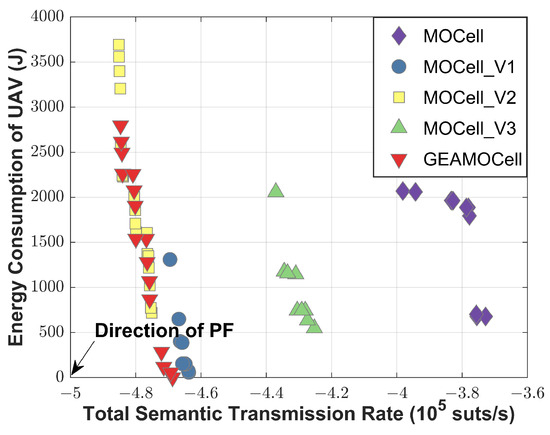
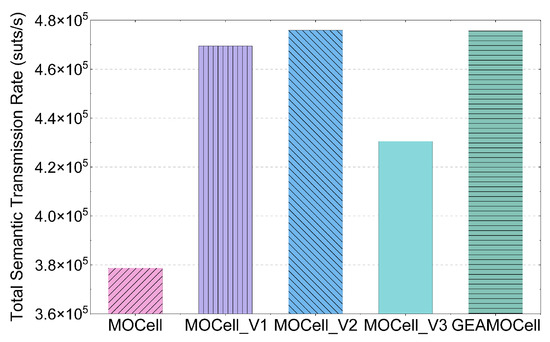
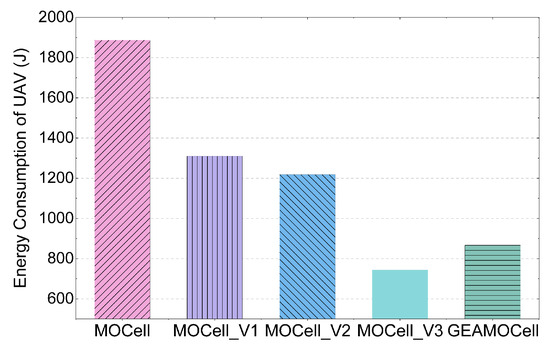
To evaluate the contribution of each improved strategy in the proposed GEAMOCell algorithm, we conducted an ablation study by comparing the following five algorithm variants. MOCell denotes the original baseline algorithm without any modifications. MOCell_V1 incorporates only the adaptive neighborhood selection. MOCell_V2 incorporates only the greedy-based semantic encoding optimization. MOCell_V3 incorporates only the crowding-guided archive feedback. GEAMOCell integrates all three strategies simultaneously.
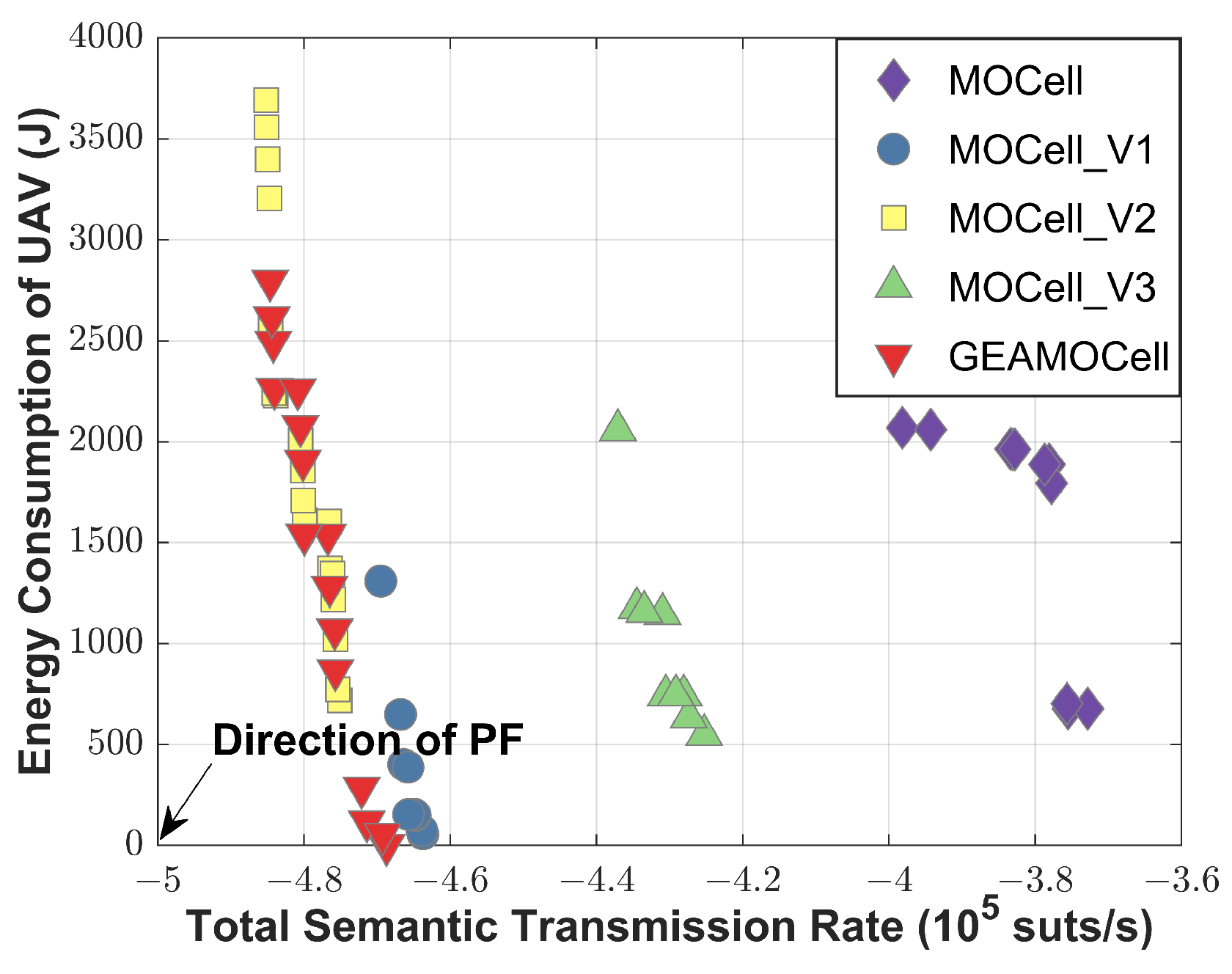
Figure 7 shows the solution distributions obtained by the five algorithm variants. As can be observed, each individual strategy contributes positively to the optimization performance compared to the original MOCell. Table 3 presents the comparison results in terms of HV and IGD indicators. Several important observations can be made from these results. First, MOCell_V2 demonstrates the most significant improvement and produces solutions that are substantially closer to the Pareto front direction, which indicates that the greedy-based semantic encoding optimization plays a critical role in enhancing convergence. Second, MOCell_V1 and MOCell_V3 also yield improved Pareto front approximations relative to the original MOCell, which demonstrates the effectiveness of the adaptive neighborhood selection and crowding-guided feedback mechanisms. Third, the proposed GEAMOCell achieves the best overall performance and produces the most well-distributed and converged solution set, which demonstrates that the three improved strategies complement each other effectively and their combination yields synergistic benefits beyond what any individual strategy can achieve.
Figure 7.
Pareto solutions obtained by different algorithm variants in the ablation study.
Table 3.
Ablation study results in terms of HV and IGD over 30 independent runs. The best results are highlighted in bold.
Figure 8 and Figure 9 show the objective values of a representative solution obtained by each algorithm variant from a single run. As can be observed, MOCell_V1 and MOCell_V2 achieve substantially higher semantic transmission rates compared to the original MOCell, which indicates that both the adaptive neighborhood selection and the greedy-based semantic encoding optimization effectively improve the convergence toward higher-quality solutions. Meanwhile, MOCell_V3 achieves the lowest energy consumption among the individual strategy variants, which demonstrates that the crowding-guided archive feedback contributes to discovering solutions with reduced flight cost. The proposed GEAMOCell achieves a semantic transmission rate comparable to the best single-strategy variant while maintaining low energy consumption, which confirms that the combination of all three strategies produces well-balanced trade-off solutions.
Figure 8.
The first objective values obtained by different algorithm variants in the ablation study.
Figure 9.
The second objective values obtained by different algorithm variants in the ablation study.
4. Discussion
To discuss the scalability of the proposed GEAMOCell algorithm with respect to increasing problem dimensions, we consider both theoretical complexity and experimental performance. From a theoretical perspective, as analyzed in Section 2.3.3, the per-iteration time complexity of GEAMOCell is , where M, , and D denote the number of objectives, the population size, and the number of decision variables, respectively. Since in the considered problem, the complexity scales linearly with the number of users N and the number of RBs , ensuring that the algorithm remains computationally tractable as the network size increases. Furthermore, the greedy-based semantic encoding optimization introduces an amortized per-iteration cost of , where . This cost scales linearly with N and each user’s encoding optimization is independent, meaning the greedy strategy naturally parallelizes across users and maintains good scalability. The adaptive neighborhood selection adds only overhead per iteration, and the crowding-guided archive feedback operates with a cost of , which is independent of N and . For significantly larger problem instances, the cellular structure of GEAMOCell provides an inherent advantage in scalability because the localized mating interactions limit the computational cost per individual to the neighborhood size rather than the entire population.
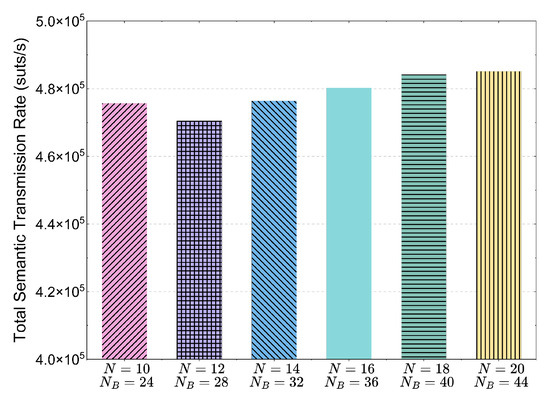
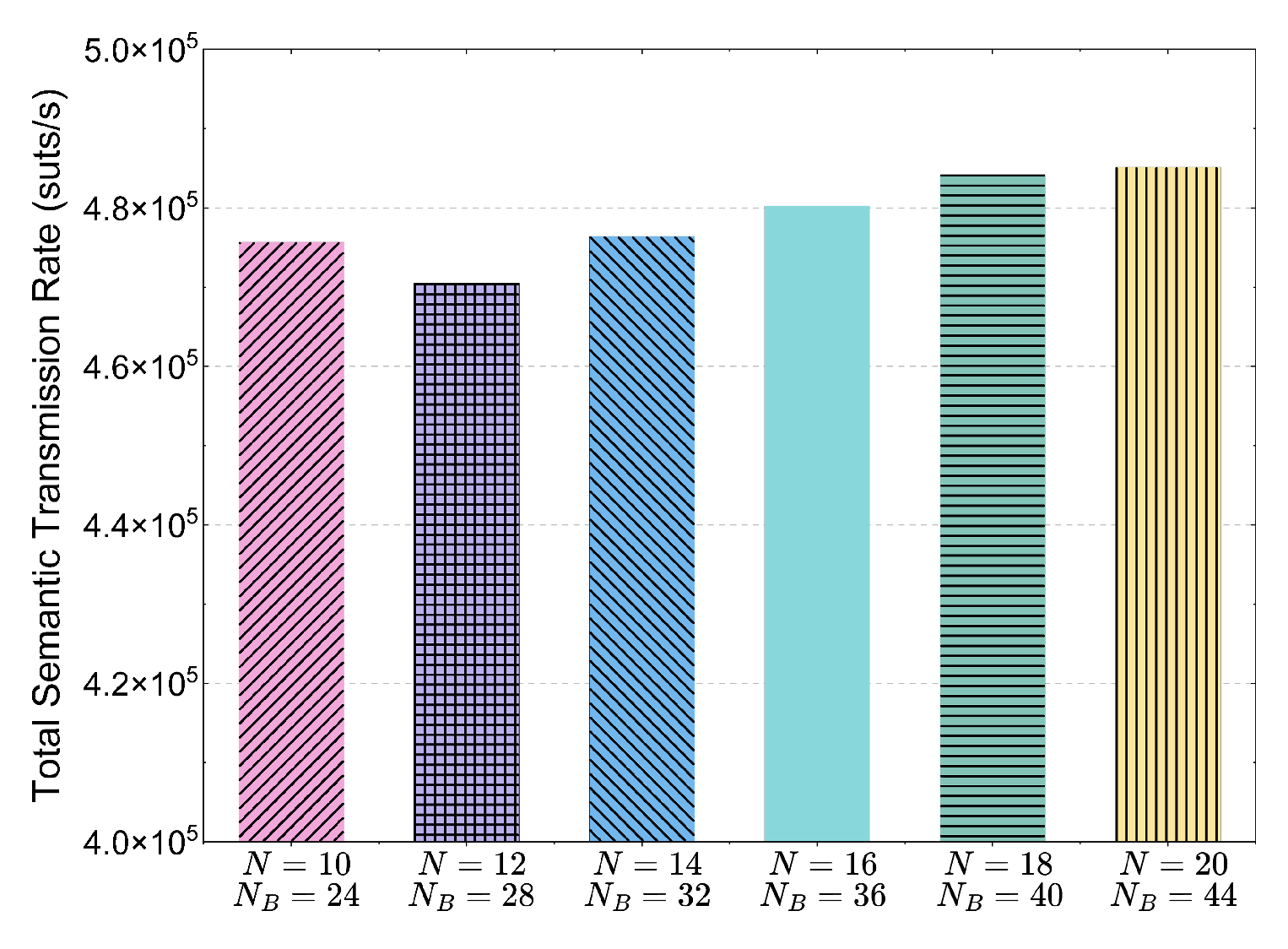
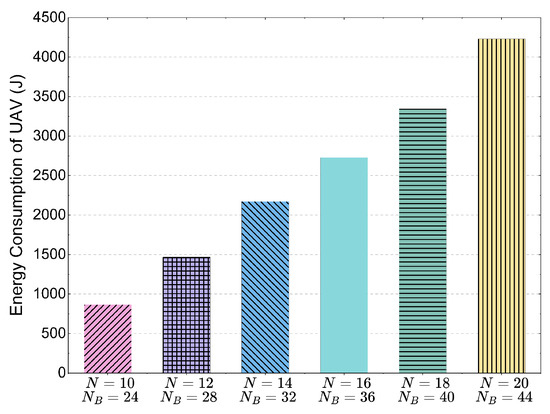
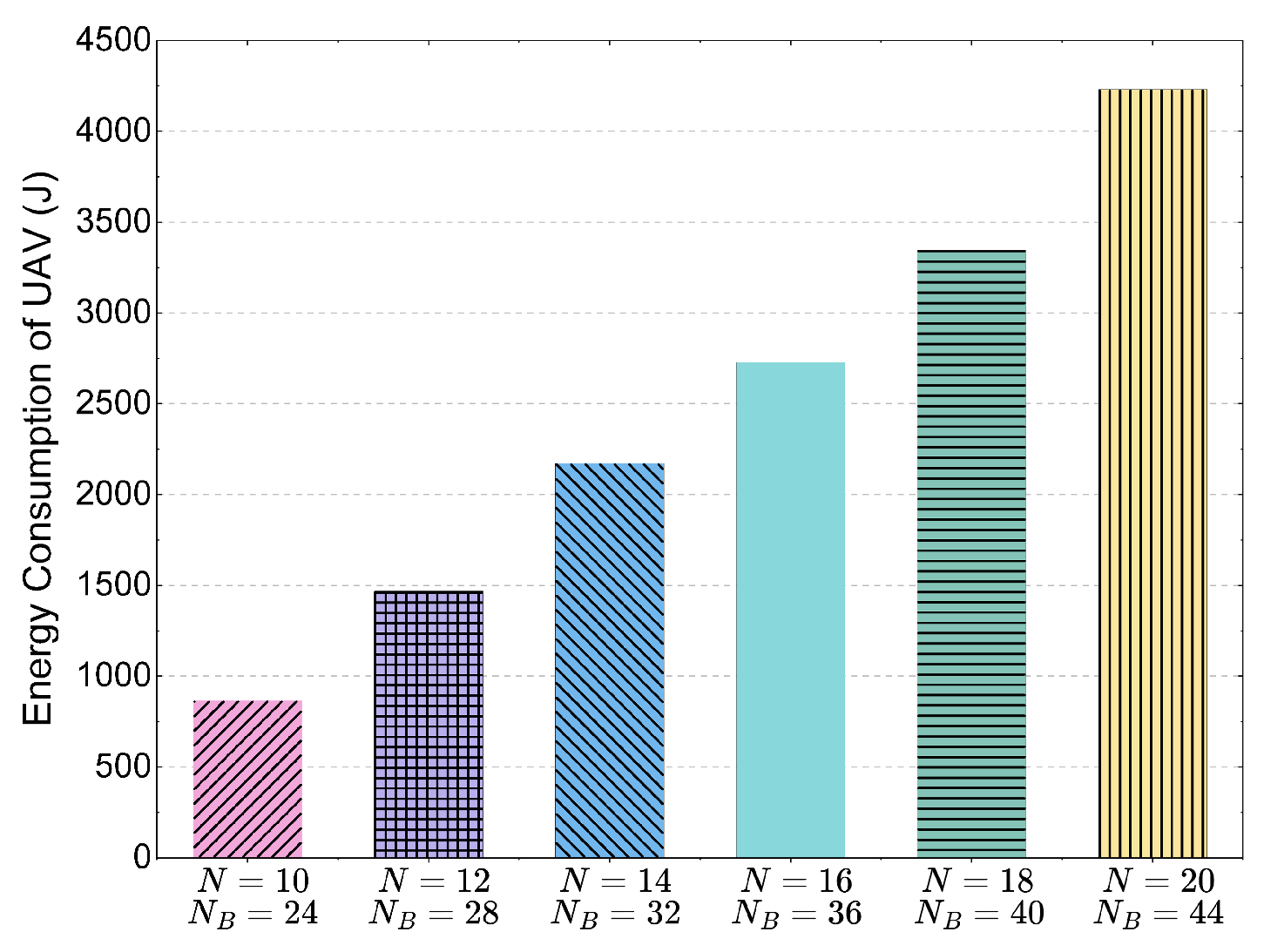
To empirically validate this, we conducted additional scalability experiments by evaluating five extended scenarios based on the original network scale (10 users and 24 resource blocks (RBs)). Specifically, these scenarios include case 1 (12 users, 28 RBs), case 2 (14 users, 32 RBs), case 3 (16 users, 36 RBs), case 4 (18 users, 40 RBs), and case 5 (20 users, 44 RBs). Figure 10 and Figure 11 present the first objective values (total semantic transmission rate) and the second objective values (UAV energy consumption) under these different network scales, respectively. As shown in the figures, the proposed GEAMOCell algorithm consistently maintains high-quality optimization convergence as the problem scale increases, which demonstrates its robustness and scalability for handling larger practical network scenarios.
Figure 10.
The first objective values obtained by the proposed algorithm under different network scales.
Figure 11.
The second objective values obtained by the proposed algorithm under different network scales.
5. Conclusions
This paper has investigated a multi-tier UAV-enabled semantic communication system. Accordingly, we have formulated a multi-objective optimization problem to balance the total semantic transmission rate and the UAV propulsion energy consumption. This is accomplished by jointly optimizing the UAV hovering position, semantic encoding lengths, and RB allocation. The problem has proven highly challenging due to its dynamic variation and mixed-integer nature. To address these challenges, we have proposed a novel GEAMOCell algorithm that incorporates an adaptive neighborhood selection mechanism to balance exploration and exploitation, and employs a crowding-guided archive feedback mechanism to maintain population diversity. The simulation results have demonstrated that the proposed algorithm achieves superior convergence and overall performance, significantly outperforming the baseline algorithms. Despite these contributions, the current study has certain limitations. First, the energy consumption model may not fully capture the energy dynamics of future applications involving complex onboard model inference or continuous fine-tuning. Second, the proposed method is designed for an offline mission-planning phase, whereas practical UAV deployments may encounter abrupt environmental changes that require instantaneous trajectory recalibration. To address these issues, we will extend the proposed framework to more complex and comprehensive scenarios in our future work. Specifically, the computational energy will be incorporated into the overall energy model to support continuous online model fine-tuning at the UAV. Furthermore, for highly dynamic environments, the offline approach can be integrated with online reinforcement learning methods to achieve robust real-time adaptation.
Author Contributions
Conceptualization, P.L. and B.W.; methodology, B.W.; software, P.L.; validation, P.L. and B.W.; writing—original draft preparation, P.L.; writing—review and editing, B.W. All authors have read and agreed to the published version of the manuscript.
Funding
This research was funded in part by the National Natural Science Foundation of China (62303070) and in part by the Science and Technology Development Plan Project of Jilin Province (20240404006ZP).
Institutional Review Board Statement
Not applicable.
Informed Consent Statement
Not applicable.
Data Availability Statement
The raw data supporting the conclusions of this article will be made available by the authors on request.
Acknowledgments
During the preparation of this manuscript, the authors used Gemini 3.1 Pro for the purposes of grammar and spelling checking. The authors have reviewed and edited the output and take full responsibility for the content of this publication.
Conflicts of Interest
The authors declare no conflicts of interest.
References
- Getu, T.M.; Kaddoum, G.; Bennis, M. Semantic Communication: A Survey on Research Landscape, Challenges, and Future Directions. Proc. IEEE 2024, 112, 1649–1685. [Google Scholar] [CrossRef] [Scilit]
- Zhang, C.; Huang, L.; Ning, Q. Resource Allocation in Wireless Semantic Communications: A Comprehensive Survey. IEEE Commun. Surv. Tutor. 2026, 28, 2965–3001. [Google Scholar] [CrossRef] [Scilit]
- Li, J.; Sun, G.; Duan, L.; Wu, Q. Multi-Objective Optimization for UAV Swarm-Assisted IoT With Virtual Antenna Arrays. IEEE Trans. Mob. Comput. 2024, 23, 4890–4907. [Google Scholar] [CrossRef] [Scilit]
- Yao, Y.; Xiao, W.; Miao, P.; Chen, G.; Yang, H.; Chae, C.; Wong, K. UAV-Relay-Aided Secure Maritime Networks Coexisting With Satellite Networks: Robust Beamforming and Trajectory Optimization. IEEE Trans. Wirel. Commun. 2026, 25, 2342–2358. [Google Scholar] [CrossRef] [Scilit]
- Li, H.; Kang, H.; Sun, G.; Li, J.; Wang, J.; Wang, X.; Niyato, D.; Leung, V.C.M. AAV Virtual Antenna Array Deployment for Uplink Interference Mitigation in Data Collection Networks. IEEE Internet Things J. 2025, 12, 10834–10850. [Google Scholar] [CrossRef] [Scilit]
- Yan, L.; Qin, Z.; Zhang, R.; Li, Y.; Li, G.Y. Resource Allocation for Text Semantic Communications. IEEE Wirel. Commun. Lett. 2022, 11, 1394–1398. [Google Scholar] [CrossRef] [Scilit]
- Xu, Y.; Zhang, T.; Liu, Y.; Yang, D.; Xiao, L.; Tao, M. 3D Multi-UAV Computing Networks: Computation Capacity and Energy Consumption Tradeoff. IEEE Trans. Veh. Technol. 2024, 73, 10627–10641. [Google Scholar] [CrossRef] [Scilit]
- Gong, H.; Huang, B.; Jia, B. Energy-Efficient 3-D UAV Ground Node Accessing Using the Minimum Number of UAVs. IEEE Trans. Mob. Comput. 2024, 23, 12046–12060. [Google Scholar] [CrossRef] [Scilit]
- Zhao, S.; Gong, S.; Gu, B.; Li, L.; Lyu, B.; Hoang, D.T.; Yi, C. Exploiting NOMA Transmissions in Multi-UAV-Assisted Wireless Networks: From Aerial-RIS to Mode-Switching UAVs. IEEE Trans. Wirel. Commun. 2025, 24, 2530–2544. [Google Scholar] [CrossRef] [Scilit]
- Chen, C.; Gu, B.; Lyu, B.; Gong, S.; Liu, Z.; Fang, Y. Traffic-Aware Asynchronous Trajectory Planning and Scheduling in UAV-Assisted Wireless Networks With Heterogeneous Traffic Demands. IEEE Trans. Mob. Comput. 2026. [Google Scholar] [CrossRef] [Scilit]
- Li, H.; Chen, H.; Wang, M.; Li, J.; Kang, H.; Guan, Y.; Lin, X. Multi-objective deployment optimization for integrated sensing and communication-enabled unmanned aerial vehicle swarm. Eng. Appl. Artif. Intell. 2025, 162, 112368. [Google Scholar] [CrossRef] [Scilit]
- Xie, L.; Xu, J.; Zhang, R. Throughput Maximization for UAV-Enabled Wireless Powered Communication Networks. IEEE Internet Things J. 2019, 6, 1690–1703. [Google Scholar] [CrossRef] [Scilit]
- Zeng, Y.; Xu, J.; Zhang, R. Energy Minimization for Wireless Communication With Rotary-Wing UAV. IEEE Trans. Wirel. Commun. 2019, 18, 2329–2345. [Google Scholar] [CrossRef] [Scilit]
- Zhang, C.; Yao, W.; Zuo, Y.; Gui, J.; Zhang, C. Multi-Objective Optimization of Dynamic Communication Network for Multi-UAVs System. IEEE Trans. Veh. Technol. 2024, 73, 4081–4094. [Google Scholar] [CrossRef] [Scilit]
- Li, J.; Sun, G.; Sun, Z.; Wang, J.; Liu, Y.; Zhang, R.; Niyato, D.; Mao, S. LLM-Guided DRL for Multi-Tier LEO Satellite Networks With Hybrid FSO/RF Links. IEEE J. Sel. Areas Commun. 2026, 44, 2393–2410. [Google Scholar] [CrossRef] [Scilit]
- Xie, H.; Qin, Z.; Li, G.Y.; Juang, B.H. Deep Learning Enabled Semantic Communication Systems. IEEE Trans. Signal Process. 2021, 69, 2663–2675. [Google Scholar] [CrossRef] [Scilit]
- Zhao, J.; Chen, M.; Yang, Z.; Pan, Y.; Niyato, D.; Pham, Q. Resource Allocation for Semantic-Aware Wireless Communication Networks With Imperfect CSI. IEEE Trans. Wirel. Commun. 2025, 24, 9840–9853. [Google Scholar] [CrossRef] [Scilit]
- Zhao, F.; Sun, Y.; Lan, J.; Zhang, L.; Liu, X.; Imran, M.A. Adaptive Semantic Communication for UAV/UGV Cooperative Path Planning. arXiv 2025, arXiv:2510.06901. [Google Scholar] [CrossRef] [Scilit]
- Xie, P.; Chen, Q.; Wu, J.; Gao, X.; Xing, L.; Zhang, Y.; Sun, H. NOMA-based intelligent resource allocation and trajectory optimization for multi-UAVs assisted semantic communication networks. Ad Hoc Netw. 2025, 171, 103762. [Google Scholar] [CrossRef] [Scilit]
- Wang, Z.; Wang, N. Resource scheduling for multi-UAVs-Enabled spectrum-Sharing semantic communications. Phys. Commun. 2026, 74, 102975. [Google Scholar] [CrossRef] [Scilit]
- Zeng, Y.; Wu, Q.; Zhang, R. Accessing From the Sky: A Tutorial on UAV Communications for 5G and Beyond. Proc. IEEE 2019, 107, 2327–2375. [Google Scholar] [CrossRef] [Scilit]
- Li, H.; Kang, H.; Liu, C.; Wang, R.; Li, J.; Sun, G.; Wang, J.; Liang, S.; Mao, S. Encrypted Traffic Detection in Resource Constrained IoT Networks: A Diffusion Model and LLM Integrated Framework. IEEE Trans. Netw. Sci. Eng. 2026, 13, 5324–5344. [Google Scholar] [CrossRef] [Scilit]
- Salomon, R. Evolutionary algorithms and gradient search: Similarities and differences. IEEE Trans. Evol. Comput. 1998, 2, 45–55. [Google Scholar] [CrossRef] [Scilit]
- Nebro, A.J.; Durillo, J.J.; Luna, F.; Dorronsoro, B.; Alba, E. MOCell: A cellular genetic algorithm for multiobjective optimization. Int. J. Intell. Syst. 2009, 24, 726–746. [Google Scholar] [CrossRef] [Scilit]
- Tian, Y.; Cheng, R.; Zhang, X.; Jin, Y. PlatEMO: A MATLAB platform for evolutionary multi-objective optimization. IEEE Comput. Intell. Mag. 2017, 12, 73–87. [Google Scholar] [CrossRef] [Scilit]
- Li, H.; Kang, H.; Li, J.; Pang, Y.; Sun, G.; Liang, S. Single-objective and multi-objective mixed-variable grey wolf optimizer for joint feature selection and classifier parameter tuning. Appl. Soft Comput. 2024, 165, 112121. [Google Scholar] [CrossRef] [Scilit]
- Moreira, G.; Paquete, L. Guiding under uniformity measure in the decision space. In Proceedings of the 2019 IEEE Latin American Conference on Computational Intelligence (LA-CCI), Guayaquil, Ecuador, 11–15 November 2019; IEEE: Piscataway, NJ, USA, 2019; pp. 1–6. [Google Scholar]
- Deb, K.; Pratap, A.; Agarwal, S.; Meyarivan, T. A fast and elitist multiobjective genetic algorithm: NSGA-II. IEEE Trans. Evol. Comput. 2002, 6, 182–197. [Google Scholar] [CrossRef] [Scilit]
- Cheng, R.; Jin, Y.; Olhofer, M.; Sendhoff, B. A Reference Vector Guided Evolutionary Algorithm for Many-Objective Optimization. IEEE Trans. Evol. Comput. 2016, 20, 773–791. [Google Scholar] [CrossRef] [Scilit]
- Zille, H.; Ishibuchi, H.; Mostaghim, S.; Nojima, Y. A Framework for Large-Scale Multiobjective Optimization Based on Problem Transformation. IEEE Trans. Evol. Comput. 2018, 22, 260–275. [Google Scholar] [CrossRef] [Scilit]
- Song, F.; Xing, H.; Xu, L.; Xiao, M.; Liu, Y.; Deng, M.; Chen, X.; Lei, X. Multi-Objective Dependent Task Scheduling, Resource Allocation, and Service Caching in Aerial-Ground Integrated MEC. IEEE Trans. Intell. Transp. Syst. 2025, 26, 13489–13505. [Google Scholar] [CrossRef] [Scilit]
- Zhao, Y.; Huang, H.; Huang, Z.; Zuo, Z.; Zhou, J.; Ba, J.; Li, L.; Liu, C. Enhanced UAV Collaborative Jamming via Multi-Objective BBO with Hybrid Dominance Sorting. IEEE Trans. Aerosp. Electron. Syst. 2026. [Google Scholar] [CrossRef] [Scilit]

Disclaimer/Publisher’s Note: The statements, opinions and data contained in all publications are solely those of the individual author(s) and contributor(s) and not of MDPI and/or the editor(s). MDPI and/or the editor(s) disclaim responsibility for any injury to people or property resulting from any ideas, methods, instructions or products referred to in the content. |
© 2026 by the authors. Licensee MDPI, Basel, Switzerland. This article is an open access article distributed under the terms and conditions of the Creative Commons Attribution (CC BY) license.