


Abstract
Resource allocation in sixth-generation (6G) networks must meet throughput, latency, and reliability targets while network conditions keep changing. At the same time, the telemetry needed to train good models is distributed across many devices and edge nodes, so sending it to a central server can violate privacy or data-sharing constraints. Federated learning (FL) helps, but two practical concerns usually determine whether it works in practice: how much communication is needed to achieve strong performance, and whether weaker (tail) clients benefit-not only the average client. In this study, we run large-scale FL on 6G telemetry with 200 clients and quantify the communication fairness trade-off. We evaluate FedAvg and FedProx under multiple settings and benchmark them against a strong centralized model and a local-only baseline. Results are reported as mean ± 95% confidence intervals over five random seeds. We measure the accuracy, macro-F1, AUC, and AP, and we also focus on tail behavior using the worst eligible client accuracy, p10 client accuracy, and fairness gap. By plotting the accuracy/macro-F1 against cumulative communication (bytes), we show that some configurations match the average performance while transmitting far fewer data. Finally, we find that the worst client performance improves early and then stabilizes, and a sensitivity study suggests that FedProx’s has a limited impact in this setup. These findings offer actionable guidance for 6G operators and system designers by quantifying how participation and dropout policies translate into concrete communication budgets and tail client behavior.
1. Introduction
Sixth-generation (6G) wireless networks are expected to not only deliver extremely high data rates but also simultaneously meet the goals of ultra-low latency (URLLC-type latency), high reliability, and widespread connectivity. A prominent element in the 6G vision is that network decisions should be more automated and intelligent, as future applications (e.g., XR/Metaverse, autonomous systems, industrial IoT, and large-scale sensing) impose variable and stringent requirements on the network [1]. In such environments, resource allocation, such as bandwidth allocation, power control, scheduling, and QoS-based priorities, is a central issue, in which every decision directly affects the trade-off between throughput and latency.
Traditionally, resource allocation has been approached either through classical optimization/hand-crafted rules or through centralized machine learning to learn policies. However, in practice, centralized learning in networks like 6G faces several obstacles: (i) network telemetry or user/device data are often subject to privacy and regulatory constraints; (ii) the data are collected in large quantities and in different locations, making it expensive and impractical to move them to one location; and (iii) the data are non-IID due to different client/site conditions, hardware, and traffic patterns, making model training and generalization difficult [2].
In this context, federated learning emerges as a viable alternative, in which the training data reside on the client side and the server/coordinator only aggregates model updates to build a shared global model [3]. The main advantage of this approach is that it allows collaborative learning without sharing data, which can reduce privacy concerns and the burden of data transfer. However, FL itself is not a “magic bullet”; it has its own engineering challenges, including communication costs, the limitations of wireless channels, and the heterogeneity (system and statistical heterogeneity) of clients [4,5].
The greatest practical bottleneck of FL in wireless/edge settings is often communication, as clients have to upload/download model weights or gradients in each round. Communication efficiency has also been considered a central issue in classical FL tasks [3], and this issue is exacerbated in wireless channels, because factors such as bandwidth, power, fading, and scheduling directly affect the learning process [6,7]. This is why the concept of “joint learning and communication design” has become important in the recent literature, which attempts to optimize FL’s update mechanism and wireless resource management together [7].
Another important issue is fairness or tail client performance. In a practical network, even if the average performance (e.g., overall accuracy or macro-F1) is good, some weak clients (e.g., fewer data, worse channels, or different traffic) may consistently lag behind. This situation can be dangerous for the network in terms of objectives such as “minimum service quality” because, in the real world, the success of a system is often measured by the worst case and not the average. In FL, non-IID data can cause divergence in client updates, and the global model may be less efficient for some clients [2,8]. In this context, FedProx is a well-known method that adds a proximal term to the local objective to reduce heterogeneity [8]. However, its efficiency and sensitivity (e.g., parameter) may vary experimentally across different datasets and settings, so it is necessary to test it with robust experimental protocols.
Furthermore, client selection and participation strategies are also very important in wireless FL, since it is usually not possible to include all clients in each round. Some works have presented methods for selecting clients under heterogeneous resources [9], showing that the FL result is not only strongly related to the “algorithm” but also to the “system settings” and “resource control”. Therefore, works adopting FL in the context of 6G emphasize that FL can be used in problems such as resource management, user behavior prediction, and network control, but it is necessary to solve practical challenges related to communication and heterogeneity [5,10].
In this paper, we approach FL from an engineering-first perspective for the 6G resource allocation problem. Our main goal is not only to show that “FL works” but to understand
- How much communication is required to achieve the desired performance (accuracy/F1 vs. cumulative bytes);
- The states of weak clients along with the average metric (worst client, p10 client, fairness gap);
- The significance of the difference between FedAvg and FedProx under heterogeneity;
- How sensitive the results are to changes in in FedProx.
A notable feature of our work is that we perform experiments at a scale of 200 clients and include multi-seed mean ± 95% CIs in reporting so that the results are less affected by random seeds or single-run effects. In practice, FL results are subject to variance (e.g., client selection randomness, mini-batch stochasticity, or non-IID severity), so reporting with confidence intervals increases the scientific robustness. In addition, we include a robust centralized model as an upper bound and a “local only” approach as a no-collaboration baseline to clarify both the benefits and limitations of FL.
Finally, this study sheds light on an important question for future wireless networks like 6G: if the average performance is roughly the same, in which settings can the same level be achieved with less communication, and what happens to the worst-case clients in the meantime? Our work takes this question as the central theme to clarify the communication-fairness trade-off, which network operators and system designers can use in practical decisions [4,7,10].
1.1. Related Work and Research Gaps
This section provides a comprehensive review of current research to understand federated learning in the context of 6G networking and resource allocation. In particular, we systematically review studies that address (i) the fundamentals of FL, (ii) communication cost/compression and communication efficiency, (iii) non-uniform data (non-IID) and system heterogeneity, (iv) fairness and worst-case client performance, and (v) the application of FL to wireless/6G resource management. Finally, we highlight the research gaps that our 200-client study attempts to fill.
Table 1 summarizes how this paper complements representative recent FL-for-wireless studies, with a particular emphasis on policy-controlled participation/dropout, communication budgets, and tail client behavior.
Table 1.
Comparison with representative recent FL-for-wireless works and the scope of this paper.
1.1.1. Federated Learning: Foundations, Motivations, and Challenges
The basic concept of federated learning is to train the model locally on clients (e.g., mobile devices, edge nodes, or users connected to a base station) instead of transmitting the training data to a central server and to only aggregate the model updates/parameters to the central server [2,3]. This approach helps to reduce issues such as privacy, regulatory restrictions, and the cost of large-scale data transfer. However, FL also has several practical limitations: the distribution of clients’ data is often non-IID; clients may have different computational and communication capabilities; and full participation in each round is usually not possible [2,8].
The classical FedAvg [3] played a fundamental role in the success of FL, but convergence can be slow or unstable due to “client drift” in non-IID data. Therefore, various improvements have been proposed in subsequent research to handle heterogeneity, such as FedProx [8], which attempts to provide more robust convergence under system and data heterogeneity by incorporating proximal regularization in the local objective. Overall, for the successful deployment of FL, not only is the mean accuracy considered, but also fair performance across different clients and practical constraints on the communication budget become decisive [2,13].
1.1.2. Communication Efficiency: Update Compression, Participation, and Budget
The main trade-off in FL is that better model quality requires more rounds, more client participation, and more upload/download communication. This cost increases rapidly with larger models and more clients [2,4]. For this reason, “communication-efficient FL” has become a central topic, involving several lines of work: (i) model/gradient compression, (ii) sparse updates, (iii) quantization, (iv) low-frequency aggregation, and (v) client selection and participation control.
The classical direction of compression has led to techniques such as sparse binary compression that reduce the communication load by encoding updates sparsely and in fewer bits [14]. Such techniques are particularly useful when the uplink is limited or the total upload traffic is not feasible due to the large number of clients. Furthermore, partial participation is also a practical requirement in FL: only a few clients are selected in each round to keep the latency and communication budget under control [2,4]. However, reducing participation can affect fairness because weak/low-data clients may lag behind; therefore, a joint study of fairness metrics and the communication budget becomes necessary.
Communication efficiency becomes more complex in a wireless environment because channel feeding, power control, and resource sharing affect the speed and quality of FL [4,15]. Recent research has also introduced the concept of over-the-air federated learning (OTA-FL), which accelerates aggregation by exploiting the superposition property of the wireless channel, but it raises new questions, such as those related to distortion, reliability, and security/privacy [16]. This means that, in highly heterogeneous and ultra-dense settings such as 6G, communication-efficient design and fairness-aware learning are inseparable.
1.1.3. Non-IID Data, Client Drift, and Modern Directions in Optimization
The main problem in FL is statistical heterogeneity (non-IID): the distribution of data from different clients is not the same, which can lead to local training drift from the global objective. FedProx [8] tackles this problem through regularization, while SCAFFOLD [17] uses control variates to reduce client drift, showing that communication rounds can be reduced under heterogeneity. Similarly, FedNova [18] addresses the problem from the perspective of “objective inconsistency”-that is, if different clients perform different numbers of local updates, naive aggregation can bias the global objective; FedNova tries to reduce this inconsistency through normalized averaging.
Furthermore, methods based on dynamic regularization have also emerged, such as FedDyn [19], which includes a regularizer to dynamically align client-level objectives in each round, so as to reduce the difference between global and local minima in the long run. On the other hand, representation-level or contrastive ideas have also been used, such as MOON [20], which attempts to improve generalization in non-IID cases through model-contrastive learning. In the same vein, to address feature shift (i.e., different distributions of features across different clients), FedBN [21] has emerged as a method to keep batch normalization local to reduce feature mismatch caused by global averaging.
All these works indicate that it is not enough to improve the “average” model in FL; rather, the nature of the heterogeneity (label shift, feature shift, quantity imbalance), the participation pattern, and the optimization dynamics together determine the client-wise performance. In problems such as 6G resource allocation, this heterogeneity is further exacerbated because the network conditions (throughput/latency) change over time, and users have different QoS requirements.
1.1.4. Fairness in Federated Learning: Definitions, Metrics, and Strategies
There are several layers of fairness in FL. At one level is “performance fairness”, which aims to ensure that the accuracy/error of the model is similar across different clients or demographic groups and that no particular group is consistently disadvantaged [13]. The second level is “participation fairness”, which ensures that clients with weak networks or low battery are not excluded from the learning process. The third level is “resource fairness”, which means that the benefits are not limited to powerful clients, given the limited communication and computing capacity.
Recent surveys have shown that fairness and privacy often go hand in hand and influence each other; for example, differential privacy noise can be more harmful to some clients, or client-level debugging and fairness diagnosis becomes difficult under secure aggregation [13]. Therefore, modern studies are not limited to the overall accuracy or AUC but also report metrics such as worst client accuracy, lower-tail statistics (e.g., 10th percentile), and performance gaps to better understand the real-world situations of vulnerable users [13].
In practice, various strategies have been observed to improve fairness: (i) reweighting or constrained optimization; (ii) personalized FL, where partial personalization is maintained for each client; (iii) client selection is made fairness-aware; and (iv) aggregation uses robust or tail-aware objectives. However, the success of these methods strongly depends on the size of the communication budget and the extent to which client participation can be restricted. Therefore, systematically quantifying the trade-off between fairness and communication (and reporting it with confidence intervals) is considered a strong addition to FL evaluation.
1.1.5. FL in Wireless/6G: A Perspective on Integrated Sensing, Communication, and Computing
FL in wireless networks is no longer simply an ML technique but a cross-layer problem where communication (bandwidth, fading), computing (edge constraints), and learning (model convergence) are interconnected [4]. Pervasive AI, ultra-reliable low-latency communications, massive connectivity, and heterogeneous devices are considered to be central features in the 6G vision, so FL is considered one of the key enabling paradigms for 6G [22]. Furthermore, concepts such as OTA-FL show interesting possibilities in the direction of low-latency aggregation in 6G, but, for this, power control, channel uncertainty, and trust/security issues also need to be addressed [16].
FL surveys and frameworks for 6G generally conclude that (i) client heterogeneity (device capability + data diversity), (ii) partial participation, (iii) energy/latency constraints, and (iv) privacy/security restrictions are the main factors that will determine the performance and feasibility of FL [4,22]. These factors are also present in our problem (resource allocation), because resource allocation policies are directly affected by the network conditions and user behavior; therefore, it is important to view the evaluation of FL from the three perspectives of “communication–fairness–performance”.
1.1.6. Federated Learning for Resource Allocation and Network Control
Reinforcement learning and deep learning-based approaches have been widely used in resource allocation and network control problems, but data centralization and the need for retraining in new environments are major issues. FL-based approaches attempt to fill this gap, where multiple systems or cells learn a policy from their local observations and then improve the learning speed and adaptability through aggregation [11]. Such works particularly emphasize that seeding a global policy can speed up learning when new users/systems join the network or the conditions change [11].
In the context of B5G/6G, research on FL-based radio resource management (RRM) and relaying-assisted scenarios is also growing, where distributed learning with energy efficiency, spectral efficiency, or latency constraints is required [23]. However, two weaknesses remain in the existing literature: (i) most studies report on small or medium client scales, while, in 6G, the large scale (hundreds/thousands) is more realistic; (ii) results are often limited to mean performance, while, in resource allocation problems, the worst client or tail performance (e.g., users with low throughput or high latency) better reflects the real impact of the policy. Therefore, studying the communication–fairness trade-off with large-scale, multi-seed, and uncertainty-aware reporting (e.g., confidence intervals) can be considered a strong contribution.
1.1.7. Privacy and Security: Secure Aggregation and Differential Privacy
Although FL data remain on the device, there are still concerns about information leakage from model updates, so mechanisms such as secure aggregation and differential privacy are important [24,25]. Secure aggregation provides the possibility that the server only sees summed updates, and individual client updates are not revealed [24]. Differential privacy, on the other hand, reduces leakage by adding noise to updates or parameters, but this may also affect utility and fairness [25]. In practice, privacy requirements in 6G settings may be more stringent; simultaneously, communication constraints will also be tight. Thus, without fairness-aware evaluation, our understanding of privacy-preserving FL remains incomplete [13,26,27].
1.1.8. Summary of Gaps and Positioning of This Work
The above literature clearly shows that (i) communication efficiency, (ii) heterogeneity-robust optimization, and (iii) fairness are all important for FL; however, in most studies, the joint quantification of these three aspects seems to be lacking at a large scale, especially in network-centric tasks such as resource allocation. Our study addresses this literature gap: we simultaneously analyze the communication budget and fairness-oriented metrics (e.g., worst client and lower-tail performance) under different FL configurations at the scale of 200 clients, and we also report the uncertainty of the results through multi-seed evaluation. Thus, this work illustrates the deployability of FL in 6G resource allocation-not only in terms of the average accuracy but also in terms of equity and practical communication constraints.
The remainder of this paper is organized as follows. Section 2 describes the dataset, baselines, FL configuration, communication accounting, and evaluation metrics. Section 3 reports the experimental results and trade-off curves, and Section 4 discusses the implications and limitations. Finally, Section 5 concludes the paper and outlines future directions.
Contributions
This work presents an empirical, deployment-oriented study (not a new FL algorithm) that (i) quantifies performance vs. communication (bytes) under controlled participation/dropout policies; (ii) evaluates tail client behavior via worst eligible and P10 metrics with 95% CIs over five seeds; (iii) compares FedAvg and FedProx under identical system settings and reports limited sensitivity to in this task; (iv) provides reproducible implementation details (model, hyperparameters, sampling, metrics, and eligibility).
Scope and Novelty Relative to Prior Work
This manuscript does not introduce a new federated optimization algorithm, nor do we claim a formal, closed-form “optimal” communication-fairness frontier. Instead, our novelty is evaluation-focused: we provide a large-scale, uncertainty-aware empirical study of how system policies (participation and dropout) translate into (i) cumulative communication payload and (ii) tail client behavior (worst eligible client, P10, and fairness gap) in a 6G-inspired telemetry task. We therefore moderate any “methodological” claims and position this contribution as actionable evidence for deployment decisions and as a reproducible experimental protocol for future fairness-aware and wireless-aware extensions.
2. Methodology
This section presents the complete experimental framework used to analyze communication-fairness trade-offs in federated learning (FL) for 6G resource allocation. We describe the dataset, client heterogeneity, learning objectives, baseline models, federated algorithms, communication accounting, and evaluation metrics in detail to ensure reproducibility and transparency.
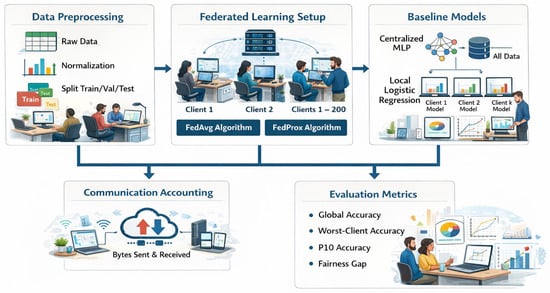
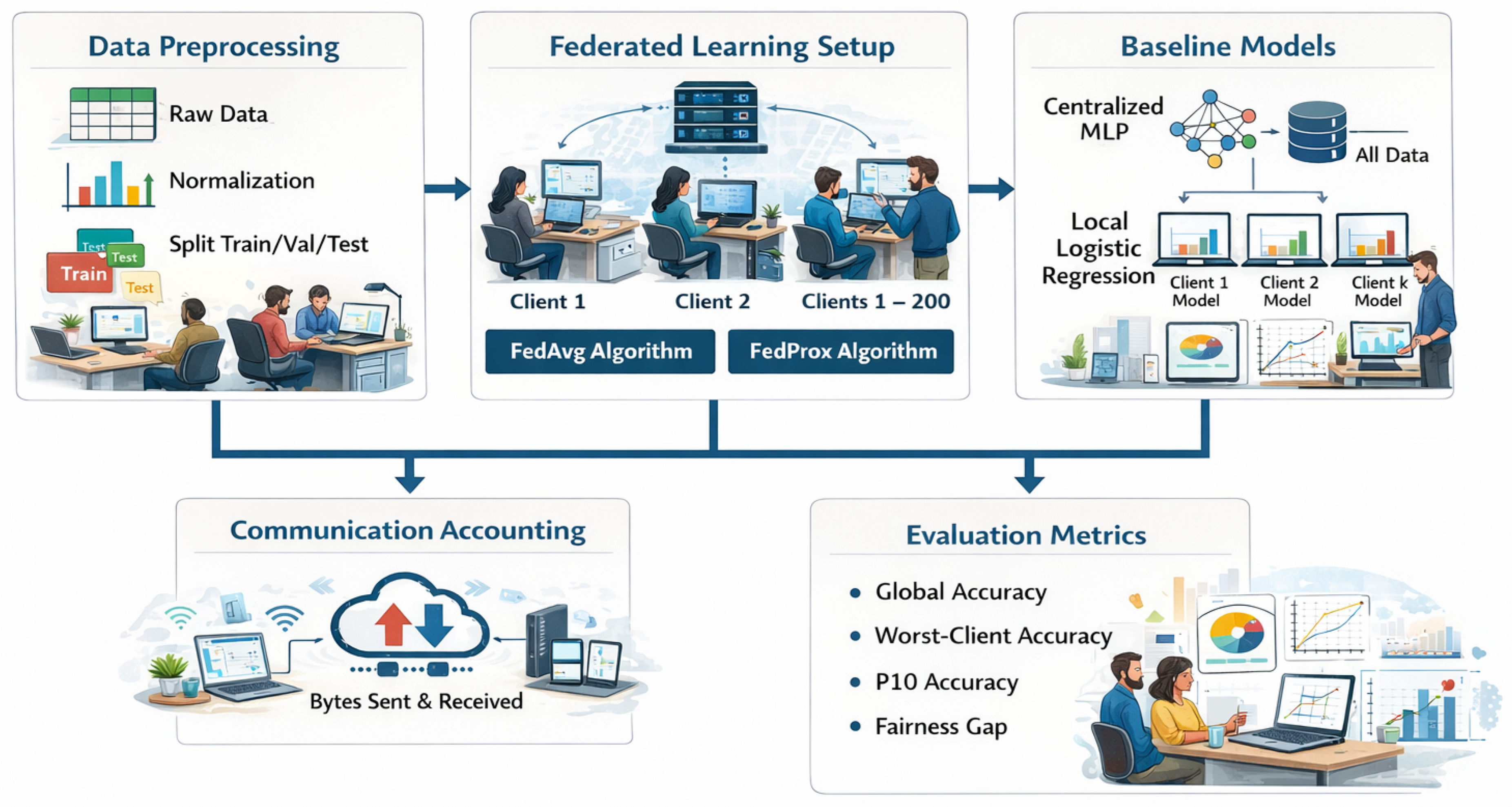
As illustrated in Figure 1, the proposed framework begins with client-wise data preprocessing and temporal splitting, followed by federated training using FedAvg and FedProx across 200 heterogeneous clients.
Figure 1.
Overall methodology overview for communication-fairness analysis in federated learning for 6G resource allocation. The pipeline illustrates data preprocessing, the federated learning setup with 200 clients using FedAvg and FedProx, the baseline models, communication accounting, and fairness-aware evaluation metrics.
2.1. Dataset Description and Client Heterogeneity
In this study, we present experiments on a large-scale 6G network telemetry dataset, which includes measurements from diverse and geographically distributed wireless environments. The dataset consists of approximately 30,000 samples and 34 attributes. Before the analysis, we performed data cleaning, filtering of unnecessary or less important features, and standardization in the preprocessing steps, after which 28 prominent features were finally retained. Each sample represented a specific time window indexed by window_idx, and this arrangement resulted in a total of 150 unique time windows.
Furthermore, we divided the same data into 200 clients, where each client represented an edge device, base station, or similar network entity that observed its local traffic conditions. In practice, there are inherent differences in traffic demand, channel quality, and user behavior at different locations; therefore, the data available to each client are not identical but rather non-IID. This feature is crucial for our study, because, based on this realistic heterogeneity, we can evaluate model performance not only at the global level but also in a more meaningful way, i.e., in terms of fairness and worst client performance, which is directly applicable to real 6G deployment.
2.2. Client Partitioning and Heterogeneity Diagnostics
Client construction. We treat each client as an independent network entity (e.g., edge node or base-station-side data silo). The raw dataset is partitioned into disjoint client datasets using the available grouping identifier(s) provided with the telemetry (e.g., site/device identifier). This preserves the natural separation of the data across network entities and avoids mixing samples from different entities.
Why the data are non-IID. Non-IID behavior arises because different entities observe different operating regimes: traffic load, SINR/coverage conditions, and QoS demand patterns vary across locations and time. As a result, both the label distribution (e.g., SLA satisfaction rates) and the feature distribution (e.g., throughput/latency statistics and resource allocation features) vary across clients.
Quantifying heterogeneity (what we report). To make this explicit, we characterize heterogeneity along three axes and report them in the manuscript: (i) quantity skew (distribution of across clients); (ii) label skew (per-client positive rate and its dispersion); (iii) feature shift (differences in client-wise feature means/variances). Table 2 lists the diagnostics used. These diagnostics help to demonstrate why tail metrics remain lower than the global averages and why some algorithms (e.g., FedProx) may behave similarly to FedAvg under mild-to-moderate drift.
Table 2.
Heterogeneity diagnostics used to characterize the 200-client partition (definitions and interpretation).
2.3. Preprocessing and Temporal Splitting
To ensure numerical stability and comparability across clients, we normalize all continuous features using standard scaling (zero mean, unit variance). Because the telemetry is time-dependent, we use a time-aware split rather than random shuffling: the first 80% of time windows (by window_idx) are used for training and the remaining 20% for testing, which prevents temporal leakage.
Standardization parameters are estimated from the training split only and then applied to the test split. This requires only aggregate statistics (means/variances) and does not require sharing raw samples. Missing values, if present, are handled using robust median imputation on the training data and the same imputation values are applied at test time.
2.4. Learning Objective
Let K denote the total number of clients, and let represent the local dataset of client k with samples. The global federated objective is a weighted empirical risk minimization problem:
where N is the total number of training samples across all clients, and the local objective of client k is
with loss function and model parameterized by w. We consider binary classification for SLA satisfaction prediction, and all reported classification metrics use a threshold of 0.5 unless stated otherwise.
2.5. Baseline Models
To contextualize the federated performance, we compare the FL approaches against two baselines.
- Centralized strong MLP (upper bound). We aggregate all training data and train a GPU-accelerated multilayer perceptron with two hidden layers, (ReLU activations), and dropout rates 0.20 and 0.15 on the hidden layers. We optimize with AdamW (learning rate , weight decay ) for up to 30 epochs and apply early stopping with patience 5 based on the validation macro-F1. We use a batch size of 8192 and a class-balanced loss via pos_weight (ratio of negatives to positives).
- Local-only logistic regression (no collaboration). Each client independently fits a logistic model using only its local training data. We implement fast analytic gradient updates on the GPU and run 20 local gradient steps with learning rate 0.25 for each client model. Predictions are evaluated only on the same client’s test split and then pooled for global reporting.
2.6. Federated Learning Setup
We adopt a cross-device federated learning paradigm where training is performed locally on multiple distributed clients and model updates are aggregated on a server. In each communication round t, a set of clients is sampled uniformly at random without replacement according to a participation ratio p. To model availability and connectivity uncertainty, we further apply a dropout rate d among the selected clients to obtain the final participating set (clients that successfully complete the round).
We evaluate four system configurations, denoted as pXX_dYY, where is the expected per-round participation ratio and is the per-round dropout probability among selected clients. Each FL run uses communication rounds, with 3 local gradient steps per participating client per round and local learning rate 0.25. Unless otherwise stated, FedProx uses , and we additionally perform a sweep for the high-dropout setting p30_d50.
2.7. FedAvg Algorithm
FedAvg combines local model updates through weighted averaging:
where is the global model at round t, is the locally updated model of client k after its local training at round t, and is the number of local training samples of client k. The set denotes the participating clients that successfully complete round t after selection and dropout.
FedAvg is widely used due to its simplicity and efficiency; however, under severe heterogeneity, it can suffer from client drift, which can degrade convergence and tail client performance.
2.8. FedProx Algorithm
FedProx mitigates non-IID client drift by adding a proximal regularization term to the local objective:
where controls the strength of the proximal term. We use as the default value and sweep for the high-dropout setting to study sensitivity.
2.9. Communication Accounting
We quantify the communication cost at the granularity of the transmitted model parameters. Let P denote the number of trainable parameters and let b denote the number of bytes per parameter (we use 32-bit floating point, so ). In round t, each participating client downloads the global model and uploads its updated model once. Therefore, the per-round communication is approximated by
and the cumulative communication after T rounds is
2.10. Limitations and 6G Mapping
This accounting measures the payload size and abstracts away wireless-layer effects (e.g., scheduling, retransmissions, packet loss, variable SINR, and energy). To connect bytes to a coarse transmission-time proxy, one may map the payload size to the uplink time as
where is an effective uplink rate (bps) that captures modulation/coding, resource allocation, and protocol overhead. We use bytes as a first-order, implementation-agnostic proxy for the communication burden and explicitly discuss these limitations in Section 4.
2.11. Evaluation Metrics
We report global performance using the accuracy, macro-F1, AUC, and average precision (AP). To capture robustness and fairness across clients, we compute client-wise test accuracies at each round t and summarize the lower tail.
Eligible client set. Not all clients have sufficient test samples or both classes in their local test split. We therefore define an eligible client set
where is the number of test samples of client i, and is a minimum test size threshold. In our experiments, we use .
Using , we define the worst eligible client accuracy and the eligible client fairness gap as
We also report the 10th percentile (P10) of eligible client accuracies as a complementary lower-tail statistic.
2.12. Statistical Robustness
All experiments are repeated across five independent random seeds. Results are reported as mean ± 95% confidence intervals, ensuring statistical reliability and minimizing the effects of random initialization or client sampling.
2.13. Implementation and Reproducibility Details
To improve the reproducibility, we provide the following implementation details explicitly in the manuscript: (i) full model architectures (layer sizes, activations, dropout); (ii) optimizer and training hyperparameters (learning rate, weight decay, batch size, early stopping); (iii) client sampling and dropout procedure per round; (iv) metric definitions (including eligibility filtering); and (v) random-seed handling.
Client sampling and dropout (per round). At round t, we sample a set of clients uniformly at random without replacement with . We then apply independent Bernoulli dropout with probability d to obtain the participating set . Only clients in download the global model, run the prescribed local updates, and upload model parameters for aggregation.
Reproducibility note. If a public repository link is not included at submission time due to double-blind review constraints, we will provide an anonymized code release and exact configuration files (including random seeds) in the camera-ready version. The manuscript is written such that a reader can re-implement the experimental protocol from the described settings alone.
3. Results
3.1. Experimental Protocol and Reported Statistics
All results are averaged over five random seeds. Whenever seed-to-seed variability is available, we report mean values with 95% confidence intervals (CI). Table 3 summarizes the key implementation details and hyperparameters used across all experiments.We assess (i) global performance using the accuracy, macro-F1, AUC, and average precision (AP); (ii) client-level robustness using the worst eligible client accuracy and the 10th percentile (P10) eligible client accuracy; and (iii) fairness using the eligible client fairness gap. We also track cumulative communication in bytes to directly quantify the communication-performance trade-off.
Table 3.
Key implementation details and hyperparameters (applied consistently across all runs unless otherwise specified).
3.2. Overall Comparison Across Centralized, Local-Only, and Federated Methods
Table 4 reports the main results for centralized training (strong MLP), local-only training (logistic regression), and multiple federated configurations using FedAvg and FedProx. Across the federated variants, the global performance is very similar: accuracy stays around 0.849–0.850 and the macro-F1 around 0.846–0.847. The centralized strong MLP achieves the highest global accuracy (), but the margin over the best federated settings is small (Table 4).
Table 4.
Overall performance (mean ± 95% CI over 5 seeds). “Worst” is the worst eligible client accuracy; “P10” is the 10th percentile eligible client accuracy; “Gap” is the fairness gap for eligible clients; “Bytes” is the total cumulative communication.
Tail metrics offer a more practical view. While the global averages are close, the most challenging clients can behave differently. In particular, the centralized model attains stronger worst eligible client accuracy than the local-only baseline (Table 4), suggesting that central training better supports difficult clients in this experimental regime.
The communication cost differentiates between federated choices. For example, the configuration achieves competitive global performance while using fewer bytes than higher-communication settings such as (Table 4). This motivates an evaluation of performance not only over rounds but also as a function of the communication budget.
3.3. Convergence Behavior over Rounds
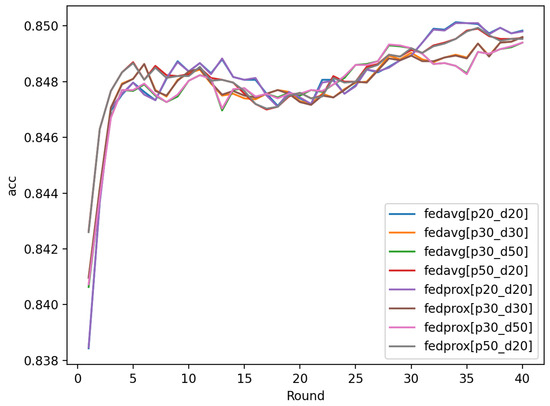
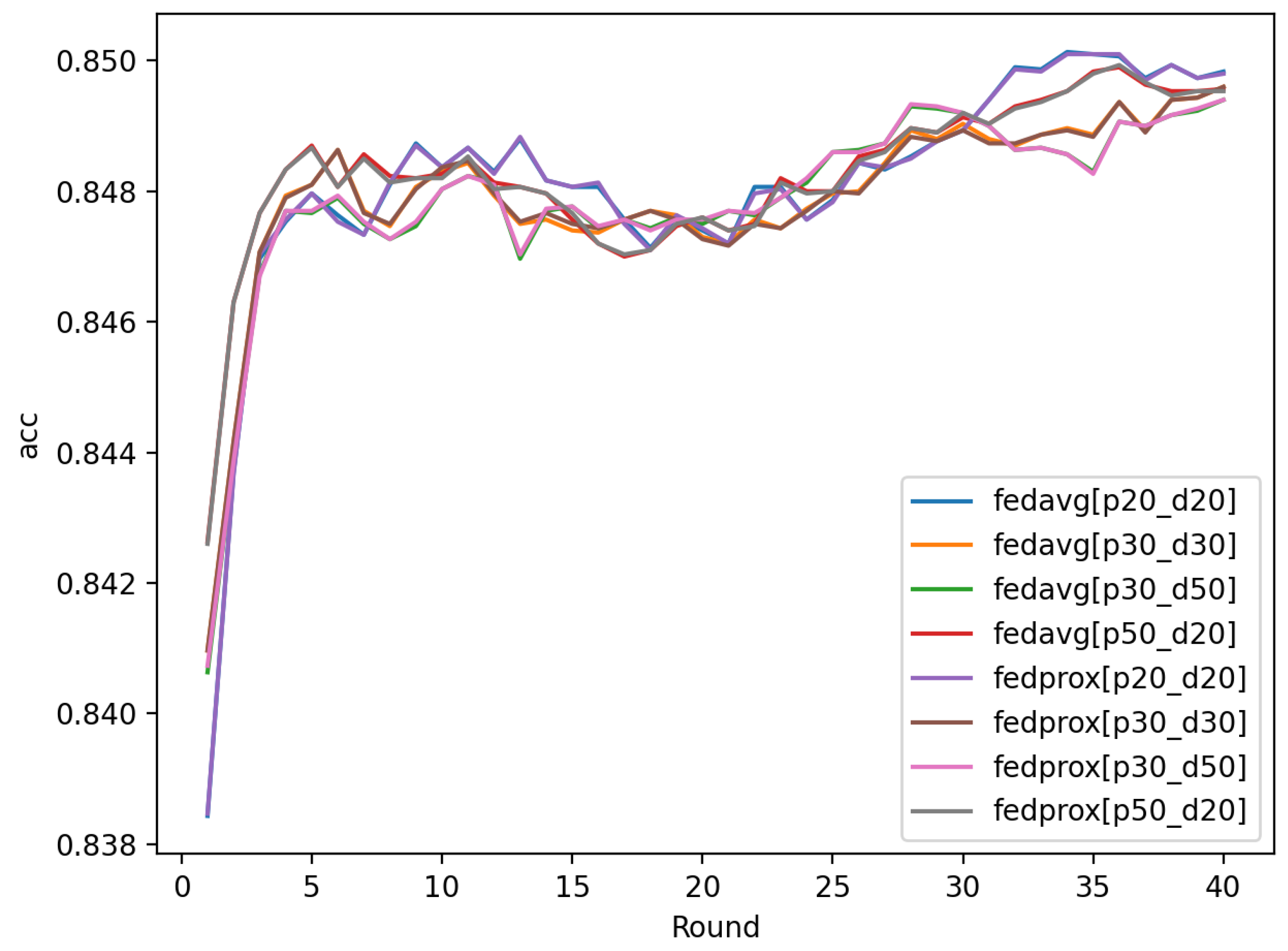
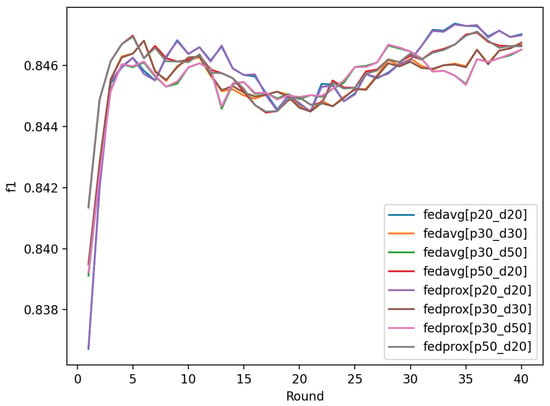
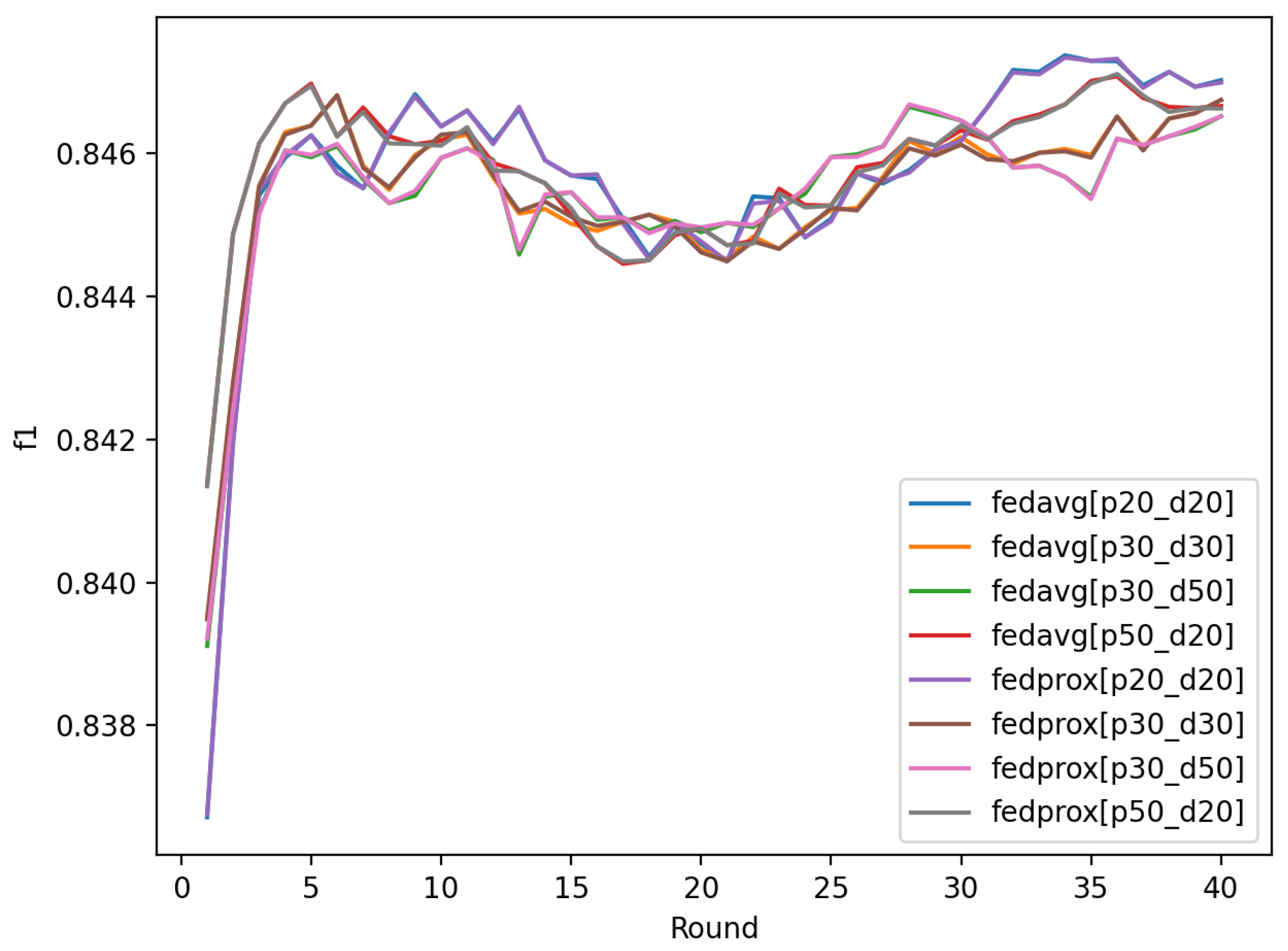
Figure 2 shows the global accuracy versus federated rounds. For both FedAvg and FedProx, the accuracy increases sharply in the first few rounds and then stabilizes with mild fluctuations, indicating fast early coordination followed by slower refinement. The macro-F1 Figure 3 closely tracks the accuracy, suggesting that improvements are broadly consistent across classes rather than concentrated in a single class.
Figure 2.
Global accuracy versus federated training rounds for FedAvg and FedProx under multiple configurations (distinct line styles and markers are used for readability). Accuracy improves quickly in early rounds and then stabilizes, indicating that later rounds yield diminishing returns for this task.
Figure 3.
Macro-F1 versus federated training rounds (distinct line styles and markers are used for readability). The trend closely follows that of accuracy, suggesting broadly consistent improvements across classes during convergence.
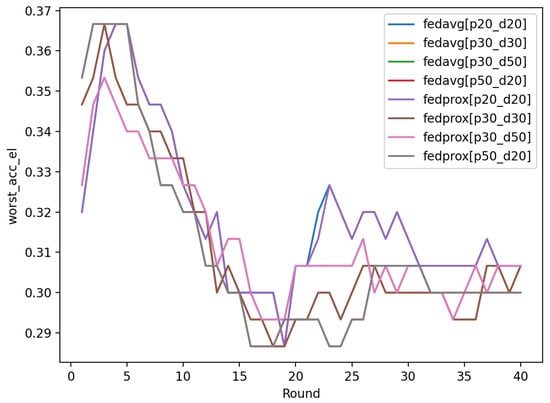
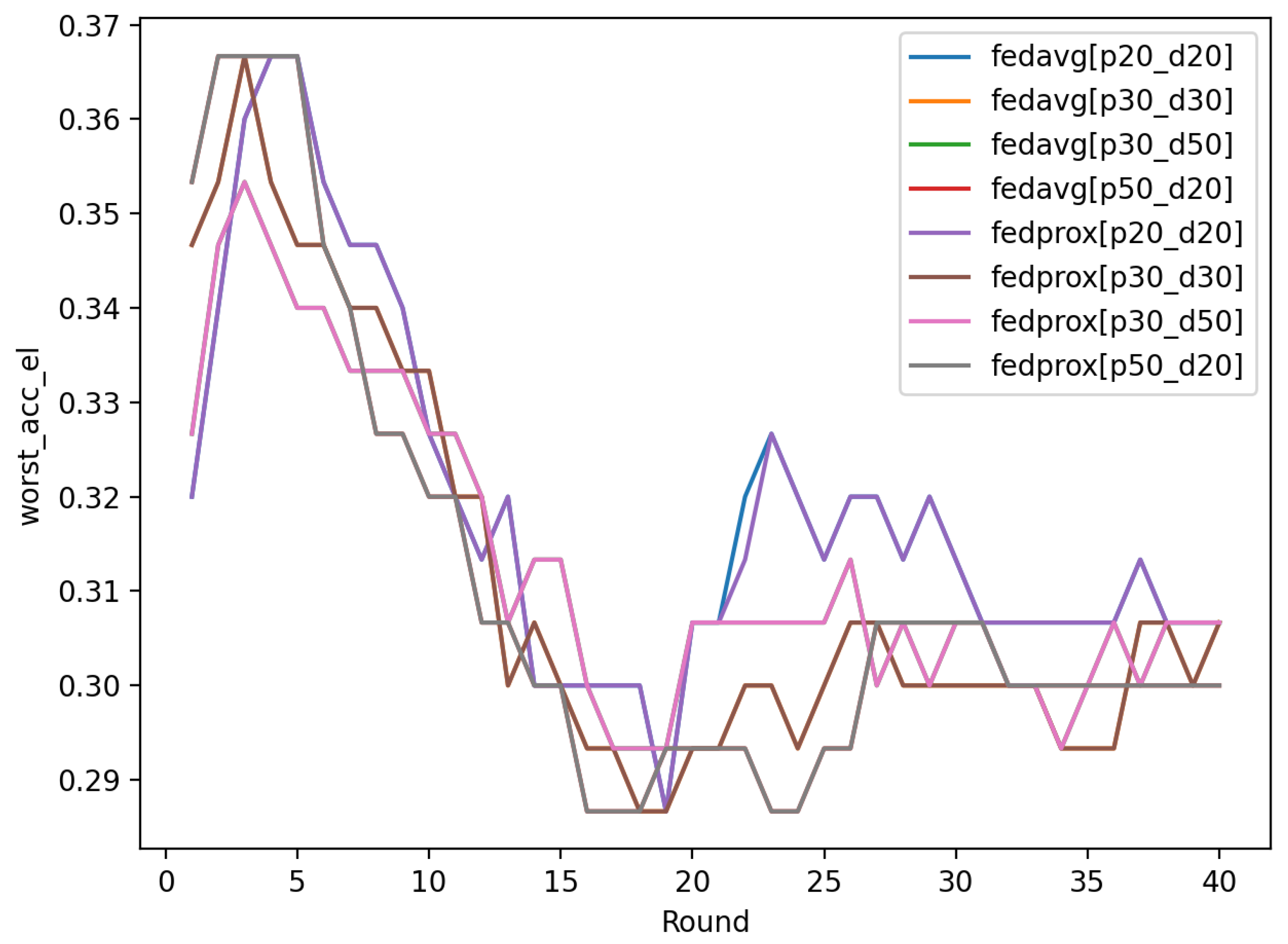
Client-level robustness evolves differently. Figure 4 plots the worst eligible client accuracy across rounds. The worst client curve remains substantially lower than the global curves, highlighting heterogeneity: some clients remain challenging even when global performance appears strong. This motivates the reporting of tail metrics in federated resource allocation settings, where weak clients may correspond to disadvantaged network conditions.
Figure 4.
Worst eligible client accuracy versus federated rounds. The worst client curve remains well below that of the global accuracy, emphasizing heterogeneity.
3.4. Communication-Performance Trade-Off
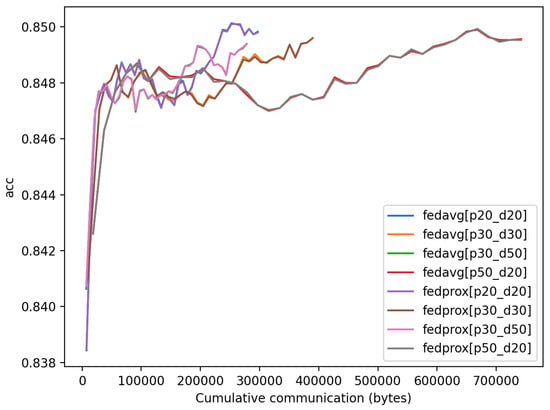
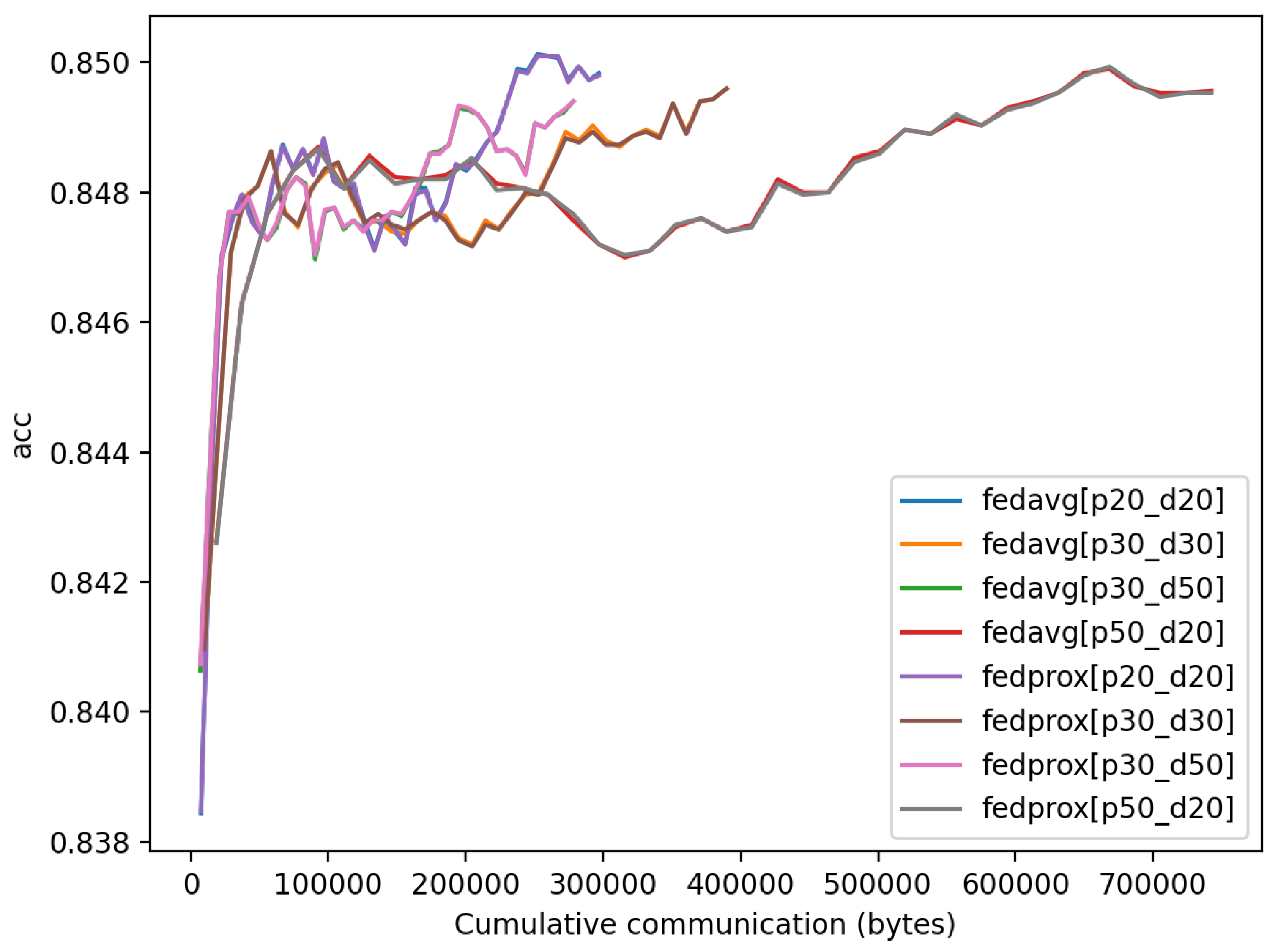
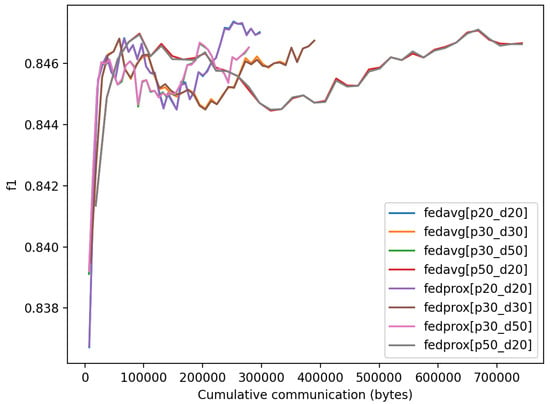
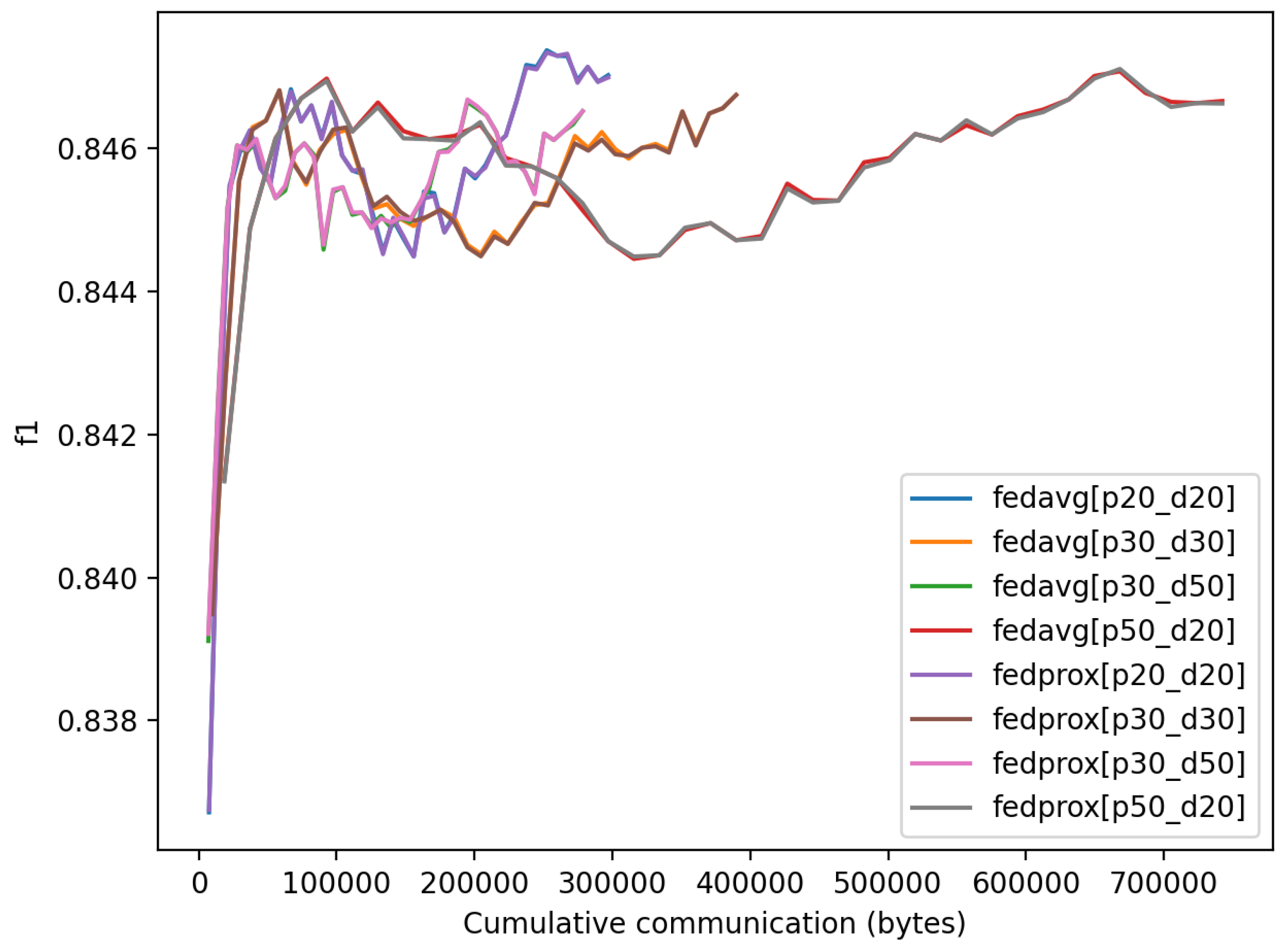
A key deployment question is how many bytes are needed to reach a target performance level. Figure 5 plots the accuracy versus cumulative communication (bytes), and Figure 6 shows the same view for the macro-F1. These plots show that different configurations can achieve similar final performance at different communication costs, meaning that practitioners can choose operating points based on bandwidth/latency limits instead of optimizing the average performance alone. In our experiments, lower-communication settings (e.g., ) remain competitive while reducing the total bytes compared to the highest-communication configuration (Table 4).
Figure 5.
Global accuracy versus cumulative communication (bytes) for different configurations (distinct line styles and markers are used for readability). Similar accuracies can be reached at very different byte budgets, showing that participation and dropout policies are a primary driver of communication costs at comparable performance levels.
Figure 6.
Macro-F1 versus cumulative communication (bytes) (distinct line styles and markers are used for readability). A competitive macro-F1 can be achieved at different communication budgets depending on , which motivates the joint reporting of performance and communication costs.
3.5. Client-Level Distribution and Fairness
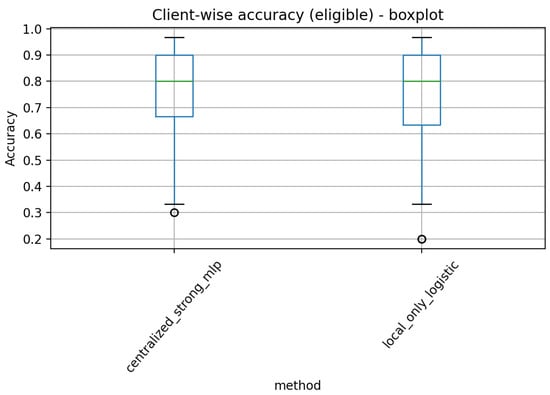
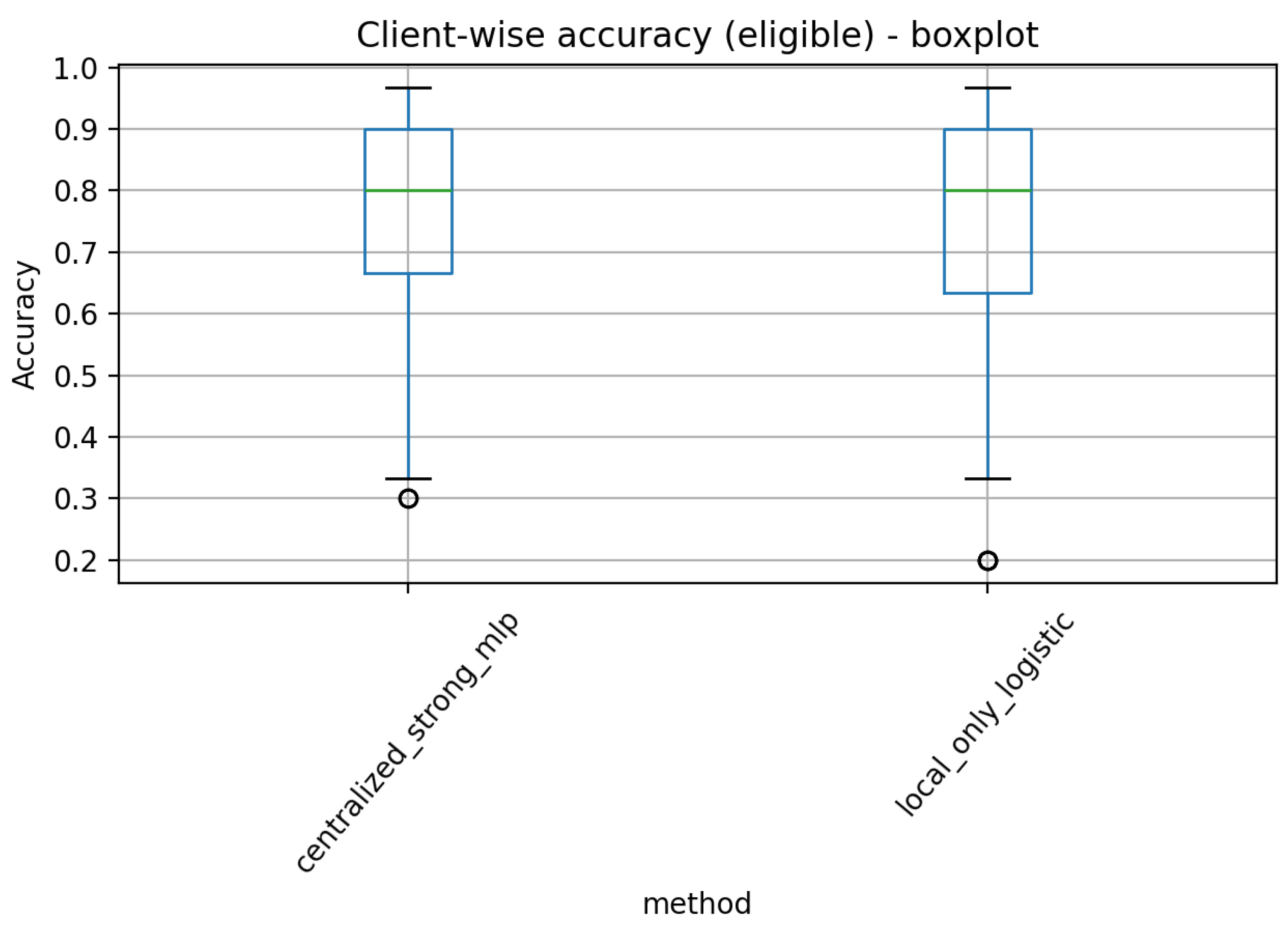
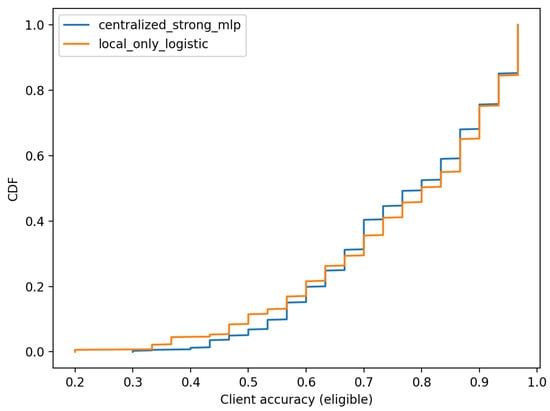
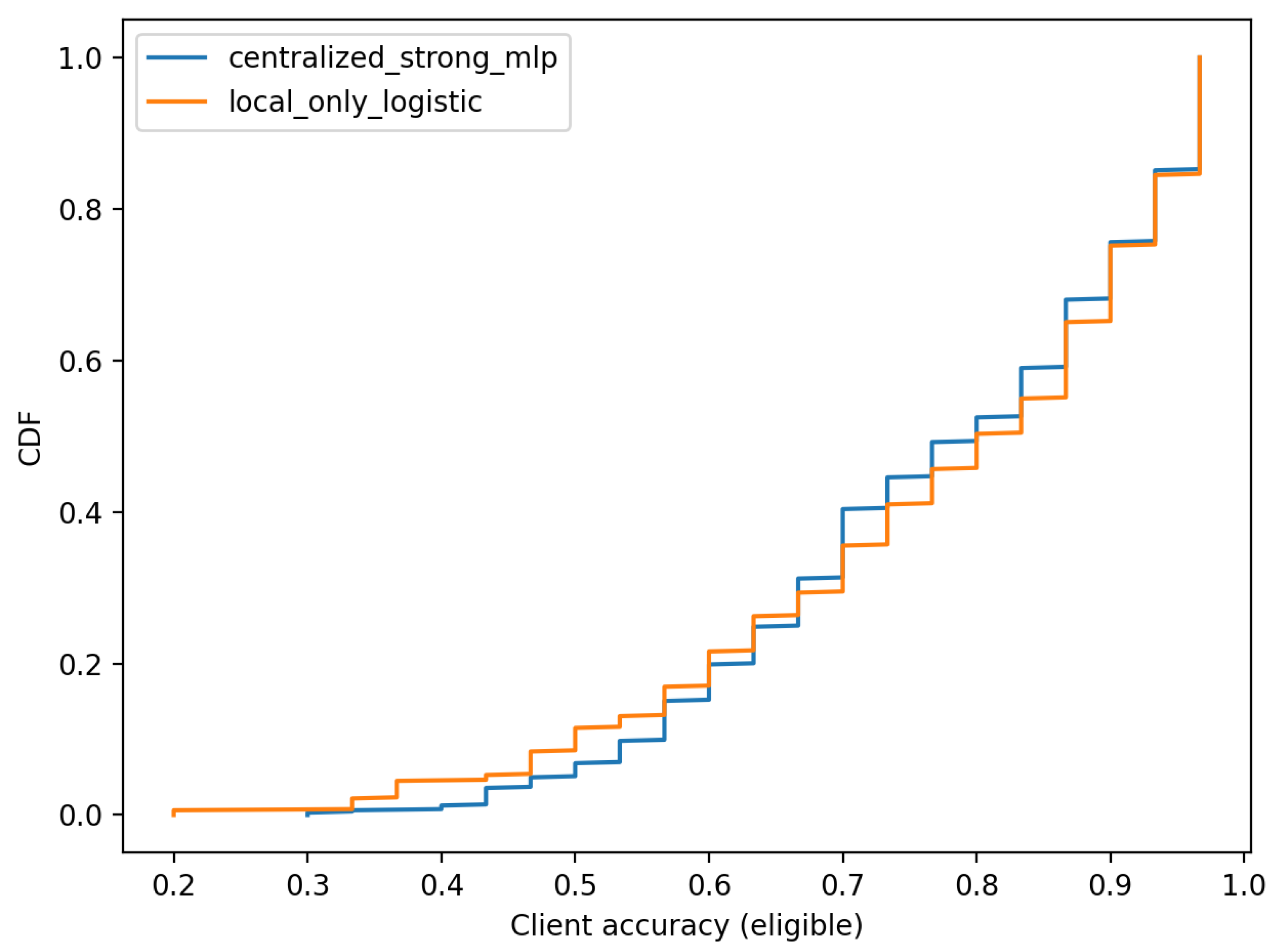
Global averages can hide substantial client-to-client variation. Figure 7 and Figure 8 visualize the distribution of eligible client accuracies for the centralized strong MLP and the local-only logistic baseline. The distributional view highlights that the median performance can appear similar even when the lower tail differs, which directly affects worst client and fairness-aware outcomes.
Figure 7.
Eligible client accuracy distribution as a boxplot for centralized strong MLP and local-only logistic regression. Distributional views reveal tail behavior that global averages can hide.
Figure 8.
Empirical CDF of eligible client accuracies for centralized strong MLP and local-only logistic regression, highlighting differences in the lower tail.
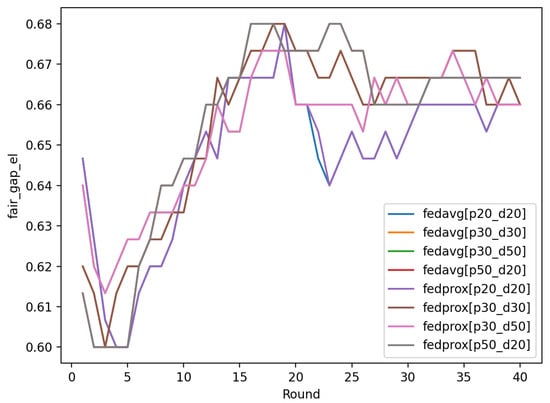
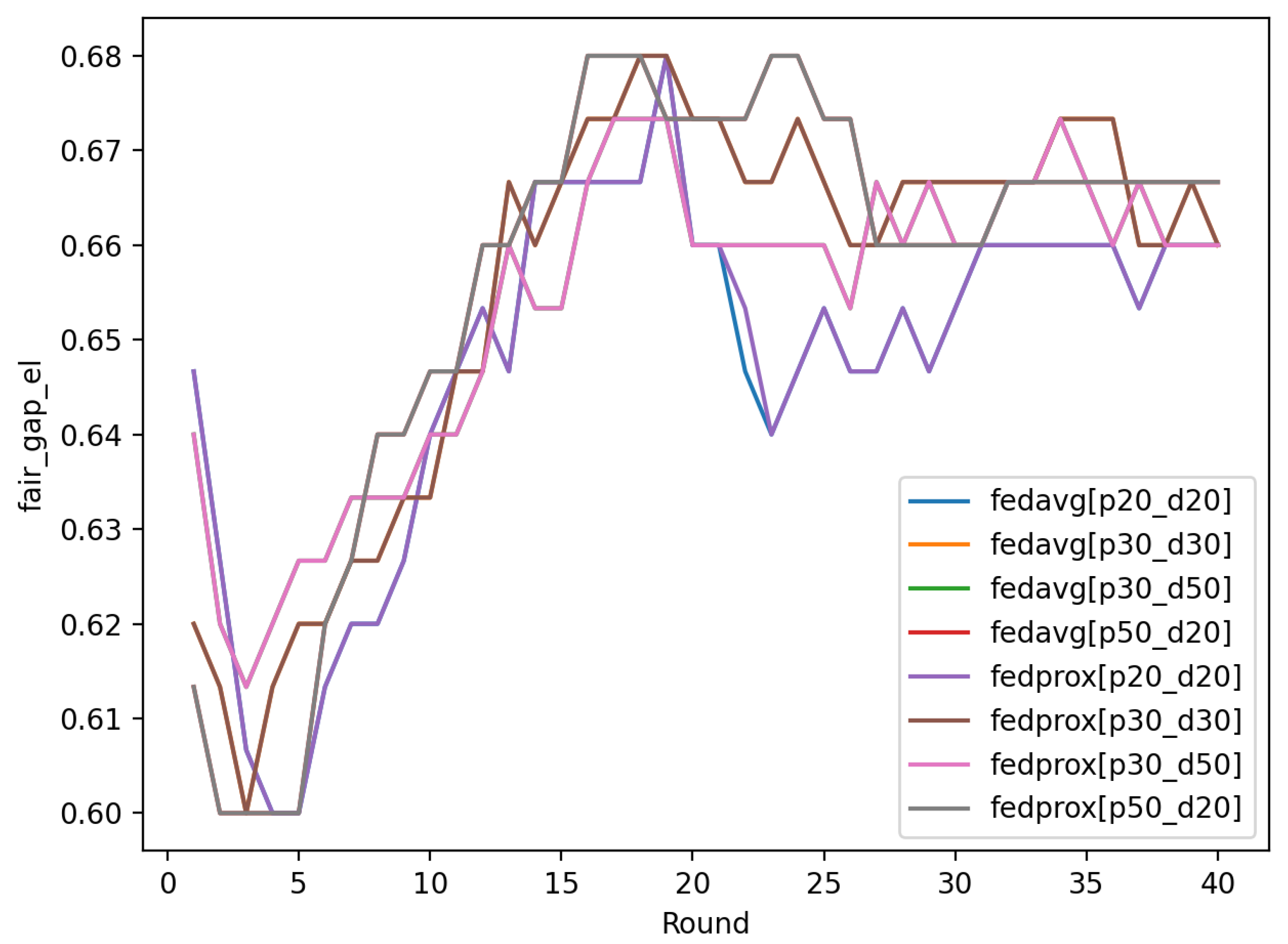
Fairness dynamics over federated rounds are shown in Figure 9. The fairness gap changes early and then stabilizes, indicating that a global improvement does not automatically eliminate disparities across clients. This supports the use of tail-aware and fairness-aware criteria in model selection and deployment decisions, rather than relying only on global averages.
Figure 9.
Eligible client fairness gap versus federated rounds. The gap changes early and then stabilizes, indicating persistent disparities across clients.
3.6. FedProx Sensitivity Analysis ( Sweep)
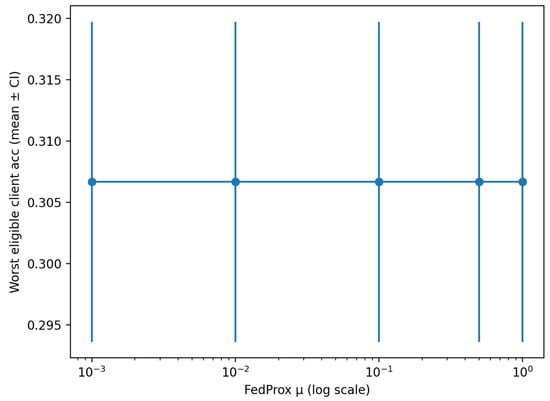
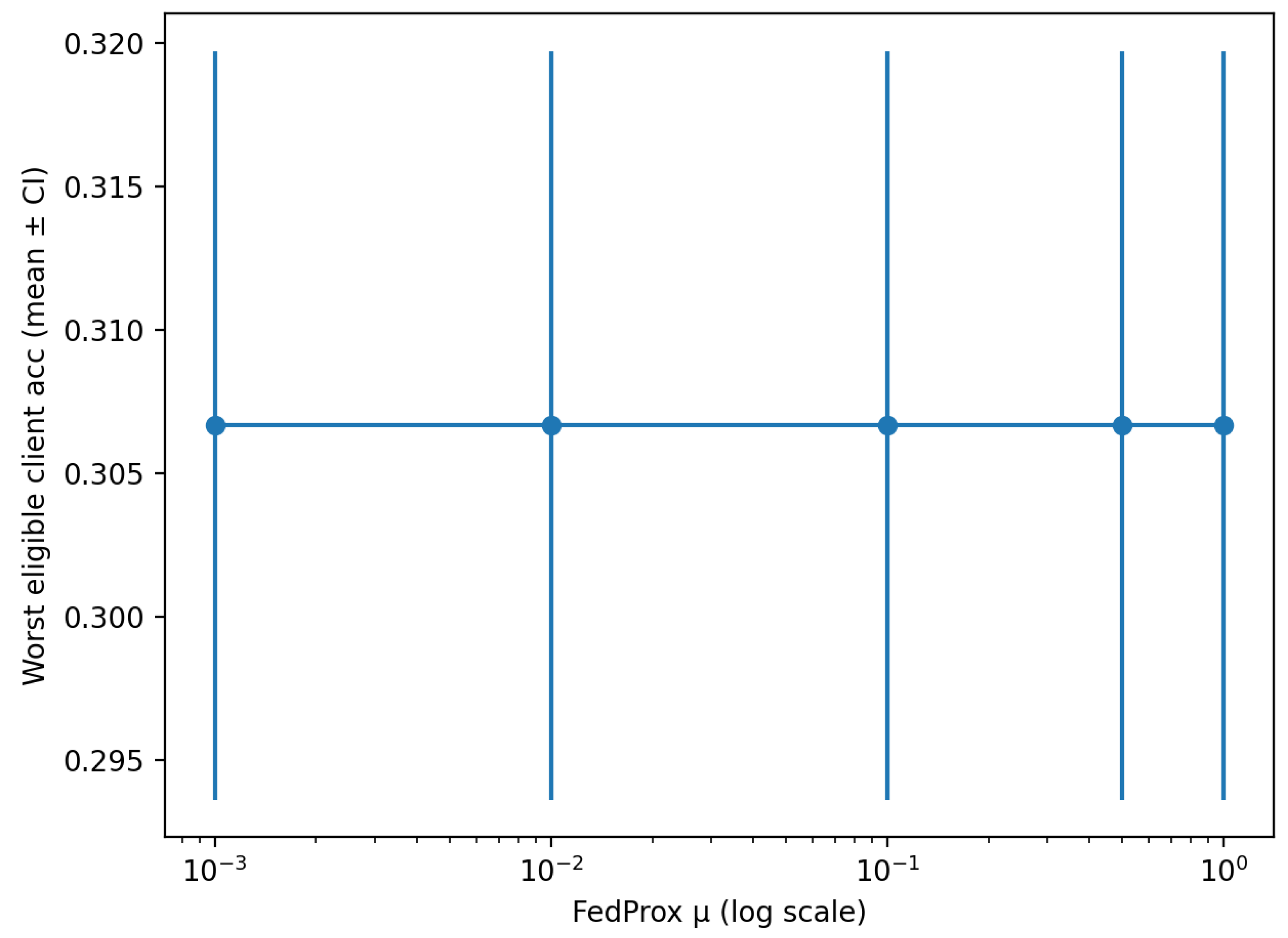
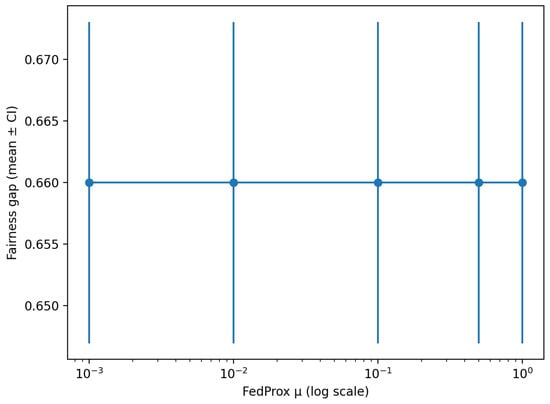
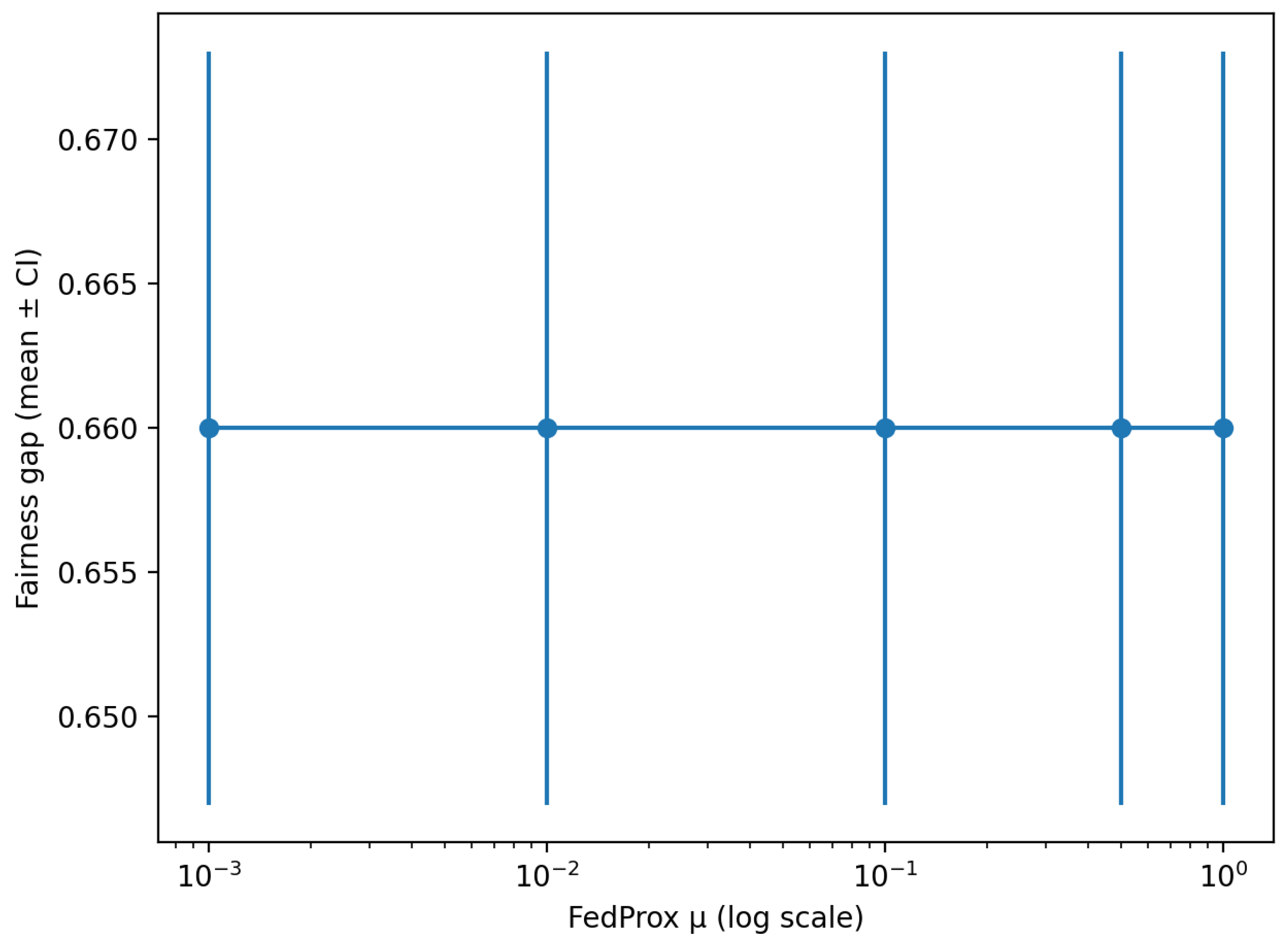
FedProx introduces a proximal term controlled by to reduce client drift under heterogeneity. Table 5 reports a sweep of for the setting. In our runs, both the global and tail metrics are very similar across , suggesting limited sensitivity to in this setup (Table 5). This is consistent with Figure 10 and Figure 11, which show minimal changes in the worst client accuracy, macro-F1, and fairness gap across the tested range.
Table 5.
FedProx sweep for the setting (mean ± 95% CI over 5 seeds).
Figure 10.
FedProx sensitivity: worst eligible client accuracy (mean ± 95% CI) versus (log scale). Worst client performance remains stable across .
Figure 11.
FedProx sensitivity: fairness gap (mean ± 95% CI) versus (log scale). The gap remains essentially unchanged across the tested range.
3.7. Takeaways
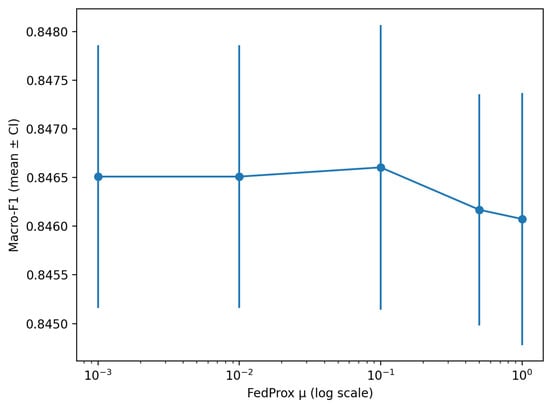
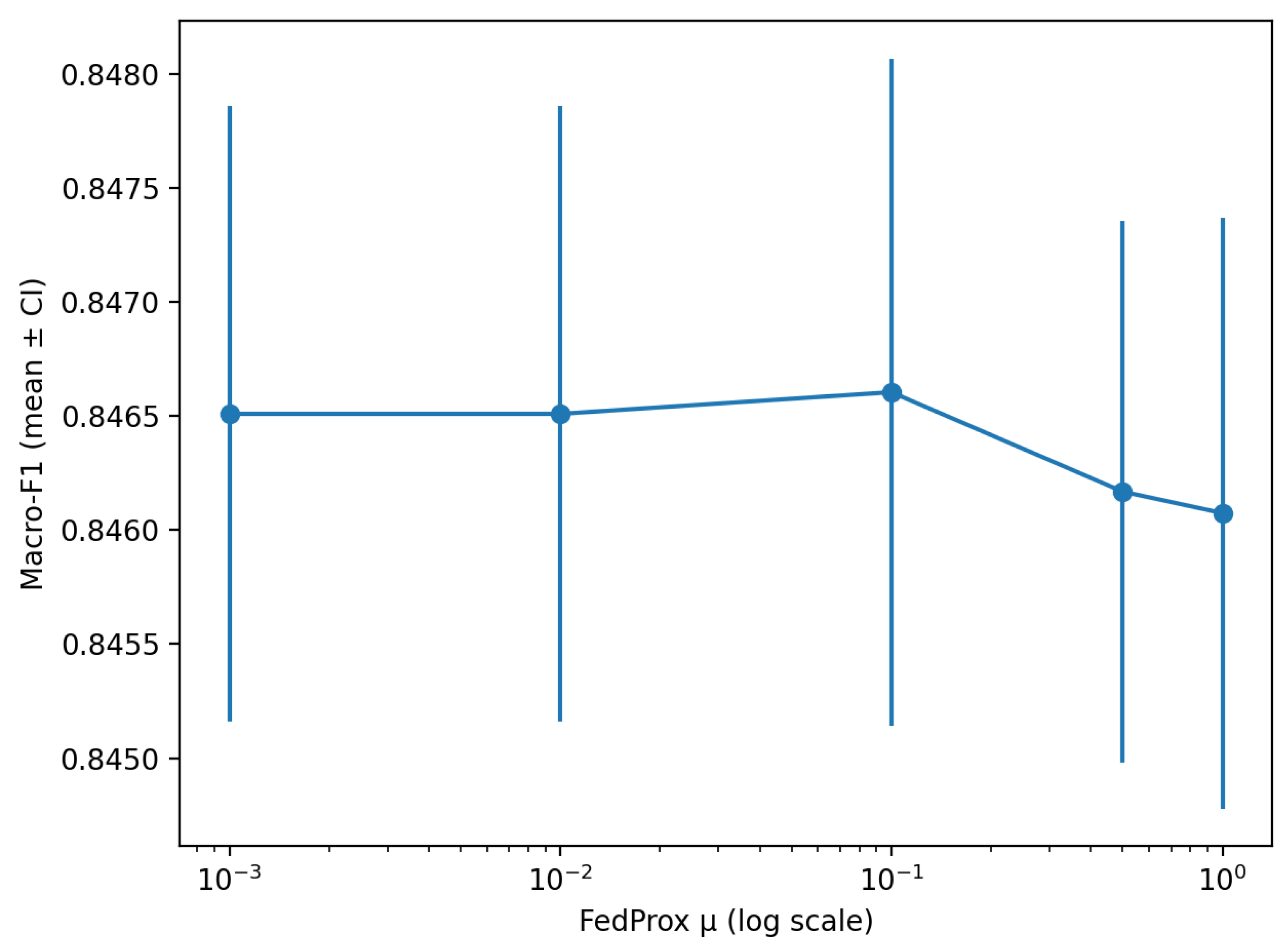
Across 200 clients, three points stand out. First, federated learning reaches near-centralized global performance in this 6G resource allocation setting (Table 4). Second, tail metrics matter: the worst client accuracy and client-level plots reveal behavior that global averages can hide (Figure 4, Figure 5, Figure 6, Figure 7 and Figure 8). Third, the communication cost materially affects deployment practicality, and competitive performance can be achieved at very different byte budgets (Figure 5 and Figure 6). In addition, FedProx shows limited sensitivity to the proximal coefficient under the representative setting , as the macro-F1 curve remains nearly flat across the tested values (Figure 12).
Figure 12.
FedProx sensitivity: macro-F1 (mean ± 95% CI) versus (log scale) for . The curve is nearly flat, indicating limited sensitivity.
4. Discussion
The experimental results provide several important insights into the behavior of federated learning for large-scale 6G resource allocation, particularly when communication efficiency and client-level fairness are jointly considered. Rather than focusing solely on global accuracy, this study emphasizes distributional and worst-case behavior, which is critical for realistic network deployment.
4.1. Positioning of the Contribution and Interpretation of the Trade-Off
While we use the term “communication-fairness trade-off”, the core contribution is empirical: we measure how changing system policies (participation and dropout) shift (i) the communication payload and (ii) tail client performance. We do not propose a new fairness-aware objective or solve a multi-objective optimization problem. We therefore moderate claims of methodological novelty and frame the results as actionable deployment guidance for selecting operating points under bandwidth and reliability constraints.
4.2. Limitations of Byte-Only Communication Modeling and 6G System Abstraction
Our communication accounting uses transmitted parameter bytes as an implementation-agnostic proxy. This abstracts away important wireless effects such as uplink scheduling, retransmissions, packet loss, time-varying SINRs, latency constraints, energy consumption, and straggler dynamics. The added mapping via an effective rate is only a coarse time proxy; it is not a physical-layer simulator. As a result, the reported byte budgets should be interpreted as payload budgets rather than end-to-end latency/energy guarantees. Future work should incorporate at least a simplified wireless model (e.g., per-round bandwidth allocation and a latency/energy objective) to connect the learning curves more directly to 6G resource constraints.
4.3. Near-Centralized Performance Under Data Locality Constraints
One of the most notable observations is that both FedAvg and FedProx achieve global performance that is very close to that of the centralized strong MLP baseline. Despite the strict constraint that raw data never leave individual clients, the federated models consistently reach similar accuracy, macro-F1, AUC, and AP values. This result confirms that collaborative model aggregation can effectively compensate for data fragmentation across heterogeneous clients.
Importantly, the marginal performance gap between centralized and federated learning remains small across all tested configurations. This suggests that, for the considered 6G telemetry task, the representational capacity of the global model is not significantly limited by decentralized training. From a practical perspective, this finding supports the feasibility of federated learning as a privacy-preserving alternative to centralized optimization in next-generation wireless systems.
4.4. Communication Efficiency and Diminishing Returns
A significant contribution of this study is that we have clearly quantified the relationship between performance and communication costs. The accuracy-bytes and macro-F1-bytes curves clearly show that, after a certain communication budget, the rate of performance increase slows down, i.e., diminishing returns emerge. Many federated configurations achieve near-peak performance while transmitting fewer bytes, while setups with relatively more aggressive participation require much more communication but achieve very limited additional benefits.
This observation has direct implications for 6G system design. In bandwidth- and energy-constrained environments, it may be practical to lower the client participation rate or limit the frequency of communication, without any significant performance degradation. Our results indicate that the selection of optimal operating points should not be based solely on the prediction accuracy but should also take into account system-level requirements, such as spectrum availability, latency budgets, and energy efficiency.
4.5. The Importance of Fairness Metrics Beyond Global Accuracy
While the global metrics converge relatively quickly and remain generally stable, the client-level analysis provides a more nuanced and realistic picture. The worst client accuracy and lower-tail performance remain significantly below the global average even after convergence. This difference highlights a fundamental weakness in that relying solely on aggregate metrics does not guarantee that acceptable service quality is being achieved for all clients.
In practical 6G deployments, poorly performing clients may represent users or network segments with poor channel conditions, limited data availability, or geographically backward/remote locations. Ignoring these tail behaviors can lead to unfair or unreliable network operations. Therefore, by reporting the worst client accuracy, P10 accuracy, and fairness gap, this study provides a more realistic and actionable assessment of federated learning behavior in heterogeneous environments.
From measurement to mitigation. To strengthen the practical impact, we explicitly outline fairness-aware interventions that can be layered on top of the same protocol, such as (i) tail-aware client reweighting or constrained optimization (optimize average performance subject to a minimum worst client constraint); (ii) fairness-aware client selection that increases the inclusion probability for underperforming clients; and (iii) personalized or clustered FL (e.g., partial personalization heads) to reduce persistent lower-tail errors. In this manuscript, we focus on measurement and transparent reporting, and we frame these mitigation mechanisms as concrete next steps that can be evaluated under the same communication accounting and tail metric protocol.
4.6. Stabilization of the Fairness Gap During Training
Analysis of the fairness gap helps to understand how federated training evolves over time. The increase in the fairness gap in the early rounds can be attributed to the fact that strong clients adapt relatively quickly, especially when they have more informative or less noisy data. However, the stabilization of the gap in later rounds indicates that repeated aggregation prevents uncontrolled divergence between clients.
This stability is an important result. It indicates that federated learning does not necessarily increase inequality over time, even in non-IID conditions, but rather converges to a steady state where performance differences persist but do not grow indefinitely. For system designers, this means that fairness-aware interventions should focus on improving the performance of the lower tail rather than on correcting the ever-worsening imbalance.
4.7. Limited Sensitivity to the Proximal Parameter of FedProx
Our -sweep experiments provide useful insights into the robustness of FedProx. The global efficiency, fairness gap, and worst client accuracy remain largely unchanged over a wide range of values of the proximal parameter. This limited sensitivity suggests that, in the setting under study, the behavior of FedProx can be quite similar to that of FedAvg in practice when an appropriate degree of regularization is present.
From a practical perspective, this is a positive result, as it reduces the need for fine-level hyperparameter tuning, which can be expensive or impractical in large-scale deployments. More importantly, the results indicate that the factors that most influence fairness and efficiency are generally system-level decisions, e.g., the participation rate, communication budget, and client sampling, and not only the intensity of proximal regularization. A plausible explanation for the near-identical FedAvg and FedProx behavior in this dataset is that local training is intentionally light (only a few local steps per round), which limits client drift, and the model/dataset combination may not induce sufficiently severe feature/label shift for the proximal term to matter. In addition, when participation and dropout introduce stochasticity in who contributes each round, the dominant source of variance can be sampling noise rather than heterogeneity-driven divergence. We therefore treat the sweep as an informative negative result: it suggests that, for this telemetry task and training regime, investing effort in tuning yields diminishing returns compared to system-level controls or fairness-aware interventions.
4.8. Implications for 6G Resource Allocation
Overall, the results point to several important implications for federated learning in 6G systems. First, federated learning can achieve robust global performance without centralizing raw data collection, providing a practical basis for privacy-preserving and scalable network intelligence. Second, communication-efficient configurations can significantly reduce bandwidth usage while maintaining competitive performance-an aspect that is particularly important in ultra-dense and energy-sensitive deployments.
Third, fairness should not be treated as a secondary issue. Although the global metrics appear to remain stable, the worst client and lower-tail performance remain a continuing challenge. This observation suggests that future 6G resource allocation strategies should incorporate fairness-aware objectives directly into the learning and scheduling mechanisms, rather than relying solely on global optimization.
4.9. How This Study Surpasses Previous Work
Compared to previous studies, which are usually limited to the average accuracy or loss, this study offers a more comprehensive assessment because it jointly analyzes the communication cost, distributional performance, and robustness. Furthermore, the inclusion of confidence intervals based on multiple seeds increases the reliability of the results and reduced the possibility of drawing unnecessary general conclusions based on a single run.
Most importantly, this study demonstrates that meaningful insights emerge only when global, system-level, and client-level perspectives are combined. This holistic framework alleviates key limitations of previous work and provides a more deployment-oriented understanding of federated learning in the context of 6G resource allocation.
5. Conclusions
Concretely, across federated settings, we observe accuracy 0.850 and macro-F1 0.847, while the centralized strong MLP achieves accuracy and macro-F1 (Table 4). Communication budgets vary substantially across policies: for example, p30_d50 transmits roughly bytes per run, whereas p50_d20 transmits about bytes, despite similar global performance. These results suggest that, for this telemetry task, system-level participation and dropout policies can be tuned to meet a target performance level with significantly different communication footprints, while tail client metrics (e.g., worst eligible client accuracy around 0.30 and fairness gaps around 0.66 in our settings) remain the critical constraint for deployability.
This paper studies the communication-fairness trade-off in federated learning for 6G resource allocation under a realistic setting based on 200 clients. Through FedAvg and FedProx, we show that federated learning can achieve performance close to that of centralized training while maintaining data locality. The results show that the global accuracy and macro-F1 converge rapidly and remain stable, while nearly identical global performance is possible in different configurations with different communication budgets, which makes diminishing returns obvious.
In terms of fairness, the worst client and lower-tail performance remain below the global average, so the average metric alone is not sufficient. Although the fairness gap stabilizes over time, it does not automatically guarantee equal performance. Furthermore, the -sweep showed that the performance and fairness metrics of FedProx are less sensitive to over a wide range; therefore, system-level aspects such as the participation rate and communication budget are more decisive. In the future, we will work on adaptive client selection, fairness-aware aggregation, and the joint optimization of learning and radio resource management.
In practice, the reported trade-off curves can be used by 6G operators to select operating points that satisfy a target accuracy level under a communication budget while monitoring lower-tail client performance as a reliability and service quality safeguard. We also explicitly note that the present study uses payload bytes as a first-order proxy and does not model full wireless-layer dynamics; therefore, “deployability” claims are conditioned on this abstraction and should be interpreted accordingly.
Author Contributions
Conceptualization, N.M.; methodology, N.M. and M.H.S.; software, N.M.; validation, N.M., A.M. and N.N.; formal analysis, N.M. and K.A.; investigation, N.M. and G.M.; resources, M.H.S. and G.M.; data curation, N.M. and A.M.; writing-original draft preparation, N.M.; writing-review and editing, N.M., M.H.S., A.M., G.M., K.A. and N.N.; visualization, N.M.; supervision, M.H.S. and N.N.; project administration, N.M. All authors have read and agreed to the published version of the manuscript.
Funding
This research received no external funding.
Institutional Review Board Statement
Not applicable.
Informed Consent Statement
Not applicable.
Data Availability Statement
The dataset used in this study is publicly available on Kaggle: Wireless 6G Network Dataset of Resource Allocation (see https://www.kaggle.com/datasets/nizamuddinmaitlo/wireless-6g-network-dataset-of-resource-allocation, accessed on 8 January 2026).
Acknowledgments
The authors would like to thank their respective institutions for providing computational and administrative support.
Conflicts of Interest
The authors declare no conflicts of interest.
Abbreviations
The following abbreviations are used in this manuscript:
| 6G | Sixth-Generation |
| FL | Federated Learning |
| AUC | Area Under the ROC Curve |
| AP | Average Precision |
| CI | Confidence Interval |
Nomenclature
Main symbols used in this manuscript:
| Symbol | Meaning |
| K | number of clients |
| , | client-k dataset and number of samples |
| , | global model at round t and client-k local update |
| sample-proportional aggregation weight | |
| participating client set at round t (after dropout) | |
| T | number of communication rounds |
| FedProx proximal regularization coefficient | |
| P, b | number of parameters; bytes per parameter (32-bit ) |
| , TotalBytes | per-round and cumulative communication in bytes |
| , | effective uplink rate (bps) and coarse transmission-time proxy |
| eligible client set for fairness/tail metrics | |
| minimum test sample threshold for eligibility (here ) | |
| accuracy of client i at round t |
References
- Saad, W.; Bennis, M.; Chen, M. A Vision of 6G Wireless Systems: Applications, Trends, Technologies, and Open Research Problems. IEEE Netw. 2020, 34, 134–142. [Google Scholar] [CrossRef] [Scilit]
- Kairouz, P.; McMahan, H.B. Advances and Open Problems in Federated Learning. Found. Trends® Mach. Learn. 2021, 14, 1–210. [Google Scholar] [CrossRef] [Scilit]
- McMahan, H.B.; Moore, E.; Ramage, D.; Hampson, S.; Agüera y Arcas, B. Communication-Efficient Learning of Deep Networks from Decentralized Data. In Proceedings of the 20th International Conference on Artificial Intelligence and Statistics; PMLR: Cambridge, MA, USA, 2017; Volume 54, pp. 1273–1282. Available online: https://proceedings.mlr.press/v54/mcmahan17a.html (accessed on 15 March 2026).
- Qin, Z.; Li, G.; Ye, H. Federated Learning and Wireless Communications. IEEE Wirel. Commun. 2021, 28, 134–140. [Google Scholar] [CrossRef] [Scilit]
- Lim, W.Y.B.; Luong, N.C.; Hoang, D.T.; Jiao, Y.; Liang, Y.C.; Yang, Q.; Niyato, D.; Miao, C. Federated Learning in Mobile Edge Networks: A Comprehensive Survey. IEEE Commun. Surv. Tutor. 2020, 22, 2031–2063. [Google Scholar] [CrossRef] [Scilit]
- Amiri, M.M.; Gündüz, D. Federated Learning over Wireless Fading Channels. IEEE Trans. Wirel. Commun. 2020, 19, 3546–3557. [Google Scholar] [CrossRef] [Scilit]
- Chen, M.; Yang, Z.; Saad, W.; Yin, C.; Poor, H.V.; Cui, S. A Joint Learning and Communications Framework for Federated Learning over Wireless Networks. IEEE Trans. Wirel. Commun. 2021, 20, 269–283. [Google Scholar] [CrossRef] [Scilit]
- Li, T.; Sahu, A.K.; Talwalkar, A.; Smith, V. Federated Optimization in Heterogeneous Networks. In Proceedings of Machine Learning and Systems 2 (MLSys 2020); MLSys: Indio, CA, USA, 2020; Available online: https://proceedings.mlsys.org/paper/2020/hash/1f5fe83998a09396ebe6477d9475ba0c-Abstract.html (accessed on 15 March 2026).
- Nishio, T.; Yonetani, R. Client Selection for Federated Learning with Heterogeneous Resources in Mobile Edge. In ICC 2019-2019 IEEE International Conference on Communications (ICC); IEEE: Piscataway, NJ, USA, 2019. [Google Scholar] [CrossRef] [Scilit]
- Yang, Z.; Chen, M.; Wong, K.K.; Poor, H.V.; Cui, S. Federated Learning for 6G: Applications, Challenges, and Opportunities. Engineering 2022, 8, 33–41. [Google Scholar] [CrossRef] [Scilit]
- Lee, H.-S.; Lee, D.-E. Resource Allocation in Wireless Networks with Federated Learning: Network Adaptability and Learning Acceleration. ICT Express 2022, 8, 31–36. [Google Scholar] [CrossRef] [Scilit]
- Zhao, J.; Ni, Y.; Cheng, Y. Joint Client and Resource Optimization for Federated Learning in Wireless IoT Networks. Appl. Sci. 2024, 14, 542. [Google Scholar] [CrossRef] [Scilit]
- Rafi, T.H.; Noor, F.A.; Hussain, T.; Chae, D.-K. Fairness and Privacy Preserving in Federated Learning: A Survey. Inf. Fusion 2024, 105, 102198. [Google Scholar] [CrossRef] [Scilit]
- Sattler, F.; Wiedemann, S.; Müller, K.-R.; Samek, W. Sparse Binary Compression: Towards Distributed Deep Learning with Minimal Communication. In 2019 International Joint Conference on Neural Networks (IJCNN); IEEE: Piscataway, NJ, USA, 2019. [Google Scholar] [CrossRef] [Scilit]
- Asad, M.; Shaukat, S.; Hu, D.; Wang, Z.; Javanmardi, E.; Nakazato, J.; Tsukada, M. Limitations and Future Aspects of Communication Costs in Federated Learning: A Survey. Sensors 2023, 23, 7358. [Google Scholar] [CrossRef] [Scilit] [PubMed]
- Xiao, B.; Yu, X.; Ni, W.; Wang, X.; Poor, H.V. Over-the-Air Federated Learning: Status Quo, Open Challenges, and Future Directions. Fundam. Res. 2025, 5, 1710–1724. [Google Scholar] [CrossRef] [Scilit] [PubMed]
- Karimireddy, S.P.; Kale, S.; Mohri, M.; Reddi, S.; Stich, S.; Suresh, A.T. SCAFFOLD: Stochastic Controlled Averaging for Federated Learning. In Proceedings of the 37th International Conference on Machine Learning; PMLR: Cambridge, MA, USA, 2020; Volume 119, pp. 5132–5143. Available online: https://proceedings.mlr.press/v119/karimireddy20a.html (accessed on 15 March 2026).
- Wang, J.; Liu, Q.; Liang, H.; Joshi, G.; Poor, H.V. Tackling the Objective Inconsistency Problem in Heterogeneous Federated Optimization. In Advances in Neural Information Processing Systems 33 (NeurIPS 2020); NeurIPS: San Diego, CA, USA, 2020. [Google Scholar]
- Acar, D.A.E.; Zhao, Y.; Navarro, R.M.; Mattina, M.; Whatmough, P.N.; Saligrama, V. Federated Learning Based on Dynamic Regularization. arXiv 2021, arXiv:2111.04263. [Google Scholar] [CrossRef] [Scilit]
- Li, Q.; He, B.; Song, D. Model-Contrastive Federated Learning. In 2022 IEEE/CVF Conference on Computer Vision and Pattern Recognition (CVPR); IEEE: Piscataway, NJ, USA, 2021. [Google Scholar]
- Li, X.; Jiang, M.; Zhang, X.; Kamp, M.; Dou, Q. FedBN: Federated Learning on Non-IID Features via Local Batch Normalization. In Proceedings of the 9th International Conference on Learning Representations, ICLR 2021, Virtual Event, 3–7 May 2021; Available online: https://openreview.net/forum?id=6YEQUn0QICG (accessed on 15 March 2026).
- Hasan, M.K.; Habib, A.A.; Islam, S.; Safie, N.; Ghazal, T.M.; Khan, M.A.; Alzahrani, A.I.; Alalwan, N.; Kadry, S.; Masood, A. Federated Learning Enables 6G Communication Technology: Requirements, Applications, and Integrated with Intelligence Framework. Alex. Eng. J. 2024, 91, 658–668. [Google Scholar] [CrossRef] [Scilit]
- Bartsiokas, I.A.; Gkonis, P.K.; Kaklamani, D.I.; Venieris, I.S. A Federated Learning-Based Resource Allocation Scheme for Relaying-Assisted B5G/6G Networks. Electronics 2024, 13, 390. [Google Scholar] [CrossRef] [Scilit]
- Bonawitz, K.; Ivanov, V.; Kreuter, B.; Marcedone, A.; McMahan, H.B.; Patel, S.; Ramage, D.; Segal, A.; Seth, K. Practical Secure Aggregation for Federated Learning on User-Held Data. arXiv 2016, arXiv:1611.04482. [Google Scholar] [CrossRef] [Scilit]
- Wei, K.; Li, J.; Ding, M.; Ma, C.; Yang, H.H.; Farokhi, F.; Jin, S.; Quek, T.Q.; Poor, H.V. Federated Learning with Differential Privacy: Algorithms and Performance Analysis. IEEE Trans. Inf. Forensics Secur. 2020, 15, 203–217. [Google Scholar] [CrossRef] [Scilit]
- Akhtarshenas, A.; Vahedifar, M.A.; Ayoobi, N.; Maham, B.; Alizadeh, T.; Ebrahimi, S.; López-Pérez, D. Federated Learning: A Cutting-Edge Survey of the Latest Advancements and Applications. Comput. Commun. 2024, 228, 107964. [Google Scholar] [CrossRef] [Scilit]
- Al-Quraan, M.; Bani Ahmad, A.; Al-Khassaweneh, M.; Al-Qaisi, M.; Abdelhadi, A. Edge-Native Intelligence for 6G Communications Driven by Federated Learning: A Survey of Trends and Challenges. IEEE Trans. Emerg. Top. Comput. Intell. 2023, 7, 957–979. [Google Scholar] [CrossRef] [Scilit]

Disclaimer/Publisher’s Note: The statements, opinions and data contained in all publications are solely those of the individual author(s) and contributor(s) and not of MDPI and/or the editor(s). MDPI and/or the editor(s) disclaim responsibility for any injury to people or property resulting from any ideas, methods, instructions or products referred to in the content. |
© 2026 by the authors. Licensee MDPI, Basel, Switzerland. This article is an open access article distributed under the terms and conditions of the Creative Commons Attribution (CC BY) license.