


Abstract
In response to thermal failure risks in ultra-high voltage (UHV) bushing online monitoring devices and maintenance equipment—caused by high heat generation of electronic components and the intrinsically low thermal conductivity of conventional resin encapsulation materials—this study proposes a novel modification strategy based on flash Joule heating (FJH). Distinct from conventional interface modification methods, the proposed approach enables cross-scale, in situ microsoldering between multi-walled carbon nanotubes (MWCNTs) and carbon fibers (CFs), constructing a multiscale reinforcement network with integrated thermal transport and mechanical load transfer pathways. The transient ultra-high-temperature thermal shock generated by FJH not only effectively removes inert impurities on CF surfaces but also drives carbon structural reconstruction, enabling graphitic-level welding of MWCNTs onto the fiber surface. This micro-welded architecture fundamentally differs from traditional filler dispersion or interface coating strategies, which often suffer from the trade-off between interfacial thermal transport and mechanical bonding. By contrast, the FJH-induced carbon–carbon bonded nodes form a continuous conductive and load-bearing network at the micro–nano scale. Characterizations using scanning electron microscopy (SEM), Raman spectroscopy, and X-ray photoelectron spectroscopy (XPS) confirm successful in situ welding of MWCNTs onto CF surfaces. Meanwhile, FJH treatment effectively removes oxygen-containing functional groups and surface impurities. Analysis of carbon bonding evolution indicates that the welding efficiency reaches its maximum at 90 V. Macroscopic performance tests demonstrate that, compared with epoxy resin, the thermal conductivity of the multiscale reinforced system increases by approximately 168%, while the mechanical strength improves by 62.72%. This study provides new theoretical insights and technical pathways for the development of next-generation polymer composite materials with both high thermal conductivity and high mechanical strength.
1. Introduction
With the rapid development of ultra-high voltage (UHV) power transmission technology and the continuous advancement of smart grid construction, the reliability of online monitoring devices and maintenance equipment for UHV bushings and key nodes has become a core factor in ensuring the safe operation of power grids. However, as such electronic devices evolve toward high integration, miniaturization, and high power, the power density of internal electronic components increases sharply, leading to increasingly prominent thermal management challenges. If heat cannot be dissipated in a timely manner, it will directly result in accelerated device aging or even thermal failure [1,2]. At present, polymer materials such as epoxy resins, which are widely used in power equipment encapsulation and housing manufacturing, possess excellent corrosion resistance and processability, but they are inherently poor thermal conductors and can no longer meet the heat dissipation requirements under high-load operating conditions [3,4]. Therefore, there is an urgent need for novel materials that can exhibit superior thermal conductivity while maintaining good mechanical properties [5].
A typical approach is to incorporate high-thermal-conductivity fillers into polymer matrices [6,7,8,9,10]. Carbon fiber, as a high-quality material, has been widely used in resin modification due to its unparalleled advantages of high strength, high modulus, and low density [11,12]. However, the limited number of active functional groups on the CF surface and its poor interfacial bonding with resin matrices lead to easy damage and failure of CF composites, preventing full utilization of the intrinsic properties of carbon fibers [13,14,15]. Improving fiber surface properties is a common method to enhance interfacial bonding between fibers and resin matrices. Carbon nanotubes (CNTs), owing to their outstanding mechanical properties, anisotropic structure, and high aspect ratio, have inspired extensive research on interfacial reinforcement in composite materials [16,17]. The hybridization of CNTs and carbon fibers is a common strategy that can enhance fiber tensile strength [18], increase radial stiffness [19], and strengthen the composite interface [20,21].
To reduce interfacial thermal resistance and improve interfacial bonding strength, conventional methods mainly include chemical grafting [22], electrodeposition [23], and chemical vapor deposition [24]. However, most of these methods suffer from certain limitations. For instance, the high growth temperature required for chemical deposition may cause oxidation and damage to the fiber surface, thereby reducing the bulk strength. Meanwhile, catalysts mainly composed of metal compounds may diffuse into carbon fibers at high temperatures, destroying the graphitic microcrystalline structure on the fiber surface and causing secondary damage [25]. Although wet chemical treatments are relatively mild, they involve complex procedures and significant solvent pollution, which are unfavorable for industrial development [26,27].
In recent years, flash Joule heating (FJH) technology has emerged as a highly energy-efficient processing method for carbon materials and has demonstrated great potential. This technique utilizes the intrinsic electrical resistance of carbon materials and applies high-current pulses on the millisecond-to-second timescale, instantly heating the material to 2000–3000 K [28,29,30]. Tour and co-workers used this method to synthesize gram-scale graphene from various feedstocks (e.g., carbon black, plastics, and coal) within less than one second, enabling rapid and low-cost graphene production [31,32]. Subsequently, Tour’s group employed FJH to convert conductive carbon black into graphene doped with various heteroatoms, featuring turbostratic structures and expanded interlayer spacing.
In this work, flash Joule heating (FJH) is introduced as a new interface engineering strategy for carbon-based composites. By applying transient pulsed voltages, localized transient temperatures of 2000–3000 K are generated at CNT/CF interfaces within millisecond-to-second timescales. This extreme localized thermal field drives carbon atom rearrangement, diffusion, and structural reconstruction, enabling cross-scale atomic-level welding between nano- and micro-carbon reinforcements. Unlike conventional approaches based on surface functionalization, filler dispersion, or interfacial coupling agents, this method directly constructs a micro-welded carbon skeleton network with intrinsically low interfacial thermal resistance and efficient load transfer capability. This study therefore establishes FJH-enabled carbon welding as a new paradigm for simultaneously optimizing thermal transport and mechanical reinforcement in polymer composites, providing a scalable pathway for next-generation lightweight materials requiring high strength and high thermal conductivity.
2. Materials and Methods
2.1. Materials
Multi-walled carbon nanotubes (TNMP1, outer diameter 5–15 nm, purity > 99 wt%) were purchased from Chengdu Organic Chemicals Co., Ltd., Chengdu, China. Carbon fibers (TYG-1, average diameter 12 μm, density 2.2 g/cm3) were supplied by Hunan Dongying Carbon Materials Technology Co., Ltd. Epoxy resin (E-51) and curing agent DDM (4,4′-diaminodiphenylmethane, molecular weight 198.27) were obtained from Guangdong Runjiang Chemical Co., Ltd., Guangzhou, Guangdong, China. Acetone was supplied by Chengdu Kelong Chemical Co., Ltd., Chengdu, China, and deionized water was used throughout the experiments. Unless otherwise specified, all reagents and materials were used as received without further purification.
2.2. Flash Joule Heating Treatment
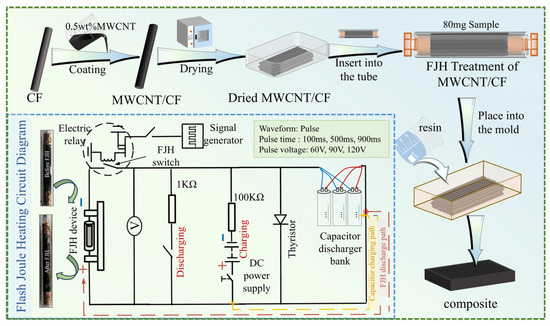
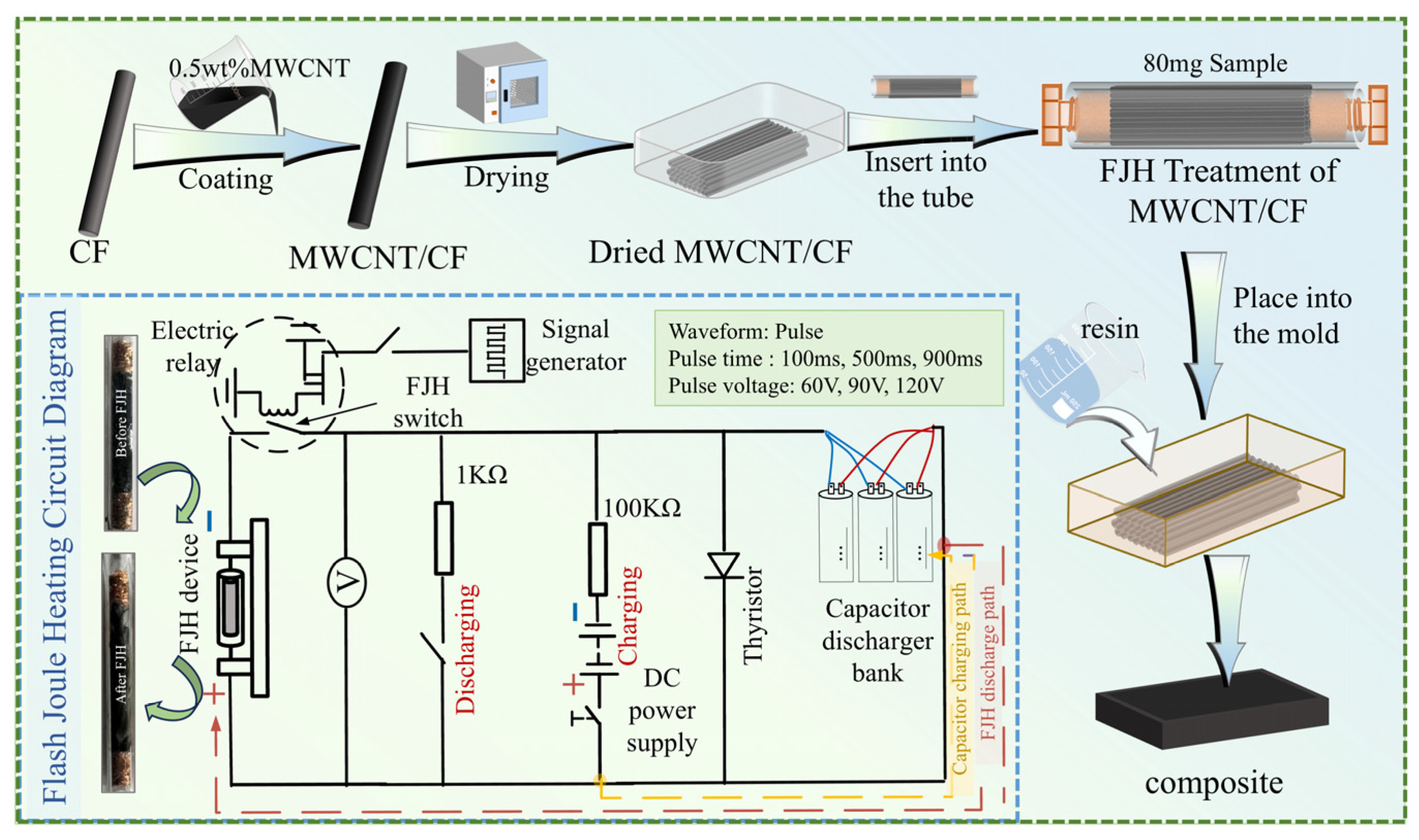
The flash Joule heating experiments were conducted in a quartz tube chamber. Copper electrodes were used to establish electrical connections, and the system consisted of a relay switch, signal generator, capacitor bank, charging resistor, and DC power supply. Approximately 80 mg of MWCNT-coated carbon fibers were placed in-side the quartz tube, with copper wires covering both ends to enhance electrical con-tact during the FJH process. By adjusting the clamping pressure, the sample resistance was fine-tuned to a stable value of 0.5 Ω prior to FJH. Turn on the charging switch to charge the capacitor bank, and monitor its voltage with a multimeter until the predetermined voltage value is reached, then stop charging. Next, adjust the signal generator’s output waveform to a pulse signal, setting the pulse time duration as the discharge time. After turning off the discharge switch, initiate the pulsed plasma discharge. During the process, the pulse duration was extremely short, and the instantaneous high current generated temperatures up to 3000 K. The specific circuit diagram can be found in Figure 1.
Figure 1.
Schematic illustration of the fabrication process of epoxy composites reinforced with MWCNT/CF treated by flash Joule heating.
2.3. Composite Fabrication
Epoxy resin and curing agent were mixed in a beaker according to the prescribed weight ratio. The mixture was subsequently degassed at 70 °C under vacuum to remove residual solvent and air bubbles generated during mixing. The degassed mixture was then poured into molds containing the carbon fibers. Finally, the composites were cured at 120 °C for 2 h, followed by post-curing at 130 °C for 2 h under atmospheric pressure.
2.4. Structural Characterization and Performance Testing
Before and after treatment, Raman spectra were acquired using a laser confocal Raman spectrometer (HORIBA LabRAM HR Evolution, Paris, France) with an excitation wavelength of 532 nm to evaluate graphite order and defect density. X-ray photoelectron spectroscopy (XPS) analysis was performed using a Thermo Scientific K-Alpha instrument (Waltham, MA, USA) with monochromatic aluminum Kα radiation (1486.6 eV) to investigate surface chemical composition before and after modification, analyzing surface chemistry and bonding evolution. Data were processed using Avantage software (5.99). Field emission scanning electron microscopy (SEM, ZEISS Sigma 300, Oberkochen, Germany) was employed to evaluate microstructural changes induced by FJH, enabling observation of the interfacial bonding morphology between multi-walled carbon nanotubes and carbon fibers. Mechanical property testing was performed using a universal testing machine (TY-9000D1, Yangzhou Tianyou Instrument Equipment Co., Yangzhou, China). Flexural strength was determined via three-point bending tests on specimens measuring 40 × 20 × 3.5 mm with a span of 25 mm and a displacement rate of 1 mm/min. Three specimens per group were tested, and the average value was used to evaluate interfacial load transfer. The thermal conductivity of the composite material was measured using a Netzsch LFA467 laser flash analyzer (Selb, Germany). Specimens measuring 10 × 10 × 3.5 mm were tested independently three times, and the average value was taken.
3. Results and Discussion
3.1. Microstructural Analysis
3.1.1. Raman Spectroscopy Analysis
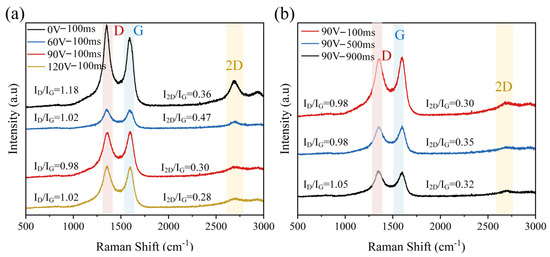
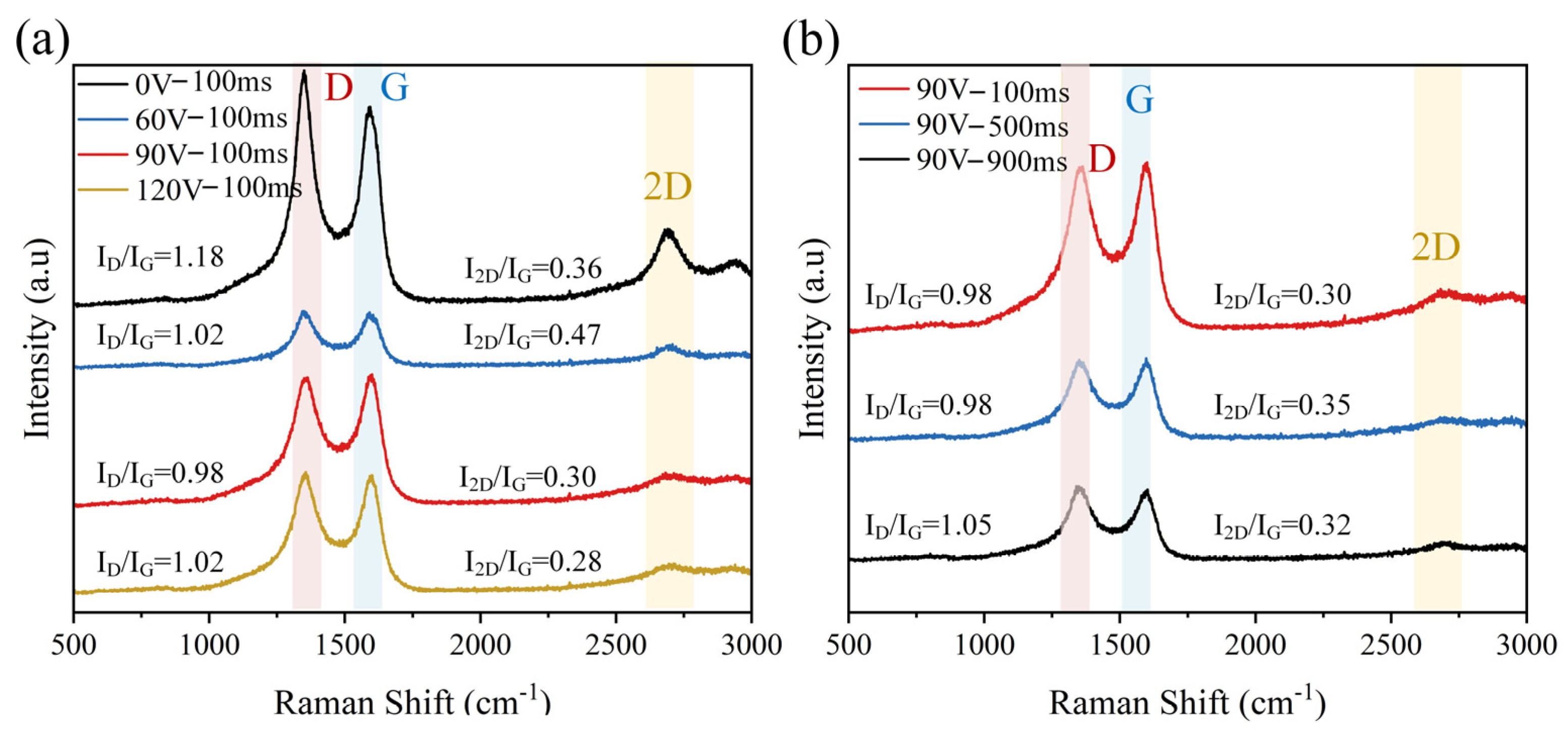
Figure 2a,b present the Raman spectra of the MWCNT/CF composite interfaces under different Joule heating welding parameters. All samples exhibit characteristic D, G, and 2D peaks located at approximately 1350 cm−1, 1580 cm−1, and 2700 cm−1, respectively, corresponding to defect-induced disordered carbon structures, in-plane vibrational modes of sp2 carbon atoms, and second-order scattering peaks. These features confirm that all samples retain the typical characteristics of carbon materials [33,34,35].
Figure 2.
Raman spectra of MWCNTs/CF before and after FJH treatment: (a) Raman spectra of MWCNTs/CF under different pulse discharge voltages; (b) Raman spectra of MWCNTs/CF under different pulse durations.
As shown in Figure 2a, the Raman spectra differ significantly under different applied voltages. Without voltage application (0 V), the ID/IG ratio of the sample is 1.18. When the voltage is increased to 60 V and 90 V, the ID/IG ratios decrease to 1.02 and 0.98, respectively, indicating that the transient high temperature generated by flash Joule heating helps reduce defects and improve the structural order of carbon. Among these conditions, the sample treated at 90 V exhibits the lowest ID/IG ratio and a relatively higher I2D/IG value (0.30), suggesting better integrity of the interfacial carbon structure under this parameter. However, when the voltage is further increased to 120 V, the ID/IG ratio rises again to 1.02, accompanied by a decrease in the relative intensity of the 2D peak, indicating that excessive thermal input may introduce new structural defects or damage the original ordered carbon structure.
Figure 2b shows the effect of different pulse durations on the Raman spectra at a fixed voltage of 90 V. When the pulse durations are 100 ms and 500 ms, the ID/IG ratios remain at approximately 0.98, and the I2D/IG values are 0.30 and 0.35, respectively, indicating that Joule heat welding within this time range can optimize the interfacial carbon structure without significantly introducing defects. In contrast, when the pulse duration is extended to 900 ms, the ID/IG ratio increases to 1.05 and the 2D peak intensity weakens, suggesting that prolonged high-temperature exposure leads to degradation of the carbon structure. Overall, Raman analysis demonstrates that flash Joule heat welding plays a significant role in regulating the interfacial carbon structure of MWCNT/CF. Moderate voltage and pulse duration reduce interfacial defect density and enhance structural order, whereas excessive voltage or overly long pulse duration causes structural damage.
3.1.2. XPS Analysis
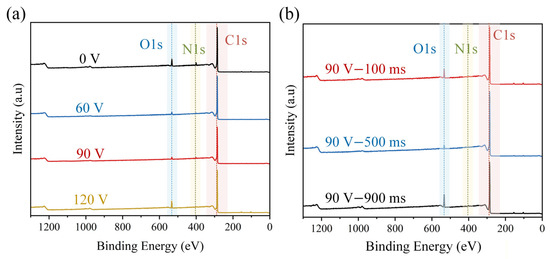
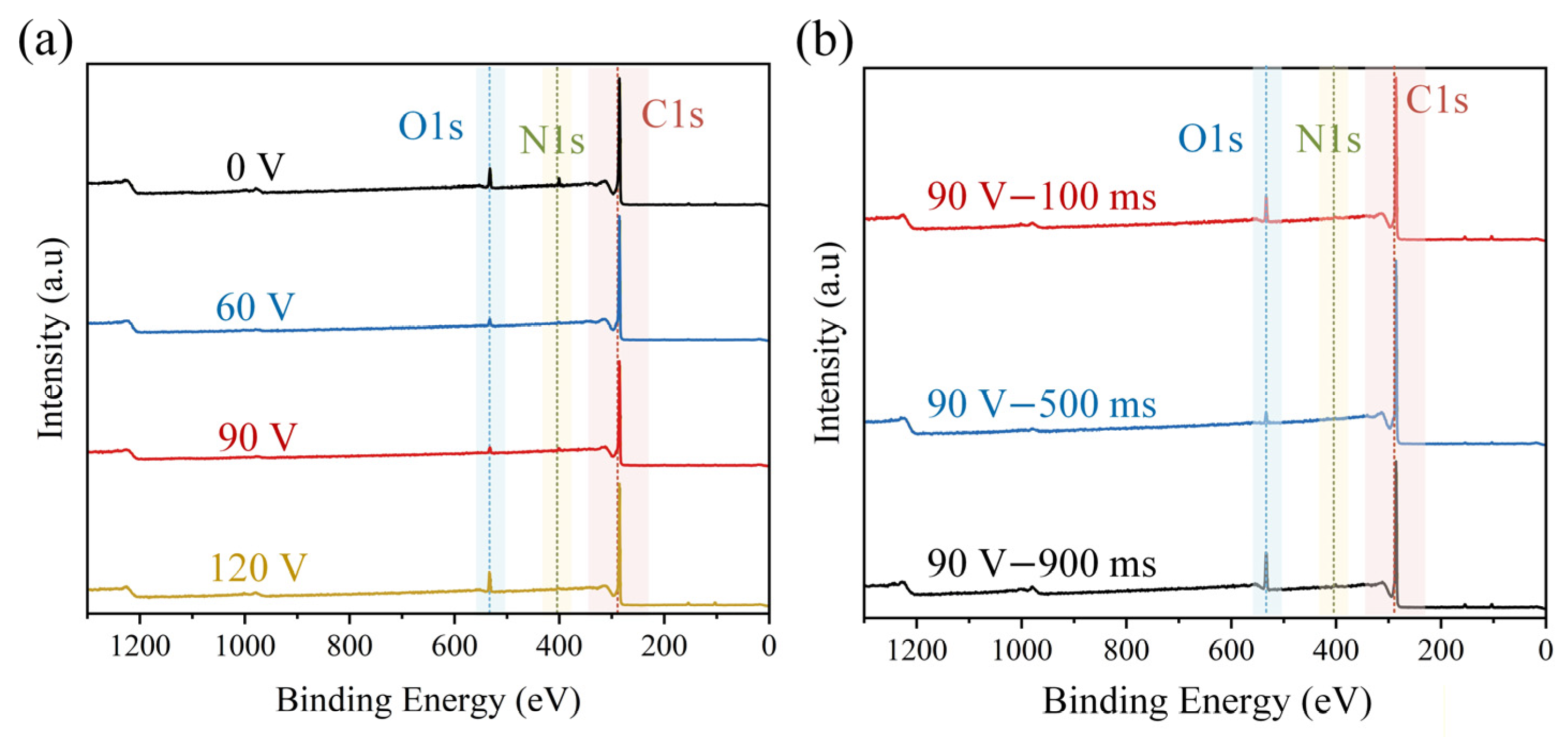
Figure 3a,b present the XPS survey spectra of the MWCNT/CF interfaces under different flash Joule heat welding parameters. All samples show a prominent C 1 s peak (~285 eV), accompanied by O 1 s (~532 eV) and N 1 s (~400 eV) signals [36,37], indicating that the sample surfaces are mainly composed of carbon with certain amounts of oxygen- and nitrogen-containing functional groups.
Figure 3.
XPS survey spectra of MWCNTs/CF before and after FJH treatment: (a) XPS survey spectra under different pulse discharge voltages; (b) XPS survey spectra under different pulse durations.
Under different applied voltages, the elemental composition of the MWCNT/CF interface changes to some extent. As shown in Table 1, without voltage application (0 V), the O 1 s and N 1 s peaks are relatively prominent. As the voltage increases, the relative intensity of the C 1 s peak increases, while the O 1 s and N 1 s signals gradually weaken, indicating that the transient high temperature generated by flash Joule heating effectively removes impurities from the raw materials. Overall, the XPS survey spectra demonstrate that flash Joule heating significantly regulates the interfacial chemical composition. Appropriate voltage and pulse duration can remove excess functional groups while maintaining interfacial stability.
Table 1.
Percentage Table of Carbon and Oxygen Atoms.
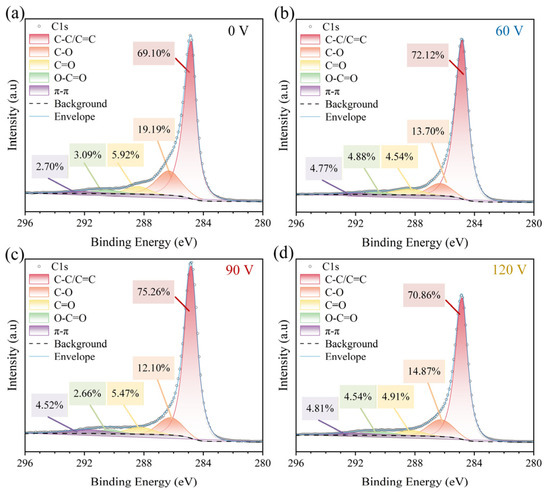
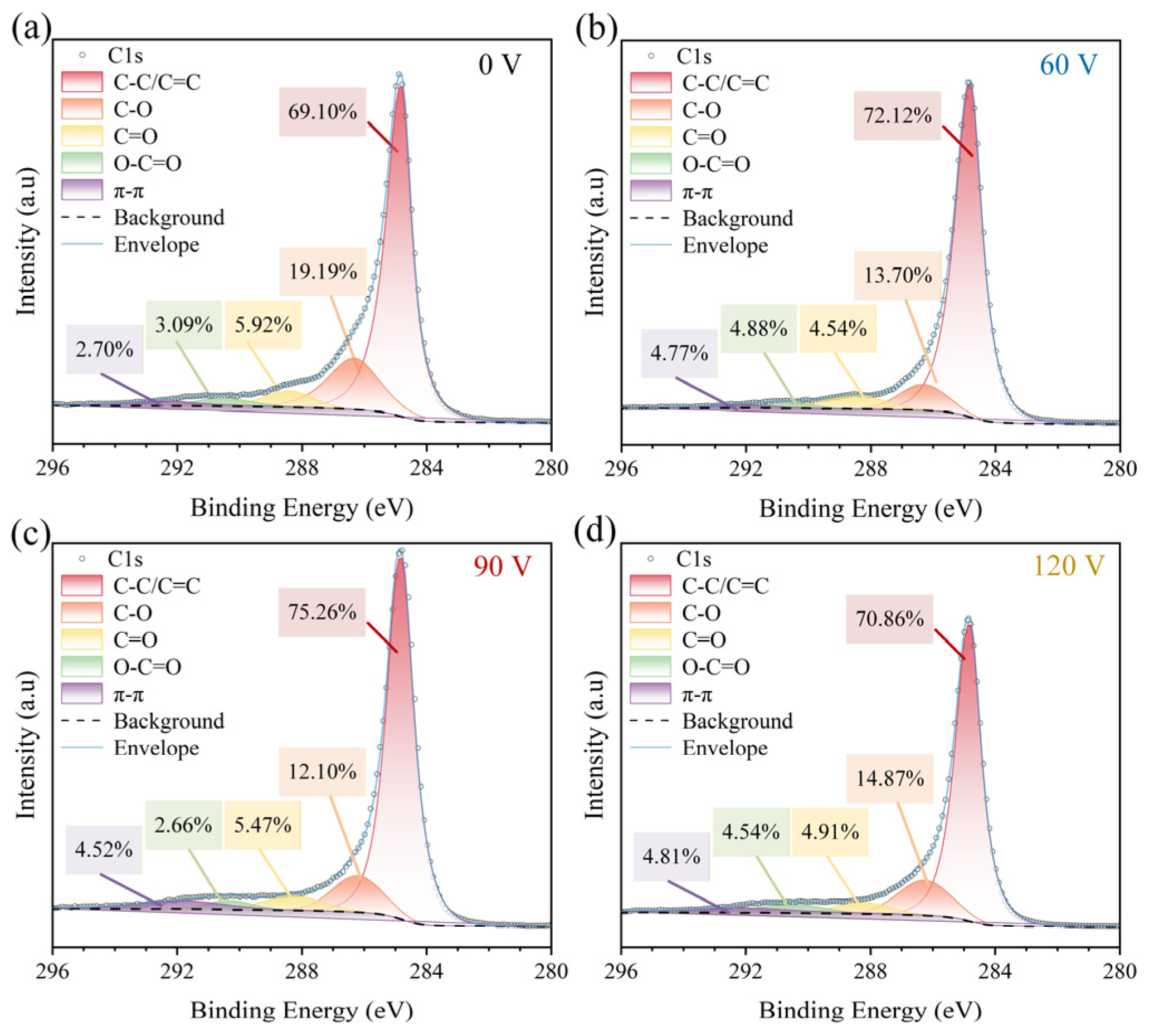
Figure 4a–d show the high-resolution C 1 s XPS fitting results of the MWCNT/CF interfaces under different Joule heat welding voltages. All C 1 s spectra can be deconvoluted into five characteristic peaks corresponding to C–C/C=C (~284.6 eV), C–O (~286.0 eV), C=O (~287.0 eV), O–C=O (~288.8 eV), and π–π (~291.0 eV) [38,39,40].
Figure 4.
High-resolution C 1 s spectra of MWCNTs/CF before and after FJH treatment: (a) pristine MWCNTs/CF; (b) 60 V pulse voltage; (c) 90 V pulse voltage; (d) 120 V pulse voltage.
Under the 0 V condition (Figure 4a), the proportion of the C–C/C=C peak is 69.10%, while the total proportion of oxygen-containing functional group peaks (C–O, C=O, and O–C=O) is approximately 28.20%, indicating that the MWCNT/CF surface retains a considerable amount of oxidized structures and surface defects in the initial state. When the voltage is increased to 60 V (Figure 4b), the proportion of the C–C/C=C peak increases to 72.12%, accompanied by a clear reduction in the C–O and C=O peak intensities, suggesting that the transient high temperature generated by flash Joule heating begins to decompose surface oxygen-containing functional groups and gradually enrich the interface in carbon.
At 90 V (Figure 4c), the proportion of the C–C/C=C peak further increases to 75.26%, reaching the highest value among all samples, while the proportion of oxygen-containing functional groups decreases to the lowest level. This result further confirms that appropriate Joule heat conditions favor interfacial carbon structural rearrangement and welding.
When the voltage was further increased to 120 volts (Figure 4d), the ratio of C–C/C=C peaks decreased to 70.86%, while the ratios of C–O, C=O and O–C=O peaks increased again. This indicates that excessive heat input may cause damage to the fiber structure or the formation of microcracks, thereby creating new defect sites and leading to damage to the carbon lattice. This process generates highly reactive unsaturated carbon sites. During the rapid cooling stage after the pulse, these high-energy sites react with the trace amounts of oxygen or water vapor remaining in the quartz tube, triggering partial oxidation reactions.
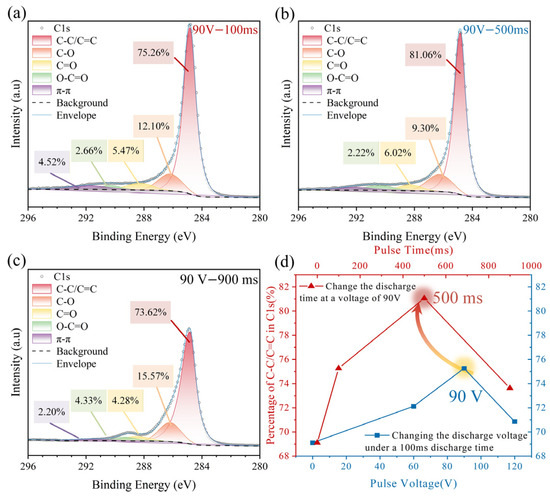
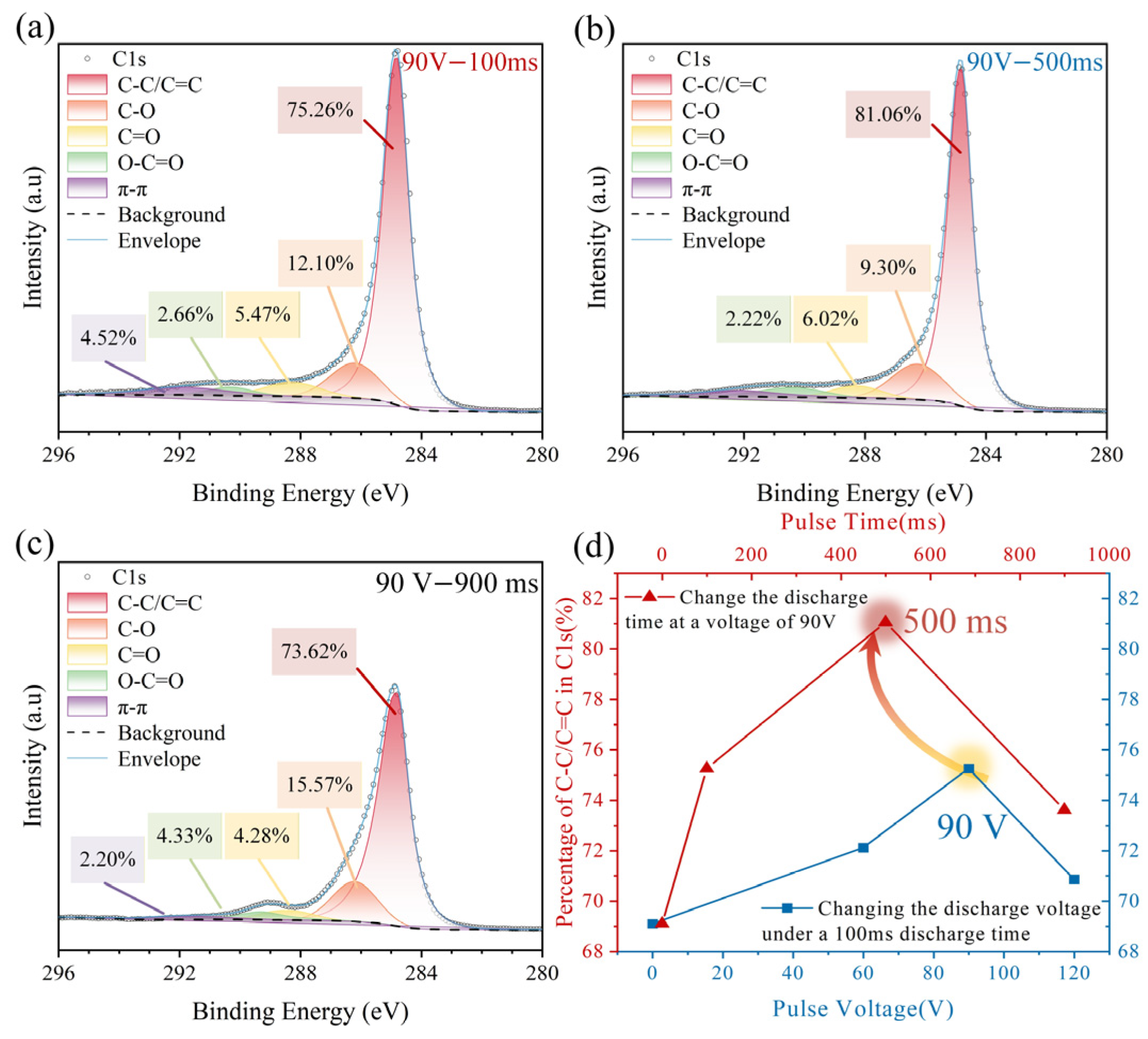
Figure 5a–c show the effects of different pulse durations (100, 500, and 900 ms) on the C 1 s chemical bonding structure of the MWCNT/CF interface at a fixed voltage of 90 V. At a pulse duration of 100 ms (Figure 5a), the proportion of the C–C/C=C peak is 75.26%, while the total proportion of oxygen-containing functional groups (C–O, C=O, and O–C=O) is approximately 20.23%, indicating that even within a short electrification time, flash Joule heating effectively promotes decomposition of some oxygen-containing functional groups and increases the interfacial sp2 carbon content. When the pulse duration is extended to 500 ms (Figure 5b), the proportion of the C–C/C=C peak significantly increases to 81.06%, reaching the highest value among all samples, while the C–O and C=O peak proportions further decrease. This suggests that under this condition, the transient high temperature induced by Joule heating is most favorable for interfacial carbon structural rearrangement and graphitization. This result is consistent with the lower defect level observed in Raman analysis at 500 ms.
Figure 5.
High-resolution C 1 s spectra of MWCNTs/CF before and after FJH treatment: (a) 100 ms pulse duration; (b) 500 ms pulse duration; (c) 900 ms pulse duration; (d) variation of carbon–carbon bonding under different discharge parameters.
However, when the pulse duration is further extended to 900 ms (Figure 5c), the proportion of the C–C/C=C peak decreases to 73.62%, accompanied by a significant increase in oxygen-containing functional groups, indicating that prolonged high-temperature exposure may cause carbon structure damage or secondary interfacial reactions, thereby reducing structural order.
Figure 5d quantitatively summarizes the variation in the proportion of C–C/C=C bonds in the C 1 s spectra. At a fixed voltage of 90 V, the C–C/C=C content first increases and then decreases with increasing pulse duration, reaching a maximum at 500 ms. Similarly, at a fixed pulse duration, the C–C/C=C content reaches a peak near 90 V as the voltage increases and subsequently decreases. These results indicate that both voltage and pulse duration jointly determine interfacial carbon structural evolution during flash Joule heat welding, with an optimal parameter combination of 90 V and 500 ms.
3.1.3. Microstructural Morphology Analysis
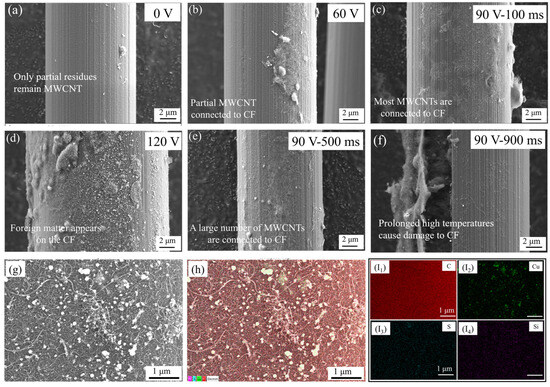
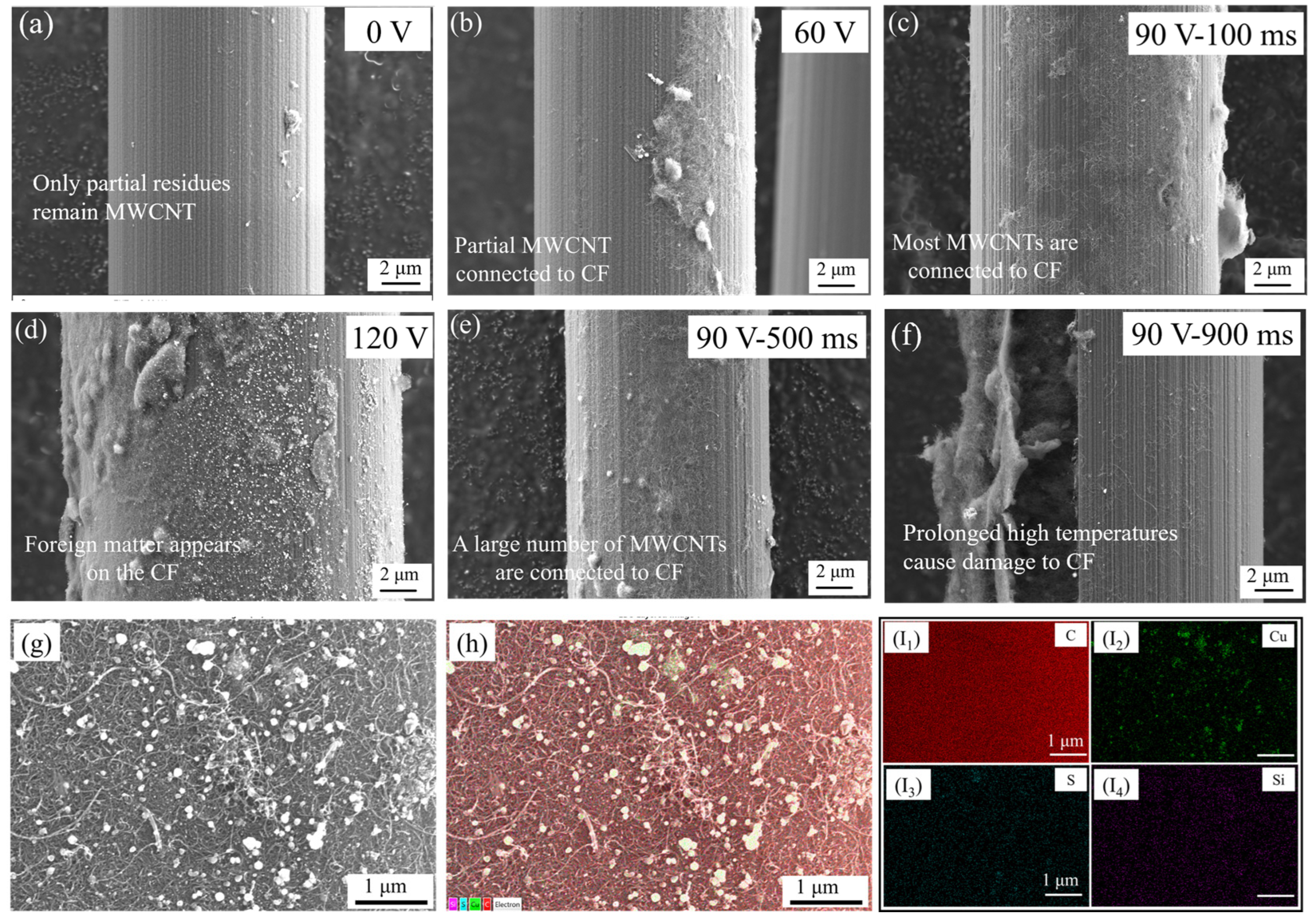
Figure 6a–f show the changes in the connection state of MWCNTs on the CF surface under different voltages and discharge durations. Without voltage application (Figure 6a), only a small amount of scattered MWCNT residues remains on the CF surface, indicating that the initial MWCNT–CF interaction mainly relies on physical adsorption with weak interfacial bonding. When the voltage is increased to 60 V (Figure 6b), some MWCNTs are observed to form preliminary connections with the CF surface, but the overall distribution is discontinuous and the welded regions are limited. This indicates that although the Joule heating effect is triggered at this voltage, the transient temperature is insufficient to achieve large-scale effective welding.
Figure 6.
SEM images of samples before and after FJH treatment: (a) pristine MWCNTs/CF; (b) 60 V–100 ms; (c) 90 V–100 ms; (d) 120 V–100 ms; (e) 90 V–500 ms; (f) 90 V–900 ms; (g) Electron image of MWCNTs/CF treated at 120 V–100 ms; (h) EDS layered image of MWCNTs/CF treated at 120 V–100 ms; (I1–I4) EDS elemental analysis image of MWCNTs/CF treated at 120 V–100 ms.
When the voltage is further increased to 90 V (Figure 6c), most MWCNTs are successfully connected to the CF surface, with a significantly increased interfacial bonding area. This demonstrates that under relatively high voltage and short pulse conditions, flash Joule heating can achieve effective welding between MWCNTs and CFs within an extremely short time. However, when the voltage is increased to 120 V (Figure 6d), a large number of irregular foreign particles or granular deposits appear on the CF surface.
These structures do not correspond to the typical morphology of MWCNTs. Therefore, EDS analysis was conducted (Figure 6(I1–I4)), revealing that these particles consist of copper elements. It is speculated that they originate from the sublimation of copper wires under high-temperature conditions, followed by deposition onto the CF surface during cooling. This result indicates that excessive voltage induces uncontrollable side reactions, reducing the purity and reliability of the welded interface. At a constant voltage of 90 V, extending the pulse duration to 500 ms (Figure 6e) further increases the number of MWCNT connections on the CF surface, forming a more continuous and dense network structure. This indicates that moderately extending the pulse duration enhances welding success by involving more MWCNTs in interfacial connections. However, when the pulse duration is further extended to 900 ms (Figure 6f), obvious morphological damage and structural degradation appear on the CF surface, with localized erosion or fracture features. This demonstrates that prolonged high-temperature exposure damages the CF substrate, shifting the welding process from interfacial reinforcement to matrix degradation, which is unfavorable for improving the overall composite performance. Therefore, rational control of voltage and pulse duration ensures high welding efficiency while avoiding interfacial contamination and substrate damage, providing an effective approach for constructing high-performance MWCNT/CF composite interfaces.
3.2. Mechanical Properties
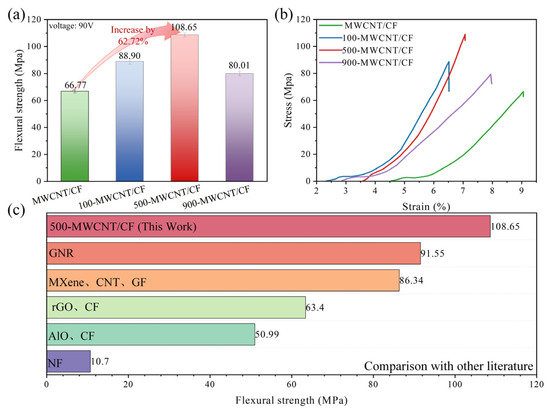
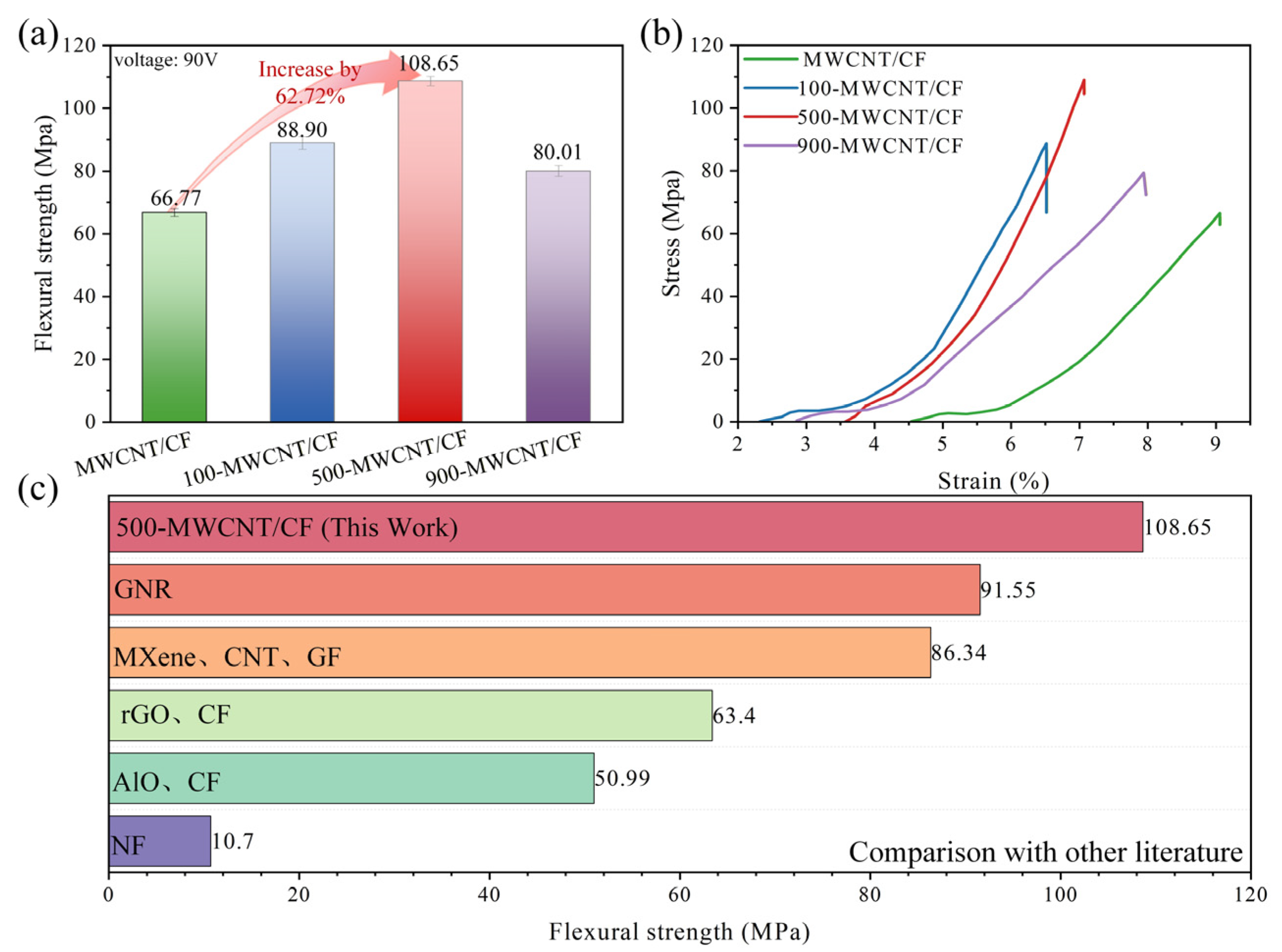
Figure 7a,b show the flexural mechanical properties of MWCNT/CF composites under different flash Joule heat welding parameters. The flexural strength of the untreated MWCNT/CF specimen is 66.77 MPa, exhibiting relatively limited load-bearing capacity. After introducing flash Joule heat welding at a fixed voltage, the flexural strength of the composites increases significantly. As shown in Figure 7a, when the pulse duration is 100 ms, the flexural strength increases to 88.90 MPa. When the pulse duration is extended to 500 ms, the flexural strength further increases to 108.65 MPa, representing an improvement of approximately 62.72% compared with the pristine MWCNT/CF specimen and achieving the highest value among all samples. This indicates that under appropriate Joule heat conditions, the MWCNT/CF interfacial bonding is significantly enhanced, effectively improving load transfer efficiency.
Figure 7.
Mechanical properties of composites: (a) flexural strength of composites; (b) flexural stress–strain curves; (c) comparison of mechanical performance of epoxy composites reported in different studies [41,42,43,44,45].
However, when the pulse duration is further extended to 900 ms, the flexural strength decreases to 80.01 MPa. Although this value remains higher than that of the untreated sample, it is significantly lower than that obtained under the 500 ms condition. This trend indicates that excessive high-temperature exposure weakens interfacial structural stability, thereby limiting further improvement in mechanical performance. Figure 7b presents the flexural stress–strain curves of different samples. The 500-MWCNT/CF specimen sustains higher stress at lower strain levels and exhibits a steeper initial slope, indicating significantly enhanced flexural modulus and interfacial load-bearing capacity. In contrast, the untreated MWCNT/CF specimen shows a slower stress increase, reflecting weak interfacial bonding and inefficient load transfer.
In addition, the 900-MWCNT/CF specimen fails at larger strain ranges with noticeably lower stress levels compared with the 500 ms sample, indicating that the interface may undergo localized damage or degradation after prolonged Joule heating. This observation is consistent with the interfacial degradation trends observed in SEM and XPS analyses. Overall, flexural performance results demonstrate that flash Joule heat welding significantly enhances the mechanical properties of composites by improving MWCNT/CF interfacial bonding quality. However, this enhancement depends strongly on appropriate welding parameters. A moderate pulse duration (~500 ms) achieves an optimal balance between interfacial reinforcement and structural stability, whereas excessively short or long pulse durations are unfavorable for achieving optimal mechanical performance. Figure 7c compares the mechanical performance of the optimal 500-MWCNT/CF composite in this work with various epoxy resin composites reported in the literature [41,42,43,44,45].
3.3. Thermal Conductivity
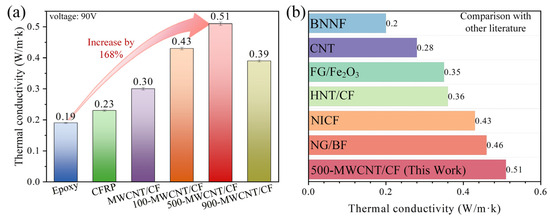
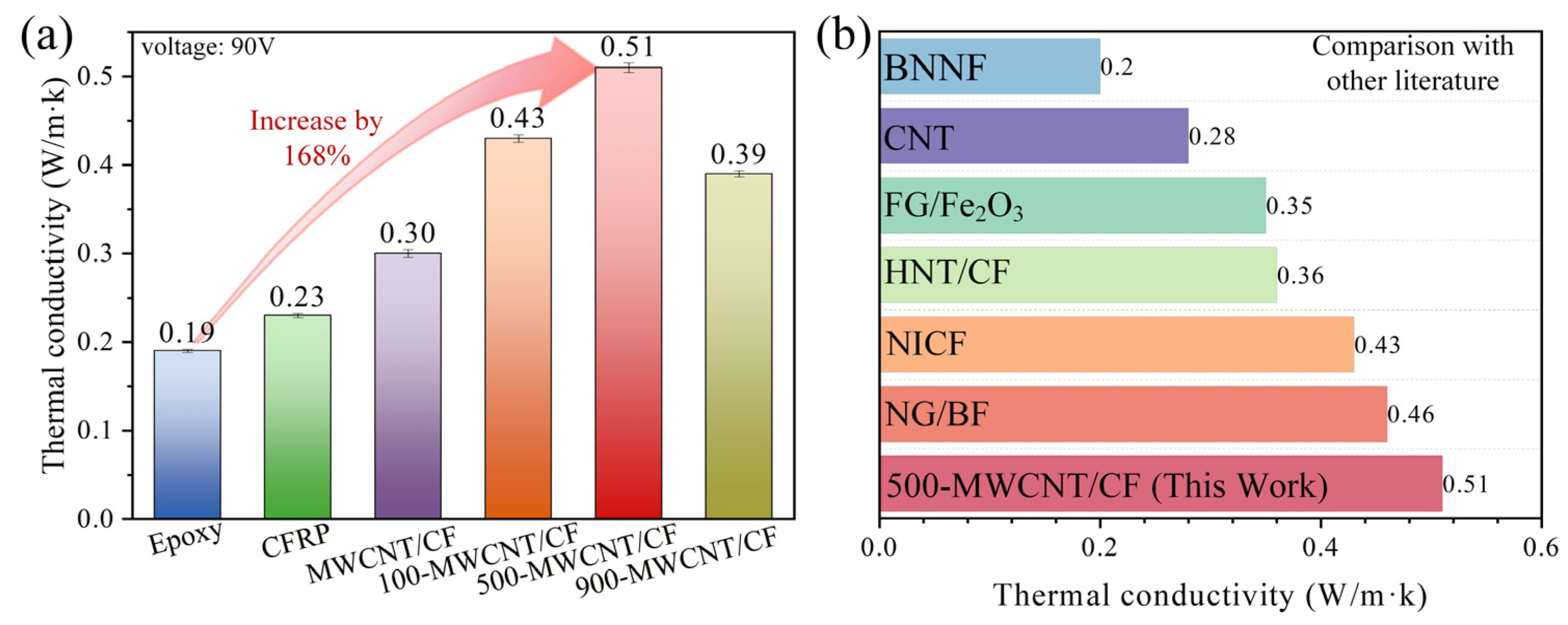
Figure 8a shows the variation in thermal conductivity of composites under different flash Joule heat welding parameters. The thermal conductivity of pure epoxy resin is only 0.19 W·m−1·K−1, while those of CFRP and MWCNT/CF composites are 0.23 W·m−1·K−1 and 0.30 W·m−1·K−1, respectively, indicating that the introduction of MWCNTs helps establish preliminary thermal conduction pathways. After flash Joule heating, the thermal conductivity of the composites is further significantly enhanced. As shown in Figure 8a, when the pulse duration is 100 ms, the thermal conductivity increases to 0.43 W·m−1·K−1. When the pulse duration is extended to 500 ms, the thermal conductivity reaches 0.51 W·m−1·K−1, representing an enhancement of approximately 168% compared with pure epoxy resin and achieving the highest value among all samples. This result indicates that under appropriate Joule heat conditions, MWCNT/CF interfacial connections are significantly improved, effectively constructing continuous, low-thermal-resistance heat conduction networks.
Figure 8.
Thermal conductivity of composites: (a) thermal conductivity under different conditions; (b) comparison of thermal conductivity of epoxy composites reported in different studies [46,47,48,49,50,51].
When the pulse duration is further extended to 900 ms, the thermal conductivity decreases to 0.39 W·m−1·K−1, indicating that excessive high-temperature exposure damages the established thermal conduction pathways or introduces interfacial thermal resistance, thereby limiting further enhancement in thermal conductivity. Figure 8b compares the thermal conductivity of the optimal 500-MWCNT/CF composite in this work with various fiber-reinforced epoxy resin composites reported in the literature. The thermal conductivity of 500-MWCNT/CF reaches 0.51 W·m−1·K−1, which is significantly higher than reported values for BN nanofillers, CNT fillers, FG/Fe2O3, HNT/CF, and some graphite-based composites [46,47,48,49,50,51]. These results further verify the effectiveness of flash Joule heat welding in synergistically enhancing multiple performance metrics.
4. Conclusions
This study proposes an interfacial modification strategy based on flash Joule heating. By generating transient high temperatures at the MWCNT/CF contact interface through millisecond-scale pulses, carbon atom rearrangement and carbon–carbon welding are induced, enabling the construction of continuous multiscale thermal conduction networks while effectively reducing interfacial impurities and oxygen-containing functional groups. During parameter optimization, pulse voltage and duration jointly determine carbon structural evolution, with an optimal combination identified at 90 V and 500 ms. Under this condition, the proportion of carbon–carbon bonds reaches the highest value (81.06%), indicating the highest degree of interfacial graphitization and structural ordering, which is favorable for reducing interfacial thermal resistance and enhancing load transfer efficiency.
In terms of macroscopic performance, the flexural strength of the optimal composite increases from 66.77 MPa to 108.65 MPa, representing an improvement of 62.72%. Meanwhile, the thermal conductivity of the composite increases from 0.19 W·m−1·K−1 for pure epoxy resin to 0.51 W·m−1·K−1, corresponding to an enhancement of approximately 168%, confirming the effectiveness of FJH in synergistically improving thermal and mechanical properties. It should be noted that excessively high voltage (e.g., 120 V) may induce copper wire sublimation and subsequent deposition on the fiber surface, reducing interfacial purity, while excessively long pulse duration (e.g., 900 ms) causes fiber morphological damage and performance degradation. Therefore, rational control of voltage and pulse duration is critical for obtaining stable, high-performance composite interfaces.
Overall, this work provides a rapid, efficient, and environmentally friendly approach for fabricating carbon-reinforced epoxy composites with both high thermal conductivity and high mechanical strength, offering a viable technical pathway and theoretical basis for applications with stringent requirements on thermal management and structural reliability.
Author Contributions
Conceptualization, J.Z.; methodology, L.G.; validation, L.L.; formal analysis, J.Q.; data curation, Z.Z.; funding acquisition, Z.Y. All authors have read and agreed to the published version of the manuscript.
Funding
This research was funded by the Science and Technology Project of State Grid Corporation of China, grant number 521203250005.
Data Availability Statement
Dataset available on request from the authors.
Conflicts of Interest
Authors Jie Zhang, Longgang Guo, Jian Qin, and Zhiqiang Zhang were employed by the company State Grid Anhui Electric Power Company—Ultra High Voltage Branch. The remaining authors declare that the research was conducted in the absence of any commercial or financial relationships that could be construed as a potential conflict of interest.
Abbreviations
The following abbreviations are used in this manuscript:
| MWCNT/CF | Carbon fibers coated with carbon nanotubes |
| 100-MWCNT/CF | MWCNT/CF treated by rapid Joule heating at 90 V and 100 ms parameters |
| 500-MWCNT/CF | MWCNT/CF treated by rapid Joule heating at 90 V and 500 ms parameters |
| 900-MWCNT/CF | MWCNT/CF treated by rapid Joule heating at 90 V and 900 ms parameters |
References
- Guo, Y.; Ruan, K.; Shi, X.; Yang, X.; Gu, J. Factors affecting thermal conductivities of the polymers and polymer composites: A review. Compos. Sci. Technol. 2020, 193, 108134. [Google Scholar] [CrossRef] [Scilit]
- Zhou, S.; Wei, W.; Li, L.; Luo, Y.; Xia, L.; Zhang, H.; Jia, Q.; Zeng, Z.; Yang, Z.; Wu, G. In situ growth of graphene on carbon fibers to enhance the mechanical and thermal conductivity of epoxy composites. Appl. Surf. Sci. 2025, 680, 161299. [Google Scholar] [CrossRef] [Scilit]
- Hao, M.; Qian, X.; Zhang, Y.; Yang, J.; Li, C.; Gong, H.; Wang, X.; Wang, P.; Liu, L.; Huang, Y. Thermal conductivity enhancement of carbon fiber/epoxy composites via constructing three-dimensionally aligned hybrid thermal conductive structures on fiber surfaces. Compos. Sci. Technol. 2023, 231, 109800. [Google Scholar] [CrossRef] [Scilit]
- Li, M.; Ali, Z.; Wei, X.; Li, L.; Song, G.; Hou, X.; Do, H.; Greer, J.C.; Pan, Z.; Lin, C.-T.; et al. Stress induced carbon fiber orientation for enhanced thermal conductivity of epoxy composites. Compos. Part B Eng. 2021, 208, 108599. [Google Scholar] [CrossRef] [Scilit]
- Yang, X.; Zhu, J.; Yang, D.; Zhang, J.; Guo, Y.; Zhong, X.; Kong, J.; Gu, J. High-efficiency improvement of thermal conductivities for epoxy composites from synthesized liquid crystal epoxy followed by doping BN fillers. Compos. Part B Eng. 2020, 185, 107784. [Google Scholar] [CrossRef] [Scilit]
- Li, H.; Liang, Y.; Liu, S.; Qiao, F.; Li, P.; He, C. Modulating carrier transport for the enhanced thermoelectric performance of carbon nanotubes/polyaniline composites. Org. Electron. 2019, 69, 62–68. [Google Scholar] [CrossRef] [Scilit]
- Huang, Z.; Wei, W.; Li, X.; Zuo, H.; Yang, Z.; Wu, G. Interfacial Bonding of Al-Si/C Composites and Improvement of the Thermal Shock Resistance. In Proceedings of the 2021 International Conference on Advanced Electrical Equipment and Reliable Operation (AEERO), Beijing, China, 15–17 October 2021; pp. 1–4. [Google Scholar] [CrossRef] [Scilit]
- Li, Y.; Jiang, B.; Huang, Y. Interfacial self-healing performance of carbon fiber/epoxy based on postsynthetic modification of metal-organic frameworks. Compos. Sci. Technol. 2022, 227, 109564. [Google Scholar] [CrossRef] [Scilit]
- Zuo, H.; Wei, W.; Li, X.; Yang, Z.; Liao, Q.; Xian, Y.; Wu, G. Enhanced wetting and properties of Carbon/Copper composites by Cu-Fe alloying. Compos. Interfaces 2022, 29, 111–120. [Google Scholar] [CrossRef] [Scilit]
- Liao, Q.; Wei, W.; Zuo, H.; Li, X.; Yang, Z.; Xiao, S.; Wu, G. Interfacial bonding enhancement and properties improvement of carbon/copper composites based on nickel doping. Compos. Interfaces 2021, 28, 637–649. [Google Scholar] [CrossRef] [Scilit]
- Wu, G.; Ma, L.; Liu, L.; Wang, Y.; Xie, F.; Zhong, Z.; Zhao, M.; Jiang, B.; Huang, Y. Interface enhancement of carbon fiber reinforced methylphenylsilicone resin composites modified with silanized carbon nanotubes. Mater. Des. 2016, 89, 1343–1349. [Google Scholar] [CrossRef] [Scilit]
- Kepple, K.L.; Sanborn, G.P.; Lacasse, P.A.; Gruenberg, K.M.; Ready, W.J. Improved fracture toughness of carbon fiber composite functionalized with multi walled carbon nanotubes. Carbon 2008, 46, 2026–2033. [Google Scholar] [CrossRef] [Scilit]
- Lee, G.; Sung, M.; Youk, J.H.; Lee, J.; Yu, W.-R. Improved tensile strength of carbon nanotube-grafted carbon fiber reinforced composites. Compos. Struct. 2019, 220, 580–591. [Google Scholar] [CrossRef] [Scilit]
- Xiong, S.; Zhao, Y.; Wang, Y.; Song, J.; Zhao, X.; Li, S. Enhanced interfacial properties of carbon fiber/epoxy composites by coating carbon nanotubes onto carbon fiber surface by one-step dipping method. Appl. Surf. Sci. 2021, 546, 149135. [Google Scholar] [CrossRef] [Scilit]
- Yang, Z.; Huang, X.; Li, J.; Tang, B.; Huang, G.; Wei, W.; Wu, G. Improved amine functionalization of carbon fiber surfaces by O2 plasma activation treatment. Compos. Interfaces 2023, 30, 1411–1427. [Google Scholar] [CrossRef] [Scilit]
- Rahman, M.R.; Taib, N.-A.A.B.; Matin, M.M.; Rahman, M.M.; Bakri, M.K.B.; Alexanrovich, T.P.; Vladimirovich, S.V.; Sanaullah, K.; Tazeddinova, D.; Khan, A. Optimization of Tensile Strength and Young’s Modulus of CNT–CF/Epoxy Composites Using Response Surface Methodology (RSM). Materials 2022, 15, 6746. [Google Scholar] [CrossRef] [Scilit] [PubMed]
- Li, L.; Zeng, Z.; Yang, Z.; Zhou, S.; Zhang, Y.; Wu, Y.; Ren, J.; Zeng, R.; Wei, W. High Thermally Conductive and Mechanically Strong Aramid Nanofiber Composite Film by a Single-Walled Carbon Nanotube and Ti3C2Tx MXene for Electromagnetic Shielding and Thermal Management. ACS Appl. Eng. Mater. 2025, 3, 302–313. [Google Scholar] [CrossRef] [Scilit]
- Wu, Z.; Dong, J.; Teng, C.; Li, X.; Zhao, X.; Qin, X.; Ji, C.; Zhang, Q. Polyimide-Based Composites Reinforced by Carbon Nanotube-Grafted Carbon Fiber for Improved Thermal Conductivity and Mechanical Property. Compos. Commun. 2023, 39, 101543. [Google Scholar] [CrossRef] [Scilit]
- Parasuram, S.; Banerjee, P.; Raj, R.; Kumar, S.; Bose, S. Electrophoretically Deposited Multiscale Graphene Oxide/Carbon Nanotube Construct Mediated Interfacial Engineering in Carbon Fiber Epoxy Composites. ACS Appl. Mater. Interfaces 2023, 15, 28581–28593. [Google Scholar] [CrossRef] [Scilit]
- Sun, Z.; Guo, F.-L.; Li, Y.-Q.; Hu, J.-M.; Liu, Q.-X.; Mo, X.-L.; Huang, P.; Fu, S.-Y. Effects of Carbon Nanotube-Polydopamine Hybridization on the Mechanical Properties of Short Carbon Fiber/Polyetherimide Composites. Compos. Part B Eng. 2022, 236, 109848. [Google Scholar] [CrossRef] [Scilit]
- Chen, Q.; Peng, Q.; Zhao, X.; Sun, H.; Wang, S.; Zhu, Y.; Liu, Z.; Wang, C.; He, X. Grafting carbon nanotubes densely on carbon fibers by poly(propylene imine) for interfacial enhancement of carbon fiber composites. Carbon 2020, 158, 704–710. [Google Scholar] [CrossRef] [Scilit]
- Zhang, Y.; Wu, Y.; Wei, W.; Chen, S.; Li, J.; Yang, Z.; Gao, G.; Wu, G. Multiscale enhancement of carbon/carbon composite performance by self-assembly of sulfonated graphene with silane-treated carbon fibers. Chem. Eng. J. 2024, 491, 152182. [Google Scholar] [CrossRef] [Scilit]
- Yan, F.; Liu, L.; Li, M.; Zhang, M.; Shang, L.; Xiao, L.; Ao, Y. One-step electrodeposition of Cu/CNT/CF multiscale reinforcement with substantially improved thermal/electrical conductivity and interfacial properties of epoxy composites. Compos. Part A Appl. Sci. Manuf. 2019, 125, 105530. [Google Scholar] [CrossRef] [Scilit]
- Wu, D.; Yao, Z.; Sun, X.; Liu, X.; Liu, L.; Zhang, R.; Wang, C. Mussel-tailored carbon fiber/carbon nanotubes interface for elevated interfacial properties of carbon fiber/epoxy composites. Chem. Eng. J. 2022, 429, 132449. [Google Scholar] [CrossRef] [Scilit]
- Yang, X.; Zhang, Y.; Liu, J.; Huang, J.; Ji, J.; Wang, T.; Li, T. Enhancing Mechanical Properties of CF/Al Composites through Multi-scale Interfacial Strengthening by Introducing Carbon Nanotube-grafted Carbon Fibers. Surf. Interfaces 2025, 64, 106440. [Google Scholar] [CrossRef] [Scilit]
- Liu, Y.; Lu, M.; Hu, Z.; Liang, L.; Shi, J.; Huang, X.; Lu, M.; Wu, K. Casein phosphopeptide-biofunctionalized graphene oxide nanoplatelets based cellulose green nanocomposites with simultaneous high thermal conductivity and excellent flame retardancy. Chem. Eng. J. 2020, 382, 122733. [Google Scholar] [CrossRef] [Scilit]
- Zhang, T.; Cheng, Q.; Xu, Z.; Jiang, B.; Wang, C.; Huang, Y. Improved interfacial property of carbon fiber composites with carbon nanotube and graphene oxide as multi-scale synergetic reinforcements. Compos. Part A Appl. Sci. Manuf. 2019, 125, 105573. [Google Scholar] [CrossRef] [Scilit]
- Cheng, Y.; Chen, J.; Deng, B.; Chen, W.; Silva, K.J.; Eddy, L.; Wu, G.; Chen, Y.; Li, B.; Kittrell, C.; et al. Flash upcycling of waste glass fibre-reinforced plastics to silicon carbide. Nat. Sustain. 2024, 7, 452–462. [Google Scholar] [CrossRef] [Scilit]
- Saadi, M.A.S.R.; Advincula, P.A.; Thakur, M.S.H.; Khater, A.Z.; Saad, S.; Zeraati, A.S.; Nabil, S.K.; Zinke, A.; Roy, S.; Lou, M.; et al. Sustainable valorization of asphaltenes via flash joule heating. Sci. Adv. 2022, 8, eadd3555. [Google Scholar] [CrossRef] [Scilit]
- Advincula, P.A.; Beckham, J.L.; Choi, C.H.; Chen, W.; Han, Y.; Kosynkin, D.V.; Lathem, A.; Mayoral, A.; Yacaman, M.J.; Tour, J.M. Tunable Hybridized Morphologies Obtained through Flash Joule Heating of Carbon Nanotubes. ACS Nano 2023, 17, 2506–2516. [Google Scholar] [CrossRef] [Scilit]
- Wyss, K.M.; Luong, D.X.; Tour, J.M. Large-Scale Syntheses of 2D Materials: Flash Joule Heating and Other Methods. Adv. Mater. 2022, 34, 2106970. [Google Scholar] [CrossRef] [Scilit]
- Luong, D.X.; Bets, K.V.; Algozeeb, W.A.; Stanford, M.G.; Kittrell, C.; Chen, W.; Salvatierra, R.V.; Ren, M.; McHugh, E.A.; Advincula, P.A.; et al. Gram-scale bottom-up flash graphene synthesis. Nature 2020, 577, 647–651. [Google Scholar] [CrossRef] [Scilit] [PubMed]
- Ferrari, A.C. Raman spectroscopy of graphene and graphite: Disorder, electron–phonon coupling, doping and nonadiabatic effects. Solid State Commun. 2007, 143, 47–57. [Google Scholar] [CrossRef] [Scilit]
- Ferrari, A.C.; Basko, D.M. Raman spectroscopy as a versatile tool for studying the properties of graphene. Nat. Nanotechnol. 2013, 8, 235–246. [Google Scholar] [CrossRef] [Scilit] [PubMed]
- Han, S.; Lin, J.T.; Yamada, Y.; Chung, D.D.L. Enhancing the thermal conductivity and compressive modulus of carbon fiber polymer–matrix composites in the through-thickness direction by nanostructuring the interlaminar interface with carbon black. Carbon 2008, 46, 1060–1071. [Google Scholar] [CrossRef] [Scilit]
- Park, S.-J. Effect of ozone-treated single-walled carbon nanotubes on interfacial properties and fracture toughness of carbon fiber-reinforced epoxy composites. Compos. Part A Appl. Sci. Manuf. 2020, 137, 105937. [Google Scholar] [CrossRef] [Scilit]
- Abd-Elnaiem, A.-M.; Hussein, S.I.; Assaedi, H.S.; Mebed, A.M. Fabrication and evaluation of structural, thermal, mechanical and optical behavior of epoxy–TEOS/MWCNTs composites for solar cell covering. Polym. Bull. 2021, 78, 3995–4017. [Google Scholar] [CrossRef] [Scilit]
- Yang, S.-Y.; Lin, W.-N.; Huang, Y.-L.; Tien, H.-W.; Wang, J.-Y.; Ma, C.-C.M.; Li, S.-M.; Wang, Y.-S. Synergetic effects of graphene platelets and carbon nanotubes on the mechanical and thermal properties of epoxy composites. Carbon 2011, 49, 793–803. [Google Scholar] [CrossRef] [Scilit]
- Han, G.; Wang, Q.; Ding, F.; Fang, M.; Fang, X.; Yi, P.; Li, Y.; Sun, X.; He, J.; Li, J.; et al. Assembly of partially unzipped multiwalled carbon nanotubes into ultralight, highly efficient and multifunctional electromagnetic wave absorbing aerogel. Carbon 2023, 213, 118220. [Google Scholar] [CrossRef] [Scilit]
- Higginbotham, A.L.; Kosynkin, D.V.; Sinitskii, A.; Sun, Z.; Tour, J.M. Lower-Defect Graphene Oxide Nanoribbons from Multiwalled Carbon Nanotubes. ACS Nano 2010, 4, 2059–2069. [Google Scholar] [CrossRef] [Scilit]
- Nadiv, R.; Shtein, M.; Buzaglo, M.; Peretz-Damari, S.; Kovalchuk, A.; Wang, T.; Tour, J.M.; Regev, O. Graphene nanoribbon—Polymer composites: The critical role of edge functionalization. Carbon 2016, 99, 444–450. [Google Scholar] [CrossRef] [Scilit]
- Bodduru, K.; Singh, L.K.; Amrita, M.; Anbumani, P.; Singh, A.P. Influence of MXene and carbon nanotube on the mechanical properties of sisal fibre/glass fibre reinforced epoxy composite laminates. Mater. Today Proc. 2023, in press. [Google Scholar] [CrossRef] [Scilit]
- Integration of Triboluminescent EuD4TEA Crystals to Transparent Polymers: Impact Sensor Application. ACS Appl Mater Interfaces 2017, 9, 6488–6496. [CrossRef] [Scilit] [PubMed]
- Girimurugan, R.; Arunraja, K.M.; Shanmugam, A.; Saranya, S.; Vigneshwaran, M. The Effects of Nano-Alumina Particles on the Enrichment of Tensile, Flexural and Impact Properties of Carbon Fiber-Reinforced Epoxy Composites. Mater. Today Proc. 2023, in press. [Google Scholar] [CrossRef] [Scilit]
- Akhyar; Gani, A.; Ibrahim, M.; Ulmi, F.; Farhan, A. The influence of different fiber sizes on the flexural strength of natural fiber-reinforced polymer composites. Results Mater. 2024, 21, 100534. [Google Scholar] [CrossRef] [Scilit]
- Ren, L.; Zhou, X.; Xue, J.; Song, Z.; Li, B.; Liu, Q.; Zhao, C. Thermal Metamaterials with Site-Specific Thermal Properties Fabricated by 3D Magnetic Printing. Adv. Mater. Technol. 2019, 4, 1900296. [Google Scholar] [CrossRef] [Scilit]
- Wang, Z.; Liu, J.; Cheng, Y.; Chen, S.; Yang, M.; Huang, J.; Wang, H.; Wu, G.; Wu, H. Alignment of Boron Nitride Nanofibers in Epoxy Composite Films for Thermal Conductivity and Dielectric Breakdown Strength Improvement. Nanomaterials 2018, 8, 242. [Google Scholar] [CrossRef] [Scilit]
- Kim, S.H.; Heo, Y.-J.; Park, M.; Min, B.-G.; Rhee, K.Y.; Park, S.-J. Effect of hydrophilic graphite flake on thermal conductivity and fracture toughness of basalt fibers/epoxy composites. Compos. Part B Eng. 2018, 153, 9–16. [Google Scholar] [CrossRef] [Scilit]
- Wu, X.; Zhao, J.; Rao, X.; Chung, D.D.L. Carbon fiber epoxy-matrix composites with hydrothermal-carbon-coated halloysite nanotube filler exhibiting enhanced strength and thermal conductivity. Polym. Compos. 2020, 41, 2687–2703. [Google Scholar] [CrossRef] [Scilit]
- Choi, J.H.; Song, H.J.; Jung, J.; Yu, J.W.; You, N.-H.; Goh, M. Effect of crosslink density on thermal conductivity of epoxy/carbon nanotube nanocomposites. J. Appl. Polym. Sci. 2017, 134, 44253. [Google Scholar] [CrossRef] [Scilit]
- Arun, P.V.R.; Rajadurai, A. Thermo-mechanical characterization of siliconized E-glass fiber/hematite particles reinforced epoxy resin hybrid composite. Appl. Surf. Sci. 2016, 384, 99–106. [Google Scholar] [CrossRef] [Scilit]

Disclaimer/Publisher’s Note: The statements, opinions and data contained in all publications are solely those of the individual author(s) and contributor(s) and not of MDPI and/or the editor(s). MDPI and/or the editor(s) disclaim responsibility for any injury to people or property resulting from any ideas, methods, instructions or products referred to in the content. |
© 2026 by the authors. Licensee MDPI, Basel, Switzerland. This article is an open access article distributed under the terms and conditions of the Creative Commons Attribution (CC BY) license.