


Abstract
Culvert construction at stream crossing sites can lead to zones of high-velocity water flow which can disrupt the dispersal and connectivity of species of greatest conservation need (SGCN) in Texas. To help inform effective culvert design, the swimming performance of the following seven fish species has been measured, the first three of which are SGCN themselves, and the last four serve as hosts for glochidia of SGCN mussels (mussel genera indicated in parentheses): Colorado Roundnose Minnow, Texas Shiner, Headwater Catfish, Largemouth Bass (host for Lampsilis spp.), Green Sunfish (host for Lampsilis spp.), Channel Catfish (host for Cyclonaias spp.) and Blacktail Shiner (host for Fusconaia spp.). The primary objective was to measure the critical swimming speeds (Ucrit) under a range of relevant temperatures (15, 22.5, and 30 °C) to be used in site-specific calculations of culvert water velocities (Vf). A secondary objective was to collect additional physiological endpoints of relevance to overall swimming performance, including maximum burst swimming speed (Umax), metabolic rate measurements (i.e., standard (SMR), maximum (MMR) and aerobic scope (AS)) and calculations of cost of transport (COT) and optimal swimming speed (Uopt). As expected, Ucrit tended to increase with increasing temperature for several species with metabolic rate measurements following congruent trends, whereas Umax exhibited thermal independence for all species.
Keywords:
fish passage; swimming performance; metabolism; stream crossing; culvert; Ucrit; aerobic scope; conservation physiology Key Contribution:
To support the conservation of imperiled species of Texas freshwater fishes and mussels and decrease the impacts of human infrastructure on habitat fragmentation, swimming performance metrics were measured to inform construction of stream-crossing sites.
1. Introduction
As human populations expand, the demand for urban development and transportation infrastructure such as bridges and culverts at stream crossing sites increases, leading to detrimental impacts on these aquatic systems. These structures, particularly culverts, can disrupt ecosystem connectivity by acting as barriers to aquatic organism movement, as they alter natural flow regimes and create zones of high velocity flow that can impede fish passage [1,2]. These anthropogenic changes to the natural landscapes can affect water chemistry and hydrology, disrupt migratory patterns, and ultimately lead to habitat fragmentation and ecosystem disruptions [3]. Culverts can generate turbulent flow fields, shallow flow depths, and elevated velocity conditions, especially when built too narrowly. These conditions can exceed the swimming capacities of many fish species, resulting in fatigue or failure to traverse the structure, impeding upstream passage. As a result, culverts can act as ecological bottlenecks that contribute to habitat fragmentation [4]. Habitat degradation and fragmentation have negatively affected fish assemblages across North America by limiting access to critical habitats and inhibiting population growth and distribution. In fact, such effects imposed by barriers to fish passage are believed to have contributed to the decline of freshwater species worldwide [5,6,7]. Therefore, understanding and mitigating the impacts of human population growth, particularly on imperiled species, is critical for environmentally sustainable urban development.
Importantly, impedance by stream barriers is likely to harm not only native fish populations, but also the parasitic life stages (i.e., larval glochidia) of imperiled mussels that rely on fish-mediated transport for dispersal. Texas contains 52 species of freshwater mussels (of nearly 300 within North America) that provide important ecosystem services, including serving as valuable indicator species of healthy ecosystems [8,9,10,11]. Given that adult mussels are relatively sedentary, such host-mediated transport of glochidia represents the primary route for species population growth and dispersal [8]. As a result, fish passage barriers can indirectly limit mussel dispersal, recruitment, and gene flow and may ultimately reduce population connectivity [10]. A substantial proportion of native species of freshwater mussels are imperiled in the United States, and they are thought to be one of the most imperiled fauna globally [12,13]. Despite growing awareness of fish passage barriers, species-specific swimming performance data are lacking for many host fishes of imperiled mussel species.
To inform environmentally friendly urban development, it is vital to study the swimming performance of fishes needing to traverse culverts, primarily their critical swimming speed (Ucrit), defined as a measure of prolonged swimming capacity, as this influences their ability to successfully navigate velocity barriers [14,15,16,17]. Quantifying species-specific swimming performance and hydraulic thresholds can contribute to improved culvert design and fish passage [16]. Metabolic metrics such as aerobic scope (AS), which defines the energetic limitations of aerobically fueled swimming, and cost of transport (COT), can also provide insight into the limits of swimming performance [18,19]. Metabolism reflects the energetic demands of vital life functions such as locomotion, growth, reproduction, and feeding [20]. Temperature-induced changes in metabolic rate () and AS may impact swimming performance and therefore temperature considerations should be included in swimming performance investigations [21,22]. Measuring both swimming performance and metabolism across a range of temperatures can provide insights into best practices for management and conservation.
Recently, Emadi et al. [23] addressed these issues by focusing on the Edwards Plateau region of Texas [23]. To expand available physiological data to inform conservation efforts, we investigated various aspects of the swimming and metabolic performance of seven freshwater fish species across the state of Texas at three different temperatures (15, 22.5 and 30 °C), with a focus on species of greatest conservation need (SGCN). SGCN are vulnerable species that have been identified by Texas Parks and Wildlife (TPWD) to be rare, declining in population size and distribution, vulnerable to environmental change, and in need of special conservation action for the recovery and stability of those populations [24]. Focusing on SGCN is critical because these species are the most vulnerable to habitat fragmentation and altered flow conditions. For this study, we targeted the following seven fish species, the first three of which are SGCN species themselves, and the last four serve as hosts for different glochidia SGCN, with mussel genera indicated in brackets: Texas Shiner (Notropis amabilis), Colorado Roundnose Minnow (Dionda cf. episcopa), Headwater Catfish (Ictalurus lupus), Blacktail Shiner (Cyprinella venusta) [host for Fusconaia], Largemouth Bass (Micropterus salmoides) [host for Lampsilis], Green Sunfish (Lepomis cyanellus) [host for Lampsilis] and Channel Catfish (Ictalurus punctatus) [host for Cyclonaias]. The data collected from this study will be useful in providing guidance for maximum passable flow rates in the design of culverts and other stream barrier modifications to improve fish passage and mitigate the impact of these structures on fish and mussel populations in Texas. Moreover, benefits from these findings are likely to extend beyond Texas, given that all focal fish species except for Colorado Roundnose Minnow have ranges that extend outside this state.
2. Materials and Methods
2.1. Experimental Animals
Each of the seven fish species was collected in succession by TPWD field biologists from varying locations and habitats across the state of Texas. All species were collected via seine, except for the Largemouth Bass which were collected via electrofishing and Channel Catfish which were provided by TPWD’s Possum Kingdom Fish Hatchery. Upon collection, fish were transported in aerated coolers to the University of North Texas in Denton County, TX. They were then evenly distributed among nine 25-gallon tanks containing water matched to the temperature and chemistry of the transport water, which ranged from 13.8 to 25.2 °C depending on collection site. Each tank contained a minimum of 3 fish to ensure adequate sample size (n = 6–8) and to account for mortality. Each of the nine tanks was placed in one of three 150-gallon living stream tanks (Frigid Units, Inc., Toledo, OH, USA) for temperature regulation, such that each living stream tank contained three replicate tanks. After a period of 24 h, the temperature of each of the living streams were slowly adjusted 2 °C per day and no more than 1 °C per hour to reach the final temperature treatments of 15, 22.5 and 30 °C. These temperatures were chosen based on a previous study and represent the average, typical high, and typical low of freshwater spring and stream temperatures in the Edwards Plateau region [23]. The coolest temperature was maintained using a chiller unit (Frigid Units, Inc., Toledo, OH, USA), while the two warmer temperatures were achieved using aquarium heaters. Once these temperatures were reached, fish were acclimated for a minimum of one month prior to initiating swimming performance experiments. Although the replicate tanks were placed within larger living stream tanks for temperature regulation, no current-generating devices were used in the replicate tanks themselves during the acclimation period. Therefore, fish were not subjected to sustained swimming exercise during temperature acclimation.
Fish were fed Tetramin flakes, pellets or live red worms once daily until satiated and maintained under a 14:10 h light:dark cycle. Water quality was measured daily and maintained using aquarium filters and air pumps to maintain dissolved oxygen > 95%. Dissolved oxygen, conductivity, salinity, and temperature were recorded daily and measured using a YSI ProSolo meter fitted with an ODO/Cond/Temp/Salinity Probe (YSI Inc., Yellow Springs, OH, USA) in addition to ammonia, nitrite, and nitrate measured using standard aquarium test strips. Water changes were conducted as needed with dechlorinated Denton Municipal tap water. All animal care and experimental protocols were reviewed by the University of North Texas Institutional Animal Care and Use Committee and were carried out according to institutional and federal guidelines (IACUC Protocol 24002).
2.2. Maximum Burst Swimming Speed
The maximum burst swimming speed, or Umax, was defined for this study as the fastest swimming speed measured during a C-start escape response to a startle stimulus [17,25,26,27]. However, it is important to note that inconsistent use of terms representing a fish’s maximum swimming speed is found in the literature, with both Umax and Uburst being used to define the fatigue velocity during constant acceleration tests [25,26]. Additionally, Uburst has also been defined as the swimming speed achieved just prior to initiating a burst-and-coast swimming mode for a minimum period (e.g., >5 s) [28]. When acclimation to treatment temperatures was completed, each fish was fasted for 24 h prior to experimentation to eliminate metabolic activity due to specific dynamic action. Fish were photographed and weighed to determine wet mass. Total body length (tip of the snout to the end of the longest lobe of the caudal fin) and width (the widest section of the body, usually just behind the pectoral fins) were determined using ImageJ 1.54g software (National Institutes of Health, Bethesda, MD, USA). The fish was then transferred into the burst swimming apparatus which consisted of either a white 38 L cylindrical tank with a diameter of ~36 cm (for smaller species) or a 64 L cylindrical tank with a diameter of ~55 cm (for larger species) containing water matched to the temperature and chemistry of the treatment water. The water level was deep enough for the fish to move freely but not so deep that it allowed the fish to swim vertically. This depth ranged from ~7 cm deep to ~15 cm deep and allowed for a clearance of ~5 cm between the tip of the caudal fin and the surface of the water. A GoPro (HERO7 Black, GoPro Inc., San Mateo, CA, USA) was placed above the tank to record the burst responses at 30 frames per second and was remotely controlled via the Quik app as to not disturb the fish. Initially, a short video was taken with a ruler on the bottom of the tank for calibration. A curtain was used to cover the tank to minimize stress on the fish. After a 15 min habituation period, a startle response was initiated by dropping a standard weight from a height of 1.5 m through a PVC pipe to shield it from view into the tank. Each fish was exposed to 3 total startle response trials, each with a 15 min habituation period. Videos were processed and analyzed using Lolitrack 5 to measure the maximum burst swimming speed immediately following the startle cue (Loligo Systems, Viborg, Denmark). The videos for each burst trial were individually calibrated for distance and filters and masks were used within the software program to clearly outline the fish’s location within the tank. The first 12 frames (or 400 ms) following the startle response cue were analyzed to determine the maximal swimming speed, or Umax. The highest value from all three trials was used as Umax.
2.3. Critical Swimming Speed and Metabolic Measurements
Swim trials were conducted according to procedures described by Emadi et al., which were based on established respirometry protocols [14,15,23,29,30]. Critical swimming speeds, or Ucrit, and were determined using swim tunnel respirometers (170 mL or 1.5 L Blazka-type or 10 L Brett-type; Loligo Systems, Viborg, Denmark) equipped with a Pt1000 temperature probe and a dipping oxygen probe. Prior to experimentation, swim tunnels were calibrated for velocity as well as oxygen saturation by performing a two-point calibration using 100% oxygenated water and a 20 g/L sodium sulfite solution for the high and low points, respectively. Due to a previous study of two fish species that showed no effect of glochidia infection on aerobic capacity or swimming performance, fish were not inspected for glochidia prior to trials [31].
Upon completion of the burst swimming test, fish were gently transferred into a size-matched swim tunnel respirometer and habituated at a flow rate of 0.5 body lengths per second (BL/s) until oxygen consumption stabilized, allowing estimation of the standard metabolic rate (SMR). Species such as the Blacktail Shiner required an overnight habituation period to reach SMR, while others such as the Green Sunfish needed only 3–4 h. If overnight habituation was required, a Phillips Hue LED Smart Bulb was used on a timer to slowly fade in and out to mimic a natural sunrise and not to startle the fish. The cross-sectional area of the fish was calculated using the following equations:
Radius (r) = average of width and height Cross-sectional area = π (r2)
If the cross-sectional area of the fish was greater than 10% of the swim tunnel cross-sectional area, a solid blocking correction was applied, which accounts for the increased water velocity around the fish caused by its displacement of the tunnel’s cross-sectional area [32]. Fish were remotely monitored from behind a curtain using a webcam connected to a laptop.
Once a consistent was maintained (at least 3 consecutive measurements not deviating by >10%), Ucrit tests were conducted in accordance with prior studies [23,30]. Following habituation, each fish was subjected to progressively increased velocity intervals in increments of 0.5 BL/s every 20 min until it reached fatigue, exhibited by impingement on the back screen for at least 3 s. Each 20 min interval contained a flush period to replenish the chamber with oxygen-saturated water, a brief wait period to allow for stabilization of measurements, and a measurement period. The wait period was 30 s, while the flush and measurements periods were optimized to replenish the oxygen in the chamber to 100% and to achieve a high r2 value for the metabolic measurements. Temperature was maintained in the swim tunnels using either a standard aquarium heater or an Alpha 8 heating/cooling coil (LAUDA-Brinkmann, LP, Delran, NJ, USA). AutoResp version 3.1.2 was used to calibrate the system and collect data (Loligo Systems, Viborg, Denmark). At the end of the swim trial, fish were either humanely euthanized with an overdose of MS-222 or returned to their treatment replicate tank for further testing in a separate study. The swim tunnel chamber was then resealed to measure metabolic activity due to background microbial respiration, and these values were subtracted from the data during analysis.
To calculate Ucrit, the following equation by Brett was used:
in which Uf (cm/s) represents the highest swimming speed maintained for the full interval prior to failure, T (s) is the time spent at the velocity of failure, t (s) is the total time interval (in this case 1200 s), and dU is the increment in swim speed (cm/s) [14].
Ucrit = [Uf + (T/t)dU]/cm
Standard metabolic rate (SMR) and maximum metabolic rate (MMR) were obtained by log transforming data and plotting it versus swimming speed in BL/s using an exponential regression. The resulting equation was used to calculate the SMR, or y intercept, and the MMR, which was the extrapolated value at Ucrit. To improve estimates of metabolic rate, the three values prior to ramp up were averaged together. Only individuals with r2 values above 0.7 were used for metabolic analyses. For this reason, several species had low sample sizes for the metabolic data. Absolute aerobic scope (AAS) was calculated by subtracting SMR from MMR, and factorial aerobic scope (FAS) was calculated by dividing MMR by SMR.
2.4. Maximum Water Velocities
The following equation was used to calculate maximum water velocities:
in which Vf is the velocity of the culvert to be traversed (m/s), Vs is the percentile Ucrit value (m/s), d is the length of the culvert, and Evs−1 is the time increment used during the swim trials (s) [33]. This equation takes into account that the fish must swim faster than the flow of water in order to make forward progress. We modelled Vf across a range of culvert lengths (5–30 m) and range of percentiles from 5th to 95th, both in increments of 5.
Vf = Vs − (d * Evs−1)
2.5. Optimal Swimming Speed and Cost of Transport
The COT was calculated for each individual at each velocity increment by dividing by swimming speed (cm/s). As described above, to improve estimates of , the three values prior to ramp up were averaged together. Optimal swimming speed (Uopt) and the minimum cost of transport (COTmin) were estimated for each individual using a second-order polynomial regression plotting the relationship between swimming speed (cm/s) and COT. The vertex of the fitted polynomial was used to derive these metrics, with the x component used to calculate Uopt and the y value used for COTmin.
2.6. Statistical Analysis
Statistical analyses were completed using SigmaPlot 15.1 (Systat Software, Inc., San Jose, CA, USA). Data are presented as the means ± the standard error of the mean (SEM). Statistical differences between temperature treatments within each species were assessed using one-way ANOVA followed by pairwise multiple comparison via Holm–Sidak post hoc tests. When assumptions of normality using Shapiro–Wilk tests or equal variance using Brown–Forsythe tests were not met, the data were log-transformed and a Kruskal–Wallis one-way ANOVA on ranks was performed. This was followed by Dunn’s post hoc test. Statistical significance was designated at α = 0.05 for all statistical tests and post hoc comparisons.
3. Results
3.1. Biometric Measurements and Water Quality
The average mass of the Green Sunfish in the 30 °C treatment was significantly less than the average mass of the 22.5 °C treatment fish (Table 1). Similarly, the average length of the Green Sunfish in the 30 °C treatment was significantly shorter than the fish in the 22.5 and 15 °C treatments. These differences reflect the use of a smaller cohort of Green Sunfish collected from a different location which resulted in variation in initial body mass and length between treatment groups. No other significant differences in mass or length were found for the remaining species. Water quality parameters are reported in Supplementary Table S1.
Table 1.
Biometric Data. Mass and total length (mean ± SEM) for each species at each temperature treatment.
3.2. Critical and Burst Swimming Speeds
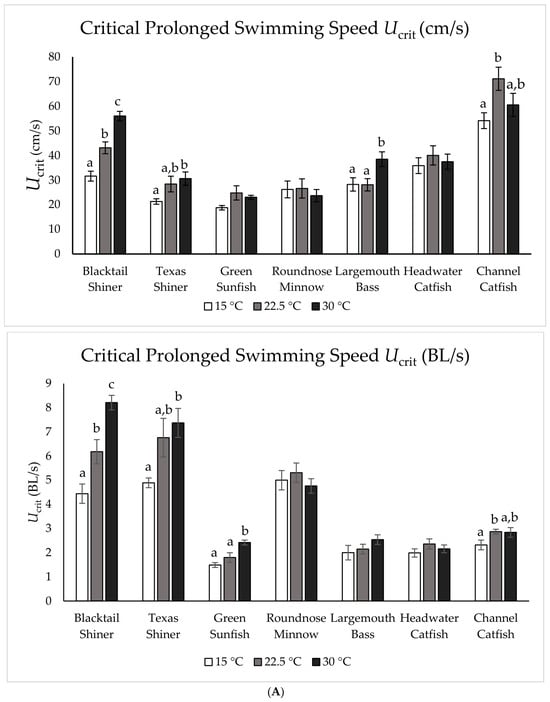
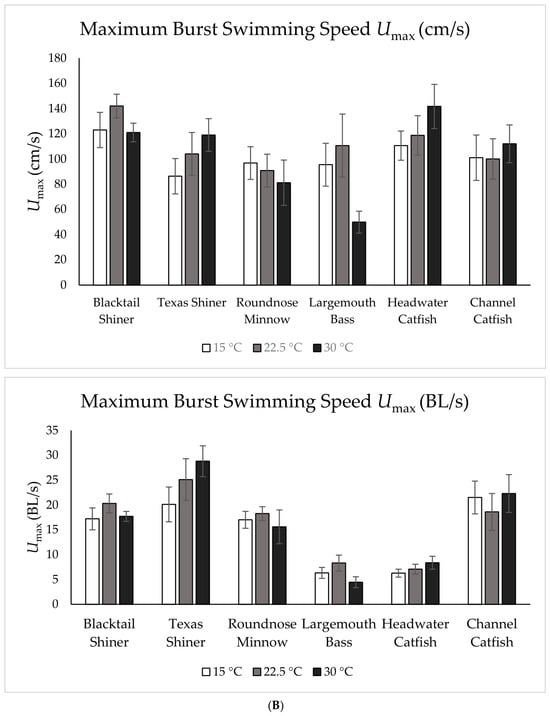
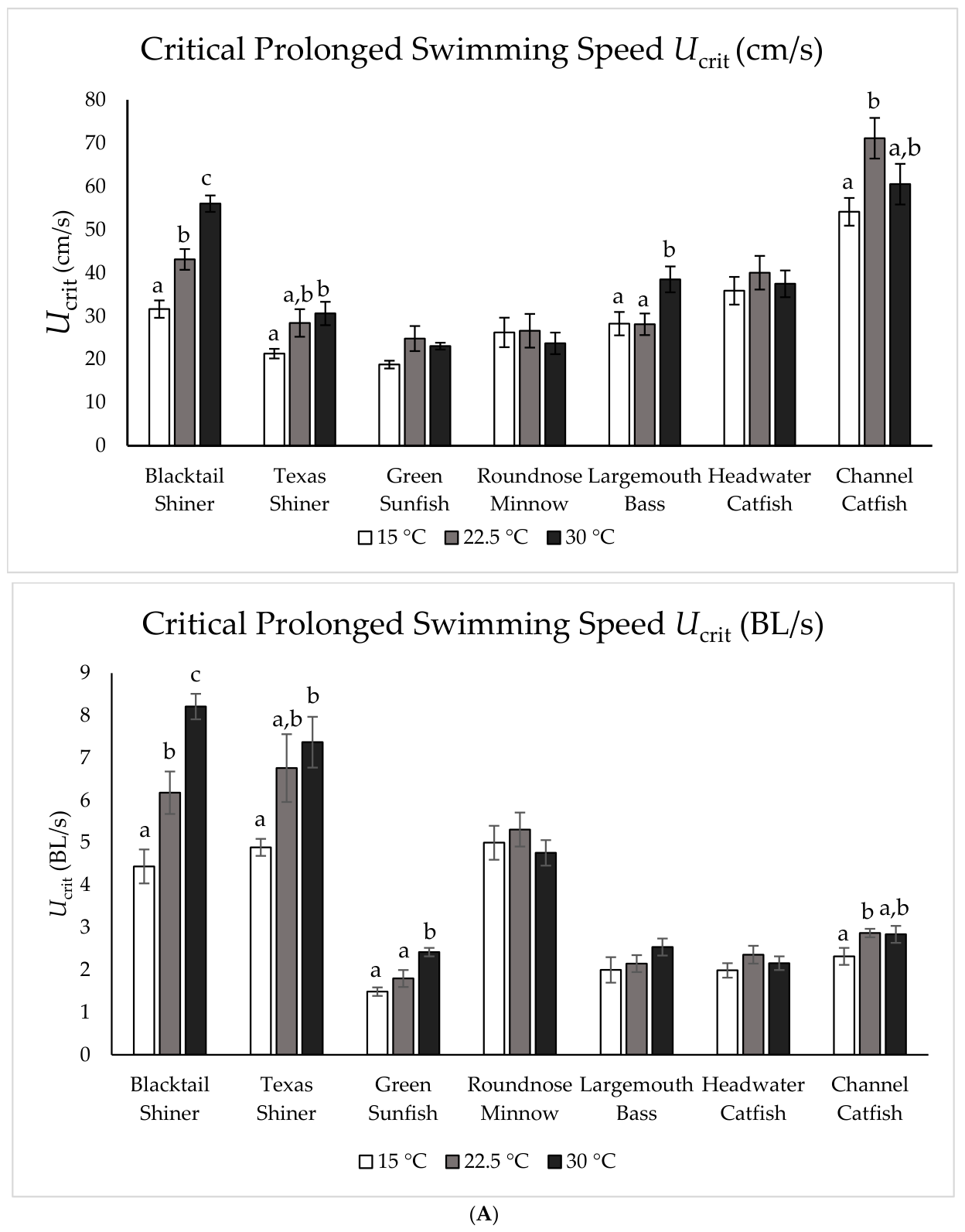
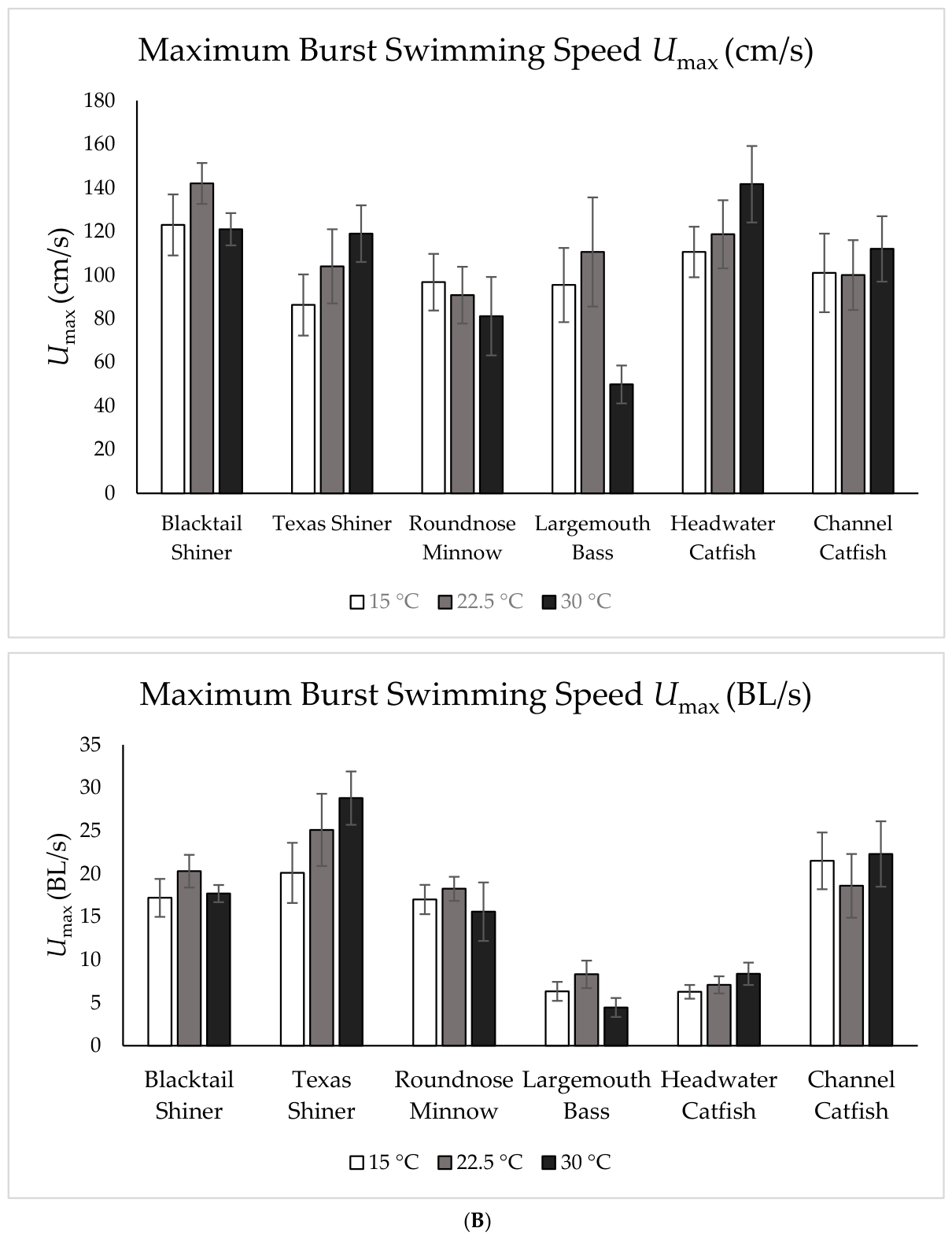
When expressed in absolute speed (cm/s), an overall trend of increased Ucrit with increasing temperatures was observed for Blacktail Shiner, Texas Shiner, and Largemouth Bass, while Colorado Roundnose Minnow, Green Sunfish, Headwater Catfish and Channel Catfish had the highest Ucrit values at 22.5 °C (Figure 1). A similar trend was observed when expressed in BL/s except for the Green Sunfish which displayed increasing Ucrit with increasing temperature.
Figure 1.
Ucrit and Umax of target fish species. Mean ± SEM of the critical swimming speeds (Ucrit) (A) and maximum burst swimming speeds (Umax) (B) are provided in cm/s and BL/s for each temperature treatment. Different letters indicate significant differences between temperature treatments. Statistical differences among treatments were assessed using one-way ANOVA followed by Holm–Šidák post hoc tests. When assumptions of normality or equal variance were not met, a Kruskal–Wallis followed by Dunn’s post hoc test was used.
Blacktail Shiner displayed significantly different Ucrit values across all temperature treatments, with increasing swimming speeds corresponding with increasing temperature treatments. These significant differences were observed when Ucrit was expressed in both cm/s and BL/s. Texas Shiner from the 30 °C treatment experienced significantly higher mean Ucrit compared to the 15 °C treatment when Ucrit was expressed in both cm/s and BL/s. Green Sunfish in 30 °C had significantly greater Ucrit when compared to the 15 and 22.5 °C fish when expressed in BL/s but not in cm/s. Similarly, Largemouth Bass in 30 °C had significantly greater Ucrit when compared to the 15 and 22.5 °C treatments when expressed in cm/s but not in BL/s. Channel Catfish in the 22.5 °C treatment had significantly higher mean Ucrit compared to the 15 °C treatment when expressed in cm/s but did not have significant differences when expressed in BL/s. No significant differences in Ucrit were observed among treatments in either cm/s or BL/s for Colorado Roundnose Minnow or Headwater Catfish. No significant differences in Umax were observed across temperature treatments for any of the species when expressed in either cm/s or BL/s. Burst swimming could not be induced in Green Sunfish to obtain Umax measurements despite multiple attempts to modify the protocol to elicit an escape response.
The Q10 values, or the temperature coefficient values which describe the proportional change in a physiological rate associated with a 10 °C increase, for both Ucrit and Umax, typically fell within the range of ~0.8–1.6 (Supplementary Table S2) [34]. Consistent with our previous study, Q10 values were generally higher when comparing the temperature range of 15–22.5 °C to 22.5–30 °C, indicating that swimming performance is more temperature-sensitive within the lower temperature range for most fishes tested [23]. A notable exception was Largemouth Bass that showed greater temperature sensitivity within the higher temperature range (22.5–30 °C) for both Ucrit and Umax, although in opposite directions. While Q10 values of ~0.4 for Umax within this temperature range suggest that burst swimming may be sensitive to higher temperature for this species resulting in decreased performance, no statistically significant differences in Umax were observed.
3.3. Maximum Passable Water Velocities
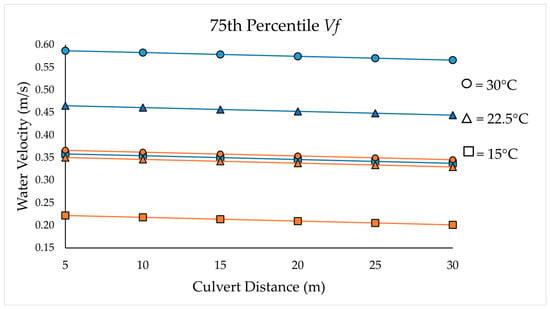
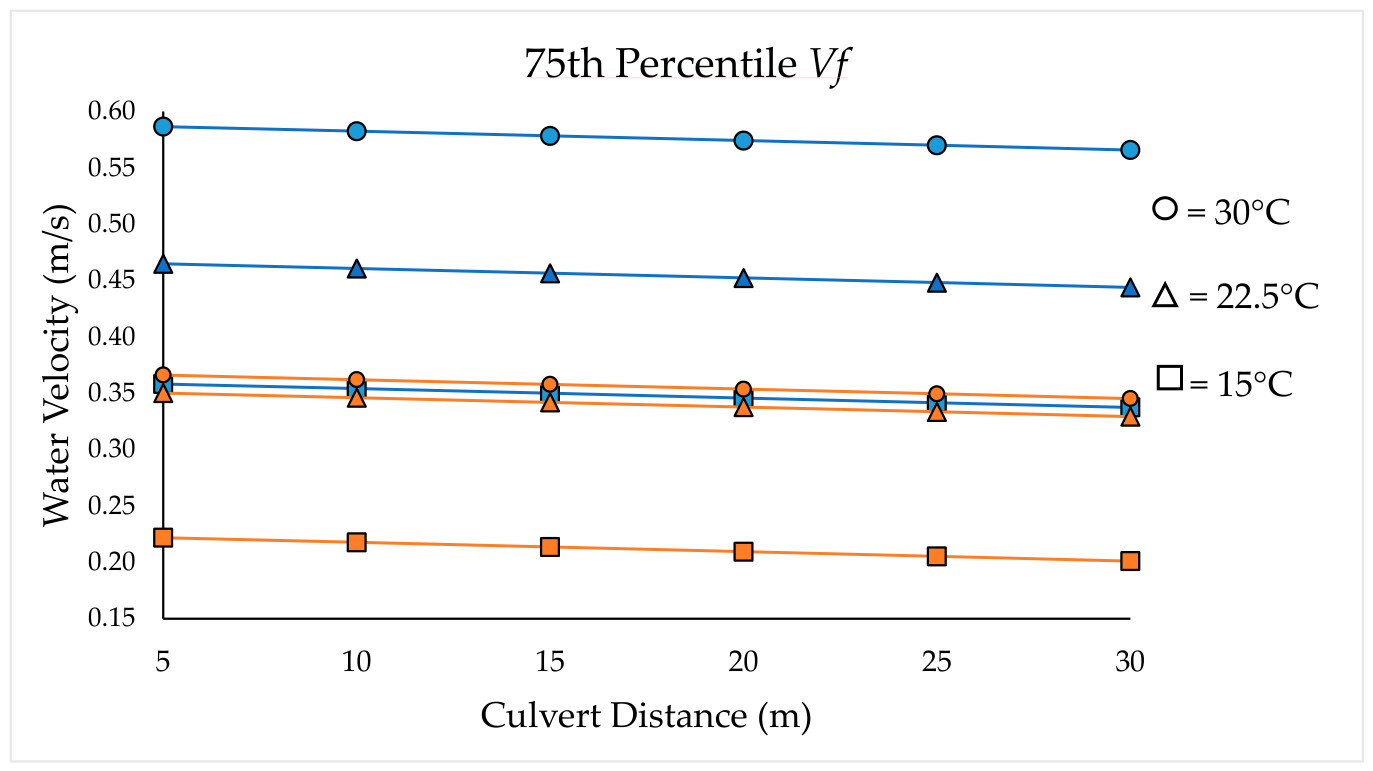
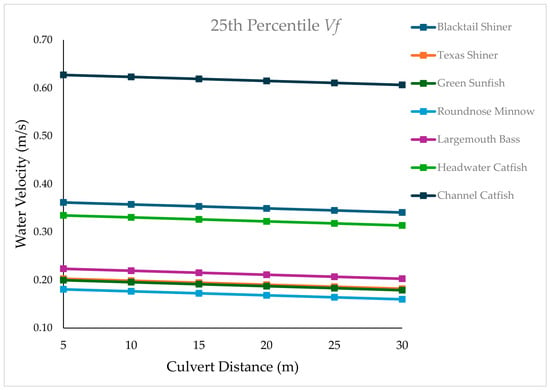
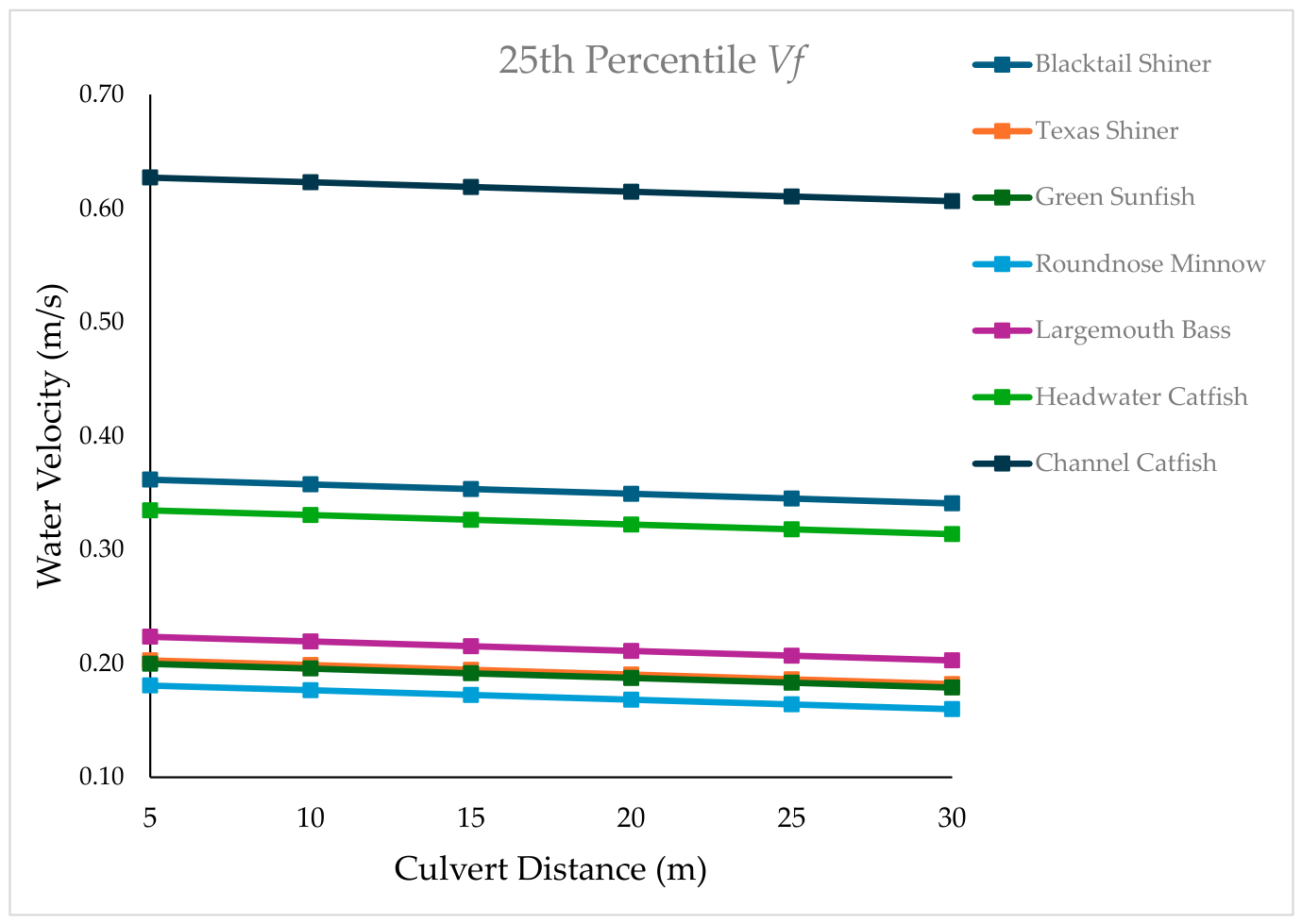
Maximum passable water velocities (Vf) were calculated using absolute Ucrit (cm/s) percentiles (Vs) from the 5th to 95th percentile in 5% intervals. These percentiles were modelled over a range of culvert distances (d) from 5 to 30 m. Calculated Vf (m/s) for all species as a function of culvert lengths ranging from 5 to 30 m set at percentile levels of protection ranging from 5th to 95th at each temperature tested can be found in Supplementary Tables S3–S9. A representative example of modelled Vf values for Blacktail Shiner and Texas Shiner across all three temperature treatments set at the 75th percentile can be seen in Figure 2. For example, for Blacktail Shiner and Texas Shiner at 22.5 °C and a culvert length of 20 m with a 75th percentile level of protection, maximum passable water velocities of 0.45 and 0.34 m/s were calculated, respectively. Additionally, a representative example of Vf values for all species at 22.5 °C set at a more conservative and protective threshold of the 25th percentile can be seen in Figure 3. In general, Vf values tended to follow the same trends as absolute Ucrit values, increasing with progressively increasing temperatures. Adversely, increasing the culvert distance (d) resulted in decreasing Vf values. Finally increasing the percentile thresholds (Vs), and therefore decreasing percentage of successful fish passage, also resulted in higher Vf values.
Figure 2.
Example Vf ranges at 3 temperatures. Recommendations of maximum water flow rates (Vf) as a function of culvert length set at the 75th percentile (blue = Blacktail Shiner; orange = Texas Shiner).
Figure 3.
Example comparison of Vf values across all species tested. Recommendations of maximum water flow rates (Vf) as a function of culvert length set at the 25th percentile for all species from the 22.5 °C treatments.
3.4. Metabolic Rate and Aerobic Scope Measurements
In general, fish from the warmer (30 °C) treatment exhibited the highest values (MMR and SMR) with the exception being the MMR of the Colorado Roundnose Minnow, which was highest in the mid-level temperature (22.5 °C) treatment (Table 2). A similar trend was observed for absolute aerobic scope (AAS) which increased with each increase in temperature. Blacktail Shiner had significantly higher SMR in both 30 and 22.5 °C compared to 15 °C and significantly higher MMR in the 30 °C than in 15 and 22.5 °C. Texas Shiner exhibited increasingly higher SMR and MMR for each increased temperature treatment with significant differences found between each group. The AS of the 30 °C fish was significantly higher than the 15 and 22.5 °C groups. For the Green Sunfish, the SMR of the 30 °C group was significantly higher than the 15 °C group. Similarly, the MMR and AAS were significantly higher in 30 °C than in 15 or 22.5 °C. No significant differences in metabolic endpoints were observed for Colorado Roundnose Minnow across temperature treatments. Largemouth Bass exhibited significantly higher SMR in 30 °C when compared to 15 and 22.5 °C and exhibited the same statistical difference in MMR. Headwater Catfish showed significantly lower SMR in the 15 °C treatment compared to the 22.5 and 30 °C treatments, with no statistically significant differences in MMR or AAS. Channel Catfish exhibited a significantly lower SMR, MMR and AAS in the 15 °C treatment compared to each of the two warmer treatments. No significant differences in factorial aerobic scope were observed for any of the seven species across temperature treatments. Q10 values for SMR, MMR, and AS generally fell within the range of ~1–2 (Supplementary Table S3). Notable exceptions include the Green Sunfish that showed a heightened Q10 for MMR and AS, particularly for the 22.5–30 °C range (2.66 and 3.55, respectively), and the Headwater Catfish that showed an elevated Q10 for SMR for both temperature ranges (2.58 across 15 to 30 °C).
Table 2.
Data summary for metabolic rate endpoints. Mean ± SEM of SMR (mgO2/kg/h), MMR (mgO2/kg/h), Absolute AS (mgO2/kg/h), and Factorial AS measured for each species and temperature treatment.
3.5. Optimal Swimming Speed and Cost of Transport
Uopt, minimum cost of transport (COTmin), and cost of transport at Ucrit (COTUcrit) are shown in Table 3. Blacktail Shiner in the 30 °C treatment had significantly higher Uopt values than the 15 °C treatment but no significant differences in COT. Texas Shiner in 15 °C had significantly lower Uopt in both absolute and BL compared to 22.5 and 30 °C and showed no significant differences in COTmin. However, the COTUcrit values were significantly higher in 30 °C than in 15 and 22.5 °C for the absolute speed and higher in 30 °C when compared to 15 °C when measured in BL. Green Sunfish exhibited no significant differences in Uopt but exhibited significantly higher COTmin (absolute and BL) and COTUcrit (in absolute only) at 30 °C compared to 15 and 22.5 °C. When measured in BL, only the 15 °C treatment was significantly lower than the 30 °C treatment. No significant differences in optimal swimming speed or COT between temperature treatments were found for Colorado Roundnose Minnow or Headwater Catfish. Absolute Uopt values of Largemouth Bass in the 30 °C treatment were significantly higher than the 15 and 22.5 °C treatments, while no significant differences in COTmin or COTUcrit were detected. Finally, no significant differences in Uopt were observed in Channel Catfish, but absolute COTmin in the 15 °C treatment was significantly lower than the 22.5 and 30 °C treatments. COTmin values measured in BL showed only significant difference between 30 and 22.5 °C. COTUcrit in 30 °C measured in both absolute and BL were significantly higher than the 15 °C treatment. Low sample sizes for some metrics such as COTmin were due to individuals with poor model fits (r2 values of less than 0.7) being excluded.
Table 3.
Data summary for additional swimming performance metrics. Mean ± SEM of Uopt (cm/s and BL/s), COTmin (mgO2/g/m and mgO2/g/BL), and COTUcrit (mgO2/g/m and mgO2/g/BL) measured for each species and temperature treatment.
4. Discussion
This study sought to characterize the swimming performance of seven different species of freshwater fish to help inform culvert design to aid in the conservation of fish and mussel SGCN. This work adds to a growing body of research from our laboratory aimed at providing guidance for culvert water velocities which are traversable by key native Texas fishes. Additionally, metabolic metrics such as AS and COT were measured to provide further insight into the swimming performance of these species at three environmentally relevant temperatures. It was found that temperature affected prolonged swimming performance in several species but had little effect on burst swimming performance. Species differed substantially in thermal metabolic responses and swimming capacities, but all species generally displayed increased metabolic demand in response to increasing temperatures. These results demonstrate how thermal conditions may alter passage success and should be taken into consideration when modeling culverts. Additionally, our findings support the importance of species-specific hydraulic thresholds.
It is important to consider, however, that some caveats with our approach exist that warrant discussion. First, the absence of flow and sustained swimming exercise during acclimation may have reduced swimming performance, although this effect was not assessed. Secondly, we chose to use a standard Ucrit test using swim tunnels in lieu of other endurance-based tests or open flume approaches that more closely mimic natural conditions as a compromise to limit time and logistical constraints associated with other methods and equipment (e.g., large custom-made flumes) [17,35,36,37,38,39,40]. While standard Ucrit tests using swim tunnels have the advantages of permitting relatively rapid trials and commercially available equipment, it has previously been shown that results obtained using such tests tend to underestimate true swimming capacity in the wild [35,41]. Nevertheless, while both caveats are important to consider, the resulting impacts are likely to result in more conservative estimates of swimming capacity for evaluating fish passage and therefore err on the side of protection.
The relative swimming speed ranges of the species measured in this study are consistent with those of the species measured by Emadi et al. [23]. In the 2024 study, the smaller Plateau Shiner and Guadalupe Roundnose Minnow generally had higher relative Ucrit values (~6–14 BL/s) compared to the larger adult Guadalupe Bass (~2–3 BL/s). In the present study, the same trend was observed with the smaller Shiner and Minnows exhibiting higher relative swimming speeds (~4–9 BL/s) compared to the larger Sunfish, Catfish, and Bass (~1.5–3 BL/s). Together, these patterns are consistent with the expected scaling relationship between body size and swimming performance, whereby smaller-bodied fish achieve higher swimming speeds when expressed relative to body length (BL/s), whereas larger fish are expected to exhibit faster absolute swimming speed (expressed in cm/s) [15]. The critical swimming speeds of Largemouth Bass observed in this study (2–2.5 BL/s) were also in line with and slightly higher than those of previously conducted studies. Kolok measured critical swimming speeds of 1.1–2.2 BL/s in slightly smaller bass [42]. Similarly, Hasler et al. observed critical swimming values of 1.2–2.2 BL/s in bass which were approximately two times longer than ours. Absolute Ucrit values measured in cm/s (54.1–71.1 cm/s) were also generally consistent with and slightly higher than those previously reported for Channel Catfish of slightly smaller size ranges (See [43] for summary of prior studies). Vaughn observed values similar to ours of 53.7 to 61.4 cm/s when measuring fish of similar length [44]. The agreement with previous species-specific swimming performance estimates further suggests that the swimming speeds measured in this study are representative of the prolonged swimming capacities reported for these taxa. Overall, these comparisons support that body size and unit of measurement should be considered when interpreting and reporting interspecific swimming performance.
Effects of temperature on critical swimming speed were also observed. With thermal performance theory in mind, the expectation was to see an increase in Ucrit with temperature up to a maximum swimming speed at the thermal optimum (Topt), followed by a sharp decline. This concept is typically depicted using what is known as the thermal performance curve. Although such curves are typically best characterized using a minimum of four temperatures (ideally eight or more) spanning both the ascending and descending portions of the curve to permit estimation of parameters such as Topt and maximum performance (Pmax), the thermal performance curve concept can nevertheless serve as a useful framework for explaining some of the temperature effects observed herein [45,46,47]. For example, Blacktail Shiner and Texas Shiner exhibited statistically significant increases in Ucrit with increasing temperature. The results for these two species suggest a strong thermal enhancement of aerobic swimming performance across the temperatures tested; however, given that a decline in performance was not observed as temperature increased, Topt/Pmax remains uncertain. Furthermore, continued improvements in swimming performance with increasing temperatures should not be interpreted as evidence of unlimited thermal resilience. Upper thermal limits and maximum aerobic capacity may exhibit limited plasticity, potentially constraining the ability of fishes to compensate for continued warming due to global climate change [48]. For perspective, Blacktail Shiner as well as Largemouth Bass and Channel Catfish have all exhibited higher thermal maxima ranges than the 30 °C maximum temperature used in this study (34–39 °C, 33–40 °C, and 30–42 °C, respectively) [49,50,51,52,53]. In contrast, species such as the Colorado Roundnose Minnow and Headwater Catfish exhibited the strongest swimming performance at the middle temperature. This may be a reflection of a lower thermal optimum in these species compared to the other species, such that the highest temperature treatment (30 °C) falls on the descending portion of the thermal performance curve [54]. This potential difference in thermal optima may indicate greater sensitivity to higher temperatures. Although to the best of our knowledge, no thermal tolerance data are present in the literature for the three SGCN fishes in this study (Texas Shiner, Colorado Roundnose Minnow, and Headwater Catfish), this would be logical given the corresponding average temperatures of the spring flow dominated systems they typically inhabit (generally around 22 °C without much variation). Finally, for the Green Sunfish, there was no observed temperature effect on Ucrit when expressed in absolute terms (cm/s), which is congruent given the highly tolerant nature of this generalist species. Conversely, when expressed in relative terms (BL/s), the highest temperature revealed the highest Ucrit, which is consistent with previously reported thermal maximum ranges of greater than 30 °C (34–39 °C) for this species [51,52]. This interpretation of an apparent temperature effect is confounded, however, by the smaller body size of fish in the highest temperature and the scaling relationship previously mentioned. Therefore, the contributions from temperature and body size to this increase in relative Ucrit remain unclear.
Consistent with our previous study and others, there was no observed effect of temperature on Umax for any of the species measured [17,23,55]. This was likely due to the relative thermal insensitivity of anaerobic white muscle used for burst swimming upon adequate acclimation [55]. It should be noted that Green Sunfish could not be enticed to perform burst swimming reliably, even with multiple startle methodologies utilized.
Metabolic rates and absolute aerobic scope generally increased with warmer acclimation temperatures, which was to be expected as cellular respiration rates are known to increase with warmer temperatures up to a certain threshold [56,57,58]. As temperatures increase, energetic demand also increases, which may reduce long-term energetic efficiency. Elevated baseline metabolic costs (i.e., SMR) at higher temperatures indicate higher maintenance costs, which reduces energy available for growth, reproduction, or feeding. Because SMR and MMR generally increase at different rates with increasing temperature, aerobic scope can change dependent on a species’ thermal physiology [21]. AS represents the metabolic energy available to an organism beyond baseline requirements and is therefore an important metric for understanding performance capacities associated with activities such as prolonged swimming and dispersal [59].
Across species, temperature effects on aerobic metabolic capacity generally mirrored those observed in Ucrit. Blacktail Shiner and Texas Shiner showed increases in MMR, AS, and Ucrit with increasing acclimation temperature, which indicate that aerobic capacity increased throughout the temperature range measured. This suggests that the thermal optima for these species may lie at or above 30 °C. In contrast, Colorado Roundnose Minnow and Headwater Catfish displayed little change in aerobic capacity or swimming performance across the tested thermal range. Both Largemouth Bass and Channel Catfish, on the other hand, revealed increased MMR at elevated temperature that generally corresponded with the observed increases in Ucrit with temperature. Overall, these observed patterns are consistent with the expectation that performance traits exhibit species-specific thermal optima, beyond which aerobic performance becomes constrained as maintenance costs continue to increase while MMR plateaus or declines [21,60].
Optimal swimming speeds followed a similar trend to Ucrit and tended to increase with warmer temperatures, especially in the shiners and Largemouth Bass, further suggesting a link between aerobic capacity and prolonged swimming performance [61]. However, the Texas Shiner and Channel Catfish exhibited increased COT at warmer temperatures, despite improved swimming capacity. These findings may indicate a tradeoff between swimming capacity and energetic efficiency in which warmer temperatures may enhance short-term swimming performance at the expense of increasing the energetic costs of locomotion [62,63]. While some species may be able to successfully pass at warmer temperatures, the increased energetic costs of prolonged swimming could reduce the energy available for other fitness-related functions such as growth and reproduction [64,65]. These species-specific differences in thermal responses of aerobic capacity and energetic efficiency could explain the variation in swimming performance among taxa and likely reflect underlying differences in habitat association and evolutionary thermal adaptation, which could influence passage success and vulnerability to environmental changes such as habitat fragmentation and climate change [66].
Calculated Vf trends mirrored Ucrit trends as well, in which higher temperatures generally showed increased passable water velocities. As expected, culverts of shorter distances also had higher passable water velocity values, reflecting the greater energetic demands associated with prolonged swimming through longer culverts. Similarly, smaller percentile thresholds result in lower passable water velocities, facilitating a greater percentage of individuals that will be able to successfully pass at these more conservative protection thresholds. For example, the use of the 25th percentile Ucrit values provides Vf values through which 75% of a species will be able to successfully pass. For SGCN, higher protection thresholds of 90–95% might be more appropriate, warranting the use of the 10th or 5th percentile Ucrit values, respectively.
It is recommended that culverts be constructed to reflect the lowest swimming capacity of the most sensitive species present. For example, the imperiled Colorado Roundnose Minnow exhibited the lowest passable water velocity value of 0.11 m/s at 15 °C across a 30 m culvert. Therefore, where this species is present, their swimming capacity should set the protective threshold and water velocity values of a stream-crossing site to ensure conservation of this species. Likewise, where host fishes of imperiled freshwater mussels are present, designing culverts based on the swimming capacity of the most limiting host species may provide additional conservation benefits by maintaining host movement to facilitate mussel dispersal among habitats. We also recommend the use of culvert modifications such as baffles, which can reduce water velocities and provide intermittent resting areas, potentially allowing fish to negotiate higher-velocity culverts while reducing the distance between available resting locations [67]. Temperature effects and climate change predictions should also be taken into consideration. For example, passable water velocities tended to increase with temperature for some species but were decreased at the highest temperature for others, which indicates that passage success is altered by temperature in species-specific ways. As the climate warms and increasingly frequent extreme weather events occur, these effects of temperature on passable water velocity values should be considered during the construction of stream-crossing sites.
5. Conclusions
As anthropogenic infrastructure continues to expand and cause habitat fragmentation and loss of biodiversity in freshwater ecosystems, it is critical that we address the conservation implications. Such effects imposed by barriers to fish passage/migration are believed to have contributed to the decline of freshwater species worldwide. In addition to native freshwater fishes, impedance from human infrastructure is likely to harm parasitic life stages of mussels (i.e., larval glochidia) that rely on fish-mediated dispersal critical to their life history strategies by limiting population growth and distribution. These are issues of heightened concern particularly for imperiled fishes and mussels which have been designated by TPWD as SGCN. Considering the longevity of fabricated structures associated with road-based stream crossings, these study results will likely have a long-term beneficial impact on our focal species’ persistence, distribution, overall population health, and the critical ecosystem services they provide. Moreover, given that Texas contains 52 species of freshwater mussels, this project should contribute to the overall maintenance of mussel biodiversity within the state and potentially beyond [8]. The findings of this study fill a critical gap in the literature, as there is currently little to no swimming performance data available for several of the focal fish species, particularly the SGCN taxa and host fishes which support dispersal of imperiled mussel species. The passable water velocity recommendations for SGCN provided here will be practical tools for civil engineers to design culverts in a way that mitigates negative impacts on these imperiled species. Incorporating long-term conservation planning into infrastructure design using species-specific physiological data is critical for the preservation of biodiversity in our freshwater ecosystems.
Supplementary Materials
The following supporting information can be downloaded at: https://www.mdpi.com/article/10.3390/fishes11080488/s1, Table S1: Water Quality, Table S2: Q10 Values, Tables S3–S9: Vf Percentiles.
Author Contributions
Conceptualization, P.T.B. and E.M.M.; methodology, E.M.M. and C.M.E.; software, E.M.M.; validation, A.N.B.-L. and E.M.M.; formal analysis, A.N.B.-L.; investigation, A.N.B.-L. and M.R.H.; resources, E.M.M. and P.T.B.; data curation, A.N.B.-L.; writing—original draft preparation, A.N.B.-L.; writing—review and editing, E.M.M. and P.T.B.; visualization, A.N.B.-L.; supervision, E.M.M.; project administration, A.N.B.-L., E.M.M. and P.T.B.; funding acquisition, E.M.M. and P.T.B. All authors have read and agreed to the published version of the manuscript.
Funding
This research was funded by Texas Department of Transportation (grant number TxDOT 57-4XXIA004) through Texas Parks and Wildlife Department (contract # CA-0006096).
Institutional Review Board Statement
The animal study protocol was approved by the Institutional Animal Care and Use Committee of the University of North Texas (IACUC Protocol 24002, approved 6 March 2024).
Data Availability Statement
The original contributions presented in this study are included in the article of Supplementary Materials. Further inquiries can be directed to the corresponding author.
Acknowledgments
The authors would like to thank the staff at Possum Kingdom Hatchery and the TPWD Field Biologists who assisted in acquiring the fish used for this study. During the preparation of this manuscript, the author(s) utilized ChatGPT (OpenAI, GPT-5.5) for the purposes of language refinement, finding relevant literature, and manuscript organization. The authors have reviewed and edited the output and take full responsibility for the content of this publication.
Conflicts of Interest
The authors declare no conflicts of interest.
Abbreviations
The following abbreviations are used in this manuscript:
| SGCN | Species of greatest conservation need |
| Ucrit | Critical swimming speed |
| Vf | Maximum passable water velocities |
| Umax | Maximum burst swimming speed |
| SMR | Standard metabolic rate |
| MMR | Maximum metabolic rate |
| AAS | Absolute aerobic scope |
| FAS | Factorial aerobic scope |
| COT | Cost of transport |
| Uopt | Optimal swimming speed |
| TPWD | Texas Parks and Wildlife |
| Metabolic rate | |
| Topt | Thermal optimum |
| Pmax | Maximum performance |
References
- Kemp, P.S.; O’hanley, J.R. Procedures for Evaluating and Prioritising the Removal of Fish Passage Barriers: A Synthesis. Fish. Manag. Ecol. 2010, 17, 297–322. [Google Scholar] [CrossRef] [Scilit]
- Noonan, M.J.; Grant, J.W.A.; Jackson, C.D. A Quantitative Assessment of Fish Passage Efficiency. Fish Fish. 2012, 13, 450–464. [Google Scholar] [CrossRef] [Scilit]
- Dudgeon, D.; Arthington, A.H.; Gessner, M.O.; Kawabata, Z.; Knowler, D.J.; Lévêque, C.; Naiman, R.J.; Prieur-Richard, A.; Soto, D.; Stiassny, M.L.J.; et al. Freshwater Biodiversity: Importance, Threats, Status and Conservation Challenges. Biol. Rev. 2006, 81, 163–182. [Google Scholar] [CrossRef] [Scilit] [PubMed]
- Silva, A.T.; Lucas, M.C.; Castro-Santos, T.; Katopodis, C.; Baumgartner, L.J.; Thiem, J.D.; Aarestrup, K.; Pompeu, P.S.; O’Brien, G.C.; Braun, D.C.; et al. The Future of Fish Passage Science, Engineering, and Practice. Fish Fish. 2018, 19, 340–362. [Google Scholar] [CrossRef] [Scilit]
- Moyle, P.B.; Williams, J.E. Biodiversity Loss in the Temperate Zone: Decline of the Native Fish Fauna of California. Conserv. Biol. 1990, 4, 275–284. [Google Scholar] [CrossRef] [Scilit]
- Gehrke, P.C.; Harris, J.H. Regional-Scale Effects of Flow Regulation on Lowland Riverine Fish Communities in New South Wales, Australia. Regul. Rivers Res. Manag. 2001, 17, 369–391. [Google Scholar] [CrossRef]
- Nicola, G.G.; Elvira, B.; Almodovar, A. Dams and Fish Passage Facilities in the Large Rivers of Spain: Effects on Migratory Species. River Syst. 1996, 10, 375–379. [Google Scholar] [CrossRef] [Scilit]
- Ford, D.F.; Oliver, A.M. The Known and Potential Hosts of Texas Mussels: Implications for Future Research and Conservation Efforts. Freshw. Mollusk Biol. Conserv. 2015, 18, 1–14. [Google Scholar] [CrossRef] [Scilit]
- Dudding, J.; Hart, M.; Khan, J.; Robertson, C.R.; Lopez, R.; Randklev, C.R. Host Fish Associations for Two Highly Imperiled Mussel Species from the Southwestern United States: Cyclonaias Necki (Guadalupe Orb) and Fusconaia Mitchelli (False Spike). Freshw. Mollusk Biol. Conserv. 2019, 22, 12–19. [Google Scholar] [CrossRef] [Scilit]
- Haag, W.R. North American Freshwater Mussels: Natural History, Ecology, and Conservation; Cambridge University Press: Cambridge, UK, 2012. [Google Scholar]
- Williams, J.D.; Bogan, A.E.; Butler, R.S.; Cummings, K.S.; Garner, J.T.; Harris, J.L.; Johnson, N.A.; Watters, G.T. A Revised List of the Freshwater Mussels (Mollusca: Bivalvia: Unionida) of the United States and Canada. Freshw. Mollusk Biol. Conserv. 2017, 20, 33–58. [Google Scholar] [CrossRef] [Scilit]
- Williams, J.D.; Warren, M.L.; Cummings, K.S.; Harris, J.L.; Neves, R.J. Conservation Status of Freshwater Mussels of the United States and Canada. Fisheries 1993, 18, 6–22. [Google Scholar] [CrossRef] [Scilit]
- Newton, T.J.; Johnson, N.A.; Hu, D.H. U.S. Geological Survey Science Vision for Native Freshwater Mussel Research in the United States; U.S. Geological Survey Circular 1511; U.S. Geological Survey: Reston, VA, USA, 2023. [CrossRef] [Scilit]
- Brett, J.R. The Respiratory Metabolism and Swimming Performance of Young Sockeye Salmon. J. Fish. Res. Board Can. 1964, 21, 1183–1226. [Google Scholar] [CrossRef] [Scilit]
- Beamish, F.W.H. Swimming Capacity. In Fish Physiology; Academic Press: Cambridge, MA, USA, 1978; Volume VII, pp. 101–187. [Google Scholar]
- Castro-Santos, T. Optimal Swim Speeds for Traversing Velocity Barriers: An Analysis of Volitional High-Speed Swimming Behavior of Migratory Fishes. J. Exp. Biol. 2005, 208, 421–432. [Google Scholar] [CrossRef] [Scilit] [PubMed]
- Tudorache, C.; Viaene, P.; Blust, R.; Vereecken, H.; Boeck, G.D. A Comparison of Swimming Capacity and Energy Use in Seven European Freshwater Fish Species. Ecol. Freshw. Fish 2008, 17, 284–291. [Google Scholar] [CrossRef] [Scilit]
- Peake, S.J. Swimming Performance and Behaviour of Fish Species Endemic to Newfoundland and Labrador: A Literature Review for the Purpose of Establishing Design and Water Velocity Criteria for Fishways and Culverts; Canadian Manuscript Report of Fisheries and Aquatic Sciences; Fisheries and Oceans Canada: Ottawa, ON, Canada, 2008.
- Farrell, A.P.; Eliason, E.J.; Sandblom, E.; Clark, T.D. Fish Cardiorespiratory Physiology in an Era of Climate change. Can. J. Zool. 2009, 87, 835–851. [Google Scholar] [CrossRef] [Scilit]
- Fry, F.E.J. The Effect of Environmental Factors on the Physiology of Fish. In Fish Physiology; Elsevier: Amsterdam, The Netherlands, 1971; Volume 6, pp. 1–98. [Google Scholar] [CrossRef] [Scilit]
- Clark, T.D.; Sandblom, E.; Jutfelt, F. Aerobic Scope Measurements of Fishes in an Era of Climate Change: Respirometry, Relevance and Recommendations. J. Exp. Biol. 2013, 216, 2771–2782. [Google Scholar] [CrossRef] [Scilit] [PubMed]
- Norin, T.; Clark, T.D. Measurement and Relevance of Maximum Metabolic Rate in Fishes. J. Fish Biol. 2016, 88, 122–151. [Google Scholar] [CrossRef] [Scilit] [PubMed]
- Emadi, C.M.; Bean, P.T.; Mager, E.M. Swimming Performance Assessments of Fish Species of Greatest Conservation Need to Inform Future Stream Crossing Designs in Texas. Fishes 2024, 9, 234. [Google Scholar] [CrossRef] [Scilit]
- TPWD. Texas Conservation Action Plan 2012–2016: Statewide/Multi-Region Handbook; TPWD: Austin, TX, USA, 2012.
- Farrell, A.P. Comparisons of Swimming Performance in Rainbow Trout Using Constant Acceleration and Critical Swimming Speed Tests. J. Fish Biol. 2008, 72, 693–710. [Google Scholar] [CrossRef] [Scilit]
- Reidy, S.P.; Nelson, J.A.; Tang, Y.; Kerr, S.R. Post-Exercise Metabolic Rate in Atlantic Cod and Its Dependence upon the Method of Exhaustion. J. Fish Biol. 1995, 47, 377–386. [Google Scholar] [CrossRef]
- Jordan, A.D.; Herbert, N.A.; Steffensen, J.F. Escape Performance in Three Teleosts from West Greenland. Polar Biol. 2005, 28, 164–167. [Google Scholar] [CrossRef] [Scilit]
- Johansen, J.L.; Esbaugh, A.J. Sustained Impairment of Respiratory Function and Swim Performance Following Acute Oil Exposure in a Coastal Marine Fish. Aquat. Toxicol. 2017, 187, 82–89. [Google Scholar] [CrossRef] [Scilit] [PubMed]
- Mager, E.M.; Esbaugh, A.J.; Stieglitz, J.D.; Hoenig, R.; Bodinier, C.; Incardona, J.P.; Scholz, N.L.; Benetti, D.D.; Grosell, M. Acute Embryonic or Juvenile Exposure to Deepwater Horizon Crude Oil Impairs the Swimming Performance of Mahi-Mahi (Coryphaena hippurus). Environ. Sci. Technol. 2014, 48, 7053–7061. [Google Scholar] [CrossRef] [Scilit] [PubMed]
- Stieglitz, J.D.; Mager, E.M.; Hoenig, R.H.; Benetti, D.D.; Grosell, M. Impacts of Deepwater Horizon Crude Oil Exposure on Adult Mahi-Mahi (Coryphaena hippurus) Swim Performance: Impacts of Deepwater Horizon Exposure on Mahi-Mahi. Environ. Toxicol. Chem. 2016, 35, 2613–2622. [Google Scholar] [CrossRef] [Scilit] [PubMed]
- Horne, L.; DeVries, D.; Stoeckel, J. The Effects of Glochidia Infection on the Metabolic Rate and Hypoxia Tolerance of Bluegill Lepomis maxrochirus and Largemouth Bass Micropterus salmoides. J. Parasitol. 2022, 108, 467–475. [Google Scholar] [CrossRef] [Scilit] [PubMed]
- Bell, W.H.; Terhune, L.D.B. Water Tunnel Design for Fisheries Research; Fisheries Research Board of Canada: Nanaimo, BC, Canada, 1970.
- Watson, J.R.; Goodrich, H.R.; Cramp, R.L.; Gordos, M.A.; Yan, Y.; Ward, P.J.; Franklin, C.E. Swimming Performance Traits of Twenty-One Australian Fish Species: A Fish Passage Management Tool for Use in Modified Freshwater Systems. Water 2020, 12, 343. [Google Scholar]
- Schmidt-Nielsen, K. Animal Physiology: Adaptation and Environment, 5th ed.; Cambridge University Press: Cambridge, UK, 1997. [Google Scholar]
- Peake, S.J.; Farrell, A.P. Fatigue Is a Behavioural Response in Respirometer-confined Smallmouth Bass. J. Fish Biol. 2006, 68, 1742–1755. [Google Scholar] [CrossRef] [Scilit]
- Aedo, J.R.; Otto, K.R.; Rader, R.B.; Hotchkiss, R.H.; Belk, M.C. Size Matters, but Species Do Not: No Evidence for Species-Specific Swimming Performance in Co-Occurring Great Basin Stream Fishes. Water 2021, 13, 2570. [Google Scholar] [CrossRef] [Scilit]
- Botha, T.; Mahloko, M.; Wepener, V.; Howatson, G.; Smit, N. A Tool for Determining Maximum Sustained Swimming Ability of Selected Inland Fish Species in an Afrotropic Ecozone. Water SA 2018, 44, 511–515. [Google Scholar] [CrossRef] [Scilit]
- Cai, L.; Katopodis, C.; Johnson, D.; Zhang, P.; Zhao, P. Case Study: Targeting Species and Applying Swimming Performance Data to Fish Lift Design for the Huangdeng Dam on the Upper Mekong River. Ecol. Eng. 2018, 122, 32–38. [Google Scholar] [CrossRef] [Scilit]
- Starrs, D.; Ebner, B.C.; Lintermans, M.; Fulton, C.J. Using Sprint Swimming Performance to Predict Upstream Passage of the Endangered Macquarie Perch in a Highly Regulated River. Fish. Manag. Ecol. 2011, 18, 360–374. [Google Scholar] [CrossRef] [Scilit]
- Peake, S.; McKinley, R.S.; Scruton, D.A. Swimming Performance of Various Freshwater Newfoundland Salmonids Relative to Habitat Selection and Fishway Design. J. Fish Biol. 1997, 51, 710–723. [Google Scholar] [CrossRef]
- Haro, A.; Castro-Santos, T.; Noreika, J.; Odeh, M. Swimming Performance of Upstream Migrant Fishes in Open-Channel Flow: A New Approach to Predicting Passage through Velocity Barriers. Can. J. Fish. Aquat. Sci. 2004, 61, 1590–1601. [Google Scholar] [CrossRef] [Scilit]
- Kolok, A.S. Interindividual Variation in the Prolonged Locomotor Performance of Ectothermic Vertebrates: A Comparison of Fish and Herpetofaunal Methodologies and a Brief Review of the Recent Fish Literature. Can. J. Fish. Aquat. Sci. 1999, 56, 700–710. [Google Scholar] [CrossRef]
- Vaughn, A.J.; Street, G.M.; Boudreau, M.R.; Allen, P.J. The Relationship among Acceleration, Metabolism, and Tail Beat Frequency of Channel Catfish (Ictalurus punctatus) during Critical Swimming Speed Tests. Aquaculture 2024, 580, 740280. [Google Scholar] [CrossRef] [Scilit]
- Beecham, R.; Thomas, T.; Gao, D.X.; Gaunt, P.S. The Effects of a Sublethal Dose of Botulinum Serotype E on the Swimming Performance of Channel Catfish Fingerlings. J. Aquat. Anim. Health 2014, 26, 149–153. [Google Scholar] [CrossRef] [Scilit] [PubMed]
- Ern, R.; Andreassen, A.H.; Jutfelt, F. Physiological Mechanisms of Acute Upper Thermal Tolerance in Fish. Physiology 2023, 38, 141–158. [Google Scholar] [CrossRef] [Scilit] [PubMed]
- Schulte, P.M.; Healy, T.M.; Fangue, N.A. Thermal Performance Curves, Phenotypic Plasticity, and the Time Scales of Temperature Exposure. Integr. Comp. Biol. 2011, 51, 691–702. [Google Scholar] [CrossRef] [Scilit] [PubMed]
- Kontopoulos, D.-G.; Sentis, A.; Daufresne, M.; Glazman, N.; Dell, A.I.; Pawar, S. No Universal Mathematical Model for Thermal Performance Curves across Traits and Taxonomic Groups. Nat. Commun. 2024, 15, 8855. [Google Scholar] [CrossRef] [Scilit] [PubMed]
- Sandblom, E.; Clark, T.D.; Gräns, A.; Ekström, A.; Brijs, J.; Sundström, L.F.; Odelström, A.; Adill, A.; Aho, T.; Jutfelt, F. Physiological Constraints to Climate Warming in Fish Follow Principles of Plastic Floors and Concrete Ceilings. Nat. Commun. 2016, 7, 11447. [Google Scholar] [CrossRef] [Scilit] [PubMed]
- Farless, N.A.; Brewer, S.K. Thermal Tolerances of Fishes Occupying Groundwater and Surface-Water Dominated Streams. Freshw. Sci. 2017, 36, 866–876. [Google Scholar] [CrossRef] [Scilit]
- Eaton, J.G.; Scheller, R.M. Effects of Climate Warming on Fish Thermal Habitat in Streams of the United States. Limnol. Oceanogr. 1996, 41, 1109–1115. [Google Scholar] [CrossRef] [Scilit]
- Beitinger, T.L.; Bennett, W.A.; McCauley, R.W. Temperature Tolerances of North American Freshwater Fishes Exposed to Dynamic Changes in Temperature. Environ. Biol. Fishes 2000, 58, 237–275. [Google Scholar] [CrossRef] [Scilit]
- Bennett, W.A.; McCauley, R.W.; Beitinger, T.L. Rates of Gain and Loss of Heat Tolerance in Channel Catfish. Trans. Am. Fish. Soc. 1998, 127, 1051–1058. [Google Scholar] [CrossRef] [Scilit]
- Burleson, M.L.; Silva, P.E. Cross Tolerance to Environmental Stressors: Effects of Hypoxic Acclimation on Cardiovascular Responses of Channel Catfish (Ictalurus punctatus) to a Thermal Challenge. J. Therm. Biol. 2011, 36, 250–254. [Google Scholar] [CrossRef] [Scilit] [PubMed]
- Volkoff, H.; Rønnestad, I. Effects of Temperature on Feeding and Digestive Processes in Fish. Temperature 2020, 7, 307–320. [Google Scholar] [CrossRef] [Scilit] [PubMed]
- Johnson, T.; Bennett, A. The Thermal Acclimation of Burst Escape Performance in Fish: An Integrated Study of Molecular and Cellular Physiology and Organismal Performance. J. Exp. Biol. 1995, 198, 2165–2175. [Google Scholar] [CrossRef] [Scilit] [PubMed]
- Sandblom, E.; Gräns, A.; Axelsson, M.; Seth, H. Temperature Acclimation Rate of Aerobic Scope and Feeding Metabolism in Fishes: Implications in a Thermally Extreme Future. Proc. Biol. Sci. 2014, 281, 20141490. [Google Scholar] [CrossRef] [Scilit] [PubMed]
- Cominassi, L.; Ressel, K.N.; Brooking, A.A.; Marbacher, P.; Ransdell-Green, E.C.; O’Brien, K.M. Metabolic Rate Increases with Acclimation Temperature and Is Associated with Mitochondrial Function in Some Tissues of Threespine Stickleback. J. Exp. Biol. 2022, 225, jeb244659. [Google Scholar] [CrossRef] [Scilit] [PubMed]
- Ern, R.; Norin, T.; Gamperl, A.K.; Esbaugh, A.J. Oxygen Dependence of Upper Thermal Limits in Fishes. J. Exp. Biol. 2016, 219, 3376–3383. [Google Scholar] [CrossRef] [Scilit] [PubMed]
- Ern, R. A Mechanistic Oxygen- and Temperature-Limited Metabolic Niche Framework. Philos. Trans. R Soc. Lond. B Biol. Sci. 2019, 374, 20180540. [Google Scholar] [CrossRef] [Scilit] [PubMed]
- Portner, H.O.; Farrell, A.P. Physiology and Climate Change. Science 2008, 322, 690–692. [Google Scholar] [CrossRef] [Scilit] [PubMed]
- Tudorache, C.; O’Keefe, R.A.; Benfey, T.J. Optimal Swimming Speeds Reflect Preferred Swimming Speeds of Brook Charr (Salvelinus fontinalis Mitchill, 1874). Fish. Physiol. Biochem. 2011, 37, 307–315. [Google Scholar] [CrossRef] [Scilit] [PubMed]
- Farrell, A.P. Pragmatic Perspective on Aerobic Scope: Peaking, Plummeting, Pejus and Apportioning. J. Fish Biol. 2016, 88, 322–343. [Google Scholar] [CrossRef] [Scilit] [PubMed]
- Claireaux, G.; Lefrançois, C. Linking Environmental Variability and Fish Performance: Integration through the Concept of Scope for Activity. Philos. Trans. R Soc. Lond. B Biol. Sci. 2007, 362, 2031–2041. [Google Scholar] [CrossRef] [Scilit] [PubMed]
- Hein, A.M.; Keirsted, K.J. The Rising Cost of Warming Waters: Effects of Temperature on the Cost of Swimming in Fishes. Biol. Lett. 2012, 8, 266–269. [Google Scholar] [CrossRef] [Scilit] [PubMed]
- Jahn, M.; Seebacher, F. Increased Energetic Cost of Movement Reduces Reproductive Output in Zebrafish at Different Temperatures and Water Flow Rates. Funct. Ecol. 2026, 40, e70319. [Google Scholar] [CrossRef] [Scilit]
- Fu, S.-J.; Dong, Y.-W.; Killen, S.S. Aerobic Scope in Fishes with Different Lifestyles and across Habitats: Trade-Offs among Hypoxia Tolerance, Swimming Performance and Digestion. Comp. Biochem. Physiol. Part A Mol. Integr. Physiol. 2022, 272, 111277. [Google Scholar] [CrossRef] [Scilit] [PubMed]
- Franklin, P.A.; Baker, C.F. Culvert Baffle Design to Improve Fish Passage for Small-Bodied Fishes: A Rapid Evidence Synthesis. Conserv. Sci. Pract. 2025, 7, e70082. [Google Scholar] [CrossRef] [Scilit]

Disclaimer/Publisher’s Note: The statements, opinions and data contained in all publications are solely those of the individual author(s) and contributor(s) and not of MDPI and/or the editor(s). MDPI and/or the editor(s) disclaim responsibility for any injury to people or property resulting from any ideas, methods, instructions or products referred to in the content. |
© 2026 by the authors. Licensee MDPI, Basel, Switzerland. This article is an open access article distributed under the terms and conditions of the Creative Commons Attribution (CC BY) license.