


Abstract
In this study, we estimated the age and growth of S. niphonius using otolith-based age determination. Five hundred and thirty individuals were sampled from commercial fisheries and the National Institute of Fisheries Science research vessels in Korean waters between January and December 2024 and from June to September 2025. Fork length ranged from 30.4 to 112.1 cm and body weight ranged from 218.2 to 9360 g. Sagittal otoliths were transversely sectioned and examined under a microscope. The age-reading precision between the two independent readers exhibited a high agreement (percentage agreement = 96.0%, average percentage error = 5.49%, coefficient of variation = 7.76%). The observed age ranges were 0–10.1 years for females and 0–8.1 years for males. Estimated parameters of the von Bertalanffy growth function were cm, year−1, and for females, and cm, year−1, and for males. Females exhibited larger asymptotic lengths but lower growth coefficients than those of males, and growth differed significantly between sexes. These results constitute the first study of age and growth based on otoliths in Korean waters and contribute to improving the biological understanding and management of this species.
Key Contribution:
This study provides the first otolith-based estimates of age structure and growth for Japanese Spanish mackerel (Scomberomorus niphonius) in Korean waters. The results reveal sex-specific growth patterns, with females reaching larger asymptotic sizes and longer maximum ages than males, providing essential biological information for regional stock assessment and sustainable fisheries management.
1. Introduction
The Japanese Spanish mackerel (Scomberomorus niphonius) is an epipelagic and coastal predatory species distributed in the subtropical to temperate waters of the northwestern Pacific. It is an important commercial fishery resource in East Asian waters, including the Yellow Sea, East China Sea, and East Sea/Sea of Japan [1,2]. This species is of considerable economic importance in China, Korea, and Japan, and the accumulation of fundamental biological information such as age, growth, and reproduction improves stock assessment and management. Additionally, S. niphonius exhibits distinct seasonal migration patterns in Korean waters, approaching the coastal areas of the Yellow Sea and Southern Sea during spring and summer for spawning, and subsequently moving southward and offshore during autumn and winter [3].
However, the population structure of this species is not understood. Based on the distribution of seasonal fishing grounds and spawning areas, S. niphonius can be divided into Bohai–Yellow Sea and East China Sea stocks [4]. Contrastingly, molecular genetic studies have reported no significant genetic differentiation between populations in the Yellow Sea and East China Sea, suggesting the presence of a single mtDNA gene pool [5]. Studies based on otolith characteristics have proposed a metapopulation structure reflecting Bohai-Yellow Sea, central Yellow Sea, and southern East China Sea populations, and otolith microchemistry has revealed high connectivity and mixed origins among the spawning grounds between the East China Sea and the Yellow Sea [6,7,8], indicating that the spatial structure of S. niphonius is complex and cannot be reduced to either a single stock or a completely isolated stock, but rather reflects a combination of regional connectivity and local life-history differences.
Korean waters are considered a key region for the seasonal migration and reproduction of S. niphonius. Previous studies in Korea have demonstrated that the surrounding waters play an important role in the life history of this species by examining long-term fluctuations in catch, fishing ground formation, migration routes, and the maturation and spawning characteristics of populations in the southwestern seas [3,9,10]. However, these studies have primarily focused on catch variability, migration, maturation, and spawning; however, information directly estimating the age structure and growth characteristics of S. niphonius in Korean waters is limited. Therefore, quantitatively elucidating the age and growth characteristics of populations in Korean waters and comparing them with those from adjacent regions is essential for understanding the life history strategies and regional characteristics of this species.
Information on age and growth is fundamental for age-structured stock assessment, estimation of recruitment and mortality, and interpretation of maturation and life history traits [11]. For S. niphonius, age determination using scales and otoliths has been conducted in Japanese waters, and the otolith transverse section method improves the readability of annuli and enhances age estimation accuracy [12]. Fujinami et al. [2] reported that the growth parameters of this species may vary among regions, and suggested that growth in the East China Sea may be faster than previously estimated in the Seto Inland Sea.
Conducting otolith-based age determination and growth estimation in Korean waters and comparing the results with those from adjacent regions are important to reduce uncertainties in stock assessments and to provide a scientific basis for region-specific management. The present study therefore addressed three aspects: (i) how the age structure and growth pattern of S. niphonius in Korean waters are characterized; (ii) whether growth differs between sexes; and (iii) whether growth parameters differ between Korean and adjacent populations despite this species being a shared migratory resource in the region. To address these aspects, specimens collected from the Yellow Sea, Southern Sea, and Jeju waters of Korea were aged using the otolith cross-section method, the periodicity of annulus formation was validated, and the estimated growth parameters were compared with those reported from neighbouring regions. Because S. niphonius migrates across Korean, Chinese, and Japanese waters, region-specific growth estimates are a prerequisite for understanding the dynamics of the stock as a whole, and the results presented here are intended to contribute to future stock assessment and sustainable management of this shared resource.
2. Materials and Methods
2.1. Sample Collection
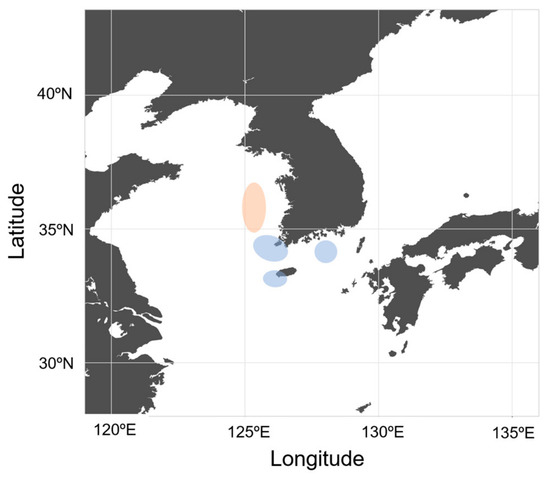
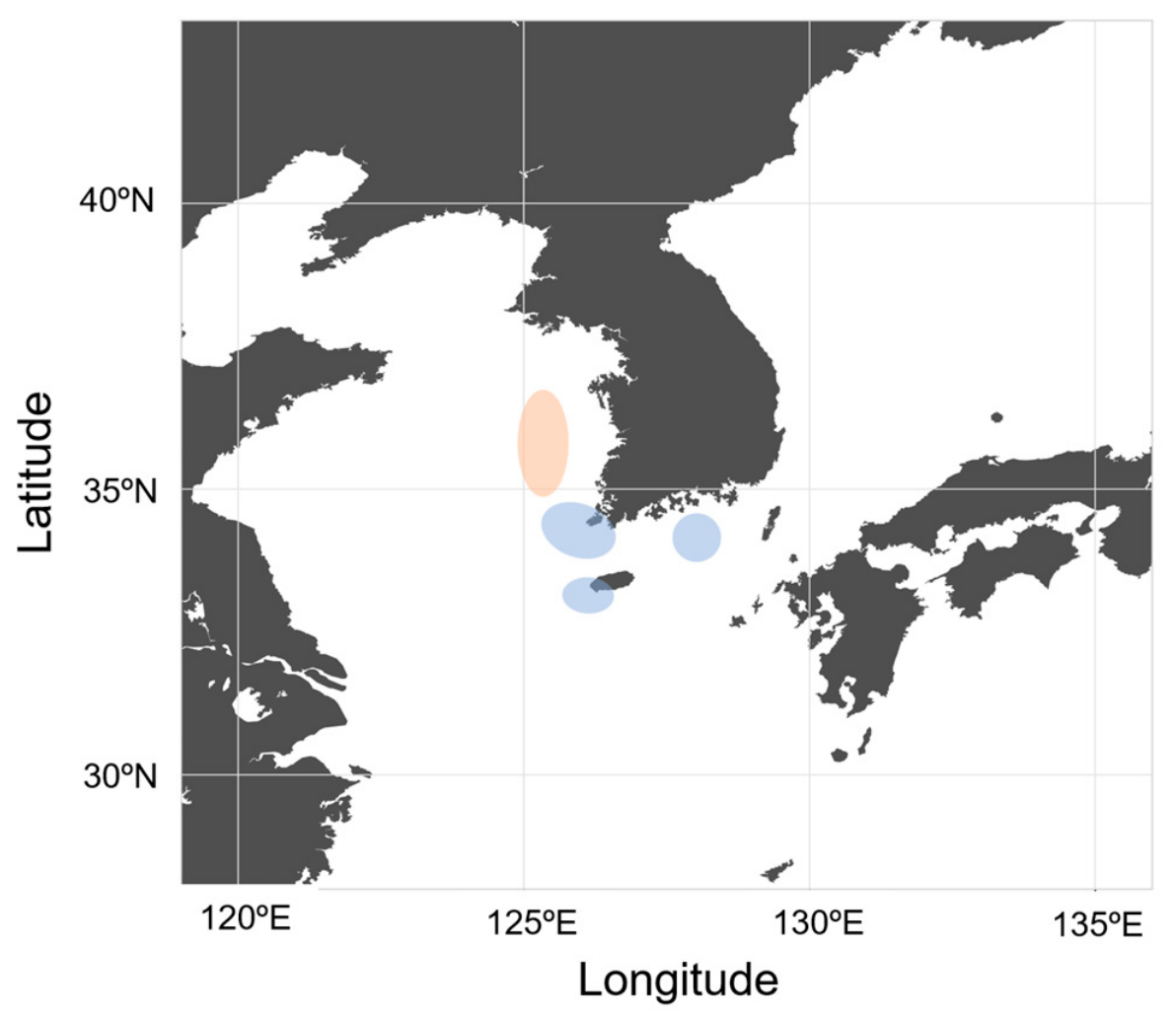
Five hundred and thirty S. niphonius samples were collected from Korean waters. Most specimens (n = 501) were collected from commercial fisheries (Jan–Dec 2024 and Jun–Sep 2025), whereas 29 were collected during research vessel surveys conducted by the National Institute of Fisheries Science (NIFS) in 2024 (January, April, August, and November) (Figure 1). To cover a broad size range and geographic distribution, specimens were obtained from several commercial fishing gear sources including set nets, stow nets, and bottom trawls.
Figure 1.
Map exhibiting sampling locations of Scomberomorus niphonius in the Yellow Sea, Southern Sea, and Jeju waters of Korea, distinguished by collection source: commercial fisheries (blue) and National Institute of Fisheries Science research vessels (Orange).
2.2. Biological Characteristics
For each specimen, the fork length (FL) and body weight (BW) were measured, and sex was determined based on the macroscopic morphology of the gonads. The overall sex ratio was calculated and statistically analyzed using the chi-square ( test.
The FL-BW relationship is determined using the following equation: . To test for sex-specific differences, the relationship was linearized as , and analysis of covariance (ANCOVA) was performed using sex as a fixed factor, as a covariate, and their interaction terms.
2.3. Age Determination and Annulus Periodicity
Sagittal otoliths were removed from each individual, rinsed with water, air-dried, and stored until further processing. Following the otolith cross-sectional method previously applied to S. niphonius [12], each otolith was embedded in epoxy resin and transversely sectioned through the core at approximately 0.2 mm thickness. The otoliths were sectioned sequentially until the core was clearly exposed (Struers, Accutom-100, Struers ApS, Ballerup, Denmark). The clearest transverse plane was selected, polished with 2000-grit sandpaper, mounted on a glass slide, and examined under transmitted light at 50× magnification using an Olympus microscope (CX41, Olympus Corporation, Tokyo, Japan).
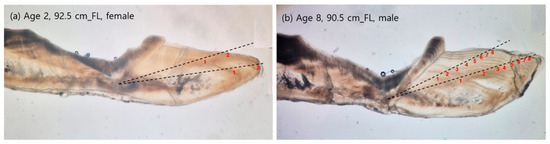
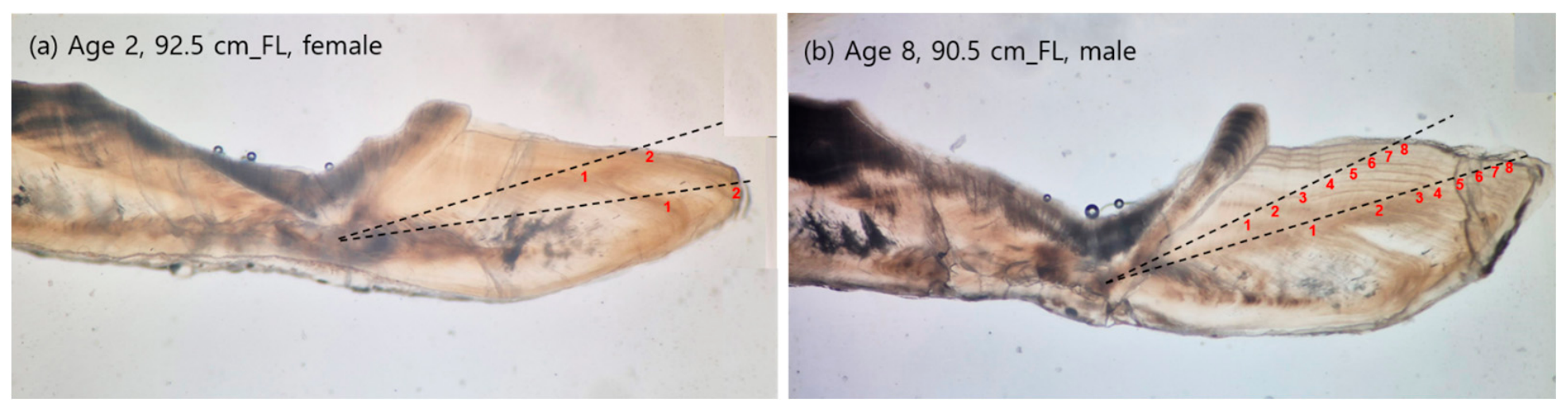
In the transverse section, the core, translucent, and opaque zones are clearly distinguishable (Figure 2). Opaque zones were counted as annuli, and the edge type (translucent or opaque; narrow or wide) was recorded for each otolith. The right otolith was used preferentially for age determination, and the left otolith was used when the right otolith was damaged. The otoliths were read independently by two readers without access to FL, BW, sex, or capture date. Otoliths for which the two readers disagreed were excluded from the subsequent age and growth analyses. Reading precision was assessed using percent agreement (PA), average percent error (APE; [13]), and coefficient of variation (CV; [14]). Monthly variations in edge type were examined to evaluate the periodicity of annulus formation.
Figure 2.
Transverse sections of Scomberomorus niphonius otoliths in Korean waters: (a) age 2, female (92.5 cm FL); (b) age 8, male (90.5 cm FL).
For growth analyses, age was expressed as fractional age. 1 June was adopted as the conventional birth date for age assignment because the main spawning season of S. niphonius in Korean waters occurs from May to June [10], which is consistent with the June 1 birth date assumption used by [12]. The fractional age was calculated at a monthly resolution as follows:
where is the fractional age, is the integer age based on the annulus count, and is the number of months elapsed between June 1 and the month of capture. For fish captured before June, was calculated from June 1 of the previous year.
2.4. Growth Analysis
Growth was described using the von Bertalanffy growth function (VBGF):
where is the fork length at age , is the asymptotic fork length, is the growth coefficient, and is the theoretical age at which fork length is zero.
The fractional ages were used for all growth analyses. The VBGF was fitted separately for females and males. Model parameters (, , and ) were estimated by nonlinear least-squares regression. Nonparametric bootstrap analyses were conducted to evaluate the uncertainty associated with the growth parameter estimates. Age–length observations were resampled with 1000 replacements, and VBGF was refitted to each bootstrap sample using the same fitting procedure as the original analysis. The 95% confidence intervals for , , and were obtained from the 2.5th and 97.5th percentiles of the bootstrap distributions. Sex-specific growth differences were evaluated using Kimura’s likelihood ratio test [15].
To examine age-specific growth patterns, the instantaneous growth rate was calculated as the first derivative of VBGF with respect to age.
Instantaneous growth rates were calculated across the observed age ranges using sex-specific parameter estimates obtained from the fitted VBGF.
To compare overall growth performance among regions independently of the inverse correlation between L∞ and K, the growth performance index was calculated as φ′ = log10 K + 2 log10 L∞ [16].
3. Results
3.1. Sex Ratio and FL-BW Relationship
A total of 530 individuals of S. niphonius were collected. FL ranged from 30.4 to 112.1 cm, and BW ranged from 218.2 to 9360.0 g. The overall sex ratio was 1:0.57 (338 females and 192 males), indicating a clear predominance of females. The observed sex ratio differed significantly from the expected 1:1 ratio (χ2 = 40.24, df = 1, p < 0.001) (Table 1).
Table 1.
Number of individuals and sex ratio of Scomberomorus niphonius by fork length class in Korean waters. FL—fork length.
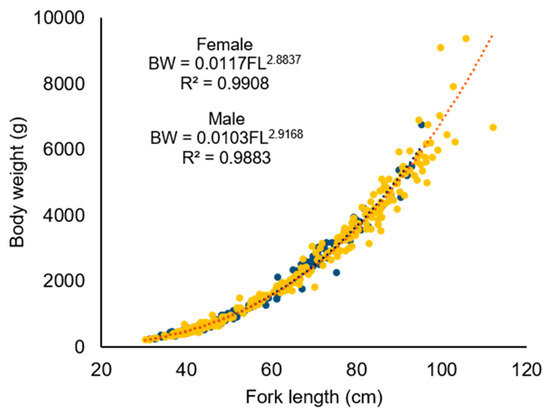
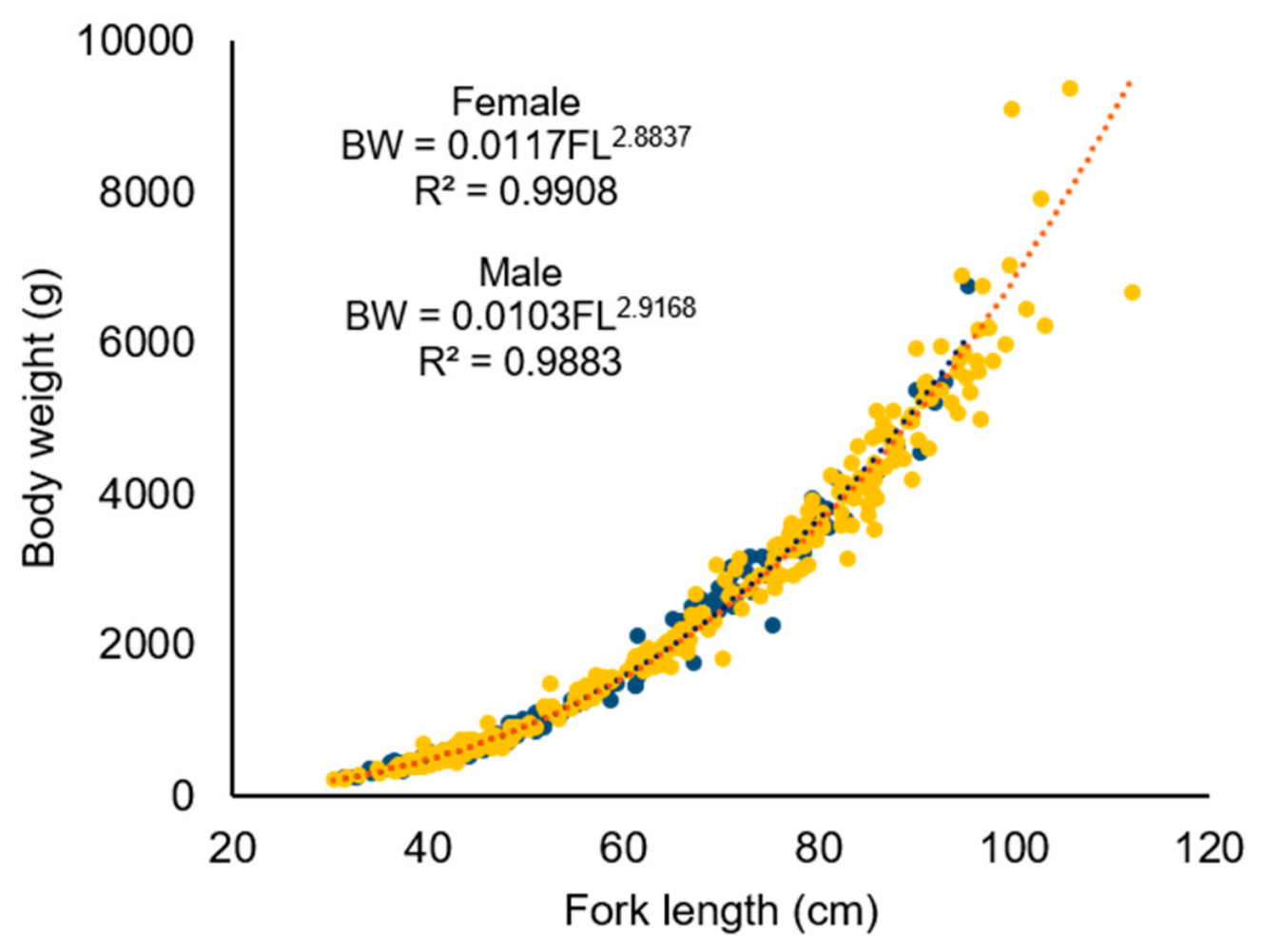
FL–BW relationships were estimated separately for females and males, and for both sexes. The relationships of FL-BW were expressed as for both sexes, for females, and for males (Figure 3). ANCOVA revealed no significant differences in either the slopes (t = 1.18, p > 0.05) or intercepts (t = 0.43, p > 0.05) of the FL-BW relationships between sexes.
Figure 3.
Fork length-body weight relationships for female (yellow) and male (blue) Scomberomorus niphonius in Korean waters. FL—fork length; BW—body weight.
3.2. Age Determination and Annulus Periodicity
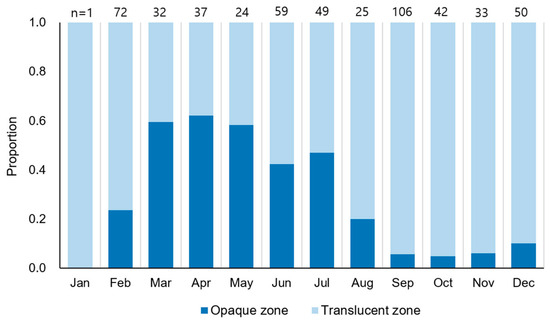
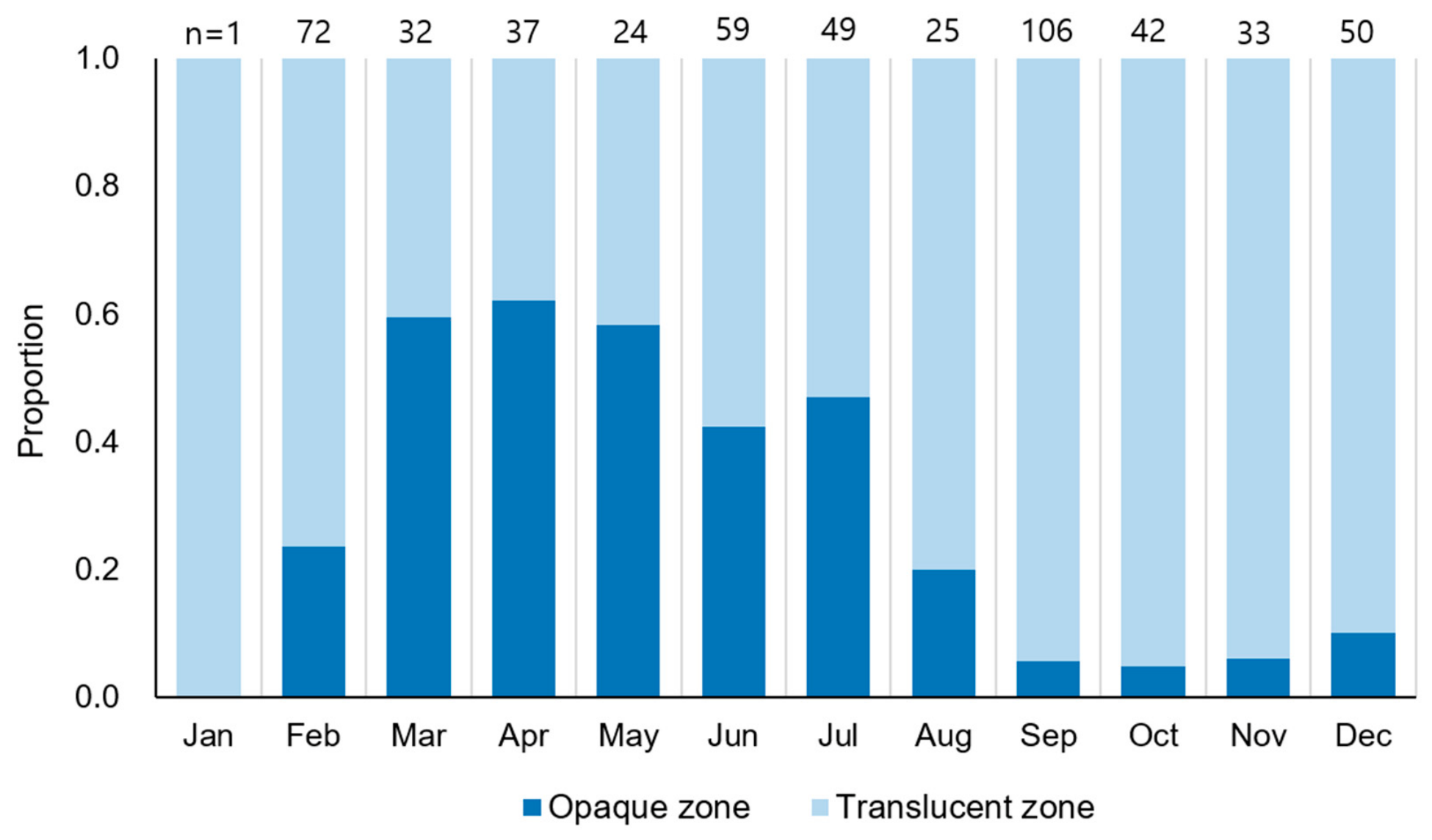
In the transverse sections of the sagittal otoliths, the core and translucent and opaque zones were readily distinguishable. The monthly edge-type analysis exhibited a distinct seasonal pattern in opaque-edge formation (Figure 4). The proportion of otoliths with opaque edges increased in February, was highest from March to May, and then gradually declined from June, indicating that annulus formation occurred annually. Based on this periodicity, opaque zones were treated as annuli, and the age was assigned as the fractional age.
Figure 4.
Monthly frequency of translucent and opaque edge types in the otoliths of Scomberomorus niphonius in Korean waters.
Independent age readings by the two readers exhibited high consistency, with a percent agreement (PA) of 96.0%, an average percent error (APE) of 5.49%, and a coefficient of variation (CV) of 7.76%. Otoliths with discrepant age estimates were excluded from the subsequent age and growth analyses. Of the 530 otoliths examined, the two readers assigned concordant ages to 509 individuals (percent agreement = 96.0%); the remaining 21 otoliths (12 from females and 9 from males), for which the readers’ counts could not be reconciled, were excluded. Consequently, 509 successfully aged individuals (326 females and 183 males) were retained for all subsequent age-structure and growth analyses (Table 2 and Table 3).
Table 2.
Number of individuals of Scomberomorus niphonius in Korean waters by month and age class.
Table 3.
Observed fork length of Scomberomorus niphonius of different ages (mean ± standard deviation) by sex in Korean waters. FL—fork length; SD—standard deviation. Based on the 509 successfully aged individuals.
The estimated ages ranged from 0.0 to 10.1 years overall, with a maximum age of 10.1 years in females and 8.1 years in males. Despite this wide range, the age 0 group exhibited the highest proportion (59.1%), with a gradual decline in frequency observed in age groups 1 and 2. Contrastingly, individuals aged 3 years had an extremely low occurrence rate (Table 2 and Table 3).
3.3. Growth Characteristics Based on the Von Bertalanffy Growth Function
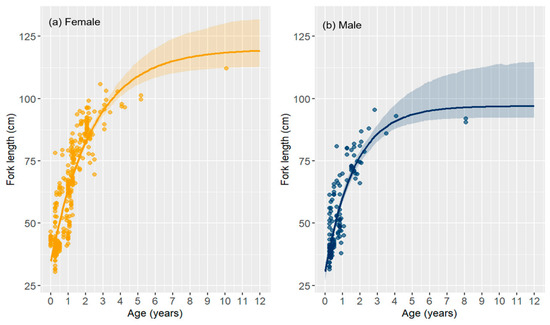
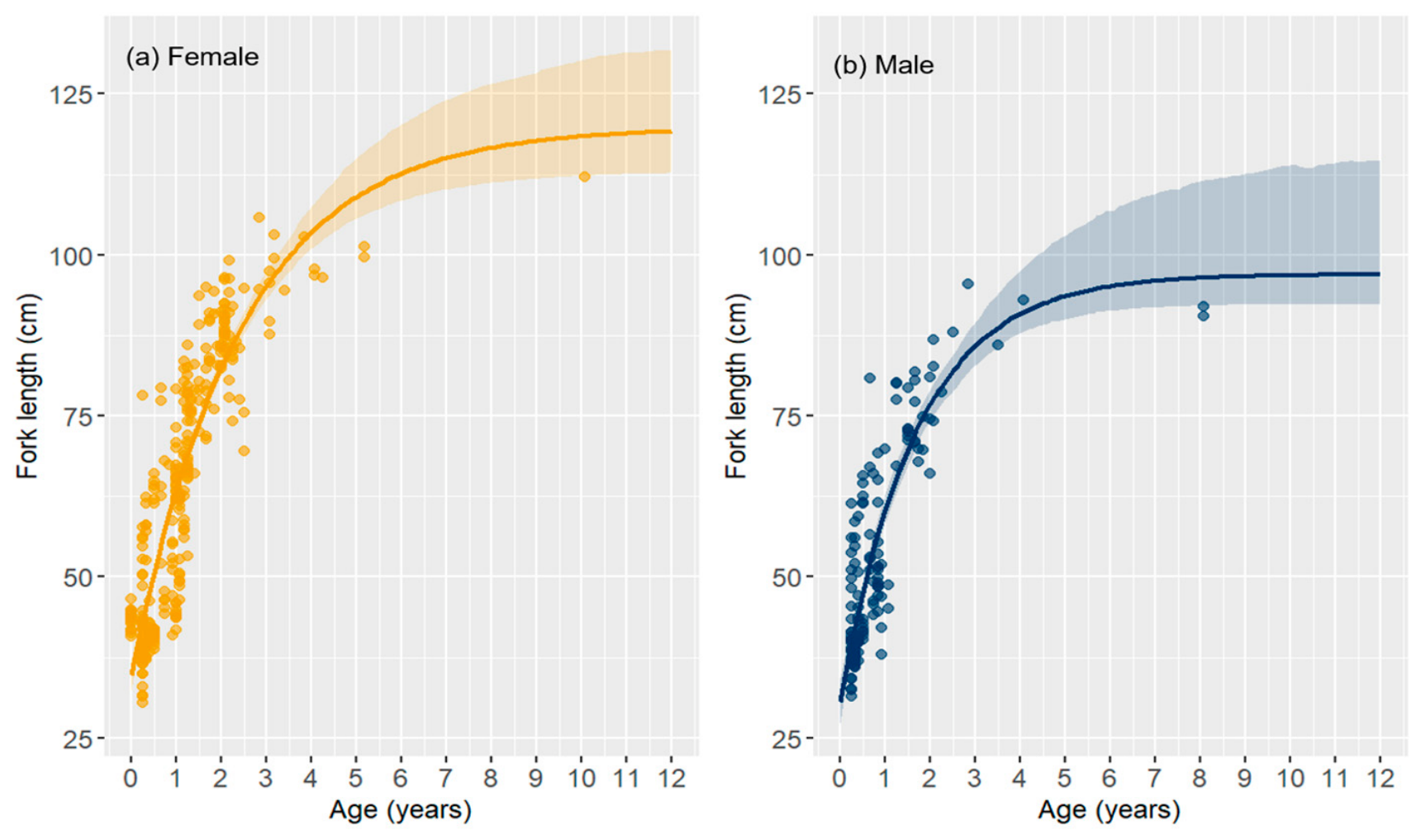
Based on the fractional age estimates, the von Bertalanffy growth function (VBGF) for females and males was estimated using the following formulae (Figure 5):
Figure 5.
von Bertalanffy growth curves fitted to fork length at different ages for female and male Scomberomorus niphonius in Korean waters. Dots, lines, and shaded areas indicate observed data, fitted VBGF curves, and 95% confidence intervals, respectively.
Bootstrap-derived 95% confidence intervals for the estimated VBGF parameters are listed in Table 4. Females exhibited a larger asymptotic fork length () but a lower growth coefficient () than males. Kimura’s likelihood ratio test indicated a significant difference in growth between females and males (, degrees of freedom (df) = 3, p < 0.001), supporting the use of sex-specific growth models.
Table 4.
von Bertalanffy growth parameters (L∞, K, and t0) estimated for females, males, and both sexes of Scomberomorus niphonius in Korean waters, with 95% confidence intervals (CIs) derived from bootstrap analyses.
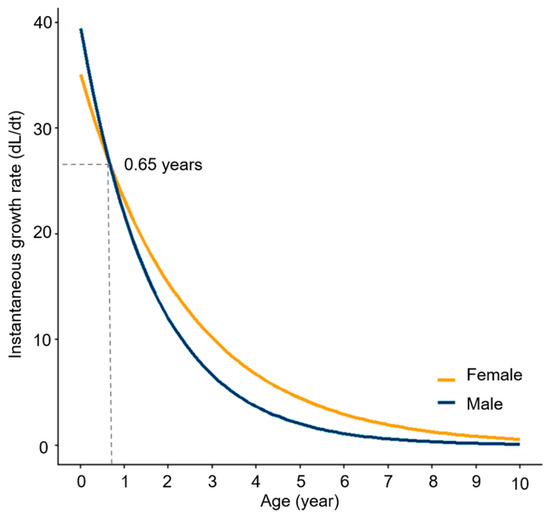
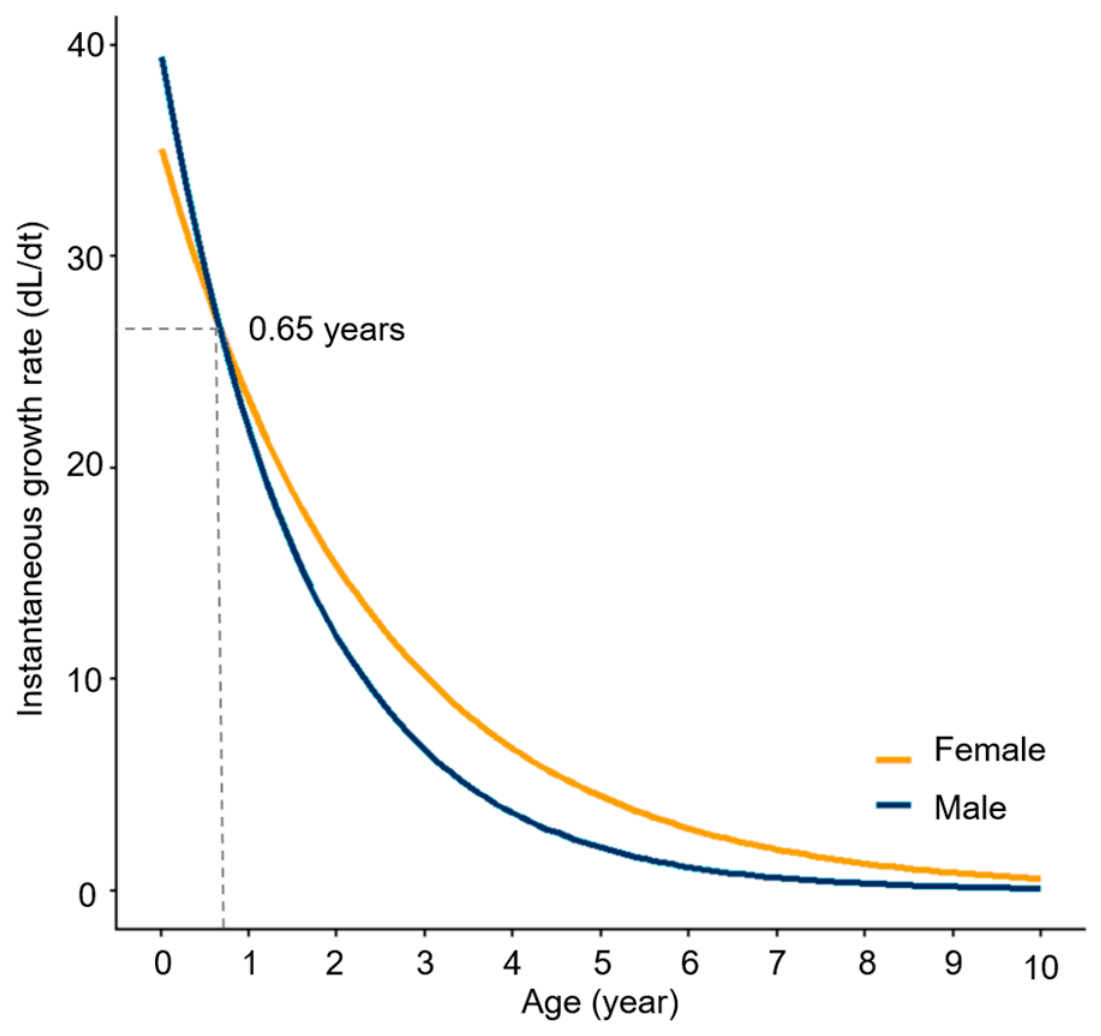
Instantaneous growth rates derived from VBGF decreased progressively with age in both sexes (Figure 6). At age 0, males exhibited a higher instantaneous growth rate (39.47 cm year−1) than that of females (35.06 cm year−1). However, a crossover in the sex-specific growth curves occurred at approximately 0.65 year, after which females maintained higher instantaneous growth rates than males. The decline in instantaneous growth rate with increasing age was more pronounced in males compared with females. Females had a more gradual decrease and sustained relatively higher growth rates at older ages compared to males.
Figure 6.
Instantaneous growth rates derived from the von Bertalanffy growth function for female and male Scomberomorus niphonius in Korean waters.
4. Discussion
The otoliths of S. niphonius are small and thin, making it difficult to clearly distinguish the annuli and marginal increments through surface observations alone, which may lead to age underestimation. Contrastingly, the transverse section method provides improved readability and more accurate age determination [2,12]. Accordingly, the use of transverse sections in this study allowed for a relatively clearer identification of the growth increments. Age readings between the two independent readers exhibited a high level of agreement (96.0%), supporting the reproducibility and reliability of age estimation. Most disagreements occurred in individuals smaller than 60 cm FL (age 0–1), where the boundaries between the core and growth increments were relatively ambiguous, potentially increasing reading error.
The frequency of opaque zone occurrence was highest from March to May and decreased between June and July, indicating that annuli form once annually in Korean waters, consistent with the reproductive cycle of the species, in which gonadal development begins in March and peak spawning occurs from May to June [10]. A similar pattern has been reported in Japan, where annulus formation occurs annually from April to May in the Southwestern Sea of Japan [2,12]. Otolith composition is influenced by various factors, such as reproduction, growth, and migration, and opaque zone formation is often associated with periods of active growth and/or seasonally warm conditions [17,18,19]. Therefore, annulus formation during spring is consistent with the increased metabolic activity associated with spawning and elevated water temperatures.
The maximum observed age of S. niphonius in the present study was 10.1 years for females and 8.1 years for males, which was markedly higher than that reported from the waters off Kyushu, Japan (6.8 years for females and 4.7 years for males) (Table 5) [2]. In Korean waters, few older individuals aged ≥5 years were captured in offshore waters during July–August. Although the main spawning season is May–June, the proportion of individuals in the spawning stage was high (80%) even in July–August [10], suggesting that individuals that were spawning or had completed spawning migrated from coastal spawning grounds to offshore waters. S. niphonius is a highly migratory species [3,7], with larger individuals ranging more widely. Accordingly, larger fish appear to disperse after spawning, whereas younger individuals appear to be distributed throughout Korean waters without clear spatial or temporal isolation [3].
Table 5.
Comparison of growth parameters, growth performance indices and fork length by age between this study and previous studies.
The difference in S. niphonius age range between Korean and Japanese waters is difficult to conclusively attribute to intrinsic biological differences between regions and is more likely to reflect differences in study conditions. First, the availability of samples from older individuals was the most important factor. Most of the overall age structure consisted of individuals aged 0 and 1 year, which is consistent with previous studies [3,12]. Because this species exhibits a marked sex ratio imbalance of approximately 1:0.5, obtaining samples from older males is challenging. Second, samples from a previous study (Fujinami et al., 2024) [2] were collected mainly from coastal catches using trolls and set nets, which likely resulted in under-sampling of older individuals. In contrast, the present study obtained extensive samples from coastal and offshore waters, where the major fishing grounds for S. niphonius are located (e.g., stow nets and trawls). This broader sampling likely enabled the inclusion of a large number of older individuals, which are distributed offshore.
The von Bertalanffy growth parameters estimated in this study were L∞ = 119.8 cm and K = 0.41 for females, and L∞ = 97.0 cm and K = 0.59 for males. The females reached a large asymptotic length, whereas the males exhibited fast early growth. S. niphonius grew rapidly to approximately 60 cm within the first year and reached approximately 70% of L∞ by age 2, indicating a growth pattern characterized by rapid early growth (age 0–2 years), followed by a gradual decrease in growth rate, which is consistent with previous studies [2]. This rapid early growth can be interpreted as a life-history strategy for survival and reproduction. S. niphonius does not form dense schools [20]; therefore, rapid growth may reduce the size-dependent predation risk at an early stage. Furthermore, the length at 50% maturity is approximately 50 cm [10], suggesting that individuals spawn at age one and partition most of their energy to growth before maturation.
S. niphonius grow very rapidly, and both sexes attain approximately 60 cm by age 1, close to the length at 50% maturity of about 53 cm reported for both sexes in these waters [10]. Spawning occurs mainly from May to June, and the length at maturity is almost the same between sexes [10]. The sex-related differences in growth and longevity observed in the present study are therefore considered to reflect differences in energy allocation after maturity. Because fecundity increases with body length in females [21], continued somatic growth after maturation is advantageous for reproduction, which may account for the faster growth and larger asymptotic length observed in females. In males, by contrast, reproductive success is unlikely to increase substantially with body length, so the benefit of continued somatic growth is comparatively small [22]; instead, maintaining gonadal activity over a longer period may be more advantageous for individual reproductive success. Consistent with this interpretation, a previous study in the same waters reported that female GSI remained at a low level after June, whereas male GSI showed slight fluctuations until August, indicating that gonadal activity persists later in males [10]. However, because reproductive indicators were not measured directly in the present study, this interpretation remains tentative.
When comparing the growth characteristics of S. niphonius distributed within the same East China Sea region, individuals from Korean waters in the present study generally exhibited larger lengths at an older age than those from coastal waters off Kyushu, Japan (Table 5). In both regions, the age structure was dominated by age 0–1 individuals, suggesting that differences in body size during the early life stage, when growth rates are the highest, likely reflect differences in environmental conditions and ecological characteristics between the regions [23,24]. Among these, temperature and prey availability may be contributing factors to the regional differences in growth. This species is temperature sensitive, and its optimal habitat temperature varies seasonally. High habitat suitability has been reported at temperatures of 13–18 °C in winter and 14–23 °C in spring and autumn [23]. In Korean waters, temperatures within the optimal range of 13–23 °C are widely distributed during most of the year, except between January–February and August–September [25]. Although the spatial extent of this thermal range is relatively limited in August and September, it is maintained in the mid-depth layers of the East Sea, suggesting that, except for midwinter, Korean waters provide optimal habitat temperatures for most of the year.
This species is piscivorous from the first feeding stage onward, although its prey composition changes with ontogeny. The main prey include clupeid larvae during the early stages [26], followed by anchovy (Engraulis japonicus), chub mackerel (Scomber japonicus), and hairtail (Trichiurus japonicus) [25,27,28]. Starvation can delay growth and increase mortality; the availability of prey-rich habitats determines survival and growth performance [26]. Korean waters support abundant populations of these prey species, potentially providing favorable habitats for enhanced growth [9,29]. Nevertheless, because the migration routes and life-history patterns of this species have not yet been fully resolved, studies that combine long-term datasets with distributional monitoring are required to elucidate the underlying regulatory mechanisms.
Although the age composition observed in this study was inevitably shaped by the selectivity of the commercial fisheries, the predominance of age 0–1 individuals and the scarcity of older fish represent the age structure of the stock as exploited during the study period (2024–2025), indicating a fishery that depends heavily on incoming recruitment. Together with the sex-specific growth patterns identified here, these characteristics offer a biological basis for interpreting the current population structure: the von Bertalanffy parameters can serve as direct inputs to age-structured assessment, while the rapid early growth and maturation of both sexes at around 50 cm by the end of the first year [10] provide a reference for evaluating size- or age-at-first-capture measures. Because the distribution of S. niphonius shifts with age and season across coastal and offshore waters [3,7], the age structure obtained from any single period reflects only part of the stock; continued monitoring across years and fishing grounds will therefore be needed to track temporal changes in age composition and growth and to refine the parameters presented here for use in stock assessment.
5. Conclusions
This study applied the otolith transverse section method to estimate the age and growth of S. niphonius in Korean waters with relatively high precision, which suggested a longer maximum lifespan in this region than in adjacent areas. Additionally, differences in growth characteristics between the Korean and Japanese populations were identified, which were likely associated with environmental factors, stock conditions, and differences in sampling design. Future studies on water populations in China would further improve our understanding of the ecological characteristics of this shared resource among Korea, China, and Japan and provide a scientific basis for sustainable management.
Author Contributions
H.J.K.: conceived and designed the study, performed the otolith analysis and data processing, and wrote the manuscript. H.-y.C., S.Y.M. and H.W.L.: collected and prepared the otolith samples from commercial landings. J.-h.L.: assisted with the data collection and reviewed the manuscript. S.C.Y.: contributed to the conceptualization and planning of the study and supervised the writing of the manuscript. All authors have read and agreed to the published version of the manuscript.
Funding
This research was supported by the National Institute of Fisheries Science (NIFS), Republic of Korea (Project No. R2026001).
Institutional Review Board Statement
All fish samples were obtained from commercial landings and scientific surveys conducted by the National Institute of Fisheries Science (NIFS). The sampling procedures for the research vessel surveys followed standard operating protocols for fishery resource surveys authorized by the NIFS. No endangered or protected species were included.
Data Availability Statement
The data supporting the findings of this study are available from the National Institute of Fisheries Science (NIFS) but are not publicly available owing to restrictions. Data are available from the authors upon reasonable request and with permission from the NIFS.
Acknowledgments
The authors thank the South Sea Fisheries Research Institute team for providing S. niphonius samples and the otolith analysis team at the Fisheries Resources Research Center for their assistance with the laboratory work.
Conflicts of Interest
The authors declare no conflicts of interest.
Abbreviations
The following abbreviations are used in this manuscript:
ANCOVA—Analysis of covariance; APE—average percent error; BW—body weight; CI—confidence interval; CV—coefficient of variation; df—degrees of freedom; FL—fork length; NIFS—National Institute of Fisheries Science; PA—percent agreement; RISA—Real-Time Information System for Aquaculture; VBGF—von Bertalanffy growth function.
References
- Ohshimo, S.; Muko, S.; Yoda, M.; Kurota, H. Fluctuations in distribution and relative abundance of Japanese Spanish mackerel (Scomberomorus niphonius) in the Yellow Sea, East China Sea and Sea of Japan. Reg. Stud. Mar. Sci. 2021, 48, 102057. [Google Scholar] [CrossRef] [Scilit]
- Fujinami, Y.; Hiraoka, Y.; Ebisu, R.; Matsushima, N.; Itou, T.; Matsui, K.; Kurota, H.; Tanabe, T. Age, growth and reproduction of Japanese Spanish mackerel (Scomberomorus niphonius) in the coastal area off northern and western Kyushu, Japan. Fish. Res. 2024, 275, 107011. [Google Scholar] [CrossRef] [Scilit]
- Kim, H.Y.; Lim, Y.N.; Song, S.H.; Kim, Y.H. Estimation of migration route of Japanese Spanish mackerel (Scomberomorus niphonius) using catch characteristics. Korean J. Fish. Aquat. Sci. 2016, 49, 376–384. [Google Scholar] [CrossRef] [Scilit]
- Horikawa, H.; Zheng, Y.; Meng, T. Biological and Ecological Characteristics of Valuable Fisheries Resources from the East China Sea and the Yellow Sea; Seikai National Fisheries Research Institute: Nagasaki, Japan, 2001. [Google Scholar]
- Shui, B.-N.; Han, Z.-Q.; Gao, T.-X.; Miao, Z.-Q.; Yanagimoto, T. Mitochondrial DNA variation in Japanese Spanish mackerel populations. Fish. Sci. 2009, 75, 593–600. [Google Scholar] [CrossRef] [Scilit]
- Zhang, C.; Ye, Z.; Li, Z.; Wan, R.; Ren, Y.; Dou, S. Population structure of Japanese Spanish mackerel Scomberomorus niphonius in the Bohai Sea, the Yellow Sea and the East China Sea: Evidence from random forests based on otolith features. Fish. Sci. 2016, 82, 251–256. [Google Scholar] [CrossRef] [Scilit]
- Pan, X.; Ye, Z.; Xu, B.; Jiang, T.; Yang, J.; Tian, Y. Population connectivity in a highly migratory fish, Japanese Spanish mackerel (Scomberomorus niphonius), along the Chinese coast: Implications from otolith chemistry. Fish. Res. 2020, 231, 105690. [Google Scholar] [CrossRef] [Scilit]
- Pan, X.; Ye, Z.; Xu, B.; Jiang, T.; Yang, J.; Cheng, J.; Tian, Y. Combining otolith elemental signatures with multivariate analytical models to verify migratory patterns of Japanese Spanish mackerel. Acta Oceanol. Sin. 2020, 39, 54–64. [Google Scholar] [CrossRef] [Scilit]
- Lee, S.-J.; Kim, B.-Y.; Chang, D.-S. Long-term variation in catch of Spanish mackerel (Scomberomorus niphonius) related to environmental change in Korean waters. J. Korean Soc. Fish. Ocean Technol. 2011, 47, 99–107. [Google Scholar] [CrossRef] [Scilit]
- Moon, S.Y.; Baeck, G.W.; Jin, S.Y.; Kim, H. Maturity and spawning of Spanish mackerel (Scomberomorus niphonius) in the southwestern waters of Korea. Korean J. Fish. Aquat. Sci. 2023, 56, 667–675. [Google Scholar] [CrossRef]
- Campana, S.E. Accuracy, precision and quality control in age determination, including a review of the use and abuse of age validation methods. J. Fish Biol. 2001, 59, 197–242. [Google Scholar] [CrossRef]
- Nishikawa, T.; Nakamura, Y.; Katayama, S. Age composition of Japanese Spanish Mackerel Scomberomorus niphonius (Cuvier 1832) Caught off Hyogo Prefecture, Southwestern Sea of Japan, as determined by the Otolith cross-section method. Asian Fish. Sci. 2014, 27, 248–259. [Google Scholar] [CrossRef] [Scilit]
- Beamish, R.J.; Fournier, D.A. A method for comparing the precision of a set of age determinations. Can. J. Fish. Aquat. Sci. 1981, 38, 982–983. [Google Scholar] [CrossRef] [Scilit]
- Chang, W.Y.B. A statistical method for evaluating the reproducibility of age determination. Can. J. Fish. Aquat. Sci. 1982, 39, 1208–1210. [Google Scholar] [CrossRef] [Scilit]
- Kimura, D.K. Likelihood methods for the von Bertalanffygrowth curve. Fish. Bull. 1980, 77, 765–776. [Google Scholar]
- Pauly, D.; Munro, J.L. Once more on the comparison of growth in fish and invertebrates. Fishbyte 1984, 2, 21. [Google Scholar]
- Sturrock, A.M.; Hunter, E.; Milton, J.A.; Eimf; Johnson, R.C.; Waring, C.P.; Trueman, C.N. Quantifying physiological influences on otolith microchemistry. Methods Ecol. Evol. 2015, 6, 806–816. [Google Scholar] [CrossRef] [Scilit]
- Wakefield, C.B.; Potter, I.C.; Hall, N.G.; Lenanton, R.C.J.; Hesp, S.A. Timing of growth zone formations in otoliths of the snapper, Chrysophrys auratus, in subtropical and temperate waters differ and growth follows a parabolic relationship with latitude. ICES J. Mar. Sci. 2017, 74, 180–192. [Google Scholar] [CrossRef] [Scilit]
- Carbonara, P.; Follesa, M.C. Handbook on Fish Age Determination: A Mediterranean Experience; Studies and Reviews; FAO: Rome, Italy, 2019; p. 13. [Google Scholar]
- Masuda, R.; Shoji, J.; Nakayama, S.; Tanaka, M. Development of schooling behavior in Spanish mackerel Scomberomorus niphonius during early ontogeny. Fish. Sci. 2003, 69, 772–776. [Google Scholar] [CrossRef] [Scilit]
- Barneche, D.R.; Robertson, D.R.; White, C.R.; Marshall, D.J. Fish reproductive-energy output increases disproportionately with body size. Science 2018, 360, 642–645. [Google Scholar] [CrossRef] [Scilit] [PubMed]
- Parker, G.A. The evolution of sexual size dimorphism in fish. J. Fish Biol. 1992, 41, 1–20. [Google Scholar] [CrossRef] [Scilit]
- Yang, T.; Liu, X.; Han, Z. Predicting the effects of climate change on suitable habitat of Japanese Spanish mackerel. Front. Mar. Sci. 2022, 9, 927790. [Google Scholar] [CrossRef] [Scilit]
- Jin, Y.; Liu, Z.-L.; Yuan, X.-W.; Jiang, Y.-Z. Stage-specific influence of temperature on the growth rate of Japanese Spanish mackerel (Scomberomorus niphonius) in early life. J. Fish Biol. 2022, 100, 498–506. [Google Scholar] [CrossRef] [Scilit] [PubMed]
- National Institute of Fisheries Science (NIFS). Real-Time Information System for Aquaculture (RISA) Observational Data. 2024. Available online: https://www.nifs.go.kr/risa/risa/risaD/actionRisaPastDown.do (accessed on 6 April 2026).
- Shoji, J.; Kishida, T.; Tanaka, M. Piscivorous habits of Spanish mackerel larvae in the Seto Inland Sea. Fish. Sci. 1997, 63, 388–392. [Google Scholar] [CrossRef] [Scilit]
- Lee, J.E.; Seong, G.C.; Kim, H.; Moon, S.Y.; Baeck, G.W. Diet composition of Spanish mackerel (Scomberomorus niphonius) in the South Sea of Korea. Korean J. Fish. Aquat. Sci. 2021, 54, 808–813. [Google Scholar] [CrossRef]
- Jung, J.H.; Moon, S.Y.; Lee, M.H.; Kim, C. Feeding ecology and prey interactions of Japanese Spanish mackerel Scomberomorus niphonius (Teleostei: Scombridae) in Korean coastal waters. Aquac. Fish Fish. 2026, 6, e70189. [Google Scholar] [CrossRef] [Scilit]
- Kim, J.Y.; Kim, Y.; Kim, H. Population variation of Spanish mackerel (Scomberomorus niphonius) according to its major prey abundance in Korean waters. J. Environ. Sci. Int. 2021, 30, 811–820. [Google Scholar] [CrossRef] [Scilit]

Disclaimer/Publisher’s Note: The statements, opinions and data contained in all publications are solely those of the individual author(s) and contributor(s) and not of MDPI and/or the editor(s). MDPI and/or the editor(s) disclaim responsibility for any injury to people or property resulting from any ideas, methods, instructions or products referred to in the content. |
© 2026 by the authors. Licensee MDPI, Basel, Switzerland. This article is an open access article distributed under the terms and conditions of the Creative Commons Attribution (CC BY) license.