


Abstract
A novel bilateral-symmetric, multi-slot fishway (BMSF-R11) was recently developed, which has more migration space for fish, and lower mainstream velocity and turbulence than traditional vertical-slot fishways (VSFs) under the condition of the same slot width. This study aims to verify that, relative to a VSF, the BMSF-R11 is more favorable for the upstream migration of moderately swimming fishes. Three-dimensional numerical simulations were performed to determine hydrodynamic properties in both a VSF and the BMSF-R11, and laboratory fish-passage experiments using silver carp (Hypophthalmichthys molitrix, a moderately swimming fish species) were conducted to provide fish-passing characteristics. As expected, the BMSF-R11 possessed much higher fish-passing efficiency than the VSF (e.g., the passage success rate (PSR) was 90–93% vs. 57–63% and the entrance efficiency (EE) was 90–98% vs. 55–63%), due to the former’s much better hydrodynamic performance. There are two primary roughly linear fish-passing paths in a VSF, but four primary S-shape fish-passing paths are present in the BMSF-R11. Furthermore, this study reveals the inherent relationships among fish-passing efficiency parameters, fish-swimming trajectory, fish-occurrence frequency, and hydrodynamic properties in both a VSF and the BMSF-R11. This study contributes to conserving fishery resources and aquatic biodiversity, especially for migratory fish with moderate swimming abilities.
Keywords:
fish-passing efficiency; fish-swimming trajectory (FST); fish-occurrence frequency; hydrodynamic characteristics; turbulent kinetic energy (TKE); Reynolds shear stress (RSS) Key Contribution:
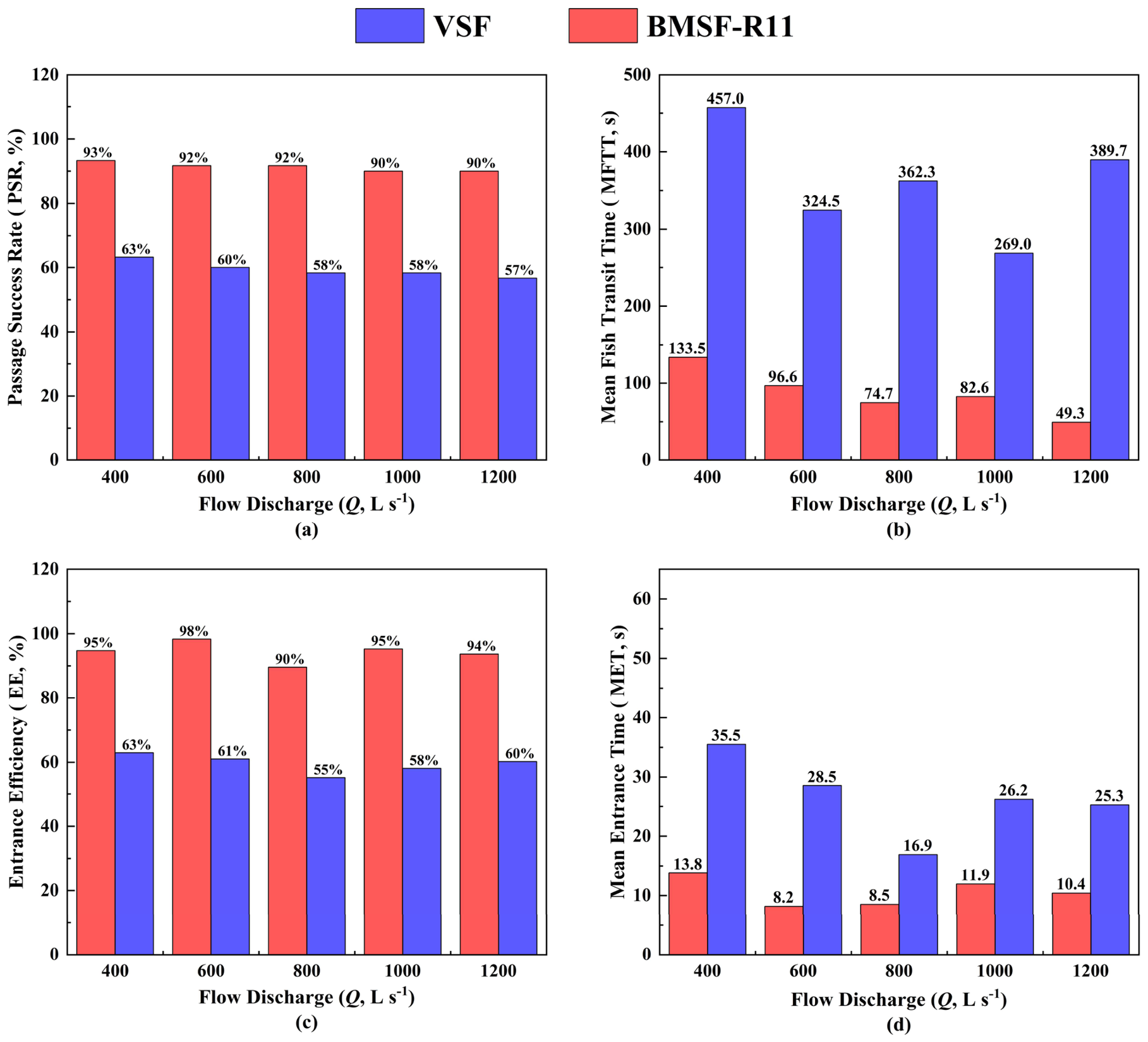
This study verifies that, for silver carp (Hypophthalmichthys molitrix, a moderately swimming fish species), the recommended BMSF-R11 gives much higher fish-passing efficiency than a VSF, given the former’s much larger passage success rate (PSR, 90–93% vs. 57–63%) and entrance efficiency (EE, 90–98% vs. 55–63%), as well as the former’s much smaller mean fish transit time (MFTT, 49.3–133.5 vs. 269.0–457.0 s) and mean entrance time (MET, 8.2–13.8 vs. 16.9–35.5 s).
1. Introduction
Countless anthropogenic hydraulic barriers have been built all over the world along rivers and creeks, for the sake of flood control, hydroelectric generation, agricultural irrigation, urban water supply, and inland water transportation. This fragmentation of river systems leads to a decrease in fish populations, loss of fish genetic diversity, and extinction of endangered fish species. Migratory fish are particularly severely affected because they need to jump or climb over these hydraulic barriers to reach their spawning grounds [1,2,3,4,5]. As a result, a large number of fishways have been constructed to restore river connectivity, prevent habitat fragmentation, protect fishery resources, and conserve biological diversity [6,7,8,9,10]. Fishways can be generally classified into technical fishways (including Denil, pool-weir, submerged-orifice, vertical-slot (VS), multi-slot (MS), combined, and culvert fishways) and nature-like fishways (including rock-ramp and pool-riffle types) [11,12,13,14,15]. The purpose of designing fishways has evolved to promote the free migration of entire fish communities composed of fishes with diverse body sizes, living habits, and swimming capabilities, rather than only considering economically valuable and endangered fishes [16,17,18,19].
VSFs serve as one of the most widely used fishway types around the world, and account for more than 70% of fishways in China [20,21,22,23,24]. In each pool, the VSF has only one vertical slot, which traverses the entire water depth. VSFs allows various fishes to choose their preferred swimming depths when migrating, and can adapt to a significant variation in downstream/upstream water levels [25,26,27,28,29]. Although efficient for strong-swimming fishes (e.g., salmon and trout), VSFs usually lead to low passage success rates for moderately/weakly swimming fishes (e.g., Cyprinids like Schizothorax) due to large water velocity and turbulence in the slot region [30,31,32,33,34]. In VSFs, two neighboring vertical slots are distributed either on the same or opposite sides, and it is necessary to ensure that the maximum water velocity in the mainstream area does not exceed the burst swimming speed (Uburst) of target fishes by adjusting the bed slope, geometric dimension, and structural arrangement [35,36,37,38]. Researchers have carried out extensive research into various aspects of VSFs, such as flow pattern, hydrodynamic characteristics, structural optimization, fish-passage performance, and fish-swimming behavior [39,40,41,42,43,44].
To facilitate the upstream migration of moderately/weakly swimming fishes, MSFs have been proposed in the literature. By installing at least two vertical slots in each pool, MSFs not only provide more migration space for fishes, but also offer significantly lower velocity and turbulence in the mainstream region [32,45,46,47,48]. By comparing two VSF configurations with three MSF configurations, Quaresma et al. (2018) [49] concluded that, when maintaining similar water depths, the MSFs required less flow and generated smaller velocity and turbulence, and hence were more suitable for weak-swimming fishes. Romão et al. (2019) [50] evaluated the efficiency of MSFs for both Iberian barbel (Luciobarbus bocagei) and southern Iberian chub (Squalius pyrenaicus). Overall, MSFs were deemed to be an effective design for the two cyprinids, and the barbel had relatively more success than the chub. Branco et al. (2023) [51] tested six VSF and MSF configurations with aligned or alternating slot arrangements, and showed that MSFs with one orifice had the highest number of successes in fishway negotiation. Zhang et al. (2023) [52] recommended a novel, bilateral-symmetric, multi-slot fishway (called the BMSF-8), which had four vertical slots (forming two symmetric fish-passing channels) in each pool. Relative to VSFs, the BMSF-8 not only had more sufficient migration space for fishes, but also generated much lower water velocity and turbulence. Zhang et al. (2025) [53] developed a more advanced bilateral-symmetric, multi-slot fishway (named BMSF-R11) by introducing an inclined wall, a sudden-contraction section, and two trapezoidal flow-splitting piers in each pool. They showed that the BMSF-R11 had better hydrodynamic performance than both the BMSF-8 and a VSF.
Under the condition of the same slot width, the BMSF-R11 had much lower velocity and turbulence than a VSF (e.g., the maximum time-averaged velocity magnitude was 1.13~1.15 vs. 2.03~2.08 m s−1) [53], and hence was declared to be more favorable for the upstream migration of moderately/weakly swimming fishes. Nevertheless, until now, no laboratory or in situ fish-passage experiments have been performed to verify this claim. This study aims to narrow this research gap by conducting fish-passage experiments in two laboratory physical models (i.e., a VSF and the BMSF-R11) with the aid of juvenile silver carp (Hypophthalmichthys molitrix, a moderately swimming fish).
2. Materials and Methods
2.1. Hydrodynamic Simulation Design
Previous studies have shown that the velocity uniformity coefficient along the slot section (β), as well as the spatial distribution of the time-averaged velocity magnitude/TKE/RSS X–Y component magnitude (U/k/|τxy|), exert an important effect on fish-swimming behavior in fishways [10,54]. Furthermore, potential hydrodynamic parameters influencing fish-passing efficiency include the spatial-averaged, time-averaged water-depth (hm), and the maximum time-averaged velocity magnitude/TKE/RSS X–Y component magnitude (Umax/kmax/|τxy|max), as well as the spatial-averaged, time-averaged velocity magnitude/TKE/RSS X–Y component magnitude along the slot section at the z = 0.50 hm plane (U*/k*/|τxy|*). In fact, some hydrodynamic properties in both VSF and BMSF-R11 prototype fishways (with a pool length L = 3.0 m, a pool width B = 2.2 m, a pool height H = 2.5 m, and a bed slope S = 1.67%) have been obtained at Q = 600–1200 L s−1, such as hm, Umax, kmax, and |τxy|max [53]. This study supplements two extra hydrodynamic numerical cases (i.e., a VSF at Q = 400 L s−1 and a BMSF-R11 at Q = 400 L s−1), as well as the numerical results of four hydrodynamic variables (i.e., β, U*, k*, and |τxy|*) in both a VSF and the BMSF-R11 at Q = 400–1200 L s−1. When carrying out hydrodynamic numerical simulation, this study adopts the identical numerical model layout scheme and solution method as Zhang et al. (2025) [53], in terms of geometric configurations, governing equations, discrete algorithms, boundary conditions, and computational grids.
2.2. Fish-Passage Experiment Design
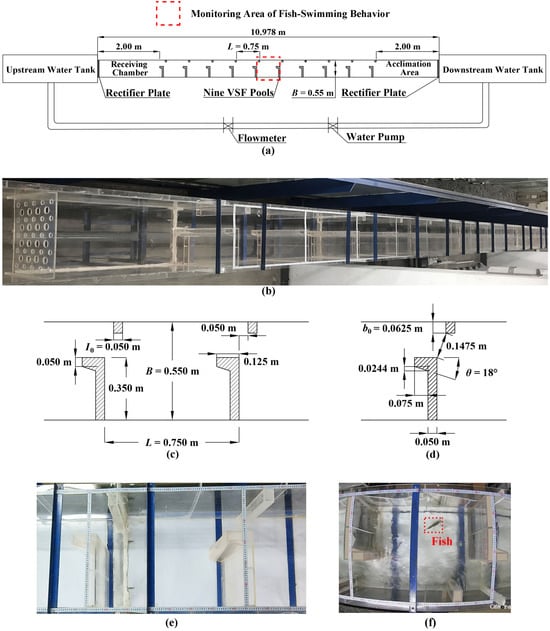
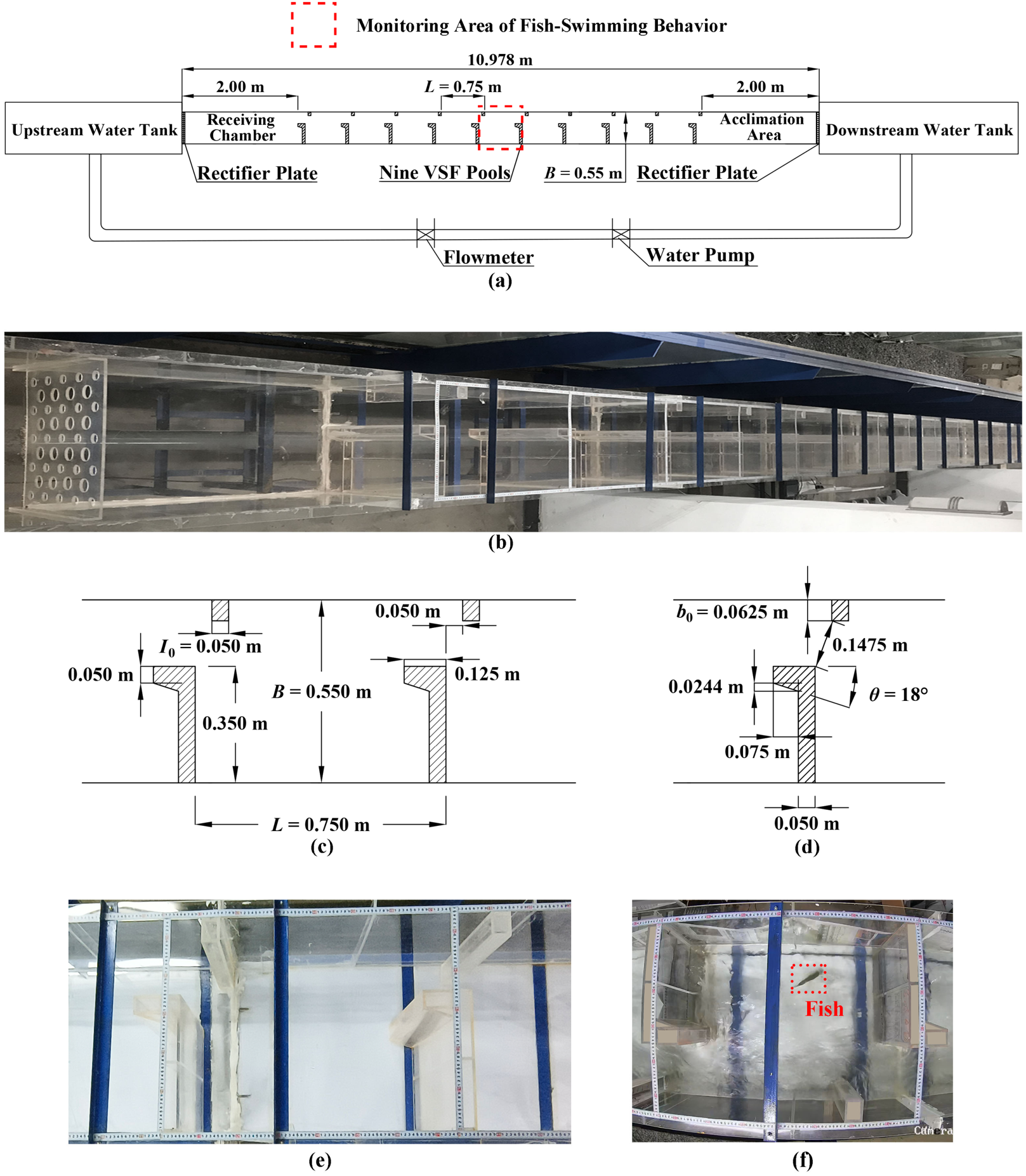
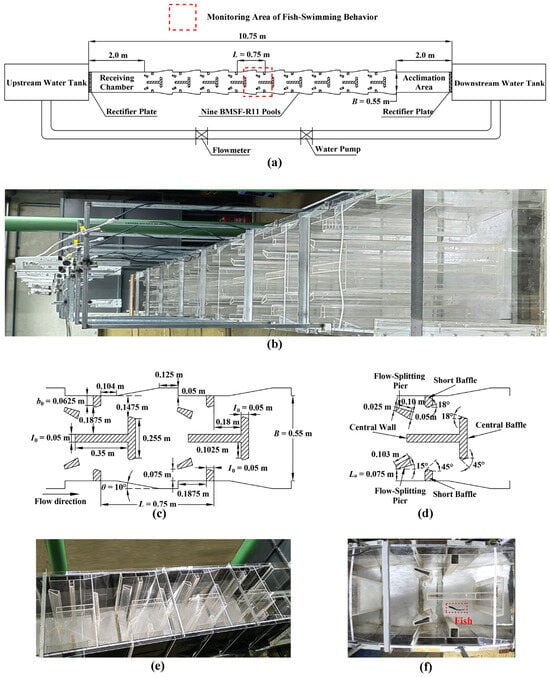
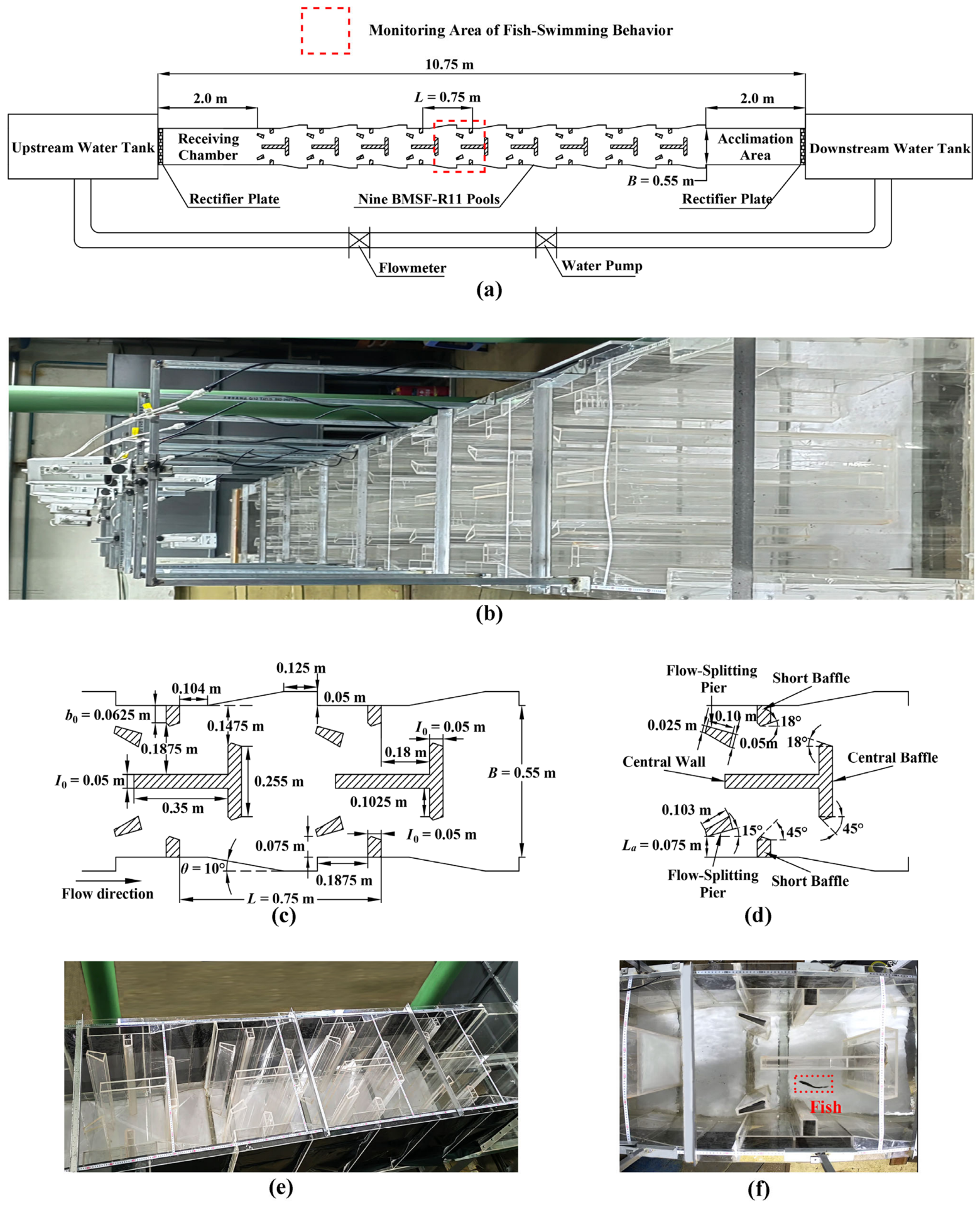
With a length ratio of λL = 1:4, the VSF and BMSF-R11 physical models were built at Dalian University of Technology, and were composed of an up/downstream water tank, an up/downstream rectifier plate, an upstream receiving chamber, nine middle fishway pools, a downstream acclimation area, a bottom water pipe (diameter = 0.125 m), a bottom flowmeter (DN125, Jinke Company, Kaifeng, China), and a bottom water pump (SGL125-100AG, Shimge Company, Wenling, China) (Figure 1 and Figure 2). According to the Froude similarity criterion, the flow-rate ratio (λQ) was equal to (λL)2.5 = 1:32, and hence the five physical-model flow rates (Qm) were 12.5, 18.75, 25.0, 31.25, and 37.5 L s−1 (corresponding to the prototype flow rate Q = 400, 600, 800, 1000, and 1200 L s−1, respectively). According to the turbulence–drag similarity law, the Manning roughness coefficient ratio (λn) is equal to (λL)1/6. In the prototype fishway, the surface of walls and baffles were considered as clean cement surfaces, and hence the prototype Manning roughness coefficient np had a value of 0.01 [53]. Consequently, the physical-model Manning roughness coefficient nm = np/[(λL)1/6] = 0.0079, and this is the reason why plexiglass (with a Manning roughness coefficient of 0.0079–0.0097 [55]) was chosen as the building material in this study. Opaque white papers were stuck to the outside of walls or added to the inside of baffles to avoid the influence of the building material transparency on fish-swimming behavior, but these white papers were partly or entirely removed when taking photos (Figure 1b,e,f and Figure 2b,e,f). The steel frame was mounted externally to enhance the structural stability, and one high-resolution camera (DS-2CD3T86FWDV3-I3S, Hikvision Company, Hangzhou, China) was installed right above each pool to instantaneously record the locations of fish. Fish-swimming behavior, fish-swimming trajectory, and fish-occurrence frequency, were monitored in real time in the fifth pool, marked out by the red dashed square box in Figure 1a and Figure 2a.
Figure 1.
The geometrical arrangement of a laboratory vertical-slot fishway (VSF, Bombač et al. (2015) [56]) physical model with a length ratio of λL = 1:4: (a) 2-D schematic diagram; (b) overall photo; (c,d) pool details; (e) local photo; (f) fish-passing photo.
Figure 2.
The geometrical arrangement of a laboratory bilateral-symmetric, multi-slot fishway (BMSF-R11, Zhang et al. (2025) [53]) physical model with a length ratio of λL = 1:4: (a) 2-D schematic diagram; (b) overall photo; (c,d) pool details; (e) local photo; (f) fish-passing photo.
Known as one of the four major Chinese carp, adult silver carp (Hypophthalmichthys molitrix) has a burst swimming speed (Uburst) of 1.49–1.85 m s−1, and is deemed a migratory, moderately swimming fish species [57]. The swimming behavior of juvenile fish in a physical model resembles that of adult fish in a prototype, given a similar body shape and hydraulic environment [58,59,60]. Therefore, a total of 600 juvenile silver carp, with a mean total length (TL) of 14.6 cm and a mean weight of 35.6 g, were bought from a fish pond. All fish were put into water-filled vessels aerated with oxygen to decrease the transport stress, and arrived at the laboratory within 12 h of capture. Fish were fed once after reaching the laboratory, and rested in a water tank for 2 days and nights before the start of the experiment. Two automatic heating sheets (380V-10A-4800W, Zhenfeng Company, Guangzhou, China) were utilized to maintain a constant water temperature of 25.0 ± 1.0 °C (the optimum water temperature of silver carp) during the whole experimental period. Sixty of the fish were divided into 12 groups (five fish in each trial group), and were tested under each operating condition with collaborative swimming strategies being observed [61,62]. The five fish in each trial group were simultaneously tested; therefore, each fish was tested only once to prevent learning effects. When performing the experiment, the five fish were simultaneously put into the acclimation area, and were allowed to migrate of their own volition. The fish-swimming route of each fish was monitored in real time. If a fish reached the receiving chamber in under 30 min, this fish was regarded as successful and immediately removed from the flume to avoid interfering with other fish. The maximum allowed time (i.e., 30 min) in this study was close to that employed in previous studies [58,63,64]. Fish failing to arrive at the receiving chamber within 30 min were deemed to be unsuccessful, and were also removed from the flume before starting the next trial group. All tested fish were kept alive during the experimental process and were released to the Lingshui River (flowing through Dalian University of Technology) after finishing the experiment.
2.3. Data Processing
During the experiment, juvenile silver carp were observed to swim at approximately half the water depth (i.e., the z = 0.50 hm plane). Therefore, in addition to hm, Umax, kmax, and |τxy|max, the spatial-averaged, time-averaged velocity magnitude/TKE/RSS X–Y component magnitude along the slot section at the z = 0.50 hm plane (i.e., U*/k*/|τxy|*) was also been calculated in the middle pool. The aforementioned seven hydrodynamic parameters were treated as potential influencing factors that affected fish-passing efficiency in this study. Furthermore, the velocity uniformity coefficient along the slot section (β), defined as × 100%, was also computed in the middle pool, where is the mean water velocity, Ui is the local water velocity, and N denotes sample size.
Four parameters helped assess fish-passing efficiency under each operating condition—passage success rate (PSR, the ratio of the number of successful vs. tested fish), mean fish transit time (MFTT, the mean time spent to reach the receiving chamber for all successful fish), entrance efficiency (EE, the numerical ratio of successful vs. attempted entries), and mean entrance time (MET, the mean time spent negotiating the first slot for the fastest fish of each trial group). Logger Pro 3.8.4 was adopted to track the fish locations frame-by-frame using high-resolution video recording, and consequently, the fish-swimming trajectory (FST) of each fish was obtained. The z = 0.50 hm plane in the middle pool was uniformly subdivided into about 600 square cells (each cell was 0.10 m long and wide). By superposing the original fish-swimming trajectories on these square cells, both the spatial distribution of the fish-occurrence frequency number and the frequency number statistics within different ranges of U/k/|τxy| could be achieved. In addition, the aforementioned fish-swimming trajectories and fish-occurrence frequency numbers were overlaid on the U/k/|τxy| contours of the z = 0.50 hm plane, with the aid of MATLAB 8.6.
2.4. Statistical Analysis
Analysis of variance (ANOVA), ridge regression analysis, and Spearman correlation analysis were conducted with the help of IBM SPSS Statistics-V26.0. ANOVA was used to check for differences between the VSF and BMSF-R11 regarding water temperature, fish length, fish weight, the seven hydrodynamic parameters (i.e., hm, Umax, U*, kmax, k*, |τxy|max, and |τxy|*), and the four fish-passing parameters (i.e., PSR, MFTT, EE, and MET). Ridge regression analysis helped determine which hydrodynamic parameters significantly affected the four fish-passing parameters of both the VSF and BMSF-R11. Spearman correlation analysis was adopted to ascertain the correlation between fish-occurrence frequency and the background U/k/|τxy| value at five different flow rates.
3. Results
3.1. Hydrodynamic Result
In the VSF and BMSF-R11 at Q = 400~1200 L s−1, hm fell within the range 0.49–1.34 m vs. 0.47–1.30 m; U* was in the range of 1.41–1.56 m s−1 vs. 0.61–0.77 m s−1; Umax reached 1.92–2.08 m s−1 vs. 1.12–1.15 m s−1; k* was equal to 0.089–0.096 m2 s−2 vs. 0.032–0.036 m2 s−2; kmax reached 0.150–0.214 m2 s−2 vs. 0.073–0.083 m2 s−2; |τxy|* was 0.3–0.4 Pa vs. 3.1–5.7 Pa; |τxy|max reached 54–101 Pa vs. 36–52 Pa; and β lay in the range of 85–87% vs. 57–64%, respectively (Table 1).
Table 1.
Comparison between the VSF and BMSF-R11 in terms of the spatial-averaged, time-averaged water-depth (hm); spatial-averaged, time-averaged velocity magnitude/TKE/RSS X–Y component magnitude along the slot section at the z = 0.50 hm plane (U*/k*/|τxy|*); maximum time-averaged velocity magnitude/TKE/RSS X–Y component magnitude (Umax/kmax/|τxy|max); and velocity uniformity coefficient along the slot section (β) in the middle pool.
3.2. Fish-Passing Efficiency
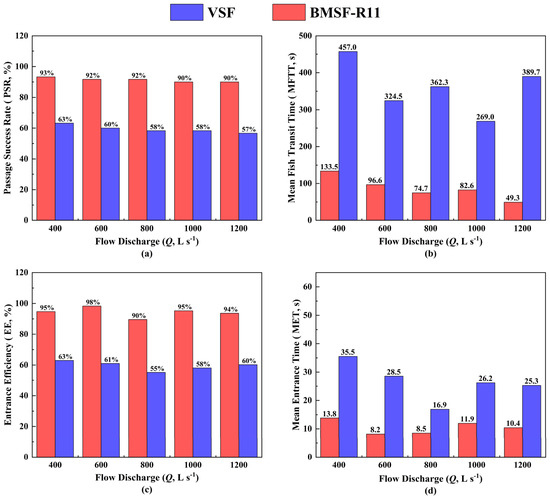
At Q = 400–1200 L s−1, for the VSF and BMSF-R11, PSR values were 57–63% vs. 90–93%; MFTT values were 269.0–457.0 s vs. 49.3–133.5 s; EE values were 55–63% vs. 90–98%; and MET values were 16.9–35.5 s vs. 8.2–13.8 s, respectively (Figure 3). ANOVA revealed that the differences between the VSF and BMSF-R11 were not significant (p > 0.10) for hm, water temperature, fish length, and fish weight, but had a significance level of p < 0.01 with respect to Umax, U*, kmax, k*, |τxy|max, |τxy|*, PSR, MFTT, EE, and MET. Furthermore, as shown in Table 2, ridge regression analysis demonstrated that both PSR and EE were significantly correlated with Umax, U*, kmax, and k* (p < 0.05); MFTT was only significantly correlated with Umax and k* (p < 0.05); but MET was not significantly correlated with any hydrodynamic parameter considered (p > 0.05).
Figure 3.
Comparison of four fish-passing parameters between the VSF and BMSF-R11 at five different flow rates: (a) passage success rate (PSR); (b) mean fish transit time (MFTT); (c) entrance efficiency (EE); (d) mean entrance time (MET).
Table 2.
The ridge regression analysis between four fish-passing parameters (i.e., PSR, MFTT, EE, and MET) and six hydrodynamic parameters (i.e., U*, Umax, k*, kmax, |τxy|*, and |τxy|max) at Q = 400–1200 L s−1 for both the VSF and BMSF-R11.
3.3. Fish-Swimming Trajectory
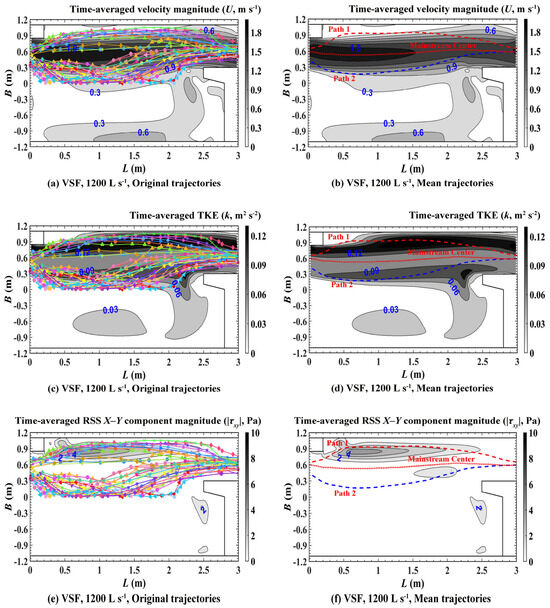
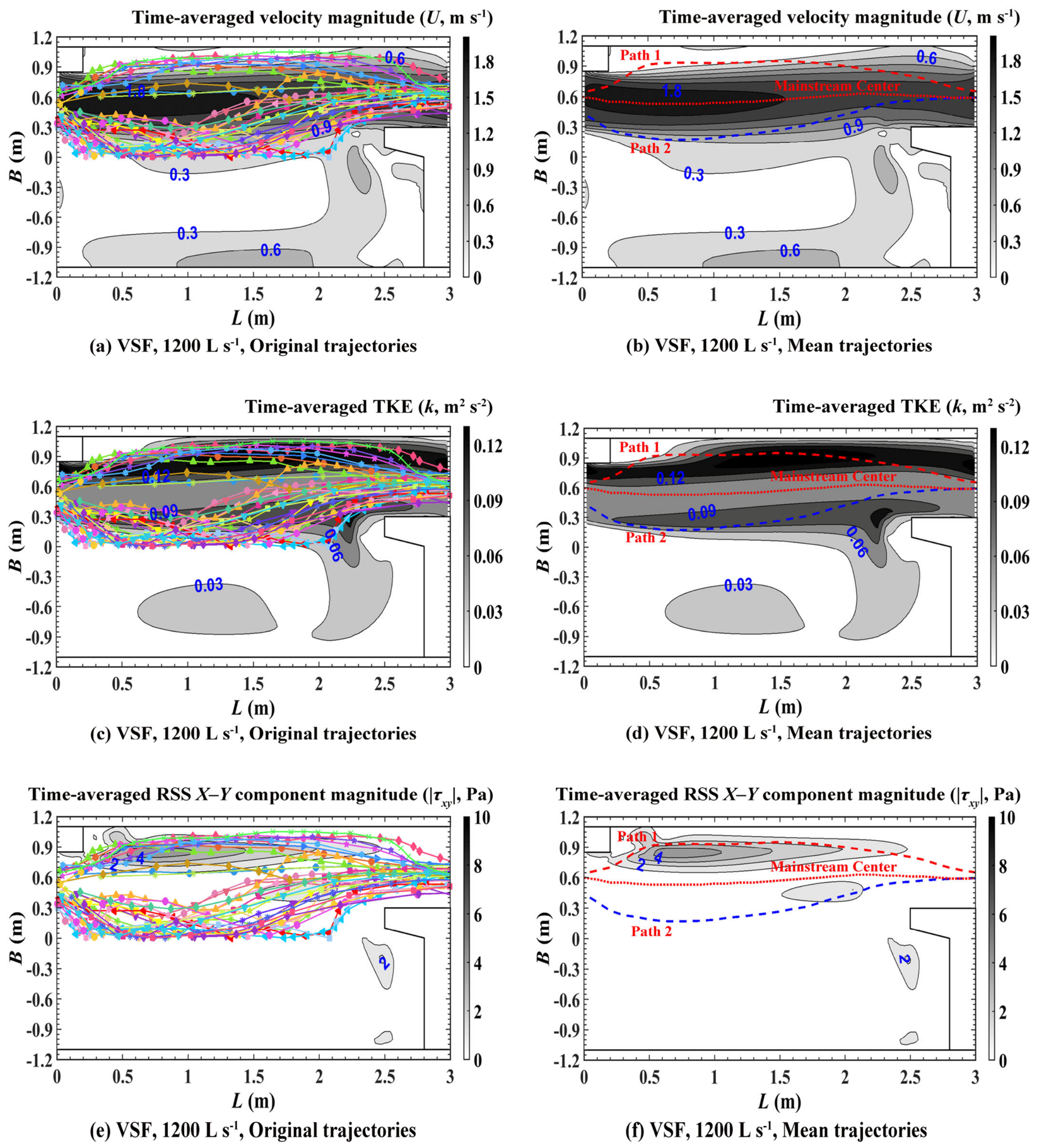
In the VSF, two primary fish-passing paths (i.e., Path 1 and Path 2) can be recognized from the original fish-swimming trajectories at Q = 400–1200 L s−1. Due to the similarity in fish-swimming trajectories among different flow rates, the original fish-swimming trajectories and the two primary paths’ mean trajectories are exhibited only at Q = 1200 L s−1 for conciseness (Figure 4). When looking downstream, Path 1 was situated at the left side of the mainstream, and had a PSR value of 33%, 32%, 27%, 20%, and 17% at Q = 400, 600, 800, 1000, and 1200 L s−1, respectively (Table 3). Path 2 was located at the right side of the mainstream, and had a PSR value of 27%, 23%, 28%, 33%, and 35% at Q = 400, 600, 800, 1000, and 1200 L s−1, respectively. A few fish (accounting for 3–5%) did not choose the above two paths, but directly penetrated the mainstream to reach upstream.
Figure 4.
Fish-swimming trajectories are overlaid on three hydrodynamic variables at the z = 0.50 hm plane in the VSF (taking Q = 1200 L s−1 as an example): (a,c,e) original fish-swimming trajectories; (b,d,f) mean trajectories of two primary paths, where red dashed lines represent Path 1 and blue dashed lines signify Path 2.
Table 3.
The passage success rates (i.e., PSR values) of different fish-passing paths in the middle pool of the VSF and BMSF-R11 at Q = 400–1200 L s−1.
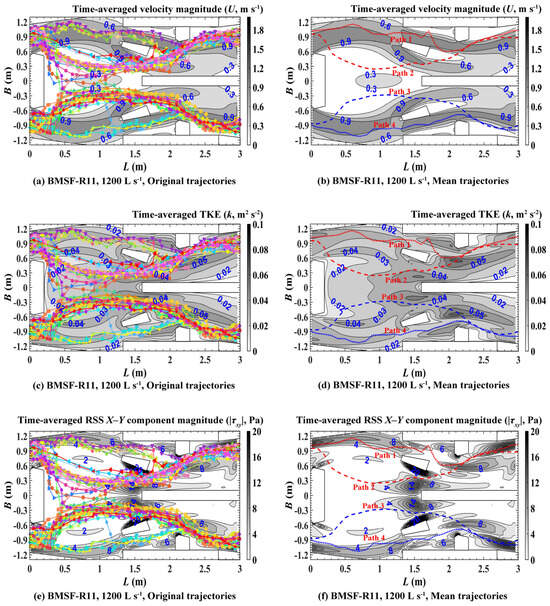
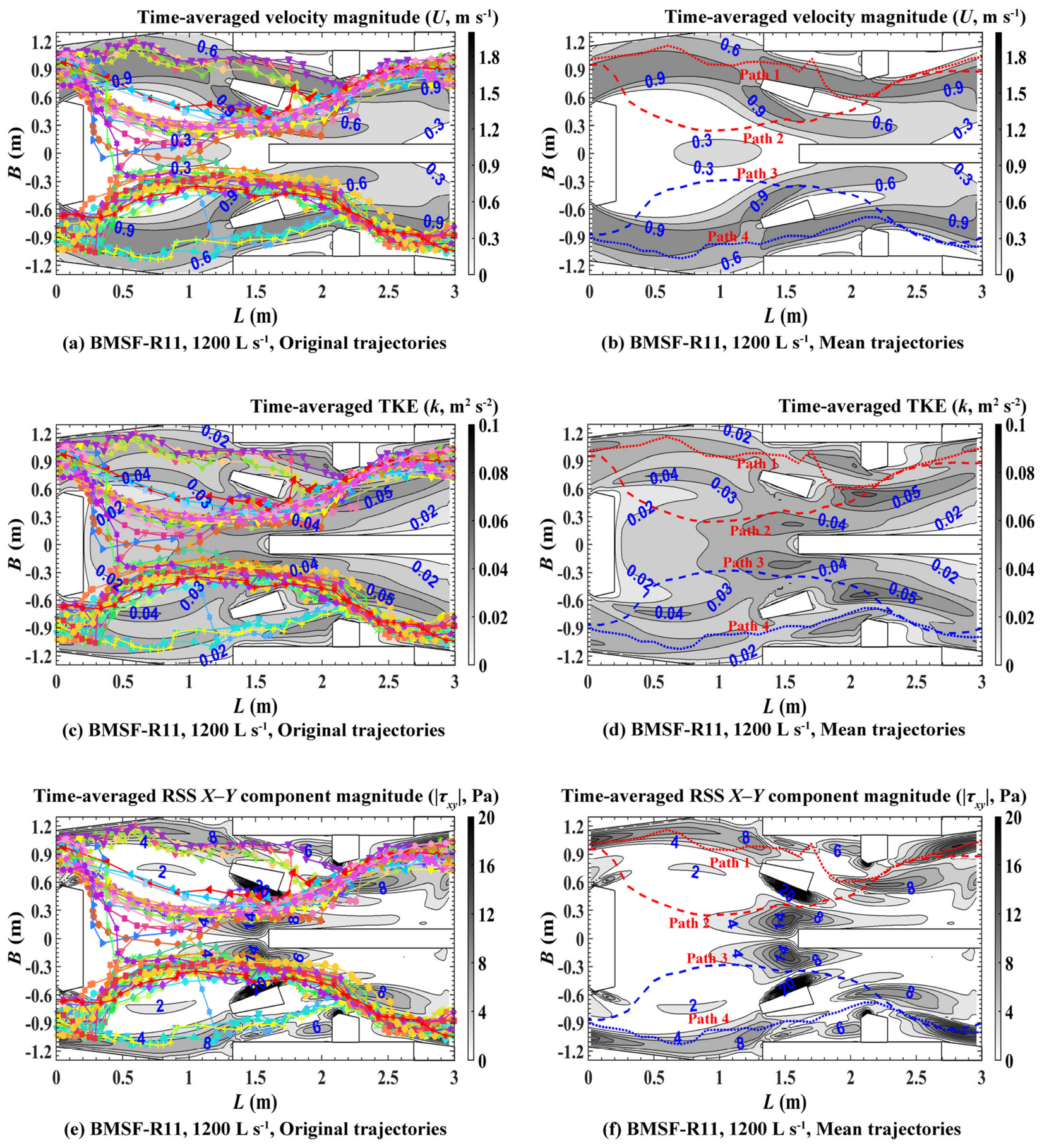
In the BMSF-R11, four primary fish-passing paths (i.e., Path 1, Path 2, Path 3, and Path 4) could be identified from the original fish-swimming trajectories at Q = 400–1200 L s−1. Path 1 and Path 4 were situated between the flow-splitting piers and lateral walls (Figure 5), and had PSR values of 5–8% and 3–8%, respectively, at Q = 400–1200 L s−1 (Table 3). Path 2 and Path 3 were located between the flow-splitting piers and central wall, and had PSR values of 37–43% at Q = 400–1200 L s−1. A small number of fish switched paths during the migration process, so such fish were regarded as belonging to the path occupied for the most time.
Figure 5.
Fish-swimming trajectories are overlaid on three hydrodynamic variables at the z = 0.50 hm plane in the BMSF-R11 (taking Q = 1200 L s−1 as an example): (a,c,e) original fish-swimming trajectories; (b,d,f) mean trajectories of the four primary paths, where red dotted lines represent Path 1, red dashed lines signify Path 2, blue dashed lines denote Path 3, and blue dotted lines indicate Path 4.
3.4. Fish-Occurrence Frequency
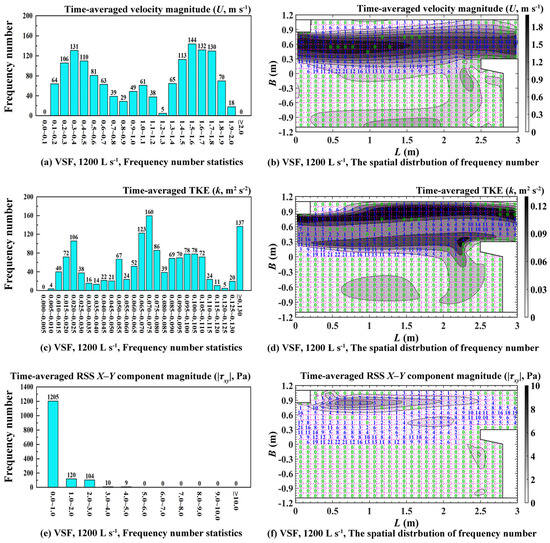
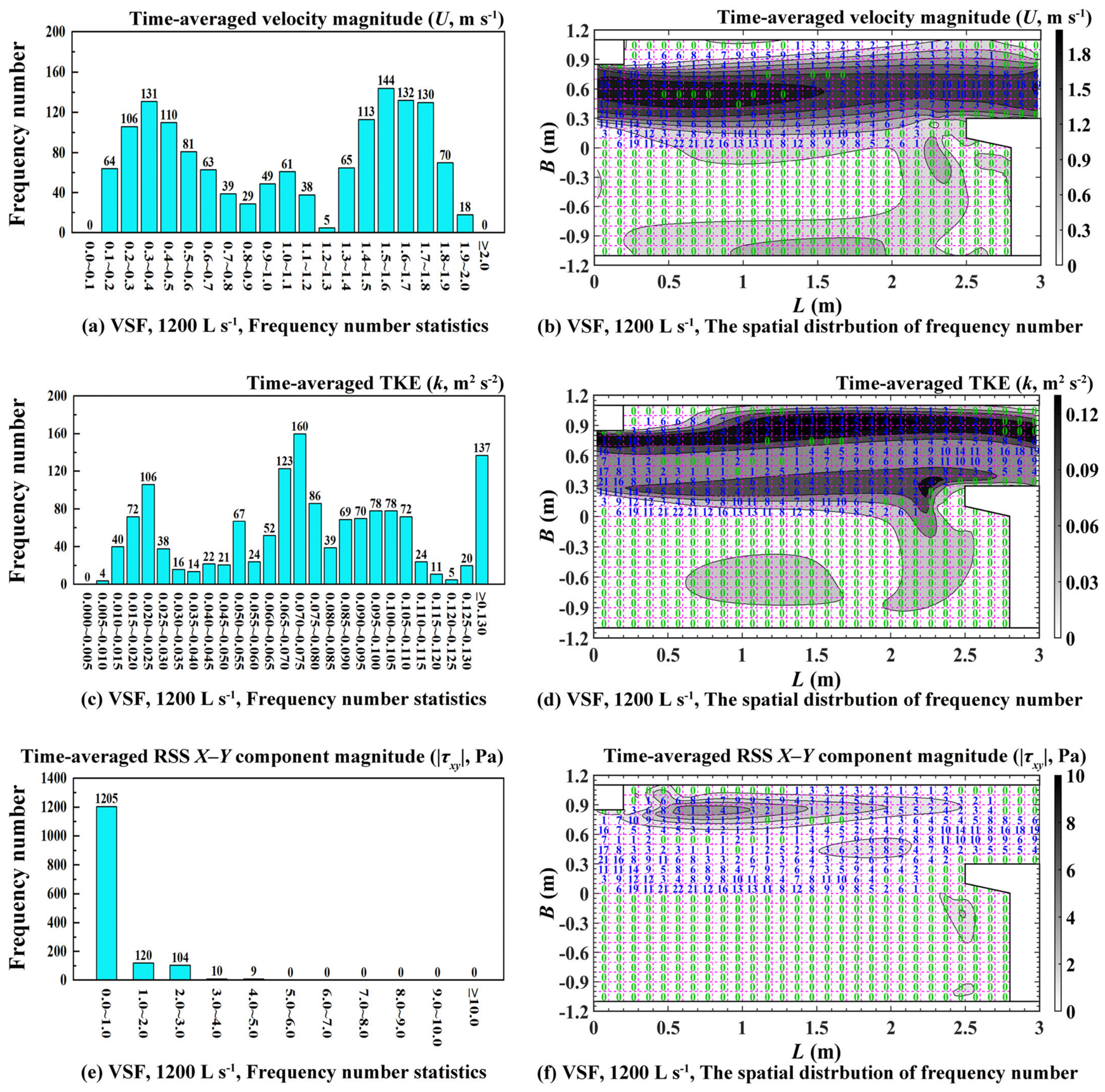
In the VSF or BMSF-R11, the relationship between fish-occurrence frequency and the background U/k/|τxy| was analogous at Q = 400–1200 L s−1, and hence fish-occurrence frequency number and frequency number statistics are displayed only at Q = 1200 L s−1 for conciseness. In the VSF, the spatial distribution of the fish-occurrence frequency number is overlaid on the background U/k/|τxy| contours (Figure 6b,d,f), and frequency number statistics within different ranges of U/k/|τxy| are shown in Figure 6a,c,e. At Q = 400, 600, 800, 1000, and 1200 L s−1, the highest fish-occurrence frequency numbers occurred in U ≤ 1.8 m s−1 (occupying 100%, 99%, 96%, 97%, and 94%, respectively), 0.010 m2 s−2 ≤ k ≤ 0.150 m2 s−2 (occupying 93%, 89%, 86%, 90%, and 97%, respectively), and |τxy| ≤ 5 Pa (occupying 99%, 100%, 100%, 100%, and 100%, respectively). Spearman correlation analysis showed that the fish-occurrence frequency number was significantly negatively correlated with the background |τxy| (r = −0.969–−0.701, p < 0.05), but did not have a significant correlation with the background U and k (Table 4).
Figure 6.
Fish-occurrence frequency at the z = 0.50 hm plane in the VSF (taking Q = 1200 L s−1 as an example): (a,c,e) frequency number statistics within different ranges of three hydrodynamic variables; (b,d,f) the spatial distribution of the fish-occurrence frequency number.
Table 4.
Spearman correlation analysis between the fish-occurrence frequency number and the background U/k/|τxy| value at five different flow rates in the VSF and BMSF-R11 (p signifies the significance level, * denotes p < 0.05, ** indicates p < 0.01, and *** signifies p < 0.001).
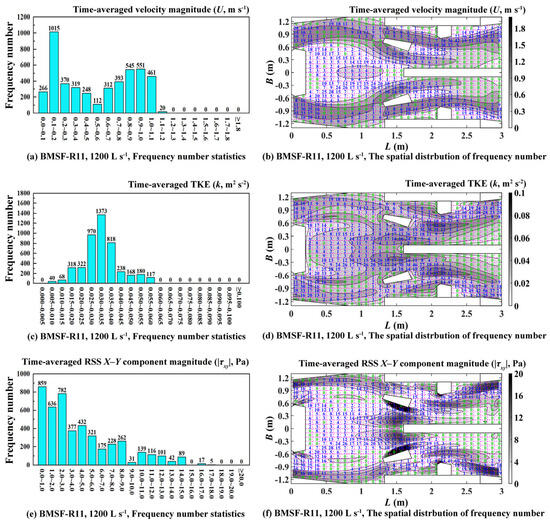
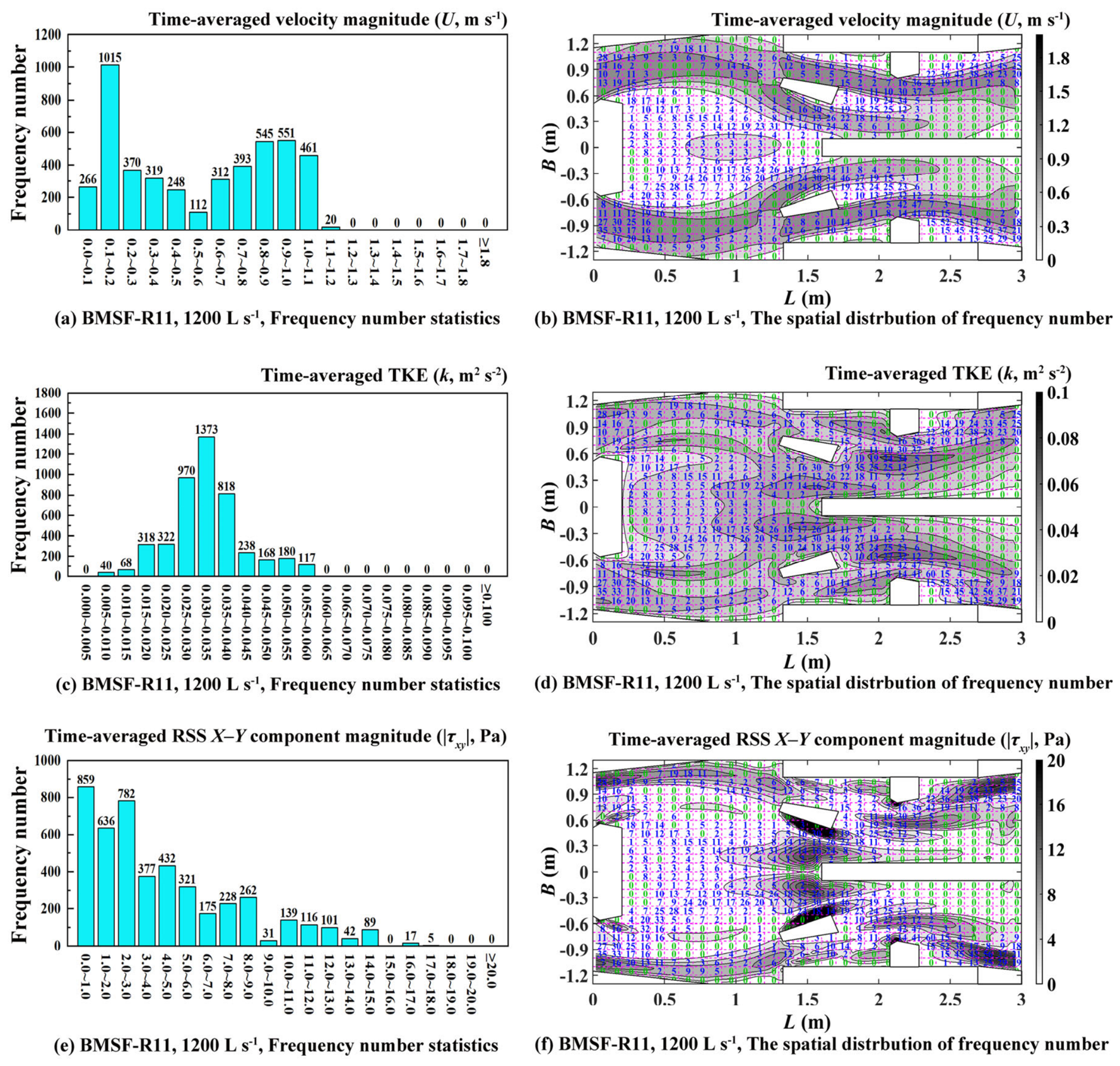
In the BMSF-R11 at Q = 400, 600, 800, 1000, and 1200 L s−1, most fish-occurrence frequency numbers arose in the area of U ≤ 1.0 m s−1 (accounting for 92%, 92%, 89%, 91%, and 90%, respectively), 0.010 m2 s−2 ≤ k ≤ 0.050 m2 s−2 (accounting for 96%, 96%, 94%, 96%, and 93%, respectively), and |τxy| ≤ 10 Pa (accounting for 99%, 98%, 88%, 85%, and 89%, respectively) (Figure 7). Spearman correlation analysis confirmed that the fish-occurrence frequency number was significantly negatively correlated with both U (r = −0.609–−0.551, p < 0.05) and |τxy| (r = −0.963–−0.915, p < 0.001) (Table 4).
Figure 7.
Fish-occurrence frequency at the z = 0.50 hm plane in the BMSF-R11 (taking Q = 1200 L s−1 as an example): (a,c,e) frequency number statistics within different ranges of three hydrodynamic variables; (b,d,f) the spatial distribution of the fish-occurrence frequency number.
4. Discussion
When adopting the same geometric layout (i.e., L = 3.0 m, B = 2.2 m, H = 2.5 m, S = 1.67%, and the slot width bs = 0.59~0.75 m), the BMSF-R11 offered better hydrodynamic performance than the VSF at Q = 400–1200 L s−1, due to the former’s much smaller U*, Umax, k*, kmax, and |τxy|max [53,56,65]. Considering that the maximum water velocity should not exceed the Uburst value of target fishes for passage, the BMSF-R11 and VSF are theoretically appropriate for fishes with Uburst > 1.12–1.15 m s−1 vs. Uburst > 1.92–2.08 m s−1, respectively. In addition, the BMSF-R11 and VSF possessed approximately equal water depth at the same flow rate (hm = 0.47–1.30 m vs. 0.49–1.34 m), and satisfied the requirement that the fishway water depth should be no lower than 0.40–0.50 m [29,37]. In addition, the VSF had a much larger velocity uniformity coefficient along the slot section (β = 85–87%) when compared to the BMSF-R11 (β = 57–64%), as the mainstream was linear in the VSF (directly running through different vertical slots) but had an S-shape in the BMSF-R11.
For the purpose of verifying that the BMSF-R11 was more favorable for the upstream migration of moderately swimming fishes with Uburst > 1.12–1.15 m s−1, we selected juvenile silver carp to conduct fish-passage experiments in both the VSF and BMSF-R11 physical models. As expected, experimental results confirmed that the BMSF-R11 generated much larger PSR and EE (as well as obviously smaller MFTT and MET), and hence possessed higher fish-passing efficiency than the VSF. The relatively lower velocity and turbulence in the BMSF-R11 can promote the upstream migration of fish, in accordance with the observations of others [58,66,67,68]. Water temperature, fish length, fish weight, and the hm value were not significantly different between the VSF and BMSF-R11, so these factors did not significantly affect the four fish-passing parameters. The ridge regression analysis revealed that fish-passing efficiency was mainly affected by velocity and TKE, corroborating the conclusion in some previous studies [47,69,70].
At x = 0.2–2.3 m of the VSF pool (where x is the streamwise coordinate), the two primary fish-passing paths deviated from the mainstream core because fish tend to reduce the energy consumption of migration as much as possible [44]. In the slot area of the VSF (e.g., x = 0.0–0.2 m and 2.3–3.0 m), both Path 1 and Path 2 lay nearly on the mainstream core because fish have no other choice but to penetrate the mainstream core so as to reach upstream. In the VSF, the two primary fish-passing paths had a roughly linear shape, due to its linear mainstream. With the growth of flow rate, the PSR of Path 1 decreased from 33% at Q = 400 L s−1 to 17% at Q = 1200 L s−1, but that of Path 2 increased from 27% at Q = 400 L s−1 to 35% at Q = 1200 L s−1. In the BMSF-R11, there were four primary S-shaped fish-passing paths, which corresponded to its four S-shaped mainstream branches. The PSR values of Path 1 and Path 4 were nearly equivalent (5–8% vs. 3–8%), and were much lower those that of Path 2 and Path 3 (37–43%).
At the z = 0.50 hm plane, the VSF had much larger U and k values, but relatively smaller |τxy| values than the BMSF-R11. Consequently, at Q = 400–1200 L s−1, most fish-occurrence frequency numbers occurred in the region of U ≤ 1.8 m s−1, 0.010 m2 s−2 ≤ k ≤ 0.150 m2 s−2, and |τxy| ≤ 5 Pa in the VSF, but U ≤ 1.0 m s−1, 0.010 m2 s−2 ≤ k ≤ 0.050 m2 s−2, and |τxy| ≤ 10 Pa in the BMSF-R11. Fish-occurrence frequency was only significantly correlated with |τxy| in the VSF, but it had a significant correlation with both U and |τxy| in the BMSF-R11, resembling the results of Zhang et al. [64,71]. The velocity uniformity coefficient along the slot section β = 85–87% in the VSF signifies that fish had limited opportunities to choose small water velocities when negotiating the slot section, and hence U did not significantly correlate with fish-occurrence frequency in the VSF. However, β = 57–64% in the BMSF-R11 means that fish had numerous opportunities to select slow water velocities when passing the slot section, and therefore U was significantly correlated with fish-occurrence frequency in the BMSF-R11.
5. Conclusions
By combining 3-D numerical simulations and laboratory fish-passage experiments, this study makes a systematic comparison between the traditional VSF and the novel BMSF-R11 (with the same prototype pool length L = 3.0 m, pool width B = 2.2 m, pool height H = 2.5 m, bed slope S = 1.67%, and slot width bs = 0.59–0.75 m). The hydrodynamic parameters, fish-passing efficiency, fish-swimming trajectory, and fish-occurrence frequency were examined. The main conclusions include the following aspects:
The BMSF-R11 provided better hydrodynamic performance than the VSF, owing to the former’s much smaller U* (0.61–0.77 vs. 1.41–1.56 m s−1), Umax (1.12–1.15 vs. 1.92–2.08 m s−1), k* (0.032–0.036 vs. 0.089–0.096 m2 s−2), kmax (0.073–0.083 vs. 0.150–0.214 m2 s−2), and |τxy|max (36–52 vs. 54–101 Pa). As expected, the BMSF-R11 possessed higher fish-passing efficiency than the VSF, given the former’s much larger PSR (90–93% vs. 57–63%) and EE (90–98% vs. 55–63%), as well as much smaller MFTT (49.3–133.5 vs. 269.0–457.0 s) and MET (8.2–13.8 vs. 16.9–35.5 s). PSR and EE were significantly correlated with Umax, U*, kmax, and k*; MFTT was only significantly correlated with Umax and k*; but MET was not significantly correlated with any hydrodynamic parameter considered. In the VSF, the two primary fish-passing paths were roughly straight, and their PSR values were 17–33% and 23–35%, respectively. In the BMSF-R11, the four primary fish-passing paths exhibited an S-shape, and their PSR values were equal to 5–8%, 37–43%, 37–43%, and 3–8%, respectively. The fish-occurrence frequency was only significantly correlated with |τxy| in the VSF, but had a significant correlation with both U and |τxy| in the BMSF-R11. In summary, at Q = 400–1200 L s−1, this study provides up to eight hydrodynamic variables for both a VSF and the BMSF-R11, verifies that the BMSF-R11 is more favorable for the upstream migration of silver carp than a VSF, and reveals the hydrodynamic factors affecting fish-passing efficiency and fish-occurrence frequency in both a VSF and the BMSF-R11.
The higher fish-passing efficiency of the BMSF-R11 can be attributed to its better hydrodynamic performance, namely, more ample migration space and lower mainstream velocity/turbulence. Future study should validate the fish-passing efficiency of the BMSF-R11 for wild fishes with different living habits and swimming capabilities, as well as field-testing, to decide whether the BMSF-R11 can serve as an efficient multi-species fishway.
Author Contributions
D.Z.: Conceptualization, Methodology, Investigation, and Writing—original draft; X.C.: Validation, Data curation, and Visualization; C.Z.: Supervision and Writing—review and editing; D.L.: Supervision and Writing—review and editing; Y.L.: Conceptualization, Supervision, and Funding acquisition. All authors have read and agreed to the published version of the manuscript.
Funding
This research was funded by the National Natural Science Foundation of China (grant numbers 52479060 and 52179060), the Open Fund of State Key Laboratory of Hydraulic Engineering Intelligent Construction and Operation (Tianjin University, grant number HESS-2413), and the Natural Science Foundation of Liaoning Province (grant number 2025-MS-024).
Institutional Review Board Statement
All fish samples were commercially obtained. This study only involved observations of fish and did not involve animal experiments. Animal welfare and the animal experimental protocol were strictly consistent with related ethics regulations of Dalian University of Technology.
Informed Consent Statement
Not applicable.
Data Availability Statement
The original contributions presented in this study are included in the article. Further inquiries can be directed to the corresponding authors.
Acknowledgments
We thank the two anonymous reviewers for helpful peer review.
Conflicts of Interest
The authors declare no conflicts of interest.
Abbreviations
The following abbreviations are used in this manuscript:
| BMSF | Bilateral-symmetric, multi-slot fishway |
| VSF | Vertical-slot fishway |
| MSF | Multi-slot fishway |
| FST | Fish-swimming trajectory |
| TKE | Turbulent kinetic energy |
| RSS | Reynolds shear stress |
| PSR | Passage success rate |
| EE | Entrance efficiency |
| MFTT | Mean fish transit time |
| MET | Mean entrance time |
| ANOVA | Analysis of variance |
| TL | Total length |
References
- Castro-Santos, T. Modeling the effect of varying swim speeds on fish passage through velocity barriers. Trans. Am. Fish. Soc. 2006, 135, 1230–1237. [Google Scholar] [CrossRef] [Scilit]
- Moser, M.L.; Keefer, M.L.; Pennington, H.T.; Ogden, D.A.; Simonson, J.E. Development of Pacific lamprey fishways at a hydropower dam. Fish. Manag. Ecol. 2011, 18, 190–200. [Google Scholar]
- Twardek, W.M.; Chapman, J.M.; Miller, K.M.; Beere, M.C.; Li, S.; Kaukinen, K.H.; Danylchuk, A.J.; Cooke, S.J. Evidence of a hydraulically challenging reach serving as a barrier for the upstream migration of infection-burdened adult steelhead. Conserv. Physiol. 2019, 7, coz023. [Google Scholar] [PubMed]
- Castro-Santos, T.; Kieffer, M.; Goerig, E. Sprinting performance and behavior of adult shortnose sturgeon (Acipenser brevirostrum). Can. J. Fish. Aquat. Sci. 2024, 81, 1495–1513. [Google Scholar] [CrossRef] [Scilit]
- Ke, S.; Xiang, S.; Kattel, G.R.; Li, D.; Tu, Z.; Shi, X. Design and initial evaluation of a novel tubular fishway for the rubber dam on the Huangbai River, a tributary of the Gezhouba Reservoir. J. Environ. Manag. 2025, 381, 125301. [Google Scholar] [CrossRef] [Scilit]
- Stuart, I.G.; Williams, A.; McKenzie, J.; Holt, T. Managing a migratory pest species: A selective trap for common carp. N. Am. J. Fish. Manag. 2006, 26, 888–893. [Google Scholar] [CrossRef] [Scilit]
- Yao, W.; Rutschmann, P. Three high flow experiment releases from Glen Canyon Dam on rainbow trout and flannelmouth sucker habitat in Colorado River. Ecol. Eng. 2015, 75, 278–290. [Google Scholar] [CrossRef] [Scilit]
- Branco, P.; Santos, J.M.; Katopodis, C.; Pinheiro, A.; Ferreira, M.T. Effect of flow regime hydraulics on passage performance of Iberian chub (Squalius pyrenaicus) (Günther, 1868) in an experimental pool-and-weir fishway. Hydrobiologia 2013, 714, 145–154. [Google Scholar] [CrossRef] [Scilit]
- Santos, J.M.; Branco, P.; Katopodis, C.; Ferreira, T.; Pinheiro, A. Retrofitting pool-and-weir fishways to improve passage performance of benthic fishes: Effect of boulder density and fishway discharge. Ecol. Eng. 2014, 73, 335–344. [Google Scholar] [CrossRef] [Scilit]
- Fuentes-Pérez, J.F.; Eckert, M.; Tuhtan, J.A.; Ferreira, M.T.; Kruusmaa, M.; Branco, P. Spatial preferences of Iberian barbel in a vertical slot fishway under variable hydrodynamic scenarios. Ecol. Eng. 2018, 125, 131–142. [Google Scholar] [CrossRef] [Scilit]
- Katopodis, C.; Williams, J.G. The development of fish passage research in a historical context. Ecol. Eng. 2012, 48, 8–18. [Google Scholar] [CrossRef] [Scilit]
- Branco, P.; Boavida, I.; Santos, J.M.; Pinheiro, A.; Ferreira, M.T. Boulders as building blocks: Improving habitat and river connectivity for stream fish. Ecohydrology 2013, 6, 627–634. [Google Scholar]
- Baki, A.B.M.; Zhu, D.Z.; Rajaratnam, N. Mean flow characteristics in a rock-ramp-type fish pass. J. Hydraul. Eng. 2014, 140, 156–168. [Google Scholar] [CrossRef] [Scilit]
- Silva, A.T.; Lucas, M.C.; Castro-Santos, T.; Katopodis, C.; Baumgartner, L.J.; Thiem, J.D.; Aarestrup, K.; Pompeu, P.S.; O’Brien, G.C.; Braun, D.C.; et al. The future of fish passage science, engineering, and practice. Fish. Fish. 2018, 19, 340–362. [Google Scholar]
- Baki, A.B.M.; Azimi, A.H. Hydraulics and design of fishways II: Vertical-slot and rock-weir fishways. J. Ecohydraul. 2024, 9, 158–170. [Google Scholar]
- Yang, F.; Zeng, Y.; Huai, W.; Zha, W.; Wan, Y. Responses of cyprinid (Ancherythroculter nigrocauda) to flow with a semi-circular cylinder patch. J. Fish Biol. 2022, 100, 884–893. [Google Scholar] [CrossRef] [Scilit] [PubMed]
- Bunt, C.M.; Castro-Santos, T.; Haro, A. Performance of fish passage structures at upstream barriers to migration. River Res. Appl. 2012, 28, 457–478. [Google Scholar]
- Bravo-Córdoba, F.J.; Sanz-Ronda, F.J.; Ruiz-Legazpi, J.; Fernandes Celestino, L.; Makrakis, S. Fishway with two entrance branches: Understanding its performance for potamodromous Mediterranean barbels. Fish. Manag. Ecol. 2018, 25, 12–21. [Google Scholar]
- Twardek, W.M.; Ekström, A.; Eliason, E.J.; Lennox, R.J.; Tuononen, E.; Abrams, A.E.I.; Jeanson, A.L.; Cooke, S.J. Field assessments of heart rate dynamics during spawning migration of wild and hatchery-reared Chinook salmon. Philos. Trans. R. Soc. B 2021, 376, 20200214. [Google Scholar] [CrossRef] [Scilit]
- Pon, L.B.; Hinch, S.G.; Cooke, S.J.; Patterson, D.A.; Farrell, A.P. Physiological, energetic and behavioural correlates of successful fishway passage of adult sockeye salmon Oncorhynchus nerka in the Seton River, British Columbia. J. Fish Biol. 2009, 74, 1323–1336. [Google Scholar] [CrossRef] [Scilit] [PubMed]
- Yang, F.; Zeng, Y. Collective swimming pattern and synchronization of fish pairs (Gobiocypris rarus) in response to flow with different velocities. J. Fish Biol. 2025, 106, 442–452. [Google Scholar] [PubMed]
- Bao, J.; Li, W.; Zhang, C.; Mi, X.; Li, H.; Zhao, X.; Cao, N.; Twardek, W.M.; Cooke, S.J.; Duan, M. Quantitative assessment of fish passage efficiency at a vertical-slot fishway on the Daduhe River in Southwest China. Ecol. Eng. 2019, 141, 105597. [Google Scholar] [CrossRef] [Scilit]
- Twardek, W.M.; Cooke, S.J.; Lapointe, N.W.R. Fishway performance of adult Chinook salmon completing one of the world’s longest inland salmon migrations to the upper Yukon River. Ecol. Eng. 2023, 187, 106846. [Google Scholar] [CrossRef] [Scilit]
- Ning, Z.; Chen, J.; Jiang, C.; Liao, Y.; Ding, T.; Chen, Y.; Deng, B.; Meng, W. Sediment Deposition Impacts on Fish Migration in Vertical Slot Fishways. Fishes 2025, 10, 590. [Google Scholar] [CrossRef] [Scilit]
- Liu, M.; Rajaratnam, N.; Zhu, D.Z. Mean flow and turbulence structure in vertical slot fishways. J. Hydraul. Eng. 2006, 132, 765–777. [Google Scholar] [CrossRef] [Scilit]
- Cea, L.; Pena, L.; Puertas, J.; Vázquez-Cendón, M.E.; Peña, E. Application of several depth-averaged turbulence models to simulate flow in vertical slot fishways. J. Hydraul. Eng. 2007, 133, 160–172. [Google Scholar] [CrossRef] [Scilit]
- Fuentes-Pérez, J.F.; Sanz-Ronda, F.J.; Martínez de Azagra Paredes, A.; García-Vega, A. Modeling water-depth distribution in vertical-slot fishways under uniform and nonuniform scenarios. J. Hydraul. Eng. 2014, 140, 06014016. [Google Scholar] [CrossRef] [Scilit]
- Quaranta, E.; Katopodis, C.; Revelli, R.; Comoglio, C. Turbulent flow field comparison and related suitability for fish passage of a standard and a simplified low-gradient vertical slot fishway. River Res. Appl. 2017, 33, 1295–1305. [Google Scholar] [CrossRef] [Scilit]
- Zheng, T.; Tu, C.; Zhang, Z.; Sun, S.; Dai, H.; Li, G.; Liu, H. Vertical slot fishway design for fluctuating water-level reservoir. J. Hydraul. Res. 2025, 63, 117–125. [Google Scholar] [CrossRef] [Scilit]
- Mallen-Cooper, M.; Brand, D.A. Non-salmonids in a salmonid fishway: What do 50 years of data tell us about past and future fish passage? Fish. Manag. Ecol. 2007, 14, 319–332. [Google Scholar] [CrossRef] [Scilit]
- Calluaud, D.; Pineau, G.; Texier, A.; David, L. Modification of vertical slot fishway flow with a supplementary cylinder. J. Hydraul. Res. 2014, 52, 614–629. [Google Scholar] [CrossRef] [Scilit]
- Romão, F.; Branco, P.; Quaresma, A.L.; Amaral, S.D.; Pinheiro, A.N. Effectiveness of a multi-slot vertical slot fishway versus a standard vertical slot fishway for potamodromous cyprinids. Hydrobiologia 2018, 816, 153–163. [Google Scholar] [CrossRef] [Scilit]
- Ballu, A.; Pineau, G.; Calluaud, D.; David, L. Experimental-based methodology to improve the design of vertical slot fishways. J. Hydraul. Eng. 2019, 145, 04019031. [Google Scholar] [CrossRef] [Scilit]
- Tarena, F.; Comoglio, C.; Spairani, M.; Candiotto, A.; Ashraf, M.U.; Abbà, M.; Ruffino, C.; Nyqvist, D. Passage performance of three small-sized fish species in a Vertical Slot Fishway with and without overhead cover. Ecol. Eng. 2025, 219, 107713. [Google Scholar] [CrossRef] [Scilit]
- Rajaratnam, N.; Katopodis, C.; Solanki, S. New designs for vertical slot fishways. Can. J. Civ. Eng. 1992, 19, 402–414. [Google Scholar] [CrossRef] [Scilit]
- Stuart, I.G.; Berghuis, A.P. Upstream passage of fish through a vertical-slot fishway in an Australian subtropical river. Fish. Manag. Ecol. 2002, 9, 111–122. [Google Scholar] [CrossRef] [Scilit]
- Rodríguez, T.T.; Agudo, J.P.; Mosquera, L.P.; González, E.P. Evaluating vertical-slot fishway designs in terms of fish swimming capabilities. Ecol. Eng. 2006, 27, 37–48. [Google Scholar] [CrossRef] [Scilit]
- An, R.; Li, J.; Liang, R.; Tuo, Y. Three-dimensional simulation and experimental study for optimising a vertical slot fishway. J. Hydro-Environ. Res. 2016, 12, 119–129. [Google Scholar] [CrossRef] [Scilit]
- Puertas, J.; Pena, L.; Teijeiro, T. Experimental approach to the hydraulics of vertical slot fishways. J. Hydraul. Eng. 2004, 130, 10–23. [Google Scholar] [CrossRef] [Scilit]
- Stuart, I.G.; Baumgartner, L.J.; Zampatti, B.P. Lock gates improve passage of small-bodied fish and crustaceans in a low gradient vertical-slot fishway. Fish. Manag. Ecol. 2008, 15, 241–248. [Google Scholar] [CrossRef] [Scilit]
- Yao, W.; An, R.; Yu, G.; Li, J.; Ma, X. Identifying fish ecological risk patterns based on the effects of long-term dam operation schemes. Ecol. Eng. 2021, 159, 106102. [Google Scholar] [CrossRef] [Scilit]
- Eggers, F.; Schiavon, A.; Calles, O.; Watz, J.; Comoglio, C.; Candiotto, A.; Nyqvist, D. Fish behaviour in a vertical slot fishway: Multi-species upstream passage success, size selectivity and diel passage patterns in a large Italian river. River Res. Appl. 2025, 41, 849–863. [Google Scholar]
- Wang, Z.; Lai, M.; Li, H.; Wang, Y.; Zeng, R.; Lv, J.; He, T.; Han, C.; Wang, X. Light Color and Intensity-Dependent Modulation of Phototactic Behavior Mediating Orientation Guidance in Schizothoracine Fishes. Fishes 2026, 11, 200. [Google Scholar] [CrossRef] [Scilit]
- Chen, K.; Wang, X.; Li, Y.; Li, J.; Wu, L.; Lv, J.; Huang, Y.; Wang, B.; Shang, G. To initiate or to terminate: Effects of endurance status and hydraulic factors on fish upstream attempt behavior under high-flow conditions. Fishes 2026, 11, 427. [Google Scholar] [CrossRef] [Scilit]
- Larinier, M. Pool fishways, pre-barages and natural bypass channels. BFPP-Connaiss. Gest. Du Patrim. Aquat. 2002, 364, 54–82. [Google Scholar] [CrossRef] [Scilit]
- Fujihara, M.; Fukushima, T.; Tachibana, K. Numerical modelling of flows in vertical single-slot and double-slot fishways. In Advances in Hydraulics and Water Engineering: Volumes I & II; World Scientific: Singapore, 2002; pp. 1019–1024. [Google Scholar]
- Romão, F.; Quaresma, A.L.; Santos, J.M.; Amaral, S.D.; Branco, P.; Pinheiro, A.N. Multislot fishway improves entrance performance and fish transit time over vertical slots. Water 2021, 13, 275. [Google Scholar] [CrossRef] [Scilit]
- Lejeune, A.F.; Calluaud, D.; Pineau, G.; David, L. Numerical comparison of RANS, URANS and LES simulations of turbulent flow in vertical double slot fishways. In Proceedings of the 39th IAHR World Congress, Granada, Spain, 19–24 June 2022; International Association for Hydro-Environment Engineering and Research (IAHR): Madrid, Spain, 2022; pp. 1378–1386. [Google Scholar]
- Quaresma, A.L.; Romao, F.; Branco, P.; Ferreira, M.T.; Pinheiro, A.N. Multi slot versus single slot pool-type fishways: A modelling approach to compare hydrodynamics. Ecol. Eng. 2018, 122, 197–206. [Google Scholar] [CrossRef] [Scilit]
- Romão, F.; Quaresma, A.L.; Santos, J.M.; Branco, P.; Pinheiro, A.N. Cyprinid passage performance in an experimental multislot fishway across distinct seasons. Mar. Freshw. Res. 2019, 70, 881–890. [Google Scholar] [CrossRef] [Scilit]
- Branco, P.; Mascarenhas, A.M.; Duarte, G.; Romão, F.; Quaresma, A.; Amaral, S.D.; Ferreira, M.T.; Pinheiro, A.N.; Santos, J.M. Vertical slot fishways: Incremental knowledge to define the best solution. Biology 2023, 12, 1431. [Google Scholar] [CrossRef] [Scilit] [PubMed]
- Zhang, D.; Bian, X.; Shi, X.; Deng, J.; Liu, Y. Design of a bilateral-symmetric multi-slot fishway and its comparison with vertical slot fishway in terms of hydraulic properties. River Res. Appl. 2023, 39, 954–969. [Google Scholar] [CrossRef] [Scilit]
- Zhang, D.; Ren, T.; Liang, D.; Liu, Y. Hydrodynamic optimization of bilateral-symmetric multi-slot fishway using computational fluid dynamics. J. Hydraul. Res. 2025, 63, 188–203. [Google Scholar] [CrossRef] [Scilit]
- Silva, A.T.; Santos, J.M.; Ferreira, M.T.; Pinheiro, A.N.; Katopodis, C. Effects of water velocity and turbulence on the behaviour of Iberian barbel (Luciobarbus bocagei, Steindachner 1864) in an experimental pool-type fishway. River Res. Appl. 2011, 27, 360–373. [Google Scholar] [CrossRef] [Scilit]
- Fisher, C. Is slime the great hydraulic equalizer. PVC Pipe News 2004, 27, 11–14. [Google Scholar]
- Bombač, M.; Novak, G.; Mlačnik, J.; Četina, M. Extensive field measurements of flow in vertical slot fishway as data for validation of numerical simulations. Ecol. Eng. 2015, 84, 476–484. [Google Scholar] [CrossRef] [Scilit]
- Cai, L.; Katopodis, C.; Jin, Y.; Huang, Y.; Han, D.; Hu, W.; Chen, X.; Tao, J.; Hou, Y. Comprehensive analysis and application of Chinese Cyprinidae swimming ability. J. Lake Sci. 2022, 34, 1788–1801. [Google Scholar] [CrossRef] [Scilit]
- Guiny, E.; Ervine, D.A.; Armstrong, J.D. Hydraulic and biological aspects of fish passes for Atlantic salmon. J. Hydraul. Eng. 2005, 131, 542–553. [Google Scholar] [CrossRef] [Scilit]
- Wang, R.W.; David, L.; Larinier, M. Contribution of experimental fluid mechanics to the design of vertical slot fish passes. Knowl. Manag. Aquat. Ecosyst. 2010, 396, 02. [Google Scholar] [CrossRef] [Scilit]
- Zhang, D.; Qu, Y.; Shi, X.; Liu, Y.; Jiang, C. Design of a novel multislot and pool-weir combined fishway based on hydraulic properties analysis and fish-passage experiments. J. Hydraul. Eng. 2024, 150, 04024004. [Google Scholar] [CrossRef] [Scilit]
- Goettel, M.T.; Atkinson, J.F.; Bennett, S.J. Behavior of western blacknose dace in a turbulence modified flow field. Ecol. Eng. 2015, 74, 230–240. [Google Scholar] [CrossRef] [Scilit]
- Nyqvist, D.; Tarena, F.; Candiotto, A.; Comoglio, C. Individual activity levels and presence of conspecifics affect fish passage rates over an in-flume barrier. Ecol. Freshw. Fish. 2024, 33, e12787. [Google Scholar] [CrossRef] [Scilit]
- Conallin, J.; Tun, N.N.; Swe, A.M.; Baumgartner, L.J.; Lunn, Z.; Mallen-Cooper, M.; Marsden, T.; Ning, N.; Robinson, W.; Senevirathna, L.; et al. Using fish swimming ability to refine criteria for fishway construction in Myanmar. Fish. Res. 2023, 262, 106680. [Google Scholar] [CrossRef] [Scilit]
- Zhang, D.; Xu, Y.; Deng, J.; Shi, X.; Liu, Y. Relationships among the fish passage efficiency, fish swimming behavior, and hydraulic properties in a vertical-slot fishway. Fish. Manag. Ecol. 2024, 31, e12681. [Google Scholar] [CrossRef] [Scilit]
- Bombač, M.; Novak, G.; Rodič, P.; Četina, M. Numerical and physical model study of a vertical slot fishway. J. Hydrol. Hydromech. 2014, 62, 150–159. [Google Scholar] [CrossRef] [Scilit]
- Makrakis, S.; Miranda, L.E.; Gomes, L.C.; Makrakis, M.C.; Júnior, H.F. Ascent of neotropical migratory fish in the Itaipu reservoir fish pass. River Res. Appl. 2011, 27, 511–519. [Google Scholar] [CrossRef] [Scilit]
- Johnson, G.E.; Pearson, W.H.; Southard, S.L.; Mueller, R.P. Upstream movement of juvenile coho salmon in relation to environmental conditions in a culvert test bed. Trans. Am. Fish. Soc. 2012, 141, 1520–1531. [Google Scholar] [CrossRef] [Scilit]
- Khodier, M.A.; Tullis, B.P. Fish passage behavior for severe hydraulic conditions in baffled culverts. J. Hydraul. Eng. 2014, 140, 322–327. [Google Scholar] [CrossRef] [Scilit]
- Olsen, A.H.; Tullis, B.P. Laboratory study of fish passage and discharge capacity in slip-lined, baffled culverts. J. Hydraul. Eng. 2013, 139, 424–432. [Google Scholar] [CrossRef] [Scilit]
- Kirk, M.A.; Caudill, C.C.; Tonina, D.; Syms, J.C. Effects of water velocity, turbulence and obstacle length on the swimming capabilities of adult Pacific lamprey. Fish. Manag. Ecol. 2016, 23, 356–366. [Google Scholar] [CrossRef] [Scilit]
- Zhang, D.; Xu, Y.; Liang, D.; Zhang, C.; Liu, Y. The crucial hydrodynamic factors affecting fish-passage efficiency and fish-swimming behaviours in a multi-slot and pool-weir combined fishway. J. Fish Biol. 2026, 108, 1122–1137. [Google Scholar] [PubMed]

Disclaimer/Publisher’s Note: The statements, opinions and data contained in all publications are solely those of the individual author(s) and contributor(s) and not of MDPI and/or the editor(s). MDPI and/or the editor(s) disclaim responsibility for any injury to people or property resulting from any ideas, methods, instructions or products referred to in the content. |
© 2026 by the authors. Licensee MDPI, Basel, Switzerland. This article is an open access article distributed under the terms and conditions of the Creative Commons Attribution (CC BY) license.