


Abstract
Background: This study was conducted to determine the effect of various fatty acid ratios added to diets of rainbow trout (Oncorhynchus mykiss, Walbaum) on some sperm parameters and parameters related to arginase activity. Methods: A total of 99 male rainbow trout were used in this study, with the fish averaging 3 years old. Semen was collected by abdominal massage. Four different experimental groups were created in the study: a control group without n-3 series fatty acids added to their diets, and groups with n-3 series fatty acids added at ratios of 1% (D1), 2% (D2), and 3% (D3), respectively. Results: While no significant difference in semen volume was observed between the D1 and D3 groups and the control group, semen volume was significantly higher in the D2 group. Compared with the control group, the time required for sperm motility to decline to both 50% and 0% was significantly prolonged in the D1 and D3 groups. Seminal plasma arginase activity did not differ significantly in the D2 and D3 groups compared with the control group but was significantly higher in the D1 group. Conclusions: Consequently, considering the doses used in the study, fatty acid supplementation was found to lead to changes in sperm quality parameters, specifically volume (only 2%) and arginase activity (only 1%). Given that the rate of decrease in sperm motility was later in groups D1 and D2, it was concluded that the added fatty acids may be beneficial.
Key Contribution:
This study investigates the effects of dietary omega-3 fatty acids on semen quality and seminal plasma arginase activity in male rainbow trout. The findings highlight the importance of optimal omega-3 supplementation for improving reproductive performance in aquaculture.
1. Introduction
Rainbow trout (Oncorhynchus mykiss (Walbaum, 1792)) is a freshwater species belonging to the family Salmonidae and is one of the most widely consumed fish species worldwide [1]. Parallel to the increase in rainbow trout farming in our country, the need for sufficient number and quality of eggs and therefore high quality and quantity of sperm is also increasing. Aquaculture is one of the sectors that has developed in recent years in order to meet the increasing food demand in parallel with the population growth. In addition to the population growth, the decrease in the amount of aquatic products obtained through capture fisheries and their inadequacy have made it necessary to produce and raise some fish species in controlled environments [2].
In rainbow trout hatcheries, reproductive efficiency is one of the major factors determining production success. Although female fecundity is important, successful fertilization largely depends on the availability of high-quality semen with adequate sperm concentration, motility, and fertilizing capacity. Reduced semen quality may lead to lower fertilization rates, poor embryo survival, and decreased fry production, ultimately affecting hatchery productivity and economic sustainability. Since artificial fertilization is routinely practiced in rainbow trout culture, optimization of male broodstock nutrition to improve semen quality has become an important strategy for enhancing reproductive performance and seed production efficiency [2].
As with other fish species, fertile egg and progeny recruitment from rainbow trout broodstock is under the influence of many factors. Production of quality fry is only possible in hatcheries with quality broodstock, under optimal conditions, and by feeding them with energy-rich feed. One of the most important sources that can meet the energy that fish need is lipids. For normal development, rainbow trout feeds must contain 1% 18:3 omega-3 (ω-3, n-3) fatty acid [3]. Proper feeding of broodstock with mixed feeds that are balanced in terms of other nutrients, especially n-3 series fatty acids, increases production. Feeding brood fish with feed containing sufficient levels of n-3 series fatty acids is of great importance in obtaining good quality and motility semen [2]. For this purpose, it should be determined how the feed used and the essential fatty acid levels it contains will contribute to semen quality. Dietary n-3 polyunsaturated fatty acids (PUFAs), particularly eicosapentaenoic acid (EPA) and docosahexaenoic acid (DHA), are essential structural components of sperm cell membranes. These fatty acids contribute to membrane fluidity and flexibility, which are critical for sperm motility, membrane integrity, and fertilization ability. Alterations in dietary fatty acid intake can modify the lipid composition of spermatozoa membranes, thereby influencing sperm function and reproductive performance. In addition, n-3 PUFAs may improve oxidative stability by modulating cellular antioxidant defenses and reducing lipid peroxidation, which is particularly important in highly unsaturated sperm membranes. Therefore, dietary supplementation with EPA- and DHA-rich fatty acids may enhance sperm motility duration, viability, and overall fertilization capacity in fish broodstock [3].
Fatty acids are divided into two groups. They are called saturated (single bond) fatty acids if they contain a single bond, and unsaturated (double bond) fatty acids if they contain a double bond. Highly unsaturated fatty acids are those containing more than 20 carbon atoms and more than four double bonds. Fatty acids with 18–20 carbon atoms and 2–4 double bonds in their molecular structure are known as PUFAs. Unlike farm animals, the muscles of fish generally contain high amounts of highly unsaturated fatty acids, one of the n-3 series fatty acids. The essential fatty acid needs of marine and freshwater fish differ significantly [4].
The extremely short duration of sperm motility is one of the primary factors limiting fertilization success in salmonids. Spermatozoon activity in numerous bony fish species that undergo external fertilization is transient and achieves its peak velocity following dilution, and decreases during movement [5]. On the other hand, pH of semen, motility rate of sperm, motility duration, density, chemical structure of spermatozoa and seminal plasma are used to determine sperm quality [2,6].
Arginase (L-arginine amidinohydrolase E.C. 3.5.3.1) is the final enzyme of the urea cycle and hydrolyzes L-arginine to urea and ornithine. Beyond its classical role in the urea cycle, arginase has important physiological functions in the male reproductive system through its regulation of L-arginine metabolism. Arginase and nitric oxide synthase (NOS) compete for the common substrate L-arginine, thereby influencing nitric oxide (NO) production, which plays a key role in sperm motility, capacitation, and fertilization. Furthermore, ornithine generated by arginase serves as the precursor for polyamine synthesis. Polyamines are essential for cell proliferation, differentiation, DNA stabilization, and spermatogenesis, and they have been detected in seminal plasma and spermatozoa. Therefore, alterations in seminal plasma arginase activity may influence seminal plasma composition and sperm function, making this enzyme a potential biochemical indicator of male reproductive performance [7]. Porembska [8] attributes the presence of arginase enzyme in non-ureotelic organisms and tissues to the repression or deletion of other enzymes of the cycle due to the fact that organisms use metabolic pathways other than the urea cycle in the regulation of nitrogen. The presence of arginase enzyme has also been detected in many tissues of fish, which are ammonotelic organisms.
In this study, we investigated the effects of dietary n-3 series essential fatty acids on semen quality parameters and seminal plasma arginase activity, with particular emphasis on the potential relationship between nutritional modulation and biochemical markers of male reproductive function in rainbow trout.
2. Materials and Methods
2.1. Animals and Working Arrangement
The experiment was conducted at the Cip Fish Production Facility of the Faculty of Fisheries, Fırat University. A total of 99 three-year-old male rainbow trout (Oncorhynchus mykiss) were randomly assigned to four dietary treatment groups (Control, n = 25; D1, n = 25; D2, n = 25; D3, n = 24). Each dietary treatment was maintained in a separate concrete tank (3 × 1.5 × 1.0 m) throughout the feeding trial. Fish were acclimated to the experimental conditions for one month and fed the control diet during this period. Subsequently, Broodstock fish were fed their respective experimental diets three times daily to apparent satiation (ad libitum) for three months. Feed was offered until the fish voluntarily ceased feeding; therefore, no fixed feeding rate (% body biomass day−1) was applied. The experiment was conducted under identical environmental conditions for all groups during the natural spawning season (November–March), using water with a mean temperature of 9 ± 2 °C. Semen quality parameters and seminal plasma arginase activity were measured individually for each fish, and individual fish were considered the experimental units for the statistical analyses.
2.2. Preparation of the Study
In the study, the control group without added n-3 series fatty acids and the study groups containing 45% crude protein, 3619 kcal/kg metabolized energy and 1%, 2% and 3% n-3 series fatty acids concentrated from anchovy oil (D1, D2 and D3) were created. In addition, protein sources included maize gluten, soybean meal, anchovy meal, and fatty acids; energy sources included unprocessed sunflower oil (a source of n-6 series fatty acids) and n-3 series fatty acids (Table 1) [9]. The concentrated n-3 fatty acid supplement (Solgar Omega-3 700 (Solgar Inc., Leonia, NJ, USA)) was derived from anchovy oil and contained 54.3% EPA, 37.1% DHA, and 8.6% other n-3 fatty acids (docosapentaenoic, linolenic, and stearidonic acids), according to the manufacturer’s specification.
Table 1.
Nutritional content and use rates of the feed used in the study.
2.3. Sperm Collection in Broodstock Fish
Sperm samples were collected from broodstock fish maintained at the Faculty of Fisheries, Fırat University, Türkiye. All procedures were performed by experienced personnel during routine handling for reproductive evaluation. Fish were handled carefully and all manipulations were conducted to minimize stress and avoid any harm to the animals. Sperm was collected using standard non-invasive stripping techniques under controlled environmental conditions. Fish were fasted for 24 h prior to semen collection. Semen samples were collected from sexually mature male rainbow trout during the natural spawning period (November–March) by gentle abdominal stripping without anesthesia in order to minimize handling time and stress. Gentle pressure was applied from the anterior to the posterior region of the abdomen, and semen was collected into clean, dry tubes using standard non-invasive stripping techniques. Following collection, semen samples were immediately processed for semen quality analyses. Following collection, samples were immediately processed for motility and kinematic analyses [10].
2.4. Determining the Volume and pH of Sperm
The collected semen was taken into a measured flask, their volume was determined, and other semen characteristics were examined immediately afterwards. The pH of the semen fluid was measured by dipping the electrodes into the semen fluid with a digital pH meter (Orion Star A211 pH Benchtop Meter, Thermo Fisher Scientific Inc., Beverly, MA, USA).
2.5. Determination of Spermatozoa Motility and Motility Duration
To determine spermatozoa motility, 2 mL of 119 mmol NaCl solution (equivalent to physiological saline, 0.9% NaCl) was used as a standard diluent for sperm motility assessment. One drop of semen was then added and gently mixed. The motility rate (%) was measured using a 400× magnification a mirror microscope (Olympus CX31 (Olympus Corporation, Tokyo, Japan). The change in this percentage rate was also examined depending on time. Additionally, the motility period was determined by observing the moment when spermatozoa movement stopped 50% or completely and recorded in seconds. For each semen sample, at least three microscopic fields were evaluated, and the mean value was used for statistical analysis. All evaluations were performed by the same experienced observer to minimize inter-observer variability [2,11].
2.6. Determination of Spermatozoa Density
While determining the spermatozoa density (×109/mL), 10 mL of 119 mmol NaCl solution was taken and 1–2 drops of 3% eosin were added into it to facilitate counting under the microscope. Semen was diluted 1/500 with this prepared diluent and determined using the hemocytometric method with a Thoma slide [11,12].
2.7. Determination of Seminal Plasma Arginase Activities
Afterward, the spermatological properties were examined immediately and the samples were centrifuged using a chilled centrifuge (Hettich Mikro200R - Andreas Hettich GmbH & Co. KG, Tuttlingen, Germany) at 15,000 g and + 4 °C for 13 min. Seminal plasma samples that had been obtained were kept in a freezer at −20 °C for two weeks until they were analyzed for arginase enzyme activity.
Seminal plasma arginase activity was measured spectrophotometrically using a version of the Geyer and Dabich-described Thiosemicarbazide-Diacetyl-Monoxime-Urea (TDMU) technique [13]. There were two repetitions of the measurements. After a 12 min pre-incubation at 55 °C, 0.1 mL of seminal plasma was diluted 1/20 with 1 mM MnCl2 and used as the enzyme source for this method. Tubes containing 0.3 mL of enzyme source (0.4 mL carbonate buffer and 0.3 mL L-arginine (120 mM, pH 9.5) were incubated for 10 min (37 °C). Three milliliters of acid reagent were added to each tube at the conclusion of the incubation period. The tubes were submerged in a bath of boiling water for ten minutes after the process ceased. Following this process, the tubes were filled with 2 milliliters of color reagent. Following the tubes’ removal from the bath of boiling water and cooling, the absorbance at 520 nm was measured.
2.8. Statistical Analysis
The statistical significance of the various groups was evaluated using SPSS 22 software. The Shapiro–Wilk normality test was used to assess whether the raw values of all measured parameters showed a normal distribution. The results of the test revealed that each parameter value showed a normal distribution. Based on these test results, differences between groups were evaluated and compared using the post hoc Tukey test and one-way analysis of variance (ANOVA). Mean and standard error were used to present the results of the study. p values below 0.05 were considered statistically significant.
3. Results
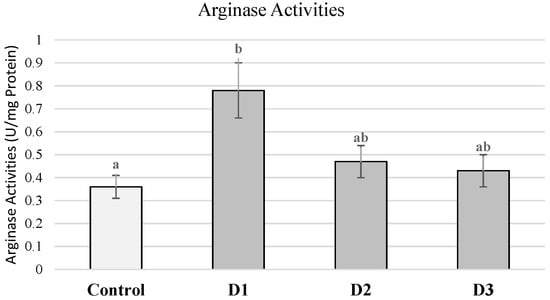
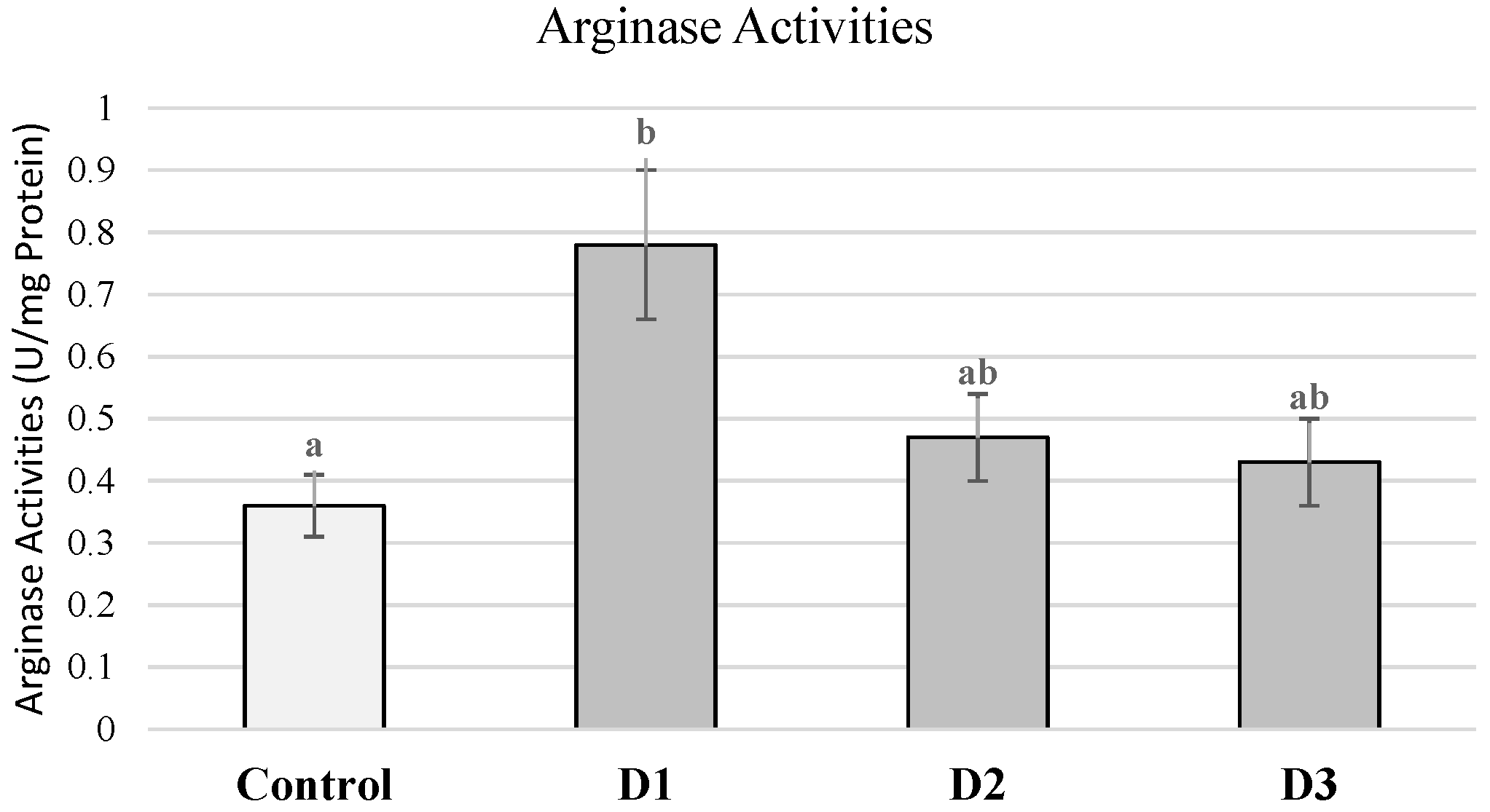
The results of some semen quality parameters are given in Table 2, while seminal plasma arginase activities are given in Figure 1.
Table 2.
The results of some semen quality parameters.
Figure 1.
The effect on seminal plasma arginase activity of n-3 fatty acid added Rainbow Trout Feeds. Different letters (a and b) above the bars indicate statistically significant differences among groups (p < 0.05).
The effects of dietary n-3 fatty acid supplementation on semen quality parameters are presented in Table 2. Semen volume was significantly higher in the D2 group than in the control group (p < 0.05), whereas the D1 and D3 groups showed intermediate values that did not differ significantly from either the control or D2 groups. No significant differences among the groups were observed for semen pH, sperm density, or initial sperm motility (p > 0.05). Both the duration of 50% sperm motility and the total duration of sperm motility were significantly longer in the D1 and D3 groups than in the control group (p < 0.05), while the D2 group did not differ significantly from either the control or the D1 and D3 groups for the duration of 50% sperm motility. However, the total duration of sperm motility in the D2 group was similar to that of the control group and significantly shorter than those of the D1 and D3 groups (p < 0.05).
As shown in Figure 1, seminal plasma arginase activity was significantly higher in the D1 group than in the control group (p < 0.05). The D2 and D3 groups showed intermediate arginase activities and did not differ significantly from either the control or D1 groups.
4. Discussion
The capacity of sperm to properly fertilize an egg is measured by their quality. A measure of sperm quality could be any measurable physical parameter that is directly related to the sperm’s ability to fertilize. Sperm count and traits will be optimized by natural selection to maximize the fitness of each individual male relative to the unique reproductive strategy of each species. Males are competitive in the wild and rely on their species’ reproductive tactics and physical surroundings. Although dietary changes have a significant impact on reproductive physiology, there is little evidence that they have an effect on sperm quality in fish. Egg and spermatozoon counts can be impacted by fatty acids, particularly PUFAs, n-3 series fatty acids, and their derivatives [14,15].
Gamete quality and seed production are significantly enhanced by improvements in breeding nutrition and feeding [16]. Enriching commercial diets with PUFA increases the European seabass (Dicentrarchus labrax) species male sea bass reproductive performance. When compared to perch fed a non-enriched wet food, fish oil-enriched commercial pellet meal resulted in longer spermiation times, larger milt volumes and spermatozoa concentrations, and a better rate of embryo and larval survival following fertilization. While the researchers noted increased weight gain in fish fed the wet diet, they also showed that males fed commercially prepared meals showed improved reproductive success, perhaps due to the advantages of PUFA enrichment [17]. In another study, researchers investigated the results of rainbow trout’s long-term adaptation to 8 and 18 °C with a diet supplemented with corn oil or fish oil on spermatozoan plasma membrane properties. They reported that dietary lipids changed the composition of the sperm plasma membrane but did not change its fluidity and did not increase fertilization capacity [18].
In many studies on reproductive performance, many different substances such as ascorbic acid [19], gossypol [20], melatonin [21], and amino acid [22] supplements have been tested and it has been observed that these substances have different effects on reproductive performance. In this study, we determined differences in some sperm quality parameters and seminal plasma arginase activities in trout fed with diets enriched with different amounts of n-3 series fatty acids.
Among the metrics used to assess sperm quality are sperm density, motility rate, and motility duration because they have an important effect on successful fertilization [23]. In this study, it was noted that semen volume increased in the group with 2% fatty acid supplementation, while there was no change in semen pH and density. However, when spermatozoon motility durations were evaluated, it was observed that both 50% and 0% sperm motility durations were prolonged in D1 (1%) and D3 (3%) groups. The prolonged sperm motility observed in the present study may increase the potential for successful fertilization, particularly under artificial fertilization conditions. However, because fertilization rate, embryo survival, and larval performance were not evaluated, these findings should not be interpreted as direct evidence of improved reproductive performance.
The prolonged sperm motility observed in the present study may be explained by several complementary physiological mechanisms. Long-chain n-3 polyunsaturated fatty acids, particularly EPA and DHA, are incorporated into sperm plasma membranes, where they increase membrane fluidity and flexibility. Improved membrane fluidity facilitates the function of membrane-associated ion channels and transport systems involved in sperm activation and flagellar beating. In addition, DHA-rich mitochondrial membranes may enhance mitochondrial efficiency and ATP production, thereby providing a sustained energy supply for flagellar movement. Because sperm motility is an ATP-dependent process, improved mitochondrial energy metabolism may contribute to the longer motility duration observed in the n-3 supplemented groups. Furthermore, maintenance of membrane integrity and ionic homeostasis may delay sperm exhaustion after activation, thereby prolonging the fertilization period [2,6,18].
Although enrichment of sperm membranes with long-chain n-3 polyunsaturated fatty acids may improve membrane fluidity and sperm function, these highly unsaturated lipids are also more susceptible to lipid peroxidation under oxidative conditions [6,18]. Therefore, maintaining an appropriate balance between dietary n-3 fatty acid enrichment and antioxidant defense is essential for preserving sperm quality. Oxidative stress has been associated with impaired membrane integrity, reduced ATP production, and decreased sperm motility [6,18,24]. In the present study, antioxidant status was not evaluated; therefore, biomarkers such as malondialdehyde (MDA), superoxide dismutase (SOD), catalase (CAT), glutathione peroxidase (GSH-Px), reduced glutathione (GSH), and total antioxidant capacity were not determined. Future studies incorporating these oxidative stress parameters would provide a more comprehensive understanding of the mechanisms underlying the beneficial effects of dietary n-3 fatty acids on rainbow trout sperm quality. Future studies combining semen quality evaluation, seminal plasma arginase activity, and oxidative stress biomarkers would provide a more comprehensive understanding of the mechanisms through which dietary n-3 fatty acids improve male reproductive performance in rainbow trout.
Koprucu et al. [24] studied the effects of n-3 series fatty acids added to the diets of rainbow trout under regular stripping conditions at similar rates (1% and 2%) to our study on MDA, SOD, CAT, GSH-Px and GSH levels; semen and liver fatty acid compositions; and spermatological values (semen volume and pH, sperm density, percentage and duration of sperm motility). The researchers obtained the highest n-3 PUFA levels and spermatological values in semen from fish fed a diet containing 2% fatty acids in all sampling periods. In our study, we determined that semen volume increased significantly in the group to which 2% fatty acids were added. Yonar et al. [25] investigated semen production and quality, hepato-somatic index, hemato-immunological values, oxidative stress and fatty acid contents in liver, muscle and semen of rainbow trout fed diets supplemented with n-3 series long-chain PUFAs under regular milking conditions. They fed the fish with diets supplemented with 3.14% (control), 7.84% and 13.63% n-3 PUFAs. Their research has shown that 13.63% of the total fatty acids consist of n-3 PUFA and that it can increase sperm production and quality in rainbow trout broodstock under regular milking conditions.
The modulation of polyamines, glutamate, proline, NOS, and arginase (mitochondrial form) is crucial [26]. It has been reported that the mitochondrial form of arginase is found in several reproductive system components [11,27]. Male reproductive organs and tissues, including seminal plasma and spermatozoa, semen, the prostate, the epididymis, and the testis, are also known to contain polyamines [28]. The relationship between arginase activity and sperm quality may be explained through the regulation of L-arginine metabolism. Arginase and NOS compete for the common substrate L-arginine. Consequently, increased arginase activity may reduce L-arginine availability for NO synthesis while simultaneously increasing ornithine production. The increased availability of ornithine promotes the synthesis of polyamines, including putrescine, spermidine, and spermine, which are involved in cell proliferation, differentiation, chromatin stabilization, and spermatogenesis. Therefore, increased arginase activity may shift L-arginine metabolism toward polyamine synthesis rather than NO production, thereby supporting sperm maturation, seminal plasma quality, and overall sperm function. However, maintenance of a physiological balance between arginase and NOS activities is essential, as both excessive and insufficient NO production may adversely affect sperm function [11,12,27,28,29]. Although the present study did not directly measure NO or polyamine concentrations, the observed changes in seminal plasma arginase activity may reflect alterations in L-arginine metabolism that contribute to the improved reproductive characteristics observed in the n-3 supplemented groups. In this study, arginase activity increased in the groups supplemented with 2% and 3% n-3 series fatty acids, but this increase did not reach a statistically significant level. However, a significant increase in seminal plasma arginase activity was found in the D1 group supplemented with 1% compared to the control group. While there have been some documented correlations between seminal plasma arginase activity and spermatological parameters [12,29,30], there has been no evidence that n-3 series fatty acids have an effect on the activities of seminal plasma arginase. However, the connections between the metabolism of arginine and fatty acids have been studied [31] or although there have been studies examining the function of omega-3 fatty acids and arginine in infection and wound healing, there is no proof to support the impact of n-3 series fatty acids on seminal plasma arginase activity when added to the diet [32]. Ozer Kaya and colleagues stated that intramuscular vitamin E and vitamin E-selenium combination [12], L-arginine applications [29], dexamethasone administration [11] increase and decrease at different rates as a result of the applications in their studies in which they examined the seminal plasma arginase activities. Increased activity of seminal plasma arginase with the addition of n-3 series fatty acids to the diet (in group D1) may have a positive effect on cell division, growth and differentiation of sperm cells, spermatological parameters through the resulting polyamines. The different responses observed among the dietary supplementation levels indicate that the biological effects of n-3 fatty acids are not strictly linear and may reflect the complex regulation of reproductive physiology. While 1% supplementation significantly increased seminal plasma arginase activity, 2% supplementation produced the highest semen volume, whereas both 1% and 3% supplementation prolonged sperm motility duration. These findings suggest that individual reproductive traits may differ in their sensitivity to dietary n-3 fatty acids. Such differences may be associated with dose-dependent lipid metabolism, maintenance of an optimal n-3/n-6 fatty acid balance, and compensatory regulation of L-arginine metabolism. In addition, although dietary enrichment with EPA and DHA improves sperm membrane composition and function, excessive incorporation of highly unsaturated fatty acids into sperm membranes may increase susceptibility to lipid peroxidation. Therefore, increasing dietary n-3 fatty acid levels does not necessarily result in proportional improvements in all reproductive parameters, and the optimal supplementation level may vary depending on the physiological endpoint evaluated [2,6,24,30].
Although dietary n-3 fatty acid supplementation improved several semen quality parameters, including sperm motility duration and seminal plasma arginase activity, the present study evaluated only indirect indicators of male reproductive performance. Fertilization rate, embryo survival, hatching success, and larval quality were not assessed. Therefore, the observed improvements in semen quality should be interpreted as an increased reproductive potential rather than direct evidence of enhanced reproductive success. Future studies integrating semen quality evaluation with fertilization trials and early developmental performance are required to confirm the practical implications of dietary n-3 fatty acid supplementation in rainbow trout hatchery production.
Although sperm quality parameters provide valuable information regarding male reproductive potential, fertilization trials and subsequent evaluation of embryo development, hatching success, and larval survival are necessary to confirm the functional relevance of sperm characteristics. Male age is an important factor affecting reproductive performance in rainbow trout; therefore, future studies including males of different age classes may provide further insights into age-related variations in sperm quality. Environmental conditions such as water temperature, photoperiod, spawning season, and salinity may influence sperm characteristics and should be considered in future reproductive studies.
Another limitation of this study is that each dietary treatment was maintained in a single tank. Although semen quality and arginase activity were measured individually for each fish, potential tank effects cannot be completely excluded. Therefore, the results should be interpreted with appropriate caution, and future studies should include replicated tanks to further validate the effects of dietary n-3 fatty acid supplementation.
5. Conclusions
Dietary supplementation with n-3 fatty acids improved selected semen quality parameters in male rainbow trout; however, the responses varied according to the supplementation level. The 2% supplementation level significantly increased semen volume, whereas 1% supplementation resulted in the highest seminal plasma arginase activity. In contrast, both the 1% and 3% supplementation levels significantly prolonged sperm motility duration. These findings suggest that the effects of dietary n-3 fatty acids are parameter-specific rather than strictly dose-dependent, and that no single supplementation level was optimal for all reproductive traits evaluated.
Although the observed improvements in semen quality indicate an enhanced reproductive potential, fertilization success, embryo development, and larval performance were not evaluated in the present study. In addition, the fatty acid composition of the experimental diets, oxidative stress biomarkers, nitric oxide metabolism, and polyamine metabolism were not directly assessed. Therefore, the biological mechanisms underlying the observed improvements remain to be fully elucidated. Future studies integrating dietary fatty acid profiling, oxidative status, arginine metabolism, fertilization trials, and offspring performance will provide a more comprehensive understanding of the role of dietary n-3 fatty acids in improving reproductive performance in rainbow trout.
Author Contributions
S.O.K., S.G., M.S. and G.T. were involved in the design of the study, animal applications, laboratory experiments (spermatological), and evaluation of results S.O. and K.K. were involved in the design of the study, animal applications, laboratory experiments, and evaluation of results E.K. and M.E. were involved in the design of the study, animal applications, laboratory experiments (biochemical), and evaluation of results. All authors have read and agreed to the published version of the manuscript.
Funding
This research was funded by Firat University Scientific Research Projects Management Unit, grant number FÜBAP-2056.
Institutional Review Board Statement
Ethical review and approval were not required for this study according to the institutional guidelines of Fırat University for routine reproductive sampling procedures in fish. All experimental procedures were conducted in accordance with general principles for the care and use of aquatic animals and were designed to minimize stress and disturbance.
Informed Consent Statement
Not applicable.
Data Availability Statement
The original contributions presented in the study are included in the article, and further inquiries can be directed to the corresponding author.
Acknowledgments
The authors thank the participants who gave their time to the trial.
Conflicts of Interest
The authors declare no conflicts of interest.
Abbreviations
The following abbreviations are used in this manuscript:
| PUFA | Polyunsaturated fatty acids |
| TDMU | Thiosemicarbazide-Diacetyl-Monoxime-Urea |
| n-3 | omega-3 |
| EPA | Eicosapentaenoic acid |
| DHA | Docosahexaenoic acid |
| NOS | Nitric oxide synthase |
| NO | Nitric oxide |
| MDA | Malondialdehyde |
| SOD | Superoxide Dismutase |
| CAT | Catalase |
| GSH-Px | Glutathione Peroxidase |
| GSH | Reduced Glutathione |
References
- Bari, S.M.; Hossen, M.I.; Islam, M.R.; Helal, M.M.U. Genome-wide identification and characterization of interleukin-18 gene family in rainbow trout (Oncorhynchus mykiss). J. Adv. Biotechnol. Exp. Ther. 2024, 7, 275–289. [Google Scholar] [CrossRef] [Scilit]
- Kaya, S.O.; Gur, S.; Koprucu, K.; Türk, G.; Sönmez, M.; Ozcan, S. Effect of dietary n-3 series fatty acids on sperm motility duration of rainbow trout (Oncorhynchus mykiss Walbaum, 1792). Clin. Exp. Health Sci. 2020, 10, 104–107. [Google Scholar] [CrossRef] [Scilit]
- Roy, J.; Mercier, Y.; Tonnet, L.; Burel, C.; Lanuque, A.; Surget, A.; Larroquet, L.; Corraze, G.; Terrier, F.; Panserat, S.; et al. Rainbow trout prefer diets rich in omega-3 long chain polyunsaturated fatty acids DHA and EPA. Physiol. Behav. 2020, 213, 112692. [Google Scholar] [CrossRef] [Scilit] [PubMed]
- Liu, Y.; Shen, N.; Xin, H.; Yu, L.; Xu, Q.; Cui, Y. Unsaturated fatty acids in natural edible resources: A systematic review of classification, resources, biosynthesis, biological activities and application. Food Biosci. 2023, 53, 102790. [Google Scholar] [CrossRef] [Scilit]
- Yamamoto, Y.; Hishikawa, D.; Ono, F. Trpv4-mediated apoptosis of Leydig cells induced by high temperature regulates sperm development and motility in zebrafish. Commun. Biol. 2024, 7, 96. [Google Scholar] [CrossRef] [Scilit] [PubMed]
- Kowalski, R.K.; Cejko, B.I. Sperm quality in fish: Determinants and affecting factors. Theriogenology 2019, 135, 94–108. [Google Scholar] [CrossRef] [Scilit] [PubMed]
- Li, M.; Qin, J.; Xiong, K.; Jiang, B.; Zhang, T. Review of arginase as a promising biocatalyst: Characteristics, preparation, applications and future challenges. Crit. Rev. Biotechnol. 2022, 42, 651–667. [Google Scholar] [CrossRef] [Scilit] [PubMed]
- Porembska, Z. Different species of arginase in animal tissues. Enzym. Protein 2019, 15, 198–209. [Google Scholar]
- Sargent, J.R.; Tocher, D.R.; Bell, J.G. The lipids. In Fish Nutrition, 3rd ed.; Halver, J.E., Hardy, R.W., Eds.; Academic Press: San Diego, CA, USA, 2002; pp. 181–257. [Google Scholar]
- Viveiros, A.T.M. Semen Collection and Preservation in African Catfish, Clarias gariepinus. Ph.D. Thesis, Wageningen University, Wageningen, The Netherlands, 2002. [Google Scholar]
- Ozer Kaya, S.; Erisir, M.; Gur, S.; Kandemir, F.M.; Benzer, F.; Kaya, E.; Sonmez, M.; Turk, G. The changes in semen quality, arginase activity and nitric oxide level in dexamethasone-treated rams. Andrologia 2020, 52, e13464. [Google Scholar] [CrossRef] [Scilit] [PubMed]
- Ozer Kaya, S.; Gur, S.; Erisir, M.; Kandemir, F.M.; Benzer, F.; Kaya, E.; Turk, G.; Sonmez, M. Influence of vitamin E and vitamin E-selenium combination on arginase activity, nitric oxide level and spermatological properties in ram semen. Reprod. Domest. Anim. 2020, 55, 162–169. [Google Scholar] [CrossRef] [Scilit] [PubMed]
- Geyer, J.W.; Dabich, D. Rapid method for determination of arginase activity in tissue homogenates. Anal. Biochem. 1971, 39, 412–417. [Google Scholar] [CrossRef] [Scilit] [PubMed]
- Santolaria, P.; Rickard, J.P.; Perez-Pe, R. Understanding sperm quality for improved reproductive performance. Biology 2023, 12, 980. [Google Scholar] [CrossRef] [Scilit] [PubMed]
- Maranesi, M.; Castellini, C.; Dall’Aglio, C.; Petrucci, L.; Mattioli, S.; Boiti, C.; Zerani, M. Effects of PUFAs on animal reproduction: Male and female performances and endocrine mechanisms. Phytochem. Rev. 2018, 17, 801–814. [Google Scholar] [CrossRef] [Scilit]
- Bera, P.; Dhara, H.; Mandal, S.; Sau, S.K.; Das, S. Nutritional strategies for improving reproductive performance in fishes. In Aquaculture: Enhancing Food Security and Nutrition; Springer Nature: Cham, Switzerland, 2025; pp. 409–430. [Google Scholar] [CrossRef] [Scilit]
- Asturiano, J.F.; Sorbera, L.A.; Carrillo, M.; Zanuy, S.; Ramos, J.; Navarro, J.; Bromage, N. Reproductive performance in male European sea bass (Dicentrarchus labrax, L.) fed two PUFA-enriched experimental diets: A comparison with males fed a wet diet. Aquaculture 2001, 194, 173–190. [Google Scholar] [CrossRef] [Scilit]
- Labbe, C.; Maisse, G.; Muller, K.; Zachowski, A.; Kaushik, S.; Loir, M. Thermal acclimation and dietary lipids alter the composition, but not fluidity, of trout sperm plasma membrane composition. Lipids 1995, 30, 23–33. [Google Scholar] [CrossRef] [Scilit] [PubMed]
- Kocabas, F.K.; Kocabas, M.; Aksu, O.; Sahilli, Y.Ç. Ascorbic acid ameliorated sperm quality of rainbow trout against arsenic toxicity: Impact on oxidative stress, fertility ability and embryo development. J. Environ. Sci. Health Part C 2022, 40, 119–132. [Google Scholar]
- Irm, M.; Ye, B.; Wu, X.; Geng, L.; Cai, Q.; Zhang, L.; Zhai, H.; Zhou, Z. Assessment of conventional and low-gossypol cottonseed meal as alternative protein sources in low-fishmeal diets of hybrid grouper: Growth, feed utilization, gut histology, and immunity. Animals 2022, 12, 1906. [Google Scholar] [CrossRef] [Scilit] [PubMed]
- Acharyya, A.; Das, J.; Hasan, K.N. Melatonin as a multipotent component of fish feed: Basic information for its potential application in aquaculture. Front. Mar. Sci. 2021, 8, 734066. [Google Scholar] [CrossRef] [Scilit]
- Butts, I.A.E.; Hilmarsdottir, G.S.; Zadmajid, V.; Gallego, V.; Støttrup, J.G.; Jacobsen, C.; Krüger-Johnsen, M.; Politis, S.N.; Asturiano, J.F.; Holst, L.K.; et al. Dietary amino acids impact sperm performance traits for a catadromous fish, Anguilla anguilla, reared in captivity. Aquaculture 2020, 518, 734602. [Google Scholar] [CrossRef] [Scilit]
- Bobe, J.; Labbe, C. Egg and sperm quality in fish. Gen. Comp. Endocrinol. 2010, 165, 535–548. [Google Scholar] [CrossRef] [Scilit] [PubMed]
- Koprucu, K.; Yonar, M.E.; Ozcan, S. Effect of dietary n-3 polyunsaturated fatty acids on antioxidant defense and sperm quality in rainbow trout (Oncorhynchus mykiss) under regular stripping conditions. Anim. Reprod. Sci. 2015, 163, 135–143. [Google Scholar] [CrossRef] [Scilit] [PubMed]
- Yonar, S.M.; Koprucu, K.; Ozcan, S. Dietary profile of n-3 series LC-PUFAs in rainbow trout under regular stripping condition: Semen production and quality, hepato-somatic index, haemato-immunologic values, oxidative stress and fatty acid composition of liver, muscle and semen. Aquac. Res. 2020, 51, 370–378. [Google Scholar] [CrossRef] [Scilit]
- Sagar, N.A.; Tarafdar, S.; Agarwal, S.; Tarafdar, A.; Sharma, S. Polyamines: Functions, metabolism, and role in human disease management. Med. Sci. 2021, 9, 44. [Google Scholar] [CrossRef] [Scilit] [PubMed]
- Razmi, N.; Ali Jelodar, G.; Nazifi, S.; Dehghani, A. Arginase status in cattle reproductive system. Vet. Arh. 2005, 75, 31–38. [Google Scholar]
- Keskinege, A.; Elgun, S.; Yilmaz, E. Possible implications of arginase and diamine oxidase in prostatic carcinoma. Cancer Detect. Prev. 2001, 25, 76–79. [Google Scholar]
- Ozer Kaya, S.; Kandemir, F.M.; Gur, S.; Erisir, M.; Benzer, F.; Kaya, E.; Turk, G.; Sonmez, M. Evaluation of the role of L-arginine on spermatological parameters, seminal plasma nitric oxide levels and arginase enzyme activities in rams. Andrologia 2020, 52, e13439. [Google Scholar] [CrossRef] [Scilit] [PubMed]
- Gur, S.; Kandemir, F.M. Relationships between seminal plasma arginase activity and spermatological parameters in rams. Andrologia 2012, 44, 86–91. [Google Scholar] [CrossRef] [Scilit] [PubMed]
- Bansal, V.; Syres, K.M.; Makarenkova, V.; Brannon, R.; Matta, B.; Harbrecht, B.G.; Ochoa, J.B. Interactions between fatty acids and arginine metabolism: Implications for the design of immune-enhancing diets. J. Parenter. Enter. Nutr. 2005, 29, S75–S80. [Google Scholar] [CrossRef] [Scilit] [PubMed]
- Alexander, J.W.; Supp, D.M. Role of arginine and omega-3 fatty acids in wound healing and infection. Adv. Wound Care 2014, 3, 682–690. [Google Scholar] [CrossRef] [Scilit] [PubMed]

Disclaimer/Publisher’s Note: The statements, opinions and data contained in all publications are solely those of the individual author(s) and contributor(s) and not of MDPI and/or the editor(s). MDPI and/or the editor(s) disclaim responsibility for any injury to people or property resulting from any ideas, methods, instructions or products referred to in the content. |
© 2026 by the authors. Licensee MDPI, Basel, Switzerland. This article is an open access article distributed under the terms and conditions of the Creative Commons Attribution (CC BY) license.