


Abstract
The striped mullet (Mugil cephalus) and white mullet (Mugil curema) support artisanal fishing at the mouth of the Soto La Marina River, Gulf of Mexico, an area of great ecological value within the Laguna Madre and Rio Bravo Delta Protected Natural Area, the Terrestrial Priority Region RTP-83, and the Marine Priority Region RMP-44. Given the absence of historical catch and effort time series—a typical constraint of data-limited fisheries—a length-based frequency approach was used to estimate growth parameters, mortality rates, and the exploitation rate (E = F/Z). During 2018–2019, 1134 specimens of M. cephalus and 339 of M. curema were sampled. Due to sexual dimorphism in M. cephalus, analyses were performed separately for females, males, and combined sexes, while M. curema was analyzed with sexes combined. Growth (L∞, k) and mortality (Z, M, F) parameters for combined sexes were: M. cephalus (562 mm, 0.14 year−1; 3.72, 0.21, 3.51 year−1) and M. curema (329 mm, 0.15 year−1; 1.46, 0.25, 1.21 year−1). Exploitation rates (E) substantially exceeded Gulland (E = 0.5) and Patterson (E = 0.4) reference points: M. cephalus females (0.891), males (0.915), combined sexes (0.944), and M. curema (0.828). It is concluded that both stocks show strong evidence of growth overfishing, with exploitation rates well above established reference points, revealing a disconnect between the area’s conservation designations and the actual condition of the resource.
Keywords:
mullets; data-limited fisheries; exploitation rate; overfishing; protected areas; sexual dimorphism; reference points Key Contribution:
This study provides an integrated stock assessment for Mugil cephalus and Mugil curema in the Mouth of the Soto La Marina River, within the Laguna Madre Protected Area, a high-priority conservation zone in the Gulf of Mexico.
1. Introduction
We document sexual dimorphism in the growth parameters of M. cephalus in this region, demonstrating that females reach larger asymptotic lengths and grow faster than males. Using a data-limited approach, we estimate exploitation rates (E = 0.828–0.944) that exceed both the classic Gulland reference point (E = 0.5) and the more conservative Patterson reference point (E = 0.4), revealing overexploitation of both mullet stocks. Fishing mortality (F) is between 8 and 17 times higher than natural mortality (M) in both species (F/M = 8.2–16.7), confirming a critical imbalance between fishing pressure and natural replacement capacity. The study reveals a disconnect between the triple conservation designations of the study area and the actual overexploited condition of the fishery resources, providing evidence for fishery managers and policymakers.
The assessment of the exploitation status of fishery resources is fundamental for the sustainable management of fisheries [1]. However, in most artisanal fisheries in developing countries, and particularly in Mexico, historical catch and effort time series are not available [2]. This situation, known as “data-limited fisheries”, affects approximately 80% of global fisheries and 95% of artisanal fisheries [3]. Faced with this reality, length-based methods allow useful diagnoses to be obtained using only growth parameters and instantaneous mortality rate estimates [4,5,6].
There is a controversy in the literature regarding the optimal reference point for the exploitation rate. Gulland [7] established the classic criterion of E = 0.5 (F = M), below which a stock is considered underexploited and above which it is considered overexploited [8]. However, Patterson [9], analyzing 28 pelagic fish stocks, empirically demonstrated that E values > 0.4 (F = 2/3 M) are consistently associated with biomass declines over 10-year periods, while below this level the trend has been towards recovery. This finding has generated a divergence in data-limited fisheries assessments: while some authors [7,8] consider E = 0.5 acceptable as a reference point, others [9,10] advocate for a more conservative approach (E = 0.4), particularly in high-conservation-value areas. The present study will evaluate the results against both reference points.
In Mexico, the striped mullet (Mugil cephalus) and the white mullet (Mugil curema) support highly relevant fisheries in the Gulf of Mexico [11]. In Tamaulipas, these species represent the second largest volume and value in the state’s fishery production, surpassed only by shrimp [12,13]. Additionally, M. cephalus generates a high-commercial-value byproduct: mature gonads (“mullet roe”), which increases fishing pressure on the species [14].
A fundamental aspect of this study is that the fishing area of this research—the Mouth of the Soto La Marina River, in the Municipality of Soto La Marina, Tamaulipas, Mexico (MSLMR)—concentrates three federal conservation protection and prioritization designations. First, the Protected Area “Laguna Madre y Delta del Río Bravo”, under the Flora and Fauna Protection Area category [15] (PA-Laguna Madre), specifically Polygon 13 “Mouth of the Soto La Marina River”, classified as Special Use Subzone A and designated for fishing and aquaculture [16]. Second, the Terrestrial Priority Region RTP-83 “Laguna Madre” (RTP-83-Laguna Madre) of the Comisión Nacional para el Conocimiento y Uso de la Biodiversidad (CONABIO), characterized by its high biodiversity, endemism, and function as a biological corridor [17]. Third, the Marine Priority Region RMP-44 “Laguna Madre” (RMP-44-Laguna Madre), also of CONABIO, where the problem of fishing overexploitation has been explicitly documented [18]. This triple designation gives the region exceptional conservation value and demands that productive activities be carried out sustainably.
Despite this relevance, information on the exploitation status of mullets in the area is scarce. The Carta Nacional Pesquera [19] mentions “exploitation at maximum sustainable yield” without quantitative evidence to support it, and the only previous study in Tamaulipas dates back to 1980 [20]. This lack of information prevents an evaluation of the effectiveness of current management measures: minimum capture size (30 cm for M. cephalus; 26 cm for M. curema), seasonal closures, and fishing gear regulation [21].
Therefore, the general objective of this study was to assign an exploitation status to the stocks of M. cephalus (with sex-separated analysis, given documented sexual dimorphism) and M. curema (sexes combined) in the MSLMR, an area that forms part of the PA-Laguna Madre, as well as the RTP-83-Laguna Madre and RMP-44-Laguna Madre, using a data-limited approach and evaluating the results against the reference points of Gulland [7] (E = 0.5) and Patterson [9] (E = 0.4). It was hypothesized that both stocks show strong evidence of growth overfishing, as will be shown by exploitation rate values exceeding established reference points.
2. Materials and Methods
2.1. Study Area
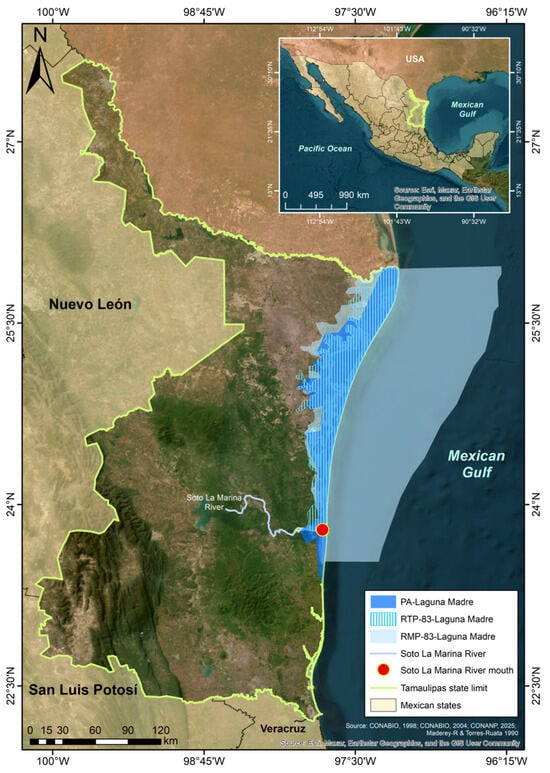
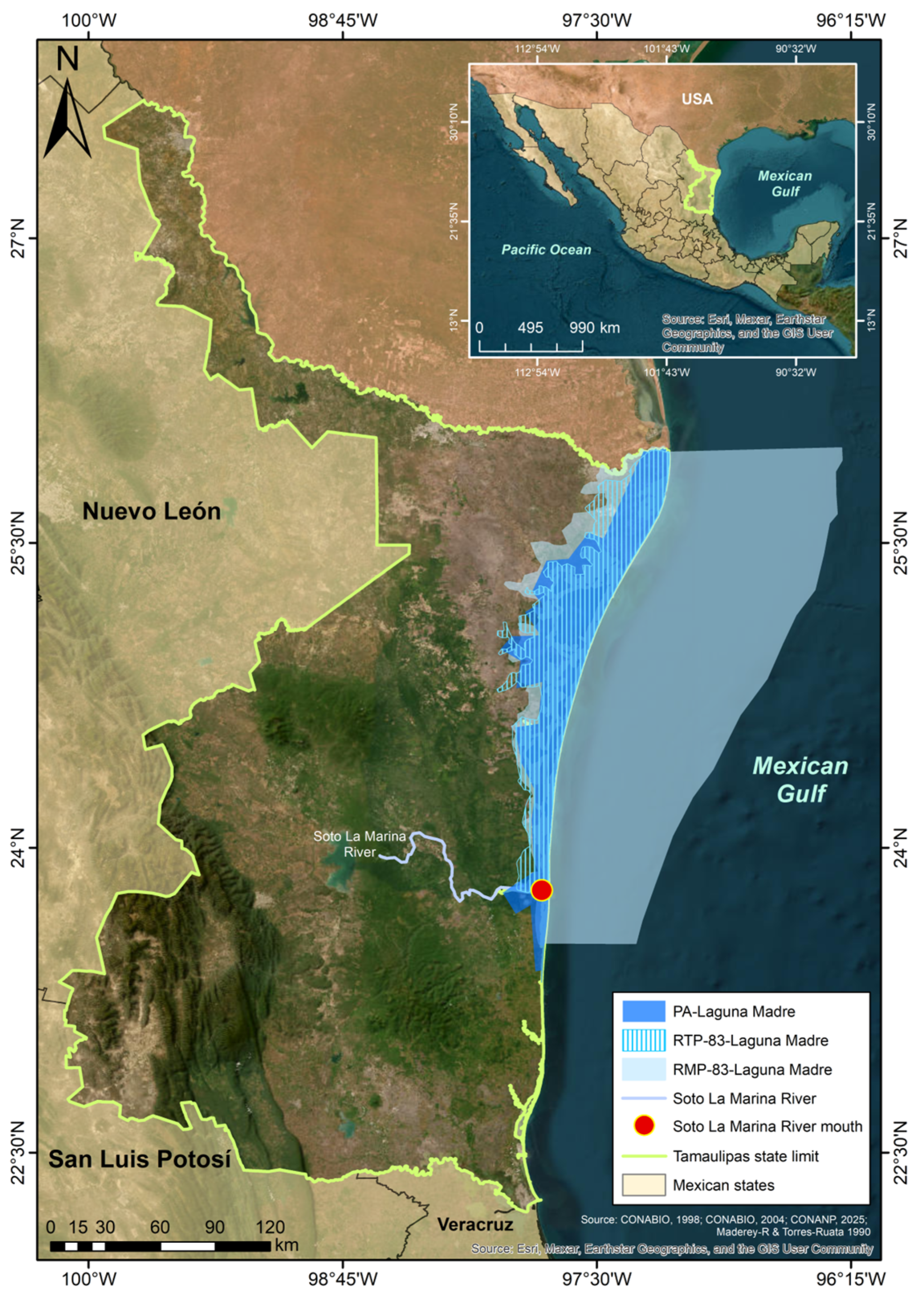
The study area is the Mouth of the Soto La Marina River (MSLMR), where commercial artisanal fishing is carried out by the inhabitants of the towns of Miguel de la Madrid Hurtado and La Pesca, in the Municipality of Soto la Marina, Tamaulipas, Mexico. The MSLMR is located in the western Gulf of Mexico, at approximately 23°46′22″ N, 97°44′16″ W. (Figure 1). These localities are situated in the southern portion of the Laguna Madre system, one of the most extensive coastal lagoons in Mexico [22]. In this area, the average annual surface water temperature is 27 °C [23]. Fishing activity is predominantly artisanal, using small vessels with a maximum overall length of 10.5 m that employ gillnets and trammel nets [21].
Figure 1.
Geographic location of the Mouth of the Soto La Marina River, in the Municipality of Soto La Marina, Tamaulipas, Mexico, and the geographic convergence of federal conservation protection and prioritization designations.
2.2. Sampling and Data Collection
Monthly samplings were conducted during the 2018–2019 period at fish reception centers in the towns of Miguel de la Madrid Hurtado and La Pesca, located in the Municipality of Soto La Marina, Tamaulipas, Mexico. Specimens of M. cephalus and M. curema from the artisanal fishery of the MSLMR were examined.
Data collection was structured under a two-stage sampling design [24]. In the first stage, a mass sampling was conducted directly at landing sites to characterize the size structure of the commercial catch, fit growth to the von Bertalanffy model (VBM), and estimate the total (Z), natural (M), and fishing (F) mortality rates. From the mass sample, a simple random subsample was selected for sex assignment of individuals and validation of taxonomic identification of the species. This subsampling procedure ensures that the analyzed specimens retain the biometric proportionality of the original catch, providing unbiased estimates of biological parameters [25,26]. For each organism included in the biological sampling, the following variables were determined:
Biometry: Total length (TL, mm) was recorded using a graduated measuring tape, and total weight (TW, g) was obtained using a digital scale with 5 kg capacity (precision ±1 g). Biometry was performed on individuals from both sampling types.
Sex determination: Through abdominal dissection, sex was identified using standard macroscopic criteria for teleosts [27,28,29].
Taxonomic validation: Due to the sympatry of mullets in the estuarine system, the biological subsample was used to confirm the taxonomic identity of the species through the analysis of specific meristic and morphometric characters [30].
2.3. Data Analysis
2.3.1. Sex Ratio and Morphometric Differences
The sex ratio was evaluated using a chi-square test (χ2) to determine whether it differed from the expected 1:1 ratio [31]. Given the well-documented sexual dimorphism of M. cephalus in the Gulf of Mexico and adjacent regions [32,33], subsequent analyses (growth parameters, mortality rates, and exploitation rate) were performed separately for females and males of this species. This decision is independent of any inferential test applied to the sample and is grounded in the biological reality of the species as established in the literature. For M. curema, the absence of reported dimorphism in the literature [34] justified a combined-sex analysis. The Chen et al. test [35] was applied to evaluate whether the length–weight relationship curves differed between sexes, providing an additional, statistically appropriate confirmation of the dimorphism in M. cephalus within the MSLMR (see Section 3.3).
2.3.2. Length–Weight Relationship
The length–weight relationship was estimated using the power model [36]: TW = a·TLb, where TW is total weight in grams, TL is total length in millimeters, and a and b are parameters of the power regression model, where a is the condition factor, and b is the exponent of the power relationship. Parameters were estimated by least squares after logarithmic transformation [37]. The isometry hypothesis (b = 3) was evaluated using Student’s t-test [38]. Following Froese [39], building on the foundational work of Ricker [40,41] and Cinco [42], and consistent with subsequent applications such as Keller and Kerstetter [43], the exponent b is not interpreted here as a fixed allometric growth property of the species, but as a descriptor of the relationship between body mass and length within the sampled individuals at a given place and time. A value of b significantly different from 3 does not necessarily imply that the species itself grows allometrically; rather, it reflects variation in the mean body condition of the individuals in the sample relative to the value expected under strict geometric isometry. Such variation may result from the selective removal of individuals in better condition by the fishery, nutritional stress associated with the documented high fishing pressure, or the predominance of individuals at particular reproductive stages within the sample. Normality of the data was verified with the Shapiro–Wilk test [44]. To compare length–weight relationship curves between sexes, Chen et al.’s test [35] was used according to the following model: (RSSp-RSSs/(3(K-1))/(RSSs/(N-3)K); where RSSp is the residual sum of squares of the grouped fit (without sex differentiation), RSSs is the residual sum of squares of both groups (F and M), N is the total number of samples, and K is the number of groups being compared.
2.3.3. Growth Parameters
Growth was described using the von Bertalanffy model [45]: Lt = L∞[1 − e−k(t − t0)], where L∞ is the asymptotic length, k is the growth coefficient (curvature parameter), and t0 is the age at zero length. The parameters L∞ and k were estimated using the ELEFAN I [46] and Shepherd’s [47] methods, contained in the FISAT II software package (FAO-ICLARM Stock Assessment Tools, version 1.2.2) [48]. Parameters with the best fit (“score”) according to each method were selected. The parameter t0 was estimated using Pauly’s empirical relationship [49]: log10(−t0) = −0.3922 − 0.2752·log10(L∞) − 1.038·log10(k). Reliability of the parameters was evaluated using the Phi-prime index (Ø′ = log10k + 2log10L∞) [50].
2.3.4. Longevity (Age Limit)
Longevity (A0.95) was estimated using Taylor’s method [51]: A0.95 = t0 + 2.996/k, and Pauly’s simplified estimator [52]: A0.95 = 3/k.
2.3.5. Instantaneous Mortality Rates
Total mortality (Z) was estimated using four methods: linearized catch curve [4], the Jones and van Zalinge method [53], the Beverton and Holt method [54], and the Ault and Ehrhardt method [55]. The method with the highest coefficient of determination (r2) was selected. The Jones and van Zalinge method was selected because it presented the best fit (r2 > 0.96 across all datasets), consistent with the model-selection criterion stated above.
These four methods differ in their underlying mathematical structure and assumptions, which explains the discrepancy observed among their Z estimates. The Jones and van Zalinge method operates on the cumulative length-frequency distribution weighted by the asymptotic length (L∞), making it more sensitive to the overall shape of the size distribution. In contrast, the Beverton and Holt and the Ault and Ehrhardt methods are based on the mean length of the catch above the length at first capture (L′), and tend to yield more conservative Z estimates when the sample includes a high proportion of individuals at sizes close to L′. All Z values are expressed in the same units (year−1); the observed differences are therefore methodological in origin and not a unit conversion error.
Natural mortality (M) was estimated using Pauly’s empirical equation [52], log10M = −0.0066 − 0.279 log10L∞ + 0.6543 log10k + 0.4632 log10T, where T is the mean water temperature (T = 27 °C) [23]. Fishing mortality (F) was obtained by the difference F = Z − M.
2.3.6. Exploitation Rate
The exploitation rate (E) was calculated as E = F/Z. The obtained values were evaluated against two reference points: Gulland’s [7] with E = 0.5, and the more conservative Patterson’s [9] with E = 0.4, corresponding to F = 2/3 M. In this data-limited context, E constitutes a diagnostic indicator of the fishing pressure level [1].
2.3.7. Reliability of Biological Parameters
The reliability of M and k was assessed using the Beverton and Holt invariant [56], defined as Φ = M/k. This analysis was used to verify the biological coherence of the results, contrasting the obtained values with ranges reported in the literature for the genus Mugil. The consistency of this relationship ensures that the growth and natural mortality estimates adequately reflect the life strategy of the species studied before their integration into fishery assessment models.
3. Results
3.1. Size and Weight Structure
From the mass sampling, a total of 1473 specimens were examined, of which 1134 corresponded to M. cephalus and 339 to M. curema. M. cephalus showed a wider size range (205–530 mm) and a notably higher maximum weight (1511 g) compared to M. curema (235–310 mm; 266 g) (Table 1).
Table 1.
Descriptive statistics of total length and total weight of striped mullet Mugil cephalus and white mullet Mugil curema, combined sexes from mass sampling, at the Mouth of the Soto La Marina River, Gulf of Mexico.
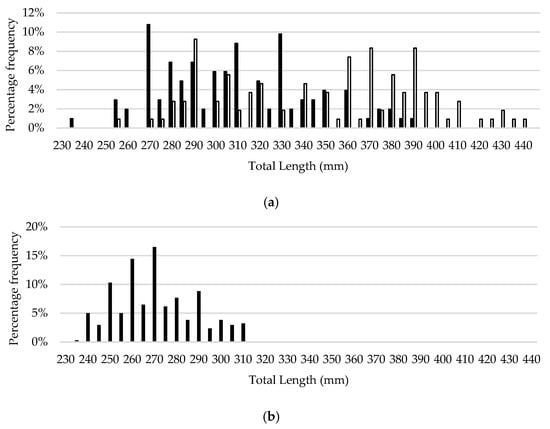
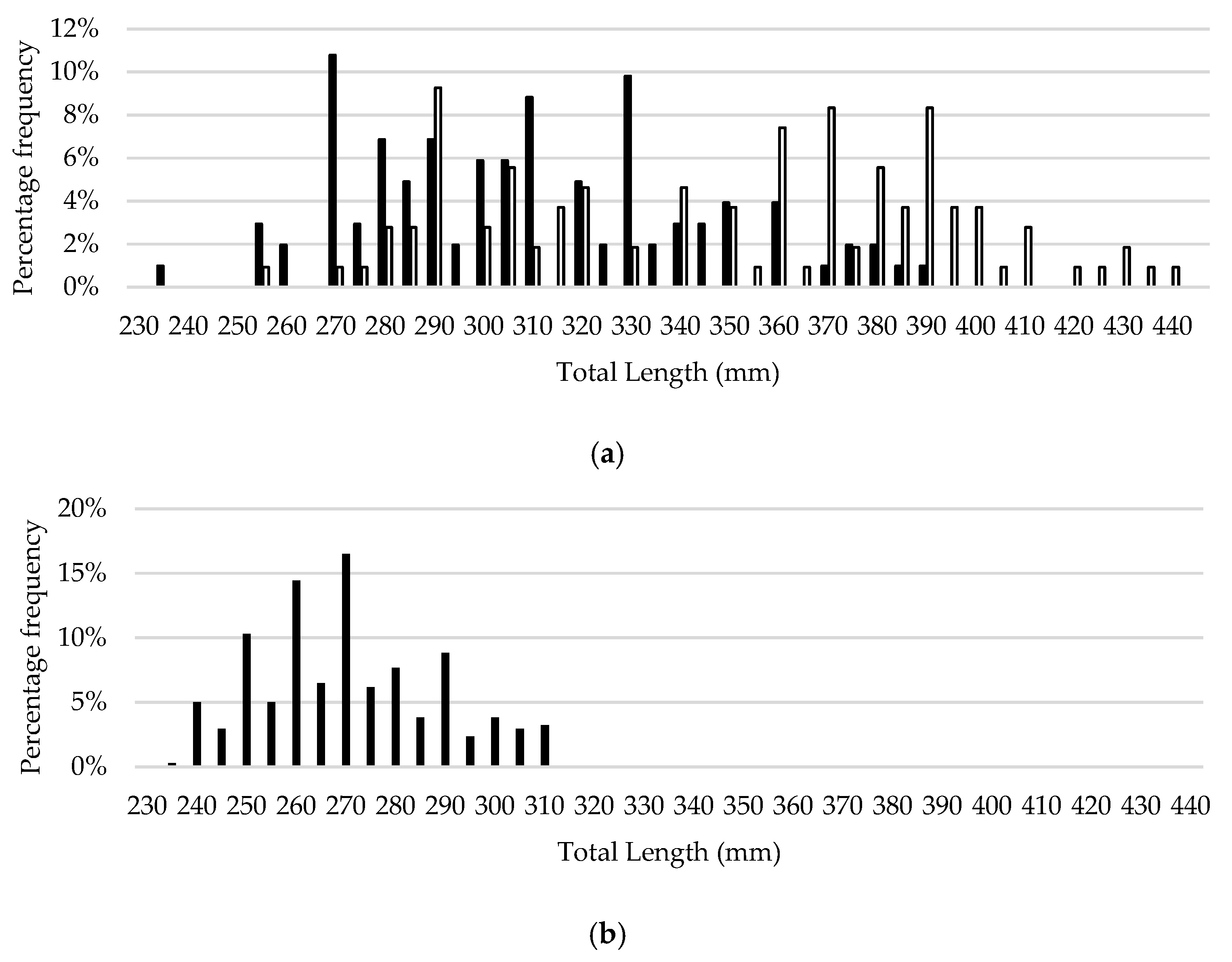
Sex was assigned to 357 specimens. For M. cephalus, 210 individuals were sexed, of which 108 were females with a mean TL of 349 mm and a mean TW of 416 g, and 102 males with a mean TL of 308 mm and a mean TW of 294.3 g. The total length ranges for M. cephalus females and males were 255–440 mm and 235–390 mm, respectively (Figure 2a).
Figure 2.
Total length distribution of (a) females and males of the striped mullet Mugil cephalus, and (b) combined sexes of the white mullet Mugil curema at the mouth of the Soto La Marina River, in the Gulf of Mexico. Open bars represent females, and filled bars represent males.
For M. curema (n = 147), 83 individuals were females with a mean TL of 267 mm and a mean TW of 170.2 g, respectively, and 64 were males with a mean TL of 266 mm and a mean TW of 169.9 g. The TL range for combined sexes of M. curema was 235–310 mm (Figure 2b).
3.2. Length–Weight Relationship
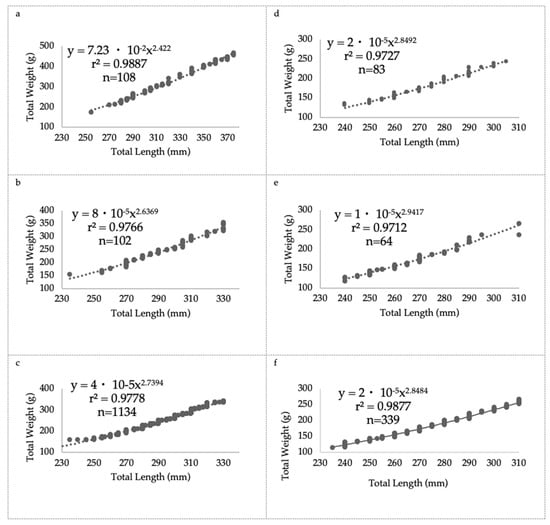
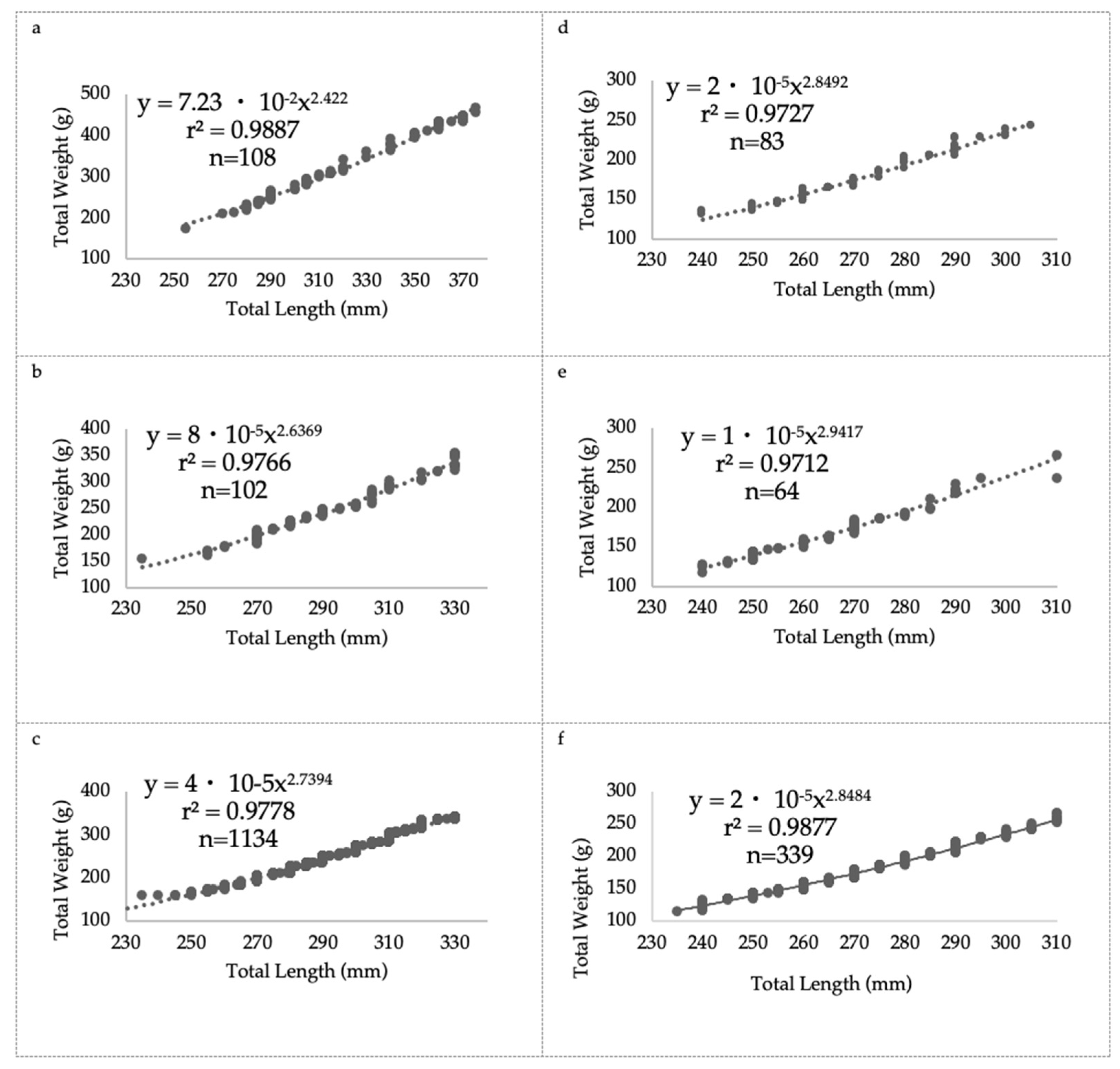
The length–weight relationship showed a good fit in all analyzed categories (Figure 3), with coefficients of determination (r2) ranging between 0.971 and 0.989 (Table 2).
Figure 3.
Length–weight relationship of females (a), males (b), and combined sexes (c) of striped mullet Mugil cephalus and of females (d), males (e), and combined sexes (f) of white mullet Mugil curema, at the Mouth of the Soto La Marina River, in the Gulf of Mexico.
Table 2.
Length–weight relationship parameters by sex and for combined sexes of striped mullet Mugil cephalus and white mullet Mugil curema at the Mouth of the Soto La Marina River, Gulf of Mexico.
Based on the exponent b of the power relationship, the sampled individuals of M. cephalus showed a decrease in mean body condition with increasing length in females, males, and combined sexes (Table 2). Student’s t-test confirmed that the b values were significantly different from 3 in all cases (females: t1.96 = 21.15, p < 0.05; males: t1.96 = 8.71, p < 0.05; combined sexes: t1.96 = 170.0, p < 0.05). This indicates that in M. cephalus, weight does not increase proportionally to the cube of length, but rather at a lower rate, indicating a decrease in mean body condition relative to length within the sample (i.e., sampled individuals become comparatively less heavy for their length as length increases).
In M. curema, a differential pattern between sexes was observed. In males, mean body condition remained relatively constant across the sampled size range, since the b value (2.94) was not significantly different from 3 (t1.96 = 0.891, p > 0.05), suggesting that in males, weight remains proportional to the cube of length. In contrast, females (b = 2.42) and combined sexes (b = 2.85) showed a decrease in mean body condition with increasing length, with b values significantly lower than 3 (females: t1.96 = 10.898, p < 0.05; combined sexes: t1.96 = 9.135, p < 0.05). These differences between sexes could be associated with reproductive factors affecting body condition in females during the gonadal maturation period [34].
3.3. Differences Between Sexes and Sex Ratio
Descriptive comparison of biometric variables between sexes revealed clear differences in M. cephalus: females presented a larger mean TL (349 mm; range 255–440 mm) and mean TW (416 g) compared to males (mean TL = 308 mm; range 235–390 mm; mean TW = 294.3 g). In M. curema, values were very similar between sexes (females: mean TL = 267 mm, mean TW = 170.2 g; males: mean TL = 266 mm, mean TW = 169.9 g), consistent with the absence of dimorphism reported for this species [34]. Consequently, subsequent analyses were performed with sexes separated for M. cephalus and with combined sexes for M. curema.
The Chen et al. test [35], which operates on the residuals of the log-transformed length–weight regression rather than on raw length values, revealed significant differences between the length–weight relationship curves of females and males in M. cephalus (F2,65 = 35.94, p < 0.05), but not in M. curema (F2,67 = 0.45, p > 0.05). Since regression residuals from models with high coefficients of determination (r2 = 0.977–0.989) satisfy the normality assumption reasonably well by the central limit theorem applied to regression errors, this test provides statistically appropriate confirmation of the sexual dimorphism of M. cephalus within the MSLMR, independent of the distributional properties of the original size data.
The female:male sex ratio was 1.06:1 in M. cephalus (108:102) and 1.30:1 in M. curema (83:64). In both cases, the chi-square test indicated no significant differences with respect to the expected 1:1 ratio (M. cephalus: χ2 = 0.17, *p* > 0.05; M. curema: χ2 = 2.46, *p* > 0.05).
3.4. Growth Parameters
The estimates of growth parameters for species of the genus Mugil in the MSLMR revealed structural differences depending on the analysis method and the dataset used (Table 3).
Table 3.
Estimation of the von Bertalanffy growth parameters (L∞, k, and t0) of striped mullet Mugil cephalus and white mullet Mugil curema at the Mouth of the Soto La Marina River, Gulf of Mexico.
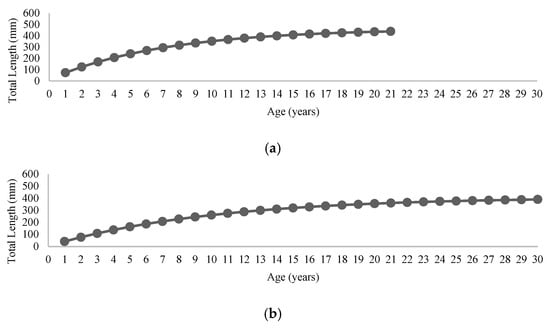
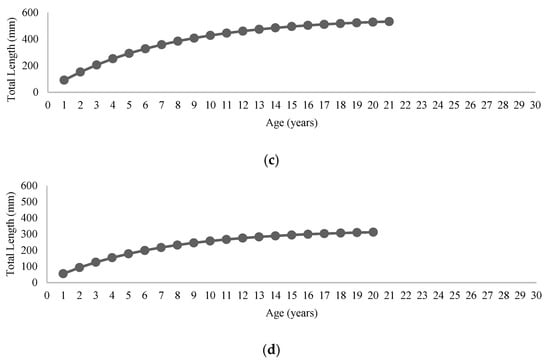
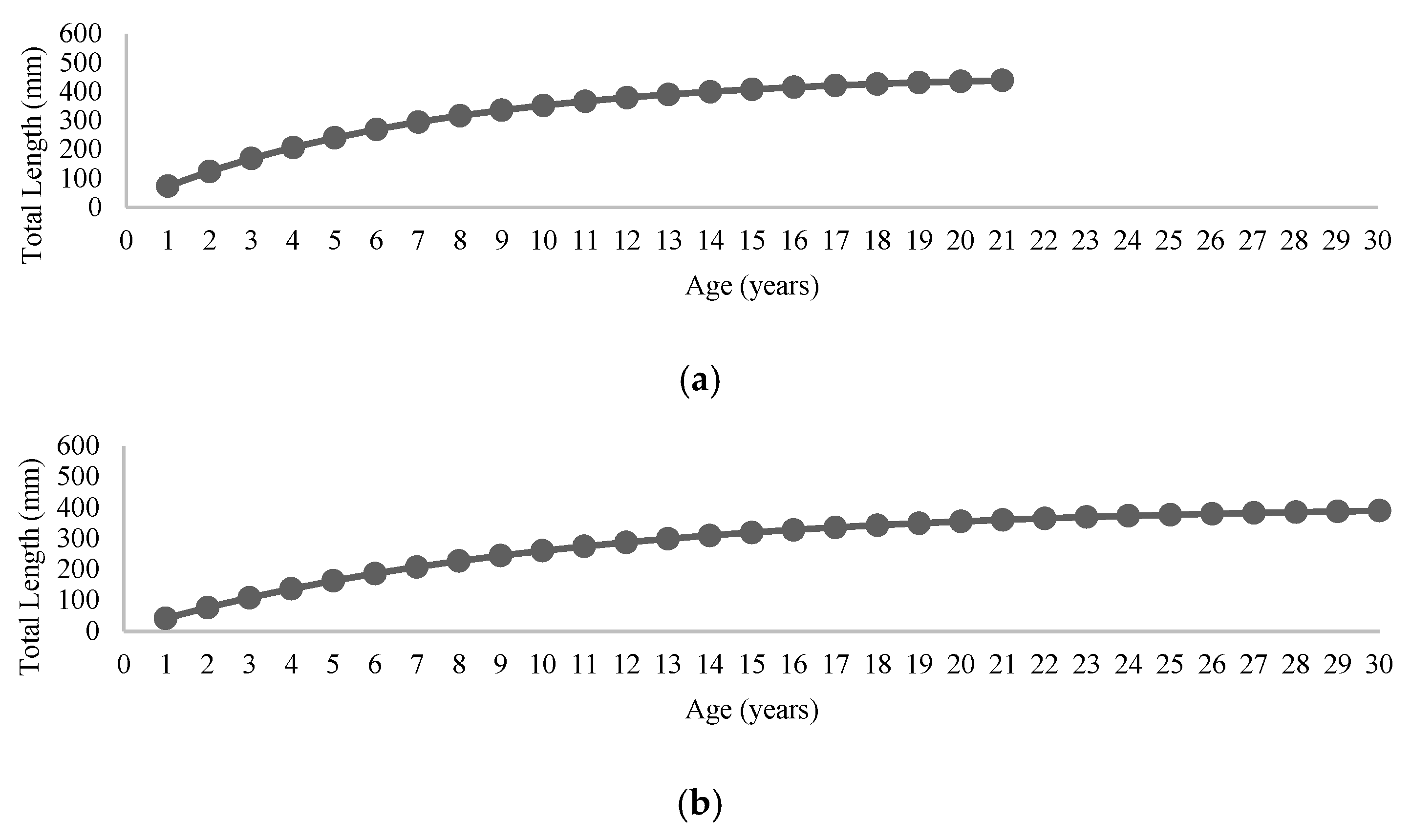
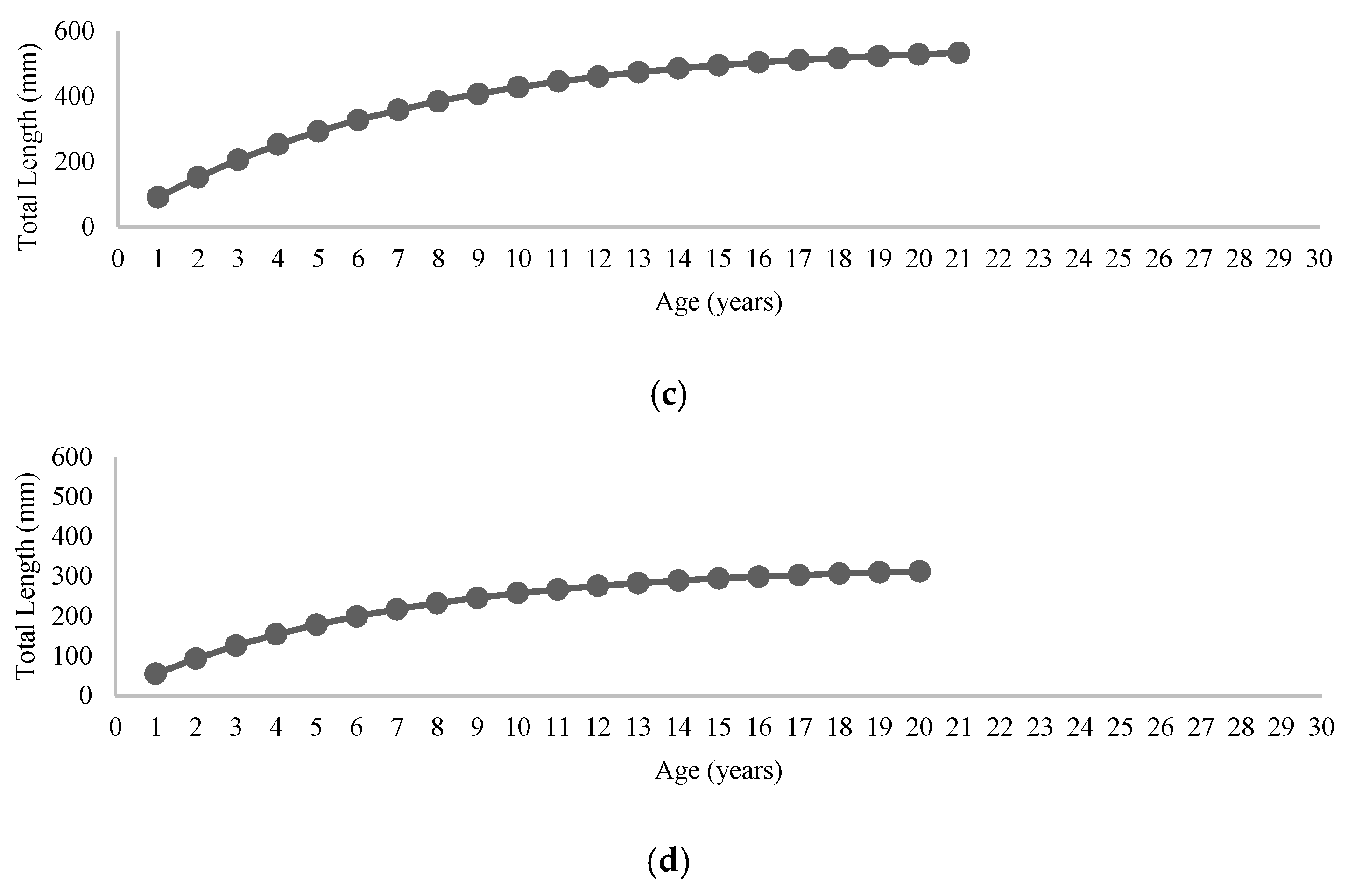
For M. cephalus, asymptotic length (L∞) values showed a marked gradient, where the combined sexes group reached the largest dimensions with 561 mm, while the male group recorded the most conservative sizes, ranging between 377 and 410 mm. In terms of growth rate (k), the species showed moderate development with values ranging between 0.100 and 0.200 year−1. These variations in growth velocity directly influenced longevity estimates (A0.95), which were 21 years for females, 30 years for males, and 21 years for combined sexes (Figure 4a–c).
Figure 4.
Growth curves for females (a), males (b), and combined sexes (c) of striped mullet Mugil cephalus and combined sexes (d) of white mullet Mugil curema at the Mouth of the Soto La Marina River, Gulf of Mexico.
For its part, M. curema presented a distinct life strategy, characterized by smaller dimensions and, in certain models, faster growth. Its L∞ stabilized around 320 mm; however, the parameter k exhibited a notable discrepancy between methods: while ELEFAN suggested rapid growth of 0.590 year−1 with a reduced longevity of 4 years, Shepherd’s method estimated slower development (0.150 year−1) and a longer average lifespan of 20 years (Figure 4d).
Regarding statistical robustness, Shepherd’s method proved to be the most accurate for both species, consistently reaching the maximum goodness-of-fit value (Score RN = 1). Finally, estimates derived from Powell’s method indicated that the Z/k ratio remained close to unity in most cases, ranging from 0.813 to 1.109, offering a preliminary perspective on the mortality-relative-to-growth structure in the studied population.
3.5. Growth Performance Reliability
The Phi-prime index (Ø′) values were for M. cephalus: females = 4.6, males = 4.2, combined sexes = 4.5; and for combined sexes of M. curema = 4.2. These values were compared with ranges reported in the literature (2.6–4.8 for M. cephalus; 2.3–4.8 for M. curema), falling within the expected intervals [57,58,59].
3.6. Instantaneous Mortality Rates
3.6.1. Total Mortality (Z)
Table 4 presents the Z estimates obtained using four methods. The Jones and van Zalinge method [53] showed the best fits (r2 > 0.96); therefore, its estimates were selected. The Z values in decreasing order were for M. cephalus: 3.72 year−1 for combined sexes, 2.115 year−1 for males, and 2.025 year−1 for females; and for M. curema: 1.455 year−1 for combined sexes.
Table 4.
Total instantaneous mortality rate (Z) calculated using various methods, and required life parameters for the models, of striped mullet Mugil cephalus and white mullet Mugil curema at the Mouth of the Soto La Marina River, Gulf of Mexico.
3.6.2. Natural Mortality (M), Fishing Mortality (F), and Exploitation Rate (E)
M. cephalus presented lower M than M. curema, but higher F and higher E than M. curema (Table 5). In all point estimates and in all confidence intervals, for all datasets of both species, E values were greater than 0.5, substantially exceeding both reference points (Gulland [7]: E = 0.5; Patterson [9]: E = 0.4). This indicates that, with high confidence, current exploitation rates in both species significantly exceed the reference levels.
Table 5.
Selected total instantaneous mortality rates (Z), natural mortality (M), fishing mortality (F), and exploitation rate (E) of striped mullet Mugil cephalus and white mullet Mugil curema at the Mouth of the Soto La Marina River, Gulf of Mexico.
3.6.3. Reliability of Biological Parameters
The M/k ratio presented values between 1.4 and 1.8 using Shepherd’s method and between 1.1 and 1.5 using ELEFAN (Table 6). These values fall within the range reported as acceptable for teleosts [56,60].
Table 6.
Natural mortality to growth ratio (M/k) values for females, males, and combined sexes of striped mullet Mugil cephalus, and for combined sexes of white mullet Mugil curema, at the Mouth of the Soto La Marina River, Gulf of Mexico.
4. Discussion
The overall objective of this study was to assign an exploitation status to the fish populations of M. cephalus (with separate analysis by sex, due to the significant morphometric differences found) and M. curema (with combined sexes, due to the absence of dimorphism) in the mouth of the Soto La Marina River, in the Gulf of Mexico, an area that has a triple conservation value because it is integrated within the Laguna Madre Protected Area [15], the Terrestrial Priority Region RTP 83 [17] and the Marine Priority Region RMP 44 [18]. Using a methodological approach appropriate for data-limited conditions (absence of historical catch and effort time series), growth parameters, mortality rates, and the exploitation rate (E = F/Z) were estimated as a diagnostic indicator of fishing pressure level, evaluating it against two reference points: the classic Gulland [7] (E = 0.5) and the more conservative Patterson [9] (E = 0.4).
The main finding of this research is that the E values estimated across all analyzed datasets (E = 0.828–0.944) far exceed both reference points. This result constitutes strong diagnostic evidence that both stocks are subject to severe growth overfishing. Notably, this condition occurs in an area that concentrates three conservation protection and prioritization designations, revealing a critical disconnect between the formal recognition of the area’s ecological value and the actual condition of the fishery resources it supports.
To substantiate this diagnosis, the following subsections first characterize the life-history parameters and reproductive biology underlying the observed patterns (Section 4.1), then examine how these traits translate into the estimated fishing pressure and exploitation rates (Section 4.2), and finally discuss the implications of these findings for conservation and management in this high-priority area (Section 4.3)
4.1. Life-History Parameters and Sexual Dimorphism: Regional Context and Implications for Assessment
The growth parameters estimated using methods appropriate for data-limited conditions (ELEFAN I [46] and Shepherd’s [47]) were consistent with the ranges reported in the literature for both species in the Gulf of Mexico and other regions [20,30,57,59,61]. In M. cephalus, marked sexual dimorphism was observed: females reached a greater asymptotic length (L∞ = 463 mm) and a faster growth rate (k = 0.14 year−1) compared to males (L∞ = 411 mm; k = 0.10 year−1). This pattern has been previously documented in mullets and is attributed to differences in energy allocation to reproduction, where females invest more energy in somatic growth to reach larger sizes that increase fecundity [32,33]. For combined sexes, M. cephalus showed L∞ = 562 mm and k = 0.14 year−1, while M. curema reached L∞ = 329 mm with k = 0.15 year−1. These values align with those reported by Ibañez-Aguirre et al. [57] in the Gulf of Mexico (L∞ = 400–461 mm; k = 0.10–0.20 year−1) and by Díaz and Hernández [20] in Tamaulipas (L∞ = 581 mm; k = 0.19 year−1).
The length–weight relationship revealed a decrease in mean body condition with increasing length in most categories (b < 3), indicating that sampled individuals become comparatively less heavy in relation to their length as length increases [8]. This pattern is common in mullets and has been reported for M. cephalus in Tamiahua Lagoon [33]. The exception was male M. curema, whose mean body condition remained relatively constant across the sampled size range (b = 2.94; t = 0.891, p > 0.05), suggesting a different growth strategy, possibly related to lower energy investment in gonadal development compared to females [34].
The sex ratio close to 1:1 in both species indicates no bias in differential mortality by sex or in fishing gear selectivity [27]. This result is consistent with previous studies on Mexican mullets [62,63] and suggests that the population maintains a balanced sexual structure despite high fishing pressure.
The Phi-prime index (Ø′ = 4.2–4.6) falls within the range reported for mullets in Mexico and worldwide [57,58,64]. Since Ø′ is a robust indicator of growth performance and relatively independent of the methodology used [50,65], its similarity to previous studies validates the reliability of our estimates and demonstrates that, even with simple methods appropriate for data-limited conditions, robust biological parameters can be obtained.
The estimated longevity (21–30 years for M. cephalus; 20 years for M. curema) is higher than that reported in previous studies for mullets (generally 4–16 years) [65], but consistent with the longevity documented for lightly exploited populations or those under favorable environmental conditions [66]. The greater longevity of male M. cephalus (30 years) compared to females (21 years) correlates with their lower growth rate (k = 0.10 year−1), an inverse relationship between k and longevity that has been widely documented in fish [66,67].
Taken together, these life-history parameters depict species with a moderate growth rate and a comparatively high biological potential for longevity, which provides an important baseline against which the observed mortality and exploitation patterns, discussed below, can be interpreted.
4.2. Fishing Pressure and Exploitation Rate as a Diagnostic Indicator
The estimation of E constitutes a diagnostic indicator widely used in data-limited fishery assessments [9,10]. A novel aspect of this study is the sex-differentiated analysis in M. cephalus, which revealed contrasting patterns in fishing pressure. Although E values were high in all cases (females: E = 0.891; males: E = 0.915; combined sexes: E = 0.944), males presented slightly higher F (F = 1.935 year−1) than females (F = 1.805 year−1). This could be due to differences in fishing gear selectivity or in spatial aggregation patterns between sexes [54]. Murugan et al. [68] also reported sex-specific exploitation differences in M. cephalus on the southeast coast of India (males: E = 0.674; females: E = 0.227), although in the opposite direction to that found in our study, suggesting that sexual selectivity may vary regionally depending on the fishing gear used and local reproductive behaviors.
In combined sexes M. cephalus, the E value of 0.944 implies that 94% of deaths in the population are attributable to fishing. This situation constitutes a case of growth overfishing [54], where individuals are captured before reaching their optimal harvest size.
This pattern becomes particularly meaningful when interpreted in light of the life-history parameters described in Section 4.1. The F/M ratios estimated across categories ranged between 8.2 and 16.7, indicating that fishing mortality exceeds natural mortality by a factor of 8 to 17. In the context of the moderate growth rate (k = 0.10–0.15 year−1) and the comparatively high biological potential for longevity (20–30 years) estimated for these stocks, such elevated F/M ratios are characteristic of populations subject to severe growth overfishing, in which individuals are systematically removed well before reaching their size at first maturity. In other words, the life-history traits that would otherwise allow these mullets to grow slowly toward large asymptotic sizes and long lifespans are effectively truncated by a level of fishing mortality that prevents most individuals from approaching either.
The E values obtained (0.83–0.94) exceed not only Gulland’s reference point [7] (E = 0.5) but also Patterson’s more conservative one [9] (E = 0.4). Patterson [9], analyzing 28 pelagic fish stocks, demonstrated that E values > 0.4 are consistently associated with biomass declines over 10-year periods. For E = 0.6, the probability of stock decline is approximately 0.85 [9]. For our E values > 0.8, these probabilities would be close to 1, suggesting that, if current conditions persist, it is highly likely that both stocks will continue to decline severely.
Comparison with other localities reveals that the situation at the MSLMR is particularly critical. Gallardo-Cabello et al. [69] reported E = 0.730 for M. cephalus in the central Mexican Pacific. In Cuyutlán Lagoon in the State of Colima, Mexico, Cabral-Solís et al. [62] documented E = 0.75 for M. curema, while Meléndez-Galicia and Romero-Acosta [70] reported underexploitation (E = 0.19) on the coast of Michoacán, showing the regional variability in stock status and making the situation documented in our study area, which also has conservation designations, even more concerning.
This regional comparison underscores the severity of the situation at the MSLMR and raises a critical question that frames the remainder of this discussion: How is it possible for such an intense level of fishing pressure to persist within an area formally recognized for its high conservation value?
4.3. Overfishing Diagnosis in a Triple Ecological Value Zone: Implications for Conservation and Management
A particularly relevant finding is that the documented overexploitation occurs in an area that concentrates three conservation protection and prioritization designations: the LM-PA [15], the RTP-83-LM [17], and the RMP-44-LM [18]. In the LM-PA, Special Use Subzone A was explicitly designated for fishing activities under the concept of “sustainable use” [16]. Our results indicate that, at least for the mullet stocks, this use is far from sustainable.
In the RMP-44, the region’s data sheet [18] explicitly mentions fishing overexploitation as one of the region’s problems. Our results confirm and update this diagnosis for the mullet resource, which had not been quantitatively evaluated previously. In the RTP-83, overexploitation of fishery resources can have indirect effects on associated terrestrial ecosystems, particularly on birds that depend on fish for food [17].
This situation shows that designation of an area as protected or priority does not automatically guarantee the sustainability of the fisheries it harbors [71,72]. Edgar et al. [73] demonstrated that the effectiveness of marine protected areas critically depends on five factors: (1) absence of fishing (not applicable in this subzone), (2) effective surveillance, (3) age, (4) size, and (5) isolation. In our case, Special Use Subzone A explicitly allows fishing, so its effectiveness in maintaining healthy stocks fundamentally depends on the implementation of appropriate management measures and their enforcement [74].
Given this dependence on appropriate management and enforcement, and based on the reference points of Gulland [7] and Patterson [9], the following measures are proposed:
- (1)
- Strengthening surveillance within the PA: Increase coordinated presence of fishing authorities (CONAPESCA) and environmental authorities (CONANP) at the landing sites of La Pesca and Miguel de la Madrid Hurtado.
- (2)
- Adoption of Patterson’s reference point (E = 0.4): Given the high conservation value of the area, adopting the more conservative reference point [9] as a management target is recommended, seeking to reduce F until reaching F ≤ 2/3 M.
- (3)
- Review of fishing gear selectivity: Technically evaluate the mesh size of nets currently used in the PA, aiming to increase it to allow the escape of juvenile individuals.
- (4)
- Implementation of simple community-based monitoring indicators: Following Froese [75], using (a) proportion of juveniles in catch, (b) comparison of mean length with length at first maturity, and (c) percentage of mature individuals in the catch as easily measurable indicators for participatory monitoring with fishers.
- (5)
- Participatory research and co-management: Involve fishers in the systematic collection of length and catch data, and promote their participation in co-management schemes, where international experience shows that the effectiveness of measures is increased and conflicts reduced [76,77].
- (6)
- Sex-specific monitoring: Given the sexual dimorphism found in M. cephalus, maintaining sex-specific data collection in future monitoring is recommended, since differences in growth rates and longevity between females and males may require differentiated management strategies.
- (7)
- Interinstitutional coordination: Establish a joint monitoring program between Mexican government institutions such as CONANP (management of the PA-Laguna Madre), CONABIO (monitoring of RTP-83-Laguna Madre and RMP-44-Laguna Madre), IMIPAS (Instituto Mexicano de Investigación de Pesca y Acuacultura Sustentables) (fishery assessment), and local academic institutions.
The management measures proposed above are grounded in the diagnostic approach adopted in this study, which, while informative, carries inherent methodological constraints that must be acknowledged before these recommendations can be fully contextualized.
4.4. Study Limitations and Future Perspectives
This study is based on a data-limited approach, which is a strength in contexts of scarce information, but imposes methodological limitations. The methods used assume population equilibrium conditions that are likely not met in overexploited stocks [78]. Biomass could not be estimated directly, preventing calculation of maximum sustainable yield (MSY) using surplus production models [6].
As noted in the methodological introduction, the estimation of E constitutes a diagnostic indicator of fishing pressure level, not a complete stock assessment [1]. However, as Patterson [9] empirically demonstrated, this indicator has high predictive power for biomass trends, and its combination with other simple indicators (proportion of juveniles, size comparison) allows robust diagnoses to be generated under limited information conditions [75].
It is important to note that the exploitation rate (E = F/Z) constitutes a diagnostic indicator of relative fishing pressure rather than a direct estimator of biomass relative to population reference points. Therefore, the results presented here should be interpreted as a robust warning signal of growth overfishing, rather than as a definitive assessment of the biomass status of either stock. To strengthen future assessments, the following priority research lines are proposed: (a) calculation of the length-based spawning potential ratio (LB-SPR; Hordyk et al. [79]), which can be estimated using the length distribution and growth parameter data already available; (b) incorporation of the indicators proposed by Froese [75]—proportion of juveniles in the catch, comparison of mean length with length at first maturity, and percentage of mature individuals in the catch—as low-cost, complementary tools for participatory monitoring; and (c) collection of catch-per-unit-effort (CPUE) time series through collaboration with local fishers, which would allow, in the medium term, the application of biomass dynamics models suited to data-limited conditions (e.g., CMSY++, JABBA). Incorporating these complementary indicators would reinforce the prospective value of the present study and connect it to current methodological trends in the global assessment of data-limited fisheries.
Future research should focus on (1) estimating biomass using direct methods (acoustic surveys, swept area) within the PA-Laguna Madre polygon; (2) validating growth parameters using direct methods (otolith analysis), particularly to corroborate the estimated longevity of 30 years for male M. cephalus; (3) evaluating the stock–recruitment relationship to identify possible overfishing effects on recruitment; (4) analyzing the selectivity of fishing gear currently used in the PA-Laguna Madre; (5) developing data-limited biomass dynamics models specific to the region; and (6) evaluating the ecological impact of mullet overexploitation on birds and other ecosystem components that depend on these fish as a food resource.
5. Conclusions
- (1)
- The growth parameters estimated for M. cephalus (females: L∞ = 463 mm, k = 0.14 year−1; males: L∞ = 411 mm, k = 0.10 year−1; combined sexes: L∞ = 562 mm, k = 0.14 year−1) and for M. curema (L∞ = 329 mm, k = 0.15 year−1) at the MSLMR are biologically plausible and consistent with values reported in the literature for the Gulf of Mexico and other regions [20,57,59,61], validating the methodological approach used for data-limited conditions.
- (2)
- The presence of sexual dimorphism in M. cephalus was confirmed, evidenced by significant differences in size, weight, length–weight relationship curves, and growth parameters between females and males [32,33]. Females reach a larger asymptotic length and grow faster than males, a pattern that should be considered in future assessment and management studies. In contrast, M. curema did not present sexual dimorphism, justifying its analysis with combined sexes.
- (3)
- The estimated exploitation rates were notably high in all analyzed categories: M. cephalus (females = 0.891, males = 0.915, combined sexes = 0.944) and M. curema (combined sexes = 0.828). These values far exceed both Gulland’s classic reference point [7] (E = 0.5) and Patterson’s more conservative one [9] (E = 0.4). This result constitutes strong diagnostic evidence of growth overfishing in both stocks, although a definitive assessment of biomass status would require complementary biomass-based indicators (see Section 4.4).
- (4)
- The proposed hypothesis is confirmed: fishing mortality rates (F) exceed natural mortality rates (M) in all analyzed categories (F/M between 8.2 and 16.7), which explains the decline observed in catches during the last decade and confirms the overexploitation status of both resources.
- (5)
- A particularly relevant finding is that the documented overexploitation occurs in an area with triple conservation value: the PA-Laguna Madre [15], the RTP-83-Laguna Madre [17], and the RMP-44-Laguna Madre [18] of CONABIO. This condition contradicts the “sustainable use” objectives established in the PA-Laguna Madre Management Plan [16] and in the priority region designations, revealing a critical disconnect between the formal recognition of the area’s ecological value and the actual condition of the fishery resources it sustains.
- (6)
- A coordinated management program between fishing authorities (National Commission for Aquaculture and Fisheries, CONAPESCA) and environmental authorities (National Commission of Natural Protected Areas, CONANP) is urgently needed, including (a) strengthening surveillance at the landing sites of the towns of La Pesca and Miguel de la Madrid Hurtado; (b) adopting Patterson’s reference point [9] (E = 0.4) as a management target; (c) reviewing and adjusting fishing gear selectivity to allow juvenile escape; (d) protecting nursery areas identified within the PA-Laguna Madre; (e) implementation of a continuous monitoring program based on simple indicators [75]; (f) developing co-management schemes with active fisher participation [76,77]; and (g) establishing a joint monitoring program involving CONANP, CONABIO, IMIPAS, and academic institutions.
- (7)
- The methodological approach employed, based on simple indicators (exploitation rate E = F/Z, and size comparison), proved to be a useful, low-cost, and scientifically robust tool for diagnosing the exploitation status of fishery resources in data-limited contexts [1,9]. This approach is particularly valuable for artisanal fisheries in developing countries and for high conservation value areas, where available scientific information is scarce but the need for reliable diagnoses is urgent.
- (8)
- The replication of this assessment model is recommended for other commercially important species present in the region (such as pompano, drum, snapper, and croaker), as well as in other coastal protected areas of Mexico, as part of a national strategy for data-limited fisheries assessment that can generate preliminary diagnoses to guide future management and research.
Author Contributions
Conceptualization, J.H.R.-C. and S.E.O.-d.l.F.; methodology, J.H.R.-C., S.E.O.-d.l.F., U.J.S.-R., and G.H.-I.; software, J.H.R.-C., J.A.R.-O., U.J.S.-R., L.G.Y.-C., and M.R.-G.; validation, J.H.R.-C., U.J.S.-R., G.H.-I., L.G.Y.-C., and M.R.-G.; formal analysis, J.H.R.-C., S.E.O.-d.l.F., and J.A.R.-O.; investigation, J.H.R.-C., S.E.O.-d.l.F., J.A.R.-O., and G.H.-I.; resources, J.H.R.-C., S.E.O.-d.l.F., G.H.-I., L.G.Y.-C., and M.R.-G.; data curation, J.H.R.-C., J.A.R.-O., U.J.S.-R., G.H.-I., L.G.Y.-C., and M.R.-G.; writing—original draft preparation, J.H.R.-C. and S.E.O.-d.l.F.; writing—review and editing, J.H.R.-C., S.E.O.-d.l.F. and G.H.-I.; visualization, J.H.R.-C., S.E.O.-d.l.F., J.A.R.-O., U.J.S.-R., G.H.-I., L.G.Y.-C., and M.R.-G.; supervision, J.H.R.-C., S.E.O.-d.l.F., J.A.R.-O., U.J.S.-R., and G.H.-I.; project administration, J.H.R.-C., S.E.O.-d.l.F., and J.A.R.-O.; funding acquisition, J.H.R.-C., S.E.O.-d.l.F., G.H.-I., L.G.Y.-C., and M.R.-G. All authors have read and agreed to the published version of the manuscript.
Funding
This research received no external funding.
Institutional Review Board Statement
This study did not involve live animal experimentation or any procedure requiring ethics approval under MDPI’s guidelines for animal research. All specimens of Mugil cephalus and Mugil curema were obtained from commercial artisanal fishery landings at the fish reception centers of the towns of La Pesca and Miguel de la Madrid Hurtado, Municipality of Soto La Marina, Tamaulipas, Mexico, where the fish were already dead upon arrival. The research consisted exclusively of morphometric measurements (total length, total weight) and sex determination by visual inspection of gonads, performed on already deceased specimens. No experimental procedures were performed that could cause pain, distress, or harm to live animals. Sampling was conducted following the guidelines of the Mexican National Fisheries Charter and the Management Plan of the Laguna Madre Protected Area for biological-fishery monitoring of commercial catches for stock assessment and fishery management purposes.
Informed Consent Statement
Not applicable.
Data Availability Statement
All data supporting the conclusions of this article are presented within the manuscript.
Conflicts of Interest
The authors declare that they have no conflicts of interest.
References
- Hilborn, R.; Walters, C.J. Quantitative Fisheries Stock Assessment: Choice, Dynamics and Uncertainty; Chapman and Hall: New York, NY, USA, 1992. [Google Scholar]
- Arreguín-Sánchez, F.; Arcos, E. La pesca en México: Estado de la explotación y uso de los ecosistemas. Hidrobiológica 2011, 21, 321–462. [Google Scholar]
- Costello, C.; Ovando, D.; Hilborn, R.; Gaines, S.D.; Deschenes, O.; Lester, S.E. Status and solutions for the world’s unassessed fisheries. Science 2012, 338, 517–520. [Google Scholar] [CrossRef] [Scilit] [PubMed]
- Pauly, D. Algunos Métodos Sencillos Para la Evaluación de las Poblaciones de Peces Tropicales; FAO Documento Técnico de Pesca No. 234; Organización de las Naciones Unidas para la Agricultura y la Alimentación: Roma, Italy, 1983. [Google Scholar]
- Sparre, P.; Venema, S.C. Introducción a la Evaluación de Recursos Pesqueros Tropicales. Parte 1: Manual; FAO Documento Técnico de Pesca No. 306/1; Organización de las Naciones Unidas para la Agricultura y la Alimentación: Roma, Italy, 1995. [Google Scholar]
- García, S.; Sparre, P.; Csirke, J. Estimating surplus production and maximum sustainable yield from biomass data when catch and effort time series are not available. Fish. Res. 1989, 8, 13–23. [Google Scholar] [CrossRef] [Scilit]
- Gulland, J.A. The Fish Resources of the Ocean; Fishing News Books: London, UK, 1971. [Google Scholar]
- Pauly, D. Fishbyte section. Naga ICLARM Q. 1993, 16, 26. [Google Scholar]
- Patterson, K. Fisheries for small pelagic species: An empirical approach to management targets. Rev. Fish Biol. Fish. 1992, 2, 321–338. [Google Scholar] [CrossRef] [Scilit]
- Caddy, J.F.; Mahon, R. Reference Points for Fisheries Management; FAO Fisheries Technical Paper No. 347; Food and Agriculture Organization of the United Nations: Rome, Italy, 1995. [Google Scholar]
- DOF. Acuerdo Por el Que se da a Conocer el Plan de Manejo Pesquero de Lisa (Mugil cephalus) y Lebrancha (Mugil curema), en las Costas de Tamaulipas y Veracruz; Diario Oficial de la Federación: Mexico City, Mexico, 2018. [Google Scholar]
- Rodríguez-Castro, J.H.; Garza, A.E.; Olmeda, S. La actividad pesquera en Tamaulipas, ejemplo nacional. CienciaUAT 2010, 4, 28–35. [Google Scholar]
- CONAPESCA. Anuario Estadístico de Acuacultura y Pesca 2017; Comisión Nacional de Acuacultura y Pesca: Mazatlán, Mexico, 2017.
- Ortiz, M.; Peña, R.; Telles, J.; Barbosa, G. Evaluación biológica y pesquera de las pesquerías de escama de mayor importancia comercial en la Laguna Madre, Tamaulipas. IV Foro Científico DE Pesca Ribereña 2007, 1, 91–102. [Google Scholar]
- DOF. Decreto Por el Que se Declara Área Natural Protegida, con el Carácter de Área de Protección de Flora y Fauna, la Región Conocida Como Laguna Madre y Delta del Río Bravo; Diario Oficial de la Federación: Mexico City, Mexico, 2005. [Google Scholar]
- CONANP. Programa de Manejo del Área de Protección de Flora y Fauna Laguna Madre y Delta del Río Bravo; Comisión Nacional de Áreas Naturales Protegidas: Mexico City, Mexico, 2015.
- Arriaga, L.; Espinoza, J.M.; Aguilar, C.; Martínez, E.; Gómez, L.; Loa, E. Regiones Terrestres Prioritarias de México; Comisión Nacional para el Conocimiento y Uso de la Biodiversidad (CONABIO): Mexico City, Mexico, 2000.
- Arriaga, L.; Aguilar, V.; Alcocer, J. Regiones Marinas Prioritarias de México; Comisión Nacional para el Conocimiento y Uso de la Biodiversidad (CONABIO): Mexico City, Mexico, 1998.
- DOF. Acuerdo Por el Que se da a Conocer la Actualización de la Carta Nacional Pesquera; Diario Oficial de la Federación: Mexico City, Mexico, 2018. [Google Scholar]
- Díaz, E.; Hernández, S. Crecimiento, reproducción y hábitos alimenticios de la lisa Mugil cephalus en la Laguna de San Andrés, Tamps. An. Esc. Nac. Cienc. Biol. 1980, 23, 109–127. [Google Scholar]
- DOF. NORMA Oficial Mexicana NOM-016-SAG/PESC-2014, Para Regular la Pesca de Lisa y Liseta o Lebrancha en Aguas de Jurisdicción Federal del Litoral del Golfo de México y Mar Caribe, así Como del Océano Pacífico, Incluyendo el Golfo de California; Diario Oficial de la Federación: Mexico City, Mexico, 2015. [Google Scholar]
- CONABIO. Sitios de Manglar con Relevancia Biológica y con Necesidades de Rehabilitación Ecológica, Ficha de Caracterización; Comisión Nacional para el Conocimiento y Uso de la Biodiversidad: Mexico City, Mexico, 2009.
- INAPESCA. Temperatura Superficial del Mar; Instituto Nacional de Pesca: Mexico City, Mexico, 2013.
- Cochran, W.G. Sampling Techniques, 3rd ed.; John Wiley & Sons: New York, NY, USA, 1977. [Google Scholar]
- Cadima, E.L. Fish Stock Assessment Manual; FAO Fisheries Technical Paper No. 393; Food and Agriculture Organization of the United Nations: Rome, Italy, 2003. [Google Scholar]
- Thompson, S.K. Sampling, 3rd ed.; Wiley: Hoboken, NJ, USA, 2012. [Google Scholar]
- Nikolsky, G.V. The Ecology of Fishes; Academic Press: London, UK, 1963. [Google Scholar]
- Holden, M.J.; Raitt, D.F.S. Manual of Fisheries Science. Part 2. Methods of Resource Investigation and Their Application; FAO Fisheries Technical Paper No. 115; Food and Agriculture Organization of the United Nations: Rome, Italy, 1974. [Google Scholar]
- Ospina, J.F.; Pardo, F.; Álvarez, R. Madurez gonadal de la ictiofauna presente en la Bahía de Cartagena, Caribe Colombiano. Bol. Cient. Mus. His. Nat. 2008, 12, 117–140. [Google Scholar]
- Ibáñez, A.L.; Gallardo-Cabello, M. Total length-standard length length-weight relationships of the striped mullet Mugil cephalus. J. Appl. Ichthyol. 2004, 20, 73–74. [Google Scholar]
- Daniel, W.W. Bioestadística: Base Para el Análisis de las Ciencias de la Salud, 4th ed.; Limusa Wiley: Mexico City, Mexico, 2012. [Google Scholar]
- Ramos-Santiago, E.; Gil-López, H.; Labastida-Che, A.; Gómez-Ortega, R. Reproducción y madurez gonádica de la lisa Mugil cephalus en las costas de Oaxaca y Chiapas. Cienc. Pesq. 2010, 18, 79–91. [Google Scholar]
- Cabral-Solís, E.; Espino-Barr, E.; Gallardo-Cabello, M.; Ibáñez-Aguirre, A.L. Fishing impact on Mugil curema stock of multi-species gill net fishery in a tropical lagoon, Colima, Mexico. J. Fish. Aquat. Sci. 2007, 2, 235–242. [Google Scholar] [CrossRef] [Scilit]
- Lucano-Ramírez, G.; Michel-Morfín, J.E. Ciclo reproductivo y aspectos poblacionales de Mugil curema (Valenciennes 1836) (Pisces: Mugilidae) en la laguna costera Agua Dulce, Jalisco, México. Oceanologia 1997, 1, 105–115. [Google Scholar]
- Chen, Y.; Jackson, D.A.; Harvey, H.H. A comparison of von Bertalanffy and polynomial functions in modelling fish growth data. Can. J. Fish. Aquat. Sci. 1992, 49, 1228–1235. [Google Scholar] [CrossRef] [Scilit]
- Ricker, W.E. Computation and interpretation of biological statistics of fish populations. Bull. Fish. Res. Board Can. 1975, 191, 1–382. [Google Scholar]
- Sokal, R.R.; Rohlf, F.J. Introducción a la Bioestadística; Reverté: Barcelona, Spain, 1986. [Google Scholar]
- Zar, J.H. Biostatistical Analysis, 3rd ed.; Prentice Hall: Upper Saddle River, NJ, USA, 1996. [Google Scholar]
- Froese, R. Cube law, condition factor and weight-length relationships: History, meta-analysis and recommendations. J. Appl. Ichthyol. 2006, 22, 241–253. [Google Scholar] [CrossRef] [Scilit]
- Ricker, W.E. Linear regressions in fishery research. J. Fish. Res. Board Can. 1973, 30, 409–434. [Google Scholar] [CrossRef] [Scilit]
- Ricker, W.E. Growth rates and models. In Fish Physiology, Vol. VIII: Bioenergetics and Growth; Hoar, W.S., Randall, D.J., Brett, J.R., Eds.; Academic Press: New York, NY, USA, 1979; pp. 677–743. [Google Scholar]
- Cinco, E. Length-weight relationships in fishes. In Small-Scale Fisheries of San Miguel Bay, Philippines: Biology and Stock Assessment; Pauly, D., Mines, A.N., Eds.; ICLARM Technical Reports 7; International Center for Living Aquatic Resources Management: Quezon City, Philippines, 1982; pp. 34–37. [Google Scholar]
- Keller, H.R.; Kerstetter, D.W. Length-length and length-weight relationships for oilfish (Ruvettus pretiosus), escolar (Lepidocybium flavobrunneum), snake mackerel (Gempylus serpens), and longnose lancetfish (Alepisaurus ferox) from the Gulf of Mexico and western North Atlantic. J. Appl. Ichthyol. 2014, 30, 241–243. [Google Scholar]
- Shapiro, S.S.; Wilk, M.B. An analysis of variance test for normality (complete samples). Biometrika 1965, 52, 591–611. [Google Scholar] [CrossRef] [Scilit]
- von Bertalanffy, L. A quantitative theory of organic growth. Hum. Biol. 1938, 10, 181–213. [Google Scholar]
- Pauly, D.; David, N. ELEFAN I, a BASIC program for the objective extraction of growth parameters from length-frequency data. Meeresforschung 1981, 28, 205–211. [Google Scholar]
- Shepherd, J.G. A weakly parametric method for the analysis of length composition data. In Length-Based Methods in Fisheries Research; Pauly, D., Morgan, G.R., Eds.; ICLARM Conference Proceedings 13; International Center for Living Aquatic Resources Management: Manila, Philippines, 1987; pp. 113–119. [Google Scholar]
- Gayanilo, F.C.; Sparre, P.; Pauly, D. The FAO-ICLARM Stock Assessment Tools II (FISAT II) User’s Guide; FAO Computerized Information Series (Fisheries) No. 8; Food and Agriculture Organization of the United Nations: Rome, Italy, 2005. [Google Scholar]
- Pauly, D. Fish population dynamics in tropical waters: A manual for use with programmable calculators. ICLARM Stud. Rev. 1984, 8, 1–325. [Google Scholar]
- Pauly, D.; Munro, J.L. Once more on the comparison of growth in fish and invertebrates. Fishbyte 1984, 2, 21–27. [Google Scholar]
- Taylor, C.C. Cod growth and temperature. J. Cons. Int. Explor. Mer 1958, 23, 366–370. [Google Scholar] [CrossRef] [Scilit]
- Pauly, D. On the interrelationships between natural mortality, growth parameters, and mean environmental temperature in 175 fish stocks. J. Cons. Int. Explor. Mer 1980, 39, 175–192. [Google Scholar] [CrossRef] [Scilit]
- Jones, R.; van Zalinge, N.P. Estimates of mortality rate and population size for shrimp in Kuwait waters. Kuwait Bull. Mar. Sci. 1981, 2, 273–288. [Google Scholar]
- Beverton, R.J.H.; Holt, S.J. The theory of fishing. In Sea Fisheries: Their Investigation in the United Kingdom; Graham, M., Ed.; Edward Arnold: London, UK, 1956; pp. 372–441. [Google Scholar]
- Ault, J.S.; Ehrhardt, N.M. Correction to the Beverton and Holt Z-estimator for truncated catch length-frequency distributions. Fishbyte 1991, 9, 37–39. [Google Scholar]
- Beverton, R.J.H.; Holt, S.J. A review of the lifespans and mortality rates of fish in nature, and their relation to growth and other physiological characteristics. In CIBA Foundation Colloquia on Ageing; Wolstenholme, G.E.W., O’Connor, M., Eds.; John Wiley & Sons: Hoboken, NJ, USA, 1959; Volume 5, pp. 142–180. [Google Scholar]
- Ibañez-Aguirre, A.L.; Gallardo-Cabello, M.; Carrara, X. Growth analysis of striped mullet, Mugil cephalus, and white mullet, M. curema (Pisces: Mugilidae), in the Gulf of Mexico. Fish. Bull. 1999, 97, 861–872. [Google Scholar]
- Dankwa, H.R. Length-weight relationship and growth parameters of grey mullets (Pisces: Mugilidae) in two estuaries in Ghana. West Afr. J. Appl. Ecol. 2011, 18, 53–61. [Google Scholar] [CrossRef] [Scilit]
- Panda, D.; Mohanty, S.K.; Pattnaik, A.K.; Das, S.; Karna, S.K. Growth, mortality and stock status of mullets (Mugilidae) in Chilika Lake, India. Lakes Reserv. Res. Manag. 2018, 23, 4–16. [Google Scholar] [CrossRef] [Scilit]
- Ibañez-Aguirre, A.L.; Gallardo-Cabello, M. Age determination of the grey mullet Mugil cephalus L. and the white mullet Mugil curema V. (Pisces: Mugilidae) in Tamiahua Lagoon, Veracruz. Cienc. Mar. 1996, 22, 329–345. [Google Scholar] [CrossRef] [Scilit]
- Ibáñez-Aguirre, A.L.; Gallardo-Cabello, M. Reproduction of Mugil cephalus and M. curema (Pisces: Mugilidae) from a coastal lagoon in the Gulf of Mexico. Bull. Mar. Sci. 2004, 75, 37–49. [Google Scholar]
- Gallardo-Cabello, M.; Cabral-Solís, E.; Espino-Barr, E.; Ibáñez-Aguirre, A.L. Growth analysis of white mullet Mugil curema (Valenciennes, 1836) (Pisces: Mugilidae) in the Cuyutlán Lagoon, Colima, México. Hidrobiológica 2005, 15, 321–325. [Google Scholar]
- Pauly, D. Growth performance in fishes: Rigorous description of patterns as a basis for understanding causal mechanisms. ICLARM Q. 1991, 14, 18–21. [Google Scholar]
- Ibáñez-Aguirre, A.L. Determinación de la edad de lisa Mugil cephalus L. y la lebrancha Mugil curema V. (Pisces: Mugilidae) en la Laguna de Tamiahua, Veracruz. Cienc. Mar. 1996, 22, 329–345. [Google Scholar] [CrossRef] [Scilit]
- Thompson, J.M. Synopsis of biological data on the grey mullet Mugil cephalus Linnaeus 1758. CSIRO Fish. Synop. 1963, 1, 1–75. [Google Scholar]
- Beverton, R.J.H. Patterns of reproductive strategy parameters in some marine teleost fishes. J. Fish Biol. 1992, 41, 137–160. [Google Scholar] [CrossRef] [Scilit]
- Charnov, E.L. Life History Invariants: Some Explorations of Symmetry in Evolutionary Ecology; Oxford University Press: Oxford, UK, 1993. [Google Scholar]
- Murugan, S.; Ashiq Ur Rahman, M.; Ajmal Khan, S.; Lyla, P.S. Crecimiento y dinámica de la población del salmonete de cabeza plana, Mugil cephalus (Linnaeus, 1758) de las aguas de Parangipettai (costa sureste de la India). Thalassas 2014, 30, 47–56. [Google Scholar]
- Gallardo-Cabello, M.; Espino-Barr, E.; García-Boa, A.; Puente-Gómez, M. Fishery analysis of Mugil cephalus in Central Mexican Pacific Coast. J. Mar. Biol. Oceanogr. 2016, 5, 2. [Google Scholar]
- Meléndez-Galicia, C.; Romero-Acosta, A. Evaluación biológico-pesquera de la lisa Mugil curema, en la costa de Michoacán. Cienc. Pesq. 2010, 18, 68–78. [Google Scholar]
- Kaiser, M.J. Are marine protected areas a red herring or fisheries panacea? Can. J. Fish. Aquat. Sci. 2005, 62, 1194–1199. [Google Scholar] [CrossRef] [Scilit]
- Lester, S.E.; Halpern, B.S.; Grorud-Colvert, K.; Lubchenco, J.; Ruttenberg, B.I.; Gaines, S.D.; Airamé, S.; Warner, R.R. Biological effects within no-take marine reserves: A global synthesis. Mar. Ecol. Prog. Ser. 2009, 384, 33–46. [Google Scholar] [CrossRef] [Scilit]
- Edgar, G.J.; Stuart-Smith, R.D.; Willis, T.J.; Kininmonth, S.; Baker, S.C.; Banks, S.; Barrett, N.S.; Becerro, M.A.; Bernard, A.T.; Berkhout, J.; et al. Global conservation outcomes depend on marine protected areas with five key features. Nature 2014, 506, 216–220. [Google Scholar] [CrossRef] [Scilit] [PubMed]
- Day, J.; Dudley, N.; Hockings, M.; Holmes, G.; Laffoley, D.; Stolton, S.; Wells, S. Guidelines for Applying the IUCN Protected Area Management Categories to Marine Protected Areas; IUCN: Gland, Switzerland, 2012. [Google Scholar]
- Froese, R. Keep it simple: Three indicators to deal with overfishing. Fish Fish. 2004, 5, 86–91. [Google Scholar] [CrossRef] [Scilit]
- Pinkerton, E. (Ed.) Co-Operative Management of Local Fisheries: New Directions for Improved Management and Community Development; University of British Columbia Press: Vancouver, BC, Canada, 1989. [Google Scholar]
- Gutiérrez, N.L.; Hilborn, R.; Defeo, O. Leadership, social capital and incentives promote successful fisheries. Nature 2011, 470, 386–389. [Google Scholar] [CrossRef] [Scilit] [PubMed]
- Sparre, P.; Venema, S.C. Introduction to Tropical Fish Stock Assessment. Part 1. Manual; FAO Fisheries Technical Paper No. 306/1; Food and Agriculture Organization of the United Nations: Rome, Italy, 1995. [Google Scholar]
- Hordyk, A.; Ono, K.; Valencia, S.; Loneragan, N.; Prince, J. A novel length-based empirical estimation method of spawning potential ratio (SPR), and tests of its performance, for small-scale, data-poor fisheries. ICES J. Mar. Sci. 2015, 72, 217–231. [Google Scholar]

Disclaimer/Publisher’s Note: The statements, opinions and data contained in all publications are solely those of the individual author(s) and contributor(s) and not of MDPI and/or the editor(s). MDPI and/or the editor(s) disclaim responsibility for any injury to people or property resulting from any ideas, methods, instructions or products referred to in the content. |
© 2026 by the authors. Licensee MDPI, Basel, Switzerland. This article is an open access article distributed under the terms and conditions of the Creative Commons Attribution (CC BY) license.