


Abstract
Loop lines (also known as traplines) represent a recent innovation in pelagic longline fisheries, particularly targeting swordfish (Xiphias gladius). Originating in Japanese fisheries during the mid-2000s, their use has expanded across the Pacific, Atlantic, and Mediterranean, yet remains poorly documented in fishing gear classifications and scientific literature. Loop lines consist of concentric monofilament loops attached to the branch line, replacing the conventional hook-and-bait terminal component. Available evidence suggests that this device may enhance swordfish catch rates while exhibiting high selectivity and reduced bycatch of non-target species such as seabirds and turtles. Preliminary observations also indicate size selectivity towards medium-sized individuals. Despite these potential advantages, concerns remain regarding fish welfare, meat quality, operational efficiency, and the risk of increased plastic pollution through gear loss. Given their growing adoption and possible implications for stock assessment, ecosystem impacts, and fisheries management, systematic data collection and observer-based studies are urgently needed to properly characterize their performance and environmental effects.
Key Contribution:
Loop lines appear to constitute a highly selective alternative to conventional hook-based pelagic longlines, with preliminary evidence indicating substantially reduced bycatch of vulnerable non-target species.
1. Introduction
The emergence of so-called loop lines/traplines (also spelled as trap-lines) or Meka-rings in pelagic longline fisheries, represents one of the most recent technological developments in the capture of tuna and tuna-like species, particularly in fisheries targeting swordfish (Xiphias gladius) [1,2].
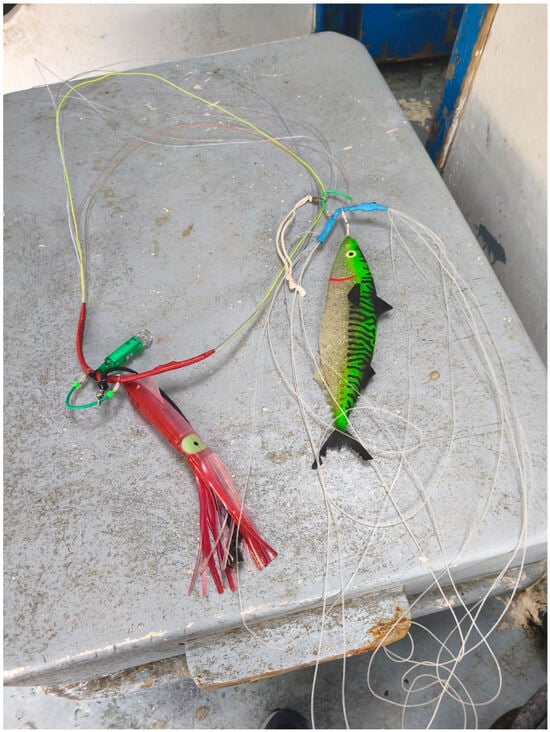
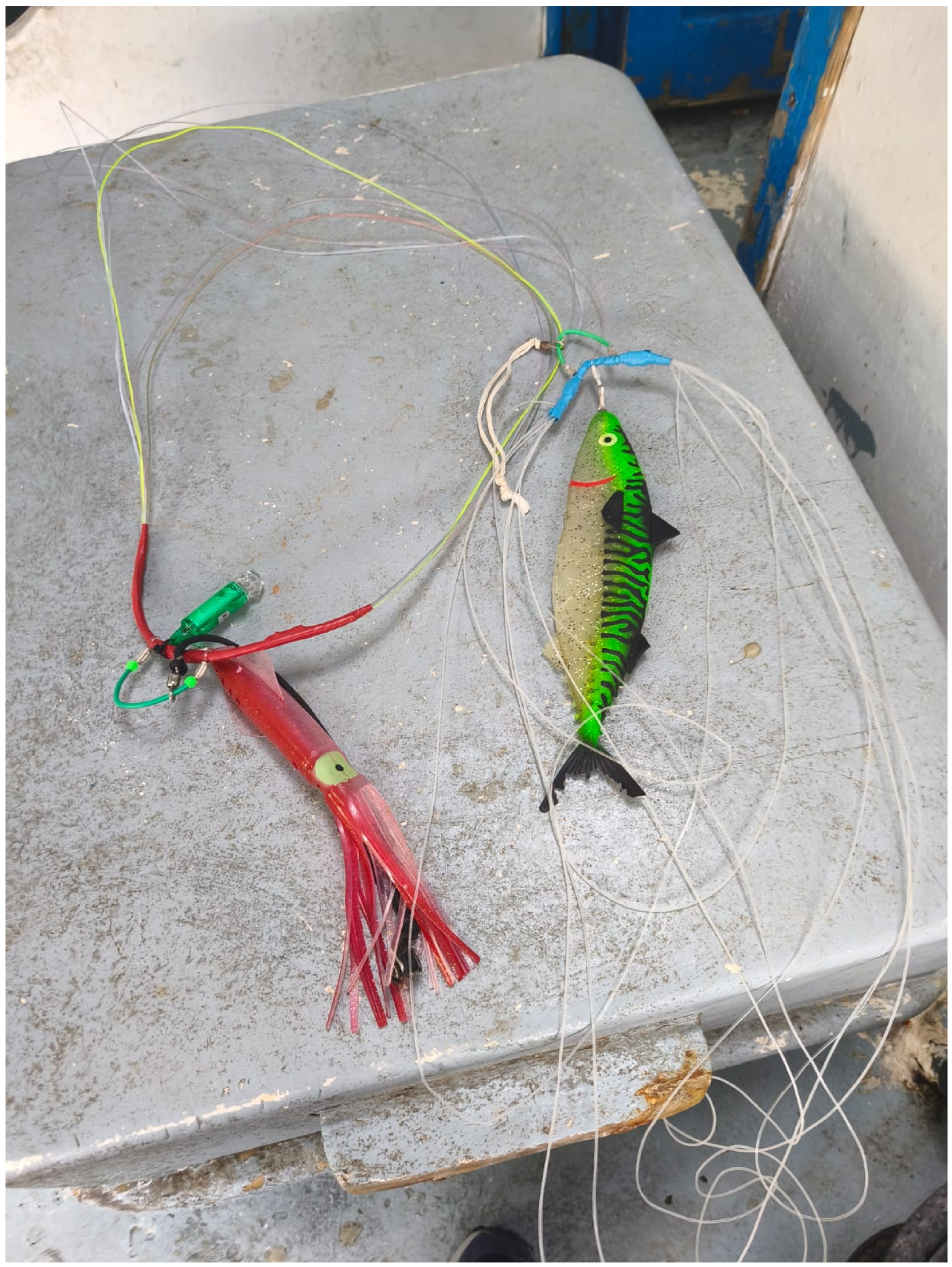
From a technical perspective, loop lines consist of several loops of different sizes, typically seven, although the number may vary from four to eight and occasionally up to thirteen. These loops are made of 2.0–2.5 mm nylon or polyamide monofilament, depending on the availability of material stored on board or materials available at local markets. The diameter of the loops ranges from approximately 30 cm to 50–70 cm within a single device. A loop line typically requires approximately eight fathoms (14.63 m) of nylon monofilament. This line is folded to form a series of concentric loops of increasing diameter. Once the desired configuration has been achieved, the loops are gathered and secured together using adhesive tape, creating a central anchoring point from which an artificial lure, generally resembling either a fish or a squid, is suspended (Figure 1). In addition, battery-powered LED lights or chemical light sticks are commonly incorporated into the device to enhance its visual attractiveness.
Figure 1.
General appearance of two different loop lines with artificial bait. Source: JCB.
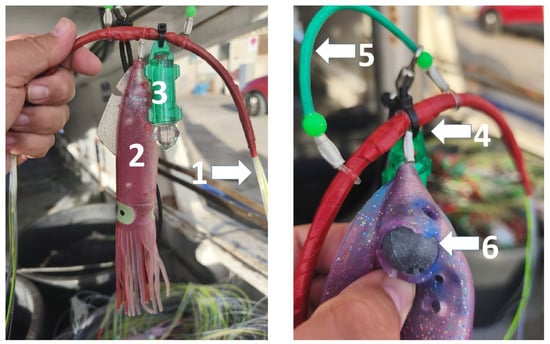
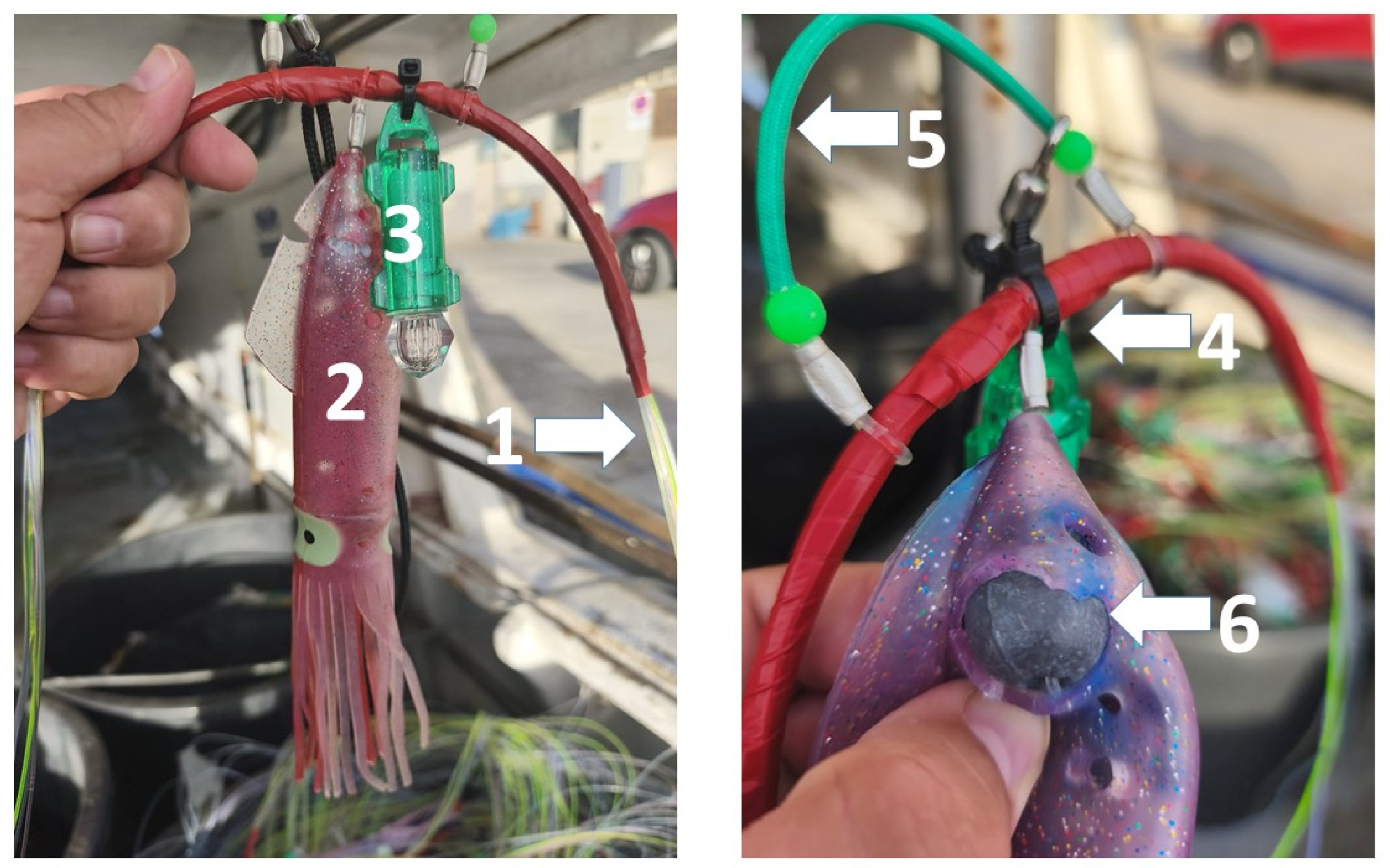
Immediately above the artificial lure, at the central junction where all loops converge, a short section of monofilament is fashioned into a small attachment loop. This attachment point serves to connect the loop to the branch line. The attachment loop is secured to the concentric loops using metal crimps and, in some designs, is covered by a protective sleeve to reduce abrasion and improve durability (Figure 2).
Figure 2.
Main components of loop lines: (1) monofilament nylon loops (rings); (2) artificial bait (lure); (3) battery-powered light; (4) loop covering or protective sleeve; (5) attachment piece (connector); and (6) lead weight (sinker). Source: JCB.
Although artificial lures and battery-powered lights are frequently deployed together, some Asian fleets use loop lines equipped exclusively with lights, and no artificial lure. These fleets commonly employ waterproof LED lights of various colors that are automatically activated when in contact with seawater [3].
The finished loop line is attached to the branch line either by means of a swivel snap or, alternatively, by suspending it directly from the hook of an existing branch line. The latter configuration allows conventional pelagic longlines to be rapidly modified into mixed hook–loop line systems without substantial changes to the overall gear configuration.
The loop line device is composed of several components: (1) multiple nylon or polyamide monofilament loops; (2) artificial bait; (3) battery-powered or chemical light, i.e., an electronic light source attached to the device to enhance attraction of target species, particularly during low-light conditions; (4) a protective lining surrounding the central section where the loops are bundled together, providing reinforcement and reducing abrasion; (5) a fastening structure, often secured with staples, used to connect the device to a swivel, branch line, or other fishing gear components; and (6) a weight incorporated into the device to improve its stability and maintain the desired fishing depth and orientation in the water column (Figure 2). However, this configuration is flexible and may vary from fleet to fleet, with some omitting elements such as the battery-powered light, the protective sleeve, or even the artificial lure. In particular, certain Asian fleets have been observed deploying loop lines equipped just with lights and no lures [4].
Depending on the vessel and fleet, loop lines can be attached to the main line using a conventional auxiliary line or suspended directly from the hooks on existing auxiliary lines. In the latter configuration, the conventional hook ceases to be the primary fishing device and simply serves as a support for the loop line.
As part of the monitoring of loop-line use in the Mediterranean Sea, one of the authors (JCB) conducted approximately 20 interviews in several Spanish fishing ports to monitor the use of loop lines. Interviews with Mediterranean fishermen indicate a growing trend to completely eliminate this practice and attach loop lines directly to auxiliary lines. According to these fishermen, using hooks as support can increase the likelihood of physical damage to the swordfish during capture and hauling, thus reducing the quality of the meat and, potentially, the commercial value of the catch. On the other hand, the use of alternating loops and baited hooks, which began with just a few loops, has been increasing. One vessel monitored during this study had already adopted a completely hookless setup, using only loop lines. While this is still uncommon, observations suggest that hookless longline systems are beginning to appear in Mediterranean swordfish fisheries and could become prevalent as fishers continue to adapt and optimize this technology.
The loop line device is designed to increase swordfish catches in pelagic longline fisheries. Although the mechanisms underlying its apparent effectiveness remain poorly understood, it is hypothesized that swordfish are attracted to the artificial lure and attempt to strike it with their bill. During this interaction, the bill, head, or front part of the body becomes entangled in the multiple concentric monofilament loops. Once entangled, the fish is unable to free itself, resulting in its capture without the need for a conventional hook.
Although they were initially developed by Japanese fishermen to catch swordfish in diamond squid (Thysanoteuthis rhombus) fisheries in the mid-2000s [3], these concentric ring traps (loop lines) have spread from the Pacific Ocean to the Mediterranean and the Atlantic [3,5,6]. Though some researchers have noted the use of this device in their fleets since 2018, it was only in 2024 that the Standing Committee on Research and Statistics of the International Commission for the Conservation of Atlantic Tunas (ICCAT) documented its use [3,5,6].
Scientific knowledge about the characteristics and use of this device is very limited. At present, loop lines are not deployed as independent fishing gear but rather as a modification of conventional pelagic longlines. Existing longline configurations have been progressively adapted to incorporate loop lines alongside conventional baited hooks, with the proportion of hooks to loop lines typically ranging from approximately 3:1 to 1:1. Consequently, most commercial fisheries currently employ mixed terminal configurations in which both capture devices are deployed simultaneously within the same fishing set. This operational characteristic is critical for assessing catch rates of mixed gear versus only hooks because loop line deployment inevitably reduces the number of baited hooks and modifies the overall fishing stimulus generated by the gear. Therefore, observed differences in CPUE, catch composition, and selectivity cannot be attributed solely to the terminal capture device but also reflect changes in the configuration and fishing dynamics of the entire longline system.
The apparent improvement in the catchability of swordfish, particularly adult and sub-adult individuals, together with a potential reduction in the capture of juveniles and non-target species, highlights two important considerations [2,7,8,9,10,11]. First, it raises important management challenges regarding how fisheries should be regulated when terminal devices with markedly different selectivity profiles are deployed, particularly given the currently limited information on the proportions and configurations in which loop lines are incorporated into pelagic longlines. Second, this emerging terminal device may offer significant opportunities to improve the selectivity and environmental sustainability of pelagic longline fisheries by increasing target-species catches while reducing bycatch.
The adoption of loop lines is so recent that they have not yet been formally described or classified in the most recent international fishing gear catalogs or gear classification systems [12,13]. This lack of formal recognition further emphasizes the need to standardize their description, improve data collection protocols, and explicitly incorporate their use into fisheries monitoring and observer programs, and stock assessment systems. The primary objective of the present study is to provide a standardized definition and technical description of loop lines (traplines), together with a comprehensive review of the currently available scientific evidence regarding their efficiency, selectivity, and implications for fisheries management.
2. Current Empirical Evidence on the Effects of Loop Lines on Catch Efficiency, Selectivity, and Bycatch
To date few studies have analyzed actual data from scientific observers. However, the few existing studies agree in pointing out that loop lines have the potential to substantially modify catch dynamics by improving swordfish selectivity while reducing bycatch [2,7,8,9,10,11].
A study by Italian researchers shows that loop lines almost doubled swordfish CPUE and LPUE while capturing significantly larger fish and dramatically reducing bycatch [8]. Despite representing only about 30% of the deployed terminal gear, loop lines accounted for approximately half of all marketable swordfish captured, suggesting substantially greater fishing efficiency than conventional hooks.
A study by Portuguese researchers study considerably expands this evidence using a much larger dataset collected from commercial fisheries in the eastern Atlantic [9]. More than 560 fishing sets and over 640,000 hook and loop lines were monitored, allowing statistical comparisons between hooks and loop lines. The results from the Portuguese fleet largely confirm the findings of Italian scientists, showing significantly higher swordfish CPUE, greater size selectivity, and pronounced reductions in bycatch, particularly for pelagic sharks such as blue shark (Prionace glauca) and shortfin mako (Isurus oxyrinchus) [9]. Unlike the Italian researchers’ study, which focused on a single vessel and season, the Portuguese researchers study shows that these advantages persist across multiple vessels and fishing trips, providing stronger quantitative support for the ecological benefits of loop lines [9].
A study by Spanish researchers complements these findings by recognizing that trapline performance depends strongly on fishing strategy and gear configuration. Thus, while loop lines consistently increased the proportion of swordfish within total catches and reduced incidental catch, responses varied among métiers depending on deployment depth, loop lines placement on the gear, and operational practices [2,10]. These findings suggest that loop lines should not be evaluated as an isolated terminal device but as part of an integrated fishing system whose performance depends on overall gear configuration.
A study by Japanese researchers addressed a different but equally important question by evaluating whether the use of Meka-rings—the Japanese equivalent of loop lines—could bias the standardized CPUE indices used in Atlantic swordfish stock assessments [11]. Unlike the other studies, its primary objective was not to assess fishing performance but to quantify the adoption of this terminal device by the Japanese longline fleet. More recent preliminary results presented by Matsushita et al. [14] indicate that the use of Meka-rings varies markedly among ocean basins, representing approximately 2.0–2.1% of deployed terminal devices in the Atlantic, 0.1–10.1% in the eastern Pacific, 0.1–33% in the northwestern Pacific, 1.2–20% in the southwestern Pacific, and 0.8–9.1% in the Indian Ocean. These findings show that, although the technology remains relatively uncommon in the Atlantic and is therefore unlikely to have a significant influence on standardized CPUE indices in this region [11], its use is already substantial in several Pacific fisheries and is progressively expanding across multiple ocean basins. Consequently, the systematic recording of loop-line deployment, together with the development of gear-specific CPUE standardizations, should be considered a priority before increasing adoption compromises the comparability of historical abundance indices used in swordfish stock assessments by tuna Regional Fisheries Management Organizations (tRFMOs).
Taken together, the four studies reveal a remarkable consistency in their main conclusions. All report improved swordfish selectivity, reduced interactions with non-target species, and evidence of enhanced catch efficiency associated with loop lines [2,7,8,9,10,11]. Differences among studies primarily reflect variations in fishing métiers, fleet characteristics, and study objectives rather than contradictory biological responses.
In any case, it is necessary to obtain more information, such as datasets collected by scientific observers, to better understand and robustly assess this device.
3. Considerations Regarding Longlines and Loop Lines as Terminal Accessories of the Longline
A longline consists of a main line, or “mother line,” suspended in the water by secondary lines called “buoy lines” at the ends of which buoys are placed. From the mother line hang secondary lines, the “branch lines,” at the ends of which are hooks. The characteristics of the materials, dimensions, type of buoys and hooks, as well as their configuration, are highly variable and depend primarily on the origin of the fishing fleet, the fishermen, and the target species [1].
These three parts—the main line or mother line, the secondary lines (buoy lines and branch lines), and the terminal section (hook and bait)—are adapted for catching specific species through variations in materials, lengths, and deployment strategies [15]. The terminal variation in the loop lines modifies only one of the three main components of the longline. Such variations have already occurred with successive modifications in hook types (J, circle, tuna), sizes, baits (natural, artificial), bait types (fish, cephalopods), and lights (chemical, electric), among others [16].
Like a hook, a loop line can only capture one animal at a time. In this respect, the fishing effort and the CPUE (number of individuals/1000 loops) can be measured in the same way as for hooks. Initial impressions, based on the data available so far, indicate that loops are more selective, with a significantly higher catch rate of swordfish and perhaps other billfish [2].
To date, no fishing gear has been specifically designed and constructed from the outset to operate exclusively with loop lines. Instead, all experimental and commercial applications have been based on adaptations of conventional pelagic longline gear, in which loop lines have generally been incorporated by replacing selected hooks along existing branch lines. Consequently, loop lines should not currently be regarded as a completely new fishing gear, but rather as a modified longline métier in which conventional baited hooks and loop lines are deployed simultaneously.
This distinction has important implications for experimental design and the interpretation of catch-rate comparisons. Comparisons between hooks and loop lines deployed within the same fishing set should be interpreted with caution because the introduction of loop lines alters the overall configuration and fishing dynamics of the entire gear. Conventional pelagic longlines generate a continuous “bait curtain” along their full length because virtually every branch line carries a natural bait, producing visual and chemical stimuli that attract both target and non-target species. In contrast, when loop lines are incorporated into the gear, a proportion of these baited hooks is replaced by un-baited synthetic loop devices. Consequently, the density of natural bait is reduced, diminishing the overall olfactory and visual attraction generated by the gear. This reduction in fishing stimulus may contribute to the consistently lower incidence of bycatch reported in the Mediterranean and Atlantic studies, particularly for opportunistic predators and scavengers that are primarily attracted by natural bait. Therefore, the observed improvements in selectivity should not necessarily be interpreted solely as an intrinsic property of the loop line itself, but rather as the combined consequence of the modified capture mechanism and the reduced attractive field created by the entire fishing gear. For this reason, longlines using loop line configurations should be considered an independent fishing métier rather than simply an alternative terminal component equivalent to replacing one hook type with another. Their evaluation should therefore be based on comparisons between complete fishing systems rather than on within-set comparisons of individual hooks and loop lines.
Operational differences during gear retrieval may also influence fishing performance and product quality. For example, fish entangled in loop lines may suffer greater physical damage than those captured by conventional hooks, potentially resulting in reduced meat quality. Entangled fish are generally retrieved laterally, generating greater hydrodynamic resistance compared with fish hooked through the mouth. This may result in longer hauling times, increased tension on the gear, and, in some cases, line breakage leading to fish loss. The increased mechanical stress experienced during hauling may adversely affect flesh quality and external appearance, potentially reducing the commercial value of the catch. These operational considerations should therefore be incorporated into future evaluations of the economic performance of loop-line fisheries, in addition to assessments of catch efficiency and species selectivity.
4. Discussion
The evidence accumulated so far points to loop lines as a novel fishing device that represents a technological evolution within pelagic longline systems. They differ from conventional hooks not only in form and function but also in their potential selectivity, efficiency, and ecological implications. The studies conducted to date consistently indicate a substantial reduction in the bycatch of non-target species, particularly pelagic sharks, sea turtles, and seabirds [2,9,10]. Unlike conventional hooks, loop lines do not rely on hook penetration but capture animals by entanglement. Consequently, the relatively few non-target individuals interacting with loop lines generally become entangled rather than hooked, potentially reducing capture-related injuries.
The increasing use of loop lines may alter catchability for swordfish while simultaneously modifying catch composition and selectivity. If these gear modifications are not properly recorded, historical CPUE series may become non-comparable, potentially biasing abundance indices used in stock assessments. For this reason, we conclude that fisheries using loop lines should be considered a distinct fishing métier rather than simply conventional longlines fitted with an alternative terminal device. This distinction has important implications for observer programs, fisheries statistics, CPUE standardization, and stock assessment modeling. Therefore, we recommend that tuna Regional Fisheries Management Organizations (tRFMOs) and national fisheries administrations: (i) formally describe and classify loop-line fisheries as a separate métier; (ii) incorporate specific information on loop-line use into logbooks and observer programs; (iii) develop standardized protocols for recording gear configuration, including the proportion and placement of loop lines; and (iv) produce independent CPUE standardizations for fisheries using loop lines before these data are incorporated into stock assessments.
In relation to the widespread adoption of loop lines by some swordfish fleets, it is due to perceived operational and economic advantages associated with their use. Interviews with skippers from Mediterranean fishing vessels targeting swordfish (carried out by JCB with the purpose of monitoring the use of the loop lines) report that the apparent selectivity of loop lines towards swordfish reduces interactions with non-target species, particularly Atlantic bluefin tuna (Thunnus thynnus), whose catches are subject to strict quota regulations. By reducing unwanted catches of regulated or non-target species, loop lines may decrease competition for baited fishing gear and improve fishing efficiency. A higher level of adoption has been observed in the Mediterranean fleet, where some fishing sets were conducted exclusively using loop lines; whereas, in the Spanish distant-water fleets they are currently used primarily as a complementary terminal device alongside conventional hooks [17]. This contrast suggests that the rate of adoption differs between fleets and may become even more pronounced as the technology continues to evolve and fishers progressively optimize its use.
Fishermen also reported that loop lines reduce dependence on natural bait, potentially lowering operational costs and improving the cost-effectiveness of harvesting available swordfish quotas. In addition, several skippers pointed out that loop lines appear to substantially reduce the capture of juvenile swordfish below the minimum legal size, a recurrent concern in conventional hook-based pelagic longline fisheries.
While these observations and perceptions are consistent among a number of interviewed fishers, further quantitative analyses are required to formally assess the economic, operational, and selectivity-related benefits attributed to loop lines.
An additional aspect that deserves consideration is that the incorporation of loop lines fundamentally modifies the attraction properties of the entire longline.
As pointed out above, loop lines consist of assemblies of nylon rings or monofilament loops. In this regard, it is important to remember that traditional surface longline gear has historically contributed to plastic pollution with substantial quantities of nylon and other synthetic materials, which are lost at sea and subsequently become ghost-fishing gear [18]. This new device could increase the amount of fishing gear lost at sea and plastic pollution unless proactive mitigation measures are implemented.
Further research—through controlled field experiments, observer-based documentation, and comparative analyses across ocean basins—is essential.
5. Conclusions
In conclusion, the available evidence suggests that loop lines constitute an emerging and potentially transformative terminal device in pelagic longline fisheries targeting swordfish. Preliminary observer-based studies consistently indicate higher catch efficiency for the target species, reduced catches of juveniles, and substantially lower bycatch rates of vulnerable non-target taxa, including pelagic sharks, sea turtles, and seabirds. However, important uncertainties remain regarding their operational performance, long-term ecological consequences, and their implications for fisheries-dependent data used in stock assessments.
A particularly important concern is that loop lines appear to have been progressively adopted by several fleets over at least the last decade without being systematically recorded in fisheries statistics, observer programs, or logbooks. Consequently, historical CPUE series used by tRFMOs may already include unaccounted changes in catchability associated with this modified fishing métier. If left undocumented, such changes could compromise the comparability of historical abundance indices and potentially influence stock assessment outputs for swordfish. For this reason, the development of standardized descriptions, dedicated observer protocols, and harmonized data collection systems should be considered a priority by tRFMOs and national fisheries administrations. Information on the presence, configuration, and proportion of loop lines within commercial longline sets should be collected as soon as possible to support the development of independent CPUE standardizations for fisheries using this technology. Early implementation of these measures will reduce uncertainty in future stock assessments while ensuring that management decisions continue to rely on robust and comparable fisheries-dependent data.
Author Contributions
Both authors listed have made a substantial, direct and intellectual contribution to the work, and approved it for publication. All authors have read and agreed to the published version of the manuscript.
Funding
José Carlos Báez acknowledges that their research work was partially supported by the project ‘Reducing bycatch of threatened megafauna in the East Central Atlantic’ project (Grant Agreement No. 101135583–050224FBG), funded by the European Commission (EU) through the HORIZON EUROPE Programme.
Institutional Review Board Statement
Not applicable.
Data Availability Statement
No new data were created or analyzed in this study. Data sharing is not applicable to this article.
Conflicts of Interest
The authors declare no conflicts of interest.
References
- Domingo, A.; Báez, J.C.; Forselledo, R.; Jiménez, S. Longline, Chapter 3.1.2. ICCAT Manual. Ed. International Commission for Conservation Atlantic Tuna. 2025. Available online: https://www.iccat.int/en/iccatmanual.html (accessed on 18 April 2026).
- Macías, D.; Moreno de la Rosa, J.; García-Barcelona, S.; Alegría, A.; Rueda, L.; Báez, J.C. Spatiotemporal distribution and bycatch associated with surface longlines using traplines in the western Mediterranean. Collect. Vol. Sci. Pap. ICCAT 2025, 82, 1–16. [Google Scholar]
- Ochi, D.; Shiode, D.; Ijima, H.; Kai, M.; Semba, Y. “Ring-Shaped Branchline” in Japanese Longline Fisheries; ICCAT Working Document SCRS/2025/091; 2025. [Google Scholar]
- Report of the 2025 Meeting of the Subcommittee on Ecosystems and Bycatch (SC-ECO). Collect. Vol. Sci. Pap. ICCAT 2025, 82, 1–95.
- Garibaldi, F.; Di Natale, A.; Zava, B. A new challenge for assessing the swordfish fishery: The use of an innovative fishing gear. Collect. Vol. Sci. Pap. ICCAT 2024, 81, 1–9. [Google Scholar]
- Report of the 2024 intersessional meeting of the Swordfish Species Group (including MSE). Collect. Vol. Sci. Pap. ICCAT 2024, 81, 1–59.
- Valastro, M.; Di Natale, A.; Garibaldi, F.; Piccinetti, C.; Suzuki, Z. The swordfish CPUE poses several questions and enigmas. A discussion paper. Collect. Vol. Sci. Pap. ICCAT 2024, 81, 1–6. [Google Scholar]
- Tiralongo, F.; Giovannelli, F.; Zambetti, A.; Dimichino, B.; Baiata, P.; Pignalosa, P. Trap-Line: An Innovative Fishing Gear for Mediterranean Swordfish Fisheries. Biol. Mar. Mediterr. 2026, 30, 192–195. [Google Scholar]
- Coelho, R.; Lino, P.; Barbosa, C.; Rosa, D. The Use of Traplines in the Portuguese Pelagic Longline Fleet Operating in the Eastern Atlantic; ICCAT Working Document SCRS/2026/001; 2026. [Google Scholar]
- Rueda, L.; Macías, D.; Moreno, J.; Borrego-Santos, R.; Alegría, A.; Salmerón, F.; García-Barcelona, S.; Ortiz de Urbina, J.M.; Báez, J.C. Preliminary Results on the Use of Traplines in the Swordfish Longline Spanish Fishery in the Mediterranean Sea; ICCAT Working Document SCRS/2026/047; 2026. [Google Scholar]
- Kai, M.; Ochi, D.; Tsukahara, Y.; Sato, K.; Semba, Y. Influences of Using Ring-Shaped Branch-Line (Meka-Ring) on Atlantic Swordfish CPUE in Japanese Longline Fisheries; ICCAT Working Document SCRS/2026/035; 2026. [Google Scholar]
- He, P.; Chopin, F.; Suuronen, P.; Ferro, R.S.T.; Lansley, J. Clasificación y Definición Ilustrada de los Artes de Pesca; Documento Técnico de Pesca y Acuicultura de la FAO; Food and Agriculture Organization: Rome, Italy, 2022; Volume 672, p. 87. [Google Scholar] [CrossRef] [Scilit]
- Popescu, I.; Breuer, M. Research for PECH Committee. In Handbook of Fishing Gears Used by the EU Fleet; European Parliament, Policy Department for Structural and Cohesion Policies: Brussels, Belgium, 2024; p. 37. [Google Scholar]
- Matsushita, H.; Ochi, D.; Okamoto, K. Preliminary Analysis of Meka-Ring Effects on Bycatch in Japanese Longline Fisheries Based on Scientific Observer Data; ICCAT Standing Committee on Research and Statistics (SCRS), Sub-Committee on Ecosystems and Bycatch, Working Document SCRS/2026/091; 2026. [Google Scholar]
- Watson, J.W.; Kerstetter, D.W. Pelagic longline fishing gear: A brief history and review of research efforts to improve selectivity. Mar. Technol. Soc. J. 2006, 40, 6–11. [Google Scholar] [CrossRef] [Scilit]
- Lima, F.D.; Parra, H.; Alves, R.B.; Santos, M.A.R.; Bjorndal, K.A.; Bolten, A.B.; Vandeperre, F. Correction: Effects of gear modifications in a North Atlantic pelagic longline fishery: A multiyear study. PLoS ONE 2024, 19, e0315684. [Google Scholar] [CrossRef] [Scilit] [PubMed]
- Báez, J.C.; Alegría, A.; Moreno, J.; Borrego-Santos, R.; Salmerón, F.; García-Barcelona, S.; Rodríguez, E.; Carrera, M.; Rueda, L.; Puerto, M.Á.; et al. Development and Results of the Pilot Project on the Efficacy of Traplines/Loops in the Spanish Longline Fleet in the ICCAT Area. Collect. Vol. Sci. Pap. ICCAT 2026, 83, 1–7. [Google Scholar]
- Richardson, K.; Hardesty, B.D.; Vince, J.; Wilcox, C. Global estimates of fishing gear lost in the ocean each year. Sci. Adv. 2022, 8, eabq0135. [Google Scholar] [CrossRef] [Scilit] [PubMed]
Disclaimer/Publisher’s Note: The statements, opinions and data contained in all publications are solely those of the individual author(s) and contributor(s) and not of MDPI and/or the editor(s). MDPI and/or the editor(s) disclaim responsibility for any injury to people or property resulting from any ideas, methods, instructions or products referred to in the content. |
© 2026 by the authors. Licensee MDPI, Basel, Switzerland. This article is an open access article distributed under the terms and conditions of the Creative Commons Attribution (CC BY) license.