


Abstract
Global warming and summer heatwaves increasingly threaten the survival of cultured Babylonia areolata, but the heat tolerance of different geographical populations and the potential for genetic improvement by hybridization remain poorly understood. In this study, four geographical populations (Thailand, TL; Wanning, WN; Zhao’an, ZA; Changle, CL) and four hybrid combinations (TH, HT, TF, and FT) were compared for mortality rate, median lethal temperature (LT50), and critical thermal maximum (CTMax) under controlled thermal stress. The results showed that the low-latitude TL population exhibited significantly higher LT50 (36.49 ± 0.05 °C) and CTMax (35.77 ± 0.52 °C) than the high-latitude CL and ZA populations (LT50: 35.90 ± 0.05–36.02 ± 0.04 °C; CTMax: 35.12 ± 0.77–35.26 ± 0.53 °C). All four hybrids had improved heat tolerance compared with their low parents, with TH and HT showing the strongest mid-parent heterosis (e.g., 73.68–78.94% for survival at 36.5 °C). However, none significantly exceeded the high-parent performance (TL), indicating only mid-parent heterosis. These findings reveal significant genetic variation in heat tolerance among geographical populations of B. areolata and confirm that cross-breeding can effectively enhance heat tolerance, though it does not produce transgressive superiority. This study provides key genetic resources and a theoretical basis for breeding heat-tolerant strains of B. areolata.
Keywords:
Babylonia areolata; high-temperature tolerance; hybridization; median lethal temperature; mid-parent heterosis Key Contribution:
This study revealed significant geographic genetic differentiation in heat tolerance among Babylonia areolata populations and demonstrated that interpopulation hybridization can generate significant mid-parent heterosis for heat tolerance, providing key germplasm and theoretical support for thermotolerance breeding in this species.
1. Introduction
Global warming and extreme heat events caused by climate change have profoundly affected the physiological functions, population dynamics, and geographical distribution of terrestrial and aquatic organisms [1]. Marine and coastal ecosystems are particularly sensitive to seawater temperature fluctuations, and abnormal seawater warming due to climate change is continuously threatening the survival and reproduction of marine organisms [2,3,4]. At present, global surface and ocean temperatures have broken historical records, and the warming rate continues to accelerate. If the current trend continues, the global average temperature is projected to rise to a level that could cause severe biodiversity loss by the end of this century [5,6].
Mollusks are typical ectotherms, and their core life activities such as growth [7,8], development [9], feeding [10], metabolism [11], and distribution [12] are highly dependent on ambient temperature. Under the background of global warming, large-scale mortality events of cultured shellfish caused by persistently high temperatures in summer occur frequently, which has become a key bottleneck restricting the sustainable development of the marine shellfish aquaculture industry [13,14,15]. As an important economically cultured species, Babylonia areolata is a benthic gastropod naturally distributed in the tropical to subtropical shallow seas of the Indo-West Pacific, with a large latitude span and significant temperature differences in habitats, providing an ideal material for studying population differences in temperature adaptability [16,17]. Previous studies have shown that the temperature adaptability of aquatic ectotherms is jointly determined by genetic basis and environmental acclimation, and different geographic populations of the same species often form significant differentiation in heat tolerance due to long-term adaptation to the temperature conditions of their native habitats [18,19].
Currently, B. areolata is widely cultured along the southeast coast of China, but prominent problems such as high mortality in summer high-temperature periods and poor culture stability exist [20]. Most existing studies have focused on aquaculture ecology [21], nutritional requirements [22], and disease control [17]. Moreover, previous studies by our team have explored hybrid performance and stress resilience in this species, including low salinity and hypoxia tolerance in F1 hybrids [23], immune responses under pathogenic Vibrio challenge [17], and growth performance of crosses between Chinese and Thai populations [24]. However, these studies focused on specific environmental or disease stress, and the divergence in thermal tolerance among major geographical populations and the potential to enhance this trait via crossbreeding remain underexplored. Additionally, while previous studies have evaluated survival rates under discrete stress conditions, no systematic assessment has been conducted to quantify the thermal tolerance limits in B. areolata using standardized physiological endpoints. Specifically, the LT50 and CTMax provide quantitative, comparable metrics that capture the upper thermal boundaries of different populations, which cannot be inferred from survival data alone. The present study systematically compared the thermal tolerance of four major cultured geographical populations using mortality rate, LT50, and CTMax as core indicators and also evaluated the thermal tolerance and heterosis of hybrid offspring. The objectives were to clarify the differences in thermal tolerance among different geographical populations of B. areolata, determine the effect of cross-breeding on offspring thermal tolerance, and provide a scientific basis for breeding heat-tolerant improved varieties and developing targeted thermal tolerance culture techniques.
2. Materials and Methods
2.1. Experimental Materials
The B. areolata used in this experiment included four different geographical self-bred populations and four hybrid populations. All were obtained from the Yitai Aquaculture Company (24.21° N, 118.02° E, Zhangzhou, China) and were healthy populations constructed from June to July 2023. All populations were reared under the same environmental conditions, and individuals with normal activity and uniform size were selected for the experiment. The shell length and body weight ranges of the experimental B. areolata were 29.65 ± 0.51–30.87 ± 0.18 mm and 5.73 ± 0.16–5.84 ± 0.22 g, respectively. Detailed information on each population is shown in Table 1.
Table 1.
Information on the eight populations of Babylonia areolata.
The acclimation temperature was set at 26 °C, a suitable growth temperature for B. areolata [25] and close to the ambient seawater temperature during the experiment. Each population of B. areolata was acclimated separately in 90 L recirculating glass tanks paved with a 4–5 cm sand layer. Each recirculating system contained four acclimation glass tanks, and eight populations were evenly distributed in four recirculating systems. During acclimation, an appropriate amount of fresh frozen Loligo oshimai was fed every other day, and fresh filtered seawater was fully replaced in time after feeding. The water temperature was controlled by a seafood chiller combined with air conditioning in the culture room to ensure stability at 26 ± 0.5 °C. An air pump was used for uninterrupted aeration to maintain sufficient dissolved oxygen, and seawater salinity was maintained at 32 ppt, with pH at 7.8, a 12 L:12 D photoperiod, and light intensity of approximately 500–1000 lux. Dead individuals were removed in time. The acclimation period was 14 days.
2.2. Determination of Mortality Rate and Median Lethal Temperature (LT50) Under Thermal Stress
Twenty individuals of uniform shell length were randomly selected from each population for each thermal treatment. Five temperature gradients (35, 35.5, 36.0, 36.5, and 37.0 °C) were established for the thermal stress assay. Each temperature treatment was maintained by an independent recirculating seawater system comprising four isolated glass tanks. Two populations were reared separately in each tank, with 20 conspecifics per population per tank. Seawater temperature was increased to the target value at a constant rate of 0.03 °C/min and held for 12 h. Following thermal stress, all individuals were transferred to 25 °C seawater for a 12 h recovery period. During the recovery period, mortality was recorded at 2 h intervals. An individual was considered dead when no retraction response of the foot muscle was elicited by gentle stimulation with forceps. The entire experiment was independently replicated three times, and the four tanks per treatment served as subsamples within each replicate to account for potential tank effects.
2.3. Determination of Critical Thermal Maximum (CTMax)
The critical thermal maximum (CTMax) is widely used to assess the thermal resistance of ectothermic mollusks [26,27,28] and is defined as the temperature at which motor coordination of a given species becomes uncontrolled or disorganized, ultimately leading to mortality if the stress persists [28]. CTMax assays were conducted following the general protocols of Díaz et al. [27], with modifications as described by Valles-Regino et al. [29]. A dynamic method was employed, in which seawater temperature was gradually increased until the test snails exhibited clear symptoms of thermal distress—specifically, complete detachment from the substrate (glass tank wall) due to loss of foot muscle adhesion. Importantly, individuals reaching this endpoint were detached from the substrate but remained alive, confirming that CTMax represents a sublethal rather than a lethal thermal threshold.
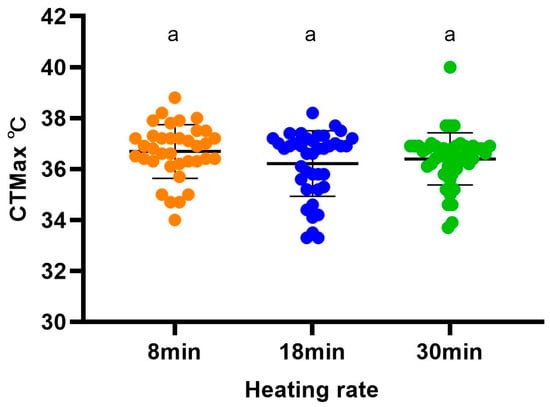
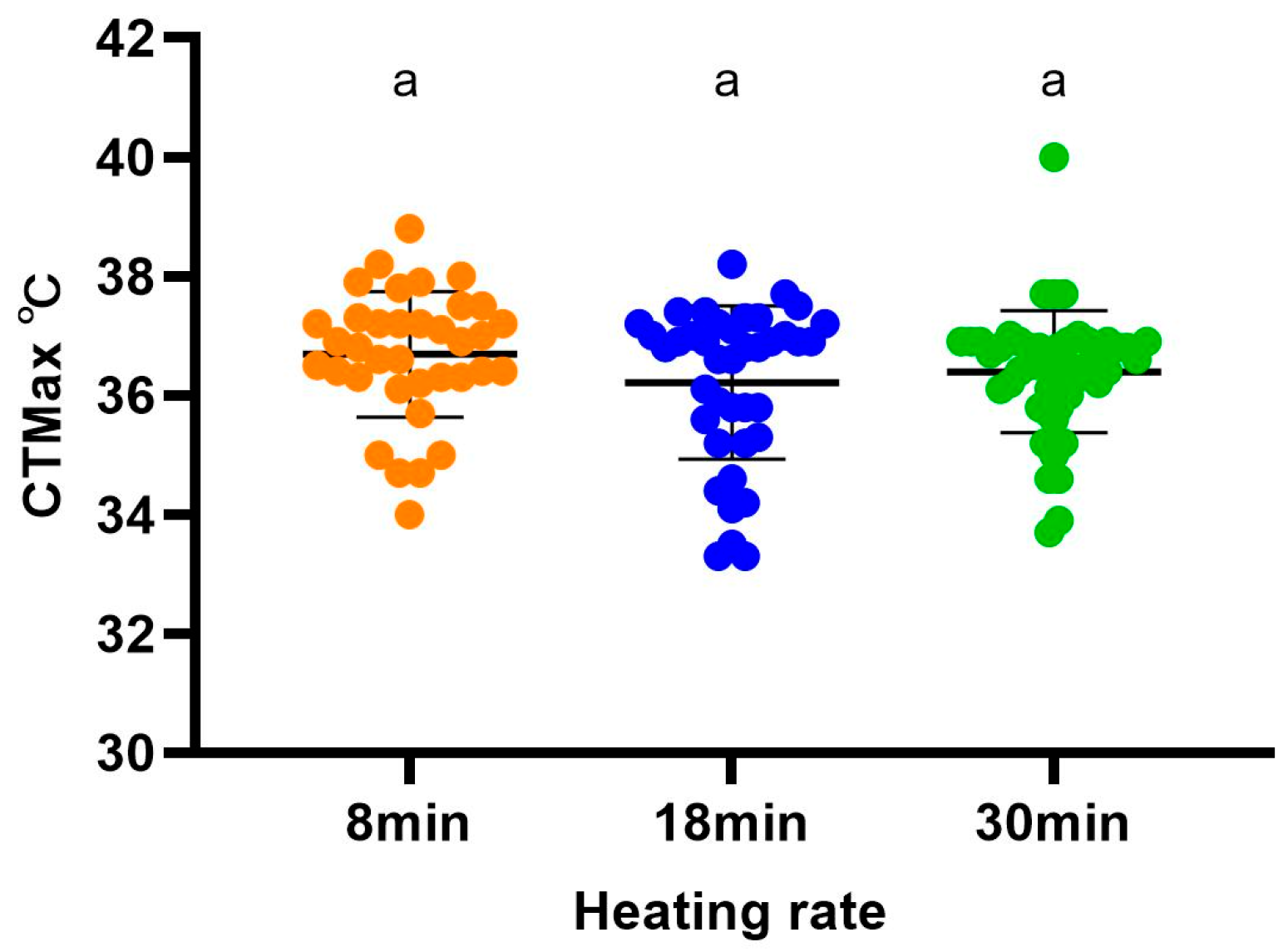
To determine the appropriate heating rate, three rates (1 °C/8 min, 1 °C/18 min, and 1 °C/30 min) were tested. No significant differences in CTMax were detected among them, so an intermediate rate of 1 °C/20 min was selected for the formal assay to balance efficiency and observation accuracy. For each trial, 16 or 17 healthy individuals were randomly selected from each population. The initial water temperature was maintained at 25.0 °C, and the temperature was continuously increased at 1 °C/20 min until CTMax was recorded for each individual. CTMax was defined as the temperature at which the foot could no longer maintain normal adhesion to the substrate, resulting in lateral collapse and loss of balance [29]. The experiment was independently replicated three times, with a total of 50 individuals measured per population.
2.4. Data Analysis
All statistical analyses were performed using SPSS 20.0 software. Prior to analysis, the normality of data distribution for each group was assessed using the Shapiro–Wilk test, and Levene’s test was used to assess the homogeneity of variances. One-way ANOVA was then performed, followed by Duncan’s multiple-comparison test when variances were homogeneous (Levene’s test, p > 0.05) or Dunnett’s T3 test when variances were heterogeneous (p < 0.05), to compare differences among populations at each condition. To determine LT50, the mortality data of each population at five temperature gradients (35, 35.5, 36.0, 36.5, and 37.0 °C) were fitted to a logistic model (log(inhibitor) vs. normalized response—variable slope) using GraphPad Prism 9.0, and the LT50 was calculated from the fitted equation [30]. All experimental data are expressed as mean ± standard deviation (SD), and significant differences among groups are summarized in the figures using letter annotations (a, b, c, etc.), where different letters indicate significant differences at p < 0.05.
Heterosis was calculated according to the method described in reference [23]. The mid-parent heterosis (HMP) and best-parent heterosis (HBP) for high-temperature tolerance in TH, HT, TF, and FT were calculated using the following formulas:
where F is the phenotypic value of the hybrid offspring, P is the mean phenotypic value of the self-bred offspring of the two parents, and P0 is the phenotypic value of the self-bred offspring of the better parent.
3. Results
3.1. Comparison of Mortality Rates Under Thermal Stress
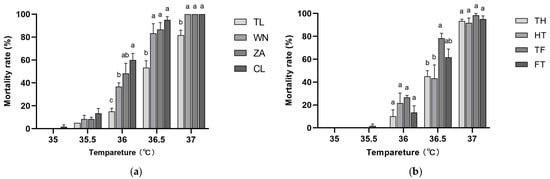
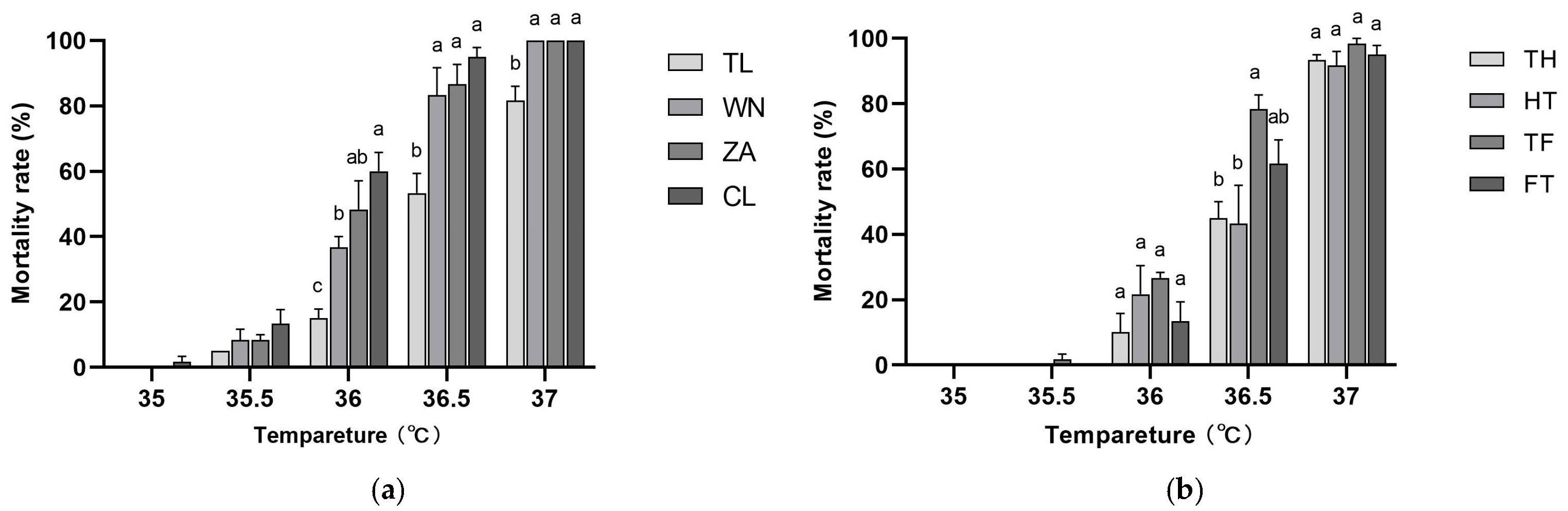
The heat tolerance of different geographic populations of B. areolata was compared by measuring the mortality under heat stress. As shown in Figure 1a, the mortality of each population increased significantly with the increase in stress temperature, and the mortality varied under different high-temperature conditions. At 35 °C, only the CL population showed 1.67 ± 1.67% mortality; at 35.5 °C, the mortality of TL, WN, ZA, and CL was 5%, 8.33 ± 3.33%, 8.33 ± 1.67%, and 13.33 ± 4.41%, respectively, with no significant difference among populations (p > 0.05); at 36.0 °C, the mortality was in the order CL ≥ ZA ≥ WN > TL, with significant differences (p < 0.05); at 36.5 °C, the mortality of TL, WN, ZA, and CL was 53.33 ± 6.01%, 83.33 ± 8.33%, 86.67 ± 6.01%, and 95.00 ± 2.87%, respectively, and the mortality of TL was significantly lower than that of the other three populations (p < 0.05); at 37.0 °C, TL mortality was 81.67 ± 4.41%, and the other three populations all died.
Figure 1.
Comparison of mortality rates under thermal stress among four geographical populations (a) and four hybrid populations (b) of Babylonia areolata. n = 60 per population and temperature (3 biological replicates, n = 20 per replicate). Different lowercase letters above bars indicate significant differences among populations (p < 0.05). TL: Thailand B. areolata; WN: Wanning B. areolata; ZA: Zhao’an B. areolata; CL: Changle B. areolata; TH: Thailand B. areolata ♀ × Hainan B. areolata ♂ ; HT: Hainan B. areolata ♀ × Thailand B. areolata ♂ ; TF: Thailand B. areolata ♀ × Zhao’an B. areolata ♂ ; FT: Zhao’an B. areolata ♀ × Thailand B. areolata ♂.
As shown in Figure 1b, none of the four hybrid populations died at 35 °C. At 35.5 °C, only the FT population showed a small number of deaths. At 36.0 °C, the mortality rates of TH, HT, TF, and FT were 10 ± 5.77%, 21.67 ± 8.82%, 26.67 ± 1.67%, and 13.33 ± 6.01%, respectively, with no significant difference among them (p > 0.05). At 36.5 °C, the mortality rates of TF and FT were higher, at 78.33 ± 4.41% and 61.67 ± 7.26%, respectively, and the mortality rate of TF was significantly higher than that of TH and HT (p < 0.05). At 37.0 °C, the mortality rates of all four hybrid populations exceeded 90%, with TF being the highest (98.33 ± 1.67%), but no significant difference was found among populations (p > 0.05).
3.2. Comparison of Median Lethal Temperature (LT50) of Each Population Under Thermal Stress
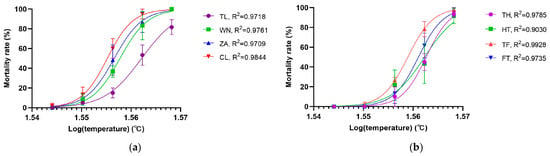
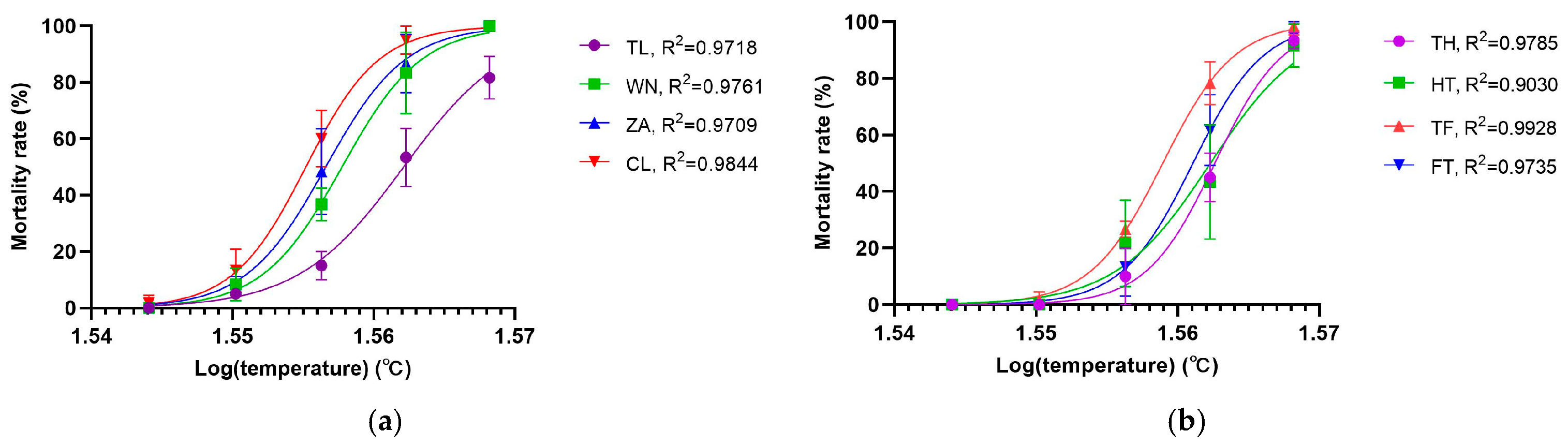
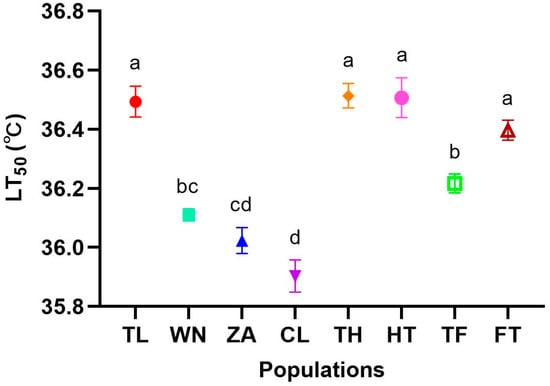
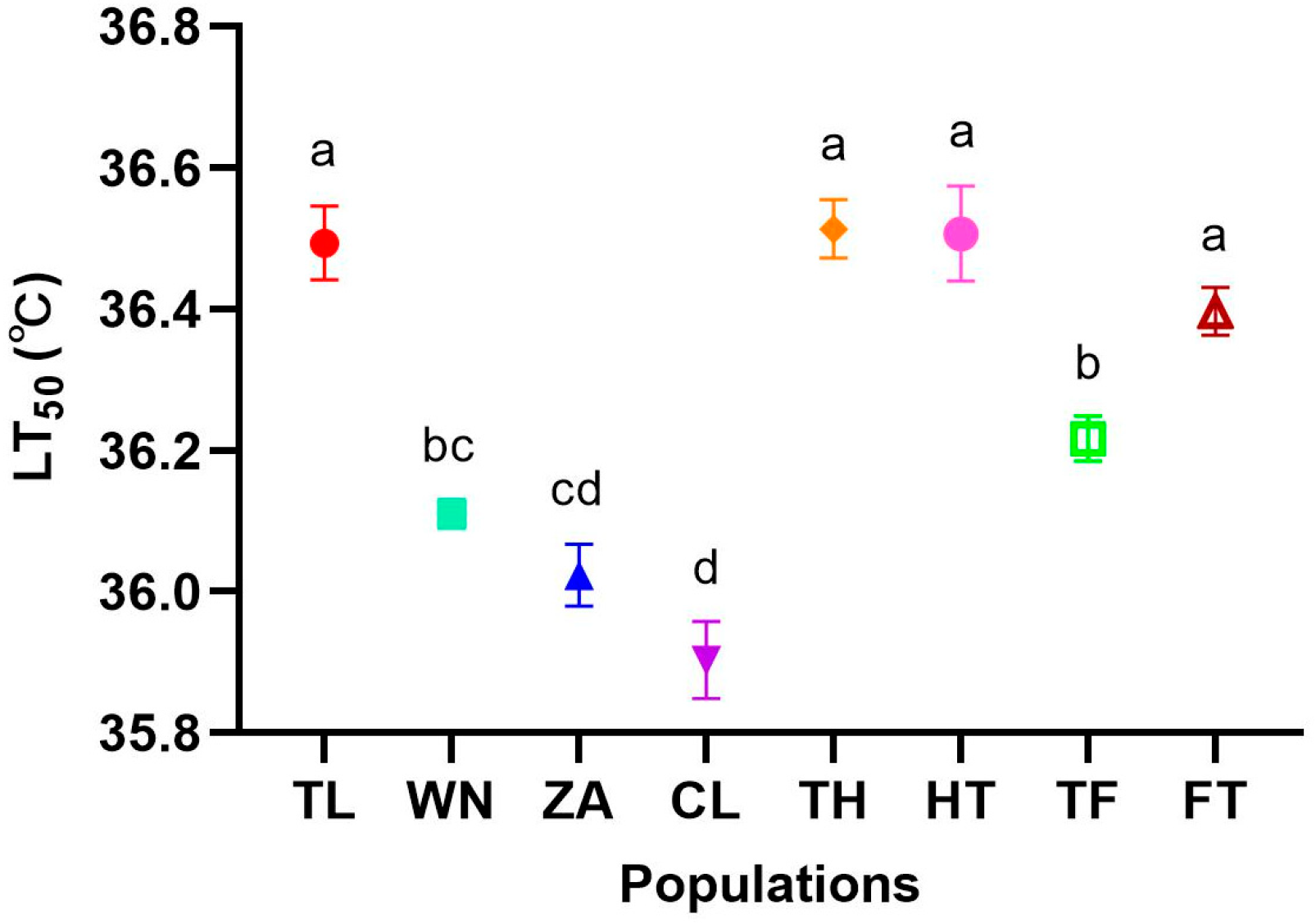
According to the mortality data of each population at different temperature points under heat stress, mortality curves were fitted by nonlinear regression using GraphPad Prism 9.0 software. As shown in Figure 2a,b, the mortality of eight B. areolata populations increased approximately logarithmically with time under heat stress, and the fitting coefficient R2 was all greater than 0.90. The LT50 values of TL, WN, ZA, CL, TH, HT, TF, and FT were calculated to be 36.49 ± 0.05, 36.11 ± 0.02, 36.02 ± 0.04, 35.90 ± 0.05, 36.51 ± 0.04, 36.51 ± 0.07, 36.21 ± 0.03, and 36.40 ± 0.03 °C, respectively. As shown in Figure 3, among the four geographic populations, the LT50 of TL was significantly higher than that of the other three populations (p < 0.05), indicating the strongest heat tolerance, followed by WN, while ZA and CL were relatively weak. In addition, the heat tolerance of the four hybrid populations was significantly improved compared with their low parents (p < 0.05), among which TH and HT had stronger heat tolerance.
Figure 2.
Mortality curves of four geographical populations (a) and four hybrid populations (b) of Babylonia areolata under thermal stress. TL: Thailand B. areolata; WN: Wanning B. areolata; ZA: Zhao’an B. areolata; CL: Changle B. areolata; TH: Thailand B. areolata ♀ × Hainan B. areolata ♂ ; HT: Hainan B. areolata ♀ × Thailand B. areolata ♂ ; TF: Thailand B. areolata ♀ × Zhao’an B. areolata ♂ ; FT: Zhao’an B. areolata ♀ × Thailand B. areolata ♂.
Figure 3.
Comparison of median lethal temperatures among eight populations of the Babylonia areolata under thermal stress. Different lowercase letters above bars indicate significant differences among populations (p < 0.05) (n = 3 replicates per population).
3.3. Comparison of Critical Thermal Maximum (CTMax) of Each Population
To determine the effect of different heating rates on the CTMax of B. areolata, CTMax values were compared at three heating rates: 1 °C/8 min, 1 °C/18 min, and 1 °C/30 min. As shown in Figure 4, there was no significant difference in CTMax values among the three heating rates (p > 0.05), indicating that a 1 °C increase over 8–30 min did not significantly affect the CTMax.
Figure 4.
Effect of different heating rates on the CTMax value of thermal tolerance in Babylonia areolata. The same lowercase letters above bars indicate no significant differences among different heating rates (p > 0.05) (n = 50 per heating rate).
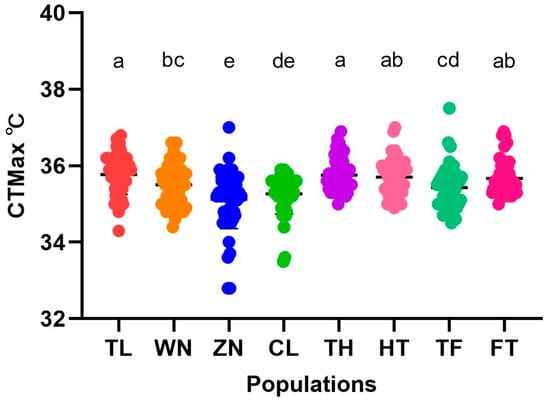
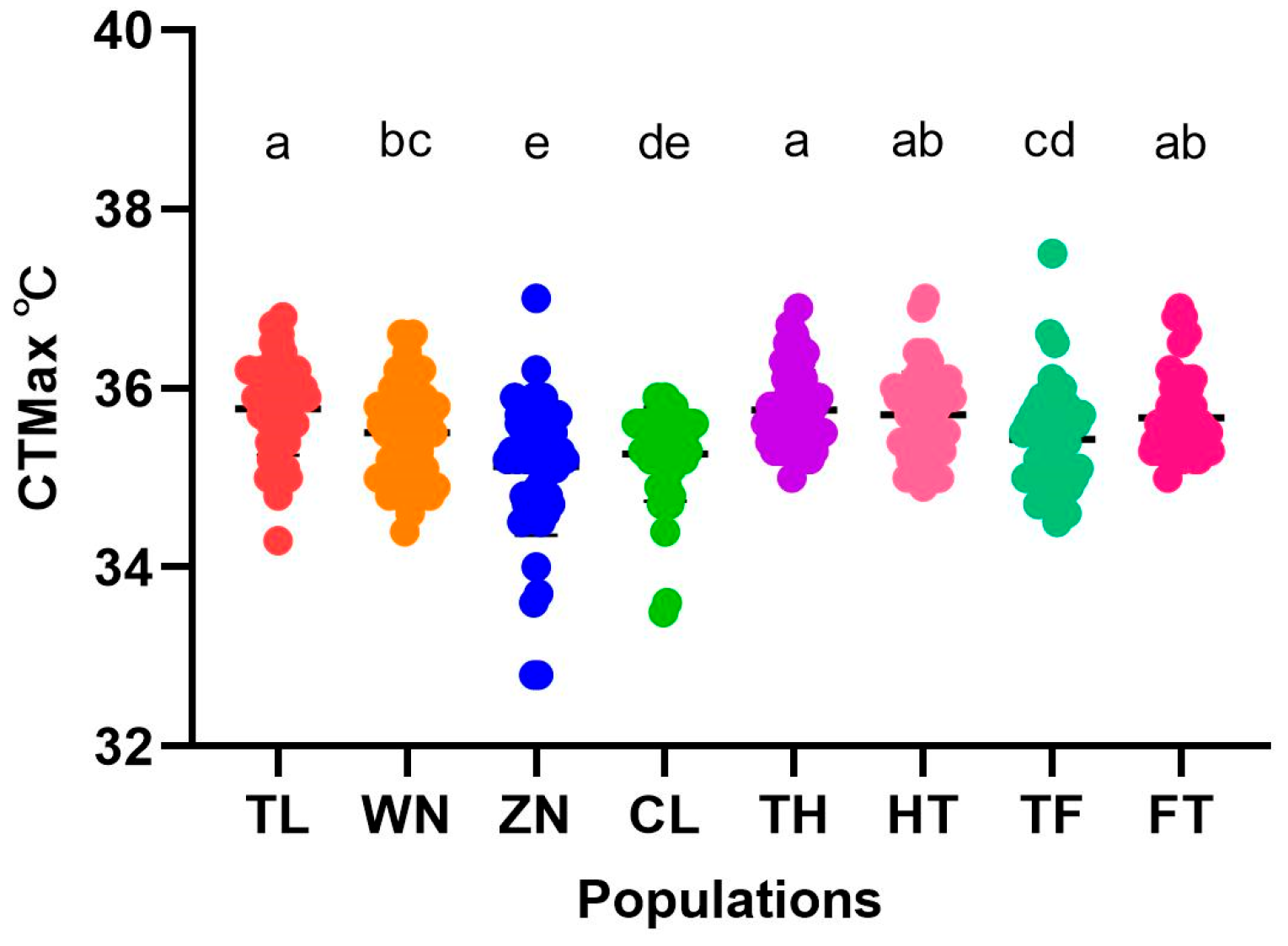
Based on the above results, a heating rate of 1 °C/20 min was chosen to compare the CTMax of the eight populations. As shown in Figure 5, the CTMax values of TL, WN, ZA, CL, TH, HT, TF, and FT were 35.77 ± 0.52, 35.50 ± 0.52, 35.12 ± 0.77, 35.26 ± 0.53, 35.75 ± 0.06, 35.70 ± 0.07, 35.43 ± 0.08, and 35.67 ± 0.06 °C, respectively. These results were consistent with the LT50 performance of each population: the CTMax of the four geographical populations was correlated with the seawater temperature of their natural distribution areas, and hybridization significantly increased the CTMax of the offspring but did not exceed that of the high-parent population.
Figure 5.
Comparison of CTMax among different populations of Babylonia areolata. Different lowercase letters above bars indicate significant differences among populations (p < 0.05) (n = 50 per population). TL: Thailand B. areolata; WN: Wanning B. areolata; ZA: Zhao’an B. areolata; CL: Changle B. areolata; TH: Thailand B. areolata ♀ × Hainan B. areolata ♂ ; HT: Hainan B. areolata ♀ × Thailand B. areolata ♂ ; TF: Thailand B. areolata ♀ × Zhao’an B. areolata ♂ ; FT: Zhao’an B. areolata ♀ × Thailand B. areolata ♂.
3.4. Heterosis Analysis
To intuitively understand the degree of improvement in high-temperature tolerance of offspring through cross-breeding, the heterosis rates of the four hybrids at two stress temperatures (36.0 and 36.5 °C) with large differences in survival rate and LT50 after 12 h of high-temperature stress were analyzed. As shown in Table 2, in the mid-parent heterosis analysis, TH, HT, and FT all showed positive heterosis rates for survival rate under both high-temperature stress conditions and for LT50. Among them, TH and HT had higher heterosis rates for high-temperature tolerance, with the survival rate at 36.5 °C and 12 h-LT50 showing heterosis rates of 73.68% and 78.94% and 0.58% and 0.56%, respectively. Regarding best-parent heterosis, only TH showed positive values across all three indicators, but the best-parent heterosis was not significant.
Table 2.
Analysis of heterosis rate for heat tolerance in hybrids.
4. Discussion
Temperature is a critical ecological factor that governs the physiological metabolism of marine organisms [31,32]. As ectotherms, shellfish body temperature fluctuates in accordance with environmental conditions, rendering them particularly vulnerable to thermal variations [33]. Such temperature fluctuations directly influence key biological processes, including growth, development, reproduction, behavior, and geographical distribution [34,35]. Consequently, the thermal tolerance range and adaptive capacity of a species constitute essential traits that must be prioritized in economic shellfish breeding and aquaculture programs, as they directly determine the economic viability and sustainability of production systems [14,25]. In subtropical and tropical aquaculture, extreme high water temperatures constitute one of the most formidable challenges. During summer months, water temperatures in shallow or stagnant aquaculture ponds in these regions frequently exceed 35 °C. Compounded by global warming and the increasing frequency of marine heatwave events, abnormally elevated coastal seawater temperatures have emerged as a severe threat to the survival and productivity of farmed species [36].
The differences in thermal adaptability and their genetic basis among different geographic populations are research hotspots in heat-tolerant breeding [37,38]. As benthic organisms with limited mobility, shellfish exhibit strong site fidelity, and their thermal adaptability is typically highly correlated with the temperature regimes characteristic of their native habitats. Different geographic populations of the same species often form significant differentiation in heat tolerance due to long-term adaptation to local environments [39,40]. For example, under 35 °C and 40 °C thermal stress, the mortality rate of the Guangxi population of the clam Meretrix meretrix (66.67%, 11.67%) was lower than those of the Jiangsu population (98.33%, 33.33%); under thermal stress, the peak time of oxygen consumption rate and ammonia excretion rate of the Guangxi population was later than that of the Jiangsu population, and the activities of total superoxide dismutase (T-SOD), catalase (CAT), and lysozyme (LZM) in the hepatopancreas were significantly higher than those of the Jiangsu population (p < 0.05), while the malondialdehyde (MDA) content of the Jiangsu population was significantly higher, indicating that the Guangxi population had stronger heat tolerance, consistent with the higher annual average water temperature of its habitat [41]. In oysters, the Pacific oyster (Crassostrea gigas) is mainly distributed in northern cold waters, with an optimal growth temperature of 20–28 °C, while the Portuguese oyster (C. angulata) is distributed in southern warm waters, with an optimal growth temperature of 24–28 °C. The thermal upper limit (LT50) of the latter is about 1 °C higher than that of the former, and the Arrhenius breakpoint temperature of heart rate and standard metabolic rate is also significantly higher than that of C. gigas during warming [42,43].
B. areolata is mainly distributed in Southeast Asia, radiating from the Gulf of Thailand to the southern coast of Zhejiang Province, China, spanning tropical to subtropical seas. The temperature decreases continuously from south to north in this geographical range, but there was no systematic study on the differences in temperature tolerance among different geographic populations before. In this study, the main cultured geographic populations of B. areolata in mainland China were selected, and it was found that their heat tolerance was consistent with the environmental temperature of geographical distribution, that is, populations distributed in low-latitude seas had stronger heat tolerance. Specifically, LT50 (36.49 ± 0.05 °C) and CTMax (35.77 ± 0.52 °C) of TL were significantly higher than those of WN (LT50 36.11 ± 0.02 °C, CTMax 35.50 ± 0.52 °C), ZA (LT50 36.02 ± 0.04 °C, CTMax 35.12 ± 0.77 °C), and CL (LT50 35.90 ± 0.05 °C, CTMax 35.26 ± 0.53 °C) (p < 0.05), showing a gradient change of enhanced heat tolerance with decreasing latitude. These findings align with patterns widely reported in aquatic organisms [44,45,46], suggesting that geographic variation in thermal tolerance might be mediated by multiple physiological and molecular mechanisms. In bivalves such as the Pacific oyster C. gigas and Pacific abalone Haliotis discus hannai, heat shock proteins (HSPs) are significantly upregulated under thermal stress as a primary molecular defense to maintain protein homeostasis [39,47]. Thermal tolerance divergence has also been linked to enhanced antioxidant defense systems, where heat-resistant populations exhibited significantly higher SOD and CAT activities and greater reactive oxygen species scavenging efficiency under thermal stress, resulting in less tissue damage [48]. At the metabolic level, heat-stressed bivalves shift toward anaerobic glycolysis and lipid mobilization to compensate for reduced aerobic scope, while membrane lipid remodeling through homeoviscous adaptation preserves cellular integrity by modulating glycerophospholipid composition and fatty acid saturation [49]. Although the present study did not directly measure these physiological parameters, the superior heat tolerance of low-latitude B. areolata populations likely reflects evolved differences in stress protein expression, oxidative stress resistance, and metabolic flexibility shaped by long-term exposure to warmer native environments. Future studies are warranted to investigate the mechanisms underlying thermal tolerance variation among geographically distinct populations of B. areolata at both physiological and molecular levels.
In addition, the TL population in this study was the fifth-generation material subjected to growth selection breeding, which had been cultured in Hainan and Fujian Provinces, China, for seven and six years, respectively. Previous studies in bivalves have demonstrated that selective breeding targeting growth traits can concurrently enhance thermal tolerance. For example, four generations of shell height selection in the bay scallop (Argopecten irradians irradians) elevated the Arrhenius break temperature (ABT) by approximately 2 °C [50]. Moreover, positive genetic correlations between growth and thermal tolerance have been reported in oysters [37]. Thermal acclimation or domestication can also influence heat resistance in bivalves [51,52]. However, for the TL population, such domestication effects are unlikely to explain its superior heat tolerance, as the environmental temperatures in Hainan and Fujian, where it was cultured, are lower than those in its native Thai habitat, and the local Hainan and Fujian populations—which experienced comparable or longer cultivation periods—exhibited significantly lower heat tolerance than TL. Therefore, we infer that the elevated heat tolerance of TL may be attributed to its long-term adaptation to the original tropical habitat or to indirect enhancement through growth-selective breeding. Nevertheless, whether a positive genetic correlation exists between growth and thermal tolerance traits in B. areolata remains to be verified through dedicated quantitative genetic analyses.
Crossbreeding is an effective method to improve the stress resistance traits of economic aquatic animals [53,54]. In this study, the LT50 values of the four hybrid populations (TH, HT, TF, and FT) were 36.51 ± 0.04, 36.51 ± 0.07, 36.21 ± 0.03, and 36.40 ± 0.03 °C, respectively, which were significantly higher than their respective low parents (WN: 36.11 ± 0.02 °C, ZA: 36.02 ± 0.04 °C), showing clear mid-parent heterosis. Among them, the heterosis rates of survival rate of TL × WN hybrids (TH and HT) under 36.5 °C stress reached 73.68% and 78.94%, respectively, and the heterosis rates for LT50 after 12 h of stress were both positive, much higher than those of TL × ZA combinations. However, the heat tolerance indexes of all hybrid offspring did not exceed the best parent TL (LT50 = 36.49 ± 0.05 °C), showing only mid-parent heterosis but no best-parent heterosis. These results are consistent with the hypothesis that heat tolerance in B. areolata might have a quantitative genetic basis, with hybrid phenotypes tending toward the average of the two parents, suggesting an additive mode of inheritance. Similar phenomena have been reported in the crossbreeding of shellfish such as abalone, scallop, and oyster: hybridization can significantly enhance the heat tolerance of offspring and improve their adaptability to summer high temperatures, but the best-parent heterosis is often not significant [18,42,55,56]. In contrast, the heterosis rates of TH and HT (TL × WN) were higher than those of TF and FT (TL × ZA), indicating that the genetic distance or combination mode between parents has an important influence on the strength of heterosis.
Organisms have a specific temperature tolerance range, and once the ambient temperature exceeds the threshold, physiological metabolism will be disrupted, leading to stress or even death [14]. In recent years, rising sea surface temperatures have frequently exceeded the tolerance limit of many marine organisms, especially cultured mollusks [13,57]. Elevated temperature reduces dissolved oxygen in seawater and interferes with respiratory metabolism [58]. Therefore, determining the temperature tolerance range of new germplasm or strains is crucial to ensure aquaculture success [39,59]. The improvement of heat tolerance of hybrid offspring in this study is consistent with the previous observation that the summer mortality of TL × WN hybrids was significantly lower than that of the Hainan parent [24]. Based on the accumulated evidence from multiple traits, including growth performance, stress resilience, disease resistance, and thermal tolerance [17,23,24], it is recommended that the Thailand × Wanning hybrids (TH or HT) be preferentially promoted in areas with frequent high summer temperatures to reduce farming risks. Furthermore, since only mid-parent heterosis was observed in this study, future work could combine molecular-marker-assisted selection or genomic selection to further aggregate heat-tolerant alleles from different parents, aiming to break through the limitation of mid-parent heterosis and breed new heat-tolerant strains with best-parent heterosis.
5. Conclusions
This study systematically demonstrates that the four examined geographical populations of B. areolata exhibit marked genetic differentiation in heat tolerance, which increases as the latitude of origin decreases. The Thai-selected population (TL) shows the highest heat tolerance. Intraspecific hybridization effectively improves offspring heat tolerance, with all hybrids performing significantly better than their low parent. The Thailand × Wanning (TL × WN) hybrids display stronger positive mid-parent heterosis, while no hybrid combination achieves significant best-parent heterosis. These results confirm crossbreeding as an effective strategy for enhancing heat tolerance in B. areolata. However, it should be noted that this study focused on acute thermal stress assessment, and further research incorporating long-term thermal acclimation and physiological biomarker analysis is warranted. Nevertheless, the superior hybrid combinations identified here provide important materials and theoretical support for future breeding of heat-tolerant strains and stable aquaculture production, offering significant practical value for the industry to cope with thermal stress and achieve healthy, sustainable development.
Author Contributions
Conceptualization, C.K. and J.F.; methodology, J.F. and L.N.; validation, Y.L.; formal analysis, Z.C. and W.Z.; investigation, M.S.; resources, W.L.; data curation, J.F. and Y.L.; writing—original draft preparation, J.F.; writing—review and editing, W.Y.; supervision, X.L.; funding acquisition, T.G. and C.K. All authors have read and agreed to the published version of the manuscript.
Funding
This work was supported by the National Natural Science Foundation of China (32202900), the Applied Technology Engineering Center of Fujian Provincial Higher Education for Marine Resource Protection and Ecological Governance (2024-01), the Research on Breeding Technology of Candidate Species for Guangdong Modern Marine Ranching (2025-MRB-00-001), the Starting Research Fund for High-Level Talents of Xiamen Ocean Vocational College (KYG202545), and the Fujian Provincial S&T Project (2025N0064).
Institutional Review Board Statement
Not applicable. This study used the invertebrate ivory shell Babylonia areolata, which is not subject to ethical approval requirements in accordance with local/national legislation.
Informed Consent Statement
Not applicable.
Data Availability Statement
The original contributions presented in this study are included in the article. Further inquiries can be directed to the corresponding author.
Conflicts of Interest
The authors declare no conflicts of interest.
References
- Häder, D.P.; Barnes, P.W. Comparing the impacts of climate change on the responses and linkages between terrestrial and aquatic ecosystems. Sci. Total Environ. 2019, 682, 239–246. [Google Scholar] [CrossRef] [Scilit] [PubMed]
- Jones, M.C.; Dye, S.R.; Fernandes, J.A.; Frölicher, T.L.; Pinnegar, J.K.; Warren, R.; Cheung, W.W.L. Predicting the impact of climate change on threatened species in UK waters. PLoS ONE 2013, 8, e54216. [Google Scholar] [CrossRef] [Scilit] [PubMed]
- Cheng, Y.; Wang, J.H.; Alavi, S.M.H.; Zhang, S.P.; Linhartová, Z.; Roy, D.R.; Shazada, N.E.; Dzyuba, B.; Linhart, O. Impacts of global warming on quality of male fishes: Evidence from a meta-analysis of temperature effects on sperm motility kinematics. Rev. Aquacult. 2025, 17, 7257. [Google Scholar] [CrossRef] [Scilit]
- Liu, C.H.; Shang, Y.Y.; Gul, S.; Hu, M.H.; Wang, Y.J. Energetic adaptations of bivalves under environmental stress: A comprehensive review on bioenergetics and aquaculture sustainability. Rev. Aquacult. 2025, 17, e70052. [Google Scholar] [CrossRef] [Scilit]
- Morris, P.J.; Swindles, G.T.; Valdes, P.J.; Ivanovic, R.F.; Gregoire, L.J.; Smith, M.W.; Tarasov, L.; Haywood, A.M.; Bacon, K.L. Global peatland initiation driven by regionally asynchronous warming. Proc. Natl. Acad. Sci. USA 2018, 115, 4851–4856. [Google Scholar] [CrossRef] [Scilit] [PubMed]
- Seney, E.E.; Rowland, M.J.; Lowery, R.A.; Griffis, R.B.; McClure, M.M. Climate change, marine environments, and the US endangered species act. Conserv. Biol. 2013, 27, 1138–1146. [Google Scholar] [CrossRef] [Scilit] [PubMed]
- Li, Y.G.; Xu, C.X.; Li, Q. Effects of salinity and temperature on growth and survival of diploid and tetraploid larvae of the Pacific oyster, Crassostrea gigas. Aquaculture 2022, 550, 737809. [Google Scholar] [CrossRef] [Scilit]
- Bai, X.C.; Liang, Y.X.; Zhang, H.N.; Cheng, G.; Xu, C.X.; Li, Q. Combined effects of temperature, salinity and rearing density on the larval growth and survival of the diploid, triploid and tetraploid of the Pacific oyster Crassostrea gigas. Aquaculture 2024, 585, 740690. [Google Scholar] [CrossRef] [Scilit]
- Alter, K.; Philippart, C.J.M.; Teng, S.; Bolier, H.; Drenth, P.; Dubbeldam, M. Consequences of thermal history for growth, development and survival during metamorphosis and settlement for the European flat oyster. Aquaculture 2023, 566, 739174. [Google Scholar]
- Riisgård, H.U.; Larsen, P.S. Effect of Temperature on Filtration in the Blue Mussel, Mytilus edulis—Our Present Understanding. J. Mar. Sci. Eng. 2025, 13, 2033. [Google Scholar] [CrossRef] [Scilit]
- Yang, C.Y.; Wang, X.B.; Zhou, K.; Jiang, D.L.; Shan, Y.; Wang, L.L.; Song, L.S. Effect of high temperature stress on glycogen metabolism in gills of Yesso scallop Patinopecten yessoensis. Fish. Shellfish Immun. 2023, 138, 108786. [Google Scholar] [CrossRef] [Scilit]
- Steeves, L.E.; Filgueira, R.; Guyondet, T.; Chassé, J.; Comeau, L. Past, present, and future: Performance of two bivalve species under changing environmental conditions. Front. Mar. Sci. 2018, 5, 184. [Google Scholar] [CrossRef] [Scilit]
- Ericson, J.A.; Venter, L.; Copedo, J.S.; Nguyen, V.T.; Alfaro, A.C.; Ragg, N.L.C. Chronic heat stress as a predisposing factor in summer mortality of mussels, Perna canaliculus. Aquaculture 2023, 564, 738986. [Google Scholar]
- Li, X.; Shi, C.Y.; Yang, B.; Li, Q.; Liu, S.K. High temperature aggravates mortalities of the Pacific oyster (Crassostrea gigas) infected with Vibrio: A perspective from homeostasis of digestive microbiota and immune response. Aquaculture 2023, 568, 739309. [Google Scholar] [CrossRef] [Scilit]
- Calvo-Rodríguez, L.; Ortiz-Delgado, J.B.; Cañón, L.; de Paz, P.D.; Fernández, I.; Riesco, M.F. Current summer heat waves impair rainbow trout (Oncorhynchus mykiss) spermatogenesis: Implications for future fish farming management practices in South Europe. Aquaculture 2025, 596, 741716. [Google Scholar]
- Zou, Y.; Fu, J.Q.; Liang, Y.; Luo, X.; Shen, M.H.; Huang, M.Q.; Chen, Y.X.; You, W.W.; Ke, C.H. Chromosome-level genome assembly of the ivory shell Babylonia areolata. Sci. Data 2024, 11, 1201. [Google Scholar] [CrossRef] [Scilit] [PubMed]
- Fu, J.Q.; Liang, Y.; Shen, M.H.; Lü, W.G.; Luo, X.; You, W.W.; Ke, C.H. Survival and immune responses of two populations of Babylonia areolata and their hybrids under pathogenic Vibrio challenge. Aquaculture 2024, 584, 740646. [Google Scholar] [CrossRef] [Scilit]
- Chen, N.; Luo, X.; Gu, Y.T.; Han, G.D.; Dong, Y.W.; You, W.W.; Ke, C.H. Assessment of the thermal tolerance of abalone based on cardiac performance in Haliotis discus hannai, H. gigantea and their interspecific hybrid. Aquaculture 2016, 465, 258–264. [Google Scholar] [CrossRef] [Scilit]
- Jahan, K.; Nie, H.T.; Yin, Z.H.; Zhang, Y.M.; Li, N.; Yan, X.W. Comparative transcriptome analysis to reveal the genes and pathways associated with adaptation strategies in two different populations of Manila clam (Ruditapes philippinarum) under acute temperature challenge. Aquaculture 2022, 552, 737999. [Google Scholar] [CrossRef] [Scilit]
- Fu, D.; Wu, Y.Y.; Hong, X.; Zhu, Y.Y.; Luo, Q.R.; Li, G.Y.; Tian, K.; Zheng, X.; Liu, C.S.; Wang, S.F.; et al. Genome-wide identification and characterization of the HSP gene superfamily in the Ivory Shell (Babylonia areolata). Comp. Biochem. Phys. D. 2025, 57, 101668. [Google Scholar] [CrossRef] [Scilit]
- Zhong, M.C.; Liu, X.K.; Xu, R.; Liu, X.J.; Jiang, Q.C.; Song, X.Y.; Lu, Y.N.; Luo, X.; Yue, C.Y.; Qin, S.; et al. Effects of light quality and intensity on the juvenile physiological metabolism of Babylonia areolata. Aquacul. Rep. 2023, 33, 101758. [Google Scholar] [CrossRef] [Scilit]
- Li, T.; Zhang, Z.L.; Zheng, P.H.; Li, J.T.; Zhang, X.X.; Li, J.J.; Lu, Y.N.; Xian, J.A.; Guo, H.; Lu, Y.P. Effects of dietary vitamin C on the growth performance, muscle composition, non-specific immunity, and resistance of juvenile ivory shell (Babylonia areolata) to ammonia. Aquacul. Rep. 2024, 36, 102188. [Google Scholar] [CrossRef] [Scilit]
- Fu, J.Q.; Nie, L.W.; Xia, G.Y.; Lü, W.G.; Liu, H.T.; Liang, Y.; You, W.W.; Ke, C.H.; Luo, X.; Shen, M.H. Changes in low salinity and hypoxia tolerance in F1 hybrids of the ivory shell, Babylonia areolata. Aquacul. Rep. 2024, 36, 102131. [Google Scholar] [CrossRef] [Scilit]
- Lü, W.G.; Ke, C.H.; Fu, J.Q.; You, W.W.; Luo, X.; Huang, M.Q.; Yu, J.J.; Li, W.D.; Shen, M.H. Evaluation of crosses between two geographic populations of native Chinese and introduced Thai spotted ivory shell, Babylonia areolata, in southern China. J. World Aquacult. Soc. 2016, 47, 544–554. [Google Scholar] [CrossRef] [Scilit]
- Xue, M.; Ke, C.H.; Wang, D.X.; Wei, Y.J.; Xu, Y.B. The combined effects of temperature and salinity on growth and survival of hatchery-reared juvenile spotted Babylon, Babylonia areolata (Link 1807). J. World Aquacul. Soc. 2010, 41, 116–122. [Google Scholar]
- Ab Lah, R.; Kelaher, B.P.; Bucher, D.; Benkendorff, K. Ocean warming and acidification affect the nutritional quality of the commercially-harvested turbinid snail Turbo militaris. Mar. Environ. Res. 2018, 141, 100–108. [Google Scholar] [CrossRef] [Scilit] [PubMed]
- Diaz, F.; Re, A.D.; Salas, A.; Galindo-Sanchez, C.E.; Gonzalez, M.A.; Sanchez, A.; Rosas, C. Behavioral thermoregulation and critical thermal limits of giant keyhole limpet Megathura crenulate (Sowerby 1825) (Mollusca; Vetigastropoda). J. Therm. Biol. 2015, 54, 133–138. [Google Scholar] [PubMed]
- Diaz, F.; Re, A.D.; Medina, Z.; Re, G.; Valdez, G.; Valenzuela, F. Thermal preference and tolerance of green abalone Haliotis fulgens (Philippi, 1845) and pink abalone Haliotis corrugata (Gray, 1828). Aquacult. Res. 2006, 37, 877–884. [Google Scholar] [CrossRef] [Scilit]
- Valles-Regino, R.; Mouatt, P.; Yee, L.H.; Benkendorff, K. Ocean warming and heat stress impact molecules of keystone significance in a predatory marine gastropod. Front. Mar. Sci. 2022, 9, 830425. [Google Scholar] [CrossRef] [Scilit]
- Shen, Y.W.; Huang, M.Q.; You, W.W.; Luo, X.; Ke, C.H. The survival and respiration response of two abalones under short-term hypoxia challenges. Aquaculture 2020, 529, 735658. [Google Scholar] [CrossRef] [Scilit]
- Marquez, L.; Larson, M.; Almansa, E. Effects of temperature on the rate of embryonic development of cephalopods in the light of thermal time applied to aquaculture. Rev. Aquacul. 2021, 13, 706–718. [Google Scholar]
- Pörtner, H.O.; Gutt, J. Impacts of climate variability and change on (marine) animals: Physiological underpinnings and evolutionary consequences. Integr. Comp. Biol. 2016, 56, 31–44. [Google Scholar] [CrossRef] [Scilit] [PubMed]
- Martel, S.I.; Leppes, N.J.; Lagos, N.A.; Vargas, C.A.; Lardies, M.A. Phenotypic responses of the giant mussel Choromytilus chorus to prolonged upwelling conditions. Aquacul. Rep. 2025, 41, 102680. [Google Scholar] [CrossRef] [Scilit]
- Seuront, L.; Ng, T.P.T.; Lathlean, J.A. A review of the thermal biology and ecology of molluscs, and of the use of infrared thermography in molluscan research. J. Mollus. Stud. 2018, 84, 203–232. [Google Scholar] [CrossRef] [Scilit]
- Martinez, M.; Mangano, M.C.; Maricchiolo, G.; Genovese, L.; Mazzola, A.; Sarà, G. Measuring the effects of temperature rise on Mediterranean shellfish aquaculture. Ecol. Indic. 2018, 88, 71–78. [Google Scholar] [CrossRef] [Scilit]
- Yanar, M.; Erdoğan, E.; Kumlu, M. Thermal tolerance of thirteen popular ornamental fish species. Aquaculture 2019, 501, 382–386. [Google Scholar] [CrossRef] [Scilit]
- Jiang, G.W.; Xu, C.X.; Li, Q. Genetic parameters and response to selection for thermal tolerance, summer survival and growth in hybrid oyster (Crassostrea gigas♀× C. angulata♂). Aquat. Living Resour. 2023, 36, 30. [Google Scholar]
- Xiao, Q.Z.; Huang, Z.K.; Shen, Y.W.; Gan, Y.; Wang, Y.; Gong, S.H.; Lu, Y.S.; Luo, X.; You, W.W.; Ke, C.H. Transcriptome analysis reveals the molecular mechanisms of heterosis on thermal resistance in hybrid abalone. BMC Genom. 2021, 22, 650. [Google Scholar] [CrossRef] [Scilit]
- Chen, N.; Huang, Z.K.; Lu, C.K.; Shen, Y.W.; Luo, X.; Ke, C.H.; You, W.W. Different transcriptomic responses to thermal stress in heat-tolerant and heat-sensitive pacific abalones indicated by cardiac performance. Front. Physiol. 2019, 9, 1895. [Google Scholar] [PubMed]
- Mizrahi, T.; Heller, J.; Goldenberg, S.; Arad, Z. Heat shock proteins and survival strategies in congeneric land snails (Sphincterochila) from different habitats. Cell Stress Chaperon 2012, 17, 523–527. [Google Scholar] [CrossRef] [Scilit]
- Qing, Z.Y.; Hua, C.S.; Hua, C.A.; Dong, Z.Z.; Yu, Z.; Cao, Y.; Ping, W.Y. Effects of high temperature stress on the survival, metabolism, and related enzyme activities of two Meretrix meretrix populations. Mar. Fish. 2024, 6, 1–19. [Google Scholar]
- Jiang, G.W.; Li, Q.; Xu, C.X.; Liu, S.K. Effects of temperature on the growth and survival of reciprocal hybrids of two oyster species, Crassostrea gigas and Crassostrea angulata. J. Fish. Sci. China 2021, 28, 29–36. [Google Scholar]
- Ghaffari, H.; Wang, W.; Li, A.; Zhang, G.F.; Li, L. Thermotolerance divergence revealed by the physiological and molecular responses in two oyster subspecies of Crassostrea gigas in China. Front. Physiol. 2019, 10, 1137. [Google Scholar] [CrossRef] [Scilit] [PubMed]
- Wang, C.G.; Jiang, Z.X.; Du, M.Y.; Li, Q.Y.; Cong, R.H.; Wang, W.; Zhang, G.F.; Li, L. Comparative chromatin dynamics reveal differential thermal tolerance mechanisms between two congeneric oyster species. Aquaculture 2024, 579, 740177. [Google Scholar]
- Fangue, N.A.; Hofmeister, M.; Schulte, P.M. Intraspecific variation in thermal tolerance and heat shock protein gene expression in common killifish, Fundulus heteroclitus. J. Exp. Biol. 2006, 209, 2859–2872. [Google Scholar] [CrossRef] [Scilit] [PubMed]
- Lascio, A.D.; Rossi, L.; Costantini, M.L. Different temperature tolerance of northern and southern European populations of a freshwater isopod crustacean species (Asellus aquaticus L.). Fundam. Appl. Limnol. 2011, 179, 193–201. [Google Scholar] [CrossRef] [Scilit]
- Li, Y.G.; Jiang, K.Y.; Li, Q. Comparative transcriptomic analyses reveal differences in the responses of diploid and triploid Pacific oysters (Crassostrea gigas) to thermal stress. Aquaculture 2022, 555, 738219. [Google Scholar] [CrossRef] [Scilit]
- Ye, K.; Liu, R.Q.; Zhan, T.Y.; Chen, S.; Yu, J.M.; Niu, D.H. The heat-resistant capability analysis of two populations of Sinonovacula constricta under thermal stress. J. Therm. Biol. 2025, 130, 104164. [Google Scholar] [CrossRef] [Scilit] [PubMed]
- Zhang, W.Y.; Dong, Y.W. Membrane lipid metabolism, heat shock response and energy costs mediate the interaction between acclimatization and heat-hardening response in the razor clam Sinonovacula constricta. J. Exp. Biol. 2021, 224, 243031. [Google Scholar] [CrossRef] [Scilit]
- Zhu, X.H.; Liu, P.P.; Hou, X.J.; Zhang, J.H.; Lv, J.; Lu, W.; Zeng, Q.F.; Huang, X.T.; Xing, Q.; Bao, Z.M. Genome-wide association study reveals PC4 as the candidate gene for thermal tolerance in bay scallop (Argopecten irradians irradians). Front. Genet. 2021, 12, 650045. [Google Scholar] [CrossRef] [Scilit] [PubMed]
- Tucci, C.F.; Milan, M.; Rovere, G.D.; Bernardini, I.; Ferraresso, S.; Franch, R.; Babbucci, M.; Monticelli, G.; Panin, M.; Patarnello, T.; et al. Thermal priming mitigates the effects of lethal marine heatwaves on the Manila clam Ruditapes philippinarum. iScience 2025, 28, 113108. [Google Scholar] [CrossRef] [Scilit] [PubMed]
- Li, A.; Wang, C.G.; Wang, W.; Zhang, Z.Y.; Liu, M.K.; She, Z.C.; Jia, Z.; Zhang, G.F.; Li, L. Molecular and fitness data reveal local adaptation of southern and northern estuarine oysters (Crassostrea ariakensis). Front. Mar. Sci. 2020, 7, 589099. [Google Scholar] [CrossRef] [Scilit]
- Zhang, H.C.; Xiao, Q.Z.; Lin, W.H.; Huang, Z.K.; Miao, B.B.; Gan, Y.; Li, C.Y.; Ke, C.H.; Luo, X.; You, W.W. Molecular identification and population genetic analysis of a three-way cross hybrid abalone. Aquaculture 2025, 612, 743189. [Google Scholar] [CrossRef] [Scilit]
- Jiang, G.W.; Xu, C.X.; Li, Q. General and specific combining abilities of Pacific oyster (Crassostrea gigas) and Fujian oyster (C. angulata) for growth, survival and thermal tolerance of their reciprocal hybrids. J. Ocean U. China 2025, 24, 238–248. [Google Scholar] [CrossRef] [Scilit]
- Xiao, Q.Z.; Shen, Y.W.; Gan, Y.; Wang, Y.; Zhang, J.P.; Huang, Z.K.; You, W.W.; Luo, X.; Ke, C.H. Three-way cross hybrid abalone exhibit heterosis in growth performance, thermal tolerance, and hypoxia tolerance. Aquaculture 2022, 555, 738231. [Google Scholar] [CrossRef] [Scilit]
- Wang, J.J.; Liu, O.Y.; Shen, M.; Liu, G.L.; Wang, Y.C.; Lu, X.; Xu, X.; Wang, Q.C.; Wang, C.D.; Ning, J.H. Three-way crossed scallops between Argopecten irradians irradians, A. i. concentricus and A. purpuratus exhibit strong heterosis in growth, survival and temperature tolerance. Aquaculture 2025, 596, 741866. [Google Scholar]
- Rahman, M.S.; Rahman, M.S. Effects of elevated temperature on prooxidant-antioxidant homeostasis and redox status in the American oyster: Signaling pathways of cellular apoptosis during heat stress. Environ. Res. 2021, 196, 110428. [Google Scholar] [CrossRef] [Scilit] [PubMed]
- Hu, Z.; Feng, J.; Song, H.; Zhou, C.; Yu, Z.L.; Yang, M.J.; Pu, S.; Guo, Y.J.; Li, Y.R.; Zhang, T. Mechanisms of heat and hypoxia defense in hard clam: Insights from transcriptome analysis. Aquaculture 2022, 549, 737792. [Google Scholar] [CrossRef] [Scilit]
- Wang, C.D.; Liu, B.; Liu, X.; Ma, B.; Zhao, Y.M.; Zhao, X.; Liu, F.Q.; Liu, G.L. Selection of a new scallop strain, the Bohai Red, from the hybrid between the bay scallop and the Peruvian scallop. Aquaculture 2017, 479, 250–255. [Google Scholar] [CrossRef] [Scilit]

Disclaimer/Publisher’s Note: The statements, opinions and data contained in all publications are solely those of the individual author(s) and contributor(s) and not of MDPI and/or the editor(s). MDPI and/or the editor(s) disclaim responsibility for any injury to people or property resulting from any ideas, methods, instructions or products referred to in the content. |
© 2026 by the authors. Licensee MDPI, Basel, Switzerland. This article is an open access article distributed under the terms and conditions of the Creative Commons Attribution (CC BY) license.