Journal Description
Cryptography
Cryptography
is an international, scientific, peer-reviewed, open access journal on cryptography published bimonthly online by MDPI.
- Open Access— free for readers, with article processing charges (APC) paid by authors or their institutions.
- High Visibility: indexed within Scopus, ESCI (Web of Science), dblp, and other databases.
- Journal Rank: JCR - Q2 (Computer Science, Theory and Methods) / CiteScore - Q1 (Applied Mathematics)
- Rapid Publication: manuscripts are peer-reviewed and a first decision is provided to authors approximately 19.9 days after submission; acceptance to publication is undertaken in 2.9 days (median values for papers published in this journal in the first half of 2026).
- Recognition of Reviewers: reviewers who provide timely, thorough peer-review reports receive vouchers entitling them to a discount on the APC of their next publication in any MDPI journal, in appreciation of the work done.
- Journal Cluster of Information Systems and Technology: Analytics, Applied System Innovation, Cryptography, Data, Digital, Informatics, Information, Journal of Cybersecurity and Privacy and Multimedia.
Impact Factor:
2.4 (2025);
5-Year Impact Factor:
2.3 (2025)
Latest Articles
Dipper: A Lightweight Hybrid SPN–ARX Block Cipher
Cryptography 2026, 10(4), 52; https://doi.org/10.3390/cryptography10040052 - 21 Jul 2026
Abstract
►
Show Figures
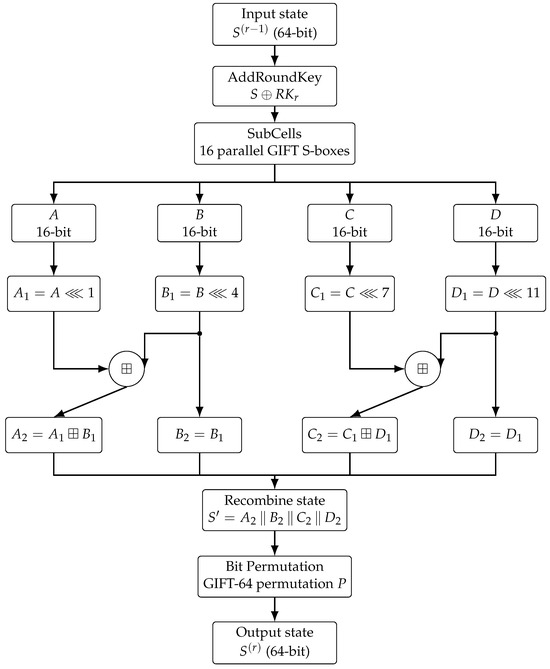
We present Dipper, a lightweight 64-bit block cipher with 96-bit and 128-bit key variants, built on a 28-round hybrid SPN–ARX structure. Each round applies a full-state key addition, sixteen parallel 4-bit GIFT S-boxes, four word-wise rotations, two 16-bit modular additions over half of
[...] Read more.
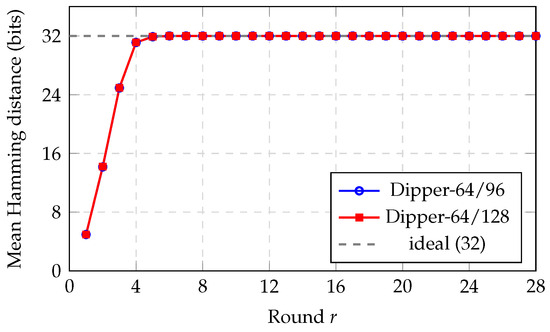
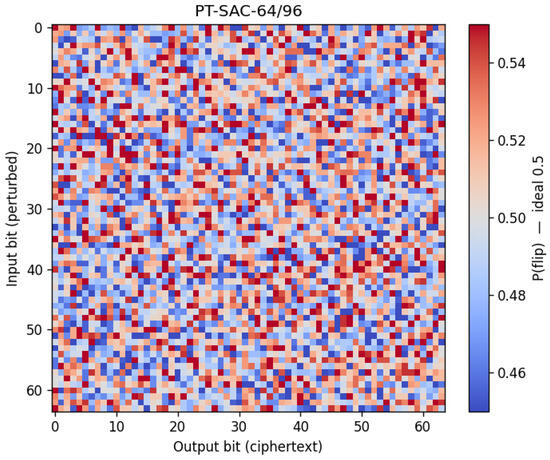
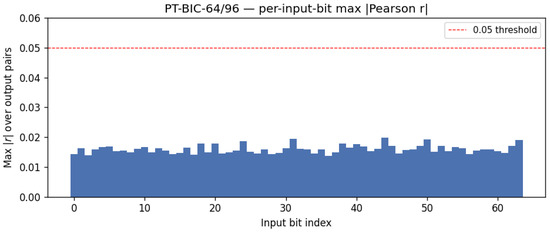
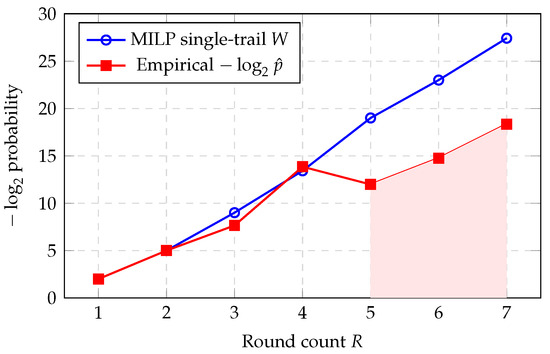
We present Dipper, a lightweight 64-bit block cipher with 96-bit and 128-bit key variants, built on a 28-round hybrid SPN–ARX structure. Each round applies a full-state key addition, sixteen parallel 4-bit GIFT S-boxes, four word-wise rotations, two 16-bit modular additions over half of the state, and the GIFT-64 bit permutation, combining the compact substitution layer of GIFT-style designs with the diffusion efficiency of ARX operations. We evaluate Dipper from both hardware and cryptanalytic perspectives under a single, fully open-source methodology. Round-based Verilog implementations were synthesized alongside PRESENT, GIFT, and SIMON variants using an identical Yosys + ABC + Nangate45 flow. Under this flow, Dipper-64/96 and Dipper-64/128 require 2498 and 2824 gate equivalents (GE), respectively, both falling between GIFT-64-128 (2191 GE) and PRESENT-128 (2963 GE); notably, Dipper-64/128 is more compact than PRESENT-128 at the same key size, despite incorporating an additional ARX diffusion layer. A broader comparison re-implements eleven established lightweight ciphers under the same flow, and post-place-and-route FPGA results on Lattice ECP5, measured software timings, and Cortex-M memory footprints support deployment across RFID, sensor-node, and edge-gateway scenarios. For differential resistance, we develop a mixed-integer linear programming (MILP) model that couples the exact GIFT differential distribution table with a Lipmaa–Moriai encoding of modular addition. Predicted and empirical differential probabilities agree tightly for reduced-round variants, while five-round trails reveal differential clustering. The security evaluation further includes proven-optimal linear trail bounds up to ten rounds, an exhaustive impossible-differential search bounding the longest distinguisher at five rounds, and experimental integral distinguishers of at most five rounds, leaving the 28-round cipher a margin close to 3× against the longest identified distinguisher. All RTL, synthesis scripts, reference implementations, and MILP models are released for full reproducibility.
Full article
Open AccessArticle
A No-Degradation Framework for Augmenting Operating-System Randomness with Publicly Observable Dynamic Data Sources
by
Mohammad Dashti
Cryptography 2026, 10(4), 51; https://doi.org/10.3390/cryptography10040051 - 18 Jul 2026
Abstract
►▼
Show Figures
Modern cryptography depends on the quality of the operating-system entropy pool, and historic failures of that pool have shown that randomness, not algorithm strength, is often the weakest link of a deployed cryptosystem. Hardware True-Random Number Generators (TRNGs) mitigate this risk but are
[...] Read more.
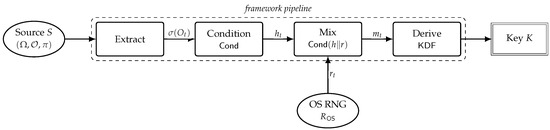
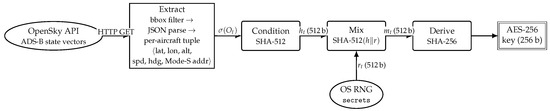
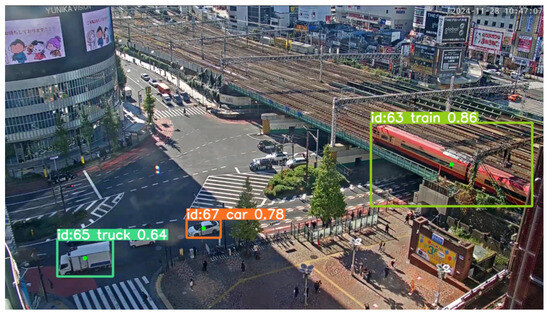
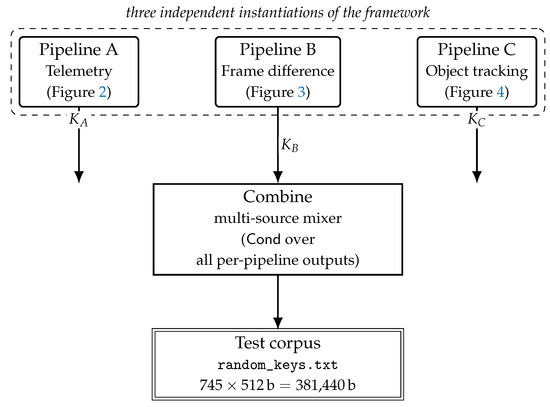
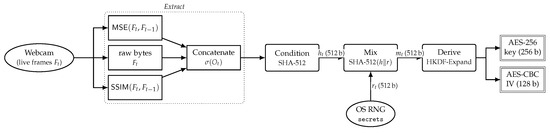
Modern cryptography depends on the quality of the operating-system entropy pool, and historic failures of that pool have shown that randomness, not algorithm strength, is often the weakest link of a deployed cryptosystem. Hardware True-Random Number Generators (TRNGs) mitigate this risk but are not universally available or trusted. This paper develops a unified four-stage construction, extract → condition → mix → derive, that admits heterogeneous publicly observable dynamic data sources as auxiliary inputs to the operating-system randomness pipeline. The construction’s central claim is a no-degradation defence-in-depth property, formalised as Theorem 1: under a pseudorandom-function assumption on the conditioning function, the composed output is computationally indistinguishable from the operating-system output alone, even when an adversary fully controls the public source. The framework does not claim that public sources supply secret entropy against an adversary who also observes them; it claims only that mixing them in cannot weaken the baseline, and that any uncompromised source supplies residual unpredictability under operating-system-generator compromise. We instantiate the framework in three pipelines—aircraft state vectors from a public sensor network, webcam frame-differencing of a wall of lava lamps, and computer-vision tracking of vehicles on a public traffic-camera feed—and argue soundness by combining the theorem with published evaluations of each source. On a 381 kbit corpus of framework-derived keys, every applicable NIST SP 800-22 test and SP 800-90B entropy estimator finds the framework output statistically indistinguishable from an os.urandom baseline; this is consistent with no-degradation but not in itself evidence of marginal entropy gain, and per-pipeline raw-input measurements and source-ablation runs are deferred to empirical follow-up. Off-the-shelf computer-vision tooling is sufficient to operationalise the framework on commodity hardware.
Full article

Figure 1
Open AccessArticle
A Secure and Ultra-Lightweight Authentication Protocol for RFID Systems Using Epoch-Based Pseudonym Indexing
by
Pierre E. Abi-Char, Mehdi Al Housseini and Mohammed Al-Husseini
Cryptography 2026, 10(4), 50; https://doi.org/10.3390/cryptography10040050 - 13 Jul 2026
Abstract
Mobile Radio Frequency Identification (RFID) systems are emerging as a fundamental part of modern smart environments, enabling automatic identification, tracking, and data exchange among different mobile platforms. While these systems are increasingly being adopted, they have a major drawback: an RFID tag has
[...] Read more.
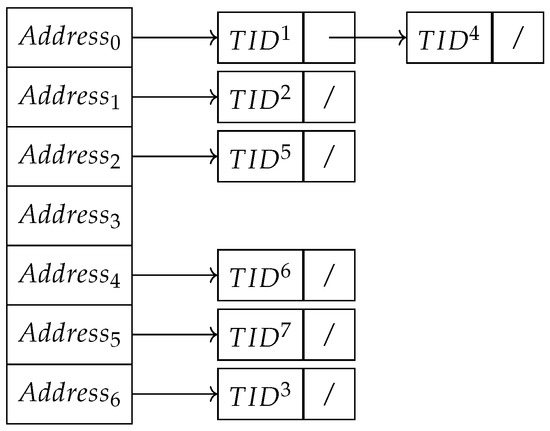
Mobile Radio Frequency Identification (RFID) systems are emerging as a fundamental part of modern smart environments, enabling automatic identification, tracking, and data exchange among different mobile platforms. While these systems are increasingly being adopted, they have a major drawback: an RFID tag has very little computational power, and the wireless communication channels can be attacked by adversaries. Several authentication and key management mechanisms to protect data and provide secure access have been proposed to solve these problems. In this study, we propose a new scheme that improves system security through explicit three-party mutual authentication, epoch-based pseudonym indexing for server lookup, and comprehensive resiliency against replay, impersonation, and man-in-the-middle attacks. An in-depth security analysis, along with performance evaluation, substantiates that the proposed protocol improves privacy and resilience without losing compatibility with low-cost RFID tags equipped only to perform lightweight cryptographic functions. This protocol also provides epoch-based unlinkability and is well suited for large-scale deployments, as found in healthcare, logistics, and Internet of Things (IoT) applications.
Full article
(This article belongs to the Section Hardware Security)
►▼
Show Figures

Figure 1
Open AccessReview
A Brief Survey on Hardware Implementation of Fully Homomorphic Encryption
by
Yang Su, Kaixuan Zhou, Weidong Zhong, Jianfei Wang, Jia Hou and Chen Yang
Cryptography 2026, 10(4), 49; https://doi.org/10.3390/cryptography10040049 - 13 Jul 2026
Abstract
Leveraging the favorable properties of cryptographic computation, FHE effectively ensures data availability without visibility, thereby holding broad application prospects in cloud computing security and data privacy protection. However, computational efficiency remains a critical bottleneck that constrains its practical deployment and further development. Consequently,
[...] Read more.
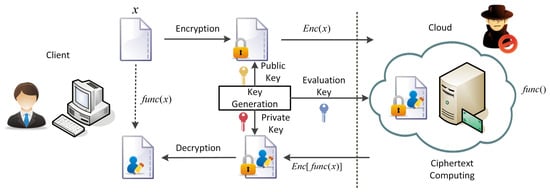
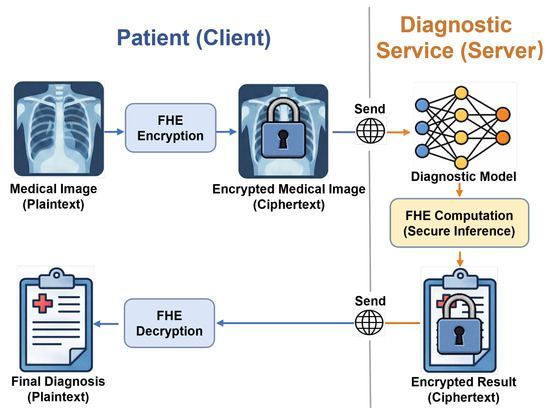
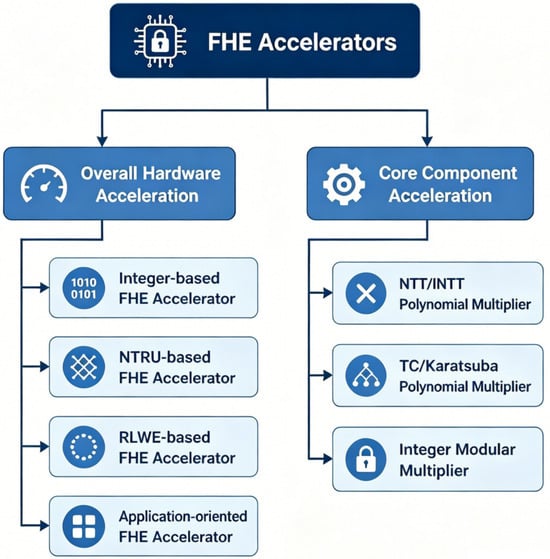
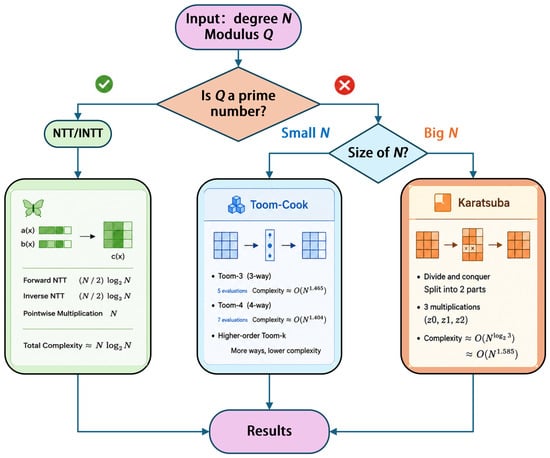
Leveraging the favorable properties of cryptographic computation, FHE effectively ensures data availability without visibility, thereby holding broad application prospects in cloud computing security and data privacy protection. However, computational efficiency remains a critical bottleneck that constrains its practical deployment and further development. Consequently, research on hardware implementations of FHE has become a major direction in the cryptographic community. This paper first systematically reviews the research progress of FHE schemes, summarizing and analyzing the characteristics of representative FHE schemes. Subsequently, we survey and analyze hardware research progress and optimization techniques from the perspectives of overall accelerator architecture design, polynomial multiplier design, and integer modular multiplier design, highlighting the main advantages, disadvantages, and common features of different hardware structures. Finally, based on an analysis of existing hardware implementation architectures for FHE, this paper presents the potential deficiencies, summarizes and outlines future research directions and development prospects, aiming to further improve the operational performance of FHE hardware implementations.
Full article
(This article belongs to the Topic Trends and Prospects in Security, Encryption and Encoding: 2nd Edition)
►▼
Show Figures

Figure 1
Open AccessArticle
An Extended Coppersmith-Based Attack on RSA
by
Mohammed Rahmani, Abderrahmane Nitaj and Mhammed Ziane
Cryptography 2026, 10(4), 48; https://doi.org/10.3390/cryptography10040048 - 11 Jul 2026
Abstract
Lattice-based cryptanalysis has become one of the most powerful tools for evaluating the security of the RSA cryptosystem. Most existing attacks rely on the classical key equation and are effective mainly when the
[...] Read more.
Lattice-based cryptanalysis has become one of the most powerful tools for evaluating the security of the RSA cryptosystem. Most existing attacks rely on the classical key equation and are effective mainly when the decryption exponent is sufficiently small or when significant information about the RSA prime factors is available. However, the dependence on this classical equation restricts the applicability of existing attacks and limits the range of weak exponents that can be targeted. In this paper, we propose a generalized lattice-based technique for solving the extended key equation when an approximation of one of the RSA primes is known and the parameters r, x, and s are suitably small. By transforming this relation into an appropriate modular equation and applying Coppersmith’s method, we derive conditions under which the RSA modulus can be factored in polynomial time, even when the corresponding private exponent is large. Our analysis encompasses several well-known attacks as special cases and significantly enlarges the class of vulnerable RSA exponents. Consequently, the proposed framework remains effective in settings where classical lattice-based approaches are no longer applicable.
Full article
Open AccessArticle
ML-KEM (CRYSTALS-Kyber) on FPGA Using the Residue Number System
by
Abdullah Alhassani and Mohammed Benaissa
Cryptography 2026, 10(4), 47; https://doi.org/10.3390/cryptography10040047 - 10 Jul 2026
Abstract
►▼
Show Figures
The NIST standardisation process for Post-Quantum Cryptography (PQC) has nominated the CRYSTALS-Kyber Key-Encapsulation Mechanism (KEM) scheme as the primary key establishment method. The algorithm was renamed as the Module-Lattice-Based Key-Encapsulation Mechanism (ML-KEM). This work proposes an efficient design for ML-KEM on FPGA with
[...] Read more.
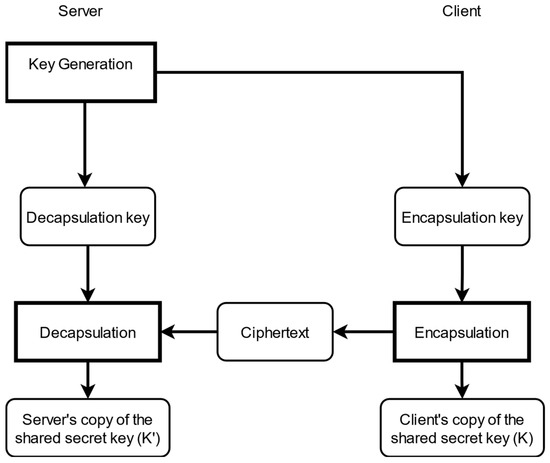
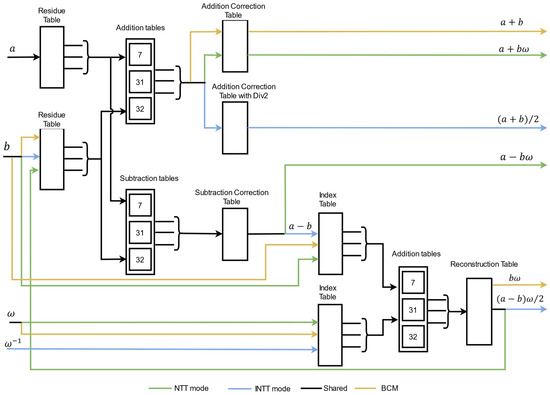
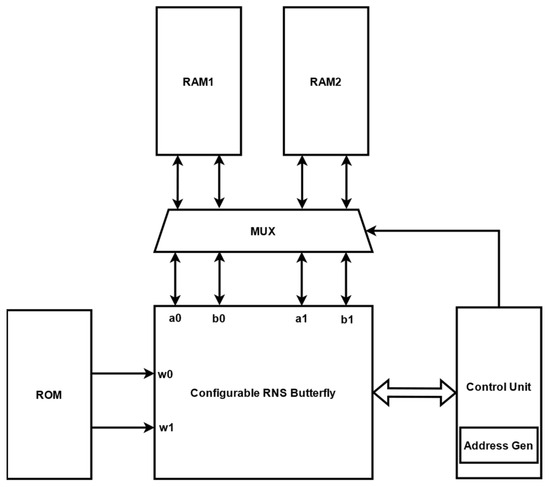
The NIST standardisation process for Post-Quantum Cryptography (PQC) has nominated the CRYSTALS-Kyber Key-Encapsulation Mechanism (KEM) scheme as the primary key establishment method. The algorithm was renamed as the Module-Lattice-Based Key-Encapsulation Mechanism (ML-KEM). This work proposes an efficient design for ML-KEM on FPGA with built-in side-channel attack (SCA) protection. The design is based on combining two methodologies: the Residue Number System (RNS) arithmetic and the look-up tables implementation. At the arithmetic level in the number-theoretic transform (NTT) computation of the polynomial multiplication, the operations are spread across the RNS channels, and these computations are implemented using look-up tables. The use of look-up tables resulted in low-latency RNS implementation and higher performance. The proposed design, implemented on Xilinx Artix-7 FPGA, shows higher performance with a reasonable increase in area, whilst the experimental TVLA results demonstrate the design’s SCA protection advantages.
Full article

Figure 1
Open AccessArticle
Efficient Verifiable Computation for Support Vector Machine Training over Secret-Shared Data
by
Shimao Yu, Liang Su and Hanlin Zhang
Cryptography 2026, 10(4), 46; https://doi.org/10.3390/cryptography10040046 - 3 Jul 2026
Abstract
The outsourcing of machine learning tasks, such as Support Vector Machine (SVM) training, to cloud platforms poses significant security challenges, primarily concerning the confidentiality of sensitive training data and the integrity of computation results returned by potentially malicious servers. To address these challenges,
[...] Read more.
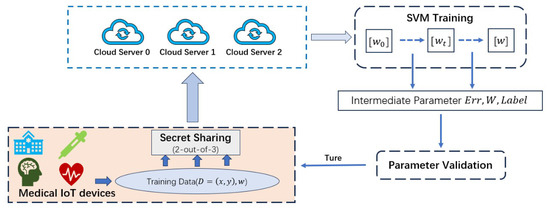
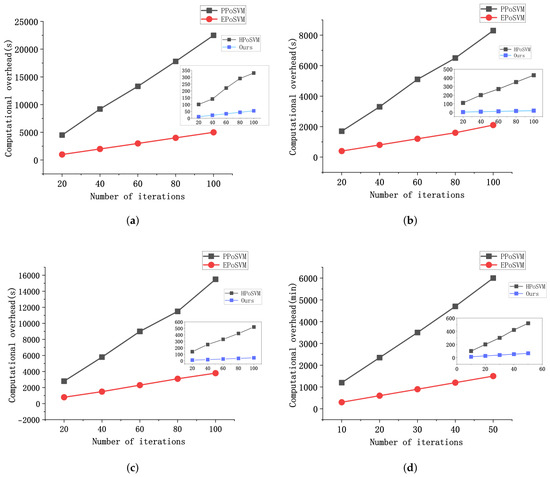
The outsourcing of machine learning tasks, such as Support Vector Machine (SVM) training, to cloud platforms poses significant security challenges, primarily concerning the confidentiality of sensitive training data and the integrity of computation results returned by potentially malicious servers. To address these challenges, this paper proposes a lightweight, privacy-preserving, and verifiable SVM training scheme designed for resource-constrained clients. Our scheme leverages a replicated secret sharing protocol to securely distribute training data and model parameters across multiple non-colluding servers, executing the entire collaborative training process in the share domain without leaking plaintext information. Furthermore, to guarantee computational correctness, we introduce a novel interval-based index point storage strategy combined with a bilinear mapping-based parameter label consistency check. This verifiable mechanism enables clients to perform sampled, lightweight audits of the cloud’s intermediate training states and final outputs. Experimental evaluations on multiple typical datasets demonstrate that the proposed scheme maintains stable classification performance while achieving an order-of-magnitude decrease in training runtime compared with existing ciphertext-based methods, offering a highly configurable trade-off among verification coverage, computational overhead, and storage cost.
Full article
(This article belongs to the Special Issue Advanced Information Security Solutions for Future and Efficient IoT, Wireless, and Localization Systems)
►▼
Show Figures

Figure 1
Open AccessArticle
A Lightweight Accelerator for the LESS Digital Signature Scheme
by
Giuseppe Cutrera, Alessandra Dolmeta, Valeria Piscopo, Maurizio Martina and Guido Masera
Cryptography 2026, 10(4), 45; https://doi.org/10.3390/cryptography10040045 - 3 Jul 2026
Abstract
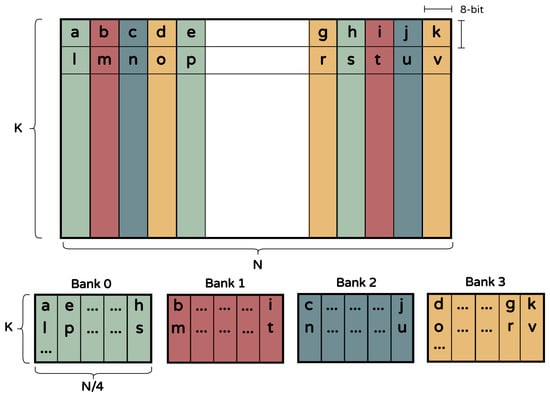
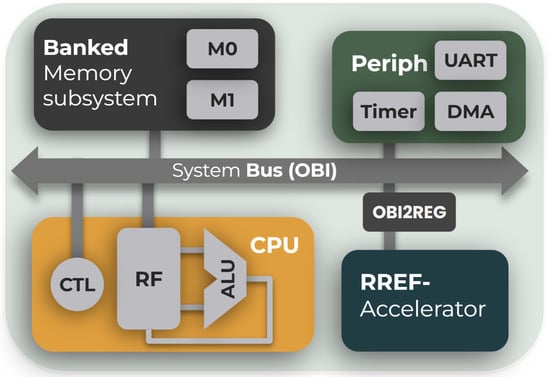
The Linear Equivalence Signature Scheme (LESS) is a code-based post-quantum candidate in the National Institute of Standards and Technology’s (NIST) standardization process for additional digital signatures. In this paper, we present an area-efficient FPGA accelerator for the Reduced Row Echelon Form (RREF) kernel
[...] Read more.
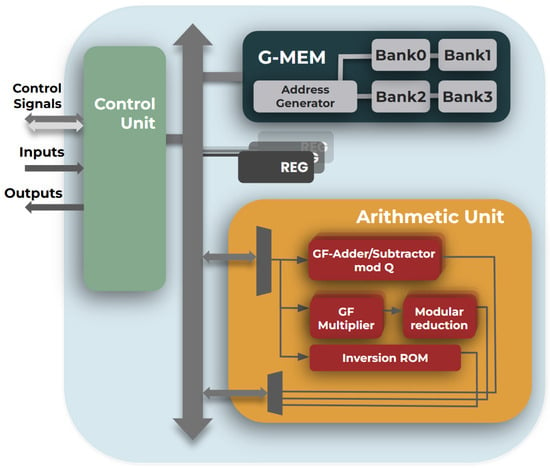
The Linear Equivalence Signature Scheme (LESS) is a code-based post-quantum candidate in the National Institute of Standards and Technology’s (NIST) standardization process for additional digital signatures. In this paper, we present an area-efficient FPGA accelerator for the Reduced Row Echelon Form (RREF) kernel of LESS, designed for embedded RISC-V SoCs where resource overhead is the primary constraint. Our architecture targets the scheme’s primary computational bottleneck: the linear-algebra core responsible for RREF processing. By implementing an optimized pivot-reuse workflow, our design significantly reduces redundant row-reduction operations across related computations. The accelerator features a matrix-oriented execution engine paired with a streaming control interface to minimize synchronization overhead. Implementation on a Xilinx Artix-7 FPGA shows that despite its compact footprint, the accelerator achieves up to 21× speedup over the embedded software RREF baseline. By prioritizing a minimalist footprint, our design requires only 1.38 to 8.7 KeSlice, depending on the targeted security level. By covering all LESS security levels and providing comparisons with existing post-quantum cryptographic hardware, this work establishes a performance baseline for a signature scheme that has remained largely unexplored in the hardware domain.
Full article
(This article belongs to the Special Issue Advances in Post-Quantum Cryptography)
►▼
Show Figures

Figure 1
Open AccessArticle
CipherAPR: Accelerating RNS-CKKS Encrypted Inference via Importance-Guided and Level-Aware Mixed-Degree Polynomial Design
by
Junping Wan, Yucen Liao, Yinglong Liao, Zejiu Tan, Jinming Xu, Zoe L. Jiang and Binxing Fang
Cryptography 2026, 10(4), 44; https://doi.org/10.3390/cryptography10040044 - 2 Jul 2026
Abstract
►▼
Show Figures
Fully Homomorphic Encryption (FHE) enables Machine Learning as a Service (MLaaS) providers to perform inference over encrypted data, preserving user privacy. In the RNS-CKKS FHE scheme, however, ReLU activations must be replaced with polynomials. High-degree polynomial approximations preserve accuracy but consume more ciphertext
[...] Read more.
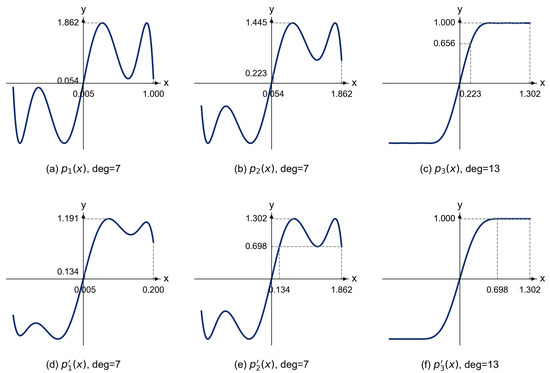
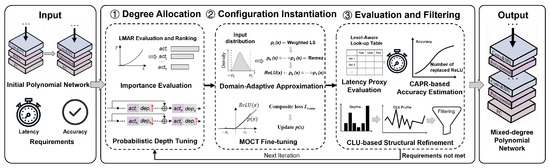
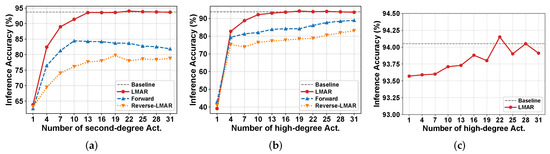
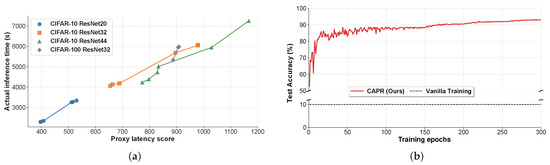
Fully Homomorphic Encryption (FHE) enables Machine Learning as a Service (MLaaS) providers to perform inference over encrypted data, preserving user privacy. In the RNS-CKKS FHE scheme, however, ReLU activations must be replaced with polynomials. High-degree polynomial approximations preserve accuracy but consume more ciphertext levels, triggering costly bootstrapping operations. Existing mixed-degree methods reduce the bootstrapping count by assigning different polynomial degrees across layers. However, recent FHE compiler research shows that reducing the bootstrapping count alone is insufficient to fully accelerate inference, because bootstrapping placement and the level budget restored after each operation also significantly affect performance. Incorporating such execution-side factors into mixed-degree design substantially enlarges the search space, making straightforward extensions of existing methods computationally infeasible. We propose CipherAPR, an importance-guided framework for level-aware mixed-degree polynomial design. CipherAPR introduces the Low-Magnitude Activation Ratio (LMAR) to prioritize degree updates on accuracy-sensitive layers, combines Domain-Adaptive Approximation (DAAP) with Multi-Objective Coefficient Tuning (MOCT) to produce reusable polynomial approximations that consume fewer ciphertext levels, and applies ciphertext-level utilization (CLU) to filter configurations with poor restored-level utilization. Lightweight latency and accuracy estimators further accelerate offline candidate screening. Experiments on ResNet and VGG show that CipherAPR achieves a 1.09×–1.39× speedup over AutoFHE with comparable accuracy.
Full article

Figure 1
Open AccessArticle
Near-Bent Boolean Functions Are Insufficient for Correlation-Robust Hashing: A Spectral Obstruction and an Information-Theoretic Frontier
by
Guillermo Sosa-Gómez
Cryptography 2026, 10(4), 43; https://doi.org/10.3390/cryptography10040043 - 26 Jun 2026
Abstract
Oblivious Transfer (OT) extension, in particular, the construction of Ishai, Kilian, Nissim, and Petrank (CRYPTO 2003) requires a hash function H that is correlation-robust(CR). All practical instantiations model H as a random oracle or an ideal cipher, leaving CR with no quantifiable reduction
[...] Read more.
Oblivious Transfer (OT) extension, in particular, the construction of Ishai, Kilian, Nissim, and Petrank (CRYPTO 2003) requires a hash function H that is correlation-robust(CR). All practical instantiations model H as a random oracle or an ideal cipher, leaving CR with no quantifiable reduction to a structural property of the deployed hash. It is natural to ask whether the most nonlinear balanced Boolean functions available on an odd number of variables, the near-bent functions of the Maiorana–McFarland (MM) class, furnish an algebraic, standard-model CR candidate. We prove that they do not, and we identify precisely why. First, we keep a correct spectral fact: a balanced is -CR if and only if , reducing CR to an autocorrelation bound. Against this criterion we establish three obstructions: (i) The MM-doubling family on variables has autocorrelation supported only on the directions , where it equals with ; hence , a factor above the value one would need, and an exhaustive search over all balanced members for returns the maximal in every case. (ii) Near-bentness controls the Walsh maximum (nonlinearity), not autocorrelation: every near-bent function satisfies , so and no near-bent function is even approximately CR. (iii) A deterministic admits the support bound , so statistical multi-output CR is impossible for and in particular at the IKNP regime . Together, these results close the near-bent route to standard-model CR and clarify which design objective (low absolute indicator, not high nonlinearity) and which parameter regime ( ) a viable algebraic candidate would have to target.
Full article
Open AccessArticle
ParaSM2: Enhancing SM2 Cryptographic Performance via Parallel Restructuring of KDF and HASH
by
Hongjuan Kang, Bing Guo, Yufang Sun, Mingjie Zhao, Xin Chen and Kui Ye
Cryptography 2026, 10(3), 42; https://doi.org/10.3390/cryptography10030042 - 22 Jun 2026
Abstract
In the past decade, the high computational overhead of asymmetric cryptography has remained a central challenge in end-to-end secure communication systems. To mitigate the performance bottlenecks inherent in the full SM2 encryption and decryption workflow, this paper introduces ParaSM2, a parallel restructuring optimization
[...] Read more.
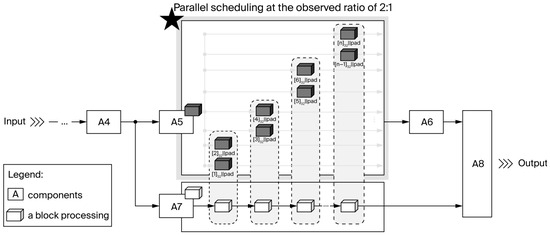
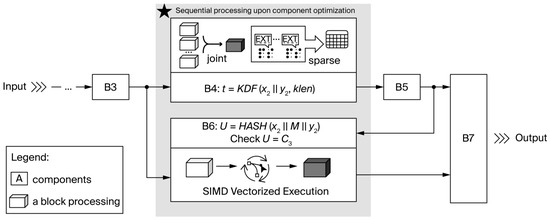
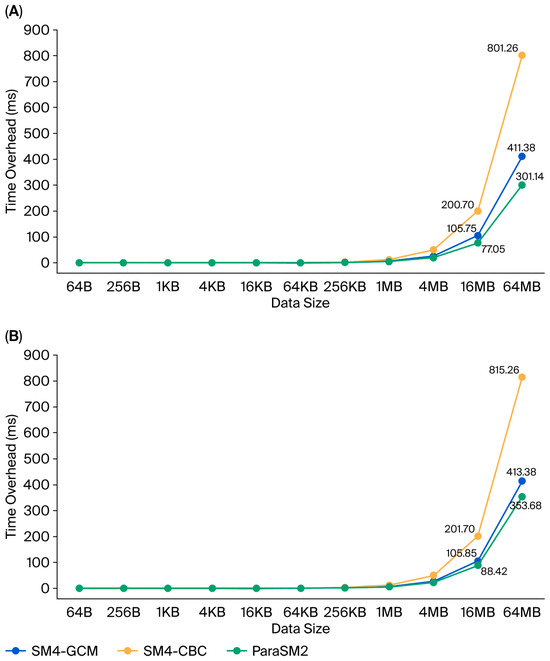
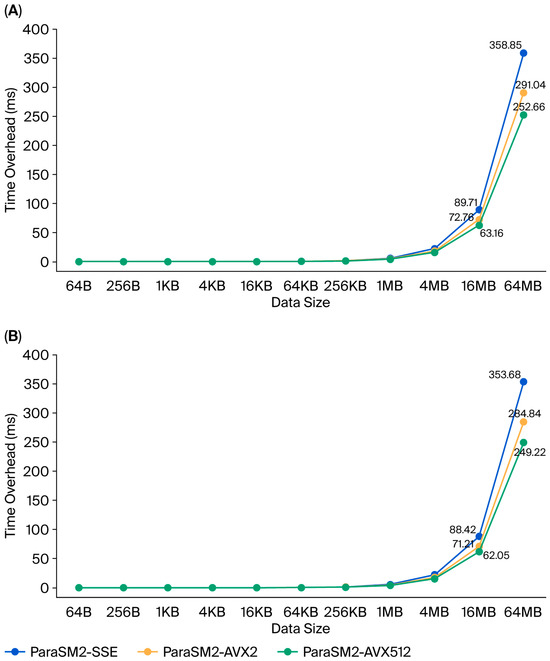
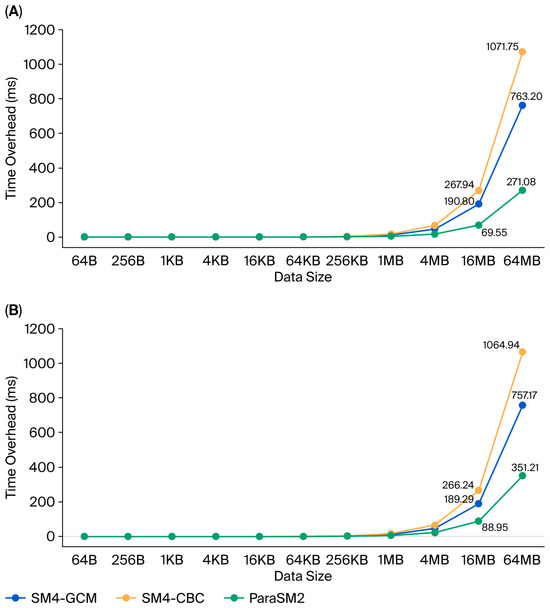
In the past decade, the high computational overhead of asymmetric cryptography has remained a central challenge in end-to-end secure communication systems. To mitigate the performance bottlenecks inherent in the full SM2 encryption and decryption workflow, this paper introduces ParaSM2, a parallel restructuring optimization framework tailored for SM2-based cryptographic operations. ParaSM2 exploits the observed 2:1 processing ratio between KDF and HASH to perform cross-component parallel restructuring and applies fixed-prefix reuse together with dynamic task parallelism to eliminate 39.7% of redundant KDF computations. Furthermore, a vectorized reconstruction of the HASH message extension is incorporated to leverage SIMD parallel acceleration, thereby substantially enhancing throughput. Experimental evaluations against SM4-GCM and SM4-CBC on data blocks larger than 64 KB demonstrate that ParaSM2 achieves up to a 5.1× performance improvement on both x86 and ARM architectures, effectively reducing end-to-end latency and providing a scalable pathway for algorithmic optimization in cryptography across heterogeneous platforms.
Full article
(This article belongs to the Topic Cybersecurity Symmetry: Encryption, AI, and Attack Patterns)
►▼
Show Figures

Figure 1
Open AccessHypothesis
Mythos-Class Frontier Models and the Compression of Post-Quantum Cryptography Migration Timelines
by
Robert Campbell
Cryptography 2026, 10(3), 41; https://doi.org/10.3390/cryptography10030041 - 18 Jun 2026
Abstract
►▼
Show Figures
Post-Quantum Cryptography (PQC) migration to National Institute of Standards and Technology (NIST) Federal Information Processing Standards (FIPS) 203, 204, and 205 under the National Security Agency (NSA) Commercial National Security Algorithm Suite (CNSA) 2.0 is a multi-year, multi-domain transformation across cloud, enterprise, embedded,
[...] Read more.
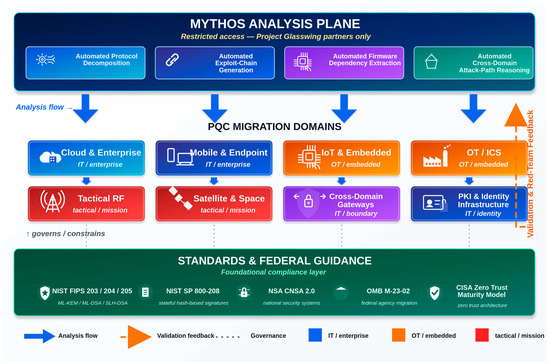
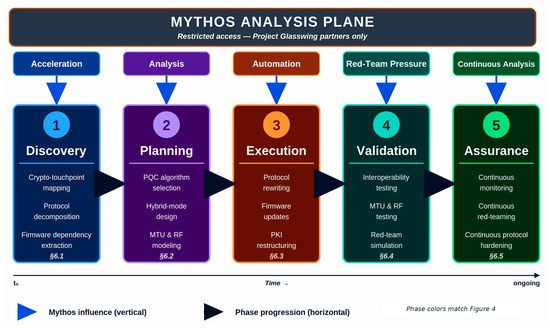
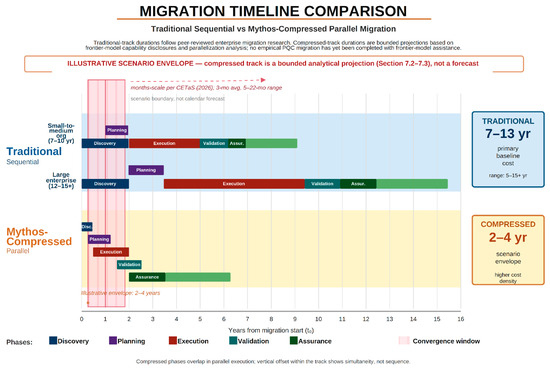
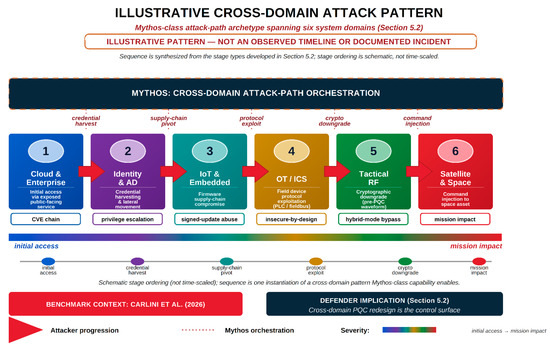
Post-Quantum Cryptography (PQC) migration to National Institute of Standards and Technology (NIST) Federal Information Processing Standards (FIPS) 203, 204, and 205 under the National Security Agency (NSA) Commercial National Security Algorithm Suite (CNSA) 2.0 is a multi-year, multi-domain transformation across cloud, enterprise, embedded, operational technology (OT), tactical, and national-security systems. Anthropic’s Claude Mythos Preview (April 2026) introduces artificial intelligence (AI)-accelerated cybersecurity capabilities that intersect this migration directly, performing autonomous reasoning against previously unknown vulnerabilities in production software—a qualitative departure from signature-based and static and dynamic application security testing (SAST/DAST) tooling. Drawing on federal guidance from NIST, NSA, the Office of Management and Budget (OMB), and the Cybersecurity and Infrastructure Security Agency (CISA), and on independent analyses from the Centre for Emerging Technology and Security (CETaS) and the UK AI Security Institute, we present a lifecycle and architecture analysis of how Mythos-class models alter PQC migration timelines, risk surfaces, lifecycle dependencies, and architectural constraints. Modeling Mythos as both accelerator and destabilizer, we derive an analytic projection of a compressed two-to-four-year migration window for highest-exposure systems, against traditional baselines of five-to-ten years for small organizations and twelve-to-fifteen-plus years for large enterprises. The compression collapses human-labor bottlenecks in discovery, planning, and code modification, not cryptography itself. We propose a lifecycle-aligned migration model, an updated cost model, and governance requirements for frontier-model access. The binding constraint shifts domain-conditionally: defender capacity at adversary tempo governs software-analytical phases, while non-compressible external cadence governs embedded and regulated domains.
Full article

Figure 1
Open AccessArticle
A Hybrid Attack on Small Private Exponent RSA via Continued Fractions and Lattices
by
Mengce Zheng, Yansong Feng, Abderrahmane Nitaj and Yanbin Pan
Cryptography 2026, 10(3), 40; https://doi.org/10.3390/cryptography10030040 - 18 Jun 2026
Abstract
In this study, we propose a hybrid cryptanalytic technique targeting the RSA cryptosystem when instantiated with small private exponents. By integrating the continued fraction approach with Coppersmith’s lattice-based technique, we formulate a novel vulnerability framework. Utilizing an innovative relationship extracted from continued fraction
[...] Read more.
In this study, we propose a hybrid cryptanalytic technique targeting the RSA cryptosystem when instantiated with small private exponents. By integrating the continued fraction approach with Coppersmith’s lattice-based technique, we formulate a novel vulnerability framework. Utilizing an innovative relationship extracted from continued fraction convergents, we deduce an improved upper bound for the secret key: . In this context, and , where S serves as a known approximation of the prime sum . As an extension of our preliminary conference proceedings, this paper supplies comprehensive proofs for all theoretical propositions, performs a comprehensive parameter sensitivity evaluation, and provides bounds for partial prime exposure scenarios. Empirical evaluations confirm the theoretical mechanics of our framework, demonstrating that it offers improved bounds in specific partial leakage scenarios compared to traditional lattice-only baselines.
Full article
(This article belongs to the Special Issue Information Security and Privacy—ACISP 2025)
Open AccessArticle
An Energy-Aware Post-Quantum Ascon–ML-KEM Cryptographic Framework for Low-Latency UAV Remote Sensing Communications
by
Nedal Y. Al-Tamimi, Mahmoud AlJamal, Mohammad Q. Al-Jamal, Ayoub Alsarhan, Sami Aziz Alshammari, Nayef H. Alshammari, Khalid Hamad Alnafisah and Mohammed Kamel Aleinzi
Cryptography 2026, 10(3), 39; https://doi.org/10.3390/cryptography10030039 - 16 Jun 2026
Abstract
►▼
Show Figures
UAV-based remote sensing systems are increasingly deployed in smart surveillance, disaster response, environmental monitoring, and critical infrastructure inspection. In these applications, aerial sensing platforms must transmit telemetry, control commands, and observation data securely and reliably under strict latency, energy, and computational constraints. However,
[...] Read more.
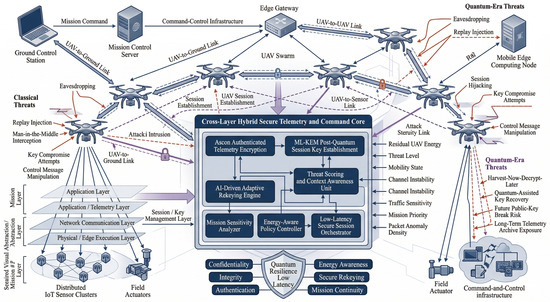
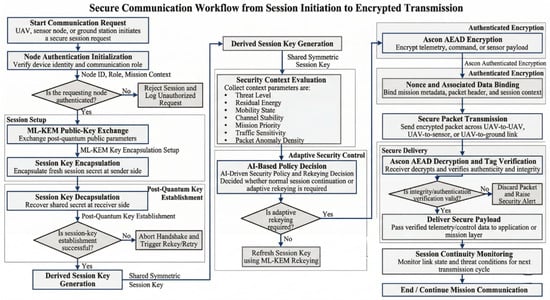
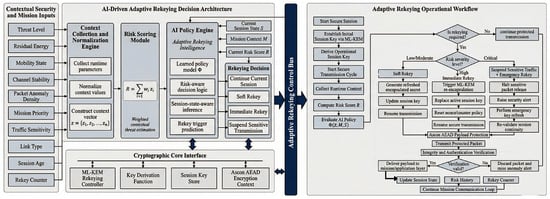
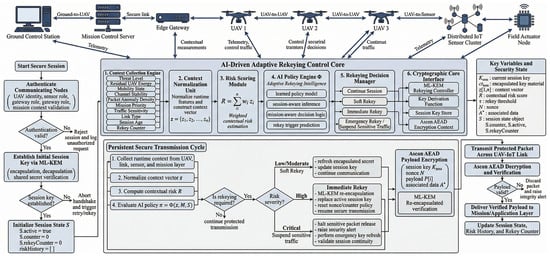
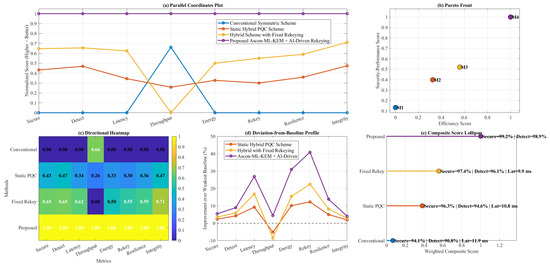
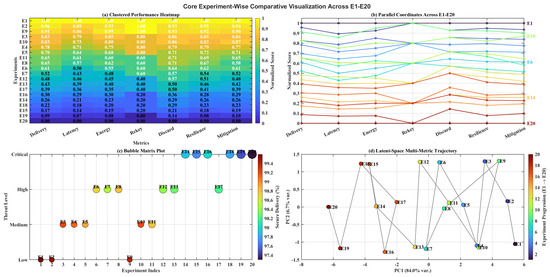
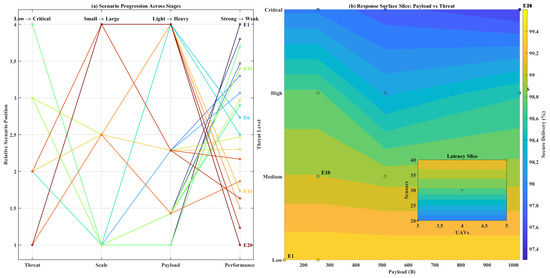
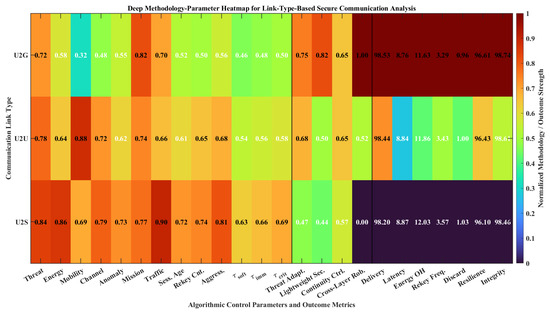
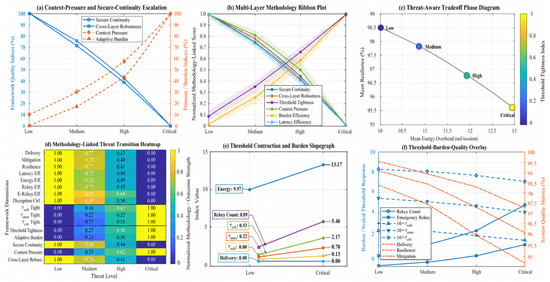
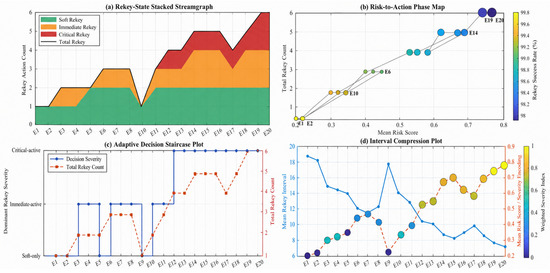
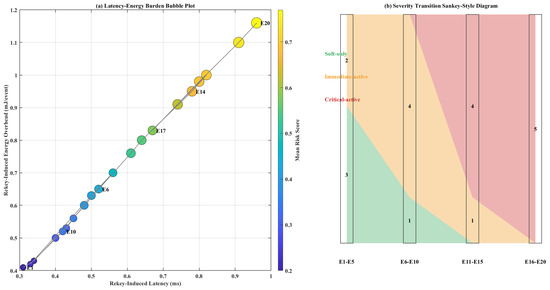
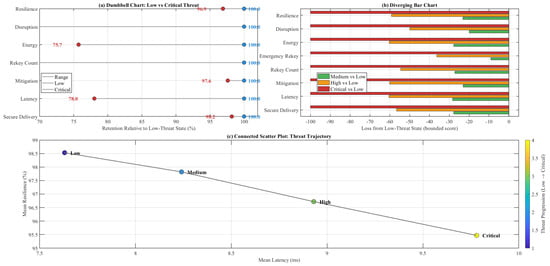
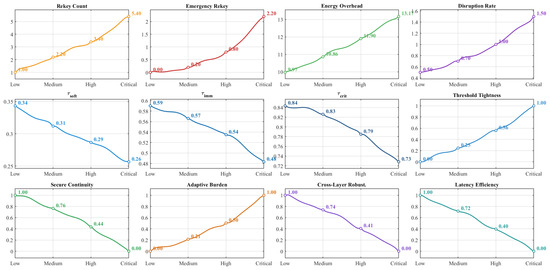
UAV-based remote sensing systems are increasingly deployed in smart surveillance, disaster response, environmental monitoring, and critical infrastructure inspection. In these applications, aerial sensing platforms must transmit telemetry, control commands, and observation data securely and reliably under strict latency, energy, and computational constraints. However, existing security approaches often fail to jointly provide lightweight payload confidentiality, quantum-resilient key establishment, and adaptive communication protection suitable for dynamic and resource-constrained aerial sensing environments. To address this challenge, this paper proposes an energy-aware post-quantum hybrid cryptographic framework for secure and low-latency UAV remote sensing communications in UAV–IoT mission networks. The proposed framework integrates Ascon-based authenticated encryption for low-overhead protection of remote sensing payloads and mission telemetry, ML-KEM-based post-quantum session-key establishment for long-term resilience against quantum-era threats, and an AI-driven adaptive rekeying mechanism that dynamically adjusts key-refresh decisions according to threat level, residual energy, mobility state, channel stability, anomaly density, traffic sensitivity, link type, and mission progression. Accordingly, rekeying is treated not as a static maintenance process but as an intelligent and context-aware cryptographic control function that adapts communication security to evolving mission and sensing conditions. The framework is evaluated across twenty progressively demanding scenarios involving different UAV counts, sensor densities, payload sizes, communication modes, and adversarial settings relevant to real-time remote sensing operations. Experimental results demonstrate a secure delivery rate of 99.2%, attack detection and mitigation effectiveness of 98.9%, end-to-end encryption latency of 8.7 ms, throughput of 5.03 Mbps, energy overhead of 11.6 mJ/session, rekeying overhead of 2.9 mJ/event, session resilience of 96.4%, and integrity verification success of 99.1%. These findings show that the proposed framework provides a practical and scalable contribution to post-quantum secure UAV remote sensing by unifying lightweight authenticated encryption, ML-KEM-based quantum-resilient key establishment, and AI-driven adaptive rekeying within a resilient aerial–terrestrial communication architecture.
Full article

Figure 1

Open AccessArticle
Asymmetric Multi-Party Private Set Union for Large-Repository Updates Without Non-Collusion Assumptions
by
Yuqi Jia and Leyou Zhang
Cryptography 2026, 10(3), 38; https://doi.org/10.3390/cryptography10030038 - 14 Jun 2026
Abstract
►▼
Show Figures
Multi-party private set union (MPSU) allows multiple parties to compute a union without disclosing private inputs, but most existing protocols focus on balanced settings with comparable input sizes. In large-repository update scenarios, a leader maintains a massive base set while contributors submit small
[...] Read more.
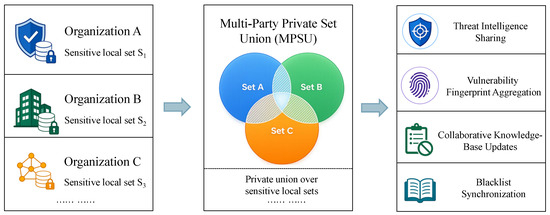
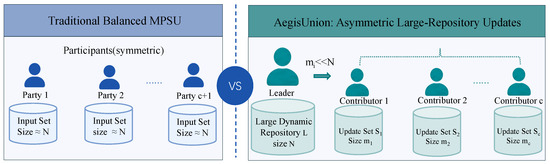
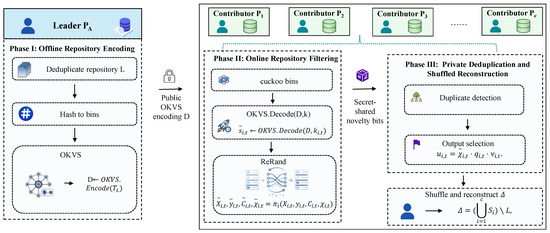
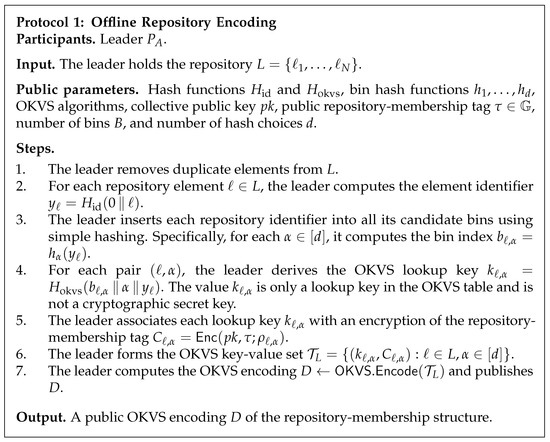
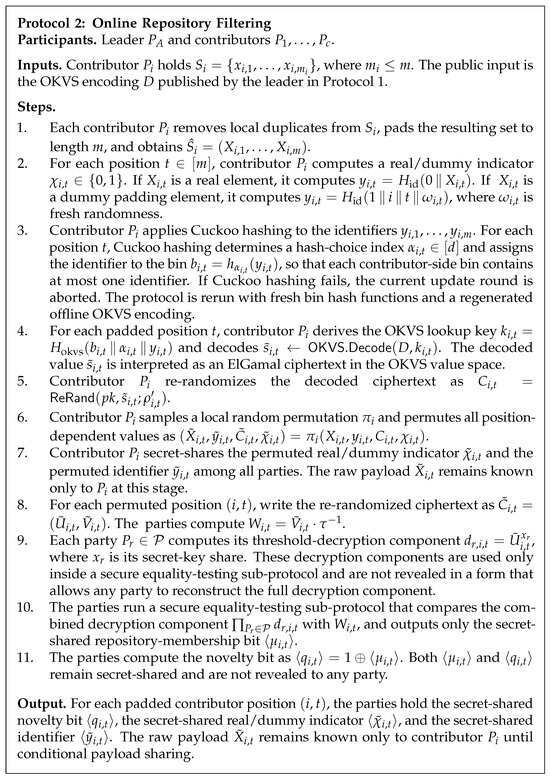
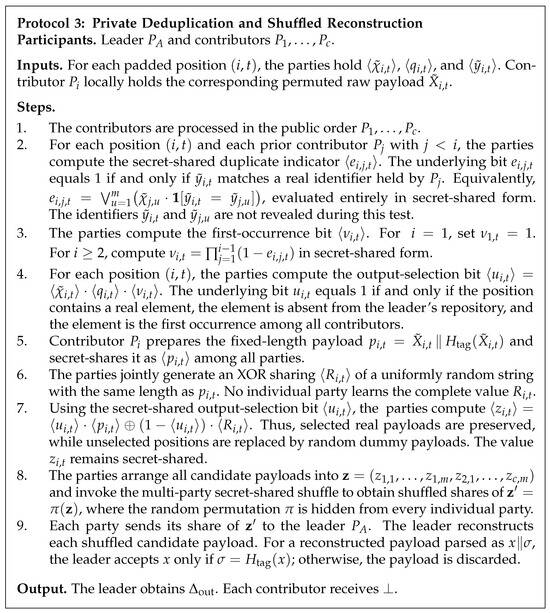
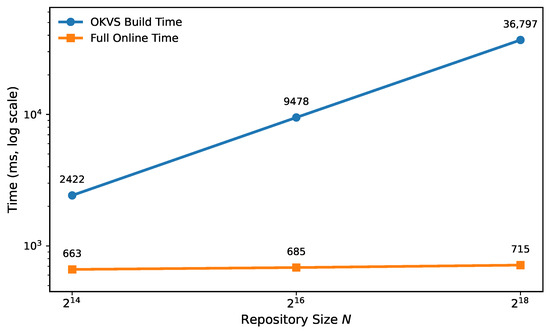
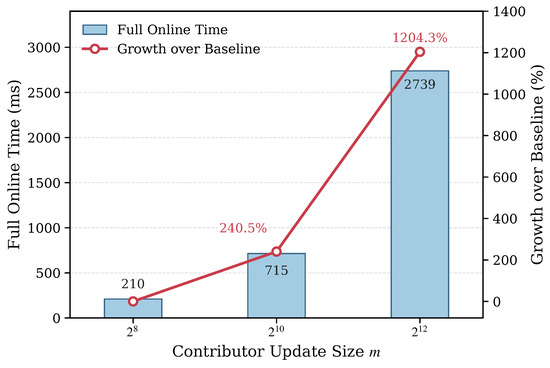
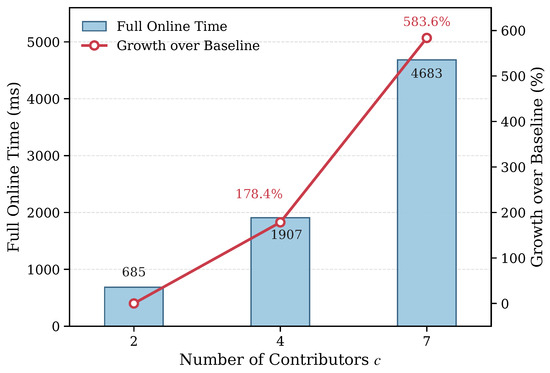
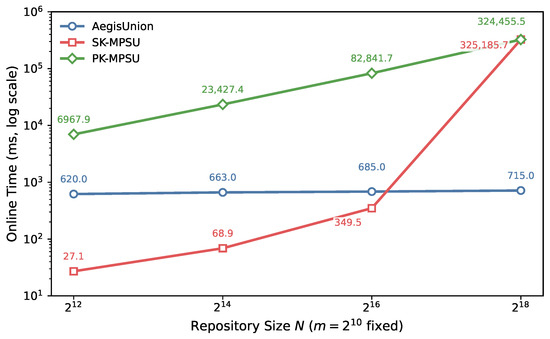
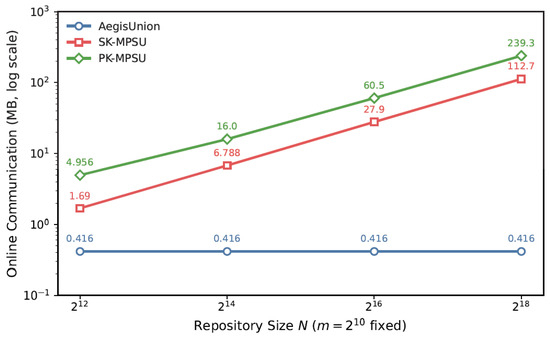
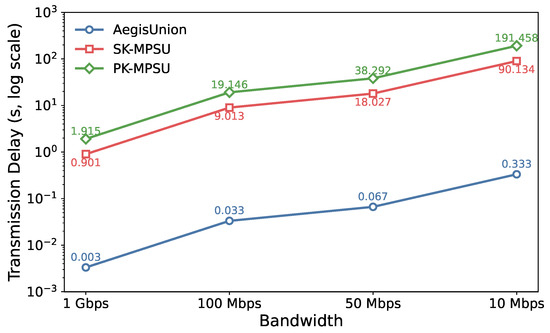
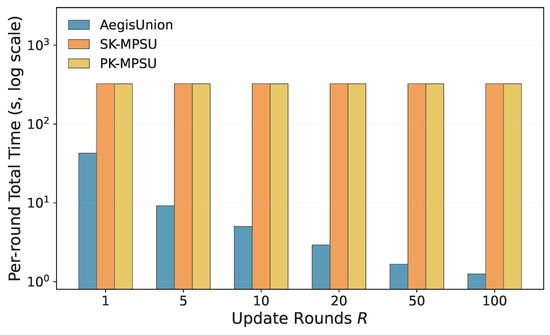
Multi-party private set union (MPSU) allows multiple parties to compute a union without disclosing private inputs, but most existing protocols focus on balanced settings with comparable input sizes. In large-repository update scenarios, a leader maintains a massive base set while contributors submit small update sets; directly using balanced MPSU makes the online cost scale with the leader’s repository size. We propose AegisUnion, an asymmetric MPSU protocol tailored to large-repository updates. AegisUnion separates repository-dependent computation from online update processing through an offline oblivious key-value store (OKVS) encoding phase. In the online phase, contributors perform private membership determination, cross-contributor private deduplication, conditional payload sharing, and secret-shared shuffling, without revealing raw inputs, repository-overlap relations, inter-contributor duplicates, or the source of each output element. Under the semi-honest model, AegisUnion tolerates any coalition of corrupted parties as long as at least one party remains honest, without non-collusion assumptions. Experiments show that, as the repository grows from to , the online time remains stable at 663–715 ms. At repository size and contributor update bound , AegisUnion achieves about and lower online time than symmetric-key-based MPSU and public-key-based MPSU baselines, respectively, and about and lower online communication.
Full article

Figure 1
Open AccessArticle
Dynamic Asymmetric Group Key Agreement Based on SM9 Signature
by
Guanglu Wei, Tiecheng Bai, Zehua Fan, Gang Wu, Wenxu Chen, Peng Qin and Kai Fan
Cryptography 2026, 10(3), 37; https://doi.org/10.3390/cryptography10030037 - 12 Jun 2026
Abstract
In 2021, the SM9 identity-based cryptographic algorithm became an ISO/IEC international standard, marking a significant advancement in China’s commercial cryptography technology and international standardization capabilities. The SM9 key exchange protocol, a component of the SM9 algorithm suite, provides secure communication by establishing a
[...] Read more.
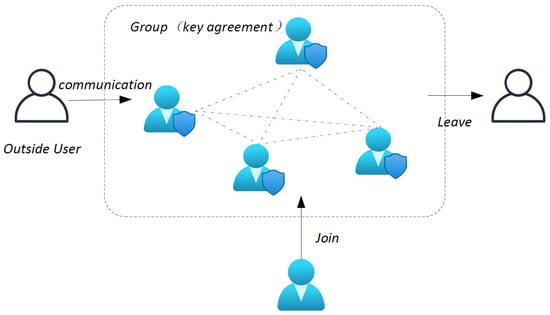
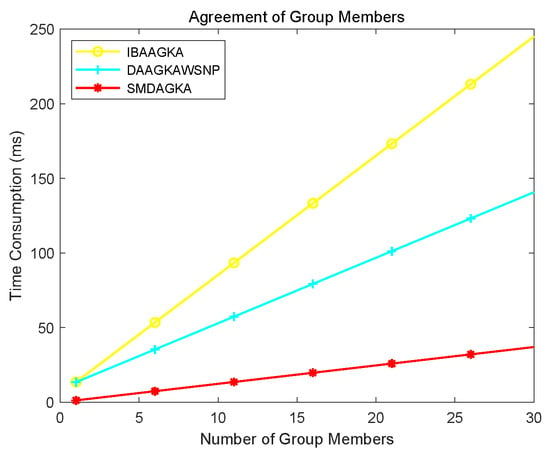
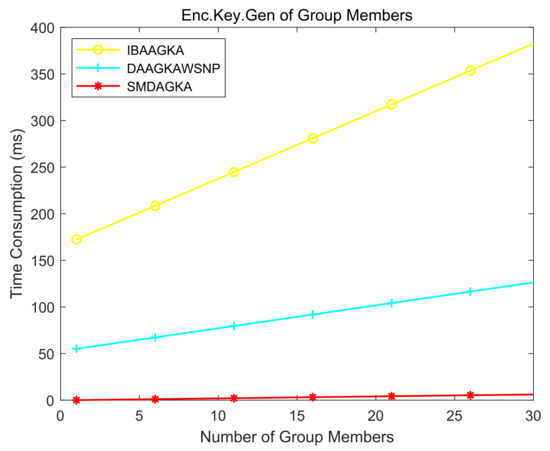
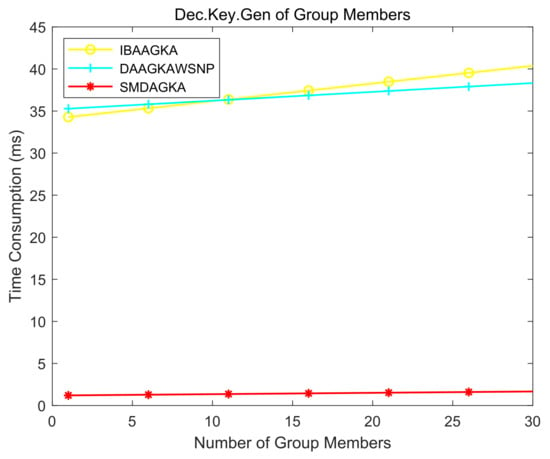
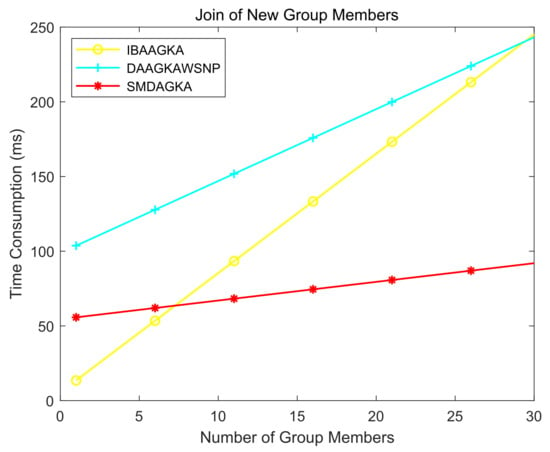
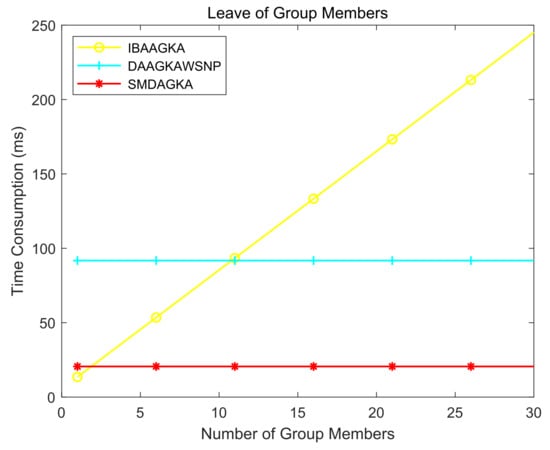
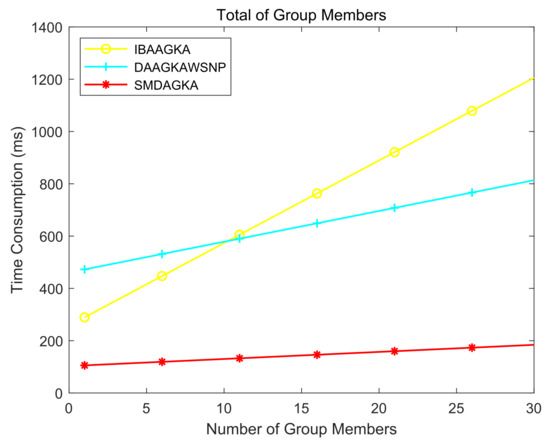
In 2021, the SM9 identity-based cryptographic algorithm became an ISO/IEC international standard, marking a significant advancement in China’s commercial cryptography technology and international standardization capabilities. The SM9 key exchange protocol, a component of the SM9 algorithm suite, provides secure communication by establishing a shared symmetric key between two parties. However, in a group of n users, directly applying this key exchange protocol requires each user to perform O(n) encryption operations and transmit an O(n)-sized ciphertext to ensure confidentiality, which becomes highly inefficient for large groups. To enable efficient secure group communication, we first develop a batch multi-signature algorithm based on SM9, and then we propose a dynamic asymmetric group key agreement (SMDAGKA) protocol based on this method. Our protocol reduces the required encryption operations and ciphertext size to O(1), significantly improving efficiency. Security proofs demonstrate that our scheme achieves a high level of security, and performance analysis shows that it incurs relatively lower computational overhead than related protocols.
Full article
(This article belongs to the Special Issue Information and Communications Security—ICICS 2025)
►▼
Show Figures

Figure 1
Open AccessArticle
Hybrid Architecture for Protected Data Communication Inside the Private Cloud
by
Biswaranjan Senapati, Lalit Narayan Mishra, Awad Bin Naeem and Amit J. Rangari
Cryptography 2026, 10(3), 36; https://doi.org/10.3390/cryptography10030036 - 2 Jun 2026
Abstract
Private cloud object stores provide infrastructure isolation but leave application-layer data exposed to insider threats and compromised credentials. This paper presents an engineering integration of an Add-Rotate-XOR (ARX) block cipher and multi-bit Least Significant Bit (LSB) steganography into an end-to-end pipeline for private
[...] Read more.
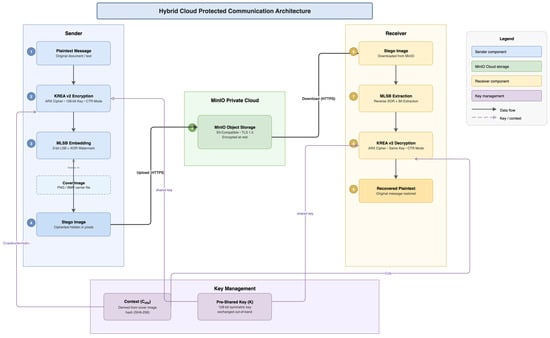
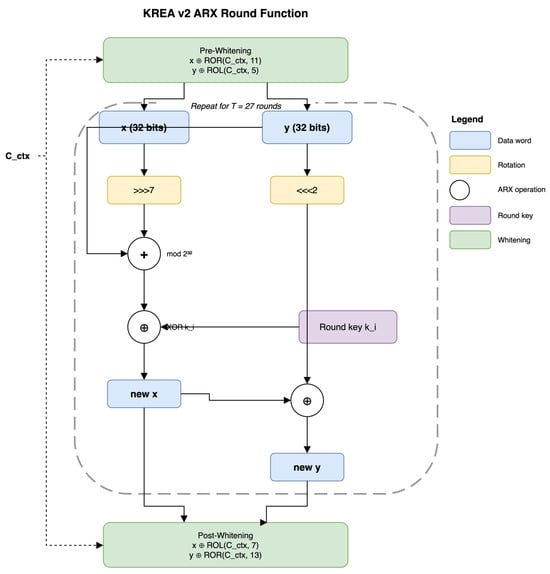
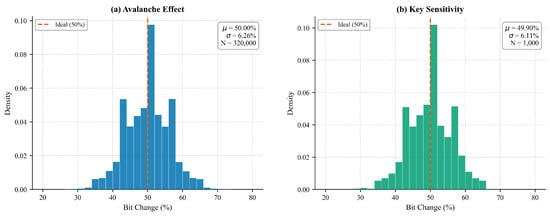
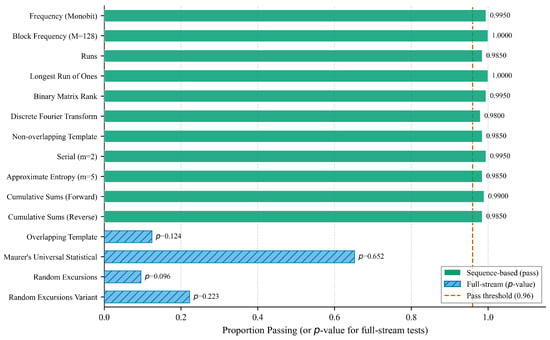
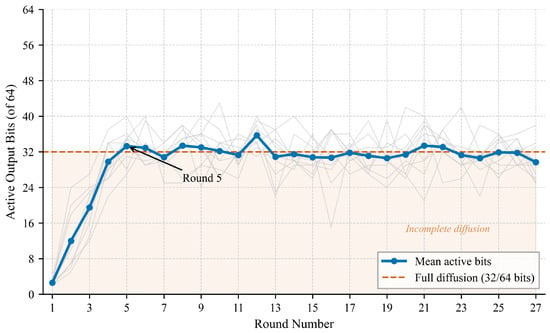
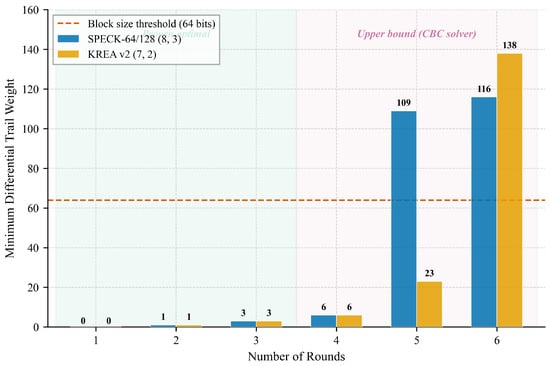
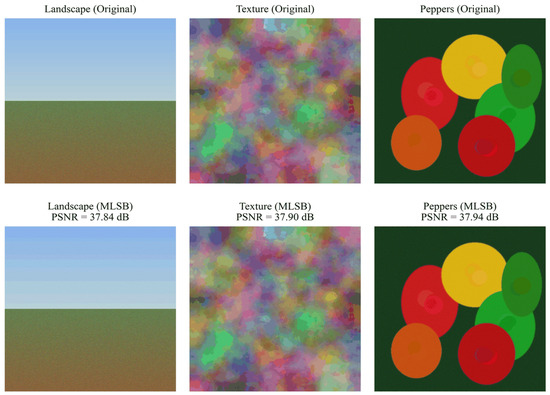
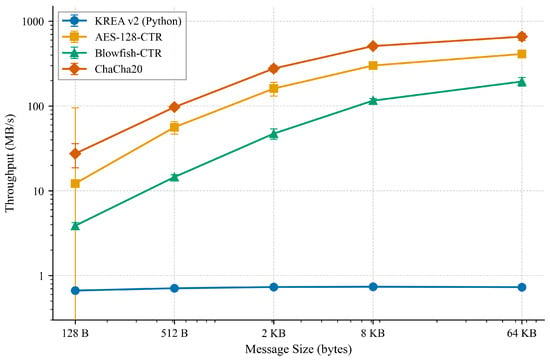
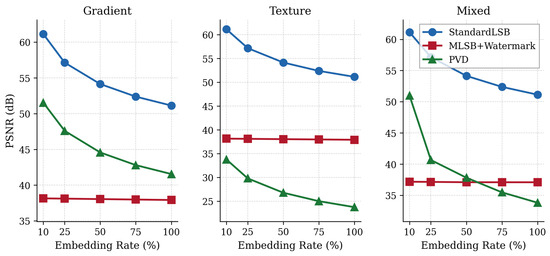
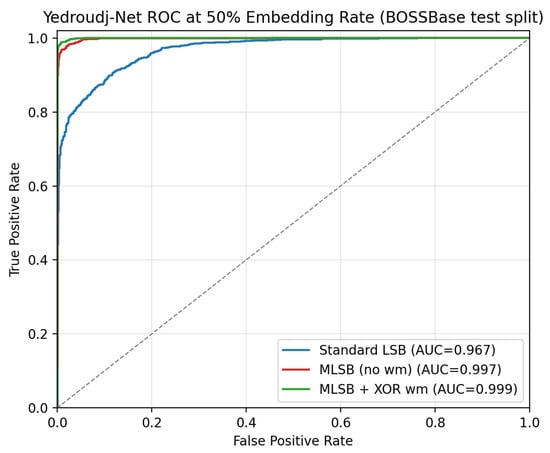
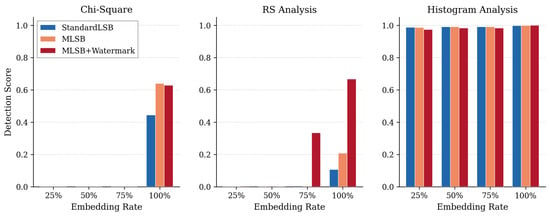
Private cloud object stores provide infrastructure isolation but leave application-layer data exposed to insider threats and compromised credentials. This paper presents an engineering integration of an Add-Rotate-XOR (ARX) block cipher and multi-bit Least Significant Bit (LSB) steganography into an end-to-end pipeline for private MinIO object storage. The cipher, KREA v2, is a SPECK-64/128 derived ARX construction with three application-driven choices: CRC32 key whitening, byte-aligned rotations ( , ), and deterministic CTR-mode nonces. Mixed Integer Linear Programming (MILP) trail analysis matches SPECK-64/128’s minimum-trail weights through rounds 1–4. KREA v2 ciphertext meets standard keystream-quality preconditions (NIST SP 800-22 battery, 49.98% mean avalanche, Shannon entropy 7.9992–7.9998 bits/byte across realistic XML, JSON, video, and HTTP/2 payloads). Modified LSB (MLSB) embeds 3 bits per RGB channel with an XOR watermark at 37–38 dB Peak Signal-to-Noise Ratio (PSNR), providing standard-LSB capacity. Steganalysis uses chi-square and RS detectors plus a Convolutional Neural Network (CNN) detector (Yedroudj-Net) trained on 8000 BOSSBase-1.01 cover/stego pairs; CNN area under the ROC curve is ≥0.999 against the watermarked variant. The MinIO pipeline runs at 355.1 ms (68.6% network I/O) with 100% message fidelity. The XOR watermark increases RS detectability above 75% capacity; a 200-image ablation cuts median RS detection (0.289 to 0.000) and mean (0.342 to 0.130) in a sparse-keystream variant, prioritised for follow-on full-scale evaluation. The architecture is offered as a documented engineering integration with explicit security caveats and threat-model boundaries, not as a production-hardened cryptographic primitive.
Full article
(This article belongs to the Special Issue Emerging Topics in Hardware Security (2nd Edition))
►▼
Show Figures

Figure 1
Open AccessArticle
MPC-in-the-Head Zero-Knowledge Proof for Rank Syndrome Decoding via Mixed-Field Secret Sharing
by
Xueyi Tang, Kexin Qiao, Qinghao Wu and Licheng Wang
Cryptography 2026, 10(3), 35; https://doi.org/10.3390/cryptography10030035 - 29 May 2026
Abstract
►▼
Show Figures
Quantum computing poses significant challenges to traditional zero-knowledge proof schemes based on number-theoretic assumptions. As a result, code-based cryptography has attracted increasing attention for its resistance against quantum computing. In this paper, we study the Rank Syndrome Decoding problem (RSD) and investigate its
[...] Read more.
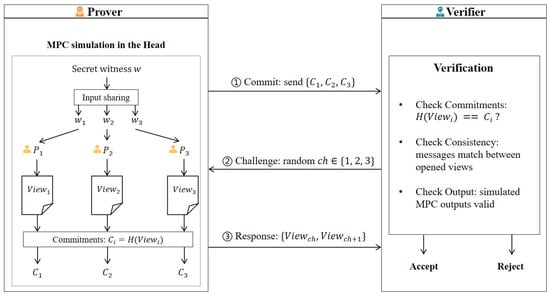
Quantum computing poses significant challenges to traditional zero-knowledge proof schemes based on number-theoretic assumptions. As a result, code-based cryptography has attracted increasing attention for its resistance against quantum computing. In this paper, we study the Rank Syndrome Decoding problem (RSD) and investigate its ZK proof formulation within the MPC-in-the-Head framework. To prove the possession of a secret witness, we reformulate the secret witness as a mixed-field matrix multiplication preserving the rank constraint, and then obtain a representation that aligns naturally with the local-view paradigm of MPC-in-the-Head. Utilizing this value-to-calculation technique, we introduce the RSD relation into a ZKBoo-style (2, 3)-secret-sharing MPC-in-the-Head framework and obtain an RSD-based zero-knowledge proof scheme via mixed-field secret sharing. The resulting scheme reduces the proof size relative to generic formulations while preserving completeness, soundness, and zero-knowledge for the interactive protocol. The Fiat–Shamir non-interactive extension is analyzed only in the classical random oracle model; we do not claim QROM security for this variant.
Full article

Figure 1

Open AccessArticle
A Parameterizable Research Framework for Electronic Voting Based on Cryptographic Protocols and Blockchain Audit
by
Tolegen Aidynov, Dina Satybaldina, Gulsipat Abisheva and Eldor Egamberdiyev
Cryptography 2026, 10(3), 34; https://doi.org/10.3390/cryptography10030034 - 27 May 2026
Abstract
►▼
Show Figures
Electronic voting requires the simultaneous admission of only legitimate participants, ballot uniqueness, vote confidentiality, storage integrity, and result verifiability. Blockchain alone does not solve these problems, since ledger immutability does not guarantee anonymity, ballot correctness, or reduced trust concentration. The purpose of this
[...] Read more.
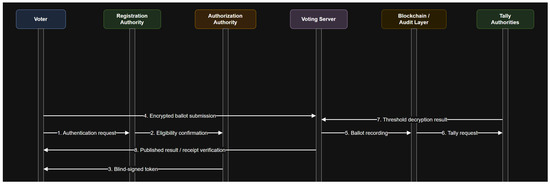
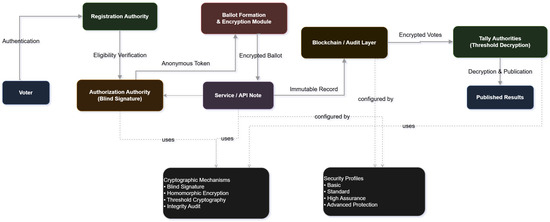
Electronic voting requires the simultaneous admission of only legitimate participants, ballot uniqueness, vote confidentiality, storage integrity, and result verifiability. Blockchain alone does not solve these problems, since ledger immutability does not guarantee anonymity, ballot correctness, or reduced trust concentration. The purpose of this work is to develop a parameterizable research framework for electronic voting scenarios with enhanced cryptographic protection, allowing the security level to be varied according to the requirements of a voting scenario. The main contribution of the work is a parameterizable research architecture for composing and experimentally comparing electronic voting configurations with different security and computational profiles. The cryptographic and audit mechanisms integrated into this architecture include blind-signature-based anonymous authorization, encrypted ballot submission, blockchain-style audit, receipt verification, homomorphic tally publication, and threshold-supported tally artifacts. These mechanisms are not proposed as new cryptographic primitives; rather, they are integrated into a reproducible prototype to study how their combination affects verifiability, privacy support, auditability, and computational cost. Compared with basic blockchain-based voting prototypes, this architecture explicitly separates security, privacy, and verifiability profiles and makes their computational cost observable. The implemented prototype is used as an experimental platform for analyzing supported security properties, threat modeling, and computational cost estimation. The results show that authentication, anonymous token issuance, and receipt verification maintain an almost constant cost at the studied scale, while the main cryptographic burden is associated with encrypted ballot submission and threshold-supported tally publication. The scientific novelty of the work lies in constructing a parameterizable architecture that integrates several cryptographic mechanisms and a blockchain audit layer into one reproducible research prototype. At the same time, the proposed approach retains prototype-level limitations associated with the absence of a full zero-knowledge proof stack, independently deployed threshold authorities, and coercion-resistance mechanisms.
Full article

Figure 1

Open AccessArticle
DPS: A Post-Quantum Proxy Signature Scheme from Dilithium for IoT Applications
by
Yuteng Wang, Ruoyu Ding, Tianrun Yu, Zhen Han, Jian Weng and Jiasi Weng
Cryptography 2026, 10(3), 33; https://doi.org/10.3390/cryptography10030033 - 15 May 2026
Abstract
Proxy signatures enable the secure delegation of signing authority, which is particularly useful in resource-constrained Internet of Things (IoT) environments. However, most existing schemes rely on classical hardness assumptions and therefore cannot resist quantum attacks. To address the challenge, we propose a post-quantum
[...] Read more.
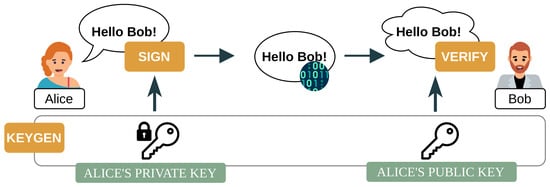
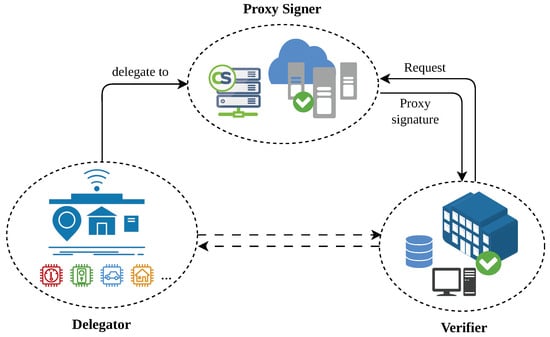
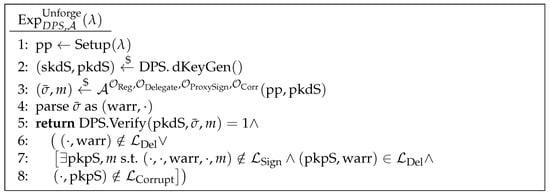
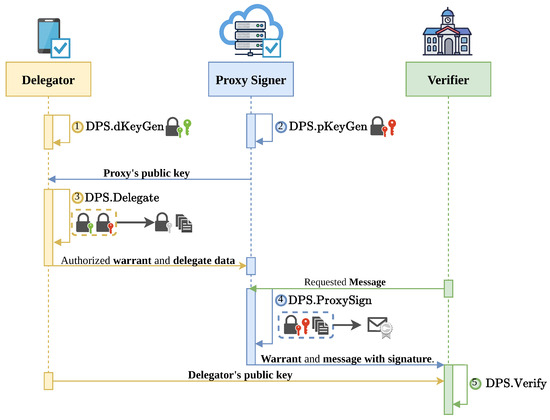
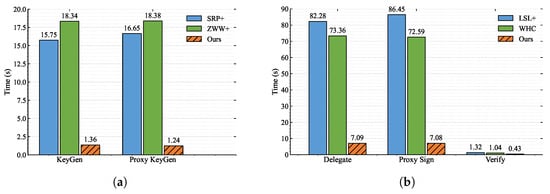
Proxy signatures enable the secure delegation of signing authority, which is particularly useful in resource-constrained Internet of Things (IoT) environments. However, most existing schemes rely on classical hardness assumptions and therefore cannot resist quantum attacks. To address the challenge, we propose a post-quantum proxy signature scheme based on Dilithium for IoT scenarios. We first propose an asynchronous remote key generation (ARKG) scheme based on CRYSTALS-Kyber, enabling the delegator and proxy signer to generate proxy keys of Dilithium without real-time interaction. We further integrate ARKG with the Dilithium signature scheme to construct a proxy signature scheme called DPS while ensuring the unlinkability of proxy signatures. Additionally, our proposed DPS achieves post-quantum security and provides unforgeability, distinguishability, verifiability, and undeniability with formal proofs. Experimental performance evaluation shows that our scheme yields significant efficiency gains over existing quantum-safe proxy signature solutions, with 10× speedup for both the delegation and proxy signing phases, as well as a 2.4× improvement in the verification phase.
Full article
(This article belongs to the Special Issue Advances in Post-Quantum Cryptography)
►▼
Show Figures

Figure 1
Highly Accessed Articles
Latest Books
E-Mail Alert
News
Topics
Topic in
Applied Sciences, Cryptography, Electronics, Mathematics, Information, Sci, Entropy, JCP
Recent Developments and Applications of Image Watermarking
Topic Editors: Frederic Ros, Pedro M. B. TorresDeadline: 31 July 2026
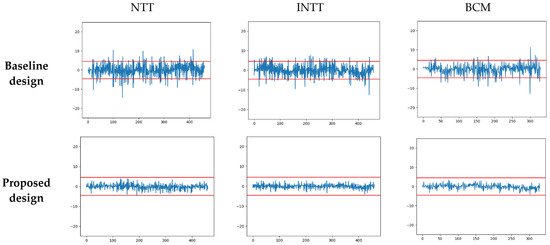
Topic in
JCP, JSAN, Symmetry, Applied Sciences, Cryptography
Trends and Prospects in Security, Encryption and Encoding: 2nd Edition
Topic Editors: Ki-Hyun Jung, Luis Javier García VillalbaDeadline: 31 January 2027
Topic in
AI, Future Internet, Micromachines, Symmetry, Cryptography
Cybersecurity Symmetry: Encryption, AI, and Attack Patterns
Topic Editors: Mobyen Uddin Ahmed, Azidine GuezzazDeadline: 31 March 2027
Topic in
Mathematics, Symmetry, Algorithms, Cryptography, IoT, Digital, Quantum Reports
Future-Proofing Digital Trust: From Classical to Quantum-Safe Security
Topic Editors: Saqib Ali, Raja Waseem AnwarDeadline: 30 April 2027
Conferences
Special Issues
Special Issue in
Cryptography
Emerging Cryptographic Techniques in Watermarking and Steganography for Secure Communication and Privacy
Guest Editors: Mhamed Sayyouri, Mohamed Amine TahiriDeadline: 31 October 2026
Special Issue in
Cryptography
Advanced Information Security Solutions for Future and Efficient IoT, Wireless, and Localization Systems
Guest Editors: Aleksandr Ometov, Pavel Mašek, Joaquin Torres-SospedraDeadline: 10 November 2026
Special Issue in
Cryptography
Information Security and Privacy—ACISP 2026
Guest Editors: Josef Pieprzyk, Mir Ali Rezazadeh BaeeDeadline: 20 November 2026
Special Issue in
Cryptography
Emerging Topics in Hardware Security (2nd Edition)
Guest Editor: Jim PlusquellicDeadline: 30 November 2026