


Abstract
This paper examines the “Habermas Machine” (HM), a Google DeepMind system that uses large language models to generate consensus statements for groups in disagreement as a way of interrogating the digitally mediated public sphere. Although the system was named in his honour, Habermas publicly disowned the association shortly before his death, describing it as “misleading.” Reading the HM as both a technical and a political artefact, I argue that it fails Habermas’s own criteria for legitimate discourse in three specific respects (accountable authorship, legible distortion, and the autonomy of communicative power from systemic imperatives), and that, following Marcuse, this failure generalises beyond any one system to technocratic approaches to consensus-building as such. Read politically, I situate the HM within Habermas’s own revised diagnosis of a public sphere fragmented by platform architecture, arguing that AI-mediated consensus tools do not correct this fragmentation but extend its logic, producing a synthetic public opinion that displaces argued consensus while retaining its appearance.
1. Introduction
In April 2025, in an interview with the Süddeutsche Zeitung, Jürgen Habermas publicly disowned an artificial intelligence system that Google DeepMind had built and named in his honour, objecting that his name had been “apparently abused for advertising purposes” and that the association was “misleading” [1]. He died eleven months later, on 14 March 2026, having never endorsed the system. The system in question, the Habermas Machine (hereafter HM), uses a pair of large language models (LLMs) to generate a single group statement that participants in a disagreement can endorse more readily than their own original positions, and was reported in Science to considerable acclaim: relative to human mediators, its statements were rated clearer, more informative, and more widely acceptable, produced in seconds rather than minutes [2].
Palomo Hernández [3] suggests we should read the HM as both a technical and a political artefact, a distinction this paper adopts as its organising structure. This paper is grounded in two questions, one for each reading. First, considered as a technical artefact: why, exactly, is Habermas’s thought incompatible with the HM, and does this incompatibility tell us something about technocratic approaches to deliberation and argument support? Second, considered as a political artefact: if the HM and systems like it are incompatible with Habermas’s own account of legitimate discourse, what follows politically from their proliferation into the public sphere as technologies which synthesise opinion?
Existing Habermasian critiques of the HM have concentrated on its implicit model of deliberation. Palomo Hernández [3] shows that its conception of deliberative democracy is thin and overvalues consensus as an outcome; Volpe [4] argues that its normative telos is prudential, aimed at reducing polarisation; Oleart and Palomo [5] read it as an instance of AI techno-solutionism; and Schismenos [6] treats it as a product of cognitive closure. These critiques followed an initial reception of media coverage that largely took the HM’s self-description [2] as a deliberative tool at face value. To these examples, the present paper adds an account of the structural failure of technocratic approaches to realise communicative action, and a reading of such systems against Habermas’s late diagnosis of the digital public sphere. The approach is a conceptual and normative reconstruction. I read the HM’s published design [2] against the presuppositions of communicative action and discourse theory [7,8,9], and against the critical theory of technology from which Habermas’s position developed [10,11].
Read as a technical artefact, I argue that the HM is incompatible with Habermas’s theory of communicative action in three specific respects (accountable authorship, legible distortion, and the autonomy of communicative power) and that, following Marcuse’s account of technological rationality, this incompatibility generalises beyond any one system to technocratic approaches to consensus-building as such. Read as a political artefact, I suggest that the HM is aligned with pathologies of the digital public sphere which can systematically distort communication. I distinguish a generic critique of deliberative procedure (that it can privilege some social positions over others regardless of the technology used) from a further and more literal mechanism specific to LLMs: the statistical smoothing by which a reward model trained to predict group approval regresses toward majority phrasing and viewpoint, flattening minority standpoints and making them less visible.
Section 2 sets out what the HM does: a generative language model drafts candidate group statements from participants’ written opinions, a personalised reward model predicts how each participant would rank those candidates, and a social-choice rule selects the statement returned to the group for critique and revision. Section 3 answers the technical half of the question directly, showing that the HM fails against three presuppositions of Habermas’s own theory. Section 4 argues, via Marcuse, that this failure is an instance of technological rationality. Section 5 traces the fragmentation of the public sphere that followed Habermas’s canonical theories of communicative action and the public sphere. Section 6 turns to Habermas’s own revised account of that fragmentation and the disputes it has provoked. In the discussion (Section 7), I take up the question of whether LLM argumentation support can potentially contribute to more rational discourse in Habermas’s terms.
2. The “Habermas” Machine
Argument-based technologies were developed specifically to optimise large-group deliberation using argument maps. Earlier systems tended to focus on managing the complexity of policy decisions in large organisations by connecting and mediating discussants with relevant information from relational databases and presenting these in support of further deliberation. Rittel & Kunz [12] elaborated these as Issue Based Information Systems (IBIS) which describe the relations between “issues” (or questions) and the positions taken towards them (which could be described as compatible, consistent, or incompatible). Similarly, Conklin & Begeman [13] described the use of Graphical Issue Based Information Systems (gIBIS) which added hypertext markup and represented relationships between “argument nodes” which could be explored through a browser interface. Lyytinen & Hirschheim [14] offered an early attempt to realise Habermas’s thought as a system of supported discourse by mapping aspects to information systems, arguing that such technology has the potential to support authentic communication and effective deliberation. Argumentation technology also solves a problem for retention and reuse of past reasoning. Text- and forum-based deliberation loses structure over time, and participants have no way to see what has already been said, contested, or resolved. Argument maps convert deliberation into an artefact, and Conklin & Begeman [13] and van Gelder’s [15] work on computer-supported argument visualisation (CSAV) set out this function explicitly, describing the maps as a way of efficiently examining the cumulative results of protracted, distributed, and complex argumentation. Interest in technology-mediated discourse has grown alongside the technical developments that enable new forms of interaction, particularly when temporally or spatially distanced. A longer-running tradition of computer-supported argument visualisation, aimed at making group reasoning traceable and cumulative rather than ephemeral (Conklin [16]; Renton & Macintosh [17]; Klein & Iandoli [18]; Buckingham Shum [19]), predates machine learning or AI models.
Google DeepMind recently reported in Science [2] the results of testing a new argument support system which uses AI technologies to process language. The HM is a software platform which “helps groups reach agreement on complex issues through structured, AI-mediated deliberation.” The HM is designed to iteratively generate group statements based on personal opinions and critiques from individual participants, with the explicit objective of maximising group approval ratings. The name and conceptual framing derive from Jürgen Habermas’s [7,8] theory of communicative action, which holds that communication oriented toward mutual understanding is central to legitimate collective decision-making.
The HM sits within a fast-growing body of work on AI-assisted deliberation, alongside systems described by Kim et al. [20], Shin et al. [21], Argyle et al. [22], Hadfi et al. [23], Small et al. [24], Ma et al. [25] and De Liddo et al. [26]. Its closest methodological relative is perhaps Harvard’s Generative Social Choice framework [27], which likewise uses specialised language models to generate group-representative statements and other models to estimate individual liking scores, aggregating these into a winning selection. The two approaches diverge in objective: Generative Social Choice produces a slate of several statements intended to represent the diversity of perspectives in a group, whereas the HM converges on a single consensus statement.
One key affordance of generative AI in this context is the manipulation of language. The HM takes individual opinions from people on a contested question, generates a candidate group statement meant to capture areas of agreement, and iterates based on feedback until it produces a summary most participants endorse more than their own original statement. A scaffolded pair of LLMs helps participants to converge on a common point of view. For instance, participants rate their level of agreement with a binary question and provide some written copy which explains their reasoning. These statements are processed and iterated towards a single “group statement” through a process of increasing convergence on “a widely acceptable perspective” [28].
The deliberation protocol (Figure 1a) begins with the HM generating candidate initial group statements from participants’ individual opinions on a given question; participants then rank these statements, and the top-ranked one (via aggregated rankings) is returned to the group. Participants next privately write critiques of this initial “winner” (the term used by Tessler et al. [2] for the statement selected by aggregated rankings), and the HM generates revised statements incorporating the critiques alongside the original opinions and the initial winning statement. Participants rank the revised statements, a new winner is selected through aggregated rankings, and participants make a final judgement between the initial and revised winning statements. A full deliberation round on a single question takes approximately 15 min. A statement “wins” when it tops an aggregate of participants’ rankings, so winning registers relative acceptability to the group as it is constituted at that moment: it does not register that a statement is better supported, more truthful or more just, nor that participants have come to understand one another’s reasons.
Figure 1.
Schematic of the Habermas Machine. (a) The deliberation protocol: participants write opinions and critiques privately; the AI mediator drafts and revises candidate group statements, which participants rank. (b) Statement selection inside the mediator: a generative language model samples candidate statements, a personalised reward model predicts each participant’s ranking of them, and a social-choice rule (the Schulze method) combines the predicted rankings into one group ordering. (Redrawn by the author from the procedure described in [2] using Claude Opus 5.5.).
Internally (Figure 1b), statement selection is produced through a simulated election: a generative model samples many candidate statements, and a second, personalised reward model predicts each participant’s ranking over them. Rather than eliciting preferences directly, the system infers an opinion structure from free-text input, then applies a social choice rule to aggregate the predicted rankings. Notably, the HM uses the Schulze method rather than a simple majority or Borda count, chosen for its independence-of-clones property, which prevents similar candidate statements from splitting support and jointly dominating selection in a “tyranny of the majority” [2]. Because the generative model samples many candidates from the same underlying opinions, several of those candidates will often be near-paraphrases of each other: the same position, with slightly different wording. Under plurality or Borda count, clones distort the outcome. If three candidate statements all express roughly the same synthesis, they split that position’s support three ways, letting a distinct but less-representative statement “win” by default. Alternatively, a sampling process could pad the field with near-duplicates of a favoured statement to inflate its aggregate score under Borda’s positional weighting. The candidates are sampled from a large pretrained language model conditioned on participants’ written opinions [2], so any tendency of that model to reproduce majority framings, fluent registers or familiar compromises is present before a single ranking is predicted. (The reward model, trained to predict approval, has no reason to acknowledge or penalise any such tendencies.)
The study [2] was conducted with more than 5700 UK participants discussing controversial issues such as Brexit, immigration, the minimum wage, climate change, and universal childcare. Relative to human mediators, AI-mediated statements were rated as more clear, logical, and informative, generated wider agreement, and left groups less divided, without alienating minority perspectives. Quantitatively, more than 56% of participants preferred the AI-generated statements, and the system was found to incorporate dissenting voices rather than simply catering to majority views. A further practical advantage was speed: the HM performed the mediation task in seconds, compared to several minutes required by human mediators [2]. The results suggested—rather superficially—that the ideal speech situation can be recreated or supported under controlled conditions through AI mediation.
The choice of name for the HM was intended as a tribute to Habermas’s legacy concepts of “communicative rationality” and “ideal speech situations” (or discourse undistorted by the effects of political and institutional power). Notably, Habermas rejected the association with the HM in an article in Süddeutsche Zeitung [1] less than a year before his death. In a brief response, Habermas criticised that his name was “apparently abused for advertising purposes” and that the association was “misleading.”
3. Why the Habermas Machine Is Not Habermasian
Palomo Hernández [3] explored the norms and values underlying the HM, noting that the conception of deliberative political discourse is thin and overemphasises the extent to which consensus is the desirable outcome of deliberative processes. Table 1 summarises this comparison of Habermasian theory with the implicit norms of the HM.
Table 1.
The Habermas Machine against Habermas [3] (p. 1958).
Volpe [4] similarly argues that Habermas’s discourse theory does not treat consensus as the goal of deliberation, but as a precondition for the kind of discourse that should guide it, so optimising directly for consensus may conflict with deliberation understood as an exercise of communicative autonomy.
Habermas’s account of communicative action rests on presuppositions that are hard for the HM to satisfy. The first is accountability. Rational–critical discourse presupposes identifiable agents who stand behind their claims and can be held to account for them; the force of the better argument, Habermas’s central normative concept, only makes sense against a background in which arguments have authors who are answerable for what they assert [7] (pp. 278–279). The HM’s critique step collects private text from each participant, but the system, not the participants, processes that text into the next candidate statement; no participant sees or responds to another’s actual reasons, only the machine’s synthesis of them. The resulting group statement has no author and therefore no validity in the relevant sense of consensus.
The second is the legibility of distortion. For Habermas, systematically distorted communication is a recognisable pathology: a deviation from a norm that participants can, in principle, come to identify, which is what grounds the emancipatory and critical potential of his theory [8] (p. 196). Participants using the HM see a candidate statement and can rank or critique it, but they cannot see why the reward model favoured one candidate over another, or whether a minority position was incorporated because it was persuasive or because it was statistically convenient for maximising predicted approval. The algorithmic operation of the HM is outside content the participants can inspect and there is no way for them to discuss these rules.
The third presupposition is the autonomy of communicative power from systemic imperatives. Habermas [9] depends on the claim that the communicative power generated through public deliberation is genuinely independent of the steering media of money and administrative power; without this autonomy, the claim that law derives its legitimacy from public deliberation becomes circular, since the deliberation is determined by the very power it is supposed to legitimate [8] (p. 375). The HM is built and deployed by a corporation with a direct commercial interest in demonstrating that AI can “help humans find common ground” [2], trained to maximise a metric, predicted approval, set by its designers rather than generated by the deliberation itself. Communicative power, on Habermas’s account, is supposed to arise from the deliberation associated with social action; the HM stipulates consensus as the deliberation’s target before the exchange begins. This is a fundamental misunderstanding of the way that deliberative consensus is a structural orientation of communicative action and not its goal.
Oleart & Palomo [5] further note that “The HM, in its eagerness to structure the process solely towards obtaining agreement as a result of deliberation, causes its deliberative impact at the systemic level to be minimal. The HM leaves aside the deliberative skills of the participants or, at least, makes them unnecessary for its functioning. Thus, in a sort of “deliberation without citizens,” the HM simplifies and reduces human intervention in the deliberative process to a minimum.”
The first two failures, taken individually, might invite a specific engineering response: surface participants’ reasons to one another rather than only the machine’s synthesis, to restore something closer to accountability; separate Habermas’s distinct validity-claim types (truth, rightness, sincerity) rather than collapsing all disagreement into one undifferentiated approval signal, to restore legibility. Both changes are genuine improvements, and both have been proposed in some form by the HM’s critics [3,5]. The third failure is extra-systemic and sociotechnical, concerning who sets the system’s objective and on whose behalf. Such considerations belong to social and institutional process rather than the operation of the system itself. (Section 4 explains this asymmetry through Marcuse’s account of technological rationality.)
To reflect on the history of attempts to use technology to support rational discourse: Lyytinen & Hirschheim [14], inspired by Habermas, argued nearly forty years ago that innovations in information science (IS) would need to be aligned to authentic social action in order to be useful. They highlighted the need for IS systems to be socially open, “to provide institutional arrangements that approximate the ground rules of rational discourse,” and emphasised the need for discursive systems to be legitimised through social action and authenticated with reference to the “validity” of discourse. Table 2 describes their interpretation of Habermas’s [7,8] theoretical framework.
Table 2.
Types of Social Action that should inform rational discourse in an information system (adapted from Lyytinen & Hirschheim [14]).
Why have IS systems retained the Habermasian goal of idealised speech and consensus while failing to realise implementations oriented around communicative action? Naser [29] proposes that the answer lies in a lack of philosophical nuance: “From the lens of this work, philosophical naivety refers to an unexamined default stance that treats intelligence as merely the successful manipulation of statistical correlations, consciousness as irrelevant to engineered cognition, ethics as an afterthought reducible to a checklist, and knowledge as whatever maximizes predictive accuracy. Such a stance is not malicious; rather, it is a pragmatic shortcut that allows engineers of various backgrounds, often with little training/exposure to machine learning, to integrate potent algorithms without wading into conceptual debates” [29].
According to Naser [29] conceptual and philosophical misunderstandings lead to three primary flaws: (1) ontological misclassification of system capabilities; (2) ethical blind spots in machine learning system design and application; and (3) inadequate epistemological approaches and hidden philosophical commitments for interpreting model outputs. The philosophical aspects of these flaws can be interpreted as shortcomings in the underlying conception of intelligence and how it can be simulated or supported.
Evidently, the HM cannot accommodate communicative–discursive elements, and the algorithmic sorting of the HM is more clearly aligned to the purposive–rational dimensions and aims to identify a “winner” among competing claims or hypotheses. However, the operation of the HM might not be purely instrumental since it does involve some deliberative sequences, and it conforms to the “strategic” mode of action since the goal is to reconcile or synthesise competing hypotheses or claims through a shared process.
4. Synthetic Consensus as Technological Rationality
In a measured assessment of the potential of the HM, Volpe [4] argues that generative AI can be genuinely beneficial for supporting deliberation, while observing precisely that the HM’s own normative logic gives reason for caution: “the logic and normative telos of the HM appear to be primarily prudential,” Volpe writes, with AI “deployed as a conflict mitigator to reduce polarisation through consensus-building” rather than as a facilitator of the kind of reasoned exchange anticipated by Habermas’s theory. There is empirical support for the value of supported deliberation. For example, Fishkin’s Deliberative Polling method sees a random, representative sample of citizens surveyed, given balanced briefing materials on a policy question, convened for small-group discussion under trained neutral moderators, and then given the opportunity to question competing experts, before being surveyed again [30,31]. Fishkin and Luskin [32] reported that across dozens of these exercises, conducted in the United States of America, United Kingdom, China, and Denmark, participants show measurable gains in factual knowledge and opinion shifts that track the balanced information they received, rather than polarising toward their pre-existing leanings. Furthermore, there is some evidence to suggest that AI assistance can be helpful for deliberation. Kim et al. [20] found that group discussion with chatbot facilitation showed more even participation and exhibited greater diversity of opinions. Shin et al. [21] found that chatbots can facilitate consensus-building in small-to-medium-sized projects. At the same time, Palomo Hernández [3] found that more traditional forms of group deliberation (such as citizen assemblies) are not necessarily more informed or inclusive. This has led to calls for symbiotic and hybrid forms of human-AI assisted deliberation [33].
Marcuse’s writing on technological rationality offers a compelling counterpoint. For Marcuse [10,34], technology in advanced industrial society embodies a specific historical project of “technological rationality,” which is simultaneously a form of reason and a form of domination. Technical rationality serves and constitutes social interests, organising perception, need, and even what counts as a rational question in advance. The central mechanism in this account is what Marcuse terms “one-dimensionality.” Advanced industrial society, through its technological apparatus of production and consumption, generates and satisfies “false needs,” needs implanted by the existing order of domination for its own perpetuation rather than needs arising from genuine human flourishing, and in doing so it absorbs and neutralises the negative, oppositional, transcending elements of thought and culture that left unchecked might challenge the status quo. Technology closes off the capacity to imagine alternatives by producing what Marcuse calls a “comfortable, smooth, reasonable, democratic unfreedom” [10] (p. 1).
Read through this lens, a system explicitly designed to reduce polarisation and mitigate conflict through consensus-building meets the description of what Marcuse means by technological rationality: an apparatus that resolves social antagonism smoothly, at scale, and presents that resolution as a helpful, frictionless service rather than a foreclosure of political possibility. For Marcuse, technological rationality functions ideologically not by suppressing dissent through force, but by presenting a particular, historically contingent arrangement—here, the substitution of computed synthesis for argued consensus—as a neutral, efficiency-oriented, value-free matter of engineering. If a technology can produce, faster and more reliably than participants’ own reasoning, an articulation of their view that they endorse more strongly than their own articulation of it, exactly what the HM’s 56% preference results imply [2], this looks less like facilitated communication than the manufacture of a synthetic consensus experience where participants feel heard and represented without having done the negating, effortful work of genuine confrontation with disagreement and the subsequent exchange of reasoning with contemporaries. Consequently, as noted by Oleart & Palomo [5], we can understand interventions like the HM as an expression of techno-solutionism, while much of Habermas’s work can be understood in terms of a critique of technocratic modernity [35].
The critique of 20th century technological and instrumental rationality [Zweckrationalität] is the distinctive contribution of the first generation of Frankfurt School thinkers with which Habermas is associated. Weber [36] had previously identified “rationalisation” as a complex of civil, economic and bureaucratic tendencies resulting from the intrusion of scientific–technical rationalisation into social and religious life. In Western culture, he argued, nature, society and individual action are increasingly dominated by a tendency towards strategic and practical control over empirical reality. Weber’s rationalisation thesis suggests that the development of increasingly sophisticated forms of control over nature and the institutional discipline of bureaucracy are aspects of diminishing freedom in social and material life. Weber’s “spirit” of capitalism represents the kind of rationalisation that penetrates all aspects of contemporary social life, restricting the freedom of individuals and disenchanting the subjective experience of the world to a technological perspective from which “one can, in principle, master all things by calculation” [37] (p. 139).
The rationalisation thesis the Frankfurt School inherited from Weber concerns chiefly the expansion of formal rationality and of instrumentally rational action at the expense of substantive, value-oriented reasoning. While Weber developed a plural concept of rationality (practical, theoretical, substantive, formal) [38], these are distinct from his typology of social action, in which instrumentally rational (zweckrational) action stands alongside value-rational, affectual and traditional action. Horkheimer and Adorno’s conception of instrumental reason effectively revises Weber’s concept by imbuing it with the bitter sense that “progress” leads us not to a more rational world, but back to irrationalism. In The End of Reason, Horkheimer [39] (p. 29) summarises instrumental rationality as “the optimum adaptation of means to ends, thinking as an energy conserving operation… a pragmatic instrument oriented to expediency, cold and sober.” Reason thus conceived reduces everything to a possible object of control and manipulation. In the Dialectic of Enlightenment, this is described as “the organ of calculation, of planning; it is neutral in regard to ends” [40] (p. 88), while truth is equated with scientific systemisation [40] (p. 85).
Habermas [7] argued that this diagnosis had mistaken one form of reason for reason as such. Instrumental rationality could colonise ever more of social life, as Habermas’s account of system and lifeworld allows, without being the only rationality available to modern subjects; a non-dominating form of reason remained available, in principle, to be recovered and defended.
Habermas [11] directly criticised Marcuse’s presentation of technological rationality. Marcuse had called for new approaches to science which were non-instrumental in their fundamental orientation. For Habermas, the problem in advanced capitalism is not that instrumental rationality exists, but that it has expanded beyond its proper domain and displaced more fundamental forms of communicative action and public, normative discourse and, as a result, political and ethical questions that should be settled through discourse become matters of technocracy. From this perspective, communicative action represents an intersubjective, postmetaphysical theorising of an alternative to instrumental or technological reason designed to overcome the pessimism of the earlier Frankfurt School theorists. Communicative action is oriented toward reaching mutual understanding (Verständigung): participants coordinate their behaviour through the intersubjective recognition of validity claims, raising claims to truth, normative rightness, and sincerity that are in principle open to challenge and revision through argument [7] (p. 99). Strategic action, by contrast, is oriented toward success: actors calculate the anticipated responses of others as variables in achieving their own objectives. Alongside the instrumental rationalisation Weber and Marcuse describe, Habermas proposed, runs a second and categorically different kind of rationality: communicative action, oriented not to success but to mutual understanding, in which validity claims are raised and redeemed through argument rather than settled by calculation.
The essence of Habermas’s [11] rejoinder to Marcuse is that the latter makes a category error, mistaking instrumental forms of rationality for rationality as such. Communicative action, once identified, provides a non-dominating form of rationality which is resistant to technological capture. But does the HM represent a form of communicative action, or of technological rationality? The apparent inspiration for using Habermas’s name to christen the HM was that it could in some way support communicative action. A sympathetic reading presents the HM as an aid to communicative action, a means of helping participants raise and redeem validity claims more effectively, and it can point to procedural credentials (balanced representation of minority views, iterative revision, endorsement by participants) that appear to satisfy rather than violate the norms of the ideal speech situation.
The relevant question is therefore not whether a deliberative technology conforms to communicative procedure but what its success criterion is, and the success criterion of a system optimised to produce agreement is agreement. Once the efficient generation of endorsable consensus becomes the metric against which the technology is built, tuned, and judged, the negating moment that Marcuse regarded as the condition of non-identical thought (the confrontation with disagreement that is not resolved but sustained) becomes friction to be minimised and managed algorithmically. A consensus that is produced faster and more reliably than participants could produce themselves, and that they endorse more strongly than their own formulation [2], is not thereby a consensus they have reasoned their way to but may equally be a consensus supplied to them in a form engineered for efficient acceptance and hence an example of technological rationality.
Habermas’s own name for this displacement is the colonisation of the lifeworld [8]. Where Marcuse saw technological rationality as a closed totality, Habermas located the problem at a boundary: the steering media of money and administrative power penetrate domains of social life that depend on reaching understanding, and reorganise them according to criteria of success [8] (p. 367). A deliberation tool that optimises predicted approval is a discrete instance of this process, but it shows how these technologies could be implemented at scale with the result of false consensus presented as authentic across a public sphere increasingly mediated by digital technologies.
5. The Digital Fragmentation of the Public Sphere
Since the canonical expressions of Habermas’s theories about communication and the public sphere [7,8,9,11], information and communication technologies have dramatically changed the nature, scope and reach of discourse. Much of Habermas’s thought was fully developed by the time that the Internet and the connected society had begun to revolutionise the way that information and opinion was shared. While there was some optimism about the possibility that the “world wide web” could act as a catalyst for the kind of inclusive, boundary-dissolving public sphere that the printed press had only partially and unevenly realised [41], Habermas himself was slow to engage with the new medium on its own terms. His first substantive remark on the internet appeared only as a footnote and was dismissive in character, characterising online communication as little more than a proliferation of “millions of fragmented chat rooms” [42]. At that stage, digital networks were treated as a peripheral phenomenon.
Even before the rise in the world wide web, postmodern critics had questioned the future relevance of the Habermasian public sphere [43]. Herring [44] has described how the emergence of Web 2.0 connectivity and the mobile Internet resulted in the reconfiguration of existing media discourse as well as the emergence of new forms. The apparent democratising potential of social media—catalysed by events such as the Arab Spring—seemed initially to vindicate Habermasian hopes for an expanded public sphere, and a significant body of scholarship argued that networked digital communication could fulfil the structural conditions for deliberative democracy that mass broadcast media had failed to provide. The limits of this optimism became apparent quickly, criticised by commentators such as Kruse et al., who disputed the idea that the emergence of social media could constitute a public sphere using data from Millennials and Generation X [45]. Bilić et al. [46] identified the structural coupling of internet use and capital accumulation for almost two decades, as the Internet is “enshittified” [47,48] and “zombified” [49] through platform decay and susceptibility to anti-democratic forces [50,51].
Kellner [52] anticipated the disappointments of the Web 2.0 moment, noting that new technologies bring “new possibilities for manipulation, social control… and intensifying of differences between haves and have nots” alongside their democratic potential. Web 2.0’s defining shift towards mass, low-barrier content production by ordinary users provides a different structural configuration to the previous exclusion of citizens from production, enabling the fragmentation and algorithmic sorting of a nominally maximally inclusive public into self-reinforcing enclaves—the echo-chamber and filter-bubble dynamic [53,54]. Misinformation spreads online through social media, echo chambers, and polarisation [55,56], and many interactions with apparent humans are in fact automated and algorithmic [57].
For Habermas, the concept of the public sphere originated as both a historical and normative category. The Structural Transformation of the Public Sphere [58] presents a historical sociology of the rise and decline of a particular social formation: the bourgeois public sphere of eighteenth-century Europe, which Habermas reconstructs as a domain mediating between private individuals and the authority of the state, in which citizens could discuss matters of common concern and participate in democratic self-government through the formation of public opinion. Coffee houses, literary salons, and the early periodical press provided the institutional matrix for this sphere, which was in principle governed by a norm of rational–critical argument: institutional or political authority was suspended, all participants were formally equal, and the validity of any claim rested (at least in principle) solely on the force of the reasons offered in its support.
The historical thesis Habermas [58] originally presented is partly a narrative of the decline of the public sphere under modernity: under the pressure of commercial mass media, advertising, and the welfare state’s incorporation of previously autonomous social domains, this rational–critical public dissolves into a managed and manipulated pseudo-public, in which opinion is not formed through argument but manufactured through the techniques of public relations. Through such processes, citizens become consumers of political spectacle rather than active participants in the formation of collective will.
Social pathologies arise when the systemic imperatives of money and power penetrate back into the lifeworld and displace communicative action from the domains it properly governs. Habermas calls this the colonisation of the lifeworld, and it is his reconstruction of the classical Marxist theme of reification: the conversion of communicatively integrated social relations into systemic dependencies, experienced by participants as a loss of meaning, freedom, and solidarity [8] (p. 367). To communicate with another person is already to implicitly acknowledge the standards against which distortion can be measured. This is why the lifeworld, even when colonised, retains some critical resources: the norms it embodies are not merely ideological constructs but are partially constitutive of the social practices through which individuals coordinate their lives, and they therefore carry a kind of normative weight that systemic imperatives cannot [8] (p. 375).
Notably, technology is what makes a public sphere possible at scale in the first place; there is no pre-technological public sphere. In Habermas’s original formulation, the eighteenth-century bourgeois public sphere depended on a specific technological and institutional infrastructure, the periodical press and the spaces of print circulation (coffeehouses, salons, reading societies), through which private individuals could constitute themselves as a “public” engaged in rational–critical debate over matters of common concern. Without the material apparatus of print capitalism, the discursive form Habermas describes would not have been possible at that scale. Technology, in this brief account, shapes and at least partially determines the scope, participants, and temporal and spatial reach of the public sphere, and thus technological change leads to new forms of the public sphere depending on economic, legal and political configurations. Habermas [11] identified the belief that social development follows the internal logic of scientific and technical progress as the characteristic ideology of technocratic societies: it presents political choices as technical necessities and so removes them from public discussion. Marcuse [10] reached a related conclusion by treating technological rationality as a historical project that serves particular interests. Oleart and Palomo Hernández [5] make the same point about deliberative democracy: presenting technology as a “solution” to the problems of deliberation depoliticises those problems and leaves the political economy of the technology unexamined. Which forms of the public sphere are realised depends on concrete political and economic choices.
Habermas distinguishes between the informal public sphere (dispersed discussions in civil society) and the formal arenas of institutional deliberation in parliaments, courts, and regulatory agencies. The informal public sphere is the site of communicative power: where problems are first perceived, grievances articulated, and public opinions formed that eventually feed into formal political processes. This communicative power is irreducible to administrative power; it is the connection to the informal public sphere that gives formal democratic decisions their claim to legitimacy. Legitimate law emerges from the interaction between informal communicative processes and formal deliberative procedures, with the public sphere functioning as a sensor detecting social problems that the political system must then address [9] (p. 359).
The Habermasian public sphere has been criticised since its canonical expression, and, as Eisenegger & Schäfer [59] showed, although Habermas’s work on the public sphere remains preeminent, it can be interpreted as declining in influence since the “digital turn.” Habermas’s often misunderstood claim to universalism is based in both the linguistic and pragmatic aspects of communication. Habermas credits pragmatists in the American tradition like Mead and Dewey with emphasising the “unifying, consensus-creating power of reason” over and against traditional religious forms of social integration [60] (p. 197) and reasoning “in light of what might be willed by all” [60] (pp. 209–210) through intersubjective communicative rationality [7] (pp. 3–10; 14–15; 22–25). Critiques such as Fraser’s [61] and Honneth’s [62] challenged the universalist claims structurally, arguing that the very formation of public opinion in liberal democracies is shaped by relations of gender, class, and race that the Habermasian model treats as exogenous to the public sphere, when in fact they are constitutive of the communicative norms that appear universal. What presents itself as the force of the better argument is already inflected by the social positions from which speakers enter discourse, the cultural capital they command, and the recognition they are structurally accorded. From such a recognition-theoretic point of view, what Habermas treats as the normative core of the public sphere (the bracketing of status so that only reasons matter) thus appears less as a regulative ideal than as an idealisation that conceals its own conditions of possibility.
Notably, lifeworld traditions are not neatly self-contained and often do not have equivalent access to the media of public debate. As Bohman [63] (pp. 116–117) argues, communicatively structured forms of political inequality are partisan: norms governing deliberation (official languages, formal styles, gender-inflected distinctions between public and private) may favour particular groups and prevent others from participating effectively. Kohn [64] (pp. 424–426) similarly suggests that deliberative democracy, presented as a neutral medium for competing interests, effectively privileges those who benefit most from the status quo. Taylor [65] reconstructed demands for cultural autonomy as a form of misrecognition, distinguishing a “politics of universalism” that safeguards the rights of all citizens from a “politics of difference” that values the diversity of cultural traditions. If the mutual recognition embedded in the cognitive structure of speech could never take shape in an equivalent, workable political form, we might doubt the emancipatory potential of communicative action altogether [66].
Additionally, new communication and networking technologies increasingly mediate social interaction. Benkler [67] argues that cheap networked computers shifted the economics of information production, replacing the large capital outlays of the industrial information economy (printing presses, broadcast towers, studios and libraries) with decentralised, granular media production. Where Benkler (like Habermas at the time) offers an optimistic interpretation of the diversification and democratic potential this brings, this decentralisation was ultimately overtaken by platformisation and heteronomic re-consolidation [68].
According to Han [69], digital media does not merely distort the public sphere but systematically evacuates the structural conditions for any genuine encounter with otherness, critical distance, or negativity. Outrage, in Han’s view, draws attention efficiently but lacks the stability and constancy required for successful intervention in the public sphere; masses marshalled for public shaming lack commitment to a course of shared action. “The shitstorm represents an authentic phenomenon of digital communication… made possible by online anonymity, since decoupling one’s name from one’s public presence immediately sets the conditions for misrecognition” [69] (pp. 2–3). Bosco & Costa Ribeiro [50] trace how the same infrastructural features that erode reasoned public debate (anonymity, virality, algorithmic amplification) systematically favour the affective, adversarial registers exploited by right-wing populist movements, so that the pathologies of digital communication and the rise of illiberal politics reinforce one another.
Recently, Susen [70] assessed the extent of structural change in the public sphere, tracing five interlocking fault lines along which the public sphere is said to have shifted. Contemporary discourse is characterised by: the strained fit between mass democratic participation and the demanding procedures of deliberative politics; the long-standing tension between capitalist economic organisation and democratic legitimacy; the destabilising effect of digital infrastructure on any coherent notion of a shared public forum; the uneasy handover of authority from legacy media institutions to platform-based alternatives; and the steady absorption of internet communication into commercial logics of extraction and monetisation.
Deliberative legitimacy requires that norms be redeemable through argument among all affected, yet the procedures that make argument rational (reciprocity, reason-giving, revisability) do not scale to mass democratic publics without technology. Habermas needs both the inclusiveness and the procedural rigour, and yet these appear to be in tension.
This tension between capitalism and democratic legitimacy is awkward for Habermas because his mature work increasingly treated the constitutional state as capable of domesticating the economy through law and rights [9]. Reasserting capitalism as a structural antagonist to legitimacy revives the earlier Frankfurt School charge that Habermas underestimated how far economic power constitutes (rather than merely constrains) the public sphere and reopens the question of whether socio-economic position or political identity is exogenous to or constitutive of communicative norms.
“In other words, even as media change created new opportunities for counterpublics to challenge and contest dominant relations and communication in public spheres, racial, gender, economic, and political orders have proven not only remarkably durable but defensive” [71].
As Boeder [72] points out, technological evolution and the emergence of online counter-publics disrupts Habermas’s conception of the public sphere. Some commentators such as Dahlberg [73] find that the fragmentation of the digitally networked public sphere raises challenges but is ultimately overstated, and interactions in cyberspace remain compatible with Habermas’s overarching concept and interest in a unified public sphere. Others such as Eisenegger & Schäfer [59] instead embrace a plurality of overlapping public spheres.
For agonistic theorists such as Mouffe [74], the orientation of deliberative democracy towards rational consensus misreads democratic politics, in which antagonism cannot be eliminated and every consensus rests on some exclusion. A democratic public sphere should instead convert antagonism between enemies into agonism between adversaries, recognising political conflict as visible and legitimate. Habermas’s own position is subtler than the target of this critique, since he treats consensus as a presupposition of argument, not a state to be produced (Section 3). Mouffe’s critique nonetheless applies directly to the HM, which does treat consensus as a state to be produced and measures its success by how far visible disagreement shrinks. From both the deliberative and the agonistic standpoints the design of the HM is problematic: it either makes agreement a target or makes the reduction in conflict a measure of success.
This section has described a public sphere whose infrastructure has moved from print to platforms, and whose platforms have decayed from open networks into engagement-optimised and increasingly automated environments [47,48,49,68]. Generative AI is changing how social media and digital communication work, and new tools and concepts for understanding this are needed. Tools such as the HM can be deployed into the platformed public sphere, and could plausibly take over and intensify its logic of aggregation, ranking and optimisation. Attention and visibility are allocated by ranking systems owned by private firms [46,75]. Apparent consensus can be manufactured computationally through bots, sockpuppets and unseen coordination used to produce bandwagon effects which replicate cognitive biases [76]. Concomitantly, deliberative functions are increasingly delegated to algorithms as AI systems enter deliberation and decision-making in ways that can sideline citizens and civil society [77].
6. New Theories of the Public Sphere
In the contemporary, “postdigital” public sphere, digital infrastructures and generative AI are increasingly constitutive of public communication [78]. If fragmentation, platformisation, and the erosion of a shared communicative infrastructure are as severe as Susen’s [70] fault lines suggest, what are the implications for Habermas’s own theory of the public sphere? I frame the answer in relation to Habermas’s [79,80] updated theory of the public sphere and its increasingly digital forms of mediation and his diagnosis of platform-driven fragmentation.
Habermas [42] had been somewhat dismissive of the effects of technological change on the public sphere, writing “the rise of millions of fragmented chat rooms across the world tend instead to lead to the fragmentation of large but politically focused mass audiences into a huge number of isolated issue publics. Within established national public spheres, the online debates of web users only promote political communication, when news groups crystallize around the focal points of the quality press, for example, national newspapers and political magazines.” By the time Habermas returned to the question of the public sphere at length [79], his position had shifted markedly. He now described the internet as “a caesura in the development of media in human history comparable to the introduction of printing,” an innovation of equivalent magnitude to movable type, and a “third revolution in communications technologies” whose consequence has been “the global dissolution of boundaries” in the flow of communication across previously separated publics.
Habermas develops the diagnosis in more specific terms [80]. His central claim is that digital media have dramatically increased inclusivity (near-universal, low-cost access to public communication) while degrading deliberative quality, inverting the trade-off that structured the classical bourgeois public sphere, which restricted participation along the lines of class, gender, and education that Fraser [61] and Honneth [62] identify. The central diagnosis of Habermas [80] is that while the new media initially promised to empower users, this promise is being undermined by their algorithm-steered platform structure that promotes self-enclosed informational bubbles and discursive echo chambers in which users split into a plurality of pseudo-publics that are largely closed off from one another.
Habermas argues that without appropriate regulation, this new structural transformation risks hollowing out the institutions through which democracies address urgent collective problems. On Habermas’s account, digital platforms remove that mediation and moderation: contributions are deprofessionalised, published without the filtering, fact-checking, or editorial judgement that print and broadcast media once supplied, however unevenly and undemocratically that gatekeeping function was exercised. Platforms sort users algorithmically into “self-enclosed informational bubbles and discursive echo chambers,” producing not one fragmented public but rather a “plurality of pseudo-publics that are largely closed off from one another.”
Habermas’s central view [80] is that a public sphere significantly shaped by social media is, in its present form, detrimental to democracy, and that restoring inclusiveness and deliberative quality is a constitutional imperative, not an optional adjustment. Communicative power, the informal public’s capacity to generate legitimacy for formal political decisions, depends on a public sphere integrated enough that dispersed opinion-formation can aggregate into something to which formal institutions can respond [9] (p. 359). A public sphere fractured into mutually illegible pseudo-publics cannot perform this function; it produces many small, locally coherent communicative powers with no mechanism for combining into one. This is why Habermas [80] treats the restoration of inclusiveness and deliberative quality together as a “constitutional imperative.”
Patberg [81] reads Habermas’s shift as an attempt to preserve the normative core of the classical model, the idea that legitimate opinion- and will-formation requires a functioning public sphere, while conceding that digital media have altered the material conditions under which that structure must now be secured, chiefly through regulation rather than the self-organising civility of the print-era bourgeois public. Chambers [82] challenges Habermas’s framing directly, arguing that the asymmetrical fragmentation of the digital public sphere is a political problem rather than a technological one: the outcome of specific commercial and regulatory choices (engagement-optimised advertising models, weak platform accountability, strategic actors exploiting open architectures), not a technologically determined consequence of networked communication as such. Staab & Thiel [75] develop a parallel argument specifically against Habermas [79], contending that the relevant unit of analysis is not the citizen as a diminished discursive agent but the “singularised” user profile constructed for the purposes of targeted engagement, and that this shift is best explained through a political-economic analysis of digital capitalism rather than through a normative theory of communicative rationality. Additionally, digitalisation has also produced new forms of mediation and participation such as citizen journalism, eyewitness and hyperlocal reporting, activist media and reporting from authoritarian settings where professional access is restricted. Professional newsrooms have moved from early hostility towards incorporating and verifying citizen content [83] but the specialised role of the journalist as public communicator is regularly supplanted.
Can the public sphere, as a concept, survive any of this? O’Mahony [84] calls for a renewal of the Habermasian public sphere as a way to defend democracy while also advocating its re-theorisation as social action: “The public sphere, and the agency mobilized through it, should [be] regarded as more constitutive in its societal implications than Habermas grants. This requires attention to the ontological implications of phenomenological consciousness; in other words, ‘constitutive implications’ involves recognizing the power of subjects, notably collective subjects, to reimagine societal possibilities.”
Schlesinger [85] instead identifies an “interregnum” post-public sphere in which platform economics, the reshaping of legacy media, and social media’s political uses have reframed communicative space too radically for the original concept to track. Stewart & Hartmann [86] occupy a middle position, anticipating a genuinely new “interstitial” social field that will structurally adapt to new forms of civic communication; professionalised social movements; and new hybrid forms of institutional power which straddle public and private interest. A public sphere is legitimate to the extent that it provides the possibilities and preconditions for meaningful political engagement [87]. While socio-technical constructs have changed beyond anything Habermas [58] originally anticipated, that normative standard has persisted.
7. Discussion: Can LLMs Support Communicative Action?
The discussion that follows returns to the three presuppositions Section 3 used to assess the HM (accountability, legibility, autonomy of communicative power) and asks what happens when AI-mediated communication of this kind is generalised across the public sphere rather than confined to one deliberation platform.
The first presupposition is accountability. Essentially, Naser’s [29] diagnosis of naivety and unaccountability in deliberation support technologies is predicted by Marcuse’s account of technological rationality. Rational–critical discourse requires identifiable agents who stand behind their claims and can be held to them, a structure Habermas derives from speech act theory and builds into the pragmatic presuppositions of communicative action [7] (pp. 278–279). Monti [88] argues that generative AI cannot satisfy this at any scale. Distinguishing communicative agents from what he calls linguistic machines, Monti argues that an LLM reproduces the grammatical form of a validity claim (an assertion, a justification, a revision offered under challenge) without occupying the position that gives such claims their force. To assert something is to take on a commitment that can be redeemed or withdrawn, and to be wrong is to incur a cost to one’s standing as an interlocutor; an LLM incurs no such cost, and generates a claim and its negation with equal fluency because nothing is at stake for it in either case. Coeckelbergh [89] extends this from the structure of the claim to its social consequences: when persuasive text becomes cheap to produce at volume, the rational response is generalised suspicion, regardless of any given output’s accuracy. That participants in the HM study endorsed the machine’s synthesis more readily than their own formulation [2] was reported as evidence of quality; on Coeckelbergh’s account it is equally evidence of the problem, since a system optimised for endorsable consensus is optimised independently of whether its endorsability tracks the better argument. The HM compounds this at the level of authorship. Dingemanse [90] explains that LLM output is compelling not because of what the system computes but because fluent, coherent, confident text invites human interpreters to supply the judgement and authorship that the output does not itself possess.
The second presupposition is that distortion in communication remains, in principle, legible to the participants subject to it; this is what gives Habermas’s critical theory its emancipatory purchase, since a pathology that cannot be recognised cannot be contested. Hansen [91] argues that AI-mediated aggregation produces a distortion of a different order from exclusion. Reward models trained to predict group approval regress toward majority phrasing, but Hansen’s point is that minority positions are not thereby excluded; they are processed into what he calls a structure of silence, counted in the input without shaping the output, in a way that leaves no visible trace of having been overridden. This explains how the HM’s own study could report incorporating dissenting voices “rather than simply catering to majority views” [2] while still producing exactly this effect: incorporation into the process and influence over the result are not the same thing once the aggregation rule is built, as the Schulze method is, to converge on one broadly acceptable statement. Maifianti et al.’s review of the inclusion literature supplies the general mechanism: a persistent gap between formal openness and substantive influence, tracked to asymmetries of confidence and rhetorical fluency that survive even in maximally open settings [92].
This is Fraser’s [61] and Bohman’s [63] critique of Habermas’ classical public sphere, relocated to the realms of LLM mediation. What presents itself as the force of the better argument is inflected by the social position from which a participant speaks, and a system trained to predict aggregate approval inherits that inflexion rather than correcting for it, a point Kohn [64] makes about deliberative procedure generally. Fenton [93] and Jackson & Kreiss [71] push this toward the diagnosis that digital public deliberation increasingly performs the appearance of engagement without its substance. Fraser’s own later work, read by Charles & Fuentes-Rohwer [94], takes the proliferation of digital counterpublics, the alternative discursive arenas in which marginalised groups form protected spaces and circulate their own discourse, as evidence of democratisation rather than fragmentation [95]. On this view, digital media multiply sites of legitimate contestation. Honneth’s [96] recognition-theoretic reconstruction of democratic institutions offers a further resource here, theorising this kind of pathology as a failure of mutual recognition rather than of communicative rationality. Counterpublics depend on marginalised groups formulating their positions in their own terms, at a distance from the dominant public. What Fraser treated as a condition of democratisation becomes, under synthetic mediation, one more input to be smoothed.
The third presupposition is the autonomy of communicative power from systemic imperatives: legitimacy requires that public deliberation not already be determined by the money or administrative power it is supposed to hold accountable [9]. Hartzog & Silbey [97] describe the mechanism by which AI accelerates the displacement of communicative action from the lifeworld. Their claim is that AI systems damage democratic institutions less by replacing them outright than by offering faster, cheaper substitutes that get adopted because they are convenient, whether or not they perform the underlying function as well. Saura García [98] names the resulting condition: a synthetification of public opinion, in which opinion is increasingly produced or smoothed by automated systems rather than achieved through exchange, so that what circulates as public opinion is rather a synthetic artefact. McKelvey et al. [99] point out that generative AI depends on public training data and public interaction at scale: systems built from public communicative resources are being redeployed into the public sphere on private, commercial terms.
The use of synthetic processing to replace authentic human data in research and product development is increasing, and such AI systems typically prioritise efficiency over authenticity [100]. Recall that the HM was developed by Google DeepMind, part of one of the world’s largest advertising and cloud-computing companies. Whatever its researchers intended, a system that converts public disagreement into machine-generated agreement has obvious commercial value to a firm that sells AI services, including to public bodies. Staab and Thiel [75] argue that platform publics already form under conditions in which commercial interests have primacy; the HM extends that primacy from the distribution of opinion to its formation. Habermas’s model, by contrast, depends on the public sphere being analytically differentiated from economic power: communicative power must arise in civil society, not be supplied by actors whose imperatives are profit and market position [9]. Furthermore, any consultation made with the public by governmental or quasi-governmental institutions which make use of synthetic consensus technologies can easily misrepresent the authentic views of a populace by instead aligning them to a “common ground” which does not really exist. Oleart and Palomo Hernández [5] connect this to the “citizenwashing” of EU technology policy. Synthetic consensus technologies would make citizenwashing easier to produce and harder to detect. A consultation that routes public input through a system optimised for endorsable agreement can present a “common ground” that no participant articulated as the authentic view of the public.
Wiewiura et al. [101] have cautioned against treating either “AI” or “democracy” as a single thing when both come in distinguishable pluralistic forms. Some AI-mediated interventions do not raise these problems, because they do not attempt to occupy the position of an accountable speaker at all: Argyle et al.’s [22] chatbot prompts that improved the tone of political conversation, as well as Hadfi et al.’s [23] findings on inclusion, work by improving the conditions under which human participants address each other, leaving the exchange between accountable speakers intact. What distinguishes the HM is the specific ambition to generate the group’s statement itself. In the digital public sphere, the systems performing this synthesis are owned and tuned by firms with an interest in their adoption and integration into political, administrative and market systems. What remains is a public sphere that keeps the outward form of argued consensus (statements, endorsements, majorities in favour) after the processes that would make that consensus rational have been replaced. Schismenos [6] succinctly states the pathological conclusion: that the HM is “a symbolic product of... cognitive closure, an instrument designed to automate the very dialogue which, according to Habermas, ought to open up the horizon of social autonomy,” a judgement that returns this paper to where it began, with Habermas’s own refusal to lend his name to the system [1].
8. Conclusions
This paper is not the first to criticise the HM on Habermasian grounds, building on Palomo Hernández [3], Volpe [4], Oleart & Palomo [5], and Schismenos [6]. Writing in the earliest days of computer-supported argumentation, Lyytinen & Hirschheim [14] emphasised the need to understand the Habermasian potential of the information system in social, not algorithmic terms. However, even contemporary attempts to realise Habermas’s concepts of rational discourse and communicative action [2] seem to misunderstand consensus as a regulative ideal and instead focus on bringing about an empirical state of “consensus” between deliberants. Read as a technical artefact, the HM fails Habermas’s own criteria for legitimate discourse in three specific, traceable ways (accountability, legibility, communicative autonomy). Marcuse’s account of technological rationality shows why this is a structural property of any equivalent technology which aims at achieving algorithmic “consensus.”
Systems structurally similar to the HM (Polis, Generative Social Choice, chatbot-facilitated deliberation) are already being adopted by platforms, firms, and some public bodies for producing legitimate-seeming consensus from disagreement. The proliferation of systems like the HM into the public sphere is therefore a further instance of the technocratic substitution predicted by Marcuse. Section 5 and Section 6 traced Habermas’s own revised diagnosis of a public sphere fragmented by platform architecture, and the discussion argued that AI-mediated consensus tools extend the logic of this fragmentation.
This need not amount to a wholesale rejection of AI-supported discourse. A potential follow-on study could assess the potential for an LLM design for supported argumentation which followed the contours of Habermas’s thought more authentically. The discussion distinguished systems that improve the conditions under which accountable participants address each other [22,23] from systems that attempt to generate the group’s position on their behalf. Rather, it shows that any attempt to realise an authentic HM would need to start from the principles of communicative action rather than attempting to realise an “ideal speech situation” as synthetic consensus. As Susen [70] says, “one can only hope that people’s critical capacity, rather than the systemic logic built into seemingly uncontrollable technologies, will determine the course of history.”
Funding
This research received no external funding.
Data Availability Statement
No new data were created or analyzed in this study. Data sharing is not applicable to this article.
Acknowledgements
During the preparation of this manuscript/study, the author used Claude Opus 5.5 for the purposes of creating Figure 1. The authors have reviewed and edited the output and take full responsibility for the content of this publication.
Conflicts of Interest
The author declares no conflict of interest.
References
- Rabe, J.-C. Habermas vs. Google: Nicht in seinem Namen. Süddeutsche Zeitung, 25 April 2025. Available online: https://www.sueddeutsche.de/kultur/google-deepmind-streit-habermas-maschine-li.3241968 (accessed on 9 September 2026).
- Tessler, M.H.; Bakker, M.A.; Jarrett, D.; Sheahan, H.; Chadwick, M.J.; Koster, R.; Evans, G.; Campbell-Gillingham, L.; Collins, T.; Parkes, D.C.; et al. AI Can Help Humans Find Common Ground in Democratic Deliberation. Science 2024, 386, eadq2852. [Google Scholar] [CrossRef] [Scilit] [PubMed]
- Palomo Hernández, N. Towards Automating Deliberation? The Idea of Deliberative Democracy Embedded in Google’s Habermas Machine. Proc. AAAI/ACM Conf. AI Ethics Soc. 2025, 8, 1951–1960. [Google Scholar] [CrossRef] [Scilit]
- Volpe, A. Toward an artificial deliberation? On Google DeepMind’s Habermas Machine. Ethics Inf. Technol. 2025, 27, 45. [Google Scholar] [CrossRef] [Scilit]
- Oleart, A.; Palomo Hernández, N. Why AI Technosolutionism Harms Democracy and Deliberation: The EU, Citizens’ Assemblies and the Habermas Machine. J. Delib. Democr. 2025, 21, 1–6. [Google Scholar] [CrossRef] [Scilit]
- Schismenos, A. Habermas as a thinker against Google’s “Habermas Machine”. SSRN 2026. [Google Scholar] [CrossRef] [Scilit]
- Habermas, J. The Theory of Communicative Action, Vol. 1: Reason and the Rationalization of Society; McCarthy, T., Translator; Polity Press: Cambridge, UK, 1984. [Google Scholar]
- Habermas, J. The Theory of Communicative Action, Vol. 2: Lifeworld and System: A Critique of Functionalist Reason; McCarthy, T., Translator; Polity Press: Cambridge, UK, 1987; Vol. 2. [Google Scholar]
- Habermas, J. Between Facts and Norms: Contributions to a Discourse Theory of Law and Democracy; MIT Press: Cambridge, MA, USA, 1996. [Google Scholar]
- Marcuse, H. One-Dimensional Man: Studies in the Ideology of Advanced Industrial Society; Beacon Press: Boston, MA, USA, 1964. [Google Scholar]
- Habermas, J. Technology and Science as “Ideology”. In Toward a Rational Society: Student Protest, Science, and Politics; Shapiro, J.J., Translator; Beacon Press: Boston, MA, USA, 1970; pp. 81–127. [Google Scholar]
- Rittel, H.; Kunz, W. Issues as Elements of Information Systems; Working Paper No. 131; Institut für Grundlagen der Planung I.A., University of Stuttgart: Stuttgart, Germany, 1970; Available online: https://escholarship.org/uc/item/5cj786v8 (accessed on 9 September 2026).
- Conklin, J.; Begeman, M.L. gIBIS: A Hypertext Tool for Exploratory Policy Discussion. In Proceedings of the 1988 ACM Conference on Computer-Supported Cooperative Work—CSCW ’88; ACM: New York, NY, USA, 1988; pp. 140–152. [Google Scholar] [CrossRef] [Scilit]
- Lyytinen, K.; Hirschheim, R. Information systems as rational discourse: An application of Habermas’s theory of communicative action. Scand. J. Manag. 1988, 4, 19–30. [Google Scholar] [CrossRef] [Scilit]
- van Gelder, T. Enhancing Deliberation Through Computer Supported Argument Visualization. In Visualizing Argumentation: Software Tools for Collaborative and Educational Sense-Making; Kirschner, P.A., Buckingham Shum, S.J., Carr, S.J., Eds.; Springer: London, UK, 2003; pp. 97–115. [Google Scholar] [CrossRef] [Scilit]
- Conklin, J. Dialogue Mapping: Building Shared Understanding of Wicked Problems; Wiley: Chichester, UK, 2006. [Google Scholar]
- Renton, A.; Macintosh, A. Computer-Supported Argument Maps as a Policy Memory. Inf. Soc. 2007, 23, 125–133. [Google Scholar] [CrossRef] [Scilit]
- Klein, M.; Iandoli, L. Supporting Collaborative Deliberation Using a Large-Scale Argumentation System: The MIT Collaboratorium. MIT Sloan Research Paper No. 4691-08; MIT Sloan School of Management: Cambridge, MA, USA, 2008. [Google Scholar] [CrossRef] [Scilit]
- Buckingham Shum, S. The Roots of Computer Supported Argument Visualization. In Visualizing Argumentation: Software Tools for Collaborative and Educational Sense-Making; Kirschner, P.A., Buckingham Shum, S.J., Carr, S.J., Eds.; Springer: London, UK, 2003; pp. 3–24. [Google Scholar] [CrossRef] [Scilit]
- Kim, S.; Eun, J.; Oh, C.; Suh, B.; Lee, J. Bot in the Bunch: Facilitating Group Chat Discussion by Improving Efficiency and Participation with a Chatbot. In Proceedings of the 2020 CHI Conference on Human Factors in Computing Systems; ACM: New York, NY, USA, 2020; pp. 1–13. [Google Scholar] [CrossRef] [Scilit]
- Shin, J.; Hedderich, M.A.; Lucero, A.; Oulasvirta, A. Chatbots Facilitating Consensus-Building in Asynchronous Co-Design. In Proceedings of the 35th Annual ACM Symposium on User Interface Software and Technology; ACM: New York, NY, USA, 2022; pp. 1–13. [Google Scholar] [CrossRef] [Scilit]
- Argyle, L.P.; Bail, C.A.; Busby, E.C.; Gubler, J.R.; Howe, T.; Rytting, C.; Sorensen, T.; Wingate, D. Leveraging AI for Democratic Discourse: Chat Interventions Can Improve Online Political Conversations at Scale? Proc. Natl. Acad. Sci. USA 2023, 120, e2311627120. [Google Scholar] [CrossRef] [Scilit] [PubMed]
- Hadfi, R.; Okuhara, S.; Haqbeen, J.; Sahab, S.; Ohnuma, S.; Ito, T. Conversational Agents Enhance Women’s Contribution in Online Debates. Sci. Rep. 2023, 13, 14534. [Google Scholar] [CrossRef] [Scilit] [PubMed]
- Small, C.T.; Vendrov, I.; Durmus, E.; Homaei, H.; Barry, E.; Cornebise, J.; Suzman, T.; Ganguli, D.; Megill, C. Opportunities and Risks of LLMs for Scalable Deliberation with Polis. arXiv 2023, arXiv:2306.11932. [Google Scholar] [CrossRef] [Scilit]
- Ma, S.; Chen, Q.; Wang, X.; Zheng, C.; Peng, Z.; Yin, M.; Ma, X. Towards Human-AI Deliberation: Design and Evaluation of LLM-Empowered Deliberative AI for AI-Assisted Decision-Making. arXiv 2024, arXiv:2403.16812. [Google Scholar] [CrossRef] [Scilit]
- De Liddo, A.; Anastasiou, L.; Shum, S.B. Human/AI Collective Intelligence for Deliberative Democracy: A Human-Centred Design Approach. arXiv 2026, arXiv:2603.16260. [Google Scholar] [CrossRef] [Scilit]
- Fish, S.; Gölz, P.; Parkes, D.C.; Procaccia, A.D.; Rusak, G.; Shapira, I.; Wüthrich, M. Generative Social Choice. arXiv 2023, arXiv:2309.01291. [Google Scholar] [CrossRef] [Scilit]
- Dupuis, N. Habermas Machine. LessWrong, 13 March 2025. Available online: https://www.lesswrong.com/posts/j9K4Wu9XgmYAY3ztL/habermas-machine (accessed on 12 September 2026).
- Naser, M.Z. On the Philosophical Naivety of Engineers in the Age of Machine Learning. Topoi 2025. [Google Scholar] [CrossRef] [Scilit]
- Fishkin, J.S. Democracy and Deliberation: New Directions for Democratic Reform; Yale University Press: New Haven, CT, USA, 1991. [Google Scholar]
- Fishkin, J.S. When the People Speak: Deliberative Democracy and Public Consultation; Oxford University Press: Oxford, UK, 2009. [Google Scholar]
- Fishkin, J.S.; Luskin, R.C. Experimenting with a Democratic Ideal: Deliberative Polling and Public Opinion. Acta Politica 2005, 40, 284–298. [Google Scholar] [CrossRef] [Scilit]
- Zaghouani, W. Accountable Human-AI Deliberation with LLMs: Scaling Collective Intelligence through Symbiotic Scaffolding. arXiv 2026, arXiv:2605.26940. [Google Scholar] [CrossRef] [Scilit]
- Marcuse, H. Some Social Implications of Modern Technology. In Technology, War and Fascism: Collected Papers of Herbert Marcuse; Kellner, D., Ed.; Routledge: London, UK, 1998; Volume 1, pp. 39–66. First Published 1941. [Google Scholar]
- Ortega-Esquembre, C. Social Pathologies and Ideologies in Light of Jürgen Habermas: A New Interpretation of the Thesis of Colonisation. Humanit. Soc. Sci. Commun. 2020, 7, 72. [Google Scholar] [CrossRef] [Scilit]
- Weber, M. The Protestant Ethic and the Spirit of Capitalism; Scribner: New York, NY, USA, 1930. [Google Scholar]
- Weber, M. From Max Weber: Essays in Sociology; Oxford University Press: New York, NY, USA, 1946. [Google Scholar]
- Kalberg, S. Max Weber’s Types of Rationality: Cornerstones for the Analysis of Rationalization Processes in History. Am. J. Sociol. 1980, 85, 1145–1179. Available online: https://www.jstor.org/stable/2778894 (accessed on 28 October 2026). [CrossRef] [Scilit] [PubMed]
- Horkheimer, M. The End of Reason. In The Essential Frankfurt School Reader; Arato, A., Gebhardt, E., Eds.; Bloomsbury Academic: London, UK, 1978; pp. 26–48. [Google Scholar]
- Horkheimer, M.; Adorno, T.W. Dialectic of Enlightenment; Verso: London, UK, 1997. [Google Scholar]
- Papacharissi, Z. The Virtual Sphere. The Internet as a Public Sphere. In Praktiken der Überwachten; Springer VS: Wiesbaden, Germany, 2018; pp. 43–60. [Google Scholar] [CrossRef] [Scilit]
- Habermas, J. Political Communication in Media Society: Does Democracy Still Enjoy an Epistemic Dimension? The Impact of Normative Theory on Empirical Research. Commun. Theory 2006, 16, 411–426. [Google Scholar] [CrossRef] [Scilit]
- Markell, P. Contesting Consensus: Rereading Habermas on the Public Sphere. Constellations 1997, 3, 377–400. [Google Scholar] [CrossRef] [Scilit]
- Herring, S.C. Discourse in Web 2.0: Familiar, Reconfigured, and Emergent. In Discourse 2.0: Language and New Media; Tannen, D., Trester, A.M., Eds.; Georgetown University Press: Washington, DC, USA, 2013; pp. 1–26. [Google Scholar]
- Kruse, L.M.; Norris, D.R.; Flinchum, J.R. Social Media as a Public Sphere? Politics on Social Media. Sociol. Q. 2017, 59, 62–84. [Google Scholar] [CrossRef] [Scilit]
- Bilić, P.; Dukić, D.; Arambašić, L.; Gjurković, M.; Šnajder, J.; Furman, I. Digital news media as a social resilience proxy: A computational political economy perspective. New Media Soc. 2023, 27, 2748–2767. [Google Scholar] [CrossRef] [Scilit]
- Doctorow, C. ‘Enshittification’ is coming for absolutely everything. Financial Times, 8 February 2024. Available online: https://web.archive.org/web/20240208152542/https://www.ft.com/content/6fb1602d-a08b-4a8c-bac0-047b7d64aba5 (accessed on 14 September 2026).
- Doctorow, C. Enshittification: Why Everything Suddenly Got Worse and What to Do About It; Verso: London, UK, 2025. [Google Scholar]
- Koebler, J. Facebook’s AI Spam Isn’t the ‘Dead Internet’: It’s the Zombie Internet. 404 Media, 2 May 2024. Available online: https://www.404media.co/facebooks-ai-spam-isnt-the-dead-internet-its-the-zombie-internet (accessed on 14 September 2026).
- Bosco, E.; Costa Ribeiro, W. Pathologies of Digital Communication: On the Ascendancy of Right Populism. In Political Philosophy and Public Purpose; Palgrave Macmillan: Cham, Switzerland, 2021; pp. 73–109. [Google Scholar] [CrossRef] [Scilit]
- Ritzi, C. The hidden structures of the digital public sphere. Constellations 2023, 30, 55–60. [Google Scholar] [CrossRef] [Scilit]
- Kellner, D. (Columbia University, New York, NY, USA). Habermas, the Public Sphere, and Democracy: A Critical Intervention. Unpublished manuscript, 2004. Available online: http://www.gseis.ucla.edu/faculty/kellner/papers/habermas.htm (accessed on 11 September 2026).
- Cinelli, M.; De Francisci Morales, G.; Galeazzi, A.; Quattrociocchi, W.; Starnini, M. The Echo Chamber Effect on Social Media. Proc. Natl. Acad. Sci. USA 2021, 118, e2023301118. [Google Scholar] [CrossRef] [Scilit] [PubMed]
- Dorsch, J.; Coeckelbergh, M.; Vierkant, T. Does AI Undermine Democratic Deliberation? How Engagement Algorithms Hijack Epistemic Agency. Synthese 2026, 208, 164. [Google Scholar] [CrossRef] [Scilit]
- Del Vicario, M.; Bessi, A.; Zollo, F.; Petroni, F.; Scala, A.; Caldarelli, G.; Stanley, H.E.; Quattrociocchi, W. The spreading of misinformation online. Proc. Natl. Acad. Sci. USA 2016, 113, 554–559. [Google Scholar] [CrossRef] [Scilit] [PubMed]
- Sunstein, C.R. Going to Extremes; Oxford University Press: New York, NY, USA, 2009. [Google Scholar] [CrossRef] [Scilit]
- Edwards, B. “Dead Internet theory” comes to life with new AI-powered social media app. Ars Technica, 18 September 2024. Available online: https://arstechnica.com/information-technology/2024/09/dead-internet-theory-comes-to-life-with-new-ai-powered-social-media-app/ (accessed on 27 July 2026).
- Habermas, J. Strukturwandel der Öffentlichkeit: Untersuchungen zu einer Kategorie der bürgerlichen Gesellschaft; Luchterhand: Neuwied, Germany, 1962. [Google Scholar]
- Eisenegger, M.; Schäfer, M.S. Editorial: Reconceptualizing public sphere(s) in the digital age? On the role and future of public sphere theory. Commun. Theory 2023, 33, 61–69. [Google Scholar] [CrossRef] [Scilit]
- Habermas, J. Questions and Counterquestions. In Habermas and Modernity; Bernstein, R.J., Ed.; Basil Blackwell: Oxford, UK, 1985; pp. 192–216. [Google Scholar]
- Fraser, N. Rethinking the Public Sphere: A Contribution to the Critique of Actually Existing Democracy. Soc. Text 1990, 25/26, 56–80. [Google Scholar] [CrossRef] [Scilit] [PubMed]
- Honneth, A. The Struggle for Recognition: The Moral Grammar of Social Conflicts; MIT Press: Cambridge, MA, USA, 1995. [Google Scholar]
- Bohman, J. Public Deliberation: Pluralism, Complexity, and Democracy; MIT Press: Cambridge, MA, USA, 2000. [Google Scholar]
- Kohn, M. Language, Power, and Persuasion: Toward a Critique of Deliberative Democracy. Constellations 2000, 7, 408–429. [Google Scholar] [CrossRef] [Scilit]
- Taylor, C. The Politics of Recognition. In Multiculturalism: Examining the Politics of Recognition; Gutmann, A., Ed.; Princeton University Press: Princeton, NJ, USA, 1994; pp. 25–73. [Google Scholar]
- Scheuerman, W.E. Between Radicalism and Resignation: Democratic Theory in Habermas’s Between Facts and Norms. In Habermas: A Critical Reader; Dews, P., Ed.; Blackwell: Oxford, UK, 1999; pp. 153–177. [Google Scholar]
- Benkler, Y. The Wealth of Networks: How Social Production Transforms Markets and Freedom; Yale University Press: New Haven, CT, USA, 2006. [Google Scholar]
- Reeves, C.; Sinnicks, M. Totally Administered Heteronomy: Adorno on Work, Leisure, and Politics in the Age of Digital Capitalism. J. Bus. Ethics 2023, 193, 285–301. [Google Scholar] [CrossRef] [Scilit]
- Han, B.-C. In the Swarm: Digital Prospects; Butler, E., Translator; MIT Press: Cambridge, MA, USA, 2017. [Google Scholar]
- Susen, S. A New Structural Transformation of the Public Sphere? With, against, and beyond Habermas. Society 2023, 60, 842–867. [Google Scholar] [CrossRef] [Scilit]
- Jackson, S.J.; Kreiss, D. Recentering power: Conceptualizing counterpublics and defensive publics. Commun. Theory 2023, 33, 102–111. [Google Scholar] [CrossRef] [Scilit]
- Boeder, P. Habermas’ heritage: The future of the public sphere in the network society. First Monday 2005, 10. [Google Scholar] [CrossRef] [Scilit]
- Dahlberg, L. The Habermasian Public Sphere and Exclusion: An Engagement with Poststructuralist-Influenced Critics. Commun. Theory 2013, 24, 21–41. [Google Scholar] [CrossRef] [Scilit]
- Mouffe, C. Deliberative Democracy or Agonistic Pluralism? Soc. Res. 1999, 66, 745–758. Available online: https://www.jstor.org/stable/40971349 (accessed on 30 October 2026). [CrossRef] [Scilit]
- Staab, P.; Thiel, T. Social Media and the Digital Structural Transformation of the Public Sphere. Theory Cult. Soc. 2022, 39, 129–143. [Google Scholar] [CrossRef] [Scilit]
- Woolley, S. Manufacturing Consensus: Understanding Propaganda in the Era of Automation and Anonymity; Yale University Press: New Haven, CT, USA, 2023. [Google Scholar] [CrossRef] [Scilit]
- García-Marzá, D.; Calvo, P. Algorithmic Democracy: A Critical Perspective Based on Deliberative Democracy; Philosophy and Politics—Critical Explorations; Springer: Cham, Switzerland, 2024; Volume 29. [Google Scholar]
- Pane, S. The European ‘post-digital’ Public Sphere: Foundations of an Emerging Paradigm in the Social Sciences. Methaodos.rcs 2025, 13, m251301a08. [Google Scholar] [CrossRef] [Scilit]
- Habermas, J. Reflections and Hypotheses on a Further Structural Transformation of the Political Public Sphere. Theory Cult. Soc. 2022, 39, 145–171. [Google Scholar] [CrossRef] [Scilit]
- Habermas, J. A New Structural Transformation of the Public Sphere and Deliberative Politics; Cronin, C., Translator; Polity Press: Cambridge, UK, 2023. [Google Scholar]
- Patberg, M. Digital Fragmentation: Habermas on the New Structural Transformation of the Public Sphere. The Review of Democracy, 2 February 2023. Available online: https://revdem.ceu.edu/2023/02/02/digital-fragmentation-habermas-on-the-new-structural-transformation-of-the-public-sphere/ (accessed on 13 September 2026).
- Chambers, S. Deliberative Democracy and the Digital Public Sphere: Asymmetrical Fragmentation as a Political Not a Technological Problem. Constellations 2023, 30, 61–68. [Google Scholar] [CrossRef] [Scilit]
- Wall, M. Citizen Journalism: A Retrospective on What We Know, an Agenda for What We Don’t. Digit. Journal. 2015, 3, 797–813. [Google Scholar] [CrossRef] [Scilit]
- O’Mahony, P. Habermas and the public sphere: Rethinking a key theoretical concept. Eur. J. Soc. Theory 2021, 24, 485–506. [Google Scholar] [CrossRef] [Scilit]
- Schlesinger, P. After the post-public sphere. Media Cult. Soc. 2020, 42, 1545–1563. [Google Scholar] [CrossRef] [Scilit]
- Stewart, E.; Hartmann, D. The New Structural Transformation of the Public Sphere. Sociol. Theory 2020, 38, 170–191. [Google Scholar] [CrossRef] [Scilit]
- Verovšek, P.J. The philosopher as engaged citizen: Habermas on the role of the public intellectual in the modern democratic public sphere. Eur. J. Soc. Theory 2021, 24, 526–544. [Google Scholar] [CrossRef] [Scilit]
- Monti, P. On the Discourse Ethics of Large Language Models: Between Communicative Agents and Linguistic Machines. Philos. AI 2026, 2, 61–79. [Google Scholar] [CrossRef]
- Coeckelbergh, M. LLMs, Truth, and Democracy: An Overview of Risks. Sci. Eng. Ethics 2025, 31, 4. [Google Scholar] [CrossRef] [Scilit] [PubMed]
- Dingemanse, M. Interactional foundations for critical AI literacies. In A Research Agenda for Critical AI; Valdivia, A., Ed.; Edward Elgar Publishing: Cheltenham, UK, 2026; in press. [Google Scholar] [CrossRef]
- Hansen, E. Analysing Structures of Silence in AI-mediated Public Spheres. Philos. Technol. 2026, 39, 175. [Google Scholar] [CrossRef] [Scilit]
- Maifianti, K.S.; Sarwoprasodjo, S.; Kinseng, R.A.; Sadono, D. Exploring inclusion in the public sphere: A comprehensive systematic review. Multidiscip. Rev. 2024, 8, 2025138. [Google Scholar] [CrossRef] [Scilit]
- Fenton, N. Fake Democracy: The Limits of Public Sphere Theory. Javn. Public 2018, 25, 28–34. [Google Scholar] [CrossRef] [Scilit]
- Charles, G.-U.; Fuentes-Rohwer, L. Habermas, the Public Sphere, and the Creation of a Racial Counterpublic. Mich. J. Race Law 2015, 21, 1. [Google Scholar] [CrossRef] [Scilit]
- Pfister, D.S. Public Sphere(s), Publics, and Counterpublics. In Oxford Research Encyclopedia of Communication; Powers, M., Ed.; Oxford University Press: New York, NY, USA, 2018. [Google Scholar] [CrossRef] [Scilit]
- Honneth, A. Freedom’s Right: The Social Foundations of Democratic Life; Columbia University Press: New York, NY, USA, 2014. [Google Scholar]
- Hartzog, W.; Silbey, J.M. How AI Destroys Institutions. UC Law J. 2026, 77, 727. [Google Scholar]
- Saura García, C. Synthetification of public opinion: Impacts on deliberative democracies. Ethics Inf. Technol. 2025, 27, 54. [Google Scholar] [CrossRef] [Scilit]
- McKelvey, F.; Redden, J.; Roberge, J.; Stark, L. (Un)stable diffusions. J. Digit. Soc. Res. 2024, 6, 1–12. [Google Scholar] [CrossRef] [Scilit]
- Birhane, A. Cheap Science, Real Harm: The Cost of Replacing Human Participation with Synthetic Data. Preprint. 2025. Available online: https://synthetic-data-workshop.github.io/papers/13.pdf (accessed on 31 October 2026).
- Wiewiura, J.; Jørgensen, A.; Ploug, T. AI and Democracy: Mapping Notions, Debates and Challenges. Philos. Technol. 2026, 39, 158. [Google Scholar] [CrossRef] [Scilit]
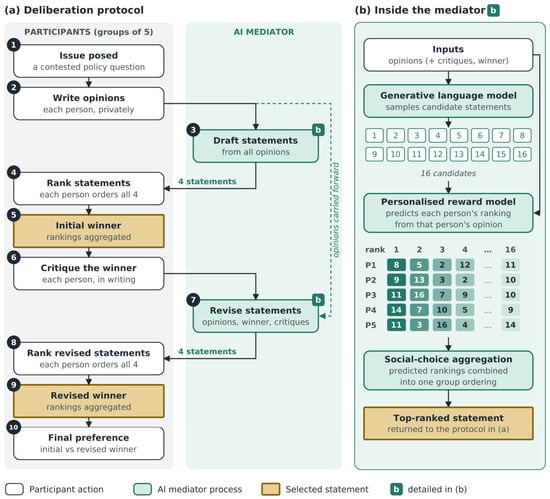
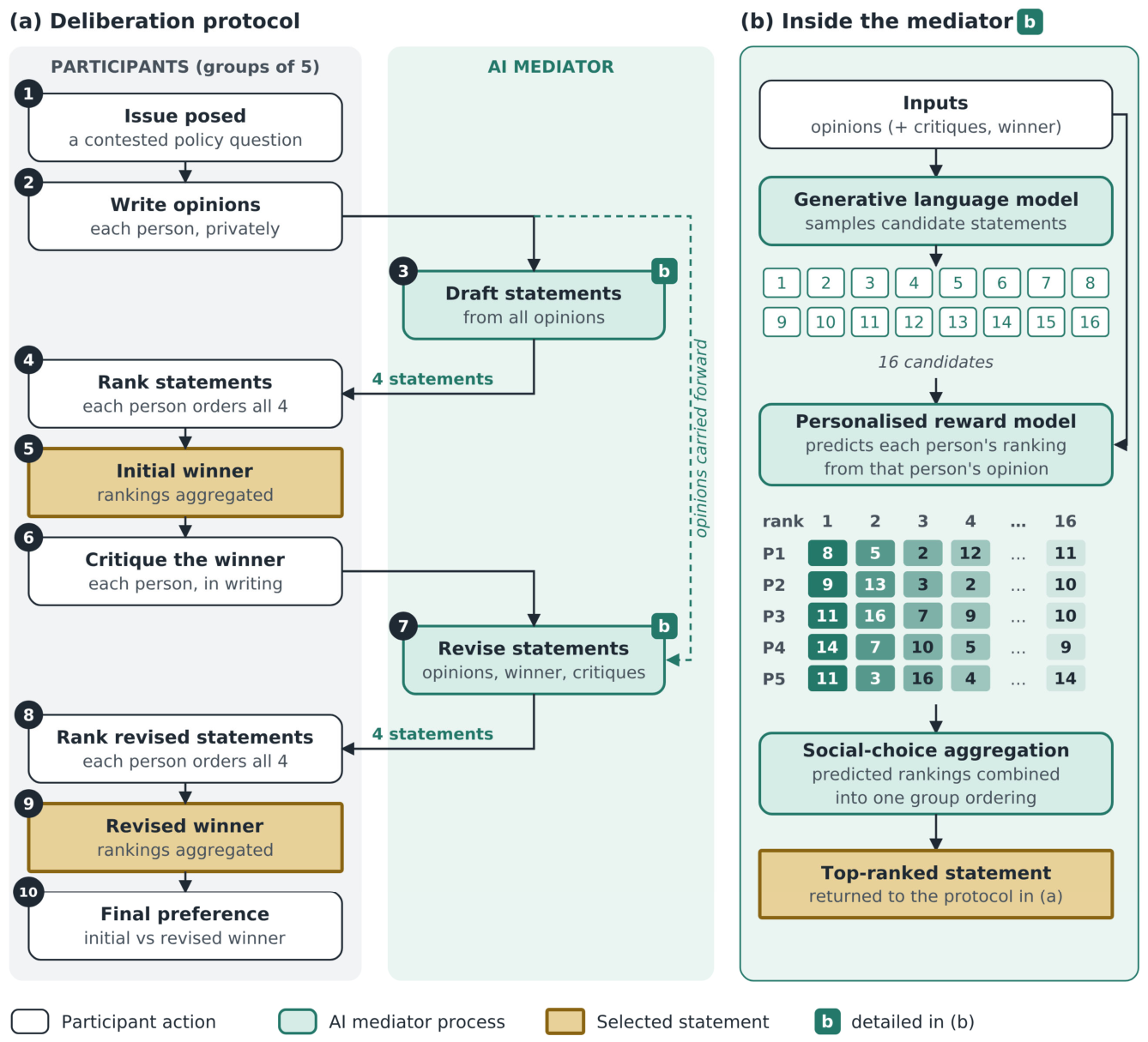

Disclaimer/Publisher’s Note: The statements, opinions and data contained in all publications are solely those of the individual author(s) and contributor(s) and not of MDPI and/or the editor(s). MDPI and/or the editor(s) disclaim responsibility for any injury to people or property resulting from any ideas, methods, instructions or products referred to in the content. |
© 2026 by the author. Licensee MDPI, Basel, Switzerland. This article is an open access article distributed under the terms and conditions of the Creative Commons Attribution (CC BY) license.