


Abstract
This paper develops a process ontology of spacetime grounded in the primacy of motion. Standard interpretations of relativity are commonly understood in terms of a four-dimensional manifold of events, with motion represented by world-lines connecting temporally ordered event-points. Although mathematically and empirically successful, this framework encourages an event-based metaphysics in which motion is derivative and temporal becoming plays no fundamental ontological role.
1. Introduction
Since the advent of Minkowski’s spacetime, modern physics has largely understood space and time in terms of a spacetime manifold. On this view, spacetime is a manifold of possible events , whose spatial and temporal properties and relations are defined by a set of mathematical objects, such as topological, affine, and metric structures. The novelty of the general theory of relativity lies in the fact that it includes field equations connecting the metric structure and the stress-energy tensor , which represents the matter-field that is located at distinct spatiotemporal points. However, the physical ontology consists of distinct events, located at particular spatiotemporal points that belong to the manifold.
The initial motivation for introducing this metaphysical view is clearly explained by Minkowski in his celebrated paper from 19081, where he introduced the concept of space-time. There, Minkowski argues that Einstein’s Principle of Relativity, according to which laws are the same in all reference frames, can be interpreted as a symmetry of an underlying four-dimensional spacetime. At least its kinematical aspects—where boosted rods appear shorter and boosted clocks move more slowly—can be shown to be a consequence of a metric structure imposed on a manifold of events, where the temporal and spatial axes describe various dimensions of this manifold.
Minkowski’s argument is that when spacetime is viewed this way, the consequences of the theory of relativity appear to be the direct consequences of the metric structure defined on a four-dimensional manifold. If we define the spatiotemporal interval as follows:
then all the kinematical consequences of the theory of relativity follow. One can transform between one inertial reference frame and another while preserving the interval. When we do so, the effects of shortening rods and elongating the time unit appear to be distinct projections of the spacetime interval on a basis within spacetime. The shortening of rods and the elongation of temporal units is a consequence of viewing aspects of the spacetime interval from various inertial reference frames, and thus are a product of representation, not a physical effect.
Minkowski’s suggestion implies an important analogy between rotations and translations in Euclidean space and the preservation of the spacetime interval in four-dimensional, relativistic spacetime. Euclidean space is homogeneous, and can be described using one reference frame, or another that is rotated or translated relative thereto. When using one frame rather than another, the coordinates used to represent the geometric object vary. But the differences between these frames are merely a function of the basic set of axes used to represent points in space. Similarly, relativistic spacetime can be described relative to one inertial reference frame or another. But the distinct inertial reference frames do not introduce any objective features to spacetime; they merely allow distinct, yet equivalent representations of the same underlying spacetime. Thus, the novelty of relativity theory, in Minkowski’s scheme, is that it replaces the original Newtonian Euclidean space and the temporal dimension with an underlying four-dimensional structure. In this new four-dimensional spacetime, space and time become mere shadows of the underlying absolute world, consisting of a set of events that take place against the backdrop of a geometrical structure2.
When one adopts Minkowski’s account of spacetime, one essentially treats spatiotemporal events as fundamental metaphysical entities. Motion, according to this approach, is a set of events that occupy spatiotemporal points. Minkowski calls these motions world-lines, suggesting an analogy between a line present in Euclidean space and a line present in a four-dimensional manifold. Mathematically, this line is a function correlating , a parameter that can receive a number on a real line, and an event within the spatiotemporal manifold. This implies that world-lines generate continuity between proximate events. Note that not all mathematically possible world-lines can be considered physical motions. We cannot think of a line that forms a closed loop within Minkowski’s spacetime as real motion. Even though time seems to be completely analogous to the other dimensions in the spacetime, a part of motion cannot be “spacelike” separated—i.e., all physical motions have a velocity 3.
However, perhaps this points to a distinction that relates to a difference between the temporal and the spatial dimensions. World-lines cannot have a temporal difference between two points such that , unlike the spatial dimension wherein can be assigned any value. For spatial dimensions, motion can go in both the positive and negative directions. Given Minkowski’s treatment of events and motion, it has become the habit of physicists and philosophers of physics to treat “space-time theories” as describing a manifold of events and of motions as sets of events that belong to that manifold4.
Minkowski’s way of interpreting the special theory of relativity (STR) has proven highly influential both in physical theorizing and philosophical discussions of spacetime. Given the strong analogy between the four-dimensional Minkowski spacetime and Euclidean geometry, the fundamental symmetries of relativity have come to be understood primarily as geometric symmetries, and relativistic kinematic effects as consequences of invariant spacetime structure5. The geometrizing spirit of Minkowski’s interpretation has encouraged a conception of the world as an already-given four-dimensional structure, within which motions are represented as world-lines embedded in a fixed manifold. In such a picture, processes are naturally assimilated to four-dimensional geometrical objects, and temporal becoming appears secondary to the underlying organization of events. This interpretive tendency has proven highly influential in subsequent philosophy of spacetime, particularly in views connecting STR with Eternalism or “block universe” metaphysics; the view according to which events are all eternally present in spacetime, and there is no temporal dynamism. According to this view, there is no process by which events come into existence.
The proposal developed here is primarily ontological. It aims to show that there is an alternative metaphysical framework within which the notion of spacetime can be articulated. We shall not try to replace the formal structure of relativistic spacetime, nor introduce a new physical theory. Rather, we will demonstrate the possibility of embedding the same physical content within another metaphysical framework. This framework reverses the order of metaphysical priority ordinarily assumed in spacetime ontology. Instead of treating spacetime events as primitive entities and motions as derivative world-lines embedded within a manifold, we propose that possible inertial motions are ontologically primitive, and that events arise as actualized intersections among them.
If it is possible to provide this alternative metaphysical framework, and take motions rather than events to be primitive, then one might be able to resist Minkowski’s geometrizing spirit. This geometrizing spirit views spacetime as devoid of change, which in turn undermines other aspects of entrenched metaphysical attitudes and assumptions. Other than providing a more palatable framework, there may be further potential benefits. This alternative framework may better explain some central aspects of spacetime theories. For example, it could explain why our theories obey the Principle of Relativity, or what this principle in fact means other than merely a fundamental symmetry of spacetime.
In contemporary philosophy of physics and metaphysics of time, the geometrical interpretation of STR is frequently taken to support the view that spacetime lacks any objective global becoming6. A prevalent argument is that STR and Minkowski spacetime are inconsistent with Presentism, or the notion that there is a unique present whose constant “march” from the past towards the future is responsible for processes of realization and actualization. There is no unique objective “now”, given that relations of simultaneity are only determined relative to that frame. Or in Minkowski’s account of spacetime, a single present defined throughout spacetime is only a product of arbitrary representation. Thus, many metaphysicians of time argue that Eternalism, or the “block universe” view, is the only view that is consistent with the STR7.
There is, nevertheless, a tradition of interpretations of STR that questions whether the type of explanation offered by Minkowski for relativistic effects should in fact be based on the analogy with Euclidean geometry. The reason is that relativistic effects become present not only when a process is viewed from two distinct inertial reference frames. The same effects take place when a body that is stationary relative to an inertial reference frame is accelerated and reaches a certain velocity relative to an inertial reference frame. Thus, one asks whether this change in time dilation or length contraction has to do with the type of forces that the parts of this body experience before and after it is accelerated.
This way of thinking of relativistic effects was originally tied to Lorentz’s reductionist program, according to which electromagnetism was considered a fundamental theory and mechanics was deemed reducible to the electromagnetic foundation. It offers a more constructionist account of relativistic effects, taking physical processes to be explainable by the basic type of entities presupposed in physical theory, rather than some general theoretical structure. However, according to Brown and Pooley [10] (p. 84), one can think of the symmetries of STR as stemming from the nature of dynamic laws: “It is the Lorentzian covariance of the laws that underwrites the fact that the geometry of space-time is Minkowskian” Brown and Pooley [10] (p. 84). Thus, the dynamic interpretation insists that the symmetries of Minkowski spacetime are explained by the symmetries of the laws that govern the fundamental forces of nature8.
The view introduced here takes inspiration from the dynamic view. However, instead of thinking of spacetime structure as inheriting its symmetries from dynamic laws, the attempt is to think of the structure of spacetime itself as constructed from dynamic, primitive entities. In the remainder of this paper, I sketch an alternative to Minkowski’s view, which takes the manifold of events to be ontologically fundamental and motions as four-dimensional “lines.” This alternative does not attempt to explain relativistic effects in terms of symmetries of the dynamical laws. Rather, it examines whether the same geometric structure can be grounded in an ontology in which events are not fundamental entities, but arise as intersections of primitive, uniform motions9. On this view, uniform inertial trajectories are taken as primitive elements, and their possible intersections constitute the set of possible events. Taking motion to be primitive is an alternative to the metaphysical view that thinks of motion as a change in an object from being present at place x at time t to being present at place at time . In this account, there is no background space or time relative to which motion is defined. Rather, events are intersections between motions, i.e., they are meeting points. Each of these motions is a process that is prior to and more fundamental than the events produced along them. Finally, I argue that this ontology provides a basis for explaining spatial and temporal relations as products of the ways such motions intersect. Thus, neither space, nor time, nor spatiotemporal events are fundamental entities. All arise from the way in which uniform motions intersect, and motion intervals can be interpreted as spatial or temporal depending on the relations among motions. The resulting ontology takes processes to be fundamental, in contrast to the static picture of a four-dimensional spacetime.
The broader research program aims to reconstruct spacetime structure from primitive motions and their relations. This paper does not provide a complete axiomatic reconstruction of Galilean or Minkowskian spacetime. Its more limited purpose is to establish the feasibility of the process-first approach. It defines possible events as intersections of primitive uniform motions, introduces motion intervals without presupposing a background spatial or temporal structure, and sketches how different rules for decomposing these intervals yield characteristic Galilean and relativistic transformation structures. This paper does not claim that the proposed relations uniquely determine the complete topological, affine, dimensional, and metric structure of spacetime. A full representation theorem establishing such equivalence is deferred to future work.
2. An Alternative to Minkowski’s Ontology
In this section, we shall attempt to demonstrate that an alternative ontology can account for the same structure described in Minkowski’s spacetime.
Minkowski’s fundamental four-dimensional manifold is based on a mathematical argument. Given that one can form an analogy between transformations between inertial reference frames and the symmetries of Euclidean spacetime, one can view spacetime as a four-dimensional manifold with a certain metric defined on it. But this representation also conceals central physical and metaphysical truths. First, there are important disanalogies between the temporal and the spatial dimensions. A significant one is that a world-line cannot move back in time when considering physical world-lines. Thus, the temporal dimension is not like the spatial dimensions, and there is something misleading in suggesting that a four-dimensional spacetime has replaced both space and time.
Second, while Minkowski’s representation provides a clear explanation of the kinematic consequences of STR, it does not explain why the matter fields and their dynamics obey the same Lorentzian symmetries. Thus, it creates the false impression that it provides a proper explanation for Einstein’s Principle of Relativity. According to that principle, all laws are the same in all inertial reference frames. The principle applies to laws, not just the underlying spatiotemporal relations. To derive the Lorentz transformations, Einstein assumes that the law itself—according to which light travels with a particular speed—obeys the Principle of Relativity. Thus, we might say that the kinematics of STR can be derived from the laws of STR. However, one cannot show the opposite inference. Namely, one cannot show that the symmetries of spacetime imply that all dynamic laws are Lorentz covariant. Thus, Minkowski’s four-dimensional geometry does not really explain the Principle of Relativity, even though it creates the illusion that the symmetries of spacetime somehow explain Lorentzian covariance.
Finally, Minkowski’s interpretation compels metaphysicians to view all events along a world-line as simply given. If the motion of a body is merely a “line” that goes through spacetime, such a conception undermines our understanding of the universe of any dynamic or evolving processes.
These metaphysical consequences derive from the suggested analogy between the potential events of spacetime and the points of Euclidean space. This analogy understands space or spacetime as providing various geometric structures defined on an underlying set of event-points. However, we can consider spacetime theory from a different perspective, beginning not with points of spacetime events, but with inertial motions.
Consider the possibility that instead of being constructed from spatiotemporal events, spacetime is constructed from primitive motions and their points of intersection. Thus, an event is the product of two motions intersecting. For a possible event to exist, we imagine two possible motions intersecting. Now, in our scheme, “primitive motion” does not presuppose a background manifold relative to which motions are defined. It is not that, with affine and metric structures defined on this manifold, we then distinguish between uniform and nonuniform motions. Rather, we take the notion of “motion” as a primitive, not defined relative to a prior temporal or spatial structure, but characterized by its role within the system of relations among motions. Logically speaking, we think of inertial motions as logical primitives. The various concepts—such as spatial direction, spacetime dimensionality, duration, length, and velocity—emerge gradually from an axiomatic system describing various relations between these primitive motions. The term ‘uniform motion’ is merely a label referring to how we experience these motions, but logically speaking, they are not defined via more fundamental concepts. Spatiotemporal events are then defined as intersections or relations between these motions. For the sake of simplicity, we assume that between two distinct primitive motions there is at most one intersection point, such that any intersection is simply a relation between two motions that either holds or does not.
This corresponds to restricting attention to spacetime structures in which distinct inertial motions intersect at most once, as in flat geometries, in contrast to positively curved ones where such motions may intersect multiple times (as in elliptical spaces). We do not allow the possibility that two primitive motions have two intersection points. In future work, we will argue that this assumption can be removed. This will be made possible by restricting the notion of “being parallel” to an immediate neighborhood of an intersection and patching together from one intersection point to the next how uniform motions diverge. Here, we do not attempt to reproduce the full differential-geometric apparatus of affine and metric structures as developed in the manifold framework. Instead, we sketch how their essential geometric content may be reconstructed out of relations among motions in the context of flat spacetimes. The goal is to provide a programmatic framework for how to think of these structures. The hope is that this framework can be extended to curved spacetimes in the future.
As understood here, a primitive motion is not a trajectory defined relative to an antecedent spacetime manifold. It is therefore not formally equivalent to a Minkowskian world-line, which is ordinarily constructed as an ordered set of spacetime events embedded within a given geometrical structure. Rather, a primitive motion is taken as a process-like element whose identity is determined relationally through its possible intersections with other motions. Events do not constitute motions; rather, events arise from relations between motions.
The main difference between this view of events and conventional physical theory is that events do not have prior locations within a four-dimensional structure, but rather, have their positions in relation to the motions that form the spacetime backbone. A location within spacetime does not exist independently of the interrelations between motions. Thus, if we imagine a set of uniform motions as forming one set of intersection points rather than another, we cannot think of these as the same events located at different spacetime locations. Spatiotemporal locations are always defined in relation to the intersecting motions.
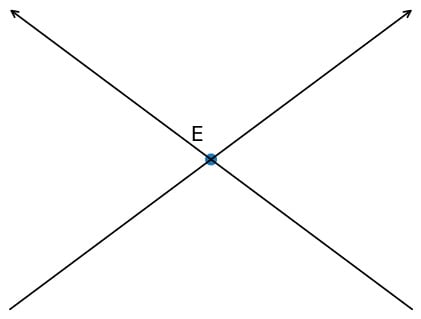
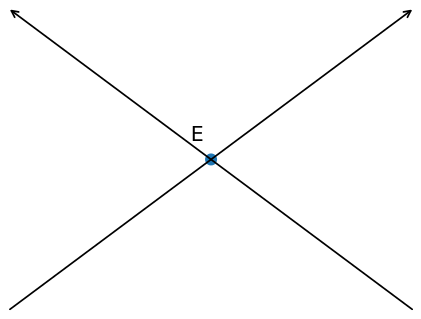
Thus, an event is a relation of intersection between two uniform motions (see Figure 1). We might designate an event as a relation . If the relation holds, the event exists. In this sense, events are not primitive spacetime particulars but relational facts generated by the intersection of motions. This intersection relation is irreflexive, symmetric, and non-transitive. The proposed view of events suggests that events are not particular entities as such but facts that describe whether two motions meet.
Figure 1.
Two uniform motions intersecting at event E.
To show the feasibility of thinking of spacetime as constructed from primitive motions, we proceed to define basic structures of spacetime using uniform motions as the fundamentals of spacetime and the various intersection points that exist between them. The following features can be defined this way:
- 1.
- Determinateness: Between two events and , formed due to intersections of motions with a single motion , there is a relation of determinateness—an asymmetric, irreflexive, and transitive relation such that either or , but not both.
- 2.
- Parallelism: A set of (uniform) motions can be considered parallel if there is no intersection point between any two motions that belong to the set, and if any two motions belonging to the set are “coplanar”. Two non-intersecting motions are coplanar if there exist two intersecting motions and , that intersect at distinct events. The set of parallel motions represents the set of motions that move “in the same direction” and “with the same velocity”, although the notion of “sameness of direction” does not suppose a conformal structure and the notion of “sameness of velocity” does not suppose a metric.
- 3.
- Congruence: Between four events belonging to the same motion, there is a congruence relation that is transitive and additive. Thus, if all belong to a single motion , the four-place relation of congruence implies that the segment is congruent to the segment .
These geometric structures do not presuppose any inherent distinction between duration and length. Motion intervals are defined along events belonging to a single motion. It is in this sense that we can say that motion is more primitive than either space or time.
2.1. Determinateness
One of the ways in which a motion can be deemed a process is to posit that earlier stages of the motion determine or make possible the actualization of a later stage. To reflect the nature of a motion as such, we posit a relation of determinateness between events in a motion. This relation describes a direction by which events or intersection points can unfold. This relation resembles a causal structure or a temporal structure, except that it does not presuppose a more fundamental temporal or causal order. Ordinarily, causal structures assume a relation between events while presupposing that events are ontologically primitive (or function as particulars). A temporal structure presupposes a uniform temporal dimension that drives all becoming processes. However, the relation of determinateness is localized to a particular motion. Unless two intersections on a single motion are coincident, it is always the case that one event “takes place” prior to the second one. In other words, the determinateness relation is an irreflexive, asymmetric, and transitive relation between two events belonging to the same motion.
- 1.
- 2.
- If is an event and is another event , then there are two exclusive options:
- (a)
- The two events are coincident, i.e., 10;
- (b)
- One event determines the other event: or .
- 3.
- Transitivity: .
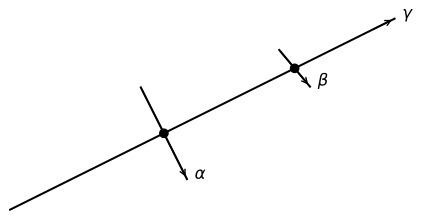
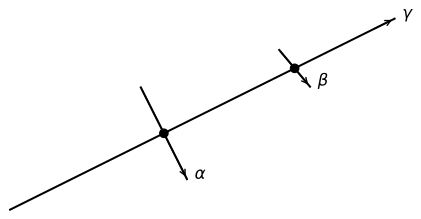
Assume now that and intersect , so that and (see Figure 2). Assume that the events are not coincident. Then, there exists a relation of determinateness between events and , such that either or , but not both. This imposes a direction of the “unfolding” of events. Even though the motion simply exists, events along the motion always unfold in a particular direction. This imposes an ordering structure on events along a particular motion.
Figure 2.
Two motions and intersecting a motion , forming a relation of determinateness.
Determinateness is local to a particular motion and does not impose a global temporal ordering over all events. In this respect, the present approach differs from the notion of a universal cosmic time and from the idea that all events belong to a single global process of becoming. Temporal directionality is instead distributed across distinct motions and can only be localized to particular actualized motions.
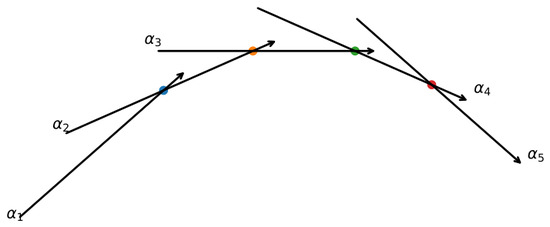
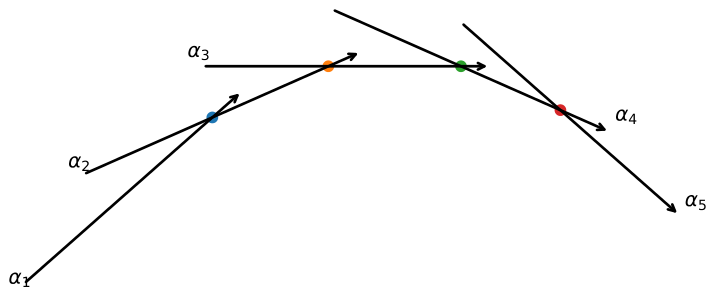
The determinateness relation does not allow a global ordering relation for any two events. However, the transitive nature of determinateness implies that this order may spread from one motion to other motions that intersect it. If event is an event on motion , and motion intersects , then it must be the case that this intersection event determines or is determined by . Because further motions on are determined by the intersection between and , by the transitivity of the determinateness relation we find that events on determine events on . A chain of pairwise connected motions will “spread” the determinateness relation along the chain. If two events are connected via a series of motions, then the determinateness relation does impose an order on these events (see Figure 3).
Figure 3.
A chain of motions , where each consecutive pair intersects. The determinateness relation is transitive across distinct motions.
Given the transitive nature of the determinateness relation, one can consider whether there exists a chain of motions connecting an event with an event , even if the two events do not belong to a single motion. However, it should be clear that the determinateness relation must propagate in a coherent manner. Since determinateness is asymmetric and transitive, its propagation along intersecting motions cannot generate loops. Consequently, distinct chains connecting the same events cannot induce contradictory orderings. In other words, if there are two distinct sequences of motions connecting and , they must agree on the relation of determinateness. Thus, we can find that determinateness may “spread” along a network of interconnected motion and impose a clear direction of progression in a region, without there being a single cosmic time enforcing this progression11.
Once we have posited the relation of determinateness, we may posit the idea that if a motion intersects a set of parallel motions, then the events formed on the intersecting motion would constitute a dense set of events. Or, in other words, for every two motions that intersect a motion at and . Assuming that , there exists another motion such that intersects . If , then and . In other words, between any two events formed by parallel motions intersecting a motion , there is another motion from the parallel set that intersects between the two motions. Thus, the determinateness relation can be used to posit a betweenness relation. Moreover, we may posit that a set of parallel motions would form a dense set of events if a motion intersects them.
Determinateness introduces temporal direction without presupposing a universal temporal flow common to all motions. Each motion possesses its own directed unfolding, while a broader temporal order emerges through relations among intersecting motions12.
2.2. Parallelism
Intuitively, we think that motions are geometrically parallel if they move in the same direction and with the same velocity. However, we do not suppose that direction and speed are well-defined at this point. What we can do is define parallelism with the help of intersection points that either exist or do not.
Define the notion of “coplanar” in the following way:
A set of motions is coplanar if and only if:
There exist two distinct motions and , such that:
- 1.
- and intersect, so that .
- 2.
- All motions intersect both and .
- 3.
- If intersect , then it is not the case that these events are coincident. Similarly, if intersect , it is not the case that these events are coincident.
Intuitively, the notion of being coplanar is that there exists a two-dimensional plane in which the two motions exist. However, the notion of belonging to a single plane is only defined via relative intersections.
A set of parallel motions has the following feature:
- 1.
- For any two motions belonging to the set of parallel motions , there exists no intersection point—.
- 2.
- For every distinct , the set is coplanar.
These conditions capture, at a primitive relational level, what subsequently comes to be interpreted geometrically as motions heading in the same direction and with the same velocity.
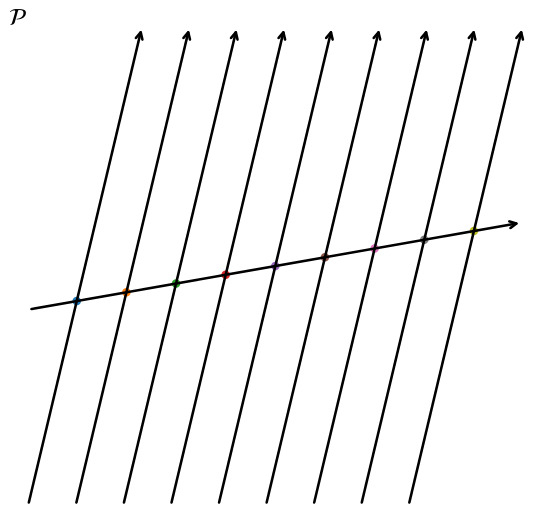
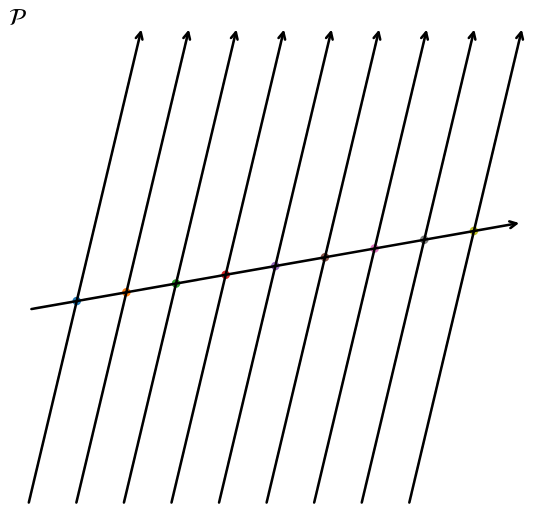
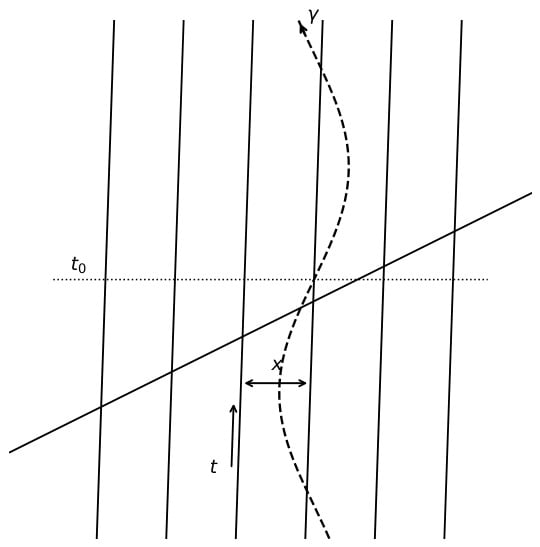
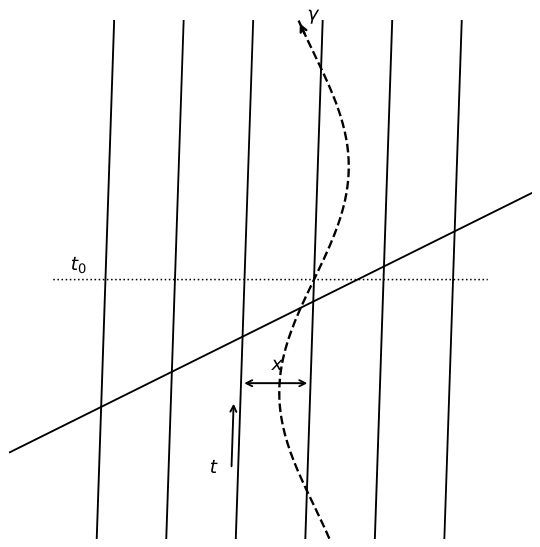
First, we discuss what we would normally consider a spacetime, namely a spacetime consisting of a single temporal dimension and a single spatial dimension. First, in a the set containing all motions is coplanar. Furthermore, the notion of being parallel in a spacetime implies that motions are parallel in spacetime but actually trace the same spatial dimension with the same velocity—it is just that they trace this spatial dimension at an earlier or later time. In a spacetime, uniform motions that are indefinitely extended forward and backward and are not parallel will eventually meet. Thus, a set of uniform motions that do intersect in effect trace the same spatial dimension but at different velocities. In such a spacetime, a set of parallel motions may become a “backdrop” relative to which we can examine the events of intersection formed by another motions intersecting the parallel motions (see Figure 4).
Figure 4.
A set of parallel motions intersected by another motion.
Assume that there exist two sets of parallel motions, and , where at least one motion in intersects a motion in . Suppose that the union is not coplanar. We interpret the failure of to be coplanar as indicating two independent spatial dimensions. If it is also the case that any motion not belonging to must intersect at least one motion in and at least one motion in , then we have a spacetime.
Since each parallel family represents one primitive direction of uniform motion, the impossibility of embedding the union of two such families within a single plane implies that neither direction can be reconstructed from the other. Pairwise non-coplanarity for sets of parallel motions therefore serves as the criterion for directional independence.
Similarly, the analysis can be extended to a spacetime. We posit that there exist three sets of parallel motions , , and . Assume also that if , then there is an intersection between each pair. If each of the unions , and is not coplanar, and if any motion not belonging to must intersect motions belonging to two distinct sets of parallel motions, then we have a spacetime. What is important to note is that we have essentially defined the notion of “sameness of direction” using incidence relations without presupposing an affine structure.
2.3. Congruence
Assume we have three distinct events on a particular motion: . Then, there exists a fourth intersection point , such that the segment is congruent with . The congruence relation is described as follows:
- 1.
- For any three events on a motion , there is a fourth event , such that . This congruence relation forms an equivalence class on intervals between pairs of events, so that:
- 2.
- For any two events on a particular motion, and (reflexive and symmetric relation on segments).
- 3.
- For three pairs of events: (Transitivity).
- 4.
- If and , then (additivity).
The idea of congruent intervals does not yet distinguish between temporal or spatial congruence, so we can simply consider these intervals as motion intervals. The congruence relation imposes a metric on events belonging to a particular motion.
In the following, we shall attempt to show how the decomposition of motion intervals into their “temporal” and “spatial” components produces particular spacetime structures—the two central ones being Galilean spacetime and relativistic spacetime.
3. Breaking Motion Intervals into Spatial Distances and Temporal Durations
If we conceive of uniform motions as the backbone of spacetime, one needs to ask how motions acquire their spatial and temporal meanings. Motion intervals are taken here to be ontologically prior to the distinction between spatial distance and temporal duration. The spatial and temporal interpretations of motion intervals emerge only through relations among motions. If we compare two distinct segments on particular motions, we can always find a ratio between them. But we normally experience space and time as distinct dimensions of motion. How does this come about?
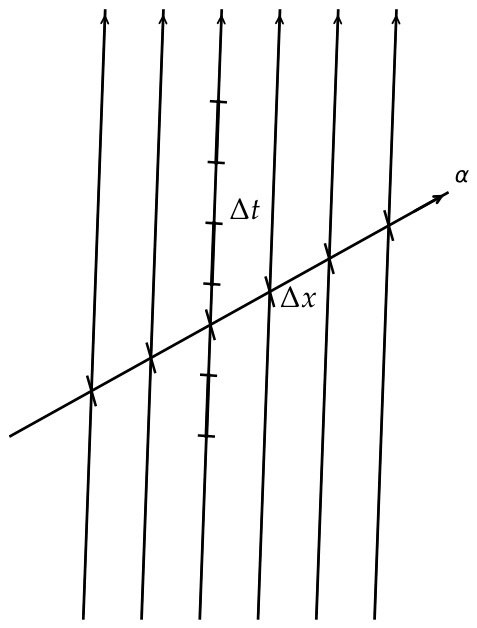
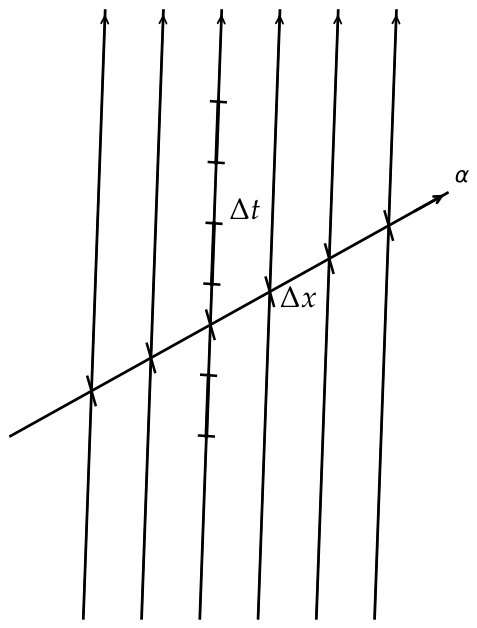
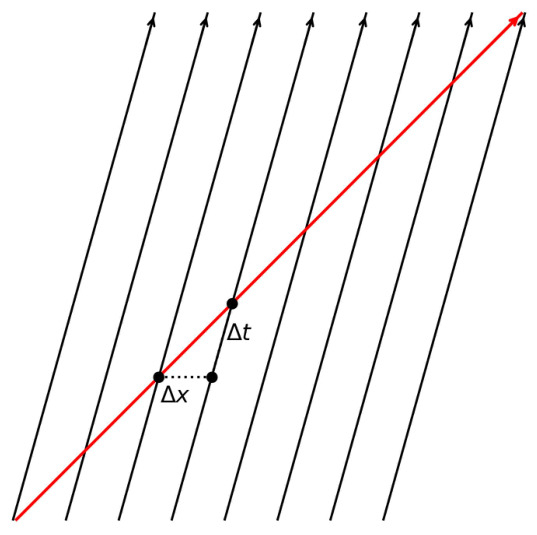
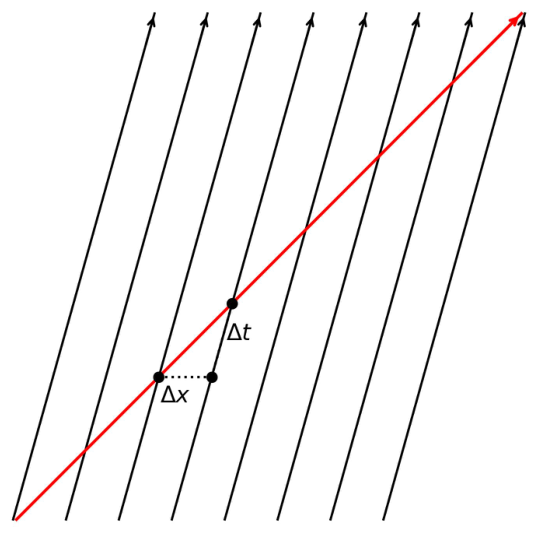
Assume we have a set of “parallel” motions. These would be motions in the “same direction”, and with the “same speed”, although we currently have no way of turning motion intervals into velocities. It would be convenient to think of these as “parallel” motions, where the idea of parallelism is identified with non-intersection. Thus, the parallel motions have no common events. Now, assume that there is a motion that intersects all of these parallel motions. When we have such an intersecting motion, taking intervals along this motion to provide a certain standard, we can think of the intervals forming between intersection events as “distances” between the parallel motions. Then, taking the intervals along the parallel motions to be durations, we find the context in which a motion interval can be considered “distance” and the context in which it can be considered “duration” (see Figure 5). Whether a motion interval is spatial or temporal depends on the relation between the motion and other motions within spacetime.
Figure 5.
A motion intersecting a set of parallel motions.
If we now consider the motion and the set of motions that are parallel to it (and non-intersecting with it), then for this set, the intervals on these parallel motions can be considered as segments of temporal duration. Relative to these intervals, other motions can be considered as moving and as “changing place”. What we must make sure is that there is a consistent way to move between these two perspectives. Relative to one set of parallel motions, the intersecting motions are said to be moving, and the parallel motions can be said to be at rest. But relative to another set of parallel motions, these parallel motions can be said to be moving. This scheme suggests that places within spacetime are not points that persist through time. Rather, places are determined by motions, whose persistence is not relative to time but relative to other motions.
What is now missing from the analysis of spacetime is how to relate distinct motion intervals that belong to different motions. If, for example, is a set of parallel motions, how do we relate the intervals on one motion to intervals on another?
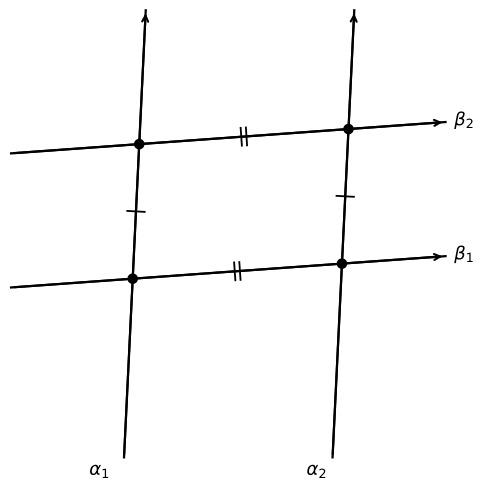
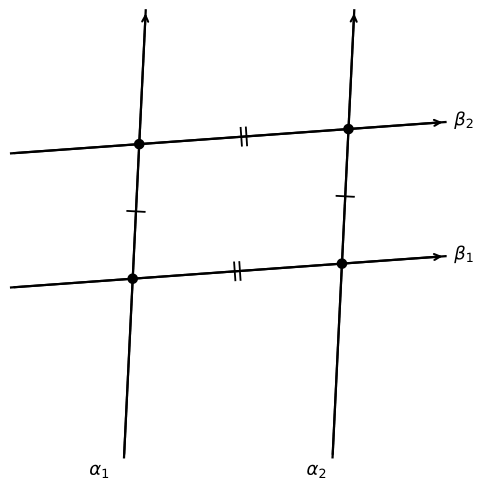
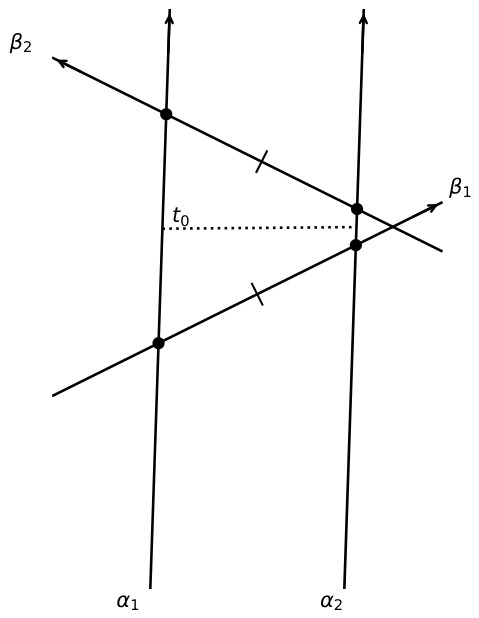
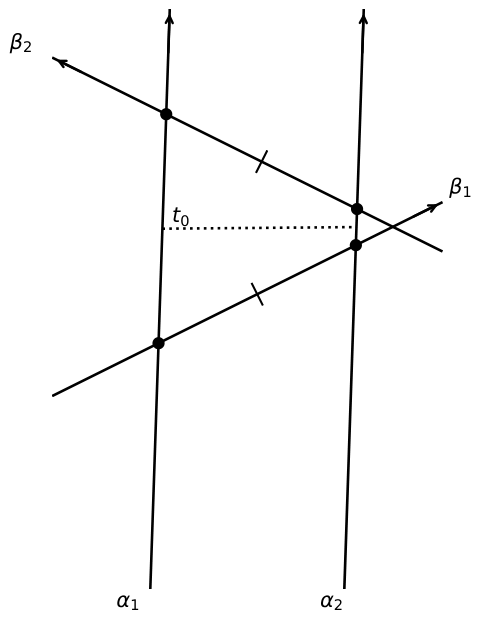
First, we need to define a “flatness” condition. We do so by considering a set of parallel motions , which intersect the set of parallel motions . The flatness condition implies that if form intersection points with two motions , then the intervals are congruent to if and only if and are congruent (see Figure 6). The flatness condition guarantees that uniform motions always “continue in the same direction” relative to other motions, or in other words, the distances between parallel motions do not change.
Figure 6.
Flatness condition: Assume two parallel motions and intersect two parallel motions and . Both the intervals formed on and are congruent and the intervals formed on and are congruent.
The flatness condition implies that a selected motion interval on a motion belonging to a set of parallel motions can function as a unit of time. Not because there is a separate temporal dimension to spacetime, but because in relation to the set of parallel motions, intervals along the parallel motions assume the function of temporal duration. Intervals along the motions that intersect the parallel motions can assume the function of spatial distance.
In the following subsection, we shall recover central characteristics of both Galilean and Minkowski Spacetimes by introducing a structure of decomposition. That is, the nature of the spacetime has to do with how a motion interval decomposition takes place—namely, how intervals along a set of parallel motions are related to intervals of motions intersecting the parallel motions. We limit discussion to a spacetime, in order to focus our attention on how “temporal” intervals are related to “spatial” intervals. This will allow us to understand how motion intervals can assume their distinct temporal and spatial meanings depending on the context in which they are in, and how this is related to the nature of spacetime. We leave a full account of theories of spacetime to future work. We also do not try to reduce to the framework introduced here the full framework of spacetime theories, including manifold structure, affine connections and metrics. We focus on the limited aim of showing how central characteristics of spacetime theory might be explained via distinct ways in which motion intervals are “decomposed” when an intersecting motion traverses parallel motions.
3.1. Galilean Spacetime
So far, we have not related motion intervals between parallel and intersecting motions. To do so, imagine two parallel motions intersecting two motions . In this subsection, we show that providing a mathematical relation between motion intervals belonging to various motions can recapture some central features of a Galilean spacetime. The following reconstruction should be understood schematically.
First, we define a relation of simultaneity by considering an Einsteinian-like procedure for sending signals between two motions belonging to a set of parallel motions. Assume that a motion moves from towards , and that a motion moves from to . Assume also that the intervals formed by intersection points on and are congruent. Then consider the midsections on the intervals on and . These can be considered as simultaneous—they form a way of coordinating between events and taking them to be simultaneous (see Figure 7).
Figure 7.
Simultaneity relations defined via the Galilean paradigm of uniform motion.
Given a certain definition of simultaneity, one can demonstrate that intervals on a set of parallel motions can provide temporal intervals for all processes that move in relation to these parallel motions. Also, one can form hyperplanes intersecting these parallel motions at events that can be considered “simultaneous”.
A particular set of parallel motions can be considered as an “inertial” frame. Once relations of simultaneity are defined on a set of parallel motions, one can pick a particular motion that intersects motions in this inertial frame and use intervals on this motion to define “distances” between the parallel motions. For this particular inertial reference frame, there is a well-defined temporal and spatial coordinate system , using intervals along the parallel motions to represent duration, and using a representative intersecting motion to define a unit of length and the distance between parallel motions. Once such a coordinate system is defined, one can describe a non uniform motion as having a coordinate . This motion would have a well-defined velocity as the derivative of , given that it now has a position and a time defined relative to the inertial reference frame. But this coordinate system is constructed from the motion intervals that belong to the underlying uniform motions defining a coordinate system (see Figure 8).
Figure 8.
An inertial frame defined by a set of parallel motions, relative to which a coordinate system is defined.
In this coordinate system that we have constructed, we have for each nonuniform actual motion a well-defined coordinate . Moreover, we can use derivatives to assign velocities and accelerations, given that , and . However, we do not yet have a kinematics. That is, we do not have a rule for adding velocities, given that we just have velocities defined relative to the set of parallel motions. To allow a universal rule for adding velocities, we must posit some uniform relation between the temporal and spatial intervals.
Given the flatness condition and the simultaneity relations, we can now define relations between motion intervals belonging to non-parallel motions. Within the frame associated with , we say that the intervals on are temporal, i.e., they provide duration intervals. Intervals belonging to are spatial. Notice that their temporal or spatial character is the result of their placement relative to other motions and is not inherent to underlying dimensions.
To capture some important characteristics of a Galilean spacetime, we assume that these intervals are always related linearly, so that:
We can consider this relation between intervals belonging to intersecting motions as the Galilean Paradigm of Uniform Motion (or GPUM). We take this linear relation to describe the full range of possible ratios between temporal and spatial units. We argue that such a paradigm gives rise to characteristic features of Galilean spacetime, wherein a change in the selection of a set of parallel motions is equivalent to a boost in velocity.
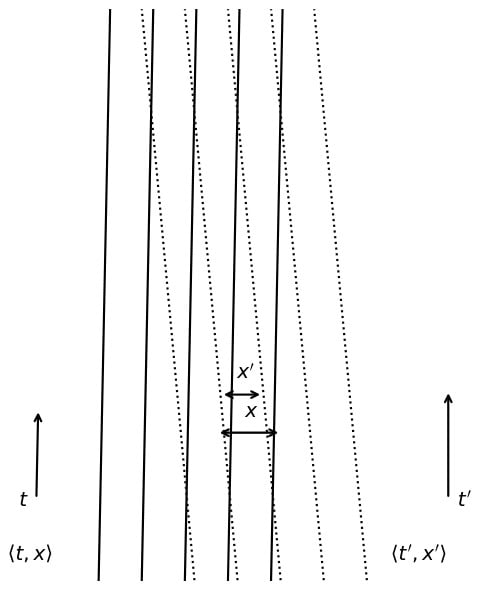
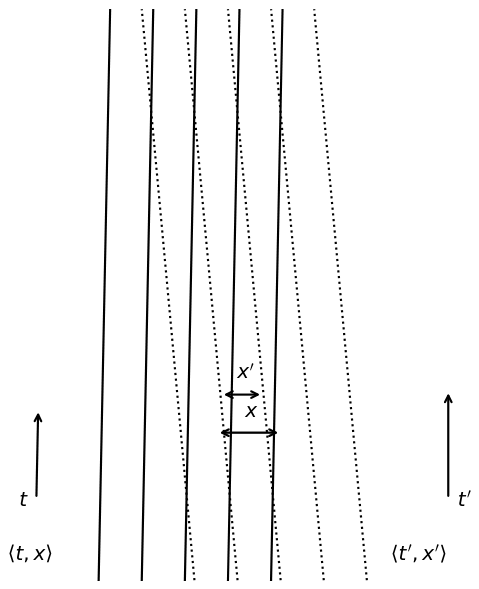
The linear rule connecting temporal and spatial durations is conceptually related to the Galilean transformation between coordinates associated with two distinct sets of parallel motions. To show this, assume it is possible to construct two coordinate systems, and , both defined relative to distinct sets of parallel motion and . Given the Galilean “decomposition” of motion intervals, an interval on an intersecting motion is related to an interval on a motion belonging to a parallel set via . This is a “linearity” assumption applicable to all motions that intersect a set of parallel motions. For the same intersecting motion, we get that and depending on the chosen set of parallel motions.
One might wonder how, given the GPUM, one should transform between and . I argue that the linearity assumption allows us to conclude that two sets of parallel motions can use the same relations of simultaneity, so that essentially . To see this, consider the above definition of simultaneity. One can demonstrate a connection between the linearity assumption of the GPUM and the notion that relative velocities are in principle without an upper bound. Moreover, one can demonstrate that if there is no upper bound to motions, then relations of simultaneity for one set of parallel motions are in effect relations of simultaneity for another set. Assume that two motions intersect to motions , so that and . One can show that if and are simultaneous in they are also simultaneous in (and vice versa).
If the two events are simultaneous in , then there exist two motions, , that connect , and for which is at the midsection for the intersection points and and is at the midsection of and . Moreover, the segment on connecting is equal to the segment on connecting . Intuitively, we can see that one can find motions with the same velocities as (i.e., they are parallel to them) that are coincident with . The ratio between the “distance” between travelled by these motions and half of the “time” it takes the motions to travel back and forth is the velocity of these motions.
The GPUM implies that motions decompose linearly, but it describes all possible decompositions. Thus, it means that motions of higher velocity could be found connecting the two motions while showing and to be simultaneous. All we need to do is find motions that travel from to , are coincident with , and of a higher velocity (with equal segments connecting and ). Because the GPUM preserves the linear relation between congruent motion intervals, replacing one signaling motion by another of larger coefficient changes only the duration of the signaling process, not the midpoint construction used to define simultaneity. It means that one can diminish the duration it takes to travel back and forth between the two motions.
For every duration required for signals to travel back and forth while preserving the simultaneity of and , one can find faster motions connecting the motions and preserving the relations of simultaneity. But if the time is as small as we want, it is also as small as we want for . Thus, it follows that and are simultaneous in as well. Since every simultaneity construction can be refined using motions of arbitrarily large , any difference between simultaneity relations defined relative to distinct parallel families disappears in the limit. Hence, the simultaneity relation is independent of the chosen inertial frame. From all this, it follows that the temporal coordinates .
We can now show that position defined relative to one set of parallel motions will transform according to the Galilean transformation. Assuming there is a linear relation for both and t, we find that and . The difference would simply be the “relative” velocity between the two sets of parallel motions. We finally obtain the following transformation between the two coordinate systems:
Thus, we see that central features of the Galilean Spacetime are the result of the previous assumptions, together with the GPUM and the decomposition of motion intervals into temporal and spatial intervals (see Figure 9).
Figure 9.
A transformation between two sets of parallel motions.
3.2. Relativistic Spacetime
We have seen how some central features of Galilean spacetime were determined as a result of considering how a motion intersects a set of parallel motions. Once such a motion is considered, one can consider the motion intervals along the parallel motions as segments of temporal duration, and motion intervals along an intersecting motion as spatial distance. The nature of Galilean Spacetime is shown to be related to a presupposition about the relation between motion intervals, which serve as either temporal or spatial intervals, depending on the context. When a linear relation is assumed, so that , we can see how the various properties of Galilean spacetime have been derived.
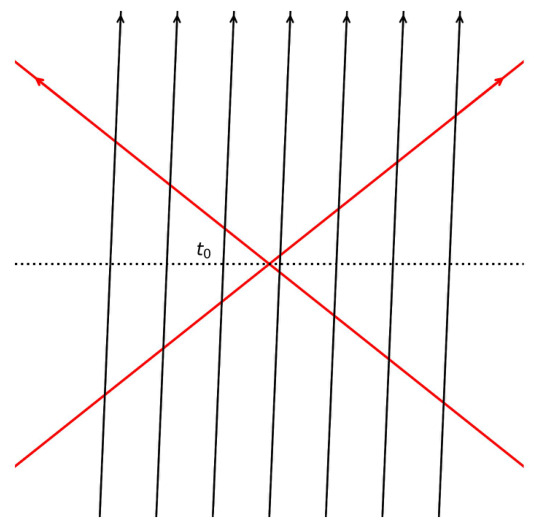
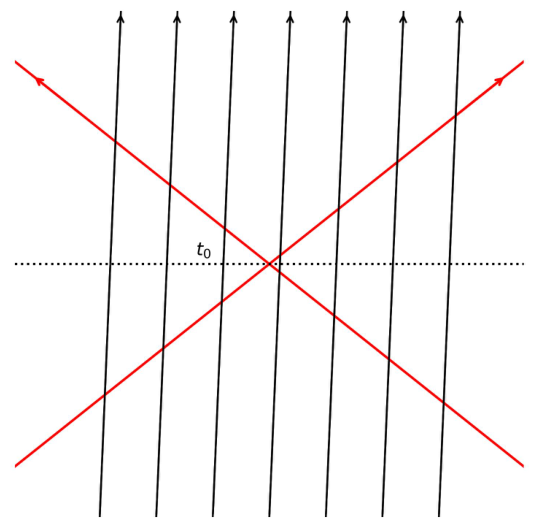
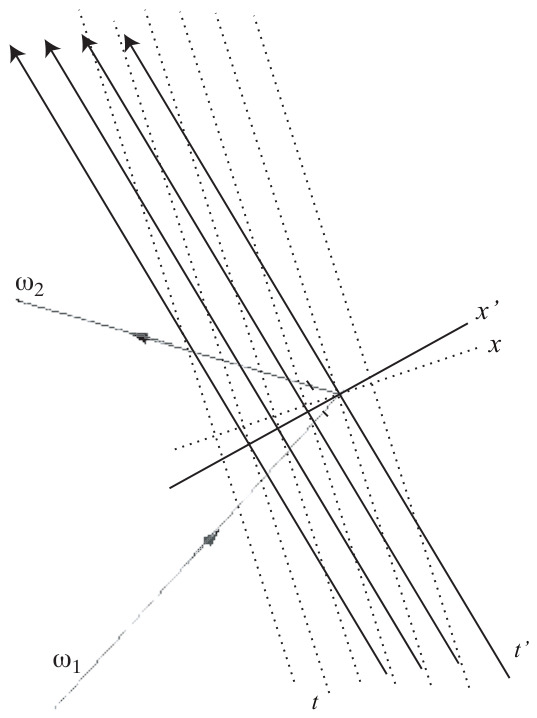
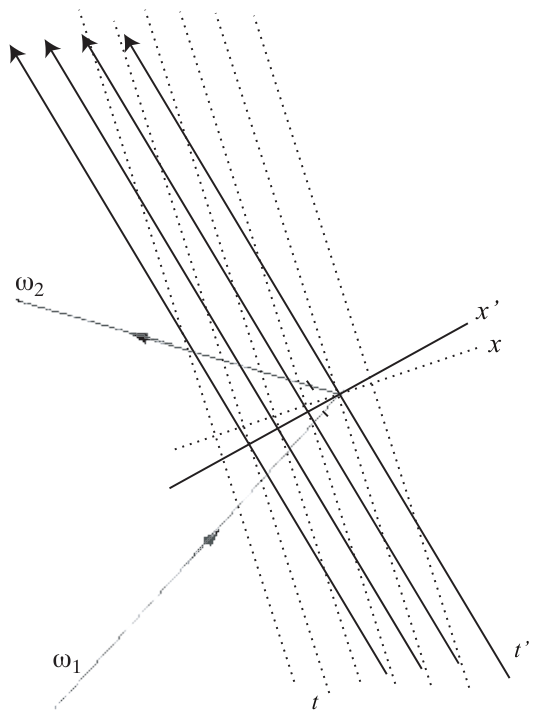
To understand the nature of relativistic spacetime, we now consider a different relation between spatial and temporal intervals. Instead of a linear relation, we posit a relation mediated via an invariant wave-like motion traveling at the speed of light. First, we take a set of parallel motions, then use two light signals—one moving in the positive and another moving in the negative direction. The two events that are at the midsections of parallel motions intersected by the light signals would be considered as simultaneous (see Figure 10).
Figure 10.
Simultaneity relations defined via the wave-like paradigm of uniform motion.
Assume we have a set of parallel motions. Using light signals, we define relations of simultaneity on the set of parallel motions that define a temporal unit . If there is an intersecting motion, we can use this motion to define the “distances” between the parallel motions . Just pick an intersecting motion and use the intervals on this motion to define the distance between parallel motions. Given this invariant wave motion, we define the relation between the spatial distance of a particular set of parallel motions, the temporal duration along the parallel motions, and the motion interval on the “privileged” motion (see Figure 11):
Thus, we think of relativistic spacetime as resulting from different assumptions regarding the way motion intervals decompose into spatial and temporal components in a particular context of an intersecting motion crossing a set of parallel motions.
Figure 11.
Spatial and temporal intervals defined relative to wave motion.
In the relativistic case, we have to consider a complicated relation between the relativistic decomposition of motion intervals and the clocks and measuring rods. To establish this connection, we first have to accept that a wave function provides a solution to the relativistic decomposition of motions:
where , , c is the wave’s velocity, T is the wave’s period, is the wavelength, and .
To calibrate the time—or a motion interval on a segment of parallel motions, we take two motions , and allow a positive solution of the wave equation to move from to and an intersecting negative solution to move from to . The time interval t that the wave signals took to move back and forth, and the distance between the motion x, would then be defined as follows:
We now have to determine what decomposition would look like when the same wave motions are decomposed relative to another set of parallel motions (see Figure 12). To compare the “time” and “distance” it takes the wave phenomena to travel back and forth between parallel motions in to the time and distance it takes to do so for , we select two motions , where is coincident with the intersection between and , while is coincident with the intersection between and . From the perspective of the coordinate frame , it takes longer to move from to than it is for it to move from to . But for the set of parallel motions, the “distance” between and is the same going in both directions. To reflect the equality going both ways, we argue that we can “stretch” the wavelengths by factors and for the “positive” and “negative” wave solutions, so as to “regain” the equality of distances. We now simply posit arbitrary rescaling parameters, and then see if further restrictions can be given to them.
Figure 12.
Spatial and temporal duration decomposed relative to another set of parallel motions.
Such a stretching of the wavelength should result in an alternative coordinate reference frame , which is defined as:
Equation (8) could be rewritten in terms of a transformation between and , so that
Note that the inverse transformation has the following form:
Notice that the stretching parameters were introduced arbitrarily to allow for the equality of distance between two parallel motions. We now have the transformation from one set of parallel motions to another set of parallel motions , and the inverse transformation from to . But the situation appears to be entirely symmetric. If we want the transformations to be symmetric, i.e., if we want a unit of length and a unit of time to transform in the same way by and , then we have to set
Solving (9) for and , we get the following solution for the relative velocities between the coordinate reference frames:
Given (12), one can show that . Since , , so that . This implies that there is a restriction on relative velocities between motions, as they could only be less than or equal to c. Finally, substituting (11) and (12) into (9), and defining
we obtain the usual Lorentz Transformations:
The situation with the relativistic space–time is analogous to that of the Galilean spacetime. The priority of the Relativistic Paradigm of Uniform Motion over the structure of spacetime explains the equivalence between inertial reference frames, as these various representations of the spacetime stem from taking the relativistic paradigm of motion as basic.
4. The Relation Between Uniform and Non-Uniform Motions
The above reconstruction of spacetime suggests that (uniform) motions are primitive in a spacetime, while events are generated from the intersection between motions. Thus, a certain ontological reversal is achieved, wherein motions are not considered as “constructed” from events; rather, events are taken to be produced by underlying motions or processes. However, the description of uniform motions and their intersection only provides the background structure for actual physical processes. Potential uniform motions form the primitive relational background from which spacetime structure is reconstructed, whereas actual motions are realized physical processes that manifest segments of such motions. How do we move from potential uniform motions to describing actual non-uniform motions?
An actual uniform motion is a realization of a potential uniform motion. We think of a “free” particle as manifesting one of the processes described by a uniform motion. Thus, when Newton describes his Law of Inertia, he argues that when there is no impressed force, a body will continue moving with uniform, rectilinear motion. Moreover, he claims that there is an “inherent” force of inertia that compels a body to move in a straight line. In the account suggested here, there is no background space and time. Rather, a free body simply manifests the fundamental process of uniform motion. Moreover, there is no inner force of inertia which compels a body from being present at one place in space to being present at another place. In fact, we think of other processes as defined relative to this fundamental process, which is realized by a free particle. But we do not imagine this particle to be present at different places at different times. We imagine it to be a process, which, when intersecting other processes, produces an event.
An actual motion need not trace inertial, uniform motion. A body may move via a field of forces or external influences. One can say that it accelerates or decelerates. We conceptualize an actual motion as traced relative to the spacetime structure, i.e., it moves relative to the background of potential, uniform motions. It does so by manifesting, for each part of the actual motion, a segment of a potential, uniform motion. It may be that within a given time, a motion accelerates continuously. In this case, each infinitesimal part of this actual motion manifests an infinitesimal part of a distinct uniform motion. Thus, we might think of an actual motion as steering its way along a mesh of background, potential uniform motions.
Once we think of actual motions as manifesting parts of uniform motions, we can think of how systems of actual motions are constructed. A composite system is itself a process that is comprised of distinct subprocesses. Each composite system can be viewed as an actual motion that traces its trajectory relative to the background of uniform motions. What allows us to articulate laws of motion can be traced to the rules for constructing composite motions and the behavior of a composite system that is isolated—i.e., a system that does not exchange motion with any other. It is the assumption of physical theories that the trajectory describing composite, isolated motions also manifests a uniform motion. Thus, we can trace the law of conservation of momentum to the claim that all actual non-uniform motions are parts of a system that actualizes a uniform motion.
The relation between a structure of possible motions and their actualization can accommodate well flat spacetimes, such as Galilean and relativistic spacetimes. In such spacetimes, one can clearly distinguish between possibilities and actualities, and the spacetime structure is never influenced by anything that is actual. This accords well with our intuition that possibilities precede actualities, and that actualities must conform to them. However, the situation is made more complicated when one discusses General Relativity, where the structure of spacetime is determined in part by the distribution of matter via the momentum-energy tensor. But to fully understand the relation between spacetime and matter, we must develop the concept of mass and explain how the general laws of energy and momentum conservation and dynamic laws look like when they are embedded within spacetime considered from the framework introduced here13. To make a gesture towards explaining this, we just state that a material system is, generally speaking, a composite system. Namely, it is comprised of various components—each having its own actual motion that is traced via spacetime. In Newtonian and special relativistic theories, these actual motions are traced relative to a set of possible motions provided by the spacetime theory. But in General Relativity, one might consider how an actual motion is materialized when it is formed as part of a composite system. When several motions are considered parts of a larger, composite system, it may be that these motions are actualized according to their relation to the composite, not just the set of background possible motions.
The process ontology proposed here is intended as a general ontological framework. The present paper reconstructs only the flat kinematical structures of Galilean and special relativistic spacetimes. Extending the same ontology to General Relativity requires reconstructing the dynamics of composite systems and their relation to spacetime structure, a task left for future work.
One might argue that all we have done is relabel the central structures of Minkowski’s spacetime—we have “relabeled” lines as processes and argued that this renders the view a dynamic one. But notice that the claim is not simply that lines should be labeled processes. Rather, the argument is that we can define a metric directly on primitive motions, independently of any temporal and spatial dimensions. We have also shown how this metric—the motion intervals—acquire their temporal and spatial meaning depending on the context. The metaphysical difference therefore does not consist merely in calling world-lines ’processes’. Rather, the explanatory direction is reversed. Instead of taking spacetime geometry as primitive and inertial motions as structures embedded within it, the present framework reconstructs spatial and temporal structure from primitive motions and the relations among them. Motion is therefore not explained by spacetime; rather, spacetime is explained by motion.
5. Process and Foundations of Spacetime
The ideas about primitive motions undergirding the foundations of spacetime resonate with process philosophy. If motion is conceptually primitive, one cannot think of motion as a change in place, or as composed of distinct events. Rather, one thinks of places as defined relative to motions and events as produced by intersections of motions. Nevertheless, it is difficult to find an ontological pinning of processes or motions without resorting to things or enduring entities. Normally, we think of motion or process as a thing that undergoes change. If it is motion via space or spacetime, we think that motion consists of a thing or an entity first being present in one place (or spatiotemporal point) and then in another. Alternatively, we think that motion is an enduring entity that first has one property and then it has another, as in Aristotle’s substance ontology. It is very difficult to imagine a process without the ontology of some thing that can be present at different places or times and possesses various properties at different times.
How can one conceive of a process without conceiving of it as comprised of events or as an enduring thing? Perhaps the first step is to dissociate a process from its presence in space and time. If we cease to imagine space and time as consisting of a background container, relative to which the existence of entities in the world is conceptualized, we may begin to capture what motion is. A motion exists, or is happening, and it so happens that it intersects other motions and produces events accordingly. But these events are produced by motions—they do not define their existence. Thus, the existence of a motion is taken to be prior to or independent of the events it produces, and is not composed of them.
The problem with this way of thinking about processes is that it seems to make them abstract or devoid of any concrete existence. Particular, concrete entities are often taken to be such because they are present in space and time. But, in the framework introduced here, we are not thinking of space and time as background structures relative to which an entity becomes concrete. How does one then conceive of a motion as existing, or as a concrete entity? We can imagine actual motions to be concrete by suggesting that they have a determinate logical place within the set of possible motions and their relations, which is provided as an ideal background from which one of many possible motions is realized. A concrete motion is identified via the set of relations with the rest of the world, and so one does not presuppose that it must be present in space or time to be concrete.
Another problem with conceiving of motions as primitive from an ontological perspective is that the existence of a motion can be considered independently of whether a particular event occurs. When considered prior to the event’s occurrence, the process is a set of potential events, and its existence is independent of the actual events produced by it. Before an event has occurred, we consider it possible that an event would not take place. The motion may respond differently depending on other motions that are present to it (and the motions in which it participates). Thus, we can say that the event is actualized independently of whether the motion exists, but still as a result of that existence. There is then a difference between the existence of the motion and the actuality of the events it produces. One way to think of this difference is to consider that an event is not an occurrence that takes place at a particular temporal instant, but rather, it is a relation between two motions that either intersect or do not intersect. For example, if I happen to meet my friend for lunch, this event is actualized and becomes part of my history. But if the meeting fails to take place, then the event is never actualized. The fact that I exist does not imply that I am present to another particular entity, and the fact that my history consists of being present to distinct entities one after the other does not imply that these events define me or my existence. It is always possible that my history would include other events that result from being present to other entities.
The difference between the existence of motions and the actuality of events implies that time is not a singular flowing parameter, underwriting all processes of change. Rather, for each motion, we can define its own “personal” time. Each motion progresses along its own career, its events unfolding as it further materializes. Since the existence of motion is not tied to an underlying spatial or temporal background, its dynamics are not tied to some universal dynamic underlying the entire universe. There is no singular thread of development, but a myriad of processes following distinct paths. We have to make sure that these paths do not form an incoherent web of events.
Assume we have three actual motions , and each two motions intersect at events , , and . Then the determinateness relation must be determined in the same way no matter the path between two events. If is later than and is later than , then is later than even if there is more than one “path” of motions that connects them. Thus, while temporal threads of becoming are localized to distinct motions, a coherent set of relations of determinateness may spread to a myriad of interconnected motions.
We should therefore rethink the identity conditions for events, which are ordinarily conceived of as particulars of a distinct kind. Like other particulars, such as things or objects, events can be counted; they can hold properties, and they seem to be present at particular times or places. Unlike other particulars, events seem to be localized to specific time intervals.
However, if the account here of the relation between motions and events is correct, then events are not particulars; they are not concrete entities that are present in some preexisting temporal interval. One reason is that particulars ordinarily do not have their identity conditions tied to particular intervals of time. A particular ordinarily preserves its identity when it is present at different times or different places. Thus, it seems to be a categorical mistake to think that an event is a particular, if its identity is thought to be necessarily attached to a temporal interval.
Another reason events are not particulars is that if there is no underlying time, or a background for potential events, the nature of an event as a particular is even more suspect. We have no means of articulating the identity of an event as a particular if there is no interval of time in which this event is present. Thus, when one describes an event, one should think of it as a relation between two motions that are mutually present. An event is a fact and not a particular, even though it is linguistically convenient to talk of it as if it were.
The approach offered here differs from many forms of process metaphysics by avoiding agential and organic metaphors in explaining the nature of a process. Process metaphysics often treats processes as composed of fleeting actualizations or event-like occurrences, and of the temporal directedness of a process as analogous in some sense to the action of a goal oriented agent14. Process philosophy often erects an implicit analogy between a natural process and a human agent, while providing various rhetorical strategies to obscure the differences.
Take, for example, Whitehead’s process philosophy [16]. One way in which the framework introduced here differs from his philosophy is that a process is not taken to be composite (or a “nexus”) of distinct “drops of experience”. Whitehead’s actual entities or occasions are discrete happenings, each of which is taken to be an independent element of becoming. But the approach here thinks of an event or a distinct occurrence as a relational fact that takes place in the history of a process. Thus, the event or the actual occurrence is not a fundamental element of reality and the process is not composed of distinct elements. A process grounds spatial and temporal designations and is ontologically prior to space and time. Thus, one cannot “reconstruct” the process from temporally distinct “elements”. This allows us to view a process as genuinely extended in space and time without supposing it is composed of distinct happenings. Moreover, the approach here does not attempt to account for becoming using the agential or organic metaphors common in process philosophy. For example, Whitehead’s actual occasions prehend, or ‘’feel’’ and ’‘grasp’’ other occasions, thereby forming the reasons for occasions to become. Occasions then “perish” upon achieving satisfaction, while enduring processes or motions are reconstructed as nexūs or historic routes of related occasions. It seems as if the agential or organic metaphors (originating with Aristotle’s account of how substances become) become useful when one considers whether one stage of becoming originates and makes possible another stage of becoming. The stringing together of various stages of becoming often alludes to an analogy with human action. It is as if the substance or the actual entity has a power to induce change in another entity in much the same way that a human takes specific action to induce change in his or her surroundings. In the approach endorsed here, the agential and organic metaphors are not required, given that we do not attempt to reconstruct a process from distinct occurrences and the “actions” that make these occurrences possible.
Other process philosophies emphasize the fundamental nature of time. For example, Bergson [17] attempts to capture the nature of process by inquiring into the nature of the underlying time within which a process takes place. Bergson attempts to recover the true nature of the process by articulating an alternative understanding of the underlying temporal structure which drives the process. A phenomenological analysis of time allows Bergson to move beyond spatialized representations of time and uncover “pure duration”, which is the actual form of states of consciousness that interpenetrate and can only be viewed as organic wholes. But the framework introduced here questions the fundamental nature of time. Whereas Bergson treats duration or temporality as metaphysically fundamental, the present account treats temporal structure as emerging from more primitive processes and their relations. Once we view motions as fundamental and more primitive than events, space, or time, we can forgo agential metaphors and avoid grounding process in an underlying temporal order.
6. Conclusions
This paper has argued that one need not accept the ontological interpretation often associated with Minkowski spacetime: the view that spacetime is fundamentally a manifold of events and that motions are merely world lines composed of such events. The target of this paper has not been the mathematical formalism of relativity, but the metaphysical priority given to events and spacetime points within it. Once events are treated as primitive, motion is naturally assimilated to a frozen geometrical line, and temporal becoming appears secondary or illusory.
The alternative proposed here begins with primitive uniform motions rather than with spacetime events. Events are understood as intersections between motions, and therefore as relational facts rather than as independently existing particulars. On this view, neither space nor time is ontologically fundamental. Spatial and temporal relations arise from the ways motion intervals are organized, compared, and decomposed within systems of possible motions. Actual motions can then be understood as localized processes of becoming, whose intersections generate events and whose relations impose a determinate temporal order.
The resulting account offers a process-based interpretation of relativistic spacetime. It preserves the structural insights of Minkowski’s formalism while resisting the static ontology of a completed block of events. Spacetime structure is not denied, but its ontological basis is reinterpreted: it arises from the relational organization of motions rather than from a primitive manifold of event-points.
Funding
This research received no external funding.
Data Availability Statement
No new data were created or analyzed in this study. Data sharing is not applicable to this article.
Acknowledgments
During the preparation of this manuscript, the author used OpenAI Codex, based on the GPT-5 model family, for the purposes of editing. The authors have reviewed and edited the output and take full responsibility for the content of this publication.
Conflicts of Interest
The author declares no conflicts of interest.
Notes
| 1 | For a reprint, see Minkowski [1]. |
| 2 | Galison [2] argues that Minkowski utilizes geometric visualization to understand the physical world. Thus, Minkowski thinks of physical processes via their analogy to points and lines in Euclidean space. |
| 3 | Minkowski’s way of selecting “physical” world-lines out of all mathematically possible world-lines is to impose a positive “time-like” separation on any segment connecting two events on the world-line: The substance at any world-point may always, without the appropriate determination of space and time, be looked upon as at rest. The axiom signifies that at any world-point the expression always has a positive value, or, what comes to the same thing, that any velocity v always proves less than c. Minkowski [1] p. 80. |
| 4 | This standard view is described in Friedman [3] (Chapter II) and Torretti [4] (Chapter 4). |
| 5 | An example of the geometric approach to explanation is given in Maudlin [5]. |
| 6 | For such a view, consider Putnam [6] and Rietdijk [7]. |
| 7 | For such a conclusion, see, e.g., Petkov [8] and Sider [9]. |
| 8 | See Brown [11] for a fuller account of the dynamic interpretation of spacetime. |
| 9 | See [12] for an elaboration of this view. |
| 10 | The assumption here is that events are not particulars, and therefore their identity is not determined by their location. We identify an event via an intersection between two motions. We say that events are coincident when the distance between them is zero or if they are on the same motion and do not determine each other. |
| 11 | Thus, the proposal here has some affinities with Dieks’ [13] account of local becoming. According to Dieks, one cannot assume a global becoming process for spacetime as a whole, but one can take temporal relations between events defined locally as providing a “local” sense of becoming. However, Dieks’ proposal does assume that potential events form a background relative to which one defines the presence of an actual event as its “happening”. This provides a rather peculiar sense of local becoming. Dieks equates the occurrence or the happening of an event with its coming into existence, but there is no real change articulated other than the event’s mere presence at a spatiotemporal location. Dieks’ proposal thus preserves the notion that motions are comprised of events and makes it difficult to articulate the difference between the motion’s becoming and its temporal parts being merely present. |
| 12 | The present proposal bears some affinity to Robb’s [14] causal reconstruction of spacetime geometry. Like Robb, it seeks to reconstruct spacetime from primitive relational notions rather than from a pre-existing manifold, and both approaches assign a privileged role to temporal ordering and light-like propagation. However, the ontological starting points differ fundamentally. Robb takes events (or instants) together with the asymmetric relation of “before” and the structure of optical lines as primitive. This has some affinity to the notion of determinateness articulated here. However, by contrast, the present framework takes primitive motions as fundamental. Events are not basic entities but relational facts constituted by intersections of motions, while determinateness propagates along interconnected motions rather than ordering primitive events directly. Consequently, causal and temporal relations are reconstructed only after the ontology of motions has been established. |
| 13 | To see how the framework incorporates these, one may consult [12]. |
| 14 | For example, Rescher [15] p. 37 writes as follows: “…Process is a natural categorical resort, because we humans understand change owing to the fact that we experience change in ourselves: We act or do things, and things happen to us. Human agency as we experience it qualifies as paradigmatic for process because—like instructions for swimming or broad jumping—what is involved is a programmed sequence of actions or activities”. |
References
- Minkowski, H. Space and Time. In The Principle of Relativity; Dover: Downers Grove, IL, USA, 1952; pp. 73–91. [Google Scholar]
- Galison, P. Minkowski’s space-time: From visual thinking to the absolute world. In Chrono-topologies: Hybrid Spatialities and Multiple Temporalities; Rodopi: Düsseldorf, Germany, 2010; Volume 32, pp. 9–42. [Google Scholar]
- Friedman, M. Foundations of Space-Time Theories; MIT Press: Cambridge, MA, USA, 1983. [Google Scholar]
- Torretti, R. Relativity and Geometry; Pergamon: Oxford, UK, 1983. [Google Scholar]
- Maudlin, T. Philosophy of Physics: Space and Time; Princeton University Press: Princeton, NJ, USA, 2012. [Google Scholar]
- Putnam, H. Time and Physical Geometry. J. Philos. 1967, 64, 237–240. [Google Scholar] [CrossRef] [Scilit]
- Rietdijk, C.W. Special Relativity and Determinism. Philos. Sci. 1976, 43, 598–609. [Google Scholar] [CrossRef] [Scilit]
- Petkov, V. Is there an alternative to the block universe view? In The Ontology of Spacetime; Dieks, D., Ed.; Elsevier: Amsterdam, The Netherlands, 2006; Volume 1, pp. 207–228. [Google Scholar]
- Sider, T. Four-Dimensionalism: An Ontology of Persistence and Time; Oxford University Press: Oxford, UK, 2001. [Google Scholar]
- Brown, H.; Pooley, O. Minkowski Space–time: A Glorious Non-entity. In The Ontology of Spacetime; Dieks, D., Ed.; Elsevier: Amsterdam, The Netherlands, 2006; p. 67. [Google Scholar]
- Brown, H.R. Physical Relativity: Space–time Structure from a Dynamical Perspective; Oxford University Press: Oxford, UK, 2005. [Google Scholar]
- Belkind, O. Physical Systems: Conceptual Pathways Between Flat Spacetime and Matter; Springer: Dordrecht, The Netherlands, 2012. [Google Scholar]
- Dieks, D. Becoming, Relativity and Locality. In The Ontology of Spacetime; Dieks, D., Ed.; Elsevier: Amsterdam, The Netherlands, 2006; Volume 1, pp. 157–176. [Google Scholar]
- Robb, A.A. Geometry of Time and Space; Cambridge University Press: Cambridge, UK, 1936. [Google Scholar]
- Rescher, N. Process Metaphysics: An Introduction to Process Philosophy; State University of New York Press: Albany, NY, USA, 1996. [Google Scholar]
- Whitehead, A.N. Process and Reality: An Essay in Cosmology; The Free Press: New York, NY, USA, 1978. [Google Scholar]
- Bergson, H. Time and Free Will: An Essay on the Immediate Data of Consciousness; Pogson, F.L., Translator; Dover Publications: Garden City, NY, USA, 2001. [Google Scholar]
Disclaimer/Publisher’s Note: The statements, opinions and data contained in all publications are solely those of the individual author(s) and contributor(s) and not of MDPI and/or the editor(s). MDPI and/or the editor(s) disclaim responsibility for any injury to people or property resulting from any ideas, methods, instructions or products referred to in the content. |
© 2026 by the author. Licensee MDPI, Basel, Switzerland. This article is an open access article distributed under the terms and conditions of the Creative Commons Attribution (CC BY) license.