


Abstract
Structural semiotics, as developed by A. J. Greimas and the Paris School, provides a powerful framework for analyzing narrative meaning through actantial roles, modalities, and hierarchical narrative structures. Despite its longstanding engagement with formal reasoning and diagrammatic tools, it has seen relatively few explicit mathematical formalizations. This article proposes a diagrammatic reconstruction of key Greimassian concepts using the language of symmetric monoidal and hypergraph categories. We treat the actantial model as a typing schema and introduce wiring diagrams as a formal semantics for representing narrative configurations, modal transformations, and actantial redistribution. Modal operations such as knowing-how-to-do, wanting-to-do, and causing-to-do are modeled as typed morphisms, while Frobenius structures account for duplication, erasure, and persistence of actants across narrative time. We show how operadic nesting captures hypotaxis, and how diagrammatic factorization yields higher-level abstractions corresponding to the hypotactical clusters of the canonical narrative schema. The approach is illustrated through a detailed analysis of Aesop’s The Fox & the Crow, culminating in a formal account of discoursivization via actorialization, spatialization, and temporalization. Rather than replacing structural semiotics, this work provides it with a compositional and mathematically explicit toolkit that clarifies existing concepts and opens new possibilities for comparative, computational, and interdisciplinary analysis.
1. Introduction
Structural semiotics is an approach to literary analysis that was developed by A. J. Greimas in the mid-1960s. Often referred to as the Paris School of semiotics, its theoretical framework is influenced by Saussure’s structuralist linguistics of difference and “the notion of binary oppositions and distinctiveness of functional phonology as presence and absence.” [1] (p. 1100). As a method, structural semiotics seeks to understand how meaning is produced and structured within a “semantic universe”. Greimas and Rastier identified how the construction of cultural objects (texts, images, myths, etc.) are built upon structural hierarchies. These include those that are “deeply” embedded (logical status of semiotic objects), those that are “superficial” (semiotic grammars that are language-independent) and those that are “manifested” (signification via quasi-universals that are language-dependent) [2] (p. 86). Thus, unlike earlier semiotic traditions that focused on individual signs, this approach treats meaning as a result of relations and systems. It posits that meaning does not exist in isolation but is generated through fundamental logical oppositions and the underlying structures of discourse.
Another cornerstone of Greimassian semiotics is the idea that the semantic universe consists of elementary units of meaning that provide axiological structures which contain the totality of signification and exist prior to their articulation. Narratives emerge, then, because these elemental units are composed together in such a way that signification is a function of the relational structure they embody. These elementary units of narrative syntax lead to the identification of “actants”, or functional roles in a story, rather than fixed characters. Actants may be anthropomorphic entities, abstract concepts or physical objects in the world.
In order to track narrative grammars and their transformations within and across texts, Greimas developed visualization aids for analysis such as the actantial model (after Propp [3]) and the canonical narrative schema. In the actantial model, narratives are analyzed according to the presence of reoccurring actors personified by roles such as Subject, Sender, Receiver, Opponent and Helper. By focusing on these functions, Greimas sought to reveal the narrative program driving a story’s progression through a formalized means that would allow for tracking patterns of structure at various hierarchical levels within a discourse. His later canonical narrative schema used the primary actor roles found in the actantial model to instigate a more detailed account of narrative trajectories. Here, Greimas considered how the interaction of modalities (“doings” and “beings”) become anchors that define syntagmatic demarcations of complex narratives into stages that involve the actants in various goal-oriented combinations.
Although Greimas and the tradition of structural semiotics has traditionally drawn on the symbols and logical reasoning of mathematics [4], there have been few mathematical formalizations of the techniques and tools that Greimas used. In this article, we propose a diagrammatic formalization of Greimassian structural semiotics using the language of symmetric monoidal and hypergraph categories. This article draws on several standard notions from category theory, including categories, functors, adjunctions, and operadic composition. We do not assume detailed prior familiarity with these concepts; only their basic intuitions are used in what follows. For accessible introductions, see, for example, Spivak [5] and Lawvere and Schanuel [6]. Our central claim is that wiring diagrams provide a natural and expressive formalism for representing actantial configurations, modal transformations, and narrative composition in a way that is both mathematically rigorous and semiotically faithful. By treating actants as typed objects and narrative operations as morphisms, we show how key semiotic mechanisms—such as hypotaxis, modal nesting, and abstraction into the canonical narrative schema—can be understood as compositional processes. We further demonstrate how Frobenius structures enable the controlled duplication, erasure, and instantiation of actants, reflecting narrative dynamics that are otherwise treated informally in semiotic analysis.
Summary
The paper proceeds as follows. We first introduce the categorical background required for wiring diagrams and hypergraph categories by introducing our previous work on a category-theoretic framework for the actantial model using Spivak and Kent’s [7] ontological logs. We derive a discrete category from a categorical schema of the actantial model and then use it to inform a detailed wiring diagram and analysis of Aesop’s The Fox & the Crow that shows how narrative modalities may be nested, factorized, and abstracted in a systematic manner. Finally, we demonstrate how this approach supports higher-level abstractions corresponding to Greimas and Courtés’ notion of discoursivization [8] (pp. 85–86), including actorialization, spatialization, and temporalization. Taken together, this work does not aim to replace structural semiotics, but rather to provide it with a compositional and formally explicit diagrammatic toolkit that clarifies the existing concepts and opens new directions for comparative and computational analysis.
2. The Actantial Model as a Typing Schema
In previous work, we introduced a category-theoretic reconstruction of the Greimas actantial model using the utility of ontological logs presented by Spivak and Kent [7]. We emphasized how various structural characteristics of the model that Greimas identifies, such as semiotic axes, role dependencies and oppositional relations, are also systematically accounted for in our constructed categorical schema. Taking a first-principles approach, we showed how the graph-like visualization that Greimas uses to describe a semantic, role-based conceptual system can be formally expressed within a category-theoretic framework. In what follows, we treat the actantial model primarily as a typing schema, and do not further develop its internal categorical dynamics, which have been addressed elsewhere.
Definition 1
(Categorical schema). A categorical schema is a pair consisting of a directed multigraph G together with a categorical path equivalence ≃. Such a schema presents a small category whose objects are the vertices of G and whose morphisms are equivalence classes of directed paths modulo ≃.
Remark 1.
In the present context, we restrict attention to finite directed multigraphs, consistent with the use of categorical schemas as finite representations of semiotic structures.
Definition 2
(ontological log). An ontological log, or olog of a categorical schema, , is the labeling of the vertices V, and arrows A of G such that:
- a vertex, v, represents a type or set of objects that form a class, for which its label is written as a singular indefinite noun phrase inscribed in a rectangle.
- an arrow, a, represents a functional relation or aspect between types, for which its label is written as a verb phrase.
An olog of a categorical schema is accompanied with a set of equations that are its path equivalence statements.
Example 1.
Consider the following small olog:
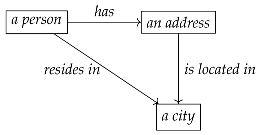 where
The olog represents a functional relation assigning to each person a city in which they live and an equivalence between having an address in a city and residing in that city. Such a diagram illustrates how ologs encode typed relational structures in a simple and intuitive way.
Proposition 1
(Schema-category equivalence). Every categorical schema canonically presents a small category, and every small category arises (up to equivalence) from a categorical schema.
Spivak [9] provides a proof for constructing the schema–category equivalence through freely generating morphisms from paths in the underlying graph and by quotienting the specified path equivalences. Conversely, any small category admits a presentation as a directed graph equipped with relations identifying composable morphisms.
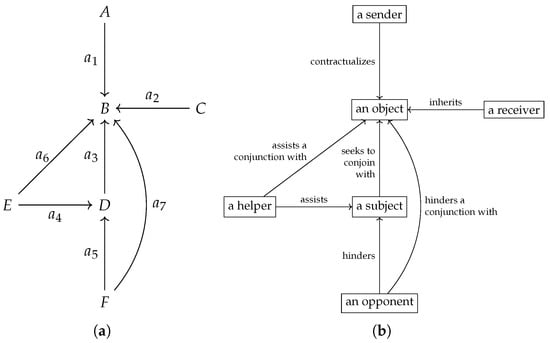
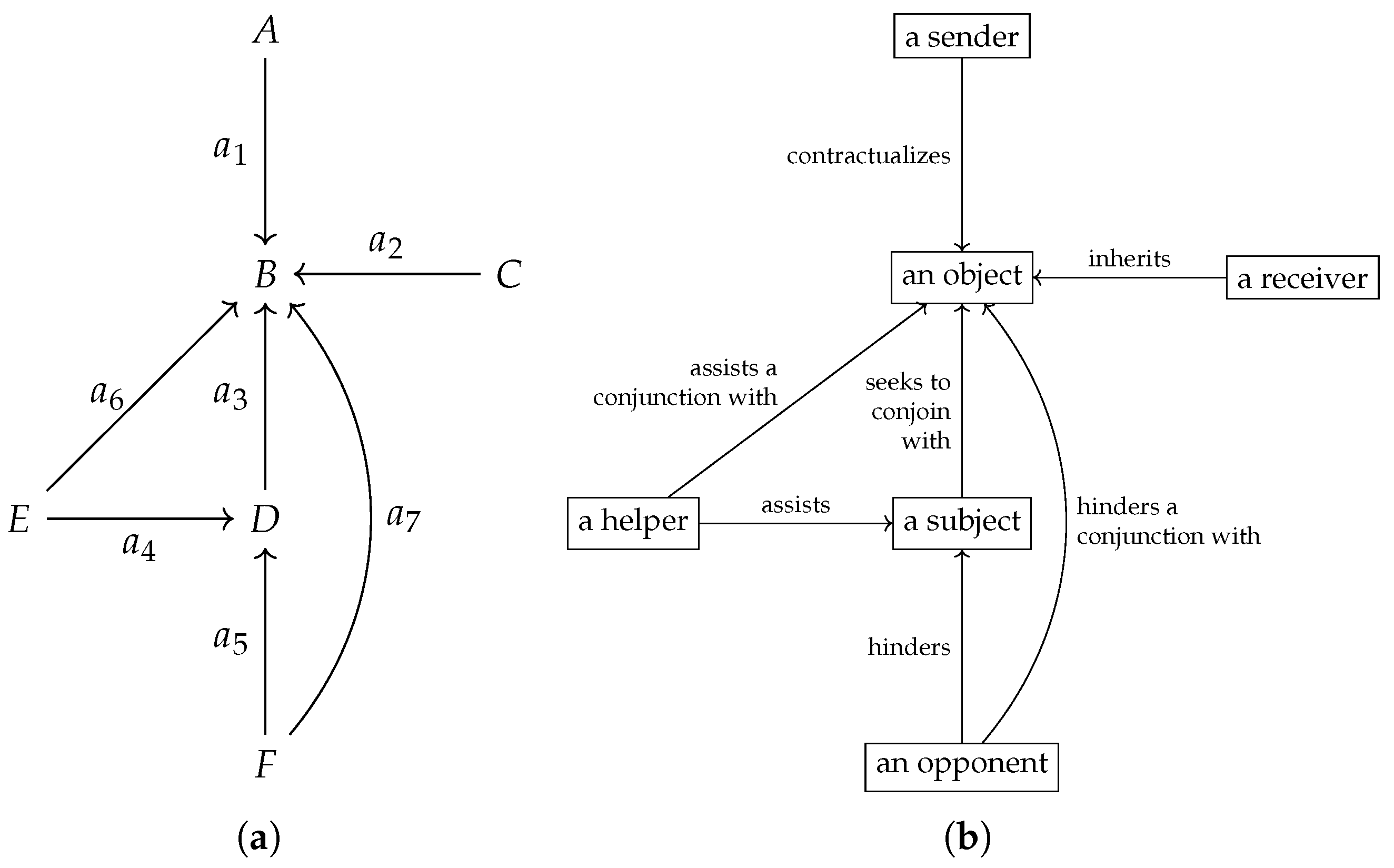
Consider then the categorical schema , and its associated olog we give in Figure 1. The olog provides a means in which to formally type what Greimas identifies as fundamental narrative roles that become associated with particular modalities. These, in turn, drive the action of the discourse through the actions and relations between “Sender”, “Receiver”, “Subject”, “Opponent” and “Helper”. Thus, the status of an actant in a narrative trajectory is a function of its position relative to the other actants and their goals and actions. These actions and their associated goals are structured through syntagms which Greimas further associates to “axes” within the actantial model—essentially sub-schemas of vertices called:
Figure 1.
(a) Categorical schema of the Greimas actantial model with: , and (path equivalences). (b) Ontological log of the categorical schema of the Greimas actantial model such the following equivalences hold: , and .
- ‘the axis of desire’ as {Subject, Object}
- ‘the axis of knowledge’ as {Sender, Object, Receiver}
- ‘the axis of power’ as {Helper, Subject, Opponent}
The focus of the actantial model is thus to move beyond the discursive level and into the narrative level to track the syntagmatic progression. Here, roles are identified not through specific or localized (i.e., context-dependent and instance-level) modalities, but through minimal semantic units that can account for all possible instances of these roles [10] (p. 75). In this way, the model aligns well to a category-theoretic framework of abstraction.
3. The Canonical Narrative Schema
3.1. From Types to Processes
When considered as a typing mechanism rather than a category of processes, the actantial model can be framed as a relational diagram or what Greimas calls an actantial grammar that describes “functional syntactic categories—subject, object, predicate, etc.—which it makes explicit in view of its own construction.” [8] (p. 5). Thus, in order to focus on the dynamics and modalities of a narrative as a “canonical succession of functions organized as programs of actions performed by syntactic subjects” [11] (p. xiii), Greimas required a new analytic framework. This new framework was called the canonical narrative schema (CNS), and sought to account for modalities in a narrative and the logic of a story’s development. Greimas concluded that it was only because of the qualities of intentionality, purpose and finality that the “ultimate coherence of the story and its description” [12] (pp. xi–xii) could be achieved. Subsequently, the CNS was a framework to describe these embedded hypotactic structures while retaining the utility of the actantial grammar.
Greimas proposed a division of any narrative into three hypotactical clusters that each potentially contain a hierarchy of narrative programs (NPs) that emerge through actantial roles (rôles actantiels). These roles, established from the grammar of the actantial model, support a narrative trajectory (parcours narratif) [13] (p. 131). Courtés [14] (p. 100) visualizes the CNS through the following diagram:
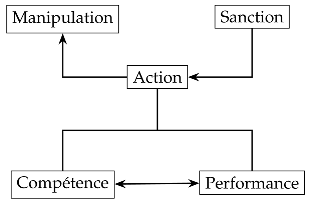
The way in which Greimas moved from the actantial model to the CNS was to identify how three autonomous segments of the narrative syntax—“Manipulation”, “Action” and “Sanction”—inevitably involve a “Sender-manipulator” and “Sender-judge”. These extended roles then account for “a semiotics of action, a semiotics of manipulation, and a semiotics of sanction.” [8] (p. 206). As Hébert [15] (p. 109) notes, in the CNS diagram given in (1), “the arrows indicate presuppositional relations between components; thus, the sanction presupposes the action, but the action does not presuppose the sanction.” We also note that the diagram indicates that the hypotactical cluster of Action establishes a syntagmatic hierarchy such that the clusters of Competence and Performance are considered its fundamental components, with each logically presupposing the other.
The diagrammatic reasoning of the CNS indicates that given the entailment sequence of (Sanction) ⊢ (Action (Performance ⇔ Competence)) ⊢ (Manipulation), it is natural to assume that a normative temporal ordering of the CNS is Manipulation, Action (Performance, Competence) then Sanction. However, as Hébert notes, in semiotics there is a distinction between real (clock) time and thematized time, which in a text “is a representation of real time in a semiotic act.” [15] (p. 110). This leads to the possibility of simultaneities between the activations of the hypotactical clusters or even extended, infinite, or negative time scales or scenarios. This distinction between real and thematized time bears comparison to the notion of internal time in dissipative systems, as developed by Prigogine [16], where temporal order emerges from the dynamics of the system itself rather than from an external clock. Although we do not pursue this analogy further here, it suggests a potential avenue for relating semiotic temporality to broader physical and philosophical accounts of time.
Possibly due to these nuances, Greimas and the Paris School did not develop any further diagrammatic representational tools for accounting for the temporal dimension or the transformation, repetition, conjunction or disjunction of modalities that are tracked through the CNS. Here, we turn to the potential of wiring diagrams, hypergraph categories and operads in order to give a more complete set of tools to properly support the intended application of the CNS to diagramming narrative instances. This pivot also allows for modalities to be formalized uniformly as morphisms acting on actantial configurations, rather than as properties internal to actants themselves.
3.2. Discrete Category of Actants
In order to inform our approach to wiring diagrams based on the syntagmatic relations found in the CNS, we first pass from the actantial model (Figure 1) to the discrete category on its objects. The motivation here is to extract only the objects (types) from the actantial model in order to populate the wiring schema of the CNS. In this way, we mirror how Greimas similarly identified the actantial grammar of the original model as containing the fundamental syntactic objects (actants) of the CNS, for which one associates to them transformations according to various actualizing or virtualizing modalities found in the source text under analysis. Formally, this corresponds to forgetting the morphisms of the category presented by the actantial schema, retaining only its object-level typology.
Definition 3
(discrete category of a schema). Let be a categorical schema with vertex set V. The discrete category associated with , denoted , is the category whose objects are the elements of V and whose only morphisms are identities.
This construction admits an equivalent functorial description. Let denote the category of small categories and functors. There exists a functor
which sends a category to its underlying set of objects, together with a left adjoint
which assigns to each set its discrete category. Applying the composite to the category associated with the actantial schema (Figure 1) yields a discrete category that retains only the actantial roles of the model—Sender, Receiver, Subject, Helper, and Opponent—while forgetting all non-identity morphisms and path equivalences.
Remark 2.
When we refer to the discrete-category construction as left adjoint, we do so at the level of categorical intuition rather than formal development. The functor freely generates a category from a set of actants by adding identities and no nontrivial morphisms. In this sense, the construction preserves only object-level information, and, via the functor , intentionally forgets all non-identity morphisms—that is, it discards the relational structure between actants while retaining only their typological distinction. No properties of the adjunction are used in what follows, and no further functorial machinery is required.
The discrete category on the actantial schema may be understood simply as retaining the list of actantial roles (Sender, Subject, etc.) while discarding all relationships between them. It provides a ‘bare typing layer’ on which more complex structures will later be built. The resulting discrete category thus provides a purely typological layer for actantial roles. It serves as the object-level foundation for the wiring-diagrammatic semantics developed in the following section, where narrative dynamics are reintroduced not through categorical composition, but through symmetric monoidal and operadic structure.
4. Wiring Diagrams and Operadic Structure
We will first introduce wiring diagrams in the context of the actantial model we gave in Figure 1 and our subsequent derivation of the discrete category . We wish to show how the notion of composition, or the combination of elements within a wiring diagram, can motivate an instantiation of a narrative structure and its associated modalities through actorialization, or the establishing of its actors via a unification of semantic and syntactic components [8] (p. 8). Consider the following wiring diagram of :
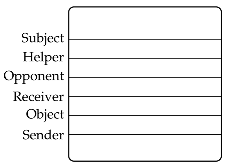
In , we are limited to the types (objects) of the actantial model, which are denoted in a wiring diagram now as edges rather than labeled boxes. The outer box itself is a morphism, and given that there are no boxes contained within it, there can only be found identities on the objects of the category. To mirror how Greimas approached the demarcation of the actantial model into the axes of “desire”, “power”, and “knowledge”, we equip with a symmetric monoidal structure whose monoidal product models the co-presence of actants in a narrative configuration.
Definition 4
(free symmetric monoidal category on actants). Let A be the set of actantial types given by the objects in the discrete category . The free symmetric monoidal category generated by A, denoted , is defined as follows:
- Objects of are finite tensor products of elements of A, including the empty tensor, taken up to associativity and symmetry. Equivalently, objects may be identified with finite multisets of actants.
- The monoidal unit I is the empty tensor.
- The monoidal product ⊗ is given by concatenation of tensors (or multiset union), modulo associativity and symmetry.
- Morphisms of are generated solely by identity morphisms on objects.
In this construction, composite objects such as or represent narrative configurations in which multiple actants are simultaneously present. The symmetric monoidal structure thus formalizes the notion of co-presence central to Greimas’ actantial grammar, while remaining neutral with respect to narrative dynamics. In the wiring diagram of , the semiotic axes are represented as named composite objects on actantial types:
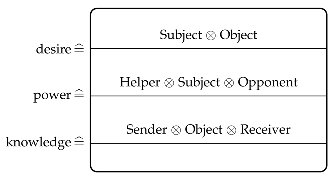
Each axis corresponds to a bundle of parallel wires labeled by the tensor product of its constituent actants, without introducing any non-identity morphisms. These identifications should be understood as interpretations rather than definitions: the tensor product (e.g., Subject ⊗ Object) represents a formal actantial configuration, while labels such as “desire”, “power”, and “knowledge” designate one semantically privileged interpretation of these configurations within Greimas’ framework. Thus, the categorical structure itself does not enforce these identifications.
The category provides the ambient symmetric monoidal structure required for wiring diagrams. At this stage, wiring diagrams consist solely of bundles of parallel wires corresponding to composite actantial configurations. We incorporate narrative dynamics in the next section by adding nontrivial morphisms, yielding structured wiring diagrams that model concrete narrative processes.
Frobenius Structure and Hypergraph Categories
The static actantial configurations found in the free symmetric monoidal category are insufficient to model narrative progression. Narratives contain actorial distributions which entail pragmatic values (objective or subjective), and thus allow roles to be interiorized through a syncretism, or find autonomy through repetition or duplication [8] (p. 8). Roles can thus be merged, split, or deleted according to the actorial typology of the narrative discourse. These operations are informed by what Greimas identified as the bundling of modalities in the hypotactical clusters of Manipulation, Action, Competence, Performance, and Sanction of the CNS. These modalities are classified as follows:
- Actualizing modalities: knowing-how-to-do; being-able-to-do,
- Virtualizing modalities: wanting-to-do; having-to-do,
- Factitive modality: causing-to-do,
- Realizing modalities: being; doing,
for which each modality itself implies the existence of its negation (¬), as well as the further use of the logical operators □ (necessity), and ⋄ (possibility).
In order to model these types of operations diagrammatically, we enrich our symmetric monoidal structure with Frobenius operations, yielding a hypergraph category suitable for representing narrative dynamics.
Definition 5
(special commutative Frobenius structure). Let be a symmetric monoidal category. An object is said to carry a special commutative Frobenius structure if it is equipped with morphisms
 satisfying the Frobenius, associativity, commutativity, and specialness axioms.
Definition 6
(hypergraph category). A hypergraph category is a symmetric monoidal category such that every object is equipped with the structure of a special commutative Frobenius monoid, that is, with morphisms
satisfying the associativity, unitality, commutativity, Frobenius axiom, and specialness axioms. These Frobenius structures are required to be compatible with the symmetric monoidal product, in the sense that for all objects , the induced Frobenius structure on the tensor product agrees with the tensor product of the Frobenius structures on X and Y.
Diagrammatically, this compatibility is expressed by the following equivalences, which state that copying, merging, and deleting composite objects factor through the corresponding operations on their components:
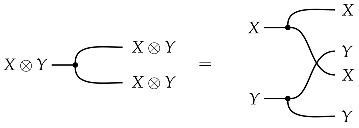
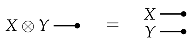
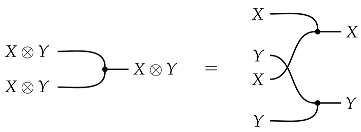

The equations given above are coherence conditions rather than additional axioms: they follow uniquely from the objectwise Frobenius structures together with the symmetric monoidal structure of . In narrative terms, these identities ensure that the duplication, fusion, or elimination of compound actantial configurations is fully determined by the corresponding operations on individual actants.
We also note that throughout this work, modalities (e.g., wanting-to-do, knowing-how-to-do, causing-to-do) are treated formally as typed morphisms in the hypergraph category . Their role as semantic descriptors of actantial configurations should be understood as an interpretative layer applied to these morphisms, rather than as an independent ontological category. In particular, when we speak of modalities as “anchoring” actantial configurations or structuring syntagmatic progression, this refers to the semantic interpretation of morphisms whose domain and codomain are actantial configurations. No additional structure beyond morphisms in is introduced. This distinction ensures that the formal level remains uniform—modalities are always morphisms—while allowing for their semiotic interpretation as components of narrative meaning.
5. An Application to Aesop’s The Fox & the Crow
In order to examine the utility of wiring diagram schematics for semiotic analysis, we pass from the formal categorical construction to its semiotic interpretation in a concrete narrative instance: Aesop’s fable of The Fox & the Crow (Appendix A). The fable is traditionally attributed to Aesop, but is known primarily through later adaptations, most notably Jean de La Fontaine’s Le Corbeau et le Renard. The wide circulation of this fable across linguistic and cultural contexts, including its appearance in late-nineteenth-century Japanese illustrated editions [17], makes it particularly well suited for a structural and diagrammatic analysis that abstracts from stylistic variation.
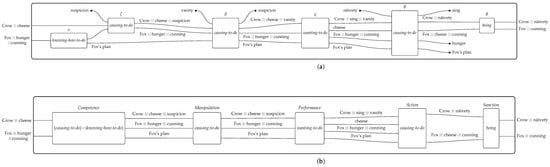
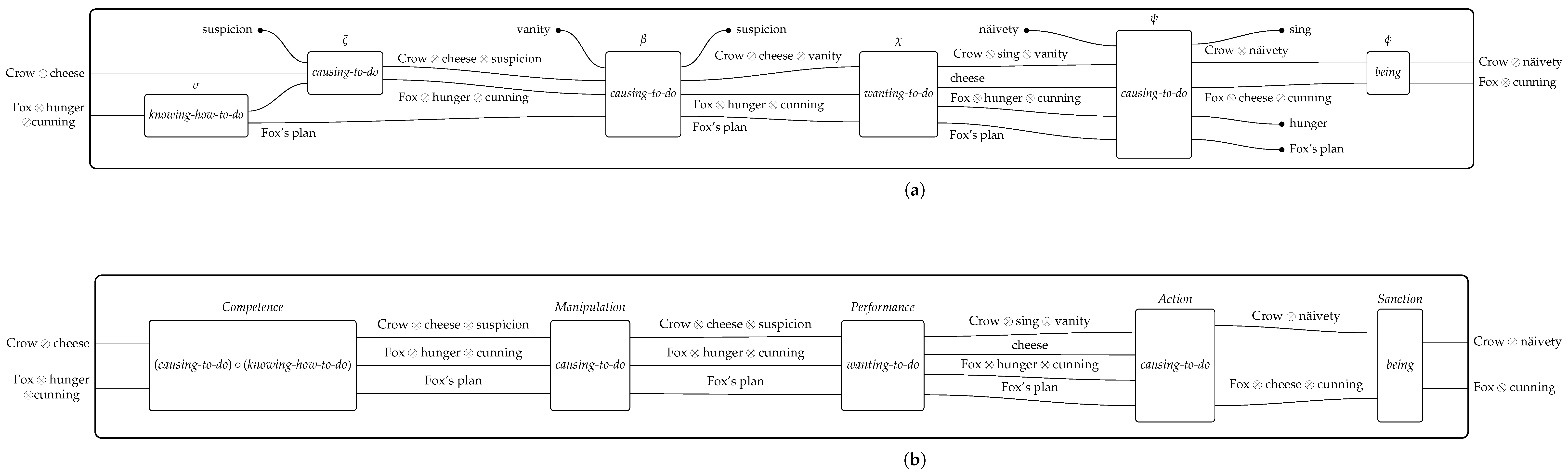
In Figure 2a, we give the wiring diagram that accounts for the actorialization of the fable through its declaration of actualizing and virtualizing modalities. We present the perspective of the Fox as Subject, but treat the modalities of the fable as syntagmatic objects, and therefore descriptive features that demarcate the narrative into underlying hypotactical clusters. We provide composite actantial configurations (e.g., “Fox ⊗ hunger ⊗ cunning”) as atomic narrative resources, and apply Frobenius operations for moments where the discourse itself effects a separation or elimination of roles. In particular, the Frobenius operations of erasure () and instantiation () enable actants such as “hunger” (Sender) or “Fox’s plan” to be closed, accomplished or accounted for, while actants such as “vanity” (Helper) or “suspicion” (Opponent) can be introduced as temporal-dependent appearances, or emanating from environmental or contextual conditions.
Figure 2.
(a). The wiring diagram for The Fox & the Crow, encoding actorialization and modal dynamics via typed morphisms in a hypergraph category, . (b). A factorized abstraction obtained by diagrammatic boxing of connected subdiagrams of , yielding morphisms corresponding to the hypotactical clusters of the canonical narrative schema (Competence, Manipulation, Performance, Action, Sanction). Both diagrams denote morphisms in the same hypergraph category; the lower diagram introduces no additional categorical structure, but represents a higher-level narrative abstraction of the upper diagram.
We also note that although in , the composite actantial object is categorically equivalent to two parallel wires labeled A and B, we use the bundled presentation to indicate a semantically primitive bundle, rather than a result of explicit composition: e.g., the first appearance of the Opponent and Object in the fable as “Crow ⊗ cheese”. This choice of presentation reflects narrative givenness rather than an additional categorical structure. Below, we give an adaptation of Rupel and Spivak’s [18] wiring diagram formalism for typing narrative modalities in a structural semiotics context. Table 1 provides textual references from the source narrative corresponding to the typed morphisms in .
Table 1.
Morphisms found in and their associated modalities and textual references.
Definition 7
(typed wiring diagram box). Let be a hypergraph category whose objects are actantial configurations. A box B in a wiring diagram consists of
- A finite list of input wires ,
- A finite list of output wires ,
- A morphismin ,
- A semantic label indicating the narrative modality or operation represented by the morphism.
5.1. Hypotaxis as Nesting Diagrams
A key advantage of wiring diagrams is their compositionality: any morphism in a hypergraph category may itself be presented as a wiring diagram. This corresponds to the notion in semiotics of hypotaxis, in which through structural organization and syntactic devices, signs and their meanings emerge from hierarchies. Thus, any box in (Figure 2a) may be refined by replacing it with a sub-diagram whose composite morphism is equal to the original box. This allows modal operations to be analyzed through a systematic means for encoding relationships between signs at multiple levels of granularity without altering the global structure of the narrative diagram.
From a categorical perspective, the nesting of wiring diagrams may be understood operadically: each box admits a finite arity of inputs and outputs, and may be substituted by another diagram with matching boundary types. We do not require a formal operad construction here; rather, we exploit the fact that string diagrams in a symmetric monoidal (hypergraph) category naturally support operadic composition. This aligns with the semiotic notion of hypotaxis, in which higher-order narrative functions are refined into hierarchically structured sub-processes. For example, consider the following morphism (cf. Figure 2a):
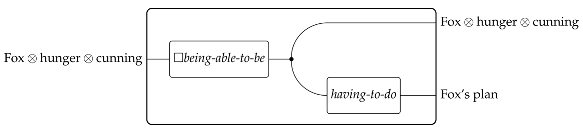
Here, we draw on Frobenius comultiplication () via an internal decomposition in order to refine and qualify semantically the morphism that we labelled knowing-how-to-do. We interpret the modality of ‘knowing-how-to-do’ in terms of a hypotaxis in which the actualizing modality of necessarily-being-able-to-be combines with the deontic virtualizing modality of having-to-do. Thus, the cognitive act of the Fox generating a plan comes from a modal persistence of the composite actantial primitive ‘’ necessitating a having-to-do, the output of which is the actantial object ‘Fox’s plan.’ The Frobenius comultiplication allows us to consider ‘’ as a state of the Subject persisting in time, and it is thus available across different modal evaluations. The refinement of a morphism by a nested wiring diagram in this way does not require a functorial translation, since both diagrams inhabit the same hypergraph category and denote the same composite morphism.
5.2. Obtaining the CNS Through Factorization
Beyond operadic refinement by expansion, wiring diagrams also support an inverse operation of abstraction or factorization. Given a connected subdiagram whose external boundary is fixed, we may box this subdiagram and regard it as a single morphism equal to the composite of its constituent morphisms. Thus, given a wiring diagram in a hypergraph category , any connected subdiagram determines a composite morphism. We may optionally represent such a subdiagram by a single enclosing box, whose inputs and outputs coincide with the boundary of the subdiagram. This operation introduces no new categorical structure, but serves as a semantic abstraction reflecting higher-level narrative organization.
At the formal level, factorization corresponds to identifying composite morphisms in , but at the interpretative level, it can be understood as the emergence of higher-order narrative functions corresponding to the hypotactical clusters of the canonical narrative schema. Consider the wiring diagram we give in Figure 2b. Although and differ diagrammatically, they denote the same morphism in the hypergraph category . The latter is obtained from the former purely by diagrammatic factorization (boxing), introducing no new categorical structure. Here, we have identified morphisms (and their compositions) (cf. Table 1) that align to the higher functions and characteristics that Greimas argues constitute the hypotactical clusters of the CNS. These include:
- . The prerequisites needed to perform the action, including causing-to-do () and knowing-how-to-do ()—the Fox’s cunning and the Crow’s vanity.
- : The component that initiates the action, dealing specifically with the modality of causing-to-do—the Fox’s deception and use of flattery on the Crow.
- : The actual realization of the action, presupposed by Competence and wanting-to-do—the Fox asking the Crow to sing.
- : The central component, representing the main event or goal—the Crow singing (causing-to-do), leading to the loss of the cheese.
- : The final evaluation of the action, determining whether it was successful—the Fox justifies the theft by claiming the Crow received a lesson.
From a semiotic perspective, factorization corresponds to identifying higher levels of modal abstraction. For example, in , the morphisms knowing-how-to-do and causing-to-do, when composed, are abstracted as a single morphism representing the hypotactical cluster of Competence. However, the utility of the Frobenius operations also means that the erasure (), instantiation () or comultiplication () of individual actants can track other narrative dynamics within the trajectory. For example, we see in that within Competence, there is the instantiation of the object “suspicion” acting as an Opponent to the Subject (Fox), which in Manipulation is erased as the Crow (Opponent) is deceived by the Fox. Similarly, Action is predicated on the actant ‘näivety,’ a Helper to the Fox who uses it to fool the Crow into parting with the cheese. Finally, the erasure of the actants “hunger” (Sender) and “Fox’s plan” (Object) signal the end of Action and entailment of Sanction.
5.3. Abstracting up to Discoursivization
We conclude our diagrammatic analysis by abstracting from actantial dynamics to the level of what Greimas and Courtés call “discoursivization.” Here, Greimas and Courtés identify the mechanism by which abstract, underlying semantic structures (such as actantial roles, modalities, or isotopies) become realized in a narrative. This realization is instantiated through “actorialization, temporalization, and spatialization.” [8] (p. 86). Formally, this corresponds to the identification of a composite morphism; interpretatively, it corresponds to the stabilization of actantial identity within discourse.
We introduced the wiring diagram in Figure 2a, and its subsequent factorization along the hypotactical clusters of the canonical narrative schema is presented as in Figure 2b. We define Actorialization to be the boxed composite morphism
whose internal structure consists of the morphisms corresponding to Competence, Manipulation, Performance, Action, and Sanction, and whose boundary coincides with that of . These morphisms jointly mediate between narrative syntax and narrative semantics in the Aesop fable such that semionarrative structures are transformed into discursive structures. Therefore, represents the abstraction of modal and actantial dynamics into a single narrative operation responsible for the constitution and evaluation of actors within the discourse. At this level of abstraction, the internal modal composition of the CNS is no longer foregrounded, but instead encapsulated as a single discursive function. In Greimasian terms, this corresponds to the passage of actants acquiring stability, evaluability, and narrative identity. The wiring diagram formalism makes this abstraction explicit: Actorialization is not a primitive operation, but the result of a structured composition of modal processes that may be expanded or collapsed without altering the external narrative interface.
We note that in the present framework, temporality is modeled externally through morphism composition, such that sequential composition corresponds to the ordering of narrative transformations. This reflects the structuralist distinction between logical and chronological ordering, allowing for flexible interpretations including simultaneity and non-linear sequencing. We do not, at this stage, internalize time as an additional parameter or enrichment of the category (e.g., via indexed categories or temporal logics). Rather, temporal structure emerges from the compositional organization of morphisms. A stronger internalization of temporality—such as equipping with explicit temporal structure—remains a direction for future work.
Discursivization is completed by situating Actorialization within a broader spatio-temporal organization of the narrative. We represent Temporalization as the wiring diagram obtained by composing two morphisms in the hypergraph category : Spatialization, denoted , and Actorialization, denoted . We leave as an opaque morphism in , though contend that in the case of the Aesop fable, it describes the relation of the Subject, Opponent and Object in terms of the setting of the woods, and the tree that the Crow sits in. Our resulting wiring diagram given below thus encodes the integration of actantial constitution and spatio-temporal distribution into a unified discursive process:

Diagrammatically, suggests that the sequential composition of followed by models the discourse of The Fox & the Crow, with boundary wires corresponding to the initial narrative givens (Crow, cheese, Fox)—interpreted actantially as Opponent, Object, and Subject—and their final actantial configurations stabilized actantial configurations (Crow ⊗ näivety, Fox ⊗ cunning). Temporalization thus captures how the composite morphism of abstracts the joint operation by which spatially situated entities are transformed into stabilized narrative actors across time.
6. Conclusions
In this article, we have provided a category-theoretic framework for formalizing the canonical narrative schema (CNS) as a tool to aid narrative analysis. Starting with the Greimas actantial model, we drew on previous work that reconstructed the model and presented it as the categorical schema using the utility of ontological logs of Spivak and Kent. In order to provide an actant-base for our exploration of wiring diagrams for the CNS, we then passed to a discrete category in order to retain only the objects which correspond to actantial types. We then formed the free symmetric monoidal category , whose objects are finite tensor products of actants and whose monoidal structure models their co-presence in narrative configurations. Equipping each object of with a special commutative Frobenius structure yielded a hypergraph category . We then used this hypergraph category as a resource for generating wiring diagrams to explain and reason on aspects of the CNS using the lens of the Aesop fable The Fox & the Crow. This included the wiring diagram and its factorization , both defined as a morphism in , that encode modal transformations and actantial redistribution. Finally, we considered the deepest level hierarchy of narrative structure, or what Greimas and Courtés called discoursivization. Here, we presented discoursivization through a wiring diagram that contains the morphisms of actoralization and spatialization, and uses the actantial instances in the Aesop fable as a case study for tracking narrative trajectories.
The actantial model and the canonical narrative schema have long served as powerful analytic heuristics, but their internal operations, such as modal nesting, abstraction, and role redistribution, are typically described informally. By rendering these operations diagrammatically within a hypergraph categorical framework, we formalize the desire of Greimas to provide an account of how narrative meaning is assembled from simpler components. In particular, our use of wiring diagrams exposes the dual processes of refinement and abstraction that underlie hypotaxis, showing how higher-level narrative functions may be systematically expanded into modal substructures or collapsed into single discursive operations without loss of coherence.
While the present framework is faithful to distinctions already present in Greimassian semiotics, its categorical formulation introduces several analytical advantages. First, it makes compositional structure explicit, allowing complex narrative programs to be systematically decomposed and recomposed via morphism composition and diagrammatic nesting. Second, it provides a notion of structural invariance, whereby different narrative realizations may be identified as equivalent when they correspond to the same morphism in . Third, it enables formal comparison and transformation of narratives, since wiring diagrams admit equivalence, factorization, and substitution operations. The framework also supports computational implementation, as the categorical structures involved are amenable to algorithmic manipulation. These features are not readily available within the classical semiotic apparatus, where such operations remain largely implicit or informal.
Finally, the diagrammatic and compositional nature of the proposed framework opens several directions for future research. Because wiring diagrams admit comparison, reuse, and formal equivalence, they provide a basis for studying narrative variation across texts, genres, or cultural contexts at a structural level—a key concern of structural semiotics. The framework also lends itself naturally to computational implementations, where narrative schemas may be instantiated, transformed, or queried algorithmically. More broadly, by situating the canonical narrative schema within a formally compositional setting, this work suggests a pathway toward integrating structural semiotics with contemporary approaches in knowledge representation, cognitive modeling, and diagrammatic reasoning, while remaining grounded in the interpretive commitments of the Paris School.
Funding
This research received no external funding.
Institutional Review Board Statement
Not applicable.
Informed Consent Statement
Not applicable.
Data Availability Statement
The original contributions presented in this study are included in the article. Further inquiries can be directed to the corresponding author.
Conflicts of Interest
The author declares no conflicts of interest.
Appendix A. The Fox & the Crow
One bright morning as the Fox was following their sharp nose through the wood in search of a bite to eat, he saw a Crow on the limb of a tree overhead. This was by no means the first Crow the Fox had ever seen. What caught their attention this time and made them stop for a second look, was that the lucky Crow held a bit of cheese in her beak. “No need to search any farther,” thought sly Master Fox. “Here is a dainty bite for my breakfast.” Up he trotted to the foot of the tree in which the Crow was sitting, and looking up admiringly, he cried, “Good-morning, beautiful creature!” The Crow, her head cocked on one side, watched the Fox suspiciously. However, she kept her beak tightly closed on the cheese and did not return their greeting. “What a charming creature she is!” said the Fox. “How her feathers shine! What a beautiful form and what splendid wings! Such a wonderful Bird should have a very lovely voice, since everything else about her is so perfect. Could she sing just one song, I know I should hail her Queen of Birds.” Listening to these flattering words, the Crow forgot all her suspicion, and also her breakfast. She wanted very much to be called Queen of Birds. So she opened her beak wide to utter her loudest caw, and down fell the cheese straight into the Fox’s open mouth. “Thank you,” said Master Fox sweetly, as he walked off. “Though it is cracked, you have a voice sure enough. However, where are your wits?” The flatterer lives at the expense of those who will listen to them [19].
References
- Trifonas, P.P. From Semantics to Narrative: The Semiotics of A. J. Greimas. In International Handbook of Semiotics; Trifonas, P.P., Ed.; Springer Science+Business Media: Dordrecht, The Netherlands, 2015; pp. 1099–1107. [Google Scholar]
- Greimas, A.J.; Rastier, F. The Interaction of Semiotic Constraints. Yale Fr. Stud. 1968, 41, 86–105. [Google Scholar] [CrossRef] [Scilit]
- Propp, V. Theory and History of Folklore; Liberman, A., Ed.; University of Minnesota Press: Minneapolis, MN, USA, 1984. [Google Scholar]
- Dosse, F. History of Structuralism: The Rising Sign, 1945–1966; Contradictions of Modernity Series; University of Minnesota Press: Minneapolis, MN, USA, 1997. [Google Scholar]
- Spivak, D.I. Category Theory for Sciences; MIT Press: Boston, MA, USA, 2014. [Google Scholar]
- Lawvere, F.; Schanuel, S. Conceptual Mathematics: A First Introduction to Categories; Cambridge University Press: Cambridge, UK, 2009. [Google Scholar]
- Spivak, D.I.; Kent, R.E. Ologs: A categorical framework for knowledge representation. PLoS ONE 2012, 7, e24274. [Google Scholar] [CrossRef] [Scilit] [PubMed]
- Greimas, A.J.; Courtés, J. Semiotics and Language: An Analytical Dictionary; Crist, L.; Patte, D.; Lee, J.; McMahon, E., II; Phillips, G.; Rengstorf, M., Translators; Indiana University Press: Bloomington, IN, USA, 1979. [Google Scholar]
- Spivak, D.I. Functorial Data Migration. arXiv 2010, arXiv:1009.1166. [Google Scholar] [CrossRef] [Scilit]
- Moto, S.G. The actantial model. S. Afr. J. Afr. Lang. 2001, 21, 75–79. [Google Scholar] [CrossRef] [Scilit]
- Perron, P.; Collins, F. Paris School Semiotics; John Benjamins Publishing Co.: Amsterdam, The Netherlands, 1989. [Google Scholar]
- Budniakiewicz, T. Fundamentals of Story Logic: Introduction to Greimassian Semiotics; Perron, P., Ed.; John Benjamins Publishing Co.: Amsterdam, The Netherlands, 1992. [Google Scholar]
- Wagner, E.S. Narrativity, Coherence and Literariness: A Theoretical Approach with Analyses of Laclos, Kafka and Toussaint; Narratologia, De Gruyter: Berlin, Germany, 2020. [Google Scholar]
- Courtés, J. Analyse Sémiotique du Discours: De L’énoncé à L’énonciation; Hachette: Paris, France, 1991. [Google Scholar]
- Hébert, L. An Introduction to Applied Semiotics: Tools for Text and Image Analysis; Routledge: London, UK, 2020. [Google Scholar]
- Prigogine, I. From Being to Becoming: Time and Complexity in the Physical Sciences; W. H. Freeman and Company: San Francisco, CA, USA, 1980. [Google Scholar]
- La Fontaine, J.d. Choix de Fables de La Fontaine: Illustrées par un Groupe des Meilleurs Artistes de Tokio, 1st ed.; Imprimerie de Tsoukidji-Tokio: Tokyo, Japan, 1894. [Google Scholar]
- Rupel, D.; Spivak, D.I. The operad of temporal wiring diagrams: Formalizing a graphical language for discrete-time processes. arXiv 2013, arXiv:1307.6894. [Google Scholar]
- Aesop. Aesop’s Fables: A New Revised Version from Original Sources; Dodo Press: Gloucestershire, UK, 2009. [Google Scholar]

Disclaimer/Publisher’s Note: The statements, opinions and data contained in all publications are solely those of the individual author(s) and contributor(s) and not of MDPI and/or the editor(s). MDPI and/or the editor(s) disclaim responsibility for any injury to people or property resulting from any ideas, methods, instructions or products referred to in the content. |
© 2026 by the author. Licensee MDPI, Basel, Switzerland. This article is an open access article distributed under the terms and conditions of the Creative Commons Attribution (CC BY) license.