1. Introduction: Technological Paradigms and Inferential Rationality
The successive configurations of industrial production commonly designated as Industry 3.0, 4.0, 5.0, and 6.0 are typically understood as technological evolutions driven by specific enabling technologies: programmable logic controllers and automation (3.0), cyber-physical systems and Internet of Things (4.0), human–robot collaboration and sustainability imperatives (5.0), and artificial general intelligence and conscious adaptive systems (6.0) [
1]. While this techno-centric interpretation correctly identifies the material substrate of each configuration, it fails to grasp their deeper epistemological significance. This paper proposes an alternative reading: each industrial paradigm instantiates and privileges a distinctive form of inferential rationality—a specific mode of reasoning about production, optimization, and possibility.
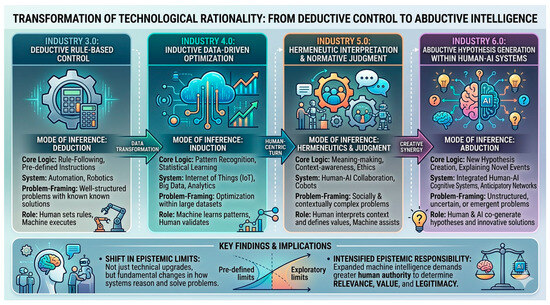
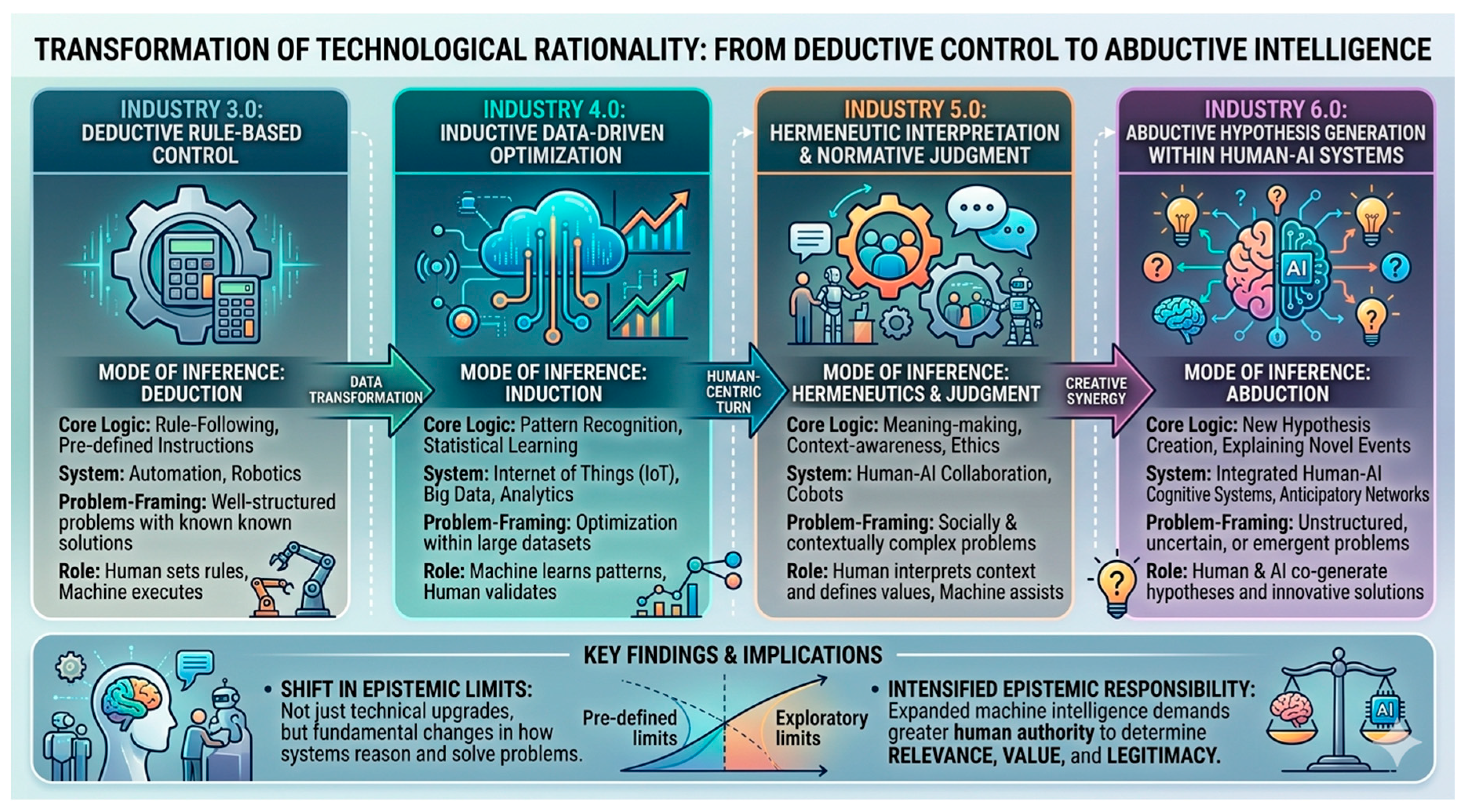
Our thesis is that Industry 3.0 embodies deductive rationality, Industry 4.0 inductive generalization, Industry 5.0 hermeneutic interpretation, and Industry 6.0 abductive hypothesis generation. This progression is not arbitrary but structurally necessary: each paradigm emerges in response to epistemic limitations inherent in its predecessor. The transitions between paradigms exhibit the characteristic dynamics of Kuhnian scientific revolutions: periods of ‘normal manufacturing’ during which problems are solved within established frameworks, followed by accumulation of anomalies, crisis, and paradigm shift [
2]. However, unlike scientific revolutions, industrial paradigm shifts do not render previous approaches obsolete but rather integrate them within expanded frameworks of possibility.
1.1. The Kuhnian Framework Applied to Technology
Thomas Kuhn’s
The Structure of Scientific Revolutions (1962) introduced the concept of
paradigm to describe the theoretical and methodological configurations orienting scientific inquiry during periods of “normal science,” punctuated by phases of crisis in which accumulating anomalies motivate paradigm change [
2]. Giovanni Dosi (1982) extended this framework to technological development, proposing that
technological paradigms consist of shared models of relevant problems and solution strategies that structure trajectories of incremental innovation [
3]. In Dosi’s formulation, a technological paradigm “defines contextually the needs that are meant to be fulfilled, the scientific principles utilized for the task, and the material technology to be used” (p. 152).
In applying Kuhn’s framework to industrial and technological change, however, it is necessary to adopt a heuristic and analogical interpretation, rather than a literal one. Unlike scientific revolutions, industrial paradigms do not exhibit strong incommensurability or wholesale replacement. Instead, they evolve through layered recombination, sectoral heterogeneity, and uneven diffusion over time. Legacy technologies and emerging configurations routinely coexist within the same industrial ecosystems. For this reason, the present analysis assumes hybridity by default: different inferential modes and technological logics operate simultaneously, while one becomes institutionally dominant in shaping investment priorities, governance structures, and problem framing. This qualified use of Kuhn therefore does not endorse a strong discontinuist or irrationalist account of paradigm transition; rather, it remains compatible with partial continuity, rational carry-over, and cumulative recombination across industrial configurations.
Within this qualified Kuhnian perspective, the notion of incommensurability retains analytical value when interpreted epistemically rather than ontologically. Successive industrial paradigms do not merely provide improved solutions to identical problems; they reconstitute what counts as a legitimate problem, which variables are deemed relevant, and which forms of evidence and performance are considered acceptable. From this viewpoint, Industry 4.0 does not simply enhance Industry 3.0 by executing the same optimization tasks more efficiently. It redefines optimization itself, privileging data-driven pattern recognition, probabilistic learning, and algorithmic inference over rule-based deductive control.
Recent institutional analyses support this interpretation. As Rejeb et al. (2025) demonstrate in their systematic review [
4], Industry 4.0 and Industry 5.0 function as
rational myths rather than purely technical-economic constructs, emerging from discursive processes shaped by institutional pressures, stakeholder interactions, and shared meanings [
5,
6]. This reinforces the idea that industrial paradigms should be understood not as deterministic technological stages, but as historically situated configurations in which specific forms of rationality become dominant, while others persist in hybrid and subordinate roles.
1.2. Forms of Rationality and Inferential Modes
To understand paradigms as forms of rationality requires clarifying what we mean by ‘inferential modes.’ Following Peirce (1903), we distinguish three fundamental types of ampliative reasoning [
7]. Deduction explicates what is implicit in premises but introduces no new content: given rules and initial conditions, it derives necessary consequences. Induction generalizes from observed regularities to universal laws but remains bounded by empirical experience. Abduction—what Peirce termed ‘the logic of discovery’—generates explanatory hypotheses that transcend available data, introducing genuinely novel concepts. As Peirce wrote, abduction is ‘the only logical operation that introduces any new idea’ (CP 5.172).
These inferential modes correspond to distinct epistemic attitudes toward the domain of production. Deductive rationality treats the production domain as fully specifiable a priori through explicit rules; inductive rationality discovers regularities through systematic observation; hermeneutic rationality interprets situated meanings; abductive rationality generates novel possibilities. Each industrial paradigm, we argue, embodies one of these attitudes as its dominant epistemology, though never to the complete exclusion of others. A crucial methodological clarification: these inferential modes do not replace one another in evolutionary succession. Rather, paradigms reconfigure which mode of reasoning becomes dominant and institutionally privileged. Industry 3.0 manufacturing still requires inductive quality control and abductive troubleshooting; Industry 4.0 systems still execute deductive algorithms and require hermeneutic interpretation of results. What changes is the paradigm’s characteristic epistemology—the inferential form that structures how problems are framed, what counts as legitimate knowledge, and which problem-solving strategies receive investment and authority. Abduction in Industry 6.0 does not supplant deduction, induction, or hermeneutics; it reconfigures their relationship within a system privileging hypothesis generation and possibility exploration. This non-linear, recombinatory dynamic prevents our analysis from collapsing into technological progressivism, where later paradigms are simply ‘better’ than earlier ones.
Table 1 provides a schematic overview of the four industrial paradigms analyzed in this paper, summarizing their characteristic inferential modes, epistemic strengths, structural limitations, and crisis triggers. Hermeneutic rationality does not replace inferential logic; rather, it conditions it by determining, in context, what counts as relevant, permissible, and meaningful for optimization. Accordingly, any abductive Industry 6.0 scenario must be understood as building on—rather than superseding—the hermeneutic governance constraints foregrounded by Industry 5.0.
1.3. Methodology: Conceptual Analysis and Empirical Integration
This study adopts a conceptual–philosophical methodology informed by empirical literature, rather than a systematic or bibliometric review. Its primary aim is to clarify how successive industrial paradigms can be interpreted as configurations of rationality, not to exhaustively map or quantify the existing research landscape. Following Kuhn [
2] and Dosi [
3], industrial paradigms are treated as theoretical–methodological orientations that shape how manufacturing problems are defined and addressed. Peircean inferential logic [
7] provides the analytical lens through which these paradigms are examined.
The mapping of deduction, induction, hermeneutics, and abduction onto Industry 3.0 to 6.0 emerges through an iterative interpretive process rather than through a priori classification. This process consists of analyzing dominant technological configurations, identifying characteristic problem-solving strategies, extracting implicit epistemic commitments, and comparing these patterns with established philosophical categories of reasoning. The analysis does not assume that a single inferential mode exhaustively characterizes any industrial paradigm. Instead, it identifies the dominant form of rationality shaping decision-making, legitimacy, and problem framing within each configuration, while acknowledging the coexistence of multiple inferential logics in practice.
Empirical literature plays a supporting and validating role, rather than serving as the primary object of analysis. Peer-reviewed sources were identified through targeted searches in Scopus and Web of Science covering the period 2018–2025, complemented by European Commission policy documents and foundational philosophical texts. Search terms included combinations of Industry 4.0, Industry 5.0, Industry 6.0, cognitive manufacturing, human-centric manufacturing [
6], and artificial intelligence, together with epistemological concepts such as rationality, abduction, and epistemic responsibility. Sources were selected for their relevance to industrial practice, conceptual clarity, and capacity to illuminate the epistemic characteristics of specific paradigms, rather than through formal inclusion–exclusion criteria. To enhance transparency, the analytical procedure proceeded in five explicit steps:
- (1)
identification of the dominant technological substrate associated with each paradigm;
- (2)
analysis of how each configuration frames manufacturing problems and solution strategies;
- (3)
reconstruction of the implicit epistemological assumptions underlying these practices;
- (4)
comparison of these assumptions with Peirce’s categories of inference; and
- (5)
qualitative validation of the proposed mapping against documented industrial practices, noting both alignments and tensions [
7].
This stepwise procedure reduces the risk of circular reasoning by allowing empirical anomalies and counterexamples to challenge and refine the initial conceptual mapping, rather than merely illustrating it. This approach has clear limitations. Paradigms are treated as ideal types; real manufacturing systems exhibit hybrid rationalities and gradual transitions. Industry 6.0 remains largely speculative, requiring philosophical extrapolation rather than empirical generalization. Finally, the analysis reflects interpretive judgment and focuses primarily on European and North American contexts, implying potential selection bias in the empirical corpus. These limits notwithstanding, the methodology is appropriate for uncovering the epistemological structure of industrial change and foregrounding epistemic responsibility as the central philosophical issue in human–AI manufacturing systems.
2. Industry 3.0: The Paradigm of Deductive Control
Industry 3.0, conventionally dated from the 1970s onward, marks the digital transformation of manufacturing through programmable automation. Technologically characterized by programmable logic controllers (PLCs), computer-aided design and manufacturing (CAD/CAM), and early industrial robotics, its deeper significance lies in instantiating a specific form of rationality: deductive control through programmed rule-following.
2.1. The Cartesian-Taylorist Synthesis
The philosophical foundations of Industry 3.0 lie in Cartesian rationalism and Taylorist scientific management. René Descartes envisioned a mathesis universalis—a universal mathematics through which all phenomena could be represented by explicit propositions and manipulated through formal rules. This dream found organizational expression in Frederick Taylor’s Principles of Scientific Management (1911), which decomposed work processes into elementary operations, determined optimal procedures through time-motion studies, and enforced strict separation between planning (management’s domain) and execution (workers’ domain) [
8]. As Kovacs (2018) observes in his critical analysis of Industry 4.0’s ‘dark corners,’ this separation between intellectual and manual labor reflects deeper assumptions about knowledge, control, and human agency [
9].
Industry 3.0 represents the technological realization of Taylorism: the transformation of procedural knowledge into executable code. The PLC does not think about what it does; it follows programmed instructions with perfect fidelity. The rationality is purely deductive: given initial conditions (sensor inputs) and transformation rules (program logic), the system derives necessary outputs. The manufacturing floor becomes, ideally, a domain of perfect transparency—a space where all relevant variables are monitored, all transformations are pre-specified, and deviation signals malfunction requiring human intervention.
2.2. Philosophical Genealogy of Programmed Rationality
The trajectory from Cartesian rationalism to contemporary programmable logic controllers represents intellectual continuity spanning four centuries. Descartes’s mathesis universalis—the dream of reducing all reasoning to calculation—found expression in Leibniz’s calculus ratiocinator, which imagined a universal characteristic language enabling mechanical resolution of disputes through computation. As Leibniz wrote, disputants would say ‘let us calculate’ rather than argue, transforming philosophy into mathematics [
10]. This rationalist vision encountered technological instantiation in Charles Babbage’s analytical engine (1837), the first programmable computer, designed to execute any calculable function through mechanical rule-following.
What Descartes, Leibniz, and Babbage imagined for intellectual work, Frederick Taylor systematically applied to manual labor. Scientific management decomposed craft knowledge into elementary operations, determined optimal procedures through systematic measurement, and eliminated worker discretion through rigid procedural specification. The Ford assembly line realized this vision materially: workers became interchangeable components executing pre-defined motions, their skill reduced to programmable routine. As Noble (reprint 2011) documents in his social history of industrial automation [
11], this ‘Taylorization’ of manufacturing reflected not mere efficiency but control—managerial appropriation of knowledge previously embedded in worker expertise.
Industry 3.0 represents the cybernetic completion of this genealogy. The PLC synthesizes Cartesian formalization, Leibnizian calculation, Babbage’s programmability, and Taylorist control into integrated manufacturing systems. Yet as Dreyfus (1972) argued in his critique of artificial intelligence [
12], this rule-based approach confronts fundamental limits [
13]. Human expertise—the machinist’s feel for material, the quality inspector’s pattern recognition, and the troubleshooter’s diagnostic intuition—resists formalization because it depends on embodied, situational know-how rather than explicit propositional knowledge. This limitation becomes acute when manufacturing confronts novelty, variability, or complexity exceeding parametric specification. Industry 3.0’s brittleness reflects not technological immaturity but epistemological constraint: deduction cannot generate genuinely new knowledge.
2.3. The Toyota Paradox: Lean Manufacturing as Tacit Critique
The limitations of rigid deductive control became visible through lean manufacturing’s alternative approach [
14]. While Industry 3.0 pursued maximal automation and worker de-skilling, the Toyota Production System emphasized flexible automation and worker empowerment. The andon cord—enabling any worker to halt production upon detecting problems—exemplifies recognition that quality requires interpretive intelligence irreducible to algorithmic rules. Toyota’s success demonstrated that manufacturing excellence cannot be exhaustively pre-specified; manufacturing excellence requires not just procedural execution but continuous improvement (kaizen), problem-solving (genchi genbutsu), and respect for worker knowledge (jidoka). These practices presuppose epistemic humility: acknowledging that formal systems cannot capture tacit knowledge, that environments are too variable for complete specification, and that learning requires experimentation beyond deductive derivation.
2.4. Epistemic Strengths: Reproducibility and Local Optimization
The deductive paradigm exhibits characteristic strengths. First, perfect reproducibility: identical inputs and programs yield identical outputs, enabling mass production of standardized goods with minimal variation. Second, predictability: given complete specification of initial states, future states can be calculated with certainty. Third, local optimizability: within well-defined parameter spaces, mathematical optimization techniques identify maxima and minima. These capabilities made Industry 3.0 extraordinarily effective for mass production scenarios where product specifications were stable, demand was predictable, and competitive advantage derived from cost minimization through economies of scale.
2.5. Structural Limitations and Emergent Anomalies
However, the deductive paradigm confronts structural limitations. First, rigidity: reprogramming automated systems requires significant downtime and specialized expertise. As markets shift toward mass customization and shorter product lifecycles, this inflexibility becomes problematic. Second, brittleness: when encountering conditions not anticipated in their programs, automated systems cannot adapt autonomously but must halt and await human intervention. Third, and most fundamentally, the impossibility of generating novelty: deduction is conservative, explicating but not amplifying content. As recent analysis of Industry 3.0 to 4.0 transitions confirms, ‘the real difference between Industry 3.0 and I4.0’ lies precisely in the shift from programmed execution to intelligent autonomous adaptation through real-time data analysis [
15].
These limitations manifest as anomalies within the deductive paradigm. Manufacturing systems optimized for stable, high-volume production prove inadequate for volatile, variety-demanding markets. The accumulation of such anomalies creates conditions for a paradigm crisis and eventual transition to Industry 4.0.
3. Transition from Industry 3.0 to Industry 4.0: Crisis of Deductive Control
The crisis precipitating Industry 4.0’s emergence is fundamentally epistemological rather than merely technological. Industry 3.0 does not fail because PLCs malfunction or computational power proves insufficient. Rather, it confronts a limit inherent to deductive rationality: the impossibility of pre-specifying all relevant variables in complex, volatile environments. What cannot be done within the deductive paradigm is not ‘better programming’ or ‘more sensors’ but something deduction logically excludes: discovering which variables matter without knowing in advance what to look for. This is why the transition requires a different inferential mode—induction’s capacity to identify correlations in high-dimensional data spaces without presupposing causal structure. The technological innovations of Industry 4.0 (cyber-physical systems, IoT, machine learning) are enabling conditions, but the paradigm shift itself is epistemic: from presuming manufacturing knowledge can be specified a priori to accepting it must be learned through systematic empirical inquiry.
The transition from Industry 3.0 to 4.0 exemplifies Kuhnian revolutionary dynamics. Three convergent factors precipitate crisis: increasing market demand for product variety and customization, emergence of enabling technologies (ubiquitous sensing, wireless connectivity, and distributed computing), and recognition that relevant variables cannot all be pre-specified. A comprehensive review of 244 peer-reviewed articles from Scopus confirms that Industry 4.0 represents not mere technological upgrading but fundamental reconceptualization of manufacturing’s ontology and epistemology [
16].
Philosophically, this transition marks the shift from Cartesian rationalism to empiricism. Where Industry 3.0 presumed that optimal procedures could be determined a priori through analysis and implemented through programming, Industry 4.0 recognizes that optimization requires learning from experience—that is, inductive generalization from operational data. The locus of intelligence shifts from pre-programmed rules to discovered patterns.
3.1. Industrial Anomalies: Documented Failures of Deductive Control
The crisis of deductive manufacturing control did not emerge from isolated technological failures but from a growing accumulation of structural anomalies that rigid rule-based systems proved unable to absorb. During the late 1990s and early 2000s, several industrial sectors encountered limits that could not be resolved through improved programming or incremental automation but pointed instead to an epistemic mismatch between deductive control and increasingly complex production environments.
A first class of anomalies concerned mass customization in automated manufacturing systems. As product variety increased and customers demanded individualized configurations, highly automated production lines—originally designed for stable product architectures—encountered combinatorial complexity that exceeded feasible pre-specification. Empirical studies in automotive and high-volume manufacturing document how configuration proliferation disrupted scheduling, quality assurance, and throughput in rigidly programmed systems, revealing the limits of deductive control in environments characterized by high variability and short product life cycles [
17]. The difficulty was not technical insufficiency, but the impossibility of exhaustively enumerating relevant production states in advance.
A second anomaly class involved supply-chain brittleness in globally distributed production networks. Large-scale disruption events in the early 2010s exposed the fragility of tightly optimized, rule-driven supply chains. Empirical analyses of industrial disruptions demonstrate how unexpected environmental and geopolitical shocks propagated non-linearly across manufacturing systems, producing cascading failures that deductive planning models could neither anticipate nor adapt to in real time [
5]. These events revealed a structural assumption embedded in Industry 3.0 systems: environmental stability and enumerability of relevant contingencies—assumptions increasingly violated in real-world production ecosystems.
A third anomaly emerged in complex process industries, where production outcomes depended on high-dimensional, non-linear interactions among parameters that could not be fully specified ex ante. Semiconductor manufacturing and advanced materials processing provide well-documented examples in which deductive process control proved insufficient to manage yield variability, despite extensive modeling and automation. In such contexts, relevant causal factors often become visible only through post hoc pattern detection rather than prior specification.
Taken together, these anomalies exposed a fundamental epistemic limitation of the deductive paradigm: rule-based control presupposes that relevant variables and their relations can be identified in advance. When this presupposition fails—due to combinatorial complexity, environmental volatility, or opaque causal structures—deductive systems become brittle rather than intelligent. It is precisely this failure that motivates the transition toward inductive, data-driven rationality in Industry 4.0, where learning from empirical variation replaces exhaustive prior specification as the dominant epistemic strategy.
3.2. The Epistemological Significance of Industry 4.0’s Inductive Turn
The transition to data-driven manufacturing represents more than a technological upgrade; it marks an epistemological revolution comparable to empiricism’s challenge to rationalism in seventeenth-century philosophy. Where Descartes presumed knowledge derives from reason analyzing clear and distinct ideas, empiricists like Locke and Hume insisted experience provides knowledge’s foundation. Industry 3.0 embodies rationalist confidence: optimal procedures can be determined a priori through analysis. Industry 4.0 instantiates empiricist humility: knowledge emerges through systematic observation, generalizing patterns discovered in data. This shift parallels Quine’s critique of the analytic-synthetic distinction in ‘Two Dogmas of Empiricism’ (1951). Quine argued that no sharp boundary separates truths of meaning (analytic) from truths of fact (synthetic); even logic and mathematics are empirically revisable [
18]. Similarly, Industry 4.0 dissolves the presumed boundary between engineering design (determining procedures through analysis) and operational learning (adjusting procedures through experience). Cyber-physical systems continuously revise their ‘knowledge’ based on empirical performance, treating even fundamental process models as hypotheses subject to data-driven refinement [
19].
While this philosophical analogy clarifies the epistemological novelty of Industry 4.0, it remains necessary to show how this inductive turn emerged as a response to concrete failures of deductive control in manufacturing practice. The following section addresses this issue by grounding the transition from Industry 3.0 to Industry 4.0 in documented industrial anomalies and operational breakdowns.
3.3. From Deductive Control to Inductive Learning: Empirical Signals of an Epistemic Crisis
The transition from Industry 3.0 to Industry 4.0 can be empirically interpreted as a response to the epistemic limits of deductive control under conditions of increasing variability, complexity, and uncertainty. Industry 3.0 manufacturing systems, grounded in programmable logic controllers (PLCs), CAD/CAM integration, and rule-based automation, presupposed a production environment in which relevant variables could be exhaustively specified ex ante and stable causal relations could be encoded into deterministic control logics. Within such systems, performance deviations were typically addressed through predefined rules, tolerance thresholds, and corrective procedures derived deductively from engineering models.
However, a growing body of empirical literature documents how this deductive architecture became increasingly brittle as manufacturing environments evolved. Studies on mass customization, flexible production, and globally distributed supply chains report recurrent failures of rule-based control systems to cope with high product variety, stochastic disturbances, and context-sensitive interactions among machines, materials, and human operators [
7]. In these settings, anomalies no longer appeared as isolated exceptions but as systematic mismatches between predefined models and observed behavior.
Empirical evidence from smart manufacturing and cyber-physical production systems highlights several recurring patterns. First, the combinatorial explosion of process states rendered exhaustive rule specification impractical. Second, latent interactions among variables produced outcomes that were not predictable from local process models alone. Third, disturbances propagated non-linearly across tightly coupled systems, undermining the assumption that local corrective actions would restore global stability. These phenomena are widely reported in studies on predictive maintenance, real-time quality control, and adaptive scheduling, where traditional deductive approaches proved insufficient to anticipate or explain emergent behaviors [
7].
Crucially, these failures cannot be reduced to purely technical shortcomings or organizational inertia. Rather, they reveal a structural epistemic limitation: deductive control presupposes that the space of relevant states and causal relations is known in advance. When this condition is violated, increasing rule complexity does not restore control but amplifies fragility. The industrial response documented in the literature was not the abandonment of automation but a shift toward inductive learning architectures capable of extracting regularities directly from operational data. Machine learning models, statistical pattern recognition, and data-driven optimization emerged precisely to address situations in which explicit rules could no longer be specified exhaustively. Industry 4.0 thus represents not merely a technological intensification of automation but an epistemological reconfiguration. Decision-making authority shifts from predefined rules to probabilistic models trained on historical and real-time data. Validity is no longer grounded primarily in logical derivation from first principles but in predictive performance and statistical generalization. This inductive turn explains both the empirical success of Industry 4.0 applications and their well-documented limitations, particularly their dependence on data quality, historical representativeness, and the opacity of learned models.
By grounding the 3.0 → 4.0 transition in documented failures of deductive control under real manufacturing conditions, this analysis supports the claim that industrial paradigm shifts are driven not only by technological opportunity but also by epistemic crises in dominant forms of rationality. This empirical anchoring also provides a benchmark for evaluating subsequent transitions, clarifying why inductive optimization itself eventually encounters limits that motivate the hermeneutic and abductive reconfigurations discussed in later sections.
4. Industry 4.0: The Paradigm of Inductive Optimization
Industry 4.0, formalized in Germany’s 2011 high-tech strategy and rapidly adopted globally, instantiates inductive rationality. Its technological substrate—cyber-physical systems, Internet of Things, cloud computing, big data analytics, and machine learning—enables continuous collection, transmission, and analysis of operational data. But the paradigm’s significance lies not in these technologies per se but in the epistemological transformation they enable: from execution of pre-programmed rules to discovery of patterns through data-driven learning.
4.1. Data-Driven Epistemology and Empiricist Foundations
The philosophical foundation of Industry 4.0 is empiricist epistemology, particularly the inductive logic articulated by John Stuart Mill. In A System of Logic (1843), Mill argued that substantive knowledge derives from experience through inductive generalization: observing that all examined instances of A have been followed by B, we infer (with probability but not certainty) that all A will be followed by B [
20]. Industry 4.0 applies this principle systematically: manufacturing systems continuously observe correlations between process parameters and outcomes, generalize these correlations into predictive models, and adjust parameters to optimize performance.
As Klingenberg et al. (2019) document in their systematic literature review, Industry 4.0 is fundamentally ‘a data-driven paradigm’ where decisions emerge from algorithmic analysis of operational data rather than from pre-specified procedures [
21]. Recent artificial intelligence applications in Industry 4.0 contexts demonstrate this transformation: manufacturing systems now employ predictive maintenance algorithms, real-time scheduling optimization, computer vision quality control, and adaptive supply chain management—all instantiating inductive inference from historical and real-time data to operational decisions [
22].
4.2. The Cyber-Physical System as Learning Environment
The cyber-physical system (CPS)—Industry 4.0’s paradigmatic artifact—embodies this inductive logic. A CPS integrates computational, networking, and physical components in feedback loops, enabling continuous sensing, analysis, and adaptation. Unlike the programmed automaton of Industry 3.0, the CPS does not merely execute instructions but learns from experience. Through machine learning algorithms, it identifies patterns in sensor data, predicts future states, and adjusts control parameters. The manufacturing environment becomes not a pre-programmed sequence but a learning laboratory where optimal procedures emerge through experimentation and generalization.
4.3. Epistemic Advantages and Inherent Limitations
The inductive paradigm transcends several limitations of its predecessor. It enables flexibility: systems adapt to varying conditions without manual reprogramming. It permits continuous improvement: through reinforcement learning and evolutionary algorithms, systems progressively refine their performance. It facilitates predictive capabilities: by identifying precursor patterns, systems anticipate failures before they occur, enabling predictive maintenance. These advantages have driven rapid Industry 4.0 adoption: a 2024 systematic review documents exponential growth in AI-enabled smart production management research (Scopus database, 2021–2025), with particular emphasis on real-time decision-making, predictive interventions, and autonomous optimization [
22].
Yet inductive rationality confronts its own structural limits. First, the classical problem of induction: past regularities do not guarantee future ones. Machine learning models trained on historical data may fail catastrophically when encountering novel conditions. Second, the black box problem: deep learning models achieve high predictive accuracy but offer little explanatory transparency. Third, data dependency: induction requires large, high-quality datasets; biased data yields biased models. Most fundamentally, induction optimizes within presupposed problem spaces but cannot redefine the problems themselves. As David Hume demonstrated, induction cannot justify its own validity; it must assume uniformity of nature—an assumption that cannot itself be inductively established.
Moreover, Industry 4.0’s focus on efficiency and optimization, while technologically impressive, raises deeper questions about values and purposes. Who determines the objective functions that machine learning algorithms optimize? What considerations are rendered legible to algorithmic analysis, and what remains invisible? These questions become acute as Industry 4.0’s limitations accumulate, setting conditions for the transition to Industry 5.0.
5. Transition from Industry 4.0 to Industry 5.0: The Crisis of Optimization and Rediscovery of the Human
The transition from Industry 4.0 to 5.0 marks an epistemic crisis of a different kind: not inadequacy of inferential method but inadequacy of value neutrality. Industry 4.0 optimizes brilliantly—but what should be optimized cannot itself be inductively determined. Induction discovers correlations but cannot decide which correlations matter ethically, which efficiency gains justify which human costs, or which sustainability trade-offs are acceptable. What cannot be done within the inductive paradigm is not ‘better algorithms’ or ‘more data’ but something induction structurally excludes: determining normative priorities that constrain technical optimization. This is why the transition requires hermeneutic rationality: interpretation that is irreducibly evaluative, context-sensitive, and grounded in practical wisdom rather than formal procedure. Industry 5.0’s technologies (collaborative robots, human–machine interfaces, sustainability metrics) enable this shift, but the paradigm change itself is epistemic: from presuming optimization is value-neutral to recognizing it presupposes ethical commitments requiring deliberative judgment.
The transition from Industry 4.0 to 5.0 represents not technological insufficiency but axiological awakening. While Industry 4.0 systems optimize impressively, they optimize what they are programmed to optimize, without the capacity to question whether these are the right objectives. Three crises converge to necessitate a paradigm shift: the social sustainability crisis (worker alienation, skill polarization, unemployment anxiety), the environmental sustainability crisis (resource depletion, emissions, waste), and the crisis of meaning (reduction of human beings to resources to be optimized).
The European Commission’s 2021 document ‘Industry 5.0: Towards a Sustainable, Human-Centric and Resilient European Industry’ officially marks this transition. Rather than superseding Industry 4.0 technologically, Industry 5.0 reframes its objectives: from efficiency maximization to human flourishing, from resource exploitation to planetary regeneration, and from fragile optimization to robust resilience. As Zizic et al. (2022) demonstrate in their comprehensive analysis [
13], this represents a ‘paradigm shift for the people, organization and technology’—a fundamental reconceptualization of manufacturing’s purpose [
23,
24].
Philosophically, this transition resonates with Heidegger’s critique of modern technology. In ‘Die Frage nach der Technik’ (1954), Heidegger argued that modern technology does not merely provide means to ends but constitutes a mode of revealing (Entbergen) that reduces all beings to ‘standing-reserve’ [
25] (Bestand)—resources available for exploitation [
26]. Industry 4.0, with its relentless optimization logic, instantiates precisely this: workers become ‘human resources,’ ecosystems become ‘natural capital,’ communities become ‘stakeholder networks’—all rendered legible to and optimizable by algorithmic rationality. Industry 5.0 attempts to escape this Gestell (enframing) by reasserting human dignity, ecological integrity, and social solidarity as non-negotiable constraints.
6. Industry 5.0: Hermeneutic Interpretation and Human-Centricity
Industry 5.0’s distinguishing characteristic is not new technology but new telos: manufacturing oriented toward human well-being, ecological sustainability, and social resilience. Its three pillars—human-centricity, sustainability, and resilience—reflect recognition that technical optimization must be subordinated to values that cannot themselves be technically optimized. This requires a form of rationality irreducible to either deduction or induction: hermeneutic interpretation—the situated, context-sensitive judgment that determines what matters in particular circumstances.
6.1. Postphenomenological Framework: Technology as Mediator
The philosophical framework appropriate to Industry 5.0 is postphenomenology, particularly Don Ihde’s analysis of human-technology relations. In Technology and the Lifeworld (1990), Ihde argues that technologies are neither neutral instruments nor autonomous forces but mediators that actively shape human experience and interpretation [
27]. Technologies do not simply extend human capabilities; they transform what humans perceive, how they understand, and what they value. Different technological configurations enable different forms of human-world engagement.
Industry 5.0 explicitly embraces this mediating role. Rather than automating away human judgment (Industry 3.0) or delegating decisions to algorithms (Industry 4.0), it designs socio-technical systems where humans and intelligent technologies collaborate, each contributing irreplaceable capacities. Recent systematic reviews confirm this orientation: analysis of 227 Scopus/WoS articles shows Industry 5.0 ‘shifts focus from technology-driven advancements to a more holistic vision, acknowledging the socio-technical system’ [
28]. Another bibliometric study identifies ‘human–robot collaboration,’ ‘human factors,’ and ‘social sustainability’ as Industry 5.0’s conceptual core—all presupposing irreducible human interpretive capacity [
29].
6.2. Hermeneutic Rationality: Interpretation, Context, Judgment
What distinguishes hermeneutic rationality from deductive or inductive forms is its attention to meaning, context, and particularity. Hermeneutics, originating in Schleiermacher and Dilthey and developed through Heidegger, Gadamer, and Ricoeur, insists that understanding requires not application of universal rules or induction of general patterns but interpretation of particular meanings within horizons of significance. The interpreter brings background understanding, values, and purposes that shape what becomes visible as relevant. Industry 5.0 embodies this logic. When collaborative robots (cobots) work alongside humans, success depends not on optimizing a predefined metric but on achieving fluent coordination attuned to shifting circumstances. Human workers interpret situational demands—recognizing when to intervene, when to defer to automation, when to improvise beyond procedures—through practical wisdom (phronesis) that cannot be formalized. As research on cognitive manufacturing demonstrates, this interpretive capacity increasingly characterizes advanced manufacturing: systems that are ‘not just reactive but proactive, not just efficient but intelligent’ require integration of human contextual understanding with computational pattern recognition [
30].
6.3. Sustainability and Ethical Deliberation
Industry 5.0’s sustainability imperative further exemplifies hermeneutic rationality. Determining what constitutes ‘sustainable’ manufacturing cannot be algorithmically optimized because it requires value judgments: how to balance present prosperity against future generations’ needs, how to weigh economic growth against ecosystem integrity, and how to distribute benefits and burdens fairly. These are not technical questions admitting of optimization but ethical questions requiring deliberative judgment. Recent literature emphasizes this dimension: studies on Industry 5.0 and Sustainable Development Goals highlight that achieving sustainability requires not merely technical efficiency but also “ethical use of technology” and subordination of technology to human well-being [
24]. As one analysis notes, Industry 5.0 reverses Industry 4.0’s orientation: “Rather than asking what we can do with new technology, we ask what the technology can do for us.”
7. Transition from Industry 5.0 to Industry 6.0: Toward Generative Intelligence
The transition from Industry 5.0 to 6.0 remains largely anticipatory, yet its lineaments are discernible. If Industry 5.0 recenters human judgment, Industry 6.0 aims to amplify human cognitive capabilities through artificial intelligence that transcends pattern recognition to achieve genuine understanding and creative synthesis. This requires a form of rationality that neither deduces nor induces nor merely interprets, but abduces—generates novel hypotheses that reorganize existing knowledge and open new possibility spaces.
Technologically, Industry 6.0 scenarios invoke artificial general intelligence (AGI), conscious adaptive systems, bio-cybernetic integration, and cognitive manufacturing platforms. Recent comprehensive reviews identify Industry 6.0 as a paradigm ‘founded on the principles of consciousness, circularity, and resilience, positioning manufacturing as a catalyst for human flourishing, ecological regeneration, and adaptive intelligence’ [
31]. Another analysis defines it as a ‘cognitive manufacturing paradigm in which AI-driven systems and distributed control architectures transform knowledge into autonomous and adaptive decision-making capabilities’ [
32]. But what unites these visions is less specific technologies than the promise of machine intelligence capable of abductive reasoning—generating explanatory hypotheses, reframing problems, and discovering new conceptual frameworks. Having established Industry 5.0’s hermeneutic character, we now examine structural constraints necessitating consideration of Industry 6.0’s abductive alternative.
7.1. Structural Limitations of the Hermeneutic Paradigm
Despite its ethical and practical strengths, Industry 5.0’s hermeneutic paradigm encounters four structural limits that motivate transition toward Industry 6.0. First, scalability constraints: human judgment, however sophisticated, cannot scale to planetary manufacturing systems. Global supply chains involve millions of actors, billions of transactions, and trillions of data points. While human wisdom excels in situated contexts, coordinating such complexity exceeds individual or even collective human cognitive capacity. Sustainability challenges exemplify this: addressing climate change requires system-level transformations spanning energy, materials, logistics, and consumption—optimization problems whose dimensionality overwhelms human intuition.
Second, radical uncertainty: twenty-first-century manufacturing operates amid unprecedented volatility. Climate disruption, geopolitical instability, pandemics, and technological discontinuities create conditions where historical experience provides limited guidance. The COVID-19 [
33] pandemic’s supply chain chaos revealed interpretive rationality’s conservative bias: hermeneutic judgment privileges established frameworks, making genuine novelty difficult to envision. As Taleb documents in analyses of ‘black swans,’ human cognition systematically underestimates low-probability high-impact events, requiring computational exploration of possibility spaces beyond human imagination [
34].
Third, complexity beyond comprehension: advanced manufacturing increasingly involves systems whose behavior emerges from interactions humans cannot intuitively grasp. Quantum computing, synthetic biology, advanced materials, and neuromorphic engineering operate at scales and complexities where human pattern recognition fails. Understanding requires not just interpretation but hypothesis generation and testing at computational speed—precisely the abductive capacity Industry 6.0 promises. Fourth, innovation imperatives: sustainability transitions demand radical technological transformation. Decarbonizing manufacturing, achieving circularity, and regenerating ecosystems require solutions not yet imagined. Hermeneutic interpretation, however valuable for refining existing practices, cannot generate the conceptual breakthroughs needed. This demands abductive intelligence: computational systems capable of generating novel hypotheses, recombining knowledge in unexpected ways, and discovering solutions outside the human conceptual repertoire.
7.2. Toward Computational Creativity: Recent Developments
Industry 6.0’s prospects rest on emerging AI capabilities transcending pattern recognition to achieve genuine creativity. Recent developments suggest this transition’s plausibility. Recent AI achievements—from AlphaFold’s solution to protein folding to large language models’ emergent reasoning capabilities to autonomous scientific discovery systems [
35]—demonstrate AI transcending mere pattern recognition. This differs fundamentally from Industry 4.0’s inductive optimization, which finds patterns within predefined spaces. Computational creativity involves problem transformation—generating alternative conceptualizations and exploring unimagined possibilities, instantiating Peircean abduction’s introduction of genuinely novel organizing ideas.
As Russell (2019) argues in Human Compatible, the transition from narrow to general artificial intelligence represents not mere quantitative scaling but qualitative transformation in machine cognition [
36]. AGI systems would possess flexible intelligence transferable across domains—approaching human-like capacity to reframe problems, transfer learning, and generate creative solutions. If such capabilities emerge in the coming decade—a possibility projected by some researchers but contested by others and subject to profound uncertainty [
37]—such systems could, in principle, instantiate computational abduction as we have defined it: generating hypotheses that reorganize manufacturing knowledge, identifying previously unrecognized variables, and proposing experimental designs humans would not conceive.
7.3. Methodological Note on Industry 6.0’s Speculative Character
Important methodological caveat: Industry 6.0 remains largely theoretical. Unlike Industries 3.0–5.0, which describe established or emerging practices, Industry 6.0 represents anticipatory analysis. Our characterization combines (a) emerging technological capabilities demonstrated in research contexts, (b) industry discourse about future manufacturing paradigms, and (c) philosophical extrapolation applying Peircean logic to project trajectories. This speculative dimension requires epistemic caution: Industry 6.0 may not materialize as envisioned, AGI timelines remain uncertain, and alternative futures are possible. Nevertheless, analyzing Industry 6.0’s philosophical implications serves important purposes even if specific predictions prove inaccurate. First, it illuminates the logical structure of paradigm progression: each paradigm addresses the predecessor’s epistemic limits through different inferential modes. Second, it clarifies a central philosophical question: what role remains for human judgment in increasingly intelligent manufacturing systems? Third, it provides a normative framework: how should Industry 6.0 be designed to preserve human dignity and epistemic responsibility? These philosophical contributions endure regardless of Industry 6.0’s empirical trajectory.
To be maximally clear about our methodological stance: we are not predicting that Industry 6.0 will materialize, nor that AGI will arrive by a specific date, nor that abductive AI will function as we describe it. Rather, we analyze what Industry 6.0 would mean philosophically if characterized by abductive rationality, what epistemic requirements this would impose, and what implications follow for human–machine relations. This conditional analysis serves philosophical purposes even if empirical predictions prove inaccurate: it clarifies the logical structure of paradigm evolution, establishes human epistemic responsibility as the central normative question, and provides an evaluative framework for assessing actual technological developments as they emerge. Whether or not Industry 6.0 materializes as envisioned, the philosophical question of how abductive capacity relates to other inferential modes and what this implies for human agency remains conceptually valuable.
8. Industry 6.0: Abduction and Strategic Possibility
Industry 6.0 can be interpreted as a prospective configuration in which abductive rationality becomes a dominant organizing principle, rather than a fully realized empirical paradigm. In this sense, Industry 6.0 does not designate a completed technological stage but a philosophical and epistemic horizon that responds to the limitations of inductive optimization and hermeneutic judgment identified in previous industrial paradigms. Its significance lies not in technological novelty alone, but in a reconfiguration of how manufacturing knowledge is generated, evaluated, and governed. Before attributing an abductive character to Industry 6.0, it is therefore necessary to establish clear conceptual boundaries. Not all forms of machine-generated novelty qualify as abduction in the Peircean sense. Optimization algorithms exploring parameter spaces remain inductive pattern discovery. Generative AI producing esthetic or linguistic outputs without explanatory intent does not generate hypotheses. Recommendation systems combine items through collaborative filtering to identify correlations rather than causal mechanisms. Evolutionary algorithms generate variation through mutation and selection without articulated explanatory structure. Opaque neural networks transform inputs into outputs without producing testable conjectures. Genuine abduction responds to anomaly and novelty by generating explanatory hypotheses that reorganize knowledge into testable frameworks. Only systems exhibiting this structure can be meaningfully described as abductive. Understanding Industry 6.0’s philosophical relevance therefore requires three steps. First, clarify the precise meaning of abduction in Peirce’s logic of inquiry. Second, specifying how abductive reasoning can be empirically recognized in manufacturing practice. Third, assessing the implications of abductive systems for human epistemic authority and responsibility.
8.1. Peirce on Abduction: The Logic of Discovery
Charles Sanders Peirce introduced abduction, which he also termed hypothesis, presumption, or retroduction, as the third fundamental mode of inference, distinct from deduction and induction. Deduction explicates consequences already implicit in premises, while induction generalizes from observed cases to probabilistic regularities. Abduction, by contrast, generates explanatory hypotheses for surprising observations. Peirce’s canonical formulation states: “The surprising fact, C, is observed. But if A were true, C would be a matter of course. Hence, there is reason to suspect that A is true” (CP 5.189) [
7]. Abduction is ampliative and non-conservative. It introduces genuinely new ideas not contained in the premises. As Peirce emphasized, abduction is “the only logical operation which introduces any new idea” (CP 5.172), encompassing “all the operations by which theories and conceptions are engendered” (CP 5.590). This generative capacity distinguishes abduction from both deductive explication and inductive generalization. Contemporary philosophy often characterizes abduction as inference to the best explanation, emphasizing explanatory coherence, parsimony, and empirical testability. Importantly, Peircean abduction must be distinguished from broader notions of computational creativity or generic novelty. In its strict sense, abduction has four defining features. First, it responds to an anomaly, understood as an observation that violates expectations relative to a background model. Second, it generates explanatory hypotheses concerning underlying mechanisms or structures. Third, it introduces genuinely novel conceptual content rather than recombining existing patterns. Fourth, it remains subject to empirical testing and potential falsification. Novelty alone is insufficient. The defining criterion of abduction is explanatory force coupled with testability. The challenge, therefore, is not to define abduction philosophically but to specify how abductive reasoning could be empirically recognized and institutionally governed in manufacturing contexts. In this respect, the present account is also compatible with broader philosophical interpretations, including Ernan McMullin’s, according to which abductive reasoning has long played a constitutive role in scientific inquiry; what changes in Industry 6.0 is not the mere presence of abduction but its prospective centrality as an organizing rationality.
8.2. A Discriminative Micro-Case: Recognizing Abductive Reasoning in Manufacturing
To render abductive intelligence operational rather than purely schematic, this subsection presents a discriminative micro-case. The aim is not to claim that Industry 6.0 is already empirically established but to clarify what would count as abductive reasoning in manufacturing practice and how such reasoning could be governed under Peircean constraints. The ceramic manufacturing context is selected not for sectoral specificity, but for its epistemic properties. Ceramic production combines energy-intensive thermochemical processes, heterogeneous natural materials, and non-linear phase transformations, making causal relations partially underdetermined, context-dependent, and observable only ex post [
38]. As such, it constitutes an epistemically privileged setting in which deductive control and inductive optimization reach their structural limits, rendering abductive reasoning both necessary and empirically salient.
Consider a ceramic tile manufacturing line in which, over a limited temporal window, an unexpected co-variation emerges. A modest increase in surface defects is observed together with a systematic deviation in colorimetric L values, while standard process parameters such as temperature setpoints and cycle times remain within tolerance. Relative to the prevailing operational model, this outcome is surprising, since those outputs are expected to remain stable under the recorded conditions. This triggers an abductive process:
Step 1. Anomaly detection with explicit surprisal criterion.
The anomaly must be formulated as a violation of expectations relative to a reference model. A minimal abductive requirement is an explicit statement of the surprisal of the form: given model M and conditions C, outcome O has low plausibility. This representation frames the anomaly as a demand for explanation rather than a mere outlier.
Step 2. Hypothesis proposal in testable form.
Abduction begins when explanatory hypotheses are proposed that introduce candidate mechanisms. For example, one hypothesis may attribute the deviation to subtle changes in raw material properties affecting sintering kinetics. Another may posit localized changes in the kiln atmosphere influencing oxidation states. A third may suggest sensor drift producing a spurious correlation. Each hypothesis must specify a mechanism sketch and predicted traces, including counterfactual expectations.
Step 3. Constrained experiment design.
Testing hypotheses in manufacturing is normatively constrained by safety, production continuity, and sustainability goals. Abductive experimentation therefore requires test designs that are feasible and acceptable, such as limited micro-variations on non-critical batches, targeted sensor cross-checks, or focused material sampling. At this stage, a human decision point is indispensable, as feasibility and acceptability cannot be derived from optimization alone.
Step 4. Acceptance rule.
A hypothesis is provisionally accepted not because it improves prediction, but because it increases explanatory coherence while remaining testable. Acceptance combines empirical results, explanatory force, parsimony, and operational relevance. Crucially, the acceptance rule must be explicit and revisable, creating an auditable trail linking anomalies, hypotheses, tests, and decisions.
This protocol distinguishes abduction from advanced induction by anchoring inquiry in explicit surprisal, requiring mechanistic hypotheses, embedding experimentation within normative constraints, and treating acceptance as a governed epistemic act rather than an automatic model update. As such, it provides an operational criterion for identifying abductive reasoning without presupposing full autonomy or general intelligence. While empirically grounded in a ceramic manufacturing context, the protocol is intended as an ideal-typical illustration of abductive reasoning applicable to other process-based and materially heterogeneous industrial systems.
8.3. Distributed Abductive Intelligence in Industry 6.0
From this perspective, Industry 6.0 can be understood as the emergence of distributed abductive capacity within human–machine assemblages. Abductive reasoning is not delegated entirely to machines but arises from the interaction between computational systems and human judgment. Research on cognitive manufacturing illustrates early movement in this direction. Such systems integrate multimodal data, domain knowledge, and semantic representations to identify unexpected patterns and suggest explanatory candidates. However, current implementations approximate abduction only in a scaffolded sense, relying on human-defined ontologies, constraints, and validation criteria. Some authors argue that more general forms of artificial intelligence, if realized, could further support abductive capacities by enabling cross-domain transfer and hypothesis generation [
39,
40,
41,
42,
43]. Importantly, abductive scaffolding does not require the advent of artificial general intelligence. Knowledge-graph-centric architectures, causal discovery methods, and program synthesis pipelines can support limited forms of abductive reasoning provided they meet the criteria of explanatory novelty and empirical testability.
In all cases, abductive intelligence in manufacturing remains distributed rather than autonomous. Machines explore possibility spaces and generate candidate explanations, while humans retain responsibility for framing anomalies, evaluating relevance, and authorizing tests.
8.4. The Irreducibility of Human Epistemic Responsibility
Even the most ambitious scenarios of Industry 6.0 encounter a fundamental limit: the irreducibility of human epistemic responsibility. Epistemic responsibility refers to the capacity and obligation to determine what counts as relevant, plausible, and valuable. This responsibility cannot be delegated to artificial systems for structural reasons rooted in the nature of rationality.
First, the frame problem implies that any intelligent system operates within presupposed relevance structures that it cannot fully justify without regress. Second, the value alignment problem highlights that optimization requires objective functions that themselves embody normative commitments. Third, Gödelian considerations indicate that sufficiently complex formal systems cannot establish their own consistency. Fourth, the hermeneutic circle shows that interpretation depends on background understanding that cannot be fully formalized without loss.
These limits are not contingent shortcomings of current AI but structural features of rational inquiry. They imply that human judgment remains indispensable precisely at the point of abductive hypothesis generation, where decisions about relevance, plausibility, and acceptability must be made. Industry 6.0’s promise, therefore, lies not in replacing human creativity but in augmenting it. Abductive systems expand the space of possible explanations and tests, while humans govern the criteria by which possibilities become knowledge. From a governance perspective, this entails explicit audit trails linking anomalies, hypotheses, experiments, and acceptance decisions with clearly defined points of human oversight. Far from diminishing epistemic responsibility, abductive intelligence intensifies it, shifting the human role from direct problem-solving to the governance of possibility spaces and normative boundaries. This reinforces the continuity between Industry 5.0’s emphasis on practical judgment and Industry 6.0’s abductive horizon. In this sense, the argument also converges with recent realist-oriented philosophical accounts of AI, such as Krzanowski’s, which stress the persistent gap between machine optimization and human judgment concerning relevance, value, and intelligibility [
44].
9. Conclusions
This analysis has demonstrated that industrial paradigms are not merely technological configurations but embody distinct forms of inferential rationality. Industry 3.0 instantiates deductive control through programmed rule following; Industry 4.0 embodies inductive optimization through data-driven pattern learning; Industry 5.0 foregrounds hermeneutic interpretation through situated human judgment; Industry 6.0—a paradigm that is still emerging—promises abductive generation of strategic possibilities through human-AI collaboration.
These paradigms do not form a progressive sequence where later stages simply improve upon earlier ones. Rather, following Kuhn, they constitute incommensurable frameworks addressing different questions and privileging different values. As clarified methodologically in
Section 1.2, these inferential modes coexist within each paradigm; what changes is their relative dominance and institutional privilege rather than their presence or absence. This non-substitutive, reconfiguratory dynamic is essential to our analysis, preventing collapse into technological progressivism. Industry 3.0’s question was ‘how to execute procedures with perfect fidelity?’; Industry 4.0 asks ‘how to optimize performance through learning?’; Industry 5.0 inquires ‘how to ensure technology serves human flourishing?’; Industry 6.0 will ask ‘how to generate radical novelty?’ Each question presupposes distinct ontological commitments about what manufacturing is and epistemic assumptions about how manufacturing knowledge is possible.
A methodological qualification: while Kuhnian ‘paradigm shift’ language illuminates industrial discontinuities, industrial transitions differ importantly from scientific revolutions. Scientific paradigms exhibit sharper replacement—Newtonian mechanics does not coexist with quantum mechanics in contemporary physics. Industrial paradigms exhibit greater hybridity: Industry 4.0 factories employ Industry 3.0 PLCs; Industry 5.0 sustainability coexists with Industry 4.0 optimization; and future Industry 6.0 will incorporate all previous rationalities. The Kuhnian framework is therefore heuristic rather than literal—highlighting epistemic discontinuities without implying complete substitution. Industrial change is more layered, gradual, and heterogeneous than Kuhn’s scientific revolution model. Our emphasis on ‘reconfiguration’ rather than ‘replacement’ acknowledges this, but the qualification merits explicit statement.
Nevertheless, we can discern a trajectory: from management of given domains toward generation of new possibilities and from administration of the actual toward exploration of the possible. This progression reflects deepening appreciation of manufacturing’s essentially creative dimension—not mere transformation of matter according to predetermined specifications but invention of new products, processes, and purposes.
The central philosophical claim defended here is that epistemic responsibility—the obligation and capacity to determine what matters, what is possible, and what is worth pursuing—remains irreducibly human. Artificial intelligence, however advanced, operates within problem frames it cannot itself establish. It can optimize within given objective functions but cannot determine which objectives are worth optimizing. It can generate countless hypotheses but cannot decide which merit serious investigation. It can process vast information streams but cannot recognize significance without pre-specified relevance criteria.
This is not a contingent limitation of current systems but a structural feature of rationality itself, rooted in the frame problem, value alignment challenge, Gödelian incompleteness, and hermeneutic circle. Recognition of these limits should not diminish enthusiasm for artificial intelligence but clarify its proper role: not replacement of human judgment but amplification of human cognitive reach. Industry 6.0’s promise lies not in autonomous machines but in augmented humans—individuals whose abductive capacity is enhanced by computational exploration of possibility spaces while retaining ultimate authority over what possibilities matter and why.
The practical implication is clear: the design of Industry 6.0 systems must embed epistemic responsibility in governance structures, ensuring meaningful human control over strategic decisions. This requires not merely technical safety mechanisms but institutional arrangements—regulatory frameworks, professional norms, and educational practices—that cultivate capacity for responsible abductive judgment. The challenge is simultaneously technical, ethical, and political: how to build socio-technical systems that leverage artificial intelligence’s exploratory power while preserving human dignity, agency, and wisdom.
Manufacturing’s future, then, depends not on achieving artificial general intelligence but on achieving genuine human–machine symbiosis: partnerships where computational and human intelligence complement rather than compete, where machines amplify rather than replace human creativity, and where technological sophistication serves rather than subverts human flourishing. This vision requires philosophical clarity about rationality’s limits, ethical commitment to human dignity, and political will to shape technological development toward emancipatory ends. Industry 6.0 can be an epoch of augmented human capability or an era of diminished human agency. Which emerges depends on choices we make now about values, purposes, and the meaning of intelligence itself.




 ,
,