


Abstract
Expanded newborn screening (NBS) using tandem mass spectrometry (MS/MS) can identify multiple inborn errors of metabolism (IEMs), but regional disease and genetic spectra vary. We retrospectively analyzed 611,080 newborns screened at the Women and Children’s Hospital of Ningbo University from July 2014 to December 2024. Amino acids and acylcarnitines were measured by MS/MS, and 256 newborns with persistently abnormal profiles underwent molecular testing using a 94-gene IEM panel or whole-exome sequencing. The initial screen-positive rate was 1.51% (9204), with a 98.9% recall success rate and a repeat positive rate of 11.0% (1003/9106). Integrated diagnostic assessment identified 137 confirmed IEM cases, giving a screen-detected IEM rate of 1 in 4460. Confirmed cases comprised 44 amino acid, 47 organic acid, and 46 fatty acid oxidation disorders. The three most frequent disorders were phenylketonuria, 3-methylcrotonyl-CoA carboxylase deficiency, and primary carnitine deficiency, with the predominant variants being PAH c.728G>A, MCCC1 c.1679dup, and SLC22A5 c.1400C>G. Additionally, 90 newborns with abnormal results on repeat MS/MS testing had single heterozygous findings, complicating diagnostic interpretation. These data characterize the screen-detected IEM spectrum and recurrent genetic variants in Ningbo and highlight the importance of integrating biochemical and molecular findings for gene- and variant-specific diagnostic interpretation.
1. Introduction
Inborn errors of metabolism (IEMs) are congenital disorders due to pathogenic variants in genes encoding metabolic enzymes, transporters, or cofactors, leading to toxic substrate accumulation or product deficiency that disrupts carbohydrate, fatty acid, protein, or complex molecule metabolism [1]. Although individually rare, IEMs collectively have an estimated global birth prevalence of 50.9 per 100,000 live births [2]. Clinical presentation varies from newborn acute metabolic crises to late-onset adult manifestations. Early diagnosis is critical for timely intervention to prevent morbidity and mortality [3].
Currently, tandem mass spectrometry (MS/MS) has been widely used in newborn screening of IEMs, supporting early diagnosis and treatment [4,5]. This technique allows simultaneous measurement of multiple amino acids and acylcarnitines from dried blood spots (DBS) [6]. An abnormal metabolite profile may indicate the presence of an IEM. Diagnostic confirmation requires disease-specific biochemical and/or molecular testing [7].
The incidence and composition of IEMs detected by newborn screening vary widely among countries, populations, and screening programs, with regional variation being of particular relevance in China given its large population, geographic diversity, and heterogeneous genetic background [8,9]. These findings suggest that national estimates offer an essential epidemiological framework but may not fully reflect the disease spectrum at the provincial or municipal level. Region-specific longitudinal data are thus needed to identify locally prevalent disorders, establish appropriate biochemical thresholds, characterize recurrent genetic variants, and enhance the efficiency of confirmatory testing and genetic counseling.
Our center initiated expanded newborn screening using MS/MS in July 2014, initially for newborns delivered at our hospital. Beginning in 2016, the program was progressively extended across Ningbo, an eastern coastal city of China. In this retrospective study, we analyzed screening data collected from July 2014 to December 2024 to describe screening outcomes, the screen-detected disease spectrum, and genetic findings. We also examined single heterozygous findings in newborns with abnormal results on repeat MS/MS testing to address gene- and variant-specific challenges in diagnostic interpretation. These data provide regional evidence to inform diagnostic assessment and genetic counseling for IEMs in Ningbo.
2. Materials and Methods
2.1. Study Population and Sample Collection
This retrospective study included 611,080 newborns who underwent expanded MS/MS screening for IEMs in Ningbo between July 2014 and December 2024. The screening program was implemented through a citywide network of 30 maternity hospitals and newborn screening collection sites, with all DBS specimens transported to the Central Laboratory of Birth Defects Prevention and Control, the Affiliated Women and Children’s Hospital of Ningbo University, for centralized MS/MS testing. Expanded MS/MS newborn screening was initially offered only to newborns delivered at our hospital in 2014–2015. Beginning in 2016, the program was progressively extended to newborns born throughout Ningbo.
According to national technical specifications and expert consensus in China, heel-prick capillary blood samples for newborn screening were collected between 48 h and 7 days after birth, after adequate feeding had been established [10]. The samples were applied to Whatman S&S Grade 903 filter paper (Hangzhou Jieyimaite Medical Devices Co., Ltd., Hangzhou, China), air-dried, and stored in sealed plastic bags at approximately 2–8 °C. They were transported to the screening center under cold-chain conditions, received by the laboratory within 3–5 working days, and typically analyzed by MS/MS within 1–3 days of arrival.
This retrospective study was approved by the ethics committee of the Affiliated Women and Children’s Hospital of Ningbo University (approval number EC2023-017, 10 January 2023). Written informed consent for newborn screening was obtained from parents or legal guardians. The screening consent form disclosed the potential subsequent research use of retained records, specimens, and test results, with confidentiality protected. This study used de-identified screening and clinical data.
2.2. MS/MS Screening and Analysis
Quantitative analysis of 11 amino acids, free carnitine, 30 acylcarnitines, and succinylacetone was performed using the NeoBase™ non-derivatized MS/MS kit (Revvity Inc., Waltham, MA, USA) according to the manufacturer’s protocol. A 3.2 mm punch from each DBS was extracted and analyzed using Xevo TQD tandem mass spectrometers (Waters Corp., Milford, MA, USA). During the initial implementation period in 2014–2015, laboratory reference intervals were based on those used by the Zhejiang Provincial Newborn Screening Center. Subsequently, MS/MS screening data collected at our center during 2014–2015 were retrospectively analyzed to establish local reference intervals using a nonparametric percentile-based approach. The locally established reference intervals and screening criteria were implemented in 2016. Lower and upper limits were set at analyte-specific percentiles ranging from the 0.1st to 2nd and the 98th to 99.9th percentiles, respectively, to accommodate the non-normal distributions of metabolite concentrations. The MS/MS markers and screening criteria used in the program are provided in Supplementary Table S1. Abnormal MS/MS profiles prompted further clinical, biochemical, and molecular evaluation as appropriate.
2.3. Molecular Testing and Variant Interpretation
Molecular testing was recommended for all newborns with persistently abnormal repeat MS/MS results, regardless of clinical symptoms, as part of the diagnostic evaluation rather than as an independent first-tier screening strategy. The molecular testing strategy evolved over the study period.
During 2014–2021, genomic DNA was extracted from DBS or peripheral blood samples using an E.Z.N.A.® Blood DNA Mini Kit (Omega Bio-tek, Norcross, GA, USA). Targeted sequencing was performed using the basic edition panel for inherited metabolic diseases (Genuine Diagnostic Laboratory, Hangzhou, China), covering 94 genes. Target regions were enriched using an Agilent SureSelect Human Exon Capture Kit (Agilent Technologies, Santa Clara, CA, USA), and libraries were purified using Agencourt AMPure XP beads (Beckman Coulter, Brea, CA, USA). Following library quantification using KAPA reagents (KAPA Biosystems, Wilmington, MA, USA), sequencing was performed on a MiSeq platform (Illumina, San Diego, CA, USA). Putative pathogenic sequence variants were validated by Sanger sequencing following PCR amplification using the TaKaRa LA PCR™ Kit Ver. 2.1 (Takara Bio Inc., Kusatsu, Japan). This panel-based protocol did not include deletion/duplication or other structural variant analysis. The panel gene list is as follows: PAH, PTS, PCBD1, QDPR, SPR, GCH1, BCKDHA, BCKDHB, DBT, DLD, AMT, GCSH, GLDC, MAT1A, CBS, CTH, MTHFR, SUOX, MOCS1, MOCS2, GPHN, FAH, TAT, HPD, HGD, MMUT, MMAA, MMAB, MMACHC, MMADHC, LMBRD1, ABCD4, MCEE, CD320, MLYCD, SUCLA2, SUCLG1, SUCLG2, PCCA, PCCB, GCDH, IVD, BTD, ACADSB, AUH, DNAJC19, CLPB, TMEM70, SERAC1, HMGCL, MCCC1, MCCC2, HLCS, ACADS, ACADM, ACADVL, HADH, HADHA, HADHB, ACAD8, ETHE1, ETFA, ETFB, ETFDH, ACAT1, SLC22A5, SLC25A20, CPT1A, CPT2, ARG1, ASL, ASS1, SLC25A13, CPS1, OAT, OTC, SLC25A15, SLC5A5, TPO, TG, TSHB, TSHR, PAX8, DUOX2, CYP11B1, CYP11B2, HSD3B2, STAR, CYP17A1, CYP11A1, POR, G6PD, ATP7B, PC.
During 2022–2024, whole-exome sequencing was performed. Genomic DNA was extracted from peripheral blood using a DNA extraction kit (QIAGEN, Hilden, Germany). Exome libraries were prepared using OmniSeek whole-exome capture reagents (Twist Bioscience, South San Francisco, CA, USA) and sequenced on a DNBSEQ-T7 platform (MGI Tech Co., Ltd., Shenzhen, China) with 150 bp paired-end reads. After quality filtering, reads were aligned to the GRCh37/hg19 reference genome using Sentieon BWA-MEM (Sentieon, San Jose, CA, USA), and sequence variants were called using GATK v4.0. Variants were annotated using HGMD, ClinVar, dbSNP, 1000 Genomes, ExAC, and gnomAD, with computational predictions obtained using SIFT 4G v2.0.0, MutationTaster 2021, and PROVEAN v1.1.5. Three complementary read-depth-based tools—XHMM v1.0, CNVkit v0.9.10, and DECoN v1.0.2—were used to screen for candidate copy-number variants, including deletions and duplications.
Sequence variants were classified according to the American College of Medical Genetics and Genomics/Association for Molecular Pathology (ACMG/AMP) guidelines as pathogenic, likely pathogenic, uncertain significance, likely benign, or benign [11]. Available biochemical, clinical, and segregation findings were considered when assessing their relevance and whether sufficient evidence supported reclassification. Where available, parental testing was used to assess segregation and determine whether two variants were in trans.
Diagnostic interpretation integrated variant classification, the gene-specific inheritance pattern, biochemical findings, and the available clinical evidence. When molecular findings were inconclusive, including variants of uncertain significance, diagnostic confirmation required independent disease-specific biochemical or other established diagnostic evidence. The term “single heterozygous findings” was used as a descriptive category rather than a uniform designation of carrier status. An undetected second disease-causing variant could not be excluded solely on the basis of a single heterozygous result, particularly given the limitations of the molecular testing protocols.
2.4. Statistical Analysis
Analyses were descriptive, with categorical variables expressed as counts and percentages. The initial-positive, recall completion, and repeat-positive rates were calculated using all screened newborns, initially screen-positive newborns, and newborns completing repeat MS/MS testing as denominators, respectively. Observed PPV after repeat testing was calculated as the proportion of confirmed cases among repeat-positive newborns, including those without molecular testing in the denominator. Condition-specific PPVs were calculated using the corresponding repeat-positive biochemical screening groups, without summing denominators shared across conditions. Two-sided 95% confidence intervals for binomial proportions were calculated using the exact Clopper–Pearson method.
3. Results
3.1. Screening Overview
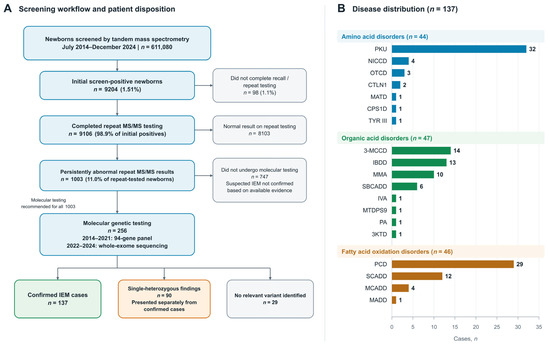
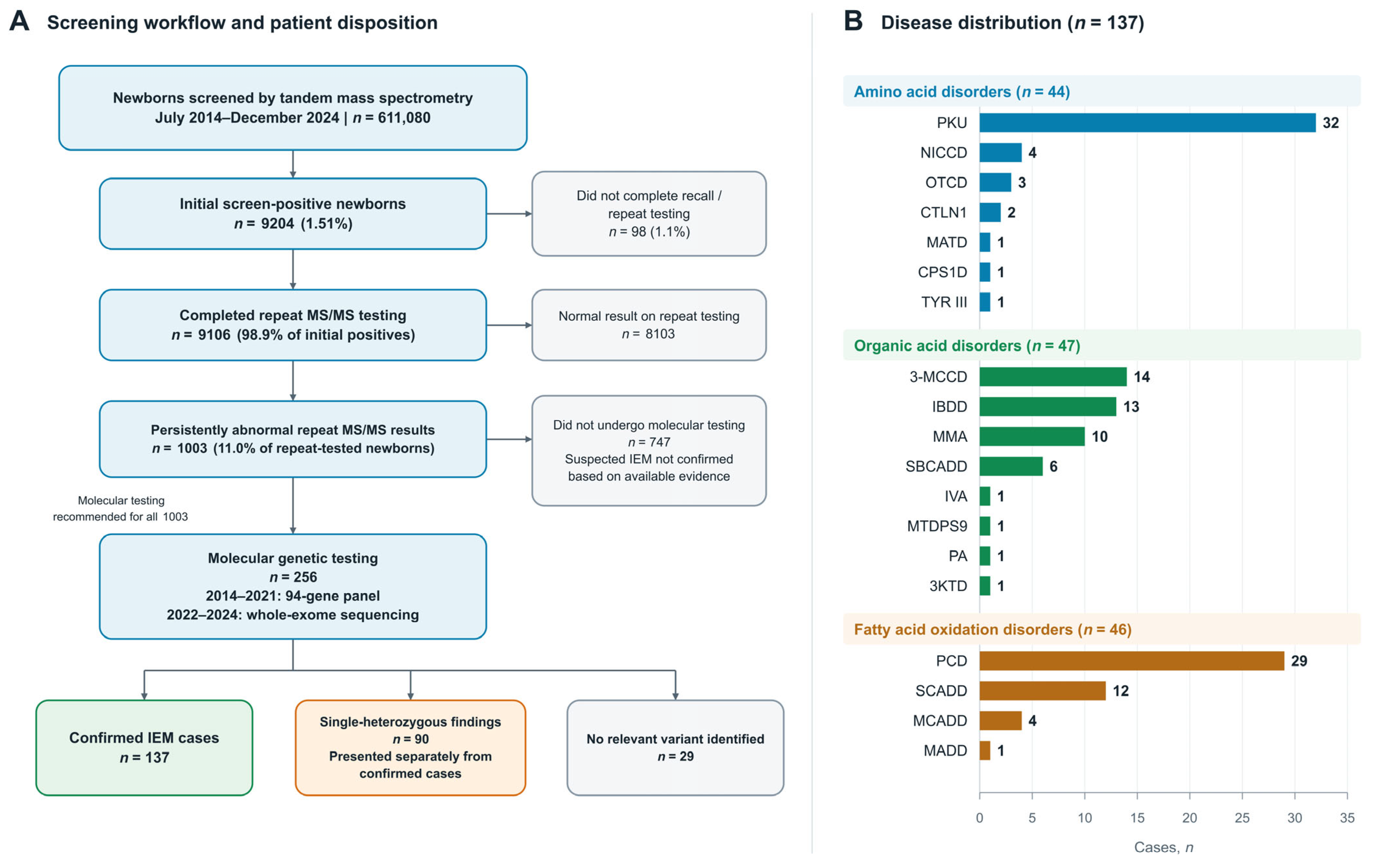
Between July 2014 and December 2024, a total of 611,080 newborns were screened for IEMs using MS/MS at our center. Initial screening identified abnormal metabolite profiles in 9204 newborns, yielding an initial screen-positive rate of 1.51% (95% CI, 1.48–1.54%). All screen-positive newborns were recalled for repeat testing, and 9106 were successfully recalled (98.94%; 95% CI, 98.70–99.13%). Of these, 1003 remained screen-positive on repeat testing, corresponding to a repeat screen-positive rate of 11.0% (95% CI, 10.38–11.68%). Among newborns with birth dates and initial MS/MS report dates, the mean interval from birth to reporting was 13.36 days (95% CI, 13.34–13.37 days). For newborns who underwent repeat sampling, the interval from the initial positive screening report date to collection of the repeat sample had a mean of 5.84 days (95% CI, 4.92–6.76 days). The screening workflow, study population, recall process, confirmatory testing, and final diagnostic classification are presented in Figure 1A. The distribution of the 137 confirmed IEM cases by disorder is shown in Figure 1B.
Figure 1.
Newborn screening workflow and distribution of confirmed IEM cases in Ningbo, July 2014–December 2024. (A) Screening, recall, molecular testing, and case classification. Single heterozygous findings are presented separately from confirmed cases. (B) Distribution of 137 confirmed cases by disorder, with colors indicating amino acid disorders, organic acid disorders, and fatty acid oxidation disorders. Numbers beside the bars indicate case counts.
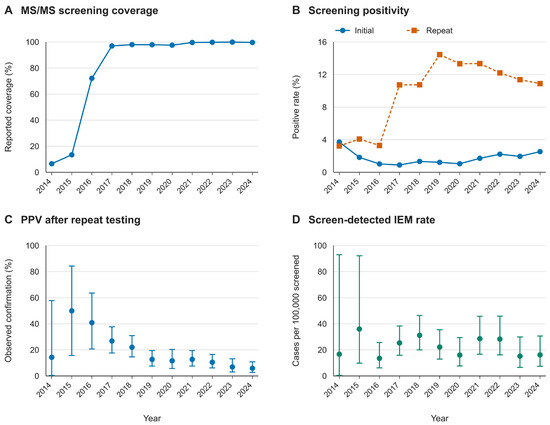
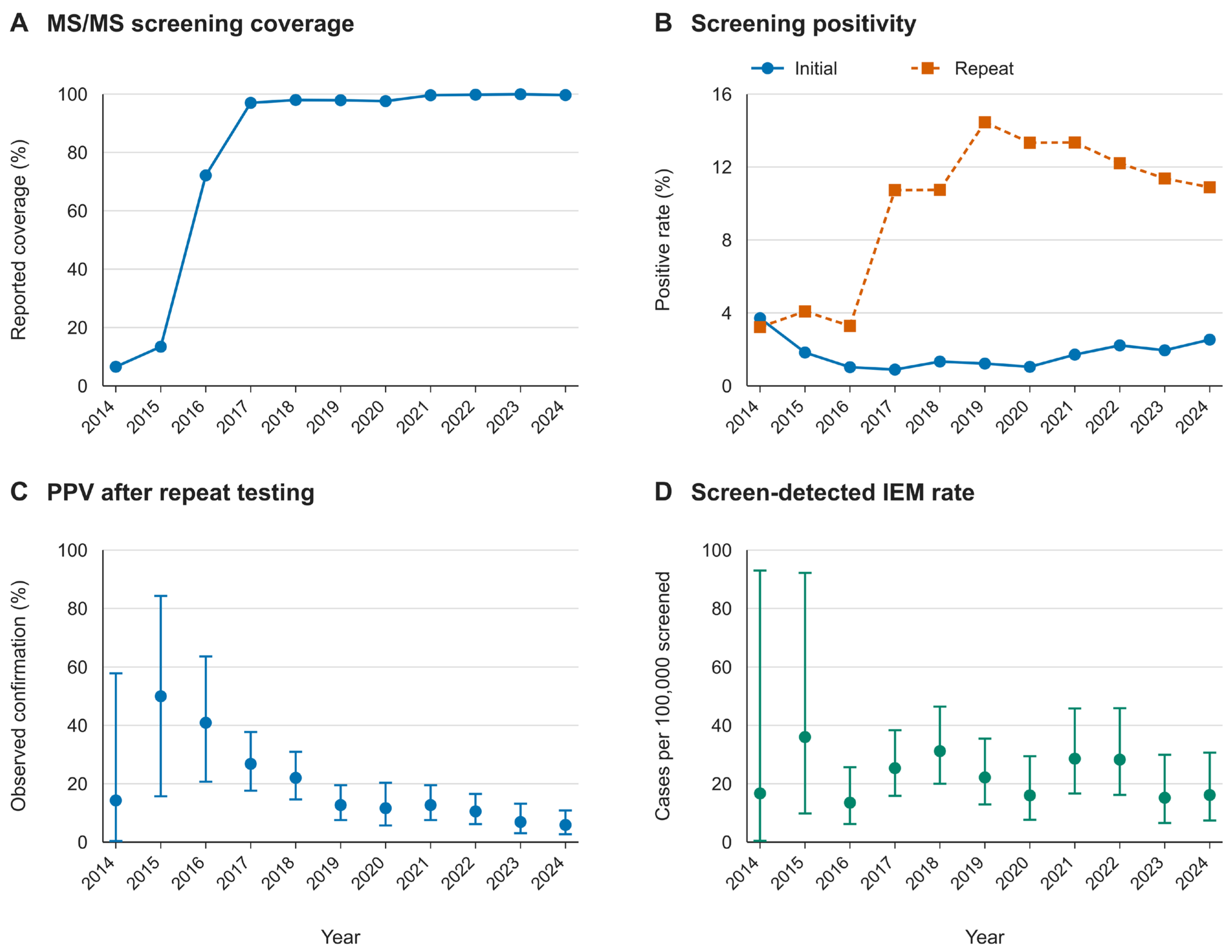
Annual screening participation and performance are presented in Figure 2. Reported coverage increased substantially over time and ranged from 97.01% to 99.96% during 2017–2024. Annual initial-positive rates ranged from 0.89% to 3.71%, whereas repeat-positive rates among retested newborns ranged from 3.23% to 14.46%. Observed PPV after repeat testing was highest in 2015 (50.00%; 4/8) and lowest in 2024 (5.88%; 9/153). Estimates in the early years had wide confidence intervals because of small repeat-positive denominators. Annual screen-detected IEM rates ranged from 13.51 to 36.00 per 100,000 screened newborns.
Figure 2.
Annual performance of expanded newborn screening in Ningbo, 2014–2024. (A) MS/MS screening coverage; (B) initial-positive rates among all screened newborns and repeat-positive rates among newborns who completed repeat testing; (C) observed PPVs after repeat testing; and (D) screen-detected IEM rates per 100,000 screened newborns. Error bars in panels (C,D) indicate two-sided exact binomial (Clopper–Pearson) 95% confidence intervals.
Among the 1003 newborns with persistently abnormal metabolic profiles on repeat MS/MS testing, 256 underwent molecular testing. Reportable variants were identified in 227 newborns. Based on molecular findings, supplementary biochemical testing, and available clinical information, 137 newborns were classified as having confirmed IEMs. Clinical symptoms were not required for confirmation when the biochemical and molecular evidence supported the diagnosis. The overall screen-detected IEM rate was 22.42 per 100,000 screened newborns (95% CI, 18.82–26.50), corresponding to approximately 1 in 4460. The observed PPV after repeat testing was 13.66% (95% CI, 11.59–15.94%). Single heterozygous findings were identified in 90 newborns. This term describes the detection of a single heterozygous variant and does not, by itself, establish either a disease diagnosis or unaffected carrier status. These newborns were not included in the confirmed-case group because the available evidence was considered insufficient to establish a diagnosis. Interpretation requires consideration of the specific variant, the relevant inheritance pattern, and its concordance with the biochemical phenotype. No relevant genetic variant was identified in the remaining 29 newborns who underwent molecular testing. The remaining 747 repeat screen-positive newborns did not undergo molecular testing. Most subsequently showed normalization of the initially abnormal MS/MS markers. Reasons for non-completion of molecular testing included parental refusal and loss of contact with some non-resident families. The suspected IEMs were not confirmed based on the available biochemical and clinical evidence; however, incomplete diagnostic evaluation and follow-up precluded the definitive exclusion of an IEM in all cases.
3.2. Disease Spectrum, Initial Screening Profiles, and Genetic Findings in Confirmed IEM Cases
Screening criteria, initial biochemical profiles of confirmed IEM cases, and condition-specific observed PPVs are summarized in Table 1. Detailed genetic findings for the confirmed cases are provided in Supplementary Table S2. Forty-four newborns were confirmed to have AADs, encompassing 7 distinct diseases, with a screen-detected IEM rate of 1 in 13,888. Phenylketonuria (PKU; OMIM #261600) was the most common AAD, accounting for 32 cases. Other confirmed disorders included 4 cases of neonatal/infantile-onset citrin deficiency (NICCD; OMIM #605814) with SLC25A13 variants, 3 male newborns with ornithine transcarbamylase deficiency (OTCD; OMIM #311250) due to hemizygous OTC variants, 2 newborns with citrullinemia type I (CTLN1; OMIM #215700) due to ASS1 variants, and single cases of methionine adenosyltransferase deficiency (MATD; OMIM #250850), tyrosinemia type III (TYR III; OMIM #276710), and carbamoyl phosphate synthetase I deficiency (CPS1D; OMIM #237300).
Table 1.
Screening criteria, initial biochemical profiles of confirmed IEM cases, and condition-specific observed positive predictive values.
For the 32 newborns with PKU, initial phenylalanine (Phe) concentrations ranged from 118.0 to 913.9 μmol/L. Genetic analysis of PAH showed that c.728G>A (pathogenic) was the most frequently observed variant (n = 14), followed by c.1197A>T (pathogenic; n = 5) and c.611A>G (pathogenic; n = 5). In the 4 NICCD cases, initial citrulline (Cit) concentrations ranged from 33.45 to 124.21 μmol/L, and SLC25A13 c.852_855del (pathogenic) was the predominant variant (n = 4). All 3 OTCD cases occurred in male newborns, with initial Cit concentrations ranging from 2.47 to 4.79 μmol/L. The identified OTC variants were c.154G>T (likely pathogenic), c.717G>A (likely pathogenic), and c.1024C>A (uncertain significance). In the 2 newborns with CTLN1, initial Cit concentrations ranged from 88.67 to 97.41 μmol/L, and the identified ASS1 variants were c.257G>A (likely pathogenic), c.919C>T (uncertain significance), c.651del (likely pathogenic), and c.1003C>T (uncertain significance).
We identified 9 distinct OADs in 47 confirmed cases, giving a screen-detected IEM rate of 1 in 13,002. The confirmed OADs included 3-methylcrotonyl-CoA carboxylase deficiency (3-MCCD; OMIM #210200 and #210210; n = 14) with MCCC1 or MCCC2 variants, isobutyryl-CoA dehydrogenase deficiency (IBDD; OMIM #611283; n = 13) with ACAD8 variants, and short/branched-chain acyl-CoA dehydrogenase deficiency (SBCADD; OMIM #610006; n = 6) with ACADSB variants. Methylmalonic acidemia (MMA) was also confirmed, including the cblC type (OMIM #277400; n = 5) with MMACHC variants and the mut type (OMIM #251000; n = 5) with MMUT variants. One rare case of mitochondrial DNA depletion syndrome 9, encephalomyopathic type with MMA (MTDPS9; OMIM #245400), was identified in a newborn carrying compound heterozygous SUCLG1 variants c.752G>A (uncertain significance) and c.418G>T (uncertain significance). Other confirmed OADs included β-ketothiolase deficiency (3KTD; ACAT1; OMIM #203750; n = 1), propionic acidemia (PA; PCCA/PCCB; OMIM #606054; n = 1), and isovaleric acidemia (IVA; IVD; OMIM #243500; n = 1).
Within the OADs, 3-MCCD, IBDD, and MMA were the most common diagnoses. In the 3-MCCD cases, variants in MCCC1 accounted for 82.1% (23/28) of the alleles, with c.1679dup (pathogenic; n = 4) being the predominant recurrent variant. Initial C5-OH concentrations in confirmed 3-MCCD cases ranged from 0.75 to 8.69 μmol/L. In IBDD, ACAD8 c.286G>A (likely pathogenic; n = 9) was the most frequent variant, and initial C4 concentrations ranged from 1.23 to 2.29 μmol/L. Recurrent variants among newborns with MMA included MMACHC c.658_660del (pathogenic; n = 3) and MMUT c.1663G>A (pathogenic; n = 2), with initial C3 concentrations ranging from 5.75 to 9.12 μmol/L in the cblC cases and from 4.81 to 15.20 μmol/L in the mut cases. In SBCADD, the most frequent ACADSB variants were c.655G>A (likely pathogenic) and c.1165A>G (pathogenic), identified in 4 and 3 alleles, respectively, with initial C5 concentrations ranging from 0.50 to 1.04 μmol/L.
Four distinct FAODs were identified in 46 confirmed cases with abnormal biochemical profiles. The confirmed FAODs comprised primary carnitine deficiency (PCD; OMIM #212140; n = 29) with SLC22A5 variants, short-chain acyl-CoA dehydrogenase deficiency (SCADD; OMIM #201470; n = 12) with ACADS variants, and medium-chain acyl-CoA dehydrogenase deficiency (MCADD; OMIM #201450; n = 4) with ACADM variants. One case of multiple acyl-CoA dehydrogenase deficiency (MADD; ETFDH; OMIM #231680) was also identified.
PCD was the most common FAOD in our cohort. Considerable allelic heterogeneity was observed in SLC22A5. The c.1400C>G (pathogenic; n = 25) variant was the most frequent, followed by c.51C>G (pathogenic; n = 10). Initial free carnitine (C0) concentrations in newborns with confirmed PCD ranged from 2.84 to 9.53 μmol/L. SCADD was the second most common FAOD. The most frequent ACADS variants were c.1130C>T (pathogenic) and c.1031A>G (pathogenic), each identified in 6 alleles. Initial C4 concentrations in confirmed SCADD cases ranged from 0.77 to 2.11 μmol/L. In the 4 MCADD cases, no recurrent ACADM variant predominated. Initial acylcarnitine profiles showed C6, C8, and C10:1 concentrations of 0.56 to 2.25, 2.10 to 17.57, and 0.45 to 1.18 μmol/L, respectively. One newborn with MADD carried compound heterozygous ETFDH variants c.1046T>G (uncertain significance) and c.1454C>G (uncertain significance). The initial acylcarnitine profile showed C6, C8, C10, and C14:1 concentrations of 0.17, 0.45, 0.88 and 0.56 μmol/L, respectively.
Condition-specific observed PPVs among repeat screen-positive newborns ranged from 0.48% for 3KTD to 33.33% for OTCD (Table 1). Estimates were 27.78% for MMA, 26.45% for PKU, and 19.73% for PCD, compared with 0.56% for MATD and 1.85% for IVA. The OTCD estimate was based on three confirmed cases among nine repeat-positive newborns and had a wide 95% confidence interval (7.49–70.07%). Each estimate represents confirmation of the specified condition within its corresponding biochemical screening group; denominators shared by multiple conditions were not summed.
3.3. Single Heterozygous Findings in Screen-Positive Newborns
In addition to the confirmed cases, single heterozygous findings were identified in 90 newborns with persistently abnormal screening results. These findings involved MAT1A (n = 24), ASS1 (n = 4), PAH (n = 3), SLC25A13 (n = 3), ARG1 (n = 2), HPD (n = 2), PTS (n = 1), MTHFR (n = 1), and CPS1 (n = 1). Notably, the biochemical abnormalities prompting genetic testing were not always specific to the genes in which the single heterozygous variants were subsequently identified. Genetic testing in the 3 newborns with single heterozygous SLC25A13 variants was prompted by atypical metabolic findings, including arginine (Arg, 113.40 μmol/L), free carnitine (C0, 8.43 μmol/L), and isovalerylcarnitine (C5, 1.07 μmol/L), rather than elevated Cit. Similarly, the newborn with a single heterozygous MTHFR variant underwent genetic testing because of an elevated C5-OH concentration (0.91 μmol/L), whereas the newborn with a single heterozygous PTS variant was tested because of markedly elevated tyrosine (Tyr, 929.22 μmol/L). Thus, in these newborns, the detected single heterozygous variants did not fully correspond to the initial biochemical abnormalities and should not, in isolation, be considered diagnostic of the associated disorders.
Among the 26 newborns with single heterozygous variants in MCCC1 or MCCC2, MCCC1 c.639 + 2T > A (pathogenic) was one of the most frequent variants (n = 5), and initial C5-OH concentrations ranged from 0.53 to 6.00 μmol/L. Additional rare findings included CLPB c.341G>A (uncertain significance) in a newborn with a C5-OH concentration of 0.63 μmol/L and AUH c.656-2delA (likely pathogenic) in a newborn with a C5-OH concentration of 1.32 μmol/L. A single heterozygous MMADHC c.373-5C>A (uncertain significance), associated with MMA and homocystinuria, cblD type (OMIM #277410), was identified in one newborn with a C3 concentration of 2.02 μmol/L. However, genetic testing was prompted by an elevated C0 concentration and an abnormal C0/(C16 + C18) ratio. Accordingly, the detected single heterozygous variant did not fully explain the biochemical abnormalities observed on initial screening. Another newborn with an elevated C4 concentration of 0.87 μmol/L carried the ACAD8 c.1000C>T (pathogenic) variant associated with IBDD.
Single heterozygous SLC22A5 findings were identified in 14 newborns, with initial C0 concentrations ranging from 2.39 to 7.21 μmol/L. Additional single heterozygous findings involved ACADS (n = 2) with C4 concentrations ranging from 1.24 to 1.95 μmol/L; ACADM (n = 1) with the c.709-1G>A (likely pathogenic) and C6, C8, and C10:1 concentrations of 0.16, 0.34, and 0.28 μmol/L, respectively; ACADVL (n = 1) with the c.1310T>C (uncertain significance) and elevated C14, C14:1, and C14:2 concentrations of 1.85, 2.90, and 0.54 μmol/L, respectively. One newborn with the heterozygous CPT1A c.733C>T (likely pathogenic) had C0, C16, and C18 concentrations of 40.35, 1.36, and 0.54 μmol/L, respectively. The biochemical characteristics are detailed in Table 2, and the genetic findings are reported in Supplementary Table S3.
Table 2.
Initial screening of metabolite concentrations in the single heterozygous findings.
4. Discussion
A major strength of this study is its large population size and long observation period, comprising 611,080 newborns screened over 10 years. These data characterize the regional screening yield and the disease and variant spectrum identified through routine practice. The overall initial positive rate was 1.51%, and 11.0% of newborns who completed repeat testing remained screen-positive. The observed PPV after repeat testing was 13.7% (137/1003), representing the observed proportion of confirmed cases among repeat-screen-positive newborns. Condition-specific estimates varied, including 27.78% for MMA, 26.45% for PKU, and 19.73% for PCD, compared with 0.56% for MATD and 1.85% for IVA. These differences may reflect disease frequency, the specificity of the biochemical screening profiles, and the extent of subsequent diagnostic verification. For conditions sharing screening markers, an abnormal profile may indicate another IEM within the same biochemical group. A low condition-specific estimate therefore does not necessarily imply that the other infants were false positives for all IEMs. Screening criteria and the stage at which positivity is defined also affect comparisons between programs [12]. For example, Japan reported a recall rate of 0.31% among screened newborns [13]. This measures the proportion requiring further assessment, whereas our recall completion rate of 98.9% measures attendance among initially screen-positive newborns. Similarly, a Zhejiang study reported a PCD PPV of 1.93%, but this should not be directly compared with our estimate after repeat testing without accounting for differences in the screening pathway and denominator [14]. The high recall completion in our program indicates that most initially screen-positive newborns returned for repeat testing, although completion of recall and completion of diagnostic assessment are separate measures.
The overall screen-detected IEM rate was 22.42 per 100,000 screened newborns, approximately 1 in 4460, below the 38.69 per 100,000 reported in a census of more than seven million Chinese newborns [8]. AADs, OADs, and FAODs were relatively evenly represented in Ningbo, with 44, 47, and 46 cases, respectively, whereas AADs predominated nationally. PKU, 3-MCCD, and PCD together accounted for 75 of the 137 cases (54.7%; Figure 1B). The present study extends an earlier Ningbo report with an overlapping study period, in which heterozygous findings were included in the reported positive-case total [15]. The lower estimate should therefore not be interpreted as evidence of a temporal decline in disease occurrence. The principal contribution of this study is the longer observation period, larger screened population, and additional characterization of condition-specific and annual screening performance, rather than an independent replication of the earlier cohort.
PKU was the most frequent AAD in our cohort (n = 32), with a screen-detected rate of 1 in 19,096, compared with 6.28 per 100,000 (approximately 1 in 15,923) screened newborns nationally [16]. The recurrent PAH c.728G>A variant (pathogenic) identified in our cohort has also been reported as a frequent variant in Suzhou, an eastern coastal city in China [17]. In addition to PKU, four cases of NICCD were confirmed. The SLC25A13 c.852_855del (pathogenic) was the most frequently detected variant (n = 4). This finding differs slightly from that reported by Cheng et al., who found c.852_855del to predominate in southern and southwestern China, whereas c.1638_1660dup was enriched in eastern coastal regions [18]. PCD accounted for 63.0% of the confirmed FAODs, corresponding to a screen-detected rate of 1 in 21,072. Its clinical relevance includes the risk of metabolic decompensation and cardiac complications, which can be reduced by appropriate treatment [19,20]. PCD has been reported to occur more frequently in southern China than in northern China [21]. SLC22A5 c.1400C>G (pathogenic) was the most frequent SLC22A5 variant in our cohort. Nevertheless, previous studies have reported that this hotspot variant is less frequent in southern Chinese populations than in northern ones [21].
In the Ningbo OAD spectrum, 3-MCCD, IBDD, and MMA were among the most frequently identified disorders. However, their substantial contribution to screening yield does not necessarily indicate a correspondingly high clinical burden, particularly for 3-MCCD, because these disorders differ markedly in penetrance, phenotypic expression, and natural history. Many individuals with 3-MCCD identified by MS/MS newborn screening remain asymptomatic or exhibit only mild biochemical abnormalities [22,23,24]. Moreover, initial C5-OH concentrations have not consistently correlated with subsequent metabolic events or developmental outcomes, limiting their prognostic value [23]. The clinical significance of IBDD is similarly uncertain because available evidence is derived largely from relatively small cohorts [25,26]. Persistent C4 elevation together with biallelic ACAD8 variants may support the diagnosis but cannot independently predict clinical outcomes [25,26]. In contrast, MMA is a clinically actionable disorder that may present with neonatal metabolic acidosis, hyperammonemia, encephalopathy, and irreversible neurological injury. Long-term complications, including renal impairment, may occur despite early diagnosis, although their severity varies according to molecular subtype and cobalamin responsiveness [27,28]. In our cohort, MMA was predominantly associated with MMACHC and MMUT defects, and one rare case of SUCLG1-related MMA was identified. MMA has been reported to occur more frequently in northern China [27]. Among Chinese patients, cblC-type MMA with homocystinuria is particularly common, and MMACHC c.609G>A (pathogenic) is a recurrent hotspot variant that was detected in 2 of 10 MMACHC alleles in our cohort [28].
The 90 newborns with single heterozygous findings, predominantly involving MAT1A (n = 24), MCCC1/MCCC2 (n = 26), and SLC22A5 (n = 14), represent a heterogeneous group (Table 2). This designation describes the molecular finding and does not establish a uniform carrier or disease status. MAT1A interpretation is particularly dependent on the specific allele: four newborns carried c.776C>T (p.Ala259Val; pathogenic), for which autosomal dominant hypermethioninemia has been documented [29]. Their available follow-up findings varied, and biochemical improvement or absence of symptoms does not establish an unaffected carrier state. One child with c.1070C>T (p.Pro357Leu; pathogenic) had persistent hypermethioninemia without reported clinical manifestations, but absent segregation data limited interpretation of its molecular basis. Although 3-MCCD generally follows autosomal recessive inheritance, a dominant-negative effect has been demonstrated for a specific MCCC1 allele; this cannot be generalized to all monoallelic MCCC1/MCCC2 findings [30]. In newborns with single heterozygous SLC22A5 findings, initial C0 concentrations overlapped with those of confirmed PCD cases, preventing reliable distinction on that measurement alone. Maternal metabolic disease may contribute to low neonatal C0 or elevated C5-OH and warrants evaluation where appropriate [31]. Conversely, findings discordant with the biochemical phenotype, including the MTHFR and PTS findings in this cohort, should not automatically be considered explanatory. Interpretation should integrate the inheritance mechanism, variant classification, disease-specific biochemical evidence, segregation, and longitudinal findings.
Several limitations should be acknowledged. First, diagnostic verification was incomplete and nonuniform. Although molecular testing was recommended for all 1003 repeat-screen-positive newborns, only 256 underwent testing. Follow-up duration and completeness could not be reliably reconstructed for the remaining 747, and subsequent normalization of biochemical markers did not definitively exclude IEMs. Incomplete verification therefore introduces potential verification bias, and the overall and condition-specific observed PPVs reflect confirmation under the assessments performed [32]. Small case numbers and unresolved diagnostic classifications, including monoallelic MAT1A findings, further limit interpretation. Second, missed cases could not be comprehensively ascertained. Among 98 initially screen-positive newborns who did not complete repeat testing, 23 died without sufficient metabolic evaluation to exclude an IEM. Two infants with NICCD were diagnosed after initially negative screening and were excluded from the 137 screen-detected cases. Incomplete ascertainment of subsequent diagnoses precludes reliable estimation of screening sensitivity and underlying population incidence. Moreover, average reporting and recall intervals do not establish that screening preceded symptom onset. Symptomatic infants require immediate clinical assessment and appropriate treatment without waiting for repeat screening results. Third, changes in screening coverage, biochemical cutoffs, and molecular testing capabilities limit comparisons across years, and this study does not establish optimized cutoffs. The 2014–2021 panel lacked deletion/duplication and other structural variant analysis; later exome-based CNV analysis did not eliminate all technical limitations [33]. Undetected second disease-causing variants therefore remain possible in some single heterozygous cases. Parental and maternal investigations were available only for subsets of newborns, and long-term outcomes were not systematically collected, limiting conclusions about inheritance, maternal contributions, genotype–phenotype relationships, and treatment effectiveness.
5. Conclusions
This study characterized the screen-detected IEM spectrum and recurrent genetic variants in Ningbo over a decade of expanded newborn screening. The single heterozygous findings highlight the need for gene- and variant-specific interpretation integrating biochemical findings, molecular evidence, and available clinical and family data. Incomplete diagnostic verification and the identification of false-negative cases limit interpretation of the incidence estimate. These regional data provide a basis for further studies of screening performance and diagnostic follow-up.
Supplementary Materials
The following supporting information can be downloaded at https://www.mdpi.com/article/10.3390/ijns12040093/s1: Supplementary Table S1: MS/MS screening conditions and screen-positive criteria in Ningbo, 2016–2024; Supplementary Table S2: Variant spectrum and relative frequencies in confirmed IEM cases from newborn screening; Supplementary Table S3: Variant spectrum and relative frequencies in single heterozygous findings from newborn screening.
Author Contributions
Conceptualization, F.W., X.Y., D.Z., Q.L., H.L. and Q.Y.; methodology, F.W. and X.Y.; validation, Q.L., L.Y., H.C. and H.L.; formal analysis, D.Z., Z.Y. and L.Y.; investigation, X.Y., D.Z., Q.L., L.Y., S.D., H.C. and S.W.; resources, Q.L., S.D., H.C., S.W. and Q.Y.; data curation, F.W. and X.Y.; writing—original draft preparation, F.W. and X.Y.; writing—review and editing, D.Z., Q.L., L.Y., Z.Y., S.D., H.C., S.W., H.L. and Q.Y.; visualization, X.Y. and Z.Y.; supervision, H.L. and Q.Y.; project administration, H.L. and Q.Y.; funding acquisition, D.Z., L.Y. and H.L. All authors have read and agreed to the published version of the manuscript.
Funding
This research was funded by the General Program of the National Natural Science Foundation of China (82672413), the Zhejiang Provincial Preventive Medicine Association Science and Technology Project (ZPMA-SFCRPBD-2025262), the Key Technology Breakthrough Program of Ningbo Sci-Tech Innovation YONGJIANG 2035 (2024Z221, 2025Z160), the Ningbo Medical and Health Brand Discipline (PPXK2024-06) and the Ningbo Leading Medical and Health Discipline (2026-A34).
Institutional Review Board Statement
The study was conducted in accordance with the Declaration of Helsinki and approved by the ethics committee of the Affiliated Women and Children’s Hospital of Ningbo University (approval number EC2023-017, 10 January 2023).
Informed Consent Statement
Informed consent was obtained from all subjects involved in the study. Written informed consent has been obtained from the patient(s) to publish this paper.
Data Availability Statement
The data presented in this study are available on request from the corresponding author due to ethical and privacy restrictions.
Conflicts of Interest
Zhen Yang is employed by the BGI Genomics. BGI Genomics had no role in the design of the study; in the collection, analyses, or interpretation of data; in the writing of the manuscript; or in the decision to publish the results. The other authors declare no conflicts of interest.
Abbreviations
The following abbreviations are used in this manuscript:
| 3KTD | 3-ketothiolase deficiency |
| 3-MCCD | 3-methylcrotonyl-CoA carboxylase deficiency |
| AADs | Amino acid disorders |
| ARG1D | Arginase 1 deficiency |
| Arg | Arginine |
| C0 | Free carnitine |
| C3 | Propionylcarnitine |
| C4 | Butyrylcarnitine/isobutyrylcarnitine |
| C5 | Isovalerylcarnitine |
| C5-OH | 3-hydroxyisovalerylcarnitine |
| C5:1 | Tiglylcarnitine |
| C6 | Hexanoylcarnitine |
| C8 | Octanoylcarnitine |
| C10 | Decanoylcarnitine |
| C10:1 | Decenoylcarnitine |
| C12 | Dodecanoylcarnitine |
| C14 | Tetradecanoylcarnitine |
| C14:1 | Tetradecenoylcarnitine |
| C14:2 | Tetradecadienoylcarnitine |
| C16 | Palmitoylcarnitine |
| C18 | Stearoylcarnitine |
| Cit | Citrulline |
| CPS1D | Carbamoyl phosphate synthetase I deficiency |
| CPT1D | Carnitine palmitoyltransferase 1A deficiency |
| CTLN1 | Citrullinemia type I |
| DBS | Dried blood spot |
| FAODs | Fatty acid oxidation disorders |
| HCU | Homocystinuria |
| IBDD | Isobutyryl-CoA dehydrogenase deficiency |
| IEMs | Inborn errors of metabolism |
| IVA | Isovaleric acidemia |
| MADD | Multiple acyl-CoA dehydrogenase deficiency |
| MATD | Methionine adenosyltransferase deficiency |
| MCADD | Medium-chain acyl-CoA dehydrogenase deficiency |
| MCC1D | 3-methylcrotonyl-CoA carboxylase 1 deficiency |
| MCC2D | 3-methylcrotonyl-CoA carboxylase 2 deficiency |
| Met | Methionine |
| MGCA1 | 3-methylglutaconic aciduria type I |
| MGCA7 | 3-methylglutaconic aciduria type VII |
| MMA-cblC | Methylmalonic aciduria and homocystinuria, cblC type |
| MMA-cblD | Methylmalonic aciduria and homocystinuria, cblD type |
| MMA-mut | Methylmalonic aciduria, mut type |
| MS/MS | Tandem mass spectrometry |
| MTDPS9 | Mitochondrial DNA depletion syndrome 9 |
| NA | Not applicable |
| NBS | Newborn screening |
| NICCD | Neonatal- or infantile-onset citrin deficiency |
| OADs | Organic acid disorders |
| OTCD | Ornithine transcarbamylase deficiency |
| PA | Propionic acidemia |
| PCD | Primary carnitine deficiency |
| Phe | Phenylalanine |
| PKU | Phenylketonuria |
| PPV | Positive predictive value |
| PTPSD | 6-pyruvoyl-tetrahydropterin synthase deficiency |
| SBCADD | Short/branched-chain acyl-CoA dehydrogenase deficiency |
| SCADD | Short-chain acyl-CoA dehydrogenase deficiency |
| TYR III | Tyrosinemia type III |
| Tyr | Tyrosine |
| VLCAD | Very-long-chain acyl-CoA dehydrogenase deficiency |
References
- Ferreira, C.R.; van Karnebeek, C.D.M. Inborn errors of metabolism. Handb. Clin. Neurol. 2019, 162, 449–481. [Google Scholar] [CrossRef] [Scilit]
- Waters, D.; Adeloye, D.; Woolham, D.; Wastnedge, E.; Patel, S.; Rudan, I. Global birth prevalence and mortality from inborn errors of metabolism: A systematic analysis of the evidence. J. Glob. Health 2018, 8, 021102. [Google Scholar] [CrossRef] [Scilit]
- Mukherjee, S.; Ray, S.K. Inborn Errors of Metabolism Screening in Neonates: Current Perspective with Diagnosis and Therapy. Curr. Pediatr. Rev. 2022, 18, 274–285. [Google Scholar] [CrossRef] [Scilit]
- Therrell, B.L.; Padilla, C.D.; Borrajo, G.J.C.; Khneisser, I.; Schielen, P.C.J.I.; Knight-Madden, J.; Malherbe, H.L.; Kase, M. Current Status of Newborn Bloodspot Screening Worldwide 2024: A Comprehensive Review of Recent Activities (2020–2023). Int. J. Neonatal Screen. 2024, 10, 38. [Google Scholar] [CrossRef] [Scilit]
- Lindner, M.; Gramer, G.; Haege, G.; Fang-Hoffmann, J.; Schwab, K.O.; Tacke, U.; Trefz, F.K.; Mengel, E.; Wendel, U.; Leichsenring, M.; et al. Efficacy and outcome of expanded newborn screening for metabolic diseases—Report of 10 years from South-West Germany. Orphanet J. Rare Dis. 2011, 6, 44. [Google Scholar] [CrossRef] [Scilit]
- Millington, D.S. How mass spectrometry revolutionized newborn screening. J. Mass Spectrom. Adv. Clin. Lab 2024, 32, 1–10. [Google Scholar] [CrossRef] [Scilit]
- Dietzen, D.J.; Rinaldo, P.; Whitley, R.J.; Rhead, W.J.; Hannon, W.H.; Garg, U.C.; Lo, S.F.; Bennett, M.J. National Academy of Clinical Biochemistry Laboratory Medicine Practice Guidelines: Follow-up testing for metabolic disease identified by expanded newborn screening using tandem mass spectrometry; executive summary. Clin. Chem. 2009, 55, 1615–1626. [Google Scholar] [CrossRef] [Scilit]
- Deng, K.; Zhu, J.; Yu, E.; Xiang, L.; Yuan, X.; Yao, Y.; Li, X.; Liu, H. Incidence of inborn errors of metabolism detected by tandem mass spectrometry in China: A census of over seven million newborns between 2016 and 2017. J. Med. Screen. 2021, 28, 223–229. [Google Scholar] [CrossRef] [Scilit]
- Guo, Y.; Jiang, J.; Xu, Z. Chinese genetic variation database of inborn errors of metabolism: A systematic review of published variants in 13 genes. Orphanet J. Rare Dis. 2023, 18, 148. [Google Scholar] [CrossRef] [Scilit]
- Screening Group of Neonatal Genetic Metabolic Disease, Special Committee of Birth Defects Prevention and Control, Chinese Preventive Medical Association. Consensus on the organizational management and dry blood sample collection for neonatal inherited metabolic disease screening. Chin. J. Neonatol. 2023, 38, 321–326. (In Chinese) [Google Scholar] [CrossRef]
- Richards, S.; Aziz, N.; Bale, S.; Bick, D.; Das, S.; Gastier-Foster, J.; Grody, W.W.; Hegde, M.; Lyon, E.; Spector, E.; et al. Standards and guidelines for the interpretation of sequence variants: A joint consensus recommendation of the American College of Medical Genetics and Genomics and the Association for Molecular Pathology. Genet. Med. 2015, 17, 405–424. [Google Scholar] [CrossRef] [Scilit]
- McHugh, D.; Cameron, C.A.; Abdenur, J.E.; Abdulrahman, M.; Adair, O.; Al Nuaimi, S.A.; Åhlman, H.; Allen, J.J.; Antonozzi, I.; Archer, S.; et al. Clinical validation of cutoff target ranges in newborn screening of metabolic disorders by tandem mass spectrometry: A worldwide collaborative project. Genet. Med. 2011, 13, 230–254. [Google Scholar] [CrossRef] [Scilit]
- Shigematsu, Y.; Yuasa, M.; Ishige, N.; Nakajima, H.; Tajima, G. Development of Second-Tier Liquid Chromatography-Tandem Mass Spectrometry Analysis for Expanded Newborn Screening in Japan. Int. J. Neonatal Screen. 2021, 7, 44. [Google Scholar] [CrossRef] [Scilit]
- Lin, Y.; Xu, H.; Zhou, D.; Hu, Z.; Zhang, C.; Hu, L.; Zhang, Y.; Zhu, L.; Lu, B.; Zhang, T.; et al. Screening 3.4 million newborns for primary carnitine deficiency in Zhejiang Province, China. Clin. Chim. Acta 2020, 507, 199–204. [Google Scholar] [CrossRef] [Scilit]
- Yang, X.; Ding, S.; Zhang, J.; Hu, Z.; Zhuang, D.; Wang, F.; Wu, S.; Chen, C.; Li, H. The significance of machine learning in neonatal screening for inherited metabolic diseases. Front. Pediatr. 2024, 12, 1366891. [Google Scholar] [CrossRef] [Scilit]
- Xiang, L.; Tao, J.; Deng, K.; Li, X.; Li, Q.; Yuan, X.; Liang, J.; Yu, E.; Wang, M.; Wang, H.; et al. Phenylketonuria incidence in China between 2013 and 2017 based on data from the Chinese newborn screening information system: A descriptive study. BMJ Open 2019, 9, e031474, Erratum in BMJ Open 2020, 10, e031474. https://doi.org/10.1136/bmjopen-2019-031474corr1. [Google Scholar] [CrossRef] [Scilit]
- Wang, T.; Ma, J.; Zhang, Q.; Gao, A.; Wang, Q.; Li, H.; Xiang, J.; Wang, B. Expanded Newborn Screening for Inborn Errors of Metabolism by Tandem Mass Spectrometry in Suzhou, China: Disease Spectrum, Prevalence, Genetic Characteristics in a Chinese Population. Front. Genet. 2019, 10, 1052. [Google Scholar] [CrossRef] [Scilit]
- Cheng, R.L.; Qiu, J.W.; Zhou, Q.; Saberon, J.H.; Shi, J.; Deng, M.; Guo, L.; Chen, F.P.; Lin, W.X.; Song, Y.Z. Identification of 13 novel pathogenic SLC25A13 variants and comparison of the genetic spectrum among different geographic regions: Molecular characterization of a large cohort of citrin deficiency in China. Mol. Genet. Metab. 2025, 146, 109238. [Google Scholar] [CrossRef] [Scilit]
- El-Hattab, A.W.; Almannai, M. Primary Carnitine Deficiency. In GeneReviews® [Internet]; University of Washington, Seattle: Seattle, WA, USA, 2024. Available online: https://www.ncbi.nlm.nih.gov/books/NBK84551/ (accessed on 11 October 2026).
- Pınar, E.; Zubarioglu, T.; Babazade, H.; Çalışgan, K.; Cansever, M.Ş.; Kıykım, E.; Aktuğlu Zeybek, Ç. Primary systemic carnitine deficiency: Phenotypic variability, diagnostic challenges, and long-term outcomes. Pediatr. Int. 2025, 67, e70211. [Google Scholar] [CrossRef] [Scilit]
- Zhou, J.; Li, G.; Zeng, Y.; Qiu, X.; Zhao, P.; Huang, T.; Wang, X.; Luo, J.; Lin, N.; Xu, L. Screening primary carnitine deficiency in 10 million Chinese newborns: A systematic review and meta-analysis. Orphanet J. Rare Dis. 2024, 19, 248. [Google Scholar] [CrossRef] [Scilit]
- Grünert, S.C.; Stucki, M.; Morscher, R.J.; Suormala, T.; Bürer, C.; Burda, P.; Christensen, E.; Ficicioglu, C.; Herwig, J.; Kölker, S.; et al. 3-methylcrotonyl-CoA carboxylase deficiency: Clinical, biochemical, enzymatic and molecular studies in 88 individuals. Orphanet J. Rare Dis. 2012, 7, 31. [Google Scholar] [CrossRef] [Scilit]
- Forsyth, R.; Vockley, C.W.; Edick, M.J.; Cameron, C.A.; Hiner, S.J.; Berry, S.A.; Vockley, J.; Arnold, G.L. Inborn Errors of Metabolism Collaborative. Outcomes of cases with 3-methylcrotonyl-CoA carboxylase (3-MCC) deficiency—Report from the Inborn Errors of Metabolism Information System. Mol. Genet. Metab. 2016, 118, 15–20. [Google Scholar] [CrossRef] [Scilit]
- Cheng, Y.; Chen, P.; Yu, Z.; Yin, X.; Zhang, C.; Miao, H.; Huang, X. Newborn screening for 3-methylcrotonyl-CoA carboxylase deficiency in Zhejiang province, China. Clin. Chim. Acta 2023, 542, 117266. [Google Scholar] [CrossRef] [Scilit]
- Pena, L.; Angle, B.; Burton, B.; Charrow, J. Follow-up of patients with short-chain acyl-CoA dehydrogenase and isobutyryl-CoA dehydrogenase deficiencies identified through newborn screening: One center’s experience. Genet. Med. 2012, 14, 342–347. [Google Scholar] [CrossRef] [Scilit]
- Feng, J.; Yang, C.; Zhu, L.; Zhang, Y.; Zhao, X.; Chen, C.; Chen, Q.X.; Shu, Q.; Jiang, P.; Tong, F. Phenotype, genotype and long-term prognosis of 40 Chinese patients with isobutyryl-CoA dehydrogenase deficiency and a review of variant spectra in ACAD8. Orphanet J. Rare Dis. 2021, 16, 392, Erratum in Orphanet J. Rare Dis. 2021, 16, 505. https://doi.org/10.1186/s13023-021-02132-5. [Google Scholar] [CrossRef] [Scilit]
- Zhou, X.; Cui, Y.; Han, J. Methylmalonic acidemia: Current status and research priorities. Intractable Rare Dis. Res. 2018, 7, 73–78. [Google Scholar] [CrossRef] [Scilit]
- He, R.; Mo, R.; Shen, M.; Kang, L.; Song, J.; Liu, Y.; Chen, Z.; Zhang, H.; Yao, H.; Liu, Y.; et al. Variable phenotypes and outcomes associated with the MMACHC c.609G>A homologous mutation: Long term follow-up in a large cohort of cases. Orphanet J. Rare Dis. 2020, 15, 200. [Google Scholar] [CrossRef] [Scilit]
- Muriello, M.J.; Viall, S.; Bottiglieri, T.; Cusmano-Ozog, K.; Ferreira, C.R. Confirmation that MAT1A p.Ala259Val mutation causes autosomal dominant hypermethioninemia. Mol. Genet. Metab. Rep. 2017, 13, 9–12. [Google Scholar] [CrossRef] [Scilit]
- Baumgartner, M.R.; Dantas, M.F.; Suormala, T.; Almashanu, S.; Giunta, C.; Friebel, D.; Gebhardt, B.; Fowler, B.; Hoffmann, G.F.; Baumgartner, E.R.; et al. Isolated 3-methylcrotonyl-CoA carboxylase deficiency: Evidence for an allele-specific dominant negative effect and responsiveness to biotin therapy. Am. J. Hum. Genet. 2004, 75, 790–800. [Google Scholar] [CrossRef] [Scilit]
- Onuki, T.; Hiroshima, S.; Sawano, K.; Shibata, N.; Ogawa, Y.; Nagasaki, K.; Nyuzuki, H. A Study of Maternal Patients Diagnosed with Inborn Errors of Metabolism Due to Positive Newborn Mass Screening in Their Newborns. Children 2023, 10, 1341. [Google Scholar] [CrossRef] [Scilit]
- Begg, C.B.; Greenes, R.A. Assessment of diagnostic tests when disease verification is subject to selection bias. Biometrics 1983, 39, 207–215. [Google Scholar] [CrossRef] [Scilit]
- Rehder, C.; Bean, L.J.H.; Bick, D.; Chao, E.; Chung, W.; Das, S.; O’Daniel, J.; Rehm, H.; Shashi, V.; Vincent, L.M. Next-generation sequencing for constitutional variants in the clinical laboratory, 2021 revision: A technical standard of the American College of Medical Genetics and Genomics (ACMG). Genet. Med. 2021, 23, 1399–1415. [Google Scholar] [CrossRef] [Scilit]

Disclaimer/Publisher’s Note: The statements, opinions and data contained in all publications are solely those of the individual author(s) and contributor(s) and not of MDPI and/or the editor(s). MDPI and/or the editor(s) disclaim responsibility for any injury to people or property resulting from any ideas, methods, instructions or products referred to in the content. |
© 2026 by the authors. Published by MDPI on behalf of the International Society for Neonatal Screening. Licensee MDPI, Basel, Switzerland. This article is an open access article distributed under the terms and conditions of the Creative Commons Attribution (CC BY) license.