


Abstract
This retrospective evaluation reports a tailored workplace wellness program in improving physical fitness and psychological well-being among employees in labor-intensive industries. Data were drawn from program records of 2964 workers (80.7% men; mean age 40.4 years) participating in the AlphaOne Health and Fitness Program across industrial sites in Australia between 2003 and 2010, representing mining, utilities, emergency services, and transportation sectors. Outcomes included the Total Fitness Index (TFI), a composite measure of biomedical, fitness, behavioral, and psychosocial indicators, and the Q-Negative (Q-NEG) subscale of the Quality-of-Life Scale, which assesses psychological distress. Pre- and post-program comparisons were conducted using descriptive statistics and chi-square tests. Participants exhibited significant improvements in physical fitness (TFI 15.1 to 15.6; Δ = +0.47; p < 0.001) and psychological well-being (Q-NEG 10.9 to 10.3; Δ = −0.56; p < 0.001) over a post-program interval that varied by site and participant (median approximately 6 months among assessments with verified dates), with notable upward movement in TFI category classifications. Enhanced physical fitness was strongly associated with reduced psychological distress (χ2 = 98.73; p < 0.001). As an evaluation of real-world data collected as part of an operational program rather than a purpose-built research study, these findings seem to suggest that tailored wellness initiatives for blue-collar workers could produce meaningful gains in both physical and mental health and that multidimensional assessment tools such as TFI and Q-NEG are valuable for capturing the impact of integrated workplace health strategies across high-risk labor sectors.
1. Introduction
Workplace health promotion programs (WHPPs) are now widely recognized as effective organizational strategies to enhance employee well-being and reduce escalating healthcare costs, with the workplace acknowledged as a critical setting for achieving public health goals [1]. Pelletier’s systematic reviews consistently demonstrate that comprehensive health promotion and disease management initiatives improve health behaviors and risk profiles while reducing organizational costs, establishing a strong empirical foundation for workplace wellness investment [2,3]. Goetzel and colleagues further validated this by showing that multi-component wellness programs deliver both health and economic benefits across industries, positioning them as vital population health strategies [4,5]. Over several decades, innovations in WHPPs have produced diverse interventions with varying levels of evidence, targeting issues such as disease and injury prevention, lifestyle modification, mental health, and organizational and environmental change.
Despite this progress, most WHPP research has focused on white-collar or higher socioeconomic status (SES) industries, leaving blue-collar (BC) workers comparatively underrepresented [6]. This represents a critical oversight, as BC workers constitute nearly one-third of the global workforce and face disproportionate exposure to overlapping occupational and lifestyle risks. Predominantly male, this population experiences hazardous working conditions, heavy physical labor, ergonomic strain, noise, and environmental exposures, alongside a higher prevalence of modifiable risk factors such as smoking, poor nutrition, obesity, and hazardous alcohol consumption. Sorenson aptly described this intersection as “Double Jeopardy” [7]. These challenges are magnified by an aging workforce, with the average age in many labor-intensive sectors now approaching 50 years [8]. Additionally, shift work, prevalent in industries such as mining, utilities, transport, and emergency services, is itself an independent risk factor for cardiovascular disease, diabetes, and mood disorders [9]. Psychosocial dimensions, such as low job control, limited autonomy, and reduced job satisfaction, further contribute to stress, anxiety, and depression [10,11]. Importantly, because BC industries are deeply embedded in local communities, effective interventions can generate multiplier effects, benefiting workers’ families and neighborhoods in ways not typically observed in white-collar contexts.
Given these intersecting vulnerabilities, there is a strong rationale for wellness programs explicitly tailored to BC populations that integrate both physical and psychosocial health. Foundational occupational stress frameworks such as Karasek and Theorell’s demand–control–support model and Marmot and Wilkinson’s work on social determinants of health highlighted decades ago that health outcomes are shaped as much by psychosocial context as by biomedical risks [10,11,12,13]. Contemporary evidence reinforces this, showing that integrated, multi-level approaches are most effective when they simultaneously reduce workplace hazards, strengthen organizational supports, and build individual resilience [14,15].
The AlphaOne Health and Fitness Program was designed within this paradigm, combining functional fitness assessments, ergonomic risk reduction, and structured team-based learning modules (“Health Journeys”) with measures of psychological well-being, including the Q-Scale. This design provides a unique opportunity to evaluate how mind–body interventions can enhance both physical and psychological outcomes in an understudied, high-risk workforce.
It is important to note at the outset that the AlphaOne Health and Fitness Program was implemented as an operational occupational health initiative, not as a prospectively designed research study. Health assessments were administered by trained personnel for the purposes of individual counseling, risk identification, and workplace health promotion, with data captured to support these operational goals rather than research-grade data collection standards. The present analysis is therefore a retrospective evaluation of de-identified program records, undertaken to extract scientific and public health value from a large, rare, and otherwise underutilized real-world dataset. This origin shapes the scope of what can be concluded from these data: as detailed in the Methods and Discussion, the absence of a randomized control group, variability in assessment timing, and other constraints reflect the program’s operational design rather than limitations introduced by the present analysis. We view this transparently reported real-world evidence as a valuable complement to controlled trials, particularly for a population—blue-collar workers—that is rarely captured in either type of study.
2. Materials and Methods
2.1. Study Design
This study is a retrospective, secondary analysis of operational records from the AlphaOne Health and Fitness Program, a multi-level occupational health and fitness initiative implemented across a range of Australian industrial worksites between 2003 and 2010. The program engaged employees across 82 companies and more than 100 distinct job categories within physically demanding sectors, including mining, utilities, emergency services, and transportation. Because AlphaOne was delivered as a workplace health service rather than a research protocol, assessment scheduling, data capture, and follow-up timing were determined by operational and employer-driven considerations rather than a fixed research design; these constraints are described where relevant throughout the Methods and addressed directly in the Limitations (Section 4). Although delivered more than a decade ago, the program’s core assessment domains and intervention principles remain highly relevant to contemporary occupational health practice, particularly in industries where physical hazards and psychosocial stressors intersect. Moreover, a central contribution of this report is to demonstrate that these same principles, integrated physical and psychosocial assessment, structured behavioral coaching, and organizational-level engagement, may be deliverable at population scale through contemporary digital health platforms, translating a historically resource-intensive, in-person model into a scalable framework for present-day workplace and population health programs.
2.2. Program Design
The AlphaOne program developed an implementation model derived from the Australian National Workplace Health Project [16,17]. Program delivery followed a staged approach wherein company executives were engaged as “organizational gatekeepers”. Program implementation proceeded through engagement with company executives, followed by site managers and then individual work teams. Individual-level and team-based interventions of the program (detailed below) drew heavily on theoretical principles derived from the Transtheoretical Model of Behavior Change and Principles of Motivational Interviewing, emphasizing readiness for change, personalized goal setting, and autonomy-supportive communication [18,19]. This layered design enabled AlphaOne to address organizational culture and policy alongside individual and team behaviors. Following organizational and site-level engagement, participation in the health and fitness assessment was voluntary at the individual level; all workers at participating worksites were offered the opportunity to take part, and no financial or employment-related incentives or penalties were tied to participation. Individual assessment data were kept confidential from employers, with only de-identified, aggregate workforce findings reported back to participating companies. As with any program relying on voluntary participation, this approach may have introduced self-selection bias, as workers who chose to participate could systematically differ in baseline health status or motivation from those who did not; this is addressed further as a limitation in Section 4. Consistent with its design as an operational workplace program, implementation timelines and the spacing of follow-up assessments varied across worksites according to employer scheduling, shift rotations, and site accessibility, rather than a standardized research visit schedule; the resulting variability in assessment intervals is quantified in Section 2.8 and discussed as a limitation in Section 4.
2.3. Measures
Participants completed a standardized HFA, which incorporated biomedical, functional fitness, lifestyle, and psychosocial domains. These measures were used to generate risk codes at the individual level and to aggregate workforce risk profiles at the group level. Psychosocial outcomes were assessed with the Q-Scale, a multidimensional measure of well-being, stress, sleep, pain, and job satisfaction [20]. The Q-Scale measure captures emotional burden, stress, and subjective well-being. A Q-NEG score ≥ 11 indicates elevated psychological distress and has been linked to overutilization of healthcare services in primary care settings [20]. The Q-Scale consists of 10 items rated on a 1–5 ordinal scale, comprising six negative-affect items (Q-NEG, range 6–30, higher scores indicating greater distress) and four positive-affect items; the Q-NEG subscale was validated in an independent sample of nearly 10,000 primary care patients, demonstrating strong internal consistency (Cronbach’s α = 0.890) and concurrent validity against the Kessler-6 psychological distress screener (r = 0.711, p < 0.001) [20]. Table 1 summarizes the standardized framework of biomedical, functional fitness, lifestyle, psychosocial, and composite measures applied in the AlphaOne program, along with their risk coding structure and interpretation. Collectively, these measures encompassed biomedical (e.g., blood pressure, BMI, waist–hip ratio), physical fitness (heart rate response to the 3-min step test), strength (flexed-arm hang, push-up, squat), flexibility (sit-and-reach), behavioral (exercise, diet, smoking, alcohol), and psychosocial domains (Q-Scale). Such breadth of direct, hands-on measurement, combined with one-to-one counseling, is uncommon in workplace health programs today due to time and cost constraints. As a result, the AlphaOne dataset represents a rare and valuable contemporary resource, offering insights that remain highly relevant to present-day workplace health promotion.
Table 1.
Framework of measures used in the AlphaOne program.
2.4. Intervention
The intervention was delivered as a multilevel program combining individual assessments, group learning, and organizational strategies. Central to the model were Health Journeys, structured modules that combined education, cognitive–behavioral skills training, ergonomic strategies, and peer support on topics such as physical fitness, pain management, stress, and sleep. These team-based activities were reinforced by environmental supports at the worksite (e.g., ergonomic adjustments, healthier food options) and individualized counseling based on assessment results. Table 2 outlines the multilevel structure of the AlphaOne program, detailing strategies and examples at the organizational, environmental, team-based, and individual levels.
Table 2.
AlphaOne program levels.
2.5. Outcome Measures
To assess the program’s effectiveness, the TFI was developed as a composite score integrating both physical and mental fitness domains. The TFI incorporated seven established physical fitness indicators, cardiovascular endurance, muscular strength, muscular endurance, flexibility, and body composition, along with a measure of psychological well-being, assessed through the Q-NEG score. Table 3 details the assessment domains incorporated into the TFI and the standardized protocols used to evaluate each component.
Table 3.
TFI Components and Assessment Protocols.
2.6. Scoring System
Each of the seven physical fitness indicators was rated initially in the dataset on a scale from 0 to 4, where 0 represented the lowest risk and 4 the highest. For TFI scoring, this scale was inverted to reflect respective fitness status: scores of 0 or 1 were recoded as 3 (highest fitness), a score of 2 as 2 (moderate fitness), and scores of 3 or 4 as 1 (lowest fitness). The total TFI score was then calculated by summing these recoded values across all seven components. Lastly, a point was subtracted from the summed TFI for participants with elevated psychological distress (Q-NEG ≥ 11), slightly reducing their overall fitness score. This produced a total TFI score ranging from 7 (lowest fitness) to 22 (highest fitness). Participants were subsequently categorized into Low Fitness (TFI score ≤ 10), Moderate Fitness (11–15), or High Fitness (≥16).
2.7. Ethical Considerations and Institutional Review
This study was conducted in accordance with the ethical principles outlined in the Declaration of Helsinki. It was reviewed and deemed exempt from Institutional Review Board (IRB) oversight under institutional policies pertaining to secondary research involving de-identified data. The IRB at Lake Erie College of Osteopathic Medicine granted this exemption under Protocol #32-130, titled Health Journeys and Occupational Wellness: A Retrospective Analysis of Physical and Mental Health Outcomes in Blue-Collar Workers.
2.8. Statistical Analysis
Because assessment dates were captured as part of routine program administration rather than a fixed research visit schedule, the interval between baseline and follow-up assessments varied across participants and worksites. Among the subset of matched records with complete baseline and follow-up timestamps (n = 700, reflecting the proportion of program records with usable date fields), the median interval between assessments was 6.2 months (interquartile range, 5.7–8.1 months). This variability reflects employer-driven scheduling and site-level logistics inherent to an operational workplace program, as described in Section 2.1, rather than a uniform research protocol; consequently, the follow-up window is reported descriptively rather than treated as a fixed study parameter and is addressed further as a limitation in Section 4. The 6.2-month median interval is reported as a descriptive characteristic of the timestamped subset only and was not applied to or assumed representative of the full analytic cohort (n = 2964); all primary outcome analyses were conducted on the full matched sample regardless of timestamp availability.
Descriptive statistics were used to summarize participant characteristics, including age, gender, and baseline distributions of TFI scores, Q-NEG scores, and TFI fitness categories. Additionally, frequency counts were used to describe categorical shifts in TFI classifications (High, Moderate, and Low) from baseline to follow-up and changes in Q-NEG status, which were categorized as Improved, No Change, or Worsened. Paired t-tests were conducted to evaluate within-subject changes in TFI and Q-NEG scores from baseline to follow-up. To assess categorical transitions in physical fitness, a TFI category shift matrix was created, and participants’ movement between fitness categories was examined across time points. This matrix was further segmented by Q-NEG change status to explore associations between psychological improvements and physical fitness outcomes. To statistically evaluate the relationship between changes in psychological and physical health, a chi-square test of independence was performed to assess the association between Q-NEG change status and TFI category shifts. All analyses were conducted using RStudio version 2025.05.0 (Posit Software, PBC, Boston, MA, USA), and statistical significance was defined as p < 0.05.
2.9. Role of the Funding Source
QHSlab supported this study. The authors had full access to the corresponding data used in the analysis. QHSlab did not influence the data interpretation. The authors accept full responsibility for the content and the decision to publish, and no author received payment from a pharmaceutical company or other external agency for writing this article.
3. Results
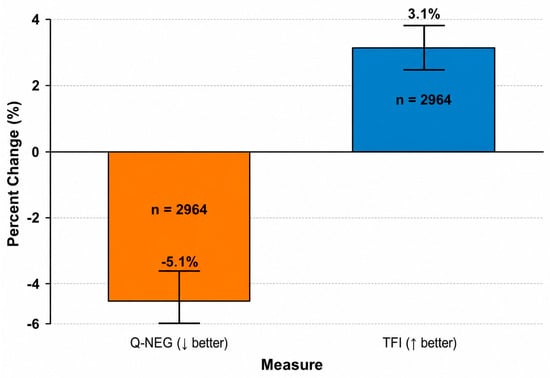
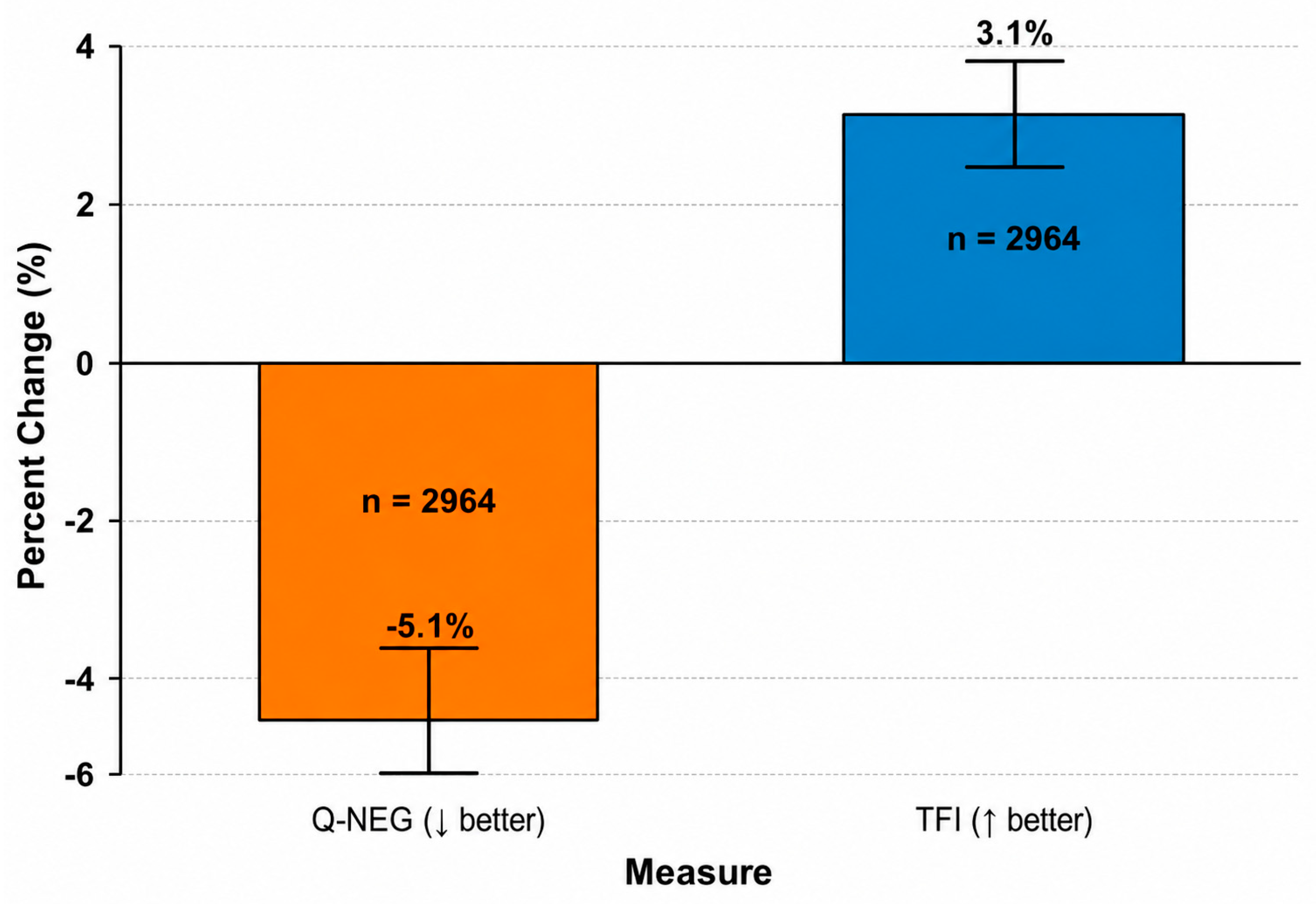
All outcome analyses reported below were conducted on the full matched sample of 2964 participants; the follow-up interval described in Section 2.8 reflects a descriptive characteristic of the timestamped subset only and did not serve as an analytic variable or inclusion criterion. The population was predominantly male, with 80.65% identified as male and 19.35% as female. The mean participant age was 40.4 years, reflecting a mid-career workforce typical of trade, transport, and labor-intensive industries. At baseline, the average TFI score was 15.1 (SD = 3.42), and the average Q-NEG score was 10.9, indicating elevated levels of psychological distress and moderate overall fitness across the cohort. By follow-up, the average TFI score had increased to 15.6 (SD = 3.48), and the average Q-NEG score had decreased to 10.3. Paired t-tests revealed statistically significant improvements in both physical and mental health. TFI scores increased by an average of 0.47 points (t = 9.50, p < 0.001), indicating enhanced overall fitness when using the revised scoring system in which higher scores reflect better fitness. Q-NEG scores declined by an average of 0.56 points (t = −10.60, p < 0.001), reflecting a reduction in psychological distress across the sample. These patterns are further illustrated in Figure 1, which shows the percent change in TFI and Q-NEG scores from baseline to follow-up. The average TFI score increased by 3.1%, while Q-NEG scores decreased by 5.1% (n = 2964), both changes representing meaningful improvements in occupational wellness over time (Figure 1).
Figure 1.
Percent Change in TFI and Q-NEG Scores Over Time. Note: Bar chart depicting percent change in TFI and Q-NEG scores over the follow-up period. Outcome data reflect the full matched analytic sample (n = 2964). The median follow-up interval (6.2 months; interquartile range 5.7–8.1 months) was reconstructed from the subset of records with complete baseline and follow-up timestamps (n = 700) and is reported for descriptive transparency only; it does not alter the analytic sample. Error bars represent the standard error of the mean. TFI scores reflect physical fitness, where higher scores are better; Q-NEG scores reflect psychological distress, where lower scores are better.
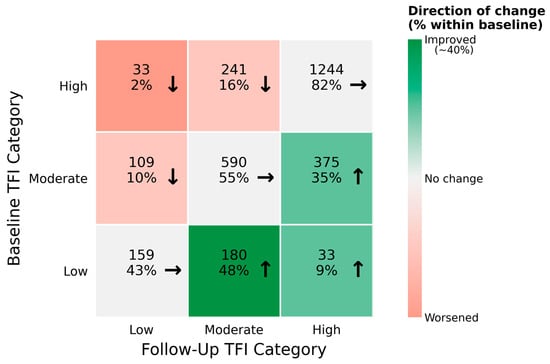
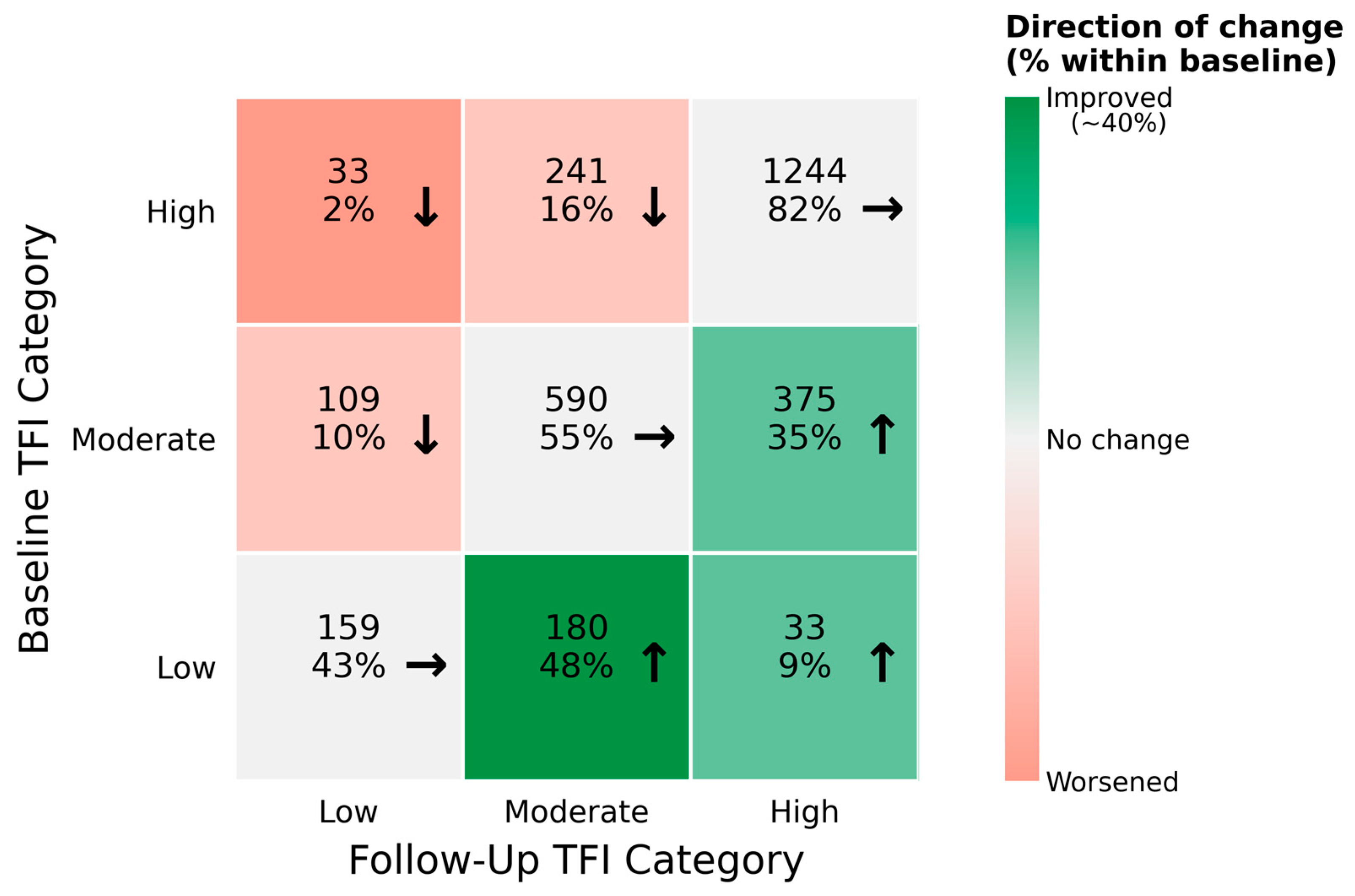
To further explore changes in fitness classification, a TFI category shift matrix was generated. Participants were categorized as Low Fitness (TFI score ≤ 10), Moderate Fitness (11–15), or High Fitness (≥16) based on their composite scores. At baseline, 21.4% of participants were classified as Low Fitness, 46.2% as Moderate Fitness, and 32.4% as High Fitness. By follow-up, a portion of participants demonstrated improvement in fitness classification, while others remained stable or declined. A heatmap of category shifts is shown in Figure 2, highlighting the dynamic nature of physical fitness across the cohort during the follow-up period.
Figure 2.
Total Fitness Index category shift matrix from baseline to follow-up over time. Note: Heatmap shows participant transitions between TFI fitness categories (Low, Moderate, and High) from baseline to follow-up (n = 2964). Arrows within each cell indicate the direction of change from baseline to follow-up TFI categories: upward (↑) shows improvement to a higher category, downward (↓) shows decline to a lower category, and rightward (→) shows no change. Numbers represent participant counts with within-baseline percentages, while color intensity reflects the proportion of each baseline group transitioning to the follow-up category.
To assess the relationship between changes in psychological distress and physical fitness, participants were grouped by Q-NEG change status (Improved, No Change, or Worsened). A clear pattern emerged: 598 participants who experienced improvements in psychological well-being also improved in TFI classification, compared to only 232 participants among those with worsened Q-NEG scores. Conversely, declines in psychological health were associated with declines in fitness. Among participants whose Q-NEG scores worsened, 253 showed a decline in fitness, compared to only 191 among those whose psychological well-being had improved.
A chi-square test of independence confirmed a statistically significant association between Q-NEG change and TFI classification shift (χ2 = 98.73, df = 4, p < 0.001). These findings suggest a meaningful connection between improved psychological well-being and enhanced physical fitness, underscoring the value of integrated wellness programs that target both mental and physical domains. Table 4 illustrates the relationship between changes in TFI categories and Q-NEG status, reinforcing the importance of integrated wellness strategies that address both physical and psychological health.
Table 4.
Relationship between changes in physical fitness (TFI) and psychological distress (Q-NEG) from baseline to follow-up. Note: Cross-tabulation of participants’ physical fitness change (TFI Improved, No Change, or Worsened) against changes in psychological distress (Q-NEG Improved, No Change, or Worsened) from baseline to follow-up (n = 2964).
Two components of the Q-NEG measure, satisfaction (Q-Satisfied) and interest (Q-Interest), were also examined. Satisfaction improved in 26.2% of participants, remained stable in 55.8%, and declined in 17.9%. Among those whose satisfaction improved, just over half (51.2%) also improved in TFI classification, whereas declines in satisfaction were associated with higher rates of fitness decline. Interest improved in 19.9%, was unchanged in 64.5%, and declined in 15.6%; patterns of association with TFI mirrored those observed for satisfaction but were slightly less pronounced. These findings suggest that while improvements in satisfaction and interest were positively linked to physical fitness gains, many participants achieved fitness improvement without subjective changes, indicating partially independent pathways of benefit.
4. Discussion
The primary aim of this study was to evaluate the effectiveness of a comprehensive workplace wellness initiative in improving both physical and psychological health outcomes among blue-collar workers. The main findings demonstrate significant improvements in TFI and Q-NEG scores over the follow-up period (median 6.2 months among participants with complete follow-up dates), with a strong association between enhanced psychological well-being and upward shifts in physical fitness categories. These results reinforce the value of workplace programs grounded in the Health Journeys model and highlight the utility of multidimensional tools such as TFI and Q-NEG in capturing integrated health improvements in occupational settings [11].
These findings are consistent with large-scale evaluations showing that comprehensive workplace wellness programs may produce modest but meaningful gains in employee health metrics, including physical activity, nutrition, weight, blood pressure, and cholesterol [5,22]. Programs that combine individual, organizational, and environmental strategies—similar to AlphaOne—could be effective when implemented over sustained periods [15]. Although the absolute improvements in TFI and Q-NEG scores were modest at the individual level, their practical significance should be interpreted within a population health framework. Across nearly 3000 workers, even relatively small average improvements translate into meaningful shifts in physical fitness and psychological well-being at the workforce level. Similar modest but sustained improvements have been associated with reductions in health risks, absenteeism, and healthcare utilization in previous workplace wellness studies.
A key innovation of the AlphaOne program was the use of health education workshops, which laid the foundation for the evolution of Health Journeys into behaviorally adaptive, digitally delivered tools. Today, these are integrated into platforms such as QHSLab (West Palm Beach, FL, USA) and Cerner/Oracle Health (North Kansas City, MO, USA), delivering scalable, personalized interventions addressing domains such as pain, emotional well-being, sleep, allergies, and behavioral change.
Importantly, this study expands the workplace wellness evidence base by focusing on an underrepresented population—blue-collar workers—who are often excluded from wellness evaluations that traditionally emphasize biometric outcomes, weight loss, or cost savings in white-collar settings. The improvements across both physical and psychological domains align with LaMontagne et al.’s integrated intervention framework, which emphasizes reducing psychological demands while enhancing organizational supports [13]. Secondary analyses further reinforced this integrated perspective, showing that psychosocial improvements were associated with fitness gains, while physical improvements also occurred independently, likely due to ergonomic, behavioral, and team-based components. These findings strengthen the emerging consensus around the mind–body connection in occupational health and support calls for routine integration of mental health screening into all workplace wellness programs [23].
Unlike studies that examine health metrics in isolation, this analysis employed a composite measure of physical fitness (TFI) and linked it quantitatively with psychological well-being (Q-NEG). The significant chi-square association between improvements in Q-NEG and fitness category progression (TFI) provides empirical support for integrated care models and validates the importance of monitoring health trajectories longitudinally rather than relying solely on static indicators [24]. This approach is particularly valuable for labor-intensive populations that face cultural and logistical barriers to conventional healthcare engagement.
The findings also operationalize LaMontagne’s tripartite model for workplace mental health promotion, which advocates for (1) protection from work-related harm, (2) promotion of positive mental health, and (3) support for workers experiencing mental health issues [13]. The AlphaOne program exemplified this approach by integrating ergonomic hazard reduction, evidence-based mental health training, and referral pathways into a unified workforce-wide intervention. Such holistic designs may be especially effective in high-risk environments, where fragmented approaches have proven insufficient.
By analyzing longitudinal data from a large industrial workforce, this study contributes a rare and valuable dataset to occupational health research. The results may also inform the design of modern, digitally scalable interventions that integrate ergonomic, behavioral, and psychological strategies. As employers increasingly adopt such platforms, these findings provide both a benchmark and a roadmap for advancing integrated wellness frameworks.
Several limitations of this evaluation warrant emphasis, most of which follow directly from AlphaOne’s nature as an operational workplace program rather than a purpose-built research study, as described in Section 2.1. Because the program was not designed with a research protocol, no randomized or matched control group was established, precluding causal inference; observed improvements may reflect unmeasured confounders such as organizational culture, secular trends in worker health behavior, or participant motivation rather than the intervention alone. For the same reason, individual-level engagement and adherence data (e.g., number of counseling sessions attended, completion of Health Journeys modules) were not systematically captured, preventing dose–response analyses. Assessment timing was likewise determined by employer and site-level scheduling rather than a fixed research visit window; as detailed in Section 2.8, the interval between baseline and follow-up could be reconstructed for only a subset of participants with complete date records, introducing uncertainty around the precise follow-up period for the full cohort. Sex-stratified analyses were not performed in the present report; although the dataset includes sex as a recorded variable, the analytic dataset did not support a fully powered stratified comparison within the scope of this evaluation, and the predominantly male composition of the cohort (80.7%) should be considered when generalizing findings to female blue-collar workers. The TFI’s equal weighting across component domains was a pragmatic design choice consistent with the program’s original operational purpose of generating an accessible composite risk indicator for participants and coaches, rather than a psychometrically derived weighting scheme; future work could explore empirically weighted or factor-analytic alternatives. Additionally, while TFI and Q-NEG are robust multidimensional tools, other relevant domains such as objectively measured sleep quality were not directly assessed. Nonetheless, as discussed above, the core assessment and intervention principles demonstrated here continue to inform present-day digitally delivered occupational health programs, providing a bridge between this historical operational dataset and current practice. Detailed activity-level timelines and duration for each component of the intervention were not uniformly retained in the available program records, and adherence or protocol-fidelity measures (e.g., number of sessions attended, monitoring of deviations from the intended protocol) were not systematically captured during program delivery; as with other constraints described above, this reflects AlphaOne’s design as an operational workplace service rather than a research protocol with built-in fidelity monitoring. Future evaluations of similar occupational programs would benefit from prospectively designed adherence tracking to enable dose–response analyses and more rigorous assessment of intervention fidelity. Finally, because data collection occurred between 2003 and 2010, generalizability to contemporary blue-collar workforces and industries should be considered carefully; nonetheless, as discussed above, the core assessment and intervention principles demonstrated here continue to inform present-day digitally delivered occupational health programs, providing a bridge between this historical operational dataset and current practice.
These findings yield several practical recommendations for labor-intensive sectors. First, integrated tools such as TFI and Q-NEG should be embedded into routine health assessments to monitor physical and psychological well-being simultaneously, allowing for personalized, data-driven care. Second, mental health promotion should be prioritized as a core wellness strategy rather than a reactive service, with routine psychological screening to identify at-risk individuals and foster mental health literacy. Finally, future programs should capitalize on scalable digital platforms that provide adaptive, whole-person support across domains such as pain, sleep, emotional health, and behavior [25]. Collectively, these results demonstrate that behaviorally intelligent, multidimensional wellness strategies can serve as essential infrastructure for sustaining worker health, engagement, and productivity.
This study provides real-world evidence that a comprehensive workplace wellness program was associated with improvements in physical fitness and psychological well-being among blue-collar workers. By integrating the TFI and Q-NEG measures, the evaluation captured the holistic interplay between physical performance and emotional resilience, offering a more complete picture of employee health than traditional single-domain metrics. Central to these outcomes were the Health Journeys modules, structured, behaviorally adaptive interventions grounded in cognitive–behavioral strategies and ergonomic principles. Delivered through team-based, practical learning, these modules actively engaged participants in taking ownership of their health trajectories. Collectively, these findings validate the effectiveness of integrated mind–body health strategies in labor-intensive occupational settings. The AlphaOne model not only demonstrates measurable benefits for worker well-being but also presents a scalable, evidence-informed framework that organizations can adopt to strengthen workforce health, resilience, and productivity.
5. Conclusions
This study shows that a comprehensive workplace wellness program may improve physical fitness and psychological well-being in blue-collar workers. Using combined metrics, the assessment highlighted the link between mental health and physical performance. The Health Journeys modules, based on cognitive–behavioral and ergonomic approaches, encouraged active participation and ownership of health. Overall, the AlphaOne program may be a viable model to tailor solutions to boost worker wellness and productivity.
Author Contributions
Conceptualization, M.A.S.-G., T.G. and D.H.; formal analysis, A.M., M.A.S.-G.; resources, T.G.; writing—original draft preparation, A.M., M.A.S.-G.; writing—review and editing, M.A.S.-G., S.A.A.R. and D.H.; supervision, D.H.; funding acquisition, T.G. All authors have read and agreed to the published version of the manuscript.
Funding
This research received no external funding, and the APC was funded by QHSLab, Inc.
Institutional Review Board Statement
This study (protocol #32-130) was deemed exempt from IRB review under 45 CFR 46.104(d)(4) by the IRB at the Lake Erie College of Osteopathic Medicine (LECOM) on 28 April 2025.
Informed Consent Statement
Informed consent was waived due to the retrospective nature of the study, which involved secondary analysis of de-identified data.
Data Availability Statement
Restrictions apply to the availability of these data. The data presented in this study are derived from historical operational records of the AlphaOne Health and Fitness Program and are held by QHSLab, Inc. (West Palm Beach, FL, USA). Data are not publicly available due to proprietary and confidentiality restrictions. Requests to access the datasets should be directed to the corresponding author (M.A.S.-G.) and are subject to the approval of QHSLab, Inc.
Conflicts of Interest
Grogan is the Chief Executive Officer of QHSLab, Inc., and holds stock in the company. Matejka, Rizvi, and Sanchez-Gonzalez serve as scientific advisers to QHSLab and may hold stock or stock options. QHSLab acquired the historical AlphaOne program data analyzed in this report and funded the article processing charge. The authors had unrestricted access to the full dataset and sole responsibility for analytic decisions and interpretation; QHSLab had no role in data analysis or the decision to publish. No other financial or personal relationships with individuals or organizations have influenced the submitted work.
References
- Berry, L.L.; Mirabito, A.M. Partnering for prevention with workplace health promotion programs. Mayo Clin. Proc. 2011, 86, 335–337. [Google Scholar] [CrossRef] [Scilit] [PubMed]
- Pelletier, K.R. A review and analysis of the health and cost-effective outcome studies of comprehensive health promotion and disease prevention programs at the worksite: 1991–1993 update. Am. J. Health Promot. 1993, 8, 50–62. [Google Scholar] [CrossRef] [Scilit] [PubMed]
- Pelletier, K.R. A review and analysis of the clinical and cost-effectiveness studies of comprehensive health promotion and disease management programs at the worksite: 1995–1998 update (IV). Am. J. Health Promot. 1999, 13, 333–345. [Google Scholar] [CrossRef] [Scilit] [PubMed]
- Goetzel, R.Z.; Ozminkowski, R.J. The health and cost benefits of work site health-promotion programs. Annu. Rev. Public Health 2008, 29, 303–323. [Google Scholar] [CrossRef] [Scilit] [PubMed]
- Goetzel, R.Z.; Henke, R.M.; Tabrizi, M.; Pelletier, K.R.; Loeppke, R.; Ballard, D.W.; Grossmeier, J.; Anderson, D.R.; Yach, D.; Kelly, R.K.; et al. Do workplace health promotion (wellness) programs work? J. Occup. Environ. Med. 2014, 56, 927–934. [Google Scholar] [CrossRef] [Scilit] [PubMed]
- Schulte, P.A.; Pana-Cryan, R.; Schnorr, T.; Schill, A.L.; Guerin, R.; Felknor, S.; Wagner, G.R. An approach to assess the burden of work-related injury, disease, and distress. Am. J. Public Health 2017, 107, 1051–1057. [Google Scholar] [CrossRef] [Scilit] [PubMed]
- Sorensen, G.; Barbeau, E.; Stoddard, A.M.; Hunt, M.K.; Kaphingst, K.; Wallace, L. Promoting behavior change among working-class, multiethnic workers: Results of the Healthy Directions—Small Business Study. Am. J. Public Health 2005, 95, 1389–1395. [Google Scholar] [CrossRef] [Scilit] [PubMed]
- Varianou-Mikellidou, C.; Boustras, G.; Dimopoulos, C.; Wybo, J.L.; Guldenmund, F.W.; Nicolaidou, O.; Anyfantis, I. Occupational health and safety management in the context of an ageing workforce. Saf. Sci. 2019, 116, 231–244. [Google Scholar] [CrossRef] [Scilit]
- Vyas, M.V.; Garg, A.X.; Iansavichus, A.V.; Costella, J.; Donner, A.; Laugsand, L.E.; Janszky, I.; Mrkobrada, M.; Parraga, G.; Hackam, D.G. Shift work and vascular events: Systematic review and meta-analysis. BMJ 2012, 345, e4800. [Google Scholar] [CrossRef] [Scilit] [PubMed]
- Karasek, R. Healthy Work: Stress, Productivity, and the Reconstruction of Working Life; Basic Books: New York, NY, USA, 1990. [Google Scholar]
- Wilkinson, R.G.; Marmot, M. Social Determinants of Health: The Solid Facts; World Health Organization, Regional Office for Europe: Copenhagen, Denmark, 2003. [Google Scholar]
- Stansfeld, S.; Candy, B. Psychosocial work environment and mental health—A meta-analytic review. Scand. J. Work Environ. Health 2006, 32, 443–462. [Google Scholar] [CrossRef] [Scilit] [PubMed]
- LaMontagne, A.D.; Martin, A.; Page, K.M.; Reavley, N.J.; Noblet, A.J.; Milner, A.J.; Keegel, T.; Smith, P.M. Workplace mental health: Developing an integrated intervention approach. BMC Psychiatry 2014, 14, 131. [Google Scholar] [CrossRef] [Scilit] [PubMed]
- Virtanen, M.; Lallukka, T.; Elovainio, M.; Steptoe, A.; Kivimäki, M. Effectiveness of workplace interventions for health promotion. Lancet Public Health 2025, 10, e512–e530. [Google Scholar] [CrossRef] [Scilit] [PubMed]
- Rouyard, T.; Yoda, E.; Akksilp, K.; Dieterich, A.V.; Kc, S.; Dabak, S.V.; Müller, A.M. Effects of workplace interventions on sedentary behaviour and physical activity: An umbrella review with meta-analyses and narrative synthesis. Lancet Public Health 2025, 10, e295–e308. [Google Scholar] [CrossRef] [Scilit] [PubMed]
- Oldenburg, B.; Owen, N.; Harris, D. Australian National Workplace Health Project: Strategies for gaining access, support and commitment. Health Promot. J. Aust. 1999, 9, 49–54. [Google Scholar]
- Glanz, K.; Lewis, F.M.; Rimer, B.K. Health Behavior and Health Education: Theory, Research, and Practice; Jossey-Bass/Wiley: San Francisco, CA, USA, 1990. [Google Scholar]
- Prochaska, J.O.; DiClemente, C.C. Stages and processes of self-change of smoking: Toward an integrative model of change. J. Consult. Clin. Psychol. 1983, 51, 390–395. [Google Scholar] [CrossRef] [PubMed]
- Bischof, G.; Bischof, A.; Rumpf, H.J. Motivational interviewing: An evidence-based approach for use in medical practice. Dtsch. Arztebl. Int. 2021, 118, 109–115. [Google Scholar] [CrossRef] [Scilit] [PubMed]
- Matejka, A.; Rizvi, S.A.A.; Goubran, B.; Fincham, F.; Oms, J.; Sanchez-Gonzalez, M.; Grogan, T. Scale-based scores linked to health care overutilization in primary care: Development and validation of the Q-Scale. Consultant360 2025, 65, 1–8. [Google Scholar] [CrossRef] [Scilit]
- Golding, L.A. YMCA Fitness Testing and Assessment Manual, 4th ed.; Human Kinetics: Champaign, IL, USA, 2000. [Google Scholar]
- Peñalvo, J.L.; Sagastume, D.; Mertens, E.; Uzhova, I.; Smith, J.; Wu, J.H.Y.; Bishop, E.; Onopa, J.; Shi, P.; Micha, R.; et al. Effectiveness of workplace wellness programmes for dietary habits, overweight, and cardiometabolic health: A systematic review and meta-analysis. Lancet Public Health 2021, 6, e648–e660. [Google Scholar] [CrossRef] [Scilit] [PubMed]
- Lerner, D.; Amick, B.C.; Rogers, W.H.; Malspeis, S.; Bungay, K.; Cynn, D. The work limitations questionnaire. Med. Care 2001, 39, 72–85. [Google Scholar] [CrossRef] [Scilit] [PubMed]
- Short, M.E.; Goetzel, R.Z.; Pei, X.; Tabrizi, M.J.; Ozminkowski, R.J.; Gibson, T.B.; DeJoy, D.M.; Wilson, M.G.H. How accurate are self-reports? Analysis of self-reported health care utilization and absence when compared with administrative data. J. Occup. Environ. Med. 2009, 51, 786–796. [Google Scholar] [CrossRef] [Scilit] [PubMed]
- Hamine, S.; Gerth-Guyette, E.; Faulx, D.; Green, B.B.; Ginsburg, A.S. Impact of mHealth chronic disease management on treatment adherence and patient outcomes: A systematic review. J. Med. Internet Res. 2015, 17, e52. [Google Scholar] [CrossRef] [Scilit] [PubMed]

Disclaimer/Publisher’s Note: The statements, opinions and data contained in all publications are solely those of the individual author(s) and contributor(s) and not of MDPI and/or the editor(s). MDPI and/or the editor(s) disclaim responsibility for any injury to people or property resulting from any ideas, methods, instructions or products referred to in the content. |
© 2026 by the authors. Published by MDPI on behalf of the JMMS. Licensee MDPI, Basel, Switzerland. This article is an open access article distributed under the terms and conditions of the Creative Commons Attribution (CC BY) license.