


Abstract
Currently, the use of acoustic echo cancellers (AECs) plays a crucial role in IoT applications, such as voice control appliances, hands-free telephony and intelligent voice control devices, among others. Therefore, these IoT devices are mostly controlled by voice commands. However, the performance of these devices is significantly affected by echo noise in real acoustic environments. Despite good results being achieved in terms of echo noise reductions using conventional adaptive filtering based on gradient optimization algorithms, recently, the use of bio-inspired algorithms has attracted significant attention in the science community, since these algorithms exhibit a faster convergence rate when compared with gradient optimization algorithms. To date, several authors have tried to develop high-performance AEC systems to offer high-quality and realistic sound. In this work, we present a new AEC system based on the grey wolf optimization (GWO) and particle swarm optimization (PSO) algorithms to guarantee a higher convergence speed compared with previously reported solutions. This improvement potentially allows for high tracking capabilities. This aspect has special relevance in real acoustic environments since it indicates the rate at which noise is reduced.
1. Introduction
Nowadays, acoustic echo cancellation (AEC) is considered as an important area of speech enhancement and its improvement is still a important issue in audio communication. In particular, its impact is growing considerably, since its use is highly demanded in consumer IoT devices controlled by voice commands. Recently, new schemes have been developed to overcome the performance problems of conventional adaptive filtering structures [1,2]. To ensure a high speech quality and speech intelligibility, cutting-edge metaheuristic algorithms have emerged and are considered as potential solutions, since conventional step-descent adaptive filtering algorithms offer limited performance. Recent studies have proven that the use of metaheuristic algorithms has increased the performance of advanced filtering applications, such as active noise control (ANC) [3,4,5,6,7,8,9,10,11,12,13,14], enhancement of speech or suppression of noise [15,16,17] and acoustic echo cancellation. Regarding the latter application, Diana et al. [18] proposed a hybrid metaheuristic technique based on the artificial bee colony (ABC) and the Kernel Adaptive Improved Proportionate and Normalized Least Mean Square (KIPNLMS) algorithm. The authors used these two algorithms to achieve a high echo cancellation efficiency under linear and nonlinear distortions of the speech signal. On the other hand, Kimoto et al. [19] proposed a multichannel AEC system based on a variant of the particle swarm optimization (PSO) algorithm called deterministic particle swarm optimization (D-PSO). Merabti et al. [20] presented an AEC system based on a genetic algorithm (GA) to estimate the room impulse response and nonlinear function parameters. Recently, Anides et al. [21] proposed an efficient processor to simulate a new variant of the PSO algorithm based on the Markovian switching technique. On the other hand, Pichardo et al. [22] used grey wolf optimization and the LMS algorithm to increase the convergence speed.
Analyzing previous works, two large challenges remain in the development of efficient AEC systems to significantly reduce the echo noise:
- The first challenge is linked to the achievement of a high convergence speed and good tracking capabilities in AEC systems.
- The second challenge lies in improving the extremely time-consuming process in the design of these metaheuristic algorithms, since most of them require a trial-and-error process for parameter setting.
Here, we present two contributions to overcome the above challenges:
- We propose a new AEC system that uses convex combination based on the PSO algorithm and the GWO algorithm to achieve a better echo cancellation performance. Here, the use of GWO allows us to achieve a fast convergence rate, while the use of the PSO algorithm allows us to obtain a high exploitation performance by adjusting inertia weights and acceleration coefficients. The results show that our proposed method outperforms existing approaches in terms of the ERLE level and tracking capabilities to significantly reduce the background noise, reverberation and other types of interference.
- To improve the time-consuming process, we use the GWO algorithm, since this requires fewer parameters to be tuned. In addition, we carefully select another metaheuristic algorithm to result in algorithms with complementary capabilities. As a consequence, we can reduce parameter tuning, which is beneficial, especially when used in practical applications.
In general terms, the study of new metaheuristic algorithms opens new horizons in the development of high-performance AEC systems. Specifically, the use of metaheuristic algorithms in the development of AEC systems allows us to achieve higher convergence speeds and offer higher tracking capabilities in comparison with gradient descent adaptive filtering algorithms.
2. The Proposed Convex GWO/PSO Algorithm
Recently, the development of combination schemes has attracted significant attention, since the outputs of several filters are mixed together to obtain an overall output of increased quality. To achieve this, several authors use a linear combination of these filters. In this work, we use the GWO algorithm because of its simplicity and low number of parameters that need to be adjusted [23]. However, one of its critical limitations appears when dealing with a large number of variables and local solutions. Specifically, its accelerated exploitation and fast convergence speed can be seen as disadvantages since they cause it to fall into local solutions easily. On the other hand, the particle swarm optimization (PSO) algorithm maintains a balance between exploration and exploitation by adjusting certain parameters. Therefore, the algorithm exhibits better exploration or exploitation performances according to the requirements. This features allows us to obtain a flexible and effective algorithm. Here, we use the GWO algorithm to achieve a high exploitation performance and PSO is used to obtain a high exploration performance by adjusting inertia weights and acceleration coefficients.
2.1. GWO Algorithm
The GWO algorithm is a population-based metaheuristic algorithm that intends to mimic the social behavior and hunting strategy of grey wolves in nature [24]. This algorithm employs four types of grey wolves to represent the leadership hierarchy of a wolf pack: alpha (), which represents the fittest solution; omega (), which are the search agents; and finally, beta () and delta (), which are the second and third best solutions, respectively. To simulate the GWO algorithm, the following equations are used:
where n indicates the current iteration, represents the position of a grey wolf, is the position vector of the prey, and and denote coefficient vectors, which are calculated by
The parameters and represent random vectors in and is the tuning parameter for exploration and exploitation, which is linearly decreased from 2 to 0 and is calculated using:
where is the total number of iterations. The updated positions of the search agents are expressed by
The best three wolves at each iteration are defined by and , and is the new position of the prey.
2.2. PSO Algorithm
Particle swarm optimization (PSO) is a bio-inspired algorithm that mimics the collective behavior of a swarm of particles to find an optimal solution [25]. Each particle has a unique position and velocity, which are updated based on the individual best position and the best position of the swarm. After calculating the velocity of each particle, the new velocity is applied to the particle’s previous position to update its position. The equation for updating the velocity and position of each particle is as follows:
where is the velocity of particle i at time n, is the inertia weight, and are acceleration constants, and are random numbers between 0 and 1, is the best position of particle i, is the current position of particle i, and is the global best position of the swarm.
2.3. Convex GWO/PSO Algorithm
To date, several works have proven that combining two adaptive algorithms has several advantages; one of them is linked to the improvement in the performance. In this work, we present a new algorithm that combines two swarm intelligence techniques (the GWO and PSO algorithms) to improve tracking capabilities and to ensure a high convergence rate.
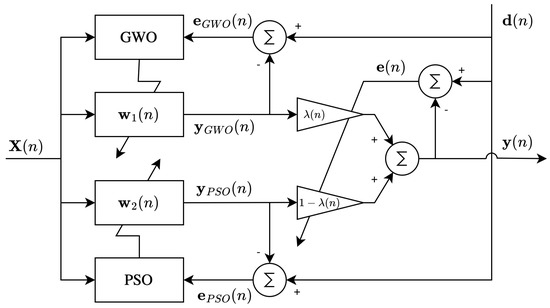
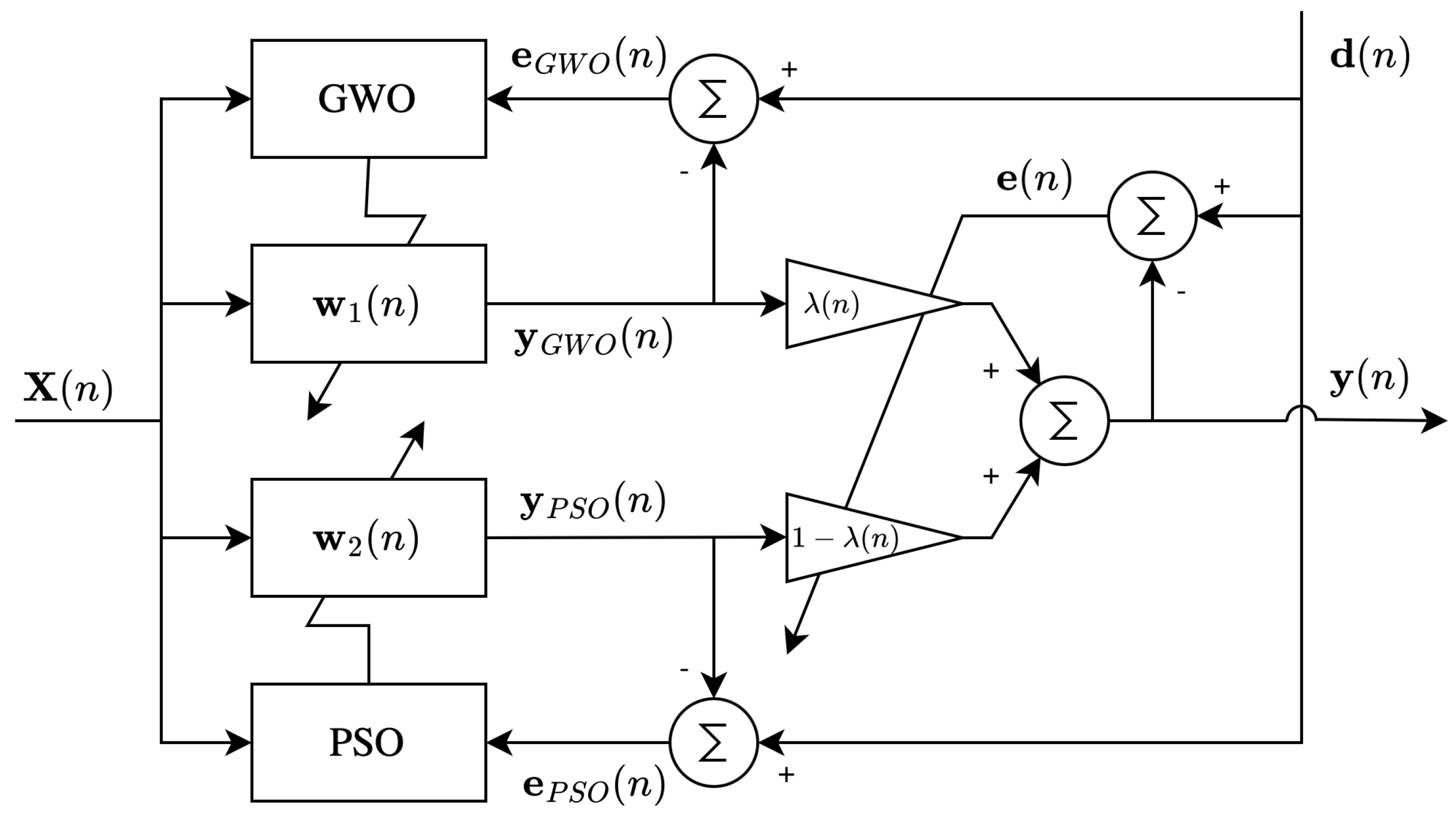
In the proposed structure (see Figure 1), the input signal, , is defined by:
where L is the length of the block and N is the size of the filter. In addition, the desired signal is described by:
Figure 1.
The proposed structure using the GWO/PSO algorithm.
We use a convex combination to obtain the output of the filter, as follows:
Here, and are the outputs of the GWO and PSO filters, respectively. is a mixing parameter defined in range [0,1], given by:
where is the step size for an auxiliary parameter (), which is used to minimize the instantaneous square error of the filters, and is calculated at each iteration to obtain the best characteristics of each filter. Specifically, the adaption rule of specifies its value inside a symmetric interval []. Likewise, the value of limits the permissible range of to [1- , ]. Finally, the error vector for each filter is expressed as follows:
In the next section, we present the proposed convex structure by using the GWO and PSO algorithms.
- The computation of the coefficients of the filter by using the GWO algorithmThe encircling behavior of grey wolves is described in Equation (1). Previously, in [22], the calculation of was proposed as follows:The search space is determined by the parameter, which is based on the error signal . To evaluate each search agent, we use a fitness function defined in terms of the mean square error (MSE). Therefore, the fitness value is expressed as follows:Here, the number of search agents, denoted by , is dynamically adjusted based on the instantaneous error, as proposed in [22]. In this context, and represent the maximum and minimum number of search agents, respectively. Finally, the positions of both the search agents and the prey are updated through Equations (5)–(8), and the vector is set equal to .
- The computation of the coefficients of the filter by using the PSO algorithmTo update the filter coefficients, we use the PSO algorithm. Specifically, we set . To identify the best position, we choose the particle with the lowest fitness value, . Each particle represents a vector of filter coefficients, and we update its position by using the following expressions:where is the velocity vector and is the inertia weight, which is linearly decreased to control exploration and exploitation, given by:
3. Results
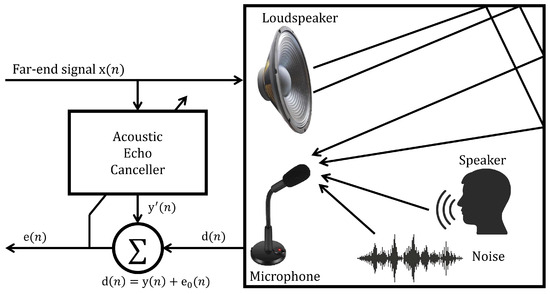
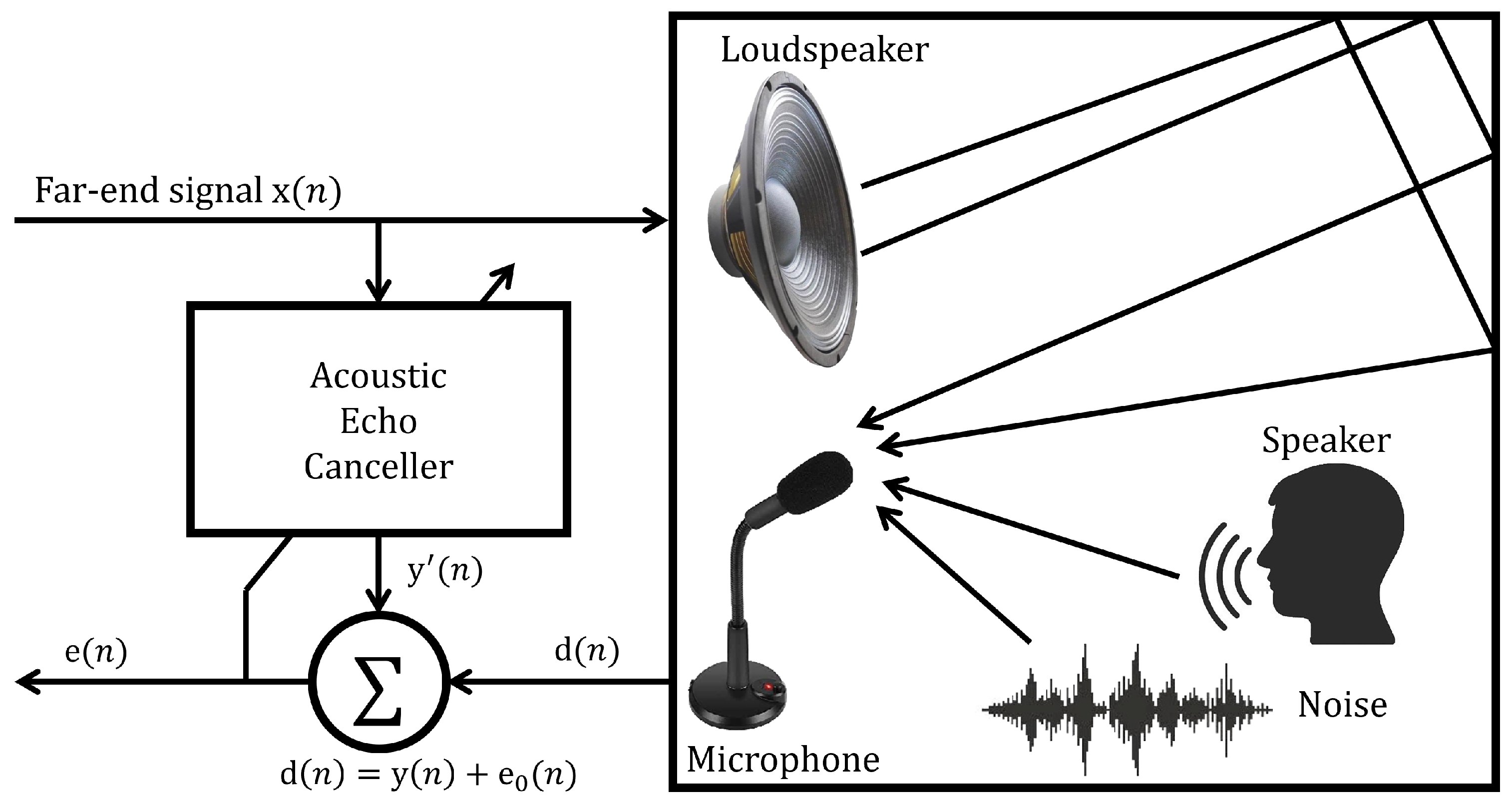
Here, we simulate the proposed AEC system based on a new convex combination. Specifically, this combination uses the grey wolf optimization (GWO) and particle swarm optimization (PSO) algorithms. Figure 2 shows the experimental setup used to evaluate the performance of the proposed AEC system, where refers to the original audio signal, is the residual echo signal, and is the speech signal combined with the background noise, , along with the acoustic echo signal, .
Figure 2.
Structure of the acoustic echo canceller.
To perform the simulation of the proposed AEC system, we consider the following conditions:
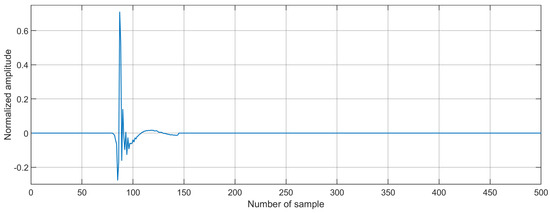
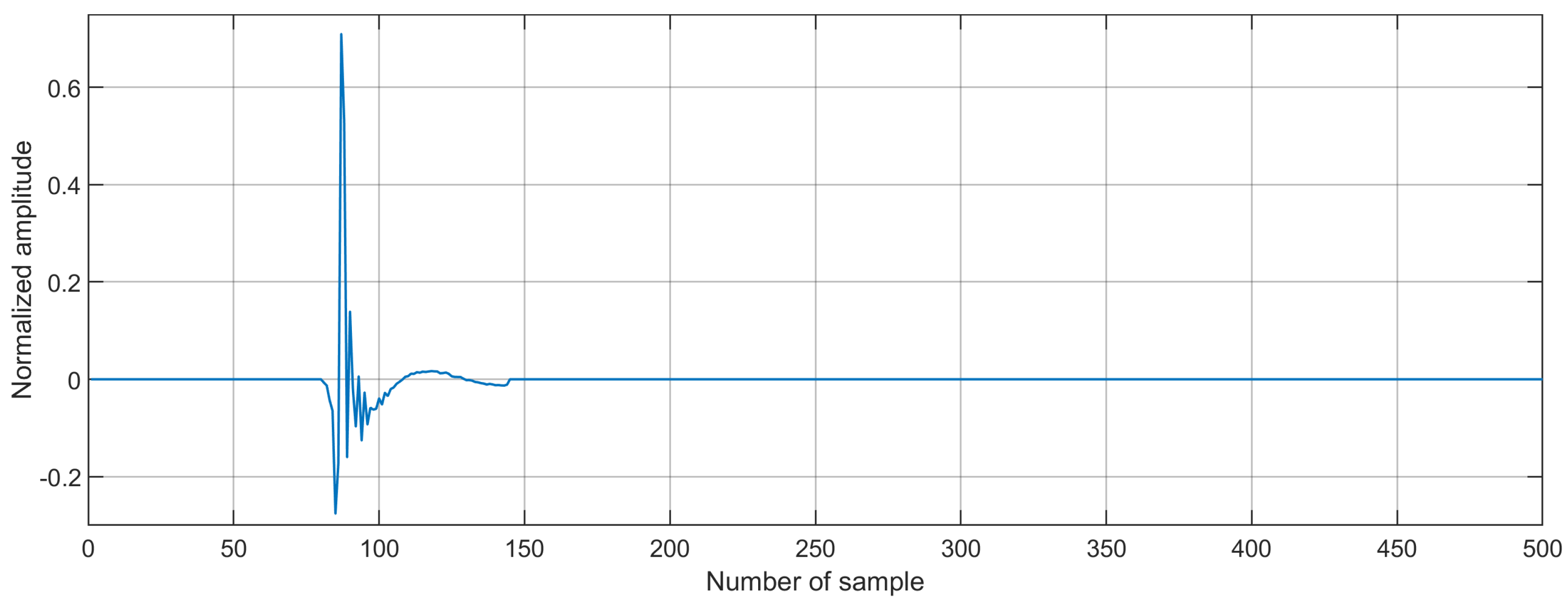
- We use an impulse response as the echo path since this response is recommended by ITU-T G168 [26]. In addition, the length of the path is defined by 500 coefficients, as shown in Figure 3.Figure 3. Acoustic echo path used for the simulation of the proposed and existing algorithms.
- We use the AR(1) process as an input signal. In addition, the echo signal was mixed with white Gaussian noise (SNR = 20 dB).
- In the case of using the GWO algorithm, the number of search agents is defined in the range of 15–30. On the other hand, the implementation of the PSO algorithm requires up to 60 particles.
- Here, we test the tracking capabilities of the proposed algorithm by inducing an abrupt change in the impulse response of the acoustic echo path; i.e., we multiply the acoustic paths by −1 in the middle of the adaptive filtering process.
- The performance of the proposed algorithm is validated in terms of echo return loss enhancement ().
- The computer performs 2,000,000 iterations to obtain the desired result.
In addition, we define and calibrate all the variables and parameters of the GWO and PSO algorithms to obtain the best performance of the proposed AEC system. In addition, we simulate existing approaches [22,24,25,27,28,29,30,31] to compare the performance between the proposed and existing algorithms. In all cases, we adjust the parameters to obtain the best result of each algorithm.
- Modified artificial bee colony, MABC: population size , evaporation parameter , upper bound , lower bound , pheromone , convergence factor .
- Artificial bee colony, ABC: upper bound , lower bound , evaporation parameter , pheromone , population size .
- Grey wolf optimizer, GWO: upper bound , lower bound , population size , a decreases linearly from 2 to 0.
- Particle swarm optimization, PSO: population size , upper bound , lower bound , acceleration coefficient, , acceleration coefficient, , inertia weight .
- PSO-LMS: population size , acceleration coefficient, , acceleration coefficient, , convergence factor , inertia weight , upper bound , lower bound .
- Differential evolution, DE: combination factor , scaling factor , crossover rate , upper bound , lower bound , population size .
- Least mean squares, LMS: convergence factor .
- GWO/LMS: upper bound , lower bound , population size automatically adjusted between , convergence factor .
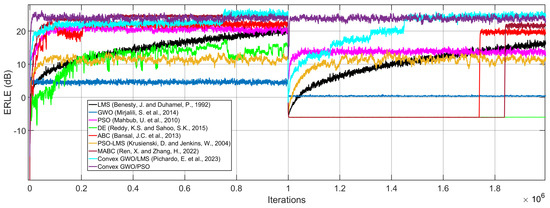
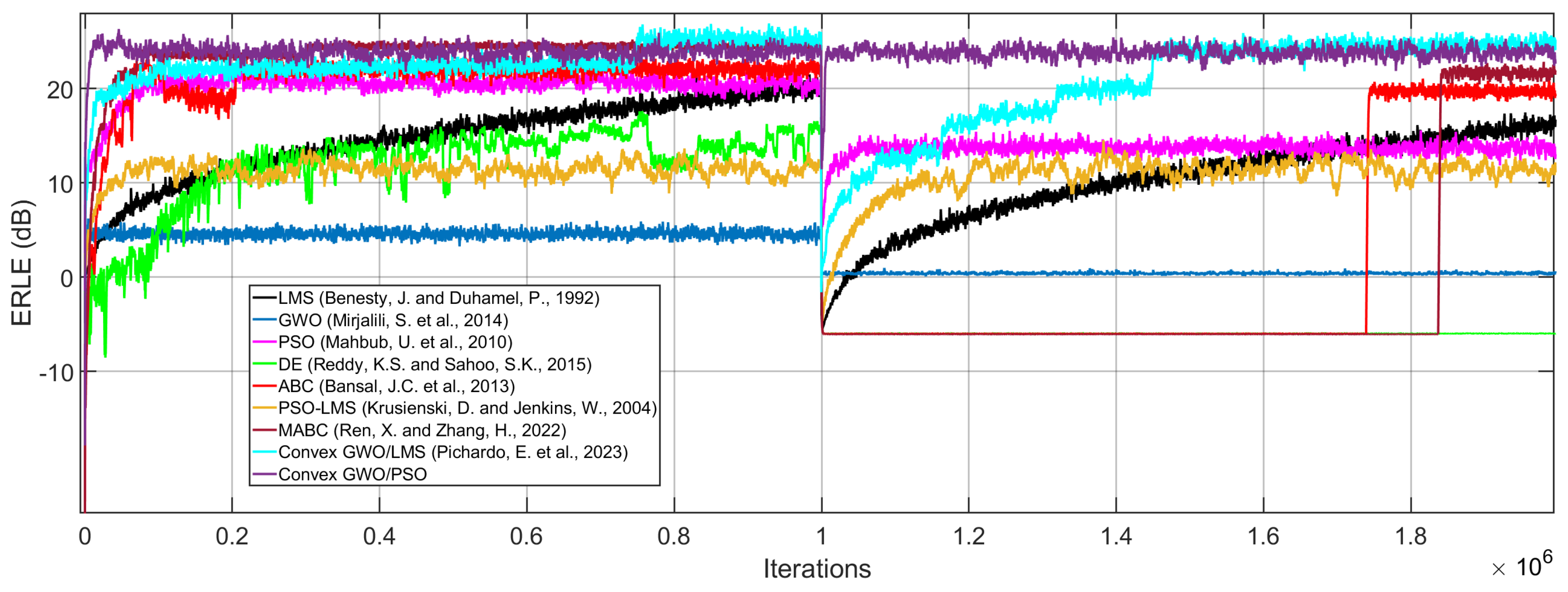
As can be seen in Figure 4, the proposed convex GWO/PSO adaptive filter exhibits the best performance in terms of the ERLE level and convergence speed at the cost of performing more addition and multiplication in comparison with existing approaches, as shown in Table 1. However, the conventional GWO algorithm performs more additions and multiplications and exhibits a very low ERLE level compared with the proposed algorithm. Therefore, our proposal significantly improves the performance of conventional GWO in terms of ERLE and the number of arithmetic operations. In addition, the proposed algorithm exhibits a superior performance compared to existing solutions, especially when the path suffers an abrupt change. This has special relevance, since our approach can effectively reduce acoustic echo signals at high speeds. Therefore, the use of existing approaches in real-world echo noise applications is limited.
Figure 4.
Simulating existing approaches and the proposed algorithm to obtain the ERLE [22,24,25,27,28,29,30,31].
Table 1.
Comparison between the existing approaches and the proposed convex GWO/LMS system in terms of the number of multiplications and additions.
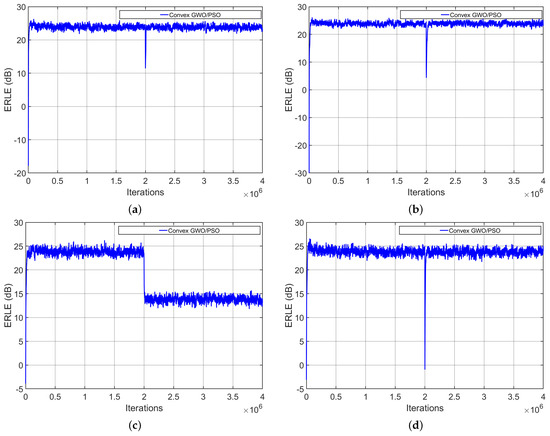
To verify the tracking properties of the proposed GWO/PSO algorithm, we performed four different experiments under the following conditions:
- We used an AR(1) process as an input signal.
- We change the SNR from 20 dB to 10 dB in the middle of iterations.
- We induce an abrupt change in the impulse response of the acoustic echo path at the middle of the process. To achieve this, we multiply the acoustic path by −1.
- We shift the acoustic path in the middle of the process.
- We simulate a double-talk scenario in the middle of the process.
Figure 5 shows the performance of the proposed algorithm when considering the previous conditions. In all cases, the algorithm shows a high convergence speed to confirm its tracking capabilities.
Figure 5.
Performing four different experiments to obtain the ERLE curves by using the proposed convex GWO/PSO algorithm. (a) Multiplying the acoustic path by −1; (b) shifting the acoustic path; (c) varying the SNR from 20 to 10 dB; (d) considering a double-talk simulation.
In real-world echo noise applications, variations in background noise critically affect the performance of the AEC system. However, our proposal shows good capabilities; the background noise variation does not affect its performance, as shown in Figure 5. To demonstrate this, we decreased the SNR from 20 to 10 dB in the middle of the iterations.
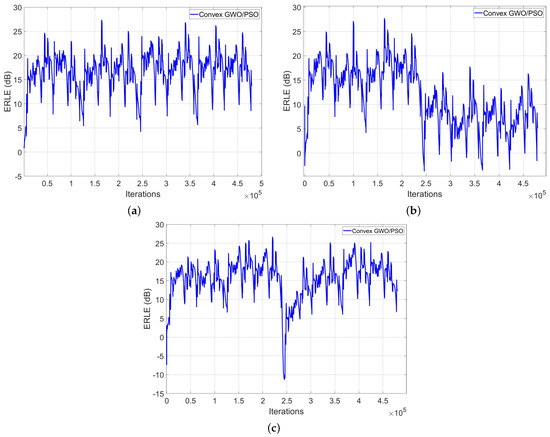
Additionally, we perform three different tests under the following conditions:
- We use the speech signal as an input signal.
- We simulate a single-talk and a double-talk scenario.
- We change the SNR from 20 dB to 10 dB in the middle of the iterations.
As can be observed from Figure 6, the proposed algorithm shows its computational capabilities under a single-talk scenario and a double-talk scenario. Regarding the latter, we employed a double-talk detector circuit to avoid adaptation during periods of simultaneous far and near-end speech. As can be observed from the above figures, the proposed algorithm achieves a good ERLE level and shows excellent tracking capabilities for all combinations of input signal levels, echo paths and echo path changes. With regard to the ERLE level, the improvement in this factor allows us to verify its utility in practical and real-world AEC applications.
Figure 6.
ERLE curves after using the proposed convex GWO/PSO algorithm and considering a speech sequence signal as input signal. (a) Considering a single talk simulation; (b) varying the SNR from 20 to 10 dB; (c) considering a double talk simulation.
Statistical Comparison
To demonstrate the statistical results in the simulation of each algorithm, we calculate the average of the ERLE value (dB) and the standard deviation, as shown in Table 2. This evaluation considers ten individual experiments, each one with 2,000,000 iterations.
Table 2.
Comparison between the existing approaches and the proposed convex GWO/LMS system in terms of the standard deviation in dB and the average value of ERLE.
As seen in Table 2, the proposed convex GWO/PSO algorithm presents the highest average value between all approaches and it has the second lowest standard deviation. In contrast, the GWO algorithm, which possesses the lowest standard deviation, also obtains the lowest average value.
4. Conclusions
Here, we present for the first time a convex combination of the GWO and PSO algorithms to guarantee a higher convergence rate and a higher level of ERLE compared with gradient descent algorithms and conventional metaheuristic methods. This was proven through several experiments in which the proposed convex GWO/PSO algorithm was tested under different acoustic conditions. Consequently, this algorithm can be seen as a potential tool to be used in real-world acoustic echo cancellation scenarios.
Author Contributions
Conceptualization, E.P.; Data curation, E.P.; Formal analysis, G.S.; Investigation, E.V. and J.G.A.; Methodology, J.G.A. and G.S.; Resources, E.P., L.K.T. and E.V.; Software, L.K.T. and E.P.; Supervision, G.S. and J.G.A.; Validation, E.P. and L.K.T.; Writing—original draft, L.K.T. and G.S.; Writing—review and editing, G.S. and L.K.T. All authors have read and agreed to the published version of the manuscript.
Funding
The authors would like to thank the Instituto Politécnico Nacional for the financial support.
Data Availability Statement
The raw data supporting the conclusions of this article will be made available by the authors on request.
Acknowledgments
The authors would like to thank the Consejo Nacional de Humanidades, Ciencias y Tecnologías (CONAHCYT) and the IPN for the financial support in producing this work.
Conflicts of Interest
The authors declare no conflicts of interest.
References
- Talebi, S.P.; Godsill, S.J.; Mandic, D.P. Filtering structures for α-stable systems. IEEE Control. Syst. Lett. 2022, 7, 553–558. [Google Scholar] [CrossRef] [Scilit]
- Talebi, S.P.; Werner, S.; Mandic, D.P. Fractional-Order Learning Systems. In Proceedings of the 2022 International Joint Conference on Neural Networks (IJCNN), Padua, Italy, 18–23 July 2022; pp. 1–6. [Google Scholar]
- Rout, N.K.; Das, D.P.; Panda, G. PSO based adaptive narrowband ANC algorithm without the use of synchronization signal and secondary path estimate. Mech. Syst. Signal Process. 2019, 114, 378–398. [Google Scholar] [CrossRef] [Scilit]
- Rout, N.K.; Das, D.P.; Panda, G. Particle swarm optimization based nonlinear active noise control under saturation nonlinearity. Appl. Soft Comput. 2016, 41, 275–289. [Google Scholar] [CrossRef] [Scilit]
- Walia, R.; Ghosh, S. Active noise control using modified FsLMS and hybrid PSOFF algorithm. Appl. Sci. 2018, 8, 686. [Google Scholar] [CrossRef] [Scilit]
- Meng, H.; Chen, S. Particle swarm optimization based novel adaptive step-size FxLMS algorithm with reference signal smoothing processor for feedforward active noise control systems. Appl. Acoust. 2021, 174, 107796. [Google Scholar] [CrossRef] [Scilit]
- Zhou, Y.; Zhao, H.; Liu, D. Genetic Algorithm-Based Adaptive Active Noise Control without Secondary Path Identification. IEEE Trans. Instrum. Meas. 2023, 72, 6505009. [Google Scholar] [CrossRef] [Scilit]
- Zhou, Y.; Zhao, H.; Liu, D.; Zhang, H. Adaptive Narrowband Active Noise Control Trained by Genetic Algorithm. IEEE Trans. Instrum. Meas. 2024, 73, 2520511. [Google Scholar] [CrossRef] [Scilit]
- Raja, M.A.Z.; Aslam, M.S.; Chaudhary, N.I.; Khan, W.U. Bio-inspired heuristics hybrid with interior-point method for active noise control systems without identification of secondary path. Front. Inf. Technol. Electron. Eng. 2018, 19, 246–259. [Google Scholar] [CrossRef] [Scilit]
- Raja, M.A.Z.; Aslam, M.S.; Chaudhary, N.I.; Nawaz, M.; Shah, S.M. Design of hybrid nature-inspired heuristics with application to active noise control systems. Neural Comput. Appl. 2019, 31, 2563–2591. [Google Scholar] [CrossRef] [Scilit]
- Khan, W.U.; Raja, M.A.Z.; He, Y.; Chaudhary, N.I. A novel application of integrated grasshopper optimization heuristics for attenuation of noise interferences. Ain Shams Eng. J. 2022, 13, 101536. [Google Scholar] [CrossRef] [Scilit]
- Tao, W.; Ma, Y.; Xiao, S.; Cheng, Q.; Wang, Y.; Chen, Z. An Active Indoor Noise Control System Based on CS Algorithm. Appl. Sci. 2022, 12, 9253. [Google Scholar] [CrossRef] [Scilit]
- Khan, W.U.; He, Y.; Raja, M.A.Z.; Chaudhary, N.I.; Khan, Z.A.; Shah, S.M. Flower pollination heuristics for nonlinear active noise control systems. Comput. Mater. Contin 2021, 67, 815–834. [Google Scholar]
- Yu, N.; Li, Z.; Wu, Y.; Feng, R. Quantum-behaved particle swarm optimization-based active noise control system with timing varying path. J. Low Freq. Noise Vib. Act. Control. 2021, 40, 524–539. [Google Scholar] [CrossRef] [Scilit]
- Nisa, R.; Baba, A. Meta-Heuristic Application in Suppression of Noise. In Metaheuristic and Evolutionary Computation: Algorithms and Applications; Springer: Berlin/Heidelberg, Germany, 2021; pp. 87–106. [Google Scholar]
- Taha, T.M.; Wajid, S.K.; Hussain, A. Speech enhancement based on adaptive noise cancellation and particle swarm optimization. J. Comput. Sci. 2019, 15, 691–701. [Google Scholar] [CrossRef] [Scilit]
- Kunche, P.; Reddy, K.; Kunche, P.; Reddy, K. Speech enhancement based on bat algorithm (BA). In Metaheuristic Applications to Speech Enhancement; Springer: Berlin/Heidelberg, Germany, 2016; pp. 91–110. [Google Scholar]
- Diana, D.; Carline, M.J. Hybrid metaheuristic method of ABC kernel filtering for nonlinear acoustic echo cancellation. Appl. Acoust. 2023, 210, 109443. [Google Scholar] [CrossRef] [Scilit]
- Kimoto, M.; Asami, T. Multichannel Acoustic Echo Canceler Based on Particle Swarm Optimization. Electron. Commun. Jpn. 2016, 99, 31–40. [Google Scholar] [CrossRef] [Scilit]
- Merabti, H.; Massicotte, D. Robust nonlinear acoustic echo cancellation using a metaheuristic optimization approach. In Proceedings of the 2015 IEEE International Conference on Digital Signal Processing (DSP), Singapore, 21–24 July 2015; pp. 297–301. [Google Scholar]
- Anides, E.; Salinas, G.; Pichardo, E.; Avalos, J.G.; Sánchez, G.; Sánchez, J.C.; Sánchez, G.; Vazquez, E.; Toscano, L.K. A Real-Time FPGA-Based Metaheuristic Processor to Efficiently Simulate a New Variant of the PSO Algorithm. Micromachines 2023, 14, 809. [Google Scholar] [CrossRef] [Scilit]
- Pichardo, E.; Anides, E.; Vazquez, A.; Garcia, L.; Avalos, J.G.; Sánchez, G.; Pérez, H.M.; Sánchez, J.C. A Compact and High-Performance Acoustic Echo Canceller Neural Processor Using Grey Wolf Optimizer along with Least Mean Square Algorithms. Mathematics 2023, 11, 1421. [Google Scholar] [CrossRef] [Scilit]
- Faris, H.; Aljarah, I.; Al-Betar, M.A.; Mirjalili, S. Grey wolf optimizer: A review of recent variants and applications. Neural Comput. Appl. 2018, 30, 413–435. [Google Scholar] [CrossRef] [Scilit]
- Mirjalili, S.; Mirjalili, S.M.; Lewis, A. Grey wolf optimizer. Adv. Eng. Softw. 2014, 69, 46–61. [Google Scholar] [CrossRef] [Scilit]
- Mahbub, U.; Acharjee, P.P.; Fattah, S.A. A time domain approach of acoustic echo cancellation based on particle swarm optimization. In Proceedings of the International Conference on Electrical & Computer Engineering (ICECE 2010), Dhaka, Bangladesh, 18–20 December 2010; pp. 518–521. [Google Scholar]
- International Telecommunication Union ITU-T. Digital Network Echo Cancellers. In Standardization Sector of ITU; International Telecommunication Union ITU-T: Paris, France, 2002. [Google Scholar]
- Benesty, J.; Duhamel, P. A fast exact least mean square adaptive algorithm. IEEE Trans. Signal Process. 1992, 40, 2904–2920. [Google Scholar] [CrossRef] [Scilit] [PubMed]
- Reddy, K.S.; Sahoo, S.K. An approach for FIR filter coefficient optimization using differential evolution algorithm. AEU Int. J. Electron. Commun. 2015, 69, 101–108. [Google Scholar] [CrossRef] [Scilit]
- Bansal, J.C.; Sharma, H.; Jadon, S.S. Artificial bee colony algorithm: A survey. Int. J. Adv. Intell. Paradig. 2013, 5, 123–159. [Google Scholar] [CrossRef] [Scilit]
- Krusienski, D.; Jenkins, W. A particle swarm optimization-least mean squares algorithm for adaptive filtering. In Proceedings of the Conference Record of the Thirty-Eighth Asilomar Conference on Signals, Systems and Computers, Pacific Grove, CA, USA, 7–10 November 2004; Volume 1, pp. 241–245. [Google Scholar]
- Ren, X.; Zhang, H. An Improved Artificial Bee Colony Algorithm for Model-Free Active Noise Control: Algorithm and Implementation. IEEE Trans. Instrum. Meas. 2022, 71, 2515211. [Google Scholar] [CrossRef] [Scilit]

Disclaimer/Publisher’s Note: The statements, opinions and data contained in all publications are solely those of the individual author(s) and contributor(s) and not of MDPI and/or the editor(s). MDPI and/or the editor(s) disclaim responsibility for any injury to people or property resulting from any ideas, methods, instructions or products referred to in the content. |
© 2024 by the authors. Licensee MDPI, Basel, Switzerland. This article is an open access article distributed under the terms and conditions of the Creative Commons Attribution (CC BY) license (https://creativecommons.org/licenses/by/4.0/).