


Abstract
In this paper, a new bio-inspired metaheuristic algorithm named the Kookaburra Optimization Algorithm (KOA) is introduced, which imitates the natural behavior of kookaburras in nature. The fundamental inspiration of KOA is the strategy of kookaburras when hunting and killing prey. The KOA theory is stated, and its mathematical modeling is presented in the following two phases: (i) exploration based on the simulation of prey hunting and (ii) exploitation based on the simulation of kookaburras’ behavior in ensuring that their prey is killed. The performance of KOA has been evaluated on 29 standard benchmark functions from the CEC 2017 test suite for the different problem dimensions of 10, 30, 50, and 100. The optimization results show that the proposed KOA approach, by establishing a balance between exploration and exploitation, has good efficiency in managing the effective search process and providing suitable solutions for optimization problems. The results obtained using KOA have been compared with the performance of 12 well-known metaheuristic algorithms. The analysis of the simulation results shows that KOA, by providing better results in most of the benchmark functions, has provided superior performance in competition with the compared algorithms. In addition, the implementation of KOA on 22 constrained optimization problems from the CEC 2011 test suite, as well as 4 engineering design problems, shows that the proposed approach has acceptable and superior performance compared to competitor algorithms in handling real-world applications.
1. Introduction
There are many problems in science, engineering, mathematics, and real-world applications that have more than one feasible solution. These multi-solution problems are known as optimization problems. According to this definition, the process of determining the best feasible solution among all the available solutions for this type of problem is called optimization [1]. Optimization problems are mathematically modeled using three main parts: decision variables, constraints, and objective functions. The goal of optimization is to determine the optimal values for the decision variables in such a way that, respecting the constraints of the problem, the objective function becomes maximum or minimum [2]. Problem solving techniques that deal with optimization tasks are classified into the following two groups: deterministic and stochastic approaches [3]. Deterministic approaches, which are placed into two classes, gradient-based and non-gradient-based, have good performance in solving convex, linear, continuous, differentiable, and low-dimensional optimization problems [4]. Despite these advantages, deterministic approaches fail to solve complex, non-convex, nonlinear, discontinuous, non-differentiable, and high-dimensional optimization problems by getting stuck in inappropriate local solutions [5]. These are the characteristics and nature of many optimization problems in science, technology, industry, engineering, and real-world applications. Disadvantages and inabilities of deterministic approaches in handling such optimization problems have led researchers to develop stochastic approaches [6].
Metaheuristic algorithms are one of the most widely used stochastic approaches that are able to provide suitable solutions for optimization problems based on a random search in the problem-solving space and the use of random operators and trial-and-error processes. Moreover, there are many advantages, such as the following: independence from the type of problem, convenient implementation, easy concepts, no need for gradient information, efficiency in non-differentiable, discontinuous, complex, non-convex, nonlinear, and high-dimensional problems, and efficiency in nonlinear and unknown search spaces, has led to the popularity of metaheuristic algorithms among researchers. The optimization process in metaheuristic algorithms starts with the random generation of a number of feasible solutions. Then, during successive iterations of the algorithm and based on the update steps, these initial solutions are improved. After the completion of the iterations of the algorithm, the best solution obtained during the search process is presented as a solution to the problem [7]. Metaheuristic algorithms do not provide any guarantee to achieve the global optimal, and this is due to the random search nature of these approaches. However, given that the solutions obtained from metaheuristic algorithms for optimization problems are close to the global optimal, they are acceptable as quasi-optimal solutions. The desire of researchers to achieve better quasi-optimal solutions for optimization problems has led to the design of numerous metaheuristic algorithms [8]. These algorithms are employed to solve optimization problems in various sciences such as the following: structure design [9], simultaneous sound absorption and superior mechanical properties [10], energy [11,12,13], protection [14], electrical engineering [15,16,17,18,19], and energy carriers [20,21].
The two main pillars of the success of metaheuristic algorithms in providing an effective search process in the problem-solving space are exploration and exploitation. Exploration is the ability of the algorithm in the global search of the problem-solving space, with the aim of discovering the main optimal area and avoiding getting stuck in local optima. Exploitation is the ability of the algorithm in the local search of the problem-solving space, with the aim of obtaining possible better solutions near the promising areas and the obtained solutions. In addition to having exploration and exploitation, what leads to the successful performance of the metaheuristic algorithm in the optimization process is its ability to establish a balance between exploration and exploitation during the search process [22].
The main research question in the study of metaheuristic algorithms is that despite the many metaheuristic algorithms that have been designed so far, is there still a need to design new metaheuristic algorithms or not? In response to this challenge, the No Free Lunch (NFL) [23] theorem explains that the successful performance of a metaheuristic algorithm in solving a set of optimization problems is not a guarantee to provide the same performance of that algorithm in solving other optimization problems. In fact, a metaheuristic algorithm may provide an even global optimal in solving an optimization problem but fail in solving another optimization problem. According to the NFL theorem, there is no assumption about the success or failure of implementing a metaheuristic algorithm on an optimization problem. According to the NFL theorem, there is no unique metaheuristic algorithm that is the best optimizer for all optimization problems. By keeping the study field of metaheuristic algorithms active, the NFL theorem encourages and motivates researchers to be able to provide more effective solutions for optimization problems by introducing newer metaheuristic algorithms.
The novelty and innovation of this article is in the design of a new metaheuristic algorithm called the Kookaburra Optimization Algorithm (KOA), which is used in solving optimization problems. The scientific contributions of this study are as follows:
- KOA is designed based on mimicking the natural behavior of kookaburras in the wild;
- The fundamental inspiration of KOA is derived from (i) the kookaburras’ strategy during hunting and (ii) the behavior of kookaburras when they slam their prey into a tree to ensure that the prey is killed;
- The implementation steps of KOA are described and mathematically modeled in two phases of exploration and exploitation based on simulating the behavior of kookaburras in nature;
- The effectiveness of KOA in solving optimization problems has been evaluated in the CEC 2017 test suite;
- The performance of KOA in handling real-world applications has been tested on 22 constrained optimization problems from the CEC 2011 test suite as well as 4 engineering design problems;
- The results of KOA have been compared with the performance of 12 well-known metaheuristic algorithms.
The structure of the paper is as follows: the literature review is presented in Section 2. Then the proposed Kookaburra Optimization Algorithm (KOA) is introduced and modeled in Section 3. The simulation studies and results are presented in Section 4. The effectiveness of KOA in solving real-world applications is investigated in Section 5. The conclusions and suggestions for future research are provided in Section 6.
2. Literature Review
Metaheuristic algorithms have been developed with inspiration from various natural phenomena, natural behaviors of living organisms in nature, laws of physics, biological concepts, game rules, human behaviors, and other evolutionary phenomena. Based on the main design idea, metaheuristic algorithms are placed in the following five groups: swarm-based, evolutionary-based, physics-based, human-based, and game-based approaches.
Swarm-based metaheuristic algorithms are designed inspired by the swarming phenomena among animals, insects, reptiles, aquatic, birds, and other living organisms. Ant Colony Optimization (ACO) [24], Artificial Bee Colony (ABC) [25], Particle Swarm Optimization (PSO) [26], and Firefly Algorithm (FA) [27] are among the most prominent swarm-based metaheuristic algorithms that have been employed in many optimization applications. ACO is designed inspired by the ant colony’s ability to identify the shortest communication path between the nest and the food source. ABC is designed inspired by the activities and interactions of honeybees in the colony to access food resources. PSO is developed inspired by the swarming movement of flocks of fish and birds searching for food sources. FA is introduced inspired by the exchange and communication of information between fireflies using optical communication. Among the natural swarming behaviors in wildlife, foraging, hunting, chasing, and migration are more prominent and have been sources of inspiration in the design of several metaheuristic algorithms such as: Green Anaconda Optimization (GAO) [28], Coati Optimization Algorithm (COA) [29], Pelican Optimization Algorithm (POA) [30], African Vultures Optimization Algorithm (AVOA) [31], White Shark Optimizer (WSO) [32], Orca Predation Algorithm (OPA) [33], Grey Wolf Optimizer (GWO) [34], Serval Optimization Algorithm (SOA) [35], Marine Predator Algorithm (MPA) [36], Subtraction-Average-Based Optimizer (SABO) [37], Whale Optimization Algorithm (WOA) [38], Golden Jackal Optimization (GJO) [39], Tunicate Swarm Algorithm (TSA) [40], Honey Badger Algorithm (HBA) [41], and Reptile Search Algorithm (RSA) [42].
Evolutionary-based metaheuristic algorithms are designed with inspiration from genetics and biology sciences, the concepts of natural selection and evolutionary operators. Genetic algorithm (GA) [43] and differential evolution (DE) [44] are the most familiar names of evolutionary-based metaheuristic algorithms that have been widely used in handling optimization tasks. GA and DE are developed with inspiration from the process of reproduction, Darwin’s theory of evolution, survival of the fittest, and random genetic operators such as mutation, crossover, and selection. Artificial immune systems (AISs) are designed inspired by the body’s defense and immunity mechanisms against diseases and microbes [45]. Some other evolutionary-based metaheuristic algorithms are as follows: evolution strategy (ES) [46], cultural algorithm (CA) [47], and genetic programming (GP) [48].
Physics-based metaheuristic algorithms are designed with inspiration from forces, laws, concepts, phenomena, and transformations in physics. Simulated annealing (SA) [49] is one of the most widely used physics-based metaheuristic algorithms, which is designed with the inspiration of the metal annealing process where, in order to achieve an ideal crystal, the metal is first melted under heat and then slowly cooled. Physical forces and Newton’s laws of motion are employed in designing algorithms such as the following: Momentum Search Algorithm (MSA) [50] based on momentum force, Spring Search Algorithm (SSA) [51] based on spring force, and Gravitational Search Algorithm (GSA) [52] based on gravitational force. Various physical transformations during the natural water cycle have been the main inspiration in the design of Water Cycle Algorithm (WCA) [53]. The concepts of cosmology have been fundamental in the development of algorithms such as Black Hole Algorithm (BHA) [54] and Multi-Verse Optimizer (MVO) [55]. Some other physics-based metaheuristic algorithms are as follows: Archimedes Optimization Algorithm (AOA) [56], Equilibrium Optimizer (EO) [57], Lichtenberg Algorithm (LA) [58], Thermal Exchange Optimization (TEO) [59], Electro-Magnetism Optimization (EMO) [60], Nuclear Reaction Optimization (NRO) [61], and Henry Gas Optimization (HGO) [62].
Human-based metaheuristic algorithms are designed with inspiration from different human strategies, such as interactions, communication, thoughts, decisions, and other human behaviors in personal and social life. Teaching–Learning Based Optimization (TLBO) is one of the most famous human-based metaheuristic algorithms, which is designed with the inspiration of educational relationships between students and teachers in the classroom [63]. The Mother Optimization Algorithm (MOA) is introduced based on Eshrat’s care of her children in the following three phases: education, advice, and upbringing [64]. The Teamwork Optimization Algorithm (TOA) is introduced with the inspiration of cooperation and interactions between teammates when providing a team work in order to achieve the set goals [65]. The Sewing Training-Based Optimization (STBO) is designed inspired by the process of learning sewing skills of students in sewing schools [66]. The Driving Training-Based Optimization (DTBO) is developed inspired by driving education and interactions between applicants and instructors in driving schools [5]. Some other human-based metaheuristic algorithms are as follows: Doctor and Patient Optimization (DPO) [67], Following Optimization Algorithm (FOA) [68], Ali Baba and the Forty Thieves (AFT) [69], Drawer Algorithm (DA) [70], Election-Based Optimization Algorithm (EBOA) [71], Chef-Based Optimization Algorithm (CHBO) [72], Coronavirus Herd Immunity Optimizer (CHIO) [73], War Strategy Optimization (WSO) [74], and Gaining Sharing Knowledge-Based Algorithm (GSK) [75].
Game-based metaheuristic algorithms are designed inspired by the governing rules, the behavior of players, coaches, referees, and other influential persons in various individual and team games. The Football Game-Based Optimization (FGBO) [76] and Volleyball Premier League (VPL) [77] are among the game-based metaheuristic algorithms developed based on the simulation of league matches between clubs. The effort of players to find a hidden object in the playground has been the main inspiration in the design of Puzzle Optimization Algorithm (POA) [78]. The effort of the players in the archery competition and shooting towards the scoreboard has been the main idea in the design of the Archery Algorithm (AA) [6]. Some other game-based metaheuristic algorithms are as follows: Darts Game Optimizer (DGO) [79], Golf Optimization Algorithm (GOA) [80], Dice Game Optimizer (DGO) [81], Orientation Search Algorithm (OSA) [82], Hide Object Game Optimizer (HOGO) [83], and Ring Toss Game-Based Optimization (RTGBO) [84].
Topology optimization-based methods are mathematical methods for optimizing the material distribution in a certain region based on the given performance metrics, constraints, and load conditions. Topology optimization has significant potential for practical engineering applications due to its greater design freedom compared to structural shape optimization and structural size optimization [85]. Topology optimization-based methods are employed in different applications such as the design of compliant robotic legs [86] and lightweight design [87].
Based on the best knowledge obtained from the literature review, no metaheuristic algorithm based on simulating the natural behavior of kookaburras has been designed so far. This is while the strategy of kookaburras when hunting and killing prey is an intelligent process that can be the basis for designing a new metaheuristic algorithm. With the aim of addressing this research gap in optimization studies, in this paper, a new meta-heuristic algorithm based on modeling the natural behavior of kookaburras in the wild is designed, which is discussed in the next section.
3. Kookaburra Optimization Algorithm
In this section, the inspiration source and theory of the proposed Kookaburra Optimization Algorithm (KOA) approach are stated, then its implementation steps are mathematically modeled in order to be used in solving optimization problems.
3.1. Inspiration of KOA
The Kookaburra of the Dacelo genus is a bird from the group of terrestrial tree kingfishers that lives on land, is carnivorous, and belongs to the Coraciiformes and Alcedininae families. This bird lives in the native habitats of New Guinea and Australia. They are found in habitats ranging from arid savannah to humid forest, as well as near running water or in suburban areas with tall trees. The sound of this bird is similar to human laughter, and with this sound, the bird basically warns its enemies not to approach its territory [88].
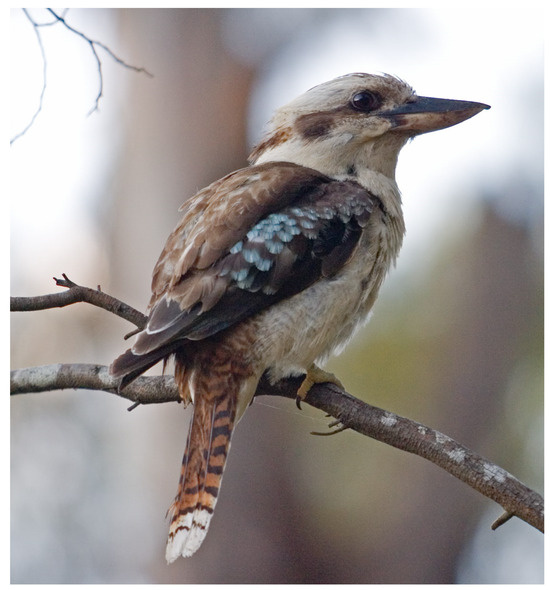
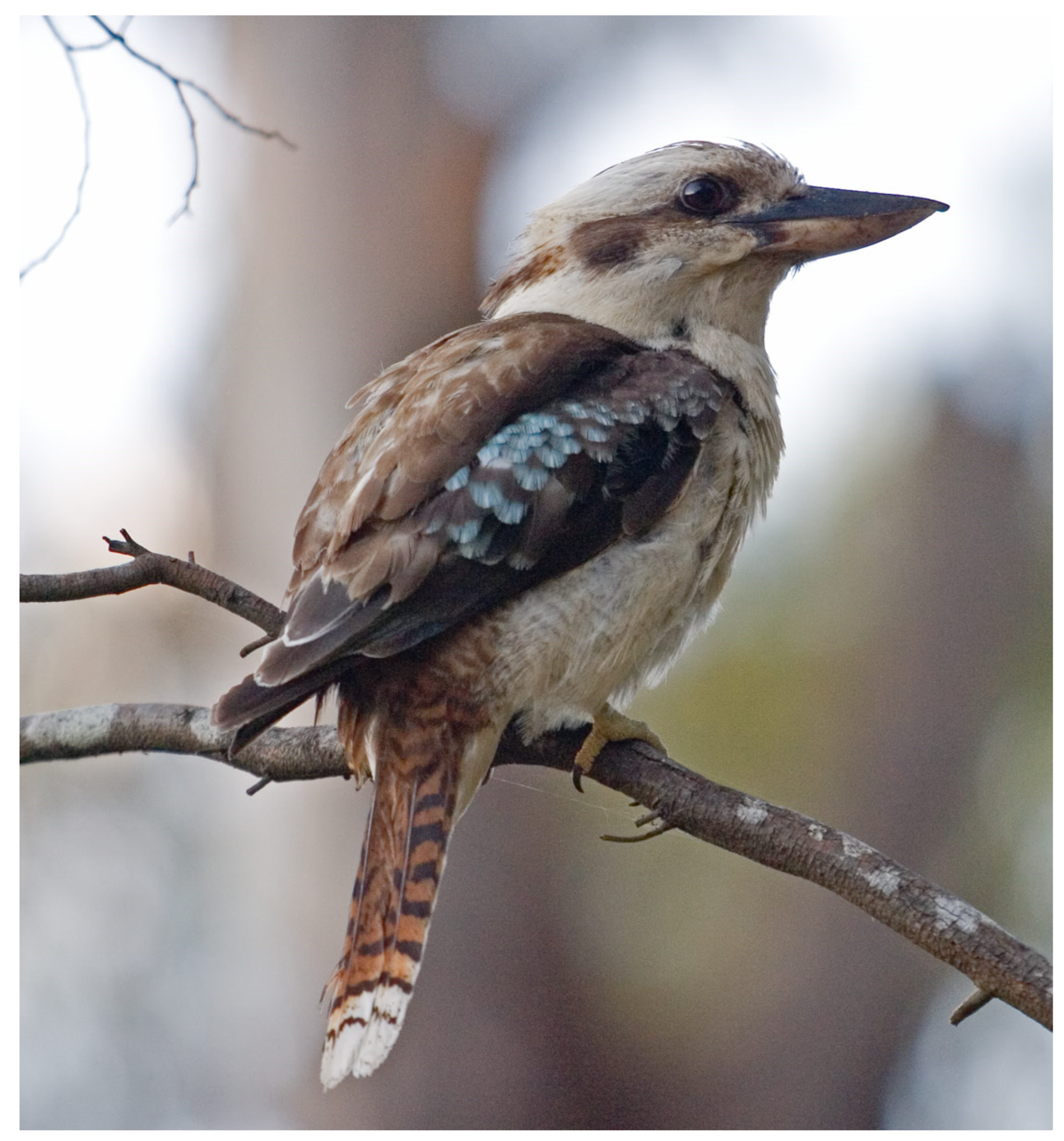
Kookaburras can be found in different colors such as blue, brown, and white, and behind the eyes of this bird there is a dark brown spot, which gives the bird an angry awe along with the special shape of the feathers on its head. Kookaburra is between 28 and 47 cm long, and its weight is about 300 g [89]. A picture of a kookaburra is shown in Figure 1.
Figure 1.
Kookaburra taken from: free media Wikimedia Commons.
Kookaburras are carnivorous birds that feed on mice, insects, snakes, frogs, small reptiles, and small birds. The beak of the kookaburra is suitable for diving and hunting. The bird dives towards the prey with an open beak, and after hunting, it returns to the branch of the tree from which it flew from and knocks the prey against the tree several times to make sure it is dead. Then he holds the prey tightly between his claws, crushes it, and eats it [90].
Among the natural behaviors of the kookaburra in the wild, the strategy of this animal in hunting and knocking the prey against the tree in order to ensure that the prey is killed is much more significant. These natural kookaburra behaviors are the intelligent processes employed in the design of proposed KOA approach.
3.2. Algorithm Initialization
The proposed KOA approach is a population-based optimizer that is able to provide suitable solutions for optimization problems in an iterative-based process based on a random search in the problem-solving space. The KOA population consists of kookaburras that are placed in the problem-solving space so that each kookaburra determines values for the decision variables based on its position in the problem-solving space; therefore, each kookaburra is a candidate solution to the problem that can be modeled using a vector. Kookaburras together form the KOA population matrix, which can be modeled using a matrix according to Equation (1). The position of the kookaburras at the beginning of KOA implementation is randomly initialized using Equation (2).
Here, is the KOA population matrix, is the th kookaburra (candidate solution), is its th dimension in search space (decision variable), is the number of kookaburras, is the number of decision variables, is a random number in interval , and are the lower bound and upper bound of the th. decision variable, respectively.
Considering that the position of each kookaburra in the problem-solving space is a candidate solution for the problem corresponding to each kookaburra, the objective function of the problem can be evaluated. The set of evaluated values for the objective function of the problem can be represented using a vector according to Equation (3).
Here, is the vector of evaluated objective function and is the evaluated objective function based on the th kookaburra.
The evaluated values for the objective function are a suitable criterion for measuring the quality of candidate solutions and population members. The best evaluated value for the objective function corresponds to the best member and the worst evaluated value for the objective function corresponds to the worst member. Considering that in each iteration, the position of the kookaburras in the problem-solving space is updated, the objective function of the problem is reevaluated and based on the comparison of the new values, the best member of the population is also updated.
3.3. Mathematical Modelling of KOA
The proposed KOA approach updates the position of kookaburras in the following two phases: exploration and exploitation, in an iterative-based process in order to improve candidate solutions based on the simulation of natural kookaburra behaviors in the wild. Next, the process of updating the KOA population in the search space is presented.
3.3.1. Phase 1: Hunting Strategy (Exploration)
The kookaburra is a carnivorous bird that feeds on other small birds, reptiles, insects, mice, frogs, etc. Although this bird has weak legs, they have a very strong neck that helps them in hunting. The strategy of kookaburras in selecting prey and attacking it leads to large displacement in their position. This process represents the global search with the concept of exploration, which refers to the detailed scanning of the problem-solving space with the aim of avoiding getting stuck in the local optimal in order to discover the main optimal area.
In order to simulate the hunting strategy of kookaburras, the position of other kookaburras, which have a better objective function value, is considered as the prey location in KOA design for each kookaburra. Therefore, based on the comparison of the objective function values, the available prey set for each kookaburra is determined using Equation (4).
Here, is the set of candidate prey for th kookaburra, is the kookaburra with a better objective function value than the th kookaburra, and is the objective function value.
In the KOA design, it is assumed that each kookaburra randomly selects a prey and attacks it. Based on the simulation of the movement of the kookaburra towards the prey in the hunting strategy, a new position for the kookaburra is calculated using Equation (5). In this case, if the value of the objective function is improved in the new position, this new position will replace the previous position of the corresponding kookaburra according to Equation (6).
Here, is the new suggested position of the ith kookaburra based on first phase of KOA, is its th dimension, is its objective function value, is a random number with a normal distribution in the range of , is the th dimension of selected prey for th kookaburra, is a random number from set , is the number of kookaburra, and is the number of decision variables.
3.3.2. Phase 2: Ensuring That the Prey Is Killed (Exploitation)
The second characteristic behavior of kookaburras is that after attacking the prey, the kookaburra carries the prey with itself and makes sure that the prey is killed by repeatedly hitting it against the tree. The kookaburra then holds the prey tightly between its claws and crushes and eats it. This behavior of kookaburras, which happens near the hunting ground, leads to small changes in their position. This process, which represents the local search with the concept of exploitation, refers to the ability of the algorithm to achieve better solutions near the obtained solutions and promising areas.
In the KOA design, in order to simulate this behavior of kookaburras based on their movement near the hunting place, a random position is calculated using Equation (7). In fact, it is assumed that this displacement occurs randomly in a neighborhood to the center of each kookaburra with a radius equal to . The radius of this neighborhood is first set to the maximum value; then, during successive iterations, this radius becomes smaller so that the local search with the aim of converging towards better solutions can be performed more accurately. The new position calculated for each kookaburra replaces its previous position if it improves the value of the objective function according to Equation (8).
Here, is the new suggested position of the th kookaburra based on the second phase of KOA, is its th dimension, is its objective function value, is the iteration counter of the algorithm, and is the maximum number of algorithm iterations.
3.4. Repetition Process, Pseudocode, and Flowchart of KOA
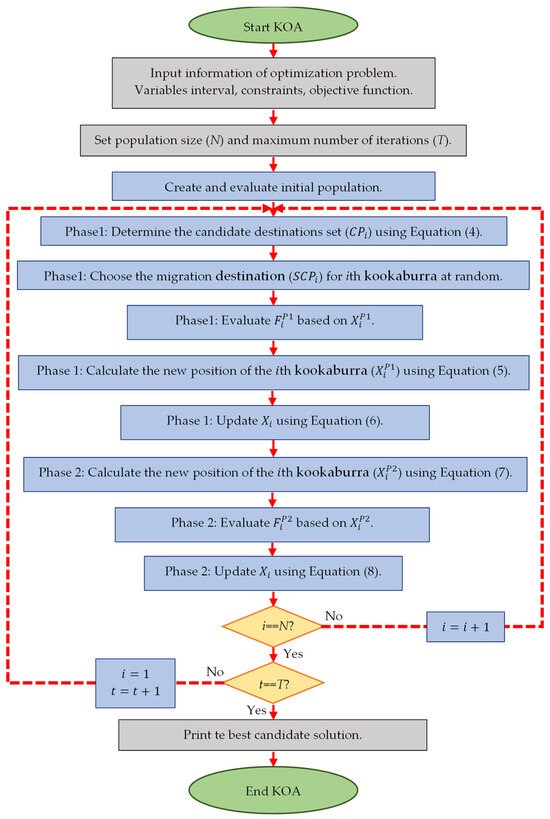
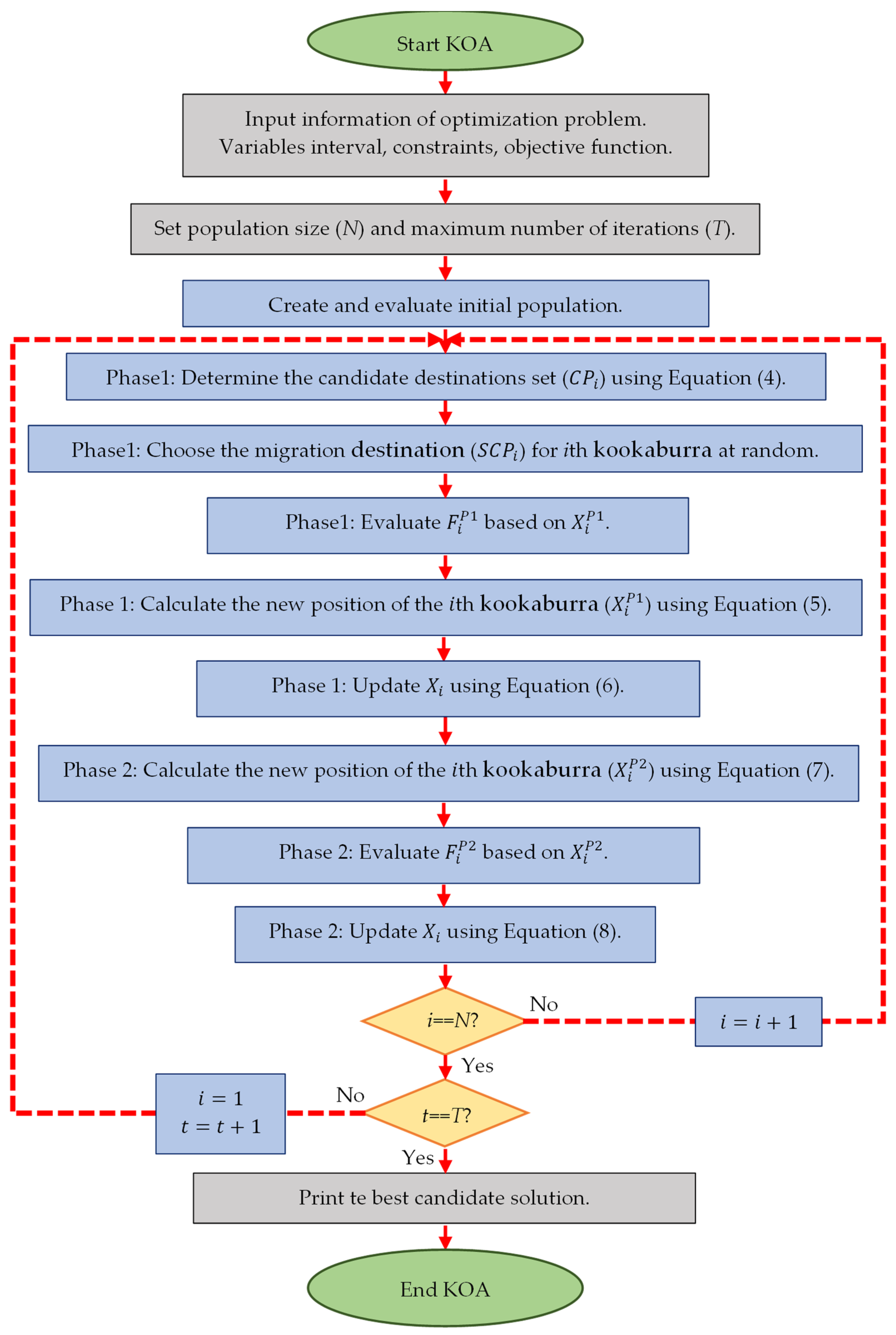
The first iteration of KOA is completed after updating the location of all kookaburras based on the first and second phases. At the end of each iteration, the best solution obtained until that iteration is updated and saved. Then, based on the updated positions and the new evaluated values for the objective function, the algorithm enters the next iteration. The process of updating the position of kookaburras continues until the last iteration of the algorithm based on Equations (4)–(8). In the end, the best candidate solution obtained during the iterations of the algorithm is presented as the proposed solution by KOA for the problem. The steps of KOA implementation are presented as a flowchart in Figure 2, and its pseudo code is presented in Algorithm 1.
| Algorithm 1 Pseudocode of KOA | |
| Start KOA. | |
| 1. | Input problem information: variables, objective function, and constraints. |
| 2. | Set KOA population size (N) and iterations (T). |
| 3. | Generate the initial population matrix at random using Equation (2). |
| 4. | Evaluate the objective function. |
| 5. | For to T |
| 6. | For to |
| 7. | Phase 1: hunting strategy (exploration) |
| 8. | Determine the candidate preys set using Equation (4). |
| 9. | Choose the prey for the ith KOA member at random. |
| 10. | Calculate new position of ith KOA member using Equation (5). |
| 11. | Update ith KOA member using Equation (6). |
| 12. | Phase 2: Ensuring that the prey is killed (exploitation) |
| 13. | Calculate new position of ith KOA member using Equation (7). |
| 14. | Update ith KOA member using Equation (8). |
| 15. | end |
| 16. | Save the best candidate solution so far. |
| 17. | end |
| 18. | Output the best quasi-optimal solution obtained with the KOA. |
| End KOA. | |
Figure 2.
Flowchart of KOA.
3.5. Computational Complexity of KOA
In this subsection, the analysis of the computational complexity of KOA is discussed. The KOA initialization steps have a complexity equal to O(Nm), where N is the number of kookaburras and m is the number of decision variables of the problem. In each iteration of KOA, the position of each kookaburra in the problem-solving space is updated in the two phases of exploration and exploitation. Therefore, the process of updating kookaburras has a complexity equal to O(2NmT), where T is the maximum number of iterations of the algorithm. Therefore, the total computational complexity of the proposed KOA approach is equal to O(Nm(1 + 2T)).
4. Simulation Studies and Results
In this section, simulation studies are presented on the performance of KOA in dealing with optimization scenarios. The performance of KOA has been evaluated on 29 standard benchmark functions from the Competitions on Evolutionary Computation (CEC) 2017 test suite for problem dimensions equal to 10, 30, 50, and 100. In order to measure the performance quality of KOA, the obtained results have been compared with the performance of the following 12 well-known metaheuristic algorithms: GA [43], PSO [26], GSA [52], TLBO [63], MVO [55], GWO [34], WOA [38], MPA [36], TSA [40], RSA [42], AVOA [31], and WSO [32]. The control parameters of metaheuristic algorithms are specified in Table 1. The optimization results are reported using the following six statistical indicators: mean, best, worst, standard deviation (std), median, and rank. The ranking criterion of metaheuristic algorithms for each of the benchmark functions is the value of the mean index.
Table 1.
Control parameters values.
4.1. Evaluation CEC 2017 Test Suite
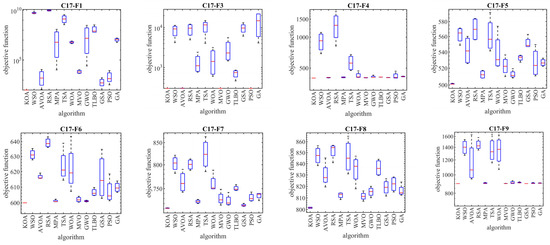
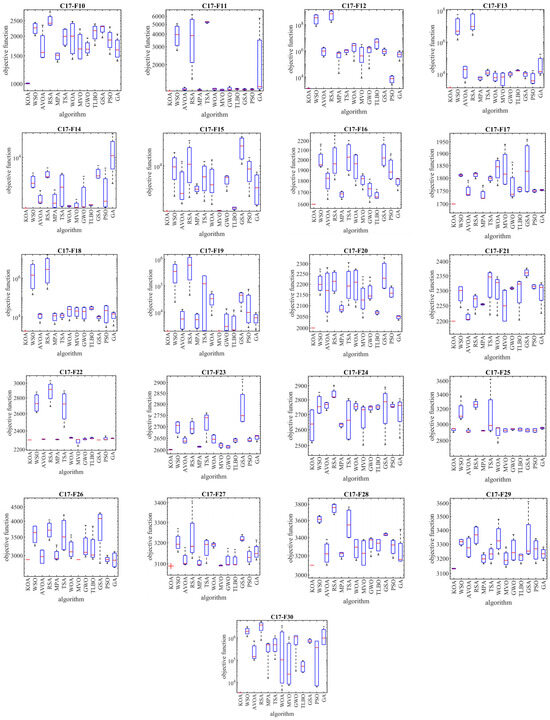
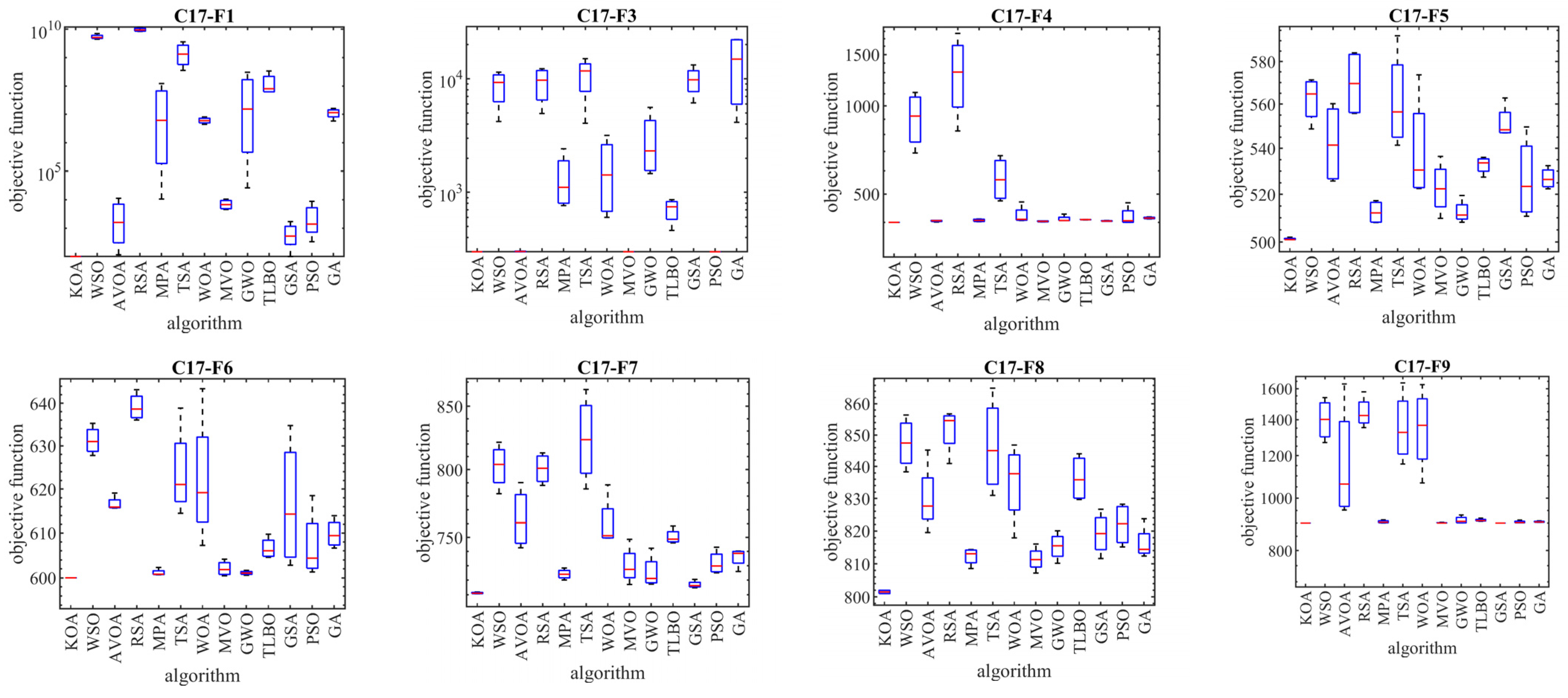
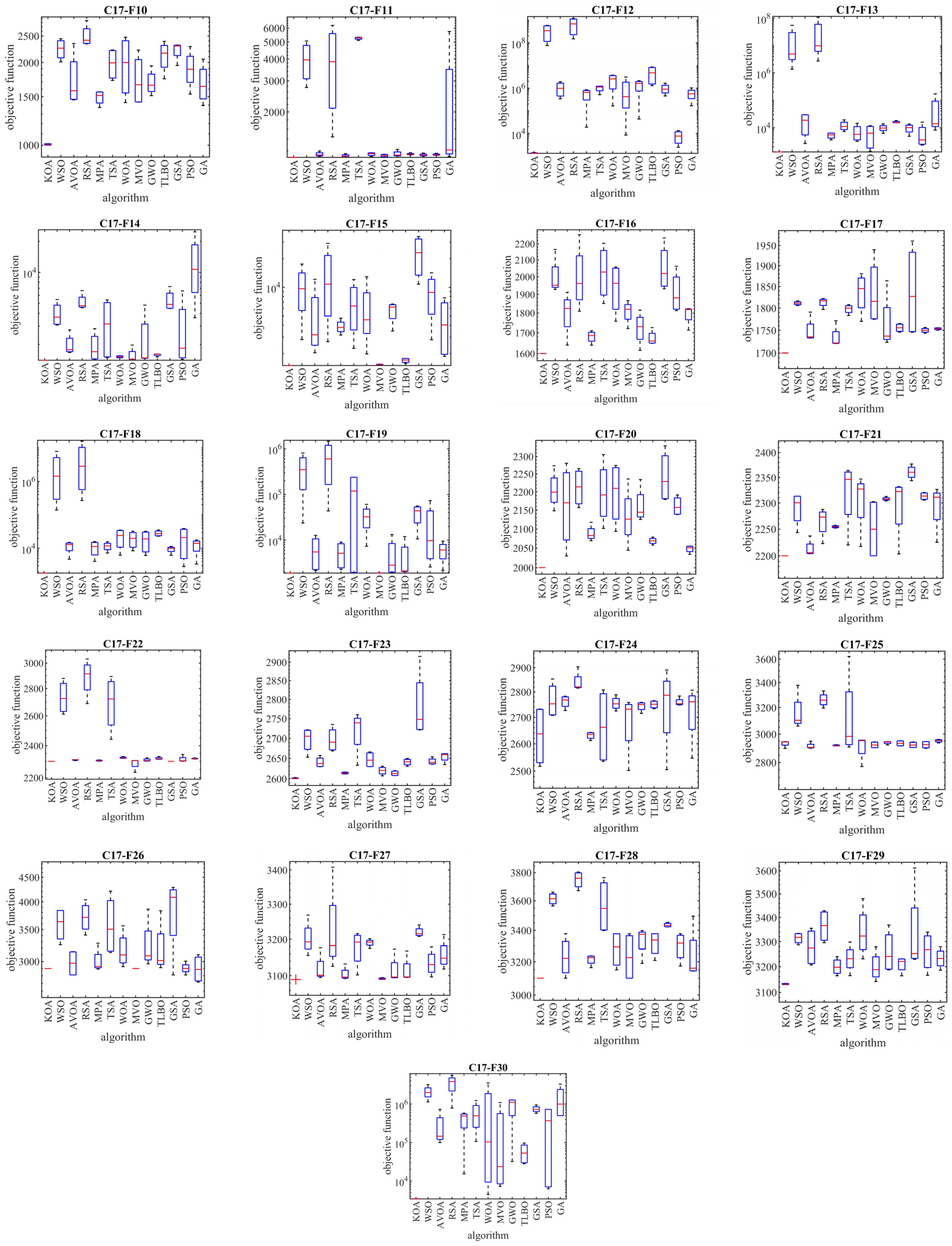
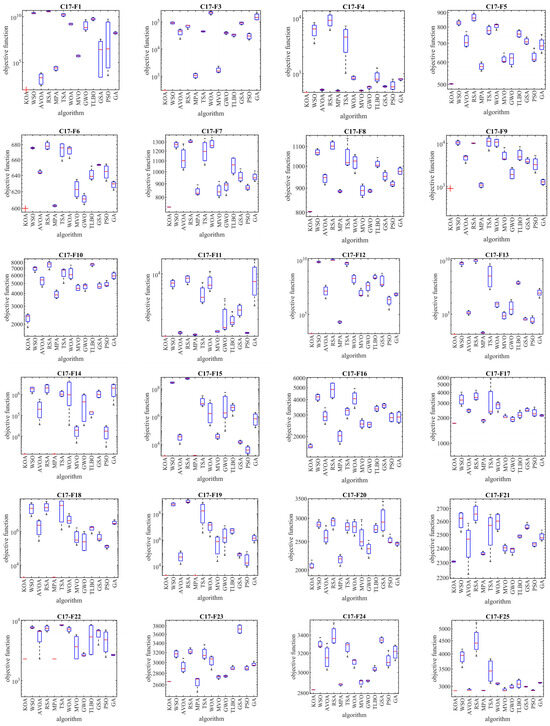
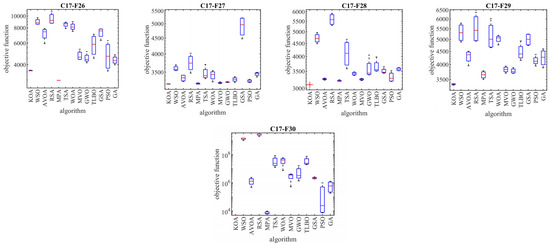
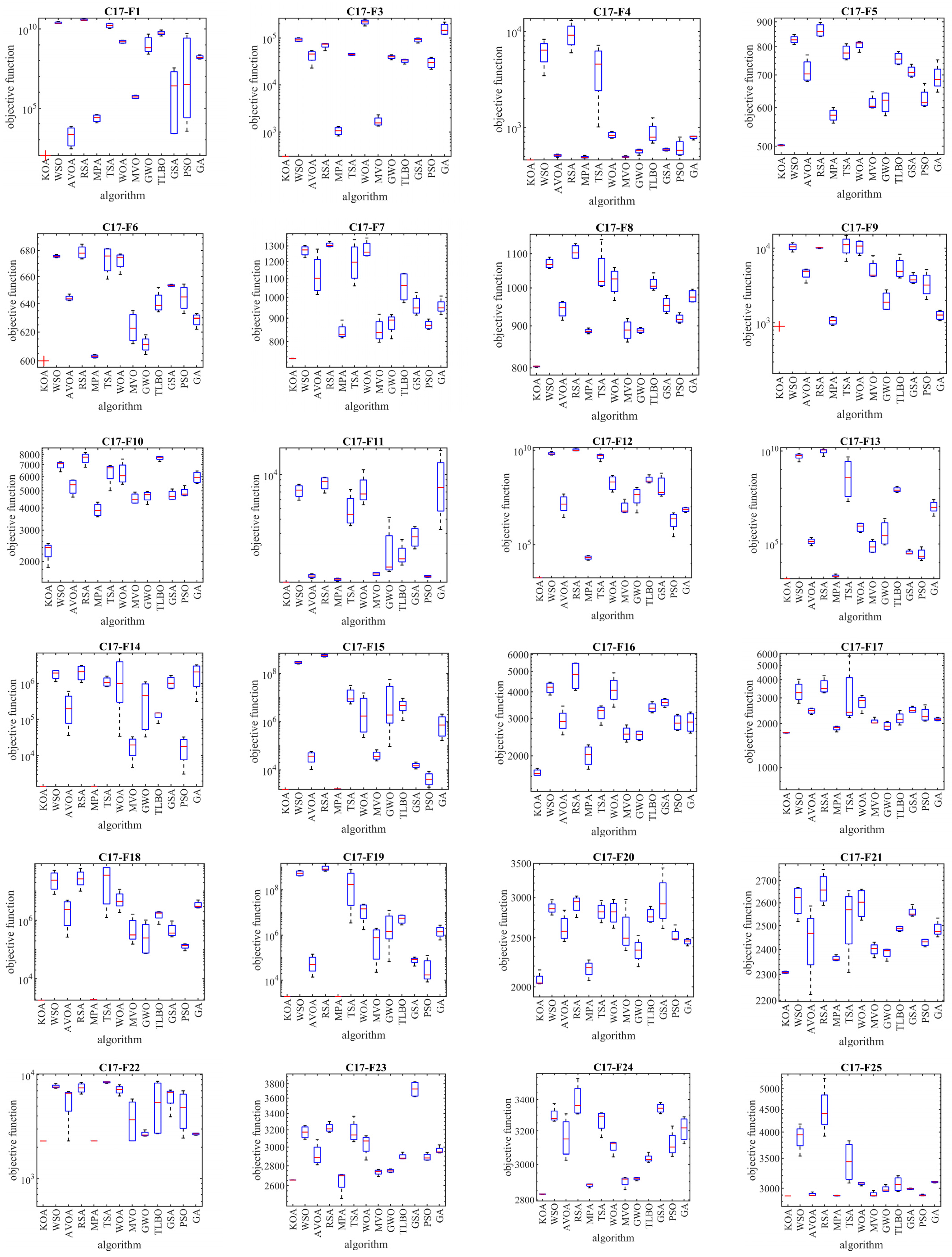
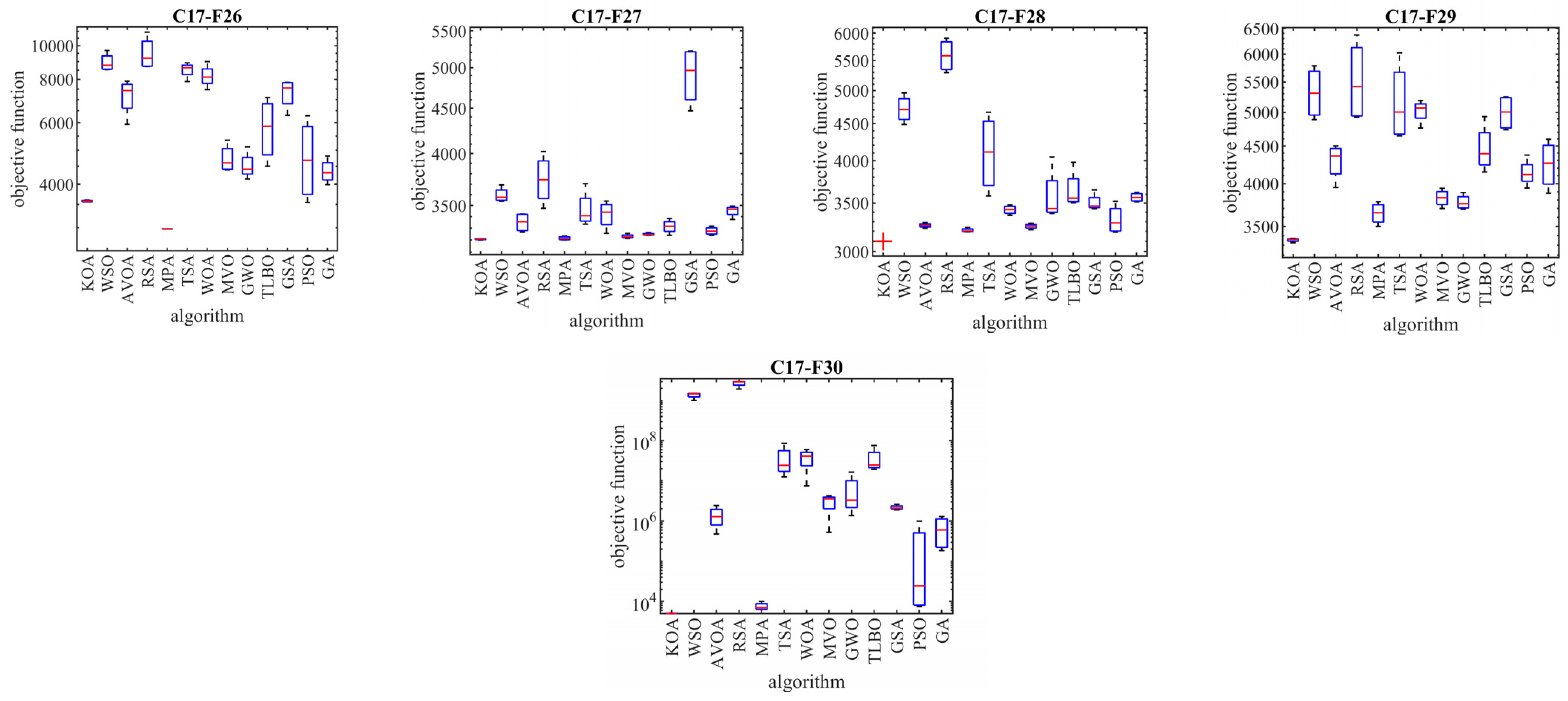
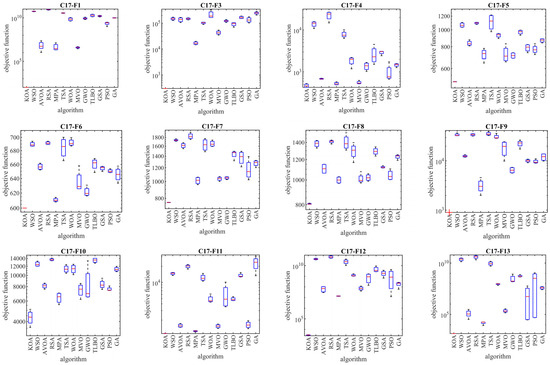
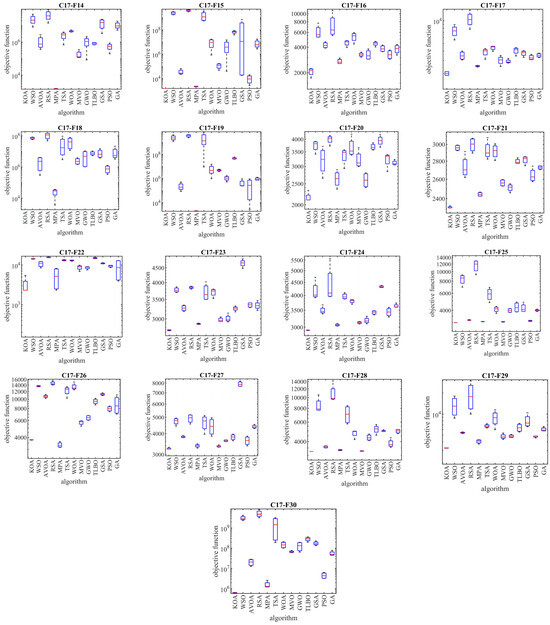
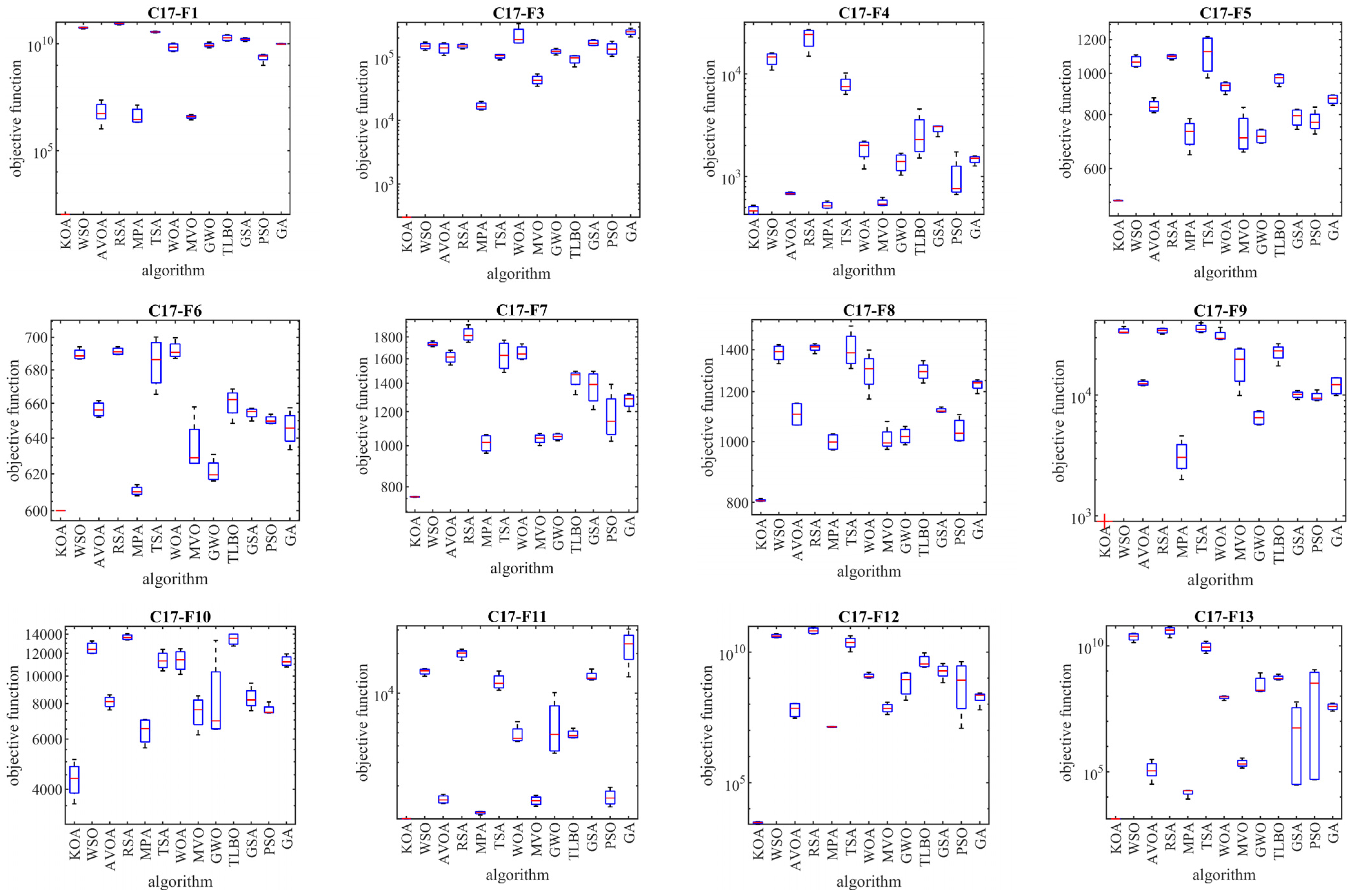
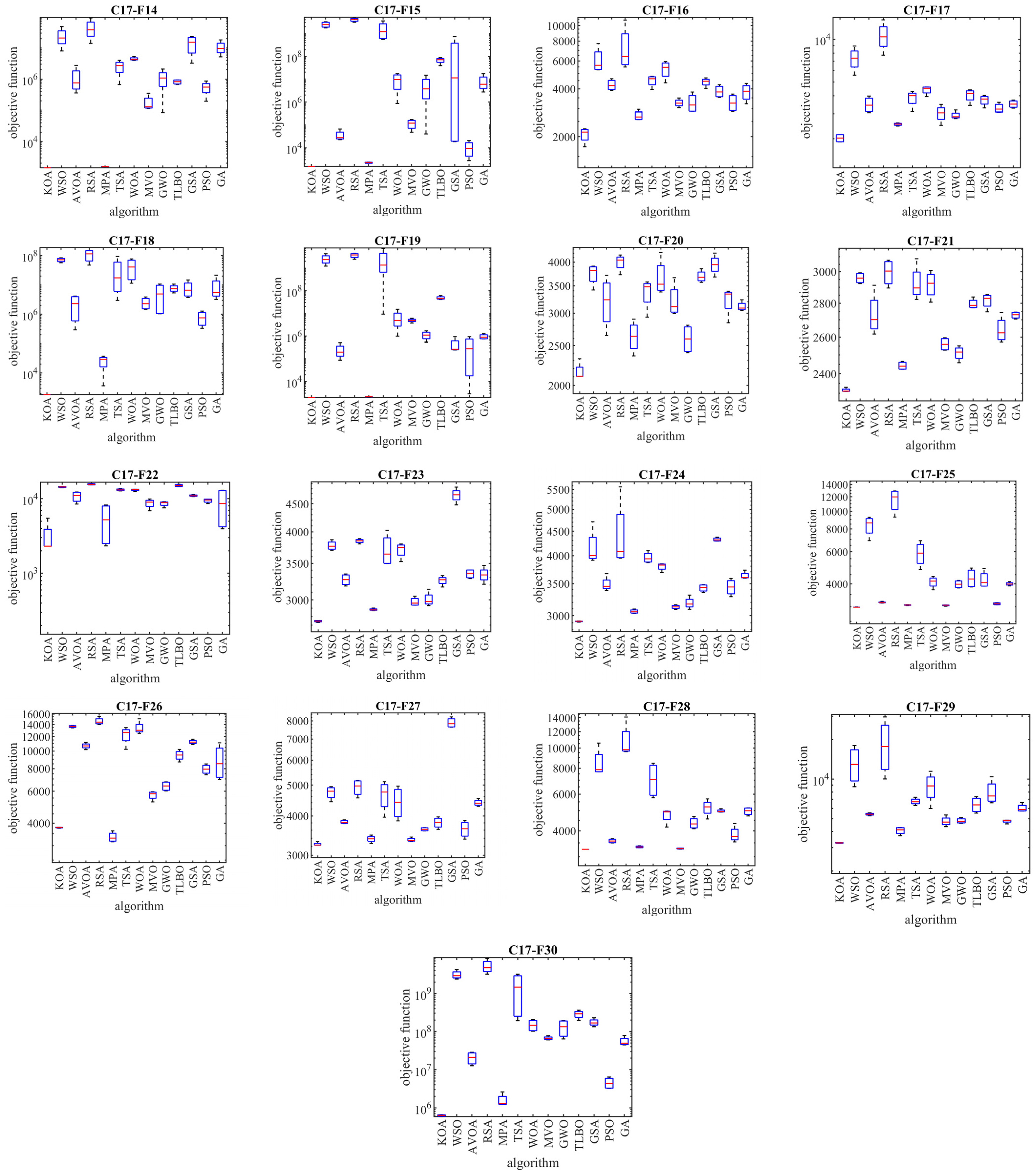
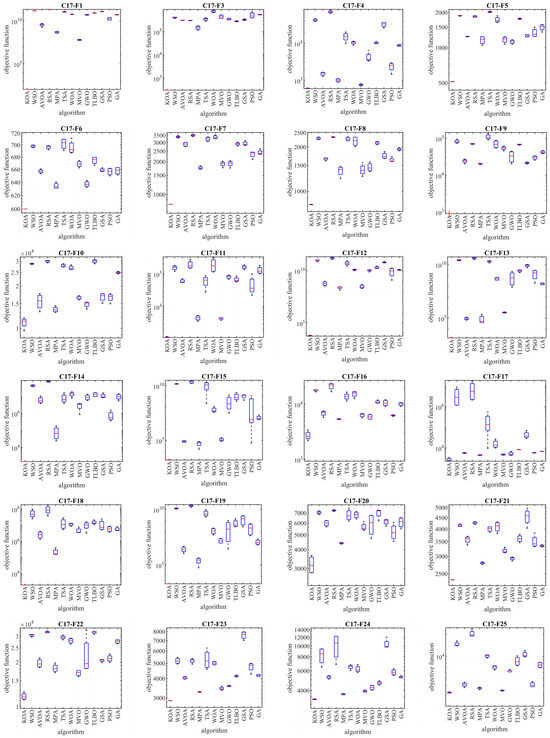
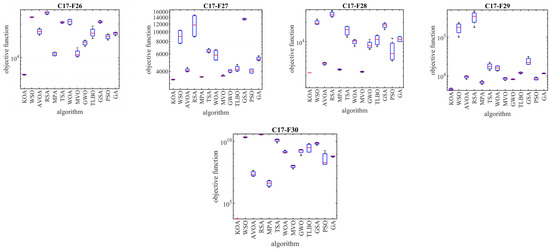
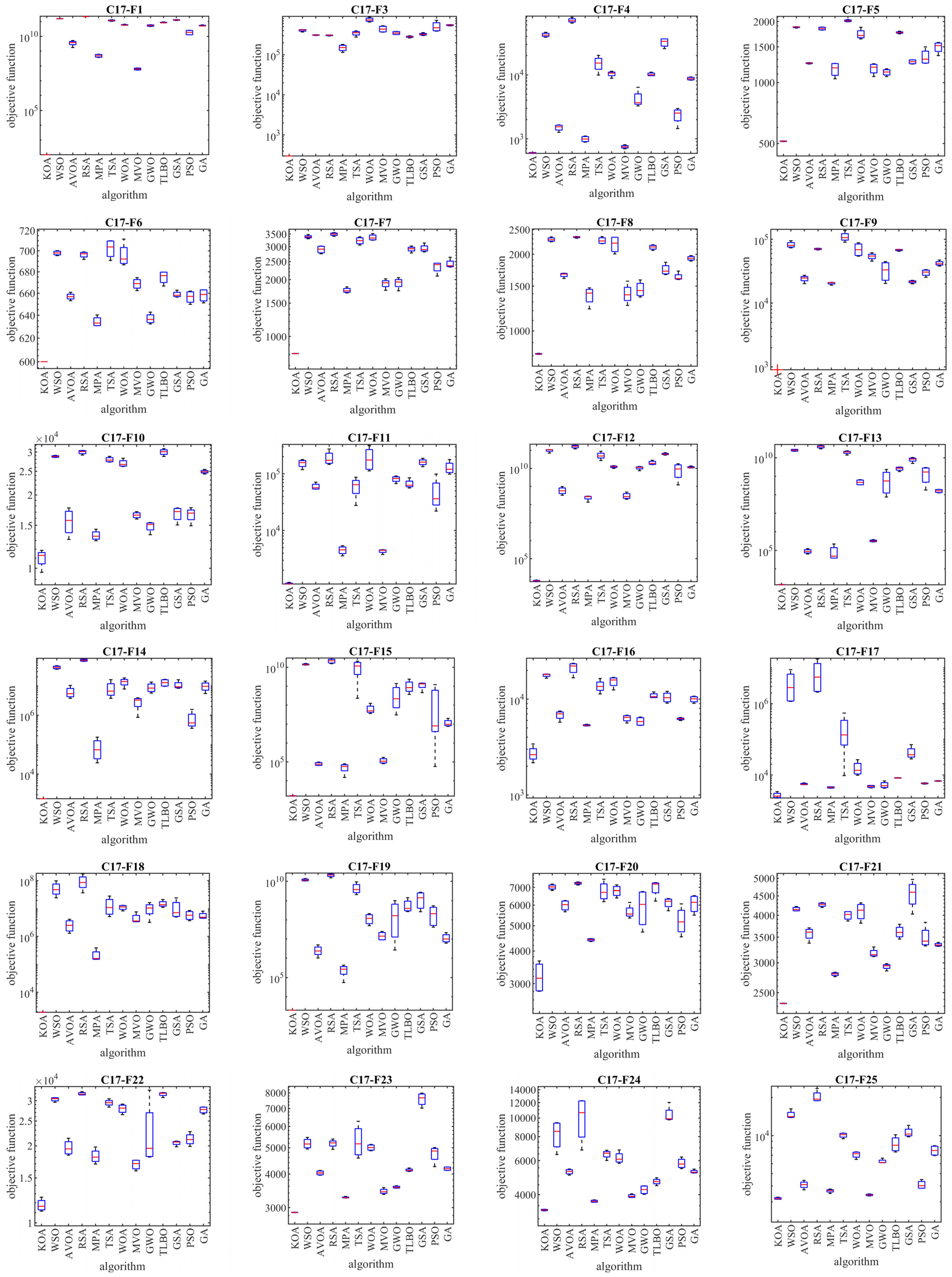
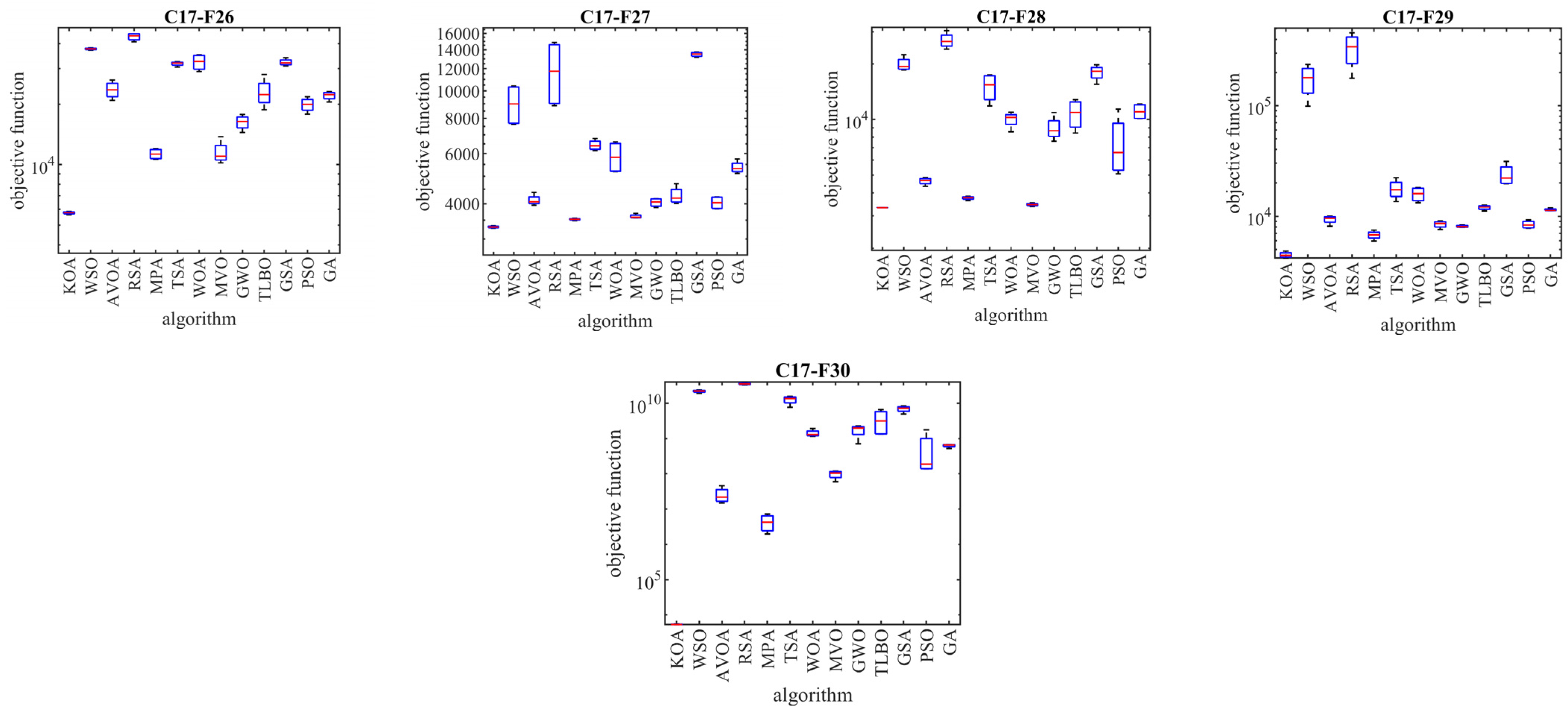
In this subsection, the evaluation of the proposed KOA approach in dealing with the Competitions on Evolutionary Computation (CEC) 2017 test suite is discussed. This test suite has 30 standard benchmark functions consisting of the following: 3 unimodal functions of C17-F1 to C17-F3, 7 multimodal functions of C17-F4 to C17-F10, 10 hybrid functions of C17-F11 to C17-F20, and 10 composition functions of C17-F21 to C17-F30. Among these, the C17-F2 function is not considered in the simulation studies due to the instability of the behavior. Information related to CEC 2017 test suite is provided in Appendix A and Table A1. The full description and details of the CEC 2017 test suite are provided in [91]. The implementation results of KOA and competitor algorithms on the CEC 2017 test suite for different dimensions of the problem equal to 10, 30, 50, and 100 are reported in Table 2, Table 3, Table 4 and Table 5. The boxplot diagrams resulting from the application of metaheuristic algorithms on the studied benchmark functions are drawn in Figure 3, Figure 4, Figure 5 and Figure 6. What is evident from the simulation results, in handling the CEC 2017 test suite for the problem dimension equal to 10, KOA is the first best optimizer for functions C17-F1, C17-F3 to C17-F24, and C17-F27 to C17-F30. For problem dimension equal to 30, KOA is the first best optimizer for functions C17-F1, C17-F3 to C17-F5, C17-F7, C17-F12 to C17-F14, C17-F16 to C17-F18, C17-F21 to C17-F27, and C17-F29. For problem dimension equal to 50, KOA is the first best optimizer for functions C17-F1, C17-F3 to C17-F25, and C17-F27 to C17-F30. For problem dimension equal to 100, KOA is the first best optimizer for functions C17-F1, and C17-F3 to C17-F30.
Table 2.
Optimization results of CEC 2017 test suite (dimension = 10).
Table 3.
Optimization results of CEC 2017 test suite (dimension = 30).
Table 4.
Optimization results of CEC 2017 test suite (dimension = 50).
Table 5.
Optimization results of CEC 2017 test suite (dimension = 100).
Figure 3.
Boxplot diagrams of KOA and competitor algorithms performances on the CEC 2017 test suite (dimension = 10).
Figure 4.
Boxplot diagrams of KOA and competitor algorithms performances on the CEC 2017 test suite (dimension = 30).
Figure 5.
Boxplot diagrams of KOA and competitor algorithms performances on CEC 2017 test suite (dimension = 50).
Figure 6.
Boxplot diagrams of KOA and competitor algorithms performances on the CEC 2017 test suite (dimension = 100).
The optimization results show that the proposed KOA approach, with a high ability in both exploration and exploitation and the ability to balance them during the search process, has been able to provide suitable results for the benchmark functions. The analysis of the simulation results indicates that KOA, by providing better results and obtaining the rank of the first best optimizer in most of the benchmark functions, has provided a superior performance compared to competitor algorithms in addressing the CEC 2017 test suite in different dimensions of the problem equal to 10, 30, 50, and 100.
4.2. Statistical Analysis
In this subsection, using statistical analysis, it has been checked whether the superiority of KOA against competitor algorithms is significant from a statistical point of view or not. For this purpose, the Wilcoxon rank sum test [92] is used, which is a non-parametric test and is used to determine the significant difference between the average of two data samples. In this test, based on the values calculated for the p-value index, it is determined whether there is a statistically significant difference between the performance of the two algorithms or not.
The results of statistical analysis on the performance of KOA and each of the competitor algorithms in handling the CEC 2017 test suite in different dimensions of the problem are reported in Table 6. Based on the results obtained from the Wilcoxon rank sum test, in cases where the p-value is less than 0.05, the proposed KOA approach has a statistically significant superiority in competition with the corresponding metaheuristic algorithm.
Table 6.
Wilcoxon rank sum test results.
5. KOA for Real-World Applications
In this section, the efficiency of KOA in addressing real-world applications is challenged. For this purpose, 22 real-world constrained optimization problems from the CEC 2011 test suite as well as 4 classical engineering design problems are employed.
5.1. Evaluation CEC 2011 Test Suite
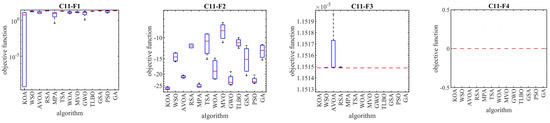
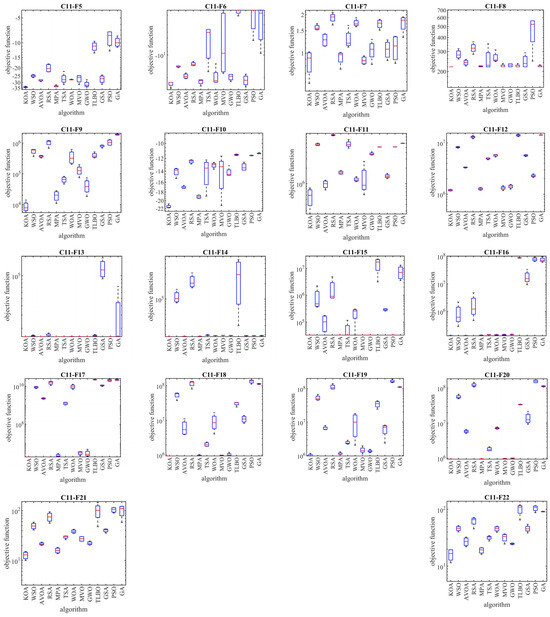
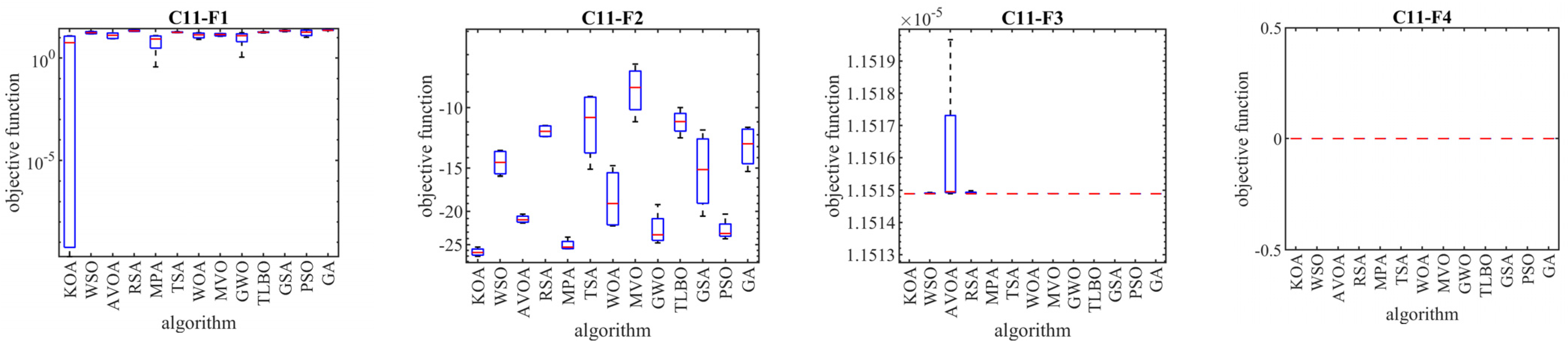
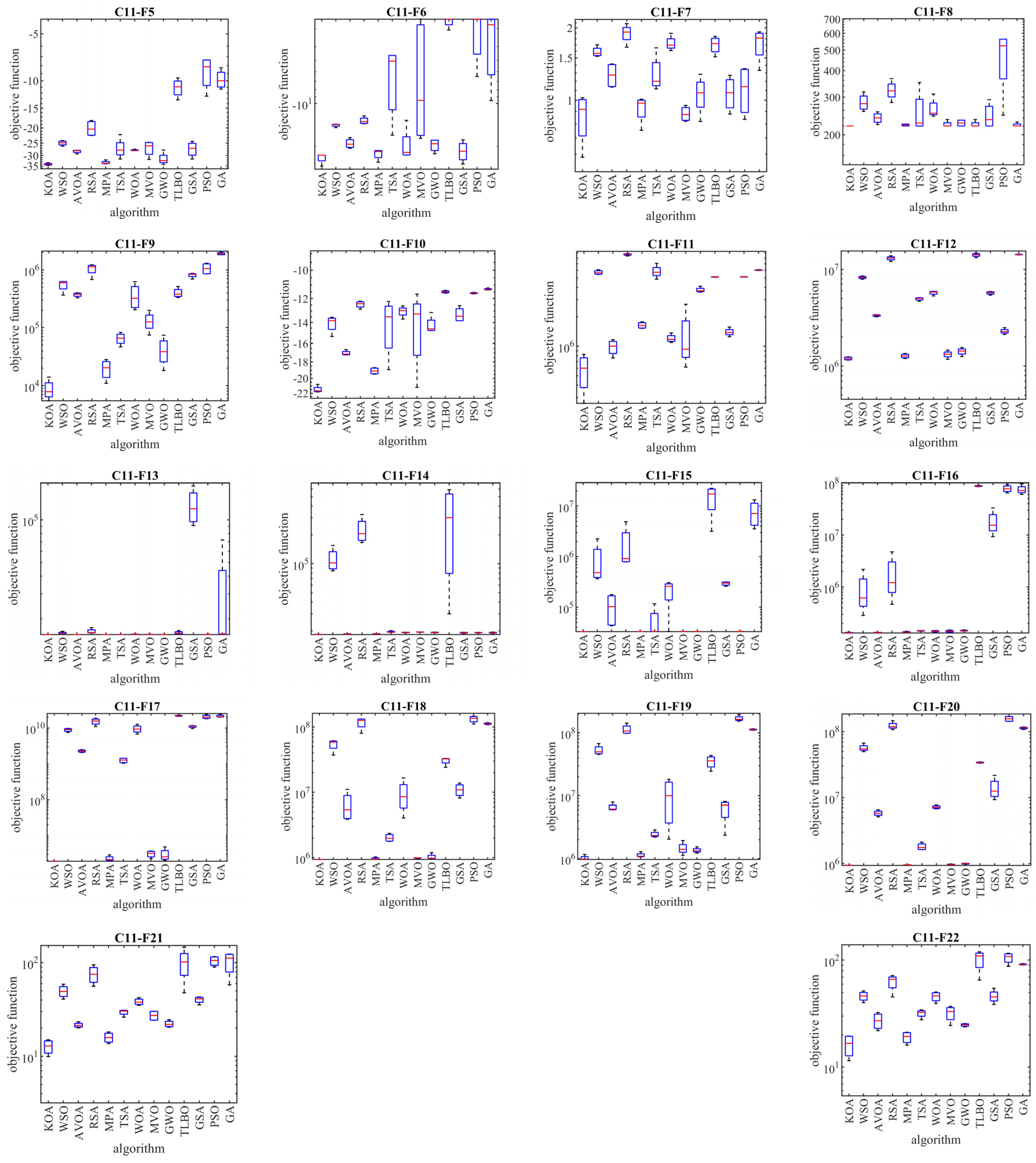
In this subsection, the ability of KOA and competitor algorithms in handling the CEC 2011 test suite is evaluated. This test suite consists of 22 constrained optimization problems from real-world applications. The full description and details of CEC 2011 test suite are provided in [93]. The optimization results of CEC 2011 test suite using KOA and competitor algorithms are reported in Table 7. Also, the boxplot diagrams obtained from the performance of metaheuristic algorithms in solving optimization problems C11-F1 to C11-F22 are drawn in Figure 7.
Table 7.
Optimization results of the CEC 2011 test suite.
Figure 7.
Boxplot diagrams of KOA and competitor algorithms performances on the CEC 2011 test suite.
The optimization results show that KOA, with its high ability to balance exploration and exploitation, has been able to provide suitable results for optimization problems in real-world applications. Based on the simulation results, KOA is the first best optimizer for C11-F1 to C11-F22. What is concluded from the analysis of the simulation results is that KOA has provided better results in most of the optimization problems compared to the competitor algorithms in handling the CEC 2011 test suite. Also, based on the statistical analysis and the results obtained from the Wilcoxon rank sum test, the superiority of KOA compared to competitor algorithms is significant from a statistical point of view.
5.2. Pressure Vessel Design Problem
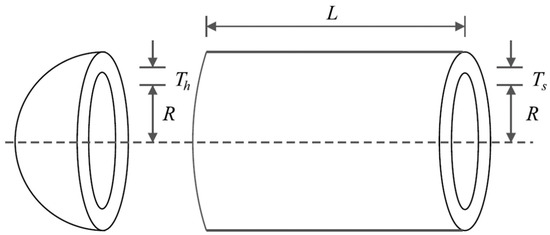
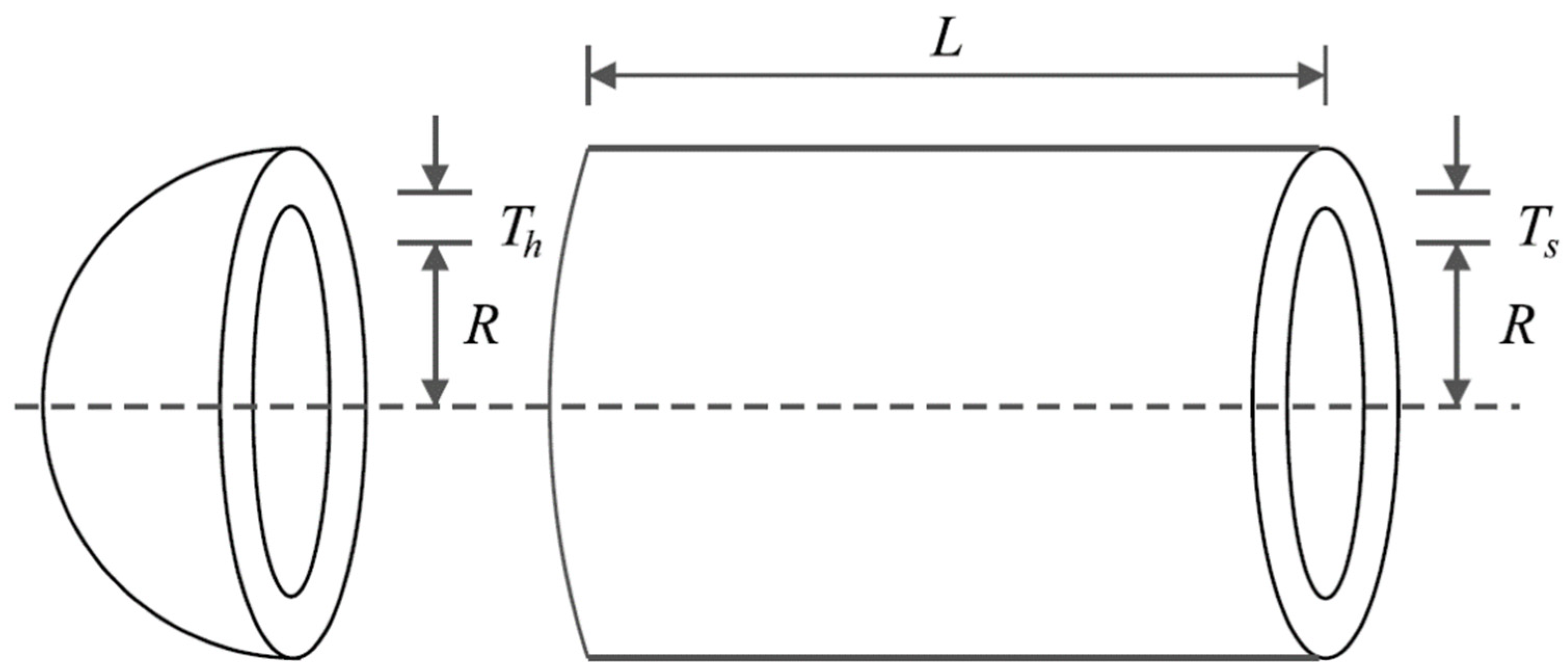
Pressure vessel design is a real-world optimization application aimed at minimizing construction cost. Pressure vessel design schematic is shown in Figure 8 and its mathematical model is as follows [94]:
Figure 8.
Schematic of pressure vessel design.
Consider: .
Minimize:
Subject to:
with
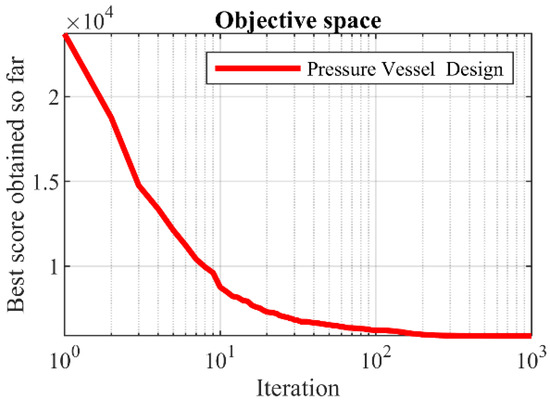
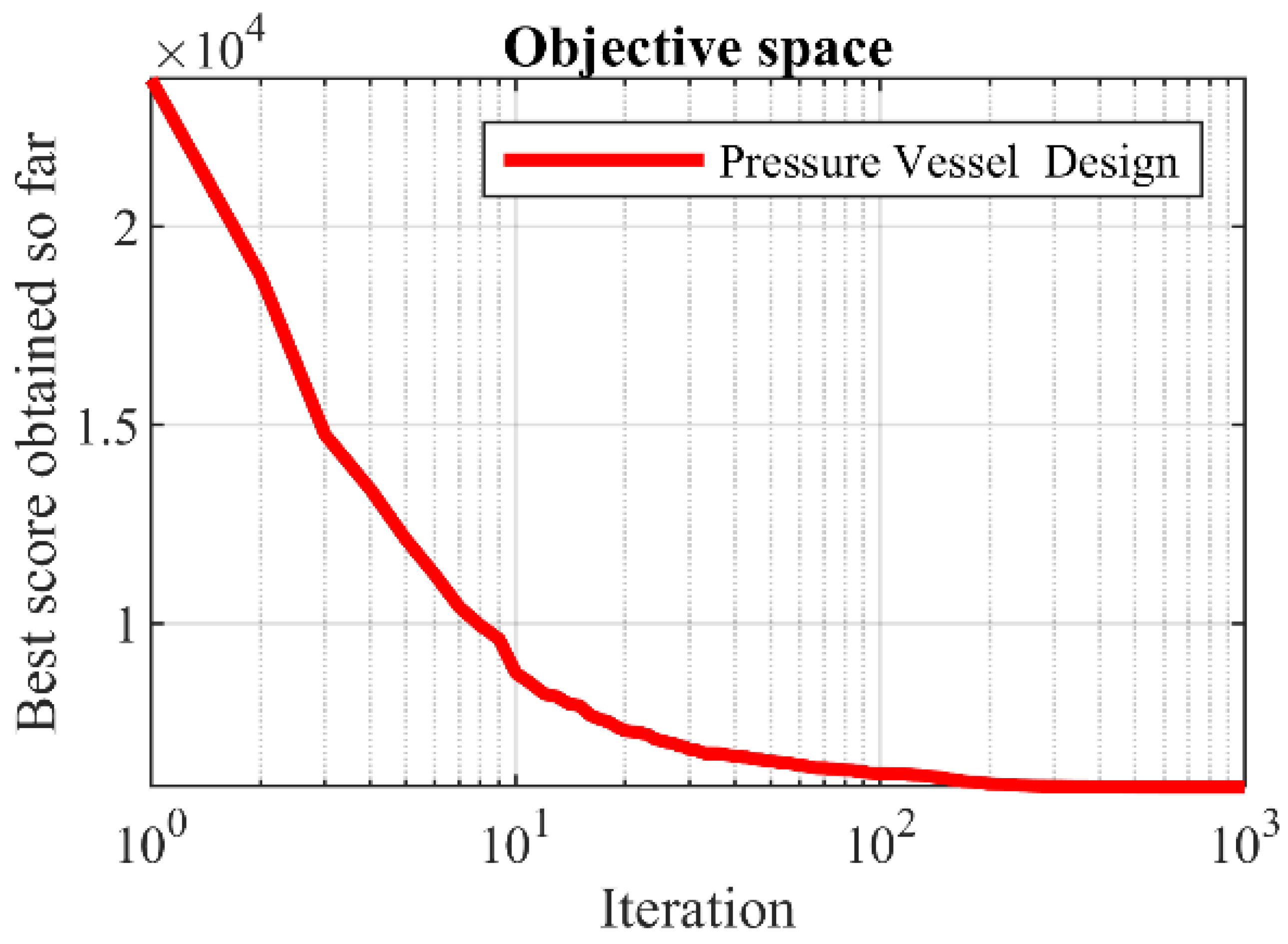
The pressure vessel design optimization results using KOA and competitor algorithms are reported in Table 8 and Table 9. Based on the results, KOA has provided the optimal design with the values of design variables equal to (0.7780271, 0.3845792, 40.312284, 200) and the corresponding objective function value equal to (5882.8955). The convergence curve of KOA during the pressure vessel design optimization is drawn in Figure 9. Based on the comparison of optimization results, it is evident that KOA has provided superior performance in the pressure vessel design optimization compared to the competitor algorithms.
Table 8.
Performance of optimization algorithms on the pressure vessel design problem.
Table 9.
Statistical results of optimization algorithms on the pressure vessel design problem.
Figure 9.
KOA’s performance convergence curve on pressure vessel design.
5.3. Speed Reducer Design Problem
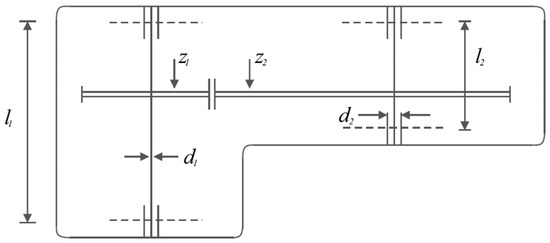
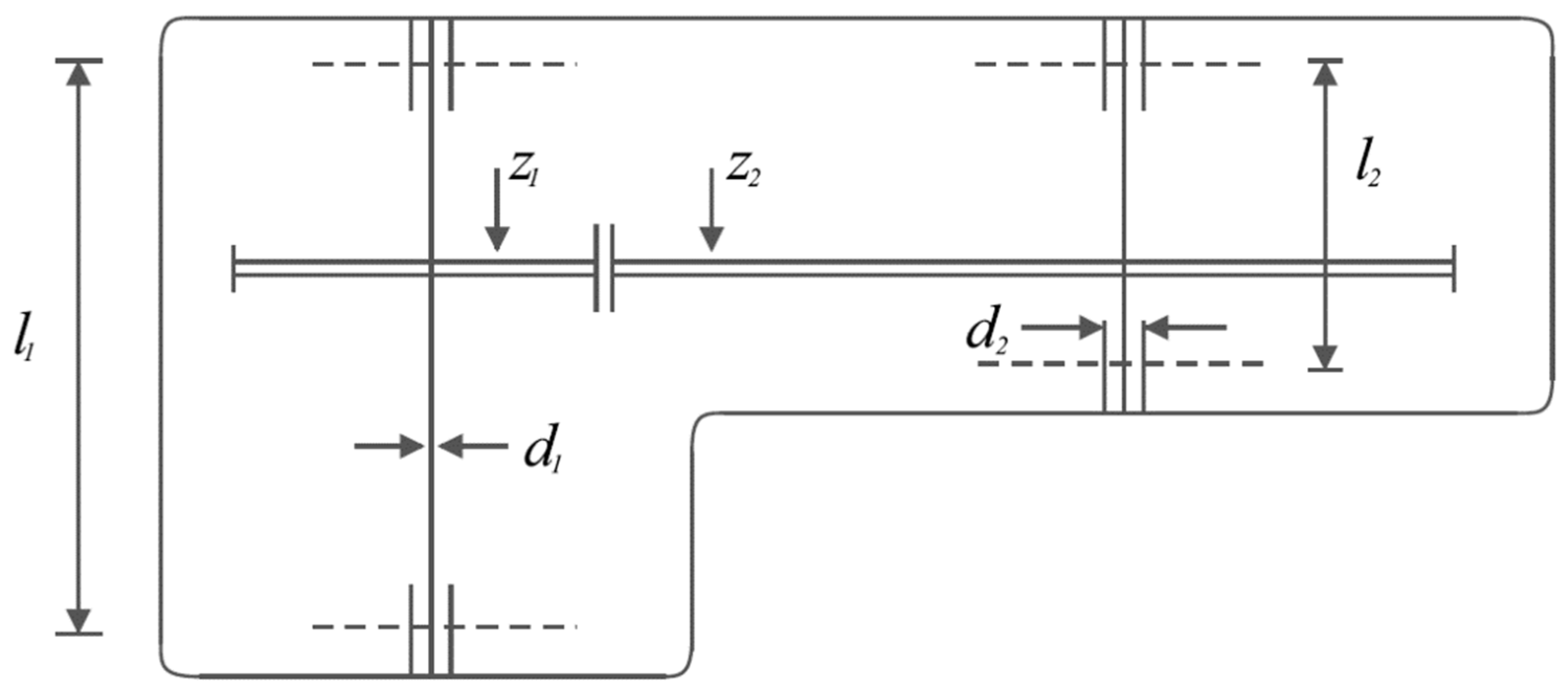
Speed reducer design is an engineering challenge with the aim of minimizing the weight of the speed reducer. The schematic of speed reducer design is shown in Figure 10 and its mathematical model is as follows [95,96]:
Figure 10.
Schematic of the speed reducer design.
Consider: .
Minimize: .
Subject to:
with
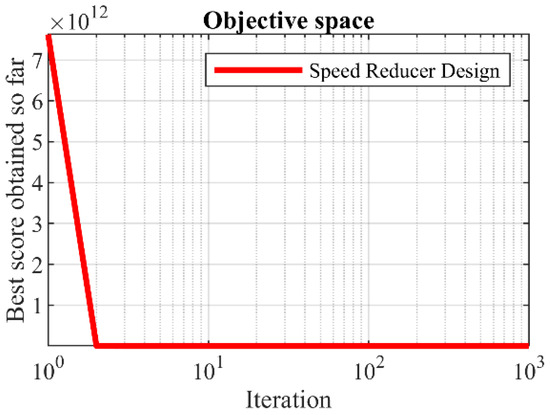
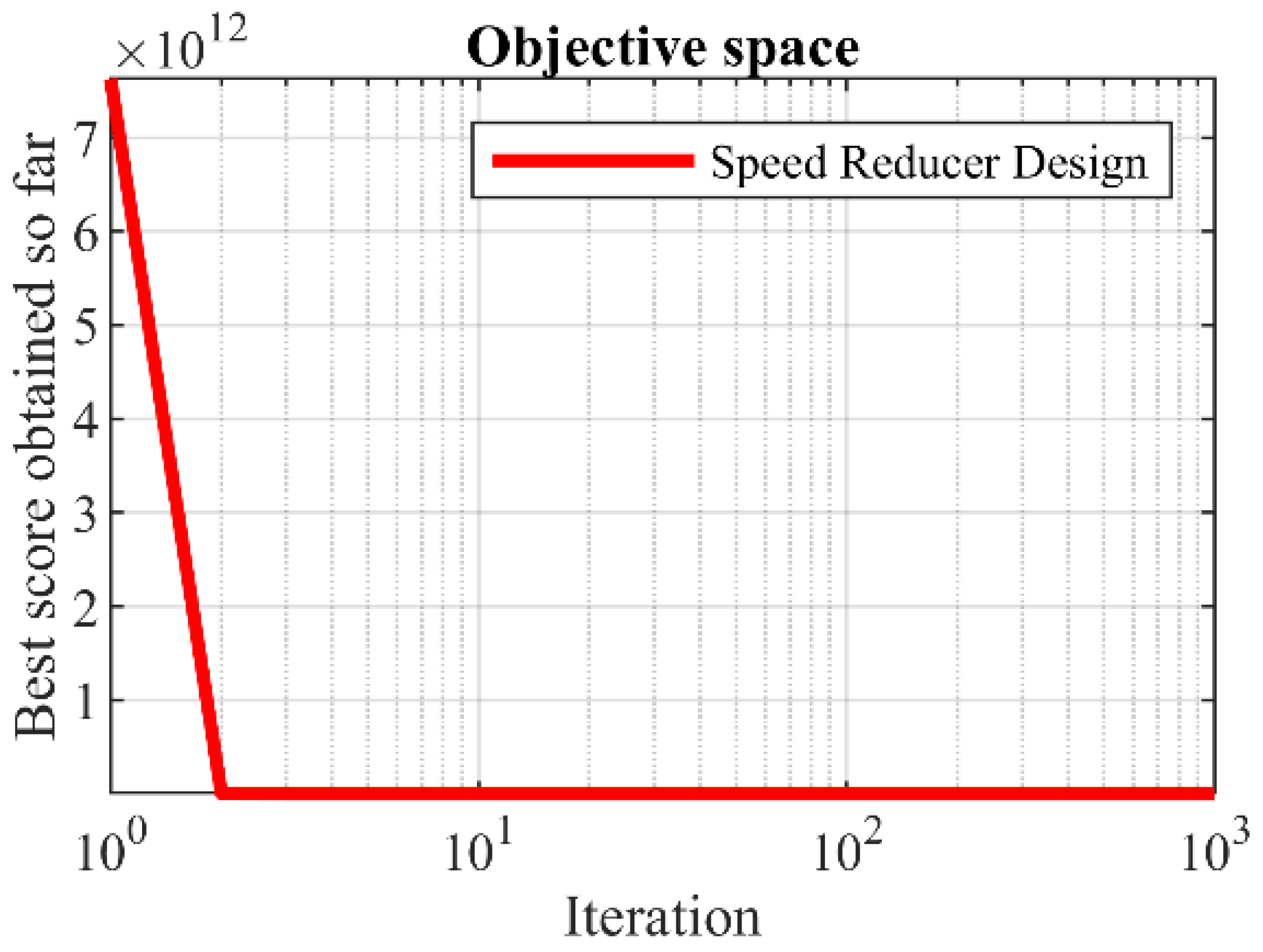
The implementation results of KOA and competitor algorithms on the speed reducer design are presented in Table 10 and Table 11. Based on the results, KOA has provided the optimal design with the values of design variables equal to (3.5, 0.7, 17, 7.3, 7.8, 3.3502147, 5.2866832) and the corresponding objective function value equal to (2996.3482). The convergence curve of KOA while achieving the optimal design for the speed reducer design problem is drawn in Figure 11. The analysis of the simulation results shows the superiority of KOA performance compared to the competitor algorithms in order to handle the speed reducer design.
Table 10.
Performance of optimization algorithms on the speed reducer design problem.
Table 11.
Statistical results of optimization algorithms on the speed reducer design problem.
Figure 11.
KOA’s performance convergence curve on speed reducer design.
5.4. Welded Beam Design
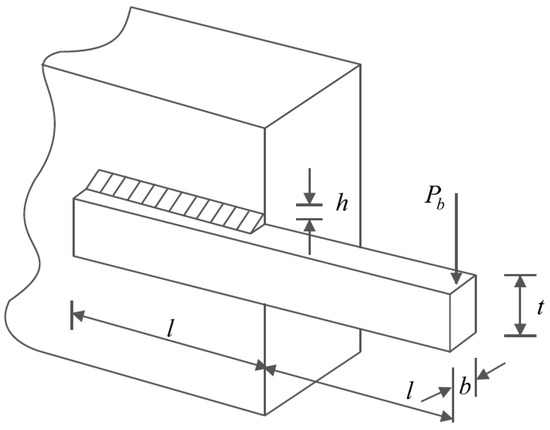
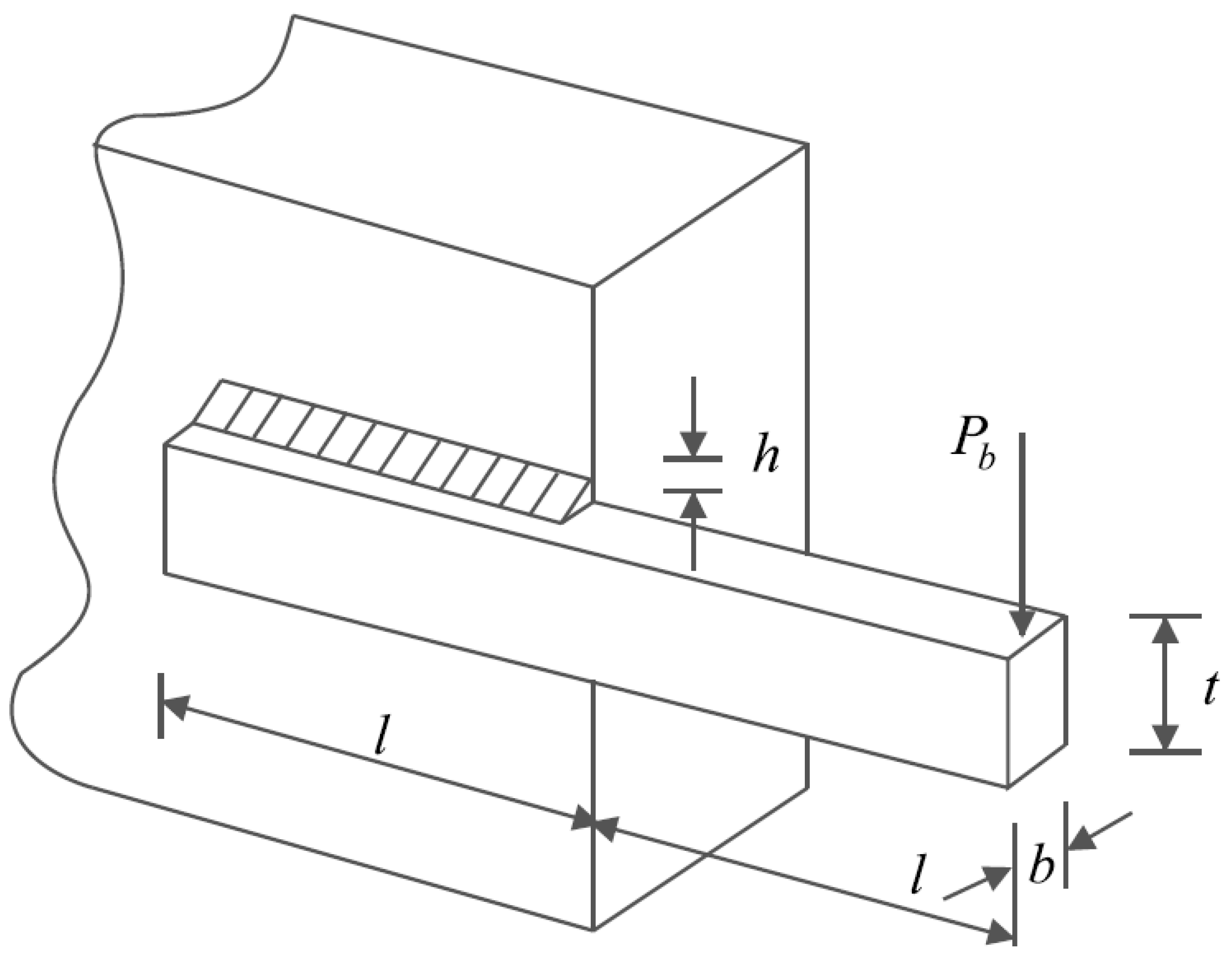
Welded beam design is a real-world application in engineering with the aim of minimizing the fabrication cost of the welded beam. The schematic of welded beam design is shown in Figure 12 and its mathematical model is as follows [38]:
Figure 12.
Schematic of welded beam design.
Consider: .
Minimize: .
Subject to:
where
with
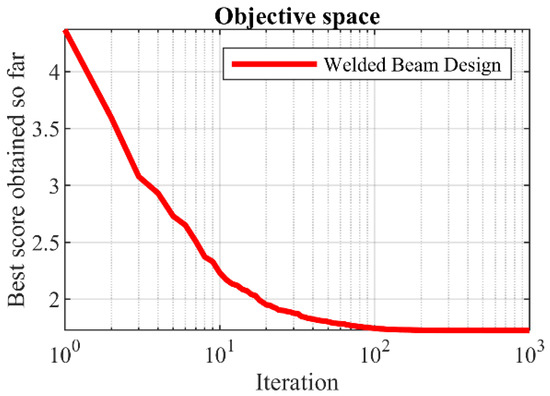
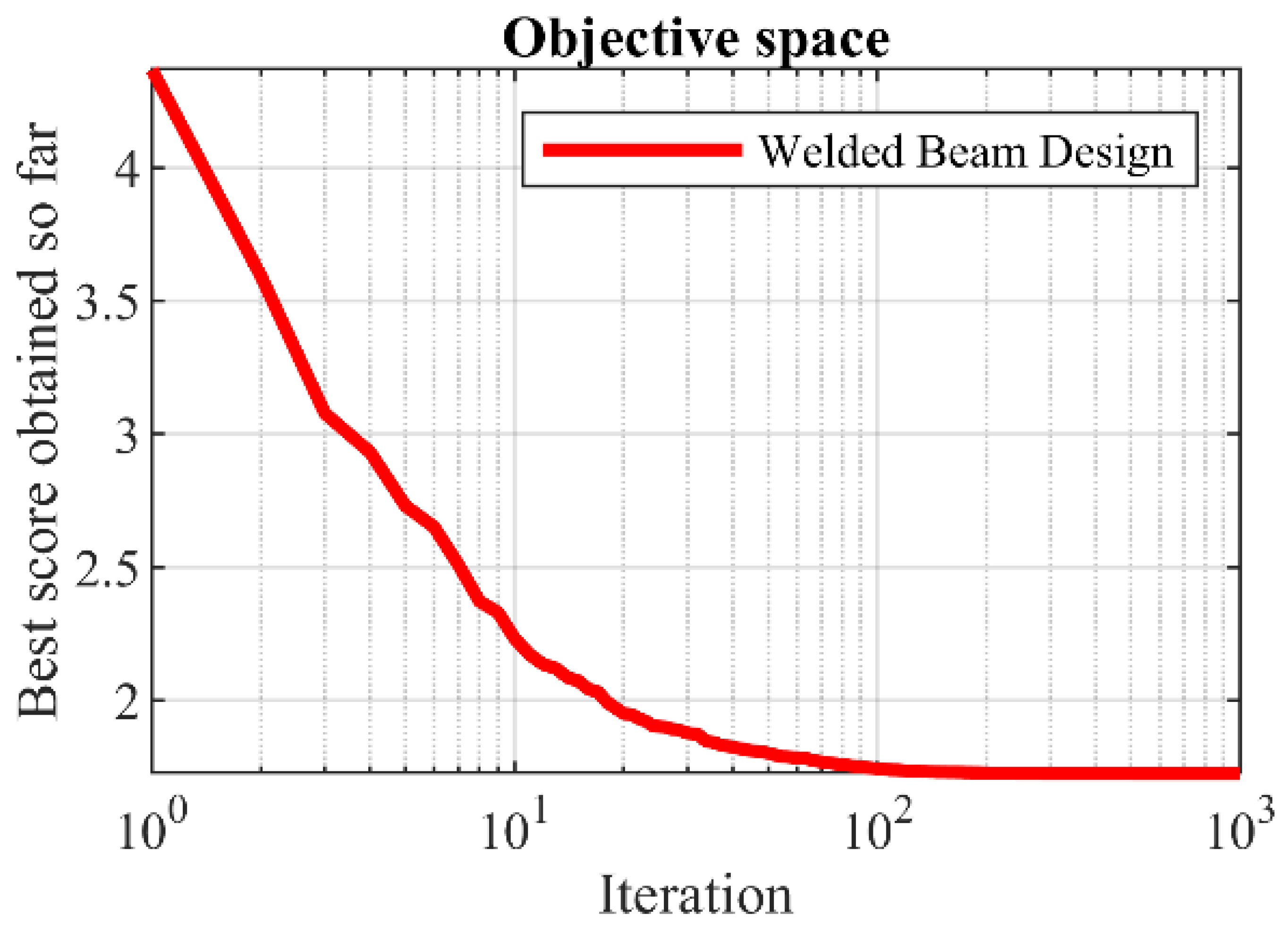
The results of employing KOA and competitor algorithms in handling the welded beam design problem are reported in Table 12 and Table 13. Based on the results, KOA has provided the optimal design with the values of design variables equal to (0.2057296, 3.4704887, 9.0366239, 0.2057296) and the corresponding objective function value equal to (1.7246798). The convergence process of KOA towards the optimal solution for the welded beam design problem is drawn in Figure 13. What is clear from the analysis of the optimization results is that KOA has provided a more effective performance compared to the competitor algorithms in the optimization of the welded beam design.
Table 12.
Performance of optimization algorithms on the welded beam design problem.
Table 13.
Statistical results of optimization algorithms on the welded beam design problem.
Figure 13.
KOA’s performance convergence curve on welded beam design.
5.5. Tension/Compression Spring Design
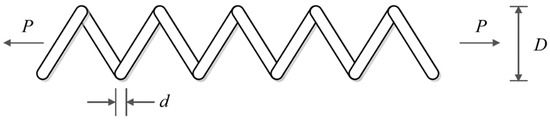
Tension/compression spring design is an engineering subject of real-world applications with the aim of minimizing the weight of tension/compression spring. The schematic of welded beam design is shown in Figure 14 and its mathematical model is as follows [38]:
Figure 14.
Schematic of tension/compression spring design.
Consider:
Minimize:
Subject to:
with
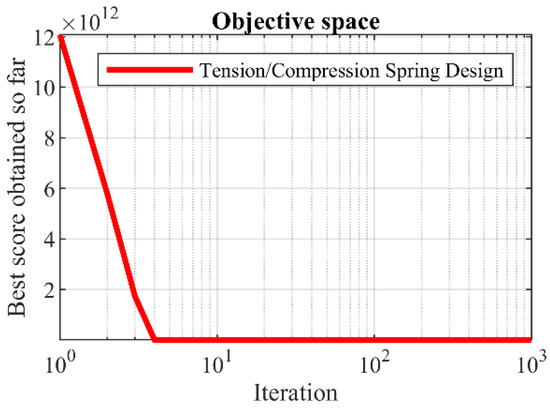
The optimization results of tension/compression spring design using KOA and competitor algorithms are reported in Table 14 and Table 15. Based on the results, KOA has provided the optimal design with the values of design variables equal to (0.0516891, 0.3567177, 11.288966) and the corresponding objective function value equal to (0.0126019). The convergence curve of KOA to the optimal solution for the tension/compression spring design problem is plotted in Figure 15. The analysis of the simulation results shows that KOA has provided superior performance in dealing with tension/compression spring design by providing better results compared to the competitor algorithms.
Table 14.
Performance of optimization algorithms on the tension/compression spring design problem.
Table 15.
Statistical results of optimization algorithms on the tension/compression spring design problem.
Figure 15.
KOA’s performance convergence curve on tension/compression spring.
6. Conclusions and Future Works
In this paper, a new metaheuristic algorithm named the Kookaburra Optimization Algorithm (KOA) was introduced, which has applications in dealing with optimization issues. The fundamental inspiration for KOA is derived from the strategy of kookaburras when hunting and their behavior to ensure that the prey is killed. The theory of KOA was stated and mathematically modeled in the two phases of exploration and exploitation, which are based on simulating the natural behaviors of kookaburras. The effectiveness of the proposed KOA approach in handling optimization tasks was evaluated on the CEC 2017 test suite for problem dimensions equal to 10, 30, 50, and 100. The optimization results showed that KOA, with its high ability in exploration, exploitation, and establishing a balance between them, has been able to provide suitable solutions for the benchmark functions. The quality of KOA in the optimization process was compared with the performance of the 12 well-known metaheuristic algorithms. Based on the simulation results, by achieving better results for most benchmark functions, KOA provided superior performance compared to competitor algorithms in the handling of the CEC 2017 test suite. Also, the implementation of KOA on 22 constrained optimization problems from the CEC 2011 test suite, as well as 4 engineering design problems, indicated the capability of the proposed approach in addressing real-world applications.
By introducing the proposed approach of KOA, several research tasks are proposed for further studies. Designing binary and multi-purpose versions of KOA is one of the most special research proposals of this study. Also, using KOA to solve optimization problems in different sciences and real-world applications are other research proposals for future studies.
Author Contributions
Conceptualization, M.D. and Z.M.; methodology, M.D., Z.M. and G.B.; software, M.D., O.P.M., A.E.A., G.D. and G.B.; validation, G.D., A.E.A., O.P.M., G.B. and Z.M.; formal analysis, M.D., O.P.M., A.E.A. and G.D.; investigation, Z.M. and A.E.A.; resources, G.D. and G.B.; data curation, M.D. and Z.M.; writing—original draft preparation, M.D. and Z.M.; writing—review and editing, O.P.M., G.D., A.E.A. and G.B.; visualization, G.B. and O.P.M.; supervision, M.D.; project administration, Z.M., O.P.M. and G.D.; funding acquisition, O.P.M. All authors have read and agreed to the published version of the manuscript.
Funding
“O.P. Malik” (the fourth author) has paid APC from his NSERC, Canada, research grant.
Institutional Review Board Statement
Not applicable.
Informed Consent Statement
Not applicable.
Data Availability Statement
Not applicable.
Acknowledgments
The financial support of NSERC Canada through a research grant is acknowledged.
Conflicts of Interest
The authors declare no conflict of interest.
Appendix A
The information of CEC 2017 test suite is determined in Table A1.
Table A1.
Information of the CEC 2017 test functions.
References
- Zhao, S.; Zhang, T.; Ma, S.; Chen, M. Dandelion Optimizer: A nature-inspired metaheuristic algorithm for engineering applications. Eng. Appl. Artif. Intell. 2022, 114, 105075. [Google Scholar] [CrossRef] [Scilit]
- Sergeyev, Y.D.; Kvasov, D.; Mukhametzhanov, M. On the efficiency of nature-inspired metaheuristics in expensive global optimization with limited budget. Sci. Rep. 2018, 8, 453. [Google Scholar] [CrossRef] [Scilit] [PubMed]
- Liberti, L.; Kucherenko, S. Comparison of deterministic and stochastic approaches to global optimization. Int. Trans. Oper. Res. 2005, 12, 263–285. [Google Scholar] [CrossRef] [Scilit]
- Koc, I.; Atay, Y.; Babaoglu, I. Discrete tree seed algorithm for urban land readjustment. Eng. Appl. Artif. Intell. 2022, 112, 104783. [Google Scholar] [CrossRef] [Scilit]
- Dehghani, M.; Trojovská, E.; Trojovský, P. A new human-based metaheuristic algorithm for solving optimization problems on the base of simulation of driving training process. Sci. Rep. 2022, 12, 9924. [Google Scholar] [CrossRef] [Scilit]
- Zeidabadi, F.-A.; Dehghani, M.; Trojovský, P.; Hubálovský, Š.; Leiva, V.; Dhiman, G. Archery Algorithm: A Novel Stochastic Optimization Algorithm for Solving Optimization Problems. Comput. Mater. Contin. 2022, 72, 399–416. [Google Scholar] [CrossRef] [Scilit]
- De Armas, J.; Lalla-Ruiz, E.; Tilahun, S.L.; Voß, S. Similarity in metaheuristics: A gentle step towards a comparison methodology. Nat. Comput. 2022, 21, 265–287. [Google Scholar] [CrossRef] [Scilit]
- Dehghani, M.; Montazeri, Z.; Dehghani, A.; Malik, O.P.; Morales-Menendez, R.; Dhiman, G.; Nouri, N.; Ehsanifar, A.; Guerrero, J.M.; Ramirez-Mendoza, R.A. Binary spring search algorithm for solving various optimization problems. Appl. Sci. 2021, 11, 1286. [Google Scholar] [CrossRef] [Scilit]
- Wang, Z.; Zhang, J.; Li, Z.; Shi, C. On the crashworthiness of bio-inspired hexagonal prismatic tubes under axial compression. Int. J. Mech. Sci. 2020, 186, 105893. [Google Scholar] [CrossRef] [Scilit]
- Li, Z.; Wang, X.; Li, X.; Wang, Z.; Zhai, W. New Class of Multifunctional Bioinspired Microlattice with Excellent Sound Absorption, Damage Tolerance, and High Specific Strength. ACS Appl. Mater. Interfaces 2023, 15, 9940–9952. [Google Scholar] [CrossRef] [Scilit]
- Dehghani, M.; Montazeri, Z.; Malik, O.P. Energy commitment: A planning of energy carrier based on energy consumption. Electr. Eng. Electromech. 2019, 69–72. [Google Scholar] [CrossRef] [Scilit]
- Dehghani, M.; Mardaneh, M.; Malik, O.P.; Guerrero, J.M.; Sotelo, C.; Sotelo, D.; Nazari-Heris, M.; Al-Haddad, K.; Ramirez-Mendoza, R.A. Genetic Algorithm for Energy Commitment in a Power System Supplied by Multiple Energy Carriers. Sustainability 2020, 12, 10053. [Google Scholar] [CrossRef] [Scilit]
- Dehghani, M.; Mardaneh, M.; Malik, O.P.; Guerrero, J.M.; Morales-Menendez, R.; Ramirez-Mendoza, R.A.; Matas, J.; Abusorrah, A. Energy Commitment for a Power System Supplied by Multiple Energy Carriers System using Following Optimization Algorithm. Appl. Sci. 2020, 10, 5862. [Google Scholar] [CrossRef] [Scilit]
- Ehsanifar, A.; Dehghani, M.; Allahbakhshi, M. Calculating the leakage inductance for transformer inter-turn fault detection using finite element method. In Proceedings of the 2017 Iranian Conference on Electrical Engineering (ICEE), Tehran, Iran, 2–4 May 2017; IEEE: Tehran, Iran, 2017; pp. 1372–1377. [Google Scholar]
- Dehghani, M.; Montazeri, Z.; Malik, O. Optimal sizing and placement of capacitor banks and distributed generation in distribution systems using spring search algorithm. Int. J. Emerg. Electr. Power Syst. 2020, 21, 20190217. [Google Scholar] [CrossRef] [Scilit]
- Dehghani, M.; Montazeri, Z.; Malik, O.P.; Al-Haddad, K.; Guerrero, J.M.; Dhiman, G. A New Methodology Called Dice Game Optimizer for Capacitor Placement in Distribution Systems. Electr. Eng. Electromech. 2020, 61–64. [Google Scholar] [CrossRef] [Scilit]
- Dehbozorgi, S.; Ehsanifar, A.; Montazeri, Z.; Dehghani, M.; Seifi, A. Line loss reduction and voltage profile improvement in radial distribution networks using battery energy storage system. In Proceedings of the 2017 IEEE 4th International Conference on Knowledge-Based Engineering and Innovation (KBEI), Tehran, Iran, 22 December 2017; IEEE: Tehran, Iran, 2017; pp. 215–219. [Google Scholar]
- Montazeri, Z.; Niknam, T. Optimal utilization of electrical energy from power plants based on final energy consumption using gravitational search algorithm. Electr. Eng. Electromech. 2018, 70–73. [Google Scholar] [CrossRef] [Scilit]
- Dehghani, M.; Mardaneh, M.; Montazeri, Z.; Ehsanifar, A.; Ebadi, M.J.; Grechko, O.M. Spring search algorithm for simultaneous placement of distributed generation and capacitors. Electr. Eng. Electromech. 2018, 68–73. [Google Scholar] [CrossRef] [Scilit]
- Dehghani, M.; Montazeri, Z.; Ehsanifar, A.; Seifi, A.R.; Ebadi, M.J.; Grechko, O.M. Planning of energy carriers based on final energy consumption using dynamic programming and particle swarm optimization. Electr. Eng. Electromech. 2018, 62–71. [Google Scholar] [CrossRef] [Scilit]
- Montazeri, Z.; Niknam, T. Energy carriers management based on energy consumption. In Proceedings of the 2017 IEEE 4th International Conference on Knowledge-Based Engineering and Innovation (KBEI), Tehran, Iran, 22 December 2017; IEEE: Tehran, Iran, 2017; pp. 539–543. [Google Scholar]
- Trojovská, E.; Dehghani, M.; Trojovský, P. Zebra Optimization Algorithm: A New Bio-Inspired Optimization Algorithm for Solving Optimization Algorithm. IEEE Access 2022, 10, 49445–49473. [Google Scholar] [CrossRef] [Scilit]
- Wolpert, D.H.; Macready, W.G. No free lunch theorems for optimization. IEEE Trans. Evol. Comput. 1997, 1, 67–82. [Google Scholar] [CrossRef] [Scilit]
- Dorigo, M.; Maniezzo, V.; Colorni, A. Ant system: Optimization by a colony of cooperating agents. IEEE Trans. Syst. Man Cybern. Part B 1996, 26, 29–41. [Google Scholar] [CrossRef] [Scilit] [PubMed]
- Karaboga, D.; Basturk, B. Artificial bee colony (ABC) optimization algorithm for solving constrained optimization problems. In Proceedings of the International Fuzzy Systems Association World Congress, Cancun, Mexico, 18–21 June 2017; Springer: Berlin/Heidelberg, Germany, 2017; pp. 789–798. [Google Scholar]
- Kennedy, J.; Eberhart, R. Particle swarm optimization. In Proceedings of the ICNN’95—International Conference on Neural Networks, Perth, WA, Australia, 27 November–1 December 1995; IEEE: Perth, WA, Australia, 1995; Volume 4, pp. 1942–1948. [Google Scholar]
- Yang, X.-S. Firefly algorithm, stochastic test functions and design optimisation. Int. J. Bio-Inspired Comput. 2010, 2, 78–84. [Google Scholar] [CrossRef] [Scilit]
- Dehghani, M.; Trojovský, P.; Malik, O.P. Green Anaconda Optimization: A New Bio-Inspired Metaheuristic Algorithm for Solving Optimization Problems. Biomimetics 2023, 8, 121. [Google Scholar] [CrossRef] [Scilit] [PubMed]
- Dehghani, M.; Montazeri, Z.; Trojovská, E.; Trojovský, P. Coati Optimization Algorithm: A new bio-inspired metaheuristic algorithm for solving optimization problems. Knowl. Based Syst. 2023, 259, 110011. [Google Scholar] [CrossRef] [Scilit]
- Trojovský, P.; Dehghani, M. Pelican Optimization Algorithm: A Novel Nature-Inspired Algorithm for Engineering Applications. Sensors 2022, 22, 855. [Google Scholar] [CrossRef] [Scilit]
- Abdollahzadeh, B.; Gharehchopogh, F.S.; Mirjalili, S. African vultures optimization algorithm: A new nature-inspired metaheuristic algorithm for global optimization problems. Comput. Ind. Eng. 2021, 158, 107408. [Google Scholar] [CrossRef] [Scilit]
- Braik, M.; Hammouri, A.; Atwan, J.; Al-Betar, M.A.; Awadallah, M.A. White Shark Optimizer: A novel bio-inspired meta-heuristic algorithm for global optimization problems. Knowl. Based Syst. 2022, 243, 108457. [Google Scholar] [CrossRef] [Scilit]
- Jiang, Y.; Wu, Q.; Zhu, S.; Zhang, L. Orca predation algorithm: A novel bio-inspired algorithm for global optimization problems. Expert Syst. Appl. 2022, 188, 116026. [Google Scholar] [CrossRef] [Scilit]
- Mirjalili, S.; Mirjalili, S.M.; Lewis, A. Grey Wolf Optimizer. Adv. Eng. Softw. 2014, 69, 46–61. [Google Scholar] [CrossRef] [Scilit]
- Dehghani, M.; Trojovský, P. Serval Optimization Algorithm: A New Bio-Inspired Approach for Solving Optimization Problems. Biomimetics 2022, 7, 204. [Google Scholar] [CrossRef] [Scilit]
- Faramarzi, A.; Heidarinejad, M.; Mirjalili, S.; Gandomi, A.H. Marine Predators Algorithm: A nature-inspired metaheuristic. Expert Syst. Appl. 2020, 152, 113377. [Google Scholar] [CrossRef] [Scilit]
- Trojovský, P.; Dehghani, M. Subtraction-Average-Based Optimizer: A New Swarm-Inspired Metaheuristic Algorithm for Solving Optimization Problems. Biomimetics 2023, 8, 149. [Google Scholar] [CrossRef] [Scilit] [PubMed]
- Mirjalili, S.; Lewis, A. The whale optimization algorithm. Adv. Eng. Softw. 2016, 95, 51–67. [Google Scholar] [CrossRef] [Scilit]
- Chopra, N.; Ansari, M.M. Golden Jackal Optimization: A Novel Nature-Inspired Optimizer for Engineering Applications. Expert Syst. Appl. 2022, 198, 116924. [Google Scholar] [CrossRef] [Scilit]
- Kaur, S.; Awasthi, L.K.; Sangal, A.L.; Dhiman, G. Tunicate Swarm Algorithm: A new bio-inspired based metaheuristic paradigm for global optimization. Eng. Appl. Artif. Intell. 2020, 90, 103541. [Google Scholar] [CrossRef] [Scilit]
- Hashim, F.A.; Houssein, E.H.; Hussain, K.; Mabrouk, M.S.; Al-Atabany, W. Honey Badger Algorithm: New metaheuristic algorithm for solving optimization problems. Math. Comput. Simul. 2022, 192, 84–110. [Google Scholar] [CrossRef] [Scilit]
- Abualigah, L.; Abd Elaziz, M.; Sumari, P.; Geem, Z.W.; Gandomi, A.H. Reptile Search Algorithm (RSA): A nature-inspired meta-heuristic optimizer. Expert Syst. Appl. 2022, 191, 116158. [Google Scholar] [CrossRef] [Scilit]
- Goldberg, D.E.; Holland, J.H. Genetic Algorithms and Machine Learning. Mach. Learn. 1988, 3, 95–99. [Google Scholar] [CrossRef] [Scilit]
- Storn, R.; Price, K. Differential evolution–A simple and efficient heuristic for global optimization over continuous spaces. J. Glob. Optim. 1997, 11, 341–359. [Google Scholar] [CrossRef] [Scilit]
- De Castro, L.N.; Timmis, J.I. Artificial immune systems as a novel soft computing paradigm. Soft Comput. 2003, 7, 526–544. [Google Scholar] [CrossRef] [Scilit]
- Beyer, H.-G.; Schwefel, H.-P. Evolution strategies—A comprehensive introduction. Nat. Comput. 2002, 1, 3–52. [Google Scholar] [CrossRef] [Scilit]
- Reynolds, R.G. An introduction to cultural algorithms. In Evolutionary Programming—Proceedings of the Third Annual Conference; World Scientific Press: San Diego, CA, USA, 1994; pp. 131–139. [Google Scholar]
- Koza, J.R.; Koza, J.R. Genetic Programming: On the Programming of Computers by Means of Natural Selection; MIT Press: Cambridge, MA, USA, 1992; Volume 1. [Google Scholar]
- Kirkpatrick, S.; Gelatt, C.D.; Vecchi, M.P. Optimization by simulated annealing. Science 1983, 220, 671–680. [Google Scholar] [CrossRef] [Scilit] [PubMed]
- Dehghani, M.; Samet, H. Momentum search algorithm: A new meta-heuristic optimization algorithm inspired by momentum conservation law. SN Appl. Sci. 2020, 2, 1720. [Google Scholar] [CrossRef] [Scilit]
- Dehghani, M.; Montazeri, Z.; Dhiman, G.; Malik, O.; Morales-Menendez, R.; Ramirez-Mendoza, R.A.; Dehghani, A.; Guerrero, J.M.; Parra-Arroyo, L. A spring search algorithm applied to engineering optimization problems. Appl. Sci. 2020, 10, 6173. [Google Scholar] [CrossRef] [Scilit]
- Rashedi, E.; Nezamabadi-Pour, H.; Saryazdi, S. GSA: A gravitational search algorithm. Inf. Sci. 2009, 179, 2232–2248. [Google Scholar] [CrossRef] [Scilit]
- Eskandar, H.; Sadollah, A.; Bahreininejad, A.; Hamdi, M. Water cycle algorithm–A novel metaheuristic optimization method for solving constrained engineering optimization problems. Comput. Struct. 2012, 110, 151–166. [Google Scholar] [CrossRef] [Scilit]
- Hatamlou, A. Black hole: A new heuristic optimization approach for data clustering. Inf. Sci. 2013, 222, 175–184. [Google Scholar] [CrossRef] [Scilit]
- Mirjalili, S.; Mirjalili, S.M.; Hatamlou, A. Multi-verse optimizer: A nature-inspired algorithm for global optimization. Neural Comput. Appl. 2016, 27, 495–513. [Google Scholar] [CrossRef] [Scilit]
- Hashim, F.A.; Hussain, K.; Houssein, E.H.; Mabrouk, M.S.; Al-Atabany, W. Archimedes optimization algorithm: A new metaheuristic algorithm for solving optimization problems. Appl. Intell. 2021, 51, 1531–1551. [Google Scholar] [CrossRef] [Scilit]
- Faramarzi, A.; Heidarinejad, M.; Stephens, B.; Mirjalili, S. Equilibrium optimizer: A novel optimization algorithm. Knowl. Based Syst. 2020, 191, 105190. [Google Scholar] [CrossRef] [Scilit]
- Pereira, J.L.J.; Francisco, M.B.; Diniz, C.A.; Oliver, G.A.; Cunha, S.S., Jr.; Gomes, G.F. Lichtenberg algorithm: A novel hybrid physics-based meta-heuristic for global optimization. Expert Syst. Appl. 2021, 170, 114522. [Google Scholar] [CrossRef] [Scilit]
- Kaveh, A.; Dadras, A. A novel meta-heuristic optimization algorithm: Thermal exchange optimization. Adv. Eng. Softw. 2017, 110, 69–84. [Google Scholar] [CrossRef] [Scilit]
- Cuevas, E.; Oliva, D.; Zaldivar, D.; Pérez-Cisneros, M.; Sossa, H. Circle detection using electro-magnetism optimization. Inf. Sci. 2012, 182, 40–55. [Google Scholar] [CrossRef] [Scilit]
- Wei, Z.; Huang, C.; Wang, X.; Han, T.; Li, Y. Nuclear reaction optimization: A novel and powerful physics-based algorithm for global optimization. IEEE Access 2019, 7, 66084–66109. [Google Scholar] [CrossRef] [Scilit]
- Hashim, F.A.; Houssein, E.H.; Mabrouk, M.S.; Al-Atabany, W.; Mirjalili, S. Henry gas solubility optimization: A novel physics-based algorithm. Future Gener. Comput. Syst. 2019, 101, 646–667. [Google Scholar] [CrossRef] [Scilit]
- Rao, R.V.; Savsani, V.J.; Vakharia, D. Teaching–learning-based optimization: A novel method for constrained mechanical design optimization problems. Comput. Aided Des. 2011, 43, 303–315. [Google Scholar] [CrossRef] [Scilit]
- Matoušová, I.; Trojovský, P.; Dehghani, M.; Trojovská, E.; Kostra, J. Mother optimization algorithm: A new human-based metaheuristic approach for solving engineering optimization. Sci. Rep. 2023, 13, 10312. [Google Scholar] [CrossRef] [Scilit]
- Dehghani, M.; Trojovský, P. Teamwork Optimization Algorithm: A New Optimization Approach for Function Minimization/Maximization. Sensors 2021, 21, 4567. [Google Scholar] [CrossRef] [Scilit]
- Dehghani, M.; Trojovská, E.; Zuščák, T. A new human-inspired metaheuristic algorithm for solving optimization problems based on mimicking sewing training. Sci. Rep. 2022, 12, 17387. [Google Scholar] [CrossRef] [Scilit]
- Dehghani, M.; Mardaneh, M.; Guerrero, J.M.; Malik, O.P.; Ramirez-Mendoza, R.A.; Matas, J.; Vasquez, J.C.; Parra-Arroyo, L. A new “Doctor and Patient” optimization algorithm: An application to energy commitment problem. Appl. Sci. 2020, 10, 5791. [Google Scholar] [CrossRef] [Scilit]
- Dehghani, M.; Mardaneh, M.; Malik, O. FOA:’Following’Optimization Algorithm for solving Power engineering optimization problems. J. Oper. Autom. Power Eng. 2020, 8, 57–64. [Google Scholar]
- Braik, M.; Ryalat, M.H.; Al-Zoubi, H. A novel meta-heuristic algorithm for solving numerical optimization problems: Ali Baba and the forty thieves. Neural Comput. Appl. 2022, 34, 409–455. [Google Scholar] [CrossRef] [Scilit]
- Trojovská, E.; Dehghani, M.; Leiva, V. Drawer Algorithm: A New Metaheuristic Approach for Solving Optimization Problems in Engineering. Biomimetics 2023, 8, 239. [Google Scholar] [CrossRef] [Scilit]
- Trojovský, P.; Dehghani, M. A new optimization algorithm based on mimicking the voting process for leader selection. PeerJ Comput. Sci. 2022, 8, e976. [Google Scholar] [CrossRef] [Scilit] [PubMed]
- Trojovská, E.; Dehghani, M. A new human-based metahurestic optimization method based on mimicking cooking training. Sci. Rep. 2022, 12, 14861. [Google Scholar] [CrossRef] [Scilit] [PubMed]
- Al-Betar, M.A.; Alyasseri, Z.A.A.; Awadallah, M.A.; Abu Doush, I. Coronavirus herd immunity optimizer (CHIO). Neural Comput. Appl. 2021, 33, 5011–5042. [Google Scholar] [CrossRef] [Scilit] [PubMed]
- Ayyarao, T.L.; RamaKrishna, N.; Elavarasam, R.M.; Polumahanthi, N.; Rambabu, M.; Saini, G.; Khan, B.; Alatas, B. War Strategy Optimization Algorithm: A New Effective Metaheuristic Algorithm for Global Optimization. IEEE Access 2022, 10, 25073–25105. [Google Scholar] [CrossRef] [Scilit]
- Mohamed, A.W.; Hadi, A.A.; Mohamed, A.K. Gaining-sharing knowledge based algorithm for solving optimization problems: A novel nature-inspired algorithm. Int. J. Mach. Learn. Cybern. 2020, 11, 1501–1529. [Google Scholar] [CrossRef] [Scilit]
- Dehghani, M.; Mardaneh, M.; Guerrero, J.M.; Malik, O.; Kumar, V. Football game based optimization: An application to solve energy commitment problem. Int. J. Intell. Eng. Syst. 2020, 13, 514–523. [Google Scholar] [CrossRef] [Scilit]
- Moghdani, R.; Salimifard, K. Volleyball premier league algorithm. Appl. Soft Comput. 2018, 64, 161–185. [Google Scholar] [CrossRef] [Scilit]
- Zeidabadi, F.A.; Dehghani, M. POA: Puzzle Optimization Algorithm. Int. J. Intell. Eng. Syst. 2022, 15, 273–281. [Google Scholar]
- Dehghani, M.; Montazeri, Z.; Givi, H.; Guerrero, J.M.; Dhiman, G. Darts game optimizer: A new optimization technique based on darts game. Int. J. Intell. Eng. Syst. 2020, 13, 286–294. [Google Scholar] [CrossRef] [Scilit]
- Montazeri, Z.; Niknam, T.; Aghaei, J.; Malik, O.P.; Dehghani, M.; Dhiman, G. Golf Optimization Algorithm: A New Game-Based Metaheuristic Algorithm and Its Application to Energy Commitment Problem Considering Resilience. Biomimetics 2023, 8, 386. [Google Scholar] [CrossRef] [Scilit]
- Dehghani, M.; Montazeri, Z.; Malik, O.P. DGO: Dice game optimizer. Gazi Univ. J. Sci. 2019, 32, 871–882. [Google Scholar] [CrossRef] [Scilit]
- Dehghani, M.; Montazeri, Z.; Malik, O.P.; Ehsanifar, A.; Dehghani, A. OSA: Orientation search algorithm. Int. J. Ind. Electron. Control Optim. 2019, 2, 99–112. [Google Scholar]
- Dehghani, M.; Montazeri, Z.; Saremi, S.; Dehghani, A.; Malik, O.P.; Al-Haddad, K.; Guerrero, J.M. HOGO: Hide objects game optimization. Int. J. Intell. Eng. Syst. 2020, 13, 216–225. [Google Scholar] [CrossRef] [Scilit]
- Doumari, S.A.; Givi, H.; Dehghani, M.; Malik, O.P. Ring Toss Game-Based Optimization Algorithm for Solving Various Optimization Problems. Int. J. Intell. Eng. Syst. 2021, 14, 545–554. [Google Scholar] [CrossRef] [Scilit]
- Wang, L.; Shi, D.; Zhang, B.; Li, G.; Helal, W.M.K.; Qi, M. Deep learning driven real time topology optimization based on improved convolutional block attention (Cba-U-Net) model. Eng. Anal. Bound. Elem. 2023, 147, 112–124. [Google Scholar] [CrossRef] [Scilit]
- Sun, Y.; Zong, C.; Pancheri, F.; Chen, T.; Lueth, T.C. Design of topology optimized compliant legs for bio-inspired quadruped robots. Sci. Rep. 2023, 13, 4875. [Google Scholar] [CrossRef] [Scilit]
- Ma, C.; Pu, R.; Wu, L.; Zhang, L.; Lu, G. Lightweight Design of a Support Based on Topology Optimization and 3D Printing. IOP Conf. Ser. Earth Environ. Sci. 2019, 332, 042044. [Google Scholar] [CrossRef] [Scilit]
- Yang, R.; Brice, B.; Ryan, U. A new Caryospora coccidian species (Apicomplexa: Eimeriidae) from the laughing kookaburra (Dacelo novaeguineae). Exp. Parasitol. 2014, 145, 68–73. [Google Scholar] [CrossRef] [Scilit] [PubMed]
- Simpson, K.; Day, N.; Trusler, P. Field Guide to the Birds of Australia, 6th ed.; Penguin Books Australia Ltd.: Melbourne, VIC, Australia, 1999. [Google Scholar]
- Campbell, B. Nocturnal Foraging by Kookaburras. Aust. Field Ornithol. 2001, 19, 104–105. [Google Scholar]
- Awad, N.; Ali, M.; Liang, J.; Qu, B.; Suganthan, P. Problem Definitions and Evaluation Criteria for the CEC 2017 Special Session and Competition on Single Objective Real-Parameter Numerical Optimization; Technical Report; Nanyang Technological University: Singapore, 2016. [Google Scholar]
- Wilcoxon, F. Individual comparisons by ranking methods. In Breakthroughs in Statistics; Springer: Berlin/Heidelberg, Germany, 1992; pp. 196–202. [Google Scholar]
- Das, S.; Suganthan, P.N. Problem Definitions and Evaluation Criteria for CEC 2011 Competition on Testing Evolutionary Algorithms on Real World Optimization Problems; Technical Report; Jadavpur University: Kolkata, India, 2010; pp. 341–359. [Google Scholar]
- Kannan, B.; Kramer, S.N. An augmented Lagrange multiplier based method for mixed integer discrete continuous optimization and its applications to mechanical design. J. Mech. Des. 1994, 116, 405–411. [Google Scholar] [CrossRef] [Scilit]
- Gandomi, A.H.; Yang, X.-S. Benchmark problems in structural optimization. In Computational Optimization, Methods and Algorithms; Springer: Berlin/Heidelberg, Germany, 2011; pp. 259–281. [Google Scholar]
- Mezura-Montes, E.; Coello, C.A.C. Useful infeasible solutions in engineering optimization with evolutionary algorithms. In Proceedings of the Mexican International Conference on Artificial Intelligence, Monterrey, Mexico, 14–18 November 2005; Springer: Berlin/Heidelberg, Germany, 2005; pp. 652–662. [Google Scholar]

Disclaimer/Publisher’s Note: The statements, opinions and data contained in all publications are solely those of the individual author(s) and contributor(s) and not of MDPI and/or the editor(s). MDPI and/or the editor(s) disclaim responsibility for any injury to people or property resulting from any ideas, methods, instructions or products referred to in the content. |
© 2023 by the authors. Licensee MDPI, Basel, Switzerland. This article is an open access article distributed under the terms and conditions of the Creative Commons Attribution (CC BY) license (https://creativecommons.org/licenses/by/4.0/).