


Abstract
Amongst the Kabire of Ojor, Akamkpa, south-eastern Nigeria, some personal names are products of religious beliefs and translation. Such names exist in a cultural context that onomastic studies are yet to explore. This study seeks to examine the recent Kabire naming pattern with the English–Dubire translation of such labels. Using purposive sampling, data were collected from eighteen participants in Ojor, Akamkpa and analysed with the semiotic and domestication theories; this was followed by an ethnographic study of the eighteen participants’ respective labels to understand the purpose(s) of the translated personal names. Findings confirmed that labels were conceived originally in English amongst the Kabire during their recent religious interactions in Ojor, Akamkpa. Like in some parts of Africa, such labels have become integral to Kabire cosmology with particular psycho-spiritual and societal meanings and functions.
1. Introduction
According to Kłoskowska (2001), ‘culture’ is a set of ways [of doing things], norms, values, symbols, beliefs, knowledge and symbolic works which a given community regards as its own, and so, it (the community) is accordingly dedicated to them because they are drawn from the community’s traditions and historical experiences and are consequently valid within the specific community. Kłoskowska’s focus here is on the syntagmatic character of culture wherein different elements and systems like arts, customs, language, literature, religion, symbols and traditions get fused together to produce what appears to be a single, homogeneous system or identity.
Nevertheless, while ‘culture’ provides the basis for a person’s or people’s identity, that ‘identity’ itself may either be developed from within the person or people of a community to persist through change, or ascribed from without with the likelihood of changing according to circumstance (Gleason 1983). This presupposes that a person’s or people’s identity may become variegated depending on how the person or people see themselves (self-created or self-ascribed) and how others see the person or people through peculiar community labels and/or canons formed over time and ascribed accordingly to individuals or groups. These are the natural, fundamental, constitutive elements of individual and collective identities that make up ‘cultural identity’ (Chen 2018; Lecours 2000).
Lecours’ (2000) and Chen’s (2018) conception of cultural identity appears to capture the reality of the Kabire people whose homeland, Ojor, is essentially cosmopolitan. Indeed, ‘Ojo’ is an Ejagham word for ‘dogs’; it is the Ejagham plural for ‘Njo’ (a dog). According to our source (Ewoh 2026), the name ‘Ojor’ was plastered on the Kabire people through stereotyping when some British colonial officers left Akamkpa town with their Ejagham interpreter for Kabire land on a documentation assignment. On arrival, the colonial officers asked their interpreter to tell them what he knew about the Kabire people and the land. The interpreter did not hesitate in drawing from his Ejagham stereotype to describe the Kabire people and their land located in the equatorial rainforest as ‘Ojo’ (meaning ‘dogs’) because the Ejagham people dreaded the fierce and fearless Kabire warriors who had wild cannibalistic tendencies. That was how the Kabire people and their land, which they originally knew and lived in as ‘Kabire’, became officially known as ‘Ojor’.
Though the name ‘Ojor’ does not sit well with the Kabire people because it is not part of their heritage and cultural identity since it has no bearing on, or meaning in, their culture and Dubire language, it has not in any way affected the people’s perception of themselves and how they relate to and interact with their neighbours (Ejagham and Ayo), and the migrant settler population (Efik and Ibibio). Due to the healthy symbiotic relationship which they share with their Ejagham and Ayo neighbours, on the one hand, and the migrant Efik and Ibibio workers and farming partners, on the other, their traditional naming culture sometimes draws from these non-Indigenous sources who have, over time, become part and parcel of the Ojor community (Mbey et al. 2025).
In recent times, however, with the advent of Christianity, there has been a shift in Kabire cosmology with emphasis on the belief that nothing exists or happens in the physical world without it first being formed and organised in the spiritual world; and that it is the latter that governs the physical world (Asadu and Nzuanke 2014, p. 130). Consequently, today, while most Christians amongst the Kabire people attribute their successes and achievements to God (Ùbàsè), the Traditionalists also appear to attribute theirs to the handiwork of other gods (or even cults). This is notwithstanding the position of moderate Kabire people who still hold onto their belief that success in life is essentially a product of personal or family effort. Overall, each group, in their respective circumstances, find a way to express love, show respect and gratitude and lavish praise to God (Ùbàsè), for the Christians; friends, family or community, for the moderates; and other gods (or even cults), for the Traditionalists, through some of the names they give to their offspring.
It is, therefore, against this backdrop of religious or moderate beliefs that a significant part of the new naming culture and tradition is believed to have developed amongst the Kabire people from when Pentecostalism came to Ojor, Akamkpa in the mid-20th century. In fact, some of the recent names given by the Kabire people to their offspring appear to have been originally conceived in the English language before being translated into Dubire (the local language). This seems antithetical to general African traditional naming practices and suggests serious cultural contradictions that raise questions about the Kabire identity of such names because, as translations from a European language, the names may be devoid of substantive Kabire cultural identity. Indeed, how do Kabire people culturally substitute and/or localise English-origin religious and value-laden labels as names in their Dubire language, and how do such names participate in the construction of Kabire cultural identity? In this study, we shall attempt to provide answers to the above questions by identifying some of such labels as examples for classification, translation and description with a view to explaining such an apparent reversal of logic in Kabire anthroponymy.
2. Review of Literature
Though several studies have been carried out on names and naming practices around the world, due to space, it will be necessary for this study to narrow its literature review and focus on names and naming that are related to recent religious and social influences in Nigeria.
One such study is that of Boluwaduro (2019), which only accommodates Christian or religious names in its broad classification of Ibibio personal names into categories like birth rank, family/personal attachment and personal attributes that portray cultural traits, norms, traditions and religious beliefs amongst Ibibio name-bearers of Akwa Ibom State, Southeastern Nigeria. According to the study, using names to construct identities in Ibibio land requires such important ideological indicators as kinship and knowledge of and belief in Ibibio culture and tradition. Consequently, personal names may either be a reflection of the name-bearer’s self-created or self-ascribed identity and label or a channel through which prejudices can be circulated in the course of transmitting cultural beliefs.
In a rather more circumscribed study of religious or Christian names, Aboh et al. (2022) discuss naming practices amongst Pentecostal Christians in the five Bette-speaking wards of Obudu Local Government Area (Obudu Urban 1, Obudu Urban 2, Ipong, Begiading and Angiaba/Begiaka) in Cross River State, Southeastern Nigeria. The study underscores the nexus between anthroponymy and spirituality. Yet, the arguments advanced in it with regard to naming amongst Bette Pentecostal Christians seem to run in total contradistinction to those traditional Bette naming practices that are highlighted by Nzuanke and Akpagu (2019) and Betiang (2019). In fact, the emergence of Pentecostal Christianity in the area, which dates back to the 1950s, has more or less challenged Bette cosmology concerning certain traditional practices, including naming, whereby some Bette names now incorporate manifold meanings with messages that go far beyond mere religious identity.
Apparently aligning his views with those of Aboh et al. (2022), Mensah (2024) examines the naming practices of different religious faithful amongst the Tiv in north-central Nigeria. He explains that religious names in Tiv land are generally given to showcase the name-givers’ or name-bearers’ deep attachment to their respective faith. According to Mensah, this attachment is exemplified by the name-giver’s and/or name-bearer’s belief and, perhaps, involvement in such spiritual practices and icons as witchcraft, an afterlife, the place and role of ancestors and a supreme celestial spirit in the image of God almighty.
As can be noticed, none of the above studies is even remotely connected to the naming practices and traditions amongst the Kabire people. Indeed, literature on Kabire naming traditions is scarce. Ayang (2005) provides only information on Ojor traditional institutions and chieftaincy matters, with virtually nothing on Kabire naming traditions.
Only Mbey et al. (2025) discuss name-borrowing amongst the Kabire people of Ojor-Akamkpa in Akamkpa Local Government Area and Ojor-Umon in Biase Local Government Area, both of Cross River State, south-eastern Nigeria. In the study, the authors highlight and explain the incidence of name-borrowing in terms of a phenomenon that is captured as unnecessary, intimate or core borrowing (from their Ejagham and Ayo neighbours, as well as the migrant Efik/Ibibio settler population) wherein lexemes are drawn from ‘foreign’ (Efik and Ibibio) or neighbouring (Ejagham and Dòkò-Ayo), donor or source languages to substitute or replace seemingly existing, equivalent lexemes in a ‘recipient’ language (Bloomfield 1933; Myers-Scotton 2002, 2006; Haspelmath 2009), which in this case is Dubire/Lubila. This, they explained, is more due to psycho-spiritual constraints rather than lexical absence.
In terms of translation of African and/or Nigerian cultural and religious names, only two works readily come to focus. Asadu and Nzuanke (2014) examine the reoccurrence of Chi (God) or Chukwu (almighty God) affixes in Igbo names as both cultural and religious undertones with meaning. Used as Chi or Chukwu, both are variations of allusions to a higher being, as the Igbo race believes in a pantheon of gods that govern human existence, the highest being Chi. They apply onomastics in the translation of thirty chi names from Igbo to English, establishing their translatability into a European language.
Perhaps drawing from the findings of the translatability of sub-Saharan African names, Nzuanke and Akpagu (2019) worked on the translation of nine recurrent Bette (Obudu) death-related or “Líwhú” names into English and provided acceptable alternative labels for such names in English as symbols or signs with meanings.
While all the studies analysed above may have contributed significantly to building the literature of African, nay global onomastics, none of them attempted to examine the developing naming pattern (from foreign, non-African to African labels) amongst Indigenous religious adherents and some moderates. This developing pattern borders on highlighting and projecting African cultural identities through the translation of certain religious labels from foreign, non-African languages to find acceptable substitute labels in some African languages.
That is what this study seeks to achieve by highlighting and projecting Kabire cultural identity through the translation of certain religious labels from English (a European language) to acceptable substitute labels in Dubire, the language of the Kabire people of Ojor, Akamkpa in Southeastern Nigeria.
3. Theoretical Framework
‘Domestication’ and ‘semiotics’ will be applied to this study. Evidently, an offshoot of Nida’s ‘Dynamic Equivalence’ (Nida 1960, p. 192), ‘domestication’ is the process of translation that has evolved from being a mere linguistic activity to being a cultural process that involves the transfer of meaning and message between languages and societies. For centuries, a recurrent debate in translation studies has been whether Translators should adapt foreign texts to the target culture (domestication) and/or translate the text as it is with its ‘foreign flavour’ (foreignisation).
These opposing concepts and ideals are both articulated by Venuti (1995), who describes ‘domestication’ as the process of translating a work to correspond to the linguistic and cultural norms of the target audience and culture. This is with a view to reducing the ‘foreignness’ of the source text and adapting it to the specific expectations of the target audience to produce fluent and readable translations for the target reader.
In domestication, the Translator looks out first for culture-specific items with which the target audience may not be familiar. These include historical references, social customs and traditions, idioms and proverbs, food and clothing, names and forms of address, etc. Thereafter, the Translator will analyse the target audience to determine how to deliver the message and meaning for maximum effect. Once the analysis is completed, the Translator will apply the most suitable ‘domestication’ technique(s), which may be: ‘cultural substitution’, ‘adaptation’, ‘localisation’, and/or ‘modulation’, etc.
For the purposes of this study, we shall apply only ‘cultural substitution’ and ‘localisation’ as domestication techniques in translating English-origin religious and value-laden labels into Dubire. While ‘cultural substitution’ seeks to replace a culture-specific item in a source text (ST) with a roughly equivalent one that performs a similar function or evokes a similar response in the target text (TT) culture, ‘localisation’ allows the Translator to adapt a text to the linguistic, cultural, social and practical conventions of the target audience, so that the text will appear as if it was originally conceived and created for that specific audience. On the whole, Translators who apply ‘domestication’ to their works often sacrifice certain aspects of the source text culture and language in favour of readability and fluency in the target language since the strategy allows the Translator to modify a text to conform to the expectations of the intended audience in the target culture. Therefore, translating English-origin religious and value-laden labels into equivalent expressions in the Dubire language, replacing culturally distinctive allusions or labels with recognisable substitutes in Dubire language and Kabire culture, and modifying source language syntax and style to conform to Dubire language needs are a few examples of how ‘domestication’ shall be applied to the translation of recent Kabire names.
Concerning semiotics, its apparent general thrust is to produce meaning from cultural texts, especially in situations where there are complex meaning-relations of surface and deep structures (or denotative or connotative meanings) created by certain symbols with the aim of distinguishing the latter from others in specific texts with a cultural background (Peirce 1931–1958). Peirce’s conception of semiotics is ‘semiosis’, which hinges on the triadic model of representamen (R), interpretant (I) and object (O) used in isolating meanings from signs. Put differently, while representamen (R) is the visible, crafted image or written/spoken word/expression that represents the sign (like labels), interpretant (I) is the mental picture meaning of that sign; and object (O) is the actual, perceptible, concrete, physical referent that links ‘R’ and ‘I’ to reality in the real world.
It highlights such semiotic practices as anthroponymy in relation to a particular group, community and/or culture with special emphasis on the following three trichotomies, namely:
- -
- Icon: The sign that resembles the object;
- -
- Index: The sign that directly, physically points to or indicates the objects;
- -
- Symbol: The sign that is connected to its object by an arbitrary rule or social convention to generate meaning.
4. Methodology
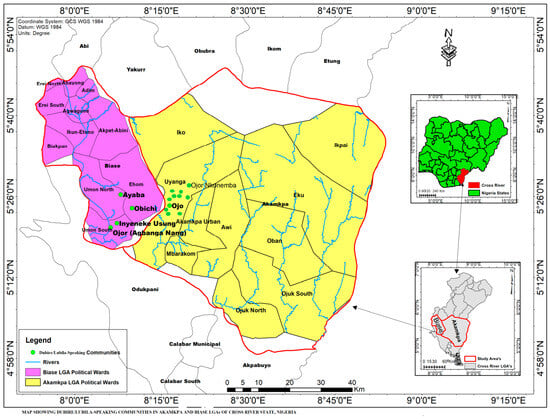
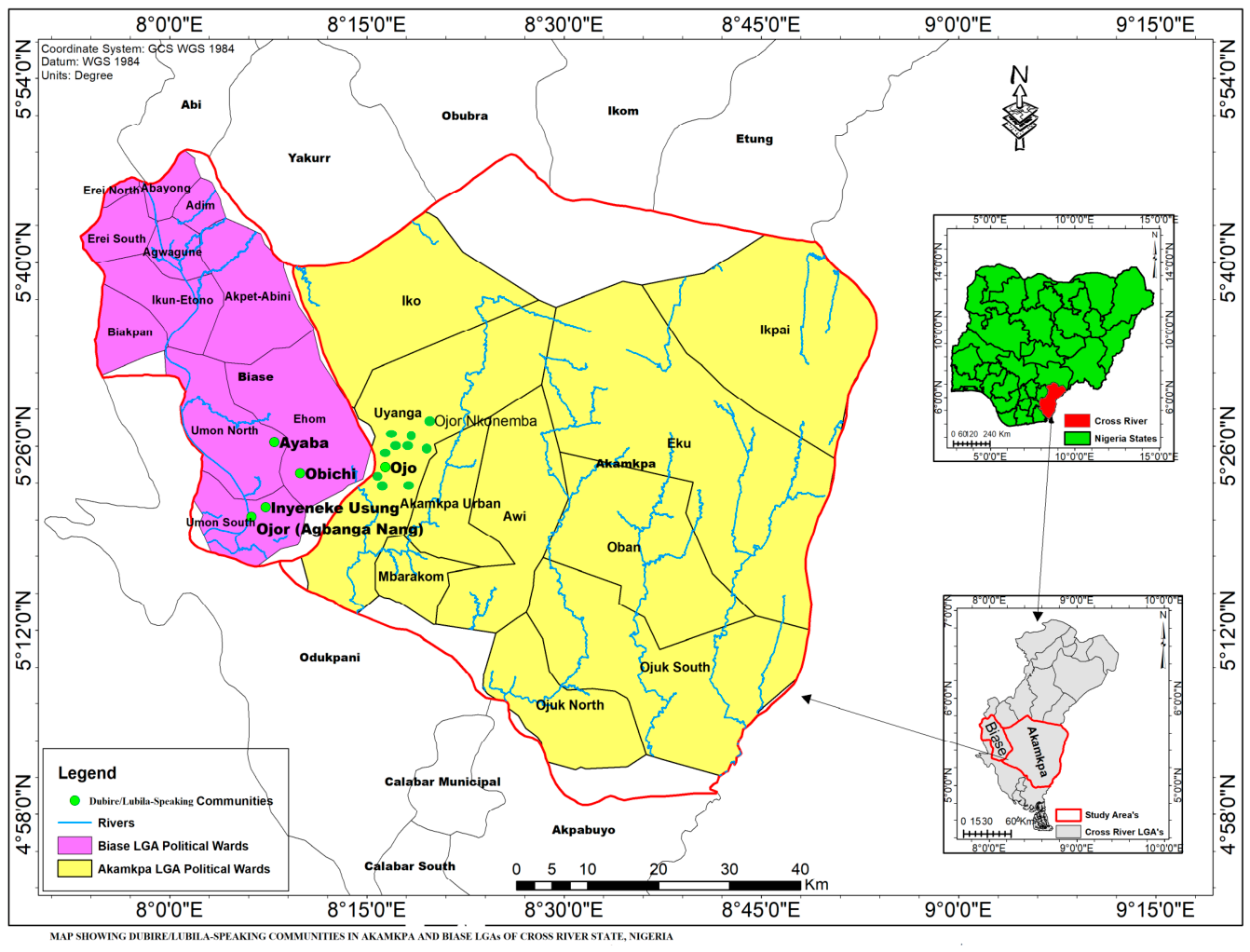
The study was conducted from May 2025 to May 2026 in Ojor, Akamkpa (Figure 1), which comprises 11 villages (Abakpa, Aronghojong, Ayughaba, Mbarakpa, Mkparatop, Ndighene, Nkonimba, Nsirong, Ojor Camp, Okoroba and Usangharet) in Akamkpa Local Government Area of Cross River State, Nigeria. The National Population Commission (NPC 2007) estimated the population of Ojor, Akamkpa to be about 7000 with some 6500 native speakers of Dubire, the local language. Yet, sixteen years later, the Ojor Traditional Council, relying on an unpublished 2023 population estimate based on evidence of internal and cyclical migratory trends around the community, maintained the same figures for the locality (Ewoh 2026). There are two other groups of people and languages present in and around Ojor, Akamkpa: neighbouring people/languages, which include Dokó-Uyanga, Kiong and Nkukoli; and the ‘foreign/settler’ Efik, Ejagham, Ibibio population/languages.
Figure 1.
Map of the study area. Source: Department of Geography and Regional Planning, University of Calabar, Nigeria.
The purposive sample (Maximum Variation Technique) was used for the sample population of eighteen people in Ojor, Akamkpa, including the Obol Loche (Chief of Ojor, Akamkpa) and his eldest wife, both from Nkonimba village, and two persons (a male and a female) from each of the eight other villages (Abakpa, Ayughaba, Mbarakpa, Mkparatop, Nsirong, Ojor Camp, Okoroba and Usangharet). For the purposes of this research, Aronghojong and Ndighene villages were lumped under Abakpa because, since around 1992, the upsurge of farming and other economic activities around these three contiguous villages tends to blend the other two into the bigger Abakpa village. Consequently, the hitherto clearly existing boundary-and-identity lines and heritage of natives of those two villages are seemingly getting gradually obliterated and absorbed into Abakpa.
In the study, gender, age, marital status, religion, parentage and location were used as criteria for selecting the participants. Thus, for gender, the Obol Loche plus eight other males and Obol Loche’s wife and eight other females from the above-listed nine villages were retained. The age criterion of respondents was set at 20 to 80 years because the researchers expected those between the ages of 20 and 35 to be name-bearers, and those between the ages of 36 and 80 (who may have witnessed the evolution of naming patterns in the community) to be name-givers with reasonable enough knowledge about Kabire naming culture. In relation to marital status, the assumption was that all those from 36 to 80 years should have been married. Yet, unexpectedly, three of the participants between the ages of 20 and 35 were already married with children. This gave the researchers another perspective on the study. Only the Obol Loche, his eldest wife, two males and two females are Traditionalists. The remaining twelve are members of one Christian denomination or the other. Concerning parentage and location, all the participants were born of Kabire parents and have been living in Ojor, Akamkpa from birth to date.
While six (singles) of the ten participants aged between 20 and 35 years were asked questions about six recent value-laden Kabire names drawn from socio-economic and political encounters, the other four, married and aged between 20 and 35, and the eight (married), aged between 36 and 80 years, were interviewed in respect of ten religion-related names (Christian and Traditional) which they bore and/or have had to give to their own offspring.
During our interactions with participants in English with occasional translations in Dubire (to facilitate communication), we asked questions about their respective religious faith or inclinations, motivations for those peculiar names they bore (name-bearers), reasons for giving those specific names to their respective offspring (name-givers), and the degree of their understanding of Kabire naming traditions and cultural practices. It should be underscored that all the participants (especially the Obol Loche, his wife and some senior members of the Kabire Traditional Council) admitted that the names that were listed for this study were never part of original Kabire anthroponymy, as such names did not previously exist in any part of Kabire land.
These interactions were recorded on an iPad and later transcribed into written form, essentially in English. The qualitative method will be used to analyse these data. Since Dubire is not yet a standardised language, we used mainly the English alphabet to improvise a written Dubire form based on the peculiar pronunciation of the different participants. Our version of the Dubire written form may, therefore, inevitably vary from any other form generated elsewhere. We shall draw from our version of the Dubire written form to provide glosses by way of English back-translations for all the religion-related and value-laden English labels that were translated into Dubire for a better understanding of their respective meanings and functions as Kabire names. This, it is hoped, will provide evidence that the recent naming patterns are emanations of the Kabire psycho-spiritual belief system and the people’s attachment and pride in their individual religious practices.
5. Data Presentation, Translation, Analysis and Discussion
Generally speaking, naming practices in Kabire are a product of their sociocultural, economic and psycho-spiritual existence. Though Kabire cosmology revolves around pantheism with God Almighty (Ùbàsè) and smaller gods like Mfugho, Ocheworor, and a goddess known as Ikəu (Ayang 2005, pp. 15–16), reference has hardly been made to any Deity in their original naming tradition; Kabire names have been drawn essentially from the people’s everyday existential experiences which hinge on farming, hunting, family, community life, war and survival. Examples of such original Kabire names include ‘Mbey’ (brave man/leader of a powerful group), ‘Nkpong’ (a child/person who may not live long), ‘Akima’ (denoting strength, a family name transferred only to descendants of the given family), ‘Onwor’ (family name reserved for only ancestral bearers).
Originally in Kabire psycho-spirituality, the concept of ‘Deity’ often gave rise to a single interpretation: God created the human being to live their potential according to their abilities. So, from birth through life to death, the average Kabire person attributed all achievements, successes and failures which may have been patterned by fate, to family involvement and the bravery or cowardice, hard work or laziness, intelligence or stupidity and survival instincts or otherwise of the individual(s) concerned. However, the advent of Christianity brought something new to Kabire cosmology which even Traditionalists seem to embrace: that everything that happens in our world so happens because God has (or the gods have) accepted, organised and ordered it to happen that way. This was captured in biblical teachings that gave rise to expressions and coinages that tended to embody certain ideals and moral values which different community members adapted as names/labels to suit their respective peculiar family circumstances. Consequently, while Traditionalists in Kabire land now tend to attribute their successes and achievements to their gods (or even cults) rather than to individuals’ prowess with unconventional labels like ‘My Protector’, ‘My Provider’, the Christian converts attribute theirs to God (Ùbàsè). This has given rise to some unconventional first names like ‘Godsgift’, ‘Godspower’, ‘Godslove’, etc. Similarly, the moderates who neither completely reject one nor wholeheartedly accept the other of these religions still stick with the original belief system in relation to an individual’s achievements, successes and failures in life with such unconventional first names as ‘Obidience’, ‘Excellence’, ‘Knowledge’, etc. This is evident in the way each of these three groups tries to communicate their gratitude, hopes, expectations, fears and/or concerns to the community, the world, their respective Deities, spirits and/or cults through some of the names they give to their offspring. The labels are generally first conceived in English, then ascribed Dubire substitutes for use as names in peculiar family circumstances.
We shall hereunder show samples of these ascribed English labels and their translations into Dubire for which we shall provide glosses in English to explain their suitability as names with Kabire cultural identity.
5.1. Kabire Names as Signs/Symbols of Christian Spirituality
Names in this category are recent. The labels in English (Table 1, Column 1), like many other such labels that tend to praise and glorify God as a beacon of hope, are borne out of the belief amongst devout Kabire Christians in the all-powerful, kind, generous, supreme God who is their source of strength, love, peace and happiness. They are essentially products of the arrival of the Pentecostal Christian faith in Kabire land.
Table 1.
Kabire names as signs/symbols of Christian spirituality.
The labels are essentially sentential and can be classified differently as rhetorical questions (Who is like God?), dictums (Everything is from God), metaphors (God is happiness) and declarations (Thank God; God’s Love). In domestication, such labels are rendered either by their cultural substitutes in the target language and culture or simply localised in the context and realities of the target language and culture. Let us examine examples of cultural substitution and localisation with morpheme-by-morpheme analyses of the labels.
| (a). Thank God | ||||
| Ubase | sa | - | m | |
| ↓ | ↓ | ↓ | ||
| Gloss: God, thank-PRES-1SG 2SG-OBJ | ||||
| ‘God, I thank you.’ | ||||
In domesticating the labels in Table 1 above, example (a) provides an interesting case where the label (Thank God) comes out as a 3SG declaration of gratitude to God. Yet, the Dubire substitute, ‘Ubasesam’, implies a direct one-to-one communication between the name-giver (1SG) and God (2SG). So, while God appears to be distant and perhaps unseen to the English evocator of the label ‘Thank God’, the same God is shown to be quite close to the Kabire person; so close that the latter can talk directly to Him. That is the thought that underpins ‘Ubasesam’ as a Kabire cultural substitution to ‘Thank God’.
| (b). Who is like God? | ||||
| Bane- | ayin- | da- | Ubase? | |
| ↓ | ↓ | ↓ | ↓ | |
| Gloss: | Who | look-PRS | like | God. |
| look-3GS | prep | God | ||
| ‘Who is like God?’ | ||||
In example (b), ‘Who is like God?’, the English label only emphasizes incomparability with the seemingly existing but invisible divinity. Conversely, in the Dubire substitution (Bane-ayin-da-Ubase) in column 2 above, we note the use of the verb ‘looks’, which indicates ‘visibility’ or ‘appearance’. This is inherent in Kabire Christian thought wherein God is adjudged to be present and visible in Kabire land. Therefore, ‘Bane-ayin-da-Ubase’ is a name that emanates from the Kabire person’s awareness of God’s overwhelmingly incomparable looks.
| (c). God’s beauty | ||
| Kene- | Ubase | |
| ↓ | ↓ | |
| Beauty | God | |
| Gloss: | Beauty-Gen | God |
| ‘Beauty of God’ or ‘God’s beauty’ | ||
| (d). Thanksgiving to God | |||
| De-sam-a- | Ubase | ||
| ↓ | ↓ | ||
| Thanking you, | God | ||
| Gloss: | thank-PROG 2SG | God | |
| ‘Thanksgiving to God’ | |||
| (e). God’s Love | |||
| Ku- | bam- | Ubase | |
| ↓ | ↓ | ↓ | |
| To | love | God | |
| Gloss: | INF | love | God |
| ‘God’s Love’ | |||
| (f). | Who | can | defeat | God? |
| Bane- | a- | rugho- | Ubase? | |
| ↓ | ↓ | ↓ | ↓ | |
| Gloss: | Who | MOD | defeat | ACC God |
| Who | MOD | V | N | |
| ‘Who can defeat God?’ | ||||
| (g). God’s happiness | ||
| Okondom- | Ubase | |
| ↓ | ↓ | |
| Happiness | God | |
| Gloss: | Happiness-Gen | God |
| ‘God’s happiness’ | ||
| (h). God’s power | ||
| Ikom- | Ubase | |
| ↓ | ↓ | |
| Power | God | |
| Gloss: | Power-Gen | God |
| ‘God’s power’ | ||
Domestication of examples (c) ‘God’s beauty’ as ‘Kene-Ubase’, (g) ‘God’s happiness’ as ‘Okondom-Ubase’ and (h) ‘God’s power’ as ‘Ikom-Ubase’ is localised in the context-dependent Dubire reverse-order structure of ‘Predicate + Subject’. Unlike the English language, Dubire structures tend to mark possession with Noun + Noun in ‘Predicate + Subject’ structures, and with neither the preposition ‘of’ nor a clitic ‘s’ attached to the root word (Subject-3SPOSS + N) to mark possession.
In example (d), (Thanksgiving to God), culturally substituted as ‘Desama-Ubase’, the fused, frozen form of the Dubire verb root ‘sam’ (thank you) to express gratitude, is inflected with ‘De’ (prefix) and ‘a’ (suffix) to sustain a typical Kabire action of perennial gratitude to God. Note that while the English label is impersonal and seems to address God as 3SG, the Kabire name ‘Desama-Ubase’ addresses God directly as an interlocutor (2SG).
Example (e) (God’s Love), localised as ‘Kubam-Ubase’, would ordinarily have fallen into the same possession-marking category as examples (c), (g) and (h). But the verb root ‘bam’ that is inflected with the prefix ‘Ku’ (infinitive marker) makes ‘Kubam-Ubase’, or loving God the ultimate goal of the name-giver/name-bearer’s existence. ‘Kubam-Ubase’ appears to be even more profound than ‘God’s Love’ because it presupposes a non-finite action of love for God with no definite timeframe.
We describe the Dubire language structure as ‘context-dependent reverse-order structure of Predicate + Subject’ because the reverse syntactic order noted in the examples above may just be an occasional occurrence and not an established pattern of Dubire sentence structure. This is evidenced in example (f), ‘Who can defeat God?’, which is localised as ’Bane-arugho-Ubase?’ because of its clear Subject + Verb + Predicate order.
Apart from ‘Bane-arugho-Ubase?’, all of the seven other Kabire names analysed above tend to exhibit losses in relation to the original source language (English) labels that are structured on verbs, possessive forms, object pronouns and prepositions. Though these grammatical elements are absent in seven of the final Kabire names, their absence rather enhances the central messages and provides the desired local Kabire cultural flavour that gives the names in the eight samples presented in Table 1 above a place within the Kabire naming paradigm as acceptable cultural substitutes in Kabire culture.
5.2. Names That Project Prosperity Amongst the Kabire People
The Kabire community was originally seriously socialist-inclined with a strong communal spirit anchored on the belief in hard work. Over time, however, specifically from about 1985–1993 (which coincides with when General Ibrahim Badamassi Babangida ruled Nigeria), a period that was characterised by hardship, there appeared to have developed a shift in Kabire worldview to ditch the socialist inclination in favour of a deep capitalist spirit of survival of the fittest. This tended to breed rivalry and competition, which were offshoots of prosperity amongst some successful members of the Kabire society (Ewoh 2026).
Against this backdrop, average Kabire people with a moderate belief system started giving their offspring names that project hope of prosperity, depict positive expectations and defy fear, rivalry and competition in the community. While they believe in the existence of God, this category of Kabire people does not reject Traditionalists and their belief in local deities and cults. Under this category, six examples shall be highlighted (Table 2).
Table 2.
Names that project prosperity amongst the Kabire people.
Though not all the labels in this category are sentential, there are still some rhetorical questions and declarations that will be analysed, translated and explained in more or less the same way as we did with the labels in Table 1. This is with a view to confirming the extent to which they align with the realities of the Dubire target language and Kabire culture.
In domesticating the labels in Table 2 above, we shall not only sacrifice the syntactic order (Subject + Verb + Predicate) of the rhetorical questions and declarations in the English source text, but also the English language structure in a case where a possessive adjective (1SPOSS) is used. This is for purposes of comprehension, readability and fluency in Dubire, the target language.
| (i). | Who | knows? |
| Bane- | ayet? | |
| ↓ | ↓ | |
| Interlinear | Who | know-s |
| Gloss: | Who | know-PRS.3SG |
| ‘Who knows?’ | ||
| (j). | Who | knows | tomorrow |
| Nu- | yet- | ika? | |
| ↓ | ↓ | ↓ | |
| Who | know-3SG | tomorrow | |
| Gloss: | Who | know-PRS.3SG | tomorrow |
| ‘Who knows tomorrow?’ | |||
| (k). | My | prized possession |
| N- | wan | |
| ↓ | ↓ | |
| Gloss: | 1SG.POSS | very own |
| ‘My | very own’ or ‘My prized possession’ |
| (l). | Goodluck |
| Ofa’a | |
| ↓ | |
| Gloss: | Noun |
| ‘Goodluck’ |
| (m). | Wealth |
| Omense | |
| ↓ | |
| Gloss: | Noun |
| ‘Wealth’ |
| (n). | I’m not begging | ||
| Onne- | n- | si | |
| ↓ | ↓ | ↓ | |
| Someone | not | beg | |
| Gloss: | Someone | NEG | beg |
| ‘I’m not begging’ | |||
In samples (i) Who knows? and (j) Who knows tomorrow? (rhetorical questions), the Dubire translations in Column 2, ‘Banayét?’ and ‘Nuyét-Ika?’, respectively, show the use of a Dubire verb ‘yét’ (to know) with a strange introduction of negative forms in the gloss as in: (i) Who knows not? and (j) Who knows not tomorrow? (Table 2). As analysed, the Dubire substitutes, ‘Banayét?’ and ‘Nuyét-Ika?’, appear to respect the Subject + Verb + Predicate order of the source language labels.
‘Baneyet?’ captures a hope for greatness through future physical strength, wisdom, intelligence or luck that may engender prosperity in a name-bearer’s life. One participant explained that since the name-giver is uncertain about what nature may reserve for their offspring, they only gave the name and let nature decide which of the above-listed attributes will align properly with the name-bearer’s star to make the latter prosperous. ‘Baneyet?’ is founded on uncertainty.
The participant added that ‘Nuyet-Ika?’ was coined by a Kabire name-giver to express surprise at the very positive turn his life had taken. This was against the backdrop of the extreme hardship the name-giver had suffered in the not-too-distant past. ‘Nuyet-Ika?’ is founded on certainty.
Example (k) ‘My prized possession’ culturally substituted in Dubire by ‘Nwan’ refers to something owned and deeply cherished because of its future value. To the non-Dubire speaker, ‘Nwan’ may pass for an undertranslation because it does not seem to transfer all the graphics in ‘My prized possession’. Yet, the message and meaning inherent in that English label are sufficiently captured and expressed by ‘Nwan’ as a name in Kabire naming culture and tradition.
The labels in samples (l) ‘Goodluck’ (Ofa’a) and (m) ‘Wealth’ (Omense) are pre-emptive, declarative prayers by name-givers to invoke, implore and persuade unseen spirits to do what the former desire for the name-bearers because the former tend to be helpless and desperate, yet very hopeful. The labels are direct noun-to-noun transfers that convey the same messages from the English source text to Dubire, the target language, and Kabire, the target culture.
It should be further noted that amongst the Kabire people, guarding the label in sample (l) ‘Goodluck’ as a simple name, ‘Ofa’a’, in the Dubire language helps the name-giver and the name-bearer to avoid any social misrepresentation that may arise from ascribing and using the common English label, ‘Goodluck’, which is generally associated with the male gender in Nigeria. For emphasis, in Kabire naming culture, ‘Ofa’a’, as a name, is unisex.
Even the declaration in sample (n) ‘I’m not begging’, expressed with the Dubire impersonal form, ‘Onnensi’ (3SG), and shown in the gloss as ‘someone not beg’, may equally appear to the non-Dubire reader as a clear shift in focus and meaning. Yet, as expressed above in Dubire, the name fits squarely and appropriately in the context of usage in Kabire naming culture.
5.3. New Names in Kabire as Signs/Symbols of Traditional/Animist Spirituality
Traditionalists and animists amongst the Kabire people believe that one can only grow or succeed in relation to how they worship their deities or serve their cults. This partly explains why some of them go as far as using the names, chants and modes of worship or service of their deities and cults as names for their offspring. Due to the mysteries surrounding the mode of worship of such deities and the closed, restrictive nature of service in the cults, examples of names under this category shall be restricted. For this study, we could only identify four.
As may be noticed, we have introduced ‘Representamen’, ‘Interpretant’ and ‘Object’ in columns 1, 2 and 4, respectively, in Table 3.
Table 3.
Recent Kabire names from Traditional/Animist spirituality.
In our analysis of samples ‘o’, ‘p’, ‘q’, and ‘r’ (Table 3), we shall apply the triadic model of Peircean ‘semiosis’ (Peirce 1931–1958) in a seven-step process to find the equivalent Dubire target sign for each of the four cases.
Sample (o), ‘Peace’, is a performative traditional rite/ritual carried out to appease the gods of Kabire land and implore them to instil psychological weakness in victims and enemies of the Kabire people. This is to spiritually control the former’s behaviour and force them into spiritual amnesia to avoid retaliation and consequently engender peace between the aggrieved and their Kabire aggressors or attackers. This generally takes place after a war or a heinous crime like murder or massacre caused or committed by the Kabire people. Traditionalists/Animists who are often involved in the rites/rituals may coin a label or name for their offspring to serve as a permanent invocation of the spirit of peace around their immediate environment (Okimba 2026).
Our translation of ‘Peace’ follows Peirce’s triadic model (Peirce 1931–1958) as shown below:
Step 1: As a sign vehicle, the English word ‘Peace’ is the representamen—the visible or audible sign that stands for something.
- Source text sign: Peace;
- Language: English.
In Peirce’s triadic model (Peirce 1931–1958), every sign refers to an object.
Step 2: The sign, ‘Peace’, may possibly refer to such objects as:
- Absence of war;
- Harmony among people;
- Inner tranquility;
- A personal name or organisational label;
- A symbolic ideal.
In the context of this study, ‘Peace’ is a label/name to project the ‘absence of war’.
Step 3a: As an immediate interpretant, ‘Peace’ conventionally evokes the following in English:
- Calmness;
- Harmony;
- Non-violence;
- Reconciliation.
Step 3b: As a dynamic interpretant, ‘Peace’ as used in the context of this study is both religious and political, especially when considered against the backdrop of its actual effect in terms of:
- How English-speaking Kabire indigenes understand the label;
- Whether it is religious, political, or personal;
- Whether the label embodies emotional or symbolic value.
Step 3c: In the final interpretant, ‘Peace’, as a label, refers to ‘a state of harmony, control, reconciliation and absence of conflict’. This is the core meaning for which an equivalent Dubire sign is being sought in this study.
Step 4: The acceptable Dubire lexical equivalent that is capable of generating a similar interpretant is ‘Denowo’, (see Table 4). This is because, in Kabire land, it is the entire process of traditional religious rites/rituals carried out for the spiritual control of victims of Kabire brutality with a view to ensuring reconciliation, calm and social harmony.
Table 4.
Denowo as a recent label in Kabire Traditional/Animist spirituality.
Step 5: Test of semiotic equivalence between English and Dubire signs.
Evidently, as shown in Steps 3a, 3b, 3c and in Table 4, there is substantial coincidence in message and meaning between the English and Dubire interpretants. This presupposes a successful translation of the initial label.
Step 6: Verification of cultural and pragmatic suitability involves confirming if the Dubire sign can work in the intended context since labels and names have symbolic functions. Though in onomastics, not all personal names are translated one-to-one, the context of this study presents a different reality because we, rather, seek to verify and ascertain peculiar English-religious and value-laden labels that have been translated into the Dubire language and adapted as names in Kabire culture.
Step 7: The target language sign is ‘Denowo’, that is Peace = Denowo.
Consequently, the Peircean translation procedure will be:
Representamen (Peace) → Object (Peace/harmony) → Immediate Interpretant (Peacefulness) → Dynamic Interpretant (Harmony, non-conflict) → Final Interpretant (State of peace)→ Target Sign → Equivalence Check → Translation (‘Denowo’).
Sample (p) ‘My Protector’ refers to the ‘Ikpe’ cult imported from Ejagham country into Kabire land. It is represented by a masquerade which the Ejagham call ‘Mgbe’ and the Efik call ‘Ekpe’. The cult is deeply rooted in the traditional religious practices of the Ejagham of the Cross River Region, the Efik of the Lower Cross River Region and the Kabire of the equatorial rain forest. It is modelled after the leopard, which has cosmopolitan attributes with a huge capacity to adapt and survive in any terrain (Offiong 2026).
So, Kabire members of the ‘Ikpe’ cult tend to name their male offspring as a mark of respect and a show of love, attachment and commitment to the ideals of the cult.
Our translation of ‘My Protector’ follows Peirce’s triadic model (Peirce 1931–1958) as shown below:
Step 1: The representamen is the source text sign ‘My Protector’.
- Source text sign: My Protector;
- Language: English;
- Form: A possessive noun phrase.
Step 2: The sign, ‘My Protector’, will refer to such object possibilities as:
- A person who protects the speaker;
- A guardian or defender;
- A symbolic or spiritual protector;
- A title, brand name, or label.
In the context of this study, ‘My Protector’ points to a symbolic or spiritual protector.
Step 3a: As the immediate interpretant, ‘My Protector’ will generally suggest:
- Someone who provides protection;
- A guardian;
- A defender;
- A source of safety and security.
These semantic features form the core meaning.
Step 3b: As the dynamic interpretant, ‘My Protector’ will evoke the following effects on the audience:
- Trust;
- Safety;
- Dependence;
- Affection;
- Respect;
- Spiritual reassurance (in religious contexts).
Step 3c: As the final interpretant, ‘My Protector’ will relate to ‘an individual or entity that protects and safeguards the speaker spiritually or otherwise.’ This is the meaning for which an equivalent Dubire sign shall be sought in this study.
Step 4: The acceptable Dubire lexical equivalent that can produce a similar interpretant is ‘Ikpe’ (Table 5), which pictures the powerful and fearful masquerade that symbolises the cult.
Table 5.
Ikpe as a recent label in Kabire Traditional/Animist spirituality.
Step 5: Test of semiotic equivalence between English and Dubire signs.
As can be seen in Steps 3a, 3b, 3c and in Table 5 above, the Dubire sign produces virtually the same interpretive effect.
Step 6: Drawing from Step 5 above, the cultural and contextual suitability of ‘My Protector’ will be a religious reference, in this case, a traditional religious reference to the venerated ‘Ikpe’ cult.
Step 7: The final Dubire translation will, therefore, be My Protector → Ikpe.
Consequently, the Peircean translation procedure will be:
‘My Protector’ (Representamen) → Object (one who protects me) → Interpretants (protection, safety, guardianship) → Equivalent Interpretive Effect→ Dubire Sign (‘Ikpe’).
Sample (q) ‘Melody’ in Dubire is the most celebrated arm of the ‘Ikpe’ cult. It is not only a melting pot of the latter and a representation of ancestral history, but also the only arm of the cult that is mostly celebrated during funerals, coronations and other feasts with rhythm and lyrics that extol the beauty, bravery, strength and success of the cult (Offiong 2026).
Based on Peirce’s triadic model (Peirce 1931–1958), we shall attempt a translation of ‘Melody’ as shown below:
Step 1: The representamen is the source text sign ‘Melody’as it appears.
- Source text sign: Melody;
- Language: English;
- Form: A lexical item that may function as a common noun or a proper name.
Step 2: The sign, ‘Melody’, may refer to any of the following objects:
- A musical sequence of notes forming a tune.
- A feminine given name.
- A symbolic label suggesting harmony, beauty, rhythm, lyrics, or celebration for veneration.
In the context of this study, the object ‘Melody’ points to a symbolic label suggesting harmony, beauty, rhythm, lyrics, or celebration for veneration.
Step 3a: The immediate interpretant is the conventional meaning associated with the sign. In this study, the following semantic features should form the core meaning of ‘Melody’:
- Tune;
- Musical phrase, Ode;
- Harmony;
- Musical beauty;
- Pleasant sound.
Step 3b: The dynamic interpretant relates to the actual effect(s) which the word ‘Melody’ may evoke on the audience. The effects include:
- Music;
- Artistry;
- Beauty;
- Softness;
- Emotional expression for veneration.
In this study, we shall preserve these effects in the Dubire translation.
Step 3c: The final interpretant is the stable meaning acceptable in context by the audience.
- For the common noun, it should be a succession of musical notes perceived as a coherent tune.
- For a label or symbolic name, it should be something associated with music, harmony, beauty, and ode for veneration.
Nevertheless, if the name were used as a personal name, it may also evoke elegance and creativity.
Step 4: In the context of our Kabire audience, ‘Melody’ is a label or symbolic name that is associated with harmony, beauty, music, and celebration to venerate the ‘Ikpe’ cult. The only possible Dubire equivalent is ‘Ebongo’ (Table 6), which fits this description.
Table 6.
Ebongo as a recent label in Kabire Traditional/Animist spirituality.
Step 5: Test of semiotic equivalence between English and Dubire signs.
The one-to-one correspondence in this case is very strong.
Step 6: This step is especially important because in many countries of the world, today, ‘Melody’ may pass for a proper name which should ordinarily not be translated. Yet, in Kabire onomastics, if it remains untranslated, it will only be seen as a label with neither connection nor relevance to Kabire culture and tradition.
Step 7: To produce the Target sign, the English label, ‘Melody’, will be given expression in Dubire and placed in Kabire naming culture and tradition if it must convey the concept of melody, and an ode to venerate the ‘Ikpe’ cult. That is where ‘Ebongo’ fits in squarely. The Peircean summary of the translation process is as follows:
Representamen (‘Melody’) → Object (evocation of veneration) → Immediate Interpretant (musical phrase, ode) → Dynamic Interpretant (emotional expression) → Final Interpretant (symbolic label) → Dubire Sign (‘Ebongo’).
Sample (r), ‘My god’, relates to one of the smaller gods in Kabire cosmology. Other smaller gods include ‘Ocheworor’ and the goddess called ‘Ikəu’ (Ayang 2005, pp. 15–16). Originally, reference was hardly ever made to any Deity in Kabire naming tradition, as names were mainly drawn from their history and everyday experiences.
Like in the previous cases, we shall apply Peirce’s triadic model (Peirce 1931–1958) to find an equivalent Dubire target sign for ‘My God’, as follows.
Step 1: The representamen is the source text sign, ‘My God’.
- Source text sign: My God;
- Language: English;
- Form: Possessive noun phrase.
Step 2: Depending on the context, the sign, ‘My God’, may refer to any of the following objects:
- The deity worshipped by the speaker.
- A personal expression of faith and devotion.
- A religious label, title, or motto.
- An exclamation (“My God!”) expressing surprise.
In the context of this study, the most likely object is expression of faith and devotion to a divine protector or deity worshipped.
Step 3a: The immediate interpretant is the conventional meaning associated with the sign, ‘My God’, which generally relates to:
- A personal relationship with God;
- Worship;
- Reverence;
- Faith;
- Dependence on a divine or supernatural being/power.
Step 3b: The dynamic interpretant concerns the effect produced on the audience, like:
- Devotion;
- Spiritual intimacy;
- Trust;
- Protection;
- Traditional religious commitment.
Step 3c: The final interpretant is the stable meaning that suits the context of usage. This is a reminder about ‘The God or Deity to whom the people or community belong, or who they worship.’
Step 4: The possible Dubire lexical equivalent for a similar interpretant is ‘Mfugho’ (Table 7), which pictures one of the smaller deities in Kabire cosmology.
Table 7.
Mfugho as a recent label in Kabire Traditional/Animist spirituality.
Step 5: Test of semiotic equivalence between English and Dubire signs.
The Dubire sign produces a very close interpretant.
Step 6: Kabire people generally relate with ‘Mfugho’ for:
- Safety from demonic attacks and evil spirits;
- Spiritual blessings and favours.
Step 7: To produce the target language sign, the English label, ‘My God’ will be given expression in Dubire and placed in Kabire naming culture and tradition as an expression of faith or reverence in, and devotion to, the community deity. That is where ‘Mfugho’ fits in squarely as a name. The Peircean summary of the translation process can be represented as follows:
Representamen (‘My God’) → Object (Deity worshipped) → Immediate Interpretant (Community deity) → Dynamic Interpretant (Reverence, devotion) → Final Interpretant (Physical reminder of deity) → Dubire Sign (‘Mfugho’).
Overall, in Peirce’s semiosis, translation is not just a mere one-to-one movement of signs; it is rather an interpretation of the source language signs through a chain of interpretants until the translator arrives at signs that respectively refer to the same objects and are capable of producing substantially equivalent interpretants in the target language community.
As translation strategies, both domestication (as applied in Section 5.1 and Section 5.2 above) and semiotics (as applied in Section 5.3 above) align with Lederer’s target-text oriented approach to translation, which emphasises that in translating texts with a deep cultural undertone, it is more the meaning of the words and symbols (in relation to the local cultural identity) rather than the referent that should be the focus of the Translator (Lederer 1994, p. 68).
6. Conclusions
The study set out to understand the role played by religion and some socio-cultural factors in altering the original naming pattern in Kabire culture and tradition and introducing a new naming culture and tradition that may have developed amongst the Kabire people from when Pentecostalism came to Ojor-Akamkpa in the mid-20th century. Against this backdrop, the study investigated how Kabire people managed naming with Christian and Traditional religious labels in relation to their cultural identity, especially as some of the labels are originally conceived in English and translated into Dubire (the local language).
Based on a purposive sample of 18 Kabire people and their English–Dubire translated names, we discovered that though Kabire naming practices are still deeply entrenched in their local culture and tradition, the advent of Pentecostalism and other recent religious and some socio-cultural practices have resulted in a shift towards new naming practices with English-origin religious and value-laden labels that get adapted into Kabire naming traditions. Consequently, contrary to what used to be, the Kabire have devised new naming patterns that speak of positives like ‘peace’, ‘goodness’, ‘luck’, ‘love’, ‘potential blessing’, ‘wealth’ and ‘authority’. Though the cosmopolitan nature of Kabire land seems to have opened up the community to Ejagham and Efik traditions that exist side-by-side with theirs, their labels, whether borrowed or from the Christian, moderate and/or Traditionalist/Animist perspectives, are adapted into Dubire through domestication (cultural substitution and localisation) and semiotics. Such adaptations involve shifts, expansions, substitutions, and reinterpretations. Consequently, the names do not simply preserve English meanings but transform them to fit Kabire cultural and religious frameworks.
Author Contributions
Conceptualization, E.G.M. and S.N.; methodology, E.G.M. and A.A.; software, K.O.I.; validation, E.G.M. and K.O.I.; formal analysis, S.N.; investigation, E.G.M.; resources, K.O.I.; data curation, E.G.M.; writing—original draft preparation, S.N.; writing—review and editing, S.N. and K.O.I.; visualization, S.N. and K.O.I.; supervision, A.A.; project administration, S.N.; funding acquisition. All authors have read and agreed to the published version of the manuscript.
Funding
This research received no external funding.
Institutional Review Board Statement
The study was conducted according to the guidelines of the Declaration of Helsinki, and approved by the Faculty of Arts Ethical Committee (FAEC) of University of Calabar (protocol code UC/FA/26/ET11/053 and date of approval: 28 May 2025).
Informed Consent Statement
Informed consent was obtained from all subjects involved in the study.
Data Availability Statement
The original contributions presented in this study are included in the article. Further inquiries can be directed to the corresponding author.
Conflicts of Interest
The authors declare no conflict of interest.
References
- Aboh, Romanus, Eyo Mensah, Idom Inyabri, and Lucy Ushuple. 2022. Christianity and the Gendering of personal names among the Bette in Southeastern Nigeria. Journal of Religion in Africa 53: 53–77. [Google Scholar] [CrossRef] [Scilit]
- Asadu, Oluchukwu, and Samson Fabian Nzuanke. 2014. Onomastics and translation: The case of Igbo→English translation of Chi names. LWATI: A Journal of Contemporary Research 11: 122–40. [Google Scholar]
- Ayang, Boniface. 2005. History of Ojor People: From the Earliest Times to the Present Day. Calabar: Clear Lines Publications. [Google Scholar]
- Betiang, Liwhu. 2019. Naming and the reconstruction of female identity in Bette-Obudu. Sociolinguistic Studies 13: 357–78. [Google Scholar] [CrossRef] [Scilit]
- Bloomfield, Leonard. 1933. Language. Chicago: The University of Chicago Press. [Google Scholar]
- Boluwaduro, Eniola. 2019. Ideology and identity construction in Ibibio personal names. Sociolinguistic Studies 13: 231–50. [Google Scholar] [CrossRef] [Scilit]
- Chen, Guo-Ming. 2018. Cultural Identity. In International Encyclopedia of Intercultural Communication. Edited by Young Yun Kim. Hoboken: Wiley-Blackwell. [Google Scholar] [CrossRef] [Scilit]
- Ewoh, Romanus. 2026. Community Oral History. Akamkpa: Oral Historical Text. [Google Scholar]
- Gleason, Philip. 1983. Identifying identity: A semantic history. The Journal of American History 69: 910–31. [Google Scholar] [CrossRef] [Scilit] [PubMed]
- Haspelmath, Martin. 2009. Lexical borrowing: Concepts and Issues. In Loanwords in the World’s Languages: A Comparative Handbook. Edited by Martin Haspelmath and UriTadmor. Berlin: De Gruyter Mouton, pp. 35–54. [Google Scholar]
- Kłoskowska, Antonina. 2001. National Cultures at the Grass-Root Level. Budapest: Central European University Press. [Google Scholar]
- Lecours, André. 2000. Theorizing cultural identities: Historical institutionalism as a challenge to the culturalists. Canadian Journal of Political Science/Revue Canadienne de Science Politique 33: 499–522. [Google Scholar] [CrossRef] [Scilit]
- Lederer, Marianne. 1994. La Traduction Aujourd’hui: Le Modèle Interpretative. Paris: Hachette. [Google Scholar]
- Mbey, Etete G., Samson Nzuanke, and Angela Ajimase. 2025. Dressing in borrowed robes: Name borrowing amongst the Abire of South-eastern Nigeria. Ikenga International Journal of Institute of African Studies 26: 1050–76. [Google Scholar] [CrossRef]
- Mensah, Eyo. 2024. Name this child: Religious identity and ideology in Tiv personal names. Names, A Journal of Onomastics 72: 12–23. [Google Scholar]
- Myers-Scotton, Carol. 2002. Contact Linguistics: Bilingual Encounters and Grammatical Outcomes. Oxford: Oxford University Press. [Google Scholar]
- Myers-Scotton, Carol. 2006. Multiple Voices: An Introduction to Bilingualism. Malden: Blackwell. [Google Scholar]
- National Population Commission—NPC. 2007. Legal Notice and Publication of Details of the Break-Down of the National and State Provisional Totals of 2006 Census. Lagos: Federal Government Official Gazette, vol. 94. [Google Scholar]
- Nida, Eugene. 1960. Message and Mission: The Communication of the Christian Faith. New York: Harpers. [Google Scholar]
- Nzuanke, Samson, and Zana Akpagu. 2019. Onomastics and translation: The case of Bette-English translation of death-related names. Sociolinguistic Studies 13: 273–294. [Google Scholar] [CrossRef] [Scilit]
- Offiong, Raphael A. 2026. Community Oral History. Ojor-Akamkpa: Oral Historical Text. [Google Scholar]
- Okimba, Okon E. 2026. Community Oral History. Ojor-Akamkpa: Oral Historical Text. [Google Scholar]
- Peirce, Charles S. 1931–1958. Collected Writings (8 Volumes). Edited by Charles Hartshorne, Paul Weiss and Arthur W. Burks. Cambridge: Harvard University Press. [Google Scholar]
- Venuti, Lawrence. 1995. The Translator’s Invisibility: A History of Translation, 1st ed. London and New York: Routledge. [Google Scholar]

Disclaimer/Publisher’s Note: The statements, opinions and data contained in all publications are solely those of the individual author(s) and contributor(s) and not of MDPI and/or the editor(s). MDPI and/or the editor(s) disclaim responsibility for any injury to people or property resulting from any ideas, methods, instructions or products referred to in the content. |
© 2026 by the authors. Licensee MDPI, Basel, Switzerland. This article is an open access article distributed under the terms and conditions of the Creative Commons Attribution (CC BY) license.