


Abstract
This article presents a scoping review of antigypsyism in compulsory education, with particular attention to the Catalan context. Its aim is to map the state of knowledge, identify the main mechanisms through which structural racism against Roma people is reproduced in education, and identify existing gaps in the research. Following the PRISMA-ScR guidelines, of the 282 records initially identified across five databases, 48 academic studies and institutional sources meeting the inclusion criteria were analysed. The conceptual framework brings together the definition proposed by the Alliance Against Antigypsyism with critical pedagogy, critical communicative methodology, critical race theory, and intersectionality. The analysis is organised around four levels: discourse, pedagogical practices, school organisation, and educational outcomes. The findings show that educational antigypsyism is a structural phenomenon, with both explicit and implicit manifestations, which produces profound gaps in achievement, graduation, and academic continuity. Its most persistent expressions are school segregation, low teacher expectations, and curricular invisibility. In Catalonia, despite an advanced legal framework, specific research remains virtually non-existent. These findings indicate that educational antigypsyism must be addressed as embedded structural racism, requiring Catalonia-specific research and policies that move beyond deficit-based thinking and recognise Roma agency.
1. Introduction
1.1. Antigypsyism as an Invisible Form of Structural Racism
Antigypsyism is a specific form of racism directed against the Roma/Gypsy people, with a long historical trajectory in Europe but only recent academic and institutional recognition. Conceptually, Río Ruiz and García-Sanz (2019) identify as a turning point the definition proposed by Nicolae (2006), one of the first attempts to establish a comprehensive conceptualisation that has since been widely adopted across Europe.
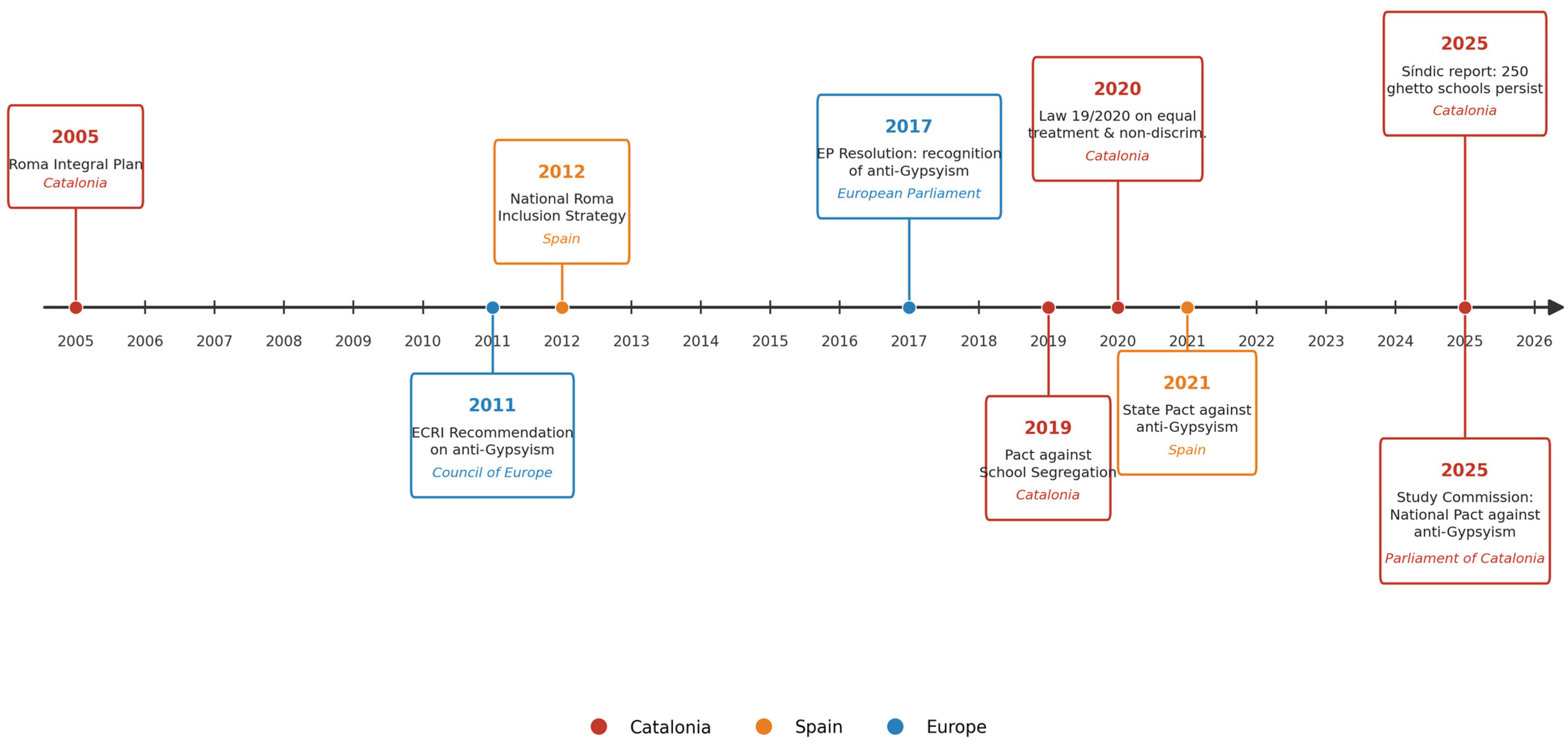
At the institutional level, the shift takes place mainly from the 2010s onward, with three key milestones: the ECRI General Policy Recommendation on combating antigypsyism (Council of Europe, European Commission Against Racism and Intolerance (ECRI) 2011), the Reference Paper of the Alliance Against Antigypsyism (2017), and the European Parliament Resolution of 25 October 2017. These documents recognise for the first time that antigypsyism is a structural human-rights problem requiring specific political action.
In the Catalan context, Law 19/2020 on equal treatment and non-discrimination introduces, for the first time, a legal definition of antigypsyism or Romaphobia as “a specific form of racism, both social and institutional, against the Roma people, which is persistent, violent, recurrent, and trivialised” (art. 4.z). This definition, linked to its own sanctioning regime, places Catalonia in a pioneering position within Spain with regard to the legal recognition of, and institutional response to, antigypsyism, including in the field of education.
The following section (see Figure 1) presents a legislative and policy timeline showing the evolution of the recognition of educational antigypsyism and its visibility—or absence—across different regulatory frameworks.
Figure 1.
Legislative and policy timeline of educational antigypsyism. Author’s own elaboration.
It should be noted that, despite antigypsyism’s long history, its institutional recognition is recent and uneven, particularly in the field of education. This trajectory partly explains the scarcity of academic literature and the gaps identified in the present review.
1.1.1. Knowledge Gaps and Rationale for the Study
Given the lack of consolidated scientific literature on antigypsyism and compulsory education, particularly in Catalonia and Spain, this review also incorporates grey literature and work produced by Roma or European activists, organisations, and research centres (Nicolae 2006; Carrera et al. 2017; Ruiz Torres 2017; Cortés and End 2019; Mirga-Kruszelnicka and Dunajeva 2020; Rostas et al. 2022; Cortés et al. 2021; Rostas et al. 2022). Although such materials do not always meet the criteria for indexed publication, they partly fill the gap created by the academic invisibilisation of the Roma people and provide categories, historical narratives, and analyses with a demonstrable influence on European (European Parliament Resolution 2017) and Spanish (Congreso de los Diputados 2023) regulatory frameworks. Their authorship combines Roma activism and academic training, and their dissemination and citation in subsequent work confer on them a form of informal community review.
The inclusion of these sources follows methodological recommendations for research with invisibilised communities (Hill Collins 1990; Munté et al. 2015; Gómez et al. 2019) and makes it possible to address dimensions not covered by indexed literature.
1.1.2. Author’s Positionality
This research is situated within a critical perspective, committed to educational justice and the human rights of the Roma people, and recognises that assumed neutrality can render invisible relations of power and forms of institutional racism (hooks 1994, pp. 16, 29–30). This positionality guides the choice of theoretical framework, the focus on knowledge gaps concerning Catalonia, and the intention to identify not only the ways antigypsyism is reproduced, but also the factors and experiences pointing toward its transformation in education, in dialogue with Roma-centred epistemological approaches to research and knowledge production (Mirga-Kruszelnicka and Dunajeva 2020; Matache 2026).
1.2. Theoretical and Conceptual Framework
1.2.1. A Critical, Antiracist and Communicative Approach
This article is framed within critical and antiracist pedagogy (Freire 1975) and critical communicative methodology, approaches that have proven effective in research with minorities and oppressed groups by positioning them as protagonists, on methodologically equal footing, with transformative feedback loops (Munté et al. 2015; Gómez et al. 2019). It also draws on critical race theory and the intersectionality framework, which allow racism to be analysed as a structural phenomenon and place the experiences of oppressed groups at the centre, recognising racialised inequalities that operate intersectionally (Crenshaw 1989, 1991; Davis 2004; Hill Collins and Bilge 2016) and that specifically affect Roma people (Filigrana 2020).
From this framework, antigypsyism is understood as a historical, structural, and systemic system of discrimination that articulates race, class, and gender—not as a “cultural problem.” This perspective is key to analysing how the phenomenon operates in schools and which mechanisms reproduce, or may transform, educational inequalities, framing it as a specific form of structural racism without denying either the agency of Roma people or the transformative potential of the education system.
1.2.2. Reference Definition, Dimensions and Implications for Education
The conceptual and analytical frameworks guiding the reading, coding, and interpretation of the reviewed literature are based on a reference definition. The review adopts the definition proposed by the Alliance Against Antigypsyism (2017), which conceptualises antigypsyism as a specific form of racism with historical, structural, and systemic dimensions. This definition guides both the selection of studies and the analytical process, incorporating elements such as explicit and implicit manifestations, institutional educational racism, intersectionality, and educational inequalities.
The definition adopted by the Alliance Against Antigypsyism (2017) conceptualises antigypsyism as a “persistent and historically constructed device” that codifies everyday, systemic racism toward groups labelled under the “Gypsy” stigma. This definition identifies three key elements: (a) a homogenising and essentialising perception, (b) the attribution of fixed and dehumanising traits, and (c) structures and practices that produce degradation, ostracism, and systematic disadvantage in access to life opportunities.
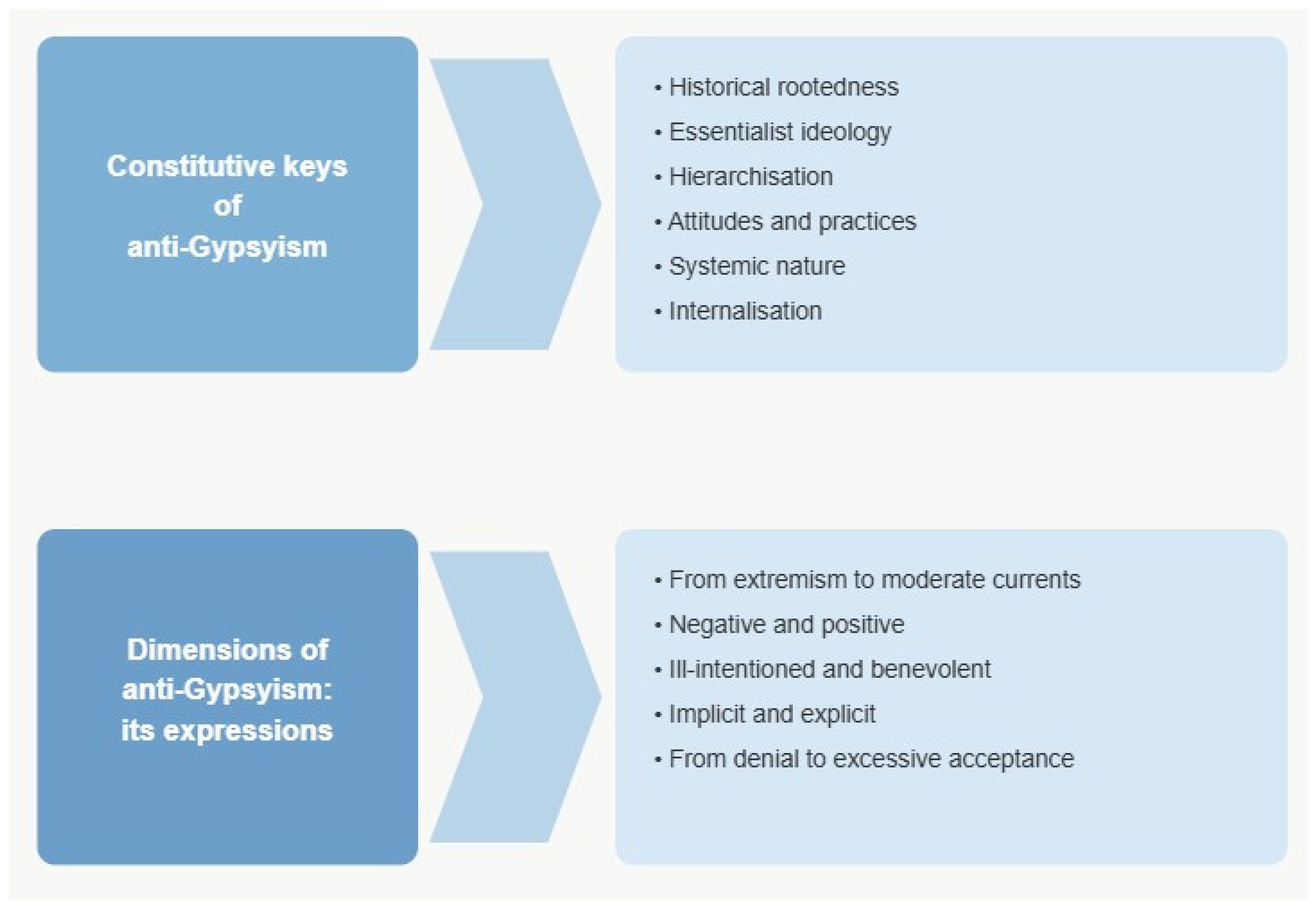
In education, this conceptual framework is especially useful because it links historical dimensions (more than five centuries of persecution and anti-Roma legislation), structural dimensions (nation-state, labour market, housing, social services), and systemic dimensions (school, media, justice system). It also allows antigypsyism to be analysed beyond individual attitudes, as part of the ordinary functioning of institutions and policies. Finally, it integrates explicit forms (hate speech, denial of services, open segregation) and subtle forms (low expectations, culturalisation of problems, curricular invisibilisation), as shown in Figure 2.
Figure 2.
Keys and dimensions of antigypsyism according to the Alliance against Antigypsyism. Author’s own elaboration.
This historical and structural reading is reinforced by Matache’s (2026) recent Roma-centred account of anti-Roma racism, which traces its genealogy to the system of racialised slavery of Moldavia and Wallachia and to centuries of expulsion and violence across Europe, situating it relationally to other structures of oppression such as patriarchy, classism, and ableism. Matache favours the term “anti-Roma racism” over “antigypsyism” in order to avoid reproducing the pejorative connotations embedded in the latter term; this terminological tension is acknowledged here, while the present review retains “antigypsyism” in line with its predominant use in the European policy and academic literature under review (Alliance Against Antigypsyism 2017; European Parliament Resolution 2017).
Several studies in the reviewed literature have explicitly adopted this definition as their analytical core in research on racism against Roma people (Jiménez-Rodrigo and Sánchez-Muros 2020; Muñoz Vacas 2021), on segregation (Viedma-Guiard and Álvarez de Andrés 2023), or on educational inequalities (Kyriakidis and Koikas 2023).
From this framework, antigypsyism is understood less as another “form” of racism and more as an axis of oppression that articulates race, class, and gender in shaping the social position of the Roma people. This perspective allows for a more precise analysis of how this system manifests in education. For this reason, the analysis of the reviewed articles has been organised according to four analytical levels: discourse, pedagogical practices, school organisation, and educational outcomes, operationalised through the coding tool presented in Section 2.6.
2. Materials and Methods
2.1. Design and Methodological Approach
The study is framed within the principles of the scoping review, as conceptualised by Arksey and O’Malley (2005) and subsequently developed by Levac et al. (2010). This methodological approach is particularly suited to mapping an emerging field of research characterised by fragmented and heterogeneous literature, such as the study of antigypsyism in compulsory education. Arksey and O’Malley’s (2005) framework was chosen because it does not require an assessment of methodological quality across the included studies; that is a critical advantage given the fragmented and largely non-standardised nature of the literature on antigypsyism in education. Levac et al.’s (2010) subsequent refinements were incorporated to strengthen the analytical rigour of the process, particularly through their emphasis on a clearly articulated research question, a team-based iterative approach to study selection, and a numerical and thematic reporting of results, principles reflected in the coding and synthesis procedures described in Section 2.6.
Unlike systematic reviews, which aim to assess the quality of available evidence from a stable and homogeneous corpus, the present scoping review aims to identify, describe, and organise existing knowledge, as well as to detect research gaps and guide future lines of inquiry. Although the review process incorporates rigorous search, selection, and analysis criteria, its orientation is eminently exploratory and descriptive.
This scoping review was not registered prospectively. The review protocol, including the research questions, inclusion/exclusion criteria, and search strategy, is nevertheless reported in full in accordance with the PRISMA-ScR guidelines (Tricco et al. 2018).
Consistent with the critical positionality outlined in the Introduction (Section 1.1.2), the author’s engagement with educational justice and antiracist commitment informed methodological choices throughout the review, including the inclusion of grey literature (Section 1.1.1) and the design of the coding tool (Section 2.6), in line with recommended practice for research with invisibilised communities (Hill Collins 1990; Munté et al. 2015; Gómez et al. 2019).
2.2. Research Questions
The review is structured around three research questions (RQ), which guide both the analytical process and the presentation of results:
- RQ1. How is antigypsyism conceptualised in the academic literature, and what are its main dimensions and manifestations in education?
- RQ2. What evidence exists on the presence and scope of antigypsyism in compulsory education in Europe and in Spain, with particular attention to the Catalan context?
- RQ3. What are the educational impacts of antigypsyism, and what policies or interventions have been documented to address it in compulsory education, particularly in Catalonia?
2.3. Search Strategy
The literature search was conducted between October 2022 and 18 January 2026 in the Web of Science, Scopus, ERIC, SciELO, and Google Scholar databases, selected for their relevance to the social sciences, education, and racism and minority studies. For Google Scholar, the search was limited to the first 30 results, based on relevance criteria.
Search terms were used in Catalan, Spanish, and English, relating to antigypsyism, the Roma people, Roma children, education, racism, segregation, and discrimination, combined using Boolean operators. The full search strategy, including the Boolean strings and keywords used in databases, is provided in Table S2. Search strings were designed to capture both the specific concept of antigypsyism and broader formulations of racism against the Roma population in educational contexts. The term “gitanos/gypsies” was included exclusively for bibliographic-retrieval purposes, in recognition of its pejorative connotations in certain contexts, particularly outside the Iberian Peninsula.
In addition, a manual search was conducted through the reference lists of the included studies in order to identify potentially relevant work not retrieved through the automated searches.
2.4. Selection Process and Workflow
The process of identifying, screening, assessing eligibility for, and including studies followed the PRISMA-ScR recommendations (Tricco et al. 2018), adapted to the exploratory nature of the review.
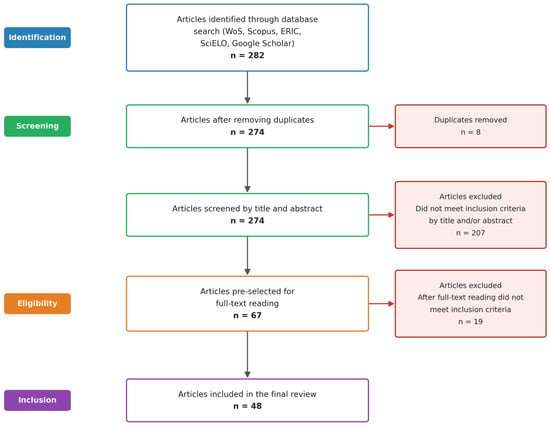
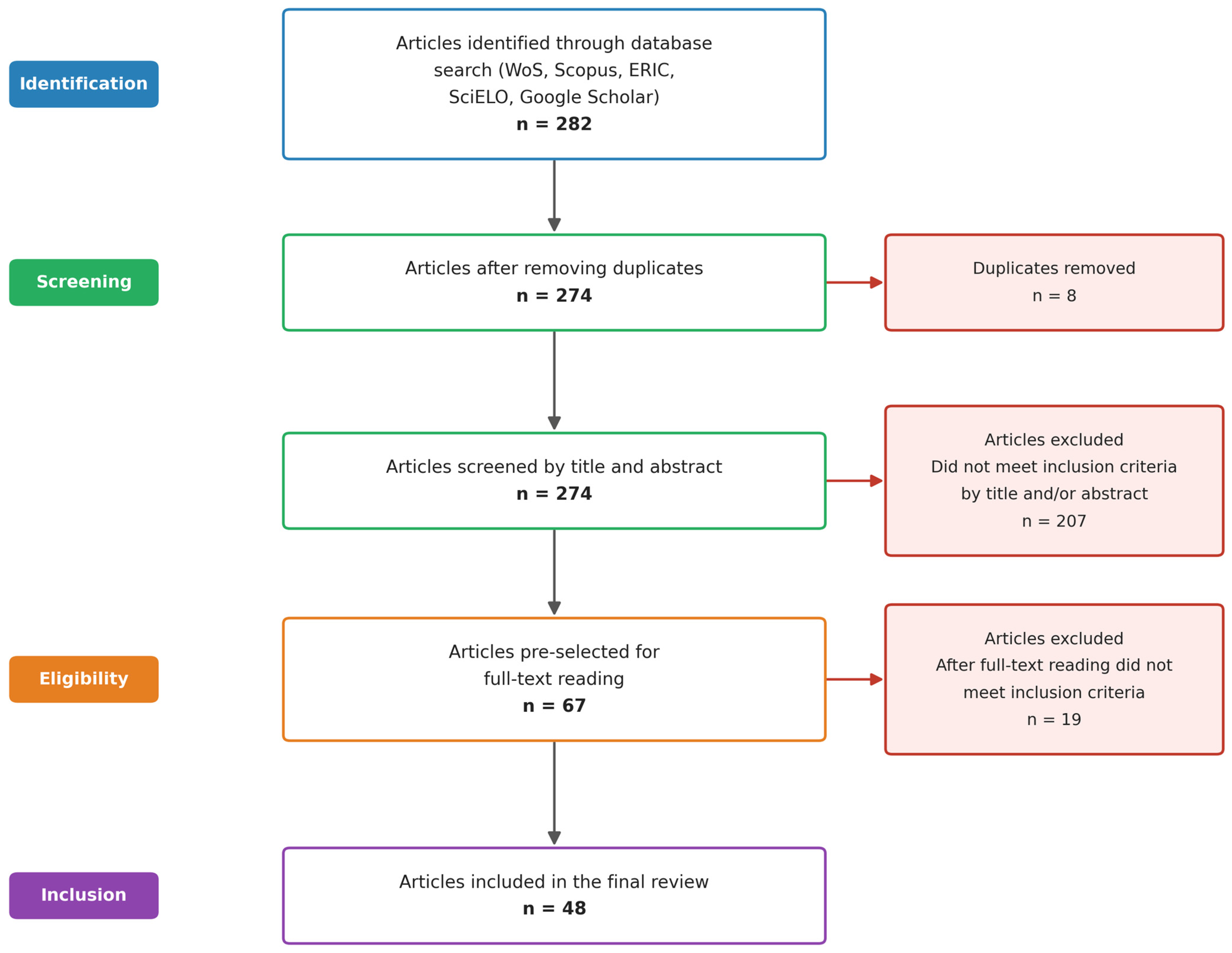
At the identification stage, the literature search retrieved a total of 282 records. After reference management and the removal of duplicates (N = 8), a set of 274 unique articles was obtained.
At the screening stage, the 274 records were assessed by reading titles and abstracts, excluding 207 articles that did not meet the defined inclusion criteria, mainly because they did not focus on compulsory education, did not address the Roma people, or did not incorporate a perspective related to racism or antigypsyism.
At the eligibility stage, the 67 pre-selected articles were assessed in full text. Following this assessment, a further 19 studies were excluded for not meeting the established inclusion criteria.
Finally, 48 scientific articles were included in the review, constituting the main corpus of analysis. The full characteristics of these 48 studies are presented in Table S1.
The complete flow diagram of the selection process is presented in Figure 3.
Figure 3.
PRISMA-ScR flow diagram of the selection process. Author’s own elaboration.
2.5. Inclusion and Exclusion Criteria
The inclusion criteria were as follows: (a) studies focused on compulsory education; (b) empirical or theoretical analyses related to the Roma people; (c) explicit or implicit presence of dimensions linked to racism or antigypsyism; (d) peer-reviewed academic publications; (e) texts available in Catalan, Spanish, or English.
Studies focused exclusively on other levels of education, work of a purely demographic or historical nature with no link to education, and publications without full-text access were excluded.
In addition to the main corpus of 48 scientific articles, 8 further academic works (books and specialised reports) identified through manual search were incorporated. These works were used for conceptual and contextual purposes, particularly in developing the theoretical framework, and are not part of the PRISMA-ScR diagram or the systematic analysis of the main corpus.
2.6. Data Extraction, Analysis and Synthesis
For each included article, basic bibliographic data, context, objectives, methodology, findings relevant to the research questions, and key concepts were recorded. The synthesis was organised thematically around the three research questions, identifying patterns, divergences, and knowledge gaps, particularly in relation to Catalonia.
To analyse the role of the concept of “antigypsyism” in each study, four categories were established, as it follows in Table 1:
Table 1.
Typology of the use of the antigypsyism concept in the selected literature.
To operationalise these elements, a coding table was developed with four levels of analysis (discourse, pedagogical practices, organisation, and educational outcomes), allowing indicators and textual evidence relating to both explicit and subtle manifestations of antigypsyism to be recorded (See Table 2). Coding was applied systematically across all texts, with the aim of identifying mechanisms of reproduction as well as experiences or proposals for transformation. The table below presents textual examples illustrating the application of the indicators during the analytical process, without claiming to be exhaustive.
Table 2.
Analytical coding table.
To improve the reliability of the analytical process, coding was carried out iteratively and reflexively, reviewing and adjusting the coding framework as new patterns relevant to the research questions emerged. This process made it possible to refine the indicators and ensured consistent application of the analytical criteria across all included texts.
To ensure consistency, all documents were analysed using the same coding structure and the same conceptual criteria, based on the adopted operational definition of antigypsyism. Analytical and interpretive decisions were documented throughout the process to ensure transparency and traceability. The presence or absence of each indicator (“Yes/No”) was determined through a full reading of each text and the strict application of the established criteria.
The analysis combined a deductive approach—based on the operational definition of antigypsyism and the adopted theoretical framework—with an inductive approach to incorporate emerging dimensions. The four-level coding table, with explicit and subtle indicators, facilitated the systematic extraction of evidence, distinguishing between manifestations of antigypsyism and experiences aimed at overcoming it.
The category system was initially developed from the theoretical framework and refined iteratively during the full reading of the studies. To ensure analytical consistency, all articles were coded using the same structure and the same conceptual criteria, and all decisions were documented to ensure the transparency and traceability of the process.
During the preparation of this manuscript, the author used Claude (Anthropic, San Francisco, CA, USA) to assist with formatting and verifying bibliographic references, checking citation consistency, reconstructing and translating the figures, and supporting grammar and language consistency checks during the revision. The access was via claude.ai, used at various points between December 2025 and September 2026; as with most cloud-based AI assistants, the underlying model version is updated periodically by the provider and was not fixed by the author. The author reviewed, verified and takes full responsibility for the accuracy and content of all references, citations and figures.
3. Results and Discussion
3.1. RQ1—Conceptualisation, Dimensions and Manifestations of Antigypsyism
3.1.1. Historical Dimensions of Antigypsyism: Origins and Continuities
The reviewed literature documents that antigypsyism has a history spanning more than five centuries in Europe (Hellgren and Gabrielli 2021), and several authors situate it as constitutive of the formation of modern nation-states, built upon devices for the persecution and control of the Roma people (Garcés 2016). Between the fifteenth and eighteenth centuries, systematic policies of expulsion, criminalisation, and forced assimilation were recorded, which Míguez Salina et al. (2024) frame within more than 600 years of anti-Roma legislation. Genetic research confirms a shared origin in the Indian subcontinent and a long history of coexistence and interaction with European populations, challenging essentialist readings of the Roma people (Giménez et al. 2019). Several contributions conceptualise antigypsyism as a device of genocide and epistemicide underpinning modernity and Enlightenment-era policies of integration and assimilation, including episodes such as the Baró Istardipé or the Roma genocide (Samudaripen)1, which the literature notes are scarcely present in collective memory or in school curricula (Garcés 2016; Río Ruiz and García-Sanz 2019; Periáñez-Bolaño 2021). The review finds that the historical dimension of antigypsyism is addressed by only 6 of the 48 reviewed studies (N = 6), indicating that this dimension is under-represented in the literature and constitutes a gap identified in relation to RQ1.
3.1.2. Persistence in the Contemporary Period
The reviewed literature shows that, despite formal advances in human rights and equality, antigypsyism persists in forms adapted to the current context. Fernández Ortega (2021) and Fejzula (2019) note that certain discourses and policies presented as inclusive or intercultural may sustain racial hierarchies and mechanisms of control over the Roma people. These authors argue that “the ideology of integration” and certain human-rights frameworks can depoliticise antigypsyism and turn Roma people into objects of diagnosis or intervention, prolonging assimilationist logics. In fields such as education, social services, or health, the literature identifies manifestations of subtle institutional antigypsyism—segregation, low expectations, culturalisation of problems, invisibilisation of positive role models—as mechanisms present in the reproduction of inequalities. The review finds that these mechanisms have been scarcely studied in the Catalan context, representing a relevant gap for RQ1.
3.1.3. Antigypsyism as Structural Racism
Part of the reviewed literature conceptualises antigypsyism as an ideology constitutive of European modernity that positions the Roma people as subject to an internal coloniality and object of a system of domination with historical roots, beyond individual prejudice (Garcés 2016; Fejzula 2019; Fernández Ortega 2021). From this perspective, antigypsyism would operate through institutions, norms, and policies that, despite presenting themselves as neutral, generate discriminatory effects in areas such as education, housing, health, employment, or justice. Fejzula (2019) argues that this system articulates with other axes of oppression—social class and gender—shaping what she terms a European “antigypsy” regime that identifies the Roma people as a threat to the sovereignty of whiteness.
3.1.4. Mechanisms of Institutional Reproduction
The literature analysed identifies a series of institutional mechanisms through which antigypsyism is reproduced: the rule of law, security policies, certain interpretations of human rights, and integration, inclusion, or interculturality policies (Fejzula 2019). Among the most documented mechanisms are residential and school segregation (Vučković Juroš 2022; Ateş and Ünal 2022); the attribution of inequalities to “cultural factors” (Magano and Mendes 2021); the use of euphemisms such as “vulnerable pupils” (Martínez-Lozano et al. 2023; Allen et al. 2024); and the absence of specific data and protocols (Abad Merino et al. 2024). In education, the literature notes that these mechanisms are expressed in pedagogical, organisational, and outcome-related practices that perpetuate inequalities (Allen et al. 2024; Lambrev et al. 2020; Munté Pascual et al. 2020). The review finds that these mechanisms have been scarcely studied in the Catalan context, representing a central gap identified in relation to RQ1.
3.1.5. Gender, Intersectionality and Antigypsyism
The scientific literature adopting an intersectional approach (Hill Collins and Bilge 2016; Sordé 2006) documents specific forms of discrimination affecting Roma women: triple exclusion (Domínguez et al. 2004), symbolic and material violence, colonial gender roles, and the imaginary of hypersexualisation (Garcés 2016), as well as inequalities in education, employment, and sexual and reproductive rights (Jiménez-Rodrigo and Sánchez-Muros 2020). Hellgren and Gabrielli (2021) further highlight the intersection between racialisation and aporophobia, which positions the Roma people as a racialised “underclass.” In education, Bretones Peregrina and Soto Marata (2023) and Valero et al. (2020) document culturalist explanations of school difficulties that can lead to the normalisation of racist or gender-based violence under the label of “Gypsy culture.” The literature also documents indicators of specific impact on Roma women, such as below-average life expectancy (FRA 2023) and experiences of unequal treatment by education and social-service professionals.
At the same time, some studies identify dimensions of agency and resilience, particularly among Roma mothers who maintain positive expectations regarding education as a pathway to social mobility (Ateş and Ünal 2022). Periáñez-Bolaño (2021) proposes, from a decolonial perspective, educational models that incorporate Roma history and epistemologies. Amador (2016) provides evidence that certain educational interventions can help reverse inequalities when they operate with high expectations and positive role models.
3.1.6. Stereotype Construction and Explicit/Implicit Manifestations
The reviewed literature identifies the historical and persistent construction of an imaginary of “Gypsyness” that combines negative stereotypes (laziness, criminality, lack of civilisation) with apparently positive or romanticised representations (exoticism, freedom, passion), noting that both forms dehumanise and establish boundaries between groups (Míguez Salina et al. 2024).
Explicit antigypsyism includes direct forms of discrimination documented across all four analytical levels: insults, ethnic harassment, open rejection of Roma families, and discriminatory tracking decisions (N = 42). At the organisational level, the visible segregation of schools or classrooms with a predominantly Roma student body appears in the literature as an expression of institutional racism, frequently justified through pedagogical arguments (Cortés 2021; Fernández Ortega 2021).
Implicit antigypsyism is documented across the entire set of analysed studies (N = 48), expressed through euphemisms, omissions, and apparently neutral practices that generate educational inequalities. At the discourse level, the literature records the use of labels such as “at-risk pupils” or “vulnerable groups” and the culturalist attribution of difficulties. At the pedagogical level, the absence of Roma role models, low expectations, and curricular simplification are identified. At the organisational level, the literature notes the lack of specific protocols, insufficient teacher training on antigypsyism, and limited participation by Roma families. In terms of educational outcomes, studies document high absenteeism, early school leaving, achievement gaps, and unequal access to post-compulsory education.
3.1.7. Operational Definition for Education
The review finds that 29 of the 48 reviewed studies identify education as a particularly significant field for the manifestation of antigypsyism. European and Spanish studies agree that this phenomenon is expressed simultaneously across the four analytical levels: discourse (deficit-based and culturalist narratives), pedagogical practices (curricular absence, low expectations, discriminatory tracking), school organisation (segregation, concentration, lack of protocols), and educational outcomes (persistent gaps in achievement, graduation, and academic continuation) (Magano and Mendes 2021; Munté Pascual et al. 2020).
Based on the analysis of the literature, the review proposes an operational definition of antigypsyism in education to address RQ1: a specific form of structural and systemic racism against the Roma/Gypsy people, with deep historical roots in Europe, which manifests explicitly and implicitly across multiple levels (individual, institutional, and structural), generates exclusion across multiple domains (education, health, housing, employment, justice), interacts intersectionally with other axes of oppression (gender, class, ability), and has documented effects in education, expressed in school segregation, low expectations, curricular invisibility, and gaps in achievement and graduation rates.
3.2. RQ2—Presence of Antigypsyism in Compulsory Education
Having established the conceptual definition and dimensions of antigypsyism in education, this section synthesises the available evidence on its presence, addressing RQ2. Of the 48 reviewed articles, only 17 use antigypsyism as a central analytical axis; in the remainder it appears in an instrumental (19), marginal (6), or absent (6) form, even in studies addressing inequalities linked to this phenomenon in the specialised literature. This pattern is especially pronounced in Spanish and Catalan research.
The report of the Síndica de Greuges (2025) notes that, despite six years of the National Pact against School Segregation being in force, around 250 schools still show a high degree of concentration of pupils in situations of vulnerability. Despite an overall reduction in segregation of 25%, the situation has stagnated in the most affected schools. The report incorporates, for the first time, an explicitly antiracist perspective and recognises segregation as a structural problem, although it does not specifically make the Roma population visible nor identify antigypsyism as a particular form of racism.
European and Spanish Evidence
In terms of discourse, research documents deficit-based narratives (Rodríguez Maeso 2014; Torotcoi and Pecak 2019; Vojak 2019), cultural blaming, and euphemisms such as “at-risk pupils” or “vulnerable groups” (Fejzula 2019; Río Ruiz 2018; Allen et al. 2024), which the literature links to the denial of institutional racism (Bhabha et al. 2017). Under the rhetoric of inclusion or interculturality, Fejzula (2019) and Fernández Ortega (2021) note that these discourses can operate as vectors of cultural assimilation.
At the level of pedagogical practices, the literature documents a systematic absence of Roma history and culture from the curriculum (Rostas 2017; Torotcoi and Pecak 2019), including the invisibilisation of the Samudaripen and the Baró Istardipé (Vojak 2019; Periáñez-Bolaño 2021). In addition, low expectations are documented in 22 of the 48 studies, along with discriminatory tracking and referral toward less prestigious pathways (Lambrev et al. 2020; Allen et al. 2024) or toward special education (Bhabha et al. 2017; Kyriakidis and Koikas 2023), as well as implicit practices involving less attention or less demanding materials (Jiménez-Rodrigo and Sánchez-Muros 2020).
At the organisational level, school segregation is the most documented manifestation: over-representation in certain schools (Magano and Mendes 2021), low-level groups or segregated classrooms (Torotcoi and Pecak 2019), the absence of anti-discrimination protocols (Orosz et al. 2018; Abad Merino et al. 2024), and insufficient teacher training on antigypsyism (Macris 2015; González-García and Flecha Sanmamed 2021). Cortés (2021) and Fernández Ortega (2021) note that segregation is frequently justified through apparently neutral criteria that function as implicit mechanisms for reproducing inequalities.
Regarding educational outcomes, the literature documents significant gaps: only 36% of young Roma people complete compulsory secondary education, compared to 98% of the general population (FRA 2025), and school failure reaches 64%, compared to 13% for the general population (Fundación Secretariado Gitano 2013). Munté Pascual et al. (2020) and Martínez-Lozano et al. (2023) attribute these gaps to structural antigypsyism rather than cultural factors. Torotcoi and Pecak (2019) note that this structural racism permeates the education system and is only partially counteracted by family and Roma-organisation support.
3.3. RQ3—Educational Impacts, Policies and Transformative Experiences
The literature identifies school segregation as the most documented structural manifestation of educational antigypsyism. The review has not located studies directly documenting its manifestations in primary and secondary education in Catalonia; the available analyses of this context derive mainly from institutional reports.
3.3.1. Policies, Strategies and Institutional Responses
The reviewed literature reveals a significant gap in terms of specific policies, rigorous diagnoses, and scientific production directly linking antigypsyism and education (N = 6). Cortés (2021) notes that, despite the existence of the State Pact against Antigypsyism, the institutional response has been limited in terms of multi-level coordination and sanctioning mechanisms, and that some measures have reproduced forms of isolation. Rostas (2017) proposes strategies to strengthen social support for educational-equality policies, including anti-segregation measures and the use of the media to legitimise inclusive schooling. Dragoș (2021) identifies teacher training and education policy as necessary areas of intervention to address deficit-based discourses and segregation. Torotcoi and Pecak (2019) propose specific interventions—mentoring, identity reinforcement, anti-bias training—for inclusion in National Roma Inclusion Strategies. At the European level, Carrera et al. (2017) propose reformulating the institutional framework to integrate the fight against antigypsyism, and Kyriakidis and Koikas (2023) note that legal actions have limited impact unless accompanied by specific socioeconomic and educational policies.
The review finds that none of the 48 analysed articles studies current responses to educational antigypsyism in Catalonia or evaluates their impact, pointing to a gap in systematic diagnosis and evaluation.
Among the reviewed literature, only five studies focus specifically on the Catalan case, of which only three provide data or analysis relating to manifestations of antigypsyism or to specific interventions. Other national studies include partial references to Catalonia.
González-García and Flecha Sanmamed (2021), starting from the gap in university access (1% among the Roma population compared to 35% of the general population), analyse how accumulated segregation and discrimination limit access to, and continuation in, higher education. The study describes the role of the University Access Group (GAU), based on Successful Educational Actions (SEA) and community support, and concludes that the intervention has improved educational inclusion, academic self-esteem, and social opportunities for participants.
Martínez-Lozano et al. (2023) document how COVID-19 amplified pre-existing inequalities—greater risk of absenteeism, digital disconnection, learning and mental-health setbacks—in contexts of vulnerability with a history of exclusion. The study highlights the role of trust networks with Roma families and of prior transformative projects in sustaining school engagement. The authors do not use the concept of antigypsyism, placing this study in the “omission” category according to the typology applied in this review.
Fernández Ortega (2021) analyses mechanisms such as covert segregation (diversified classes), cultural blaming, low expectations, and internalised racism, linking them to the constant devaluation of Roma history and culture.
Valero et al. (2020) and Munté Pascual et al. (2020) document experiences of school segregation, particularly among Roma girls, and the presence of professional stereotypes that shape socio-educational interventions. These studies record that only 17% of the Roma population over 16 has completed compulsory secondary education, compared to 80% of the general population, and highlight interventions under the Catalan Comprehensive Roma People Plan that have achieved reductions in absenteeism (from 46% to 0.94% at one school) and increased access to university through specific courses.
Giménez et al. (2019) document that only 1% of the Roma population accesses higher education, while only 30% completes compulsory schooling, compared to 60% of the general population, linking this gap to forms of segregation that extend beyond the school setting to housing, health, and employment.
Bretones Peregrina and Soto Marata (2023) describe the Socio-Educational Promotion Service for the Roma People in Barcelona, managed by the Education Consortium and the Pere Closa Foundation (Fundació Pere Closa 2024), as an initiative that brings Roma professionals into schools. The authors note that the available results do not allow this intervention to be attributed a generalised impact on antigypsyism within the Catalan education system. The review further finds that the Department of Education does not publish detailed criteria or public evaluation indicators for the programme, which hinders assessment of its scope and impact.
3.3.2. Transformative Experiences and Factors
Alongside the mechanisms of reproduction identified above, the review also documents transformative experiences and factors capable of counteracting educational antigypsyism, drawn from 4 of the 48 reviewed studies and organised across three levels: compulsory education, transition to university, and public policy.
Compulsory education (1). Flecha and Soler (2013) present a longitudinal study at a school with a high proportion of Roma pupils, documenting the impact of Successful Educational Actions based on dialogic learning (interactive groups, dialogic literary gatherings, family participation, joint committees). The study’s findings show improvements in academic achievement and in the school–family relationship.
Transition to university (2, 3). González-García and Flecha Sanmamed (2021) analyse the GAU in Catalonia—access courses for people over 25 and 45—as a response to trajectories marked by segregation and discrimination. The GAU combines intensive academic support, community support, and university role models from the Roma community, and the study concludes that it partially contributes to reversing educational and social exclusion. Torotcoi and Pecak (2019), in a study of Roma university students in Central and Eastern Europe, document that access to and continuation in university are related to support networks (family, key personnel, scholarships) and to exposure to Roma role models.
Public policy (4). Carrera et al. (2017) identify good practices across several European countries that combine Roma inclusion with the fight against antigypsyism, including human-rights and anti-discrimination training for professionals, complaint mechanisms and access to justice, and policies against hate in the media and social networks.
3.3.3. Identified Gaps
The review identifies several structural gaps in the analysed literature. Fernández Ortega (2021) and Cortés (2021) note the persistent invisibility of Roma people in school curricula and the lack of systematic knowledge about antigypsyism and propose incorporating Roma history, contributions, and experiences as educational content. The literature also points to the need for reforms in initial and in-service teacher training, particularly in contexts with high segregation rates (Lambrev et al. 2020; Fernández Ortega 2021; Dragoș 2021; Smedile and Ramírez-García 2024). Carrera et al. (2017), Magano and Mendes (2021), and Kyriakidis and Koikas (2023) document a gap between legal frameworks and actual outcomes, pointing to the need to combine legal guarantees with specific socioeconomic policies and educational interventions. Fernández Ortega (2021) and Allen et al. (2024) identify a tendency in the academic agenda to treat the Roma people as an object of study rather than as agents of knowledge and propose co-designing research with the active participation of the Roma community.
4. Conclusions
To the author’s knowledge, this scoping review offers the first systematic mapping of antigypsyism in compulsory education with specific attention to the Catalan context. The analysis of 48 studies, combined with institutional sources and official data, makes it possible to identify the state of knowledge, the main documented mechanisms of reproduction of inequalities, and existing research gaps.
The findings show that educational antigypsyism is documented in the literature as a phenomenon with explicit and implicit manifestations across the four analytical levels: discourse, pedagogical practices, school organisation, and educational outcomes. School segregation, low teacher expectations, and curricular invisibilisation are its most recurrent expressions in the reviewed literature. The studies further note that these manifestations cannot be explained solely by individual or cultural factors but respond to structural and intersectional mechanisms (Munté Pascual et al. 2020; Allen et al. 2024).
The review finds a significant academic gap: of the 48 studies analysed, only 5 specifically address the Catalan context, and none offers a systematic diagnosis of the phenomenon or a rigorous evaluation of existing policies. This absence coexists with an advanced Catalan legal framework, with full competences in education and specific policies such as the Comprehensive Roma People Plan or the Pact against Segregation, whose impact on educational antigypsyism has not been specifically evaluated in the academic literature.
The review also identifies three cross-cutting patterns present across multiple contexts: the euphemisation of racism through terms such as “vulnerability” or “cultural diversity”; the role of segregation—both between and within schools—as a mechanism for reproducing inequalities; and the gap between institutional recognition of antigypsyism and the persistence of negative educational indicators, noted by Carrera et al. (2017), Magano and Mendes (2021), and Kyriakidis and Koikas (2023).
At the same time, the reviewed literature documents transformative experiences showing improvements in educational outcomes when interventions based on dialogic learning, family participation, and community role models are applied (Flecha and Soler 2013; González-García and Flecha Sanmamed 2021). These experiences suggest that evidence-based and community-participation approaches can help reduce the documented inequalities.
The review identifies the following research gaps for future studies: the production of disaggregated data on the Roma population within the Catalan education system; evaluation of the impact of existing policies on educational inequalities linked to antigypsyism; the incorporation of Roma history and contributions into the curriculum; initial and in-service teacher training on antigypsyism and intersectionality; and the co-design of research with the active participation of the Roma community, as proposed by Fernández Ortega (2021) and Allen et al. (2024).
The review acknowledges important methodological limitations: the scarcity of literature specific to Catalonia, which requires extrapolating from Spanish and European studies with possible limits on transferability; the heterogeneity of methodologies and contexts, which hinders direct comparisons; the possibility of having omitted studies in local or poorly indexed journals; the linguistic restriction to Catalan, Spanish, and English; the absence of a formal quality assessment of the studies, inherent to the scoping-review design; and the fact that the analysis was carried out by a single researcher without a second coder.
Despite these limitations, the review provides an operational conceptual framework and a mapping of the state of knowledge that can guide future research and decision-making in education policy relating to the Roma people in Catalonia.
Supplementary Materials
The following supporting information can be downloaded at: https://www.mdpi.com/article/10.3390/genealogy10040127/s1, Table S1: Characteristics of the 48 studies included in the scoping review (Barragán López 2021; Belak et al. 2024; Bocsi et al. 2023; Janko Spreizer 2022; Marqués Gonçalves 2020; Marqués Gonçalves and Willem 2020; Merhaut et al. 2022; Munté-Pascual et al. 2025; Nin et al. 2023; Salazar Manzano 2024; Slepičková and Bobáková 2020; Walach 2020); Table S2: Full electronic search strategy (Web of Science).
Funding
This research was funded by the Departament of Equality and Feminism of the Government of Catalonia through the project CHANCRÍ: Scientific Evidence to Overcome Gender-Based Antigypsyism (grant number IFE038/24/000020).
Institutional Review Board Statement
Not applicable.
Informed Consent Statement
Not applicable.
Data Availability Statement
No new data were created in this study. The full list of the 48 studies included in the corpus, together with the coding table and the PRISMA-ScR checklist, is available from the corresponding author upon request.
Acknowledgments
The author wishes to thank her doctoral supervisor for her guidance throughout this research. Generative AI tools were used to support specific aspects of manuscript preparation. Claude (Anthropic) was used to assist with language editing and refinement of the English translation of the manuscript. DeepL was used as a translation aid for converting sections of the original Spanish/Catalan text into English. SciSpace was used to support literature search and organization during the exploratory phase of identifying relevant studies for the corpus. These tools were used exclusively for language support, translation assistance, and literature-search support; they were not used to analyze data, code the corpus, interpret findings, or draw scientific conclusions. All coding, analysis, interpretation, and writing of the scientific content were carried out by the author. All these AI tools were accessed via claude.ai and were used at various points between December 2025 and September 2026; as with most cloud-based AI assistants, the underlying model version is updated periodically by the provider and was not fixed by the author.
Conflicts of Interest
The author declares no conflicts of interest.
Note
| 1 | The Baró Istardipé means “the Great Round-up” in Caló, the language of the Roma people of the Iberian Peninsula, and took place on the night of 29–30 July 1749 in Spanish territory; it represents the first documented attempt at genocide against the Roma people. Samudaripen is the Romani name for the Nazi genocide against the Roma people during the 1930s and up to 1945, perpetrated by the German fascist government and its allies. |
References
- Abad Merino, Silvia, Fernando Macías-Aranda, Olga Serradell Pumareda, and Ainhoa Flecha. 2024. La experiencia académica del alumnado gitano en la universidad. Revista de Educación 406: 369–406. [Google Scholar] [CrossRef]
- Allen, Dan, Jackie Bolton, Doreen Dove, Allison Hulmes, Chris Kidd, Mairtain Moloney-Neachtain, Ian Rees, Michaela Rogers, Alison Smith, and Peter Unwin. 2024. A Scoping Review of Social Work with Roma and Traveller Communities: Introducing the ROMA Model. European Journal of Social Work 28: 1291–305. [Google Scholar] [CrossRef] [Scilit]
- Alliance Against Antigypsyism. 2017. Antigypsyism—A Reference Paper. Available online: https://www.antigypsyism.eu (accessed on 20 September 2022).
- Amador, Jelen. 2016. La ‘Roma Response’ al Modelo Reproduccionista. La Educación, Nuestra Escalera para la Transformación Social. International Journal of Sociology of Education 5: 144–63. [Google Scholar] [CrossRef] [Scilit]
- Arksey, Hilary, and Lisa O’Malley. 2005. Scoping Studies: Towards a Methodological Framework. International Journal of Social Research Methodology 8: 19–32. [Google Scholar] [CrossRef] [Scilit]
- Ateş, Aysel, and Ali Ünal. 2022. Roma Mothers’ Experiences with Their Children’s Schools. Education and Science 47: 299–319. [Google Scholar] [CrossRef] [Scilit]
- Barragán López, Mercedes. 2021. Antigitanismo: El rechazo de la etnia gitana como determinante de aporofobia. Revista Electrónica de Estudios Penales y de la Seguridad 9: 7–22. [Google Scholar]
- Belak, Andrej, Jitse P. van Dijk, and Sijmen A. Reijneveld. 2024. Social Mechanisms behind the Poor Health of Marginalized Roma: Novel Insights and Implications from Four Ethnographic Studies in Slovakia. Social Science & Medicine 360: 117322. [Google Scholar] [CrossRef] [Scilit] [PubMed]
- Bhabha, Jacqueline, Arlan Fuller, Margareta Matache, Jelena Vranješević, Miriam C. Chernoff, Boris Spasić, and Jelena Ivanis. 2017. Reclaiming Adolescence: A Roma Youth Perspective. Harvard Educational Review 87: 186–224. [Google Scholar] [CrossRef] [Scilit]
- Bocsi, Veronika, Aranka Varga, and Anikó Fehérvári. 2023. Chances of Early School Leaving—With Special Regard to the Impact of Roma Identity. Education Sciences 13: 483. [Google Scholar] [CrossRef] [Scilit]
- Bretones Peregrina, Eva, and Pepi Soto Marata. 2023. La participación de las familias gitanas en las instituciones educativas: El Servicio de Promoción Socioeducativa del pueblo gitano. Revista de Estilos de Aprendizaje 15: 92–102. [Google Scholar] [CrossRef] [Scilit]
- Carrera, Sergio, Iulius Rostas, and Lina Vosyliute. 2017. Combating Institutional Anti-Gypsyism: Responses and Promising Practices in the EU and Selected Member States (CEPS Research Report No. 2017/08). Brussels: Centre for European Policy Studies. [Google Scholar]
- Congreso de los Diputados. 2023. Informe de la Subcomisión para el estudio de un Pacto de Estado contra el Antigitanismo y la Inclusión del Pueblo Gitano [Report of the Subcommittee for the study of a State Pact against Anti-Gypsyism and the Inclusion of the Roma People]. Boletín Oficial de las Cortes Generales, March 8. Available online: https://www.congreso.es/public_oficiales/L14/CONG/BOCG/D/BOCG-14-D-587.PDF (accessed on 7 August 2026).
- Cortés, Ismael. 2021. Hate Speech, Symbolic Violence, and Racial Discrimination. Antigypsyism: What Responses for the Next Decade? Social Sciences 10: 360. [Google Scholar] [CrossRef] [Scilit]
- Cortés, Ismael, and Markus End, eds. 2019. Dimensions of Antigypsyism in Europe. Brussels: European Network Against Racism. [Google Scholar]
- Cortés, Ismael, Patricia Caro, and Markus End, eds. 2021. Antigitanismo. Trece Miradas. Madrid: Traficantes de Sueños. [Google Scholar]
- Council of Europe, European Commission Against Racism and Intolerance (ECRI). 2011. ECRI General Policy Recommendation No. 13 on Combating Anti-Gypsyism and Discrimination Against Roma. Strasbourg: Council of Europe. [Google Scholar]
- Crenshaw, Kimberlé. 1989. Demarginalizing the Intersection of Race and Sex: A Black Feminist Critique of Antidiscrimination Doctrine, Feminist Theory and Antiracist Politics. University of Chicago Legal Forum 1989: 8. [Google Scholar]
- Crenshaw, Kimberlé. 1991. Mapping the Margins: Intersectionality, Identity Politics, and Violence against Women of Color. Stanford Law Review 43: 1241–99. [Google Scholar] [CrossRef] [Scilit]
- Davis, Angela. 2004. Mujeres, Raza y Clase. Madrid: Akal. [Google Scholar]
- Domínguez, Concha, Ainhoa Flecha, and Manuela Fernández. 2004. Mujeres gitanas y mercado laboral: Mecanismos para superar su triple exclusión. Lan Harremanak 2: 81–93. [Google Scholar] [CrossRef] [Scilit]
- Dragoș, Simina. 2021. Romani Students’ Responses to Antigypsyist Schooling in a Segregated School in Romania. Critical Romani Studies 4: 122–40. [Google Scholar] [CrossRef] [Scilit]
- European Parliament Resolution. 2017. European Parliament Resolution of 25 October 2017 on Fundamental Rights Aspects in Roma Integration in the EU: Fighting Anti-Gypsyism (2017/2038(INI)). Brussels: European Union. [Google Scholar]
- European Union Agency for Fundamental Rights (FRA). 2023. Roma in 10 European Countries: Main Results—Roma Survey 2021. Luxembourg: Publications Office of the European Union. [Google Scholar]
- European Union Agency for Fundamental Rights (FRA). 2025. Rights of Roma and Travellers in 13 European Countries: Perspectives from the Roma Survey 2024. Luxembourg: Publications Office of the European Union. [Google Scholar] [CrossRef]
- Fejzula, Sebijan. 2019. The Anti-Roma Europe: Modern Ways of Disciplining the Roma Body in Urban Spaces. Revista Direito e Práxis 10: 2097–116. [Google Scholar] [CrossRef] [Scilit]
- Fernández Ortega, Cayetano. 2021. Anti-Roma Racism and the White Academic Agenda: Hidden Blind-Spots of the Education System. Revista Contemporânea de Educação 16: 131–67. [Google Scholar] [CrossRef] [Scilit]
- Filigrana, Patricia. 2020. El pueblo Gitano Contra el Sistema-Mundo. Reflexiones Desde una Militancia Feminista y Anticapitalista. Mexico City: Akal. [Google Scholar]
- Flecha, Ramón, and Marta Soler. 2013. Turning Difficulties into Possibilities: Engaging Roma Families and Students in School through Dialogic Learning. Cambridge Journal of Education 43: 451–65. [Google Scholar] [CrossRef] [Scilit]
- Freire, Paulo. 1975. Pedagogía del Oprimido. Madrid: Siglo XXI de España. [Google Scholar]
- Fundación Secretariado Gitano. 2013. El Alumnado Gitano en Secundaria: Un Estudio Comparado. Madrid: Centro de Estudios Económicos Tomillo/Ministerio de Educación, Cultura y Deporte. [Google Scholar]
- Fundació Pere Closa. 2024. Memòria 2024. Barcelona: Fundació Pere Closa. [Google Scholar]
- Garcés, Helios F. 2016. El racismo antirom/antigitano y la opción decolonial. Tabula Rasa 25: 225–51. [Google Scholar] [CrossRef] [Scilit]
- Giménez, Aarón, David Comas, and Annabel Carballo. 2019. Origen e identidad del Pueblo Gitano. International Journal of Roma Studies 1: 159–84. [Google Scholar] [CrossRef] [Scilit]
- González-García, Jorge, and Ainhoa Flecha Sanmamed. 2021. Análisis del Impacto Social del Curso de Acceso a La Universidad (GAU) del Plan Integral Pueblo Gitano de La Generalitat de Catalunya. International Journal of Roma Studies 3: 152–79. [Google Scholar] [CrossRef] [Scilit]
- Gómez, Aitor, María Padrós, Oriol Ríos, Lidia Cabral Mara, and Tamara Pukepuke. 2019. Reaching Social Impact through Communicative Methodology. Researching with Rather than on Vulnerable Populations: The Roma Case. Frontiers in Education 4: 9. [Google Scholar] [CrossRef] [Scilit]
- Hellgren, Zenia, and Lorenzo Gabrielli. 2021. Racialization and Aporophobia: Intersecting Discriminations in the Experiences of Non-Western Migrants and Spanish Roma. Social Sciences 10: 163. [Google Scholar] [CrossRef] [Scilit]
- Hill Collins, Patricia. 1990. Black Feminist Thought: Knowledge, Consciousness, and the Politics of Empowerment. Boston: Unwin Hyman. [Google Scholar]
- Hill Collins, Patricia, and Sirma Bilge. 2016. Interseccionalidad. Madrid: Morata. [Google Scholar]
- hooks, bell. 1994. Teaching to Transgress: Education as the Practice of Freedom. New York: Routledge. [Google Scholar]
- Janko Spreizer, Alenka. 2022. Romi med anticiganizmom, civilnimi iniciativami in protirasističnimi strategijami [Los Roma entre el antigitanismo, las iniciativas civiles y las estrategias antirracistas]. Glasnik Slovenskega Etnološkega Društva 62: 58–69. [Google Scholar]
- Jiménez-Rodrigo, María Luisa, and Sonsoles Patricia Sánchez-Muros. 2020. El reto de la medición del antigitanismo: Indicadores sobre discriminación y exclusión social hacia la población Romá en la Unión Europea. Sociología Histórica 10: 11–50. [Google Scholar] [CrossRef] [Scilit]
- Kyriakidis, Konstantinos, and Effrosyni Koikas. 2023. Roma Youth’s Right to Education (Case Studies: Greece and Hungary). Paper presented at IMSCI 2023, International Multi-Conference on Society, Cybernetics and Informatics, Virtually, September 12–15. [Google Scholar]
- Lambrev, Veselina, Anna Kirova, and Larry Prochner. 2020. Education Reforms for Inclusion? Interrogating Policy-Practice Disjunctions in Early Childhood Education in Bulgaria. Education Inquiry 11: 126–43. [Google Scholar] [CrossRef] [Scilit]
- Levac, Danielle, Heather Colquhoun, and Kelly K. O’Brien. 2010. Scoping Studies: Advancing the Methodology. Implementation Science 5: 69. [Google Scholar] [CrossRef] [Scilit] [PubMed]
- Macris, Vicki. 2015. Romani Peoples’ Resistance to Mainstream Schooling: A Focus on Romani Women and Girls’ Education and the Educational Policies, Barriers, and Practices in Greece. Alberta Journal of Educational Research 61: 449–64. [Google Scholar] [CrossRef] [Scilit]
- Magano, Olga, and Maria Manuela Mendes. 2021. Structural Racism and Racialization of Roma/Ciganos in Portugal: The Case of Secondary School Students during the COVID-19 Pandemic. Social Sciences 10: 203. [Google Scholar] [CrossRef] [Scilit]
- Marqués Gonçalves, Gabriela. 2020. Vivenciando el racismo cotidiano: Relatos de Antigitanismo en España. International Journal of Roma Studies 2: 66–86. [Google Scholar] [CrossRef] [Scilit]
- Marqués Gonçalves, Gabriela, and Cilia Willem. 2020. Lucha feminista gitana en España, lucha interseccional: El combate contra el Antigitanismo en las redes sociales en España. Investigaciones Feministas 12: 127–44. [Google Scholar] [CrossRef] [Scilit]
- Martínez-Lozano, Virginia, Beatriz Macías-Gómez-Estern, and José L. Lalueza. 2023. Community Resilience Processes in Schools with Roma Students during COVID-19: Two Case Studies in Spain. Sustainability 15: 10502. [Google Scholar] [CrossRef] [Scilit]
- Matache, Margareta. 2026. The Permanence of Anti-Roma Racism: (Un)Uttered Sentences. New York: Routledge. [Google Scholar]
- Merhaut, Marek, Marie Fulková, and Lothar Filip Rudorfer. 2022. Social Services Management in the Context of Ethnic Roma Issues in the Czech Republic with a Focus on Education for Roma Children. Social Sciences 11: 477. [Google Scholar] [CrossRef] [Scilit]
- Mirga-Kruszelnicka, Anna, and Jekatyerina Dunajeva, eds. 2020. Re-Thinking Roma Resistance Throughout History: Recounting Stories of Strength and Bravery, 1st ed. Berlin: ERIAC—European Roma Institute for Arts and Culture. [Google Scholar]
- Míguez Salina, Gabriela, Jesús García-Álvarez, and Miguel A. Santos Rego. 2024. El Pueblo Gitano y su construcción de lo ‘social’ como resistencia. Athenea Digital 24: e3548. [Google Scholar] [CrossRef] [Scilit]
- Munté, Ariadna, Rosa Martínez Alegre, and Ignacio De Vicente. 2015. Voces gitanas en la investigación científica. RECEI—Revista Científica de Estudios sobre Interculturalidad 1: 73. [Google Scholar] [CrossRef] [Scilit]
- Munté Pascual, Ariadna, Irene de Vicente, Virginia Matulič, and Jelen Amador. 2020. The Invisible Feminist Action of Roma Families. Affilia 35: 516–32. [Google Scholar] [CrossRef] [Scilit]
- Munté-Pascual, Ariadna, María Virginia Matulič, Paula Abella, Miguel Ángel Pulido-Rodríguez, Manuela Fernández, Adriana Aubert, and Ramon Flecha. 2025. The Third Sector of Social Action and Roma People during the COVID-19 Pandemic. Social Sciences 14: 533. [Google Scholar] [CrossRef] [Scilit]
- Muñoz Vacas, Trinidad. 2021. Antigitanismo y anti-antigitanismo: Volviendo al discurso de la resistencia romaní. Athenea Digital 21: e2889. [Google Scholar] [CrossRef] [Scilit]
- Nicolae, Valeriu. 2006. Towards a Definition of Anti-Gypsyism. Brussels: ERGO. [Google Scholar]
- Nin, María Cristina, Stella Maris Shmite, and Judith Molini. 2023. El genocidio del pueblo Gitano, proceso histórico y actualidad. Desafíos educativos. Revista Universitaria de Geografía 32: 41–71. [Google Scholar] [CrossRef] [Scilit]
- Orosz, Gábor, Emile Bruneau, Linda R. Tropp, Nóra Sebestyén, István Tóth-Király, and Beáta Bőthe. 2018. What Predicts Anti-Roma Prejudice? Qualitative and Quantitative Analysis of Everyday Sentiments about the Roma. Journal of Applied Social Psychology 48: 317–28. [Google Scholar] [CrossRef] [Scilit]
- Periáñez-Bolaño, Iván. 2021. Traces of Romani-Gypsy Colonial Trauma in Spain (1499–1978): Narratives of Recovery and Reparation of a People with History(-ies). Open Library of Humanities 7: 4. [Google Scholar] [CrossRef] [Scilit]
- Río Ruiz, Manuel Ángel. 2018. Antigitanismo y cambios en los derechos y condiciones escolares de la infancia gitana en España (1970–1995). Historia y Política 40: 179–210. [Google Scholar] [CrossRef] [Scilit]
- Río Ruiz, Manuel Ángel, and Carolina García-Sanz. 2019. Antigitanismo en Europa: Conceptualización, historia reciente y aportes al conocimiento de una forma específica de racismo. Sociología Histórica 10: 1–10. [Google Scholar] [CrossRef] [Scilit]
- Rodríguez Maeso, Silvia. 2014. ‘Civilising’ the Roma? The Depoliticisation of (Anti-)Racism within the Politics of Integration. Identities 22: 53–70. [Google Scholar] [CrossRef] [Scilit]
- Rostas, Iulius. 2017. Antigypsyism, Education and the Media: Ways Forward. Identities 24: 760–68. [Google Scholar] [CrossRef] [Scilit]
- Rostas, Iulius, Lina Vosyliūtė, and Marton Kalotay. 2022. State of the Art Report: Transitional Justice for Roma in Europe. Berlin: ERIAC—European Roma Institute for Arts and Culture. [Google Scholar]
- Ruiz Torres, Guillermo, ed. 2017. Countering Antigypsyism in Europe. Brussels: The Greens/EFA in the European Parliament. [Google Scholar]
- Salazar Manzano, María del Rocío. 2024. Antigitanismo Escolar y Miradas Gitanas Sobre Educación Infantil (Actividades Complementarias y Extraescolares). Cantabria: Trabajo Fin de Grado, Universidad de Cantabria. [Google Scholar]
- Síndica de Greuges. 2025. Pacte Nacional Contra la Segregació Escolar. Vint Prioritats D’actuació per Combatre la Segregació Escolar a Catalunya. Barcelona: Síndica de Greuges. [Google Scholar]
- Slepičková, Lenka, and Daniela Filakovská Bobáková. 2020. Conceptualization of Roma in Policy Documents Related to Social Inclusion and Health in the Czech Republic. International Journal of Environmental Research and Public Health 17: 7739. [Google Scholar] [CrossRef] [Scilit] [PubMed]
- Smedile, Concetta, and Antonia Ramírez-García. 2024. Structural Anti-Roma Racism in Italian Middle Schools. Societies 14: 153. [Google Scholar] [CrossRef] [Scilit]
- Sordé, Teresa. 2006. Les Reivindicacions Educatives de la Dona Gitana. Cabrera de Mar: Galerada. [Google Scholar]
- Torotcoi, Simona, and Marko Pecak. 2019. Strategies for Emancipation Path to Higher Education: Combating Antigypsyism by Building Roma Students’ Aspirations and Resilience. In Dimensions of Antigypsyism in Europe. Brussels: European Network Against Racism (ENAR) and Central Council of German Sinti and Roma, pp. 301–21. [Google Scholar]
- Tricco, Andrea C., Erin Lillie, Wasifa Zarin, Kelly K. O’Brien, Heather Colquhoun, Danielle Levac, David Moher, Micah D. J. Peters, Tanya Horsley, Laura Weeks, and et al. 2018. PRISMA Extension for Scoping Reviews (PRISMA-ScR): Checklist and Explanation. Annals of Internal Medicine 169: 467–73. [Google Scholar] [CrossRef] [Scilit] [PubMed]
- Valero, Diana, Carmen Elboj, Teresa Plaja, and Ariadna Munté Pascual. 2020. Social Work and the Roma Community: Elements to Improve Current Practices. European Journal of Social Work 24: 978–89. [Google Scholar] [CrossRef] [Scilit]
- Viedma-Guiard, Andrés, and Eva Álvarez de Andrés. 2023. La producción de la injusticia socioespacial hacia el pueblo Gitano durante el franquismo: Los barrios de Lo Campano y los Mateos en Cartagena (España). Revista Urbano 26: 22–33. [Google Scholar] [CrossRef] [Scilit]
- Vojak, Danijel. 2019. Education on the Roma Genocide in the Second World War in the Republic of Croatia. Društvena Istraživanja 30: 135–52. [Google Scholar] [CrossRef] [Scilit]
- Vučković Juroš, Tanja. 2022. ‘I Have Always Thought That, If I Am Poor, I’m Also Supposed to Study Poorly’: Habitus, Emotions, and the Educational Trajectories of Disadvantaged Youth. Communist and Post-Communist Studies 55: 62–83. [Google Scholar] [CrossRef] [Scilit]
- Walach, Václav. 2020. Envy, Corruption and ‘Hard Racism’: Studying Antigypsyism as an Ideological Fantasy. Slovenský národopis/Slovak Ethnology 68: 324–39. [Google Scholar] [CrossRef] [Scilit]

Disclaimer/Publisher’s Note: The statements, opinions and data contained in all publications are solely those of the individual author(s) and contributor(s) and not of MDPI and/or the editor(s). MDPI and/or the editor(s) disclaim responsibility for any injury to people or property resulting from any ideas, methods, instructions or products referred to in the content. |
© 2026 by the author. Licensee MDPI, Basel, Switzerland. This article is an open access article distributed under the terms and conditions of the Creative Commons Attribution (CC BY) license.