


Abstract
Video anomaly detection (VAD) has evolved from handcrafted feature-based methods to deep learning and foundation model-based approaches, enabling improved detection of complex and previously unseen events. This review examines this evolution through four paradigms: closed-set, open-set, open-vocabulary, and open-world VAD. A unified taxonomy is developed to organize representative methods according to learning paradigms, model architectures, supervision strategies, and semantic capabilities. The review further compares benchmark datasets, evaluation protocols, and performance metrics, with emphasis on the challenges of detecting and recognizing unseen anomalies in realistic environments. Recent advances in vision–language models (VLMs) are discussed in terms of their ability to incorporate language knowledge and open-ended semantic reasoning into VAD. Key challenges related to generalization, computational efficiency, multimodal understanding, and real-world deployment are identified. Finally, emerging directions involving large language models (LLMs), multimodal large language models (MLLMs), and video large language models (Video-LLMs), together with agentic AI and autonomous reasoning, are discussed toward more adaptive and interpretable VAD systems.
1. Introduction
1.1. Video Anomaly Detection: Definition and Applications
VAD aims to automatically identify events that deviate from normal behavior in video sequences [1,2]. Since anomalous events are rare, diverse, and often unavailable during training, VAD is commonly formulated as an unsupervised, self-supervised, or weakly supervised learning problem [2,3,4]. Early approaches relied on handcrafted motion features and statistical models, whereas recent methods employ deep neural networks, transformers, and spatiotemporal representation learning to learn discriminative features directly from video data [1,2]. Recent developments have further incorporated pose-based representations and graph learning to model fine-grained human motion, improving the detection of localized and context-dependent anomalies. The emergence of VLMs and LLMs further extends VAD beyond anomaly detection toward semantic understanding and explainable reasoning for unseen events [5,6,7,8,9].
Intelligent surveillance is the primary application of VAD, enabling continuous monitoring of large-scale camera networks without constant human supervision [2,3]. Typical applications include detecting violence, theft, intrusion, vandalism, abandoned objects, and other suspicious activities in public spaces, transportation systems, airports, and commercial buildings [9,10]. Automated VAD systems can improve response time, reduce operator workload, and support public safety through timely abnormal event detection [1,9,10]. Beyond surveillance, VAD has been increasingly adopted in healthcare, transportation, and industrial environments. In healthcare, VAD supports patient monitoring by detecting falls, abnormal movements, and emergency situations [11,12]. In transportation, it assists intelligent traffic management through accident detection, illegal driving behavior recognition, and pedestrian safety monitoring [1]. Industrial applications include equipment fault detection, worker safety monitoring, production inspection, and predictive maintenance, where anomaly detection can improve operational safety and efficiency [1,13].
Intelligent video surveillance has evolved from handcrafted feature-based approaches [14] to deep learning architectures, including convolutional neural networks (CNNs), recurrent neural networks (RNNs), autoencoders, generative models, and transformers [11]. While conventional methods mainly operate under the closed-set assumption by learning normal patterns, they often fail to generalize to unseen anomalies [1]. Recent advances in foundation models, including CLIP [5], VLMs [5], MLLMs [7], and Video-LLMs [15], enable semantic reasoning, open-world generalization, and interpretable anomaly explanations [6]. These developments are driving the transition from closed-set anomaly detection toward open-set, explainable, and agentic video understanding systems, which constitute the focus of this review [16,17,18].
Figure 1 summarizes the chronological evolution of VAD models across the major methodological paradigms.
Figure 1.
Historical milestones in video anomaly detection, from handcrafted and reconstruction-based methods to transformer- and foundation-model-based approaches.
1.2. Limitations of Closed-Set VAD
Despite substantial progress in deep learning-based VAD, most existing methods are developed under a closed-set assumption, where the training and testing data are assumed to share the same distribution [1]. In this setting, models learn normal patterns or predefined anomaly categories from available datasets and are expected to detect anomalies that follow similar distributions during deployment [19]. Although this assumption simplifies model training and evaluation, it is often violated in real-world scenarios, where surveillance environments continuously evolve and novel events emerge [19,20]. Conventional VAD methods assume that the operational environment is static and that future observations are sufficiently represented by the training data [3]. However, real-world surveillance is inherently open-world, involving changing scenes, object interactions, environmental conditions, and human behaviors. As a result, models trained under the closed-set assumption often exhibit degraded performance when deployed in unseen environments [17,21]. Many supervised and weakly supervised VAD approaches rely on predefined anomaly categories, such as fighting, burglary, or traffic accidents [3]. While effective for benchmark datasets, these models are limited to recognizing anomalies observed during training and cannot reliably identify novel abnormal events that fall outside the predefined taxonomy [3,22]. Deep learning models generally assume that training and testing samples are independently and identically distributed (i.i.d.). Their performance depends heavily on the availability of representative training data [1]. In practical deployments, distribution shifts caused by camera viewpoints, lighting conditions, weather, scene dynamics, and population diversity frequently violate this assumption, leading to reduced detection accuracy and increased false alarms [1,10]. One of the major limitations of closed-set VAD is its inability to generalize to unseen anomalies [21]. Since anomalous events are rare and diverse, it is impractical to collect exhaustive training samples covering all possible abnormal behaviors [17]. Consequently, conventional models often misclassify novel events as normal or assign incorrect anomaly scores, limiting their applicability in open-world surveillance systems [23,24].
1.3. Emergence of Open-Set VAD
Figure 2 illustrates the transition from closed-set VAD to open-set and open-world formulations.
Figure 2.
Conceptual relationship among closed-set, open-set, open-vocabulary, and open-world formulations of video anomaly detection. The formulations represent different and potentially overlapping problem assumptions and capabilities rather than a strict sequential hierarchy. Their historical emergence reflects the development of VAD research, while their conceptual boundaries may overlap across methods.
The limitations of conventional closed-set VAD have motivated the development of Open-Set Video Anomaly Detection (Open-Set VAD), where models are expected to detect and reason about previously unseen anomalies in dynamic environments [19]. Unlike closed-set approaches that rely on fixed training distributions, Open-Set VAD leverages large-scale pretraining and semantic knowledge to improve generalization beyond predefined anomaly categories [23]. This paradigm shift is driven by recent advances in open-set recognition, foundation models, VLMs, and LLMs, enabling more robust and interpretable video understanding [23,24].
1.4. Contributions and Organization of This Review
Existing VAD surveys have made important contributions by organizing methodological developments, reviewing deep learning architectures, summarizing benchmark datasets and evaluation metrics, and examining emerging foundation model-based approaches. However, these perspectives do not necessarily answer a central question: whether the experimental protocols used in individual studies provide sufficient evidence for the capabilities claimed by the proposed methods, particularly regarding the detection of previously unseen anomalies and generalization beyond conventional benchmark settings.
This review addresses this question by connecting three dimensions of VAD research: problem formulation, experimental design, and demonstrated capability. Rather than treating closed-set, open-set, open-vocabulary, and open-world VAD as a strict hierarchy, we examine them as overlapping analytical formulations with different assumptions about anomaly categories, semantic knowledge, and evaluation requirements. We then assess how these assumptions are reflected in training protocols, benchmark construction, evaluation metrics, and the interpretation of reported results. The principal contribution of this review is therefore not simply the aggregation of existing methods or the introduction of another architectural taxonomy. Instead, it provides a protocol-oriented synthesis that examines whether experimental evidence supports claims about unseen-anomaly recognition, semantic generalization, distribution-shift robustness, and open-world applicability. This perspective also helps identify situations in which apparently similar results reflect different experimental conditions and should not be interpreted as directly comparable evidence of model capability. The main contributions of this review are summarized as follows:
- This review presents a unified taxonomy of VAD approaches, covering traditional handcrafted feature-based methods, deep learning-based models, transformer-based architectures, and recent foundation model-based frameworks. In addition to categorizing methods by their learning paradigms and representations, we distinguish closed-set, open-set, open-vocabulary, and open-world formulations according to their underlying problem assumptions and, where applicable, their explicit evaluation protocols. This distinction helps separate architectural capabilities from experimentally demonstrated generalization to unseen anomalies.
- Representative VAD approaches are systematically analyzed in terms of learning paradigm, network architecture, supervision strategy, computational requirements, strengths, limitations, and claimed capabilities. Particular attention is given to whether reported experimental settings support claims of open-set, open-vocabulary, or open-world recognition. This analysis highlights differences in training assumptions, anomaly definitions, and evaluation settings that can otherwise lead to misleading comparisons between methods.
- This review summarizes widely used benchmark datasets and evaluation metrics for VAD, covering both conventional closed-set protocols and emerging evaluations involving unseen or novel anomalies. The characteristics, advantages, limitations, and protocol assumptions of these benchmarks are discussed to clarify the conditions under which quantitative results should be interpreted and compared. Particular attention is given to the distinction between standard benchmark performance and evidence obtained under explicit open-set or open-world evaluation protocols.
- This review examines remaining challenges in developing practical open-set and open-world VAD systems, including generalization to unseen anomalies, semantic reasoning, multimodal fusion, computational efficiency, explainability, continual learning, uncertainty estimation, and deployment on resource-constrained edge devices. Based on the identified methodological and evaluation gaps, future research directions are discussed, including the integration of foundation models, VLMs, Video-LLMs, agentic AI, and autonomous reasoning frameworks toward more trustworthy, explainable, and adaptive intelligent surveillance systems.
Figure 3 provides the organizational structure used to frame the review. The remainder of this review is organized as follows. Section 2 introduces the background, task definition, and mathematical formulation of video anomaly detection. Section 3 clarifies the terminology and defines the four key paradigms (closed-set, open-set, open-vocabulary, and open-world VAD). Section 4 reviews benchmark datasets and evaluation metrics. Section 5 presents semi-supervised and weakly supervised methods, while Section 6 reviews unsupervised approaches. Section 7 discusses supervised open-set techniques, and Section 8 surveys open-vocabulary and open-world methods based on foundation models, VLMs, and Video-LLMs. Section 9 examines computational efficiency and reporting considerations. Section 10 outlines remaining challenges and future research directions. Section 11 concludes the review.
Figure 3.
Organizational structure of the review of VAD from closed-set to open-set settings.
2. Background
2.1. Video Anomaly Detection Task
VAD aims to automatically identify events that deviate from normal patterns in video sequences. Unlike conventional video classification, which assumes a predefined set of categories, VAD must detect abnormal events that are often rare, diverse, and highly context-dependent. Moreover, many anomalous events may not be observed during training, making VAD an inherently open-ended and challenging learning problem [1,25]. Formally, given an input video sequence consisting of T consecutive frames, the objective of VAD is to learn a mapping:
where denotes the predicted anomaly scores for each frame, with larger values indicating a higher likelihood of abnormality. For video-level anomaly detection, the overall anomaly score can be obtained by temporal aggregation as following:
or other pooling strategies depending on the learning framework [3]. The main challenges of VAD arise from severe class imbalance, the scarcity of anomalous samples, large intra-class variations, dynamic backgrounds, camera motion, illumination changes, and distribution shifts across different surveillance environments [1,11]. To address these challenges, modern VAD models jointly learn spatial–temporal representations, where spatial features encode object appearance and scene context, while temporal features capture motion dynamics and long-range event evolution. Given a spatial encoder and a temporal modeling function , the latent video representation can be expressed as:
which is subsequently used to estimate anomaly scores. Besides determining whether a video contains abnormal events, practical surveillance systems also require event localization, aiming to identify both the temporal interval and spatial region where anomalies occur. Consequently, many recent methods simultaneously optimize anomaly classification and localization, enabling more interpretable and actionable intelligent surveillance systems [25,26].
2.2. Problem Formulation
Given an input video sequence containing T consecutive frames, the objective of VAD is to learn a function that determines whether the observed video or its constituent frames correspond to normal or anomalous events. Each frame is first encoded into a feature representation using a spatial feature extractor, such as a CNN, Vision Transformer (ViT), or VLM, where denotes the feature extraction function. The temporal representation is then learned by aggregating frame-level features through a temporal modeling network , including recurrent neural networks, temporal convolutional networks, transformers, or state-space models, yielding a latent representation:
Depending on the level of supervision, VAD can be formulated under unsupervised, self-supervised, weakly supervised, or fully supervised learning paradigms.
- Unsupervised and self-supervised approaches are typically trained using only normal videos and detect anomalies through reconstruction or prediction errors. Given an input sequence V and its reconstructed sequence , the anomaly score can be computed as:where larger reconstruction errors indicate a higher probability of abnormality [10].
- Weakly supervised methods utilize video-level labels and commonly adopt Multiple Instance Learning (MIL), where each video is regarded as a bag of instances and the video-level anomaly score is obtained through temporal aggregation:where represents the anomaly score of the t-th frame [3].
- Fully supervised methods further exploit frame-level annotations to directly optimize temporal localization accuracy, although such annotations are expensive to obtain [25].
The learning objective generally minimizes a task-dependent loss function:
where , , , and denote the classification, reconstruction, future prediction, and localization losses, respectively, while are balancing coefficients. Different VAD methods optimize different combinations of these objectives according to their learning paradigms.
2.3. Closed-Set vs. Open-Set Formulation
Let a video be represented by the temporally ordered indexed sequence . A frame-level anomaly detector produces:
where a larger score indicates stronger evidence of abnormality. An anomaly score is not necessarily a calibrated probability.
A generic spatial–temporal representation can be written as follows:
where and denote spatial and temporal processing, respectively. This notation is illustrative: some methods encode video clips jointly rather than processing individual frames independently.
For video-level supervision, instance scores may be aggregated as:
where maximum, top-k, attention-based, or other pooling rules are selected by the particular method. Video-level training labels do not imply that evaluation is also performed at the video level.
3. Terminology and Paradigm Clarification
To facilitate clear communication and distinguish the different problem settings, this review defines four key VAD paradigms: closed-set, open-set, open-vocabulary, and open-world VAD. Their definitions, key characteristics, learning settings, and representative applications are summarized in Table 1.
Table 1.
Terminology and paradigm clarification for video anomaly detection.
3.1. Key Distinction
The four paradigms differ primarily in how anomaly categories and anomaly definitions are determined. Closed-set VAD assumes a fixed and predefined taxonomy in which the relevant anomaly categories are known during training. Open-set VAD relaxes this assumption by allowing previously unseen anomalies to occur during testing, although these anomalies are generally identified as abnormal without necessarily being assigned a semantic category. Open-vocabulary VAD extends open-set detection by incorporating language-based semantic representations, enabling previously unseen anomaly categories to be described or recognized using textual concepts. In contrast, open-world VAD represents a broader setting in which the definition of an anomaly itself can change dynamically according to the deployment context, user requirements, or operational objectives. Thus, the progression from closed-set to open-set, open-vocabulary, and open-world VAD reflects an increasing degree of flexibility in both the anomaly categories and the definition of abnormality. This distinction is important because the ability to detect an unknown anomaly does not necessarily imply the ability to categorize it, describe it using language, or redefine what constitutes an anomaly at inference time.
3.2. Distinguish Detection from Recognition
Binary detection produces an anomaly score . When category recognition and unknown rejection are also required, an output may instead be defined as
A detector is not assumed to provide Equation (11) merely because it can flag an unseen event as anomalous.
4. Benchmark and Evaluation Metrics
4.1. Benchmark
Benchmark datasets play a fundamental role in the development and evaluation of VAD methods by providing standardized video sequences, annotations, and predefined evaluation protocols. However, the presence of annotations in a dataset should not be equated with the supervision level of a particular experiment. Annotation availability is an intrinsic property of the dataset, whereas the supervision level is determined by which annotations are actually used during model training. In addition, open-set evaluation introduces a third dimension: anomaly-category exposure, which specifies whether the anomaly categories evaluated at test time were observed during training. To avoid conflating these concepts, we distinguish three aspects when describing VAD benchmarks: (i) annotation availability, which indicates the type and granularity of ground-truth information provided by the dataset; (ii) training protocol, which indicates how the available annotations are used in a particular experiment, such as normal-only, video-level weak supervision, or frame/pixel-level supervision; and (iii) anomaly-category exposure, which indicates whether the evaluation contains anomaly categories observed during training or deliberately introduces unseen categories. Thus, a dataset that provides frame-level annotations may support fully supervised training, weakly supervised training, or normal-only training, depending on the experimental protocol. Similarly, the designation of a benchmark as open-set depends on the construction of its training and testing splits rather than solely on the dataset name. Table 2 summarizes representative VAD benchmarks using these distinctions. The table reports the annotations available in each dataset separately from the typical training protocols and the anomaly-category exposure used in representative evaluations. Avenue, ShanghaiTech, and Street Scene, for example, provide detailed temporal or spatial annotations, but these annotations are not necessarily used during training in every study. Experiments that train only on normal videos from these datasets are therefore considered normal-only or unsupervised/semi-supervised according to the specific learning formulation, even though anomaly annotations are available for evaluation. Conversely, UCF-Crime and XD-Violence are commonly used under video-level supervision, but their dataset-level annotation properties should not be interpreted as defining the supervision of every possible experimental setup. For open-set and open-world evaluation, anomaly-category exposure must be considered explicitly. A benchmark becomes open-set when the experimental protocol holds out one or more anomaly categories from training and evaluates the model on those unseen categories. UBnormal and RSOB are particularly relevant examples because their benchmark protocols explicitly support evaluation on anomaly categories that are not represented during training. PreVAD and related language-guided settings further extend this principle by associating anomaly observations with semantic descriptions rather than relying exclusively on a fixed category taxonomy. Therefore, throughout this review, supervision labels are assigned to experimental protocols, while datasets are characterized primarily by their available annotations and benchmark design.
Table 2.
Comparative summary of representative VAD benchmark datasets.
4.1.1. Datasets with Anomaly Annotations
The availability of anomaly annotations is an important characteristic of VAD datasets; however, it should be distinguished from the supervision regime used to train a model. Frame-level or pixel-level annotations can support evaluation even when anomalous videos or frames are excluded from training. Consequently, the supervision level of a VAD experiment depends on how the available data and annotations are used during training, rather than solely on the annotation properties of the dataset. The following datasets provide anomaly annotations and are commonly used to evaluate VAD methods under different experimental protocols.
Avenue: The CUHK Avenue dataset is one of the early and influential benchmarks for VAD. It contains surveillance videos captured from a fixed camera on a university campus, with anomalies including running, throwing objects, loitering, and unusual movement patterns. The dataset provides frame-level annotations and has been widely used to evaluate reconstruction-based, prediction-based, and transformer-based VAD methods [27].
ShanghaiTech: The ShanghaiTech Campus dataset contains surveillance videos collected from 13 different camera viewpoints across a university campus. It includes diverse anomalous events, such as fighting, chasing, cycling in pedestrian areas, and unauthorized vehicle movements under varying environmental conditions. With frame-level temporal annotations, ShanghaiTech has become a widely adopted benchmark for evaluating deep learning-based VAD methods because of its scene diversity and realistic surveillance settings [10,35].
Street Scene: Street Scene is a fully annotated VAD benchmark consisting of a fixed outdoor surveillance scene with diverse pedestrian and vehicle activities. It includes anomalous events such as jaywalking, illegal bicycle riding, loitering, and unusual vehicle movements. Unlike earlier benchmarks, Street Scene provides both frame-level and pixel-level annotations, enabling evaluation of temporal detection and spatial localization performance [29].
4.1.2. Weakly Supervised Datasets
UCF-Crime: UCF-Crime is a large-scale benchmark specifically designed for weakly supervised video anomaly detection. It contains 1900 long, untrimmed surveillance videos collected from real-world environments, including 950 normal and 950 anomalous videos. The anomalous videos cover 13 categories, including abuse, arrest, arson, assault, burglary, explosion, fighting, robbery, road accidents, shooting, shoplifting, stealing, and vandalism. Since only video-level labels are provided during training, UCF-Crime has become a standard benchmark for MIL-based and weakly supervised VAD methods. The dataset is challenging because of its long video duration, large intra-class variations, cluttered backgrounds, and sparse anomaly occurrences [3].
XD-Violence: XD-Violence is a large-scale benchmark focusing on violence-related anomaly detection in complex real-world scenarios. The dataset consists of 4754 untrimmed videos with a total duration of approximately 217 h and provides video-level labels for training together with temporal annotations for evaluation. Compared with UCF-Crime, XD-Violence provides greater visual diversity, multiple simultaneous anomaly events, and synchronized audio signals, making it suitable for both unimodal and multimodal anomaly detection research. Its anomaly categories include fighting, abuse, car accidents, explosions, shootings, and riots, among others. These characteristics make it a widely used benchmark for multimodal and weakly supervised VAD methods [30].
4.1.3. Open-Set and Open-World Datasets
UBnormal: UBnormal is a synthetic open-set VAD benchmark designed to evaluate the detection of previously unseen anomaly types. The dataset consists of multiple virtual surveillance scenes and provides pixel-level annotations for abnormal events, enabling fully supervised training and spatial anomaly localization. A key characteristic of UBnormal is the explicit separation of anomaly types between the training and testing sets, such that anomaly categories appearing during testing are not observed during training. The benchmark therefore provides a controlled setting for evaluating open-set generalization rather than closed-set anomaly classification. UBnormal contains 236,902 frames from 29 virtual scenes, with 22 anomaly types and 660 annotated abnormal events [31].
HR-UBnormal: HR-UBnormal extends UBnormal toward human-related and skeleton-based VAD by representing human activities through skeletal motion [32]. The benchmark is derived from UBnormal and focuses on the dynamics of human poses rather than relying exclusively on RGB appearance. This representation reduces the influence of scene appearance, background, and other visual factors while emphasizing abnormal human motion. HR-UBnormal has been evaluated together with HR-ShanghaiTech and HR-Avenue, providing a complementary benchmark for studying human-motion anomaly detection.
RSOB (Real-world Supervised Open-set Benchmark): RSOB was introduced to address the limitations of synthetic open-set benchmarks through a real-world surveillance setting [33]. RSOB is constructed from traffic-camera videos collected across 346 different traffic scenes and contains 1004 normal videos and 1000 abnormal videos covering 10 anomaly classes. Unlike conventional weakly supervised datasets that provide only video-level labels, RSOB provides precise frame-level annotations, including 2,363,753 labeled abnormal frames. The benchmark defines three open-set scenarios: (1) training on local anomalies and testing on unseen anomalies, (2) training on global anomalies and testing on unseen anomalies, and (3) training on anomalies from specific scenes while testing on anomalies from different scenes. These settings evaluate generalization to unseen anomaly types, different spatiotemporal scales, and scene-dependent changes in normality.
PreVAD: PreVAD (Pre-training Video Anomaly Dataset) represents a transition from conventional open-set VAD toward language-guided open-world anomaly detection [23]. The dataset contains annotated videos with multi-level anomaly categories and textual descriptions that explicitly define the corresponding abnormal events. Unlike conventional datasets that associate anomalies primarily with fixed category labels, PreVAD provides semantic descriptions that allow anomaly definitions to be expressed in natural language. This design supports the open-world setting in which anomaly definitions can be specified according to the deployment context or user requirements.
SVAD: The Short Videos for Video Anomaly Detection (SVAD) dataset was introduced to provide a benchmark for anomaly detection in diverse online short-video environments [34]. The dataset contains 383 short videos collected from mainstream online video platforms and covers seven anomaly categories, with events ranging from individual abnormal behaviors to group-level activities. Importantly, the dataset provides both closed-set and open-set evaluation splits, enabling direct comparison between conventional anomaly recognition and detection of unknown anomaly types.
4.2. Evaluation Metrics
VAD algorithms are commonly evaluated from three complementary perspectives: detection accuracy, open-set recognition capability, and computational efficiency. Detection metrics quantify the ability to distinguish normal and anomalous events, open-set metrics assess the recognition of previously unseen anomalies under distribution shifts, and computational metrics evaluate the practicality of deploying VAD models in real-time surveillance systems. A comprehensive evaluation using these metrics enables fair comparison among conventional closed-set methods, open-set approaches, and recent foundation model-based architectures.
4.2.1. Closed-Set Metrics
Closed-set VAD methods are primarily evaluated using the Area Under the Receiver Operating Characteristic Curve (AUC), which measures the trade-off between the true positive rate (TPR) and false positive rate (FPR) over different decision thresholds. Given TPR and FPR,
the AUC is computed as the area under the ROC curve,
Frame-level AUC is widely reported in VAD, where each video frame is assigned an anomaly score and compared against frame-level ground-truth annotations [3]. In contrast, video-level AUC evaluates the anomaly score of an entire video, which is commonly adopted in weakly supervised learning. Average Precision (AP) summarizes the precision-recall curve and is particularly suitable for highly imbalanced datasets where anomalous events are rare [25]. Precision and recall are defined as
while the mean Average Precision (mAP) is obtained by averaging AP over multiple anomaly categories. ROC and Precision–Recall (PR) curves are typically reported together to provide complementary evaluations of detection performance, especially under severe class imbalance [1].
4.2.2. Open-Set Metrics
Open-set VAD requires models to correctly identify both known and previously unseen anomalies. The Area Under the Receiver Operating Characteristic (AUROC) remains a widely adopted threshold-independent metric for measuring the separability between known and unknown samples [36,37]. In addition, the False Positive Rate at 95% True Positive Rate (FPR95) measures the false alarm rate when the detector correctly identifies 95% of positive samples,
Lower FPR95 values indicate better rejection of unknown events [36].
Another important metric is the Open-Set Classification Rate (OSCR), which jointly evaluates classification accuracy on known samples and rejection capability for unknown samples by measuring the trade-off between Correct Classification Rate (CCR) and False Positive Rate (FPR) across confidence thresholds [38]. To balance performance on known and unknown classes, studies also report the Harmonic Mean (H-score),
where and denote the classification accuracies of known and unknown classes, respectively. Recently, calibration metrics such as Expected Calibration Error (ECE) have also been considered for evaluating whether model confidence is consistent with prediction correctness [39], which is particularly relevant for reliable deployment in safety-critical surveillance applications.
4.2.3. Computational Metrics
Besides detection accuracy, practical VAD systems must satisfy the computational requirements of real-time surveillance. Frames Per Second (FPS) measures inference throughput and is commonly used to determine whether a model can process live video streams. Latency represents the average processing time per frame or video segment,
Model complexity is typically evaluated using the number of learnable parameters, floating-point operations (FLOPs), and memory consumption during inference [1]. Lower computational complexity can facilitate efficient deployment on edge devices and embedded surveillance platforms, where computational and memory resources are constrained [25]. Consequently, recent VAD research increasingly considers both detection performance and computational efficiency to provide a balanced assessment of model effectiveness and deployment feasibility.
Table 3 compares representative VAD methods across learning paradigms, representations, supervision strategies, and temporal modeling approaches.
Table 3.
Representative video anomaly detection methods across different learning paradigms.
5. Normal-Only and Weakly Supervised VAD
Figure 4 compares the architectural organization of representative semi-supervised and weakly supervised VAD frameworks. Semi-supervised and weakly supervised VAD methods have been extensively investigated to reduce the requirement for frame-level temporal annotations, which are expensive to obtain for long and untrimmed surveillance videos. In the conventional semi-supervised setting, models are trained primarily using normal videos and identify anomalies as deviations from the learned distribution of normal activities.
Figure 4.
Architectural comparison of representative weakly supervised VAD frameworks (S3R [45], CLIP-TSA [53], PE-MIL [47], and LAGoVAD [23]).
5.1. Terminology for Training Conditionss
In this review, training supervision and data composition are treated as separate attributes. Normal-only training describes a data condition in which task-specific training uses anomaly-free videos, regardless of whether the learning objective is reconstruction, prediction, contrastive learning, or self-supervision. Weakly supervised VAD uses anomaly-containing videos with coarse labels, such as video-level labels, without requiring precise temporal annotations. Fully supervised VAD uses detailed temporal or spatial anomaly annotations during training. We reserve the term semi-supervised for protocols that explicitly combine labeled and unlabeled training data. Self-supervised refers to the training objective rather than to a distinct data-label regime. Semi-supervised, or normal-only methods differ primarily in how they represent expected behavior and convert deviations into anomaly scores. Early sparse-representation methods express observations using combinations learned from normal video, while recurrent approaches model temporal regularity. Future-frame prediction uses prediction error as an indirect measure of abnormality. MemAE [10] and MNAD [41] constrain reconstruction or prediction through learned normality memories, and HF2-VAD [44] combines flow reconstruction with frame prediction. These mechanisms reduce dependence on annotated anomaly examples, but their effectiveness depends on whether the learned representation separates meaningful anomalies from unfamiliar normal behavior. Object-centric and attribute-based methods change the evidence used to make this distinction. Georgescu et al. [42] employ self-supervised tasks over object-centered video information, while attribute-based VAD [46] combines complementary motion, pose and deep-feature evidence. Such representations can reduce sensitivity to irrelevant background appearance, but object detection and pose estimation introduce additional failure points. Semantic-guided prediction methods similarly depend on the quality of the semantic information supplied to the prediction process. A low reconstruction or prediction error is not equivalent to normality. A flexible model can reproduce anomalous content, and a visually unusual but acceptable event can produce a high error. The relevant comparison therefore concerns both detection performance and the conditions under which the scoring surrogate fails.
5.2. Weakly Supervised VAD
Weakly supervised VAD relaxes the annotation requirement further by using only video-level labels, indicating whether an entire video contains an anomaly without specifying its temporal location. The problem is commonly formulated as Multiple-Instance Learning (MIL), where a video is represented as a bag of temporal snippets and the model learns to identify abnormal instances from coarse video-level supervision [3]. Sultani et al. [3] established a widely adopted MIL-based formulation in which anomalous and normal videos are treated as positive and negative bags, respectively. Sparsity and temporal smoothness constraints are used to localize anomalous segments. This formulation substantially reduces annotation costs but introduces a fundamental challenge: anomalous videos often contain a large proportion of normal frames, causing the abnormal signal to be dominated by negative instances. Several methods have improved the robustness of MIL-based learning: MIST (Multiple Instance Self-Training) [43] introduced pseudo-label generation and self-guided attention, allowing task-specific representations to be iteratively refined from video-level labels. RTFM (Ranking-based Temporal Feature Magnitude) [22] addressed the imbalance between rare anomalous snippets and dominant normal snippets by learning temporal feature magnitudes and selecting highly discriminative instances. The method incorporates temporal feature modeling to capture dependencies between anomalous and normal snippets. S3R (Self-Supervised Sparse Representation) [45] further improved weakly supervised VAD through self-supervised sparse representation learning and more effective temporal instance discrimination. MGFN++ (Magnitude-Contrastive Glance-and-Focus Network) [26] further improves weakly supervised VAD through magnitude-contrastive learning and multi-scale temporal feature modeling. These methods demonstrate that temporal context and reliable instance selection are important for weakly supervised anomaly localization.
5.3. Vision–Language Models in Weakly Supervised VAD
More recently, weakly supervised VAD has evolved from conventional spatiotemporal feature modeling toward approaches that improve feature discrimination, temporal localization, and semantic understanding. Table 4 summarizes representative semi-supervised and weakly supervised VAD methods and their main learning characteristics. S3R (Self-Supervised Sparse Representation) [45] introduces a feature-level anomaly modeling framework that combines dictionary-based sparse representation with self-supervised learning. The learned dictionary is used by the en-Normal and de-Normal modules to reconstruct snippet-level features and filter out normal-event components, while self-supervised learning generates pseudo-normal and pseudo-anomalous samples for training the anomaly detector. This design enables S3R to address both one-class and weakly supervised VAD settings while improving the localization of anomalous temporal segments [45]. In parallel, CLIP-TSA (CLIP-Assisted Temporal Self-Attention) [53] introduces pretrained vision–language representations into weakly supervised VAD. Instead of relying on conventional C3D or I3D features, CLIP-TSA extracts ViT-based visual features from CLIP and applies a Temporal Self-Attention (TSA) module to model temporal dependencies and identify informative snippets. The combination of pretrained visual representations and temporal self-attention improves the discrimination of anomalous segments in untrimmed videos and demonstrates the potential of foundation-model features for weakly supervised VAD [53]. Prompt-based methods further introduce explicit semantic information into weakly supervised learning. Prompt-Enhanced Multiple Instance Learning (PE-MIL) [47] incorporates abnormal-aware and normal-context prompts to improve the separation between anomalous events and their surrounding normal content. By introducing semantic information into the MIL framework, PE-MIL reduces the ambiguity caused by video-level supervision and improves the identification of abnormal instances. More recent approaches have extended this direction through temporally aware prompt learning. WSVAD-CLIP [8] combines CLIP-based visual–language representations with temporal prompt learning to capture evolving anomalous patterns and improve the alignment between video features and anomaly-related textual representations. A further transition toward open-world VAD is represented by LaGoVAD (Language-guided Open-world Video Anomaly Detection under Weak Supervision) [23]. Unlike conventional weakly supervised methods that rely on a fixed anomaly taxonomy, LaGoVAD allows anomaly definitions to be specified using natural language. The framework learns to associate video representations with language-defined anomaly concepts, enabling the detector to adapt its interpretation of abnormality according to the specified anomaly definition. This language-guided formulation extends weakly supervised VAD from fixed-category anomaly recognition toward open-world anomaly detection, where previously unseen anomaly concepts can be specified without retraining the detector [23]. Overall, these methods illustrate a progression from feature-level normality modeling in S3R, through pretrained visual representation and temporal modeling in CLIP-TSA, to semantic prompt learning in PE-MIL and WSVAD-CLIP, and finally language-defined open-world detection in LaGoVAD. Table 4 summarizes representative semi-supervised and weakly supervised VAD methods, illustrating the progression from normality modeling to MIL-based learning and recent vision–language-based approaches. The progression from normality modeling to MIL-based learning and recent vision–language-based approaches reflects a broader shift from detecting deviations in low-level visual representations toward learning semantically meaningful and temporally discriminative representations. Nevertheless, most existing weakly supervised methods still assume that the anomaly categories available during training sufficiently represent those encountered during testing. This assumption is restrictive for real-world surveillance, where anomalous events are inherently rare, diverse, and potentially unseen. This limitation motivates the transition toward open-set, open-vocabulary, and open-world VAD settings discussed in the following sections.
Table 4.
Representative semi-supervised and weakly supervised VAD methods.
6. Unsupervised VAD
Table 5 summarizes representative unsupervised VAD methods and their principal modeling strategies. Unsupervised VAD aims to identify abnormal events without requiring anomalous samples or temporal annotations during training. The fundamental assumption is that abnormal events are rare and difficult to enumerate, whereas normal activities can be collected relatively easily. Accordingly, unsupervised VAD methods primarily learn the appearance, motion, temporal dynamics, or latent distribution of normal video and assign higher anomaly scores to observations that deviate from the learned normality. This formulation is particularly attractive for real-world surveillance because collecting representative samples of every possible abnormal event is impractical. Existing unsupervised VAD approaches can be broadly grouped into reconstruction-based, memory-augmented, prediction-based, and representation-learning methods [1].
Table 5.
Representative unsupervised VAD methods.
6.1. Reconstruction-Based Methods
Early deep learning approaches predominantly formulated VAD as a reconstruction problem. Autoencoder-based methods learn a compact representation of normal video and reconstruct the input sequence, with the reconstruction error used as an anomaly score. ConvLSTM-based architectures further incorporated temporal information by jointly modeling spatial appearance and temporal dynamics, allowing reconstruction errors to be estimated at the frame or pixel level [35]. The underlying assumption is that a model trained primarily on normal observations reconstructs normal patterns accurately while producing larger reconstruction errors for anomalous observations. Memory-augmented architectures subsequently introduced explicit representations of normality into the reconstruction process. Gong et al. [40] proposed MemAE, which incorporates a memory module containing prototypical normal patterns. During reconstruction, the input representation retrieves a limited number of memory items, constraining the decoder to reconstruct observations using learned normal patterns. This mechanism reduces the ability of the model to reproduce abnormal patterns that are not represented in the memory. Park et al. [41] extended this concept through MNAD, which uses memory-guided normality modeling together with reconstruction and future-frame prediction. These approaches established memory-based modeling as an important strategy for reducing the reconstruction of anomalous patterns.
6.2. Prediction-Based Methods
An alternative formulation treats VAD as a future-frame prediction problem. Instead of reconstructing the current observation, the model predicts a future frame from preceding observations and identifies anomalies according to the discrepancy between the predicted and observed frames. Liu et al. [10] introduced a future-frame prediction framework that jointly considers appearance and motion information. Because normal activities generally exhibit predictable temporal evolution, the model can learn to generate future observations accurately for normal events while producing larger prediction errors when unexpected events occur. Prediction-based methods subsequently incorporated increasingly sophisticated temporal representations and constraints to improve the modeling of normal dynamics. Baradaran and Bergevin [55] investigated future video prediction from a single frame for anomaly detection, demonstrating the potential of object-level and future-oriented representations for identifying deviations from expected temporal evolution. Prediction-based formulations therefore complement reconstruction-based approaches by explicitly modeling temporal consistency rather than relying only on the reconstruction of individual observations.
Figure 5 contrasts representative unsupervised VAD frameworks and their major components.
Figure 5.
Architectural comparison of representative unsupervised VAD frameworks (Hybrid-ConvATFM [59], AttributeVAD [58], and DiffVAD [57]).
6.3. Hybrid and Representation-Based Methods
Hybrid approaches combine complementary reconstruction, prediction, motion, and representation-learning signals to obtain a more robust characterization of normality. -VAD, for example, integrates memory-augmented optical-flow reconstruction with future-frame prediction, using normal motion patterns learned from optical flow to guide subsequent prediction [44]. Such formulations allow appearance and motion information to contribute jointly to anomaly scoring. More recent methods have moved beyond direct pixel-level reconstruction and prediction toward latent representation learning and more structured modeling of normality. Figure 5 illustrates this progression through three representative frameworks: DiffVAD, Attribute-VAD, and Hybrid-ConvATFM. These models demonstrate how unsupervised VAD has progressively incorporated diffusion-based latent modeling, semantic attributes, and hybrid convolutional-attention architectures. DiffVAD introduces a diffusion-based framework for unsupervised VAD by learning latent normal patterns rather than relying exclusively on pixel-level reconstruction errors [57]. The diffusion process provides a mechanism for modeling the distribution of normal latent representations, with deviations from the learned latent patterns used to identify anomalies. This formulation illustrates the transition from conventional deterministic reconstruction toward probabilistic latent-space modeling. Attribute-VAD further shifts the focus from raw visual appearance toward semantic attributes [58]. Instead of representing an event solely through low-level visual features, the method uses pretrained representations and attribute-based modeling to characterize normal and abnormal behaviors. Such semantic representations can provide a more structured description of the factors contributing to abnormality and reduce the dependence of anomaly scores on low-level appearance variations. Hybrid-ConvATFM combines convolutional autoencoding and attention-based temporal feature modeling within a hybrid unsupervised and weakly supervised framework [59]. The architecture integrates local feature extraction with temporal attention to capture both short-range visual patterns and longer-range temporal dependencies. In the fully unsupervised setting, the model learns normal patterns without requiring frame-level anomaly annotations, while its hybrid formulation can additionally exploit weak video-level supervision when available. As shown in Figure 5, these representative models illustrate the architectural evolution of unsupervised VAD from conventional reconstruction and prediction toward latent distribution modeling, semantic attribute representation, and hybrid spatiotemporal learning. DiffVAD emphasizes latent pattern learning through diffusion, Attribute-VAD incorporates pretrained semantic attributes, and Hybrid-ConvATFM combines convolutional reconstruction with attention-based temporal modeling. Together, these approaches demonstrate the increasing diversity of representations used to characterize normality in unsupervised VAD.
7. Open-Set Supervised VAD
Conventional supervised VAD typically operates under a closed-set assumption, where the anomaly categories observed during testing are assumed to be represented in the training data. Although this formulation enables discriminative models to learn category-specific representations, it is restrictive for real-world surveillance because anomalous events are inherently diverse, rare, and difficult to enumerate in advance. In practical deployments, a system may encounter anomaly categories that were not present during training, such as previously unseen types of theft, assault, or safety violations. Figure 6 illustrates the resulting paradigm shift from conventional closed-set VAD toward open-set detection, open-vocabulary anomaly recognition, and ultimately open-world anomaly understanding.
Figure 6.
Evolution of video anomaly detection from closed-set classification to open-set detection, open-vocabulary recognition, and open-world anomaly understanding.
Open-set supervised VAD addresses this limitation by explicitly evaluating the ability to detect anomalous events that are unseen during training while retaining supervised information from normal and known anomalous events. Recent benchmarks and frameworks have established open-set VAD as an important research direction beyond conventional closed-set anomaly classification [31,33]. As illustrated in Figure 6, the key distinction is that the model must determine whether an event is anomalous even when its specific category has not been observed during training.
7.1. Core Challenges in Open-Set VAD
A major challenge in open-set VAD is separating known anomalies from previously unseen anomalies without simply treating every unfamiliar observation as abnormal. Open-set formulations therefore require representations that preserve the discriminative structure of known classes while maintaining sufficient separation between normal observations and unknown anomalous events. In addition, surveillance environments can introduce distribution shifts caused by differences in camera viewpoints, scene layouts, illumination, object populations, and temporal dynamics. Open-set evaluation commonly constructs training and testing protocols in which a subset of anomaly categories is regarded as known, while the remaining categories are excluded from training and treated as unseen during evaluation. UBnormal [31] provides an early benchmark for this setting by explicitly separating known and unknown anomaly types across training and testing. More recent real-world benchmarks such as RSOB further evaluate supervised open-set generalization across unseen anomaly categories and different surveillance scenes [33]. These protocols provide a more realistic assessment of generalization than conventional closed-set classification because models must recognize abnormality beyond the specific categories available during training.
7.2. VLM-Based Approaches
The emergence of large-scale VLMs, particularly CLIP, has introduced a new direction for open-set VAD. Unlike conventional visual classifiers that learn a fixed set of anomaly classes, CLIP provides a shared visual–language embedding space in which visual observations can be compared with textual descriptions. This property enables anomaly detection to incorporate semantic concepts rather than relying exclusively on a fixed classifier [5]. The transition from category-specific visual representations to language-conditioned representations is also reflected in Figure 6, where open-set detection is extended toward semantic recognition of previously unseen events. VadCLIP [48], although originally developed for weakly supervised VAD, demonstrated the effectiveness of transferring CLIP knowledge to video anomaly detection. The framework combines visual anomaly classification with fine-grained vision–language alignment and adapts pretrained CLIP representations to video-level anomaly detection. Its results on UCF-Crime and XD-Violence illustrate the potential of pretrained vision–language representations for capturing semantic information that is difficult to obtain from conventional visual features alone. Open-Vocabulary Video Anomaly Detection (OVVAD) [50] extends this direction from detecting unseen anomalies toward recognizing their semantic categories. Conventional open-set VAD generally determines whether an observation is anomalous but does not necessarily identify the semantic type of an unseen event. OVVAD instead exploits pretrained vision–language representations to detect and categorize both seen and unseen anomalies using an open vocabulary. As illustrated conceptually in Figure 6, this represents a transition from simply detecting unknown anomalies to assigning meaningful semantic descriptions to previously unseen events.
7.3. Open-Set Anomaly Recognition with Foundation Models
Foundation models have recently been incorporated into VAD to provide richer visual and semantic representations and to reduce dependence on task-specific feature learning. However, the use of a pretrained vision–language model does not, by itself, constitute an open-set evaluation. A distinction should therefore be made between the architectural capability of a foundation model and experimental evidence obtained under an explicit open-set or open-vocabulary protocol. AnomalyCLIP [49] investigates the adaptation of pretrained CLIP representations for video anomaly recognition. The framework leverages the semantic structure of the pretrained vision–language feature space and introduces mechanisms for anomaly-aware representation learning and temporal modeling. Its use of CLIP provides a semantically informed representation for anomaly detection; however, the standard benchmark results reported on datasets such as UCF-Crime, ShanghaiTech, and XD-Violence should not be interpreted as a formal open-set evaluation unless anomaly categories are explicitly withheld from task-specific training. Anomize [52] further explores open-vocabulary video anomaly detection by leveraging visual and textual semantic representations to address the recognition and categorization of unfamiliar anomaly patterns. Rather than relying exclusively on fixed task-specific anomaly categories, the framework incorporates semantic information to improve the representation of novel events and to reduce confusion between visually similar anomaly categories. This line of work illustrates how foundation models can support a transition from conventional closed-set anomaly detection toward more flexible semantic and open-vocabulary anomaly recognition. Accordingly, the terminology used in Table 6 distinguishes between methodological capability and protocol-level evidence. In particular, “open-set” is used only when the corresponding experiment explicitly withholds relevant anomaly categories from task-specific training or otherwise defines an unknown-category evaluation protocol. The presence of a pretrained vision–language model, CLIP representation, or semantic embedding is therefore not sufficient to classify a reported benchmark result as open-set. Under this distinction, standard UCF-Crime and XD-Violence experiments with foundation-model-based VAD methods are described according to their actual supervision and evaluation protocols, while experiments explicitly designed to evaluate unseen or withheld anomaly categories are identified as open-set or open-vocabulary where appropriate. Table 6 summarizes representative methods and reports their formulation, representation, datasets, and evaluation results.
Table 6.
Representative VAD methods with open-set, open-vocabulary, or open-world formulations and/or evaluation protocols. Performance values are reported according to the evaluation protocols of the original studies and are therefore not directly comparable across different datasets and metrics.
8. Open-Vocabulary VAD and Open-World Anomaly Detection
Open-vocabulary video anomaly detection (OVVAD) extends conventional open-set VAD by introducing semantic recognition of anomalous events beyond a fixed set of training categories. Whereas conventional VAD typically produces an anomaly score indicating whether a video segment is abnormal, OVVAD additionally seeks to associate detected anomalies with semantic categories, including categories that are not explicitly observed during training. Open-world VAD further relaxes the assumption that the definition of an anomaly is fixed after training. In practical surveillance settings, the definition of abnormality may depend on the deployment environment, operational requirements, or user-defined conditions. This distinction is important because the presence of a pretrained vision–language model does not by itself demonstrate open-set or open-world recognition. Such capabilities must be supported by an evaluation protocol that explicitly tests unseen categories, semantic target recognition, changing anomaly definitions, or context changes. Figure 7 illustrates this progression from category-bound anomaly detection toward semantic and language-guided anomaly understanding. Importantly, these stages should be distinguished by their problem formulations and evaluation protocols rather than solely by the architectures employed.
Figure 7.
Representative architectures illustrating the progression from open-vocabulary to open-world video anomaly detection. OVVAD [50] incorporates semantic knowledge and anomaly synthesis; AnomalyCLIP [49] adapts CLIP representations for anomaly recognition; and HAWK [51] incorporates motion information and interactive vision–language reasoning.
8.1. Open-Vocabulary VAD
Wu et al. [50] formulate OVVAD as two complementary tasks: class-agnostic anomaly detection and class-specific anomaly classification. Their framework incorporates semantic knowledge from LLMs and uses anomaly synthesis to construct pseudo-unseen anomaly examples for classification. This design enables the model to extend beyond anomaly categories observed during training and provides an explicit mechanism for evaluating recognition of novel anomaly types [50]. From an evaluation perspective, the important distinction is that OVVAD does not only ask whether an unseen event is anomalous; it also evaluates whether the detected event can be associated with the appropriate semantic category. Thus, its evaluation provides evidence for both anomaly detection and novel category recognition. Nevertheless, this protocol should not be interpreted as demonstrating unrestricted open-world adaptation: the set of candidate categories and the manner in which pseudo-unseen anomalies are constructed remain part of the experimental design. VadCLIP [48] demonstrates the effectiveness of pretrained CLIP representations in weakly supervised VAD. However, its standard experiments on UCF-Crime and XD-Violence do not by themselves constitute a formal open-set or open-vocabulary evaluation. In particular, the use of CLIP provides semantically informed representations, but the reported benchmark protocol does not explicitly test whether a user-defined anomaly category can be introduced at inference or whether a withheld anomaly category can be reliably distinguished from other anomalies. VadCLIP is therefore considered here as a foundation-model-based VAD method rather than as direct evidence of open-world capability. Li et al. [52] further investigate novel anomaly recognition in OVVAD. Anomize addresses detection ambiguity, where unfamiliar anomalies may receive unreliable anomaly scores, and categorization confusion, where novel anomalies may be confused with visually similar known categories. The framework combines multiple levels of visual information with textual representations and exploits relationships between anomaly categories to improve the representation of novel events [52]. The evaluation of these methods highlights an important analytical distinction for OVVAD. Novel-category evaluation provides evidence that a model can recognize anomaly categories excluded from some form of task-specific training, but it does not necessarily establish robustness to arbitrary changes in anomaly definitions or deployment context. Consequently, open-vocabulary recognition should be regarded as a stronger semantic capability than conventional open-set detection, but not automatically as evidence of unrestricted open-world adaptation.
8.2. Open-World Anomaly Detection
Open-world VAD goes beyond recognition of previously unseen anomaly categories by considering situations in which the interpretation of abnormality may change with language, context, or operational requirements. Accordingly, a meaningful open-world evaluation should test more than generalization to unseen categories. It should examine whether changing the anomaly definition changes the model’s scoring behavior in the expected direction, whether the requested target event can be distinguished from other anomalous events, and whether the resulting predictions remain robust under changes in context or deployment conditions. LaGoVAD [23] provides a representative language-guided formulation in which the anomaly definition can be specified using natural language at inference time. For example, the same observed activity may be considered normal under one operational definition and anomalous under another. This formulation directly addresses definition flexibility because the textual query is part of the inference process. Its evaluation therefore provides stronger evidence for definition-conditioned anomaly detection than a conventional benchmark in which the anomaly categories remain fixed. The use of dynamic video synthesis and contrastive learning further supports generalization across anomaly durations and semantic descriptions, while the PreVAD pretraining dataset provides large-scale video-text supervision for language-guided anomaly detection [23]. Nevertheless, language-conditioned inference should be distinguished from unrestricted open-world learning: changing the textual definition at inference does not necessarily demonstrate robustness to all domain, contextual, or operational changes. HAWK [51] extends anomaly detection toward interactive open-world understanding by combining a vision–language model with explicit motion information. In addition to anomaly detection, the framework supports video description and question answering, allowing users to query observed events using natural language. Its motion-video consistency learning and motion-to-language supervision strengthen the relationship between abnormal motion patterns and their linguistic descriptions [51]. However, the presence of interactive reasoning capabilities should be distinguished from direct evidence of definition-conditioned detection. Question answering and event description demonstrate semantic understanding, but they do not necessarily establish that the anomaly score changes appropriately when the operational definition of abnormality is modified. AnomalyCLIP [49] adapts pretrained CLIP representations for anomaly recognition and demonstrates the usefulness of vision–language semantic representations for VAD. Its use of semantic representations provides a potential mechanism for relating visual observations to textual anomaly concepts. However, the standard benchmark experiments should be interpreted according to their actual evaluation protocols. Unless anomaly definitions or target categories are explicitly changed or withheld during evaluation, these results provide evidence for semantic representation learning rather than direct evidence of open-world definition adaptation. Huang et al. [24] introduce multimodal evidential learning for open-world weakly supervised VAD. The framework combines visual–language associations, temporal modeling, and multimodal evidence aggregation to represent uncertainty in anomaly predictions. This is particularly relevant to open-world settings because an unseen or ambiguous event may not correspond clearly to previously learned anomaly categories. The reported uncertainty estimates therefore provide an additional dimension of open-world analysis. However, uncertainty estimation and open-world recognition are not equivalent: an uncertainty-aware model still requires an appropriate unknown-event or changing-definition protocol to demonstrate that its uncertainty estimates improve decisions under genuinely unseen conditions.
8.3. Protocol-Oriented Analysis of Open-World VAD
The methods discussed above differ not only in architecture but also in what their experiments actually demonstrate. To make this distinction explicit, we analyze open-vocabulary and open-world VAD according to four protocol-level questions. First, definition sensitivity asks whether the anomaly definition can be modified without retraining the detector. A genuine definition-conditioned system should produce different anomaly scores when the textual or operational definition changes while the underlying video remains unchanged. Language-guided approaches such as LaGoVAD directly address this requirement, whereas conventional CLIP-based representations alone do not establish it. Second, target-event discrimination asks whether a system can distinguish a requested anomaly from other anomalous events. Detecting that “something abnormal” has occurred is insufficient when the user requests a specific event. An evaluation should therefore include positive target events together with non-target anomalous events and report whether the model can selectively identify the requested event. Novel-category recognition in OVVAD addresses this issue more directly than conventional frame- or video-level anomaly scoring. Third, context robustness asks whether the claimed semantic capability remains valid when the surrounding scene, camera, environment, activity, or operational context changes. This dimension is particularly important for surveillance deployment because an event that is anomalous in one context may be normal in another. Standard UCF-Crime or XD-Violence evaluation does not automatically establish robustness to such contextual changes; this capability requires an explicit cross-context or cross-domain protocol. Fourth, metric–claim alignment asks whether the reported metric actually measures the capability being claimed. Conventional frame-level AUC or AP can quantify anomaly detection performance, but these metrics alone do not establish semantic target recognition, definition adaptation, or interactive open-world reasoning. Consequently, claims about open-world intelligence should be supported by evaluation protocols specifically designed to test the corresponding capability. These observations reveal a distinction between architectural openness and evaluation openness. Foundation models, CLIP representations, textual conditioning, and multimodal reasoning can provide the architectural mechanisms required for more flexible anomaly understanding, but the corresponding capability should be considered demonstrated only when the evaluation protocol explicitly tests it. Thus, open-set, open-vocabulary, and open-world VAD should not be treated as interchangeable labels. Open-set evaluation primarily concerns recognition of previously unseen anomaly categories; open-vocabulary evaluation additionally evaluates semantic identification of such events; and open-world evaluation requires broader adaptation to changing anomaly definitions, contexts, or operational requirements. The representative methods discussed above are summarized in Table 6. This table reports their paradigm, key components, datasets, and principal contributions, while the preceding analysis emphasizes the extent to which their reported experiments provide evidence for the capabilities associated with each paradigm.
9. Computational Efficiency and Reporting Considerations
Computational efficiency is an important consideration for practical VAD deployment; however, published computational measurements are often reported under substantially different experimental conditions. Parameter count, operation count, inference throughput, latency, and memory consumption characterize different aspects of computational cost and should therefore not be interpreted interchangeably. In particular, parameter count describes model size, whereas inference speed depends on hardware, numerical precision, batch size, input resolution, temporal window, implementation, and the stages included in the timing procedure. For this reason, computational measurements should be interpreted at the level of a specific reported model configuration rather than as properties of an entire architectural family. A CNN, transformer, CLIP-based model, or VLM may have substantially different computational requirements depending on its backbone, temporal processing strategy, input representation, and auxiliary modules. Similarly, reported parameters may refer to total model parameters, trainable parameters, or only a particular backbone or language component. These quantities are not directly interchangeable. In addition, a reported operation count depends on the input configuration and on the convention used for multiply–accumulate operations. Inference throughput also requires careful interpretation. FPS measurements may be obtained with different hardware, precision, batching strategies, and software implementations. Moreover, some studies measure only a particular processing stage, such as inference from precomputed features, rather than the complete pipeline from video frames to anomaly scores. For streaming applications, throughput should also be distinguished from decision latency because a model may process frames rapidly while still requiring a temporal observation window before producing a prediction. Consequently, measurements reported by different studies should be regarded as source-specific indicators rather than as controlled cross-method efficiency benchmarks. To avoid creating a misleading ranking, Table 7 reports selected computational measurements exactly as described in representative studies. The table is intentionally organized around the reported configuration and measurement rather than around broad architectural categories. Missing quantities are denoted as “NR” (Not Reported), and no efficiency ranking is inferred from the reported values. Differences in hardware, input configuration, timing procedure, and measurement scope should be considered when interpreting these results.
Table 7.
Selected source-reported computational measurements for representative VAD configurations. Values are reported according to the configurations and measurement procedures of the original studies and are not intended for direct cross-study efficiency ranking. “NR” denotes Not Reported.
The measurements in Table 7 illustrate why a controlled computational comparison would require a common evaluation environment. Such an evaluation would need to fix the hardware platform, software implementation, numerical precision, input resolution, temporal window, batch size, and timing protocol, while also specifying whether feature extraction and other preprocessing stages are included. Without these controls, apparent differences in FPS, latency, FLOPs, or parameter count cannot be attributed solely to differences between VAD methods. Accordingly, computational efficiency in this review is discussed as a deployment consideration rather than as a quantitative ranking criterion across heterogeneous published results. Lightweight CNN-based systems may offer advantages in resource-constrained settings, whereas larger transformer-, VLM-, or Video-LLM-based systems may provide additional semantic or reasoning capabilities at higher computational cost. These observations describe qualitative deployment trade-offs and should not be interpreted as evidence of a universally superior architecture.
10. Challenges and Future Directions
The transition from closed-set VAD toward open-set, open-vocabulary, and open-world settings substantially increases the practical relevance of anomaly detection, but also introduces challenges that are not adequately addressed by conventional benchmark protocols. Existing methods can detect increasingly diverse anomalies and exploit pretrained visual–language knowledge, yet their robustness to distribution shifts, semantic ambiguity, multimodal inputs, computational constraints, uncertainty, and continual adaptation remains limited. Recent benchmark studies have further demonstrated the difficulty of generalizing to unseen anomaly types and previously unobserved surveillance scenes [31,33].
10.1. Challenges
A major challenge in open-set and open-world VAD is generalization across scenes and domains. Most existing models are trained using a limited set of environments and may therefore learn scene-specific characteristics rather than general representations of normality. Changes in camera viewpoints, illumination, background structure, activity density, weather, and time of day can substantially alter the distribution of normal observations. Recent open-set benchmarks have explicitly demonstrated the difficulty of generalizing across unseen anomaly types and different surveillance scenes [31,33]. Domain adaptation, scene-agnostic representation learning, and adaptive normality models are therefore important directions for improving deployment robustness. Another challenge concerns semantic understanding and explainability. Although foundation models provide strong semantic priors, general-purpose VLMs are not specifically trained for surveillance-specific concepts. Context-dependent events such as loitering, trespassing, or restricted-area access cannot always be interpreted from visual appearance alone. Furthermore, a semantic prediction does not necessarily indicate the precise visual and temporal evidence supporting the decision. Future systems should therefore combine VLM-based semantic representations with explicit spatial and temporal grounding, evidence-based reasoning, and natural-language explanations. Open-vocabulary VAD provides an important foundation for this direction by connecting anomaly detection with semantic descriptions of previously unseen events [50,52]. Multimodal fusion is another relatively underexplored direction. Most VAD systems primarily rely on RGB video, while audio, text, metadata, depth, and other sensor information can provide complementary evidence. Multimodal approaches such as XD-Violence-based multimodal learning and recent multimodal evidential VAD demonstrate the potential of combining complementary visual and semantic information [24,30]. However, multimodal surveillance introduces temporal synchronization problems, heterogeneous representations, and modality dropout when individual sensors become unavailable. Robust fusion mechanisms that dynamically weight available modalities and multimodal self-supervised learning could therefore improve reliability under realistic conditions. Computational efficiency also remains a major limitation. CLIP, VLMs, and Video-LLMs provide stronger semantic representations but require substantially more computational resources than conventional CNN-based models. Continuous processing of high-resolution video streams can therefore become impractical for edge devices and large camera networks. Efficient temporal architectures, knowledge distillation, pruning, quantization, and parameter-efficient adaptation are promising approaches for reducing computational cost. State-space models such as VideoMamba provide an alternative to conventional attention mechanisms for efficient long-range temporal modeling [60]. Practical deployment can therefore adopt a hierarchical strategy in which lightweight models perform continuous edge-level monitoring and larger foundation models are selectively activated for semantic interpretation or complex anomaly reasoning. Uncertainty estimation and continual adaptation are further important challenges. Open-world systems must distinguish between known normal events, known anomalies, unknown anomalies, and genuinely ambiguous observations. Deterministic anomaly scores provide limited information about these cases and may be poorly calibrated for out-of-distribution observations. Calibration techniques such as Expected Calibration Error provide a basis for evaluating prediction reliability [39], while multimodal evidential learning explicitly models predictive evidence to distinguish reliable and uncertain anomaly predictions [24]. Future systems should investigate evidential, Bayesian, conformal, and anomaly-specific calibration approaches to obtain more reliable confidence estimates. At the same time, surveillance environments evolve continuously, requiring models to adapt without incorporating anomalies into the normality representation or suffering catastrophic forgetting. Replay-based continual learning, online hard-negative mining, and memory-efficient adaptation of foundation models are potential solutions. Finally, evaluation standardization remains necessary. Existing datasets use different definitions of open-set anomalies, train/test splits, annotation levels, and evaluation metrics. UBnormal introduced controlled disjoint anomaly categories for open-set evaluation [31], while RSOB further considers unseen anomalies across different real-world scenes [33]. Nevertheless, a unified evaluation framework is still needed to jointly assess anomaly detection, localization, semantic recognition, uncertainty calibration, cross-domain generalization, and computational efficiency. Future benchmarks should also include zero-shot and few-shot settings based on natural-language anomaly definitions, enabling systematic evaluation of open-vocabulary and open-world VAD systems.
10.2. Deployment and Future Directions
Beyond model-level challenges, practical deployment introduces additional requirements. Large-scale surveillance systems may involve hundreds or thousands of cameras, making centralized processing of all video streams computationally and bandwidth intensive. Hierarchical edge–cloud architectures can address this issue by performing lightweight anomaly screening locally and forwarding only relevant video segments or feature representations to centralized models. Federated or distributed learning could further support model adaptation across camera networks while reducing the need to transfer raw video. Privacy, fairness, transparency, and accountability are also important considerations for intelligent surveillance. VAD systems may process identifiable individuals and generate alerts that influence security decisions. Therefore, future systems should incorporate privacy-preserving learning, bias evaluation, transparent reporting, and human-in-the-loop mechanisms. Automated anomaly predictions should provide supporting evidence and confidence information rather than being treated as definitive decisions in high-stakes applications. Future research is likely to move toward foundation-model-driven and agentic VAD. Video-LLMs can provide richer temporal understanding, semantic explanation, and reasoning over long video sequences. Rather than simply assigning an anomaly score, an agentic system could inspect relevant frames, compare alternative interpretations, request additional information, and adapt the anomaly definition according to user feedback. For example, a system could determine whether a person entering a restricted area is anomalous by jointly considering the person’s location, time, trajectory, access context, and previously defined operational rules. Few-shot and zero-shot adaptation will also be increasingly important. Open-world systems should be capable of recognizing newly specified anomaly categories using only textual descriptions or a small number of examples. VLMs provide a natural basis for this capability, while parameter-efficient fine-tuning and in-context learning can reduce the cost of adapting large foundation models. In parallel, surveillance-specific foundation models could be pretrained on large-scale video data using objectives designed around temporal behavior, object interactions, scene context, and anomaly semantics. Another promising direction is the combination of neural and symbolic reasoning. Neural models can provide robust visual representations and handle ambiguous observations, while symbolic components can encode explicit operational rules such as restricted areas, temporal constraints, and object interactions. This combination could improve interpretability and allow surveillance systems to incorporate deployment-specific knowledge without retraining the complete model. Finally, future VAD systems should move beyond retrospective detection toward temporal reasoning and anomaly forecasting. Instead of detecting an event only after it becomes visually apparent, models could identify precursor behaviors, estimate the progression and severity of an event, and predict potential future anomalies. This requires stronger temporal representations, causal reasoning, and long-context modeling. Such capabilities could transform VAD from a passive detection mechanism into a proactive intelligent monitoring system. Overall, the future of VAD lies in moving from fixed anomaly recognition toward systems that can generalize, understand, adapt, reason, and explain. The combination of efficient spatiotemporal models, foundation models, multimodal sensing, uncertainty estimation, continual learning, and interactive reasoning provides a promising direction for developing robust open-world surveillance systems that remain useful as environments, anomaly categories, and operational requirements evolve.
11. Conclusions
This review has examined the historical development of VAD, from early handcrafted feature-based methods to contemporary systems incorporating deep learning, transformers, foundation models, and vision–language representations. Rather than representing a single linear progression, contemporary VAD encompasses several partially independent and overlapping problem formulations and model capabilities. The development of VAD reflects a broader transition from learning fixed visual patterns toward learning transferable, semantic, and adaptive representations capable of operating under previously unseen conditions. The evolution can be summarized across five major dimensions. First, feature representations have progressed from handcrafted optical-flow and sparse-coding descriptors to CNN- and RNN-based spatiotemporal representations, followed by transformer-based long-range temporal modeling and, more recently, pretrained foundation models such as CLIP and VLMs. This progression has increasingly shifted VAD from low-level appearance and motion modeling toward representations that incorporate higher-level semantic knowledge. This historical progression reflects increasing representational capacity, but it should not be interpreted as implying that newer representations universally replace earlier approaches or automatically provide open-set or open-world capabilities. Second, the learning paradigm has evolved from closed-set supervision toward increasingly flexible formulations. Semi-supervised and weakly supervised approaches reduced the dependence on expensive frame-level annotations, while unsupervised methods learned normality without requiring anomalous training samples. Open-set VAD further introduced explicit evaluation of previously unseen anomalies, followed by open-vocabulary VAD, which uses language to recognize unseen anomaly categories. Open-world VAD represents a further extension in which the definition of abnormality can change according to context, deployment requirements, or user specifications. Third, VAD capabilities have expanded from simple binary anomaly detection toward temporal and spatial localization, semantic categorization, explanation, and uncertainty estimation. This development is particularly important for practical surveillance systems, where identifying that an event is abnormal is often insufficient. A useful system should also indicate what occurred, when and where it occurred, how confident the prediction is, and why the event was considered anomalous. Fourth, architectural development has progressed from reconstruction-based and prediction-based models to memory-augmented, hybrid, transformer-based, and foundation-model-based architectures. The incorporation of VLMs provides semantic grounding through visual–language representations, while emerging Video-LLMs offer opportunities for longer-range temporal reasoning, anomaly explanation, and interactive interpretation. These developments suggest that future VAD systems will increasingly combine specialized video representations with general-purpose multimodal knowledge. Finally, the field is moving toward greater real-world applicability. Open-set and open-world formulations explicitly address distribution shifts, unseen anomaly categories, and changing operational requirements. However, challenges remain in cross-scene generalization, computational efficiency, multimodal fusion, uncertainty calibration, continual learning, privacy, and evaluation standardization. In particular, the computational requirements of foundation models remain a major obstacle for large-scale real-time deployment, motivating hierarchical architectures that combine lightweight edge-level detection with centralized semantic reasoning. Overall, contemporary VAD is better understood through several interacting dimensions rather than as a single transition from closed-set VAD to open-world anomaly understanding. Training supervision determines what annotations are available to the learner; category exposure determines whether anomaly types are observed or withheld; domain conditions determine whether the deployment environment differs from training; anomaly-definition variability determines whether abnormality is fixed or user-dependent; and model output determines whether the system detects, localizes, recognizes, explains, or responds to semantic queries. This perspective highlights the distinction between architectural capability and experimentally demonstrated capability. Future progress will therefore depend not only on more powerful models, but also on evaluation protocols that explicitly test the properties claimed by those models, including unseen-category generalization, definition sensitivity, contextual robustness, semantic target discrimination, computational efficiency, and evidence-grounded explanation.
Author Contributions
Conceptualization, D.T.P. and H.D.N.; methodology, D.T.P. and H.D.N.; software, D.T.P.; validation, D.T.P. and H.D.N.; formal analysis, D.T.P.; investigation, D.T.P. and H.D.N.; resources, H.D.N.; data curation, D.T.P.; writing—original draft preparation, D.T.P.; writing—review and editing, H.D.N.; visualization, D.T.P.; supervision, H.D.N.; project administration, H.D.N.; funding acquisition, H.D.N. All authors have read and agreed to the published version of the manuscript.
Funding
This research received no external funding.
Institutional Review Board Statement
Not applicable.
Informed Consent Statement
Not applicable.
Data Availability Statement
No new data were created or analyzed in this study. Data sharing is not applicable to this article.
Conflicts of Interest
The authors declare no conflicts of interest.
References
- Pang, G.; Shen, C.; Cao, L.; Van Den Hengel, A. Deep Learning for Anomaly Detection: A Review. ACM Comput. Surv. 2021, 54, 38. [Google Scholar] [CrossRef] [Scilit]
- Kiran, B.R.; Thomas, D.M.; Parakkal, R. An Overview of Deep Learning Based Methods for Unsupervised and Semi-Supervised Anomaly Detection in Videos. J. Imaging 2018, 4, 36. [Google Scholar] [CrossRef] [Scilit]
- Sultani, W.; Chen, C.; Shah, M. Real-World Anomaly Detection in Surveillance Videos. In Proceedings of the IEEE Conference on Computer Vision and Pattern Recognition (CVPR), Salt Lake City, UT, USA, 18–23 June 2018; pp. 6479–6488. [Google Scholar] [CrossRef] [Scilit]
- Hamdi, S.; Bouindour, S.; Snoussi, H.; Wang, T.; Abid, M. End-to-End Deep One-Class Learning for Anomaly Detection in UAV Video Stream. J. Imaging 2021, 7, 90. [Google Scholar] [CrossRef] [Scilit] [PubMed]
- Radford, A.; Kim, J.W.; Hallacy, C.; Ramesh, A.; Goh, G.; Agarwal, S.; Sastry, G.; Askell, A.; Mishkin, P.; Clark, J.; et al. Learning Transferable Visual Models From Natural Language Supervision. In Proceedings of the International Conference on Machine Learning (ICML), Virtual, 18–24 July 2021; pp. 8748–8763. [Google Scholar] [CrossRef] [Scilit]
- Lin, B.; Ye, Y.; Zhu, B.; Cui, J.; Ning, M.; Jin, P.; Yuan, L. Video-LLaVA: Learning United Visual Representation by Alignment Before Projection. In Proceedings of the Advances in Neural Information Processing Systems (NeurIPS), Miami, FL, USA, 12–16 November 2024. [Google Scholar] [CrossRef] [Scilit]
- Zhang, H.; Li, X.; Bing, L. Video-LLaMA: An Instruction-tuned Audio-Visual Language Model for Video Understanding. arXiv 2023, arXiv:2306.02858. [Google Scholar] [CrossRef] [Scilit]
- Li, M.; Sang, J.; Lu, Y.; Du, L. WSVAD-CLIP: Temporally Aware and Prompt Learning with CLIP for Weakly Supervised Video Anomaly Detection. J. Imaging 2025, 11, 354. [Google Scholar] [CrossRef] [Scilit] [PubMed]
- Si, J.; Dong, Q.; Yang, X. Temporal-Enhanced and Visual-Text Adaptive Fusion for Weakly Supervised Video Anomaly Detection in Public Safety. J. Imaging 2026, 12, 249. [Google Scholar] [CrossRef] [Scilit] [PubMed]
- Liu, W.; Luo, W.; Lian, D.; Gao, S. Future Frame Prediction for Anomaly Detection—A New Baseline. In Proceedings of the IEEE Conference on Computer Vision and Pattern Recognition (CVPR), Salt Lake City, UT, USA, 18–22 June 2018; pp. 6536–6545. [Google Scholar] [CrossRef] [Scilit]
- Chalapathy, R.; Chawla, S. Deep Learning for Anomaly Detection: A Survey. arXiv 2019, arXiv:1901.03407. [Google Scholar] [CrossRef] [Scilit]
- Phan, D.T.; Doan, V.H.M.; Choi, J.; Lee, B.; Oh, J. AADC-Net: A Multimodal Deep Learning Framework for Automatic Anomaly Detection in Real-Time Surveillance. IEEE Trans. Instrum. Meas. 2025, 74, 5025713. [Google Scholar] [CrossRef] [Scilit]
- Chandola, V.; Banerjee, A.; Kumar, V. Anomaly Detection: A Survey. ACM Comput. Surv. 2009, 41, 15. [Google Scholar] [CrossRef] [Scilit]
- Cong, Y.; Yuan, J.; Liu, J. Sparse Reconstruction Cost for Abnormal Event Detection. In Proceedings of the IEEE Conference on Computer Vision and Pattern Recognition (CVPR), Colorado Springs, CO, USA, 20–25 June 2011; pp. 3449–3456. [Google Scholar] [CrossRef] [Scilit]
- Maaz, M.; Rasheed, H.; Khan, S.; Khan, F.S. Video-ChatGPT: Towards Detailed Video Understanding via Large Vision and Language Models. arXiv 2023, arXiv:2306.05424. [Google Scholar] [CrossRef] [Scilit]
- Mumcu, F.; Jones, M.J.; Cherian, A.; Yilmaz, Y. Leveraging Multimodal LLM Descriptions of Activity for Explainable Semi-Supervised Video Anomaly Detection. arXiv 2025, arXiv:2510.14896. [Google Scholar] [CrossRef] [Scilit]
- Ma, J.; Wang, J.; Luo, J.; Yu, P.; Zhou, G. Sherlock: Towards Multi-Scene Video Abnormal Event Extraction and Localization via a Global-Local Spatial-Sensitive LLM. In Proceedings of the ACM Web Conference 2025, Sydney, Australia, 28 April–2 May 2025; pp. 4004–4013. [Google Scholar] [CrossRef] [Scilit]
- Khedher, M.I.; Adjed, F.; Kattan, J. Enhancing Trustworthiness in VAD with Rule-Based VLM-LLM Explanations. Proc. Aaai Symp. Ser. 2025, 7, 190–197. [Google Scholar] [CrossRef] [Scilit]
- Abdalla, M.; Javed, S.; Al Radi, M.; Ulhaq, A.; Werghi, N. Video Anomaly Detection in 10 Years: A Survey and Outlook. Neural Comput. Appl. 2025, 37, 26321–26364. [Google Scholar] [CrossRef] [Scilit]
- Huang, H.; Wang, P.; Pei, J.; Wang, J.; Alexanian, S.; Niyato, D. Deep Learning Advancements in Anomaly Detection: A Comprehensive Survey. IEEE Internet Things J. 2025, 12, 44318–44342. [Google Scholar] [CrossRef] [Scilit]
- Bulzan, A.S.; Cernazanu-Glavan, C. Towards Open World Detection: A Survey. arXiv 2025, arXiv:2508.16527. [Google Scholar] [CrossRef] [Scilit]
- Tian, Y.; Pang, G.; Chen, Y.; Singh, R.; Verjans, J.W.; Carneiro, G. Weakly-Supervised Video Anomaly Detection with Robust Temporal Feature Magnitude Learning. In Proceedings of the IEEE/CVF International Conference on Computer Vision (ICCV), Virtual, 11–17 October 2021; pp. 4975–4986. [Google Scholar] [CrossRef] [Scilit]
- Liu, Z.; Wu, X.; Wu, J.; Wang, X.; Yang, L. Language-Guided Open-World Video Anomaly Detection under Weak Supervision. arXiv 2026, arXiv:2503.13160. [Google Scholar] [CrossRef] [Scilit]
- Huang, C.; Huang, W.; Jiang, Q.; Wang, W.; Wen, J.; Zhang, B. Multimodal Evidential Learning for Open-World Weakly-Supervised Video Anomaly Detection. IEEE Trans. Multimed. 2025, 27, 3132–3143. [Google Scholar] [CrossRef] [Scilit]
- Ramachandra, B.; Jones, M.J.; Vatsavai, R.R. A Survey of Single-Scene Video Anomaly Detection. IEEE Trans. Pattern Anal. Mach. Intell. 2022, 44, 2293–2312. [Google Scholar] [CrossRef] [Scilit] [PubMed]
- Chen, Y.; Kou, W.B.; Fok, W.; Liu, Z.; Qi, X.; Wu, Y.C. MGFN++: Magnitude-Contrastive Glance-and-Focus Network for Weakly-Supervised Video Anomaly Detection. Pattern Recognit. 2026, 180, 114314. [Google Scholar] [CrossRef] [Scilit]
- Lu, C.; Shi, J.; Jia, J. Abnormal Event Detection at 150 FPS in MATLAB. In Proceedings of the IEEE International Conference on Computer Vision (ICCV), Sydney, Australia, 1–8 December 2013; pp. 2720–2727. [Google Scholar] [CrossRef] [Scilit]
- Luo, W.; Liu, W.; Gao, S. A Revisit of Sparse Coding Based Anomaly Detection in Stacked RNN Framework. In Proceedings of the IEEE International Conference on Computer Vision (ICCV), Venice, Italy, 22–29 October 2017; pp. 341–349. [Google Scholar] [CrossRef] [Scilit]
- Ramachandra, B.; Jones, M.J. Street Scene: A New Dataset and Evaluation Protocol for Video Anomaly Detection. In Proceedings of the IEEE/CVF Winter Conference on Applications of Computer Vision (WACV), Snowmass Village, CO, USA, 1–5 March 2020; pp. 2569–2578. [Google Scholar] [CrossRef] [Scilit]
- Wu, P.; Liu, J.; Shi, Y.; Sun, Y.; Shen, F.; Wang, P. Not Only Look, but Also Listen: Learning Multimodal Violence Detection under Weak Supervision. In Proceedings of the European Conference on Computer Vision (ECCV), Virtual, 23–28 August 2020; pp. 322–339. [Google Scholar] [CrossRef] [Scilit]
- Acsintoae, A.; Florescu, A.; Georgescu, M.I.; Mare, T.; Sumedrea, P.; Ionescu, R.T.; Khan, F.S.; Shah, M. UBnormal: New Benchmark for Supervised Open-Set Video Anomaly Detection. In Proceedings of the IEEE/CVF Conference on Computer Vision and Pattern Recognition (CVPR), New Orleans, LA, USA, 18–24 June 2022; pp. 20111–20121. [Google Scholar]
- Flaborea, A.; Collorone, L.; Di Melendugno, G.M.D.; D’Arrigo, S.; Prenkaj, B.; Galasso, F. Multimodal Motion Conditioned Diffusion Model for Skeleton-Based Video Anomaly Detection. In Proceedings of the IEEE/CVF International Conference on Computer Vision (ICCV), Paris, France, 2–6 October 2023; pp. 10318–10329. [Google Scholar] [CrossRef] [Scilit]
- Huang, H.; Hu, Z.; Feng, D.; Chen, C.; Li, D.; Liu, H.; Duan, L. Enabling Real-World Supervised Video Anomaly Detection: New Open-Set Benchmark and New Framework. IEEE Trans. Multimed. 2026, 28, 4317–4331. [Google Scholar] [CrossRef] [Scilit]
- Yang, Y.; Han, C.; Wan, J. A Short Video Anomaly Detection Benchmark with Temporal-Guided Multi-Feature Fusion for Weak Supervision. Pattern Recognit. 2026, 179, 113739. [Google Scholar] [CrossRef] [Scilit]
- Luo, W.; Liu, W.; Gao, S. Remembering History with Convolutional LSTM for Anomaly Detection. In Proceedings of the 2017 IEEE International Conference on Multimedia and Expo (ICME), Hong Kong, China, 10–14 July 2017; pp. 439–444. [Google Scholar] [CrossRef] [Scilit]
- Hendrycks, D.; Gimpel, K. A Baseline for Detecting Misclassified and Out-of-Distribution Examples in Neural Networks. arXiv 2016, arXiv:1610.02136. [Google Scholar] [CrossRef] [Scilit]
- Scheirer, W.J.; de Rezende Rocha, A.; Sapkota, A.; Boult, T.E. Toward Open Set Recognition. IEEE Trans. Pattern Anal. Mach. Intell. 2013, 35, 1757–1772. [Google Scholar] [CrossRef] [Scilit] [PubMed]
- Dhamija, A.R.; Günther, M.; Boult, T. Reducing Network Agnostophobia. In Proceedings of the Advances in Neural Information Processing Systems, Montreal, QC, Canada, 3–8 December 2018; Volume 31. [Google Scholar] [CrossRef] [Scilit]
- Guo, C.; Pleiss, G.; Sun, Y.; Weinberger, K.Q. On Calibration of Modern Neural Networks. In Proceedings of the International Conference on Machine Learning (ICML); PMLR: Brookline, MA, USA, 2017; pp. 1321–1330. [Google Scholar] [CrossRef] [Scilit]
- Gong, D.; Liu, L.; Le, V.; Saha, B.; Mansour, M.R.; Venkatesh, S.; Van Den Hengel, A. Memorizing Normality to Detect Anomaly: Memory-Augmented Deep Autoencoder for Unsupervised Anomaly Detection. In Proceedings of the IEEE/CVF International Conference on Computer Vision (ICCV), Seoul, Republic of Korea, 27 October–2 November 2019; pp. 1705–1714. [Google Scholar] [CrossRef] [Scilit]
- Park, H.; Noh, J.; Ham, B. Learning Memory-Guided Normality for Anomaly Detection. In Proceedings of the IEEE/CVF Conference on Computer Vision and Pattern Recognition (CVPR), Virtual, 14–19 June 2020; pp. 14372–14381. [Google Scholar] [CrossRef] [Scilit]
- Georgescu, M.I.; Barbalau, A.; Ionescu, R.T.; Khan, F.S.; Popescu, M.; Shah, M. Anomaly Detection in Video via Self-Supervised and Multi-Task Learning. In Proceedings of the IEEE/CVF Conference on Computer Vision and Pattern Recognition (CVPR), Virtual, 19–25 June 2021; pp. 12742–12752. [Google Scholar] [CrossRef] [Scilit]
- Feng, J.C.; Hong, F.T.; Zheng, W.S. MIST: Multiple Instance Self-Training Framework for Video Anomaly Detection. In Proceedings of the IEEE/CVF Conference on Computer Vision and Pattern Recognition (CVPR), Virtual, 19–25 June 2021; pp. 14009–14018. [Google Scholar] [CrossRef] [Scilit]
- Liu, Z.; Nie, Y.; Long, C.; Zhang, Q.; Li, G. A Hybrid Video Anomaly Detection Framework via Memory-Augmented Flow Reconstruction and Flow-Guided Frame Prediction. In Proceedings of the IEEE/CVF International Conference on Computer Vision (ICCV), Virtual, 11–17 October 2021; pp. 13588–13597. [Google Scholar] [CrossRef] [Scilit]
- Wu, J.C.; Hsieh, H.Y.; Chen, D.J.; Fuh, C.S.; Liu, T.L. Self-Supervised Sparse Representation for Video Anomaly Detection. In Proceedings of the European Conference on Computer Vision (ECCV), Tel Aviv, Israel, 23–27 October 2022. [Google Scholar] [CrossRef] [Scilit]
- Cao, C.; Lu, Y.; Wang, P.; Zhang, Y. A New Comprehensive Benchmark for Semi-Supervised Video Anomaly Detection and Anticipation. In Proceedings of the IEEE/CVF Conference on Computer Vision and Pattern Recognition (CVPR), Vancouver, BC, Canada, 18–22 June 2023; pp. 20392–20401. [Google Scholar] [CrossRef] [Scilit]
- Chen, J.; Li, L.; Su, L.; Zha, Z.J.; Huang, Q. Prompt-Enhanced Multiple Instance Learning for Weakly Supervised Video Anomaly Detection. In Proceedings of the IEEE/CVF Conference on Computer Vision and Pattern Recognition (CVPR), Seattle, WA, USA, 17–21 June 2024; pp. 18319–18329. [Google Scholar] [CrossRef] [Scilit]
- Wu, P.; Zhou, X.; Pang, G.; Zhou, L.; Yan, Q.; Wang, P.; Zhang, Y. VadCLIP: Adapting Vision-Language Models for Weakly Supervised Video Anomaly Detection. In Proceedings of the AAAI Conference on Artificial Intelligence, Vancouver, BC, Canada, 20–27 February 2024; Volume 38, pp. 6074–6082. [Google Scholar] [CrossRef] [Scilit]
- Zanella, L.; Liberatori, B.; Menapace, W.; Poiesi, F.; Wang, Y.; Ricci, E. Delving into CLIP Latent Space for Video Anomaly Recognition. Comput. Vis. Image Underst. 2024, 249, 104163. [Google Scholar] [CrossRef] [Scilit]
- Wu, P.; Zhou, X.; Pang, G.; Sun, Y.; Liu, J.; Wang, P.; Zhang, Y. Open-Vocabulary Video Anomaly Detection. In Proceedings of the IEEE/CVF Conference on Computer Vision and Pattern Recognition (CVPR), Seattle, WA, USA, 17–21 June 2024; pp. 18297–18307. [Google Scholar] [CrossRef] [Scilit]
- Tang, J.; Lu, H.; Wu, R.; Xu, X.; Ma, K.; Fang, C.; Guo, B.; Lu, J.; Chen, Q.; Chen, Y.C. HAWK: Learning to Understand Open-World Video Anomalies. In Proceedings of the Advances in Neural Information Processing Systems (NeurIPS), Vancouver, BC, Canada, 10–15 December 2024; Volume 37. [Google Scholar] [CrossRef] [Scilit]
- Li, F.; Liu, W.; Chen, J.; Zhang, R.; Wang, Y.; Zhong, X.; Wang, Z. Anomize: Better Open Vocabulary Video Anomaly Detection. In Proceedings of the IEEE/CVF Conference on Computer Vision and Pattern Recognition (CVPR), Nashville, TN, USA, 11–15 June 2025; pp. 29203–29212. [Google Scholar] [CrossRef] [Scilit]
- Joo, H.K.; Vo, K.; Yamazaki, K.; Le, N. CLIP-TSA: CLIP-Assisted Temporal Self-Attention for Weakly-Supervised Video Anomaly Detection. In Proceedings of the 2023 IEEE International Conference on Image Processing (ICIP); IEEE: Piscataway, NJ, USA, 2023; pp. 3230–3234. [Google Scholar] [CrossRef] [Scilit]
- Chen, Y.; Liu, Z.; Zhang, B.; Fok, W.; Qi, X.; Wu, Y.C. MGFN: Magnitude-Contrastive Glance-and-Focus Network for Weakly-Supervised Video Anomaly Detection. In Proceedings of the AAAI Conference on Artificial Intelligence, Washington, DC, USA, 7–14 February 2023; Volume 37, pp. 387–395. [Google Scholar] [CrossRef] [Scilit]
- Baradaran, M.; Bergevin, R. Future Video Prediction from a Single Frame for Video Anomaly Detection. In Proceedings of the International Symposium on Visual Computing (ISVC), Las Vegas, NV, USA, 16–18 October 2023; pp. 472–486. [Google Scholar] [CrossRef] [Scilit]
- Fan, J.; Ji, Y.; Wu, H.; Ge, Y.; Sun, D.; Wu, J. An unsupervised video anomaly detection method via Optical Flow decomposition and Spatio-Temporal feature learning. Pattern Recognit. Lett. 2024, 185, 239–246. [Google Scholar] [CrossRef] [Scilit]
- Zhang, M.; Wang, J.; Qi, Q.; Ren, P.; Sun, H.; Zhuang, Z.; Zhang, L.; Liao, J. Safeguarding Sustainable Cities: Unsupervised Video Anomaly Detection through Diffusion-based Latent Pattern Learning. In Proceedings of the Thirty-Third International Joint Conference on Artificial Intelligence (IJCAI), Jeju Island, Republic of Korea, 3–9 August 2024; pp. 7572–7580. [Google Scholar] [CrossRef] [Scilit] [PubMed]
- Reiss, T.; Hoshen, Y. An Attribute-based Method for Video Anomaly Detection. Trans. Mach. Learn. Res. 2025, 2025. [Google Scholar] [CrossRef] [Scilit]
- Rakhmonov, A.A.U.; Varnousefaderani, B.A.; Kim, J. A hybrid unsupervised-weakly supervised method for video anomaly detection. Pattern Anal. Appl. 2025, 28, 135. [Google Scholar] [CrossRef] [Scilit]
- Li, K.; Li, X.; Wang, Y.; He, Y.; Wang, Y.; Wang, L.; Qiao, Y. VideoMamba: State Space Model for Efficient Video Understanding. In Proceedings of the European Conference on Computer Vision, Milano, Italy, 29 September–4 October 2024; pp. 237–255. [Google Scholar] [CrossRef] [Scilit]
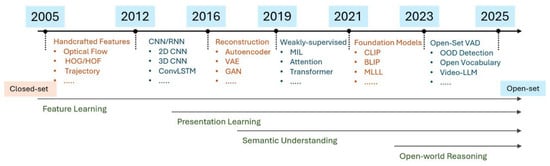
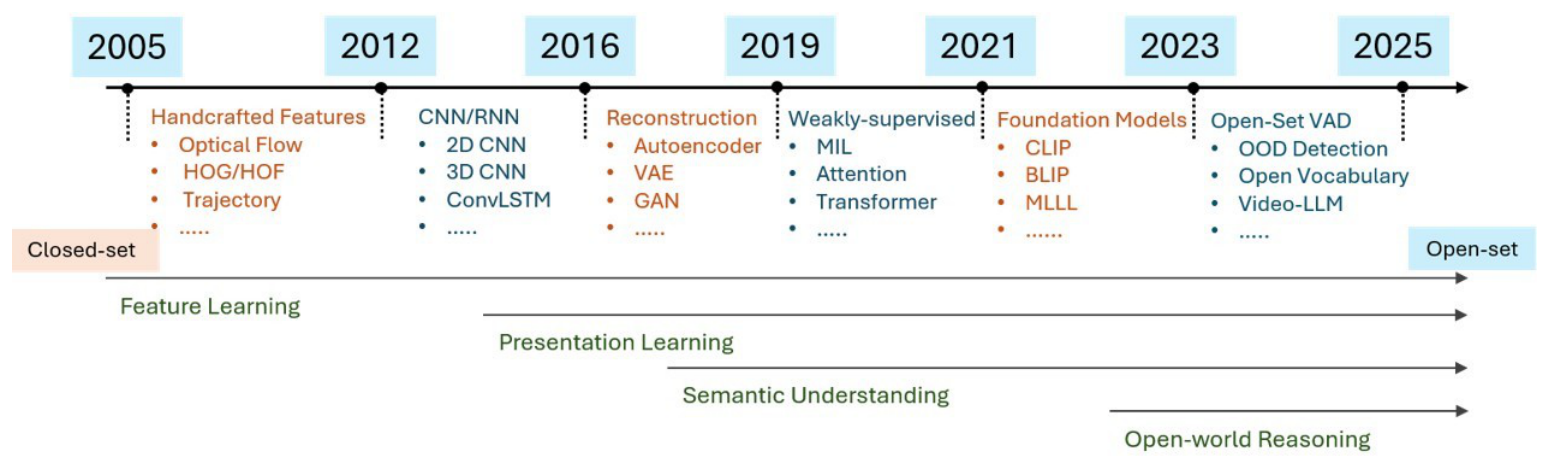
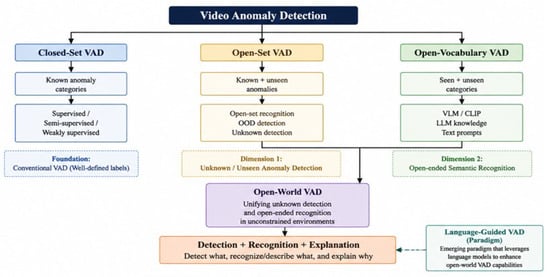
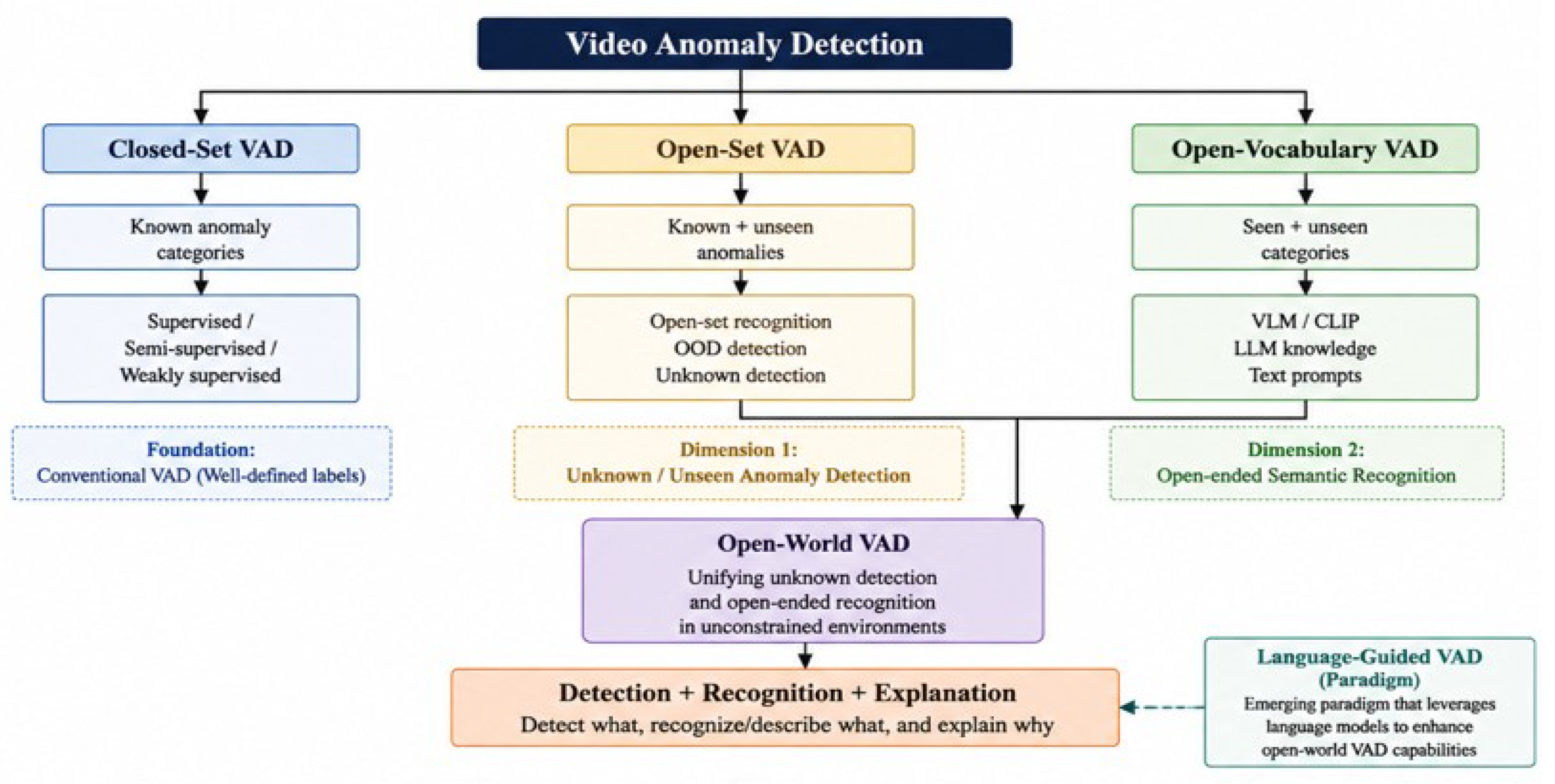
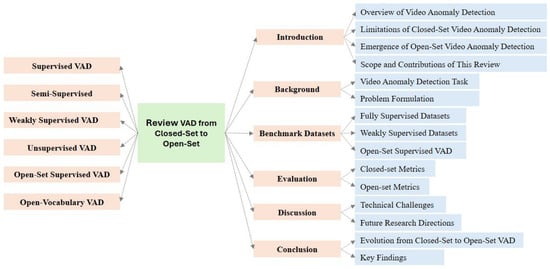
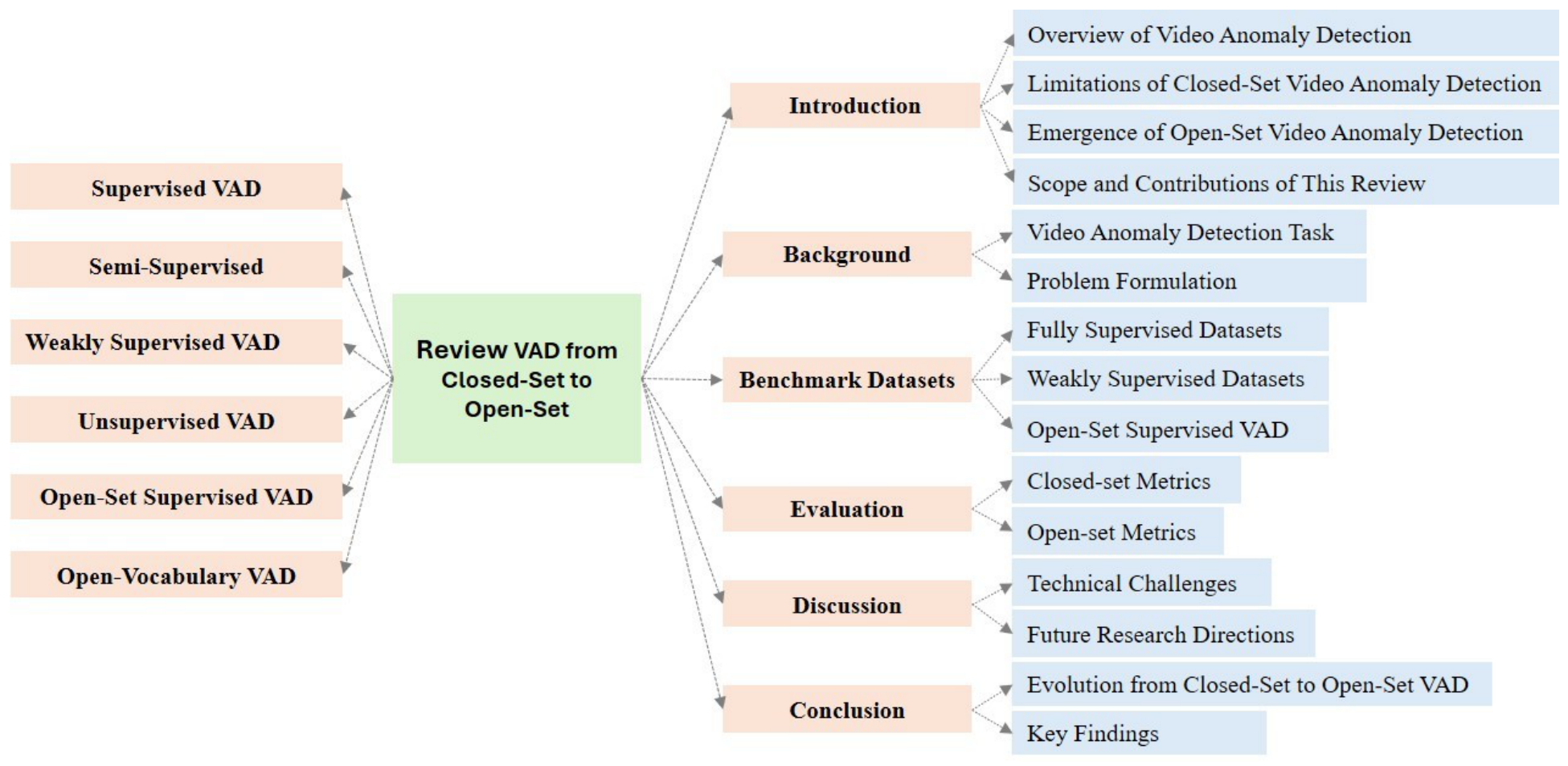
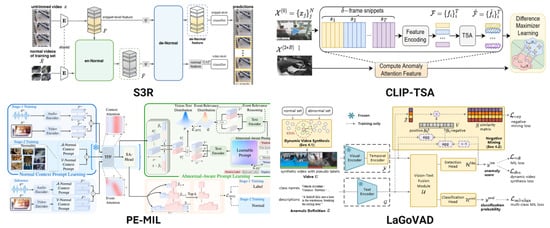
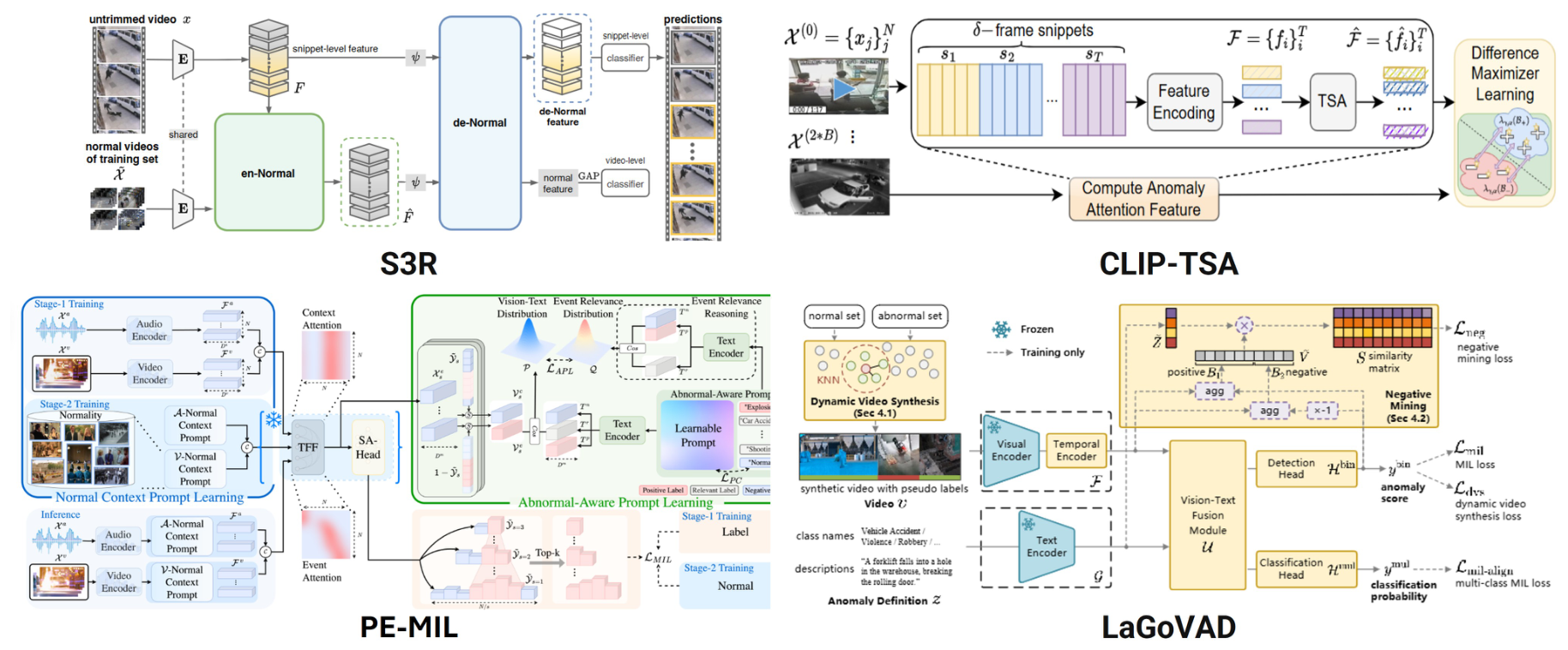
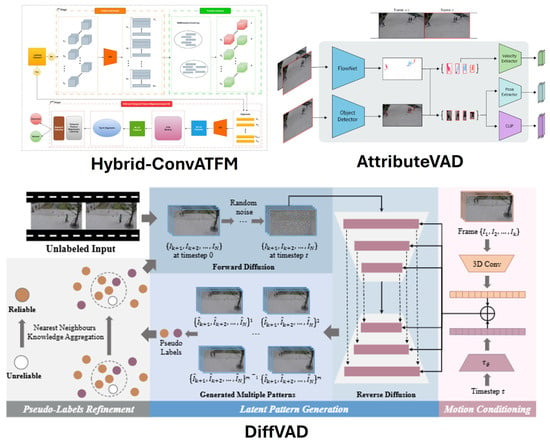
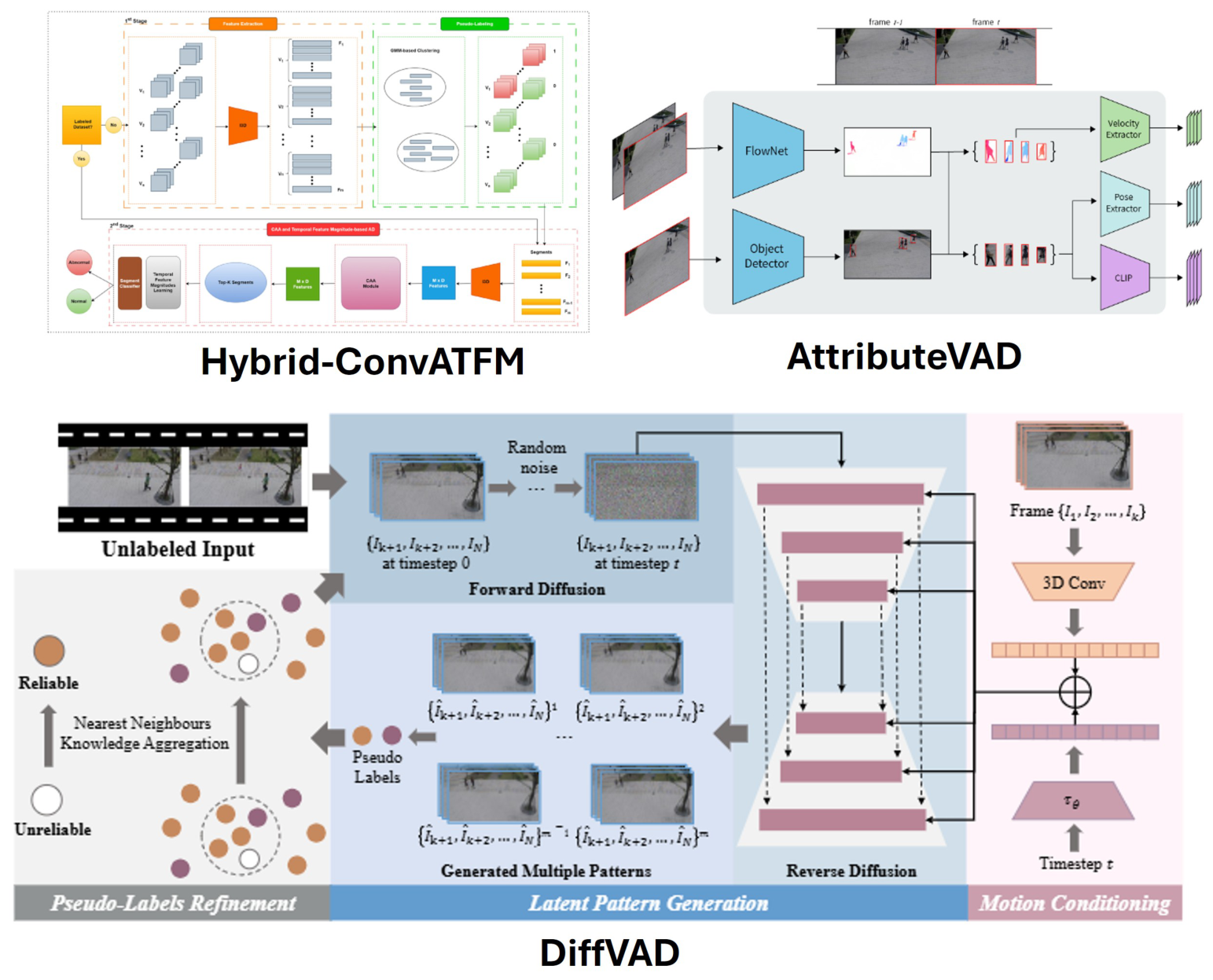
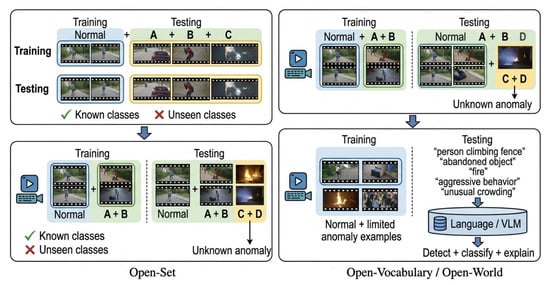
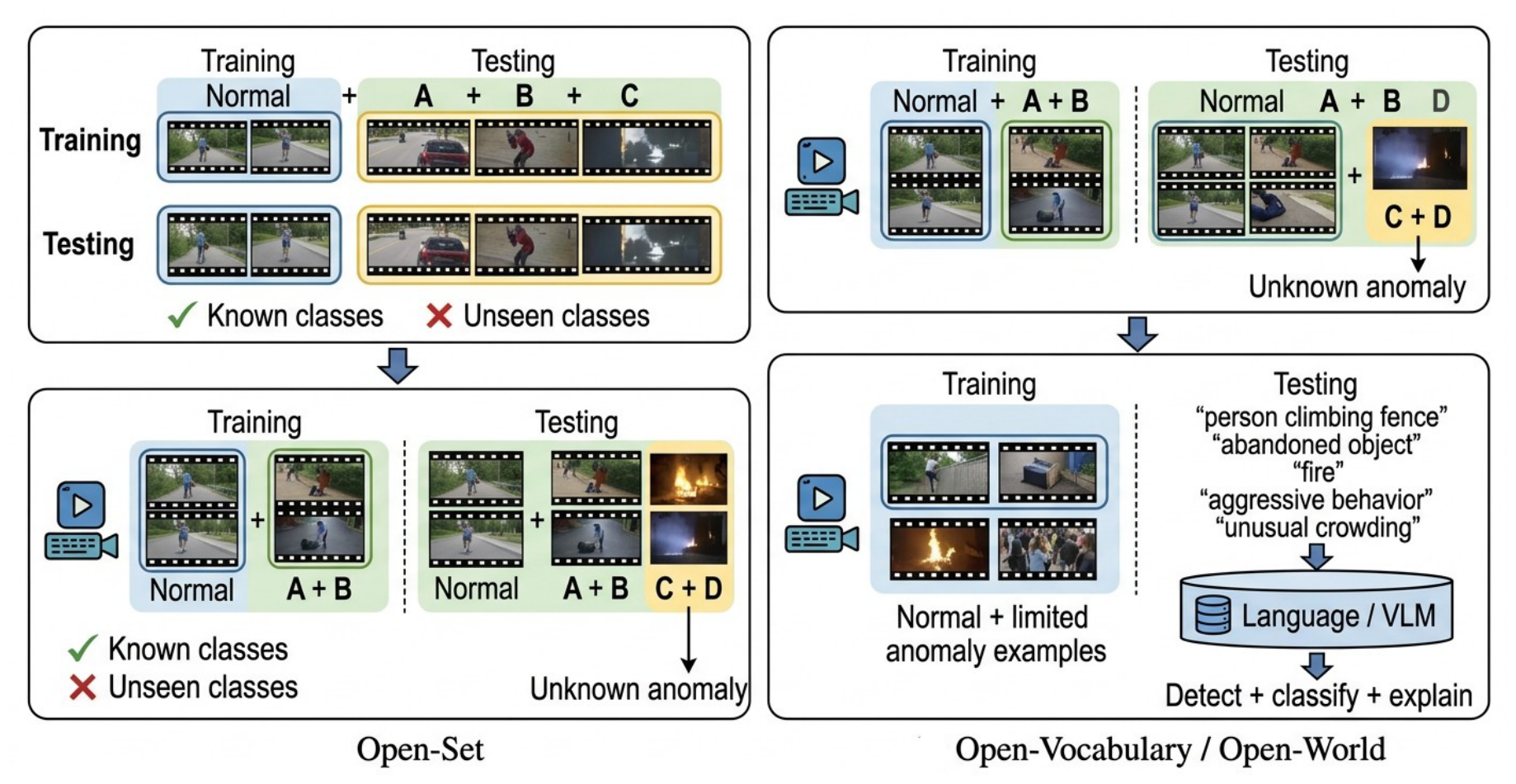
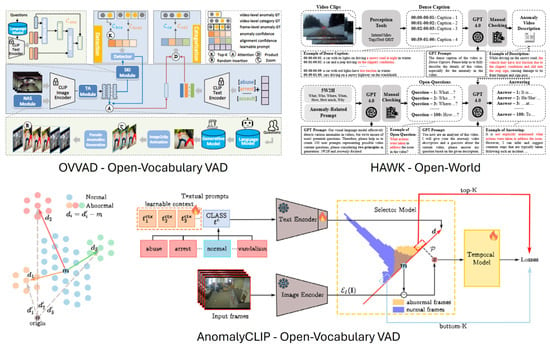

Disclaimer/Publisher’s Note: The statements, opinions and data contained in all publications are solely those of the individual author(s) and contributor(s) and not of MDPI and/or the editor(s). MDPI and/or the editor(s) disclaim responsibility for any injury to people or property resulting from any ideas, methods, instructions or products referred to in the content. |
© 2026 by the authors. Licensee MDPI, Basel, Switzerland. This article is an open access article distributed under the terms and conditions of the Creative Commons Attribution (CC BY) license.