


Abstract
Genicular artery embolization (GAE) has emerged as a minimally invasive treatment for symptomatic knee osteoarthritis, but the evolution of its clinical evidence base remains incompletely characterized. This study evaluated the development of GAE research, emphasizing the composition and distribution of clinical evidence, collaboration patterns, embolic strategies, and conceptual themes. Scopus and Web of Science Core Collection were searched for peer-reviewed human studies of GAE published through 17 December 2025. Publication characteristics, study design, geographic origin, collaboration networks, embolic strategy, funding, and keyword trends were analyzed using Microsoft Excel, VOSviewer, and Bibliometrix in R. Among 128 included publications, 116 (90.6%) were published after 2020, and 48.4% (62/128) were original clinical investigations. Prospective cohorts and RCTs reporting clinical outcomes accounted for 24.2% (31/128) of publications, including only four RCTs (3.1%). Prospective cohort studies involved authors from 18 countries and RCTs from four countries. Permanent microspheres were the predominant embolic strategy in 24 of 62 (38.7%) original clinical studies, with differences in study-design composition across embolic strategies. GAE research has expanded rapidly across research groups and settings, although prospective and randomized evidence remains a minority of the literature. Continued prospective, randomized, and comparative investigation may further strengthen the clinical evidence base.
1. Introduction
Knee osteoarthritis (OA) is a leading cause of chronic pain and disability worldwide [1,2]. Conservative management for early knee OA includes lifestyle modification, nonsteroidal anti-inflammatory drugs, and intra-articular corticosteroid injections, while advanced disease may require total knee arthroplasty (TKA). However, a treatment gap remains for patients with persistent symptoms despite conservative therapy who are not candidates for, or wish to delay, surgical intervention. This has prompted interest in additional nonsurgical treatment options. Genicular nerve ablation, a minimally invasive radiofrequency procedure targeting sensory nerves around the knee, has emerged as an additional option for OA patients with refractory pain. However, the therapeutic benefit of ablation is typically transient, often lasting only several months, limiting its role in long-term management [3].
Over the past decade, genicular artery embolization (GAE) has emerged as another minimally invasive treatment for symptomatic knee OA. Interest in GAE has grown as OA is increasingly recognized as a disease involving inflammation and pathological angiogenesis within the periarticular genicular vasculature and synovium [4,5]. These abnormal neovessels are thought to contribute to pain through associated neurovascular changes, providing a rationale for selective arterial embolization. By targeting abnormal periarticular vascularity through a minimally invasive, joint-preserving approach, GAE may offer an additional treatment option for patients with persistent symptoms who are not ready for or are unsuitable for TKA. Prospective studies have also reported sustained symptomatic improvement extending up to four years following GAE, suggesting the potential for durable symptom relief [6,7,8].
Since the first clinical report by Okuno et al. in 2015, the literature has expanded rapidly to include randomized trials, technical investigations, systematic reviews, and consensus recommendations [9]. Previous narrative reviews, systematic reviews, and meta-analyses have primarily examined the clinical outcomes, safety, and technical aspects of GAE. More recently, Kaufmann-Buhler et al. demonstrated increasing global public interest in GAE through Google Trends analysis, highlighting growing awareness of the procedure [10]. However, increasing publication output does not necessarily establish clinical validation or indicate the maturity of the scientific evidence base.
To our knowledge, no comprehensive bibliometric analysis has characterized the evolution of GAE research alongside the composition of its published clinical investigations. The primary objective of this study was to characterize the growth and composition of the published GAE literature, with particular emphasis on whether increasing publication output has been accompanied by greater representation of prospective and randomized clinical investigations. Secondary objectives included examining geographic and investigator collaboration patterns, funding, the distribution of embolic strategies across study designs, and evolving conceptual themes through 17 December 2025. As a bibliometric analysis, this study was not designed to assess clinical effectiveness, compare procedural outcomes, or formally evaluate the methodological quality of individual investigations.
2. Materials and Methods
2.1. Data Sources, Search Strategy, and Study Selection
This retrospective bibliometric analysis included peer-reviewed human publications focused on GAE for knee OA published between 1 January 2000 and 17 December 2025. Institutional review board approval was not required for this study because only publicly available bibliographic data were analyzed.
Scopus and Web of Science Core Collection (WoSCC) were used to identify eligible publications because of their broad coverage of scholarly publications and availability of standardized bibliographic and citation metadata suitable for bibliometric analysis. Given the relatively limited GAE literature and evolving terminology, a sensitive search strategy was used, followed by manual screening to ensure specificity. Complete search strategies are provided in Supplementary Material S1.
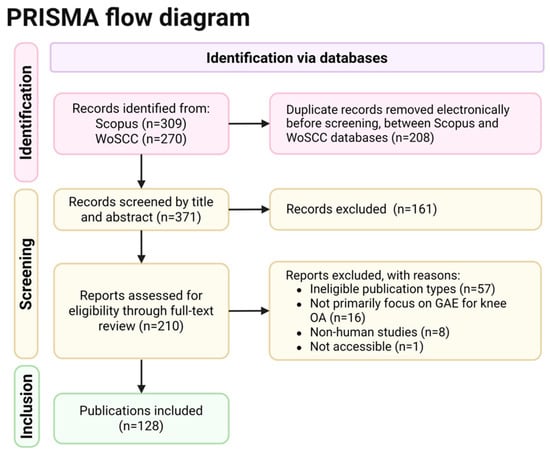
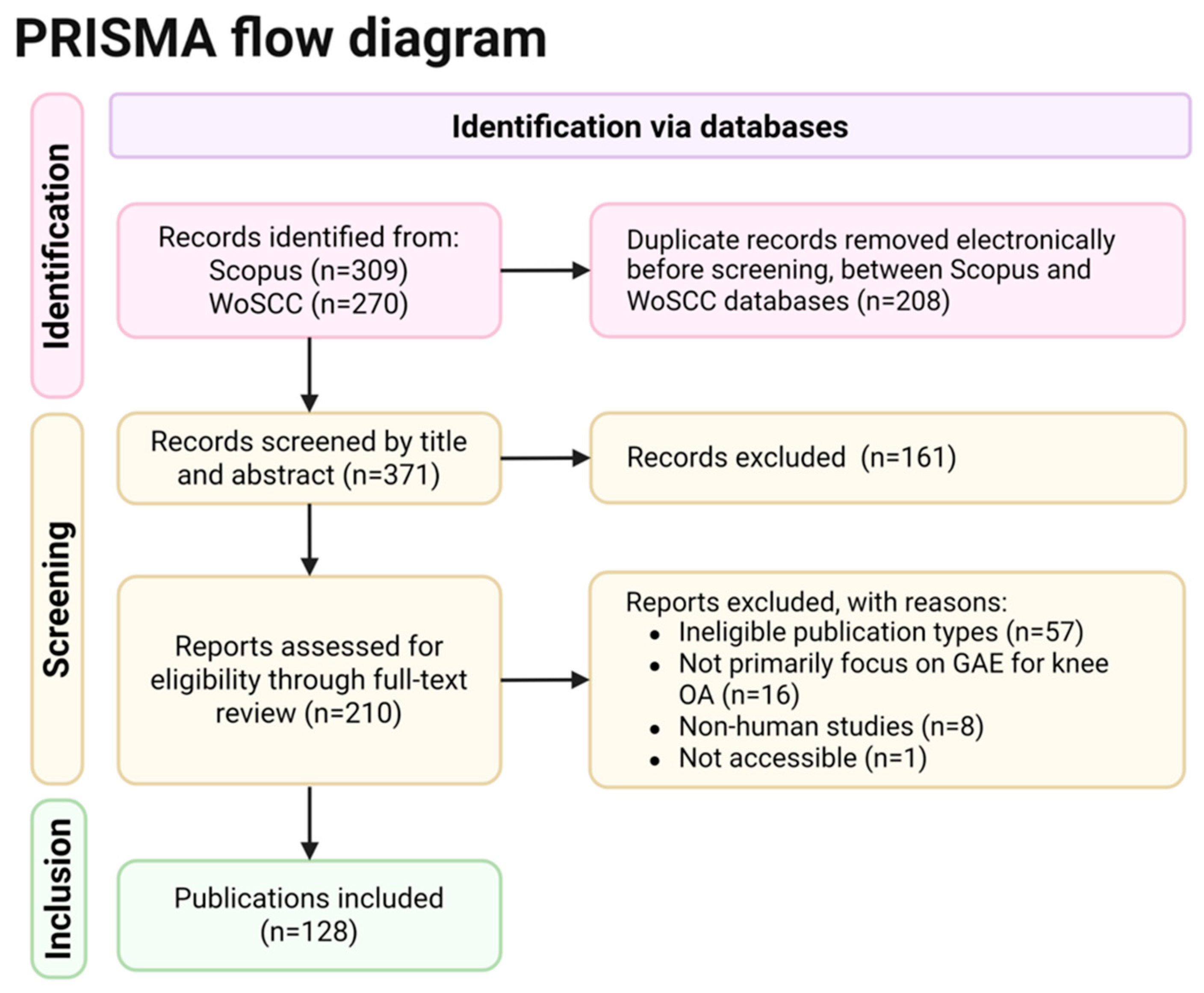
Scopus searches were performed independently by two authors on 17 December 2025. WoSCC searches were conducted subsequently to identify additional eligible publications and verify coverage of the Scopus results. Both databases were evaluated using a publication cutoff of 17 December 2025. Records were combined and de-duplicated, after which titles and abstracts were independently screened by two authors using predefined eligibility criteria. Discrepancies were resolved by consensus, with full-text review performed when necessary. Coverage across the two databases was compared after screening to identify eligible publications retrieved exclusively by either database. The publication identification, screening, and selection process is summarized in Figure 1 [11].
Figure 1.
PRISMA-style flow diagram illustrating the identification, screening, eligibility, assessment, and inclusion of publications in the bibliometric analysis. Created with BioRender.com [12].
Eligible publications included original investigations, narrative reviews, systematic reviews, technical reviews, and procedural descriptions focused primarily on human GAE for knee OA. Editorials, commentaries, errata, meeting abstracts, and notes without original clinical data or structured conceptual synthesis were excluded. Letters containing original clinical data were retained. Animal studies and studies evaluating embolization for non-OA indications, including hemorrhage, hemophilia-associated hemarthrosis, aneurysmal bleeding, or postoperative vascular complications, were excluded.
2.2. Data Extraction and Variable Classification
Following literature identification, bibliometric metadata was extracted from the Scopus records to provide standardized citation, affiliation, funding, and keyword metadata compatible with the selected bibliometric software. Additional variables, including study design, embolic category, funding source, geographic region of corresponding author, and journal specialty, were manually classified using standardized definitions (Supplementary Table S1). To assess inter-rater reliability, a second reviewer independently classified study design, embolic category, and geographic region for the applicable publications. Embolic-category assessment was restricted to original clinical investigations. Differences in the number of publications assessed across variables reflected these eligibility criteria and limitations in access to the full texts of certain publications by one author. Agreement was assessed using unweighted Cohen’s kappa (κ). Discrepancies were resolved by consensus before final analysis.
Publications were classified by study design as case reports, case series, prospective cohort series, retrospective cohort studies, randomized controlled trials (RCTs), RCT protocols, systematic reviews, meta-analyses, narrative reviews, or other publication types. RCTs were defined as publications reporting results from randomized trials, whereas RCT protocols were classified separately as publications describing planning randomized investigations without reporting clinical outcomes. Original clinical investigations were defined as case reports, case series, prospective cohorts, retrospective cohorts, and RCTs reporting clinical results. For analyses of prospective and randomized clinical evidence, prospective cohort studies and RCTs were grouped together, excluding RCT protocols. Evidence syntheses included systematic reviews and meta-analyses, while narrative and technical reviews without systematic evidence synthesis were classified separately. Embolic strategies were classified only for original clinical investigations to avoid duplicate representation of findings summarized in reviews and evidence syntheses. Each original clinical investigation was assigned to a single embolic category. When multiple embolic agents were evaluated, classification was based on the agent used in the greatest number of patients.
Funding was categorized as government, industry, institutional/foundation, mixed, no funding, or no reported funding based on funding disclosures provided in each publication. Only for analysis of industry involvement by study design, publications receiving industry support alone or in combination with another funding source were considered industry supported. Thus, publications originally classified as mixed funding were included in this analysis if industry support was among their funding sources. For the regional distribution analysis, geographic origin was assigned according to the institutional affiliation of the corresponding author. Each publication was assigned to a single geographic region, irrespective of the number or geographic distribution of contributing institutions. This analysis was distinct from the VOSviewer (version 1.6.20; Leiden University, Leiden, Netherlands) country-level co-authorship network analysis, which incorporated institutional affiliations across contributing authors to characterize international research collaboration and is described more in Section 2.3.
To account partially for differences in publication age, citation velocity was used to assess the rate of citation accrual. This was calculated as the total number of citations indexed in Scopus as of 17 December 2025, divided by the difference between the census year (2025) and the publication year. Partial publication years were not prorated, and author self-citations were not excluded from citation counts. Publications from 2024 and 2025 were excluded from this analysis to reduce instability associated with limited citation accrual.
2.3. Data Analysis and Visualization
Descriptive analyses and temporal trend figures were generated using Microsoft Excel (Microsoft Corp., Redmond, WA, USA). Co-authorship and keyword network analyses were performed using VOSviewer. Temporal trends in author keywords were evaluated using the Bibliometrix package (version 5.2.1; developed by Massimo Aria and Corrado Cuccurullo, Italy) using the Biblioshiny interface in R (version 4.5.2; R Foundation for Statistical Computing, Vienna, Austria).
Publication output, citation metrics, collaboration networks, journal distribution, and thematic analyses included all eligible publications, while abstract-based terminology analyses were restricted to publications with available abstracts. Study-design composition was evaluated overall and over time, including the proportion of publications represented by original clinical investigations and by prospective cohort studies and RCTs.
To assess whether publication counts overestimated the number of distinct clinical investigations, a sensitivity analysis was performed among publications classified as retrospective cohort studies, prospective cohort studies, or RCTs reporting clinical outcomes. This analysis excluded RCT protocols. Publications were reviewed for evidence of shared patient populations using trial registration identifiers when available, as well as study names, descriptions of patient recruitment, institutional affiliations, and enrollment periods. Cohort overlap was classified as confirmed when publications explicitly described the same underlying patient population, represented follow-up or secondary analyses of a previously reported cohort, or shared a trial registration identifier. Possible overlap was recorded when publications originated from the same institution and had overlapping enrollment periods or other suggestive characteristics, but shared patient populations could not be definitively established. Publications without identifiable evidence of overlap were retained separately, without assuming confirmed cohort independence. Publications with confirmed overlap were consolidated into study groups, whereas publications with possible but unconfirmed overlap were retained separately. The original publication-level bibliometric analyses were preserved.
To characterize the distribution of clinical evidence among leading contributors, the representation of the five most productive institutions (n ≥ 10) and six most productive investigators (n ≥ 9) among original clinical investigations and prospective cohort studies/RCTs was calculated. Geographic origins of prospective cohorts and RCTs were similarly evaluated. Analyses of temporal and geographic patterns in embolic strategy and study-design composition across embolic categories were restricted to original clinical investigations.
Temporal trends in conceptual terminology were evaluated separately in R using predefined, case-insensitive searches of publication abstracts. Five conceptual categories were assessed: angiogenesis/neovascularization, neovascular mechanisms, osteoarthritis pain framing, transarterial microembolization (TAME)/transarterial periarticular embolization (TAPE)-related concepts, and expansion beyond knee OA. Annual frequencies represented the number of publications whose abstracts contained at least one matching term within each category, with publications permitted to contribute to multiple categories. The complete search expressions are provided in Supplementary Table S2.
For VOSviewer analyses, research productivity was defined by the number of eligible publications associated with each investigator or institution, while total link strength was used to characterize connectivity within co-authorship networks. For network visualizations, entities were required to be represented in at least three publications for inclusion. Author, institution, and keyword terms were harmonized before analysis to account for spelling variants, abbreviations, and synonymous terminology. Harmonized author keywords were analyzed for co-occurrence to characterize relationships among research topics.
Safety-related reporting was analyzed separately in R using case-insensitive regular-expression searches of Scopus-indexed abstracts for publications with available abstracts. Annual frequencies represented the number of publications whose abstracts contained terminology corresponding to each safety-related topic. Predefined search expressions captured references to safety/adverse events, complications, ischemia/necrosis, non-target embolization, and cutaneous complications (Supplementary Table S3). Categories were not mutually exclusive, and publications could contribute to multiple categories. All comparisons were descriptive and were not intended to assess complication incidence or completeness of safety reporting. Matches were not restricted to confirmed adverse events and could include discussion of potential complications or explicit statements that complications did not occur.
3. Results
3.1. Growth and Evolution of the Evidence Base
The database search identified 309 records from Scopus and 270 from WoSCC. After duplicate removal and manual screening, 128 publications met the inclusion criteria. No additional eligible publications were identified in WoSCC beyond those captured in Scopus. Inter-rater agreement was high across all three independently assessed classifications, with κ values of 0.927 for study design (110/117 agreements), 0.885 for embolic category (56/61 agreements), and 0.9772 for geographic region (125/127 agreements), indicating almost perfect agreement according to the Landis-Koch criteria [13].
Original clinical investigations, including prospective cohorts (27), retrospective cohorts (23), RCTs (4), case reports (5), and case series (3), comprised 48.4% (62/128) of all included publications. Narrative reviews were the most common individual publication type (29.7%; 38/128), while evidence syntheses, including systematic reviews (8) and meta-analyses (10), collectively accounted for 14.1% (18/128). RCT protocols that described methodological design of randomized trials without reporting data comprised five studies (3.9%), published by Landers et al. (2017), van Zadelhoff et al. (2022), Little et al. (2023; GENESIS 2), DesRoche et al. (2024; GENI), and Bent et al. (2025; MOTION) [14,15,16,17,18]. Five publications over the study period (3.9%; 5/128) were classified as “Other” and retained in the denominator for study-design proportions but excluded from original clinical investigations. These five publications were published between 2022 and 2025 and included two cadaveric anatomical studies, one analysis of Google Trends search data, one study evaluating the acceptability of GAE in different patient groups, and one cost-effectiveness analysis comparing treatment modalities for knee OA [10,19,20,21,22].
Of 54 publications classified as retrospective cohort studies, prospective cohort studies, or RCTs, six groups of publications with confirmed overlap in their underlying patient populations were identified, comprising 14 publications [6,7,8,9,23,24,25,26,27,28,29,30,31,32]. After consolidating these overlapping publications, the 54 reports represented 46 study groups. Among the 31 prospective cohort and RCT publications, consolidation yielded 25 study groups. Additional publications demonstrated possible cohort overlap based on shared institutional affiliations, investigators, and overlapping enrollment periods. However, the extent of patient overlap could not be confirmed from the available reports, and these publications were therefore retained as separate study groups (Table S4).
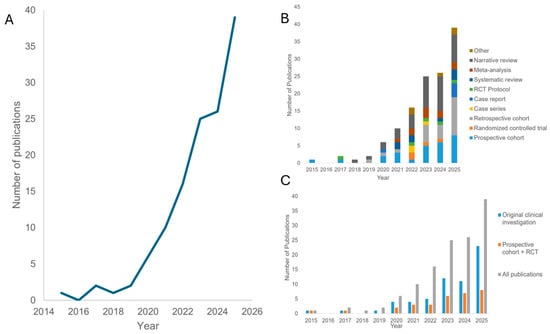
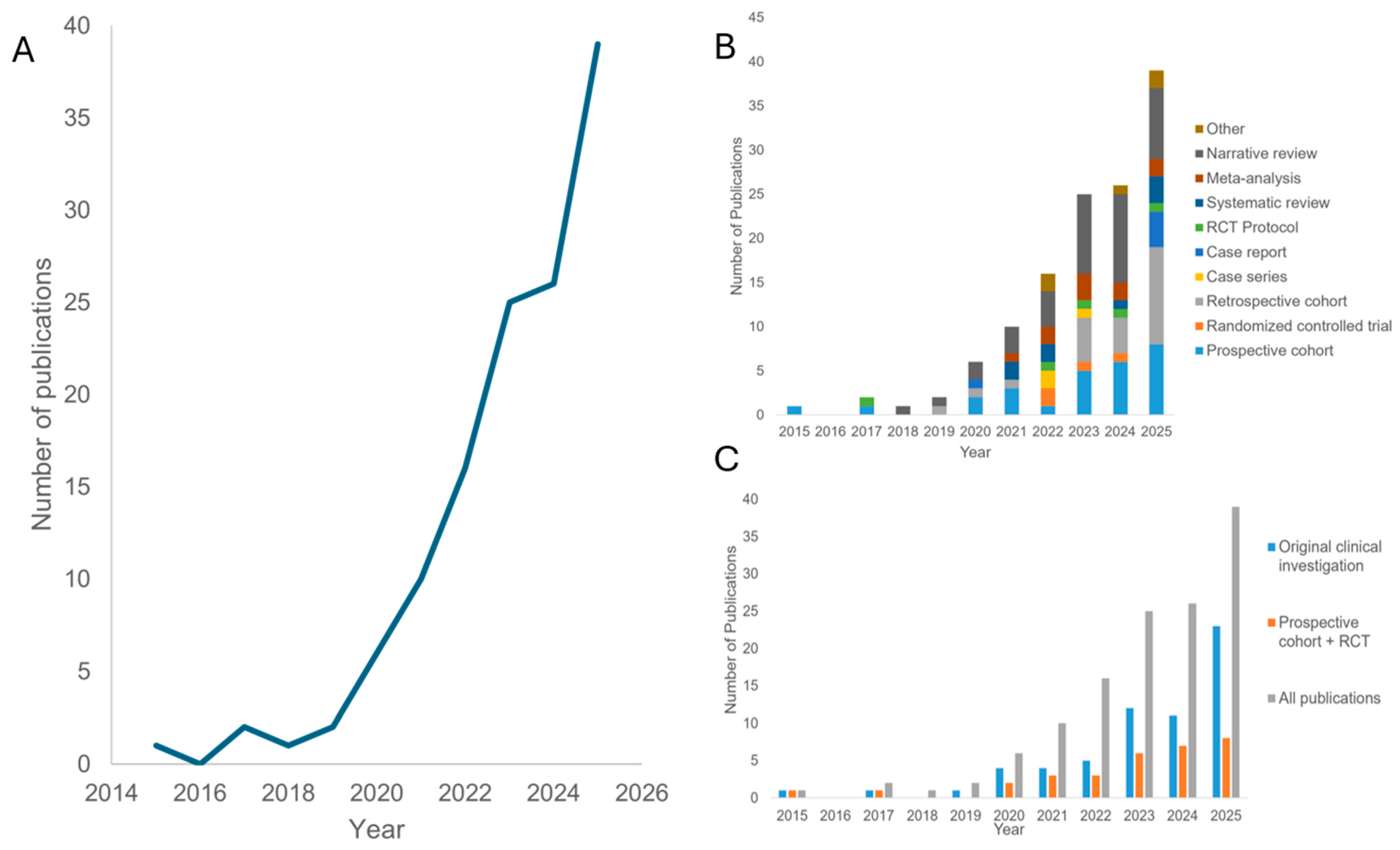
Total publication output remained low through 2019 before increasing rapidly after 2020, with 90.6% (116/128) of publications appearing during the latter period (Figure 2A). Despite the rapid growth in publication volume, prospective and randomized clinical evidence accounted for only 24.2% (31/128) of the overall GAE literature, although they represented 50% (31/62) of original clinical investigations across the study period (Figure 2C). RCTs became more frequent after 2021—with all four RCTs published during this period; however, cohort studies remained the predominant form of original clinical investigations, with prospective and retrospective cohorts accounting for 19.8% (23/116) and 18.1% (21/116) of publications from 2021 to 2025, respectively (Figure 2B).
Figure 2.
Temporal trends in publication output and the GAE evidence base. (A) Annual publication output from 2015 to 2025. (B) Distribution of study designs over time. (C) Annual publication output by evidence category, including all publications, original clinical investigations, and prospective cohort studies/randomized controlled trials (RCTs). Original clinical investigations were defined as studies reporting original patient-level clinical data, including prospective and retrospective cohort studies, RCTs, case series, and case reports. Prospective cohort studies and RCTs represent a subset of original clinical investigations. RCT = randomized controlled trial.
Among individual publications, the prospective study by Okuno et al. published in the Journal of Vascular and Interventional Radiology (JVIR) in 2017 was the most cited publication (171 citations), while Little et al. (2021) demonstrated the highest citation velocity among publications eligible for this analysis (Figure S1).
3.2. Collaboration Networks and Distribution of Clinical Evidence
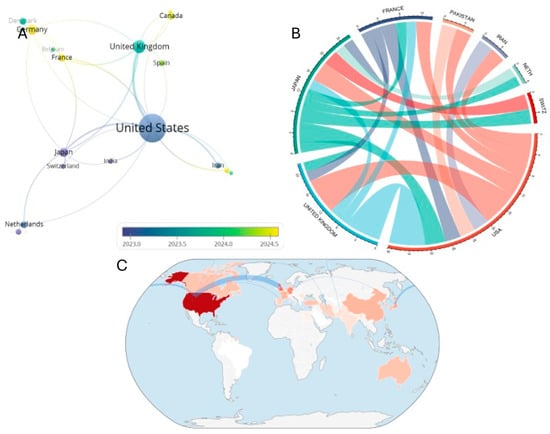
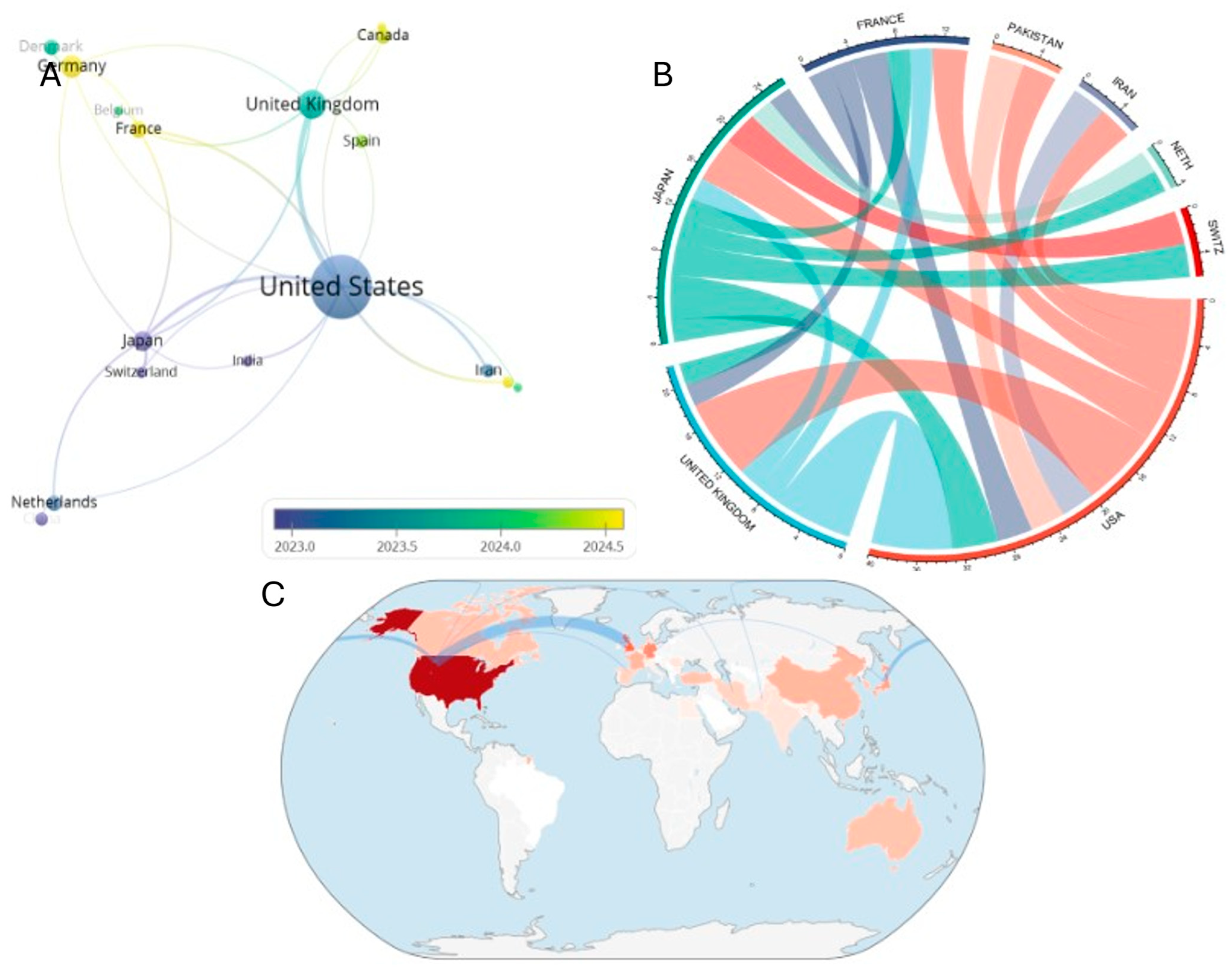
GAE research expanded across countries, institutions, and investigators after 2020, with increasing participation across a range of research centers. The United States accounted for 39.8% (51/128) of publications, followed by the United Kingdom (7.8%; 10/128) and Germany (6.3%; 8/128) (Table S5). The international co-authorship network (n ≥ 3 publication threshold) included 17 countries across six collaboration clusters, with the United States serving as the principal collaboration hub and the United Kingdom and Japan representing additional highly connected countries (Figure 3). At the institutional level, Royal Berkshire NHS Foundation Trust, the University of Chicago, UCLA, Harvard University, and the University of Minnesota were among the most productive centers, while Little, Okuno, Isaacson, and Golzarian were among the principal connectors in author collaboration networks (Tables S6 and S7; Figures S2 and S3).
Figure 3.
Global collaboration patterns in GAE research. (A) Country-level co-authorship network generated using VOSviewer. Each node represents a country identified from author affiliations, with node size proportional to its publication contribution. Lines indicate co-authorship relationships between countries, and line thickness reflects collaboration strength. Colors identify collaboration clusters detected by VOSviewer. Countries positioned closer together generally exhibit stronger relationships within the network. (B) Chord diagram illustrating collaboration among leading contributing countries. (C) Geographic distribution of GAE publications. Countries are shaded according to publication output, with darker colors indicating greater output. NETH = the Netherlands; SWITZ = Switzerland.
Clinical evidence also extended beyond the most productive research hubs. The five most productive institutions (Royal Berkshire NHS Foundation Trust, the University of Chicago, UCLA, Harvard University, and the University of Minnesota) were represented in 29.7% (38/128) of all publications, compared with 24.2% (15/62) of original clinical investigations and 22.6% (7/31) of prospective cohort studies and RCTs. Geographically, prospective cohort studies involved authors affiliated with institutions in 18 countries (Australia, Belgium, Canada, China, Denmark, Egypt, France, Germany, India, Iran, Ireland, Japan, the Netherlands, Switzerland, Taiwan, the United Kingdom, the United States, and Uzbekistan), while the four RCTs involved authors affiliated with institutions in four countries (Australia, Brazil, the Netherlands, and the United States). At the investigator level, the six most productive investigators (Little, Ahmed, Isaacson, Padia, Sajan, and Bagla) were represented in 25.8% (16/62) of original clinical investigations and 25.8% (8/31) of prospective cohort studies and RCTs. Moreover, the proportion of original clinical investigations involving at least one of these investigators remained relatively stable, at 28.6% (2/7) during 2015–2020 and 25.5% (14/55) during 2021–2025.
3.3. Dissemination and Funding
A total of 52 journals published GAE-related articles, with nearly half appearing in interventional radiology (IR) journals. Early publications were predominantly published within IR, whereas multidisciplinary and orthopedic journals accounted for an increasing proportion of publications after 2020 (Table S8; Figure S4).
Funding was reported in 30.5% (39/128) of publications and most commonly originated from institutional/foundation sources (17/39; 43.6%), followed by industry sources (11/39, 28.2%), mixed sources (7/39, 17.9%), and government sources (4/39; 10.3%). In the remaining 89 publications, 40 texts explicitly reported no funding, while 49 did not provide any funding statement. Sources of financial support varied geographically, with government-supported publications more frequently originating from Asia (4/4; 100%), whereas industry and institutional/foundation support predominated among funded North American and European publications. At least some industry support was reported in 2 of 4 RCTs (50%), compared with 8 of 27 prospective cohorts (29.6%).
3.4. Conceptual and Thematic Evolution
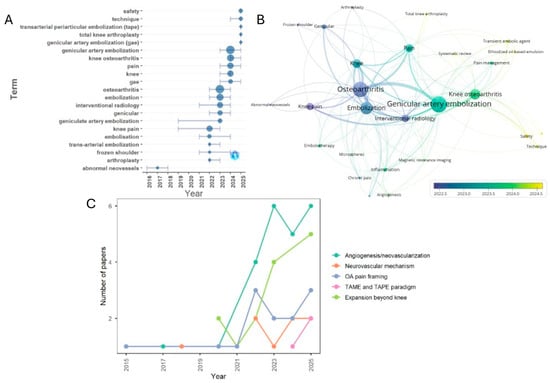
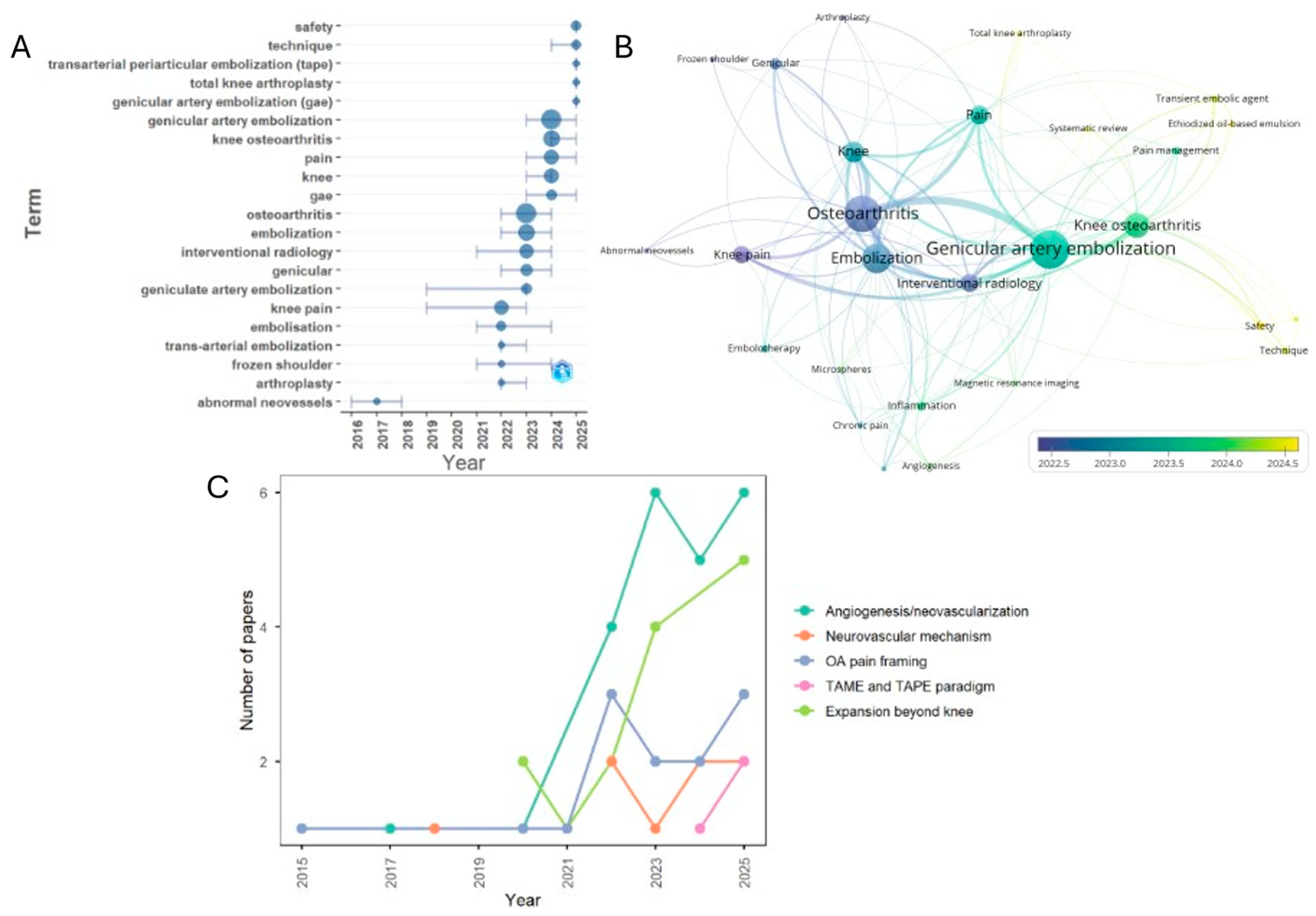
Keyword co-occurrence analysis identified 27 harmonized author keywords organized into six thematic clusters reflecting OA, embolization, clinical outcomes, inflammatory and vascular mechanisms, procedural development, and safety-related concepts (Figure 4B). Temporal analysis demonstrated changes in the conceptual framing of GAE research over time. Early publications more frequently referenced symptomatic treatment of knee OA, whereas later publications increasingly referenced angiogenesis, periarticular neovascularization, inflammation, and neurovascular mechanisms (Figure 4A,C).
Figure 4.
Temporal and conceptual trends in GAE research. (A) Temporal distribution of author keywords. Each point represents the occurrence of a keyword in a given year, with horizontal bars indicating the period over which the keyword appeared in publications. (B) Keyword co-occurrence network generated using VOSviewer. Each node represents an author-supplied keyword, with node size proportional to its frequency of occurrence. Lines indicate co-occurrence between keywords, and line thickness reflects the strength of their association. Colors distinguish clusters of frequently co-occurring keywords identified by VOSviewer. Spatial proximity generally reflects relatedness within the network. (C) Temporal distribution of major conceptual themes in the GAE literature. Lines represent the annual frequency of publications manually assigned to each conceptual theme. TAME = transarterial microembolization; TAPE = transarterial periarticular embolization.
More recent publications also increasingly referenced embolization strategies extending beyond knee OA, including TAPE and TAME. Safety-related terminology also became increasingly prevalent in abstracts after 2021, particularly terms related to cutaneous injury, non-target embolization, and periarticular tissue injury (Figure S5). These frequencies represent an increase in the number of abstracts referencing safety-related concepts and should not be interpreted as evidence of changes in complication incidence or completeness of adverse-event reporting.
3.5. Evolution and Evidentiary Composition of Embolic Strategies
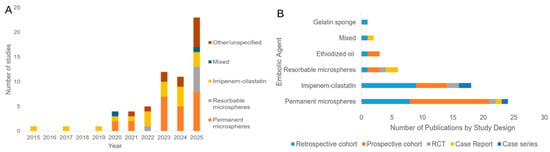
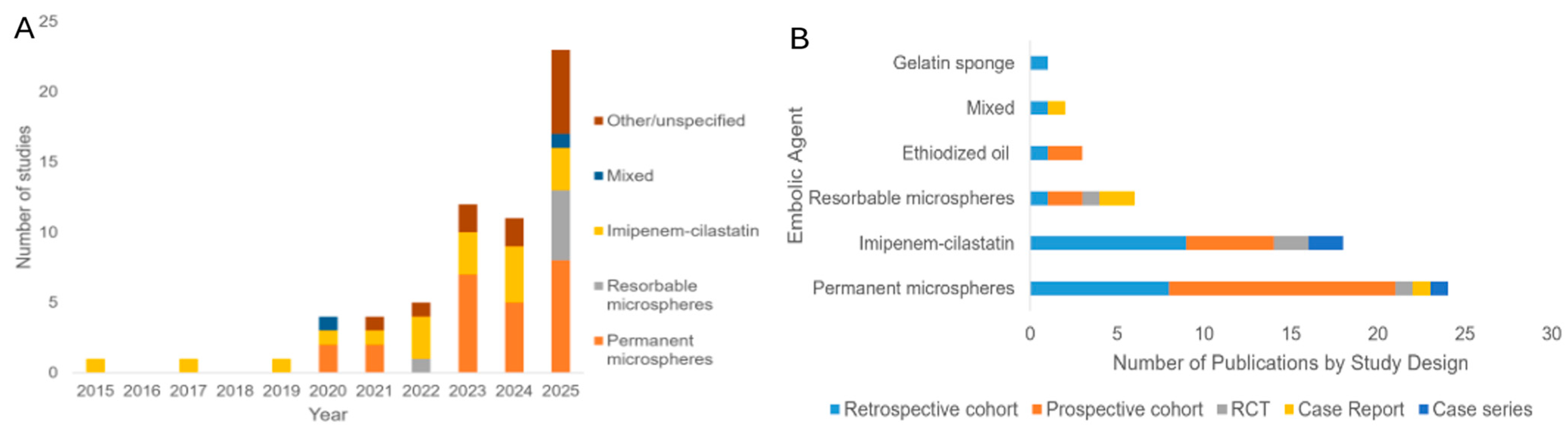
The distribution of predominant embolic strategies in published clinical investigations evolved over the study period (Figure 5A). Early clinical investigations predominantly used imipenem-cilastatin particles, whereas permanent microspheres and mixed embolic strategies became more frequently represented in later publications. Permanent microspheres were the predominant embolic strategy in 38.7% (24/62) of original clinical studies, compared with imipenem-cilastatin particles in 29.0% (18/62). Geographic variation was also observed in predominant embolic strategies, with permanent microspheres more commonly represented among North American studies and imipenem-cilastatin particles among Asian studies (Figure S6).
Figure 5.
Evolution and evidentiary composition of embolic strategies. (A) Temporal distribution of embolic strategies evaluated in original clinical investigations from 2015 to 2025. The “Other embolics” category includes gelatin sponge and ethiodized oil. (B) Study-design composition of original clinical investigations by embolic strategy. Bars represent the number of retrospective cohort studies, prospective cohort studies, RCTs, and case reports/series evaluating each embolic strategy. Studies evaluating multiple embolic strategies in the same patient were classified in the “Mixed” category only. Publications with embolic agents classified as “Other/unspecified” were excluded from Panel B. RCT = randomized controlled trial.
The distribution of study designs differed across predominant embolic strategies (Figure 5B). Of the 24 original clinical studies classified under permanent microspheres, 13 were prospective cohorts and one was an RCT, with prospective and randomized studies together comprising 58.3% (14/24). Of the 18 original clinical studies classified under imipenem-cilastatin, five were prospective cohorts and two were RCTs, together comprising 38.9% (7/18). Six original clinical investigations were classified under resorbable microspheres, including two prospective cohorts and one RCT.
4. Discussion
This bibliometric analysis demonstrates rapid expansion of the GAE literature, with more than 90% of publications appearing after 2020. Despite this growth, prospective and randomized studies remained a minority of the literature, with RCTs reporting clinical outcomes accounting for only 3.1% of publications. These findings distinguish growth in publication activity from development of prospective and randomized clinical evidence. Importantly, this bibliometric analysis does not assess treatment effectiveness, and trends in publication volume and study design should not be interpreted as evidence of methodological quality or the clinical efficacy and safety of GAE. The GAE literature therefore appears to represent an evolving rather than mature evidence base, with clinical investigation extending beyond early feasibility and observational studies.
The cohort overlap sensitivity analysis highlights an important distinction between publication volume and the number of distinct clinical investigations. Among 31 prospective cohort and RCT publications reporting clinical outcomes, consolidation of confirmed reports yielded 25 study groups. Several publications represented interim analyses, long-term follow-up reports, or secondary analyses of previously reported patient populations. These findings suggest that publication counts alone may overstate the breadth of independent prospective clinical evidence supporting GAE. Nevertheless, multiple publications from the same cohort may provide additional information regarding long-term outcomes, imaging findings, and predictors of treatment response. Thus, publication-level bibliometric productivity and the number of distinct clinical study groups should be interpreted as complementary rather than interchangeable measures.
The structure of the GAE research community provides additional context for interpreting this evolving evidence base. Although several investigators and institutions emerged as prominent publication and collaboration hubs, clinical evidence was generated across a broader range of contributors. The five most productive institutions accounted for less than one-quarter of prospective cohort studies and RCTs, and these studies involved authors affiliated with institutions in 18 and four countries, respectively. The involvement of the most prolific investigators in original clinical investigations remained relatively stable over time, at 28.6% during 2015–2020 and 25.5% during 2021–2025. Although the small number of studies in the earlier period limits this comparison, these findings are consistent with broader participation in GAE clinical research rather than increasing concentration within its earliest research groups and most prolific investigators. The increasing diversification of contributing institutions may facilitate broader evaluation of GAE across different research settings and patient populations. However, greater institutional participation does not necessarily indicate independent validation, as publications from different institutions may involve overlapping patient cohorts or shared multicenter collaborations.
The evolution of embolic strategies provides additional insight into the composition of the GAE evidence base. Although permanent microspheres represented the most common predominant embolic strategy, the composition of supporting clinical evidence varied across embolic categories. A greater proportion of studies classified under permanent microspheres employed prospective or randomized designs than those classified under imipenem-cilastatin, illustrating differences in evidentiary composition that are not captured by publication counts alone. Given the limited number of RCTs and the descriptive nature of these comparisons, differences in study-design composition should be interpreted cautiously and not considered evidence of comparative efficacy or safety, particularly because formal methodological-quality assessments and direct comparison of clinical outcomes were beyond the scope of this bibliometric analysis. Recent clinical investigations provide additional context, reporting no statistically significant differences in pain outcomes at 12 months between imipenem-cilastatin and permanent microspheres or in clinical success at six months between Lipiodol and imipenem-cilastatin [33,34]. Separately, Little et al. reported sustained improvement in pain outcomes at two years following GAE with permanent microspheres [27]. Nevertheless, the optimal degree of procedural selectivity and the implications of geographic variation in embolization techniques for clinical outcomes remain incompletely understood [35]. Regional practice patterns, regulatory availability, and operator preference may influence the selection of embolic strategies for clinical investigation. The relationship between procedural selectivity, embolic strategy, and clinical outcomes was not systematically evaluated in the present bibliometric analysis. Future systematic reviews and meta-analyses incorporating procedural characteristics and clinical outcome data are needed to clarify how these technical factors may influence treatment efficacy, durability, and safety.
Thematic trends indicate changes in the scientific framing of GAE over time. Increasing references to angiogenesis, periarticular neovascularization, inflammation, and neurovascular mechanisms are consistent with greater emphasis on proposed biological mechanisms, while references to TAPE, TAME, and other musculoskeletal embolization concepts place GAE within a broader interventional context. These findings characterize changes in publication terminology and thematic emphasis rather than underlying biological mechanisms or clinical practice. Because the present analysis was restricted to publications primarily focused on GAE, the broader literature on embolization for other musculoskeletal indications was not systematically evaluated.
Safety-related terminology also became more prominent in the literature after 2021, although this trend should not be interpreted as evidence of increasing complication rates. The observed increase may reflect greater publication volume, increased attention to adverse-event reporting, or changes in reporting practices as the literature expanded. Standardized definitions and reporting of adverse events may facilitate more consistent characterization of the safety profile of GAE in future studies.
The research landscape also showed changes in dissemination and funding. Increasing publication in orthopedic and multidisciplinary journals after 2020 suggests broader dissemination beyond IR literature. Industry funding was reported more frequently among RCTs than prospective cohort studies, although the limited number of RCTs warrants cautious interpretation. This descriptive pattern does not establish an association between funding source and study design or clinical outcomes.
This study has several limitations. Restriction to Scopus and WoSCC may have excluded publications indexed exclusively in other databases. Derived variables were initially classified by a single investigator using standardized criteria, with selected classifications independently assessed by a second reviewer; nevertheless, classification bias remains possible. Although a sensitivity analysis accounted for confirmed patient-cohort overlap, additional overlap among studies from the same institutions with overlapping enrollment periods could not always be verified; thus, adjusted counts may still overestimate the number of independent patient cohorts and should not be interpreted as definitive counts of unique clinical populations. Citation metrics are influenced by publication age and may underestimate the impact of recent studies. Geographic classifications based on corresponding-author affiliations may underrepresent multinational contributions, although the complementary VOSviewer co-authorship analysis incorporated affiliations across contributing authors. Thus, regional publication counts reflect corresponding-author distributions, whereas the network more broadly reflects international collaboration. Funding classifications relied on published disclosures, with absent or incomplete statements limiting assessment of financial support. Classification by predominant embolic strategy may have obscured the use of additional embolic agents within individual studies, particularly in investigations evaluating multiple strategies. Keyword- and abstract-based analyses reflect author terminology and reporting practices rather than changes in clinical practice. Specifically, safety-related terminology identified mentions in available abstracts rather than adverse-event incidence or the completeness of safety reporting. Comparisons across study periods, funding categories, research groups, and embolic strategies were descriptive and cannot establish statistical associations, causality, or differences in clinical outcomes. Furthermore, no formal methodological-quality or risk-of-bias assessment was performed; therefore, publication productivity, citation impact, and study-design distributions should not be interpreted as indications of evidence quality, treatment efficacy, or comparative safety and effectiveness.
In conclusion, the published GAE literature has expanded rapidly, although prospective and randomized studies remain a minority of publications. Research activity has broadened across countries and research groups, while the evidentiary composition supporting individual embolic strategies remains heterogeneous. These findings highlight the distinction between rapid growth in publication activity and maturation of the clinical evidence base. Future systematic reviews incorporating formal risk-of-bias and methodological quality assessments may help clarify the strength of existing evidence regarding treatment effectiveness, durability, and procedural variation. Continued independent prospective investigation, randomized trials, comparative assessment of embolic strategies and procedural techniques, and standardized outcome reporting are needed to further define the role of GAE in the management of knee OA.
Supplementary Materials
The following supporting information can be downloaded at https://www.mdpi.com/article/10.3390/jimaging12110561/s1; Figure S1. Citation velocity of highly cited GAE publications; Figure S2. Institutional collaboration network in GAE research; Figure S3. Author collaboration network in GAE research; Figure S4. Temporal distribution of GAE publications by journal discipline; Figure S5. Temporal trends in safety-related terminology in the GAE literature; Figure S6. Geographic variation in embolic strategies evaluated in GAE studies; Table S1. Operational Definitions for Manually Classified Variables; Table S2. Search expressions for automated conceptual terminology analysis; Table S3. Search expressions for safety-related terminology analysis; Table S4. Confirmed and Potential Patient-Cohort Overlap Among Original Clinical Publications on Genicular Artery Embolization [6,7,8,9,23,24,25,26,27,28,29,30,31,32]; Table S5. National publication output and year of first publication for GAE knee OA literature; Table S6. Most productive institutions in GAE research (≥5 publications); Table S7. Most productive authors in GAE research (≥6 publications); Table S8. Top journals by number of GAE publications; Supplementary Material S1: Complete database search strategies.
Author Contributions
Conceptualization, M.P.U., A.J.P., and M.S.M.; methodology, M.P.U., A.J.P., and M.S.M.; software, M.P.U.; validation, M.P.U. and A.J.P.; formal analysis, M.P.U.; investigation, M.P.U. and A.J.P.; resources, M.P.U., A.J.P., and M.S.M.; data curation, M.P.U. and A.J.P.; writing—original draft preparation, M.P.U. and A.J.P.; writing—review and editing, M.P.U., A.J.P., and M.S.M.; visualization, M.P.U.; supervision, M.S.M.; project administration, M.S.M.; funding acquisition, n/a. All authors have read and agreed to the published version of the manuscript.
Funding
This research received no external funding.
Institutional Review Board Statement
Not applicable. This study analyzed publicly available bibliographic data and did not involve human participants or animals.
Informed Consent Statement
Not applicable.
Data Availability Statement
The original contributions presented in this study are included in the article/Supplementary Materials. Further inquiries can be directed to the corresponding author.
Acknowledgments
This article is a revised and expanded version of a conference abstract entitled “Evolution of Clinical Evidence in Genicular Artery Embolization: A Bibliometric Analysis,” which will be presented at the International Symposium on Endovascular Therapy (ISET), Miami Beach, Florida, USA, 18–21 January 2027 [36].
Conflicts of Interest
The authors declare that they have no conflicts of interest.
References
- GBD 2021 Osteoarthritis Collaborators. Global, regional, and national burden of osteoarthritis, 1990–2020 and projections to 2050: A systematic analysis for the Global Burden of Disease Study 2021. Lancet Rheumatol. 2023, 5, e508–e522. [Google Scholar] [CrossRef] [Scilit] [PubMed]
- Hunter, D.J.; Bierma-Zeinstra, S. Osteoarthritis. Lancet 2019, 393, 1745–1759. [Google Scholar] [CrossRef] [Scilit] [PubMed]
- Iannaccone, F.; Dixon, S.; Kaufman, A. A Review of Long-Term Pain Relief after Genicular Nerve Radiofrequency Ablation in Chronic Knee Osteoarthritis. Pain Physician 2017, 3, E437–E444. [Google Scholar] [CrossRef] [Scilit]
- Berenbaum, F. Osteoarthritis as an inflammatory disease (osteoarthritis is not osteoarthrosis!). Osteoarthr. Cartil. 2013, 21, 16–21. [Google Scholar] [CrossRef] [Scilit] [PubMed]
- Singh, R.; Makary, M.S. Multimodality imaging considerations for genicular artery embolization in knee osteoarthritis. World J. Radiol. 2026, 18, 120315. [Google Scholar] [CrossRef] [Scilit] [PubMed]
- Little, M.W.; Gibson, M.; Briggs, J.; Speirs, A.; Yoong, P.; Ariyanayagam, T.; Davies, N.; Tayton, E.; Tavares, S.; MacGill, S.; et al. Genicular artEry embolizatioN in patiEnts with oSteoarthrItiS of the Knee (GENESIS) Using Permanent Microspheres: Interim Analysis. Cardiovasc. Interv. Radiol. 2021, 44, 931–940, Correction in Cardiovasc. Interv. Radiol. 2021, 44, 1153. [Google Scholar] [CrossRef] [Scilit] [PubMed]
- Cusumano, L.R.; Sparks, H.D.; Masterson, K.E.; Genshaft, S.J.; Plotnik, A.N.; Padia, S.A. Genicular Artery Embolization for Treatment of Symptomatic Knee Osteoarthritis: 2-Year Outcomes from a Prospective IDE Trial. J. Vasc. Interv. Radiol. 2024, 35, 1768–1775. [Google Scholar] [CrossRef] [Scilit] [PubMed]
- Okuno, Y.; Korchi, A.M.; Shinjo, T.; Kato, S.; Kaneko, T. Midterm Clinical Outcomes and MR Imaging Changes after Transcatheter Arterial Embolization as a Treatment for Mild to Moderate Radiographic Knee Osteoarthritis Resistant to Conservative Treatment. J. Vasc. Interv. Radiol. 2017, 28, 995–1002. [Google Scholar] [CrossRef] [Scilit] [PubMed]
- Okuno, Y.; Korchi, A.M.; Shinjo, T.; Kato, S. Transcatheter Arterial Embolization as a Treatment for Medial Knee Pain in Patients with Mild to Moderate Osteoarthritis. Cardiovasc. Interv. Radiol. 2014, 38, 336–343. [Google Scholar] [CrossRef] [Scilit] [PubMed]
- Kaufmann-Bühler, A.-K.; Maleitzke, T.; Hildebrandt, A.; Winkler, T.; Collettini, F.; Fleckenstein, F.N. Accelerating Global Interest in Genicular Artery Embolization: A Google Trends Analysis. J. Clin. Med. 2025, 14, 7920. [Google Scholar] [CrossRef] [Scilit] [PubMed]
- Page, M.J.; McKenzie, J.E.; Bossuyt, P.M.; Boutron, I.; Hoffmann, T.C.; Mulrow, C.D.; Shamseer, L.; Tetzlaff, J.M.; Akl, E.A.; Brennan, S.E.; et al. The PRISMA 2020 statement: An updated guideline for reporting systematic reviews. Int. J. Surg. 2021, 88, 105906. [Google Scholar] [CrossRef] [PubMed]
- Umapathy, M. Created in BioRender. 2026. Available online: https://BioRender.com/eud0w1y (accessed on 21 October 2026).
- Landis, J.R.; Koch, G.G. The Measurement of Observer Agreement for Categorical Data. Biometrics 1977, 33, 159–174. [Google Scholar] [CrossRef] [Scilit]
- Landers, S.; Hely, A.; Harrison, B.; Maister, N.; Hely, R.; E Lane, S.; Gill, S.D.; Page, R.S. Protocol for a single-centre, parallel-arm, randomised controlled superiority trial evaluating the effects of transcatheter arterial embolisation of abnormal knee neovasculature on pain, function and quality of life in people with knee osteoarthritis. BMJ Open 2017, 7, e014266. [Google Scholar] [CrossRef] [Scilit] [PubMed]
- van Zadelhoff, T.A.; Moelker, A.; Bierma-Zeinstra, S.M.A.; Bos, P.K.; Krestin, G.P.; Oei, E.H.G. Genicular artery embolization as a novel treatment for mild to moderate knee osteoarthritis: Protocol design of a randomized sham-controlled clinical trial. Trials 2022, 24, 1–8. [Google Scholar] [CrossRef] [Scilit] [PubMed]
- Little, M.W.; Harrison, R.; MacGill, S.; Speirs, A.; Briggs, J.H.; Tayton, E.; Davies, N.L.C.; Hausen, H.S.; McCann, C.; Levine, L.L.; et al. Genicular Artery Embolisation in Patients with Osteoarthritis of the Knee (GENESIS 2): Protocol for a Double-Blind Randomised Sham-Controlled Trial. Cardiovasc. Interv. Radiol. 2023, 46, 1276–1282. [Google Scholar] [CrossRef] [Scilit] [PubMed]
- DesRoche, C.; Nazzicone, K.; DuMerton, D.; Ghasemlou, N.; Mann, S.; Clinkard, D.; Menard, A. Genicular Embolization versus Neurolysis Intervention (GENI) Study: Protocol for a Randomized Controlled Trial Comparing Genicular Artery Embolization with Genicular Neurolysis for Knee Osteoarthritis. J. Vasc. Interv. Radiol. 2024, 35, 1224–1226. [Google Scholar] [CrossRef] [Scilit] [PubMed]
- Bent, C.; McAsey, C.J.; Bagla, S. Multicenter, PrOspective, Randomized, Controlled Trial Comparing GenIcular Artery EmbOlization Using Embosphere Microspheres to Corticosteroid iNjections for the Treatment of Symptomatic Knee Osteoarthritis: MOTION Study Protocol Summary. Cardiovasc. Interv. Radiol. 2025, 48, 551–558. [Google Scholar] [CrossRef] [Scilit] [PubMed]
- Sighary, M.; Sajan, A.; Walsh, J.; Márquez, S. Cadaveric Classification of the Genicular Arteries, with Implications for the Interventional Radiologist. J. Vasc. Interv. Radiol. 2022, 33, 437–444.e1. [Google Scholar] [CrossRef] [Scilit] [PubMed]
- O’gRady, A.; Welsh, L.; Gibson, M.; Briggs, J.; Speirs, A.; Little, M. Cadaveric and Angiographic Anatomical Considerations in the Genicular Arterial System: Implications for Genicular Artery Embolisation in Patients with Knee Osteoarthritis. Cardiovasc. Interv. Radiol. 2021, 45, 80–90. [Google Scholar] [CrossRef] [Scilit] [PubMed]
- Smole, A.K.; Sun, D.; Zhao, A.H.; Swett, B.J.; Shea, Y.M.; Gottesman, S.P.; Westrich, G.; Alexiades, M.; Della Valle, A.G.; Kishore, S.; et al. Acceptability of Genicular Artery Embolization for the Treatment of Painful Knee Osteoarthritis: A Single-Center Experience. Cardiovasc. Interv. Radiol. 2025, 48, 702–704. [Google Scholar] [CrossRef] [Scilit] [PubMed]
- Kwak, D.H.; Hofmann, H.L.; Patel, M.; Heller, D.B.; Lyons, A.; Yu, Q.; Kim, D.D.; Ahmed, O. Genicular Artery Embolization, Radiofrequency Ablation, and Corticosteroid Therapy for Knee Osteoarthritis: A Cost-Effectiveness Analysis Using Randomized Clinical Trial Data. Am. J. Roentgenol. 2024, 223, e2431710. [Google Scholar] [CrossRef] [Scilit] [PubMed]
- van Zadelhoff, T.A.; Okuno, Y.; Bos, P.K.; Bierma-Zeinstra, S.M.; Krestin, G.P.; Moelker, A.; Oei, E.H. Association between Baseline Osteoarthritic Features on MR Imaging and Clinical Outcome after Genicular Artery Embolization for Knee Osteoarthritis. J. Vasc. Interv. Radiol. 2021, 32, 497–503. [Google Scholar] [CrossRef] [Scilit] [PubMed]
- Cusumano, L.R.; Callese, T.E.; Redwood, K.; Genshaft, S.; Plotnik, A.N.; Stewart, J.K.; Padia, S.A. Added Value of Cone-Beam CT to Identify Arterial Supply during Genicular Artery Embolization for Knee Osteoarthritis. J. Vasc. Interv. Radiol. 2023, 34, 1861–1867. [Google Scholar] [CrossRef] [Scilit] [PubMed]
- Callese, T.E.; Cusumano, L.; Redwood, K.D.; Genshaft, S.; Plotnik, A.; Stewart, J.; Padia, S.A. Classification of Genicular Artery Anatomic Variants Using Intraoperative Cone-Beam Computed Tomography. Cardiovasc. Interv. Radiol. 2023, 46, 628–634. [Google Scholar] [CrossRef] [Scilit] [PubMed]
- Padia, S.A.; Genshaft, S.; Blumstein, G.; Plotnik, A.; Kim, G.H.J.; Gilbert, S.J.; Lauko, K.; Stavrakis, A.I. Genicular Artery Embolization for the Treatment of Symptomatic Knee Osteoarthritis. JBJS Open Access 2021, 6, e21.00085. [Google Scholar] [CrossRef] [Scilit] [PubMed]
- Little, M.W.; O’gRady, A.; Briggs, J.; Gibson, M.; Speirs, A.; Al-Rekabi, A.; Yoong, P.; Ariyanayagam, T.; Davies, N.; Tayton, E.; et al. Genicular Artery embolisation in Patients with Osteoarthritis of the Knee (GENESIS) Using Permanent Microspheres: Long-Term Results. Cardiovasc. Interv. Radiol. 2024, 47, 1750–1762, Correction in Cardiovasc. Interv. Radiol. 2024, 47, 1432. [Google Scholar] [CrossRef] [Scilit] [PubMed]
- Harrison, R.; Salomons, T.V.; MacGill, S.; Little, M.W. Pain catastrophising predicts optimal improvement in pain following genicular arterial embolisation for the treatment of mild and moderate knee osteoarthritis. Br. J. Pain 2025, 19, 346–357. [Google Scholar] [CrossRef] [Scilit] [PubMed]
- Taslakian, B.; Swilling, D.; Attur, M.; Alaia, E.F.; Kijowski, R.; Samuels, J.; Macaulay, W.; Ramos, D.; Liu, S.; Morris, E.M.; et al. Genicular Artery Embolization for Treatment of Knee Osteoarthritis: Interim Analysis of a Prospective Pilot Trial Including Effect on Serum Osteoarthritis-Associated Biomarkers. J. Vasc. Interv. Radiol. 2023, 34, 2180–2189. [Google Scholar] [CrossRef] [Scilit] [PubMed]
- Taslakian, B.; Mabud, T.; Attur, M.; Alaia, E.F.; Samuels, J.; Macaulay, W.; Ramos, D.; Salame, C.; Liu, S.; Morris, E.M.; et al. A Prospective Single-Arm Trial of Genicular Artery Embolization for Symptomatic Knee Osteoarthritis: Clinical and Biomarker Outcomes. J. Vasc. Interv. Radiol. 2025, 36, 1965–1975. [Google Scholar] [CrossRef] [Scilit] [PubMed]
- Hindsø, L.; Hölmich, P.; Petersen, M.M.; Xu, J.J.; Heerwagen, S.; Nielsen, M.B.; Riis, R.G.; Hansen, A.E.; Terslev, L.; Taudorf, M.; et al. Reduction in Synovitis Following Genicular Artery Embolization in Knee Osteoarthritis: A Prospective Ultrasound and MRI Study. Diagnostics 2024, 14, 2564. [Google Scholar] [CrossRef] [Scilit] [PubMed]
- Hindsø, L.; Hölmich, P.; Petersen, M.M.; Nielsen, M.B.; Heerwagen, S.; Taudorf, M.; Lönn, L. Transarterial Embolization of Geniculate Arteries Reduces Pain and Improves Physical Function in Knee Osteoarthritis-A Prospective Cohort Study. Diagnostics 2024, 14, 1627. [Google Scholar] [CrossRef] [Scilit] [PubMed]
- Correa, M.P.; Michelin, A.F.; Aguiar, L.A.; Lugokenski, R.; Algarve, R.I.; Motta-Leal-Filho, J.M. Genicular Artery Embolization Using Imipenem/Cilastatin vs. Microsphere for Knee Osteoarthritis (GAUCHO). 12-Month Clinical Results of a Single-blind Randomized Controlled Trial. Cardiovasc. Interv. Radiol. 2026, 49, 1825–1837. [Google Scholar] [CrossRef] [Scilit] [PubMed]
- Guzelbey, T.; Dablan, A.; Erdim, C.; Deniz, R.; Mutlu, I.N.; Kilickesmez, O. Lipiodol Versus Imipenem/Cilastatin in Genicular Artery Embolization: A Retrospective Study on Safety and Clinical Success. Cardiovasc. Interv. Radiol. 2024, 47, 1765–1773. [Google Scholar] [CrossRef] [Scilit] [PubMed]
- Ahmed, O.; Sajan, A.; Krishnasamy, V.; Golzarian, J.; Little, M.; Fleckenstein, F.; Okuno, Y.; Young, S.; Sapoval, M. Genicular Artery Embolization for Symptomatic Knee Osteoarthritis: A Comprehensive Review of Techniques and Clinical Outcomes. Cardiovasc. Interv. Radiol. 2025, 48, 1737–1754. [Google Scholar] [CrossRef] [Scilit] [PubMed]
- Umapathy, M.P.; Paik, A.J.; Makary, M.S. Evolution of Clinical Evidence in Genicular Artery Embolization: A Bibliometric Analysis. In Proceedings of the International Symposium on Endovascular Therapy (ISET), Miami Beach, FL, USA, 18–21 January 2027. [Google Scholar]
Disclaimer/Publisher’s Note: The statements, opinions and data contained in all publications are solely those of the individual author(s) and contributor(s) and not of MDPI and/or the editor(s). MDPI and/or the editor(s) disclaim responsibility for any injury to people or property resulting from any ideas, methods, instructions or products referred to in the content. |
© 2026 by the authors. Licensee MDPI, Basel, Switzerland. This article is an open access article distributed under the terms and conditions of the Creative Commons Attribution (CC BY) license.