




J. Imaging, Volume 12, Issue 1 (January 2026) – 53 articles
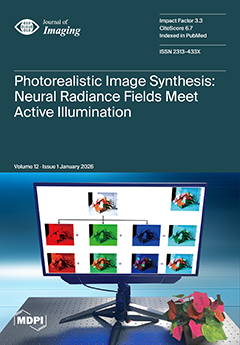
Cover Story (view full-size image):
Synthesizing photorealistic images of a scene from arbitrary viewpoints and under arbitrary lighting environments is one of the important research topics in computer vision and graphics. While novel view synthesis based on Neural Radiance Fields (NeRFs) has achieved remarkable success for standard materials, it remains challenging for fluorescent materials. Due to their excitation–emission behavior, the appearance of fluorescent materials under novel illumination strongly depends on its spectra and cannot be reproduced via conventional white balance adjustment. By leveraging active illumination, e.g., a display-camera system, and the superposition principle of images, this study achieves NeRF-based novel view synthesis of fluorescent materials under novel light source colors and spectra. View this paper
- Issues are regarded as officially published after their release is announced to the table of contents alert mailing list.
- You may sign up for e-mail alerts to receive table of contents of newly released issues.
- PDF is the official format for papers published in both, html and pdf forms. To view the papers in pdf format, click on the "PDF Full-text" link, and use the free Adobe Reader to open them.
Previous Issue
Next Issue
