1. Introduction
Breast cancer is now the most commonly diagnosed cancer globally, representing 11.7% of all new cancer cases (1 in 4 among women) and 6.9% of all cancer deaths (1 in 6 among women) worldwide [
1]. Early detection through imaging significantly improves survival rates, with mammography continuing to serve as the clinical gold standard for screening and diagnosis. Traditional full-field digital mammography (FFDM) offers high spatial resolution but limited sensitivity in dense breast tissues, prompting the development of contrast-enhanced spectral mammography (CESM) as an advanced alternative. CESM enhances lesion conspicuity by combining low- and high-energy acquisitions, improving the differentiation of benign and malignant abnormalities [
2].
Deep learning (DL) has revolutionized computer-aided diagnosis in mammography, enabling automated feature extraction and classification with performance approaching expert radiologists [
3]. Convolutional neural networks (CNNs) such as ResNet and DenseNet have been successfully applied to mammogram analysis for lesion detection, segmentation, and malignancy prediction [
4]. However, most CNN-based methods are limited to single-view processing or rely on simplistic feature concatenation, which cannot capture cross-view dependencies beyond simple aggregation between the two standard mammographic views—craniocaudal (CC) and mediolateral oblique (MLO). In contrast, radiologists interpret these views jointly to exploit their complementary anatomical information, suggesting that dual-view integration is critical for robust automated diagnosis [
5].
Recent innovations using Vision Transformers (ViTs) have introduced self-attention mechanisms capable of modeling long-range dependencies across multiple views or modalities. Hybrid CNN–Transformer architectures have achieved state-of-the-art accuracy in mammographic classification by combining local texture encoding with global contextual reasoning [
6,
7]. Furthermore, models such as NaFV-Net [
8] and Mam-Incept-Net [
9] demonstrated that attention-based fusion of multiple mammographic views substantially improves lesion localization and reduces false positives compared to CNN-only pipelines.
In the context of contrast-enhanced spectral mammography (CESM), multi-view and multi-phase data introduce both opportunities and practical challenges for automated analysis. The CDD-CESM dataset [
10] provides a useful benchmark for developing and evaluating such architectures. However, dual-view Transformer-based fusion in CESM remains underexplored, particularly when probability outputs are intended for decision support and therefore require uncertainty and calibration reporting [
7,
11].
To address this gap, the present study introduces Dual View Transformed Fusion, which formulates dual-view fusion at the token level and models complementary dependencies across views and feature extractors. Each breast side is represented using two ImageNet-pretrained CNN backbones (ResNet-101 and DenseNet-121) applied to both the craniocaudal (CC) and mediolateral oblique (MLO) projections, yielding four view-specific embeddings. These embeddings are mapped into a shared representation space and fused using a lightweight TransformerEncoder operating on a short token sequence augmented with a learnable classification token.
Beyond discrimination metrics, the framework also reports decision-support outputs by integrating Monte Carlo dropout for uncertainty estimation with per-fold post hoc logistic calibration. Probability quality is quantified using the Brier score, expected calibration error, and negative log-likelihood under patient-disjoint cross-validation. Accordingly, the contribution is not limited to dual-view fusion performance, but also includes an uncertainty-aware and calibrated probability pipeline evaluated for side-level triage on CDD-CESM.
2. Related Work
Deep learning (DL) has become the cornerstone of automated mammographic analysis due to its ability to learn discriminative visual representations directly from imaging data. Convolutional neural networks (CNNs) such as ResNet, DenseNet, and Inception architectures have shown remarkable accuracy in classifying breast lesions and segmenting regions of interest (ROIs) from mammograms [
3]. However, CNNs are inherently limited in modeling global contextual dependencies, particularly when applied to multi-view or multi-phase modalities such as contrast-enhanced spectral mammography (CESM).
To address this, several studies introduced attention mechanisms and Vision Transformers (ViTs) into mammographic pipelines, significantly improving classification performance. Ref. [
6] proposed a hybrid CNN–ViT model that combined convolutional feature maps with transformer encodings, achieving a substantial improvement in sensitivity for microcalcification classification. Similarly, ref. [
7] developed an attention-based multi-scale fusion transformer that effectively captured inter-view correlations in dual-view mammograms, outperforming single-view baselines on the INbreast and CBIS-DDSM datasets.
Traditional radiological interpretation relies on dual-view analysis—the craniocaudal (CC) and mediolateral oblique (MLO) views—to provide complementary anatomical context. Early computer-aided systems, however, typically processed these views independently. Ref. [
12] introduced a dual-view mass matching framework for breast cancer detection that used cross-view correspondence learning to improve mass localization accuracy. Building on this concept, ref. [
8] proposed NaFV-Net, an adversarial four-view architecture integrating CNN backbones and self-attention mechanisms for enhanced lesion classification.
Ref. [
9] later extended this idea through Mam-Incept-Net, which incorporated inception modules and attention-driven feature aggregation, achieving improved interpretability and higher AUC scores. More recently, ref. [
13] developed a multi-view co-occurrence and dual-modality fusion framework that integrates mammography and ultrasound data, underscoring the growing role of multimodal fusion in clinical AI for breast cancer diagnosis.
Contrast-Enhanced Spectral Mammography (CESM) has emerged as a powerful modality, providing both low-energy (LE) and recombined (subtracted) images that enhance lesion conspicuity. Deep learning models tailored to CESM data have demonstrated strong potential in differentiating malignant from benign lesions. Ref. [
14] presented a multiprocess DL system integrating multi-view CESM images with auxiliary fusion layers, showing significant diagnostic improvements in a multicenter study. Prior CESM-related deep learning work has also leveraged CC and MLO views jointly, including concatenation-based dual-view fusion, which supports treating feature concatenation as a baseline for multi-view integration in this study [
15].
Ref. [
4] proposed DualNet, a two-stream CNN architecture specifically designed for CESM-based classification, using improved watershed segmentation to enhance ROI delineation. In parallel, ref. [
11] demonstrated that ROI-stratified CNN–Transformer hybrids can effectively leverage CESM contrast information for malignancy discrimination.
Despite these advances, most CESM-focused models still process views or contrast phases separately. There remains a need for architectures that jointly model dual-view representations, capturing both spatial and contextual interdependencies.
The recent literature has underscored the transformative potential of Vision Transformers in multi-view medical imaging. Ref. [
16] proposed a multi-scale Swin Transformer framework capable of integrating features from multiple mammographic views and contrast levels, showing superior interpretability. Ref. [
7] further advanced this direction with a hybrid-view transformer fusion strategy combining CNN-extracted features and self-attention-based cross-view alignment.
Comprehensive reviews [
2,
3,
5] affirm that hybrid CNN–Transformer designs will continue to define the next generation of intelligent mammography systems, offering more transparent, data-efficient, and clinically reliable solutions. However, integrating dual-view fusion within CESM remains an underexplored yet promising research avenue—one that this study directly addresses.
3. Materials and Methods
This study is reported in accordance with the Checklist for Artificial Intelligence in Medical Imaging (CLAIM) and the TRIPOD + AI statement for prediction model reporting [
17,
18]. The experiments were conducted using the CDD-CESM dataset [
10] and formulated as side-level binary classification (Normal vs. Tumorous), where benign and malignant findings were merged into a single tumorous class. Model development and evaluation followed a patient-grouped 5-fold stratified cross-validation protocol to prevent leakage across folds.
3.1. Dataset and Task Definition
The experiments were conducted using the Categorized CESM dataset (CDD-CESM) [
10]. The CDD-CESM dataset contains 326 patients and 2006 images, including 1003 low-energy (DM) images and 1003 recombined images. Images are provided for left and right breasts in CC and MLO views, although some patients have missing views and a small number have duplicate acquisitions. In this study, only low-energy images were used. Side-level samples were formed at the breast-side level, resulting in 566 breast-side inputs across 326 patients. Of these, 435 sides contain both CC and MLO views, while 131 sides contain a single available view (65 CC-only and 66 MLO-only). For single-view sides, the missing view was handled by zero-padding to maintain a fixed two-view tensor representation. Duplicate acquisitions were identified when more than one low-energy image existed for the same patient, breast side, and view (CC or MLO). To avoid disproportionate weighting of individual patients, a single acquisition was retained per patient–side–view, and all remaining duplicates were excluded before tensor construction and fold generation. The retained acquisition was selected deterministically (first occurrence in the dataset ordering) to ensure reproducibility.
At the label level, CDD-CESM provides Normal, Benign, and Malignant annotations. For the binary task, Benign and Malignant were merged into a single Tumorous class to support dual-view triage under limited sample size. This endpoint corresponds to an abnormality triage setting, where the primary decision is whether a breast side contains any suspicious finding that warrants further assessment. Accordingly, benign findings were treated as positive together with malignant findings, while benign–malignant discrimination was not targeted in this study. The final binary distribution used in the experiments was Normal = 189 and Tumorous = 377. The tri-class distribution was Normal = 189, Benign = 194, and Malignant = 183.
Side-level labels were derived using a worst-case aggregation rule across the available views for the same breast side. Specifically, if CC and MLO labels differed, the side label was set to the higher-severity class (Malignant > Benign > Normal).
Table S1 summarizes the dataset composition and the derived side-level sample counts.
3.2. Input Construction and Preprocessing
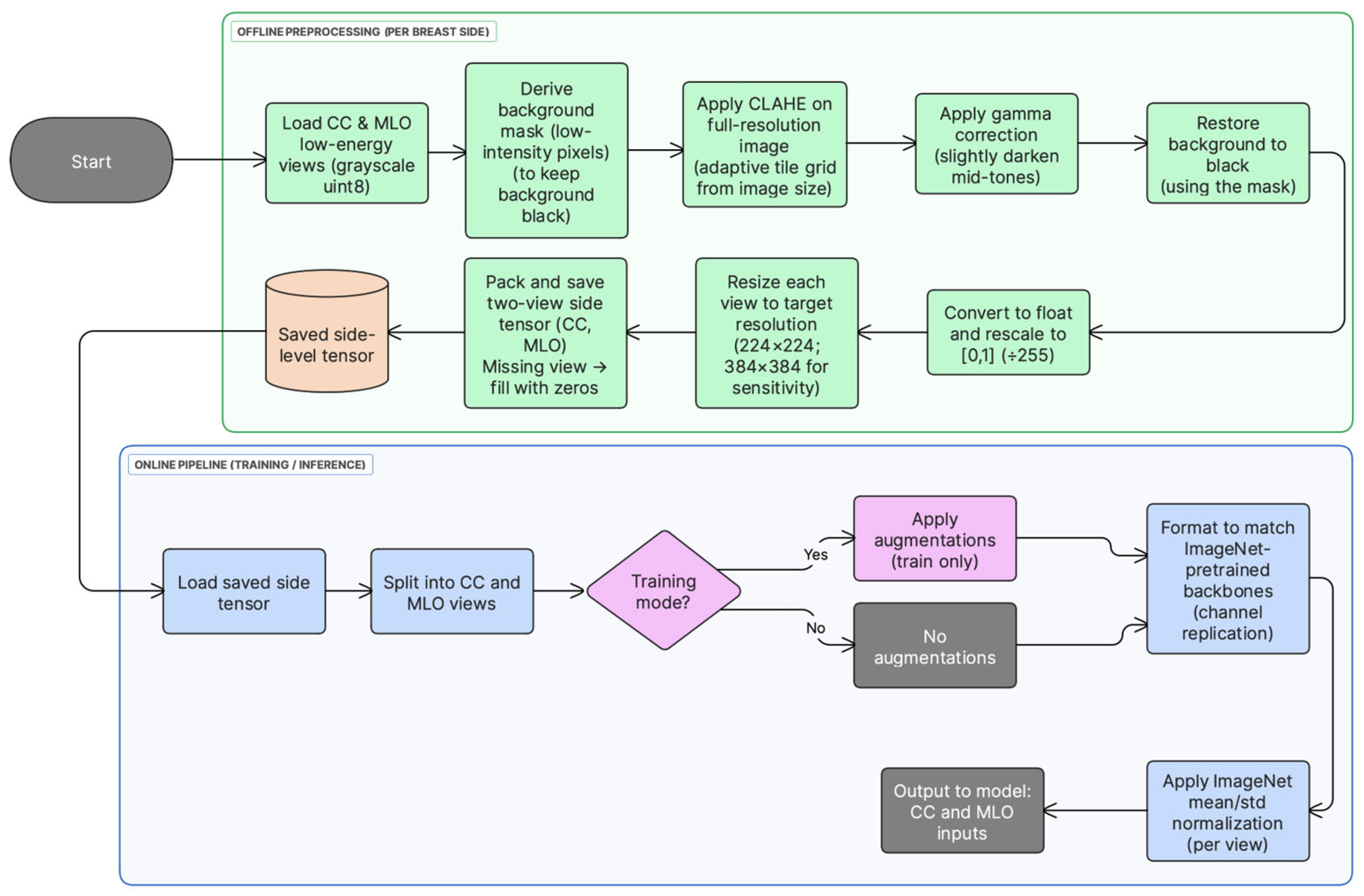
All low-energy CESM images were preprocessed offline before model training. First, each CC/MLO view was loaded as an 8-bit grayscale image. Second, a background mask was derived from the original image (pixel values ≤ 5) and used to keep the background black after enhancement. Third, local contrast was enhanced on the full-resolution image using contrast-limited adaptive histogram equalization (CLAHE) with clipLimit = 1.0 and an adaptive tileGridSize selected from the image size to approximate 1000-pixel tiles (grid = (round (w/1000), round (h/1000)), clipped to [4, 64] tiles per axis). Fourth, gamma correction (γ = 2.5) was applied to slightly darken mid-tones while preserving bright structures, and background pixels were restored to zero using the mask. Fifth, the enhanced image was converted to float and rescaled to [0, 1] by dividing by 255, and then resized to 224 × 224 pixels. Finally, for each breast side, the processed CC and MLO views were stored as two grayscale channels in a tensor; if a view was unavailable, its channel was filled with zeros. This offline pipeline enforced identical preprocessing across folds and reduced runtime overhead. Preprocessing choices follow established mammography deep learning pipelines [
7,
12].
Figure 1 summarizes the preprocessing and input construction steps used in this study.
During training, lightweight data augmentation (random horizontal flips and small rotations) was applied at load time. Each grayscale view was then converted to a 3-channel pseudo-RGB input by channel replication to enable direct use of ImageNet-pretrained CNN backbones, followed by standard ImageNet mean/std normalization. In contrast, CLAHE-based enhancement (including gamma correction and background masking) and tensor construction were performed offline and remained fixed across folds.
If either CC or MLO was unavailable for a breast side, the corresponding missing view channel was filled with an all-zero image (224 × 224 or 384 × 384), so the network always received a fixed two-view tensor; after ImageNet normalization this missing input becomes a constant-valued map.
To assess sensitivity to input resolution, an additional tensor set was generated directly from the original low-energy images at 384 × 384 resolution (i.e., not upsampled from 224 × 224 tensors). The same offline preprocessing pipeline was applied at native resolution, including full-resolution CLAHE-based enhancement, gamma correction, background masking, and rescaling to ([0, 1]), followed by resizing to 384 × 384 and two-view tensor packing. The same training and evaluation protocol was then used. As in the main setting, pseudo-RGB conversion, optional augmentation (training only), and ImageNet normalization were applied at load time.
3.3. Data Augmentation
Light augmentation was applied during training to reduce overfitting while preserving mammographic structure. Random horizontal flipping with probability 0.5 and random rotation within ±10° were applied. Validation and test samples were processed without augmentation. This ensured that reported test performance reflected generalization under a consistent input distribution.
Augmentations were applied consistently at the breast-side level. For each side-level sample, the flip decision and rotation angle were sampled once and then applied identically to both CC and MLO images to preserve interprojection geometric consistency required for fusion learning. Therefore, CC/MLO alignment was not artificially disturbed by independent view-wise augmentation. Validation and test samples were processed without augmentation.
3.4. Cross-Validation Protocol and Leakage Control
A 5-fold StratifiedGroupKFold protocol was used. Stratification was performed on the binary label, and grouping was performed by patient ID. This ensured that samples from the same patient were not shared across training and test folds. Since radiological views from the same patient are correlated, this constraint was applied to prevent leakage and optimistic performance estimates.
Within each training fold, a validation subset was created by holding out 15% of patients using patient-level stratification, so validation remained patient-disjoint from both training and the held-out test fold. The resulting subsets were used as follows:
The training subset was used for optimization,
The validation subset was used for early stopping and threshold selection, and
The held-out fold was used only for final testing.
To prevent leakage, all samples were grouped by patient identifier, such that both views (CC/MLO) and both breast sides from the same patient were always assigned to the same fold. After fold generation, split integrity was verified by checking that the intersection of patient IDs between training, validation, and test partitions was empty for every fold (i.e., zero shared patients across partitions).
3.5. Class Imbalance Handling
Class imbalance was addressed in two steps. First, a WeightedRandomSampler was applied to the training subset using inverse class frequency. Second, class-weighted cross-entropy loss was used, where weights were computed from the training fold distribution. This combination was applied to stabilize learning and to reduce bias toward the majority class.
3.6. Dual-Backbone Feature Extraction
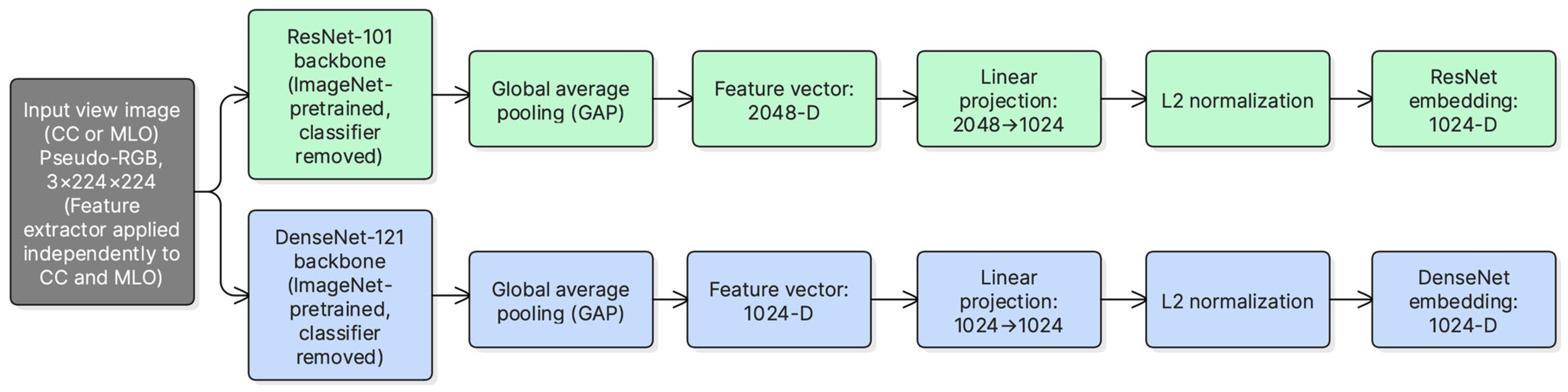
Dual-view representation learning was performed using two ImageNet-pretrained CNN backbones, ResNet-101 and DenseNet-121. For ResNet-101, the network was truncated before the original pooling and classification layers, and the final convolutional feature map was aggregated using global average pooling to obtain a 2048-dimensional vector. This vector was then mapped to a 1024-dimensional embedding using a learnable linear projection (2048 → 1024). For DenseNet-121, the final convolutional feature map was likewise globally pooled to obtain a 1024-dimensional vector, followed by a linear mapping to 1024 dimensions (1024 → 1024). A 1024-dimensional embedding size was adopted to match the transformer fusion dimension while keeping fusion complexity moderate. Finally, embeddings were L2-normalized prior to fusion to stabilize token scale.
Both CC and MLO views were passed through each backbone, producing four embeddings per breast side. This design enables complementary feature extraction, where global structures and fine-grained texture patterns can be captured through different backbone characteristics.
Figure 2 illustrates the feature extraction modules used for ResNet-101 and DenseNet-121.
For each breast side, two low-energy views are available (CC and MLO). Each view is encoded using two CNN backbones, ResNet-101 and DenseNet-121. This produces four embeddings:
where
and
denote ResNet and DenseNet, respectively. Each embedding is projected into a common
-dimensional space (here
) and L2-normalized to keep token scales consistent across backbones.
A learnable classification token
is prepended to form a token sequence of length 5:
This construction preserves view identity and backbone diversity before fusion.
3.7. Transformer-Based Cross-View Fusion (DVTF)
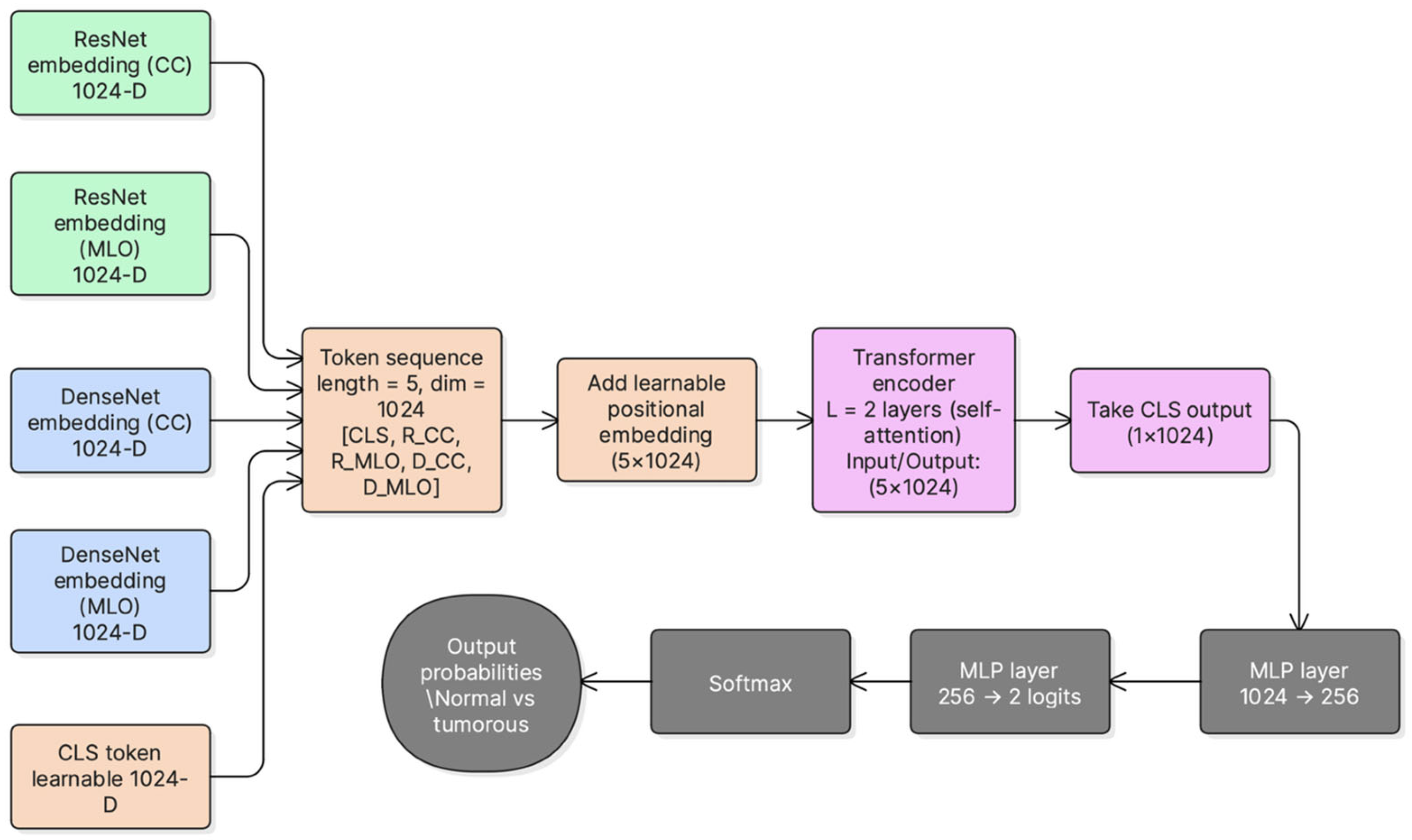
After feature extraction, the four view-backbone embeddings were projected into a unified 1024-dimensional space and L2-normalized. A learnable [CLS] token was prepended to form a sequence of five tokens. This sequence was passed to a 2-layer TransformerEncoder to model cross-view and cross-backbone dependencies through multi-head self-attention and feed-forward sublayers. In this implementation, the transformer encoder consisted of two encoder layers with 4 attention heads (d = 1024) and a 4096-dimensional feed-forward sublayer (i.e., 4 × d). GELU was employed as the activation function, and dropout (
p = 0.2) was applied within the attention and feed-forward sublayers. In addition, a learnable positional embedding was added to the 5-token sequence ([CLS] + four view tokens) prior to fusion. This approach aligns with prior work that uses attention mechanisms to model inter-view relationships beyond simple feature concatenation [
6,
8].
The final [CLS] embedding was used as the fused representation for classification. A two-layer MLP head (1024 → 256 → 2) produced logits for Normal vs. Tumorous classification.
Figure 3 summarizes the fusion architecture used in DVTF.
The token sequence
is processed using a TransformerEncoder to model cross-view and cross-backbone dependencies through self-attention [
6,
8]. For each encoder layer, the update can be written as:
where MSA denotes multi-head self-attention and FFN denotes the position-wise feed-forward network. In practice, attention is implemented through learned query, key, and value projections (
) as in standard transformer formulations [
6,
8]. The final fused representation is taken from the output
token. This fused feature is then passed to the MLP classifier to predict Normal versus Tumorous.
Attention-based refinement mechanisms have been used in medical image analysis to combine global contextual cues with local detail and to focus feature integration on anatomically relevant regions. This precedent supports using self-attention to promote cross-view feature interaction beyond simple aggregation [
19].
3.8. Uncertainty Estimation Using MC-Dropout
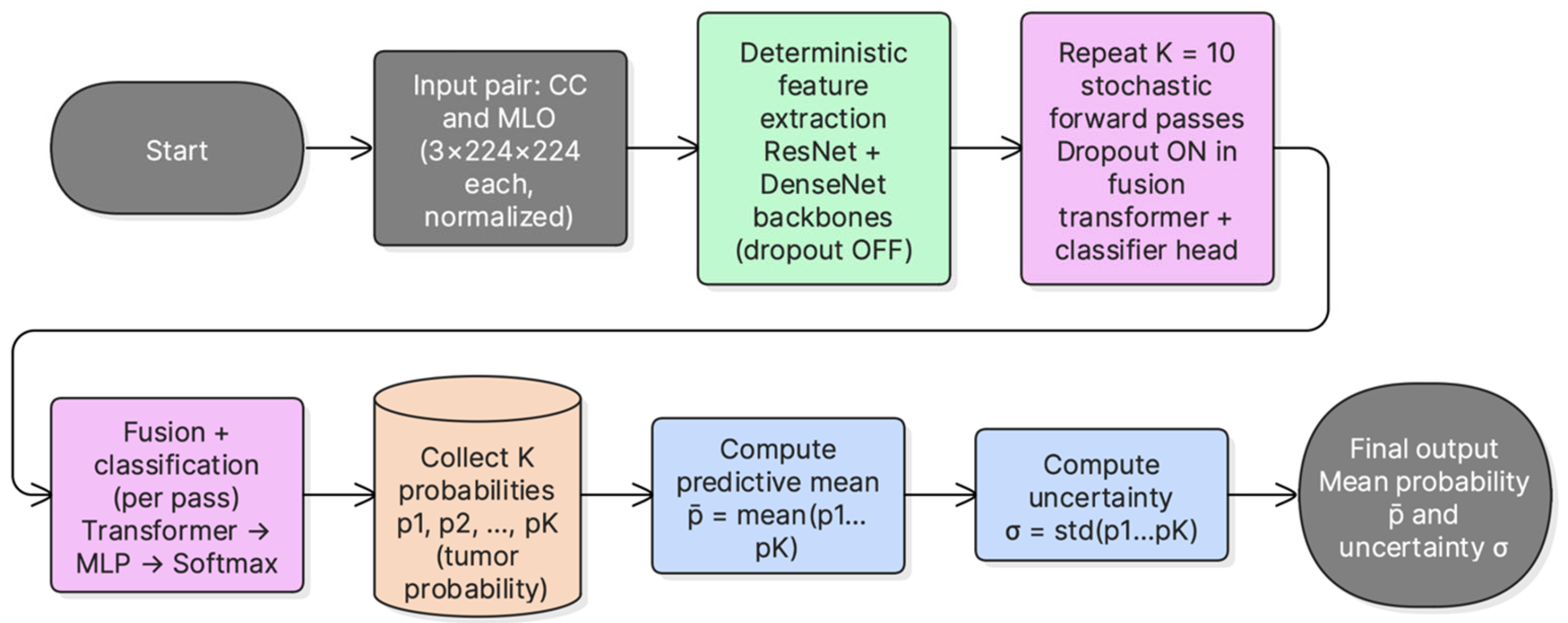
Epistemic uncertainty was estimated using Monte Carlo dropout during inference. At test time, dropout layers were kept active and multiple stochastic forward passes were performed per sample. The mean tumorous probability across passes was used as the predictive probability. The standard deviation of the tumorous probability across passes was used as an uncertainty score. This provides a simple uncertainty estimate without modifying the base architecture.
Figure 4 summarizes the inference procedure used to obtain the MC mean probability and uncertainty score.
MC Dropout was performed with K = 10 stochastic forward passes per sample. Dropout (p = 0.2) was enabled during inference for the transformer encoder and classification head. No dropout layers are present in the ResNet-101 and DenseNet-121 feature extractors; therefore, the stochasticity introduced by MC-Dropout is confined to the fusion encoder and classification head. The predictive probability was computed as the mean of the K softmax outputs, and uncertainty was quantified as the standard deviation of the Tumorous-class probability. A logistic calibration model was then fitted per fold on the validation MC probabilities and applied to the corresponding test fold.
3.9. Post Hoc Logistic Calibration
Post hoc logistic calibration was applied to improve probability behavior. For each fold, calibration parameters were learned using the validation subset. The calibrator was applied to the MC mean probability using a logistic mapping in logit space:
The learned parameters were then applied to the test MC mean probabilities to obtain calibrated probabilities. This step transforms confidence values via a 1D logistic mapping and typically preserves ranking when the fitted mapping is monotonic.
3.10. MC-Dropout K-Sensitivity and Runtime
The K-sensitivity analysis was conducted as an independent rerun of the full training and evaluation pipeline under the same 5-fold protocol. In the primary uncertainty experiments, the number of MC-dropout stochastic forward passes was set to . In addition, a sensitivity analysis was performed using to quantify the effect of on discrimination, calibration, and runtime. For each fold and each , MC mean probabilities were computed on the validation subset, and a fold-specific logistic calibrator was fitted using the corresponding validation labels. The fitted calibrator was then applied to the test MC mean probabilities prior to metric computation. Latency was measured on an NVIDIA A100 GPU using batch size 16 and is reported as milliseconds per sample and per batch. This analysis provides a practical trade-off between calibration quality and computational cost.
3.11. Ablation Study Design (Models A–E)
An ablation study was conducted to quantify the incremental contribution of each design component. All models used the same dataset splits, transforms, optimization schedule, and evaluation pipeline. The evaluated configurations were:
Model A: simple CNN baseline using LE CC without transformer fusion and without MC-dropout;
Model B: dual-view CNN baseline using conventional feature fusion without transformer fusion and without MC-dropout;
Model C: deterministic DVTF using dual backbones and transformer fusion without MC-dropout;
Model D: DVTF with MC-dropout inference, reporting MC mean probability and uncertainty;
Model E: DVTF with MC-dropout inference and post hoc logistic calibration. Model E was treated as the main model in this paper.
Fusion baseline (Weighted): learnable weighted averaging over the four tokens , followed by an MLP head (evaluated with MC-dropout + logistic calibration);
Fusion baseline (Gated): feature-wise gating between CC and MLO per backbone, then backbone fusion by concatenation + projection (evaluated with MC-dropout + logistic calibration);
Fusion baseline (Cross-attention): two-token attention between per backbone, then backbone fusion by concatenation + projection (evaluated with MC-dropout + logistic calibration).
The three fusion baselines were added to isolate the contribution of the DVTF transformer fusion beyond simple token weighting, view-gating, and two-token cross-attention. All baselines retained the same feature extractors and the same outer 5-fold patient-disjoint protocol, and they were evaluated using the same MC-dropout inference (K = 10) and per-fold logistic calibration procedure used for Model E, to ensure a like-for-like comparison of probabilistic outputs.
Model A (single-view CNN baseline): Model A used a single low-energy CC view for each breast side. The input was obtained from the pre-created tensor representation by selecting channel 0 (CC LE), while the MLO channel was ignored. A DenseNet-121 backbone pre-trained on ImageNet was employed as a feature extractor. The final convolutional features were passed through ReLU and aggregated using global average pooling, producing a 1024-dimensional feature vector (DenseNet-121 classifier input). Classification was then performed using a lightweight MLP head with the structure 1024 → 256 → 2, using ReLU and dropout (
p = 0.3). This baseline is deterministic and does not use attention or transformer-based fusion.
where
is DenseNet-121 with global average pooling.
Model B (dual-view CNN baseline): Model B employed a shared DenseNet-121 backbone (ImageNet-pretrained) to extract features independently from the CC and MLO low-energy views. For each view, the final convolutional feature map was passed through ReLU and aggregated using global average pooling, yielding a 1024-dimensional vector. The two view vectors were then combined using feature concatenation to form a 2048-dimensional fused representation. Finally, classification was performed using a lightweight MLP head (2048 → 256 → 2) with ReLU and dropout (
p = 0.3). No transformer or attention module was used, and fusion was implemented as deterministic late fusion by concatenation.
Model C (DVTF without MC-dropout): Model C implemented dual-view transformer fusion at the breast-side level. For each tensor, the CC low-energy image (channel 0) and MLO low-energy image (channel 1) were extracted. Each view was converted to pseudo-RGB and processed using the same ImageNet normalization used across models. Two ImageNet-pretrained backbones were employed in parallel: ResNet-101 and DenseNet-121. From each backbone, a 1024-dimensional L2-normalized embedding was produced for each view using global average pooling followed by a linear projection. This produced four tokens per side:
. A learnable [CLS] token and learned positional embeddings were appended to form a sequence of 5 tokens of dimension 1024. The token sequence was then fused using a 2-layer Transformer encoder with 4 attention heads and a feed-forward dimension of
, using GELU activations and dropout
. The final [CLS] embedding was mapped to logits using a lightweight classifier head 1024 → 256 → 2 with GELU and dropout
. Model C is evaluated deterministically using a single forward pass at test time; thus, dropout is not used for Monte Carlo sampling and no calibration model is fitted.
where
are view–backbone tokens.
Model D (DVTF with MC-dropout): Model D used the same dual-view transformer fusion architecture as Model C, but enabled Monte Carlo (MC) dropout during inference to estimate predictive uncertainty. The CC and MLO low-energy images were extracted from tensor channels 0 and 1, converted to pseudo-RGB, and normalized using ImageNet statistics. Two ImageNet-pretrained feature extractors (ResNet-101 and DenseNet-121) generated four 1024-D L2-normalized tokens per side (CC/MLO × backbone). A learnable [CLS] token and learned positional embeddings formed a 5-token sequence that was fused by a 2-layer Transformer encoder (4 attention heads, GELU activations, dropout
p = 0.2). The resulting [CLS] embedding was classified using a 1024 → 256 → 2 head with dropout. During training, the model used deterministic dropout as regularization. During evaluation, dropout layers were explicitly kept in training mode and K = 10 stochastic forward passes were performed per sample. The final probability was computed as the mean softmax probability across the K samples, and uncertainty was defined as the standard deviation of the Tumorous-class probability across the K samples. All discrimination and calibration metrics (ROC-AUC, PR-AUC, Brier score, and ECE) were computed from the MC mean probability.
Model E (DVTF with MC-dropout and logistic calibration): Model E extended Model D by applying a per-fold post hoc logistic calibration to the MC-dropout probabilities. The same DVTF backbone and fusion procedure were used, with CC and MLO low-energy images taken from tensor channels 0 and 1, converted to pseudo-RGB, and normalized using ImageNet statistics. For each side, four 1024-D L2-normalized tokens (CC/MLO × ResNet-101/DenseNet-121) were fused using a 2-layer Transformer encoder (4 heads, GELU, dropout ) with a learnable [CLS] token and learned positional encodings. At inference, dropout layers were kept active and K = 10 stochastic forward passes were performed per sample. The MC mean Tumorous probability was then calibrated using a validation-fitted 1D logistic mapping of the form . The calibration parameters were learned on the validation set of each fold by minimizing binary cross-entropy for 500 optimization steps (Adam, learning rate 0.01). The fitted mapping was then applied to the corresponding fold test set to obtain calibrated probabilities . Threshold selection for F1 was performed on the calibrated validation probabilities, and all reported discrimination and calibration metrics (ROC-AUC, PR-AUC, Brier score, and ECE) were computed using the calibrated test probabilities. Uncertainty was retained from the MC-dropout procedure and reported as the standard deviation of the Tumorous probability across the K samples (identical to Model D).
This design enables direct comparison of conventional dual-view fusion versus transformer-based fusion, and deterministic inference versus uncertainty-aware and calibrated inference. In addition, component-wise ablation is reported to quantify the contribution of each architectural block, following common practice in medical imaging method development where module-level gains are explicitly isolated [
19].
3.12. Evaluation Metrics and Threshold Selection
Performance was evaluated using accuracy, sensitivity, specificity, precision, and F1-score, as well as ROC-AUC and PR-AUC. Probability quality was evaluated using the Brier score and Expected Calibration Error (ECE) computed using 10 equal-width bins. Negative log-likelihood (NLL) was additionally reported as a proper scoring rule, computed from the calibrated tumorous probability as , where lower values indicate better probabilistic calibration.
For each fold, Monte Carlo dropout was first applied on the validation subset to obtain mean tumorous probabilities. Next, a logistic calibrator was fitted on the validation outputs and applied to the same validation probabilities. The fold-specific operating threshold was then selected by sweeping and maximizing validation F1 on the calibrated validation probabilities . Finally, the same calibrator was applied to the test probabilities and the selected was applied to to obtain discrete predictions.
After post hoc calibration, predicted probabilities were converted into discrete class labels using the same decision threshold employed for reporting accuracy, sensitivity, specificity, precision, and F1-score. Confusion matrix counts were then computed with Normal treated as the negative class and Tumorous treated as the positive class. To match the pooled ROC/PR analysis, counts were aggregated across the five held-out folds using out-of-fold test predictions.
In each fold, splitting was performed at the patient level using the patient identifier as the grouping variable. Thus, all samples from the same patient (including both CC and MLO views, and both breast sides if present) were assigned to the same split. Within each training fold, the validation subset was created by holding out 15% of patients (not samples), and therefore remained patient-disjoint from both training and test data.
In addition, sensitivity at fixed specificity (0.90, 0.95, and 0.97) was evaluated by selecting a decision threshold on the validation subset of each fold to achieve at least the target specificity, and then reporting the resulting test sensitivity and specificity at that threshold.
This protocol enables patient-grouped evaluation, supports consistent model comparison in the ablation, and reports both discrimination and probability quality.
3.13. Training and Implementation Settings
Experiments were conducted in Google Colab using an NVIDIA A100-SXM4-40GB GPU (40 GB). The environment used Python 3.12.12 and PyTorch 2.9.0 + cu126 (CUDA 12.6, cuDNN 91002). Optimization used Adam with a learning rate of 1 × 10
−4 and weight decay of 1 × 10
−4, with cosine annealing (T_max = 30, η_min = 1 × 10
−6). Training used batch size 16 and a maximum of 60 epochs, with early stopping based on validation ROC-AUC (patience = 10). MC-dropout used K = 10 passes and logistic calibration was fitted per fold using the validation subset. Full settings are summarized in
Table S2.
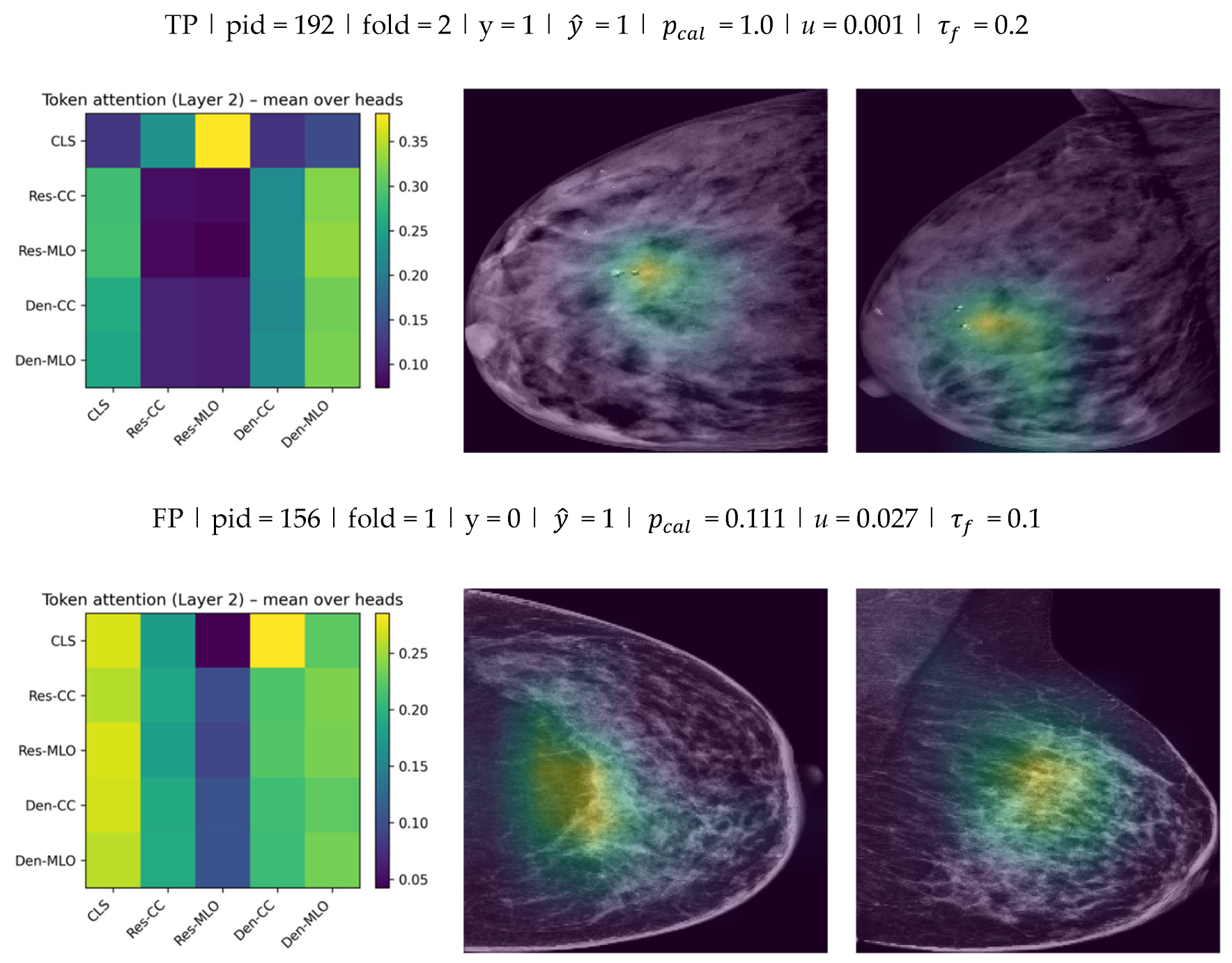
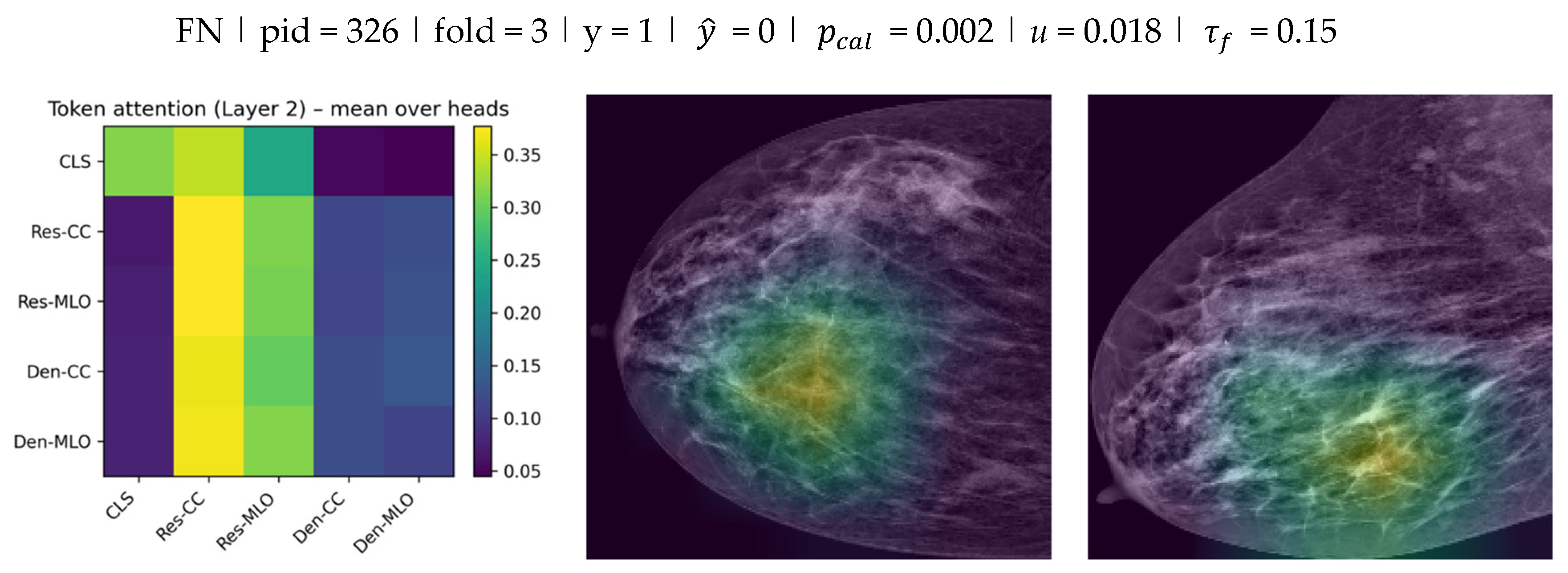
3.14. Fusion Token Attention and Grad-CAM Qualitative Explanation
To provide qualitative evidence of how the proposed dual-view fusion operates, two complementary visualizations were generated. First, token-level attention weights were extracted from the fusion transformer to illustrate interactions between the five tokens . Attention was taken from the second (final) transformer encoder layer and averaged across heads, then displayed as a token-to-token matrix (rows as query tokens and columns as key tokens). This visualization reflects cross-token weighting at the embedding level rather than pixel-level saliency. Second, Grad-CAM was applied to the ResNet stream to localize image regions contributing to the decision in each view. Grad-CAM heatmaps were computed using the final convolutional block and overlaid on the low-energy CC and MLO images. The attention matrix and the two Grad-CAM overlays were reported together for the same test cases to link fusion behavior with spatial evidence in both views.
These visualizations support an interpretable view of both fusion-level interactions and view-specific spatial contributions.
5. Discussion
Recent CESM studies have reported strong discrimination using attention mechanisms, fusion strategies, and combinations of imaging with clinical variables, depending on the task definition and endpoint [
20,
21].
However, many pipelines still evaluate views with limited cross-view interaction or do not report uncertainty-related outputs. This motivates models that (i) fuse CC and MLO features explicitly and (ii) provide probability outputs that are more informative for downstream decision support.
In this work, DVTF is reported using the calibrated MC-dropout configuration (Model E). The model combines dual-backbone convolutional feature extraction with transformer-based fusion and then estimates uncertainty using stochastic forward passes during inference. Uncertainty quantification methods of this type have been reviewed as practical additions for medical imaging models when probability outputs are required [
22].
5.1. Comparative Evaluation with Prior CESM-Based Studies
Table 6 summarizes representative CESM-related studies that are commonly cited for deep learning or machine learning analysis, together with the main metrics that were reported in those works.
The table is only intended as a contextual comparison because datasets, endpoints, and evaluation protocols differ across studies.
In
Table 6, Model E shows high mean discrimination while operating on standard dual-view low-energy inputs. The main practical difference is that uncertainty and calibration metrics are also reported in this study, whereas many prior CESM papers focus primarily on accuracy and AUC without probability quality measures.
5.2. Performance and Architectural Insights
The ablation results (
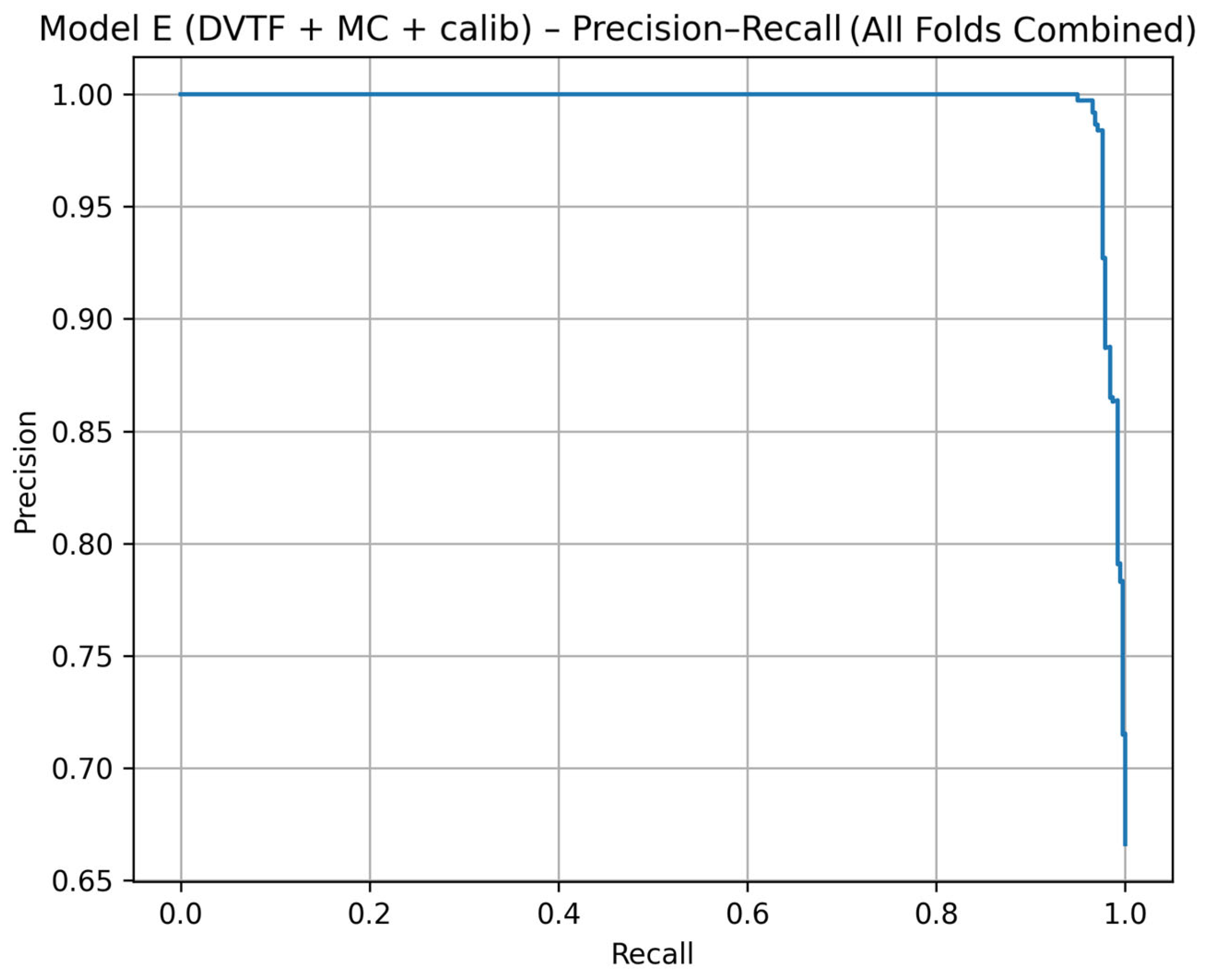
Table 3) support the contribution of each model component. First, moving from a single-stream baseline to explicit dual-view learning improved side-level discrimination, which is consistent with the clinical role of complementary CC and MLO information. Second, adding transformer-based fusion maintained strong ROC and PR behavior (
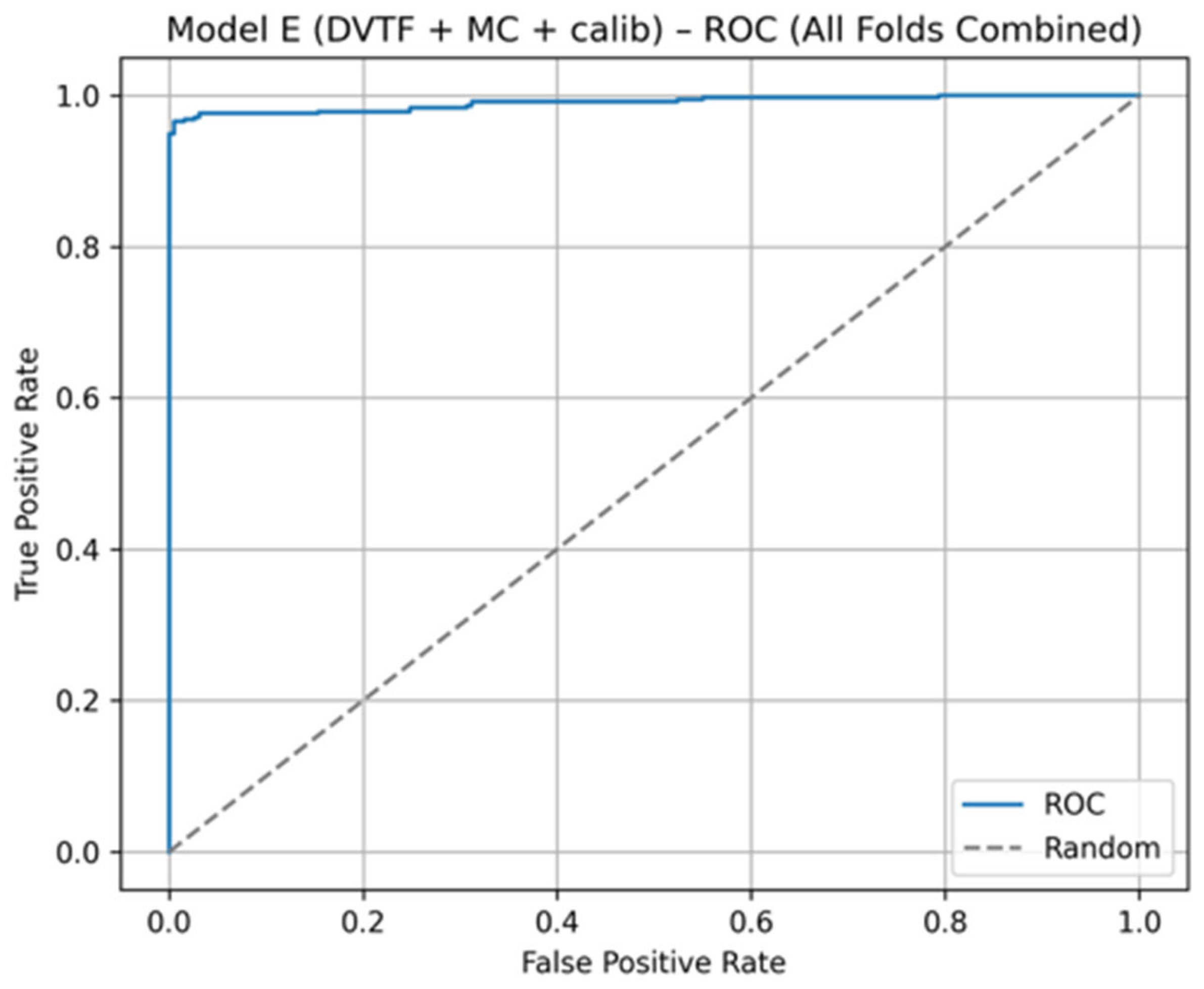
Figure 5 and
Figure 6) while providing a structured mechanism for cross-view interaction.
Third, MC-dropout enabled uncertainty estimation through repeated stochastic forward passes, and post hoc logistic calibration improved probability quality as reflected by the reduced Brier score and ECE in Model E relative to earlier variants (
Table 3). Overall, the ablation indicates that the final configuration improves probability usefulness while maintaining high discrimination.
5.3. Uncertainty Estimation and Practical Relevance
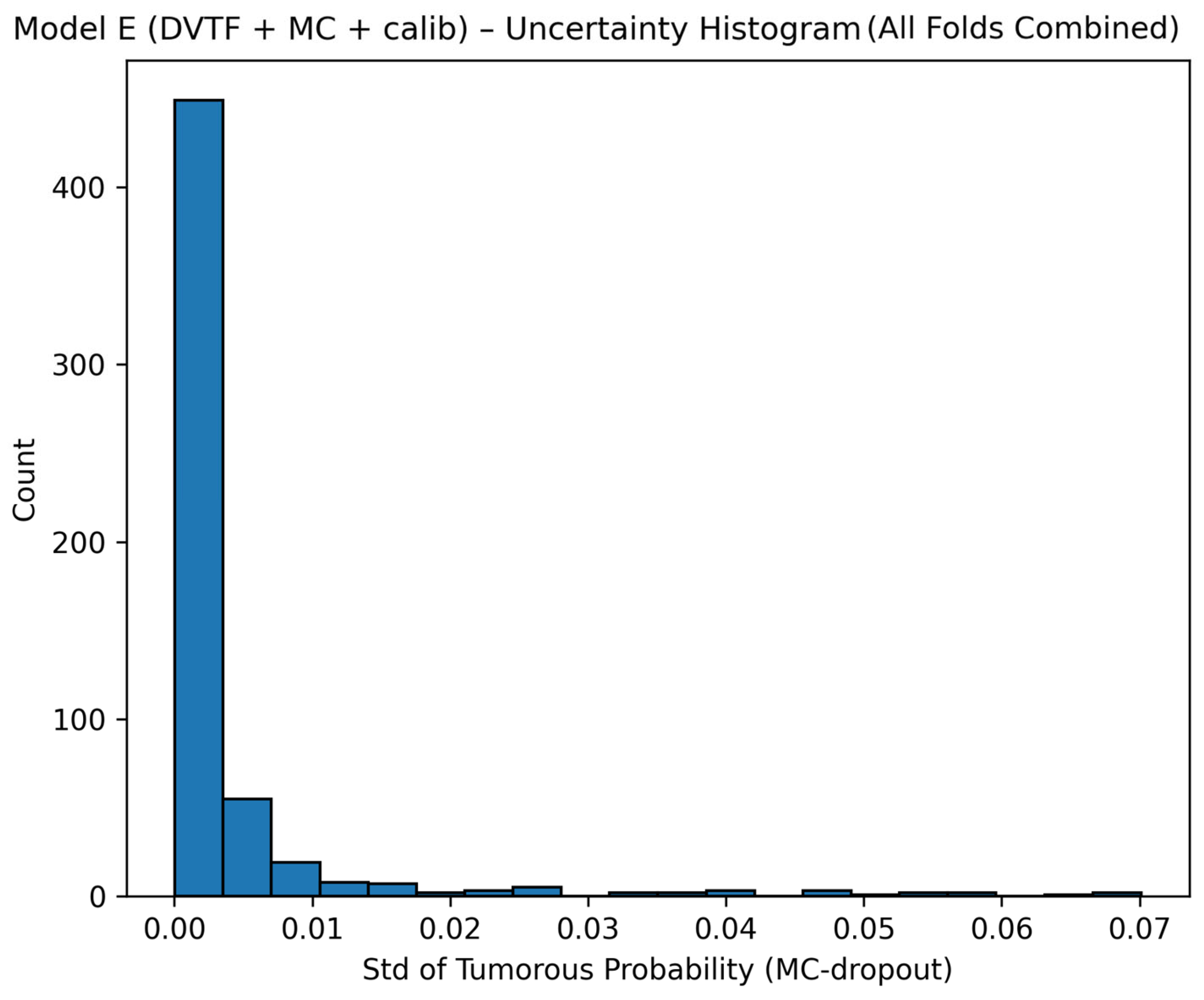
Uncertainty was quantified as the standard deviation of the tumorous probability across MC-dropout passes. The combined uncertainty histogram (
Figure 8) shows that most predictions concentrate at low uncertainty, with a smaller tail of higher-uncertainty cases. This pattern is expected when the model is confident for many samples but remains uncertain for a minority of difficult cases.
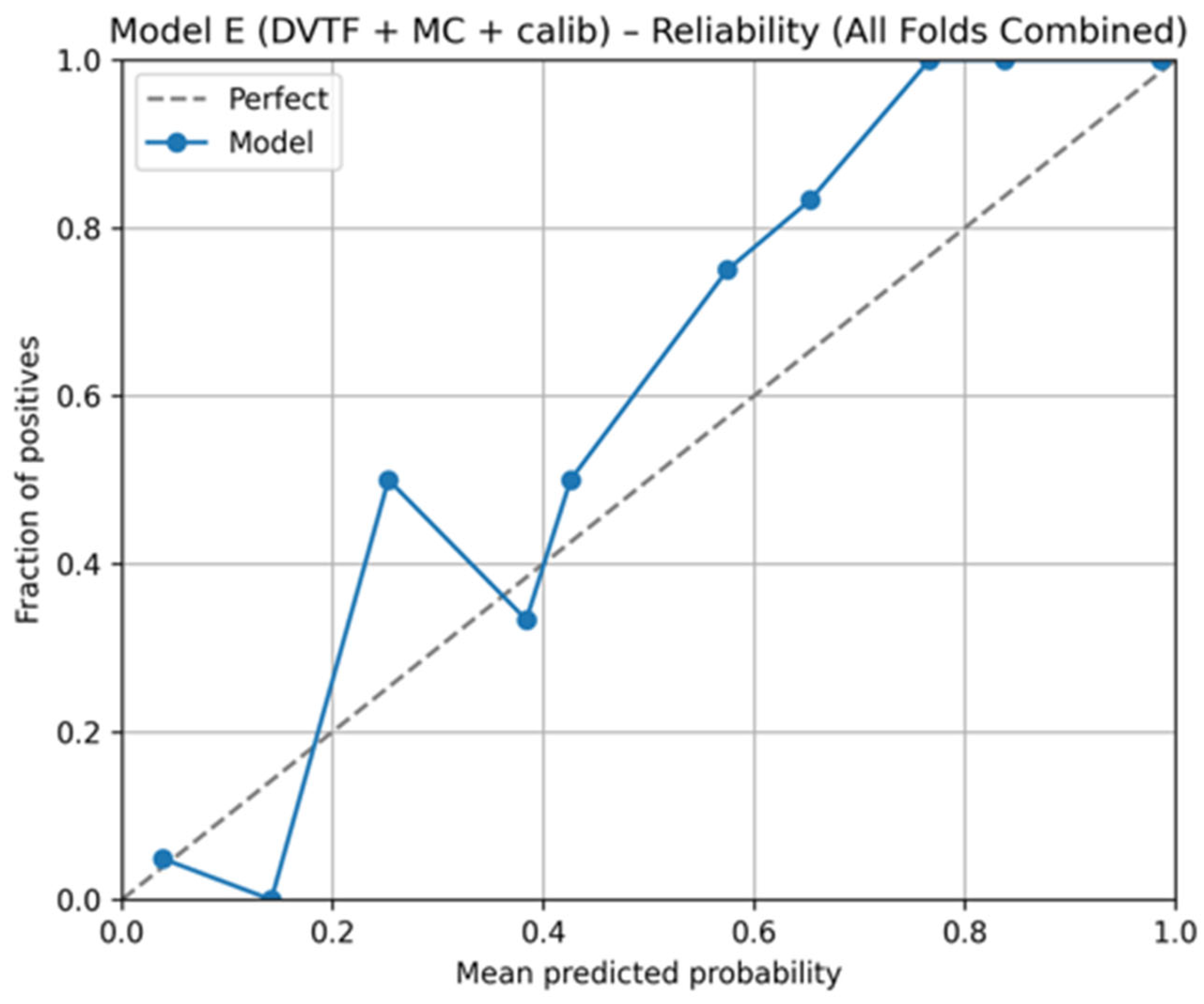
The reliability diagram (
Figure 7) provides a complementary view by comparing mean predicted probabilities with observed outcome frequency after calibration. Deviations from the diagonal indicate remaining miscalibration in specific probability ranges. These outputs can support a simple workflow where high-uncertainty or poorly calibrated probability regions are prioritized for secondary review, rather than being treated as equally reliable as low-uncertainty predictions.
5.4. Limitations
Several limitations should be considered. First, the dataset size (326 patients) and retrospective design may limit cross-site generalization.
Second, Model E was evaluated using low-energy images only. Cross-energy or recombined-image fusion may provide additional contrast information and has been explored in prior work on cross-energy feature fusion [
26].
Third, the cross-paper results summarized in
Table 6 are included for context only and cannot be treated as a direct benchmark because task definitions, datasets, and evaluation protocols vary across studies.
In addition, clinical factors such as acquisition protocol and contrast medium usage can influence lesion conspicuity and should be considered when comparing results across sites [
27].
No explicit domain-shift analysis across scanners or centers was performed; thus, generalization under different acquisition settings remains unverified. From a practical perspective, MC-dropout introduces an approximately linear runtime overhead with
(
Table S6), and this trade-off should be considered for clinical deployment.
Moreover, prior CESM studies differ in the image representations used (e.g., low-energy only versus recombined representations), which can affect reported performance and limits strict comparability across publications [
15].
Furthermore, this study did not include a reader study or prospective workflow evaluation. Future work may include external validation, decision-threshold evaluation under different operating points, and explicit explainability visualizations to support clinical review.
Finally, as a consequence of the endpoint definition, the reported performance should be interpreted as Normal vs. Tumorous triage performance rather than malignant-only classification performance.
5.5. Summary
This study reported a dual-view fusion framework for side-level classification using low-energy (DM) images from CESM acquisitions and evaluated it using patient-grouped cross-validation. The final model configuration (Model E) combined dual-backbone feature extraction, transformer fusion, MC-dropout uncertainty, and logistic calibration. The resulting performance remained high while also reporting probability quality and uncertainty outputs, which are needed when probabilities are intended for decision support.