
A Dual Stream Deep Learning Framework for Alzheimer’s Disease Detection Using MRI Sonification


Abstract
1. Introduction
- Invasive data modalities, some of the AD diagnosing models rely on imaging techniques that involve radioactivity, such as PET scans, which make them not suitable for long-term monitoring or repeated acquisition.
- Some multimodal approaches integrate heterogeneous data such as speech, clinical assessments, and genetic information, which are costly and hard to collect.
- Depending on computationally expensive architectures.
- Relying on a single data modality, such as MRI scans, which may fail in capturing latent AD-related features.
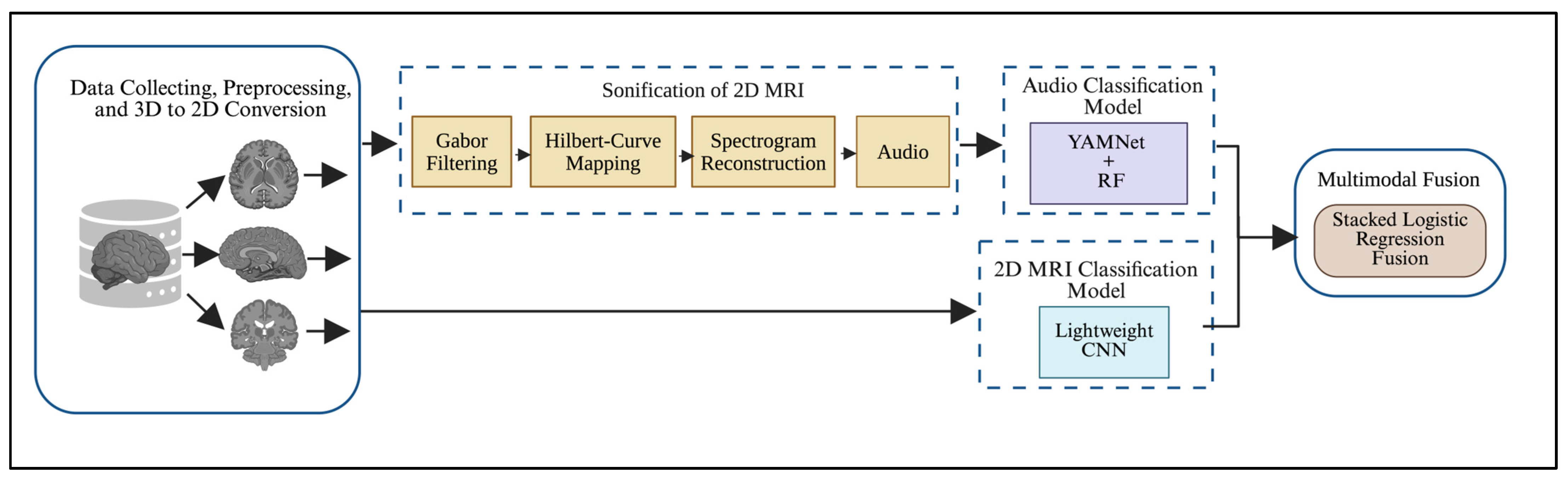
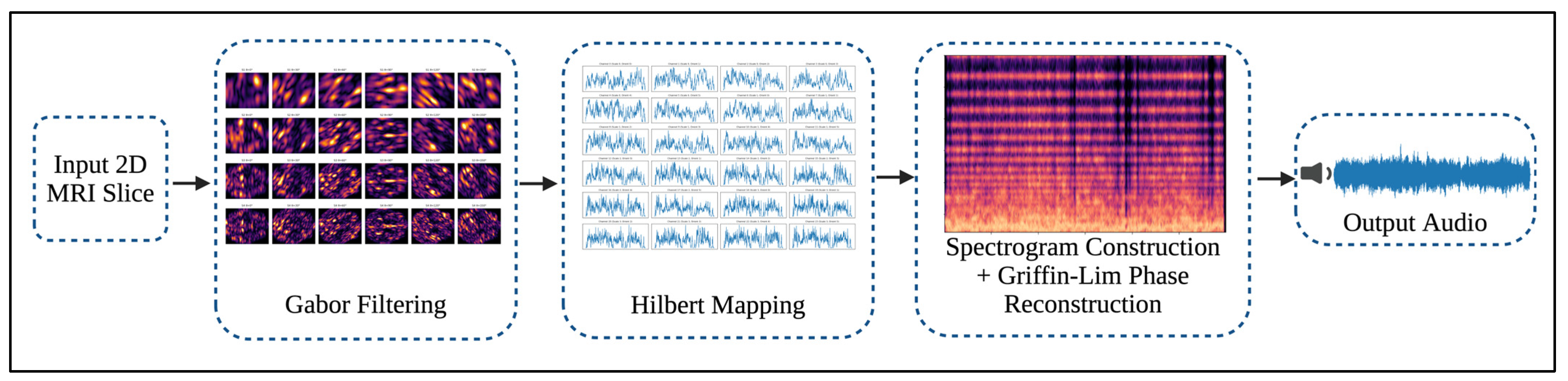
- A novel MRI sonification framework that converts 2D MRI slices into audio signals using a Gabor filter bank and a locality preserving Hilbert curve.
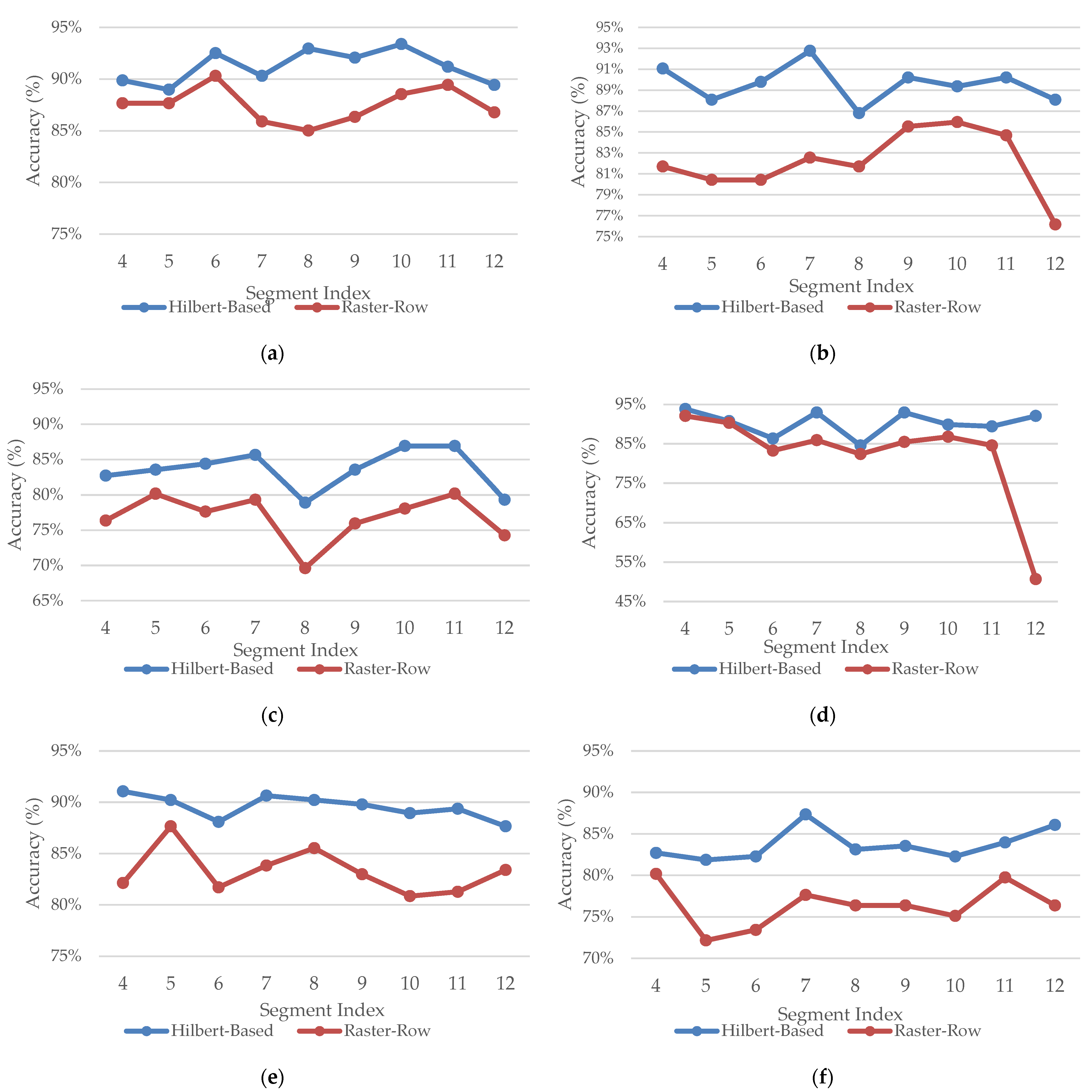
- Using the Hilbert curve instead of simple raster row scanning for time mapping for locality preserving within the audio domain, which yielded better performance results.
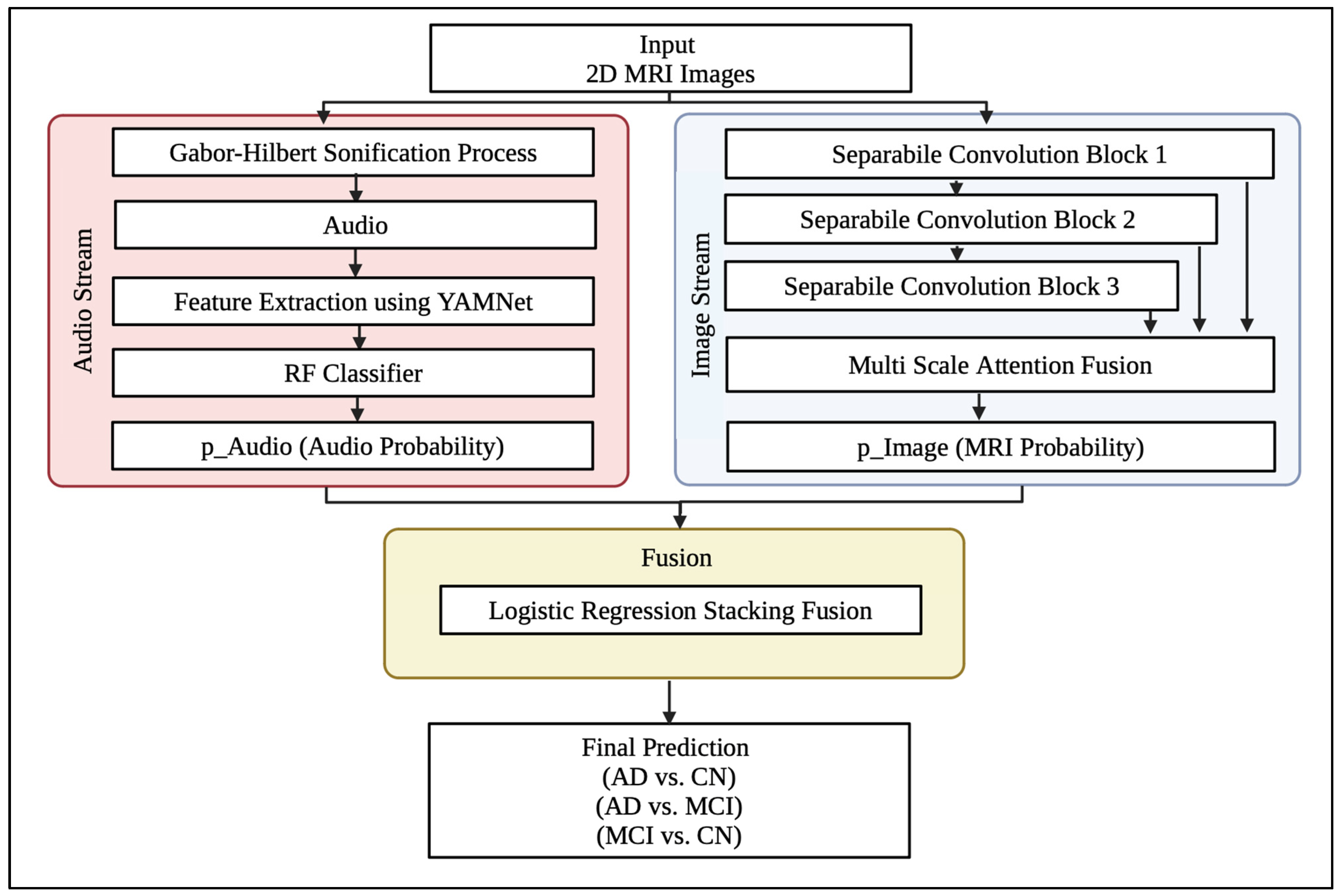
- A dual-stream multimodal that learns from MRI slices via a lightweight CNN and their corresponding sonified audio representation through YAMNet embeddings, enabling cross-models feature enrichment for AD detection.
2. Related Work
3. Materials and Methods
3.1. Alzheimer’s Disease Neuroimaging Initiative (ADNI) Dataset
3.2. 3D MRI Preprocessing
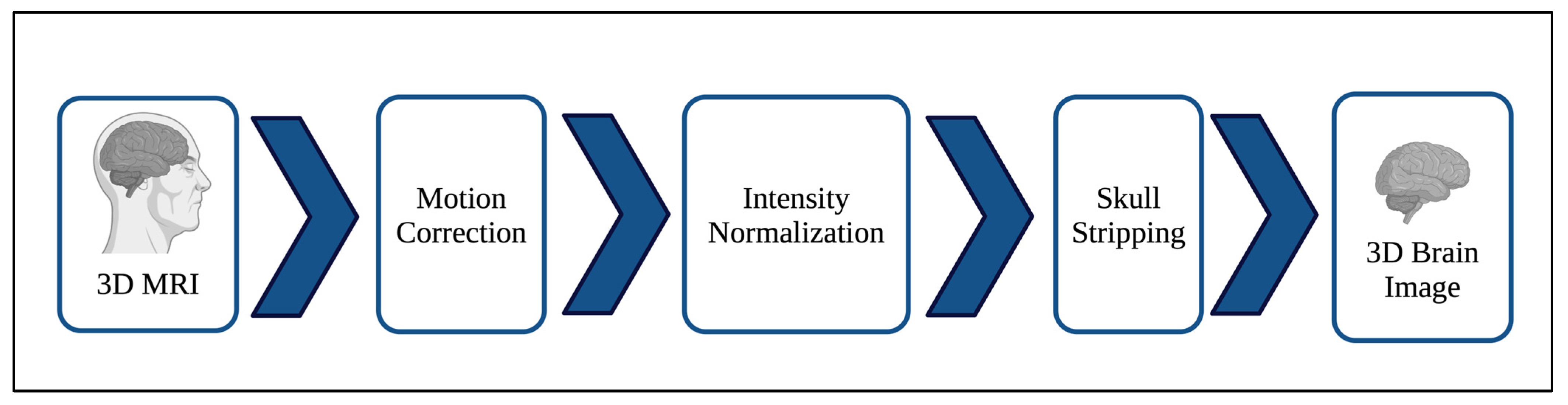
3.2.1. Initial 3D MRI Preprocessing
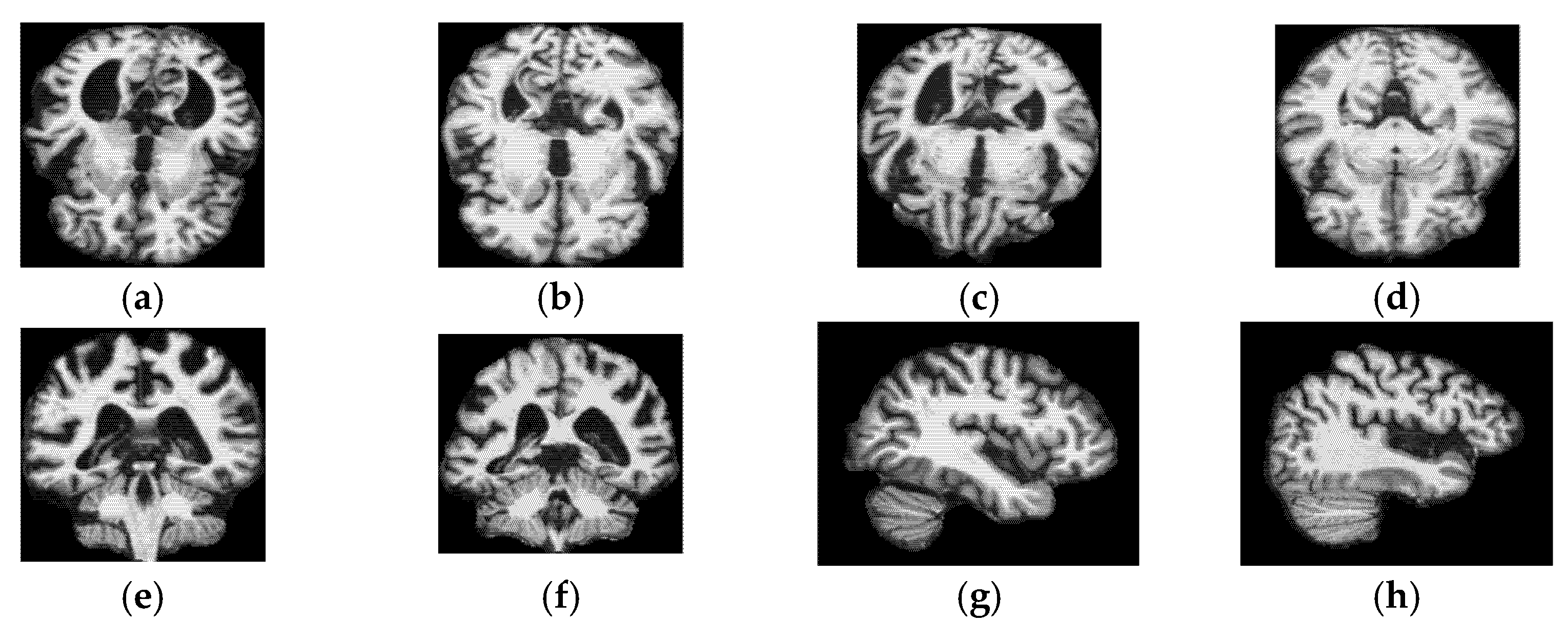
3.2.2. 2D MRI Slice Selection
3.3. Methodological Background
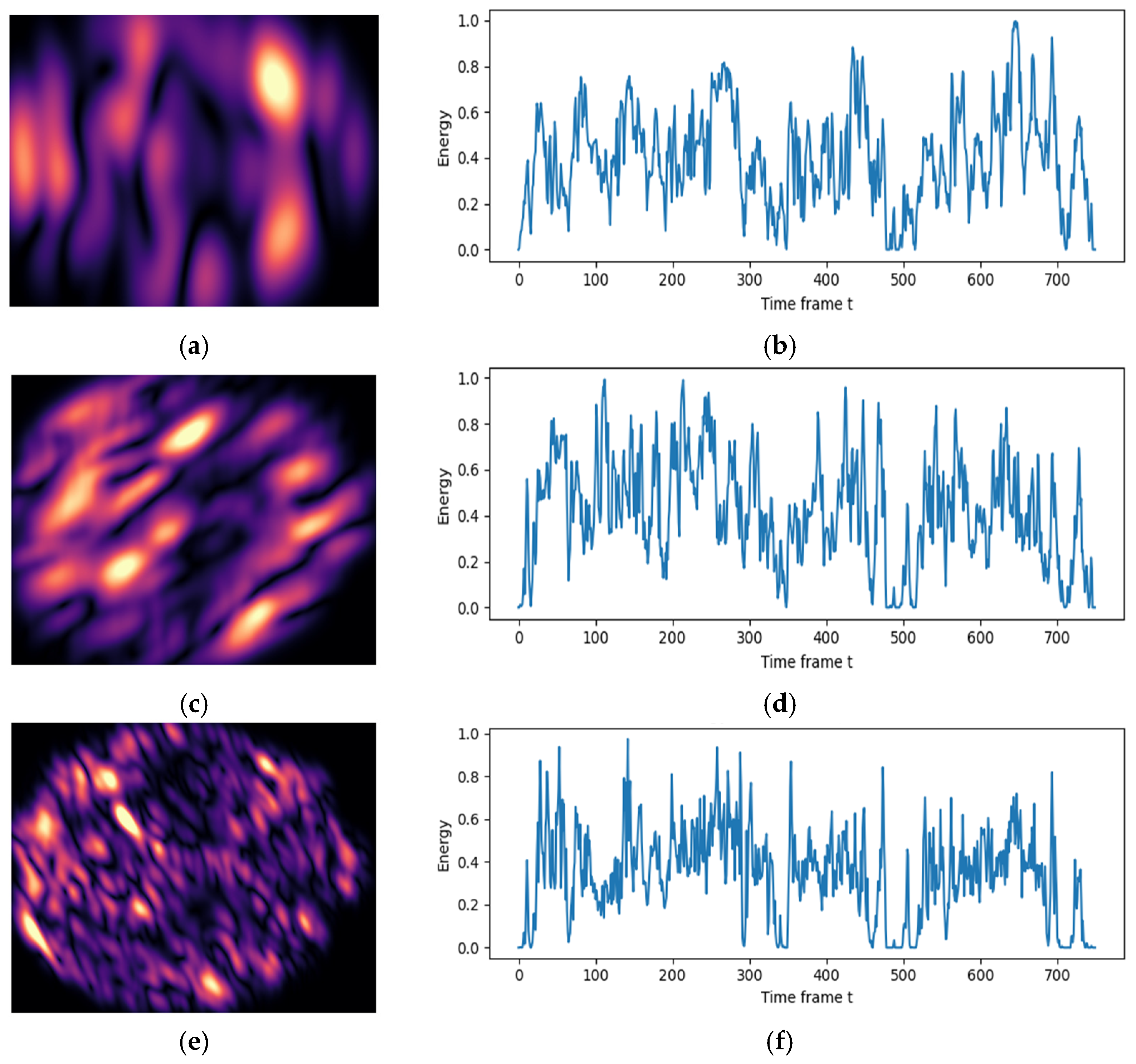
3.3.1. Multiple Scales and Multiple Orientations Gabor Filters
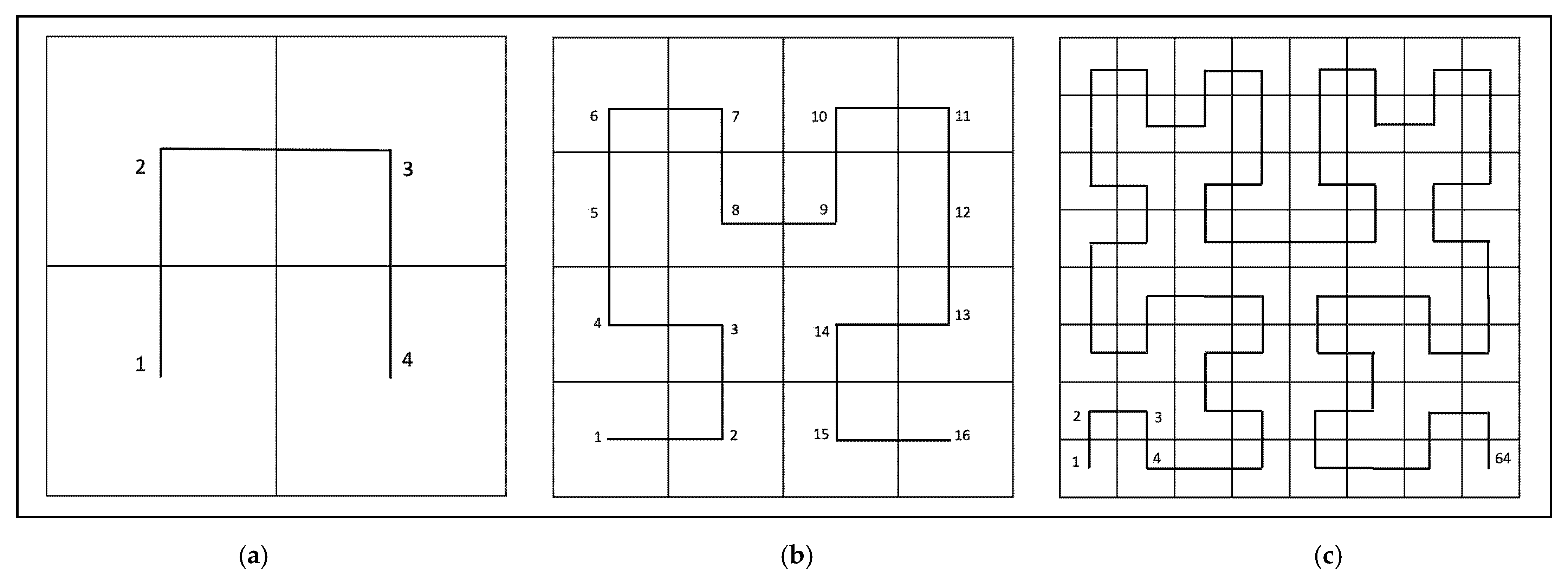
3.3.2. Hilbert’s Space-Filling Curve Time Mapping
3.4. The Proposed Methodology
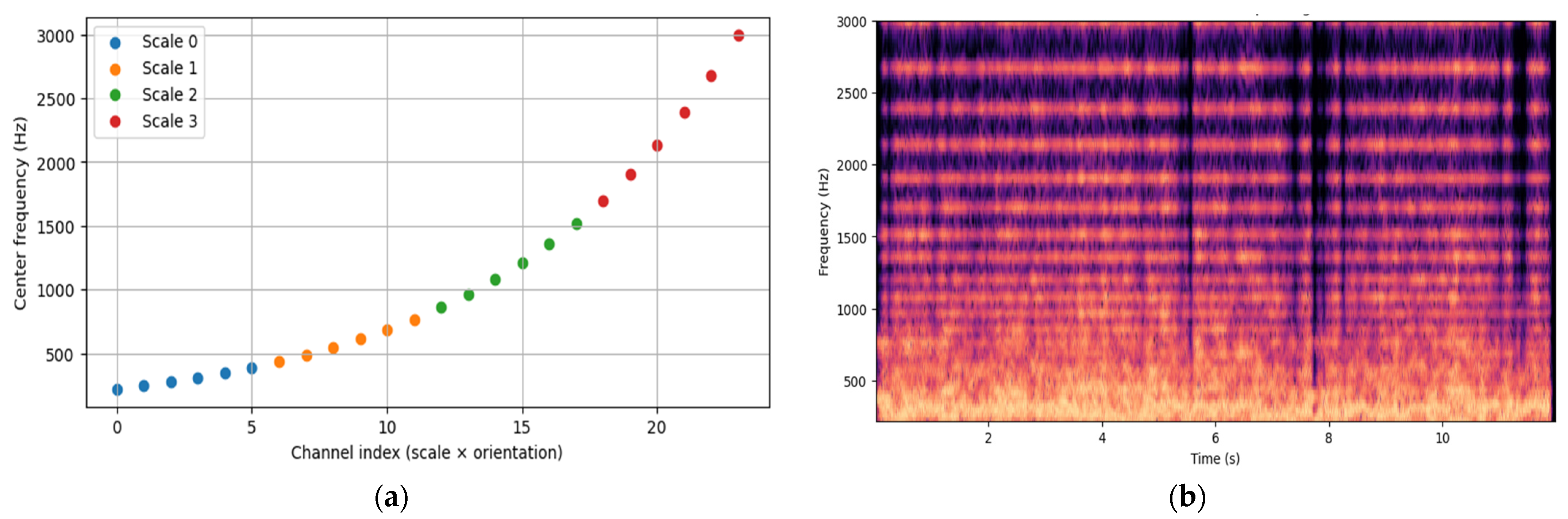
3.4.1. Hilbert-Gabor-Based Sonification Pipeline
| Algorithm 1: Pseudocode of MRI to Audio Sonification Pipeline |
| Input: |
|
Output:
|
Step 1: Image Loading and Normalization:
|
Step 2: Initialize Gabor Filter Bank G:
|
Step 3: Gabor Energy Map Extraction E:
|
Step 4: Hilbert curve time mapping
|
Step 5: Feature projection into spectrogram
|
Step 6: Frame Normalization
|
Step 8: Post Processing
|
| Computational cost: |
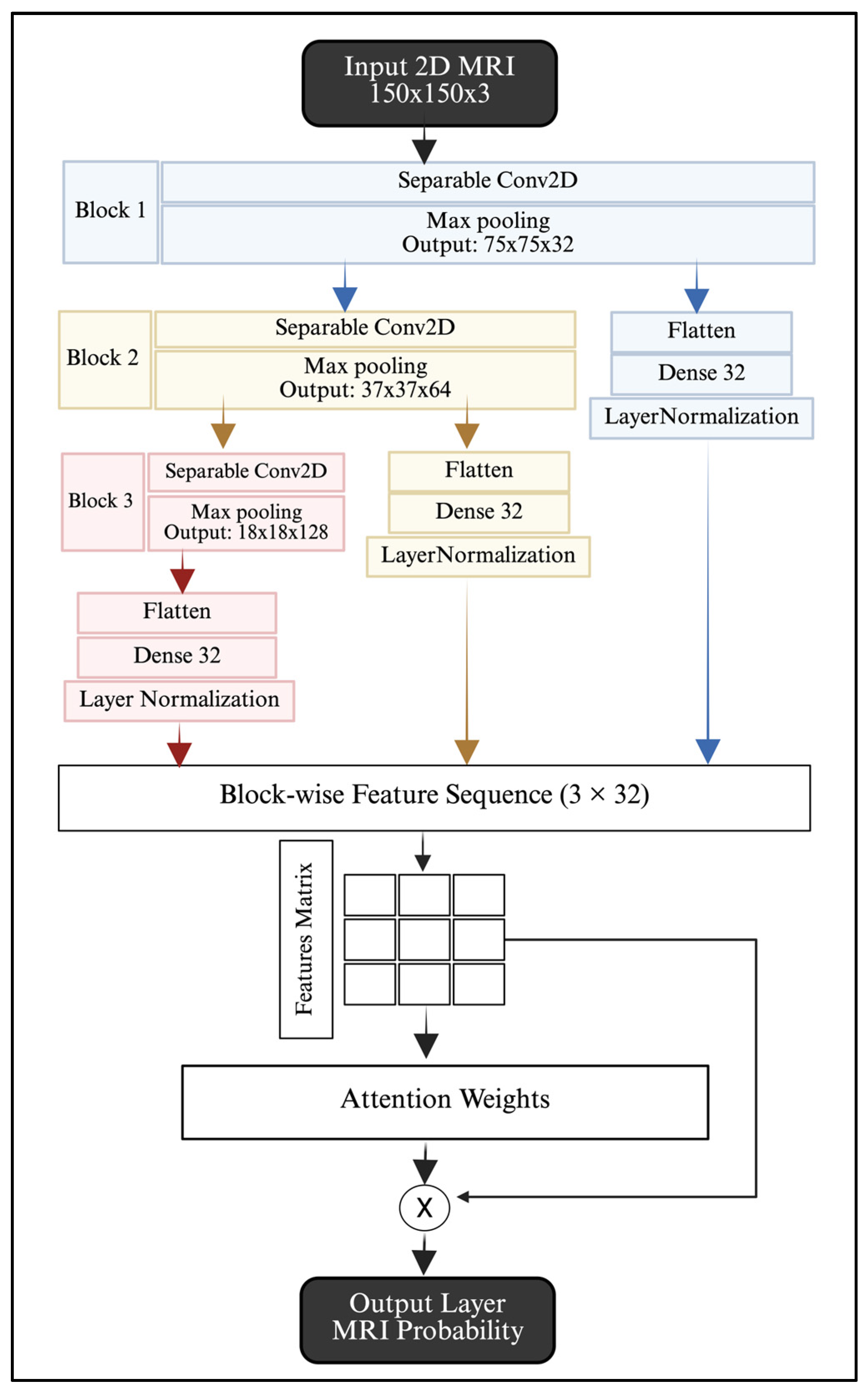
3.4.2. Dual-Stream Alzheimer’s Disease Classification Model
Audio Stream
Image Stream
Multimodal Fusion
| Algorithm 2: Pseudocode of Dual-Stream Multimodal for Alzheimer’s Disease Classification |
Input:
|
Output:
|
Step 1: Data initialization
|
Step 2: Stratified K-fold partitioning
|
Step 3: OOF based model training
|
Step 4: Stacked feature construction
|
Step 5: Multimodal fusion learning
|
Step 6: Model testing using the final image and audio models
|
| Complexity Cost: |
4. Experimental Results
4.1. Experimental Environment and Training Settings
4.2. Evaluation Metrics
4.3. Results Discussion
5. Conclusions
6. Future Work
Author Contributions
Funding
Institutional Review Board Statement
Informed Consent Statement
Data Availability Statement
Conflicts of Interest
References
- How Is Alzheimer’s Disease Diagnosed? Available online: https://www.nia.nih.gov/health/alzheimers-symptoms-and-diagnosis/how-alzheimers-disease-diagnosed (accessed on 7 December 2025).
- Zhou, Q.; Wang, J.; Yu, X.; Wang, S.; Zhang, Y. A Survey of Deep Learning for Alzheimer’s Disease. Mach. Learn. Knowl. Extr. 2023, 5, 611–668. [Google Scholar] [CrossRef]
- Arafa, D.A.; Moustafa, H.E.-D.; Ali, H.A.; Ali-Eldin, A.M.T.; Saraya, S.F. A Deep Learning Framework for Early Diagnosis of Alzheimer’s Disease on MRI Images. Multimed. Tools Appl. 2024, 83, 3767–3799. [Google Scholar] [CrossRef]
- Oldan, J.D.; Jewells, V.L.; Pieper, B.; Wong, T.Z. Complete Evaluation of Dementia: PET and MRI Correlation and Diagnosis for the Neuroradiologist. Am. J. Neuroradiol. 2021, 42, 998–1007. [Google Scholar] [CrossRef]
- Chiroiu, V.; Munteanu, L.; Ioan, R.; Dragne, C.; Majercsik, L. Using the Sonification for Hardly Detectable Details in Medical Images. Sci. Rep. 2019, 9, 17711. [Google Scholar] [CrossRef] [PubMed]
- Qiang, Y.-R.; Zhang, S.-W.; Li, J.-N.; Li, Y.; Zhou, Q.-Y. Diagnosis of Alzheimer’s Disease by Joining Dual Attention CNN and MLP Based on Structural MRIs, Clinical and Genetic Data. Artif. Intell. Med. 2023, 145, 102678. [Google Scholar] [CrossRef]
- Gionfrida, L.; Roginska, A. A Novel Sonification Approach to Support the Diagnosis of Alzheimer’s Dementia. Front. Neurol. 2017, 8, 647. [Google Scholar] [CrossRef] [PubMed]
- Barrass, S.; Kramer, G. Using Sonification. Multimed. Syst. 1999, 7, 23–31. [Google Scholar] [CrossRef]
- Tsalera, E.; Papadakis, A.; Samarakou, M. Comparison of Pre-Trained CNNs for Audio Classification Using Transfer Learning. J. Sens. Actuator Netw. 2021, 10, 72. [Google Scholar] [CrossRef]
- Illakiya, T.; Ramamurthy, K.; Siddharth, M.V.; Mishra, R.; Udainiya, A. AHANet: Adaptive Hybrid Attention Network for Alzheimer’s Disease Classification Using Brain Magnetic Resonance Imaging. Bioengineering 2023, 10, 714. [Google Scholar] [CrossRef]
- Shamrat, F.M.J.M.; Akter, S.; Azam, S.; Karim, A.; Ghosh, P.; Tasnim, Z.; Hasib, K.M.; De Boer, F.; Ahmed, K. AlzheimerNet: An Effective Deep Learning Based Proposition for Alzheimer’s Disease Stages Classification from Functional Brain Changes in Magnetic Resonance Images. IEEE Access 2023, 11, 16376–16395. [Google Scholar] [CrossRef]
- Pattilachan, T.M.; Demir, U.; Keles, E.; Jha, D.; Klatte, D.; Engels, M.; Hoogenboom, S.; Bolan, C.; Wallace, M.; Bagci, U. A Critical Appraisal of Data Augmentation Methods for Imaging-Based Medical Diagnosis Applications. arXiv 2022, arXiv:2301.02181. [Google Scholar] [CrossRef]
- Jin, Z.; Gong, J.; Deng, M.; Zheng, P.; Li, G. Deep Learning-Based Diagnosis Algorithm for Alzheimer’s Disease. J. Imaging 2024, 10, 333. [Google Scholar] [CrossRef]
- Pan, X.; Phan, T.-L.; Adel, M.; Fossati, C.; Gaidon, T.; Wojak, J.; Guedj, E. Multi-View Separable Pyramid Network for AD Prediction at MCI Stage by 18F-FDG Brain PET Imaging. IEEE Trans. Med. Imaging 2021, 40, 81–92. [Google Scholar] [CrossRef]
- Goel, T.; Sharma, R.; Tanveer, M.; Suganthan, P.N.; Maji, K.; Pilli, R. Multimodal Neuroimaging Based Alzheimer’s Disease Diagnosis Using Evolutionary RVFL Classifier. IEEE J. Biomed. Health Inform. 2025, 29, 3833–3841. [Google Scholar] [CrossRef]
- Ning, Z.; Xiao, Q.; Feng, Q.; Chen, W.; Zhang, Y. Relation-Induced Multi-Modal Shared Representation Learning for Alzheimer’s Disease Diagnosis. IEEE Trans. Med. Imaging 2021, 40, 1632–1645. [Google Scholar] [CrossRef]
- Venugopalan, J.; Tong, L.; Hassanzadeh, H.R.; Wang, M.D. Multimodal Deep Learning Models for Early Detection of Alzheimer’s Disease Stage. Sci. Rep. 2021, 11, 3254. [Google Scholar] [CrossRef] [PubMed]
- Yagis, E.; de Herrera, A.G.S.; Citi, L. Convolutional Autoencoder Based Deep Learning Approach for Alzheimer’s Disease Diagnosis Using Brain MRI. In Proceedings of the 2021 IEEE 34th International Symposium on Computer-Based Medical Systems (CBMS), Aveiro, Portugal, 7–9 June 2021; pp. 486–491. [Google Scholar]
- Tang, Z.; Zhang, T.; Song, Q.; Su, J.; Yang, B. PINet: Privileged Information Improve the Interpretablity and Generalization of Structural MRI in Alzheimer’s Disease. In Proceedings of the 14th ACM International Conference on Bioinformatics, Computational Biology, and Health Informatics, Houston, TX, USA, 3–6 September 2023; ACM: Houston, TX, USA, 2023; pp. 1–9. [Google Scholar]
- Mohsin, N.A.; Abdulameer, M.H. Evaluating the Impact of 2D MRI Slice Orientation and Location on Alzheimer’s Disease Diagnosis Using a Lightweight Convolutional Neural Network. J. Imaging 2025, 11, 260. [Google Scholar] [CrossRef] [PubMed]
- Li, Y.; Bi, Y.; Zhang, W.; Ren, J.; Chen, J. M2GF: Multi-Scale and Multi-Directional Gabor Filters for Image Edge Detection. Appl. Sci. 2023, 13, 9409. [Google Scholar] [CrossRef]
- Grigorescu, S.E.; Petkov, N.; Kruizinga, P. Comparison of Texture Features Based on Gabor Filters. IEEE Trans. Image Process. 2002, 11, 1160–1167. [Google Scholar] [CrossRef]
- Moon, B.; Jagadish, H.V.; Faloutsos, C.; Saltz, J.H. Analysis of the Clustering Properties of the Hilbert Space-Filling Curve. IEEE Trans. Knowl. Data Eng. 2001, 13, 124–141. [Google Scholar] [CrossRef]
- Pesnell, W.D.; Ingram-Johnson, K.; Addison, K. Using Hilbert Curves to Organize, Sample, and Sonify Solar Data. Am. J. Phys. 2021, 89, 943–954. [Google Scholar] [CrossRef]
- Sagan, H. Hilbert’s Space-Filling Curve. In Space-Filling Curves; Universitext; Springer: New York, NY, USA, 1994; pp. 9–30. ISBN 978-0-387-94265-0. [Google Scholar]
- Kakon, S.C.; Sazid, Z.A.; Begum, I.A.; Samad, M.A.; Hosen, A.S.M.S. Explainable Deep Ensemble Meta-Learning Framework for Brain Tumor Classification Using MRI Images. Cancers 2025, 17, 2853. [Google Scholar] [CrossRef] [PubMed]



| Classes | Number of 3D MRI Scans | Training | Validation | Testing |
|---|---|---|---|---|
| AD | 1125 | 900 | 112 | 113 |
| CN | 1146 | 916 | 115 | 115 |
| MCI | 1224 | 979 | 122 | 123 |
| Layer Type | Output Shape | Parameters Number | Connected to |
|---|---|---|---|
| Input Layer | 0 | - | |
| Sep_Conv2D_B1 | 155 | Input Layer | |
| Max_Pooling_B1 | 0 | Sep_Conv2D_B1 | |
| Sep_Conv2D_B2 | 2400 | Max_Pooling_B1 | |
| Max_Pooling_B2 | 0 | Sep_Conv2D_B2 | |
| Sep_Conv2D_B3 | 8896 | Max_Pooling_B2 | |
| Max_Pooling_B3 | 0 | Sep_Conv2D_B3 | |
| Flatten_B1 | 180,000 | 0 | Max_Pooling_B1 |
| Flatten_B2 | 87,616 | 0 | Max_Pooling_B2 |
| Flatten_B3 | 41,472 | 0 | Max_Pooling_B3 |
| Dense_B1 | 32 | 5,760,032 | Flatten_B1 |
| Dense_B2 | 32 | 2,803,744 | Flatten_B2 |
| Dense_B3 | 32 | 1,327,136 | Flatten_B3 |
| Layer_Normalization_B1 (N1) | 32 | 64 | Dense_B1 |
| Layer_Normalization_B2 (N2) | 32 | 64 | Dense_B2 |
| Layer_Normalization_B3 (N3) | 32 | 64 | Dense_B3 |
| Stacked | 0 | N1, N2, N3 | |
| TimeDistributed Dense (32, ReLU) (TD_1) | 1056 | Stacked | |
| TimeDistributed Dense (1, Linear) (TD_2) | 33 | TD_1 | |
| Attention Weights (SoftMax) | 0 | TD_2 | |
| Fused (Weighted sum) | 32 | 0 | Stacked + SoftMax |
| Output | 1 | 33 | Fused |
| Total trainable parameters | 9,903,677 |
| Orientation | Classification Task | Hilbert-Based | Raster Row |
|---|---|---|---|
| Coronal | AD vs. CN | 84.6–93.8% | 50.7–92.1% |
| AD vs. MCI | 87.7–91.1% | 80.9–87.7% | |
| MCI vs. CN | 81.9–87.3% | 72.2–80.2% | |
| Axial | AD vs. CN | 89–93.4% | 85–90.3% |
| AD vs. MCI | 86.8–92.8% | 76.2–86% | |
| MCI vs. CN | 78.9–86.9% | 74.3–80.2% | |
| Sagittal | AD vs. CN | 89–92.7% | 50.7–91% |
| AD vs. MCI | 84.3–91.9% | 77.4–85.5% | |
| MCI vs. CN | 79.3–86.5% | 73.8–81% |
| Orientation | Model | Metrics | Seg4 | Seg5 | Seg6 | Seg7 | Seg8 | Seg9 | Seg10 | Seg11 | Seg12 |
|---|---|---|---|---|---|---|---|---|---|---|---|
| Axial | [20] | Accuracy | 76.6% | 83.4% | 88.1% | 88.9% | 81.3% | 83.8% | 80.0% | 81.3% | 77.4% |
| Precision | 80.9% | 78.9% | 87.0% | 88.5% | 84.8% | 87.9% | 74.6% | 76.3% | 75.4% | ||
| Sensitivity | 67.3% | 89.4% | 88.5% | 88.5% | 74.3% | 77.0% | 88.5% | 88.5% | 78.8% | ||
| F1 Score | 73.4% | 83.8% | 87.7% | 88.5% | 79.2% | 82.1% | 81.0% | 82.0% | 77.1% | ||
| Specificity | 85.2% | 77.9% | 87.7% | 89.3% | 87.7% | 90.2% | 72.1% | 74.6% | 76.2% | ||
| AUC | 84.6% | 93.2% | 94.6% | 94.0% | 91.8% | 93.2% | 89.0% | 92.3% | 82.4% | ||
| Proposed | Accuracy | 91.5% | 88.9% | 93.2% | 92.8% | 91.9% | 92.8% | 92.3% | 89.4% | 88.1% | |
| Precision | 98.9% | 93.9% | 95.3% | 94.4% | 89.8% | 92.9% | 95.2% | 92.3% | 95.7% | ||
| Sensitivity | 83.2% | 82.3% | 90.3% | 90.3% | 93.8% | 92.0% | 88.5% | 85.0% | 78.8% | ||
| F1 Score | 90.4% | 87.7% | 92.7% | 92.3% | 91.8% | 92.4% | 91.7% | 88.5% | 86.4% | ||
| Specificity | 95.2% | 96.1% | 97.4% | 97.7% | 97.0% | 97.5% | 97.8% | 95.4% | 91.4% | ||
| AUC | 99.2% | 95.1% | 95.9% | 95.1% | 90.2% | 93.4% | 95.9% | 93.4% | 96.7% | ||
| Sagittal | [20] | Accuracy | 86.0% | 87.5% | 88.1% | 90.6% | 85.1% | 84.7% | 89.4% | 91.5% | 90.6% |
| Precision | 81.7% | 88.3% | 87.0% | 88.2% | 81.5% | 86.7% | 82.8% | 88.4% | 91.0% | ||
| Sensitivity | 91.2% | 85.0% | 88.5% | 92.9% | 89.4% | 80.5% | 98.2% | 94.7% | 89.4% | ||
| F1 Score | 86.2% | 86.6% | 87.7% | 90.5% | 85.2% | 83.5% | 89.9% | 91.5% | 90.2% | ||
| Specificity | 81.1% | 89.8% | 87.7% | 88.5% | 81.1% | 88.5% | 81.1% | 88.5% | 91.8% | ||
| AUC | 90.7% | 93.4% | 93.1% | 93.6% | 93.7% | 92.3% | 97.5% | 94.2% | 95.9% | ||
| Proposed | Accuracy | 86.4% | 91.9% | 94.0% | 92.3% | 90.2% | 86.4% | 94.5% | 92.8% | 90.6% | |
| Precision | 84.0% | 94.3% | 95.4% | 92.0% | 92.5% | 86.5% | 94.6% | 91.4% | 98.9% | ||
| Sensitivity | 88.5% | 88.5% | 92.0% | 92.0% | 86.7% | 85.0% | 93.8% | 93.8% | 81.4% | ||
| F1 Score | 86.2% | 91.3% | 93.7% | 92.0% | 89.5% | 85.7% | 94.2% | 92.6% | 89.3% | ||
| Specificity | 95.6% | 96.5% | 97.5% | 97.6% | 94.6% | 93.6% | 98.3% | 98.5% | 95.6% | ||
| AUC | 84.4% | 95.1% | 95.9% | 92.6% | 93.4% | 87.7% | 95.1% | 91.8% | 99.2% | ||
| Coronal | [20] | Accuracy | 90.2% | 87.7% | 88.5% | 92.3% | 69.4% | 90.6% | 87.2% | 86.0% | 74.9% |
| Precision | 90.9% | 85.6% | 95.7% | 92.8% | 65.0% | 88.9% | 88.1% | 87.0% | 76.5% | ||
| Sensitivity | 88.5% | 89.4% | 79.6% | 91.2% | 78.8% | 92.0% | 85.0% | 83.2% | 69.0% | ||
| F1 Score | 89.7% | 87.4% | 87.0% | 92.0% | 71.2% | 90.4% | 86.5% | 85.1% | 72.6% | ||
| Specificity | 91.8% | 86.1% | 96.7% | 93.4% | 60.7% | 89.3% | 89.3% | 88.5% | 80.3% | ||
| AUC | 94.6% | 92.2% | 95.6% | 96.4% | 79.3% | 95.4% | 92.3% | 92.9% | 82.5% | ||
| Proposed | Accuracy | 93.2% | 90.2% | 89.4% | 92.3% | 90.6% | 91.5% | 92.3% | 90.2% | 89.8% | |
| Precision | 98.0% | 88.8% | 90.7% | 89.9% | 96.9% | 90.4% | 90.6% | 92.5% | 96.8% | ||
| Sensitivity | 87.6% | 91.2% | 86.7% | 94.7% | 83.2% | 92.0% | 93.8% | 86.7% | 81.4% | ||
| F1 Score | 92.5% | 90.0% | 88.7% | 92.2% | 89.5% | 91.2% | 92.2% | 89.5% | 88.5% | ||
| Specificity | 96.0% | 95.1% | 94.3% | 98.2% | 95.6% | 97.4% | 97.7% | 97.1% | 93.4% | ||
| AUC | 98.4% | 89.3% | 91.8% | 90.2% | 97.5% | 91.0% | 91.0% | 93.4% | 97.5% |
| Orientation | Model | Metrics | Seg4 | Seg5 | Seg6 | Seg7 | Seg8 | Seg9 | Seg10 | Seg11 | Seg12 |
|---|---|---|---|---|---|---|---|---|---|---|---|
| Coronal | [20] | Accuracy | 74.3% | 81.4% | 80.6% | 77.2% | 89.9% | 83.5% | 85.2% | 76.8% | 75.5% |
| Precision | 78.0% | 84.2% | 79.2% | 87.8% | 89.5% | 82.2% | 79.6% | 71.6% | 78.6% | ||
| Sensitivity | 69.7% | 78.7% | 84.4% | 64.8% | 91.0% | 86.9% | 95.9% | 91.0% | 72.1% | ||
| F1 Score | 73.6% | 81.4% | 81.7% | 74.5% | 90.2% | 84.5% | 87.0% | 80.1% | 75.2% | ||
| Specificity | 79.1% | 84.3% | 76.5% | 90.4% | 88.7% | 80.0% | 73.9% | 61.7% | 79.1% | ||
| AUC | 82.9% | 91.5% | 91.4% | 86.7% | 95.8% | 92.2% | 95.7% | 87.5% | 84.3% | ||
| Proposed | Accuracy | 85.7% | 88.2% | 86.9% | 88.6% | 89.9% | 91.1% | 84.4% | 84.0% | 87.3% | |
| Precision | 87.9% | 83.1% | 82.7% | 91.3% | 90.2% | 90.4% | 81.0% | 81.3% | 84.8% | ||
| Sensitivity | 83.6% | 96.7% | 94.3% | 86.1% | 90.2% | 92.6% | 91.0% | 89.3% | 91.8% | ||
| F1 Score | 85.7% | 89.4% | 88.1% | 88.6% | 90.2% | 91.5% | 85.7% | 85.2% | 88.2% | ||
| Specificity | 94.1% | 94.9% | 93.7% | 96.0% | 96.0% | 96.5% | 93.1% | 91.8% | 94.3% | ||
| AUC | 87.8% | 79.1% | 79.1% | 91.3% | 89.6% | 89.6% | 77.4% | 78.3% | 82.6% | ||
| Sagittal | [20] | Accuracy | 86.9% | 81.4% | 85.7% | 81.4% | 82.7% | 84.8% | 84.8% | 86.5% | 80.6% |
| Precision | 85.8% | 81.5% | 85.5% | 85.5% | 80.5% | 80.7% | 93.9% | 88.8% | 83.9% | ||
| Sensitivity | 89.3% | 82.8% | 86.9% | 77.0% | 87.7% | 92.6% | 75.4% | 84.4% | 77.0% | ||
| F1 Score | 87.6% | 82.1% | 86.2% | 81.0% | 83.9% | 86.3% | 83.6% | 86.6% | 80.3% | ||
| Specificity | 84.3% | 80.0% | 84.3% | 86.1% | 77.4% | 76.5% | 94.8% | 88.7% | 84.3% | ||
| AUC | 92.6% | 91.2% | 93.2% | 89.5% | 88.4% | 92.4% | 92.7% | 92.5% | 89.5% | ||
| Proposed | Accuracy | 92.0% | 81.4% | 88.6% | 93.2% | 88.2% | 86.1% | 89.9% | 90.3% | 87.3% | |
| Precision | 94.0% | 92.4% | 85.7% | 92.1% | 87.9% | 89.4% | 87.7% | 89.0% | 83.3% | ||
| Sensitivity | 90.2% | 69.7% | 93.4% | 95.1% | 89.3% | 82.8% | 93.4% | 92.6% | 94.3% | ||
| F1 Score | 92.1% | 79.4% | 89.4% | 93.5% | 88.6% | 86.0% | 90.5% | 90.8% | 88.5% | ||
| Specificity | 97.0% | 93.2% | 95.3% | 98.0% | 93.1% | 95.1% | 96.3% | 93.7% | 94.3% | ||
| AUC | 93.9% | 93.9% | 83.5% | 91.3% | 87.0% | 89.6% | 86.1% | 87.8% | 80.0% | ||
| Axial | [20] | Accuracy | 86.5% | 84.4% | 85.2% | 82.7% | 85.2% | 86.9% | 82.7% | 70.5% | 75.5% |
| Precision | 89.5% | 84.6% | 92.2% | 77.9% | 84.3% | 85.8% | 79.1% | 77.7% | 76.2% | ||
| Sensitivity | 83.6% | 85.2% | 77.9% | 92.6% | 87.7% | 89.3% | 90.2% | 59.8% | 76.2% | ||
| F1 Score | 86.4% | 84.9% | 84.4% | 84.6% | 85.9% | 87.6% | 84.3% | 67.6% | 76.2% | ||
| Specificity | 89.6% | 83.5% | 93.0% | 72.2% | 82.6% | 84.3% | 74.8% | 81.7% | 74.8% | ||
| AUC | 93.8% | 91.4% | 91.9% | 90.4% | 90.8% | 93.9% | 90.2% | 82.6% | 82.7% | ||
| Proposed | Accuracy | 89.5% | 87.8% | 92.4% | 85.7% | 86.5% | 87.3% | 88.2% | 88.6% | 78.9% | |
| Precision | 88.8% | 85.0% | 91.3% | 84.9% | 84.6% | 84.3% | 85.6% | 87.4% | 79.5% | ||
| Sensitivity | 91.0% | 92.6% | 94.3% | 87.7% | 90.2% | 92.6% | 92.6% | 91.0% | 79.5% | ||
| F1 Score | 89.9% | 88.6% | 92.7% | 86.3% | 87.3% | 88.3% | 89.0% | 89.2% | 79.5% | ||
| Specificity | 95.3% | 94.3% | 97.2% | 92.6% | 92.7% | 93.7% | 95.1% | 95.8% | 89.7% | ||
| AUC | 87.8% | 82.6% | 90.4% | 83.5% | 82.6% | 81.7% | 83.5% | 86.1% | 78.3% |
| Orientation | Model | Metrics | Seg4 | Seg5 | Seg6 | Seg7 | Seg8 | Seg9 | Seg10 | Seg11 | Seg12 |
|---|---|---|---|---|---|---|---|---|---|---|---|
| Coronal | [20] | Accuracy | 89.4% | 94.3% | 95.2% | 91.2% | 95.6% | 94.3% | 96.9% | 89.0% | 92.1% |
| Precision | 87.3% | 92.3% | 91.7% | 91.1% | 93.2% | 95.4% | 97.3% | 88.5% | 88.5% | ||
| Sensitivity | 92.0% | 96.4% | 99.1% | 91.1% | 98.2% | 92.9% | 96.4% | 89.3% | 96.4% | ||
| F1 Score | 89.6% | 94.3% | 95.3% | 91.1% | 95.7% | 94.1% | 96.9% | 88.9% | 92.3% | ||
| Specificity | 87.0% | 92.2% | 91.3% | 91.3% | 93.0% | 95.7% | 97.4% | 88.7% | 87.8% | ||
| AUC | 95.6% | 98.1% | 99.2% | 96.2% | 99.2% | 98.5% | 99.5% | 94.9% | 97.1% | ||
| Proposed | Accuracy | 95.2% | 95.2% | 96.0% | 96.9% | 96.9% | 96.5% | 96.5% | 96.0% | 93.4% | |
| Precision | 94.7% | 96.3% | 98.1% | 97.3% | 95.7% | 99.1% | 94.1% | 95.6% | 95.3% | ||
| Sensitivity | 95.5% | 93.8% | 93.8% | 96.4% | 98.2% | 93.8% | 99.1% | 96.4% | 91.1% | ||
| F1 Score | 95.1% | 95.0% | 95.9% | 96.9% | 96.9% | 96.3% | 96.5% | 96.0% | 93.2% | ||
| Specificity | 99.1% | 99.1% | 99.3% | 99.5% | 98.9% | 99.5% | 99.5% | 99.5% | 98.7% | ||
| AUC | 94.8% | 96.5% | 98.3% | 97.4% | 95.7% | 99.1% | 93.9% | 95.7% | 95.7% | ||
| Sagittal | [20] | Accuracy | 92.5% | 89.4% | 96.0% | 94.3% | 84.6% | 91.2% | 96.9% | 95.6% | 89.0% |
| Precision | 91.3% | 87.9% | 99.0% | 93.8% | 87.4% | 88.3% | 96.5% | 94.7% | 88.5% | ||
| Sensitivity | 93.8% | 91.1% | 92.9% | 94.6% | 80.4% | 94.6% | 97.3% | 96.4% | 89.3% | ||
| F1 Score | 92.5% | 89.5% | 95.9% | 94.2% | 83.7% | 91.4% | 96.9% | 95.6% | 88.9% | ||
| Specificity | 91.3% | 87.8% | 99.1% | 93.9% | 88.7% | 87.8% | 96.5% | 94.8% | 88.7% | ||
| AUC | 97.2% | 96.5% | 97.3% | 98.2% | 92.0% | 97.5% | 98.6% | 97.9% | 96.4% | ||
| Proposed | Accuracy | 96.5% | 96.5% | 95.6% | 96.0% | 89.0% | 95.6% | 98.2% | 97.8% | 91.2% | |
| Precision | 95.6% | 94.8% | 97.2% | 98.1% | 94.8% | 99.0% | 98.2% | 99.1% | 90.4% | ||
| Sensitivity | 97.3% | 98.2% | 93.8% | 93.8% | 82.1% | 92.0% | 98.2% | 96.4% | 92.0% | ||
| F1 Score | 96.5% | 96.5% | 95.5% | 95.9% | 88.0% | 95.4% | 98.2% | 97.7% | 91.2% | ||
| Specificity | 99.3% | 99.4% | 98.9% | 99.1% | 97.3% | 98.9% | 99.8% | 99.7% | 97.7% | ||
| AUC | 95.7% | 94.8% | 97.4% | 98.3% | 95.7% | 99.1% | 98.3% | 99.1% | 90.4% | ||
| Axial | [20] | Accuracy | 92.5% | 94.7% | 89.0% | 92.5% | 94.3% | 97.4% | 93.8% | 93.0% | 92.1% |
| Precision | 94.4% | 92.4% | 85.4% | 91.3% | 93.8% | 96.5% | 94.5% | 97.1% | 90.5% | ||
| Sensitivity | 90.2% | 97.3% | 93.8% | 93.8% | 94.6% | 98.2% | 92.9% | 88.4% | 93.8% | ||
| F1 Score | 92.2% | 94.8% | 89.4% | 92.5% | 94.2% | 97.3% | 93.7% | 92.5% | 92.1% | ||
| Specificity | 94.8% | 92.2% | 84.3% | 91.3% | 93.9% | 96.5% | 94.8% | 97.4% | 90.4% | ||
| AUC | 97.0% | 98.7% | 94.7% | 94.8% | 97.7% | 99.6% | 97.2% | 98.9% | 96.5% | ||
| Proposed | Accuracy | 94.7% | 93.8% | 96.0% | 91.2% | 96.0% | 97.8% | 96.9% | 94.7% | 93.4% | |
| Precision | 95.5% | 92.2% | 95.6% | 90.4% | 92.6% | 97.3% | 95.7% | 98.1% | 92.9% | ||
| Sensitivity | 93.8% | 95.5% | 96.4% | 92.0% | 100.0% | 98.2% | 98.2% | 91.1% | 93.8% | ||
| F1 Score | 94.6% | 93.9% | 96.0% | 91.2% | 96.1% | 97.8% | 96.9% | 94.4% | 93.3% | ||
| Specificity | 98.7% | 99.1% | 99.5% | 98.4% | 99.7% | 99.5% | 99.7% | 99.5% | 98.7% | ||
| AUC | 95.7% | 92.2% | 95.7% | 90.4% | 92.2% | 97.4% | 95.7% | 98.3% | 93.0% |
| Method | FLOPs |
|---|---|
| MobileNetV1 | 467,840,993 |
| EfficientNetB0 | 397,007,176 |
| MobileNetV2 | 301,415,457 |
| Image-Stream | 78,102,649 |
Disclaimer/Publisher’s Note: The statements, opinions and data contained in all publications are solely those of the individual author(s) and contributor(s) and not of MDPI and/or the editor(s). MDPI and/or the editor(s) disclaim responsibility for any injury to people or property resulting from any ideas, methods, instructions or products referred to in the content. |
© 2026 by the authors. Licensee MDPI, Basel, Switzerland. This article is an open access article distributed under the terms and conditions of the Creative Commons Attribution (CC BY) license.
Share and Cite
Mohsin, N.A.; Abdul Ameer, M.H. A Dual Stream Deep Learning Framework for Alzheimer’s Disease Detection Using MRI Sonification. J. Imaging 2026, 12, 46. https://doi.org/10.3390/jimaging12010046
Mohsin NA, Abdul Ameer MH. A Dual Stream Deep Learning Framework for Alzheimer’s Disease Detection Using MRI Sonification. Journal of Imaging. 2026; 12(1):46. https://doi.org/10.3390/jimaging12010046
Chicago/Turabian StyleMohsin, Nadia A., and Mohammed H. Abdul Ameer. 2026. "A Dual Stream Deep Learning Framework for Alzheimer’s Disease Detection Using MRI Sonification" Journal of Imaging 12, no. 1: 46. https://doi.org/10.3390/jimaging12010046
APA StyleMohsin, N. A., & Abdul Ameer, M. H. (2026). A Dual Stream Deep Learning Framework for Alzheimer’s Disease Detection Using MRI Sonification. Journal of Imaging, 12(1), 46. https://doi.org/10.3390/jimaging12010046