


Abstract
In the present paper, a route for the simultaneous recovery of Fe, Cu, and Zn from the leaching filtrate of copper flotation tailings through controlled co-precipitation into a single magnetic ferrite-like product is proposed. Unlike conventional sequential recovery of individual metals, the filtrate was used as a combined precursor for substituted magnetite and a Cu–Zn-containing spinel. Across a series of 20 samples, the Fe:(Cu+Zn) molar ratio ranged from 2.05 to 2.47, with a mean value of 2.25, corresponding to the solid-solution region between MFe2O4 and Fe3O4. As the pH increased, iron precipitated first, followed by copper and zinc; at pH 9.5, Fe and Cu were almost completely co-precipitated, while Zn recovery reached approximately 98%. Calcination of the dried precipitate at 600 °C induced crystallization of the spinel phase, consolidation, and partial sintering of the aggregates. A predominantly magnetite-like spinel product was retained under nitrogen, whereas calcination in air resulted in the formation of a substantial hematite fraction. At a magnetic flux density of 1050 mT, the recoveries of the as-dried precipitate, the nitrogen-calcined product, and the air-calcined product were approximately 86%, 96%, and 90%, respectively.
1. Introduction
The accumulation of sulfide tailings generated by the flotation beneficiation of copper ores is among the most pressing environmental and resource-related challenges facing the mining and metallurgical sector. Such tailings contain residual iron, copper, and zinc sulfides, whose oxidation in storage facilities promotes the generation of acid mine drainage and the migration of metals into the environment [1,2,3]. At the same time, these materials are increasingly regarded as a technogenic resource. Bioleaching of sulfide tailings using acidophilic chemolithotrophic microorganisms (Acidithiobacillus spp., Leptospirillum spp., and others) can transfer a substantial fraction of iron, copper, and zinc into solution without energy-intensive pyrometallurgical or high-temperature hydrometallurgical operations, making this approach attractive from both economic and environmental perspectives [4,5].
Recent research indicates that tailings valorization is advancing in sophistication, moving beyond conventional disposal to resource recovery and value-added utilization. Xu et al. [6] demonstrated the feasibility of utilizing ultrafine copper tailings as a major raw material for high-strength lightweight ceramsites, highlighting their potential for value-added utilization in construction materials. Li et al. [7] demonstrated the potential of advanced magnetic separation on iron-ore tailings for recovering a high-grade silica fraction. Yang et al. [8] investigated copper–nickel tailings as a feedstock for CO2 mineral sequestration. Although these studies report diversification of tailings-utilization strategies, they are mostly related to solid tailings and not the direct valorization of polymetallic leachates. This gap points out the need for integrated approaches able to recover several dissolved metals at once while minimizing the number of intermediate separation steps and extra reagent inputs. Thus, direct conversion of polymetallic tailings leachates into functional materials is a promising route for combining metal recovery and waste valorization.
However, the resulting leaching filtrates are complex multicomponent sulfate solutions in which Fe, Cu, and Zn coexist, often at comparable or markedly different concentrations, together with associated cations such as Mn, Al, and Mg. Conventional processing of such solutions involves the sequential selective precipitation or solvent extraction of the target metals, requiring repeated pH adjustment, intermediate filtration, precipitate washing, and the addition of auxiliary reagents such as sulfides, hydroxides, and extractants [9,10,11]. At the relatively low Cu and Zn concentrations typical of actual tailings-leach filtrates, such a multistage flowsheet becomes economically unattractive: process equipment becomes more complex, the volume of secondary solutions increases, and the costs of their subsequent neutralization and disposal consequently rise [12,13].
An alternative strategy is to abandon component-by-component separation and instead use the dissolved metals as a unified cation pool for the synthesis of a multicomponent functional material. This concept is consistent with the broader trend toward converting complex mineral-derived feeds into value-added functional materials. Mu et al. [14], for example, reviewed the processing of multisource manganese ores into manganese-based products, including Mn–Zn ferrites, demonstrating that compositionally complex mineral resources can serve as precursors for functional materials. Spinel ferrites with the general formula MFe2O4 (M = Cu2+, Zn2+, Fe2+, Mn2+, Ni2+, etc.) constitute a broad class of magnetic oxides used in catalysis, adsorptive water treatment, magnetic separation, electronics, and pigment production [15,16,17]. Recent work has also emphasized that spinel structures can host several transition-metal cations. Zhao et al. [18] proved that a multication high-entropy spinel oxide can retain a common spinel framework, while the functional properties are largely influenced by the combined cation composition. This structural flexibility is especially relevant for waste-based multicomponent precursor systems such as the Fe–Cu–Zn solution examined here. Magnetite, Fe3O4, which also possesses a spinel structure (structural formula Fe2+Fe23+O4), permits the isomorphous substitution of a fraction of divalent iron by other divalent cations because of their similar ionic radii and crystallochemical compatibility [19,20]. This enables the formation of (Fe, Cu, Zn) Fe2O4 solid solutions in which Cu2+ and Zn2+ partially replace Fe2+ in a magnetite-like matrix without disrupting the spinel structure.
The synthesis of ferrites from technogenic iron-bearing solutions and wastewaters has been widely reported [21,22,23,24,25]. In most cases, the composition of the feed solution requires deliberate adjustment, either by adding iron salts to attain the required Fe:M ratio or, conversely, by introducing salts of the target metal when its concentration in the original effluent is insufficient. The leaching filtrate obtained from copper flotation tailings has the characteristic that the principal metal composition may not need to be significantly adjusted, because of the intrinsic Fe:(Cu+Zn) molar ratio of the solution close to the stoichiometric Fe ratio of 2 required for conventional divalent-metal ferrites, MFe2O4. The experimental slight excess of iron relative to this ideal ferrite ratio may favor the formation of a Fe-rich mixed spinel component. Thus, a solution composition that is not favorable for selective recovery of individual metals may instead be suitable as a multicomponent precursor for preparation of a spinel product containing Fe, Cu, and Zn.
Thus, a solution composition initially regarded as unfavorable for selective separation—low and comparable Cu and Zn concentrations against a dominant Fe background—is, in fact, close to optimal for synthesizing a substituted-magnetite spinel phase.
The present study reports the treatment of leaching filtrate of sulfide copper flotation tailings by co-precipitation to obtain a single magnetic spinel product. The present strategy directly exploits the inherent Fe:(Cu+Zn) stoichiometry of the real leachate, rather than using classical approaches of sequential recovery of single metals or systematic tuning of precursor composition. The scientific novelty of the work is the establishment and practical implementation of the relation between the copper-flotation-tailings leaching filtrate, its characteristic Fe:(Cu+Zn) molar ratio 2.0–2.5, and the control of the product phase composition and magnetic characteristics by the calcination atmosphere. This approach eliminates the intermediate separation of Fe, Cu and Zn and decreases the need for additional adjustment of the composition of the principal metal.
2. Results and Discussion
2.1. Intrinsic Stoichiometry of the Filtrate
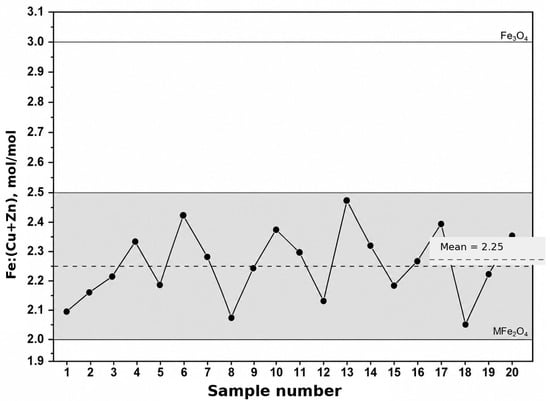
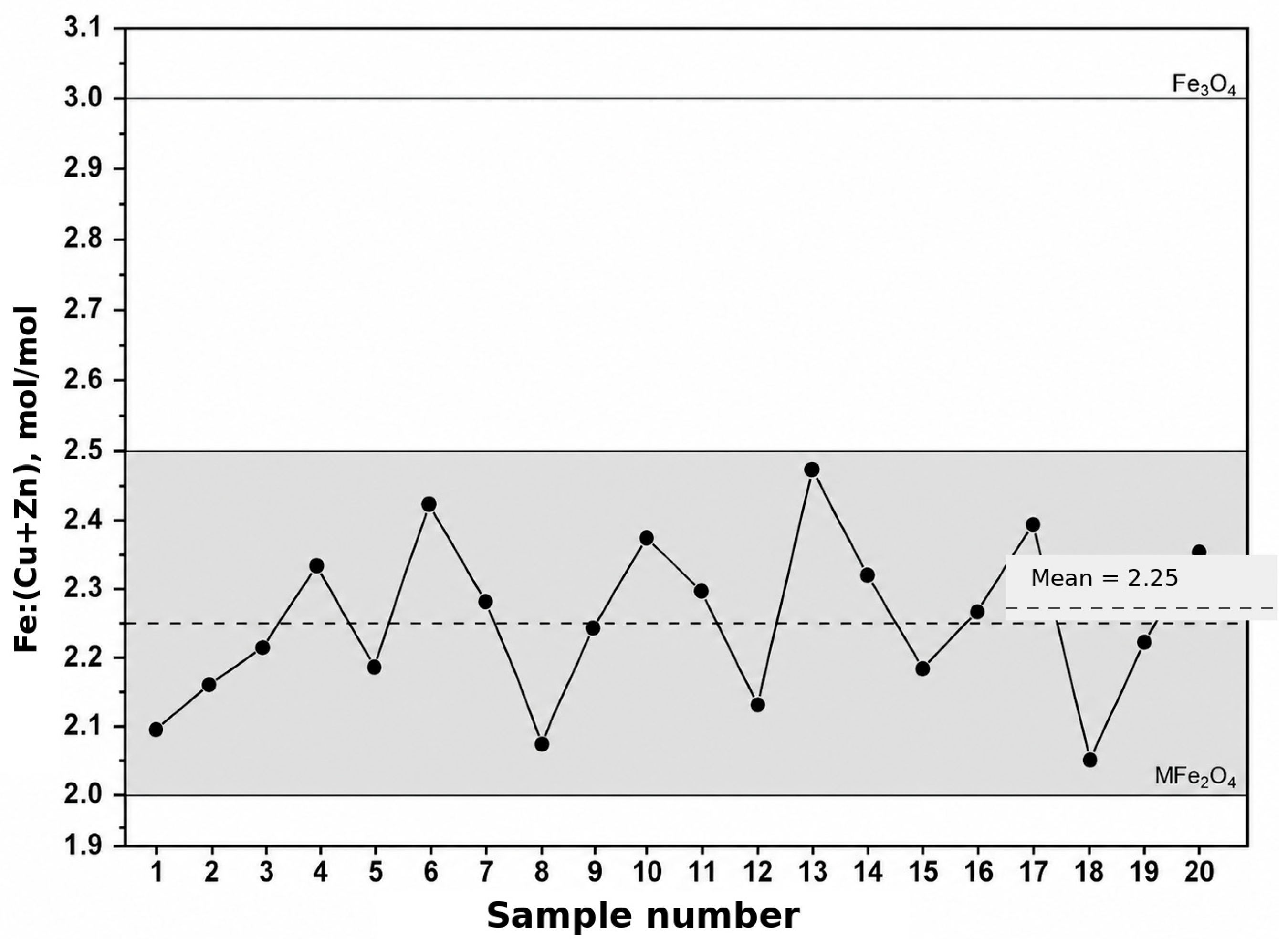
Figure 1 presents the Fe:(Cu+Zn) molar ratio for all 20 filtrate samples in comparison with the stoichiometric Fe ratio of 2.0 for a conventional divalent-metal ferrite, MFe2O4. The experimental values range from 2.05 to 2.47, with a mean value of 2.25. Thus, all samples contain a moderate excess of iron relative to the ideal MFe2O4 stoichiometry, while remaining sufficiently close to the ferrite ratio to support the use of the leaching solution as a multicomponent precursor for Fe–Cu–Zn-containing spinel formation.
Figure 1.
Fe:(Cu+Zn) molar ratio in 20 leaching-filtrate samples obtained from copper flotation tailings. The shaded area indicates the Fe:(Cu+Zn) molar-ratio range of 2.0–2.5, encompassing the experimental values and highlighting their proximity to the ideal MFe2O4 stoichiometry (R = 2). The dashed line represents the mean experimental value (R = 2.25).
The reference value R = 2 is for the ideal Fe: M ratio in a conventional divalent-metal ferrite, MFe2O4, where M is a divalent metal cation such as Cu2+ or Zn2+ [15,16,17]. The experimentally determined Fe:(Cu+Zn) ratios of 2.05–2.47 therefore indicate a moderate excess of iron compared with the ideal MFe2O4 stoichiometry. Normalizing the experimentally determined Fe, Cu, and Zn concentrations to three cations per O4 formula unit at the average ratio of 2.25 yields a nominal composition of ~Cu0.455Zn0.468Fe2.077O4. In the case of divalent Cu and Zn, the nominal composition of this composition can be written as (Cu2+0.455Zn2+0.468Fe2+0.077)Fe3+2.000O4. This expression is a stoichiometric model and does not imply experimentally determined cation-site occupancy.
This intrinsic stoichiometry reduces the need to add external iron, copper, or zinc salts. In this case, the technogenic solution serves both as the source of metals and as a preformed cationic matrix for the resulting spinel.
2.2. Effect of pH on the Co-Precipitation of Fe, Cu, and Zn
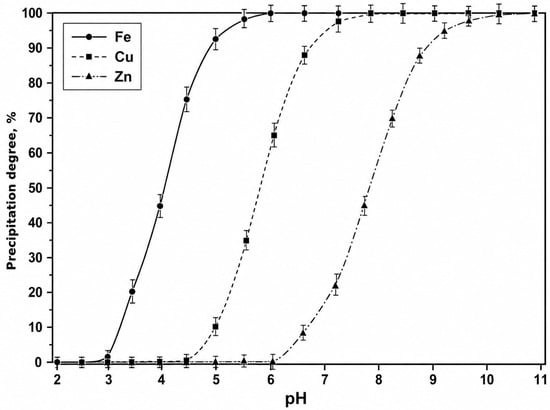
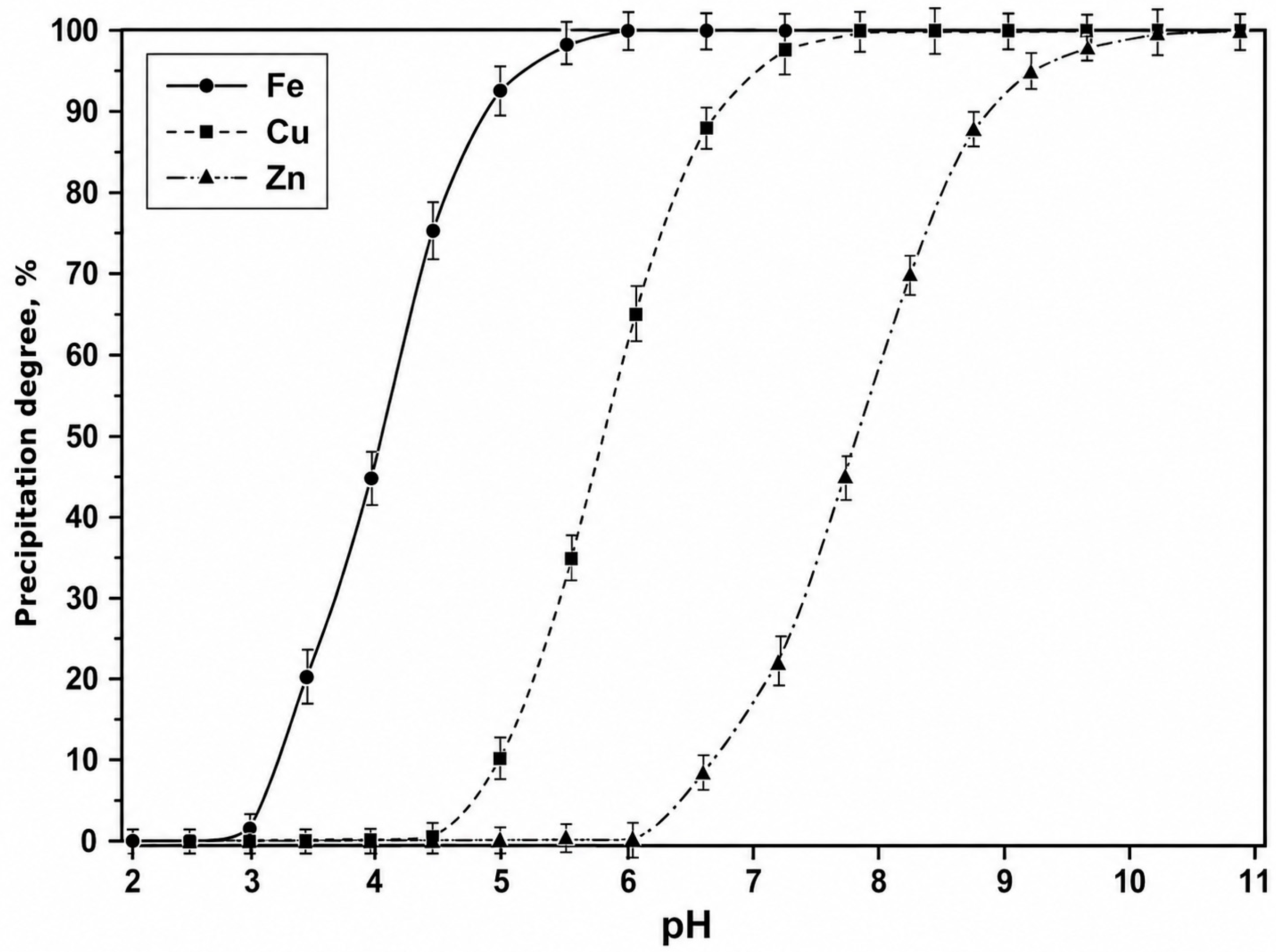
Figure 2 shows the precipitation curves of iron, copper, and zinc as a function of filtrate pH. The relatively small standard deviations observed for the replicate experiments indicate good reproducibility of the precipitation behavior over the investigated pH range.
Figure 2.
Precipitation degree of Fe, Cu, and Zn as a function of filtrate pH. Data are presented as mean ± standard deviation of three independent experiments (n = 3).
The curves exhibit a sequential sigmoidal profile, which is typical of stepwise hydrolytic precipitation of metals whose hydroxides have markedly different solubility products within a single multicomponent system. This sequence reflects the separation of solid-phase formation in both time and pH, with each metal passing through its characteristic region of rapid transfer from solution to the precipitate.
Iron begins to transfer appreciably into the solid phase at approximately pH 3.0. Between pH 3.5 and 5.5, its precipitation degree increases from 20% to 98%; thus, most of the iron is removed from solution within a pH interval of about two units. This behavior indicates the abrupt, cooperative hydrolysis of Fe3+/Fe2+ and rapid formation of a hydroxide–oxide phase. Copper behaves differently: it remains essentially unchanged in solution up to approximately pH 4.5, after which its precipitation proceeds more rapidly than that of iron. At pH 6.0, copper precipitation reaches approximately 65%, and at pH 7.2 it reaches approximately 98%. Thus, copper transfer to the solid phase occurs within a narrower pH interval of approximately 4.5–7.2.
Zinc precipitates later than the other metals and displays the most gradual curve. Noticeable transfer to the solid phase begins only above pH 6.2 and is largely completed over the pH range 8.0–10.0.
At pH 9.5, iron and copper are precipitated almost completely (close to 100%), while zinc recovery reaches approximately 97–98%; consequently, all three metals are transferred to the solid phase with high and comparable efficiency. A lower pH results in incomplete recovery of zinc, the slowest-precipitating of the three metals, thereby limiting the overall yield of the target product and shifting the stoichiometry of the resulting spinel toward a deficiency of divalent substituent cations. Conversely, increasing the pH above 9.5 provides only a marginal improvement in zinc recovery while substantially increasing alkali consumption and the risk of co-precipitating hydroxides of associated alkaline-earth and other impurity cations. Therefore, pH 9.5 was selected as a technological compromise between complete co-precipitation of the three target metals, economical use of the precipitating reagent, and limited accumulation of undesirable impurity phases in the precipitate.
This sequence of Fe, Cu, and Zn precipitation is consistent with their different hydrolysis behavior in the multicomponent sulfate solution. Iron (especially Fe(III)) hydrolyzes at lower pH and thus forms the first Fe-rich hydroxide/oxyhydroxide precursor. At intermediate pH, copper starts to precipitate, and zinc stays in solution until more alkaline conditions. This sequential behavior is in agreement with the different stability and solubility ranges of the corresponding hydrolyzed metal species.
The initial formation of a Fe-rich solid phase may then facilitate the heterogeneous precipitation or association of Cu- and Zn-bearing species with increasing pH. Thus, the precipitation curves are consistent with progressive formation of a chemically mixed Fe–Cu-Zn precursor rather than necessarily indicative of the formation of three completely independent precipitates. This interpretation should, however, be taken as a proposed mechanistic explanation, rather than direct evidence of a particular microscopic pathway of precipitation, since the intermediate solid phases were not characterized separately at each pH value.
Ferrites have been used for the treatment of metal-containing waste solutions by co-precipitation and related methods [21,22,23,24,25]. In many of these studies the precursor composition was deliberately modified by the addition of iron or other metal salts to obtain a suitable ferrite stoichiometry. Conversely, the current leachate already contains Fe, Cu and Zn in a molar ratio Fe:(Cu+Zn) close to that required for a divalent-metal ferrite type composition. This intrinsic stoichiometric feature indicates that the actual waste-derived solution could be directly used as a multicomponent precursor with minimal change in the main metal composition.
2.3. Chemical Composition of the Precipitates
The chemical compositions of the precipitate before and after calcination under nitrogen and in air are presented in Table 1.
Table 1.
Chemical composition of the precipitate before and after.
The combined Fe, Cu, and Zn content of the dried precipitate is 56.17 wt.%, confirming the dominant contribution of the three target metals to the solid phase and agreeing with the expected formation of a predominantly metal-bearing, rather than impurity-rich, product during precipitation. The presence of Mn, Al, Mg, Ca, S, and Si at a combined level of only several percent reflects the associated impurities in the initial leaching filtrate and indicates that precipitation at the selected pH is preferential toward Fe, Cu, and Zn.
After calcination, the mass fractions of all metals increase as expected, owing to the removal of physically bound water, dehydroxylation of hydroxide and oxyhydroxide phases, and decomposition of residual sulfate compounds. In other words, volatile components are lost while the absolute amount of metals in the solid residue is retained. This trend is also reflected in the fraction calculated by difference, which decreased from 36.98 wt.% in the dried precipitate to 31.51 wt.% after calcination under nitrogen and 33.77 wt.% after calcination in air, consistent with the removal of water and hydroxyl-containing species during thermal treatment.
Sulfur provides the clearest indicator of the thermal transformations: its content decreases from 3.20 wt.% in the initial precipitate to 0.65 wt.% after calcination under nitrogen and to 0.30 wt.% after calcination in air. The more extensive sulfur removal in the oxidizing atmosphere is consistent with oxidative decomposition of residual sulfate and sulfide compounds accompanied by the formation of volatile sulfur oxides. Under an inert nitrogen atmosphere, this process is less complete because no additional oxidant is available. At the same time, the higher calculated oxygen fraction in the P–air sample is consistent with oxidation of Fe(II) to Fe(III) and hematite formation, further confirming the oxidative nature of the transformations during calcination in air compared with those occurring in an inert atmosphere.
The Fe:(Cu+Zn) molar ratio calculated from the solid-phase composition is approximately 2.25 and remains virtually unchanged after calcination in either atmosphere. This indicates that thermal treatment controls the iron oxidation state and the associated phase distribution—the relative proportions of magnetite, ferrite, and hematite components—without disturbing the overall balance of the principal cations established during co-precipitation from the filtrate. In other words, the calcination atmosphere governs the phase and magnetic state of the product rather than its elemental composition, in accordance with the strategy adopted in this study to decouple these two objectives.
2.4. Phase Transformations
The phase composition of the initial material and the co-precipitated products was examined by XRD to determine the forms in which Fe, Cu, and Zn were immobilized after precipitation and to establish how subsequent thermal treatment altered the crystalline and magnetic state of the product. To avoid ambiguity, the following designations are used hereafter: P denotes the dried co-precipitated product before calcination; P–N2 denotes the product calcined at 600 °C under a nitrogen flow; and P–air denotes the product calcined at 600 °C in air.
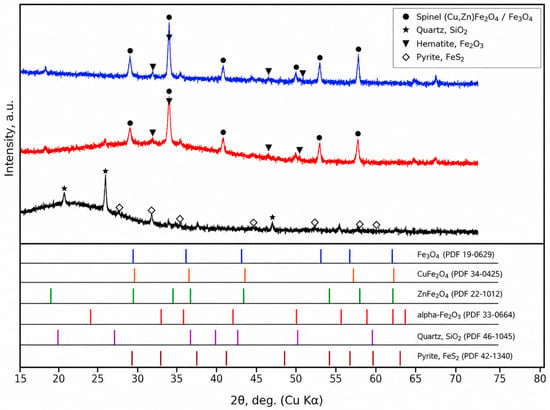
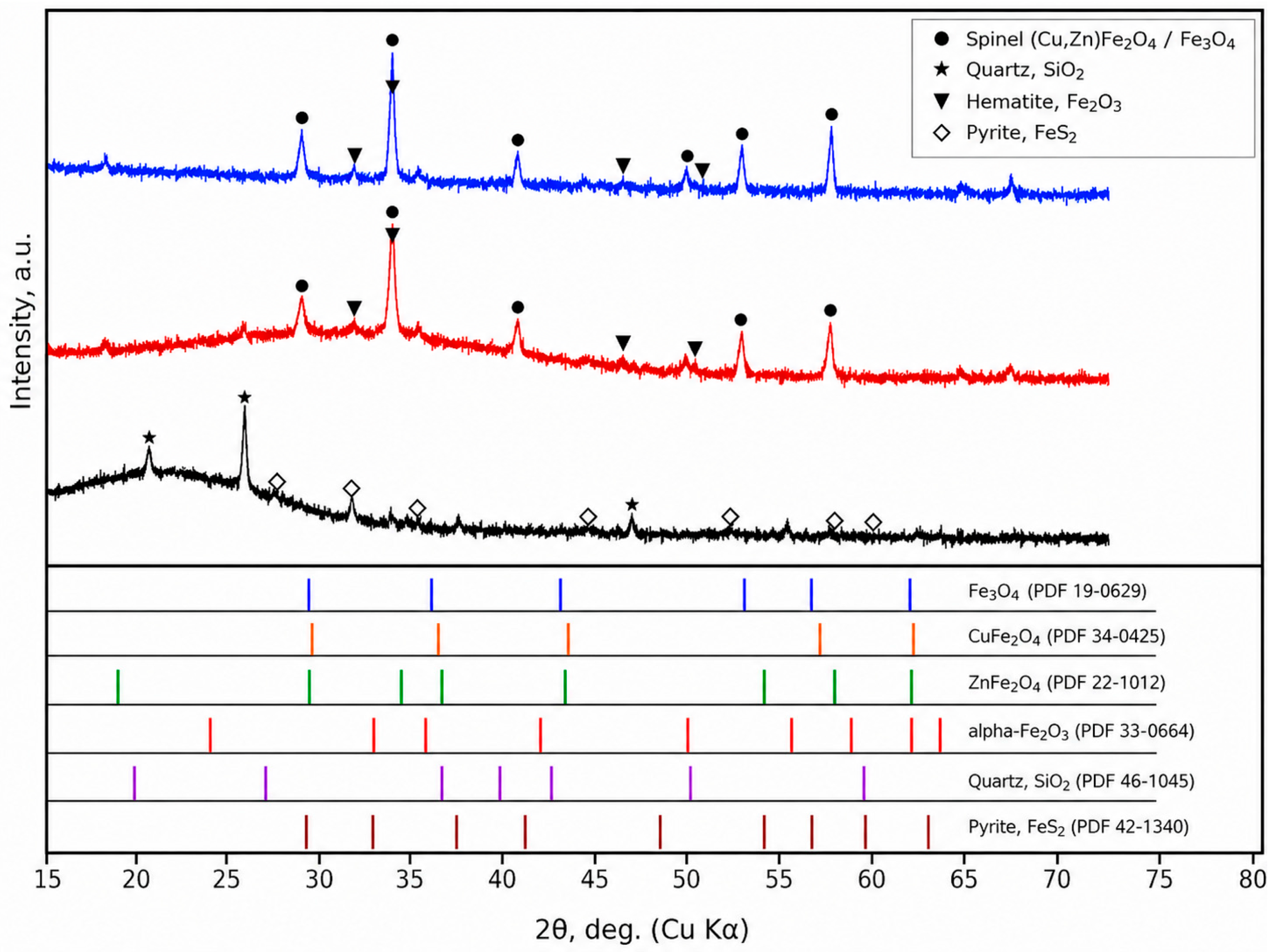
Figure 3 compares the XRD patterns of the initial copper flotation tailings and the two thermally treated co-precipitated products. The lower black curve corresponds to the initial tailings, the middle red curve to P–air, and the upper blue curve to P–N2. This arrangement separates the mineral matrix of the initial material from the phases formed during co-precipitation and subsequent calcination.
Figure 3.
XRD patterns of the initial copper flotation tailings and the precipitated product after calcination: initial tailings (black curve), P–air (red curve), and P–N2 (blue curve).
The XRD pattern of the initial tailings is characterized by a broad background and a set of relatively weak crystalline maxima. The most pronounced reflections are those of quartz at 2θ ≈ 26.6° and 50.1°, together with reflections of iron-bearing phases in the ranges 28–31°, 35–36°, 43–44°, 53–54°, 57–58°, and 62–63°. The broad background at approximately 20–35° indicates the presence of a poorly crystallized and partially amorphous silicate component. The initial tailings should therefore be regarded as a heterogeneous quartz–silicate matrix containing dispersed iron oxide and iron sulfide minerals.
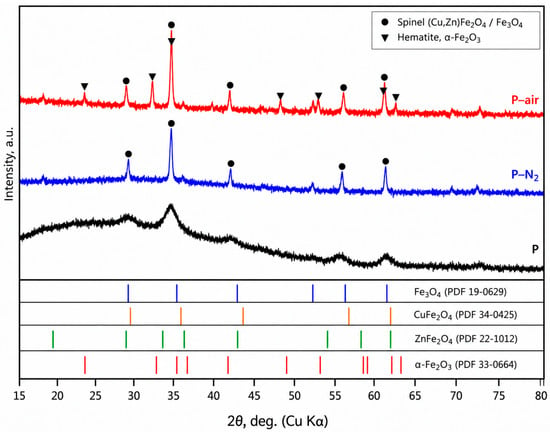
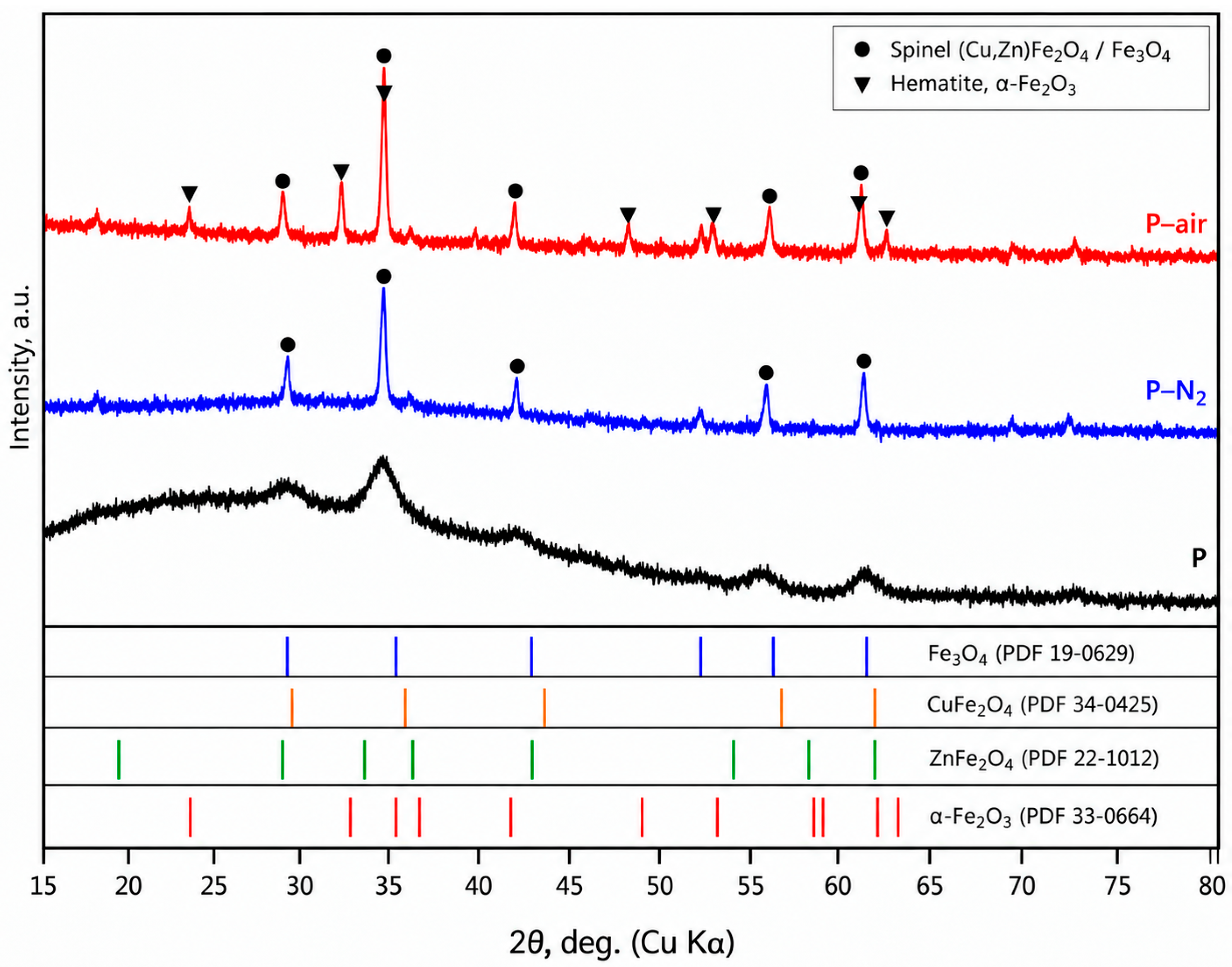
Following co-precipitation and calcination, the intensity of the spinel-phase reflections increases markedly. The principal peaks of the thermally treated samples occur in regions characteristic of a cubic spinel structure, at approximately 30°, 35.5°, 43°, 53–57°, and 62–63°. The principal reflections of Fe3O4, CuFe2O4, and ZnFe2O4 occur at closely similar 2θ positions and strongly overlap in the present diffraction patterns. Therefore, the individual contributions of these spinel phases cannot be unambiguously resolved by conventional XRD alone. Accordingly, the dominant crystalline component is conservatively described here as an Fe–Cu–Zn-containing mixed spinel phase rather than as a quantitatively resolved mixture of separate Fe3O4, CuFe2O4, and ZnFe2O4 phases. The reference patterns shown in Figure 3 and Figure 4 are provided to demonstrate the correspondence of the observed reflections with the spinel structure and should not be interpreted as quantitative phase identification. Consequently, the contribution of each individual ferrite cannot be reliably resolved from the XRD pattern alone. The observed diffraction pattern is consistent with an Fe–Cu–Zn-containing mixed spinel phase; however, conventional XRD alone cannot establish the detailed cation distribution within the spinel lattice.
Figure 4.
Phase state of the precipitated product before calcination (P, black curve), after calcination under nitrogen (P–N2, blue curve), and after calcination in air (P–air, red curve).
The difference between P–N2 and P–air is governed by the redox conditions during calcination. Under an inert nitrogen atmosphere, a fraction of Fe2+ is retained, which is required for the formation of a magnetite-like spinel. Accordingly, P–N2 exhibits intense and relatively narrow spinel reflections with only minor evidence of hematite. In air, Fe2+ is partially oxidized to Fe3+. As a result, additional hematite (Fe2O3) reflections appear alongside the spinel phase, most clearly at approximately 33°, 49–50°, 54°, and 62–64°. Thus, calcination in air does not destroy the spinel matrix but promotes partial iron oxidation and segregation of a discrete Fe(III) oxide phase.
To distinguish the stages of product formation more clearly, Figure 4 presents the XRD patterns of the co-precipitated material only: before calcination and after thermal treatment in the two atmospheres. The lower black curve corresponds to P, the middle blue curve to P–N2, and the upper red curve to P–air. The uncalcined P sample is dominated by a broad diffuse maximum and weak, broad reflections, indicating the low crystallinity of the precipitate. This pattern is typical of mixed hydroxides, oxyhydroxides, and hydrated basic salts of iron, copper, and zinc formed during precipitation from a multicomponent sulfate solution.
The observed transformation is in agreement with the formation of ferrites from mixed metal hydroxide precursors reported for metal-containing solutions from waste and from industry [21,22,23,24,25]. In these systems, co-precipitation results in poor crystalline hydroxide- or oxyhydroxide-rich solids, whereas subsequent thermal or hydrothermal treatment promotes dehydration, cation redistribution and the formation of a more ordered spinel structure. The observed decrease in the diffuse XRD background after calcination and the increase in the intensity of the spinel reflections in the present system support this precipitation-to-spinel transformation pathway.
A distinguishing feature of the present results is the strong influence of the calcination atmosphere on the final phase assemblage. The oxidation of the Fe(II)-containing component is limited under nitrogen, while calcination in air promotes further oxidation of the iron and the formation of hematite. Thus, the calcination atmosphere mainly acts as a redox-control parameter determining the phase distribution without significant changes in the sum of Fe:(Cu+Zn) cation ratio.
After calcination at 600 °C, the diffuse background decreases and is replaced by narrow, intense reflections. This indicates dehydration, removal of residual sulfate groups, and structural rearrangement of the precipitate. Simultaneously, crystallite growth and long-range ordering within the spinel lattice occur. Thermal treatment therefore performs two functions: it stabilizes the chemically heterogeneous precipitate and converts the Fe, Cu, and Zn it contains into a single, more crystalline magnetic phase.
Comparison of P–N2 and P–air demonstrates that the calcination atmosphere is the principal parameter controlling the phase state of the final product. Nitrogen favors preservation of the magnetite-like spinel and limits the formation of non-magnetic or weakly magnetic hematite. Air, in contrast, promotes more extensive oxidation of iron and the formation of a spinel–hematite mixture. This distinction is expected to directly affect the magnetic susceptibility and magnetic recovery of the product.
A qualitative comparison of the diffraction patterns supports this interpretation. In the initial uncalcined precipitate P, the spinel-phase contribution is relatively low, whereas the material is dominated by amorphous and poorly crystallized components. After calcination under nitrogen, the spinel phase becomes predominant, while the hematite contribution remains low. After calcination in air, the relative contribution of the spinel phase is somewhat lower, and the hematite contribution increases substantially. These observations should be interpreted with caution because of the overlap among the Fe3O4, CuFe2O4, and ZnFe2O4 reflections; nevertheless, the overall trend is unambiguous.
2.5. Proposed Precipitation-to-Spinel Transformation Pathway
The results of the precipitation and the phase analyzes are combined to propose a possible pathway for the formation of spinel. The pH-dependent precipitation curves show that the first precipitate in the solid phase is Fe, followed by Cu and Zn. This behavior is consistent with the previous hydrolysis of Fe, particularly Fe(III), and the formation of a Fe-rich hydroxide/oxyhydroxide precursor. With increasing pH, Cu- and Zn-bearing species gradually precipitate and associate with this Fe-rich solid phase [26,27]. The precipitation reactions can be written simplified as in Equations (1)–(4):
These equations represent simplified net reactions; in the actual multicomponent sulfate solution, hydroxocomplexes, oxyhydroxides, and basic sulfate species may also contribute to the precipitated precursor.
Dehydration and dehydroxylation of the mixed precursor during calcination, followed by solid-state cation redistribution, promote the crystallization of the spinel structure [26,27]. This transformation can be expressed in a simplified stoichiometric form as Equation (5):
For the average composition of the present system, the nominal values are approximately x = 0.455 and y = 0.468, corresponding to an Fe-rich Cu–Zn-substituted spinel composition. The Fe(II) fraction already present in the initial leachate (approximately 5–8% of total Fe) provides a possible source of divalent iron for the magnetite-like component of the spinel [19,20].
This interpretation is in good agreement with the XRD evolution from the poor crystalline precipitate P to the more crystalline spinel-containing products after calcination. The simultaneous decrease in sulfur content from 3.20 wt.% in P to 0.65 wt.% in P–N2 and 0.30 wt.% in P–air further substantiates the elimination of sulfate- and sulfur-containing species during thermal treatment.
The redox evolution of the Fe-containing component is controlled by the calcination atmosphere. Under nitrogen-limited oxidation of Fe(II), the formation of a magnetite-like Fe-Cu-Zn spinel is favored. Further oxidation of Fe(II) to Fe(III) in air promotes hematite formation consistent with the additional α-Fe2O3 reflections observed by XRD. The above phase evolution is also in agreement with the magnetic-recovery results, where P-N2 showed the highest recovery (~96% at 1050 mT) compared with P-air (~90%). The proposed pathway is therefore to be considered as a mechanistic interpretation consistent with the combined precipitation, chemical-composition, XRD, and magnetic-recovery data and not as direct evidence of the atomic-scale cation distribution within the spinel lattice.
2.6. Morphology of the Precipitate Before and After Calcination
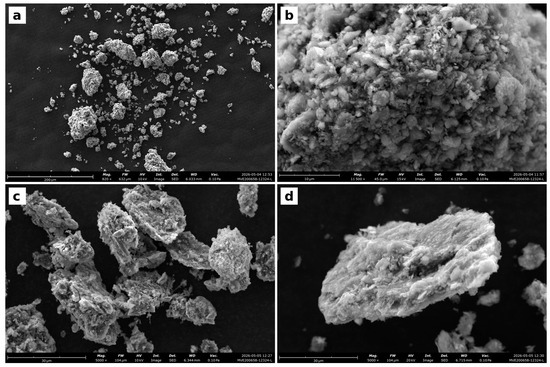
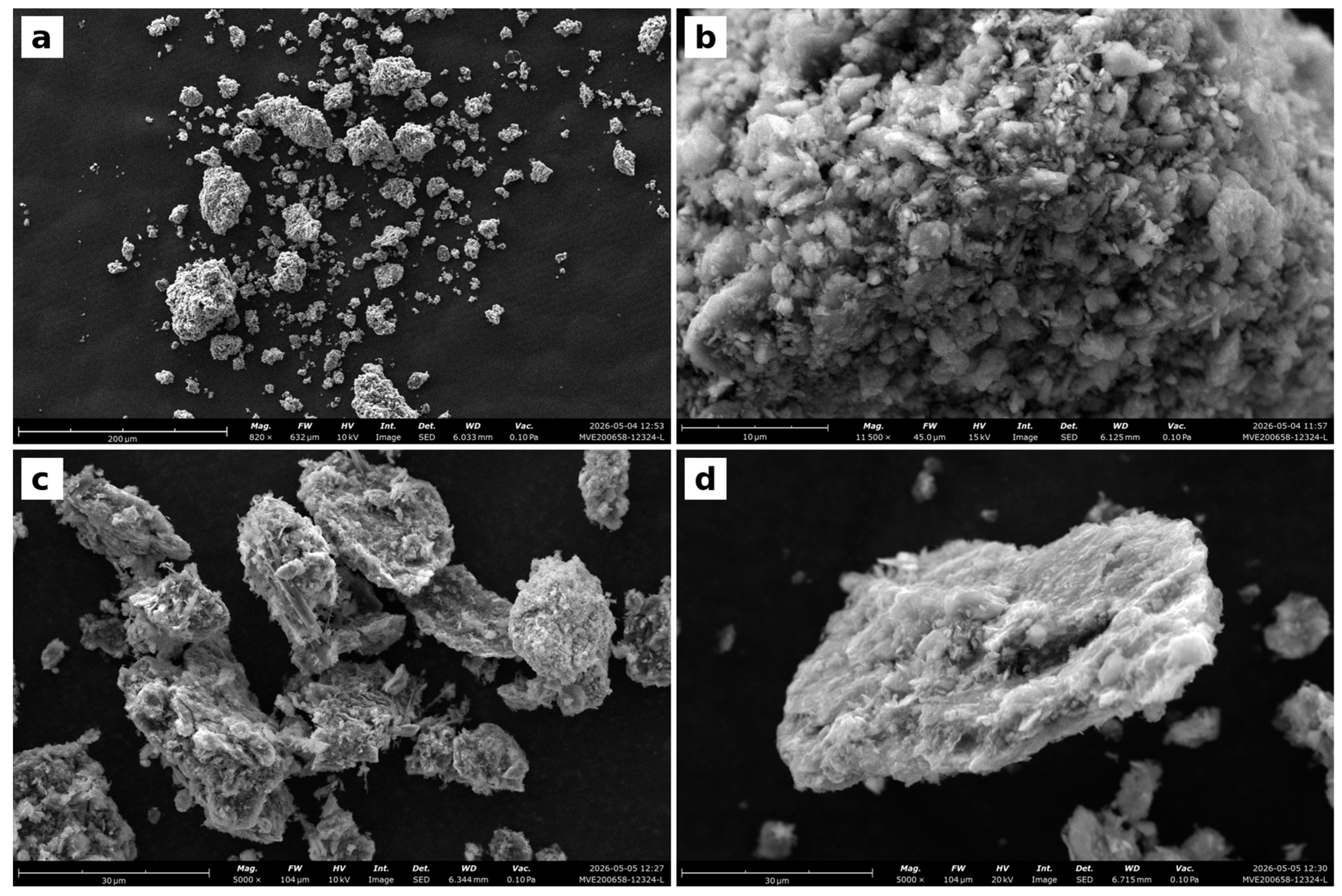
Images of the precipitate before and after calcination are shown in Figure 5.
Figure 5.
SEM images of the co-precipitated Fe–Cu–Zn-containing product: (a) before calcination, 820×; (b) before calcination, 11,500×; (c) after calcination, 5000×; and (d) detailed image of a calcined aggregate, 5000×.
SEM was used here specifically for morphological characterization rather than elemental mapping. The presence and retention of Fe, Cu, and Zn in the products were independently confirmed by bulk ICP-OES analysis, while their association with the spinel-containing crystalline product was evaluated by XRD. Therefore, the SEM observations are interpreted only in terms of particle morphology and aggregation, and no conclusions regarding micro-scale elemental homogeneity or cation-site distribution are drawn from these images.
The low-magnification image of the initial precipitate reveals a broad particle-size population ranging from several micrometers to 150–200 μm. The particles are irregularly shaped, loosely structured, and contain an extensive network of interparticle voids. The observed morphology is consistent with the aggregation of poor crystalline hydroxide/oxyhydroxide particles formed during co-precipitation.
At 11,500× magnification, the aggregate surfaces consist of thin submicrometer flakes and short plate-like features. Their lateral dimensions are predominantly 0.2–1.5 μm, with substantially smaller thicknesses. The developed surface reduces cation-diffusion distances during spinel crystallization.
After calcination, denser layered plate-like aggregates approximately 10–70 μm in size are formed. Individual flakes coalesce, necks develop at their contacts, and the surface becomes smoother. The observed consolidation is associated with dehydroxylation, mass transport across particle contacts, and crystallite growth. Particle coarsening improves filterability and magnetic separation but reduces the specific surface area of the product.
2.7. Magnetic Recovery
The magnetic properties of the co-precipitated product were evaluated from the dependence of the mass yield of the magnetic fraction on magnetic flux density. The magnetic-fraction yield was defined as the ratio of the mass transferred to the magnetic product to the mass of the initial sample. Three samples were examined: the dried precipitate P, the product calcined at 600 °C under nitrogen (P–N2), and the product calcined at the same temperature in air (P–air). This comparison enables assessment of the effects of thermal treatment and calcination atmosphere on the magnetic susceptibility of the material.
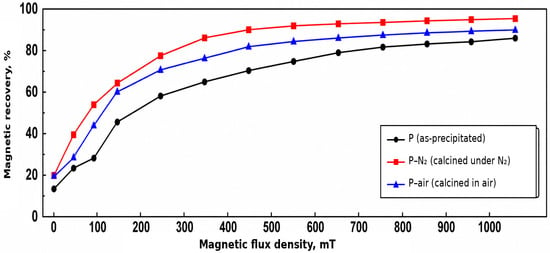
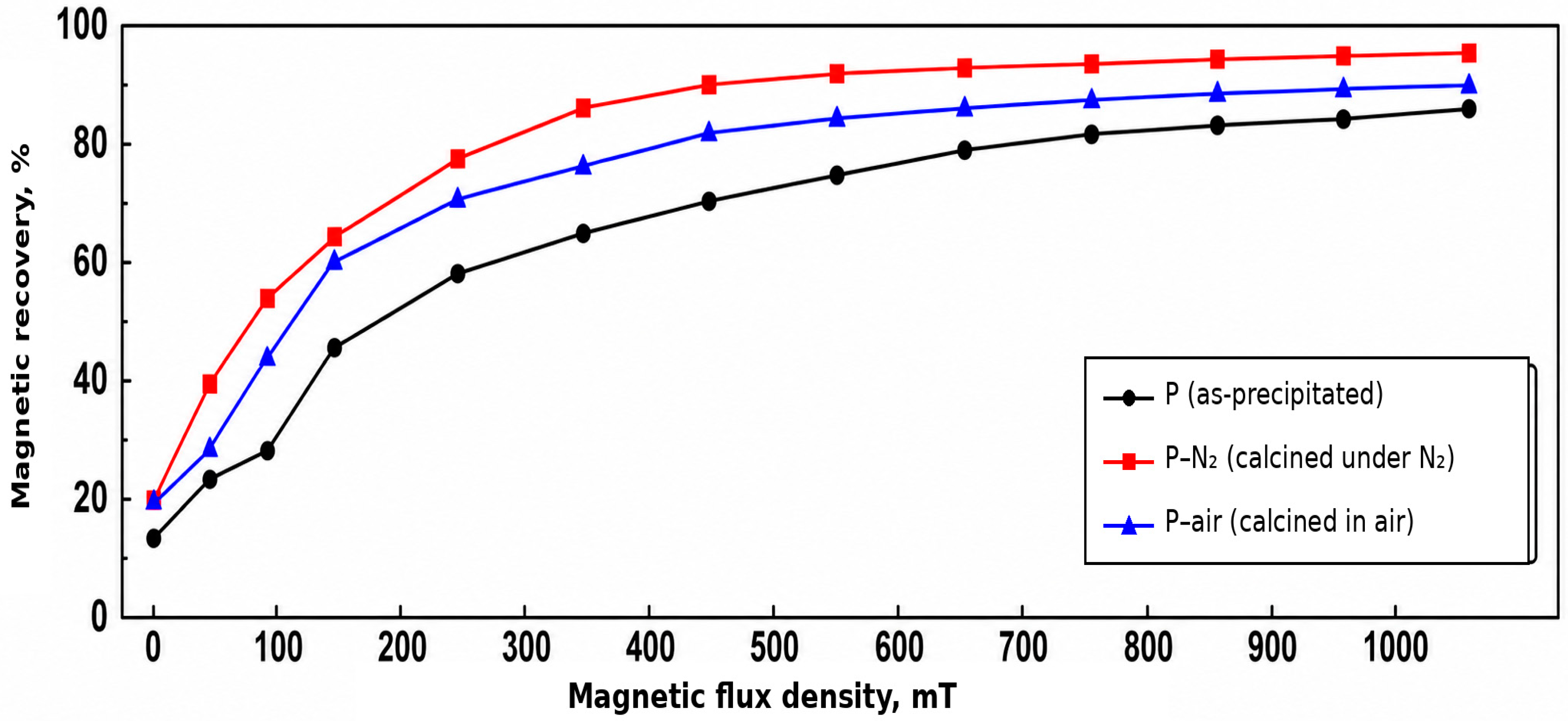
Figure 6 shows the mass yields of the magnetic fractions of P, P–N2, and P–air as functions of magnetic flux density over the range 0–1050 mT. In all cases, the magnetic-product yield increases with increasing magnetic flux density. The highest values are observed for P–N2, intermediate values for P–air, and the lowest values for the uncalcined precipitate P. Calcination therefore enhances the magnetic response of the material, with treatment in an inert atmosphere producing the most magnetically susceptible product.
Figure 6.
Mass yield of the magnetic fraction of the dried and calcined products as a function of magnetic flux density.
The most pronounced increase in magnetic-fraction yield occurs up to 300–400 mT, where particles with high magnetic susceptibility preferentially report to the magnetic product. At 350 mT, the magnetic-fraction yields are approximately 65% for P, 86% for P–N2, and 76% for P–air. The differences between the calcined samples show that the magnetic properties are governed not only by dehydroxylation and particle coarsening but also by the phase composition and iron valence state, both of which depend on the calcination atmosphere.
Over the range 400–700 mT, the magnetic-fraction yield continues to increase, although the rate of increase gradually declines. At 650 mT, the values reach approximately 79% for P, 93% for P–N2, and 86% for P–air. In this range, less magnetically susceptible particles, fine aggregates, and particles with a lower content of the magnetic spinel phase are recovered into the magnetic product.
At 900–1050 mT, the curves approach a plateau. The maximum mass yields of the magnetic fraction are approximately 86% for P, 96% for P–N2, and 90% for P–air. The residual non-magnetic fraction may be associated with quartz, silicate, and sulfate impurities, as well as with poorly crystallized hydroxide–oxide components.
The high magnetic-fraction yield of P–N2 is consistent with the XRD results. Calcination under nitrogen promotes the retention of Fe2+ and the formation of a magnetite-like mixed spinel containing Cu and Zn. This phase is ferrimagnetic and is efficiently separated in a magnetic field.
The P–air sample exhibits intermediate behavior. A spinel phase also forms during calcination in air; however, a fraction of Fe2+ is oxidized to Fe3+, producing hematite, which has markedly lower magnetic susceptibility. Consequently, the magnetic-fraction yield of P–air is lower than that of P–N2.
The lowest values observed for P are attributable to the predominance of a poorly crystallized hydroxide–oxide matrix containing bound water and numerous structural defects. Nevertheless, a magnetic-fraction yield of 80–86% indicates that magnetically active Fe-bearing associates are already formed during the co-precipitation stage.
From a technological standpoint, a magnetic flux density range of 650–850 mT is considered rational. Within this interval, P–N2 has already reached a practically significant plateau, whereas a further increase in magnetic flux density provides only a minor gain in magnetic-fraction yield at the expense of higher energy consumption.
2.8. Comparison with Alternative Spinel Synthesis Routes
The synthesis route is an important factor in controlling the crystallinity, particle size, morphology, cation distribution, and magnetic properties of spinel ferrites [26,27,28]. Current preparation approaches include conventional solid-state reaction, sol–gel/auto-combustion, hydrothermal synthesis, microwave-assisted processing, and chemical co-precipitation, each with different advantages in terms of structural control, process simplicity, energy demand, and scalability [26,27]. A recent direct comparison by Daf et al. [28] confirmed strong dependence of product properties on the synthesis pathway, showing that sol–gel auto-combustion, hydrothermal, and co-precipitation routes produce measurable differences in the structural, morphological, and magnetic characteristics of the same multication spinel ferrite.
The main advantage of the present route is therefore not claimed to be better intrinsic magnetic performance but process integration. As opposed to most conventional ferrite syntheses (Table 2) that rely on purified or specially formulated metal-salt precursors [26,29], the present process is a direct conversion of Fe, Cu and Zn from a real copper-flotation-tailings leachate into a Fe–Cu–Zn-containing spinel product without prior separation of the individual metals or deliberate addition of Fe, Cu or Zn salts. Magnetic recoveries of ca. 93% at 650 mT and 96% at 1050 mT were found for the nitrogen-calcined product. Because magnetic recovery is a process-separation parameter and not an intrinsic magnetic property like saturation magnetization or coercivity, these values are not directly compared to the literature Ms or Hc data.
Table 2.
Comparison of the present process with representative spinel-ferrite synthesis routes.
2.9. Preliminary Technical Feasibility and Economic Considerations
The technical and economic feasibility of the proposed route was evaluated in a preliminary assessment at the process level. The mean composition of the leachate indicates that 1 m3 of solution contains ~4.85 kg Fe, 1.21 kg Cu, and 1.28 kg Zn. At pH 9.5, precipitation of Fe and Cu is almost complete, and Zn recovery is 97–98%. With these values, approximately 7.3 kg of the three target metals can be transferred to the solid phase per m3 of leachate. Fe, Cu, and Zn represent 56.17 wt.% of the dried precipitate, corresponding to an estimated dried-product yield of about 13 kg m−3. The nitrogen-calcined material resulted in a product yield of ~11.5 kg m−3, of which ~93% can be magnetically recovered at 650 mT.
The main benefit of the process is technically the simultaneous recovery of Fe, Cu and Zn without the necessity of prior separation of the individual metals or intentional addition of Fe-, Cu- or Zn-containing precursor salts. However, the main operating requirements are consumption of NaOH, heating up to 75 °C, washing and drying, calcination at 600 °C, supply of nitrogen, and magnetic separation. Among these operations, thermal treatment and nitrogen consumption are expected to be the main energy and utility requirements. Thus, the current evaluation should be seen as a preliminary feasibility assessment and not as a full techno-economic analysis. A full economic assessment will need experimentally measured NaOH consumption, heat and electricity demand, nitrogen consumption, water recycling, equipment costs, and an assessment of the market value of the recovered product.
3. Materials and Methods
Bioleaching was performed using a mixed culture of Acidithiobacillus ferrooxidans and Acidithiobacillus thiooxidans in 9K medium at a pulp density of 10% (w/v). The initial pH was adjusted to 1.8, and the suspension was maintained at 30 °C with agitation at 150 rpm for 21 days. The suspension was then filtered to remove residual solids, and the filtrate was used for the precipitation experiments. A 100 mL aliquot of the leaching filtrate was used for each precipitation experiment. All precipitation experiments used to construct the pH-dependent precipitation curves were performed in triplicate under identical experimental conditions. The precipitation degree for each metal was calculated for each independent experiment, and the results are presented as the mean ± standard deviation (n = 3). A series of 20 samples (Table 3) was used to capture variations in solution composition between individual leaching cycles. The concentrations of Fe, Cu, Zn, Mn, Al, Mg, and Ca were determined by inductively coupled plasma optical emission spectrometry iCAP PRO XP DUO (Thermo Fisher Scientific, Bremen, Germany). The Fe(II) concentration was determined titrimetrically, whereas total iron was measured after preliminary reduction of Fe(III). Sulfate ions were determined gravimetrically.
Table 3.
Composition of the leaching filtrate based on a series of 20 samples.
The Fe:(Cu+Zn) molar ratio was calculated by converting the experimentally determined mass concentrations of Fe, Cu, and Zn into molar concentrations. Equation (6) represents a direct stoichiometric calculation rather than an empirical relationship proposed in this study. The calculated ratio was subsequently interpreted with reference to the general stoichiometry of spinel ferrites, MFe2O4 [15,16,17]:
The filtrate was heated to 75 ± 2 °C under continuous magnetic stirring at 400 rpm. The Fe(II) fraction naturally accounted for approximately 5–8% of the total iron content (approximately 6.4% on average), and no additional adjustment of the Fe(II)/Fe(total) ratio was performed. A 5 M NaOH solution was gradually added to the heated filtrate under continuous stirring to adjust the pH. The NaOH solution was added dropwise at an approximate rate of 0.5 mL min−1 until the required pH was reached. The effect of pH was investigated over the range 2.0–11.0. After the target pH had been reached, the suspension was aged for 60 min at 75 ± 2 °C under continuous stirring at 400 rpm. The suspension was subsequently cooled to room temperature and filtered. The principal product was obtained at pH 9.5 ± 0.1. The precipitate was washed with water until the sulfate-ion concentration in the washings decreased, and was then dried at 105 °C to constant mass.
The precipitation degree of the i-th metal was calculated as follows:
where C0.i and Ci are the metal concentrations before and after precipitation, respectively.
The dried product was divided into two portions. The first portion was calcined at 600 °C for 2 h under a nitrogen flow, whereas the second was calcined at the same temperature in air. The heating rate was 5 °C/min. The dried precipitate was denoted as P, the nitrogen-calcined product as P–N2, and the air-calcined product as P–air.
The phase composition was examined using a DW-27 mini X-ray diffractometer (Drawell, Chongqing, China) equipped with Cu Kα radiation over the 2θ range of 15–80°. Phase identification was performed by comparing the experimental diffraction patterns with reference data from the ICDD Powder Diffraction File (PDF) database. The following reference cards were used: Fe3O4 (PDF No. 19-0629), CuFe2O4 (PDF No. 34-0425), ZnFe2O4 (PDF No. 22-1012), α-Fe2O3 (PDF No. 33-0664), α-quartz SiO2 (PDF No. 46-1045), and pyrite FeS2 (PDF No. 42-1340). Because the principal reflections of Fe3O4, CuFe2O4, and ZnFe2O4 substantially overlap, the spinel-containing phase was interpreted as an Fe–Cu–Zn mixed spinel rather than as quantitatively resolved individual ferrite phases. Morphology was investigated using a Thermo Scientific Phenom XL G2 Desktop scanning electron microscope (Eindhoven, The Netherlands) in the secondary-electron mode. The chemical composition of the solid products was determined by ICP-OES after complete acid digestion.
Magnetic recovery was evaluated for the dried and calcined products at magnetic flux densities ranging from 0 to 1050 mT. A 1.00 g portion of each material was dispersed in 50 mL of deionized water, corresponding to a solid-to-liquid ratio of 1 g per 50 mL. The suspension was stirred for 1 min to ensure uniform dispersion of the particles. The magnetic fraction was then separated, dried, and weighed. The suspension was stirred for 1 min to ensure uniform dispersion of the particles. The magnetic fraction was then separated, dried, and weighed. Magnetic recovery was calculated as the ratio of the magnetic-fraction mass to the initial sample mass:
The magnetic-recovery curves obtained for P, P–N2, and P–air were subsequently compared to evaluate the influence of thermal treatment and calcination atmosphere on the magnetic response of the material.
4. Conclusions
This study demonstrates the feasibility of co-precipitating Fe, Cu, and Zn from the leaching filtrate of copper flotation tailings to obtain a magnetic spinel-containing product. The Fe:(Cu+Zn) molar ratio in the filtrate ranged from 2.05 to 2.47, with a mean value of 2.25, which is close to ferrite-spinel stoichiometry and permits use of the solution without substantial compositional adjustment. At pH 9.5, Fe and Cu were precipitated almost completely, while Zn recovery reached 97–98%. After drying, the combined Fe, Cu, and Zn content of the precipitate was 56.17 wt.%. Calcination at 600 °C caused dehydroxylation, reduced the sulfur content, and promoted formation of a magnetite-like mixed spinel. The spinel phase has higher magnetic susceptibility, whereas in air a fraction of Fe2+ was oxidized with the formation of hematite. These phase differences governed the magnetic behavior: the maximum recovery of P–N2 reached 93% at 650 mT and 96% at 1050 mT, exceeding the corresponding values for P–air and the uncalcined precipitate. The results confirm the potential of co-precipitation at pH 9.5 followed by calcination under nitrogen and magnetic separation at 650–850 mT. However, the present work is limited to laboratory batch experiments, and the variability of actual tailings leachates may affect precursor stoichiometry and product properties upon scale-up. Moreover, the strong overlap of the Fe3O4, CuFe2O4, and ZnFe2O4 reflections makes it impossible to determine the individual spinel components and the cation-site distributions precisely by conventional XRD alone. Magnetic recovery gives a process-level measure of separability but does not replace the intrinsic magnetic characterization. Future work should therefore be directed to Fe2+/Fe3+ sensitive and quantitative phase characterization, VSM measurements, long-term chemical and leaching stability, optimization of the calcination temperature and nitrogen consumption, and validation under continuous or pilot-scale conditions together with a full techno-economic and environmental assessment.
Author Contributions
Conceptualization, R.A.; methodology, L.M. and K.K.; investigation, L.M. and A.B.; formal analysis, T.O. and K.K.; data curation, L.M. and A.B.; visualization, T.O.; writing—original draft preparation, L.M. and A.B.; writing—review and editing, R.A., K.K. and T.O.; supervision, R.A.; project administration, R.A. All authors have read and agreed to the published version of the manuscript.
Funding
This research has been funded by the Ministry of Science and Higher Education of the Republic of Kazakhstan (Grant No. BR28712667).
Data Availability Statement
The original contributions presented in this study are included in the article. Further inquiries can be directed to the corresponding author.
Conflicts of Interest
The authors declare no conflicts of interest.
References
- Bilal, M.; Park, I.; Hornn, V.; Ito, M.; Hassan, F.U.; Jeon, S.; Hiroyoshi, N. The Challenges and Prospects of Recovering Fine Copper Sulfides from Tailings Using Different Flotation Techniques: A Review. Minerals 2022, 12, 586. [Google Scholar] [CrossRef] [Scilit]
- Dadzie, R.A.; Zanin, M.; Skinner, W.; Addai-Mensah, J.; Asamoah, R.; Abaka-Wood, G.B. Reprocessing of Sulphide Flotation Tailings for Copper Recovery: Characterisation. Minerals 2025, 15, 649. [Google Scholar] [CrossRef] [Scilit]
- Tyumentseva, O.; Kamunur, K.; Mussapyrova, L.; Batkal, A.; Beisembayeva, L.; Nadirov, R. Microfluidic Pre-Concentration of Metals from Fine Flotation Tailings. Minerals 2026, 16, 355. [Google Scholar] [CrossRef] [Scilit]
- Schueler, T.A.; Schippers, A.; Goldmann, D. Bioleaching for Metals Removal from Mine Tailings Flotation Fractions. Hydrometallurgy 2024, 225, 106286. [Google Scholar] [CrossRef] [Scilit]
- Zhang, R.; Schippers, A. Stirred-Tank Bioleaching of Copper and Cobalt from Mine Tailings in Chile. Miner. Eng. 2022, 180, 107514. [Google Scholar] [CrossRef] [Scilit]
- Xu, W.; Zhang, Y.; Yan, J.; Chen, Z.; Wei, Q.; Wang, H.; Lu, Y. Microstructure and Properties of High-Strength Lightweight Ceramsites Customised with Ultra-Fine Copper Tailings. Constr. Build. Mater. 2024, 429, 136433. [Google Scholar] [CrossRef] [Scilit]
- Li, Y.; Li, S.; Zhao, Z. Controlling Magnetic Agglomeration in Superconducting High Gradient Magnetic Separation Processing of Iron Ore Tailings for High-Grade Silica Recovery. Int. J. Min. Sci. Technol. 2025, 35, 1627–1644. [Google Scholar] [CrossRef] [Scilit]
- Yang, Z.; Gu, H.; Liu, S.; Wu, K.; Xu, L.; Guo, L. Insights into the Dissolution Kinetics of Copper–Nickel Tailings for CO2 Mineral Sequestration. Int. J. Miner. Metall. Mater. 2025, 32, 2119–2130. [Google Scholar] [CrossRef] [Scilit]
- Santibáñez-Velásquez, L.E.; Guzmán, A.; Morel, M.J. Extraction of Iron and Other Metals from Copper Tailings through Leaching. Metals 2022, 12, 1924. [Google Scholar] [CrossRef] [Scilit]
- Chen, W.; Yin, S.; Zhou, G.; Li, Z.; Song, Q. Copper Recovery from Tailings through Bioleaching and Further Application of Bioleached Tailings Residue: Comprehensive Utilization of Tailings. J. Clean. Prod. 2022, 332, 130129. [Google Scholar] [CrossRef] [Scilit]
- Arancibia-Zúñiga, A.; Cornejo-Kunz, B.; Rojas, F.; Carlesi, C. Circular Economy Approaches for Copper Recovery from Mining Waste: A Systematic Review of Leaching Technologies. Minerals 2026, 16, 597. [Google Scholar] [CrossRef] [Scilit]
- De Oliveira, V.H.; Duddigan, S.; Symons, J.; Whelan, M.J.; Selvaraj, V.; Abbott, A.P.; Crane, R.; Jenkin, G.R.T.; Tibbett, M. Copper Extraction and Phytotoxicity of Organic Acid Leached Mine Tailings in Brassica napus. Environ. Geochem. Health 2026, 48, 299. [Google Scholar] [CrossRef] [Scilit] [PubMed]
- Maltrana, V.; Morales, J. The Use of Acid Leaching to Recover Metals from Tailings: A Review. Metals 2023, 13, 1862. [Google Scholar] [CrossRef] [Scilit]
- Mu, P.; Zhao, J.; Zhang, X.; Yang, C.; Wu, J.; Yang, Y.; Tang, Y.; Xiao, M.; Pan, M.; Zhao, H.; et al. Research Progress in Preparation of Manganese-Based Materials from Multisource Manganese Ores. Green Smart Min. Eng. 2025, 2, 483–514. [Google Scholar] [CrossRef] [Scilit]
- Suresh, S.; Deshmukh, S.A.; Bhuse, D.V.; Mallesham, B.; Nagapillai, P. Review on Magnetically Retrievable Spinel Ferrites MFe2O4/TiO2 (M = Co, Zn) Composites and Its Application for Photocatalytic Removal of Pollutants. Appl. Water Sci. 2025, 15, 284. [Google Scholar] [CrossRef] [Scilit]
- Chanduví, H.M.; Navarro, A.M.; Aponte, G.T.; Sánchez, R.Z.; Roldán-López, J.A.; Ferradas, K.; Errico, L.A. DFT Insight into the Structural and Magnetic Properties of MgFe2O4 Ferrite: Bulk and Surface. J. Magn. Magn. Mater. 2026, 641, 173846. [Google Scholar] [CrossRef] [Scilit]
- Kuntjahjono, M.F.; Napoleon, S.; Sarweswara, W.; Pandia, Y.E.; Haqina, Z.A.; Sasongko, N.A.; Nuha, N.; Rifai, A.; Basuki, R. Comparative Review of Metal Ferrites for Heavy Metals Adsorption in Water. Sorpt. Stud. 2025, 1, 73–86. [Google Scholar] [CrossRef] [Scilit]
- Zhao, M.; Zhang, X.; Yu, H.; Xie, Y.; Yi, T. Microscopic Insight of the High-Entropy Effect on the Lithium Storage Performance and Rate Capability of Spinel Oxide. Energy Environ. Mater. 2025, 8, e70060. [Google Scholar] [CrossRef] [Scilit]
- Zhou, J.; Lyu, X.; Xia, X.; Ma, J.; Yan, L.; Gao, B. A Mini-Review of Functionalized Magnetic Fe3O4 Nanoparticles: From Fundamentals to Application. Bol. Soc. Esp. Ceram. Vidr. 2025, 64, 100448. [Google Scholar] [CrossRef] [Scilit]
- Nadoll, P.; Angerer, T.; Mauk, J.L.; French, D.; Walshe, J. The Chemistry of Hydrothermal Magnetite: A Review. Ore Geol. Rev. 2014, 61, 1–32. [Google Scholar] [CrossRef] [Scilit]
- Konishi, Y.; Nomura, T.; Mizoe, K. A New Synthesis Route from Spent Sulfuric Acid Pickling Solution to Ferrite Nanoparticles. Hydrometallurgy 2004, 74, 57–65. [Google Scholar] [CrossRef] [Scilit]
- Wei, X.; Viadero, R.C., Jr. Synthesis of Magnetite Nanoparticles with Ferric Iron Recovered from Acid Mine Drainage: Implications for Environmental Engineering. Colloids Surf. A Physicochem. Eng. Asp. 2007, 294, 280–286. [Google Scholar] [CrossRef] [Scilit]
- Tang, B.; Yuan, L.; Shi, T.; Yu, L.; Zhu, Y. Preparation of Nano-Sized Magnetic Particles from Spent Pickling Liquors by Ultrasonic-Assisted Chemical Co-Precipitation. J. Hazard. Mater. 2009, 163, 1173–1178. [Google Scholar] [CrossRef] [Scilit] [PubMed]
- Chen, D.; Hou, J.; Yao, L.H.; Jin, H.M.; Qian, G.R.; Xu, Z.P. Ferrite Materials Prepared from Two Industrial Wastes: Electroplating Sludge and Spent Pickle Liquor. Sep. Purif. Technol. 2010, 75, 210–217. [Google Scholar] [CrossRef] [Scilit]
- Chen, D.; Mei, C.Y.; Yao, L.H.; Jin, H.M.; Qian, G.R.; Xu, Z.P. Flash Fixation of Heavy Metals from Two Industrial Wastes into Ferrite by Microwave Hydrothermal Co-Treatment. J. Hazard. Mater. 2011, 192, 1675–1682. [Google Scholar] [CrossRef] [Scilit] [PubMed]
- Abidin, M.Z.U.; Ikram, M.; Moeen, S.; Nazir, G.; Kanoun, M.B.; Goumri-Said, S. A comprehensive review on the synthesis of ferrite nanomaterials via bottom-up and top-down approaches: Advantages, disadvantages, characterizations and computational insights. Coord. Chem. Rev. 2024, 520, 216158. [Google Scholar] [CrossRef] [Scilit]
- Mataev, M.; Madiyarova, A.; Abdraimova, M.; Tursyn, Z.; Ramachandran, K. Structure–Property–Application Relationships of Spinel Ferrite Nanoparticles: From Synthesis to Functional Systems. Int. J. Mol. Sci. 2026, 27, 2096. [Google Scholar] [CrossRef] [Scilit] [PubMed]
- Daf, S.R.; Badwaik, D.S.; Suryawanshi, S.M.; Kumbhare, B.T.; Balbudhe, B.R.; Wandhare, R.S. Effects of synthesis methods on the structural and magnetic properties of Mg0.2Ni0.6Zn0.2Fe2O4 spinel ferrite. J. Cryst. Growth 2025, 660, 128157. [Google Scholar] [CrossRef] [Scilit]
- Salih, S.J.; Mahmood, W.M. Review on magnetic spinel ferrite (MFe2O4) nanoparticles: From synthesis to application. Heliyon 2023, 9, e16601. [Google Scholar] [CrossRef] [Scilit] [PubMed]

Disclaimer/Publisher’s Note: The statements, opinions and data contained in all publications are solely those of the individual author(s) and contributor(s) and not of MDPI and/or the editor(s). MDPI and/or the editor(s) disclaim responsibility for any injury to people or property resulting from any ideas, methods, instructions or products referred to in the content. |
© 2026 by the authors. Licensee MDPI, Basel, Switzerland. This article is an open access article distributed under the terms and conditions of the Creative Commons Attribution (CC BY) license.