


Abstract
This study evaluated the technical viability and thermodynamic performance of an open-loop upcycled heat pump dryer, repurposed from a decommissioned window-type air conditioner, for thin-layer red dragon fruit (Selenicereus costaricensis) drying. Experiments were executed at 50 °C under controlled air velocities (0.5, 1.0, and 1.5 m/s), using open-sun drying as a control. Mathematical modeling revealed that the Wang and Singh model best described the drying process (: 0.996368–0.999539). Accounting for volumetric shrinkage via equivalent average thickness (Leq = 0.75 L0), corrected effective moisture diffusivity (Deff) ranged from 1.194 × 10⁻⁹ to 3.138 × 10⁻⁹ m2/s, while convective mass transfer coefficients () ranged from 5.241 × 10⁻⁷ to 1.880 × 10⁻⁶ m/s, both peaking at 1.5 m/s due to thinned concentration boundary layers. Thermodynamic assessments showed a maximum COPhp of 3.41 at 1.0 m/s and a maximum SMER of 0.231 kg/kWh at 1.5 m/s. Individual statistical analysis of L*, a*, and b* parameters confirmed no statistically significant differences (p > 0.05) between heat-pump-dried and fresh samples. Concurrently, a remarkably low descriptive total color difference (ΔE = 1.24) was obtained, compared to open-sun drying (ΔE = 16.22), confirming high color retention. These findings highlight e-waste upcycling as an efficient and sustainable agricultural solution.
1. Introduction
Developing tropical countries across Southeast Asia experience warm, humid climates year-round, driving a sustained demand for residential and commercial air conditioning systems. However, the rapid technological shift from legacy window-type units to energy-efficient split-type systems has resulted in the premature decommissioning of vast window-unit fleets, generating a substantial volume of electronic waste (e-waste) [1,2,3]. Managing this growing e-waste stream demands sustainable recycling and circular economy strategies to achieve effective resource valorization [2,4,5]. However, these decommissioned units still possess fully functional refrigeration loops and primary mechanisms with significant residual operational potential. In accordance with the vapor-compression refrigeration cycle, the thermal energy normally rejected by the condenser to the environment can be recovered to generate drying air with suitable psychrometric conditions and high moisture-extraction potential—a process fundamental to heat pump drying [6,7]. While advanced automated sorting and machine-learning-assisted spectroscopic classification (e.g., FTIR) are increasingly deployed in municipal facilities to recover raw materials [1,4], reclaiming functional mechanical assemblies for agricultural applications directly embodies the principles of appropriate technology [8,9,10,11]. By utilizing accessible, off-the-shelf components, this decentralized approach offers low-cost, durable, and locally repairable solutions that reduce both capital expenditure and technological dependence for smallholder farmers in developing agrarian regions.
Red dragon fruit (Selenicereus costaricensis) is a high-value commercial crop widely cultivated across tropical and subtropical regions. However, it exhibits extreme postharvest perishability owing to its elevated initial moisture content (typically ~500% on a dry basis), rendering it highly susceptible to rapid microbial spoilage and enzymatic browning. To mitigate market oversupply and extend shelf life, dehydration is essential. While traditional open-sun drying is widely practiced by smallholder farmers, it suffers from severe operational constraints, including a lack of process control, prolonged drying durations, vulnerability to weather fluctuations, and high contamination risks. Conversely, standard hot-air drying often exacerbates quality degradation; elevated temperatures break down heat-sensitive betalains—the key pigments responsible for the fruit’s vibrant red color and a primary determinant of consumer preference [12,13,14]. Moreover, during thermal dehydration, tropical fruits with such high initial moisture levels experience severe volumetric shrinkage and structural tissue collapse. Neglecting these dynamic physical alterations when evaluating mass transport kinetics introduces substantial calculation errors, thereby obscuring the true intrinsic moisture diffusion capacity.
Heat pump drying has emerged as a promising alternative for heat-sensitive agricultural products because it generates low-temperature drying air (typically 25 °C to 70 °C), resulting in superior product quality in terms of color, aroma, and texture [7]. From an energy standpoint, heat pumps exhibit high thermal efficiency, often achieving a coefficient of performance (COP) where 1 unit of electrical energy yields at least 3 units of thermal energy [15,16]. Furthermore, they can lower the relative humidity of the drying air more effectively than hot-air dryers at identical temperatures. Despite these advantages, the adoption of commercial heat pump dryers by small-scale enterprises is severely restricted by their high initial capital costs and complex maintenance requirements. To address these cost-related and practical barriers, this upcycling framework embodies the core tenets of appropriate technology. By reclaiming fully functional mechanical components (e.g., compressor and heat exchangers) from decommissioned window-type residential units and integrating them with robust, standardized HVAC hardware (such as a mechanical thermostatic expansion valve, TXV), this approach drastically reduces capital expenditure while eliminating dependence on specialized technical support or proprietary supply chains. Consequently, this upcycled system offers a low-cost, durable, and locally repairable solution that fosters technical self-reliance among smallholder farmers in developing agrarian regions.
To bridge this gap, an upcycled window-type air conditioner was engineered into a low-cost, dehumidification heat pump dryer specifically for red dragon fruit. While several studies have investigated heat pump drying for various products—such as Spirulina sp., mint leaves, ginger, tomato slices, banana slices, and kiwifruit slices [17,18,19,20,21,22]—there is a critical knowledge gap regarding the thin-layer drying kinetics, mass transfer behavior, and systematic energy performance of upcycled refrigeration systems when applied to highly perishable, pigment-rich fruits like red dragon fruit.
Consequently, the explicit novelty of this study lies in the technical and thermodynamic upcycling of e-waste (a decommissioned window-type air conditioner) integrated with a thermostatic expansion valve (TXV) into a functional agricultural implement, characterized by low-cost local maintenance accessibility using off-the-shelf, standard HVAC components to foster self-reliance among smallholder farmers. Combined with a comprehensive mathematical, thermodynamic, and instrumental validation, this study aims to investigate the drying kinetics of red dragon fruit (Selenicereus costaricensis), establish the best-fitted empirical model, and determine the shrinkage-corrected effective moisture diffusivity (Deff) via an equivalent average thickness (Leq) framework to isolate intrinsic moisture diffusion capacity from physical tissue collapse, alongside convective mass transfer coefficients (hm). Additionally, the system’s energy efficiency and thermodynamic worthiness are evaluated using the specific moisture extraction rate (SMER) and coefficient of performance (COPhp), together with an instrumental color analysis (L*, a*, b*, and ΔE) of the dried product. Ultimately, these empirical insights demonstrate the practical and technical viability of reclaiming e-waste to support sustainable, grassroots agrarian self-reliance.
2. Results and Discussion
2.1. Thermal Profiles of the Upcycled Heat Pump Dryer
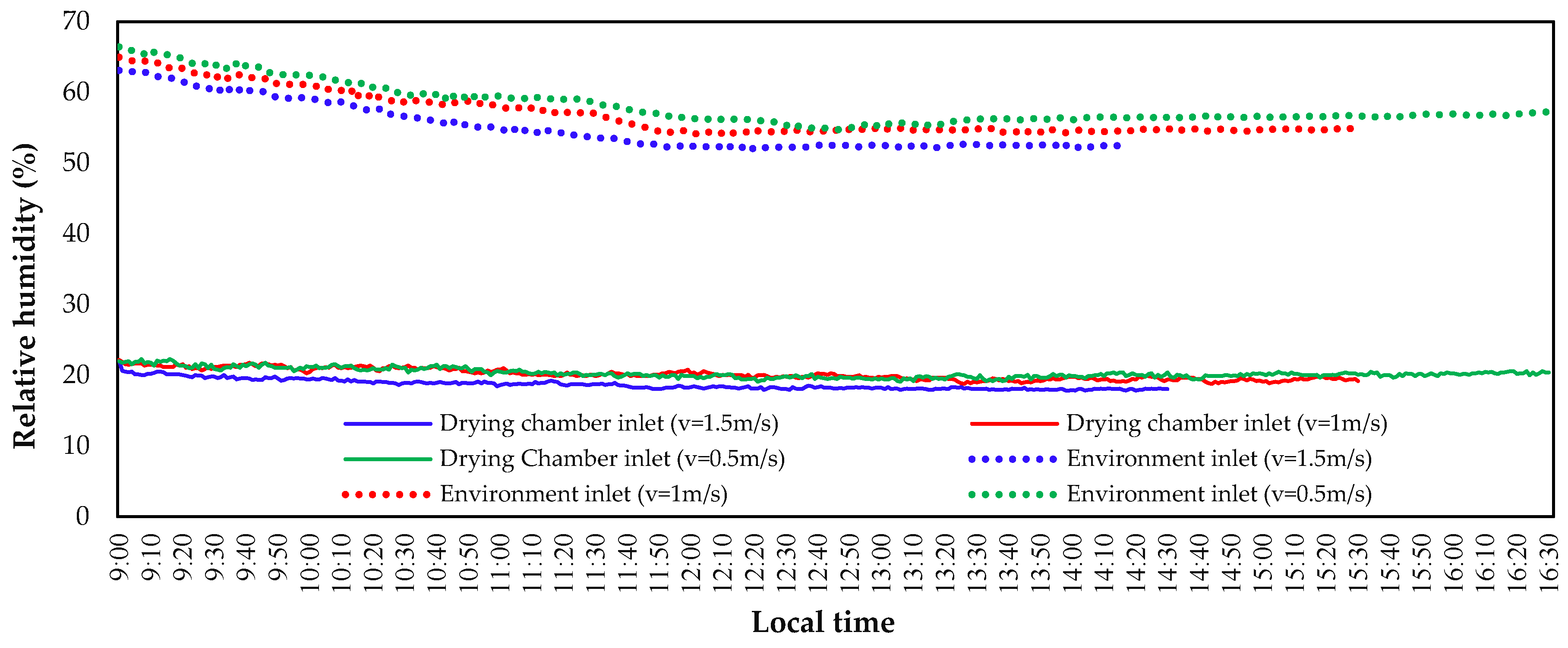
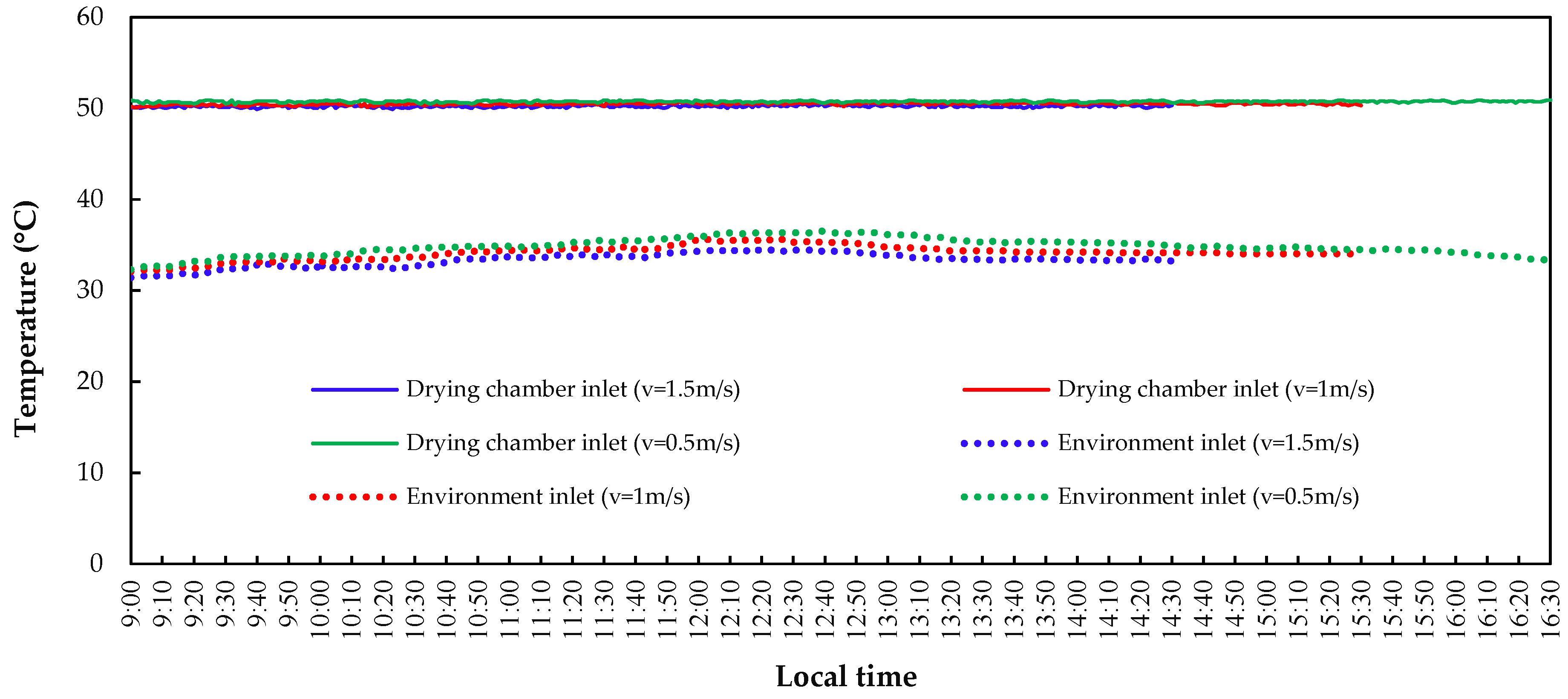
In this drying experiment, three operating conditions were investigated by adjusting the drying air velocity to 0.5, 1.0, and 1.5 m/s, with each condition executed in triplicate to ensure reproducibility. Figure 1 and Figure 2 illustrate the transient profiles of relative humidity and air temperature monitored simultaneously at the environment inlet (dryer inlet) and the drying chamber inlet.
Figure 1.
Relative humidity of air before (or dryer inlet) and after (or drying chamber inlet) passing through the dryer.
Figure 2.
Temperature of air before (or dryer inlet) and after (or drying chamber inlet) passing through the dryer.
As the fresh ambient air progressed sequentially through the evaporator dehumidification stage and the condenser heating stage of the open-loop upcycled heat pump system, a significant decrease in relative humidity was observed alongside a concurrent increase in air temperature. This thermal behavior successfully demonstrates the high efficiency of the open-loop configuration: the atmospheric air is first stripped of its moisture content at the evaporator via water vapor condensation and is subsequently heated by the sensible heat rejected at the condenser. This integrated process yields a low-humidity, high-temperature air matrix, thereby significantly enhancing the driving force for convective mass transfer before the air stream contacts the dragon fruit slices and exits into the environment.
2.2. Open Sun Drying
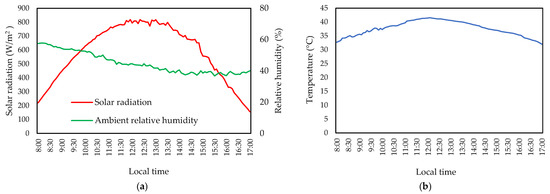
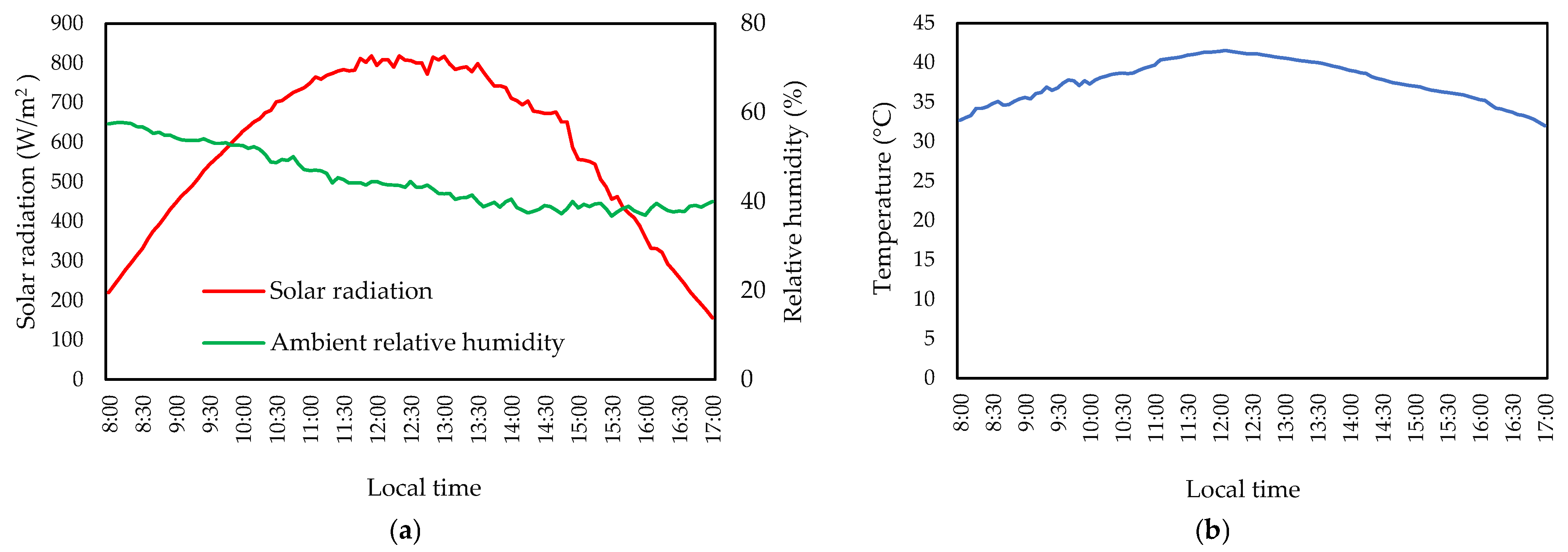
Meteorological conditions during the natural open-sun drying of dragon fruit slices were continuously monitored, capturing ambient temperature, relative humidity, and solar radiation intensity at 5 min intervals. During the first half of the experimental diurnal cycle, clear sky conditions prevailed with negligible cloud cover, leading to a steady, progressive increase in solar irradiance. The solar intensity reached a peak value of approximately 817.93 W/m2 before gradually declining toward the end of the monitoring period at 17:00. Concurrently, the ambient air temperature fluctuated between 32.68 °C and 41.58 °C. As expected, the ambient relative humidity exhibited an inverse relationship with temperature, decreasing dynamically as the thermal energy input increased. This behavior aligns with psychrometric principles, where elevated ambient temperatures expand the moisture-holding capacity of the air matrix. Throughout the experimental period, the ambient relative humidity ranged from 36.73% to 57.82%, as illustrated in Figure 3a,b.
Figure 3.
Variations in solar radiation, relative humidity (a) and ambient temperature (b) with drying time.
2.3. Evaluation and Fitting of Mathematical Modes for Drying Curves
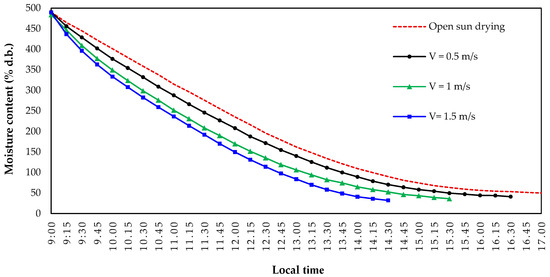
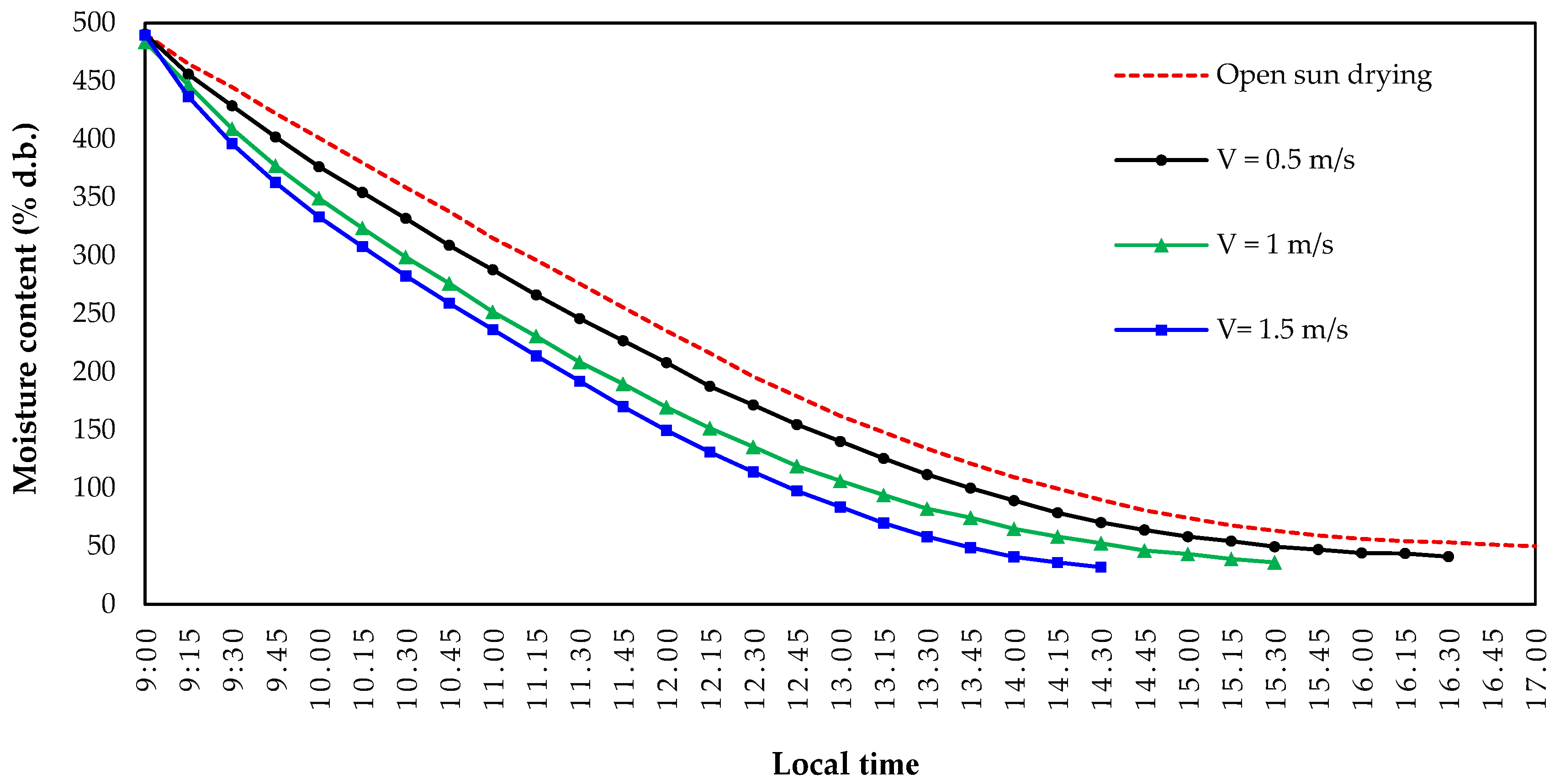
Fresh dragon fruit slices were dried under specific experimental conditions to examine their moisture reduction behavior. After the drying process, the moisture content of the fruit slices was significantly reduced from an initial value of 498.54% d.b. to approximately 30.12% d.b. under the maximum air velocity condition, as illustrated by the drying curves in Figure 4. As the convective drying air velocity increases, the boundary layer thickness of the air film on the surface of the dragon fruit flesh diminishes. This reduction in boundary layer thickness effectively lowers the resistance to both heat and mass transfer between the drying medium and the product surface. The thermal energy supplied by the convective air stream delivers sufficient kinetic energy to the water molecules within the fruit matrix, enabling them to overcome internal cohesive forces and migrate toward the surface for evaporation. Operating the upcycled heat pump dryer at a controlled air velocity of 1.5 m/s required a total drying time of only 330 min, whereas the traditional open sun drying process extended up to 480 min. Throughout all configurations, the drying progression occurred entirely within a falling rate period, with no constant-rate period observed. This kinetic trend is in excellent agreement with previously documented investigations regarding the thin-layer drying of biological materials [23,24].
Figure 4.
The correlation between moisture content and air velocity at drying conditions.
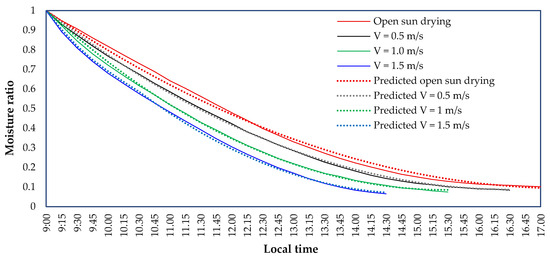
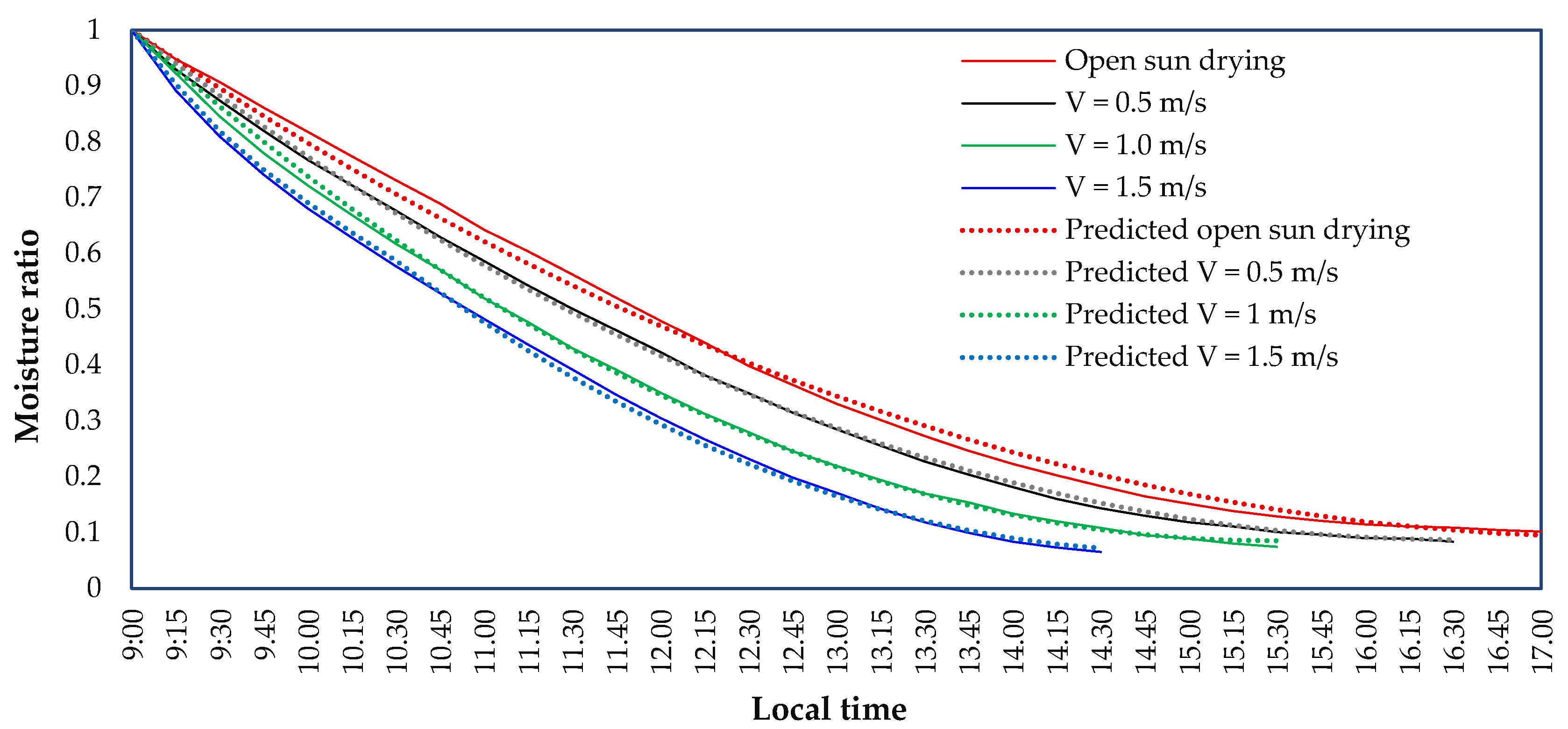
To standardize the kinetic profiles, the experimental moisture content data over time were transformed into moisture ratio (MR) values, as plotted in Figure 5. The continuous decline of the MR curves over the drying timeline reflects the overall moisture reduction profile of the lumped material during the falling rate phase. The variation in MR was comprehensively evaluated across drying air velocities of 0.5, 1.0, and 1.5 m/s at a steady drying temperature of 50 °C, and directly compared with the open sun drying treatment. Every experimental curve demonstrated a steep, rapid moisture declines during the initial drying stages, signifying that a substantial volume of unbound water was swiftly transferred before the drying rate systematically tapered off over time. While the overall moisture reduction trends remained fundamentally similar across all treatments, increasing the air velocity from 0.5 to 1.5 m/s significantly accelerated the moisture removal rate, thereby shortening the total drying duration by enhancing the convective heat and mass transfer coefficients. This behavior strongly concurs with the reported literature on the thin-layer drying of dragon fruit slices [25], red dragon fruit [26], and apricots [27]. These empirical kinetic data subsequently formed the mathematical foundation for empirical modeling based on the correlation between the moisture ratio and drying time.
Figure 5.
Variation in dragon fruit moisture ratio using the best-fitted model under different drying conditions.
The five empirical models listed in Table 1 were employed to describe the thin-layer drying kinetics of sliced dragon fruit. These models inherently assume that the drying air continuously removes evaporated moisture from the material’s surface until it reaches an equilibrium state. In this study, the moisture ratio (MR) equation was simplified to MR = Mt/M0 by omitting the equilibrium moisture content (Me). Based on the experimental evaluation of moisture content profiles, it was observed that Me under the specific heat pump drying and open sun drying conditions was negligibly small compared to both the initial moisture content (M0) and the moisture content at any given time (Mt), satisfying the condition Me Mt Mo during extended drying periods. Consequently, Me can be mathematically neglected from the model without introducing significant error, serving as a justified modeling assumption for these experimental regimes.
Table 1.
Thin-layer drying models applied to the experimental data.
To evaluate the adequacy, reliability, and consistency of the empirical models against the experimental data, a rigorous statistical assessment was conducted. The coefficient of determination (R2), root mean square error (RMSE), and sum of squared errors (SSE) were calculated, as tabulated in Table 2. In thin-layer drying analysis, the optimal mathematical model is conventionally identified by the maximum R2 value coupled with the minimum RMSE and SSE values. The statistical indicators clearly reveal that the best-fit model is environment-dependent, reflecting the distinct drying mechanisms involved. For the open sun drying treatment, the Two-term exponential model provided the most superior fit, exhibiting the highest R2 of 0.998218 and the lowest RMSE of 0.029139.
Table 2.
Parameters of the models under different drying conditions.
Conversely, for all upcycled open-loop heat pump drying treatments, the Wang and Singh model consistently outperformed the other candidate models across all tested air velocities (0.5, 1.0, and 1.5 m/s). The Wang and Singh model yielded high R2 values ranging from 0.996368 to 0.999539, while maintaining the lowest RMSE (0.014936 to 0.041531) and SSE (3.489 × 10⁻⁵ to 2.805 × 10⁻⁴). The quadratic polynomial form of the Wang and Singh model demonstrates high robustness in predicting steady-state, forced convective drying dynamics under controlled thermal conditions. This strong mathematical agreement under controlled regimes is in excellent conformance with the thin-layer drying behavior reported by Khatun et al. [32].
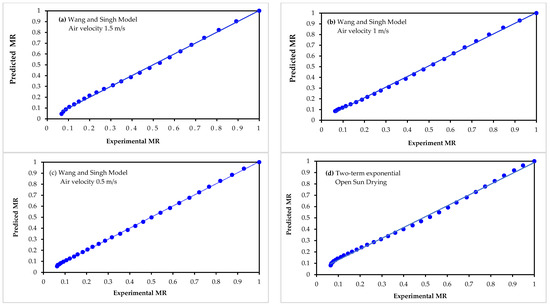
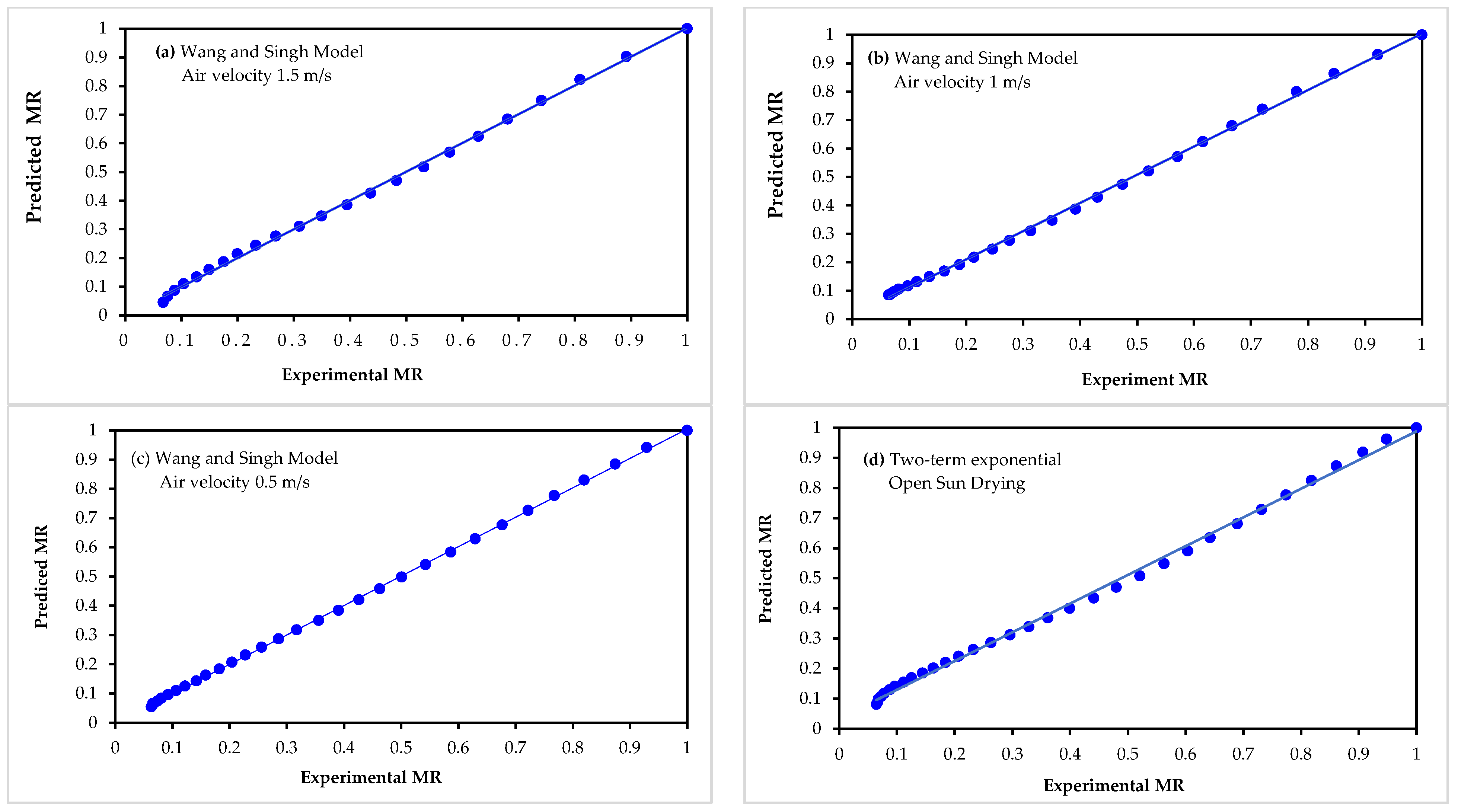
The drying kinetics of sliced dragon fruit under the tested conditions were evaluated using their respective optimal models, where the Wang and Singh model was applied for the upcycled heat pump dryer treatments (at air velocities of 0.5, 1.0, and 1.5 m/s) and the Two-term exponential model was implemented for the open sun drying process. To rigorously verify the adequacy of these mathematical predictions, the correlation between the experimental and predicted moisture ratio (MR) data was established. As illustrated in Figure 6, the models precisely forecast the drying kinetics across all treatments, displaying highly linear relationships with data points closely aligned along the 45° diagonal reference line.
Figure 6.
The correlation of the experimental and predicted data of the models under different drying conditions.
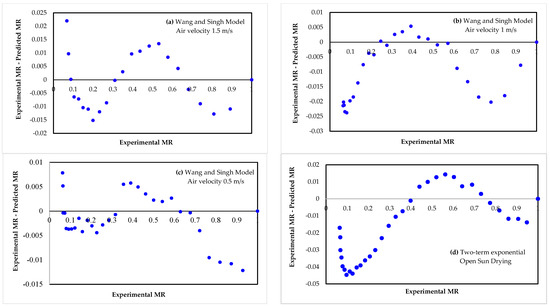
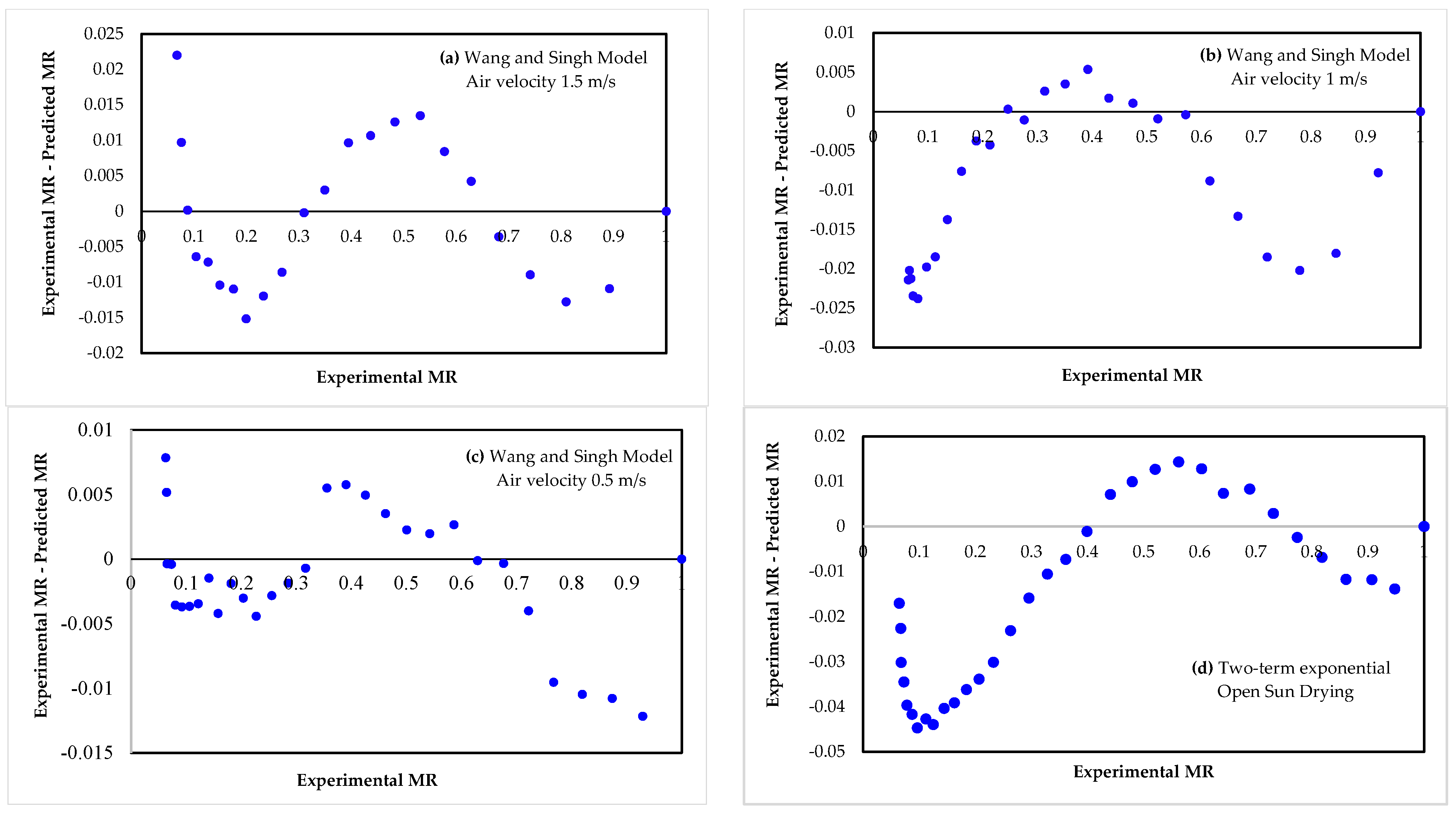
Furthermore, the accuracy and reliability of these simulations were verified through a comprehensive residual analysis, as depicted in Figure 7. The calculated residuals exhibit a bounded, highly consistent fluctuating distribution closely distributed around the zero-centerline. Although minor cyclical variations are inherently observable due to the highly non-linear nature of thin-layer biological moisture tracking and quadratic formulations, the tightly constrained residual magnitudes—falling strictly within ±0.025 for the heat pump configurations and within ±0.05 for the open sun drying baseline—demonstrate that the selected models operate with negligible systematic divergence. This confirms that the analyzed datasets are accurate, reliable, and mathematically robust for engineering scale-up applications. These validation results closely align with established thin-layer drying literature for biological products [33,34].
Figure 7.
Residual plot of the experimental and predicted data of the models under different drying conditions.
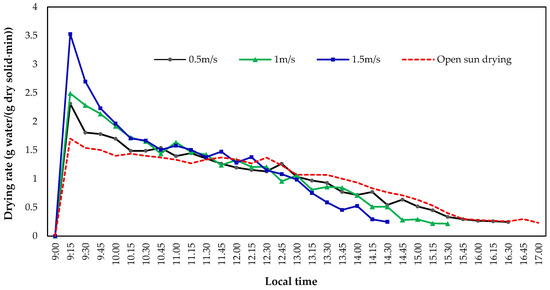
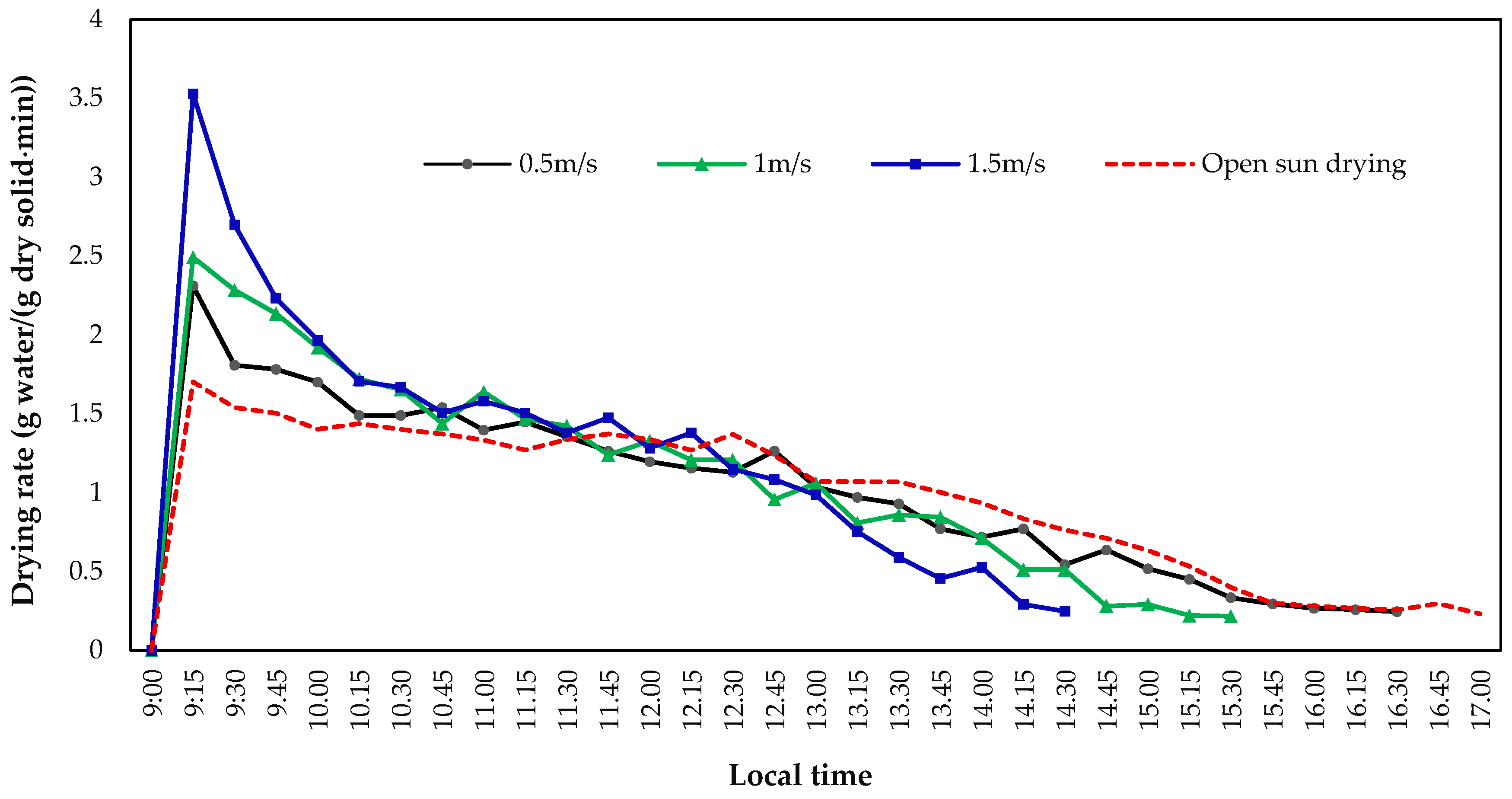
Convective heat transfer drying inherently utilizes the thermal gradient between the forced convective air stream and the moist material to drive heat transfer internally. Figure 8 illustrates the dynamic variation of the drying rate as a function of local drying time for the dragon fruit samples processed under different air velocities and open sun drying regimes. As observed from the kinetic profiles, the drying rate experienced a sharp, initial increase within the first 15 min (from 9:00 to 9:15), representing a brief warm-up period as the product surface absorbed thermal energy. Subsequently, the drying rate continuously declined over time without exhibiting any constant drying rate period, thereby confirming that the entire process was governed exclusively by a falling rate drying mechanism. During the initial phase of the falling rate period, moisture evaporated rapidly from the material surface, causing a swift depletion of unbound surface water. As drying progressed, the process transitioned into a diffusion-controlled regime, where the drying rate was restricted by the internal moisture diffusion mechanism driven by the moisture gradient from areas of higher water molecular density within the core to lower density areas at the product surface. Notably, higher air velocities (specifically at 1.5 m/s) yielded substantially higher peak drying rates (approximately 3.5 g water/(g dry solid·min)) compared to lower velocities and open sun drying, owing to the enhanced convective heat transfer rate that augmented the kinetic energy of the water molecules. These experimental observations align closely with established literature regarding the forced convective thin-layer drying dynamics of various biological products [35,36,37].
Figure 8.
Drying rate curves for various drying conditions.
2.4. Heat and Mass Transfer Kinetics
Heat transfer from the drying air to the dragon fruit slices is primarily governed by a forced convection mechanism, given that the latent heat of vaporization is predominantly exchanged at the product’s surface. This surface convective heat transfer concurrently drives conductive heat transfer into the internal flesh of the material. Governed by the moisture gradient between the core and the surface, internal water—in both liquid and vapor states—migrates outward to replenish the evaporated surface moisture before being swept into the ambient air stream.
In this study, drying experiments were evaluated using dragon fruit slices characterized by an initial thickness (L0) of 5.0 ± 0.2 mm (giving an initial half-thickness of 2.5 mm) and a diameter of 80.0 ± 2.0 mm, yielding an initial volume (V0) of 2.513 × 10⁻⁵ m3 and an initial surface area (A0) of 0.01131 m2, which were subsequently utilized to evaluate the convective mass transfer coefficient (hm). Given the exceptionally high initial moisture content (approximately 500% d.b.) of dragon fruit slices, they are highly susceptible to macrostructural shrinkage and physical collapse during dehydration [25,26,32]. To ensure that the evaluated effective moisture diffusivity (Deff) accurately reflects the actual dimensional shrinkage occurring during dehydration, the mathematical modeling incorporated an equivalent average slice thickness approach (Leq = 0.75L0) [38,39].
The drying air velocity exhibited a profound impact on the convective mass transfer coefficient (hm). As summarized in Table 3, the estimated hm values ranged from 5.241 × 10⁻⁷ m/s to 1.880 × 10⁻⁶ m/s, reaching a maximum at the highest air velocity of 1.5 m/s. This behavior aligns closely with established boundary layer theories and conforms with existing literature [40,41]. From a transport phenomenon perspective, escalating the air velocity from 0.5 m/s to 1.5 m/s reduces the thickness of the stagnant air boundary layer enveloping the dragon fruit slices. A thinner boundary layer substantially minimizes resistance to heat and mass transfer, thereby accelerating convective heat input and surface evaporation. Consequently, the high-velocity working fluid rapidly removes vaporized moisture from the surface until it equilibrates with the surrounding drying conditions. Notably, the hm values yielded by the developed dryer outperformed those from conventional hot air dryers operating at identical temperatures. This enhancement is attributed to the developed system’s superior capacity to dehumidify the drying air, maintaining a higher vapor pressure deficit (driving force) that accelerates evaporation.
Table 3.
The convective mass transfer coefficients, effective moisture diffusion coefficients, and coefficients of determination (R2) under different drying conditions.
Regarding the effective moisture diffusivity (Deff), to maintain rigorous compliance with Crank’s theoretical framework [37], only data points falling strictly within the falling rate drying period were selected for least-squares linear regression of ln(MR) against drying time (t). As summarized in Table 3, the resulting high coefficients of determination (R2 = 0.9809–0.9947) validate the exceptional goodness-of-fit of the first-term mathematical approximation. The shrinkage-corrected Deff values for the dragon fruit slices ranged from 1.194 × 10⁻⁹ m2/s for open-sun drying to 1.961 × 10⁻⁹–3.138 × 10⁻⁹ m2/s for upcycled heat pump drying across air velocities of 0.5–1.5 m/s at 50 °C. These values fall well within the characteristic range of 10−11–10−6 m2/s reported for agricultural products [41].
The moderate and synchronized rise of corrected Deff alongside air velocity highlights an indirect mechanism rather than a direct alteration of internal diffusivity properties. Specifically, elevated air velocity enhances boundary-layer convective heat transfer, which accelerates the internal temperature rise within the fruit matrix. This thermal boost diminishes liquid water viscosity while augmenting the kinetic energy of water molecules, thereby facilitating internal moisture migration toward the evaporating surface. To contextualize these refined findings, the obtained Deff values were benchmarked against various dried agricultural products in the literature, as presented in Table 4 (including lemon slices [42], pineapple [43], sweet potato [44], and banana [21]). The higher moisture diffusivity observed in dragon fruit slices is attributed to their unique physico-chemical characteristics and exceptionally high initial moisture content, alongside variations in the specific configurations of the drying technologies employed.
Table 4.
Comparison of effective moisture diffusivities (Deff) of dried dragon fruit slices with various agricultural products.
2.5. Performance of Upcycled Heat Pump Drying System
The overall performance metrics of the upcycled heat pump dryer evaluated at 50 °C across air velocities of 0.5, 1.0, and 1.5 m/s are summarized in Table 5. As the drying air velocity increased from 0.5 to 1.5 m/s, the thickness of the boundary layer adjacent to the surface area of the product was reduced. This reduction lowered the mass transfer resistance, resulting in a corresponding increase in the moisture evaporation rate from the product. Although higher air velocities increased the continuous system power demand () from 1.685 to 1.787 kW, the dramatic 26.7% reduction in total drying duration (from 7.5 to 5.5 h) outweighed the power increment. Consequently, the cumulative electrical energy consumption (E) dropped substantially from 12.637 to 9.830 kWh, directly driving the continuous improvement in SMER from 0.194 to 0.231 kg/kWh.
Table 5.
Performance results of the heat pump drying system at 50 °C.
Simultaneously, the thermodynamic performance of the upcycled module was maintained at high operating efficiency across all testing conditions (COPhp = 3.24–3.41). Higher drying air velocity enhanced convective heat transfer from the air stream to the evaporator, causing the compressor to draw more electrical power, which reached 1.687 kW at 1.5 m/s. This increased power demand resulted in a minor attenuation in COPhp (3.37 at 1.5 m/s compared to 3.41 at 1.0 m/s). Nevertheless, maintaining COPhp > 3.20 across all air velocity settings confirms that the upcycled air-conditioning system operates within an optimal thermodynamic regime with strong technical viability of this technology for agricultural drying, as detailed in Table 5.
To validate the thermodynamic efficiency and technical viability of this open-loop upcycled heat pump system, its performance indicators were compared with those of conventional drying technologies, commercial heat pump systems, and alternative low-cost setups:
- Comparison with Conventional Hot-Air Dryers: Conventional electric hot-air dryers operate through direct electrical resistance heating, which inherently introduces severe thermodynamic irreversibility (exergy destruction) due to the massive temperature gradient between the heating element and the drying air [44,45]. Although both the conventional dryer and this upcycled heat pump dryer operate in an open-loop configuration—meaning neither system recaptures the latent heat of vaporization from the exhaust air—the upcycled heat pump dryer functions with significantly lower system irreversibility during the air-heating phase. By utilizing a vapor-compression refrigeration cycle to upgrade ambient thermal energy across much smaller temperature differences at the heat exchangers, it achieves a heating coefficient of performance (COPhp > 3.20) and a superior SMER of up to 0.231 kg/kWh, significantly reducing overall electrical energy consumption compared to conventional resistance heaters.
- Comparison with Commercial Heat Pump Dryers: Standard commercial heat pump dryers available in the market typically exhibit a COPhp range of 3.1 to 4.2 [46,47]. Despite being fabricated from a decommissioned 18,000 Btu/h window-type air conditioner, the upcycled heat pump system developed in this work maintains a COPhp within the same operating range as commercial heat pump dryers (3.24–3.41). This proves that replacing the original capillary tube with a mechanical thermostatic expansion valve (TXV) successfully allowed the system to adapt to shifting thermal loads without severe degradation of vapor-compression cycle efficiency. Beyond thermodynamic parity, this upcycled configuration delivers distinct practical and operational advantages. While commercial systems heavily rely on proprietary electronic expansion valves (EEVs), specialized microcontrollers, and custom replacement parts that demand factory-trained service support, the system presented herein utilizes off-the-shelf, standardized HVAC components. The purely mechanical operation of the TXV enables self-regulating refrigerant flow under variable thermal loads without requiring electronic sensors or digital controllers. Consequently, routine maintenance, troubleshooting, and component servicing can be readily performed by local refrigeration technicians using accessible, standard commercial spare parts, thereby providing a durable, low-capital alternative for rural agricultural communities.
- Comparison with Other Low-Cost Dryers: Traditional low-cost alternatives, such as open sun drying or basic direct solar dryers, are highly dependent on fluctuating weather conditions, solar intensity, and ambient relative humidity, leading to prolonged drying times, unpredictable product quality, and risk of contamination. While this upcycled system requires electrical power input, it guarantees a stable, controlled drying environment (50 °C) and continuous dehumidification through the single-direction airflow mechanism (evaporator cooling followed by sensible condenser heating), bypassing the ambient limitations faced by basic low-cost solar setups while preserving agricultural product quality.
To evaluate the precision, accuracy, and physical reliability of the evaluated operational data, overall measurement uncertainties and propagated errors for the primary and derived performance metrics were verified according to Kline and McClintock’s methodology [48] (Equation (23)). Based on the individual instrument accuracies detailed in Section 3.7 and the error propagation formulations expressed in Equations (26)–(28), the maximum propagated relative uncertainties for the derived performance parameters were determined as follows:
- Indirect Compressor Power (): Propagated from total system power demand () and fan power () via Equation (28), yielding a relative uncertainty of approximately ±2.25%.
- Specific Moisture Extraction Rate (): Propagated from sample masses ( and ) and total electrical energy consumption (E) via Equation (26), yielding a maximum relative uncertainty of ±2.30%.
- Heat Pump Coefficient of Performance (): Propagated from air mass flow rate (), enthalpy differences (Δh), and indirect compressor power consumption () via Equation (27), resulting in a maximum relative uncertainty of ±4.38%.
All calculated maximum propagated relative uncertainties (≤4.38%) strictly conform to the acceptable engineering tolerance threshold of ≤5.0%. This confirms that the experimental apparatus, sensory instrumentation, and derived thermodynamic calculations exhibit high precision, physical validity, and statistical repeatability across all testing conditions. The evaluated operating ranges and propagated uncertainties of the derived performance metrics are summarized in Table 6.
Table 6.
Operating ranges and propagated uncertainties of derived performance metrics.
2.6. Color of Dried Dragon Fruit
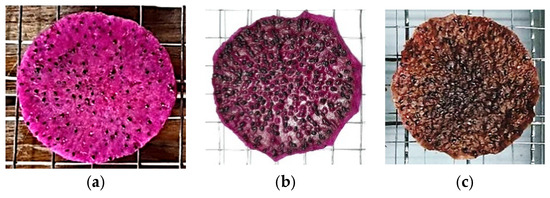
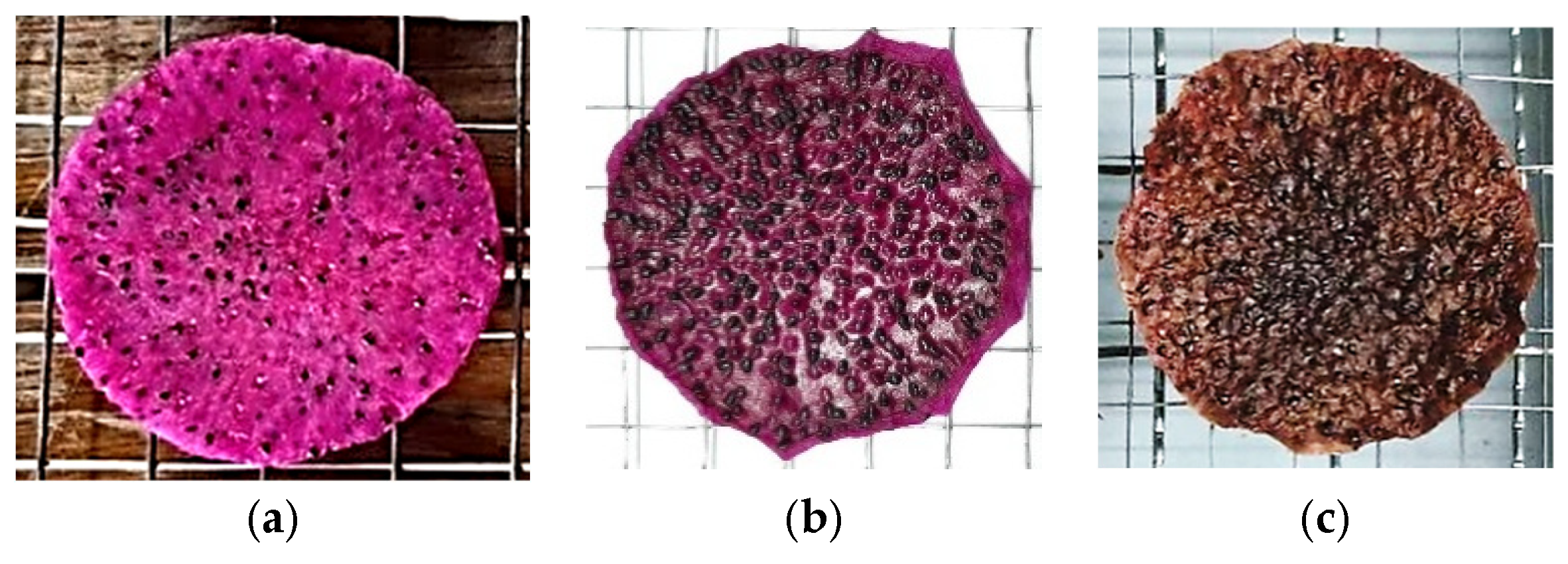
The color of a dried food product is a critical quality attribute influencing consumer acceptance. Therefore, the color parameters of the dried dragon fruit samples were evaluated and compared with fresh and open sun-dried samples, as summarized in Table 7. Statistical analysis demonstrates that the different drying methods significantly influenced (p ≤ 0.05) lightness (L*) and yellowness (b*), whereas no statistically significant differences () were observed for redness (a*). Visual variations in color among the treatments can be observed in Figure 9. However, these photographic images are intended strictly for qualitative illustration due to minor ambient lighting variations, with final quality assessments relying on instrumental color measurements.
Table 7.
Color parameters of dried dragon fruit slices.
Figure 9.
Fresh and dried dragon fruit slice sample using different drying methods: (a) Fresh. (b) Upcycled heat pump dryer. (c) Open sun. Note: These images are for illustrative purposes only; please refer to instrumental data for precise color evaluation.
The samples dried using the upcycled heat pump dryer exhibited an L* value of 44.69 ± 1.33, a* value of 12.10 ± 1.02, and b* value of −4.00 ± 0.57. Based on individual analysis of variance (ANOVA) for each color parameter, these values showed no statistically significant differences () when compared to fresh dragon fruit (L* = 45.87 ± 0.68, a* = 12.12 ± 1.17, b* value of −4.41 ± 0.53). Furthermore, the calculated total color difference (ΔE = 1.24), which serves as a descriptive indicator rather than a parameter subjected to ANOVA, remained well below the threshold of 2.0. This confirms that the color alteration was visually imperceptible to the human eye, maintaining a purplish-red hue very close to that of the fresh fruit (Figure 9a,b).
Consequently, drying dragon fruit with the upcycled heat pump dryer at 50 °C with an air velocity of 1.5 m/s proved to be the most effective method for preserving natural color. This process successfully minimized the thermal degradation of heat-sensitive pigments (specifically betacyanins) and suppressed enzyme-catalyzed browning reactions. Similar color retention trends have been reported by Mahayothee et al. [36] for red-fleshed dragon fruit, Saniso et al. [49] for Garcinia, and Mella et al. [50] for beetroot.
In contrast, the samples dried by open-sun exposure showed a significant decrease (p ≤ 0.05) in lightness (L*) to 30.59 ± 2.29, representing a 33.31% reduction in brightness compared to the fresh counterpart. Concurrently, the yellowness () shifted significantly from a negative value to a positive value of 0.71 ± 1.08. This chromatic shift signifies a transition from the natural purplish-red hue toward a dull yellowish-brown tone (Figure 9c), resulting in a high ΔE value of 16.22. This severe discoloration indicates significant pigment degradation and non-enzymatic browning caused by prolonged exposure to high solar radiation and atmospheric oxygen [51].
3. Materials and Methods
3.1. Sample Preparation
Fresh red dragon fruits (Selenicereus costaricensis, ) at commercial maturity were sourced from a local market in Nonthaburi, Thailand. Fruits of uniform size, shape, and color without visual defects were selected, stored at 5 °C for 16 h, and equilibrated at ambient temperature (25 ± 2 °C) for 3 h prior to processing. The fruits were washed, peeled, and mechanically cut into uniform slices with a thickness of 5 ± 0.2 mm (Lo) and a diameter of 80 ± 2 mm. To minimize enzymatic browning and thermal pigment degradation, sliced samples were loaded onto drying trays and transferred to the drying chamber within 10 min. Each experimental run utilized 6 ± 0.05 kg of fruit slices randomly allocated across treatments to eliminate systemic bias and maintain uniform bed-loading conditions for drying kinetics evaluation. The initial moisture content was determined in triplicate (n = 3) using the standard oven-drying method (105 °C for 24 h) in accordance with AOAC Official Method 934.01 [52], yielding an average value of 498.54% ± 8.65%.
3.2. Upcycled Heat Pump Dryer Design and Modification
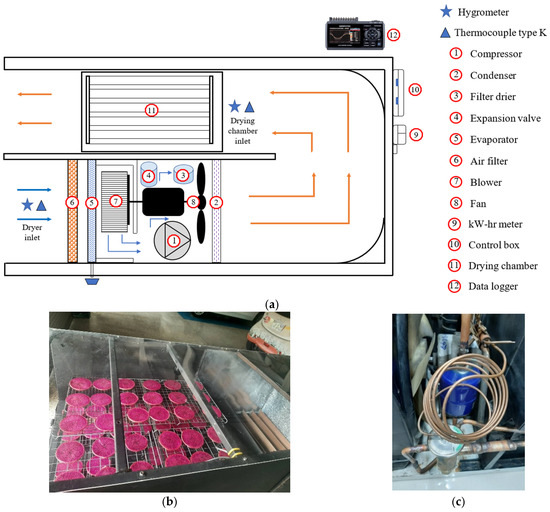
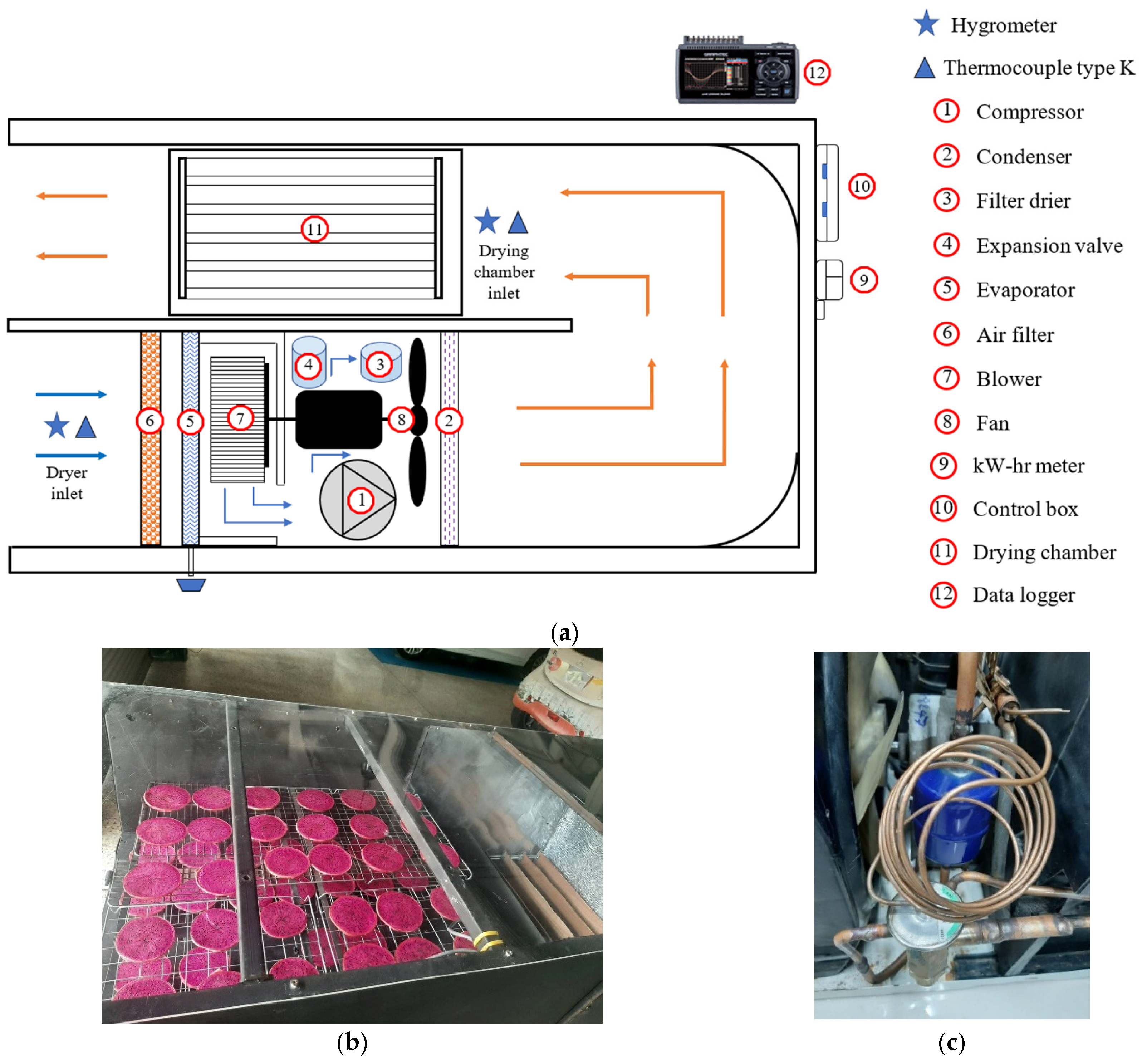
The experimental heat pump dryer, with overall dimensions of 0.6 m × 1.5 m × 0.9 m, features a drying chamber measuring 0.6 m × 0.8 m × 0.4 m (effective volume of 0.192 m3). The system was upcycled from a decommissioned 18,000 Btu/h residential window-type air conditioner utilizing R-410A refrigerant (Figure 10a,b). Detailed technical characteristics of the primary components are summarized in Table 8.
Figure 10.
The upcycled heat pump dryer: (a) Schematic diagram of the laboratory dryer. (b) Pictorial of the laboratory dryer. (c) Thermostatic expansion valve (TXV).
Table 8.
Technical specifications of the upcycled heat pump drying system components.
To enhance thermodynamic stability and effectively manage variable thermal loads, the original capillary tube was replaced with a thermostatic expansion valve (TXV, Figure 10c) paired with a variable-speed fan controller. Operating in an open-loop flow configuration, ambient air is drawn through an air filter, passes through the evaporator for condensation dehumidification, and is subsequently sensibly heated by the compressor and condenser to reduce its relative humidity prior to entering the drying chamber. Process temperatures and relative humidity levels were continuously monitored at key locations throughout the system.
3.3. Drying Procedure
Thin-layer drying experiments were conducted using the upcycled heat pump dryer operating without auxiliary heating, which was operated for 1 h prior to each run to establish steady-state thermal conditions. Drying experiments were performed at a constant drying temperature of 50 °C—representing the optimal steady-state operating temperature achieved by the upcycled heat pump system without auxiliary heat—under three drying air velocities (0.5, 1.0, and 1.5 m/s) in a parallel-flow configuration. For each trial, 6 ± 0.05 kg of dragon fruit slices were distributed uniformly in a single layer on the trays, while open sun drying was conducted simultaneously for comparison.
To evaluate system thermal performance and drying kinetics, environmental and process parameters were monitored continuously at 10 s intervals using a data acquisition system (Graphtec GL820, Graphtec Corp., Yokohama, Japan). Air temperature and relative humidity were measured using K-type thermocouples (Graphtec Corp., Yokohama, Japan; accuracy ± 0.5 °C) and hygrometers (B-530-UM-152, Graphtec Corp., Yokohama, Japan; accuracy ± 2%RH), respectively. Air velocity was monitored using a hot-wire anemometer (Model 45158, Extech Instruments, Nashua, NH, USA; accuracy ± 3%), and solar radiation was recorded via a pyranometer (CMP6, Kipp & Zonen, Delft, The Netherlands; sensitivity 1.795 × 10⁻⁶ V/(W·m2)). Cumulative electrical energy consumption was recorded using a calibrated electromechanical kilowatt-hour meter (Class 2.0 accuracy, Holley Group Electric, Bangkok, Thailand), logged manually at 15 min intervals concurrently with sample mass measurements, which were taken using a digital balance (Model 474-42, KERN & SOHN GmbH, Balingen, Germany; accuracy ± 0.01 g) until constant mass was reached (defined as a minimal mass change of approximately 0.01 g between successive mass measurements). Final dry matter content was determined according to AOAC Official Method 934.01, and all experimental runs were conducted in triplicate (n = 3) with average values reported.
3.4. Mathematical Modeling of Drying Curves
Moisture content, which indicates the quantity of water present within the material, is expressed on either a wet basis (Mwet) or a dry basis (Mdry). Mwet represents the mass of water per total mass of the sample, whereas Mdry relates the mass of water to the bone-dry mass of the material. These parameters are calculated using Equations (1) and (2), respectively [53,54,55]:
where mi is the mass of the sample at a specific drying time t (kg), and md is the mass of the completely dried sample determined after oven drying (kg).
The moisture ratio (MR) of dragon fruit slices during the heat pump drying process represents the remaining moisture relative to the total initial moisture content, expressed as follows:
where Mt is the dry-basis moisture content at any time t, M0 is the initial dry-basis moisture content, and Me is the equilibrium moisture content. Under the specific operating conditions of the heat pump dryer, the value of Me was found to be negligible compared to both Mo and Mt (Me Mt Mo) over extended drying periods. Therefore, Me can be mathematically omitted without introducing significant error, simplifying Equation (3) into Equation (4) [56]:
The drying rate (DR, g water/g dry matter · min) of dragon fruits slice was evaluated using Equation (5) [57,58,59]:
where and represent the dry-basis moisture contents at drying times t and t + dt, respectively (g water/g dry matter), and dt denotes the specific drying time interval (min).
To establish the most suitable thin-layer mathematical model, the experimental drying curves were fitted against five widely implemented empirical models for organic and biological materials—namely Page, Modified Page, Henderson and Pabis, Wang and Singh, and Two-term exponential—as summarized in Table 1.
Model coefficients were estimated by non-linear regression analysis using Statistica software (version 13.5.0.017) utilizing the Levenberg–Marquardt optimization algorithm. The primary criterion for evaluating the goodness-of-fit and identifying the best-fit model was the coefficient of determination (R2). Additionally, the root mean square error (RMSE) and the sum of squared errors (SSE) were calculated as supplementary statistical indicators to assess fitting quality [60,61,62]. Higher values of R2 coupled with lower values of RMSE and SSE indicated a superior model fit. These criteria were defined by Equations (6)–(8):
where MRexp,i is the ith experimentally observed moisture ratio, MRpre,i is the ith predicted moisture ratio, is the mean experimental moisture ratio, N is the number of experimental data, and i is an integer equal to 1, 2, 3, …, N.
3.5. Determination of Effective Moisture Diffusivity
The phenomenon of liquid diffusion during the drying of biological products, particularly within the falling rate period, is commonly described by Fick’s second law of diffusion [40,63], which is expressed as follows:
where M is moisture content on a dry basis (% d.b.), Deff is the effective moisture diffusivity (m2/s), and t is drying time (s).
The analytical solution to Equation (9) was developed by Crank [37,64] for a slab geometry based on the following assumptions: one-dimensional moisture diffusion, uniform initial moisture distribution, a constant effective moisture diffusivity, and non-shrinking of the dragon fruit slice. Although dragon fruit slices possess a soft tissue structure and high initial moisture content-making volumetric shrinkage highly likely during the drying process-shrinkage was not dynamically measured due to experimental constraints. Consequently, the non-shrinking behavior was adopted as a simplified modeling assumption.
For a material conforming to an infinite slab geometry with a total thickness of 2L, where moisture movement occurs exclusively along the thickness direction, the analytical solution for evaluating the effective moisture diffusivity of the dragon fruit slices is given by Equation (10):
where L represents the half-thickness of the slab (m), t is drying time (s), and n is a positive integer (n = 0, 1, 2, …). For extended drying periods during the falling rate period for drying of the food or biological materials, the higher-order terms of the series solution in Equation (10) become negligible. Thus, limiting the summation to the first term (n = 0) provides an accurate approximation [20,62,65], allowing Equation (10) to be simplified as follows:
By taking the natural logarithm of both sides of Equation (11), the relationship can be expressed linearly as:
Based on Equation (12), the effective moisture diffusivity (Deff) was determined from the slope of the linear plot of ln(MR) against drying time (t) via the least-squares regression method.
To account for the substantial volumetric shrinkage and thickness reduction in the red dragon fruit slices during drying, an equivalent average thickness approach was implemented to correct the characteristic half-thickness dimension (L). Due to the high initial moisture content (approximately 500% d.b.), red dragon fruit slices undergo a thickness reduction of approximately 50% at the end of drying (Lf ≈ 0.050L0), as reported in similar dimensional shrinkage kinetics literature [38,39]. Consequently, the representative half-thickness across the entire drying period was defined using an equivalent average half-thickness (Leq), calculated as follows:
where is the initial half-thickness of the fresh slice. By replacing L with Leq in Equation (12), the shrinkage-corrected effective moisture diffusivity (Deff, corrected) was calculated as:
This correction effectively decouples the intrinsic liquid diffusion capacity from geometric alterations induced by physical tissue collapse during thermal dehydration.
3.6. Mass Transfer Coefficients
Hot air drying involves convective mass transfer at the external surface of the material, driven by the vapor pressure deficit between the product surface and the surrounding air. Internal mass transfer within the solid matrix is governed by moisture concentration gradients, which conform to Fick’s laws of diffusion. During the drying process, heat and mass transfer occur simultaneously as coupled phenomena. In this study, the transient one-dimensional moisture diffusion within a dragon fruit slice characterized by a constant effective diffusivity (Deff) is modeled using Equation (16) [63,66]:
The rate of moisture diffusion from the material’s interior to its surface will equal the mass transfer rate of moisture from the surface to the drying air. Based on the assumption that moisture transfer in dragon fruit slices is one-dimensional and symmetrical in the transverse plane. To solve Equation (16), the initial condition at the start of the drying process (t = 0) is defined as:
where M0 represents the uniform initial moisture content of the sample. The boundary conditions, which account for geometric symmetry at the mid-plane and convective mass transfer at the external drying surface, are expressed by Equations (18) and (19), respectively:
where hm is the convective mass transfer coefficient (m/s), x = 0 denotes the center plane of symmetry, x = L represents the external surface boundary (half-thickness), Msurf is the instantaneous moisture content at the product surface, and Me is the equilibrium moisture content.
t = 0, M = M0
The convective mass transfer coefficient (hm) as a function of the drying curve was determined using the analytical procedure described by Kaya et al. [67], which correlates with the moisture ratio according to Equation (20):
where V is the volume of the material (m3), A is the total mass transfer surface area of the dragon fruit slice (m2), and t is the drying time (s). The geometric dimensions of the slices—having a thickness of 5.0 ± 0.2 mm and a diameter of 80.0 ± 2.0 mm—were measured using a digital caliper.
Under the simplified assumption of a non-shrinking infinite slab geometry, the total mass transfer area (A) was calculated as twice the cross-sectional area of the flat faces (A = 2πr2), neglecting moisture transfer through the thin peripheral edge, while the volume was determined as V = πr2h (where is the full thickness of 5.0 mm). These geometric parameters were maintained constant throughout the drying simulation. While physical shrinkage inherently occurs during fruit dehydration, utilizing the initial geometric parameters (A and V) provides a standardized and analytically tractable basis for evaluating the apparent convective mass transfer coefficient (hm) across experimental conditions, as supported by conventional drying literature [67]. Importantly, the non-shrinking assumption was restricted solely to the determination of external surface mass transfer (hm), whereas internal moisture diffusion was treated independently. This approach simplifies the moving-boundary problem at the external surface; nevertheless, the effect of dimensional shrinkage on internal moisture transport was rigorously compensated for in the calculation of effective moisture diffusivity (Deff) by adopting an equivalent characteristic length (Leq).
3.7. Performance Evaluation and Uncertainty Analysis
The energetic performance of the upcycled heat pump drying system was evaluated by determining two key performance indicators: the Specific Moisture Extraction Rate (SMER) and the coefficient of performance of the heat pump module (COPhp). The SMER (kg/kWh) quantifies the mass of moisture extracted from the dragon fruit slices per unit of total electrical energy consumed by the system, calculated using Equation (21):
where and denotes the initial and final wet masses () of the dragon fruit slices, respectively, recorded at 15 min intervals using a calibrated digital balance until a minimal mass change was achieved. The term E represents the total cumulative electrical energy consumed by the system (kWh), measured using an electromechanical energy meter (Class 2.0 accuracy, conforming to IEC 62053-11).
The dimensionless parameter COPhp evaluates the useful thermal energy rate transferred to the drying air relative to the equivalent electrical power supplied to the compressor:
The net thermal energy rate accumulated by the drying air stream (, kW) as it flows through the heat pump heating and dehumidification stages is calculated using Equation (23):
where is the mass flow rate of the drying air (kg/s), derived from the air velocity measured by a hot-wire anemometer multiplied by air density and duct cross-sectional area. The parameters hch and hin denote the specific enthalpies (kJ/kg) of the drying air at the drying chamber inlet (post-condenser) and dryer inlet (pre-evaporator), respectively. These enthalpies were determined via standard thermodynamic psychrometric equations using air temperature and relative humidity continuously logged via K-type thermocouples and a Graphtec hygrometer (model B-530-UM-152) connected to a Graphtec GL-820 data acquisition unit.
To accurately isolate electrical power distribution within the upcycled window-type air conditioning module, individual power parameters were designated as follows:
- Total System Power (): Computed as the average electrical power demand (kW) over the drying period, obtained by dividing the recorded energy consumption (E) by the corresponding drying duration (t).
- Fan Power (): Established as a fixed baseline operating power (0.100 kW) corresponding to the rated specifications (100 W, 0.85 A) of the circulation fan under designated speed settings.
- Compressor Power (): Due to integrated system circuitry, the net power consumption of the compressor (kW) was derived indirectly by subtracting the fixed fan power from the total system power:
To verify experimental data reliability, uncertainty propagation was evaluated in accordance with Kline and McClintock’s methodology. For any calculated parameter R derived from independent measured variables () with individual instrument uncertainties (), the total propagated uncertainty () is expressed as:
Accordingly, the fractional relative uncertainties for SMER, COPhp, and indirect compressor power () are formulated in Equations (26)–(28), respectively:
where ±0.01 g, as both initial and final sample masses were measured using the same calibrated digital balance. The terms and represent the propagated uncertainties in specific enthalpy evaluation at the drying chamber and system inlet, respectively. The technical specifications and primary measurement accuracies of all measuring instruments used in these uncertainty formulations are summarized in Table 9.
Table 9.
Specifications and measurement accuracies of experimental instruments.
3.8. Color Measurement
The surface color of the fresh and dried dragon fruit slices was quantified using a calibrated colorimeter (UltraScan VIS, HunterLab, Reston, VA, USA) based on the CIE L*a*b* color space. Color measurements for each experimental drying condition were replicated five times at different positions on the sample surfaces to obtain an average value. The total color difference (ΔE) relative to the fresh reference samples was calculated using Equation (29) [52,68]:
where L* represents lightness/brightness ranging from 100 (white) to 0 (black); a* denotes redness when positive and greenness when negative; and b* signifies yellowness when positive and blueness when negative. The parameters , , and correspond to the initial color coordinates of the fresh, un-dried dragon fruit slices used as the baseline reference. To minimize enzymatic browning before evaluation, the fresh slices were measured immediately after slicing at ambient temperature (25 ± 1 °C). The fresh control samples exhibited baseline color values of L* = 45.87 ± 0.68, a* = 12.12 ± 1.17, and b* = −4.41 ± 0.53.
4. Conclusions
An open-loop upcycled heat pump dryer was successfully fabricated by upcycling a decommissioned window-type refrigeration system and evaluated for the thin-layer drying of red dragon fruit slices. The system demonstrated adequate operational stability, maintaining a steady thermal driving force of 50 °C and an environment that accelerated the drying process, reducing the total drying duration from 7.5 h at 0.5 m/s to 5.5 h at 1.5 m/s. The thin-layer drying kinetics exhibited falling rate behavior governed by internal moisture diffusion, where the Wang and Singh model provided an appropriate mathematical description for the heat pump drying process (R2 ≥ 0.9963). Elevating the drying air velocity from 0.5 to 1.5 m/s enhanced the convective mass transfer coefficient (hm) and consequently raised the shrinkage-corrected effective moisture diffusivity (Deff) from 1.961 × 10⁻⁹ to a maximum value of 3.138 × 10⁻⁹ m2/s (incorporating an equivalent average thickness Leq = 0.75L0. From an energy perspective, the open-loop upcycled configuration proved highly sustainable, achieving a maximum COPhp of 3.41 at 1.0 m/s. At 1.5 m/s, the increased air velocity elevated the thermal load on the evaporator, requiring higher compressor electrical power and consequently reducing the COPhp to 3.37; however, the system optimized mass transfer, driving the SMER to its peak value of 0.231 kg/kWh. Regarding product quality, statistical evaluation (ANOVA) of individual color parameters (L*, a*, and b*) revealed no statistically significant differences (p > 0.05) between the heat pump-dried samples and fresh fruit slices. This color retention was additionally supported by a minimal overall color difference (ΔE = 1.24), indicating a visually imperceptible change and effectively mitigating the severe thermal degradation observed in open-sun drying (ΔE = 16.22). Ultimately, this engineering approach demonstrates the technical viability of reclaiming functional e-waste to provide an affordable, decentralized post-harvest drying alternative for small-scale agrarian applications. Furthermore, the repurposed system enables low-cost local maintenance convenience using standardized, off-the-shelf HVAC components (including thermostatic expansion valves) available in local markets. While this study confirms technical, quality, and thermodynamic feasibility, comprehensive techno-economic evaluations remain a recommended subject for future investigations.
Author Contributions
Conceptualization, S.P. and W.N.; methodology, S.P. and W.N.; software, S.P. and W.N.; validation, S.P. and W.N.; formal analysis, S.P. and W.N.; investigation, S.P. and W.N.; resources, S.P. and W.N.; data curation, S.P. and W.N.; writing—original draft preparation, S.P. and W.N.; writing—review and editing, S.P. and W.N.; visualization, S.P. and W.N.; supervision, S.P. and W.N.; project administration, S.P. and W.N. All authors have read and agreed to the published version of the manuscript.
Funding
This research received no external funding.
Data Availability Statement
The raw data supporting the conclusions of this article will be made available by the authors on request.
Acknowledgments
The authors acknowledge the use of Gemini (version 1.5 Pro) and Grammarly (Pro version) to assist with language editing, grammar checking, and improving the clarity and readability of the manuscript. All final text was reviewed and edited by the authors, who take full responsibility for the content of the publication. The authors would also like to thank the editors and reviewers for their valuable and constructive comments.
Conflicts of Interest
The authors declare that the research was conducted in the absence of any commercial or financial relationships that could be construed as a potential conflict of interest.
References
- Quinto, S.; Law, N.; Fletcher, C.; Le, J.; Antony Jose, S.; Menezes, P.L. Exploring the E-Waste Crisis: Strategies for Sustainable Recycling and Circular Economy Integration. Recycling 2025, 10, 72. [Google Scholar] [CrossRef] [Scilit]
- Lubongo, C.; Bin Daej, M.A.A.; Alexandridis, P. Recent Developments in Technology for Sorting Plastic for Recycling: The Emergence of Artificial Intelligence and the Rise of the Robots. Recycling 2024, 9, 59. [Google Scholar] [CrossRef] [Scilit]
- Anuardo, R.G.; Espuny, M.; Costa, A.C.F.; Espuny, A.L.G.; Kazançoğlu, Y.; Kandsamy, J.; de Oliveira, O.J. Transforming E-Waste into Opportunities: Driving Organizational Actions to Achieve Sustainable Development Goals. Sustainability 2023, 15, 14150. [Google Scholar] [CrossRef] [Scilit]
- Laureti, L.; Costantiello, A.; Anobile, F.; Leogrande, A.; Magazzino, C. Waste Management and Innovation: Insights from Europe. Recycling 2024, 9, 82. [Google Scholar] [CrossRef] [Scilit]
- Kafle, S.; Karki, B.K.; Sakhakarmy, M.; Adhikari, S. A Review of Global Municipal Solid Waste Management and Valorization Pathways. Recycling 2025, 10, 113. [Google Scholar] [CrossRef] [Scilit]
- Çengel, Y.A.; Boles, M.A. Thermodynamics: An Engineering Approach, 8th ed.; McGraw-Hill: New York, NY, USA, 2015. [Google Scholar]
- Zhu, L.; Ji, X.; Yang, H.; Cao, X.; Wang, W.; Liang, M.; Li, J.; Zhang, Q.; Yang, X.; Geng, Z. Heat Pump Technology in the Field of Fruit and Vegetable Drying: A Review. Foods 2025, 14, 2569. [Google Scholar] [CrossRef] [Scilit] [PubMed]
- Villegas-Camacho, O.; Francisco-Valencia, I.; Alejo-Eleuterio, R.; Granda-Gutiérrez, E.E.; Martínez-Gallegos, S.; Villanueva-Vásquez, D. FTIR-Based Microplastic Classification: A Comprehensive Study on Normalization and ML Techniques. Recycling 2025, 10, 46. [Google Scholar] [CrossRef] [Scilit]
- Bishop, C.P. Sustainability lessons from appropriate technology. Curr. Opin. Environ. Sustain. 2021, 49, 50–56. [Google Scholar] [CrossRef] [Scilit]
- Nandan, A.; Suresh, A.C.; Saole, P.; Jeevanasai, S.A.; Chandrasekaran, R.; Meili, L.; Wan Azelee, N.I.; Selvasembian, R. An Integrated Approach for Electronic Waste Management—Overview of Sources of Generation, Toxicological Effects, Assessment, Governance, and Mitigation Approaches. Sustainability 2023, 15, 16946. [Google Scholar] [CrossRef] [Scilit]
- Ghulam, S.T.; Abushammala, H. Challenges and Opportunities in the Management of Electronic Waste and Its Impact on Human Health and Environment. Sustainability 2023, 15, 1837. [Google Scholar] [CrossRef] [Scilit]
- Andrade, R.C.; Ribeiro, C.D.F.; Caetano, V.C.S.; Fernandes, S.S.; Otero, D.M. Trends in dragon fruit peel compound extraction and technological applications. Trends Food Sci. Technol. 2024, 153, e104721. [Google Scholar] [CrossRef] [Scilit]
- Pawde, S.; Talib, M.I.; Parate, V.R. Development of fiber-rich biscuit by incorporating dragon fruit powder. Int. J. Fruit Sci. 2020, 20, 1620–1628. [Google Scholar] [CrossRef] [Scilit]
- Oliveira, I.A.G.; Silva, N.C.; Barrozo, M.A.S. Spray-Dried Whole Red Pitaya (Hylocereus costaricensis): A Potential Source of Bioactive Compounds for Food Applications. Resources 2026, 15, 90. [Google Scholar] [CrossRef] [Scilit]
- Lee, K.H.; Kim, O.J. Investigation on Drying Performance and Energy Savings of the Batch-Type Heat Pump Dryer. Dry. Technol. 2009, 27, 565–573. [Google Scholar] [CrossRef] [Scilit]
- Lee, Y.H.; Chin, S.K.; Chung, B.K. Drying characteristics and quality of lemon slices dried under Coulomb force-assisted heat pump drying. Dry. Technol. 2021, 39, 765–776. [Google Scholar] [CrossRef] [Scilit]
- Costa, B.R.; Rodrigues, M.C.K.; Rocha, S.F.; Pohndorf, R.S.; Larrosa, A.P.Q.; Pinto, L.A.A. Spirulina Drying in Heat Pump. J. Food Process. Preserv. 2016, 40, 934–942. [Google Scholar] [CrossRef] [Scilit]
- Aktaş, M.; Khanlari, A.; Aktekeli, B.; Amini, A. Analysis of a new drying chamber for heat pump mint leaves dryer. Int. J. Hydrogen Energy 2017, 42, 18034–18044. [Google Scholar] [CrossRef] [Scilit]
- Chapchaimoh, K.; Poomsa-ad, N.; Wiset, L.; Morris, J. Thermal characteristics of heat pump dryer for ginger drying. Appl. Therm. Eng. 2016, 95, 491–498. [Google Scholar] [CrossRef] [Scilit]
- Coşkun, S.; Doymaz, İ.; Tunckal, C.; Erdoğan, S. Investigation of drying kinetics of tomato slices dried by using a closed loop heat pump dryer. Heat Mass Transf. 2017, 53, 1863–1871. [Google Scholar] [CrossRef] [Scilit]
- Tunckal, C.; Doymaz, İ. Performance analysis and mathematical modelling of banana slices in a heat pump drying system. Renew. Energy 2020, 150, 918–923. [Google Scholar] [CrossRef] [Scilit]
- Mohammadi, I.; Tabatabaekoloor, R.; Motevali, A. Effect of air recirculation and heat pump on mass transfer and energy parameters in drying of kiwifruit slices. Energy 2019, 170, 149–158. [Google Scholar] [CrossRef] [Scilit]
- Fadhel, A.; Charfi, K.; Balghouthi, M.; Kooli, S. Experimental investigation of the solar drying of Tunisian phosphate under different conditions. Renew. Energy 2018, 116, 762–774. [Google Scholar] [CrossRef] [Scilit]
- Kishk, S.S.; ElGamal, R.A.; ElMasry, G.M. Effectiveness of recyclable aluminum cans in fabricating an efficient solar collector for drying agricultural products. Renew. Energy 2019, 133, 307–316. [Google Scholar] [CrossRef] [Scilit]
- Bhagya Raj, G.V.S.; Dash, K.K. Microwave vacuum drying of dragon fruit slice: Artificial neural network modelling, genetic algorithm optimization, and kinetics study. Comput. Electron. Agric. 2020, 178, 105814. [Google Scholar] [CrossRef] [Scilit]
- Bassey, E.J.; Cheng, J.H.; Sun, D.W. Improving drying kinetics, physicochemical properties and bioactive compounds of red dragon fruit (Hylocereus species) by novel infrared drying. Food Chem. 2022, 375, 131886. [Google Scholar] [CrossRef] [Scilit] [PubMed]
- Kayran, S.; Doymaz, İ. Drying of Cataloglu Apricots: The Effect of Sodium Metabisulfite Solution on Drying Kinetics, Diffusion Coefficient, and Color Parameters. Int. J. Fruit Sci. 2021, 21, 270–283. [Google Scholar] [CrossRef] [Scilit]
- Diamante, L.M.; Munro, P.A. Mathematical modelling of the thin layer solar drying of sweet potato slices. Sol. Energy 1993, 51, 271–276. [Google Scholar] [CrossRef] [Scilit]
- Midilli, A.; Kucuk, H.; Yapar, Z. A new model for single-layer drying. Dry. Technol. 2002, 20, 1503–1513. [Google Scholar] [CrossRef] [Scilit]
- Zhang, Q.; Litchfield, J.B. An optimization of intermittent corn drying in a laboratory scale thin layer dryer. Dry. Technol. 1991, 9, 383–395. [Google Scholar] [CrossRef] [Scilit]
- Wang, C.Y.; Singh, R.P. A Single Layer Drying Equation for Rough Rice; ASAE Technical Paper No. 78-3001; ASAE Press: St. Joseph, MI, USA, 1978. [Google Scholar]
- Khatun, P.; Karmakar, A.; Chakraborty, I. Microwave-vacuum drying: Modeling validation of drying and rehydration kinetics, moisture diffusivity and physicochemical properties of dried dragon fruit slices. Food Humanit. 2024, 2, 100292. [Google Scholar] [CrossRef] [Scilit]
- Peter, M.; Liu, Z.; Fang, Y.; Dou, X.; Awuah, E.; Soomro, S.A.; Chen, K. Computational intelligence and mathematical modelling in chanterelle mushrooms’ drying process under heat pump dryer. Biosyst. Eng. 2021, 212, 143–159. [Google Scholar] [CrossRef] [Scilit]
- Phitakwinai, S.; Thepa, S.; Nilnont, W. Thin-layer drying of parchment arabica coffee by controlling temperature and relative humidity. Food Sci. Nutr. 2019, 7, 2921–2931. [Google Scholar] [CrossRef] [Scilit] [PubMed]
- Setyoningrum, T.M.; Kusuma, H.S.; Umamah, S.H.; Salsabila, N.E.; Darmokoesoemo, H.; Amenaghawon, A.N. Analysis of moisture content and drying kinetics model for drying of Cananga odorata flowers. South Afr. J. Chem. Eng. 2025, 52, 292–299. [Google Scholar] [CrossRef] [Scilit]
- Mahayothee, B.; Komonsing, N.; Khuwijitjaru, P.; Nagle, M.; Müller, J. Influence of drying conditions on color, betacyanin content and antioxidant capacities in dried red-fleshed dragon fruit (Hylocereus polyrhizus). Int. J. Food Sci. Technol. 2019, 54, 460–470. [Google Scholar] [CrossRef] [Scilit]
- Crank, J. The Mathematics of Diffusion, 2nd ed.; Oxford University Press: London, UK, 1975. [Google Scholar]
- Mayor, L.; Sereno, A.M. Modelling shrinkage during convective drying of food materials: A review. J. Food Eng. 2004, 61, 373–386. [Google Scholar] [CrossRef] [Scilit]
- Sejagat, L.P.; Muhidong, J.; Iqbal; Yumeina, D. Dimensional changes of red dragon fruit (Hylocereus polyrhizuz) slices during the drying process. SALAGA J. 2023, 1, 31–36. [Google Scholar] [CrossRef] [Scilit]
- Koua, B.K.; Koffi, P.M.E.; Gbaha, P. Evolution of shrinkage, real density, porosity, heat and mass transfer coefficients during indirect solar drying of cocoa beans. J. Saudi Soc. Agric. Sci. 2019, 18, 72–82. [Google Scholar] [CrossRef] [Scilit]
- Lemus-Mondaca, R.A.; Zambra, C.E.; Vega-Gálvez, A.; Moraga, N.O. Coupled 3D heat and mass transfer model for numerical analysis of drying process in papaya slices. J. Food Eng. 2013, 116, 109–117. [Google Scholar] [CrossRef] [Scilit]
- Harchegani, M.T.; Varnamkhasti, M.G.; Ghanbarian, D.; Sadeghi, M.; Tohidi, M. Dehydration characteristics and mathematical modelling of lemon slices drying undergoing oven treatment. Heat Mass Transf. 2016, 52, 281–289. [Google Scholar] [CrossRef] [Scilit]
- Olanipekun, B.F.; Tunde-Akintunde, T.Y.; Oyelade, O.J.; Adebisi, M.G.; Adenaya, T.A. Mathematical modeling of thin-layer pineapple drying. J. Food Process. Preserv. 2015, 39, 1431–1441. [Google Scholar] [CrossRef] [Scilit]
- Doymaz, İ. Thin-layer drying characteristics of sweet potato slices and mathematical modelling. Heat Mass Transf. 2011, 47, 277–285. [Google Scholar] [CrossRef] [Scilit]
- Moran, M.J.; Shapiro, H.N.; Boettner, D.D.; Bailey, M.B. Fundamentals of Engineering Thermodynamics, 9th ed.; John Wiley & Sons: Hoboken, NJ, USA, 2018. [Google Scholar]
- Mujumdar, A.S. Handbook of Industrial Drying, 4th ed.; CRC Press, Taylor & Francis Group: Boca Raton, FL, USA, 2014. [Google Scholar]
- Atalay, H. Comparative assessment of solar and heat pump dryers with regards to exergy and exergoeconomic performance. Int. J. Energy Res. 2019, 43, 6435–6449. [Google Scholar] [CrossRef] [Scilit]
- Figliola, R.S.; Beasley, D.E. Theory and Design for Mechanical Measurements, 7th ed.; John Wiley & Sons: Hoboken, NJ, USA, 2020. [Google Scholar]
- Saniso, E.; Sueni, L.; Havibaka, M.; Chaiwarakorn, S.; Dasaesamoh, A.; Chaidana, H. Garcinia drying using mixed-mode solar dryer technique: Drying kinetics, mathematical modeling and quality characteristics. Case Stud. Therm. Eng. 2025, 66, 105711. [Google Scholar] [CrossRef] [Scilit]
- Mella, C.; Vega-Gálvez, A.; Uribe, E.; Pasten, A.; Mejias, N.; Quispe-Fuentes, I. Impact of vacuum drying on drying characteristics and functional properties of beetroot (Beta vulgaris). Appl. Food Res. 2022, 2, 100120. [Google Scholar] [CrossRef] [Scilit]
- Pathare, P.B.; Opara, U.L.; Al-Said, F.A.J. Color measurement and analysis in fresh and processed foods: A review. Food Bioprocess Technol. 2013, 6, 36–60. [Google Scholar] [CrossRef] [Scilit]
- Helrich, K. Official Methods of Analysis of the Association of Official Analytical Chemists, 15th ed.; Association of Official Analytical Chemists Inc.: Arlington, TX, USA, 1990. [Google Scholar]
- Biswas, R.; Hossain, M.A.; Zzaman, W. Thin layer modeling of drying kinetics, rehydration kinetics and color changes of osmotic pre-treated pineapple (Ananas comosus) slices during drying: Development of a mechanistic model for mass transfer. Innov. Food Sci. Emerg. Technol. 2022, 80, e103094. [Google Scholar] [CrossRef] [Scilit]
- Kidane, H.; Farkas, I.; Buzás, J. Performance evaluation of solar drying chambers and drying kinetics of apple slices. Energy Rep. 2025, 13, 4528–4540. [Google Scholar] [CrossRef] [Scilit]
- Mulyanti, B.; Pawinanto, R.E.; Wisesa, R.S.H.A.; Dwitama, A.; Baihaqie, M.H.; Faza, I.N.; Saseno, M.; Rizqi, P.M.J.; Nurhidayatulloh; Rizqulloh, M.A.; et al. Experimental performance of heat pump batik dryer with closed-loop airflow system. Therm. Sci. Eng. Prog. 2026, 72, 104597. [Google Scholar] [CrossRef] [Scilit]
- Ojeniran, J.; Atungulu, G.G.; Luthra, K. Performance Assessment of Fluidized Bed Drying System for Enhancing Drying Efficiency and Quality of Parboiled Rice. AgriEngineering 2026, 8, 78. [Google Scholar] [CrossRef] [Scilit]
- Mbegbu, N.N.; Ojediran, J.O.; Nwajinka, C.O.; Chukwuma, E.C.; Aniobi, M. Thin layer drying and effect of temperature on the drying characteristics of bushbuck (Gongronema latifolium) leaves. J. Agric. Food Res. 2024, 18, 101379. [Google Scholar] [CrossRef] [Scilit]
- Shi, Q.; Zheng, Y.; Zhao, Y. Mathematical modeling on thin-layer pump drying of yacon (Smallanthus sonchifolius) slices. Energy Convers. Manag. 2013, 71, 208–216. [Google Scholar] [CrossRef] [Scilit]
- Patel, V.; Judal, K.B.; Panchal, H.; Singh, B.; Jomde, A.; Kumar, A.; Patel, A.; Jain, R.; Sadasivuni, K.K. Investigation on drying kinetics analysis of gooseberry slices dried under open sun. Environ. Chall. 2023, 13, 100778. [Google Scholar] [CrossRef] [Scilit]
- Omolola, A.O.; Kapila, P.F.; Silungwe, H.M. Mathematical modeling of drying characteristics of Jew’s mallow (Corchorus olitorius) leaves. Inf. Process. Agric. 2019, 6, 109–115. [Google Scholar] [CrossRef] [Scilit]
- Saniso, E.; Sueni, L.; Havibaka, M.; Chaidana, H. Enhancement of dried salted four-finger threadfin (Eleutheronema tetradactylum) using indirect solar dryer: An experimental study on drying kinetics and product quality. Results Eng. 2025, 26, 104953. [Google Scholar] [CrossRef] [Scilit]
- Adekanye, T.; Alhassan, E.; Amodu, M.; Olanrewaju, T.; Iyanda, M. Kinetics of heat and mass transfer in moringa leaves drying in a cabinet dryer. Results Eng. 2025, 26, 104763. [Google Scholar] [CrossRef] [Scilit]
- Kumar, A.; Kandasamy, P.; Chakraborty, I.; Hangshing, L. Analysis of energy consumption, heat and mass transfer, drying kinetics and effective moisture diffusivity during foam-mat drying of mango in a convective hot-air dryer. Biosyst. Eng. 2022, 219, 85–102. [Google Scholar] [CrossRef] [Scilit]
- Hidar, N.; Ouhammou, M.; Mghazli, S.; Idlimam, A.; Hajjaj, A.; Bouchdoug, M.; Jaouad, A.; Mahrouz, M. The impact of solar convective drying on kinetics, bioactive compounds and microstructure of stevia leaves. Renew. Energy 2020, 161, 1176–1183. [Google Scholar] [CrossRef] [Scilit]
- Junior, E.N.M.; Chaves, R.P.; Cunha, J.S.; Chisté, R.C.; Pena, R.S. Drying Kinetics of the Leaves from Three Varieties of Cassava (Manihot esculenta Crantz). Food Sci. Nutr. 2026, 14, e71494. [Google Scholar] [CrossRef] [Scilit] [PubMed]
- Eltawil, M.A.; Azam, M.M.; Alghannam, A.O. Solar PV powered mixed-mode tunnel dryer for drying potato chips. Renew. Energy 2018, 116, 594–605. [Google Scholar] [CrossRef] [Scilit]
- Kaya, A.; Aydin, O.; Demirtaş, C. Concentration boundary conditions in the theoretical analysis of convective drying process. J. Food Process Eng. 2007, 30, 564–577. [Google Scholar] [CrossRef] [Scilit]
- Islam, M.Z.; Saha, T.; Monalisa, K.; Hoque, M.M. Effect of starch edible coating on drying characteristics and antioxidant properties of papaya. J. Food Meas. Charact. 2019, 13, 2951–2960. [Google Scholar] [CrossRef] [Scilit]

Disclaimer/Publisher’s Note: The statements, opinions and data contained in all publications are solely those of the individual author(s) and contributor(s) and not of MDPI and/or the editor(s). MDPI and/or the editor(s) disclaim responsibility for any injury to people or property resulting from any ideas, methods, instructions or products referred to in the content. |
© 2026 by the authors. Licensee MDPI, Basel, Switzerland. This article is an open access article distributed under the terms and conditions of the Creative Commons Attribution (CC BY) license.