


Abstract
This study investigates the feasibility of recycling scallop shells as a partial substitute for natural coarse aggregates in concrete at replacement rates of 20%, 30%, and 40% by mass. The originality of the work lies in combining conventional mechanical and durability tests with a six-month environmental monitoring protocol under simulated rainfall and an end-of-life regulatory interpretation of chemical release. Processed shells were used as a 2/20 mm coarse fraction and characterized by a density of 2713 kg/m3, a water absorption of 2.93%, and a Los Angeles coefficient of 15.1. At 28 days, compressive strength decreased from 33.7 MPa for the reference concrete to 27.9 MPa, 28.1 MPa, and 26.7 MPa for SS20, SS30, and SS40, respectively. Water-accessible porosity increased from 7.8% to 9.9%, and carbonation depth after 70 days increased from 6.2 mm to 12.8 mm at 40% shell replacement. In contrast, chloride ion migration decreased from 19.0 × 10⁻¹² m2/s for the reference concrete to 17.4, 16.3, and 12.1 × 10⁻¹² m2/s at 90 days for SS20, SS30, and SS40, respectively. Environmental monitoring showed low runoff concentrations for anions and trace metals, all below the French regulatory thresholds considered in this work. Under the conditions of this study, shell replacement up to 30% appears technically feasible for non-structural or lightly loaded applications, while the environmental behavior remained compatible with an inert end-of-life classification.
1. Introduction
The utilization of natural resources in the construction industry is a matter of significant concern, as it gives rise to numerous environmental and economic issues. The substantial consumption of natural aggregates, which are indispensable for concrete production, exerts mounting pressure on ecosystems, contributing to the degradation of natural habitats and the exhaustion of quarries. Considering these concerns, the recycling of waste from other industries emerges as a promising alternative strategy to mitigate the environmental impact of construction. Among the industrial and agri-food by-products that can be reused in civil engineering, shellfish waste, particularly from scallops, stands out as a resource that has not yet been fully utilized for its potential.
These by-products of the shellfish industry are produced in large quantities every year, and their disposal poses considerable environmental and economic challenges. France, the world’s second-largest shellfish producer, produces an average of 150,000 tons of shellfish by-products every year [1,2]. The accumulation of shellfish in landfill or in the natural environment leads to various nuisances, such as visual pollution, greenhouse gas emissions during decomposition, and high management and transport costs. Indeed, meatless shells represent nearly 86% of the total mass of shellfish, and represent a significant potential source of waste to be managed [3]. Consequently, their incorporation into construction materials, particularly reinforced concrete, appears to be an innovative solution for combining waste reduction and the preservation of natural resources [4].
Research into the reuse of shellfish waste in concrete has shown that shellfish, rich in calcium carbonate (CaCO3), can be incorporated into the formulation of cementitious materials. They can partially replace traditional aggregates or be crushed and used as mineral fines to modify the structure of concrete. This approach has a dual advantage: it reduces the extraction of sand and gravel, which are non-renewable resources, while recovering an abundant waste product, thus contributing to the circular economy [5]. In addition, some studies suggest that adding shells to the concrete matrix could modify its mechanical and physical properties, notably by influencing its porosity, compressive strength and durability against external aggressors, such as carbonation and chloride penetration [6].
The recycling of shells is of considerable interest for several sectors, including construction, water purification, agriculture, catalysis, and biomaterial production [7,8,9,10,11,12]. In concrete technology, this interest is part of a broader search for alternative aggregates and fillers derived from recycled concrete, dredged sediments, and industrial or bio-based wastes [13,14,15,16]. In the specific case of scallop shells, their high calcium carbonate content makes them attractive as aggregate substitutes, but their practical use still depends on controlling fresh-state behavior, compactness, and long-term durability [4,13,17,18,19,20,21,22,23,24,25].
The state of the art on the use of shells in concrete highlights different experimental approaches and possible applications. Several studies have explored the integration of marine shells as a partial substitute for traditional aggregates or as a mineral filler in the cementitious matrix [26,27,28,29,30,31,32,33,34]. According to Mo et al. (2018), shells can be incorporated after heat treatment or grinding to improve their compatibility with concrete [4]. In the present study, the processed shell aggregate was used as a crushed and sieved 2/20 mm fraction, with a density of 2713 kg/m3, a water absorption of 2.93%, and a Los Angeles coefficient of 15.1, which confirms that it can be handled as a coarse recycled aggregate rather than as a powder addition.
Some research shows that the addition of shells influences the porosity and mechanical strength of concrete. Tayeh et al. (2019) found that up to 20% substitution of aggregates by shells results in concrete with acceptable performance for non-structural applications [5]. In parallel, Edalat-Behbahani et al. (2019) studied the effect of shell powder as a cement substitute and observed a reduction in initial strength, offset by a gradual gain in long-term strength [25].
Other work has focused on the durability of concrete incorporating shells. Zhu et al. (2024) demonstrated improved resistance to carbonation and reduced water absorption at low substitution rates [20]. However, certain challenges remain to be overcome, notably in terms of reinforcement adhesion, shrinkage and behavior in aggressive environments [6]. So, although several advances have been made, further research is still needed to optimize shell incorporation and better understand their effects on concrete microstructure and durability.
Despite the growing literature on shell-based concrete, most studies remain focused on short-term mechanical response and conventional durability indicators measured under controlled laboratory conditions. Published work rarely links the evolution of concrete durability to its environmental behavior during outdoor exposure and to its regulatory status at the end of its service life. As a result, the practical implications of shell incorporation for waste management and post-demolition classification remain insufficiently documented.
In particular, data from long-duration runoff monitoring is still scarce. Standard leaching tests performed on crushed materials provide valuable compliance information, but they do not capture progressive surface wash-off, runoff chemistry, or the cumulative effect of repeated wetting under near-service conditions. This gap is especially important for shell-based concretes, because calcium carbonate-rich aggregates can modify both the transport properties of concrete and the chemistry of the released water.
Another limitation of the current literature is that durability and environmental compatibility are generally discussed separately. Studies frequently conclude on the mechanical feasibility of shell substitution, but they seldom combine durability indicators such as carbonation or chloride migration with a time-dependent monitoring of chemical release and an interpretation in terms of end-of-life waste classification.
The research novelty of the present work therefore lies not in the use of scallop shells alone, but in the combined assessment of (i) mechanical and physical performance, (ii) durability indicators, (iii) six-month simulated-rainfall monitoring, and (iv) end-of-life environmental compatibility within a single experimental framework. This integrated approach was designed to provide a more realistic basis for assessing the feasibility of shell-based concrete in a circular-economy perspective.
In this context, this study proposes an integrated experimental evaluation of concrete incorporating scallop shells as a partial substitute for natural coarse aggregates. The objective is to identify the substitution range that remains acceptable when considering mechanical response, physical properties, durability evolution, runoff quality during service-like exposure, and environmental safety at the end of life. The work is intended to support practical decision-making for shell waste valorization in concrete rather than to claim universal validity for all shell types or all concrete formulations.
2. Results and Discussion
2.1. Mixture Proportions and Selection of Replacement Ratios
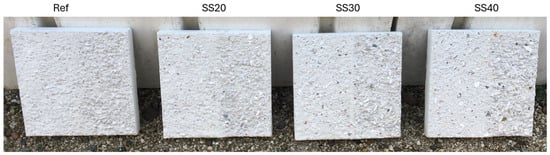
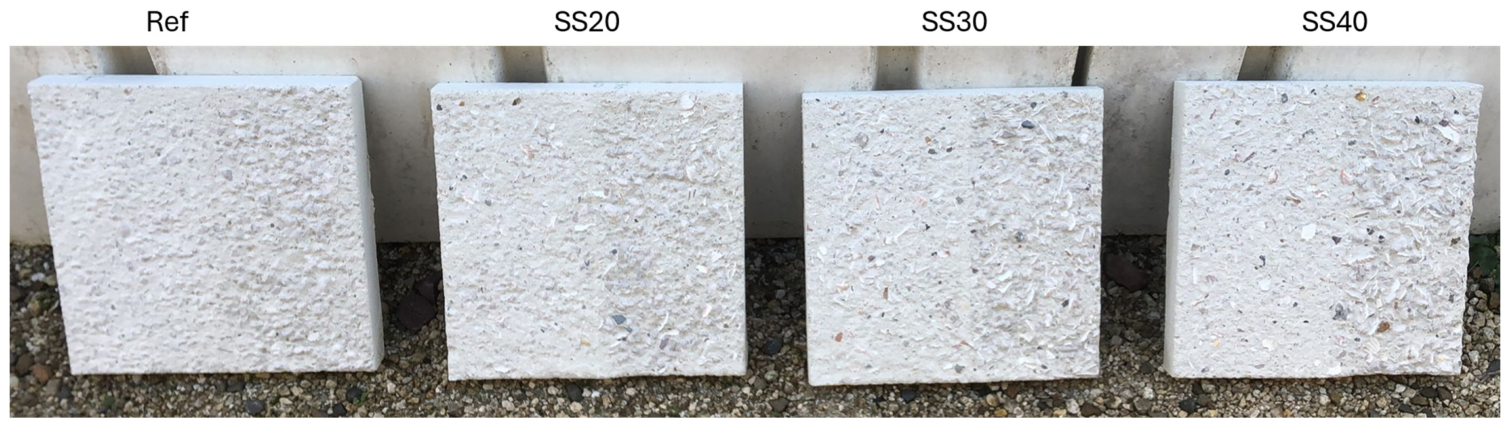
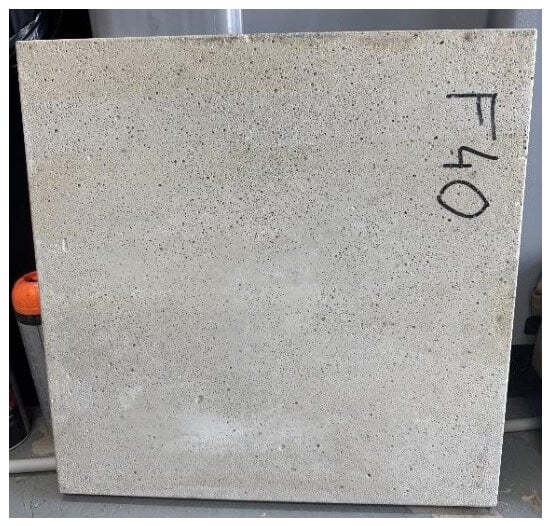
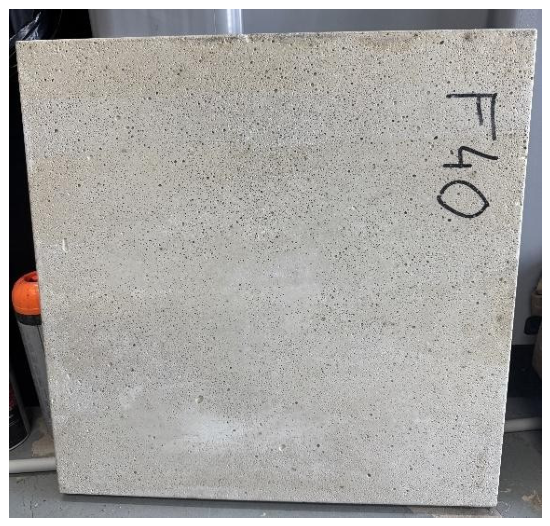
The present study was designed to evaluate the effect of replacing natural coarse aggregate with scallop shells in concrete. Four mixtures were prepared: a reference concrete without shells and three concretes in which natural gravel was replaced by scallop shells at 20%, 30%, and 40% by mass (SS20, SS30, and SS40, respectively). These replacement rates were selected to represent moderate, intermediate, and high substitution levels within the range commonly investigated for shell aggregate concrete, where progressive incorporation is generally used to identify the threshold beyond which the benefits of waste valorization are offset by excessive losses in technical performance [19,27,35]. Lower replacement levels were not prioritized because they were expected to produce only limited material substitution effects, whereas higher replacement rates are more frequently associated with marked reductions in compactness, strength, and durability-related performance in shell-based concretes [26,35]. In order to isolate the specific effect of shell incorporation, the cement, limestone filler, admixture, and effective water contents were kept constant for all formulations. Workability was not directly investigated in the present study and therefore cannot be quantitatively discussed from the available dataset. This aspect should be addressed in future work through dedicated fresh-state testing. The four formulations are presented in Table 1 below. A representative view of the concrete slabs after surface sandblasting is shown in Figure 1, illustrating the presence of shell particles in the slabs.
Table 1.
Scallop shell concrete mix proportions (kg/m3).
Figure 1.
Surface appearance of concrete slabs after sandblasting (2 different sandblasting levels for the same sample).
2.2. Physical Properties: Porosity, Density and Water Absorption
The experimental findings in Table 2 concerning the porosity, density, and water absorption of concrete incorporating scallops demonstrate significant effects resulting from the substitution of natural aggregates with these marine co-products. Initially, a steady rise in porosity is observed, with the reference concrete exhibiting a value of 7.8% and the SS40 concrete reaching 9.9%. This enhancement is attributable to the porous, irregular, and less dense nature of the shells, which disrupts the overall compactness of the cementitious matrix. Mo et al. (2018) have previously noted that marine shells, despite their abundance of calcium carbonate (CaCO3), do not possess the same degree of compaction capacity as natural aggregates, thereby increasing concrete porosity [4].
Table 2.
Physical properties of scallop shell concrete.
This phenomenon is further substantiated by the observed decline in density, from 2413 kg/m3 (reference concrete) to 2228 kg/m3 for SS40. This reduction in density is attributable to the lower mass of shells relative to conventional mineral aggregates. As Tayeh et al. (2019) have demonstrated in their study, the substitution of shells for aggregates in concrete results in a substantial reduction in density, accompanied by an enhancement in porosity and permeability [5].
The water absorption of the samples increased from 4.5% (Ref and SS20) to 5.1% for SS40, indicative of the elevated permeability of the cementitious matrix. This parameter is of critical importance, as greater water absorption exposes concrete to a heightened risk of degradation by external agents (freeze–thaw, chloride ions, sulfates). Bamigboye et al. (2020) have highlighted this direct correlation between an increase in the rate of shell substitution and a rise in porosity and water absorption, affecting the long-term durability of concrete [6].
In a related study, Zhu et al. (2024) observed that the increase in porosity associated with the incorporation of shells can be partially offset by heat treatments or mineral additions [20]. However, they noted that beyond certain thresholds (above 30–40% substitution), the adverse effects on durability become pronounced.
In summary, the incorporation of scallops into concrete results in alterations to its physical characteristics, rendering it both more lightweight and more porous and absorbent. These alterations can be accommodated in non-structural applications or managed through complementary strategies; however, they impose constraints on complete substitution without optimized formulation.
2.3. Mechanical Property: Compressive Strength
Table 3 presents the compressive strength measured at 24 h, 14 days, and 28 days for the different mixtures. The results indicate a progressive reduction in strength with increasing shell content, although the magnitude of the loss remains moderate up to 30% replacement.
Table 3.
Compressive strength of scallop shell concrete.
The 28-day compressive strength decreased from 33.7 MPa for the reference concrete to 27.9 MPa for SS20, 28.1 MPa for SS30, and 26.7 MPa for SS40. At 24 h, the differences were smaller and SS40 even reached 13.9 MPa, slightly above the 13.3 MPa measured for the reference mixture. At later ages, however, the shell-containing concretes showed lower strength development, which is consistent with their higher porosity and less efficient aggregate-paste interface.
The analysis of the results indicates that the incorporation of scallops into concrete structures leads to alterations in the internal structure of the concrete. This is likely attributable to the increased porosity and diminished effectiveness of the interface between the shells and the cementitious matrix. The irregular shape and texture of the scallops may diminish adhesion with the cement paste, consequently reducing the transmission of mechanical loads [27].
2.4. Long-Term Properties: Total Shrinkage
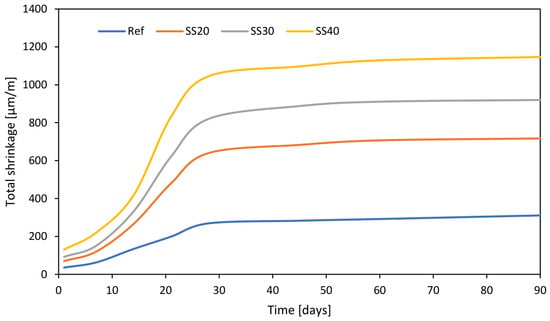
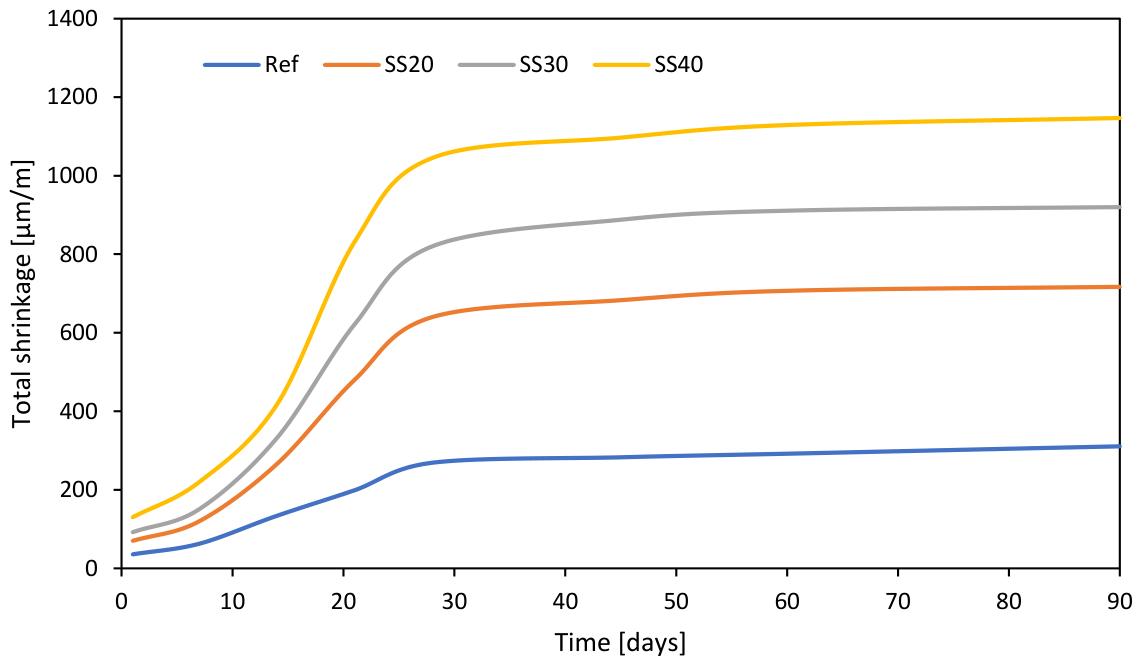
An analysis of the experimental results for total shrinkage over 90 days reveals a significant change as a function of the rate of substitution of aggregates by scallops as shown in Figure 2. The reference concrete, devoid of scallops, exhibited minimal shrinkage, reaching 311 µm/m after 90 days. This outcome aligns with the anticipated behavior for compact, low-porosity concrete. In contrast, the gradual incorporation of shells resulted in a substantial enhancement in shrinkage. Specifically, concrete containing 20% shells (SS20) demonstrates a substantial increase in shrinkage, reaching 717 µm/m, which is more than double the level observed in the reference formulation. This trend is more pronounced in the SS30 and SS40 formulations, which show shrinkage of 920 µm/m and 1147 µm/m, respectively. This phenomenon can be attributed to the porous nature of the shells, which facilitates water evaporation and reduces the compactness of the cementitious matrix. Additionally, the irregular shape of these particles can generate additional voids within the concrete, thereby increasing the degree of deformation that occurs during the drying process.
Figure 2.
Total shrinkage of scallop shell concrete.
These results are consistent with the observations of Mo et al. (2018), who demonstrated that shell waste, despite its high calcium carbonate content, increases the porosity of concrete and negatively impacts its dimensional stability [4] as mentioned above. Additionally, Tayeh et al. (2019) have demonstrated that substituting more than 20% of the concrete can lead to increased shrinkage, reduced compactness, and diminished mechanical strength [5]. Finally, Bamigboye et al. (2020) specify that these effects are particularly critical for structural uses, pointing out that formulations with high shell content require additional adjustments to compensate for their negative influence on concrete durability and dimensional stability [6].
2.5. Long-Term Properties: Chloride Ions Migration
As illustrated in Table 4, the data set encompasses chloride ion migration through various concrete types. The measurement of chloride ion migration was conducted at three distinct intervals: 28, 60, and 90 days. The concrete samples that were analyzed included a control sample, SS20; SS30 and SS40.
Table 4.
Chloride ion migration in scallop shell concrete.
After a duration of 28 days, chloride ion migration in the control concrete sample was found to be 17 × 10−12 m2/s. Conversely, concrete containing 20% shells exhibited a 10% reduction. This reduction increased with shell content, reaching 6.5%, 16.6% and 39.6% for SS20, SS30 and SS40, respectively.
At 60 days, the chloride migration rate increases to 19 × 10−12 m2/s for the reference concrete. The values obtained for SS20, SS30, and SS40 were 17.2 × 10⁻¹² m2/s, 16 × 10−12 m2/s, and 12 × 10−12 m2/s, respectively.
This increase is limited after 90 days, indicating a stabilization of ionic migration. For the reference concrete, the result is 19 × 10−12 m2/s. The values for shell-integrated concrete are 8.4%, 14.2, and 36.3% lower for SS20, SS30, and SS40, respectively.
This trend may appear paradoxical because the shell-based concretes also exhibited higher water-accessible porosity. However, total accessible porosity does not necessarily reflect the pore structure that effectively governs chloride transport. As reported by Mo et al. [4], shell crushing can generate fine calcareous particles that behave as reactive or quasi-inert fines and may partially fill capillary pores, thereby modifying the microstructure. [4]. In addition, Zhu et al. [20] showed that concretes incorporating shells may exhibit a denser paste/aggregate interfacial zone, which can improve resistance to ionic transport despite a higher overall porosity [20]. In this context, shell incorporation may increase the global void content through local surface irregularities and shell-associated pores, while simultaneously refining the connected pore network and increasing its tortuosity. Therefore, chloride migration in concrete incorporating scallop shell aggregates is not governed solely by total porosity, but may also be influenced by the characteristics of the connected pore network, including pore connectivity and tortuosity, together with pore solution conductivity and chloride binding capacity [36,37,38,39]. Future studies could include pore size distribution analysis and characterization of the shell–cement paste interfacial transition zone (ITZ) to validate this interpretation.
Tayeh et al. (2019) also emphasize that the incorporation of shells up to 30% not only ensures acceptable mechanical performance but also enhances durability against aggressive agents such as chlorides, provided that the concrete formulation is meticulously controlled [5].
In summary, while the presence of shells does enhance the apparent porosity of the concrete, their effect on chloride ion migration is beneficial.
2.6. Long-Term Properties: Accelerated Carbonation
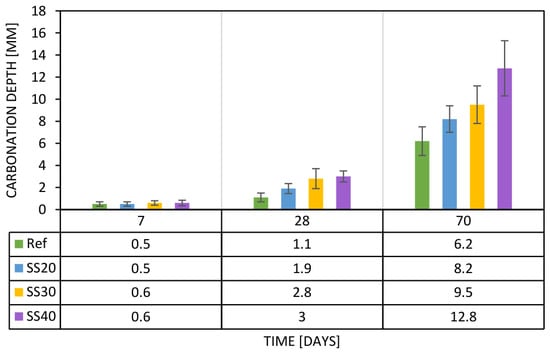
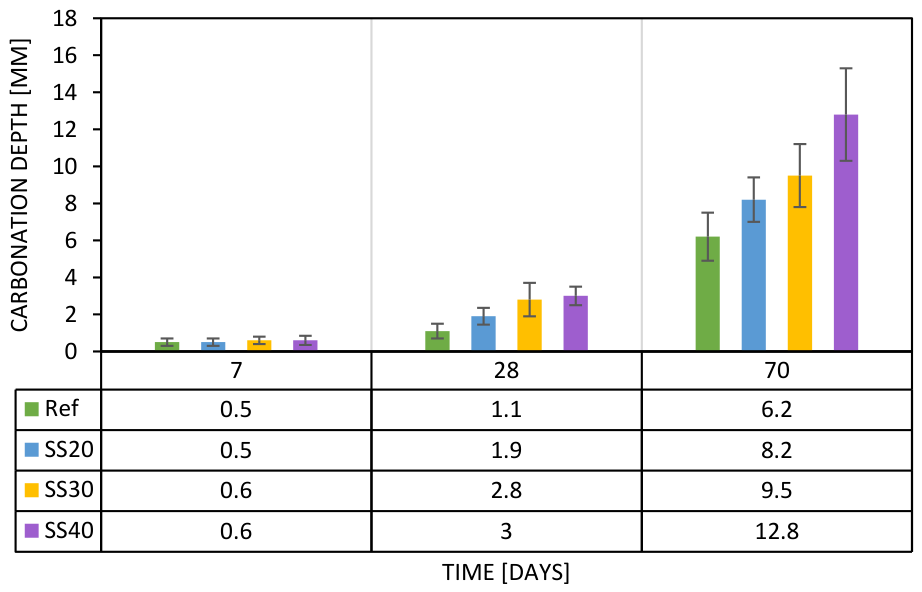
The results in Figure 3 demonstrate that, irrespective of the measurement time, there is an increase in carbonation depth with an increasing scallop substitution rate. After a period of seven days, the carbonation levels of all formulations exhibited negligible change, with measurements ranging from 0.5 mm for Ref to 0.5 to 0.6 mm for SS20 to SS40. At this early stage, the concrete microstructure remains relatively closed, and CO2 penetration is minimal.
Figure 3.
Carbonation depth of scallop shell concrete.
After a 28-day period, more pronounced disparities emerge: the carbonation depth increases to 1.1 mm for reference concrete, in comparison with 1.9 mm for SS20, 2.8 mm for SS30, and 3.0 mm for SS40. This increase indicates that shell incorporation progressively facilitates carbonation, most likely because of the higher overall porosity, lower compactness, and greater susceptibility to CO2 ingress in the shell-based mixes [4,18,20]. In addition, carbonation is influenced not only by pore structure but also by moisture conditions and alkaline reserve [40]. This finding aligns with the observations of Mo et al. (2018), who noted that the increase in porosity resulting from the incorporation of shells facilitates gas diffusion within the cementitious matrix [4].
After 70 days, the differences become even more significant: the reference concrete reaches a carbonation depth of 6.2 mm, while SS20 rises to 8.2 mm, SS30 to 9.5 mm, and SS40 to 12.8 mm. This progression substantiates the cumulative effect of porosity and augmented absorption on the rate of carbonation reaction. Research conducted by Tayeh et al. (2019) and Bamigboye et al. (2020) demonstrates that, at a certain substitution rate, the decrease in density and the increase in connected pores encourage CO2 migration, thereby diminishing the durability of the reinforcement coating zone [5,6].
In conclusion, although the valorization of scallops in concrete contributes to a more sustainable approach, it requires fine management of the risk of carbonation, especially for rates above 30%. Complementary strategies, such as the addition of admixtures or the treatment of the shells to limit their porosity, could be considered to control this effect and ensure long-term reinforcement protection.
2.7. Environnemental Monitoring
Table 5 presents the results of analyses of runoff water collected during ten sampling campaigns carried out over a six-month period. The values reported herein correspond to the concentrations measured for the main physicochemical and metallic parameters, expressed in milligrams per liter (mg/L) or micrograms per liter (µg/L), as appropriate. The results obtained are presented for the reference concrete (Ref) and the three formulations containing scallop shells at varying substitution rates. The regulatory comparison thresholds employed are delineated in the final column.
Table 5.
Main physico-chemical and metallic parameters of scallop shell concrete runoff water.
For the reference concrete, chloride concentrations varied between 25 and 35 mg/L during the monitoring period. The sulfate values ranged between 15 and 50 mg/L. Fluoride levels remained low, generally below 0.3 mg/L. With regard to trace metals, the concentrations measured for arsenic, cadmium, chromium, lead, and selenium remained very low, often below the analytical detection limits. The levels of copper, nickel, zinc, antimony, barium, and molybdenum remained relatively stable throughout the monitoring period, with values generally below 10 µg/L. It is evident that no regulatory thresholds were exceeded for the reference material in question.
For the SS20 formulation, chloride concentrations range from 32 to 45 mg/L. Sulfate levels exhibited an incremental rise from 25 to 102 mg/L over the course of the monitoring period. Fluoride levels typically remain stable at concentrations ranging from 0.18 to 0.3 milligrams per liter. Heavy metals such as arsenic, cadmium, and lead have been found to be below the limits of detection. Copper levels have been observed to vary between 10 and 20 µg/L, while nickel levels have been shown to fluctuate around 10 µg/L. The zinc values range from 5 to 8 µg/L, with the barium levels occasionally reaching 14 µg/L. It is evident that other elements, including antimony, molybdenum and selenium, exhibit concentrations that are negligible, with levels typically falling below 1 µg/L in the majority of cases.
In the case of the SS30 formulation, chlorides increase slightly at the beginning of the period (35 to 50 mg/L), before stabilising between 70 and 126 mg/L towards the end of the monitoring period. Sulfates, conversely, exhibited a comparable trend, attaining a maximum of 126 mg/L during the ninth campaign. Fluoride levels remained low, below 0.5 mg/L. Concentrations of arsenic, cadmium, chromium, and lead were predominantly below the limits of detection. The average concentrations of elements such as copper and nickel ranged from 10 to 15 µg/L. Zinc levels ranged from 5 to 10 µg/L, while barium levels reached a maximum of 18 µg/L. The concentrations of specific trace elements (antimony, molybdenum, and selenium) were found to be below 1 µg/L, indicating an absence or paucity of these elements.
The SS40 formulation exhibited chloride concentrations ranging from 31 to 56 mg/L at the commencement of monitoring, reaching 126 mg/L in the final campaign. Sulfate concentrations ranged from 32 to 125 mg/L, exhibiting a comparable trend to that observed in SS30. Fluoride concentrations remain below 0.4 mg/L. Heavy metals such as arsenic, cadmium, and lead were not detected in quantities that exceeded the limits of detection. The levels of copper, nickel and zinc remained comparable to other formulations, ranging from 10 to 20 µg/L, 10 to 15 µg/L, and 5 to 8 µg/L, respectively. Barium levels exhibited a range from 8 to 16 µg/L, while molybdenum and selenium levels remained below 1 µg/L for the duration of the measurement periods.
Overall, the results show three main trends: (i) all measured concentrations remained below the regulatory thresholds considered for interpretation; (ii) anions exhibited a gradual increase before stabilizing, which is typical of an initial wash-off stage followed by chemical equilibration; and (iii) trace metals remained consistently low, without any systematic amplification with shell content. No significant anomalies were detected for anions or trace metals. These results confirm the overall chemical stability of the materials during the monitoring period, regardless of the rate of substitution with scallop shells.
2.7.1. Changes in Anions (Chlorides, Sulfates, and Fluorides)
Chloride and sulfate concentrations gradually increase over the course of sampling campaigns before stabilizing, reflecting an initial leaching phenomenon typical of cementitious materials subjected to watering or runoff cycles [35].
During the initial weeks of the setting process, soluble salts such as CaCl2 and CaSO4 present in the cement are eliminated through washings. Thereafter, the system attains a state of chemical equilibrium between the cement matrix and the percolating water [21].
The SS30 and SS40 formulations exhibit marginally elevated chloride and sulfate contents in comparison to the reference concrete. This behavior is consistent with the increased presence of scallop shells, composed mainly of CaCO3, which promotes the release of calcium ions and the secondary formation of soluble salts [41]. However, it is notable that all values remain below the regulatory thresholds (200 mg/L for Cl− and 150 mg/L for SO42−) for these elements, thereby confirming the low solubility of the compounds and the good chemical inertia of the matrix.
Fluoride levels remained stable, with a mean value of less than 0.4 mg/L, suggesting that the carbonate materials present within the shells do not result in substantial fluoride ion release. This finding is consistent with the observations reported by Martínez-García and González-Fonteboa (2017) [26].
2.7.2. Behavior of Heavy Metals
Heavy metals such as As, Cd, Cr, Cu, Ni, Pb, and Zn were detected in concentrations well below regulatory thresholds, demonstrating the cement matrix’s high retention capacity. The predominant mechanisms encompass precipitation in the form of hydroxides at elevated pH (>11), sorption on C–S–H (calcium silicate hydrate) phases, and encapsulation within the pores of the concrete [13].
No significant increase was observed with the addition of shells, indicating that replacing natural aggregates with shell waste does not alter the material’s chemical stability [22]. Copper, nickel, and zinc exhibited minimal fluctuations (≤20 µg/L), which can be attributed to the inherent variability of water-matrix interactions rather than active leaching. Analogous trends were observed in concrete exposed to marine environments by McManus et al., 2018 [42].
Antimony, molybdenum, and selenium have been found to be virtually undetectable, thus indicating that there is a strong immobilization of non-essential trace elements by the cementitious matrix. This finding has been demonstrated in leaching tests on oyster shells by Kong et al. (2022) [21].
2.7.3. Influence of Shell Substitution Rate
The increase in the substitution rate (from 20% to 40%) does not result in a linear relationship between shell content and the concentration of leached elements. Despite a marginal increase in anions (Cl− and SO42−) observed in formulations with the highest shell content, these values remain well below environmental limits.
These observations confirm the good chemical and mineralogical inertia of scallop shells, which are dominated by calcite (CaCO3) and aragonite, two stable phases at basic pH [35].
Furthermore, the presence of shells has been demonstrated to have a buffering effect on pH, thereby limiting the mobility of metal ions (as evidenced by Zelloufi et al., 2024 in the context of shell concrete exposed to seawater [43]). These results corroborate the findings of Peceño et al., 2019 [41], and Martínez-García et al., 2017 [26], which demonstrate that partial replacement of aggregates with marine shells enhances durability without compromising environmental compatibility.
2.7.4. Comprehensive Environmental Assessment
The results obtained in this monitoring exercise demonstrate that:
- All measured parameters are below the limit values set by the Decree of 11 January 2007, and the Decree of 12 December 2014 (criteria for inert waste).
- Concentrations remain stable over time, indicating controlled leaching.
- The promotion of metallic elements and the neutralization of acidic species is promoted by basic pH values (>11). This has been confirmed by Chen et al., 2023 [13], and Kong et al., 2022 [21].
Consequently, concrete incorporating scallop shells can be designated as a material with minimal environmental impact, compatible with sustainable resource management and the regulatory requirements for inert materials. It is important to note that the simulated exposure corresponds to a concentrated accumulation of precipitation over time and does not reflect the full range of aging mechanisms in concrete over several decades. Nevertheless, this approach allows for a conservative examination of the environmental behavior of a material already subjected to progressive surface degradation, representative of a pre-demolition state.
3. Materials
3.1. Cement
Portland cement (CEM II/A-LL 52.5R) is utilized as a binder. This high-strength cement is distinguished by its rapid hardening properties and is frequently employed in the field of building construction. The cement’s chemical composition and physical properties are delineated in its technical data sheet, which encompasses data on fineness, density, and compressive strength. Detailed information on cement’s properties can be found in Table 6.
Table 6.
Cement characteristics.
3.2. Limestone Filler
The utilization of limestone filler in the majority of regional precast plants is predominantly driven by its cost-effectiveness. This selection is informed by economic imperatives, while concurrently ensuring that the fundamental properties essential for concrete production are maintained. For a comprehensive understanding of the characteristics of the limestone filler employed, detailed product characterization is presented in Table 7.
Table 7.
Limestone filler characteristics.
3.3. Sand
Sand constitutes a fundamental component of concrete mixes, assuming a crucial role in shaping the properties and performance of the final product. The sand utilized in this study is 0/4 washed sand. The physical properties of fine particles are delineated in Table 8.
Table 8.
Sand characteristics.
3.4. Coarse Aggregate
The concrete preparation stage employs semi-crushed washed stone as coarse aggregate, with a maximum size of 12.5 mm. Local materials are utilized and incorporated into the mixture in order to meet the requisite specifications. The physical properties of coarse particles are described in the following Table 9.
Table 9.
Coarse aggregate characteristics.
3.5. Scallop Shell Aggregate
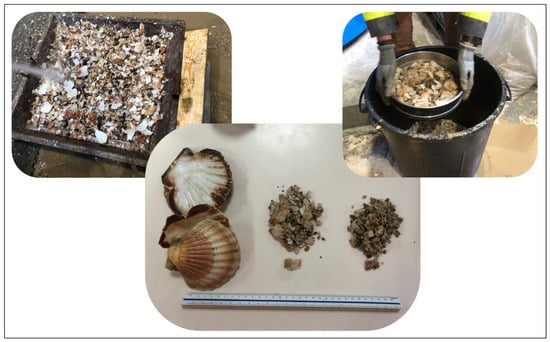
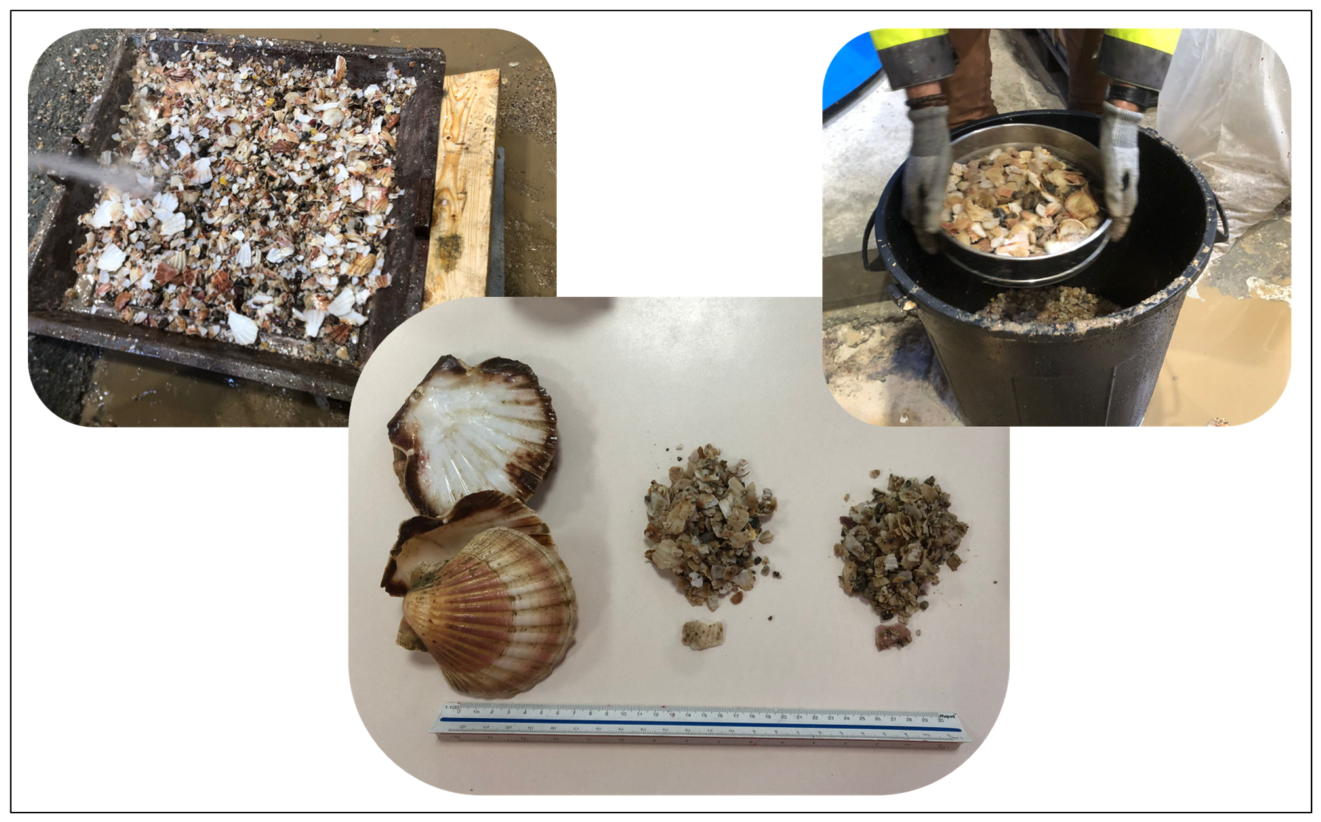
Scallop shells used in this study were collected from local fishing industries after the shellfish processing stage. Before use, the shells were stored outdoors for three months, allowing natural cleaning under rain exposure and progressive removal of macro-debris and microorganisms. They were then crushed, screened to obtain a particle size ranging from 2 to 20 mm, and finally washed to remove any remaining impurities before incorporation into the concrete mixtures as presented in Figure 4.
Figure 4.
Scallop shell preparation.
The characterization of the shells was carried out mainly according to the standards applicable to natural aggregates. Only the main physical properties relevant to this study are reported in Table 10. The scallop shells exhibited an absolute density of 2713 kg/m3, a water absorption coefficient of 2.93%, an acid-soluble chloride content of 0.055%, and a Los Angeles coefficient of 15.1, indicating acceptable resistance for use as coarse aggregate in concrete. The particle size distribution of the processed scallop shell aggregate was controlled after crushing and screening to comply with the target 2/20 mm grading.
Table 10.
Scallop shell characteristics.
Subsequently, the proportions of the chemical elements in Table 11 constituting the shells were analyzed by ICP-AES according to the following protocol:
- Sample preparation
- ▪
- The shells were dried.
- ▪
- The shells were then pulverized using a pestle in a ceramic mortar, yielding 0.2 g of dry material.
- Hot mineralization
- ▪
- The crushed samples were placed in a Teflon spray can.
- ▪
- Next, 6.66 milliliters of hydrochloric acid (HCl, 30%) and 3.33 milliliters of nitric acid (HNO3, 69%) were added.
- ▪
- The Teflon spray was introduced into a Berghof Speedwave MWS-2 microwave mineralizer, following a predefined program.
- ▪
- The sample was prepared for analysis. The digest was transferred to a 50 mL flask and made up with ultrapure water.
- ▪
- The solution was stored at 4 °C in the dark until analysis.
- ▪
- The solution was then filtered through a 0.45 µm filter into a polypropylene tube.
- Chemical analysis
- ▪
- Determination of elemental composition was conducted by the ICP-AES method.
Table 11.
Elemental shell compositions.
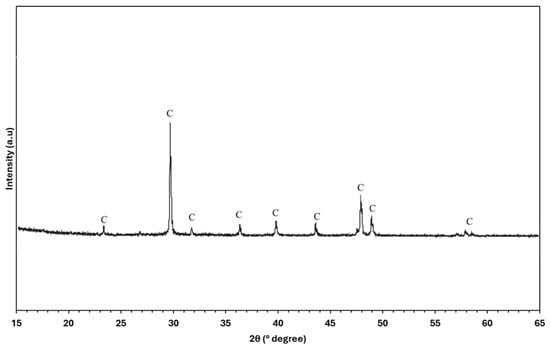
Mineralogical characterizations of the shells were determined by DRX on a Siemens D5000 diffractometer using copper Kα radiation (1.5418 Å wavelength) and by thermogravimetric analysis (TGA) coupled with differential scanning calorimetry (DSC) on a Netzsch Sta 449 F3 Jupiter® simultaneous thermal analyzer. For these analyses, the shells were ground to a fine powder (less than 80 μm).
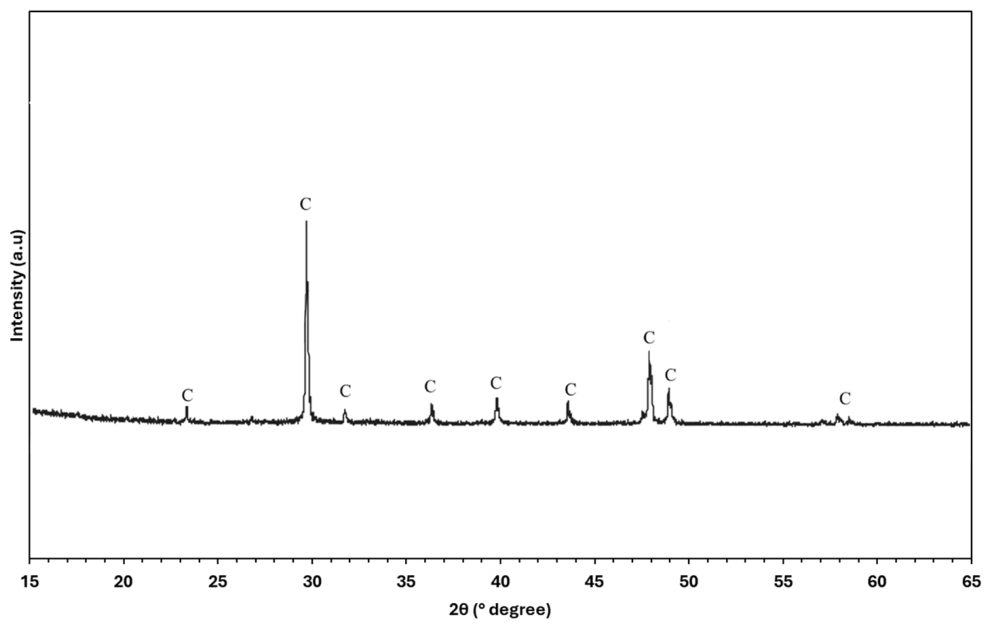
The outcomes of the mineralogical analysis, as determined by XRD, are illustrated in Figure 5. The mineralogical composition of the shells is dominated by calcium carbonate, specifically the form of calcite as observed in scallops. Assuming that the calcium quantified by ICP-AES analysis originates from calcium carbonate (see Table 11), a semi-quantitative mineralogical composition can be established. The mineralogical composition of scallops is mainly calcium carbonate, with calcite predominating at 96.1% by mass.
Figure 5.
Diffractograms of scallop shells (C: Calcite).
3.6. Additive
In order to enhance the workability of self-compacting concrete, a superplasticizer is incorporated into the mixture. Moreover, within the industrial process, an accelerating admixture is utilized to facilitate the early demolding phase.
4. Experimental Methods
This section offers a synopsis of the investigative protocol established to evaluate the technical and environmental performance of scallop-shell concretes. The tests conducted to assess mechanical properties, physical characteristics, and chemical properties, as well as potential environmental impacts, are presented herein.
4.1. Water-Accessible Porosity
The measurements of water-accessible porosity were carried out in accordance with the standard NF EN 18-459 [44]. The principle of this method is to saturate concrete samples under vacuum for 48 h, and then proceed with the various weightings: These included hydrostatic weighing (), mass in air (), and dry mass ().
The water-accessible porosity, denoted by P, is then calculated based on these measurements using the following equation:
4.2. Immersion Water Absorption
The immersion water absorption (Abs) test is a standardized procedure used to assess the permeability and durability of concrete in accordance with NBN B 15-215:1989. The test involves immersing a concrete sample in water at 20 ± 2 °C for a minimum of 48 h and up to constant wet mass. Mass is considered constant when two successive weightings, 24 h apart, do not give a difference of no more than 0.1%. The amount of water absorbed is then measured.
4.3. Compressive Strength
The evolution of the compressive strength of concrete was evaluated through tests on cylindrical specimens at varying ages (24 h, 7 days, and 28 days), in accordance with standard NF EN 12390-3 [45]. Prior to conducting the test, the concrete specimens are pre-faced to ensure that their surfaces are perfectly flat. The experimental procedure involves the execution of three replicates for each formulation.
4.4. Total Shrinkage
Total concrete shrinkage is assessed in accordance with standard NF P 18-427 [46], which describes the method for measuring the change in length of hardened concrete specimens. The test involves the use of prismatic specimens fitted with studs to facilitate accurate measurement of the change in length. The standard dimensions of the specimens used in this test are 7cm × 7 cm × 28 cm. The test is carried out at a temperature of 20 °C and a humidity of 65%.
4.5. Chloride Ion Migration
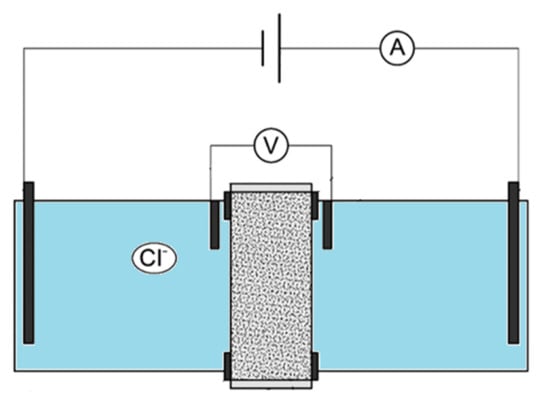
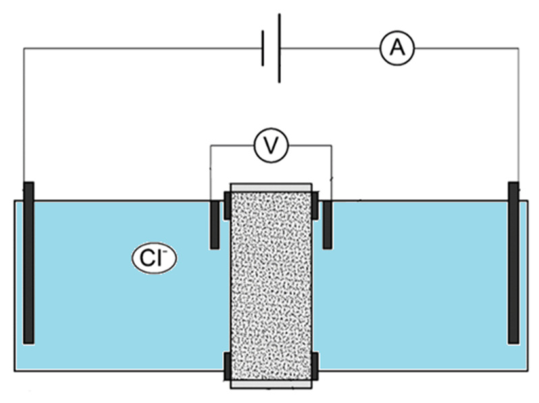
Accelerated electric-field chloride ion migration tests were carried out. The concrete’s position is between two compartments as shown in Figure 6. The compartments are filled with a chloride-containing solution on the upstream side and a chloride-free solution on the downstream side. The voltage applied to the sample terminals was 30 volts to migrate chloride ions from the upstream compartment to the downstream compartment. The effective diffusion coefficient De (m2/s) was determined in accordance with the standard XP P 18-462 [47].
Figure 6.
Chloride ions migration.
4.6. Accelerated Carbonation
The experiment involves the observation of the depth of carbonated concrete in cylindrical concrete specimens as they are exposed to an atmosphere containing carbon dioxide in accordance with XP P 18-458 [48]. The specimens are placed in a sealed carbonation chamber where the CO2 concentration is maintained at 3%, the temperature is set at 20 °C, and the relative humidity is kept at 70%. The depth of carbonation is measured periodically.
Concrete specimens were then immersed in a 1% alcoholic phenolphthalein solution immediately following their removal from the carbonation chamber. This method was employed to ascertain the thickness of the carbonated zone. The measurements were obtained at three distinct intervals: after seven days, after 28 days, and after 70 days.
4.7. Environmental Monitoring Under Simulated Rainfall
During their lifetime, which can extend over several decades, materials present a risk of releasing substances into water, mainly through leaching. The intrinsic composition of certain raw materials can have various adverse environmental and health effects.
The study of leaching is generally based on specific laboratory tests designed for mineral wastes. These tests characterize the properties of the material. However, leaching is also influenced by several factors, in particular the environment in which the structure is located.
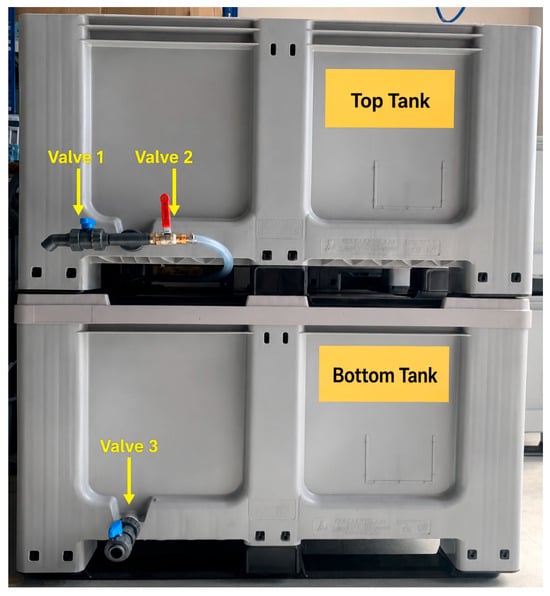
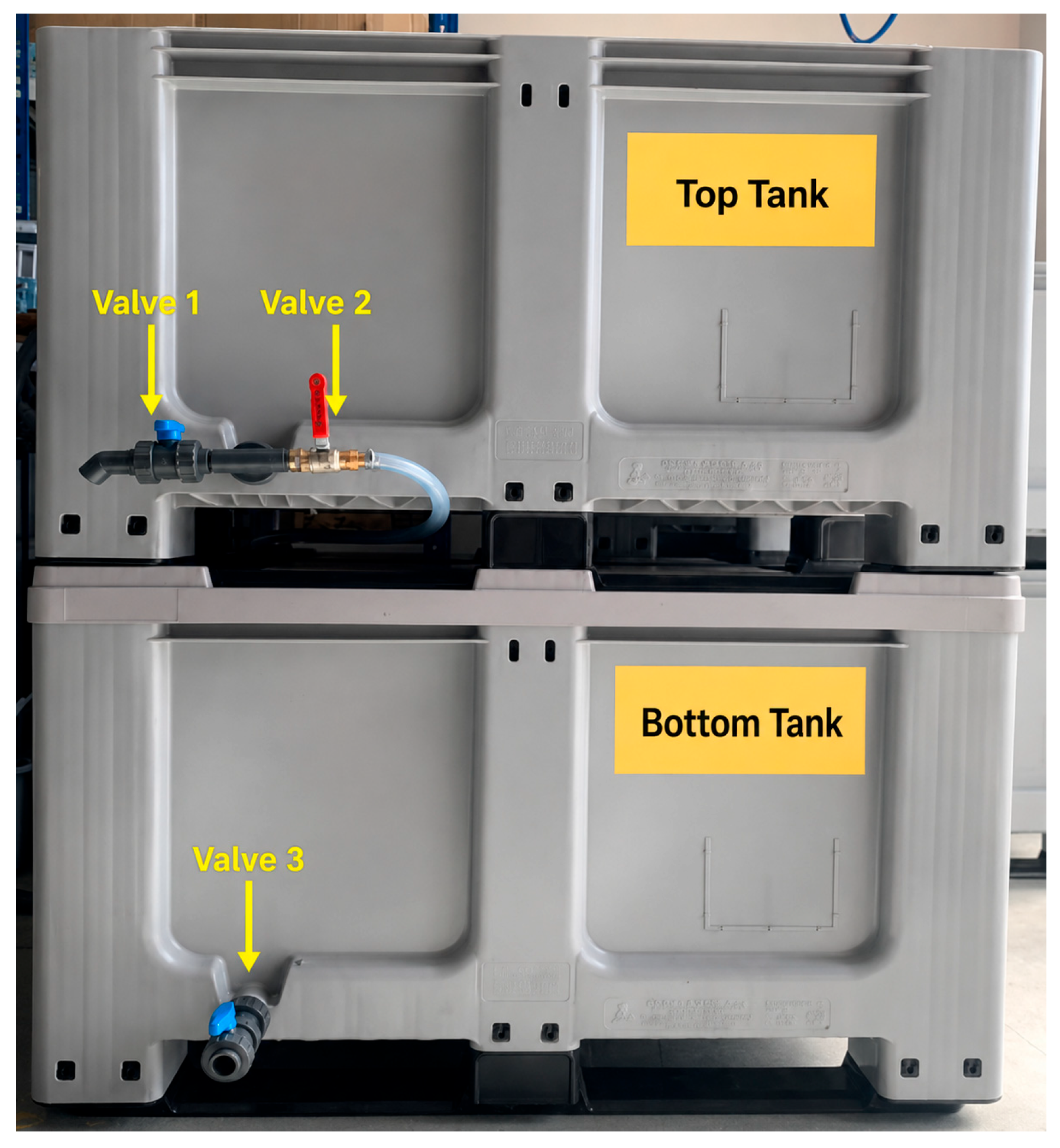
In addition, this study uses an environmental monitoring system (Figure 7), which consists of exposing samples, known as test plates, to artificially accelerated precipitation.
Figure 7.
Environmental monitoring system.
The aim of environmental monitoring is to measure changes in pollutants over time using a specific run-off collection system (Figure 7). The test beds (Figure 8) are concrete structures exposed to artificial rainfall to simulate as closely as possible the conditions in which the product will be used.
Figure 8.
Sample subjected to environmental monitoring.
For this study, the evaluation includes daily watering with 12 L of water from the drinking water for six months (see Table 12) and a total of 10 samples (see Table 13). The simulated rainfall protocol implemented aims to reproduce cumulative rainfall exposure equivalent to approximately nine years of natural rainfall, based on local climate data. It does not claim to reproduce the entire service life of a structure, but rather constitutes an accelerated and conservative approach designed to assess surface runoff and potential leaching phenomena.
Table 12.
Environmental monitoring data.
Table 13.
Sampling date.
The sampling phases are as follows:
- -
- Collection of water in the collection tank.
- -
- Filling of special vials for environmental analysis.
In order to interpret the results, the innovative concretes are compared with a control concrete using the same test and analysis protocol, and the analyses of the recovered water are compared with the environmental quality standards (EQS) in force, in particular those defined by the decree of 11 January 2007 on the quality limits of surface fresh water intended for the production of drinking water (excluding conditioned spring water), in application of articles R.1321-38 [49] to R.1321-41 [50]. This normative choice is justified by a more rigorous and demanding approach to the processing of the results. The following analytical parameters have been selected:
- -
- Anions: sulfates, chlorides, nitrates and fluorides.
- -
- Trace heavy metals.
- -
- TOC (total organic carbon)
- -
- PCBs (polychlorinated biphenyls).
- -
- PAH (polycyclic aromatic hydrocarbons).
- -
- BTEX (benzene, toluene, ethylbenzene and xylenes).
- -
- COD (chemical oxygen demand).
- -
- DB05 (biochemical oxygen demand after 5 days).
- -
- TSS (suspended solids).
- -
- HCT (total hydrocarbons).
- -
- Phenol index.
- -
- Total nitrogen.
However, the decree of 11 January 2007 does not specify limits for the following chemical elements:
- -
- BTEX.
- -
- TOC.
- -
- PCB.
- -
- Molybdenum.
- -
- Nickel.
- -
- Antimony.
For these parameters, the reference thresholds on the basis of which the results are interpreted are those defined in the Decree of 12 December 2014 on the conditions for the admission of inert waste to facilities classified under headings 2515, 2516, 2517 and to storage facilities for inert waste classified under heading 2760 of the nomenclature of classified facilities [51].
If the analyzed parameters remain systematically below the defined thresholds, their monitoring is suspended. However, analyses of heavy metals and anions will continue until the end of the monitoring program.
5. Conclusions
This study investigated the feasibility of recycling scallop shells as a partial substitute for natural coarse aggregates in concrete through an integrated experimental program combining mechanical response, physical properties, durability indicators, and six-month environmental monitoring under simulated rainfall.
The main technical results show that shell incorporation progressively altered the concrete properties. Mechanical tests revealed a progressive decrease in the compressive strength and compactness of the concrete with increasing shell substitution rates. The 28-day compressive strength decreased from 33.7 MPa for the reference concrete to 27.9 MPa and 28.1 MPa for substitution rates of 20% and 30%, respectively, and reached 26.7 MPa for 40% shells. This trend remains compatible with non-structural or lightly loaded applications up to 30% substitution, provided that appropriate design is implemented.
The durability indicators showed contrasting effects. Chloride ion migration was reduced by 8 to 15% for formulations containing 20 to 30% shells and by up to approximately 36% for 40% substitution, despite a concomitant increase in water-accessible porosity from 7.8% to 9.9%. Conversely, the carbonation depth after 70 days of accelerated exposure increased from 6.2 mm for the reference concrete to 8.2 mm, 9.5 mm, and 12.8 mm for the formulations with 20%, 30%, and 40% shells, respectively, highlighting the need for formulation control in reinforced structures.
From an environmental standpoint, the six-month runoff monitoring protocol showed low release levels for all formulations. Chloride concentrations remained at or below 74 mg/L, sulfates at or below 126 mg/L, fluoride at or below 0.43 mg/L, and the analyzed trace metals generally remained below 20 µg/L or below the analytical detection limits. These values stayed below the regulatory thresholds considered in this study and support the chemical stability of the shell-based concretes during service-like exposure.
Under the conditions investigated here, substitution rates up to 30% appear to provide the most balanced compromise between waste valorization and technical performance, whereas 40% replacement leads to more pronounced losses in compactness, shrinkage resistance, and carbonation resistance. From an industrial perspective, the proposed route is compatible with a simple processing chain based on shell collection, outdoor maturation, crushing, and sieving to a coarse 2/20 mm fraction, which makes it relevant for non-structural or lightly loaded concrete products.
This work nevertheless has several limitations. Sulfate resistance, fresh-state workability, detailed particle size distribution of the processed shells, and microstructural characterization of the pore network and interfacial transition zone were not directly measured. These aspects should be addressed in future work to strengthen the interpretation of the observed mechanisms and extend the field of application.
Author Contributions
Conceptualization, F.A. and B.H.; methodology, F.A., H.A. and B.H.; validation, A.M. and B.H.; formal analysis, F.A., A.M. and A.Y.; investigation, H.A. and A.Y.; data curation, F.A. and H.A.; writing—original draft preparation, F.A., H.A., A.Y. and B.H.; writing—review and editing, F.A., A.M., A.Y. and B.H.; supervision, F.A., A.M. and B.H. All authors have read and agreed to the published version of the manuscript.
Funding
This research received no external funding.
Data Availability Statement
The original contributions presented in this study are included in the article. Further inquiries can be directed to the corresponding author.
Acknowledgments
The authors gratefully acknowledge Gilles Florentin, CMEG, Normandy, France, for his valuable help, technical expertise, and support during this work.
Conflicts of Interest
Houssam Affan is an employee of Groupe FEHR. Abdelrahman Mohamad is an employee of Vicat. The other authors declare no conflicts of interest. Groupe FEHR and Vicat had no role in the design of the study; in the collection, analyses, or interpretation of data; in the writing of the manuscript; or in the decision to publish the results.
References
- FranceAgriMer. Chiffres-clés des Filières Pêche et Aquaculture en France en 2023: Production-Entreprises-Échanges-Consommation. 2023. Available online: https://www.franceagrimer.fr/fam/content/download/72218/document/CC_p%C3%AAche_2023_FR.pdf?version=14 (accessed on 10 September 2025).
- Nguyen, D.H.; Boutouil, M.; Sebaibi, N.; Leleyter, L.; Baraud, F. Valorization of seashell by-products in pervious concrete pavers. Constr. Build. Mater. 2013, 49, 151–160. [Google Scholar] [CrossRef] [Scilit]
- Archer, M.; Watson, R.; Denton, J.W. Fish Waste Production in the UK—The quantities Produced and Opportunities for Better Utilisation. 2000. Available online: https://www.seafish.org/document/?id=b20daade-1e6e-4204-bf46-e353a255f93a (accessed on 10 March 2025).
- Mo, K.H.; Alengaram, U.J.; Jumaat, M.Z.; Lee, S.C.; Goh, W.I.; Yuen, C.W. Recycling of seashell waste in concrete: A review. Constr. Build. Mater. 2018, 162, 751–764. [Google Scholar] [CrossRef] [Scilit]
- Tayeh, B.A.; Hasaniyah, M.W.; Zeyad, A.M.; Yusuf, M.O. Properties of concrete containing recycled seashells as cement partial replacement: A review. J. Clean. Prod. 2019, 237, 117723. [Google Scholar] [CrossRef] [Scilit]
- Bamigboye, G.O.; Nworgu, A.T.; Odetoyan, A.O.; Kareem, M.; Enabulele, D.O.; Bassey, D.E. Sustainable use of seashells as binder in concrete production: Prospect and challenges. J. Build. Eng. 2021, 34, 101864. [Google Scholar] [CrossRef] [Scilit]
- Gao, Z.; Yang, H.; Liu, Q. Natural Seashell Waste as an Efficient and Low-Cost Catalyst for the Synthesis of Arylmethylenemalonitriles. CLEAN–Soil Air Water 2019, 47, 1900129. [Google Scholar] [CrossRef] [Scilit]
- Mchich, Z.; Stefan, D.S.; Mamouni, R.; Saffaj, N.; Bosomoiu, M. Eco-Friendly Hydrogel Beads from Seashell Waste for Efficient Removal of Heavy Metals from Water. Polymers 2024, 16, 3257. [Google Scholar] [CrossRef] [Scilit] [PubMed]
- Nahas, L.; Dahdah, E.; Aouad, S.; El Khoury, B.; Gennequin, C.; Abi Aad, E.; Estephane, J. Highly efficient scallop seashell-derived catalyst for biodiesel production from sunflower and waste cooking oils: Reaction kinetics and effect of calcination temperature studies. Renew. Energy 2023, 202, 1086–1095. [Google Scholar] [CrossRef] [Scilit]
- Topić Popović, N.; Lorencin, V.; Strunjak-Perović, I.; Čož-Rakovac, R. Shell Waste Management and Utilization: Mitigating Organic Pollution and Enhancing Sustainability. Appl. Sci. 2023, 13, 623. [Google Scholar] [CrossRef] [Scilit]
- Magnabosco, G.; Giuri, D.; Di Bisceglie, A.P.; Scarpino, F.; Fermani, S.; Tomasini, C.; Falini, G. New Material Perspective for Waste Seashells by Covalent Functionalization. ACS Sustain. Chem. Eng. 2021, 9, 6203–6208. [Google Scholar] [CrossRef] [Scilit]
- Affan, H. Etude du Comportement Hygrothermique et Durabilité de Matériaux de Construction Incorporant des Biomasses. Ph.D. Theses, Normandie Université Caen, France, 2024. Available online: https://theses.hal.science/tel-04966217 (accessed on 26 April 2026).
- Chen, B.; Peng, L.; Zhong, H.; Zhao, Y.; Meng, T.; Zhang, B. Synergetic recycling of recycled concrete aggregate and waste mussel shell in concrete: Mechanical properties, durability and microstructure. Constr. Build. Mater. 2023, 371, 130825. [Google Scholar] [CrossRef] [Scilit]
- Soleimani, T.; Hayek, M.; Junqua, G.; Salgues, M.; Souche, J.-C. Environmental, economic and experimental assessment of the valorization of dredged sediment through sand substitution in concrete. Sci. Total Environ. 2023, 858, 159980. [Google Scholar] [CrossRef] [Scilit] [PubMed]
- Li, J.; Zuo, X.; Xin, C. Utilizing Industrial Waste to Enhance Mechanical Strength and Cost-Effectiveness of Dredged Soil. Recycling 2026, 11, 55. [Google Scholar] [CrossRef] [Scilit]
- Wan, C.; Hou, P.; Zhou, L.; Golewski, G.L.; Zheng, Y.; Zhang, T. The fracture performance of modified recycled concrete: Influence of recycled aggregate and recycled powder. Eng. Fract. Mech. 2026, 331, 111709. [Google Scholar] [CrossRef] [Scilit]
- Wang, J.; Liu, E.; Li, L. Characterization on the recycling of waste seashells with Portland cement towards sustainable cementitious materials. J. Clean. Prod. 2019, 220, 235–252. [Google Scholar] [CrossRef] [Scilit]
- Bamigboye, G.O.; Okechukwu, U.E.; Olukanni, D.O.; Bassey, D.E.; Okorie, U.E.; Adebesin, J.; Jolayemi, K.J. Effective Economic Combination of Waste Seashell and River Sand as Fine Aggregate in Green Concrete. Sustainability 2022, 14, 12822. [Google Scholar] [CrossRef] [Scilit]
- Bamigboye, G.O.; Okara, O.; Bassey, D.E.; Jolayemi, K.J.; Ajimalofin, D. The use of Senilia senilis seashells as a substitute for coarse aggregate in eco-friendly concrete. J. Build. Eng. 2020, 32, 101811. [Google Scholar] [CrossRef] [Scilit]
- Zhu, Y.; Chen, D.; Yu, X.; Liu, R.; Liao, Y. Properties of Cementitious Materials Utilizing Seashells as Aggregate or Cement: Prospects and Challenges. Materials 2024, 17, 1222. [Google Scholar] [CrossRef] [Scilit] [PubMed]
- Kong, J.; Cong, G.; Ni, S.; Sun, J.; Guo, C.; Chen, M.; Quan, H. Recycling of waste oyster shell and recycled aggregate in the porous ecological concrete used for artificial reefs. Constr. Build. Mater. 2022, 323, 126447. [Google Scholar] [CrossRef] [Scilit]
- Camba, C.; Mier, J.L.; Carral, L.; Lamas, M.I.; Álvarez, J.C.; Díaz-Díaz, A.-M.; Tarrío-Saavedra, J. Erosive Degradation Study of Concrete Augmented by Mussel Shells for Marine Construction. J. Mar. Sci. Eng. 2021, 9, 1087. [Google Scholar] [CrossRef] [Scilit]
- Hamada, H.M.; Al-Attar, A.; Askar, M.K.; Beddu, S.; Majdi, A.; Humada, A.M. Recycled seashells as sustainable aggregates in concrete: Advancing waste management and enhancing performance: A comprehensive review. J. Build. Eng. 2025, 110, 113067. [Google Scholar] [CrossRef] [Scilit]
- González-Caro, Á.; Lamaa, G.; Silva, R.V.; de Brito, J.; Jiménez, J.R.; Fernández-Rodríguez, J.M.; Merino-Lechuga, A.M. CO2-cured alkali-activated pervious paving blocks incorporating seashell sand. Mater. Struct. 2025, 59, 23. [Google Scholar] [CrossRef] [Scilit]
- Edalat-Behbahani, A.; Soltanzadeh, F.; Emam-Jomeh, M.; Soltan-Zadeh, Z. Sustainable approaches for developing concrete and mortar using waste seashell. Eur. J. Environ. Civ. Eng. 2021, 25, 1874–1893. [Google Scholar] [CrossRef] [Scilit]
- Martínez-García, C.; González-Fonteboa, B.; Martínez-Abella, F.; Carro- López, D. Performance of mussel shell as aggregate in plain concrete. Constr. Build. Mater. 2017, 139, 570–583. [Google Scholar] [CrossRef] [Scilit]
- Cuadrado-Rica, H.; Sebaibi, N.; Boutouil, M.; Boudart, B. Properties of ordinary concretes incorporating crushed queen scallop shells. Mater. Struct. 2016, 49, 1805–1816. [Google Scholar] [CrossRef] [Scilit]
- Rica, H.C.; Boutouil, M.; Boudart, B.; Claquin, P.; Leroy, F. Colonisation et détérioration des bétons incorporant des coquilles pour récifs artificiels. Matériaux Tech. 2016, 104, 503. [Google Scholar] [CrossRef] [Scilit] [PubMed]
- H.G, N.C.; Mutusva, T. Investigation of Properties of Concrete with Seashells as a Coarse Aggregate Replacement in Concrete. Matter Int. J. Sci. Technol. 2015, 1, 285–295. [Google Scholar] [CrossRef] [Scilit]
- Safi, B.; Saidi, M.; Daoui, A.; Bellal, A.; Mechekak, A.; Toumi, K. The use of seashells as a fine aggregate (by sand substitution) in self-compacting mortar (SCM). Constr. Build. Mater. 2015, 78, 430–438. [Google Scholar] [CrossRef] [Scilit]
- Kuo, W.-T.; Wang, H.-Y.; Shu, C.-Y.; Su, D.-S. Engineering properties of controlled low-strength materials containing waste oyster shells. Constr. Build. Mater. 2013, 46, 128–133. [Google Scholar] [CrossRef] [Scilit]
- Engelaère, C. Etude de Valorisation des Coproduits Marins Coquilliers sous Forme D’additions et de Granulats dans les Matériaux Cimentaires. Ph.D. Thesis, Université de Caen Normandie, Caen, France, 2012. Available online: https://www.theses.fr/2012CAEN2053 (accessed on 25 April 2023).
- Yang, E.-I.; Kim, M.-Y.; Park, H.-G.; Yi, S.-T. Effect of partial replacement of sand with dry oyster shell on the long-term performance of concrete. Constr. Build. Mater. 2010, 24, 758–765. [Google Scholar] [CrossRef] [Scilit]
- Falade, F. An investigation of periwinkle shells as coarse aggregate in concrete. Build. Environ. 1995, 30, 573–577. [Google Scholar] [CrossRef] [Scilit]
- Eziefula, U.G.; Ezeh, J.C.; Eziefula, B.I. Properties of seashell aggregate concrete: A review. Constr. Build. Mater. 2018, 192, 287–300. [Google Scholar] [CrossRef] [Scilit]
- Luping, T.; Nilsson, L.-O. Rapid Determination of the Chloride Diffusivity in Concrete by Applying an Electric Field. 1993. Available online: https://www.concrete.org/publications/internationalconcreteabstractsportal.aspx?m=details&ID=1244 (accessed on 8 June 2026).
- Hirao, H.; Yamada, K.; Takahashi, H.; Zibara, H. Chloride Binding of Cement Estimated by Binding Isotherms of Hydrates. J. Adv. Concr. Technol. 2005, 3, 77–84. [Google Scholar] [CrossRef] [Scilit]
- Galan, I.; Glasser, F.P. Chloride in cement. Adv. Cem. Res. 2015, 27, 63–97. [Google Scholar] [CrossRef] [Scilit]
- Fu, J.; Thomas, H.; Li, C.-F. Tortuosity in Porous Media: Image Analysis and Physical Simulation. Earth-Sci. Rev. 2021, 212, 103439. [Google Scholar] [CrossRef] [Scilit]
- Qu, F.; Li, W.; Dong, W.; Tam, V.W.Y.; Yu, T. Durability deterioration of concrete under marine environment from material to structure: A critical review. J. Build. Eng. 2021, 35, 102704. [Google Scholar] [CrossRef] [Scilit]
- Peceño, B.; Arenas, C.; Alonso-Fariñas, B.; Leiva, C. Substitution of Coarse Aggregates with Mollusk-Shell Waste in Acoustic-Absorbing Concrete. J. Mater. Civ. Eng. 2019, 31, 04019077. [Google Scholar] [CrossRef] [Scilit]
- McManus, R.S.; Archibald, N.; Comber, S.; Knights, A.M.; Thompson, R.C.; Firth, L.B. Partial replacement of cement for waste aggregates in concrete coastal and marine infrastructure: A foundation for ecological enhancement? Ecol. Eng. 2018, 120, 655–667. [Google Scholar] [CrossRef] [Scilit]
- Zelloufi, M.; Ramos, V.; El Haddaji, B.; Bourguiba, A.; Rollinson, G.K.; Andersen, J.; Sebaibi, N.; Boutouil, M. Bio-colonisation, durability, and microstructural analysis of concrete incorporating magnetite and oyster shell waste aggregates in marine environment. Constr. Build. Mater. 2024, 456, 139269. [Google Scholar] [CrossRef] [Scilit]
- NF P18-459; Concrete—Testing Hardened Concrete—Testing Porosity and Density. Afnor Editions: Saint-Denis, France, 2022.
- NF EN 12390-3; Testing Hardened Concrete—Part 3: Compressive Strength of Test Specimens. Afnor Editions: Saint-Denis, France, 2019.
- NF P 18-427; Concrete. Determination of the Dimensional Variations Between Two Opposite Faces of Hardened Concrete Test Specimens. Afnor Editions: Saint-Denis, France, 1996.
- XP P 18-462; Testing Hardened Concrete—Chloride Ions Migration Accelerated Test In non-Steady-State Conditions—Determining the Apparent Chloride Ions Diffusion Coefficient. Afnor Editions: Saint-Denis, France, 2022.
- XP P 18-458; Testing Hardened Concrete—Accelerated Carbonation Test. Afnor Editions: Saint-Denis, France, 2022.
- Article R1321-38-Code de la santé Publique-Légifrance n.d. Available online: https://www.legifrance.gouv.fr/codes/article_lc/LEGIARTI000046840721 (accessed on 13 November 2025).
- Arrêté du 11 Janvier 2007 Relatif aux Limites et Références de Qualité des eaux Brutes et des eaux Destinées à la Consommation Humaine Mentionnées aux Articles R. 1321-2, R. 1321-3, R. 1321-7 et R. 1321-38 du code de la santé Publique-Légifrance n.d. Available online: https://www.legifrance.gouv.fr/loda/id/JORFTEXT000000465574/2020-10-22/ (accessed on 13 November 2025).
- Arrêté du 12 Décembre 2014 Relatif aux Conditions D’admission des Déchets Inertes dans les Installations Relevant des Rubriques 2515, 2516, 2517 et dans les Installations de Stockage de Déchets Inertes Relevant de la Rubrique 2760 de la Nomenclature des Installations Classées-Légifrance n.d. Available online: https://www.legifrance.gouv.fr/loda/id/JORFTEXT000029893828/2021-10-06 (accessed on 13 November 2025).

Disclaimer/Publisher’s Note: The statements, opinions and data contained in all publications are solely those of the individual author(s) and contributor(s) and not of MDPI and/or the editor(s). MDPI and/or the editor(s) disclaim responsibility for any injury to people or property resulting from any ideas, methods, instructions or products referred to in the content. |
© 2026 by the authors. Licensee MDPI, Basel, Switzerland. This article is an open access article distributed under the terms and conditions of the Creative Commons Attribution (CC BY) license.