


Abstract
This study proposes the development of a recycling process for the reintegration of dental zirconia waste into CAD/CAM systems for rapid prototyping, with the objective of demonstrating the feasibility of manufacturing functional products from recycled zirconia obtained from a commercial dental laboratory. The proposed methodology aims to explore a simple and economically viable process, which involves the purification and processing of a heterogeneous zirconia powder, followed by the fabrication of pre-sintered blocks suitable for CAD/CAM applications. The recycled bulk ceramic was characterized and compared with commercial zirconia through density measurements, X-ray diffraction, scanning electron microscopy, Vickers hardness, flexural strength testing, and sintering shrinkage analysis. The results indicated that, although recycled zirconia exhibits lower property values than the commercial reference material, it retains adequate characteristics for specific practical applications. Consequently, to demonstrate industrial feasibility, four components were designed using CAD and machined using CAM from the recycled blocks, simulating a rapid prototyping process. The fabricated components exhibited a smooth and flawless surface, were mechanically robust and solid to the touch, and showed well-defined contours with sharp edges. Dimensional analysis demonstrated high accuracy, with an average percentage error of 0.53% ± 0.14. These findings demonstrate that high-value ceramic waste can be reintegrated into the production chain as functional industrial components through a process that is closely aligned with the real conditions of industrial recycling, while also mitigating environmental contamination from hazardous industrial waste.
1. Introduction
Over the past two decades, zirconia ceramic (3Y-TZP) has been one of the most important materials in the dental industry due to its mechanical and aesthetic properties, biocompatibility, and durability [1]. Zirconia also has opened the door to the employment of CAD/CAM (Computer-aided design/Computer-aided manufacturing) systems for dental prosthesis fabrication, revolutionizing dental services by allowing high-quality restorations to be completed more easily and quickly than with previous methods. This has led to substantial growth in the dental zirconia market, a trend expected to continue in the future [2]. However, this increasing demand also results in a rise in waste production, as the fabrication of dental pieces generates a significant amount of powder and debris; an estimated 80% of the raw material [3] is wasted, ultimately being discarded as waste despite its potential value. In a world where sustainability and waste management are becoming central concerns, effective recycling of not only commodity materials but also high-value advanced materials such as zirconia should be prioritized.
Although recyclable commodity materials are well known in the recycling industry, recycling advanced materials requires the development of customized processes. In this sense, the present work introduces a process for recycling dental zirconia and demonstrates the feasibility of producing functional components for high-value applications.
Zirconia waste originates from the dental industry. The method for fabricating fixed dental prostheses, such as crowns, bridges, and full arches, currently employs CAD/CAM technology. The process begins with scanning the denture of a patient, previously prepared by the dentist, using an intraoral scanner. From this scan, restorations are designed using dental software, enabling the generation of a 3D crown or other dental structure perfectly customized for the patient. The designed restorations are milled from a disc-shape zirconia block using a dental milling machine [4]. These blocks are fabricated through high compaction of fine zirconia powders and a thermal pre-sintering process to provide sufficient mechanical stability, thereby facilitating the machining process [5,6]. The most common commercial disc size is 98 mm in diameter and is available in different dental colors, translucency, and thicknesses from 12 to 25 mm in which it is possible to mill approximately 25 individual units, depending on the size and accommodation of the pieces in the block. Subsequently, the raw pieces undergo a complete sintering process up to 1550 °C to ensure the ceramic material reaches its maximum hardness and density. Finally, makeup, if necessary, and glaze are applied to enhance the surface finish and give the dental piece a more natural appearance.
The waste that motivated this work originates from the milling process in the form of powder, debris, and residual zirconia blocks (Figure S1). As this is a subtractive manufacturing process, most of the material is removed from the zirconia block to shape dental components, resulting in the generation of a large amount of waste. As mentioned before, an estimated 70% to 90% of the block’s weight is squandered. The powder and debris are extracted by a dust collector connected to the milling machine and collected in a special disposable vacuum bag. That bag contains approximately 20 kg of high-value waste that, in some cases, does not have a well-established recycling pathway.
In the dental field, commercial zirconia is classified as monochromatic and multilayered. The multilayered version features up to 5 shades, ranging from opacity to maximum translucency, emulating the chromatic variability of a natural tooth [7]. This translucency is achieved by increasing the yttria content and the addition of dopants. However, it is inversely related to the mechanical properties of the material, where higher translucency results in lower mechanical strength [8]. Depending on the specific dental restoration, this factor influences the choice of zirconia type; for example, translucency is prioritized in incisors, while mechanical strength is preferred in molars [9]. The powder residue generated by CAD/CAM systems in dental laboratories is a mixture derived from various blocks, containing both monochromatic and multilayered zirconia with different concentrations of yttria, dopants, and crystallographic phases. Additionally, contamination of the powder with materials such as polymethyl methacrylate (PMMA) and wax can occur because CAD/CAM systems are frequently used to produce temporary prostheses, provisional dentures or test models.
Given this context, some authors have explored the potential of recycled zirconia [10,11,12,13,14,15,16,17,18,19]. Studies have addressed the effects of pre-sintering temperature, sintering conditions [15], and the impact of particle size on the final properties, demonstrating that reusing this material is indeed feasible. Although a slight reduction in mechanical properties has been observed, recycled zirconia still performs satisfactory compared to other commercially available materials. However, many of these studies have focused on optimizing the properties of recycled zirconia under highly controlled laboratory conditions. For instance, they often rely on raw materials obtained from a single type of zirconia blocks rather than the direct recycling of zirconia powder, which resulted in a highly homogeneous starting material [12,13,15,16,17,18]. In addition, in their efforts to enhance the properties of recycled zirconia, these approaches typically involve high energy input, such as prolonged milling times ranging from 6 to 12 h and extensive powder sieving steps [16,17,18], which may ultimately render the recycling process economically unfeasible.
Processes that are successful under controlled laboratory conditions may not accurately reflect the real challenges encountered when recycling waste materials generated in conventional dental laboratories. We therefore consider it worthwhile to explore recycling strategies under realistic conditions representative of standard dental laboratories. In such environments, the zirconia powders generated present several disadvantages for optimal ceramic processing. These include contamination by other materials commonly processed in the same milling machines, such as waxes and PMMA, as mentioned before; compositional heterogeneity resulting from the use of zirconia blocks with different translucency levels and mechanical strengths, as well as from multiple commercial brands; and particle size heterogeneity arising from the use of milling burs with different diameters. Bringing these contaminated and heterogeneous powders to optimal conditions to produce recycled zirconia with properties close to those of the original material may not be economically viable.
Therefore, in this work we propose a simple recycling process that can be applied under conditions closer to real industrial practice, deliberately sacrificing laboratory-level ceramic perfection to explore the realistic possibilities of cost-effective industrial recycling. To this end, we not only obtained and characterized recycled zirconia, but went one step further by demonstrating its reintegration into the productive chain through the fabrication of 98 mm pre-sintered blocks compatible with CAD/CAM systems. This enables the manufacture of functional components for industrial applications using rapid prototyping methods, an approach that, to the best of our knowledge, has not been previously reported in the literature.
2. Results
2.1. Powder Characterization
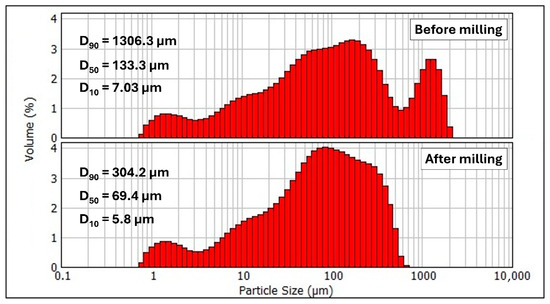
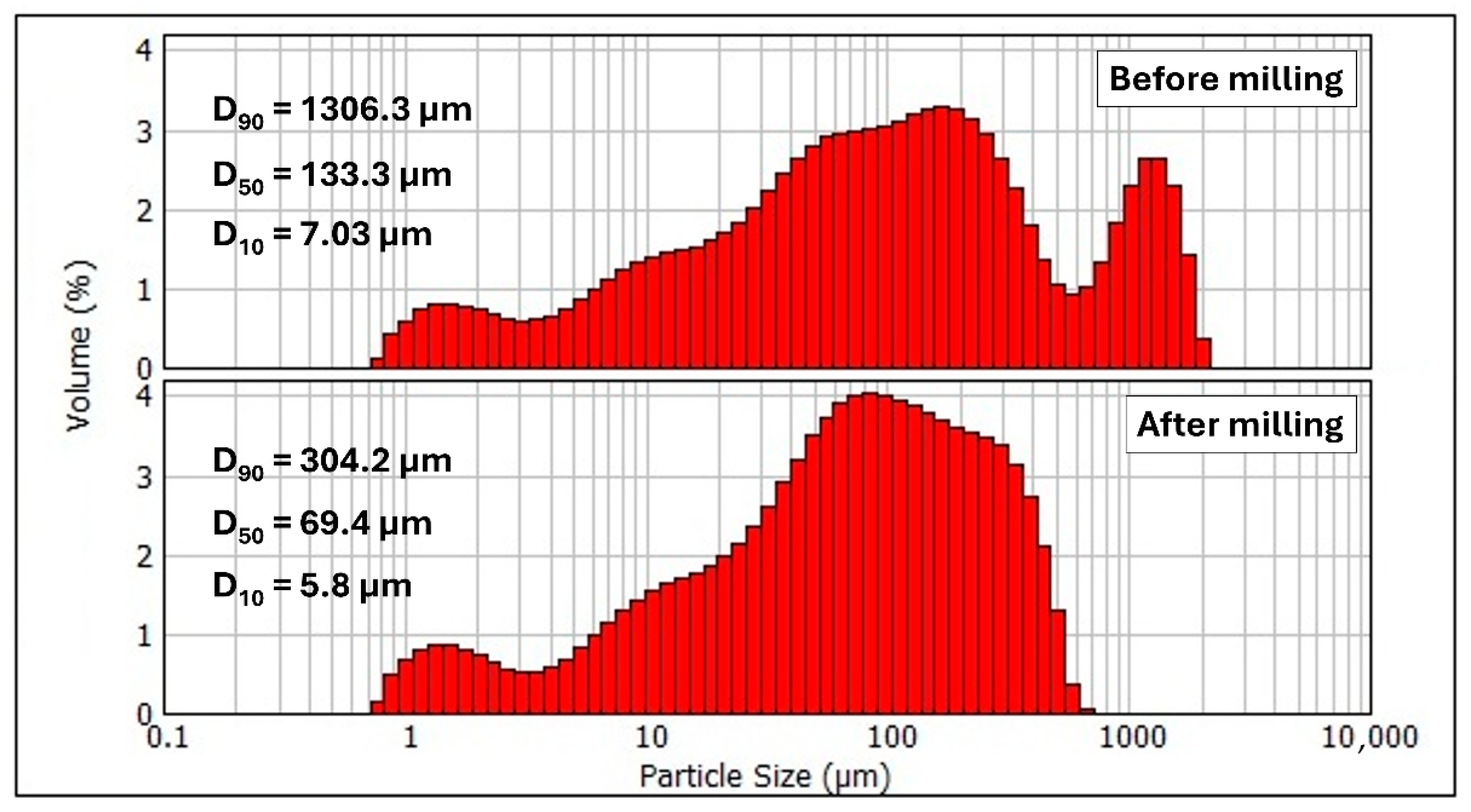
The particle size distribution before milling showed a multimodal distribution. The analysis revealed particle sizes within the range of 0.8 µm to 1950 µm, and values of D10 = 7.03 µm, D50 = 133.34 µm, and D90 = 1306.34 µm. Recycled zirconia powder after wet milling exhibited a different multimodal distribution with the following values, D10 = 5.8 µm, D50 = 69.4 µm, and D90 = 304.25 µm. After milling, particles larger than 631 µm were no longer detected, narrowing the size distribution of 0.8 µm to 631 µm (Figure 1).
Figure 1.
Particle size distribution of the recycled powder before milling and after milling, indicating a narrowing of the size distribution from 0.8–1950 µm to 0.8–631 µm, with a decrease in D10, D50 y D90 values.
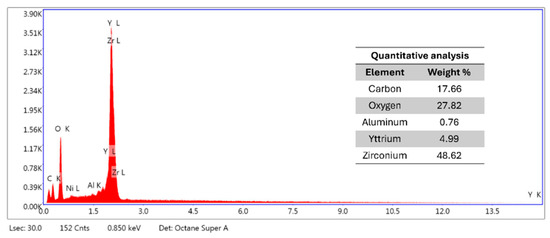
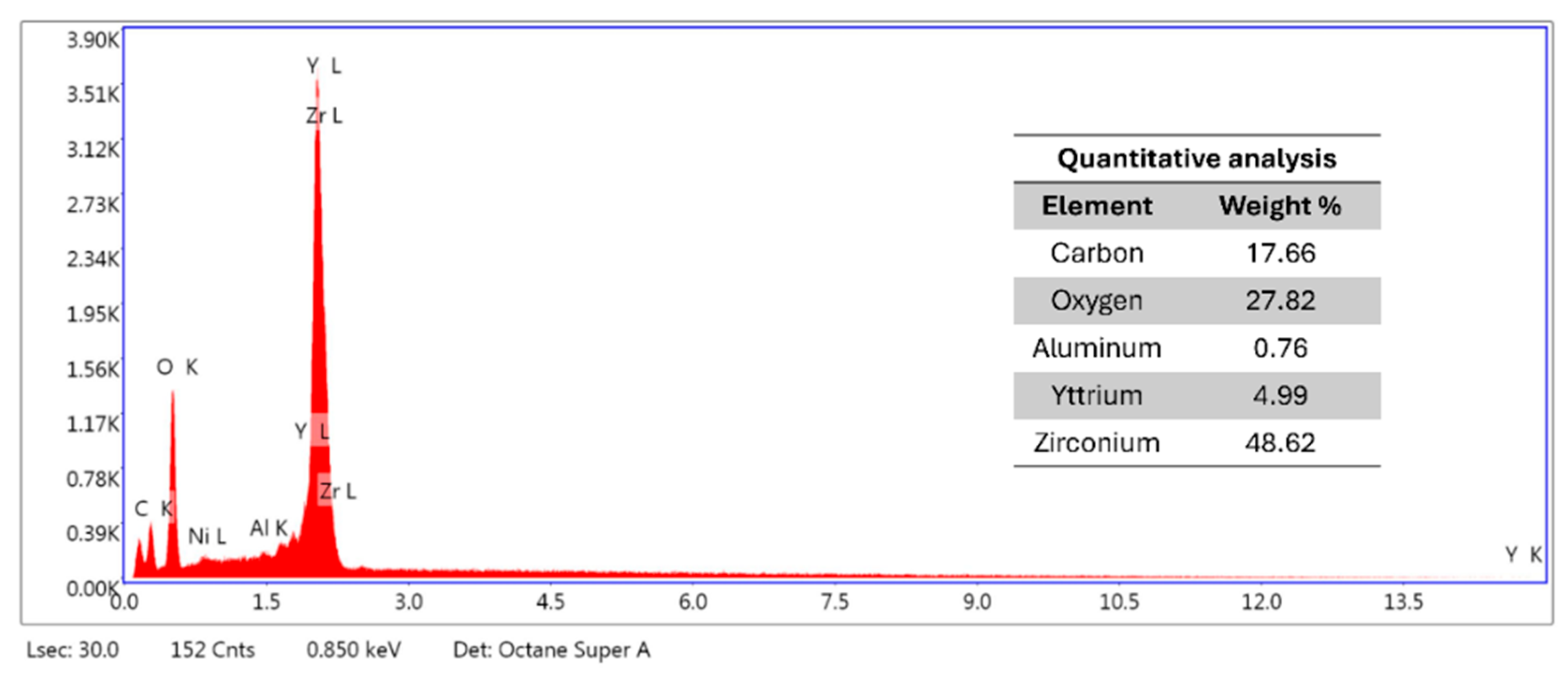
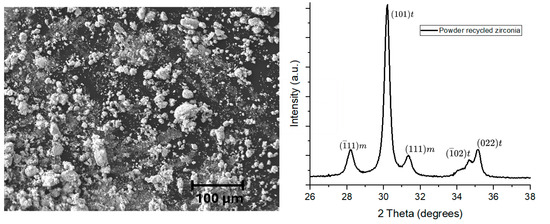
SEM analysis of the powders, covering both elemental composition and morphological characteristics, is presented next. The EDS analysis (Figure 2) presented the elemental composition of the recycled zirconia powder. The identified elements included zirconium (48.62%), oxygen (27.82%), yttrium (4.99%), and aluminum (0.76%). No contamination from other elements above 1 wt% was detected. Powder micrographs reveal particles and agglomerates with irregular shapes and a wide size distribution, ranging from less than one micrometer to several tens of micrometers.
Figure 2.
EDS of the recycled zirconia powder showing the elemental composition.
The XRD pattern of the powder reveals the presence of both monoclinic and tetragonal zirconia phases (Figure 3). The main reflection associated with the monoclinic phase, corresponding to the (1̅11) plane, appears at approximately 2θ ≈ 28.2°, whereas the primary reflection of the tetragonal phase, indexed as the (101) plane, is located at around 2θ ≈ 30.1°. Based on the relative intensities of these diffraction peaks, the monoclinic phase is clearly less prominent than the tetragonal phase. A semi-quantitative estimation indicates that the powder consists of approximately 80% tetragonal phase and 20% monoclinic phase.
Figure 3.
SEM micrograph showing irregular particles and XRD pattern of the recycled zirconia powder, indicating the presence of two phases. Approximately 80% of tetragonal phase and a 20% of monoclinic phase.
2.2. Bulk Material Characterization
After sintering, both the recycled and commercial zirconia specimens were evaluated for several physical and mechanical properties, as described in the Materials and Methods section.
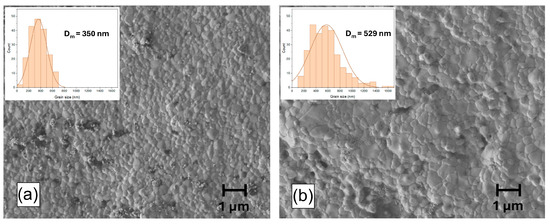
SEM micrographs of the sintered materials are presented in Figure 4, illustrating the surface morphology of both commercial and recycled zirconia. The grain size in the recycled zirconia is larger than that observed in the commercial material. In both cases, the grains exhibit a non-uniform morphology and size distribution. For commercial zirconia, the grain size ranges from 70 nm to 675 nm, with a median grain size Dm = 350 nm. In contrast, the recycled zirconia shows an increased grain size range from 113 nm to 1650 nm, with a Dm of 529 nm. Surface defects are more pronounced in the recycled zirconia, in which higher surface roughness and porosity is observed.
Figure 4.
SEM micrographs illustrating the surface morphology and grain size distribution. (a) Commercial zirconia and (b) recycled zirconia.
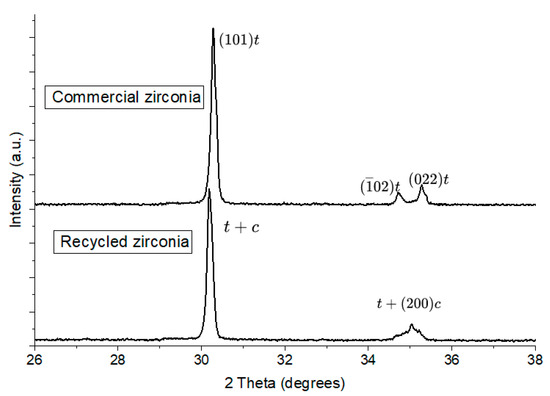
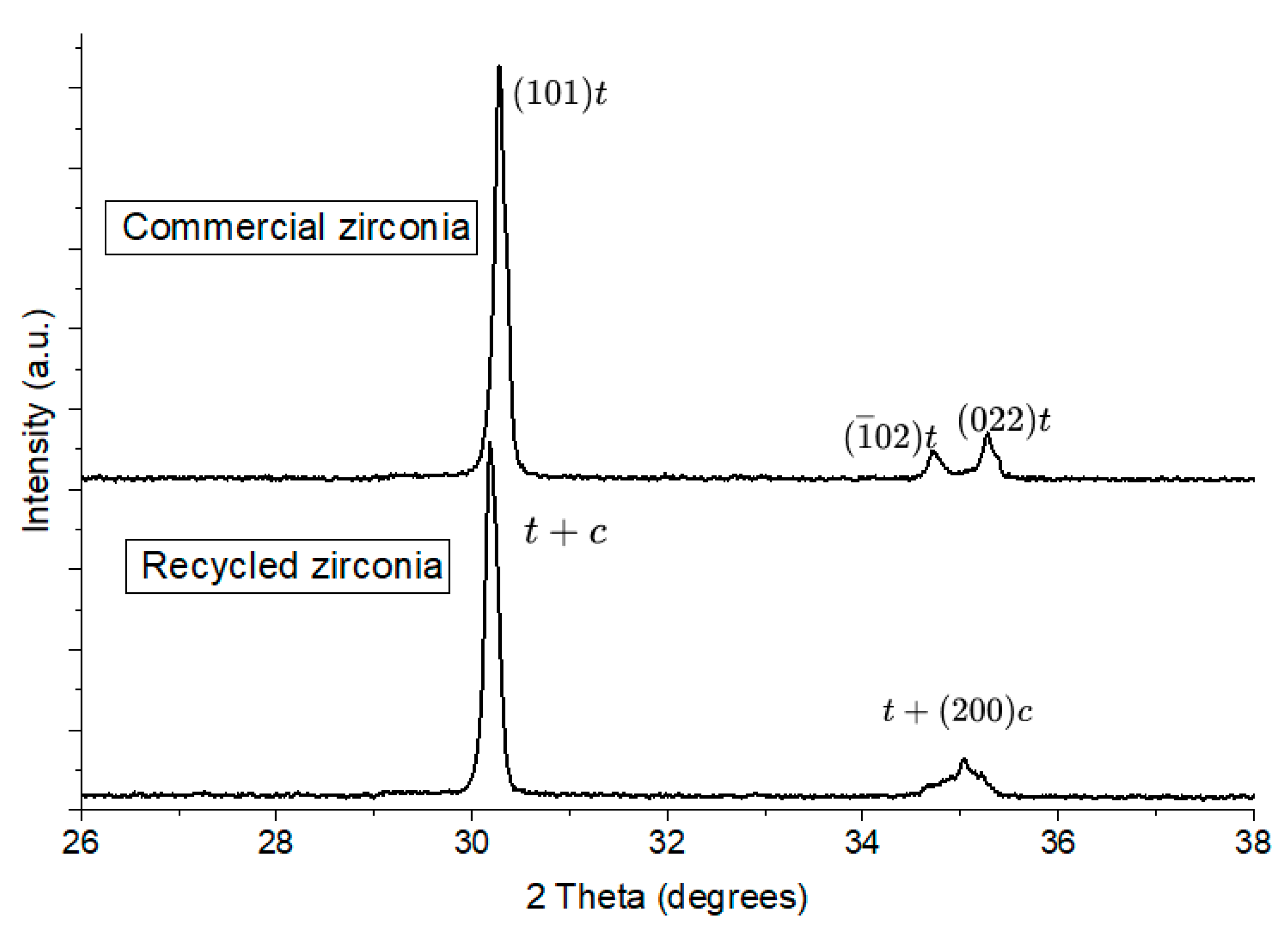
X-ray diffraction results are presented in Figure 5. The diffractogram for commercial zirconia distinctly displays peaks characteristic of the tetragonal phase. In contrast, the reflections from recycled zirconia, while present at similar angles, do not display the same peak splitting characteristic of the tetragonal phase, indicating the presence of a cubic phase (Figure 5). Rietveld analysis further confirmed that the recycled zirconia consisted of 21% tetragonal phase and 79% cubic phase. No evidence of the monoclinic phase was detected in either of the sintered materials.
Figure 5.
XRD patterns of both materials. Phase identification: t = tetragonal, c = cubic. Sintered commercial zirconia, showing a fully tetragonal phase; Sintered recycled zirconia, exhibiting tetragonal and cubic phases.
Density measurements resulted in a value of 5.60 g/cm3 for the recycled material. Table 1 shows the mass, volume, and density values of the recycled zirconia specimens. The relative density for the commercial zirconia was 99.5% and 92.6% for the recycled zirconia. Accordingly, the calculated porosity was 0.5% and 7.4%, respectively.
Table 1.
Density measurements. Mass and volume measured and calculated density of recycled zirconia specimens. Mean and standard deviation (SD) are reported.
The results of the bending tests, including specimen dimensions, maximum load at failure, and the corresponding flexural strength values, are presented in Table 2.
Table 2.
Bending tests of recycled zirconia. Specimen dimensions, maximum load at failure, and corresponding flexural strength. Mean ± SD are reported as well.
A comparative summary of the physical and mechanical properties of both materials is provided in Table 3.
Table 3.
Comparative summary of the test results on both materials.
2.3. Fabrication of Recycled Zirconia Blocks and Shrinkage Measurements
Some pre-sintered blocks were obtained. During pre-sintering, approximately 5% of the weight was lost, corresponding to binder removal, with no measurable shrinkage observed at this stage. The pre-sintered blocks were easy to handle and retained their shape. Slight powder residue was released upon handling; similar behavior is typically seen in commercial materials. No cracks or delamination were observed (Figure S4).
The shrinkage measurements and the calculated shrinkage are reported in the Supplementary Materials (Table S1). The overall average shrinkage was −18.94% ± 0.221. The average shrinkage values calculated on a per-block basis were −18.855% ± 0.03, −18.78% ± 0.16, and −19.18% ± 0.17 for Blocks 1, 2, and 3, respectively. These values were highly consistent across the different blocks. In addition, no significant weight loss was observed at this stage.
2.4. Prototypes Results
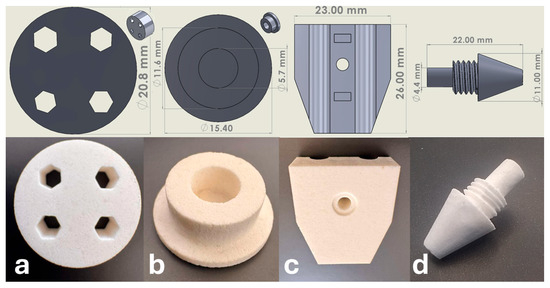
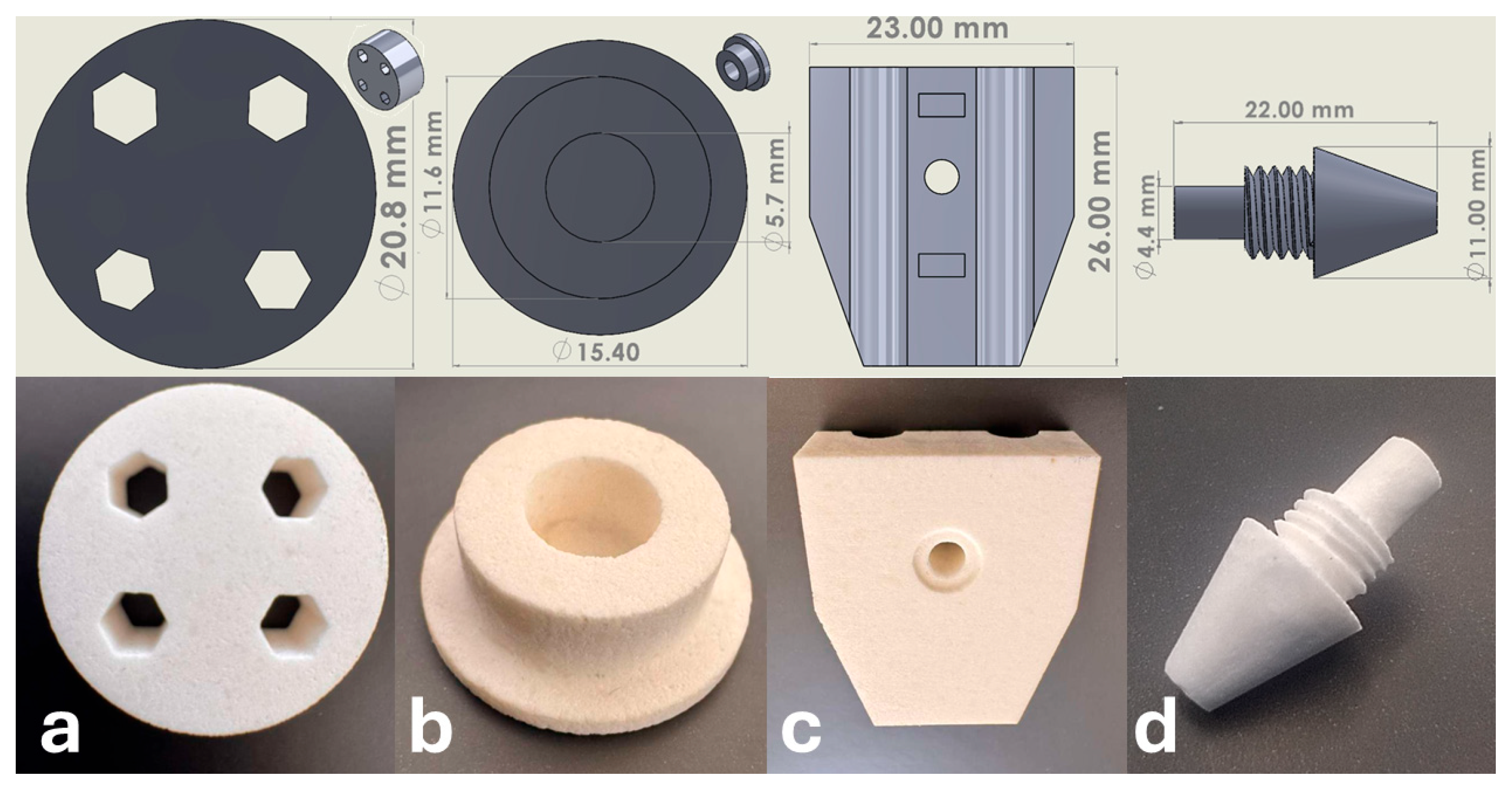
A visual inspection and dimensional analysis were performed on the fabricated prototypes. All pieces showed good shape retention and precise geometric definition, with well-defined features. Fine details were accurately reproduced and flawless; for example, the hexagonal holes in the ceramic spacer (Figure 6a) are clearly distinguishable, as are the threads in the nozzle (Figure 6d). The cylindrical plug (Figure 6b) and thermocouple housing (Figure 6c) also retained their complex features, including the central cavity and narrow bore, respectively. In addition, all fabricated components appear mechanically robust, quite solid, the surface feels smooth to the touch, and exhibit a uniform and reliable appearance, with no visible physical defects, cracks, or macroscopic porosity.
Figure 6.
Proposed industrial prototypes. Recycled zirconia components fabricated by rapid prototyping methods: (a) ceramic spacer, (b) cylindrical plug, (c) thermocouple housing, and (d) fluid nozzle. Photographs with dimensional measurements of the prototypes are included in Supplementary Materials, Figure S5.
For the dimensional analysis of the industrial prototypes, Table 4 presents the results of the measurements performed after sintering, along with the error obtained in comparison with the original design dimensions. The average absolute percentage error was 0.53% ± 0.14.
Table 4.
Dimensional comparison of the fabricated prototypes. Original design dimensions versus measured dimensions and corresponding percentage error. Dia = diameter.
3. Discussion
3.1. Powder Characterization
As explained previously, a heterogeneous powder obtained from a milling machine processing different types of zirconia as well as other organic materials was used in this study. The powders underwent a washing step to remove organic contaminants. Subsequently, a very modest wet milling process lasting only 30 min was applied, which helped to homogenize the particle size distribution. The milling process effectively deagglomerated the larger particles while having a minimal effect on the smaller ones, resulting in a 76% reduction in D90 and a 47% reduction in D50 compared to the initial powder. This process yielded a final D50 value of 69.4 µm. Although this topic is discussed later, this processing step had the most significant impact on the porosity of the material. Furthermore, since the powder was dried and calcined at 750 °C for 2.5 h, the presence of residual organic materials is not expected.
Elemental analysis by EDS did not reveal the presence of contaminant elements; only elements consistent with yttria-stabilized zirconia (ZrO2–Y2O3) were detected, including aluminum oxide, which has been commonly reported as a minor constituent in some commercial zirconia materials [13]. The estimated yttria content was approximately 5 mol% Y2O3. Although this value is approximate, the same calculation approach was applied to the EDS data reported in Ref. [17]. It should be noted that this yttria concentration is characteristic of cubic-phase zirconia.
Phase analysis by XRD revealed the presence of only two phases in the recycled zirconia: approximately 80% tetragonal phase and 20% monoclinic phase. While the presence of the tetragonal phase is expected, the occurrence of the monoclinic phase is less common. Nevertheless, these results are consistent with previous studies [10,12,15,16] which have also reported the coexistence of tetragonal and monoclinic phases in recycled zirconia powders. Since the recycled zirconia originates from pre-sintered material that is initially present in the tetragonal phase, the appearance of the monoclinic phase can be attributed to stress-induced phase transformation during mechanical processing, such as CAD/CAM machining, where the tetragonal-to-monoclinic transformation is known to occur [20].
3.2. Bulk Material Characterization
The characterization of the physical and mechanical properties allows for a more detailed analysis of the results. The sintered recycled zirconia was evaluated and compared with a high-strength commercial dental zirconia. Accordingly, the discussion is based on the differences observed between these materials, as well as on comparisons with previously published studies on zirconia recycling.
Recycled zirconia exhibited a relative density of 92.6%, while the porosity was 7.4%. Overall, the measured mechanical properties of the recycled zirconia were considerably lower compared with commercial zirconia. Next, we will provide some explanations based on the results obtained.
The lower density and significantly higher porosity of the recycled zirconia can be primarily attributed to insufficient powder treatment and a relatively low pressing pressure. As explained in the Introduction, this work starts from a powder that is heterogeneous both in composition and particle size. Bringing such a material to optimal conditions that allow densities close to the theoretical value would require the application of significant energy input and additional processing steps. It is true that some previous studies have reported recovering recycled zirconia with properties close to those of the original material; however, these works relied on extended milling times ranging from 6 to 12 h and the use of sieving procedures to homogenize the powders. Moreover, in most cases, only a single type of zirconia was recycled, resulting in powders that were more homogeneous in composition [12,16,17,18].
The approach of our recycling strategy is to explore the possibility of reintegrating this waste material into the production chain through a process that is closely aligned with realistic recycling conditions and is economically viable. Therefore, we deliberately accepted the risk of proposing a method consistent with such conditions and subsequently evaluating its outcomes. To this end, only a single initial sieving step using one mesh size was applied, followed by a very short wet milling process of 30 min.
As a result, we are working with powders exhibiting a D50 value of 69.4 µm. In contrast, other studies report significantly finer particle sizes. For example, H. Yang et al. reported a D50 of approximately 1 µm [16], V. Cordeiro et al. reported values around D50 = 0.5 µm [10], and similarly, Strazzi-Sahyon et al. [17] reported particle sizes close to D50 = 1.5 µm. Therefore, while our recycled powder has a D50 of 69.4 µm, most studies that report recycled zirconia with good mechanical properties typically work with an average D50 ≈ 1 µm, often achieved at the expense of milling times of up to 12 h.
This substantial difference in particle size and particle size distribution is directly reflected in the densification behavior and the resulting porosity of the material [10,16,17,18,19]. The results obtained in the present study are consistent with previous reports that have used CAD/CAM waste powder collected directly from dental laboratories [11,19].
On the other hand, a uniaxial pressing pressure of 100 MPa was used to fabricate the specimens employed for all mechanical tests. Although this pressure is not the highest reported in the literature, it falls well within commonly used values. Therefore, for the purposes of this study, pressing pressure was ruled out as a critical factor in densification, as it would play a more significant role only if densities closer to the theoretical value were being pursued.
The grain size obtained from the recycled zirconia was considerably bigger than the commercial, nearly 40% on average. As is well known, the bigger the grain size, the lower mechanical properties. Grain growth can be attributed to several factors, such as the thermal process variables, temperature and time, crystallographic phases, and dopants, among other factors. However, we used the same thermal process for recycled and commercial zirconia. Hence, grain growth could also be attributed to the heterogeneity of recycled powders.
XRD results combined with Rietveld refinement confirmed that the commercial zirconia exhibits a single tetragonal phase, whereas the recycled zirconia contains multiple phases, consisting of approximately 21% tetragonal and 79% cubic phase. This phase composition can be explained by the heterogeneous origin of the recycled powder, which is a mixture of different CAD/CAM zirconia blocks. The dental laboratory, from where the zirconia waste was obtained, confirmed that approximately 85% of the processed material corresponds to multilayer translucent zirconia (SHTML), which typically contains a higher yttria content, inducing cubic phase. This compositional characteristic is consistent with the significant fraction of the cubic phase observed. Unfortunately, the cubic zirconia phase is known to exhibit lower mechanical properties compared to the tetragonal phase.
After analyzing all these results, it becomes evident that each factor present in our recycled material adversely affects its mechanical properties. These include a relative density of 92.6%, which consequently results in a high porosity of 7.4%, a relatively large grain size, and the presence of the cubic phase. However, it is clear that in order to achieve mechanical properties comparable to those of commercial zirconia, the primary requirement is to reduce porosity and attain significantly higher densities.
Improving mechanical properties can be a challenging task without first achieving sufficient densification, as densification depends largely on the use of powders with smaller particle sizes, often at the expense of the economic feasibility of the recycling process under real-world conditions [21]. Nevertheless, minimal processing strategies for recycling dental zirconia can yield promising results for practical applications. It is therefore necessary to continue exploring cost-effective strategies that may contribute to further improvements in the recycling process. For example, Bastos Campos et al. [19] applied a minimal processing philosophy without performing additional milling; although the achieved relative densities were comparatively low (86.7–92.2%), the flexural strength was successfully improved through the infiltration of thermally compatible glasses. This approach could represent a valuable option in cases such as the present study, where mechanical properties could be enhanced using this type of additive.
3.3. Mechanical Properties and Potential Industrial Applications
The main limitation encountered in this research work was the relatively low mechanical performance obtained for the recycled zirconia. In particular, the most critical result was the flexural strength, for which an average value of 160 MPa ± 35 was obtained, a value that is considerably lower than that of commercial dental zirconia.
These zirconia ceramics, depending on their degree of translucency, typically exhibit flexural strengths ranging from approximately 500 to 1200 MPa. It is also well established that some of the previously cited studies on recycled zirconia report flexural strength values reaching several hundreds of megapascals. However, as discussed earlier, those studies did not employ recycled powders, but rather homogeneous residual zirconia blocks. In addition, those works involved extensive milling times, for example H. Yang et al. used 6 h [16], A. Valian et al. 8 h [18], and Strazzi-Sahyon et al. up to 12 h [17], which result in a significant reduction in particle size and, consequently, improved compaction and densification, leading to higher flexural strength values. However, this would require a very high energy input, potentially compromising the feasibility of recycling in real industrial scenarios.
In contrast, our approach deliberately aimed to minimize processing steps by using only 30 min of milling on a heterogeneous powder obtained from a real dental laboratory. Even with this limited processing, flexural strength values of up to 160 MPa ± 35 were achieved. However, in industrial practice it is well known that many advanced ceramic materials classified as refractory, dielectric, insulating or even some structural ceramics exhibit flexural strength values comparable to those reported in the present study for recycled zirconia. Therefore, it is entirely valid to state that components manufactured using this recycled material can be suitable for industrial applications.
To mention only a few examples of advanced ceramics currently employed in industry, magnesium oxide exhibits flexural strengths in the range of 82–105 MPa, cordierite 70–190 MPa, steatite 100–180 MPa, mullite 115–160 MPa, and alumina 200–600 MPa. Consequently, the flexural strength achieved in this study represents a very acceptable value for a wide range of industrial applications, such as ceramic spacers, washers, pipes, housings, valves, nozzles, for instance, zirconia nozzles in tundish application, for molten metal processing in the foundry industry [22].
It should be clarified that this discussion does not refer to highly porous ceramics, which typically exhibit flexural strength values ranging from only a few megapascals up to typically around 40 MPa. Only more specialized porous ceramics, such as silicon carbide (SiC), can reach higher values approaching 100 MPa [23,24].
3.4. Fabrication of Recycled Zirconia Blocks and Prototypes
The pre-sintered CAD/CAM blocks fabricated from recycled zirconia were suitable for CAD/CAM processing, and the measured shrinkage factor proved to be highly precise and consistent based on the experimental results. The overall average shrinkage value was −18.94% ± 0.221, calculated from twelve samples obtained from three different blocks. However, when the samples are analyzed on a per-block basis, the standard deviation decreases to an average value of ±0.12, indicating that the variation in shrinkage among pieces from the same block would be approximately 0.63%. This represents a significant advantage, as it ensures reliability when targeting industrial component applications that require good dimensional control. These blocks were ultimately used to manufacture prototypes intended for industrial applications.
Since the main objective of this work was to demonstrate the feasibility of reintegrating recycled dental zirconia into the production chain, four distinct components with potential industrial applications were designed using CAD and subsequently machined using CAM from the recycled blocks, also aiming to simulate a rapid prototyping process for ceramic components. It should be noted that the selected components were chosen to present a certain degree of geometric complexity and to pose specific manufacturing challenges, to assess the reproducibility and resolution achievable with the proposed process.
The results were excellent, as the fabricated components preserved their geometric features with a high degree of sharpness. Their appearance and tactile robustness convey the perception of solid, high-quality components. Dimensional analysis yielded very promising results, with an average absolute percentage error of 0.53% ± 0.14, which fully complies with the ISO 2768 standard [25] for the specification of general tolerances in industrial applications. In addition, the effectiveness of measuring the shrinkage factor for each block was confirmed, and this value was used to properly oversize the components during the CAM stage.
Finally, it is important to note that the recycled zirconia blocks used for prototype fabrication were pressed at 25 MPa, which is significantly lower than the pressing pressure applied to the characterized test specimens (100 MPa). This difference was due to technical limitations of our pressing equipment, as well as time and budget constraints that prevented the fabrication of a steel mold, requiring instead the use of a plastic mold.
As a result, the fabricated prototypes were not subjected to physical or mechanical characterization. It was assumed that their properties could be comparable to those of the characterized specimens if the recycled blocks had been pressed at the recommended pressure levels. In this case, the shrinkage factor would also change; however, this would not constitute a problem, since this factor must always be determined for each powder batch.
4. Materials and Methods
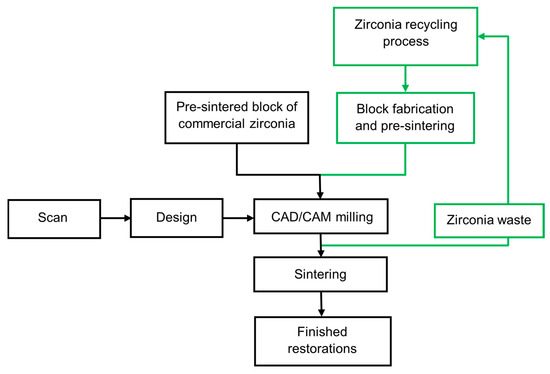
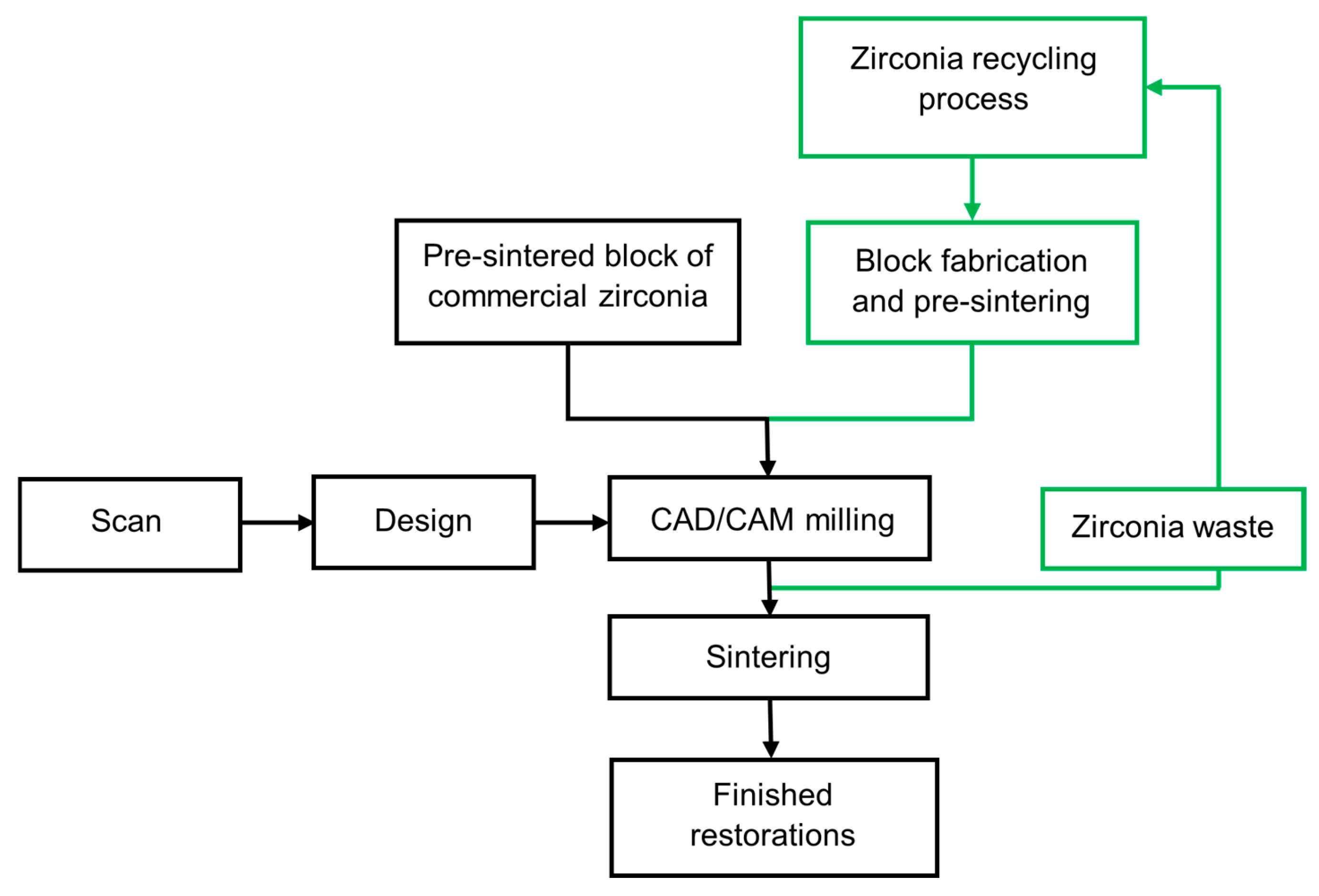
A process was developed to purify zirconia powders and transform them into rectangular test specimens and blocks suitable for dental CAD/CAM systems. The test specimens were used to evaluate the physical and mechanical properties of the recycled material, while the CAD/CAM blocks were used exclusively to fabricate representative industrial prototypes using CAD/CAM-based rapid prototyping methods, with the same technology available (Figure 7).
Figure 7.
Flowchart illustrating the CAD/CAM process. The solid pathway outlines the standard procedure, while the green pathway highlights the recycling of dental zirconia and its integration into the process.
4.1. Zirconia Powder Recycling Process
Zirconia waste intended for recycling was obtained from a local commercial dental laboratory. The laboratory provided a full dust collection vacuum bag discarded from a dry milling machine, from which the powders were collected and subsequently used to develop the proposed recycling process. The laboratory confirmed that the same milling system is used to process different types of zirconia, as well as wax and PMMA.
The residual powder collected from the vacuum bag was sieved through a 0.5 mm mesh to remove large particles. The resulting powder was suspended in distilled water and subjected to three iterative cycles of agitation, settling, and supernatant decantation, ensuring that the zirconia sediment at the bottom was not disturbed. Zirconia (6.05 g/cm3) settled rapidly, while wax (0.9 g/cm3) was separated due to density differences and buoyancy, and PMMA (1.18 g/cm3) was progressively removed as a suspension during decantation. The decanted supernatant was filtered through filter paper to separate solid residues (wax/PMMA) from the liquid. Wet milling was performed for 30 min using a high-energy ball mill (SPEX CertiPrep 8000M, Metuchen, NJ, USA). Thirty grams of powder and 20 mL of distilled water were placed in a polyamide vial along with eight (10 mm) and forty (3 mm) 3Y-TZP zirconia balls (Inframat Advanced Materials, Manchester, CT, USA), resulting in a grinding ball-to-powder mass ratio of 1. The zirconia was dried at 115 °C for two h and subsequently calcined at 750 °C for 2.5 h to ensure the complete removal of organic components.
4.2. Powder Characterization
4.2.1. Particle Size Distribution
Particle size distributions were conducted by a laser scattering particle size distribution analyzer (Mastersizer 2000, Malvern Instruments Ltd., Malvern, UK) before and after ball milling treatment.
4.2.2. Elemental and Phase Analysis
For the elemental analyses, scanning electron microscopy (SEM) with energy dispersive spectroscopy (EDS) studies were conducted using a JSM 7401F (JEOL Co., Tokio, Japan). Powder particles were deposited on carbon tape and analyzed to obtain microstructural images and elemental composition. To estimate the molar percentage of Y2O3 in the recycled zirconia powder, the elemental composition obtain by EDS was further processed on an oxide basis. Aluminum was excluded, as it does not contribute to zirconia phase stabilization. Oxygen was also excluded from the calculation due to its high uncertainty in EDS, (low atomic number, Z = 8). The molar fraction of Y2O3 was calculated from the moles of Zr and Y, considering the stoichiometry of their respective oxides (ZrO2 and Y2O3).
For crystallographic phase analysis, X-ray diffraction measurements were performed on the recycled powder using a Xray Diffractometer (PANalytical, Malvern Instruments Ltd., Malvern, UK). Diffractogram was obtained over a 2θ range of 25° to 40°, with a step size of 0.05° and a counting time of 100 s per step. The phase analysis was assisted by Match (Phase Identification from Powder Diffraction, Versión 3, Crystal Impact, Bonn, Germany) and Rietveld analysis to quantify the present phases, such as tetragonal, cubic, and monoclinic.
4.3. Fabrication of Test and Control Specimens
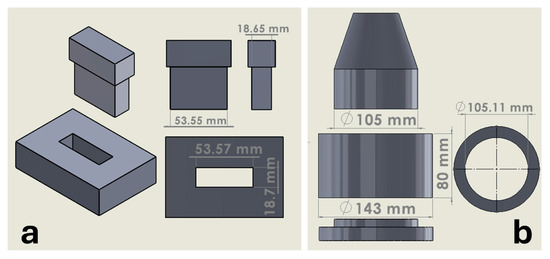
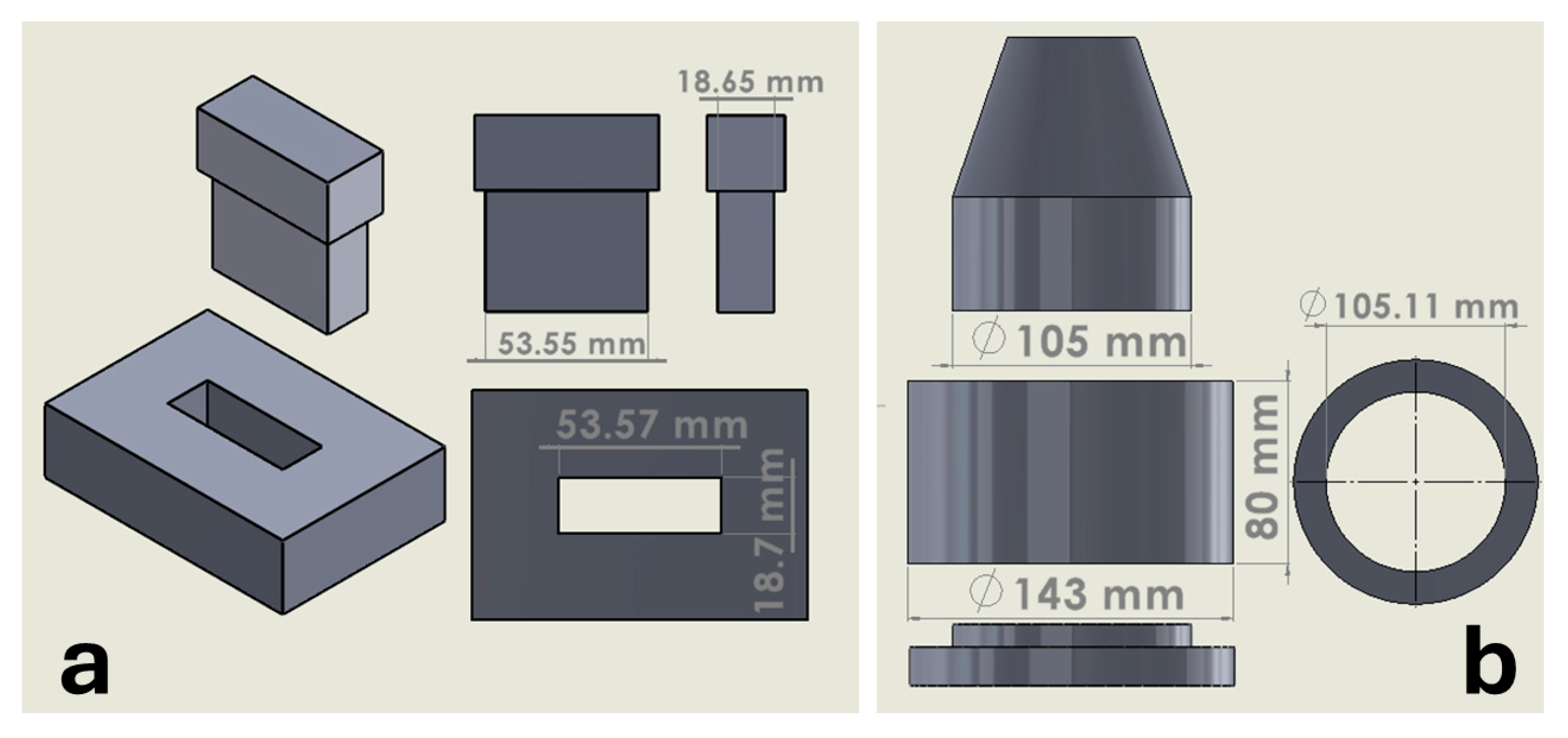
Ten rectangular test specimens (Figure S2) were fabricated as follows. Thirteen grams of milled recycled zirconia powder and 1.8 mL of organic binder (polyvinyl alcohol at 5 wt%) were mixed and poured into a rectangular mold made of tool steel W4 (Figure 8a). The powder in the mold was compressed using a press (MTS 810, MTS Systems, Eden Prairie, MN, USA) applying an axial force of 100.2 kN over the piston; since the pressing area of the mold was 10 cm2, the pressing pressure was 100 MPa. The rectangular plate-shaped was removed from the mold and then dried for two h at 150 °C to remove moisture. Binder removal was carried out by heating to 300 °C with a dwell time of 30 min, followed by a second stage at 650 °C [26] (Furnace Carbolite HTF 1700, Neuhausen, Germany). Finally, the sintering process was carried out in a high-temperature furnace (Duotron, Add-in S-6100, Goyang-si, Republic of Korea) at a temperature of 1530 °C for two h, following the temperature ramps and sintering time recommended by the commercial zirconia manufacturer.
Figure 8.
Technical drawing of (a) Steel mold for rectangular test specimens, and (b) POM mold for CAD/CAM blocks.
To obtain control specimens for comparison between the properties of recycled zirconia and commercial zirconia, ten specimens of commercial zirconia were fabricated. The zirconia block used was supplied by Cera Direct® (Ceradirect Technology Ltd., Shenzhen, China) and corresponds to an HT white zirconia with a low yttria content. The specimens were designed in SOLIDWORKS® (Version 2024, Dassault Systèmes, Waltham, MA, USA) using a geometry similar to that of the raw rectangular test specimens (53.5 mm × 18.5 mm × 4.8 mm) and subsequently milled from a commercial zirconia block using a dental milling machine (Roland DWX-51D, 5-axis, Hamamatsu, Japan). After milling, the control specimens were sintered according to the manufacturer’s (Cera Direct®, Ceradirect Technology Ltd., Shenzhen, China) recommended schedule, which consisted of heating at a rate of 7 °C/min up to 1000 °C, with a dwell time of 30 min, followed by heating at 3 °C/min up to 1530 °C with a dwell time of 2 h, and subsequent cooling to room temperature at a rate of 8 °C/min.
4.4. Material Characterization
Several analyses were performed to characterize the physical and mechanical properties of both the recycled zirconia and the control specimens. The methodology applied for each analysis is described below.
4.4.1. Physical Properties Evaluation
Microstructure and grain size distribution was studied by means of a Scanning electron microscopy (SEM) JSM 7401F (JEOL Co., Tokio, Japan). Five images at 30,000× magnification were captured to evaluate the grain size distribution. The grain size distribution was then determined using the ImageJ software (Version 1.54a, developed by Rasband, W.S., & U. S. National Institutes of Health) by measuring the equivalent grain diameter of individual grains. The median grain size (Dm) and grain size range were then obtained.
The crystallographic phase analysis was performed to identify the present phases. Diffractograms were obtained over a 2θ range of 20° to 120°, with a step size of 0.0130° and a counting time of 100 s per step.
Density was measured using a densitometer (Ultrapycnometer 1000, Quantachrome Instruments, Boynton Beach, FL, USA). Ultra-high purity nitrogen was used, and three readings per sample were recorded to ensure accuracy and reliability. The specimens used for this measurement correspond to the remaining pieces after the flexural strength tests, specifically the rectangular specimens fractured into two halves. For this reason, differences in weight and volume can be observed among some of the samples. Relative density and porosity were calculated as follows:
where is the measured density and is the theorical density (6.05 g/cm3).
4.4.2. Mechanical Properties Evaluation
Vickers hardness was determined using a microhardness tester (FM-7, Future-tech, Kawasaki, Japan), with a load of 9.8 N applied for 15 s. For each group (n = 5), 10 indentations were performed. Additionally, fracture toughness was calculated using Equation (3) [27].
where P is the load applied through the indenter, 9.8 N; and C is the crack length (m), measure from the center of the indentation to the crack tip.
Flexural strength tests were conducted using the three-point method in an universal testing machine (Sintech 20/D, Sintech Co, Eden Prairie, MN, USA) at a loading rate of 5 mm/min according to the ASTM C1161 standard [28]. After sintering, rectangular plate specimens, both recycled and control (n = 5 for each) were utilized for this test. Flexural strength (σ) was calculated according to Equation (4):
where P is the maximum load in Newtons; L is the distance between supports in mm; b is the width of the specimen in mm and d is the thickness of the specimen in mm.
4.5. Fabrication of CAD/CAM Recycled Zirconia Block
To shape the recycled zirconia CAD/CAM block, 350 g of milled zirconia powder and 48 mL of organic binder (polyvinyl alcohol at 5 wt%) were mixed and poured into a cylinder-piston mold (Figure S3) made of polyoxymethylene (POM), dimensions are shown in Figure 8b. The powder in the mold was compressed using a press (MTS 810, MTS Systems, Eden Prairie, MN, USA) applying an axial force of 216.5 kN over the piston; since the pressing area of the mold was 86.6 cm2, the pressing pressure was 25 MPa. The disc-shaped block was removed from the mold and then dried for two h at 150 °C to remove moisture. Binder removal was carried out by heating to 300 °C with a dwell time of 30 min, followed by a second stage at 650 °C [26]. Finally, the discs were pre-sintered (Carbolite HTF 1700, Neuhausen, Germany) at 1100 °C for two h, with heating and cooling ramps of 10 °C/min.
Zirconia Shrinkage Measurement
To achieve dimensional precision in milled prototypes, it is necessary to determine the shrinkage factor of the pre-sintered recycled zirconia block. Defined as the percentage of dimensional reduction after sintering. Thus, the milling process must account for the shrinkage factor by producing an oversized green piece that will reach the desired final dimension after sintering. For this purpose, twelve specimens were milled in the Roland milling machine from three pre-sintered zirconia blocks fabricated using the same batch of recycled powder. Each specimen was produced in the form of a cylinder with a diameter of 3 mm and a thickness of 3 mm. The dimensions of the specimens were measured before and after the sintering process, and the resulting data were analyzed using the following equation:
where L1 and L2 are the lengths before and after sintering. In this case we used diameters.
4.6. Fabrication of Prototypes
The first step in prototype fabrication was the CAD (computer-aided design) stage. The prototypes were designed using SolidWorks® (Version 2024, Dassault Systèmes, Waltham, MA, USA) and their dimensions were intentionally oversized by applying the shrinkage factor previously determined for the block from which they were milled. The designed prototypes consisted of generic components intended to explore complex geometries that simulate potential industrial applications. Subsequently, the CAM (computer-aided manufacturing) process was carried out by milling the prototypes from a pre-sintered recycled zirconia block using the dental milling machine previously described. Finally, the sintering process was performed in a high-temperature furnace (Duotron S-6100, Addin Co., Ltd., Goyang-si, Republic of Korea) at 1530 °C for two h, following the same schedule described previously for this process.
After sintering, the pieces were visually inspected, and the dimensions of the prototypes were measured using a digital vernier caliper (Mitutoyo Absolute AOS digimatic, Mitutoyo Corp., Kawasaki, Japan). Subsequently, the measurements were compared with the original design dimensions. The percentage error was calculated as an indicator of the deviation from the target dimensions.
5. Conclusions
The present work demonstrated the feasibility of reintegrating dental zirconia into CAD/CAM systems. Pre-sintered blocks with consistent dimensions and characteristics suitable for these systems were obtained and used to produce industrial parts.
Although recycled zirconia exhibited lower physical and mechanical properties than high-resistance commercial zirconia, it still has adequate mechanical and structural properties for practical applications, as demonstrated. This decrease was attributed to the heterogeneity of the powders used, which originated from a commercial dental laboratory, as well as to the short milling time. These factors resulted in the presence of a cubic phase, grain growth, and relatively large particle sizes, which hindered proper densification and consequently affected the mechanical properties of the ceramic material.
Nevertheless, compared to other industrial ceramics, this recycled material exhibits adequate properties to presumably compete in applications where high-temperature, wear resistance, thermal and dielectric insulation, and dimensional stability and precision are prioritized.
It was also demonstrated that, when compacted into blocks compatible with CAD/CAM systems, recycled zirconia can be used to fabricate solid components with complex geometries, good surface appearance, and good dimensional accuracy. This makes the material particularly suitable for rapid prototyping applications involving ceramic components.
Although further optimization of recycled zirconia may be required to overcome existing challenges, the potential of this material for manufacturing industrial components using modern rapid prototyping methods is noteworthy. The results of this study demonstrate the feasibility of reintegrating high-value materials originally used in dental applications into industrial contexts, while simultaneously reducing their environmental impact.
Supplementary Materials
The following supporting information can be downloaded at: https://www.mdpi.com/article/10.3390/recycling11050092/s1, Figure S1: Dental zirconia waste. On the left, two bags containing approximately 20 kg of zirconia powder, each were collected during milling process through a vacuum collector. On the right, fractured remaining blocks. These photos were obtained from Biometika® digital dental lab.; Figure S2: Rectangular specimen made of recycled zirconia; Figure S3: Mold made of POM that shaped compressed recycled powders into blocks; Figure S4: Pre-sintered block made of recycled zirconia; Figure S5: Prototypes measurements; Table S1: Pre- and post-sintering dimensions of samples derived from a single powder batch, with shrinkage and weight loss values determined for each sample.
Author Contributions
Methodology: M.d.C.A.-D., H.E.E.-P., L.V.T.-L., A.L.-V. and L.F.J.-T. Validation: M.d.C.A.-D., H.E.E.-P., L.V.T.-L., A.L.-V. and L.F.J.-T. Formal analysis: M.d.C.A.-D., H.E.E.-P., L.V.T.-L., A.L.-V. and L.F.J.-T. Data curation: M.d.C.A.-D., H.E.E.-P., L.V.T.-L., A.L.-V. and L.F.J.-T. Writing—original draft preparation: M.d.C.A.-D., H.E.E.-P., L.V.T.-L., A.L.-V. and L.F.J.-T. Conceptualization: J.S.C.-C. Project administration: J.S.C.-C. Writing—review and editing: J.S.C.-C. Funding acquisition: M.d.C.A.-D. and J.S.C.-C. All authors have read and agreed to the published version of the manuscript.
Funding
This research was funded by the Mexican Secretariat of Science, Humanities, Technology and Innovation (SECIHTI) through the Postdoctoral Fellowships in Mexico Program to María del Carmen Aragón-Duarte, grant number 423276.
Data Availability Statement
The original contributions presented in this study are included in this article and Supplementary Materials. Further inquiries can be directed at the corresponding author.
Acknowledgments
The authors thank Irvin Murillo and Leonel Macias for designing and milling the ceramic pieces. Also J. Misael Martínez for designing prototypes and lab assistance.
Conflicts of Interest
The authors declare no conflicts of interest.
Abbreviations
The following abbreviations are used in this manuscript:
| CAD | Computer-aided design |
| CAM | Computer-aided manufacturing |
| 3Y-TZP | 3 mol% Yttria-stabilized Tetragonal Zirconia Polycrystal |
| PMMA | Polymethyl methacrylate |
| POM | Polyoxymethylene |
| SEM | Scanning Electron Microscopy |
| XRD | X-ray diffraction |
| EDS | Energy Dispersive Spectroscopy |
| SD | Standard Deviation |
| ASTM | American Society for Testing Materials |
| ISO | International Organization for Standardization |
| Dia | Diameter |
References
- Yin, Y.; Xu, J.; Ji, M.; Li, L.; Chen, M. A Critical Review on Sintering and Mechanical Processing of 3Y-TZP Ceramics. Ceram. Int. 2023, 49, 1549–1571. [Google Scholar] [CrossRef] [Scilit]
- Yoshinari, M. Future Prospects of Zirconia for Oral Implants—A Review. Dent. Mater. J. 2020, 39, 37–45. [Google Scholar] [CrossRef] [Scilit]
- Yang, H.; Sun, L.; Yu, H.; Nugraha, A.P.; Sáenz, J.R.V.; Hong, G. Current Prospect of Dental Zirconia Recycling: A Scoping Review. J. Prosthodont. Res. 2024, 68, 522–531. [Google Scholar] [CrossRef] [Scilit]
- Davidowitz, G.; Kotick, P.G. The Use of CAD/CAM in Dentistry. Dent. Clin. N. Am. 2011, 55, 559–570. [Google Scholar] [CrossRef] [Scilit]
- Denry, I.; Kelly, J.R. State of the Art of Zirconia for Dental Applications. Dent. Mater. 2008, 24, 299–307. [Google Scholar] [CrossRef] [Scilit]
- Irvine, D.; Goh, W.T.; Dailami, F.; Matthews, J. The Analysis of Tool Wear Mechanisms in the Machining of Pre-Sintered Zirconia Dental Crowns. Procedia Manuf. 2019, 38, 1026–1033. [Google Scholar] [CrossRef] [Scilit]
- McLaren, E.A.; Maharishi, A.; White, S.N. Influence of Yttria Content and Surface Treatment on the Strength of Translucent Zirconia Materials. J. Prosthet. Dent. 2023, 129, 638–643. [Google Scholar] [CrossRef] [Scilit]
- Cho, J.-H.; Han, J.-S.; Yoon, H.-I.; Yeo, I.-S.L. Effect of Phase Fraction and Grain Size on Translucency of 3 Mol% Yttria-Stabilized Tetragonal Zirconia Polycrystal. J. Mater. Res. Technol. 2023, 25, 1222–1230. [Google Scholar] [CrossRef] [Scilit]
- Liao, Y.; Gruber, M.; Lukic, H.; McLees, J.; Chen, S.; Boghosian, A.; Megremis, S. Survey of the Mechanical and Physical Behaviors of Yttria-Stabilized Zirconia from Multiple Dental Laboratories. JADA Found. Sci. 2023, 2, 100018. [Google Scholar] [CrossRef] [Scilit]
- Cordeiro, V.V.; Rodrigues, A.M.; da Costa, F.P.; de Melo Cartaxo, J.; de Lucena Lira, H.; Menezes, R.R. The Harnessing of the Waste Arising from Y-TZP Dental Ceramics Manufactured by CAD/CAM to Be Used as Alternative Dental Materials. Ceram. Int. 2022, 48, 36149–36155. [Google Scholar] [CrossRef] [Scilit]
- de Assis, L.C.L.; de Oliveira Magnago, R.; da Silva, C.A.A.; Habibe, A.F.; Villanova, G.R.L.; dos Santos, C. Reuse of ZrO2(Y2O3) Arising from Making Dental Implant–Characterization of Materials. Mater. Sci. Forum 2014, 798–799, 632–637. [Google Scholar] [CrossRef] [Scilit]
- Ding, H.; Tsoi, J.K.H.; Kan, C.W.; Matinlinna, J.P. A Simple Solution to Recycle and Reuse Dental CAD/CAM Zirconia Block from Its Waste Residuals. J. Prosthodont. Res. 2021, 65, 311–320. [Google Scholar] [CrossRef] [Scilit]
- Gouveia, P.F.; Schabbach, L.M.; Souza, J.C.M.; Henriques, B.; Labrincha, J.A.; Silva, F.S.; Fredel, M.C.; Mesquita-Guimarães, J. New Perspectives for Recycling Dental Zirconia Waste Resulting from CAD/CAM Manufacturing Process. J. Clean. Prod. 2017, 152, 454–463. [Google Scholar] [CrossRef] [Scilit]
- Su, C.Y.; Wang, J.C.; Chen, D.S.; Chuang, C.C.; Lin, C.K. Additive Manufacturing of Dental Prosthesis Using Pristine and Recycled Zirconia Solvent-Based Slurry Stereolithography. Ceram. Int. 2020, 46, 28701–28709. [Google Scholar] [CrossRef] [Scilit]
- Silva, L.B.; Acchar, W.; Silva, V.M. Study of the Sintering Dental Ceramic Waste from ZrO2-Y2O3 System. Mater. Sci. Forum 2017, 881, 392–397. [Google Scholar] [CrossRef] [Scilit]
- Yang, H.; Yamanaka, K.; Yu, H.; Vanegas Sáenz, J.R.; Hong, G. Optimizing the Microstructure, Mechanical, and Optical Properties of Recycled Zirconia for Dental Applications. Ceram. Int. 2024, 50, 52848–52860. [Google Scholar] [CrossRef] [Scilit]
- Strazzi-Sahyon, H.B.; Campos, T.M.B.; dos Santos, C.; Piza, M.M.T.; Alves, L.M.M.; Benalcazar Jalkh, E.B.; Bergamo, E.T.P.; Tebcherani, S.M.; Witek, L.; Coelho, P.G.; et al. Effect of Calcination on Minimally Processed Recycled Zirconia Powder Derived from Milling Waste. Dent. Mater. 2024, 40, 1477–1486. [Google Scholar] [CrossRef] [Scilit]
- Valian, A.; Ghasemi, A.; Rastbood, E.; Zandian, A.; Zanguei, E. Exploring Physical and Mechanical Properties of Hydrothermally Processed Recycled Non-Sintered Dental Zirconia Wastes. J. Mech. Behav. Biomed. Mater. 2024, 160, 106708. [Google Scholar] [CrossRef] [Scilit] [PubMed]
- Campos, T.M.B.; dos Santos, C.; Alves, L.M.M.; Benalcazar-Jalkh, E.B.; Strazzi-Sahyon, H.B.; Bergamo, E.T.P.; Tebcherani, S.M.; Witek, L.; Coelho, P.G.; Yamaguchi, S.; et al. Minimally Processed Recycled Yttria-Stabilized Tetragonal Zirconia for Dental Applications: Effect of Sintering Temperature on Glass Infiltration. J. Mech. Behav. Biomed. Mater. 2024, 150, 106311. [Google Scholar] [CrossRef] [Scilit]
- Rautenbach, Z.; Haiek, M.; Ruales-Carrera, E.; Özcan, M. Phase Transformation of Yttria-Stabilized Zirconia after the Use of Various Bur Types in Dry and Wet Conditions: A Systematic Review and Meta-Analysis. J. Mech. Behav. Biomed. Mater. 2025, 169, 107064. [Google Scholar] [CrossRef] [Scilit]
- Kojima, T.; Mori, Y.; Kamiya, M.; Sasai, R.; Itoh, H. Disintegration Process of Yttria-Stabilized Zirconia Ceramics Using Hydrothermal Conditions. J. Mater. Sci. 2007, 42, 6056–6061. [Google Scholar] [CrossRef] [Scilit]
- Jain, N.; Barthmann, F.; Ansari, G. RHI Zirconia Nozzless in Tundish Application. J. Refract. Innov. 2016, 1, 45–50. [Google Scholar]
- Roy, S. Properties and Advanced Applications of Porous Ceramic Composites. Open Ceram. 2025, 21, 100714. [Google Scholar] [CrossRef] [Scilit]
- Salvini, V.R.; Pandolfelli, V.C.; Spinelli, D. Mechanical Properties of Porous Ceramics. In Recent Advances in Porous Ceramics; InTech: London, UK, 2018. [Google Scholar]
- ISO 2768; General Tolerances. Part 1: Tolerances for Linear and Angular Dimensions Without Individual Tolerances Indications. ISO: Vernier, Switzerland, 1989.
- Baklouti, S.; Bouaziz, J.; Chartier, T.; Baumard, J.-F. Binder Burnout and Evolution of the Mechanical Strength of Dry-Pressed Ceramics Containing Poly(Vinyl Alcohol). J. Eur. Ceram. Soc. 2001, 21, 1087–1092. [Google Scholar] [CrossRef] [Scilit]
- Ćorić, D.; Majić Renjo, M.; Ćurković, L. Vickers Indentation Fracture Toughness of Y-TZP Dental Ceramics. Int. J. Refract. Met. Hard Mater. 2017, 64, 14–19. [Google Scholar] [CrossRef] [Scilit]
- ASTM C1161; Test Method for Flexural Strength of Advanced Ceramics at Ambient Temperature. ASTM ASTM International: West Conshohocken, PA, USA, 2018.

Disclaimer/Publisher’s Note: The statements, opinions and data contained in all publications are solely those of the individual author(s) and contributor(s) and not of MDPI and/or the editor(s). MDPI and/or the editor(s) disclaim responsibility for any injury to people or property resulting from any ideas, methods, instructions or products referred to in the content. |
© 2026 by the authors. Licensee MDPI, Basel, Switzerland. This article is an open access article distributed under the terms and conditions of the Creative Commons Attribution (CC BY) license.