
This is an early access version, the complete PDF, HTML, and XML versions will be available soon.
Article

A Data Science Framework for Municipal Solid Waste Systems Based on Behavioral Segmentation

by
Ivan Gaytán Aguilar
1,
María del Consuelo Hernández Berriel
1,
Federico del Razo López
1,
Everardo Efrén Granda Gutiérrez
2,
María del Consuelo Mañón Salas
1 and
Roberto Alejo Eleuterio
1,*
1
Division of Postgraduate Studies and Research, National Technological of Mexico Campus Toluca, Metepec 52149, Mexico
2
University Center at Atlacomulco, Autonomous University of the State of Mexico, Atlacomulco 50450, Mexico
*
Author to whom correspondence should be addressed.
Recycling 2026, 11(5), 91; https://doi.org/10.3390/recycling11050091 (registering DOI)

Submission received: 17 March 2026 / Revised: 13 April 2026 / Accepted: 9 May 2026 / Published: 12 May 2026

Abstract

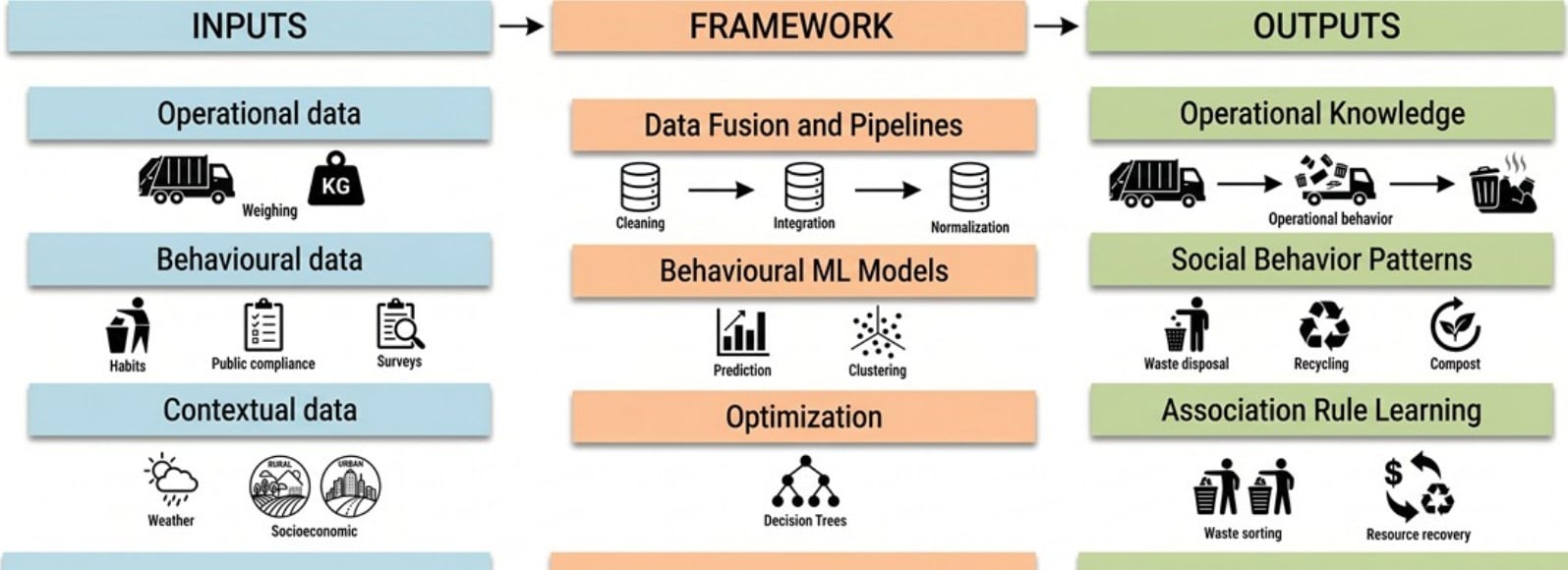
Municipal solid waste management (MSWM) systems in Latin America are constrained by limited access to high-resolution operational data, compelling local authorities to depend on aggregated national statistics that are inadequate for behaviorally informed intervention design. This limitation is particularly evident in the State of Mexico, which generates about 16,187 tons of waste every day but only recycles only 11%. In this context, this study introduces a diagnostic data science framework to identify behaviorally grounded citizen segments and their defining attributes, supporting evidence-based decision-making in MSWM. Primary survey data from 560 households across three municipalities were used, and a three-stage analytical pipeline was implemented to account for contextual heterogeneity. First, k-means clustering was applied to identify behavioral segments. Second, random forest classifiers were used to validate cluster coherence and quantify feature importance. Third, the Apriori algorithm was used to extract association rules that capture recurrent material-mixing behaviors. The results revealed municipality-specific segmentation structures (Tequixquiac: K = 6; Tlalpujahua: K = 3; Xalatlaco: K = 2), with material-specific disposal behaviors emerging as stronger segmentation drivers. Random forest classifiers validated cluster coherence with 100% accuracy, confirming that segments represent behaviorally distinct archetypes. The proposed framework converts raw behavioral data into actionable municipal visions. This approach focuses on finding diagnostic patterns instead of making predictions by utilizing machine-learning-driven MSWM research.
Keywords: integrated municipal solid waste management; behavioral segmentation; household waste behavior; municipal decision-making; State of Mexico; k-means clustering; random forest; association rules integrated municipal solid waste management; behavioral segmentation; household waste behavior; municipal decision-making; State of Mexico; k-means clustering; random forest; association rules
Graphical Abstract