
Article

Operational Flexibility Through Hydraulic Retention Time and Its Influence on Mesophilic AD of Fattening/Finishing Phase

1
Linking Landscape, Environment, Agriculture and Food (LEAF) Research Centre, School of Agriculture, University of Lisbon, Tapada da Ajuda, 1349-017 Lisboa, Portugal
2
Associated Laboratory for Green Chemistry (LAQV-REQUIMTE), Department of Chemistry, NOVA School of Science and Technology, NOVA University Lisbon, 2829-516 Caparica, Portugal
3
Associate Laboratory for Sustainable Land Use and Ecosystem Services (TERRA), School of Agriculture, University of Lisbon, Tapada da Ajuda, 1349-017 Lisboa, Portugal
*
Author to whom correspondence should be addressed.
Recycling 2026, 11(2), 29; https://doi.org/10.3390/recycling11020029
Submission received: 3 December 2025 / Revised: 19 January 2026 / Accepted: 29 January 2026 / Published: 2 February 2026
(This article belongs to the Special Issue Biomass Revival: Rethinking Waste Recycling for a Greener Future)

Abstract

Anaerobic digestion (AD) is a proven and promising technology for recovering energy from biowastes, such as pig slurry (PS) from the fattening/finishing phase. The mechanisms of AD are widely studied, and nowadays, it is of the utmost importance to investigate strategies that give end-users the confidence to choose this technology and to adapt it to their reality, promoting the energy transition and circular economy. This study investigated how collection and storage period affect PS samples, and how hydraulic retention time (HRT) (15 versus 20 days) influences AD performance and stability. Seasonality was the primary factor influencing feedstock characteristics. Samples presented no significant differences during the storage period. A 20-day HRT led to higher digestate pH, total ammonia nitrogen (TAN), and free ammonia nitrogen (FAN) concentrations, which can cause process instability and methanogenesis inhibition. However, 20-day HRT led to a specific methane production that was 7% higher and to a methane quality (expressed in % v/v CH4) that was 6% higher than 15-day HRT. Overall, methane quality, digestate pH, TAN, and FAN values may be considered key points that need to be monitored to prevent the AD system from being compromised. Nevertheless, these results provide the operational freedom to choose either HRT, allowing reduced reactor volume and investment.

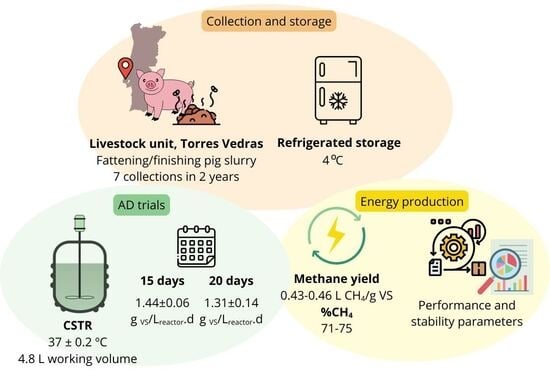
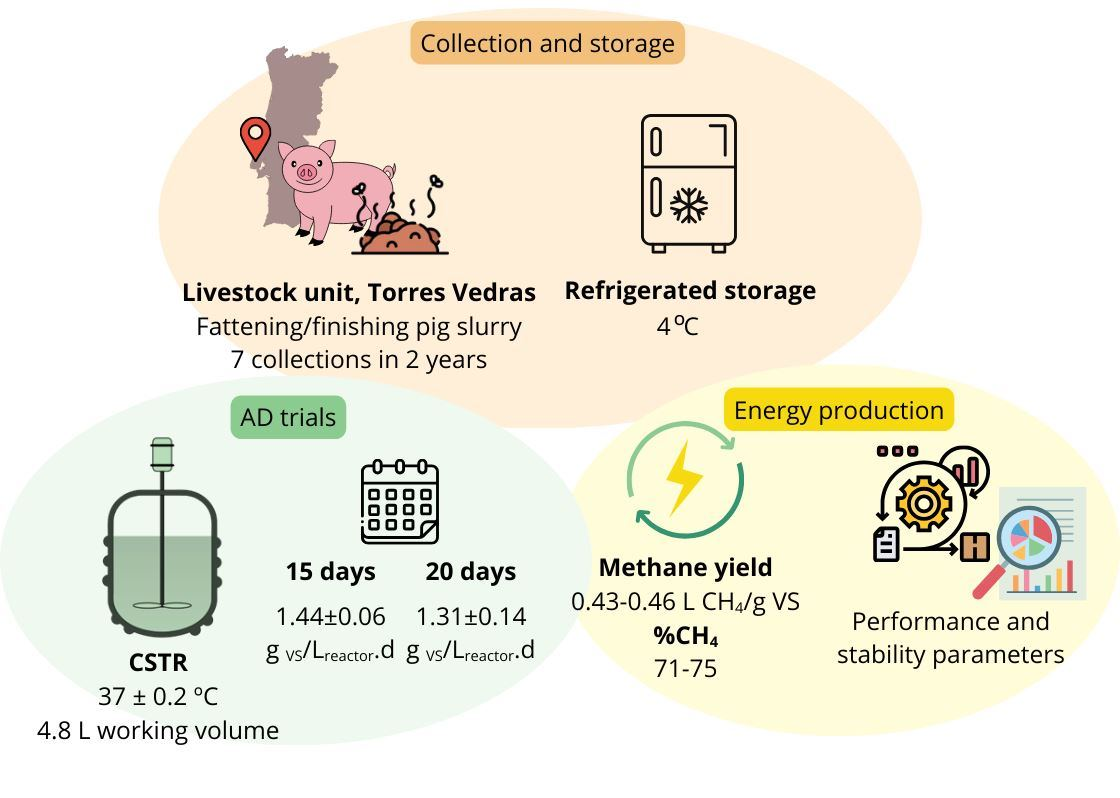
Graphical Abstract

1. Introduction

With the world’s population predicted to reach 8.5 billion by 2030 and the need for food, water, and agricultural resources rising, the global food production system will need to grow considerably in terms of both quantity and sustainability without losing quality and safety [1]. Global meat production expanded in 2024, with notable expansions in Europe, Asia, and South America after two years of contraction. Significant increases in meat production helped to boost this recovery by reducing inflationary pressures and increasing consumer purchasing power. These elements led to an increase in meat imports [2]. Particularly, it is expected that the production of pigmeat will rise globally, contributing 33% to the growth in the production of meat overall [1]. This will lead to an intensification of livestock facilities and pigmeat production, which will inevitably result in the generation of huge amounts of slurry [3,4], a significant environmental challenge, as livestock accounts for 80–90% of agricultural emissions, and nearly 10% of the sector’s global greenhouse gas (GHG) emissions footprint is due to slurry management [5,6]. Additionally, livestock is also responsible for 80% of total ammonia emissions in agriculture [5]. According to Zhang et al. [7], the initial stages of slurry management, particularly cleaning processes and collection protocols, serve as primary determinants of nitrogen flow and effluent characteristics. However, parameters such as total ammonia nitrogen (TAN), free ammonia nitrogen (FAN), and pH are critical, as they directly influence the risk of ammonia volatilization. Managing the digestate’s chemical profile is essential, not only for process stability but also for ensuring alignment with the European Green Deal’s objectives and supporting the Farm to Fork strategy’s target of reducing nutrient losses by 50% [8,9].
According to the current challenges (reduction in GHG emissions, energetic transition, circular bioeconomy [7]), the continuous search for improved technologies that enable the proper and profitable management of biowaste is crucial. Anaerobic digestion (AD) is a viable and sustainable technology for managing pig slurry (PS) that complies with European Union (EU) regulations to produce renewable energy [10]. It is already recognized as a biowaste-to-energy technology that can recover bioenergy while also improving PS management and producing a biodigestate with further agronomic valorisation potential [4,11,12].
Over the last 20 years, research has focused on improving the AD process through various routes [13]. The flexibility of AD plants is one of the main challenges, since it allows a reduction in operating costs and maximizes biogas production. Several engineering solutions can be used to accomplish this, including changing the operating conditions or implementing pre-treatments to boost substrate availability [14]. Depending on the specifications and limitations of each pig farm unit, operational conditions may include varying the frequency of feedings or the hydraulic retention time (HRT).
While higher HRTs facilitate greater degradation of organic matter and enhance biogas yields, this operational choice must be balanced against its inherent disadvantages, as it requires larger reactor volumes (higher CAPEX and OPEX) and may increase FAN levels, which could result in methanogen inhibition, given the high nitrogen content in PS [15]. On the other hand, shorter HRTs may result in lower capital expenditures since they require smaller digesters and consequently decrease acquisition and construction costs. Therefore, the possibility of selecting shorter HRTs should be explored. Regarding mesophilic AD experiments using PS from the fattening/finishing phase, the average HRT used is 15–40 days, with an organic loading rate (OLR) ranging from 0.8 to 2.0 VS/Lreactor.d [13,16,17,18].
Furthermore, according to BAT’s [19] conclusions for the intensive rearing of pigs, on-farm processing is required to mitigate emissions of nitrogen and odours, as well as to enhance manure storage. Within the regulatory framework, mechanical separation and AD are two of the techniques for this purpose. However, the document also notes that AD implementation may be limited by high investment costs. Rather than selecting a fixed HRT, the results demonstrate that an operational window of 15 to 20 days provides significant strategic flexibility for farm-scale implementation. Designing a smaller reactor based on this range reduces initial Capital Expenditure (CAPEX) while allowing farmers to dynamically adapt to seasonal fluctuations to mitigate potential variations throughout the year. This flexible approach ensures that the infrastructure remains optimized, thereby facilitating compliance with environmental standards without compromising process feasibility.
One distinctive feature of this study is the focus on PS from the fattening/finishing phase, since this phase has the highest organic content from all the breeding streams [20]. Another aspect is the technical integration with the farm’s management, allowing for an in-depth characterization of on-site operational logistics.
The present study aims to evaluate the technical feasibility of operational optimization in the AD of PS, addressing two operational dimensions. First, it investigates how seasonality and storage influence the physicochemical characteristics of the feedstock. Second, it assesses the effects of adopting shortened HRTs (15 and 20 days) on AD performance and stability. This approach seeks to provide the facility with enhanced operational flexibility, empowering stakeholders to select the configuration that best aligns with their specific logistical and economic constraints, based on results demonstrating that consistent biogas production is achievable throughout the year, regardless of the significant seasonal fluctuations in PS composition.

2. Results and Discussion

To shed light on the substrate’s variability, the findings of the physicochemical characterization of PS samples from several collections are presented hereafter. The performance of the AD experiments was carried out with the feedings obtained from the PS collected at different times, after the pre-treatments described previously. To perform trials with real samples representative of the reality of a pig farm is of utmost importance, since it may anticipate scenarios that can occur, creating strategies to overcome the potential drawbacks. The results obtained from these trials are discussed for a comprehensive evaluation of the process under different operational conditions.

2.1. Impact of Collection and Storage on PS Characteristics

Table 1 shows the physicochemical characteristics of the substrates grouped by collection period.
The values of pH exhibited an upward trend across the different stages (PSR, PSPT, and PSPT-S). Higher pH values were observed during the warm season, likely due to enhanced ammonification at higher ambient temperatures. During storage, pH values exhibited a slight increase between 2 and 4%, indicating the continuous biochemical activity that occurs even under cold storage conditions [21].
The collections during cold seasons present lower TS and VS values for PSR, which may be explained by the lower temperatures combined with rain in the cold seasons, which led to both less evaporation of the slurries stored in the pits, and to the possible accumulation of water. This could result from rain entering the rooms, leading to more stable water content and a more diluted slurry. On the other hand, warm seasons with higher temperatures lead to a decrease in the water content and a higher evaporation rate, increasing the concentration of total and volatile solids. In Torres Vedras (where the pig farm unit is located), the average temperature in autumn/winter ranges between 10 and 22 °C, while in summer it can go from 16 to 28 °C [22].
The values presented for PSPT correspond to the pre-treatments applied to the PSR on the collection day. Analyzing the effect of pre-treatment on PS characteristics, it is possible to observe different behaviour according to the season of collection. For the PS collected in the cold season, the pre-treatment led to a decrease in TS values of 11%, and in VS values, the decrease was about 14%. Yet, in contrast, for PS collected in the summer, PSPT corresponds to a decrease of 21% in TS when compared to PSR. For VS values, the decrease caused by pre-treatment was 27%. Although sieving is a common laboratory procedure, in this work it mimics the model farm’s operations. The facility uses a mechanical screening unit with a solid removal efficiency similar to the sieving process used in a laboratory. Thus, the sieved substrate is representative of the actual full-scale feedstock.
In fact, two-way ANOVA revealed that seasonality was the primary factor influencing feedstock characteristics, accounting for 79.45% and 73.82% of the total variance for TS and VS, respectively. No significant differences were observed between PSPT and PSPT-S samples for both 1–2 and 3–4 months (p > 0.05), validating that storage at 4 °C successfully maintained the samples’ characteristics, ensuring that the subsequent AD trials accurately reflected the original properties of the raw material. Statistical analysis of the VS/TS ratio indicated significant effects for pre-treatment, stored samples, and seasonality. The PSR presented the highest organic fraction in both seasons (68.50 ± 2.74% in cold, 73.46 ± 1.08% in warm). The pre-treatment significantly reduced the VS/TS ratio (p < 0.05) by 4% in the cold season and 8% in the warm season. However, after the application of the pre-treatment, the stability of the samples during the storage period was high, since there were no significant differences between the PSPT and PSPT-S samples for either 1–2 or 3–4 months (p > 0.05) within the same season.
Given the significant seasonal variation in VS observed in this study (73.82% of total variance), a strategic operational adjustment is recommended. Specifically, feeding quantities should be adjusted according to the season. During the warm season, when the slurry is more concentrated, the HRT should be higher than in the cold season to maintain a stable OLR. These findings might be helpful regarding the flexibility of AD plants and capacity storage on farms to give farmers strategies to manage large amounts of slurry and provide options for dealing with these fluctuations throughout the year.

2.2. Feeding Properties of AD Trials

The samples obtained after pre-treatment procedures correspond to the feeding for the AD trials. Table 2 presents their physicochemical characterization. These results clarify the variation in feedstock composition and point out factors to consider while maximizing AD performance along the yearly variations in PS. The standard deviation in each HRT group represents the inherent heterogeneity of the PS collected in each trial rather than the HRT period itself, as the physicochemical characterization refers to the feedstock before AD.
The VS/TS ratio is an important parameter that indicates approximately how much biodegradable organic matter content is available for the AD process. The typical VS/TS ratio for PS is around 70% [23], which is not far off from the values obtained in the characterization of both the raw PS (Table 1) and AD feeding streams (Table 2).
Another important key parameter that reflects the biodegradability of the PS is the SCOD/TCOD ratio, which gives information about the readily available organic fraction in the substrate for AD. Therefore, the substrate’s availability for microbial activity is directly correlated with a higher SCOD/TCOD ratio. So, higher results may contribute to improving biogas generation [24].
Despite similar organic content (VS/TS), trial B exhibited a higher SCOD/TCOD ratio. While the VS/TS ratio primarily quantifies the total organic mass in the solid fraction, the SCOD/TCOD ratio represents the degree of organic matter solubilization and the presence of readily biodegradable organic matter, suggesting that the organic matter was more readily bioavailable than in trial A.
Zhu et al. [25] created linear regressions for different pig growing stages (including the finishing phase), presenting a significant correlation between TKN and TS (correlation coefficient of 0.9695). This correlation is consistent with the variations in the TKN and TS parameters presented in Table 2, where an increase in TS content is associated with an increase in TKN.
A suitable C/N ratio provides support for effective microbial activity and, therefore, for biogas production. The optimal range falls within 20–30: higher C/N ratios could lead to nitrogen deficiency in the AD process, while low ratios might cause ammonia inhibition [26]. Despite the heterogeneity of values, both trials presented C/N ratios below the optimal C/N ratio, with trial A being 20% higher (p < 0.05) than trial B.

2.3. Effect of HRT on AD Performance and Stability

Table 3 shows some performance parameters for both trials, with the corresponding statistical analysis. The OLR was significantly different between trials A and B (p < 0.05). Trial A, which was the trial performed under lower HRT, operated at a 10% higher OLR. A statistically significant difference was also observed for methane quality (expressed in % v/v CH4). The SGP and SMP are the key parameters for evaluating performance and process efficiency, as they represent the volume of biogas/methane produced per unit mass of organic matter added to the reactor, while total biogas production does not consider the organic matter. Statistical analysis confirmed that both SGP and SMP were significantly influenced by HRT (p < 0.05), with the 20-day HRT achieving superior yields, thereby demonstrating that additional time optimized the biodegradation of PS.
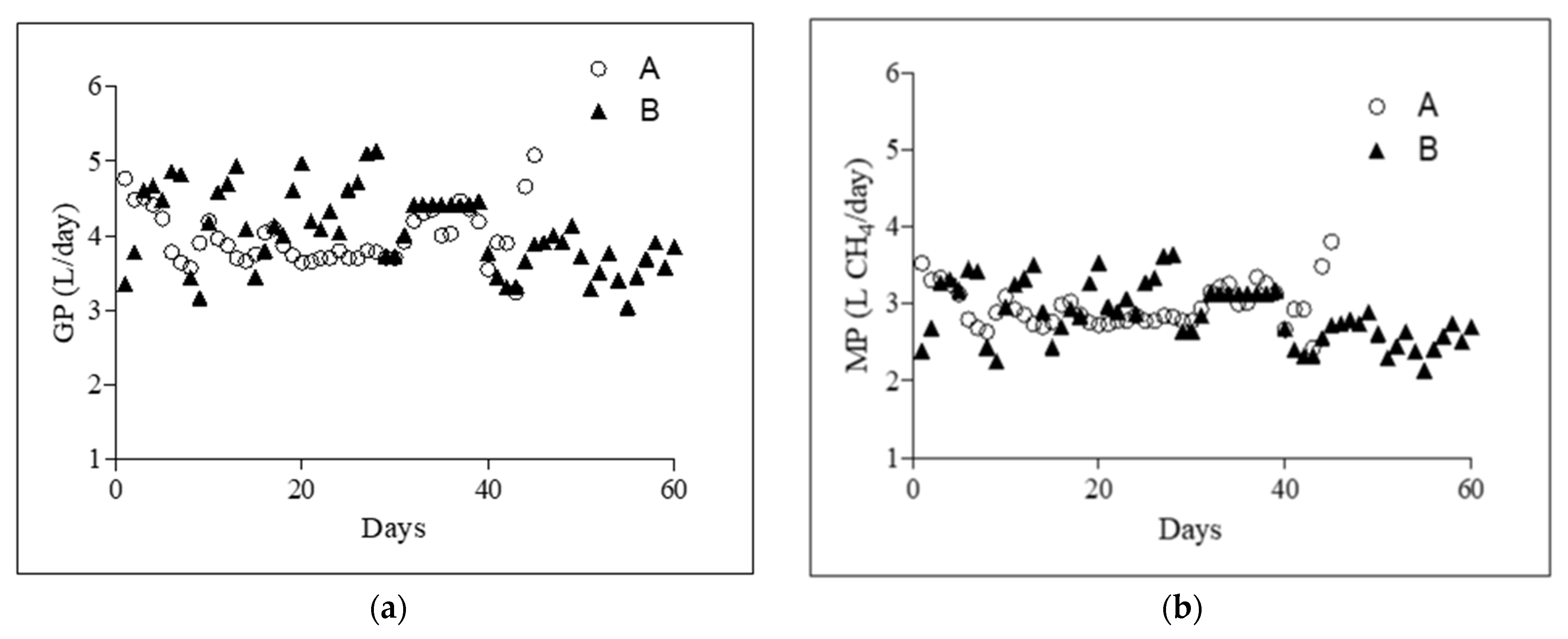
However, gas and methane production (GP and MP) did not differ significantly (p > 0.05), suggesting that while the quality and efficiency of biogas generation improved, the absolute quantities of biogas and methane remained comparable between trials. Figure 1 shows the evolution of both the GP (Figure 1a) and MP (Figure 1b) parameters throughout the study period. Although biogas and methane production in trial B were higher than in trial A, trial A showed a decrease in the first few days of the experiment, but then remained constant, registering an increase in the last days of the trial. On the other hand, trial B had slightly unstable production during the first half of the experiment, registering more stable production in the end.
According to these findings, the longer HRT in Trial B might have increased the substrate utilization efficiency, as evidenced by the higher SGP and SMP, and supported by the 16% higher SCOD/TCOD ratio (Table 2). However, the pattern of biogas and methane production, aligned with the lower methane quality, suggests some peaks of instability during the HRT of 20 days, which may be linked with the stability parameters discussed below.
Since there is a strong correlation between the digestate pH, TAN, and FAN [27], special attention should be given to these parameters, which can lead to instability and even the inhibition of the process [15,28].
Microbial communities are influenced by the pH of the medium, but studies differ on the effect of pH on the AD process: some identify pH ≈ 8 as the stability threshold [29], while others state that for pH > 8.5, the microbial activity is almost inhibited [30]. Analyzing Table 4, digestate pH values were lower for the 15-day HRT; however, they were still above 8. Trial B had the highest average digestate pH, near 8.5, which, according to Cai et al. [30], can promote microbial activity inhibition.
During the AD process, TAN is one important parameter that needs to be followed carefully to maintain a stable and efficient process; it is important for protein production, but when present in excessive concentrations, it can lead to process failure due to FAN toxicity in the anaerobic consortium. TAN exists in equilibrium in the AD process in two principal forms: ammonia ion (N-NH4+) and free ammonia nitrogen (FAN), the latter being the most toxic to the methanogenic community. Although it is widely accepted that TAN could inhibit the methanogenesis phase, it is a great challenge to identify a crucial threshold. Some researchers refer to a range of 3.4 to 5.8 g/L [31], while others mention reactor stability with TAN concentrations exceeding 4 g/L [32]. It is important to highlight the broader range of concentrations (1.7 to 14 g/L) reported by Chen et al. [33] that can lead to a 50% reduction in methane production. TAN values from trials A and B had no significant difference (p > 0.05), with the highest value being reported in the 20-day trial (31% higher than trial A). Nevertheless, these values are within the range referred to by Jiang et al. and Strik et al. [31,32], but according to Chen et al. [33], these concentrations can cause inhibitory effects on the process.
Finding a consensus on values is another challenge for FAN inhibitory thresholds; for example, the following concentrations can be found in the literature: 1600–2600 mg/L [31], 900 mg/L [32], and 220 mg/L [28]. A conclusion common to all these studies is the adaptation of the microbial consortium to the substrate, making them more tolerant to higher TAN and FAN concentrations. Nevertheless, the A and B trials had FAN levels (503–658 mg N/L) below the critical thresholds referred to by Jiang et al. and Strik et al. [31,32], but higher than the inhibitory threshold (220 mg FAN/L) stated by Yenigün and Demirel [28]. The threshold for a 50% reduction in methane production varies widely between 150 and 1200 mg FAN/L [28,34], a range primarily determined by the system’s adaptation and biomass acclimatization to slight fluctuations. The process stability observed throughout the trials provides strong evidence that the measured FAN concentrations (up to 658 mg N/L) remained well below the inhibitory threshold for this system, since methane yield did not present any pronounced decrease. In fact, our system achieved an even higher SMP with the 20-day HRT despite the higher FAN levels. The AD reactor where these trials were performed was fed with fattening and finishing pig slurry for several years. The good results obtained could be supported by microbiota adaptation to this type of substrate, making the AD process more flexible and resilient to OLR fluctuations.
The higher FAN levels observed in trial B (31% higher than trial A), aligned with the higher digestate pH and TAN (in Table 4), may be the reason for the peaks of instability in biogas and methane production observed in Figure 1, and for the lower methane quality compared with the 15-day HRT trial. However, even the lowest methane quality reported (71% in trial B) is superior to the ones reported in the literature: 9% higher than that reported by Xu et al. [17] and 18% higher than that reported by Panichnumsin et al. [35].
As a matter of fact, these possible signs of instability were not reflected in SMP, which had an increase of 7% in trial A, agreeing with [15]. This author states that longer HRTs are expected to have higher specific methane productions, due to the longer digestion time for organic matter biodegradation [15].
Table 4 also shows the TCOD and VS removals that are statistically different between the trials (p < 0.05). TCOD removal was higher than VS removal in both trials, and this is in line with the broader scope of TCOD as an indicator of both particulate and soluble organic matter, whereas VS reflects only the volatile fraction of total solids. Higher TCOD removal suggests a substantial degradation of soluble organic compounds. Although it was expected that longer HRTs had better VS removals due to the higher contact time between the anaerobic consortium and organic matter [36], Table 4 shows lower VS removal for trial B, which had the longest HRT in the study. This may be due to the low OLR of this trial (1.31 ± 0.14 g VS/Lreactor.d), which is 9% lower than for trial A. Perhaps trial B was working underload and could benefit from increasing the OLR. Nevertheless, despite the lower VS and TCOD removals in trial B, a higher SMP was observed. This can be explained by the higher SCOD/TCOD ratio of its feeding streams, which provided a greater fraction of readily biodegradable and bioavailable organic matter.
There are a few similarities between this work and the experiments of Wang et al. [18], which were conducted using comparable HRTs (15, 21.8, and 22.3 days). In Wang et al.’s study of the digestate, pH also increased with the increase in HRT (from 7.4 to 7.8), the same is noted for TAN (increase of 34% and 71% from HRT of 15 days to 21.8 and 22.3, respectively) and FAN values (a 3-fold increase from 15-day HRT to 21.8- and 22.3-day HRT). In our study, the increase in HRT led to an increase of 30% in both TAN and FAN, a lower increment than that noted by Wang et al. [18]. However, Wang et al. [18] reported lower TAN and FAN values: maximum TAN value of 2.42 g/L for HRT of 21.8 days; maximum FAN values of 180 mg/L for both HRTs of 21.8 and 22.3 days.
SMP was also higher for trials with longer HRTs: the increment from a 15-day trial was about 44% and 59% for HRTs of 21.8 and 22.3, respectively. These increments are higher than those reported in our work, where an increase of 5 days in HRT led to an increase of 7% in SMP. The fact that TAN and FAN values are lower in their study may be linked with the higher SMP results they reported.
Panichnumsin et al. [35] conducted AD works in mesophilic conditions with slurry from fattening pigs under an HRT of 15 days. In his work, the TAN values of digestates were 67% lower than in trial A; however, trial A registered better methane quality (20% higher). Regarding SGP and SMP, trial A had almost a 2-fold increase compared with Panichnumsin et al.’s trials [35]. This is probably due to microbial adaptation to higher TAN concentrations and long-term continuous operation, which offset the ammonia stress typically associated with the digestion of PS.
Laboratory-scale trials performed with samples to mimic real farming conditions serve as a fundamental tool for full-scale implementation. Rather than defining a single fixed point, establishing an operational window of 15 to 20 days allows for a strategic balance between process efficiency and reactor volume (CAPEX). Moreover, it provides farm managers with the operational versatility to adapt to seasonal fluctuations without compromising stability or energy recovery. Given that this study concentrates on shorter HRTs (15 and 20 days) that fall within the range of those most commonly used in AD for fattening and finishing pigs, 15–40 days [13,16,17,18], it was possible to observe that both HRTs are favourable options to consider because of their lower operating costs, the need for smaller infrastructures, and the potential to give farmers more flexibility and options to manage fluctuations in PS production throughout the year. Nevertheless, it is necessary to pay attention to stability parameters such as digestate pH and TAN/FAN concentrations to control the AD process and evaluate possible instabilities.

3. Materials and Methods

3.1. Livestock Facility

The livestock farm from which PS samples were collected is located in Torres Vedras, Portugal (39°11′37.43″ N; 9°15′01.72″ W). The facility has an area of around 2000 m2, works exclusively with the fattening/finishing phase with a capacity of 1862 places, and the pigs are distributed according to their weight. In the rooms for the fattening phase, the pigs start at an average of 25 kg, and they are kept there until they reach about 50 kg; then they move on to the rooms for the finishing stage, where they remain until they reach approximately 110 kg.
The feed formulation is defined according to pigs’ age needs: non-grained flour is provided in feeders, and water in scoops/drinking troughs, in an ad libitum regime, meaning that the feed is always available. The rooms have forced ventilation, and each room has a gridded floor with a storage pit. The feces, urine, wastewater, and feed scraps are stored in pits, with a maximum retention period of up to two months, depending on monitoring requirements, ensuring a long period of volume accumulation. Afterwards, cleaning and disinfection procedures begin after the animals have completed their growth phase.
The physical separation of pigs by growing phases (fattening and finishing) allows for differentiated sampling before all effluents are forwarded to a centralized collector.
The monitoring plan for sample collection was prepared, along with the methods to be used, to ensure that all samples were collected under similar conditions over time: firstly, homogenizing the contents of the pits, and afterwards, collecting the PS in dedicated containers. The samples were then transported to the laboratory in sealed containers of 20 L, where they were stored at 4 °C until further use to prevent biological degradation and to ensure the stability of the samples between collection and use in the lab digester [21]. This is not a full-scale procedure, but a methodology used to mitigate biochemical modifications in the timespan between the moment of collection and use in the lab digester.

3.2. Experimental Setup

This research was conducted over a period from September 2023 to September 2025. It spans two years of sample collection, includes different storage durations (1–2 and 3–4 months at 4 °C) as defined by the experimental monitoring plan, and encompasses experimental work in a lab-scale continuous-stirred tank reactor (CSTR) (ERT, Almada, Portugal), aiming to provide a representative picture of waste generation in pig farming units over an extended period.
The samples were taken throughout the different seasons of the year, which ended up making the study representative of the reality of a farm and its inherent fluctuations during the year. A total of seven collections were conducted over the period of study, with frequency adjusted according to operational requirements and laboratory scheduling. For statistical analysis and due to the temperature variations observed in the Torres Vedras region, the seven sampling collections were grouped into two distinct thermal periods:
i.
The Warm Season, including the two collections taken in July 2024 and June 2025, months characterized by peak ambient temperatures with the maximum average temperatures registered [22];
ii.
The Cold Season, including the five collections taken in October 2023, January 2024, March 2024, November 2024, and April 2025, months with temperatures below 22 °C [22].
This classification allowed a two-way ANOVA to be performed to assess the impact of seasonality and treatment on the composition of the effluent.
This experimental work is organized into two sections: the collection and storage of PS samples, and then the AD trials. First, the physicochemical characterization of PS samples was performed on the day of collection, before and after the pre-treatment. Then, the samples were stored separately in dedicated containers according to their corresponding phase (fattening and finishing), and another physicochemical characterization was performed after a period of storage. With this, it was possible to evaluate the impact of storage on the samples’ characteristics over time. While the literature for fattening/finishing PS suggests an OLR range of 0.80 to 2.00 g VS/Lreactor.d [13,16,17,18], this study selected a narrower range, 1.20 to 1.60 g VS/Lreactor.d, to apply more efficient PS management, minimizing loading fluctuations and standardizing the OLR across the trials. This strategy allowed the consideration of HRT as the key parameter for AD performance analysis. The experimental AD trials were developed between May and December of 2024, with occasional interruptions due to the maintenance requirements of the lab unit.

3.3. Pig Slurry Samples: Collection and Storage

The experimental design was preceded by a technical assessment of the pig farm’s operational flow. Initial procedures consisted of collecting samples from each growing stage to conduct physicochemical characterizations that could help to select the appropriate blend (v/v) of each phase to use in AD trials, considering seasonal variability and the characteristics of fattening and finishing effluents (especially VS content). To ensure the OLRs range selected (1.20–1.60 g VS/Lreactor.d), a ratio of 40% of fattening slurry and 60% of finishing slurry (v/v) was selected.
After each PS collection at the pig farm, the samples were characterized for pH (VioLab benchtop multiparameter probe, Giorgio Bormac S.r.l., Carpi, Italy) and total and volatile solids (TS and VS, respectively) according to the APHA [37] methods. The samples were stored at 4 °C separately in dedicated containers according to the corresponding phase (fattening and finishing). Mixing and sieving were performed when needed before AD trials, and the pre-treated samples were submitted to new characterization, which provided an insight into the effect of storage time on the samples. Prior to reactor feeding, the stored samples were allowed to reach ambient temperature to avoid thermal instability within the CSTR and to mimic the real-world conditions of feedstock. Table 5 summarizes the different stages in which the PS was characterized.

Pre-Treatments of Slurries

As mentioned above, the slurries collected from each phase were mixed in a proportion of 40% from the fattening phase and 60% from the finishing phase. However, due to equipment constraints related to the diameter of the reactor feed pipes, it was necessary to apply pre-treatments that would prevent the pipes from clogging. Considering that the use of pre-treatments due to energy consumption increases AD costs, it was crucial to choose low-energy-demanding processes. First, to ensure proper homogenization of the slurries, an industrial stirrer (250 W, 2500 rpm, Bertrand–Groupe Dito, Nevers, France) was used in beater mode for 1 min at 4500 rpm. Then, to overcome the obstacle of pipe diameter, a 2 mm mesh sieve was used to screen the mixture. This pre-treatment replicates the mechanical solid–liquid separators commonly used in full-scale reactors [38].

3.4. AD Trials

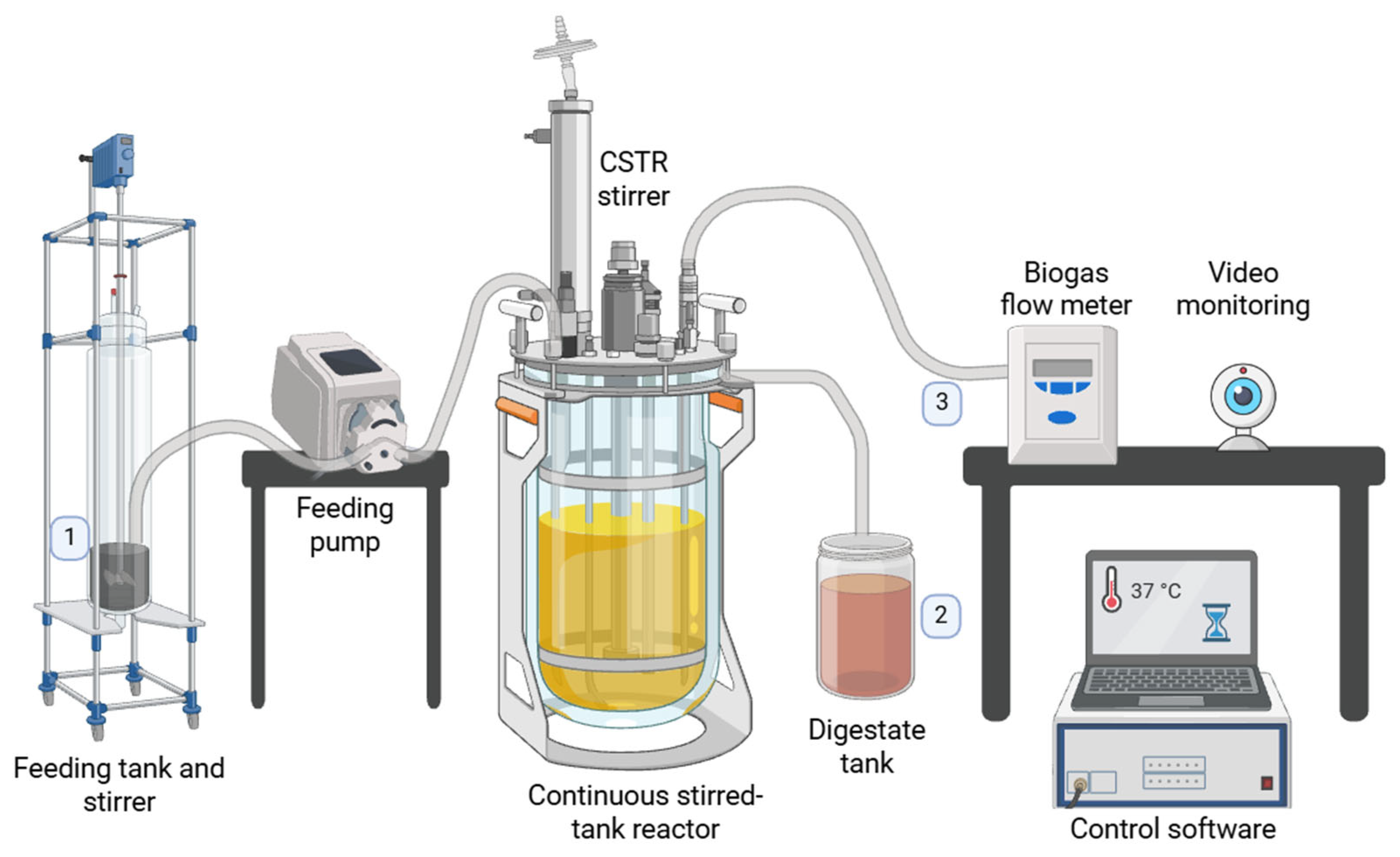
The AD laboratory unit (Figure 2) consists of a semi-continuous stirred tank reactor (CSTR) with a working volume of 4.8 L (ERT, Almada, Portugal), controlled by computer software (ERT, Portugal) that has been working with PS for the past few years under stable conditions and has a long-term adaptation to this substrate, with a microbial consortium that is fully acclimated. Feeding frequency was selected according to previous work performed by the authors [39]: daily feeding was divided into 6 times a day. The feeding was performed using a feed pump (Watson Marlow, 120 rpm, 24 W, Falmouth, UK), and the biogas volume was measured directly with a gas flow meter by liquid displacement (µFlow, BPC Instruments, Lund, Sweden). The biogas quality (expressed in % v/v CH4) was quantified every week, using a portable analyser (LMSxi Multifunction Landfill Gas Analyser, Gas Data, Coventry, UK).
To enhance homogenisation, the feeding stream and the biomass inside the reactor were both stirred (using mechanical stirrers from VELP Scientifica, 50 rpm, 60 W, Usmate, Italy). Before each feeding cycle and throughout feeding time, the feeding stream was agitated for 30 s. Similarly, the reactor was agitated 1 min before, during, and 1 min after feeding. The pH and temperature of the reactor were monitored daily.
The HRT trials were conducted after achieving a steady state and under mesophilic conditions (37 ± 0.2 °C). Two HRTs were evaluated (15 and 20 days) to make it possible to evaluate the impact of increasing HRT on the process efficiency and stability.
According to the average used OLRs in AD reported in the literature [13,16,17,18], our goal was to maintain an intermediate range between 1.20 and 1.60 g VS/Lreactor.d. To maintain the OLR within this target experimental range, the samples collected in the warm season were diluted by a maximum of 10% to fulfil the requirements for AD trials. The trials in this study were performed at average OLRs of 1.44 ± 0.06 g VS/Lreactor.d for 15-day HRT (trial A) and 1.31 ± 0.14 g VS/Lreactor.d for 20-day HRT (trial B). PS from different collection periods was used to evaluate the effect of collection and storage time on both process performance and stability operational parameters. Trial A lasted 45 days, while Trial B was conducted over 60 days.

3.4.1. Feeding and Digestate Characterization

At the beginning and end of each HRT, both the feeding and digestate were characterized for physicochemical parameters, according to the methods of the APHA [37]. For TS determination, samples were dried to constant weight at 105 °C. The VS content was determined by igniting the samples in a muffle furnace at 550 °C for 4 h. Total chemical oxygen demand (TCOD) was determined using the closed reflux titrimetric method. After 2 h of digestion at 150 °C, the excess dichromate was titrated with ferrous ammonium sulfate using ferroin indicator. Ammoniacal nitrogen (N-NH4+) and Kjeldahl nitrogen (TKN) were measured by the Kjeldahl method: N-NH4+ was determined by distillation and titration, while TKN was measured following acid digestion prior to the distillation step. Soluble chemical oxygen demand (SCOD) was determined by using COD kits (Nanocolor CSB 15000, Macherey−Nagel, Dueren, Germany) after centrifuging the samples at 4000 rpm for 7 min.
Free ammonia nitrogen (FAN) was determined using Equation (1), described by Sheng et al. [40]:
F A N N N H 3 = [ N N H 4 + ] 10 p H 10 p H + e 6344 T ( K )
where F A N N N H 3 represents the free ammonia nitrogen concentration (g/L), [ N N H 4 + ] is the ammonium ion concentration (g/L), p H is the pH of the sample (Sorensen scale), and T ( K ) is the temperature of the sample (Kelvin).
Temperature and pH have an impact on total ammonia nitrogen (TAN), which is found in equilibrium in the AD process in two main forms: FAN and ammonium ion (N-NH4+). For pH values below 7.5, TAN can be expressed in N-NH4+, due to the chemical equilibrium between FAN and N-NH4+, which is influenced by pH and temperature [30]. For pH values above 7.5, TAN is obtained through the sum of N-NH4+ and FAN. In this work, this was only applied to digestates, since feedings showed pH values below 7.5.
Total organic carbon (TOC) was calculated as described by Cuetos et al. [41]. In parallel, organic nitrogen (Norg) was determined by subtracting ammoniacal nitrogen from Kjeldahl nitrogen. The C/N ratio was then calculated using total organic carbon and organic nitrogen.

3.4.2. Operational and Performance Parameters

The operational parameters assessed in this study include daily biogas (GP) and methane (MP) production, specific biogas production (SGP), specific methane production (SMP), removal efficiencies of volatile solids (VS removal), and total chemical oxygen demand (TCOD removal).

3.5. Statistical Analysis

The results are presented along with the means and standard deviations for each analysis, which were carried out in triplicate. GraphPad Prism software (version 5.0) was used to perform statistical analysis. To evaluate the influence of seasonality on PS characteristics, a two-way ANOVA was performed, followed by Bonferroni post-tests. To compare the HRTs under study, statistical comparisons were performed using t-tests tailored to each dataset. Normality and variance equality were assessed prior to selecting the appropriate version of the t-test. All tests were conducted at a 5% significance level (p < 0.05).

4. Conclusions

The distinguishing factor of this study is the fact that it covers a collection and trial period of 2 years, approaching the representation of pig slurry variation throughout the year and technical integration with the farm’s management, allowing for an in-depth characterization of the on-site operational logistics of the livestock unit.
Parameters such as digestate pH, TAN, and FAN concentrations should be carefully monitored to control the process and foresee any issues that could result in lower methane production or even process failure. Above all, it is necessary to consider all the parameters in an integrated way, understanding that they all function in synergy and can influence the AD process positively or negatively. Nevertheless, it should be emphasized that the process seems to be resilient under higher parameter concentrations, especially during long-term continuous operation.
These findings could enlighten the development of environmentally friendly strategies for pig slurry management and biogas production. The results obtained give the freedom to consider the choice of either of the HRTs in this study (15 and 20 days) for the anaerobic digestion of fattening/finishing pig slurry, which allows farm managers to adjust the throughput according to seasonal slurry fluctuations and storage constraints. This flexibility makes the system more appealing, as the system can maintain high organic removal (76.55% TCOD at 15 days) and stable methane production (up to 0.46 L/g VS at 20 days), while allowing the selection of a lower reactor volume and reducing the associated cost investments, but assures more stability to the process. However, performing more AD trials with higher OLRs should be interesting to observe the long-term effect on stability and performance.

Author Contributions

Conceptualization, I.S., N.L., H.R. and E.D.; methodology, I.S.; formal analysis, I.S.; resources, I.S., N.L., H.R. and E.D.; investigation, I.S.; writing—original draft preparation, I.S.; writing—review and editing, I.S., N.L., H.R. and E.D.; visualization, I.S.; supervision, N.L., H.R., and E.D. All authors have read and agreed to the published version of the manuscript.

Funding

This research was funded by FCT—Fundação para a Ciência e Tecnologia, I.P. through project reference UID/04129/2025 (LEAF) and a PhD grant to the first author (https://doi.org/10.54499/2023.03381.BD). H. Ribeiro and E. Duarte acknowledge the support by national funds through FCT—Fundação para a Ciência e Tecnologia, I.P., under the projects UIDB/04129/2020 of LEAF-Linking Landscape, Environment, Agriculture and Food, Research Unit (https://doi.org/10.54499/UIDB/04129/2020, https://doi.org/10.54499/UID/04129/2025) and LA/P/0092/2020 of Associate Laboratory TERRA (https://doi.org/10.54499/LA/P/0092/2020). N. Lapa acknowledges the support from national funds from FCT—Fundação para a Ciência e a Tecnologia, I.P., under the scope of the projects UID/50006/2025, UID/PRR/50006/2025 and LA/P/0008/2020 of the Associated Laboratory for Green Chemistry—LAQV REQUIMTE (https://doi.org/10.54499/UID/50006/2025, https://doi.org/10.54499/UID/PRR/50006/2025 and https://doi.org/10.54499/LA/P/0008/2020).

Data Availability Statement

The original contributions presented in this study are included in the article. Further inquiries can be directed to the corresponding author.

Conflicts of Interest

The authors declare no conflicts of interest.

Abbreviations

The following abbreviations are used in this manuscript:
ADAnaerobic digestion
C/NCarbon-to-nitrogen
CSTRSemi-continuous stirred tank reactor
EUEuropean Union
FANFree ammonia nitrogen
GPBiogas production
HRTHydraulic retention time
MPMethane production
NorgOrganic nitrogen
OLROrganic loading rate
PSPig slurry
PSRPS after collection
PSPT-SPS after storage
PSPTPS after pre-treatment
SCODSoluble chemical oxygen demand
SGPSpecific biogas production
SMPSpecific methane production
TANTotal ammonia nitrogen
TCODTotal chemical oxygen demand
TKNKjeldahl nitrogen
TOCTotal organic carbon
TSTotal solids
VSVolatile solids

References

  1. OECD. FAO OECD-FAO Agricultural Outlook 2021–2030; OECD: Paris, France, 2021; ISBN 9789264436077. [Google Scholar]
  2. FAO. MEAT MARKET REVIEW Overview of Global Market Developments in 2024; FAO: Rome, Italy, 2025. [Google Scholar]
  3. Chen, B.; Azman, S.; Dewil, R.; Appels, L. Alkaline Anaerobic Digestion of Livestock Manure: Unveiling Mechanisms, Applications, and Perspective. Chem. Eng. J. 2023, 477, 146852. [Google Scholar] [CrossRef]
  4. Díaz Lara, C.O.; Cabañas Vargas, D.; Sacramento Rivero, J.C.; Baz-Rodríguez, S.; Ruiz Espinoza, J.E.; Aguilera-Cauich, E.A.; Baas-López, J.M.; Pacheco-Catalán, D.E. Towards Circularity in Anaerobic Digestion: Methane Yield Enhancement Using Biochar from Co-Pyrolysis of Anaerobic Sludge and Residual Lignocellulosic Biomass. Recycling 2025, 10, 84. [Google Scholar] [CrossRef]
  5. Prado, J.; Chieppe, J.; Raymundo, A.; Fangueiro, D. Bio-Acidification and Enhanced Crusting as an Alternative to Sulphuric Acid Addition to Slurry to Mitigate Ammonia and Greenhouse Gases Emissions during Short Term Storage. J. Clean. Prod. 2020, 263, 121443. [Google Scholar] [CrossRef]
  6. Ma, C.; Guldberg, L.B.; Hansen, M.J.; Feng, L.; Petersen, S.O. Frequent Export of Pig Slurry for Outside Storage Reduced Methane but Not Ammonia Emissions in Cold and Warm Seasons. Waste Manag. 2023, 169, 223–231. [Google Scholar] [CrossRef] [PubMed]
  7. Zhang, J.; Li, P.; Wan, J.; Guo, X.; Wang, Y.; Wang, J. Mitigation of Nitrogen Losses during Pig Manure Management: Impact of Manure Cleaning Technique. Water-Energy Nexus 2025, 8, 1–5. [Google Scholar] [CrossRef]
  8. Directorate-General for Health (European Commission). European Green Deal—Delivering on Our Targets; Publications Office of the European Union: Luxembourg, 2021. [CrossRef]
  9. Directorate-General for Health and Food Safety (European Commission). Farm to Fork Strategy for a Fair, Healthy and Environmentally-Friendly Food System; European Commission: Brussels, Belgium, 2020.
  10. Cardelli, R.; Giussani, G.; Marchini, F.; Saviozzi, A. Short-Term Effects on Soil of Biogas Digestate, Biochar and Their Combinations. Soil Res. 2018, 56, 623–631. [Google Scholar] [CrossRef]
  11. Samoraj, M.; Mironiuk, M.; Izydorczyk, G.; Witek-Krowiak, A.; Szopa, D.; Moustakas, K.; Chojnacka, K. The Challenges and Perspectives for Anaerobic Digestion of Animal Waste and Fertilizer Application of the Digestate. Chemosphere 2022, 295, 133799. [Google Scholar] [CrossRef]
  12. Wang, G.; Fu, P.; Zhang, B.; Zhang, J.; Huang, Q.; Yao, G.; Li, Q.; Dzakpasu, M.; Zhang, J.; Li, Y.Y.; et al. Biochar Facilitates Methanogens Evolution by Enhancing Extracellular Electron Transfer to Boost Anaerobic Digestion of Swine Manure under Ammonia Stress. Bioresour. Technol. 2023, 388, 129773. [Google Scholar] [CrossRef]
  13. Silva, I.; Lapa, N.; Ribeiro, H.; Duarte, E. Pig Slurry Anaerobic Digestion: The Role of Biochar as an Additive Towards Biogas and Digestate Improvement. Appl. Sci. 2025, 15, 1037. [Google Scholar] [CrossRef]
  14. Ervasti, S.; Kostensalo, J.; Tampio, E. Effects of Seasonal and Local Co-Feedstocks on the Performance of Continuous Anaerobic Digestion of Cattle Slurry. Bioresour. Technol. Rep. 2022, 19, 101207. [Google Scholar] [CrossRef]
  15. Molinuevo-Salces, B.; González-Fernández, C.; Gómez, X.; García-González, M.C.; Morán, A. Vegetable Processing Wastes Addition to Improve Swine Manure Anaerobic Digestion: Evaluation in Terms of Methane Yield and SEM Characterization. Appl. Energy 2012, 91, 36–42. [Google Scholar] [CrossRef]
  16. Kaparaju, P.; Rintala, J. Mitigation of Greenhouse Gas Emissions by Adopting Anaerobic Digestion Technology on Dairy, Sow and Pig Farms in Finland. Renew. Energy 2011, 36, 31–41. [Google Scholar] [CrossRef]
  17. Xu, J.; Adair, C.W.; Deshusses, M.A. Performance Evaluation of a Full-Scale Innovative Swine Waste-to-Energy System. Bioresour. Technol. 2016, 216, 494–502. [Google Scholar] [CrossRef] [PubMed]
  18. Wang, Y.; Zhang, W.; Dong, H.; Zhu, Z.; Li, B. Performance Evaluation of a Large-Scale Swine Manure Mesophilic Biogas Plant in China. Trans. ASABE 2017, 60, 1713–1720. [Google Scholar] [CrossRef]
  19. Commission Implementing Decision (EU). 2017/302 of 15 February 2017 Establishing Best Available Techniques (BAT) Conclusions, Under Directive 2010/75/EU of the European Parliament and of the Council, for the Intensive Rearing of Poultry or Pigs (Notified Under Document C(2017) 688) (Text with EEA Relevance); EU: Brussels, Belgium, 2017. [Google Scholar]
  20. Alejandra Villamar, C.; Sardá, C. Nutrients Cycle within Swine Production: Generation, Characteristics, Treatment and Revaluation. In Livestock Health and Farming; IntechOpen: London, UK, 2020. [Google Scholar]
  21. Silva, I.; Ribeiro, H.; Duarte, E.; Lapa, N. Effects of Storage Time in Pig Slurry to Enhance Bioenergy Recovery. In WASTES: Solutions, Treatments and Opportunities IV; CRC Press: London, UK, 2023; pp. 160–165. [Google Scholar]
  22. Portuguese Institute for Sea and Atmosphere (IPMA). Maps and Graphs, Climate Monitoring. Available online: https://www.ipma.pt/en/oclima/monitorizacao/ (accessed on 8 July 2025).
  23. Angelidaki, I.; Alves, M.; Bolzonella, D.; Borzacconi, L.; Campos, J.L.; Guwy, A.J.; Kalyuzhnyi, S.; Jenicek, P.; van Lier, J.B. Defining the Biomethane Potential (BMP) of Solid Organic Wastes and Energy Crops: A Proposed Protocol for Batch Assays. Water Sci. Technol. 2009, 59, 927–934. [Google Scholar] [CrossRef]
  24. Oduor, W.W.; Wandera, S.M.; Murunga, S.I.; Raude, J.M. Enhancement of Anaerobic Digestion by Co-Digesting Food Waste and Water Hyacinth in Improving Treatment of Organic Waste and Bio-Methane Recovery. Heliyon 2022, 8, e10580. [Google Scholar] [CrossRef]
  25. Zhu, J.; Zhang, Z.; Ndegwa, P.M. Using a Soil Hydrometer to Measure the Nitrogen and Phosphorus Contents in Pig Slurries. Biosyst. Eng. 2003, 85, 121–128. [Google Scholar] [CrossRef]
  26. Zhang, L.; Lee, Y.W.; Jahng, D. Anaerobic Co-Digestion of Food Waste and Piggery Wastewater: Focusing on the Role of Trace Elements. Bioresour. Technol. 2011, 102, 5048–5059. [Google Scholar] [CrossRef]
  27. De Vrieze, J.; Verstraete, W.; Boon, N. Repeated Pulse Feeding Induces Functional Stability in Anaerobic Digestion. Microb. Biotechnol. 2013, 6, 414–424. [Google Scholar] [CrossRef]
  28. Yenigün, O.; Demirel, B. Ammonia Inhibition in Anaerobic Digestion: A Review. Process Biochem. 2013, 48, 901–911. [Google Scholar] [CrossRef]
  29. Chen, B.; Azman, S.; Crauwels, S.; Dewil, R.; Appels, L. Mild Alkaline Conditions Affect Digester Performance and Community Dynamics during Long-Term Exposure. Bioresour. Technol. 2024, 406, 131009. [Google Scholar] [CrossRef] [PubMed]
  30. Cai, Y.; Gallegos, D.; Zheng, Z.; Stinner, W.; Wang, X.; Pröter, J.; Schäfer, F. Exploring the Combined Effect of Total Ammonia Nitrogen, PH and Temperature on Anaerobic Digestion of Chicken Manure Using Response Surface Methodology and Two Kinetic Models. Bioresour. Technol. 2021, 337, 125328. [Google Scholar] [CrossRef] [PubMed]
  31. Jiang, Y.; McAdam, E.; Zhang, Y.; Heaven, S.; Banks, C.; Longhurst, P. Ammonia Inhibition and Toxicity in Anaerobic Digestion: A Critical Review. J. Water Process Eng. 2019, 32, 100899. [Google Scholar] [CrossRef]
  32. Strik, D.P.B.T.B.; Domnanovich, A.M.; Holubar, P. A PH-Based Control of Ammonia in Biogas during Anaerobic Digestion of Artificial Pig Manure and Maize Silage. Process Biochem. 2006, 41, 1235–1238. [Google Scholar] [CrossRef]
  33. Chen, Y.; Cheng, J.J.; Creamer, K.S. Inhibition of Anaerobic Digestion Process: A Review. Bioresour. Technol. 2008, 99, 4044–4064. [Google Scholar] [CrossRef]
  34. Meng, X.; Yu, D.; Wei, Y.; Zhang, Y.; Zhang, Q.; Wang, Z.; Liu, J.; Wang, Y. Endogenous Ternary PH Buffer System with Ammonia-Carbonates-VFAs in High Solid Anaerobic Digestion of Swine Manure: An Alternative for Alleviating Ammonia Inhibition? Process Biochem. 2018, 69, 144–152. [Google Scholar] [CrossRef]
  35. Panichnumsin, P.; Nopharatana, A.; Ahring, B.; Chaiprasert, P. Production of Methane by Co-Digestion of Cassava Pulp with Various Concentrations of Pig Manure. Biomass Bioenergy 2010, 34, 1117–1124. [Google Scholar] [CrossRef]
  36. Dennehy, C.; Lawlor, P.G.; McCabe, M.S.; Cormican, P.; Sheahan, J.; Jiang, Y.; Zhan, X.; Gardiner, G.E. Anaerobic Co-Digestion of Pig Manure and Food Waste; Effects on Digestate Biosafety, Dewaterability, and Microbial Community Dynamics. Waste Manag. 2018, 71, 532–541. [Google Scholar] [CrossRef]
  37. American Public Health Association. Standard Methods for the Examination of Water and Wastewater, 23rd ed.; American Public Health Association: Baltimore, MD, USA, 2017. [Google Scholar]
  38. Cândido, D.; Bolsan, A.C.; Hollas, C.E.; Venturin, B.; Tápparo, D.C.; Bonassa, G.; Antes, F.G.; Steinmetz, R.L.R.; Bortoli, M.; Kunz, A. Integration of Swine Manure Anaerobic Digestion and Digestate Nutrients Removal/Recovery under a Circular Economy Concept. J. Environ. Manag. 2022, 301, 113825. [Google Scholar] [CrossRef]
  39. Silva, I.; Lapa, N.; Ribeiro, H.; Duarte, E. Bioreactor Feeding Strategies to Improve Biogas Production and Pig Slurry Management Flexibility. J. Ecol. Eng. 2024, 25, 252–259. [Google Scholar] [CrossRef]
  40. Sheng, K.; Chen, X.; Pan, J.; Kloss, R.; Wei, Y.; Ying, Y. Effect of Ammonia and Nitrate on Biogas Production from Food Waste via Anaerobic Digestion. Biosyst. Eng. 2013, 116, 205–212. [Google Scholar] [CrossRef]
  41. Cuetos, M.J.; Fernández, C.; Gómez, X.; Morán, A. Anaerobic Co-Digestion of Swine Manure with Energy Crop Residues. Biotechnol. Bioprocess Eng. 2011, 16, 1044–1052. [Google Scholar] [CrossRef]
Figure 1. Evolution of (a) GP and (b) MP during the HRTs of 15 and 20 days (trials A and B, respectively).
Recycling 11 00029 g001
Figure 2. Schematic diagram of AD laboratory unit: (1) Feeding sampling point; (2) digestate sampling point; (3) biogas sampling point. Created in https://BioRender.com (accessed on 14 January 2026).
Recycling 11 00029 g002
Table 1. Evolution of PS characteristics during collection, pre-treatment, and storage period.
SeasonPSRPSPTPSPT-S
Day of Collection1–2 Months
Storage
3–4 Months
Storage
pHCold6.66 ± 0.046.72 ± 0.076.88 ± 0.046.97 ± 0.02
Warm6.90 ± 0.176.95 ± 0.207.02 ± 0.117.10 ± 0.08
TS
(g/kg)
Cold40.09 ± 3.88 a,A35.88 ± 2.20 a,A35.06 ± 1.93 a,A34.40 ± 3.29 a,A
Warm61.56 ± 7.98 b,B48.96 ± 4.27 c,B49.92 ± 7.81 c,B47.53 ± 2.49 c,B
VS
(g/kg)
Cold27.54 ± 3.48 d,D23.63 ± 1.95 d,D23.08 ± 1.37 d,D22.33 ± 2.20 d,D
Warm45.28 ± 6.55 e,E32.92 ± 2.99 f,E34.05 ± 5.89 f,E32.30 ± 2.38 f,E
VS/TS (%)Cold68.50 ± 2.74 g,G65.47 ± 1.95 h,G66.07 ± 1.66 h,G64.83 ± 0.88 h,G
Warm73.46 ± 1.08 g,H67.56 ± 1.22 h,H68.19 ± 1.03 h,H67.90 ± 1.47 h,H
PSR: raw PS after collection; PSPT: PS after pre-treatments; PSPT-S: PS after pre-treatments and storage. Means followed by the same lowercase letter in the same row are not significantly different (p > 0.05). Different uppercase letters in the same column indicate significant differences between seasons.
Table 2. Physicochemical characterization of feedings used in each AD experimental trial.
Physicochemical
Parameters
Experimental Trials
A
(HRT = 15 Days)
B
(HRT = 20 Days)
pH7.05 ± 0.086.91 ± 0.11
TS (g/L)32.55 ± 1.24 a39.52 ± 3.79 b
VS (g/L)21.43 ± 0.97 a26.50 ± 3.03 b
VS/TS (%)66 a67 a
TCOD (g/L)68.43 ± 4.10 a72.54 ± 1.96 a
SCOD (g/L)39.70 ± 4.00 a48.49 ± 2.20 b
SCOD/TCOD (%)58 a67 b
TAN (g/L)3.34 ± 0.39 a3.46 ± 0.23 a
TKN (g/L)4.38 ± 0.46 a4.91 ± 0.38 a
Norg (g/L)1.04 ± 0.07 a1.45 ± 0.17 b
TOC (g/L)12.43 ± 0.56 a15.37 ± 1.76 b
C/N12 a10 b
Different letters in each parameter indicate significantly different results (p < 0.05).
Table 3. Comparison of performance parameters for different HRTs (trials A and B).
Performance
Parameters
Experimental Trials
A
(HRT = 15 Days)
B
(HRT = 20 Days)
OLR (g VS/Lreactor.d)1.44 ± 0.06 a1.31 ± 0.14 b
CH4 (% v/v)75 ± 1 a71 ± 1 b
GP (L/d)3.98 ± 0.37 a4.07 ± 0.53 a
MP (L CH4/d)2.97 ± 0.28 a2.88 ± 0.38 a
SGP (L/g VS)0.58 ± 0.07 a0.66 ± 0.13 b
SMP (L CH4/g VS)0.43 ± 0.05 a0.46 ± 0.09 b
Different letters in each parameter indicate significantly different results (p < 0.05).
Table 4. Stability parameters for different HRTs (trials A and B).
TrialsAB
Digestate pH8.28 ± 0.10 a8.42 ± 0.17 b
TAN (g/L)2.94 ± 0.74 a3.85 ± 0.54 a
N-NH4+ (g/L)2.44 ± 0.61 a3.19 ± 0.44 a
FAN (mg N/L)503 ± 127 a658 ± 92 b
TCOD removal (%)76.55 ± 3.93 a65.58 ± 6.26 b
VS removal (%)48.54 ± 5.34 a39.56 ± 5.08 b
Different letters in each parameter indicate significantly different results (p < 0.05).
Table 5. Designation of different sample stages.
CodeDesignation
PSRCharacterization of raw PS after collection (40:60)
PSPTCharacterization of PS after pre-treatments
PSPT-SCharacterization of PS after pre-treatments and storage
Disclaimer/Publisher’s Note: The statements, opinions and data contained in all publications are solely those of the individual author(s) and contributor(s) and not of MDPI and/or the editor(s). MDPI and/or the editor(s) disclaim responsibility for any injury to people or property resulting from any ideas, methods, instructions or products referred to in the content.