
Article

Ultrasound-Assisted Depolymerization Process of Kraft Lignin by Laccase–Mediator System from Industrial Black Liquor

1
UMR Transfrontalière BioEcoAgro 1158, ICV–Institut Charles Viollette, University Lille, INRAE, University Liège, UPJV, YNCREA, University Artois, University Littoral Côte d’Opale, F-59000 Lille, France
2
FR 2638-IMEC-Institut Michel-Eugène Chevreul, University Lille, CNRS, INRAE, Centrale Lille, University Artois, F-59000 Lille, France
3
Unité de Catalyse et Chimie du Solide (UCCS), University Artois, CNRS, Centrale Lille, University Lille, UMR 8181, Rue Jean Souvraz, SP 18, F-62300 Lens, France
*
Author to whom correspondence should be addressed.
Recycling 2026, 11(2), 28; https://doi.org/10.3390/recycling11020028
Submission received: 17 November 2025 / Revised: 16 January 2026 / Accepted: 19 January 2026 / Published: 2 February 2026

Abstract

The recycling of industrial biomass waste, such as black liquor rich in lignin from the pulp and paper industry, represents a sustainable strategy to reduce environmental impact and promote resource valorization. Enzymatic depolymerization of lignin is considered a promising approach due to the high specificity of lignin-degrading enzymes. However, lignin’s poor solubility in aqueous and acidic conditions, combined with its structural complexity and recalcitrance, limits its enzymatic reactivity. In this study, Trametes versicolor laccase was used to depolymerize lignin following a sonication pretreatment designed to improve its solubility and reactivity. Response surface methodology (RSM) identified lignin concentration and sonication time as the most influential parameters for optimizing pretreatment efficiency. The enzymatic depolymerization process revealed a competition between condensation and depolymerization reactions. Characterization of the reaction products using GPC, FTIR, and NMR confirmed the formation of lignin-derived aromatic compounds. These findings highlight the effectiveness of sonication as a pretreatment method to enhance enzymatic lignin degradation. Future research will focus on integrating depolymerization and product separation processes to limit lignin repolymerization and increase the yield of depolymerized aromatic products.

Graphical Abstract

1. Introduction

Lignin is the most abundant aromatic biopolymer, accounting for up to 30% of the Earth’s organic carbon, making it a promising renewable feedstock for aromatic compounds [1,2]. Worldwide, the annual production of lignin as a by-product of the pulp and paper industry is estimated at approximately 100 million tons [3]. This lignin is present in an aqueous solution known as black liquor, which also contains residues of cellulose, hemicelluloses, and various chemical compounds such as sugars and polyphenols. Currently, less than 2% of lignin from black liquor is valorized into high-value products [4,5,6]. Most of the lignin is utilized for low-value applications, mainly for energy production (~500 Mt, 65 €/t) through combustion within pulp and paper mills, as well as for the manufacture of cement additives (1.1 Mt, 300 €/t), bitumen (>102 Mt, 700 €/t), and organic solvents such as benzene, toluene, and xylene (BTX) (>30 Mt, 1000 €/t) [7,8,9,10].
However, to move toward the production of high-value-added aromatic compounds, it is necessary to efficiently separate lignin from other components present in black liquor [11,12].
Among the various approaches developed for lignin depolymerization, chemical depolymerization remains one of the most extensively investigated routes. This strategy mainly relies on thermochemical, oxidative, and reductive catalytic processes [13,14]. Numerous studies have demonstrated its effectiveness in converting lignin into a wide range of value-added aromatic compounds. In a study focusing on lignin valorization, Alherech et al. reported that using different concentrations of NaOH or Cu(II) as catalysts enabled the production of diverse aromatic monomers. When 3 mol.L−1 NaOH was employed, an overall monomer yield of 28.8% was achieved, with the following product distribution: vanillin (6.1%), syringaldehyde (13.7%), p-hydroxybenzoate (pHBA, 3.3%), acetosyringone (1.9%), syringic acid (1.8%), vanillic acid (1.0%), and acetovanillone (0.9%). In contrast, the use of Cu(II) at a much lower concentration (3 mmol.L−1) resulted in a slightly higher overall yield of 30%. The corresponding product distribution was vanillin (6.3%), syringaldehyde (12.9%), pHBA (3.8%), acetosyringone (2.0%), syringic acid (2.7%), vanillic acid (1.4%), and acetovanillone (0.8%) [15,16,17]. Despite its proven efficiency, chemical depolymerization presents several major limitations due to the harsh reaction conditions required, such as the use of strong acids (e.g., sulfuric and hydrochloric acids), multiple washing steps, and equipment corrosion. These factors lead to a significant environmental impact [18,19,20,21]. Consequently, there is a growing need to direct research efforts toward more environmentally friendly depolymerization pathways capable of operating under mild conditions while maintaining satisfactory catalytic efficiency.
As an alternative to chemical depolymerization routes, electrochemical lignin depolymerization has emerged as a promising approach [21,22,23,24]. This method enables the selective activation of specific linkages (e.g., β-O-4 bonds) within the lignin structure without the use of hazardous oxidizing or reducing agents, relying solely on electrons as reactive species. An electrochemical study performed on lignin model compounds in the presence of various metal oxyhydroxides (Ni, Co, Mn, Fe, and Cu) used as electrocatalysts on nickel foam electrodes demonstrated high efficiency for lignin depolymerization through the oxidative cleavage of β-O-4 linkages. This process achieved a 93% yield of aromatic monomers with a 99% selectivity toward benzoic acid [24]. Consequently, this approach has been widely applied to lignin model compounds [22,24]. However, lignin is an intrinsically heterogeneous polymer, both structurally and compositionally, which limits the applicability of this strategy to real lignin samples. This method often exhibits low selectivity toward target compounds (e.g., vanillin or aromatic acids), non-uniform reactivity, and limited control over product distribution. In addition, technical constraints related to electrodes and catalysts, such as fouling, gradual activity loss, and poor long-term stability, remain major challenges [25,26].
In recent years, research efforts have increasingly focused on an alternative and promising route for lignin depolymerization: the enzymatic approach. This strategy has attracted growing interest due to its potential for high-value-added applications [27,28,29]. Enzymatic lignin depolymerization involves lignin peroxidases, manganese peroxidases, and laccases. Among these enzymes, laccases are considered the most effective because they operate under mild conditions, such as aqueous media, acidic to neutral pH, and moderate temperatures (40–50 °C). Their activity is often enhanced by the use of mediators, such as 2,2′-azino-bis(3-ethylbenzothiazoline-6-sulfonic acid) (ABTS), forming a laccase–mediator system (LMS) [30,31,32,33,34]. For instance, laccase from Trametes versicolor is widely used for lignin depolymerization under acidic conditions. However, lignin exhibits low solubility under acidic conditions and is more soluble in basic media (pH ≥ 10), which is not compatible with the optimal activity of natural laccases. Furthermore, during lignin depolymerization, repolymerization phenomena may occur, leading to the formation of higher-molecular-weight lignin polymers [35].
In response to these constraints, recent research aims to optimize reaction conditions and biocatalysts to improve the efficiency of enzymatic lignin depolymerization. The use of alternative solvents, such as deep eutectic solvents (DES) and ionic liquids, has been extensively investigated to enhance lignin solubility and limit repolymerization phenomena [36,37,38]. In parallel, advances in enzyme engineering, particularly the rational modification of laccases and peroxidases to improve their stability in basic media or unconventional solvents, are opening new perspectives to overcome the limitations of natural enzymes [39,40,41]. However, each of these strategies presents specific advantages and limitations in terms of efficiency, cost, and enzyme compatibility. In comparison, lignin pretreatment methods applied prior to depolymerization appear to be a more direct and effective approach to improve lignin solubility in aqueous media. Enhanced solubility promotes better enzyme–substrate interactions and, consequently, higher depolymerization efficiency. These pretreatment strategies include biological, chemical, and physical methods [42,43].
Biological lignin pretreatment represents a specific strategy aimed at modifying or partially degrading the complex lignin structure. This approach relies on the use of ligninolytic enzymes or microorganisms, particularly white-rot basidiomycetes such as Phanerochaete chrysosporium, Trametes versicolor, and Pleurotus ostreatus, which are capable of producing extracellular enzyme cocktails involved in lignin oxidation. This eco-friendly method is especially suitable for applications requiring the preservation of specific lignin linkages, such as β-O-4 bonds, to enable more efficient subsequent depolymerization [30,44]. Chemical pretreatment methods are based on processes such as acidification, alkalinization, alkylation, esterification, and oxidation of biomass. Among these, acidification, alkalinization, and oxidation are commonly applied to lignocellulosic biomass to separate its components and increase lignin accessibility for further applications, including depolymerization [44,45]. Physical pretreatment methods involve mechanical or irradiation techniques [42,46,47,48,49]. These processes are primarily used to modify parameters such as surface area, particle size, and crystallinity index, which reflect changes in polymer structure and, consequently, material properties [50]. Each of these pretreatment strategies presents specific characteristics. Biological pretreatment is distinguished by its environmental sustainability, owing to the use of mild and selective conditions for lignin recovery [51,52]. However, it requires long processing times, and enzyme-related costs remain significant. Chemical methods offer shorter processing times and compatibility with depolymerization reactions, particularly by reducing repolymerization phenomena through techniques such as esterification and alkylation [53,54]. Nevertheless, their selectivity depends on the reagents employed, and they present a high environmental impact due to the use of organic solvents and potentially toxic chemicals.
Previous studies have reported that physical pretreatment methods can induce non-selective and random modifications of the lignin structure [55] and may also promote repolymerization phenomena [48]. However, physical pretreatments are characterized by their simple implementation and moderate environmental impact, and they are widely used for biomass pretreatment prior to lignin extraction and depolymerization [44,56]. Among these methods, those most relevant to the present work include extrusion, ball milling, microwave-assisted treatment, and sonication [42,43,47,57,58]. In this study, sonication was selected as the pretreatment strategy because of its ability to reduce lignin particle size, improve the surface-to-volume ratio, and increase the fraction of lignin solubilized after treatment. These effects enhance lignin accessibility and sensitivity to enzymatic hydrolysis [58,59]. Here, we propose to combine ultrasound pretreatment of industrial lignin derived from black liquor with enzymatic depolymerization catalyzed by Trametes versicolor laccase, used as a model enzyme. This laccase has been extensively studied, and its efficiency has been well documented since the mid-1990s. It exhibits strong oxidative activity toward technical lignins, including kraft lignin, and shows broad substrate specificity. In addition, it demonstrates good operational stability over a wide pH and temperature range. Furthermore, it is commercially available and widely reported in the literature for lignin modification and transformation studies. Its ability to depolymerize lignin in the presence of ABTS as a mediator has also been demonstrated [60]. Therefore, selecting an enzyme with well-established performance allows a relevant comparison between our approach and existing processes. The proposed strategy presents a synergistic effect from both physicochemical and enzymatic perspectives. Ultrasound pretreatment enhances lignin solubilization under conditions compatible with optimal laccase activity and increases the accessibility of β-O-4 cleavage sites, thereby facilitating enzymatic action. The combination of these effects is expected to result in a more efficient and better-controlled lignin depolymerization process, opening new perspectives for lignin valorization in biotechnological applications. To the best of our knowledge, such a combined approach has not yet been investigated for industrial lignin derived from black liquor.

2. Results and Discussion

2.1. Study of Lignin Solubility

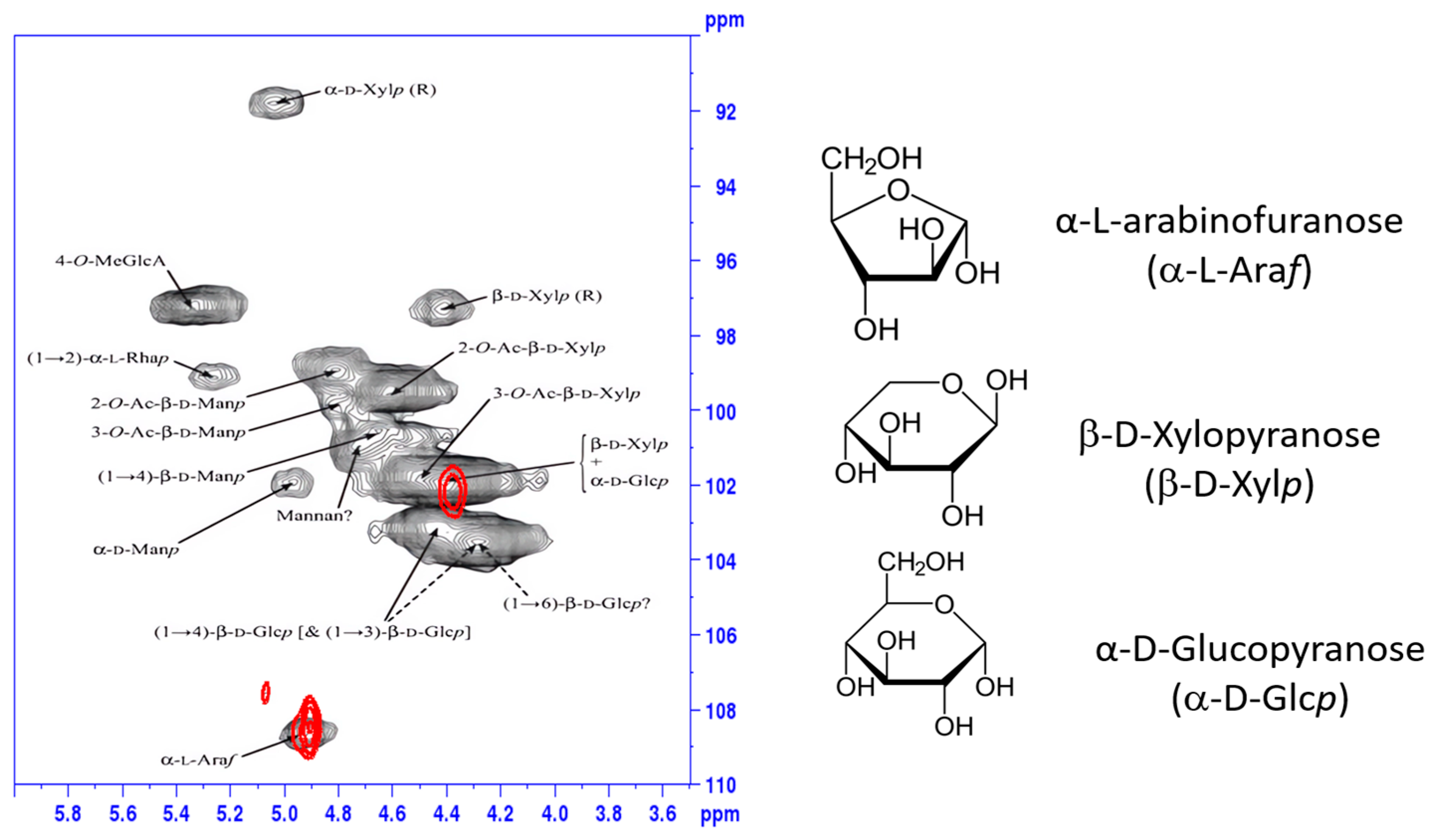
First, the molecular weight of lignin treated under acidic conditions was analyzed by gel permeation chromatography (GPC). The initial kraft lignin exhibited an average molecular weight of 7800 Da. After acid hydrolysis, the molecular weight decreased to 4700 Da, corresponding to a reduction of approximately 40%. This decrease is attributed to the removal of polysaccharide fractions initially linked to lignin through ether bonds, which form lignin–carbohydrate complexes [61,62]. Further characterization by two-dimensional NMR spectroscopy (Figure 1) revealed the presence of structural motifs such as α-L-arabinofuranose (α-L-Araf), β-D-xylopyranose (β-D-Xylp), and α-D-glucopyranose (α-D-Glcp), based on comparison with reported data from Kim et al. [63].
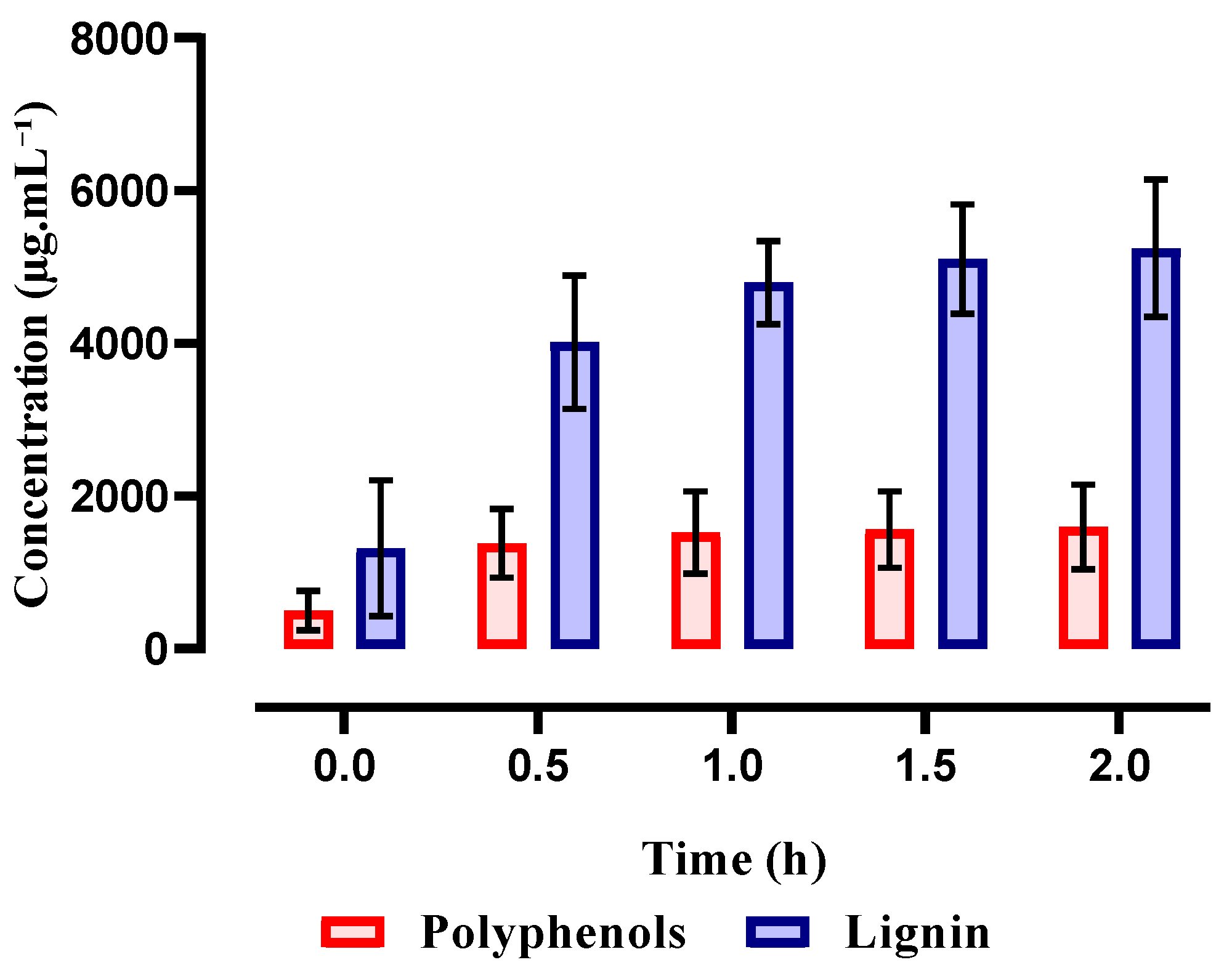
Then, the concentrations of lignin and polyphenols in the supernatant phase were monitored during sonication at acidic pH for 2 h after acid treatment of lignin (Figure 2).
Figure 2 shows that the lignin concentration increased from 1320 µg·mL−1 at t = 0 to 4000 µg·mL−1 at t = 30 min and continued to rise before stabilizing at 5245 µg·mL−1 after 2 h. This corresponds to a lignin solubilization yield of 65 ± 7.9% under these conditions. The increase in lignin concentration reflects improved solubility, even at acidic pH (5.2 after sonication), which is generally unfavorable for lignin dissolution. Regarding polyphenols, a slight increase was observed from 501 µg·mL−1 at t = 0 to 1383 µg·mL−1 at t = 30 min, followed by stabilization at approximately 1500 µg·mL−1 after 2 h. The progressive solubilization of lignin during sonication was accompanied by a proportional increase in phenolic functions, as measured by the Folin–Ciocalteu assay. The lignin-to-polyphenol ratio remained relatively constant (3.2–4.1) over time. If the detected phenolic signal were mainly due to newly released low-molecular-weight degradation products resulting from lignin depolymerization during sonication, a significant change in this ratio would be expected. The observed stability, therefore, suggests that the measured phenolic groups predominantly originate from the soluble lignin fraction rather than from newly formed degradation products. However, since the Folin–Ciocalteu assay is non-specific, this interpretation should be considered within the methodological limitations of the technique. Overall, these results support the hypothesis that the quantified polyphenols mainly correspond to phenolic structures intrinsically associated with lignin and released proportionally as lignin solubilizes.
The improved solubility of lignin can be explained by structural modifications leading to fiber relaxation, as well as by the increased contact surface resulting from the reduction in lignin particle size. Previous studies on the synthesis and characterization of lignin nanoparticles for applications such as biocomposite production have reported an increase in both nanoparticle yield and aqueous solubility during sonication, mainly due to an improved surface-to-volume ratio [58,59]. Accordingly, in the present study, lignin sonication is expected to promote better exposure of hydroxyl groups to the aqueous medium, thereby enhancing lignin solubility.
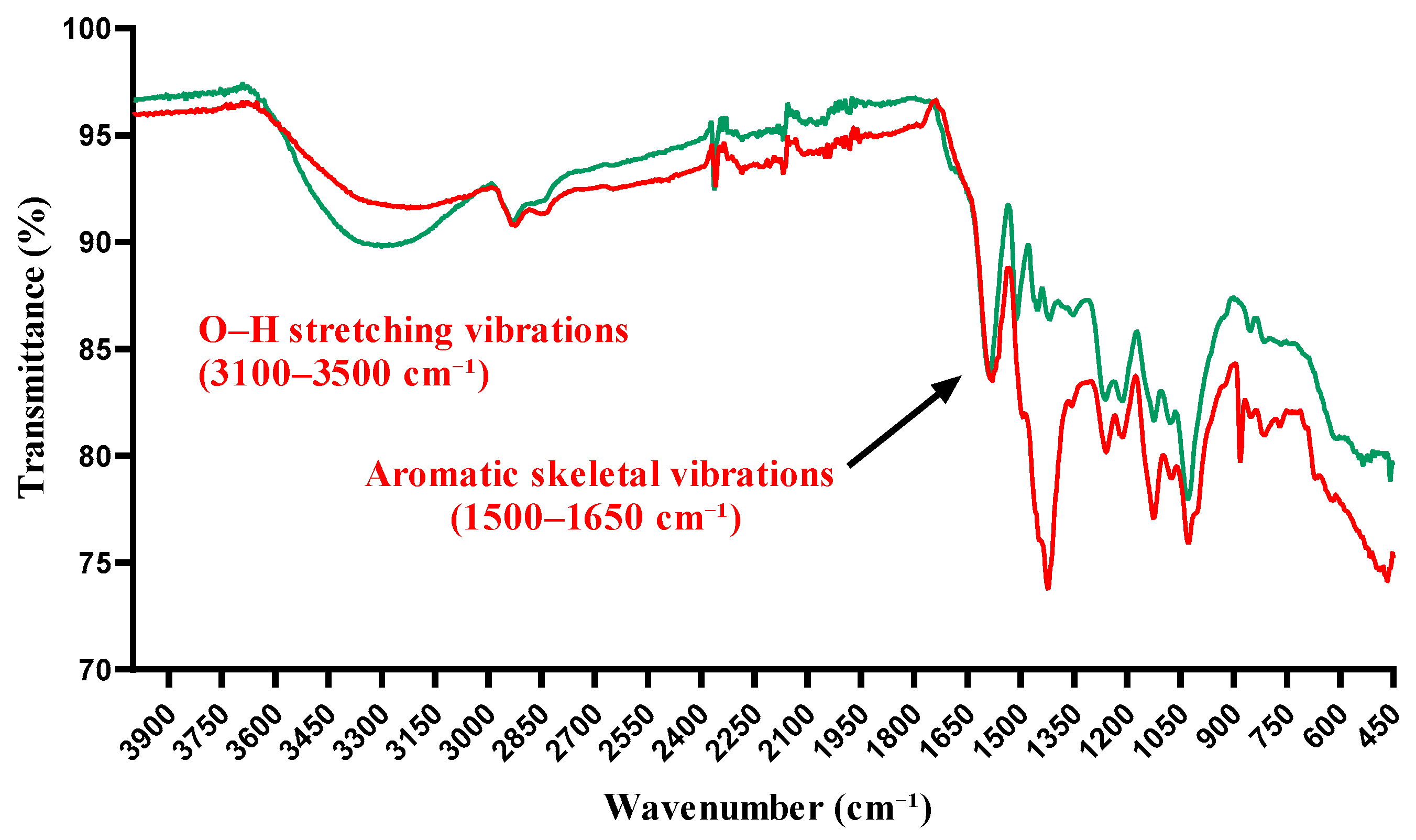
Figure 3 presents the FTIR spectra of lignin at t = 0 (red curve) and after 1 h of sonication (green curve). The band located between 1500 and 1600 cm−1 shows a markedly higher transmittance after sonication, indicating a decrease in absorbance. This band is associated with in-plane deformation of O–H bonds in phenolic and aromatic units, and its attenuation reflects structural rearrangements and a local reduction in aromatic condensation. Conversely, the broad –OH stretching band (3100–3500 cm−1) exhibits a slightly lower transmittance after sonication, indicating a moderate increase in absorbance. This variation suggests modifications in the hydrogen-bonding environment and improved accessibility of hydroxyl groups. Overall, these structural changes, including decreased aromatic interactions and partial relaxation of the lignin matrix, increase the accessibility of polar groups and result in a more open and less condensed structure. This evolution facilitates solvent interactions and is fully consistent with the enhanced lignin solubility observed following sonication.
After 2 h of sonication at pH 4.5 and an ultrasonic power of 400 W, approximately 65% of lignin was solubilized in the aqueous phase, compared with only 15% in the absence of sonication. This substantial increase in solubility is highly relevant to our objective of lignin depolymerization. Consequently, an experimental design approach was implemented to optimize lignin solubility in aqueous media within the pH range of 4.5–5.0.

2.2. Optimization of Lignin Solubility by Experimental Design

Table 1 summarizes the experimental design matrix and the corresponding responses (y1 and y2y2) obtained during sonication optimization. The RSM analysis was performed using responses y1 and y2. The results obtained from the face-centered composite design for responses y1 and y2, corresponding to polyphenol concentration (y1) and lignin concentration (y2), are summarized respectively in Table 2 and Table 3. Data were analyzed using statistical and graphical analysis software Modde 5.0 [64]. This software was employed to perform regression analysis on the results of the 17 experiments and to estimate the regression coefficients (b) of the model equations. Analysis of variance (ANOVA), including quadratic and interaction terms, was applied to evaluate the significance of each model parameter (Equation (3)). The coefficient of determination (R2) represents the proportion of response variability explained by the model, whereas Q2 indicates the predictive ability of the model. The estimated coefficients for linear, quadratic, and interaction effects (b0, bi, bii, bij, Equation (2)) for both responses y1 and y2 are presented in Table 2 and Table 3. These tables also include the number of experiments (N), degrees of freedom (DF), probability values (p-value), adjusted coefficient of determination (R2_adj), and the confidence level (95%).
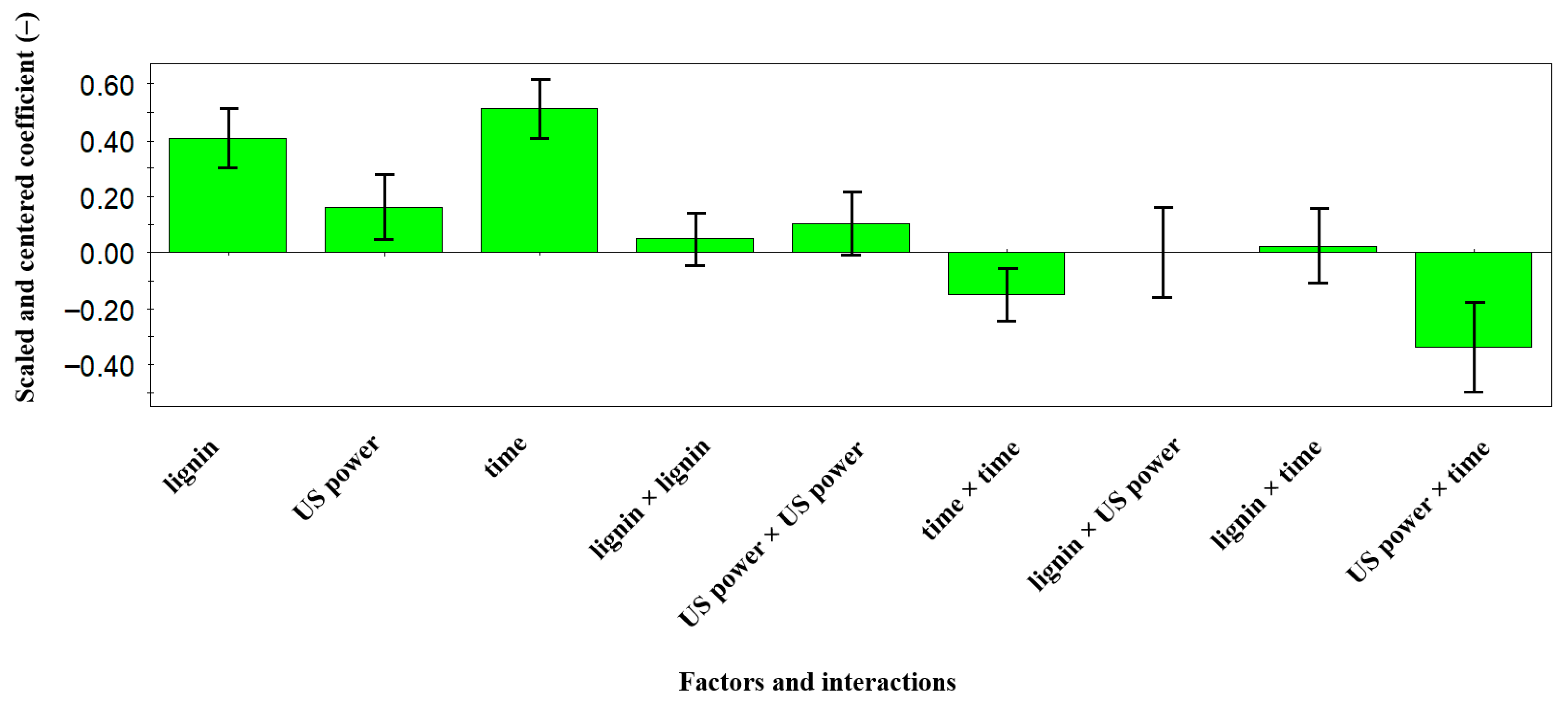
To visualize the influence of each factor on the fitted model, the scaled and centered regression coefficients for response y1 are presented in Figure 4. This graphical representation highlights the relative contributions of the linear, quadratic, and interaction terms.
The plot displays the standardized effects of the linear, quadratic, and interaction terms—lignin concentration, ultrasound (US) power, and sonication time—on response y1. Error bars represent the 95% confidence intervals. Positive values indicate a positive contribution to the response, whereas negative values indicate inhibitory or curvature effects.
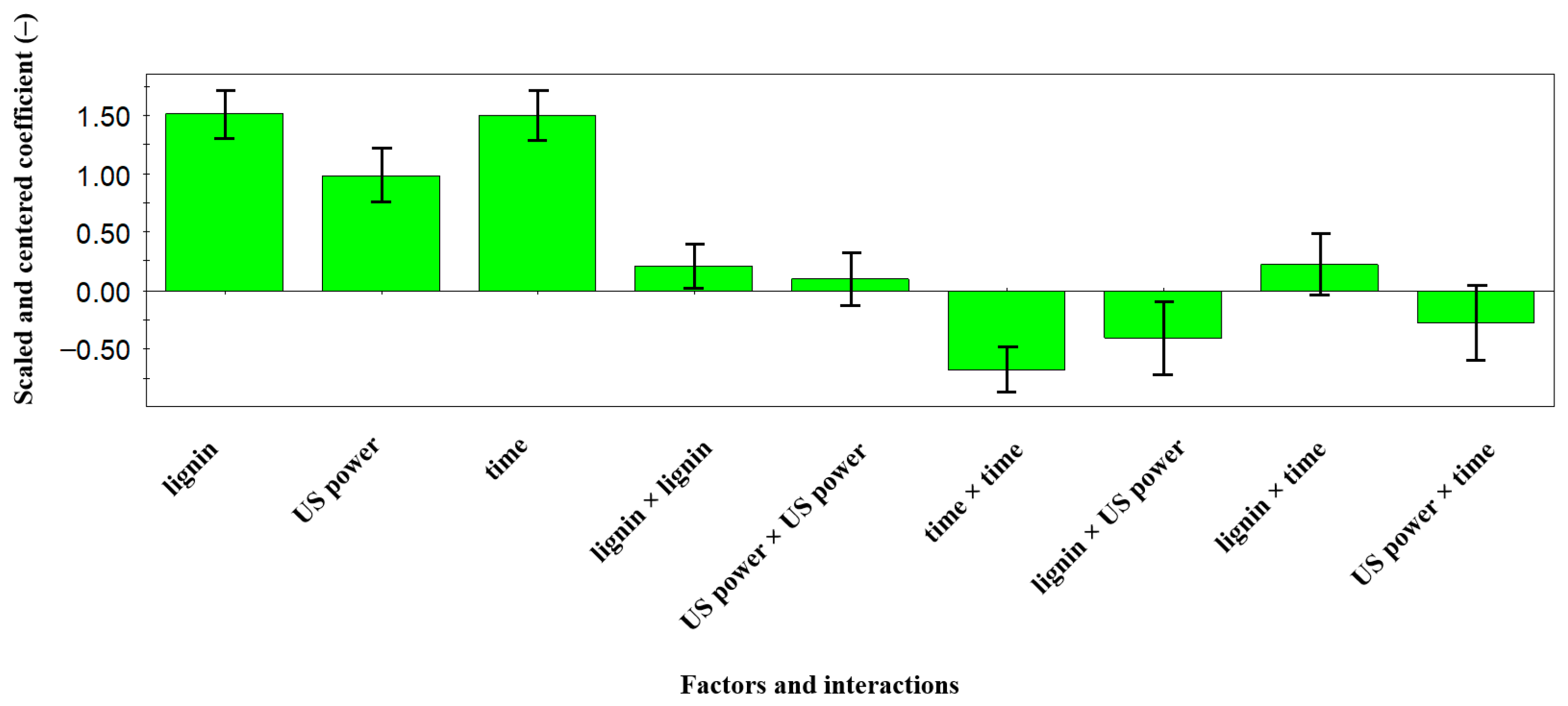
Figure 5 shows the standardized effects for y2, confirming the dominance of the linear terms and the limited contribution of quadratic and interaction effects.
The scaled and centered coefficients for both responses (y1 and y2) are presented in Figure 4 (y1) and Figure 5 (y2). These graphical representations allow direct comparison of the relative influences of the experimental factors. For both responses, the linear effects of lignin concentration, sonication power (US power), and sonication time exhibit the highest standardized coefficients, confirming their dominant influence on the model. The quadratic terms (e.g., time × time and lignin × lignin) show lower but still significant contributions. Overall, these graphical results strongly support the interpretation of the regression model.
The analysis of variance (ANOVA) results for the different mathematical models demonstrate their good performance, as the regression coefficients R2 and Q2 are close to unity (Table 2 and Table 3), indicating that approximately 99% of the response variability is explained by the models. The global ANOVA results (Table 4) show that the fitted second-order polynomial models are statistically significant, with high F-values and associated p-values lower than 0.05 for both response variables y1 and y2. These findings confirm the adequacy of the models to describe the experimental data. Furthermore, the lack-of-fit tests are not significant (p > 0.05), indicating that the models provide an appropriate representation of the experimental domain.
The estimated coefficients of the second-order polynomial models are presented in Table 2 and Table 3. By substituting these coefficients into the general model (Equation (3)), the fitted regression equations for the two response variables, y1 and y2, were obtained as follows:
y 1 =   1.90 + 0.40 X 1 + 0.16 X 2 + 0.51 X 3   +   0.04 X 1 2   +   0.10 X 2   2   0.15 X 3   2 + 0.002 X 1 X 2 + 0.02 X 1 X 3 + 0.33 X 2 X 3
y 2 = 5.23 + 1.50 X 1 + 0.98 X 2 + 1.50 X 3   +   0.21 X 1 2   +   0.01 X 2   2   0.67 X 3   2 + 0.41 X 1 X 2 + 0.22 X 1 X 3 + 0.27 X 2 X 3
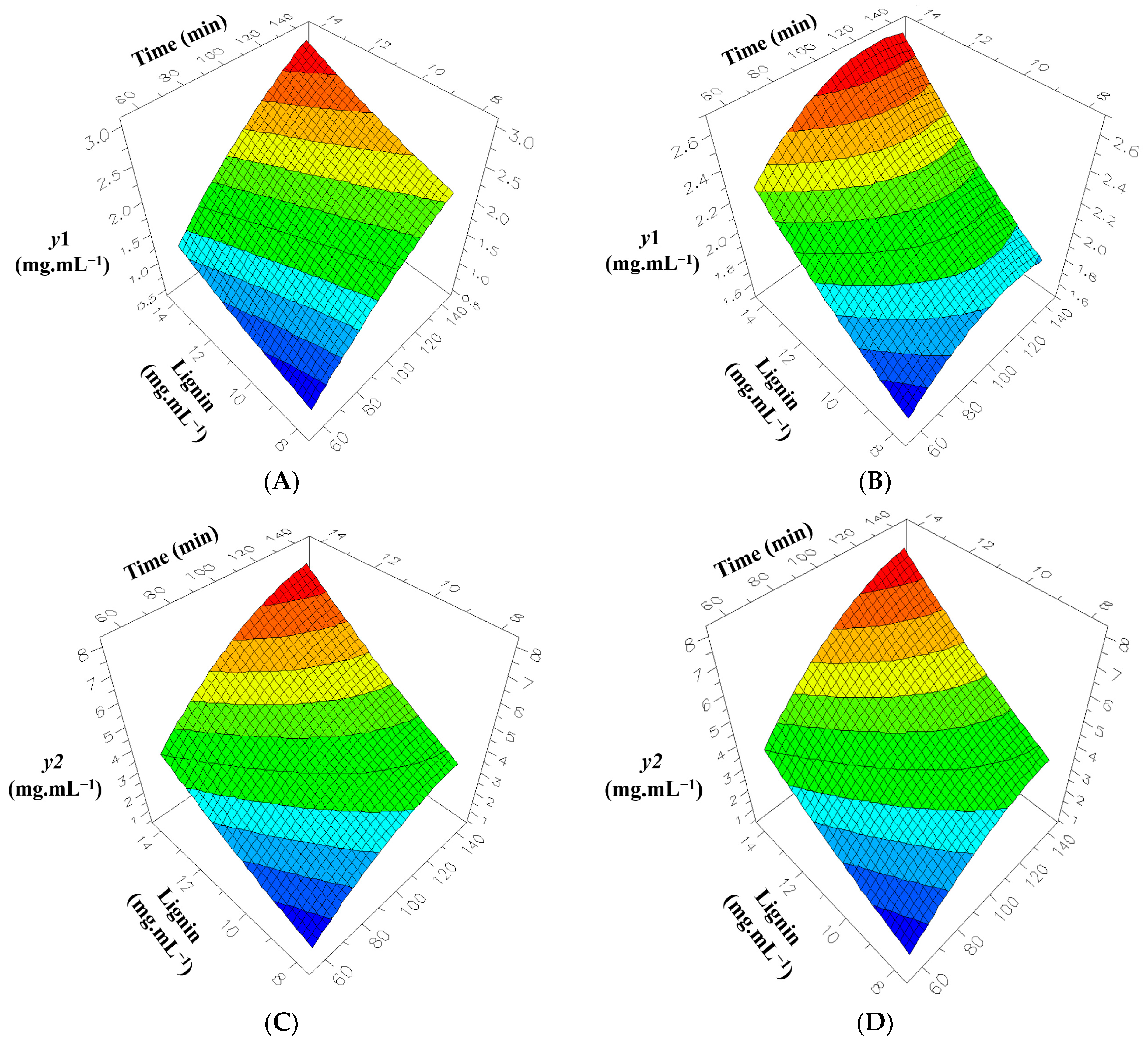
Response surface methodology (RSM), based on the mathematical model (Equation (3)) was applied to relate the measured responses to the sonication process parameters. RSM enables the identification of significant factors, quantification of their relative importance, and determination of the experimental design space in which the process can be operated, monitored, and controlled [59,65]. The corresponding response surface plots are illustrated in Figure 6.
The response surface plots (Figure 6) highlight a significant interaction between lignin concentration and sonication time for both response variables (y1 and y2). Overall, increasing sonication time improves the responses; however, the magnitude of this effect strongly depends on the lignin concentration in the medium.
At low lignin concentrations (0–8 mg·mL−1), increasing sonication time (60–140 min) leads to a marked increase in both y1 and y2 values, as evidenced by the pronounced inclination of the response surfaces and the clear transition from blue to red regions. These observations indicate that sonication is particularly effective at low lignin levels, likely due to improved propagation of ultrasonic waves, more efficient cavitation, and reduced aggregation phenomena.
In contrast, at higher lignin concentrations (10–16 mg·mL−1), the effect of sonication time becomes progressively attenuated. The response surfaces exhibit shallower slopes and more homogeneous color gradients, reflecting reduced sensitivity of y1 and y2 to prolonged sonication. This behavior indicates a diminished marginal gain with increasing treatment time. This attenuation reveals an antagonistic interaction between the two factors, whereby high lignin loading limits sonication efficiency. This effect may be attributed to increased local viscosity, partial damping of ultrasonic wave propagation, restricted mass transfer, or insufficient dispersion of lignin particles within the medium. These results are consistent with those reported in the literature [58,59], although the lignin used in the present study is an industrial lignin obtained from a membrane ultrafiltration process and therefore differs from the lignins investigated in previous works. Consequently, this study contributes to the development of an innovative process for improving lignin solubility through ultrasonic pretreatment. To further enhance lignin solubility prior to depolymerization, pretreatment conditions were optimized based on the RSM results. The selected operating conditions for lignin sonication pretreatment were an ultrasonic power of 340 W and a sonication time of 140 min at a lignin concentration of 14 g.L−1. These findings indicate that high lignin concentration, high ultrasonic power, and prolonged sonication time constitute the optimal conditions for lignin pretreatment by sonication.
In summary, the design of experiments methodology enabled the optimization of lignin sonication conditions toward the targeted optimum.

2.3. Lignin Depolymerization

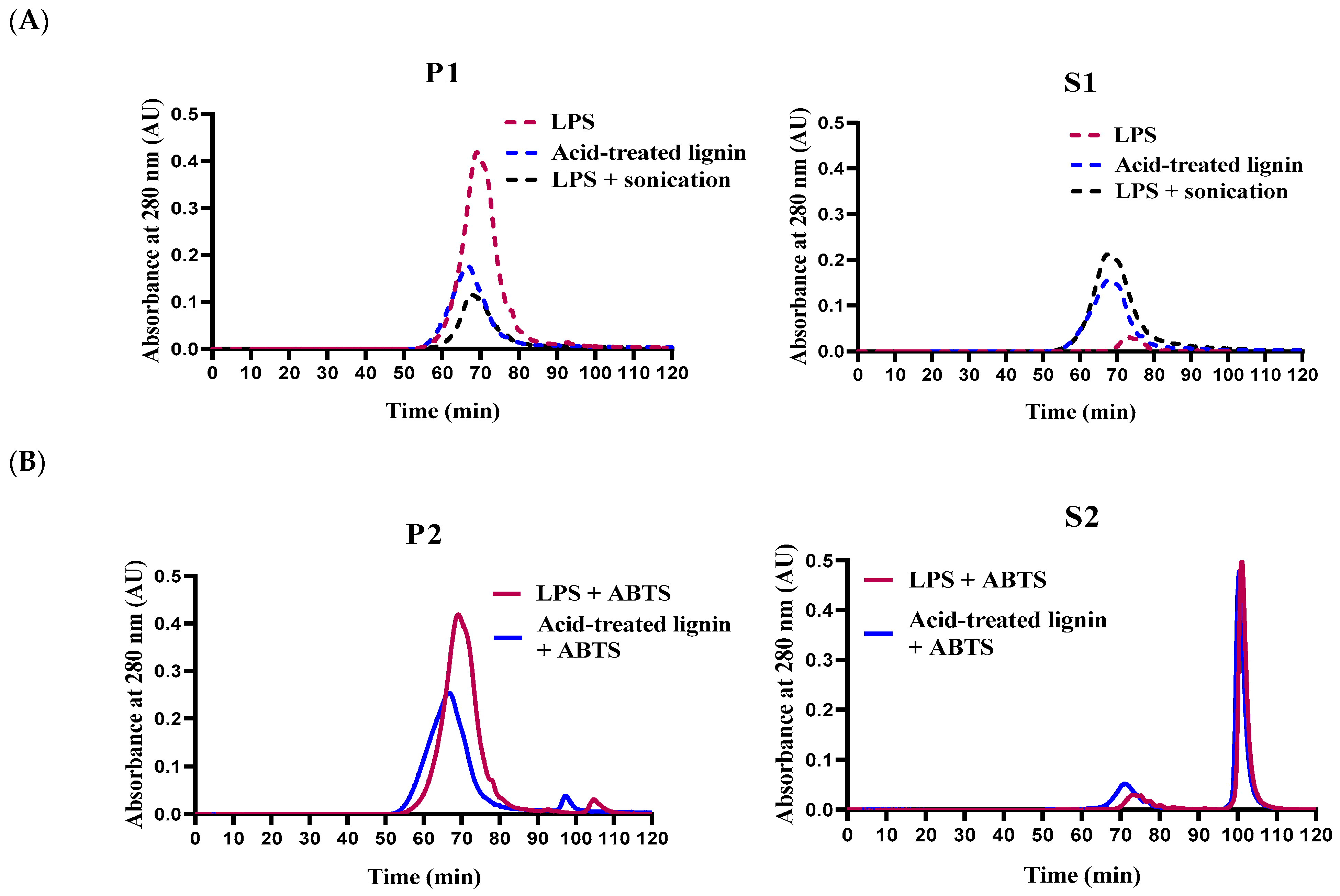
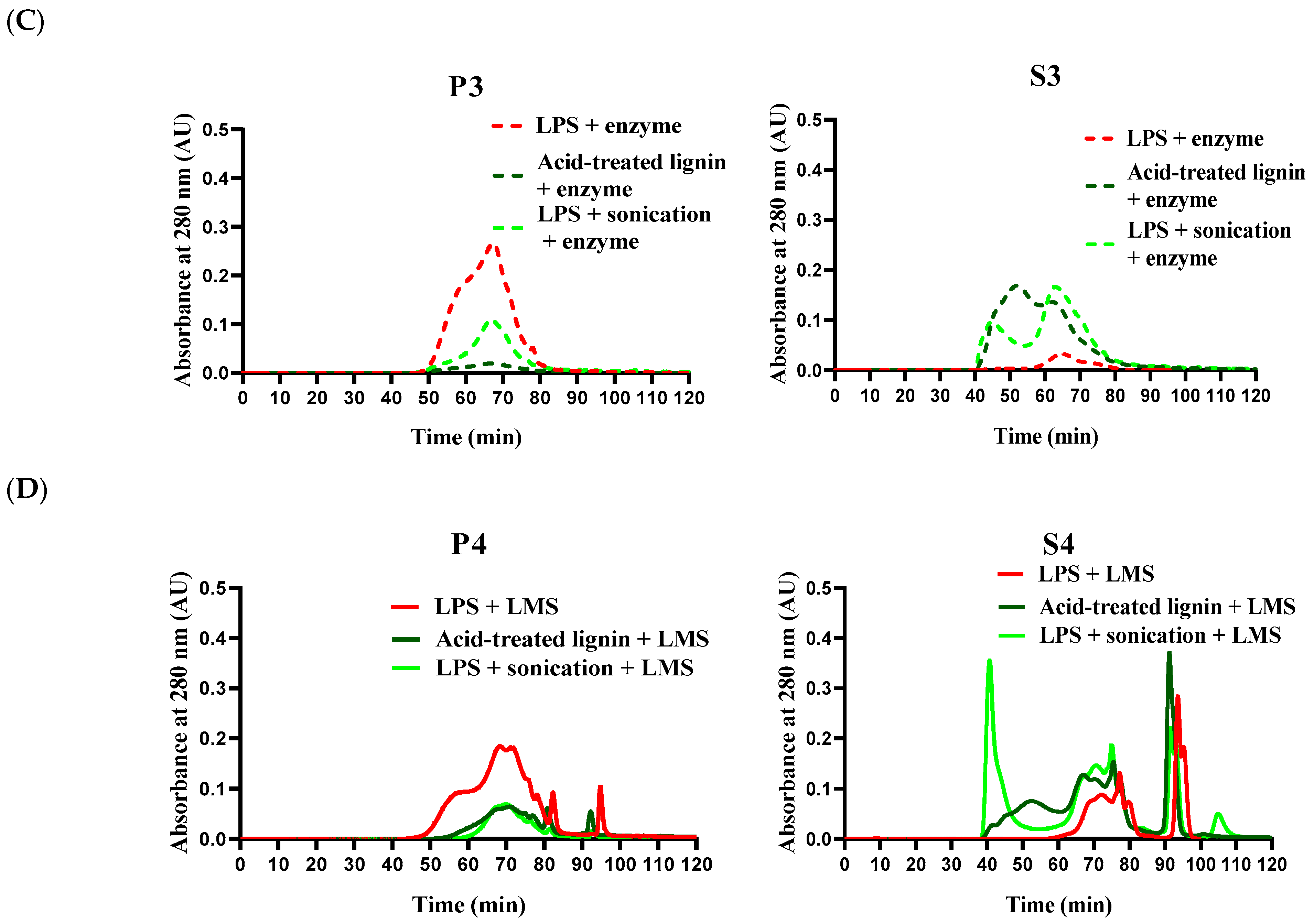
Depolymerization experiments were performed under the conditions described in Section 3.4. Figure 7 presents the GPC chromatograms of the lignin depolymerization products obtained under these different conditions.
Firstly, without LMS implementation, GPC profiles of lignin after acid treatment and LPS + sonication treatments (Figure 7A) show a distribution of lignin between the pellet (Figure 7A, P1) and the supernatant (Figure 7A, S1). In contrast, for untreated LPS, almost all lignin is detected in the pellet fraction. This observation highlights the positive effect of pretreatment methods on lignin solubility. Notably, solubility improvement is more pronounced after sonication, with approximately 70% of lignin recovered in the supernatant and 30% in the pellet, compared with a nearly equal distribution (50–50%) between pellet and supernatant following acid treatment.
In reactions carried out with the different lignin samples and ABTS in the absence of laccase (Figure 7B), no variation in the lignin peak area at 66 min (Figure 7B, P2) was observed, indicating that no reaction occurred without the enzyme. Moreover, under these conditions, ABTS was mainly detected in the supernatant at a retention time of 105 min (Figure 7B, S2).
For reactions performed with Trametes versicolor laccase in the absence of ABTS, the GPC profiles (Figure 7C) show a shift in the lignin peak (initial retention time: RT = 66 min) toward shorter retention times in both the pellet (Figure 7C, P3) and the supernatant (Figure 7C, S3) (shifted to a new RT between 45 and 55 min). This shift indicates lignin condensation, corresponding to the formation of higher-molecular-weight polymers. Furthermore, in the supernatant fraction, the progressive increase in lignin signal intensity (expressed in absorbance units, AU) for LPS (≈0.03 AU), acid-treated lignin (≈0.1 AU), and acid–sonication-treated lignin (≈0.2 AU) highlights the influence of pretreatment methods on the formation of repolymerization products. This effect is directly related to the increased lignin solubility, as previously demonstrated by the experimental design study. Overall, in the absence of the laccase–mediator system (LMS), the reaction between lignin and laccase mainly leads to the formation of condensed products with higher molecular weights.
Finally, reactions performed with the LMS led to the formation of both repolymerization products, detected in the pellet (Figure 7D, P4) and in the supernatant (Figure 7D, S4) at a retention time of approximately 55 min, as well as depolymerization products, also observed in both fractions, with peaks at 78, 82, and 92 min. These results clearly demonstrate the key role of the LMS in promoting lignin depolymerization. However, a competition between lignin condensation and depolymerization reactions was observed, which is related to the intrinsic ability of laccase to catalyze both processes. This phenomenon has been frequently reported in enzymatic lignin depolymerization studies [32,66]. The results also indicate that lignin depolymerization is possible even when lignin remains bound to polysaccharides. However, the influence of polysaccharides on this process still needs to be clarified. Indeed, lignin depolymerization performed on LPS and on acid-treated lignin yields similar profiles. In both cases, repolymerization products are observed at a retention time of 55 min (Figure 7D, S4, dark green), along with depolymerization products detected at 74, 78, 82, and 92 min (Table 4 and Figure 7D, S4, dark green and red). The main difference lies in the distribution of these products: they are predominantly detected in the supernatant (S4, dark green), whereas lignin repolymerization products are mainly localized in the pellet (P4, red) at 55 min. Although the results indicate that LPS does not directly inhibit enzyme activity, we suspect that its presence likely affects substrate accessibility by increasing steric volume around the aromatic units of lignin and β-O-4 bonds. This phenomenon may reduce the effective exposure of certain cleavage sites, potentially influencing which bonds are preferentially depolymerized. At the same time, LPS may modulate solubility and molecular dispersion, indirectly influencing reaction kinetics. Based on the peak areas obtained under the different experimental conditions, Table 5 presents the pellet-to-supernatant ratios of the depolymerization products obtained from LPS and acid-treated lignins.
These data show that most of the lignin repolymerization product Pr1 (RT ≈ 55 min) obtained from LPS is located in the pellet fraction. The pellet-to-supernatant ratio indicates that 86% of product Pr2 (RT ≈ 74 min) is present in the supernatant, while only 14% is detected in the pellet. Products Pr3 (RT ≈ 78 min) and Pr5 (RT ≈ 92 min) are approximately 1.2-fold more abundant in the pellet than in the supernatant, whereas Pr4 (RT ≈ 82 min) is predominantly localized in the pellet. For acid-treated lignin, the depolymerization products, particularly Pr2, Pr3, and Pr5, are more than 90% detected in the supernatant fraction. In contrast, Pr1 (repolymerization product) and Pr4 are mainly localized in the pellet.
The depolymerization results obtained with sonicated lignin demonstrate that ultrasound pretreatment has a significant impact on the reaction products. After sonication, lignin-derived products are mainly detected in the supernatant (Figure 7, S4, light green) and only marginally in the pellet (Figure 7, P4, light green). This behavior contrasts with reactions performed without sonication, where most products are recovered in the pellet fraction (Figure 7, P4, red). These findings suggest that ultrasound pretreatment primarily enhances depolymerization by improving lignin dispersion and solubility, thereby increasing the accessibility of reactive sites such as β-O-4 linkages. Cavitation-induced microjets and shear forces likely promote partial disruption of intermolecular interactions, leading to exposure of structural motifs that are more susceptible to enzymatic cleavage. Although increased solubility may also favor condensation reactions, particularly under conditions where reactive phenoxy radicals accumulate, the ultrasound-induced disaggregation of lignin particles appears to overall promote depolymerization pathways. This effect is attributed to reduced steric hindrance and improved molecular accessibility of lignin chains.

2.4. Scaling of Aromatic Production

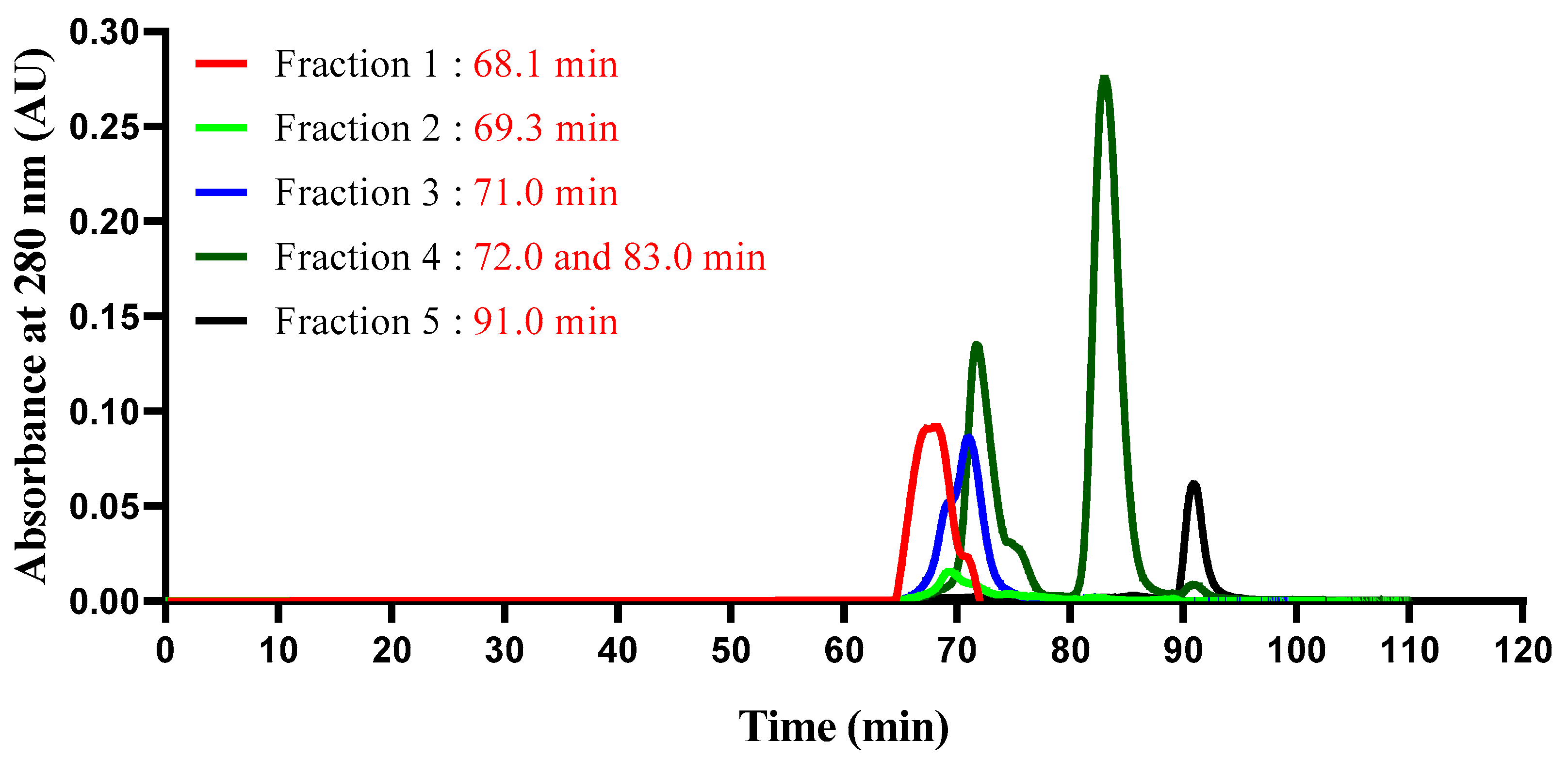
A scale-up of the lignin depolymerization reaction was performed under the previously optimized conditions (lignin 5 mg·mL−1, ABTS 2 mmol·L−1, Trametes versicolor laccase 20 U, 24 h). The resulting depolymerization products were subsequently separated by membrane ultrafiltration using polyethersulfone (PES) membranes with a molecular weight cut-off (MWCO) of 5 kDa. Figure 8 presents the GPC profiles of the lignin depolymerization products obtained after membrane separation. The analytical system was coupled to a UV detector operating at 280 nm. The absorbance detected at this wavelength indicates the presence of conjugated compounds, mainly aromatic structures derived from lignin.
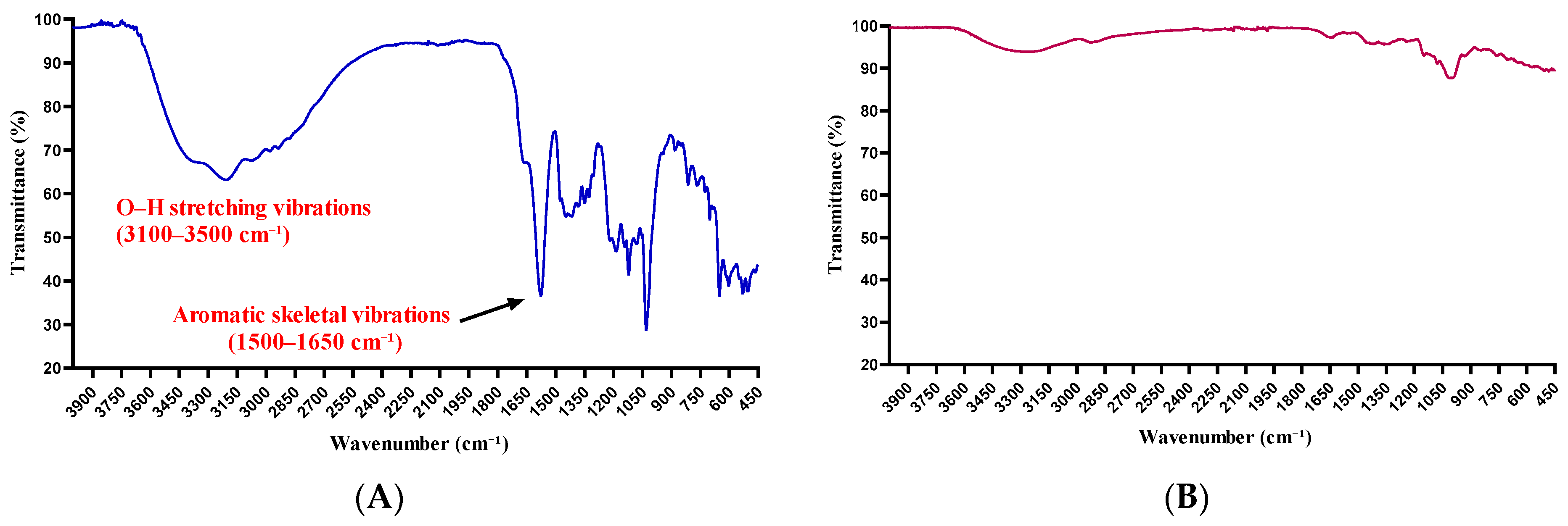
Figure 9 below shows the characterization by FTIR of the permeate, which contains the mixture of the 5 depolymerization products shown in Figure 8. A control with ABTS and laccase was realized in order to determine the different functional groups characterizing the analyzed molecules.
Figure 9A shows two main characteristic peaks. An intense band at 1550 cm−1 corresponds to aromatic functional groups [58,67], while a broad band in the 3100–3500 cm−1 range is attributed to O–H stretching vibrations, likely associated with phenolic groups and alcohols [58,68]. Additional bands assigned to alcohol functions are observed between 1100 and 1200 cm−1, along with a peak at 1050 cm−1 corresponding to C–O bond vibrations [58]. These latter signals are characteristic of phenolic compounds expected from lignin depolymerization. In contrast, Figure 9B shows the absence of aromatic signals and only weak contributions associated with alcohol functional groups. These results confirm that the peaks observed in the GPC profiles of the permeate correspond to lignin depolymerization products.
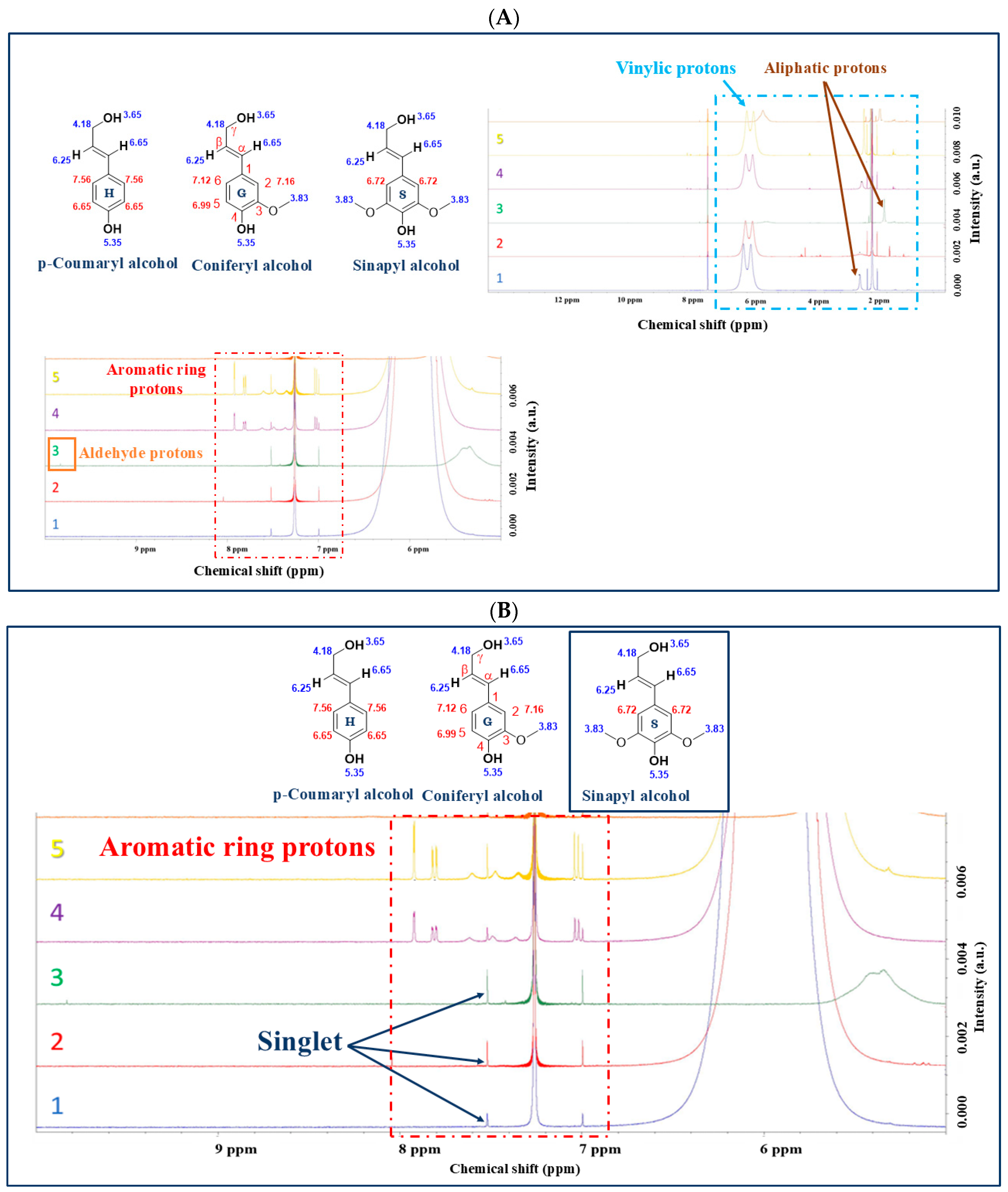
Following characterization by GPC and FTIR, fractions 1 to 5 were further analyzed by proton nuclear magnetic resonance (1H NMR). The NMR measurements were performed in CDCl3. Analysis of the five fractions shown in Figure 10 indicates that the observed signals correspond to compounds bearing phenolic groups and aliphatic polyols. These structural features are fully consistent with motifs typically present in lignin, thereby confirming the FTIR results.
The proton nuclear magnetic resonance (1H NMR) spectra were analyzed and compared with literature data to identify the main characteristic signals associated with lignin-derived structures. The spectra revealed resonances corresponding to aromatic protons, attributed to benzene rings from lignin structural units. Comparison of the observed chemical shifts with reported data for p-hydroxyphenyl (H), guaiacyl (G), and syringyl (S) units indicates that the analyzed samples predominantly contain H- and G-type structural motifs (Figure 10A). Four main regions can be distinguished in the 1H-NMR spectra, namely 1.8–2.2 ppm, signals assigned to aliphatic protons; 3–4 ppm, signals attributed to protons on carbons adjacent to oxygen atoms (e.g., ether linkages); 5–6 ppm, signals corresponding to vinylic (ethylenic) protons; and 7–8 ppm, signals characteristic of aromatic protons, as well as a signal characteristic of the aldehyde function around 10 ppm. These results suggest that the samples contain partially oxidized or modified aromatic compounds, typical of products obtained from lignin depolymerization processes.
For the syringyl (S) units (Figure 10B), the molecule exhibits symmetry along the 1–4 axis due to identical substitutions at positions 3 and 5. Consequently, the aromatic ring protons experience an equivalent chemical environment, resulting in the observation of a singlet in the 1H NMR spectrum.
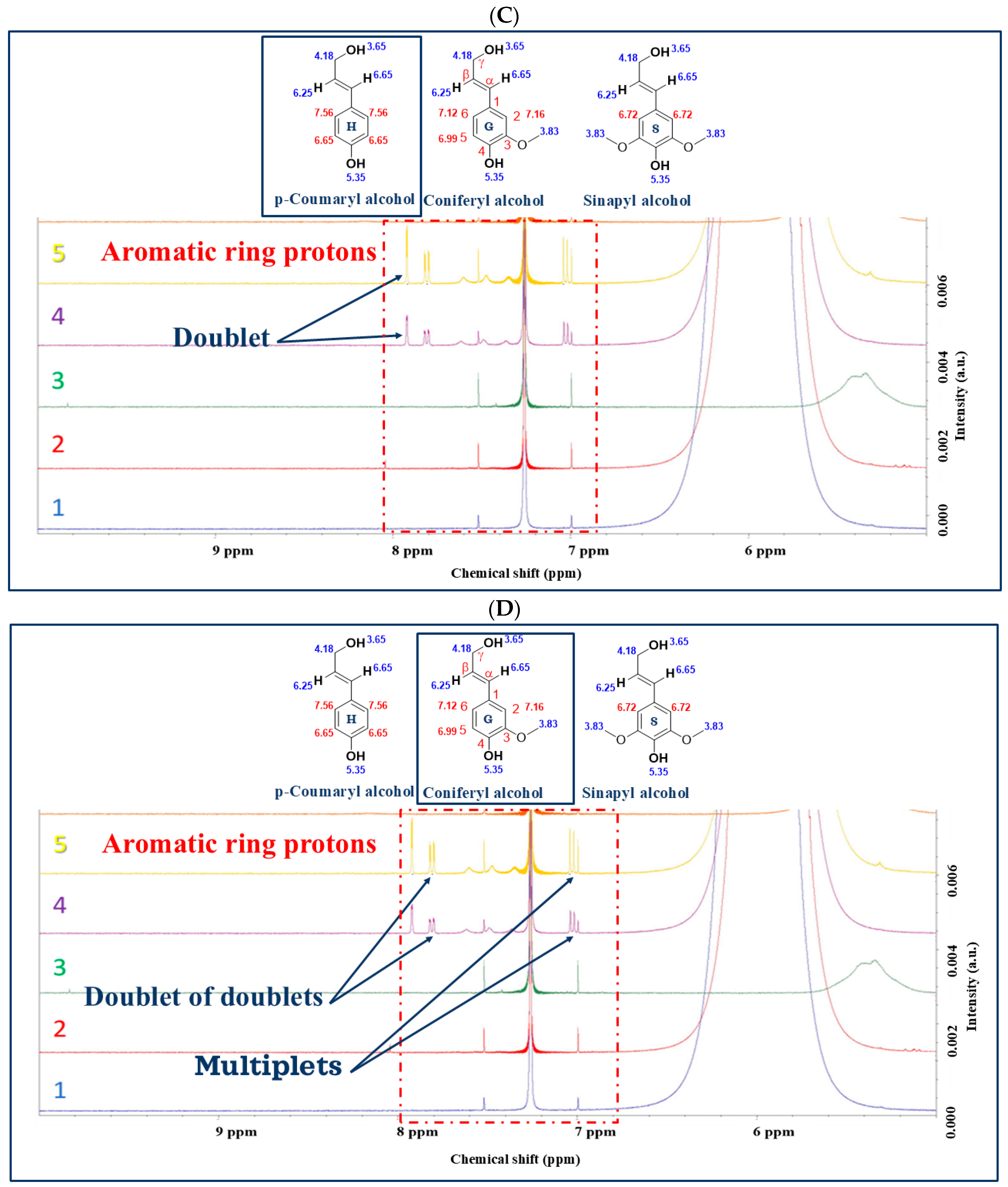
For the p-hydroxyphenyl (H) units (Figure 10C), molecular symmetry is also present. Two distinct types of aromatic protons are observed. Each ortho proton has a different neighboring proton, resulting in a doublet signal in the 1H NMR spectrum.
For the guaiacyl (G) unit (Figure 10D), three different aromatic protons are observed, two of which are adjacent. These two protons, therefore, resonate as doublets. However, each of these doublets is further split due to a smaller 3J coupling constant. In addition, the more distant proton appears as an overlapping doublet with additional splitting, resulting from 3J coupling with the two adjacent protons. This coupling pattern is also reflected by the presence of a multiplet signal.
Furthermore, a “roof effect” is observed between these peaks, confirming that the two signals are indeed coupled.
Although these results alone are not sufficient to fully elucidate the molecular structures of the depolymerization products, they clearly confirm the presence of aromatic moieties in the samples. These observations are consistent with previously reported data for lignin-derived materials and partially depolymerized lignin fractions [69,70,71,72].
Figure 10. 1H NMR spectra of depolymerization products: (A) Global spectra of the 5 samples compared with literature [71]. (B) Focus on S units in the aromatic zone of the 1H NMR spectra. (C) Focus on H units in the aromatic zone of the 1H NMR spectra. (D) Focus on G units in the aromatic zone of the 1H NMR spectra.
Recycling 11 00028 g010aRecycling 11 00028 g010b

3. Materials and Methods

3.1. Reagents

The lignin used in this study was refined by membrane ultrafiltration from black liquor supplied by Fibre Excellence Saint-Gaudens (President Saragat Street, 31,800 Saint-Gaudens, France), an industrial company specialized in pulp and paper production. Laccase from Trametes versicolor was purchased from Sigma-Aldrich (St. Louis, MO, USA). The mediator 2,2′-azino-bis(3-ethylbenzothiazoline-6-sulfonic acid) diammonium salt (ABTS) was also obtained from Sigma-Aldrich (St. Louis, MO, USA). Sodium hydroxide was supplied by VWR Chemicals (Rosny-sous-Bois, France), while acetonitrile and sulfuric acid (96%) were purchased from CARLO ERBA Reagents (Val de Reuil, France).

3.2. Starting Material

3.2.1. Description of the Starting Material

The starting material used in this study was black liquor-derived lignin obtained from an industrial Kraft pulping process (Fibre Excellence Saint-Gaudens, Saint-Gaudens, France). In black liquor, lignin is present in a dissolved form together with inorganic salts, low-molecular-weight degradation products, and residual carbohydrate-derived compounds originating mainly from hemicelluloses. At this stage, lignin may still be associated with polysaccharide fragments and other soluble components, which can influence its physicochemical properties and subsequent reactivity. Therefore, a dedicated preparation procedure was applied prior to depolymerization in order to obtain a lignin substrate with a more controlled composition.

3.2.2. Preparation of the Starting Material

The preparation of the starting material was carried out in order to obtain a lignin fraction with a more controlled composition, suitable for subsequent depolymerization experiments. This preparation includes a recovery and concentration step by membrane ultrafiltration. However, since the lignin obtained from this process may still contain polysaccharides associated with its structure, it was considered relevant to use a polysaccharide-free reference lignin for comparison purposes. To this end, an acid treatment was applied directly to the black liquor, allowing the recovery of a lignin free of polysaccharides, which was used as a reference material throughout the study.
Membrane Ultrafiltration Recovery
The black liquor containing dissolved lignin was subjected to a membrane ultrafiltration step in order to concentrate the lignin fraction and remove part of the inorganic salts and low-molecular-weight soluble compounds. A volume of 400 mL of black liquor was filtered through a 5 kDa polyethersulfone (PES) membrane under a pressure of 2 bar using a 400 mL Amicon® stirred cell from Merck (Darmstadt, Germany). This step allowed enrichment of the retentate stream in lignin while simplifying the chemical matrix prior to subsequent treatments. The lignin obtained after this step is referred to as lignin–polysaccharide material (LPS) throughout this manuscript.
The ultrafiltration-based lignin recovery process has been investigated in detail and will be reported in a separate forthcoming publication.
Treatment of Lignin in Acid Medium
An acid precipitation step was carried out directly on the black liquor. Although acid precipitation is commonly used for lignin recovery from black liquor, in the present study, it was primarily applied to reduce residual polysaccharide content prior to depolymerization. This protocol is inspired by the LignoBoost process [73,74]. The reaction was performed using 100 mL of black liquor containing 25 mg·mL−1 lignin in order to remove the polysaccharide fraction bound to lignin. The lignin-containing black liquor was treated with sulfuric acid (final concentration: 2 mol.L−1) at 150 °C for 2 h under continuous stirring. Under these conditions, lignin precipitation was observed. After 2 h, the mixture was cooled to room temperature and centrifuged at 4000 rpm for 10 min. The resulting lignin-containing pellet was recovered and washed twice with 120 mL of distilled water. After washing, the pellet was redissolved in a 2.5 mol.L−1 NaOH solution. Lignin from this solution was then separated by membrane ultrafiltration using polyethersulfone (PES) membranes with molecular weight cut-offs (MWCO) of 10 kDa and 5 kDa. The objective of the ultrafiltration step was to purify the solubilized lignin fraction by removing low-molecular-weight compounds and residual traces of polysaccharides, while selecting an appropriate MWCO to ensure efficient lignin retention. The fraction used in the depolymerization experiments corresponds to the retentate obtained with the 5 kDa PES membrane, which consists essentially of lignin. This purified lignin fraction was employed as the starting material in the depolymerization experiments involving acid-pretreated lignin, which served as one of the reaction controls. Finally, the molecular weight of lignin was determined by gel permeation chromatography (GPC) in order to monitor changes induced by the pretreatment. The lignin obtained after this step is referred to as “acid-pretreated lignin” throughout the manuscript.

3.3. Ultrasonic Lignin Pretreatment

Sonication of the lignin was carried out on lignin–polysaccharide material (LPS) obtained by membrane ultrafiltration using the SinapTec® ultrasonic homogenizer (Lezennes, France) [75]. 0.4 L of lignin stock solution was prepared, with a final concentration of 8 mg·mL−1 at pH 4.5. This pH was selected based on the optimal pH of laccase from Trametes versicolor used for depolymerization, as this enzyme exhibits maximal activity in the pH range 4–5. Sonication was carried out for 2 h at an ultrasound power of 400 W and at temperatures between 60 and 75 °C due to cavitation heating. 2 mL were sampled every 30 min. Lignin concentration and molecular weight were, respectively, determined by high-performance liquid chromatography (HPLC) and gel permeation chromatography (GPC), respectively. Polyphenol content was quantified using the Folin–Ciocalteu colorimetric assay, which measures total reducing phenolic functions. As this assay is not specific to individual phenolic compounds or to native versus degradation-derived phenolics, results are interpreted as an indirect indicator of the total phenolic groups present in solution [75]. After sonication, the samples were centrifuged for 10 min at 13,400 rpm. The pellet was then separated from the supernatant, and only the supernatant containing the soluble lignin fraction and possibly polyphenols was analyzed. Each experiment was carried out twice to confirm the results. The lignin obtained after this step is referred to as LPS + sonication throughout the manuscript.

Experimental Design

An experimental design approach was applied to screen and determine the optimal conditions for lignin sonication. Several experimental design models can be employed, including factorial designs, central composite designs, and Doehlert designs [76,77]. Factorial designs are useful for evaluating main effects as well as interactions between selected factors. However, central composite designs allow the establishment of a mathematical model to predict optimal conditions using fewer experimental runs, thereby reducing experimental costs. In this study, a face-centered composite design was selected [78,79] in order to determine the optimal experimental conditions for lignin sonication. This experimental design includes a full factorial design 2k, where 2k experiments are required to cover all possible combinations of factor levels (the low and high levels are coded Xi = −1 and Xi = +1, respectively), and axial points (or star points) are placed on the axis of each factor in order to encircle the experimental domain. The star distance α between the axial points and the center of the domain is given by the following relation:
a =   [ n f ] 0.25
nf represents the number of points of the full factorial design and is equal to 2k. The central point is repeated and used to estimate the experimental error.
The relationship between the coded and natural scales is given as follows:
U i =   U i 0 + Δ   U i · X i
U i represents the original variable, U i 0 is the midpoint of the original interval, X i is the coded variable, and Δ   U i stands for the interval of origin range.
The central composite experimental design is represented by a mathematical model obtained by linear regression and calculated using a second-order polynomial function according to the following form:
y =   b 0 + i b i X i +   i b i i X i 2 +   i b i j X i X j +   ε
y is the matrix of the answers, b 0 is the constant value, b i is the coefficient effect of the factor i, b i j is the coefficient of interaction between factor I and factor j, and ε represents an experimental error.
Coefficients b 0 , b i , b i i , and b i j are determined by matrix algebra according to the following relation:
b =   ( X t ·   X   ) 1   ·   X t   ·   y
X is the experiment matrix in coded variables, and X t is the transposed experiment matrix.
Modde 5.0 [64] software was used to estimate the regression coefficients b .
The aim of this study was to determine the optimal conditions for lignin sonication. Three factors (k = 3) at two levels were defined (Table 6) and a face-centered composite design was selected (Table 7). The investigated process variables were lignin concentration in solution (mg·mL−1), ultrasonic power (W), and sonication time (min).
The ranges of these parameters were established from preliminary experiments performed on a lignin solution (8 mg·mL−1) subjected to ultrasonic pretreatment for 2 h at 400 W, corresponding to the maximum output of the device. These tests enabled us to identify operational conditions that promoted efficient lignin dispersion and detectable structural alterations. The resulting baseline served as the reference framework for selecting the concentration, power, and sonication time ranges evaluated in the present work.
Determination of polyphenols by the Folin–Ciocalteu assay [75] and lignin by HPLC represented the two responses to the experimental design.
Response surface methodology (RSM) was carried out to assess the impact of each parameter on the sonication process and, consequently, on the improvement in lignin solubility.

3.4. Lignin Depolymerization

A laccase–mediator system (LMS) using ABTS as a mediator was employed for lignin depolymerization [32,80,81]. Experiments were conducted in a total reaction volume of 1.5 mL. Depolymerization reactions were performed on different lignin fractions, namely lignin still bound to polysaccharides (LPS), acid-treated lignin, and LPS subjected to sonication. Sonicated lignin (LPS + sonication) was used as the main substrate, while LPS and acid-treated lignin served as control samples to evaluate the specific influence of each lignin fraction on the reaction. The reaction mixture contained 5 mg·mL−1 lignin, 5 mM ABTS, and 10 U laccase from Trametes versicolor. Several reaction controls were realized. The first was lignin 5 mg·mL−1 and ABTS 5 mmol·L−1, the second lignin 5 mg·mL−1 with Trametes versicolor laccase 10 U, and the last lignin 5 mg·mL−1. All reactions were carried out for 24 h at pH 4.5–5.0 and 40 °C with orbital shaking at 400 rpm using a mixing block (BIOER®, Schönwalde-Glien, Germany). Reactions were stopped by heating at 90 °C for 10 min, followed by cooling in an ice bath for 10 min. The reaction media appeared turbid due to the low solubility of lignin under these conditions. Samples were centrifuged at 13,400 rpm for 10 min to separate the pellet and supernatant fractions. The lignin-containing pellet was resolubilized in a 2.5 mol.L−1 NaOH solution. Both pellet and supernatant fractions were analyzed by GPC. This depolymerization protocol was carried out as a preliminary small-scale study to evaluate the effects of sonication and enzymatic treatment on lignin. The selected conditions served as the basis for the larger-scale experiments described in Section 3.5.

3.5. Separation of Lignin Depolymerization Products by Ultrafiltration

Membrane ultrafiltration was used for the separation of depolymerization products as described in the literature [82]. The reaction presented in this section corresponds to the main reaction using lignin after sonication (LPS + sonication), carried out at a larger scale. The experimental conditions were adjusted based on the preliminary results in Section 3.4. In particular, the ABTS concentration was reduced in order to limit the high consumption of mediator during large-scale trials, while maintaining sufficient catalytic efficiency. This adjustment stems from an experimental compromise necessary to ensure the reproducibility and feasibility of repeated reactions. First, depolymerization of sonicated lignin (LPS + sonication) was carried out in a 500 mL “batch” reactor in order to obtain a sufficient amount of products for subsequent separation. Except for the reaction volume (300 mL) and ABTS concentration (2 mmol·L−1), which were reduced to limit excessive reagent consumption, all other experimental parameters (pH, temperature, stirring speed, and reaction time) were identical to those described in Section 3.4. At the end of the reaction, the products were separated by membrane ultrafiltration using the same protocol applied for lignin recovery, as described in the section entitled ‘Membrane Ultrafiltration Recovery’. This 5 kDa MWCO was selected based on early work on lignin purification by membrane ultrafiltration, according to the expected molecular weight range of the smallest depolymerization products, which mainly comprise monomers and very small oligomers generated after fragmentation of β-O-4 bonds and other labile bonds, as well as on the work of Steinmetz et al. [82]. The use of a very low MWCO (5 kDa) ensures the retention of residual lignin and lignin repolymerization products.
The stirring speed was 300 rpm and the pressure 2 bar [83]. After separation, the products were recovered in the permeate and the residual lignin in the retentate.

3.6. Characterization of Depolymerization Product

3.6.1. High-Performance Liquid Chromatography (HPLC)

A gradient elution was performed using acetonitrile and water, each containing 0.1% trifluoroacetic acid (TFA) as solvents and a Kinetex 2.6 µm C8 100 Å, 150 × 4.6 mm LC column.

3.6.2. Gel Permeation Chromatography (GPC)

The molecular weight distribution of lignin and depolymerization products was determined by gel permeation chromatography (GPC). Four TSKgel columns connected in series and adapted for exclusion chromatography were used on a Waters HPLC system. The HPLC/GPC system was equipped with a degasser, a pump, an autosampler, and a UV detector operating at 280 nm. The columns employed were TSKgel 5000, TSKgel 3000, TSKgel 4000, and TSKgel Oligo PW (Tosoh Biosciences, Griesheim, Germany). These columns were selected for their ability to separate compounds over a wide molecular weight range. The mobile phase consisted of 0.2 M NaOH and 20% (v/v) acetonitrile. Elution was performed at a flow rate of 0.5 mL.min−1 at room temperature [32]. Sulfonated polystyrene standards with molecular weights of 1000, 4000, 10,000, 30,000, and 140,000 Da (Polymer Standards) from Agilent (Santa Clara, CA, USA) were used to calibrate the columns and construct the calibration curve required for molecular weight determination. A volume of 20 µL of each sample was injected using the autosampler. Each chromatographic run lasted 140 min. For each chromatogram, the elution volumes (Vₑ) were calculated from retention times to plot the calibration curve log(MW) = f(Vₑ), which was subsequently used to determine the molecular weights of the analyzed samples.

3.6.3. Fourier Transform Infrared Spectroscopy (FTIR)

Fourier transform infrared (FTIR) spectroscopy analyses were performed on dried samples using a JASCO FT/IR-4600 spectrometer (Shimadzu, Noisiel, France). Infrared spectra were recorded with Spectra Manager II software (Spectra Manager) in the 4000–400 cm−1 wavenumber range, with 32 accumulated scans.

3.6.4. Nuclear Magnetic Resonance (NMR) Spectroscopy

Characterization of Oses Found in Lignin
Approximately 35 mg of lignin were dissolved in 0.480 mL of DMSO-d6 and 0.120 mL of pyridine-d5, followed by sonication for 10 min prior to analysis. For quantitative purposes, a precisely weighed amount (between 1 and 4 mg) of 2500 Da polystyrene was added as an internal standard before sonication. NMR spectra were recorded at 298 K using a Bruker AVANCE NEO 400 spectrometer operating at a magnetic field strength of 9.4 T (400 MHz for 1H nuclei and 100 MHz for 13C nuclei). The instrument was equipped with a 5 mm BBFO SmartProbe (1H/19F/31P-109Ag) and an automatic sample loading system. Chemical shifts are reported in parts per million (ppm, δ) and were referenced to appropriate internal standards or residual solvent signals.
The HSQC experiment was performed using an adiabatic Bruker pulse sequence (hsqcetgspsisp.2). Spectra were acquired in the F2 dimension (1H) over a chemical shift range of 0–10 ppm using 1000 data points, with an acquisition time (AQ) of 100 ms and an interscan delay (D1) of 500 ms. In the F1 dimension (13C), spectra were recorded over a range of 0–200 ppm using 320 increments with 100 scans per increment, resulting in a total acquisition time of 5 h 34 min.
Characterization of Lignin Depolymerization Products
The NMR analysis was performed as follows. Approximately 22 mg of dried extract was weighed and dissolved in 600 µL of deuterated chloroform (CDCl3), followed by vortex mixing. The resulting supernatant was transferred into a standard 5 mm NMR tube, yielding a clear, colorless solution. Spectra were recorded using a Bruker AVANCE NEO 400 NMR spectrometer (Ettlingen, Germany) equipped with a 5 mm TBI probe. A 1H NMR spectrum was acquired for each sample. All measurements were carried out at 293 K (20 °C). Data processing and analysis were performed using TopSpin 4.5.0 software.

4. Conclusions

In this study, we demonstrated that sonication-assisted treatment combined with laccase–mediator system (laccase from Trametes versicolor) enables an effective depolymerization of Kraft lignin. The application of response surface methodology allowed us to identify the optimal conditions for enhancing lignin solubility through sonication, a key parameter for facilitating its depolymerization. The results showed that sonication efficiency increased with higher lignin concentrations and longer treatment durations. The best response was obtained at an initial lignin concentration of 14 mg·mL−1, a sonication time of 140 min, and an ultrasonic power of 340 W, leading to a solubilization rate of approximately 65%.
The depolymerization reaction revealed a competition between depolymerization and repolymerization mechanisms. However, characterization by GPC, FTIR, and proton NMR confirmed the formation of products resulting from the cleavage of lignin structures. The GPC profiles showed a distribution of peaks corresponding to low-molecular-weight species that are depolymerization products. FTIR analysis of the mixture of these fractions revealed absorption bands around 1550 cm−1 and between 3000 and 3450 cm−1, attributed respectively to aromatic ring vibrations and phenolic alcohols, as expected for lignin depolymerization. In particular, the 1H NMR analysis of the GPC-collected fractions showed signals with chemical shifts consistent with those of the H, G, and S units typically found in lignin. Altogether, these observations provide clear evidence of effective lignin depolymerization under the investigated conditions. Moreover, it is important to note that the precise quantification of depolymerization products remains a major limitation of this work and represents an essential perspective for future studies.
To counter the competition between depolymerization and repolymerization, the identified solution is to couple depolymerization with an in situ separation of the products. Coupling the reaction with continuous removal of low-molecular-weight products could help prevent recondensation by reducing the residence time of reactive intermediates in the reaction medium. In addition, optimizing the conditions of the LMS through design of experiments, such as mediator, lignin, and enzyme concentrations, reaction time, and temperature, could further reduce condensation reactions and promote selective cleavage of β-O-4 bonds. The aromatic compounds generated through lignin depolymerization may offer several potential applications. In the short term, we plan to evaluate their antioxidant and antimicrobial activities, which represent particularly promising valorization pathways for phenolic-rich fractions. In the longer term, additional applications may also be considered, including their use as platform molecules for the synthesis of bio-based polymers, as precursors for resin formulation, or as intermediates for the production of higher-value fine chemicals.

Author Contributions

F.T.: Conceptualization; data curation; formal analysis; investigation; methodology; supervision; validation; visualization; writing—original draft. X.T.: Data curation; formal analysis; investigation; methodology. S.M.: Data curation; formal analysis; investigation; methodology. L.F.: Funding acquisition; project administration; resources; supervision; writing—review and editing. M.B.: Methodology; resources; supervision; writing—review and editing. R.F.: Conceptualization; investigation; methodology; funding acquisition; project administration; resources; supervision; writing—review and editing. All authors have read and agreed to the published version of the manuscript.

Funding

This research was funded by the French National Research Agency, BioLiDe project [ANR-21-CE43-0014-01].

Data Availability Statement

The original contributions presented in this study are included in the article. Further inquiries can be directed to the corresponding author.

Acknowledgments

The authors are grateful for the financial support from the French National Research Agency in the framework of the BIOLIDE project [ANR-21-CE43-0014-01]. The authors also thank the company Fibre Excellence Saint Gaudens (France) for their supply of black liquor and kraft lignin. CPER BIHautEcodeFrance, Ministère de l’Enseignement Supérieur, de la Recherche et de l’Innovation, and FEDER are acknowledged for partially supporting and funding this work. A CC-BY public copyright license has been applied by the authors to the present document and will be applied to all subsequent versions up to the Author Accepted Manuscript arising from this submission, in accordance with the grant’s open access conditions.

Conflicts of Interest

The authors declare no conflicts of interest.

Abbreviations

The following abbreviations are used in this manuscript:
LPSLignin still bound to polysaccharides
GPCGel permeation chromatography
HPLCHigh-performance liquid chromatography
FTIRFourier transform infrared spectroscopy
LMSLaccase–mediator system
ABTS2,2′-Azino-bis(3-ethylbenzothiazoline-6-sulfonic acid)
RSMResponse surface methodology
USUltrasound
AUsAbsorbance units

References

  1. Luterbacher, J.S.; Alonso, D.M.; Dumesic, J.A. Targeted chemical upgrading of lignocellulosic biomass to platform molecules. Green Chem. 2014, 16, 4816–4838. [Google Scholar] [CrossRef]
  2. Upton, B.M.; Kasko, A.M. Strategies for the Conversion of Lignin to High-Value Polymeric Materials: Review and Perspective. Chem. Rev. 2015, 116, 2275–2306. [Google Scholar] [CrossRef]
  3. Libretti, C.; Correa, L.S.; Meier, M.A.R. From waste to resource: Advancements in sustainable lignin modification. Green Chem. 2024, 26, 4358–4386. [Google Scholar] [CrossRef]
  4. Wang, H.; Meng, H.; Olowoyo, J.O.; Zeng, Y.; Zheng, Y. Advancements in Lignin Valorization for Energy Storage Applications: Sustainable Technologies for Lignin Extraction and Hydrothermal Carbonization. Nanomaterials 2025, 15, 309. [Google Scholar] [CrossRef]
  5. Nguyen, L.T.; Phan, D.-P.; Sarwar, A.; Tran, M.H.; Lee, O.K.; Lee, E.Y. Valorization of industrial lignin to value-added chemicals by chemical depolymerization and biological conversion. Ind. Crops Prod. 2021, 161, 113219. [Google Scholar] [CrossRef]
  6. Gan, M.J.; Niu, Y.Q.; Qu, X.J.; Zhou, C.H. Lignin to value-added chemicals and advanced materials: Extraction, degradation, and functionalization. Green Chem. 2022, 24, 7705–7750. [Google Scholar] [CrossRef]
  7. Mandlekar, N.; Cayla, A.; Rault, F.; Giraud, S.; Salaün, F.; Malucelli, G.; Guan, J.-P.; Mandlekar, N.; Cayla, A.; Rault, F.; et al. An Overview on the Use of Lignin and Its Derivatives in Fire Retardant Polymer Systems. In Lignin-Trends and Applications; IntechOpen: London, UK, 2018. [Google Scholar] [CrossRef]
  8. Zevallos Torres, L.A.; Lorenci Woiciechowski, A.; Andrade Tanobe, V.O.D.; Karp, S.G.; Guimarães Lorenci, L.C.; Faulds, C.; Soccol, C.R. Lignin as a potential source of high-added value compounds: A review. J. Clean. Prod. 2020, 263, 121499. [Google Scholar] [CrossRef]
  9. Brenes, R.; Alhadeff, E.; Bojorge, N.; Trales, L.; Pazos, G. BTX production by breaking down lignin: Current status and future prospects. Biofuels Bioprod. Biorefin. 2022, 17, 664–681. [Google Scholar] [CrossRef]
  10. Jiju, P.S.; Patel, A.K.; Shruthy, N.S.; Shalu, S.; Dong, C.-D.; Singhania, R.R. Sustainability through lignin valorization: Recent innovations and applications driving industrial transformation. Bioresour. Bioprocess. 2025, 12, 88. [Google Scholar] [CrossRef]
  11. Morya, R.; Kumar, M.; Tyagi, I.; Kumar Pandey, A.; Park, J.; Raj, T.; Sirohi, R.; Kumar, V.; Kim, S.-H. Recent advances in black liquor valorization. Bioresour. Technol. 2022, 350, 126916. [Google Scholar] [CrossRef] [PubMed]
  12. Li, X.; Li, M.; Pu, Y.; Ragauskas, A.J.; Zheng, Y. Black Liquor Valorization by Using Marine Protist Thraustochytrium striatum and the Preliminary Metabolic Mechanism Study. ACS Sustain. Chem. Eng. 2020, 8, 1786–1796. [Google Scholar] [CrossRef]
  13. Pandey, M.P.; Kim, C.S. Lignin Depolymerization and Conversion: A Review of Thermochemical Methods. Chem. Eng. Technol. 2011, 34, 29–41. [Google Scholar] [CrossRef]
  14. Abdelaziz, O.Y.; Clemmensen, I.; Meier, S.; Costa, C.A.E.; Rodrigues, A.E.; Hulteberg, C.P.; Riisager, A. On the Oxidative Valorization of Lignin to High-Value Chemicals: A Critical Review of Opportunities and Challenges. ChemSusChem 2022, 15, e202201232. [Google Scholar] [CrossRef]
  15. Alherech, M.; Omolabake, S.; Holland, C.M.; Klinger, G.E.; Hegg, E.L.; Stahl, S.S. From Lignin to Valuable Aromatic Chemicals: Lignin Depolymerization and Monomer Separation via Centrifugal Partition Chromatography. ACS Cent. Sci. 2021, 7, 1831–1837. [Google Scholar] [CrossRef]
  16. García-Rollán, M.; Rivas-Márquez, M.N.; Bertran-Llorens, S.; Deuss, P.J.; Ruiz-Rosas, R.; Rosas, J.M.; Rodríguez-Mirasol, J.; Cordero, T. Biobased Vanillin Production by Oxidative Depolymerization of Kraft Lignin on a Nitrogen- and Phosphorus-Functionalized Activated Carbon Catalyst. Energy Fuels 2024, 38, 7018–7032. [Google Scholar] [CrossRef]
  17. Radhika, N.L.; Sachdeva, S.; Kumar, M. Lignin depolymerization and biotransformation to industrially important chemicals/biofuels. Fuel 2022, 312, 122935. [Google Scholar] [CrossRef]
  18. Roy, R.; Rahman, M.S.; Amit, T.A.; Jadhav, B. Recent Advances in Lignin Depolymerization Techniques: A Comparative Overview of Traditional and Greener Approaches. Biomass 2022, 2, 130–154. [Google Scholar] [CrossRef]
  19. Pei, Z.; Liu, X.; Chen, J.; Wang, H.; Li, H. Research Progress on Lignin Depolymerization Strategies: A Review. Polymers 2024, 16, 2388. [Google Scholar] [CrossRef]
  20. Ji, Q.; Yu, X.; Chen, L.; Mustapha, A.T.; Okonkwo, C.E.; Zhou, C.; Liu, X. Comprehensive depolymerization of lignin from lignocellulosic biomass: A review. Crit. Rev. Environ. Sci. Technol. 2023, 53, 1866–1887. [Google Scholar] [CrossRef]
  21. Ebrahimpourboura, Z.; Mosalpuri, M.; Yang, C.; Ponukumati, A.; Stephenson, C.; Foston, M.; Wright, M.M. Comparative techno-economic and life cycle assessment of electrocatalytic processes for lignin valorization. Green Chem. 2024, 26, 11303–11315. [Google Scholar] [CrossRef]
  22. Jiang, H.; Xue, A.; Wang, Z.; Xia, R.; Wang, L.; Tang, Y.; Wan, P.; Chen, Y. Electrochemical Degradation of Lignin by ROS. Sustain. Chem. 2020, 1, 345–360. [Google Scholar] [CrossRef]
  23. García-Rollán, M.; Toscano-de los Riscos, M.; Ruiz-Rosas, R.; Rosas, J.M.; Rodríguez-Mirasol, J.; Cordero, T. Oxidative electrochemical depolymerization of lignin using highly active self-standing electrocatalysts prepared by electrospinning of lignin. Biomass Bioenergy 2025, 193, 107560. [Google Scholar] [CrossRef]
  24. Danlu, Z.; Xu, Z.; Sinong, W.; Yan, X.; Qiqi, D.; Fengxia, Y.; Peng, W.; Chuanfu, L.; Wu, L. Electrochemical oxidation of lignin model compounds over metal oxyhydroxides on nickel foam. Green Chem. 2024, 26, 7759–7768. [Google Scholar] [CrossRef]
  25. Lindenbeck, L.M.; Barra, V.C.; Beele, B.B.; Rodrigues, B.V.M.; Slabon, A. Revisiting the Electrocatalyst Role on Lignin Depolymerization. Adv. Energy Sustain. Res. 2024, 5, 2400130. [Google Scholar] [CrossRef]
  26. Garedew, M.; Lam, C.H.; Petitjean, L.; Huang, S.; Song, B.; Lin, F.; Jackson, J.E.; Saffron, C.M.; Anastas, P.T. Electrochemical upgrading of depolymerized lignin: A review of model compound studies. Green Chem. 2021, 23, 2868–2899. [Google Scholar] [CrossRef]
  27. Zhou, M.; Fakayode, O.A.; Ren, M.; Li, H.; Liang, J.; Yagoub, A.E.A.; Fan, Z.; Zhou, C. Laccase-catalyzed lignin depolymerization in deep eutectic solvents: Challenges and prospects. Bioresour. Bioprocess. 2023, 10, 21. [Google Scholar] [CrossRef]
  28. Menezes, F.F.; Nascimento, V.M.; Gomes, G.R.; Rocha, G.J.M.; Strauss, M.; Junqueira, T.L.; Driemeier, C. Depolymerization of enzymatic hydrolysis lignin: Review of technologies and opportunities for research. Fuel 2023, 342, 127796. [Google Scholar] [CrossRef]
  29. Yang, C.; Qin, J.; Sun, S.; Gao, D.; Fang, Y.; Chen, G.; Tian, C.; Bao, C.; Zhang, S. Progress in developing methods for lignin depolymerization and elucidating the associated mechanisms. Eur. Polym. J. 2024, 210, 112995. [Google Scholar] [CrossRef]
  30. Wong, D.W.S. Structure and Action Mechanism of Ligninolytic Enzymes. Appl. Biochem. Biotechnol. 2009, 157, 174–209. [Google Scholar] [CrossRef]
  31. Pollegioni, L.; Tonin, F.; Rosini, E. Lignin-degrading enzymes. FEBS J. 2015, 282, 1190–1213. [Google Scholar] [CrossRef]
  32. Dillies, J.; Vivien, C.; Chevalier, M.; Rulence, A.; Châtaigné, G.; Flahaut, C.; Senez, V.; Froidevaux, R. Enzymatic depolymerization of industrial lignins by laccase-mediator systems in 1,4-dioxane/water. Biotechnol. Appl. Biochem. 2020, 67, 774–782. [Google Scholar] [CrossRef]
  33. Yao, B.; Kolla, P.; Koodali, R.; Ding, Y.; Balaranjan, S.; Shrestha, S.; Smirnova, A. Enzymatic decomposition and electrochemical study of alkali lignin by laccase (Trametes versicolor) in the presence of a natural mediator (methyl syringate). New J. Chem. 2017, 41, 958–964. [Google Scholar] [CrossRef]
  34. Meng, R.; Zhang, S.; Zhang, Y.; Zhao, Z.; Bao, Z.; Liu, Z.-H.; Zhao, Z.-M.; Li, B.-Z. Lignin Fractionation Coupling Laccase-Mediated Depolymerization Enhancing Biological Lignin Valorization. J. Agric. Food Chem. 2025, 73, 14479–14492. [Google Scholar] [CrossRef]
  35. Roth, S.; Spiess, A.C. Laccases for biorefinery applications: A critical review on challenges and perspectives. Bioprocess Biosyst. Eng. 2015, 38, 2285–2313. [Google Scholar] [CrossRef] [PubMed]
  36. Chen, H.; Wang, A.; Yan, C.; Liu, S.; Li, L.; Wu, Q.; Liu, Y.; Liu, Y.; Nie, G.; Nie, S.; et al. Study on the Solubility of Industrial Lignin in Choline Chloride-Based Deep Eutectic Solvents. Sustainability 2023, 15, 7118. [Google Scholar] [CrossRef]
  37. Verdía Barbará, P.; Choudhary, H.; Nakasu, P.S.; Al-Ghatta, A.; Han, Y.; Hopson, C.; Aravena, R.I.; Mishra, D.K.; Ovejero-Pérez, A.; Simmons, B.A.; et al. Recent Advances in the Use of Ionic Liquids and Deep Eutectic Solvents for Lignocellulosic Biorefineries and Biobased Chemical and Material Production. Chem. Rev. 2025, 125, 5461–5583. [Google Scholar] [CrossRef] [PubMed]
  38. Li, R.; Zhang, D.; Shen, B.; Lai, C.; Yong, Q. Alleviating lignin repolymerization facilitated the combined acid and deep eutectic solvent pretreatment of Populus. Ind. Crops Prod. 2024, 207, 117778. [Google Scholar] [CrossRef]
  39. Xu, K.; Huo, Y.; Tang, S.; Han, S.; Lin, Y.; Zheng, S. A novel laccase for alkaline medium temperature environments in the textile industry. Biotechnol. J. 2024, 19, 2400383. [Google Scholar] [CrossRef]
  40. Takagi, Y.; Itoh, T. Advancing laccase-catalysed depolymerisation of lignocellulosic biomass with the help of ionic liquids or deep eutectic solvents. RSC Sustain. 2025, 3, 2750–2778. [Google Scholar] [CrossRef]
  41. Guan, G.; Li, B.; Xu, L.; Qian, J.; Zou, B.; Huo, S.; Ding, Z.; Cui, K.; Wang, F. Improving the Properties of Laccase Through Heterologous Expression and Protein Engineering. Microorganisms 2025, 13, 1422. [Google Scholar] [CrossRef]
  42. Hoang, A.T.; Nižetić, S.; Ong, H.C.; Mofijur, M.; Ahmed, S.F.; Ashok, B.; Bui, V.T.V.; Chau, M.Q. Insight into the recent advances of microwave pretreatment technologies for the conversion of lignocellulosic biomass into sustainable biofuel. Chemosphere 2021, 281, 130878. [Google Scholar] [CrossRef]
  43. Sankaran, R.; Parra Cruz, R.A.; Pakalapati, H.; Show, P.L.; Ling, T.C.; Chen, W.-H.; Tao, Y. Recent advances in the pretreatment of microalgal and lignocellulosic biomass: A comprehensive review. Bioresour. Technol. 2020, 298, 122476. [Google Scholar] [CrossRef]
  44. Harmsen, P.F.H.; Huijgen, W.; Bermudez, L.; Bakker, R. Literature Review of Physical and Chemical Pretreatment Processes for Lignocellulosic Biomass; Wageningen UR Food & Biobased Research: Wageningen, The Netherlands, 2010. [Google Scholar]
  45. Lai, C.; Tu, M.; Xia, C.; Shi, Z.; Sun, S.; Yong, Q.; Yu, S. Lignin Alkylation Enhances Enzymatic Hydrolysis of Lignocellulosic Biomass. Energy Fuels 2017, 31, 12317–12326. [Google Scholar] [CrossRef]
  46. Duque, A.; Manzanares, P.; Ballesteros, M. Extrusion as a pretreatment for lignocellulosic biomass: Fundamentals and applications. Renew. Energy 2017, 114, 1427–1441. [Google Scholar] [CrossRef]
  47. Wang, Z.; Zhu, X.; Deuss, P.J. The effect of ball milling on birch, pine, reed, walnut shell enzymatic hydrolysis recalcitrance and the structure of the isolated residual enzyme lignin. Ind. Crops Prod. 2021, 167, 113493. [Google Scholar] [CrossRef]
  48. Liu, B.; Du, B.; Sun, Y.; Zhu, M.; Yang, Y.; Wang, X.; Zhou, J. Ultrasound acoustic cavitation enhances depolymerization of organosolv lignin to phenolic monomers and low molecular weight lignin bio-oils. Fuel Process. Technol. 2020, 203, 106387. [Google Scholar] [CrossRef]
  49. Zhu, G.; Qiu, X.; Zhao, Y.; Qian, Y.; Pang, Y.; Ouyang, X. Depolymerization of lignin by microwave-assisted methylation of benzylic alcohols. Bioresour. Technol. 2016, 218, 718–722. [Google Scholar] [CrossRef]
  50. Jędrzejczyk, M.; Soszka, E.; Czapnik, M.; Ruppert, A.M.; Grams, J. Chapter 6—Physical and chemical pretreatment of lignocellulosic biomass. In Second and Third Generation of Feedstocks; Elsevier: Amsterdam, The Netherlands, 2019; pp. 143–196. [Google Scholar] [CrossRef]
  51. Shrestha, S.; Fonoll, X.; Khanal, S.K.; Raskin, L. Biological strategies for enhanced hydrolysis of lignocellulosic biomass during anaerobic digestion: Current status and future perspectives. Bioresour. Technol. 2017, 245, 1245–1257. [Google Scholar] [CrossRef]
  52. Carballa, M.; Duran, C.; Hospido, A. Should We Pretreat Solid Waste Prior to Anaerobic Digestion? An Assessment of Its Environmental Cost. Environ. Sci. Technol. 2011, 45, 10306–10314. [Google Scholar] [CrossRef]
  53. Hafezisefat, P.; Qi, L.; Brown, R.C. Lignin Depolymerization and Esterification with Carboxylic Acids to Produce Phenyl Esters. ACS Sustain. Chem. Eng. 2023, 11, 17053–17060. [Google Scholar] [CrossRef]
  54. Questell-Santiago, Y.M.; Galkin, M.V.; Barta, K.; Luterbacher, J.S. Stabilization strategies in biomass depolymerization using chemical functionalization. Nat. Rev. Chem. 2020, 4, 311–330. [Google Scholar] [CrossRef]
  55. Lin, K.; Xia, A.; Yang, Y.; Huang, Y.; Zhu, X.; Zhu, X.; Cai, K.; Wei, Z.; Liao, Q. Enhancing Lignin Depolymerization and Enzymatic Hydrolysis of Lignocellulose by the Synergy of Ball Milling and Fenton-like Reactions. ACS Sustain. Chem. Eng. 2025, 13, 2529–2540. [Google Scholar] [CrossRef]
  56. Zheng, Y.; Zhao, J.; Xu, F.; Li, Y. Pretreatment of lignocellulosic biomass for enhanced biogas production. Prog. Energy Combust. Sci. 2014, 42, 35–53. [Google Scholar] [CrossRef]
  57. Perez, S.; Mazeau, K. 2 Conformations, Structures, and Morphologies of Celluloses. In Polysaccharides: Structural Diversity and Functional Versatility; Marcel Dekker: New York, NY, USA, 2005. [Google Scholar] [CrossRef]
  58. Perera, U.P.; Foo, M.L.; Chew, I.M.L. Synthesis and characterization of lignin nanoparticles isolated from oil palm empty fruit bunch and application in biocomposites. Sustain. Chem. Clim. Action 2023, 2, 100011. [Google Scholar] [CrossRef]
  59. Pérez-Rafael, S.; Ferreres, G.; Kessler, R.W.; Kessler, W.; Blair, J.; Rathee, G.; Morena, A.G.; Tzanov, T. Continuous sonochemical nanotransformation of lignin—Process design and control. Ultrason. Sonochem. 2023, 98, 106499. [Google Scholar] [CrossRef] [PubMed]
  60. Bourbonnais, R.; Paice, M.G.; Reid, I.D.; Lanthier, P.; Yaguchi, M. Lignin oxidation by laccase isozymes from Trametes versicolor and role of the mediator 2,2′-azinobis(3-ethylbenzthiazoline-6-sulfonate) in kraft lignin depolymerization. Appl. Environ. Microbiol. 1995, 61, 1876–1880. [Google Scholar] [CrossRef]
  61. Zhao, H.; Li, J.; Wang, P.; Zeng, S.; Xie, Y. Lignin-Carbohydrate Complexes Based Spherical Biocarriers: Preparation, Characterization, and Biocompatibility. Int. J. Polym. Sci. 2017, 2017, 4915185. [Google Scholar] [CrossRef]
  62. Zhao, Y.; Shakeel, U.; Saif Ur Rehman, M.; Li, H.; Xu, X.; Xu, J. Lignin-carbohydrate complexes (LCCs) and its role in biorefinery. J. Clean. Prod. 2020, 253, 120076. [Google Scholar] [CrossRef]
  63. Kim, H.; Ralph, J. Solution-state 2D NMR of ball-milled plant cell wall gels in DMSO-d6/pyridine-d5. Org. Biomol. Chem. 2010, 8, 576–591. [Google Scholar] [CrossRef]
  64. Musumarra, G.; Scirè, S. MODDE, Version 5.0, available from UMETRICS AB, European Office: Box 7960 SE90719 UMEÅ, Sweden (telephone: +46-90-184800, fax: +46-90-184899, Web: http://www.umetrics.com); North American Office: 17 Kiel Avenue, Kinnelon, NJ 07405 U.S.A. (telephone: +1-973-492-8355, fax: +1-973-492-8359). J. Chemom. 2001, 15, 199–200. [Google Scholar] [CrossRef]
  65. Box, G.E.P.; Hunter, W.G.; Hunter, J.S. Statistics for Experimenters: An Introduction to Design, Data Analysis, and Model Building; John Wiley and Sons: New York, NY, USA, 1978. [Google Scholar]
  66. Pajer, N.; Gigli, M.; Crestini, C. The Laccase Catalysed Tandem Lignin Depolymerisation/Polymerisation. ChemSusChem 2024, 17, e202301646. [Google Scholar] [CrossRef]
  67. Lin, Y.; Liao, Y.; Yu, Z.; Fang, S.; Ma, X. A study on co-pyrolysis of bagasse and sewage sludge using TG-FTIR and Py-GC/MS. Energy Convers. Manag. 2017, 151, 190–198. [Google Scholar] [CrossRef]
  68. Kaya, İ.; Kamacı, M.; Arıcan, F. Synthesis and characterization of polyphenols derived from 4-fluorobenzaldeyde: The effect of electron-donating group on some physical properties. J. Appl. Polym. Sci. 2012, 125, 608–619. [Google Scholar] [CrossRef]
  69. Huang, X.; Korányi, T.I.; Boot, M.D.; Hensen, E.J.M. Catalytic Depolymerization of Lignin in Supercritical Ethanol. ChemSusChem 2014, 7, 2276–2288. [Google Scholar] [CrossRef]
  70. Barta, K.; Warner, G.R.; Beach, E.S.; Anastas, P.T. Depolymerization of organosolv lignin to aromatic compounds over Cu-doped porous metal oxides. Green Chem. 2014, 16, 191–196. [Google Scholar] [CrossRef]
  71. Raikwar, D.; Majumdar, S.; Shee, D. Thermocatalytic depolymerization of kraft lignin to guaiacols using HZSM-5 in alkaline water–THF co-solvent: A realistic approach. Green Chem. 2019, 21, 3864–3881. [Google Scholar] [CrossRef]
  72. Ambika; Kumar, V.; Chandra, D.; Thakur, V.; Sharma, U.; Singh, D. Dépolymérisation de la lignine à l’aide de la laccase de Bacillus sp. PCH94 pour la production de produits chimiques de valeur: Une approche durable pour la valorisation de la lignine. Int. J. Biol. Macromol. 2023, 234, 123601. [Google Scholar] [CrossRef] [PubMed]
  73. Ponomarenko, J.; Dizhbite, T.; Lauberts, M.; Viksna, A.; Dobele, G.; Bikovens, O.; Telysheva, G. Characterization of Softwood and Hardwood LignoBoost Kraft Lignins with Emphasis on their Antioxidant Activity. BioResources 2014, 9, 2051–2068. [Google Scholar] [CrossRef]
  74. Aminzadeh, S.; Lauberts, M.; Dobele, G.; Ponomarenko, J.; Mattsson, T.; Lindström, M.E.; Sevastyanova, O. Membrane filtration of kraft lignin: Structural characteristics and antioxidant activity of the low-molecular-weight fraction. Ind. Crops Prod. 2018, 112, 200–209. [Google Scholar] [CrossRef]
  75. Beaudor, M.; Vauchel, P.; Pradal, D.; Aljawish, A.; Phalip, V. Comparing the efficiency of extracting antioxidant polyphenols from spent coffee grounds using an innovative ultrasound-assisted extraction equipment versus conventional method. Chem. Eng. Process.-Process Intensif. 2023, 188, 109358. [Google Scholar] [CrossRef]
  76. Box, G.E.P.; Wilson, K.B. On the Experimental Attainment of Optimum Conditions. J. R. Stat. Soc. Ser. B (Methodol.) 1951, 13, 1–38. [Google Scholar] [CrossRef]
  77. Lewis, G.A.; Mathieu, D.; Phan-Tan-Luu, R. Pharmaceutical Experimental Design; CRC Press: Boca Raton, FL, USA, 1998. [Google Scholar] [CrossRef]
  78. Gunst, R.F.; Myers, R.H.; Montgomery, D.C. Response Surface Methodology: Process and Product Optimization Using Designed Experiments. Technometrics 1996, 38, 285. [Google Scholar] [CrossRef]
  79. Goupy, J. Plans D’Experiences Pour Surfaces De Response; Collection Technique et Ingénierie; Editions Dunod: Paris, France, 1999. [Google Scholar]
  80. Bourbonnais, R.; Paice, M.G.; Freiermuth, B.; Bodie, E.; Borneman, S. Reactivities of various mediators and laccases with kraft pulp and lignin model compounds. Appl. Environ. Microbiol. 1997, 63, 4627–4632. [Google Scholar] [CrossRef]
  81. Hilgers, R. Lignin Degradation and Modification by Laccase/Mediator Systems: Insights at the Molecular Level; Wageningen University: Wageningen, The Netherlands, 2020. [Google Scholar] [CrossRef]
  82. Steinmetz, V.; Villain-gambier, M.; Klem, A.; Ziegler, I.; Dumarcay, S.; Trebouet, D. Extraction in situ des produits de dépolymérisation par filtration membranaire contre la condensation de la lignine. Bioresour. Technol. 2020, 311, 123530. [Google Scholar] [CrossRef] [PubMed]
  83. Kekana, P.; Sithole, B.; Ramjugernath, D. Stirred cell ultrafiltration of lignin from black liquor generated from South African kraft mills. S. Afr. J. Sci. 2016, 112, 7. [Google Scholar] [CrossRef] [PubMed]
Figure 1. Characterization of oses motifs (red circle) by 2D NMR and comparison with literature data [63].
Recycling 11 00028 g001
Figure 2. Lignin and polyphenol concentration (µg·mL−1) in the supernatant phase as a function of sonication time (h).
Recycling 11 00028 g002
Figure 3. FTIR spectra of lignin before (red) and after (green) 1 h of sonication. The main functional groups are highlighted.
Recycling 11 00028 g003
Figure 4. Standardized regression coefficients of the linear, quadratic, and interaction terms for the y1 response. Error bars represent 95% confidence intervals (Pareto-type chart).
Recycling 11 00028 g004
Figure 5. Standardized regression coefficients of the linear, quadratic, and interaction terms for the y2 response. Error bars represent 95% confidence intervals (Pareto-type chart).
Recycling 11 00028 g005
Figure 6. Response surface plots of ultrasonic lignin pretreatment as a function of lignin concentration (mg·mL−1), ultrasound power (US, W), and sonication time (min). Panels (A,C) correspond to a low ultrasound power level (150 W), whereas panels (B,D) correspond to a high ultrasound power level (340 W).
Recycling 11 00028 g006
Figure 7. GPC profiles of pellet (P) and supernatant (S) from lignin bound to polysaccharides (LPS), acid-treated lignin, and lignin + sonication: (A) lignin, (B) lignin + ABTS, (C) lignin + laccase from Trametes versicolor (enzyme), and (D) lignin + LMS.
Recycling 11 00028 g007aRecycling 11 00028 g007b
Figure 8. GPC profile of the permeate after UF separation and after fractionation by GPC.
Recycling 11 00028 g008
Figure 9. FTIR characterization of depolymerization products (A) and products of the reaction between ABTS and the enzyme (B).
Recycling 11 00028 g009
Table 1. Summary of responses obtained with different sonication parameters.
RunCoded VariablesNatural VariablesResponses
X1X2X3U1
(mg·mL−1)
U2
(W)
U3
(min)
y1
(mg·mL−1)
y2
(mg·mL−1)
1−1−1−18150600.500.48
2+1−1−114150600.821.24
3−1+1−18340601.483.70
4+1+1−114340602.295.57
5−1−1+181501401.432.91
6+1−1+1141501403.067.94
7−1+1+183401401.823.83
8+1+1+1143401402.708.41
9−α0062451001.383.30
1000162451002.708.29
110−α011851001.923.77
1200114001001.203.06
1300−α11245320.640.80
1400112451672.315.78
15000112451001.805.03
16000112451002.075.17
17000112451001.855.53
α: the axial distance in the central composite design; y1: polyphenol concentration (mg·mL−1); y2: lignin concentration (mg·mL−1).
Table 2. Coefficients of the factors and interaction effect for the y1 response achieved from the experimental design.
y1Coeff. SC (b)Std. Err.p-ValueConf. Int (±)
b01.9060.0636.90 × 10−60.174
X10.4090.0384.37 × 10−40.106
X20.1620.0421.78 × 10−20.116
X30.5130.0381.80 × 10−40.106
X1X10.0490.0342.21 × 10−10.094
X2X20.1050.0405.97 × 10−20.112
X3X3−0.1510.0341.12 × 10−20.094
X1X20.0020.0579.73 × 10−10.158
X1X30.0230.0486.60 × 10−10.133
X2X3−0.3370.0574.08 × 10−30.158
N = 14Q2 = 0.961 Cond. no. = 4.785
DF = 4R2 = 0.993 Y-miss = 0
R2 Adj. = 0.978 RSD = 0.108
Conf. lev. = 0.95
b: regression coefficient; X1–X3: the coded experimental factors. Interaction and quadratic terms are labeled accordingly.
Table 3. Coefficients of the factors and interaction effect for the y2 response achieved from the experimental design.
y2Coeff. SCStd. Err.p-ValueConf. Int (±)
b05.2380.1251.92 × 10−60.346
X11.5060.0763.91 × 10−50.212
X20.9890.0832.89 × 10−40.231
X31.5030.0763.94 × 10−50.212
X1X10.2120.0683.49 × 10−20.187
X2X20.0990.0802.83 × 10−10.222
X3X3−0.6740.0685.68 × 10−40.187
X1X2−0.4100.1142.25 × 10−20.315
X1X30.2260.0967.77 × 10−20.266
X2X3−0.2770.1147.11 × 10−20.315
N = 14Q2 = 0.968 Cond. no. = 4.785
DF = 4R2 = 0.998 Y-miss = 0
R2_adj. = 0.992 RSD = 0.216
Conf. lev. = 0.95
b: regression coefficient; X1–X3: the coded experimental factors; quadratic terms are labeled accordingly.
Table 4. Global ANOVA results for the fitted second-order polynomial models (y1 and y2).
y1DFSSMSFp-ValueSDy2DFSSMSFp-ValueSD
Total1353.5384.118 Total13408.97931.460
Constant146.55146.551 Constant1333.353333.353
Total
correct
126.9870.582 0.763Total
correct
1275.6266.302 2.510
Regression96.9410.77149.760.0040.878Regression975.4838.387175.520.0012.896
Residual30.0460.015 0.124Residual30.1430.048 0.219
Lack of Fit10.0050.0050.250.6650.072Lack of Fit10.0100.0100.150.7320.101
Pure Error20.0410.021 0.144Pure Error20.1330.067 0.258
N = 13Q2 = 0.937 Cond.no. = 5.00 N = 13Q2 = 0.987 Cond.no. = 4.998
DF = 13R2 = 0.993 Y-miss = 0 DF = 13R2 = 0.998 Y-miss = 0
R2 Adj = 0.973 RSD = 0.125 R2 Adj = 0.992 RSD = 0.219
Table 5. Pellet/supernatant ratio of depolymerization products obtained from LPS lignins and acid-treated lignin.
Lignin Bound to Polysaccharides
ProductsRetention Time (Minutes)Peak Areas in Pellet (×106)Peak Areas in Supernatant (×106)Pellet/Supernatant Ratio
Pr155.016.10 NDND
Pr274.00.80 5.400.14
Pr378.02.20 1.90 1.16
Pr482.08.70 NDND
Pr592.07.90 5.901.31
Acid pretreated lignin
ProductsRetention time (minutes)Peak areas in pellet (×106)Peak areas in supernatant (×106)Pellet/supernatant ratio
Pr155.0ND30.60 ND
Pr274.00.304.900.05
Pr378.00.90 3.100.29
Pr482.03.70 NDND
Pr592.04.10 51.000.08
ND: not detected. Peak areas are expressed as ×106 arbitrary units (a.u.).
Table 6. Summary of variables used for lignin sonication.
FactorCoded VariablesUnits−1+1
Lignin concentrationX1mg·mL−18.0014.00
Ultrasound power (US, P)X2W150.00340.00
Sonication durationX3min60.00140.00
Table 7. Values of the parameters studied for the experimental design.
RunCoded VariablesNatural VariablesResponses
X1X2X3U1
(mg·mL−1)
U2
(W)
U3
(min)
y1y2
1−1−1−1815060
2+1−1−11415060
3−1+1−1834060
4+1+1−11434060
5−1−1+18150140
6+1−1+114150140
7−1+1+18340140
8+1+1+114340140
9−α006245100
100016245100
110−α01185100
120011400100
1300−α1124532
140011245167
1500011245100
1600011245100
1700011245100
Disclaimer/Publisher’s Note: The statements, opinions and data contained in all publications are solely those of the individual author(s) and contributor(s) and not of MDPI and/or the editor(s). MDPI and/or the editor(s) disclaim responsibility for any injury to people or property resulting from any ideas, methods, instructions or products referred to in the content.