
Article

Integrated Optimization Framework for a RF-ICP Plasma-Based System for Solid Waste Treatment

by
Roman Stetsiuk
1,
Mustafa A. Aldeeb
2 and
Hossam A. Gabbar
1,2,*
1
Faculty of Engineering and Applied Science, Ontario Tech University, 2000 Simcoe St. North, Oshawa, ON L1G 0C5, Canada
2
Faculty of Science, Ontario Tech University, 2000 Simcoe St. North, Oshawa, ON L1G 0C5, Canada
*
Author to whom correspondence should be addressed.
Recycling 2026, 11(2), 23; https://doi.org/10.3390/recycling11020023
Submission received: 8 December 2025 / Revised: 20 January 2026 / Accepted: 21 January 2026 / Published: 28 January 2026

Abstract

Waste management remains a major challenge worldwide, as rapidly expanding urban populations put greater pressure on traditional disposal methods such as landfilling and incineration. Plasma-based waste treatment offers an innovative, sustainable waste-to-energy solution capable of converting a wide range of waste types. Although plasma technologies provide significant environmental benefits, such as greatly reducing waste volume and emissions compared to conventional approaches, their widespread adoption faces notable economic hurdles. Primary among these is high operational cost due to system inefficiencies. These costs mainly arise from energy losses within the plasma torch, energy consumed during plasma torch tuning with the plasma reactor, and power inefficiencies when processing unsuitable waste loads. These issues not only increase costs but also impact process stability, which can influence stakeholder support and the technology’s commercial potential. Optimizing the process through simulation presents an effective approach to overcoming this inefficiency. However, relying solely on these advanced tools can be time-consuming and requires substantial domain expertise, creating a bottleneck in design and optimization. This paper introduces a new integrated platform combining COMSOL Multiphysics v6.2, Ansys Fluent 2024 R1, and Aspen Plus v12.1 to address these challenges. Using a genetic algorithm, the platform automates the complex task of designing an optimal plasma torch, optimizes it for peak performance, and dynamically adjusts plasma conditions. This intelligent optimization system aims to maximize energy output and process efficiency, directly tackling key cost-related issues.

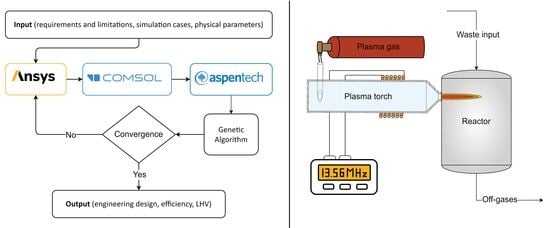
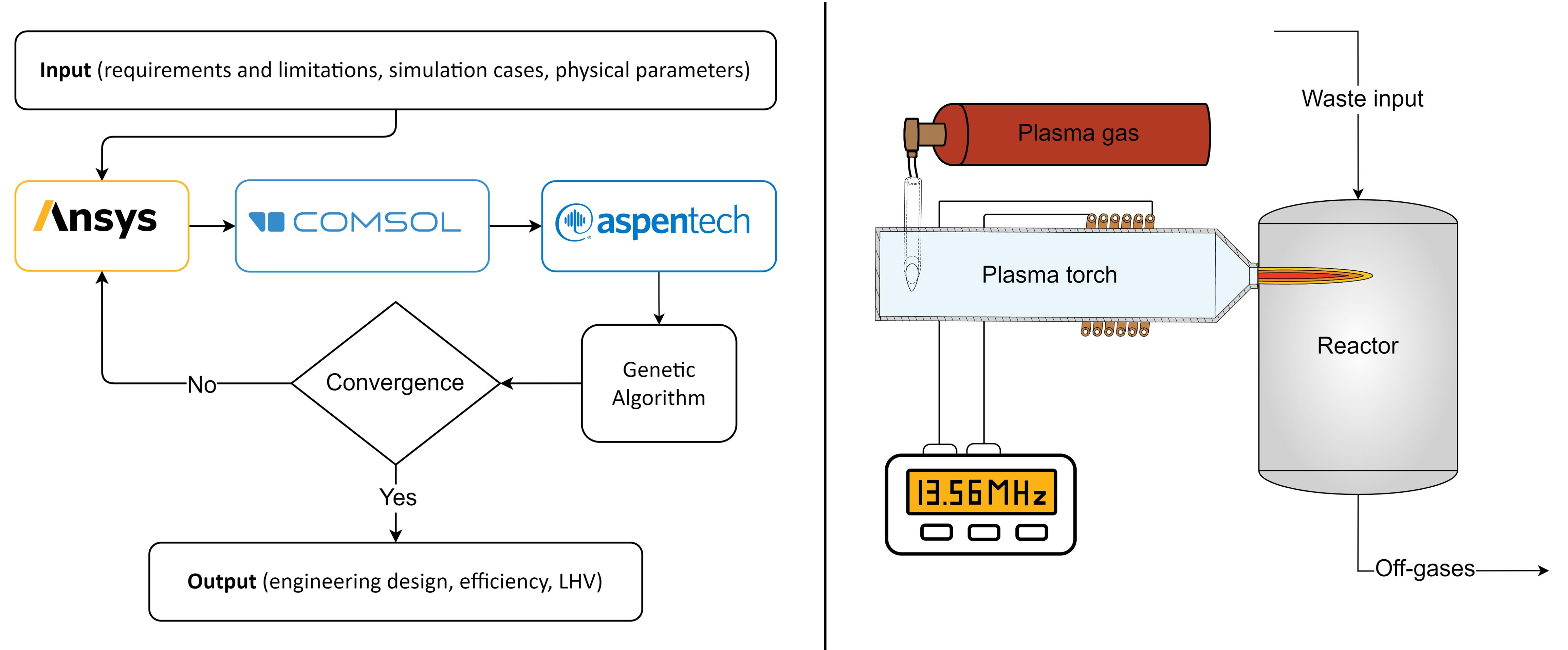
Graphical Abstract

1. Introduction

With increasing industrial activity and a growing global population, the amount of solid waste produced is rising rapidly, putting significant pressure on the environment. Economic development has also shifted how societies view and manage waste, further contributing to environmental change [1]. Worldwide, waste generated per person continues to grow, impacting the environment, public health, and national economies [2]. Reports from the UN Environment Programme indicate that nearly 11.2 billion tonnes of solid waste are collected globally each year [3]. This increasing burden is especially difficult for developing and underdeveloped countries, which struggle to manage the large volume of waste produced annually [4]. Given this situation, effective waste management has become more important than ever. Policies should focus on the waste hierarchy [5,6], starting with waste prevention and reduction at the source, followed by reuse, recycling, resource/energy recovery, and finally safe disposal. Social participation is also crucial for regulating and decreasing solid waste generation. Solid waste encompasses a wide range of categories, including municipal solid waste, bio-waste, hazardous and medical waste, e-waste, agricultural and construction waste, non-process industrial waste, and even radioactive waste [7]. These streams contain materials such as plastics, textiles, rubber, paper, glass, metals, wood, ash, and various organic and inorganic substances. Without proper treatment, such waste can significantly contribute to greenhouse gas emissions, worsen climate change, and damage ecosystems and human health [8]. As waste generation continues to rise alongside global energy demand, interest in waste-to-energy technologies has increased considerably [9,10]. Several methods are already in use for handling different waste types, broadly categorized into landfilling (both sanitary and open dumping), recycling, biological treatments (e.g., composting, vermiculture, fly larvae systems), and thermal technologies such as incineration, combustion, gasification, pyrolysis, plasma gasification, and plasma pyrolysis [11,12,13]. Selecting an appropriate waste treatment technology requires prioritizing environmentally responsible options to minimize negative impacts. The method chosen for managing waste generally depends on the type and quantity of waste generated, as well as a range of social, environmental, technical, financial, geographic, and political factors [14]. Although cost is a major determinant, ecological protection and public health considerations remain equally significant [15]. Globally, sustainable solid waste management is strongly encouraged, especially as many developing regions face severe health, ecological, and pollution-related challenges stemming from improper waste disposal in land, air, and water [16].
Plasma gasification is considered a sustainable alternative due to its operation at extremely high temperatures, which both lower hazardous emissions and improves waste-to-syngas conversion efficiency. The process is highly adaptable, capable of handling feedstocks with varying particle sizes, moisture levels, and ash content, including municipal solid waste [17]. Its feasibility is further enhanced by reducing the volume of waste sent to landfills and by supporting circular economy and decarbonization goals [18,19,20]. A further advantage of plasma gasification is the conversion of residual ash into an inert slag suitable for use in asphalt production or in the construction industry [17,21,22,23]. In terms of energy recovery and environmental performance, plasma gasification surpasses incineration by significantly reducing pollutant emissions and conserving natural resources [19,22]. It can also produce up to three times as much usable energy as incineration [22]. Despite these advantages, plasma gasification has not yet reached full commercial maturity, as most facilities remain at the demonstration stage [24,25]. A key obstacle is optimizing plasma generation, which strongly influences system efficiency and operating costs.
The main element of a plasma gasification system is the plasma torch, which is where complex physical phenomena occur [26]. Modelling these torches is very difficult due to the interaction of electric, magnetic, thermal, and fluid-dynamic fields in a highly non-linear setting [27]. This is an area where COMSOL Multiphysics excels. Its main advantage is its capability to solve coupled problems within a single, integrated environment. Researchers use COMSOL to create detailed models of the plasma torches to analyze their performance. Key applications include simulating the electric arc, current density, and magnetic fields to understand and improve plasma generation and stability. They also model the temperature distribution, which can be over 5000 °C, and the speed of the plasma jet [28]. This is important for understanding Joule heating and heat loss to the torch walls, ensuring efficient energy transfer to the waste feedstock. By simulating how changes in geometry, gas flow rate, and current affect the plasma jet’s features, engineers can improve the torch’s design for better thermal efficiency [29,30]. For example, simulations can identify the best mass flow rate and current to boost the torch’s power and performance. Through detailed component-level analysis, COMSOL provides the insights needed to create more robust, energy-efficient plasma torches that address major sources of power loss and operational costs.
While COMSOL has a unique ability to model the internal physics of the plasma torch, its practical effectiveness relies on its interaction with the gasification reactor. Here, Ansys Fluent plays a crucial role, connecting component-level design and system-level performance. It uses detailed outputs from a COMSOL simulation, including velocity, temperature, and species profiles of the plasma jet at the torch exit [31]. Ansys can simulate how that jet behaves in the complex reactor environment. This lets engineers to model how the plasma plume expands, mixes, and transfers its energy to the solid waste feedstock [32]. Additionally, CFD simulations in Ansys are vital for optimizing the torch’s physical placement, enabling analysis of different strategies and angles to ensure even heat distribution, avoid cold spots, and achieve optimal fluid dynamics for complete gasification [33,34].
Stepping back from the detailed physics of the torch and reactor, Aspen Plus is used for high-level process simulation and economic analysis of the entire plasma gasification plant [35,36]. Instead of dealing with complex fluid dynamics, Aspens Plus models often rely on thermodynamic principles, such as Gibbs free energy minimization, to predict chemical process outcomes at equilibrium [37]. Key contributions of Aspen Plus to optimization include parametric analysis, which systematically evaluates how key operating parameters, such as gasification temperature, steam-to-waste ratio, and feedstock composition, affect syngas yield and quality. This helps identify the best operating conditions for maximizing energy recovery and process efficiency [38,39]. Aspen Plus is also great for calculating overall mass and energy balances across the integrated system, from waste inputs and plasma torch energy use to syngas output and heat recovery. This is important for assessing the plant’s overall efficiency [25,38,39]. A significant advantage of Aspen Plus is its ability to conduct cost analysis. Researchers have used it to estimate the capital and operational costs of plasma gasification plants, making it an essential tool for evaluating the economic feasibility and long-term viability of waste-to-energy projects. It has modelled integrated systems, such as combining a plasma gasifier with a Solid Oxide Fuel Cell (SOFC), to assess the electrical efficiency and viability of the combined plant. Aspen Plus provides the broad perspective needed to ensure a technically optimized process is also economically sound [20,40,41,42].
To the best of our knowledge, no single simulation tool can capture the full complexity of the process, as it involves coupled interactions between fluid dynamics, electromagnetic fields, heat transfer, and chemical reactions. To address this gap, an integrated approach was chosen, linking Ansys Fluent, COMSOL Multiphysics, and Aspen Plus in a unified workflow that accounts for multiphysics interactions throughout simulation and optimization. This work aims to develop a combined digital platform using COMSOL Multiphysics, Ansys Fluent, and Aspen Plus to optimize a plasma gasification process for solid waste. We focused on improving the plasma torch to reduce plasma inefficiency-related losses. First, the three software tools were used for individual optimization. Second, we created a combined optimization tool based on a genetic algorithm and obtained results in the first step.

2. Results and Discussion

2.1. Separated Optimization

2.1.1. COMSOL Multiphysics

At atmospheric pressure, radio frequency inductively coupled plasma (RF-ICP) torches typically operate under local thermodynamic equilibrium (LTE), where electron, ion, and heavy-particle temperatures are nearly equal. The plasma jet enthalpy is primarily governed by the electron temperature and increases as the electron temperature rises [43]. The transfer of electrical energy from the power source to the waste depends primarily on the plasma density [7]. Plasma treatment of solid waste serves two main objectives: reducing waste volume for environmental mitigation and generating value-added products, including syngas for energy recovery and solid by-products such as carbon black and carbon nanospheres [7]. Process efficiency is therefore strongly linked to plasma characteristics. Key performance indicators, such as mass and volume reduction, heating value of the produced gas, and the nature and yield of by-products, are all functions of plasma properties. For petroleum sludge treatment, increasing the plasma current resulted in substantial reductions in mass (36.87–91.40%) and volume (59.59–94.52%) [7], as higher currents accelerated the decomposition of organic constituents. Similarly, plasma treatment of fly ash showed that increasing the plasma current achieved mass reductions of up to 85% [44]. Moreover, higher plasma currents increased the lower heating value (LHV) of the produced gas from 7.4 to 7.8 MJ/Nm3, while the higher heating value (HHV) decreased from 10.6 to 9.8 MJ/Nm3 during petroleum sludge treatment [7]. Similar behavior was observed in municipal solid waste (MSW) processing, where increasing the plasma current raised the syngas LHV from 7.32 to 9.31 MJ/Nm3 [45].
COMSOL Multiphysics has been used to optimize the RF-ICP torch we are developing [46]. In that work, we have varied multiple factors that affect plasma behaviour, including gas flow rate, plasma chamber diameter, nozzle diameter, swirling angle, and RF input power. Previous optimizations were performed for Ar, N2, and O2, and the optimal parameters identified from those studies are torch radius (16 mm), nozzle radius (3 mm), and gas flow rate (10 SLPM), and are adopted for a parametric sweep.
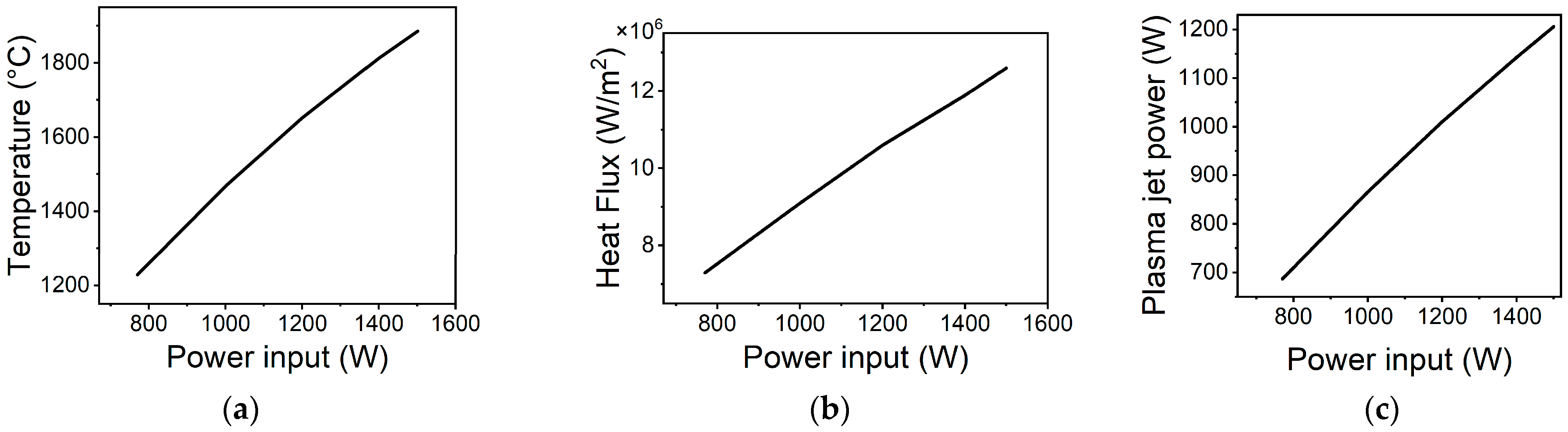
In the parametric sweep, the applied RF coil power varied from 770 W to 1500 W, with air used as the plasma-forming gas. For each case, the nozzle outlet temperature, effective thermal power delivered to the gas, and overall torch efficiency were evaluated, Figure 1 summarizes the results. The modifications to the torch design, as simulated, lead to improvements across all plasma features. It leads to an increase in outlet temperature with applied power from ~1200 to 1886 °C. Also, the plasma heat flux and the plasma jet power increase.

2.1.2. Ansys Fluent

As the COMSOL Multiphysics model resolves plasma temperature and heat transfer within a reduced two-dimensional axisymmetric domain, it does not account for the tangential inlet. To address this limitation, Ansys Fluent model was developed to study the complete torch geometry with tangential gas injection (see Figure 2) and to examine its effect on the swirling velocity field. The tangential velocity distribution, which is a critical parameter influencing plasma stability and performance [47], was calculated using Fluent.
While the total gas flow rate was kept constant at 10 SLPM, the inlet diameter was varied from 4 mm to 2 mm to match the tangential and axial velocity components between the models. The variation in these velocity components with the inlet diameter is summarized in Table 1, where the best match was obtained at an inlet diameter of 3.5 mm. Tangential and axial velocities were evaluated as area-averaged values over the inlet cross-section defined downstream of the tangential injection region, which serves as the velocity boundary condition for the axisymmetric COMSOL model.
The corresponding comparison of the matched axial and tangential velocity predictions from COMSOL Multiphysics and Ansys Fluent is presented in Table 2.

2.1.3. Aspen Plus

Gasification is a thermal decomposition process that occurs in a controlled oxygen environment, producing combustible gases from solid feedstock. The gasification of solid waste was simulated in Aspen Plus, using feed mixtures containing plastic, wood, and paper. The waste composition data used for modelling were obtained from literature sources that compiled results from audits, interviews, and surveys [48,49]. This information provides the required input for the simulation, including the feedstock’s mass flow rate and its proximate and ultimate analyses.
Table 3 summarizes the average proximate and ultimate analyses of the waste streams considered in this study. Only chlorine-free, non-recyclable plastics were included, assuming that recyclable fractions are removed during preliminary sorting.
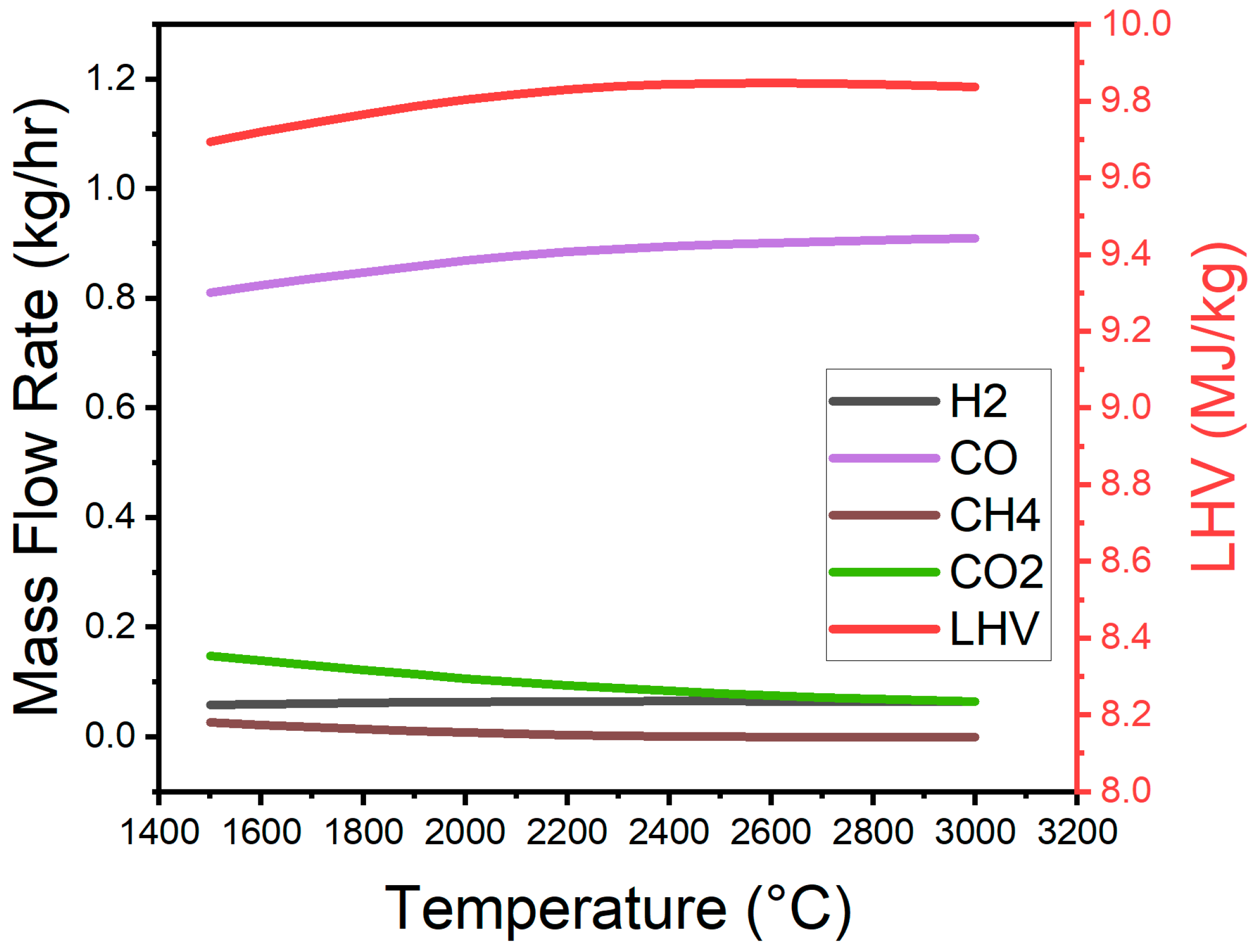
The gasification process produces various gaseous components and a solid residue (ash), but for industrial applications, only the combustible gases that contribute to energy generation, collectively known as syngas, are of primary interest. Figure 3 presents the composition of the main syngas components (H2, CO, CO2, and CH4) and the corresponding lower heating value (LHV) as a function of plasma temperature. As the plasma temperature increases, CO and H2 concentrations rise, while CO2 decreases and CH4 is almost entirely consumed. LHV increases with temperature, reflecting greater production of energy-rich gases and a reduction in less energetic components.

2.2. Integrated Optimization

In this section, the developed integrated optimization platform was applied to optimize the RF-ICP torch and the downstream gasification process for the selected material feedstock. The same design and operating parameters previously studied with individual simulation programs were used to enable comparison with the multi-tool framework. Prior to the optimization, initial modelling files were prepared, including a 3D geometry model in SolidWorks 2025, Ansys Fluent simulation setup, COMSOL Multiphysics plasma model, and Aspen Plus process flowsheet. The optimization was performed using a Genetic Algorithm (GA) coupled with Ansys Fluent, COMSOL Multiphysics, and Aspen Plus simulations to identify the optimal torch geometry and operating conditions that maximize process efficiency and syngas quality. Four design and operational parameters were considered, with their respective ranges listed in Table 4. For each candidate solution generated by the GA, the workflow sequentially executed simulations in Fluent, COMSOL, and Aspen, with outputs from one stage serving as inputs for the next.
Five independent optimization runs were performed to evaluate the framework’s repeatability and confirm convergence stability across different initial populations. The output parameters extracted from the integrated model included torch outlet temperature, energy efficiency, syngas composition, and lower heating value (LHV). The overall fitness of each candidate was evaluated according to Equation (23), which combines these outputs into a single objective function representing the overall performance of the torch–gasification system. The summarized results of all five optimization runs are presented in Table 5, followed by a detailed discussion of convergence behavior, parameter sensitivity, and comparison of the optimal cases.
Run 3 and Run 5 both have the highest fitness (2.23). Between them, they are almost identical; Run 3 has slightly higher temperature (1122.6 °C), while Run 5 has marginally higher efficiency (95.04%). Overall, both represent the optimal trade-off among the three objectives: temperature, efficiency, and LHV. The similarity arises because the fitness function balances competing effects. As temperature increases, efficiency tends to drop due to increased energy losses. When efficiency is maximized, temperature often decreases since less energy is released as heat. LHV adjusts slightly in response to the thermal and chemical balance created by these opposing effects.
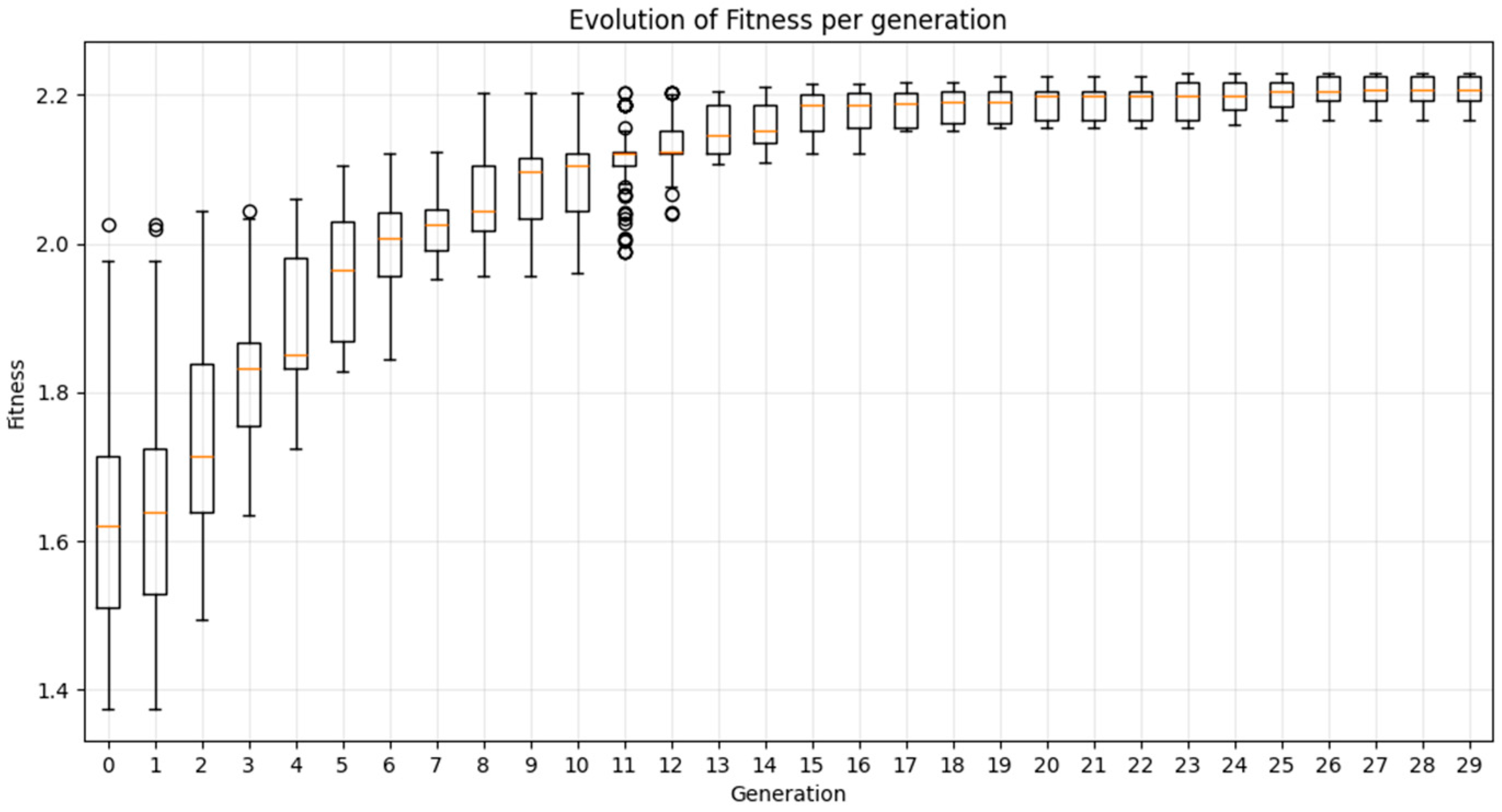
The evolution of solution fitness across generations was monitored in five optimization runs and is presented in Figure 4. The fitness of each candidate solution is plotted using a box plot for each generation, where the central line represents the median, the box spans the first and third quartiles (interquartile range, IQR), the whiskers extend to the most extreme values within 1.5 × IQR, and individual points beyond this range indicate outliers. The steady increase in median fitness across generations demonstrates effective convergence of the integrated optimization framework. During the early generations, the large interquartile range and numerous outliers reflect a highly diverse population, resulting from the initial candidate solutions being generated randomly within the specified parameter limits. This stochastic initialization ensures broad coverage of the design space, allowing the algorithm to explore multiple regions simultaneously and reducing the risk of premature convergence to local optima. As optimization progresses, the reduction in spread and outlier frequency reflects a transition from exploration to exploitation, in which the GA focuses on refining near-optimal solutions. The plateau after approximately the 20th generation indicated that the population had converged to a stable optimum, with only minimal improvements afterward. This convergence behavior confirms that the genetic operators and data exchange between simulation modules (Ansys, COMSOL, Aspen) effectively guide the integrated optimization toward globally consistent solutions rather than segregated optimization.
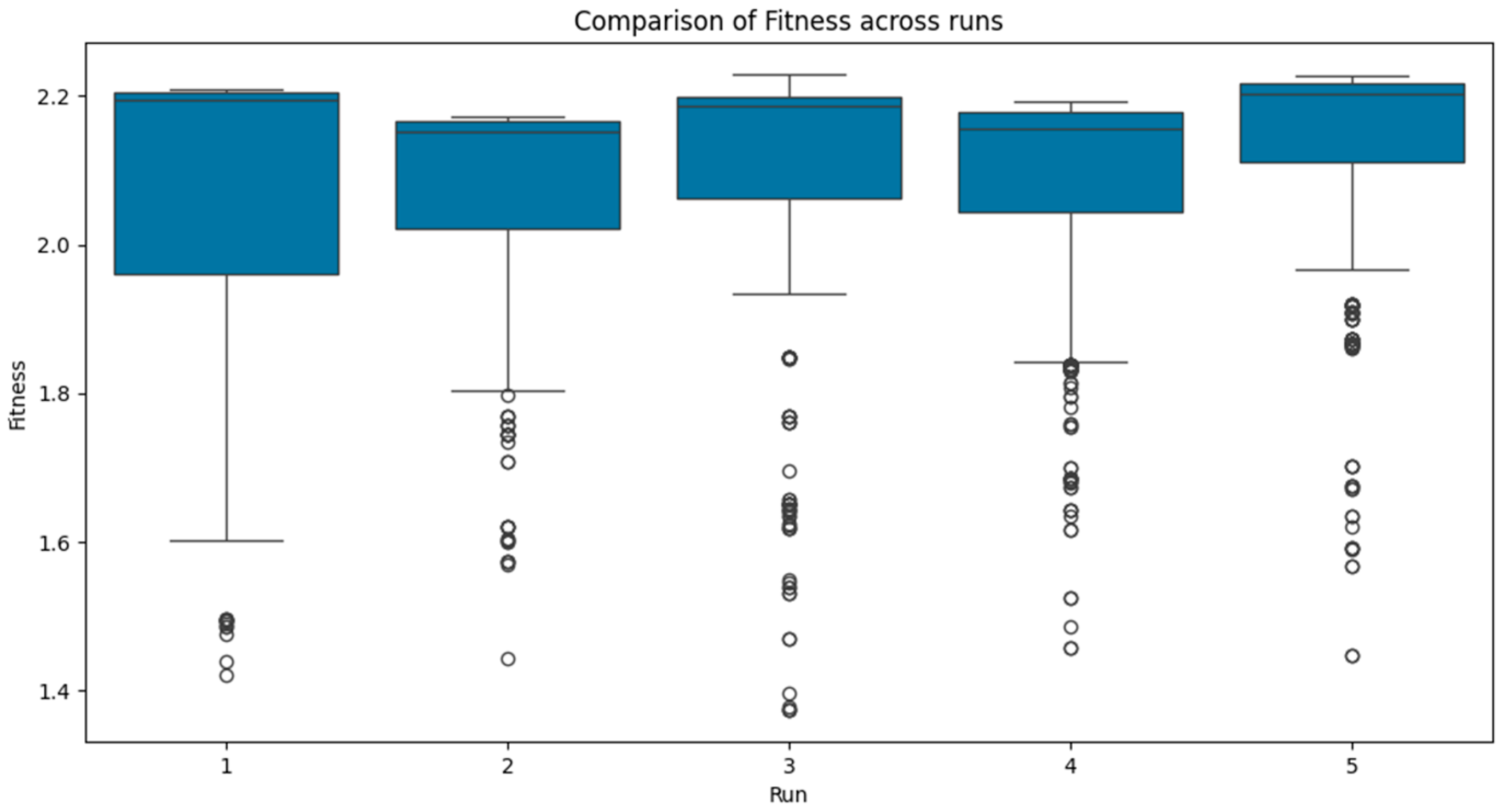
The results showed consistent convergence behavior and solution quality across all trials, with the final fitness distributions of the five independent runs shown in Figure 5, indicating that additional runs were not necessary. The similarity in median and interquartile fitness values across all five runs indicates strong repeatability and low sensitivity of the integrated optimization system to stochastic initialization or random evolutionary variation. Some runs show a broader spread of outliers, but these deviations remain within a consistent fitness range, confirming the algorithm’s robustness. The occasional presence of lower-range outliers reflects that a few individuals may prematurely converge, yet this does not affect the overall population performance. The consistent results across runs validate that the coupling and data exchange between the multiphysics solvers and the process simulator are stable and reliable, ensuring reproducible global optimization trends. Hence, the observed variability arises from inherent stochasticity in the GA rather than instability in model integration or numerical noise.
Beyond the RF-ICP torch studied here, the integrated optimization framework is applicable to other industrial applications. The integrated framework could be applicable to industrial plasma-based processes and can be used to optimize yield, energy efficiency, and process stability. The flexible and modular structure of the framework allows it to adapt to different combinations of tools to suit specific optimization needs. For metallurgical residues, thermal plasma can synthesize ferrite nanopowders from iron- and zinc-rich wastes [50]. In this context, the framework is essential for maximizing yield: Ansys can simulate particle trajectories and injection velocities to ensure feedstock remains in the plasma “hot zone,” COMSOL can model heat transfer to prevent vaporization, and the genetic algorithm identifies optimal torch geometry to maximize production throughput.
For organic wastes treated with steam-assisted plasma gasification [51], the framework allows precise control of thermal and flow conditions to maximize hydrogen-rich syngas production while reducing mass and volume. COMSOL captures thermal profiles, Ansys ensures stable flow and residence time, and Aspen Plus can simulate downstream separation and energy recovery. Similarly, biomass and municipal solid waste can be converted into syngas and vitrified residues through plasma gasification and plasma pyrolysis [52,53]. Here, the framework tunes plasma power and residence time to optimize conversion and minimize residual char formation.
For radioactive waste treatment [54], complete vitrification and safe off-gas handling are critical. COMSOL and Ansys optimize plasma core conditions to ensure thorough decomposition of organic contaminants, while Aspen Plus evaluates off-gas treatment and energy efficiency.
Although the initial capital costs of RF-ICP technology are higher than those of DC plasma systems, RF-ICP was selected because of its ability to achieve higher plasma densities and an easily ignited discharge at similar power levels. The primary focus of this study is on operational costs, since, in Waste-to-Energy applications, economic feasibility depends on the process generating sufficient revenue through energy recovery to offset the substantial upfront investment. By improving thermal efficiency and maximizing the net calorific value, as defined in the fitness function (Equation (23)), this work aims to reduce operational costs, including electricity, gas, and maintenance, while increasing power output, thereby improving overall process viability.

3. RF-ICP Torch Design

Inductively Coupled Thermal Plasma (ICTP) refers to plasma generated through inductive coupling rather than solely between electrodes, as in other thermal plasma systems [55,56]. In this configuration, the plasma is formed within a cylindrical dielectric tube encircled by an induction coil. When a radiofrequency (RF) current flows through the coil, it generates electromagnetic fields that accelerate free electrons within the torch, thereby forming plasma. Under high-pressure conditions, typically near atmospheric levels, the plasma reaches thermal equilibrium, where the gas temperature, which can reach several thousand Kelvin, approximates the electron temperature. Compared with direct current (DC) and microwave (MW) plasma torches, RF-ICP torches possess several distinct advantages. They can easily initiate plasma at atmospheric pressure without the complex ignition circuits required by DC and MW systems [57,58]. Moreover, even at relatively low power levels, RF-ICP torches can produce a dense plasma for waste treatment applications without requiring extensive cooling, unlike DC torches, which rely on electrode cooling for stable operation [55]. However, it is important to note that DC plasma torches typically achieve higher energy densities and higher overall thermal efficiencies than RF systems. The capacity of ICTP to provide a pristine, high-temperature environment devoid of electrode material contamination is one of its main advantages. Owing to these favourable characteristics, ICTP torches have been employed across multiple applications, including waste treatment and disposal [44,48,59], fabrication of thermal barrier coatings [60], and plasma spray processes used in physical vapour deposition [61]. Despite these benefits, certain challenges persist. Technically, RF systems face issues, such as counterflows in the circulating gas, moderate energy efficiency (typically 40–70%), difficulties maintaining steady plasma during disturbances, and managing gas temperature variations [7]. Economically, RF-ICP systems have higher capital costs than DC systems, primarily due to the need for sophisticated RF generators and impedance-matching networks to maximize power transfer to the plasma load [62].
The objective of this study is to design and develop an RF-ICP torch for laboratory-scale treatment of solid waste. The primary aim is to maximize waste volume reduction by generating a high-efficiency plasma torch capable of producing a high-temperature plasma jet with an intense heat flux.
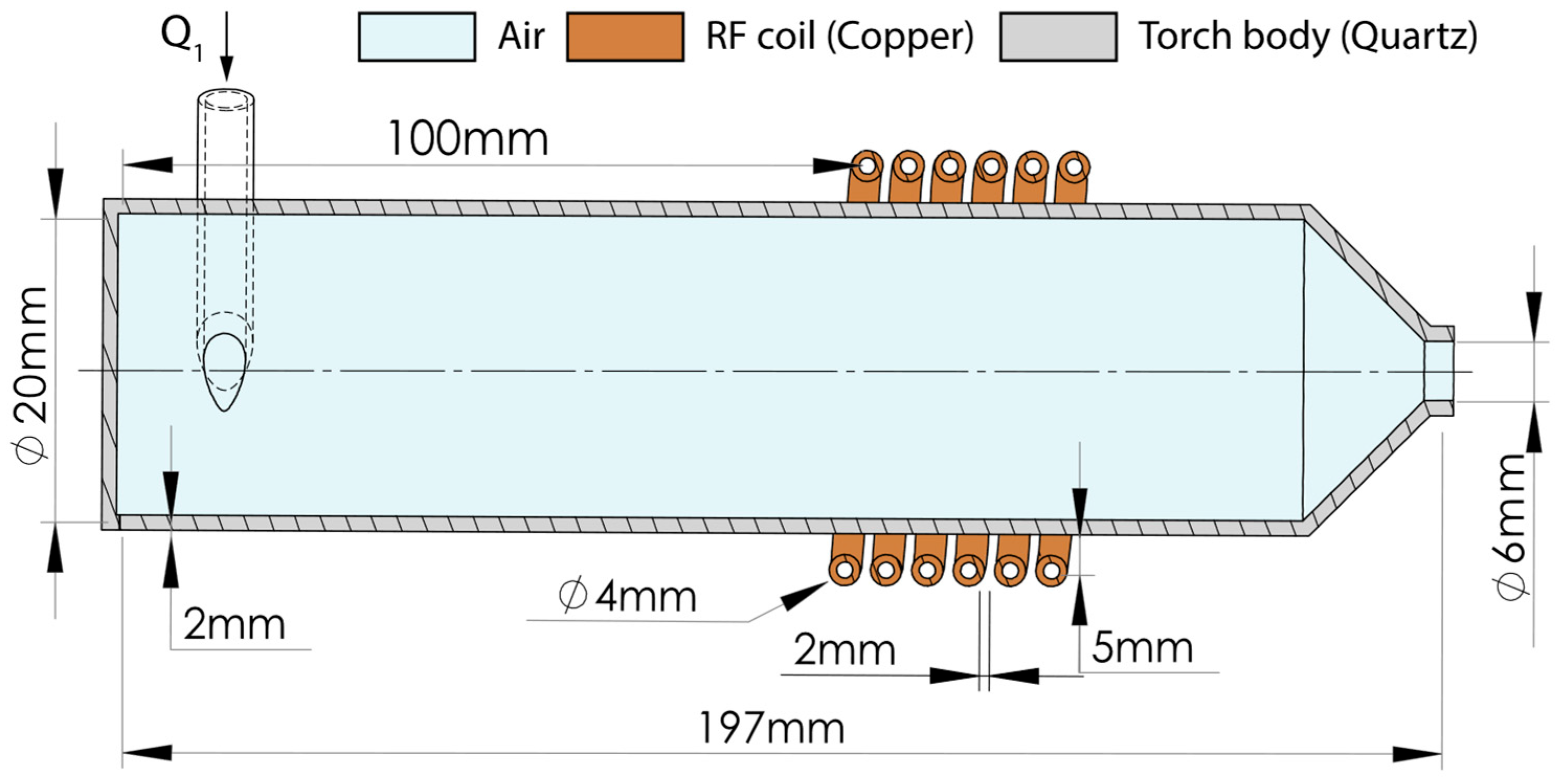
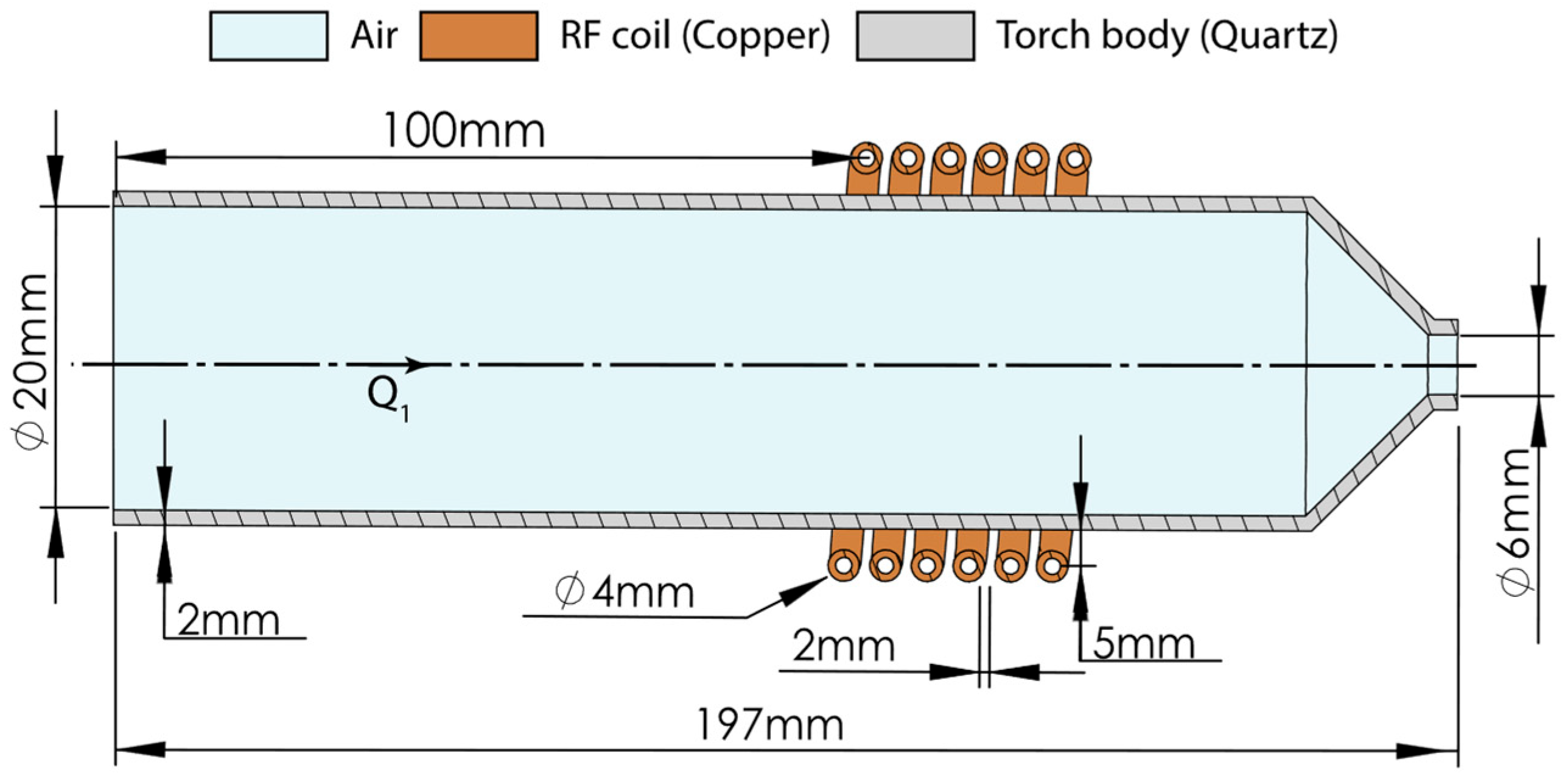
The geometry of the RF-ICP torch developed for this study is shown in Figure 6. The design is flexible and adaptable, allowing key dimensions to be modified during the optimization process. The torch consists of a hollow, cylindrical quartz chamber. At the end, the cylinder gradually contracts toward the outlet through a 45° conical section, which confines and accelerates the plasma jet. Surrounding the chamber wall, a copper RF induction coil is placed and connected to a 13.56 MHz RF power supply. For industrial applications, scaling the torch requires proportional adjustments of both the RF power and the gas flow rate. Simply enlarging geometry without maintaining proper scaling relationships can lead to poor plasma confinement, reduced efficiency, or instability. Scaling must instead rely on optimization-based methods to identify suitable operating conditions and geometric configurations, ensuring stable and efficient performance across different torch sizes and processing requirements.

4. Modelling Approach

The geometric dimensions of the torch play a critical role in determining plasma performance. Parameters such as chamber diameter, cylinder length, nozzle length, and nozzle outlet diameter directly influence RF coupling efficiency, plasma stability, and temperature distribution. These geometric parameters, in turn, determine key process outcomes such as heating uniformity, reaction kinetics, and overall throughput. For instance, a larger chamber diameter generally requires higher RF power and greater gas flow to sustain stable discharge conditions, while nozzle geometry strongly affects plasma confinement and jet velocity. To quantify these interdependencies and evaluate how design parameters influence plasma behaviour, the RF-ICP torch was modelled using a combination of computational fluid dynamics (CFD), plasma physics, and process simulation. Since no single solver can fully capture gas dynamics, plasma discharge, heat transfer, and downstream process reactions, each physical domain was simulated in the tool best suited for it: Ansys Fluent for gas flow, COMSOL Multiphysics for plasma and heat transfer, and Aspen Plus for process-level gasification and off-gas treatment. These simulations were sequentially coupled through parameter transfer to create an integrated multiphysics optimization framework. The following subsections describe the individual models, assumptions, and parameterization.

4.1. COMSOL Multiphysics

The plasma and heat transfer inside the RF-ICP torch were simulated in COMSOL Multiphysics v6.2 using a two-dimensional axisymmetric domain, in which the solver revolves the geometry around an axis to form the full volume, assuming symmetry throughout the domain (for systems that are not symmetric, a full 3D simulation is recommended by adjusting the model geometry in COMSOL). To enable this formulation, the upstream gas-injection region was omitted, and the inlet boundary was defined downstream of the tangential injection. This simplification enabled the dominant swirl to be represented in an axisymmetric form for plasma and heat transfer modelling. The swirling flow in COMSOL was modelled as steady laminar flow with an imposed mean swirl profile. This reduced-order approach captures the averaged influence of turbulence while ensuring stable numerical coupling with plasma transport and electromagnetic fields. The laminar approximation is justified because electromagnetic and inertial forces dominate plasma dynamics, while small-scale turbulent fluctuations contribute negligibly to plasma heating efficiency. The simulations were conducted under three main assumptions. Gravitational effects were neglected because their influence is small compared to electromagnetic and inertial forces. The gas was treated as incompressible due to the low Mach number [63,64,65]. The plasma was considered optically thin and in local thermodynamic equilibrium (LTE), which enables simplified thermodynamic modelling. During preliminary tests, a steep wall-to-core temperature gradient led to strong local heat fluxes, stiffness in the energy equation, and solver instability. To improve convergence, the wall temperature was raised from 300 K to 350 K, reducing the temperature gradient from 200 K to 150 K and stabilizing the numerical solution. This adjustment is treated as a numerical stabilization step and does not affect the plasma model’s underlying physics. The operating parameters used in the simulations are: ambient temperature 350 K, starting gas temperature inside the torch 500 K, RF power input 770 W, and RF coil frequency 13.56 MHz.
The simulation of the RF-ICP torch in this study is conducted using magnetic fields, heat transfer, and laminar flow interfaces in COMSOL Multiphysics. The following governing equations were applied:
¯ × H ¯ = J ¯ ,
where H ¯ is the magnetic field intensity, and J ¯ is the total current density. The magnetic flux density B ¯ is related to the magnetic vector potential A ¯ through the following:
B ¯ = ¯ × A ¯ .
The total current density J ¯ includes multiple components:
J ¯ = σ E ¯ + j ω D ¯ + σ v ¯ × B ¯ + J e ¯ ,
where σ E ¯ is the conduction current density, j ω D ¯ is the displacement current density (with ω being the angular frequency), σ v ¯ × B ¯ is the convective current density due to motion in the magnetic field, and J e ¯ represents externally applied current sources (e.g., coil excitation). In the frequency domain, the electric field E ¯ is expressed in terms of the magnetic vector potential as follows:
E ¯ = j ω A ¯ .
The energy conservation equation governs heat transport in the following domain:
ρ C p u ¯ · ¯ T + ¯ · q ¯ = Q + Q p + Q v d ,
where ρ is the fluid density, C p is the specific heat capacity at constant pressure, u ¯ is the velocity field, T is the temperature, q ¯ is the conductive heat flux, Q is a general heat source, Q p is the pressure work term, and Q v d is the viscous dissipation term. The conductive heat flux follows Fourier’s Law:
q ¯ = k ¯ T .
The fluid density is temperature-dependent and follows the ideal gas law:
ρ = p A R s T .
The Navier–Stokes equations describe the fluid momentum and mass conservation:
ρ ( u ¯ · ¯ ) u ¯ = ¯ · [ p I ¯ + K ¯ ] + F ¯ ,
and continuity equation:
¯ · ( ρ u ¯ ) = 0 ,
where p is pressure, K ¯ is the viscous stress tensor, defined as follows:
K ¯ = μ ( ¯ u ¯ + ( ¯ u ¯ ) T ) 2 3 μ ( ¯ · u ¯ ) I ¯ .
Magnetohydrodynamics introduces a body force on the fluid due to interaction with the magnetic field:
F ¯ = 1 2 R e ( J ¯ × B * ¯ ) .
The current density J ¯ includes motion-induced effects:
J ¯ = σ ( E ¯ + u ¯ × B ¯ ) .
This coupling influences both the electromagnetic field and the fluid flow via the Lorentz force. The heat source Q from electromagnetic effects is defined as follows:
ρ C p u ¯ · ¯ T = ¯ · ( k ¯ T ) + Q ,
where the total electromagnetic heating source Q includes the following:
Q = T ( 5 k B T 2 q ) ( ¯ T · J ¯ ) + E ¯ · J ¯ + Q r a d ,
where k B is Boltzmann constant, q is an elementary charge, and Q r a d is volumetric radiative heat loss. Additionally, viscous dissipation is represented by the following:
Q v d = τ ¯ : ¯ u ¯ .

4.2. Ansys Fluent

To simulate the flow field, a steady-state three-dimensional CFD model was created in Ansys Fluent 2024 R1. The geometry and design parameters were defined in SolidWorks and transferred to Ansys DesignModeler via the existing CAD tool interface. This setup allows importing all parameters from SolidWorks, selecting those used in optimization, and defining inlet, outlet, and volume wall faces. Air was used as plasma-forming gas and was introduced through a tangential inlet, creating a swirling flow that stabilizes the plasma column and ensures uniform gas distribution. The model was built under several simplifying assumptions: gravitational effects were neglected; the gas was treated as incompressible under operating conditions due to the low Mach number; and the flow was assumed to be steady and turbulent. Turbulence was modelled using the realizable k–ε model with scalable wall functions to capture strong shear layers and the tangential inlet-induced swirl. The computational domain was discretized with an unstructured mesh, with a base element size of 0.0017 m, enabling the accurate representation of curved surfaces and small features, such as the tangential inlet and nozzle. Mesh quality was evaluated using skewness metrics (minimum = 0.00000244, maximum = 0.78436, average = 0.20719, standard deviation = 0.11298). To effectively resolve the small tangential inlet, a refined face size of 0.0005 m was used. Boundary conditions included a mass-flow inlet for the gas, a pressure outlet at the nozzle, and no-slip stationary walls. The governing equations listed below were solved with the coupled solver. The solution was iterated over 600 steps (with a convergence criterion of 10−3) until the residuals for all variables stabilized. To measure the swirl intensity inside the plasma chamber, the rotational velocity was derived from the velocity field using Ansys CFD-Post. The azimuthal velocity component υ θ was calculated by projecting the Cartesian velocity vector ( υ x , υ z ) onto the azimuthal unit vector in the x-z plane according to the following:
υ θ = z υ x + x υ z x 2 + z 2 ,
where x, z are the Cartesian coordinates in the plane perpendicular to the plasma axis (y-axis), υ x , υ z are the Cartesian velocity components along x and z [see Appendix A for the equation derivation details].
This expression was implemented in CFD-Post as a user-defined variable. The area-weighted average of the rotational velocity was then computed over a cross-sectional plane located within the coil region, where the plasma is formed. Ansys governing equations are described below.
Continuity equation:
ρ t + ¯ ( ρ υ ¯ ) = 0 ,
where ρ is the fluid density, υ ¯ is the velocity.
Momentum equation:
( ρ u ¯ i ) t + ( ρ u ¯ i u ¯ j ) x j = p ¯ x i + x j [ μ ( u ¯ i x j + u ¯ j x i ) ρ u ¯ i u ¯ j ] ,
where p ¯ is a pressure, μ is the dynamic viscosity, u i u j ¯ are the Reynolds stresses, which represent the effect of turbulence. The subscripts i and j are indices used in tensor notation to represent directions in three-dimensional space.
Turbulent kinetic energy:
ρ k t + ρ k u ¯ j x j = x j [ ( μ + μ t σ k ) k x j ] + P k ρ ε ,
where μ t is the turbulent Prandtl number for k ;
P k = ρ u ¯ i u ¯ j u ¯ i x j ,
is the production of turbulent kinetic energy.
Dissipation rate ( ε ) equation:
( ρ ε ) t + ( ρ ε u ¯ j ) x j = x j [ ( μ + μ t σ ε ) ε x j ] + C 1 ε k P k C 2 ρ ε 2 k ,
where σ ε is the turbulent Prandtl number for ε and C 1 and C 2   are model constants for the realizable k- ε model. These constants are determined empirically and affect the predicted turbulence levels, viscosity, and overall stability of the model.
Turbulent viscosity ( μ t ):
μ t = ρ C μ k 2 ε ,
where C μ is a model constant.

4.3. Aspen Plus

The process simulation extensively explained in reference [66] where waste gasification and off-gas treatment were implemented in Aspen Plus v12.1. For all simulated cases, overall mass and energy balances were verified within Aspen Plus, with a convergence tolerance of 0.01% relative error. The reactor temperature source during the simulation was generated by a plasma torch (in the integrated optimization, it was obtained from COMSOL simulation results), and all simulations achieved balance closure within this error.
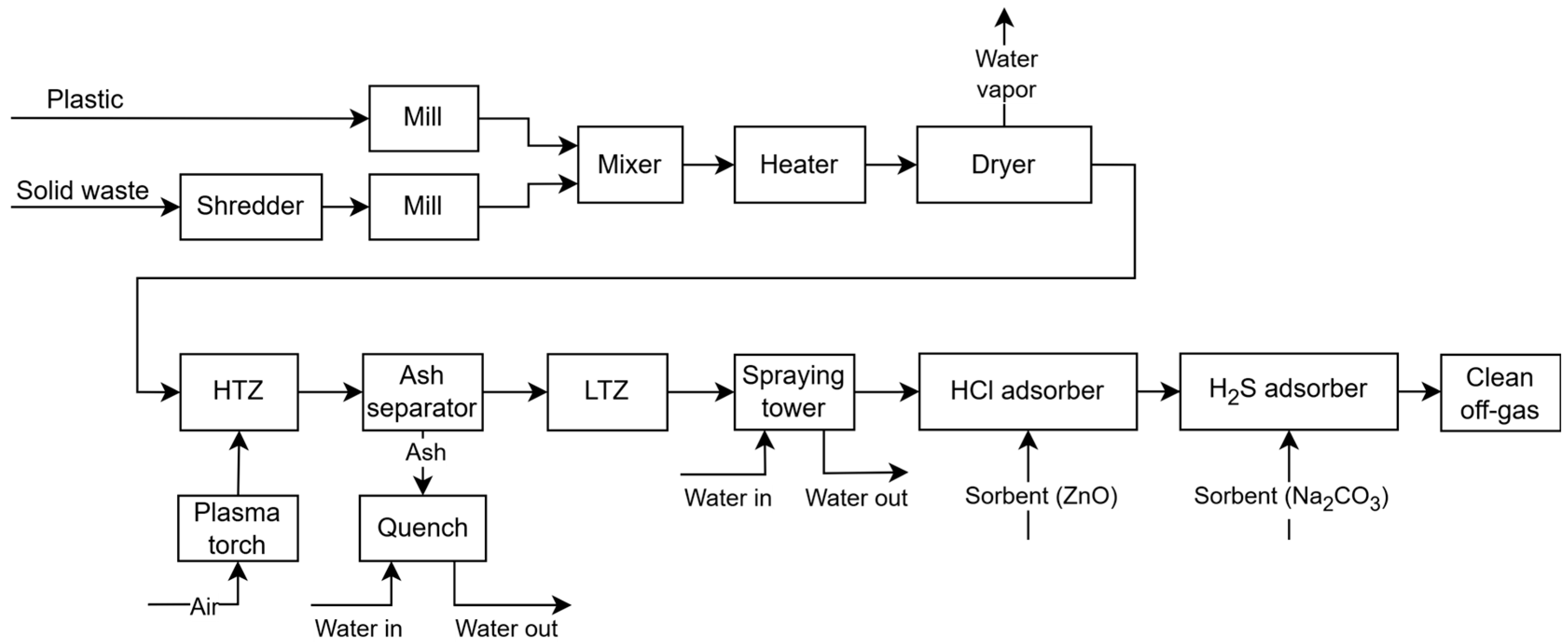
The schematic model flowsheet is illustrated in Figure 7, where the main steps of the treatment process are shown. Solid waste is first milled, dried, and homogenized to achieve a uniform particle size and reduce moisture content, enhancing syngas yield. In Aspen, the feedstock decomposition is represented using an RYield reactor, while the high- and low-temperature gasification zones are modeled using sequential RGibbs reactors heated by the RF-ICP torch, which initiate gasification reactions, producing syngas. Ashes are removed using Sep blocks, and hot syngas is partially quenched with a Flash2 block. The main gasification reactions considered are summarized in Table 6.
The raw syngas then passes through the HCl and H2S adsorber units. In Aspen, these adsorber units are implemented using heaters, RGibbs reactors, separators, and mixers to simulate sorbent reactions and product separation. Specifically, Na2CO3 and ZnO absorb HCl and H2S, respectively. The model calculates key process outputs, such as syngas composition, CO2 emissions, and low heating value (LHV), reflecting the effect of plasma heating on the downstream treatment process.

5. Integrated Optimization

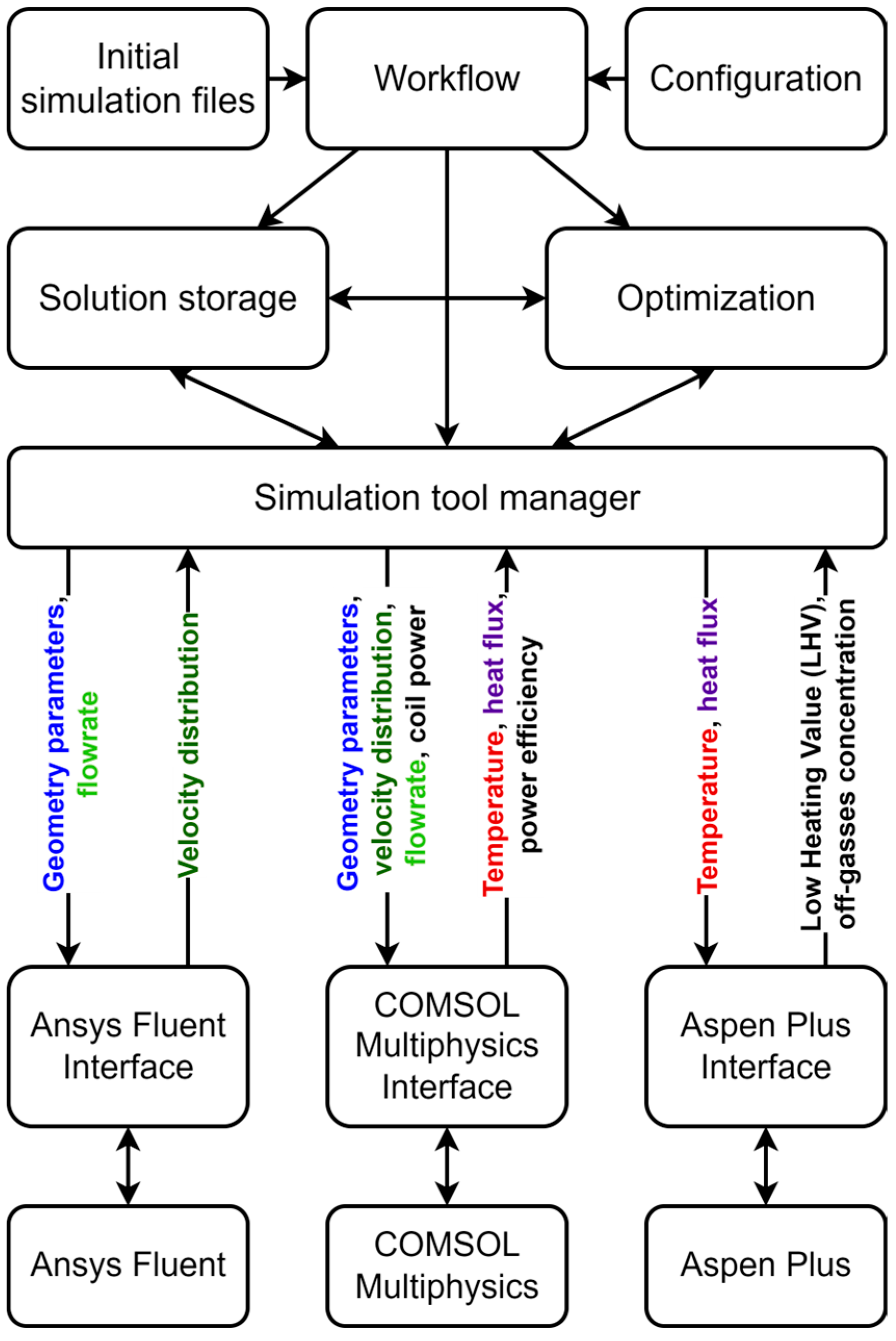
To optimize the plasma torch across multiple physical domains, we developed an integrated optimization framework that links three specialized tools: Ansys Fluent for gas dynamics, COMSOL Multiphysics for plasma physics and heat transfer, and Aspen Plus for waste gasification and off-gas treatment. The overall architecture of the proposed framework is shown in Figure 8.
The system is structured around a central workflow controller that manages the full execution sequence and governs the optimization loop. This controller loads all configuration information, including paths to project files, parameter definitions, transfer rules between tools, parameter bounds, output variables, and the settings of the genetic algorithm (GA). Beneath it operates the simulation tool manager, which supervises all communication with the individual solvers. It initializes models, updates parameters, loads projects, and handles the exchange of input and output variables. Within this manager, dedicated interfaces interact with Ansys Fluent, COMSOL Multiphysics, and Aspen Plus, forwarding commands, updating parameters, and retrieving results. Each interface exchanges data bidirectionally with its respective tool, ensuring that updated inputs are written to the solver and the resulting outputs are captured for transfer to subsequent stages. Parameters shared across tools are highlighted in Figure 8.
The optimization module implements a Genetic Algorithm to guide the search for optimal design and operating conditions. As a population-based, stochastic method inspired by natural selection, GA is well-suited for complex design spaces where deterministic approaches are impractical. All candidate solutions, simulation outputs, and fitness evaluations are maintained in the solution storage module, which provides checkpointing, supports post-processing, and enables recovery in cases of solver instability, failed runs, or convergence issues.

5.1. Initial Setup of Simulation Files

Before executing the optimization, initial simulation projects must be created for each tool. In SolidWorks, the 3D geometry of the plasma torch is designed with all parametric dimensions that will be optimized. This geometry is then imported into Ansys Fluent, where the computational mesh is generated, boundary conditions are defined, and input/output parameters are selected for transfer. In COMSOL Multiphysics, a 2D axisymmetric geometry is constructed (including geometric parameters from Ansys), along with modelling, meshing, and solver configuration, and the identification of relevant input/output variables. Finally, in Aspen Plus, components are defined, and the flowsheet is created with reactors, heat exchangers, and other process blocks, while input/output variables, including syngas composition and LHV, are identified for transfer to the GA. This initial setup ensures that all tools are automatically updated during the optimization loop.

5.2. Sequential Multiphysics Simulation

The simulation tools operate sequentially during each GA iteration. Initially, geometry and operating parameters are read from SolidWorks and passed to Ansys Fluent, where gas dynamics are evaluated and flow fields, including the mean swirling velocity, are obtained. These flow results, together with torch operating conditions such as coil distance, power, and gas flow, are then transferred to COMSOL Multiphysics to simulate plasma behavior and heat transfer, producing outputs including plasma temperature, heat flux, and torch efficiency. Finally, the plasma temperature is used in Aspen Plus to perform waste gasification and off-gas-treatment calculations, yielding syngas composition and LHV. This sequential workflow captures multiphysics interactions within a single optimization cycle. Unit conversions between solvers are automatically handled by the Python framework: string outputs are converted to numeric values, and whenever a parameter cannot be directly exported or imported in the same units, it is converted within the code to ensure compatibility.

5.3. Genetic Algorithm Implementation

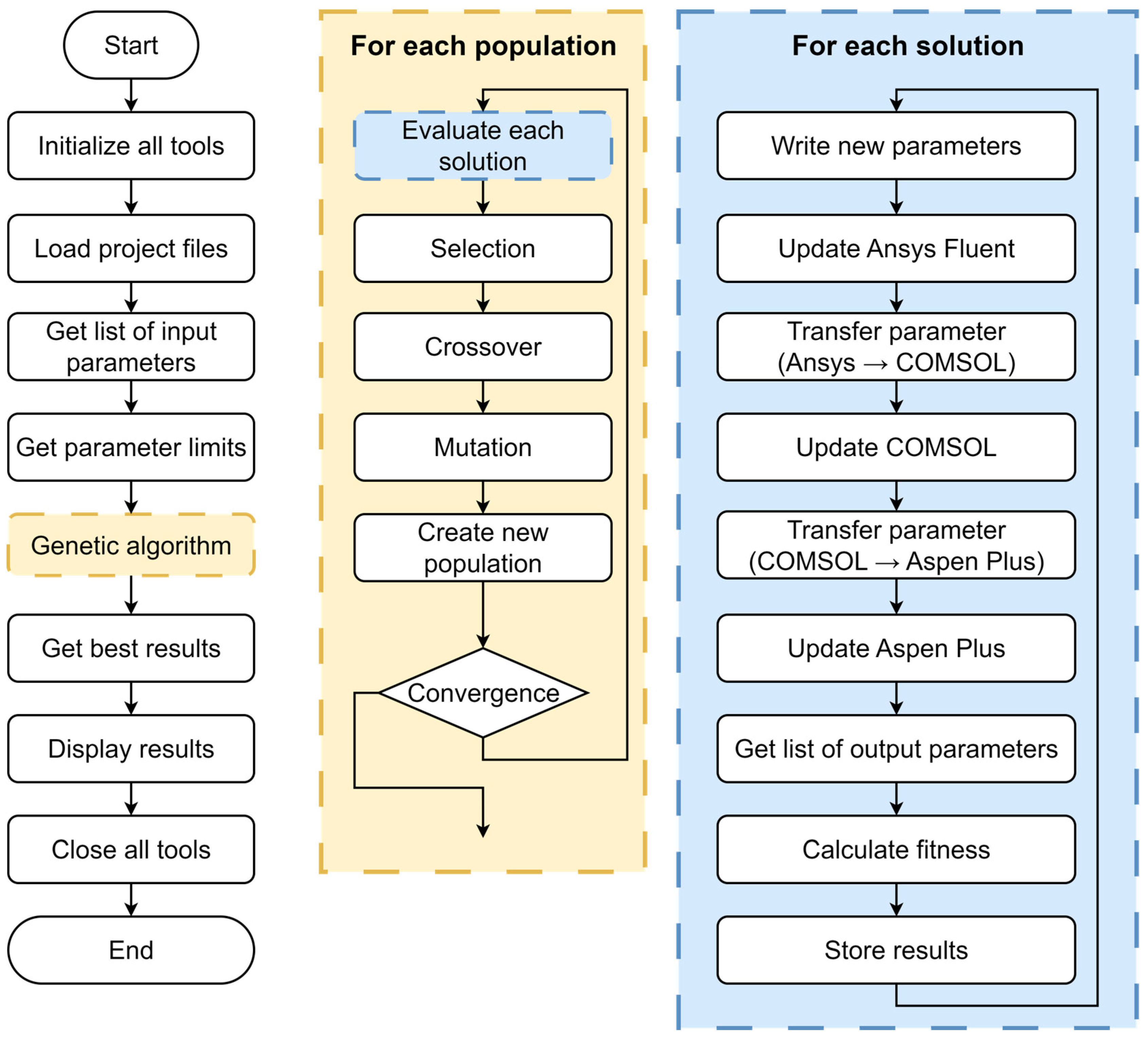
The GA drives the search for optimal torch geometry and operating conditions, as illustrated in Figure 9. First, the list of input parameters, their ranges, fitness function are passed from the main program and create the initial GA population. For each candidate solution, new parameter values are written to Ansys Fluent, which is updated and solved, and the relevant outputs are transferred to COMSOL to update and solve the plasma model. Plasma outputs are then passed to Aspen Plus, which evaluates syngas composition and LHV. After which, all output parameters are collected, and the candidate’s fitness is computed. GA operations, including selection, crossover, and mutation, are then applied to generate the next generation of solutions. The algorithm checks for convergence, and if any of the stopping criteria (maximum generations, no improvement, or target fitness achieved) is met, it returns the optimal solution. If the criterion is not met, the cycle repeats.

5.4. Fitness Function

The fitness function is designed to maximize key performance parameters of the plasma torch:
f = T + η + L H V ,
where T , η , and LHV are normalized plasma temperature, normalized torch power efficiency, and is normalized lower heating value, respectively.
T and LHV were scaled from 0 to 1, and normalized using the values examined in [66], 4000 K and LHV over 11 MJ/kg, as this is also the maximum value found in the reference.
It is worth knowing that the normalization values can be changed to be compared to the experimental value later, which would make it more accurate and would enhance the work.
The goal of the fitness function is to maximize temperature, torch power efficiency, and LHV. GA maximizes this function, simultaneously improving plasma temperature, torch power efficiency, and LHV.

5.5. Implementation Details

The framework is implemented in Python 3.12.4. Interfaces to Ansys Fluent, COMSOL Multiphysics, and Aspen Plus are realized using PyWorkbench 0.7.0 [68], MPh 1.2.4 [69], and Aspen COM API [70], respectively. On a standard workstation (24-core AMD Ryzen Threadripper 3960X; Advanced Micro Devices, Santa Clara, CA, USA; 96 GB RAM), each candidate evaluation requires approximately 15 min. Each solver executes sequentially without manual intervention, and all candidate solutions and simulation outputs are stored in the Solution Storage Module.
A real-coded genetic algorithm was implemented to optimize the plasma torch parameters. A fixed penalty of −1 × 10⁹ was assigned to any solution for which one or more simulation tools failed to update or return valid outputs. This value was set several orders of magnitude below any feasible fitness, ensuring that invalid solutions are consistently ranked last to keep the optimization focused on feasible designs. The GA population was initialized randomly and consisted of 20 individuals, evolved over a maximum of 30 generations. Uniform crossover was applied with a probability of 70%, mutation with a rate of 30%, and population updates were performed using a weak-replacement strategy. Random initialization was chosen to avoid bias and to maximize early diversity. Selected population size represents a practical compromise between maintaining diversity and limiting the computational cost, as each fitness evaluation requires a full update of the simulation chain. Uniform crossover was selected because it treats each variable independently, which is advantageous when variable interactions are not known in advance. The relatively high mutation rate helps preserve diversity in a small population and reduces the risk of premature convergence. The weak-replacement approach allows high-fitness individuals to persist while still introducing new solutions to each generation.

6. Conclusions

Plasma treatment of solid waste presents a highly effective and versatile alternative to conventional methods such as incineration. It employs extremely high temperatures to minimize harmful emissions and effectively transform waste into syngas. The ICP torch is a favoured technology due to its consistent performance and long operational lifespan, though it faces challenges such as limited energy efficiency and scaling difficulties.
To address these challenges, this study developed an integrated optimization framework combining Ansys Fluent, COMSOL Multiphysics, and Aspen Plus. This consolidated approach captures the intricate interactions between gas dynamics, plasma behaviour, and downstream processes, yielding more precise results than traditional segregated techniques. By optimizing critical parameters such as swirl angle, flow rate, and RF power through a genetic algorithm, the framework enhanced the torch’s efficiency, stability, and scalability. The optimal design improved plasma stability and energy transfer, resulting in a more efficient, sustainable waste treatment process that produces higher-quality syngas.
It is important to note that the model developed in this study relies on commercial software packages, such as COMSOL Multiphysics, Ansys Fluent, and Aspen Plus; therefore, its limitations are inherent to the assumptions and capabilities of these platforms. For example, COMSOL Multiphysics is restricted to atmospheric-pressure plasma modelling under the local thermodynamic equilibrium (LTE) assumption and cannot directly capture non-LTE behaviour at reduced pressures. In addition, the large number of coupled parameters increases model complexity, leading to longer computational times and higher computational costs.
Finally, one of the key advantages of simulation is that it provides a close approximation of experimental behaviour, helping to reduce the time, cost, and effort required for physical testing. In our future work, we plan to reassess the plasma parameters, identify the optimal operating conditions, and implement them in a small-scale waste treatment system. The experimental results obtained will then be used to refine and enhance the model, improving its accuracy and reliability. Furthermore, machine learning models will be incorporated to accelerate optimization. The framework will also be expanded to manage varying waste compositions and include simulations of electrical circuits and cooling subsystems for a thorough analysis. Scaling the framework for high-performance computing will facilitate quicker evaluations of larger design spaces, and its modular design will be refined for wider industrial applications.

Author Contributions

Conceptualization, R.S., M.A.A. and H.A.G.; methodology, R.S., M.A.A. and H.A.G.; software, R.S.; validation, R.S., M.A.A. and H.A.G.; formal analysis, M.A.A. and H.A.G.; investigation, H.A.G.; resources, H.A.G.; data curation, R.S. and M.A.A.; writing—original draft preparation, R.S. and M.A.A.; writing—review and editing, R.S., M.A.A. and H.A.G.; visualization, R.S. and M.A.A.; supervision, H.A.G.; project administration, H.A.G.; funding acquisition, H.A.G.; All authors have read and agreed to the published version of the manuscript.

Funding

This research was funded by NSERC, UNENE, Mitacs, and ProFlange. Authors would like to thank members of Smart Energy Systems Lab (SESL) and Advanced Plasma Engineering Lab (APEL) at Ontario Tech University.

Data Availability Statement

Dataset available on request from the authors.

Conflicts of Interest

The authors declare no conflicts of interest.

Appendix A

The rotational (azimuthal) velocity υ θ in the plasma chamber was derived from the Cartesian velocity components obtained from Ansys CFD-Post. Considering the plasma axis aligned along the y-direction, the transverse plane is defined as the x-z plane. In cylindrical coordinates (r, θ, y), the azimuthal unit vector is
e ^ θ = 1 r ( z ,   0 ,   x ) ,
where r = x 2 + z 2 .
The azimuthal velocity component is then computed as the projection of the velocity vector v   =   ( u x ,   u y ,   u z ) onto e ^ θ :
υ θ = v   ·   e ^ θ = z υ x + x υ z x 2 + z 2 .

References

  1. Okumura, S.; Tasaki, T.; Moriguchi, Y.; Jangprajak, W. Economic Growth and Selection of Municipal Waste Treatment Options in Bangkok. J. Mater. Cycles Waste Manag. 2017, 19, 718–730. [Google Scholar] [CrossRef]
  2. World Bank. Transitioning to a Circular Economy: An Evaluation of the World Bank Group’s Support for Municipal Solid Waste Management (2010–20); World Bank: Washington, DC, USA, 2022. [Google Scholar] [CrossRef]
  3. Solid Waste Management|UNEP—UN Environment Programme. Available online: https://www.unep.org/explore-topics/resource-efficiency/what-we-do/cities/solid-waste-management (accessed on 9 November 2025).
  4. Ojha, A.; Reuben, A.C.; Sharma, D. Solid Waste Management in Developing Countries through Plasma Arc Gasification—An Alternative Approach. APCBEE Procedia 2012, 1, 193–198. [Google Scholar] [CrossRef][Green Version]
  5. Lombardi, F.; Costa, G.; Sirini, P. Analysis of the Role of the Sanitary Landfill in Waste Management Strategies Based upon a Review of Lab Leaching Tests and New Tools to Evaluate Leachate Production. Rev. Ambiente Água 2017, 12, 543–555. [Google Scholar] [CrossRef]
  6. Bianchi, I.; Forcellese, A.; Marconi, M.; Simoncini, M.; Vita, A.; Castorani, V. Environmental Impact Assessment of Zero Waste Approach for Carbon Fiber Prepreg Scraps. Sustain. Mater. Technol. 2021, 29, e00308. [Google Scholar] [CrossRef]
  7. Bhatt, K.P.; Patel, S.; Upadhyay, D.S.; Patel, R.N. A Critical Review on Solid Waste Treatment Using Plasma Pyrolysis Technology. Chem. Eng. Process.-Process Intensif. 2022, 177, 108989. [Google Scholar] [CrossRef]
  8. Sebastian, R.M.; Louis, J. Waste Management in Northwest Territories, Canada: Current Practices, Opportunities, and Challenges. J. Environ. Chem. Eng. 2022, 10, 106930. [Google Scholar] [CrossRef]
  9. Sanlisoy, A.; Carpinlioglu, M.O. A Review on Plasma Gasification for Solid Waste Disposal. Int. J. Hydrogen Energy 2017, 42, 1361–1365. [Google Scholar] [CrossRef]
  10. Ravikumar, C.; Senthil Kumar, P.; Subhashni, S.K.; Tejaswini, P.V.; Varshini, V. Microwave Assisted Fast Pyrolysis of Corn Cob, Corn Stover, Saw Dust and Rice Straw: Experimental Investigation on Bio-Oil Yield and High Heating Values. Sustain. Mater. Technol. 2017, 11, 19–27. [Google Scholar] [CrossRef]
  11. Kaza, S.; Yao, L.C.; Bhada-Tata, P.; Van Woerden, F. What a Waste 2.0: A Global Snapshot of Solid Waste Management to 2050; World Bank: Washington, DC, USA, 2018; ISBN 978-1-4648-1329-0. [Google Scholar]
  12. Čičková, H.; Newton, G.L.; Lacy, R.C.; Kozánek, M. The Use of Fly Larvae for Organic Waste Treatment. Waste Manag. 2015, 35, 68–80. [Google Scholar] [CrossRef] [PubMed]
  13. Al-Ghouti, M.A.; Khan, M.; Nasser, M.S.; Al-Saad, K.; Heng, O.E. Recent Advances and Applications of Municipal Solid Wastes Bottom and Fly Ashes: Insights into Sustainable Management and Conservation of Resources. Environ. Technol. Innov. 2021, 21, 101267. [Google Scholar] [CrossRef]
  14. Arıkan, E.; Şimşit-Kalender, Z.T.; Vayvay, Ö. Solid Waste Disposal Methodology Selection Using Multi-Criteria Decision Making Methods and an Application in Turkey. J. Clean. Prod. 2017, 142, 403–412. [Google Scholar] [CrossRef]
  15. De Medina-Salas, L.; Castillo-Gonzalez, E.; Giraldi-Diaz, M.R.; Fernandez-Rosales, V.; Rodriguez, C.M.W. A Successful Case in Waste Management in Developing Countries. J. Pollut. Eff. Control. 2020, 8, 1–5. [Google Scholar] [CrossRef]
  16. Elsheekh, K.M.; Kamel, R.R.; Elsherif, D.M.; Shalaby, A.M. Achieving Sustainable Development Goals from the Perspective of Solid Waste Management Plans. J. Eng. Appl. Sci. 2021, 68, 9. [Google Scholar] [CrossRef]
  17. Tavares, R.; Ramos, A.; Rouboa, A. A Theoretical Study on Municipal Solid Waste Plasma Gasification. Waste Manag. 2019, 90, 37–45. [Google Scholar] [CrossRef] [PubMed]
  18. Ouda, O.K.M.; Raza, S.A.; Al-Waked, R.; Al-Asad, J.F.; Nizami, A.S. Waste-to-Energy Potential in the Western Province of Saudi Arabia. J. King Saud Univ.-Eng. Sci. 2017, 29, 212–220. [Google Scholar] [CrossRef]
  19. Ramos, A.; Rouboa, A. Life Cycle Thinking of Plasma Gasification as a Waste-to-Energy Tool: Review on Environmental, Economic and Social Aspects. Renew. Sustain. Energy Rev. 2022, 153, 111762. [Google Scholar] [CrossRef]
  20. Ramos, A.; Berzosa, J.; Espí, J.; Clarens, F.; Rouboa, A. Life Cycle Costing for Plasma Gasification of Municipal Solid Waste: A Socio-Economic Approach. Energy Convers. Manag. 2020, 209, 112508. [Google Scholar] [CrossRef]
  21. Nguyen Thi, N.; Bui Truong, S.; Do Minh, N. Reusing Coal Ash of Thermal Power Plant in a Pavement Base Course. J. King Saud Univ.-Eng. Sci. 2021, 33, 346–354. [Google Scholar] [CrossRef]
  22. Ramos, A.; Teixeira, C.A.; Rouboa, A. Environmental Assessment of Municipal Solid Waste by Two-Stage Plasma Gasification. Energies 2019, 12, 137. [Google Scholar] [CrossRef]
  23. Saddiq, H.A.; Perry, S.; Ndagana, S.F.; Mohammed, A. Modelling of Gas Turbine and Gas Turbine Exhaust and Its Utilisation as Combined Cycle in Utility System. Int. J. Sci. Eng. Res. 2015, 6, 925–933. [Google Scholar]
  24. Ungureanu, N.; Vlăduț, N.V.; Biriș, S.S.; Ionescu, M.; Gheorghiță, N.E. Municipal Solid Waste Gasification: Technologies, Process Parameters, and Sustainable Valorization of By-Products in a Circular Economy. Sustainability 2025, 17, 6704. [Google Scholar] [CrossRef]
  25. Montiel-Bohórquez, N.D.; Agudelo, A.F.; Pérez, J.F. Modelling of an Integrated Plasma Gasification Combined Cycle Power Plant Using Aspen Plus. J. King Saud Univ.-Eng. Sci. 2024, 36, 620–631. [Google Scholar] [CrossRef]
  26. Oliveira, M.; Ramos, A.; Ismail, T.M.; Monteiro, E.; Rouboa, A. A Review on Plasma Gasification of Solid Residues: Recent Advances and Developments. Energies 2022, 15, 1475. [Google Scholar] [CrossRef]
  27. Chazelas, C.; Trelles, J.P.; Vardelle, A. The Main Issues to Address in Modeling Plasma Spray Torch Operation. J. Therm. Spray Technol. 2016, 26, 3–11. [Google Scholar] [CrossRef]
  28. Elaissi, S.; Alsaif, N.A.M. Modeling and Performance Analysis of Municipal Solid Waste Treatment in Plasma Torch Reactor. Symmetry 2023, 15, 692. [Google Scholar] [CrossRef]
  29. Xiong, H.B.; Zheng, L.L.; Sampath, S.; Williamson, R.L.; Fincke, J.R. Three-Dimensional Simulation of Plasma Spray: Effects of Carrier Gas Flow and Particle Injection on Plasma Jet and Entrained Particle Behavior. Int. J. Heat Mass Transf. 2004, 47, 5189–5200. [Google Scholar] [CrossRef]
  30. Siddanathi, S.L.; Westerberg, L.G.; Åkerstedt, H.O.; Wiinikka, H.; Sepman, A. The Effect of Non-Transferred Plasma Torch Electrodes on Plasma Jet: A Computational Study. Appl. Sci. 2025, 15, 8367. [Google Scholar] [CrossRef]
  31. Javid, S.M.; Alavi, S.; Guo, X.; Zabihihesari, A.; Mostaghimi, J. Torch Simulator: An Analytical Model for Rapid Prediction of Inductively Coupled Plasma Parameters. Spectrochim. Acta Part B At. Spectrosc. 2021, 180, 106182. [Google Scholar] [CrossRef]
  32. Rojas-Perez, F.; Castillo-Benavides, J.A.; Richmond-Navarro, G.; Zamora, E. CFD Modeling of Plasma Gasification Reactor for Municipal Solid Waste. IEEE Trans. Plasma Sci. 2018, 46, 2435–2444. [Google Scholar] [CrossRef]
  33. Sedej, O.; Mbonimpa, E. CFD Modeling of a Lab-Scale Microwave Plasma Reactor for Waste-to-Energy Applications: A Review. Gases 2021, 1, 133–147. [Google Scholar] [CrossRef]
  34. Izhar, M.; Anwari, H.; Samiran, N.A.; Amin Ishak, I.; Suhail, M.; Hamid, S.; Raja, P.; Pahat, B. CFD Modelling of Plasma Downdraft Coal Gasification Process: Effect of Throat Diameter on the Produced Syngas Composition. J. Adv. Res. Numer. Heat Transf. 2024, 22, 14–30. [Google Scholar] [CrossRef]
  35. Khuriati, A.; Purwanto, P.; Setiyo Huboyo, H.; Suryono, S.; Bawono Putro, A. Application of Aspen plus for Municipal Solid Waste Plasma Gasification Simulation: Case Study of Jatibarang Landfill in Semarang Indonesia. J. Phys. Conf. Ser. 2018, 1025, 012006. [Google Scholar] [CrossRef]
  36. Bastek, S.; Dossow, M.; Tamošiūnas, A.; Umeki, K.; Spliethoff, H.; Fendt, S. Technical Evaluation of Plasma-Assisted Entrained Flow Gasification for Hydrogen-Rich Syngas Production from Waste and Biomass. Int. J. Hydrogen Energy 2025, 157, 150184. [Google Scholar] [CrossRef]
  37. Sakheta, A.; Raj, T.; Nayak, R.; O’Hara, I.; Ramirez, J. Improved Prediction of Biomass Gasification Models through Machine Learning. Comput. Chem. Eng. 2024, 191, 108834. [Google Scholar] [CrossRef]
  38. Reina-Guzmán, S.; Ayabaca-Sarria, C.; Tipanluisa-Sarchi, L.; Venegas-Vásconez, D. Thermochemical Conversion of Biomass: Aspen Plus® Modeling of Sugarcane Bagasse Gasification for Syngas Integration. Processes 2025, 13, 3037. [Google Scholar] [CrossRef]
  39. Wei, P.; Chen, G.; Zhi, F.; Zhang, A.; Deng, H.; Wen, X.; Wang, F.; Yu, C. Numerical Simulation and Experimental Study of Hydrogen Production from Chili Straw Waste Gasification Using Aspen Plus. Int. J. Hydrogen Energy 2024, 95, 377–388. [Google Scholar] [CrossRef]
  40. Anilkumar, R.; Vinayak, A.K.; Kiran, B.; Gurumoorthy, A.V.P. Study of Municipal Solid Waste Treatment Using Plasma Gasification by Application of Aspen Plus. Chem. Prod. Process Model. 2024, 19, 901–915. [Google Scholar] [CrossRef]
  41. Qureshi, T.; Khraisheh, M.; Almomani, F. Cost and Heat Integration Analysis for CO2 Removal Using Imidazolium-Based Ionic Liquid-ASPEN PLUS Modelling Study. Sustainability 2023, 15, 3370. [Google Scholar] [CrossRef]
  42. Pitrez, P.; Monteiro, E.; Rouboa, A. Numerical Analysis of Plasma Gasification of Hazardous Waste Using Aspen Plus. Energy Rep. 2023, 9, 418. [Google Scholar] [CrossRef]
  43. Tamošiūnas, A.; Valatkevičius, P.; Valinčius, V.; Grigaitienė, V.; Kavaliauskas, Ž. Diagnostic Methods Used for Atmospheric Pressure Thermal Arc Plasma. Phys. Scr. 2014, T161, 014059. [Google Scholar] [CrossRef]
  44. Pourali, M. Application of Plasma Gasification Technology in Waste to Energy-Challenges and Opportunities. IEEE Trans. Sustain. Energy 2010, 1, 125–130. [Google Scholar] [CrossRef]
  45. Balas, M.; Lisy, M.; Kracik, P.; Pospisil, J. Municipal Solid Waste Gasification within Waste-to-Energy Processing. MM Sci. J. 2017, 2017, 1783–1788. [Google Scholar] [CrossRef]
  46. Stetsiuk, R.; Aldeeb, M.A.; Gabbar, H.A. Simulation-Based RF-ICP Torch Optimization for Efficient and Environmentally Sustainable Radioactive Waste Management. Recycling 2025, 10, 139. [Google Scholar] [CrossRef]
  47. Punjabi, S.B.; Das, K.; Joshi, K.; Mangalvedekar, A.; Lande, K.; Das, K. The Effect of Swirl Velocity on ICP Torch Simulation. J. Phys. Conf. Ser. 2010, 208, 012055. [Google Scholar] [CrossRef]
  48. Zhou, H.; Meng, A.; Long, Y.; Li, Q.; Zhang, Y. Classification and Comparison of Municipal Solid Waste Based on Thermochemical Characteristics. J. Air Waste Manag. Assoc. 2014, 64, 597–616. [Google Scholar] [CrossRef] [PubMed]
  49. Zhou, H.; Meng, A.; Long, Y.; Li, Q.; Zhang, Y. An Overview of Characteristics of Municipal Solid Waste Fuel in China: Physical, Chemical Composition and Heating Value. Renew. Sustain. Energy Rev. 2014, 36, 107–122. [Google Scholar] [CrossRef]
  50. Szépvölgyi, J.; Mohai, I.; Gubicza, J.; Sáray, I. RF Thermal Plasma Synthesis of Ferrite Nanopowders from Metallurgical Wastes. Key Eng. Mater. 2004, 264–268, 2359–2362. [Google Scholar] [CrossRef]
  51. Nishikawa, H.; Ibe, M.; Tanaka, M.; Ushio, M.; Takemoto, T.; Tanaka, K.; Tanahashi, N.; Ito, T. A Treatment of Carbonaceous Wastes Using Thermal Plasma with Steam. Vacuum 2004, 73, 589–593. [Google Scholar] [CrossRef]
  52. Shie, J.-L.; Chen, L.-X.; Lin, K.-L.; Chang, C.-Y. Plasmatron Gasification of Biomass Lignocellulosic Waste Materials Derived from Municipal Solid Waste. Energy 2014, 66, 82–89. [Google Scholar] [CrossRef]
  53. Shie, J.-L.; Tsou, F.-J.; Lin, K.-L.; Chang, C.-Y. Bioenergy and Products from Thermal Pyrolysis of Rice Straw Using Plasma Torch. Bioresour. Technol. 2009, 101, 761–768. [Google Scholar] [CrossRef] [PubMed]
  54. Gonçalves, M.F.S.; Petraconi Filho, G.; Couto, A.A.; da Silva Sobrinho, A.S.; Miranda, F.S.; Massi, M. Evaluation of Thermal Plasma Process for Treatment Disposal of Solid Radioactive Waste. J. Environ. Manag. 2022, 311, 114895. [Google Scholar] [CrossRef] [PubMed]
  55. Boulos, M.I.; Fauchais, P.; Pfender, E. RF Inductively Coupled Plasma Torches. In Handbook of Thermal Plasmas; Springer International Publishing: Cham, Switzerland, 2023; pp. 1–55. [Google Scholar] [CrossRef]
  56. Aldeeb, M.A.; Abu Darda, S.; Damideh, V.; Hassen, I.; Gabbar, H.A. Analysis of Essential Features and Optimal Operational Parameters of an RF-ICP Torch for Waste Treatment Applications. Recycling 2024, 9, 20. [Google Scholar] [CrossRef]
  57. Cao, X.; Yu, D.; Xiang, Y.; Li, C.; Jiang, H.; Yao, J. Study on the Ignition Process of a Segmented Plasma Torch. Plasma Sci. Technol. 2017, 19, 075404. [Google Scholar] [CrossRef]
  58. Jie, Z.; Liu, C.; Xia, D.; Zhang, G. Microwave Plasma Torches for Solid Waste Treatment and Vitrification. Environ. Sci. Pollut. Res. 2023, 30, 32827–32838. [Google Scholar] [CrossRef]
  59. Gabbar, H.A.; Darda, S.A.; Damideh, V.; Hassen, I.; Aboughaly, M.; Lisi, D. Comparative Study of Atmospheric Pressure DC, RF, and Microwave Thermal Plasma Torches for Waste to Energy Applications. Sustain. Energy Technol. Assess. 2021, 47, 101447. [Google Scholar] [CrossRef]
  60. Major, K.; Veilleux, J.; Brisard, G. Lithium Iron Phosphate Powders and Coatings Obtained by Means of Inductively Coupled Thermal Plasma. J. Therm. Spray Technol. 2015, 25, 357–364. [Google Scholar] [CrossRef]
  61. Boulos, M.I. RF Induction Plasma Spraying: State-of-the-Art Review. J. Therm. Spray Technol. 1992, 1, 33–40. [Google Scholar] [CrossRef]
  62. Kusano, R.; Kusano, Y. Applications of Plasma Technologies in Recycling Processes. Materials 2024, 17, 1687. [Google Scholar] [CrossRef]
  63. A Plasma Torch Model. Available online: https://www.comsol.com/paper/a-plasma-torch-model-51012 (accessed on 6 January 2026).
  64. Selvan, B.; Ramachandran, K. Comparisons Between Two Different Three-Dimensional Arc Plasma Torch Simulations. J. Therm. Spray Technol. 2009, 18, 846–857. [Google Scholar] [CrossRef]
  65. Vincent, S.; Meillot, E.; Caruyer, C.; Caltagirone, J.-P.; Vincent, S.; Meillot, E.; Caruyer, C.; Caltagirone, J.-P. Modeling the Interaction between a Thermal Flow and a Liquid: Review and Future Eulerian-Lagrangian Approaches. Open J. Fluid Dyn. 2018, 8, 264–285. [Google Scholar] [CrossRef]
  66. Gabbar, H.A.; Lisi, D.; Aboughaly, M.; Damideh, V.; Hassen, I. Modeling of a Plasma-Based Waste Gasification System for Solid Waste Generated Onboard of Typical Cruiser Vessels Used as a Feedstock. Designs 2020, 4, 33. [Google Scholar] [CrossRef]
  67. Gabbar, H.A.; Aboughaly, M.; Ayoub, N. Comparative Study of MSW Heat Treatment Processes and Electricity Generation. J. Energy Inst. 2018, 91, 481–488. [Google Scholar] [CrossRef]
  68. Ansys Inc. PyWorkbench v0.7.0; Ansys Inc.: Canonsburg, PA, USA, 2025. [Google Scholar]
  69. Hennig, J.; Elfner, M.; Maeder, A.; Feder, J. MPh-Py/MPh: 1.2.4 2024. Available online: https://pypi.org/project/MPh/1.2.4/ (accessed on 6 January 2026).
  70. Aspen Technology Inc. Aspen PLUS 11.1 User Guide; Aspen Technology Inc.: Bedford, MA, USA, 2001. [Google Scholar]
Figure 1. (a) Variation of the plasma temperature with the RF power input; (b) Variation of the plasma heat flux with the RF power input; (c) Variation of the generated thermal power from the plasma with the RF power input.
Recycling 11 00023 g001
Figure 2. Geometry of the plasma torch with a tangential gas inlet used in Ansys Fluent for evaluating the swirl velocity distribution.
Recycling 11 00023 g002
Figure 3. Off-gas composition relation from temperature (temperature was changed from 1400 °C to 3000 °C).
Recycling 11 00023 g003
Figure 4. Evolution of solution fitness over 30 generations across five independent optimization runs. This visualization demonstrates how the optimization converges over generations, with the population progressively moving toward higher fitness values.
Recycling 11 00023 g004
Figure 5. Comparison of final fitness distributions across five independent runs.
Recycling 11 00023 g005
Figure 6. Plasma torch geometry.
Recycling 11 00023 g006
Figure 7. Schematic process flow in Aspen Plus.
Recycling 11 00023 g007
Figure 8. System architecture of the proposed framework. The Workflow Controller orchestrates the optimization loop. The Simulation Tool Manager communicates with solver interfaces (Ansys Fluent, COMSOL, Aspen Plus) to exchange input/output parameters. The Optimization Module runs the GA, while Solution Storage stores the results. Parameters of the same colour are transferred between tools during the update.
Recycling 11 00023 g008
Figure 9. Flowchart of the implemented GA workflow, showing initialization, candidate evaluation, GA operators (selection, crossover, mutation), solution updates for Ansys, COMSOL, and Aspen, fitness evaluation, storage, and convergence check.
Recycling 11 00023 g009
Table 1. Variation of the axial and tangential velocities with the inlet diameter.
Inlet Diameter (mm)Rotational Velocity (m/s)Axial Velocity (m/s)
41.748090.208745
3.51.962510.212319
32.314510.22183
2.52.839360.234526
23.533430.208294
Table 2. Comparison of axial and tangential velocity predictions from COMSOL Multiphysics and Ansys Fluent.
ParameterCOMSOL MultiphysicsAnsys Fluent
V axial (m/s)0.332800.21
V rotational (m/s)2.131.96
Table 3. Average proximate and ultimate analyses of waste streams considered.
TypeSolid WastePlastic
Mass flow rate (kg/h)0.500.50
Proximate analysis (wt.%)
Moisture200.13
Ash6.810.48
Fixed carbon11.210.08
Volatile matter81.9899.4
Ultimate analysis (wt.%)
C46.986.22
H6.2212.97
O45.440.73
N0.990.08
S0.240.05
Cl0.210
Table 4. Initial parameters used in the integrated optimization framework.
ParameterLimits
Torch length (mm)197
Nozzle diameter (mm)3–5
Flowrate (SLPM)4–10
Torch diameter (mm)20–38
Coil distance (mm)2
RF power input (W)770–1500
Waste mass flow (kg/h)1
Table 5. Comparison of the initial torch design from segregated optimization with results from five independent runs of the integrated optimization framework. The table lists torch body radius (T.R), nozzle radius (N.R), gas flow rate, RF power input, tangential velocity (Vr), maximum plasma temperature at the torch tip (Te), energy efficiency (η), syngas LHV, and overall fitness.
TypeT.R (mm)Flowrate (SLPM)N.R (mm)RF Power Input (W)Vr (m/s)Te (°C)η (%)LHV
(MJ/kg)
Fitness
Initial161037701.981216.586.89.621.8
Integrated (run 1)17.279.162.59501.781213.290.68102.21
Integrated (run 2)18.978.962.4410401.661294.384.9210.112.17
Integrated (run 3)17.398.912.268471.71122.694.8910.092.23
Integrated (run 4)17.529.312.4813221.81453.583.34102.19
Integrated (run 5)17.119.012.398231.791106.395.0410.042.23
Table 6. Gasification reactions and their enthalpy in standard conditions (p = 1 atm, T = 25 °C) [67].
Name of ReactionReactionΔH (kJ/mol)
Carbon oxidationC + O2 → CO2−393.65
Carbon partial oxidation C   +   1 2 O2 → CO−119.56
Water–Gas reactionC + H2O ⇄ CO + H2+131.2
Boudouard reactionC + CO2 ⇄ 2CO+175.52
HydrogasificationC + 2H2 ⇄ CH4−74.87
CO oxidation CO   +   1 2 O2 → CO2−283.01
H2 oxidation H 2   +   1 2 O2 → H2O−241.09
Water–Gas shift reactionCO + H2O ⇄ CO2 + H2−41.18
MethanationCO + 3H2 ⇄ CH4 + H2O−206.23
Disclaimer/Publisher’s Note: The statements, opinions and data contained in all publications are solely those of the individual author(s) and contributor(s) and not of MDPI and/or the editor(s). MDPI and/or the editor(s) disclaim responsibility for any injury to people or property resulting from any ideas, methods, instructions or products referred to in the content.