


Abstract
Additive-free methylammonium lead bromide (MAPbBr3) electrodes were fabricated by electrophoretic deposition (EPD) directly on Cu foil to investigate Li-storage kinetics while minimizing electrochemical and interfacial contributions associated with polymer binders and conductive carbon additives. The EPD-derived film formed a porous particulate coating and exhibited an optical band gap of approximately 2.24 eV, confirming the retention of MAPbBr3 after deposition. Peak-resolved electrochemical analysis showed that Li storage does not proceed through a single intercalation pathway. The low-voltage cathodic peak showed mixed diffusion/interfacial behavior. In contrast, other redox peaks were mainly diffusion-controlled, with b-values close to 0.5. After cycling, energy dispersive spectroscopy revealed decreased N, Br, and Pb contents and increased F, P, and O signals, indicating MAPbBr3 reconstruction and electrolyte-derived interphase formation. Electrochemical impedance spectroscopy results showed that charge-transfer resistance decreased during discharge, suggesting kinetic activation of the reconstructed interface. This work establishes additive-free EPD as a powerful platform for revealing cycling-induced interfacial reconstruction and multistep Li-storage kinetics in MAPbBr3 perovskite electrodes.
1. Introduction
Rechargeable lithium (Li)-ion batteries require electrode materials that can store large amounts of Li while maintaining fast reaction kinetics and stable interfacial charge transfer [1,2]. Beyond conventional intercalation-type materials, conversion- and alloying-type electrodes have attracted considerable attention because they can deliver higher capacities through multielectron reactions [3,4,5]. However, these reaction pathways are often accompanied by structural reconstruction, large polarization, irreversible capacity loss, and unstable solid–electrolyte interphase formation [6,7,8]. Therefore, understanding how multistep electrode reactions evolve during cycling is essential for designing next-generation Li-storage materials.
Hybrid metal halide perovskites have recently emerged as unconventional materials for electrochemical energy storage [9,10]. Although methylammonium lead halide perovskites, MAPbX3, have been studied primarily as optoelectronic semiconductors, their soft ionic lattices, mixed ionic–electronic transport, and defect-tolerant structures make them attractive for Li-ion storage [11,12]. In particular, methylammonium lead bromide (CH3NH3PbBr3, MAPbBr3) has been reported to reversibly host high Li-ion concentrations, demonstrating that halide perovskites can function as active battery electrodes rather than only as light-harvesting materials [13]. These findings suggest that MAPbBr3 can provide a useful model system for studying the electrochemical coupling between ion insertion, structural reconstruction, and interfacial reaction.
Li storage in MAPbBr3 is fundamentally different from simple topotactic intercalation. Operando X-ray diffraction studies have shown that lithiation of MAPbBr3 proceeds through three sequential processes: initial Li-ion insertion into the perovskite lattice, conversion accompanied by metallic Pb formation, and subsequent alloying between Li and Pb [14]. The early insertion process can occur without drastic structural reordering, whereas deeper lithiation causes irreversible conversion and Li-Pb alloying. This multistep reaction mechanism explains why MAPbBr3 can exhibit high Li-storage activity, but also why capacity fading and first-cycle irreversibility are commonly observed.
Despite the mechanistic importance of MAPbBr3, its Li-storage kinetics are commonly evaluated using conventional slurry-cast composite electrodes containing polymer binders and conductive carbon. Although these components are essential for maintaining mechanical integrity and electronic conductivity in practical electrodes, they simultaneously create additional particle/carbon, particle/binder, carbon/electrolyte, and binder/electrolyte interfaces and modify the composite-level electronic and ionic transport pathways. Consequently, kinetic parameters obtained from such composite electrodes can reflect the coupled response of the active material and the surrounding electrode architecture rather than solely the behavior of MAPbBr3. An additive-free electrode configuration is therefore useful as a simplified model platform for minimizing these slurry-derived contributions and more directly examining the electrochemical response of MAPbBr3.
Electrophoretic deposition (EPD) provides a promising strategy to overcome this limitation. EPD can directly assemble charged particles onto conductive current collectors under an applied electric field, enabling binder-minimized or additive-free electrode fabrication [15]. Previous studies have shown that EPD is a versatile approach for producing battery electrodes from colloidal particles without conventional polymer binders and conductive additives [16]. In this context, EPD is employed not to claim complete isolation of the intrinsic bulk properties of MAPbBr3, but to establish a simplified additive-free electrode configuration in which contributions from polymer binders and externally added conductive carbon are minimized. Direct deposition of MAPbBr3 onto the Cu current collector thereby enables its Li-storage reactions and cycling-induced interfacial evolution to be examined with fewer composite-electrode variables.
Here, we use an additive-free EPD-derived MAPbBr3 electrode as a clean platform to investigate peak-resolved Li-storage kinetics and cycling-induced interfacial reconstruction. Rather than treating the cyclic voltammetry (CV) response as a single averaged reaction, individual cathodic and anodic peaks were analyzed separately using b-value analysis. The central hypothesis of this work is that MAPbBr3 does not behave as a static intercalation host during cycling, but evolves into a reconstructed Li-storage electrode. The key novelty of this study is the use of EPD to fabricate an additive-free MAPbBr3 electrode directly on Cu foil, eliminating the need for polymer binders and conductive carbon additives. This electrode configuration provides a clean platform for probing the intrinsic Li-storage behavior of MAPbBr3 and for distinguishing the electrochemical response of the perovskite-derived active material from conventional slurry-induced electrode effects.
More importantly, this work demonstrates that Li storage in MAPbBr3 is not governed by a single intercalation-type reaction. Peak-resolved kinetic analysis reveals that redox processes exhibit distinct kinetic regimes, indicating that lithiation and delithiation proceed through coupled Li+ insertion, Pb-based conversion, Li–Pb alloying/dealloying, and solid electrolyte interphase (SEI)-mediated interfacial reconstruction. Therefore, the EPD-derived MAPbBr3 electrode should be regarded as a cycling-reconstructed lithium-storage system rather than a conventional single-phase intercalation electrode. By combining additive-free EPD fabrication, peak-resolved kinetic analysis, EDS, and EIS, this study establishes cycling-induced interfacial reconstruction as a key mechanism governing Li storage in MAPbBr3 perovskite electrodes.
2. Experimental Section
2.1. Preparation of EPD-Derived MAPbBr3 Electrode
Lead(II) bromide, PbBr2, 99.999% trace metals basis, Sigma-Aldrich, and methylammonium bromide, MABr, 98%, Sigma-Aldrich, were used as received without further purification. Anhydrous N,N-dimethylformamide, DMF, 99.8%, Sigma-Aldrich, was used as the solvent for precursor dissolution and EPD.
MAPbBr3 precursor solution was prepared by dissolving 730 mg of PbBr2 and 220 mg of MABr in 2 mL of anhydrous DMF. The molar ratio of PbBr2 to MABr was maintained close to 1:1 to form the MAPbBr3 composition. The mixture was magnetically stirred for more than 12 h to ensure complete dissolution of the precursor salts and to obtain a clear and homogeneous 1.0 M MAPbBr3 precursor solution. This concentrated precursor solution was used as the source solution for preparing the EPD suspension.
For EPD, the prepared MAPbBr3 precursor solution was diluted with 40 mL of DMF to form the deposition suspension. EPD was conducted in ambient air using a two-electrode configuration consisting of stainless-steel plates. A Cu foil current collector was attached to one of the stainless-steel electrodes and positioned between the two plates. The distance between the two stainless-steel electrodes was fixed at 2 mm. A DC voltage of 20 V was applied for 2 min to drive the electrophoretic migration and deposition of MAPbBr3 species onto the Cu foil surface.
All MAPbBr3 precursor preparation steps were performed in an Ar-filled glove box to minimize moisture exposure. The subsequent EPD process was conducted under ambient laboratory conditions. Structural and chemical characterization was subsequently performed on the deposited electrode before electrochemical testing. XRD confirmed retention of the dominant crystalline MAPbBr3 phase after EPD, while XPS confirmed the presence of the characteristic N-, Pb-, and Br-containing components. These measurements demonstrate that the principal structural and chemical characteristics of MAPbBr3 were retained after the brief ambient EPD process, although subtle surface changes caused by ambient exposure cannot be completely excluded.
After deposition, the MAPbBr3-coated Cu foil was carefully collected and dried before being used as a Li-ion battery electrode. No polymer binder, conductive carbon, or additional slurry-casting process was used. Therefore, the EPD-derived electrode provides an additive-free platform in which the electrochemical behavior can be mainly attributed to the MAPbBr3-derived active material and its interface with the electrolyte. The active-material loading of the deposited MAPbBr3 film was approximately 0.3 mg cm−2.
2.2. Fabrication of MAPbBr3 Li-Ion Battery and Electrochemical Measurements
The electrochemical performance of the EPD-derived MAPbBr3 electrodes was evaluated using CR2032-type coin half-cells. Cell assembly was performed in an Ar-filled glove box to prevent exposure of the Li metal and electrolyte to moisture and oxygen. The MAPbBr3-coated Cu foil was used directly as the working electrode. Li metal foil was used as both the counter and reference electrode. A glass fiber or polymer separator was placed between the working electrode and Li metal electrode. The electrolyte consisted of 1 M LiPF6 dissolved in a mixed solvent of ethylene carbonate and diethyl carbonate (EC/DEC 1:1 by volume).
Galvanostatic charge–discharge (GCD) measurements were carried out using a battery cycler, NEWARE Electronic Co., Ltd. (Seoul, Korea). The cells were cycled within a potential window of 0.1–2.0 V vs. Li/Li+. Rate capability was evaluated by applying different current densities ranging from 200 to 2000 mA g−1. The specific capacity was calculated based on the mass of the EPD-deposited MAPbBr3 active material. Coulombic efficiency was calculated from the ratio of charge capacity to discharge capacity for each cycle. These measurements were used to evaluate the Li-storage capacity, reversibility, and rate-dependent electrochemical response of the additive-free MAPbBr3 electrode.
CV was performed using an electrochemical workstation, WBCS3000L, WonATech. CV measurements were conducted to investigate the redox behavior of the MAPbBr3 electrode during lithiation and delithiation. Scan-rate-dependent CV measurements were further carried out to analyze the charge-storage kinetics of individual cathodic and anodic peaks. The relationship between peak current and scan rate was analyzed using the power-law equation i = avb, where i is the peak current, v is the scan rate, and b is the kinetic exponent. A b-value close to 0.5 indicates diffusion-controlled behavior, whereas a value approaching 1.0 suggests a surface-controlled or capacitive contribution.
Electrochemical impedance spectroscopy (EIS) was performed to examine the interfacial charge-transfer behavior of the EPD-derived MAPbBr3 electrode during discharge and charge. Impedance spectra were collected at selected potentials to follow the evolution of the electrode/electrolyte interface during lithiation and delithiation. The Nyquist plots were fitted using an equivalent circuit composed of a series resistance, a charge-transfer resistance coupled with a constant phase element, and a Warburg diffusion component. The fitted parameters were used to evaluate changes in ohmic resistance, charge-transfer resistance, and diffusion-related impedance during cycling.
2.3. Structural, Morphological, Chemical, and Optical Characterization
The structural and morphological properties of the EPD-derived MAPbBr3 electrodes were characterized by X-ray diffraction, XRD, scanning electron microscopy, SEM, and optical imaging. XRD was used to confirm the crystalline MAPbBr3 phase after EPD, and the diffraction peaks were indexed to the characteristic planes of MAPbBr3. SEM images were obtained at different magnifications to examine the surface coverage, particle aggregation, porous structure, and nanoscale morphology of the MAPbBr3 coating on Cu foil. Optical images were also collected to verify the macroscopic formation and uniform coverage of the deposited film on the current collector.
The surface chemical composition and elemental distribution of the electrodes were analyzed by X-ray photoelectron spectroscopy, XPS, and energy-dispersive X-ray spectroscopy, EDS. High-resolution XPS spectra of N 1s, C 1s, Pb 4f, and Br 3d were collected to confirm the methylammonium, lead, and bromide components of the MAPbBr3 film. EDS elemental mapping was performed for Br, C, N, Pb, F, P, and O before and after cycling to examine cycling-induced chemical and interfacial changes. Optical absorption spectroscopy was used to evaluate the optical response of the EPD-derived MAPbBr3 film. The optical band gap was estimated from a direct Tauc plot, constructed using the relation between (αhν)2 and photon energy, hν, assuming a direct allowed transition.
3. Results
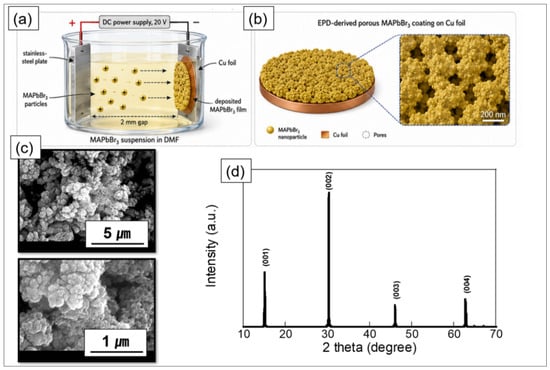
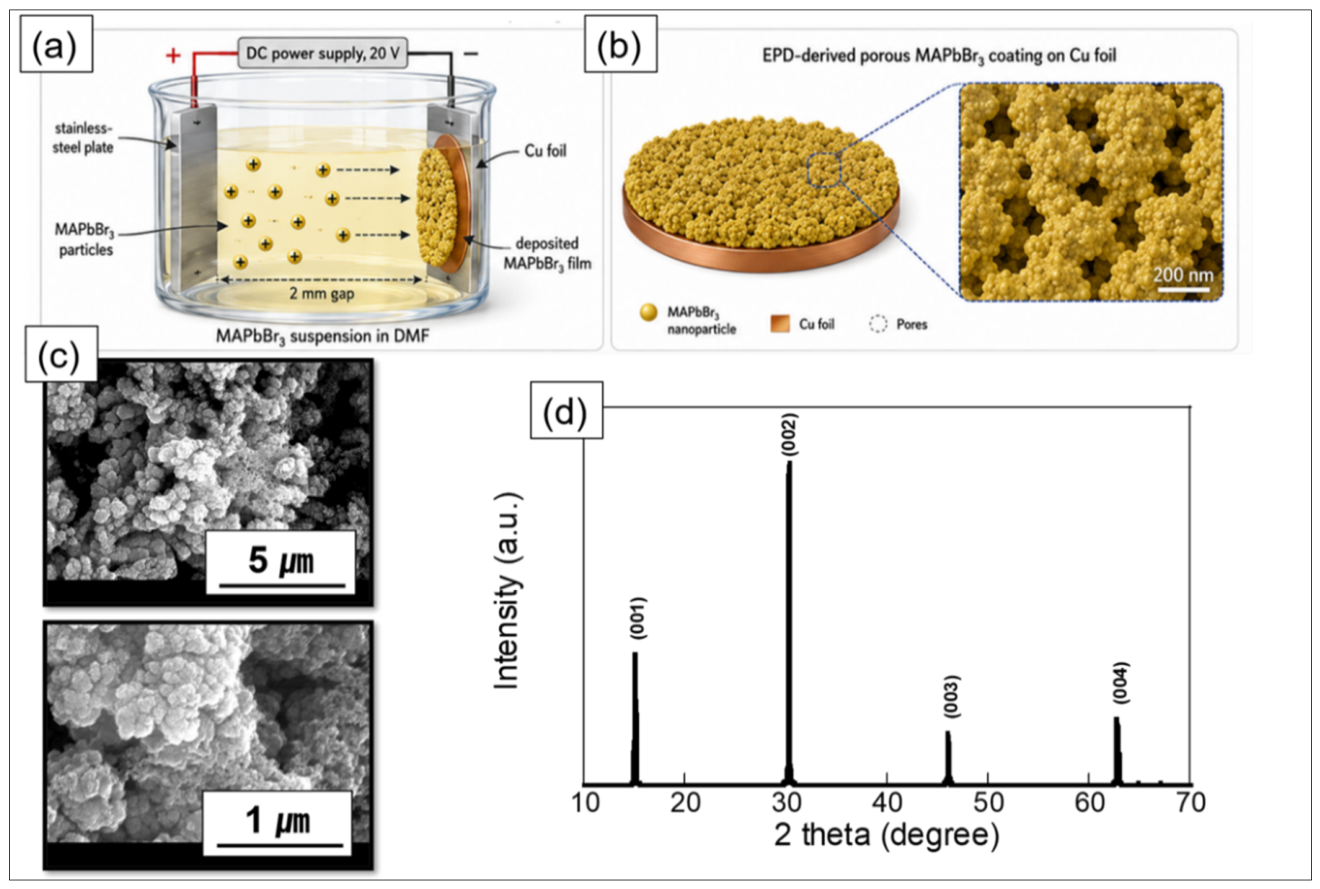
To elucidate the intrinsic Li-storage behavior of MAPbBr3 without interference from binders or conductive additives, we fabricated a binder-free electrode using EPD and investigated its structural characteristics. Figure 1 shows the fabrication process and structural characterization of the EPD-derived MAPbBr3 electrode. As illustrated in Figure 1a, MAPbBr3 particles dispersed in DMF were electrophoretically deposited onto Cu foil under a DC electric field of 20 V with an electrode gap of 2 mm.
Figure 1.
Fabrication and structural characterization of the EPD-derived MAPbBr3 electrode. (a) Schematic illustration of EPD of MAPbBr3 particles (b) Schematic representation of the porous MAPbBr3 coating formed on Cu foil by EPD, showing interconnected nanoparticles and nanoscale pores. (c) SEM images of the EPD-derived MAPbBr3 electrode at different magnifications, revealing microscale particle aggregates and a porous nanoparticulate morphology. (d) XRD pattern of the EPD-derived MAPbBr3 electrode.
The zeta-potential analysis indicates that MAPbBr3 particles dispersed in DMF carry an overall positive surface charge, with an average value of about +28.7 mV. This positive polarity explains the cathodic EPD behavior observed in this work. When a 20 V DC bias was applied across the 2 mm electrode spacing, the positively charged MAPbBr3 species were driven toward the negatively biased Cu foil, where they accumulated and formed a deposited film. The origin of this positive charge is likely related to surface adsorption of cationic species present in the precursor medium, including MA+ ions and Pb-containing complexes. Therefore, the zeta-potential result supports the preferential deposition of MAPbBr3 on the cathodic Cu current collector.
Figure 1b schematically shows the porous MAPbBr3 layer produced on the Cu foil by EPD. The coating is composed of closely packed MAPbBr3 nanoparticles that are connected to one another while maintaining numerous open pores. This nanoparticulate porous network is beneficial for Li storage because it can promote electrolyte penetration, enlarge the active electrode/electlyte interface, and reduce the effective Li+ diffusion length. In addition, the direct integration of the MAPbBr3 film with the Cu current collector provides an electronic pathway through the electrode, allowing the electrode to operate without conductive carbon additives.
The SEM images in Figure 1c confirm the porous and aggregated morphology of the EPD-derived MAPbBr3 film. At low magnification, the electrode surface is covered by microscale aggregates composed of densely assembled nanoparticles. At higher magnification, the film exhibits a rough, particulate morphology with nanoscale secondary particles and interparticle voids. This morphology is characteristic of particle-based EPD assembly, where suspended MAPbBr3 particles accumulate on the current collector while retaining nanoscale porosity. The porous morphology is expected to promote electrolyte infiltration and enhance the electrochemically active surface area during lithiation and delithiation.
Figure 1d presents the XRD pattern of the EPD-derived MAPbBr3 electrode. The diffraction peaks located at approximately 15°, 30°, 46°, and 63° can be assigned to the (001), (002), (003), and (004) planes of crystalline MAPbBr3, respectively. The sharp and intense diffraction peaks indicate that the MAPbBr3 crystalline phase is retained after the EPD process. In particular, the dominant (00L) reflections suggest preferential orientation of the deposited MAPbBr3 domains, which may originate from electric-field-assisted assembly during EPD. These results confirm that EPD can directly produce a crystalline, porous, and additive-free MAPbBr3 electrode on Cu foil, providing a suitable platform for investigating intrinsic Li-storage kinetics and cycling-induced interfacial reconstruction.
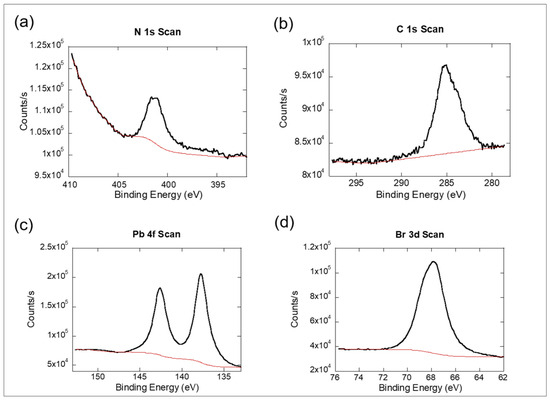
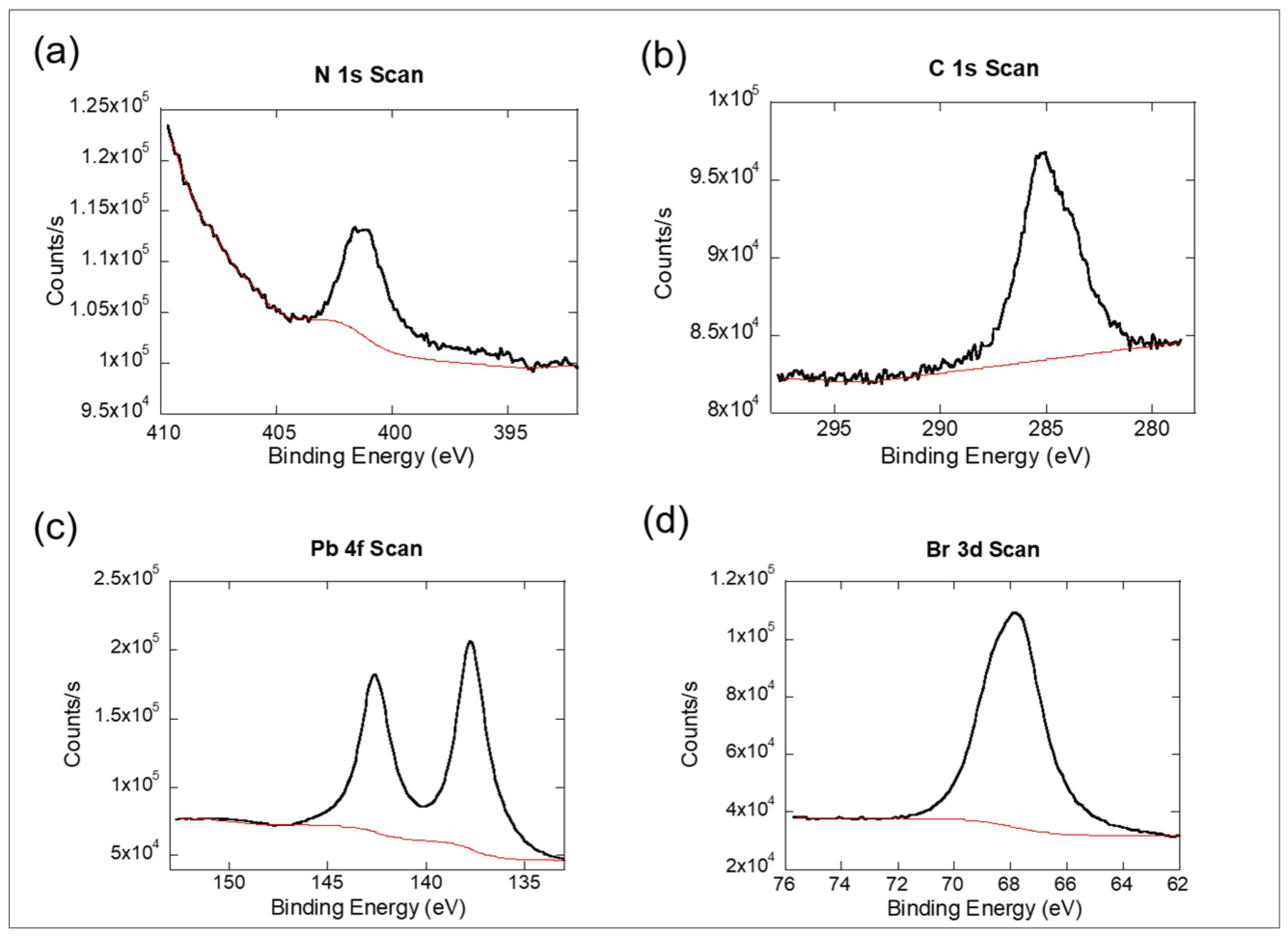
To confirm the surface chemical composition of the deposited perovskite film, the high-resolution XPS spectra of the EPD-derived MAPbBr3 electrode was measured in Figure 2. The N 1s spectrum in Figure 2a exhibits a distinct peak at approximately 401–402 eV, which can be assigned to the nitrogen-containing methylammonium cation, CH3NH3+. The presence of this N 1s signal indicates that the organic ammonium component of MAPbBr3 is retained after the EPD process. The C 1s spectrum in Figure 2b shows a main peak near 285 eV, which is attributed to carbon-containing species associated with the methylammonium group and possible adventitious surface carbon [17,18,19]. The assignment of N 1s and C 1s signals to the methylammonium component is consistent with previous XPS studies of methylammonium lead halide perovskites, where XPS was used to evaluate the organic cation-related surface chemistry.
Figure 2.
Surface chemical characterization of the EPD-derived MAPbBr3 electrode by high-resolution XPS. (a) N 1s, (b) C 1s, (c) Pb 4f, and (d) Br 3d spectra.
The Pb 4f spectrum in Figure 2c shows a well-defined spin–orbit doublet, with peaks located near 138 and 143 eV, corresponding to Pb 4f7/2 and Pb 4f5/2, respectively. These binding energies are characteristic of Pb2+ species coordinated within the lead halide perovskite framework. Previous XPS analysis of CH3NH3PbBr3 reported Pb 4f peaks at around 138 and 142.7 eV, assigned to Pb 4f7/2 and Pb 4f5/2 of Pb2+ in the perovskite structure. In addition, the Br 3d spectrum in Figure 2d exhibits a clear Br-related peak around 68 eV, confirming the presence of bromide ions in the deposited film. Reported Br 3d5/2 and Br 3d3/2 peaks for pristine MAPbBr3 appear near 68.3 and 69.4 eV and are assigned to Br− in the perovskite lattice [20,21].
The simultaneous detection of N, C, Pb, and Br verifies that the EPD process successfully forms a MAPbBr3-based electrode on Cu foil without requiring polymer binders or conductive carbon additives. These XPS results, together with the XRD and SEM analyses, demonstrate that the EPD-derived electrode retains the key chemical components and crystalline characteristics of MAPbBr3 while forming a porous particulate coating. This is important because the subsequent electrochemical response can be mainly attributed to the MAPbBr3-derived active material rather than to conventional slurry components. Therefore, the XPS analysis further supports the use of the additive-free EPD electrode as a clean platform for investigating the intrinsic Li-storage kinetics and cycling-induced interfacial reconstruction of MAPbBr3.
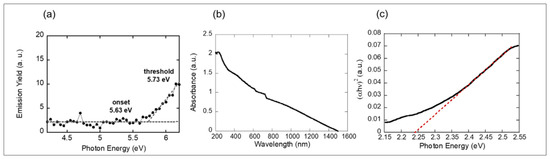
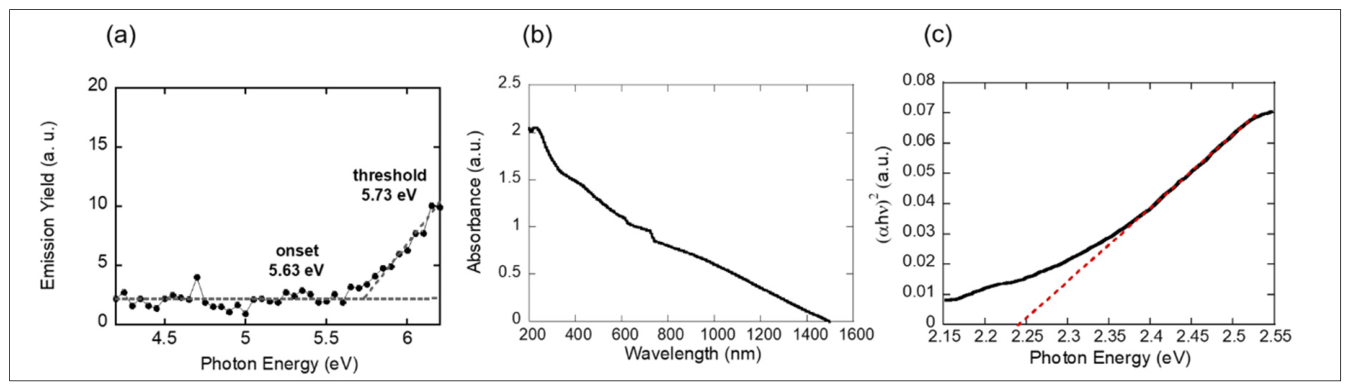
Optical characterization of the EPD-derived MAPbBr3 electrode was performed to confirm that the EPD-derived MAPbBr3 electrode retains the characteristic semiconducting electronic and optical properties of MAPbBr3 before undergoing Li-storage reactions. Figure 3 presents the electronic and optical characterization of the EPD-derived MAPbBr3 electrode. The photoelectron emission yield spectrum in Figure 3a shows a clear increase in emission yield at high photon energy, from which the onset and threshold energies were estimated to be approximately 5.63 and 5.73 eV, respectively. These values reflect the surface electronic energy level of the EPD-derived MAPbBr3 film and indicate that the deposited perovskite coating retains a well-defined electronic structure after EPD. The relatively sharp increase in emission yield near the threshold region suggests effective photoelectron emission from the MAPbBr3 surface, supporting the formation of an electronically active perovskite film on the Cu current collector.
Figure 3.
Electronic and optical characterization of the EPD-derived MAPbBr3 electrode. (a) Photoelectron emission yield spectrum as a function of photon energy, showing an onset energy of approximately 5.63 eV and a threshold energy of approximately 5.73 eV. (b) UV–Vis absorption spectrum of the EPD-derived MAPbBr3 film. (c) Direct Tauc plot, (αhν)2 versus photon energy, used to estimate the optical band gap of the EPD-derived MAPbBr3 electrode. The linear extrapolation gives an optical band gap of approximately 2.24 eV.
The UV–Vis absorption spectrum in Figure 3b shows strong absorption in the ultraviolet and visible regions, followed by a gradual decrease toward longer wavelengths. The absorption profile is consistent with the characteristic optical response of bromide-based methylammonium lead halide perovskites. Although the measurement was performed on an EPD-derived particulate film rather than an ideal flat single crystal, the clear absorption feature indicates that the optical activity of MAPbBr3 is preserved in the deposited electrode. This result is important because it confirms that the EPD process does not fully destroy the semiconducting nature of MAPbBr3.
The optical band gap was estimated from the direct Tauc plot shown in Figure 3c. The linear region of the plot was extrapolated to the photon–energy axis, yielding an optical band gap of approximately 2.24 eV [22,23]. This value is consistent with the expected band-edge transition of MAPbBr3 and confirms that the EPD-derived film retains the characteristic semiconducting behavior of the bromide perovskite phase. Together with the XRD and XPS results, the optical analysis demonstrates that EPD produces a porous MAPbBr3 electrode that maintains both the crystalline and electronic features of the perovskite material.
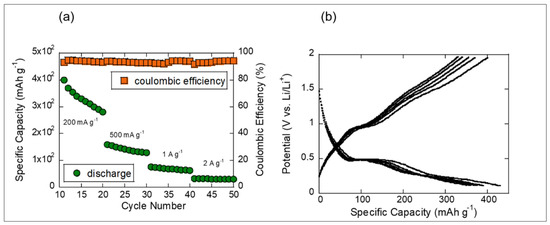
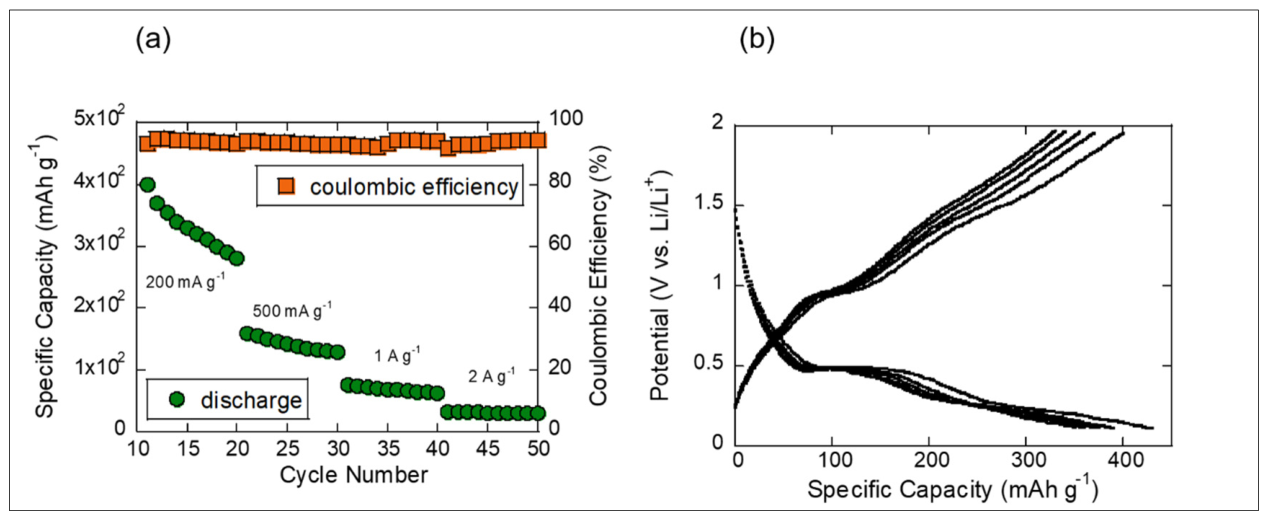
After confirming the structural, chemical, and optical characteristics of the EPD-derived MAPbBr3 electrode, its lithium-storage performance was evaluated by GCD measurements. Figure 4 shows the galvanostatic lithium-storage performance of the additive-free EPD-derived MAPbBr3 electrode. The rate capability was evaluated at current densities from 200 mA g−1 to 2 A g−1, as shown in Figure 4a. At 200 mA g−1, the electrode delivered a high initial discharge capacity of approximately 390 mAh g−1, which gradually decreased to approximately 280 mAh g−1 after repeated cycling. When the current density was increased to 500 mA g−1, the discharge capacity decreased to approximately 150 mAh g−1 and then stabilized near 120 mAh g−1. At higher current densities of 1 and 2 A g−1, the electrode retained capacities of approximately 60 and 25–30 mAh g−1, respectively. This rate-dependent capacity decrease indicates that the Li-storage reaction of MAPbBr3 becomes kinetically limited at high current densities.
Figure 4.
Galvanostatic Li-storage performance of the additive-free EPD-derived MAPbBr3 electrode. (a) Rate capability and coulombic efficiency measured at current densities of 200 mA g−1, 500 mA g−1, 1 A g−1, and 2 A g−1. (b) GCD profiles measured at 0.2 A g−1.
The coulombic efficiency remained relatively high during cycling, mostly above 90%, even as the discharge capacity decreased with increasing current density. This result indicates that, after the initial irreversible reactions, the EPD-derived MAPbBr3 electrode maintains partially reversible lithiation/delithiation behavior. Previous studies have shown that MAPbBr3 can electrochemically host Li ions and operate as a perovskite-based battery electrode, although its reaction mechanism may involve more complex processes than simple intercalation.
Figure 4b presents the GCD profiles measured at 0.2 A g−1. The voltage profiles show sloping discharge and charge curves rather than flat intercalation plateaus, suggesting that Li storage in MAPbBr3 proceeds through distributed multistep reactions. Operando XRD studies on MAPbBr3 have shown that lithiation can proceed through a complex three-step mechanism involving initial Li-ion insertion, conversion with metallic Pb formation, and subsequent Li–Pb alloying [14]. Therefore, the broad low-voltage discharge features observed here can be associated with Li+ insertion into the MAPbBr3-derived framework, Pb-based conversion, and Li–Pb alloying, while the charge profiles reflect Li extraction and Li–Pb dealloying from the lithiated perovskite-derived phases. This will be discussed in Figure 4.
The gradual capacity decay observed at low current density and the reduced capacity at high current density can be attributed to structural reconstruction of the perovskite-derived electrode, electrolyte-derived interphase formation, and polarization associated with conversion/alloying reactions [24,25,26]. In particular, previous operando studies reported that conversion reactions in MAPbBr3 are largely irreversible and that Li–Pb alloying/dealloying contributes to the electrochemical response at low potentials. The retention of measurable capacity even at 2 A g−1 indicates that the porous EPD-derived electrode provides accessible Li+ transport pathways and electrochemically active sites without using conductive carbon or polymer binders.
To further evaluate the cycling durability of the additive-free EPD-derived MAPbBr3 electrode, extended galvanostatic cycling was performed at a fixed current density of 1 A g−1 for 300 cycles in the Supporting Information (Figure S1). The electrode exhibited an initial capacity decrease during the early cycles, followed by a substantially slower decay upon prolonged cycling. After 300 cycles, a discharge capacity of approximately 45 mAh g−1 was retained. The Coulombic efficiency remained relatively stable at approximately 92–94% over most of the cycling period, indicating that the remaining electrochemically active MAPbBr3-derived electrode maintains reasonably reversible lithiation/delithiation despite the gradual capacity loss. These results show that the main capacity degradation occurs during the early electrochemical evolution of the electrode, whereas the subsequently evolved electrode exhibits comparatively stable long-term cycling behavior.
Overall, the galvanostatic results demonstrate that the additive-free EPD-derived MAPbBr3 electrode is electrochemically active for Li storage and can operate over a wide range of current densities. The sloping voltage profiles and rate-dependent capacity decay indicate that the electrode does not behave as a conventional single-phase intercalation host. Instead, MAPbBr3 undergoes coupled insertion, conversion, alloying/dealloying, and interfacial reconstruction during cycling. These results provide the electrochemical basis for the subsequent peak-resolved kinetic analysis, where individual redox peaks are analyzed to clarify the different kinetic regimes involved in MAPbBr3 Li storage. The use of scan-rate-dependent CV and b-value analysis is widely employed to distinguish diffusion-controlled and surface/interfacial contributions in battery-type electrodes.
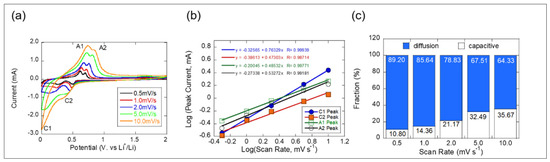
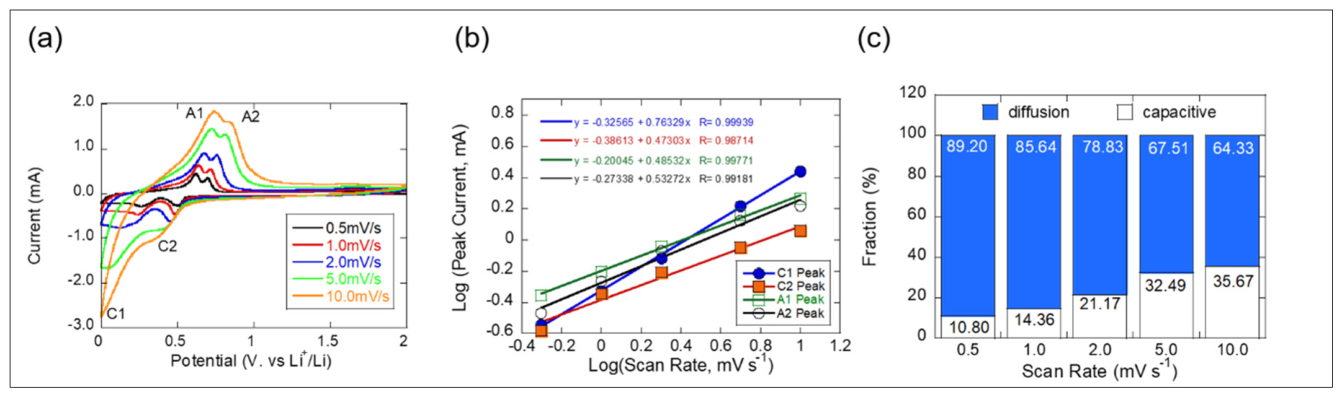
To determine whether the multiple redox peaks originate from identical or distinct Li-storage kinetics, scan-rate-dependent CV analysis was performed on the additive-free EPD-derived MAPbBr3 electrode. Figure 5 presents the scan-rate-dependent electrochemical kinetic analysis of the additive-free EPD-derived MAPbBr3 electrode. CV was measured at scan rates from 0.5 to 10.0 mV s−1 to distinguish the kinetic characteristics of individual redox processes. As shown in Figure 5a, the CV curves exhibit two cathodic features, denoted as C1 and C2, and two anodic peaks, denoted as A1 and A2. With increasing scan rate, all redox peaks become more pronounced and shift slightly because of increased polarization.
Figure 5.
Scan-rate-dependent electrochemical kinetic analysis of the additive-free EPD-derived MAPbBr3 electrode. (a) Cyclic voltammograms measured at scan rates from 0.5 to 10.0 mV s−1, showing two cathodic peaks, C1 and C2, and two anodic peaks, A1 and A2. (b) Logarithmic plots of peak current versus scan rate used to determine the b-values of the individual redox peaks. (c) Relative diffusion-controlled and capacitive contributions at different scan rates.
At a representative scan rate of 1.0 mV s−1, the CV profile exhibits two cathodic features, C1 and C2, together with two anodic peaks, A1 and A2, demonstrating that lithiation and delithiation involve multiple electrochemical processes rather than a single redox reaction. In the present study, these peaks are distinguished primarily according to their electrochemical potential and scan-rate-dependent kinetic characteristics rather than being uniquely assigned to individual structural reactions. The low-voltage C1 peak exhibits a b-value of 0.763, indicating mixed diffusion/interfacial kinetics with a substantial non-diffusion-controlled contribution. In contrast, the mid-voltage C2 peak exhibits a b-value of 0.473 and therefore shows predominantly diffusion-controlled behavior. These results establish that C1 and C2 represent kinetically distinct lithiation processes in the EPD-derived MAPbBr3 electrode.
Previous operando-XRD analysis of MAPbBr3 by Vicente et al. demonstrated that progressive lithiation can involve Li+ insertion into the perovskite phase, followed by conversion involving metallic Pb formation and subsequent Li–Pb alloying at deeper lithiation. However, because the present study does not provide state-resolved diffraction or chemical-state-sensitive characterization at the individual C1 and C2 potentials, these previously reported structural reactions cannot be uniquely assigned to the corresponding CV peaks of the present EPD-derived electrode. Therefore, the mechanism reported in Vicente et al. is used only as a framework for discussing possible reaction pathways during progressive lithiation rather than as direct evidence for the microscopic origin of C1 or C2 [14].
The distinctly higher b-value of C1 compared with C2 indicates that the low-voltage lithiation process contains a substantially larger interfacial contribution. This observation establishes a kinetic distinction between the two cathodic processes but does not, by itself, identify their underlying structural reaction pathways. The possible occurrence of conversion- and alloying-type reactions during deep lithiation is therefore discussed only by comparison with previously reported operando-XRD observations for MAPbBr3.
To further clarify the charge-storage kinetics, the relationship between peak current and scan rate was analyzed using the power-law equation i = avb, where i is the peak current, v is the scan rate, and b represents the kinetic exponent [27]. A b-value close to 0.5 indicates a diffusion-controlled process, whereas a b-value close to 1.0 suggests a surface-controlled or capacitive contribution. As shown in Figure 5b, the low-voltage C1 peak exhibits a b-value of 0.763, indicating mixed diffusion/interfacial kinetics rather than a purely diffusion-controlled lithiation process. Previous operando-XRD studies of MAPbBr3 have demonstrated that deep lithiation can involve sequential Li+ insertion, Pb-based conversion, and Li–Pb alloying. Accordingly, the C1 response observed in the present study is consistent with previously reported conversion/alloying-type lithiation. However, because metallic Pb or Li–Pb phases were not directly identified by operando/ex situ diffraction or electron microscopy in the present study, C1 should not be regarded as direct evidence for the formation of these specific phases [14]. In contrast, the C2, A1, and A2 peaks show lower b-values of 0.473, 0.485, and 0.533, respectively, indicating predominantly diffusion-controlled behavior. These results demonstrate that each redox peak has a distinct kinetic regime [14].
Detailed kinetic parameters are summarized in Table 1. The distinctive C1 behavior is instead interpreted together with the potential-dependent EIS results in a later section. The substantial evolution of charge-transfer resistance in the low-voltage region demonstrates pronounced modification of the electrode/electrolyte interface during deep lithiation. Thus, the relatively high b-value of C1 is interpreted as evidence for an increased interfacial contribution to the low-voltage reaction rather than enhanced bulk Li-ion diffusion, as will be discussed.
Table 1.
Kinetic parameters derived from scan-rate-dependent cyclic voltammetry.
Figure 5c shows the relative contributions of diffusion-controlled and capacitive processes at different scan rates. The relative contributions of diffusion-controlled and capacitive/surface-controlled processes were further quantified using the scan-rate-dependent current-separation method described in Section 2. At each potential, the current response was separated according to:
where k1(V)v represents the capacitive/surface-controlled component and k2(V)v(1/2) represents the diffusion-controlled component. The coefficients k1(V) and k2(V) were obtained by linear fitting according to:
i(V) = k1(V)v + k2(V)v(1/2)
i(V)/v(1/2) = k1(V)v(1/2) + k2(V)
The resulting current components were then integrated over the entire potential window to determine their relative contributions. Representative linear fitting results are provided in the Supporting Information (Figure S2).
At 0.5 mV s−1, the diffusion-controlled contribution is dominant, accounting for 89.20% of the total current, while the capacitive contribution is only 10.80%. As the scan rate increases, the capacitive contribution gradually increases from 14.36% at 1.0 mV s−1 to 35.67% at 10.0 mV s−1. Nevertheless, the diffusion-controlled contribution remains dominant over the entire scan-rate range, decreasing from 89.20% to 64.33%. This trend indicates that Li+ diffusion and phase transformation remain the primary charge-storage processes in the EPD-derived MAPbBr3 electrode, while surface/interfacial contributions become increasingly important at high scan rates.
Overall, the scan-rate-dependent kinetic analysis confirms that Li storage in the additive-free EPD-derived MAPbBr3 electrode is governed by peak-dependent multistep kinetics. The C1 peak is characterized by mixed diffusion/interfacial behavior and enhanced Li+ transport, whereas C2, A1, and A2 are mainly diffusion-controlled. These results provide quantitative evidence that MAPbBr3 behaves as a reconstructive Li-storage electrode involving coupled Li+ insertion, Pb-based conversion, Li–Pb alloying/dealloying, and interfacial charge-transfer processes rather than a conventional single-phase intercalation host.
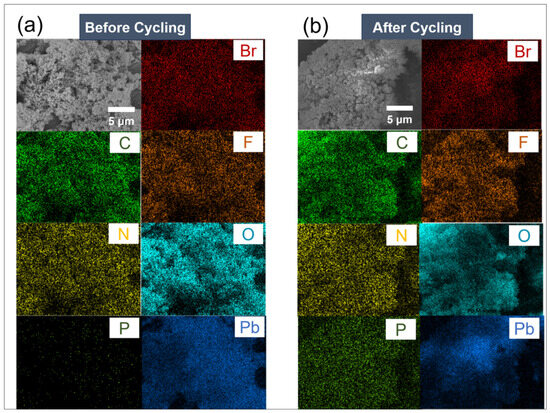
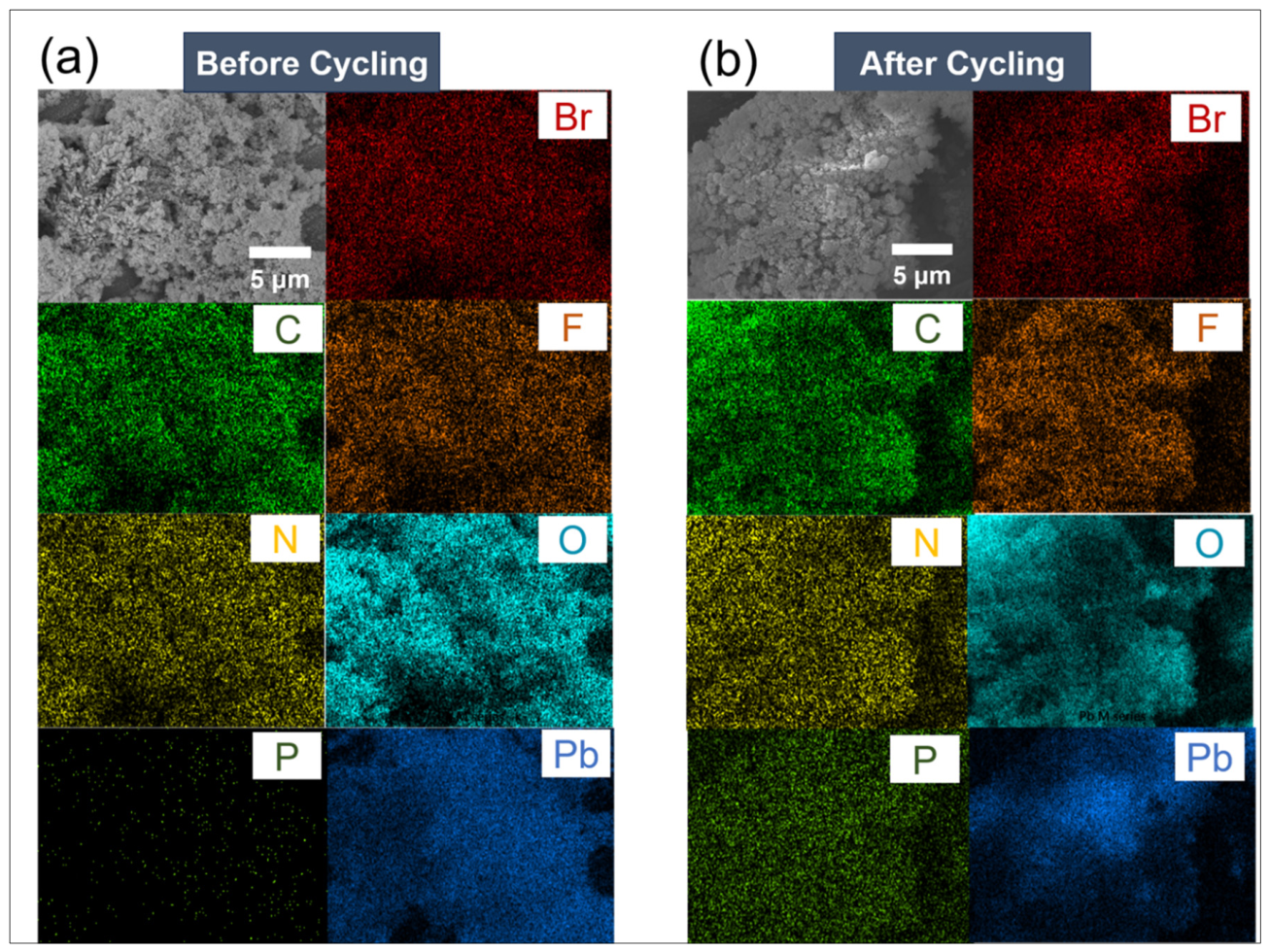
To examine cycling-induced compositional changes in the MAPbBr3-derived electrode, SEM–EDS mapping was performed before and after electrochemical cycling. Figure 6 compares the morphology and spatial distributions of Br, C, N, Pb, F, P, and O in the pristine and cycled electrodes. Before cycling, Br, N, and Pb signals are distributed throughout the particulate electrode region, consistent with the MAPbBr3-based composition confirmed independently by the XRD and XPS characterization of the pristine electrode.
Figure 6.
SEM–EDS elemental mapping of the additive-free EPD-derived MAPbBr3 electrode before and after cycling. (a) SEM image and corresponding EDS elemental maps of Br, C, F, N, O, P, and Pb before cycling. (b) SEM image and corresponding EDS elemental maps after cycling.
To provide a quantitative basis for the elemental redistribution observed in the EDS maps, the corresponding EDS spectra and semi-quantitative elemental compositions before and after cycling are provided in Table S1. The atomic fractions of N, Br, and Pb decrease from 2.80, 1.22, and 9.89 at.% before cycling to 0.66, 0.71, and 4.27 at.% after cycling, respectively. In contrast, O and F increase from 50.56 and 3.21 at.% to 59.84 and 5.31 at.%, respectively, while P becomes detectable after cycling at 0.08 at.%. A consistent trend is also observed in the corresponding weight percentages. These quantitative changes substantiate substantial cycling-induced elemental redistribution at the MAPbBr3-derived electrode surface.
Importantly, these compositional changes do not establish the chemical states or specific phases associated with the detected elements. Accordingly, the decrease in N, Br, and Pb and the enrichment of F, P, and O are interpreted as evidence for cycling-induced compositional and interfacial evolution rather than direct identification of residual MAPbBr3, metallic Pb, Li–Pb alloy, or specific electrolyte-derived interphase compounds.
Post-cycling XPS measurements were also attempted to obtain chemical-state-sensitive information. However, the cycled electrode produced spectra with insufficient signal-to-noise ratio for reliable peak deconvolution and chemical-state assignment. These spectra were therefore not used to derive chemical-state conclusions in order to avoid overinterpretation of uncertain spectral features. Consequently, the present SEM–EDS analysis is interpreted conservatively as evidence for cycling-induced elemental redistribution and interfacial compositional evolution, rather than direct identification of specific reconstructed phases.
This compositional evolution is consistent with the electrochemical and impedance changes observed during cycling. In particular, the low-voltage C1 process exhibits mixed diffusion/interfacial kinetics, while the EIS response changes substantially during deep lithiation. Taken together, these observations indicate that the electrode/electrolyte interface evolves during cycling. However, the present measurements do not directly identify the chemical phases responsible for this evolution.
Possible Pb-based conversion and Li–Pb alloying reactions are discussed based on previously reported operando-XRD studies of MAPbBr3, which demonstrated sequential Li-ion insertion, Pb-related conversion, and Li–Pb alloying during deep lithiation. Therefore, the low-voltage C1 response observed in the present study is described as being consistent with previously reported conversion/alloying-type lithiation, rather than being regarded as direct evidence for the formation of metallic Pb or Li–Pb alloy phases.
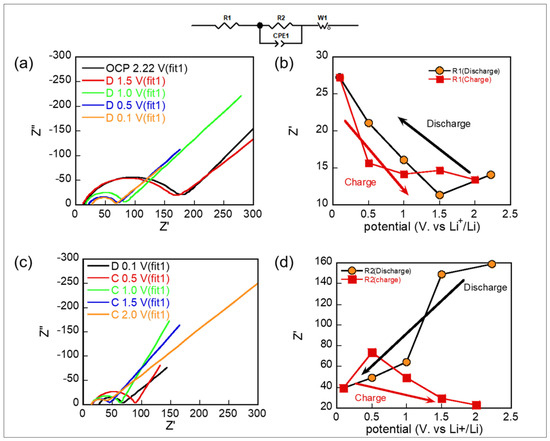
To further clarify how cycling-induced reconstruction affects interfacial charge-transfer kinetics, EIS was performed at selected potentials during discharge and charge. Figure 7 shows the potential-dependent electrochemical impedance behavior of the additive-free EPD-derived MAPbBr3 electrode during discharge and charge. The experimental impedance spectra were fitted using the equivalent circuit R1–(R2||CPE1)–W1 by complex nonlinear least-squares fitting. Experimental data points are presented in Supporting Information (Figure S3). The equivalent circuit was selected based on the experimentally resolved features of the Nyquist spectra, which consist primarily of a high-frequency real-axis intercept, a dominant depressed semicircular response in the intermediate-frequency region, and an inclined low-frequency region. R1 represents the overall series ohmic resistance arising from the electrolyte, separator, current collector/contact, and other cell components. R2 represents an effective interfacial resistance associated with the dominant impedance relaxation at the electrode/electrolyte interface. CPE1 accounts for the non-ideal capacitive response arising from surface roughness, porosity, compositional heterogeneity, and distributed interfacial reaction environments. W1 represents the low-frequency mass-transport-related impedance. Because multiple electrochemical processes may overlap within the same frequency domain, the individual circuit elements were not assigned uniquely to specific Li+ insertion, conversion, alloying, or interphase-formation reactions. The circuit was instead employed as a minimal phenomenological model for tracking potential-dependent changes in the dominant impedance response.
Figure 7.
Potential-dependent EIS analysis of the additive-free EPD-derived MAPbBr3 electrode during discharge and charge. (a) Nyquist plots measured during discharge from the open-circuit potential to 0.1 V vs. Li+/Li, fitted using an equivalent circuit composed of R1, R2/CPE1, and W1. (b) Variation of the fitted R1 values during discharge and charge as a function of potential. (c) Nyquist plots measured during the subsequent charge process from 0.1 to 2.0 V vs. Li+/Li. (d) Variation of the fitted R2 values during discharge and charge.
Figure 7a shows the Nyquist plots measured during discharge from the open-circuit potential to low potentials. At the open-circuit potential, the electrode exhibits a relatively large semicircle, indicating sluggish interfacial charge transfer before lithiation. As discharge proceeds, the semicircle becomes smaller at lower potentials, especially near 0.5 and 0.1 V vs. Li+/Li, suggesting that lithiation activates the electrode/electrolyte interface. This behavior is consistent with the low-voltage cathodic C1 process observed in the CV analysis, where the highest b-value was obtained. Therefore, the decrease in impedance during discharge can be attributed to electrochemical activation caused by Li+ insertion, Pb-based conversion, Li–Pb alloying, and the formation of a reconstructed interphase. The fitted R1 values during discharge and charge are summarized in Figure 7b. The R1 value changes moderately with potential, indicating that the ohmic resistance of the cell is affected by the state of lithiation and interfacial evolution but is not the dominant factor governing the redox kinetics. More importantly, the evolution of R2 in Figure 7d shows a strong dependence on the lithiation/delithiation state. During discharge, R2 changes significantly with decreasing potential, reflecting the progressive transformation of the pristine MAPbBr3 electrode into a lithiated and reconstructed electrode. The increase in R2 at intermediate discharge potentials suggests that structural conversion and interphase formation initially introduce kinetic barriers. However, at deep discharge, the impedance response becomes more compact in the Nyquist plot, indicating that low-voltage lithiation also generates more conductive reaction products and active interfacial pathways.
Figure 7c shows the Nyquist plots measured during the subsequent charge process. Compared with the initial discharge state, the charge spectra exhibit smaller semicircles and more compact impedance responses over the measured potential range. This indicates that the electrode does not fully return to its pristine state after lithiation. Instead, the reconstructed MAPbBr3-derived electrode maintains modified charge-transfer pathways during delithiation. The fitted R2 values during charge remain lower than those observed at high discharge potentials, suggesting that the cycling-induced reconstructed interface facilitates charge transfer after the first lithiation process.
An important relationship emerges when the peak-resolved CV analysis is considered together with the potential-dependent EIS response. Among the individual redox processes, C1 exhibits the highest b-value of 0.763, indicating the largest relative interfacial contribution to the measured current. In the corresponding low-voltage region, the effective interfacial resistance R2 also undergoes pronounced potential-dependent evolution as the electrode approaches deep lithiation. These two observations independently indicate that low-voltage lithiation is accompanied by substantial modification of the electrode/electrolyte interface.
The CV and EIS parameters, however, describe different aspects of the electrochemical response. The b-value reflects the scan-rate dependence of the redox current and therefore distinguishes the relative kinetic character of the reaction, whereas R2 describes the effective impedance associated with the dominant interfacial relaxation at a given electrode potential. Consequently, the change in R2 should not be quantitatively equated with the b-value. Rather, the pronounced evolution of R2 in the C1 potential region is consistent with the increased interfacial contribution indicated independently by b = 0.763.
This complementary behavior supports a model in which low-voltage C1 lithiation is more strongly coupled to interfacial evolution than the predominantly diffusion-controlled C2, A1, and A2 processes. Nevertheless, because multiple electrochemical phenomena may overlap within the measured impedance response, the R2 evolution is not uniquely assigned to a specific conversion, alloying, or SEI-formation reaction.
Overall, the EIS analysis demonstrates that the dominant interfacial impedance response evolves strongly with lithiation and delithiation. Together with the peak-dependent CV kinetics and cycling-induced elemental redistribution, these results support substantial electrochemical and interfacial evolution of the MAPbBr3-derived electrode while avoiding a one-to-one assignment of individual equivalent-circuit elements to specific chemical reactions.
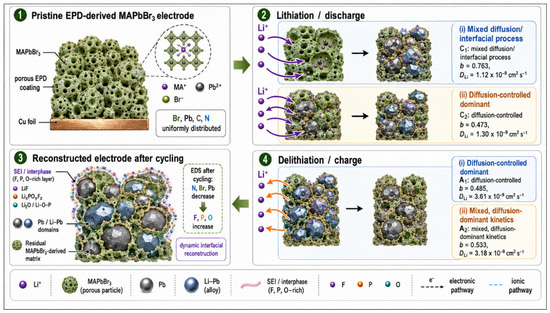
Based on the structural, chemical, electrochemical, kinetic, and impedance analyses, a mechanistic model for Li storage in the additive-free EPD-derived MAPbBr3 electrode is proposed in Figure 8. Figure 8 summarizes the proposed Li-storage mechanism of the additive-free EPD-derived MAPbBr3 electrode. In the pristine state, the EPD process produces a porous MAPbBr3 coating directly on Cu foil without polymer binders or conductive carbon additives. The electrode consists of interconnected MAPbBr3 particles with nanoscale pores, which provide electrolyte-accessible pathways and direct contact with the current collector. The uniform distribution of Br, Pb, C, and N confirms that the deposited coating contains the key chemical components of MAPbBr3. Therefore, the pristine electrode can be regarded as a clean perovskite-based platform for investigating the intrinsic Li-storage behavior of MAPbBr3.
Figure 8.
Schematic illustration of the proposed Li-storage mechanism in the additive-free EPD-derived MAPbBr3 electrode.
During discharge, Li+ insertion initially occurs within the MAPbBr3-derived framework at the mid-voltage region. This process corresponds to the C2 cathodic peak, which exhibits diffusion-controlled behavior with a b-value of 0.473. This indicates that the mid-voltage lithiation process is mainly governed by Li+ transport through the perovskite-derived structure. Upon deeper discharge, the low-voltage C1 process becomes kinetically distinct. Its b-value of 0.763 indicates mixed diffusion/interfacial behavior with a substantial non-diffusion-controlled contribution. Together with the pronounced potential-dependent impedance evolution and post-cycling compositional reconstruction, this behavior suggests that the C1 process is strongly coupled to interfacial reconstruction and low-voltage conversion/alloying-type reactions. Importantly, this interpretation does not imply an intrinsically larger Li-ion diffusion coefficient for C1. After cycling, SEM–EDS reveals pronounced elemental redistribution, including decreased relative N, Br, and Pb signals and increased F, P, and O signals. These observations indicate substantial compositional and interfacial evolution of the electrode during cycling. Importantly, Figure 8 should therefore be regarded as a schematic mechanistic interpretation integrating the present electrochemical observations with previously reported MAPbBr3 reaction pathways, rather than as a direct representation of phases chemically identified by EDS.
During charge, Li+ is extracted from the reconstructed electrode through delithiation and Li–Pb dealloying processes. The anodic peaks A1 and A2 exhibit b-values of 0.485 and 0.533. These values indicate that the delithiation process is mainly diffusion-controlled, likely involving Li+ transport and phase-boundary movement within the reconstructed electrode. The EIS results show that relatively low charge-transfer resistance is maintained during charge, suggesting that the modified interfacial pathways formed during discharge remain active during subsequent delithiation.
It is important to emphasize that Figure 8 summarizes a schematic interpretation of the electrochemical evolution of the additive-free EPD-derived MAPbBr3 electrode. Importantly, the schematic distinguishes between the kinetic characteristics directly determined in the present study and possible structural reaction pathways reported previously for MAPbBr3. During lithiation, two kinetically distinguishable cathodic processes are observed. The mid-voltage C2 process exhibits predominantly diffusion-controlled behavior with a b-value of 0.473, whereas the low-voltage C1 process exhibits mixed diffusion/interfacial kinetics with a higher b-value of 0.763. These observations demonstrate a transition in the dominant kinetic character as lithiation proceeds toward lower potentials.
Previous operando-XRD studies of MAPbBr3 have shown that progressive lithiation can involve initial Li+ insertion, conversion of the perovskite with metallic Pb formation, and subsequent Li–Pb alloying at deeper lithiation. These previously established reactions provide a plausible structural framework for interpreting the multistep electrochemical response observed here. However, the present EPD-derived electrode differs in architecture and interfacial environment from electrodes investigated in those studies, and no state-resolved XRD or XPS measurements were performed at the individual C1 and C2 states. Therefore, Figure 8 does not imply a unique assignment of C2 to Li+ insertion or C1 to Pb conversion/Li–Pb alloying. Instead, the present experimental evidence supports the more general conclusion that progressively deeper lithiation is accompanied by a change from predominantly diffusion-controlled behavior to a larger interfacial contribution, together with substantial evolution of the electrode/electrolyte interface. The specific phase transformations underlying the individual CV peaks remain to be established by future state-resolved structural characterization.
To experimentally assess the influence of the electrode fabrication configuration, a conventional slurry-cast MAPbBr3 composite electrode containing conductive carbon and polymer binder was additionally prepared and evaluated under comparable electrochemical conditions in the Supporting Information (Figure S4). In contrast to the additive-free EPD-derived electrode, the slurry-cast electrode exhibited a substantially lower reversible capacity together with more pronounced capacity fading during cycling. The comparison demonstrates that the electrochemical response of MAPbBr3 is strongly dependent on the electrode configuration rather than being determined exclusively by the bulk active material.
Notably, conductive carbon would generally be expected to improve electronic percolation within a composite electrode; nevertheless, the slurry-cast MAPbBr3 electrode showed significantly poorer Li-storage performance than the directly deposited EPD electrode. This observation suggests that the advantageous behavior of the EPD electrode cannot simply be attributed to electronic conductivity. Instead, direct MAPbBr3/Cu contact, the porous particle-assembled architecture, and the absence of polymer-binder- and carbon-derived heterogeneous interfaces likely provide a more favorable environment for electrochemical accessibility and interfacial charge transfer. Conversely, the additional interfaces and transport pathways introduced by the slurry formulation may modify the reaction distribution and interfacial evolution of the perovskite electrode.
The comparison should not, however, be interpreted as proving that the kinetic parameters obtained from the EPD electrode represent completely intrinsic bulk properties of MAPbBr3. Rather, it demonstrates that conventional slurry processing measurably alters the macroscopic electrochemical response and supports the use of additive-free EPD as a simplified model-electrode platform in which slurry-derived contributions are substantially minimized. On this basis, the peak-resolved kinetic analysis presented below is interpreted primarily as the Li-storage response of the directly deposited MAPbBr3-derived electrode and its cycling-reconstructed interface.
4. Summary and Conclusions
In this study, additive-free MAPbBr3 electrodes were fabricated directly on Cu foil by EPD to investigate the intrinsic Li-storage kinetics of MAPbBr3 with minimal interference from polymer binders and conductive carbon additives. The EPD-derived electrode formed a porous particulate coating on the Cu current collector, providing electrolyte-accessible pathways and direct electronic contact. Structural, chemical, and optical characterizations confirmed that the deposited film retained key features of MAPbBr3, including its crystalline phase, Pb–Br framework, methylammonium-related components, and semiconducting optical response. The direct optical band gap was estimated to be approximately 2.24 eV from the Tauc plot.
Electrochemical measurements showed that the EPD-derived MAPbBr3 electrode is active toward Li storage. The GCD profiles exhibited sloping voltage behavior and rate-dependent capacity retention, indicating that the electrode does not behave as a simple single-phase intercalation material. Scan-rate-dependent CV analysis further revealed peak-dependent kinetics. The low-voltage cathodic C1 peak showed a relatively high b-value of 0.763, suggesting mixed diffusion/interfacial behavior. In contrast, C2, A1, and A2 were mainly diffusion-controlled, with b-values of 0.473, 0.485, and 0.533, respectively.
The low-voltage C1 process was interpreted cautiously as being consistent with conversion/alloying-type lithiation previously reported for MAPbBr3 by operando XRD, rather than as direct evidence of metallic Pb or Li–Pb alloy formation in the present study. This distinction is important because the present work does not directly identify Pb or Li–Pb phases by operando or ex situ diffraction. Instead, the CV kinetics, together with EDS and EIS results, support the broader conclusion that MAPbBr3 undergoes cycling-induced chemical and interfacial reconstruction during Li storage.
SEM–EDS analysis revealed pronounced cycling-induced elemental redistribution, characterized by changes in the relative N, Br, and Pb signals together with increased F, P, and O signals after cycling. These observations demonstrate substantial compositional and interfacial evolution of the MAPbBr3-derived electrode but do not, by themselves, identify specific chemical states or reaction phases. Accordingly, Pb-based conversion and Li–Pb alloying are discussed only as processes consistent with previously reported operando studies rather than as phases directly demonstrated in the present work. Combined with the peak-dependent CV kinetics and potential-dependent impedance evolution, the results support a conservative picture in which Li storage is accompanied by significant cycling-induced interfacial evolution and multistep electrochemical reactions.
Overall, this work demonstrates that additive-free EPD provides a simplified electrode platform for investigating the Li-storage and interfacial behavior of MAPbBr3 while minimizing contributions associated with conventional polymer binders and conductive carbon additives. A direct comparison with a conventional slurry-cast MAPbBr3 composite electrode revealed substantially lower reversible capacity and poorer cycling stability for the slurry-derived electrode, demonstrating that electrode formulation and architecture can significantly influence the measured electrochemical response. Rather than claiming complete isolation of the intrinsic bulk kinetics of MAPbBr3, the EPD configuration reduces the number of electrochemically and structurally coupled components and thereby enables a more direct assessment of MAPbBr3-derived redox processes and cycling-induced reconstruction.
Supplementary Materials
The following supporting information can be downloaded at https://www.mdpi.com/article/10.3390/batteries12090366/s1, Figure S1: Long-term cycling performance of the additive-free EPD-derived MAPbBr3; Figure S2: Separation of diffusion-controlled and capacitive/surface-controlled contributions in the additive-free EPD-derived MAPbBr3 electrode at different scan rates; Table S1: Semi-quantitative EDS elemental compositions of the MAPbBr3-derived electrode; Figure S3: Potential-dependent EIS of the additive-free EPD-derived MAPbBr3 electrode; Figure S4: Electrochemical performance of the conventional slurry-cast MAPbBr3 composite electrode at 200 mA g−1.
Author Contributions
Conceptualization, B.-N.P. and H.K.; methodology, B.-N.P.; software, H.K.; validation, B.-N.P.; formal analysis, H.K.; investigation, B.-N.P.; resources, B.-N.P.; data curation, H.K.; writing—original draft preparation, B.-N.P.; writing—review and editing, H.K.; visualization, B.-N.P.; supervision, B.-N.P.; project administration, B.-N.P.; funding acquisition, B.-N.P. All authors have read and agreed to the published version of the manuscript.
Funding
This work was supported by the National Research Foundation of Korea (NRF) grant funded by the Korea government (MSIT) (RS-2026-25506515). This work was also supported by the 2026 Research Fund of the University of Seoul.
Data Availability Statement
The data presented in this study are available on request from the corresponding author.
Conflicts of Interest
The authors declare no conflicts of interest.
References
- Deng, D. Li-ion batteries: Basics, progress, and challenges. Energy Sci. Eng. 2015, 3, 385–418. [Google Scholar] [CrossRef] [Scilit]
- Manthiram, A. An outlook on lithium ion battery technology. ACS Cent. Sci. 2017, 3, 1063–1069. [Google Scholar] [CrossRef] [Scilit] [PubMed]
- Bresser, D.; Passerini, S.; Scrosati, B. Leveraging valuable synergies by combining alloying and conversion for lithium-ion anodes. Energy Environ. Sci. 2016, 9, 3348–3367. [Google Scholar] [CrossRef] [Scilit]
- Asenbauer, J.; Varzi, A.; Passerini, S.; Bresser, D. Revisiting the energy efficiency and (potential) full-cell performance of lithium-ion batteries employing conversion/alloying-type negative electrodes. J. Power Sources 2020, 473, 228583. [Google Scholar] [CrossRef] [Scilit]
- Cui, Q.; Zhong, Y.; Pan, L.; Zhang, H.; Yang, Y.; Liu, D.; Teng, F.; Bando, Y.; Yao, J.; Wang, X. Recent advances in designing high-capacity anode nanomaterials for Li-ion batteries and their atomic-scale storage mechanism studies. Adv. Sci. 2018, 5, 1700902. [Google Scholar] [CrossRef] [Scilit] [PubMed]
- Park, B.-N. Enhancing electrochemical kinetics in electrophoretic-deposited lithium iron phosphate Li-metal batteries through additives. Mater. Lett. 2024, 372, 136969. [Google Scholar] [CrossRef] [Scilit]
- Lee, J.-Y.; Shin, J.; Heo, M.; Yoo, C.; Chang, M.; Kim, J.; Kim, H.-S.; Park, B.-N. High-Dielectric Ultrathin BaTiO3 Anode via Electrophoretic Deposition: A Platform for Pseudocapacitive Li Storage and Interface Stabilization. ACS Appl. Energy Mater. 2025, 8, 13278–13287. [Google Scholar] [CrossRef] [Scilit]
- Xie, W.; Guo, P.; Gao, X. Elucidating the rate limitation of lithium-ion batteries under different charging conditions through polarization analysis. J. Energy Storage 2024, 82, 110554. [Google Scholar] [CrossRef] [Scilit]
- Narayanan, S.; Parikh, N.; Tavakoli, M.M.; Pandey, M.; Kumar, M.; Kalam, A.; Trivedi, S.; Prochowicz, D.; Yadav, P. Metal halide perovskites for energy storage applications. Eur. J. Inorg. Chem. 2021, 2021, 1201–1212. [Google Scholar] [CrossRef] [Scilit]
- Ahmad, S.; George, C.; Beesley, D.J.; Baumberg, J.J.; De Volder, M. Photo-rechargeable organo-halide perovskite batteries. Nano Lett. 2018, 18, 1856–1862. [Google Scholar] [CrossRef] [Scilit] [PubMed]
- Juhi, J.; Saski, M.; Kochaniec, M.K.; Wieczorek, W.; Dominko, R.; Lewiński, J. Exploring metal halide perovskites as active architectures in energy storage systems. J. Mater. Chem. A 2025, 13, 38753–38789. [Google Scholar] [CrossRef] [Scilit]
- Futscher, M.H.; Milić, J.V. Mixed conductivity of hybrid halide perovskites: Emerging opportunities and challenges. Front. Energy Res. 2021, 9, 629074. [Google Scholar] [CrossRef] [Scilit]
- Zhang, L.; Miao, J.; Li, J.; Li, Q. Halide perovskite materials for energy storage applications. Adv. Funct. Mater. 2020, 30, 2003653. [Google Scholar] [CrossRef] [Scilit]
- Vicente, N.; Bresser, D.; Passerini, S.; Garcia-Belmonte, G. Probing the 3-step lithium storage mechanism in CH3NH3PbBr3 perovskite electrode by Operando-XRD analysis. ChemElectroChem 2019, 6, 456–460. [Google Scholar] [CrossRef] [Scilit]
- Besra, L.; Liu, M. A review on fundamentals and applications of electrophoretic deposition (EPD). Prog. Mater. Sci. 2007, 52, 1–61. [Google Scholar] [CrossRef] [Scilit]
- Lee, J.; Park, B.-N. Inducing and Understanding Pseudocapacitive Behavior in an Electrophoretically Deposited Lithium Iron Phosphate Li-Metal Battery as an Electrochemical Test Platform. J. Phys. Chem. Lett. 2024, 15, 7095–7102. [Google Scholar] [CrossRef] [Scilit] [PubMed]
- Wang, C.; Ecker, B.R.; Wei, H.; Huang, J.; Gao, Y. Environmental surface stability of the MAPbBr3 single crystal. J. Phys. Chem. C 2018, 122, 3513–3522. [Google Scholar] [CrossRef] [Scilit]
- Armaroli, G.; Ferlauto, L.; Lédée, F.; Lini, M.; Ciavatti, A.; Kovtun, A.; Borgatti, F.; Calabrese, G.; Milita, S.; Fraboni, B. X-ray-induced modification of the photophysical properties of MAPbBr3 single crystals. ACS Appl. Mater. Interfaces 2021, 13, 58301–58308. [Google Scholar] [CrossRef] [Scilit] [PubMed]
- Zhidkov, I.S.; Akbulatov, A.F.; Ustinova, M.I.; Kukharenko, A.I.; Frolova, L.A.; Cholakh, S.O.; Chueh, C.-C.; Troshin, P.A.; Kurmaev, E.Z. Temperature dependence of photochemical degradation of MAPbBr3 perovskite. Coatings 2022, 12, 1066. [Google Scholar] [CrossRef] [Scilit]
- Jancik Prochazkova, A.; Scharber, M.C.; Yumusak, C.; Jančík, J.; Másilko, J.; Brüggemann, O.; Weiter, M.; Sariciftci, N.S.; Krajcovic, J.; Salinas, Y. Synthesis conditions influencing formation of MAPbBr3 perovskite nanoparticles prepared by the ligand-assisted precipitation method. Sci. Rep. 2020, 10, 15720. [Google Scholar] [CrossRef] [Scilit] [PubMed]
- Yi, N.; Wang, S.; Duan, Z.; Wang, K.; Song, Q.; Xiao, S. Tailoring the performances of lead halide perovskite devices with electron-beam irradiation. Adv. Mater. 2017, 29, 1701636. [Google Scholar] [CrossRef] [Scilit] [PubMed]
- Zhou, Y.; Parkes, M.A.; Zhang, J.; Wang, Y.; Ruddlesden, M.; Fielding, H.H.; Su, L. Single-crystal organometallic perovskite optical fibers. Sci. Adv. 2022, 8, eabq8629. [Google Scholar] [CrossRef] [Scilit] [PubMed]
- Sun, L.; Xu, L.; Xiong, Y.; Wu, P.; Xie, G.; Hu, B. Enhanced Seebeck effect of a MAPbBr3 single crystal by an organic and a metal modified layer. Adv. Electron. Mater. 2019, 5, 1800759. [Google Scholar] [CrossRef] [Scilit]
- Vicente, N.; Garcia-Belmonte, G. Methylammonium lead bromide perovskite battery anodes reversibly host high Li-ion concentrations. J. Phys. Chem. Lett. 2017, 8, 1371–1374. [Google Scholar] [CrossRef] [Scilit] [PubMed]
- Pender, J.P.; Jha, G.; Youn, D.H.; Ziegler, J.M.; Andoni, I.; Choi, E.J.; Heller, A.; Dunn, B.S.; Weiss, P.S.; Penner, R.M. Electrode degradation in lithium-ion batteries. ACS Nano 2020, 14, 1243–1295. [Google Scholar] [CrossRef] [Scilit] [PubMed]
- An, S.J.; Li, J.; Daniel, C.; Mohanty, D.; Nagpure, S.; Wood, D.L., III. The state of understanding of the lithium-ion-battery graphite solid electrolyte interphase (SEI) and its relationship to formation cycling. Carbon 2016, 105, 52–76. [Google Scholar] [CrossRef] [Scilit]
- Girard, H.-L.; Wang, H.; d’Entremont, A.; Pilon, L. Physical interpretation of cyclic voltammetry for hybrid pseudocapacitors. J. Phys. Chem. C 2015, 119, 11349–11361. [Google Scholar] [CrossRef] [Scilit]

Disclaimer/Publisher’s Note: The statements, opinions and data contained in all publications are solely those of the individual author(s) and contributor(s) and not of MDPI and/or the editor(s). MDPI and/or the editor(s) disclaim responsibility for any injury to people or property resulting from any ideas, methods, instructions or products referred to in the content. |
© 2026 by the authors. Licensee MDPI, Basel, Switzerland. This article is an open access article distributed under the terms and conditions of the Creative Commons Attribution (CC BY) license.