


Abstract
Biomass-derived hard carbon (HC) represents a promising anode candidate for sodium-ion batteries, owing to its disordered structure and abundant micropores. This study systematically investigates three chemical oxidation strategies (NaClO, H2SO4 and H2O2+NaOH) applied to cotton stalk-derived HC carbonized at 1300 °C. The NaClO-treated sample delivers the optimal overall electrochemical performance, achieving a high discharge capacity of 330.2 mAh g−1 at 0.1 C, a high initial Coulombic efficiency (ICE) of 81.7%, and a capacity retention of 81.9% after 1000 cycles at 2 C (from 226.0 to 185.1 mAh g−1). This superiority is attributed to the formation of a three-dimensional hierarchical pore network and optimal oxygen functional groups. The H2SO4 treatment yields a discharge capacity of 323.2 mAh g−1, an ICE of 75.3%, and a capacity retention of 77.1% after 1000 cycles (from 183.5 to 141.5 mAh g−1), benefiting from structural densification. The H2O2+NaOH treatment delivers a capacity of 269.8 mAh g−1 and an ICE of 74.2%, exhibiting a distinct activation behavior likely due to its thin pore walls and abundant open mesopores. Overall, all treated samples significantly outperform the pristine HC, which exhibits a discharge capacity of 320.3 mAh g−1, an ICE of 68.0%, and a retained capacity of 90.4 mAh g−1 after 1000 cycles at 2 C.
1. Introduction
Sodium-ion batteries (SIBs) represent one of the most promising next-generation technologies for large-scale energy storage, owing to the abundance of sodium and a mechanism analogous to that of Li-ion batteries [1,2,3]. Hard carbon (HC), characterized by its disordered layers, abundant micropores, and large interlayer spacing (0.37–0.42 nm), enables reversible Na+ intercalation/deintercalation, positioning it as one of the most practical anode materials for SIBs [4,5,6,7,8]. Biomass waste has emerged as a research focus for HC due to its renewability, hierarchical porosity, and low environmental footprint [9,10,11,12]. Cotton stalks, a massive agricultural by-product, have been successfully utilized as SIB anodes with considerable potential. However, previous studies have focused mainly on carbonization temperature and precursor design, while systematic chemical post-treatments for surface and pore engineering need further exploration [13,14,15,16,17,18,19,20]. In addition, residual impurities, oxygen-containing functional groups, and insufficient graphitization often result in low initial Coulombic efficiency (ICE, <80%) and poor cycling stability [21]. Therefore, rational chemical modification strategies are urgently required to enhance the sodium storage performance.
Common modification strategies for HC encompass heteroatom doping (e.g., N, P and S), surface coating, high-temperature chlorination, acid washing, and chemical oxidation [22]. Chemical oxidation enables the straightforward and controllable regulation of surface functional groups, selective etching of amorphous carbon to optimize pores, and the introduction of defects that enhance Na+ adsorption and pseudocapacitance [23,24,25,26]. Representative oxidants include NaClO, H2SO4, H2O2, NaOH, HNO3, KMnO4, and persulfates [27,28,29,30,31,32,33,34]. Among them, H2SO4 introduces sulfur-containing groups via sulfonation and exfoliates disordered carbon layers, and has been employed for sucrose dehydration and biomass pretreatment. The H2O2+NaOH combination exhibits synergistic effects. NaOH alkaline etching removes unstable carbon components and thins pore walls, while H2O2 generates hydroxyl/peroxy radicals that mildly oxidize carbon edges, thereby increasing open porosity and the mesopore proportion. In contrast, NaClO acts as a mild oxidant that effectively exfoliates surface-graphitized fragments and introduces oxygen functional groups onto carbon fibers and activated carbon. Given that carbon materials differ substantially in graphitization degree, pore structure, and impurity content, the same oxidation treatment can affect different systems in markedly different ways. Therefore, a systematic investigation of these treatments on cotton stalk-derived HC is highly desirable.
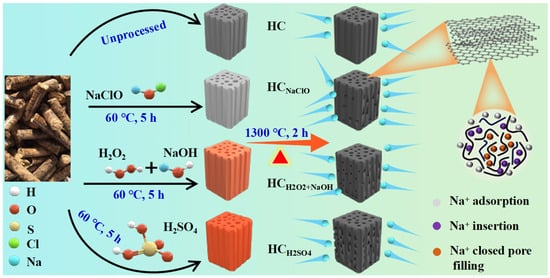
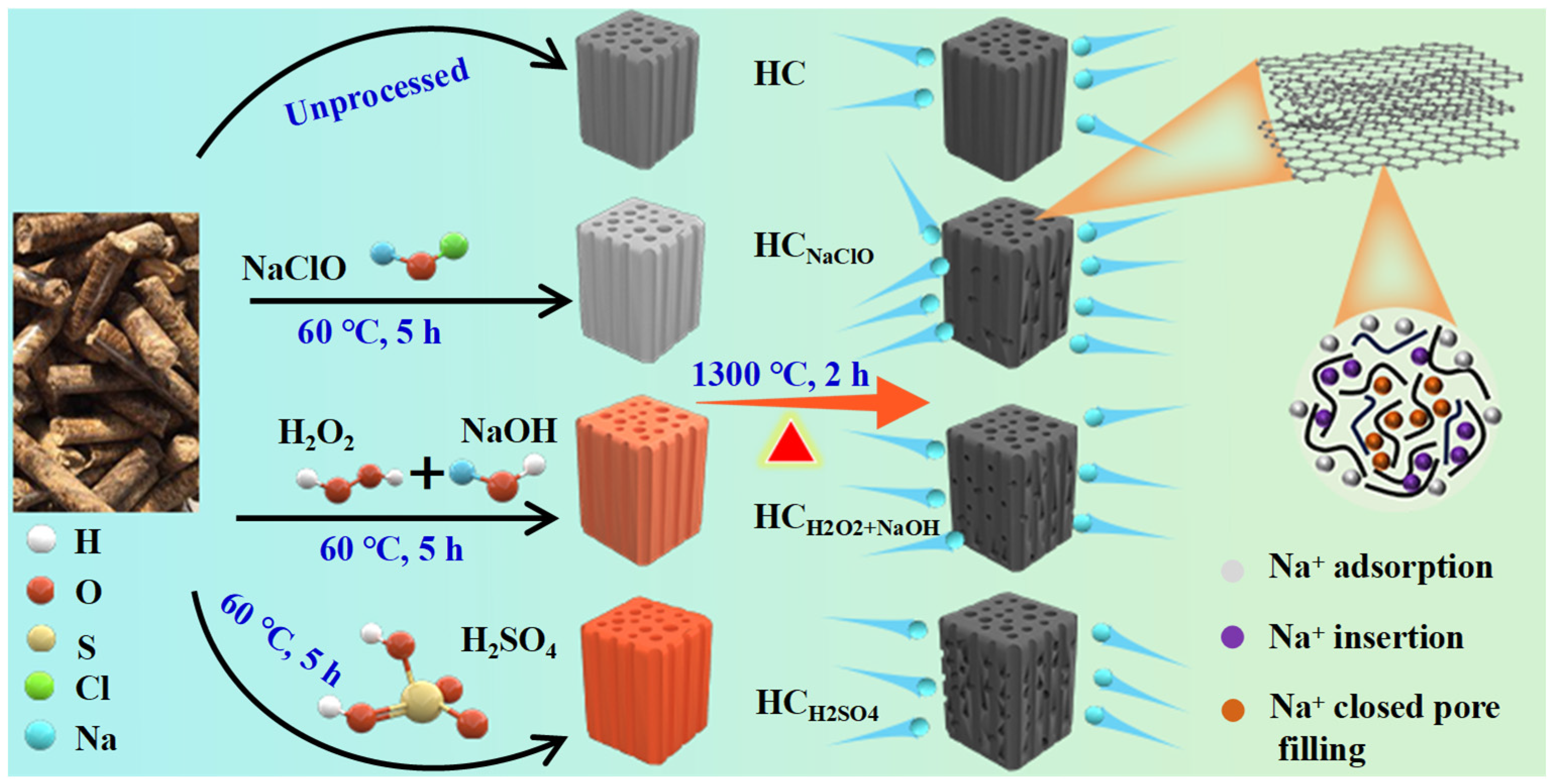
Herein, cotton stalk-derived precursors were pretreated with NaClO, H2SO4 and H2O2+NaOH as oxidants at 60 °C for 5 h and subsequently annealed at 1300 °C for 2 h, yielding HCNaClO, HCH2SO4 and HCH2O2+NaOH alongside untreated HC (Figure 1). The three oxidation strategies induce markedly different structural modifications. NaClO treatment generates a three-dimensional hierarchical pore network with expanded interlayer spacing, high defect density, and abundant closed pores. This architecture delivers the best overall performance, with a discharge capacity of 330.2 mAh g−1 at 0.1 C (assume 1 C = 350 mA g−1), a high ICE of 81.7%, and a capacity retention of 81.9% after 1000 cycles at 2 C (from 226.0 to 185.1 mAh g−1). In contrast, untreated HC shows a discharge capacity of 320.3 mAh g−1 at 0.1 C, a low ICE of 68.0%, and a limited capacity of 90.4 mAh g−1 after 1000 cycles at 2 C. In addition, the H2SO4 and H2O2+NaOH treated samples also outperform the pristine HC.
Figure 1.
Scheme of the synthesis routes of HC and HCx(x = NaClO, H2SO4 and H2O2+NaOH) and their Na+ storage mechanism.
2. Experimental Section
2.1. Material Synthesis
Cotton stalks were chemically activated using three different pre-treatment solution systems. In the H2O2+NaOH system, 6 g of NaOH (AR, >96%, Nanjing Chemical Reagent Co., Ltd., Nanjing, Jiangsu, China) and 10 mL of H2O2 (AR, 30%, Chengdu Kelong Chemical Co., Ltd., Chengdu, Sichuan, China) were dissolved in 290 mL of deionized (DI) water. In the H2SO4 system, 2.2 mL of concentrated sulfuric acid (AR, 95–98%, Chengdu Kelong Chemical Co., Ltd.) was diluted with DI water to a final volume of 400 mL. In the NaClO system, 10 mL of a 10 wt% NaClO (AR, 6–14% available chlorine, Macklin, Shanghai, China) solution was mixed with 290 mL of DI water. The stalks were individually immersed in these three systems and reacted at 60 °C under constant stirring for 5 h.
Following the reaction, surface impurities were eliminated, and the stalks were thoroughly rinsed with DI water until the supernatant became completely colorless. The purified products were subsequently dried in an oven at 60 °C for 12 h. The dried precursors were then placed in a tube furnace, heated to 1300 °C at a ramp rate of 2 °C min−1 under an Ar atmosphere, and held for 2 h. The resulting samples were designated as HCx (x = NaClO, H2SO4 and H2O2+NaOH). As a control, untreated raw stalks were directly subjected to the same annealing procedure and designated as HC.
2.2. Material Characterization
The morphological features and microstructural characteristics of the specimens were examined by scanning electron microscopy (SEM, Zeiss Merlin, Carl Zeiss, Oberkochen, Germany) equipped with an energy-dispersive spectrometer (EDS) and transmission electron microscopy (TEM, JEOL JEM-F200, 200 kV, Akishima, Tokyo, Japan). X-ray diffraction (XRD) patterns were collected on a Rigaku SmartLab SE (Tokyo, Japan) using Cu Kα radiation (λ = 0.15406 nm). Raman spectra were acquired with a confocal micro-Raman spectrometer (Renishaw plc, Wotton-under-Edge, UK) under 532 nm excitation. X-ray photoelectron spectroscopy (XPS) was carried out on an Thermo Scientific K-Alpha (Thermo Fisher Scientific, East Grinstead, UK) system employing monochromatic Al Kα radiation (1486.6 eV). Nitrogen adsorption–desorption isotherms were measured at 77 K on a Micromeritics ASAP 2460 instrument (Norcross, Georgia, USA). The specific surface area was calculated using the Brunauer–Emmett–Teller (BET) method, and the pore size distribution was determined by the Barrett–Joyner–Halenda (BJH) method.
2.3. Electrochemical Tests
The electrochemical properties were evaluated using CR2032 coin cells (Canrd Technology Co., Ltd., Dongguan, China) assembled with sodium metal foil as the counter electrode, 1 M NaPF6 (battery-grade, DoDoChem, Suzhou Dodochem Co., Ltd., Suzhou, Jiangsu, China) in diglyme as the electrolyte, and a glass fiber membrane (Whatman, Cytiva. Maidstone, Kent, UK) as the separator. The working electrode was prepared by mixing the active material (HCx), carbon black (Kejing Star, Shenzhen Kejing Star Technology Co., Ltd., Shenzhen, Guangdong, China), and sodium carboxymethyl cellulose (CMC, Kejing Star) at a mass ratio of 8:1:1 in DI water, and then casting the resultant slurry onto copper foil (Hubei Zhongyi Technology Inc., Xiaogan, Hubei, China). All electrode sheets were vacuum-dried at 80 °C for 12 h. The active material mass loading on the electrode was approximately 1.2 mg cm−2.
Galvanostatic charge–discharge (GCD) measurements were performed at ambient temperature using a LAND battery testing system. Each material in our assembled coin cell was tested three times or more. Cyclic voltammetry (CV) and electrochemical impedance spectroscopy (EIS) were carried out on a CHI 760E electrochemical workstation (CHI, Shanghai, China) at 25 °C, with CV sweep rates spanning 0.1 to 1 mV s−1 and an EIS frequency range from 105 to 0.1 Hz. The sodium-ion diffusion coefficient (DNa+) was evaluated via the galvanostatic intermittent titration technique (GITT) by applying a 0.1 C pulse current (20 min discharge followed by 120 min relaxation) and calculated according to the following equation [35]:
where τ denotes the constant current discharge time. mB represents the mass of the active material. VM is the molar volume. MB corresponds to the molar mass of the active material. S indicates the electrode surface area. ΔES refers to the steady-state voltage change. ΔEτ signifies the total voltage change during the pulse.
3. Results and Discussion
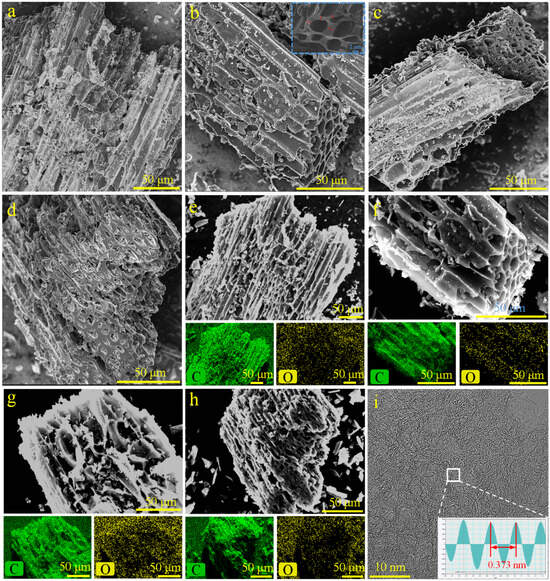
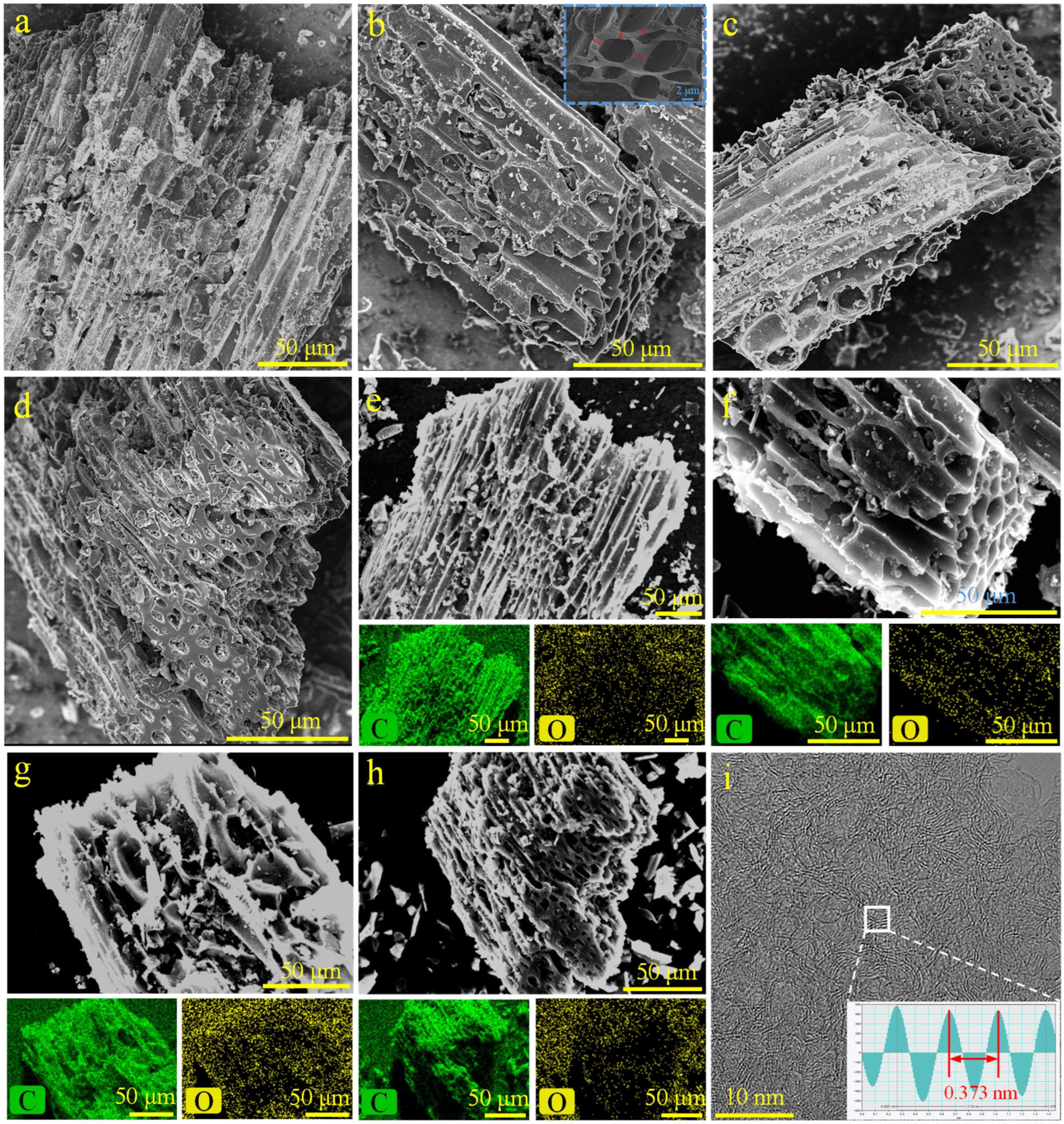
To elucidate the regulatory effects of distinct pretreatment strategies on the macroscopic morphology and microstructure of the resulting carbon materials, the architectures of HC and HCx (where x = NaClO, H2SO4 and H2O2+NaOH) were systematically characterized by SEM and TEM. As shown in the SEM image (Figure 2a), HC retains the fibrous architecture of cotton stalks with diameters ranging from 10 to 20 μm. This structure is formed through gas evolution during pyrolysis, which induces wall shrinkage, wrinkling, and surface densification. In contrast, HCNaClO (Figure 2b) develops a well-defined, three-dimensionally interconnected porous network with thin, honeycomb-like walls (1–2 μm, red arrow in the inset of Figure 2b). HCH2O2+NaOH (Figure 2c) maintains the fibrous morphology but features thinner walls and more open pores compared to HCNaClO, albeit with less uniform porosity. While all samples undergo pyrolysis-induced collapse, the severity varies significantly. HCH2SO4 exhibits the most pronounced collapse, forming dense micro-block aggregates with disordered carbon layers and indistinct nanopores (Figure 2d). In contrast, other samples show only mild collapse characterized by wall shrinkage or local pore deformation, without aggregation.
Figure 2.
(a–d) SEM images and (e–h) corresponding EDS elemental mappings of (a,e) HC, (b,f) HCNaClO, (c,g) HCH2O2+NaOH, and (d,h) HCH2SO4. (i) HRTEM image of HCNaClO. The insets in (b,i) are the high-magnification SEM image and the measurement of the interlayer spacing of HCNaClO, respectively.
EDS mapping (Figure 2e–h) reveals a uniform O/C distribution in HC, with an oxygen content of 11.9 wt%. HCH2SO4 exhibits the highest O content (14.6 wt%), but displays clustered heterogeneity due to structural collapse. Both HCH2O2+NaOH (12.3 wt% O) and HCNaClO (5.1 wt% O) show uniform elemental distributions. The former benefits from a synergistic oxidation/etching mechanism that grafts oxygen functional groups while thinning the pore walls, whereas the lower O content of the latter underscores the pivotal role of NaClO in exfoliation and pore generation. TEM analysis (Figure 2i) further resolves the microstructure of HCNaClO, revealing a carbon interlayer spacing of ~0.373 nm (inset), which is larger than that of graphite (0.335 nm) and thus facilitates reversible Na+ intercalation. Notably, numerous closed micropores (2–5 nm, yellow arrows) are also observed, serving as key sites for low-potential pore-filling reactions that contribute to the plateau capacity.
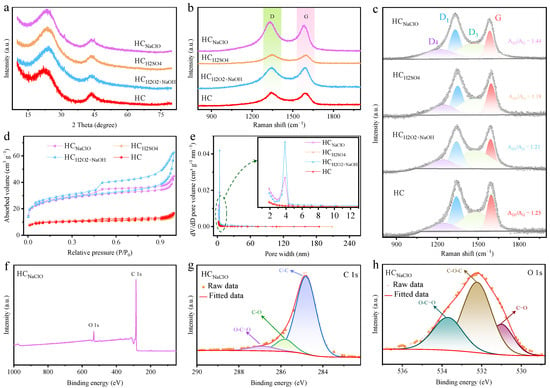
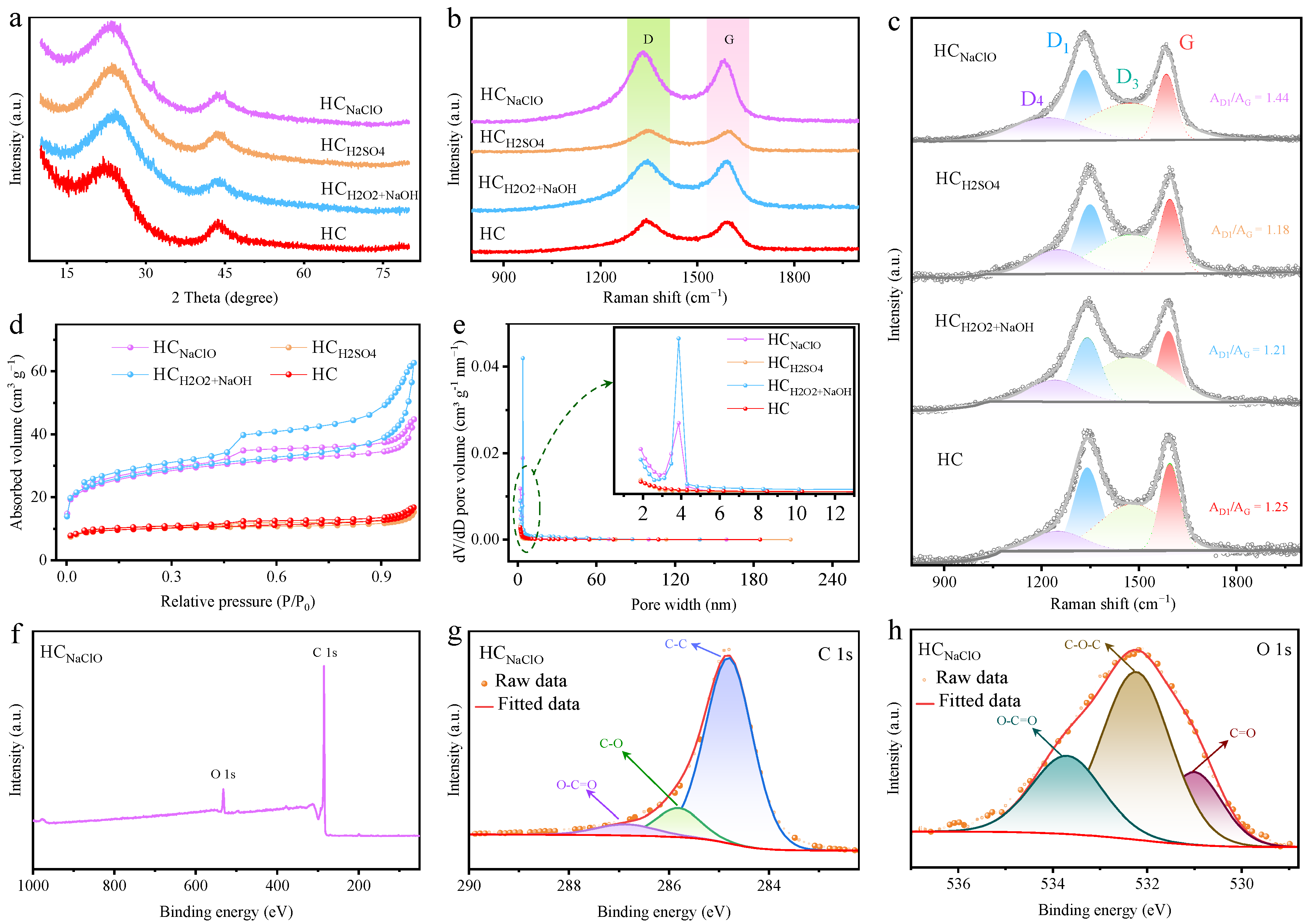
Figure 3 presents a systematic analysis of the microcrystalline structure, pore characteristics, and surface chemical states of HC and HCx. The XRD patterns (Figure 3a) reveal that all samples display two broad diffraction peaks centered near 23.5° and 43°, which correspond to the (002) and (100) planes of graphite, respectively. The interlayer spacings were determined to be 0.393 nm (HC), 0.368 nm (HCH2O2+NaOH), 0.380 nm (HCNaClO), and 0.373 nm (HCH2SO4) [36]. All values are well within the established range for hard carbon (0.36–0.42 nm), in good agreement with the TEM observations (Figure 2i).
Figure 3.
(a) XRD patterns, (b) Raman spectra and (c) peak fitting of Raman spectra, (d) N2 adsorption/desorption isotherms and (e) pore size distribution. (f) Full-survey XPS spectra of HCNaClO and its high-resolution XPS spectra: (g) C 1s and (h) O 1s.
Figure 3b,c presents the Raman spectra (Figure 3b) alongside the corresponding peak deconvolution (Figure 3c) for all samples. As can be seen, all samples exhibit two characteristic bands centered near 1350 and 1580 cm−1, which are attributed to the D band (associated with disordered and defective domains) and the G band (associated with ordered graphitic structures), respectively [37]. The defect ratio (AD1/AG), derived from the integrated peak areas, serves as a quantitative metric for the structural ordering of carbon, where a higher value signifies an elevated defect density and increased disorder within the carbon lattice. The defect ratios follow the sequence of HCNaClO (1.44) > HC (1.25) > HCH2O2+NaOH (1.21) > HCH2SO4 (1.18). It indicates that stronger oxidative treatments reduce the overall defect density by selectively removing disordered carbon domains and annealing defects at 1300 °C, whereas mild NaClO treatment preserves more defect sites. This heightened defect density provides abundant active sites for Na+ adsorption, thereby bolstering the sodium storage capacity.
Nitrogen adsorption–desorption isotherms (Figure 3d) and the corresponding pore size distribution curves (Figure 3e) demonstrate that all samples exhibit hybrid type I/IV isotherms, indicative of the coexistence of micropores and mesopores. The Brunauer–Emmett–Teller (BET) specific surface areas and total pore volumes follow the sequence HCH2O2+NaOH (99.7 m2 g−1 and 0.097 cm3 g−1) ≈ HCNaClO (97.6 m2 g−1 and 0.069 cm3 g−1) ≫ HC (37.3 m2 g−1 and 0.019 cm3 g−1) ≈ HCH2SO4 (37.2 m2 g−1 and 0.024 cm3 g−1), with the former pair exhibiting approximately 2.7 and 5.1-fold enhancements relative to pristine HC in surface area and pore volume, respectively. The average pore sizes decrease in the order of HCH2O2+NaOH (3.9 nm) > HCNaClO (2.8 nm) = HC (2.8 nm) > HCH2SO4 (2.6 nm). The pore size distribution (Figure 3e), derived from the BJH desorption branch and strictly limited to the mesopore range (2–50 nm), further reveals that HCH2O2+NaOH displays the most pronounced mesopore structure, characterized by a distinct peak centered at 3.5–4.0 nm. HCNaClO shows a similar but markedly weaker mesopore signature. In contrast, HC and HCH2SO4 exhibit severely limited pore development, with the latter displaying the lowest pore content owing to structural collapse. In contrast, HC and HCH2SO4 exhibit severely limited pore development, with the latter displaying the lowest pore content owing to structural collapse.
XPS was employed to further elucidate the surface chemical states of HCNaClO. The full-survey XPS spectrum (Figure 3f) reveals a surface composition dominated by C and O elements, and no impurities are detected. High-resolution C 1s (Figure 3g) and O 1s (Figure 3h) spectra, deconvoluted into constituent peaks, confirm the presence of abundant oxygen-containing functional groups on the HCNaClO surface. The C 1s spectrum can be resolved into three components of C–C (284.8 eV), C–O (285.8 eV) and O–C=O (286.9 eV). The O 1s spectrum distinguishes three oxygen species of O–C=O (533.7 eV), C=O (531.0 eV) and C–O-C (532.4 eV).
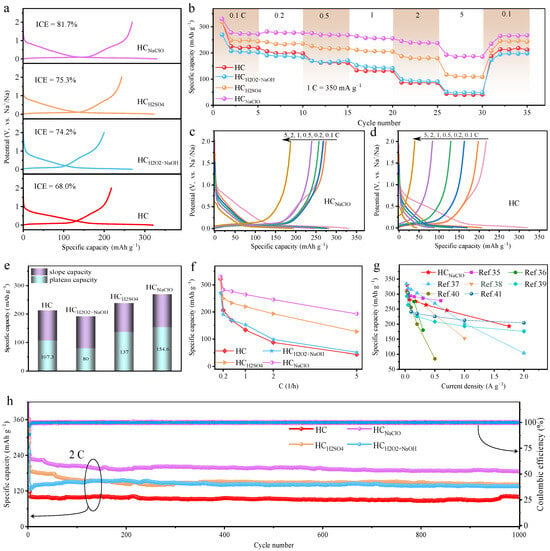
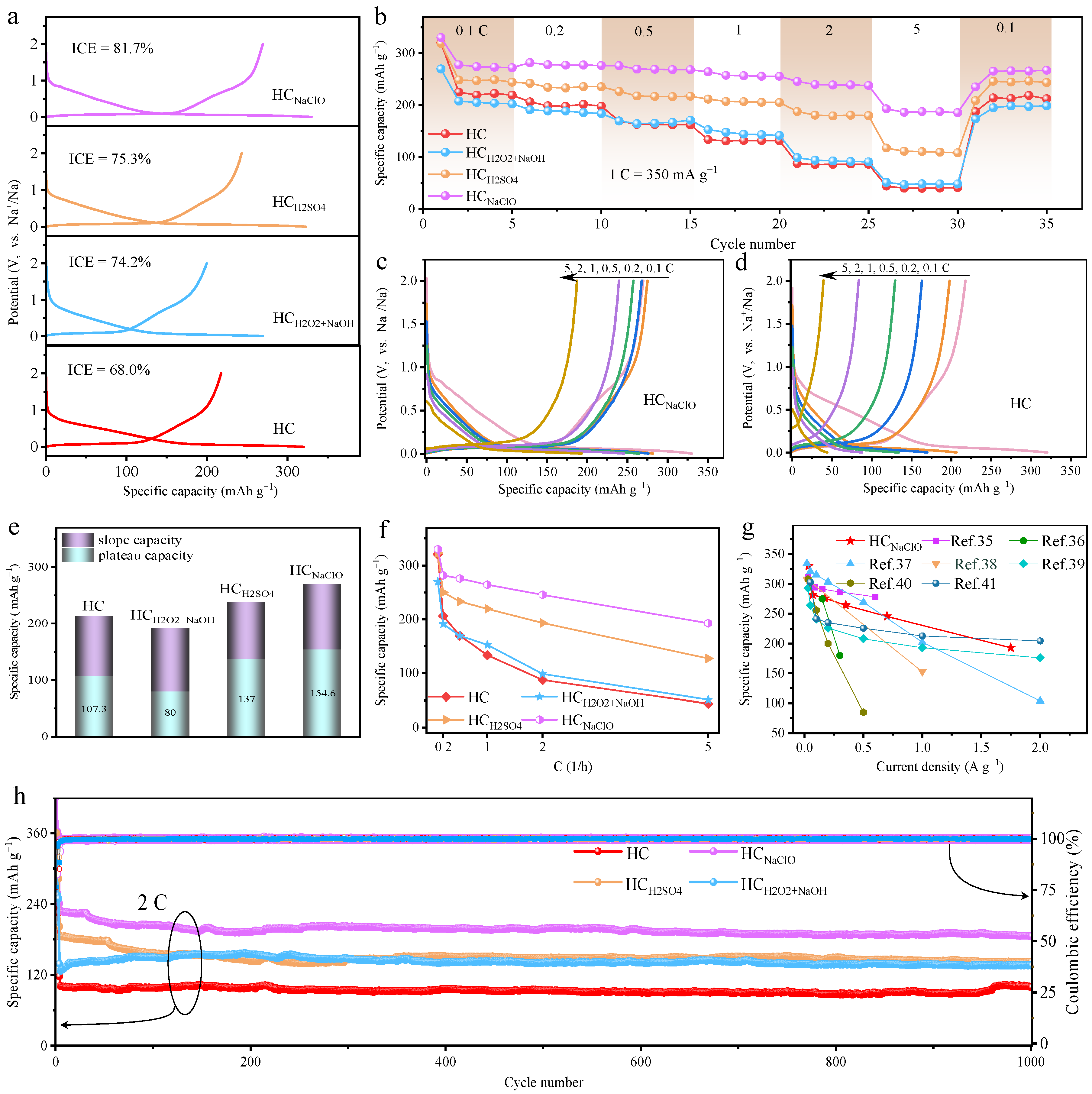
To evaluate the electrochemical sodium storage performance of HC and HCx as anodes for SIBs, systematic electrochemical measurements were performed. The initial charge–discharge profiles (Figure 4a) reveal that all electrodes exhibit characteristic HC sodium storage behavior, comprising a high-potential sloping region (>0.1 V, associated with Na+ adsorption on carbon layer surfaces and defect sites) and a low-potential plateau region (<0.1 V, corresponding to Na+ filling into closed pores and sodium cluster formation) [12,38]. All modified HCx demonstrate a higher ICE than pristine HC (68.0%), with HCNaClO attaining the highest value (81.7%), followed by HCH2SO4 (75.3%) and HCH2O2+NaOH (74.2%). The superior ICE of HCNaClO is attributed to fewer oxygen groups and more defects, which stabilize the solid-state electrolyte interface (SEI) film and create additional active sites for Na+ storage. HCH2SO4 and HCH2O2+NaOH exhibit lower ICE. This is most likely because HCH2SO4 undergoes structural collapse that increases irreversible decomposition, while HCH2O2+NaOH possesses higher oxygen groups and a lower degree of structural order compared to HCNaClO.
Figure 4.
(a) Initial GCD profiles at 0.1 C, and (b) rate capabilities of all electrodes. GCD profiles of (c) HCNaClO and (d) HC at various rates. (e) Slope-to-plateau capacity ratio of all electrodes and (f) their capacity retention versus C-rate. (g) Electrochemical performance comparison of HCNaClO with previously reported typical HC anodes for SIBs. (h) Long-term cycling performance of all electrodes measured at 2 C.
Rate performance (Figure 4b) shows that HCNaClO delivers discharge capacities of 330.2, 281.7, 275.9, 264.3, 245.6 and 193.0 mAh g−1 at 0.1, 0.2, 0.5, 1, 2 and 5 C, respectively, outperforming HCH2O2+NaOH (269.8 mAh g−1 at 0.1 C), HCH2SO4 (323.2 mAh g−1 at 0.1 C), and HC (320.3 mAh g−1 at 0.1 C) across all rates. At 5 C, HCNaClO retains 58.4% of its 0.1 C capacity, versus 39.5% (HCH2SO4), 19.0% (HCH2O2+NaOH), and 13.8% (HC), confirming the benefit of its porous architecture and oxygen-containing functional groups for rate capability. The GCD profiles (Figure 4c,d) reveal that, unlike HC, whose low-voltage plateau collapses at higher rates, HCNaClO preserves a well-defined plateau even at 5 C (Figure 4c). Plateau capacity analysis (Figure 4e) further shows that HCNaClO achieves the highest plateau contribution (154.6 mAh g−1, 57.3% of total) and HCH2SO4 (137 mAh g−1, 57.4%), exceeding HC (107.3 mAh g−1, 50.5%) and HCH2O2+NaOH (80 mAh g−1, 41.7%). Moreover, HCNaClO exhibits superior rate capability (Figure 4g) compared with typical hard carbon anodes reported previously [13,19,39,40,41,42,43].
Figure 4h shows the cycling performance of HC and HCx measured at 2 C. Before cycling, all electrodes were activated at 0.1 C for a few cycles. HCNaClO delivers an initial charge capacity of 226.0 mAh g−1 and retains 81.9% after 1000 cycles. HCH2SO4 gives 183.5 mAh g−1 with 77.1% retention. HCH2O2+NaOH exhibits an obvious continuous activation behaviour, with its capacity rising from 122.6 to a peak of 156.6 mAh g−1 at the 191st cycle, then gradually declining to 136.3 mAh g−1 after 1000 cycles, corresponding to 87.0% retention relative to the peak. This activation and subsequent slow decay are likely associated with its high specific surface area and abundant porosity (Figure 2d,e), which facilitate electrolyte infiltration but may also induce gradual structural rearrangement during prolonged cycling. Pristine HC shows only 100.2 mAh g−1 but retains 90.2% after 1000 cycles. Despite the differences in cycling stability, all electrodes achieve high average Coulombic efficiencies approaching 100%, confirming the formation of a stable SEI and good structural stability.
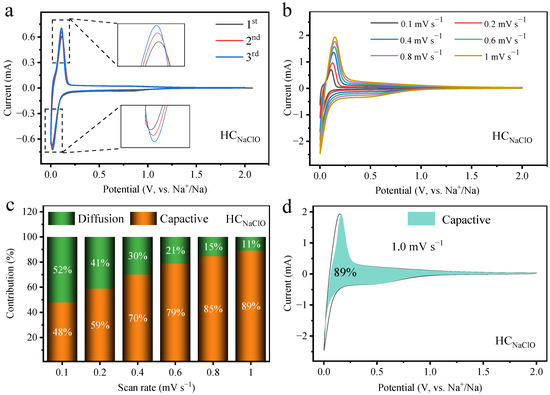
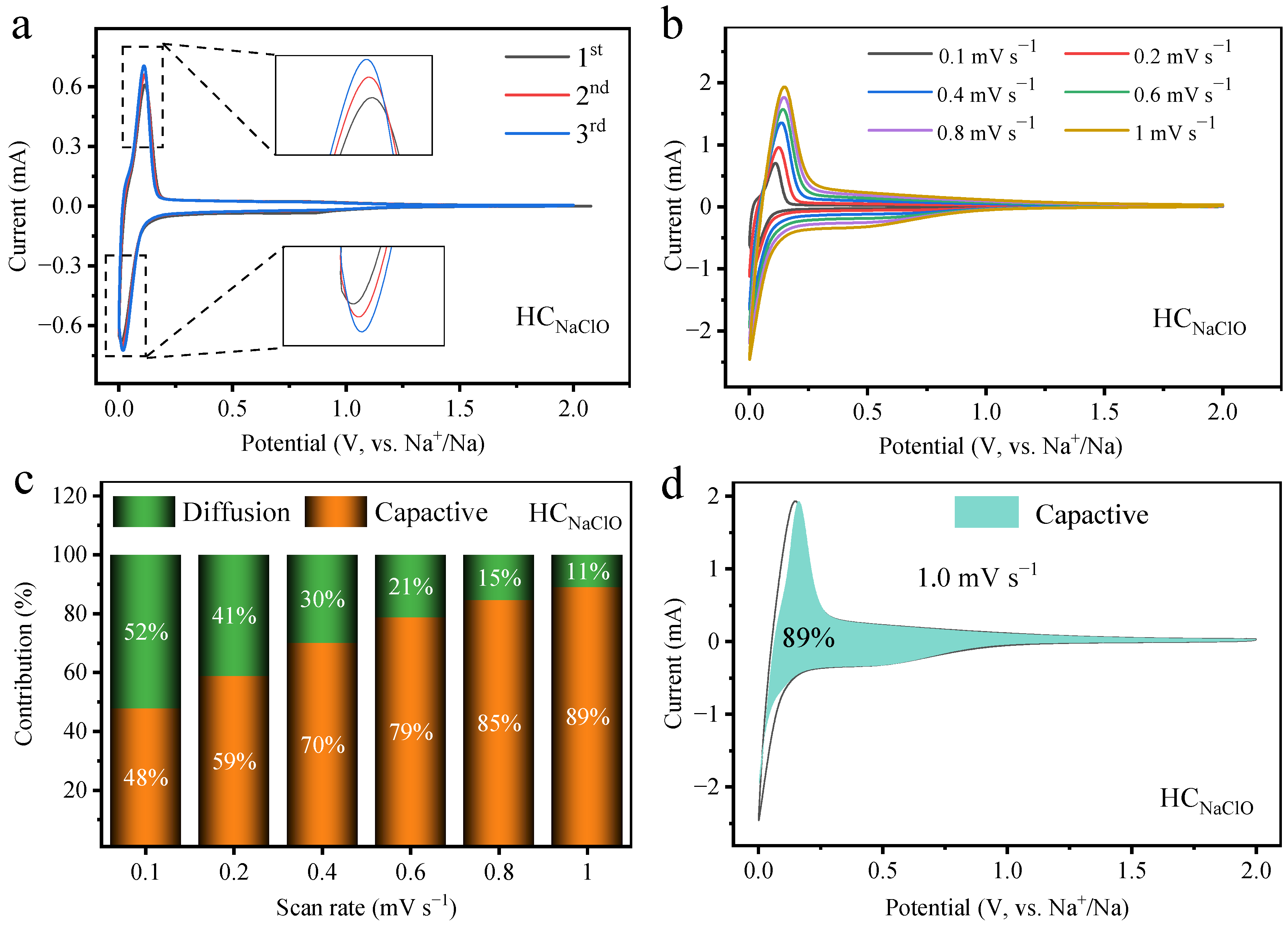
Figure 5 presents the kinetics of sodium storage through CV, EIS, and GITT analysis [44,45]. The CV profile of HCNaClO (Figure 5a) exhibits a pair of broad redox peaks at 0.1 mV s−1 with a reduction peak at ~0.02 V and an oxidation peak at ~0.11 V, indicative of reversible Na+ intercalation/deintercalation and consistent with the combined sloping and plateau regions of the charge–discharge curves. Across the scan rate range of 0.1–1.0 mV s−1 (Figure 5b), the fitted b-values for each redox peak all approximate 0.5, signifying that the electrochemical reaction is predominantly governed by semi-infinite diffusion kinetics. Quantitative assessment of the pseudocapacitive contribution (Figure 5c,d) reveals that the pseudocapacitive fractions for HCNaClO at scan rates of 0.1, 0.2, 0.4, 0.6, 0.8, and 1.0 mV s−1 are 48%, 59%, 70%, 79%, 85% and 89%, respectively. This indicates a transition from diffusion-controlled behavior at low rates to capacitive-controlled behavior at high rates. Notably, the higher diffusion contribution at low rates (e.g., 52% at 0.1 mV s−1) enables substantial bulk-phase sodium storage, which is consistent with the high reversible capacity and plateau capacity. In this process, Na+ diffuses into interlayer galleries and closed pores rather than being restricted to surface adsorption.
Figure 5.
(a) Initial CV profiles for the first three cycles at 0.1 mV s−1, and (b) CV curves at various scan rates for the HCNaClO electrode. Insets of (a) are the corresponding enlarged areas. (c) Evolution of the capacitive- and diffusion-controlled capacity contributions for the HCNaClO electrode as a function of scan rate. (d) Deconvolution of the capacitive contribution for HCNaClO at 1.0 mV s−1.
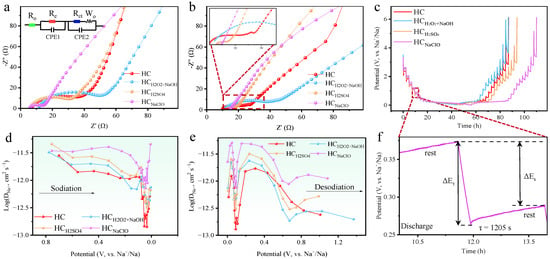
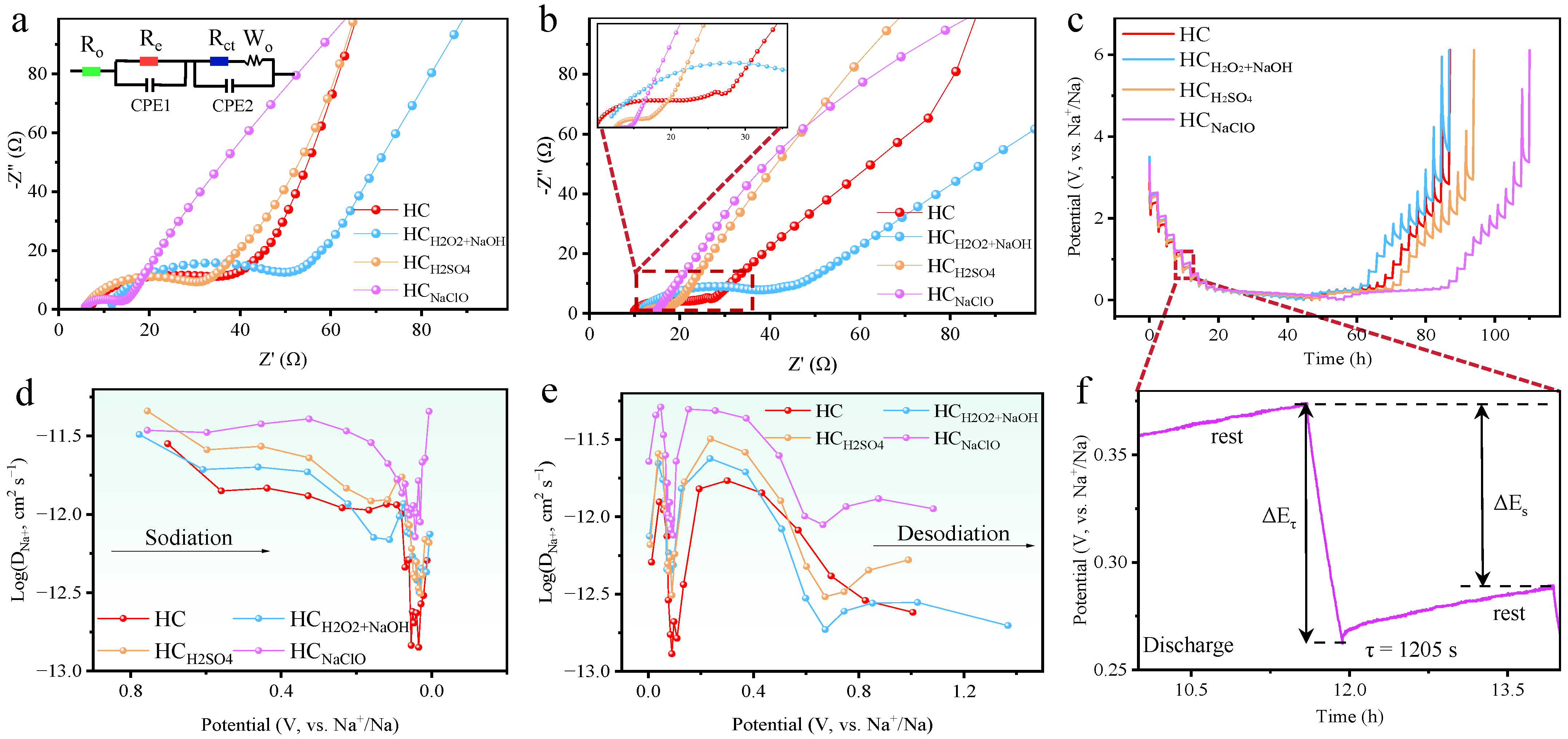
EIS analysis compares HCNaClO, HCH2SO4 and HCH2O2+NaOH measured at 2 C before cycling (Figure 6a) and after 100 cycles (Figure 6b). The equivalent circuit model (Inset of Figure 6a) used for fitting includes Ro (ohmic resistance from the electrolyte, separator, and current collector), Re (SEI resistance for the electrode after cycling), Rct (interfacial charge-transfer resistance, a key indicator of electrode kinetics), CPE (non-ideal double-layer capacitance), and Wo (semi-infinite Na+ diffusion). The fitted Ro values are 12.9, 12.2, and 10.3 Ω, respectively, showing only slight variation and indicating consistent electrode/electrolyte contact across the samples. Notably, before cycling (Figure 6a), the pristine electrodes show Rct values in the order of HCNaClO (10.3 Ω) < HCH2SO4 (31.4 Ω) < HC (34.7 Ω) < HCH2O2+NaOH (48.0 Ω). After 100 cycles at 2 C, all electrodes show decreased Rct (Figure 6b), yielding 1.7 Ω for HCNaClO, 5.2 Ω for HCH2SO4, 17.6 Ω for HC, and 44.9 Ω for HCH2O2+NaOH. This general decline arises from electrode activation during the initial cycling process. Nevertheless, the extent of reduction varies markedly. HCH2SO4 exhibits the largest absolute drop (from 31.4 to 5.2 Ω), while HCNaClO reaches the lowest value (1.7 Ω), both benefiting from the formation of robust and highly conductive SEI layers that effectively facilitate Na+ transport. The untreated HC shows a moderate decrease but retains a higher impedance. In contrast, the H2O2+NaOH treated electrode experiences only a marginal reduction, indicating that excessive oxygen-containing groups and structural damage lead to a thick and poorly ion-conducting SEI, which severely blocks charge transfer.
Figure 6.
EIS spectra of all electrodes measured at 2 C (a) before cycling and after 100 cycles. Insets in (a,b) are the corresponding equivalent circuit model and enlarged areas, respectively. (c) GITT profiles for all electrodes during charge and discharge, and (d,e) the associated evolution of DNa+ throughout the cycle. (f) The enlarged view of the HCNaClO GITT profile from (c).
GITT measurements (Figure 6c–f) track the evolution of the Na+ diffusion coefficient (DNa+) during cycling. HCNaClO exhibits DNa+ values in the range of 10−11–10−13 cm2 s−1, with an average of ~2.35 × 10⁻¹² cm2 s−1, which is superior to HC (~7.47 × 10⁻¹³ cm2 s−1), HCH2O2+NaOH (~4.0 × 10⁻¹³ cm2 s−1), and HCH2SO4 (~3.0 × 10⁻¹³ cm2 s−1). This is in agreement with the rate performance and Rct trends. The DNa+ of all electrodes initially remains stable and then declines, reflecting the three-stage sodium storage mechanism with high-voltage adsorption (2.0–0.3 V, fast diffusion), mid-voltage intercalation (0.3–0.1 V, gradually decreasing diffusion), and low-voltage pore filling (<0.1 V, sharp drop due to sluggish transport through dense carbon layers into closed micropores).
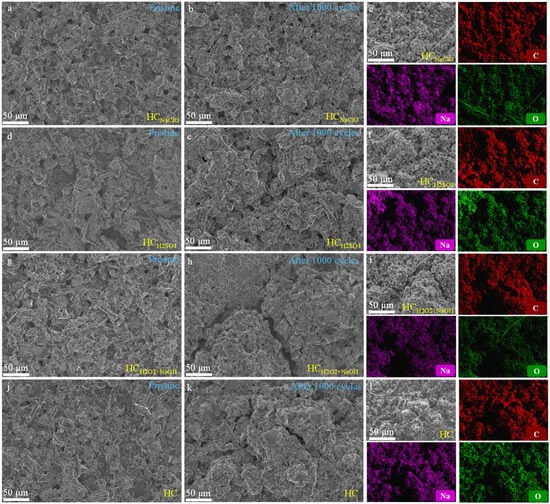
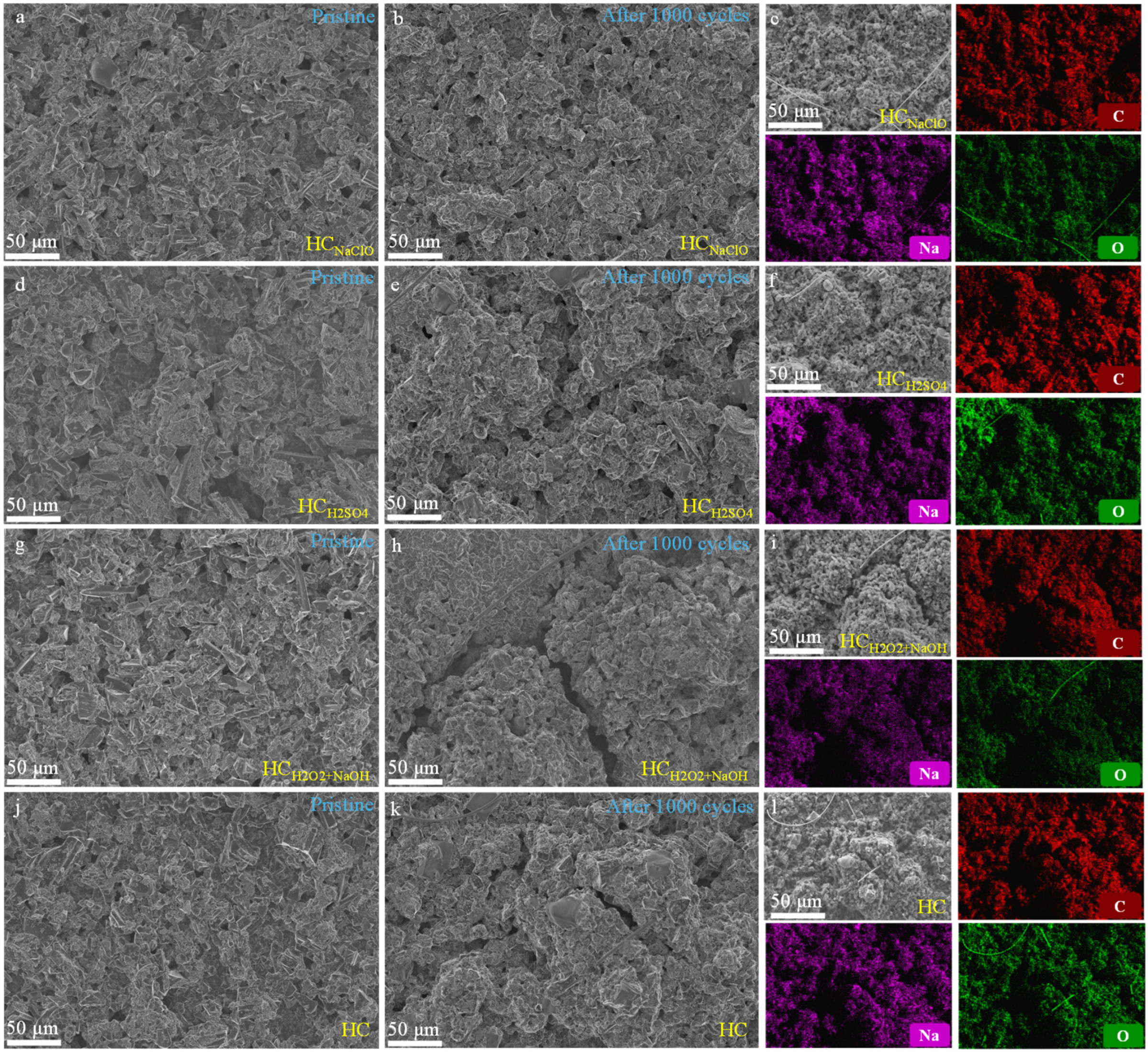
Combining the morphological evolution and surface chemistry analysis, the mechanism underlying the different electrochemical performances of electrodes measured at 2 C before cycling and after 1000 cycles can be further revealed in Figure 7 and Figure 8. As shown in Figure 7b, after 1000 cycles at 2 C, HCNaClO preserves the most intact microstructure with negligible pulverization, whereas other electrodes all suffer varying degrees of structural degradation. Notably, HCH2O2+NaOH shows the most pronounced pulverization and microcracks (Figure 7h). The corresponding EDX elemental mappings further confirm that the Na and O elements are remarkably uniformly distributed on the HCNaClO surface (Figure 7c), once again supporting the formation of a homogeneous SEI layer, which effectively suppresses excessive electrolyte erosion.
Figure 7.
(a,b,d,e,g,h,j,k) SEM images and (c,f,i,l) corresponding EDX elemental mappings of Na, O, and C for (a–c) HCH2O2+NaOH, (d–f) HCH2SO4, (g–i) HC and (j–l) HCNaClO electrodes (a,d,g,j) before and (b,c,e,f,h,i,k,l)after 1000 cycles.
Figure 8.
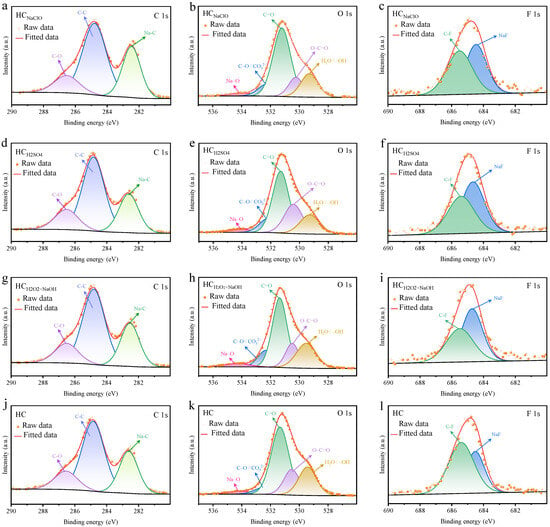
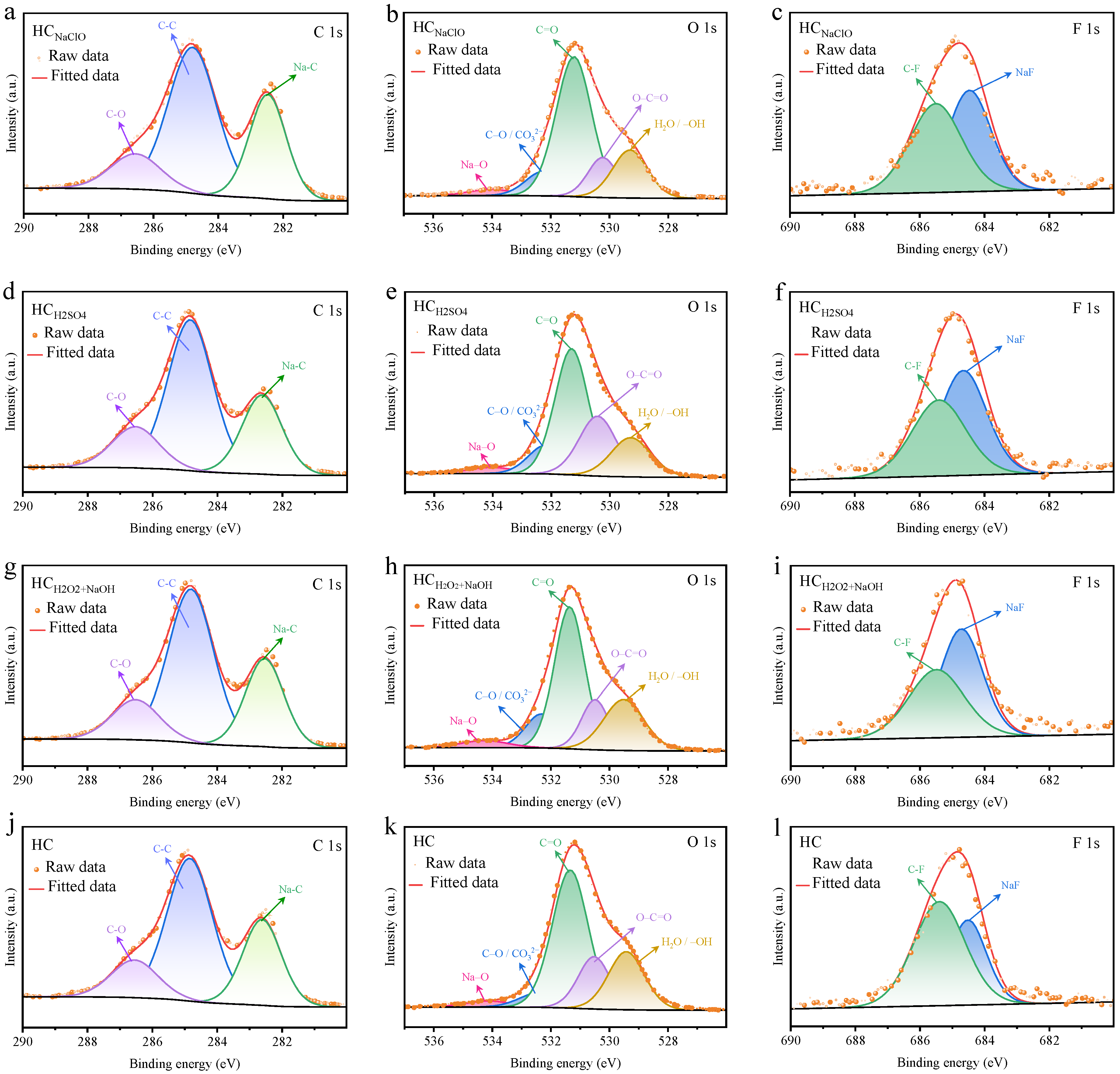
High resolution XPS spectra of C 1s, O 1s and F 1s of (a–c) HCNaClO, (d–f) HCH2SO4, (g–i) HCH2O2+NaOH and (j–l) HC measured at 2 C after 1000 cycles: (a,d,g,j) C 1s, (b,e,h,k) O 1s and (c,f,i,l) F 1s.
The XPS spectra (Figure 8) further elucidate the interfacial chemistry of the electrodes measured at 2 C after 1000 cycles. As can be seen, the O 1s spectra reveal that HCH2SO4 exhibits the strongest O–C=O (carboxyl) signals (Figure 8e), while both HC (Figure 8h) and HCH2O2+NaOH (Figure 8k) show comparable moderate intensities, both of which are noticeably higher than those of HCNaClO (Figure 8b). Quantified results show that HCNaClO exhibits the lowest O–C=O content (13.3%), followed by HC (17.6%) and HCH2SO4 (24.1%). The H2O/–OH fraction is also minimal for HCNaClO (18.8%) compared with both HC and HCH2SO4 (>21%), while the C=O signal is strongest for HCNaClO (55.3%) and weaker for the other two. It is generally suggested that moderate C=O/C–O groups can promote reversible sodium storage by providing active adsorption sites, whereas excessive O–C=O groups act as catalytic sites for electrolyte decomposition that generate a thick SEI [46,47]. Meanwhile, NaF is widely recognized as a crucial component for constructing stable SEI layers. HC exhibits the lowest NaF content (vs. C-F) in the F 1s spectrum (Figure 8l), compared to the other three. Overall, HCNaClO features suppressed O–C=O signals with a balanced C=O/C–O distribution in the O 1s spectrum (Figure 8c), which combines with its moderate NaF content (Figure 8c) to promote the formation of a thin, robust, and inorganic-rich SEI. Consequently, HCNaClO achieves the lowest charge-transfer resistance and superior cycling stability.
4. Conclusions
In summary, this work applies three chemical oxidation treatments (NaClO, H2SO4, and H2O2+NaOH) to cotton stalk-derived HC carbonized at 1300 °C. All methods preserve the carbon skeleton and improve performance. The best results are from HCNaClO, with a high ICE of 81.7% and a high discharge capacity of 330.2 mAh g−1, followed by HCH2SO4 (75.3% and 323.2 mAh g−1) and HCH2O2+NaOH (74.2% and 269.8 mAh g−1), all superior to pristine HC (68.0% and 320.3 mAh g−1). At 2 C, the capacity retention after 1000 cycles is 81.9% for HCNaClO (from 226.0 to 185.1 mAh g−1) and 77.1% for HCH2SO4 (from 183.5 to 141.5 mAh g−1), while pristine HC maintains 90.4 mAh g−1 after 1000 cycles. Each treatment has its own feature, with NaClO building hierarchical pores and oxygen groups to boost capacity and ICE; H2SO4 causing densification that limits capacity; and H2O2+NaOH thinning pore walls and opening mesopores to aid ion transport. Overall, chemical oxidation via combined pore and surface engineering proves an effective and versatile strategy for enhancing sodium storage in cotton stalk-derived HC.
Author Contributions
Y.W.: Methodology, Validation, Investigation, Formal analysis, Data curation, Writing—review & editing. H.C.: Formal analysis, Investigation, Data curation. L.L.: Investigation, Methodology. Y.T.: Investigation. J.Z.: Investigation. J.X.: Conceptualization, Project administration, Supervision, Funding acquisition, Writing—review & editing. All authors have read and agreed to the published version of the manuscript.
Funding
This research was funded by the Guangdong Provincial Natural Science Foundation (2025A1515010363, Guangdong Province, China), Special Fund for Science and Technology Innovation of Guangdong Province (pdjh2026bk018, 2026, Guangdong Province, China) and Guangxi Key R&D Program Projects (No. AB24010346, Guangxi Province, China).
Data Availability Statement
The original contributions presented in the study are included in the article; further inquiries can be directed to the corresponding author.
Conflicts of Interest
The authors declare no conflicts of interest.
References
- Li, Q.; Ulissi, U.; Liang, Z.; Chen, X.; Guo, B.; Zhang, X.; Ouyang, C. Progress and Prospect of Industrialization of Sodium-Ion Battery in China. Adv. Energy Mater. 2026, 16, e04877. [Google Scholar] [CrossRef] [Scilit]
- Mariyappan, S.; Desai, P.; Morcrette, M.; Tarascon, J.-M. From lab to market with sustainable sodium-ion batteries. Nat. Sustain. 2026, 9, 360–371. [Google Scholar] [CrossRef] [Scilit]
- Liu, J.; Huang, L.; Wang, H.; Sha, L.; Liu, M.; Sun, Z.; Gu, J.; Liu, H.; Zhao, J.; Zhang, Q.; et al. The Origin, Characterization, and Precise Design and Regulation of Diverse Hard Carbon Structures for Targeted Applications in Lithium-/Sodium-/Potassium-Ion Batteries. Electrochem. Energy Rev. 2024, 7, 34. [Google Scholar] [CrossRef] [Scilit]
- He, X.-X.; Li, L.; Wu, X.; Chou, S.-L. Sustainable Hard Carbon for Sodium-Ion Batteries: Precursor Design and Scalable Production Roadmaps. Adv. Mater. 2025, 37, 2506066. [Google Scholar] [CrossRef] [Scilit] [PubMed]
- Deng, W.; Yang, H.; Huo, H.; Yu, Y. Recent Advances, Key Strategies, and Challenges in Fast-Charging Hard Carbon Anodes for Sodium-Ion Batteries. Adv. Func. Mater. 2025, 35, 2504168. [Google Scholar] [CrossRef] [Scilit]
- Tan, S.; Wen, Y.; Li, J.; Huang, Z.; Zhang, Z.; Lai, Y.; Tian, Z.; Li, S. Fast-Charging Capabilities of Hard Carbon Anodes in Sodium-Ion Batteries: Mechanisms, Strategies, and Prospects. Carbon Neutraliz. 2025, 4, e70071. [Google Scholar] [CrossRef] [Scilit]
- Yang, Y.; Liu, Z.; Zhang, Q.; Song, J.; Li, W.; Jiang, S.; Zhang, C.; Han, J.; Yang, H.; Han, X.; et al. Recent Advances of High-Rate Hard Carbon Anodes for Sodium-Ion Batteries: Correlations Between Performance and Microstructure. Adv. Func. Mater. 2026, 36, e14132. [Google Scholar] [CrossRef] [Scilit]
- Cui, H.; Liu, L.; Shen, J.C.; Lin, G.; Dai, Y.T.; Wang, Y.Z.; Tang, Y.; Xu, J.T. Synergistic Mo2C/MoO2 hybridization in sucrose-derived hard carbon spheres for sodium-ion batteries. Chem. Eng. J. 2026, 540, 177248. [Google Scholar] [CrossRef] [Scilit]
- Molaiyan, P.; Dos Reis, G.S.; Karuppiah, D.; Subramaniyam, C.M.; García-Alvarado, F.; Lassi, U. Recent Progress in Biomass-Derived Carbon Materials for Li-Ion and Na-Ion Batteries—A Review. Batteries 2023, 9, 116. [Google Scholar] [CrossRef] [Scilit]
- Zhong, B.; Liu, C.; Xiong, D.; Cai, J.; Li, J.; Li, D.; Cao, Z.; Song, B.; Deng, W.; Peng, H.; et al. Biomass-Derived Hard Carbon for Sodium-Ion Batteries: Basic Research and Industrial Application. ACS Nano 2024, 18, 16468–16488. [Google Scholar] [CrossRef] [Scilit] [PubMed]
- Yanilmaz, M.; Temel, B.; Bayram, E.; Tosun, M.; Topcu, I.; Kim, J. Sustainable biowaste conversion into microporous carbons for efficient energy storage solutions in sodium-ion batteries. J. Environ. Chem. Eng. 2025, 13, 118559. [Google Scholar] [CrossRef] [Scilit]
- Huang, J.J.; Liu, L.; Fan, Q.H.; Li, S.F.; Cui, H.; Xu, J.T. Nitrogen-Doped Hard Carbon Anode from Redwood Biomass for Sodium-Ion Batteries with High Initial Coulombic Efficiency and Enhanced Rate Capability. Small 2025, 21, 2505579. [Google Scholar] [CrossRef] [Scilit] [PubMed]
- Li, Y.; Hu, Y.-S.; Titirici, M.-M.; Chen, L.; Huang, X. Hard Carbon Microtubes Made from Renewable Cotton as High-Performance Anode Material for Sodium-Ion Batteries. Adv. Energy Mater. 2016, 6, 1600659. [Google Scholar] [CrossRef] [Scilit]
- Dhiman, N.; Sharma, V.; Ghosh, S. Perspective on Biomass-Based Cotton-Derived Nanocarbon for Multifunctional Energy Storage and Harvesting Applications. ACS Appl. Electron. Mater. 2023, 5, 1970–1991. [Google Scholar] [CrossRef] [Scilit]
- Peng, J.; Huang, T.; Li, B.; Wang, Y.; Luo, H.; Zhou, Y.; Jin, A.; Yu, L.; Li, M.; Jiang, K. Mercerization-enhanced cellulose-II cotton fiber-based low-temperature hard carbon for sodium-ion batteries. Ind. Crops Prod. 2024, 222, 119511. [Google Scholar] [CrossRef] [Scilit]
- Sarma, H.R.; Sun, J.; Gunathilaka, I.E.; Hora, Y.; Forsyth, M.; Byrne, N. Investigation of structural & interfacial properties of hard carbon electrodes from cotton snippets toward sustainable sodium-ion batteries. Sustain. Mater. Technol. 2024, 39, e00846. [Google Scholar] [CrossRef] [Scilit]
- Sinha, S.; Rajpura, K.; Mukhopadhyay, I. Upcycling Agricultural Waste: Gossypium Herbaceum Shell-Derived Hard Carbon Sodium-Ion Battery Anodes. Adv. Sustain. Syst. 2025, 9, e00244. [Google Scholar] [CrossRef] [Scilit]
- Yang, X.; Cai, T.; Yao, Z.; Chao, G. Glucose Carbon Spheres Uniformly Coupled with Cotton-Derived Carbon Nanofibers as Ultrafast Anodes for Sodium-Ion Batteries. ChemistrySelect 2025, 10, e202405437. [Google Scholar] [CrossRef] [Scilit]
- Zhou, F.; Yang, Y.; Zhang, L.; Guo, X.; Tong, H.; Tian, Q. Influence of pyrolysis temperature on morphological features and electrochemical properties of cotton stalk-derived hard carbon materials. Fuel 2026, 405, 136757. [Google Scholar] [CrossRef] [Scilit]
- Zhou, Y.; Huang, T.; Lv, Z.; Wang, C.; Peng, J.; Jin, A.; Xiong, J.; Yu, L.; Li, M.; Ma, Z.; et al. Ball-milling pretreatment-driven low-temperature waste cotton fibers-based hard carbon anodes for sodium-ion batteries. Biomass Bioenergy 2026, 206, 108600. [Google Scholar] [CrossRef] [Scilit]
- Chu, Y.; Zhang, J.; Zhang, Y.; Li, Q.; Jia, Y.; Dong, X.; Xiao, J.; Tao, Y.; Yang, Q.-H. Reconfiguring Hard Carbons with Emerging Sodium-Ion Batteries: A Perspective. Adv. Mater. 2023, 35, 2212186. [Google Scholar] [CrossRef] [Scilit] [PubMed]
- Matei Ghimbeu, C.; Beda, A.; Réty, B.; El Marouazi, H.; Vizintin, A.; Tratnik, B.; Simonin, L.; Michel, J.; Abou-Rjeily, J.; Dominko, R. Review: Insights on Hard Carbon Materials for Sodium-Ion Batteries (SIBs): Synthesis–Properties–Performance Relationships. Adv. Energy Mater. 2024, 14, 2303833. [Google Scholar] [CrossRef] [Scilit]
- Falco, C.; Marco-Lozar, J.P.; Salinas-Torres, D.; Morallón, E.; Cazorla-Amorós, D.; Titirici, M.M.; Lozano-Castelló, D. Tailoring the porosity of chemically activated hydrothermal carbons: Influence of the precursor and hydrothermal carbonization temperature. Carbon 2013, 62, 346–355. [Google Scholar] [CrossRef] [Scilit]
- Mo, Y.; Zheng, B.; Yang, W.; Wu, Y.; Zhang, L.; Liu, G.; Ouyang, L.; Liu, H.; Gao, P.; Liu, J. Sequential Dual-Phase Oxidation Engineered Structure of Pitch-Derived Hard Carbon towards Improved Sodium-Ion Storage. Adv. Sustain. Syst. 2026, 10, e01730. [Google Scholar] [CrossRef] [Scilit]
- Zhang, H.; Zhang, X.; Zhang, J.; Li, X.; Yuan, R.; Guo, L.; Yuan, W.; Xu, X.; Li, A.; Chen, X.; et al. Control of hard carbon structure via oxidative crosslinking and functional group decomposition in pitch for sodium-ion batteries. Carbon 2026, 256, 121697. [Google Scholar] [CrossRef] [Scilit]
- He, Y.; Liu, D.; Li, Q.; Zhu, Z.; Wu, R. Advances in oxygen-containing functional groups-modified hard carbon anodes for sodium-ion batteries. Mater. Sci. Eng. R Rep. 2026, 168, 101143. [Google Scholar] [CrossRef] [Scilit]
- Chen, T.; Wu, J.; Zhang, X.; Han, X.; Liu, S.; Yang, J. Pseudocapacitive contribution in sulfur-doped porous carbon nanosheets enables high-performance sodium-ion storage. Carbon 2024, 227, 119276. [Google Scholar] [CrossRef] [Scilit]
- Wu, C.; Yang, Y.; Zhang, Y.; Xu, H.; Huang, W.; He, X.; Chen, Q.; Dong, H.; Li, L.; Wu, X.; et al. Industrial-Scale Hard Carbon Designed to Regulate Electrochemical Polarization for Fast Sodium Storage. Angew. Chem. Int. Ed. 2024, 63, e202406889. [Google Scholar] [CrossRef] [Scilit] [PubMed]
- Xu, H.; Song, H.; Sun, M.; Zhang, Y.; Feng, X.; Qin, W.; Wu, C.; Chou, S.; Wu, X. Molecular-level precursor regulation strategy aids fast-charging hard carbon anodes for sodium-ion batteries. Nano Energy 2025, 137, 110824. [Google Scholar] [CrossRef] [Scilit]
- Xu, C.; Zhou, Z.; Li, W.; Fan, X.; Meng, S.; Lai, Z.; Tang, W.; Zhang, W.; Li, S.; Leng, L.; et al. Facile fabrication of bamboo-derived hard carbon as anode for sodium-ion battery: Roles of acid-leaching and pre-carbonization treatments. J. Energy Storage 2025, 132, 117699. [Google Scholar] [CrossRef] [Scilit]
- Li, W.; Tang, Y.; Zhou, Y.; Zhang, Y.; Zhang, W.; Ma, Q.; Liu, L.; Dong, S.; Cao, Y. Enhanced sodium storage performance of asphalt-derived hard carbon through intramolecular oxidation for high-performance sodium-ion batteries. Acta Phys. Chim. Sin. 2025, 41, 100119. [Google Scholar] [CrossRef] [Scilit]
- Huang, Q.; You, S.; Yang, C. Surface Porousization of Hard Carbon Anode Materials for Sodium-Ion Batteries. Micromachines 2025, 16, 771. [Google Scholar] [CrossRef] [Scilit] [PubMed]
- Cao, Y.-M.; Li, X.; Peng, J.; Chen, B.-S.; Dang, N.; Zhang, J.; Xie, J.-Y.; Zhao, T.-B. Acidic Potassium Permanganate-Induced Hierarchical Pores in Bamboo-Based Hard Carbon for High-Performance Sodium-Ion Batteries. Langmuir 2025, 41, 9559–9566. [Google Scholar] [CrossRef] [Scilit] [PubMed]
- Luo, X.; Li, H.; Peng, J.; Wang, F.; Zheng, H.; Du, B.; Lai, W.; Chen, Y. Liquid-Phase Oxidation Engineering of Pine Wood Powder-Derived Hard Carbon for Low-Cost Sodium-Ion Batteries. ACS Appl. Mater. Interfaces 2026, 18, 8337–8349. [Google Scholar] [CrossRef] [Scilit] [PubMed]
- Gammaitoni, G.; Cha, G.; Kolan, R.R.; Christiansen, S.; Fauth, F.; Bianchini, M. Spray-dried hard carbon–Sn composites for energy-dense Na-ion batteries. EES Batter. 2025, 1, 1596–1611. [Google Scholar] [CrossRef] [Scilit] [PubMed]
- Simone, V.; Boulineau, A.; de Geyer, A.; Rouchon, D.; Simonin, L.; Martinet, S. Hard carbon derived from cellulose as anode for sodium ion batteries: Dependence of electrochemical properties on structure. J. Energy Chem. 2016, 25, 761–768. [Google Scholar] [CrossRef] [Scilit]
- Zhang, J.; Lei, Y.; Lin, Z.; Xie, P.; Lu, H.; Xu, J. A novel approach to recovery of lithium element and production of holey graphene based on the lithiated graphite of spent lithium ion batteries. Chem. Eng. J. 2022, 436, 135011. [Google Scholar] [CrossRef] [Scilit]
- Shen, J.; Liu, L.; Cui, H.; Dai, Y.; Lin, G.; Wang, Y.; Zhang, Z.; Xu, J. Bismuth-embedded hard carbon derived from Solidago canadensis toward sodium-ion batteries. Chem. Eng. J. 2026, 543, 177715. [Google Scholar] [CrossRef] [Scilit]
- Zhang, X.; Hou, Z.; Jiang, M.; Peng, J.; Ma, H.; Gao, Y.; Wang, J.G. Molecular Engineering to Regulate the Pseudo-Graphitic Structure of Hard Carbon for Superior Sodium Energy Storage. Small 2024, 20, 2311778. [Google Scholar] [CrossRef] [Scilit] [PubMed]
- Hou, Z.; He, W.; Wu, F.; Du, Y.; Xu, F.; Wang, J.-G. Tuning π-π carbon restacking hindrance to remodify hard carbon crystallites for advanced sodium energy. Energy Storage Mater. 2025, 80, 104455. [Google Scholar] [CrossRef] [Scilit]
- Zhong, L.; Qiu, X.; Hao, S.; Jiang, Z.; Zhang, W. Molecular pillaring driven microcrystalline structure engineering of hard carbon for high-rate sodium storage. Chem. Eng. J. 2025, 516, 164007. [Google Scholar] [CrossRef] [Scilit]
- Zhang, W.; Song, R.; Meng, H.; Tang, Y.; Zhang, Y.; Liu, L.; Han, P.; Deng, L.; Cao, Y. Manipulating Surface Chemistry on the Microarchitecture of Coal-Based Hard Carbon for Improved Sodium Storage. Adv. Sci. 2025, 12, e13835. [Google Scholar] [CrossRef] [Scilit] [PubMed]
- Ma, R.; Chen, Y.; Li, Q.; Zhang, B.; Chen, F.; Leng, C.; Jia, D.; Guo, N.; Wang, L. Oxygen-driven closing pore formation in coal-based hard carbon for low-voltage rapid sodium storage. Chem. Eng. J. 2024, 493, 152389. [Google Scholar] [CrossRef] [Scilit]
- Liu, L.; Cui, H.; Fan, Q.; Wang, X.; Kuang, J.; Chen, Y.; Xu, J. Cascade Anchoring Engineering of Single-Atom Fe on N/P Co-Doped Hierarchical Porous Carbon Toward High-Energy-Density and Remarkably Stable Lithium-Sulfur Batteries. Adv. Func. Mater. 2026, 36, e75616. [Google Scholar] [CrossRef] [Scilit]
- Liu, L.; Cui, H.; Shen, J.; Wang, X.; Zhao, L.; Dong, Y.; Fan, Q.; Xu, J. Synergistic Interface Engineering of Heterojunction and Oxygen Vacancies in Multiphase Cobalt Oxide/Graphene Composite Host for High-Performance Lithium–Sulfur Batteries. Adv. Energy Mater. 2026, 16, e06549. [Google Scholar] [CrossRef] [Scilit]
- Zhang, D.; Ma, J.; Sun, J.; Wang, N.; Xu, G.; Liu, Q.; Ouyang, Y.; Rong, Z.; Gao, X.; Zhao, Y.; et al. Tuning the Microstructure and Functional Groups of Coal-Derived Hard Carbons by Urea Additives for 165 Wh kg–1 Sodium Ion Pouch Cells. ACS Energy Lett. 2026, 11, 2746–2758. [Google Scholar] [CrossRef] [Scilit]
- Zheng, J.; Guan, C.; Li, H.; Wang, D.; Lai, Y.; Li, S.; Li, J.; Zhang, Z. Unveiling the Microscopic Origin of Irreversible Capacity Loss of Hard Carbon for Sodium-Ion Batteries. Adv. Energy Mater. 2024, 14, 2303584. [Google Scholar] [CrossRef] [Scilit]
Disclaimer/Publisher’s Note: The statements, opinions and data contained in all publications are solely those of the individual author(s) and contributor(s) and not of MDPI and/or the editor(s). MDPI and/or the editor(s) disclaim responsibility for any injury to people or property resulting from any ideas, methods, instructions or products referred to in the content. |
© 2026 by the authors. Licensee MDPI, Basel, Switzerland. This article is an open access article distributed under the terms and conditions of the Creative Commons Attribution (CC BY) license.