Review

Research Progress on Application of Supercapacitors in Grid Frequency Regulation

1
Hubei Branch of State Grid Xin Yuan Group Co., Ltd., Wuhan 430070, China
2
State Grid Xin Yuan Pumped-Storage Technological & Economic Research Institute, Beijing 100053, China
*
Author to whom correspondence should be addressed.
Batteries 2026, 12(8), 311; https://doi.org/10.3390/batteries12080311
Submission received: 8 July 2026 / Revised: 10 August 2026 / Accepted: 14 August 2026 / Published: 18 August 2026

Abstract

With the rapid transition of the global energy structure, large-scale clean energy integration has become a major trend in power system development. Nevertheless, the intermittency and stochastic fluctuation of renewable power generation threaten the secure operation of power systems. With high power density and millisecond-level response capability, supercapacitors act as key technical support for frequency stabilization and grid frequency fluctuation suppression. This paper reviews research advances in the application of supercapacitors to power system frequency regulation. It presents the classification and energy storage mechanisms of supercapacitors, analyzes their technical advantages in frequency regulation, and summarizes key research progress involving control strategies, topologies and capacity optimization schemes. Three typical application scenarios are illustrated: standalone frequency regulation, coordinated thermal-storage frequency regulation, and auxiliary frequency regulation for renewable power plants. Considering future requirements for frequency regulation, potential research directions are put forward to provide references for follow-up related studies.

1. Introduction

Against the backdrop of excessive global fossil fuel consumption, accelerating energy structure transition and popularizing power generation technologies based on clean renewable energy have emerged as critical pathways for the high-quality development of the energy industry in the new era [1,2,3]. Nevertheless, the continuous growth in the penetration level of new energy sources within power grids has introduced novel challenges to the secure and stable operation of power systems, prominently manifested as degraded frequency stability and intensified power fluctuation amplitudes [4]. Accordingly, power grids impose increasingly stringent requirements on the rapidity and precision of frequency regulation services.
Power system frequency regulation is generally categorized into primary frequency regulation (PFR) and secondary frequency regulation (SER) [5]. PFR aims to curb frequency deviations, targeting short-term and small-amplitude power disturbances with stringent requirements for response speed and sustained output capability [6]. By contrast, SFR addresses long-duration and large-magnitude power imbalances, requiring regulation durations on the order of several minutes to restore the nominal system frequency. In accordance with the operational characteristics of individual power grids, regional authorities formulate differentiated frequency operational criteria for normal and abnormal operating conditions. In Continental Europe, technical codes stipulate that the maximum instantaneous frequency deviation shall not exceed 0.8 Hz, with a steady-state frequency deviation ceiling of 0.2 Hz [7]. In Australia, the system frequency is mandated to be tightly confined within ±0.15 Hz under most operational scenarios [8]. The State Grid Corporation of China further refines the criteria from the perspective of dynamic regulation timeliness: the response time of primary frequency regulation is capped at 15 s, secondary frequency regulation must be accomplished within 5 min, and the permissible instantaneous frequency deviation for grid operation is set at ±0.5 Hz [9,10]. Despite regional discrepancies in frequency regulation indices, the core objective remains consistent: to rapidly stabilize post-disturbance frequency and guarantee secure system operation through coordinated collaboration between primary and secondary frequency regulation.
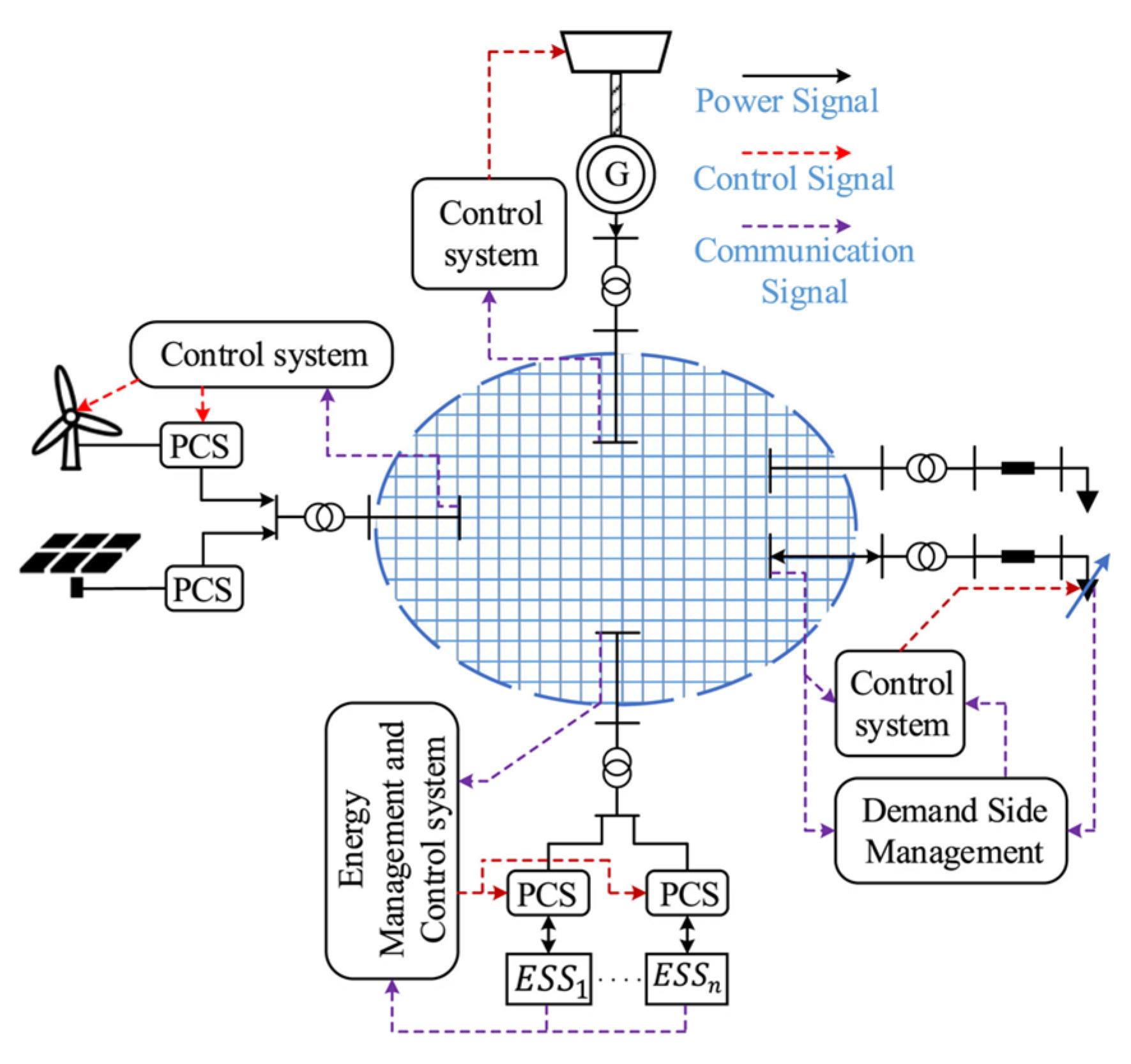
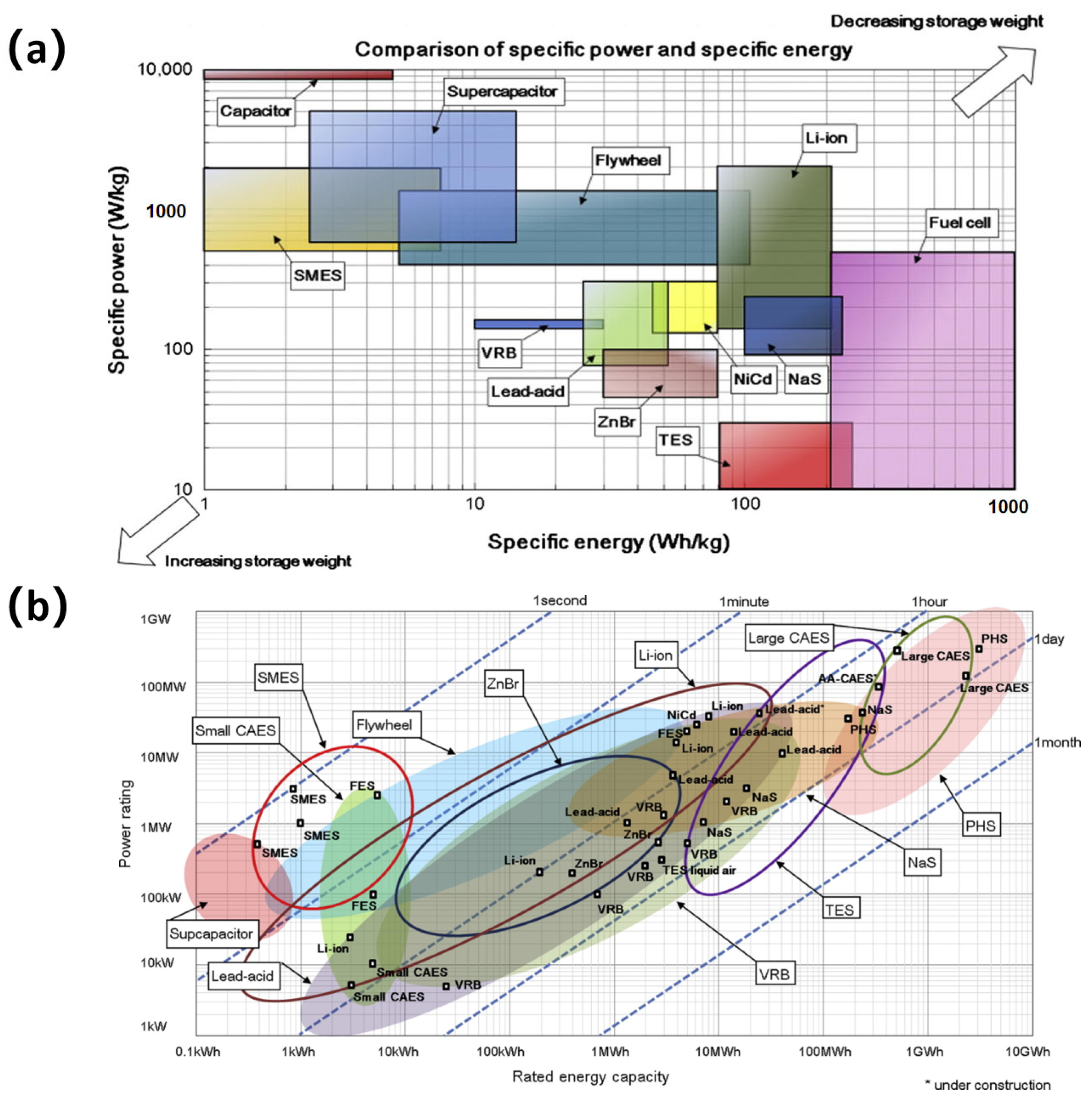
To intuitively demonstrate the access modes and coordination relationships of various frequency regulation resources, Figure 1 presents a typical architecture of modern power systems integrating multiple frequency regulation resources. As shown in the figure, modern power systems coordinate conventional synchronous generating units, energy storage systems, demand-side management resources, and renewable energy power stations to implement grid frequency regulation collaboratively [11]. By dynamically regulating the active power output of various resources, system frequency stability can be effectively maintained. At present, most power grids rely predominantly on large-scale hydropower and thermal power units to undertake frequency regulation tasks, yet such conventional frequency regulation approaches have conspicuous limitations [12]. Hydropower frequency regulation is restricted by seasonal and geographical factors, leading to relatively limited adjustability; moreover, thermal power units exhibit slow response and low ramping rates [13,14]. These drawbacks not only fail to satisfy the demand for short-duration rapid frequency regulation but also lead to inferior regulation accuracy and may even trigger reverse frequency regulation [15]. Meanwhile, frequent load variation during frequency regulation exacerbates equipment wear, shortens service life, and raises operational costs [16,17,18]. Compared with conventional regulation methods, energy storage systems present prominent advantages for grid frequency regulation. Specifically, energy storage systems feature ultra-fast response and high tracking precision, delivering remarkably higher regulation efficiency than traditional units [19]. In light of the technical characteristics of existing energy storage technologies, flywheel energy storage (FES), pumped hydro storage (PHS), compressed-air energy storage (CAES), supercapacitors (SCs), superconducting magnetic energy storage (SMES), lead–acid batteries (LABs), flow batteries (FBs) and lithium-ion batteries (LIBs) all exhibit considerable application potential in grid frequency regulation scenarios [20,21]. To quantitatively compare the performance differences between various energy storage technologies in grid frequency regulation scenarios, Table 1 summarizes the key parameters of each energy storage type [22,23]. Figure 2 delivers visual comparisons along two major dimensions, specific power-specific energy and discharge duration under rated power, thereby revealing the applicable boundaries of different energy storage systems for grid frequency regulation [24].
Among various energy storage technologies, FES, SCs and SMES feature millisecond-scale power response. They can fully meet the demands of virtual inertia control and rapidly restrain the rate of change in grid frequency, thus exhibiting prominent advantages in short-term transient PFR [25]. Nevertheless, limited by their low energy density and small storage capacity, they are unable to sustain power output over the extended durations required for automatic generation control (AGC)-based SFR [26]. LIBs and FBs deliver moderate response speed with certain continuous discharge capability, so they are compatible with multiple grid frequency regulation control strategies and applicable to both PFR and SFR [27]. PHS and CAES suffer from second-level mechanical regulation delay, which renders them incapable of participating in instantaneous virtual inertia control [28]. However, their large-capacity characteristics make them suitable for long-term AGC dispatching, and they are only applied to steady-state frequency deviation correction scenarios. LABs suffer from limited cycle life. Their performance deteriorates rapidly under high-frequency PFR with droop control, so they can only be deployed for low-frequency PFR instead of SFR systems [29].
Compared with other energy storage technologies, supercapacitors possess prominent superiorities in terms of power density and response speed, and they exhibit favorable application value for frequency regulation [30]. Benefiting from their high power density, supercapacitors can respond precisely the instant grid power fluctuations occur and compensate for instantaneous power deviations during power system frequency regulation, thereby sustaining grid frequency stability [31]. Meanwhile, they deliver ultra-fast charge and discharge capability at the millisecond-to-second scale, enabling immediate energy release or absorption following disturbances to rapidly suppress transient frequency fluctuations and secure precious response time for subsequent regulation by conventional generating units [32]. Furthermore, supercapacitors feature a wide operating temperature tolerance range, which allows them to adapt to grid operation environments under complex climatic conditions and renders them a reliable option for frequency regulation deployment in geographically distinctive regions [33,34].
This paper starts from the practical demands of grid frequency regulation, reviews the application progress of supercapacitors in frequency regulation scenarios, and emphatically analyzes their control strategies, topologies and capacity configuration methods. Combined with typical engineering cases, the practical application status of this technology in frequency regulation is summarized. Finally, prospective research directions are outlined, aiming to provide references and insights for follow-up studies on supercapacitor deployment in power grid frequency regulation.

2. Overview of Supercapacitors

Conventional thermal power generating units suffer from mechanical response delay during primary frequency regulation, while renewable energy generators exhibit relatively poor primary frequency regulation performance due to insufficient rotational inertia. When a power system is subjected to sudden disturbances such as sharp load increase, the system frequency usually drops rapidly and substantially. SCs feature millisecond-level rapid response capability, enabling instantaneous release or absorption of electric power immediately upon disturbance occurrence to effectively restrain transient frequency variations and secure a critical time window for subsequent frequency regulation actions of conventional generating units [35]. Furthermore, conventional thermal units are plagued by regulation dead zones and nonlinear regulation characteristics in secondary frequency regulation, which restrict regulation accuracy. In contrast, SCs can accurately track AGC commands and achieve continuous and smooth regulation. Since their charge–discharge process involves no mechanical motion, SCs are well suited for fast-tracking tasks in secondary frequency regulation.

2.1. General Classification

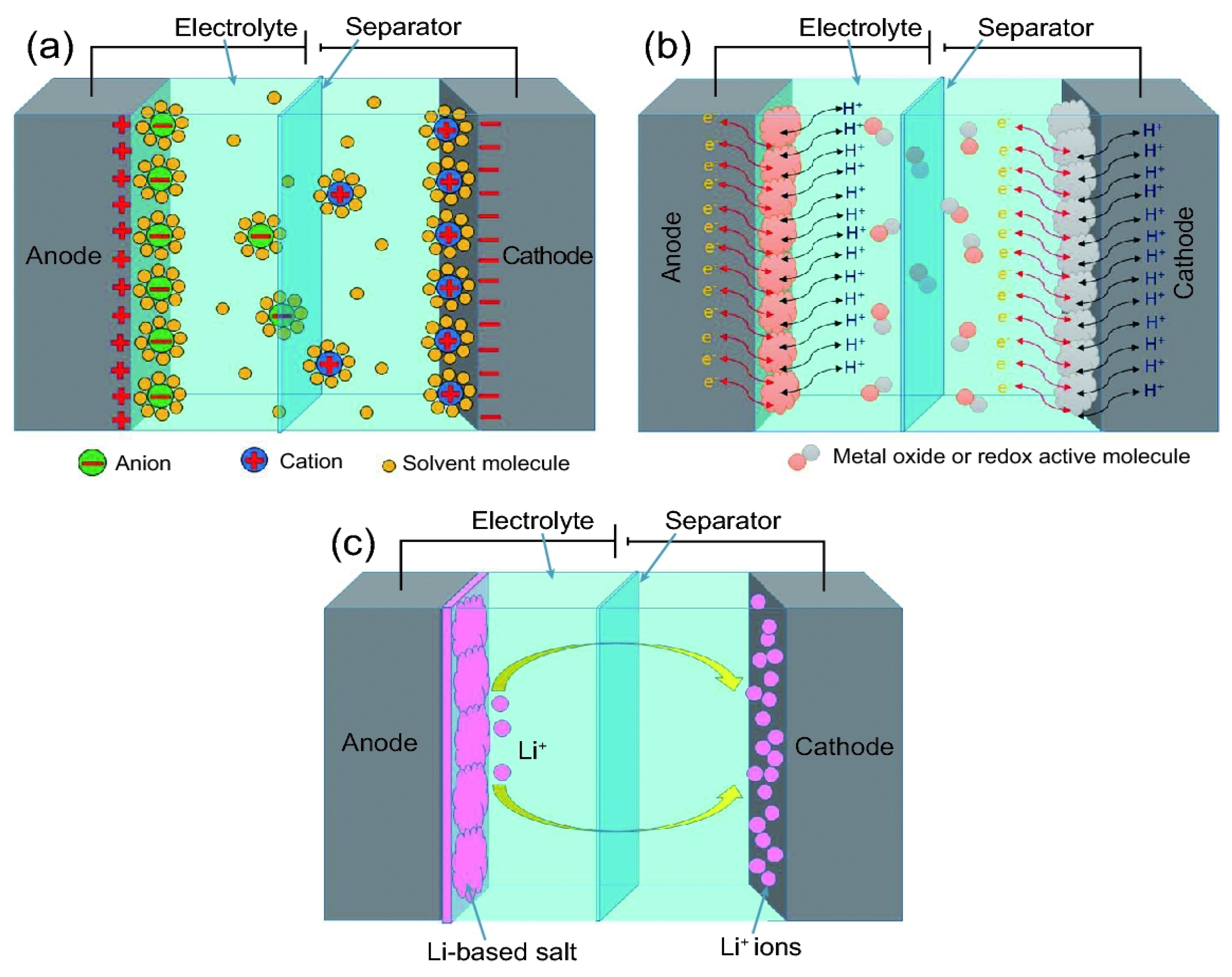
SCs, also known as electrochemical capacitors, are mainly composed of electrodes, electrolytes, separators and current collectors [36,37]. As illustrated in Figure 3, they are classified into three categories according to distinct energy storage mechanisms: electrochemical double-layer capacitors (EDLCs), pseudocapacitors (PCs), and hybrid supercapacitors (HSCs) [38,39].
EDLCs are the earliest developed supercapacitors that store energy by forming a Helmholtz electric double layer at the electrode–electrolyte interface [40,41]. During charging, anions and cations migrate toward the positive and negative electrodes for physical charge storage [42,43,44]. This reversible ion adsorption–desorption process involves no redox reactions [45,46]. This surface electrostatic mechanism allows ultra-fast energy absorption and release, giving EDLCs excellent power performance [47]. However, the same principle inherently limits their energy density [48].
Unlike EDLCs, PCs exhibit partial battery-like energy storage features [49]. They store energy through fast, reversible Faradaic redox reactions with charge transfer at the electrode–electrolyte interface [49,50]. Pseudocapacitance stems from three core mechanisms: underpotential deposition, redox pseudocapacitance, and intercalation pseudocapacitance [51,52].
HSCs are categorized into symmetric and asymmetric configurations according to electrode matching modes [53,54,55]. Symmetric hybrid devices adopt identical composite electrode materials for both positive and negative electrodes. By contrast, asymmetric systems employ distinct active materials on the two electrodes, which separately undertake electric double-layer electrostatic storage and pseudocapacitive Faradaic storage [56,57,58]. By integrating the two storage mechanisms above, asymmetric architectures synergize the high power of double-layer electrodes and the high energy of pseudocapacitive electrodes [59,60,61]. Such composite structures deliver a specific capacitance 2–3 times higher than conventional EDLCs and PCs, with greatly enhanced comprehensive performance and application potential [62]. At present, lithium-ion capacitors (LICs) represent the most widely adopted type of hybrid supercapacitors [63,64,65].

2.2. Performance and Frequency Regulation Suitability of SCs

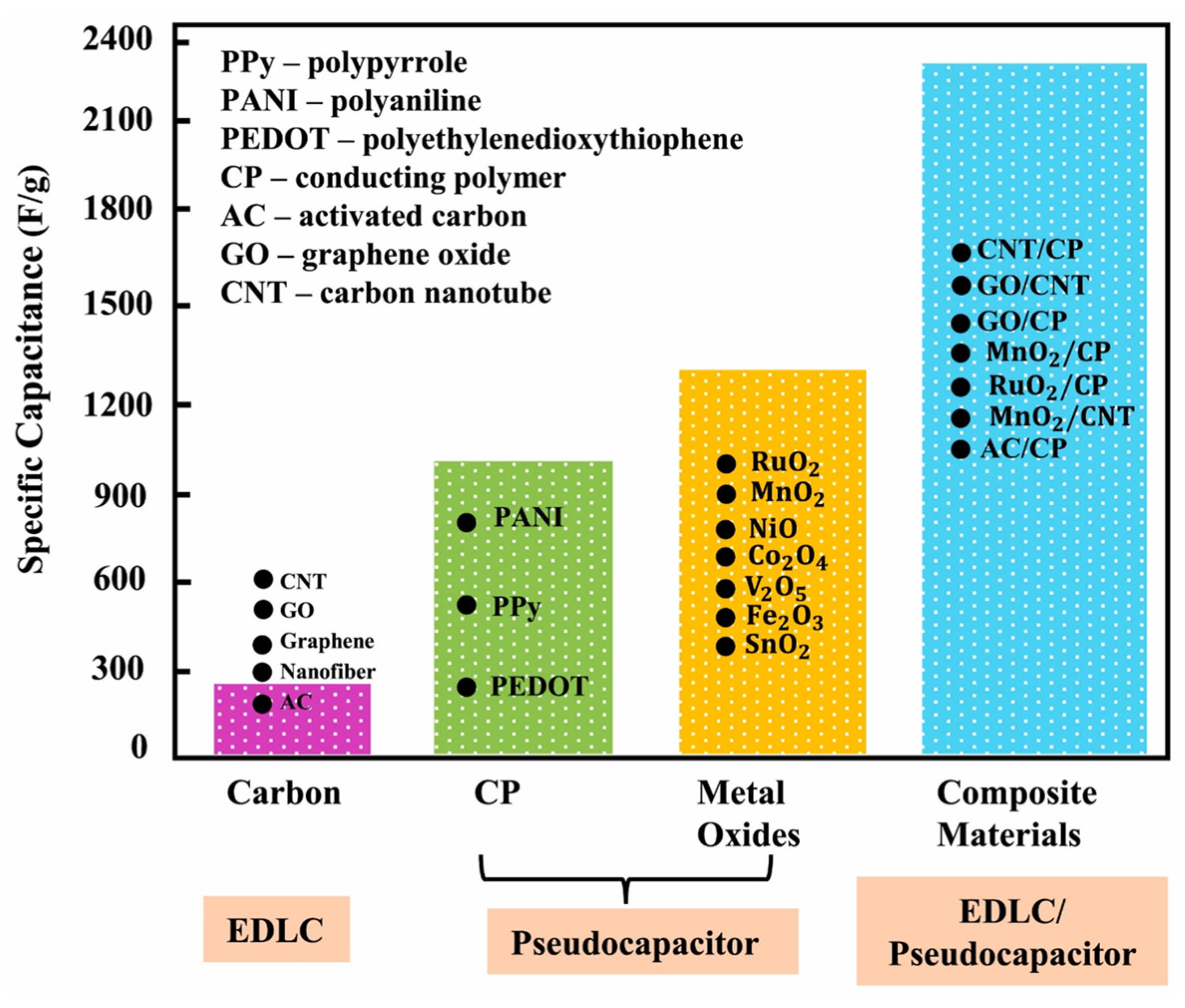
In terms of electrode material selection, carbon-based materials dominate the electrodes of EDLCs, with typical examples including activated carbon, graphite, carbon nanotubes and so on [66]. By contrast, pseudocapacitors mostly adopt metal oxides and conducting polymers as electrode active materials. Hybrid supercapacitors are assembled with two or more distinct electrode materials. The anode and cathode can be fabricated from identical materials or paired with electrodes possessing disparate electrochemical properties. Figure 4 illustrates the capacitive performance of electrode materials for various supercapacitors [67]. The specific capacitance of carbon-based materials such as activated carbon and graphite is generally below 300 F/g. Conducting polymer systems can reach approximately 1000 F/g, while metal oxide systems range from 1200 to 1500 F/g [68]. Multicomponent composite electrodes can achieve further enhanced specific capacitance.
To intuitively compare the basic performance differences among three types of supercapacitors, Table 2 summarizes the key performance parameters of EDLCs, PCs and HSCs [69,70]. The charge–discharge process of EDLCs boasts excellent reversibility. These devices endure tens of thousands of charge–discharge cycles with negligible performance degradation, featuring ultra-long cycle life, superior power density and millisecond-scale response speed. Such merits make EDLCs perfectly fit long-term high-frequency cycling and serve as an optimal option for grid inertial support. Nevertheless, EDLCs are limited by low energy density and aggravated self-discharge under extreme temperatures. While carbon electrodes reduce single-cell fabrication costs, the purely physical storage feature raises system integration difficulty and per-unit-energy cost, weakening economic viability. Thus, EDLCs are rarely deployed for long-duration frequency regulation due to the above limitations [71]. In contrast, PCs have not yet achieved industrialized commercial application. In terms of operating mechanism, the power densities of PCs fall between those of EDLCs and LIBs. Accordingly, for grid frequency regulation scenarios, although PCs can provide longer-duration energy support than EDLCs, their energy storage capacity remains insufficient to independently meet long-term frequency regulation demands lasting several minutes or even tens of minutes. As for HSCs, their round-trip efficiency is marginally inferior to EDLCs, yet they exhibit far better self-discharge behavior than PCs. HSCs balance power and energy costs, thereby achieving superior comprehensive economic performance compared with EDLCs or PCs used alone. As industrial production expands and electrode materials keep being upgraded, the full-life-cycle cost of HSCs for frequency regulation will continue to drop. Moreover, HSCs sustain stable output across a wide temperature range, meeting the frequency regulation needs of various climate regions and demonstrating great commercial prospects [72].
To date, EDLCs and LICs have achieved mature industrialization. Table 3 summarizes the parameters of supercapacitor products manufactured by relevant enterprises and research institutions [73,74]. At present, constrained by inherent energy storage mechanisms and electrode materials, commercial EDLCs generally suffer from low energy density and cannot sustain long-duration power regulation. HSCs can overcome the energy density bottleneck of EDLCs. HSC products developed by Germany’s Skeleton Technologies and South Korea’s Vinatech achieve an energy density of 60–70 Wh/kg, while HSCs produced by China’s Aowei Technology reach as high as 100 Wh/kg. Nevertheless, these products are characterized by relatively low power density, which limits the upper limit of short-term charge and discharge power output. Japan took an early lead in the industrialization of LICs. JM Energy established a dedicated production line by the end of 2008 and realized the world’s first commercial mass production of LICs. Its products operate within a voltage range of 2.2–3.8 V with an energy density of approximately 10 Wh/kg. Subsequently, AFEC and Shin-Kobe Electric Machinery successively advanced the industrial manufacturing of LICs. Furthermore, the China Green Development Investment Group Co., Ltd. (CGDG, Beijing, China) has mastered core technologies, including advanced porous electrode fabrication and controllable pre-lithiation of anodes. It has successfully developed all-carbon lithium-ion capacitors with both high energy density and high power density.
From the perspective of practical engineering requirements for grid frequency regulation, LICs are the supercapacitor devices with the optimal application value for grid frequency regulation at the current stage. Grid frequency regulation systems demand two key performances: millisecond-level rapid power response and sustained power regulation capacity lasting tens of seconds to several minutes [75]. Although EDLCs possess an extremely high power density, their low energy density makes them susceptible to over-discharge when addressing prolonged power shortages, rendering them incapable of independently completing a full frequency regulation cycle [76]. In contrast, LICs retain excellent power output characteristics while reaching an energy density range of 10–100 Wh/kg [77,78]. This constitutes the core reason why megawatt-scale hybrid energy storage power plants for frequency regulation prefer LICs over pure EDLC devices. By comparison, PCs deliver higher theoretical specific capacitance, yet they suffer from drawbacks, including high self-discharge rates, insufficient cycling stability and low industrialization maturity [79]. At present, they fail to meet the standards for large-scale grid engineering deployment and merely serve as laboratory research carriers for novel electrode materials.

3. Key Technologies for SC-Based Frequency Regulation

3.1. Control Strategies

In the application of supercapacitors for grid frequency regulation, control strategies serve as the core technical support to realize their regulatory functions. A well-designed control scheme can not only markedly improve frequency response performance but also reduce the configured capacity and cost of energy storage systems, enhancing the economic viability of practical engineering deployment. At present, most research on supercapacitors participating in primary frequency regulation focuses on control algorithm design for coordinated operation with thermal power units, among which virtual droop control and virtual inertia control represent the two most classic control strategies.

3.1.1. Virtual Droop Control

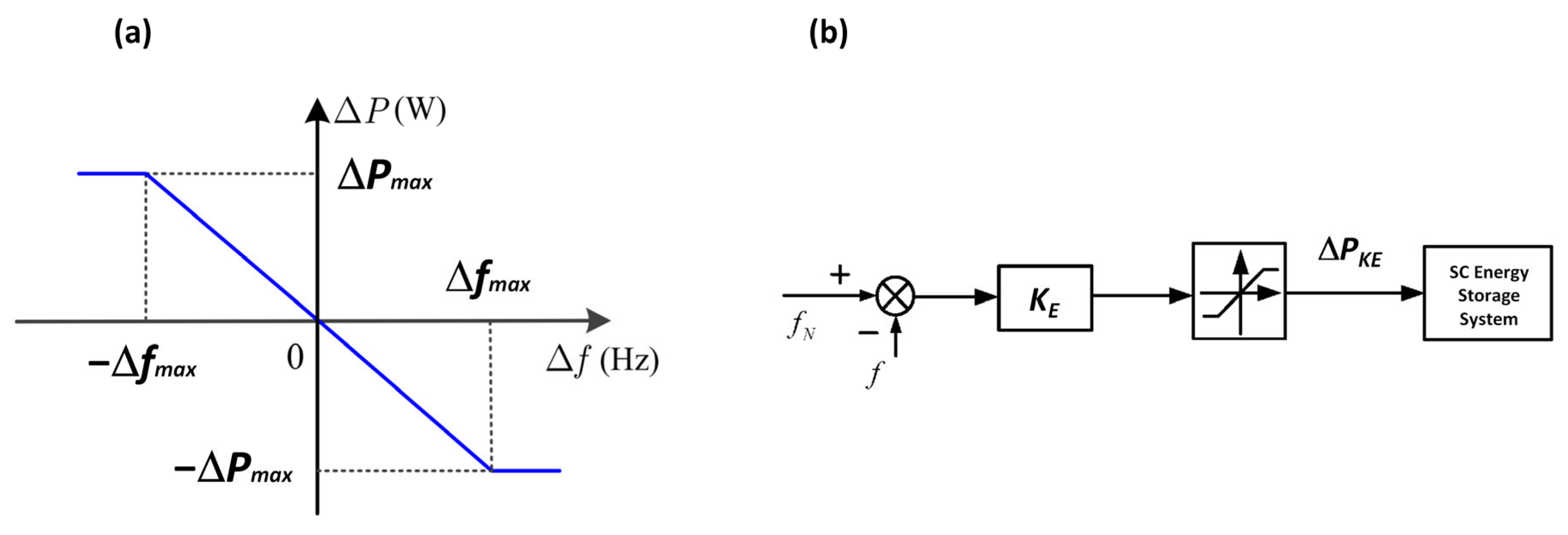
Virtual droop control provides autonomous voltage and frequency support for the power grid by mimicking the droop external characteristic of synchronous generators. With a predefined droop coefficient (the ratio of power variation to frequency deviation), supercapacitors perform autonomous and linear adjustment of charge–discharge power according to real-time grid frequency deviation, which effectively optimizes the frequency regulation performance for steady-state frequency error [80]. The characteristic curve and control block diagram of virtual droop control are presented in Figure 5a,b, and its mathematical expression is given as follows [81,82,83]:
Δ P = Δ P max ,       Δ f     Δ f max K E   ·   Δ f ,       Δ f max   <   Δ f   < Δ f max Δ P max ,       Δ f     Δ f max
where Δf and ΔP denote the variations in frequency and power, respectively; Δfmax stands for the maximum allowable frequency deviation; ΔPmax represents the maximum power adjustment range; and KE is the droop control coefficient.
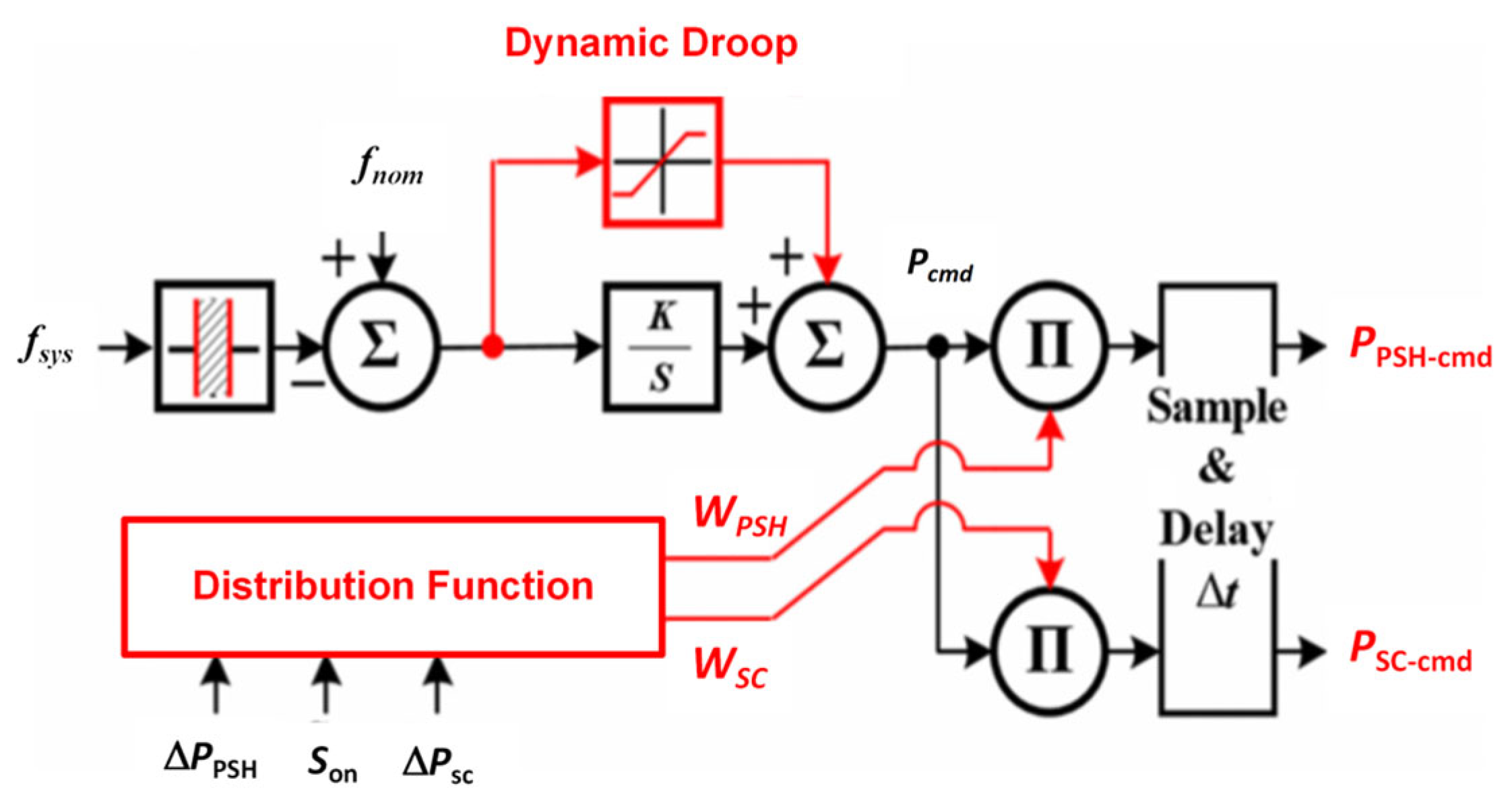
Currently, research has been conducted on the application of droop control strategies to the coordinated frequency regulation of supercapacitors with other energy storage devices. Reference [84] proposes a dynamic frequency support scheme coordinating SCs with PHS. Figure 6 illustrates the configuration of this frequency controller. Adopting dynamic droop characteristics, the controller operates in parallel with an integral controller and a distribution function. It generates a total power command, Pcmd, according to the deviation between the system frequency, fsys, and rated frequency, fnom, and dispatches the command to each frequency control unit. Afterwards, the power command is allocated to the pumped storage unit and supercapacitor unit based on weighting coefficients, WPSH and WSC. Simulation results verify that this scheme can remarkably improve the short-term stability of power systems under frequency contingency events.

3.1.2. Virtual Inertia Control

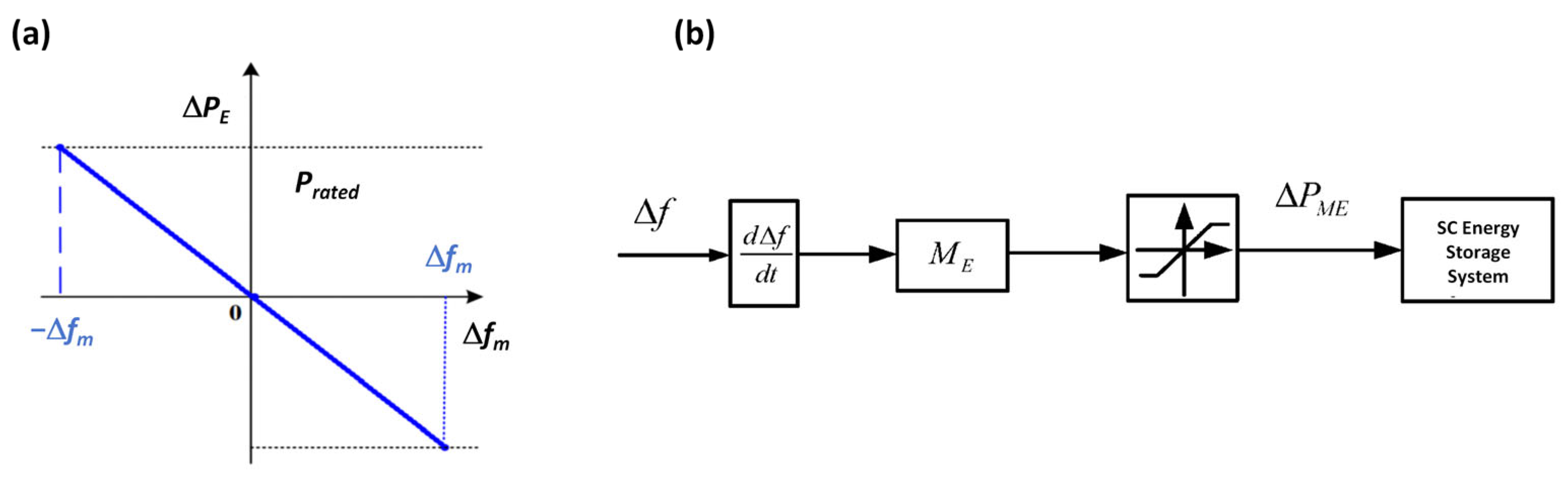
The core principle of virtual inertia control lies in emulating the inertial response characteristics of synchronous generators. It regulates supercapacitors to rapidly release or absorb power according to the rate of change in system frequency deviation so as to effectively suppress drastic fluctuations in grid frequency. Its control characteristic curve and control block diagram are shown in Figure 7a,b, with the mathematical expression presented below [85]:
Δ P E   = Δ M E d Δ f ( t ) dt
where ΔPE represents the variation of output power and ΔME is the virtual inertia coefficient.
In recent years, the application of virtual inertia control to supercapacitor frequency regulation in power systems with high penetration of renewable energy has been extensively investigated. Reference [86] designs an inertia control strategy based on generator torque limits to achieve effective regulation of supercapacitors, and an additional damping controller is introduced to suppress system oscillations, offering a feasible solution for coordinated frequency regulation of wind–supercapacitor hybrid systems. Reference [87] proposes a nonlinear inertia control strategy. This strategy establishes a proportional correlation between grid frequency and supercapacitor terminal voltage via a frequency controller to emulate inertial support, addressing the reduction in system inertia caused by grid integration of renewable energy sources. The controller formulates a relationship between the grid frequency deviation, Δfr, and the supercapacitor voltage reference, ves_ref, enabling dynamic adjustment of the supercapacitor voltage in response to grid frequency fluctuations. The supercapacitor voltage, ves, is regulated to track its reference, ves_ref, by controlling the inductor current reference, il_ref. Finally, simulations and experimental tests validate the effectiveness of the proposed virtual inertia and its corresponding control strategy.

3.1.3. Others

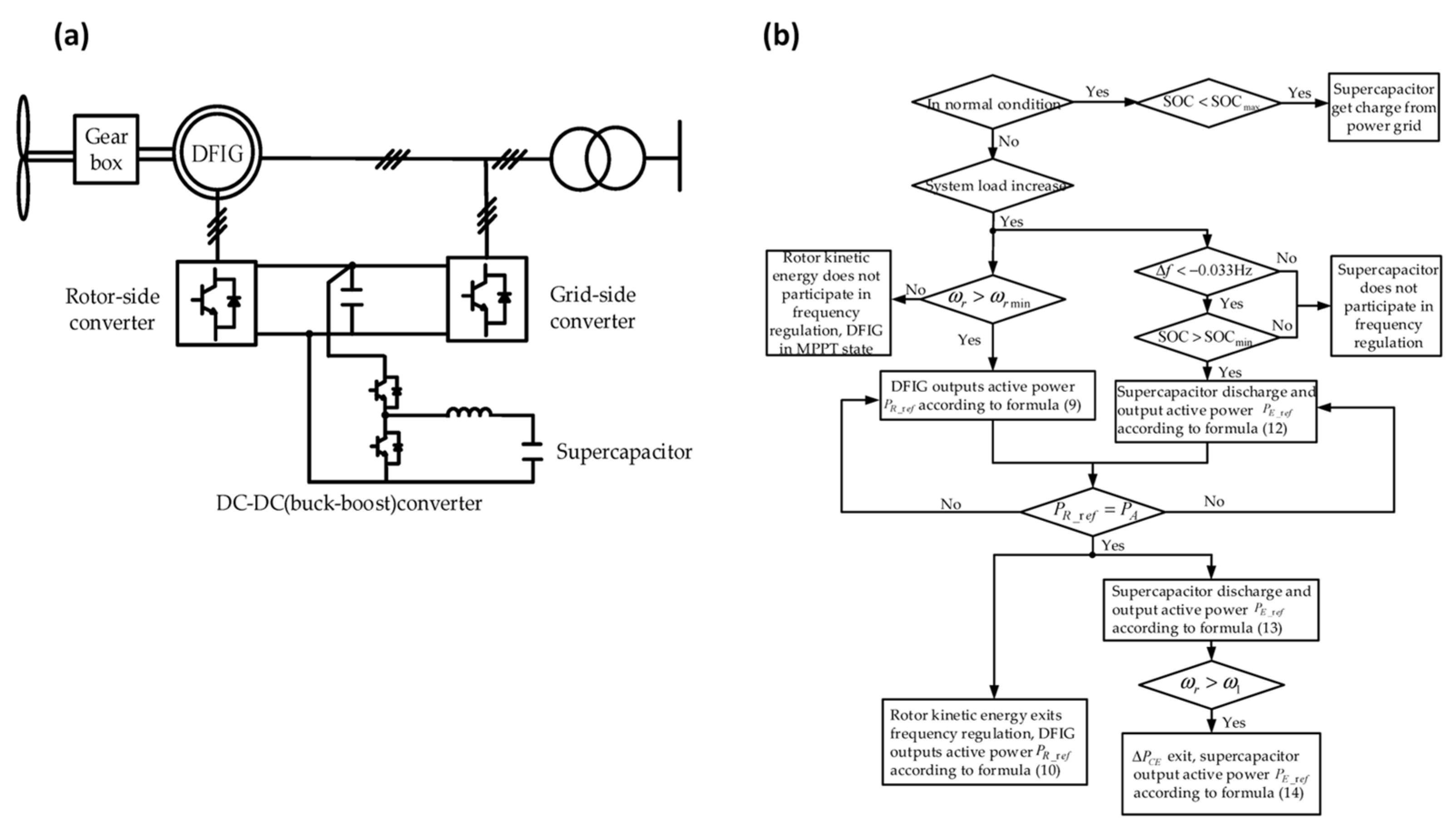
Although virtual droop control can reduce steady-state frequency deviation, it delivers mediocre performance in restraining the rate of change in frequency and mitigating maximum frequency deviation. In contrast, virtual inertia control only functions during frequency drop transients and exerts limited improvement on steady-state error. Accordingly, the combined application of these two control schemes and research on other advanced control strategies have become major research focuses in this field in recent years. For hybrid energy storage systems, Reference [88] develops an adaptive coordinated control strategy. Specifically, high-power supercapacitors respond to inertia control commands, while high-capacity lithium-ion batteries respond to droop control commands. Simulation comparisons reveal that these strategies raise the state-of-charge (SOC) level by 19.17% and 30.16% respectively, compared with the standalone lithium-battery control strategy and the no-energy-storage baseline strategy. Reference [89] proposes a coordinated frequency control strategy combining rotor kinetic energy and supercapacitors. As illustrated in Figure 8a, the supercapacitor is used to realize droop characteristics, whereas the wind turbine rotor kinetic energy is utilized to emulate the inertial response of synchronous generators. Figure 8b shows the flowchart of joint frequency control for the doubly fed induction generator (DFIG) and SCs. When grid frequency declines, both rotor kinetic energy and supercapacitors participate in frequency regulation collaboratively. If the rotor speed exceeds 0.7 p.u., kinetic energy is released to provide inertial support. If the frequency deviation exceeds 0.033 Hz and the supercapacitor SOC is sufficient, the supercapacitor is controlled to discharge for droop support. During the withdrawal of inertial support by rotor kinetic energy, the supercapacitor promptly compensates for the power shortage of the DFIG, effectively eliminating secondary frequency drop.
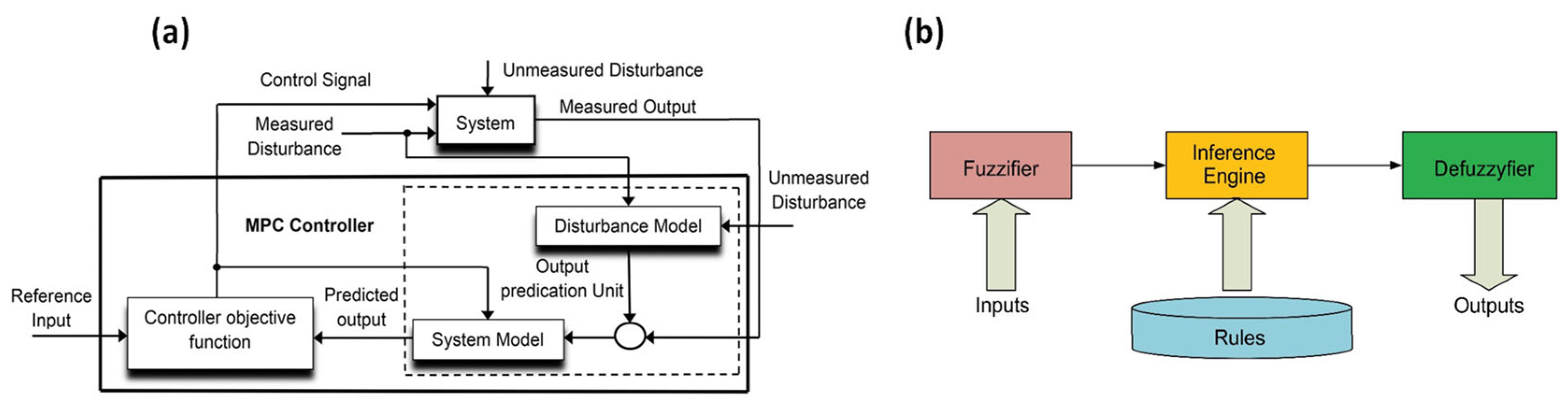
A variety of advanced control strategies have also been adopted for SC frequency regulation. For instance, model predictive control (MPC) leverages the dynamic mechanism model of the system to predict the subsequent operating conditions of generating units and energy storage devices in advance and optimizes real-time control commands based on predictive information to guarantee satisfactory frequency regulation performance [90,91]. The primary advantage of MPC lies in its capability to synchronously coordinate multiple variables. Its fundamental principle involves constructing a prediction model, defining the desired system behavior via a cost function, and generating practical control commands by minimizing this cost function [92]. Figure 9a illustrates the overall architecture of the MPC controller, which adopts a feedforward control scheme to compensate for measurable disturbances [93]. The prediction module forecasts future control trajectories by integrating the current system outputs, external disturbances and control input signals. Subject to system operational constraints, the control module solves for the optimal control action according to the predicted outputs to minimize the objective function [94].
Apart from MPC, fuzzy logic control (FLC) requires no precise mathematical modeling and exhibits excellent robustness, making it another widely adopted algorithm for supercapacitor frequency regulation. FLC maps input variables to output variables via a predefined fuzzy rule base to handle the nonlinear coupling between inputs and outputs. It maintains favorable control performance even under parametric uncertainty, rendering it highly suitable for power grids with high penetration of renewable energy [95]. As depicted in Figure 9b, the fuzzy logic system first fuzzifies diverse input variables through a fuzzification unit, and the processed signals are then delivered to an inference unit. After the inference module generates fuzzy linguistic values, a defuzzification stage converts these fuzzy quantities into precise physical control signals for practical actuation [96].
Figure 9. (a) Overall architecture of the model predictive control unit. Reproduced from Ref. [93] with permission. (b) Structural diagram of fuzzy logic control. Reproduced from Ref. [96] with permission.
Batteries 12 00311 g009
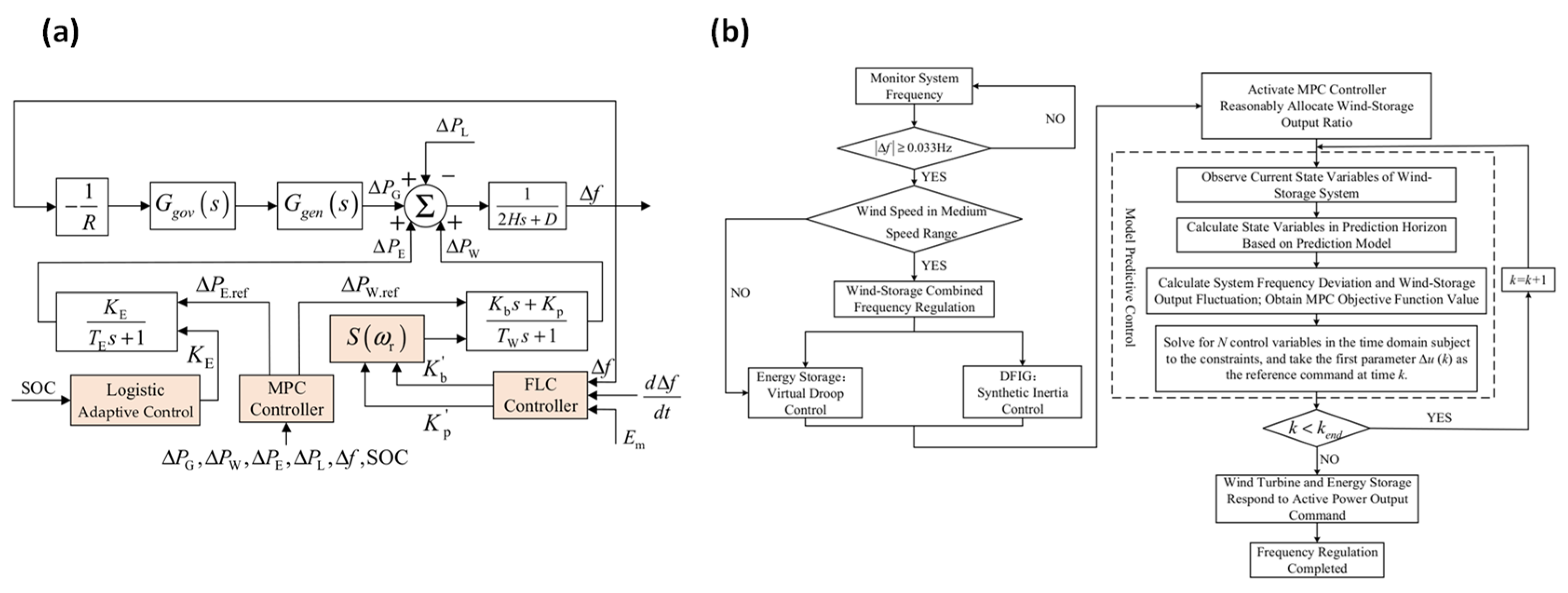
Reference [97] integrates MPC with high-speed joint control for a hybrid energy storage system consisting of batteries and supercapacitors in a DC microgrid, with regulation prioritized for supercapacitors. This scheme effectively suppresses bus voltage fluctuations and remarkably enhances the frequency regulation capability of the system. Taking a wind-storage hybrid system composed of DFIG and SC energy storage as the research object, Reference [98] proposes a coordinated primary frequency regulation strategy combining FLC and MPC. Meanwhile, SOC feedback adaptive virtual droop control is introduced to improve the continuous frequency support capability of supercapacitor energy storage. As shown in Figure 10a, the DFIG side determines its support magnitude via a multivariable fuzzy logic controller combined with a safe rotor speed decay mechanism, while the SC side dynamically adjusts its output power following an SOC-based adaptive droop law. On this basis, MPC acts as the upper coordinator to update power reference commands for wind and storage units in real time through rolling optimization. Figure 10b illustrates the optimal power allocation framework of the system. With a coordinated optimization mechanism, the framework effectively mitigates system frequency deviation and further exploits the complementary regulation potential of wind turbines and energy storage units. Simulation results verify that the proposed strategy can reduce steady-state frequency deviation, optimize coordinated power distribution, and thereby comprehensively improve the primary frequency regulation performance of the wind-storage system.
It should be noted that the intrinsic characteristic differences between various types of supercapacitors lead to distinct adaptability to different frequency regulation control systems. Virtual inertia control is extremely sensitive to the rate of change in grid frequency, requiring energy storage devices to deliver rapid high-power charge and discharge at a millisecond timescale. EDLCs store energy via pure physical electrostatic adsorption, with a response time within 20 ms and no electrochemical polarization lag, making them the optimal devices for virtual inertia control. Nevertheless, EDLCs suffer from low energy density and can only output power for a short duration. They cannot sustain continuous droop regulation for dozens of seconds independently and can merely serve as transient auxiliary compensation units. In contrast, virtual droop control, inertia-droop composite control, MPC and FLC all involve continuous power regulation over longer timescales. HSCs, represented by LICs, feature both high power density and moderate energy density, achieving a balanced combination of power and energy performance, which makes them more suitable for the aforementioned long-timescale frequency regulation schemes. Furthermore, PCs store energy through Faradaic redox reactions. They not only have a short cycle life but also suffer from high self-discharge rates and immature large-scale industrialization. At the present stage, they can hardly be applied to grid-level frequency regulation control systems. Accordingly, the design of frequency regulation control strategies should fully take the inherent characteristics of different supercapacitors into account so as to balance the system frequency regulation performance and the operational safety of energy storage devices and achieve optimal overall benefits.

3.2. Topological Structure

Proper grid-connected design can not only improve energy distribution efficiency, but also enhance the operational efficiency and reliability of supercapacitor systems to meet customized requirements under diverse application scenarios.
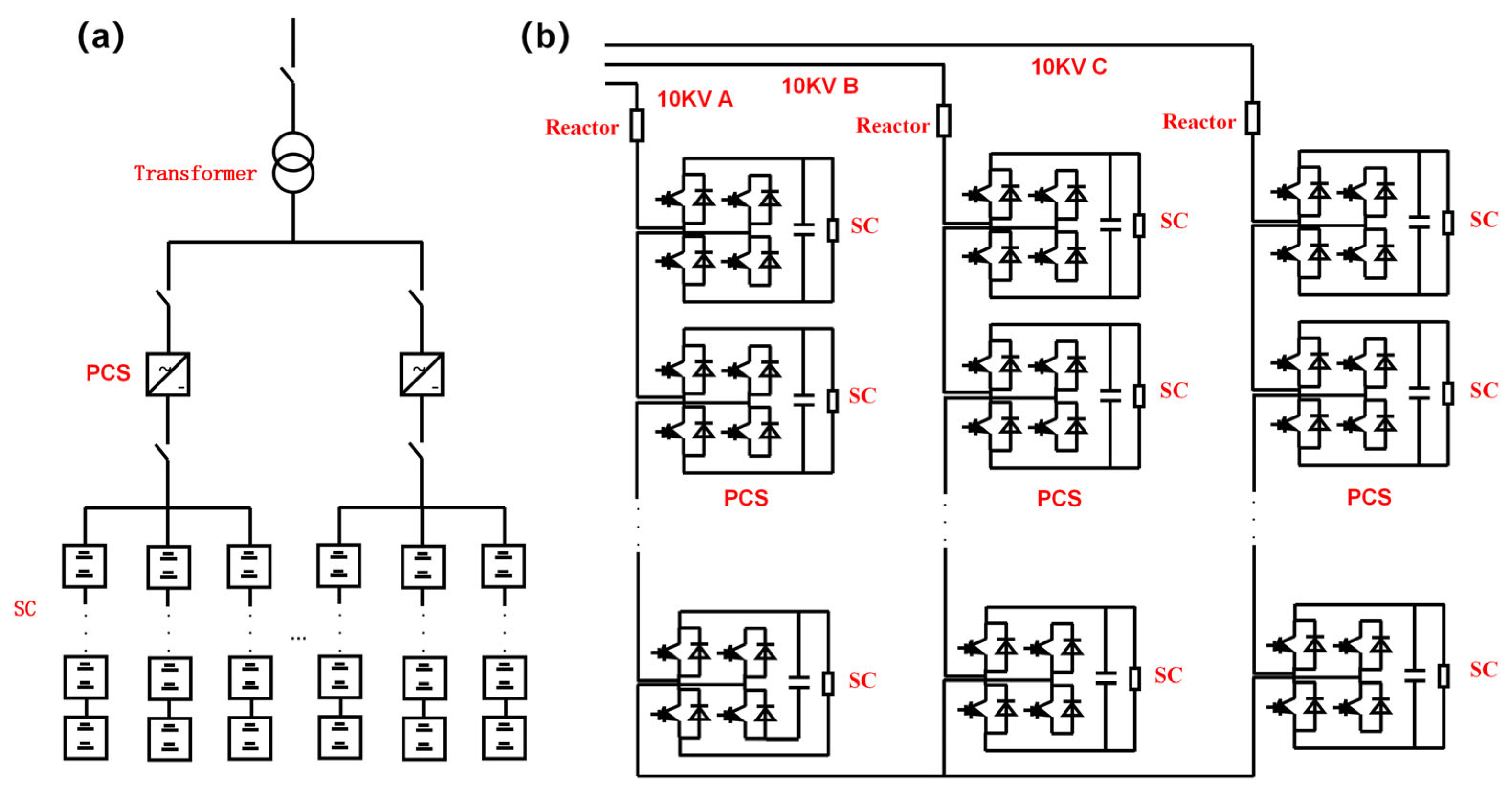
At present, two mainstream connection topologies are adopted for supercapacitors coordinated with thermal power units in frequency regulation: low-voltage parallel confluence with step-up conversion and high-voltage cascaded connection, as illustrated in Figure 11 [99]. In the low-voltage parallel confluence and step-up topology (Figure 11a), supercapacitor banks are first connected in parallel at low voltage to form a unified low-voltage DC bus. A large-capacity power conversion system (PCS) then converts direct current into alternating current, and a step-up device elevates the voltage level for grid integration. This topology features a simple structure and low control complexity, yet it suffers from limited scalability for expanding energy storage capacity [100]. The high-voltage cascaded energy storage system (Figure 11b) connects multiple small-capacity distributed PCS units in series for voltage boosting, enabling grid connection without an additional step-up transformer. It effectively mitigates capacity degradation and energy loss caused by circulating current effects, achieving higher theoretical efficiency than the low-voltage parallel step-up configuration. This topology is more suitable for medium- and high-voltage energy storage applications but comes with greater control difficulty [101].
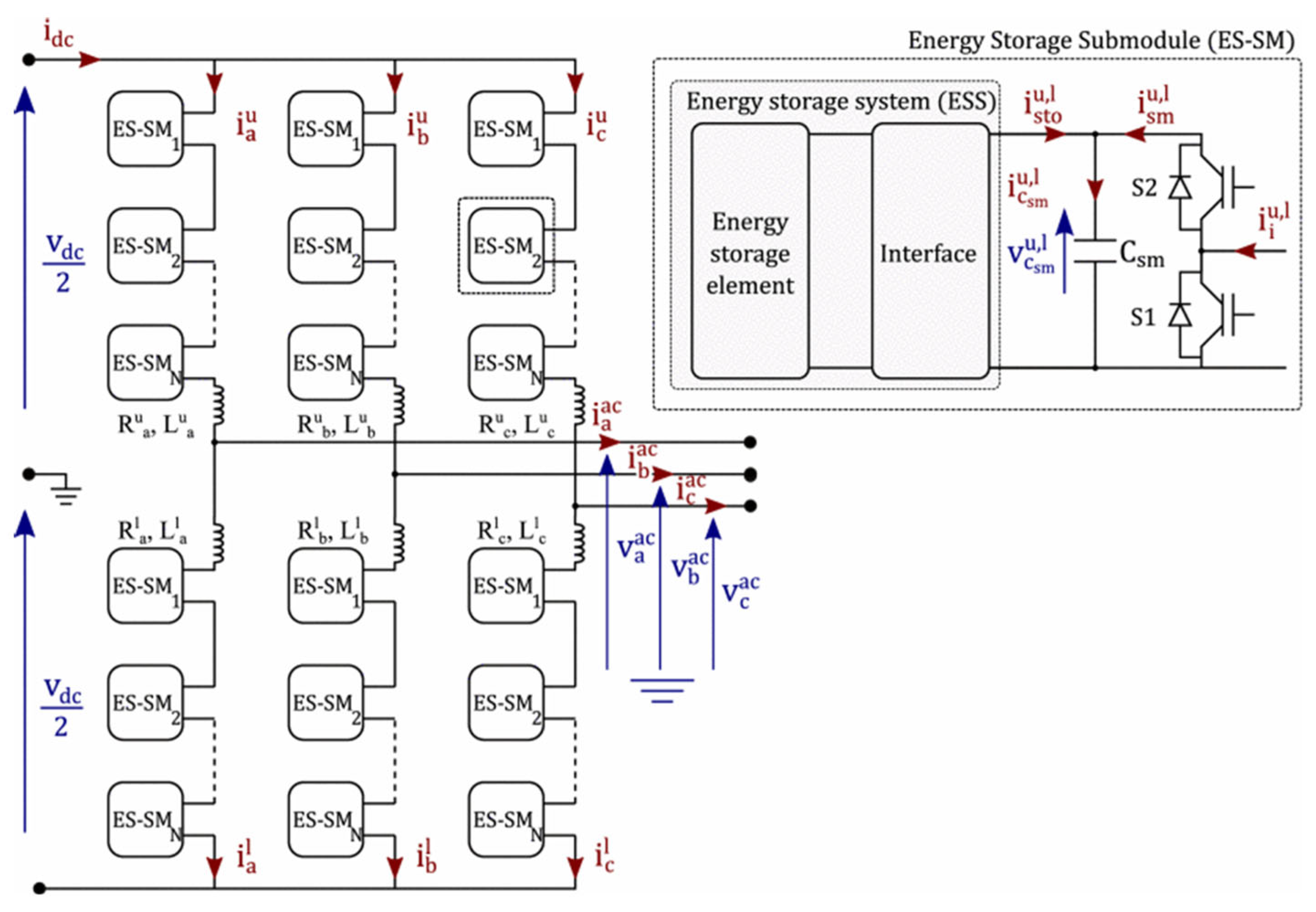
In recent years, the modular multilevel converter (MMC) has exhibited promising engineering potential for supercapacitor frequency regulation owing to its high modularity, easy expandability and shared DC bus. The MMC facilitates interconnection between AC and DC systems without additional PCSs, simplifying system configuration and improving overall energy conversion efficiency [102]. Figure 12 shows the general topology of an MMC integrated with energy storage. Each phase leg consists of an upper and a lower arm connected via arm impedance, and each arm contains an equal number of half-bridge submodules with identical electrical parameters [103]. Inside each submodule lies a parallel configuration composed of energy storage units, full-bridge converters and shunt capacitors; the capacitors restrict the rate of DC voltage variation during arm switching transients.
Reference [104] proposes a hybrid energy storage scheme for MMC under hybrid synchronous control, where battery cells are embedded inside MMC submodules while supercapacitors are connected to the DC bus. Hardware-in-the-loop tests verify that this topology can deliver effective inertial support with flexible operational mode switching, demonstrating great prospects for grid frequency regulation. Reference [105] presents a supercapacitor energy storage system built upon a quasi-resonant MMC architecture. Benefiting from soft-switching characteristics, the scheme suppresses switching losses and markedly boosts converter energy conversion efficiency. Reference [106] develops a bidirectional power-flow-capable MMC topology with reduced cascading stages. A single submodule integrates multiple functions: energy storage, voltage balancing, bidirectional DC/DC conversion, bidirectional DC/AC conversion and galvanic isolation. It provides a viable technical route for direct grid connection of supercapacitors to undertake frequency regulation duties.

3.3. Capacity Configuration Method

Capacity configuration and optimization of supercapacitor systems constitute the core issue when they participate in power system frequency regulation and serve as a fundamental prerequisite for high-efficiency frequency regulation and secure grid frequency stability. At present, capacity sizing methods mainly take the following factors into account: frequency regulation index requirements, system and device characteristics, control strategy constraints, and economic performance. Furthermore, intelligent optimization algorithms are adopted to solve multi-objective optimization problems for optimal capacity allocation of supercapacitors. A comparative summary of different configuration approaches is presented in Table 4.

3.3.1. Conventional Configuration Methods

Capacity sizing based on frequency regulation index requirements must comply with assessment criteria for grid primary frequency regulation and AGC, while fully accounting for the regulation characteristics of generating units. For example, in Reference [107], researchers incorporated the volatility of wind power output and the fluctuation characteristics of corresponding grid frequency signals, formulated a capacity configuration scheme targeting optimal frequency regulation performance, and validated its effectiveness via simulation.
The device characteristic-oriented capacity sizing method determines the rated capacity depending on the inherent operating properties of supercapacitors. In Reference [108], a capacity optimization model is established with supercapacitor output power and energy storage capacity as constraints, and both its technical effectiveness and economic performance are validated via simulation tests.
For control strategy-based capacity allocation, the required supercapacitor capacity is determined by the control demands for inertial support capability, droop characteristics and other dynamic indicators. In Reference [109], researchers completed supercapacitor capacity configuration by integrating virtual droop control and virtual inertia control, with comprehensive consideration of the droop coefficient and inertia constant of conventional synchronous generating units. Reference [110] develops a mathematical model embedded with supercapacitor investment cost under the framework of virtual inertia control. Numerical integration is adopted to quantify transient energy demand, which minimizes the capital cost of supercapacitor deployment while maintaining qualified frequency regulation performance.
The core objective of economy-optimal capacity configuration lies in balancing total investment cost and operational benefit. During the construction and operation of frequency regulation systems, the primary goal is to reduce capital input and maximize the net present value of revenue. Reference [111] analyzes the comprehensive economic benefits of supercapacitor hybrid energy storage systems participating in primary frequency regulation ancillary services, constructs a bi-level programming model for hybrid storage capacity allocation, and verifies its practical feasibility. Reference [112] proposes an analytical model to evaluate the application benefits of battery–supercapacitor hybrid energy storage in frequency regulation markets, including a separate revenue model, a cost model and a net profit model for market participation. Subject to fixed capital expenditure constraints, the optimal capacity ratio between batteries and supercapacitors is solved to maximize the overall net profit of the hybrid system.

3.3.2. Optimization Algorithm-Based Capacity Sizing

Beyond conventional sizing approaches, capacity allocation using intelligent optimization algorithms has gradually become a research hotspot. Most such methods rely on multi-objective optimization frameworks and adopt intelligent algorithms to derive the optimal capacity configuration.
For instance, Reference [113] first conducts a comprehensive evaluation of distribution network operating conditions to determine the optimal integration location for energy storage systems. On this basis, an improved multi-objective particle swarm optimization (PSO) algorithm is introduced to establish an optimization model balancing economic efficiency and system performance so as to obtain the optimal capacity scheme for energy storage devices. Reference [114] constructs an optimal sizing model that fully accounts for the life-cycle cost of a hybrid energy storage system consisting of supercapacitors and vanadium redox flow batteries. PSO is then applied to search for the optimal capacity combination of the hybrid system, and simulation results validate the feasibility of the proposed sizing strategy.
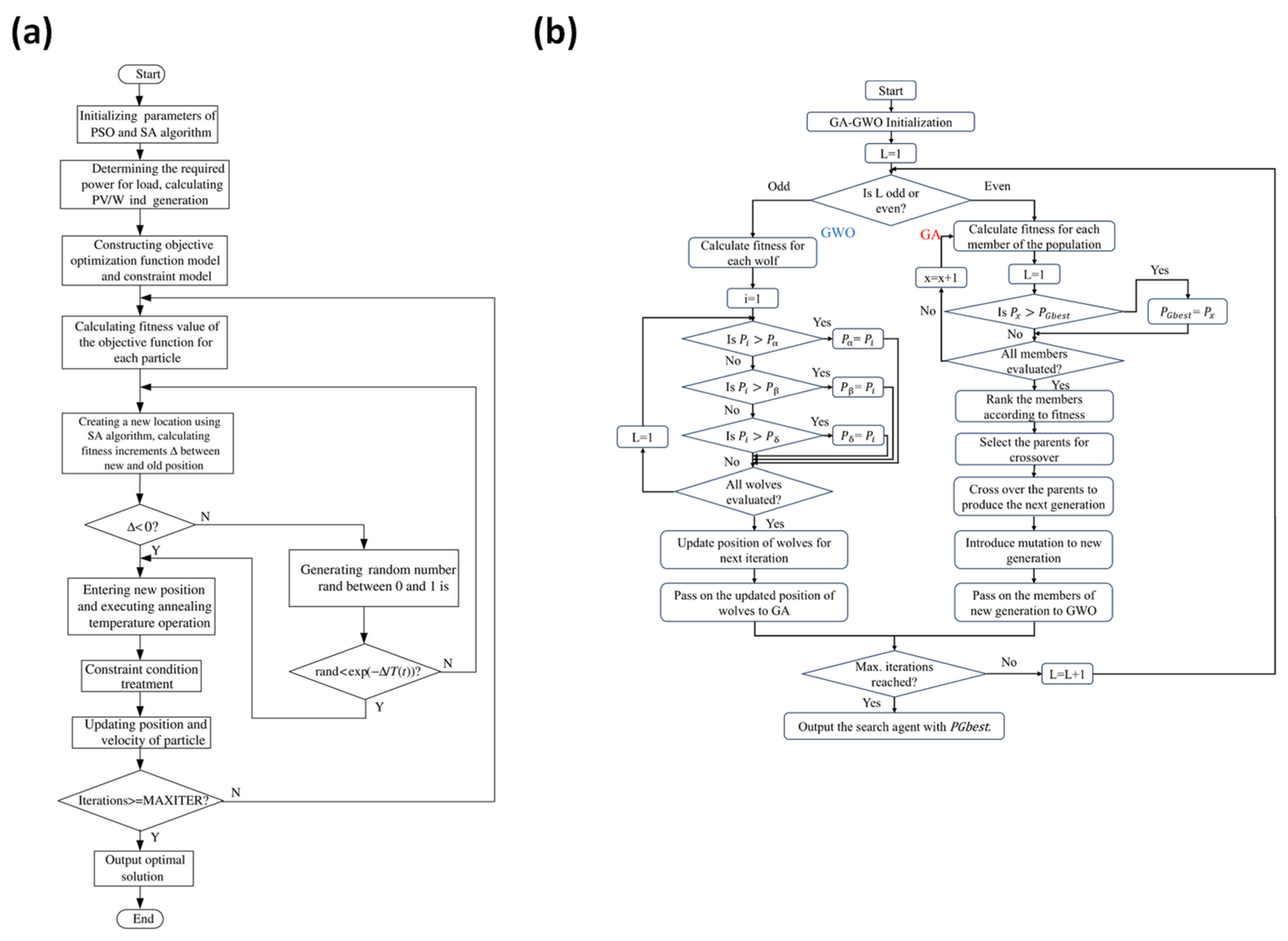
Reference [115] establishes mathematical models for wind–photovoltaic generation, batteries and supercapacitors and proposes an improved simulated annealing–particle swarm optimization hybrid algorithm (Figure 13a). By embedding the probabilistic jumping mechanism of simulated annealing into standard PSO, the algorithm accepts suboptimal solutions in the early search stage to escape local optima and gradually converges toward the global optimum as the temperature decays. It effectively remedies PSO’s drawback of premature local convergence, strengthens global search capability and suppresses premature convergence. Case studies verify that the hybrid algorithm delivers faster convergence and superior cost optimization performance, offering reliable references for energy storage capacity optimization. Another study in Reference [116] adopts a hybrid genetic–gray wolf optimization algorithm (Figure 13b) to optimize the capacity of a lithium battery–supercapacitor hybrid energy storage system. Integrating the merits of genetic algorithm and gray wolf optimizer, the algorithm reduces the charge–discharge switching frequency of supercapacitors and achieves an optimal tradeoff between frequency regulation performance and economic benefits. Simulation results demonstrate its practical engineering viability and promising application prospect in frequency regulation scenarios.
Current research on supercapacitor capacity sizing is gradually shifting from single-objective optimization toward multi-objective collaborative optimization. Solely targeting indicators such as frequency regulation performance tends to cause economic waste, whereas excessive emphasis on economic benefits may fail to satisfy frequency regulation requirements under extreme operating conditions. Although optimization algorithms can accommodate multiple constraints simultaneously, low computational efficiency and susceptibility to local optima remain bottlenecks restricting practical engineering deployment. Future research should focus on improving the computational efficiency of optimization algorithms and developing adaptive sizing mechanisms oriented to real-time electricity pricing.

4. Engineering Applications and Practical Cases of SCs for Frequency Regulation

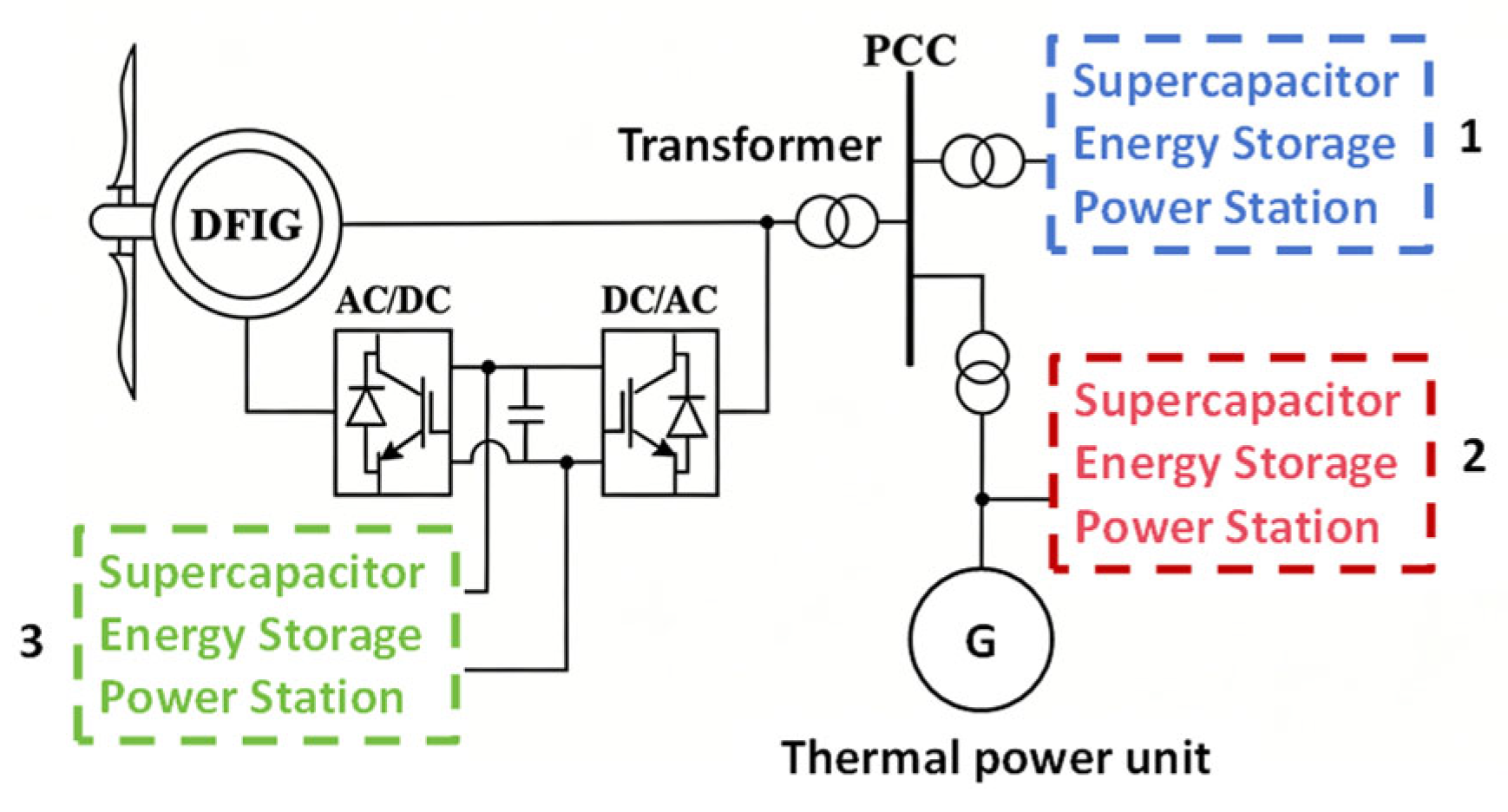
Supported by well-matched control strategies and integration technologies, supercapacitors are evolving into a critical solution for power system frequency regulation. At present, supercapacitors are deployed for grid frequency regulation in three main modes: independent frequency regulation, auxiliary frequency regulation coordinated with thermal power units, and supplementary frequency regulation for renewable energy power plants. The typical installation locations of supercapacitor energy storage devices are illustrated in Figure 14.

4.1. Independent Frequency Regulation

Supercapacitor-based independent frequency regulation power stations are constructed as standalone facilities directly connected to transmission and distribution networks, without relying on conventional generating units. As indicated by location 1 in Figure 14, such stations are generally integrated into the bulk power grid at the transmission or distribution side, which helps reduce energy loss during frequency regulation and alleviate line congestion, and they are commonly equipped with large installed capacity. Benefiting from the millisecond-level response speed and high power density of supercapacitors, independent frequency regulation stations can deliver rapid and reliable frequency support to power systems.
Supercapacitor independent frequency regulation stations have been put into practical engineering operation worldwide. The first phase of the Pianguan hundred-megawatt hybrid energy storage frequency regulation station in Shanxi Province, China, has been successfully connected to the grid and commissioned, setting a global record for the single-unit application scale of supercapacitors among hundred-megawatt independent frequency regulation plants. The station adopts a hybrid energy storage configuration combining supercapacitors and lithium-ion batteries. The rated capacity of the supercapacitor subsystem is 58 MW with a 30 s duration, while the lithium battery subsystem is rated at 42 MW/42 MWh. Built and operated as an independent power station, it integrates dual functions: 100 MW class fast frequency regulation and 42 MWh energy storage for peak shaving. It achieves millisecond-scale frequency response, effectively addressing the inherent drawbacks of conventional frequency regulation techniques, including slow response and large regulation error. It is expected to boost the local power grid’s renewable energy accommodation capacity by approximately 1.6 GW [117]. In addition, the Mehrum E-STATCOM in Germany, jointly developed by Siemens Energy and the grid operator TenneT, is the world’s first grid-independent frequency regulation device integrated with EDLC double-layer supercapacitors. It was officially commissioned in December 2025 at the site of a decommissioned coal-fired power plant in Mehrum, Germany [118]. With a total rated capacity of 300 MVA, the equipment is equipped with energy storage modules centered on supercapacitors capable of absorbing or delivering up to 200 MW of active power to the grid within millisecond timescales. Leveraging the remarkable merits of EDLCs, including millisecond-scale lag-free power response and an ultra-long cycle life of over one hundred thousand cycles, the system mimics the rotational inertia of synchronous generators to rapidly curb the rate of change in grid frequency. In the event of contingencies such as wind turbine tripping or grid power shortage, the device delivers millisecond-level frequency support. Capable of grid connection operation independent of thermal power units and renewable energy stations, this installation is designed to address the problem of insufficient system inertia resulting from the large-scale retirement of coal-fired units and high penetration of wind power in Northern Germany.

4.2. Coordinated Frequency Regulation with Thermal Power Units

Apart from standalone grid frequency regulation, supercapacitors are more widely deployed for coordinated frequency regulation with thermal power units at present. In this application scenario, the supercapacitor system is installed at location 2 illustrated in Figure 14 [119]. As a supporting facility of thermal power plants, it adopts a coordinated thermal-storage operation mode to achieve rapid response and precise tracking of grid frequency regulation commands. Featuring millisecond-level power response capability, the supercapacitor system can compensate the active power output of thermal units via multiple control strategies under abnormal operating conditions such as overshoot and reverse regulation, correct the deviation between regulation orders and actual output power, and secure system frequency stability [120]. At the initial stage of grid frequency fluctuation, this joint regulation technology can deliver prompt frequency support, effectively improve the frequency response characteristics of thermal generators, and thereby enhance their overall frequency regulation performance comprehensively.
Table 5 summarizes typical practical engineering cases of supercapacitors assisting thermal power units for grid frequency regulation in China [73]. In terms of technical routes, hybrid energy storage systems centered on lithium batteries and supercapacitors have become the mainstream solution, while projects relying solely on supercapacitors for frequency regulation remain relatively scarce [121]. The all-supercapacitor energy storage frequency regulation project at the Huaneng Yimin power plant stands as a representative operational project in China that adopts pure supercapacitors to support thermal unit frequency regulation. This project first introduced string-type PCSs into the energy storage frequency regulation field and constructed an all-supercapacitor energy storage system rated at 16 MW with a 10 min discharge duration. The system consists of six independent energy storage units and covers a land area of 1220 square meters. Compared with conventional control systems, its response speed is increased by 60%, which greatly improves the load regulation accuracy and dynamic performance of thermal power units. At present, this energy storage system operates in coordination with two 550 MW supercritical thermal units in the first phase of the power plant, providing strong support for the improvement of unit frequency regulation capability [122].
Within hybrid energy storage configurations, supercapacitors are typically assigned to short-term, high-frequency frequency regulation responses, while lithium-ion batteries undertake long-duration energy storage and power supplementation. The complementary strengths of the two technologies enable the system to attain comprehensive performance featuring rapid response, precise regulation and stable operation during grid frequency regulation.
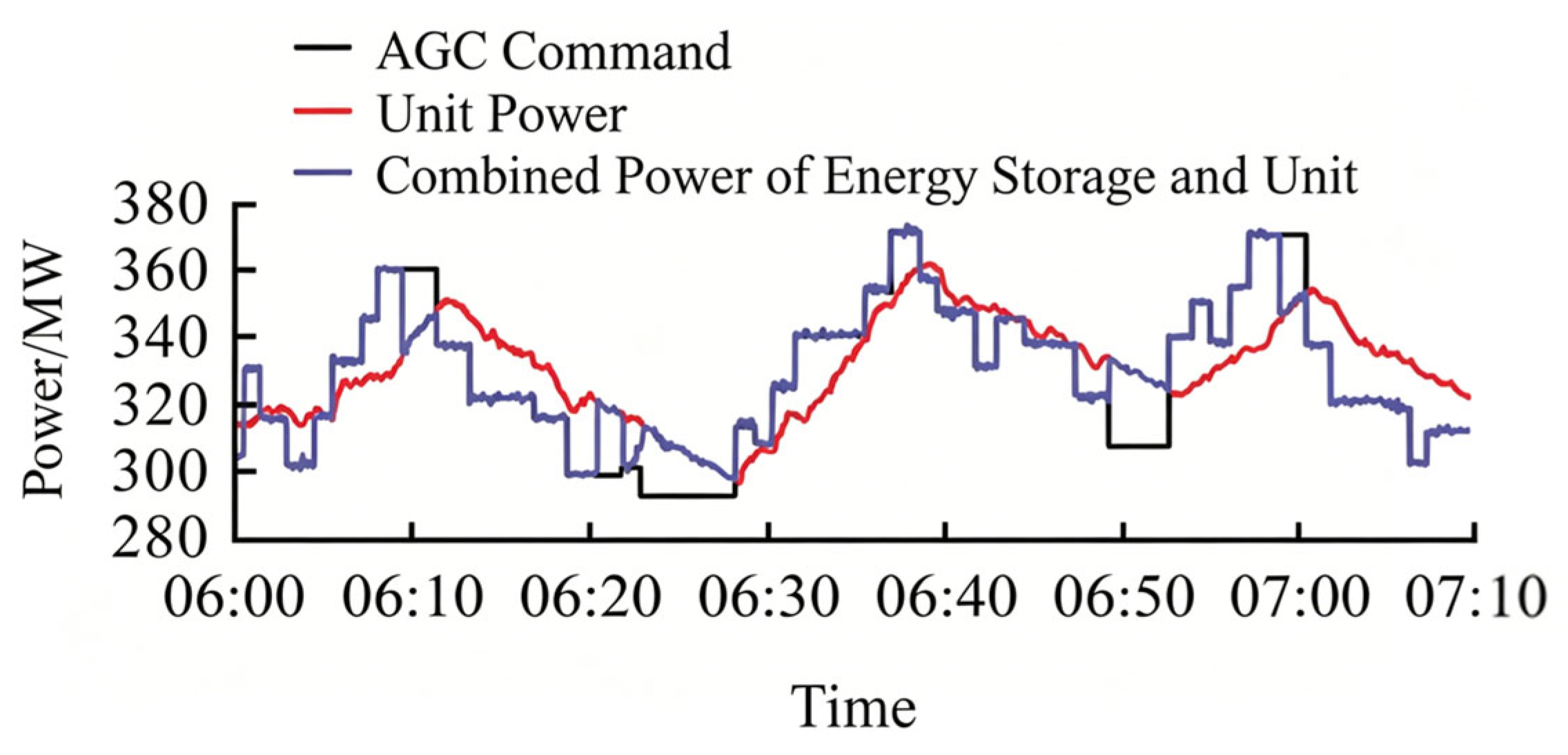
In terms of practical hybrid storage deployment, the 5 MW supercapacitor plus 15 MW lithium battery hybrid frequency regulation system at the Huaneng Luoyuan power plant was officially commissioned in 2023. The system integrates eight stacks of high-efficiency supercapacitors and twenty-four stacks of high-power lithium batteries, coordinating with two existing 660 MW coal-fired units at the plant to participate in grid frequency regulation. Figure 15 presents the AGC regulation curves after the integration of the supercapacitor hybrid storage system [123]. It can be observed that the energy storage device satisfies the grid’s requirements for response speed, reduces frequent output adjustments of thermal units, and mitigates mechanical wear on generating equipment. As summarized by the operational data in Table 6, after commissioning, the unit’s regulation speed and accuracy increased by approximately 19 times and 3 times respectively, the response time was shortened by 65%, and the comprehensive performance index rose by 53.9%. These improvements greatly enhance the operational flexibility, overall performance and life-cycle economic efficiency of the storage system. The hybrid storage system generated a cumulative revenue of 17 million Chinese yuan within its first 12 months of operation, demonstrating favorable economic returns.
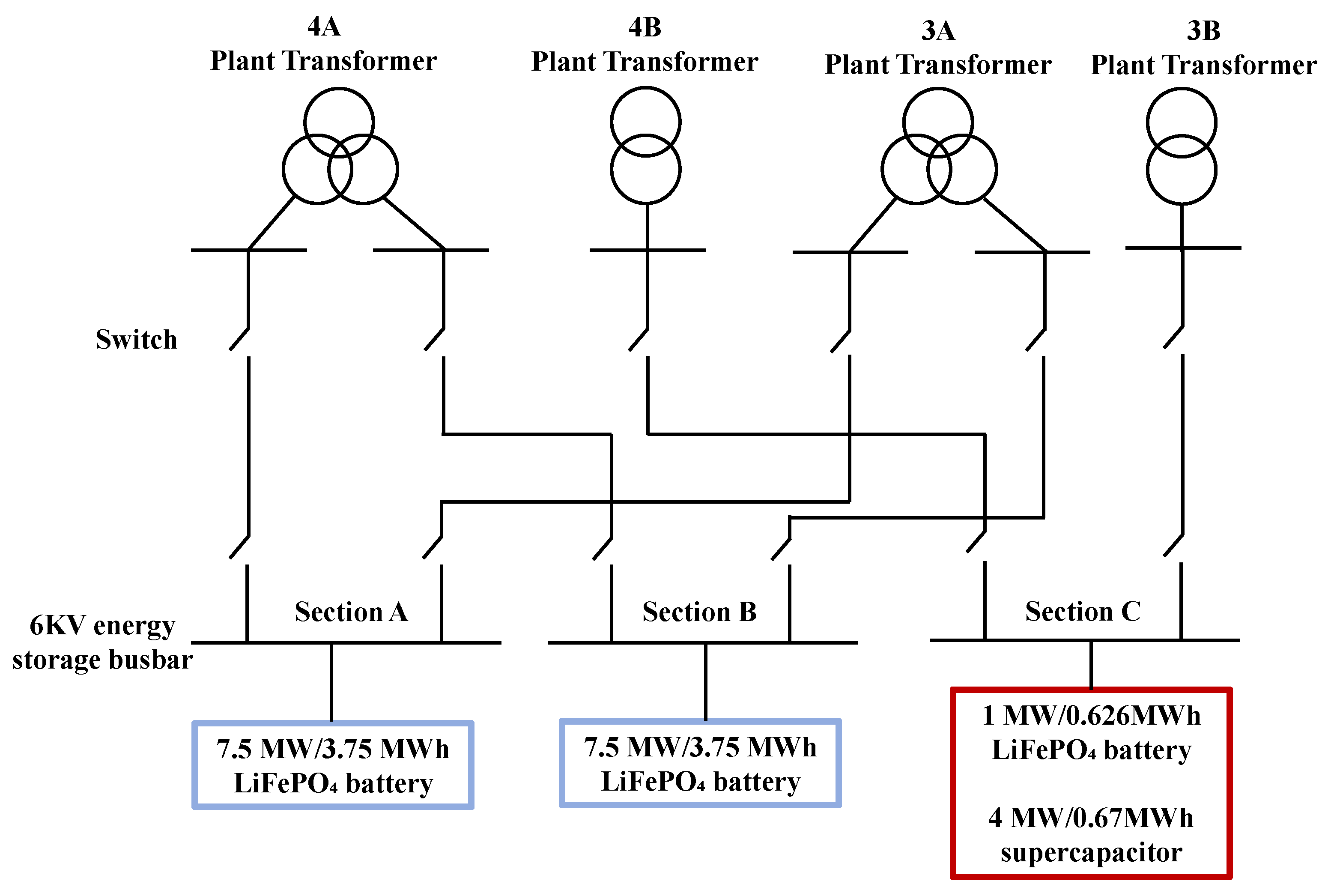
The 4 MW supercapacitor plus 16 MW/8 MWh lithium battery frequency regulation system at Jinwan power plant in Zhuhai, Guangdong, has a distributed connection architecture (Figure 16) [124]. Three storage modules rated at 7.5 MW, 7.5 MW and 5 MW are separately connected to the 6 kV auxiliary buses A, B and C of the plant, forming a multilevel coordinated control network. Battery packs and supercapacitors are connected to converters, with power boosted via transformers before integration into the 6 kV low-voltage side buses of the high-voltage plant transformers. During operation, grid frequency regulation orders are delivered from the remote terminal unit to the plant distributed control system and synchronously transmitted to the energy storage control system. For upward power regulation, the hybrid storage discharges through the high-voltage plant transformer to assist units in raising output; for downward regulation, the storage absorbs excess power via charging. Once unit output steadily tracks the dispatched setpoint, the storage gradually exits regulation and enters standby mode for subsequent frequency regulation demands. Within half a year after commissioning, the project achieved a total revenue exceeding 30 million Chinese yuan, with a monthly average revenue of 4.38 million yuan. Compared with pre-commissioning conditions, the unit’s comprehensive frequency regulation performance coefficient increased by 2.76 times, and project revenue surged by over 40 times, reflecting outstanding economic benefits.
At the current stage, the application of supercapacitors in coordinated thermal-storage frequency regulation mainly covers three core dimensions [117]. The first is optimal power allocation for hybrid energy storage. A scientific and rational configuration scheme balances the economic operation and frequency regulation capability of the system to guarantee stable and efficient operation. The second is coordinated control of hybrid energy storage systems. By analyzing external grid frequency regulation signals, the internal power distribution strategy among different units is optimized to realize efficient cooperation and maximize the performance of heterogeneous energy storage devices. The third is coupled control for joint thermal-storage frequency regulation. Given the aim of meeting grid frequency regulation performance requirements, key variables such as the heating operating conditions of thermal units are optimized to achieve high-efficiency and economical unit operation after energy storage integration.

4.3. Auxiliary Frequency Regulation for Renewable Energy Stations

With the high penetration of renewable energy integrated into power grids, its output exhibits severe volatility and randomness, which has directly led to increasingly stringent frequency regulation assessment criteria for wind farms and photovoltaic power stations [125]. Nevertheless, conventional wind and photovoltaic generators are not equipped with synchronous generators and lack physical rotational inertia, making them incapable of providing inertial response and inherent frequency regulation capacity. To address this limitation, multiple approaches, including retrofitting the control loops of grid-connected converters, reserving operating reserve capacity, and installing additional energy storage devices, can be adopted to emulate inertial response and provide virtual inertia. Combined with frequency regulation controllers, these measures can deliver rapid frequency support to a certain extent and satisfy the basic grid frequency regulation requirements [126]. Thanks to their core merits of high power density and ultra-fast charging and discharging performance, supercapacitors are highly suitable for joint frequency regulation with renewable energy stations. As illustrated at location 3 in Figure 14, supercapacitor units are deployed alongside existing facilities of renewable plants. They can supply reliable active power support for the station’s frequency regulation demand, effectively compensating for the insufficient frequency response capability of renewable generating units.
At present, multiple practical projects of coordinated frequency regulation between supercapacitors and renewable energy stations have been put into operation one after another. The Leiping wind farm in Yangjiang, China, adopts a distributed “one turbine, one energy storage” topological structure equipped with a hybrid energy storage system consisting of lithium-ion batteries and supercapacitors. Each wind turbine is matched with a 100 kW supercapacitor and a 100 kW/200 kWh lithium battery. The supercapacitor is responsible for smoothing high-frequency power fluctuations and delivering fast frequency regulation responses, while the lithium battery undertakes medium- and low-frequency power regulation, which effectively improves wind power grid-connected stability and grid frequency regulation performance [117]. The Daqing Photovoltaic Power Station in China has constructed a composite primary frequency regulation system integrated with lithium titanate batteries, flywheel energy storage and supercapacitors [127]. The three energy storage units are connected to the 0.4 kV AC bus through converters, aggregated by step-up transformers, and then operated in parallel with photovoltaic arrays on the 35 kV busbar section. Test results show that the hybrid energy storage system consisting of lithium titanate batteries, flywheels and supercapacitors can accurately track dispatching instructions throughout charging and discharging cycles, effectively suppress frequency deviation on collector lines, and maintain grid frequency within the primary frequency regulation dead band, which confirms the practical engineering application value of the system.
In addition, the Spanish energy company Acciona Energía completed the 1.25 MW wind–solar hybrid energy storage frequency regulation demonstration project in Navarra in 2026 [128]. This project adopts a hybrid energy storage architecture combining EDLC supercapacitors and lithium-ion batteries. The supercapacitor unit has a rated capacity of 1.25 MW/31 MWs and is installed alongside a 15 MW wind farm. The battery system comprises two lithium-ion branches: an energy-type battery of 0.73 MW/0.73 MWh and a power-type battery of 1.57 MW/0.39 MWh. Grid-forming control is adopted to realize coordinated operation between supercapacitors and batteries. With millisecond-scale response capability, EDLCs smooth instantaneous power fluctuations of wind and photovoltaic generation while providing virtual droop and virtual inertia support. LIBs are in charge of long-term secondary frequency regulation to cover sustained power deficits lasting from several seconds to minutes. The Finnish energy company Pohjolan Voima constructed a supercapacitor support project for the Kierikki hydropower plant [129]. The hydropower station has a total installed capacity of 38 MW and is equipped with a 3 MW supercapacitor energy storage system to coordinate with hydroelectric units for fast frequency regulation services. Restricted by the mechanical regulation lag of water turbines, hydropower alone fails to meet the stringent response indicators required by the Nordic frequency regulation market. After being connected in parallel with supercapacitors, the system leverages their millisecond-scale power charge–discharge capability to deliver instant short-term power support and suppress the rate of change in frequency during drastic grid power fluctuations, realizing transient fast frequency response regulation. The hydroelectric units then take over sustained power balancing several seconds later. This coordinated operation mode can effectively mitigate short-term power fluctuations triggered by the integration of large-scale local wind power.

5. Conclusions and Prospects

This paper systematically reviews the grid frequency regulation technologies of supercapacitors under high-penetration new power systems, with its research scope divided into three modules: analysis of device adaptability, summary of core frequency regulation technologies, and research on capacity configuration methods.
To clarify the applicable boundaries of various energy storage technologies for frequency regulation, this paper conducts a multi-dimensional comparison of energy storage performance indicators. Combined with the dynamic regulation requirements of primary and secondary grid frequency regulation, the operating conditions suitable for different energy storage technologies are defined, highlighting the unique advantages of supercapacitors in the scenario of short-term fast frequency support. In view of the performance discrepancies among three types of supercapacitors, hierarchical analysis is carried out from the perspectives of energy storage mechanism and electrode material characteristics. The comprehensive performance of EDLCs, PCs and LICs is quantitatively compared, which confirms that LICs are the optimal matching option for current grid frequency regulation projects. To establish a complete full-chain technical framework for supercapacitor-based frequency regulation, existing research achievements are systematically sorted along three dimensions: control strategies, topological structures and capacity configuration. In terms of control strategies, the operating principles and performance gaps between traditional frequency regulation schemes and intelligent control strategies such as MPC and FLC are analyzed. In terms of topological structures, the applicable scenarios and technical features of low-voltage parallel topology, high-voltage cascaded topology and MMC topology are illustrated according to grid voltage levels and station capacity demands. In terms of capacity configuration, mainstream ideas for multi-constraint optimization modeling are summarized, and the inherent defect that intelligent optimization algorithms tend to converge to local optima is pointed out. Finally, typical engineering case studies further verify the practical feasibility and engineering applicability of the proposed supercapacitor frequency regulation technical system.
Although SCs have formed mature engineering application paradigms in grid frequency regulation, their technological development still faces new opportunities and challenges against the backdrop of new-type power systems with high-penetration renewable energy integration. In the future, in-depth research needs to be carried out on the following aspects:
(1)
Improvement of intrinsic device performance. Simultaneously achieving the high-power output required for instantaneous grid frequency regulation and the long-duration energy supply needed for sustained power adjustment remains the core bottleneck restricting the engineering application of supercapacitors in grid frequency regulation. From the perspective of materials and manufacturing processes, the pre-lithiation techniques of commercial LICs generally suffer from low lithium utilization. Therefore, high-efficiency and low-cost pre-lithiation strategies need to be urgently developed to reduce irreversible capacity loss inside cells and improve the initial Coulombic efficiency [130]. Meanwhile, developing high-specific-capacity cathode materials and high-rate anode materials to further boost energy density and power density is a key research direction for promoting the large-scale application of supercapacitors in the field of frequency regulation in the future [131].
(2)
Optimization and engineering promotion of control strategies. At present, most advanced control algorithms are only verified by simulation without field engineering tests under real grid power disturbances, which limits their practical promotion value. In the future, it will be necessary to accelerate the engineering implementation and scenario adaptation of advanced control algorithms. On the one hand, the composite frequency regulation framework combining virtual inertia and droop control should be improved and an SOC adaptive correction mechanism should be introduced. The output power is dynamically constrained according to the real-time residual capacity of supercapacitors to effectively avoid the risks of overcharge and overdischarge caused by continuous frequency disturbances and extend the service life of equipment [88]. On the other hand, aiming at the drawbacks of MPC, including complex iterations and long time delays, a lightweight real-time solution framework should be constructed to reduce computational overhead and meet the stringent millisecond-level rapid response requirements for primary grid frequency regulation. In addition, adopting machine learning to realize online adaptive tuning of controller parameters is also an important development direction [132].
(3)
Improvement of topological structures. In terms of topological schemes, the current low-voltage parallel boost topology boasts a simple structure and low control complexity. However, circulating current induces severe capacity degradation and energy loss, and its capacity expansion capability is restricted. The high-voltage cascaded topology requires no boost transformer and achieves higher theoretical efficiency, yet it is accompanied by great control difficulty. Moreover, the voltage imbalance problem arising from the series operation of large-capacity modules has not been effectively resolved. In the future, the integrated design of MMC submodules should be optimized to cut down converter switching losses and simplify the grid-connected architecture of medium- and high-voltage frequency regulation power stations [133]. Meanwhile, new cascaded topologies integrated with active voltage equalization control ought to be developed to real-time balance the voltage of individual cells within large-capacity series modules, mitigate inconsistent cell aging, and enhance the overall operational stability of energy storage stacks.
(4)
Optimization of capacity sizing methods. Conventional capacity sizing methods only take a single dimension of constraints into consideration at present. When applied to new power systems, they tend to lead to a dilemma between conservative schemes (excessive configurations resulting in poor economy) and radical schemes (insufficient frequency regulation capacity). Future research should strengthen the study of capacity configuration based on intelligent optimization algorithms. Global search strategies will be introduced to upgrade the optimization searching mechanism, improve computational efficiency and effectively avoid local optimal solutions so as to ensure that the final capacity configuration scheme meets the frequency regulation requirements while achieving the optimal full-life-cycle economic performance of the system [134].
(5)
Expansion of frequency regulation application scenarios. At present, SCs are mostly deployed for joint frequency regulation with lithium batteries, while coordinated operation with other energy storage systems remains limited. PHS features high technical maturity and large installed capacity, outperforming conventional thermal power units in terms of ramp capability and start–stop speed [135]. It can serve as a dominant resource for secondary frequency regulation to undertake medium- and low-frequency power regulation, and it can also participate in primary frequency regulation within a certain range to provide transient frequency support [136]. The coordinated operation of SCs and PHS allows SCs to undertake fast short-timescale regulation tasks, compensating the response deficiencies of pumped hydro units and unlocking their full frequency regulation potential. Economically, SCs have low per-unit power cost and are suitable for frequent short-duration high-power energy absorption and release; PHS enjoys outstanding per-unit-capacity-cost advantages and is ideal for long-duration large-scale energy dispatch. Their complementary strengths enable frequent participation in frequency regulation while optimizing the whole-life-cycle comprehensive cost. Technically, SCs and PHS exhibit favorable compatibility in AGC coordination, power allocation strategies and coordinated protection configuration [137]. Since the frequency response characteristics of pumped hydro units are similar to those of thermal power units and abundant practical experience has been accumulated for supercapacitor-assisted thermal unit frequency regulation, the corresponding control strategies and operational concepts are transferable and can provide valuable references for the synergistic application of SCs and PHS. In addition, the electrical topology for supercapacitor integration into pumped hydro stations can adopt the centralized grid connection scheme used in thermal power plants and renewable energy stations, with connection at the low-voltage side of step-up substations for centralized grid integration. Future research should further deepen the technical framework for joint grid frequency regulation by supercapacitors and pumped hydro units to fully tap their latent operational benefits.
(6)
Research on the digital operation and maintenance technology of supercapacitor energy storage frequency regulation systems. Large megawatt-scale supercapacitor frequency regulation power stations consist of thousands of capacitor cells connected in series and parallel. Under long-term high-frequency charge–discharge cycling conditions, discrepancies in the aging rate of individual cells will continuously accumulate and amplify, which may easily cause overvoltage and degradation failure of partial cells and further trigger potential safety hazards in equipment operation. The traditional operation and maintenance mode relies on offline regular shutdown inspections, which suffer from poor timeliness. It fails to grasp the real-time health status of each energy storage module and leads to delayed fault early warnings. Subsequent research needs to establish a high-precision full-scale digital model for supercapacitor energy storage systems [138]. Multi-dimensional operating data, including station operating power, module voltage, cell voltage and temperature, are collected and fused in real time to construct a cell-health-state evaluation model for accurately predicting the aging degradation degree and remaining cycle life of cells. Combined with machine learning-based intelligent fault early-warning algorithms, online precise localization of module faults and advance prediction of degradation trends can be realized. Predictive proactive maintenance is implemented to drastically reduce losses of frequency regulation benefits caused by unplanned station shutdowns and comprehensively improve the long-term continuous operational safety and reliability of supercapacitor frequency regulation power stations.

Author Contributions

Conceptualization, F.Q. and Z.L.; methodology, F.Q.; validation, F.Q., Y.Z. (Yunfei Zhang) and B.Y.; formal analysis, T.Z.; investigation, Y.Z. (Yong Zheng); resources, L.L.; data curation, X.S.; writing—original draft preparation, F.Q.; writing—review and editing, Z.L.; visualization, Y.Z. (Yunfei Zhang); supervision, Z.L.; project administration, Z.L.; funding acquisition, B.Y. All authors have read and agreed to the published version of the manuscript.

Funding

This research was funded by the State Grid XinYuan Group Co., Ltd. Science and Technology Project, grant number “SGXYKJ-2025-020”.

Data Availability Statement

The original contributions presented in the study are included in the article; further inquiries can be directed to the corresponding author.

Acknowledgments

We gratefully acknowledge the support and funding provided by the Science and Technology Project of State Grid Xinyuan Group Co., Ltd.

Conflicts of Interest

Author Fengyun Quan, Zilong Li, Tong Zhang, Yong Zheng and Ling Li were employed by the company Hubei Branch of State Grid Xin Yuan Group Co., Ltd. The remaining authors declare that the research was conducted in the absence of any commercial or financial relationships that could be construed as a potential conflict-of-interest (COI). The authors declare that this study received funding from the State Grid XinYuan Group Co., Ltd. Science and Technology Project. The funder had the following involvement with the study: study design, data collection, and manuscript writing.

Abbreviations

The following abbreviations are used in this manuscript:
PFRPrimary frequency regulation
SFRSecondary frequency regulation
FESFlywheel energy storage
PHSPumped hydro storage
CAESCompressed air energy storage
SCsSupercapacitors
SMESSuperconducting magnetic energy storage
LABsLead–acid batteries
FBsFlow batteries
LIBsLithium-ion batteries
AGCAutomatic generation control
EDLCsElectrochemical double-layer capacitors
PCsPseudocapacitors
HSCsHybrid supercapacitors
LICsLithium-ion capacitors
CGDCChina Green Development Investment Group Co., Ltd.
SOCState of charge
DFIGDoubly fed induction generator
MPCModel predictive control
FLCFuzzy logic control
PCSPower conversion system
PSOParticle swarm optimization

References

  1. Sebestyén, V. Renewable and Sustainable Energy Reviews: Environmental impact networks of renewable energy power plants. Renew. Sustain. Energy Rev. 2021, 151, 111626. [Google Scholar] [CrossRef] [Scilit]
  2. Liu, W.; Chen, G.; Wang, N.; Sun, X.; Li, C.; Xu, Y.; Zhang, X.; Zhang, X.; Wang, K. Tetramethylene Sulfone (TMS) as an Electrolyte Additive for High-Power Lithium-Ion Batteries. Batteries 2025, 11, 270. [Google Scholar] [CrossRef] [Scilit]
  3. Nikgoftar, K.; Madikere Raghunatha Reddy, A.K.; Reddy, M.V.; Zaghib, K. Carbonaceous Materials as Anodes for Lithium-Ion and Sodium-Ion Batteries. Batteries 2025, 11, 123. [Google Scholar] [CrossRef] [Scilit]
  4. Yao, Y.; Liu, W.; Jain, R.; Chowdhury, B.; Wang, J.; Cox, R. Quantitative metrics for grid resilience evaluation and optimization. IEEE Trans. Sustain. Energy 2022, 14, 1244–1258. [Google Scholar] [CrossRef] [Scilit]
  5. Tang, X.; Qi, Z.; Kong, L. Battery Energy Storage System. In Electrical Energy Storage Technologies and Applications; Tang, X., Qi, Z., Kong, L., Eds.; Springer Nature: Singapore, 2025; pp. 35–63. [Google Scholar]
  6. Sao, C.K.; Lehn, P.W. Control and power management of converter fed microgrids. IEEE Trans. Power Syst. 2008, 23, 1088–1098. [Google Scholar] [CrossRef] [Scilit]
  7. Milano, F.; Manjavacas, Á.O. Converter-Interfaced Energy Storage Systems: Context, Modelling and Dynamic Analysis; Cambridge University Press: Cambridge, UK, 2019. [Google Scholar]
  8. The Frequency Operating Standard-AEMC. Available online: https://www.aemc.gov.au/sites/default/files/2024-01/Frequency%20Operating%20Standard.pdf (accessed on 4 June 2026).
  9. Ma, J.; Li, Y.; Peng, X. Energy storage technologies under new-type power systems. China Sci. Technol. Inf. 2025, 23, 101–103. [Google Scholar]
  10. Liao, Y.; Yang, W.; Wang, Z.; Huang, Y.; Chung, C.Y. Mechanism of primary frequency regulation for battery hybridization in hydropower plant. CSEE J. Power Energy Syst. 2023, 10, 2127–2137. [Google Scholar] [CrossRef] [Scilit]
  11. Akram, U.; Nadarajah, M.; Shah, R.; Milano, F. A review on rapid responsive energy storage technologies for frequency regulation in modern power systems. Renew. Sustain. Energy Rev. 2020, 120, 109626. [Google Scholar] [CrossRef] [Scilit]
  12. Zhang, J.; Wang, Y.; Zhou, G.; Wang, L.; Li, B.; Li, K. Integrating physical and data-driven system frequency response modelling for wind-PV-thermal power systems. IEEE Trans. Power Syst. 2023, 39, 217–228. [Google Scholar] [CrossRef] [Scilit]
  13. Wang, C.; Ju, P.; Wan, C.; Wu, F.; Lei, S.; Pan, X.; Lu, T. Resilience-based coordinated scheduling of cascaded hydro power with sequential heavy precipitation. IEEE Trans. Sustain. Energy 2022, 14, 1299–1311. [Google Scholar] [CrossRef] [Scilit]
  14. Xie, H.; Wang, C.; Liu, P.; Liu, H.; Xu, G.; Li, P.; Song, Y.; Mei, Y. Application of joint frequency regulation technology of energy storage and thermal power in China southern power grid. Autom. Electr. Power Syst. 2021, 45, 172–179. [Google Scholar]
  15. Xiao, C. Research on using electric energy storage to improve frequency regulation performance of thermal power units. Therm. Power Gener. 2021, 50, 98–105. [Google Scholar]
  16. Sun, P.; Lu, W.; Bai, P.; Lu, Q.; Xu, G.; Jiang, X. Development status and trends of lithium battery and supercapacitor hybrid energy storage assisted thermal power frequency regulation technology. J. Chin. Soc. Power Eng. 2024, 44, 418–429. [Google Scholar]
  17. Shen, Y.; Huang, C.; Hu, X.; Zhang, X.; Yang, P. Research on frequency regulation of thermal power unit with lithium-ion capacitor. Electr. Eng. 2021, 22, 98–103. [Google Scholar]
  18. Liu, J.; Du, Z.; Ji, W.; Hong, F. Grid-Scale High-Power Flywheel-Assisted Grid Frequency Regulation Technologies and Pilot Applications. CSEE J. Power Energy Syst. 2025, 11, 2855–2878. [Google Scholar] [CrossRef] [Scilit]
  19. Li, X.; Wang, S. Energy management and operational control methods for grid battery energy storage systems. CSEE J. Power Energy Syst. 2019, 7, 1026–1040. [Google Scholar] [CrossRef] [Scilit]
  20. Chu, Z.; Han, P.; Zheng, L.; Wang, J.; Zhang, Y.; Xue, X. Comprehensive control strategy of hybrid energy storage participating in primary frequency modulation of power grids. J. Chin. Soc. Power Eng. 2025, 45, 1511–1518+1535. [Google Scholar]
  21. Sun, B.; Yang, S.; Liu, Z.; Li, T. Analysis on present application of megawatt-scale energy storage in frequency regulation and its enlightenment. Autom. Electr. Power Syst. 2017, 41, 8–16+38. [Google Scholar]
  22. Jiang, F.; Yuan, X.; Hu, L.; Xie, G.; Zhang, Z.; Li, X.; Hu, J.; Wang, C.; Wang, H. A comprehensive review of energy storage technology development and application for pure electric vehicles. J. Energy Storage 2024, 86, 111159. [Google Scholar] [CrossRef] [Scilit]
  23. Wang, S.; Xiao, H.; Zhao, Z.; Li, D.; Hu, D.; Hu, Q.; Shen, C.; Zhang, X.; Hu, J.; Chi, C.; et al. Grid Peak Shaving and Energy Efficiency Improvement: Advances in Gravity Energy Storage Technology and Research on Its Efficient Application. Energies 2025, 18, 996. [Google Scholar] [CrossRef] [Scilit]
  24. Luo, X.; Wang, J.; Dooner, M.; Clarke, J. Overview of current development in electrical energy storage technologies and the application potential in power system operation. Appl. Energy 2015, 137, 511–536. [Google Scholar] [CrossRef] [Scilit]
  25. Wang, W.; Zhang, W.; Li, Y.; Xie, X.; Li, X.; Fang, F. Control-aware sizing of flywheel energy storage for AGC in thermal power units under representative regulation scenarios. J. Energy Storage 2026, 178, 123689. [Google Scholar] [CrossRef] [Scilit]
  26. Luo, Z.; Pan, C.; Li, X.; Mo, X.; Teng, W.; Zhang, M.; Zhang, T.; Liu, D.; He, Q.; Li, C.; et al. An adaptive primary frequency regulation strategy for multi-type energy storage system considering state of charge recovery. Sustain. Energy Technol. Assess. 2025, 83, 104640. [Google Scholar] [CrossRef] [Scilit]
  27. Shi, L.; Lao, W.; Wu, F.; Lee, K.Y.; Li, Y.; Lin, K. DDPG-based load frequency control for power systems with renewable energy by DFIM pumped storage hydro unit. Renew. Energy 2023, 218, 119274. [Google Scholar] [CrossRef] [Scilit]
  28. Betancourt, O.A.; Sanchez, Z.G.; Saleh, S.A.; Hill, E.F.; Zhao, X.; Sanchez, F.P. Battery Energy Storage Systems for Primary Frequency Regulation in Island Power Systems. In Proceedings of the 2020 IEEE/IAS 56th Industrial and Commercial Power Systems Technical Conference (I&CPS), Online, 29 June–28 July 2020; pp. 1–10. [Google Scholar]
  29. Zhang, C.P.; Sharkh, S.M.; Li, X.; Walsh, F.C.; Zhang, C.N.; Jiang, J.C. The performance of a soluble lead-acid flow battery and its comparison to a static lead-acid battery. Energy Convers. Manag. 2011, 52, 3391–3398. [Google Scholar] [CrossRef] [Scilit]
  30. Yang, J.; Yu, J.; Tian, H.; Wang, S.; Teng, X.; Ding, Q. Clearing and scheduling strategy of frequency regulation ancillary service market considering performance risk of renewable energy. Autom. Electr. Power Syst. 2020, 44, 66–73. [Google Scholar]
  31. Luo, K.; Guo, J.; Wang, W.; Wang, T.; Ma, S.; Wang, M.; Wang, G. Review of impact of grid following variable renewable energy supplementary frequency control on frequency stability and small-disturbance synchronization stability. Proc. CSEE 2023, 43, 1262–1281. [Google Scholar]
  32. Xu, C.; Tang, Y.; Li, Q.; Yang, H.; Chen, Y.; Yang, H. Supercapacitor energy storage systems for frequency regulation applications in power systems. Energy Storage Sci. Technol. 2025, 14, 3078–3089. [Google Scholar]
  33. Ariyarathna, T.; Kularatna, N.; Gunawardane, K.; Jayananda, D.; Steyn-Ross, D.A. Development of supercapacitor technology and its potential impact on new power converter techniques for renewable energy. IEEE J. Emerg. Sel. Top. Ind. Electron. 2021, 2, 267–276. [Google Scholar] [CrossRef] [Scilit]
  34. Farhadi, M.; Mohammed, O. Energy storage technologies for high-power applications. IEEE Trans. Ind. Appl. 2015, 52, 1953–1961. [Google Scholar] [CrossRef] [Scilit]
  35. Zhang, X.; Zhang, X.; Wang, K.; Sun, X.; Ma, Y. Review of power-type energy storage technology and application. J. Electr. Eng. 2024, 19, 385–398. [Google Scholar]
  36. Kouchachvili, L.; Yaïci, W.; Entchev, E. Hybrid battery/supercapacitor energy storage system for the electric vehicles. J. Power Sources 2018, 374, 237–248. [Google Scholar] [CrossRef] [Scilit]
  37. Sun, X.; Zhang, K.; Li, C.; Ren, F.; Sun, X.; Liu, H.; Wang, K.; Zhang, X.; Ma, Y. Overview of supercapacitors: Mechanisms, materials, devices, and safety characteristics. Adv. Technol. Electr. Eng. Energy 2025, 44, 117–135. [Google Scholar]
  38. Chen, X.; Paul, R.; Dai, L. Carbon-based supercapacitors for efficient energy storage. Natl. Sci. Rev. 2017, 4, 453–489. [Google Scholar] [CrossRef] [Scilit]
  39. Argirusis, C.; Katsanou, M.-E.; Alizadeh, N.; Argirusis, N.; Sourkouni, G. Recent Advances in the Application of MOFs in Supercapacitors. Batteries 2025, 11, 181. [Google Scholar] [CrossRef] [Scilit]
  40. Yao, F.; Pham, D.T.; Lee, Y.H. Carbon-based materials for lithium-ion batteries, electrochemical capacitors, and their hybrid devices. ChemSusChem 2015, 8, 2284–2311. [Google Scholar] [CrossRef] [Scilit] [PubMed]
  41. Zhang, L.L.; Zhao, X. Carbon-based materials as supercapacitor electrodes. Chem. Soc. Rev. 2009, 38, 2520–2531. [Google Scholar] [CrossRef] [Scilit] [PubMed]
  42. Sinha, P.; Kar, K.K. Introduction to supercapacitors. In Handbook of Nanocomposite Supercapacitor Materials II: Performance; Springer: Berlin/Heidelberg, Germany, 2020; pp. 1–28. [Google Scholar]
  43. Ambade, R.B.; Ambade, S.B.; Shrestha, N.K.; Salunkhe, R.R.; Lee, W.; Bagde, S.S.; Kim, J.H.; Stadler, F.J.; Yamauchi, Y.; Lee, S.H. Controlled growth of polythiophene nanofibers in TiO2 nanotube arrays for supercapacitor applications. J. Mater. Chem. A 2017, 5, 172–180. [Google Scholar] [CrossRef] [Scilit]
  44. Li, J.; Wu, P.; Li, G.; Li, M.; Wu, Q. Application of supercapacitor energy storage in short-time and high-frequency power supplementation scenes in new-generation power system. Electr. Eng. 2025, 26, 18–26+57. [Google Scholar]
  45. Fang, Y.; Liu, J.; Yu, D.J.; Wicksted, J.P.; Kalkan, K.; Topal, C.O.; Flanders, B.N.; Wu, J.; Li, J. Self-supported supercapacitor membranes: Polypyrrole-coated carbon nanotube networks enabled by pulsed electrodeposition. J. Power Sources 2010, 195, 674–679. [Google Scholar] [CrossRef] [Scilit]
  46. Hassan, M.; Reddy, K.R.; Haque, E.; Faisal, S.N.; Ghasemi, S.; Minett, A.I.; Gomes, V.G. Hierarchical assembly of graphene/polyaniline nanostructures to synthesize free-standing supercapacitor electrode. Compos. Sci. Technol. 2014, 98, 1–8. [Google Scholar] [CrossRef] [Scilit]
  47. Choi, H.; Yoon, H. Nanostructured electrode materials for electrochemical capacitor applications. Nanomaterials 2015, 5, 906–936. [Google Scholar] [CrossRef] [Scilit] [PubMed]
  48. Wang, G.; Zhang, L.; Zhang, J. A review of electrode materials for electrochemical supercapacitors. Chem. Soc. Rev. 2012, 41, 797–828. [Google Scholar] [CrossRef] [Scilit] [PubMed]
  49. Ates, M.; Chebil, A.; Yoruk, O.; Dridi, C.; Turkyilmaz, M. Reliability of electrode materials for supercapacitors and batteries in energy storage applications: A review. Ionics 2022, 28, 27–52. [Google Scholar] [CrossRef] [Scilit]
  50. Xu, B.; Wu, F.; Chen, S.; Zhang, C.; Cao, G.; Yang, Y. Activated carbon fiber cloths as electrodes for high performance electric double layer capacitors. Electrochim. Acta 2007, 52, 4595–4598. [Google Scholar] [CrossRef] [Scilit]
  51. Augustyn, V.; Simon, P.; Dunn, B. Pseudocapacitive oxide materials for high-rate electrochemical energy storage. Energy Environ. Sci. 2014, 7, 1597–1614. [Google Scholar] [CrossRef] [Scilit]
  52. Anjana, P.; Aminabhavi, T.M. Supercapattery: Energy storage devices combining functionalities of battery electrodes and supercapacitor electrodes. J. Energy Storage 2025, 134, 118265. [Google Scholar] [CrossRef] [Scilit]
  53. Patel, A.; Patel, S.K.; Singh, R.; Patel, R. Review on recent advancements in the role of electrolytes and electrode materials on supercapacitor performances. Discov. Nano 2024, 19, 188. [Google Scholar] [CrossRef] [Scilit] [PubMed]
  54. Zhao, C.; Yao, S.; Li, C.; An, Y.; Zhao, S.; Sun, X.; Wang, K.; Zhang, X.; Ma, Y. Recent advances in transition metal oxides as anode materials for high-performance lithium-ion capacitors. Chem. Eng. J. 2024, 497, 154535. [Google Scholar] [CrossRef] [Scilit]
  55. Jagadale, A.; Zhou, X.; Xiong, R.; Dubal, D.P.; Xu, J.; Yang, S. Lithium ion capacitors (LICs): Development of the materials. Energy Storage Mater. 2019, 19, 314–329. [Google Scholar] [CrossRef] [Scilit]
  56. Machida, K.; Suematsu, S.; Ishimoto, S.; Tamamitsu, K. High-voltage asymmetric electrochemical capacitor based on polyfluorene nanocomposite and activated carbon. J. Electrochem. Soc. 2008, 155, A970–A974. [Google Scholar] [CrossRef] [Scilit]
  57. Zhao, S.; Zhang, X.; Li, C.; An, Y.; Hu, T.; Wang, K.; Sun, X.; Ma, Y. The application of metal–organic frameworks and their derivatives for lithium-ion capacitors. New Carbon Mater. 2024, 39, 872–895. [Google Scholar] [CrossRef] [Scilit]
  58. Kong, Y.; Li, C.; Xu, Y.; An, Y.; Zhao, S.; Zhang, X.; Yi, S.; Gong, Y.; Sun, X.; Wang, K. Vacancy chemistry regulated cobalt oxide nanostructures with fast kinetics for high-performance lithium-ion capacitors. Energy Mater. Adv. 2025, 6, 0180. [Google Scholar] [CrossRef] [Scilit]
  59. Chatterjee, D.P.; Nandi, A.K. A review on the recent advances in hybrid supercapacitors. J. Mater. Chem. A 2021, 9, 15880–15918. [Google Scholar] [CrossRef] [Scilit]
  60. Liu, C.; Yuan, C.; Zhong, J.; An, Y.; Li, C.; Sun, X.; Wang, K.; Zhang, X.; Ma, Y. Recent advances in carbon-based cathodes for lithium-ion capacitors. J. Energy Storage 2026, 154, 121258. [Google Scholar] [CrossRef] [Scilit]
  61. Hu, T.; Zhang, X.; An, Y.; Zhao, S.; Li, C.; Sun, X.; Wang, K.; Ma, Y. Nanoarchitectonics and applications of two-dimensional materials as anodes for lithium-ion capacitors. Energy Mater. 2025, 5, 500003. [Google Scholar] [CrossRef] [Scilit]
  62. Liu, W.; Sun, X.; Yan, X.; Gao, Y.; Zhang, X.; Wang, K.; Ma, Y. Review of energy storage capacitor technology. Batteries 2024, 10, 271. [Google Scholar] [CrossRef] [Scilit]
  63. Zhao, S.; Zhang, X.; Zhao, C.; An, Y.; Zhang, Q.; Li, C.; Xu, Y.; Sun, X.; Wang, K.; Ma, Y. CoF2 embedded in hollow carbon nanobox walls via one-step pyrolysis for high-performance lithium-ion capacitors. J. Energy Chem. 2026, 119, 753–764. [Google Scholar] [CrossRef] [Scilit]
  64. An, Y.; Sun, Y.; Zhang, K.; Li, C.; Sun, X.; Wang, K.; Zhang, X.; Ma, Y. Tuning surface functional groups and crystallinity in activated carbon for high-voltage lithium-ion capacitors. New Carbon Mater. 2025, 40, 1085–1097. [Google Scholar] [CrossRef] [Scilit]
  65. Liu, H.; Zhang, X.; Li, C.; Zhao, S.; An, Y.; Ma, Y.; Sun, X.; Wang, K.; Ma, Y. Scalable synthesis of pitch-derived soft carbon with graphitic nanodomains embedded in amorphous matrix for high-energy pouch-type lithium-ion capacitors. Rare Met. 2025, 44, 10108–10122. [Google Scholar] [CrossRef] [Scilit]
  66. Madikere Raghunatha Reddy, A.K.; Darwiche, A.; Reddy, M.V.; Zaghib, K. Review on Advancements in Carbon Nanotubes: Synthesis, Purification, and Multifaceted Applications. Batteries 2025, 11, 71. [Google Scholar] [CrossRef] [Scilit]
  67. Maurya, R.K.; Agarwal, A.; Gupta, R.; Islam, S.M.; Sharma, R. Recent technological advancement in asymmetric supercapacitors: A comprehensive review. J. Power Sources 2025, 640, 236818. [Google Scholar] [CrossRef] [Scilit]
  68. Shown, I.; Ganguly, A.; Chen, L.C.; Chen, K.H. Conducting polymer-based flexible supercapacitor. Energy Sci. Eng. 2015, 3, 2–26. [Google Scholar] [CrossRef] [Scilit]
  69. Staniak, M.; Lewandowski, M. Current knowledge on supercapacitors, hybrid supercapacitors, and comparison with Lithium-Ion Cells-a review. Int. J. Electron. Telecommun. 2026, 72, 1–7. [Google Scholar] [CrossRef] [Scilit]
  70. Liu, R.; Wu, P.; Yang, E.; Li, H.; Lou, Y. A review on the application of supercapacitors in grid frequency regulation based on material innovation and hybrid system optimization. Electr. Eng. 2025, 26, 1–12. [Google Scholar]
  71. Ma, T.; Xu, S.; Zhu, M. Hierarchical porous carbon based on waste quinoa straw for high-performance supercapacitors. ACS Omega 2024, 9, 13592–13602. [Google Scholar] [CrossRef] [Scilit] [PubMed]
  72. Gbadegesin, A.O.; Sun, Y.; Nwulu, N.I. Techno-economic analysis of storage degradation effect on levelised cost of hybrid energy storage systems. Sustain. Energy Technol. Assess. 2019, 36, 100536. [Google Scholar] [CrossRef] [Scilit]
  73. Yang, P.; Zhao, J.; Wu, C.; Zhang, B.; Hao, T.; Jiang, Y.; Huo, C.; Wu, P.; Song, Z.; Zhang, Y.; et al. Integrated technologies and application prospects of supercapacitor energy storage systems in thermal power frequency regulation and grid support. Power Capacit. React. Power Compens. 2026, 47, 1–19. [Google Scholar]
  74. Zhang, X.; Sun, X.; Zhang, X.; An, Y.; Wang, K.; Wei, T.; Ma, Y. Prospect of lithium-ion capacitor application in new energy field. Adv. Technol. Electr. Eng. Energy 2020, 39, 48–58. [Google Scholar]
  75. Wu, Z.; Gao, W.; Gao, T.; Yan, W.; Zhang, H.; Yan, S.; Wang, X. State-of-the-art review on frequency response of wind power plants in power systems. J. Mod. Power Syst. Clean Energy 2018, 6, 1–16. [Google Scholar] [CrossRef] [Scilit]
  76. Hema, M.; Gopinath, G.; Sakunthala, A.; Krishnasamy, S.; Aravind, D.; Parameswaranpillai, J.; Venkateshan, N.; Natarajan, V. Gum Arabic-based blend biopolymer electrolyte for electric double layer capacitor applications. Int. J. Biol. Macromol. 2025, 307, 141956. [Google Scholar] [CrossRef] [Scilit] [PubMed]
  77. Mullani, S.; Kim, C.; Lokhande, V.; Ji, T. MXene structural and surface modifications for enhanced Li-ion diffusion in lithium-ion capacitors: A critical mini review of recent advances. Chem. Eng. J. 2025, 510, 161565. [Google Scholar] [CrossRef] [Scilit]
  78. Guo, Z.; Liu, Z.; An, Y.; Lu, C.; Li, C.; Xu, Y.; Xie, L.; Sun, X.; Zhang, X.; Wang, K. Mitigating polarization effects in lithium-ion battery capacitors through conductive network enhancement. J. Energy Storage 2025, 127, 117106. [Google Scholar] [CrossRef] [Scilit]
  79. Li, B.; Zheng, M.; Xue, H.; Pang, H. High performance electrochemical capacitor materials focusing on nickel based materials. Inorg. Chem. Front. 2016, 3, 175–202. [Google Scholar] [CrossRef] [Scilit]
  80. Li, W.; Pan, Y.; Ma, X.; Chao, P.; Sun, G.; Jin, Y. Review of grid-forming control technology for new energy in frequency modulation. J. Shenyang Univ. Technol. 2025, 47, 545–557. [Google Scholar]
  81. Bocklisch, T. Hybrid energy storage approach for renewable energy applications. J. Energy Storage 2016, 8, 311–319. [Google Scholar] [CrossRef] [Scilit]
  82. Huang, S.; Xiong, L.; He, Y.; Zhou, Y.; Gao, F.; Huang, W.; Jia, Q.; Li, Y. Energy storage system and applications in power system frequency regulation. J. Energy Storage 2025, 131, 117506. [Google Scholar] [CrossRef] [Scilit]
  83. Niu, G.; Hu, L.; Zheng, N.; Ji, Y.; Wu, M.; Shi, P.; Yan, X. Adaptive Primary Frequency Regulation Control Strategy for Doubly Fed Wind Turbine Based on Hybrid Ultracapacitor Energy Storage and Its Performance Optimization. Electronics 2025, 15, 182. [Google Scholar] [CrossRef] [Scilit]
  84. Kim, J.; Gevorgian, V.; Luo, Y.; Mohanpurkar, M.; Koritarov, V.; Hovsapian, R.; Muljadi, E. Supercapacitor to provide ancillary services with control coordination. IEEE Trans. Ind. Appl. 2019, 55, 5119–5127. [Google Scholar] [CrossRef] [Scilit]
  85. Yang, P.; Dong, X.; Li, Y.; Kuang, L.; Zhang, J.; He, B.; Wang, Y. Research on primary frequency regulation control strategy of wind-thermal power coordination. IEEE Access 2019, 7, 144766–144776. [Google Scholar] [CrossRef] [Scilit]
  86. Yan, W.; Wang, X.; Gao, W.; Gevorgian, V. Electro-mechanical modeling of wind turbine and energy storage systems with enhanced inertial response. J. Mod. Power Syst. Clean Energy 2020, 8, 820–830. [Google Scholar] [CrossRef] [Scilit]
  87. Zhang, R.; Fang, J.; Tang, Y. Inertia emulation through supercapacitor energy storage systems. In Proceedings of the 2019 10th International Conference on Power Electronics and ECCE Asia (ICPE 2019-ECCE Asia), Busan, Republic of Korea, 27–31 May 2019; pp. 1365–1370. [Google Scholar]
  88. Xing, C.; Xiao, J.; Li, P.; Xi, X.; Chen, Y.; Guo, Q. Adaptive virtual inertial control and virtual droop control coordinated control strategy for hybrid energy storage taking into account state of charge optimization. Electronics 2024, 13, 1228. [Google Scholar] [CrossRef] [Scilit]
  89. Yan, X.; Sun, X. Inertia and droop frequency control strategy of doubly-fed induction generator based on rotor kinetic energy and supercapacitor. Energies 2020, 13, 3697. [Google Scholar] [CrossRef] [Scilit]
  90. Sultana, W.R.; Sahoo, S.K.; Sukchai, S.; Yamuna, S.; Venkatesh, D. A review on state of art development of model predictive control for renewable energy applications. Renew. Sustain. Energy Rev. 2017, 76, 391–406. [Google Scholar] [CrossRef] [Scilit]
  91. Feng, M.; Wu, C. Research on key grid connection technologies for energy storage-assisted frequency regulation systems in thermal power plants. Instrum. Users 2025, 32, 127–129. [Google Scholar]
  92. Mercorelli, P. A multilevel inverter bridge control structure with energy storage using model predictive control for flat systems. J. Eng. 2013, 2013, 750190. [Google Scholar] [CrossRef] [Scilit]
  93. Elsisi, M.; Soliman, M.; Aboelela, M.A.; Mansour, W. Model predictive control of plug-in hybrid electric vehicles for frequency regulation in a smart grid. IET Gener. Transm. Distrib. 2017, 11, 3974–3983. [Google Scholar] [CrossRef] [Scilit]
  94. Camacho, E.B.; Alba, B.C. Model Predictive Control; Springer: Berlin/Heidelberg, Germany, 2004. [Google Scholar]
  95. Shang, Q.; Li, F.; Wang, S.; Li, Y.; Yin, C. Primary frequency modulation strategy for wind-storage combined system based on multivariable fuzzy logic control. Power Syst. Technol. 2023, 47, 2344–2360. [Google Scholar]
  96. Sarojini, R.K.; Palanisamy, K.; De Tuglie, E. A fuzzy logic-based emulated inertia control to a supercapacitor system to improve inertia in a low inertia grid with renewables. Energies 2022, 15, 1333. [Google Scholar] [CrossRef] [Scilit]
  97. Jing, P.; Zhang, X.; Ukil, A.; Swain, A. Faster joint control of battery and supercapacitor-based HESS in DC microgrid using MPC with hybrid PI. J. Energy Storage 2025, 105, 114528. [Google Scholar] [CrossRef] [Scilit]
  98. Cai, T.; Sun, Y. A Wind–Storage Coordinated Frequency Regulation and Power Optimization Control Strategy Based on Multivariable Fuzzy Logic and Model Predictive Control. Energies 2026, 19, 2071. [Google Scholar] [CrossRef] [Scilit]
  99. Si, W.; Li, X.; Ma, L.; Zu, G.; Miao, S. A comparative study of low-voltage energy storage schemes and high-voltage cascading energy storage schemes. Shanxi Electr. Power 2025, 5, 36–41. [Google Scholar]
  100. Ju, X.; Xu, C.; Hao, J.; Song, J.; Teng, W.; Tian, H.; Zhao, H.; Chen, Z.; Wang, T.; Liao, Z.; et al. Advances and challenges in novel energy storage technology III: Energy storage integration technology, safety technology, and system planning and scheduling. Sol. Energy 2024, 9, 39–48. [Google Scholar]
  101. Huang, S.; Xiao, H.; Huang, C.; Guo, Z.; Wu, J.; Xie, H. Application and practice of a high-voltage cascaded energy storage system in thermal energy storage frequency controlling. Energy Storage Sci. Technol. 2022, 11, 3583–3593. [Google Scholar]
  102. Dougal, R.A.; Liu, S.; White, R.E. Power and life extension of battery-ultracapacitor hybrids. IEEE Trans. Compon. Packag. Technol. 2002, 25, 120–131. [Google Scholar] [CrossRef] [Scilit]
  103. Errigo, F.; Morel, F.; De Vienne, C.M.; Chédot, L.; Sari, A.; Venet, P. A submodule with integrated supercapacitors for HVDC-MMC providing fast frequency response. IEEE Trans. Power Deliv. 2021, 37, 1423–1432. [Google Scholar] [CrossRef] [Scilit]
  104. Yuan, C.; Gou, J.; You, J.; Li, B.; Du, X.; Fu, Y.; Zhang, W.; Wang, X.; Shi, P. Modular Multilevel Converter-Based Hybrid Energy Storage System Integrating Supercapacitors and Batteries with Hybrid Synchronous Control Strategy. Processes 2025, 13, 1580. [Google Scholar] [CrossRef] [Scilit]
  105. Ibanez, F. Quasi-resonant multilevel converter for supercapacitor energy storage systems. In Proceedings of the IEEE PES Innovative Smart Grid Technologies Conference Europe (ISGT-Europe), Torino, Italy, 26–29 September 2017; pp. 1–6. [Google Scholar]
  106. Hernandez, F.D.; Samanbakhsh, R.; Ibanez, F.M.; Martin, F. Self-balancing supercapacitor energy storage system based on a modular multilevel converter. Energies 2022, 15, 338. [Google Scholar] [CrossRef] [Scilit]
  107. Huang, J.; Li, X.; Chang, M.; Li, S.; Liu, W. Capacity allocation of BESS in primary frequency regulation considering its technical-economic model. Trans. China Electrotech. Soc. 2017, 32, 112–121. [Google Scholar]
  108. Yu, A.; Yang, F.; Wang, H.; Gu, R.; Wang, Y.; Xue, H. Hybrid energy storage capacity configuration of offshore wind farm based on improved APO-SVMD. Acta Energiae Solaris Sin. 2026, 47, 517–526. [Google Scholar]
  109. Liu, X.; Li, X.; Tan, Z.; Huang, J.; Cui, Y.; Zhang, B. Economic comparison of optimal strategies based on different types of energy storage batteries participating in primary frequency regulation. High Volt. Eng. 2022, 48, 1403–1410. [Google Scholar]
  110. Liu, J.; Hou, Y.; Guo, J.; Liu, X.; Liu, J. A cost-efficient virtual synchronous generator system based on coordinated photovoltaic and supercapacitor. IEEE Trans. Power Electron. 2023, 38, 16219–16229. [Google Scholar] [CrossRef] [Scilit]
  111. Pang, X.; Yang, Q.; Li, X.; Zang, X.; Wang, Z. Hybrid energy storage configuration method to satisfy peak regulation and primary frequency modulation functions of photovoltaic power stations. J. Electr. Power Sci. Technol. 2025, 40, 173–183. [Google Scholar]
  112. Kim, Y.; Raghunathan, V.; Raghunathan, A. Design and management of battery-supercapacitor hybrid electrical energy storage systems for regulation services. IEEE Trans. Multi-Scale Comput. Syst. 2016, 3, 12–24. [Google Scholar] [CrossRef] [Scilit]
  113. Cheng, Y.; Wei, Y.; Huang, B.; Jiang, X.; Yan, Z.; Guo, L. Research on location and capacity allocation strategies of energy storage in new distribution network based on multi-objective optimization. Mod. Electron. Tech. 2026, 49, 111–118. [Google Scholar]
  114. Liu, H.; Li, D.; Xiao, Z.; Qiu, Q.; Tao, X.; Qian, Q.; Jiang, M.; Yu, W. Power Allocation and Capacity Optimization Configuration of Hybrid Energy Storage Systems in Microgrids Using RW-GWO-VMD. Energies 2025, 18, 4215. [Google Scholar] [CrossRef] [Scilit]
  115. Zhou, T.; Sun, W. Optimization of battery–supercapacitor hybrid energy storage station in wind/solar generation system. IEEE Trans. Sustain. Energy 2014, 5, 408–415. [Google Scholar] [CrossRef] [Scilit]
  116. He, Y.; Zuo, Z.; Shen, K.; Gao, J.; Chen, Q.; Liu, J.; Liu, H. Sim-Geometry Modal Decomposition (SGMD)-Based Optimization Strategy for Hybrid Battery and Supercapacitor Energy Storage Frequency Regulation. Symmetry 2025, 17, 1356. [Google Scholar] [CrossRef] [Scilit]
  117. Su, X.; Zhao, L.; Chen, Y.; Wang, C.; Chen, H.; Jin, Y. Review of the research on industrialization and applications of supercapacitors. Energy Storage Sci. Technol. 2025, 14, 2994–3003. [Google Scholar]
  118. Bayer, F. Germany’s Bold Move to Reinvent Grid Stability. Available online: https://www.siemens-energy.com/global/en/home/stories/grid-stability-first-e-statcom.html (accessed on 30 October 2025).
  119. Mu, C.; Wu, P.; Sun, G.; Yang, P.; Chen, S.; Wang, Z.; Chang, D.; Ju, W.; Yu, Y. AGC frequency modulation technology and application for combination ofthermal power unit and energy storage system. Therm. Power Gener. 2018, 47, 29–34. [Google Scholar]
  120. Wang, W.; Chen, G.; Chang, D.; Wu, P.; Gao, L.; Kou, S.; Wang, Q. Super capacitor aided fast frequency modulation technology of coal-fired unit. Therm. Power Gener. 2020, 49, 111–116. [Google Scholar]
  121. Liu, J.; Su, X.; Zhao, L.; Chen, Y.; Jin, Y. Simulation analysis and verification research on the hybridgfm energy storage system with “lithium batteries+supercapacitors”. Energy Storage Sci. Technol. 2025, 14, 2675–2688. [Google Scholar]
  122. Huaneng All-Supercapacitor Energy Storage Frequency Regulation System: Empowering Green Transition with Ruiwo Technology. Available online: https://www.news.cn/power/20250423/b66cd43beac3407a8e2eb39b8dd0680a/c.html (accessed on 14 June 2026).
  123. Li, J.; Wu, P.; Huang, F.; Fang, F.; Kang, Z.; Hong, F.; Xie, J.; Yang, E.; Kou, S.; Wang, X. Research and application of AGC frequency regulation capacity allocationscheme for supercapacitor hybrid energy storage assisted thermal power unit. Therm. Power Gener. 2025, 54, 101–110. [Google Scholar]
  124. Wei, S.; Liu, H. Application and research of lithium battery and supercapacitor hybrid energy storage system in coal-fired power plants. Sci. Technol. Inf. 2024, 22, 112–114. [Google Scholar]
  125. Ju, S.; Liu, J.; Mo, T.; Lin, K.; He, X.; Wang, P. Application analysis and future prospects of energy storage in power system frequency regulation. Smart Power 2026, 54, 1–11. [Google Scholar]
  126. Peng, C.; Cui, Z.; Han, L.; Hu, J. Functional positioning of hydropower and its participation in frequency regulation and reserve services in the construction of the new power system: Issues and discussions. Water Power 2026, 52, 1–9. [Google Scholar]
  127. Li, X.; Tu, W.; Ma, L.; Jiang, M.; Ji, S. Research on role and application of power type energy storage technology in primary frequency modulation of new energy stations. Sol. Energy 2024, 2, 76–85. [Google Scholar]
  128. Acciona Tests Hybrid Storage for Grid-Forming Control. Available online: https://electricalnews.co.uk/acciona-tests-hybrid-storage-grid-forming-control/ (accessed on 22 July 2026).
  129. Ultracapacitor Completed in Kierikki—The New Energy Storage Is Tested on the Iijoki River as Part of the Electricity Market. Available online: https://www.pohjolanvoima.fi/en/ultracapacitor-completed-in-kierikki-the-new-energy-storage-is-tested-on-the-iijoki-river-as-part-of-the-electricity-market/ (accessed on 12 June 2025).
  130. Jin, L.; Shen, C.; Shellikeri, A.; Wu, Q.; Zheng, J.; Andrei, P.; Zhang, J.-G.; Zheng, J.P. Progress and perspectives on pre-lithiation technologies for lithium ion capacitors. Energy Environ. Sci. 2020, 13, 2341–2362. [Google Scholar] [CrossRef] [Scilit]
  131. Zhang, C.; Peng, Q.; Wang, K.; Zhang, X.; Chen, Y.; An, Y.; Xu, Y.; Sun, X.; Zhang, X.; Li, Q.; et al. A Weak-Aggregation Electrolyte Enables Lithium-Ion Capacitors at Ultra-Low Temperature. Angew. Chem. Int. Ed. 2026, 65, e6979216. [Google Scholar] [CrossRef] [Scilit] [PubMed]
  132. Hu, Y.; Zhang, G.; Wang, C. Frequency Regulation Strategy of MPC-VSG for Flywheel Energy Storage Systems Considering State of Charge. Electronics 2026, 15, 2802. [Google Scholar] [CrossRef] [Scilit]
  133. Wang, Z.; Lin, H.; Ma, Y. A Control Strategy of Modular Multilevel Converter with Integrated Battery Energy Storage System Based on Battery Side Capacitor Voltage Control. Energies 2019, 12, 2151. [Google Scholar] [CrossRef] [Scilit]
  134. Guo, L.; Li, W.; Zhang, M. Optimal capacity configuration and operation strategy of typical industry load with energy storage in fast frequency regulation. Energy 2024, 308, 132874. [Google Scholar] [CrossRef] [Scilit]
  135. Han, S.; He, M.; Yuan, Y.; Hunt, J.D.; Zhao, Z.; Li, G.; Li, H.; Chen, D. Evaluating the performance of seasonal pumped hydro storage coordinated operation with cascade hydropower station integrating variable renewable energy. Renew. Energy 2026, 256, 124023. [Google Scholar] [CrossRef] [Scilit]
  136. Sun, J.; Su, C.; Song, J.; Yao, C.; Ren, Z.; Sui, Q. Capacity planning for large-scale wind-photovoltaic-pumped hydro storage energy bases based on ultra-high voltage direct current power transmission. Energy 2025, 320, 135224. [Google Scholar] [CrossRef] [Scilit]
  137. Zhang, X.; Wang, J.; Zhao, Z.; Li, F.; Ker, P.J.; Ahmed, A.N.; Xu, B.; Chen, D. Dynamic flexibility management for pumped hydro storage: Enhancing frequency stability and economic efficiency in cascade hydro-wind-solar-storage integrated delivery systems. J. Energy Storage 2025, 126, 117044. [Google Scholar] [CrossRef] [Scilit]
  138. Wang, X.; Dai, K.; Hu, M.; Ni, N. Lithium-ion battery health state and remaining useful life prediction based on hybrid model MFE-GRU-TCA. J. Energy Storage 2024, 95, 112442. [Google Scholar] [CrossRef] [Scilit]
Figure 1. Power system with multiple frequency regulation resources. Reproduced from Ref. [11] with permission.
Batteries 12 00311 g001
Figure 2. (a) Comparison of specific energy and specific power among different energy storage systems. (b) Comparison of rated power, rated energy capacity and discharge duration under rated power for different energy storage systems. Reproduced from Ref. [24] with permission.
Batteries 12 00311 g002
Figure 3. Schematic structural diagrams of three types of supercapacitors. (a) EDLCs. (b) PCs. (c) HSCs. Reproduced from Ref. [38] with permission.
Batteries 12 00311 g003
Figure 4. Comparison of specific capacitance performance for different electrode materials. Reproduced from Ref. [67] with permission.
Batteries 12 00311 g004
Figure 5. (a) Droop control characteristic curve. Reproduced from Ref. [82] with permission. (b) Block diagram of conventional droop control. Reproduced from Ref. [83] with permission.
Batteries 12 00311 g005
Figure 6. Block diagram of the frequency controller from [84]. Reproduced from Ref. [84] with permission.
Batteries 12 00311 g006
Figure 7. (a) Inertia control characteristic curve, where ΔPrated denotes the rated power of the supercapacitor. Reproduced from Ref. [82] with permission. (b) Block diagram of conventional inertia control. Reproduced from Ref. [83] with permission.
Batteries 12 00311 g007
Figure 8. (a) Structural schematic of coordinated inertia-droop control strategy. (b) Flowchart of joint frequency control strategy for DFIG and SCs. Reproduced from Ref. [89] with permission.
Batteries 12 00311 g008
Figure 10. (a) Overall hierarchical coordinated control architecture and equivalent frequency response model of the wind-storage hybrid system. (b) MPC frequency regulation power dispatch scheme for the integrated wind-storage system. Reproduced from Ref. [98] with permission.
Batteries 12 00311 g010
Figure 11. (a) Topological diagram of the low-voltage parallel system. (b) Topological diagram of the high-voltage cascaded system.
Batteries 12 00311 g011
Figure 12. Topological structure of MMC integrated with energy storage system. Reproduced from Ref. [103] with permission.
Batteries 12 00311 g012
Figure 13. (a) Flowchart of improved simulated annealing–particle swarm optimization algorithm. Reproduced from Ref. [115] with permission. (b) Flowchart of genetic–gray wolf optimization algorithm. Reproduced from Ref. [116] with permission.
Batteries 12 00311 g013
Figure 14. Schematic diagram of installation locations for supercapacitor energy storage devices in frequency regulation.
Batteries 12 00311 g014
Figure 15. AGC frequency regulation curves of thermal units assisted by the supercapacitor hybrid energy storage system at Huaneng Luoyuan power plant. Reproduced from Ref. [123] under CC BY-NC-ND 4.0 International License.
Batteries 12 00311 g015
Figure 16. Lithium battery–supercapacitor hybrid energy storage frequency regulation system of Guangdong Jinwan power plant.
Batteries 12 00311 g016
Table 1. Performance comparison of various energy storage technologies under grid frequency regulation scenarios [23].
Type of Energy StoragePower Density (kW/kg)Energy Density (Wh/kg)Cycle LifeEfficiency (%)Response TimeApplicable Frequency Regulation StageVirtual Inertia Support CapacityDroop Control Adaptability
FES400–500020–80Over 20,000 cycles70–801–20 msPFRExcellentExcellent
PHS0.1–0.20.2–230–60 years60–7010 s–4 minSFRBadBad
CAES0.2–0.620–6020–40 years40–501 s–1 minSFRBadBad
SCs4000–10,00010–20Over 100,000 cycles80–901–20 msPFRExcellentExcellent
SMES500–20001–10Over 100,000 cycles80–951–5 msPFRExcellentExcellent
LABs90–70050–80500–1000 cycles80–90>20 msPFRMediumBad
FBs50–14075–200Over 12,000 cycles60–8520 ms–1 sPFR&SFRGoodMedium
LIBs200–300200–400Over 10,000 cycles90–9520 ms–1 sPFR&SFRGoodGood
Table 2. Performance comparison of EDLCs, PCs and HSCs.
TypeEnergy Density (Wh/kg)Power Density (kW/kg)Cycle Life
(Cycles)
Monthly Self-Discharge Rate (%/Month)
EDLCs5–1510–100>100,0001–3
PCs5–301–1010,000–50,0005–10
HSCs10–1005–5010,000–100,0003–5
Table 3. Parameters of supercapacitor products from relevant enterprises and institutions.
InstitutionRegionLocationTypeEnergy Density (Wh/kg)Power Density (kW/kg)
UCAP PowerUSASan Diego, CAEDLCs8.618.9
Man Yee TechnologyChinaHong KongEDLCs4.13.2
Skeleton TechGermanyMarkranstädtHSCs735.4
VinatechSouth KoreaJeonjuHSCs61.14.4
Aowei TechnologyChinaShanghaiHSCs1009.5
MusashiJapanTokyoLICs244
JM EnergyJapanYamanashi-kenLICs1021.5
AFECJapanTokyoLICs1017.2
Shin-Kobe Electric MachineryJapanTokyoLICs87.4
CGDGChinaBeijingLICs1715
Table 4. Comparison of different capacity configuration methods.
Configuration MethodCore BasisAdvantagesLimitations
Frequency regulation index-basedGrid primary frequency regulation and AGC assessment requirementsHigh compliance and qualification rate for frequency regulationInsufficient consideration of economic benefits
System and device characteristic-basedIntrinsic parameters and operating characteristics of supercapacitorsFull utilization of device performance with high operational safetyMay deviate from actual grid demand
Control strategy-basedMatching with the adopted control strategyStrong compatibility with control logic and superior dynamic response of the systemHeavily dependent on control strategy parameters
Economy-orientedConstruction cost and revenue from frequency regulationClear return on investment, suitable for commercial operationVulnerable to fluctuations in policy and electricity prices
Intelligent optimization algorithmMulti-objective optimizationCapable of resolving conflicts among multiple optimization objectivesProne to falling into local optima
Table 5. Supercapacitor-assisted frequency regulation projects for thermal power units in China.
Power Plant NameScale and Related EquipmentProject ProgressSite Location
Huaneng Luoyuan5 MW SCs (4 min) + 15 MW/7.5 MWh lithium batteryCommissionedFujian
Guangdong Jinwan4 MWSCs (10 min) + 16 MW/8 MWh lithium batteryCommissionedGuangdong
Datang Lubei4 MWSCs (30 s) + 5 MW/5 MWh lithium batteryCommissionedShandong
Huaneng Yangluo6 MW SCs (6 min) + 14 MW/14 MWh lithium batteryCommissionedHubei
Huaneng Zuoquan10 MW SCs (6 min) + 10 MW/10 MWh lithium batteryCommissionedShanxi
Huaneng Yimin16 MW SCs (10 min)CommissionedInner Mongolia
Huaneng Tongchuan5 MW SCs (10 min) + 15 MW/15 MWh lithium batteryCommissionedShaanxi
Datang Shendong Thermal Power10 MW SCs (10 min)Under constructionLiaoning
Datang Fuping Thermal Power5 MW/0.5 MWh SCs + 5 MW/5 MWh lithium batteryUnder constructionShaanxi
Datang Qinling Power Generation10 MW SCs (10 min) + 10 MW/10 MWh lithium batteryIn preparationShaanxi
Table 6. Comparison of unit frequency regulation performance before and after the Commissioning of the supercapacitor energy storage system in Reference [123]. Reproduced from Ref. [123] under CC BY-NC-ND 4.0 International License.
Performance IndexEnergy Storage Out of ServiceEnergy Storage in ServiceImprovement Ratio (%)
Regulation rate 0.04880.98391916.19
Regulation accuracy 1.32285.1199287.05
Response time 0.18590.7162285.26
Comprehensive performance index0.54060.863759.77
Comprehensive performance requirement0.550.55
Disclaimer/Publisher’s Note: The statements, opinions and data contained in all publications are solely those of the individual author(s) and contributor(s) and not of MDPI and/or the editor(s). MDPI and/or the editor(s) disclaim responsibility for any injury to people or property resulting from any ideas, methods, instructions or products referred to in the content.