


Abstract
Redox-flow batteries are a promising emerging technology for large-scale storage of renewable energy. However, existing ion-exchange membranes used for separating electrolytes are expensive and often ineffective at preventing crossover of redox-active species, leading to a decrease in battery capacity over time. Herein, we introduce a new class of proton-conducting membranes formed by depositing highly alkylated waxy hydrophobic salts on porous polypropylene supports and demonstrate that they form self-assembled nanostructures which exclusively conduct protons via a unique mechanism of action. These new “ionowax” membranes display comparable proton conductivities to existing commercially available functionalized porous polymer membranes but are cheaper and easier to fabricate. We anticipate that these new membranes will facilitate future development of cheaper and/or longer-lasting aqueous redox-flow batteries.
1. Introduction
It is now widely accepted in the scientific community that global temperatures on the earth’s surface and oceans are increasing, driven by greenhouse gas emissions from fossil fuel use [1]. To avoid increasingly extreme weather patterns and ecosystem disruption, it is necessary to transition away from fossil fuels to renewably sourced power. However, achieving carbon-zero energy systems is fundamentally limited by the ability to store renewably produced power [2]. While solar and wind power have the potential to fulfil the world’s stationary energy requirements, their output varies with time and is often poorly aligned with demand, making effective energy storage a critical bottleneck to widespread deployment [3]. Existing battery technologies, particularly conventional lithium-ion systems, face challenges in cost, resource availability, safety, lifetime, and scalability that limit their suitability for long-duration, grid-scale storage [4,5].
Aqueous redox-flow batteries are a promising emerging technology for grid-scale energy storage, displaying several advantages over conventional solid-state batteries, including longer working lifetimes, trivially scalable energy storage capacities and favourable safety and toxicity profiles [6,7]. However, their operating capacity is prone to decay over time due to crossover of redox-active species, which can be traced back to imperfect selectivity of the ion-conducting membranes separating half-cells [8,9,10,11].
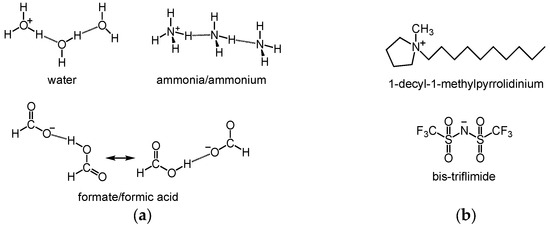
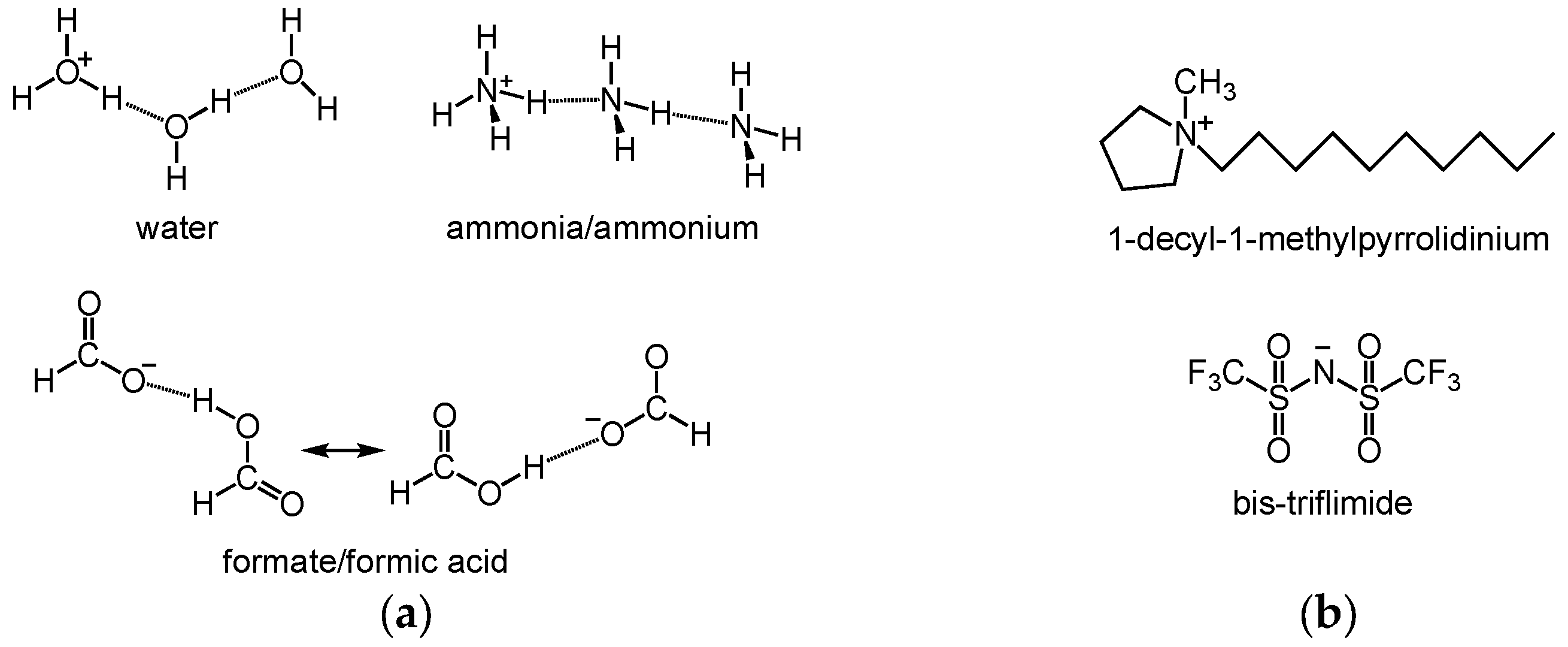
Recently, researchers have been exploring the use of ionic liquids as additives to improve the conductivity and/or durability and/or selectivity of proton-conducting membranes [12,13,14,15,16], motivated by the attractive properties of pure ionic liquids [17,18], such as their low volatilities [17,19], non-flammability [17,20], high thermal [21,22] and electrochemical stability [23,24,25,26] and ability to conduct ions even under anhydrous conditions [12,27]. However, there is an intrinsic tension when it comes to designing or selecting ionic liquids to simultaneously optimise ion-selective conductivity, promote ductility and ensure mutual immiscibility with surrounding electrolyte solutions [15,16,28]. For example, protic ionic liquids that can conduct protons via Grotthuss-like mechanisms enhance both selectivity towards proton conduction and the overall rate of ionic conductivity (Figure 1a) [29].
Figure 1.
(a) Grotthuss-like proton transfer mechanisms in water, ammonia/ammonium and formate/formic acid-containing systems, (b) pyrrolidinium ionic liquid known to spontaneously self-assemble into bilayers on a mica support.
Unfortunately, this tends to produce brittle membranes that lack the mechanical robustness required for industrial applications [12,15,30]. At the same time, it is known that the physical properties of ionic liquids can be tuned by adjusting the number and length of alkyl chains attached to a given ionic core [31,32]. Although structure–property relationships can be complex due to the presence of both short- and long-range ordering in these materials, and are also influenced by surface/support interactions [31,33], it has been shown that increasing the degree of conformational flexibility associated with ionic liquid components tends to promote glass-forming behaviour, increasing ductility [34,35]. Similarly, extensive alkylation [36,37] and/or charge delocalization within constituent ions [37,38] is typically required to create ionic liquids that are immiscible with aqueous electrolytes, a key property required for longevity in aqueous environments.
Prima facie, it appears impossible to satisfy the competing demands of high ionic conductivity, water immiscibility and mechanical robustness [15,16,28]. However, our unique insight is that it may be possible to utilise an entirely different mechanism of proton conduction, inspired by biological lipid bilayer systems which are thought to conduct protons in a concerted Grotthuss-like manner through transient water networks or other proton-hopping pathways [39,40]. We hypothesise that it may be possible to exploit this phenomenon using ionic liquids with strong chemical and structural similarities to biological bilayer-forming compounds, e.g., phospholipids [41].
For example, it has previously been shown that long-chain alkylimidazolium and alkylpyridinium bistriflimide ionic liquids (Figure 1b) form bilayer type structures when deposited on mica surfaces [42,43]. Similarly, previous studies have revealed both bulk nanostructuring [44,45,46] and surface layering effects [46,47,48,49] in a range of ionic liquids, including tetraalkylammonium and tetraalkylphosphonium alkylsulfonates, which predominantly form single bilayers on gold surfaces [50]. Self-assembly behaviour has also been demonstrated for ionic liquids deposited onto a range of different supports, including silica [51], polystyrene resin [52] and highly ordered pyrolytic graphite [53]. Additionally, dynamic reordering of self-assembled nanostructures has been observed in the presence of water [54].
The aim of the present work is to investigate whether such nanostructures—comprising mono-ionic alkylated components—are capable of selectively conducting protons via the same mechanism of action as zwitterionic phospholipid membranes when deposited and self-assembled on porous polymer supports. If so, they are likely to find applications across a wide range of electrochemical energy capture and storage technologies including electrochemical carbon capture systems, electrolytic “green” hydrogen production systems and aqueous redox-flow batteries. However, exploring such applications is beyond the scope of the present work.
2. Materials and Methods
2.1. Ionowax Synthesis, Membrane Fabrication and Characterisation
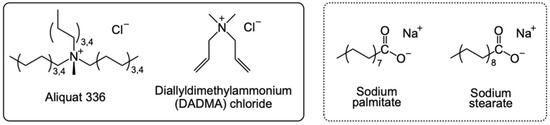
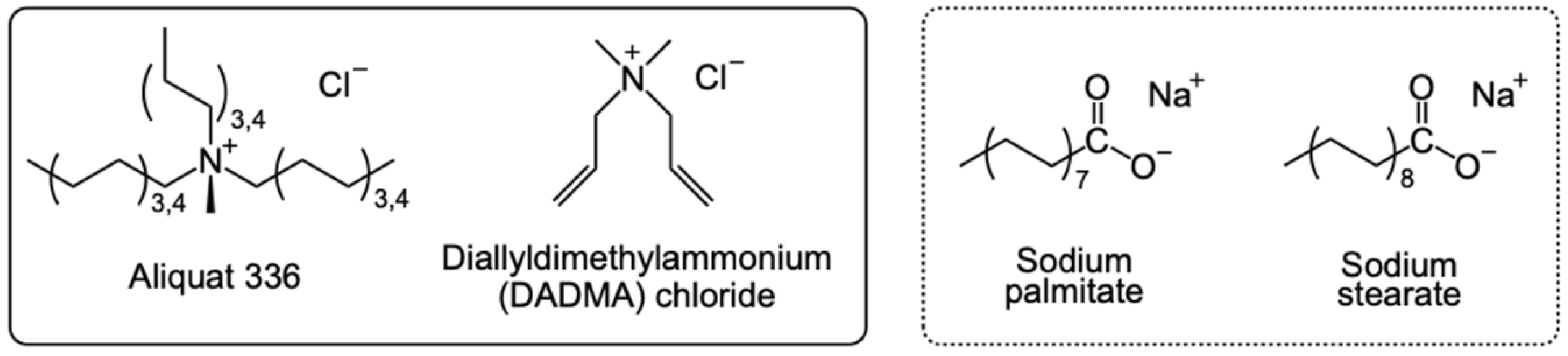
Alkylammonium alkylcarboxylate ionowaxes were synthesised by ion metathesis from the starting materials illustrated in Figure 2, wherein ionowaxes are defined as highly alkylated ionic compounds that are waxy solids at room temperature. Starting materials were sourced from a variety of suppliers and used as received; supplier information is provided in the Supplementary Materials, along with specific synthesis procedures for each ionowax prepared in this work. All products were obtained in quantitative yields.
Figure 2.
Alkylammonium and fatty acid salt starting materials for ionowax synthesis.
Membranes were formed by depositing a sample of each ionowax onto the polypropylene fabric backing side of Celgard 4560, which was then placed wax side up on a silicon sheet on top of a hotplate. The sample was heated until the wax began to soften, whereupon a second sheet of silicon was placed over the top and the sample compressed using a plastic roller. Impregnated membranes were taken off the hotplate and left to cure for 1–24 h, until the membrane could be peeled off the silicon sheet cleanly. Membranes were spray-washed with MilliQ before further characterisation to remove any residual surface salt.
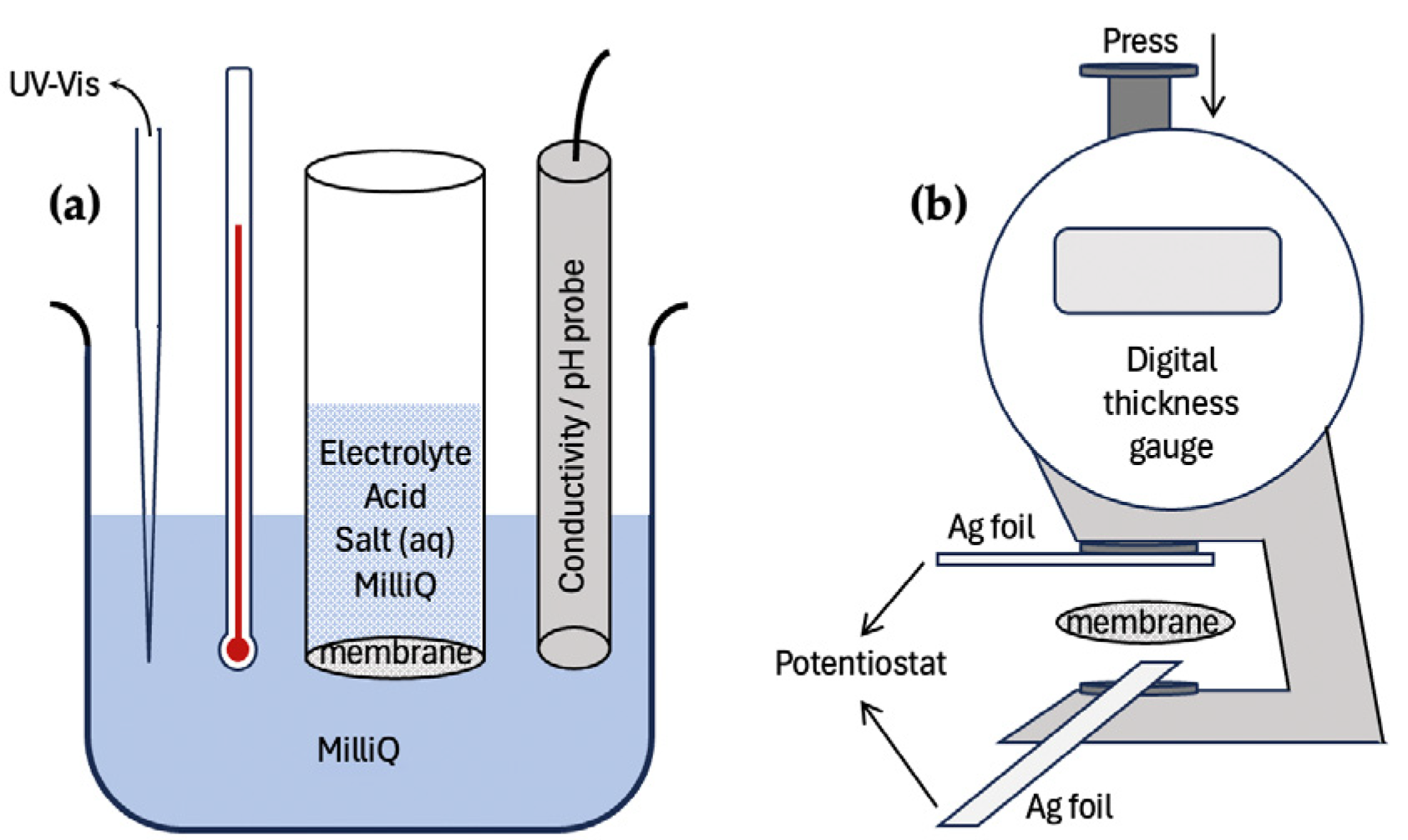
Ion-conducting properties of each membrane were characterised by bulk solution testing and electrochemical impedance spectroscopy, using experimental apparatus as illustrated in Figure 3. For reference, the same testing procedures were performed using Fumasep 375-PP and Nafion 117 membranes which were used as received, without pre-treatment. Nafion 117 was chosen as the gold standard proton-conducting membrane most widely used in the literature for electrochemical applications requiring proton transport such as fuel cells, electrolysers and redox-flow batteries. Fumasep 375-PP is primarily recognised as an anion-conducting membrane, and was chosen to serve as a negative control in this work. Key characteristics of each commercial membrane material used in this work are summarised in Table 1.
Figure 3.
Schematic diagram of experimental setups for (a) bulk solution membrane permeability testing and (b) electrochemical impedance spectroscopy.
Table 1.
Properties of commercially available membranes used in this work, as reported by manufacturers and/or suppliers.
During bulk solution testing, 1 M solutions of ammonium formate or formic acid were placed in a membrane-capped glass cylinder, which was then immersed in a beaker containing 100 mL of MilliQ water (Figure 3). Changes in conductivity and/or pH of the MilliQ were recorded every 5 min for 1.5 h. As a negative control, MilliQ was used in place of the salt or acid solution.
Electrochemical impedance spectroscopy was performed using an EmStat4S potentiostat (Palmsens BV, Houten, The Netherlands) in two-electrode, two-terminal mode, scanning over an alternating current (AC) frequency range of 1–100,000 Hz, recording 10 data points per order of magnitude change, linearly spaced on a logarithmic scale. Membrane samples were prepared by first soaking the membrane in MilliQ water for 10 min, followed by 20 min in 1 M formic acid. For the negative control, membrane samples were soaked in MilliQ water for 30 min. Membranes were sandwiched between two polished silver electrodes under a constant external pressure of 265 kPa. EIS spectra were analysed by non-linear fitting to equivalent circuit models using the PStrace software (version 5.9), which was also used to control the potentiostat during data acquisition.
2.2. Electrolyte Crossover, Thermal and Long-Term Stability Testing
Electrolyte crossover experiments were performed by filling a membrane-capped glass cylinder with 1 M solutions of vanadyl sulfate (VOSO4) and 1 M vanadium(II)/1.5 M Zn(II) sulfate solutions in ~1 M sulfuric acid and monitoring changes in conductivity and visible light absorption at 750 nm of the MilliQ solution into which the membrane-capped cylinder was placed (Figure 3). Full details of how the V(II)/Zn(II) solution was prepared are provided as Supplementary Materials. As a control, a 1 M solution of zinc sulfate was also prepared and membrane crossover monitored via conductometry.
During thermal stability testing, a membrane-capped glass cylinder was filled with 1 M ammonium formate solution, and placed in a beaker of MilliQ water, which was heated at a constant rate using a hotplate-stirrer, and the conductivity of the MilliQ solution monitored as a function of temperature.
Long-term stability testing was performed by first characterising bulk salt and proton conductivities as described previously. Membranes were then left either in air or in MilliQ for one week and re-tested conductometrically.
2.3. Molecular Dynamics Simulations
In brief, two-dimensional sheets (100 Å2) of DADMA stearate and Aliquat stearate were constructed by either randomly positioning 200 copies of each monomer in boxes of heights 30 Å and 40 Å, respectively, or by aligning the charged headgroups with the top and bottom edges of each sheet. In total, 6000 water molecules were placed on top of each ionowax sheet to a depth of 200 Å, and each supersystem was equilibrated to a temperature of 300 K under constant volume conditions, and then further equilibrated to a condensed state under an applied external pressure of 100 atm at the same temperature. Finally, a sequence of alternating constant temperature and volume (NVT) and constant pressure and temperature (NPT) simulations were performed until each system converged to a constant density, and the structure of each ionowax layer reached a stable state. All simulations were performed using the LAMMPS molecular dynamics engine [55] in conjunction with the GROMOS 54A7 united-atom force field [56,57], augmented with water parameters obtained via the automated topology builder and repository service (ATB) [58]. Full MD simulation details are provided as Supplementary Materials.
2.4. Small-Angle X-Ray Scattering
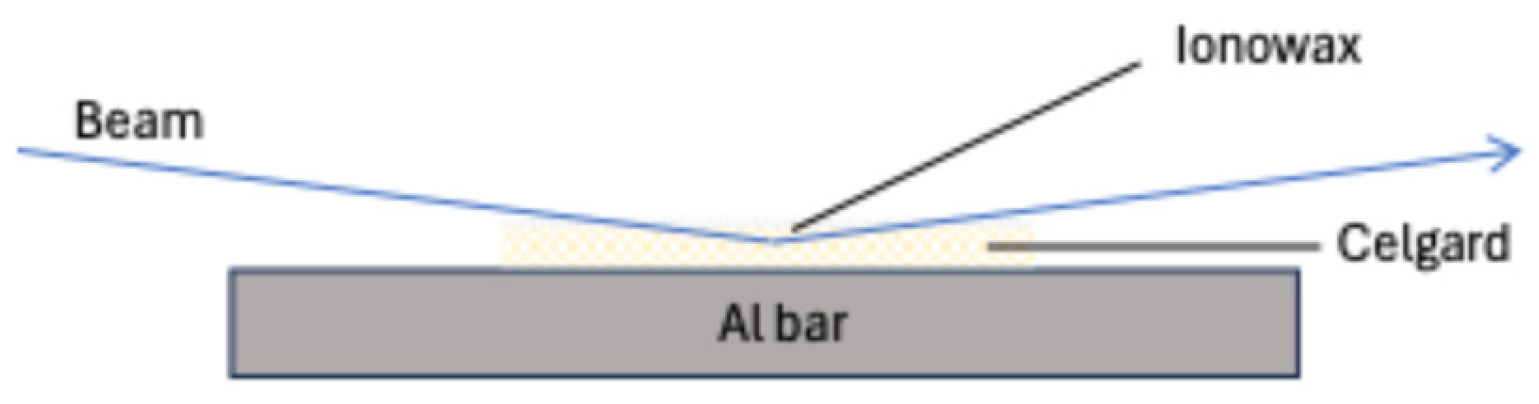
Grazing incidence small-angle scattering measurements were performed on the SAXS/WAXS beamline at the Australian Synchrotron. Membranes were prepared following the fabrication procedures outlined above and soaked for 24 h in MilliQ water, before being taken out and left to dry in air for at least 24 h prior to the start of beam time. Membranes were mounted onto an aluminium bar in air using Kapton tape with the coated fabric side facing up, as illustrated in Figure 4.
Figure 4.
Cross-section view of ionowax-coated Celgard membrane mounted on an aluminium bar (not to scale).
Due to the complex topology of the membrane surface, it was not possible to precisely align the surface of the sample at a specified grazing incidence angle. Instead, sample orientation was performed by aligning the underlying aluminium bar at a grazing incidence angle of 0.15°. The sample stage was then translated vertically until Al scattering bands were no longer observed in the resultant scattering pattern. This typically involved lowering the sample stage by 0.1 mm.
Scattering spectra were recorded by a Pilatus3-2M detector (Dectris, Baden-Daetwill, Switzerland) at a distance of 694 mm from the focal point of the 15 keV (λ = 0.8266 Å) beam, focused to a horizontal width at half-maximum intensity of 250 µm and vertical width at half-maximum intensity of 25 µm. Each measurement was recorded for a total exposure time of 1 s and three separate measurements were taken for each sample, spaced at 1 mm intervals across the surface of the membrane. Data were processed using BioXTAS RAW v2.4.0 using centring and calibration parameters reported by ScatterBrain v2.82 (Australian Synchrotron) based on calibration against a silver behenate standard.
3. Results and Discussion
3.1. Membrane Conductivity, Selectivity and Stability
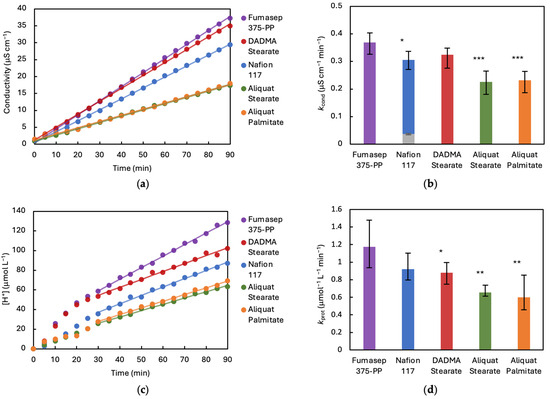
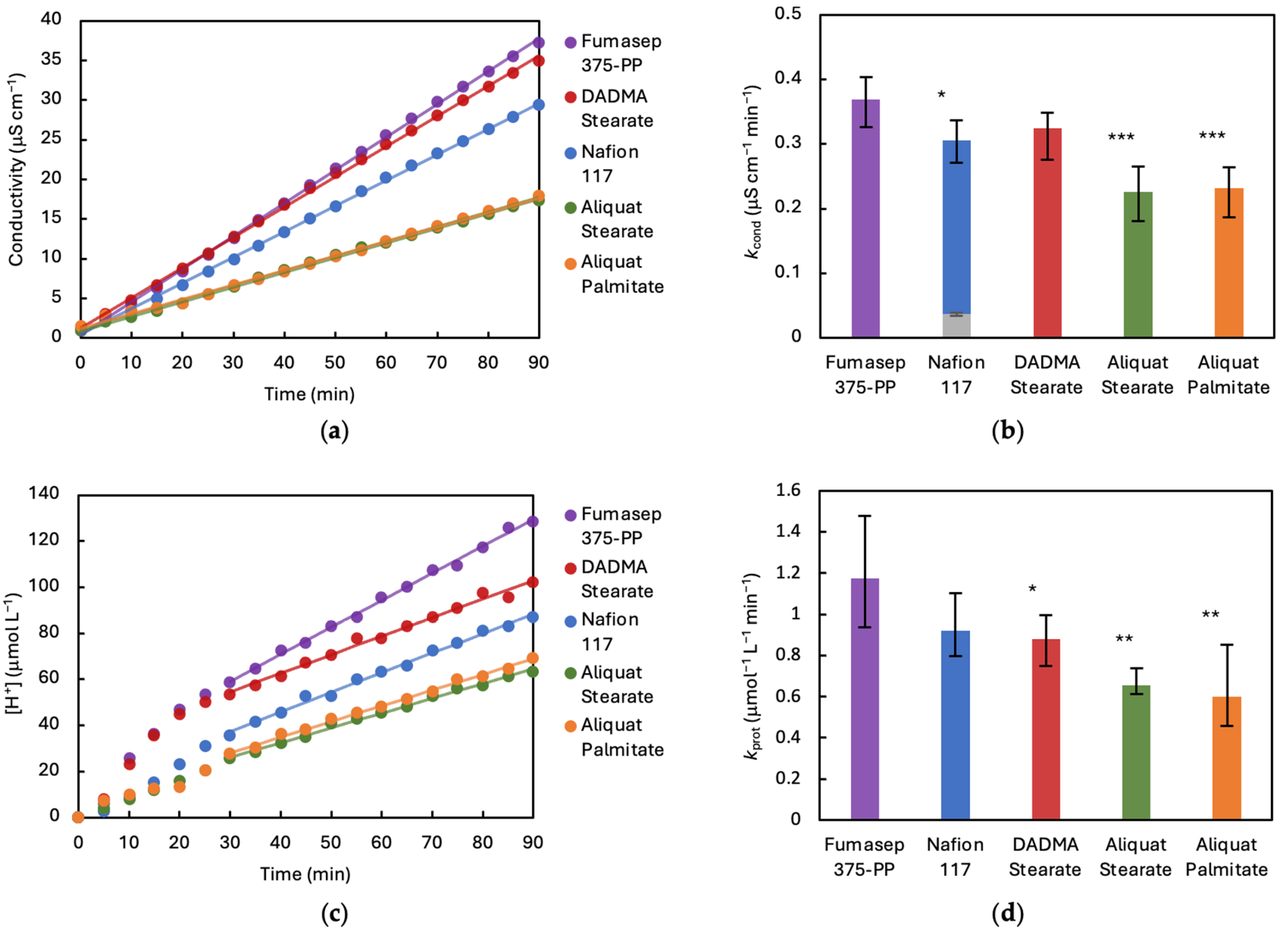
Time-dependent conductometry and potentiometry data (Figure 5a,c) indicate that proton concentrations tend to increase linearly with time regardless of membrane identity, implying that proton conduction across the membrane is the rate-limiting factor on the time scales investigated in this work. However, some deviations from linearity are observed in proton concentrations at shorter time scales (t < 30 min). This most likely reflects measurement uncertainty due to rapid changes in pH on this time scale, magnified by the logarithmic nature of the pH scale. Similarly, we tend to observe a higher degree of inter-sample variability measuring proton conduction via changes in pH rather than conductivity (Figure 5d and Figure 5b, respectively). Therefore, we consider conductometry the more reliable technique for assessing relative rates of proton conduction across different membranes, provided appropriate controls are performed.
Figure 5.
(a) Representative data from conductivity testing; (b) proton conduction rates (formic acid to MilliQ solution), averaged over n = 4 (Fumasep, Nafion, Aliquat stearate) or 5 (DADMA stearate, Aliquat palmitate) runs. Background rates of non-proton ion conduction (ammonium formate to MilliQ) were negligible except across the Nafion membrane (grey bar). Error bars display the range of rates observed. One-tailed t-tests were performed to determine the statistical significance of the difference in proton transfer rates of Nafion and ionowax membranes relative to Fumasep (* p < 0.05, ** p < 0.01, *** p < 0.001). (c) Representative pH monitoring data; (d) proton conduction rates, with error bars and statistical testing as described in (b).
On this basis, we observe that DADMA stearate ionowax membranes compare favourably to commercial membranes in terms of both proton conductivity and proton selectivity, performing similarly to Fumasep 375-PP and outperforming Nafion 117. Nafion 117 is not particularly selective for protons under our experimental conditions, which initially seems surprising as it is widely considered the gold standard in proton exchange membranes for fuel cell and electrolysis applications [59]. However, it is well known in the literature that Nafion 117 is also quite permeable to ammonium ions [60].
It also seems counterintuitive that Fumasep 375-PP does not appear to conduct anions, despite its primary application as an anion-exchange membrane. However, past studies have shown that conductivity across anion-exchange membranes can be highly dependent on the nature of the anion [61], and the phenomenon of proton “leakage” across anion-exchange membranes is also well known [62], especially when in contact with concentrated acids [63]. Additionally, acidic conditions tend to promote higher overall conductivities for this class of membranes [64].
Although our ionowax membranes perform similarly to commercial ion-exchange membranes in terms of proton conductivity and selectivity in their “as made” state, their practical utility will also depend on their longer-term chemical and thermal stabilities, as well as their ability to selectively exclude common redox-active electrolyte species such as vanadium and nickel ions. Fortunately, electrolyte crossover testing revealed that these membranes are equally as impermeable to redox-active ions as they are to non-redox-active salts. For example, no change in either conductivity or absorbance at 750 nm was observed on the MilliQ side of the testing apparatus using 1 M vanadyl sulfate as the test solution. Photometrically, V2+ ions were also equally impermeable, with observed increases in conductivity attributed to the acidity (~1 M H2SO4) of the test solution. Because nickel ions were also present, further control testing was performed using a 1 M solution of nickel sulfate, which showed no change in conductivity of the MilliQ solution, confirming that the observed increase in conductivity was exclusively due to proton conduction. This behaviour may be contrasted with that of Nafion which shows significant vanadium crossover, likely mediated by bulk water transport [65].
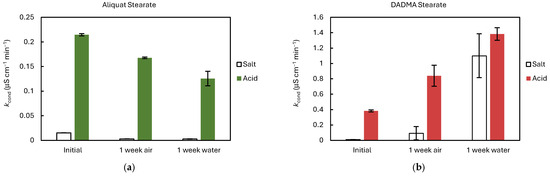
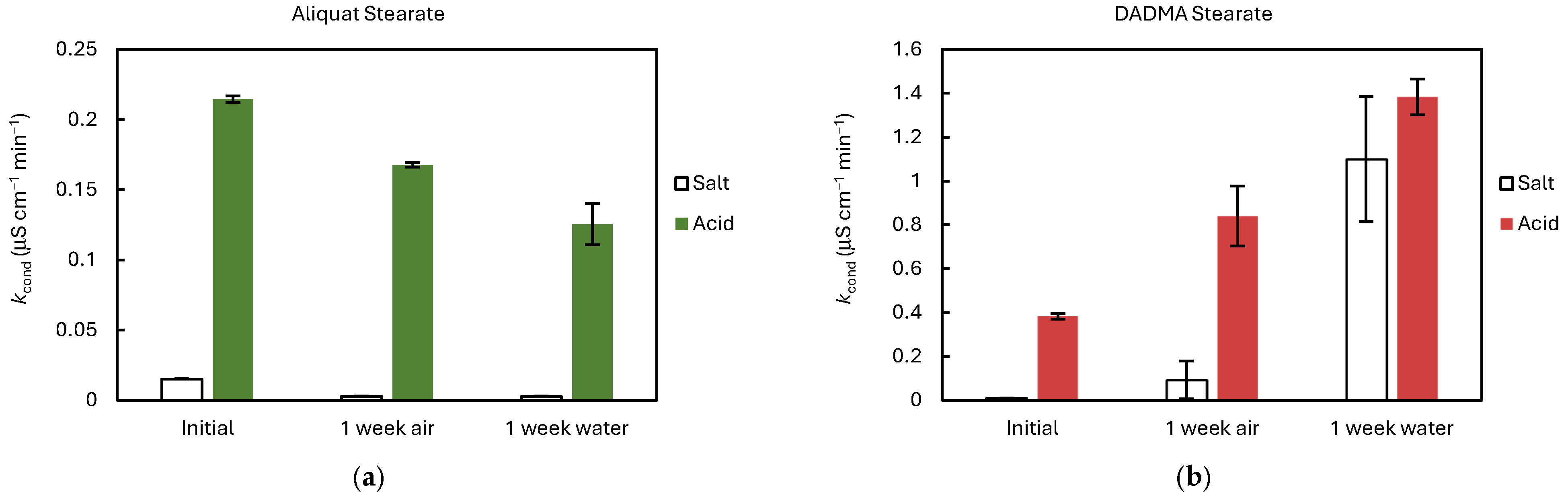
In situ and ex situ stabilities of Aliquat stearate and DADMA stearate membranes were tested by first characterising their performance “as made” and then leaving them to sit in either air or MilliQ water for one week and repeating conductometric testing (Figure 6). Aliquat stearate membranes became less permeable to both protons and other ions over time, regardless of whether the membrane was left in air or water, which we hypothesise may be due to tighter packing of the hydrocarbon chains upon dehydration and/or an extended self-assembly period.
Figure 6.
Ion conduction rates across (a) Aliquat stearate and (b) DADMA stearate membranes as made (“Initial”) and after 1 week in air or water. All measurements were performed in duplicate and are reported as average +/− range.
Conversely, DADMA stearate membranes appear to disassemble upon prolonged immersion, becoming equally permeable to protons and other ions, suggestive of bulk ion transport through non-selective microscopic pores of the underlying Celgard support. These membranes also become more permeable towards both protons and other ions after being stored under atmospheric conditions for a week, albeit retaining a degree of selectivity for protons over other ions. Together, these findings imply that the structure and properties of DADMA stearate membranes are very sensitive to the hydration state [66].
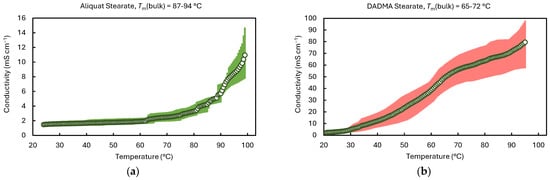
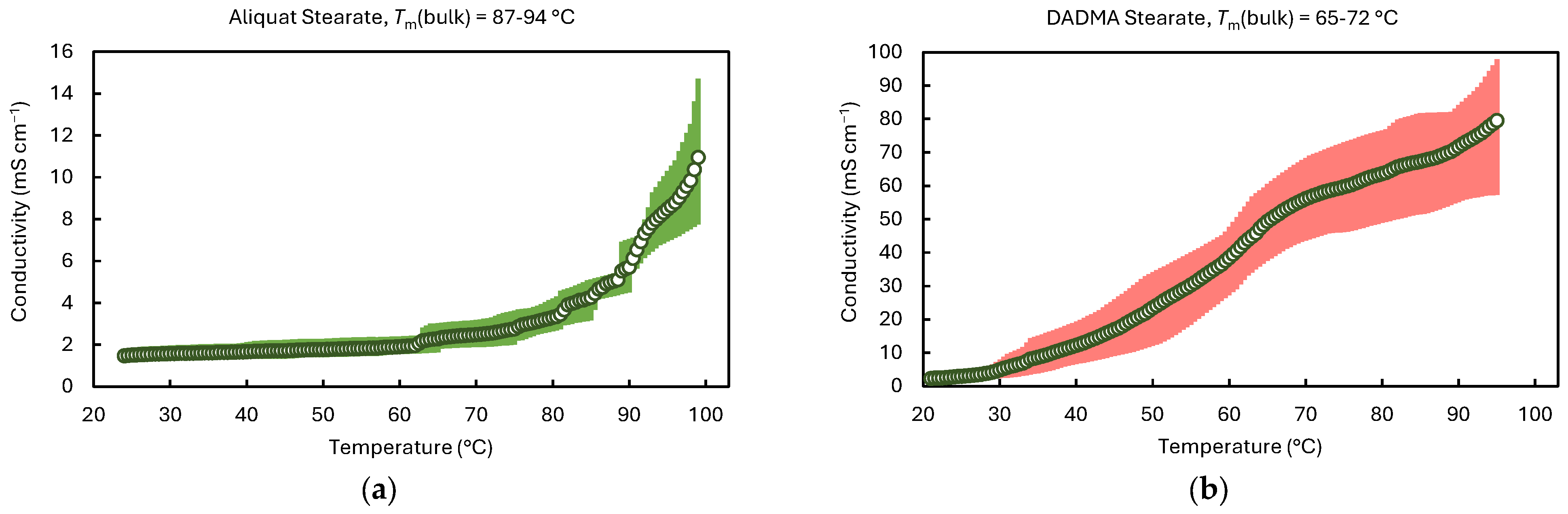
Thermal stability testing (Figure 7) reveals similar trends, notably that Aliquat stearate membranes remain much more stable with increasing temperature than their DADMA stearate counterparts. As in long-term stability testing, a sharp increase in membrane permeability towards salt is interpreted as a failure of the ionowax layer. For Aliquat stearate membranes this occurs at approximately the bulk melting temperature of the wax, while for DADMA stearate it occurs just above room temperature, far below the bulk melting temperature of the wax. This implies that DADMA stearate packs very differently under aqueous conditions on the porous polypropylene support than it does in bulk. A likely explanation is that DADMA stearate self-assembles into stacked lipid bilayers which readily slough off as the temperature increases [67].
Figure 7.
Salt-induced conductivity as a function of temperature across (a) Aliquat stearate and (b) DADMA stearate membranes. Data points represent the average conductivity at each temperature across 4 independent replicates, while the shaded error profile shows the range of values obtained.
Overall, the ionowax membranes tested in this work display two striking features: (1) they visually change morphology upon prolonged contact with aqueous solutions, suggesting that they undergo some form of self-assembly; and (2) they appear to exclusively conduct protons in aqueous, acidic environments, while remaining impermeable to water and other ions. While Aliquat-based ionowax membranes display lower rates of proton conduction than DADMA stearate upon initial use at room temperature, they are significantly more stable longer term and at higher temperatures. To obtain additional insight into likely mechanisms of proton conduction and how molecular-level structuring of ionowaxes of porous propylene supports affect the overall stability and proton conduction rates of the resultant membranes, we turn to electrochemical impedance spectroscopy, small-angle X-ray scattering and molecular dynamics simulations.
3.2. Electrochemical Impedance Spectroscopy
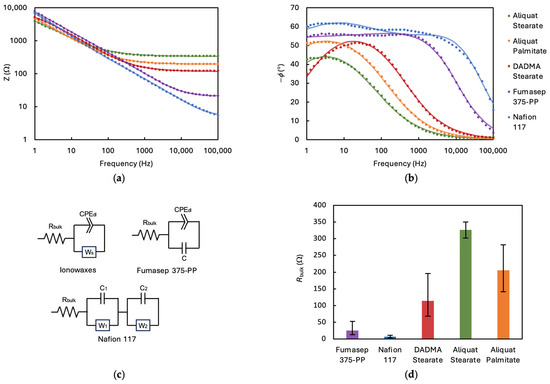
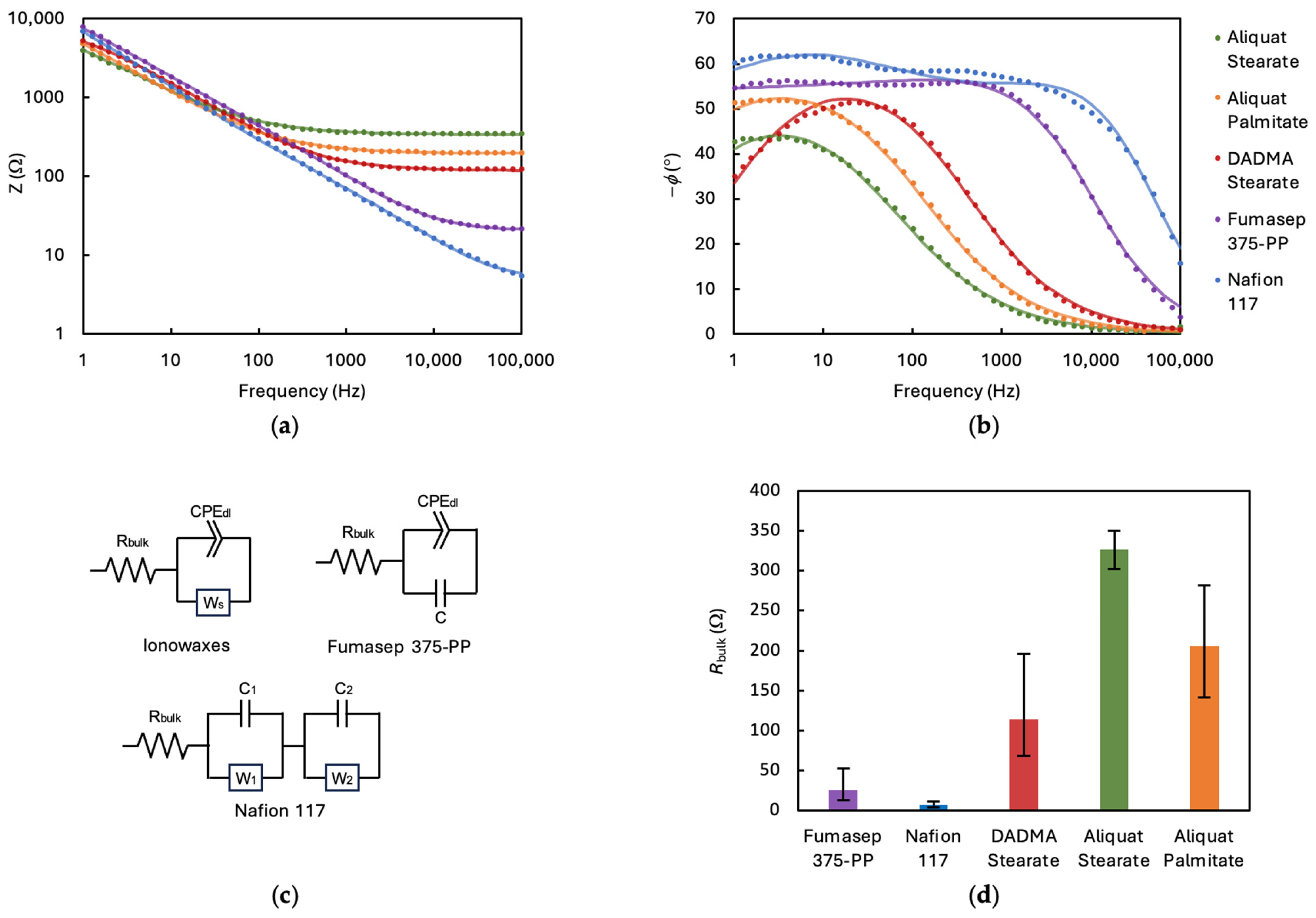
Electrical impedance spectroscopy characterises resistance across the membrane as a function of the frequency of an applied alternating current or voltage. The resulting complex impedance data (Figure 8a,b) are non-linearly fitted to the simplest possible equivalent circuit models capable of accurately reproducing all the main features of the data, designed to characterise the main ion-transfer pathways in the system (Figure 8c) [68,69,70,71]. The only element that these equivalent circuit models have in common is a series resistor, so bulk resistance is the only parameter than can be meaningfully compared between all membranes characterised in this work (Figure 8d). However, all fitted EIS parameters are available in the Supplementary Materials.
Figure 8.
(a,b) Bode plots characterising the electrochemical impedance response of each membrane, (c) equivalent circuit models used in fitting EIS data (solid lines on (a,b)), (d) electrical conductivities (Rbulk) of acid-treated membranes, averaged over n = 4 independent replicates. Error bars span the total range of fitted values.
It is immediately evident that different membrane types conduct protons via different transport mechanisms, as their EIS spectra are qualitatively distinct and they each require different equivalent circuit models to appropriately fit the data. Dynamic charge transport across our ionowax membranes is best modelled using a constant-phase element in parallel with a “short” or “transmissive boundary” Warburg element. The equivalent circuit model for this system is completed by adding a constant resistance term which accounts for bulk, frequency-independent resistance across the membrane. All fitted equivalent circuit model parameters are available as Supplementary Materials.
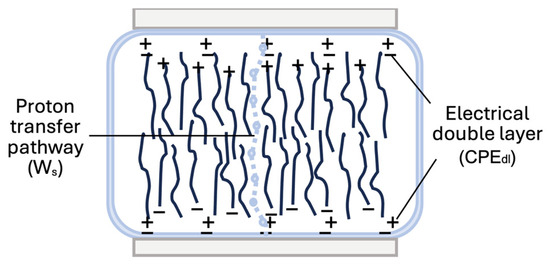
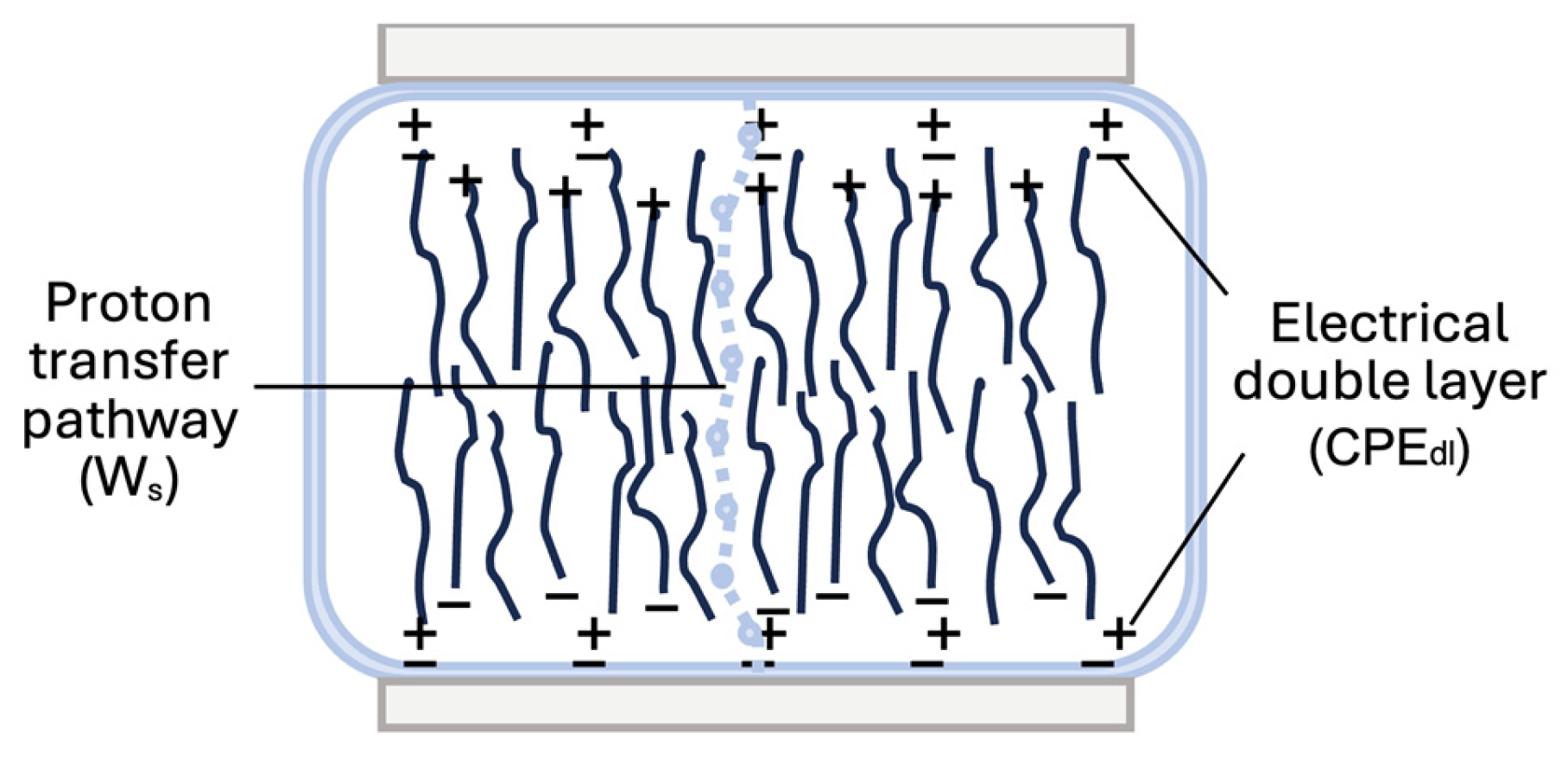
This equivalent circuit model and fitting procedure is consistent with our hypothesis that ionowaxes self-assemble into bilayer-like membranes (Figure 9), which then respond to the applied current by forming an electrical double-layer at each electrode (modelled by the constant-phase element) and shuttling protons between electrodes (modelled by the short Warburg element, describing finite-length diffusion with a transmissive boundary) [70]. Constant phase element exponents between 0.6 and 0.7 indicate that these membranes display capacitive behaviour that is quite far from ideal in that it varies significantly with applied frequency [70,72]. However, it is reasonable to postulate that electrical double layer formation is influenced by local proton concentration, which also varies with applied frequency [73,74]. We ascribe the bulk resistance across our ionowax membranes to electrical resistivity [75,76], which is relatively high in these systems (Figure 8d) because electrical conduction across hydrophobic membranes is significantly impeded.
Figure 9.
Schematic model of ion rearrangement and conduction mechanisms.
For DADMA stearate membranes, our EIS spectra closely resemble those reported in the literature characterising proton transport across tethered lipid bilayer membranes [77] whereas the EIS spectra of Aliquat-based membranes more closely resemble those of graphene oxide membranes [78] in which proton conduction is hypothesised to proceed via proton hopping between clusters of water molecules [79].
This may be contrasted with the EIS response of the commercial porous polymer membranes, which tend to display low electrical resistivities at high frequencies but whose impedance increases dramatically as the frequency of the applied alternating current decreases and ionic conduction effects come into play. Notably, there is a stark discrepancy between our observed bulk proton conduction rates (Figure 5b,d) and the measured membrane resistances (Figure 8d); the expected inverse relationship is not observed. This supports our interpretation that high-frequency conduction is primarily electronic in nature, mediated by electron transfer along water channels and/or between ionic side chains lining polymer membrane pores [59,62,63,80], mechanisms that are not available in the ionowax membrane system.
3.3. Molecular Dynamics Simulations
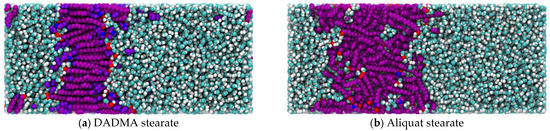
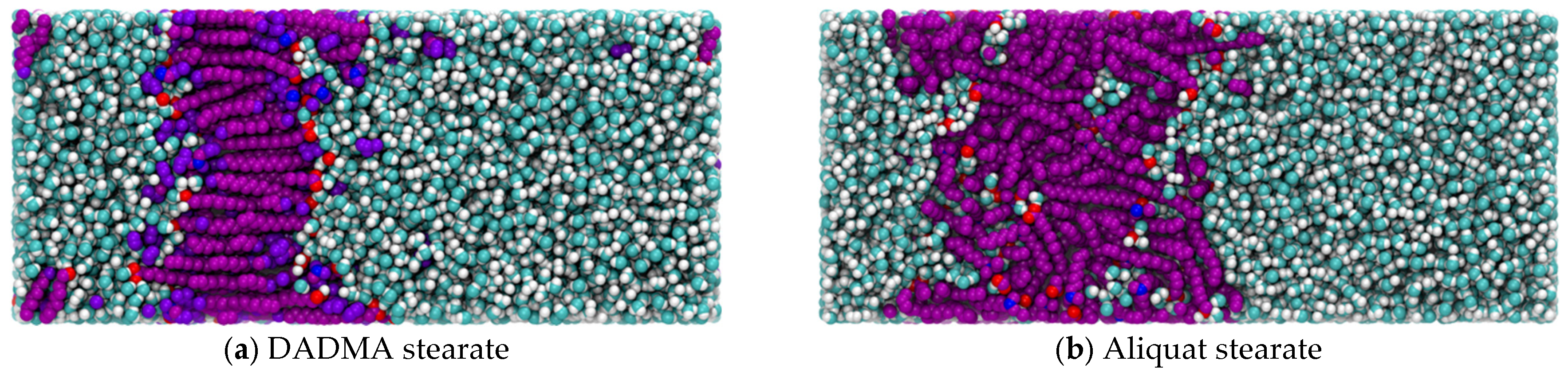
To obtain further insight into the structure of ionowax membranes and likely proton transport mechanisms, molecular dynamics simulations were performed. Regardless of starting configuration, DADMA stearate ionowaxes reliably self-assemble into bilayer-like structures whereas Aliquat stearate instead forms a hydrophobic network of interlinking Aliquat and stearate chains, with randomly orientated regions of aligned alkyl chains interspersed with polar pockets containing small clusters of headgroups and water molecules (Figure 10).
Figure 10.
Snapshots from molecular dynamics trajectories showing typical structures of self-assembled (a) DADMA stearate and (b) Aliquat stearate membranes in an aqueous environment. Magenta = alkyl chains, violet = allyl chains, red = carboxylate oxygens, blue = ammonium nitrogen, cyan + white = water.
We therefore hypothesise that proton conduction through DADMA stearate is mostly likely to occur along water wires or networks that form transiently across the membrane, analogous to biological lipid bilayer systems in which protons are observed to permeate membranes at anomalously high rates [40]. Directly modelling proton transfer mechanisms and rates is challenging because the formation of trans-membrane water wires or networks is driven entropically rather than enthalpically, necessitating long simulation times to observe these rare events or the application of enhanced sampling methods to ensure relevant pathways are constructed and accessed [40,81]. Additionally, “reactive” force fields or on-the-fly ab initio calculations are required to accurately model the change in energy associated with transferring protons between water molecules, further increasing computational complexity and cost [82,83]. Fortunately, such “gold standard” simulations have previously been performed simulating the passage of protons across a dimyristoylphosphatidylcholine lipid bilayer, which approximately matches the dimensions and nanostructuring of our DADMA stearate bilayer system (myristate = C14, stearate = C18) [40]. These authors found that proton conduction through lipid bilayer membranes is most likely mediated by transient trans-membrane water networks that are stabilised by excess protons, and may therefore exist for hundreds of picoseconds.
Aliquat stearate membranes, on the other hand, are more likely to conduct protons via tunnelling and/or hopping between permanently embedded clusters of water molecules encapsulated within the membrane [84,85,86]. This is consistent with our EIS spectra and experimental observations that conductivity decreases as the membrane dries out. We also hypothesise that proton conductivity may decrease with increasing self-assembly time as the hydrophobic side chains pack more closely and expel encapsulated pockets of water into the surrounding bulk solution. However, further computational investigation is hindered by the fact that this occurs on a computationally inaccessible time scale.
3.4. Small-Angle X-Ray Scattering
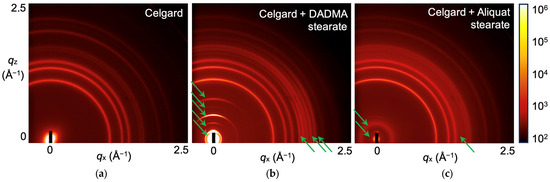
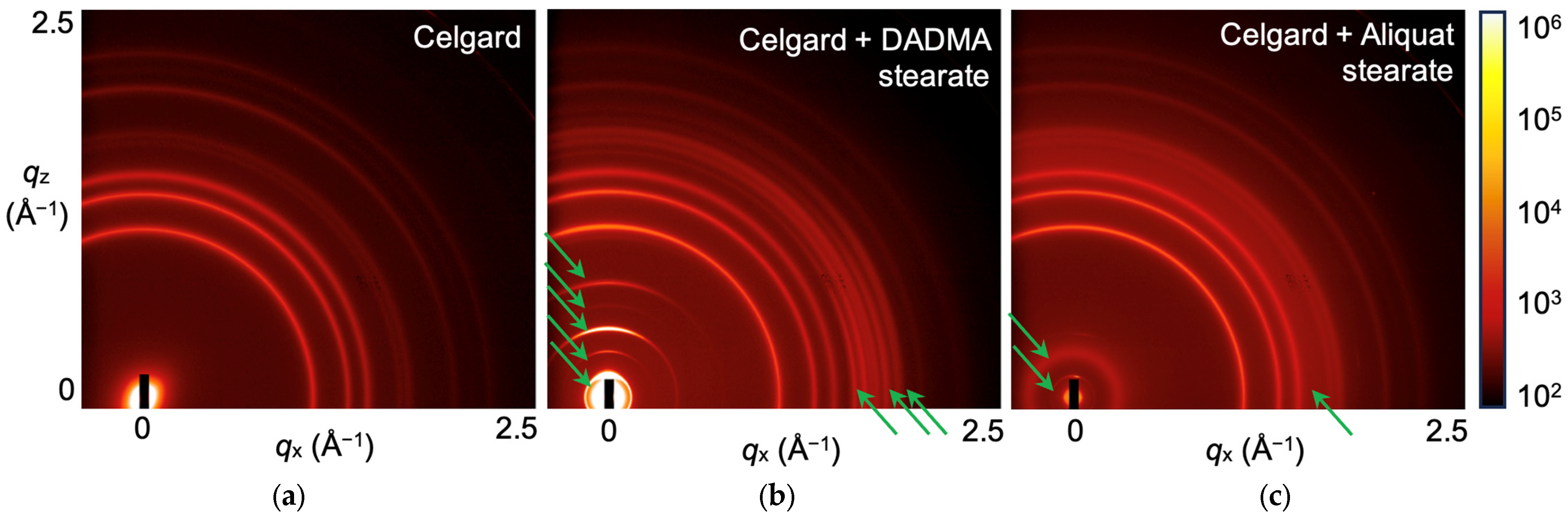
Small-angle X-ray scattering measurements performed at the Australian Synchrotron independently confirm that ionowaxes display similar nanostructured ordering when deposited on porous polypropylene supports and allowed to self-assemble under aqueous conditions as observed under purely aqueous conditions in molecular dynamics simulations (Figure 11, Table 2).
Figure 11.
Grazing incidence small-angle X-ray scattering spectra (incidence angle = 0.15°, beam energy = 15 keV, detector distance = 694 mm) of (a) untreated Celgard, (b) Celgard-supported DADMA stearate and (c) Celgard-supported Aliquat stearate membranes. Key features associated with the presence of nanostructured ionowaxes are highlighted using green arrows.
Table 2.
Assignment of structural features of DADMA stearate (top) and Aliquat stearate (bottom) membranes inferred from analysis of GISAXS scattering patterns supported by molecular dynamics simulations.
Celgard displays a distinct scattering pattern, characteristic of its semi-crystalline polypropylene components [87]. Because these scattering bands remain unchanged in the presence of ionowaxes, we infer that the ionowaxes do not fundamentally alter the chemical properties or structure of the Celgard, and therefore our ionowax membranes will largely inherit the mechanical properties of the underlying support material.
Our SAXS scattering patterns are instead consistent with self-assembly of lamellar nanostructures on top of the support material, with a characteristic repeat distance of ~46 Ångstrom, approximately twice the length of a stearate chain in its most extended conformation [88]; consistent with long-range headgroup spacings from MD simulations. However, it is also clear that the lamellar structures within self-assembled DADMA stearate and Aliquat stearate membranes are oriented quite differently; our SAXS scattering data indicate that DADMA stearate forms well-ordered and well-defined repeating bilayers aligned horizontally with the surface while Aliquat stearate comprises a series of randomly oriented lamellar regions. These findings are entirely consistent with our molecular dynamics simulations, further supporting our structural and mechanistic proposals.
3.5. Cost Analysis
Obtaining definitive costs for commercial ion-exchange membranes is challenging, but most literature sources agree that the most commonly used membranes like Nafion 117 and Fumasep 375-PP cost upwards of 500 $USD per square metre [89,90,91]. Although lower-cost porous polymer membranes are under development [92], cost estimates remain in the range of hundreds of dollars per square metre [90,93,94]. By contrast, our membranes are extremely economical (Table 3) and easy to manufacture, with unit costs projected to lie in the range of $1 per square metre (commodity chemicals and materials) to $60 per square metre (using fine chemicals + Celgard support).
Table 3.
Material costs ($USD) associated with fabricating ionowax membranes, based upon a maximum observed ionowax loading of 3.5 mg cm−1. Where multiple value estimates were available, the value that led to the highest unit cost per square metre was used.
4. Conclusions and Outlook
Ionowaxes consisting of asymmetric tetraalkylammonium cations paired with long-chain organic acids have been demonstrated to form membranes with unique proton-selective conduction properties when deposited on porous polymer supports. Electrochemical impedance spectroscopy, molecular dynamics simulations and small-angle X-ray scattering experiments support the hypothesis that proton transport in these systems occurs via Grotthuss transport through transient water networks or proton tunnelling between encapsulated water clusters. This represents a charge transfer pathway that is not available to other ions, hence solving the selectivity problem that plagues porous polymer membranes. At the same time, supported ionowax membranes display comparable proton conductivities to commercial membranes like Fumasep 375-PP and Nafion 117. We envisage that these membranes will decrease costs and minimise electrolyte crossover within established aqueous redox-flow batteries, hence enhancing their commercial viability. We also expect that they will open up new avenues in the design and development of new electrochemical carbon capture, fuel production and energy storage technologies.
Supplementary Materials
The following supporting information can be downloaded at: https://www.mdpi.com/article/10.3390/batteries12040148/s1, Section S1: Detailed ionowax synthesis and membrane fabrication procedures; Table S1: Supplier Details for materials; Table S2: Proton conduction rates measured conductometrically (mS cm−1 min−1); Table S3: Proton conduction rates measured potentiometrically (mol L−1 min−1); Table S4: Equivalent circuit element definitions; Table S5: EIS equivalent circuit model fitting parameters; Section S2: V2+ solution preparation and usage procedures; Section S3: Detailed molecular dynamics simulation procedures + results.
Author Contributions
R.L.D.: Conceptualisation, Investigation, Methodology, Data curation. T.J.G.: Investigation, Methodology, Data curation. J.C.S.: Investigation, Methodology, Data curation. D.L.C.: Conceptualisation, Formal analysis, Supervision, Visualisation, Writing. All authors have read and agreed to the published version of the manuscript.
Funding
This research was funded by the New Zealand Government Ministry of Business, Innovation and Employment Endeavour Fund, Grant Number UOCX2305. Travel funding to access the Australian Synchrotron under the merit allocation scheme (Grant Number M24648) was provided through the New Zealand Synchrotron Group.
Data Availability Statement
The original contributions presented in the study are included in the article/Supplementary Materials, further inquiries can be directed to the corresponding author.
Acknowledgments
This research was undertaken on the SAXS-WAXS beamline at the Australian Synchrotron, part of ANSTO.
Conflicts of Interest
The authors declare no conflicts of interest. The funders had no role in the design of the study; in the collection, analyses, or interpretation of data; in the writing of the manuscript; or in the decision to publish the results.
Abbreviations
The following abbreviations are used in this manuscript:
| EIS | Electrochemical Impedance Spectroscopy |
| DADMA | Diallyldimethylammonium |
| PP | Polypropylene |
| SAXS | Small Angle X-ray Scattering |
| WAXS | Wide Angle X-ray Scattering |
| MD | Molecular Dynamics |
References
- Intergovernmental Panel on Climate Change (IPCC). Climate Change 2021—The Physical Science Basis: Working Group I Contribution to the Sixth Assessment Report of the Intergovernmental Panel on Climate Change; Cambridge University Press: Cambridge, UK, 2023. [Google Scholar] [CrossRef] [Scilit]
- Freeman, S.; Agar, E. The impact of energy storage on the reliability of wind and solar power in New England. Heliyon 2024, 10, e27652. [Google Scholar] [CrossRef] [Scilit] [PubMed]
- Guo, F.; Soares, J.; Ma, L.; Tian, Z.; Chen, X.; Zhang, L.; Vale, Z. Wind and solar need storage diversity, not just capacity. Innovation 2025, 7, 101046. [Google Scholar] [CrossRef] [Scilit] [PubMed]
- Chen, T.; Jin, Y.; Lv, H.; Yang, A.; Liu, M.; Chen, B.; Xie, Y.; Chen, Q. Applications of Lithium-Ion Batteries in Grid-Scale Energy Storage Systems. Trans. Tianjin Univ. 2020, 26, 208–217. [Google Scholar] [CrossRef] [Scilit]
- Khan, S.H. Energy storage systems for deep decarbonization: A critical review. J. Energy Storage 2026, 150, 120485. [Google Scholar] [CrossRef] [Scilit]
- Zhu, F.; Guo, W.; Fu, Y. Functional materials for aqueous redox flow batteries: Merits and applications. Chem. Soc. Rev. 2023, 52, 8410–8446. [Google Scholar] [CrossRef] [Scilit]
- Sun, C.; Zhang, H. Review of the Development of First-Generation Redox Flow Batteries: Iron-Chromium System. ChemSusChem 2022, 15, e202101798. [Google Scholar] [CrossRef] [Scilit]
- George, T.Y.; Fell, E.M.; Lee, K.; Emanuel, M.S.; Aziz, M.J. Influence of crossover on capacity fade of symmetric redox flow cells. Energy Adv. 2024, 3, 2910–2921. [Google Scholar] [CrossRef] [Scilit]
- Latchem, E.J.; Kress, T.; Klusener, P.A.A.; Kumar, R.V.; Forse, A.C. Charge-Dependent Crossover in Aqueous Organic Redox Flow Batteries Revealed Using Online NMR Spectroscopy. J. Phys. Chem. Lett. 2024, 15, 1515–1520. [Google Scholar] [CrossRef] [Scilit]
- Luo, Q.; Li, L.; Wang, W.; Nie, Z.; Wei, X.; Li, B.; Chen, B.; Yang, Z.; Sprenkle, V. Capacity decay and remediation of nafion-based all-vanadium redox flow batteries. ChemSusChem 2013, 6, 268–274. [Google Scholar] [CrossRef] [Scilit]
- Feng, R.; Guo, Z.; Meng, X.; Sun, C. Modeling and State of Charge Estimation of Vanadium Redox Flow Batteries: A Review. Energies 2025, 18, 4666. [Google Scholar] [CrossRef] [Scilit]
- Díaz, M.; Ortiz, A.; Ortiz, I. Progress in the use of ionic liquids as electrolyte membranes in fuel cells. J. Membr. Sci. 2014, 469, 379–396. [Google Scholar] [CrossRef] [Scilit]
- Elwan, H.A.; Mamlouk, M.; Scott, K. A review of proton exchange membranes based on protic ionic liquid/polymer blends for polymer electrolyte membrane fuel cells. J. Power Sources 2021, 484, 229197. [Google Scholar] [CrossRef] [Scilit]
- Ebrahimi, M.; Kujawski, W.; Fatyeyeva, K.; Kujawa, J. A Review on Ionic Liquids-Based Membranes for Middle and High Temperature Polymer Electrolyte Membrane Fuel Cells (PEM FCs). Int. J. Mol. Sci. 2021, 22, 5430. [Google Scholar] [CrossRef] [Scilit]
- Alashkar, A.; Al-Othman, A.; Tawalbeh, M.; Qasim, M. A Critical Review on the Use of Ionic Liquids in Proton Exchange Membrane Fuel Cells. Membranes 2022, 12, 178. [Google Scholar] [CrossRef] [Scilit]
- Ebrahimi, M.; Fatyeyeva, K.; Kujawski, W. Different Approaches for the Preparation of Composite Ionic Liquid-Based Membranes for Proton Exchange Membrane Fuel Cell Applications—Recent Advancements. Membranes 2023, 13, 593. [Google Scholar] [CrossRef] [Scilit]
- Welton, T. Room-Temperature Ionic Liquids. Solvents for Synthesis and Catalysis. Chem. Rev. 1999, 99, 2071–2084. [Google Scholar] [CrossRef] [Scilit] [PubMed]
- Al-Bodour, A.; Alomari, N.; Perez-Duran, G.; Rozas, S.; Iglesias-Silva, G.; Aparicio, S.; Gutierrez-Vega, A.; Atilhan, M. Ionic Liquids as Multidimensional Materials: A Review from Fundamentals to Applications. Energy Fuels 2025, 39, 12791–12829. [Google Scholar] [CrossRef] [Scilit]
- Fabrizi, I.; Di Muzio, S.; Ramondo, F.; Trequattrini, F.; Palumbo, O.; Paolone, A. Vapor Pressure of Ionic Liquids with a Common Tetrabutylammonium Cation and Three Different Anions. Appl. Sci. 2025, 15, 6040. [Google Scholar] [CrossRef] [Scilit]
- Huddleston, J.G.; Visser, A.E.; Reichert, W.M.; Willauer, H.D.; Broker, G.A.; Rogers, R.D. Characterization and comparison of hydrophilic and hydrophobic room temperature ionic liquids incorporating the imidazolium cation. Green Chem. 2001, 3, 156–164. [Google Scholar] [CrossRef] [Scilit]
- Cao, Y.; Mu, T. Comprehensive Investigation on the Thermal Stability of 66 Ionic Liquids by Thermogravimetric Analysis. Ind. Eng. Chem. Res. 2014, 53, 8651–8664. [Google Scholar] [CrossRef] [Scilit]
- Xu, C.; Cheng, Z. Thermal Stability of Ionic Liquids: Current Status and Prospects for Future Development. Processes 2021, 9, 337. [Google Scholar] [CrossRef] [Scilit]
- Hapiot, P.; Lagrost, C. Electrochemical Reactivity in Room-Temperature Ionic Liquids. Chem. Rev. 2008, 108, 2238–2264. [Google Scholar] [CrossRef] [Scilit] [PubMed]
- O’Mahony, A.M.; Silvester, D.S.; Aldous, L.; Hardacre, C.; Compton, R.G. Effect of Water on the Electrochemical Window and Potential Limits of Room-Temperature Ionic Liquids. J. Chem. Eng. Data 2008, 53, 2884–2891. [Google Scholar] [CrossRef] [Scilit]
- Lerch, S.; Strassner, T. Expanding the Electrochemical Window: New Tunable Aryl Alkyl Ionic Liquids (TAAILs) with Dicyanamide Anions. Chem.—Eur. J. 2019, 25, 16166–16434. [Google Scholar] [CrossRef] [Scilit]
- Zhao, C.; Burrell, G.; Torriero, A.A.J.; Separovic, F.; Dunlop, N.F.; MacFarlane, D.R.; Bond, A.M. Electrochemistry of Room Temperature Protic Ionic Liquids. J. Phys. Chem. B 2008, 112, 6923–6936. [Google Scholar] [CrossRef] [Scilit] [PubMed]
- Chu, F.; Lin, B.; Yan, F.; Qiu, L.; Lu, J. Macromolecular protic ionic liquid-based proton-conducting membranes for anhydrous proton exchange membrane application. J. Power Sources 2011, 196, 7979–7984. [Google Scholar] [CrossRef] [Scilit]
- Lu, G.; Zhang, Y.; Zhang, J.; Du, X.; Lv, Z.; Du, J.; Zhao, Z.; Tang, Y.; Zhao, J.; Cui, G. Trade-offs between ion-conducting and mechanical properties: The case of polyacrylate electrolytes. Carbon Energy 2023, 5, e287. [Google Scholar] [CrossRef] [Scilit]
- Ingenmey, J.; Gehrke, S.; Kirchner, B. How to Harvest Grotthuss Diffusion in Protic Ionic Liquid Electrolyte Systems. ChemSusChem 2018, 11, 1900–1910. [Google Scholar] [CrossRef] [Scilit]
- Lu, F.; Gao, X.; Xie, S.; Sun, N.; Zheng, L. Chemical modification of Nafion membranes by protic ionic liquids: The key role of ionomer–cation interactions. Soft Matter 2014, 10, 7819–7825. [Google Scholar] [CrossRef] [Scilit]
- Triolo, A.; Russina, O.; Bleif, H.-J.; Di Cola, E. Nanoscale Segregation in Room Temperature Ionic Liquids. J. Phys. Chem. B 2007, 111, 4641–4644. [Google Scholar] [CrossRef] [Scilit]
- Logotheti, G.; Ramos, J.; Economou, I.G. Molecular Modeling of Imidazolium-Based [Tf2N−] Ionic Liquids: Microscopic Structure, Thermodynamic and Dynamic Properties, and Segmental Dynamics. J. Phys. Chem. B 2009, 113, 7211–7224. [Google Scholar] [CrossRef] [Scilit]
- Wang, J.; Luo, J.; Feng, S.; Li, H.; Wan, Y.; Zhang, X. Recent development of ionic liquid membranes. Green Energy Environ. 2016, 1, 43–61. [Google Scholar] [CrossRef] [Scilit]
- Crosthwaite, J.M.; Muldoon, M.J.; Dixon, J.K.; Anderson, J.L.; Brennecke, J.F. Phase transition and decomposition temperatures, heat capacities and viscosities of pyridinium ionic liquids. J. Chem. Thermodyn. 2005, 37, 559–568. [Google Scholar] [CrossRef] [Scilit]
- Kulkarni, P.S.; Branco, L.C.; Crespo, J.G.; Nunes, M.C.; Raymundo, A.; Afonso, C.A.M. Comparison of Physicochemical Properties of New Ionic Liquids Based on Imidazolium, Quaternary Ammonium, and Guanidinium Cations. Chem.—Eur. J. 2007, 13, 8478–8488. [Google Scholar] [CrossRef] [Scilit] [PubMed]
- Jaitely, V.; Karatas, A.; Florence, A.T. Water-immiscible room temperature ionic liquids (RTILs) as drug reservoirs for controlled release. Int. J. Pharm. 2008, 354, 168–173. [Google Scholar] [CrossRef] [Scilit]
- Kohno, Y.; Ohno, H. Ionic liquid/water mixtures: From hostility to conciliation. Chem. Commun. 2012, 48, 7119–7130. [Google Scholar] [CrossRef] [Scilit] [PubMed]
- Klähn, M.; Stüber, C.; Seduraman, A.; Wu, P. What Determines the Miscibility of Ionic Liquids with Water? Identification of the Underlying Factors to Enable a Straightforward Prediction. J. Phys. Chem. B 2010, 114, 2856–2868. [Google Scholar] [CrossRef] [Scilit] [PubMed]
- Gutknecht, J. Proton conductance through phospholipid bilayers: Water wires or weak acids? J. Bioenerg. Biomembr. 1987, 19, 427–442. [Google Scholar] [CrossRef] [Scilit]
- Tepper, H.L.; Voth, G.A. Protons May Leak through Pure Lipid Bilayers via a Concerted Mechanism. Biophys. J. 2005, 88, 3095–3108. [Google Scholar] [CrossRef] [Scilit]
- Benedetto, A. Ionic liquids meet lipid bilayers: A state-of-the-art review. Biophys. Rev. 2023, 15, 1909–1939. [Google Scholar] [CrossRef] [Scilit]
- Smith, A.M.; Lovelock, K.R.J.; Perkin, S. Monolayer and bilayer structures in ionic liquids and their mixtures confined to nano-films. Faraday Discuss. 2014, 167, 279–292. [Google Scholar] [CrossRef] [Scilit]
- Cheng, H.-W.; Dienemann, J.-N.; Stock, P.; Merola, C.; Chen, Y.-J.; Valtiner, M. The Effect of Water and Confinement on Self-Assembly of Imidazolium Based Ionic Liquids at Mica Interfaces. Sci. Rep. 2016, 6, 30058. [Google Scholar] [CrossRef] [Scilit] [PubMed]
- Hayes, R.; Imberti, S.; Warr, G.G.; Atkin, R. Amphiphilicity determines nanostructure in protic ionic liquids. Phys. Chem. Chem. Phys. 2011, 13, 3237–3247. [Google Scholar] [CrossRef] [Scilit]
- Jiang, H.J.; Atkin, R.; Warr, G.G. Nanostructured ionic liquids and their solutions: Recent advances and emerging challenges. Curr. Opin. Green Sustain. Chem. 2018, 12, 27–32. [Google Scholar] [CrossRef] [Scilit]
- Wang, J.; Buzolic, J.J.; Mullen, J.W.; Fitzgerald, P.A.; Aman, Z.M.; Forsyth, M.; Li, H.; Silvester, D.S.; Warr, G.G.; Atkin, R. Nanostructure of Locally Concentrated Ionic Liquids in the Bulk and at Graphite and Gold Electrodes. ACS Nano 2023, 17, 21567–21584. [Google Scholar] [CrossRef] [Scilit]
- Sloutskin, E.; Ocko, B.M.; Tamam, L.; Kuzmenko, I.; Gog, T.; Deutsch, M. Surface Layering in Ionic Liquids: An X-ray Reflectivity Study. J. Am. Chem. Soc. 2005, 127, 7796–7804. [Google Scholar] [CrossRef] [Scilit]
- Elbourne, A.; Voïtchovsky, K.; Warr, G.G.; Atkin, R. Ion structure controls ionic liquid near-surface and interfacial nanostructure. Chem. Sci. 2015, 6, 527–536. [Google Scholar] [CrossRef] [Scilit]
- Meusel, M.; Lexow, M.; Gezmis, A.; Bayer, A.; Maier, F.; Steinrück, H.-P. Growth of Multilayers of Ionic Liquids on Au(111) Investigated by Atomic Force Microscopy in Ultrahigh Vacuum. Langmuir 2020, 36, 13670–13681. [Google Scholar] [CrossRef] [Scilit] [PubMed]
- Zhang, Y.; Marlow, J.B.; Millar, W.; Silvester, D.S.; Warr, G.G.; Li, H.; Atkin, R. Effect of ion structure on the nanostructure and electrochemistry of surface active ionic liquids. J. Colloid Interface Sci. 2023, 630, 931–939. [Google Scholar] [CrossRef] [Scilit]
- Tavera-Mendez, C.-L.; Bergen, A.; Trzeciak, S.; Heinemann, F.W.; Graf, R.; Zahn, D.; Meyer, K.; Hartmann, M.; Wisser, D. Self-Assembled Supported Ionic Liquids. Chem.—Eur. J. 2024, 30, e202303673. [Google Scholar] [CrossRef] [Scilit] [PubMed]
- Lin, Y.; Wang, F.; Zhang, Z.; Yang, J.; Wei, Y. Polymer-supported ionic liquids: Synthesis, characterization and application in fuel desulfurization. Fuel 2014, 116, 273–280. [Google Scholar] [CrossRef] [Scilit]
- Buchner, F.; Forster-Tonigold, K.; Bozorgchenani, M.; Gross, A.; Behm, R.J. Interaction of a Self-Assembled Ionic Liquid Layer with Graphite(0001): A Combined Experimental and Theoretical Study. J. Phys. Chem. Lett. 2016, 7, 226–233. [Google Scholar] [CrossRef] [Scilit]
- Nishi, N.; Uruga, T.; Tanida, H. Potential dependent structure of an ionic liquid at ionic liquid/water interface probed by x-ray reflectivity measurements. J. Electroanal. Chem. 2015, 759, 129–136. [Google Scholar] [CrossRef] [Scilit]
- Thompson, A.P.; Aktulga, H.M.; Berger, R.; Bolintineanu, D.S.; Brown, W.M.; Crozier, P.S.; in ’t Veld, P.J.; Kohlmeyer, A.; Moore, S.G.; Nguyen, T.D.; et al. LAMMPS—A flexible simulation tool for particle-based materials modeling at the atomic, meso, and continuum scales. Comput. Phys. Commun. 2022, 271, 108171. [Google Scholar] [CrossRef] [Scilit]
- Schmid, N.; Eichenberger, A.P.; Choutko, A.; Riniker, S.; Winger, M.; Mark, A.E.; van Gunsteren, W.F. Definition and testing of the GROMOS force-field versions 54A7 and 54B7. Eur. Biophys. J. 2011, 40, 843–856. [Google Scholar] [CrossRef] [Scilit] [PubMed]
- Horta, B.A.C.; Fuchs, P.F.J.; Van Gunsteren, W.F.; Hünenberger, P.H. New Interaction Parameters for Oxygen Compounds in the GROMOS Force Field: Improved Pure-Liquid and Solvation Properties for Alcohols, Ethers, Aldehydes, Ketones, Carboxylic Acids, and Esters. J. Chem. Theory Comput. 2011, 7, 1016–1031. [Google Scholar] [CrossRef] [Scilit]
- Stroet, M.; Caron, B.; Visscher, K.M.; Geerke, D.P.; Malde, A.K.; Mark, A.E. Automated Topology Builder Version 3.0: Prediction of Solvation Free Enthalpies in Water and Hexane. J. Chem. Theory Comput. 2018, 14, 5834–5845. [Google Scholar] [CrossRef] [Scilit] [PubMed]
- Heitner-Wirguin, C. Recent advances in perfluorinated ionomer membranes: Structure, properties and applications. J. Membr. Sci. 1996, 120, 1–33. [Google Scholar] [CrossRef] [Scilit]
- Halseid, R.; Vie, P.J.S.; Tunold, R. Influence of Ammonium on Conductivity and Water Content of Nafion 117 Membranes. J. Electrochem. Soc. 2004, 151, A381. [Google Scholar] [CrossRef] [Scilit]
- Zou, Z.; Wu, L.; Luo, T.; Yan, Z.; Wang, X. Assessment of anion exchange membrane selectivity with ionic membrane conductivity, revised with Manning’s theory or the Kohlrausch’s law. J. Membr. Sci. 2021, 635, 119496. [Google Scholar] [CrossRef] [Scilit]
- Luo, T.; Abdu, S.; Wessling, M. Selectivity of ion exchange membranes: A review. J. Membr. Sci. 2018, 555, 429–454. [Google Scholar] [CrossRef] [Scilit]
- Münchinger, A.; Kreuer, K.-D. Selective ion transport through hydrated cation and anion exchange membranes I. The effect of specific interactions. J. Membr. Sci. 2019, 592, 117372. [Google Scholar] [CrossRef] [Scilit]
- Fumasep FAPQ-375-PP. Available online: https://www.fuelcellstore.com/fumasep-fapq-375-pp (accessed on 20 January 2025).
- Sun, C.; Negro, E.; Nale, A.; Pagot, G.; Vezzù, K.; Zawodzinski, T.A.; Meda, L.; Gambaro, C.; Di Noto, V. An efficient barrier toward vanadium crossover in redox flow batteries: The bilayer [Nafion/(WO3)x] hybrid inorganic-organic membrane. Electrochim. Acta 2021, 378, 138133. [Google Scholar] [CrossRef] [Scilit]
- Perino-Gallice, L.; Fragneto, G.; Mennicke, U.; Salditt, T.; Rieutord, F. Dewetting of solid-supported multilamellar lipid layers. Eur. Phys. J. E 2002, 8, 275–282. [Google Scholar] [CrossRef] [Scilit]
- Salditt, T. Thermal fluctuations and stability of solid-supported lipid membranes. J. Phys. Condens. Matter 2005, 17, R287. [Google Scholar] [CrossRef] [Scilit]
- Yadav, R.; Fedkiw, P.S. Analysis of EIS Technique and Nafion 117 Conductivity as a Function of Temperature and Relative Humidity. J. Electrochem. Soc. 2012, 159, B340. [Google Scholar] [CrossRef] [Scilit]
- Kuwertz, R.; Kirstein, C.; Turek, T.; Kunz, U. Influence of acid pretreatment on ionic conductivity of Nafion® membranes. J. Membr. Sci. 2016, 500, 225–235. [Google Scholar] [CrossRef] [Scilit]
- Lazanas, A.C.; Prodromidis, M.I. Electrochemical Impedance Spectroscopy—A Tutorial. ACS Meas. Sci. Au 2023, 3, 162–193. [Google Scholar] [CrossRef] [Scilit]
- Tami, J.L.; Mazumder, M.M.R.; Cook, G.E.; Minteer, S.D.; McNeil, A.J. Protocol for Evaluating Anion Exchange Membranes for Nonaqueous Redox Flow Batteries. ACS Appl. Mater. Interfaces 2024, 16, 53643–53651. [Google Scholar] [CrossRef] [Scilit] [PubMed]
- Gateman, S.M.; Gharbi, O.; Gomes de Melo, H.; Ngo, K.; Turmine, M.; Vivier, V. On the use of a constant phase element (CPE) in electrochemistry. Curr. Opin. Electrochem. 2022, 36, 101133. [Google Scholar] [CrossRef] [Scilit]
- Naumowicz, M.; Figaszewski, Z.A. The Effect of pH on the Electrical Capacitance of Phosphatidylcholine–Phosphatidylserine System in Bilayer Lipid Membrane. J. Membr. Biol. 2014, 247, 361–369. [Google Scholar] [CrossRef] [Scilit] [PubMed]
- Song, K.-T.; Schneider, P.M.; Grabovac, I.; Garlyyev, B.; Watzele, S.A.; Bandarenka, A.S. Influence of the Electrolyte pH on the Double Layer Capacitance of Polycrystalline Pt and Au Electrodes in Acidic Solutions. ChemElectroChem 2025, 12, e202400587. [Google Scholar] [CrossRef] [Scilit]
- Franzetti, I.; Pushkarev, A.; Chan, A.-L.; Smolinka, T. Parasitic Effects in Impedance Spectrum of PEM Water Electrolysis Cells: Case Study of High-Frequency Inductive Effects. Energy Technol. 2023, 11, 2300375. [Google Scholar] [CrossRef] [Scilit]
- Li, S.; Zhou, Q.; Cong, H. Electrochemical Techniques, Impedance, and Spectroscopy. In Handbook of Advanced Non-Destructive Evaluation; Ida, N., Meyendorf, N., Eds.; Springer International Publishing: Cham, Switzerland, 2018; pp. 1–27. [Google Scholar] [CrossRef] [Scilit]
- Jeuken, L.J.C.; Bushby, R.J.; Evans, S.D. Proton transport into a tethered bilayer lipid membrane. Electrochem. Commun. 2007, 9, 610–614. [Google Scholar] [CrossRef] [Scilit]
- Sardinha, A.F.; Almeida, D.A.L.; Ferreira, N.G. Electrochemical impedance spectroscopy correlation among graphene oxide/carbon fibers (GO/CF) composites and GO structural parameters produced at different oxidation degrees. J. Mater. Res. Technol. 2020, 9, 10841–10853. [Google Scholar] [CrossRef] [Scilit]
- Zhang, L.; Liu, Z.; Yang, C.; García Sakai, V.; Tyagi, M.; Hong, L. Conduction Mechanism in Graphene Oxide Membranes with Varied Water Content: From Proton Hopping Dominant to Ion Diffusion Dominant. ACS Nano 2022, 16, 13771–13782. [Google Scholar] [CrossRef] [Scilit]
- Paddison, S.J.; Paul, R. The nature of proton transport in fully hydrated Nafion®. Phys. Chem. Chem. Phys. 2002, 4, 1158–1163. [Google Scholar] [CrossRef] [Scilit]
- Li, C.; Voth, G.A. A quantitative paradigm for water-assisted proton transport through proteins and other confined spaces. Proc. Natl. Acad. Sci. USA 2021, 118, e2113141118. [Google Scholar] [CrossRef] [Scilit]
- Yamashita, T.; Voth, G.A. Properties of Hydrated Excess Protons near Phospholipid Bilayers. J. Phys. Chem. B 2010, 114, 592–603. [Google Scholar] [CrossRef] [Scilit]
- Knight, C.; Voth, G.A. The Curious Case of the Hydrated Proton. Acc. Chem. Res. 2012, 45, 101–109. [Google Scholar] [CrossRef] [Scilit]
- Devanathan, R.; Venkatnathan, A.; Rousseau, R.; Dupuis, M.; Frigato, T.; Gu, W.; Helms, V. Atomistic Simulation of Water Percolation and Proton Hopping in Nafion Fuel Cell Membrane. J. Phys. Chem. B 2010, 114, 13681–13690. [Google Scholar] [CrossRef] [Scilit]
- Komarov, P.V.; Khalatur, P.G.; Khokhlov, A.R. Large-scale atomistic and quantum-mechanical simulations of a Nafion membrane: Morphology, proton solvation and charge transport. Beilstein J. Nanotechnol. 2013, 4, 567–587. [Google Scholar] [CrossRef] [Scilit]
- Mabuchi, T.; Tokumasu, T. Relationship between Proton Transport and Morphology of Perfluorosulfonic Acid Membranes: A Reactive Molecular Dynamics Approach. J. Phys. Chem. B 2018, 122, 5922–5932. [Google Scholar] [CrossRef] [Scilit]
- Panine, P.; Di Cola, E.; Sztucki, M.; Narayanan, T. Early stages of polymer melt crystallization. Polymer 2008, 49, 676–680. [Google Scholar] [CrossRef] [Scilit]
- Moreno-Calvo, E.; Gbabode, G.; Cordobilla, R.; Calvet, T.; Cuevas-Diarte, M.À.; Negrier, P.; Mondieig, D. Competing Intermolecular Interactions in the High-Temperature Solid Phases of Even Saturated Carboxylic Acids (C10H19O2H to C20H39O2H). Chem.—Eur. J. 2009, 15, 13141–13149. [Google Scholar] [CrossRef] [Scilit]
- Düerkop, D.; Widdecke, H.; Schilde, C.; Kunz, U.; Schmiemann, A. Polymer Membranes for All-Vanadium Redox Flow Batteries: A Review. Membranes 2021, 11, 214. [Google Scholar] [CrossRef] [Scilit]
- Sreenath, S.; Nayanthara, P.S.; Krebsz, M.; Andrews, J.; Nagarale, R.K. Ion Exchange Membranes: Latest Developments toward High-Performance Vanadium Redox Flow Batteries. ACS Appl. Energy Mater. 2024, 7, 10846–10876. [Google Scholar] [CrossRef] [Scilit]
- Naik, V.V.; Koorata, P.K.; Sampathkumar, S.N.; Van Herle, J. A review on transport properties and performance of commercial and novel membranes for anion exchange membrane water electrolyser. Int. J. Hydrogen Energy 2025, 184, 151891. [Google Scholar] [CrossRef] [Scilit]
- Li, X.; Ye, T.; Liu, W.; Meng, G.; Guo, W.; Grigoriev, S.A.; He, D.; Sun, C. Sulfonated Poly(ether ether ketone)–Zirconia Organic–Inorganic Hybrid Membranes with Enhanced Ion Selectivity and Hydrophilicity for Vanadium Redox Flow Batteries. Polymers 2025, 17, 2287. [Google Scholar] [CrossRef] [Scilit]
- Yee, R.S.L.; Rozendal, R.A.; Zhang, K.; Ladewig, B.P. Cost effective cation exchange membranes: A review. Chem. Eng. Res. Des. 2012, 90, 950–959. [Google Scholar] [CrossRef] [Scilit]
- Deng, W.; Lee, A.; Dai, W.; Cherniack, L.; Crandall, B.S.; Li, H.; Jiao, F. Techno-economics of polymer-membrane-based CO2 electrolysers. Nat. Rev. Clean Technol. 2025, 1, 255–268. [Google Scholar] [CrossRef] [Scilit]

Disclaimer/Publisher’s Note: The statements, opinions and data contained in all publications are solely those of the individual author(s) and contributor(s) and not of MDPI and/or the editor(s). MDPI and/or the editor(s) disclaim responsibility for any injury to people or property resulting from any ideas, methods, instructions or products referred to in the content. |
© 2026 by the authors. Licensee MDPI, Basel, Switzerland. This article is an open access article distributed under the terms and conditions of the Creative Commons Attribution (CC BY) license.