


Abstract
Lithium-ion batteries are the primary power source for new energy equipment, such as electrochemical energy storage systems and electric vehicles. Accurate state of health (SOH) estimation and remaining useful life (RUL) prediction are essential for ensuring safe operation and reducing lifecycle operation and maintenance costs. Since existing studies are largely based on ideal laboratory data, the proposed algorithms often exhibit limited generalizability and engineering implementation difficulties in real-world scenarios. To address this gap, this paper provides a comprehensive review of the latest research progress with field data as the core focus. First, it defines the scope, acquisition characteristics, and preprocessing strategies of in-service battery data and quantitatively evaluates the applicability of representative domestic and international open-source and industrial proprietary datasets. Second, it clarifies the quantitative standards, intrinsic relationships, and application-specific requirements for SOH and RUL. The performance, applicability, and limitations of model-based, data-driven, and hybrid approaches are comprehensively analyzed based on real-world datasets, with emphasis on their underlying principles, recent technical advances, and engineering potential. Finally, it summarizes challenges, including multi-factor coupled degradation, battery pack consistency assessment, and small-sample transfer learning, and it outlines future directions, including multimodal data fusion, digital twin modeling, and edge intelligence collaboration. Unlike previous reviews that primarily focus on laboratory data, this review establishes an engineering-oriented analytical framework centered on real-world operational data. The findings indicate that hybrid approaches present a highly promising qualitative trend for balancing prediction accuracy and model interpretability, offering valuable guidance for bridging the gap between laboratory research and practical industrial applications.
1. Introduction
With the advantages of high energy density and long cycle life, lithium-ion batteries have achieved large-scale commercialization in the fields of new energy vehicles and large-scale energy storage [1,2]. However, irreversible degradation during long-term cycling leads to capacity fade and may even trigger thermal runaway, posing significant challenges to the safety, reliability, and economic performance of battery systems throughout their service life [3,4]. In the battery management system (BMS), accurate SOH estimation and RUL prediction are the fundamentals that determine the operation and maintenance strategy and safe system operation [5]. Although the existing evaluation algorithm has achieved excellent performance under ideal working conditions such as laboratory constant current-constant voltage (CC-CV) charging protocols, its performance often deteriorates when applied to real-world operational data. The highly dynamic operating conditions, highly dynamic unstructured loads, high-frequency measurement noise, and extreme lack of full-life cycle labels make traditional algorithms face a serious “data distribution gap (Data Shift)” [6,7]. To overcome the ‘black-box’ limitations of purely data-driven models, physics-informed neural networks (PINNs) embed electrochemical equations directly into the loss function to enhance interpretability and robustness [8]. Building upon the foundational PINN framework [9], recent studies demonstrate that physics-informed architectures achieve superior generalization in SOH estimation. However, deploying PINNs on fragmented, high-noise real-world data remains a critical engineering challenge. In order to break through the barriers of algorithms from the laboratory to industrial application, this review closely follows the central focus of “real-world operational data”, comprehensively analyzes the latest research progress of the joint evaluation of SOH and RUL under complex actual measurement conditions, and deeply explores the model mechanism, data drive, and its integration across the data distribution gap. The method aims to provide comprehensive theoretical support and engineering reference for battery health management in actual scenarios. The relationship between its evolutionary law and intrinsic mapping is shown in Figure 1.
Figure 1.
Evolution and prediction of lithium-ion battery SOH and RUL.
Comprehensive Literature Review Methodology
To ensure transparency and rigorous literature coverage, this manuscript was conducted following comprehensive literature review principles.
- Databases and Time Window: A comprehensive literature search was conducted across three major academic databases: Web of Science (Core Collection), IEEE Xplore, and Scopus. The 2018–May 2026 window was applied to the primary literature screening. Earlier foundational studies, benchmark dataset publications, and seminal methodological works were additionally retained when necessary to provide historical or technical context.
- Search Strings: The Boolean search queries utilized were: (“State of Health” OR “SOH” OR “Remaining Useful Life” OR “RUL”) and (“Lithium-ion battery” OR “Lithium-ion” OR “Electric Vehicle”) and (“Real-world data” OR “Operational data” OR “Data-driven” OR “Cloud-edge”).
- Inclusion and Exclusion Criteria: Publications were included if they specifically addressed SOH or RUL estimation and utilized real-world operational data or validated algorithms on unstructured datasets. While peer-reviewed journal articles formed the primary foundation of this review, high-quality peer-reviewed international conference proceedings (e.g., IEEE conferences) were also selectively included if they proposed novel algorithmic architectures. Preprints, non-peer-reviewed abstracts, and studies relying exclusively on ideal simulated laboratory data without real-world benchmarking were rigorously excluded.
- Quality Assessment and Data Extraction: A structured relevance-based screening process was applied, manually evaluating abstracts and full texts against the aforementioned engineering constraints. For descriptive comparison, performance metrics, such as root mean square error (RMSE) and mean absolute error (MAE), as well as computational complexity characteristics were extracted directly from the experimental validation sections of the selected studies to construct an aggregated literature-reported performance summary.
In recent years, SOH estimation and RUL prediction have become a highly active research domain, and researchers globally have published many reviews, as shown in Table 1. However, there are still three major academic gaps in the existing review, and it is difficult to support the implementation of algorithms from the laboratory to industrial applications: First, there is a fundamental mismatch between the data assumptions used in most studies and the characteristics of field measurements. Existing reviews often emphasize complete laboratory CC-CV profiles, whereas fleet telemetry is fragmented, noisy, asynchronously sampled, and rarely accompanied by run-to-failure labels. Consequently, the transferability of reported performance to field operation remains difficult to assess. Second, the core difficulties of the project are not covered enough, and there is a lack of comprehensive exploration of critical engineering challenges such as battery pack consistency drift, multi-physical field coupling degradation, and cross-domain (laboratory to real-world vehicle) small sample migration in the real vehicle environment. Third, there is a lack of quantitative adaptability evaluation based on real-world data sets, and the performance boundaries and engineering deployment limitations of various algorithms under real-world operating conditions remain unclear.
Table 1.
Representative literature and review on SOH estimation and RUL prediction for lithium-ion batteries.
With the widespread adoption of vehicle connectivity and edge computing, it is possible to obtain the real-world operational data of large-scale real-world vehicles and energy storage power plants [15]. SOH/RUL algorithm research based on actual operating data has become a key approach to overcome the engineering bottleneck in this field [16,17]. While recent reviews, such as Ref. [14], have begun to comprehensively explore SOH estimation based on real-world electric vehicle data, they primarily focus on single diagnostic tasks and lack a descriptive comparison under heterogeneous settings across different datasets. To bridge this gap, this review takes “real-world operational data” as the central focus of the whole chain to build a comprehensive research framework for engineering implementation [18]. As shown in Table 2, to clearly demonstrate the novelty of this work, we specifically compare our review with representative prior reviews (including [10,11,12,13,14]). The main contributions of this review are as follows:
Table 2.
Comparison between this review and representative highly cited review papers.
- It moves beyond the traditional laboratory CC-CV review framework by establishing a comprehensive review paradigm for on-board and energy storage applications. A research framework consisting of “dataset benchmark–methodology–descriptive comparison–future challenges” is proposed to bridge the gap between algorithm research and industrial applications.
- It establishes a comprehensive benchmark of lithium-ion battery SOH/RUL datasets by integrating representative domestic and international open-source real-world datasets. Their key characteristics and application scenarios are analyzed to provide a comprehensive reference framework for algorithm evaluation and engineering validation.
- It proposes a four-category classification framework for existing methods and a multidimensional descriptive performance comparison system for engineering applications. A comprehensive comparison of different methods is conducted based on aggregated empirical results from diverse operational datasets, thereby clarifying their application boundaries and selection criteria.
2. Compilation and Analysis of Real-World Operational Data Sets for Lithium-Ion Batteries
Real-world operational datasets provide the core support for SOH estimation and RUL prediction algorithms from laboratory to engineering applications. Its adaptability to real-world operating conditions directly determines the generalization capability of the algorithms [19]. This chapter comprehensively defines the key differences between the two types of datasets and clarifies how real-world operational data drive the evolution of SOH estimation and RUL prediction algorithms.
2.1. Limitations of Open-Source Dataset Classification and Laboratory Benchmark Data
To avoid conceptual confusion, we strictly distinguish between “laboratory-controlled” and “real-world operational” datasets. Laboratory datasets are generated under tightly regulated environments using predefined, repetitive protocols (e.g., standard CC-CV). As summarized in Table 3, these datasets offer high signal-to-noise ratios and complete degradation trajectories, making them ideal for theoretical algorithmic validation. Conversely, real-world operational datasets are telemetry data harvested directly from in-service electric vehicles or energy storage systems. They are characterized by stochastic dynamic loads, fragmented charging behaviors, and extreme label scarcity. Because laboratory datasets cannot reflect these complex physical challenges, bridging this engineering gap has become the primary driving force for transitioning algorithm research toward real-world operational data.
Table 3.
Laboratory benchmark datasets under controlled operating conditions.
The key to determining the engineering potential of algorithms lies in its ability to adapt to unstructured real-world environments. For this reason, the Table 4 system integrates real-world operational datasets from vehicle and energy storage applications. Completely different from the controlled laboratory environment, this type of real-world vehicle and energy storage data reveals four major engineering challenges:
- Strong dynamic multi-physics coupling: nonlinear degradation caused by large ambient temperature variations and transient load conditions.
- High-frequency measurement and communication noise: non-Gaussian noise spikes caused by on-board inverter interference, and large-scale data loss resulting from vehicle cloud communication.
- Fragmented charging and discharging trajectories: affected by the user’s “opportunistic charging behavior,” more than 85% of the operational data is incomplete micro-fragments [26].
- Extreme long-tail label scarcity: the vast majority of electric vehicles operate in the early stage of battery life (SOH > 90%), while samples representing severe degradation and critical failures are limited in the reviewed datasets [14].
The introduction of the real-world operational datasets in Table 4 provides the foundation for overcoming the “over-fitting” of the laboratory-based algorithms and evaluating the robustness of the generalization of the real-world vehicle.
Table 4.
Real-world operational datasets.
2.2. Analysis of the Difference Between the Ideal Data Set and the Actual Operating Data Set
The laboratory benchmark dataset is the fundamental basis for algorithm development, but there is an inherent data distribution gap and characteristic differences with the real-world operational datasets of the industrial site, which are the primary reasons why existing algorithms achieve excellent performance under laboratory conditions but exhibit limited generalization capability in engineering applications, as shown in Table 5. This section quantitatively analyzes the essential differences between the two types of datasets and clarifies the engineering challenges they pose for algorithm development.
Table 5.
Multi-dimensional comparison between the ideal data set of the laboratory and the actual operating data set.
The generalization failure of models transitioning to real-world applications stems from fundamental physical and operational mismatches. First, differences in battery capacity and cell packaging (e.g., small lab cylindrical cells vs. real-world high-capacity prismatic/pouch cells) introduce unmodeled thermal gradients and mechanical swelling under physical constraints. Second, unlike steady-state lab tests, real-world operating conditions and temperature variations involve highly dynamic loads and seasonal extremes, triggering non-linear aging effects such as low-temperature lithium plating. Consequently, the degradation mechanisms shift from single-modal aging (e.g., uniform SEI growth) in labs to multi-factor coupled degradation (simultaneous loss of lithium inventory, loss of active material, and mechanical cracking). Models trained on ideal lab data naturally fail to generalize because they cannot capture these complex, non-linear physical dynamics.
The essence of the above-mentioned multi-dimensional differences is the fundamental contradiction between the “steady-state controlled hypothesis” of the laboratory datasets and the real-world operational data, which is always in “Dynamic Data Shift” under complex operating conditions. This inherent gap directly leads to three major engineering bottlenecks in the practical deployment of the existing evaluation algorithm:
- Model generalization failure: Based on the laboratory steady-state data (source domain) training of the model, when facing the strong dynamic real-world operating conditions (target domain) of the real-world vehicle, its prediction error is often substantially amplified due to the lack of characterization of dynamic stress.
- Loss of feature robustness: The strong correlation global characteristics extracted from the laboratory environment, such as the complete IC and differential voltage analysis (DVA) curve peak are prone to severe feature truncation and physical mapping relationship loss when applied to high-noise, fragmented real-world operational data.
- Trade-off between computational efficiency and prediction accuracy: To address the complexity of real-world operating conditions, the computing complexity of the high-precision deep learning model increases sharply, which forms an inherent conflict with the extremely low computing power and memory resources of on-board and edge microcontrollers.
2.3. Mapping Dataset Characteristics to the Evolution of Algorithm Engineering
The challenging characteristics of real-world operational data are not only a challenge, but also the key driving force that directly drives the evolution of the next generation of prediction algorithms. For example, the widespread incomplete and fragmented charging/discharging in real-world vehicle applications directly promotes the transformation of the feature extraction paradigm from “global peak search” to “local health indicators (LHIs) reconstruction”. Enterprise-level real-world operational datasets (such as the Iontech open-source database) contain long-term, highly unstructured sequential data, making traditional equivalent circuit models (ECMs) prone to divergence, which has directly driven the research community to introduce Transformer architectures for long-sequence dependency modeling. In addition, the extreme scarcity of deep degradation labels in real-world vehicle data has promoted the application of domain adversarial transfer learning (DATL) and generative adversarial networks (GANs) to overcome the barriers of cross-domain knowledge transfer.
3. Characteristics of Operational Data and Preprocessing
Limited by inherent characteristics such as unstructured data, high noise, label scarcity, multi-factor coupling, etc., the raw on-board measurements of lithium-ion batteries cannot be directly used for SOH estimation and RUL prediction modeling. Traditional global smoothing and standardized preprocessing tend to erase subtle physical degradation characteristics in the early stages of battery aging. Therefore, the preprocessing of these field profiles is evolving toward “multi-scale decoupling and micro-fragment reconstruction.” This chapter comprehensively reviews the standardized preprocessing methods, following a four-step processing paradigm, as shown in Figure 2: (1) data cleaning and spatiotemporal alignment, (2) condition division and screening, (3) feature extraction and dimensionality reduction, and (4) data augmentation and standardization. And it clarifies its technical bottlenecks in engineering applications.
Figure 2.
Advanced preprocessing pipeline for lithium-ion battery operational datasets.
3.1. Strong Dynamic Non-Gaussian Noise Removal and Multi-Source Spatiotemporal Alignment
The core of this step is to address abnormal values, missing values, and spatiotemporal misalignment in real-world operational data and eliminate invalid data caused by sensor failures, communication interference, and other factors. Unlike high-precision laboratory equipment, real-world vehicle data are often transmitted through on-board CAN buses and wireless telemetry links.
- Non-Gaussian transient noise removal: High-frequency switching of the on-board motor inverter and road-induced vibrations can easily cause transient drift of voltage and current sensors. For this kind of strong signal fluctuation coupled with dynamic loads such as rapid acceleration, the traditional 3σ or moving average filtering can easily remove effective degradation features. Current state-of-the-art research is more inclined to introduce abnormal distribution-free anomaly detection methods (such as isolation forest or autoencoder to achieve reliable anomaly isolation under conditions of strong fluctuation measurement).
- Spatiotemporal alignment of asynchronous multi-source data: In the distributed architecture of real-world vehicle BMSs, battery pack voltage, current, and cell temperature are distributed in different CAN message frames, resulting in inherent sampling asynchrony (such as current 10 ms, temperature 1 s) and packet loss caused by communication blind spots. In the spatial dimension, interpolation-based resampling constrained by physical variation rates (nonlinear interpolation for rapidly changing currents and zero-order hold for slow-varying temperature) is required to establish a unified time reference.
3.2. Classification and Screening of Operating Conditions
Completely different from the laboratory-controlled full-life-cycle CC-CV charging/discharging process, real-world vehicle operating trajectories are influenced by complex urban-congestion start–stop and random user behavior, exhibiting highly fragmented, unstructured characteristics, which make it difficult to extract a complete continuous aging trajectory at the physical level. For this reason, the operating condition classification of real-world operational data has evolved from the traditional coarse-grained state to the intelligent capture of “Golden Micro-segments”. In engineering practice, algorithm evolution presents a dual-track trend of vehicle–cloud collaboration:
- Real-time processing at the vehicle edge: Dynamic thresholds based on current direction, amplitude variation, and voltage change rate are established to achieve real-time classification of charging, discharging, and idle operating conditions under limited computational resources. The single-frame processing time is usually controlled at the sub-millisecond level to satisfy the online constraints of mass-produced models.
- Cloud algorithm-driven segment extraction: With the aid of change-point detection methods (such as CUSUM or Hidden Markov Model), without manual predefined rigid thresholds, by autonomously identifying statistical variable points of multi-dimensional data, specific degradation mode segments can be accurately intercepted from nonlinear sequences mixed with high-frequency regeneration brakes (continuous stable charging segments in the 30%~80% SOC range or the terminal voltage relaxation fragment after long-term parking), thereby reducing the interference caused by highly dynamic operating conditions during subsequent high-precision feature extraction.
3.3. Feature Extraction and Dimension Reduction
The core goal of this step is to extract health characteristics related to battery aging while eliminating feature redundancy, reducing computational complexity, and achieving a balance between dimensionality reduction and effective information retention.
3.3.1. Health Feature Extraction
Health features can be divided into five categories according to their physical meaning, all of which satisfy the three principles of strong correlation with SOH/RUL, strong robustness, and ease of extraction:
- Time domain/voltage domain features: constant-current charging time, specific voltage interval duration, voltage rise rate, etc., which are applicable to the vast majority of real-world operational datasets and represent the most widely used feature type in engineering applications.
- IC/DVA curve features: curve peaks/troughs, peak area, peak shift, etc. extracted through differential analysis, which have clear physical significance, high sensitivity to early battery aging, and are suitable for high-resolution low-noise datasets.
- Thermal domain features: average temperature rise rate, charge/discharge temperature difference, etc., which are suitable for real-world operational datasets covering wide temperature ranges and cold climate conditions.
- Impedance domain features: ohmic resistance, polarization resistance, etc., which are suitable for high-sampling rate and high-precision datasets.
- Mechanical/deformation domain features: Recent studies have demonstrated that mechanical deformation signals—such as thickness evolution, strain accumulation, and pressure response—can serve as highly reliable indicators of battery aging. Pioneering contributions from the Politecnico di Torino [33,34] and the University of Michigan [35] have shown that mechanical stress and swelling can be used to accurately estimate battery life even under high-current cycling conditions where traditional electrical indicators often lose sensitivity. Integrating these deformation-based diagnostic approaches expands the multi-modal feature space and provides a robust supplement to conventional electrical and thermal monitoring methodologies.
3.3.2. Feature Dimension Reduction Core Algorithm
- Linear dimension reduction: principal component analysis (PCA) selects principal components with a cumulative variance contribution rate of ≥95%, with small calculation volume, strong interpretability, and adaptation to linear correlation characteristics;
- Nonlinear dimension reduction: autoencoders can retain more than 85% of high-dimensional nonlinear features and are suitable for enterprise-level real-world operational datasets;
- Feature selection: Pearson correlation coefficient, mutual information, and Random Forest importance ranking are used to directly eliminate features that are weakly correlated with SOH/RUL, making them the easiest methods to implement in engineering applications.
Engineering deployment feasibility: Time-domain/voltage-domain feature extraction, feature selection, PCA-based linear dimension reduction can be deployed online, with a processing time of <2 ms per charge/discharge cycle, and have been implemented in the online SOH estimation functions of mass-produced vehicles. IC/DVA curve features, nonlinear dimension reduction methods are more suitable for offline modeling but can achieve semi-online deployment through lightweight optimization.
3.4. Data Augmentation and Standardization
To address the critical bottleneck caused by the significant “long tail distribution” of real-world operational data (that is, a large proportion of vehicles in the early stage of battery aging with SOH > 90%, while samples representing severe degradation and failure are limited in the reviewed datasets), the core objective of this step is to address the “health-state overfitting” problem of the data-driven model. If models are directly trained on such biased real-world operational data, the on-board BMS is prone to significant prediction errors during the later stages of battery degradation when processing real-time monitoring data. For this reason, engineering applications have widely introduced GANs or VAEs for “directional resampling”. In addition, to address real-time feature drift of the vehicle caused by cross-models and extreme climate zones, the feature alignment technology combined with the maximum mean discrepancy (MMD) has become an important approach for reducing the data distribution gap while improving model generalization and the stability of online inference.
- Time series generation methods: the primary objective is to increase the number of training samples to address the problems of limited sample size and label scarcity.
Traditional data enhancement: Gaussian noise injection, time stretching, and similar techniques can increase the number of training samples by 3–5 times without requiring additional model training [36], making them suitable for small sample open-source datasets.
Model-driven data augmentation: Based on variational inference of the latent data distribution, the negative Evidence Lower Bound (ELBO) is formulated as the core loss function, as given in Equation (1).
where is the negative ELBO; and are the input data and latent variable, respectively; and represent the learnable parameters of the encoder and decoder networks; is the prior distribution; and is the Kullback–Leibler divergence.
Generative adversarial networks: GANs learn the real data distribution through the adversarial game between the generator and discriminator [36], and the core loss function is as given in Equation (2).
where and represent the generator and discriminator; is the value function; is real data sampled from ; is noise from prior ; and denotes the expectation operator.
- 2.
- Distribution alignment and domain adaptation methods: The primary objective is to reduce data distribution differences across different working conditions and different devices and expand the coverage of working conditions and adapt cross-scene model transfer training through the maximum mean discrepancy (Equation (3)) and domain adaptation and related methods [37].where and are the source and target domains with sample sizes and ; is the empirical estimator; maps data to a Reproducing Kernel Hilbert Space (RKHS) with squared norm . In practice, is implicitly computed via a kernel function (e.g., Gaussian RBF).
- 3.
- Label enhancement methods: The primary objective is to address the scarcity of SOH/RUL labels and the high cost of labeling throughout the battery’s life cycle. Through semi-supervised/self-supervised learning, high-reliability pseudo-labels are generated for unlabeled samples, reducing the cost of life-cycle aging experiments while improving the utilization of full-life-cycle datasets.
Feasibility of engineering deployment: Traditional data augmentation and standardization methods have minimal computational requirements, and the whole process can be embedded in offline model training. Generative models such as VAEs and GANs are well suited for offline training and have been widely adopted in battery health management model development by battery manufacturers and vehicle companies. Domain adaptation methods can also be integrated into prediction models through lightweight adaptation layers, enabling cross-scenario online deployment.
3.5. Engineering Bottlenecks and Future Prospects
There are still three major engineering bottlenecks in existing preprocessing technologies. First, most existing methods are designed for offline processing, making it difficult to meet the real-time online preprocessing requirements of on-board BMSs and energy storage EMSs. Second, the automatic identification technology of golden micro-fragments in fragmented and unstructured data is not sufficiently robust to adapt to complex and dynamic real-world operating conditions. Third, there are still discrepancies between the distributions of the samples generated by the existing data augmentation methods and those of real-world data, which can easily lead to model overfitting. Future developments in preprocessing technologies should focus on developing an end-to-end online preprocessing framework to achieve integrated real-time processing of anomaly detection, operating condition screening, and feature extraction, while further improving adaptability to unstructured data.
4. Methods for Estimating SOH of Lithium-Ion Batteries
Under laboratory CC-CV conditions, SOH estimation has become relatively mature. However, in real-world vehicle operation, the dual challenges of “unmeasurable ground-truth labels (maximum available capacity)” and “noisy, fragmented input features (voltage/current)” lead to the failure of the traditional steady-state algorithm. This section takes real-world operational data as the benchmark and provides an in-depth descriptive comparison of the engineering adaptability of the three representative methods (model-based, data-driven, and hybrid methods).
4.1. Core Quantitative Criteria for SOH Estimation
The current quantitative criteria for SOH are primarily divided into two categories: capacity-based and internal resistance-based. While an 80% capacity retention is frequently adopted in academic literature as a conventional end of life (EOL) threshold for electric vehicles, it is not a universal normative standard. For lithium-ion batteries, the actual EOL criteria strictly depend on the specific battery chemistry, duty profile, safety limits, peak power requirements, and intended second-life applications. For instance, cells retired at 80% SOH from high-power traction applications may still possess sufficient capability for cascade utilization in stationary energy storage systems [10]. Therefore, EOL thresholds should be dynamically defined based on system-specific engineering constraints rather than rigid capacity percentages.
- Capacity-based definition (Formula (4)): The percentage of the current maximum available capacity relative to the rated capacity. This is the most widely used quantitative metric [38]:In Equation (4), represents the rated capacity (Ah) of a new battery at the time of manufacture; represents the actual maximum usable capacity (Ah) of the battery after it has been put into service. During battery cycling, irreversible reactions such as the loss of active lithium and the degradation of electrode material structure cause to decrease continuously, which is directly reflected by a reduction in the SOH value.
- Resistance-based health indicator (Formula (5)): Changes in a battery’s internal resistance directly reflect its degree of aging [39]:In Equation (5), represents the initial internal resistance (Ω) of a new battery; represents the internal resistance of the battery in its current state; and REOL represents the critical internal resistance at the end of the battery’s life (Ω). During battery aging, factors such as SEI film growth and electrolyte decomposition cause the internal resistance to increase gradually. As approaches , the SOH value approaches 0%. Because internal resistance depends strongly on SOC, temperature, and excitation conditions, , , and should be determined under comparable measurement conditions, particularly at consistent SOC and temperature; otherwise, this resistance-based health indicator may be biased. In real-world vehicle applications, cannot be obtained directly through coulomb counting because users rarely perform complete discharge and full-charge cycles. At the same time, the battery internal resistance is strongly coupled with transient load variations and temperature fluctuations, making internal resistance estimation highly susceptible to errors. The absence of this ground-truth label directly drives the evolution of SOH estimation methods toward indirect feature mapping and data-driven approaches.
This review constructs a comprehensive methodology for lithium-ion battery SOH estimation. Based on the underlying methodological principle, existing methods are divided into four major categories: direct measurement methods, model-based methods, data-driven methods, and hybrid and cloud empowerment methods. As shown in Figure 3, the system summarizes the fundamental principles, key techniques, and application scenarios of these methods, compares their characteristics in terms of adaptability to dynamic data, estimation accuracy, and computational complexity, and clarifies their performance differences and applicability boundaries under real-world operational data. In addition, it highlights emerging research directions, including physics-informed machine learning, digital twins, and related technologies, providing a comprehensive reference for selecting SOH estimation methods under different operating conditions.
Figure 3.
Lithium-ion battery SOH estimation methodologies: a high-dimensional data-driven framework.
4.2. Model-Based Methods
The model-based method involves building a mechanistic or external-characteristic and empirical model of the battery to describe its internal aging mechanism and external electrical characteristics and then using filtering algorithms to continuously update the model parameters to estimate the SOH of the battery. Its core strength lies in its strong physical interpretability, making it particularly suitable for engineering applications that require clear identification of battery aging mechanisms [40].
4.2.1. Comprehensive Comparison of Model-Based Methods
There are two categories of model-based methods: mechanistic models and external-characteristic and empirical models. Table 6 compares the performance and practical applicability of these two methods.
Table 6.
Comprehensive comparison of model-based methods for estimating the SOH of lithium-ion batteries.
It must be explicitly noted that direct quantitative comparisons (e.g., numerical RMSE/MAE rankings) across different methods are invalid in this context, as existing literature utilizes fundamentally different validation strategies, datasets, and testing conditions. Therefore, to prevent misleading benchmarking, the performance of these methodologies is evaluated using a qualitative accuracy profile, synthesizing their generalized robustness and precision under real-world complexities as reported across the cited literature.
4.2.2. Physical-Based and Reduced-Order Models for Real-World Vehicle Operating Conditions
Physical models are based on the electrochemical processes within the battery or on its equivalent circuit characteristics. They are categorized into two types: EM and ECM. Their core function is to characterize battery SOH through the dynamic variation of model parameters.
- EM—P2D models and reduced-order electrochemical models
Although the electrochemical model represented by P2D can accurately describe the mechanisms of lithium-ion diffusion and SEI film growth, it encounters the difficulties of “dual computing power and parameter dimensions” in the deployment of real-world vehicle applications [43]. The multi-physical field of the real-world vehicle is in dynamic transient fluctuations, and the huge system of partial differential equations in the model far exceeds the computing power limit of the on-board MCUs [44].
Hosseininasab S. et al. combined a reduced-order P2D electrochemical model with observer technology to achieve an online joint estimation of battery capacity degradation and internal resistance increase, demonstrating excellent physical interpretability and robust state estimation under dynamic vehicle operating conditions [45]. Gao et al. combined an enhanced electrochemical degradation model with a dual nonlinear filtering algorithm. By simultaneously identifying the three degradation factors of lithium-ion loss, active material loss, and internal resistance increase, they achieved the high-precision joint estimation of battery SOC and SOH throughout the battery life cycle, effectively overcoming the problem of model degradation caused by battery aging [46]. Therefore, research is expected to shift largely toward reduced-order electrochemical models. Recent studies have reduced model complexity through polynomial approximation or orthogonal collocation, while integrating double nonlinear filters (such as the double extended Kalman filter). Using measured voltage and current signals under highly dynamic operating conditions as observations, key electrochemical parameters (such as effective lithium-ion concentration and polarization resistance) can be jointly estimated online, thereby improving dynamic mechanism tracking capability while satisfying the computational constraints of on-board applications.
- 2.
- ECM—Dynamic 2-RC Model
Based on the widely used second-order Thevenin equivalent circuit model, this approach introduces dynamic compensation factors for temperature and charge/discharge rates, treating open-circuit voltage, ohmic resistance, and polarization RC parameters as functions of temperature and charge/discharge rates. Dynamic model parameter updates are achieved through nonlinear least-squares fitting, while a health factor is constructed by integrating multiple parameters [47].
A commonly used second-order Thevenin equivalent circuit model is illustrated in the upper-right panel of Figure 3, and its state equations are given in Equation (6) [48]:
In Equation (6), and represent the electrochemical polarization voltage and concentration polarization voltage (V), respectively. and represent the corresponding polarization resistances (Ω), respectively. and represent the polarization capacitances (F), respectively. is the charge/discharge current (A). is the open-circuit voltage (V), which has a nonlinear relationship with the SOC. is the ohmic resistance (Ω). is the battery terminal voltage (V).
Amir S. et al. proposed a dynamic 2-RC equivalent circuit model that treats open-circuit voltage as a function of SOC. By fitting model parameters using a nonlinear least-squares regression method, we can effectively capture the dynamic changes in SOH. When using the ternary lithium-ion battery data from the CALCE dataset, it showed an RMSE of less than 1.2%, which indicates that its accuracy is higher than that of the traditional N-RC model [49]. This method is suitable for complex working conditions under a wide temperature range and various discharge rates. It can also be applied to battery pack-level evaluation scenarios, achieving a balance between estimation accuracy and actual engineering feasibility. However, this method also has limitations: due to the high degree of interaction and correlation between high-order parameters in the model, high-precision adaptive recognition algorithms are required. To mitigate the severe parameter drift caused by weak identifiability on fragmented micro-segments, online adaptive estimation techniques are widely introduced. For instance, Variable Forgetting Factor Recursive Least Squares dynamically adjusts the weight of historical data based on real-time innovation errors to prevent covariance wind-up, whereas the Dual Extended Kalman Filter temporally decouples state and parameter updates, ensuring robust parameter convergence even under highly fluctuating driving conditions.
Mechanistic diagnostic methods based on incremental capacity (IC, dQ/dV) and differential voltage (DV, dV/dQ) analysis remain among the most informative and physically interpretable tools for identifying specific battery degradation modes, such as loss of lithium inventory and loss of active material. In this context, the pioneering work by Mathieu Dubarry et al. has established foundational contributions to mechanistic SOH estimation. Notably, the development of mechanistic diagnostic frameworks and the subsequent ‘Alawa’ software toolbox [50] enables the synthesis and quantitative simulation of battery degradation modes by blending half-cell thermodynamic data. These mechanistic approaches provide deep physical insights into internal aging processes and have been widely utilized to generate synthetic degradation datasets for big data prognostics [51].
4.2.3. External-Characteristic and Empirical Models
Mathematical models (with ICA and DVA as the core techniques) aim to establish quantitative relationships between aging mechanisms such as active lithium loss inside the battery through the differential mapping of voltage and capacity. However, when facing real-world operational data, this method causes a serious conflict between theoretical assumptions and practical operating conditions. Their engineering evolution has therefore focused on the reconstruction of local features from fragmented real-world operational data.
- Limitations of Traditional Global Differential Analysis in Real-World Vehicle Applications
Traditional ICA/DVA methods are based on laboratory conditions with very low C-rates (<1/20 C) and complete charge/discharge cycles. Under fast charging, frequent start-stop, and extensive ‘Partial Cycling’ in real-world vehicle applications, it is impossible to obtain a complete IC curve at the physical level. This extreme incomplete charging and discharging (partial cycling) leads to serious feature truncation of the actual measured voltage curve, and it is physically impossible to accumulate a complete global IC/DVA curve [44]. In addition, the strong dynamic electrical noise in the real-world vehicle environment will be amplified during differential calculation, causing conventional mathematical analysis methods to fail in on-board applications.
- 2.
- Reconstruction of LHI for Real-World Operational Data
In order to overcome this “real-world vehicle data gap,” the current industry and cutting-edge research have increasingly shifted away from the traditional “overall peak search” route and turned to LHI extraction based on fragmented data. First, use advanced filtering algorithms such as OCV reconstruction technology or wavelet transformation to forcibly strip off the high-frequency measurement noise in the on-board environment. Secondly, lock the local voltage interval most commonly covered by the daily operation of the real-world vehicle, and extract the peak area and peak value of the local IC curve from incomplete actual measurement micro-fragments. The offset or voltage relaxation bias is used as a health factor. This partial reconstruction technology, which is stripped of global integrity dependence, not only greatly reduces the sensitivity of feature extraction to extreme working conditions, but also enables the mathematical model to maintain the high tracking accuracy of phase change kinetic degradation under the background of highly noisy and fragmented real-world operating conditions.
As shown in Figure 4, the IC curve obtained through the dQ/dV transformation can quantitatively characterize the internal redox phase change process of the lithium iron phosphate battery and reflect the aging evolution law of the whole life cycle of the battery. Under specific controlled conditions, as the number of cycles increases, changes in the main peak intensity, position, and width are often correlated with loss of active material, loss of lithium inventory, and increased polarization, respectively [52]. However, it must be strictly noted that these peak variations cannot be universally assigned to a single degradation mechanism. The electrochemical interpretation strongly depends on the specific electrode chemistry, ambient temperature, C-rate, SOC window, and the presence of overlapping phase transitions. In practical applications, distinguishing between universally established electrochemical facts and model-dependent inferences is essential to avoid misinterpreting dynamic features under real-world vehicle operations [53]. Its characteristic quantity is strongly correlated with battery SOH, which provides a core electrochemical basis for the non-destructive quantitative characterization of battery aging.
Figure 4.
IC curves of LiFePO4 batteries at different cycle numbers [50,52]. Note: The curves and specific voltage peaks are qualitative schematic examples designed strictly to visually illustrate the principles of IC analysis and feature extraction trends. They do not represent novel quantitative experimental results or specific statistical correlations.
Bian et al. proposed an integrated OCV–ICA method, which uses the reconstructed voltage curves to eliminate noise interference and achieve high-precision SOH estimation of multiple lithium-ion battery chemistries (LiFePO4, ternary lithium) [54]. Agudelo et al. extended the ICA method to high current and dynamic pulse operating conditions, which proves the strong correlation between the main peak area of the IC curve and the capacity under complex operating conditions, which effectively meets the engineering requirements of the actual energy storage system for SOH estimation [55]. This method is suitable for applications involving incomplete charge/discharge cycles and high-quality data. However, this method is particularly sensitive to data noise and requires preprocessing technologies such as Gaussian filtering and wavelet transformation; otherwise, the extracted features become extremely unstable, reducing estimation reliability.
4.2.4. Summary of Model-Based Methods
The physical interpretability of model-based methods is their primary advantage. However, the unstructured, high-noise nature of real-world operational data and the coupling of multiple operating factors make modeling under complex operating conditions challenging. Model-order reduction and multi-factor compensation represent highly promising pathways toward the engineering application of model-based methods, though a balance must be struck between mechanistic characterization and computational complexity. Current research trends focus on: optimizing physical models toward “order reduction, multi-factor fusion, and temperature/rate compensation” to balance mechanistic representation with computational complexity. Mathematical models are evolving toward “denoising optimization and integration with other models” to enhance adaptability to real-world unstructured data; simultaneously, several studies emphasize integration with algorithms such as Kalman filtering and particle filtering to enable real-time online parameter identification, thereby supporting online SOH estimation for vehicle and energy storage systems.
4.3. Data-Driven Methods for SOH Estimation
Under laboratory CC-CV protocols, data-driven models have reported high fitting accuracy on several benchmark datasets. However, the reported performance depends on the dataset, feature construction, and evaluation protocol. Furthermore, traditional data-driven approaches based primarily on global feature mapping may have limited adaptability to fragmented and noisy field telemetry [56]. Recent studies have increasingly explored degradation-related representations from fragmented operational data. For clarity, the methods are organized into traditional machine learning, deep learning, and data-centric or knowledge-transfer techniques. A detailed comparison of these methods is provided in Table 7.
Table 7.
Performance comparison and suitability of data-driven SOH estimation methods.
Data-driven methods have been increasingly investigated for SOH estimation under real-world operating conditions. Traditional machine learning adapts to small sample open-source datasets, and deep learning adapts to large-scale enterprise real-world operational datasets. However, there are three major challenges: limited interpretability, dependence on high-quality labeled data, and sensitivity to abnormal data. Transfer learning and semi-supervised learning are promising strategies for addressing these challenges, although their effectiveness depends on source-target similarity and label availability.
4.3.1. Detailed Description of Typical Methods
SVM classifies data using hyperplanes in high-dimensional spaces, while SVR is used to solve regression problems. Both methods can perform well on some small-sample regression benchmarks, although their performance is sensitive to feature quality, kernel selection, and the evaluation protocol. Their core mechanism involves mapping nonlinear relationships using these kernel functions [65].
- Traditional machine learning methods—SVR+PSO
To address incomplete charge/discharge records and local capacity fluctuations, several studies have combined PSO with SVR [66]. PSO is used to optimize SVR hyperparameters, while charging-segment features are used as health indicators [67]. One study on a real-world electric-bus dataset reported improved SOH tracking compared with its baseline [68]. However, this evidence is dataset-specific. This method is suitable for small samples, fewer labels, and unstructured on-board datasets, with fast calculation speed and suitable for lightweight deployment; however, on the real-world operational data of large samples of enterprises, due to the limitations of kernel function design, the accuracy is lower than that of the deep learning method.
- 2.
- Traditional Machine Learning Models—Sparse GPR
GPR is a probabilistic regression model that can provide a predictive distribution under the specified likelihood and kernel assumptions, facilitating the quantification of uncertainty and making it suitable for scenarios involving random fluctuations in operational data [69]. At its core, it defines the mean function and the covariance function of the Gaussian process (Equation (7)):
Radial basis functions are the most commonly used covariance functions in Gaussian process regression (Equation (8)):
In Equation (8), denotes the signal variance; denotes the length scale; denotes the noise variance; is the Dirac delta function.
In response to the strong stochastic fluctuations and non-Gaussian measurement noise contained in real-world operating data, GPR inherently quantifies prediction uncertainty [70]. GPR can support uncertainty-aware monitoring; however, suitability for functional-safety applications requires calibrated uncertainty estimates, representative validation, and system-level safety assessment. To overcome the edge-end deployment bottleneck—for an exact dense GPR implementation, the standard training cost scales cubically with the number of training samples—recent studies have incorporated sparse approximation strategies. For example, extracting capacity increment features from random local charging fragments as sparse control points can reduce computational cost while preserving the probabilistic formulation; their effects on accuracy and uncertainty quality depend on the inducing-point strategy [71]. Under this setting, sparse formulations can reduce the dependence on complete charge/discharge cycles. The reported accuracy should be interpreted within the specific small-sample and cross-domain setting. Typical representatives such as the local sparse GPR model proposed by Deng et al. [25] effectively utilize local segments; the IHF-IGPR joint framework constructed by Han et al. [72] verified the high-precision degradation tracking in small sample cross-domain scenarios through effectively decoupling environmental temperature effects robustness. In large-scale implementations, computational cost may remain a bottleneck on resource-constrained microcontrollers. Sparse Gaussian process regression (SGPR) may therefore be more appropriate for offline training, cloud-assisted inference, or semi-online updating, depending on the number of inducing points and target hardware [73].
- 3.
- Traditional machine learning class—PL-ELM
ELM is a fast-training algorithm for single-hidden-layer neural networks. The weights of the input layer and the biases of the hidden layer are randomly initialized, while the weights of the output layer are determined using the least squares method. It does not require iterative training and offers fast computation [74].
In view of the critical engineering constraints of limited computational resources and strict real-time requirements of on-board BMSs, extreme learning machine (ELM) variants show great potential for engineering deployment with the core advantages of non-iterative training. Separately, Huo et al. [75] investigated an optimized ELM-based SOH estimation strategy using voltage- and SOC-related operational features. Ezemobi et al. [76] reported hardware validation of the parallel-layer ELM (PL-ELM) on a Texas F28379D microcontroller, achieving a single-inference time of 93 μs under room-temperature, constant-current conditions. This result demonstrates low computational latency under the reported test conditions, while further validation under highly dynamic field operation is required for production BMS deployment. In addition, through a multi-layer integrated architecture design, the dynamic degradation characteristics of the battery under complex working conditions can be further captured [77]. Despite these computational advantages, ELM-based methods remain highly sensitive to data noise and anomalous values, and they need to be combined with robust preprocessing technology to improve reliability in practical applications [78].
- 4.
- Deep Learning Category—LSTM+PSO
LSTM networks are designed to alleviate the vanishing-gradient problem through gated state updates. Their memory mechanism makes them useful for modeling temporal dependencies in battery measurements [79]. The state-update equations are given as follows:
In Equation (9), , , and are the activation vectors of the input, forget, and output gates, respectively; is the candidate cell state; and are the cell states; and and are the hidden states. For an input feature , and represent the learnable weight matrices and bias vectors ( is the input dimension and is the hidden size); denotes the sigmoid function, and represents the Hadamard product.
Figure 5 illustrates a typical LSTM architecture. By using its gate control structure, LSTM can selectively retain key information in long-term sequences, so it is especially suitable for processing data such as battery charge/discharge voltage and current that change over time [80]. Because LSTM can represent temporal dependencies, it has been frequently investigated for SOH estimation. For noisy field data, anomaly detection or robust preprocessing may be beneficial, depending on measurement quality and the evaluation protocol [81].
Figure 5.
An advanced LSTM framework for estimating SOH and predicting RUL of lithium-ion batteries.
For fragmented multivariate time series, LSTM can reduce reliance on manually engineered features. PSO-based tuning and feature augmentation may improve performance in selected evaluations, but the benefit should be established through controlled comparisons [82,83,84]. The architecture is highly suitable for large samples and high-dimensional real-world operational time-series datasets, but its engineering deployment is still subject to three major limitations: high sensitivity to actual measurement anomalies, limited physical interpretability, and heavy dependence on high-quality real-world battery failure labels.
- 5.
- Deep Learning Category—1DCNN-LSTM Hybrid Model
In view of the characteristics of high noise and unstructured real-world vehicle operational data, hybrid deep learning models such as 1DCNN-LSTM are investigated to combine local feature extraction with temporal modeling [85]. A 1D CNN can extract local temporal patterns from voltage, current, and temperature signals and pass the extracted features to an LSTM [86,87]. Its engineering suitability depends on sampling rate, sequence length, model size, and target hardware. In the reported evaluations, the hybrid model showed improved robustness to local transient disturbances. However, it may be prone to overfitting when labeled field data are limited [88].
- 6.
- Deep Learning—Lightweight Transformer Architecture
Self-attention can represent long-range dependencies in sequence data. After temporal alignment, a Transformer can jointly encode voltage, current, and temperature channels. Its computational and generalization benefits should be evaluated for the specific dataset and architecture. For the actual measured voltage, current, and temperature sequences, the model synchronously extracts multi-scale health-related features through the multi-head attention mechanism [89], which effectively overcomes the limitation of the traditional time-series model’s insufficient capture of long-range degradation dependency [90]. In order to break through the computational bottleneck of real-world vehicle engineering applications, cutting-edge research introduces the sparse attention mechanism, which reduces the computational complexity of the original model and strengthens its ability to extract temporal features for complex and variable conditions in combination with positional encoding [91]. Finally, efficient end-to-end mapping from the high-dimensional, unstructured real-world vehicle data to SOH can be achieved [92], as shown in Figure 6.
Figure 6.
Transformer-based architecture for battery SOH estimation and RUL prediction.
Guirguis et al. reported an RMSE below 1.0% on the LG M50 dataset under the reported operating conditions [93]. Xu et al. reported an MAE below 1.2% on the CALCE dataset [94]. These results are dataset and protocol-specific. These results demonstrate performance under the evaluated laboratory conditions; they do not by themselves establish generalization to field telemetry. Furthermore, this kind of method has high parallel training efficiency; model lightweighting is the key to engineering deployment, and the models remain prone to overfitting under small-sample conditions.
- 7.
- New Data-Driven Category—DATL
DATL is designed to reduce distribution discrepancies across domains. It may reduce the amount of labeled target-domain data required in some settings, but its performance depends strongly on source-target similarity and label quality [95]. Its basic architecture comprises a deep feature extractor, a domain discriminator, and an SOH predictor. The core principle relies on adversarial training: the feature extractor learns to generate domain-invariant features to confuse the discriminator, which simultaneously tries to differentiate between the source and target domains. For its integration into battery diagnostics, the SOH predictor is trained on labeled laboratory data, while the adversarial mechanism (often assisted by MMD or CORAL) aligns the unlabeled real-world data in the latent space [96]. For example, the KMM transfer learning method proposed by Vilsen S. B. et al. demonstrated robust domain adaptation from laboratory testing profiles (source domain) to genuine field operational data (target domain) for the evaluated pairing, achieving a target domain RMSE of less than 1.5% [28]. The reported result provides evidence of domain adaptation for the evaluated source-target pair. Broader laboratory-to-field transferability requires validation across additional chemistries, vehicles, and operating conditions. By aligning feature distributions, it effectively reduces the demand for target domain labels when transitioning models from laboratory testbeds to actual field operations. The domain adaptation effect is greatly affected by the similarity of the source/target domain, and the complexity of model training is relatively high.
- 8.
- New data-driven category—GANs+LSTM (data augmentation)
This hybrid model, based on GANs and LSTM networks, serves as a temporal modeling approach for estimating battery SOH under data-scarce conditions. At its core, the method employs adversarial training between a GAN generator and discriminator to generate synthetic battery health time-series data based on available samples [97]. By expanding the training set with a hybrid dataset, it attempts to alleviate the effects of limited samples and sparse labels [98]. Subsequently, an LSTM captures time-series dependencies to estimate SOH. As a supplementary enhancement technique, GAN-based augmentation may alleviate the effects of limited samples and sparse labels. Any reported improvement should be accompanied by the baseline, dataset, metric, and uncertainty across repeated runs [99]. However, this hybrid method also has limitations, as it is prone to model collapse during training, and the generated data requires rigorous validation against real-world data.
4.3.2. Summary of the Overall Characteristics of Data-Driven Methods
The core advantages of the data-driven methods are that they do not require explicit mechanistic assumptions and offer strong nonlinear fitting capability and adaptability to dynamic operating conditions. For real-world vehicle operational data, its evolution presents three core characteristics: First, for the highly fragmented charging and discharging conditions of the real-world vehicle (such as frequent cycling in the 30–80% SOC range), cutting-edge algorithms (such as Transformer or multi-channel LSTM) have abandoned the complete global feature peak search that is easy to fail (such as complete IC/DVA curves), turning to extracting LHI from random micro fragments of arbitrary length, realizing the high confidence mapping of global SOH without relying on the complete cycle, successfully crossing the technical barriers from the laboratory to the real-world vehicle online evaluation. Secondly, the algorithm architecture is moving from a single-model approach to multi-model hybrid frameworks, which combine complementary strengths to improve robustness under complex real-world operating conditions. Finally, the research focus shifts from pure theoretical data fitting to engineering adaptation in an all-round way, focusing on solving practical problems such as the scarcity of actual measurement labels (small samples), high-frequency measurement noise, and limited computational resources of on-board devices. To overcome the limitations of limited physical interpretability, data-driven methods are increasingly integrated with physics-based models, making hybrid modeling the primary pathway toward practical engineering deployment.
4.4. Integrated SOH Estimation Methods
Model-based methods provide mechanistic structure but may be sensitive to model mismatch and parameter identifiability. Data-driven methods can represent nonlinear relationships flexibly, but their generalization depends on training-data coverage. Hybrid approaches may improve the balance between these properties in selected settings. Existing hybrid methods are mainly divided into three types of technical routes: first, model feature extraction+data-driven fitting, using the model to extract high-level features such as dynamic impedance, replacing the original rough voltage/current, and these features are subsequently fed into a deep learning model for SOH estimation [100]. Second, embedding mechanistic constraints into data-driven models, where electrochemical aging mechanisms and battery operating boundary conditions are incorporated into the loss function of the deep learning model as constraints to improve the generalization and interpretability of the model and avoid overfitting [8]. Third, model parameter identification combined with data-driven residual correction, in which the parameters of the ECM are identified online using Kalman filtering or particle filtering, and the remaining model errors are corrected using a data-driven model. This approach combines mechanistic representation with dynamic adaptability and achieves MAE <0.9% under variable temperature and variable C-rate conditions [101]. While direct numerical comparisons across different studies are constrained by varying experimental setups (e.g., disparate datasets, preprocessing protocols, and computational hardware), the aggregated literature suggests a recurring qualitative trend: hybrid architectures currently represent a highly promising engineering pathway. They effectively mitigate the “black-box” uninterpretability of pure deep learning while overcoming the poor dynamic generalization of traditional mechanistic models, representing a highly promising qualitative trend for industrial deployment. The typical framework of the hybrid method is illustrated in Figure 7.
Figure 7.
A novel framework for integrated model-data-driven lithium-ion battery SOH estimation and RUL prognostics.
5. Methods for Predicting the RUL of Lithium-Ion Batteries
Unlike the SOH estimation that focuses on the current battery state, the RUL prediction under real-world operating conditions faces two major challenges: “label scarcity and early-life truncation” (the vast majority of vehicles have SOH > 90%, lacking full-life cycle failure labels) and “ high uncertainty in future operating conditions” (future charging/discharging behavior and ambient temperature are highly unpredictable). Under such constraints, the generalization of the traditional algorithm based on complete degradation trajectory extrapolation is seriously insufficient [100]. This section is aimed at the needs of real-world vehicle applications and comprehensively reviews the three paradigm evolutions predicted by RUL under real-world operating conditions [102]. as shown in Figure 8.
Figure 8.
Multiscale fusion framework for high-accuracy battery health prediction.
5.1. Classification Framework of RUL Prediction Methods
Based on the fundamental differences of the prediction paradigm, this review classifies the RUL prediction methods under real-world operating conditions as follows:
- Direct RUL Prediction: end-to-end modeling directly maps time-series operational data or health factors to RUL values without explicitly constructing the SOH degradation trajectory.
- Indirect RUL Prediction: two-stage modeling, first predicting the full life cycle degradation trajectory of SOH based on operating data, and then extrapolating to the failure threshold through the trajectory to indirectly calculate RUL.
- Probabilistic RUL Prediction: uncertainty-aware modeling, which not only outputs the estimated value of the RUL point but also gives the probability distribution and confidence interval of RUL and quantifies the reliability of the prediction results.
- Multi-Paradigm Hybrid Prediction: This method combines the advantages of the above two or more paradigms, taking into account prediction accuracy, robustness, and uncertainty quantification ability. It represents the mainstream development direction for real-world engineering applications.
5.2. Direct Prediction Method: End-to-End Mapping and the “Aging Inflection Point” Crisis
Direct prediction with a streamlined model structure shows potential for meeting the online deployment needs of on-board edge devices with limited computing power. Using 1DCNN, LSTM, or Transformer architecture, the high-dimensional unstructured sequence (voltage, current, temperature, etc.) collected from real-world vehicles is used to predict the remaining cycle life.
5.2.1. LSTM and CNN–Temporal Architectures for Direct RUL Prediction
To address the challenges of fragmentation, high noise, and multi-condition coupling of real-world operational data, the technical breakthroughs and performance of mainstream direct prediction methods are as follows:
- Direct prediction method based on LSTM and its variants
LSTM can alleviate the vanishing-gradient problem through gated updates. Attention and PSO-based tuning have been reported to improve performance in selected evaluations. Under fragmented short sequences, however, temporal models may suffer reduced accuracy because of incomplete degradation context. Existing research has achieved feature enhancement, hyperparameter adaptation, and noise resistance improvement through attention mechanisms, PSO hyperparameter optimization, and multi-scale convolution, respectively. Zhang et al. proposed an LSTM direct prediction model based on attention mechanism optimization. By introducing the attention layer to automatically give a greater weight to the key degradation features in the hidden layer, the prediction accuracy of the lithium-ion battery and RUL under the long sequence input is effectively improved [103]; the calculation complexity of this method is moderate and easy for BMS deployment, adapted to the online prediction scenario of medium-length time-series in the vehicle. However, in the face of the extremely fragmented random short sequence of real-world vehicle operation, the pure temporal model is easy to reduce the accuracy of life prediction due to “feature truncation”.
- 2.
- Direct prediction method based on CNN–temporal model fusion
This method constructs an end-to-end topology architecture of “1DCNN/Temporal Convolutional Network (TCN) local noise-resistant feature extraction+LSTM/Transformer global temporal modeling”, which can directly extract degradation-related features from high-noise, unstructured raw operational sequences and bypass manual feature extraction, thereby eliminating the strong dependence of traditional methods on manually designed global health indicators [104]. In addition, the integration of models such as TCN and LSTM is also widely used in the temporal feature modeling of energy storage batteries to further improve the prediction generalization ability under complex operating conditions. The method has strong robustness, does not require complex artificial feature engineering, and adapts to high-noise unstructured raw time-series data; however, the model parameter volume is relatively high, and it faces the cross-domain deployment of small samples of real-world scenarios where “valid labeled data are scarce,” which needs to be combined with transfer learning to improve the cross-domain adaptation ability.
5.2.2. Dependence on EOL Labels and Sensitivity to Aging Knees
The end-to-end model relies heavily on a large amount of real-world operational data with EOL labels for supervision and training. In real-world vehicle applications, this kind of data is limited in the reviewed datasets. More importantly, purely data-driven models lack prior physical knowledge of battery degradation mechanisms. When batteries experience nonlinear aging inflection points (aging knees) caused by abusive operating conditions (such as prolonged high-C-rate fast charging), direct prediction models that rely solely on historical steady-state time-series fitting cannot capture sudden trajectory changes in advance, making them prone to early-warning failures.
5.3. Indirect RUL Prediction: Trajectory Decoupling and “Capacity Regeneration” Suppression
Indirect prediction (trajectory prediction–threshold extrapolation) is the most accepted paradigm in the industry at present, which intuitively shows the trend of the battery degradation process.
5.3.1. Mainstream Subcategories and Engineering Progress
In view of the challenges of capacity regeneration, degradation inflection points, and multi-factor coupling in real-world operational data, the technical breakthroughs and performance of the mainstream indirect prediction method are as follows:
- Indirect prediction methods based on the degradation mechanism model
This method uses equivalent circuit models or reduced-order electrochemical models as the framework to construct the state space equation of battery degradation, combines the Unscented Kalman filter or particle filtering (PF) to track the dynamic evolution of internal parameters online, and indirectly calculates RUL through physical trajectory extrapolation, which has high physical interpretability. In response to the dynamic non-Gaussian noise in real-world operational data, cutting-edge research has generally introduced advanced state observers such as simultaneous input and state estimation or Gauss–Hermit particle filtering to decouple transient load disturbances [105], which shows high life tracking accuracy in the scenario of energy storage power plants with relatively steady operating conditions. However, this method cannot provide continuous and complete parameter identification physical excitation for the online filter when dealing with complex actual vehicle measurement datasets, resulting in easy distortion and divergence of edge-end online parameter identification.
- 2.
- Data-Driven Indirect Methods Based on SOH Trajectory Prediction
By capturing the evolutionary patterns of the historical SOH sequence, the method builds a time-series prediction model and extrapolates the EOL threshold, which has strong nonlinear fitting ability. Some studies use EMD or VMD to separate long-term degradation components from short-term fluctuations. These methods may reduce the influence of apparent capacity-regeneration fluctuations, but they should use only information available up to the prediction time. By extrapolating only the long-term degradation trend, they suppress prediction divergence caused by temporary capacity recovery [106,107]. However, to prevent future information leakage, such sequential decomposition methods must be executed strictly based on causally available historical data rather than the entire lifecycle sequence. Parallel to these signal processing techniques, other data-driven frameworks have directly extracted health features from partial discharge data to successfully predict RUL, thereby completely bypassing the rigid requirement for full-cycle historical data [108]. However, long-term trajectory extrapolation is prone to error accumulation, weak interpretability, and being highly sensitive to the input accuracy of online SOH estimation.
5.3.2. Interpretability and Error Propagation in Trajectory Extrapolation
Trajectory-based prediction provides an interpretable degradation path. However, errors in upstream SOH estimates can propagate and accumulate during long-horizon RUL extrapolation.
5.4. Probabilistic RUL Prediction: “Uncertainty Quantification” for Functional Safety
The probabilistic RUL prediction method with Bayesian statistical theory as the core can simultaneously output the single-point prediction value and the posterior probability distribution with a confidence interval, quantify the inherent uncertainty of battery degradation prediction caused by multiple random factors, and provide a risk assessment basis for operation and maintenance decision-making.
5.4.1. Mainstream Subdivision Methods and Engineering Progress
To address the challenges of random fluctuations, small sample data, and the multi-factor coupling of real-world operational data, the technical breakthroughs and performance of mainstream probability prediction methods are as follows:
- Probability prediction method based on GPR
GPR is a non-parametric Bayesian probabilistic model. It portrays the correlation of data through kernel functions and can directly output the posterior Gaussian distribution of the prediction results. It is a classic method of RUL probabilistic prediction. Recent advancements reduce the computational complexity through sparse approximation strategies, optimize the fitting of multi-factor degradation data using multiple kernel functions, and improve nonlinear modeling capabilities by combining GPR with deep learning architectures. Guo et al. take the degradation trend of the LSTM model as the GPR mean function. The hybrid model built not only effectively quantifies the uncertainty of prediction but also improves the prediction accuracy of RUL under small sample conditions [109]. This method adapts to the real-world scenarios of small samples and random fluctuations and has strong interpretability. However, the computational complexity increases with the cube of the sample size, and it is difficult to satisfy the requirements of real-time online RUL prediction for large-scale vehicle fleets.
- 2.
- Probabilistic RUL prediction based on the diffusion model
The diffusion model is a new generation of generative probabilistic models. Through the modeling of the data distribution of forward noise and reverse denoising processes, it can accurately portray the multimodal and non-Gaussian uncertainty of battery degradation, breaking through the bottleneck of insufficient fitting ability of traditional GPR and Bayesian neural network (BNN) complex probability distributions. Existing studies have improved feature fusion, temporal dependency modeling, and computational efficiency through conditional diffusion, temporal diffusion architectures, and lightweight model design, respectively [110], thereby enhancing the adaptability of the model to complex real-world operating conditions. However, the model parameters are large, the training and inference costs are high, and engineering deployment still needs to be lightweight and optimized.
5.4.2. Uncertainty Quantification and Computational Demands
The core advantage of the probabilistic prediction method is that it can quantify the uncertainty of the prediction results, which provides a risk assessment basis for industrial operation and maintenance decision-making and is highly suitable for the energy storage and on-board scenarios with high safety requirements. Its core shortcoming is that the computational complexity is generally higher than that of deterministic prediction methods. Engineering online deployment is more difficult; lightweight and timely optimization is the core breakthrough direction in the future.
5.4.3. Full-Paradigm Aggregated Descriptive Comparison and Critical Analysis of Lithium-Ion Battery RUL Prediction Methods
In order to provide a qualitative comparison of the reported performance characteristics and engineering adaptability of different RUL prediction paradigms, this section builds a descriptive comparison framework for the full paradigm from the four core dimensions of prediction accuracy, uncertainty quantification, long-term trajectory extrapolation stability, and engineering deployment difficulty based on the laboratory open-source dataset and real-world vehicle operational data. See the comparative analysis results in Table 8.
Table 8.
Descriptive performance comparison of lithium-ion battery RUL prediction full paradigm method.
5.5. Integrated Prediction and Future Evolution for Real-World Vehicle Applications
5.5.1. Multi-Source Information Fusion and Mechanism-Data Integration
In view of the core challenges such as data sparseness, multi-stress cross-coupling, and local capacity regeneration faced by real-world operational data, the single prediction paradigm can no longer meet the engineering requirements. The current mainstream hybrid architecture (as shown in Table 9) has evolved in two dimensions: first, “the complementary integration of physics-based models and data-driven methods,” such as combining state observers such as UPF with GPR or deep neural networks (DNNs), using physics-based models to constrain the global degradation trajectory, and then driving by data-driven models [111]. The dynamic model accurately captures local capacity fluctuations and residual errors; the second is “the integration of cross-domain knowledge and temporal features,” such as the introduction of transfer learning or Dempster–Shafer theory (DST), which jointly characterizes multidimensional degradation patterns under different working conditions [112,113], thus improving performance in small-sample and cross-domain settings under multi-stress scenarios.
Table 9.
A comparison of the performance of current mainstream RUL hybrid prediction methods.
5.5.2. Key Pathways to Address the Challenge of Missing End-of-Life Labels
Although the above hybrid method improves the robustness of prediction, the large gap between laboratory and real-world operating conditions (Lab-to-Field) means that further improvements cannot rely solely on algorithmic advances. RUL technology from academic research to industrial mass production is expected to heavily rely on the following two core frameworks:
- DATL and physical constraints: This represents a potentially useful approach to address the challenges of “missing EOL labels” in real-world vehicles. Its core logic is to take the accelerated aging data of the laboratory with complete labels as the source domain, take the early characteristics of unlabeled real-world vehicles as the target domain, and align with feature distribution in latent space through multi-kernel maximum mean discrepancy (MK-MMD), substantially reducing the dependence of real-world operating dataset prediction on large amounts of fully labeled data.
- Lightweight vehicle cloud collaboration architecture: This framework adopts a hierarchical deployment strategy consisting of cloud-based large-model distillation with physics priors and online fine-tuning of lightweight vehicle-end models. The cloud platform uses huge computational resources and physics-based models to establish the global degradation boundary, while the vehicle side only needs to extract local features from fragmented operational data and model the local residual errors. This architecture represents a promising direction to address the trade-off between high prediction accuracy and the limited computational resources available on on-board edge devices.
6. Summary and Outlook
6.1. Summary
This review closely follows the central focus of “real-world operational data” and comprehensively summarizes the engineering progress of lithium-ion battery SOH estimation and RUL prediction technologies. Breaking through the research framework that was previously limited to the ideal data of the laboratory, it deeply analyzed the adaptive boundaries of various evaluation algorithms when crossing the “data distribution gap” and indicated that hybrid physics-based and data-driven models represent a highly promising path to balance prediction accuracy and physical interpretability under complex real-world operating conditions. To contextualize these advancements, it is essential to consider the engineering constraints that shape potential industrial deployment. In mass-produced electric vehicles, on-board SOH estimation is heavily restricted by microcontroller computational limits and functional safety requirements. Consequently, from an engineering perspective, uninterpretable data-driven models remain largely experimental at the edge. Instead, current engineering interpretations suggest a strong practical preference for deterministic approaches. For instance, Coulomb counting is generally coupled with OCV recalibration during vehicle resting periods to mitigate cumulative errors. Additionally, adaptive ECMs paired with extended Kalman filters (EKFs) are widely regarded by the academic community as a highly practical baseline due to their predictable low computational overhead and physical interpretability. To bypass these edge hardware limits for complex RUL prediction, emerging architectures are exploring vehicle–cloud collaborative frameworks. Although recent algorithms have made remarkable progress in theory, there are still three major problems that need to be solved from laboratory to large-scale industrial applications based on real-world operational data:
- Limited generalization under fragmented real-world vehicle data: Existing algorithms rely heavily on complete charge/discharge cycle data obtained from laboratory-scale cell tests. However, under the highly fragmented charging/discharging behavior, strong multi-physics coupling, and battery pack inconsistency encountered in real-world vehicles, both long-term RUL prediction accuracy and model generalization capability deteriorate. Crucially, to validate true generalization, data splitting should strictly precede learned preprocessing and augmentation. Evaluation should separate batteries or vehicles where appropriate and preserve the prediction-time information boundary. Random window-level splits can severely overestimate generalization when overlapping samples from the same battery appear in both training and test sets.
- Omission of dynamic degradation characteristics and error propagation: Existing models still have limited capability to capture nonlinear degradation phenomena frequently observed during real-world operation, such as capacity regeneration and aging inflection points (aging knees). In addition, many of the reviewed studies treat SOH estimation and RUL prediction as two independent tasks, failing to fully exploit their intrinsic physical relationship for joint optimization. Consequently, errors in the initial SOH estimation are progressively propagated and amplified during long-term RUL prediction.
- The trade-off between high prediction accuracy and limited edge computing resources: High-capacity prediction models that effectively suppress the high-frequency measurement noise present in real-world vehicle data are often difficult to deploy in real time on resource-constrained edge devices, such as on-board BMSs. Moreover, the absence of standardized industrial-scale real-world operational datasets and end-to-end online preprocessing frameworks further widens the gap between laboratory research and practical engineering applications.
6.2. Outlook
In order to bridge the gap between laboratory algorithms and industrialization, the research paradigm of lithium-ion battery SOH estimation and RUL prediction needs to evolve collaboratively towards engineering, mechanisms, and intelligence. The proposed research directions are summarized in Figure 9 and discussed below:
Figure 9.
Future road map for lithium-ion battery SOH estimation and RUL prediction.
- Build industrial-level standardized benchmarks and end-to-end online preprocessing: Establish a standardized data benchmark covering the whole climate of electric vehicles and the complex scheduling of energy storage power plants. Develop an end-to-end online preprocessing algorithm for fragmented data, enable real-time suppression of high-frequency measurement noise and automatic extraction of high-quality operational segments (“golden micro-fragments”), and support the robust deployment of algorithms on edge devices.
- Tackling varying operating conditions via physics-informed and causal modeling: To overcome the poor generalization of black-box models under highly dynamic real-world loads, future research is encouraged to shift from correlation-based learning to extracting domain-invariant physical laws. Integrating electrochemical priors (e.g., PINNs) and causal inference has the potential to promote robust SOH predictions across extreme seasonal temperatures and diverse user driving behaviors.
- Overcoming data and label scarcity via foundation models and digital twins: The extreme scarcity of end-of-life labels in real-world fleets can be mitigated by pre-training time-series foundation models on massive unlabeled operational data for few-shot adaptation. Concurrently, digital twins can be leveraged to generate high-fidelity synthetic aging trajectories under complex conditions, enriching the training space without costly physical testing.
- Resolving model deployment constraints via cloud–edge collaboration: To balance high predictive accuracy with the strict computational and memory limits of on-board BMS, future architectures are expected to adopt cloud–edge paradigms. Computationally heavy prognostic models and digital twins should reside on the cloud, transmitting lightweight, distilled models or adaptive parameter updates to edge devices for real-time execution.
Author Contributions
Conceptualization, Z.D. and J.W.; methodology, Z.D., J.W. and W.S.; software, W.S.; validation, Z.D., J.W. and W.S.; formal analysis, Z.D., J.W., W.S., M.A.M. and L.Z.; investigation, Z.D., J.W. and W.S.; resources, W.S.; data curation, W.S.; writing—original draft preparation, J.W. and W.S.; writing—review and editing, Z.D., J.W., M.A.M. and L.Z.; visualization, W.S. and M.A.M.; supervision, Z.D.; project administration, Z.D. and J.W.; funding acquisition, J.W. All authors have read and agreed to the published version of the manuscript.
Funding
This work is supported in part by the Natural Science Foundation of Xinjiang Uygur Autonomous Region (Grant No. 2024D01C14) and the Heavenly Lake Talent-Young Doctoral Projects (51052601546).
Data Availability Statement
The dataset is available on request from the corresponding author.
Acknowledgments
The authors gratefully acknowledge the great help of the fund.
Conflicts of Interest
The authors declare no conflict of interest.
Abbreviations
| SOH | State of Health |
| RUL | Remaining Useful Life |
| BMS | Battery Management System |
| CC-CV | Constant Current–Constant Voltage |
| PCA | Principal Component Analysis |
| GANs | Generative Adversarial Networks |
| EOL | End of Life |
| PINN | Physics-Informed Neural Network |
| EM | Electrochemical Model |
| ECM | Equivalent Circuit Model |
| EKF | Extended Kalman Filter |
| ICA | Incremental Capacity Analysis |
| P2D | Pseudo-Two-Dimensional |
| DVA | Differential Voltage Analysis |
| MAE | Mean Absolute Error |
| SOC | State of Charge |
| DOD | Depth of Discharge |
| RMSE | Root Mean Square Error |
| OCV | Open-Circuit Voltage |
| SVM | Support Vector Machine |
| SVR | Support Vector Regression |
| GPR | Gaussian Process Regression |
| ELM | Extreme Learning Machine |
| LSTM | Long Short-Term Memory |
| 1DCNN | One-Dimensional Convolutional Neural Networks |
| PSO | Particle Swarm Optimization |
| PL-ELM | Parallel Layer Extreme Learning Machine |
| RNNs | Recurrent Neural Networks |
| LHIs | Local Health Indicators |
| DATL | Domain Adversarial Transfer Learning |
| MMD | Maximum Mean Discrepancy |
| TCN | Temporal Convolutional Network |
| PF | Particle Filtering |
| EMD | Empirical Mode Decomposition |
| VMD | Variational Mode Decomposition |
| DNN | Deep Neural Networks |
| BNN | Bayesian Neural Network |
| BMNN | Bayesian Mixed Neural Network |
| DST | Dempster-Shafer Theory |
References
- Shahzad, S.; Jasińska, E. Renewable revolution: A review of strategic flexibility in future power systems. Sustainability 2024, 16, 5454. [Google Scholar] [CrossRef] [Scilit]
- Redouani, A.; Ikmel, G.; Zared, K.; Čyras, G.; Idrissi, N.E.A.E. A comprehensive review of integrated energy storage batteries in renewable energy stations: Technological advancements, challenges and future trends. Insights Reg. Dev. 2024, 6, 40–52. [Google Scholar] [CrossRef] [Scilit]
- Feng, X.; Ouyang, M.; Liu, X.; Lu, L.; Xia, Y.; He, X. Thermal runaway mechanism of lithium ion battery for electric vehicles: A review. Energy Storage Mater. 2018, 10, 246–267. [Google Scholar] [CrossRef] [Scilit]
- Chen, S.; Gao, Z.; Sun, T. Safety challenges and safety measures of Li-ion batteries. Energy Sci. Eng. 2021, 9, 1647–1672. [Google Scholar] [CrossRef] [Scilit]
- Chen, Y.; He, Y.; Zhong, L.; Chen, L.; Zhang, C. Remaining useful life prediction and state of health diagnosis of lithium-ion battery based on second-order central difference particle filter. IEEE Access 2020, 8, 37305–37313. [Google Scholar] [CrossRef] [Scilit]
- Qu, J.; Liu, F.; Ma, Y.; Fan, J. A neural-network-based method for RUL prediction and SOH monitoring of lithium-ion battery. IEEE Access 2019, 7, 87178–87191. [Google Scholar] [CrossRef] [Scilit]
- Zheng, D.; Man, S.; Guo, X.; Ning, Y. Joint prediction of state of health and remaining useful life for lithium-ion batteries based on health features optimization and multi-model fusion. Ionics 2024, 30, 6239–6252. [Google Scholar] [CrossRef] [Scilit]
- Wang, F.; Zhai, Z.; Zhao, Z.; Di, Y.; Chen, X. Physics-informed neural network for lithium-ion battery degradation stable modeling and prognosis. Nat. Commun. 2024, 15, 4332. [Google Scholar] [CrossRef] [Scilit]
- Raissi, M.; Perdikaris, P.; Karniadakis, G.E. Physics-informed neural networks: A deep learning framework for solving forward and inverse problems involving nonlinear partial differential equations. J. Comput. Phys. 2019, 378, 686–707. [Google Scholar] [CrossRef] [Scilit]
- Zhang, G.; Wei, X.; Wang, X.; Chen, S.; Zhu, J.; Dai, H. Evolution mechanism and non-destructive assessment of thermal safety for lithium-ion batteries during the whole lifecycle. Nano Energy 2024, 126, 109621. [Google Scholar] [CrossRef] [Scilit]
- Elmahallawy, M.; Elfouly, T.; Alouani, A.; Massoud, A.M. A comprehensive review of lithium-ion batteries modeling, and state of health and remaining useful lifetime prediction. IEEE Access 2022, 10, 119040–119070. [Google Scholar] [CrossRef] [Scilit]
- Rufino Júnior, C.A.; Sanseverino, E.R.; Gallo, P.; Amaral, M.M.; Koch, D.; Kotak, Y.; Diel, S.; Walter, G.; Schweiger, H.-G.; Zanin, H. Unraveling the degradation mechanisms of lithium-ion batteries. Energies 2024, 17, 3372. [Google Scholar] [CrossRef] [Scilit]
- Ge, M.-F.; Liu, Y.; Jiang, X.; Liu, J. A review on state of health estimations and remaining useful life prognostics of lithium-ion batteries. Measurement 2021, 174, 109057. [Google Scholar] [CrossRef] [Scilit]
- Zhu, R.; Shaukat, H.; Zahira, F.; Huzefa, H.M.; Bin Kaleem, M.; Li, H. State-of-health estimation for Li-Ion batteries of real-world electric vehicles: Progress, challenges, and prospects. Batteries 2026, 12, 174. [Google Scholar] [CrossRef] [Scilit]
- Teng, J.; Lin, K.; Lee, P. Robust SOH estimation for batteries via deep learning under incomplete measurements. Energies 2026, 19, 2100. [Google Scholar] [CrossRef] [Scilit]
- Li, Z.; Bian, Z.; Chen, Z.; Ozbay, K.; Zhong, M. Synthesis of electric vehicle charging data: A real-world data-driven approach. Commun. Transp. Res. 2024, 4, 100128. [Google Scholar] [CrossRef] [Scilit]
- Xia, F.; Wang, K.; Chen, J. State of health and remaining useful life prediction of lithium-ion batteries based on a disturbance-free incremental capacity and differential voltage analysis method. J. Energy Storage 2023, 64, 107161. [Google Scholar] [CrossRef] [Scilit]
- Rout, S.; Samal, S.K.; Gelmecha, D.J.; Mishra, S. Estimation of state of health for lithium-ion batteries using advanced data-driven techniques. Sci. Rep. 2025, 15, 30438. [Google Scholar] [CrossRef] [Scilit]
- Zhong, R.; Hu, B.; Feng, Y.; Lou, S.; Hong, Z.; Wang, F.; Li, G.; Tan, J. Lithium-Ion battery remaining useful life prediction: A federated learning-based approach. Energy Ecol. Environ. 2024, 9, 549–562. [Google Scholar] [CrossRef] [Scilit]
- Bole, B.; Kulkarni, C.; Daigle, M. Randomized Battery Usage Data Set; NASA Ames PrognRes Center: Moffett Field, CA, USA, 2009.
- Tomar, I.; Sarkar, A. Modeling multi-cycle degradation evolution in lithium-ion batteries under extreme CC-CV charging and operating temperatures. J. Electrochem. Soc. 2025, 172, 070526. [Google Scholar] [CrossRef] [Scilit]
- He, W.; Williard, N.; Osterman, M.; Pecht, M. Prognostics of lithium-ion batteries based on Dempster–Shafer theory and the Bayesian Monte Carlo method. J. Power Sources 2011, 196, 10314–10321. [Google Scholar] [CrossRef] [Scilit]
- Howey, D.; Birkl, C. Oxford Battery Degradation Dataset 1; University of Oxford: Oxford, UK, 2017. [Google Scholar] [CrossRef]
- Severson, K.A.; Attia, P.M.; Jin, N.; Perkins, N.; Jiang, B.; Yang, Z.; Chen, M.H.; Aykol, M.; Herring, P.K.; Fraggedakis, D.; et al. Data-driven prediction of battery cycle life before capacity degradation. Nat. Energy 2019, 4, 383–391. [Google Scholar] [CrossRef] [Scilit]
- Preger, Y.; Barkholtz, H.M.; Fresquez, A.; Campbell, D.L.; Juba, B.W.; Romàn-Kustas, J.; Ferreira, S.R.; Chalamala, B. Degradation of commercial lithium-ion cells as a function of chemistry and cycling conditions. J. Electrochem. Soc. 2020, 167, 120532. [Google Scholar] [CrossRef] [Scilit]
- Deng, Z.W.; Hu, X.S.; Li, P.H.; Lin, X.; Bian, X. Data-driven battery state of health estimation based on random partial charging data. IEEE Trans. Power Electron. 2022, 37, 5021–5031. [Google Scholar] [CrossRef] [Scilit]
- Zhang, J.; Wang, Y.; Jiang, B.; He, H.; Huang, S.; Wang, C.; Zhang, Y.; Han, X.; Guo, D.; He, G.; et al. Realistic fault detection of li-ion battery via dynamical deep learning. Nat. Commun. 2023, 14, 5940. [Google Scholar] [CrossRef] [Scilit]
- Vilsen, S.B.; Stroe, D.I. Transfer learning for adapting battery state-of-health estimation from laboratory to field operation. IEEE Access 2022, 10, 26514–26528. [Google Scholar] [CrossRef] [Scilit]
- Hong, J.; Wang, Z.; Chen, W.; Wang, L.; Lin, P.; Qu, C. Online accurate state of health estimation for battery systems on real-world electric vehicles with variable driving conditions considered. J. Clean. Prod. 2021, 294, 125814. [Google Scholar] [CrossRef] [Scilit]
- Guo, D.; Zou, Z.; Lai, X.; Zheng, Y. Data-driven state-of-health estimation by reconstructing virtual full-charge segments. Batteries 2026, 12, 10. [Google Scholar] [CrossRef] [Scilit]
- Zou, Z.; Xia, X.; Zhang, C.; Yue, J.; Xia, B.; Zhou, C. State of health estimation of lithium-ion batteries based on voltage data segment hybrid model. Batteries 2026, 12, 83. [Google Scholar] [CrossRef] [Scilit]
- Tasnim, Z.; Soon, K.L.; Tee, W.H.; Soon, L.T.; Pang, W.L.; Lee, S.P.; Rezali, F.A.M.; Lai, N.S.; Lian, W.X. Interpretable Grey-Box residual learning framework for state-of-health prognostics in electric vehicle batteries using real-world data. World Electr. Veh. J. 2026, 17, 201. [Google Scholar] [CrossRef] [Scilit]
- Clerici, D.; Pistorio, F.; Somà, A. Aging diagnostics in lithium-ion batteries with differential mechanical measurements. Appl. Energy 2025, 386, 125524. [Google Scholar] [CrossRef] [Scilit]
- Pistorio, F.; Clerici, D.; Somà, A. Diagnostics methodology based on differential mechanical measurements for lithium-ion batteries. Appl. Energy 2025, 397, 126156. [Google Scholar] [CrossRef] [Scilit]
- Mohtat, P.; Lee, S.; Siegel, J.B.; Stefanopoulou, A.G. Towards better estimability of electrode-specific state of health: Decoding the cell expansion. J. Power Sources 2019, 427, 101–111. [Google Scholar] [CrossRef] [Scilit]
- Iglesias, G.; Talavera, E.; González-Prieto, Á.; Mozo, A.; Gómez-Canaval, S. Data augmentation techniques in time series domain: A survey and taxonomy. Neural Comput. Appl. 2023, 35, 10123–10145. [Google Scholar] [CrossRef] [Scilit]
- He, J.; Wu, L. Cross-conditions capacity estimation of lithium-ion battery with constrained adversarial domain adaptation. Energy 2023, 277, 127559. [Google Scholar] [CrossRef] [Scilit]
- Yang, D.; Zhang, X.; Pan, R.; Wang, Y.; Chen, Z. A novel Gaussian process regression model for state-of-health estimation of lithium-ion battery using charging curve. J. Power Sources 2018, 384, 387–395. [Google Scholar] [CrossRef] [Scilit]
- Lipu, M.S.H.; Hannan, M.A.; Hussain, A.; Hoque, M.M.; Ker, P.J.; Saad, M.H.M.; Ayob, A. A review of state of health and remaining useful life estimation methods for lithium-ion battery in electric vehicles: Challenges and recommendations. J. Clean. Prod. 2018, 205, 115–133. [Google Scholar] [CrossRef] [Scilit]
- Madhavi, R.; Vairavasundaram, I. Performance analysis of state of charge and state of health prediction using Kalman filter techniques with battery parameter variation. Glob. Energy Interconnect. 2026, 9, 143–158. [Google Scholar] [CrossRef] [Scilit]
- Gao, T.; Lu, W. Reduced-order electrochemical models with shape functions for fast, accurate prediction of lithium-ion batteries under high C-rates. Appl. Energy 2024, 353, 121954. [Google Scholar] [CrossRef] [Scilit]
- Li, C.; Yang, L.; Li, Q.; Zhang, Q.; Zhou, Z.; Meng, Y.; Zhao, X.; Wang, L.; Zhang, S.; Li, Y.; et al. SOH estimation method for lithium-ion batteries based on an improved equivalent circuit model via electrochemical impedance spectroscopy. J. Energy Storage 2024, 86, 111167. [Google Scholar] [CrossRef] [Scilit]
- Li, C.; Cui, N.; Wang, C.; Zhang, C. Reduced-order electrochemical model for lithium-ion battery with domain decomposition and polynomial approximation methods. Energy 2021, 221, 119662. [Google Scholar] [CrossRef] [Scilit]
- Xu, J.; Sun, C.; Ni, Y.; Lyu, C.; Wu, C.; Zhang, H.; Yang, Q.; Feng, F. Fast identification of micro-health parameters for retired batteries based on a simplified P2D model by using Padé approximation. Batteries 2023, 9, 64. [Google Scholar] [CrossRef] [Scilit]
- Hosseininasab, S.; Lin, C.W.; Pischinger, S.; Stapelbroek, M.; Vagnoni, G. State-of-health estimation of lithium-ion batteries for electrified vehicles using a reduced-order electrochemical model. J. Energy Storage 2022, 52, 104684. [Google Scholar] [CrossRef] [Scilit]
- Gao, Y.; Liu, K.; Zhu, C.; Zhang, X.; Zhang, D. Co-estimation of state-of-charge and state-of-health for lithium-ion batteries using an enhanced electrochemical model. IEEE Trans. Ind. Electron. 2022, 69, 2684–2696. [Google Scholar] [CrossRef] [Scilit]
- Tran, M.-K.; Mathew, M.; Janhunen, S.; Panchal, S.; Raahemifar, K.; Fraser, R.; Fowler, M. A comprehensive equivalent circuit model for lithium-ion batteries, incorporating the effects of state of health, state of charge, and temperature on model parameters. J. Energy Storage 2021, 43, 103252. [Google Scholar] [CrossRef] [Scilit]
- Long, T.; Wang, S.; Cao, W.; Zhou, H.; Fernandez, C. An improved variable forgetting factor recursive least square-double extend Kalman filtering based on global mean particle swarm optimization algorithm for collaborative state of energy and state of health estimation of lithium-ion batteries. Electrochim. Acta 2023, 450, 142270. [Google Scholar] [CrossRef] [Scilit]
- Amir, S.; Gulzar, M.; Tarar, M.O.; Naqvi, I.H.; Zaffar, N.A.; Pecht, M.G. Dynamic equivalent circuit model to estimate state-of-health of lithium-ion batteries. IEEE Access 2022, 10, 18279–18288. [Google Scholar] [CrossRef] [Scilit]
- Dubarry, M.; Truchot, C.; Liaw, B.Y. Synthesize battery degradation modes via a diagnostic and prognostic model. J. Power Sources 2012, 219, 204–216. [Google Scholar] [CrossRef] [Scilit]
- Dubarry, M.; Beck, D. Analysis of synthetic voltage vs. capacity datasets for big data Li-ion diagnosis and prognosis. Energies 2021, 14, 2371. [Google Scholar] [CrossRef] [Scilit]
- She, C.; Wang, Z.; Sun, F.; Liu, P.; Zhang, L. Battery aging assessment for real-world electric buses based on incremental capacity analysis and radial basis function neural network. IEEE Trans. Ind. Informat. 2020, 16, 3345–3354. [Google Scholar] [CrossRef] [Scilit]
- She, C.Q.; Li, Y.; Zou, C.F.; Wik, T.; Wang, Z.; Sun, F. Offline and online blended machine learning for lithium-ion battery health state estimation. IEEE Trans. Transp. Electrif. 2022, 8, 1604–1618. [Google Scholar] [CrossRef] [Scilit]
- Bian, X.L.; Wei, Z.B.; Li, W.H.; Pou, J.; Sauer, D.U.; Liu, L. State-of-health estimation of lithium-ion batteries by fusing an open circuit voltage model and incremental capacity analysis. IEEE Trans. Power Electron. 2022, 37, 2226–2236. [Google Scholar] [CrossRef] [Scilit]
- Agudelo, B.O.; Zamboni, W.; Monmasson, E. Application domain extension of incremental capacity-based battery SOH indicators. Energy 2021, 234, 121224. [Google Scholar] [CrossRef] [Scilit]
- Zhang, C.; Zhao, S.; Yang, Z.; Chen, Y. A reliable data-driven state-of-health estimation model for lithium-ion batteries in electric vehicles. Front. Energy Res. 2022, 10, 1013800. [Google Scholar] [CrossRef] [Scilit]
- Shang, S.; Xu, Y.; Zhang, H.; Zheng, H.; Yang, F.; Zhang, Y.; Wang, S.; Yan, Y.; Cheng, J. Enhancing lithium-ion battery state-of-health estimation via an IPSO-SVR model: Advancing accuracy, robustness, and sustainable battery management. Sustainability 2025, 17, 6171. [Google Scholar] [CrossRef] [Scilit]
- Li, F.; Min, Y.; Zhang, Y.; Zhang, Y.; Zuo, H.; Bai, F. State-of-health estimation method for fast-charging lithium-ion batteries based on stacking ensemble sparse Gaussian process regression. Reliab. Eng. Syst. Saf. 2024, 242, 109787. [Google Scholar] [CrossRef] [Scilit]
- Zhang, L.; Zhang, J.; Gao, T.; Lyu, L.; Wang, L.; Shi, W.; Jiang, L.; Cai, G. Improved LSTM based state of health estimation using random segments of the charging curves for lithium-ion batteries. J. Energy Storage 2023, 74, 109370. [Google Scholar] [CrossRef] [Scilit]
- Park, K.; Choi, Y.; Choi, W.J.; Ryu, H.Y.; Kim, H. LSTM-based battery remaining useful life prediction with multi-channel charging profiles. IEEE Access 2020, 8, 20786–20798. [Google Scholar] [CrossRef] [Scilit]
- Shi, Z.; Xu, J.; Ibrahim, A.-W.; He, Y.; Liu, S.; Zeng, L. Accurate state of health estimation based on the multi-feature extracted and improved MHA assisted CNN-BiGRU model for lithium-ion batteries. J. Energy Storage 2025, 131, 117598. [Google Scholar] [CrossRef] [Scilit]
- Gu, X.; See, K.W.; Li, P.; Shan, K.; Wang, Y.; Zhao, L.; Lim, K.C.; Zhang, N. A novel state-of-health estimation for the lithium-ion battery using a convolutional neural network and transformer model. Energy 2023, 262, 125501. [Google Scholar] [CrossRef] [Scilit]
- Zhang, X.; Wang, L.; Gong, Q.; Wang, Y. A CNN-LSTM hybrid network with transfer learning for accurate lithium-ion battery state of health estimation. J. Energy Storage 2026, 141, 119450. [Google Scholar] [CrossRef] [Scilit]
- Ye, Z.; Yu, J.; Yang, P.; Yue, S.; Zhou, R.; Ma, M. Generative adversarial network for state of health estimation of lithium-ion batteries. In Proceedings of the 2023 IEEE International Conference on Prognostics and Health Management (ICPHM), Montreal, QC, Canada, 5–7 June 2023. [Google Scholar] [CrossRef] [Scilit]
- Chen, Z.; Sun, M.M.; Shu, X.; Xiao, R.; Shen, J. Online state of health estimation for lithium-ion batteries based on support vector machine. Appl. Sci. 2018, 8, 925. [Google Scholar] [CrossRef] [Scilit]
- Yang, R.; Zhang, X.; Liu, G.; Hou, S. State of health estimation for power battery based on support vector regression and particle swarm optimization method. In Proceedings of the 2021 40th Chinese Control Conference (CCC), Shanghai, China, 26–28 July 2021. [Google Scholar] [CrossRef] [Scilit]
- Zhi, Y.; Wang, H.; Wang, L. A state of health estimation method for electric vehicle Li-ion batteries using GA-PSO-SVR. Complex Intell. Syst. 2022, 8, 2167–2182. [Google Scholar] [CrossRef] [Scilit]
- Lu, D.H.; Chen, Z.Q. State of health estimation of lithium-ion batteries based on dual charging state. J. Shanghai Jiaotong Univ. 2022, 56, 342–352. [Google Scholar] [CrossRef]
- Buchanan, S.; Crawford, C. Probabilistic lithium-ion battery state-of-health prediction using convolutional neural networks and Gaussian process regression. J. Energy Storage 2024, 76, 109799. [Google Scholar] [CrossRef] [Scilit]
- Zhao, J.; Zhu, Y.; Zhang, B.; Liu, M.; Wang, J.; Liu, C.; Zhang, Y. Method of predicting SOH and RUL of lithium-ion battery based on the combination of LSTM and GPR. Sustainability 2022, 14, 11865. [Google Scholar] [CrossRef] [Scilit]
- Wang, J.; Deng, Z.; Yu, T.; Yoshida, A.; Xu, L.; Guan, G.; Abudula, A. State of health estimation based on modified Gaussian process regression for lithium-ion batteries. J. Energy Storage 2022, 51, 104512. [Google Scholar] [CrossRef] [Scilit]
- Han, Q.N.; Jiang, F.; Cheng, Z. State of health estimation for lithium-ion batteries based on the framework of IHF-IGPR under variable temperature. Trans. China Electrotech. Soc. 2021, 36, 3705–3720. [Google Scholar] [CrossRef]
- Feng, H.; Zhang, L. A heterogeneous learner fusion method with supplementary feature for lithium-ion batteries state of health estimation. J. Energy Storage 2024, 92, 111896. [Google Scholar] [CrossRef] [Scilit]
- Chen, K.; Li, J.; Liu, K.; Bai, C.; Zhu, J.; Gao, G.; Wu, G.; Laghrouche, S. State of health estimation for lithium-ion battery based on particle swarm optimization algorithm and extreme learning machine. Green Energy Intell. Transp. 2024, 3, 100151. [Google Scholar] [CrossRef] [Scilit]
- Huo, Y.; Zhao, L.; Qin, P.; Sun, J.; Tong, L. Aging feature extracting strategy considering battery usage conditions and optimized ELM-based accurate SOH estimation. In Proceedings of the 2023 42nd Chinese Control Conference (CCC), Tianjin, China, 24–26 July 2023; pp. 6689–6694. [Google Scholar] [CrossRef] [Scilit]
- Ezemobi, E.; Tonoli, A.; Silvagni, M. Battery state of health estimation with improved generalization using parallel layer extreme learning machine. Energies 2021, 14, 2243. [Google Scholar] [CrossRef] [Scilit]
- Liu, W.; Xu, Y.; Feng, X. A hierarchical and flexible data-driven method for online state-of-health estimation of Li-ion battery. IEEE Trans. Veh. Technol. 2020, 69, 14739–14748. [Google Scholar] [CrossRef] [Scilit]
- Acuña Acurio, B.A.; Chérrez Barragán, D.E.; Rodríguez, J.C.; Grijalva, F.; Pereira da Silva, L.C. Robust data-driven state of health estimation of lithium-ion batteries based on reconstructed signals. Energies 2025, 18, 2459. [Google Scholar] [CrossRef] [Scilit]
- Gong, Y.; Zhang, X.; Gao, D.; Li, H.; Yan, L.; Peng, J.; Huang, Z. State-of-health estimation of lithium-ion batteries based on improved long short-term memory algorithm. J. Energy Storage 2022, 53, 105046. [Google Scholar] [CrossRef] [Scilit]
- He, W.; Zhang, R.; Wang, X.; Wang, S.; Gavrilov, A.I. Lithium battery health state prediction based on LSTM. In Proceedings of the 2025 IEEE 20th Conference on Industrial Electronics and Applications (ICIEA), Yantai, China, 3–6 August 2025; pp. 1–6. [Google Scholar] [CrossRef] [Scilit]
- Feng, S.; Song, M.; Lin, Y.; Yao, W.; Xie, J. Convolutional neural network-long short-term memory-based state of health estimation for Li-ion batteries under multiple working conditions. Energy Technol. 2023, 12, 2301039. [Google Scholar] [CrossRef] [Scilit]
- Wei, L.; Diao, Q.; Sun, Y.; Li, M.; Liu, H. State of health estimation based on PSO-SA-LSTM for fast-charge lithium-ion batteries. Ionics 2024, 31, 367–383. [Google Scholar] [CrossRef] [Scilit]
- Nasimov, R.; Kumar, D.; Rizwan, M.; Panwar, A.K.; Abdusalomov, A.; Cho, Y.-I. A novel approach for state of health estimation of lithium-ion batteries based on improved PSO neural network model. Processes 2024, 12, 1806. [Google Scholar] [CrossRef] [Scilit]
- Zhang, C.L.; Zhao, S.S.; He, Y.G. State-of-health estimate for lithium-ion battery using information entropy and PSO-LSTM. J. Mech. Eng. 2022, 58, 180–190. [Google Scholar] [CrossRef] [Scilit]
- Ma, X.; Ding, X.; Tian, C.; Tian, C.; Zhu, R. Estimation of lithium-ion battery state of health-based multi-feature analysis and convolutional neural network–long short-term memory. Sustainability 2025, 17, 4014. [Google Scholar] [CrossRef] [Scilit]
- Li, C.; Han, X.; Zhang, Q.; Li, M.; Rao, Z.; Liao, W.; Liu, X.; Liu, X.; Li, G. State-of-health and remaining-useful-life estimations of lithium-ion battery based on temporal convolutional network-long short-term memory. J. Energy Storage 2023, 74, 109498. [Google Scholar] [CrossRef] [Scilit]
- Wang, Y.K.; Zhang, H.; Wang, X.H. Hybrid 1DCNN-LSTM model for predicting lithium ion battery state of health. Energy Storage Sci. Technol. 2022, 11, 240–245. [Google Scholar] [CrossRef]
- Wang, W.; Yang, G.; Li, M.; Yan, Z.; Zhang, L.; Yu, H.; Yang, K.; Jiang, P.; Hua, W.; Zhang, Y.; et al. State-of-health estimation for lithium-ion batteries based on Bi-LSTM-AM and LLE feature extraction. Front. Energy Res. 2023, 11, 1205165. [Google Scholar] [CrossRef] [Scilit]
- Sun, Z.; Fan, G.; Liu, Y.; Zhou, B.; Wang, Y.; Chen, S.; Zhang, X. Interactive fusion of local and global degradation representations for rapid estimation of lithium-ion battery state-of-health. J. Energy Storage 2024, 90, 111832. [Google Scholar] [CrossRef] [Scilit]
- Gui, X.; Du, J.; Wang, Q.; Zhao, H.; Cheng, Y.; Zhao, J. Multi-modal data information alignment based SOH estimation for lithium-ion batteries using a local-global parallel CNN-transformer network. J. Energy Storage 2025, 129, 117178. [Google Scholar] [CrossRef] [Scilit]
- Wang, H.-K.; Gao, M.; Dai, X.; Cui, L. A multi-frequency feature extraction and sparse attention mechanism integrated Mamba model for lithium-ion battery state of health estimation. J. Energy Storage 2025, 123, 116643. [Google Scholar] [CrossRef] [Scilit]
- Chen, J.; Asachi, M.; Hassanpour, A.; Babaie, M.; Jabbari, M. Modelling of lithium-ion battery electrode calendering: A critical review. J. Energy Storage 2025, 123, 116702. [Google Scholar] [CrossRef] [Scilit]
- Guirguis, J.; Abdulmaksoud, A.; Ismail, M.; Kollmeyer, P.J.; Ahmed, R. Transformer-based deep learning strategies for lithium-ion batteries SOX estimation using regular and inverted embedding. IEEE Access 2024, 12, 167108–167119. [Google Scholar] [CrossRef] [Scilit]
- Xu, Z.; Chen, Z.; Yang, L.; Zhang, S. State of health estimation for lithium-ion batteries based on incremental capacity analysis and Transformer modeling. Appl. Soft Comput. 2024, 165, 112072. [Google Scholar] [CrossRef] [Scilit]
- Zhao, X.; Wang, Z.; Miao, H.; Yang, W.; Gu, F.; Ball, A.D. A label-free battery state of health estimation method based on adversarial multi-domain adaptation network and relaxation voltage. Energy 2024, 308, 132881. [Google Scholar] [CrossRef] [Scilit]
- Chen, S.-Z.; Liang, Z.; Yuan, H.; Yang, L.; Xu, F.; Fan, Y. A novel state of health estimation method for lithium-ion batteries based on constant-voltage charging partial data and convolutional neural network. Energy 2023, 283, 129103. [Google Scholar] [CrossRef] [Scilit]
- Echabarri, S.; Do, P.; Vu, H.-C.; Liegeois, P.-Y. A modified TimeGAN-based data augmentation approach for the state of health prediction of lithium-ion batteries. Reliab. Eng. Syst. Saf. 2026, 264, 111297. [Google Scholar] [CrossRef] [Scilit]
- Ye, Z.; Chang, J.; Yu, J. Prognosability regularized generative adversarial network for battery state of health estimation with limited samples. Energy 2025, 325, 135922. [Google Scholar] [CrossRef] [Scilit]
- Soo, Y.-Y.; Wang, Y.; Xiang, H.; Chen, Z. A data augmentation method for lithium-ion battery capacity estimation based on Wassertein time generative adversarial network. Energy Technol. 2024, 12, 2400488. [Google Scholar] [CrossRef] [Scilit]
- Pang, X.; Liu, X.; Jia, J.; Wen, J.; Shi, Y.; Zeng, J.; Zhao, Z. A lithium-ion battery remaining useful life prediction method based on the incremental capacity analysis and Gaussian process regression. Microelectron. Reliab. 2021, 127, 114405. [Google Scholar] [CrossRef] [Scilit]
- Tan, X.; Zhan, D.; Lyu, P.; Rao, J.; Fan, Y. Online state-of-health estimation of lithium-ion battery based on dynamic parameter identification at multi timescale and support vector regression. J. Power Sources 2021, 484, 229233. [Google Scholar] [CrossRef] [Scilit]
- Zhang, C.L.; Zhao, S.S.; He, Y.G. An integrated method of the future capacity and RUL prediction for lithium-ion battery pack. IEEE Trans. Veh. Technol. 2022, 71, 2601–2613. [Google Scholar] [CrossRef] [Scilit]
- Zhang, Y.; Miao, Q.; Fan, B.B. LSTM-attention mechanism based remaining useful life prediction of lithium batteries. In Proceedings of the 2022 IEEE International Conference on Artificial Intelligence and Computer Applications (ICAICA), Dalian, China, 24–26 June 2022. [Google Scholar] [CrossRef] [Scilit]
- Liang, H.; Yuan, P.; Gao, Y. Remaining useful life prediction of lithium-ion battery based on CNN-Bi-LSTM network. Electr. Power Autom. Equip. 2021, 41, 213–219. [Google Scholar] [CrossRef]
- Ouyang, T.; Xu, P.; Chen, J.; Su, Z.; Huang, H. An online prediction of capacity and remaining useful life of lithium-ion batteries based on simultaneous input and state estimation algorithm. IEEE Trans. Power Electron. 2021, 36, 8102–8113. [Google Scholar] [CrossRef] [Scilit]
- Qiao, J.; Liu, X.; Chen, Z. Prediction of the remaining useful life of lithium-ion batteries based on empirical mode decomposition and deep neural networks. IEEE Access 2020, 8, 42760–42767. [Google Scholar] [CrossRef] [Scilit]
- Cheng, G.; Wang, X.; He, Y. Remaining useful life and state of health prediction for lithium batteries based on empirical mode decomposition and a long and short memory neural network. Energy 2021, 232, 121022. [Google Scholar] [CrossRef] [Scilit]
- Ali, M.U.; Zafar, A.; Nengroo, S.H.; Hussain, S.; Alvi, M.J.; Kim, H.-J. Online remaining useful life prediction for lithium-ion batteries using partial discharge data features. Energies 2019, 12, 4366. [Google Scholar] [CrossRef] [Scilit]
- Guo, X.; Yang, Z.; Liu, Y. A hybrid approach based on Gaussian process regression and LSTM for remaining useful life prediction of lithium-ion batteries. In Proceedings of the 2023 IEEE 6th Student Conference on Electric Machines and Systems (SCEMS), Beijing, China, 21–23 June 2023. [Google Scholar] [CrossRef] [Scilit]
- Ha, S.; Sung, M.; Saeed, F.; Yun, S.; Kim, I.-M.; Kang, J.-M. Generative diffusion model-based deep learning framework for remaining useful life prediction. IEEE Internet Things J. 2025, 12, 18431–18434. [Google Scholar] [CrossRef] [Scilit]
- Yang, J.; Fang, W.; Chen, J.; Yao, B. A lithium-ion battery remaining useful life prediction method based on unscented particle filter and optimal combination strategy. J. Energy Storage 2022, 55, 105648. [Google Scholar] [CrossRef] [Scilit]
- Dong, H.C. Prediction of the remaining useful life of lithium-ion batteries based on Dempster-Shafer theory and the support vector regression-particle filter. IEEE Access 2021, 9, 165490–165503. [Google Scholar] [CrossRef] [Scilit]
- Pan, D.W.; Li, H.F.; Wang, S.J. Transfer learning-based hybrid remaining useful life prediction for lithium-ion batteries under different stresses. IEEE Trans. Instrum. Meas. 2022, 71, 3501810. [Google Scholar] [CrossRef] [Scilit]
- Chen, L.; Liang, X.; Ding, J.; Qiu, K.; Ma, H. Remaining useful life prediction of lithium batteries based on transfer learning and particle filter fusion. Batteries 2025, 11, 459. [Google Scholar] [CrossRef] [Scilit]
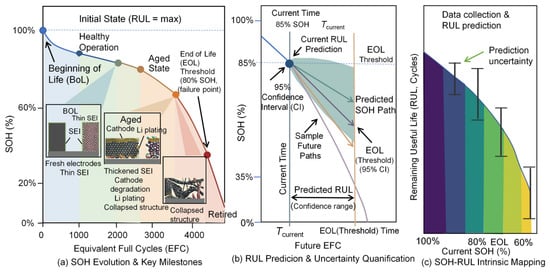
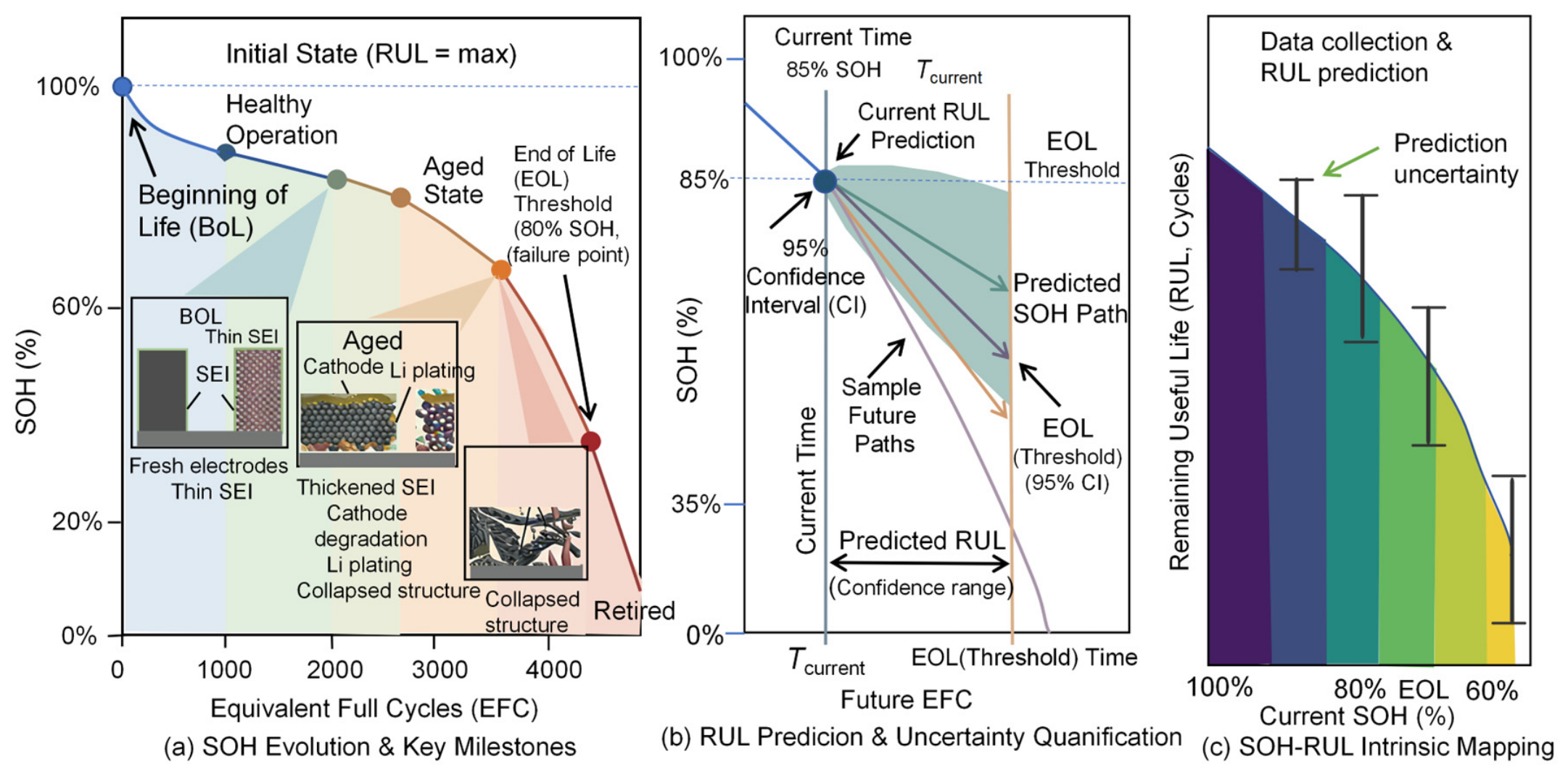
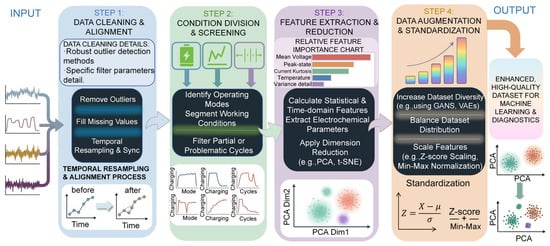
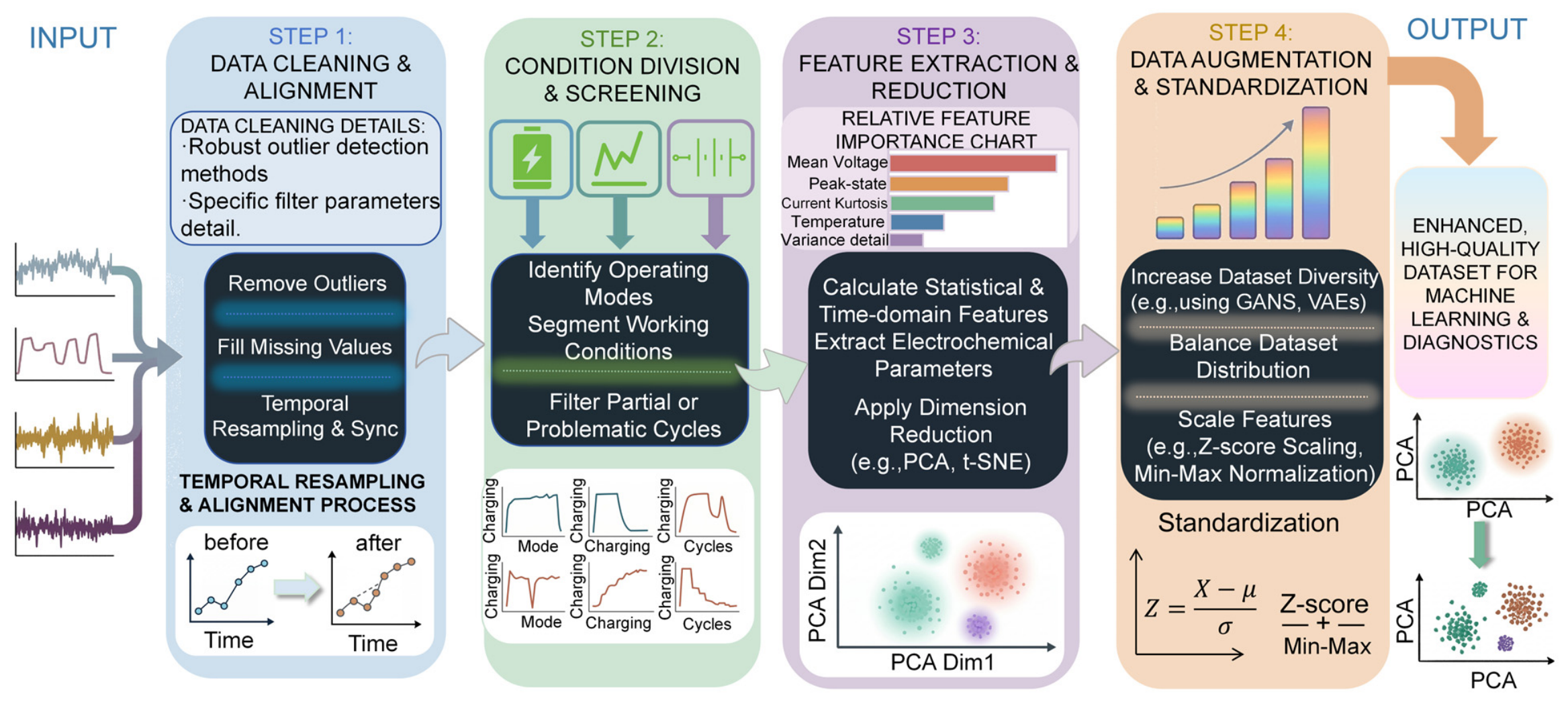
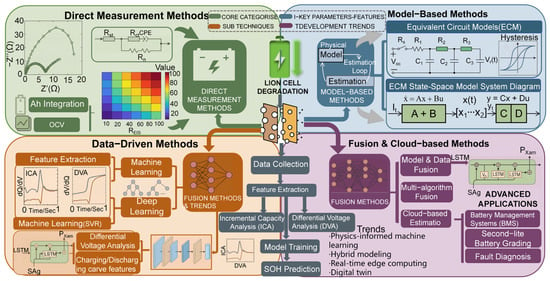
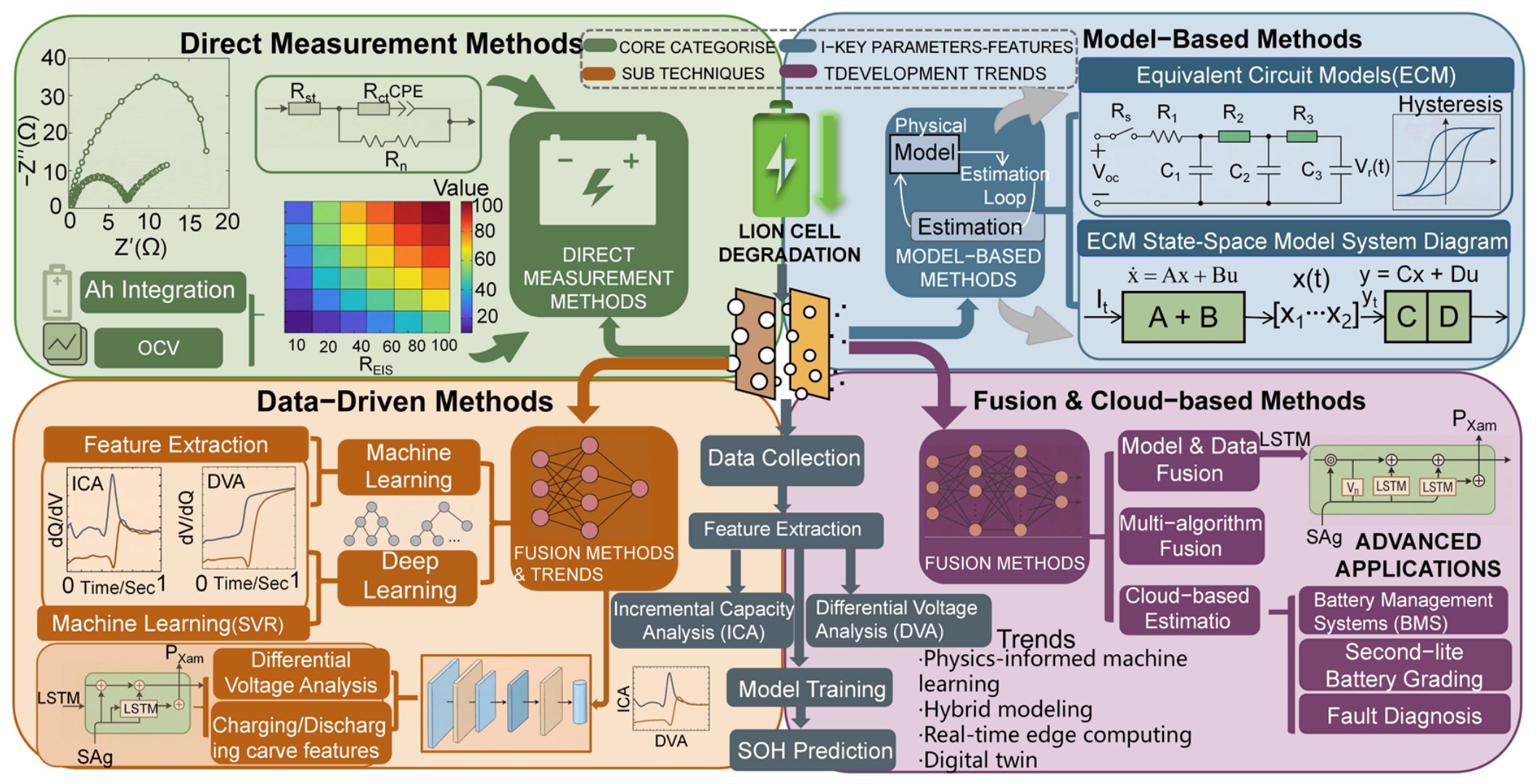
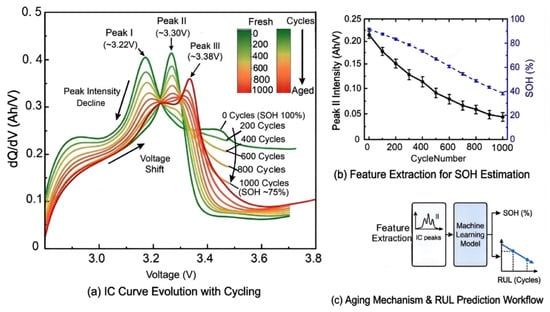
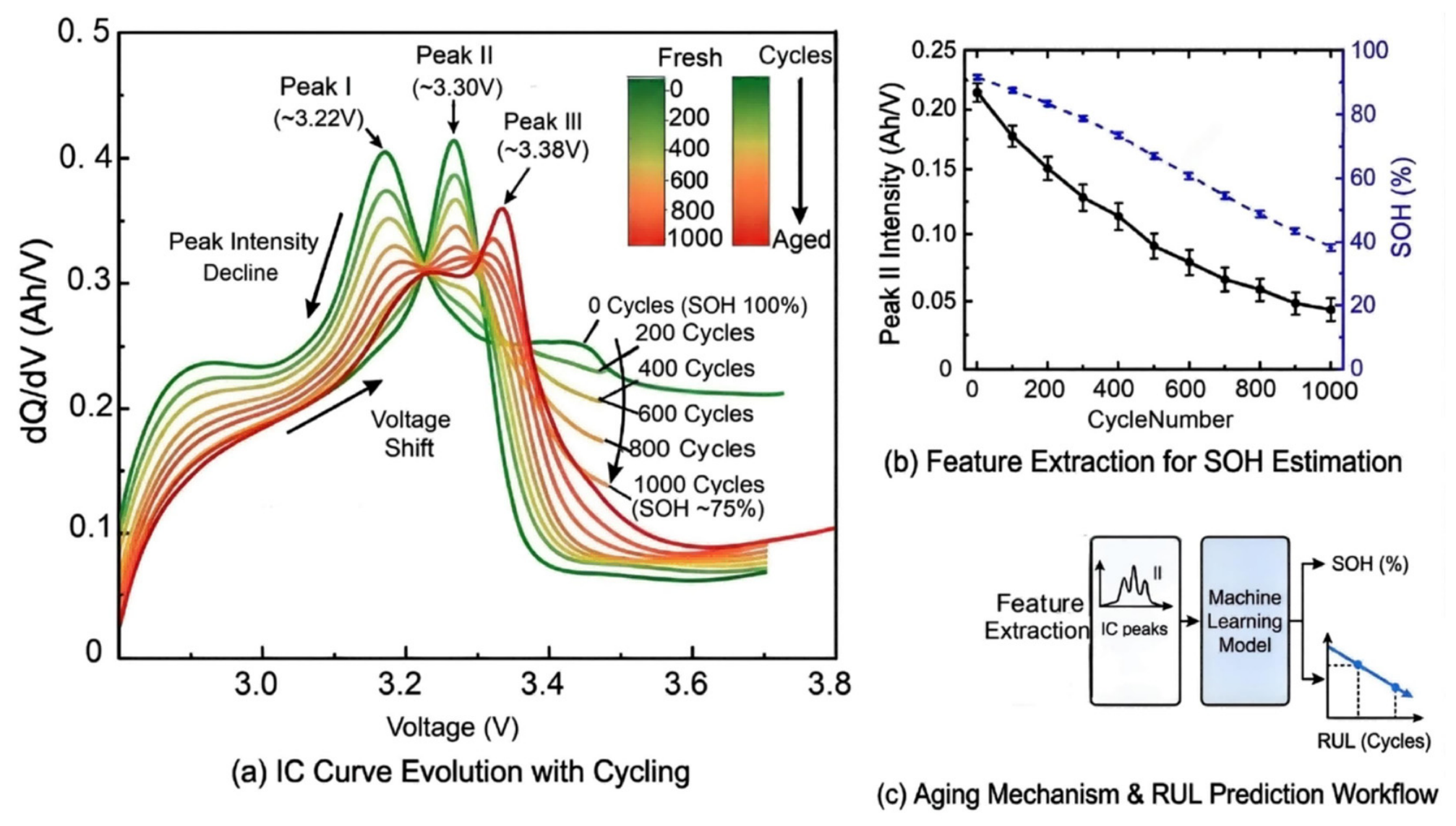
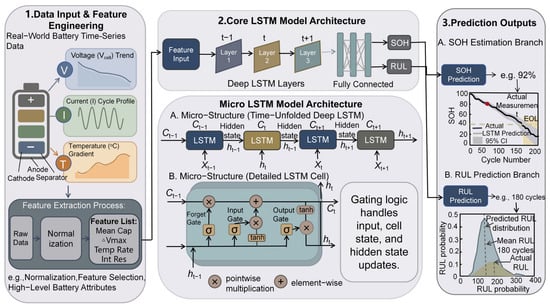
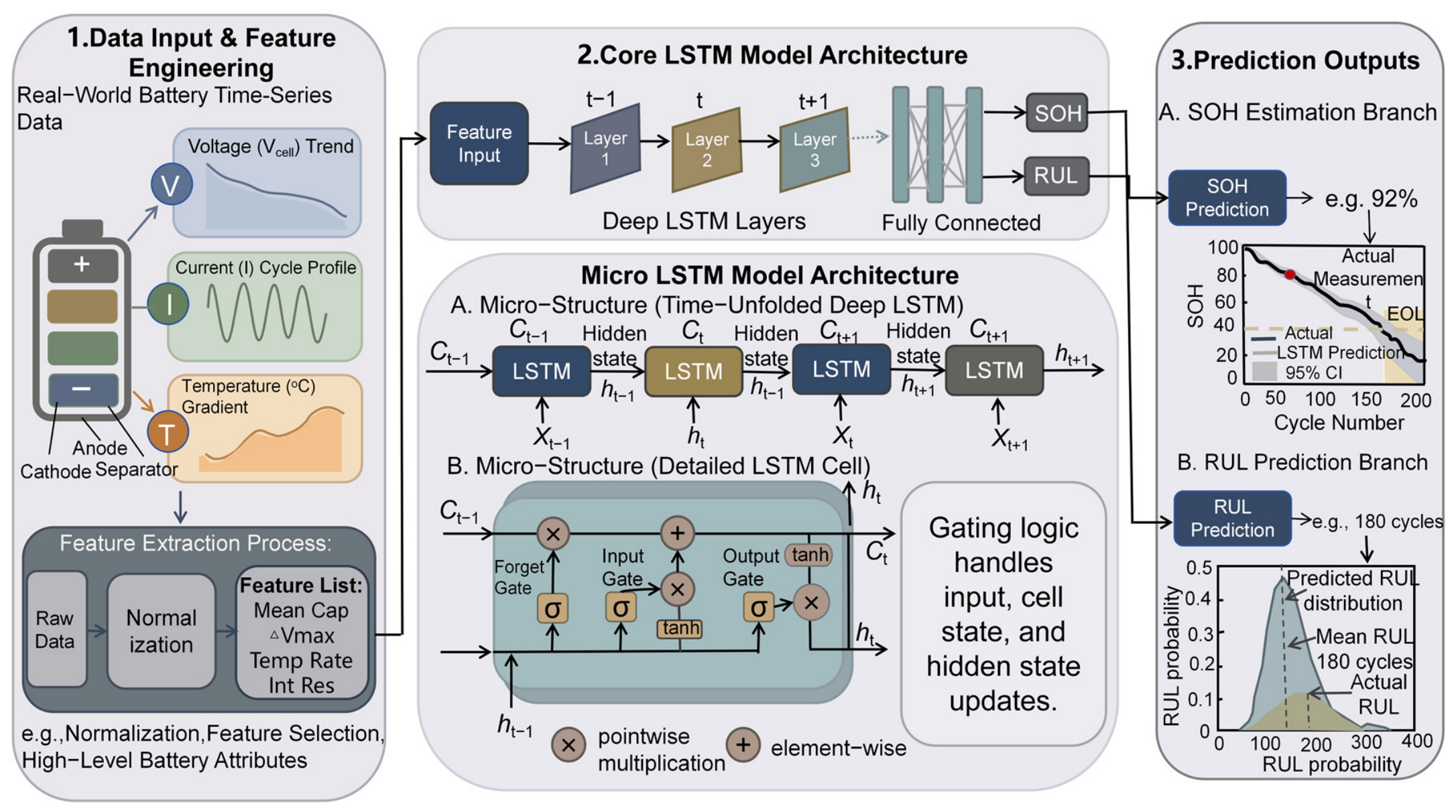
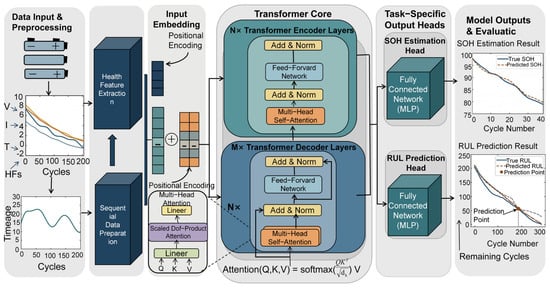
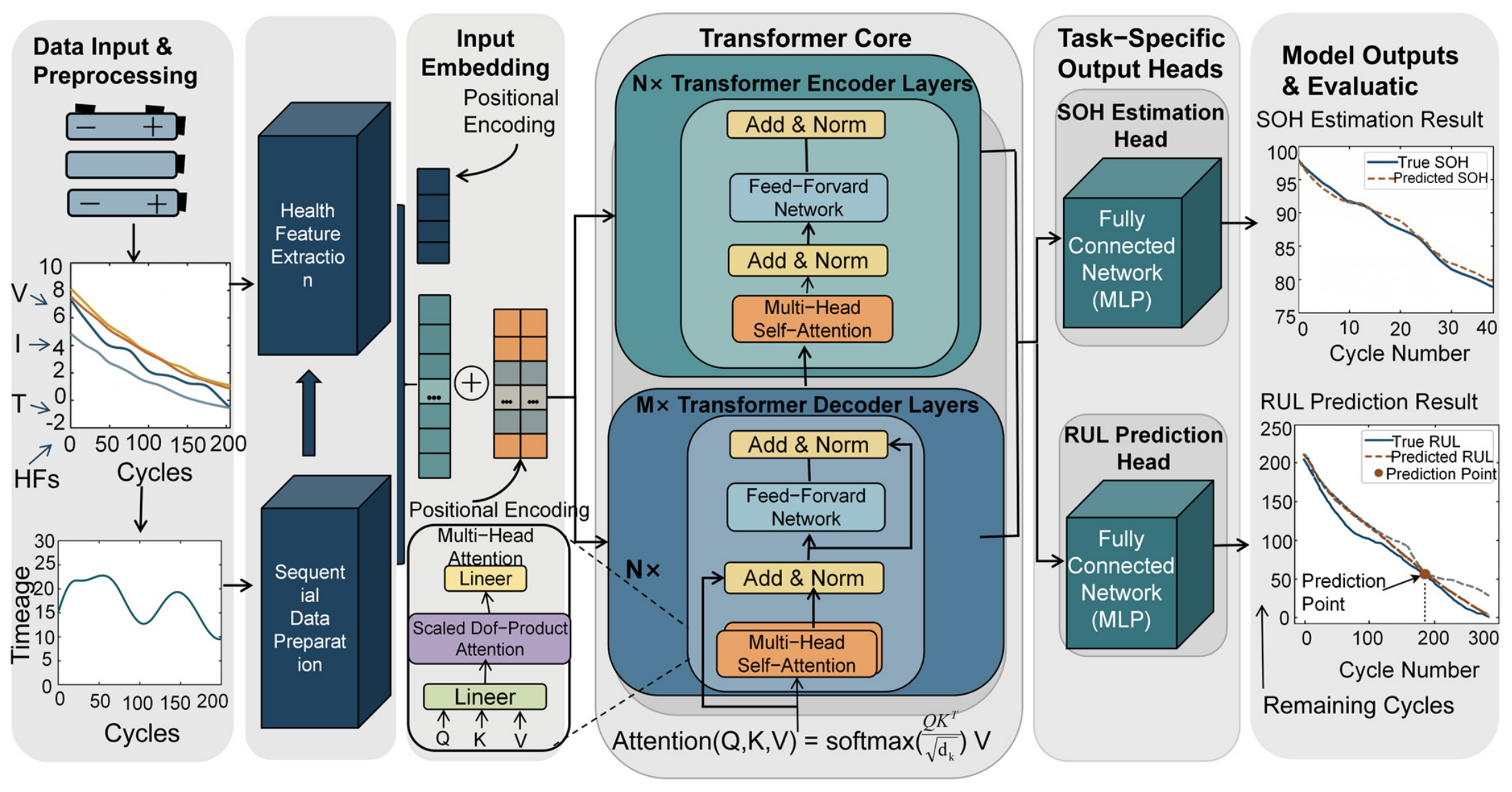
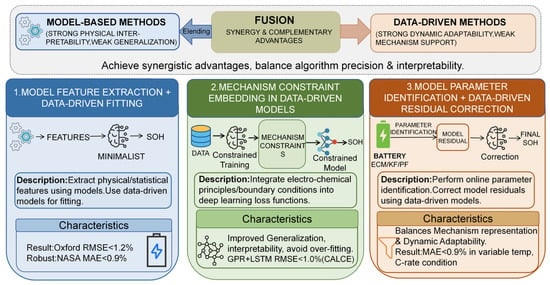
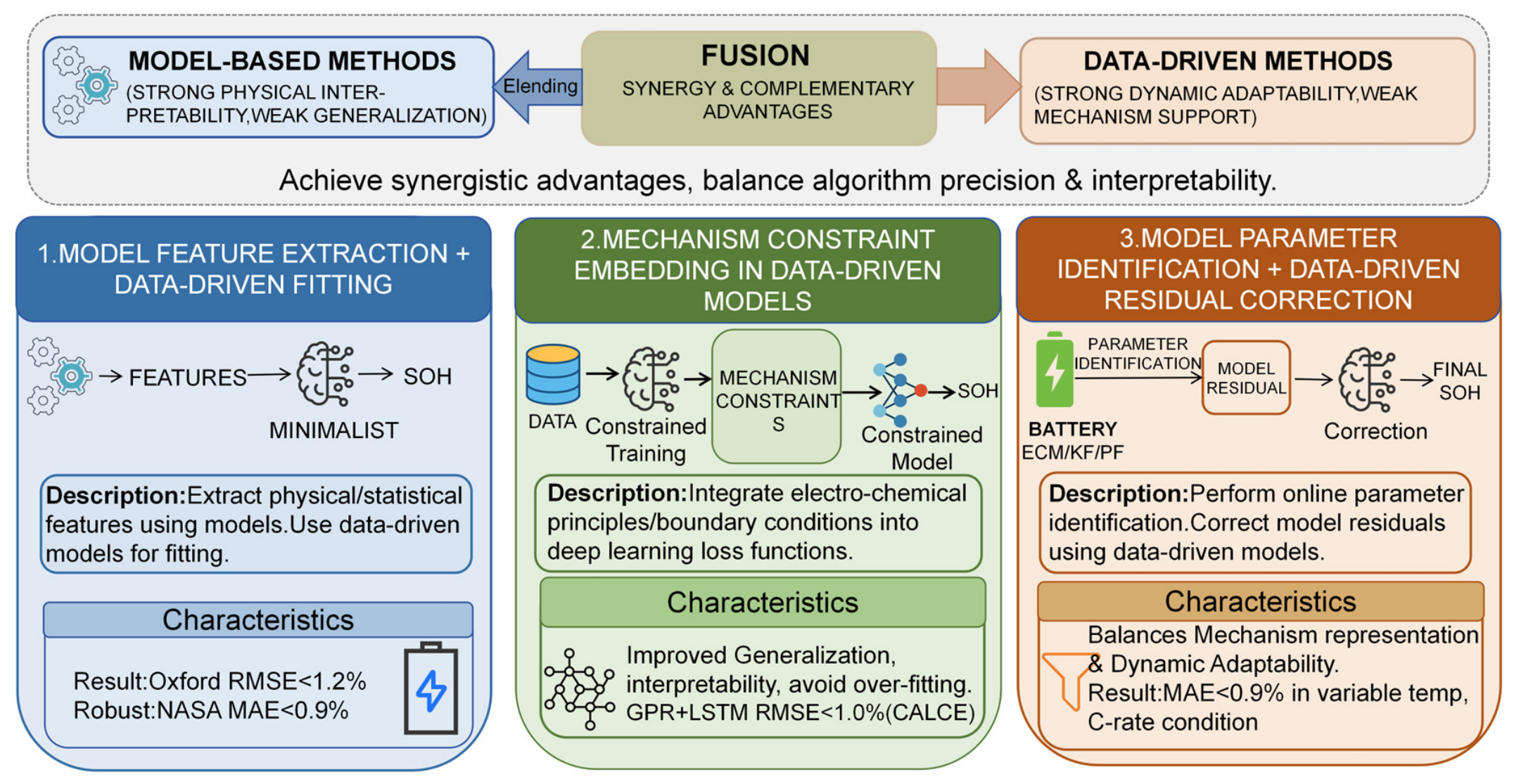
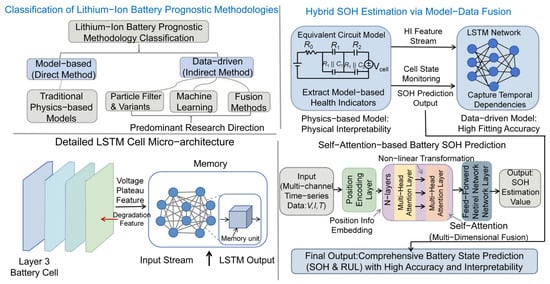
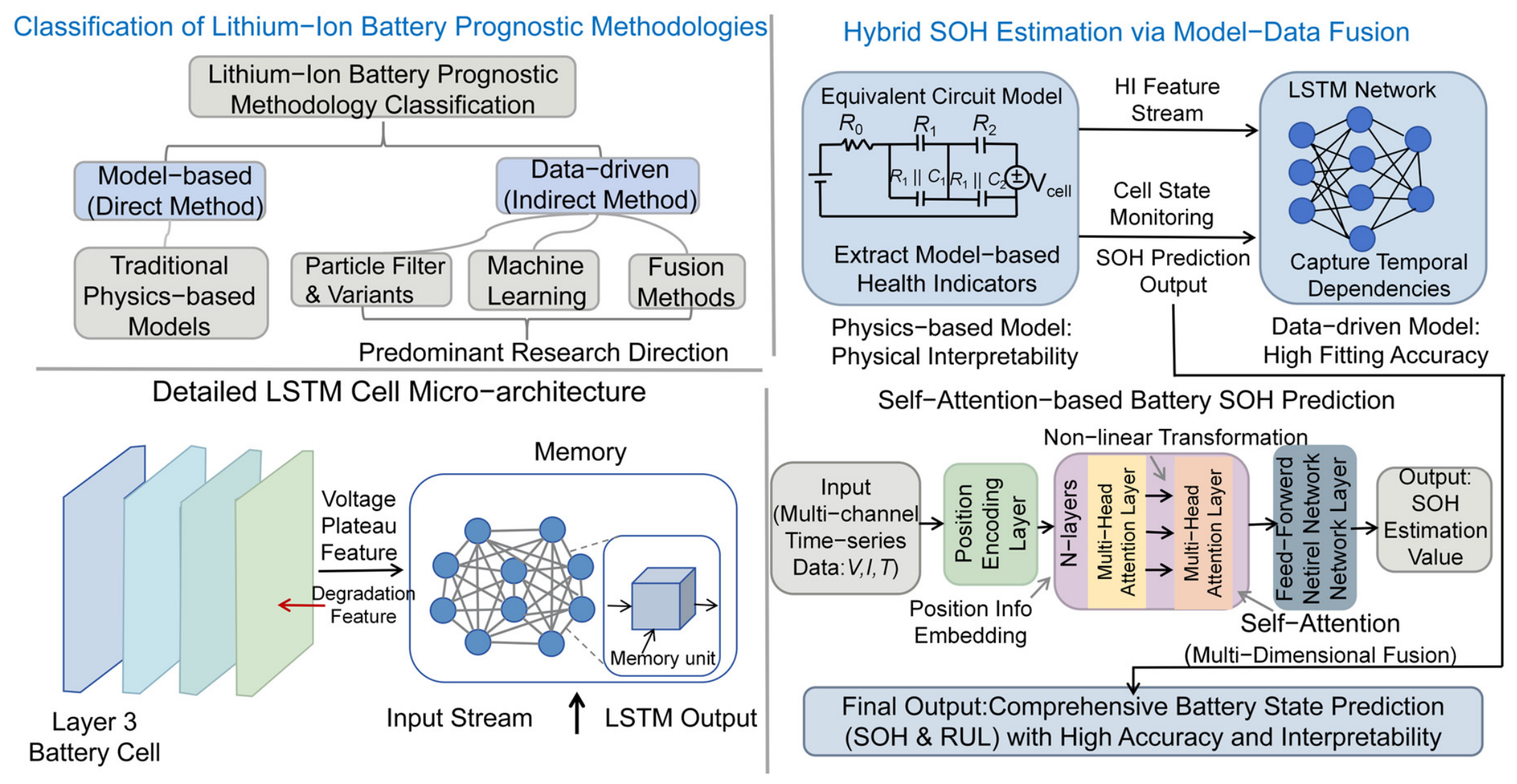
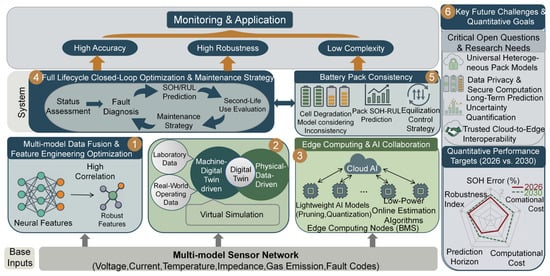
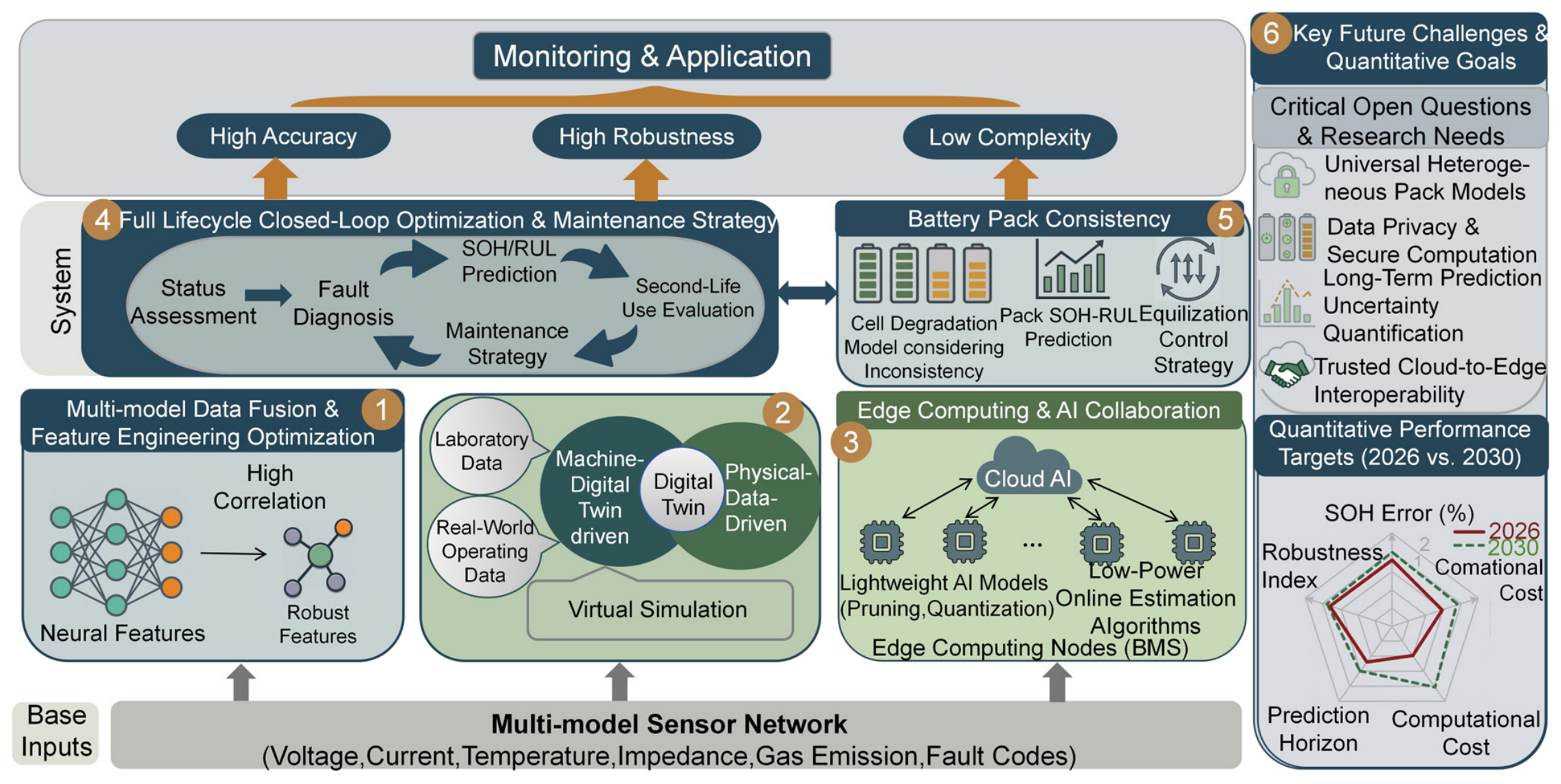

Disclaimer/Publisher’s Note: The statements, opinions and data contained in all publications are solely those of the individual author(s) and contributor(s) and not of MDPI and/or the editor(s). MDPI and/or the editor(s) disclaim responsibility for any injury to people or property resulting from any ideas, methods, instructions or products referred to in the content. |
© 2026 by the authors. Licensee MDPI, Basel, Switzerland. This article is an open access article distributed under the terms and conditions of the Creative Commons Attribution (CC BY) license.