


Abstract
The design and the synthesis of molecule-based crystalline salts made up of simple cationic and/or anionic building blocks with multiple, occasionally stimulus-responsive, chemical (host–guest, catalytic, acid–base, or redox) and physical (optical, magnetic, or conducting) properties constitute two major goals in inorganic, organic, organometallic, and coordination chemistries. A deep knowledge of the basic features of molecular and supramolecular interactions that occur in the solid state is needed to progress along these tasks to obtain new advanced multifunctional materials. Inspired by the outstanding research of several groups on magnetic molecular salts from the mid-1970s to the present day, this review offers a personal portrayal of the history of molecular magnetism and molecular electronics and its current evolution toward molecular spintronics and quantum computing. We focus on the well-known families of molecular salts based on paramagnetic tetrathiafulvalenium/tetraselenafulvalenium or tetracyanoethenide/tetracyanoquinodimethanide organic radicals, cyclopentadienide/cyclooctatetraenide metallocenium complexes, and polyhalide/polycyanide, porphyrin/phthalocyanine, oxalate/dithiooxalate, or dithiolene/dithiolate metal complexes with first-, second-, or third-row transition metal (nd, n = 3–5) and lanthanide (4f) ions. This old but evergreen class of magnetic molecular salts provides illustrative “textbook” examples of advanced multifunctional materials such as molecular magnets and conductors, molecular magnetic conductors, molecular nanomagnets, and molecular quantum bits with potential nanotechnological applications in quantum information storage and processing.
1. Introduction and Background
Molecular salts are unique examples of ordered crystalline materials built up from the solid-state self-assembly of cationic and anionic molecules, either inorganic, organic, organometallic, or metallo-organic ones (metal complexes) (Figure 1) [1,2,3,4,5,6,7,8,9,10,11,12,13,14,15,16,17,18,19,20,21,22,23,24,25,26,27,28,29,30,31,32,33,34,35,36,37,38,39,40,41,42,43,44,45,46,47,48,49,50,51,52]. When positively and negatively charged molecules approach each other to form ordered crystalline molecular salts, highly selective intermolecular interactions other than the purely electrostatic ones occur between the cationic and/or anionic building blocks [53,54,55,56,57,58]. The diversity of supramolecular non-covalent cation–cation, cation–anion, and anion–anion interactions determines the molecular and crystal structures of the resulting pure or mixed molecular salts and ultimately dictates their chemical and physical properties. These include hydrogen [59,60,61,62,63,64,65], halogen [66,67,68,69], and chalcogen bonding [70,71,72,73], as well as anion/cation–π [74,75,76], π–π [77,78,79], metallophilic [80], and metal–ligand coordinative interactions [81,82,83,84], depending on the nature of the cationic and anionic molecules.
Figure 1.
Illustration of the “melting pot” approach to pure (I–IV) and mixed (V–XVI) inorganic, organic, organometallic, and/or metallo-organic molecular salts.
The sustained advances in molecular and supramolecular sciences over the last three decades have provided us with a plethora of terms and concepts to describe the basic features of these intermolecular interactions in the solid state [85], and eventually to be able to design and synthesize tailor-made molecular salts with desired solid-state chemical (host–guest, catalytic, acid–base, or redox) and physical (porous, optical, magnetic, or conducting) properties [1,2,3,4,5,6,7,8,9,10,11,12,13,14,15,16,17,18,19,20,21,22,23,24,25,26,27,28,29,30,31,32,33,34,35,36,37,38,39,40,41,42,43,44,45,46,47,48,49,50,51,52]. Molecular salts then serve as the chemical “melting pot” for the design and synthesis of advanced multifunctional materials with potential applications in diverse fields of nanoscience and nanotechnology (Figure 2). These include the pharmaceutical industry and biomedicine [1,2,3,4,5,6,7,8,9,10], electrical energy storage [11,12,13,14,15,16,17,18,19], gas sorption, catalysis, luminescence sensing, selective ion transport, and proton conduction [20,21,22,23,24,25,26,27,28], as well as molecular magnetism and electronics [29,30,31,32,33,34,35,36,37], or molecular spintronics and quantum computing [38,39,40,41,42,43,44,45,46,47,48,49,50,51,52].
Figure 2.
Illustration of the molecular salts-based strategy for advanced multifunctional materials.
2. Aims and Scope
The present review aims to provide the readers with a historical perspective on inorganic, organic, organometallic, and/or coordination chemistry strategies to magnetic molecular salts as illustrative examples of advanced multifunctional materials. By placing the main discoveries on the magnetic and conducting properties of molecular salts in a historical context, we try to do justice to the work of the pioneers in the old but evergreen fields of molecular magnetism and electronics [86,87,88,89,90,91,92,93,94,95,96], and also to provide new insights into the recent advances on the spin dynamics and quantum coherence properties of molecular salts in the emerging fields of molecular spintronics and quantum computing [97,98,99,100,101,102,103,104,105,106,107,108,109,110,111,112,113,114,115,116,117]. In so doing, our aim is not to transcribe all the contributions in the area up to now, where excellent reviews from specialized researchers are known [29,30,31,32,33,34,35,36,37,38,39,40,41,42,43,44,45,46,47,48,49,50,51,52]. Instead, we focus on some selected innovative concepts and phenomena, together with a brief discussion of the magnetic molecular salts that brought them up.
The state-of-the-art of this “melting pot” approach will be illustrated by several well-known families of molecular salts based on organic (tetrathiafulvalenium/tetraselenafulvalenium and tetracyanoethenide/tetracyanoquinodimethanide radicals), organometallic (cyclopentadienide/cyclooctatetraenide metallocenium complexes), inorganic (polyhalide/polycyanide metal complexes), and metallo-organic building blocks (porphyrin/phthalocyanine, oxalate/dithiooxalate, and dithiolene/dithiolate metal complexes) (Scheme 1, Scheme 2, Scheme 3, Scheme 4, Scheme 5 and Scheme 6). Therefore, different combinations of them yield multifunctional materials with different properties, from molecular magnets and conductors to magnetic conductors on the one hand, and from molecular nanomagnets to quantum bits on the other hand.
Scheme 1.
Chemical structures of cationic tetrathiafulvalenium/tetraselenafulvalenium- (a) or anionic tetracyanoethenide/tetracyanoquinodimethanide-type (b) organic radicals as building units for advanced multifunctional materials based on magnetic molecular salts.
Scheme 2.
Chemical structures of cationic bis(cyclopentadienide)- (a) or anionic bis(cyclooctatetraenide)-type (b) mononuclear metallocenium complexes as building units for advanced multifunctional materials based on magnetic molecular salts.
Scheme 3.
Chemical structures of anionic polyhalide- (a) or polycyanide-type (b) mononuclear metal complexes as building units for advanced multifunctional materials based on magnetic molecular salts.
Scheme 4.
Chemical structures of cationic porphyrin- (a) or anionic phthalocyanine- and bis(phthalocyanine)-type (b) mononuclear metal complexes as building units for advanced multifunctional materials based on magnetic molecular salts.
Scheme 5.
Chemical structures of anionic bis(oxalate/dithiooxalate)- (a) or tris(oxalate/dithiooxalate)-type (b) mononuclear metal complexes as building units for advanced multifunctional materials based on magnetic molecular salts.
Scheme 6.
Chemical structures of anionic bis(dithiolene/dithiolate)- (a) or tris(dithiolene/dithiolate)-type (b) mononuclear metal complexes as building units for advanced multifunctional materials based on magnetic molecular salts.
3. From Molecular Magnets and Conductors to Magnetic Conductors
Purely organic and mixed organic/inorganic or organic/organometallic, charge-transfer molecular salts with tetracyanoethenide (TCNE)/tetracyanoquinodimethane (TCNQ) as electron acceptors (Scheme 1b) and either ferrocene ([Fe(Cp)2])/decamethylferrocene ([Fe(Me5Cp)2]) or tetrathiafulvalene (TTF)/tetraselenafulvalene (TSF) and their tetramethyl derivatives (Me4TTF/Me4TSF) as electron donors (Scheme 1a and Scheme 2a), offer unique examples of advanced multifunctional materials with interesting electron exchange (magnetic) or electron transport (electrical) properties [29,30,31].
3.1. Bis(Cyclopentadienide)Metallocenium Salts
On the one hand, Miller and Epstein reported the first insulating molecular magnets based on metallocenium salts of polycyanocarbon anion radicals of the formulas [Fe(Me5Cp)2](TCNE) and [Fe(Me5Cp)2](TCNQ) featuring mixed π-stacked columnar arrays of organometallic donors and organic acceptors (Figure 3) [118,119,120,121].
Figure 3.
Crystal structures of [Fe(Me5Cp)2](TCNQ) (a) and [Fe(Me5Cp)2](TCNE) (b) showing the mixed π-stacked columnar arrays of [Fe(Me5Cp)2]+ donor cations and TCNQ●− or TCNE●− radical anions, respectively. Adapted with permission from refs. [119,120].
A long-range ferromagnetic ordering occurs at 4.8 K in [Fe(Me5Cp)2](TCNE) [118], or alternatively, an antiferromagnetic to ferromagnetic (metamagnetic) transition occurs at 2.6 K in [Fe(Me5Cp)2](TCNQ) [121]. In each case, they result from the occurrence of moderate ferromagnetic intermolecular interactions between the [Fe(Me5Cp)2]+ and the TCNE●− or TCNQ●− radical units within the columnar stacks, together with weak either ferro- or antiferromagnetic intermolecular interactions between the columnar stacks, respectively, which are eventually due to spin polarization effects within the metallocenium complexes (Scheme 7) [86]. In fact, significant negative spin densities are found on the decamethylcyclopentadienide (Me5Cp−) rings, alongside the dominant positive spin density on the metal, as substantiated by nuclear magnetic resonance (NMR) studies. This spin polarization effects result from the contribution of an excited configuration of the [Fe(Me5Cp)2]+ cation where an electron is promoted from the π-type filled orbitals of the Me5Cp− rings to the π-type empty orbitals of the 3d5 FeIII ion in a low-spin (LS) electronic configuration (e1 and e1* orbitals, respectively, in Scheme 7a). Hence, the ferromagnetic interaction within the stacks is attributed to the coupling between the negative spin densities on the Me5Cp− rings and the positive spin densities on the adjacent TCNE●−/TCNQ●− radical anions (Scheme 7b). This targeted antiferromagnetic interaction between spin-polarized units of the opposite sign results in a net parallel alignment of the overall molecular magnetic moments, providing a powerful blueprint for designing molecular magnets.
Scheme 7.
Illustration of the spin polarization mechanism of the electron exchange in the pair of isomorphic ferrocenium charge-transfer salts with TCNE or TCNQ as electron acceptors (b), showing the simplified energy diagram for the splitting of the σ- and π-type orbitals of the LS 3d5 FeIII ion and the Me5Cp− rings from the [Fe(Me5Cp)2]+ cation (a). The closed and open arrows represent positive and negative spin densities at the FeIII ions and Me5Cp− rings, respectively, while the gray boxes indicate the overlapping regions between spin densities of opposite sign from the adjacent [Fe(Me5Cp)2]+ cations and TCNE●−/TCNQ●− radical anions. Adapted from ref. [86].
3.2. Tetrathiafulvalenium/Tetraselenafulvalenium Salts
On the other hand, one of the first molecular conductors was discovered simultaneously by Heeger and Perlstein based on the tetrathiafulvalenium radical salt with the tetracyanoquinodimethane radical anion of the formula (TTF)(TCNQ) [122,123,124,125]. It exhibits a metallic-to-semiconductor transition at 66 K. Some years later, the tetraselenafulvalenium radical salts with the hexafluorophosphate and perchlorate anions of the general formula (Me4TSF)2X (X = PF6− and ClO4−), so-called Bechgaard salts, were reported that exhibit a superconducting transition at 0.9 (PF6−) and 1.3 K (ClO4−), under a hydrostatic pressure of 12 kbar or at ambient pressure, respectively (Figure 4) [126,127].
Figure 4.
Crystal structures of (Me4TSF)2(PF6) (a) and (Me4TSF)2(ClO4) (b) showing the segregated layers of columnar stacks of Me4TSFn+ donor cations, with local charges (n) of 0 and +1, separated by octahedral PF6− or disordered tetrahedral ClO4− anions, respectively. Adapted with permission from refs. [126,127].
In each case, segregated columnar stacks of organic radical cations and anions come about in the solid state [123,126,127]. The partial electron charge transfer between the TTF/TTF●+ or Me4TSF/Me4TSF●+ units is responsible for the observed electrical conductivity or superconductivity, respectively, which eventually depends on the nature and strength of the intra- and intercolumnar X···X (X = S and Se) chalcogen contacts and π-π stacking interactions (Figure 4b). The origin of superconductivity upon replacing the sulfur atoms by selenium atoms in quasi one-dimensional Bechgaard salts is driven by Coulomb repulsions that prevent electrons from sitting on the same unit, disfavoring electron pairing in an insulating antiferromagnetic state, and spin fluctuations that bind electrons into Cooper pairs with a boson-like zero integer spin, suppressing electrical resistance in the superconducting state. The recent developments on the molecular and crystal engineering for these two related classes of purely organic and mixed organic/inorganic charge-transfer molecular salts have led to molecular superconductors with higher values of the critical temperature, and even conducting and superconducting molecular magnets [38,39,40,41,42,43].
3.3. Bis(Dithiolene/Dithiolate)Metalate Salts
Other relevant examples of molecular magnets and molecular conductors include mixed charge-transfer salts based on the well-known class of anionic mononuclear bis(dithiolene/dithiolate)metalate complexes with either inorganic or organic cations (Scheme 6a) [32,33,36]. This is exemplified by the series of “formally” nickel(III) charge-transfer salts of the parent ammonium and its alkylammonium derivatives of the general formula R4N[NiL2] [L = maleonitrile (mnt), 2-thione-1,3-dithiole-4,5-dithiolate (dmit), and 5,6-dihydro-1,4-dithiine-2,3-dithiolate (dddt); R = H, Me, Et, iPr, and nBu]. They consist of segregated layers of columnar stacks of paramagnetic square planar [NiL2]− anions separated by R4N+ cations with varying magnetic and/or conducting properties [128,129,130,131,132].
One of such materials is the ammonium bis(maleonitrile)nickel(III) salt of the formula H4N[Ni(mnt)2]·H2O reported by Kurmoo and Day (Figure 5), which behaves as an insulating molecular magnet with a ferromagnetic ordering at a critical temperature (Tc) of 4.5 K [129,130]. Interestingly, the ferromagnetic transition is suppressed under high pressures (Tc < 2.0 K at 6.8 kbar), indicating that the magnetic coupling between the [Ni(mnt)2]− anions is very sensitive to intermolecular interactions in the solid state. Based on theoretical calculations, the authors proposed that this dramatic pressure dependence of the long-range magnetic behavior arises from a competition between the intermolecular ferro- and antiferromagnetic couplings resulting from through-bond Ni–S coordinative and through-space Ni···Ni metallophilic interactions, respectively, within the stacks of [Ni(mnt)2]− anion complexes separated by H4N+ cations (Figure 5a,b) [128]. In contrast, the tetraethylammonium salt of the bis(5,6-dihydro-1,4-dithiine-2,3-dithiolate)nickel(III) complex of the formula Et4N[Ni(dddt)2] reported by Bereman and Hatfield behaves as a semiconducting molecular magnet with an antiferromagnetic ordering at 15 K, resulting from the moderate antiferromagnetic coupling between the [Ni(dddt)2]− anions within the columnar stack [131].
Figure 5.
Crystal structure of H4N[Ni(mnt)2]·H2O showing the segregated layers of columnar stacks of [Ni(mnt)2]− anions stabilized by intermolecular Ni–S (a) or Ni···Ni interactions (b) and separated by tetrahedral H4N+ cations. Adapted with permission from ref. [128].
By comparison, the tetraethylammonium salt of the bis(2-thione-1,3-dithiole-4,5-dithiolate)nickel(III) complex of the formula Et4N[Ni(dmit)2] reported by Reedijk behaves as a molecular semiconductor with a relatively low activation energy (Ea = 0.25 eV) [132]. The short intermolecular Ni···Ni, Ni···S, and S···S contacts within the columnar stack of [Ni(dmit)2]− anions give rise to a significant overlap between their highest occupied molecular orbitals (HOMOs), which is ultimately responsible for the observed conductivity properties.
3.4. Bis- and Tris(Oxalate/Dithiooxalate)Metalate Salts
Bellitto and Saito investigated the magnetic and conducting properties of a series of charge-transfer salts of TTF and related bis(ethylidenedithio)- (BEDT-TTF) or bis(ethylidenedioxy)tetrathiafulvalene (BEDO-TTF) derivatives with the anionic mononuclear bis(dithiooxalate)nickel(II), palladium(II), and platinum(II) complexes (Scheme 1a and Scheme 4a), but also with the respective oxidized copper(III) complex that constitutes an example of a molecular semiconductor [133,134]. Although the parent potassium(I) salts of this series of bis(dithiooxalate)metalate(II) complexes of the general formula K2[M(dto)2] are insulators, as evidenced by the very low electrical conductivity values at room temperature [σRT = 1 (Ni), 80 (Pd), and 0.6 nS cm−1 (Pt)], the corresponding ternary salt of the oxidized nickel(III) complex of the formula K2[M(dto)2]I was reported to show metallic conduction near room temperature (σ = 0.5–200 S cm−1) [135].
More recently, the structural, optical, and redox properties of the bis(dithiooxalate)nickel(II), palladium(II), and platinum(II) salts with the bulky benzyltriphenylphosphonium and tetraphenylarsonium organic cations have been re-investigated by Julve and Stiriba [136,137]. Unlike the aforementioned series of anionic mononuclear bis(dithiolene/dithiolate)metalate complexes of the general formula [ML2]2− (L = mnt, dddt, and dmit), the oxidation potential along this series of [M(dto)2]2− complexes was found to be very sensitive to the nature of the metal ion and decreases in the order M = Pd > Pt > Ni > Cu, favoring their oxidation while increasing their donor ability. Moreover, a spectroscopic–redox correlation is found between the formal potentials of the MIII/MII redox couple and the energies of the metal-to-ligand charge-transfer (MLCT) transition, which points to an important contribution from a d-d transition of the nd8 MII ion [n = 3 (Ni), 4 (Pd) and 5 (Pt)] in an LS electronic configuration, in agreement with earlier electronic structure calculations [138].
In this respect, Day’s group and others have been engaged on the investigation of charge-transfer salts of BEDT-TTF with the parent anionic mononuclear bis(oxalate)metalate(II) or tris(oxalate)metalate(III) complexes of the general formula (BEDT-TTF)4[M(ox)2] (M = Cu and Pt) and (BEDT-TTF)4(H3O)[M(ox)3]·PhX (M = Cr, Mn, Fe, Ga, and Rh; X = F, Cl, Br, I, CN, and NO2) for the design of molecular magnetic (super)conductors (Scheme 4a,b), where (super)conductivity and paramagnetism coexist [37,139,140,141,142,143,144,145,146]. Hence, (BEDT-TTF)4[Cu(ox)2] and (BEDT-TTF)4(H3O)[Fe(ox)3]·PhCN are the first examples of a molecular magnetic conductor and superconductor, respectively, exhibiting either a metallic-to-semiconductor transition at 65 K or a metallic-to-superconductor transition at 8.5 K (Figure 6) [140,144].
Figure 6.
Crystal structures of (BEDT-TTF)4[Cu(ox)2] (a) and (BEDT-TTF)4(H3O)[Fe(ox)3]·PhBr (b) showing the segregated layers of columnar stacks of BEDT-TTFn+ donor cations (left), with approximate local charges (n) of +1/2, separated by square or hexagonal layers of mononuclear bis(oxalate)cuprate(II) and tris(oxalate)metalate(III) anions (right), respectively. Adapted from ref. [37].
Both oxalate-based transition-metal charge-transfer salts show a segregated layer array of BEDT-TTF/BEDT-TTF●+ molecules with a β-type packing mode and numerous S···S contacts within and between adjacent columnar stacks that favor electron delocalization (Figure 6a,b, left) [141,146]. In (BEDT-TTF)4[Cu(ox)2], well-isolated paramagnetic square-planar [Cu(ox)2]2− anions (SCu = 1/2) are present within a square layer array with very large O···O contacts between the free carbonyl oxygen atoms from the oxalate ligands (Figure 6a, right) [141]. In contrast, a trigonal layer array of paramagnetic octahedral [Fe(ox)3]3− anions (SFe = 5/2) of alternating chirality occurs in (BEDT-TTF)4(H3O)[Fe(ox)3]·PhBr, each layer containing a single enantiomer (Δ or Λ) (Figure 6b, right) [146]. A dual (closed and open) hole size distribution occurs because of the weak O···O hydrogen bonding interactions of the free carbonyl oxygen atoms from the oxalate ligands with the H3O+ countercations occupying the small trigonal cavities, while the PhBr solvent molecules are located within the large trigonal cavities.
3.5. Tetra- and Hexahalometalate Salts
After the discovery of the Bechgaard salts with the diamagnetic tetrahedral and octahedral ClO4− and PF6− anions that behaved as molecular superconductors [126,127], it was natural to seek analogous examples with paramagnetic tetra- and hexahalometalates (Scheme 3a) [41]. Hence, the tetrathiafulvalenium- and tetraselenafulvalenium-type charge-transfer salts with the anionic mononuclear tetrahalometalate(II/III) complexes of the general formula Ax[MX4] (M = FeIII, MnII, CoII, NiII, and CuII with X = Cl and Br; A = Me4TTF, Me4TSF, and BEDT-TTF with x = 1–3) were first checked for the design of molecular magnetic superconductors (Scheme 3a) [147,148,149,150,151,152,153,154].
Although there are several S···Cl/Se···Cl contacts with the columnar stacks of cation radical Me4TTF●+/Me4TSF●+ units but with no significant S···S/Se···Se interactions between them, (Me4TTF)[FeCl4] and (Me4TSF)[FeCl4] behave as molecular semiconductors with rather well-isolated paramagnetic tetrahedral [FeCl4]− anions [147,148,150,151]. By contrast, (BEDT-TTF)2[FeCl4] consists of dimerized columnar stacks of neutral BEDT-TTF and cation radical BEDT-TTF●+ units with short S···S contacts and separated by layers of [FeCl4]− anions in close contact with their terminal ethylene groups [149]. This tetrachloroferrate(III) charge-transfer salt is a true molecular magnetic conductor with a metallic-to-insulating transition around 20 K, which was likely attributed to the presence of weak antiferromagnetic exchange interactions between the tetrahedral high-spin (HS) 3d5 FeIII (SFe = 5/2) ions through the conducting electrons.
Otherwise, being metallic down to at least 400 mK, the monohydrate derivative (BEDT-TTF)3[CuCl4]·H2O is a good prototype to study the interaction between localized and conducting electrons, referred to as the Ruderman–Kittel–Kasuya–Yosida (RKKY) interaction [41]. In this tetrachlorocuprate(II) charge-transfer salt, weak ferromagnetic exchange interactions between the flattened tetrahedral 3d9 CuII (SCu = 1/2) ions through the conducting electrons of the layers of trimerized neutral BEDT-TTF and cation radical BEDT-TTF●+ units were proposed, as anticipated by the RKKY model (Figure 7a) [152]. However, other exchange pathways cannot be discarded within the layers of [CuCl4]2− anions, given the formation of copper(II) dimers bridged by hydrogen-bonded water molecules with short O···Cl distances. By contrast, the anhydrous derivative (BEDT-TTF)3[CuBr4] exhibits a semimetallic behavior with a long-range antiferromagnetic transition at 8 K resulting from the significant antiferromagnetic exchange interactions between the square planar CuII ions, as expected for Jahn–Teller 3d9 ions, through the conducting electrons of the layers built from one neutral BEDT-TTF and two cation radical BEDT-TTF●+ units (Figure 7b) [153,154].
Figure 7.
Crystal structures of (BEDT-TTF)3[CuCl4]·H2O (a) and (BEDT-TTF)3[CuBr4] (b) showing the segregated layers of columnar stacks of BEDT-TTFn+ donor cations, with local charges (n) of 0 and +1, separated by layers of flattened tetrahedral or square planar mononuclear tetrahalocuprate(II) anions, respectively. Adapted with permission from refs. [152,153].
On the other hand, the tetrathiafulvalenium-type charge-transfer salts with the anionic mononuclear hexahalometalate(IV) complexes of the general formula Ax[MX6] (M = ReIV and IrIV with X = Cl; A = BEDT-TTF and Me2BDT-TTF with x = 2 and 4) were also checked for the design of molecular magnetic superconductors (Scheme 3a) [155,156]. The benzonitrile solvate derivative (BEDT-TTF)4[ReCl6]·PhCN consists of layers of neutral BEDT-TTF and cation radical BEDT-TTF●+ units on segregated columnar stacks, while (BEDT-TTF)2[IrCl6] shows a three-dimensional network of [BEDT-TTF●+]2 dimeric entities [155]. However, these hexachlororhenate(IV) and iridiate(IV) charge-transfer salts of BEDT-TTF are both semiconductors with rather well-isolated paramagnetic octahedral HS 5d3 ReIV (SRe = 3/2) and LS 5d5 IrIV (SIr = 1/2) ions, respectively.
More recently, Martínez-Lillo and Avarvari investigated the magnetic and conducting properties of a related enantiomeric pair of hexachlororhenate(IV) charge-transfer salts with asymmetric chiral (R,R)- and (S,S)-dimethylbis(ethylenedithio)tetrathiafulvalene of the formula [(R,R)-Me2BEDT-TTF]4[ReCl6] and [(S,S)-Me2BEDT-TTF]4[ReCl6] (Scheme 1a) [156]. This isostructural enantiomeric pair consists of segregated layers of columnar stacks of chiral (R,R)- or (S,S)-Me2BEDT-TTFn+ units (n = 0, 1/2, and 1) separated by [ReCl6]2− anions that interact with their terminal ethylene groups through very weak C–H···Cl hydrogen bonds (Figure 8).
Figure 8.
Crystal structure of [(S,S)- Me2BEDT-TTF]4[ReCl6] showing the segregated layers of columnar stacks of chiral Me2BEDT-TTFn+ donor cations, with approximate local charges (n) of +1 (A), +1/2 (C and D), and 0 (B), separated by mononuclear hexachlororhenate(IV) anions. The dashed lines represent the weak hydrogen bonding C–H···Cl interactions. Adapted with permission from ref. [156].
This enantiomeric pair of hexachlororhenate(IV) charge-transfer salts of Me2BEDT-TTF are semiconductors with rather well-isolated, magnetically anisotropic octahedral [ReCl6]2− anions, in agreement with the band-structure calculations (Scheme 8) [156]. Within each layer, the relative magnitude of the intra- and interstack S···S chalcogen bonding interactions between the different Me2BEDT-TTFn+ units, with approximate local charges (n) of +1 (A), +1/2 (C and D), and 0 (B), leads to cationic C-A-D trimeric entities and neutral B units (Scheme 8a). Thus, the HOMO (B) interacts only weakly with the resulting HOMO (C-A-D), mainly built from HOMO (A) with a smaller contribution from HOMO (C) and HOMO (D), slightly destabilizing it (Scheme 8b). This situation leads to an empty conduction band sufficiently close to the valence band, which would eventually explain the observed semiconductive behavior, with a calculated band gap of approximately 0.1 eV similar to the experimentally estimated activation energy (Ea = 1550 K ≡ 0.133 eV). Additionally, due to the high octahedral (Oh) molecular symmetry of the ReIV ion (SRe = 3/2), both salts possess a moderate-to-weak, negative axial magnetic anisotropy (DRe = −4.5 cm−1). Thus, the energy gap between the ground MS = ±3/2 and excited MS = ±1/2 Kramers doublets is small but non-negligible (ΔE = 2|DRe| = 9.0 cm−1), which would be ultimately responsible for the expected slow magnetic relaxation (SMR) behavior (vide infra).
Scheme 8.
Illustration of the orbital mechanism of the electron transport in the pair of isostructural enantiomeric hexachlororhenate(IV) charge-transfer salts of chiral (R,R)- and (S,S)- Me2BEDT-TTFn+ donor cations with approximate local charges (n) of +1 (A), +1/2 (C and D) and 0 (B) (b), showing the adjacent columnar stacks of Me2BEDT-TTFn+ units within each layer (a). The solid and dashed lines represent strong and medium interstack chalcogen bonding S···S interactions, respectively. Adapted with permission from ref. [156].
Furthermore, the introduction of chirality could lead to multifunctional molecular salts that exhibit magneto-chiral dichroism (MChD) effects arising from the combination of molecular magnetism and optical activity [157,158]. In this respect, spectacular achievements have been recently reported concerning the combination of chirality with molecular nanomagnetism leading to an MChD-based optical readout in the near-infrared (NIR) range for future applications in optical communication technologies at telecom wavelengths [158].
3.6. Tetra- and Hexacyanidemetalate Salts
In the search of molecular magnetic conductors, other mononuclear complex anions, both tetrahedral and octahedral, with pseudohalide ligands such as cyanide, have been incorporated into charge-transfer salts of tetrathiafulvalenium and its derivatives (Scheme 3b) [41,159,160,161,162].
The structural, optical, and conducting properties of the charge-transfer salts with square planar mononuclear tetracyanonickelate(II) and platinate(II) complexes of the general formula Ax[M(CN)4] (M = Ni and Pt; A = TTF, Me4TTF, Me4TSF, and BEDT-TTF with x = 2–4) were first investigated by Ouhab’s group for the design of molecular conductors (Scheme 3b) [159,160]. Although the acetonitrile solvate of the tetracyanoplatinate(II) charge-transfer salt of the parent TTF of the formula (TTF)5[Pt(CN)4]2·2MeCN was an insulator, the three other isomorphic series of unsolvated charge-transfer salts of the Me4TTF, Me4TSF, and BEDT-TTF derivatives were semiconductors near room temperature (σ = 0.25–12 S cm−1), regardless of the nature of the diamagnetic LS nd8 MII ion (SM = 0) in the [M(CN)4]2− acceptor anions or the An+ donor cations.
Ouahab’s group then reported the two isomorphic series of binary and ternary charge-transfer salts of BEDT-TTF with the octahedral mononuclear hexacyanoferrate(II), cobaltate(III), and chromate(III) complexes of the general formula (BEDT-TTF)5[M(CN)6]·10H2O and (Et4N)(BEDT-TTF)4[M(CN)6]·3H2O (M = Fe, Co, and Cr) for the design of molecular magnetic conductors (Scheme 3b) [162]. Both series show alternating segregated layers of [M(CN)6]3− acceptor anions and BEDT-TTFn+ donor cations, with additional disordered Et4N+ countercations and crystallization water molecules (Figure 9). However, (BEDT-TTF)5[M(CN)6]·10H2O (M = Fe and Co) have a β-packing mode of the BEDT-TTFn+ units (Figure 9a), while (Et4N)(BEDT-TTF)4[M(CN)6]·3H2O (M = Fe, Co, and Cr) possess a κ-packing mode instead (Figure 9b). Nevertheless, they are both reported to be semiconductors at room temperature (σRT = 0.02–10 S cm−1), regardless of the diamagnetic or paramagnetic nature of the LS MIII ion [SM = 0 (Co), 1/2 (Fe), and 3/2 (Cr)] in the [M(CN)6]3− acceptor anions, with no evidence of cooperative magnetic properties or any interaction between conducting and magnetic properties in the latter case.
Figure 9.
Crystal structures of (BEDT-TTF)5[Fe(CN)6]·10H2O (a) and (Et4N)(BEDT-TTF)4[Fe(CN)6]·3H2O (b) showing the segregated layers of columnar stacks of BEDT-TTFn+ donor cations, with β- and κ-packing mode, respectively, separated by layers of octahedral mononuclear hexacyanoferrate(III) anions, respectively. Adapted with permission from ref. [162].
3.7. Phthalocyaninemetalate Salts
More recently, Inabe and Hanasaki have systematically investigated the tetraphenylphosphonium salts of the partially oxidized, anionic mononuclear (phthalocyanine)cobalt(III), iron(III), and chromium(III) complexes featuring two cyanide axial coligands of the general formula Ph4P[M(PC)(CN)2]2 (M = Co, Fe, and Cr) as new examples of molecular magnetic conductors (Scheme 4b) [163,164,165,166,167,168,169,170]. This isostructural series of axially cyanide-coordinated octahedral (phthalocyanine/phthalocyanine radical)metalate(III) salts forms segregated columnar stacks of Ph4P+ cations and mononuclear phthalocyanine metal units, [Co(PC)(CN)2]1/2−, with slipped π-π stacking interactions between the adjacent closed-shell PC2− and open-shell radical PC●− forms (Figure 10) [164]. In this scenario, the magnetic exchange interactions between the delocalized electrons of the π(PC) ligand system and the localized ones of the 3d(M) ions are maximized [163].
Figure 10.
Crystal structure of Ph4P[Co(PC)(CN)2]2 showing the anionic slipped π-stacked chain of mononuclear phthalocyanine/phthalocyanine radical cobalt(III) units (a) and the segregated columnar stacks of Ph4P+ cations and [Co(PC)(CN)2]1/2− anions (b). Adapted with permission from ref. [164].
Interestingly, this family of molecular magnetic conductors exhibit different magnetic, conducting, and magneto-transport properties depending on the diamagnetic or paramagnetic nature of the LS MIII ion and, eventually, on the distinct nature of the magnetic orbitals that are involved in each case (Scheme 9) [163]. Hence, all three salts exhibit a thermally activated semiconducting behavior with comparable room-temperature resistivity, regardless of the nature of the metal ion. Yet, a dramatically larger resistivity enhancement occurs upon cooling (reflecting a significant increase in the activation energy) when replacing the diamagnetic LS 3d6 CoIII ion (SCo = 0) with magnetically anisotropic LS 3d5 FeIII (SFe = 1/2) and isotropic 3d3 CrIII ions (SCr = 3/2) along this series [164,165,167].
Scheme 9.
Simplified energy diagram for the splitting of the 3d-type metal orbitals in the family of axially cyanide-coordinated (phthalocyanine)metalate(III) salts with octahedral 3d3 CrIII (a), LS 3d5 FeIII (b), and LS 3d6 CoIII ions (c), showing the relative population of the t2g-type magnetic orbitals. Adapted from ref. [163].
Unlike the cobalt(III)-phthalocyanine salt that shows normal positive magnetoresistance [164], the iron(III) and chromium(III) derivatives exhibit negative giant magnetoresistance (GMR) effects [166,169]. In both cases, there is an important reduction in the resistivity with increasing the applied magnetic field, so that larger magnetoresistance ratios are observed for the iron(III)- and chromium(III)-phthalocyanine salts at lower and higher magnetic fields, respectively. The unique negative GMR along this family is attributed to the opposite effects of the strong ferromagnetic π(PC)-d(M) (Jπd > 0) and weak to moderate antiferromagnetic d(M)-d(M) interactions (Jdd < 0), respectively, within and between the mononuclear phthalocyanine metal units along each columnar stack (Scheme 10). Hence, the application of an external magnetic field aligns in a ferromagnetic-like (parallel) manner the localized d(M) spins, facilitating the hopping of the π(PC) electrons between neighboring units by decreasing the intersite Coulomb repulsive interaction, and ultimately leading to the reduction in the electrical resistance. This is further evidenced by magnetic dilution effects in the mixed iron(III)- and chromium(III)/cobalt(III)-phthalocyanine salts of the general formula Ph4P[MxCo1−x(PC)(CN)2]2 (M = Fe and Cr) [168,170]. They show the onset of a long-range ferrimagnetic order with a spontaneous magnetization in the FexCo1−x system for x < 1 [170], in contrast to the antiferromagnetic order found in the pure Fe salt (x = 1) [165].
Scheme 10.
Illustration of the orbital mechanism of the electron transport in the pair of axially cyanide-coordinated (phthalocyanine)ferrate(III) and chromate(III) salts upon application of a magnetic field, showing the field-induced antiferro- to ferromagnetic switching of the d(M)-d(M) electron exchange interaction. Adapted from ref. [163].
4. From Molecular Nanomagnets to Quantum Bits
4.1. Bis(Phthalocyanine)Metalate Salts
The discovery by Ishikawa in 2003 of SMR and magnetic hysteresis from a purely molecular origin at very low temperatures (just above that of He liquefaction) in the tetra-n-butylammonium salts of the anionic mononuclear bis(phthalocyanine)terbium(III) and dysprosium(III) complexes of the general formula nBu4N[Ln(PC)2] (Ln = Tb and Dy) was a milestone in the field of molecular magnetism (Scheme 4b) [171,172,173,174,175,176]. These unique SMR effects were associated with their highly anisotropic ground states (JTb = 6 and JDy = 15/2) resulting from the spin–orbit coupling (SOC) of the 4f8 TbIII (7F6 term, with STb = 3 and LTb = 3) and 4f9 DyIII ions (6H15/2 term, with SDy = 5/2 and LDy = 5). In each case, the ligand field (LF) effects cause the splitting of the thirteen components of the non-Kramers TbIII ion into one singlet and six doublets (MJ = 0, ±1, ±2, ±3, ±4, ±5 and ±6) or, alternatively, the sixteen components of the Kramers DyIII ion into eight doublets (MJ = ±1/2, ±3/2, ±5/2, ±7/2, ±9/2, ±11/2, ±13/2, and ±15/2), which are ultimately responsible for the high local magnetic anisotropy of these LnIII ions (Scheme 11). Since then, significant advances have been achieved in the search for molecular nanomagnets incorporating a single metal ion, so-called single-ion magnets (SIMs) [48].
Scheme 11.
Simplified energy diagram for the pair of bis(phthalocyanine)terbium(III) and dysprosium(III) salts, showing the splitting of the corresponding JTb = 6 and JDy =15/2 ground states of the TbIII and DyIII ions. Adapted from ref. [171].
4.2. Bis(Cyclopentadienide/Cyclooctatetraenide)Metallocenium Salts
More recently, SIMs based on diverse inorganic or organic salts of cationic or anionic, mononuclear bis(cyclopentadienide)- and bis(cyclooctatetraenide)terbium(III), erbium(III), and dysprosium(III) complexes (Scheme 2a,b) have been reported displaying very large effective energy barriers for magnetization reversal (Ueff) and reaching strategically relevant magnetization blocking temperatures (Tb) up to that of N2 liquefaction [177,178,179,180,181,182,183,184,185].
In some cases, the sandwich-type lanthanide(III) metallocenium cations with the permethylated cyclopentadienide anion (Me5Cp−) tend to show equatorial coordinative interactions with the tetraphenylborate counteranions due to their mainly ionic bonding and the large size of the LnIII ions leading to neutral molecules (Figure 11a) [180,181]. Yet, some examples of dysprosium(III) metallocenium salts with a varying number of bulky iso-propyl or tert-butyl substituents at the cyclopentadienide anion (XnCp with X = iPr or tBu and n = 3 or 5) and the non-coordinating perfluoro derivative of the tetraphenylborate anion have been reported that show no equatorial cation–anion interactions (Figure 11b) [182,183].
Figure 11.
Crystal structures of [Dy(Me5Cp)2]BPh4 (a) and [Dy(1,2,4-tBu3Cp)2]B(C6F5)4 (b). The equatorial coordinative interactions between the [Dy(Me5Cp)2]+ cations and the BPh4− anions are shown as dashed lines. Adapted from refs. [180,182].
This class of genuine molecular salts has provided remarkable examples of high-temperature Ln SIMs with Tb values from 60 up to 80 K, as for the homoleptic and heteroleptic dysprosium(III) metallocenium salts of the formulas [Dy(1,2,4-tBu3Cp)2]B(C6F5)4 and [Dy(Me5Cp)(iPr5Cp)]B(C6F5)4 [182,183]. In fact, they possess Ueff values as high as 1223 and 1541 cm−1, respectively, which are eventually due to the large magnetic anisotropy of the DyIII ion with such a low molecular symmetry. By comparison, the aforementioned anionic mononuclear bis(phthalocyanine)terbium(III) and dysprosium(III) complexes nBu4N[Ln(PC)2] possess relatively lower effective energy barriers for magnetization reversal [Ueff = 230 (Ln = Tb) and 28 cm−1 (Ln = Dy)] [171]. The final goal in this area is to use of these Ln SIMs as prototypes of spin-based quantum bits (qubits) for their practical applications in the development of future quantum computers, provided that the Tb values would be sufficiently high enough to reach room temperature [44,45,46,47,48,49,50,51,52].
Nevertheless, the coordination chemistry of first-, second-, or third-row transition metal ions (nd, n = 3–5) still remains a good alternative to organolanthanide chemistry in the race toward high-temperature SIMs as candidates of spin-based qubits operating at room temperature [186,187,188,189,190,191,192,193,194,195,196,197,198,199,200,201,202,203,204,205,206,207].
4.3. Porphyrinmetalate Salts
In the presence of an applied magnetic field, SMR effects at low temperatures have been observed by Cano for the perchlorate salts of the related mononuclear manganese(III)- and iron(III)-meso-tetraphenylporphyrin (TPP) complexes with 3,5-dimethylpyridine N-oxide (3,5-Me2pyNO) and aqua as axial coligands, respectively, of the general formula [M(TPP)L2]ClO4 [M = Mn (L = 3,5-Me2pyNO) and Fe (L = H2O)] (Scheme 4a) [186,187]. In each case, weak hydrogen bonding interactions occur between the perchlorate anions and the columnar stacks of [M(TPP)L2]+ cations involving the axially coordinated L coligands (Figure 12).
Figure 12.
Crystal structures of [Mn(TPP)(3,5-Me2pyNO)2]ClO4 (a) and [Fe(TPP)(H2O)2]ClO4 (b). The hydrogen bonding interactions between the [Mn(TPP)(3,5-Me2pyNO)2]+ and [Fe(TPP)(H2O)2]+ cations and the ClO4− anions are shown as dashed lines. Adapted from refs. [186,187].
These unique examples of field-induced SIMs with low effective energy barriers for magnetization reversal [Ueff = 15.3–15.6 (M = Mn) and 11.6–19.0 cm−1 (M = Fe) for H = 0.05–0.4 T] feature octahedral HS 3d4 MnIII (SMn = 2) and 3d5 FeIII (SFe = 5/2) ions with moderately large axial magnetic anisotropies, either negative (DMn = −3.8 cm−1) or positive (DFe = +19.2 cm−1), resulting from the rather strong equatorial LF effects typical of this type of planar TPP ligands [186,187]. In each case, however, the magnetic anisotropy results from second-order SOC effects that originate from the mixing of the HS ground states (SMn = 2 and SFe = 5/2) with the respective low-lying intermediate-spin (IS) excited states (SMn = 1 and SFe = 3/2) (Scheme 12).
Scheme 12.
Simplified energy diagram for the pair of (meso-tetraphenylporphyrin)manganese(III) (a) and iron(III) salts (b), showing the mixing between the SMn = 2 ground state and the SMn = 2 and 1 excited states (marked with an asterisk) of the HS MnIII ion and the splitting of the SFe = 5/2 ground state of the HS FeIII ion, respectively. The empty orbital for each low-lying state is also depicted. The gray arrows correspond to allowed transitions. Adapted from refs. [186,187].
4.4. Hexahalometalate Salts
In the search for SMR effects at higher temperatures, inorganic hexahalorhenate(IV) salts with bulky tetraphenylphosphonium organic cations of the general formula (Ph4P)2[ReX6]·xH2O [X = F (x = 2), Br (x = 0), and I (x = 0)] (Scheme 3b) constitute a better choice due to the relatively higher magnetic anisotropy of the 5d3 ReIV ion (SRe = 3/2) [188,189]. Hence, Pedersen and Martínez-Lillo have independently reported large effective energy barriers for magnetization reversal along this series in the presence of an applied magnetic field (Ueff = 7.0–40.6 cm−1 for H = 0.1–0.5 T). In each case, the [ReX6]2− anions are well separated from each other due to the presence of the bulky Ph4P+ cations (shortest Re···Re distances larger than 10 Å), precluding thus the formation of intermolecular halogen bonding interactions (shortest X···X contacts larger than the sum of the Van der Waals radii of the halogen atoms) (Figure 13). These investigations point to the highly anisotropic mononuclear hexahalorhenate(IV) salts as very promising candidates to check for the first time the performance of 5d SIMs as qubits.
Figure 13.
Crystal structures of (Ph4P)2[ReBr6] (a) and (Ph4P)2[ReI6] (b), showing the segregated layers of [ReX6]2− (X = Br and I) anions and Ph4P+ cations. Adapted from ref. [189].
4.5. Hexacyanide- and Tris(Oxalate)Metalate Salts
In a recent work, Hill and Freedman have investigated the quantum coherence properties of two related series of anionic mononuclear hexacyanoiron(III), ruthenium(III), and osmium(III) complexes or tris(oxalate)iron(III), chromium(III), and ruthenium(III) complexes (Scheme 3b and Scheme 5b), through pulsed electron paramagnetic resonance (EPR) spectroscopy in a water/glycerol solution [198]. These systematic studies in [M(CN)6]3− (M = Fe, Ru, and Os) or [M(ox)3]3− (M = Fe, Cr, and Ru) salts have allowed us to assess the influence of the magnitude of the SOC parameter (ζ) and spin ground state (S), respectively, on quantum coherence (Scheme 13).
Scheme 13.
Variation of the spin ground state (S) and spin–orbit coupling parameter (ζ) along the series of tris(oxalate)- (a) and hexacyanidemetalate salts (b), respectively. Adapted from ref. [198].
Overall, the quantum coherence at low temperature within each specific series increases with increasing ζ or decreasing S, so that longer spin-spin relaxation times are found for [M(CN)6]3− [T2 = 2.4 (Fe), 2.6 (Ru), and 4.1 µs (Os) at 5 K] relative to [M(ox)3]3− [T2 = 1.8 (Fe), 2.8 (Cr), and 3.4 µs (Ru) at 5 K]. Yet, the occurrence of coherent Rabi oscillations for the transition between the MS = ±1/2 levels of the ground Kramers doublet state of the LS RuIII ion (SRu = 1/2) in [Ru(ox)3]3− clearly support the viability of the series of oxalate-based transition-metal salts as electron spin-based qubits [198].
4.6. Bis- and Tris(Dithiolene/Dithiolate)Metalate Salts
In a seminal work by Kirmse, further extended by Slaggeren, they reported the first pulsed EPR studies on mononuclear square planar bis(isomaleonitriledithiolate)- and bis(maleonitriledithiolate)copper(II) salts with bulky organic cations like tetra-n-butylammonium or tetraphenylphosphonium of the formula (nBu4N)2[Cu(imnt)2] and (Ph4P)2[Cu(mnt)2] (Scheme 6a), which have been positively tested as suitable qubit candidates when incorporated into a diluted solid matrix of the isostructural diamagnetic nickel(II) analogues [190,197]. In fact, the CuII ion (SCu = 1/2) is a genuine two-level magnetic quantum system, represented by the pair of MS = +1/2 (spin up) and −1/2 (spin down) states, which can play the role of a qubit for the physical implementation of quantum information processing (QIP) in quantum computers.
Hence, long phase memory times were reported for (nBu4N)2[Cu(imnt)2] just above the boiling He and N2 temperatures (T2 values in the range of 0.52 to 0.25 µs at 3.3 and 80 K, respectively) [190], while a T2 value around 0.6 µs was observed for (Ph4P)2[Cu(mnt)2] at room temperature [197]. By comparison, the mononuclear square planar bis(1,3-dithiolane-2-thione-4,5-dithiolate)copper(II) salt of the formula (nBu4N)2[Cu(dmit)2] shows similar coherence times in diluted frozen-matrix dimethylformamide solutions (T2 = 0.51 µs at 10 K) [195]. In each case, segregated columnar stacks of [Cu(mnt)2]2− or [Cu(dmit)2]2−anions and Ph4P+ or nBu4N+ cations are formed in the solid state (Figure 14) [208,209]. The planar complex anions are well separated from each other due to the presence of the bulky organic cations (shortest Cu···Cu distance around 11.5 and 8.5 Å, respectively), with weak hydrogen bonding C–H···S and C–H···S interactions among them.
Figure 14.
Crystal structures of (Ph4P)2[Cu(mnt)2] (a) and (nBu4N)2[Cu(dmit)2] (b), showing the segregated columnar stacks of [Cu(mnt)2]2− or [Cu(dmit)2]2− anions separated by Ph4P+ or nBu4N+ cations. Adapted from refs. [208,209].
Subsequently, Freedman has investigated the quantum coherence properties of a related series of mononuclear trigonal antiprismatic tris(1,2-dithiolane-3-thione-4,5-dithiolate)-, tris(1,3-dithiolane-2-thione-4,5-dithiolate)-, tris(1,3-dithiolane-2-one-4,5-dithiolate)-, and tris(2,5-dithioxobenzo[1,2-d:3,4-d′]bis[1,3]dithiolene-7.8-dithiolate)vanadium(IV) salts of the general formula (Ph4P)2[VL3] (L = β-dmit, dmit, dmito, and dbmit; Scheme 6b) in a variety of solvents [201]. So, for instance, these tris(dithiolene/dithiolate)vanadium(IV) salts exhibit similar coherence times in diluted frozen-matrix 1:1 dimethylformamide/toluene solutions (T2 = 2.59–3.25 µs at 10 K), regardless of the ligand nature. By comparison, the analogous series of mononuclear square pyramidal bis(dithiolene/dithiolate)vanadyl(IV) salts of the general formula (Ph4P)2[VOL2] (L = β-dmit, dmit, dmito, and dbmit; Scheme 6a) exhibits rather longer coherence times in frozen-matrix SO2 solutions (T2 = 40–152 µs at 10 K) [206]. However, a remarkably large T2 value up to 0.7 ms at 10 K has been reported for (Ph4P)2[V(dbmit)3] in a diluted frozen-matrix solution of the nuclear spin-free CS2, evidencing thus the main role of the bath reservoir on quantum decoherence in solution [201]. In fact, solvents with a high nuclear spin content dramatically reduce the state superposition lifetime of the hybrid electronuclear spin-based qubit, represented by the pair of MS = +1/2 (MI = +1/2) and −1/2 (MI = +1/2) states within the hyperfine manifold of the 3d1 51VIV ion (SV = 1/2 and IV = 7/2), through entanglement with its environment (Scheme 14).
Scheme 14.
Proposed model for the influence of the immediate solvent environment on the quantum decoherence of the tris(dithiolene/dithiolate)vanadium(IV) salt (Ph4P)2[V(dbmit)3] as prototype of hybrid electronuclear spin-based qubit in solution. The green circular arrow in the boxed structure corresponds to the allowed transition. Adapted from ref. [201].
In this respect, Sessoli reported the highest values of the coherence times at room temperature for a 5% diluted crystalline dispersion of (Ph4P)2[VO(dmit)2] into the isostructural diamagnetic molybdenum(IV) analogue (T2 = 0.68 µs at 293 K), which can be further increased by using perdeuterated tetraphenylphosphonium as a countercation (T2 = 1.0 µs at 293 K) [205]. Interestingly, these values are almost one order of magnitude greater than that found for a 6% diluted crystalline dispersion of (Ph4P)2[V(dmit)3] into the isostructural diamagnetic titanium(IV) analogue (T2 = 0.19 µs at 150 K) [205]. In each case, the slightly folded planar [VO(dmit)2]2− or propeller-like chiral [V(dmit)3]2− anions are well separated from each other due to the presence of the bulky Ph4P+ cations (shortest V···V distances around 10 Å), precluding thus the formation of intermolecular chalcogen bonding interactions (shortest S···S contacts larger than the sum of the Van der Waals radii of the sulfur atoms) (Figure 15).
Figure 15.
Crystal structures of (Ph4P)2[VO(dmit)2 (a) and (Ph4P)2[V(dmit)3] (b), showing the segregated columnar stacks of [VO(dmit)2]2− and [V(dmit)3]2− anions (Ph4P+ cations are omitted for clarity). Adapted from ref. [205].
Overall, the excellent spin quantum coherence properties of this unique class of vanadium(IV)-based SIMs is likely due to the nuclear spin-free nature of the S ligand donor atoms that preclude the negative effects of the (super)hyperfine interactions between electron and nuclear spins as the main source of decoherence. Nevertheless, other sources of decoherence ligated to molecular or intermolecular (lattice) vibrations cannot be neglected, as expressed by the spin-lattice relaxation time (T1), so that the T1 values represent an upper limit for the T2 values (T2 < T1) [200].
On the other hand, the better quantum coherence performance found for the four-coordinate square planar (SP) copper(II) and five-coordinate square pyramidal (SPY) bis(dithiolene/dithiolate)vanadyl(IV) salts, when compared to the six-coordinate trigonal antiprismatic (TAP) tris(dithiolene/dithiolate)vanadium(IV) ones, is likely related to the different electronic configuration of the metal ion and eventually, to the distinct nature of the magnetic orbitals that are involved in each case (Scheme 15). So, the unpaired electron of the SP 3d9 CuII and SPY 3d1 VIV ions (SCu = SV = 1/2) is located in the dx2−y2(Cu)- and dxy(V)-type magnetic orbitals, which are both delocalized within the equatorial/basal plane of the metal ion (Scheme 15a,b), while that of the TAP 3d1 VIV ion sites instead at the dz2(V)-type magnetic orbital with almost no spin delocalization within the metal equatorial plane (Scheme 15c). Once again, these results point to the importance of searching for appropriate structure–function correlations in molecular salts to obtain new advanced multifunctional materials with higher performance for potential applications in high-density quantum information storage and processing.
Scheme 15.
Simplified energy diagram for the family of bis- and tris(dithiolene/dithiolate)metalate salts (nBu4N)2[Cu(dmit)2] (a), (Ph4P)2[VO(dmit)2 (b), and (Ph4P)2[V(dmit)3] (c), showing the splitting of the 3d-type metal orbitals of the square planar 3d9 CuII, square pyramidal 3d1 VIV, and trigonal antiprismatic 3d1 VIV ions, respectively. The respective magnetic orbital is also depicted.
In this respect, Freedman’s group recently investigated the six-coordinate trigonally distorted octahedral (Oh) tris(dithiolene/dithiolate)chromium(III) salt of the formula (Ph4P)3[Cr(dmit)3] (Scheme 6b) as an illustrative example of nuclear spin-free, transition metal-based SIM with more than one unpaired electron per metal center (SM > 1/2 and IM = 0) for the operational use of multiple transitions between MS levels in qubits [202]. In this case, the relatively weak axial and positive magnetic anisotropy (DCr = +0.26 cm−1) of the pseudo-octahedral 3d3 CrIII ion (SCr = 3/2) leads to a small energy gap between the ground MS = ±1/2 and excited MS = ±3/2 Kramers doublets (ΔE = 2|DCr| = 0.52 cm−1) (Scheme 16). This feature would allow a manifold of allowed (ΔMS = 1) and forbidden (ΔMS ≠ 1) transitions to be accessible as a function of the applied magnetic field within the typical spectral window of pulsed X-band EPR spectroscopy (ν = 9.7 GHz ≡ 0.32 cm−1).
Scheme 16.
Simplified energy diagram for the tris(dithiolene/dithiolate)chromium(III) salt, showing the splitting of the SCr = 3/2 ground state of the CrIII ion at H = 2000 G. The empty orbital for each state is also depicted. The green and purple arrows correspond to the allowed and forbidden transitions. Adapted from ref. [202].
Hence, they reported excellent values of the coherence times at the low- and high-field resonances of 1000 and 3500 G, corresponding to the forbidden MS = −3/2 → MS = +3/2 and allowed MS = −1/2 → MS = −3/2 transitions, respectively (Scheme 16), for an 1% diluted crystalline dispersion of the perdeuterated tetraphenylphosphonium derivative of this tris(dithiolene/dithiolate)chromium(III) salt, (d20-Ph4P)3[Cr(dmit)3], into the isostructural diamagnetic gallium(III) analogue [T2 = 0.15 (H = 1000 G) and 1.81 µs (H = 3500 G) at 5 K] [202]. These T2 values are, however, several orders of magnitude lower than the respective T1 values [T1 = 47 (H = 1000 G) and 29 µs (H = 3500 G) at 5 K], suggesting that decoherence is not driven by thermal and vibrational effects but by superhyperfine interactions with remaining nuclear spin-containing 69Ga and 71Ga atoms instead. More importantly, Rabi oscillations are also detected at both low- and high-field resonances, firmly stabilizing the viability of each of these transitions for potential qubit operation.
5. Conclusions and Outlook
Magnetic molecular salts serve as unifying platform for the design and synthesis of advanced multifunctional materials, such as molecular magnets and conductors, molecular magnetic conductors, molecular nanomagnets, and molecular quantum bits, crossing the Rubicon that separates molecular magnetism and electronics from molecular spintronics and quantum computing (Figure 16).
Figure 16.
Illustration of the molecular salts-based strategy to advanced multifunctional materials in the way from molecular magnetism and electronics toward molecular spintronics and quantum computing. The background image corresponds to the famous painting “César franchissant le Rubicon” by the French artist Gustave Boulanger, located at the Musée Picardie in the city of Amiens and exhibited at the Paris Salon of 1857.
These new advanced multifunctional materials based on the old but evergreen class of molecular salts provide some of the most famous landmarks in the fifty-year journey from molecular magnetism and electronics toward molecular spintronics and quantum computing, as listed hereunder:
- (i)
- From the first molecular magnets showing a long-range ferromagnetic ordering to the first SIMs exhibiting SMR of a purely molecular origin at low temperatures just above that of helium liquefaction;
- (ii)
- From the first purely organic molecular (super)conductors showing a metallic conduction at low temperatures to the first magnetic conductors exhibiting the coexistence of long-range ferromagnetic ordering and metallic conduction or GMR because of the synergy between magnetic and conducting properties;
- (iii)
- From the first SIMs with blocking temperatures above that of nitrogen liquefaction to the first prototypes of spin-based molecular qubits showing quantum coherence at room temperature.
Moreover, this “melting pot” approach to pure and mixed, inorganic, organic, organometallic, and/or metallo-organic molecular salts is perfectly suitable for their further use in different substrates to obtain thin films (TFs). Additionally, the final pattern of these molecular-salts TFs can be governed through supramolecular counterion templating effects, mimicking the role of the counterions as structure-directing agents in the solid state. So, for instance, the design principles learned from the solid-state studies are also applicable to the controlled surface deposition and patterning of magnetic molecular salts into their respective diamagnetic isomorphous analogs with (semi)conducting properties These conducting and magnetic molecular-salt TFs would constitute a new class of spintronic and quantum computing nanodevices with potential applications in quantum information storage and processing, as earlier reported for the related TFs with neutral molecular species [196].
Since molecular spintronics and quantum computing inherently require the coherent transport and manipulation of electron charges and their spin states to transfer and process quantum information across solid-state circuits, the integration of efficient conductive and qubit functionality within the same multifunctional material represents a particularly attractive strategy for the development of future quantum-computing hardware. Such an approach could substantially simplify the experimental implementation of a quantum computer by combining conductive and quantum-coherent elements at the molecular level in conducting and magnetic molecular-salt TFs.
Author Contributions
Conceptualization, M.J. and F.L.; graphical and bibliographical data curation, N.E.A.D.; writing—original draft preparation, R.R.-G.; writing—review and editing, J.M.-L., J.C., and S.-E.S. All authors have read and agreed to the published version of the manuscript.
Funding
This research was funded by the Spanish MINECO (Projects PID2019-109735GB-I00, PID2024-162741-NB100, and Unidad de Excelencia María de Maeztu CEX2019-000919-M), the Generalitat Valenciana (AICO/2020/183 and AICO/2021/295), and the Universitat de València (UV-INV-AE25-4216008).
Data Availability Statement
No new data were created or analyzed in this study.
Conflicts of Interest
The authors declare no conflicts of interest.
Abbreviations
The following abbreviations are used in this manuscript:
| BEDO-TTF | Bis(ethylidenedioxy)tetrathiafulvalene |
| BEDT-TTF | Bis(ethylidenedithio)tetrathiafulvalene |
| COT | Cyclooctatetraenide |
| Cp | Cyclopentadienide |
| dddt | 5,6-Dihydro-1,4-dithiine-2,3-dithiolate |
| Me2BEDT-TTF | Dimethylbis(ethylenedithio)tetrathiafulvalene |
| 3,5-Me2pyNO | 3,5-Dimethylpyridine N-oxide |
| dmito | 1,3-dithiolane-2-one-4,5-dithiolate |
| β-dmit | 1,2-Dithiolane-3-thione-4,5-dithiolate |
| dmit | 1,3-Dithiolane-2-thione-4,5-dithiolate |
| dbmit | 2,5-Dithioxobenzo[1,2-d:3,4-d′]bis[1,3]dithiolene-7.8-dithiolate |
| dto | Dithiooxalate |
| EPR | Electron paramagnetic resonance |
| GMR | Giant magnetoresistance |
| HS | High-spin |
| HOMO | Highest occupied molecular orbital |
| IS | Intermediate-spin |
| imnt | Isomaleonitriledithiolate |
| LF | Ligand field |
| LS | Low-spin |
| MChD | Magneto-chiral dichroism |
| mnt | Maleonitrile |
| MLCT | Metal-to-ligand charge-transfer |
| NIR | Near-infrared |
| NMR | Nuclear magnetic resonance |
| ox | Oxalate |
| Me5Cp | Pentamethylcyclopentadienide |
| PC | Phthalocyanine |
| qubit | Quantum bit |
| QIP | Quantum information processing |
| RKKY | Ruderman–Kittel–Kasuya–Yosida |
| SIM | Single-ion magnet |
| SMR | Slow magnetic relaxation |
| SOC | Spin–orbit coupling |
| SP | Square planar |
| SPY | Square pyramidal |
| TCNE | Tetracyanoethenide |
| TCNQ | Tetracyanoquinodimethane |
| TPP | Tetraphenylporphyrin |
| TSF | Tetraselenafulvalene |
| TTF | Tetrathiafulvalene |
| TF | Thin film |
| TAP | Trigonal antiprismatic |
References
- Stahl, P.H.; Wermuth, C.G. (Eds.) Handbook of Pharmaceutical Salts: Properties, Selection and Use; Wiley-VCH: Chichester, UK, 2002. [Google Scholar]
- Black, S.N.; Collier, E.A.; Davey, R.J.; Roberts, R.J. Structure, solubility, screening, and synthesis of molecular salts. J. Pharm. Sci. 2007, 96, 1053–1068. [Google Scholar] [CrossRef] [Scilit] [PubMed]
- Caravan, P.; Ellison, J.J.; McMurry, T.J.; Lauffer, R.B. Gadolinium(III) chelates as MRI contrast agents: Structure, dynamics, and applications. Chem. Rev. 1999, 99, 2293–2352. [Google Scholar] [CrossRef] [Scilit] [PubMed]
- Bottrill, M.; Kwok, L.; Long, N.J. Lanthanides in magnetic resonance imaging. Chem. Soc. Rev. 2006, 35, 557–571. [Google Scholar] [CrossRef] [Scilit] [PubMed]
- Terreno, E.; Castelli, D.D.; Viale, A.; Aime, S. Challenges for molecular magnetic resonance imaging. Chem. Rev. 2010, 110, 3019–3042. [Google Scholar] [CrossRef] [Scilit] [PubMed]
- Norek, M.; Peters, J.A. MRI contrast agents based on dysprosium or holmium. Prog. Nucl. Magn. Res. Spectrosc. 2011, 59, 64–82. [Google Scholar] [CrossRef] [Scilit] [PubMed]
- Amorosa, A.J.; Pope, S.J.A. Using lanthanide ions in molecular bioimaging. Chem. Soc. Rev. 2015, 44, 4723–4742. [Google Scholar] [CrossRef] [Scilit] [PubMed]
- Angelovski, G.; Tóth, E. Strategies for sensing neurotransmitters with responsive MRI contrast agents. Chem. Soc. Rev. 2017, 46, 324–336. [Google Scholar] [CrossRef] [Scilit] [PubMed]
- Pinto, S.M.; Tomé, V.; Calvete, M.J.F.; Castro, M.M.C.A.; Tóth, E.; Geraldes, C.F.G.C. Metal-based redox-responsive MRI contrast agents. Coord. Chem. Rev. 2019, 390, 1–31. [Google Scholar] [CrossRef] [Scilit]
- Wahsner, J.; Gale, E.M.; Rodríguez-Rodríguez, A.; Caravan, P. Chemistry of MRI contrast agents: Current challenges and new frontiers. Chem. Rev. 2019, 119, 957–1057. [Google Scholar] [CrossRef] [Scilit] [PubMed]
- Zhong, C.; Deng, Y.; Hu, W.; Qiao, J.; Zhang, L.; Zhang, J. A review of electrolyte materials and compositions for electrochemical supercapacitors. Chem. Soc. Rev. 2015, 44, 7484–7539. [Google Scholar] [CrossRef] [Scilit] [PubMed]
- Zhong, C.; Deng, Y.; Hu, W.; Sun, D.; Han, X.; Qiao, J.; Zhang, J. Electrolytes for Electrochemical Supercapacitors; CRC Press: Boca Raton, FL, USA, 2016. [Google Scholar]
- Azov, V.A.; Egorova, K.S.; Seitkalieva, M.M.; Kashin, A.S.; Ananikov, V.P. “Solvent-in-salt” systems for design of new materials in chemistry, biology and energy research. Chem. Soc. Rev. 2018, 47, 1250–1284. [Google Scholar] [CrossRef] [Scilit] [PubMed]
- Mauger, A.; Julien, C.M.; Paolella, A.; Armand, M.; Zaghib, K. A comprehensive review of lithium salts and beyond for rechargeable batteries: Progress and perspectives. Mater. Sci. Eng. R 2018, 134, 1–21. [Google Scholar] [CrossRef] [Scilit]
- Tian, X.; Zhu, Q.; Xu, B. “Water-in-Salt” electrolytes for supercapacitors: A review. ChemSusChem 2021, 14, 2501–2515. [Google Scholar] [CrossRef] [Scilit] [PubMed]
- Heumann, J.; Baltes, N.T.M.; Tübke, J. Ammonium and tartrate salts as alternatives to neutral aqueous electrolytes for supercapacitors. ChemElectroChem 2023, 10, e202300355. [Google Scholar] [CrossRef] [Scilit]
- Han, X.; Chang, C.; Yuan, L.; Sun, T.; Sun, J. Aromatic carbonyl derivative polymers as high-performance li-ion storage materials. Adv. Mater. 2007, 19, 1616–1621. [Google Scholar] [CrossRef] [Scilit]
- Chen, H.; Armand, M.; Courty, M.; Jiang, M.; Grey, C.P.; Dolhem, F.; Tarascon, J.-M.; Poizot, P. Lithium salt of tetrahydroxybenzoquinone: Toward the development of a sustainable Li-ion battery. J. Am. Chem. Soc. 2009, 131, 8984–8988. [Google Scholar] [CrossRef] [Scilit] [PubMed]
- Barrès, A.-L.; Geng, J.; Bonnard, G.; Renault, S.; Gottis, S.; Mentré, O.; Frayret, C.; Dolhem, F.; Poizot, P. High-potential reversible Li deintercalation in a substituted tetrahydroxy-p-benzoquinone dilithium salt: An experimental and theoretical study. Chem. Eur. J. 2012, 18, 8800–8812. [Google Scholar] [CrossRef] [Scilit] [PubMed]
- Holman, K.T.; Pivovar, A.M.; Swift, J.A.; Ward, M.D. Metric engineering of soft molecular host frameworks. Acc. Chem. Res. 2001, 34, 107–118. [Google Scholar] [CrossRef] [Scilit] [PubMed]
- Hisaki, I.; Xin, C.; Takahashi, K.; Nakamura, T. Designing hydrogen-bonded organic frameworks (HOFs) with permanent porosity. Angew. Chem. Int. Ed. 2019, 131, 11278–11288. [Google Scholar] [CrossRef] [Scilit]
- Xing, G.; Peng, D.; Ben, T. Crystalline porous organic salts. Chem. Soc. Rev. 2024, 53, 1495–1513. [Google Scholar] [CrossRef] [Scilit] [PubMed]
- Russell, V.A.; Evans, C.C.; Li, W.; Ward, M.D. Nanoporous molecular sandwiches: Pillared two-dimensional hydrogen-bonded networks with adjustable porosity. Science 1997, 276, 575–579. [Google Scholar] [CrossRef] [Scilit] [PubMed]
- Comotti, A.; Bracco, S.; Yamamoto, A.; Beretta, M.; Hirukawa, T.; Tohnai, N.; Miyata, M.; Sozzani, P. Engineering switchable rotors in molecular crystals with open porosity. J. Am. Chem. Soc. 2014, 136, 618–621. [Google Scholar] [CrossRef] [Scilit] [PubMed]
- Xiao, W.; Hu, C.; Ward, M.D. Guest exchange through single crystal-single crystal transformations in a flexible hydrogen-bonded framework. J. Am. Chem. Soc. 2014, 136, 14200–14206. [Google Scholar] [CrossRef] [Scilit] [PubMed]
- Karmakar, A.; Illathvalappil, R.; Anothumakkool, B.; Sen, A.; Samanta, P.; Desai, A.V.; Kurungot, S.; Ghosh, S.K. Hydrogen-bonded organic frameworks (HOFs): A new class of porous crystalline proton-conducting materials. Angew. Chem. Int. Ed. 2016, 55, 10667–10671. [Google Scholar] [CrossRef] [Scilit] [PubMed]
- Morshedi, M.; Thomas, M.; Tarzia, A.; Doonan, C.J.; White, N.G. Supramolecular anion recognition in water: Synthesis of hydrogen-bonded supramolecular frameworks. Chem. Sci. 2017, 8, 3019–3025. [Google Scholar] [CrossRef] [Scilit] [PubMed]
- Xing, G.; Bassanetti, I.; Bracco, S.; Negroni, S.M.; Bezuidenhout, C.; Ben, T.; Sozzani, P.; Comotti, A. A double helix of opposite charges to form channels with unique CO2 selectivity and dynamics. Chem. Sci. 2019, 10, 730–736. [Google Scholar] [CrossRef] [Scilit] [PubMed]
- Ferraro, J.R.; Williams, J.M. Introduction to Synthetic Electrical Conductors; Academic Press: New York, NY, USA, 1987. [Google Scholar]
- Saito, G.; Kagoshima, S. (Eds.) The Physics and Chemistry of Organic Superconductors. In Springer Proceedings in Physics; Springer: Berlin, Germany, 1990; Volume 51. [Google Scholar]
- Lahti, P.M. Magnetic Properties of Organic Materials; Marcel Dekker: New York, NY, USA, 1999. [Google Scholar]
- Cassoux, P.; Valade, L.; Kobayashi, H.; Kobayashi, A.; Clark, R.A.; Underhill, A.E. Molecular metals and superconductors derived from metal complexes of 1,3-dithiol-2-thione-4,5-dithiolate (dmit). Coord. Chem. Rev. 1991, 110, 115–160. [Google Scholar] [CrossRef] [Scilit]
- Olk, R.M.; Olk, B.; Dietzsch, W.; Kirmseand, R.; Hoyer, E. The chemistry of 1,3-dithiole-2-thione-4,5-dithiolate (dmit). Coord. Chem. Rev. 1992, 117, 99–131. [Google Scholar] [CrossRef] [Scilit]
- Miller, J.S.; Epstein, A.J. Organic and Organometallic Molecular Magnetic Materials—Designer Magnets. Angew. Chem. Int. Ed. Engl. 1994, 33, 385–415. [Google Scholar] [CrossRef] [Scilit]
- Akutagawa, T.; Nakamura, T. Control of assembly and magnetism of metal–dmit complexes by supramolecular cations. Coord. Chem. Rev. 2002, 226, 3–9. [Google Scholar] [CrossRef] [Scilit]
- Kato, R. Conducting metal dithiolene complexes: Structural and electronic properties. Chem. Rev. 2004, 104, 5319–5346. [Google Scholar] [CrossRef] [Scilit] [PubMed]
- Benmansour, S.; Gómez-García, C.J. The Peter Day series of magnetic (super)conductors. Magnetochemistry 2021, 7, 93. [Google Scholar] [CrossRef] [Scilit]
- Ouahab, L. Coordination complexes in conducting and magnetic molecular materials. Coord. Chem. Rev. 1998, 178–180, 1501–1531. [Google Scholar] [CrossRef] [Scilit]
- Coronado, E.; Galán-Mascarós, J.R.; Giménez-Saiz, C.; Gómez-García, C.J. Molecular conductors and magnets: Different strategies and achievements. Adv. Mater. Opt. Electron. 1998, 8, 61–76. [Google Scholar] [CrossRef] [Scilit]
- Miyazaki, A.; Enomoto, K.; Okabe, K.; Yamazaki, H.; Nishijo, J.; Enoki, T.; Ogura, E.; Ugawa, K.; Kuwatani, Y.; Iyoda, M. Conducting molecular magnets based on TTF-derivatives. J. Solid State Chem. 2002, 168, 547–562. [Google Scholar] [CrossRef] [Scilit]
- Coronado, E.; Day, P. Magnetic molecular conductors. Chem. Rev. 2004, 104, 5419–5448. [Google Scholar] [CrossRef] [Scilit] [PubMed]
- Ouahab, L.; Enoki, T. Multiproperty molecular materials: TTF-based conducting and magnetic molecular materials. Eur. J. Inorg. Chem. 2004, 2004, 933–941. [Google Scholar] [CrossRef] [Scilit]
- Cosquer, G.; Shen, Y.; Almeida, M.; Yamashita, M. Conducting single-molecule magnet materials. Dalton Trans. 2018, 47, 7616–7627. [Google Scholar] [CrossRef] [Scilit] [PubMed]
- Woodruff, D.N.; Winpenny, R.E.P.; Layfield, R.A. Lanthanide single-molecule magnets. Chem. Rev. 2013, 113, 5110–5148. [Google Scholar] [CrossRef] [Scilit] [PubMed]
- Layfield, R.A. Organometallic single-molecule magnets. Organometallics 2014, 33, 1084–1099. [Google Scholar] [CrossRef] [Scilit]
- Sessoli, R. Toward the quantum computer: Magnetic molecules back in the race. ACS Cent. Sci. 2015, 1, 473–474. [Google Scholar] [CrossRef] [Scilit] [PubMed]
- Ding, Y.-S.; Deng, Y.-F.; Zheng, Y.-Z. The rise of single-ion magnets as spin qubits. Magnetochemistry 2016, 2, 40. [Google Scholar] [CrossRef] [Scilit]
- Dey, A.; Kalita, P.; Chandrasekhar, V. Lanthanide(III)-based single-ion magnets. ACS Omega 2018, 3, 9462–9475. [Google Scholar] [CrossRef] [Scilit] [PubMed]
- Day, B.M.; Guo, F.-S.; Layfield, R.A. Cyclopentadienyl ligands in lanthanide single-molecule magnets: One ring to rule them all? Acc. Chem. Res. 2018, 51, 1880–1889. [Google Scholar] [CrossRef] [Scilit] [PubMed]
- Zabala-Lekuona, A.; Seco, J.M.; Colacio, E. Single-molecule magnets: From Mn12-ac to dysprosium metallocenes, a travel in time. Coord. Chem. Rev. 2021, 441, 213984. [Google Scholar] [CrossRef] [Scilit]
- Chilton, N.F. Molecular magnetism. Annu. Rev. Mater. Res. 2022, 52, 79–101. [Google Scholar] [CrossRef] [Scilit]
- Zhu, Z.; Tang, J. Lanthanide single-molecule magnets with high anisotropy barrier: Where to from here? Natl. Sci. Rev. 2022, 9, 194. [Google Scholar] [CrossRef] [Scilit] [PubMed]
- Lehn, J.M. Toward self-organization and complex matter. Science 2002, 295, 2400–2403. [Google Scholar] [CrossRef] [Scilit] [PubMed]
- Reinhoudt, D.N.; Crego-Calama, M. Synthesis beyond the molecule. Science 2002, 295, 2403–2407. [Google Scholar] [CrossRef] [Scilit] [PubMed]
- Ikkala, O.; ten Brinke, G. Functional materials based on self-assembly of polymeric supramolecules. Science 2002, 295, 2407–2409. [Google Scholar] [CrossRef] [Scilit] [PubMed]
- Hollingsworth, M.D. Crystal engineering: From structure to function. Science 2002, 295, 2410–2413. [Google Scholar] [CrossRef] [Scilit] [PubMed]
- Kato, T. Self-assembly of phase-segregated liquid crystal structures. Science 2002, 295, 2414–2418. [Google Scholar] [CrossRef] [Scilit]
- Whitesides, G.M.; Grzybowski, B. Self-assembly at all scales. Science 2002, 295, 2418–2421. [Google Scholar] [CrossRef] [Scilit] [PubMed]
- Etter, M.C. Encoding and decoding hydrogen-bond patterns of organic compounds. Acc. Chem. Res. 1990, 23, 120–126. [Google Scholar] [CrossRef] [Scilit]
- Aakeröy, C.B.; Seddon, K.R. The hydrogen bond and crystal engineering. Chem. Soc. Rev. 1993, 22, 397–407. [Google Scholar] [CrossRef] [Scilit]
- Desiraju, G.R. Supramolecular synthons in crystal engineering—A new organic synthesis. Angew. Chem. Int. Ed. Engl. 1995, 34, 2311–2327. [Google Scholar] [CrossRef] [Scilit]
- Whitesides, G.M.; Simanek, E.E.; Mathias, J.P.; Seto, C.T.; Chin, D.N.; Mammen, M.; Gordon, D.M. Noncovalent synthesis: Using physical-organic chemistry to make aggregates. Acc. Chem. Res. 1995, 28, 37–44. [Google Scholar] [CrossRef] [Scilit]
- Burrows, A.D.; Chan, C.M.; Chowdhry, M.M.; McGrady, J.E.; Mingos, D.M.P. Multidimensional crystal engineering of bifunctional metal complexes containing complementary triple hydrogen bonds. Chem. Soc. Rev. 1995, 24, 329–339. [Google Scholar] [CrossRef] [Scilit]
- Rebek, J., Jr. Assembly and encapsulation with self-complementary molecules. Chem. Soc. Rev. 1996, 25, 255–264. [Google Scholar] [CrossRef] [Scilit]
- Tadokoro, M.; Nakasuji, K. Hydrogen bonded 2,27-biimidazolate transition metal complexes as a tool of crystal engineering. Coord. Chem. Rev. 2000, 198, 205–218. [Google Scholar] [CrossRef] [Scilit]
- Priimagi, A.; Cavallo, G.; Metrangolo, P.; Resnati, G. The halogen bond in the design of functional supramolecular materials: Recent advances. Acc. Chem. Res. 2013, 46, 2686–2695. [Google Scholar] [CrossRef] [Scilit] [PubMed]
- Mukherjee, A.; Tothadi, S.; Desiraju, G.R. Halogen bonds in crystal engineering: Like hydrogen bonds yet different. Acc. Chem. Res. 2014, 47, 2514–2524. [Google Scholar] [CrossRef] [Scilit] [PubMed]
- Gilday, L.C.; Robinson, S.W.; Barendt, T.A.; Langton, M.J.; Mullaney, B.R.; Beer, P.D. Halogen bonding in supramolecular chemistry. Chem. Rev. 2015, 115, 7118–7195. [Google Scholar] [CrossRef] [Scilit] [PubMed]
- Cavallo, G.; Metrangolo, P.; Milani, R.; Pilati, T.; Priimagi, A.; Resnati, G.; Terraneo, G. The halogen bond. Chem. Rev. 2016, 116, 2478–2601. [Google Scholar] [CrossRef] [Scilit] [PubMed]
- Mahmudov, K.T.; Kopylovich, M.N.; Guedes da Silva, M.F.C.; Pombeiro, A.J.L. Chalcogen bonding in synthesis, catalysis and design of materials. Dalton Trans. 2017, 46, 10121–10138. [Google Scholar] [CrossRef] [Scilit] [PubMed]
- Vogel, L.; Wonner, P.; Huber, S.M. Chalcogen bonding: An overview. Angew. Chem. Int. Ed. 2019, 58, 1880–1891. [Google Scholar] [CrossRef] [Scilit] [PubMed]
- Mahmudov, K.T.; Gurbanov, A.V.; Aliyeva, V.A.; Guedes da Silva, M.F.C.; Resnati, G.; Pombeiro, A.J.L. Chalcogen bonding in coordination chemistry. Coord. Chem. Rev. 2022, 464, 214556. [Google Scholar] [CrossRef] [Scilit]
- Sekar, G.; Nair, V.V.; Zhu, J. Chalcogen bonding catalysis. Chem. Soc. Rev. 2024, 53, 586–605. [Google Scholar] [CrossRef] [Scilit] [PubMed]
- Schottel, B.L.; Chifotides, H.T.; Dunbar, K.R. Anion-π interactions. Chem. Soc. Rev. 2008, 37, 68–83. [Google Scholar] [CrossRef] [Scilit] [PubMed]
- Chifotides, H.T.; Dunbar, K.R. Anion-π interactions in supramolecular architectures. Acc. Chem. Res. 2013, 46, 894–906. [Google Scholar] [CrossRef] [Scilit] [PubMed]
- Rather, I.A.; Wagay, S.A.; Ali, R. Emergence of anion-π interactions: The land of opportunity in supramolecular chemistry and beyond. Coord. Chem. Rev. 2020, 415, 213327. [Google Scholar] [CrossRef] [Scilit]
- Martinez, C.R.; Iverson, B.L. Retinking the term “π-stacking”. Chem. Sci. 2012, 3, 2191–2201. [Google Scholar]
- Thakuria, R.; Nath, N.K.; Saha, B.K. The nature and applications of π-π interactions: A perspective. Cryst. Growth Des. 2019, 19, 523–528. [Google Scholar] [CrossRef] [Scilit]
- Jing, L.; Li, P.; Li, Z.; Ma, D.; Hu, J. Influence of π-π interactions on organic photocatalytic materials and their performance. Chem. Soc. Rev. 2025, 54, 2054–2090. [Google Scholar] [CrossRef] [Scilit] [PubMed]
- Zheng, Q.; Borsley, S.; Nichol, G.S.; Duarte, F.; Cockroft, S.L. The energetic significance of metallophilic interactions. Angew. Chem. Int. Ed. 2019, 58, 12747–12753. [Google Scholar] [CrossRef] [Scilit] [PubMed]
- Stang, P.J.; Olenyuk, B. Self-assembly, symmetry, and molecular architecture: Coordination as the motif in the rational design of supramolecular metallacyclic polygons and polyhedra. Acc. Chem. Res. 1997, 30, 502–518. [Google Scholar] [CrossRef] [Scilit]
- Fujita, M. Self-assembly of [2]catenanes containing metals in their backbones. Acc. Chem. Res. 1999, 32, 53–61. [Google Scholar] [CrossRef] [Scilit]
- Caulder, D.L.; Raymond, K.N. Supermolecules by design. Acc. Chem. Res. 1999, 32, 975–982. [Google Scholar] [CrossRef] [Scilit]
- Swiegers, G.F.; Malefetse, T.J. New self-assembled structural motifs in coordination chemistry. Chem. Rev. 2000, 100, 3483–3538. [Google Scholar] [CrossRef] [Scilit] [PubMed]
- Lehn, J.M. Supramolecular Chemistry: Concepts and Perspectives; VCH: Weinheim, Germany, 1995. [Google Scholar]
- Kahn, O. Molecular Magnetism; VCH: New York, NY, USA, 1993. [Google Scholar]
- Coronado, E.; Delhaès, P.; Gatteschi, D.; Miller, J.S. (Eds.) Molecular Magnetism: From Molecular Assemblies to the Devices (NATO ASI Ser. E); Kluwer: Dordrecht, The Netherlands, 1995; Volume 321. [Google Scholar]
- Jorner, J.; Ratner, M. (Eds.) Molecular Electronics; Blackwell Science: Oxford, UK, 1997. [Google Scholar]
- Aviram, A.; Ratner, M. (Eds.) Molecular Electronics: Science and Technology; New York Academy of Sciences: New York, NY, USA, 1998. [Google Scholar]
- Joachim, C.; Gimzewski, J.K.; Aviram, A. Electronics using hybrid-molecular and mono-molecular devices. Nature 2000, 408, 541–548. [Google Scholar] [CrossRef] [Scilit] [PubMed]
- Itoh, K.; Kinoshita, M. (Eds.) Molecular Magnetism: New Magnetic Materials; Kodansha and Gordon & Breach Science Pub.: Tokyo, Japan, 2000. [Google Scholar]
- Miller, J.S.; Drillon, M. (Eds.) Magnetism: Molecules to Materials. Models and Experiments; Wiley-VCH: Weimheim, Germany, 2001; Volume 1. [Google Scholar]
- Miller, J.S.; Drillon, M. (Eds.) Magnetism: Molecules to Materials. Molecule Based Materials; Wiley-VCH: Weimheim, Germany, 2001; Volume 2. [Google Scholar]
- Miller, J.S.; Drillon, M. (Eds.) Magnetism: Molecules to Materials. Nanosized Magnetic Materials; Wiley-VCH: Weimheim, Germany, 2001; Volume 3. [Google Scholar]
- Carrol, R.L.; Gorman, C.B. The genesis of molecular electronics. Angew. Chem. Int. Ed. 2002, 41, 4378–4400. [Google Scholar] [CrossRef] [Scilit] [PubMed]
- Launay, J.P.; Verdaguer, M. Electrons in Molecules: From Basic Principles to Molecular Electronics; Oxford University Press: Oxford, UK, 2014. [Google Scholar]
- Sanvito, S. Injecting and controlling spins in organic materials. J. Mater. Chem. 2007, 17, 4455–4459. [Google Scholar] [CrossRef] [Scilit]
- Bogani, L.; Wernsdorfer, W. Molecular spintronics using single-molecule magnets. Nat. Mater. 2008, 7, 179–186. [Google Scholar] [CrossRef] [Scilit] [PubMed]
- Winpenny, R.E.P. Quantum information processing using molecular nanomagnets as qubits. Angew. Chem. Int. Ed. 2008, 47, 7992–7994. [Google Scholar] [CrossRef] [Scilit] [PubMed]
- Lehmann, J.; Gaita-Ariño, A.; Coronado, E.; Loss, D. Quantum computing with molecular spin systems. J. Mater. Chem. 2009, 19, 1672–1677. [Google Scholar] [CrossRef] [Scilit]
- Stamp, P.C.E.; Gaita-Ariño, A. Spin-based quantum computers made by chemistry: Hows and whys. J. Mater. Chem. 2009, 19, 1718–1730. [Google Scholar] [CrossRef] [Scilit]
- Ardavan, A.; Blundell, S.J. Storing quantum information in chemically engineered nanoscale magnets. J. Mater. Chem. 2009, 19, 1754–1760. [Google Scholar] [CrossRef] [Scilit]
- Dei, A.; Gatteschi, D. Molecular (nano) magnets as test grounds of quantum mechanics. Angew. Chem. Int. Ed. 2011, 50, 11852–11858. [Google Scholar] [CrossRef] [Scilit] [PubMed]
- Timco, G.A.; Faust, T.B.; Tuna, F.; Winpenny, R.E.P. Linking heterometallic rings for quantum information processing and amusement. Chem. Soc. Rev. 2011, 40, 3067–3075. [Google Scholar] [CrossRef] [Scilit] [PubMed]
- Troiani, F.; Affronte, M. Molecular spins for quantum information technologies. Chem. Soc. Rev. 2011, 40, 3119–3129. [Google Scholar] [CrossRef] [Scilit] [PubMed]
- Sanvito, S. Molecular spintronics. Chem. Soc. Rev. 2011, 40, 3336–3355. [Google Scholar] [CrossRef] [Scilit] [PubMed]
- Aromí, G.; Aguilà, D.; Gamez, P.; Luis, F.; Roubeau, O. Design of magnetic coordination complexes for quantum computing. Chem. Soc. Rev. 2012, 41, 537–546. [Google Scholar] [CrossRef] [Scilit] [PubMed]
- Timco, G.A.; McInnes, E.J.L.; Winpenny, R.E.P. Physical studies of heterometallic rings: An ideal system for studying magnetically-coupled systems. Chem. Soc. Rev. 2013, 42, 1796–1806. [Google Scholar] [CrossRef] [Scilit] [PubMed]
- Ling, J.; Daly, B.; Silverson, V.A.D.; de Silva, A.P. Taking baby steps in molecular logic-based computation. Chem. Commun. 2015, 51, 8403–8409. [Google Scholar] [CrossRef] [Scilit] [PubMed]
- Metzger, R.M. Unimolecular electronics. Chem. Rev. 2015, 115, 5056–5115. [Google Scholar] [CrossRef] [Scilit] [PubMed]
- McInnes, E.J.L.; Timco, G.A.; Whitehead, G.F.S.; Winpenny, R.E.P. Heterometallic rings: Their physics and use as supramolecular building blocks. Angew. Chem. Int. Ed. 2015, 54, 14244–14269. [Google Scholar] [CrossRef] [Scilit] [PubMed]
- Castellano, M.; Ruiz-García, R.; Cano, J.; Ferrando-Soria, J.; Pardo, E.; Fortéa-Pérez, F.R.; Stiriba, S.-E.; Barros, W.P.; Stumpf, H.O.; Cañadillas-Delgado, L.; et al. Metallosupramolecular approach toward multifunctional magnetic devices for molecular spintronics. Coord. Chem. Rev. 2015, 303, 110–138. [Google Scholar] [CrossRef] [Scilit]
- Bogani, L. Experiments on molecular magnets for molecular spintronics. Struct. Bond. 2015, 164, 331–381. [Google Scholar] [CrossRef] [Scilit]
- Ghirri, A.; Troiani, F.; Affronte, M. Quantum computation with molecular nanomagnets: Achievements, challenges, and new trends. Struct. Bond. 2015, 164, 383–430. [Google Scholar] [CrossRef] [Scilit]
- Ferrando-Soria, J. Cr7Ni wheels: Supramolecular tectons for the physical implementation of quantum information processing. Magnetochemistry 2016, 2, 36. [Google Scholar] [CrossRef] [Scilit]
- Ferrando-Soria, J.; Vallejo, J.; Castellano, M.; Martínez-Lillo, J.; Pardo, E.; Cano, J.; Castro, I.; Lloret, F.; Ruiz-García, R.; Julve, M. Molecular magnetism, quo vadis? A historical perspective from a coordination chemist viewpoint. Coord. Chem. Rev. 2017, 339, 17–103. [Google Scholar] [CrossRef] [Scilit]
- Zhang, Y.; Si, W.; Gao, Q.; Zhao, C.; Liang, R.; Guo, J.; Li, M.; Jia, C.; Guo, X. Single-molecule spin devices: Fundamentals, advances, and prospects. Nano Res. 2026, 19, 94908552. [Google Scholar] [CrossRef] [Scilit]
- Candela, G.A.; Swartzendruber, I.; Miller, J.S. Metamagnetic properties of one-dimensional decamethylferrocenium 7,7,8,8-tetracyano-p-quinodimethanide (1:1): [Fe(η5-C5Me5)2]+·(TCNQ)−. J. Am. Chem. Soc. 1979, 101, 2755–2756. [Google Scholar] [CrossRef] [Scilit]
- Miller, J.S.; Reis, A.H., Jr.; Gebert, E.; Titsko, J.J.; Salaneck, W.R.; Kovnat, L.; Cape, T.W.; Van Duyne, R.P. Synthesis and characterization of the metamagnetic 1:1 1-D phase of the decamethylferrocenium 7,7,8,8-tetracyano-p-quinodimethanide: [Fe(η5-C5Me5)2]+·(TCNQ)−. J. Am. Chem. Soc. 1979, 101, 7111–7113. [Google Scholar] [CrossRef] [Scilit]
- Miller, J.S.; Calabrese, J.C.; Epstein, A.J.; Bigelow, R.W.; Zhang, J.H.; Reiff, W.M. Ferromagnetic properties of one-dimensional decamethylferrocenium tetracyanoethylenide (1:1): [Fe(η5-C5Me5)2]+·(TCNE)−. J. Chem. Soc. Chem. Commun. 1986, 22, 1026–1028. [Google Scholar] [CrossRef] [Scilit]
- Chittapeddi, S.; Cromack, K.R.; Miller, J.S.; Epstein, A.J. Ferromagnetism in molecular decamethylferrocenium tetracyanoethenide (DMeFc TCNE). Phys. Rev. Lett. 1987, 58, 2695–2698. [Google Scholar] [CrossRef] [Scilit] [PubMed]
- Coleman, L.B.; Cohen, M.J.; Sandman, D.J.; Yamagishi, F.G.; Garito, A.F.; Heeger, A.J. Superconducting fluctuations and the Peierls instability in an organic solid. Solid State Commun. 1973, 12, 1125–1132. [Google Scholar] [CrossRef] [Scilit]
- Kistenmacher, T.J.; Phillips, T.E.; Cowan, D.O. The crystal structure of the 1:1 radical cation-radical anion salt of 2,2’-bis-l,3-dithiole (TTF) and 7,7,8,8-tetracyanoquinodimethane (TCNQ). Acta Cryst. 1974, B30, 763–768. [Google Scholar] [CrossRef] [Scilit]
- Ferraris, J.P.; Cowan, D.O.; Valatka, V.; Perlstein, J.H. Electron Transfer in a new highly conducting donor-acceptor complex. J. Am. Chem. Soc. 1973, 95, 948–949. [Google Scholar] [CrossRef] [Scilit]
- Phillips, T.E.; Kistenmacher, T.J.; Ferraris, J.P.; Cowan, D.O. Crystal structure of the radical-cation radical-anion salt from 2,2’-bi-1,3-dithiole and 7,7,8,8-tetracyanoquinodimethane. Chem. Commun. 1973, 9, 471–472. [Google Scholar] [CrossRef] [Scilit]
- Jérome, D.; Mazaud, A.; Ribault, M.; Bechgaard, K. Superconductivity in a synthetic organic conductor (TMTSF)2PF6. J. Phys. Lett. 1980, 41, 95–98. [Google Scholar] [CrossRef] [Scilit]
- Bechgaard, K.; Carneiro, K.; Rasmussen, F.B.; Olsen, M.; Rindorf, G.; Jacobsen, C.S.; Pedersen, H.J.; Scott, J.C. Superconductivity in an organic solid. Synthesis, structure, and conductivity of bis(tetramethyltetraselenafulvalenium) perchlorate, (TMTSF)2ClO4. J. Am. Chem. Soc. 1981, 103, 2440–2442. [Google Scholar] [CrossRef] [Scilit]
- Allan, M.L.; Martens, J.H.F.; Coomber, A.T.; Friend, R.H.; Marsden, I.R.; Marseglia, E.A.; Underhill, A.E.; Charlton, A. NH4Ni(mnt)2·H2O. A new 1D organic ferromagnet. Mol. Cryst. Liq. Cryst. 1993, 229, 147–152. [Google Scholar] [CrossRef] [Scilit]
- Allan, M.L.; Coomber, A.T.; Marsden, I.R.; Martens, J.H.F.; Friend, R.H.; Charlton, A.; Underhill, A.E. NH4Ni(mnt)2·H2O—A low-dimensional organic ferromagnet. Synth. Met. 1993, 56, 3317–3322. [Google Scholar] [CrossRef] [Scilit]
- Coomber, A.T.; Beljonne, D.; Friend, R.H.; Bredas, J.L.; Charlton, A.; Robertson, N.; Underhill, A.E.; Kurmoo, M.; Day, P. Intermolecular interactions in the molecular ferromagnetic NH4Ni(mnt)2·H2O. Nature 1996, 380, 144–146. [Google Scholar] [CrossRef] [Scilit]
- Vance, C.T.; Bereman, R.D.; Bordner, J.; Hatfield, W.E.; Helms, J.H. Synthesis and coordination chemistry of a new 1,2-dithiolene containing the tetrathioethylene unit. Inorg. Chem. 1985, 24, 2905–2910. [Google Scholar] [CrossRef] [Scilit]
- Kramer, G.J.; Groeneveld, L.R.; Joppe, J.L.; Brom, H.B.; De Jongh, L.J.; Reedijk, J. Crystal structure and conductivity of the organometallic linear chain system (Et4N)[Ni(DMIT)2] and related compounds. Synth. Met. 1987, 19, 745–750. [Google Scholar] [CrossRef] [Scilit][Green Version]
- Bellitto, C.; Bonamico, M.; Fares, V.; Imperatori, P.; Patrizio, S. Tetrathiofulvalenium salts of planar PtII, PdII, and CuII 1,2-dithio-oxalato-S,S′ anions. Synthesis, chemistry and molecular structures of bis(tetrathiofulvalenium)bis(1,2-dithio-oxalato-S,S′)palladate(II), (ttf)2[Pd(S2C2O2)2], and of bis(tetrathiofulvalenium)tetrathiofulvalene bis(1,2-dithiooxalato-S,S′)platinate(II), (ttf)3[Pt(S2C2O2)2]. J. Chem. Soc. Dalton Trans. 1989, 18, 719–727. [Google Scholar]
- Saito, G.; Izukashi, H.; Shibata, M.; Yoshida, K.; Kushch, L.A.; Kondo, T.; Yamochi, H.; Drozdova, O.O.; Matsumoto, K.; Kusunoki, M.; et al. Formation of 2:1 insulating complexes of D+·D+·A2− alternating stack and a 4:1 semimetallic complex using M(dto)2 dianions (M = Ni, Pd or Pt and dto = dithiooxalato). J. Mater. Chem. 2000, 10, 893–910. [Google Scholar] [CrossRef] [Scilit]
- Brown, D.B.; Wrobleski, J.T. Syntheses and properties of several new molecular conductors. In Molecular Metals (NATO Conference Series: VI. Material Science); Hatfield, W.E., Ed.; Plenum Press: New York, NY, USA, 1979; Volume 1, pp. 399–406. [Google Scholar]
- El Alouani-Dahmouni, N.; Switlicka, A.; Machura, B.; Moliner, N.; Rabelo, R.; Ruiz-García, R.; Stiriba, S.-E.; Cano, J.; Julve, M. Bulky countercation effects on the crystal packing of anionic dithiooxalato-containing Ni(II), Pd(II) and Pt(II) complexes: Spectroscopic–redox correlations. CrystEngComm 2022, 24, 4787–4799. [Google Scholar] [CrossRef] [Scilit]
- El Alouani-Dahmouni, N.; Ruiz-García, R.; Machura, B.; Switlicka, A.; Cano, J.; Julve, M.; Stiriba, S.-E. Structure and bonding in molecular salts of opto-electroactive bis(dithiooxalato)metalate complexes: A systematic structural correlations study. J. Coord. Chem. 2025, 78, 251–272. [Google Scholar] [CrossRef] [Scilit]
- Latham, A.R.; Hascall, V.C.; Gray, H.B. The electronic structures and spectral properties of the square-planar dithiooxalate complexes of nickel(II), palladium(II), platinum(II), and gold(III). Inorg. Chem. 1965, 4, 788–792. [Google Scholar]
- Goèrtner, S.; Heinen, I.; Schweitzer, D.; Nuber, B.; Keller, H.J. BEDT-TTF salts with square platinates(II) as counterions: [BEDT-TTF]4[Pt(C2O4)2], a new organic metal. Synth. Met. 1989, 31, 199–213. [Google Scholar] [CrossRef] [Scilit][Green Version]
- Wang, X.; Ge, C.; Xing, X.; Wang, P.; Zhang, D.; Wu, P.; Zu, D. Preparation and properties of a new organic conductor (BEDT-TTF)4Cu(C2O4)2. Synth. Met. 1991, 39, 355–358. [Google Scholar] [CrossRef] [Scilit]
- Wang, P.; Bandow, S.; Maruyama, Y.; Wang, X.; Zhu, D. Physical and structural properties of a new organic conductor (BEDT-TTF)4Cu(C2O4)2. Synth. Met. 1991, 44, 147–157. [Google Scholar] [CrossRef] [Scilit]
- Whangbo, M.-H.; Ren, J.; Liang, W.; Pouget, J.P.; Ravy, S.; Williams, J.M.; Beno, M.A. Some general considerations for hidden fermi surface nesting. Inorg. Chem. 1992, 31, 4169–4173. [Google Scholar] [CrossRef] [Scilit]
- Martin, J.D.; Doublet, M.-L.; Canadel, E. Comparison of the electronic structures of the BEDT-TTF4[M(CN)4] (M = Ni, Pt) and BEDT-TTF4[M(C2O4)2] (M = Pt, Cu) salts. Structural requirements for hidden Fermi surface nesting. J. Phys. I 1993, 3, 2451–2461. [Google Scholar] [CrossRef] [Scilit][Green Version]
- Graham, A.W.; Kurmoo, M.; Day, P. β”-(BEDT-TTF)4[(H2O)Fe(C2O4)3]·PhCN: The first molecular superconductor containing paramagnetic metal ions. J. Chem. Soc. Chem. Commun. 1995, 31, 2061–2062. [Google Scholar] [CrossRef] [Scilit]
- Kurmoo, M.; Graham, A.W.; Day, P.; Coles, S.J.; Hursthouse, M.B.; Caulfield, J.L.; Singleton, J.; Pratt, F.L.; Hayes, W. Superconducting and semiconducting magnetic charge transfer salts: (BEDT-TTF)4AFe(C2O4)3·C6H5CN (A = H2O, K, NH4). J. Am. Chem. Soc. 1995, 117, 12209–12217. [Google Scholar] [CrossRef] [Scilit]
- Coronado, E.; Curreli, S.; Giménez-Saiz, C.; Gómez-García, C.J. The series of molecular conductors and superconductors ET4[AFe(C2O4)3]·PhX (ET = bis(ethylenedithio)tetrathiafulvalene; (C2O4)2− = oxalate; A+ = H3O+, K+; X = F, Cl, Br, and I): Influence of the halobenzene guest molecules on the crystal structure and superconducting properties. Inorg. Chem. 2012, 51, 1111–1126. [Google Scholar] [CrossRef] [Scilit] [PubMed]
- Batail, P.; Ouahab, L.; Torrance, J.B.; Pylman, M.L.; Parkin, S.S.P. Cation radical salts with magnetic anions: Preparation and characterization of FeCl4 salts of TMTTF and TMTSF. Solid State Commun. 1985, 55, 597–600. [Google Scholar] [CrossRef] [Scilit]
- Batail, P.; Ouahab, L. Effect of anion volume on dimensionality of radical cation salts. Mol. Cryst. Liq. Cryst. 1985, 125, 205–214. [Google Scholar] [CrossRef] [Scilit]
- Mallah, T.; Hollis, C.; Bott, S.; Kurmoo, M.; Day, P. Crystal structures and physical properties of bis(ethylenedithio)-tetrathiafulvalene charge-transfer salts with FeX4− (X = Cl or Br) anions. J. Chem. Soc. Dalton Trans. 1990, 19, 859–865. [Google Scholar] [CrossRef] [Scilit]
- Kumai, R.; Asamitsu, A.; Tokura, Y. A molecular antiferromagnet TMTSF·FeCl. Chem. Lett. 1996, 25, 753–754. [Google Scholar] [CrossRef] [Scilit]
- Kumai, R.; Asamitsu, A.; Tokura, Y. Magnetic and transport properties of organic radical ion salts containing tetrahalogenoferrate anion. Synth. Met. 1997, 85, 1681–1682. [Google Scholar] [CrossRef] [Scilit]
- Kurmoo, M.; Mallah, T.; Marsden, L.; Allan, M.; Friend, R.H.; Pratt, F.L.; Hayes, W.; Chasseau, D.; Bravic, G.; Duchase, L.; et al. Structure and properties of tris[bis(ethylenedithio)tetrathiafulvalenium]tetrachlorocopper(II) hydrate, (BEDT-TTF)3CuC14·H2O: First evidence for coexistence of localized and conduction electrons in a metallic charge-transfer salt. J. Am. Chem. Soc. 1992, 114, 10722–10729. [Google Scholar] [CrossRef] [Scilit]
- Marsden, I.R.; Allan, M.L.; Friend, R.H.; Kurmoo, M.; Kanazawa, D.; Day, P.; Bravic, G.; Chasseau, D.; Duchase, L.; Hayes, W. Crystal and electronic structures and electrical, magnetic, and optical properties of two copper tetrahalide salts of bis(ethylenedithio)-tetrathiafulvalene. Phys. Rev. 1994, B50, 2118–2127. [Google Scholar] [CrossRef] [Scilit] [PubMed]
- Tsuchiya, R.; Yoshizaki, S.; Nakamura, T.; Takahashi, T.; Yamamura, J.; Suzuki, K.; Enoki, T.; Saito, G. 1H-NMR study of magnetic anomaly in (BEDT-TTF)3CuBr4. Synth. Met. 1995, 70, 967–968. [Google Scholar] [CrossRef] [Scilit]
- Kepert, C.J.; Kurmoo, M.; Day, P. Semiconducting charge-transfer salts of BEDT-TTF [bis(ethylenedithio)tetrathiafulvalene] with hexachlorometallate(IV) anions. J. Mater. Chem. 1997, 7, 221–228. [Google Scholar] [CrossRef] [Scilit]
- Pop, F.; Allain, M.; Auban-Senzier, P.; Martínez-Lillo, J.; Lloret, F.; Julve, M.; Canadell, E.; Avarvari, N. Enantiopure conducting salts of dimethylbis(ethylenedithio)tetrathiafulvalene (DM-BEDT-TTF) with the hexachlororhenate(IV) anion. Eur. J. Inorg. Chem. 2014, 2014, 3855–3862. [Google Scholar] [CrossRef] [Scilit]
- Pointillart, F.; Atzori, M.; Train, C. Magneto-chiral dichroism of chiral lanthanide complexes. Inorg. Chem. Front. 2024, 11, 1313–1321. [Google Scholar] [CrossRef] [Scilit]
- Aragon-Alberti, M.; Flichot, H.; Gascoin, M.; Le Guennic, B.; Cador, O.; Novitchi, G.; Rikken, G.L.J.A.; Train, C.; Pontillart, F.; Atzori, M. Magneto-optical readout of a chiral single-molecule magnet at telecom wavelengths. J. Am. Chem. Soc. 2026, 148, 67–72. [Google Scholar] [CrossRef] [Scilit] [PubMed]
- Ouahab, L.; Padiou, J.; Grandjean, D.; Garrigou-Lagrange, C.; Delhaes, P.; Bencharif, M. Charge transfer salts obtained with organic donors (TTF, TMTTF, TMTSF, and BEDT-TTF) and tetracyanonetallate planar dianions [M(CN)42−, M = PtII, NiII]. Chem. Commun. 1989, 1038–1041. [Google Scholar] [CrossRef] [Scilit]
- Garrigou-Lagrange, C.; Ouahab, L.; Grandjean, D.; Delhaes, P. Optical study of charge-transfer salts with organic donors issued from TTF and tetracyanometallate planar dianions M(CN)4, M = Pt(II), Ni(II). Synth. Met. 1990, 35, 9–16. [Google Scholar] [CrossRef] [Scilit]
- Bouherour, S.; Ouahab, L.; Pena, O.; Padiou, J.; Grandjean, D. Structure of the undeca(tetrathiafulvalene) tris(hexacyanoferrate) pentahydrate. Acta Crystallogr. 1989, C45, 371–374. [Google Scholar] [CrossRef] [Scilit]
- Le Magueres, P.; Ouahab, L.; Briard, P.; Even, J.; Bertault, M.; Toupet, L.; Ramos, J.; Gómez-García, C.J.; Delhaes, P. Molecular materials containing conducting and magnetic sublattices: Phase transitions in [κ-(Et4N)(BEDT-TTF)4M(CN)6,3H2O; M = FeIII, CoIII, CrIII]. Mol. Cryst. Liq. Cryst. 1997, 305, 479–489. [Google Scholar] [CrossRef] [Scilit]
- Inabe, T.; Hanasaki, N. Axially ligated phthalocyanine conductors with magnetic moments. Magnetochemistry 2017, 3, 18. [Google Scholar] [CrossRef] [Scilit]
- Hasegawa, H.; Naito, T.; Inabe, T.; Akutagawa, T.; Nakamura, T. A highly conducting partially oxidized salt of axially substituted phthalocyanine. Structure and physical properties of TPP[Co(Pc)(CN)2]2 {TPP = tetraphenylphosphonium, [Co(Pc)(CN)2] = dicyano(phthalocyaninato)cobalt(III)}. J. Mater. Chem. 1998, 8, 1567–1570. [Google Scholar]
- Matsuda, M.; Naito, T.; Inabe, T.; Hanasaki, N.; Tajima, H.; Otsuka, T.; Agawa, K.; Narymbetov, B.; Kobayashi, H. A one-dimensional macrocyclic π-ligand conductor carrying a magnetic center. Structure and electrical, optical and magnetic properties of TPP[Fe(Pc)(CN)2]2 {TPP = tetraphenylphosphonium and [Fe(Pc)(CN)2] = dicyano(phthalocyaninato)iron(III)}. J. Mater. Chem. 2000, 10, 631–636. [Google Scholar] [CrossRef] [Scilit]
- Hanasaki, N.; Tajima, H.; Matsuda, M.; Naito, T.; Inabe, T. Giant negative magnetoresistance in quasi-one-dimensional conductor TPP[Fe(Pc)(CN)2]2: Interplay between local moments and one-dimensional conduction electrons. Phys. Rev. B 2000, 62, 5839–8842. [Google Scholar] [CrossRef] [Scilit]
- Takita, Y.; Hasegawa, H.; Takahashi, Y.; Harada, J.; Kanda, A.; Hanasaki, N.; Inabe, T. One-dimensional phthalocyanine-based conductor with S = 3/2 isotropic magnetic centers. J. Porphyr. Phthalocyanines 2014, 18, 814–823. [Google Scholar] [CrossRef] [Scilit]
- Ikeda, M.; Kanda, A.; Murakawa, H.; Matsuda, M.; Inabe, T.; Tajima, H.; Hanasaki, N. Effect of localized spin concentration on giant magnetoresistance in molecular conductor TPP[FexCo1−x(Pc)(CN)2]2. J. Phys. Soc. Jpn. 2016, 85, 024713. [Google Scholar] [CrossRef] [Scilit]
- Ikeda, M.; Kida, T.; Tahara, T.; Murakawa, H.; Nishi, M.; Takita, Y.; Hasegawa, H.; Takahashi, Y.; Harada, J.; Kanda, A.; et al. High magnetic field study on giant negative magnetoresistance in the molecular conductor TPP[Cr(Pc)(CN)2]2. J. Phys. Soc. Jpn. 2016, 85, 064713. [Google Scholar] [CrossRef] [Scilit]
- Ishii, R.; Uejo, M.; Watari, E.; Ikeda, M.; Murakawa, H.; Sakai, H.; Matsuda, M.; Yoshioka, H.; Tsuchiizu, M.; Hanasaki, N. Ferrimagnetic charge order in molecular conductors with diluted localized spins exhibiting enhanced giant magnetoresistance effect. Phys. Rev. B 2023, 108, 205114. [Google Scholar] [CrossRef] [Scilit]
- Ishikawa, N.; Sugita, M.; Ishikawa, T.; Koshihara, S.-Y.; Kaizu, S. Lanthanide double-decker complexes functioning as magnets at the single-molecular level. J. Am. Chem. Soc. 2003, 125, 8694–8695. [Google Scholar] [CrossRef] [Scilit] [PubMed]
- Ishikawa, N.; Sugita, M.; Ishikawa, T.; Koshihara, S.; Kaizu, S. Mononuclear lanthanide complexes with a long magnetization relaxation time at high temperatures: A new category of magnets at the single-molecular level. J. Phys. Chem. B 2004, 108, 11265–11271. [Google Scholar] [CrossRef] [Scilit]
- Ishikawa, N.; Sugita, M.; Tanaka, N.; Ishikawa, T.; Koshihara, S.-Y.; Kaizu, Y. Upward temperature shift of the intrinsic phase lag of the magnetization of bis(phthalocyaninato)terbium by ligand oxidation creating an S = 1/2 spin. Inorg. Chem. 2004, 43, 5498–5500. [Google Scholar] [CrossRef] [Scilit] [PubMed]
- Ishikawa, N.; Sugita, M.; Wernsdorfer, W. Quantum tunneling of magnetization in lanthanide single-molecule magnets: Bis(phthalocyaninato)terbium and bis(phthalocyaninato)dysprosium anions. Angew. Chem. Int. Ed. 2005, 44, 2931–2935. [Google Scholar] [CrossRef] [Scilit] [PubMed]
- Takamatsu, S.; Ishikawa, T.; Koshihara, S.-Y.; Ishikawa, N. Significant increase of the barrier energy for magnetization reversal of a single-4f-ionic single-molecule magnet by a longitudinal contraction of the coordination space. Inorg. Chem. 2007, 46, 7250–7252. [Google Scholar] [CrossRef] [Scilit] [PubMed]
- Damjanovic, M.; Morita, T.; Katoh, K.; Yamashita, M.; Enders, M. Ligand π-radical interaction with f-shell unpaired electrons in phthalocyaninato–lanthanoid single-molecule magnets: A solution NMR spectroscopic and DFT study. Chem. Eur. J. 2015, 21, 14421–14432. [Google Scholar] [CrossRef] [Scilit] [PubMed]
- Meihaus, K.R.; Long, J.R. Magnetic blocking at 10 K and a dipolar-mediated avalanche in salts of the bis(η8-cyclooctatetraenide) complex [Er(COT)2]−. J. Am. Chem. Soc. 2013, 135, 17952–17957. [Google Scholar] [CrossRef] [Scilit] [PubMed]
- Le Roy, J.J.; Ungur, L.; Korobkov, I.; Chibotaru, L.F.; Murugesu, M. Coupling strategies to enhance single-molecule magnet properties of erbium-cyclooctatetraenyl complexes. J. Am. Chem. Soc. 2014, 136, 8003–8010. [Google Scholar] [CrossRef] [Scilit] [PubMed]
- Ungur, L.; Le Roy, J.J.; Korobkov, I.; Murugesu, M.; Chibotaru, L.F. Fine-tuning the local symmetry to attain record blocking temperature and magnetic remanence in a single-ion magnet. Angew. Chem. Int. Ed. 2014, 53, 4413–4417. [Google Scholar] [CrossRef] [Scilit] [PubMed]
- Demir, S.; Zadrozny, J.M.; Long, J.R. Large spin-relaxation barriers for the low-symmetry organolanthanide complexes [Cp*2Ln(BPh4)] (Cp* = pentamethylcyclopentadienyl; Ln = Tb, Dy). Chem. Eur. J. 2014, 20, 9524–9529. [Google Scholar] [CrossRef] [Scilit] [PubMed]
- Guo, F.S.; Day, B.M.; Chen, Y.C.; Tong, M.L.; Mansikkamäki, A.; Layfield, R.A. A dysprosium metallocene single-molecule magnet functioning at the axial limit. Angew. Chem. Int. Ed. 2017, 56, 11445–11449. [Google Scholar] [CrossRef] [Scilit] [PubMed]
- Goodwin, C.A.P.; Ortu, F.; Reta, D.; Chilton, N.F.; Mills, D.P. Molecular magnetic hysteresis at 60 Kelvin in dysprosocenium. Nature 2017, 548, 439–442. [Google Scholar] [CrossRef] [Scilit] [PubMed]
- Guo, F.S.; Day, B.M.; Chen, Y.C.; Tong, M.L.; Mansikkamäki, A.; Layfield, R.A. Magnetic hysteresis up to 80 Kelvin in a dysprosium metallocene single-molecule magnet. Science 2018, 362, 1400–1403. [Google Scholar] [CrossRef] [Scilit] [PubMed]
- McClain, K.R.; Gould, C.A.; Chakarawet, K.; Teat, S.J.; Groshens, T.J.; Long, J.R.; Harvey, B.G. High-temperature magnetic blocking and magneto-structural correlations in a series of dysprosium(III) metallocenium single-molecule magnets. Chem. Sci. 2018, 9, 8492–8503. [Google Scholar] [CrossRef] [Scilit] [PubMed]
- Evans, P.; Reta, D.; Whitehead, G.F.S.; Chilton, N.F.; Mills, D.P. Bis-monophospholyl dysprosium cation showing magnetic hysteresis at 48 K. J. Am. Chem. Soc. 2020, 141, 19935–19940. [Google Scholar] [CrossRef] [Scilit] [PubMed]
- Pascual-Álvarez, A.; Vallejo, J.; Pardo, E.; Julve, M.; Lloret, F.; Krzystek, J.; Armentano, D.; Wernsdorfer, W.; Cano, J. Field-induced slow magnetic relaxation in a mononuclear manganese(III)-porphyrin complex. Chem. Eur. J. 2015, 21, 17299–17307. [Google Scholar] [CrossRef] [Scilit] [PubMed]
- Viciano-Chumillas, M.; Blondin, G.; Clémancey, M.; Krzystek, J.; Ozerov, M.; Armentano, D.; Schnegg, A.; Lohmiller, T.; Telser, J.; Lloret, F.; et al. Single-ion magnetic behaviour in an iron(III) porphyrin complex: A dichotomy between high spin and 5/2–3/2 spin admixture. Chem. Eur. J. 2020, 26, 14242–14251. [Google Scholar] [CrossRef] [Scilit] [PubMed]
- Pedersen, K.S.; Sigrist, M.; Sørensen, M.A.; Barra, A.-L.; Weyhermüller, T.; Piligkos, S.; Thuesen, C.A.; Vinum, M.G.; Mutka, H.; Weihe, H.; et al. [ReF6]2−: A robust module for the design of molecule-based magnetic materials. Angew. Chem. Int. Ed. 2014, 53, 1351–1354. [Google Scholar] [CrossRef] [Scilit] [PubMed]
- Rojas-Dotti, C.; Sanchis-Perucho, A.; Orts-Arroyo, M.; Moliner, N.; González, R.; Lloret, F.; Martínez-Lillo, J. Field-induced single-ion magnet phenomenon in hexabromo- and hexaiodorhenate(IV) complexes. Magnetochemistry 2020, 6, 20. [Google Scholar] [CrossRef] [Scilit]
- Kirmse, V.R.; Solovev, B.V.; Tarasov, B.G. Elektronen-spin-gitter- und spin-spin-relaxation von Cu(II) in Ni(II)-bis(1,1-dicyanoäthylen-2,2-dithiolat)-einkristallen. Ann. Phys. 1974, 31, 352–360. [Google Scholar] [CrossRef] [Scilit]
- Du, J.-L.; More, K.M.; Eaton, S.S.; Eaton, G.R. Orientation dependence of electron spin phase memory relaxation times in copper(II) and vanadyl complexes in frozen solution. Isr. J. Chem. 1992, 32, 351–355. [Google Scholar] [CrossRef] [Scilit]
- Dy, J.-L.; Eaton, G.R.; Eaton, S.S. Effect of molecular motion on electron spin phase memory times for copper(II) complexes in doped solids. Appl. Magn. Res. 1994, 6, 373–378. [Google Scholar] [CrossRef] [Scilit]
- Eaton, G.R.; Eaton, S.S. Solvent and temperature dependence of spin echo dephasing for chromium(V) and vanadyl complexes in glassy solution. J. Magn. Res. 1999, 136, 63–68. [Google Scholar] [CrossRef] [Scilit] [PubMed]
- Fielding, A.J.; Fox, S.; Millhauser, G.L.; Chattopadhyay, M.; Kroneck, P.M.H.; Fritz, G.; Eaton, G.R.; Eaton, S.S. Electron spin relaxation of copper(II) complexes in glassy solution between 10 and 120 K. J. Magn. Res. 2006, 179, 92–104. [Google Scholar] [CrossRef] [Scilit] [PubMed]
- Hoffmann, S.K.; Goslar, J.; Lijewski, S.; Zalewska, A. EPR and ESE of CuS4 complex in Cu(dmit)2: G-factor and hyperfine splitting correlation in tetrahedral Cu–sulfur complexes. J. Magn. Res. 2013, 236, 7–14. [Google Scholar] [CrossRef] [Scilit] [PubMed]
- Warner, M.; Din, S.; Tupitsyn, I.S.; Morley, G.W.; Stoneham, A.M.; Gardener, J.A.; Wu, Z.; Fisher, A.J.; Heutz, S.; Kay, C.W.M.; et al. Potential for spin-based information processing in a thin-film molecular semiconductor. Nature 2013, 503, 504–508. [Google Scholar] [CrossRef] [Scilit] [PubMed]
- Bader, K.; Dengler, D.; Lenz, S.; Endeward, B.; Jiang, S.-D.; Neugebauer, P.; van Slageren, J. Room temperature quantum coherence in a potential molecular qubit. Nat. Commun. 2014, 5, 5304. [Google Scholar] [CrossRef] [Scilit] [PubMed]
- Graham, M.J.; Zadrozny, J.M.; Shiddiq, M.; Anderson, J.S.; Fataftah, M.S.; Hill, S.; Freedman, D.E. Influence of electronic spin and spin-orbit coupling on decoherence in mononuclear transition metal complexes. J. Am. Chem. Soc. 2014, 136, 7623–7626. [Google Scholar] [CrossRef] [Scilit] [PubMed]
- Zadrozny, J.M.; Niklas, J.; Poluektov, O.G.; Freedman, D.E. Multiple quantum coherences from hyperfine transitions in a vanadium(IV) complex. J. Am. Chem. Soc. 2014, 136, 15841–15844. [Google Scholar] [CrossRef] [Scilit] [PubMed]
- Zadrozny, J.M.; Freedman, D.E. Qubit control limited by spin-lattice relaxation in a nuclear spin-free iron(III) complex. Inorg. Chem. 2015, 54, 12027–12031. [Google Scholar] [CrossRef] [Scilit] [PubMed]
- Zadrozny, J.M.; Niklas, J.; Poluektov, O.G.; Freedman, D.E. Millisecond coherence time in a tunable molecular electronic spin qubit. ACS Cent. Sci. 2015, 1, 488–492. [Google Scholar] [CrossRef] [Scilit] [PubMed]
- Fataftah, M.S.; Zadrozny, J.M.; Coste, S.C.; Graham, M.J.; Rogers, D.M.; Freedman, D.E. Employing forbidden transitions as qubits in a nuclear spin-free chromium complex. J. Am. Chem. Soc. 2016, 138, 1344–1348. [Google Scholar] [CrossRef] [Scilit] [PubMed]
- Atzori, M.; Tesi, L.; Morra, E.; Chiesa, M.; Sorace, L.; Sessoli, R. Room-temperature quantum coherence and Rabi oscillations in vanadyl phthalocyanine: Toward multifunctional molecular spin qubits. J. Am. Chem. Soc. 2016, 138, 2154–2157. [Google Scholar] [CrossRef] [Scilit] [PubMed]
- Tesi, L.; Lucaccini, E.; Perfetti, M.; Mannini, M.; Atzori, M.; Morra, E.; Chiesa, M.; Caneschi, A.; Sorace, L.; Sessoli, R. Quantum coherence in a processable vanadyl complex: New tools for the search of molecular spin qubits. Chem. Sci. 2016, 7, 2074–2083. [Google Scholar] [CrossRef] [Scilit] [PubMed]
- Atzori, M.; Morra, E.; Tesi, L.; Albino, A.; Chiesa, M.; Sorace, L.; Sessoli, R. Quantum coherence times enhancement in vanadium(IV)-based potential molecular qubits: The key role of the vanadyl moiety. J. Am. Chem. Soc. 2016, 138, 11234–11244. [Google Scholar] [CrossRef] [Scilit] [PubMed]
- Yu, C.-J.; Graham, M.J.; Zadrozny, J.M.; Niklas, J.; Krzyaniak, M.D.; Wasielewski, M.R.; Poluektov, O.G.; Freedman, D.E.; Long, J. Coherence times in nuclear spin-free vanadyl qubits. J. Am. Chem. Soc. 2016, 138, 14678–14685. [Google Scholar] [CrossRef] [Scilit] [PubMed]
- Bader, K.; Winkler, M.; van Slageren, J. Tuning of molecular qubits: Very long coherence and spin–lattice relaxation times. Chem. Commun. 2016, 52, 3623–3626. [Google Scholar] [CrossRef] [Scilit] [PubMed]
- Lewis, G.R.; Dance, I. Crystal supramolecular motifs for [Ph4P]+ salts of [M(mnt)2]2−, [M(mnt)2]−, [{M(mnt)2}2]2−, [M(mnt)3]3− and [M(mnt)3]2− (mnt2− = maleonitriledithiolate). J. Chem. Soc. Dalton Trans. 2000, 29, 3176–3185. [Google Scholar] [CrossRef] [Scilit]
- Zapata-Rivera, J.; Calzado, C.J. Light-induced control of the spin distribution on Cu-dithiolene complexes: A correlated ab initio study. Molecules 2019, 24, 1088. [Google Scholar] [CrossRef] [Scilit] [PubMed]
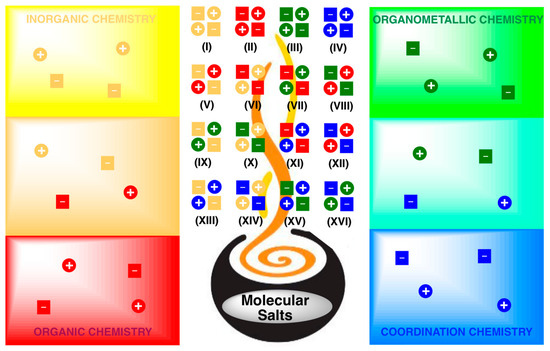
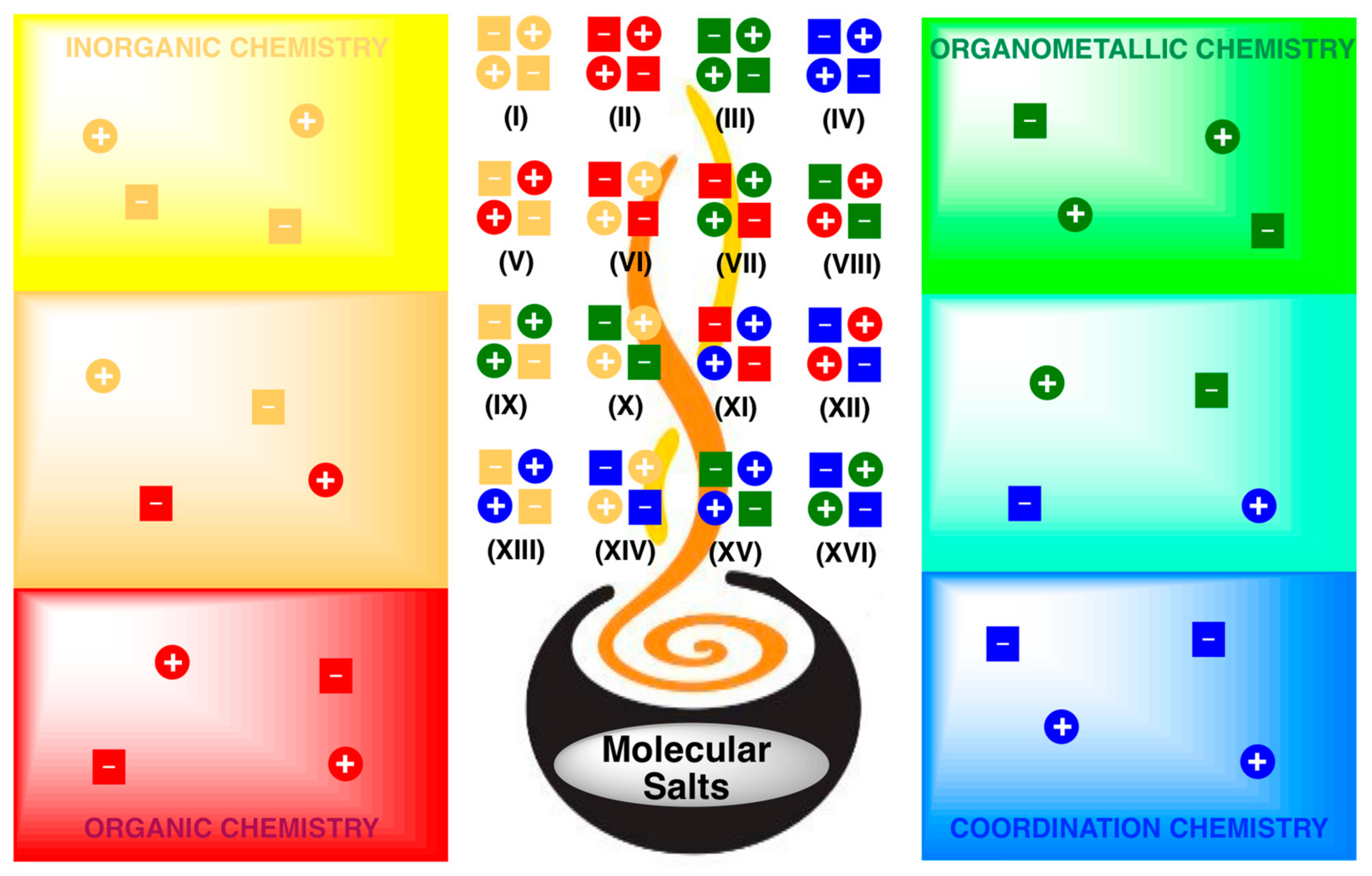
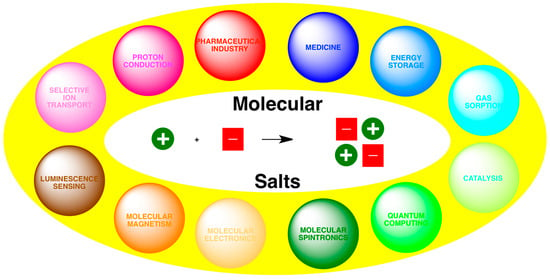
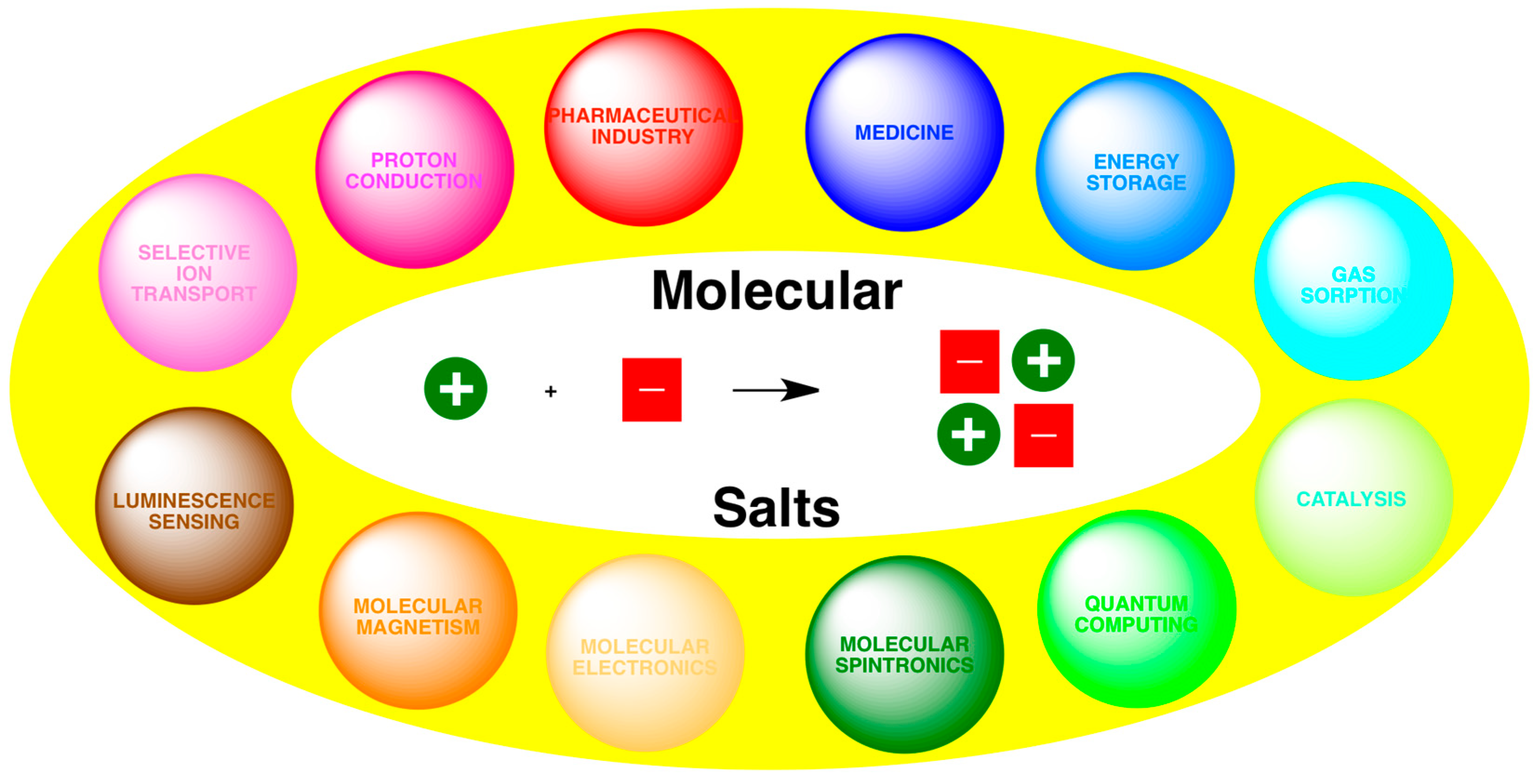
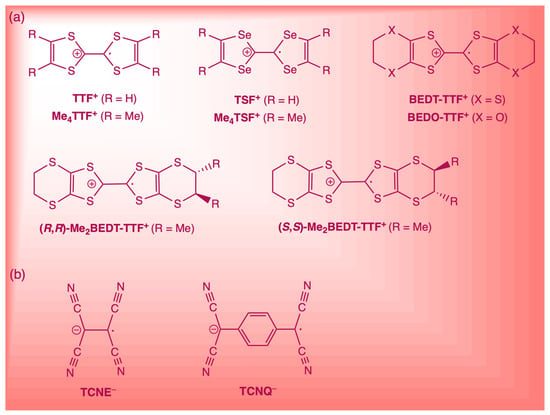
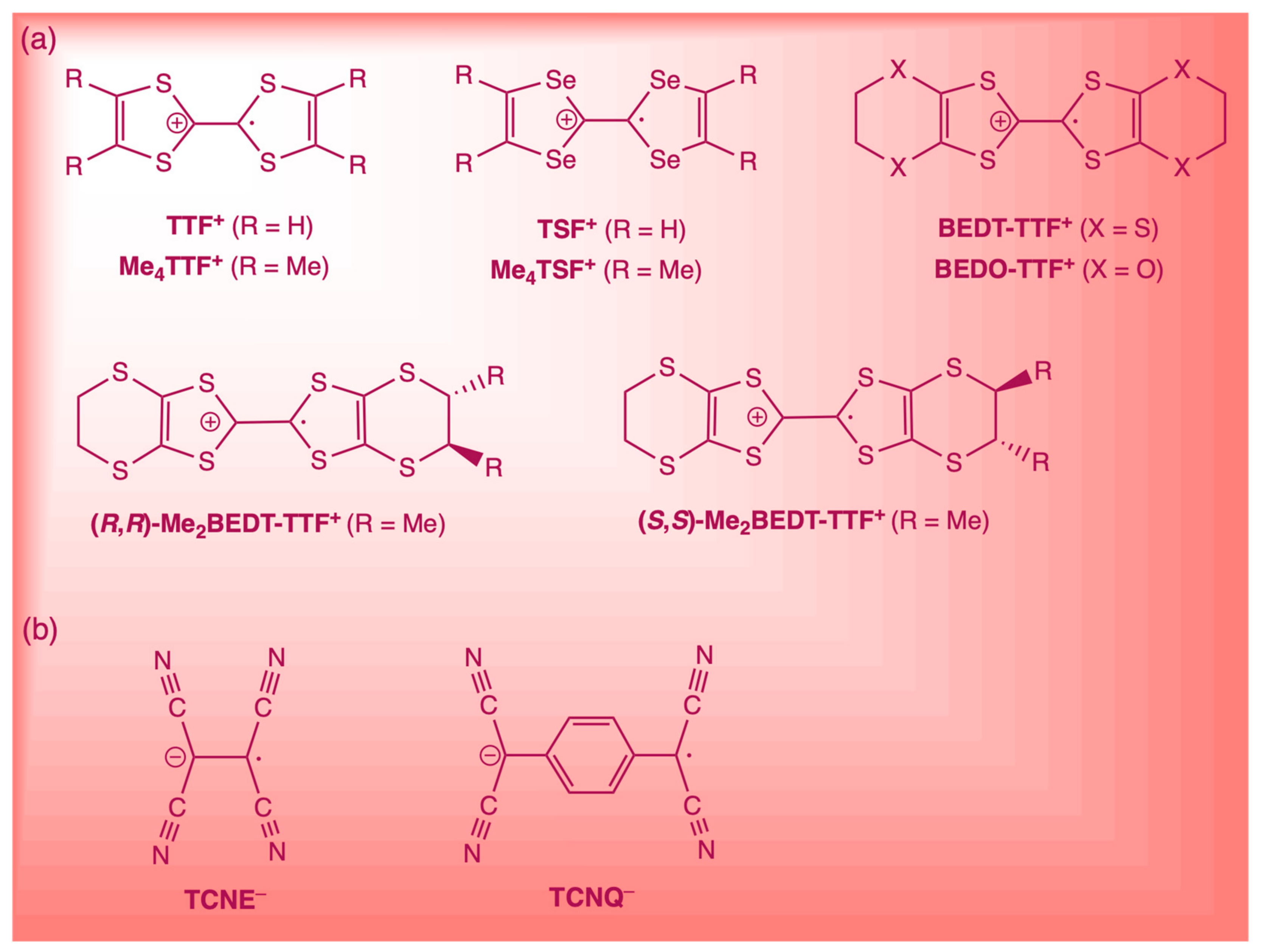
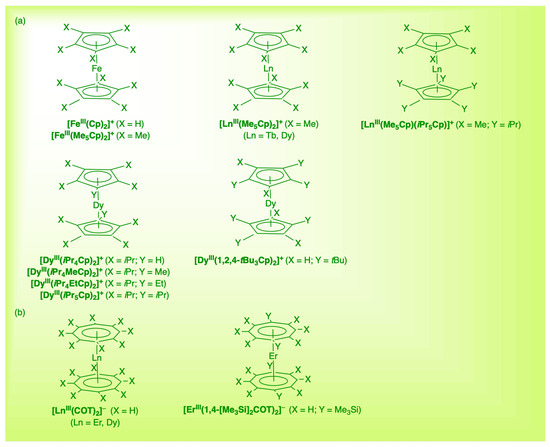
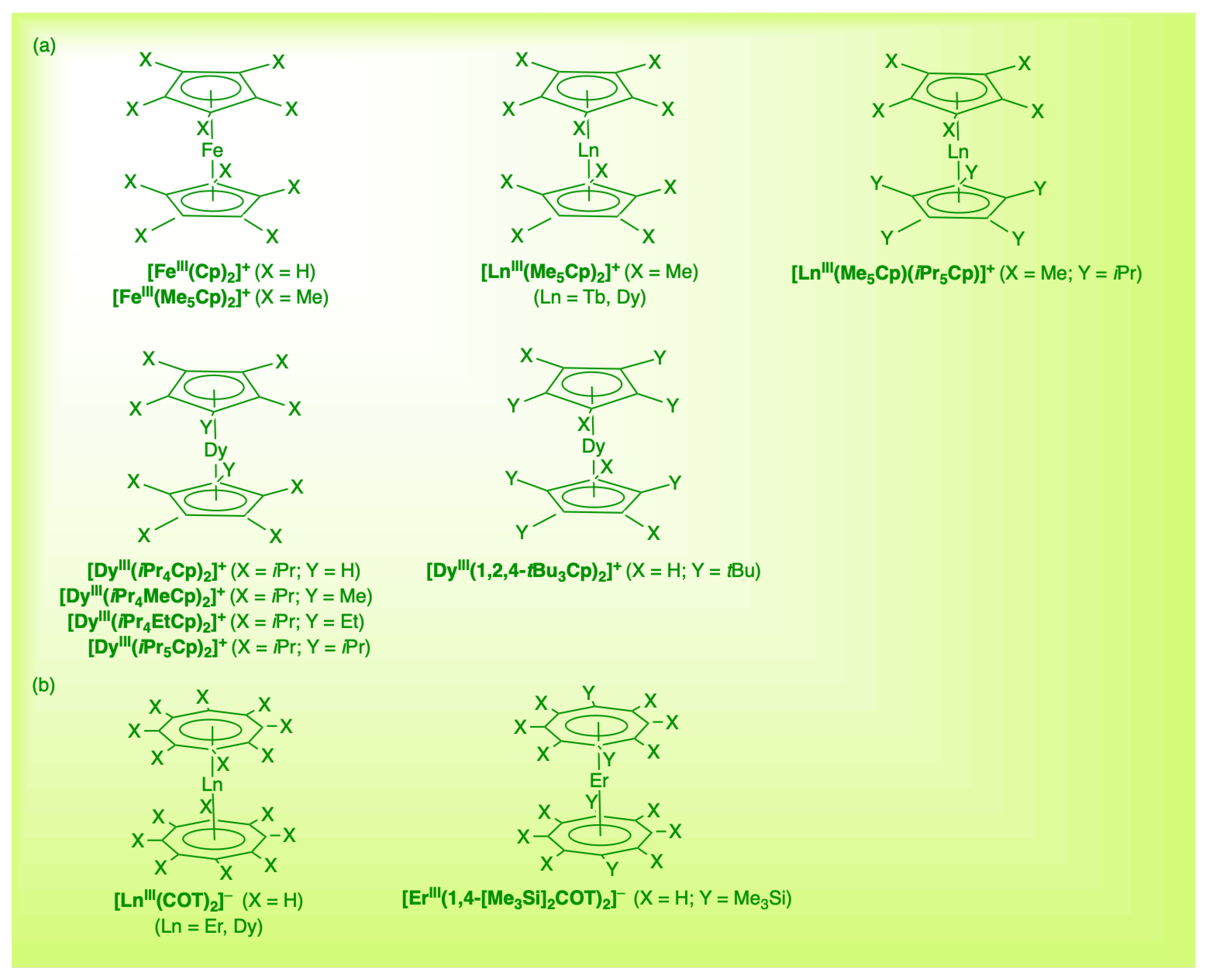
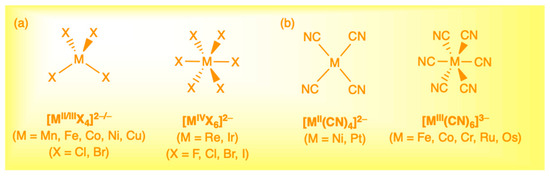
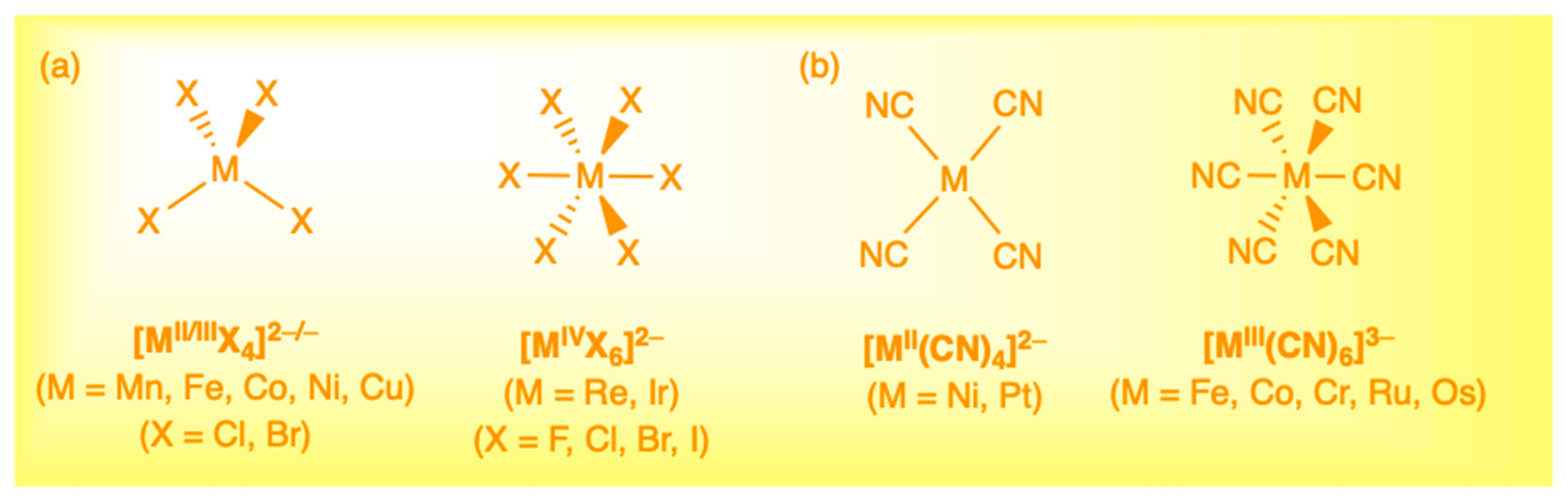
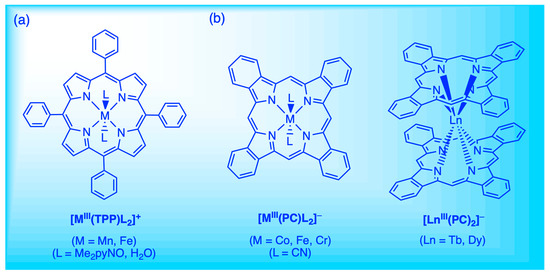
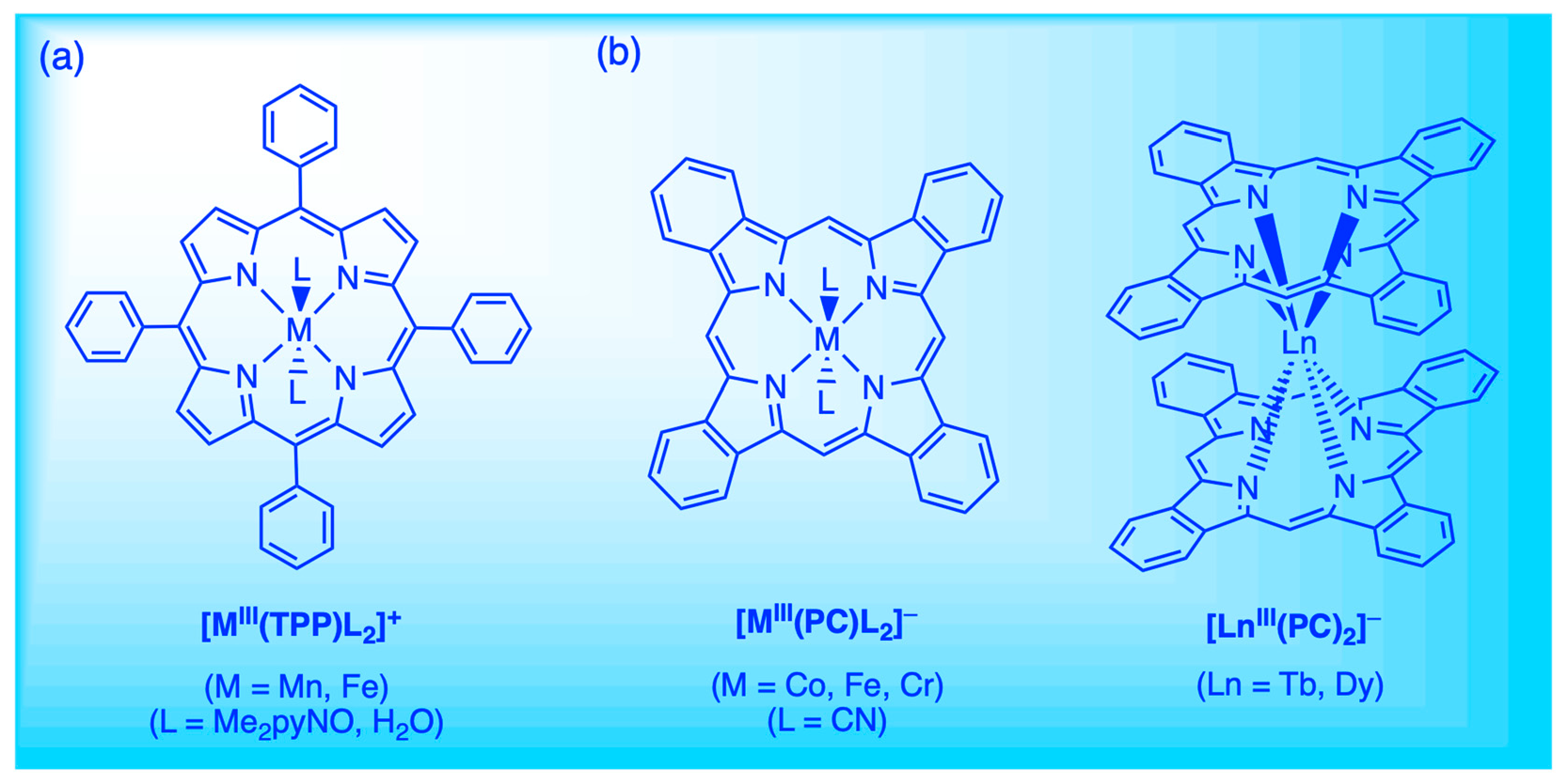
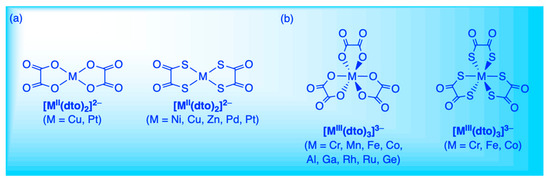
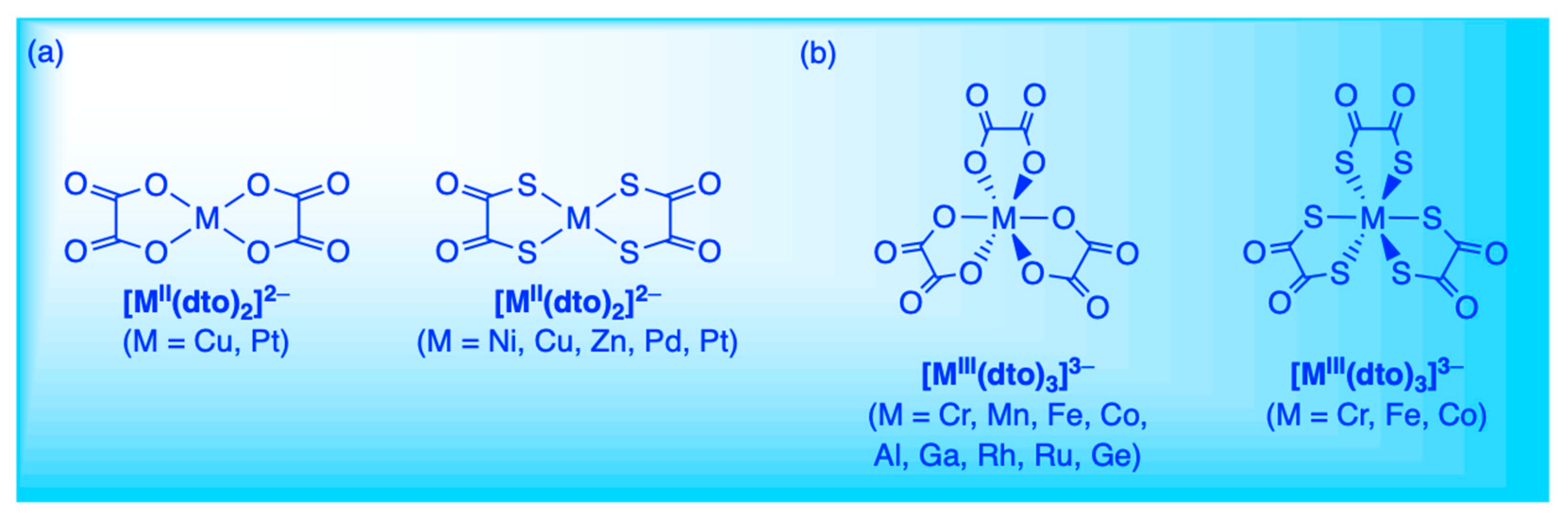
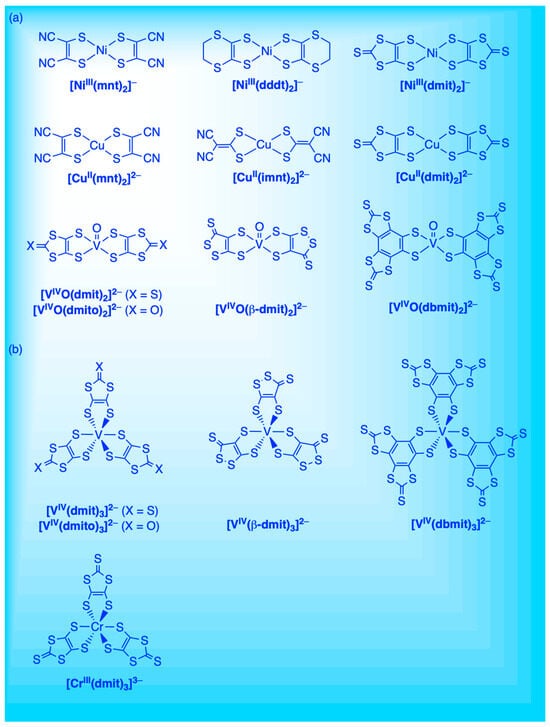
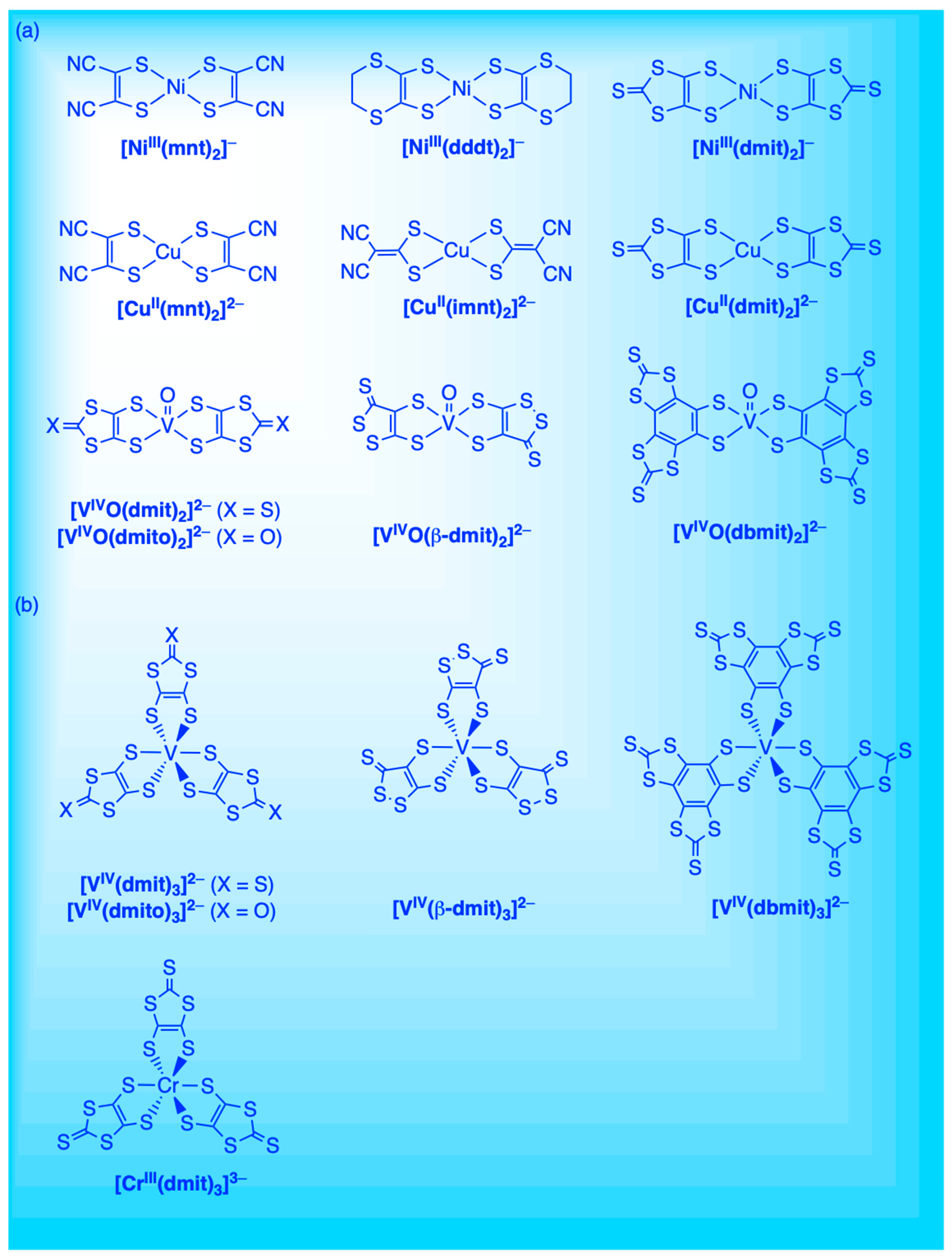
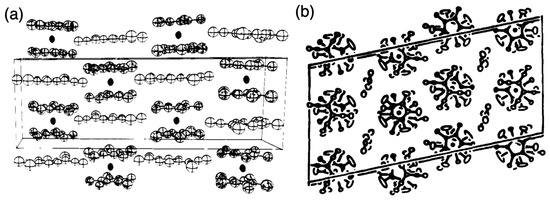
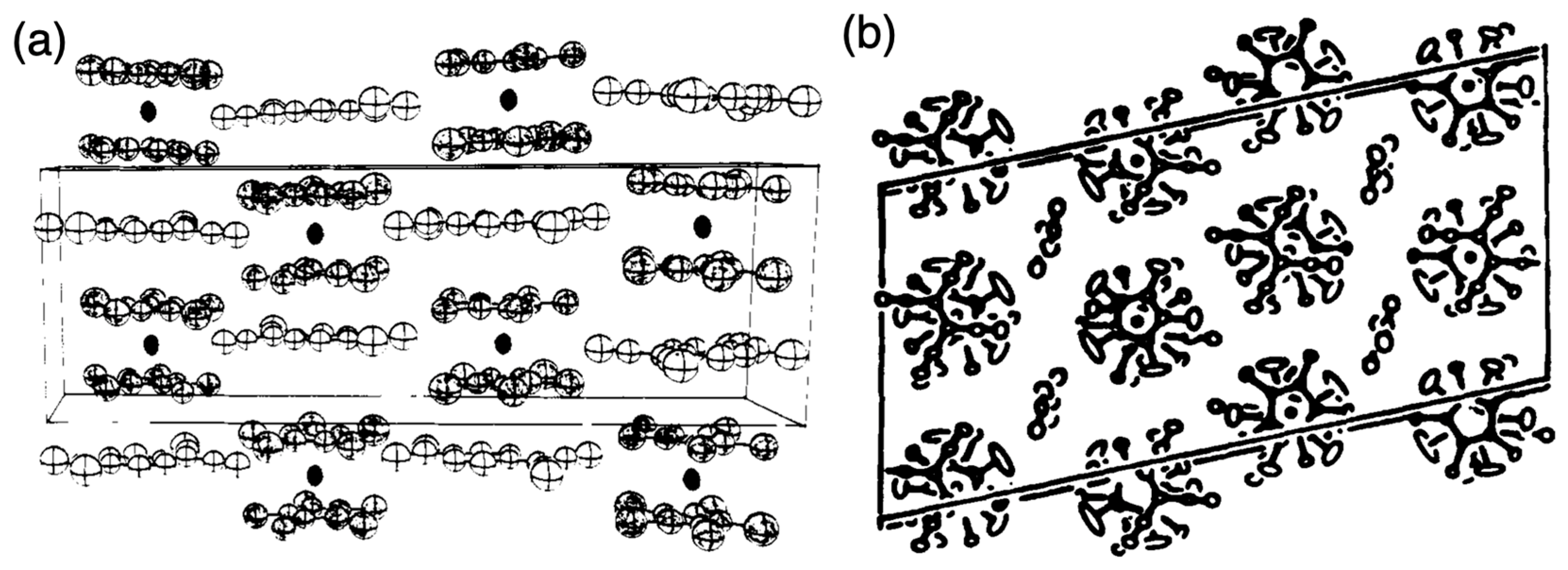
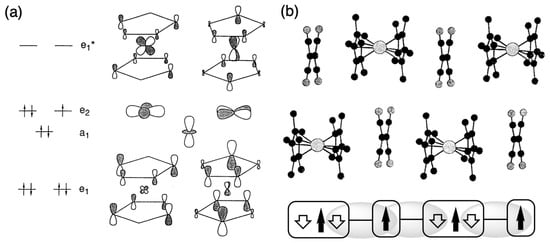
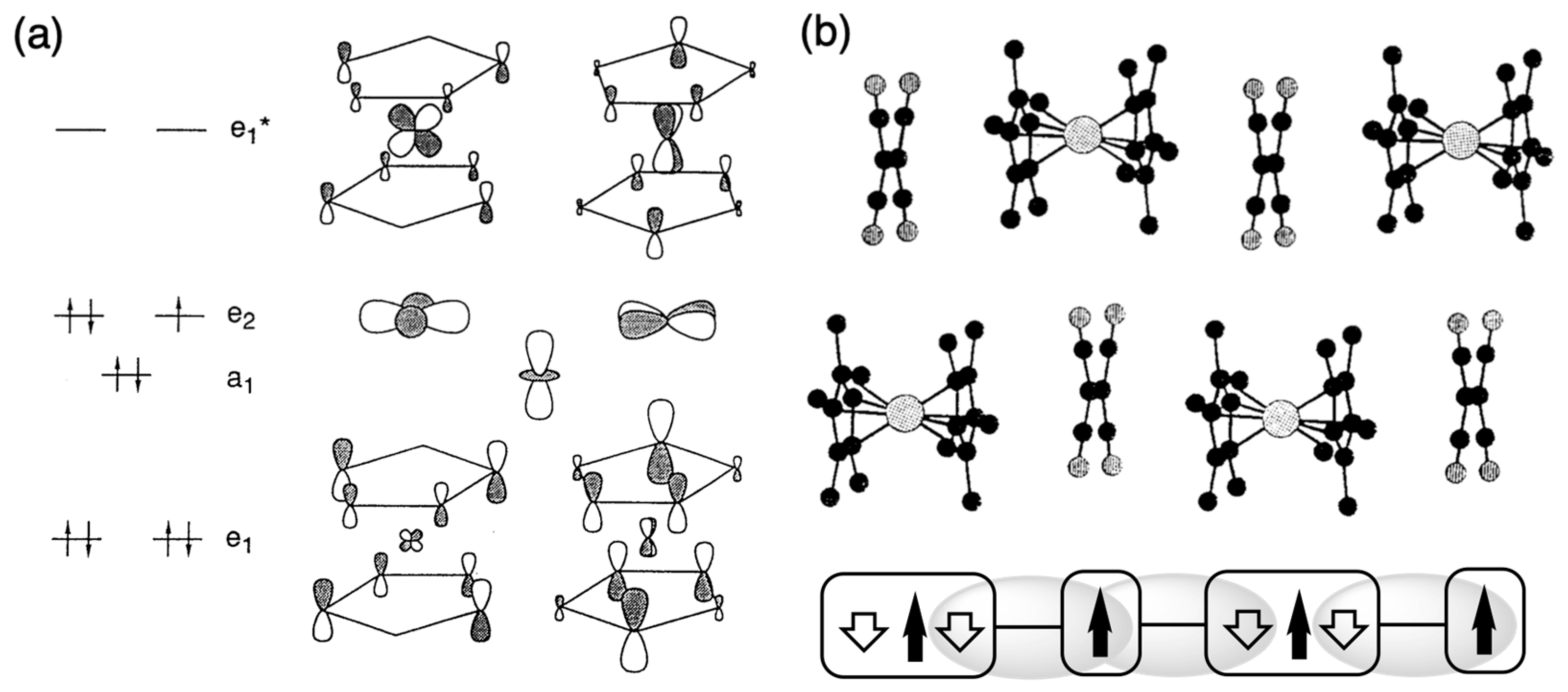
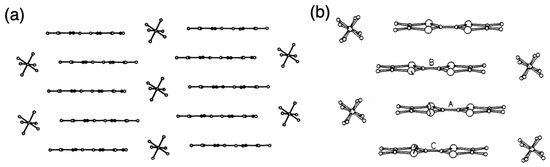
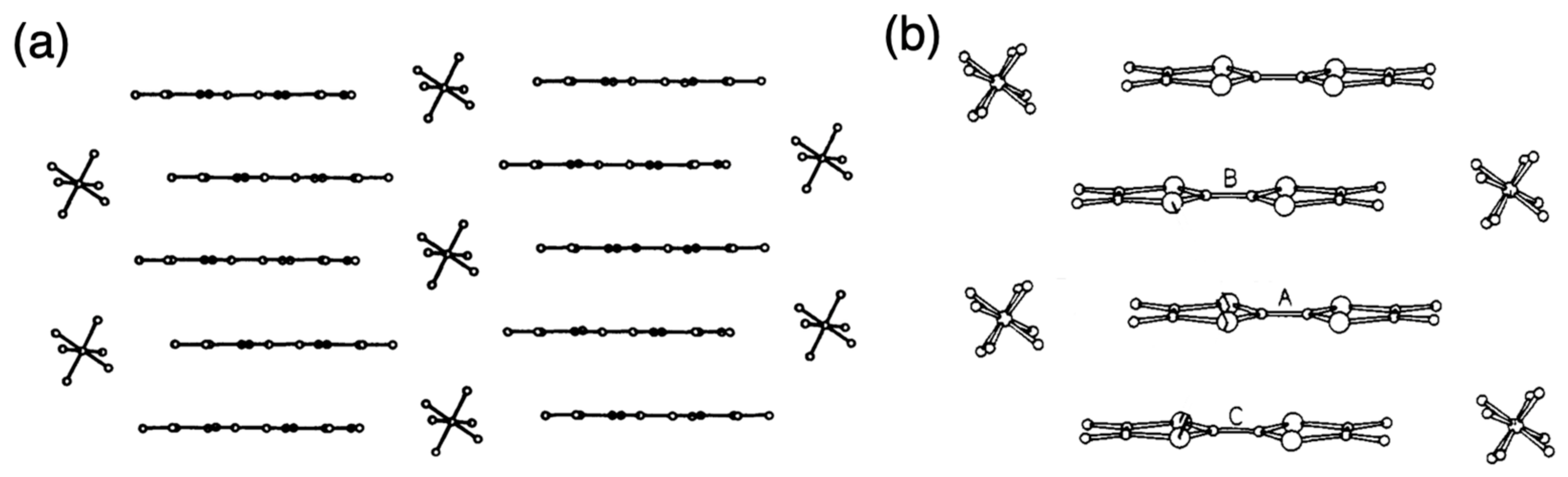
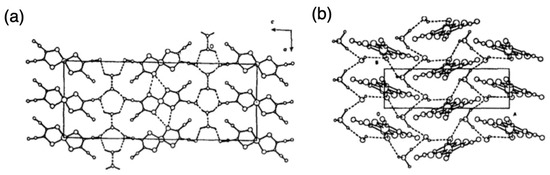
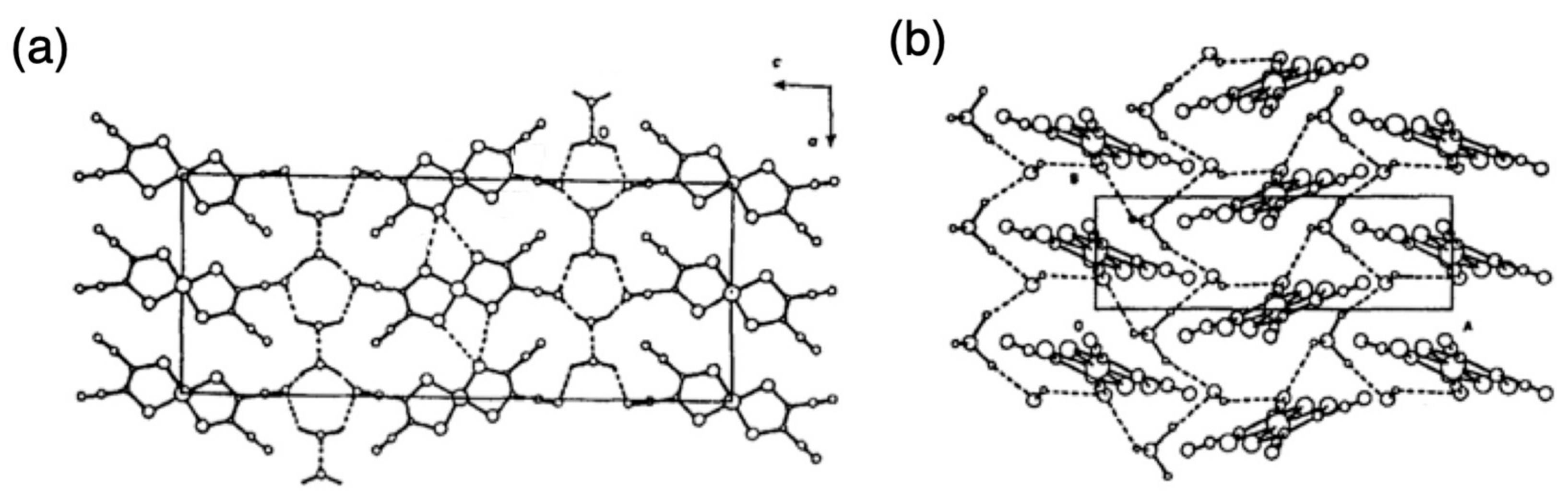
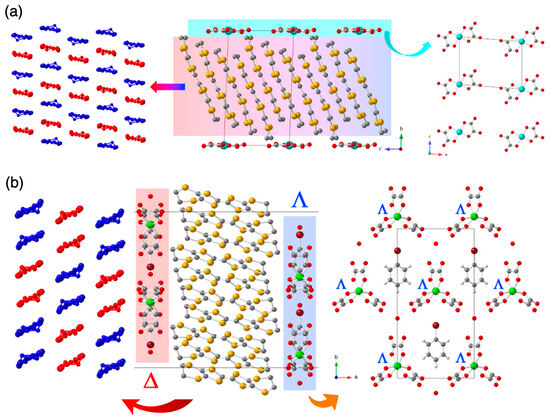
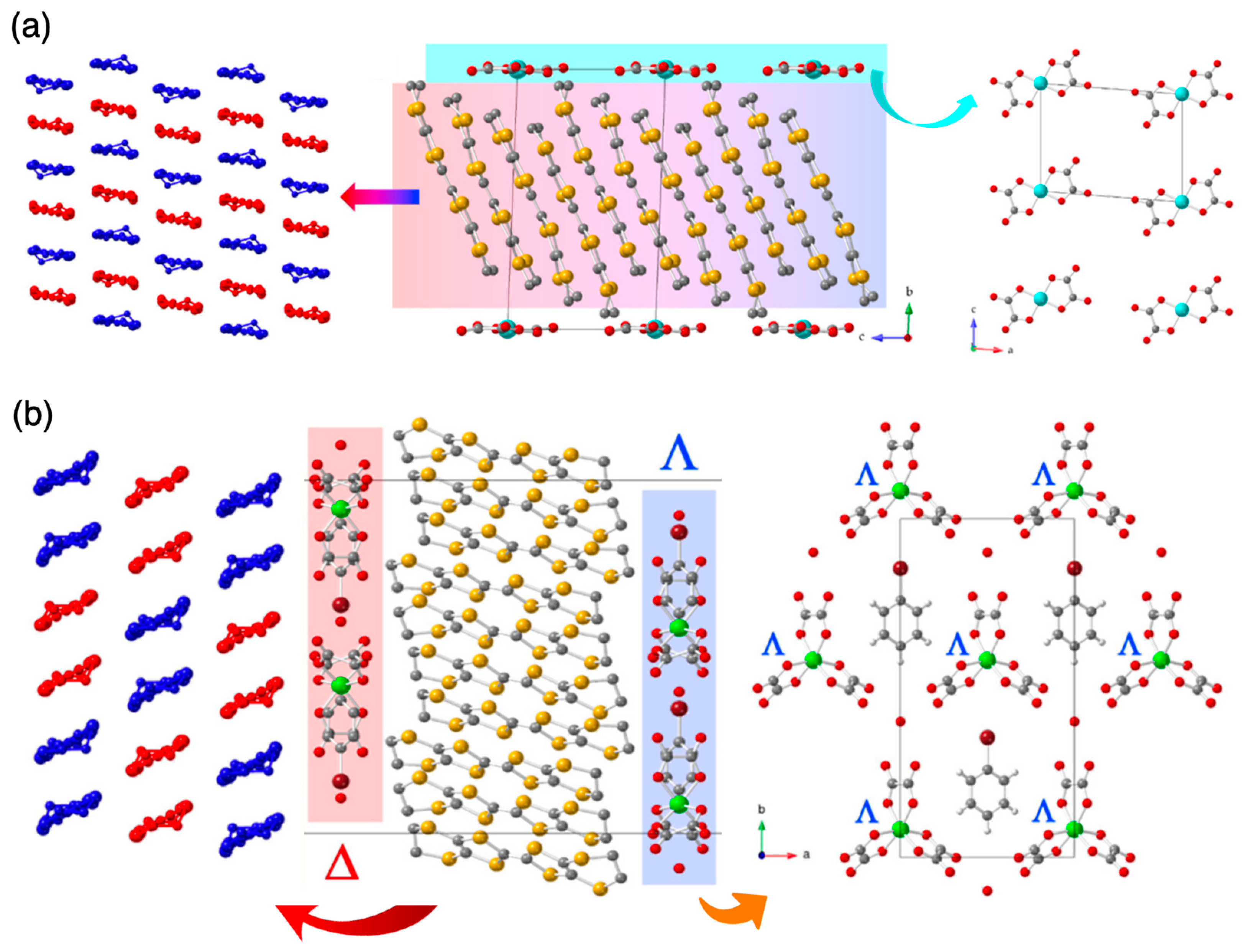
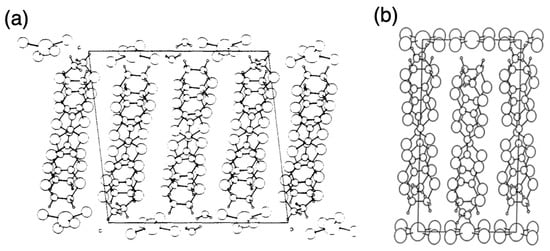
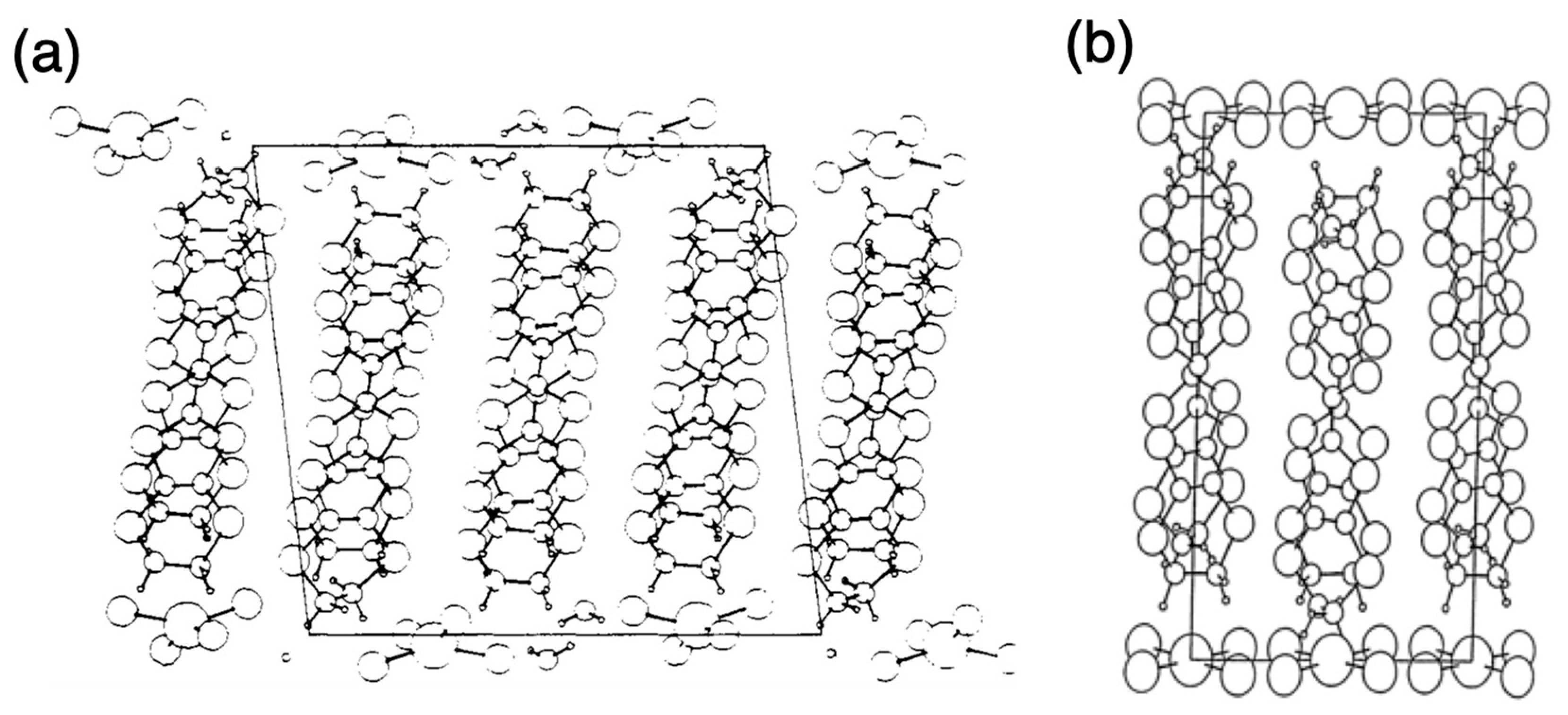
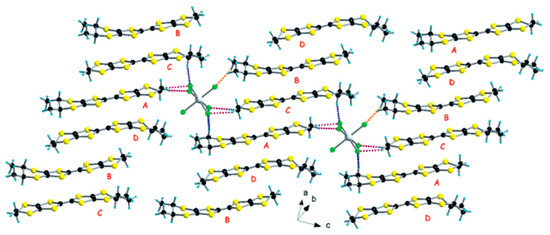
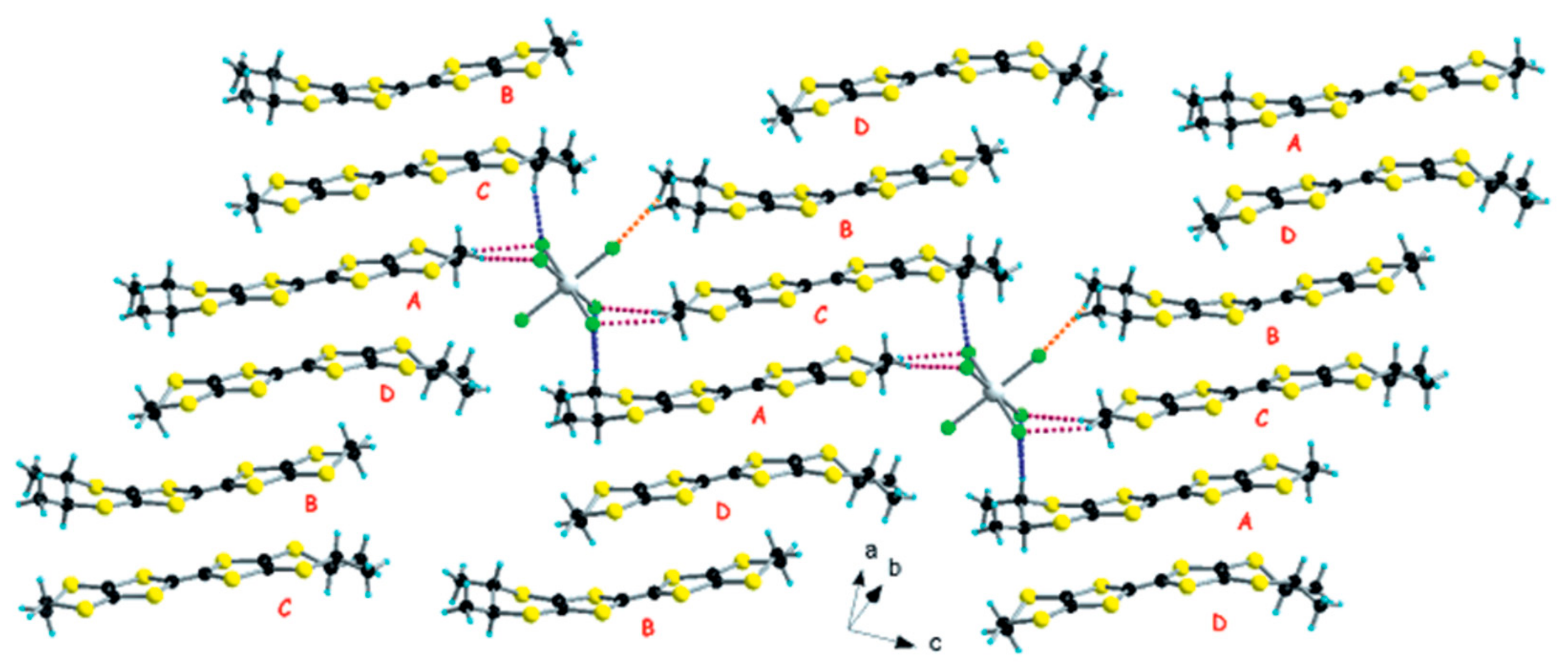
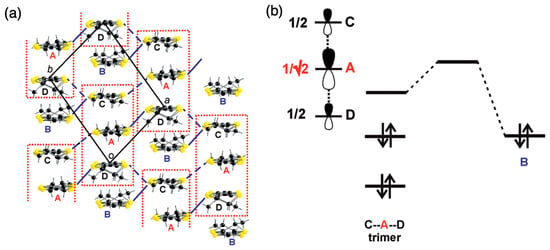
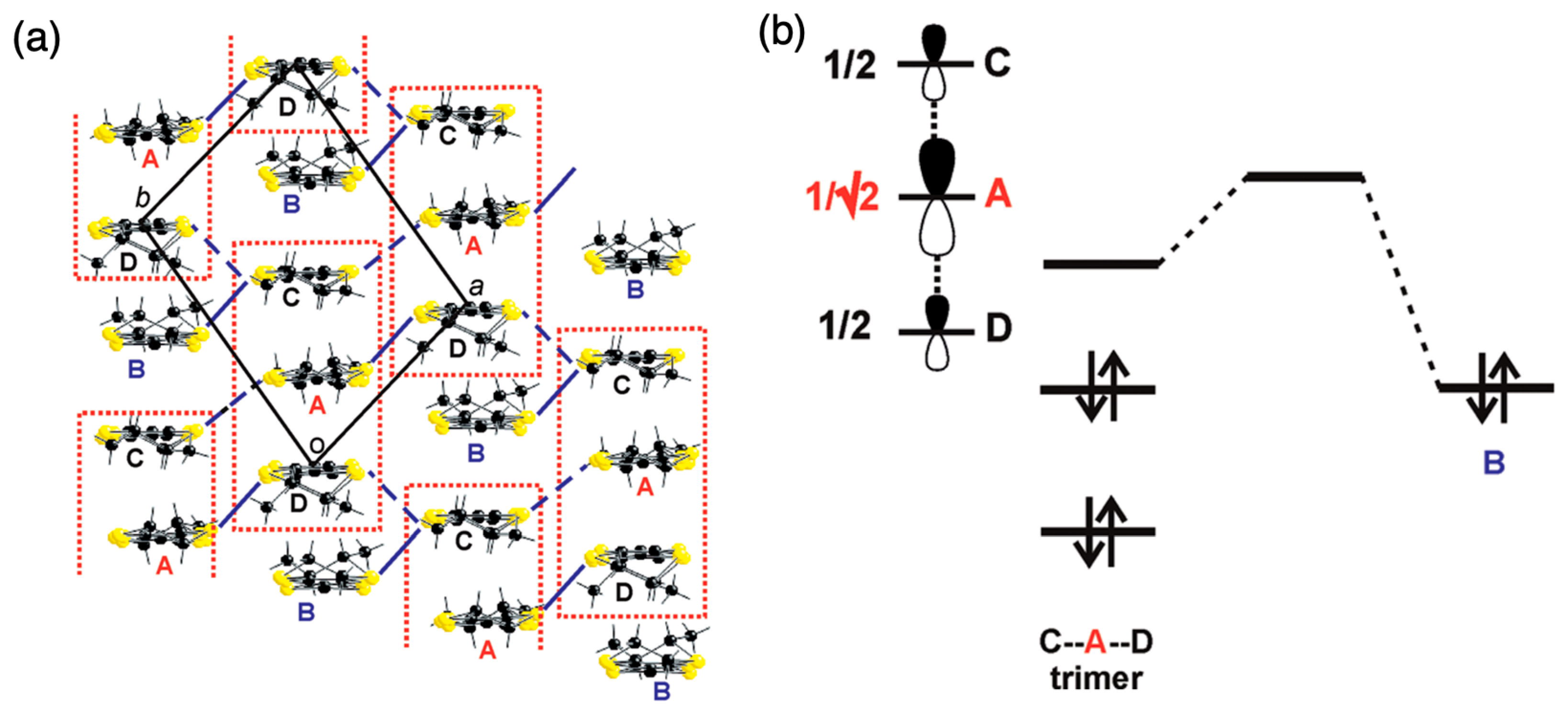
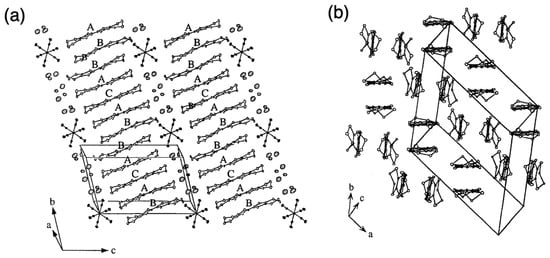
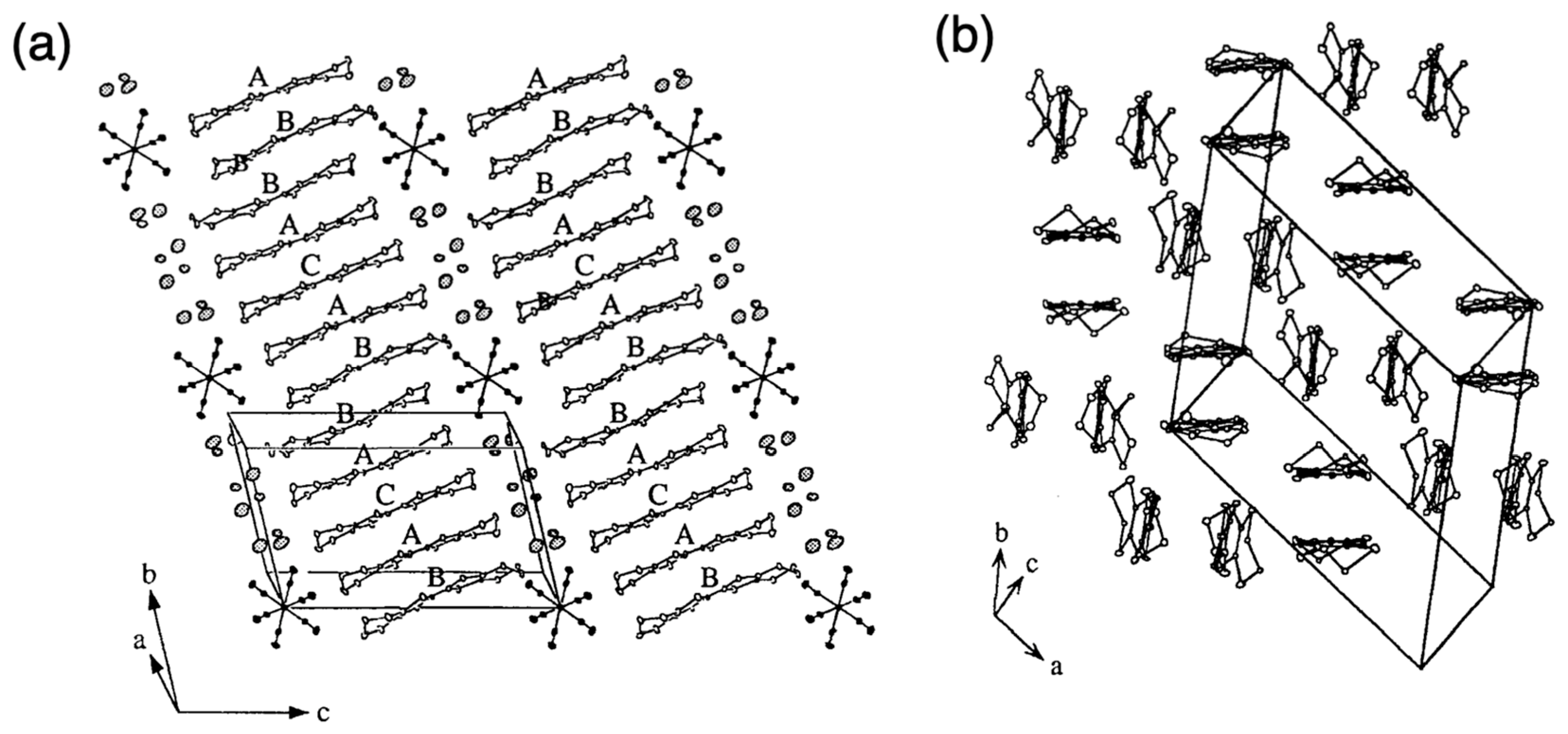
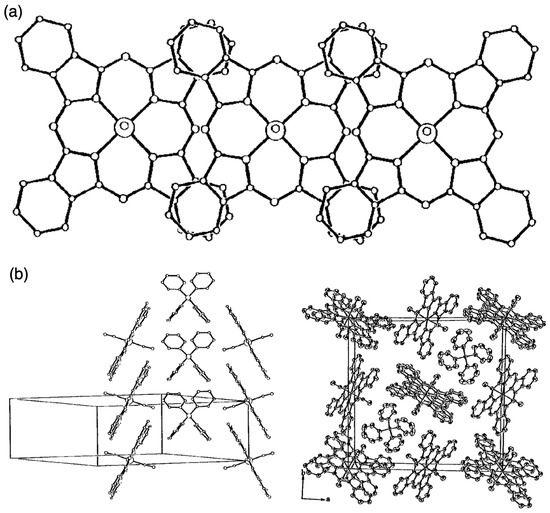
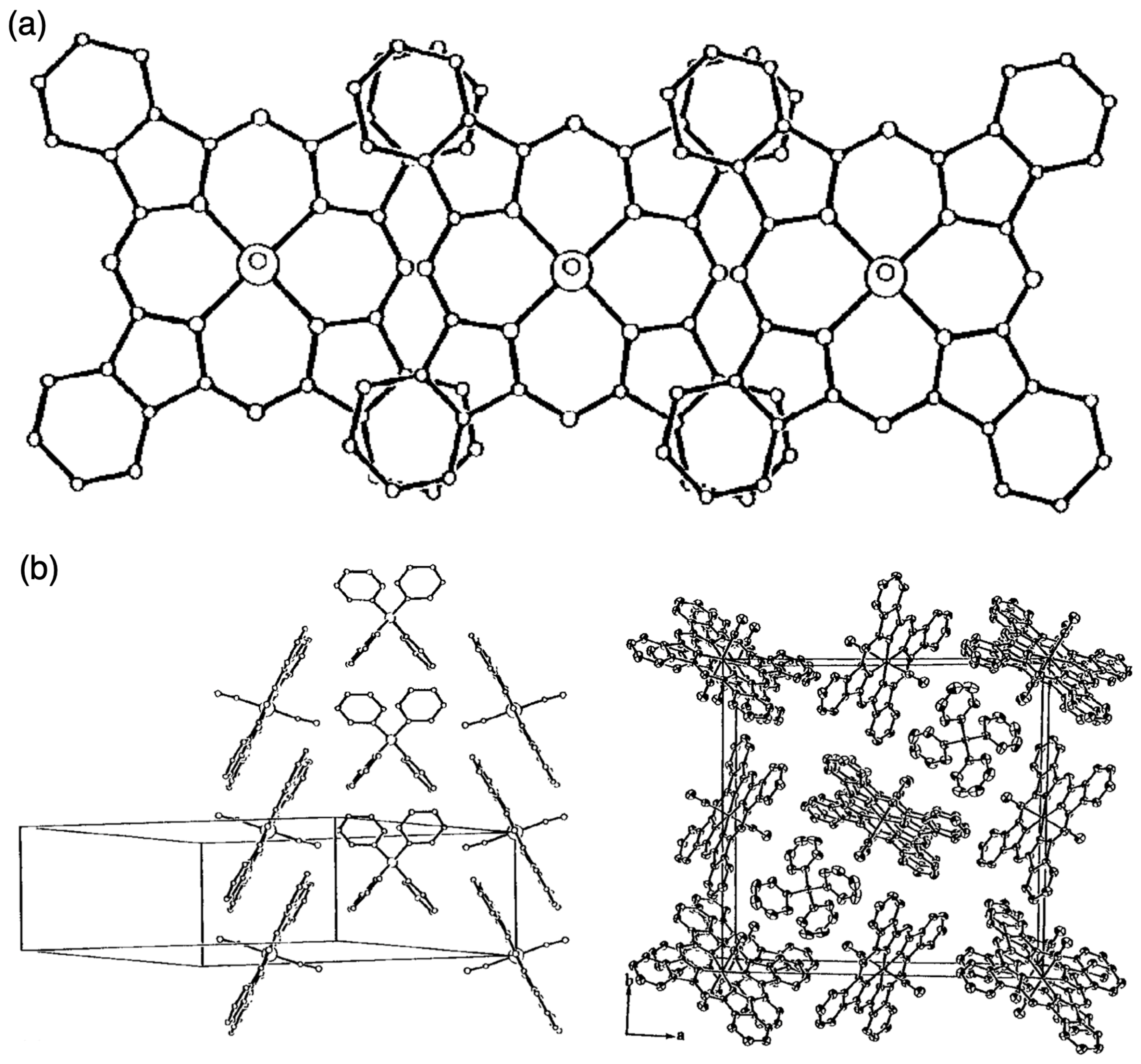
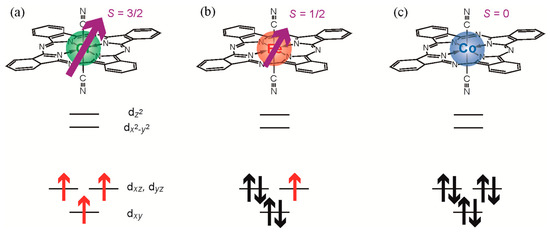
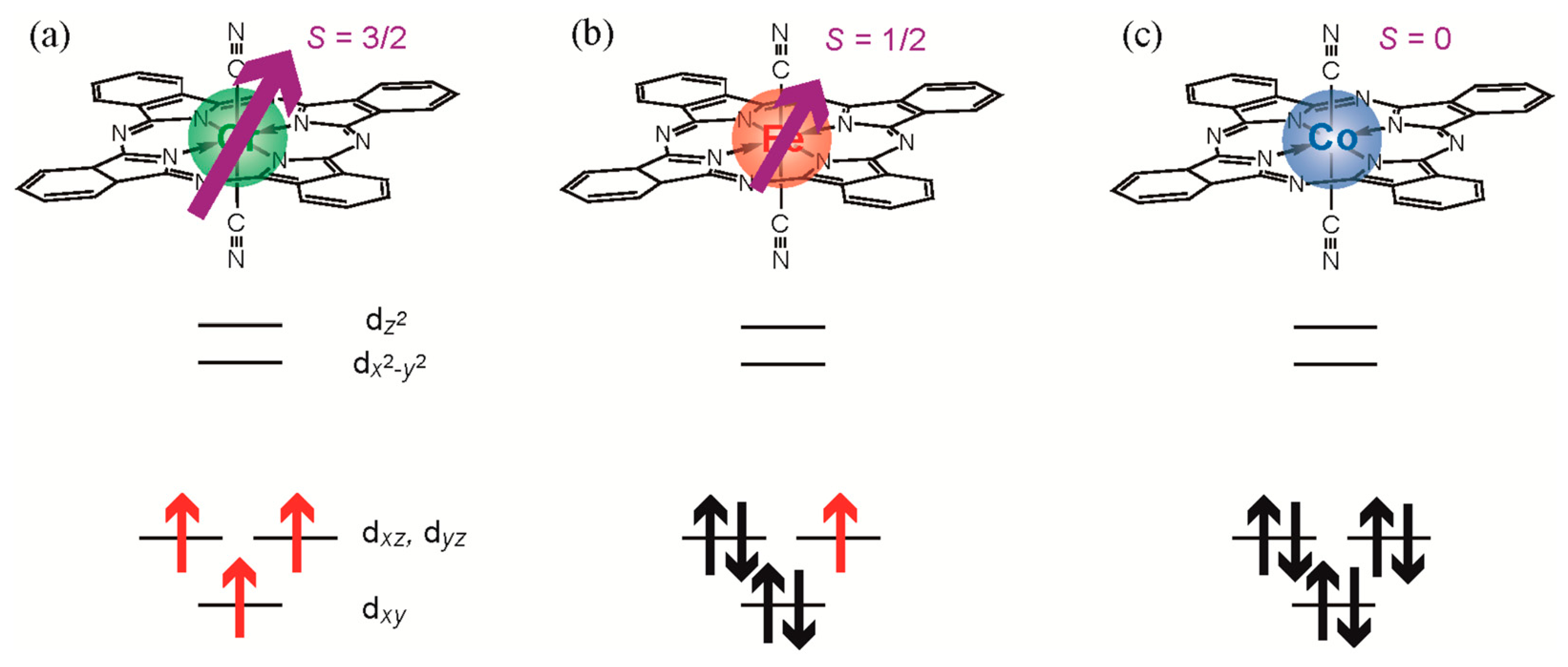
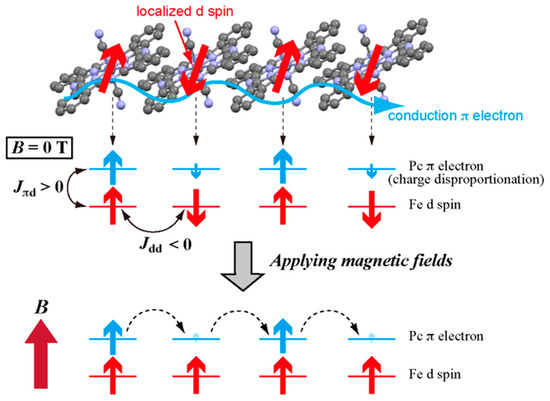
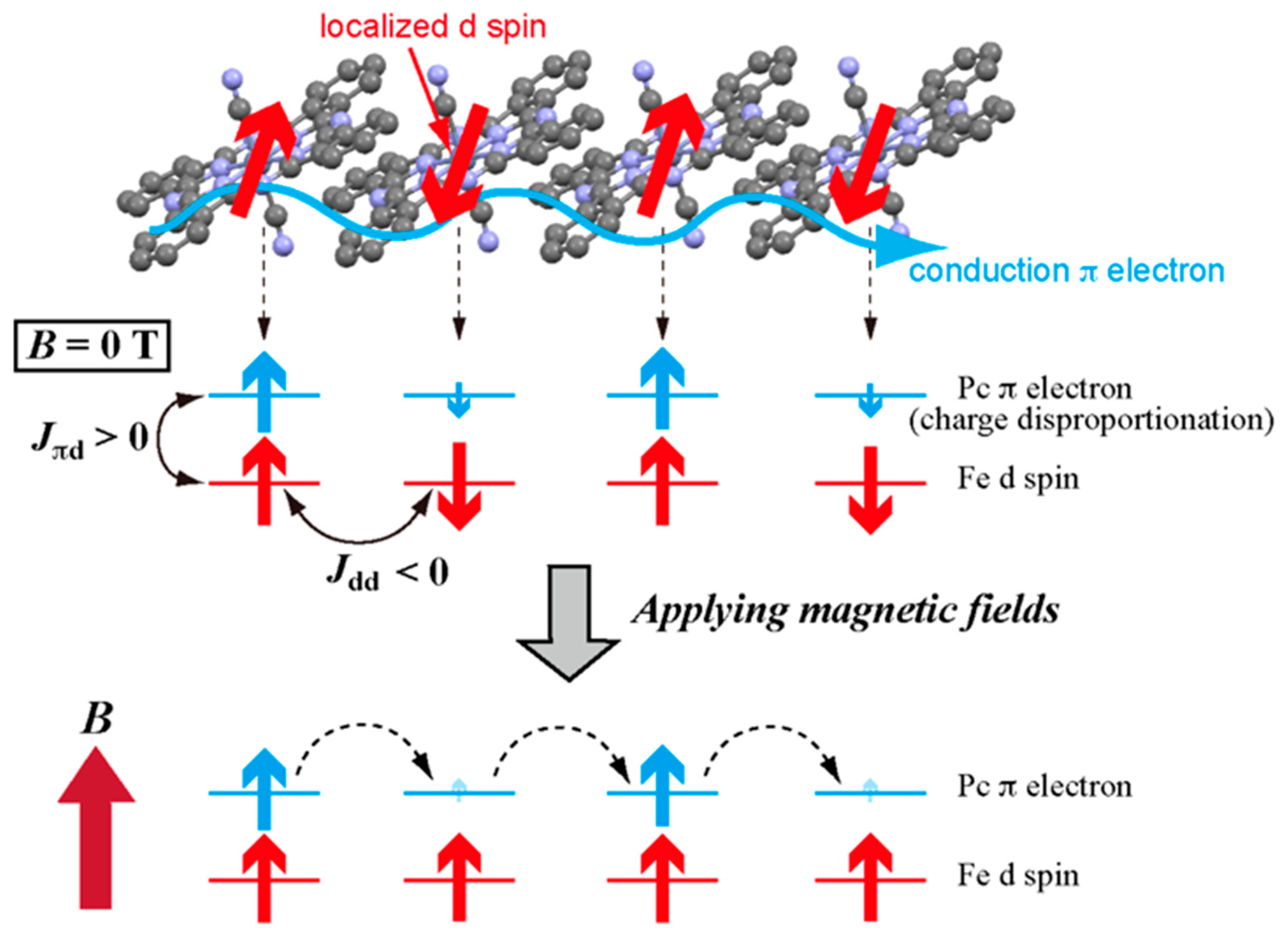
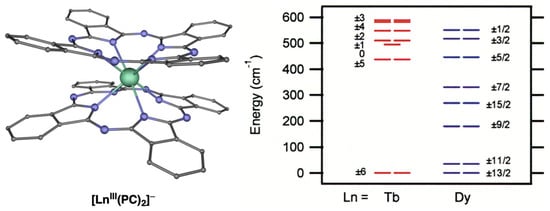
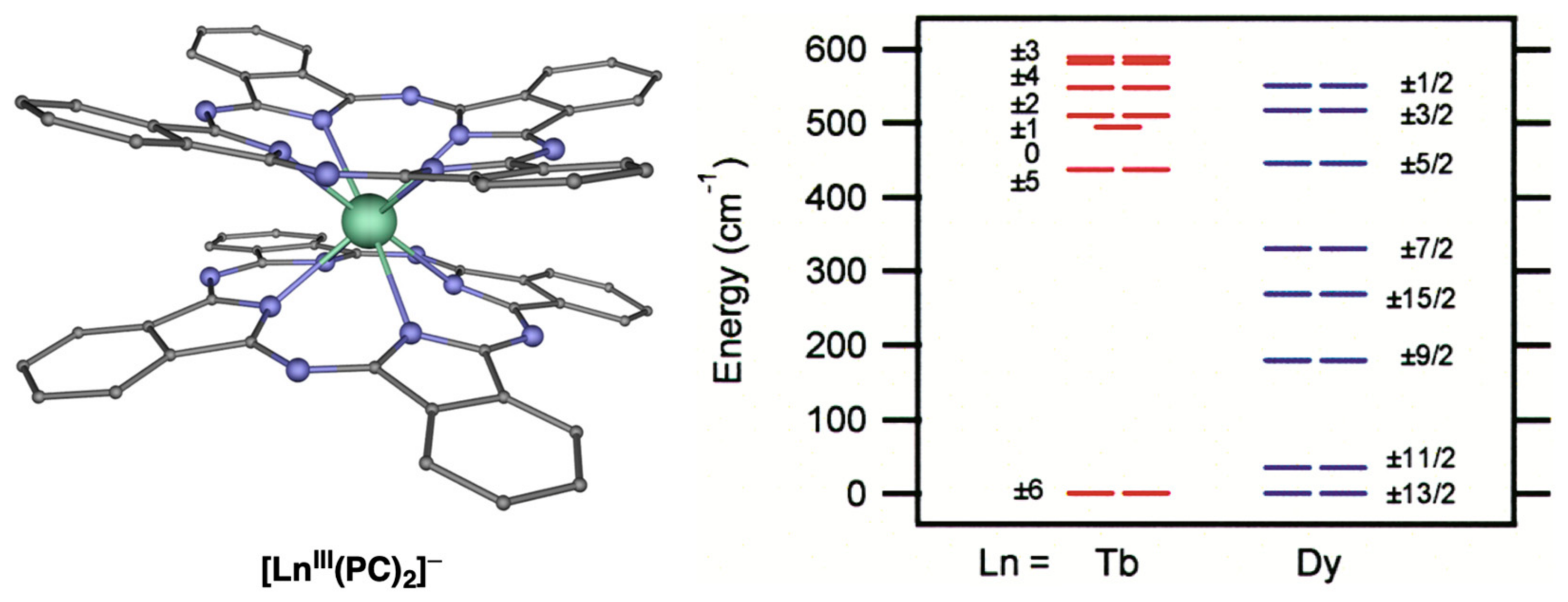
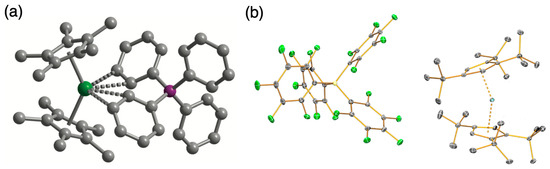
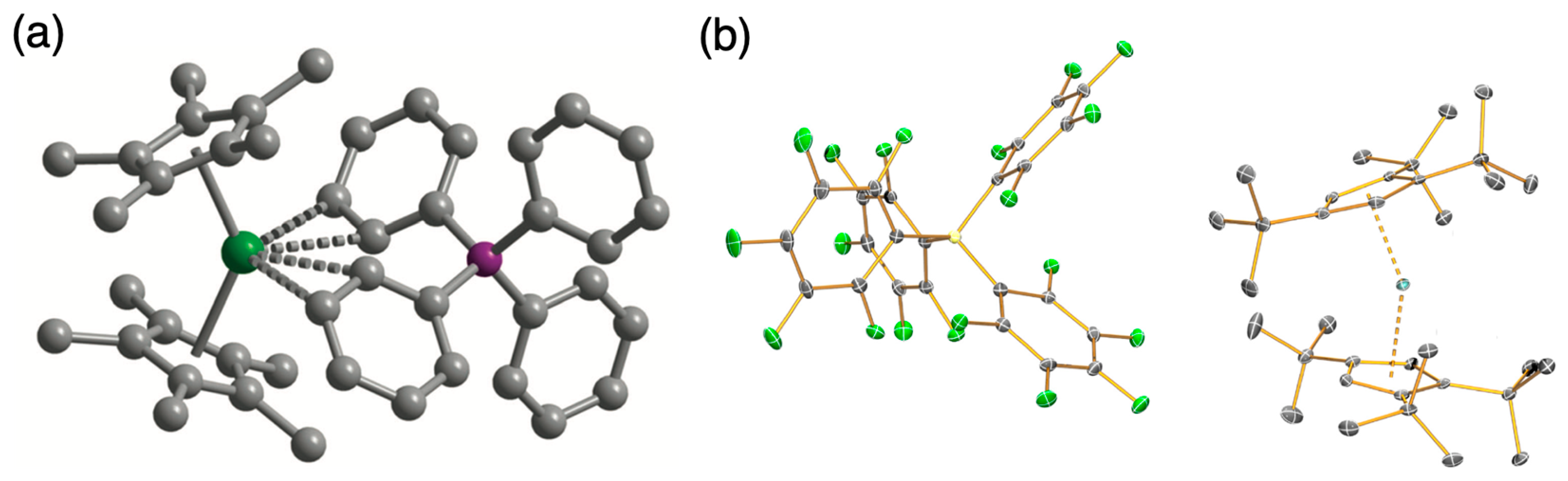
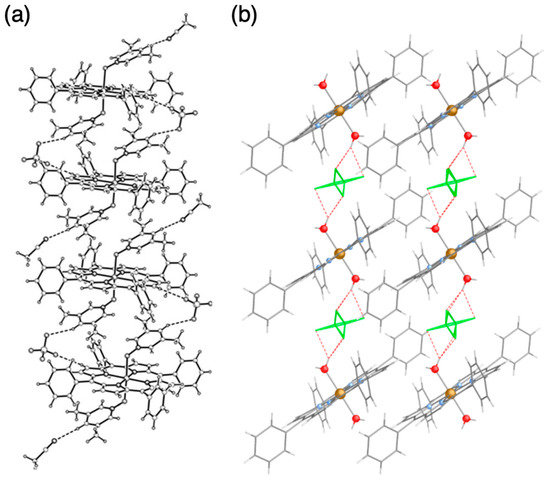
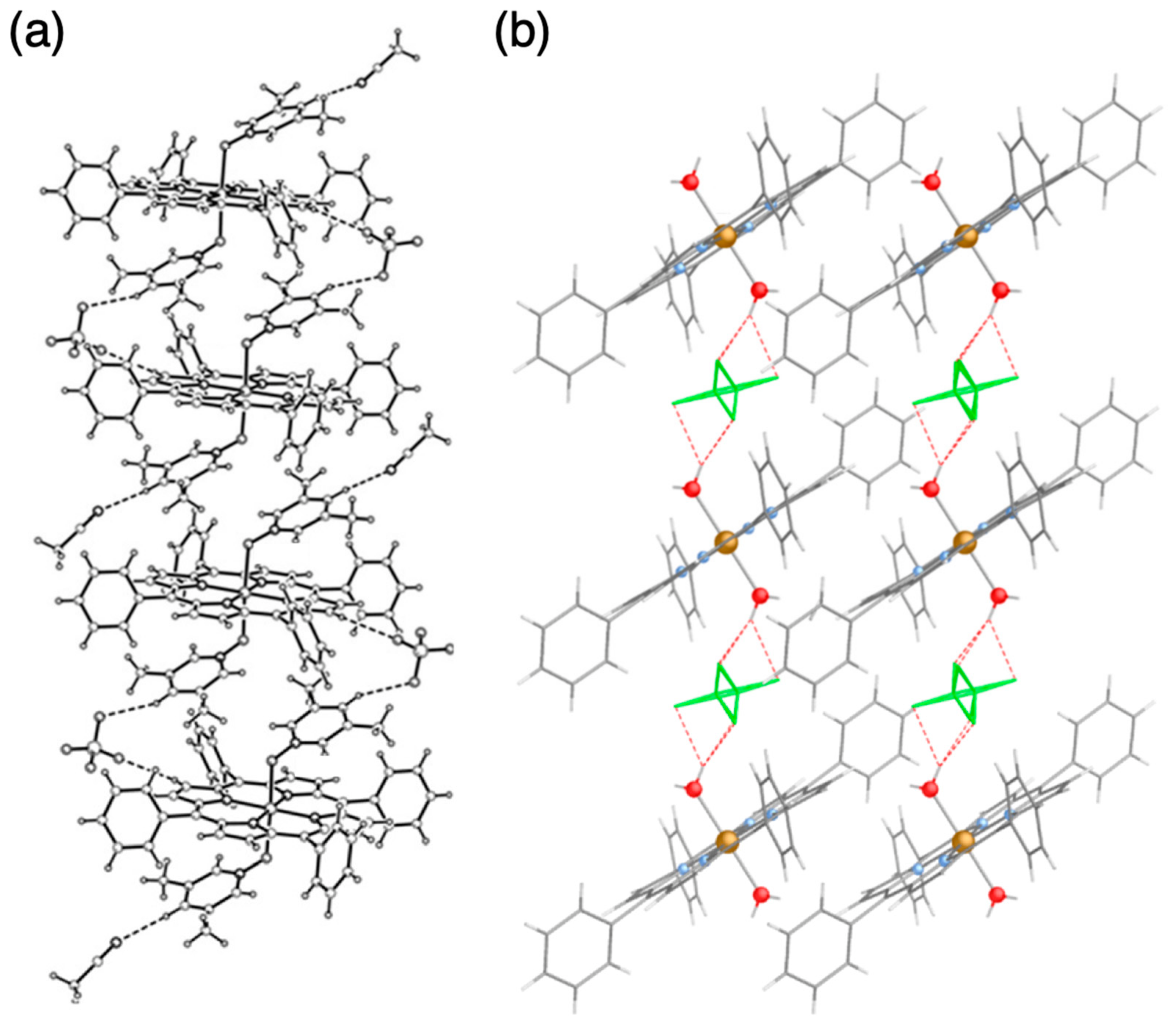
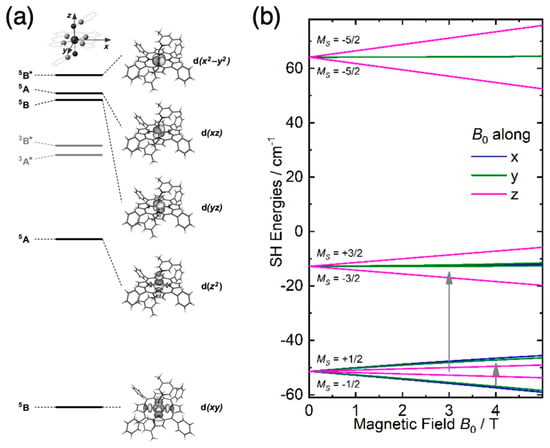
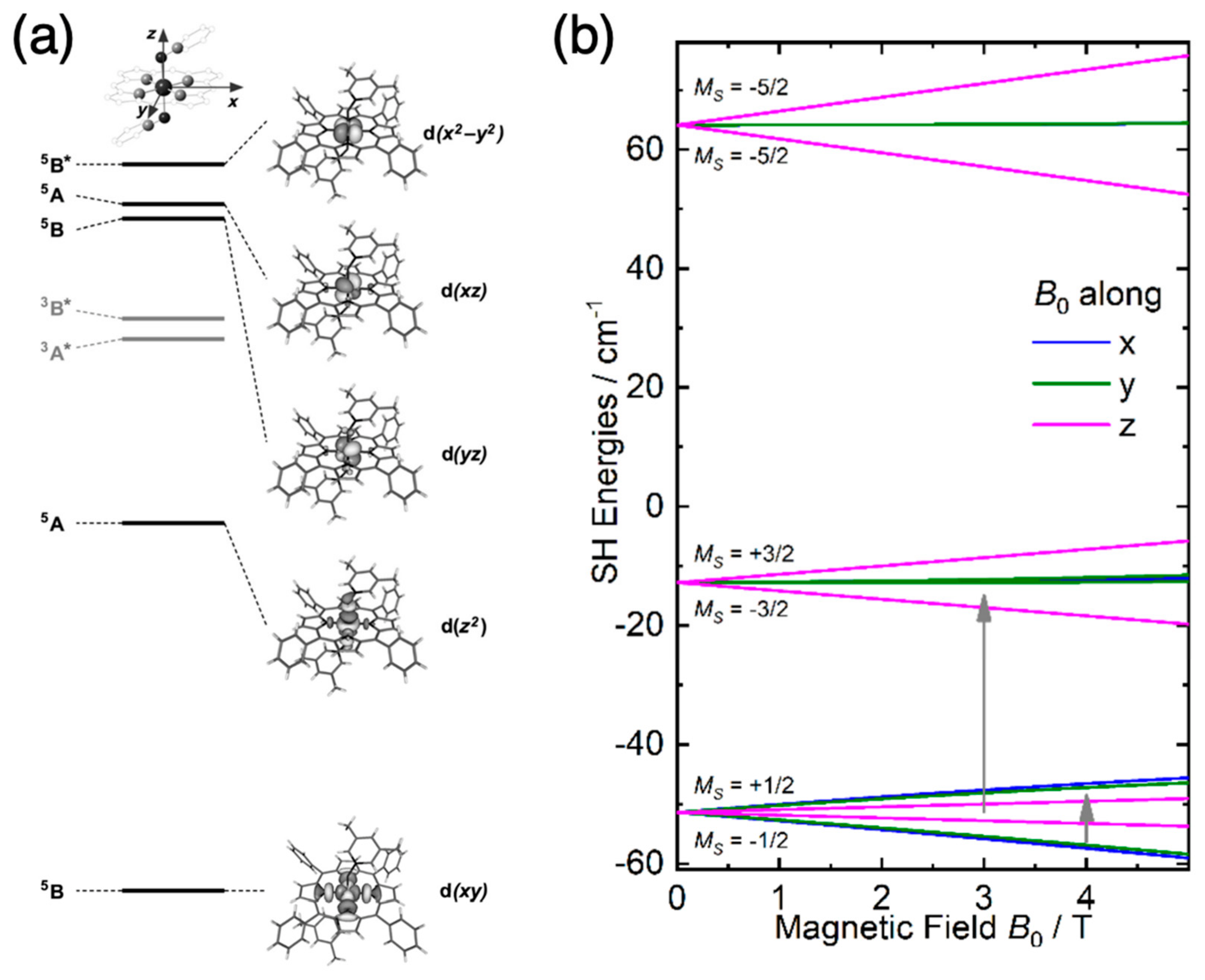
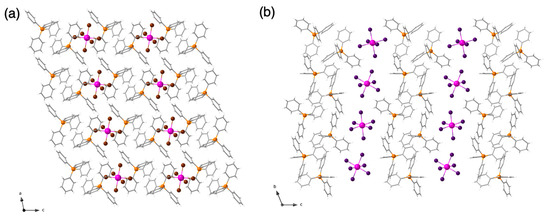
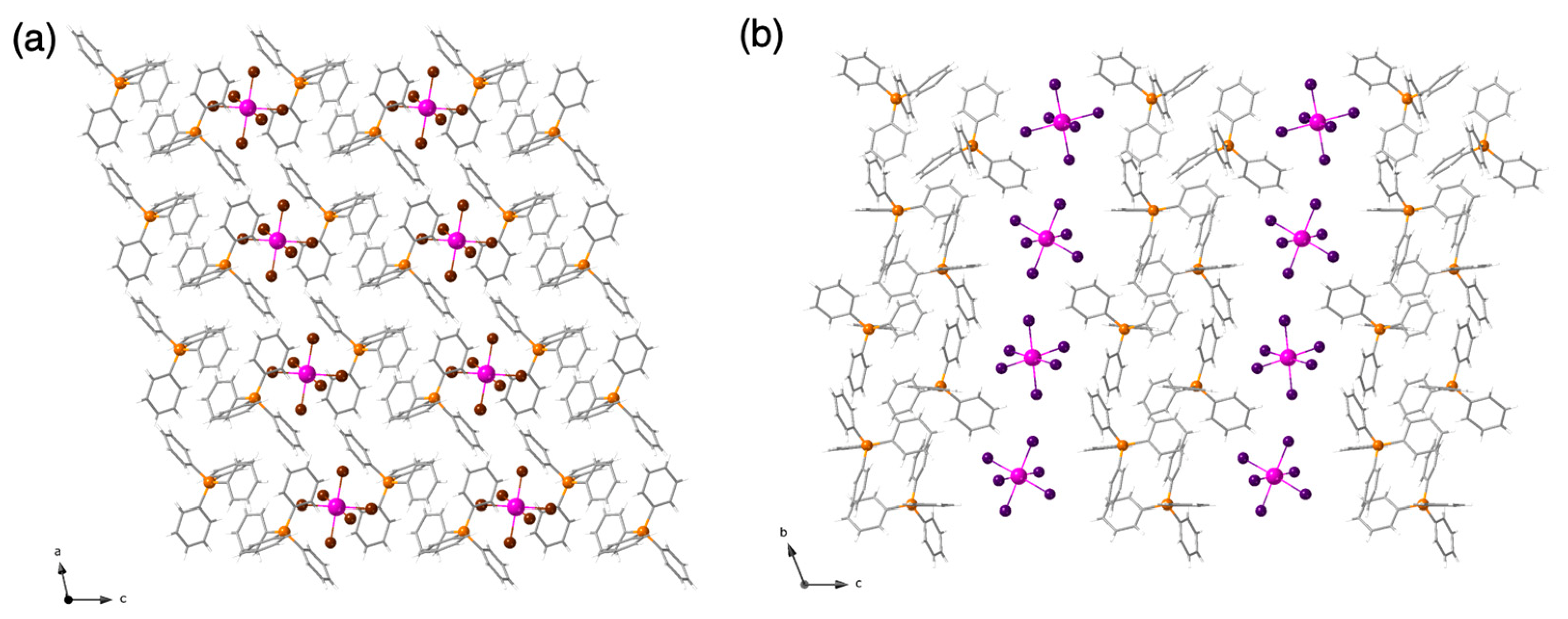
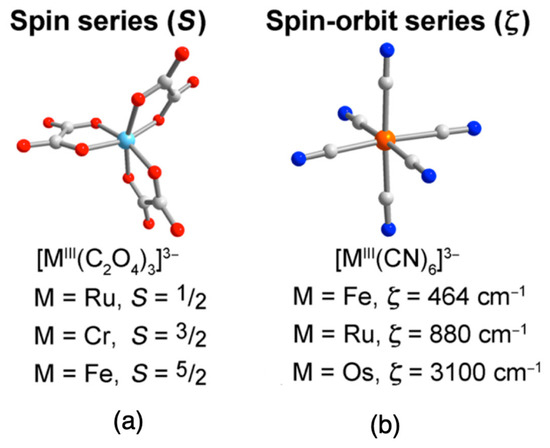
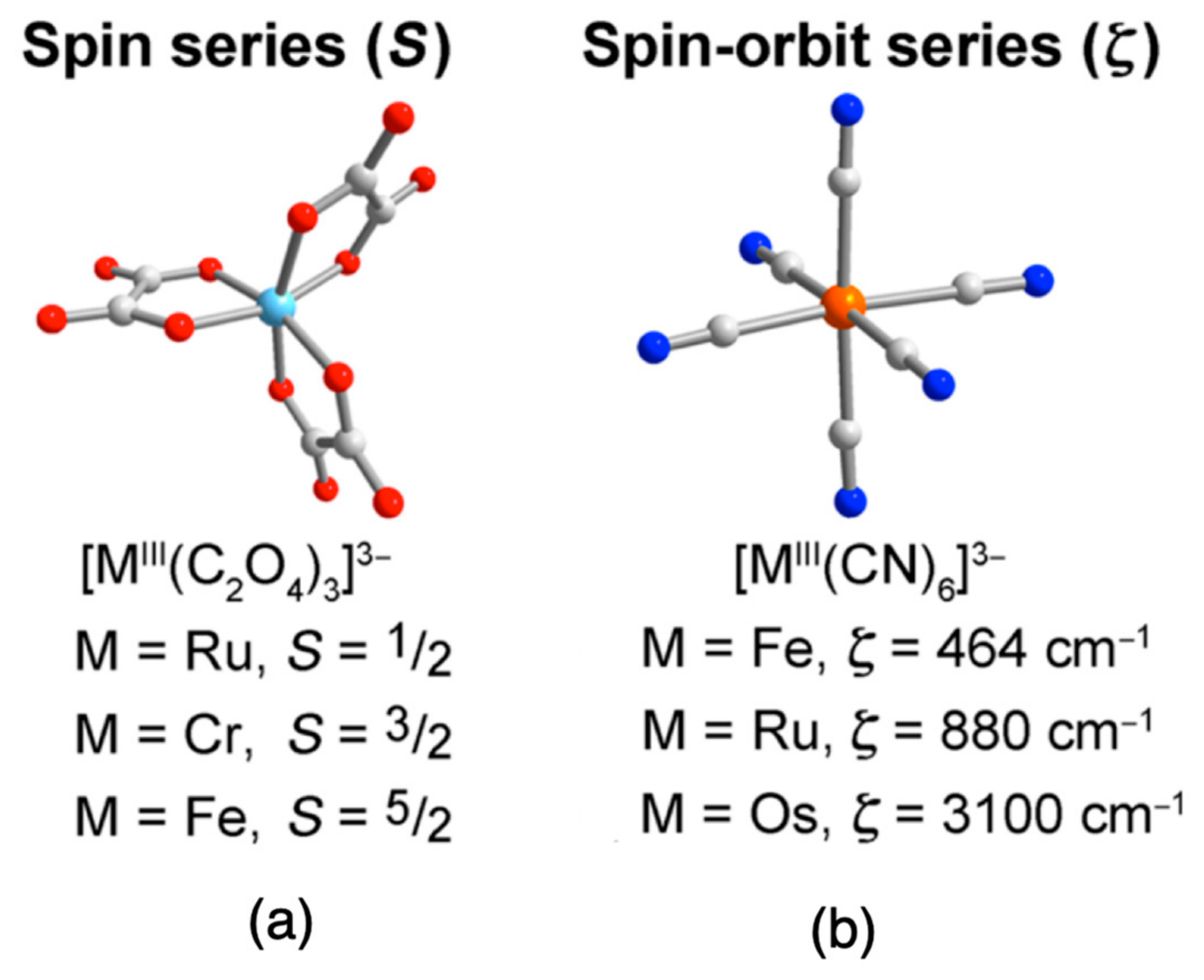
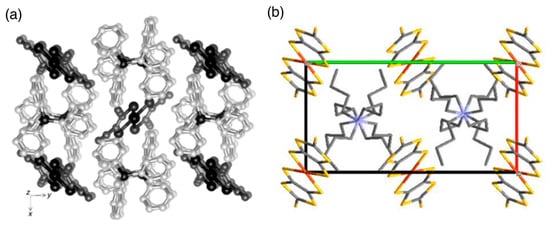
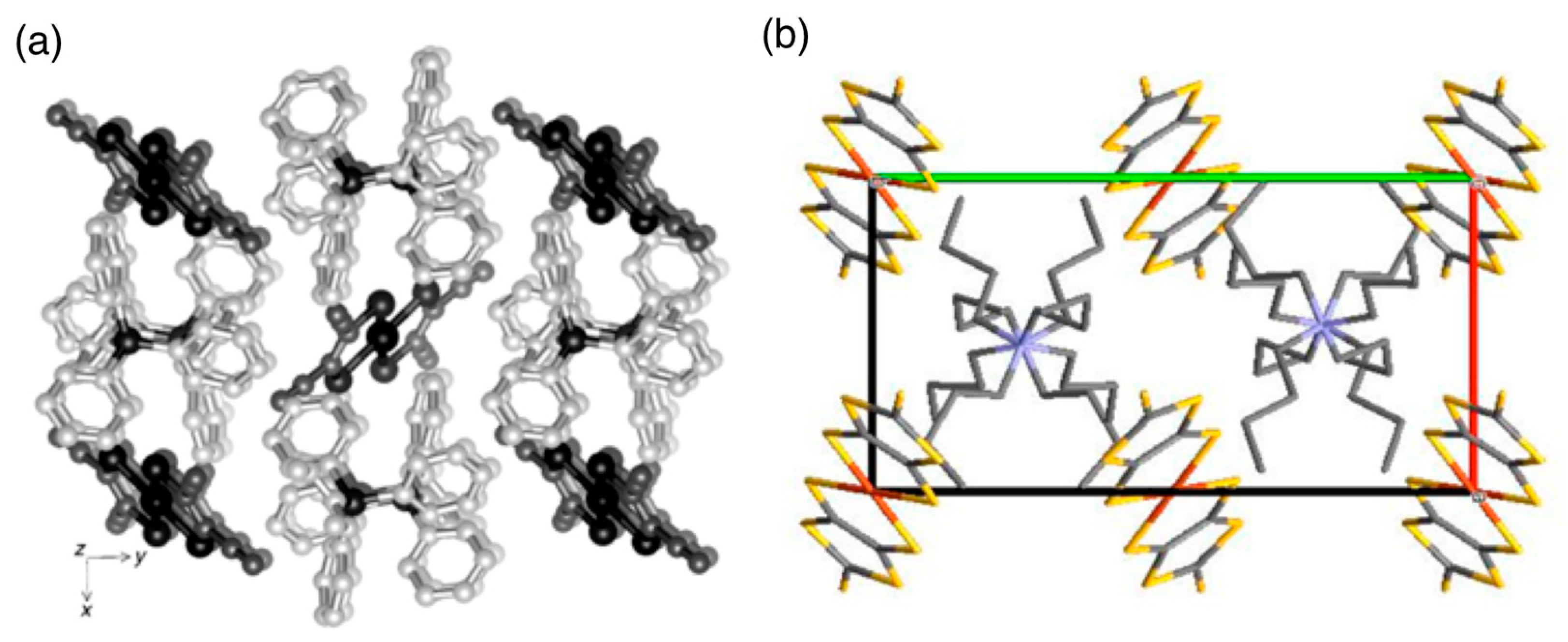
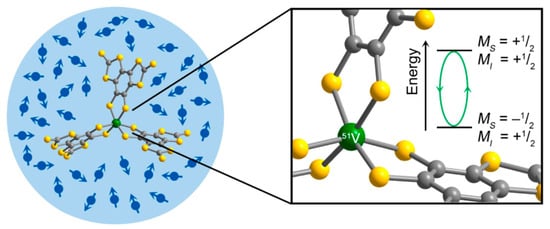
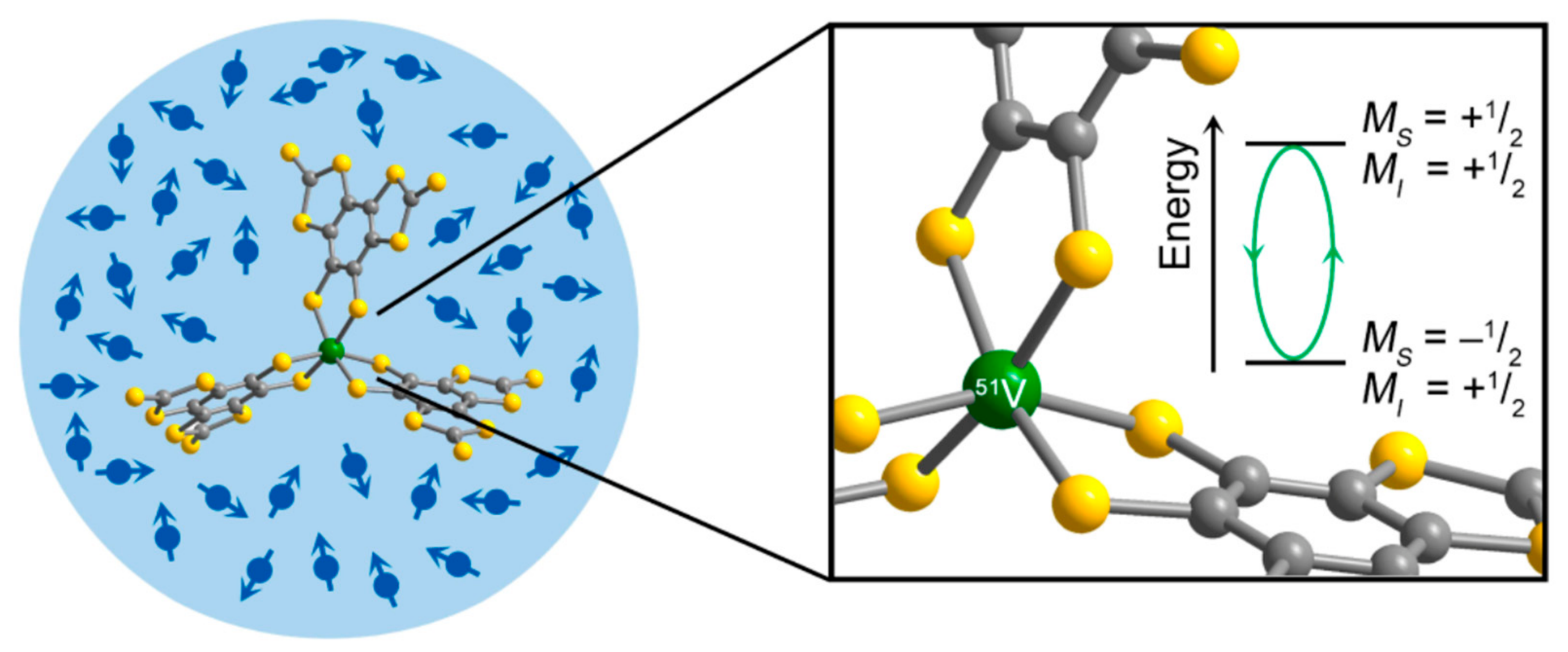
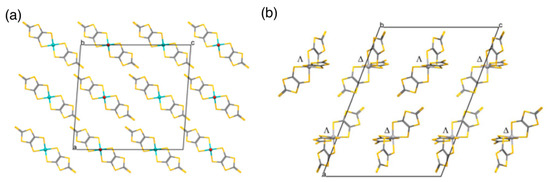
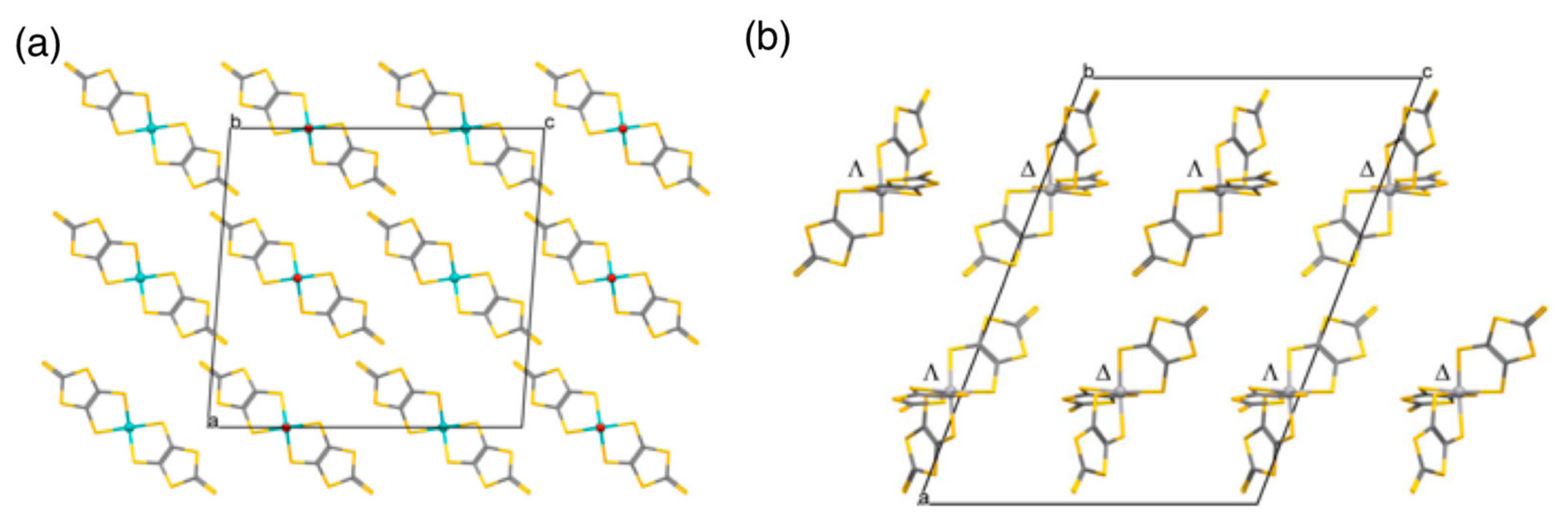
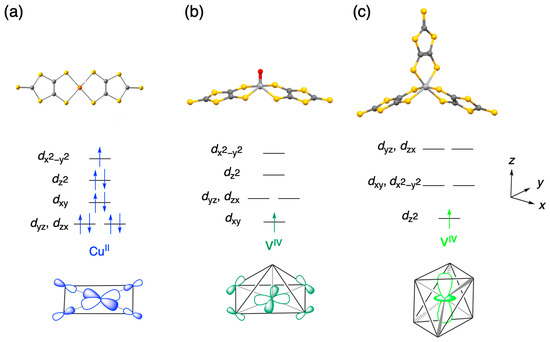
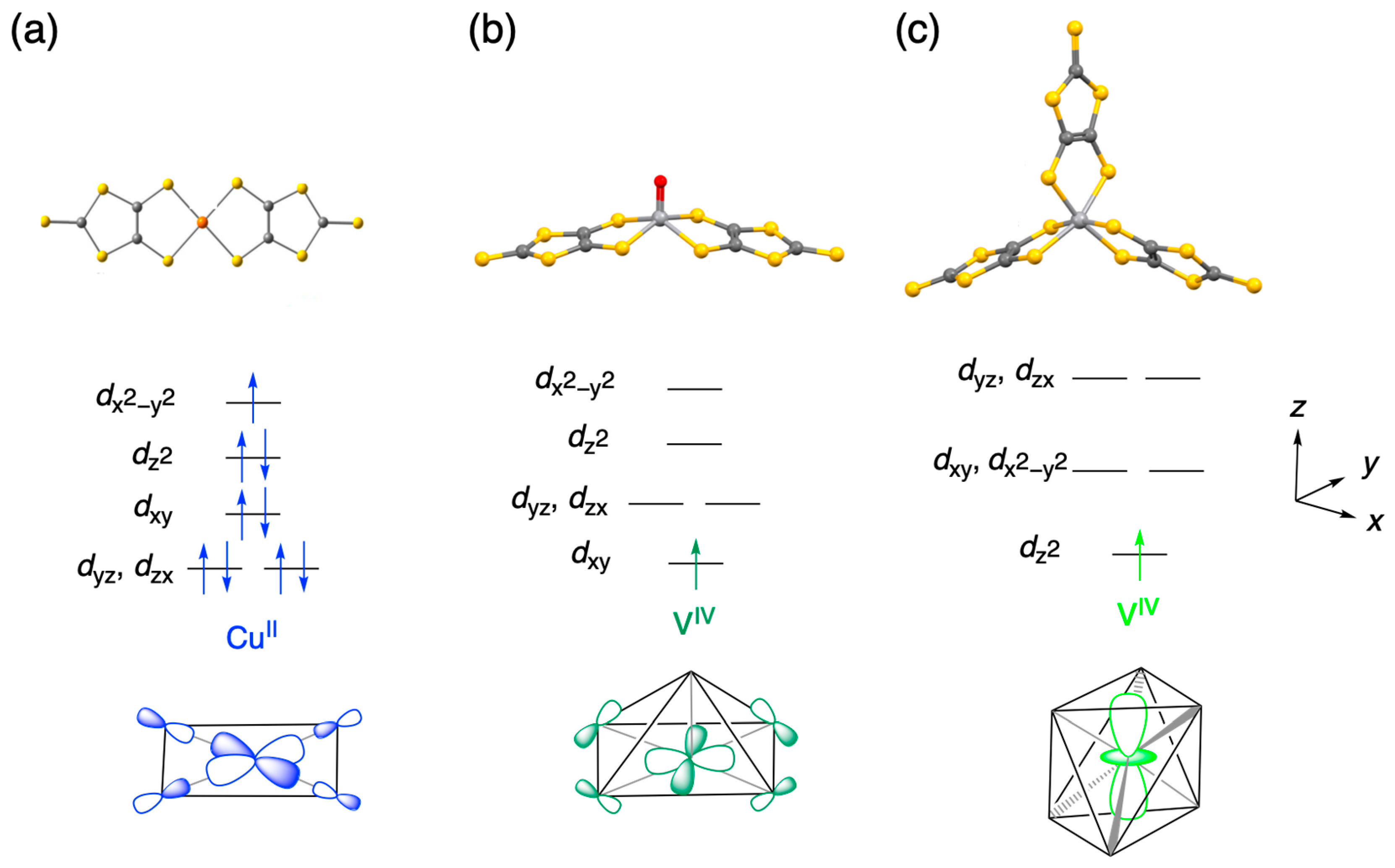
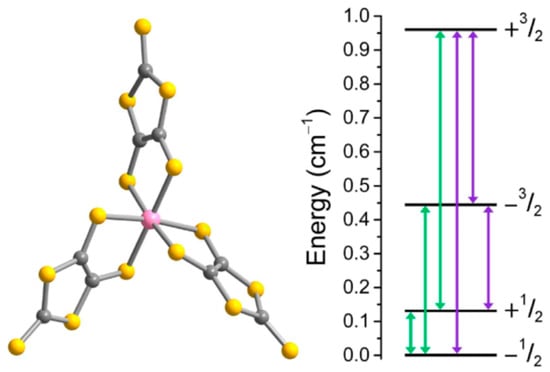
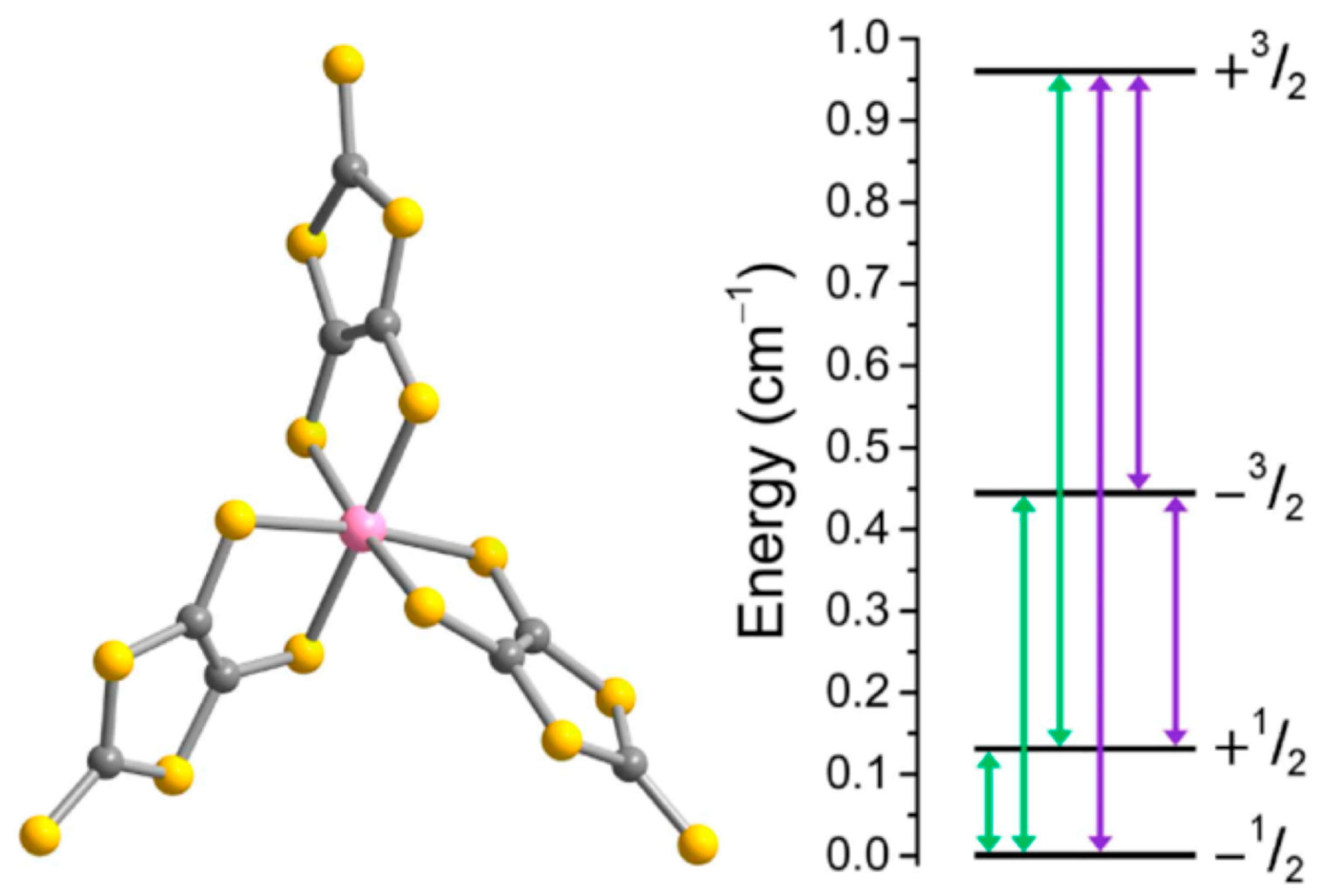
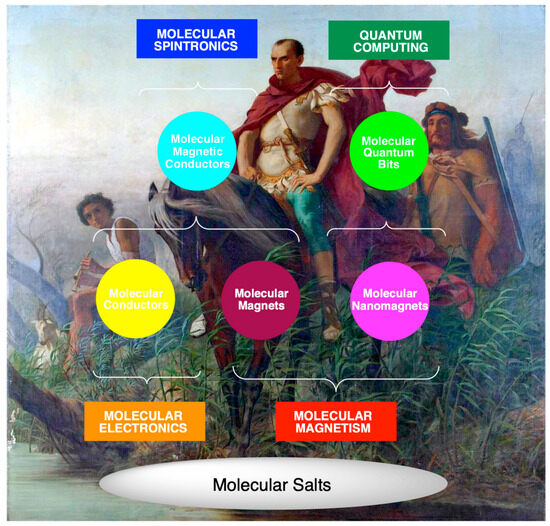
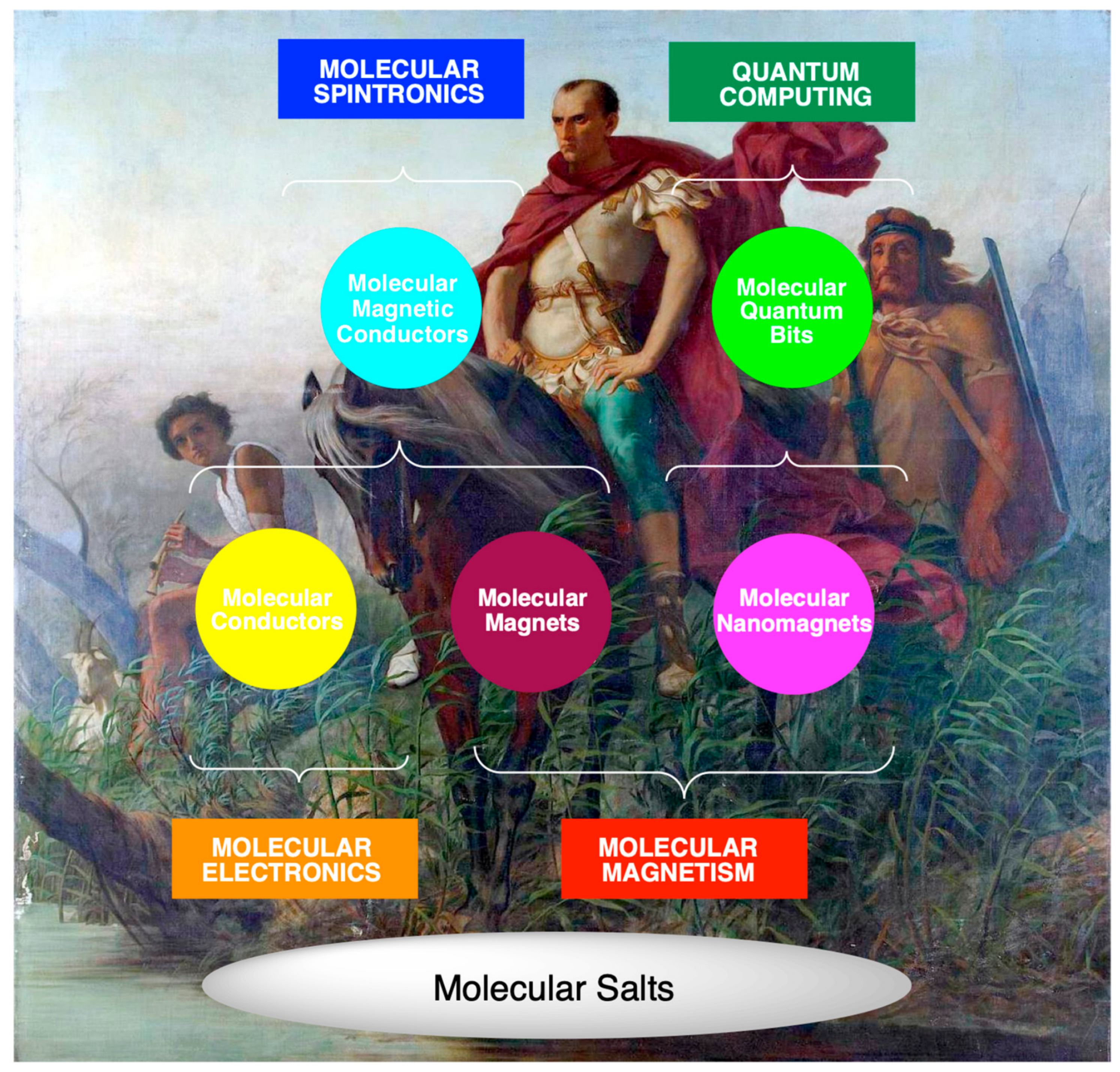
Disclaimer/Publisher’s Note: The statements, opinions and data contained in all publications are solely those of the individual author(s) and contributor(s) and not of MDPI and/or the editor(s). MDPI and/or the editor(s) disclaim responsibility for any injury to people or property resulting from any ideas, methods, instructions or products referred to in the content. |
© 2026 by the authors. Licensee MDPI, Basel, Switzerland. This article is an open access article distributed under the terms and conditions of the Creative Commons Attribution (CC BY) license.