


Abstract
Conventional water treatment relies on sequential flocculation and disinfection, which inflates infrastructure costs and heightens the risk of disinfection byproduct formation. Here, we report a magnetic lignin-based flocculant (LS-DMC-AM@Fe3O4) that integrates flocculation, sterilization, and rapid magnetic separation within a single material. The composite was synthesized by thermally initiated graft copolymerization of methacryloyloxyethyl trimethylammonium chloride (DMC) and acrylamide (AM) onto sodium lignosulfonate (LS), followed by incorporation of Fe3O4 nanoparticles (NPs) at 15 wt% loading; the product exhibited a saturation magnetization of 12.8 emu g−1. LS-DMC-AM@Fe3O4 achieved 98.2% kaolin turbidity removal at 1 mg L−1 and 98.6% E. coli removal at 8 mg L−1, and displayed a markedly broader effective dosage window than its non-magnetic analog. We attribute this broadened window to Fe3O4-enhanced membrane disruption, which liberates anionic intracellular contents that buffer excess cationic charge and thereby suppress restabilization. The bactericidal efficiency reached 90% at 18 mg L−1, 1.6-fold higher than LS-DMC-AM, governed by a synergistic dual mechanism: quaternary ammonium contact-killing coupled with Fe3O4 NP-induced intracellular reactive oxygen species (ROS) accumulation. Under an external magnetic field, flocs underwent rapid phase separation and displayed enhanced shear-regrowth capacity (E. coli floc recovery factor: 53% vs. 26%); Fe3O4 NPs were recovered at >95% efficiency over two cycles. Despite higher unit production costs, LS-DMC-AM@Fe3O4 delivers competitive per-unit-volume treatment economics through its ultralow effective dosage and magnetic seed recyclability. These results establish a viable strategy for engineering multifunctional, recyclable flocculants from industrial lignin waste.
1. Introduction
Escalating deterioration of water resources driven by industrialization and population growth has rendered the development of efficient, multifunctional water treatment agents an urgent priority [1,2]. Among aquatic pollutants, microbial contamination poses a particularly acute hazard owing to rapid propagation, secondary infectivity, and the severe waterborne diseases it engenders [3]. Escherichia coli (E. coli), the principal microbial indicator in drinking water safety assessment, serves as the primary target organism in the development of novel bactericidal water treatment materials [4,5]. Conventional water treatment processes treat flocculation and disinfection as two consecutive unit operations [6]. This configuration carries inherent liabilities: chemical oxidants (e.g., chlorine, ozone, chloramine) readily react with residual organic matter to generate carcinogenic and genotoxic disinfection byproducts (DBPs) [7,8], while microbial debris produced during disinfection proves resistant to removal by the preceding flocculation stage [9]. Integrating flocculation and bacterial inactivation within a single unit operation, therefore, offers a compelling strategy to simplify the treatment train and eliminate the chemical incompatibility between coagulants and disinfectants.
The structural basis for dual-function materials lies in the convergence of active groups required for flocculation and sterilization. Possessing a permanent positive charge unaffected by pH, quaternary ammonium groups can both adsorb and neutralize negatively charged colloidal particles and bacterial surfaces via electrostatic attraction, and exploit their hydrophobic nature to interact with the phospholipid bilayer, compromising cell wall integrity and thus exerting bactericidal activity [10,11]. Grafting these cationic moieties onto polymer backbones has yielded dual-function materials. For instance, a quaternary ammonium ternary copolymer achieved 97.2% E. coli removal via membrane disruption [12]; a tannin-based flocculant with concurrent turbidity removal and antibacterial activity [13]. These materials, however, rely on petroleum-derived monomers, raising concerns regarding feedstock sustainability and environmental compatibility. Natural polymers, namely, chitosan [14], starch [15], cellulose [16], and lignin [17], provide renewable, biodegradable alternatives as flocculant scaffolds. Among them, chitosan has garnered the greatest attention. A chitosan-based flocculant (CTS-g-PAMA) has been synthesized and achieved efficient bacterial flocculation and sterilization [14]; however, its solubility is exclusively under acidic conditions and elevated cost constraints for large-scale deployment [18]. Starch-based flocculants such as St-g-PDMC exhibited structural instability arising from swelling and gelatinization in aqueous environments [15,19], whereas cellulose necessitates energy-intensive pretreatment to overcome its intrinsically low chemical reactivity [20].
Sodium lignosulfonate (LS), an abundant byproduct of the sulfite pulping industry, has the potential capacity to transcend the above limitations. LS is inexpensive, fully water-soluble across the entire pH range, and inherently possesses hydroxyl, carboxyl, sulfonate, and methoxy functional groups amenable to chemical modification without pretreatment [21,22]. Moreover, LS valorization addresses the waste management burden of pulping liquors, consonant with circular economy principles. Cationized lignin derivatives with efficient antibacterial activity have recently emerged. A hyperbranched amphiphilic lignin-based polymer attained 99.6% E. coli removal at ultralow dosage [23]; a cationic kraft lignin for dye removal is also reported to be equipped with auxiliary antibacterial function [24]. Current studies predominantly concentrate on optimizing single properties, and flocculants with a single function fail to cope with various conditions [25]. In contrast, the synergistic integration of flocculation, disinfection, and separation into a lignin-based material platform has received scant attention, and the associated coupling mechanisms await in-depth investigation.
A further practical impediment is sluggish floc sedimentation, which prolongs hydraulic retention time and enlarges the footprint of clarification infrastructure. Magnetic flocculation, created by the incorporation of Fe3O4 nanoparticles (NPs) into flocculant matrices, surmounts this limitation by enabling rapid, magnetically driven phase separation [26]. Although magnetic flocculation is widely employed for particle removal, its application in microbial inactivation has generally not been given sufficient consideration. Consequently, the potential of magnetic flocculation for integrated bactericidal functions remains largely unexplored [27]. A magnetic flocculation prepared based on chitosan and Fe3O4 NPs (CTS-AM-DMC@Fe3O4) attained 97.0% kaolin removal with magnetic separability [28]. Beyond magnetic responsiveness, Fe3O4 NPs exhibit auxiliary antibacterial effects through two distinct pathways: (i) surface Fe(II)/Fe(III) redox cycling that catalyzes heterogeneous Fenton-like reactions, generating reactive oxygen species (ROS) [29,30], and (ii) direct nanoparticle–bacteria interfacial interactions that induce membrane perforation and vesicle deformation [31,32]. This convergence of physical and biochemical functionality suggests that Fe3O4 NPs incorporation into a cationic lignin-based flocculant could simultaneously enable rapid magnetic separation and synergistically amplify bactericidal activity via ROS-mediated oxidative stress, a hypothesis hitherto untested for lignin-based systems.
Motivated by these considerations, this study sought to develop a magnetic lignin-based flocculant (LS-DMC-AM@Fe3O4) with consolidated flocculation, sterilization, and magnetic separation capabilities. The specific objectives are: (i) to synthesize LS-DMC-AM@Fe3O4 and optimize Fe3O4 loading; (ii) to characterize its structural, thermal, and magnetic properties; (iii) to evaluate flocculation performance for kaolin and E. coli removal under varying operational conditions; (iv) to quantify bactericidal efficiency and elucidate the synergistic mechanism, with particular emphasis on the role of Fe3O4-induced intracellular ROS; and (v) to assess magnetic separation kinetics, seed recyclability, and economic feasibility relative to commercial flocculants. Compared with existing systems based on magnetic lignin or polymers, this study achieves a qualitative leap from bifunctional to trifunctional material design, namely the deep coupling of cationic graft flocculation (LS-DMC-AM), Fe3O4-mediated bactericidal functionality, and magnetic-responsive separation within a single molecular platform. This enables an integrated “flocculation–disinfection–separation” design, and reveals a novel phenomenon of “magnetic-enhanced bactericidal activity” along with its underlying mechanism, thereby demonstrating a scientific breakthrough and academic value.
2. Materials and Methods
2.1. Materials
LS (98%) was supplied by Laswitt Co. (Yiwu, China). Acrylamide (AM, AR), methacryloyloxyethyl trimethylammonium chloride (DMC, 75 wt% in water, AR), and 2,2′-azobis[2-(2-imidazolin-2-yl)propane] dihydrochloride (VA-044, AR) were purchased from Aladdin Biochemical Technology Co. (Shanghai, China). Fe3O4 NPs (99.5%, 20–30 nm) were obtained from Kelong Chemical Co. (Liaoyang, China). Kaolin powder (AR) was purchased from Macklin Biochemical Technology Co. (Shanghai, China). E. coli (ATCC 25922) was supplied by Baozang Biological Co. (Beijing, China). LB broth and LB agar were obtained from Huankai Microbial Technology Co. (Guangzhou, China). 2′,7′-dichlorodihydrofluorescein diacetate (DCFH-DA) was supplied by Aladdin (Shanghai, China). Potassium polyvinyl sulfate (PVSK) was purchased from Wako Pure Chemical Industries (Osaka, Japan). HCl (AR), NaOH (AR), anhydrous ethanol (AR), and other reagents (AR) were purchased from Kelong Chemical Co. Ultrapure water (18.2 MΩ·cm) was used throughout the experiments.
2.2. Flocculant Synthesis
LS-DMC-AM was synthesized by thermally initiated graft polymerization. Briefly, LS was dissolved in ultrapure water, followed by addition of AM and DMC at m(AM):m(DMC) = 2:1. The total monomer mass fraction was 25 wt%, and m(AM + DMC):m(LS) = 4:1. The mixture was purged with N2 for 10 min, after which the initiator VA-044 was introduced and N2 purging continued for an additional 10 min. The sealed reaction vessel was heated at 60 °C for 3 h. After polymerization, the product was aged for 1 h, purified by repeated washing with anhydrous ethanol, and dried at 60 °C for 48 h. Under these optimized conditions, LS-DMC-AM exhibited a conversion rate of 98.9%, an intrinsic viscosity of 436 mL g−1, and a cationic degree of 1.125 mmol g−1.
LS-DMC-AM@Fe3O4 was synthesized following the same procedure, with the addition of Fe3O4 NPs at a predetermined loading (5–25 wt% relative to total monomer mass) after monomer dissolution. The Fe3O4 NPs were dispersed by ultrasonication for 15 min before N2 purging. The subsequent polymerization, purification, and drying steps were identical to those for LS-DMC-AM.
2.3. Characterization
Fourier-transform infrared spectroscopy (FTIR, Nicolet iS50, Thermo Fisher, Waltham, MA, USA) was recorded over 500–4000 cm−1 using the KBr pellet method. Scanning electron microscopy (SEM, Quattro, Thermo Fisher, USA) was performed at an accelerating voltage of 5–15 kV after gold sputtering. Thermogravimetric analysis with differential scanning calorimetry (TGA-DSC, 1600 LF, Mettler Toledo, Greifensee, Switzerland) was conducted under N2 flow (50 mL min−1) at a heating rate of 10 °C min−1 from 50 to 600 °C. Vibrating sample magnetometry (VSM, CQJ-8604, Lake Shore, Westerville, OH, USA) was measured at 25 °C over ± 20 kOe.
The conversion rate was determined gravimetrically: a known mass of the crude product was purified with anhydrous ethanol and dried to constant weight. The intrinsic viscosity was determined by Ubbelohde viscometry in 1.00 mol L−1 NaCl at 30 ± 0.05 °C according to GB 12005.1-89. The cationic degree was measured by colloidal titration with PVSK (0.0025 mmol mL−1) using toluidine blue as an indicator. Zeta potential was measured with a Zetasizer Nano (Malvern, Worcestershire, UK) at 25 °C.
2.4. Flocculation and Magnetic Settling Experiments
Kaolin stock suspension (300 mg L−1, ~650 NTU) was prepared by dispersing kaolin powder in ultrapure water. E. coli stock suspension was prepared by inoculating E. coli into sterile LB broth and incubating at 37 °C under agitation (220 rpm) for 15 h. The bacterial culture was centrifuged at 5000 rpm for 10 min, washed, and resuspended in ultrapure water to an optical density at 600 nm (OD600) of approximately 0.75. For mixed-system experiments, kaolin and E. coli stock suspensions were mixed at a 1:1 volume ratio.
Flocculation experiments were conducted at room temperature (25 ± 2 °C) using a six-paddle jar tester (MY6000-6G, Meiyu Instruments, Wuhan, China). After dosing with flocculant stock solution (1.0 g L−1), the suspension was rapidly mixed at 200 rpm for 5 min, slowly stirred at 50 rpm for 15 min, and allowed to settle for 20 min. Supernatant samples were collected at 2 cm below the liquid surface. Turbidity was measured with a portable turbidimeter (2100 Q, HACH, Loveland, CO, USA). OD600 was measured with a UV-Vis spectrophotometer (UV2335, Unico, Reno, NV, USA). Turbidity removal rate (TRR) and OD600 removal rate (ORR) were calculated as TRR = (T0 − T)/T0 × 100% and ORR = (O0 − O)/O0 × 100%, where T0 and O0 are the initial values and T and O are the post-treatment values.
For magnetic settling experiments, a neodymium magnet was placed beneath the beaker during the settling phase. Supernatant samples were collected at predetermined time intervals. For the kaolin system, a small quantity of auxiliary Fe3O4 NPs was co-dosed to enhance the magnetic response, given the low flocculant dosage.
2.5. Floc Property Analysis
Floc particle size distribution was measured using a laser diffraction particle size analyzer (Mastersizer 3000, Malvern, UK), with the median diameter (d50) reported as the characteristic size parameter. Floc breakage and regrowth tests were performed by increasing the stirring speed to 200 rpm for 3 min (breakage phase), followed by slow stirring at 50 rpm for 15 min (regrowth phase). The floc recovery factor (Rf) was calculated as Rf = (t1 − t3)/(t1 − t2) × 100%, where t1, t2, and t3 are the turbidity or OD600 values after flocculation, after breakage, and after regrowth, respectively.
2.6. Sterilization Assays and Mechanism Investigation
2.6.1. Sterilization Assays
The bactericidal efficiency was evaluated by the standard plate counting method. After flocculation treatment, the E. coli suspension was serially diluted 105-fold with sterile phosphate-buffered saline (PBS). An aliquot of 100 μL was spread onto LB agar plates and incubated at 37 °C for 15 h. Colony-forming units (CFU) were enumerated, and the sterilization rate was calculated as SRR = (C0 − C)/C0 × 100%, where C0 and C are the CFU counts of the untreated control and the treated sample, respectively. Each experiment was performed in triplicate.
For bacterial regrowth assessment, the floc and supernatant fractions were collected 24 h after flocculation, washed twice with PBS, resuspended, and plated on LB agar. After incubation at 37 °C for 24 h, colony growth was observed and compared with untreated controls.
2.6.2. Mechanism Investigation
Cell morphology after flocculant treatment was observed by SEM. Flocs were collected, washed with PBS, fixed with 2.5% (v/v) glutaraldehyde at 4 °C for 4 h, dehydrated through a graded ethanol series (30%, 50%, 70%, 90%, and 100%, 15 min each), freeze-dried, gold-sputtered, and imaged.
Three-dimensional excitation-emission matrix (3D EEM) fluorescence spectra were recorded on the treated supernatant using a fluorescence spectrophotometer (Aqualog, HORIBA, Kyoto, Japan). Instrument parameters: excitation wavelength 200–450 nm, emission wavelength 280–550 nm, scan speed 2400 nm min−1, scan interval 10 nm.
Total phosphorus in the supernatant was measured by the ammonium molybdate spectrophotometric method after persulfate digestion. Supernatant samples (25 mL) were centrifuged, digested with potassium persulfate at 121 °C for 30 min, and reacted with the molybdate–antimony tartrate colorimetric reagent. Absorbance was measured at 700 nm.
Intracellular ROS were quantified using the DCFH-DA fluorescent probe (Aladdin, Shanghai, China). E. coli suspension was pre-incubated with 10 μmol L−1 DCFH-DA at 37.5 °C for 1 h in the dark, washed 2–3 times with PBS to remove excess probe, and resuspended. Flocculant was then added for the flocculation experiment. After treatment, the fluorescence intensity was measured with a fluorescence spectrophotometer (F-7000, Hitachi, Kyoto, Japan) at excitation/emission wavelengths of 488/525 nm.
2.7. Magnetic Seed Recovery
After magnetic flocculation, the magnetic flocs were collected using an external magnet. The recovered Fe3O4 NPs were stripped by a combination of deionized water rinsing, ultrasonic cleaning, and 1 mol L−1 NaOH immersion, then washed with deionized water, dried at 60 °C for 24 h, and reused for another round of LS-DMC-AM@Fe3O4 synthesis. The recovery rate was calculated as ηₘ = m/m0 × 100%, where m0 is the mass of Fe3O4 NPs in the original flocculant and m is the mass of recovered Fe3O4 NPs.
3. Results and Discussion
3.1. Flocculant Characterization
3.1.1. Optimization of Fe3O4 Loading
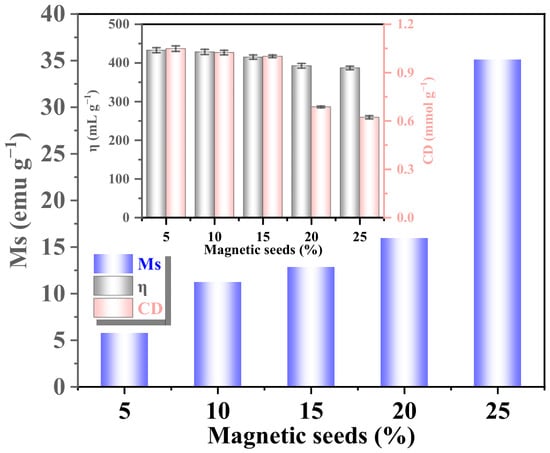
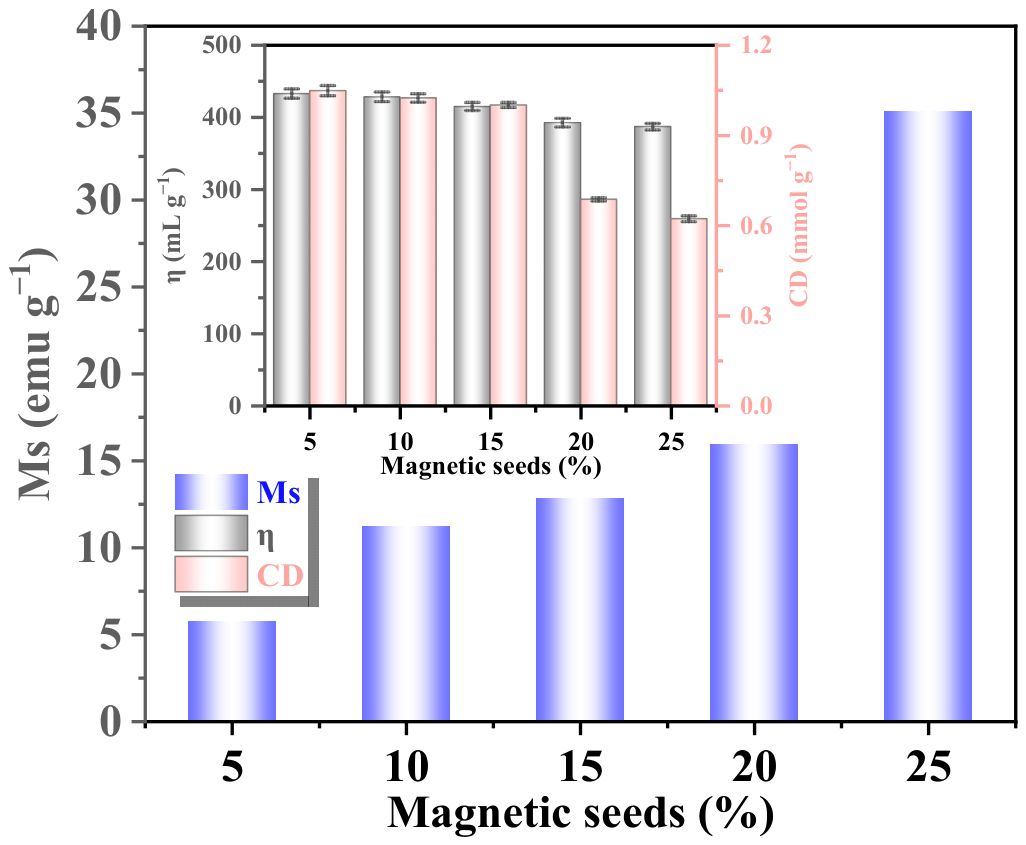
The Fe3O4 NPs loading governs the balance between magnetic responsiveness and flocculation activity. The hysteresis loops at various Fe3O4 loadings (Figure S1) exhibit S-shaped curves through the origin with negligible coercivity, confirming superparamagnetic behavior. Incrementally elevating the Fe3O4 loading from 5 to 25 wt% progressively augments the saturation magnetization (Ms), corroborating that higher magnetic particle content enhances magnetically driven phase separation (Figure 1). The intrinsic viscosity (η) remains stable at ≤15 wt% but deteriorates at higher loadings, indicating that excessive Fe3O4 NPs physically constrain polymer chain extension and diminish the hydrodynamic volume, thereby compromising adsorption-bridging capacity [33]. The cationic degree (CD) undergoes a monotonic decline with increasing Fe3O4 NPs loading, ascribable to dilution of the cationic organic fraction and partial occlusion of accessible quaternary ammonium sites.
Figure 1.
Effect of magnetic seed loading on saturation magnetization (Ms), (inset) intrinsic viscosity (η), and cationic degree (CD).
Balancing these three performance indicators, 15 wt% loading is selected as optimal, yielding η = 415 mL g−1 (~95% of the LS-DMC-AM value), CD = 1.011 mmol g−1, and Ms = 12.8 emu g−1. Furthermore, Ms scales with Fe3O4 NPs loading: at 15 wt%, Ms = 12.8 emu g−1, lower than bare Fe3O4 NPs (55.4 emu g−1) due to the diamagnetic polymer matrix [34], but adequate for rapid magnetic separation [26] to take place.
3.1.2. SEM Analysis
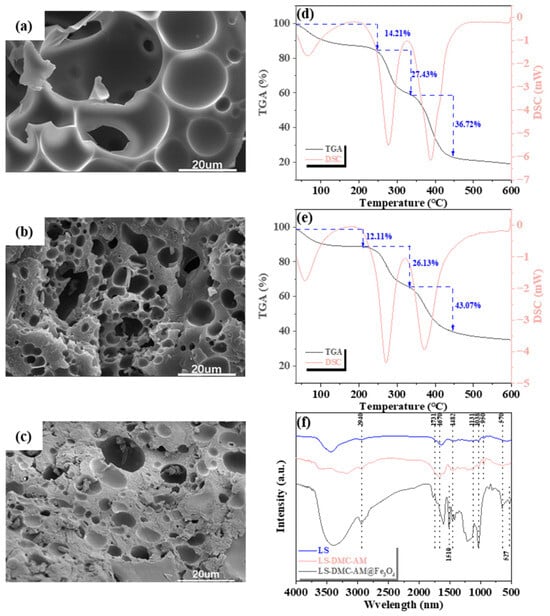
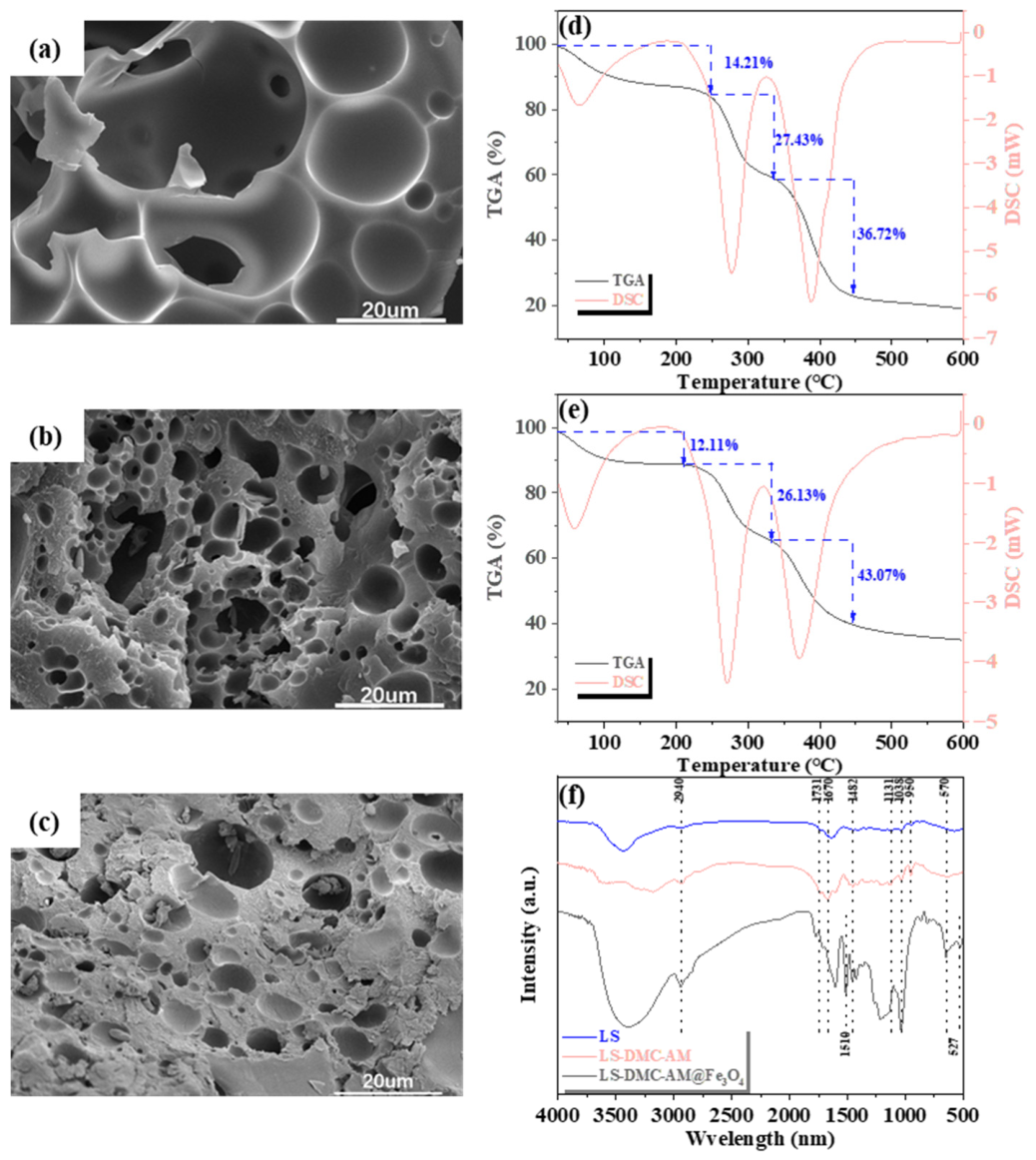
SEM imaging (Figure 2a–c) reveals a porous, block-like microstructure with abundant irregular cavities and thin pore walls. Irregular granular particles are observed attached to the pore walls, indicating well-integrated Fe3O4 NPs. Compared with LS-DMC-AM, the magnetic composite exhibited increased surface roughness while preserving the porous backbone, a morphology providing both adsorption sites and magnetic responsiveness [35].
Figure 2.
Structural and compositional characterization: SEM images of (a) LS, (b) LS-DMC-AM, and (c) LS-DMC-AM@Fe3O4; thermal analysis via thermogravimetric analysis and differential scanning calorimetry (TGA-DSC) for (d) LS-DMC-AM and (e) LS-DMC-AM@Fe3O4; (f) FTIR spectra for LS, LS-DMC-AM and LS-DMC-AM@Fe3O4.
3.1.3. TGA-DSC Analysis
According to the TGA-DSC analysis (Figure 2d,e), LS-DMC-AM@Fe3O4 exhibits a three-stage thermal decomposition profile similar to LS-DMC-AM: Stage I (50–220 °C, ~12.1% mass loss) from dehydration; Stage II (220–350 °C, ~26.1% mass loss) from decomposition of labile functional groups and side chains [36]; Stage III (350–500 °C, ~43.1% mass loss) from degradation of the polymer backbone and carbonization [37]. Above 500 °C, the residual mass exceeds that of LS-DMC-AM owing to the thermally stable Fe3O4 component, indicating enhanced thermal stability.
3.1.4. FTIR Analysis
FTIR spectra of LS, LS-DMC-AM, and LS-DMC-AM@Fe3O4 are juxtaposed in Figure 2f. LS-DMC-AM@Fe3O4 preserves all characteristic absorption bands of LS-DMC-AM: aromatic skeletal vibrations of LS at ~2940 and ~1038 cm−1 [38,39]; C=O stretching of AM at ~1670 cm−1 [40]; ester C=O and C–O–C stretching of DMC at ~1731 and ~1131 cm−1; and quaternary ammonium C–H stretching at ~950 and ~1482 cm−1 [41]. A new absorption band emerges at ~570 cm−1, assigned to Fe–O stretching, confirming Fe3O4 NPs incorporation [42]; its attenuated intensity is attributable to shielding by the organic polymer matrix. Thereby, the Fe3O4 NPs incorporation preserves the grafted functional architecture intact.
3.2. Performance in Turbidity Removal
The dosage-dependent turbidity removal profiles of LS-DMC-AM@Fe3O4, LS-DMC-AM, and bare Fe3O4 NPs are presented in Figure S2. LS-DMC-AM@Fe3O4 attains 98.2% turbidity removal at 1 mg L−1, comparable to LS-DMC-AM (97.7%). Bare Fe3O4 NPs exhibit negligible turbidity abatement, indicating that flocculation activity originates from the grafted cationic polymer rather than the magnetic constituent. These polymer-based flocculants conform to the canonical dosage-response pattern: increasing removal with dosage to an optimum, followed by decline at overdoses from charge reversal and restabilization [43].
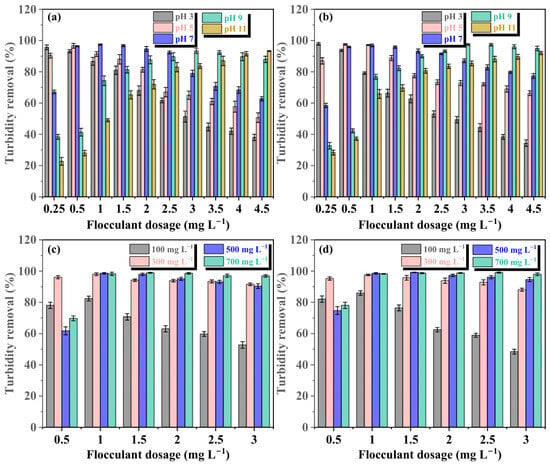
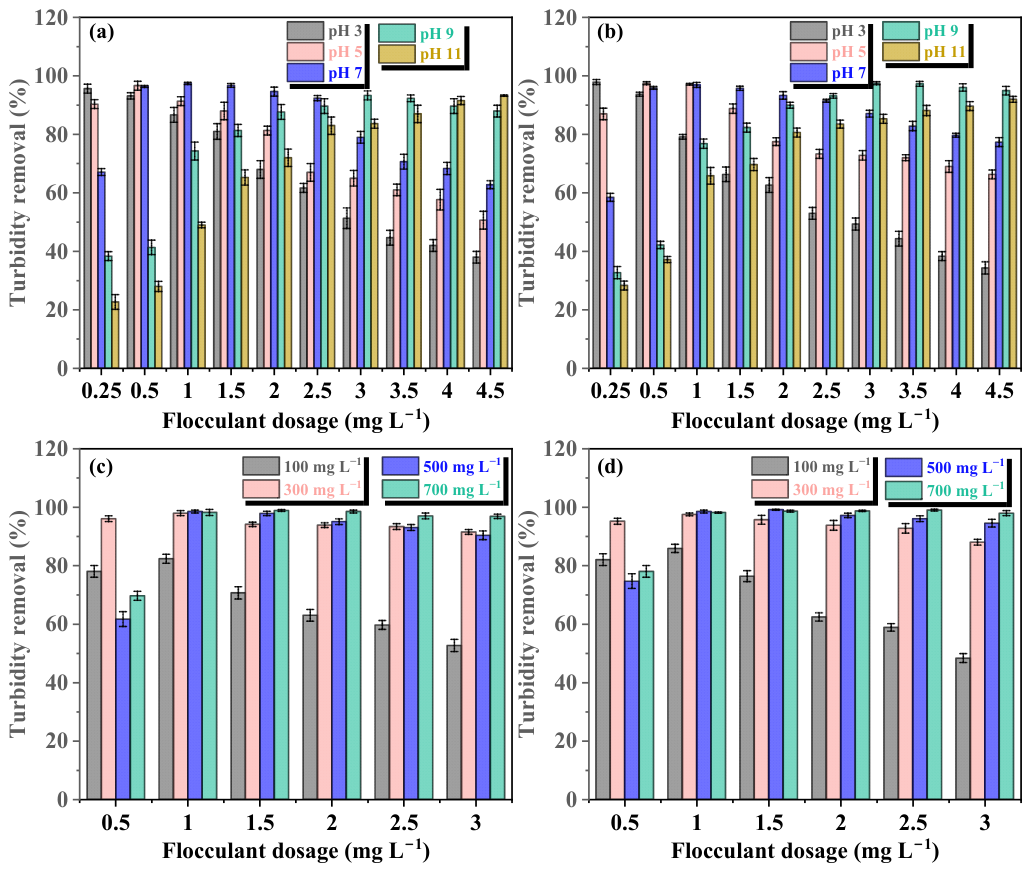
As illustrated in Figure 3a,b, LS-DMC-AM@Fe3O4 maintains high-turbidity removal across a wide pH range (3–9) with only minor shifts in optimal dosage. Under acidic conditions (pH 5), lower dosages suffice owing to the higher positive charge density on the flocculant and partial suppression of kaolin surface negative charge [44]. Under alkaline conditions (pH 9), higher dosages are required to compensate for the reduced positive charge on the flocculant and enhanced negative charge on kaolin surfaces [45]. The overall behavior closely mirrors that of LS-DMC-AM, which suggests that Fe3O4 NPs incorporation does not substantially alter the pH-dependent charge characteristics of the flocculant.
Figure 3.
Turbidity removal performance of (a,c) LS-DMC-AM and (b,d) LS-DMC-AM@Fe3O4 at different pH and kaolin concentrations. Experimental conditions: [flocculant] 0 = 0.25−4.5 mg L−1, [kaolin] = 300 mg L−1, pH 7, room temperature. pH 3−11 for (a,b); [kaolin] = 100−700 mg L−1 for (c,d).
As presented in Figure 3c,d, LS-DMC-AM@Fe3O4 demonstrates robust performance across initial kaolin concentrations ranging from 100 to 700 mg L−1. At low initial turbidity (100 mg L−1), removal efficiency is slightly lower owing to reduced particle collision frequency. At moderate turbidity (300 mg L−1), optimal matching between particle concentration and flocculant demand yields high removal at low dosage. At high turbidity (500–700 mg L−1), removal performance remains high and stable over a broad dosage window because the increased particle concentration enhances collision frequency and floc growth [46]. This robustness across a wide influent turbidity range is favorable for treating variable industrial effluents.
3.3. Performance in E. coli Removal
As shown in Figure S3, the E. coli removal performance reveals a marked advantage of Fe3O4 incorporation. LS-DMC-AM@Fe3O4 achieves 95.7% removal at 8 mg L−1 and a maximum of 98.6%, outperforming LS-DMC-AM (97.5% at an optimal dosage of 6 mg L−1, but with a narrower effective window). Bare Fe3O4 NPs exhibit negligible bacterial removal, which demonstrates that the magnetic particles alone do not possess meaningful flocculation activity toward E. coli. Notably, while LS-DMC-AM exhibits pronounced restabilization beyond its optimal dosage, LS-DMC-AM@Fe3O4 sustains high removal efficiency across a considerably expanded dosage range (8–18 mg L−1). This attenuated restabilization carries mechanistic significance: the data implicate Fe3O4 NPs in amplifying bacterial cell membrane disruption, thereby liberating negatively charged intracellular contents, including proteins, nucleic acids, and phosphate metabolites, into the supernatant. These anionic biopolymers consume excess cationic flocculant in the overdosed regime, suppressing the charge reversal that ordinarily drives restabilization [47]. Furthermore, the higher flocculant dosages required in the E. coli system compared with the kaolin system (8 vs. 1 mg L−1) are attributable to two factors: (i) concurrent consumption of cationic charge for both flocculation and membrane-disruption processes [48]; and (ii) the smaller size and more complex surface chemistry of bacterial cells relative to kaolin particles.
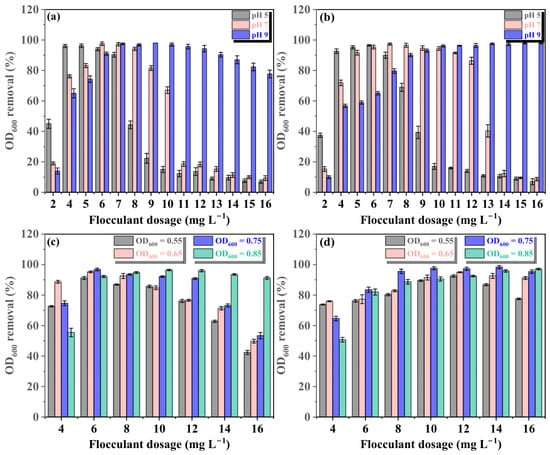
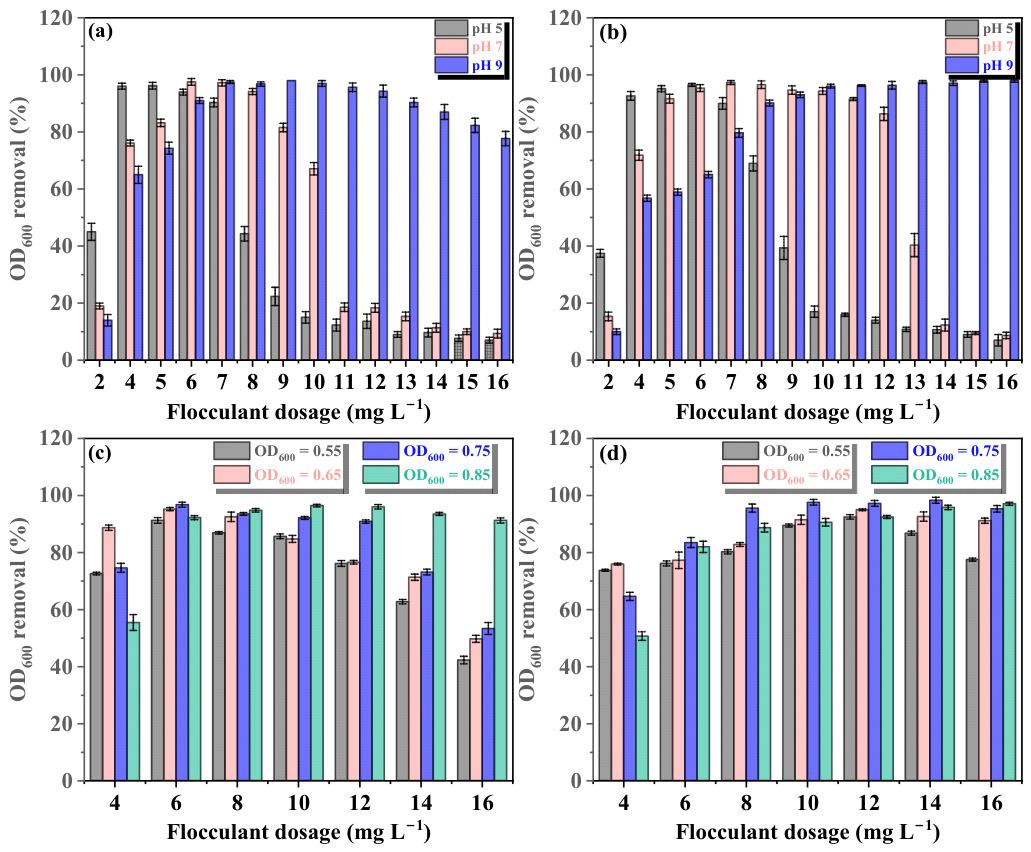
As shown in Figure 4a,b, LS-DMC-AM@Fe3O4 retains robust E. coli removal across pH 5–9, with the same trend of increased optimal dosage under alkaline conditions observed for LS-DMC-AM. Notably, the restabilization-suppression effect persists across all tested pH values, which confirms that the Fe3O4-enhanced membrane-disruption mechanism operates independently of bulk solution pH, an important attribute for practical water treatment where pH may fluctuate.
Figure 4.
E. coli removal performance of (a,c) LS-DMC-AM and (b,d) LS-DMC-AM@Fe3O4 at different pH and kaolin concentrations. Experimental conditions: [flocculant] 0 = 2−16 mg L−1, [OD600] = 0.65, pH 7, room temperature. pH 5−9 for (a,b); [OD600] = 0.55−0.85 for (c,d).
As displayed in Figure 4c,d, LS-DMC-AM@Fe3O4 maintains effective removal across OD600 values of 0.55–0.85. At low initial concentrations, removal is slightly lower due to reduced cell–cell collision frequency. At higher initial concentrations, the broader effective dosage window becomes more pronounced, consistent with the enhanced intracellular leakage mechanism: higher cell densities provide more membrane-disruption-derived anionic species to buffer against overdosing. The optimal dosage shifts slightly upward compared with LS-DMC-AM, attributable to partial cationic site shielding by Fe3O4 NPs and the consumption of cationic charge by released intracellular contents from damaged cells.
3.4. Application
3.4.1. Magnetic Floc Settling
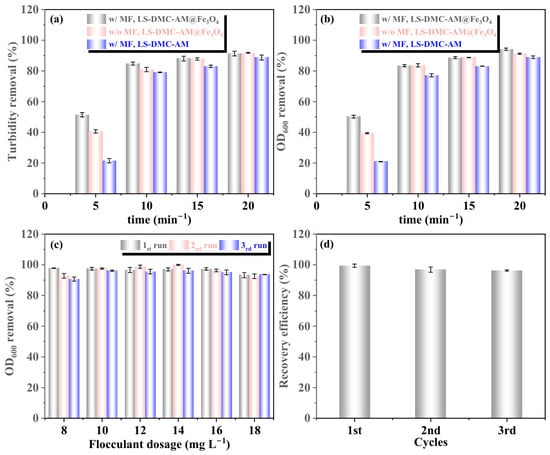
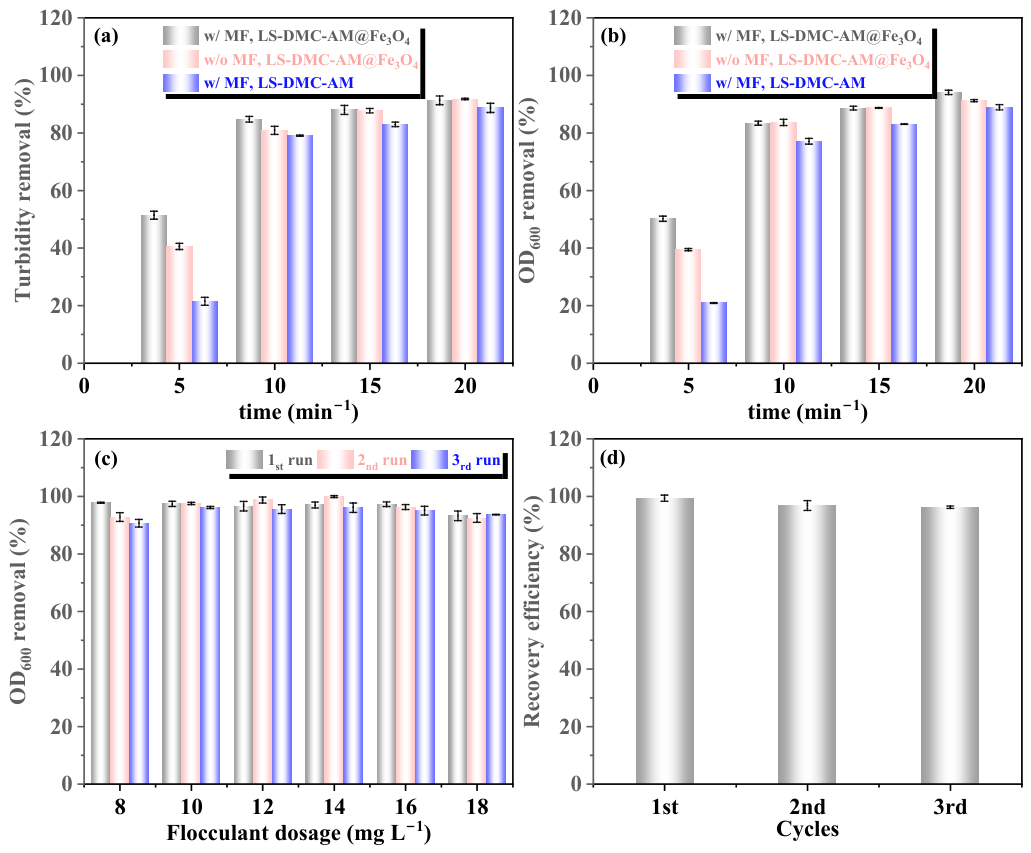
The effect of an external magnetic field on floc sedimentation is shown in Figure 5a,b. For both kaolin and E. coli systems, magnetically assisted settling consistently outperforms gravitational settling, with the enhancement most pronounced during the initial phase (within 5 min), when magnetic force drives directional floc migration [26]. The advantage is particularly evident in the E. coli system: the low density and small size of bacterial flocs make gravitational settling inefficient, and the magnetic driving force provides a disproportionate improvement [27].
Figure 5.
The time-profile of (a) turbidity and (b) E. coli removal under magnetic field (MF); (c) E. coli removal by recycled LS-DMC-AM@Fe3O4 and (d) magnetic seed recovery efficiency. Experimental conditions: [flocculant] 0 = 1, 8 mg L−1, [kaolin] = 300 mg L−1, [OD600] = 0.65, pH 7, room temperature. [flocculant] = 8−18 mg L−1 for (c).
3.4.2. Fe3O4 Seed Recyclability
The Fe3O4 NPs recovery and reuse performance is presented in Figure 5c,d. After magnetic collection, stripping, and re-grafting, the re-prepared LS-DMC-AM@Fe3O4 retains E. coli removal rates of 98.4% (cycle 1) and 97.0% (cycle 2), compared with 98.6% for the virgin material. The Fe3O4 NPs recovery rate exceeds 95% over cycles. The modest performance decline is attributable to residual organic coating on Fe3O4 NPs after repeated washing [49]. These results collectively support the feasibility of magnetic seed recycling.
3.4.3. Performance in Natural Water Matrix
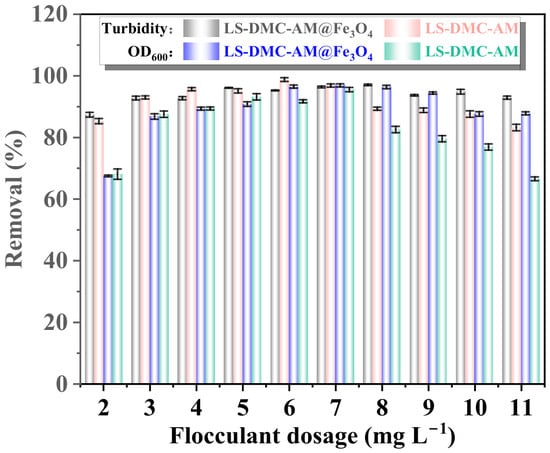
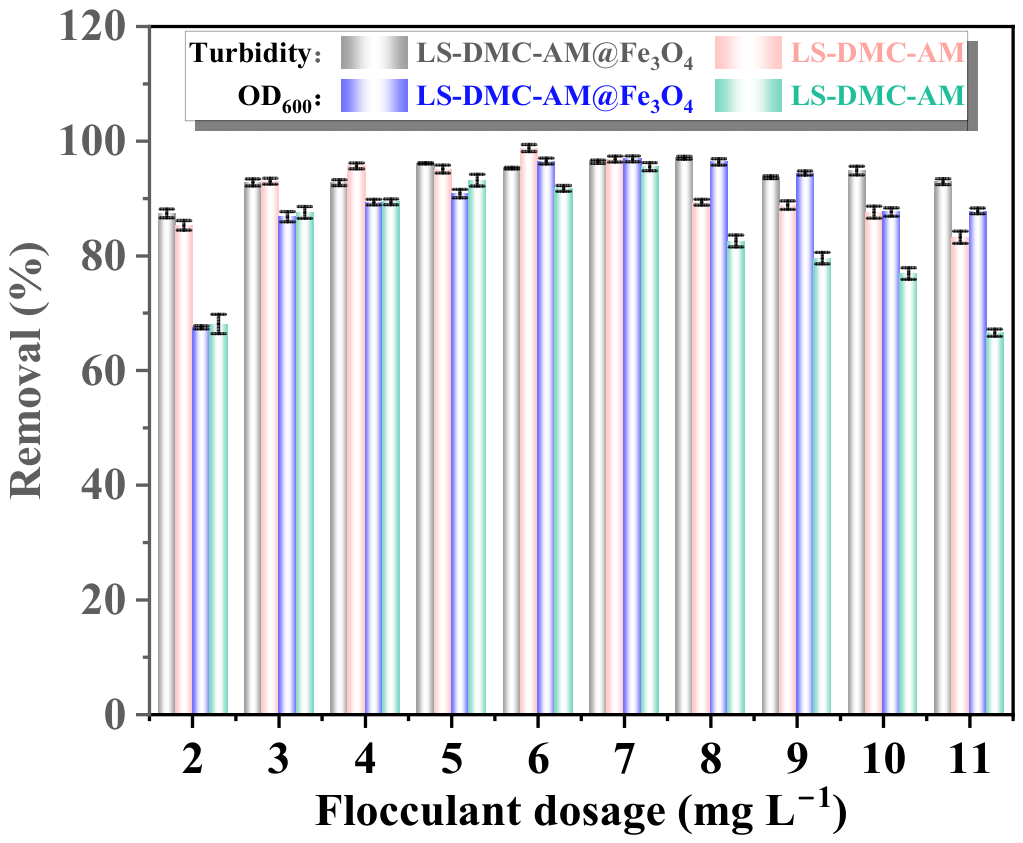
To assess practical applicability, flocculation experiments are conducted in natural water that is sampled from an artificial lake. For single-pollutant systems (Figure S4a,b), LS-DMC-AM@Fe3O4 achieves 97.2% kaolin removal at 3 mg L−1 and 96.3% E. coli removal at 14 mg L−1. The higher optimal dosages relative to ultrapure water reflect consumption of cationic charge by dissolved organic matter and competing anions [50]. For the mixed kaolin–E. coli system (Figure 6), >95% simultaneous removal is achieved at 8 mg L−1. Critically, the restabilization effect remains weaker than for LS-DMC-AM even in the complex natural water matrix, which confirms that the enhanced membrane-disruption mechanism remains operative under environmentally relevant conditions.
Figure 6.
The removal performance of LS-DMC-AM@Fe3O4 and LS-DMC-AM toward mixed kaolin and E. coli. Experimental conditions: [flocculant] 0 = 2−8 mg L−1, [kaolin] = 300 mg L−1, [OD600] = 0.65, pH 7.
3.5. Flocculation Mechanism and Floc Structural Properties
3.5.1. Flocculation Mechanism
Zeta potential analysis provides mechanistic insight into the flocculation process. As presented in Figure S5. LS-DMC-AM@Fe3O4 maintains a net positive charge over pH 3–9, with its zeta potential only marginally lower than that of LS-DMC-AM. The minor reduction is attributable to partial shielding of cationic sites by Fe3O4 NPs, but the magnitude is insufficient to substantially compromise electrostatic attraction toward negatively charged particles and cells.
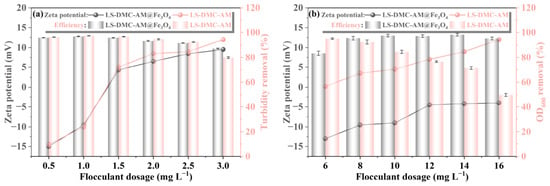
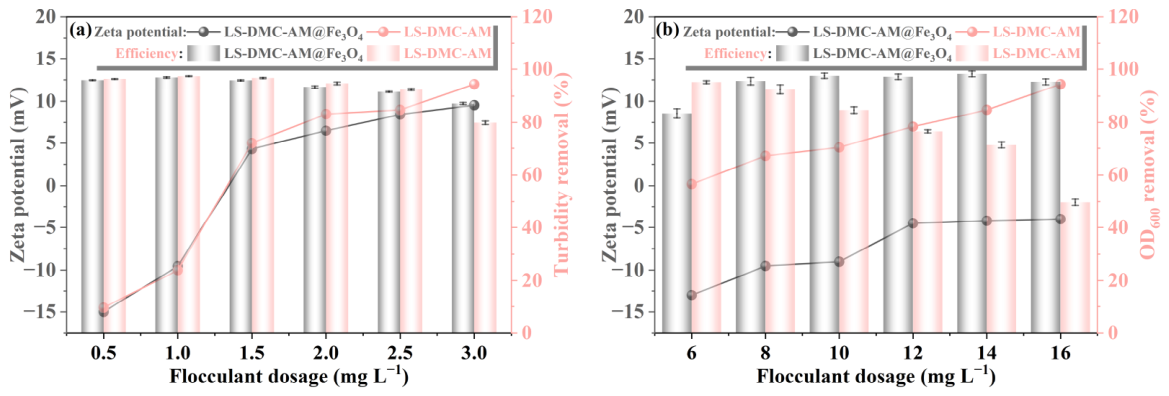
For kaolin flocculation (Figure 7a), the relationship between supernatant zeta potential and removal efficiency for LS-DMC-AM@Fe3O4 closely parallels that of LS-DMC-AM. At the optimal dosage, the zeta potential had not yet reached zero, indicating that turbidity removal is driven by the synergistic action of charge neutralization and adsorption bridging, consistent with the mechanism established for LS-DMC-AM [43,51]. Fe3O4 incorporation does not fundamentally alter this mechanism.
Figure 7.
Variation in zeta potential along with (a) turbidity and (b) E. coli removal by LS-DMC-AM@Fe3O4 and LS-DMC-AM. Experimental conditions: [flocculant] 0 = 0.5−16 mg L−1, pH 7. [kaolin] = 300 mg L−1 for (a); [OD600] = 0.65 for (b).
The E. coli system (Figure 7b) reveals a mechanistically consequential distinction. LS-DMC-AM@Fe3O4 attains high bacterial removal efficiency even when the bulk supernatant zeta potential remains distinctly electronegative, a phenomenon irreconcilable with charge neutralization alone. Rather, it furnishes independent evidence for the enhanced membrane-disruption hypothesis: Fe3O4 NPs amplify bacterial cell membrane damage, triggering leakage of negatively charged intracellular constituents, including proteins, nucleic acids, phospholipids, ATP, and phosphate metabolites, that sequester excess cationic charge in solution. This intracellular leakage-driven charge buffering attenuates the surplus positive charge that would otherwise precipitate restabilization at overdoses. The net outcome, namely a broadened effective dosage window accompanied by enhanced bactericidal activity, thus emanates directly from the dual functionality of Fe3O4 NPs as both magnetic separation agents and membrane-disruption amplifiers.
3.5.2. Floc Size and Shear-Regrowth Capacity
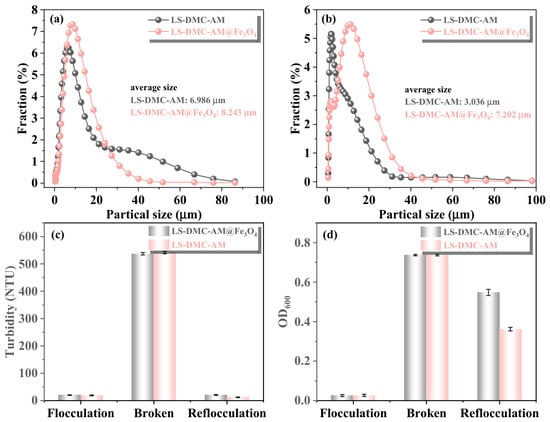
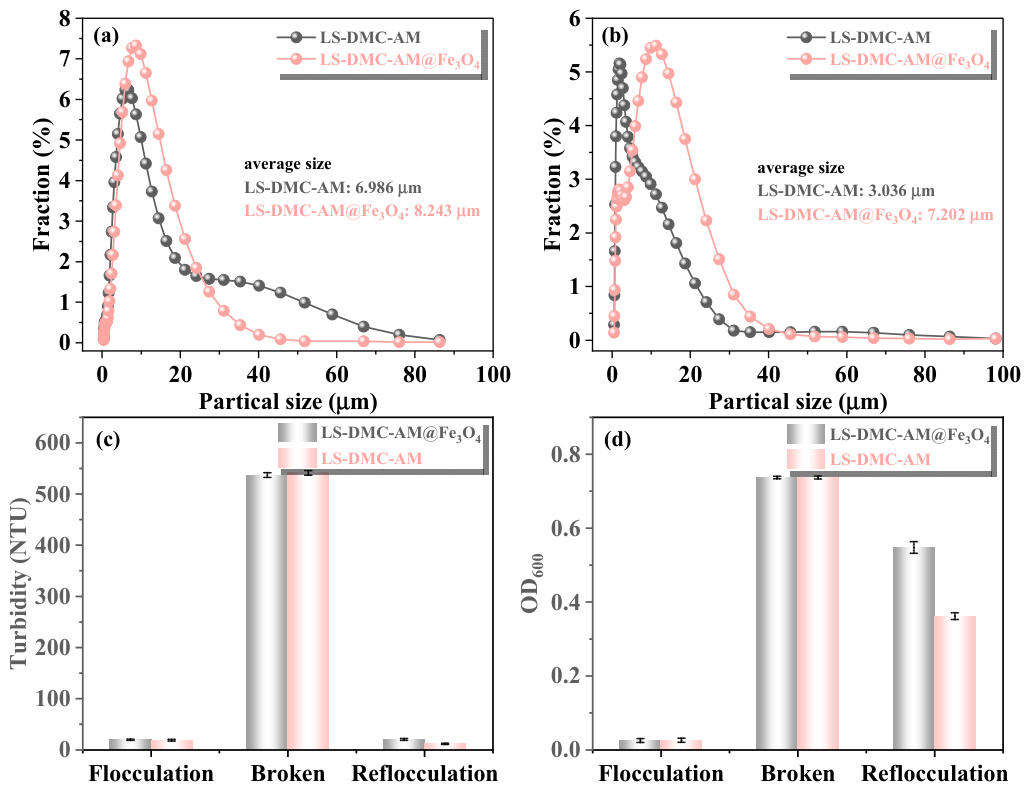
The median floc diameter (d50) increases upon Fe3O4 NPs incorporation from 6.99 to 8.24 μm for kaolin flocs and from 3.04 to 7.20 μm for E. coli flocs (Figure 8a,b). The shift in the entire particle size distribution toward larger diameters indicates that Fe3O4 NPs serve as nucleation sites that promote particle aggregation and floc densification [52]. The more pronounced relative enhancement in the E. coli system (137% increase vs. 18% for kaolin) reflects the intrinsically weaker aggregation tendency of bacterial cells, which benefit disproportionately from the presence of dense, magnetically interactive nucleation centers.
Figure 8.
Particle size of flocs after treatment of (a) kaolin and (b) E. coli by different flocculants; Changes in turbidity and OD600 at different stages for (c) kaolin and (d) E. coli treated with different flocculants. Experimental condition: [flocculant] 0 = 1, 8 mg L−1, pH 7. [kaolin] = 300 mg L−1 for (a,c); [OD600] = 0.65 for (b,d).
Floc breakage–regrowth experiments (Figure 8c) reveal contrasting behavior between the two systems. For kaolin flocs, both LS-DMC-AM and LS-DMC-AM@Fe3O4 exhibit good recovery after shear-induced breakage, with LS-DMC-AM@Fe3O4 showing a marginal improvement. For E. coli flocs, however, LS-DMC-AM@Fe3O4 achieves a substantially higher recovery factor (53%) compared with LS-DMC-AM (26%). The inherently low density, small size, and loose structure of pure bacterial flocs make them particularly susceptible to irreversible breakage under shear [53]. The incorporation of denser Fe3O4 NPs enhances floc integrity through several mechanisms: (i) magnetic dipole–dipole interactions between adjacent Fe3O4-bearing floc fragments promote re-aggregation after shear cessation [54]; (ii) the higher density of Fe3O4-containing flocs improves their settling-driven re-contact probability during the slow-stir regrowth phase [49]; and (iii) Fe3O4 NPs provide additional cross-linking points within the floc structure. This improvement in shear resistance is of practical significance for water treatment processes involving hydraulic turbulence (e.g., flocculation basins, pipelines, and filter backwash).
3.6. Bactericidal Enhancement and Dual Mechanism
3.6.1. Bactericidal Performance: Synergistic Enhancement
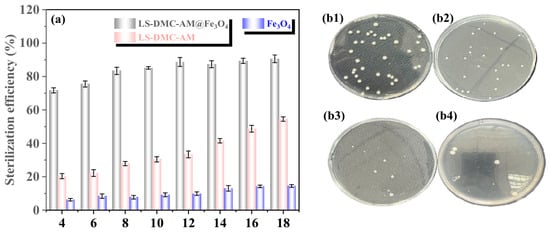
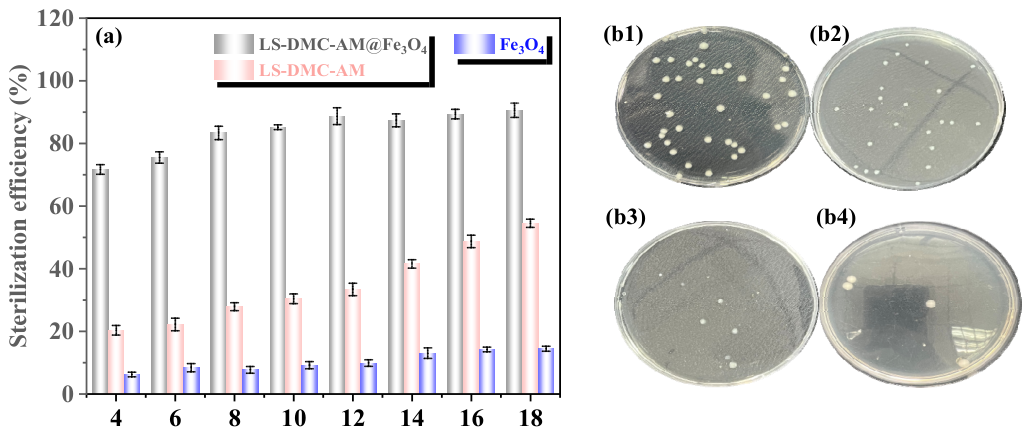
The bactericidal efficiency evaluated by plate counting (Figure 9a) demonstrates a substantial improvement upon Fe3O4 incorporation. LS-DMC-AM@Fe3O4 achieves a sterilization rate of 90% at 18 mg L−1 dosage, compared with 55% for LS-DMC-AM (a 1.6-fold enhancement). Bare Fe3O4 NPs do not exhibit meaningful standalone bactericidal activity, which confirms that the enhancement arises from a synergistic effect between the magnetic NPs and the cationic flocculant matrix, rather than from additive contributions.
Figure 9.
(a) Sterilization performance of different flocculants. Bacterial regrowth in flocs (b1) and supernatant (b2) treated with LS-DMC-AM, and in flocs (b3) and supernatant (b4) treated with LS-DMC-AM@Fe3O4. Experimental condition: pH 7, [OD600] = 0.65. [flocculant] 0 = 4−18 mg L−1 for (a), [flocculant] 0 = 18 mg L−1 for (b).
Two complementary mechanisms are proposed for this synergy. Firstly, Fe3O4 NPs may catalyze heterogeneous Fenton-like reactions at their surface, where Fe(II)/Fe(III) redox cycling converts H2O2 (present at low concentrations in biological systems or generated in situ) into HO• and other ROS [29,55]. Secondly, direct Fe3O4 NP–bacteria contact may induce membrane perforation and increase permeability, facilitating deeper penetration of quaternary ammonium groups into the phospholipid bilayer and amplifying contact-killing efficiency [32]. The net result is a bactericidal efficiency substantially exceeding that of either component alone.
Bacterial regrowth experiments (Figure 9(b1–b4)) corroborate the plate counting results. The floc fraction treated with LS-DMC-AM@Fe3O4 yields significantly fewer colonies upon re-incubation than that treated with LS-DMC-AM, demonstrating durable bacterial inactivation rather than temporary suppression. Supernatant fractions from both treatments show negligible regrowth, as most bacteria are removed by flocculation and residual suspended cells are inactivated by the dissolved or dispersed flocculant fraction.
3.6.2. Sterilization Mechanism: Membrane Damage and ROS-Mediated Oxidative Stress
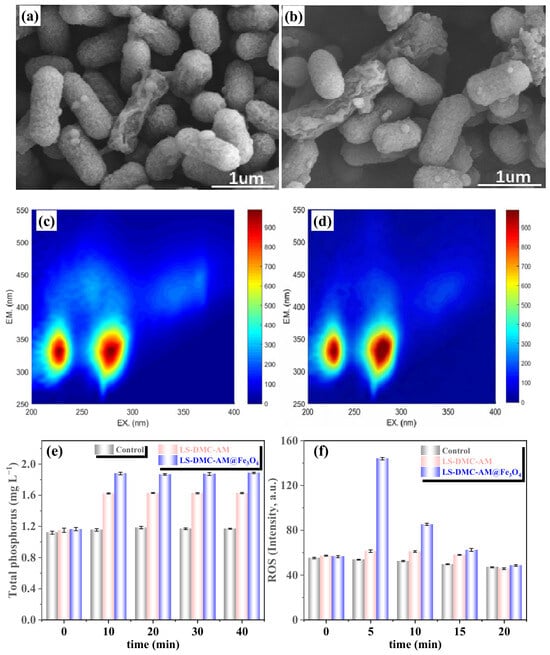
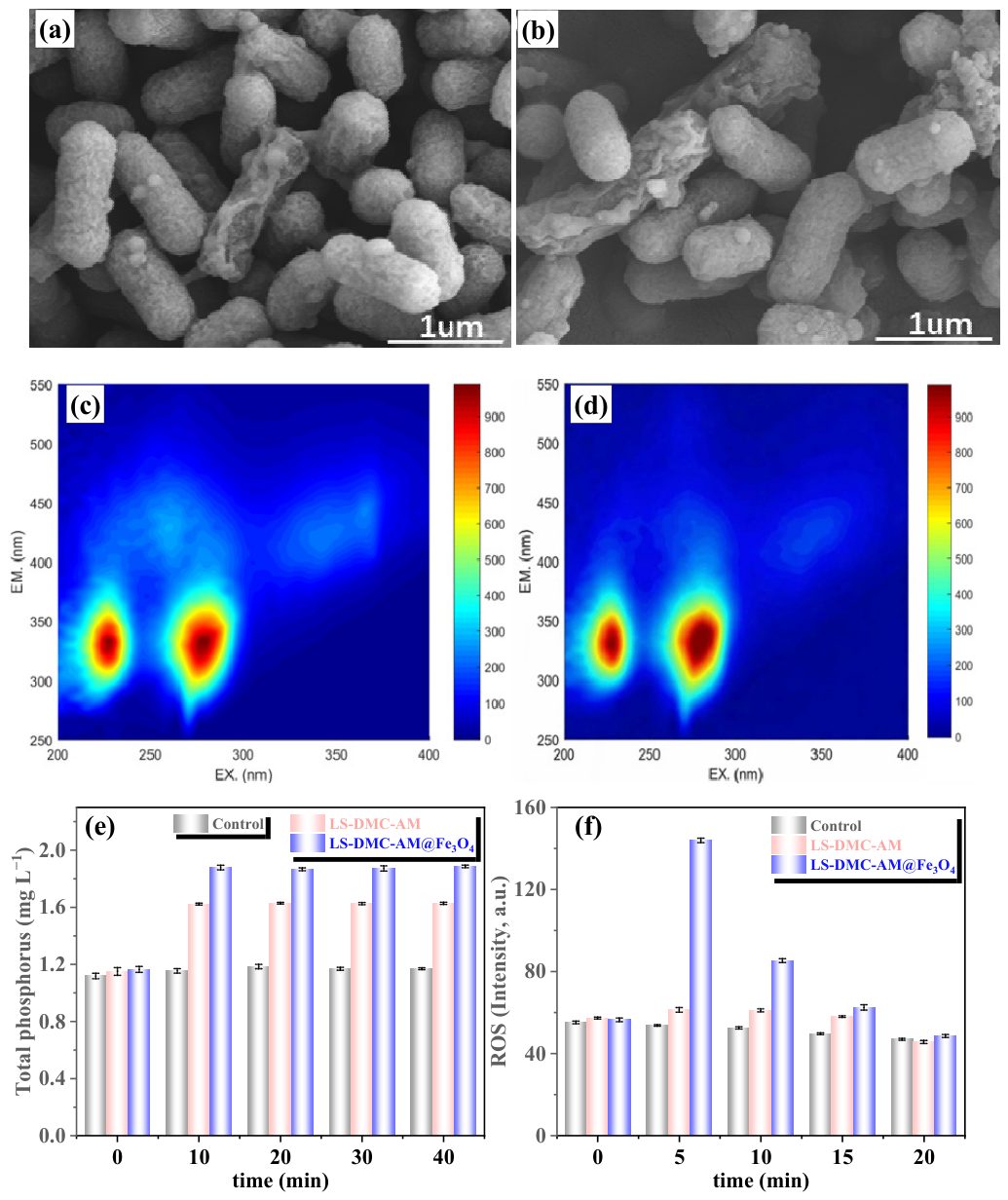
The mechanistic basis for the enhanced bactericidal activity is systematically investigated through complementary morphological, biochemical, and fluorescent probe analyses. SEM of treated cells (Figure 10a,b) reveals that both LS-DMC-AM and LS-DMC-AM@Fe3O4 cause cell surface wrinkling, shrinkage, and collapse, morphological hallmarks of cell membrane damage. The extent of deformation is markedly greater for LS-DMC-AM@Fe3O4-treated cells, which exhibit deeper creases, more extensive surface collapse, and a higher proportion of severely damaged cells. This visual evidence directly confirms that Fe3O4 NPs amplify membrane structural disruption beyond the level achievable by quaternary ammonium contact-killing alone.
Figure 10.
Multi-faceted assessment of E. coli treatment efficacy. SEM images of E. coli cells after exposure to (a) LS-DMC-AM and (b) LS-DMC-AM@Fe3O4; 3D-EEM fluorescence spectra of E. coli suspensions treated by (c) LS-DMC-AM and (d) LS-DMC-AM@Fe3O4; (e) total phosphorus concentration and (f) intracellular ROS levels in the supernatant during the flocculation process. Experimental condition: [flocculant] 0 = 18 mg L−1, [OD600] = 0.65, pH 7.
3D EEM fluorescence spectroscopy (Figure 10c,d) reveals two predominant fluorescence peaks in the supernatant: aromatic protein I (λ1e/λ1a ≈ 210–240/300–370 nm) and aromatic protein II (λ1e/λ1a ≈ 270–300/280–380 nm) [55]. The LS-DMC-AM@Fe3O4-treated supernatant exhibits stronger fluorescence intensity in the aromatic protein II region compared with the LS-DMC-AM-treated supernatant, indicating greater release of tryptophan- and tyrosine-like intracellular proteins. This enhanced protein leakage is a direct consequence of more severe membrane permeabilization [56], confirming that Fe3O4 NPs amplify the membrane-disruption component of the sterilization mechanism.
Supernatant total phosphorus (Figure 10e) increases significantly after both treatments, reaching a plateau within 10 min. LS-DMC-AM@Fe3O4 produces consistently higher total phosphorus concentrations than LS-DMC-AM across all time points. Phosphorus-containing compounds, including phospholipids from the cell membrane, ATP, and nucleic acids, are reliable quantitative markers of cytoplasmic leakage because they are normally sequestered within intact cells [55]. The elevated phosphorus levels in the LS-DMC-AM@Fe3O4 group quantitatively confirm more extensive membrane disruption and cytoplasmic content release. Intracellular ROS measurement (Figure 10f) provides the crucial mechanistic insight. LS-DMC-AM treatment induces only a minor, transient elevation in intracellular ROS, which subsequently decays. In contrast, LS-DMC-AM@Fe3O4 treatment causes a pronounced and sustained ROS burst within 5 min of exposure. This rapid ROS accumulation is characteristic of Fe3O4-mediated processes: surface Fe(II) undergoes oxidation to Fe(III) while reducing O2 or H2O2 to generate O2•−, HO•, and other ROS via heterogeneous Fenton-like pathways [29,30]. The accumulated ROS inflict oxidative damage on membrane lipids (lipid peroxidation), proteins (carbonylation and thiol oxidation) [57], and DNA (strand breaks and base modifications) [58], compounding the physical membrane damage caused by quaternary ammonium groups.
Collectively, these four convergent lines of evidence establish a synergistic dual-mechanism model for the enhanced bactericidal activity of LS-DMC-AM@Fe3O4. (i) Quaternary ammonium groups from grafted DMC electrostatically adsorb onto the electronegative bacterial surface and intercalate into the phospholipid bilayer, causing physical membrane disruption and cytoplasmic extravasation (contact-killing). (ii) Concomitantly, Fe3O4 NPs catalyze intracellular ROS overproduction through surface Fe(II)/Fe(III) redox cycling, instigating oxidative stress that damages membrane lipids (peroxidation), proteins (carbonylation and thiol oxidation), and DNA (strand scission and base modification). These two pathways operate synergistically: membrane permeabilization by quaternary ammonium groups facilitates the ingress of ROS, iron ions, and nanoparticulate matter into the cell interior, while oxidative stress reciprocally compromises membrane integrity and overwhelms cellular antioxidant defenses, amplifying the net bactericidal efficacy. This dual mechanism accounts for the enhancement in sterilization rate and the broadened effective flocculation window, the latter arising from leakage-derived anionic charge buffering that suppresses overdosing-induced restabilization.
3.7. Environmental Implications
Economic analysis (Tables S1 and S2) benchmarks LS-DMC-AM and LS-DMC-AM@Fe3O4 against commercial PAC and PAM. The unit production costs of LS-DMC-AM (124 CNY kg−1) and LS-DMC-AM@Fe3O4 (168 CNY kg−1) exceed those of PAC (15 CNY kg−1) and PAM (35 CNY kg−1), principally reflecting the expenditure on specialty monomers (DMC) and Fe3O4 NPs. Nevertheless, the substantially reduced effective dosages considerably narrow the gap in per-unit-volume treatment expenditure. At the recommended dosage of 0.5 mg L−1 for kaolin turbidity abatement, selected to optimize the performance, cost balance given the marginal differential between 0.5 and 1.0 mg L−1, LS-DMC-AM costs 0.062 CNY m−3 and LS-DMC-AM@Fe3O4 costs 0.084 CNY m−3, compared with 0.060 CNY m−3 for PAC at 4 mg L−1 and 0.105 CNY m−3 for PAM at 3 mg L−1. For E. coli removal, LS-DMC-AM@Fe3O4 incurs 1.34 CNY m−3 at 8 mg L−1, versus 0.74 CNY m−1 for LS-DMC-AM at 6 mg L−1 and 0.70 CNY m−3 for PAM at 20 mg L−1. Crucially, the per-unit-volume cost comparison underrepresents the full economic advantage of LS-DMC-AM@Fe3O4. The material’s integrated flocculation–sterilization functionality obviates a standalone disinfection unit, thereby reducing infrastructure footprint, capital equipment investment, and chemical disinfectant procurement. Magnetic separation substantially shortens hydraulic retention time, augmenting the throughput capacity of the sedimentation unit, while seed recyclability further improves lifecycle economics. When these process-level benefits are considered, LS-DMC-AM@Fe3O4 presents a competitive economic profile, with costs anticipated to decline further under scaled-up production. For treating high-turbidity, microbe-laden industrial wastewaters, LS-DMC-AM@Fe3O4 thus offers a compelling convergence of technical performance and economic viability.
4. Conclusions
LS-DMC-AM@Fe3O4, a magnetic lignin-based flocculant integrating flocculation, sterilization, and rapid magnetic separation, is constructed by incorporating Fe3O4 NPs into a pre-optimized LS-DMC-AM matrix. The composite retains the grafted quaternary ammonium and amide functionality, exhibits superparamagnetic behavior and achieves efficient kaolin turbidity and E. coli removal with robust performance across pH 3–9. Relative to its non-magnetic analog, LS-DMC-AM@Fe3O4 displays a markedly broadened effective dosage window. This work attributes this to Fe3O4-enhanced membrane disruption, which releases anionic intracellular contents that buffer excess cationic charge and suppress restabilization. The upgraded bactericidal efficiency is driven by a synergistic dual mechanism: quaternary ammonium groups mediate contact-killing membrane disruption, while Fe3O4 NPs catalyze intracellular ROS overproduction that inflicts oxidative damage on lipids, proteins, and DNA. Magnetically assisted settling substantially accelerates phase separation, with efficient Fe3O4 NPs recovery and the re-prepared flocculant retaining outstanding E. coli removal. Despite higher unit production costs, the ultralow effective dosage, elimination of standalone disinfection, and magnetic seed recyclability confer competitive process-level economics. These findings establish LS-DMC-AM@Fe3O4 as a viable multifunctional flocculant platform derived from industrial lignin waste and provide a mechanistic framework for designing synergistic antimicrobial–magnetic hybrid materials for sustainable water treatment.
Supplementary Materials
The following supporting information can be downloaded at: https://www.mdpi.com/article/10.3390/magnetochemistry12070074/s1, Figure S1: Magnetic hysteresis loops of LS-DMC-AM@Fe3O4 at different Fe3O4 loading (5–25%); Figure S2: Turbidity removal performance of different flocculants (LS-DMC-AM, LS-DMC-AM@Fe3O4, and Fe3O4) at different dosage. Experimental conditions: [flocculant] 0 = 0.25–2 mg L−1, [kaolin] = 300 mg L−1, pH 7, room temperature; Figure S3: E. coli removal performance of different flocculants (LS-DMC-AM, LS-DMC-AM@Fe3O4, and Fe3O4) at different dosage. Experimental conditions: [flocculant] 0 = 0.25–2 mg L−1, [OD600] = 0.65, pH 7, room temperature; Figure S4: (a) Kaolin and (b) E. coli removal efficiency of different flocculants (LS-DMC-AM and LS-DMC-AM@Fe3O4,) in local artificial laker water sample. Experimental conditions: pH 7, room temperature. [flocculant] 0 = 0.5–3 mg L−1, and [kaolin] = 300 mg L−1 for (a); [flocculant] 0 = 4–14 mg L−1, and [OD600] = 0.65 for (b); Figure S5: Zeta potential at different pH; Table S1: Dosage and removal efficiency of different flocculants; Table S2: Cost accounting of different flocculants (The exchange rate from RMB to USD is 1 CNY = 0.14 USD); Table S3: Raw data of Figure 4 (Part 1); Table S4: Raw data of Figure 4 (Part 2).
Author Contributions
Conceptualization, B.C. and W.D.; methodology, B.C. and W.D.; validation, B.C., G.G. and Y.L.; formal analysis, B.C., G.G. and Y.L.; resources, W.D. and H.L.; writing—original draft preparation, W.D. and B.C.; writing—review and editing, W.D., B.C., G.G. and Y.L.; supervision, W.D. and H.L.; project administration, W.D. and H.L.; funding acquisition, W.D. and H.L. All authors have read and agreed to the published version of the manuscript.
Funding
This study was financially funded by the National Natural Science Foundation of China (grant numbers 52370161, 22276018).
Data Availability Statement
The original contributions presented in this study are included in the article. Further inquiries can be directed to the corresponding author.
Conflicts of Interest
The authors declare no conflicts of interest.
References
- Gao, J.; Li, C.; Zhao, P.; Zhang, H.; Mao, G.; Wang, Y. Insights into water-energy cobenefits and trade-offs in water resource management. J. Clean. Prod. 2019, 213, 1188–1203. [Google Scholar] [CrossRef] [Scilit]
- Bielen, A.; Šimatović, A.; Kosić-Vukšić, J.; Senta, I.; Ahel, M.; Babić, S.; Jurina, T.; Plaza, J.J.G.; Milaković, M.; Udiković-Kolić, N. Negative environmental impacts of antibiotic-contaminated effluents from pharmaceutical industries. Water Res. 2017, 126, 79–87. [Google Scholar] [CrossRef] [Scilit] [PubMed]
- Magana-Arachchi, D.N.; Wanigatunge, R.P. Ubiquitous waterborne pathogens. In Waterborne Pathogens; Prasad, M.N.V., Grobelak, A., Eds.; Elsevier Butterworth-Heinemann: Oxford, UK, 2020; pp. 15–42. [Google Scholar] [CrossRef] [Scilit]
- Motlagh, A.M.; Yang, Z. Detection and occurrence of indicator organisms and pathogens. Water Environ. Res. 2019, 91, 1402–1408. [Google Scholar] [CrossRef] [Scilit]
- Pham, P.; Oliver, S.; Boyer, C. Design of Antimicrobial Polymers. Macromol. Chem. Phys. 2023, 224, 2200226. [Google Scholar]
- Fallah, N.; Bell, K.; Mao, T.; Hofmann, R.; Bossoni, G.E.B.; Santoro, D.; Mele, G. Integrated Coagulation–Disinfection Using Aluminium Polychloride and Sodium Hypochlorite for Secondary Wastewater Treatment: Operational Advantages and DBP Mitigation. Water 2025, 17, 2867. [Google Scholar] [CrossRef] [Scilit]
- Shao, B.; Shen, L.; Liu, Z.; Tang, L.; Tan, X.; Wang, D.; Zeng, W.; Wu, T.; Pan, Y.; Zhang, X.; et al. Disinfection byproducts formation from emerging organic micropollutants during chlorine-based disinfection processes. Chem. Eng. J. 2022, 455, 140474. [Google Scholar] [CrossRef] [Scilit]
- Feng, W.; Ma, W.; Zhong, D. Locally enhanced mixed-order model for chloramine decay in drinking water disinfection. Water Res. 2024, 254, 121409. [Google Scholar] [CrossRef] [Scilit] [PubMed]
- Ma, C.; Pei, H.; Hu, W.; Xu, H.; Jin, Y. The lysis and regrowth of toxic cyanobacteria during storage of achitosan–aluminium chloride composite coagulated sludge: Implications for drinking water sludge treatment. RSC Adv. 2016, 6, 112756–112764. [Google Scholar] [CrossRef] [Scilit]
- Cai, Q.; Gong, S.; Song, K.; Cai, P.; Tian, C.; Wang, C.; Pan, M.; Xiao, B. Effective harvesting of Scenedesmus using quaternary ammonium chitosan and xanthan gum: Formation of mega flocs with oppositely charged polyelectrolytes. J. Clean. Prod. 2021, 329, 129730. [Google Scholar] [CrossRef] [Scilit]
- Yang, Z.; Degorce-Dumas, J.-R.; Yang, H.; Guibal, E.; Li, A.; Cheng, R. Flocculation of Escherichia coli Using a Quaternary Ammonium Salt Grafted Carboxymethyl Chitosan Flocculant. Environ. Sci. Technol. 2014, 48, 6867–6873. [Google Scholar] [CrossRef] [Scilit] [PubMed]
- Jiang, J.; Tan, X.; Zhang, Z.; Ding, W.; Sun, M.; Li, H.; Zheng, H. Novel avenues for achieving simultaneous high-efficiency oil removal and sterilization: Designing a quaternary ammonium-hydrophobic ternary template copolymer. Chem. Eng. J. 2024, 497, 154810. [Google Scholar] [CrossRef] [Scilit]
- Xu, Y.; Liu, J.; You, G.; Yang, Z.; Miao, L.; Wu, J.; Yang, G.; Hou, J. A quaternary ammonium salt grafted tannin-based flocculant boosts the conjugative transfer of plasmid-born antibiotic resistance genes: The nonnegligible side of their flocculation-sterilization properties. Sci. Total. Environ. 2023, 901, 166515. [Google Scholar] [CrossRef] [Scilit] [PubMed]
- Li, X.; Zheng, H.; Wang, Y.; Sun, Y.; Xu, B.; Zhao, C. Fabricating an enhanced sterilization chitosan-based flocculants: Synthesis, characterization, evaluation of sterilization and flocculation. Chem. Eng. J. 2017, 319, 119–130. [Google Scholar] [CrossRef] [Scilit]
- Huang, M.; Liu, Z.; Li, A.; Yang, H. Dual functionality of a graft starch flocculant: Flocculation and antibacterial performance. J. Environ. Manag. 2017, 196, 63–71. [Google Scholar] [CrossRef] [Scilit]
- Zainol, N.A.; Razali, N.A.; Yusoff, N.A. Synthesis, characterization and performance of quaternized cellulose based flocculant derived from office paper waste for dye removal. OP Conf. Ser. Earth Environ. Sci. 2024, 1369, 12018. [Google Scholar] [CrossRef] [Scilit]
- Chen, Y.; Yang, C.; Hu, J.; Huang, M.; Zhao, L.; He, J.; Zhang, S.; Shen, F.; Tian, D. Cascade utilization of crop straw through a FeCl3-mediated deep eutectic solvent biorefinery: Lignin-containing cellulose nanofibers flocculant fabrication followed by fertilizer production. Chem. Eng. J. 2023, 472, 144823. [Google Scholar] [CrossRef] [Scilit]
- Wei, H.; Gao, B.; Ren, J.; Li, A.; Yang, H. Coagulation/flocculation in dewatering of sludge: A review. Water Res. 2018, 143, 608–631. [Google Scholar] [CrossRef] [Scilit] [PubMed]
- Khoo, P.S.; Ilyas, R.A.; Uda, M.N.A.; Abu Hassan, S.; Nordin, A.H.; Norfarhana, A.S.; Ab Hamid, N.H.; Rani, M.S.A.; Abral, H.; Norrrahim, M.N.F.; et al. Starch-Based Polymer Materials as Advanced Adsorbents for Sustainable Water Treatment: Current Status, Challenges, and Future Perspectives. Polymers 2023, 15, 3114. [Google Scholar] [CrossRef] [Scilit] [PubMed]
- Pellizzer, L. Synthesis of Cellulose-Based Flocculants and Performance Tests. M.S. Thesis, Universidade de Coimbra, Coimbra, Portugal, 2016. [Google Scholar]
- Aro, T.; Fatehi, P. Production and Application of Lignosulfonates and Sulfonated Lignin. ChemSusChem 2017, 10, 1861–1877. [Google Scholar] [CrossRef] [Scilit] [PubMed]
- Huang, C.; Ma, J.; Zhang, W.; Huang, G.; Yong, Q. Preparation of Lignosulfonates from Biorefinery Lignins by Sulfomethylation and Their Application as a Water Reducer for Concrete. Polymers 2018, 10, 841. [Google Scholar] [CrossRef] [Scilit]
- Wang, B.; Sun, Z.; Lam, S.S.; Sonne, C.; Yuan, T.-Q.; Sun, R.-C. A scalable and simple lignin-based polymer for ultra-efficient flocculation and sterilization. Sep. Purif. Technol. 2022, 292, 120960. [Google Scholar] [CrossRef] [Scilit]
- Kong, F.; Parhiala, K.; Wang, S.; Fatehi, P. Preparation of cationic softwood kraft lignin and its application in dye removal. Eur. Polym. J. 2015, 67, 335–345. [Google Scholar] [CrossRef] [Scilit]
- Wang, B.; Cao, X.-F.; Yu, S.-X.; Sun, Z.-H.; Shen, X.-J.; Wen, J.-L.; Yuan, T.-Q. New sustainable Mannich-functionalized lignin flocculants for ultra-efficiently tailoring wastewater purification. J. Clean. Prod. 2022, 387, 135801. [Google Scholar] [CrossRef] [Scilit]
- Zhao, Y.; Liu, Y.; Xu, H.; Fan, Q.; Zhu, C.; Liu, J.; Zhu, M.; Wang, X.; Niu, A. Preparation and Application of Magnetic Composites Using Controllable Assembly for Use in Water Treatment: A Review. Molecules 2023, 28, 5799. [Google Scholar] [CrossRef] [Scilit] [PubMed]
- Luo, M.; Zhong, Z.; Sun, Q.; Sun, M.; Wu, H.; Ding, W.; Li, H.; Zheng, H. Revealing antibacterial mechanisms of a magnetic flocculation system: The multi-target disruption effect. J. Hazard. Mater. 2026, 514, 142710. [Google Scholar] [CrossRef] [Scilit] [PubMed]
- Liu, C.; Wang, X.; Du, S.; Liang, W. Synthesis of chitosan-based grafting magnetic flocculants for flocculation of kaolin suspensions. J. Environ. Sci. 2023, 139, 193–205. [Google Scholar] [CrossRef] [Scilit] [PubMed]
- Munoz, M.; de Pedro, Z.M.; Casas, J.A.; Rodriguez, J.J. Preparation of magnetite-based catalysts and their application in heterogeneous Fenton oxidation—A review. Appl. Catal. B Environ. 2015, 176–177, 249–265. [Google Scholar] [CrossRef] [Scilit]
- Arakha, M.; Pal, S.; Samantarrai, D.; Panigrahi, T.K.; Mallick, B.C.; Pramanik, K.; Mallick, B.; Jha, S. Antimicrobial activity of iron oxide nanoparticle upon modulation of nanoparticle-bacteria interface. Sci. Rep. 2015, 5, 14813. [Google Scholar] [CrossRef] [Scilit] [PubMed]
- Tran, N.; Mir, A.; Mallik, D.; Sinha, A.; Nayar, S.; Webster, T.J. Bactericidal effect of iron oxide nanoparticles on Staphylococcus aureus. Int. J. Nanomed. 2010, 5, 277–283. [Google Scholar] [CrossRef] [Scilit] [PubMed]
- Moniruzzaman; Karal, M.A.S.; Wadud, A.; Rashid, M.O. Increase in anionic Fe3O4 nanoparticle-induced membrane poration and vesicle deformation due to membrane potential—An experimental study. Phys. Chem. Chem. Phys. 2023, 25, 23111–23124. [Google Scholar] [CrossRef] [Scilit] [PubMed]
- Hao, Y.; Liu, P.; Chen, W.; Yang, X. Preparation of Inorganic–Organic Hybrid Flocculant Silicon Dioxide–Chitosan–Dimethyl Diallyl Ammonium Chloride for the Treatment of Papermaking Wastewater. Langmuir 2025, 41, 895–907. [Google Scholar] [CrossRef] [Scilit] [PubMed]
- Cullity, B.D.; Graham, C.D. Introduction to Magnetic Materials; John Wiley & Sons: Hoboken, NJ, USA, 2011. [Google Scholar]
- Pervaiz, S.; Javed, M.; Shah, A.; Latif, A.; Nasir, S.; Shah, I. Environmental applications of magnetic nanohybrid materials. RSC Adv. 2025, 15, 19899–19936. [Google Scholar] [CrossRef] [Scilit] [PubMed]
- Kumar, K.; Adhikary, P.; Karmakar, N.; Gupta, S.; Singh, R.P.; Krishnamoorthi, S. Synthesis, characterization and application of novel cationic and amphoteric flocculants based on amylopectin. Carbohydr. Polym. 2015, 127, 275–281. [Google Scholar] [CrossRef] [Scilit]
- Lanthong, P.; Nuisin, R.; Kiatkamjornwong, S. Graft copolymerization, characterization, and degradation of cassava starch-g-acrylamide/itaconic acid superabsorbents. Carbohydr. Polym. 2006, 66, 229–245. [Google Scholar] [CrossRef] [Scilit]
- Duret, E.; de Moura, L.C.R.; Morales, A.; Labidi, J.; Robles, E.; Bouhtoury, F.C.-E. Efficient Lignin Precipitation from Softwood Black Liquor Using Organic Acids for Sustainable Valorization. Polymers 2025, 17, 926. [Google Scholar] [CrossRef] [Scilit]
- Hasan, M.; Akbari, A.; Greenlee, L.F. Combined Electrocatalytic Oxidation and Reduction to Selectively Cleave β-O-4 Linkage of Lignin over Platinum Electrode in Organic Solvent: Secondary Treatment Opportunity for CELF Process. ACS Sustain. Chem. Eng. 2023, 11, 15262–15272. [Google Scholar] [CrossRef] [Scilit]
- Liu, B.; Zheng, H.; Deng, X.; Xu, B.; Sun, Y.; Liu, Y.; Liang, J. Formation of cationic hydrophobic micro-blocks in P(AM-DMC) by template assembly: Characterization and application in sludge dewatering. RSC Adv. 2017, 7, 6114–6122. [Google Scholar] [CrossRef] [Scilit]
- Abdollahi, Z.; Frounchi, M.; Dadbin, S. Synthesis, characterization and comparison of PAM, cationic PDMC and P(AM-co-DMC) based on solution polymerization. J. Ind. Eng. Chem. 2011, 17, 580–586. [Google Scholar] [CrossRef] [Scilit]
- Ting, T. Synthesis, characterization of Fe3O4/polymer composites with stealth capabilities. Results Phys. 2020, 16, 102975. [Google Scholar] [CrossRef] [Scilit]
- Gregory, J.; Barany, S. Adsorption and flocculation by polymers and polymer mixtures. Adv. Colloid Interface Sci. 2011, 169, 1–12. [Google Scholar] [CrossRef] [Scilit] [PubMed]
- Wu, H.; Shen, W.; Zhao, Q.; Zhang, W. Synthesis of chitosan-based flocculant by dielectric barrier discharge modification and its flocculation performance in wastewater treatment. RSC Adv. 2024, 14, 2410–2421. [Google Scholar] [CrossRef] [Scilit] [PubMed]
- Yang, R.; Li, H.; Huang, M.; Yang, H.; Li, A. A review on chitosan-based flocculants and their applications in water treatment. Water Res. 2016, 95, 59–89. [Google Scholar] [CrossRef] [Scilit] [PubMed]
- Besra, L.; Sengupta, D.; Roy, S.; Ay, P. Influence of polymer adsorption and conformation on flocculation and dewatering of kaolin suspension. Sep. Purif. Technol. 2004, 37, 231–246. [Google Scholar] [CrossRef] [Scilit]
- Sun, M.; Li, H.; Wang, K.; Hu, C.; Jiang, X.; Ding, W.; Zhang, Y.; Zheng, H. Insights into the development of quaternized starch-derived polymers for simultaneous flocculation and bacterial inactivation: Mechanism and directed regulation. Water Res. 2025, 282, 123657. [Google Scholar] [CrossRef] [Scilit] [PubMed]
- Kenawy, E.-R.; Worley, S.D.; Broughton, R. The Chemistry and Applications of Antimicrobial Polymers: A State-of-the-Art Review. Biomacromolecules 2007, 8, 1359–1384. [Google Scholar] [CrossRef] [Scilit] [PubMed]
- Zhang, B.; Jiang, D.; Guo, X.; He, Y.; Ong, C.N.; Xu, Y.; Pal, A. Removal of Microcystis aeruginosa using nano-Fe3O4 particles as a coagulant aid. Environ. Sci. Pollut. Res. 2015, 22, 18731–18740. [Google Scholar] [CrossRef] [Scilit] [PubMed]
- Wang, B.; Wang, S.-F.; Lam, S.S.; Sonne, C.; Yuan, T.-Q.; Song, G.-Y.; Sun, R.-C. A review on production of lignin-based flocculants: Sustainable feedstock and low carbon footprint applications. Renew. Sustain. Energy Rev. 2020, 134, 110384. [Google Scholar] [CrossRef] [Scilit]
- Guibal, E.; Roussy, J. Coagulation and flocculation of dye-containing solutions using a biopolymer (Chitosan). React. Funct. Polym. 2007, 67, 33–42. [Google Scholar] [CrossRef] [Scilit]
- Ma, J.; Fu, X.; Jiang, L.; Zhu, G.; Shi, J. Magnetic flocculants synthesized by Fe3O4 coated with cationic polyacrylamide for high turbid water flocculation. Environ. Sci. Pollut. Res. 2018, 25, 25955–25966. [Google Scholar] [CrossRef] [Scilit] [PubMed]
- Jarvis, P.; Jefferson, B.; Gregory, J.; Parsons, S.A. A review of floc strength and breakage. Water Res. 2005, 39, 3121–3137. [Google Scholar] [CrossRef] [Scilit] [PubMed]
- Badruddoza, A.Z.M.; Shawon, Z.B.Z.; Tay, W.J.D.; Hidajat, K.; Uddin, M.S. Fe3O4/cyclodextrin polymer nanocomposites for selective heavy metals removal from industrial wastewater. Carbohydr. Polym. 2013, 91, 322–332. [Google Scholar] [CrossRef] [Scilit] [PubMed]
- Chen, W.; Westerhoff, P.; Leenheer, J.A.; Booksh, K. Fluorescence Excitation−Emission Matrix Regional Integration to Quantify Spectra for Dissolved Organic Matter. Environ. Sci. Technol. 2003, 37, 5701–5710. [Google Scholar] [CrossRef] [Scilit] [PubMed]
- Xia, D.; Shen, Z.; Huang, G.; Wang, W.; Yu, J.C.; Wong, P.K. Red Phosphorus: An Earth-Abundant Elemental Photocatalyst for “Green” Bacterial Inactivation under Visible Light. Environ. Sci. Technol. 2015, 49, 6264–6273. [Google Scholar] [CrossRef] [Scilit] [PubMed]
- Ezraty, B.; Gennaris, A.; Barras, F.; Collet, J.-F. Oxidative stress, protein damage and repair in bacteria. Nat. Rev. Microbiol. 2017, 15, 385–396. [Google Scholar] [CrossRef] [Scilit] [PubMed]
- Hong, Y.; Zeng, J.; Wang, X.; Drlica, K.; Zhao, X. Post-stress bacterial cell death mediated by reactive oxygen species. Proc. Natl. Acad. Sci. USA 2019, 116, 10064–10071. [Google Scholar] [CrossRef] [Scilit] [PubMed]
Disclaimer/Publisher’s Note: The statements, opinions and data contained in all publications are solely those of the individual author(s) and contributor(s) and not of MDPI and/or the editor(s). MDPI and/or the editor(s) disclaim responsibility for any injury to people or property resulting from any ideas, methods, instructions or products referred to in the content. |
© 2026 by the authors. Licensee MDPI, Basel, Switzerland. This article is an open access article distributed under the terms and conditions of the Creative Commons Attribution (CC BY) license.