


Highlights
What are the main findings?
- Fruit-tree pruning technologies operate at two distinct scales. Mechanical pruning is mainly suited to canopy-profile control, whereas branch-selective pruning requires individual branch judgment and local execution.
- Multi-year field studies show that the value of mechanical pruning cannot be judged by work rate alone. Tree regrowth and follow-up management can substantially affect later yield and economic performance.
- Intelligent branch pruning has progressed from branch recognition and 3D reconstruction to pruning-point generation and robotic cutting. The main challenge is now moving from geometric information toward branch-function assessment and continuous whole-tree operation.
What are the implications of the main findings?
- Future pruning systems should connect current tree structure with multi-year tree records and branch-function information, while evaluating pruning by post-cut tree response rather than cutting success alone.
- Mechanical canopy pruning and branch-selective pruning are likely to develop as complementary approaches, with repetitive canopy work handled mechanically and branches requiring local judgment treated selectively.
Abstract
Fruit-tree pruning has to keep tree structure under control while continually renewing fruiting wood, and many decisions still depend on practical experience. This narrative review synthesizes 92 English-language publications from 1983 to 2026, identified through Google Scholar and backward citation tracking. As orchard systems become more regular and mechanization expands, mechanical pruning has been used to control canopy edges. Vision and 3D sensing are now being used to identify branches and locate pruning points, while robotic systems are beginning to attempt selective pruning. This review looks at the literature at canopy and branch scales. Mechanical canopy pruning is effective for quickly treating regular canopy profiles, but field trials show that regrowth, follow-up manual pruning, and crop-load management can change later yield and economic outcomes. Branch-level automation has moved from 2D recognition to 3D reconstruction, pruning-point generation, and small-scale robotic trials. The harder questions are increasingly about branch function and continuous whole-tree operation. For pruning automation, machine speed or a successful cut is only part of the result; post-pruning tree responses and longer-term production also have to be considered. Multi-temporal tree records, branch-function information, continuous operation, and long-term field testing deserve more attention.
1. Introduction
Fruit trees are perennial crops. Once tree architecture is established, it affects light interception, fruiting, and field operations for many years. Dwarfing, high-density planting, and more regular training systems improve machinery access, but as trees age, shoots still thicken and cross, and fruiting sites may shift toward the outside of the canopy. Pruning therefore remains a basic orchard practice for maintaining tree form and productive capacity [1,2].
Pruning is more than cutting off branches. In practice, operators have to select branches, control pruning intensity, and anticipate how the tree will grow after pruning. Dormant and summer pruning affect shoot growth differently, which in turn changes the light environment and fruit performance [1,3,4]. Pear, peach, and other fruit crops also use different branch-renewal methods because their fruiting habits and training systems differ [5,6]. These decisions have long depended on practical experience, so pruning mechanization is not simply a matter of automating the cutting action.
Early power shears and work platforms were mainly introduced to reduce manual force, climbing, and frequent repositioning during pruning. In an apple winter-pruning trial, electric shears used with a work platform gave higher work efficiency [7]. Later, machines operating continuously along the row began to treat the outer canopy profile [8,9]. More recently, vision and 3D sensing have been used to measure canopy and branch structure, and robots have begun to use this information for local pruning [10,11,12]. As the task moves from treating the whole canopy profile to judging individual branches, the pruning object becomes finer and more information about the tree is needed.
Previous reviews have discussed the physiology of fruit-tree pruning [1], narrow-canopy orchard systems [2], mechanical pruning in citrus and grapevine [8,9], and automation and robotic pruning in fruit trees and apples [10,11,12]. These studies provide useful reviews of individual technologies, but tree-management goals, pruning objects, and machine capability are often discussed separately. Evidence ranging from module-level performance to multi-year field results is also seldom compared within one framework. Here, the literature is organized by the actual pruning object into canopy regulation and branch-selective operations, and the use of different technologies in these tasks is compared. Branch recognition is discussed separately from pruning decisions, and robotic execution is distinguished from post-pruning tree response. The literature focuses mainly on perennial fruit trees and grapevines, with priority given to original studies reporting tree response, work efficiency, cut quality, or whole-system validation.
Review Scope and Search Strategy
This review covers perennial woody horticultural crops managed in orchards or vineyards, including pome and stone fruits, citrus, jujube, olive, and grapevine. These crops share recurring canopy regulation and branch-renewal tasks, but their responses are treated as crop-, cultivar-, rootstock-, and training-system-specific rather than directly interchangeable. Annual crops, forestry operations, and ornamental pruning were outside the scope.
Google Scholar was the primary search platform, supplemented by backward citation tracking from relevant reviews and primary studies. Searches were performed iteratively during preparation of the manuscript and were last updated in August 2026. Crop terms (fruit tree, orchard, apple, pear, peach, sweet cherry, citrus, jujube, olive, and grapevine) were combined with pruning and technology terms including pruning, canopy regulation, mechanical pruning, hedging, branch renewal, computer vision, RGB-D, LiDAR, point cloud, branch reconstruction, pruning point, pruning decision, and robotic pruning. No lower publication-year limit was imposed because older studies were needed for physiological and horticultural background; the final corpus ranged from 1983 to 2026.
English-language records were screened first by title and abstract, followed by full-text assessment for papers retained in the synthesis. Original studies were included when they reported tree or canopy response, labor or economic outcomes, sensing or reconstruction performance, pruning decisions, cut quality, or integrated robotic validation. Reviews were retained for established background and for locating additional primary studies. Records were excluded when pruning was only incidental, the technology was not directly relevant to canopy regulation or branch-selective pruning, or the reported outcome was insufficient for the comparison made here. The final narrative synthesis included 92 publications. Studies shown in Table 1 and Table 2 were not selected simply because they reported the highest performance. Table 1 gives priority to field studies that allow pruning effects to be interpreted over more than one season and that include a manual/reference treatment or labor/economic information. Table 2 gives priority to studies that report quantitative validation and enough information about crop, test unit, or operating condition to interpret the metric; together, they represent successive stages from perception to integrated robotic trials. Because crops, training systems, datasets, operating scales, and metrics differed substantially, the evidence was compared narratively rather than pooled quantitatively.
To frame the two-scale analysis and clarify evidence boundaries, the literature is organized into four groups aligned with the main sections of this review: continuous mechanical canopy pruning, branch sensing and structural reconstruction, branch assessment and pruning decision-making, and robotic execution and system integration.
2. Canopy-Scale Pruning
2.1. Horticultural Requirements for Canopy Pruning
Canopy pruning mainly limits canopy height and width and treats shoots at the canopy edge. The aim is not simply to make the canopy smaller, but to leave suitable space for light interception, fruiting, and field access. Narrow-canopy and fruiting-wall systems concentrate the fruiting zone within a relatively narrow space along the row and also make it easier for workers and machines to reach the canopy [2,13]. Once the canopy is narrowed, however, scaffold distribution, leaf area, and the position of fruiting wood also change. Whether such tree forms remain suitable for mechanized management over time ultimately has to be judged by yield, fruit quality, and renewal of fruiting units [2,13,14].
Palmer et al. observed in an apple summer-pruning trial that a 10–30% reduction in leaf area was accompanied by a 6–14% reduction in whole-tree light interception [15]. Better light conditions at a local position do not necessarily mean that the whole tree intercepts more light. Post-pruning light conditions therefore need to be considered together with changes in leaf area and whole-tree light interception.
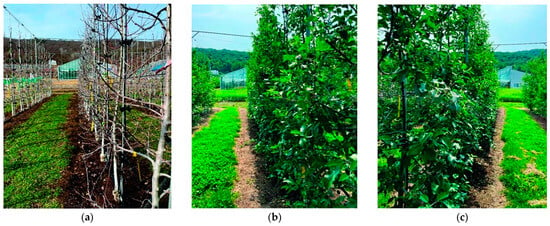
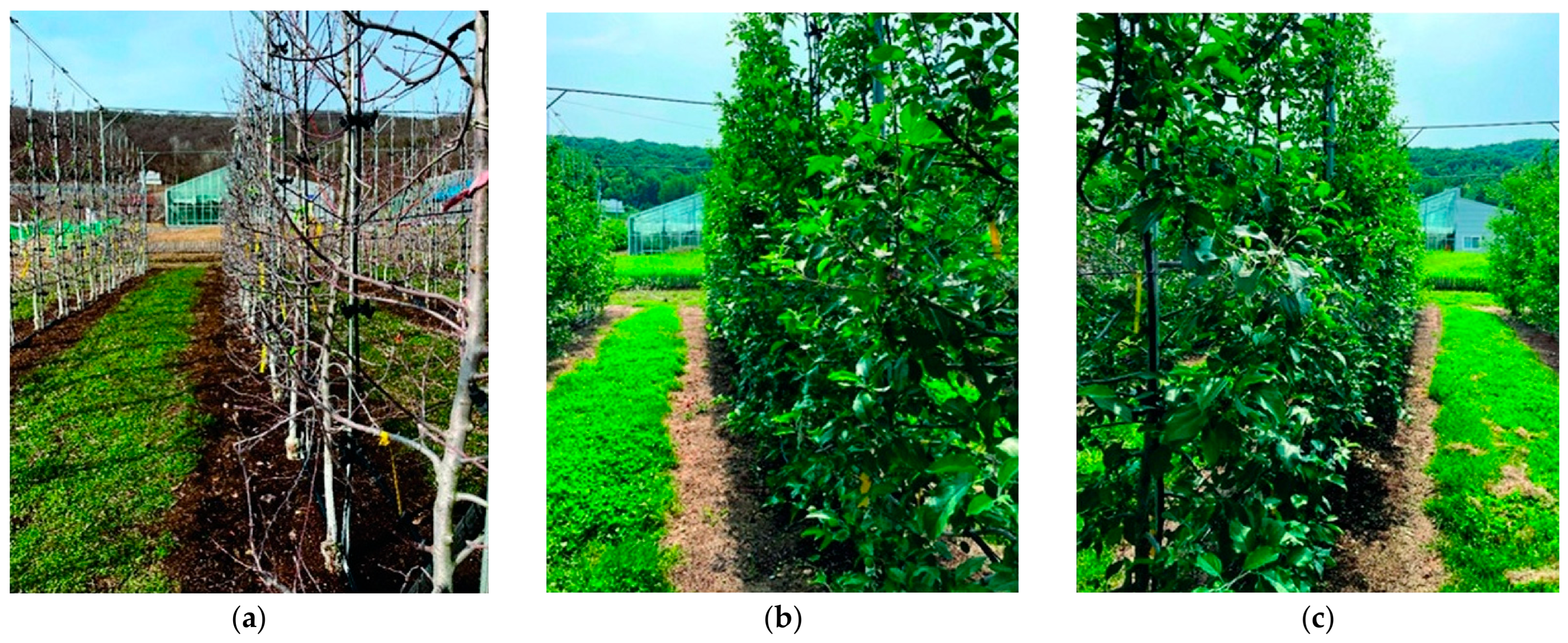
How long a canopy profile can be maintained depends largely on regrowth after pruning. Heavy dormant pruning increases the vigor of the remaining buds [1]. In a two-year peach trial, heavier pruning produced more and longer watersprouts, and crop load also affected this response [16]. Studies in apple and peach further show that the response to summer pruning depends on timing [3,4,17], while limb orientation also affects apple tree response [3]. Different apple cultivars do not produce exactly the same shoot composition or leaf-area distribution under the same pruning method [18]. When Tall Spindle apple trees were converted to narrow fruiting walls, hedging alone had a limited effect on vigor control; combining hedging with root pruning gave a stronger effect, although fruit size could decline [13]. In orchards with marked biennial bearing, excessive pruning in the off-year may also stimulate vegetative growth [19]. A single measurement of tree height or width says little about whether the canopy will remain stable. Regrowth and changes in fruiting wood in the following season are also worth tracking. Dormant-tree and growing-season canopy conditions under different pruning treatments provide a direct example of canopy recovery after mechanical pruning (Figure 1) [20].
Figure 1.
Dormant-tree and growing-season canopy conditions of ‘Arisoo’ apple under different pruning treatments: (a) dormant tree after mechanical pruning; (b,c) canopy appearance during the growing season under different treatments. Adapted from Win et al. [20] (original Figure 2C–E), under the terms of the Creative Commons Attribution 4.0 International License (CC BY 4.0).
Changes in canopy structure also affect crop-protection operations such as spray deposition. Spray deposition depends on tree form and canopy volume as well as sprayer type [21], and variable-rate spraying adjusts application volume to seasonal changes in the canopy [22]. In an organic apple orchard, within-canopy spray deposition also differed among pruning treatments [23]. A more open canopy may provide a better passage for spray, but the final distribution still depends on the spraying system, leaf area, and timing of application.
It is difficult to determine by visual inspection alone how much canopy was removed by one pruning event and how quickly the shoots will grow back. Unmanned aerial vehicle (UAV)-based 3D models have been used to estimate pruning removal and annual canopy growth in olive [24], while multispectral UAV imagery has been used to track multi-year changes in fruit trees [25]. Light detection and ranging (LiDAR) can also be used to build canopy-volume models and adjust operations such as spray volume [26]. These methods record geometric changes in the canopy and can provide a reference for setting mechanical pruning boundaries. At the level of an individual branch, however, whether it should be pruned still depends on its position and role in the tree.
2.2. Technical Implementation of Canopy Pruning
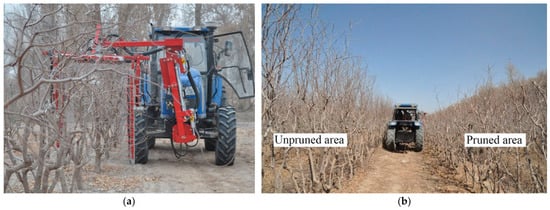
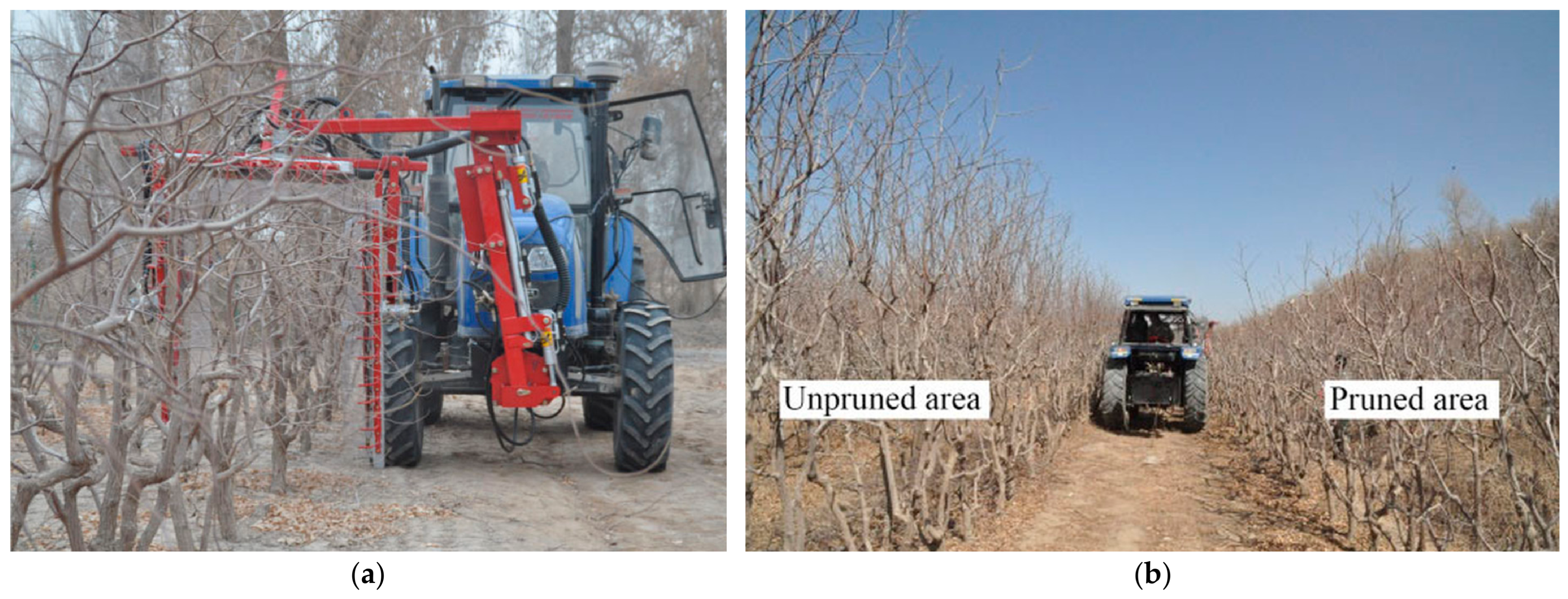
In this review, continuous canopy-pruning equipment refers to machines that move continuously along the tree row and cut peripheral shoots according to a fixed or adjustable boundary. Existing machines use cutting units such as reciprocating cutter bars or circular saws [8,9,27]. Field tests on dwarf, densely planted jujube trees showed that missed cuts and stub breakage changed with forward speed and cutter settings, indicating that machine parameters need to be matched to canopy conditions [27]. For example, a jujube shaping machine cuts continuously along a preset profile [27], while a grapevine pre-pruner first shortens canes along the trellis; bud number and fruiting canes still have to be adjusted later [9]. These machines are designed for rapid treatment of peripheral shoots, but branch condition and cut-surface quality still matter in practice. Continuous mechanical pruning changes the working scale: a person deals with branches one by one, whereas the machine turns the canopy edge into a geometric boundary that is repeatedly followed along the row. Figure 2 shows the machine operating in the field and the canopy boundary that results. The cutter frame continuously contacts shoots at the outside of the tree row (Figure 2a), after which a clear profile difference appears between pruned and unpruned areas (Figure 2b). This mode of operation is suitable for regular tree forms and continuous profile treatment, but it cannot judge the function or health status of individual branches [27].
Figure 2.
Field operation of continuous mechanical canopy pruning and the resulting canopy profile: (a) continuous operation of a jujube shaping and pruning machine along the row; (b) canopy boundary between unpruned and pruned areas in the field trial. Adapted from Zhang et al. [27] (original Figures 11 and 12), under the terms of the Creative Commons Attribution 4.0 International License (CC BY 4.0).
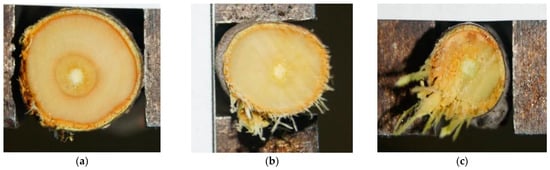
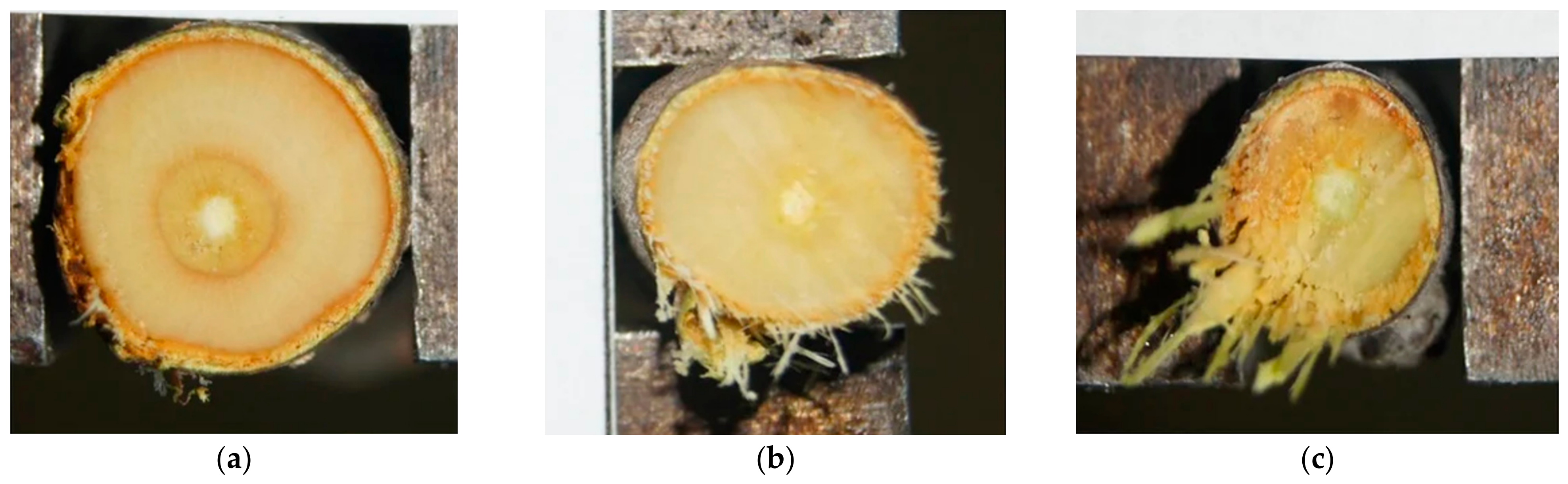
Stable continuous cutting depends partly on machine motion and partly on the branches themselves. Uneven ground changes machine posture, and response delay can create tracking errors; branch bending or local protrusions may also shift the actual cut away from the intended boundary. Even when a branch is cut successfully, the remaining cut surface is not always the same. Comparisons across fruit-tree species have shown that different cutting tools cause different levels of tissue damage [28]. Apple branch tests also found that branch diameter, feed speed, and tool parameters affect cutting force [29]. Under the tested conditions, bypass loppers and a circular saw generally caused less cut-edge damage than a chainsaw [28,30], as illustrated in Figure 3. Machine evaluation therefore should look not only at whether a branch was severed, but also at the tissue surface left after cutting. In this review, cut quality includes cut position and stub length, bark tearing, crushing, splintering, and unintended damage to retained tissues.
Figure 3.
Apple branch cut surfaces produced by different cutting tools: (a) bypass loppers; (b) circular saw; (c) chainsaw. Adapted from Nowakowski et al. [30] (original Figure 6a,c,e), under the terms of the Creative Commons Attribution 4.0 International License (CC BY 4.0).
Current sensing and control technologies allow some adjustment of an otherwise fixed pruning profile. In the hydraulic pruning robot reported by Huang et al. [31], cylinder-control accuracy was within ±1.8°, while the average start and stop lags were 0.55 s and 0.15 s, respectively; chassis movement also increased positional error. These values are specific to that prototype and test protocol, but they show why trajectory error and response delay need to be reported alongside cutter speed or cutting completion.
Tree form is an important condition for continuous mechanical pruning. Narrow fruiting walls and regular grapevine trellises have clearer boundaries and more continuous tool passages [2,9,13]. Open-center trees or trees with highly variable scaffold directions are difficult to cover with a single continuous path around the canopy. Row spacing and scaffold arrangement first determine whether the machine has a stable passage, while the training method used each year affects whether the boundary is still clear at the next pruning.
2.3. Field Outcomes of Mechanical Canopy Pruning
The most obvious advantage of mechanical pruning is its work rate along the row, but orchard labor is not spent only while the cutter is moving through branches. Turning, machine adjustment, branch removal, and manual follow-up pruning all take time. A faster machine therefore does not mean that total labor per hectare falls by the same proportion. Trials in apple, citrus, and grapevine show that when substantial manual follow-up is still required after mechanical pruning, the final labor saving is reduced (Table 1).
Regrowth carries this difference into the next pruning cycle. When the same boundary is cut repeatedly, dense new shoots can develop at the canopy edge, while competing branches and fruiting units inside the canopy are not necessarily adjusted. In a two-year ‘Arisoo’ apple trial in a super-spindle-slender orchard, mechanical pruning alone reduced pruning time, but light penetration and some fruit-quality traits were poorer than under manual pruning. Adding manual follow-up pruning brought the results closer to those of fully manual pruning [20]. How much follow-up labor is required, and which branches it is used on, is therefore part of the outcome of mechanical pruning itself.
Multi-year yield results show more clearly how pruning regimes differ. In one three-year field trial on ‘Fortune’ mandarin, the treatment based on annual mechanical pruning followed by manual follow-up pruning gave a cumulative yield about 22% lower than annual manual pruning, whereas no significant cumulative reduction was found when mechanical and manual pruning were alternated between years [32]. The same study found only a modest reduction in follow-up manual pruning time, so this cultivar- and treatment-specific result should not be interpreted as a general effect of citrus mechanical pruning. Long-term trials in ‘Clemenules’ mandarin, ‘Navel Foyos’ orange, and ‘Fino 95’ lemon showed that milder or alternating mechanical-pruning regimes could, in some treatments, maintain yield and fruit size while reducing labor or cost [33,34,35]. Because pruning boundaries, pruning intensity, and the way mechanical pruning was repeated differed among these trials, their yield results should not be ranked directly.
Grapevine behaves somewhat differently. Mechanical winter pruning generally retains more buds, but the added bud number does not translate into yield in the same proportion. A five-year Trebbiano Romagnolo trial showed that bud fruitfulness and cluster weight provided some compensation for the higher bud number [36]. In ‘Concord’ grapevine, mechanical pruning combined with follow-up pruning or crop-load adjustment maintained juice quality in most years while reducing labor cost [37]. These grapevine results depend on cultivar fruitfulness, retained nodes, and later crop adjustment and should not be transferred directly to other fruit crops [9,36,37].
The economic outcome of mechanical pruning also depends on the manual labor that follows. In a four-year ‘Fino 95’ lemon trial, alternating manual and mechanical pruning between years, or relying mainly on mechanical pruning, shortened pruning time and produced higher economic returns than fully manual pruning. By contrast, when mechanical pruning and substantial manual follow-up pruning were both used in the same year, the economic advantage was small [35]. Economic comparison therefore requires machine working time, manual follow-up labor, total labor, and equipment cost to be distinguished.
Beyond yield and economics, canopy changes can alter pest and disease conditions. After mechanical pruning of ‘Clemenules’ mandarin, the number of outer shoots and aphid damage increased [38]. In peach, heavier winter pruning was associated with greater peach aphid infestation and more leaf curling and defoliation [39]. Evidence from grapevine leaf removal is included here only to show how canopy openness can alter the disease environment; leaf removal is not treated as direct evidence of mechanical branch pruning [40,41]. Apple responses were less uniform. Centrifugal training reduced rosy apple aphid infestation in 2002 and 2004 and lowered European red mite infestation in 2003, whereas green apple aphid was higher than the control in 2002 and 2004 but lower in 2003 [42]. In a separate three-year organic apple study, strong winter pruning reduced leaf scab more consistently than fruit scab, and the response differed with cultivar susceptibility [23]. These study-specific responses show that canopy modification can change the crop-protection environment, but pruning cannot be treated as a consistent pest- or disease-control method.
Taken together, these long-term trials show that the clearest strength of mechanical canopy pruning is still rapid treatment of a regular canopy profile. The final labor saving depends on regrowth and the amount of follow-up pruning, while long-term maintenance of yield and fruit quality also depends on the crop’s fruiting habit and year-to-year management. The findings therefore support conditional rather than universal conclusions about mechanical pruning.
Table 1.
Comparison of representative field and economic studies on mechanical canopy pruning.
3. Branch-Scale Pruning
3.1. Requirements for Branch Selection and Renewal
Branch-scale pruning is difficult to reduce to a single rule across fruit crops. In pome fruits such as apple, the age and spatial distribution of fruiting units have to be maintained [1], while different pear training systems change the arrangement of scaffolds and fruiting positions [5,43]. In peach and sweet cherry, tree form, vigor, light conditions, and the distribution of fruiting units all affect production performance [4,6,14,44]. Grapevine winter pruning also requires adjustment of retained bud number and fruiting canes [9]. The details differ, but practical decisions usually come back to several questions: What role does this branch currently play? Where is it located? How much crop load will it carry if retained? And will space be needed for renewal in the following season?
Several apple studies show this kind of selection clearly. Centrifugal training does not simply remove branches according to thickness; it adjusts part of the fruiting-unit population near the canopy center and on the underside of branches [45]. Three-dimensional tree analysis showed that this spatial adjustment changes light-interception efficiency at both whole-tree and fruiting-branch levels [46], and a ‘Royal Gala’ field trial also found changes in fruiting structure after centrifugal pruning [47]. In ‘Galaxy’ apple, removing some fruiting units from bloom through fruit set improved fruit size in the current season and return bloom in the following year [48]. Artificial spur extinction in ‘Scilate’ apple also changed flower-bud density and crop load per unit branch cross-sectional area [49]. The value of a branch or fruiting unit therefore cannot be judged from branch age and diameter alone; position, current load, and its role in later renewal also need to be considered.
For automation, branch function is more useful as a working horticultural label than as a geometric label. Depending on crop and training system, a branch may be mainly structural, fruiting, renewal, competing, diseased or damaged, or low-value/unproductive. These classes are not universal and may overlap, but they make the reason for a pruning decision more explicit. They can also be linked to observable attributes such as axis age, diameter, angle, branching order, position, vigor, reproductive status, crop load, and relation to neighboring branches [1,45,46,47,48,49,50,51,52].
The role of a branch is not fixed from year to year. Multi-year observations in apple show that flowering and fruiting differ among cultivars, branch-axis ages, and branch types [50], while suitable whole-tree crop load also varies with leaf area and year [51]. After pruning, the remaining buds break again, and shoot growth and crop load are readjusted. In peach, pruning intensity and crop load affect watersprout development [16], while changes in apple crop load also alter leaf photosynthesis and carbon metabolism [52]. The number and distribution of fruiting units are also related to return bloom and renewal in the following season [48,49]. Some of these changes cannot be captured by a single scan and only become visible after one or more growing seasons.
Once the decision to prune a branch has been made, the cut itself still matters. Fresh apple pruning wounds are more susceptible to pathogen infection; susceptibility gradually declines as the wound ages, while wet conditions increase infection risk [53]. Fresh grapevine pruning wounds are also susceptible, and the period of susceptibility varies with season and pathogen species [54,55]. Different wound types in sweet cherry likewise show different infection responses [56]. When diseased branches are removed, the cut position becomes especially important. In multi-site fire-blight pruning trials, a common best-management treatment removed infected shoots about 30 cm below the proximal edge of visible symptoms/cankers [57]; pruning-wound protection in grapevine reduced infection by some trunk-disease pathogens [58]; and winter removal of diseased tissue in dragon fruit reduced subsequent stem and fruit canker severity [59]. Automatic pruning therefore needs to consider cut position and wound condition, not only whether the branch was severed.
Tool sanitation is also important for wound health. An automated pruner may use the same end-effector on many branches and trees, so contaminated tools can carry pathogens through the cutting sequence. Studies on citrus viroids and olive knot show that cutting equipment can transmit pathogens [60,61], while sanitizing contaminated hedging equipment reduced later olive-knot infection [61]. Disease-aware pruning may therefore require cleaning or disinfection before the tool moves to another branch or tree. This step affects end-effector design, operating order, and cycle time and should be included when system performance is reported.
In practice, branch-scale pruning involves at least two decisions. First, a branch is kept, shortened, or removed; then the cut position and the way the cut is made are determined. A human pruner usually makes both decisions as part of one action. An automated system has to separate at least part of that experience, first turning it into observable and recordable conditions and then into actions that a machine can execute. The sensing and robotic studies discussed below are, in different ways, trying to complete this chain.
3.2. Power-Assisted Manual Pruning
When branch retention is still decided by the worker, the earliest mechanization mainly assisted force and movement. Electric, pneumatic, or hydraulic shears reduce the effort of repeated gripping and cutting, while extension poles and work platforms reduce climbing and repositioning. In a 16-day apple-orchard trial, electric shears used with a work platform were more efficient than hand shears used with ladders [7]. The difference was not caused only by shear closing speed, but also by working height, worker movement, and tree form.
Power tools reduce physical effort, but they also introduce safety concerns. During grapevine winter pruning, grip strength was affected by tool type and ambient temperature as well as operator characteristics [62]. Hand injuries caused by electric pruning shears occurred mainly in the non-dominant hand; in one clinical study, this accounted for 82.1% of cases [63]. Power tools can improve local cutting efficiency, but which branch to choose and where to cut are still decided by the worker.
The distinction between power assistance and intelligent pruning is fairly clear at this point. The former mainly helps a person perform the action, while branch retention remains a human decision. The latter begins to transfer part of that decision to sensing and algorithms. Pruning enters the sensing-assisted and robotic-execution stage only when captured branch information can also be turned into candidate targets or pruning rules.
3.3. From 2D Recognition to 3D Structural Reconstruction
Intelligent pruning first requires the trunk, branches, and other relevant tree structures to be identified. Early work mainly separated trunks and branches from 2D images. With depth cameras and point clouds entering orchard research, attention gradually shifted toward branch-diameter measurement, spatial localization, and branch connectivity. For pruning, knowing where a target is located is only the starting point; the system also needs to know how a branch extends and how it connects to other branches.
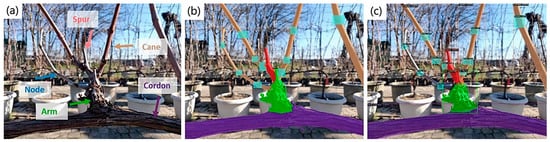
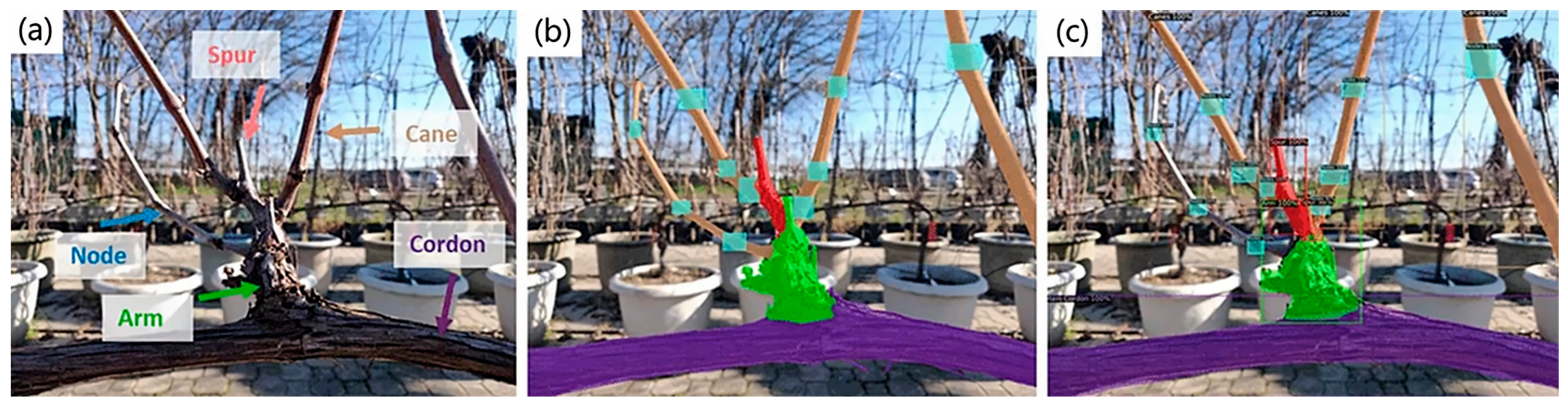
A 2D vision study for automated apple-tree training could segment trunks and branches while also detecting trellis wires [64], and later pruning work extracted branch junction points [65]. In dormant grapevines, pruning regions and different plant organs could also be detected [66]. However, 2D images easily lose connectivity where branches cross or where shoots are thin, and the problem becomes more serious under occlusion. For later pruning, an incorrect junction can be more troublesome than a small pixel-level error because it may directly change how the branch structure is interpreted. The correspondence among organ definitions, manual annotations, and model outputs in dormant grapevines provides a direct view of what pruning-related information is retained by 2D recognition (Figure 4).
Figure 4.
Correspondence between manually defined and model-recognized organs in dormant grapevines: (a) branch organs and structural classes; (b) manual annotation; (c) model segmentation output. The color coding is consistent across all subfigures: red = Spur, orange = Cane, blue = Node, purple = Cordon, green = Arm. Cyan square markers in (b) indicate manually labeled reference points, and green bounding boxes in (c) represent model-detected targets. Adapted from Guadagna et al. [66] (original Figure 4), under the terms of the Creative Commons Attribution 4.0 International License (CC BY 4.0).
Three-dimensional sensing shifts attention toward building the tree structure itself. In a semantic-skeleton study of Upright Fruiting Offshoot (UFO) sweet cherry trees, the median reconstruction accuracy across 29 trees was 70% [67]. In grapevine cane modeling, 51.45% of samples recovered complete connectivity, while another 35.51% missed only one internode relation [68]. These values describe different units and definitions and are therefore not directly comparable. Other 3D fruit-tree reconstruction studies have also estimated local dimensions with relatively good accuracy [69]. Under regular tree forms and relatively controlled acquisition conditions, local dimensions such as branch diameter and spatial position can already be measured. Recovering complete topology under occlusion and branch crossing remains more difficult.
These structural data can be used to generate pruning points. In a study of dormant Tall Spindle apple trees, red-green-blue-depth (RGB-D) acquisition covered 120 trees, and the full image dataset contained 1479 original images, including 1034 training images and 445 test images. In an RGB-D study on Tall Spindle apple, mean absolute errors for branch diameter and branch spacing were 1.10 mm and 16.06 mm, respectively, and pruning-point recognition reached 87.2% [70]. Walnut and grapevine studies have also generated candidate pruning locations from point clouds or from a combination of 2D segmentation and 3D point clouds [71,72]. Moving from tree recognition to candidate cut points is an important step, but whether a proposed point should actually be used is still a pruning-decision problem.
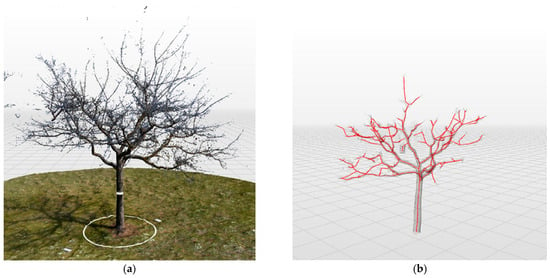
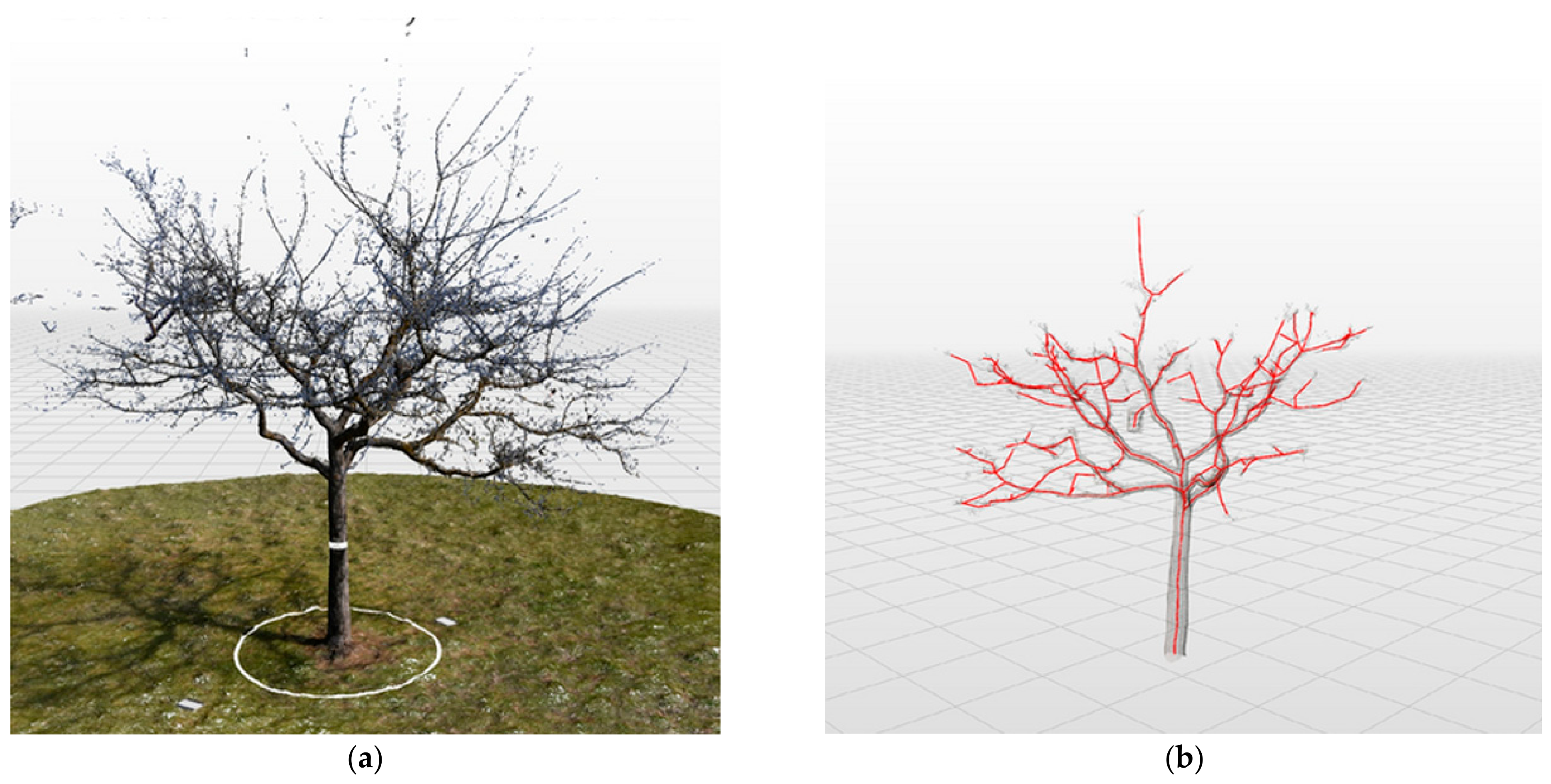
For intelligent pruning, the key to 3D reconstruction is not only obtaining a visually complete point cloud, but also organizing it into a connected branch structure. Straub et al. [73] built fruit-tree skeleton models using trunk identification, branch clustering, and graph-based methods.
Using apple as an example, the filtered point cloud preserves the geometric appearance of the canopy, while skeletonization explicitly represents the connections among the trunk and different branch orders (Figure 5). For automated pruning, these connections are more important than local dimensions alone. If a branching node is identified incorrectly, the candidate pruning points generated later may shift as well.
Figure 5.
Conversion of fruit-tree 3D sensing from point-cloud geometry to branch-topology representation: (a) filtered photogrammetric 3D point cloud of a representative apple tree; (b) 3D branch skeleton calculated from the corresponding point cloud. Adapted from Straub et al. [73] (original Figures 1 and 9), under the terms of the Creative Commons Attribution 4.0 International License (CC BY 4.0).
Validation conditions also affect how these results should be interpreted. A substantial share of branch-recognition and pruning-point work has been conducted on dormant or leafless trees, regular planar architectures, or partly controlled acquisition conditions [66,67,68,69,70,71,72,74]. Performance may change across cultivars, tree ages, architectures, illumination, background clutter, wind, humidity, and phenological stage. Studies tested only under dormant or controlled conditions should therefore be distinguished from systems that have demonstrated operation on complete trees in the field.
3.4. From Geometric Rules to Branch-Function Assessment
After branch structure has been identified, three levels should be kept separate: Perception describes where the branch is, including position, diameter, orientation, and connectivity. Interpretation asks what the branch is doing in the tree, for example, whether it is mainly fruiting, renewing, competing, or diseased. Decision-making then determines whether the branch should be retained, shortened, or removed and where the cut should be made. Early automated pruning decisions often translated practical experience into computable geometric conditions. Branch diameter and spacing were the most common, while some methods also considered branch length, node position, and spatial relation to the trunk [70,71]. These variables are relatively easy to obtain from a single scan and are useful for quickly generating candidate cuts. Other studies have extended the evaluation to the whole tree. Tang et al. virtually removed branches from 3D peach-tree models and compared light interception and net photosynthesis under different canopy structures [75]. Westling et al. generated candidate virtual pruning plans on LiDAR models of real fruit trees and compared them using canopy volume and simulated light distribution [76]. Kolmanič et al. added light interception and tree-form constraints to virtual trees and simulated dormant training over successive years [77]. These studies begin to move attention away from a single cut point and back toward structural changes in the whole tree after pruning.
Even a complete geometric description may not reveal what a branch is doing in the current tree. Flowering and fruiting are related to branch-axis age and branch type [50], and suitable crop load also changes with leaf area and year [51]. Different pruning methods further affect shoot composition and leaf-area distribution in the next stage of growth [18]. Two branches with similar diameter and angle can serve as a fruiting branch, a renewal branch, or a competing branch on different trees. Whether they should be removed also depends on current load and later renewal, and these factors are difficult to obtain from one static scan. A useful functional record would include fruiting history, branch-axis age or type, vigor, reproductive buds, current crop load, renewal role, health status, and spatial relation to neighboring fruiting units.
Some recent work has begun to learn from the results of human pruning. Differences between pre- and post-pruning RGB-D models of pear trees have been used to generate labels for removed branches automatically and to train pruning-prediction models [78]. Other systems still rely on explicit rules or expert knowledge. Vid2Cuts, for example, reconstructs grapevine structure from smartphone video and then provides visual pruning suggestions [74]. Experts themselves may not always make the same decision. Growers, fruit-tree researchers, and robotics researchers also emphasize somewhat different tree attributes [79]. If training data contain only cut coordinates, a model may learn how to reproduce the cut without knowing whether the purpose was vigor control, renewal, or crop-load adjustment. A dataset should therefore not treat one pruner’s action as the only possible ground truth. Where possible, it should record decisions from more than one expert, inter-rater agreement, confidence, the reason for retention or removal, and alternative horticulturally acceptable plans.
Health status and time also change branch-level decisions. Vision studies in apple and pear have already identified some external symptoms of fire blight [80,81], but symptom location still has to be related to a safe removal distance and to branch structure. Data quality and generalization under complex backgrounds are also common problems in disease sensing [82]. Orchard digital twins may provide a way to preserve multi-temporal tree states and support management decisions, but their use is still exploratory, and examples directly integrated into a pruning-control loop remain rare [83]. A deep-learning study in maize crop combined disease detection with severity prediction and crop-loss estimation [84], illustrating how visual assessment can be linked with downstream agricultural decisions. In the wider artificial intelligence (AI)–agriculture framework, sensing, machine learning, decision support, and robotic action are connected parts of one process. This aligns with the broader logic of AI-driven agriculture: visual sensing, decision support, and robotic operation form an integrated pipeline rather than isolated technologies [84,85], which provides a foundation for closing the loop from canopy visual assessment to automated field pruning. Intelligent pruning will ultimately need to connect geometric structure with branch function, and then gradually add health status and the time dimension.
3.5. From Single-Branch Cutting to Continuous Robotic Operation
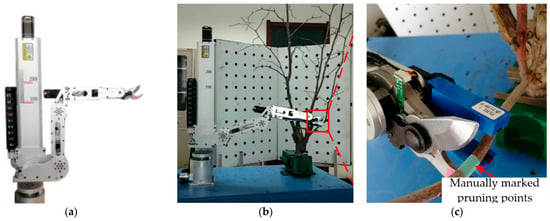
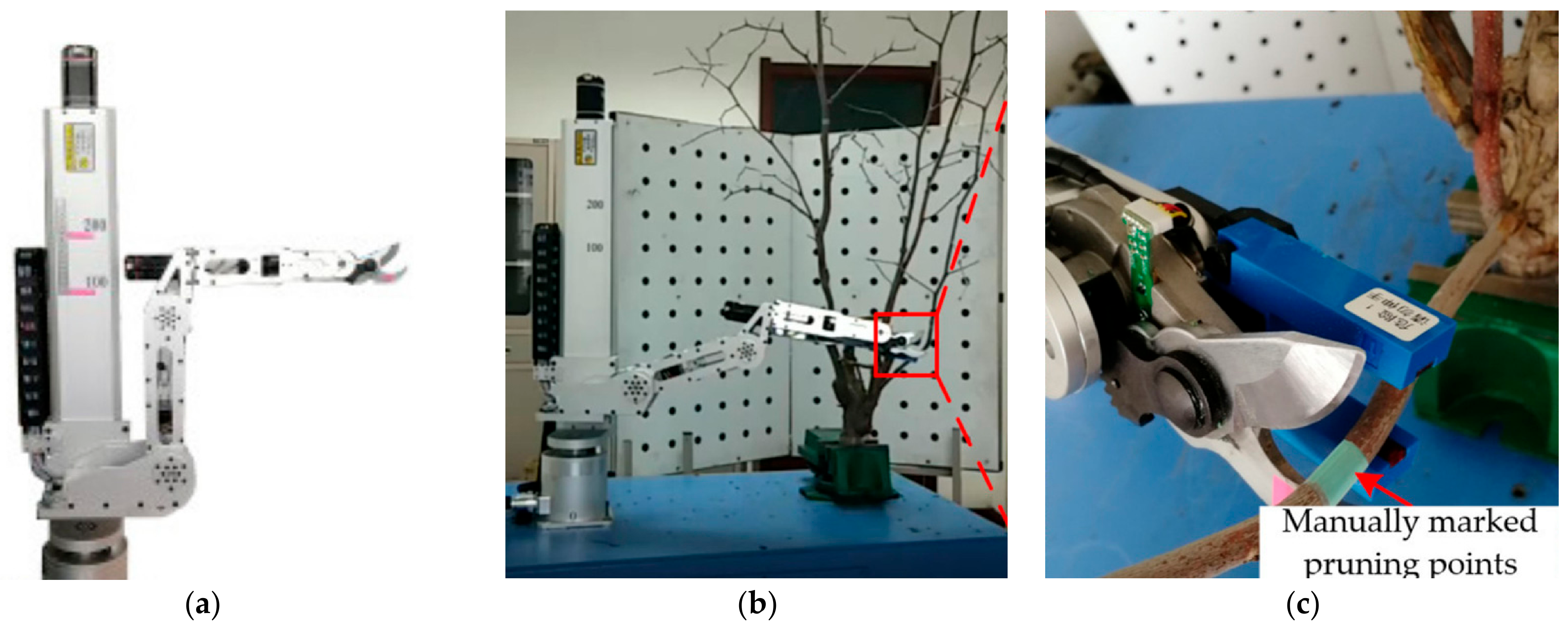
Early robotic pruning studies mainly examined whether a manipulator could approach a branch and cut it. Zahid et al. developed an apple pruning manipulator that cut branches of different orientations and up to about 25 mm in diameter on trellised ‘Fuji’ trees [86]. The jujube pruning manipulator designed by Zhang et al. had a positioning error below 10 mm and achieved a pruning success rate above 85.16% in single-tree tests [87]. Figure 6 shows this manipulator approaching a target branch under controlled conditions and the end-effector enclosing a manually marked cut point. The exact operating conditions and results of these studies are listed in Table 2.
Figure 6.
Target approach and cutting with a jujube pruning manipulator under controlled conditions: (a) pruning-manipulator prototype; (b) manipulator approaching a target branch on the test tree; (c) close-range enclosure and cutting of a manually marked pruning point by the end-effector. The text label visible in subfigure (c) reads “Manually marked pruning points”, indicating the pruning position manually marked on the branch prior to cutting. Adapted from Zhang et al. [87] (original Figures 11a and 12), under the terms of the Creative Commons Attribution 4.0 International License (CC BY 4.0).
Later studies added close-range sensing and contact feedback to the cutting process. The system first uses vision for approximate localization, then adjusts the motion based on interaction force after the tool contacts the branch. In You et al., a hybrid vision–interaction controller improved accuracy in a shear-alignment task by more than 30 percentage points over a baseline using camera depth data [88]. This feedback is useful in pruning because depth and calibration errors can shift the tool position, while branch bending under load can change the actual contact point.
At the whole-system stage, sensing, motion planning, and cutting execution begin to appear within the same operating process. The grapevine pruning robot of Botterill et al. treated 59 vines along a 96 m row, handling an average of 8.4 canes per vine in about 2 min per vine [89]. The UFO sweet cherry system achieved a 58% cutting success rate on 10 trees [90]. In a Tall Spindle apple field test, 11 of 15 target branches were ultimately cut successfully (73.3%): five on the first attempt, five on the second, and one on the third, with an average reported time of 17.8 s per branch [91]. These denominators, operating conditions, and definitions of success differ and should not be used for direct ranking.
When several branches are treated in sequence, cutting one branch can change both occlusion and the space available for the next approach. A branch that has been severed but remains attached to the tree may also interfere with the next action. If the system continues to rely on a model built before cutting, later target positions and paths can become inconsistent with the actual tree. Whole-tree operation therefore requires the tree to be observed again after cutting, the branch-removal result to be checked, and the remaining targets to be updated in time.
A severed branch does not necessarily mean that the pruning quality is acceptable. Cut position and stub length affect the final result, while tearing or crushing indicates tissue damage; the robot may also contact nearby branches that should be retained. Current whole-system trials mainly show whether sensing, planning, and cutting can operate in sequence. They contain much less observation of wound condition, post-pruning regrowth, or renewal of fruiting wood in the following season. For this reason, these studies are described here as integrated robotic trials rather than fully closed-loop systems. In this review, the term closed-loop is therefore reserved for systems in which observation after cutting changes the next action or accumulated tree records change a later decision. Robots can now carry out small-scale pruning trials in real orchards, but branch judgment, approach, cut confirmation, and target updating are not yet fully connected for continuous treatment of multiple targets on one tree. Existing studies have moved from branch recognition toward pruning-point generation and robotic cutting, but their validation conditions differ. Table 2 summarizes several representative studies and their main results.
The same difference between component performance and orchard performance explains why economic evidence is still scarce for robotic pruning. Most systems remain research prototypes tested on individual branches, small numbers of trees, or predefined targets. Botterill et al.’s value of about 2 min vine−1 [89], for example, describes prototype throughput, not a complete commercial cost. Reported cycle times may exclude setup, travel between trees, branch removal, recovery from failed actions, and manual completion. Economic evaluation becomes meaningful only when whole-tree or row trials report these operations together with equipment depreciation, maintenance, energy, operator labor, setup and transport, manual rework, and a clearly stated accounting boundary [89,90,91,92].
Table 2.
Representative studies and reported evidence in intelligent branch pruning.
4. Future Directions for Fruit-Tree Pruning Technologies
4.1. Perception and Pruning Decisions
The main question for perception is whether structural information remains reliable outside the conditions in which a method was developed. Dormant or leafless trees, regular planar architectures, and controlled acquisition simplify segmentation, depth sensing, and topology recovery, whereas orchard operation must tolerate differences in cultivar, tree age, architecture, background, illumination, wind, humidity, and phenological stage [66,67,68,69,70,71,72,73,74]. Future studies should therefore report crop and cultivar, tree form, phenological state, sensor, occlusion conditions, dataset size, and train/test split together with geometry or topology metrics. A result obtained on a dormant dataset should not be interpreted as evidence of year-round field robustness.
A branch-level dataset should not begin with a pruning-point coordinate as the only ground truth. The record has to preserve why the cut was made. At minimum, tree identity, cultivar and training system, branch topology, diameter and angle, axis age or type, reproductive status or crop load, health status, intended branch role, pruning objective, the reason for retaining/shortening/removing the branch, and the selected pruning-point coordinates should be linked. Immediate cut outcome and next-season regrowth or fruiting response should be attached to the same branch whenever possible [50,51,70,71,74,78,79,83]. Where more than one horticulturally acceptable strategy exists, multiple expert labels or inter-rater agreement and confidence are more informative than the decision of a single pruner.
4.2. Robotic Operation and Field Validation
A whole-tree benchmark should treat pruning as a sequence of state changes rather than as a set of independent cuts. The system should scan an initially unmodified tree, select and execute several cuts without manual resetting, verify branch detachment, re-observe the changed structure, update remaining targets, and replan when needed [88,89,90,91]. Reporting should distinguish targets detected, selected, reached, cut on the first attempt, recovered after failure, and finally completed manually. Cut position and quality, unintended contact or damage to retained branches, retries, human intervention, time per cut, time per tree, and system failures should also be reported. If diseased material is involved, tool cleaning or disinfection belongs in the operating sequence and in the cycle-time calculation.
Component and branch-level metrics do not by themselves show orchard readiness. Whole-tree and row trials should report total throughput, retries, recovery, manual intervention, and manual completion. Field-ready systems also need a stated economic boundary that includes setup, transport, energy, maintenance, depreciation, operator labor, and rework. Multi-season trials should then measure regrowth, renewal of fruiting wood, yield, fruit quality, and production return. Long-term mechanical pruning studies already provide this type of evidence [20,32,33,34,35,36,37]; comparable robotic evidence is still scarce. Across all validation levels, the number of trees, branches, or targets; the numerator and denominator used for success rates; excluded failures; field or controlled status; and any human intervention should be stated explicitly. The two-season duration proposed in Table 3 is a practical minimum for perennial-crop validation rather than a universal threshold; longer follow-up is preferable where biennial bearing or delayed renewal is expected.
Table 3.
Evaluation framework for pruning technologies.
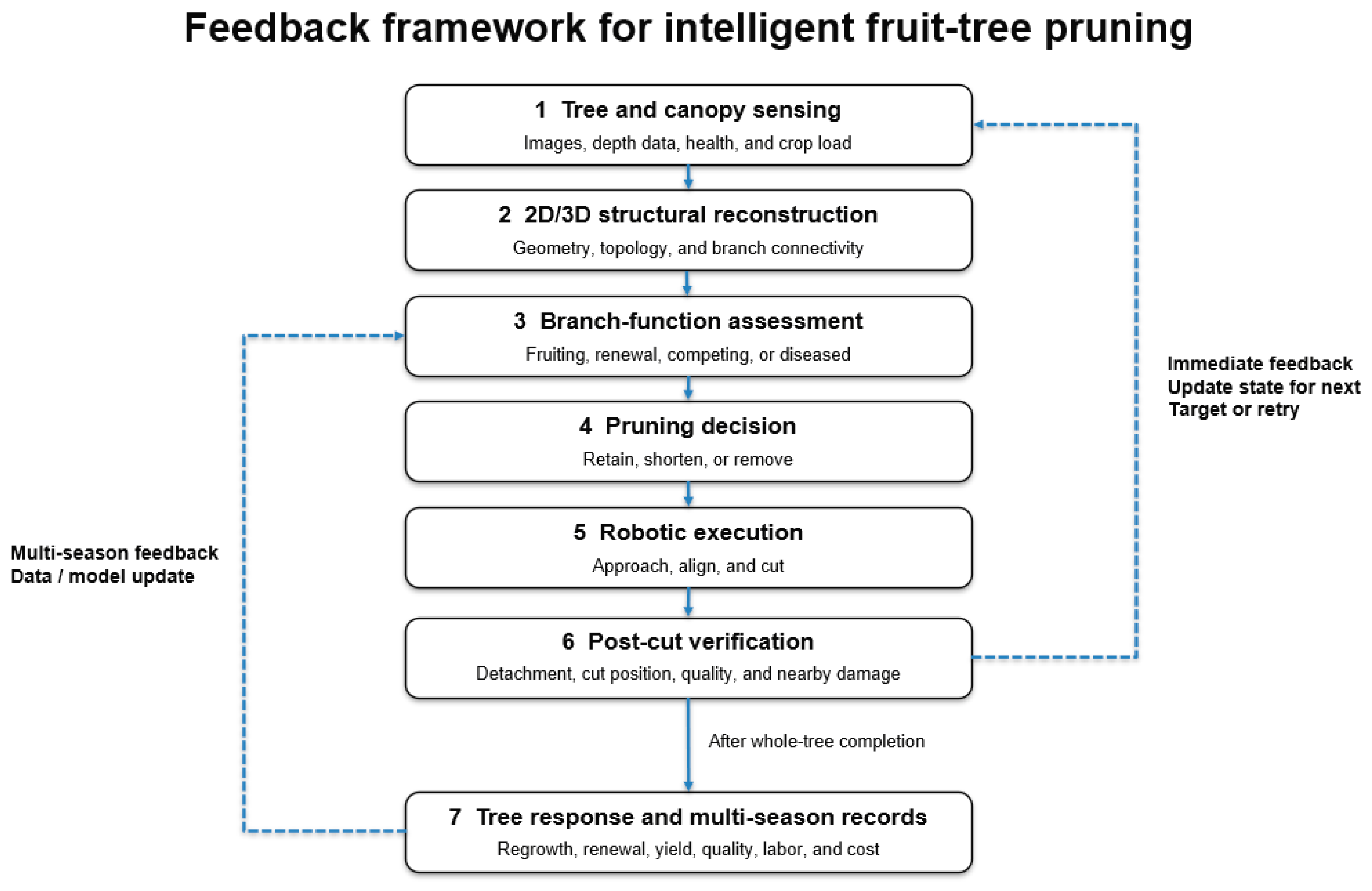
Figure 7 links these levels through two feedback loops. Within a pruning sequence, post-cut verification should trigger re-sensing, model updating, and replanning when detachment is incomplete, or the tree state has changed. Across seasons, regrowth, renewal, yield and quality, together with labor and economic records, should inform later branch interpretation and pruning decisions.
Figure 7.
Feedback framework for intelligent fruit-tree pruning. After each cut, post-cut verification updates the tree state for the next target or a retry. Tree-response monitoring begins after whole-tree completion, and multi-season records support data and model updates for later branch-function assessment and pruning decisions. Created by the authors.
5. Conclusions
Mechanical canopy pruning and intelligent branch pruning deal with different parts of the pruning problem. The first is already useful for controlling regular canopy profiles, but multi-year field work shows that work rate alone says little about the final horticultural result. Regrowth, manual follow-up, crop load, and repeated use can all change later yield, fruit quality, and economic performance. Mechanical pruning should therefore be judged within the production conditions in which it was tested rather than by a single work rate or yield value.
Branch-level automation is less mature. Research has moved from 2D recognition to 3D reconstruction, pruning-point generation, and robotic cutting, yet locating a branch is still different from deciding why it should be removed. Branch age, fruiting history, and renewal value are difficult to infer from geometry alone. After cutting, branch detachment, cut quality, and possible damage to nearby retained branches also matter. A successful cut confirms that one action was completed; it does not by itself show that the pruning was horticulturally acceptable.
Over the next stage, multi-year tree records, branch-function assessment, and continuous robotic operation need to become more closely connected. Evaluation will also have to move beyond single algorithms and single cuts to whole trees, orchard rows, and multi-year field results. Continuous mechanical and selective pruning are likely to remain complementary for some time: machinery can deal with regular peripheral growth, while workers or robots handle branches that need local judgment. Their final division of work will depend on tree form, task complexity, system reliability, biosecurity requirements, and production cost.
Author Contributions
Conceptualization, Q.Z.; methodology, Q.Z.; formal analysis, Q.Z.; investigation, Q.Z.; resources, X.H.; data curation, Q.Z. and Y.T.; writing—original draft preparation, Q.Z. and L.Y.; writing—review and editing, L.S. and S.J.; visualization, Q.Z.; supervision, Q.Z.; project administration, Q.Z.; funding acquisition, X.H. All authors have read and agreed to the published version of the manuscript.
Funding
Supported by the earmarked fund for: National Key R&D Program Project (2025YFE0208900); Sub-project under the National Key R&D Program (2025YFD1700501-03); The National Key Laboratory of Agricultural and Forestry Biosecurity (SKLJRP2501); China Agriculture Research System (CARS-28).
Data Availability Statement
No new data were created or analyzed in this study. Data sharing is not applicable to this article.
Acknowledgments
The authors would like to thank all staff of CCAT and CAUS, China Agricultural University, for their great contributions to this work.
Conflicts of Interest
The authors declare no conflicts of interest.
References
- Mika, A. Physiological Responses of Fruit Trees to Pruning. Hortic. Rev. 1986, 8, 337–378. [Google Scholar] [CrossRef] [Scilit]
- Scalisi, A.; O’Connell, M.G.; Stefanelli, D.; Zhou, S.; Pitt, T.; Graetz, D.; Dodds, K.; Han, L.; De Bei, R.; Stanley, J.; et al. Narrow Orchard Systems for Pome and Stone Fruit—A Review. Sci. Hortic. 2024, 338, 113815. [Google Scholar] [CrossRef] [Scilit]
- Myers, S.C.; Ferree, D.C. Influence of Time of Summer Pruning and Limb Orientation on Yield, Fruit Size, and Quality of Vigorous ‘Delicious’ Apple Trees. J. Am. Soc. Hortic. Sci. 1983, 108, 630–633. [Google Scholar] [CrossRef] [Scilit]
- Ikinci, A. Influence of Pre- and Postharvest Summer Pruning on the Growth, Yield, Fruit Quality, and Carbohydrate Content of Early Season Peach Cultivars. Sci. World J. 2014, 2014, 104865. [Google Scholar] [CrossRef] [Scilit] [PubMed]
- Musacchi, S.; Iglesias, I.; Neri, D. Training Systems and Sustainable Orchard Management for European Pear (Pyrus communis L.) in the Mediterranean Area: A Review. Agronomy 2021, 11, 1765. [Google Scholar] [CrossRef] [Scilit]
- Oran, R.B.; Ahı Koşar, D.; Demirsoy, H.; Ertürk, Ü. The Training Systems Affect Fruit Quality, Yield, and Labor Efficiency in Peach (P. persica L. Batsch). HortScience 2024, 59, 1172–1181. [Google Scholar] [CrossRef] [Scilit]
- dos Santos, É.F.; Silvestre, W.P.; Silva Rodrigues, L.; Cocco, C. Efficiency of Labor in Winter Pruning of Apple Trees Using Technological Innovations. Acta Agric. Slov. 2025, 121, 1–6. [Google Scholar] [CrossRef] [Scilit]
- Matias, P.; Barrote, I.; Azinheira, G.; Continella, A.; Duarte, A. Citrus Pruning in the Mediterranean Climate: A Review. Plants 2023, 12, 3360. [Google Scholar] [CrossRef] [Scilit] [PubMed]
- Poni, S.; Tombesi, S.; Palliotti, A.; Ughini, V.; Gatti, M. Mechanical Winter Pruning of Grapevine: Physiological Bases and Applications. Sci. Hortic. 2016, 204, 88–98. [Google Scholar] [CrossRef] [Scilit]
- He, L.; Schupp, J. Sensing and Automation in Pruning of Apple Trees: A Review. Agronomy 2018, 8, 211. [Google Scholar] [CrossRef] [Scilit]
- Navone, A.; Martini, M.; Chiaberge, M. Autonomous Robotic Pruning in Orchards and Vineyards: A Review. Smart Agric. Technol. 2025, 12, 101283. [Google Scholar] [CrossRef] [Scilit]
- Zahid, A.; Mahmud, M.S.; He, L.; Heinemann, P.; Choi, D.; Schupp, J. Technological Advancements towards Developing a Robotic Pruner for Apple Trees: A Review. Comput. Electron. Agric. 2021, 189, 106383. [Google Scholar] [CrossRef] [Scilit]
- Campbell, T.; Schupp, J.R.; Marini, R.P. Converting Tall Spindle Apple Trees to Narrow Walls with Summer and Dormant Hedging Plus Root Pruning. HortScience 2023, 58, 620–627. [Google Scholar] [CrossRef] [Scilit]
- Stone, C.H.; Close, D.C.; Bound, S.A.; Hunt, I. Training Systems for Sweet Cherry: Light Relations, Fruit Yield and Quality. Agronomy 2022, 12, 643. [Google Scholar] [CrossRef] [Scilit]
- Palmer, J.W.; Avery, D.J.; Wertheim, S.J. Effect of Apple Tree Spacing and Summer Pruning on Leaf Area Distribution and Light Interception. Sci. Hortic. 1992, 52, 303–312. [Google Scholar] [CrossRef] [Scilit]
- Bussi, C.; Bruchou, C.; Lescourret, F. Response of Watersprout Growth to Fruit Load and Intensity of Dormant Pruning in Peach Tree. Sci. Hortic. 2011, 130, 725–731. [Google Scholar] [CrossRef] [Scilit]
- Morgan, D.C.; Stanley, C.J.; Volz, R.; Warrington, I.J. Summer Pruning of ‘Gala’ Apple: The Relationships between Pruning Time, Radiation Penetration, and Fruit Quality. J. Am. Soc. Hortic. Sci. 1984, 109, 637–642. [Google Scholar] [CrossRef] [Scilit]
- Stephan, J.; Lauri, P.-É.; Donès, N.; Haddad, N.; Talhouk, S.; Sinoquet, H. Architecture of the Pruned Tree: Impact of Contrasted Pruning Procedures over 2 Years on Shoot Demography and Spatial Distribution of Leaf Area in Apple (Malus domestica). Ann. Bot. 2007, 99, 1055–1065. [Google Scholar] [CrossRef] [Scilit] [PubMed]
- Atay, E. A New Insight into Pruning Strategy in the Biennial Cycle of Fruiting: Vegetative Growth at Shoot and Whole-Tree Level, Yield and Fruit Quality of Apple. Not. Bot. Horti Agrobot. Cluj-Napoca 2017, 45, 232–237. [Google Scholar] [CrossRef] [Scilit][Green Version]
- Win, N.M.; Park, J.; Kim, S.; Lee, Y.; Do, V.G.; Kwon, J.-G.; Kwon, S.-I.; Yoo, J.; Kang, I.-K.; Kweon, H.-J. Effects of Mechanical Pruning on Tree Growth, Yield, and Fruit Quality of ‘Arisoo’ Apple Trees. Agriculture 2025, 15, 2118. [Google Scholar] [CrossRef] [Scilit]
- Duga, A.T.; Ruysen, K.; Dekeyser, D.; Nuyttens, D.; Bylemans, D.; Nicolai, B.M.; Verboven, P. Spray Deposition Profiles in Pome Fruit Trees: Effects of Sprayer Design, Training System and Tree Canopy Characteristics. Crop Prot. 2015, 67, 200–213. [Google Scholar] [CrossRef] [Scilit]
- Nackley, L.L.; Warneke, B.; Fessler, L.; Pscheidt, J.W.; Lockwood, D.; Wright, W.C.; Sun, X.; Fulcher, A. Variable-Rate Spray Technology Optimizes Pesticide Application by Adjusting for Seasonal Shifts in Deciduous Perennial Crops. HortTechnology 2021, 31, 479–489. [Google Scholar] [CrossRef] [Scilit]
- Holb, I.J. Effect of Pruning on Apple Scab in Organic Apple Production. Plant Dis. 2005, 89, 611–618. [Google Scholar] [CrossRef] [Scilit] [PubMed]
- Jiménez-Brenes, F.M.; López-Granados, F.; de Castro, A.I.; Torres-Sánchez, J.; Serrano, N.; Peña, J.M. Quantifying Pruning Impacts on Olive Tree Architecture and Annual Canopy Growth by Using UAV-Based 3D Modelling. Plant Methods 2017, 13, 55. [Google Scholar] [CrossRef] [Scilit] [PubMed]
- Roma, E.; Catania, P.; Vallone, M.; Orlando, S. Assessing the Effectiveness of Pruning in an Olive Orchard Using a Drone and a Multispectral Camera: A Three-Year Study. Agronomy 2024, 14, 1023. [Google Scholar] [CrossRef] [Scilit]
- Guo, N.; Xu, N.; Kang, J.; Zhang, G.; Meng, Q.; Niu, M.; Wu, W.; Zhang, X. A Study on Canopy Volume Measurement Model for Fruit Tree Application Based on LiDAR Point Cloud. Agriculture 2025, 15, 130. [Google Scholar] [CrossRef] [Scilit]
- Zhang, B.; Liu, Y.; Zhang, H.; Shen, C.; Fu, W. Design and Evaluation of a Shaping and Pruning Machine for Dwarf and Densely Planted Jujube Trees. Appl. Sci. 2022, 12, 2699. [Google Scholar] [CrossRef] [Scilit]
- Nowakowski, T.; Dąbrowska, M.; Sypuła, M.; Strużyk, A. A Method for Evaluating the Size of Damages to Fruit Trees during Pruning Using Different Devices. Sci. Hortic. 2018, 242, 30–35. [Google Scholar] [CrossRef] [Scilit]
- Li, C.; Zhang, H.; Wang, Q.; Chen, Z. Influencing Factors of Cutting Force for Apple Tree Branch Pruning. Agriculture 2022, 12, 312. [Google Scholar] [CrossRef] [Scilit]
- Nowakowski, T.; Tucki, K.; Gruz, Ł. The Effect of Cutting Technique on the Degree of Damage to Fruit Tree Shoots. Agriculture 2026, 16, 115. [Google Scholar] [CrossRef] [Scilit]
- Huang, C.W.; Cai, D.X.; Wang, W.Z.; Li, J.; Duan, J.L.; Yang, Z. Development of an Automatic Control System for a Hydraulic Pruning Robot. Comput. Electron. Agric. 2023, 214, 108329. [Google Scholar] [CrossRef] [Scilit]
- Martin-Gorriz, B.; Porras Castillo, I.; Torregrosa, A. Effect of Mechanical Pruning on the Yield and Quality of ‘Fortune’ Mandarins. Span. J. Agric. Res. 2014, 12, 952–959. [Google Scholar] [CrossRef] [Scilit]
- Fonte, A.; Torregrosa, A.; Garcerá, C.; Mateu, G.; Chueca, P. Mechanical Pruning of ‘Clemenules’ Mandarins in Spain: Yield Effects and Economic Analysis. Agronomy 2022, 12, 761. [Google Scholar] [CrossRef] [Scilit]
- Chueca, P.; Mateu, G.; Garcerá, C.; Fonte, A.; Ortiz, C.; Torregrosa, A. Yield and Economic Results of Different Mechanical Pruning Strategies on ‘Navel Foyos’ Oranges in the Mediterranean Area. Agriculture 2021, 11, 82. [Google Scholar] [CrossRef] [Scilit]
- Martín-Górriz, B.; Martínez-Barba, C.; Torregrosa, A. Lemon Trees Response to Different Long-Term Mechanical and Manual Pruning Practices. Sci. Hortic. 2021, 275, 109700. [Google Scholar] [CrossRef] [Scilit]
- Allegro, G.; Martelli, R.; Valentini, G.; Pastore, C.; Mazzoleni, R.; Pezzi, F.; Filippetti, I. Effects of Mechanical Winter Pruning on Vine Performances and Management Costs in a Trebbiano Romagnolo Vineyard: A Five-Year Study. Horticulturae 2023, 9, 21. [Google Scholar] [CrossRef] [Scilit]
- Bates, T.; Morris, J. Mechanical Cane Pruning and Crop Adjustment Decreases Labor Costs and Maintains Fruit Quality in New York ‘Concord’ Grape Production. HortTechnology 2009, 19, 247–253. [Google Scholar] [CrossRef] [Scilit]
- Fonte, A.; Garcerá, C.; Chueca, P. Influence of Mechanical and Manual Pruning on the Incidence of Pests in ‘Clemenules’ Mandarins. Pest Manag. Sci. 2023, 79, 4390–4402. [Google Scholar] [CrossRef] [Scilit] [PubMed]
- Grechi, I.; Sauge, M.; Sauphanor, B.; Hilgert, N.; Senoussi, R.; Lescourret, F. How Does Winter Pruning Affect Peach Tree–Myzus persicae Interactions? Entomol. Exp. Appl. 2008, 128, 369–379. [Google Scholar] [CrossRef] [Scilit]
- Gubler, W.D.; Marois, J.J.; Bledsoe, A.M.; Bettiga, L.J. Control of Botrytis Bunch Rot of Grape with Canopy Management. Plant Dis. 1987, 71, 599–601. [Google Scholar] [CrossRef] [Scilit]
- Würz, D.A.; Rufato, L.; Bogo, A.; Allebrandt, R.; Pereira De Bem, B.; Marcon Filho, J.L.; Brighenti, A.F.; Bonin, B.F. Effects of Leaf Removal on Grape Cluster Architecture and Control of Botrytis Bunch Rot in Sauvignon Blanc Grapevines in Southern Brazil. Crop Prot. 2020, 131, 105079. [Google Scholar] [CrossRef] [Scilit]
- Simon, S.; Lauri, P.-É.; Brun, L.; Defrance, H.; Sauphanor, B. Does Manipulation of Fruit-Tree Architecture Affect the Development of Pests and Pathogens? A Case Study in an Organic Apple Orchard. J. Hortic. Sci. Biotechnol. 2006, 81, 765–773. [Google Scholar] [CrossRef] [Scilit]
- Kappel, F.; Brownlee, R. Early Performance of “Conference” Pear on Four Training Systems. HortScience 2001, 36, 69–71. [Google Scholar] [CrossRef] [Scilit]
- Anthony, B.M.; Minas, I.S. Canopy Architecture Impact on Peach Tree Physiology, Vigor Diffusion, Productivity and Fruit Quality. Sci. Hortic. 2025, 342, 114025. [Google Scholar] [CrossRef] [Scilit]
- Lauri, P.-É.; Willaume, M.; Larrive, G.; Lespinasse, J.-M. The Concept of Centrifugal Training in Apple Aimed at Optimizing the Relationship between Growth and Fruiting. Acta Hortic. 2004, 636, 35–42. [Google Scholar] [CrossRef] [Scilit]
- Willaume, M.; Lauri, P.-É.; Sinoquet, H. Light Interception in Apple Trees Influenced by Canopy Architecture Manipulation. Trees 2004, 18, 705–713. [Google Scholar] [CrossRef] [Scilit]
- Raffo, M.D.; Rodríguez, R.O.; Mañueco, M.L. The Effects of Centrifugal Pruning on Fruiting Structure Production in Royal Gala Apples. Cienc. Investig. Agrar. 2011, 38, 227–232. [Google Scholar] [CrossRef] [Scilit]
- Lauri, P.-É.; Crété, X.; Ferré, G. Centrifugal Training in Apple: Appraisal of a Two-Year Experiment on ‘Galaxy’ in Southeast France. Acta Hortic. 2007, 732, 391–396. [Google Scholar] [CrossRef] [Scilit]
- Van Hooijdonk, B.M.; Tustin, D.S.; Oliver, M.J.; Breen, K.C.; Dayatilake, G.A. Modification of Canopy Architecture Imposed by Artificial Spur Extinction Promotes Reliable Cropping Behaviour and Enhances Fruit Quality of ‘Scilate’ Apple Trees. Acta Hortic. 2014, 1058, 63–70. [Google Scholar] [CrossRef] [Scilit]
- Costes, E.; Sinoquet, H.; Kelner, J.-J.; Godin, C. Exploring Within-Tree Architectural Development of Two Apple Tree Cultivars over 6 Years. Ann. Bot. 2003, 91, 91–104. [Google Scholar] [CrossRef] [Scilit] [PubMed]
- Penzel, M.; Herppich, W.B.; Weltzien, C.; Tsoulias, N.; Zude-Sasse, M. Modeling of Individual Fruit-Bearing Capacity of Trees Is Aimed at Optimizing Fruit Quality of Malus × domestica Borkh. ‘Gala’. Front. Plant Sci. 2021, 12, 669909. [Google Scholar] [CrossRef] [Scilit] [PubMed]
- Yang, X.; Chen, L.-S.; Cheng, L. Leaf Photosynthesis and Carbon Metabolism Adapt to Crop Load in ‘Gala’ Apple Trees. Horticulturae 2021, 7, 47. [Google Scholar] [CrossRef] [Scilit]
- Chen, C.; Li, B.-H.; Dong, X.-L.; Wang, C.-X.; Lian, S.; Liang, W.-X. Effects of Temperature, Humidity, and Wound Age on Valsa Mali Infection of Apple Shoot Pruning Wounds. Plant Dis. 2016, 100, 2394–2401. [Google Scholar] [CrossRef] [Scilit] [PubMed]
- Rosace, M.C.; Legler, S.E.; Salotti, I.; Rossi, V. Susceptibility of Pruning Wounds to Grapevine Trunk Diseases: A Quantitative Analysis of Literature Data. Front. Plant Sci. 2023, 14, 1063932. [Google Scholar] [CrossRef] [Scilit] [PubMed]
- Úrbez-Torres, J.R.; Gubler, W.D. Susceptibility of Grapevine Pruning Wounds to Infection by Lasiodiplodia theobromae and Neofusicoccum parvum. Plant Pathol. 2011, 60, 261–270. [Google Scholar] [CrossRef] [Scilit]
- Spotts, R.A.; Wallis, K.M.; Serdani, M.; Azarenko, A.N. Bacterial Canker of Sweet Cherry in Oregon—Infection of Horticultural and Natural Wounds, and Resistance of Cultivar and Rootstock Combinations. Plant Dis. 2010, 94, 345–350. [Google Scholar] [CrossRef] [Scilit] [PubMed]
- DuPont, S.T.; Munir, M.; Cox, K.; Johnson, K.; Peter, K.; Baro, A. Evaluation of Pruning Therapies in Apple Trees with Fire Blight. J. Plant Pathol. 2023, 105, 1695–1709. [Google Scholar] [CrossRef] [Scilit]
- Brown, A.A.; Travadon, R.; Lawrence, D.P.; Torres, G.; Zhuang, G.; Baumgartner, K. Pruning-Wound Protectants for Trunk-Disease Management in California Table Grapes. Crop Prot. 2021, 141, 105490. [Google Scholar] [CrossRef] [Scilit]
- Salvador Dutra, P.S.; Gazis, R.; Crane, J.H.; Zhang, S. Pruning as an Effective Strategy for the Integrated Management of Fruit and Stem Canker in Dragon Fruit Production. Crop Prot. 2025, 191, 107145. [Google Scholar] [CrossRef] [Scilit]
- Barbosa, C.J.; Pina, J.A.; Pérez-Panadés, J.; Bernad, L.; Serra, P.; Navarro, L.; Durán-Vila, N. Mechanical Transmission of Citrus Viroids. Plant Dis. 2005, 89, 749–754. [Google Scholar] [CrossRef] [Scilit] [PubMed]
- Nguyen, K.; Förster, H.; Adaskaveg, J.E. Quaternary Ammonium Compounds as New Sanitizers for Reducing the Spread of the Olive Knot Pathogen on Orchard Equipment. Plant Dis. 2017, 101, 1188–1193. [Google Scholar] [CrossRef] [Scilit] [PubMed]
- Çakmak, B.; Ergül, E. Interactions of Personal and Occupational Risk Factors on Hand Grip Strength of Winter Pruners. Int. J. Ind. Ergon. 2018, 67, 192–200. [Google Scholar] [CrossRef] [Scilit]
- Öztürk, V.; Bektaş, M. An Endemic Threat of Agricultural Mechanization: Hand Injuries Caused by Electric Pruning Shears. Ulus Travma Acil Cerrahi Derg. 2025, 31, 1026–1031. [Google Scholar] [CrossRef] [Scilit] [PubMed]
- Majeed, Y.; Zhang, J.; Zhang, X.; Fu, L.; Karkee, M.; Zhang, Q.; Whiting, M.D. Deep Learning Based Segmentation for Automated Training of Apple Trees on Trellis Wires. Comput. Electron. Agric. 2020, 170, 105277. [Google Scholar] [CrossRef] [Scilit]
- Tong, S.; Yue, Y.; Li, W.; Wang, Y.; Kang, F.; Feng, C. Branch Identification and Junction Points Location for Apple Trees Based on Deep Learning. Remote Sens. 2022, 14, 4495. [Google Scholar] [CrossRef] [Scilit]
- Guadagna, P.; Fernandes, M.; Chen, F.; Santamaria, A.; Teng, T.; Frioni, T.; Caldwell, D.G.; Poni, S.; Semini, C.; Gatti, M. Using Deep Learning for Pruning Region Detection and Plant Organ Segmentation in Dormant Spur-Pruned Grapevines. Precis. Agric. 2023, 24, 1547–1569. [Google Scholar] [CrossRef] [Scilit] [PubMed]
- You, A.; Grimm, C.; Silwal, A.; Davidson, J.R. Semantics-Guided Skeletonization of Upright Fruiting Offshoot Trees for Robotic Pruning. Comput. Electron. Agric. 2022, 192, 106622. [Google Scholar] [CrossRef] [Scilit]
- Williams, H.; Smith, D.; Shahabi, J.; Gee, T.; Nejati, M.; McGuinness, B.; Black, K.; Tobias, J.; Jangali, R.; Lim, H.; et al. Modelling Wine Grapevines for Autonomous Robotic Cane Pruning. Biosyst. Eng. 2023, 235, 31–49. [Google Scholar] [CrossRef] [Scilit]
- Li, X.; Liu, B.; Shi, Y.; Xiong, M.; Ren, D.; Wu, L.; Zou, X. Efficient Three-Dimensional Reconstruction and Skeleton Extraction for Intelligent Pruning of Fruit Trees. Comput. Electron. Agric. 2024, 227, 109554. [Google Scholar] [CrossRef] [Scilit]
- Tong, S.; Zhang, J.; Li, W.; Wang, Y.; Kang, F. An Image-Based System for Locating Pruning Points in Apple Trees Using Instance Segmentation and RGB-D Images. Biosyst. Eng. 2023, 236, 277–286. [Google Scholar] [CrossRef] [Scilit]
- Zhu, W.; Bai, X.; Xu, D.; Li, W. Pruning Branch Recognition and Pruning Point Localization for Walnut (Juglans regia L.) Trees Based on Point Cloud Semantic Segmentation. Agriculture 2025, 15, 817. [Google Scholar] [CrossRef] [Scilit]
- Fernandes, M.; Gamba, J.D.; Pelusi, F.; Bratta, A.; Caldwell, D.; Poni, S.; Gatti, M.; Semini, C. Grapevine Winter Pruning: Merging 2D Segmentation and 3D Point Clouds for Pruning Point Generation. Comput. Electron. Agric. 2025, 237, 110589. [Google Scholar] [CrossRef] [Scilit]
- Straub, J.; Reiser, D.; Lüling, N.; Stana, A.; Griepentrog, H.W. Approach for Graph-Based Individual Branch Modelling of Meadow Orchard Trees with 3D Point Clouds. Precis. Agric. 2022, 23, 1967–1982. [Google Scholar] [CrossRef] [Scilit]
- Häring, S.; Folawiyo, S.; Podguzova, M.; Krauß, S.; Stricker, D. Vid2Cuts: A Framework for Enabling AI-Guided Grapevine Pruning. IEEE Access 2024, 12, 5814–5836. [Google Scholar] [CrossRef] [Scilit]
- Tang, L.; Hou, C.; Huang, H.; Chen, C.; Zou, J.; Lin, D. Light Interception Efficiency Analysis Based on Three-Dimensional Peach Canopy Models. Ecol. Inform. 2015, 30, 60–67. [Google Scholar] [CrossRef] [Scilit]
- Westling, F.; Underwood, J.; Bryson, M. A Procedure for Automated Tree Pruning Suggestion Using LiDAR Scans of Fruit Trees. Comput. Electron. Agric. 2021, 187, 106274. [Google Scholar] [CrossRef] [Scilit]
- Kolmanič, S.; Strnad, D.; Kohek, Š.; Benes, B.; Hirst, P.; Žalik, B. An Algorithm for Automatic Dormant Tree Pruning. Appl. Soft Comput. 2021, 99, 106931. [Google Scholar] [CrossRef] [Scilit]
- Dukić, J.; Pejić, P.; Vidović, I.; Nyarko, E.K. Towards Robotic Pruning: Automated Annotation and Prediction of Branches for Pruning on Trees Reconstructed Using RGB-D Images. Sensors 2025, 25, 5648. [Google Scholar] [CrossRef] [Scilit] [PubMed]
- Flynn, D.; Jain, A.; Knight, H.; Wilson, C.G.; Grimm, C. Uncovering Implementable Dormant Pruning Decisions from Three Different Stakeholder Perspectives. HortTechnology 2026, 36, 325–332. [Google Scholar] [CrossRef] [Scilit]
- Mahmud, M.S.; He, L.; Zahid, A.; Heinemann, P.; Choi, D.; Krawczyk, G.; Zhu, H. Detection and Infected Area Segmentation of Apple Fire Blight Using Image Processing and Deep Transfer Learning for Site-Specific Management. Comput. Electron. Agric. 2023, 209, 107862. [Google Scholar] [CrossRef] [Scilit]
- Veres, M.; Tarry, C.; Grigg-McGuffin, K.; McFadden-Smith, W.; Moussa, M. An Evaluation of Multi-Channel Sensors and Density Estimation Learning for Detecting Fire Blight Disease in Pear Orchards. Sensors 2024, 24, 5387. [Google Scholar] [CrossRef] [Scilit] [PubMed]
- Yang, Y.; Mali, P.; Arthur, L.; Molaei, F.; Atsyo, S.; Geng, J.; He, L.; Ghatrehsamani, S. Advanced Technologies for Precision Tree Fruit Disease Management: A Review. Comput. Electron. Agric. 2025, 229, 109704. [Google Scholar] [CrossRef] [Scilit]
- Liu, X.; He, L.; Niu, S.; Li, R.; Majeed, Y.; Sun, X.; Chen, J.; Li, X.; Walsh, K.B.; Fu, L. Opportunities and Challenges in the Application of Digital Twins for Orchard Management. Comput. Electron. Agric. 2025, 239, 111104. [Google Scholar] [CrossRef] [Scilit]
- Haridasan, A.; Thomas, J.; Rajesh, E.K. Disease Detection, Severity Prediction, and Crop Loss Estimation in Maize Crop Using Deep Learning. Artif. Intell. Agric. 2022, 6, 276–291. [Google Scholar] [CrossRef] [Scilit]
- Vocaturo, E.; Rani, G.; Dhaka, V.S.; Zumpano, E. AI-Driven Agriculture: Opportunities and Challenges. In Proceedings of the 2023 IEEE International Conference on Big Data (BigData); IEEE: New York, NY, USA, 2023; pp. 3530–3537. [Google Scholar] [CrossRef] [Scilit]
- Zahid, A.; Mahmud, M.S.; He, L.; Choi, D.; Heinemann, P.; Schupp, J. Development of an Integrated 3R End-Effector with a Cartesian Manipulator for Pruning Apple Trees. Comput. Electron. Agric. 2020, 179, 105837. [Google Scholar] [CrossRef] [Scilit]
- Zhang, B.; Chen, X.; Zhang, H.; Shen, C.; Fu, W. Design and Performance Test of a Jujube Pruning Manipulator. Agriculture 2022, 12, 552. [Google Scholar] [CrossRef] [Scilit]
- You, A.; Kolano, H.; Parayil, N.; Grimm, C.; Davidson, J.R. Precision Fruit Tree Pruning Using a Learned Hybrid Vision/Interaction Controller. In Proceedings of the 2022 International Conference on Robotics and Automation (ICRA), Philadelphia, PA, USA, 23–27 May 2022; pp. 2280–2286. [Google Scholar] [CrossRef] [Scilit]
- Botterill, T.; Paulin, S.; Green, R.; Williams, S.; Lin, J.; Saxton, V.; Mills, S.; Chen, X.Q.; Corbett-Davies, S. A Robot System for Pruning Grape Vines. J. Field Robot. 2017, 34, 1100–1122. [Google Scholar] [CrossRef] [Scilit]
- You, A.; Parayil, N.; Krishna, J.G.; Bhattarai, U.; Sapkota, R.; Ahmed, D.; Whiting, M.; Karkee, M.; Grimm, C.M.; Davidson, J.R. Semiautonomous Precision Pruning of Upright Fruiting Offshoot Orchard Systems: An Integrated Approach. IEEE Robot. Autom. Mag. 2023, 30, 10–19. [Google Scholar] [CrossRef] [Scilit]
- Tong, S.; Wang, J.; Zhang, J.; Liu, L.; Wang, Y.; Kang, F. An Apple Tree Pruning Robot System Based on Branch Segmentation and Decision-Making Control. Artif. Intell. Agric. 2026, 16, 1025–1040. [Google Scholar] [CrossRef] [Scilit]
- Galinato, S.P.; Kendall, A.; Miles, C.A. Costs and Profitability for Mechanized Pruning and Harvest in Two Cider Apple Orchard Systems. HortTechnology 2022, 32, 275–287. [Google Scholar] [CrossRef] [Scilit]

Disclaimer/Publisher’s Note: The statements, opinions and data contained in all publications are solely those of the individual author(s) and contributor(s) and not of MDPI and/or the editor(s). MDPI and/or the editor(s) disclaim responsibility for any injury to people or property resulting from any ideas, methods, instructions or products referred to in the content. |
© 2026 by the authors. Licensee MDPI, Basel, Switzerland. This article is an open access article distributed under the terms and conditions of the Creative Commons Attribution (CC BY) license.