Article

Integration of Multi-Omics Reveals Genomic Features of Chromatin Accessibility in Gardenia jasminoides J.Ellis Leaves

1
College of Life Sciences, Nanchang University, 999 Xuefu Avenue, Honggutan New District, Nanchang 330047, China
2
Jiangxi Provincial Key Laboratory of Ex Situ Plant Conservation and Utilization, Lushan Botanical Garden, Chinese Academy of Sciences, 9 Zhiqing Road, Jiujiang 332900, China
3
Guangdong Provincial Key Laboratory of Applied Botany & State Key Laboratory of Plant Diversity and Specialty Crops, South China Botanical Garden, Chinese Academy of Sciences, Guangzhou 510650, China
*
Authors to whom correspondence should be addressed.
These authors contributed equally to this work.
Horticulturae 2026, 12(9), 1121; https://doi.org/10.3390/horticulturae12091121
Submission received: 13 July 2026 / Revised: 22 August 2026 / Accepted: 1 September 2026 / Published: 4 September 2026
(This article belongs to the Special Issue Genome Alignment and Regulatory Genomics in Horticultural Crops)

Abstract

Chromatin accessibility is an important feature of cis-regulatory elements that shapes gene regulation in plants; however, it has been studied less frequently in traditional medicinal plants such as Gardenia jasminoides J.Ellis (G. jasminoides). This study applied Assay for Transposase-Accessible Chromatin using sequencing (ATAC-seq) technology to characterize the genome-wide distribution and functional features of accessible chromatin regions (ACRs) in G. jasminoides leaves. A total of 26,461 ACRs and 13,625 associated genes were identified in this study, and our results revealed a positive correlation between the open chromatin state of ACRs and the expression levels of their associated genes. These ACRs were also found to be enriched with numerous conserved transcription factor binding motifs (TF motifs). Integration of two histone modification datasets further demonstrated that ACRs are closely associated with activating histone modifications, including H3K4me3 and H3K27ac, which work together to regulate the transcription of target genes. Additionally, luciferase (LUC) reporter assays validated the transcriptional activation activity of two candidate ACRs. Taken together, these findings elucidate the genomic features of ACRs in G. jasminoides and provide critical genomic resources for subsequent gene regulation analyses for this species.

1. Introduction

The nucleosome is the fundamental structural unit of chromatin. It consists of a histone octamer and the DNA wrapped around it [1,2]. In eukaryotic genomes, regions of chromatin with sparse nucleosome distribution adopt a loose, low-compaction conformation. This structural state enables the binding and interaction of regulatory elements (e.g., transcription factors, TFs) to bind to and interact with target gene promoters and enhancers within these regions, thereby modulating gene expression [3]. The property of open, accessible chromatin is defined as chromatin accessibility, and the specific DNA segments with elevated accessibility and a loose conformational state are termed ACRs [4,5,6,7]. In addition to transcriptional regulation by TFs, chromatin structure and gene expression are also modulated by diverse histone modifications [8,9,10].
G. jasminoides, a member of the genus Gardenia in the Rubiaceae family, is an evergreen shrub. Its dried mature fruits are used as a traditional Chinese medicinal herb, exhibiting analgesic, hemostatic, anti-inflammatory, anti-edematous, hepatoprotective, and choleretic effects [11,12]. G. jasminoides is a traditional Chinese medicinal and edible plant. It also serves as a popular ornamental plant and an important source of natural pigments, thus possessing great academic value and broad application prospects. As an economically and pharmacologically important plant, G. jasminoides has attracted widespread attention for its medicinal properties and biological characteristics. Current research on G. jasminoides primarily focuses on physiological and biochemical characterization, as well as genomic and transcriptomic analyses [13]. However, studies on its transcriptional regulatory networks remain limited, particularly regarding the synergistic mechanisms of transcription factors and the epigenetic regulation of non-coding regulatory elements (e.g., promoters and enhancers). In this context, investigating chromatin-based epigenetic regulation in G. jasminoides is of great biological significance. Based on the above research gaps, we put forward the core research question: How do chromatin accessible regions (ACRs) participate in the transcriptional regulation of genes in G. jasminoides? Elucidating the chromatin accessibility and transcriptional regulation in this species can fill the research gap and enrich the epigenomic data of medicinal plants.
This study employed ATAC-seq to identify genome-wide ACRs in G. jasminoides. Integrating these ACR data with other omics datasets clarifies the genomic characteristics of these key cis-regulatory sequences and their regulatory impact on downstream gene expression. Furthermore, we aim to deepen the understanding of ACR-mediated transcriptional regulation and to provide valuable genomic resources for further investigation of non-coding regulatory regions in G. jasminoides.

2. Materials and Methods

2.1. Plant Materials

The leaf samples of G. jasminoides used in this study were collected from plants (LS016) grown at the Lushan Botanical Garden of the Chinese Academy of Sciences in Jiangxi Province (9 Zhiqing Road, Jiujiang, Jiangxi, China). The plants were around three to four years old and were grown outdoors. Three mature leaves were pooled at each sampling for subsequent experiments, and two independent biological replicates were prepared. The same batch of leaf samples was used for RNA-seq, ATAC-seq and ChIP-seq analyses.

2.2. RNA-Sequencing (RNA-Seq) and Data Analysis

Total RNA was extracted from G. jasminoides leaves via the RNeasy Plant Mini Kit (QIAGEN, 74904, Hilden, Germany) and randomly fragmented into short fragments. The fragmented RNA transcripts were subjected to adapter ligation, end repair, and terminal modification for library construction, with each fragment carrying an adapter sequence at both ends. The RNA library was sequenced on a high-throughput sequencing platform in PE150 mode.
Raw sequencing data were quality-controlled using Trim_Galore (version: 0.6.10) (http://github.com/FelixKrueger/TrimGalore, accessed on 1 January 2026; Default parameters), an integrated wrapper tool around Cutadapt (version: 4.4) and FastQC (version: 12.1) for consistent adapter and quality trimming. Clean reads were aligned to the G. jasminoides reference genome using Hisat2 (version: 2.2.1) [14]. Samtools (version: 1.18) [15] was employed for data sorting, indexing, filtering, and statistical analysis (-F 4 -q 30: filtering out unaligned reads and low-quality alignments with a mapping quality score > 30). Cuffnorm (version: 2.2.1) was used to calculate gene expression levels as fragments per kilobase of transcript per million mapped reads (FPKM) [16]. Pheatmap (version: 1.0.13) was utilized to evaluate the reproducibility between experimental and control groups [17]. All RNA-seq sequencing statistics are summarized in Supplementary Table S1.

2.3. ATAC-Seq and Data Analysis

ATAC-seq library preparation for G. jasminoides leaves was performed according to previously reported protocols with minor modifications [18,19,20]. Tn5 transposase shows intrinsic sequence bias during DNA fragmentation and tagmentation. Tn5-treated genomic DNA was used as the input control and adopted the -c parameter in MACS2 (version: 2.2.7) for accessible chromatin peak calling to correct such bias [1,2]. G. jasminoides is a non-model plant with scarce published studies on accessible chromatin regions (ACRs). Accordingly, we included Tn5-tagged genomic DNA as a negative control to eliminate analytical biases derived from the transposase preference in this work [21,22]. Approximately 0.3 g of fresh leaf samples were rapidly frozen in liquid nitrogen and ground into a fine powder. Nuclei were extracted by adding 10 mL of lysis buffer, followed by sequential washing with 1 mL of Wash Buffer I and 1 mL of Wash Buffer II. The purified nuclei were resuspended in 50 μL of Tn5 transposase reaction mixture (True Prep DNA Library Prep Kit V2 for Illumina, Vazyme, TD501, Nanjing, China) and incubated at 37 °C for 30 min. The Tn5-tagged DNA was purified using the DNA Clean and Selector Kit (Zymo Research, D4014, Irvine, CA, USA), and then amplified with Q5 High-Fidelity DNA Polymerase (NEB, M0491, Ipswich, MA, USA) and True Prep index primers (Vazyme, TD202, Nanjing, China).
Raw ATAC-seq data were quality-filtered using Trim_Galore and aligned to the G. jasminoides reference genome with Bowtie2 (version: 2.5.4) (parameter: -X 1000) [23]. The aligned data were sorted, indexed, filtered, and statistically analyzed using Samtools (version: 1.18) [15] with parameters set to -F 4 -q 30, followed by peak calling using MACS2 with parameters: --nomodel --shift 100 --extsize 200 [24]. The duplicate reads were removed during peak calling. Genomic DNA of G. jasminoides treated with Tn5 transposase alone served as the input control. Overlapping peaks were detected by the Bedtools software (version: 2.31.1) using default parameters. Chromatin regions with stable open chromatin signals across two biological replicates were defined as accessible chromatin regions (ACRs). ACR annotation was performed using HOMER (version: 4.11) (http://homer.ucsd.edu/homer, accessed on 1 January 2026). ATAC-seq signals were visualized with Deeptools (version: 3.5.4) and the Integrative Genomics Viewer (IGV) (version: 2.19.8) [25,26,27]. The transcription factor (TF) motifs used in this study were downloaded from PlantTFDB v5.0 (https://planttfdb.gao-lab.org/). FIMO (version: 5.5.2) was utilized for TF motif enrichment analysis with p value < 1 × 10⁻⁴ [28].

2.4. Chromatin Immunoprecipitation Sequencing (ChIP-Seq) and Data Analysis

G. jasminoides histone ChIP-seq followed procedures from previous studies [29,30,31] with minor modifications using ChIP-seq-grade anti-H3K27ac (PTMBio, PTM-116, Hangzhou, China) and anti-H3K4me3 (PTMBio, PTM-613) antibodies. The DNA-protein complexes were fragmented using a Covaris M220 sonicator (Woburn, MA, USA) (10% duty cycle, 5 min). Approximately 5 ng of ChIP-ed DNA and input DNA were used for library preparation using the Illumina (Vazyme, TD501, Nanjing, China) True Prep DNA Library Prep Kit V2. ChIP-seq was performed in two biological replicates.
Raw ChIP-seq data were filtered using Trim_Galore and mapped to the gardenia genome via Bowtie2 with parameters set to: -X 1000. Reads with MAPQ values over 30 were extracted using Samtools, then further processed for peak calling via MACS2 with default parameters for narrow peak calling (q < 0.05) [32]. The Input library was used as a control in peak calling. ChIP-seq signals were visualized using Deeptools and IGV as described above.

2.5. Transient Assay

The transient assay was conducted via Agrobacterium-mediated transformation of tobacco to verify the function of candidate ACRs. The ACRs were cloned into the mini35S: LUC vector. After sequencing, these vectors were transformed into Agrobacterium tumefaciens GV3101 (psoup) competent cells. Positive Agrobacterium clones were centrifuged and resuspended in infiltration buffer to adjust OD600 to ~0.5. The bacterial suspension was infiltrated into the lower epidermis of tobacco leaves using a needleless 1 mL syringe, with infiltration sites marked. Infiltrated plants were cultured in the dark for 1 day, then under normal conditions for 2–3 days. The transformed leaf was sprayed with a reaction buffer containing 1 mM luciferin substrate, and the luminescence signal was observed via a plant in vivo imaging system (Tanon 5200, Shanghai, China). Infiltrated leaves with high reporter gene expression were harvested, frozen in liquid nitrogen, and ground into powder. A dual-luciferase reporter assay was performed using the TransDetect Double-Luciferase Reporter Assay Kit (Trans, FR201, Beijing, China). Leaf powder was lysed with 1× Cell Lysis Buffer, and the supernatant was collected after centrifugation. Luciferase Reaction Reagent and cell lysate were added to a 96-well plate to measure firefly LUC activity, followed by Renilla Luciferase Reaction Reagent II to measure REN activity using a multimode microplate reader. Relative luciferase activity was calculated as the LUC/REN ratio.

3. Results

3.1. Genome-Wide Identification of ACRs in G. jasminoides via ATAC-Seq

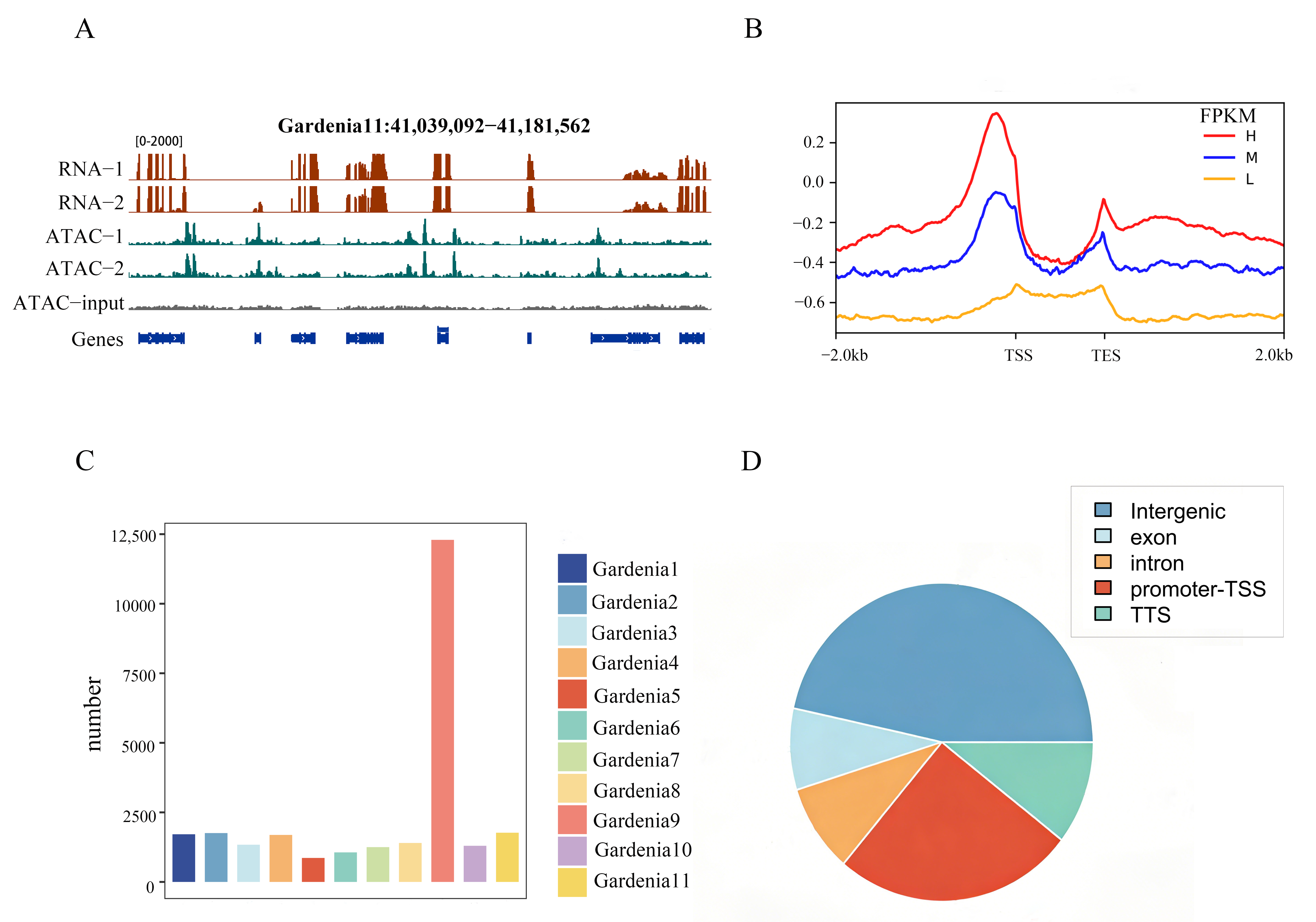
ATAC-seq was performed to identify and characterize ACRs across the G. jasminoides genome. Two biological replicate leaf ATAC-seq libraries of G. jasminoides yielded high-quality sequencing reads, with a total of 71.4 M clean reads, over 71.6% of which were uniquely mapped to the G. jasminoides reference genome (Figure S1–S3, Table S1). As shown, ATAC-seq signals were predominantly enriched around the transcription start sites (TSS) of genes and were positively correlated with gene expression levels (FPKM values) (Figure 1A,B), indicating a strong positive correlation between chromatin accessibility and gene transcriptional activity. A total of 26,461 ATAC-seq-enriched regions were consistently identified in both biological replicates and were defined as ACRs. These ACRs were associated with 13,625 protein-coding genes and distributed across all 11 chromosomes of G. jasminoides (Figure 1C, Table S2). Genomic annotation analysis of these ACRs revealed that the majority of ACRs were localized in intergenic regions (46.62%) and promoter regions (25.66%), while 10.51%, 9.00%, and 8.21% of ACRs were mapped to transcription termination regions, intron regions, and exon regions, respectively (Figure 1D, Table S2).

3.2. Analysis of Conserved TF Motifs Enrichment in ACRs

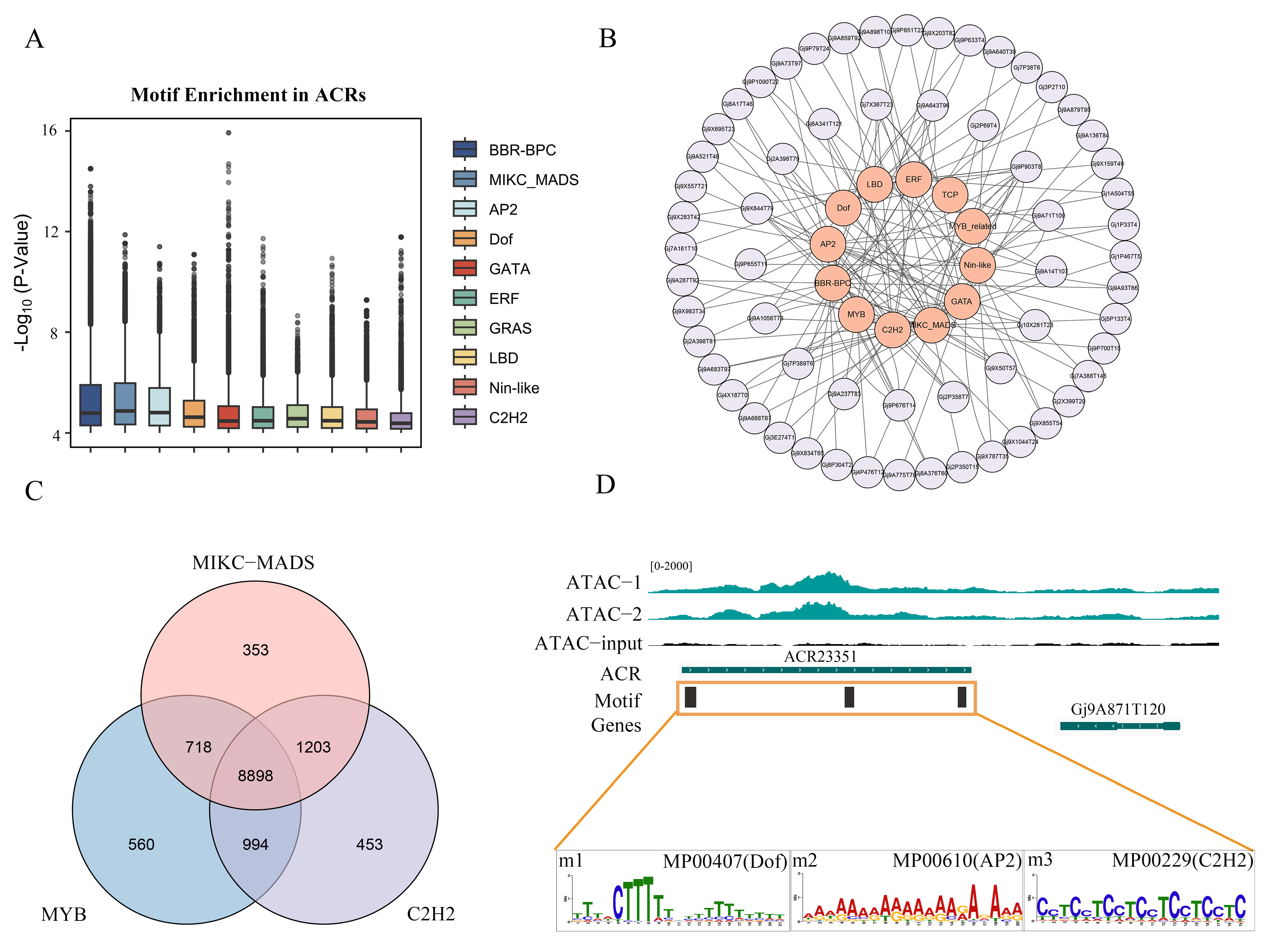
TF motifs refer to short, conserved DNA sequences specifically recognized and bound by TFs [33,34]. TFs modulate gene expression by binding to these specific cis-elements, resulting in the extensive enrichment of conserved TF motifs within ACRs. To characterize the enrichment of TF motifs in the ACRs of G. jasminoides, known TF motifs from public databases were mapped to the identified ACR sequences. The results showed that conserved TF motifs were significantly enriched within ACRs, and the top 10 enriched motifs belonged to the BBR-BPC, MIKC_MADS, AP2, Dof, GATA, ERF, GRAS, LBD, Nin-like, and C2H2 families (Figure 2A, Table S3). Furthermore, a potential TF regulatory network was constructed based on the interactions between ACR-enriched TF motifs and their putative downstream target genes. (Figure 2B). In total, 8899 genes harbored regulatory regions simultaneously containing MYB, MIKC_MADS, and C2H2 motifs (Figure 2C). The TF motifs detected in a representative ACR were visualized (Figure 2D). Collectively, these results demonstrate that conserved TF motifs are widely distributed within ACRs of G. jasminoides and may coordinately regulate the expression of downstream target genes.

3.3. Histone Modification Features Flanking ACRs

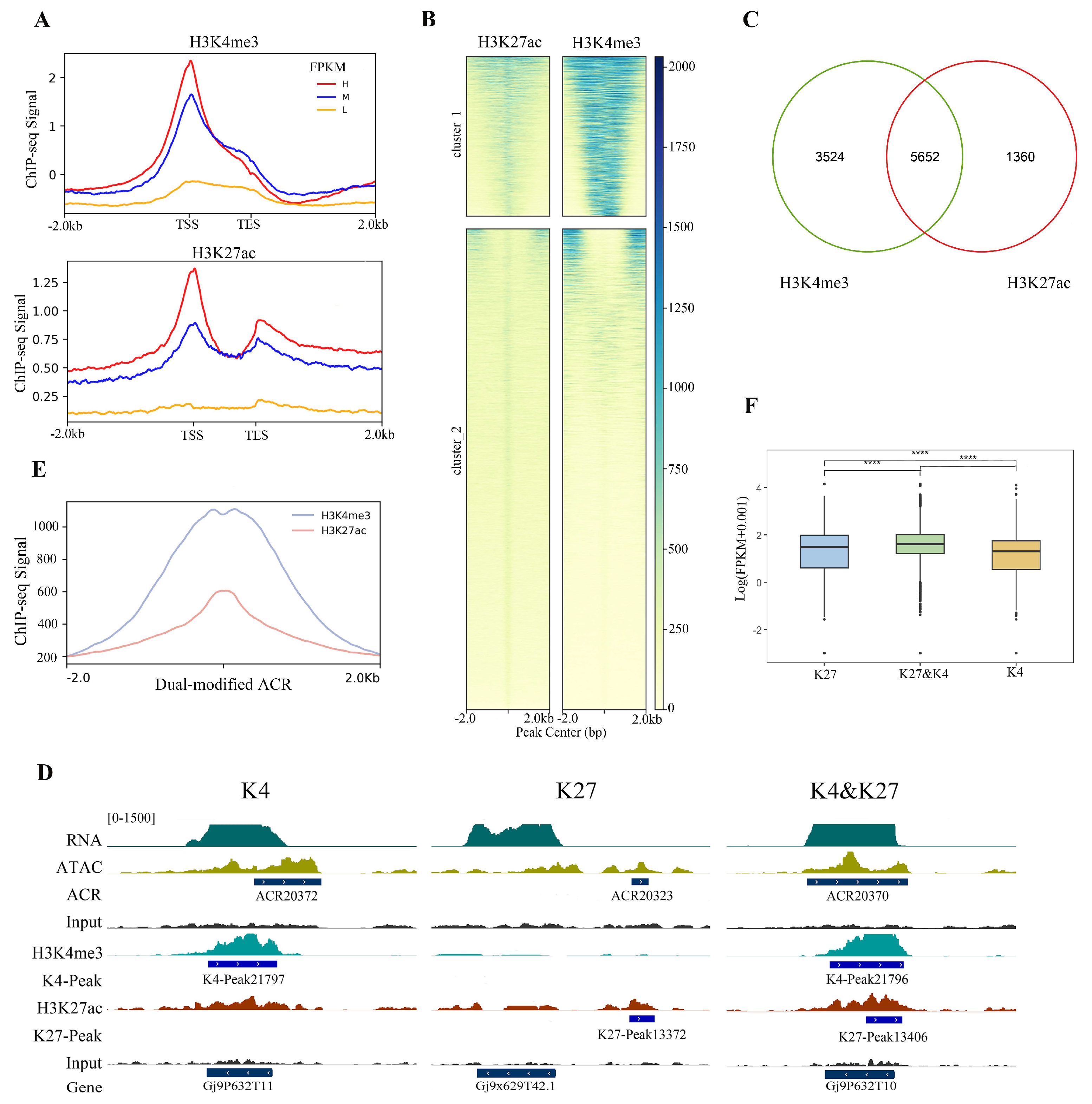
Histone modifications are a core epigenetic regulatory mechanism, often closely associated with ACRs and serving as a key driver of gene expression in plants [35,36,37,38]. In this study, ChIP-seq was employed to investigate the genome-wide distribution of two activating histone modifications, H3K4me3 and H3K27ac, as well as their associations with ACRs in leaves. A total of 18,617 H3K27ac-enriched peaks and 28,856 H3K4me3-enriched peaks were identified in the leaves of G. jasminoides (Tables S4 and S5). ChIP-seq signals for both H3K4me3 and H3K27ac were predominantly enriched around the TSS of genes and were positively correlated with FPKM values (Figure 3A and Figure S3, Tables S4 and S5), similar to the ATAC-seq signal. The k-means clustering algorithm was used to classify ACRs based on their histone modification profiles, yielding two major clusters (Figure 3B). The results showed that the majority of ACRs in the first cluster were modified by H3K4me3, with relatively few harboring H3K27ac modifications, whereas most ACRs in the second cluster exhibited low signal intensities for both histone modifications. As expected, dual-modified ACRs by H3K4me3 and H3K27ac have been observed (Figure 3C,D). In total, 5652 ACRs carrying dual modifications of both histones have been identified (Figure 3E, Table S6). Furthermore, the expression levels of genes associated with dual-modified ACRs were significantly higher than those associated with single-modified ACRs (Figure 3F, Table S6). Collectively, these findings suggest that the dual modification of H3K4me3 and H3K27ac on ACRs may play a pivotal regulatory role in modulating chromatin accessibility and promoting transcriptional activation in G. jasminoides.
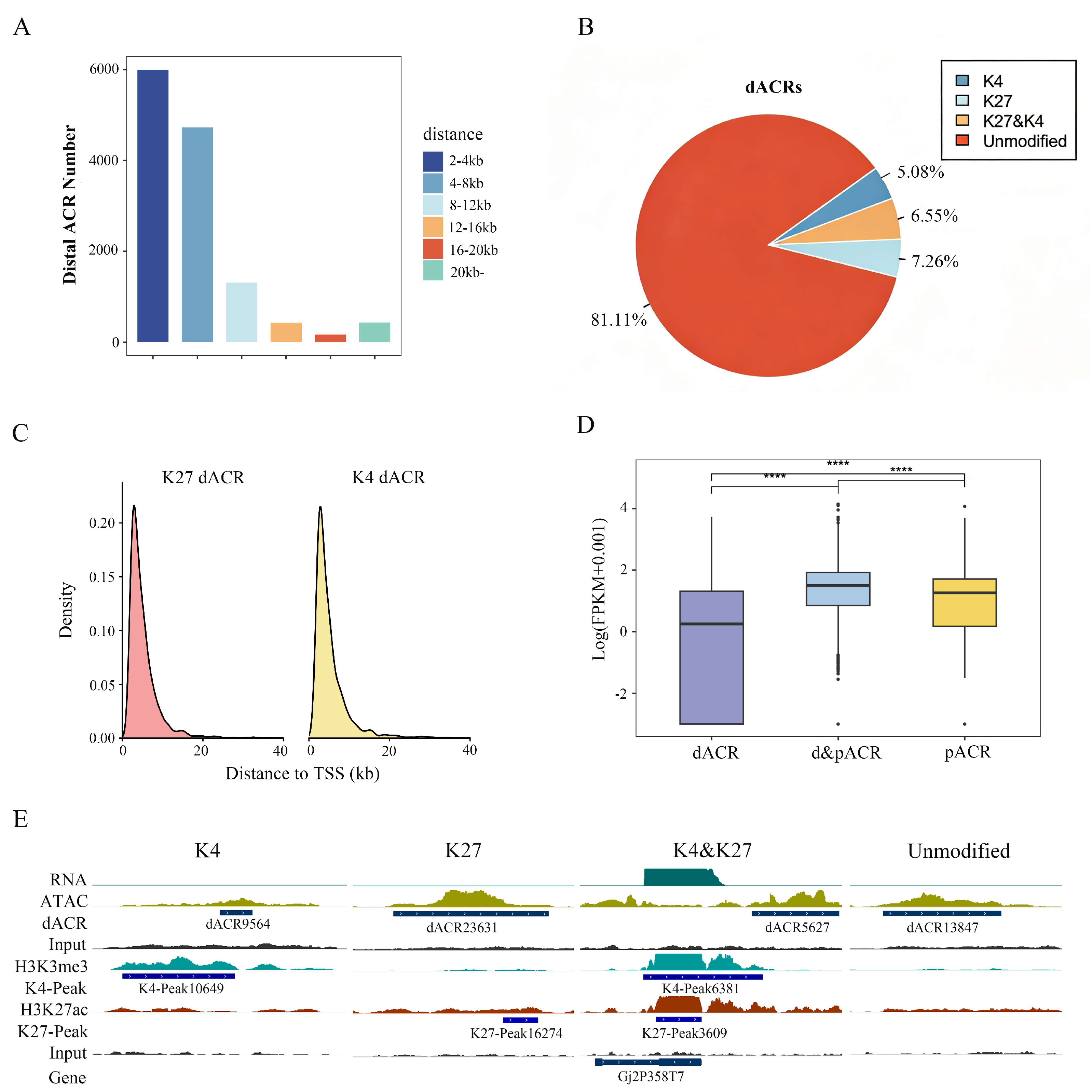
Distal accessible chromatin regions (dACRs) are open, non-coding chromatin regions located far from transcription start sites (TSSs), predominantly in intergenic regions. As a specific category of ACRs, they may serve as potential enhancer-like elements, but with distinct epigenetic features from proximal ACRs [39,40]. In this study, a total of 13,063 dACRs were identified in G. jasminoides, which were primarily distributed in intergenic regions 2–8 kb away from the nearest associated gene (Figure 4A, Table S2). In contrast to proximal ACRs (pACRs), the majority of dACRs (81.11%) lacked H3K4me3 and H3K27ac modifications (Figure 4B, Tables S4 and S5), while a small subset of dACRs were modified by H3K4me3 or H3K27ac (Figure 4E) and were mainly localized within 10 kb of the TSS (Figure 4C). Furthermore, the expression levels of genes associated with both pACRs and dACRs were significantly higher than those associated with either dACRs or pACRs alone, indicating an enhancer functional role of these dACRs in promoting proximal gene expression (Figure 4D).

3.4. Functional Validation of Candidate ACRs via Transient Transfection Assays

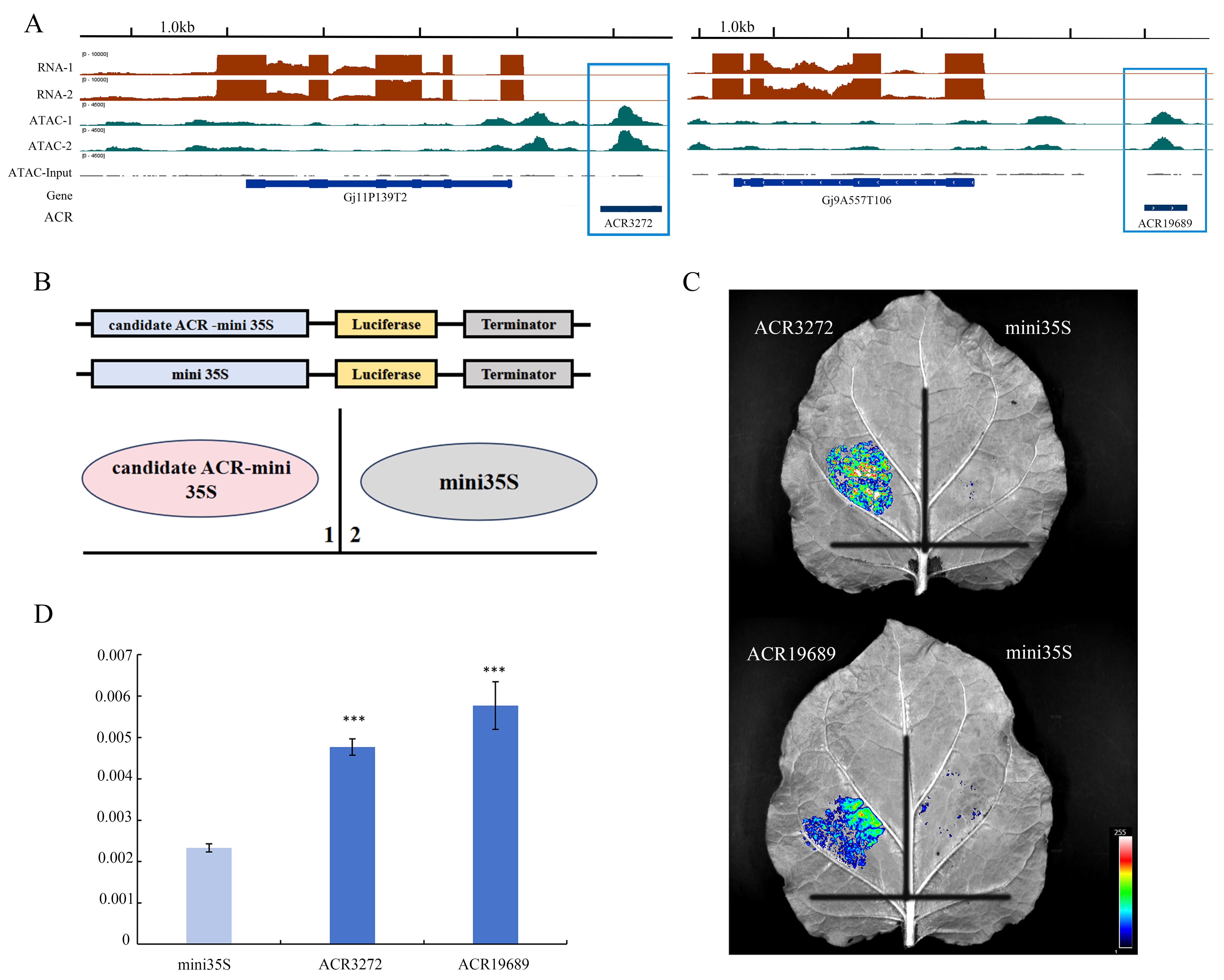
As mentioned above, ACRs might exert transcriptional activation effects for downstream gene regulation. For further validation, based on ACRs and histone modification patterns and gene expression levels, two candidate ACRs (ACR3272 and ACR19689) were prioritized for functional validation (Figure 5A, Tables S2, S7 and S8). To characterize their transcriptional activity, each candidate sequence was cloned upstream of the mini35S promoter within a luciferase (Luc) reporter vector, thereby generating effector constructs (candidate ACR-mini35S:Luc) (Figure 5B). These recombinant plasmids were transformed into Agrobacterium tumefaciens strain GV3101: pSoup, followed by infiltration into Nicotiana benthamiana leaves. Infected leaf tissues were harvested for dual-luciferase reporter assays. The results demonstrated that both ACRs exhibited significantly higher transcriptional activity compared with the negative control (mini35S alone), thereby confirming their robust potential to activate gene expression in plants (Figure 5C,D).

4. Discussion

4.1. Framework Establishment for Mining ACRs in Non-Model Woody Medicinal Plant G. jasminoides

Chromatin accessibility, manifested as accessible chromatin regions (ACRs), acts as a central epigenetic regulator governing transcriptional regulation in plants, and ATAC-seq has become the dominant low-input, high-throughput strategy to map genome-wide ACR landscapes across plant taxa [41]. While chromatin regulatory landscapes have been characterized in model plants (e.g., Arabidopsis thaliana) or crops (rice, maize and soybean) [42,43,44,45], systematic epigenomic research on woody medicinal species remains severely underdeveloped. As a pharmacologically valuable Rubiaceae evergreen shrub, G.jasminoides produces high-value bioactive metabolites including geniposide, crocin and flavonoids, yet the epigenetic mechanisms (e.g., chromatin accessibility) controlling its secondary metabolism, stress resistance and organ development remain largely uncharted. The present study established an optimized ATAC-seq experimental pipeline tailored to gardenia leaf nuclei, combined with parallel RNA-seq transcriptome profiling and ChIP-seq for two canonical activating histone marks (H3K4me3, H3K27ac). By integrating these omics data, we constructed the first comprehensive chromatin accessibility landscapes for G. jasminoides, systematically dissecting the genomic localization, epigenetic signatures and transcriptional regulatory capacity of ACRs. This work not only provides a fundamental epigenomic dataset for this medicinal plant, but also establishes a multi-omics analytical framework applicable to other non-model woody medicinal plants.

4.2. Non-Coding Cis-Regulatory Sequences Play an Important Role in Gene Regulation of G. jasminoides

Consistent with previous findings in soybean or other plants (such as grape, sorghum, Artemisia annua and Andrographis paniculata, etc.) [45,46,47,48,49,50], genomic positional annotation classified the ACRs into two major subgroups: proximal ACRs (pACRs) and distal ACRs (dACRs). This bimodal distribution aligns with the universal cis-regulatory architecture of plant genomes, where pACRs serve as core promoters for basal transcription, while dACRs function as long-distance enhancer-like elements that enhance or fine-tune gene expression for their target genes. This is partially supported by our observation that genes co-regulated by both pACRs and dACRs exhibited significantly higher transcript levels than those regulated by only one category of accessible chromatin in G. jasminoides. Additionally, Dual-luciferase transient reporter assays in Nicotiana benthamiana offered molecular evidence for the transcriptional activity of the dACR (ACR19689). These observations support the critical regulatory functions of pACRs/dACRs in G. jasminoides. In addition, dACRs exhibit low levels of histone modifications compared with pACRs, which may be due to uncharacterized histone-modification marks or histone variants that specifically target dACRs rather than pACRs. This scenario awaits further investigation. Previous research has demonstrated that genomic variations within ACRs exert substantial impacts on crop improvement [51], and targeted genome editing of ACRs has been documented to enhance crop yield, findings that underscore the fundamental contributions of these non-coding regulatory sequences to plant development. Once robust stable genetic transformation and CRISPR-Cas9 editing platforms are developed for G. jasminoides, targeted deletion or base editing of candidate ACRs will enable direct dissection of their endogenous physiological functions (e.g., enhancing secondary metabolite biosynthesis and improving vegetative or reproductive growth).

4.3. Limitations and Future Perspectives

Despite the new contributions of this integrated multi-omics study, several limitations remain to be addressed in follow-up research, which also outline clear directions for future investigation. First, all sequencing datasets were generated from leaf tissue. Chromatin accessibility exhibits tissue specificity across all plant species. Future work will expand ATAC-seq, RNA-seq and histone ChIP-seq profiling to multiple tissues (flower, buds, fruits, root, etc.) to construct a tissue-resolved chromatin accessibility landscape, enabling comparative analysis of tissue-specific cis-regulatory circuits governing specialized metabolite biosynthesis. Second, this study only profiled two activating histone modifications; the full chromatin state spectrum of gardenia remains incomplete. Subsequent ChIP-seq detection of repressive histone marks (e.g., H3K27me3) and whole-genome bisulfite sequencing (WGBS) for DNA methylation will comprehensively characterize the balance between permissive and repressive epigenetic states across the genome, revealing how multiple epigenetic layers jointly shape chromatin accessibility and gene expression. Third, because of the limited data for other species, interspecies comparative epigenomics is absent in the current analysis. Cross-species comparison between G. jasminoides and other Rubiaceae species (e.g., coffee, quinine) will uncover evolutionarily conserved cis-regulatory modules associated with specialized metabolite production, as well as lineage-specific chromatin rewiring events that drive the unique medicinal traits of gardenia. Lastly, our study only investigated static chromatin states under normal growth conditions; future research should profile dynamic ACR remodeling under abiotic stress (drought, high temperature) and biotic stress (pathogen infection) to dissect how chromatin accessibility mediates environmental stress responses in medicinal shrubs.
In summary, although several limitations remain unresolved in the present study, we established the ATAC-seq workflow for this woody non-model plant and conducted the first genome-wide characterization of chromatin accessibility features in G. jasminoides. Our research provides valuable genomic reference resources for future investigations into other woody plants.

5. Conclusions

In this study, we used ATAC-seq and histone ChIP-seq approaches to systematically characterize the genome-wide ACRs in G. jasminoides. Furthermore, the findings demonstrate that ACRs play a crucial role in the transcriptional regulation of G. jasminoides genes. Collectively, this research provides essential genomic resources and theoretical foundations for identifying important functional genes, clarifying transcriptional regulatory mechanisms and advancing molecular breeding efforts in G. jasminoides.

Supplementary Materials

The following supporting information can be downloaded at: https://www.mdpi.com/article/10.3390/horticulturae12091121/s1, Figure S1: Pearson correlation between two replicates of ATAC-seq data; Figure S2: Insert-size distribution of ATAC-seq fragments in two biological replicates; Figure S3: ATAC-seq signal enrichment around TSS in two biological replicates; Figure S4: Pearson correlation heatmap of two RNA-seq data; Figure S5: Pearson correlation among the histone modification ChIP-seq data; Figure S6: Histone modification features of ACRs in G. jasminoides genome; Table S1: The list of raw data in this study; Table S2: The genomic annotation of ACRs; Table S3: The TF motif PWM used in this study; Table S4: The genomic annotation of H3K27ac enriched Peaks; Table S5: The genomic annotation of H3K4me3 enriched Peaks; Table S6: The histone modification status of ACRs; Table S7: The sequence of putative ACRs; Table S8: The sequence of primers.

Author Contributions

M.H. and H.Y. conceived and supervised the project. H.Y. acquired funding. Z.Z., Y.H., L.Z., T.J. and Y.X. conducted the experiments. S.F. and Q.L. performed data analysis and visualization. Z.Z. and Y.H. drafted the manuscript. L.Y. contributed to review and editing. Z.Z. and Y.H. contributed equally to this work. All authors have read and agreed to the published version of the manuscript.

Funding

This research was supported by the Jiujiang Natural Science Foundation Project (2025_000760) and Jiangxi Provincial Natural Science Foundation (20252BAC200066).

Data Availability Statement

The sequencing raw data have been submitted to the National Genomics Data Center (https://ngdc.cncb.ac.cn/, BioProject: PRJCA061882).

Acknowledgments

We thank Yejin Yu from CisGen company (Guangzhou) for the support of bioinformation analysis of ATAC-seq data.

Conflicts of Interest

The authors declare no conflicts of interest.

References

  1. Ige, O.O.; Hendrickson-Rebizant, T.; Luo, W.; Cheung, P.; Lao, Y.; Zahedi, R.P.; Davie, J.R.; Lakowski, T.M. SET7/9 exhibits sigmoidal kinetics on nucleosomes, hyperbolic kinetics on histones by an ordered sequential mechanism and methylates lysine and arginine. J. Biol. Chem. 2025, 301, 110639. [Google Scholar] [CrossRef] [Scilit] [PubMed]
  2. Ren, M.; Greenberg, M.M.; Zhou, C. Participation of Histones in DNA Damage and Repair within Nucleosome Core Particles: Mechanism and Applications. Acc. Chem. Res. 2022, 55, 1059–1073. [Google Scholar] [CrossRef] [Scilit] [PubMed]
  3. Lukauskas, S.; Tvardovskiy, A.; Nguyen, N.V.; Stadler, M.; Faull, P.; Ravnsborg, T.; Aygenli, B.Ö.; Dornauer, S.; Flynn, H.; Lindeboom, R.G.H.; et al. Publisher Correction: Decoding chromatin states by proteomic profiling of nucleosome readers. Nature 2024, 628, E6. [Google Scholar] [CrossRef] [Scilit] [PubMed]
  4. Klemm, S.L.; Shipony, Z.; Greenleaf, W.J. Chromatin accessibility and the regulatory epigenome. Nat. Rev. Genet. 2019, 20, 207–220. [Google Scholar] [CrossRef] [Scilit] [PubMed]
  5. Fan, S.; Yang, H.; Hu, Y.; Zhang, L.; Huang, M. A review of the advances and perspectives in sequencing technologies for analysing plant epigenetic responses to abiotic stress. Plant Stress 2026, 19, 101144. [Google Scholar] [CrossRef] [Scilit]
  6. Paulišić, S.; Boccaccini, A.; Dreos, R.; Ambrosini, G.; Guex, N.; Benstein, R.M.; Schmid, M.; Fankhauser, C. Transcriptional dynamics and chromatin accessibility in the regulation of shade-responsive genes in Arabidopsis. Genome Biol. 2025, 26, 422. [Google Scholar] [CrossRef] [Scilit] [PubMed]
  7. Huang, M.; Li, M.-W.; Lam, H.-M. How noncoding open chromatin regions shape soybean domestication. Trends Plant Sci. 2021, 26, 876–878. [Google Scholar] [CrossRef] [Scilit] [PubMed]
  8. Gonske, S.; Escobar, T.M.; Loyola, A. Histone supply: A precious commodity for cell identity. Biochem. J. 2025, 482, 1449–1464. [Google Scholar] [CrossRef] [Scilit] [PubMed]
  9. Padhan, J.; Sudhamalla, B. Methyl-CpG-Binding Protein 2 Reads Histone Methylation via an Aromatic Cage to Regulate Gene Expression and Chromatin Association. J. Biol. Chem. 2025, 302, 111115. [Google Scholar] [CrossRef] [Scilit] [PubMed]
  10. Jenuwein, T.; Allis, C.D. Translating the Histone Code. Science 2001, 293, 1074–1080. [Google Scholar] [CrossRef] [Scilit] [PubMed]
  11. Liu, M.Q.; Peng, H.S. Evolution and quality evaluation of Gardenia jasminoides(Zhizi) of successive ages. Zhonghua Yi Shi Za Zhi 2016, 46, 259–263. [Google Scholar] [PubMed]
  12. Yang, Q.; Cai, Y.; Wang, Z.; Guo, S.; Qiu, S.; Zhang, A. From traditional medicinal use to functional food: The pharmacological activity, hepatotoxicity mechanism and detoxification strategies of gardenia fructus. J. Funct. Foods 2025, 135, 107093. [Google Scholar] [CrossRef] [Scilit]
  13. Yang, C.-X.; Zhang, T.; Xu, M.; Zhu, P.-L.; Deng, S.-Y. Insights into biosynthetic genes involved in the secondary metabolism of Gardenia jasminoides Ellis using transcriptome sequencing. Biochem. Syst. Ecol. 2016, 67, 7–16. [Google Scholar] [CrossRef] [Scilit]
  14. Kim, D.; Paggi, J.M.; Park, C.; Bennett, C.; Salzberg, S.L. Graph-based genome alignment and genotyping with HISAT2 and HISAT-genotype. Nat. Biotechnol. 2019, 37, 907–915. [Google Scholar] [CrossRef] [Scilit] [PubMed]
  15. Li, H.; Handsaker, B.; Wysoker, A.; Fennell, T.; Ruan, J.; Homer, N. The Sequence Alignment/Map format and SAMtools. Bioinformatics 2009, 25, 2078–2079. [Google Scholar] [CrossRef] [Scilit] [PubMed]
  16. Trapnell, C.; Hendrickson, D.G.; Sauvageau, M.; Goff, L.; Rinn, J.L.; Pachter, L. Differential analysis of gene regulation at transcript resolution with RNA-seq. Nat. Biotechnol. 2013, 31, 46–53. [Google Scholar] [CrossRef] [Scilit] [PubMed]
  17. Dailey, A.L. Metabolomic Bioinformatic Analysis. Methods Mol. Biol. 2017, 1606, 341–352. [Google Scholar] [CrossRef] [Scilit] [PubMed]
  18. Huang, M.; Zhang, L.; Zhou, L.; Wang, M.; Yung, W.-S.; Wang, Z.; Duan, S.; Xiao, Z.; Wang, Q.; Wang, X.; et al. An expedient survey and characterization of the soybean JAGGED 1 (GmJAG1) transcription factor binding preference in the soybean genome by modified ChIPmentation on soybean protoplasts. Genomics 2020, 113, 344–355. [Google Scholar] [CrossRef] [Scilit] [PubMed]
  19. Huang, M.-K.; Zhang, L.; Zhou, L.-M.; Yung, W.-S.; Li, M.-W.; Lam, H.-M. Genomic Features of Open Chromatin Regions (OCRs) in Wild Soybean and Their Effects on Gene Expressions. Genes 2021, 12, 640. [Google Scholar] [CrossRef] [Scilit] [PubMed]
  20. Grandi, F.C.; Modi, H.; Kampman, L.; Corces, M.R. Chromatin accessibility profiling by ATAC-seq. Nat. Protoc. 2022, 17, 1518–1552. [Google Scholar] [CrossRef] [Scilit] [PubMed]
  21. Lu, Z.; Marand, A.P.; Ricci, W.A.; Ethridge, C.L.; Zhang, X.; Schmitz, R.J. The prevalence, evolution and chromatin signatures of plant regulatory elements. Nat. Plants 2019, 5, 1250–1259. [Google Scholar] [CrossRef] [Scilit] [PubMed]
  22. Huang, M.; Zhang, L.; Yung, W.-S.; Hu, Y.; Wang, Z.; Li, M.-W.; Lam, H.-M. Molecular evidence for enhancer–promoter interactions in light responses of soybean seedlings. Plant Physiol. 2023, 193, 2287–2291. [Google Scholar] [CrossRef] [Scilit] [PubMed]
  23. Langdon, W.B. Performance of genetic programming optimised Bowtie2 on genome comparison and analytic testing (GCAT) benchmarks. BioData Min. 2015, 8, 1. [Google Scholar] [CrossRef] [Scilit] [PubMed]
  24. Yuan, J.; Sun, H.; Wang, Y.; Li, L.; Chen, S.; Jiao, W.; Jia, G.; Wang, L.; Mao, J.; Ni, Z.; et al. Open chromatin interaction maps reveal functional regulatory elements and chromatin architecture variations during wheat evolution. Genome Biol. 2022, 23, 34. [Google Scholar] [CrossRef] [Scilit] [PubMed]
  25. Ramírez, F.; Dündar, F.; Diehl, S.; Grüning, B.A.; Manke, T. deepTools: A flexible platform for exploring deep-sequencing data. Nucleic Acids Res. 2014, 42, W187–W191. [Google Scholar] [CrossRef] [Scilit] [PubMed]
  26. Thorvaldsdóttir, H.; Robinson, J.T.; Mesirov, J.P. Integrative Genomics Viewer (IGV): High-performance genomics data visualization and exploration. Brief. Bioinform. 2013, 14, 178–192. [Google Scholar] [CrossRef] [Scilit] [PubMed]
  27. Robinson, J.T.; Thorvaldsdottir, H.; Turner, D.; Mesirov, J.P. igv.js: An embeddable JavaScript implementation of the Integrative Genomics Viewer (IGV). Bioinformatics 2022, 39, btac830. [Google Scholar] [CrossRef] [Scilit] [PubMed]
  28. Grant, C.E.; Bailey, T.L.; Noble, W.S. FIMO: Scanning for occurrences of a given motif. Bioinformatics 2011, 27, 1017–1018. [Google Scholar] [CrossRef] [Scilit] [PubMed]
  29. Jeon, H.; Lee, H.; Kang, B.; Jang, I.; Roh, T.-Y. Comparative analysis of commonly used peak calling programs for ChIP-Seq analysis. Genom. Inform. 2020, 18, e42. [Google Scholar] [CrossRef] [Scilit] [PubMed]
  30. Zhang, L.; Yung, W.-S.; Hu, Y.; Wang, L.; Sun, W.; Huang, M. Establishment of a convenient ChIP-seq protocol for identification of the histone modification regions in the medicinal plant Andrographis paniculata. Med. Plant Biol. 2023, 2, 6. [Google Scholar] [CrossRef] [Scilit]
  31. Huang, M.; Hu, Y.; Zhang, L.; Yang, H.; Feng, C.; Jiang, C.; Xie, N.; Liu, D.; Chen, S.; Wang, J.; et al. Decoding the chromatin accessibility in Andrographis paniculata genome, a case study of genome-wide investigation of the cis-regulatory elements in medicinal plants. Acta Pharm. Sin. B 2024, 14, 4179–4182. [Google Scholar] [CrossRef] [Scilit] [PubMed]
  32. Zhang, Y.; Liu, T.; Meyer, C.A.; Eeckhoute, J.; Johnson, D.S.; Bernstein, B.E.; Nusbaum, C.; Myers, R.M.; Brown, M.; Li, W.; et al. Model-based Analysis of ChIP-Seq (MACS). Genome Biol. 2008, 9, R137. [Google Scholar] [CrossRef] [Scilit] [PubMed]
  33. Kondratova, L.; Vallejos, C.E.; Conesa, A. Profiling conserved transcription factor binding motifs in Phaseolus vulgaris through comparative genomics. BMC Genom. 2025, 26, 169. [Google Scholar] [CrossRef] [Scilit] [PubMed]
  34. Lao, Z.; Mao, J.; Chen, R.; Xu, R.; Yang, Z.; Wang, Y.; Zhou, J.; Mu, Z.; Xu, H.; Li, F.; et al. Genome-wide identification and characterization of BASIC PENTA-CYSTEINE transcription factors and their binding motifs in coconut palm. Front. Plant Sci. 2024, 15, 1491139. [Google Scholar] [CrossRef] [Scilit] [PubMed]
  35. Hu, Y.; He, C.; Gong, X.; Xu, H.; Chen, X.; Shen, Y.; Zeng, G.; Qin, X.; Deng, Z.; He, Z.; et al. Epigenomic studies in sorghum reveal differential enrichment of multiple histone marks at clade A PP2C genes in response to drought. New Crop. 2025, 2, 100059. [Google Scholar] [CrossRef] [Scilit]
  36. Baerenfaller, K.; Shu, H.; Hirsch-Hoffmann, M.; Fütterer, J.; Opitz, L.; Rehrauer, H.; Hennig, L.; Gruissem, W. Diurnal changes in the histone H3 signature H3K9ac|H3K27ac|H3S28p are associated with diurnal gene expression in Arabidopsis. Plant Cell Environ. 2016, 39, 2557–2569. [Google Scholar] [CrossRef] [Scilit] [PubMed]
  37. Zhao, W.; Xu, Y.; Wang, Y.; Gao, D.; King, J.; Xu, Y.; Liang, F.-S. Investigating crosstalk between H3K27 acetylation and H3K4 trimethylation in CRISPR/dCas-based epigenome editing and gene activation. Sci. Rep. 2021, 11, 15912. [Google Scholar] [CrossRef] [Scilit] [PubMed]
  38. Wu, Y.; Tirichine, L. Chromosome-Wide Distribution and Characterization of H3K36me3 and H3K27Ac in the Marine Model Diatom Phaeodactylum tricornutum. Plants 2023, 12, 2852. [Google Scholar] [CrossRef] [Scilit] [PubMed]
  39. Zhu, B.; Zhang, W.; Zhang, T.; Liu, B.; Jiang, J. Genome-Wide Prediction and Validation of Intergenic Enhancers in Arabidopsis Using Open Chromatin Signatures. Plant Cell 2015, 27, 2415–2426. [Google Scholar] [CrossRef] [Scilit] [PubMed]
  40. Oka, R.; Zicola, J.; Weber, B.; Anderson, S.N.; Hodgman, C.; Gent, J.I.; Wesselink, J.-J.; Springer, N.M.; Hoefsloot, H.C.J.; Turck, F.; et al. Genome-wide mapping of transcriptional enhancer candidates using DNA and chromatin features in maize. Genome Biol. 2017, 18, 137. [Google Scholar] [CrossRef] [Scilit] [PubMed]
  41. Marinov, G.K.; Shipony, Z. Interrogating the Accessible Chromatin Landscape of Eukaryote Genomes Using ATAC-seq. Deep. Seq. Data Anal. 2021, 2243, 183–226. [Google Scholar] [CrossRef] [Scilit] [PubMed]
  42. Farmer, A.; Thibivilliers, S.; Ryu, K.H.; Schiefelbein, J.; Libault, M. Single-nucleus RNA and ATAC sequencing reveals the impact of chromatin accessibility on gene expression in Arabidopsis roots at the single-cell level. Mol. Plant 2021, 14, 372–383. [Google Scholar] [CrossRef] [Scilit] [PubMed]
  43. Srikant, T.; Gonzalo, A.; Bomblies, K. Chromatin accessibility and gene expression vary between a new and evolved autopolyploid Arabidopsis arenosa. Mol. Biol. Evol. 2024, 41, msae213. [Google Scholar] [CrossRef] [Scilit] [PubMed]
  44. Wang, G.; Li, X.; Shen, W.; Li, M.-W.; Huang, M.; Zhang, J.; Li, H. The chromatin accessibility landscape of pistils and anthers in rice. Plant Physiol. 2022, 190, 2797–2811. [Google Scholar] [CrossRef] [Scilit] [PubMed]
  45. Wang, L.; Jia, G.; Jiang, X.; Cao, S.; Chen, Z.J.; Song, Q. Altered chromatin architecture and gene expression during polyploidization and domestication of soybean. Plant Cell 2021, 33, 1430–1446. [Google Scholar] [CrossRef] [Scilit] [PubMed]
  46. Ren, C.; Li, H.; Wang, Z.; Dai, Z.; Lecourieux, F.; Kuang, Y.; Xin, H.; Li, S.; Liang, Z. Characterization of Chromatin Accessibility and Gene Expression upon Cold Stress Reveals that the RAV1 Transcription Factor Functions in Cold Response in Vitis amurensis. Plant Cell Physiol. 2021, 62, 1615–1629. [Google Scholar] [CrossRef] [Scilit] [PubMed]
  47. Zhou, C.; Yuan, Z.; Ma, X.; Yang, H.; Wang, P.; Zheng, L.; Zhang, Y.; Liu, X. Accessible Chromatin Regions and Their Functional Interrelations with Gene Transcription and Epigenetic Modifications in Sorghum Genome. Plant Commun. 2021, 2, 100140. [Google Scholar] [CrossRef] [Scilit] [PubMed]
  48. Zhou, L.; Huang, Y.; Wang, Q.; Guo, D. Chromatin Accessibility Is Associated with Artemisinin Biosynthesis Regulation in Artemisia annua. Molecules 2021, 26, 1194. [Google Scholar] [CrossRef] [Scilit] [PubMed]
  49. Lv, X.; Yang, H.; Hu, Y.; Jing, T.; Xiong, Y.; Liang, Q.; Tian, S.; Yang, L.; Zhang, Z.; Huang, M.; et al. Light-induced Dof transcription factors up-regulate the andrographolide biosynthesis in Andrographis paniculata. Ind. Crop. Prod. 2025, 235, 121715. [Google Scholar] [CrossRef] [Scilit]
  50. Zhang, L.; Yang, H.; Jing, T.; Hu, Y.; Fan, S.; Tian, S.; Wang, X.; Jin, H.; Sun, W.; Huang, M. Light-responsive transcription factor ApTrihelix1 modulates andrographolide biosynthesis via targeting ApCPS2 in Andrographis paniculata. Hortic. Res. 2026, 13, uhag118. [Google Scholar] [CrossRef] [Scilit] [PubMed]
  51. Hendelman, A.; Zebell, S.; Rodriguez-Leal, D.; Dukler, N.; Robitaille, G.; Wu, X.; Kostyun, J.; Tal, L.; Wang, P.; Bartlett, M.E.; et al. Conserved Pleiotropy of an Ancient Plant Homeobox Gene Uncovered by Cis-Regulatory Dissection. Cell 2021, 184, 1724–1739.e16. [Google Scholar] [CrossRef] [Scilit] [PubMed]
Figure 1. Summary of ATAC-seq data for the G. jasminoides genome. (A) IGV screenshot of RNA-seq and ATAC-seq signal coverage, exemplified by region 41,039,092–41,181,562 on chromosome 11 (Gardenia 11). (B) ATAC-seq signal enrichment. TSS: Transcription start site; TES: Transcription end site. H, M, L denote high (FPKM ≥ 10), medium (1 ≤ FPKM < 10), and low (FPKM < 1) expression genes, respectively. (C) Number of ACRs per chromosome. Cardenia 1–11 represent the 11 chromosomes observed in gardenia. (D) Distribution of ACRs across the G. jasminoides genome, including intergenic regions (46.62%), exons (8.21%), introns (9.00%), promoters-TSS (25.66%), and transcription termination regions (TTS) (10.51%). Promoters (promoter-TSS) are defined as regions spanning 1 kb upstream of the transcription start site (TSS). Transcription termination regions (TTS) are defined as regions spanning 1 kb downstream of the TTS. Intergenic regions are regions that do not overlap with gene bodies, promoters or TTS regions.
Horticulturae 12 01121 g001
Figure 2. Conserved TF motifs enriched in ACRs of the G. jasminoides genome. (A) Top 10 enriched TF motifs identified in ACRs, including BBR-BPC, MIKC_MADS, AP2, Dof, GATA, ERF, GRAS, LBD, Nin-like, and C2H2. (B) Potential transcriptional regulatory networks constructed between ACR-enriched TF motifs and their putative target genes. Pink circles represent TF motifs; purple circles represent corresponding target genes. (C) Venn diagram showing the overlap of genes putatively regulated by the three highly enriched TF families (MYB, MIKC_MADS, and C2H2) in ACRs. (D) Examples of TF motifs on ACRs, such as Dof (MP00407), AP2 (MP00610), and C2H2 (MP00229).
Horticulturae 12 01121 g002
Figure 3. Histone modification profiles of ACRs in the G. jasminoides genome. (A) Enrichment of ChIP-seq signals for histone modifications, H3K4me3 and H3K27ac. TSS: Transcription start site; TES: Transcription end site. H, M, L denote genes with high (FPKM ≥ 10), medium (1 ≤ FPKM < 10), and low (FPKM < 1) expression, respectively. (B) Heatmap of signal intensity for H3K27ac and H3K4me3 modifications across two distinct gene clusters (cluster 1 and cluster 2). Heatmap of signal intensity for ACRs bearing H3K27ac and H3K4me3 modifications. (C) The signal coverage of H3K27ac and H3K4me3 in dual-modified ACRs. (D) Examples of ACRs with single H3K4me3 (K4) or H3K27ac (K27) modifications, and ACRs with dual K4 and K27 modifications. (E) Statistics for ACRs modified by histone H3K4me3 and H3K27ac. (F) Comparison of FPKM values in K4 and K27 dual-modified ACRs versus genes associated with ACRs modified by K4 or K27 alone. **** denotes p < 0.0001, pairwise comparisons among groups.
Horticulturae 12 01121 g003
Figure 4. Characteristic analysis of dACRs in the G. jasminoides genome. (A) Distribution of distances from dACRs to their nearest associated gene. (B) Proportion of dACRs with different histone modification statuses: unmodified, H3K4me3 (K4)-modified, H3K27ac (K27)-modified, and dual H3K4me3/H3K27ac (K4/K27)-modified. (C) Statistical analysis of distances from K4-modified and K27-modified dACRs to the TSS. (D) Comparison of FPKM values between genes associated with both pACRs and dACRs, and those associated exclusively with dACRs or pACRs alone. **** denotes p < 0.0001, pairwise comparisons among groups. (E) Representative examples of dACRs: unmodified dACRs, dACRs modified by K4 or K27 alone, and dACRs with dual K4/K27 modifications.
Horticulturae 12 01121 g004
Figure 5. Functional validation of candidate ACRs via transient transformation in Nicotiana benthamiana leaves. (A) Signal tracks of ACR3272 (637 bp from the TSS) and ACR19689 (2140 bp from the TSS). (B) Schematic diagrams of the reporter vectors: mini35S empty vector (control) and ACR-mini35S fusion vector (experimental). The positions of the ACR relative to the minimal mini35S promoter are indicated. (C) Transcriptional activity of candidate ACRs (ACR3272 and ACR19689) measured by dual-luciferase reporter assay. (D) Dual luciferase activity (LUC/REN) assay results for candidate ACRs. LUC: firefly luciferase; REN: Renilla reniformis luciferase. Error bars represent the standard error (SE) of the mean from three independent biological replicates. Asterisks denote statistically significant differences compared to mini35S (by Student’s t-test: p < 0.001).
Horticulturae 12 01121 g005
Disclaimer/Publisher’s Note: The statements, opinions and data contained in all publications are solely those of the individual author(s) and contributor(s) and not of MDPI and/or the editor(s). MDPI and/or the editor(s) disclaim responsibility for any injury to people or property resulting from any ideas, methods, instructions or products referred to in the content.