


Abstract
Climatic changes in the Mediterranean area affect grapevine growth and productivity due to an increase in the magnitude and frequency of extreme climatic events. Functional traits of the vegetative stages of grapevines are drivers of stress tolerance, and their characterization may aid in the selection of cultivars showing greater resistance. Our aim was to evaluate and compare the adaptability to hot and arid climatic conditions of two varieties typical of small satellite islands of Sicily (Zibibbo and Corinto) with the two most common grape varieties grown on the main island (Catarratto and Nero d’Avola). The four selected varieties grew in a common rain-fed experimental germplasm repository. We followed seasonal changes in stomatal conductance, leaf water potential and leaf temperature, relating them to leaf water relation traits and xylem structural characteristics of the leaf vein network. We observed significant differences in functional traits and physiological behaviour of the four cultivars. Leaf water potential at turgor loss point was one of the most informative traits, together with midday leaf water potential and midday stomatal conductance. Nero d’Avola, Catarratto, and Zibibbo showed the highest adaptability to Mediterranean summer–autumn drought and heat stress through different physiological strategies; whereas, Corinto appeared more vulnerable. These findings highlight the importance of functional trait analysis for supporting cultivar selection, vineyard management, and future breeding strategies under climate change scenarios.
1. Introduction
Grapevine (Vitis spp.) is one of the most economically important fruit crops cultivated worldwide, covering about 7 million hectares [1]. The domestication of vines occurred simultaneously about 11,000 years ago in western Asia and the Caucasus for the production of table and wine vines [2]. Cultivation and selection over many centuries under different climatic conditions has resulted in an enormous diversity of local grapevine cultivars (10,000–14,000). Natural and human selection have led to countless typologies of wine, strictly related to a specific area of origin, and a multitude of table grape cultivars and rootstocks [3].
Climatic changes in the Mediterranean area affect grapevine growth and productivity due to an increase in the magnitude and frequency of extreme climatic events and to a greater variability in rainfall and temperature among years, with an expected increase in intensity and duration of drought and heatwaves in many regions [4,5,6,7,8]. Heatwaves pose a potential threat by determining a temporary decrease in net primary production and affecting carbon and water use in both natural and agricultural ecosystems [9,10]. Water availability is one of the most important environmental factors affecting crop growth and productivity. However, irrigation practices to overcome drought stress are not always sustainable [6], leading to the need to identify the already existing variability in grapevine varieties that are more resilient, better adapted to changing climatic conditions and may provide long-term sustainable solutions [11,12].
Functional traits of the vegetative stages of grapevines are drivers of stress tolerance and their characterization may aid in the selection of cultivars with greater resistance, as has been done across European vineyard regions [13]. Viticulture on the Mediterranean island of Sicily is one of the most important and ancient forms in Europe [14]. Native vines, many of which are known all over the world, have been cultivated on the island for many centuries [15]. The high number of autochthonous Sicilian grapevine varieties is an important source of genetic diversity, as the traits leading to adaptation under adverse environmental conditions may show significant intraspecific variation [16]. In field conditions, and particularly during summer months, plants are exposed to multiple stress factors, mainly heat, high solar radiation and soil water deficit [17].
Drought stress and high temperatures affect vine growth and productivity through a complex combination of physiological, hydraulic, morphological and phenological traits [18,19,20,21]. Water availability and high evaporation rates influence the regulation of stomatal closure and leaf water potential, which in turn affect gas exchange, growth and productivity. Leaf temperature is also influenced by stomatal conductance, and increasing temperatures affect biochemical photosynthetic processes. Stomatal closure is also linked to maintaining the functionality of the xylem network [20,22]. Leaf vasculature in turn plays crucial roles in water and sugar transport and mechanical support, and leaf vein architecture and density affect photosynthesis via hydraulic efficiency [23,24,25,26].
The capacity of grapevine cultivars to withstand prolonged water deficits is also related to their leaf-level hydraulic plasticity in response to water availability. Central to this are traits derived from pressure–volume (PV) curves, specifically the leaf water potential at turgor loss point (Ψtlp), osmotic potential at full turgor (π0), bulk modulus of elasticity (εmax) and leaf capacitance at full turgor (Cft), that are considered as reliable indicators of drought stress tolerance [27]. The occurrence of seasonal osmoregulation and the maintenance of low osmotic potentials under drought conditions serve as a primary adaptive mechanism. By maintaining a lower Ψtlp, the vine can sustain a positive turgor pressure even as leaf water potential declines, thereby extending the window for gas exchange and carbon assimilation under stress. For grapevine, it has been proposed that osmotic adjustment is a pre-programmed seasonal strategy, largely independent of environmental variability [28] and that can therefore be expected to differ among varieties. Furthermore, the adaptive value of εmax represents a strategic trade-off: higher values typical of stiffer cell walls allow for a rapid drop in leaf water potential, facilitating a steeper gradient for water extraction from drying soils, while more elastic walls help maintain turgor as leaf water content decreases. The elasticity of cell walls is causally related to Cft, as it directly influences the amount of water that may be stored in the cells, with increased capacitance contributing to avoid desiccation and buffer changes in leaf water potential [29,30]. Cft has been indeed considered as an important hydraulic trait for wine grapes [31]. A comprehensive characterization of drought tolerance must integrate these multi-faceted traits to accurately predict grapevine varietal performance under fluctuating field conditions [20,32].
Trials conducted under natural conditions are necessary to characterize the integrated responses of grapevine varieties to multiple stress factors in the field [11]. The many Sicilian varieties have anatomical and physiological traits that allow them to resist different levels of drought stress and achieve different levels of productivity, as some of them have been selected to grow and produce under extreme conditions. Our aim was to evaluate and compare the drought and heat tolerance mechanisms of two varieties typical of small satellite islands of Sicily (Zibibbo and Corinto) to ascertain whether they show a greater adaptability to hot and arid climatic conditions than the two most common grape varieties grown on the main island (Catarratto and Nero d’Avola). Therefore, we examined the variability of some key functional traits in the four grapevine varieties grown in the same rain-fed vineyard. We measured in summer and autumn a set of traits commonly used to describe stress tolerance: stomatal conductance, leaf water potential and leaf temperature, relating them to leaf water relation traits (Ψtlp, π0, εmax, Cft) and xylem structural characteristics of the leaf vein network.
2. Materials and Methods
2.1. Study Site and Plant Material
The study was conducted in an experimental vineyard within the perennial plant germplasm repository managed by the Institute of Biosciences and BioResources of the National Research Council of Italy (CNR-IBBR). This vineyard, which contains three replicates (plants) for each preserved grapevine accession, is located in the Collesano-Lascari district (Palermo, Italy 37°59′19.9″ N, 13°54′55.8″ E, 80 m a.s.l.) with a North-West exposure. The small size of the vineyard and the homogeneity of pedological and microclimatic conditions ensured that environmental variability was minimized, allowing differences in cultivar performance to be attributed primarily to genetic and physiological traits rather than spatial confounding factors. The soil of the experimental site is well drained, mainly represented by an association of regosols, brown soils and/or vertex brown soils, on clay. The vineyard was planted in 2006, and all cultivars were grafted on 1103 Paulsen rootstock. The collection is represented by 480 different clones/cultivars of domestic and wild vines, each accession/cultivar is represented by three cloned plants. The grapevines were in a planting pattern of 0.80 × 2.6 m and were vertically trained and pruned as simple guyot. Measurements were carried out on field-grown plants of four Sicilian cultivars of Vitis vinifera L., Nero d’Avola, Corinto, Catarratto and Zibibbo. Due to the conservation constraints and limited plant availability inherent to this national germplasm repository, data were collected from two adjacent cloned plants per cultivar. Measurements were taken in 2014 on three consecutive sunny days in summer (July, after berry set) and autumn (September, after berry ripening). Sampling days occurred after at least 15 days without precipitation according to the local meteorological station data.
The daily pattern of leaf water potential (ΨL) and stomatal conductance to water vapour (gs) was followed from predawn to the afternoon.
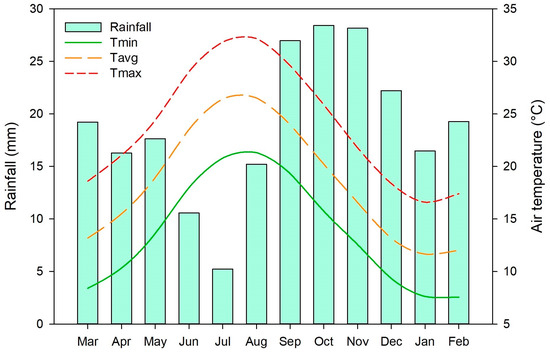
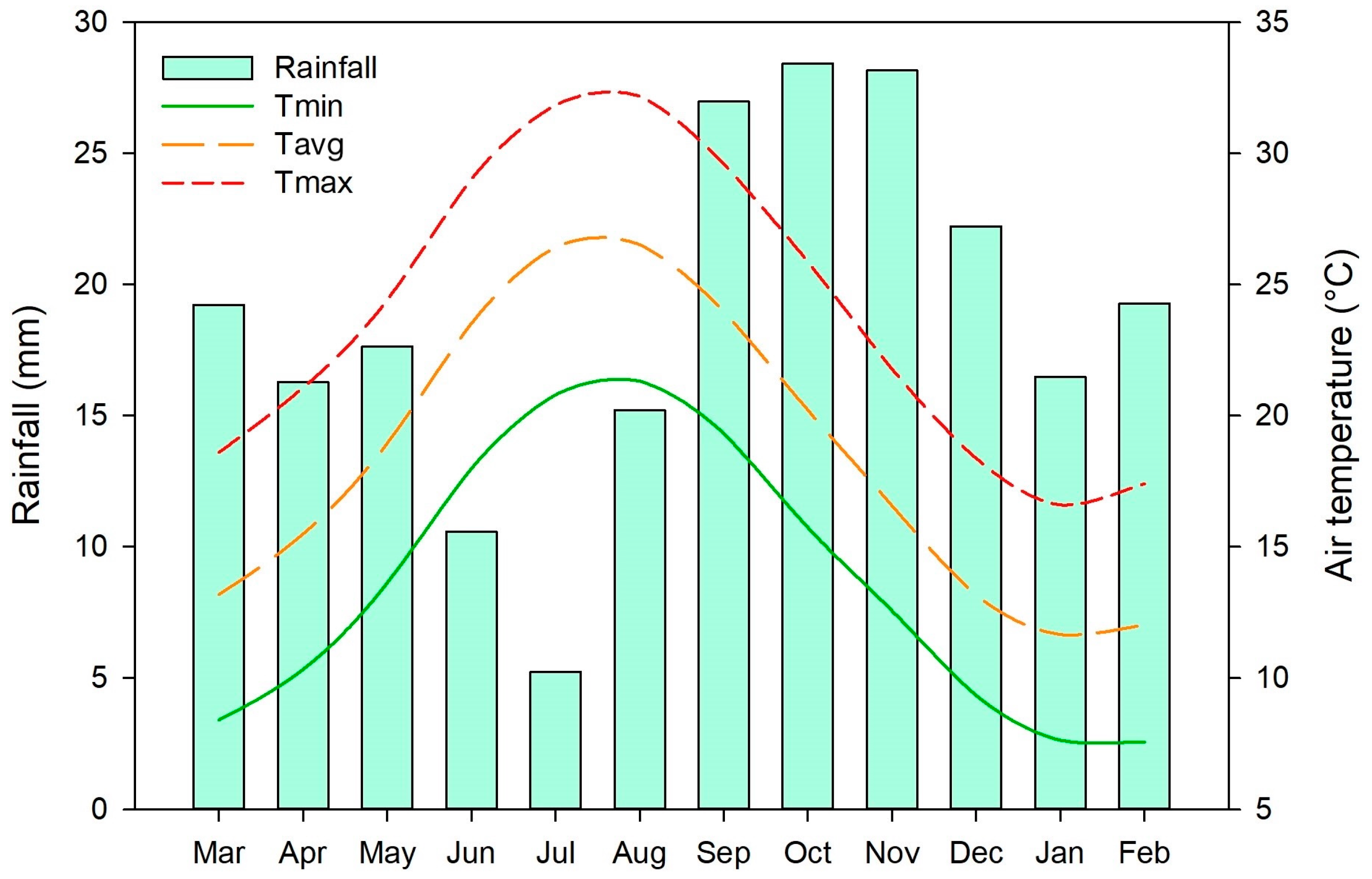
Air temperature and relative humidity were recorded during measurements with a digital thermo-hygrometer (PCE-MHT 1, PCE Instruments, Southampton, UK). Photosynthetic photon flux density (PPFD) was recorded with a LI-250 Light Meter (LI-COR Biosciences, Lincoln, NE, USA) at leaf canopy level (Figure S1). The average air temperature data of the sampling dates were: in July Tavg 26.0 °C, Tmax 36.1 °C; in September Tavg 24.2 °C, Tmax 29.4 °C. Average monthly temperature and rainfall for the 10-year period 2014–2024 were calculated from data of the meteorological station of the SIAS (Servizio Informativo Agrometeorologico Siciliano) closest to the experimental vineyard in Lascari (PA) (Figure 1).
Figure 1.
Average monthly air temperature and total monthly rainfall in the decade 2014–2024.
2.2. Pressure–Volume Curves
Five fully expanded leaves per cultivar collected from two individuals were used to construct PV curves by the bench dehydration method [33,34]; summer PV curves were constructed in July and autumn ones in September. Leaf petioles were cut under water and left to rehydrate in the dark for 2 h before starting PV construction. After correcting for oversaturation, when necessary, the PV curves were elaborated to obtain the main water relation traits related to drought tolerance: leaf Ψtlp, π0, εmax and leaf area specific capacitance at full turgor (Cft).
2.3. Plant Water Status and Stomatal Conductance
To follow the daily pattern of ΨL, two fully expanded leaves per plant from two plants per cultivar were collected every two hours from predawn to 17:30 h, wrapped in cling film, stored in a cool-box and measured with a pressure chamber (PMS 1505D, PMS Instrument Company, Albany, OR, USA) within an hour. Between predawn and 17:30 h, abaxial gs and leaf temperature (TL) were measured every two hours with a porometer (SC-1 Leaf Porometer, Decagon, Pullman, WA, USA) on five south-facing, fully expanded leaves per plant. At the same time, independent TL measurements were taken with a handheld infrared digital thermometer (All-Sun EM526, Eastern Technology Group, Zhangzhou, Fujian, China). In July, predawn sampling and measurements were carried out between 4:45 and 5:30, while in September between 5:30 and 6:15.
2.4. Leaf Mass per Area
Leaf mass per unit area (LMA) was calculated from six to nine leaves from two plants per cultivar, after removing the petiole. Leaf area (LA) was determined using the free software Image J (version 1.48v, National Institutes of Health, Bethesda, MD, USA, https://imagej.net) to analyze the scanned images of the fresh leaves. Leaves were then oven dried at 70 °C for 72 h and dry weight was determined on an analytical balance. LMA was obtained by dividing leaf dry mass by LA.
2.5. Leaf Vein Density
Leaf vein classification followed conventional methods (e.g., [25,35]). The density of first, second and third order veins was determined on scans (MFC-L2700DN, Brother Industries, Ltd., Tokyo, Japan) of three fully expanded leaves collected from two plants per cultivar. For the determination of minor leaf vein density, portions taken from the middle part of three fully expanded leaves collected from two plants per cultivar were cleared by immersion in a 15% NaOH aqueous solution for 2 days in an oven at 35 °C. The cleared samples were then stained either with 1% (w/v) safranin O in 96% ethanol or with 0.5% (v/v) toluidine blue in phosphate buffer, pH 6.8. Images of the cleared and stained leaf samples were captured with a digital camera (Canon EOS 300D, Tokyo, Japan) attached to an optical microscope (Nikon HFX-DX, Nikon Corporation, Tokyo, Japan). Minor vein density (fourth- and higher-order veins) was determined at 4× magnification, from areas of approximately 1–2 mm2 chosen between midvein and leaf margin. Image J was used to analyze the images. Total leaf vein density (Total VD) was calculated as the sum of major and minor vein density per unit leaf area.
2.6. Statistical Analysis
All data are presented as mean values ± standard deviation. The significance of differences among cultivars was tested by one-way ANOVA using the software package SigmaPlot 12 (Systat Software, Inc., San Jose, CA, USA). The normality assumption was checked using the Shapiro–Wilk test and equal variance with the Brown–Forsythe test. A level of significance of p < 0.05 was chosen to determine significant effects, followed by Duncan’s Multiple Range test for pairwise multiple comparison when differences were significant.
Principal component analysis (PCA) of functional traits of each variety was carried out using the R package FactoMiner package (version 2.9) [36] and factoextra package (version 1.0.7, https://CRAN.R-project.org/package=factoextra, accessed on 23 January 2026).
3. Results
3.1. Pressure–Volume Curves
Results from the PV curve analysis are reported in Table 1. All cultivars showed osmoregulation between summer and autumn, with significant decreases in Ψtlp and π0, while εmax and Cft did not vary significantly between seasons. Ψtlp in summer ranged between −1.65 and −2.04 MPa, while in autumn it dropped to between −2.01 and −2.42 MPa, with Zibibbo reaching the most negative average values in both seasons, though this difference was not always significant (see Table 1). Correspondingly, Zibibbo had significantly greater concentration of solutes at full turgor, compared to the other cultivars. The εmax in Nero d’Avola was similar to that of Corinto and significantly lower than in Catarratto and Zibibbo. Cft was significantly higher in Zibibbo than in the other cultivars in autumn, while in summer Corinto and Cataratto had significantly lower Cft average values.
Table 1.
Leaf water relation parameters obtained by pressure–volume curve analysis of the four grapevine cultivars in summer and autumn. Leaf water potential at turgor loss point (Ψtlp), osmotic potential at full turgor (π0), bulk modulus of elasticity (εmax) and leaf specific capacitance at full turgor (Cft) values are means of five replicates ± SD. For each season, means within columns followed by the same letter(s) were not significantly different according to Duncan’s Multiple Range test (p < 0.05). Averages in bold indicate significant differences between seasons within each cultivar.
3.2. Leaf Water Potential
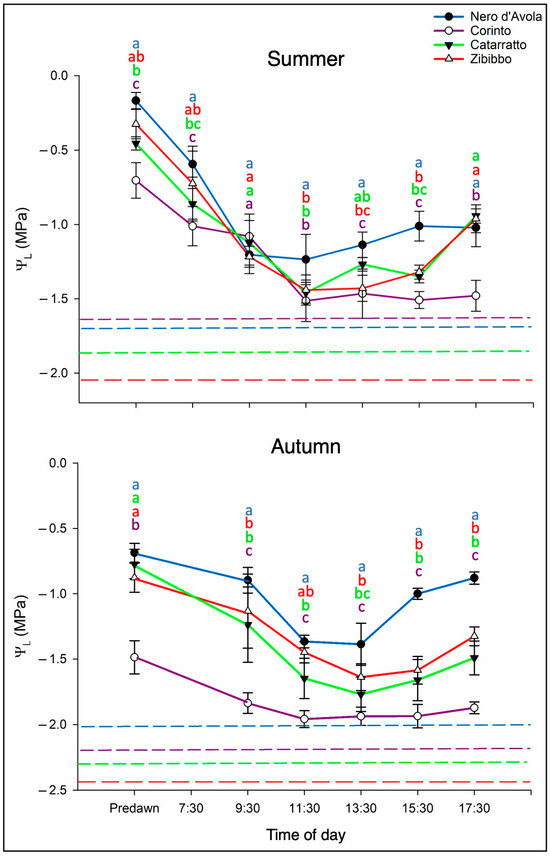
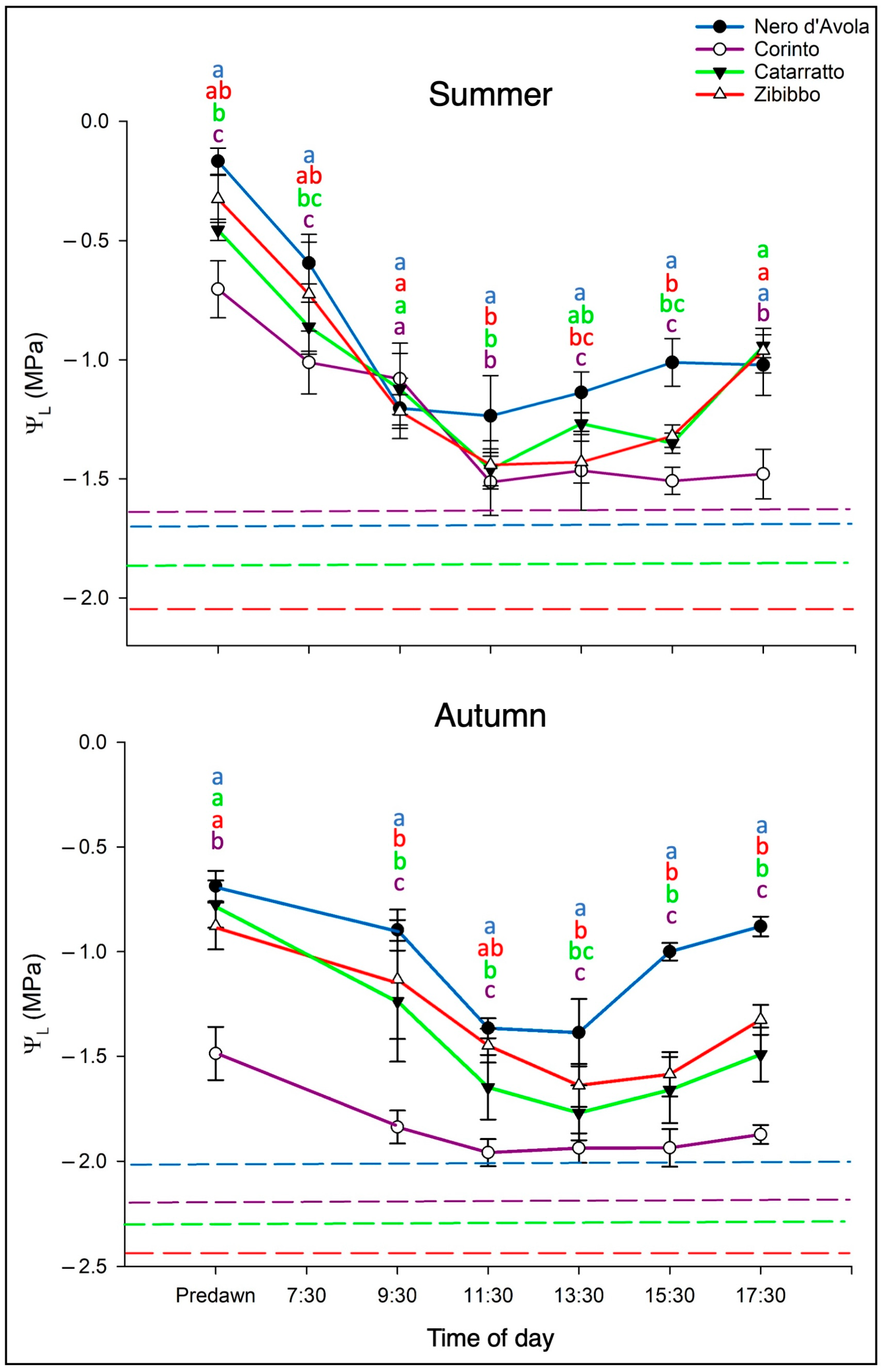
The daily pattern of ΨL in summer and autumn is shown in Figure 2. During summer, predawn leaf water potential (ΨPD) ranged between −0.15 and −0.75 MPa and ΨL decreased steeply in all cultivars after sunrise. Corinto showed significantly lower ΨL values both at predawn and in the late afternoon, when the other cultivars started recovering their leaf water status. Corinto was subject to stress for most of the day, as ΨL approached turgor loss point, while the other cultivars maintained ΨL values distinctly above their turgor loss point. In autumn, ΨPD values were lower for all cultivars, with Corinto showing a significantly lower value (−1.5 MPa) compared to the other three cultivars.
Figure 2.
Daily pattern of leaf water potential (ΨL) measured in July and in September on the four cultivars, between predawn and 17:30 h. Data are presented as means ± SD. The dashed lines indicate the mean turgor loss point (Ψtlp) values for the cultivars. Different letters indicate significant differences among cultivars within each sampling time (p < 0.05).
3.3. Leaf Stomatal Conductance
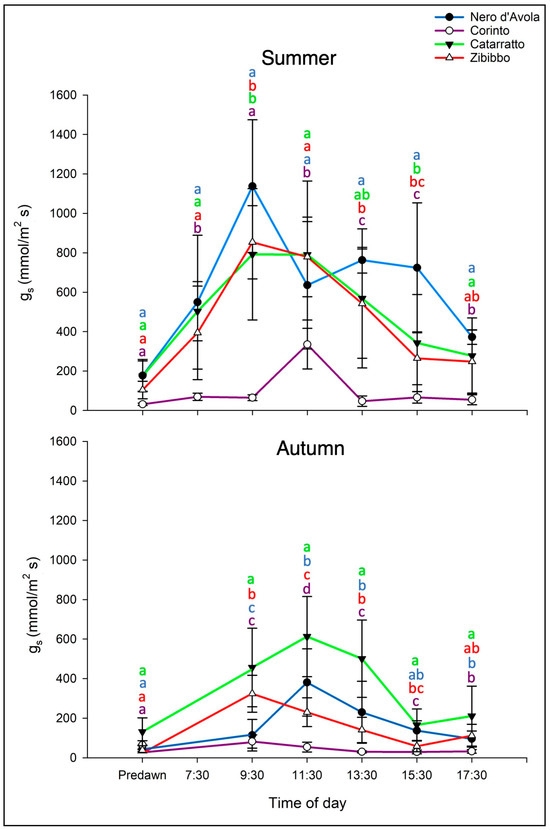
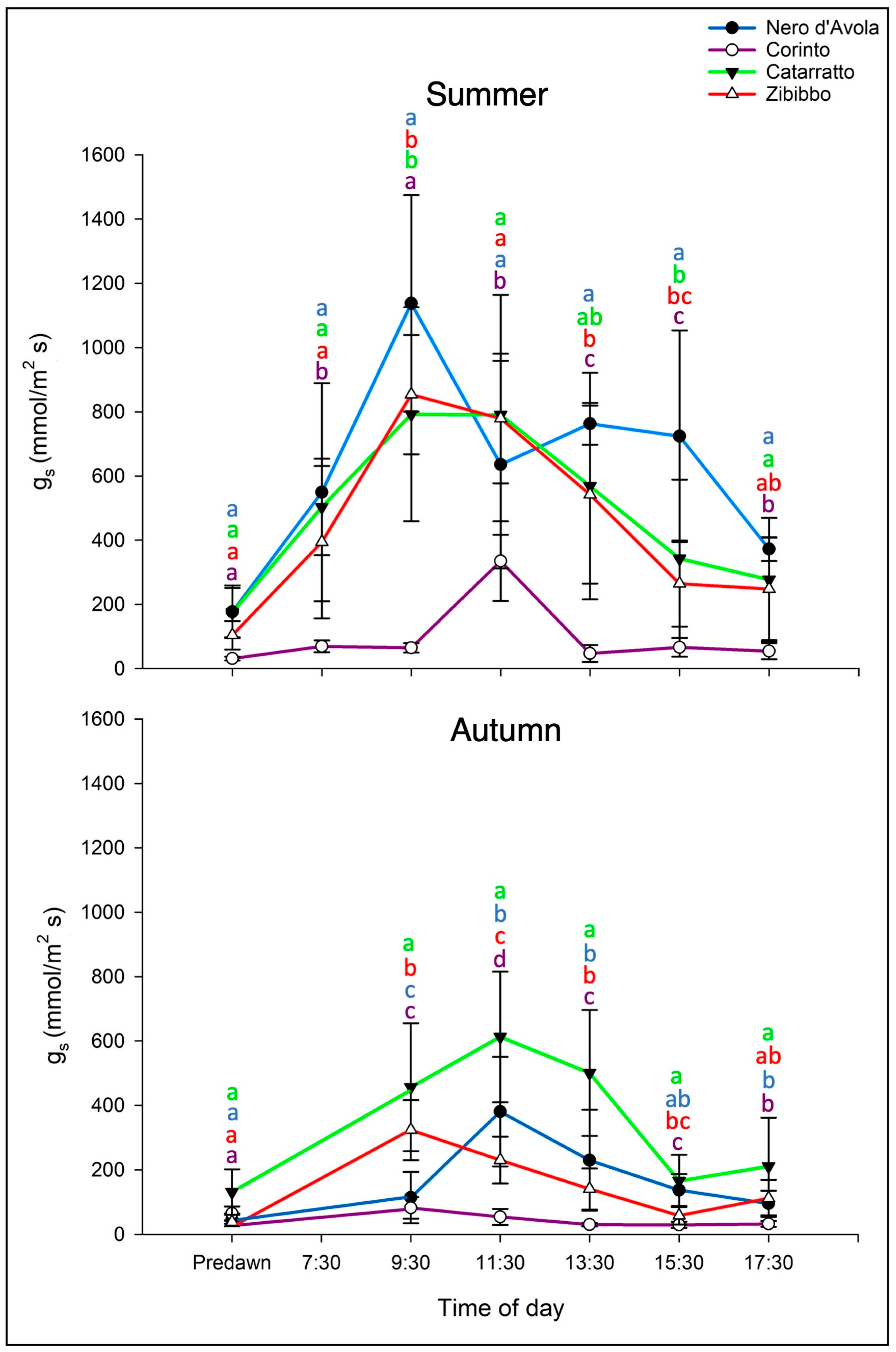
The daily pattern of gs in the two sampling seasons is shown in Figure 3. As for the daily ΨL pattern, differences in leaf gas exchange were observed, depending on the cultivar and on the season. During the summer, air temperatures up to 36.1 °C were recorded during measurements; Nero d’Avola, Catarratto and Zibibbo showed similar patterns of gs, while Corinto showed the lowest levels of gs, 10 to 20 times lower than the other cultivars, opening stomata only for a few hours in the middle of the day. In autumn, Corinto showed extremely low levels of gas exchange. Catarratto had higher levels of stomatal conductance than the other cultivars in the central part of the day.
Figure 3.
Daily pattern of leaf stomatal conductance to water vapour (gs) measured in July and in September on the four cultivars, between predawn and 17:30 h. Data are presented as means ± SD. Different letters indicate significant differences among cultivars within each sampling time (p < 0.05).
3.4. Leaf Temperature
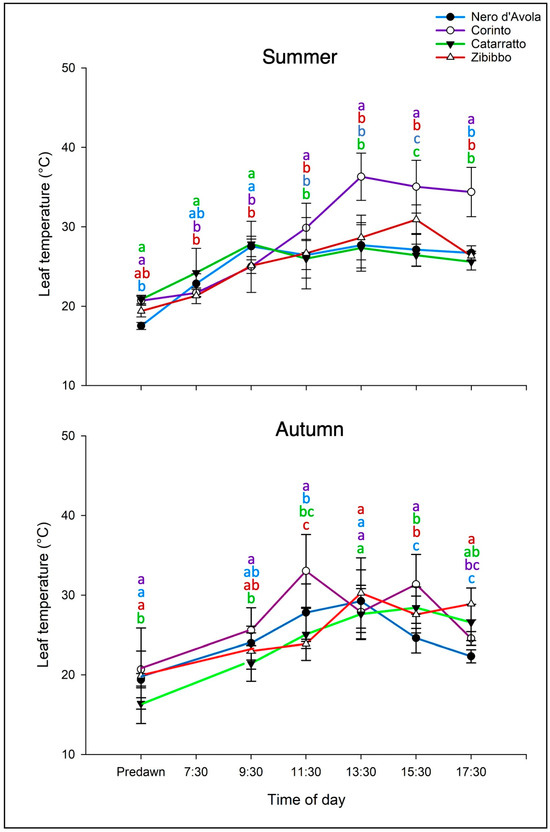
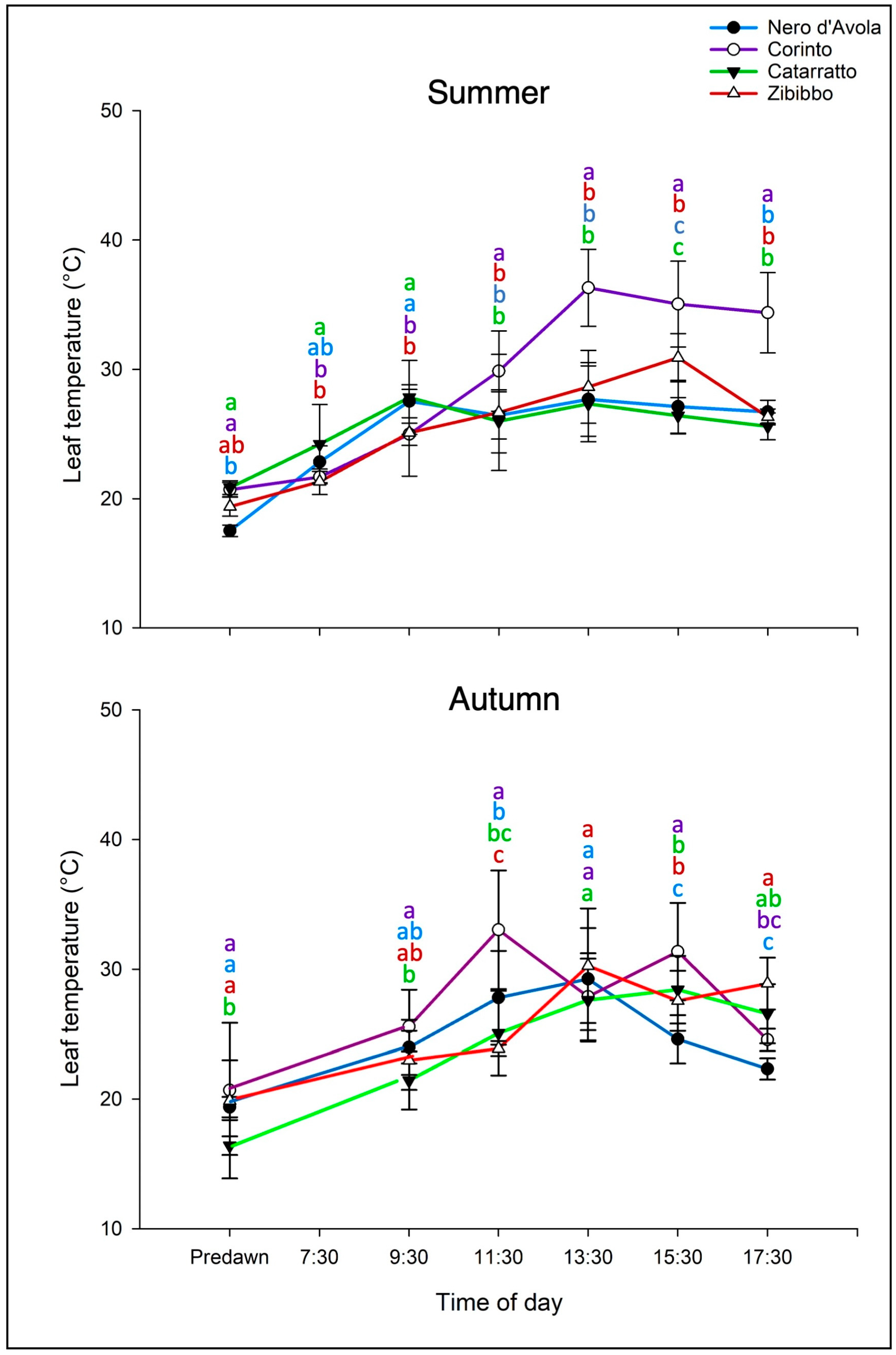
Independent measurements of TL were recorded during measurement days (Figure 4). In summer, when the highest seasonal air temperatures were measured, Corinto was the cultivar reaching the highest leaf temperatures, 36.6 °C at midday. Nero d’Avola and Catarratto showed a similar pattern, reaching a maximum value of about 28.0 °C at 9:30 and maintaining this range of temperatures throughout the rest of the day. Zibibbo showed a slightly different pattern, with a slower increase in leaf temperature that peaked at 15:30 (30.0 °C) and decreased by about 4.0 °C within the next two hours. Though Corinto in autumn had the lowest levels of gs compared to the other cultivars, leaf temperatures were in the same range of the other ones.
Figure 4.
Daily pattern of leaf temperature measured in July and in September on the four cultivars, between predawn and 17:30 h. Data are presented as means ± SD. Different letters indicate significant differences among cultivars within each sampling time (p < 0.05).
3.5. Leaf Structural Properties
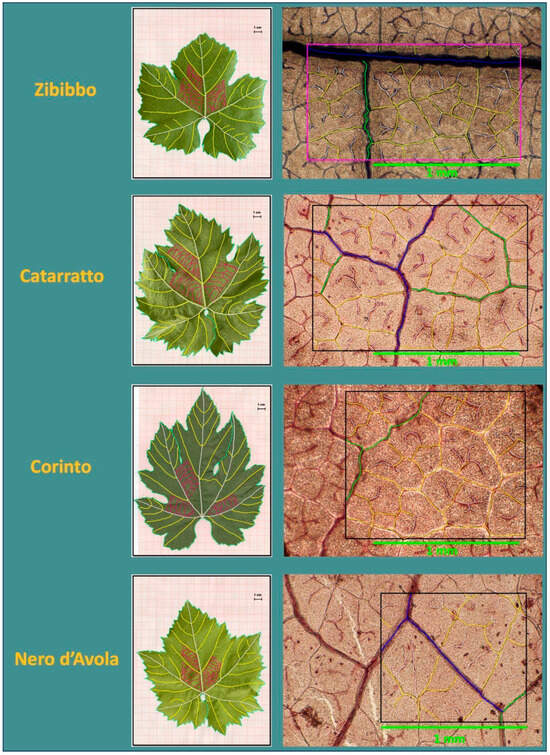
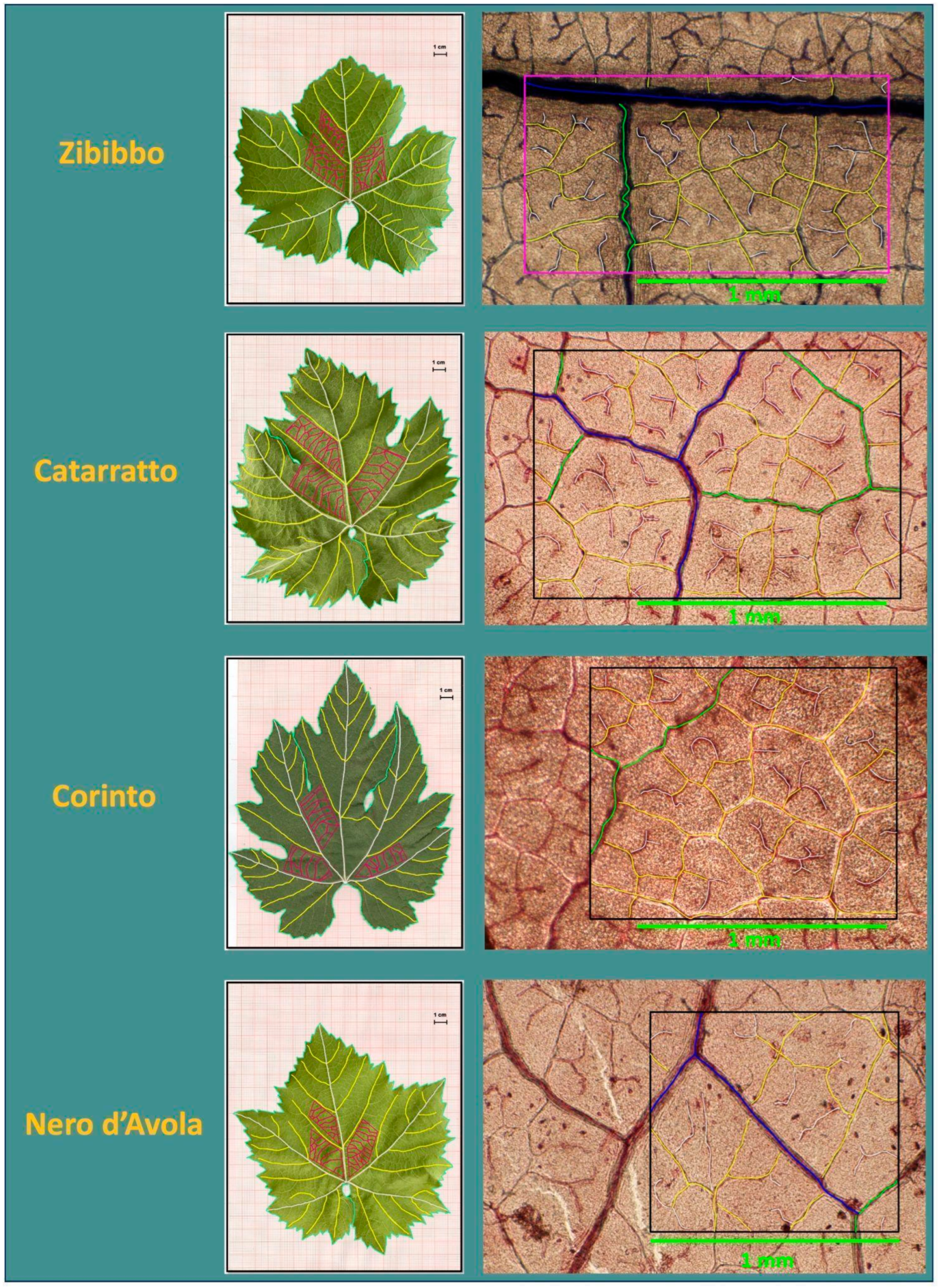
Examples of patterns of leaf vein density in the different cultivars are shown in Figure 5. Leaf structural properties, LMA and vein density (VD), of mature leaves collected in summer from the cultivars are reported in Table 2. The highest LMA value was found in Zibibbo, while the lowest in Catarratto. While no significant differences were found in minor VD among the cultivars, Catarratto showed a significantly higher density of major veins. The density of free ending veins was lowest in Corinto. Overall, total VD was significantly higher in Zibibbo compared to the other cultivars, followed by Catarratto, Nero d’Avola and Corinto (Table S1).
Figure 5.
Images of the analysis of leaf vein density of major and minor veins of the four cultivars. The purple frames indicate the sampled leaf areas where vein measurements were performed.
Table 2.
Leaf mass per unit area (LMA), density of major, minor and free ending veins of leaves of the four cultivars. Data are reported as means ± SD. For LMA n = 5, for vein density (VD) n = 10 Means within each column followed by the same letter(s) were not significantly different according to Duncan’s Multiple Range test (p < 0.05).
3.6. Principal Component Analysis
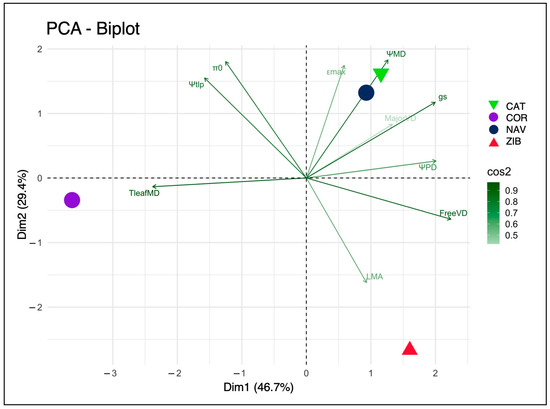
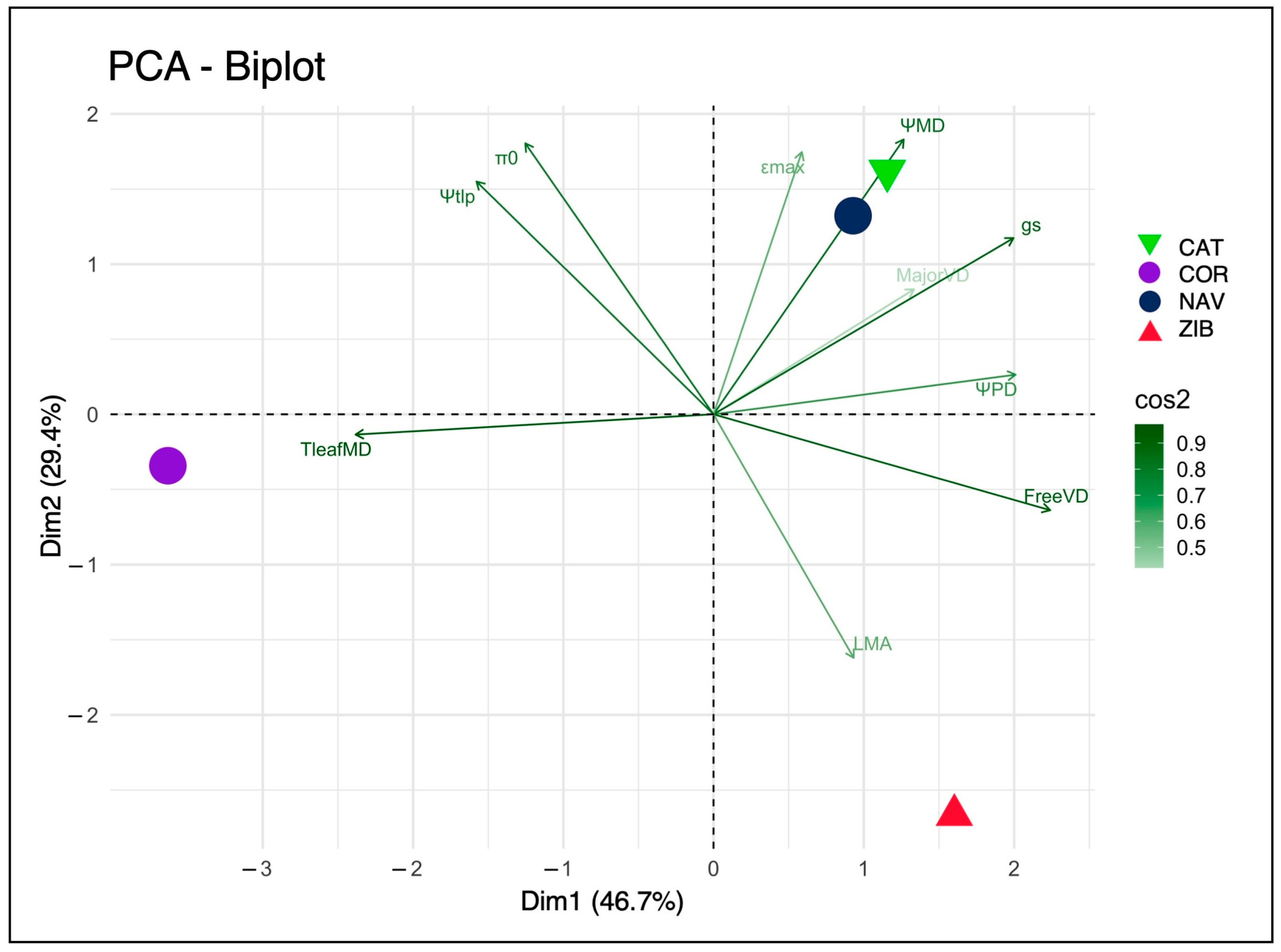
All physiological and anatomical traits were included in the principal component analysis (PCA) (Figure 6) to assess their contribution to grapevine adaptive responses. The first two principal components explained 76.1% of the total variability observed among the four varieties, revealing a clear differentiation of their functional traits. PC1 accounted for 46.7% of the total variance and primarily separated Corinto (COR) from the other varieties, being strongly associated with midday leaf temperature (TleafMD). PC2 explained an additional 29.4% of the variance and further discriminated the varieties. Along this axis, leaf mass per area (LMA) was mainly associated with Zibibbo (ZIB); whereas, midday leaf water potential (ΨMD) was associated with Nero d’Avola (NAV) and Catarratto (CAT), which clustered together and exhibited a similar physiological profile.
Figure 6.
Principal component analysis (PCA) of functional traits in four grapevine cultivars grown under field conditions.
4. Discussion
We observed significant differences in functional traits and physiological behaviour of the four grapevine cultivars, two typical of the main island of Sicily (Catarratto and Nero d’Avola) and two typical of the circum-Sicilian islands (Zibibbo and Corinto). The study was carried out on a germplasm repository vineyard, therefore minimizing micro-environmental and localized soil spatial variability across the plot. Duplicate measurements were considered representative, since the collection comprised a total of three cloned plants per cultivar.
Grapevine has adapted to drought conditions through millennial cultivation [37], with differences in drought and heat response strategies among varieties and clones, due to adaptation to different geographical areas. Among the selected functional traits, those obtained from PV curves, such as Ψtlp and π0, are reliable and widely used proxies of potential resistance to drought stress [6,38,39] and the association of low Ψtlp with high drought tolerance has been widely reported (e.g., [27,40]). The regulation of water consumption by regulating gs is also a useful trait to determine the adaptability of a genotype to limited water availability [41,42,43]. Based on Ψtlp and π0, Catarratto was confirmed as potentially highly drought tolerant. Catarratto is one of the most important wine cultivars of Sicily where it has been cultivated for centuries [3] and is indeed highly appreciated for its resistance to drought and high temperatures. Catarratto was also able to avoid significant increases in TL during the warmer hours of both summer and autumn sampling days. This could be due both to relatively low LMA and high density of major veins. Anatomical and morphological traits, such as LMA and VD have often been related to the ability to cope with drought stress [34,44]. The high leaf VD of this cultivar is also in agreement with high levels of leaf hydraulic conductance measured in a previous study comparing well-watered and drought conditions [45], since higher VD is related to a smaller impact of hydraulic dysfunction in leaves [46].
Nero d’Avola, characterized by high Ψtlp, π0 and Cft, showed a water spending strategy, with high levels of gs throughout the day, at the same time maintaining ΨL above turgor loss point even under conditions of drought and heat stress. The maintenance of high gs allowed for leaf cooling in the summer under high temperatures [47,48], making Nero d’Avola a well-suited genotype to face increasing temperatures and more frequent heatwaves. A possible explanation for the occurrence of limited decreases in ΨL under high transpiration could be the high Cft we found for this cultivar [49]; Cft is particularly important in defining hydraulic traits of wine grapes [31].
While root depth is a critical factor affecting water uptake [50], it was not directly measured in this study. However, because scion-rootstock interactions can significantly influence root system architecture and physiology [51,52,53], it remains possible that Nero d’Avola developed a deeper or more expansive root network despite being grafted onto the same rootstock as the other cultivars. This hypothesis is further supported by the less negative ΨPD values exhibited by Nero d’Avola, indicative of deeper root growth [50].
According to PCA, Cataratto and Nero d’Avola, both main island cultivars, were closely associated in their traits and strategy, strongly related to the maintenance of high gs and high ΨMD.
Zibibbo showed the lowest Ψtlp and π0, both in summer and autumn, so it could potentially be one of the most drought tolerant cultivars. The good level of recovery of ΨL in the summer afternoon may be explained by high VD of both major and free ending veins. Combined with high LMA, Zibibbo showed a tolerant strategy related to structural investment in leaf tissues. These findings are in line with the fact that this cultivar is widely grown in environments with extreme climatic conditions. Zibibbo was introduced in Pantelleria, a volcanic circum-Sicilian island characterized by a dry climate and strong winds, from Cape Zebib (Tunisia) during the Arab domination from the ninth to eleventh centuries [54].
Corinto separated distinctly from the other cultivars, as seen on the PCA biplot. It showed a water saving strategy with very low levels of gs compared to the other three cultivars, particularly in summer. However, tight stomatal control did not avoid the drop in leaf water potential during the warmer hours of the day, and in summer the cultivar experienced relevant stress, as ΨL values approached Ψtlp for several hours. Low leaf Cft, low total and free ending VD of this cultivar could explain the lower recovery in ΨL during the afternoon in both sampling seasons. Stomatal closure also led to significantly higher TL in summer. High leaf temperatures negatively affect carbon assimilation, reducing net primary production [55] and stomatal closure has been shown to result in cessation of berry growth in other grapevine varieties [56]. Corinto has indeed a quite low yield, with an average production of only 1 Kg/plant [57], while data available in Italian databases, show that Zibibbo has the highest yield, 4.6 Kg/plant, followed by Cataratto (3.6 Kg/plant) and Nero d’Avola (2.7 Kg/plant) (https://vitisdb.it/).
5. Conclusions
In our field conditions, Nero d’Avola, Catarratto and Zibibbo, through specific responses of each cultivar, responded best to summer conditions of drought and heat stress, while Corinto appeared to be the most sensitive. Data from this study confirm the variability in grapevine cultivars’ response to aridity and high temperatures. Different morpho-anatomical traits and different strategies adopted to regulate gas exchange and water status allowed adaptation to the Mediterranean environment. Leaf water potential at turgor loss point was one of the most informative traits, together with midday leaf water potential and midday stomatal conductance. Identifying such key functional indicators is particularly relevant in the context of ongoing climate change in Mediterranean viticultural areas, where increasing temperatures, prolonged drought periods, and more frequent heatwaves are expected to challenge grapevine productivity and sustainability. The identification of cultivar-specific adaptive strategies and key functional traits may support the development of more resilient viticultural systems through targeted cultivar selection and improved management practices. Moreover, the valorization of local grapevine biodiversity could represent an important resource for maintaining wine production under future climatic scenarios.
Supplementary Materials
The following supporting information can be downloaded at: https://www.mdpi.com/article/10.3390/horticulturae12080986/s1, Figure S1: Average values of air temperature, relative humidity, and PPFD of the three sampling dates in each season. Table S1: Total vein density of leaves of the four cultivars. Data are reported as means ± SD, n = 10. Means followed by the same letter(s) were not significantly different according to Duncan’s Multiple Range test (p < 0.05).
Author Contributions
L.A.: research design, experimentation, analysis, writing; S.I.: experimentation, analysis, writing; A.M.: experimentation, analysis; F.C.: research design, writing, review, editing, funding; M.S.: review, funding; A.N.: research design, review; E.O.: research design, experimentation, analysis, writing, review. All authors have read and agreed to the published version of the manuscript.
Funding
This work was supported in part by a PhD fellowship from the University of Palermo to SI (MIUR, XXV ciclo) and by Regione Siciliana (PSR Sicilia 2007–2013, Sottomisura 214/2A—Preservazione della biodiversità: Centri pubblici di conservazione, Grant No. 94750767637).
Data Availability Statement
The dataset is available on request from the authors without specific restrictions.
Acknowledgments
We thank Leonardo Pollina for microscopy work and image analysis of vein density.
Conflicts of Interest
The authors declare no conflicts of interest.
Abbreviations
The following abbreviations are used in this manuscript:
| Cft | Leaf specific capacitance at full turgor |
| gs | Stomatal conductance to water vapour |
| LA | Leaf area |
| LMA | Leaf mass per unit area |
| PCA | Principal component analysis |
| PPFD | Photosynthetic photon flux density |
| PV | Pressure–volume |
| Tavg | Temperature average |
| TL | Leaf temperature |
| Tmax | Maximum Temperature |
| VD | Vein density |
| εmax | Bulk modulus of elasticity |
| π0 | Osmotic potential at full turgor |
| ΨL | Leaf water potential |
| ΨMD | Midday leaf water potential |
| ΨPD | Predawn leaf water potential |
| Ψtlp | Turgor loss point |
References
- FAOSTAT. World Food and Agriculture-Statistical Pocketbook 2018; Food and Agriculture Organization of the United Nations: Rome, Italy, 2019. [Google Scholar] [CrossRef] [Scilit]
- Dong, Y.; Duan, S.; Xia, Q.; Liang, Z.; Dong, X.; Margaryan, K.; Musayev, M.; Goryslavets, S.; Zdunić, G.; Bert, P.-F.; et al. Dual domestications and origin of traits in grapevine evolution. Science 2023, 379, 892–901. [Google Scholar] [CrossRef] [Scilit] [PubMed]
- Carimi, F.; Mercati, F.; Abbate, L.; Sunseri, F. Microsatellite analyses for evaluation of genetic diversity among Sicilian grapevine cultivars. Genet. Resour. Crop Evol. 2010, 57, 703–719. [Google Scholar] [CrossRef] [Scilit]
- Coumou, D.; Robinson, A.; Rahmstorf, S. Global increase in record-breaking monthly-mean temperatures. Clim. Change 2013, 118, 771–782. [Google Scholar] [CrossRef] [Scilit]
- IPCC. Climate Change 2014: Impacts, Adaptation, and Vulnerability: Part A: Global and Sectoral Aspects; Cambridge University Press: Cambridge, UK, 2014. [Google Scholar] [CrossRef] [Scilit]
- Gambetta, G.A.; Herrera, J.C.; Dayer, S.; Feng, Q.; Hochberg, U.; Castellarin, S.D. The physiology of drought stress in grapevine: Towards an integrative definition of drought tolerance. J. Exp. Bot. 2020, 71, 4658–4676. [Google Scholar] [CrossRef] [Scilit] [PubMed]
- NOAA NERRS System-Wide Monitoring Program. 2020. Available online: http://www.nerrsdata.org (accessed on 28 October 2025).
- Domeisen, D.I.; Eltahir, E.A.; Fischer, E.M.; Knutti, R.; Perkins-Kirkpatrick, S.E.; Schär, C.; Seneviratne, S.I.; Weisheimer, A.; Wernli, H. Prediction and projection of heatwaves. Nat. Rev. Earth Environ. 2023, 4, 36–50. [Google Scholar] [CrossRef] [Scilit]
- Bastos, A.; Gouveia, C.M.; Trigo, R.M.; Running, S.W. Analysing the spatio-temporal impacts of the 2003 and 2010 extreme heatwaves on plant productivity in Europe. Biogeosciences 2014, 11, 3421–3435. [Google Scholar] [CrossRef] [Scilit]
- Sun, W.; Maseyk, K.; Lett, C.; Seibt, U. Restricted internal diffusion weakens transpiration-photosynthesis coupling during heatwaves. Plant Cell Environ. 2024, 47, 1813–1833. [Google Scholar] [CrossRef] [Scilit] [PubMed]
- Carvalho, L.C.; Coito, J.L.; Gonçalves, E.F.; Chaves, M.M.; Amâncio, S. Differential physiological response of grapevine varieties Touriga Nacional and Trincadeira to combined heat, drought and light stresses. Plant Biol. 2016, 18, 101–111. [Google Scholar] [CrossRef] [Scilit] [PubMed]
- Delrot, S.; Grimplet, J.; Carbonell-Bejerano, P.; Schwandner, A.; Bert, P.F.; Bavaresco, L.; Costa, L.D.; Di Gaspero, G.; Duchêne, E.; Hausmann, L.; et al. Genetic and genomic approaches for adaptation of grapevine to climate change. In Genomic Designing of Climate-Smart Fruit Crops; Springer: Cham, Switzerland, 2020; pp. 157–270. [Google Scholar] [CrossRef] [Scilit]
- Bartlett, M.K.; Sinclair, G. Temperature and evaporative demand drive variation in stomatal and hydraulic traits across grape cultivars. J. Exp. Bot. 2021, 72, 1995–2009. [Google Scholar] [CrossRef] [Scilit] [PubMed]
- Breglia, F.; Bouby, L.; Wales, N.; Ivorra, S.; Fiorentino, G. Disentangling the origins of viticulture in the western Mediterranean. Sci. Rep. 2023, 13, 17284. [Google Scholar] [CrossRef] [Scilit] [PubMed]
- Mercati, F.; De Lorenzis, G.; Brancadoro, L.; Lupini, A.; Abenavoli, M.R.; Barbagallo, M.R.; Di Lorenzo, R.; Scienza, A.; Sunseri, F. High-throughput SNP array to assess genetic variability of the main grapevine cultivars from Sicily. Tree Genet. Genomes 2016, 12, 1–15. [Google Scholar] [CrossRef] [Scilit]
- Beis, A.; Patakas, A. Relative contribution of photoprotection and antioxidative mechanisms to drought adaptation ability in grapevines. Environ. Exp. Bot. 2012, 78, 173–183. [Google Scholar] [CrossRef] [Scilit]
- Mittler, R. Abiotic stress, the field environment and stress combination. Trends Plant Sci. 2006, 11, 15–19. [Google Scholar] [CrossRef] [Scilit] [PubMed]
- Martorell, S.; Medrano, H.; Tomàs, M.; Escalona, J.M.; Flexas, J.; Diaz-Espejo, A. Plasticity of vulnerability to leaf hydraulic dysfunction during acclimation to drought in grapevines: An osmotic-mediated process. Physiol. Plant. 2015, 153, 381–391. [Google Scholar] [CrossRef] [Scilit] [PubMed]
- Hochberg, U.; Bonel, A.G.; David-Schwartz, R.; Degu, A.; Fait, A.; Cochard, H.; Perlunger, E.; Herrera, J.C. Grapevine acclimation to water deficit: The adjustment of stomatal and hydraulic conductance differs from petiole embolism vulnerability. Planta 2017, 245, 1091–1104. [Google Scholar] [CrossRef] [Scilit] [PubMed]
- Dayer, S.; Herrera, J.C.; Dai, Z.; Burlett, R.; Lamarque, L.J.; Delzon, S.; Bortolami, G.; Cochard, H.; Gambetta, G.A. The sequence and thresholds of leaf hydraulic traits underlying grapevine varietal differences in drought tolerance. J. Exp. Bot. 2020, 71, 4333–4344. [Google Scholar] [CrossRef] [Scilit] [PubMed]
- Martínez-Lüscher, J.; Kizildeniz, T.; Vučetić, V.; Dai, Z.; Luedeling, E.; van Leeuwen, C.; Gomès, E.; Pascual, I.; Irigoyen, J.J.; Morales, F.; et al. Sensitivity of grapevine phenology to water availability, temperature and CO2 concentration. Front. Environ. Sci. 2016, 4, 48. [Google Scholar] [CrossRef] [Scilit]
- Tyree, M.T.; Sperry, J.S. Vulnerability of xylem to cavitation and embolism. Annu. Rev. Plant Biol. 1989, 40, 19–36. [Google Scholar] [CrossRef]
- Sack, L.; Holbrook, N.M. Leaf hydraulics. Annu. Rev. Plant Biol. 2006, 57, 361–381. [Google Scholar] [CrossRef] [Scilit] [PubMed]
- Brodribb, T.J.; Field, T.S.; Jordan, G.J. Leaf maximum photosynthetic rate and venation are linked by hydraulics. Plant Physiol. 2007, 144, 1890–1898. [Google Scholar] [CrossRef] [Scilit] [PubMed]
- Kawai, K.; Okada, N. Roles of major and minor vein in leaf water deficit tolerance and structural properties in 11 temperate deciduous woody species. Trees 2018, 32, 1573–1582. [Google Scholar] [CrossRef] [Scilit]
- Harayama, H.; Kitao, M.; Agathokleous, E.; Ishida, A. Effects of major vein blockage and aquaporin inhibition on leaf hydraulics and stomatal conductance. Proc. R. Soc. B 2019, 286, 20190799. [Google Scholar] [CrossRef] [Scilit] [PubMed]
- Bartlett, M.K.; Scoffoni, C.; Sack, L. The determinants of leaf turgor loss point and prediction of drought tolerance of species and biomes: A global meta-analysis. Ecol. Lett. 2012, 15, 393–405. [Google Scholar] [CrossRef] [Scilit] [PubMed]
- Farolfi, E.; Kulhánková, A.; De Berardinis, F.; Tarnay, S.L.; Gambetta, G.A.; Hochberg, U.; Forneck, A.; Herrera, J.C. Leaf seasonal osmotic adjustment is not driven by temperature or water deficit. Plant J. 2025, 124, e70569. [Google Scholar] [CrossRef] [Scilit] [PubMed]
- Lamont, B.B.; Lamont, H.C. Utilizable water in leaves of 8 arid species as derived from pressure-volume curves and chlorophyll fluorescence. Physiol. Plant. 2000, 110, 64–71. [Google Scholar] [CrossRef] [Scilit]
- Sack, L.; Tyree, M.T. Leaf hydraulics and its implications in plant structure and function. In Vascular Transport in Plants; Elsevier: Oxford, UK, 2005; pp. 93–114. [Google Scholar] [CrossRef] [Scilit]
- Vicario, K.; Young, E.; Li, G.; Mariani, R.O.; Cathline, K.A.; Findlay, A.; Robertson, G.; Martin, A.R. Hydraulic trait variation and relationships with the leaf economics spectrum in wine grapes. Planta 2025, 261, 58. [Google Scholar] [CrossRef] [Scilit] [PubMed]
- Charrier, G.; Delzon, S.; Domec, J.C.; Zhang, L.; Delmas, C.E.; Merlin, I.; Corso, D.; King, A.; Ojeda, H.; Ollat, N.; et al. Drought will not leave your glass empty: Low risk of hydraulic failure revealed by long-term drought observations in world’s top wine regions. Sci. Adv. 2018, 4, eaao6969. [Google Scholar] [CrossRef] [Scilit] [PubMed]
- Tyree, M.T.; Hammel, H.T. The measurement of the turgor pressure and the water relations of plants by the pressure bomb technique. J. Exp. Bot. 1972, 23, 267–282. [Google Scholar] [CrossRef] [Scilit]
- Savi, T.; Love, V.L.; Dal Borgo, A.; Martellos, S.; Nardini, A. Morpho-anatomical and physiological traits in saplings of drought-tolerant Mediterranean woody species. Trees 2017, 31, 1137–1148. [Google Scholar] [CrossRef] [Scilit]
- Sack, L.; Scoffoni, C. Leaf venation: Structure, function, development, evolution, ecology and applications in the past, present and future. New Phytol. 2013, 198, 983–1000. [Google Scholar] [CrossRef] [Scilit] [PubMed]
- Lê, S.; Josse, J.; Husson, F. FactoMineR: An R package for multivariate analysis. J. Stat. Softw. 2008, 25, 1–18. [Google Scholar] [CrossRef] [Scilit]
- Atak, A. Climate change and adaptive strategies on viticulture (Vitis spp.). Open Agric. 2024, 9, 20220258. [Google Scholar] [CrossRef] [Scilit]
- Meinzer, F.C.; Woodruff, D.R.; Domec, J.C.; Goldstein, G.; Campanello, P.I.; Gatti, M.G.; Villalobos-Vega, R. Coordination of leaf and stem water transport properties in tropical forest trees. Oecologia 2008, 156, 31–41. [Google Scholar] [CrossRef] [Scilit] [PubMed]
- Sack, L.; Cowan, P.D.; Jaikumar, N.; Holbrook, N.M. The hydrology of leaves. Plant Cell Environ. 2003, 26, 1343–1356. [Google Scholar] [CrossRef] [Scilit]
- Álvarez-Cansino, L.; Comita, L.S.; Jones, F.A.; Manzané-Pinzón, E.; Browne, L.; Engelbrecht, B.M.J. Turgor loss point predicts survival responses to experimental and natural drought in tropical tree seedlings. Ecology 2022, 103, e3700. [Google Scholar] [CrossRef] [Scilit] [PubMed]
- Florez-Sarasa, I.; Clemente-Moreno, M.J.; Cifre, J.; Capó, M.; Llompart, M.; Fernie, A.R.; Bota, J. Differences in metabolic and physiological responses between local and widespread grapevine cultivars under water deficit stress. Agronomy 2020, 10, 1052. [Google Scholar] [CrossRef] [Scilit]
- Lamarque, L.J.; Delmas, C.E.; Charrier, G.; Burlett, R.; Dell’Acqua, N.; Pouzoulet, J.; Gambetta, G.A.; Delzon, S. Quantifying the grapevine xylem embolism resistance spectrum to identify varieties and regions at risk in a future dry climate. Sci. Rep. 2023, 13, 7724. [Google Scholar] [CrossRef] [Scilit] [PubMed]
- Nerva, L.; Chitarra, W.; Fila, G.; Lovat, L.; Gaiotti, F. Variability in stomatal adaptation to drought among grapevine cultivars: Genotype-dependent responses. Agriculture 2023, 13, 2186. [Google Scholar] [CrossRef] [Scilit]
- Amitrano, C.; Arena, C.; Cirillo, V.; De Pascale, S.; De Micco, V. Leaf morpho-anatomical traits in Vigna radiata L. affect plant photosynthetic acclimation to changing vapor pressure deficit. Environ. Exp. Bot. 2021, 186, 104453. [Google Scholar] [CrossRef] [Scilit]
- Oddo, E.; Abbate, L.; Inzerillo, S.; Carimi, F.; Motisi, A.; Sajeva, M.; Nardini, A. Water relations of two Sicilian grapevine cultivars in response to potassium availability and drought stress. Plant Physiol. Biochem. 2020, 148, 282–290. [Google Scholar] [CrossRef] [Scilit] [PubMed]
- Scoffoni, C.; Rawls, M.; McKown, A.; Cochard, H.; Sack, L. Decline of leaf hydraulic conductance with dehydration: Relationship to leaf size and venation architecture. Plant Physiol. 2011, 156, 832–843. [Google Scholar] [CrossRef] [Scilit] [PubMed]
- Urban, J.; Ingwers, M.; McGuire, M.A.; Teskey, R.O. Stomatal conductance increases with rising temperature. Plant Signal. Behav. 2017, 12, e1356534. [Google Scholar] [CrossRef] [Scilit] [PubMed]
- Sadras, V.O.; Montoro, A.; Moran, M.A.; Aphalo, P.J. Elevated temperature altered the reaction norms of stomatal conductance in field-grown grapevine. Agric. For. Meteorol. 2012, 165, 35–42. [Google Scholar] [CrossRef] [Scilit]
- Tomasella, M.; Calderan, A.; Mihelčič, A.; Petruzzellis, F.; Braidotti, R.; Natale, S.; Lisjak, K.; Sivilotti, P.; Nardini, A. Best procedures for leaf and stem water potential measurements in grapevine: Cultivar and water status matter. Plants 2023, 12, 2412. [Google Scholar] [CrossRef] [Scilit] [PubMed]
- Savi, T.; Petruzzellis, F.; Moretti, E.; Stenni, B.; Zini, L.; Martellos, S.; Lisjak, K.; Nardini, A. Grapevine water relations and rooting depth in karstic soils. Sci. Total Environ. 2019, 692, 669–675. [Google Scholar] [CrossRef] [Scilit] [PubMed]
- Tandonnet, J.P.; Cookson, S.J.; Vivin, P.; Ollat, N. Scion genotype controls biomass allocation and root development in grafted grapevine. Aust. J. Grape Wine Res. 2010, 16, 290–300. [Google Scholar] [CrossRef] [Scilit]
- Ferlito, F.; Distefano, G.; Gentile, A.; Allegra, M.; Lakso, A.N.; Nicolosi, E. Scion-rootstock interactions influence the growth and behaviour of the grapevine root system in a heavy clay soil. Aust. J. Grape Wine Res. 2020, 26, 68–78. [Google Scholar] [CrossRef] [Scilit]
- Gautier, A.T.; Merlin, I.; Doumas, P.; Cochetel, N.; Mollier, A.; Vivin, P.; Lauvergeat, V.; Péret, B.; Cookson, S.J. Identifying roles of the scion and the rootstock in regulating plant development and functioning under different phosphorus supplies in grapevine. Environ. Exp. Bot. 2021, 185, 104405. [Google Scholar] [CrossRef] [Scilit]
- Gristina, A.S.; De Michele, R.; Garfì, G.; La Mantia, T.; Fontana, I.; Spinelli, P.; Motisi, A.; Carimi, F. Urgent need for preservation of grapevine (Vitis vinifera L. Subsp. Vinifera) germplasm from small circum-Sicilian islands as revealed by SSR markers and traditional use investigations. Genet. Resour. Crop Evol. 2017, 64, 1395–1415. [Google Scholar] [CrossRef] [Scilit]
- Greer, D.H. Leaf temperature and CO2 effects on photosynthetic CO2 assimilation and chlorophyll a fluorescence light responses during mid-ripening of Vitis vinifera cv. Shiraz grapevines grown in outdoor conditions. Funct. Plant Biol. 2022, 49, 659–671. [Google Scholar] [CrossRef] [Scilit] [PubMed]
- Knipfer, T.; Bambach, N.; Hernandez, M.I.; Bartlett, M.K.; Sinclair, G.; Duong, F.; Kluepfel, D.A.; McElrone, A.J. Predicting stomatal closure and turgor loss in woody plants using predawn and midday water potential. Plant Physiol. 2020, 184, 881–894. [Google Scholar] [CrossRef] [Scilit] [PubMed]
- Melia, V.; Capraro, F.; Sparacio, A. Studio Sulle Potenzialità Enologiche Del Corinto Nero Coltivato Alle Isole Eolie. 2008. Available online: https://www.irvos.it/wp-content/uploads/2012/01/13.pdf (accessed on 28 October 2025).

Disclaimer/Publisher’s Note: The statements, opinions and data contained in all publications are solely those of the individual author(s) and contributor(s) and not of MDPI and/or the editor(s). MDPI and/or the editor(s) disclaim responsibility for any injury to people or property resulting from any ideas, methods, instructions or products referred to in the content. |
© 2026 by the authors. Licensee MDPI, Basel, Switzerland. This article is an open access article distributed under the terms and conditions of the Creative Commons Attribution (CC BY) license.