


Abstract
Agronomic biofortification represents an effective strategy to counteract hidden hunger in humans. Salts and synthetic chelates are widely used as foliar or root applications for enriching vegetables with mineral nutrients. Recently, biochelates have been proposed as a sustainable alternative to synthetic chelates, especially peptide-based biochelates that combine the beneficial role of peptides as biostimulants and chelating agents. This study investigated the impact of multiple foliar applications of two peptide-based biochelates for enhancing Fe and Zn in leaves of hydroponically grown lettuce. No significant differences were observed in the fresh and dry weight of lettuce shoots, leaf pigments, leaf antioxidant activity and leaf macronutrient profile, while a significant increase in biochelate treatments was observed in leaf Fe and Zn concentrations in comparison with untreated control (+38.1% and +44.1%, respectively). Leaf concentration of Fe and Zn in biochelate treatments allowed to estimate that 100 g of biofortified fresh lettuce shoots per day in the human diet can contribute to Population Reference Intake from 7.9 to 11.5% for Fe and from 3.3 to 3.9% for Zn. Moreover, Zn-peptide treatments reduced nitrate concentration with respect to control and Fe-peptide (−9% and −11%, respectively), increasing the quality of lettuce leaves. Overall, peptide-based biochelates proved to be a promising, environmentally friendly fertilizer for lettuce biofortification, enhancing Fe and Zn concentration without impairing yield and leaf quality.
1. Introduction
Climate change and soil degradation are becoming major critical factors for sustainable development and human nutrition [1]. Poor soil quality causes malnutrition by reducing crop nutrient content in edible parts, contributing to hidden hunger (micronutrient deficiencies) and overall malnutrition. Malnutrition results from inadequate intake or absorption of essential minerals and vitamins, leading to serious health consequences and affecting more than two billion people globally. In particular, iron and zinc deficiencies are the most widespread forms of hidden hunger worldwide in terms of Disability-Adjusted Life Years (DALY), contributing 65.8% and 12.5%, respectively, of all DALYs lost due to malnutrition [2,3].
Biofortification represents an effective strategy to increase the nutritional value of fruits and vegetables for helping to contrast the malnutrition without changing dietary habits [4]. Among biofortification approaches, agronomic techniques are widely used to enhance the concentration of nutrients in edible parts of various leafy vegetables by both root and foliar applications [5,6]. Compared to other crops, like cereals and legumes, antinutritional factors in leafy vegetables (such as oxalates and phytates) provide a lower inhibitory effect on the gastrointestinal absorption of minerals, which may result in an increase in mineral bioavailability, such as Zn [7,8]. Furthermore, biofortification through hydroponics systems, in comparison with soil-based culture, is more effective in enhancing nutrient content in vegetables, because roots are continuously fed with nutrient solutions and the absence of soil constraints (i.e., alkaline pH, salinity) maximizes the bioavailability of nutrients. Synthetic chelates are widely employed in agriculture for increasing micronutrients in edible parts of crops [9]. For instance, the application of Fe-EDDHA in nutrient solution resulted in an increase in leaf Fe concentration (up to 159.3 mg Fe kg−1 DW) in lettuce crops (‘Vanda’ and ‘Luminosa’) grown under deep water technique [10]. However, synthetic chelates are characterized by high chemical stability and slow biodegradation rate, leading to bioaccumulation in plant tissues and water, causing environmental pollution and risk for human health [9,11]. Furthermore, several authors reported a decrease in lettuce yield following Fe biofortification treatments with synthetic chelates. Testing the same Fe-EDDHA treatments used by Brito et al. [10], da Silva et al. [12] recorded a linear decrease in leaf dry biomass in ‘Vanda’ lettuce grown under Nutrient Film Technique (NFT) as Fe-EDDHA rate increased; moreover, the same authors reported that Fe concentration in lettuce leaves reached a maximum value (157.9 mg Fe kg−1 DW) close to the level recorded by Brito et al. [10]. Similarly, Giordano et al. [13] reported a negative impact of biofortification with Fe-EDDHA on plant biomass with an 11% decrease in fresh shoot biomass of both green and red Salanova lettuce grown under NFT when leaf Fe concentration exceeded 40.6 and 66.0 mg Fe kg−1 DW in green and red Salanova lettuce, respectively. Testing another type of synthetic chelate (Fe-HBED) at different rates (0, 1 and 2 mmol L−1) in the nutrient solution, Buturi et al. [14] observed a strong increase in Fe concentration in lettuce leaves (up to 433.4 mg Fe kg−1 DW) in both ‘Napulus’ and ‘Romana’ cultivars; however a reduction in plant dry biomass was observed when Fe-HBED was applied in comparison with control treatment (−17.5% at 1 mmol L−1 of Fe-HBED and −19.0% at 2 mmol L−1 of Fe-HBED), which can be associated with an oxidative stress in plant tissues. The above studies suggested that the type of synthetic chelate, cultivar and growing system can influence the Fe accumulation in lettuce leaves with a yield penalty starting from a broad range of leaf Fe concentrations.
Similarly to Fe, zinc (Zn) biofortification can be achieved through synthetic chelates (e.g., Zn-EDTA) or mineral salts (e.g., ZnSO4). Puccinelli et al. [15] observed an increase in leaf Zn concentration (up to 5.7 and 6.0 mg Zn kg−1 FW in Experiments 1 and 2, respectively) in ‘Nelson’ lettuce grown under an aeroponic system when the nutrient solution was enriched with Zn-EDTA; lettuce yield was not significantly affected by the tested Zn-EDTA rates. Similarly to Zn-EDTA trials, the application of ZnSO4 into the nutrient solution caused an increase in leaf Zn concentration (up to 265.2 and 733.3 mg Zn kg−1 DW, in the study of Barrameda-Medina et al. [16] and de Lima et al. [17], respectively) in lettuce plants grown under a hydroponic system without any significant variation in crop yield. Despite the above positive findings, a yield penalty was observed in lettuce when the nutrient solution was enriched with ZnSO4 above 0.1 mM [18]. As reported by Stanton et al. [19], when leaf Zn concentration reaches values above the range between 100 and 700 mg Zn kg−1 DW, plants exhibit Zn toxicity symptoms.
Although nutrient solution enrichment has been widely investigated for lettuce biofortification, foliar application of Zn and Fe fertilizers has been proposed as an alternative method to root applications for promoting rapid and direct nutrient absorption in lettuce leaves. Foliar treatments with FeSO4 resulted in increased leaf Fe concentration in lettuce grown under NFT, together with an increase in leaf N concentration, flavonoids and phenolic compounds, without negative effects on the fresh weight of shoots and roots and total fresh weight of lettuce plants [20]. Foliar applications of ZnSO4 was also used for biofortification of lettuce grown in NFT as reported by Preciado-Rangel et al. [21] who observed an increase in Zn concentration in lettuce leaves and other qualitative traits (total phenol, flavonoids and antioxidant capacity) when ZnSO4 was increased from 0 to 100 µM in the spray solution; moreover, plants which were foliarly treated with the highest Zn concentration (100 µM) recorded the highest fresh weight of lettuce shoots respect to control plants. Despite the above positive results on biofortification of lettuce leaves with foliar applications of Fe and Zn salts, the Fe and Zn concentrations reached in leaf tissues appeared to be limited.
Recently, biochelates have been proposed as a sustainable alternative to the use of synthetic chelates for delivering micronutrients to different crops like cucumber, lettuce, wheat, and soybean; biochelates are eco-friendly chelating agents that are completely biodegradable and safe for human health and the environment [22]. Vegetal-derived peptides have been proposed as biochelating agents of mineral nutrients for enhancing plant nutrient uptake and transport [23]. Moreover, peptide-based biochelates may also provide biostimulant activity, enhancing crop growth and productivity, especially under abiotic stress conditions [22]. Peptide-based biochelates have performed similarly to synthetic chelates in supporting nutrient uptake of crops. For instance, root application of Fe-peptide showed similar agronomic performances to Fe-EDDHA in three trials on cucumber, tomato and strawberry grown under alkaline conditions [22]. Similarly, Leporino et al. [23] reported no significant differences in growth and leaf Fe concentration of tomato plants grown under alkaline conditions when Fe was rootly applied as Fe-EDTA or Fe-peptide. However, Zn-EDTA showed superior performance in enhancing the leaf Zn concentration of tomato plants grown under alkaline conditions [23]. Notably, peptide-based biochelates stimulated phenolic compound pathways in tomato leaves compared to the synthetic chelate EDTA, suggesting that biochelates can promote antioxidant defenses and modulate cell responses to mitigate stress. Despite the above positive results with peptide-based biochelates, no biofortified studies with micronutrient-peptide based biochelates have been carried out on leafy vegetable crops.
Given the biological role of Fe and Zn in human health [6] and the growing interest in the use of biochelates in agriculture as a replacement for synthetic chelates, an agronomic trial was conducted to evaluate the biofortification effect of multiple foliar applications of Fe and Zn peptide-based biochelates on lettuce plants grown in a floating system. Moreover, to better understand lettuce plant responses to the biofortification treatments, the trial was conducted in a greenhouse equipped with a high-throughput phenotyping platform, and mineral and biochemical analyses of leaves were performed to evaluate the effects of biochelates on leaf quality traits.
2. Materials and Methods
2.1. Plant Growth Conditions, Biochelate Characteristics and Experimental Design
The experiment was carried out in a polymethyl methacrylate greenhouse at the Experimental Farm of Tuscia University, Central Italy (42°25′ N, 12°08′ E) from 31 March to 15 May 2024. Temperature, relative humidity, and solar radiation were recorded hourly by a weather station (HYGROVUE5 TEMP & RH PROBE C/W and CS301 APOGEE PYRANOMETER C/W, Campbell Scientific, Loughborough, UK) located inside the greenhouse (Supplementary Figure S1).
Lettuce seeds (Lactuca sativa L. - cv Salanova Aquino; Rijk Zwaan, Bologna, Italy) were sown on 31 March in black plastic cups (Ø: 4.8 cm, h: 5 cm, b: 3 cm) filled with vermiculite. The cups were placed in a circular polystyrene support and placed in tanks, each filled with nutrient solutions (floating system). The nutrient solution, which was similar to the solution used by Fiore et al. [24], was obtained by adding the following fertilizers to pure water (mg L−1): 722 Ca(NO3)2, 137 KH2PO4, 230 K2SO4, 84 NH4NO3, 250 MgSO4, 108 KNO3. For each macronutrient, the final concentration (mg L−1) was 154 N, 31 P, 72 S, 176 K, 160 Ca and 24 Mg. Micronutrients were added as 24 mg L−1 of commercial fertilizer (Mikrom; Cifo S.p.A., Bologna, Italy) containing (g kg−1): 5 B, 5 Cu, 40 Fe, 40 Mn, 2 Mo, 10 Zn. Mikrom also confirmed traces of Mg (0.43 mg L−1) and S (0.58 mg L−1). The volume of the nutrient solution was kept constant at 6.5 L, and oxygenation of the nutrient solution was conducted by pumping air through emitters placed on the bottom of the tanks (one emitter for each tank).
The vegetal-derived peptide-based biochelates were provided by Hello Nature® (Rivoli Veronese, Italy). Fe-peptide (KeyLan Fe) contained 58.5 g L−1 of Fe water-soluble, while Zn-peptide (KeyLan Zn) contained 65.0 g L−1 of Zn water-soluble. Both peptide-based biochelates contained 520 g L−1 of vegetal protein hydrolysates.
Foliar applications of Fe-peptide (1.5 mL L−1) and Zn-peptide (1.5 mL L−1) were compared with a control treatment (distilled water). A randomized block design was adopted to compare the three treatments with 8 replicates each, for a total of 24 plants. A 2 L Volpi Ninfea sprayer (Volpi, Piadena, Italy) was used for the foliar spray treatments. Each plant was foliar-sprayed with 15 mL of solution to allow complete coverage of vegetation, avoiding runoff. All treatments were performed on the 23rd, 30th and 37th day after sowing (DAS).
2.2. Non-Destructive Phenotyping Measurements
During the trial (23rd, 26th, 30th, 33rd, 36th and 40th DAS), non-destructive leaf measurements were performed to indirectly check chlorophylls (transmittance ratio T850/T720), flavonols (transmittance ratio F660/F325) and anthocyanins content (transmittance ratio F660/F525) using the Multi-Pigment-Meter (ADC BioScientific Ltd., Hoddesdon, UK). Moreover, the Nitrogen–Flavonol Index (NFI) was calculated as the ratio between chlorophyll and flavonol content. Five leaf measurements were taken for each plant, with a total of 40 replicates per treatment (8 plants × 5 leaf measurements).
Lettuce morphological traits were monitored with a high-throughput phenotyping platform (Phenospex, Heerlen, The Netherlands) belonging to Arcadia Spin-off Company (Rivoli Veronese, Italy). Phenotyping measurements were carried out twice each morning for 24 consecutive days for all 24 lettuce plants, and 3D Leaf Area, Plant Height and Digital Biomass of lettuce shoots were determined.
2.3. Plant Biomass Determination
At the 40th DAS, 24 lettuce plants (8 plants per experimental treatment) were harvested to record the fresh weight of the shoots individually. Before drying, the shoots were washed into distillated water, and the dry weight of the shoots was determined after oven-drying plant tissue at 65 °C until the sample weight remained constant; subsequently, dry samples were ground separately in a Wiley mill to pass through a 20-mesh screen.
2.4. Photosynthetic Pigments, Antioxidant Activity and Nitrates
At the 40th DAS, six leaves for each treatment were harvested, frozen with liquid nitrogen and stored at −80 °C. Subsequently, the sample was ground with liquid nitrogen and an aliquot of 0.1 was used to determine total chlorophyll and carotenoid content, while 0.5 g and 10 mL 80% were used for analysis of ferric reducing antioxidant power assay (FRAP), total phenol and flavonoids.
Total chlorophyll (a + b) and carotenoid concentration in lettuce leaves were determined following the Lichtenthaler and Wellburn method [25]: the frozen sample was extracted by adding 10 mL of 80% acetone into a glass tube, homogenization in ice, and centrifuged at 1400 g for 5 min at 4 °C. The absorbance of the supernatants was recorded at 470, 663 and 647 nm, and the final concentration was calculated using the equations reported by the same authors.
For total phenols and flavonoids, an extraction with 80% ethanol (pH 2) was performed, while for the ferric reducing antioxidant power assay (FRAP), an extraction with 80% methanol was performed. Both extractions were conducted by adding 10 mL of extracting solution, homogenization and incubation for 1 h at room temperature. The extract was centrifuged, and the supernatant was stored at −20 °C.
The total phenols content (TPC) was determined using the Folin–Ciocalteu method [26]. For the assay, 0.2 mL of extract was added with 1 mL of Folin-Ciocalteau’s reagent diluted (1:5, v:v) and 0.8 mL of 7.5% sodium carbonate (w/v). The absorbance of the solution was measured after 1 h of incubation at room temperature and in dark conditions, at 765 nm, and the result was expressed as mM GAE for 100 g−1 of FW.
The flavonoids contents were determined using the colorimetric assay proposed by Jia Zhishen et al. [27]. An aliquot of 0.7 mL of extract was added with 0.15 mL of 5% (w/v) sodium nitrite, 0.15 mL of 10% (w/v) aluminum trichloride and 1 mL of sodium hydroxide 1 M. The absorbance of the solution was measured at 510 nm, and the result was expressed as mM QE for 100 g−1 of FW.
FRAP assay was conducted following the protocol reported by Benzie and Strain [28]: 0.03 mL of extract was added to 0.09 mL of distilled water and 0.9 mL of FRAP working solution [(acetate buffer 300 mM (pH 3.6), 2,4,6-tris(2-pyridyl)-s-triazine 10 mM and FeCl3 × 6 H2O 20 Mm (10:1:1; v/v/v).] After incubation at 37 °C for 30 min in the dark, the absorbance was read at 593 nm and, through curve calibration with Trolox, the results were expressed as mM Trolox for 100 g−1 of FW.
For nitrate concentration, dry samples were used, according to Cataldo et al. [29]. In a plastic tube, 0.1 g of dry plant tissues was added to 10 mL of distilled water, homogenized for two hours and centrifuged at room temperature. Subsequently, in a glass tube, 0.2 mL of the supernatant was incubated with 0.8 mL of salicylic acid 5% (w/v, prepared the day before analysis and kept in the dark at 4 °C) for 30 min at room temperature. After the first incubation, 19 mL of 1.7 N NaOH was added and incubated for 1 h at room temperature, and after the second incubation, the nitrate concentration was determined spectrophotometrically at 410 nm.
All chemicals and reagents were purchased from Merck Life Science S.r.l. (Milan, Italy), unless otherwise stated.
2.5. Mineral Analysis
Nitrogen concentration of lettuce leaves was determined with the Kjeldahl method [30]: 0.25 g of dry sample was placed inside a glass tube and 10 mL of H2SO4 was added, mineralized with Kjeldahl catalyst tablets, steam distilled using boric acid 4% (w/v) as a trap, and titrated with HCl 0.1 N.
Macro- (P, K, Ca, Mg) and micronutrient (Fe, Mn, Zn Cu, B) and sodium concentration of lettuce leaves was performed in two steps: 0.5 g of dry sample were mineralized with 65% HNO3 for 40 min and, after digestion, the samples were diluted with 1% HNO3 and examined using an atomic emission spectrometer (4210 MP-AES, Agilent Technologies, Santa Clara, CA, USA) connected with SPS 4 Autosampler (Agilent Technologies, Santa Clara, CA, USA). A standard sample was always prepared as a reference for the elemental analysis [31].
Furthermore, following the approach proposed by Puccinelli et al. [15], the nutritional contribution was evaluated by converting leaf Fe and Zn concentrations from mg kg−1 DW to mg 100 g−1 fresh weight (FW). The final values correspond to the estimated daily intake (EDI, mg d−1), based on a standard consumption of 100 g of fresh lettuce leaves. Population Reference Intake (PRI) established by the European Food Safety Authority (EFSA) for Fe [32] and Zn [33] was used for calculating the ratio of PRI that can be covered with the EDI.
2.6. Statistical Analysis
All data were subjected to analysis of variance (ANOVA) using RStudio “2025.9.2 + 418” (RStudio Team, Vienna, Austria). Before analysis, the experimental data sets were checked for normal distribution and homogeneity of variance using Levene’s test. Tukey’s test was carried out at p = 0.05 on each of the significant variables measured. Experimental data were used to calculate the coefficients of variation, defined as the ratio of the standard deviations to the relative means, expressed as percentages.
3. Results
3.1. Spectral Indices of Leaves and Morpho-Physiological Traits
In Supplementary Table S1, the results obtained from reading with a multi-pigment meter (MPM-100) are reported.
At 26th DAS, significant differences were observed in chlorophylls, flavonols and anthocyanin content in lettuce leaves. Specifically, leaves treated with Zn-peptide-based biochelates showed the highest chlorophyll value with respect to leaves treated with Fe-peptide-based biochelates and control, without a difference between these treatments. Flavonols contents were highest in lettuce leaves treated with Zn-peptide, while the lowest values were obtained in leaves treated with Fe-peptide; intermediate values were recorded in the control treatment. Regarding anthocyanin content, the highest values were recorded in the control treatment, while leaves treated with Fe-peptide showed the lowest values; intermediate values were obtained in leaves treated with Zn-peptide.
At the 30th DAS, significant differences among treatments were observed in anthocyanin content and NFI, while no significant differences were recorded for chlorophyll and flavonols. Anthocyanin content was highest in the control treatment, while the lowest value was obtained in the Fe-peptide treatment; intermediate values resulted in the Zn-peptide treatment. For NFI, the highest value was observed in leaves treated with Fe-peptide, while the lowest value was observed in leaves treated with Zn-peptide; intermediate values were recorded in the control treatment.
At 23rd and from 33rd to 40th DAS, no significant differences were observed among treatments for all variables reported in Supplementary Table S1.
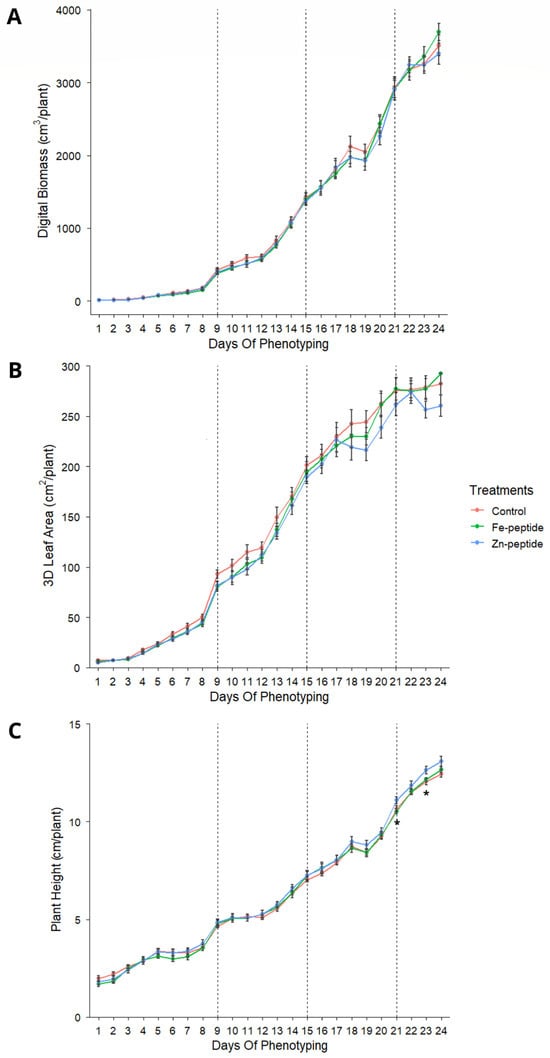
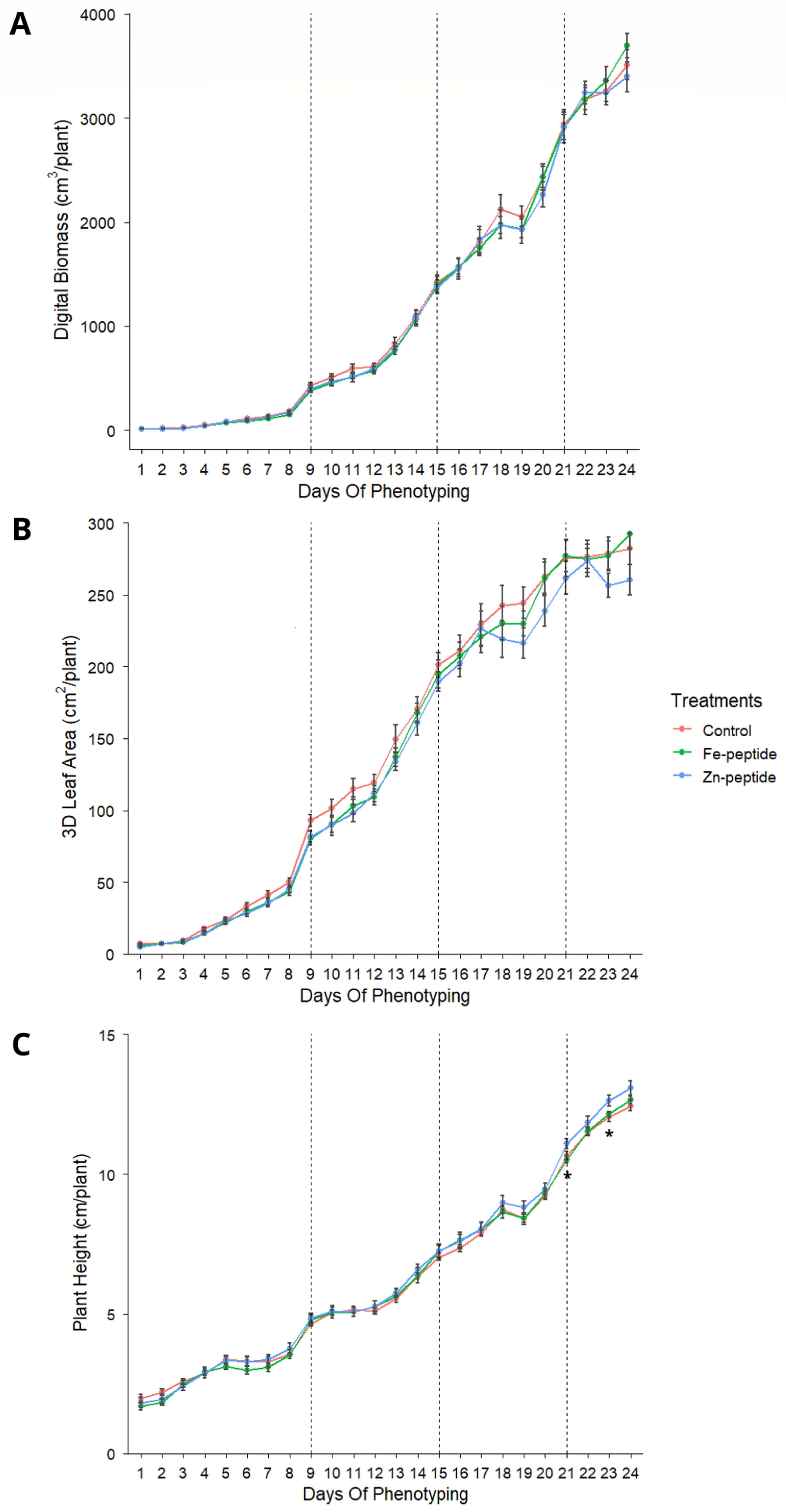
Morphological digital traits obtained by phenotyping platforms are reported in Figure 1. Digital Biomass and 3D Leaf Area were similar among treatments over the entire growing cycle. Significant differences were observed for Plant Height only at 21st and 23rd days of phenotyping (DOP); in both days, plants treated with Zn-peptide showed the highest values, whereas the lowest values on 21st DOP were observed in plants treated with Fe-peptide and intermediate values were observe in control plants, while on 23rd DOP, the lowest value was observed in control plants and an intermediate value was recorded in plants treated with Fe-peptide.
Figure 1.
Effect of biofortification treatments on Digital Biomass (A), 3D Leaf Area (B) and Plant Height (C) of lettuce plants from HortControl software (version n. 3.15.6) during the greenhouse experiment. Dashed black line (9th, 15th and 21st Days of Phenotyping, DOP) corresponds to days when foliar treatments were performed on hydroponically grown lettuce. * Significant at p ≤ 0.05. All data are expressed as mean ± standard error.
3.2. Lettuce Shoot Biomass
Fresh and dry weight, and dry matter content of lettuce shoots at the end of the trial are reported in Table 1, where no significant differences were observed among treatments.
Table 1.
Effect of biofortification treatments on fresh and dry biomass and dry matter of shoots in hydroponically grown lettuce.
3.3. Leaf Pigments, Antioxidant Activity and Nitrates
No significant differences were observed for total chlorophyll, carotenoids, ferric reducing antioxidant power (FRAP), total phenols and flavonoids (Table 2).
Table 2.
Effect of biofortification treatments on total chlorophyll, carotenoids, ferric reducing antioxidant power assay (FRAP), total phenols, flavonoids and nitrate concentration of leaves in hydroponically grown lettuce.
Significant differences were observed for nitrate concentrations in lettuce leaves, with the lowest values in the Zn-peptide treatment (Table 2).
3.4. Mineral Composition
Macro- and microelement and sodium concentrations in dry leaves are reported in Table 3 and Table 4, respectively. No significant differences were observed for macronutrient and sodium concentrations in lettuce leaves.
Table 3.
Effect of biofortification treatment on macronutrient concentration and sodium in leaves of hydroponically grown lettuce.
Table 4.
Effect of biofortification treatment on micronutrient concentrations in leaves of hydroponically grown lettuce.
Significant differences were observed for Fe, Zn and B concentrations in lettuce leaves (Table 4). Foliar applications of Fe-peptide significantly increased leaf Fe concentrations compared to control and Zn-peptide treatment; on the other hand, foliar applications of Zn-peptide significantly increased leaf Zn concentration in comparison with control and Fe-peptide treatment. Moreover, Zn-peptide treatment also increased the leaf B concentration with respect to Fe-peptide, while intermediate values were obtained in the control treatment. Manganese and Cu concentrations in lettuce leaves did not show significant differences among treatments.
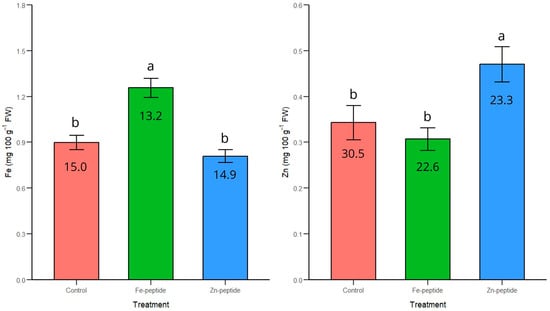
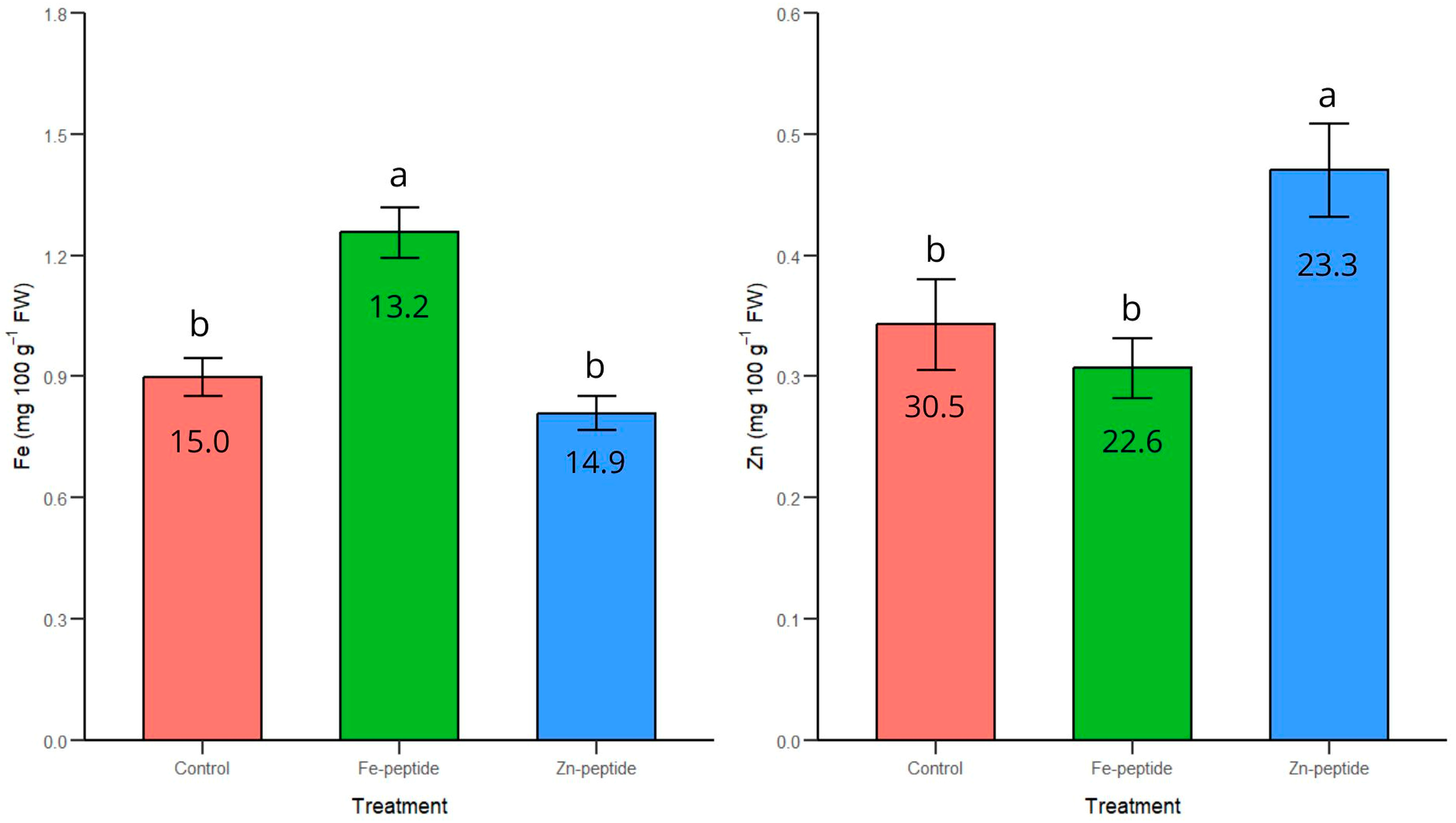
From a nutritional point of view, when leaf Fe and Zn concentrations were expressed as mg 100 g−1 FW, Fe and Zn exhibited the same overall trend observed in Table 4, as shown in Figure 2. Fe-peptide treatment increased the leaf Fe concentration (1.26 mg Fe 100 g−1 FW) compared to control and Zn-peptide treatments (0.90 and 0.81 mg Fe 100 g−1 FW, respectively), while Zn-peptide treatment enhanced leaf Zn concentration (0.47 mg Zn 100 g−1 FW) in comparison with control and Fe-peptide treatments (0.34 and 0.31 mg Zn 100 g−1 FW, respectively).
Figure 2.
Effect of biofortification treatment on Fe (left) and Zn (right) concentration of leaves in hydroponically grown lettuce expressed on a fresh weight basis. Different letters indicate significant differences according to Tukey’s test at p = 0.05. All data are expressed as mean ± standard error, and the coefficients of variation are reported below the error bars as percentages.
The estimated dietary intake (EDI) for Fe and Zn is reported in Table 5, together with Population Reference Intake (PRI), defined as the intake level of a nutrient that is sufficient to meet the requirements of all healthy individuals in a specific population group according to the European Food Safety Authority (EFSA).
Table 5.
Estimated dietary intake (EDI) resulting from the consumption of 100 g of fresh lettuce leaves treated with Fe- or Zn-peptide, Population Reference Intake (PRI) established by the European Food Safety Authority (EFSA), and EDI/PRI ratio for Fe and Zn.
As reported by EFSA, for adult males (≥18 years), the PRI for Fe and Zn was 11 and 14.2 mg d−1, respectively. Therefore, 100 g of Fe- and Zn-biofortified lettuce leaves can satisfy 11.5% and 3.3% of PRI for Fe and Zn, respectively. For adult females (≥18 years), EFSA reported two different PRI for Fe: 16 mg d−1 for premenopausal and 11 mg d−1 for postmenopausal; the PRI for Zn, instead, EFSA reported 11.9 mg d−1, without distinction of physiological categories. In the current study, 100 g of Fe-biofortified lettuce leaves can satisfy 8% and 11.5% of PRI for premenopausal and postmenopausal females respectively, while 100 g of Zn-biofortified lettuce leaves can satisfy 3.9% of PRI.
4. Discussion
For counteracting the global increase in human micronutrient deficiencies, agronomic biofortification represents one of the most effective and rapid strategy to enhance micronutrient concentrations in edible parts of leafy vegetables, especially for Fe and Zn, which represent 78.3% of total Disability-Adjusted Life Years (DALY) [3,4]. Salts and synthetic chelates are widely used in biofortification strategies, but their use is often associated with a yield penalty [12,13,14,18]. Furthermore, the use of synthetic chelates in agriculture causes environmental pollution and bioaccumulation in tissue, with negative consequences for human health [9,11]. In the current study, an agronomic biofortification trial was conducted to evaluate whether multiple foliar applications of two peptide-based fertilizers could enhance leaf Fe and Zn concentrations in lettuce grown under floating system.
The results clearly showed that peptide-based fertilizers enhanced the concentration of Fe and Zn in lettuce leaves with respect to the control treatment (+38.1% and +44.1%, respectively), without causing a yield penalty. This response may be related to the presence of peptides, which combine micronutrient chelating action with biostimulant effects, promoting leaf enrichment with Fe and Zn without compromising plant growth [22]. Moreover, leaf Zn concentration obtained in the current study (from 55.9 to 84.8 mg Zn kg−1 DW), being between 30 and 100 mg Zn kg−1 DW, was within the optimal concentration range for greenhouse lettuce [19]; in addition, leaf Zn concentration resulted from foliar applications of Zn-peptide-based biochelate was higher than leaf Zn concentration reported by Preciado-Rangel et al. [21] (up to 40 mg kg−1) obtained with foliar application of ZnSO4. Leaf Fe concentration observed in Fe-peptide treatment (214.94 mg Fe kg−1) was higher than leaf Fe concentrations reported in previous studies with synthetic chelates: 40.6 and 66.0 mg Fe kg−1 in green and red lettuce cultivars, respectively, by Giordano et al. [13], 157.9 mg Fe kg−1 by da Silva [12], and 159.3 mg Fe kg−1 DW by Brito et al. [10]. Furthermore, leaf Fe concentration in the Fe-peptide treatment (214.94 mg Fe kg−1) of the current study was within the optimal Fe range for lettuce leaves reported (168–223 mg Fe kg−1) by Bryson and Mills [34], while the leaf Fe concentrations in control and Zn-peptide treatment were below the leaf optimal range. The above findings indicated that peptide biochelates can promote optimal accumulation of Fe in leaf tissues without causing toxic effects.
During mineral absorption, antagonism and synergistic interactions may occur between minerals themselves [35]. As reported by Giordano et al. [13], lettuce plants grown in nutrient solution enriched with the highest concentration of Fe-EDDHA showed a significant increase in leaf P and Fe concentrations, whereas a decrease in leaf K, Ca and Mg concentrations was also recorded. On the contrary, Buturi et al. [14] reported an increase in leaf macro- (N, P, K, Ca, Mg and S) and micronutrients (Fe, Mn, Zn and B) when lettuce was grown in a nutrient solution enriched with growing rates of Fe-HBED. Preciado-Rangel et al. [20,21] reported that foliar applications of inorganic salts (FeSO4 and ZnSO4) changed the leaf mineral profile of N and P for FeSO4 treatment and P, K, Ca, Mg, Fe, Mn, Ni and Cu with ZnSO4 treatment in lettuce grown under NFT.
In the current study, foliar applications of Fe- and Zn-peptide fertilizers did not affect the leaf concentrations of macronutrients (N, P, K, Ca, Mg), Na, Cu and Mn; the above findings suggest that, under optimal root supply of mineral nutrients, peptide-based biochelates can enhance the target micronutrients, with limited changes in the overall mineral profile of lettuce leaves. Several authors observed an increase in leaf mineral concentrations after foliar/root applications of vegetal-protein hydrolysate-based products, highlighting the beneficial role of vegetal peptides in enhancing mineral uptake in lettuce crops through several mechanisms such as an increase in surface area of the plant’s root system, an enhancement of nutrient availability and a stimulation of nutrient transporter activity [36,37,38,39]. However, in the current trial, the peptide-based biochelates caused limited changes in the overall mineral profile of lettuce leaves as a result of the optimal nutrient supply at the root level.
The above findings highlight the importance of the right selection of fertilizer type, rate and mode of application (root vs. foliar) for maximizing biofortification of lettuce leaves without negative side effects on their mineral profile.
Lettuce is particularly appreciated for the higher fiber, vitamins, antioxidants and mineral content in leaves. From a nutritional point of view, it has been demonstrated that 100 g of fresh lettuce can contribute 15% of the human recommended intake of Fe (8–18 mg d−1 for adults) and 3% of Zn (8–11 mg d−1 for adults) [40]. Moreover, Puccinelli et al. [15] reported that 100 g of Zn-biofortified fresh lettuce shoots could provide 3.7–5.6% of the Population Reference Intake (PRI) for Zn. Similarly, Giordano et al. [13] reported that 100 g of Fe-biofortified fresh lettuce shoots contributed between 1.8 and 2.5% and 2.8–4.0% of the PRI for Fe in green and red lettuce cultivars, respectively. In the current study, the contribution of 100 g of Fe-biofortified fresh lettuce shoots to PRI was higher (between 8.0 and 11.5%) than the values reported by Giordano et al. [13], whereas the contribution of 100 g of Zn-biofortified fresh lettuce shoots to PRI was lower (between 3.3 and 3.9%) than that reported by Puccinelli et al. [15]. This discrepancy between the literature and the current findings is linked to the different leaf Fe and Zn concentrations in lettuce obtained with biofortification treatments.
Considering that the average leaf concentrations among treatments for N, P, Ca, Mg, Fe, Mn, Zn, Cu and B were within the optimal ranges for lettuce grown under greenhouse conditions [36], the Fe and Zn enrichment achieved in this study represents an effective strategy to improve the nutritional value of lettuce without compromising the availability of other macro and micronutrients for human dietary intake.
Leaf nitrate concentration is one key factor for lettuce marketability due to the impact of nitrates on human health [41]. In the current study, the nitrate concentrations in lettuce leaves were under the threshold (4000 mg NO3 kg−1 fresh weight) imposed by EC Regulation 1258/2011 (Regulation—1258/2011-EN-EUR-Lex, https://eur-lex.europa.eu/eli/reg/2011/1258/oj/eng, accessed on 10 February 2026) for lettuce cultivated in a greenhouse and harvested from 1 April to 30 September. Moreover, the nitrate concentrations in lettuce leaves treated with Zn-peptide were lower than those in the control and Fe-peptide treatments (−8.6% and −11.1%, respectively). Similarly, Barrameda-Medina et al. [16] observed a significant reduction in nitrate concentration in lettuce leaves when the Zn concentration in the nutrient solution was higher than 20 µmol L−1, and an increase in nitrate reductase activity and N metabolism was also observed under higher Zn supply. In the current study, the reduction in nitrate concentration in lettuce leaves after Zn-peptide foliar application may also be related to an enhancement in nitrate reductase activity.
Biofortification with synthetic chelates and salts may also induce oxidative stress and yield penalty. Buturi et al. [14] reported that biofortification with the synthetic chelate Fe-HBED led to a reduction in total lettuce dry biomass and an increase in oxidative stress indicators (O2−, proline, malondialdehyde) and enzymatic activity (ascorbate peroxidase, glutathione peroxidase, and catalase) associated with oxidative stress mitigation. Moreover, foliar application of salts (FeSO4 and ZnSO4) can also induce stress signaling in plants increasing antioxidant activity, total phenols and flavonoids in lettuce leaves as observed by Preciado-Rangel et al. [20,21]. In the current study, the lack of significant differences in antioxidants, chlorophyll and carotenoid concentration in lettuce leaves suggests that peptide-based biochelates, at the tested rates, did not induce oxidative stress response in lettuce leaves, preserving crop yield and leaf quality.
5. Conclusions
Our findings indicate that foliar applications of Fe- and Zn-peptides increased Fe and Zn concentration in lettuce leaves, without yield penalty, and maintained leaf mineral composition within the optimal range for greenhouse-grown lettuce. In all treatments, leaf nitrate concentration was below the limit imposed by the EU regulation, with a significant reduction in leaf nitrate concentration under Zn-peptide treatment. Overall, these findings suggest that peptide-based biochelates may represent promising fertilizers for lettuce biofortification in hydroponic systems, combining nutritional improvement and environmental sustainability enhancement.
Although promising, these findings represent the first step toward the use of peptide-based biochelates for lettuce biofortification, as Fe- and Zn-peptide fertilizers were evaluated separately. Future studies are necessary to explore the synergistic effects derived from the combined applications of Fe- and Zn-peptide to simultaneously increase Fe and Zn concentration in lettuce leaves. Furthermore, it will be interesting to compare the cost and effectiveness of peptide-based biochelates with traditional mineral fertilizers and synthetic chelates.
Supplementary Materials
The following supporting information can be downloaded at: https://www.mdpi.com/article/10.3390/horticulturae12070797/s1, Figure S1: Temperature (A), relative humidity (B), and solar radiation (C) registered hourly through the weather station located inside the greenhouse during the growing of lettuce plants; Table S1. Effect of biofortification treatments with peptide-based biochelates on leaf spectral index (chlorophylls, flavonols, anthocyanins and Nitrogen Flavonol Index or (NFI) of lettuce plants grown in a floating system.
Author Contributions
Conceptualization, G.C.; methodology, L.F., M.L., M.C., P.B. and G.C.; software, L.F., M.L. and G.C.; validation, L.F., M.L. and G.C.; formal analysis, L.F., M.L., P.B. and G.C.; investigation, L.F., M.L., M.C., P.B. and G.C.; resources, G.C.; data curation, L.F., M.L. and G.C.; writing—original draft preparation, L.F., M.L. and G.C.; writing—review and editing, L.F., M.L. and G.C.; visualization, G.C.; supervision, G.C.; project administration, G.C.; funding acquisition, G.C. All authors have read and agreed to the published version of the manuscript.
Funding
This work is part of the Ph.D. thesis of Leonardo Fiore at Tuscia University, and it was partially funded by PNRR DM 352/2022, Parco Scientifico e Tecnologico del Lazio.
Data Availability Statement
The data presented in this study are available on request from the corresponding author upon reasonable request.
Acknowledgments
The graphical abstract has been created in BioRender (https://BioRender.com). The last access was performed on 20 May 2026. The authors are grateful to Helene Reynaud, Director of R&D at Hello Nature USA, for providing the biochelate fertilizers (KeyLan Fe and KeyLan Zn).
Conflicts of Interest
Author Paolo Bonini was employed by oloBion S.L. while Marzia Leporino and Giuseppe Colla were employed by the Arcadia spin-off Company approved by the University of Tuscia. The remaining authors declare that the research was conducted in the absence of any commercial or financial relationships that could be construed as a potential conflict of interest. The authors declare that this study received funding from Hello Nature. The funder was not involved in the study design, collection, analysis, interpretation of data, the writing of this article, or the decision to submit it for publication.
References
- FAO. Food Security and Nutrition in the World Financing to End Hunger, in All Its Forms; FAO: Rome, Italy, 2024. [Google Scholar]
- Chitekwe, S.; Raj, K.; Naveen, P.; Courtney, K.; Andre, H.; Abukari, R.; Kingsley, I. Individual, Household and National Factors Associated with Iron, Vitamin A and Zinc Deficiencies among Children Aged 6–59 Months in Nepal. Matern. Child Nutr. 2022, 18, e13305. [Google Scholar] [CrossRef] [Scilit] [PubMed]
- van Ginkel, M.; Cherfas, J. What Is Wrong with Biofortification. Glob. Food Secur. 2023, 37, 100689. [Google Scholar] [CrossRef] [Scilit]
- Ashraf, S.A. Food Fortification as a Sustainable Global Strategy to Mitigate Micronutrient Deficiencies and Improve Public Health. Discov. Food 2025, 5, 201. [Google Scholar] [CrossRef] [Scilit]
- Imperio, M.D.; Montesano, F.F.; Santovito, E.; Parente, A.; Serio, F. Mineral Composition and Bioaccessibility in Rocket and Purslane after Zn Biofortification Process. Foods 2022, 11, 484. [Google Scholar] [PubMed]
- Pal, V.; Kaur, S.; Sharma, V.; Kaur, M.; Verma, G.; Sheoran, P.; Viliam, B.; Brestic, M.; Kabir, P.; Hossain, A. Agronomic Biofortification with Micronutrients: An Efficient Approach to Increase Nutritional Quality in Crops and Combat Hidden Hunger. J. Agric. Food Res. 2026, 25, 102465. [Google Scholar] [CrossRef] [Scilit]
- Afzal Ali, N.; Singha, S.; Mitra, S. Leafy Vegetables as a Significant Source of Minerals: Minerals Interaction with Plant Components, Effects of Processing and Their Potential Absorption. Trends Food Sci. Technol. 2025, 161, 105071. [Google Scholar] [CrossRef] [Scilit]
- Kailer, E.; Souza, P.; Daigh, A.L.M.; Kasuya, M.C.M.; da Silva, M.d.C.S.; Valadares, S.V.; Nick, C. Arbuscular Mycorrhizal Fungi Inoculation Inhibits Plant Zn Toxicity and Promotes Zn Biofortification for Lettuce (Lactuca sativa L.). Soil Sci. Soc. Am. J. 2025, 89, e70102. [Google Scholar] [CrossRef] [Scilit]
- Klem-Marciniak, E.; Huculak-Mączka, M.; Marecka, K.; Hoffmann, K.; Hoffmann, J. Chemical Stability of the Fertilizer Chelates Fe-EDDHA and Fe-EDDHSA over Time. Molecules 2021, 26, 1933. [Google Scholar] [CrossRef] [Scilit] [PubMed]
- Brito, G.S.; Cecílio Filho, A.B.; Pimentel, F.A.G.; Rossi, G.R.; do Nascimento Andrade, F.L.; Alves, D.P.; Humel Junior, A.R. Biofortification of Baby Leaf Lettuce with Iron and Zinc: Agronomic and Nutritional Impacts. Agriculture 2026, 16, 175. [Google Scholar] [CrossRef] [Scilit]
- Yin, F.; Li, J.; Wang, Y.; Yang, Z. Biodegradable Chelating Agents for Enhancing Phytoremediation: Mechanisms, Market Feasibility, and Future Studies. Ecotoxicol. Environ. Saf. 2024, 272, 116113. [Google Scholar] [CrossRef] [Scilit] [PubMed]
- da Silva, V.B.; Ribera, L.M.; Medelo, M.J.Y.; de Almeida, H.J.; Cecilio Filho, A.B. Effects of Fe and Zn on Growth, Biofortification and Quality of Lettuce Grown in Hydroponics Efeitos Do Fe e Zn No Crescimento, Bioforticação e Qualidade de Alface Cultivado Em Hidroponia. Rev. Caatinga 2024, 2125, e12187. [Google Scholar] [CrossRef] [Scilit]
- Giordano, M.; El-Nakhel, C.; Pannico, A.; Kyriacou, M.C.; Stazi, S.R.; De Pascale, S.; Rouphael, Y. Iron Biofortification of Red and Green Pigmented Lettuce in Closed Soilless Cultivation Impacts Crop Performance and Modulates Mineral and Bioactive Composition. Agronomy 2019, 9, 290. [Google Scholar] [CrossRef] [Scilit]
- Buturi, C.V.; Sabatino, L.; Mauro, R.P.; Navarro-le, E.; Blasco, B.; Leonardi, C.; Giuffrida, F. Iron Biofortification of Greenhouse Soilless Lettuce: An Effective Agronomic Tool to Improve the Dietary Mineral Intake. Agronomy 2022, 12, 1793. [Google Scholar] [CrossRef] [Scilit]
- Puccinelli, M.; De Padova, A.; Vernieri, P.; Carmassi, G.; Incrocci, L. Response of Aeroponically Cultivated Baby-Leaf Lettuce (Lactuca sativa L.) Plants with Different Zinc, Copper, Iodine, and Selenium Concentrations. Horticulturae 2024, 10, 726. [Google Scholar] [CrossRef] [Scilit]
- Barrameda-Medina, Y.; Lentini, M.; Esposito, S.; Ruiz, J.M.; Blasco, B. Zn-Biofortification Enhanced Nitrogen Metabolism and Photorespiration Process in Green Leafy Vegetable Lactuca sativa L. J. Sci. Food Agric. 2017, 97, 1828–1836. [Google Scholar] [CrossRef] [Scilit] [PubMed]
- de Lima, B.M.; Noboa, C.S.; de Lima, F.M.; da Costa Mello, S.; Villani Purquerio, L.F.; Sala, F.C. Agronomic Biofortification with Zinc in Hydroponically Cultivated Lettuce. Aust. J. Crop Sci. 2023, 17, 198–205. [Google Scholar] [CrossRef] [Scilit]
- Sago, Y.; Watanabe, N.; Minami, Y. Zinc Biofortification of Hydroponic Baby Leaf Lettuce Grown under Artificial Lighting with Elevated Wind Speed and Root Zone Temperature. J. Agric. Meteorol. 2018, 74, 173–177. [Google Scholar] [CrossRef] [Scilit]
- Stanton, C.; Sanders, D.; Krämer, U.; Podar, D. Zinc in Plants: Integrating Homeostasis and Biofortification. Mol. Plant 2022, 15, 65–85. [Google Scholar] [CrossRef] [Scilit] [PubMed]
- Preciado-Rangel, P.; Valenzuela-García, A.A.; Pérez-García, L.A.; González-Galas, U.; Ortiz-díaz, S.A.; Buendía-García, A.; y Rueda Puente, O.E. Foliar Biofortification with Iron Improves Nutraceutical Quality and Antioxidant Capacity in Lettuce. Terra Latinoam. 2022, 40, 1–7. [Google Scholar]
- Preciado-Rangel, P.; Campos-ortiz, A.; Sánchez-chávez, E.; Ojeda-barrios, D.; Hernandez-montiel, L.G.; Nacional, T.; Instituto, D.M.; Torreón, T. De Zinc Biofortification Improves Yield, Nutraceutical Quality and Antioxidant Capacity in Lettuce. Trop. Subtrop. Agroecosyst. 2021, 24, 1–10. [Google Scholar]
- Zuluaga, M.Y.A.; Cardarelli, M.; Rouphael, Y.; Cesco, S.; Pii, Y.; Colla, G. Iron Nutrition in Agriculture: From Synthetic Chelates to Biochelates. Sci. Hortic. 2023, 312, 111833. [Google Scholar] [CrossRef] [Scilit]
- Leporino, M.; Bonini, P.; Cardarelli, M.; Rouphael, Y.; Colla, G. Biochelate as an Eco-Friendly Alternative to Synthetic Chelate for Micronutrients Supply in Tomato Grown under Alkaline Conditions: A Multi-Omics Approach. Sci. Hortic. 2025, 346, 114166. [Google Scholar] [CrossRef] [Scilit]
- Fiore, L.; Cardarelli, M.; Ruzzi, M.; Ficca, A.G.; Rouphael, Y.; Luziatelli, F.; Colla, G. Do Plant Biostimulants Affect the Survival of Escherichia coli in Lettuce? Front. Plant Sci. 2024, 15, 1495463. [Google Scholar] [CrossRef] [Scilit] [PubMed]
- Lichtenthaler, H.K.; Wellburn, A.R. Determinations of Total Carotenoids and Chlorophylls a and b of Leaf Extracts in Different Solvents. Biochem. Soc. Trans. 1983, 11, 591–592. [Google Scholar] [CrossRef] [Scilit]
- Singleton, V.L.; Rossi, J.A. Colorimetry of Total Phenolics with Phosphomolybdic-Phosphotungstic Acid Reagents. Am. J. Enol. Vitic. 1965, 16, 144–158. [Google Scholar] [CrossRef] [Scilit]
- Jia, Z.; Tang, M.; Wu, J. The Determination of Flavonoid Contents in Mulberry and Their Scavenging Effects on Superoxide Radicals. Food Chem. 1999, 64, 555–559. [Google Scholar] [CrossRef] [Scilit]
- Benzie, I.F.F.; Strain, J.J. The Ferric Reducing Ability of Plasma (FRAP) as a Measure of ‘”Antioxidant Power”’: The FRAP Assay. Anal. Biochem. 1996, 239, 70–76. [Google Scholar] [CrossRef] [Scilit] [PubMed]
- Cataldo, D.A.; Haroon, M.H.; Schrader, L.E.; Youngs, V.L. Rapid Colorimetric Determination of Nitrate in Plant Tissue by Nitration of Salicylic Acid. Commun. Soil Sci. Plant Anal. 1975, 6, 71–80. [Google Scholar] [CrossRef] [Scilit]
- Bremner, J.M. Total Nitrogen; American Society of Agronomy: Madison, WI, USA, 1965; pp. 1149–1160. [Google Scholar]
- Tabatabai, M.A. Handbook of Reference Methods for Plant Analysis; CRC PRESS: Boca Raton, FL, USA, 1998; Volume 38. [Google Scholar]
- European Food Safety Authority. Draft Scientific Opinion on Dietary Reference Values for Iron; European Food Safety Authority: Parma, Italy, 2014. [Google Scholar]
- European Food Safety Authority. Draft Scientific Opinion on Dietary Reference Values for Zinc; European Food Safety Authority: Parma, Italy, 2014. [Google Scholar]
- Bryson, G.M.; Mills, H.A. Plant Analysis Handbook IV; Micro-Macro Publishing, Inc.: Athens, GA, USA, 2014. [Google Scholar]
- Kumar, S.; Santosh, K.; Mohapatra, T. Interaction Between Macro-and Micro-Nutrients in Plants. Front. Plant Sci. 2021, 12, 665583. [Google Scholar] [CrossRef] [Scilit] [PubMed]
- Cristofano, F.; El-Nakhel, C.; Pannico, A.; Giordano, M.; Colla, G.; Rouphael, Y. Foliar and Root Applications of Vegetal-Derived Protein Hydrolysates Differentially Enhance the Yield and Qualitative Attributes of Two Lettuce Cultivars Grown in Floating System. Agronomy 2021, 11, 1194. [Google Scholar] [CrossRef] [Scilit]
- Carillo, P.; De Micco, V.; Ciriello, M.; Formisano, L.; El-Nakhel, C.; Giordano, M.; Colla, G.; Rouphael, Y. Morpho-Anatomical, Physiological, and Mineral Composition Responses Induced by a Vegetal-Based Biostimulant at Three Rates of Foliar Application in Greenhouse Lettuce. Plants 2022, 11, 2030. [Google Scholar] [CrossRef] [Scilit] [PubMed]
- Choi, S.; Colla, G.; Cardarelli, M.; Kim, H.-J. Effects of Plant-Derived Protein Hydrolysates on Yield, Quality, and Nitrogen Use Efficiency of Greenhouse Grown Lettuce and Tomato. Agronomy 2022, 12, 1018. [Google Scholar] [CrossRef] [Scilit]
- Cristofano, F.; El-Nakhel, C.; Colla, G.; Cardarelli, M.; Pii, Y.; Lucini, L.; Rouphael, Y. Tracking the Biostimulatory Effect of Fractions from a Commercial Plant Protein Hydrolysate in Greenhouse-Grown Lettuce. Antioxidants 2022, 12, 107. [Google Scholar] [CrossRef] [Scilit] [PubMed]
- Kim, M.J.; Moon, Y.; Tou, J.C.; Mou, B.; Waterland, N.L. Nutritional Value, Bioactive Compounds and Health Benefits of Lettuce (Lactuca sativa L.). J. Food Compos. Anal. 2016, 49, 19–34. [Google Scholar] [CrossRef] [Scilit]
- Afton, W.D.; Fontenot, K.K.; Kuehny, J.S.; Motsenbocker, C.E. Evaluation of Yield, Marketability, and Nitrate Levels of Lettuce Cultivars Produced in Southern Louisiana. HortTechnology 2020, 30, 632–637. [Google Scholar] [CrossRef] [Scilit]

Disclaimer/Publisher’s Note: The statements, opinions and data contained in all publications are solely those of the individual author(s) and contributor(s) and not of MDPI and/or the editor(s). MDPI and/or the editor(s) disclaim responsibility for any injury to people or property resulting from any ideas, methods, instructions or products referred to in the content. |
© 2026 by the authors. Licensee MDPI, Basel, Switzerland. This article is an open access article distributed under the terms and conditions of the Creative Commons Attribution (CC BY) license.