


Abstract
Actinidia eriantha is an endemic kiwifruit species in China with high nutritional value and breeding potential. As a typical dioecious fruit tree, most currently bred cultivars are female, while the development of male pollinizer cultivars remains insufficiently studied and reported. Through long-term collection and evaluation of wild germplasm resources, our research team bred a male cultivar ‘Ganxiong 1’ with both ornamental and pollination value. In this study, the phenological traits, floral characteristics, major biological traits, ploidy levels, and genetic diversity of ‘Ganxiong 1’ were systematically analyzed and compared with those of the commonly used pollinizer ‘Moshan 4’. The results showed that ‘Ganxiong 1’ exhibited stable genetic traits, with branch bleeding occurring in late February and flowering in early May, highly overlapping with the flowering period of most female A. eriantha cultivars. It produced bright red flowers arranged in false dichasial cymes, showing high ornamental value. The average number of anthers per flower was 140.24, and the number of pollen grains per anther reached 8.57 × 10⁴, with a pollen viability of 97.64% and a pollen tube length of 127.25 μm, indicating strong pollination potential. Ploidy and SSR analyses revealed that ‘Ganxiong 1’ is a diploid cultivar and is genetically distinct from previously reported A. eriantha cultivars at the DNA level. Regarding pollination effects, the fruit set rate, single fruit weight, seed number, SSC, and AsA content of ‘Ganlv 1’ fruits pollinated with ‘Ganxiong 1’ were significantly higher than those pollinated with ‘Moshan 4’, while the TA content was significantly lower than that of ‘Moshan 4’ pollination. In conclusion, ‘Ganxiong 1’ exhibits high stability and distinctiveness in phenological, morphological, cytological, and genetic characteristics. It can be considered a new ornamental and pollination dual-purpose cultivar of A. eriantha and provides an important parental resource for kiwifruit breeding programs.
1. Introduction
Kiwifruit belongs to the family Actinidiaceae and the genus Actinidia and is a perennial deciduous vine fruit crop [1]. Currently, the genus Actinidia comprises 54 species and 21 varieties worldwide [2]. Actinidia eriantha, an important kiwifruit species endemic to China, is characterized by strong stress resistance [3,4], high ascorbic acid content, and easy peelability [5]. It is widely distributed in Jiangxi, Zhejiang, Fujian, and Hunan provinces [6] and represents a promising berry crop following A. chinensis var. chinensis and A. chinensis var. deliciosa. Moreover, abundant wild germplasm resources of A. eriantha are available in China [7].
Kiwifruit is a dioecious species, requiring compatible male plants for effective pollination in commercial production. However, most cultivated cultivars are female, including large-fruited ‘white’ [8], easy-peeling ‘Ganmi 6’ [9], sweet-flavored ‘Ganlv 1’ [10], and early-maturing ‘Ganlv 2’ [11], whereas breeding studies on male pollinizers of A. eriantha remain limited. In practice, artificial-assisted pollination is essential for achieving high yield and fruit quality. At present, the female cultivars of A. eriantha are mainly pollinated using A. chinensis var. chinensis ‘Moshan 4’ [12]. Nevertheless, this pollination system often results in low fruit set and suboptimal fruit quality [13].
Jiangxi Province possesses abundant wild germplasm resources of A. eriantha [14], providing valuable opportunities for the selection and breeding of suitable male genotypes. During long-term surveys and germplasm collection in mountainous regions of Jiangxi Province, our research team identified 274 wild male accessions and preserved 16 excellent genotypes through grafting [6]. Among them, a male accession designated ‘Ganxiong 1’ (code ‘MG-15’) was discovered at an altitude of 872 m in Nancheng County, Fuzhou City, Jiangxi Province. This accession exhibited abundant inflorescences, a large number of flowers, and bright red petals. Scions were collected from the original plant and vegetatively propagated for cultivar development.
Simple sequence repeat (SSR) markers, also known as microsatellite markers, are tandem repeat sequences composed of 1–6 nucleotide motifs that are widely distributed throughout the genome [15]. Due to their high polymorphism, co-dominant inheritance, good reproducibility, and ease of operation, SSR markers have become one of the most widely used molecular markers in genetic studies [16,17]. In recent years, SSR markers have been extensively applied in genetic diversity analysis, germplasm evaluation, and cultivar identification in fruit crops [18,19,20]. Furthermore, they have been widely used in population genetic studies, contributing to the conservation of valuable gene pools in natural ecosystems and the identification of spontaneous hybridization events [21]. In addition, SSR markers can be used to construct DNA fingerprinting profiles, enabling the detection of genetic variation among materials at the molecular level and providing reliable evidence for the identification of new cultivars [11]. Currently, multiple highly polymorphic SSR markers have been developed in A. eriantha [22], which can be effectively used for germplasm identification and genetic diversity analysis.
Ploidy is an important genetic characteristic in plants and exhibits considerable variation in kiwifruit, where diploid, tetraploid, and even higher ploidy levels have been reported among different species and cultivars [23,24]. However, A. eriantha has predominantly been reported as diploid [6]. Ploidy level is closely associated with plant vigor, organ size, flowering and fruiting capacity, and stress resistance, and plays an important role in fruit size, quality formation, and breeding utilization. In kiwifruit breeding, ploidy not only affects the formation of male and female gametes and the fertilization process, but also directly influences pollination compatibility and hybridization efficiency [25], making it a key factor in breeding strategies. For male plants, ploidy level may also affect pollen viability, pollen tube growth, and pollination performance, thereby influencing fruit set and quality [13]. Therefore, determination of ploidy in newly selected male germplasm is essential not only for comprehensive evaluation of its biological characteristics but also for its effective utilization in production and breeding programs.
In this study, distinctness, uniformity, and stability (DUS) tests were conducted from 2022 to 2024 using ‘Moshan 4’ as a reference cultivar. Phenological observations, botanical characterization, ploidy determination, and SSR analysis were performed to establish a DNA fingerprint profile. The results of this study enrich the cultivar structure of A. eriantha and provide valuable materials for investigating the mechanisms underlying pollen-related traits.
2. Materials and Methods
2.1. Materials
The experiment was conducted at the kiwifruit germplasm repository in Fengxin County, Jiangxi Province, China. Six healthy and uniformly growing plants of ‘Ganxiong 1’ and six of ‘Moshan 4’ were selected as experimental materials; two vines were used as one biological replicate. Given that ‘Moshan 4’ is widely used for pollination in A. eriantha production [12], it was selected as a reference cultivar. All vines were grafted onto 8-year-old A. chinensis var. deliciosa ‘Miliang 1’ rootstocks.
2.2. Phenological Observations
Phenological observations were conducted throughout the growing season to record the key developmental stages of kiwifruit. A phenological stage was defined when more than 50% of buds or organs on the whole plant reached the corresponding morphological characteristics. The branch bleeding stage was identified by the appearance of visible sap exudation from pruning cuts or branch wounds in early spring. The bud break stage was recorded when buds swelled, scales split, and green tissues became visible. The leaf expansion stage was defined by the unfolding and expansion of young leaves on newly developed shoots. The start time of flowering was determined when approximately 20% of flowers were open. The time of full flowering was recorded when more than 50% of flowers were open. The time of full flowering was defined by the shedding of most petals and a marked decline in open flowers. The leaf fall stage was recorded when more than 50% of leaves had abscised.
2.3. Assessment of Biological Traits
The biological characteristics of ‘Ganxiong 1’ and ‘Moshan 4’ were evaluated with modifications based on previously reported methods [11,26,27]. Three biological replicates were included for each cultivar. For branch traits, ten one-year-old healthy branches were randomly selected per replicate for each cultivar. Branch diameter was measured at the midpoint of each branch using a digital caliper (INSIZE Co., Ltd., Suzhou, China), and internode length was determined as the average length between adjacent nodes. For leaf traits, fifteen fully expanded, healthy, and pest-free leaves were randomly sampled per replicate for each cultivar. Leaf morphological characteristics, including shape and color, were visually assessed, while leaf size parameters (length and width) were measured using a ruler. For floral traits, thirty flowers at full bloom were randomly collected per replicate for each cultivar. Inflorescence type, petal arrangement, and the color of petals, filaments, and anthers were recorded based on visual observation. Corolla diameter was measured using a digital caliper.
2.4. Ploidy Determination
Ploidy determination was performed using a CyFlow Cube flow cytometer (Sysmex, Hamburg, Germany) with minor modifications based on a previously reported method [11]. Approximately 0.5 cm2 of fresh leaf tip tissue was excised and finely chopped with a sharp razor blade in the presence of polyvinylpyrrolidone (PVP) powder to prevent oxidation. The nuclei were then released by adding extraction buffer, followed by staining solution. After incubation in the dark for 2 min, the suspension was filtered through a nylon mesh into a sample tube for analysis. Flow cytometric analysis was conducted to determine nuclear DNA content. During measurement, ‘Hongyang’ (diploid), ‘Jinyan’ (tetraploid), and ‘Jinkui’ (hexaploid) [23] were used as internal standards to calibrate instrument settings, including voltage and flow rate. Based on the relative fluorescence intensity, the ploidy levels of ‘Ganxiong 1’ and ‘Moshan 4’ were determined.
2.5. Determination of Pollen Viability and Pollen Number per Anther
Flower buds of ‘Ganxiong 1’ and ‘Moshan 4’ at the pre-anthesis stage were collected, and the anthers were manually removed and incubated at 25 °C in a growth chamber to allow pollen release [13]. The released pollen grains were collected and subjected to viability assessment using the Alexander staining method [28]. For the determination of pollen grains per anther, pollen released from 50 anthers was collected and counted under a light microscope. For both pollen viability and pollen number per anther, five randomly selected microscopic fields were examined for each biological replicate.
2.6. Simple Sequence Repeat (SSR) Analysis
Young leaf samples were collected from A. eriantha cultivars ‘Ganxiong 1’, ‘Moshan 4’, and the previously reported cultivar ‘White’ [8], ‘Ganmi 6’ [9], ‘Ganlv 1’ [10], and ‘Ganlv 2’ [11]. Genomic DNA was extracted using the CTAB method. After quality assessment, the extracted DNA was diluted to 150 ng/μL and used as the template for SSR-PCR amplification. Based on the primers previously screened for A. eriantha germplasm identification (Table 1) [22], the reaction system and gel preparation were carried out following the methods described in previous studies [16,18,22]. The SSR profiles presented in this study were generated using a previously established dataset comprising 96 kiwifruit accessions, which includes the six cultivars analyzed in this study. PCR products were separated by non-denaturing polyacrylamide gel electrophoresis, and bands were visualized using silver staining. Each SSR primer amplified multiple loci in the genome, generating several bands. Only bands within the expected size range were manually scored as presence (1) or absence (0), and a binary matrix was constructed based on the banding patterns. The binary data from all primers were integrated to construct DNA fingerprint profiles for each cultivar.
Table 1.
Primers were used for SSR analysis. The fragment size ranges were based on previously reported studies [22].
2.7. Fruit Quality Analysis After Pollination
Six uniform, disease- and pest-free vines of the new A. eriantha cultivar ‘Ganlv 1’ was used for the pollination experiment, with every two plants considered as one biological replicate. For pollination, 60 flowers at the bud stage were selected from each vine. Using the spot pollination method, 30 flowers per tree were pollinated with pollen from ‘Ganxiong 1’ and the other 30 with pollen from ‘Moshan 4’. Immediately after pollination, the flowers were covered with pollination bags [13]. The fruit set rate was recorded 30 d after pollination. Fruits were harvested when they reached physiological maturity (soluble solids content (SSC) > 6.5%) [6] and were placed to soften at room temperature before quality evaluation. Single fruit weight was measured using a digital balance. Each fruit was cut transversely at the equator, and the number of seeds in the transverse section was manually counted. The SSC was determined using a digital refractometer (ATAGO, Tokyo, Japan). Dry matter content (DM) was measured by the drying method [26], thin slices of equatorial flesh were dried at 65 °C to constant weight, and dry matter content was expressed as the ratio of dry weight to fresh weight. Total soluble sugar content (TS) was determined by the anthrone colorimetric method, titratable acidity (TA) by NaOH titration [29], and ascorbic acid (AsA) content by the 2,6-dichlorophenolindophenol titration method [26].
2.8. Statistical Analysis
All experiments were conducted using three independent biological replicates. Statistical significance was analyzed by t-test using SPSS IBM v19 software.
3. Results
3.1. Phenological Periods
In Fengxin County, Jiangxi Province, both ‘Ganxiong 1’ and ‘Moshan 4’ exhibited the branch bleeding stage in late February. Bud break and leaf expansion of ‘Ganxiong 1’ occurred later than those of ‘Moshan 4’, taking place in mid-March and late March, respectively. Flowering of ‘Ganxiong 1’ was also delayed compared with ‘Moshan 4’, with the flowering period extending from early May to mid-May and lasting for 12–15 d. The flowering period of ‘Ganxiong 1’ coincides with that of most female plants of the A. eriantha cultivars, such as ‘White’ [8], ‘Ganlv 1’ [10] and ‘Ganlv 2’ [11]. Leaf fall of both cultivars occurred in late November. Based on continuous observations over three consecutive years, the phenological stages of ‘Ganxiong 1’ and ‘Moshan 4’ were relatively stable, with only minor variations through the years within the same cultivar (Table 2).
Table 2.
The phenological periods of ‘Ganxiong 1’ and ‘Moshan 4’ (Month/Day-Day, in Fengxin, Jiangxi province, China).
3.2. Floral Organ Traits and Pollen Characteristics
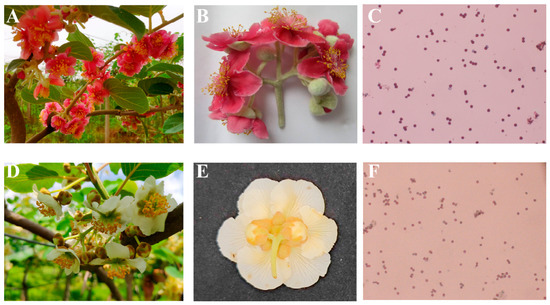
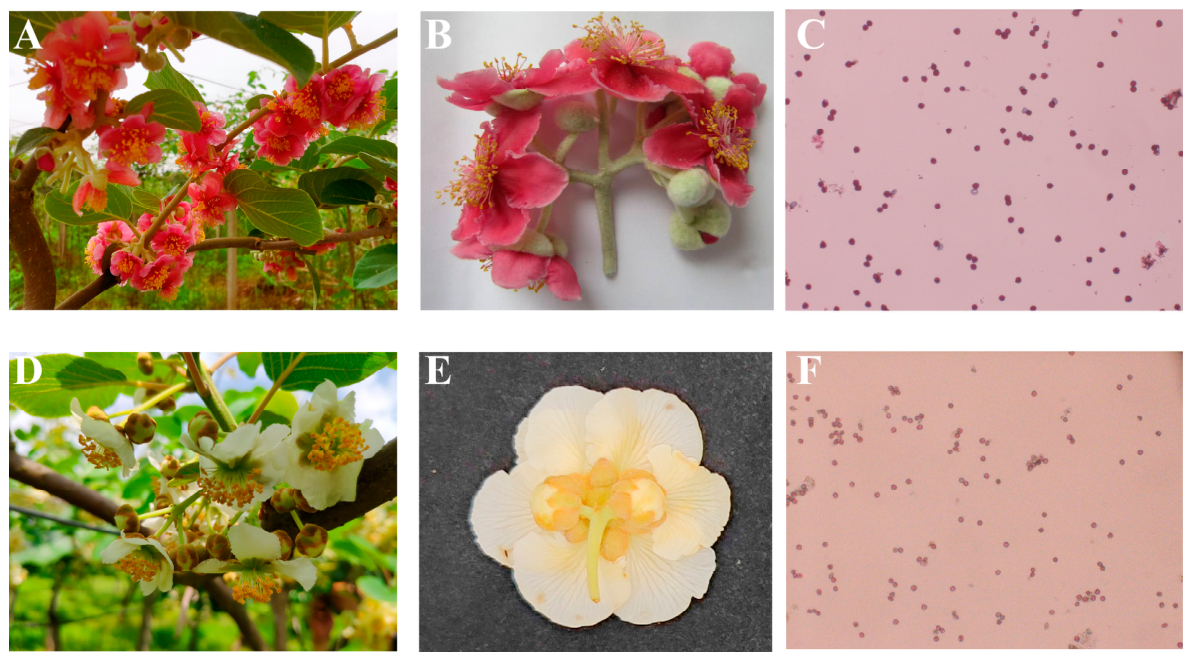
‘Ganxiong 1’ and ‘Moshan 4’ exhibited pronounced differences in floral organ traits. The most notable distinction was that ‘Ganxiong 1’ produced red flowers arranged in a false dichasial cyme (Figure 1A,B, Table 3), whereas ‘Moshan 4’ bore white flowers and formed a polychasial cyme (Figure 1D,E, Table 3). In addition, the number of anthers per flower and the number of pollen grains per anther were significantly higher in ‘Ganxiong 1’ than in ‘Moshan 4’ (Table 3). Conversely, pollen tube length was significantly shorter in ‘Ganxiong 1’, while no significant difference in pollen viability was observed between the two genotypes (Figure 1C,F, Table 3).
Figure 1.
Comparison of floral organ traits between ‘Ganxiong 1’ and ‘Moshan 4’. (A–C) Flower, inflorescence, and pollen viability assay of ‘Ganxiong 1’. (D–F) Flower, inflorescence, and pollen viability assay of ‘Moshan 4’. In (C,F), circular particles represent pollen grains, and only the red-stained pollen grains indicate viable pollen.
Table 3.
The flower characters of ‘Ganxiong 1’ and ‘Moshan 4’. Values are presented as mean ± SD. Different lowercase letters within the same trait indicate significant differences between cultivars at p < 0.05.
3.3. Assessment of Major Biological Traits
Based on multi-year observations of the biological characteristics of ‘Ganxiong 1’ (Table 4), both ‘Ganxiong 1’ and ‘Moshan 4’ exhibited dark green leaves. However, leaf shape differed markedly between the two cultivars, with ‘Ganxiong 1’ showing a broadly ovate leaf shape, whereas ‘Moshan 4’ displayed a subovate leaf shape. Leaf length and leaf width of ‘Ganxiong 1’ were significantly greater than those of ‘Moshan 4’. In contrast, the diameter of the annual branch, internode length of the annual branch, and corolla diameter were all smaller in ‘Ganxiong 1’ than in ‘Moshan 4’. In addition, both petals and filaments of ‘Ganxiong 1’ were pink, while ‘Moshan 4’ had white petals and green filaments. Anthers were yellow in both cultivars.
Table 4.
The biological traits of ‘Ganxiong 1’ and ‘Moshan 4’. Values are presented as mean ± SD based on observations recorded from 2022 to 2024. Different lowercase letters within the same trait indicate significant differences between cultivars at p < 0.05.
3.4. Ploidy Analysis
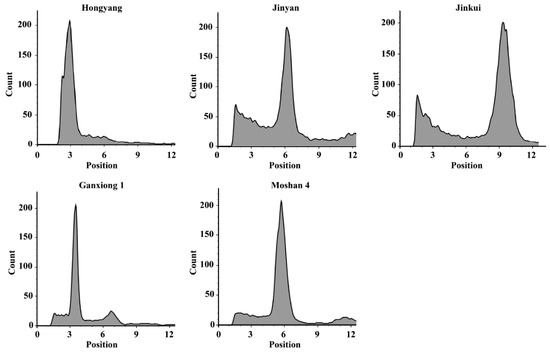
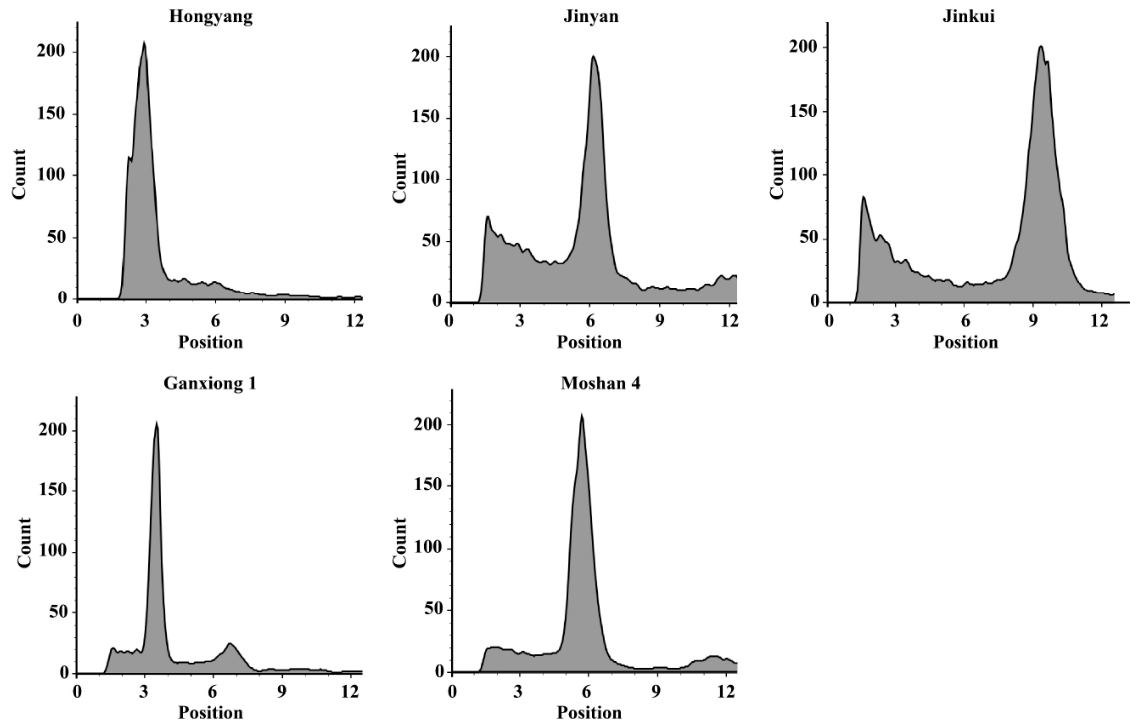
Diploid ‘Hongyang’, tetraploid ‘Jinyan’, and hexaploid ‘Jinkui’, with known ploidy levels, were used as reference controls to determine the ploidy of ‘Ganxiong 1’ and ‘Moshan 4’. The peak position of ‘Ganxiong 1’ was consistent with that of ‘Hongyang’, whereas that of ‘Moshan 4’ corresponded to ‘Jinyan’ (Figure 2). Therefore, ‘Ganxiong 1’ and ‘Moshan 4’ were identified as diploid and tetraploid, respectively.
Figure 2.
Flow cytometry was used to determine the ploidy levels of ‘Ganxiong 1’ and ‘Moshan 4’. The y-axis represents the number of detected nuclei, and the x-axis indicates the DNA content peak position. When the diploid peak is located at 3, the corresponding peaks of tetraploid and hexaploid are observed at 6 and 9, respectively.
3.5. DNA Molecular Fingerprint Construction
DNA molecular fingerprints of ‘Ganxiong 1’, ‘Moshan 4’, and several previously reported A. eriantha cultivars were constructed using SSR markers. The results showed that four primer pairs were sufficient to effectively discriminate among these cultivars, revealing clear genetic differences at the DNA level (Table 5, Supplementary Materials S1). These findings indicate that ‘Ganxiong 1’ is genetically distinct from previously reported A. eriantha cultivars and can therefore be considered a novel A. eriantha cultivar.
Table 5.
DNA fingerprint profiles of ‘Ganxiong 1’ and several previously reported A. eriantha cultivars. Banding patterns were scored by manual inspection, where “1” indicates the presence of a band at a given locus and “0” indicates its absence.
3.6. Effects of Pollination with ‘Ganxiong 1’ and ‘Moshan 4’ on Main Economic Indicators of Fruit
The main economic indicators at the fruit ripe stage were measured after pollinating A. eriantha ‘Ganlv 1’ with pollen from ‘Ganxiong 1’ and ‘Moshan 4’. The results showed that compared with ‘Moshan 4’, pollination with ‘Ganxiong 1’ significantly increased fruit set rate, single fruit weight, number of seeds in transverse section, SSC and AsA content by 9.10%, 15.36%, 73.13%, 11.27%, and 3.49%, respectively (Table 6). The TA content of fruits pollinated with ‘Ganxiong 1’ was significantly decreased by 38.58% compared with that of fruits pollinated with ‘Moshan 4’.
Table 6.
Determination of the main economic indicators of fruit after pollination of ‘Ganlv 1’ with ‘Ganxiong 1’ and ‘Moshan 4’. SSC, soluble solids content; DM, dry matter content; TS, soluble sugar content; TA, titratable acidity content; AsA, ascorbic acid. Values are presented as mean ± SD. Different lowercase letters within the same trait indicate significant differences between cultivars at p < 0.05.
4. Discussion
The selection of male genotypes is one of the key breeding objectives for the sustainable development of the kiwifruit industry [30,31]. In this study, aiming to address the limitations in the breeding system of male plants in A. eriantha, ‘Ganxiong 1’ was systematically evaluated through three consecutive years of DUS testing, ploidy analysis, and SSR marker identification at the phenotypic, cytological, and molecular levels. The results indicated that ‘Ganxiong 1’ exhibited high consistency in key traits, including floral morphology, phenological characteristics, and growth performance, and showed no obvious environment-induced variation, suggesting a stable genetic basis for its traits [32]. Furthermore, SSR fingerprinting confirmed its genetic distinctness from existing cultivars, suggesting that this genotype may retain unique allelic variations derived from wild germplasm and possesses an important genetic foundation for cultivar development [19,33]. Although four polymorphic SSR primer pairs were selected in this study, this number was sufficient to distinguish ‘Ganxiong 1’ from other kiwifruit cultivars. Future research should employ more precise molecular markers, e.g., SNPs, to enable a finer-resolution assessment of DNA-level variation. Therefore, these findings not only provide reliable molecular evidence for cultivar registration and protection but also offer valuable materials for elucidating the genetic mechanisms underlying male-related traits in A. eriantha.
Compared with the commonly used pollinizer ‘Moshan 4’, ‘Ganxiong 1’ originated from wild A. eriantha germplasm and exhibits a closer genetic relationship with A. eriantha cultivated varieties, which may confer potential advantages in flowering characteristics and pollination compatibility [34]. Previous studies have indicated that interspecific or distantly related pollination may, to some extent, affect fruit set and fruit quality stability, whereas intraspecific or closely related pollination is more conducive to improving pollination efficiency and fruit development [13,35]. Therefore, as a specialized male cultivar, ‘Ganxiong 1’ is expected to show high compatibility in pollen germination, pollen tube growth, and fertilization efficiency [36]. This may help alleviate the problems of low pollination efficiency and unstable fruit quality in A. eriantha production and support the establishment of an optimized pollination system [37].
Consistent with previous reports [13], fruits pollinated by A. eriantha male genotypes tend to exhibit higher AsA content compared with those pollinated by A. chinensis. This may be related to the intrinsic genetic background of A. eriantha, which is associated with enhanced AsA biosynthesis or accumulation capacity [38], although the underlying mechanism requires further investigation. In addition, the differences in pollination performance between ‘Ganxiong 1’ and ‘Moshan 4’ may also be associated with their ploidy levels. ‘Moshan 4’ is a tetraploid genotype, and its pollination with diploid female plants may lead to ploidy imbalance and the formation of triploid embryos, which could adversely affect seed development and fertilization efficiency [23,25]. This is supported by the observed lower seed number and poorer seed development in fruits pollinated by ‘Moshan 4’. In contrast, ‘Ganxiong 1’, as a diploid genotype, is more compatible in terms of ploidy, which may contribute to improved fertilization success and better fruit development.
From the perspectives of production application and comprehensive utilization, ‘Ganxiong 1’ is characterized by abundant flowering, bright red petals, and outstanding ornamental value, integrating ecological landscape functions with productive advantages and showing promising potential in orchard landscaping and agro-tourism development [39]. Meanwhile, its stable performance and strong adaptability indicate good prospects for large-scale application [40]. This cultivar can serve as a high-quality pollinizer for commercial A. eriantha orchards, helping to reduce reliance on artificially assisted pollination and improve production efficiency [41]. In addition, ‘Ganxiong 1’ provides valuable experimental material for studies on pollen development, pollination compatibility, and related molecular regulatory mechanisms [36]. Future research integrating transcriptomics, metabolomics [42], epigenetic analyses, and functional gene validation will help to systematically elucidate the formation mechanisms of its pollination and ornamental traits [43], thereby laying a solid theoretical foundation for the improvement of male breeding systems and the sustainable development of the kiwifruit industry.
In addition to its use as a pollen donor, the potential for vegetative propagation of ‘Ganxiong 1’ may further enhance its application value. Vegetative propagation methods, including cutting, grafting, and tissue culture, are widely used in woody perennial species to ensure clonal fidelity and rapid multiplication of elite genotypes. For instance, micropropagation and in vitro culture have been successfully applied in various fruit crops to facilitate large-scale propagation and germplasm conservation [44,45]. Therefore, future studies could explore the feasibility of vegetative propagation of ‘Ganxiong 1’ to support its wider utilization in kiwifruit production systems.
5. Conclusions
In this study, the phenological characteristics, floral traits, major biological features, ploidy level, and genetic diversity of ‘Ganxiong 1’ were systematically investigated and compared with those of ‘Moshan 4’. The results indicated that ‘Ganxiong 1’ exhibited stable phenological performance with delayed bud break and flowering, distinctive red flowers arranged in false dichasial cymes, and pollen-production capacity. In addition, ‘Ganxiong 1’ showed broader ovate leaves and relatively smaller branch diameter, internode length, and corolla diameter. Cytological analysis identified ‘Ganxiong 1’ as a diploid cultivar. Furthermore, SSR marker analysis revealed clear genetic differentiation between ‘Ganxiong 1’ and previously reported A. eriantha cultivars. Compared with ‘Moshan 4’, pollination of ‘Ganlv 1’ with ‘Ganxiong 1’ resulted in a higher fruit set rate, single fruit weight, seed number, SSC, and AsA content. However, the TA content of the fruit was significantly lower than that of ‘Moshan 4’, while there were no significant differences in DM and TS. Therefore, these results confirm that ‘Ganxiong 1’ is a genetically stable and distinct cultivar. The findings provide a scientific basis for its official registration, germplasm protection, and further utilization in A. eriantha breeding and genetic improvement programs.
Supplementary Materials
The following supporting information can be downloaded at: https://www.mdpi.com/article/10.3390/horticulturae12050546/s1.
Author Contributions
G.L. drafted the initial version of the manuscript. C.H. and M.Z. assisted with phenological observations. D.J. contributed to botanical characteristic assessments and ploidy analysis. L.W. conducted SSR analysis and constructed DNA fingerprint profiles. X.X. and G.L. revised the manuscript. All authors have read and agreed to the published version of the manuscript.
Funding
This work was supported by the Jiangxi Provincial Key Research and Development Program (grant number 20261BCF320034), the Jiangxi Outstanding Youth Fund Project (grant number 20252BAC220042), and the National Natural Science Foundation of China Youth Science Foundation (Category C) (grant number 32302490).
Data Availability Statement
The original contributions presented in this study are included in the article/Supplementary Materials. Further inquiries can be directed to the corresponding authors.
Acknowledgments
We thank Guiqing Tu from Fengxin County Modern Agricultural Technology Service Center for managing experimental plants. We also acknowledge the assistance of ChatGPT (OpenAI, GPT-5.3-mini) for English language polishing of the Abstract, Introduction, Results, and Discussion Sections of the manuscript.
Conflicts of Interest
The authors declare no conflicts of interest.
References
- Qi, X.J.; Guo, D.D.; Wang, R.; Zhong, Y.P.; Fang, J.B. Development status and suggestions on Chinese kiwifruit industry. J. Fruit Sci. 2020, 37, 754–763. [Google Scholar] [CrossRef]
- Huang, H.W. Classification, Resources, Domestication, and Cultivation of Actinidia; Science Press: Beijing, China, 2013. [Google Scholar]
- Bovio-Zenteno, E.M.; Jia, T.J.; Nazir, M.F.; Dai, L.Y.; Xu, J.; Zhao, Y.F.; Zou, S.Y.; Huang, H.W. Physiological, biochemical and molecular regulatory mechanisms of kiwifruit responses to heat stress: A review and future perspectives. Plant Stress 2026, 19, 101209. [Google Scholar] [CrossRef] [Scilit]
- Ling, C.C.; Yang, J.; Xu, J.L.; Tang, W.; Liu, Y.Y.; Wang, Y.Z.; Li, P.W.; He, Y.; Ouyang, Z.Y.; Chen, S.Q.; et al. Natural variation of AcEGY3 mediates chloroplastic ROS homeostasis to confer kiwifruit thermotolerance. Nat. Commun. 2025, 16, 6184. [Google Scholar] [CrossRef] [Scilit]
- Yao, X.H.; Wang, S.B.; Wang, Z.P.; Li, D.W.; Jiang, Q.; Zhang, Q.; Gao, L.; Zhong, C.H.; Huang, H.W.; Liu, Y.F. The genome sequencing and comparative analysis of a wild kiwifruit Actinidia eriantha. Mol. Hortic. 2022, 2, 13. [Google Scholar] [CrossRef] [Scilit] [PubMed]
- Liao, G.L.; Xu, X.B.; Huang, C.H.; Zhong, M.; Jia, D.F. Resource evaluation and novel germplasm mining of Actinidia eriantha. Sci. Hortic. 2021, 282, 110037. [Google Scholar] [CrossRef] [Scilit]
- Yu, X.F.; Qin, M.Y.; Qu, M.H.; Jiang, Q.; Guo, S.M.; Chen, Z.H.; Shen, Y.F.; Fu, G.D.; Fei, Z.J.; Huang, H.W.; et al. Genomic analyses reveal dead-end hybridization between two deeply divergent kiwifruit species rather than homoploid hybrid speciation. Plant J. 2023, 115, 1528–1543. [Google Scholar] [CrossRef] [Scilit] [PubMed]
- Wu, Y.J.; Xie, M.; Zhang, Q.C.; Jiang, G.H.; Zhang, H.Q.; Long, Q.J.; Han, W.J.; Chen, J.W.; Shong, G.H. Characteristics of ‘White’: A new easy-peel cultivar of Actinidia eriantha. N. Z. J. Crop Hortic. Sci. 2009, 37, 369–373. [Google Scholar] [CrossRef] [Scilit]
- Xu, X.B.; Huang, C.H.; Qu, X.Y.; Chen, M.; Zhong, M.; Lang, B.B.; Chen, C.J.; Xie, M.; Zhang, W.B. A new easy peeling Actinidia eriantha cultivar ‘Ganmi 6’. Acta Hortic. Sin. 2015, 42, 2539–2540. [Google Scholar] [CrossRef]
- Xu, X.B.; Liao, G.L.; Huang, C.H.; Jia, D.F.; Zhong, M.; Qu, X.Y.; Liu, Q.; Gao, H. A novel sweet aromatic cultivar of Actinidia eriantha ‘Ganlv No. 1’. J. Fruit Sci. 2024, 41, 358–361. [Google Scholar] [CrossRef]
- Liao, G.L.; Xu, X.B.; Huang, C.H.; Qu, X.Y.; Jia, D.F. A novel early maturing kiwifruit (Actinidia eriantha) cultivar. N. Z. J. Crop Hortic. Sci. 2022, 51, 585–593. [Google Scholar] [CrossRef] [Scilit]
- Huang, H.W.; Zhang, Z.H.; Jiang, Z.W.; Cheng, Z.P.; Chen, X.Z.; Wang, Y.C.; Wang, S.M. A new male cultivar of Actinidia chinensis ‘Moshan 4’. Acta Hortic. Sin. 2006, 33, 1163. [Google Scholar]
- Liao, G.L.; Jiang, Z.Q.; He, Y.Q.; Zhong, M.; Huang, C.H.; Qu, X.Y.; Xu, X.B. The comprehensive evaluation analysis of the fruit quality in Actinidia eriantha pollinated with different pollen donors based on the membership function method. Erwerbs-Obstbau 2022, 64, 91–96. [Google Scholar] [CrossRef] [Scilit]
- Lv, Z.X. Diversity Analysis of 66 Kiwifruit Resourcesand Quality Resources Selection Introducedin the South of Jiangxi Province. Master’s Thesis, Jiangxi Agricultural University, Nanchang, China, 2021. [Google Scholar]
- Agarwal, M.; Shrivastava, N.; Padh, H. Advances in molecular marker techniques and their applications in plant sciences. Plant Cell Rep. 2008, 27, 617–631. [Google Scholar] [CrossRef] [Scilit] [PubMed]
- Hu, G.M.; Zhang, Q.; Han, F.; Li, D.W.; Li, Z.Z.; Wang, Z.; Zhao, T.T.; Tian, H.; Liu, X.L.; Zhong, C.H. Screening and application of universal SSR molecular marker primers in Actinidia. Sci. Agric. Sin. 2022, 55, 3411–3425. [Google Scholar] [CrossRef]
- Zhen, Y.Q.; Li, Z.Z.; Huang, H.W.; Wang, Y. Molecular characterization of kiwifruit (Actinidia) cultivars and selections using SSR markers. J. Am. Soc. Hortic. Sci. 2004, 129, 374–382. [Google Scholar] [CrossRef] [Scilit]
- Zhong, M.; Tao, J.J.; Huang, C.H.; Huang, Q.; Zou, L.F.; Liao, G.L.; Chen, L.; Xu, X.B. Analysis of genetic diversity of populations in Actinidia eriantha Benth. based on simple sequence repeat (SSR) markers. J. Nucl. Agric. Sci. 2019, 33, 863–869. [Google Scholar]
- Hu, G.M.; Jiang, Q.; Wang, Z.; Li, Z.Z.; Liao, W.Y.; Shen, D.D.; Zhong, C.H. Genetic diversity analysis and core collection construction of the Actinidia chinensis complex (kiwifruit) based on SSR markers. Agronomy 2022, 12, 3078. [Google Scholar] [CrossRef] [Scilit]
- Shen, X.; Li, Y.G.; Jiang, D.Y.; Liu, Y.L. Creating an effective DNA identification system for discriminating cherries (Prunus subgenus Cerasus). BMC Plant Biol. 2025, 25, 475. [Google Scholar] [CrossRef] [Scilit]
- Máchová, P.; Cvrčková, H.; Trčková, O.; Vítová, K.; Pechačová, J.; Buriánek, V.; Maděra, P.; Houšková, K.; Vyhnánek, T.; Hanáček, P. Microsatellite markers as a useful tool for species identification and assessment of genetic diversity of the Tilia species in the Czech Republic. Czech J. Genet. Plant Breed. 2025, 62, 14–24. [Google Scholar] [CrossRef] [Scilit]
- Liao, G.L.; Li, Z.Y.; Huang, C.H.; Zhong, M.; Tao, J.J.; Qu, X.Y.; Chen, L.; Xu, X.B. Genetic diversity of inner quality and SSR association analysis of wild kiwifruit (Actinidia eriantha). Sci. Hortic. 2019, 248, 241–247. [Google Scholar] [CrossRef] [Scilit]
- Liao, G.L.; Chen, L.; Zhong, M.; Huang, C.H.; Tao, J.J.; Qu, X.Y.; Xu, X.B. An analysis of ploidy in eighty-eight Actinidia cultivars (strains) and their wild relatives. Acta Agric. Univ. Jiangxiensis 2018, 40, 689–698. [Google Scholar] [CrossRef]
- Xia, H.; Deng, H.; Li, M.; Xie, Y.; Lin, L.; Zhang, H.; Luo, X.; Lv, X.; Wang, J.; Liang, D. Chromosome-scale genome assembly of a natural diploid kiwifruit (Actinidia chinensis var. deliciosa). Sci. Data 2023, 10, 92. [Google Scholar] [CrossRef] [Scilit]
- Wu, J.H.; Ferguson, A.R.; Murray, B.G.; Jia, Y.L.; Datson, P.M.; Zhang, J.L. Induced polyploidy dramatically increases the size and alters the shape of fruit in Actinidia chinensis. Ann. Bot. 2012, 109, 169–179. [Google Scholar] [CrossRef] [Scilit]
- Liao, G.L.; Xu, X.B.; Zhong, M.; Huang, C.H.; Tu, G.Q.; Li, B.M.; Tao, J.J.; Qu, X.Y.; Zhao, S.G.; Leng, J.H. A novel mid-maturing cultivar with high dry matter content from seedlings of ‘Jinfeng’ kiwifruit (Actinidia chinensis). Eur. J. Hortic. Sci. 2019, 84, 294–301. [Google Scholar] [CrossRef] [Scilit]
- GB/T 19557.11–2022; Guidelines for the Conduct of Tests for Distinctness, Uniformity and Stability (DUS) in Actinidia spp. Standardization Administration of the People’s Republic of China: Beijing, China, 2023.
- Alexander, M.P. Differential staining of aborted and nonaborted pollen. Stain Technol. 1969, 44, 117–122. [Google Scholar] [CrossRef] [Scilit] [PubMed]
- Gao, J.F. Experimental Instruction in Plant Physiology; Higher Education Press: Beijing, China, 2006. [Google Scholar]
- Xu, H.H.; Yang, N.; Zhao, J.; Yang, J.H.; Candy, S.R. The Wondrous Kiwifruit—Origin, Cultivation and Utilization. Int. J. Hortic. 2017, 7, 1–6. [Google Scholar] [CrossRef] [Scilit]
- Supreetha, B.G.; Mhetre, V.B.; Raja, W.H.; Verma, M.K.; Rashmi, E.R.; Kavitha, R.; Prusty, R. Agronomic practices affecting the yield and quality of kiwifruit: A comprehensive review. Appl. Fruit Sci. 2025, 67, 239. [Google Scholar]
- Dong, J.Q.; Wu, L.H.; Zheng, H.; Wang, Y.L.; Han, F.; Zhong, C.H.; Zhang, Q. Comparative analysis of male and female floral development in Actinidia chinensis and Actinidia eriantha. HortScience 2025, 60, 1200–1207. [Google Scholar] [CrossRef] [Scilit]
- Marrazzo, M.T.; Passerelli, A.A.; Cipriani, G.; Mori, G.D. Towards improved markers for molecular characterization in kiwifruit. Sci. Hortic. 2024, 338, 113775. [Google Scholar] [CrossRef] [Scilit]
- Nakao, Y.; Haruki, T.; Murase, K.; Morita, Y.; Morita, T. Effects of pollination of some stigmas in kiwifruit flowers on seed distribution and fruit quality. Hortic. J. 2025, 94, 184–189. [Google Scholar] [CrossRef] [Scilit]
- Tang, W.; Sun, X.; Yue, J.; Tang, X.; Jiao, C.; Yang, Y.; Niu, X.; Miao, M.; Zhang, D.; Huang, S.; et al. Chromosome-scale genome assembly of kiwifruit Actinidia eriantha with single-molecule sequencing and chromatin interaction mapping. Gigascience 2019, 8, giz027. [Google Scholar] [CrossRef] [Scilit]
- Zhong, C.H.; Huang, W.J.; Wang, Z.P.; Li, L.; Li, D.W.; Zhang, Q.; Zhao, T.T.; Zhang, P. The breeding progress and development status of the kiwifruit industry in China. Acta Hortic. 2022, 1332, 445–454. [Google Scholar] [CrossRef] [Scilit]
- Xiao, T.; Jia, T.J.; Wu, W.; Peng, J.Q.; Pan, L.; Zhu, X.B.; Liu, T.; Cheng, J.H.; Wang, H.L.; Xiao, L.L.; et al. Collection, evaluation, and new cultivar breeding of Actinidia chinensis var. chinensis in Wudang mountains, China. Horticulturae 2025, 11, 739. [Google Scholar] [CrossRef] [Scilit]
- Liao, G.L.; Xu, Q.; Allan, A.C.; Xu, X.B. L-Ascorbic acid metabolism and regulation in fruit crops. Plant Physiol. 2023, 192, 1684–1695. [Google Scholar] [CrossRef] [Scilit] [PubMed]
- Ferguson, A.R. Kiwifruit: Evolution of a crop. Acta Hortic. 2011, 913, 31–42. [Google Scholar] [CrossRef] [Scilit]
- Zhang, Q.; Zhang, H.; Gui, Y.; Geng, S.M.; Liu, Z.; Liu, Y.F.; Liu, Z.D. Phenological growth stages of a new kiwifruit cultivar (Actinidia deliciosa ‘Jinfu’). Sci. Hortic. 2024, 327, 112795. [Google Scholar] [CrossRef] [Scilit]
- Mu, L.T.; Liu, H.Z.; Cui, Y.J.; Fu, L.S.; Gejima, Y. Mechanized technologies for scaffolding cultivation in the kiwifruit industry: A review. Inf. Process. Agric. 2018, 5, 401–410. [Google Scholar] [CrossRef] [Scilit]
- Mao, J.P.; Gao, Z.; Wang, X.L.; Yao, D.L.; Lin, M.F.; Chen, L. Integrated transcriptome and targeted metabolome analyses provide insights into flavonoid biosynthesis in kiwifruit (Actinidia chinensis). Sci. Rep. 2024, 14, 19417. [Google Scholar] [CrossRef] [Scilit]
- Nazir, M.F.; Lou, J.P.; Wang, Y.; Zou, S.Y.; Huang, H.W. Kiwifruit in the omics age: Advances in genomics, breeding, and beyond. Plants 2024, 13, 2156. [Google Scholar] [CrossRef] [Scilit]
- Mohammadi, M.A.; Wai, M.H.; Rizwan, H.M.; Qarluq, A.Q.; Xu, M.J.; Wang, L.L.; Cheng, Y.; Aslam, M.; Zheng, P.; Wang, X.M.; et al. Advances in micropropagation, somatic embryogenesis, somatic hybridizations, genetic transformation and cryopreservation for Passiflora improvement. Plant Methods 2023, 19, 50. [Google Scholar] [CrossRef] [Scilit]
- Hammou, R.A.; Harrouni, C.; Caid, M.B.E.; Hallouti, A.; Baroud, S.; Daoud, S. Establishment of argan tree plantlets (Argania spinosa (L.) Skeels) grown from generative and vegetative propagation under different watering regimes at the nursery stage. Biocatal. Agric. Biotechnol. 2022, 44, 102457. [Google Scholar] [CrossRef] [Scilit]

Disclaimer/Publisher’s Note: The statements, opinions and data contained in all publications are solely those of the individual author(s) and contributor(s) and not of MDPI and/or the editor(s). MDPI and/or the editor(s) disclaim responsibility for any injury to people or property resulting from any ideas, methods, instructions or products referred to in the content. |
© 2026 by the authors. Licensee MDPI, Basel, Switzerland. This article is an open access article distributed under the terms and conditions of the Creative Commons Attribution (CC BY) license.