


Abstract
The first female flower node (FFFN) is a crucial trait affecting earliness and yield in bitter gourd (Momordica charantia L.). To identify the genetic locus and candidate gene controlling FFFN, we performed phenotypic and genetic analyses using two parental lines, ‘M144’ (average FFFN: 6.3 ± 2.0) and ‘K55’ (average FFFN: 22.0 ± 4.5), along with their F1 hybrid and an F2 population consisting of 317 individuals. The results show that the low FFFN trait was incompletely dominant over the high FFFN trait. Using BSA-seq, we mapped a FFFN locus to an interval of 18.8–22.5 Mb on chromosome 4. Fine mapping with KASP markers narrowed the McFFFN4.1 to a 73.05 kb interval between markers 25QP334 and 26QP20, which contained seven predicted genes. Transcriptome analysis revealed that only Moc04g29650, which is annotated as cytochrome b-c1 complex subunit Rieske, was differentially expressed between the parents within this mapping interval. Sequence comparison identified a single SNP (C > A) in the promoter region of Moc04g29650, which was located within a putative YAB1/FIL-binding motif. Given the known role of FILAMENTOUS FLOWER (FIL) in regulating floral transition in Arabidopsis thaliana, Moc04g29650 is proposed as the most likely candidate gene for McFFFN4.1. The KASP marker 26QP20, located near Moc04g29650, showed the strongest association with FFFN in the F2 population, with a maximum LOD score of 5.45, and thus represents a valuable tool for marker-assisted selection (MAS) breeding in bitter gourd. This study lays a foundation for cloning McFFFN4.1 and genetically improving early maturity in bitter gourd.
1. Introduction
Bitter gourd (Momordica charantia L.), an economically important vegetable of the Cucurbitaceae family cultivated in tropical and subtropical Asia, is distinguished by its characteristic bitter flavor and significant medicinal properties [1,2,3]. Flowering time is a critical transitional point in plant development, marking the shift from vegetative to reproductive growth, and significantly influences the adaptability, regional distribution, and ultimate yield of crops. The node of the first female flower is a key agronomic trait governing the earliness of Cucurbitaceae crops, directly affecting the timing of female flower initiation, early yield, and harvesting period [4,5]. The genetic regulatory mechanisms underlying flowering time and the first female flower node have been extensively studied in Arabidopsis thaliana and various vegetable crops. A lower female flower node typically signifies earlier flowering and fruit set, helping the plant to evade later biotic and abiotic stresses, shortening the production cycle, and reducing cultivation costs [6].
Extensive research on the genetic regulatory mechanisms of flowering time and first female flower node has been conducted in Arabidopsis and various vegetable crops. In Arabidopsis, activation of FLOWERING LOCUS T (FT) transcription in leaf vascular tissue induces flowering [7,8]. CA02g30020, annotated as an F-box-LRR protein, was significantly down-regulated in the cultivated pepper inbred line FS871 just before first flower anthesis [9]. Using SLAF-seq combined with BSA in a pepper F2 population, 10 candidate regions containing 23 genes were identified on chromosome 12, with 5 genes predicted to be associated with first flower node expression [5]. Several studies have shown that the flowering time of pepper is regulated by multiple genes; for example, CaJOINTLESS suppresses vegetative growth in shoot meristems, the CaAP2 transcription factor represses flowering and affects natural variation, and CaBLIND participates in initiating axillary meristems and facilitates the transition to flowering [10,11,12]. By integrating QTL-seq with traditional QTL analysis, the early-flowering gene Csa1G651710 (CsFT) was identified on chromosome 1 of cucumber, and two independent large deletions upstream of CsFT were selected during adaptation to higher latitudes [13,14]. CsFT expression is regulated by environmental signals, such as photoperiod, and it influences crop photoperiod sensitivity, day-neutral traits, and geographical adaptation through genetic variations [15]. QTLs related to the first female flower node, including fffn1.1, fffn2.1, fffn2.2, fffn3.1, fffn5.1, fffn5.2, qNFFF2.1, and qNFFF2.2, have been genetically mapped and identified in cucumber [16,17]. Using segregating populations derived from a cross between cultivated and wild cucumber, a major-effect QTL, FT1.1, was found to control flowering in cultivated cucumber, whereas a minor-effect QTL, FT6.3, mediates photoperiod-sensitive flowering during domestication [18]. In watermelon, the major QTL Qdff3-1 was fine-mapped to a 1.13 Mb interval on chromosome 3, which harbors an FT homolog and a PP2C gene [6].
In recent years, the rapid development of high-throughput sequencing technology has resulted in significant breakthroughs in bitter gourd genomics research, accelerating genetic research and the discovery of genes related to important agronomic traits. The initial draft genome of the bitter gourd variety OHB3-1 was released in 2017 [19]. Subsequently, two independent studies simultaneously completed whole-genome sequencing of the bitter gourd, providing key insights into its genetic diversity and domestication process [1,2]. The first telomere-to-telomere (T2T) genome of the bitter gourd variety Mca was assembled in 2023 [20]. Recently, a telomere-to-telomere, gap-free reference genome of the elite bitter gourd variety Y52 has been released [21]. These high-quality, continuously updated reference genomes have greatly improved the accuracy and resolution of genetic mapping in bitter gourd, enabling researchers to move from low-density linkage mapping to more efficient and precise QTL localization and candidate gene identification. Classical genetic analysis indicates that the first female flower node is a quantitative trait controlled by multiple genes, with expression easily influenced by environmental factors. Using a high-density genetic map constructed via GBS technology, two major QTLs for the first female flower node, designated qNPF9-F3 and qNPF14-F2, were located on linkage groups LG-9 and LG-14, respectively [22]. These two QTLs collectively explain approximately 25.97% of the phenotypic variation. Using an F4 population, five QTLs associated with the first female flower node were identified on chromosomes 3, 9, 10, and 11, further validating the complex genetic architecture of this trait and significant genotype-by-environment interactions [23]. Concurrent studies on the regulatory mechanisms of sex differentiation, which are crucial for female flower development, enhance our comprehension of the factors determining the position of the first female flower node. Research has demonstrated that gynoecy in bitter gourd is regulated by a single recessive gene, gy1, located at the end of chromosome 1 [22,24]. Using RAD-seq technology, a co-localized QTL interval (gy/fffn/ffn) controlling gynoecy, first female flower node, and female flower number was mapped to the distal end of chromosome 1, suggesting that genes controlling floral organ development and flowering time may be genetically linked or tightly clustered [25]. A major QTL for first flower node, Mcffn, was fine-mapped to a 77.98 kb interval on chromosome 6. Further sequence alignment and expression analysis identified MC06g1112, the bitter gourd homolog of the Arabidopsis FT gene, as the key candidate gene, and a point mutation in this gene decreases the first flower node in bitter gourd [4]. However, despite these advances, significant studies remain focused on genetic regulation of the first female flower node in bitter gourd. The previously reported QTLs and candidate genes associated with this trait are either characterized by relatively large mapping intervals, lack clear functional validation, or are restricted to specific genetic backgrounds—limitations that hinder their utility in modern precision breeding programs, which require high levels of accuracy, stability, and applicability.
In this study, we utilized an F2 population derived from the early-maturing, low-node female flower line ‘M144’ and the late-maturing, high-node female flower line ‘K55’ to reveal the molecular regulatory mechanism of the first female flower node in bitter gourd. Using BSA-seq and linkage analysis, a QTL associated with the first female flower node was identified on chromosome 4, which was named McFFFN4.1. Notably, McFFFN4.1 represents a novel locus distinct from all previously reported QTLs for the first female flower node, which have been mapped on chromosomes 1, 3, 6, 9, 10, and 11 [4,23,25]. This QTL was successfully fine-mapped to a 73.05 kb interval containing seven annotated genes. Based on SNP variations between the parents, a KASP marker, 26QP20, tightly linked to the target trait, was developed, and its co-segregation with the first female flower node phenotype was validated in the F2 population. The development and validation of this marker provide an efficient detection tool for marker-assisted selection in breeding early-maturing bitter gourd varieties.
2. Materials and Methods
2.1. Plant Materials
Two bitter gourd inbred lines, ‘M144’ (low first-female-flower-node, FFFN ≈ 6; P1) and ‘K55’ (high FFFN ≈ 22; P2), were used as the female and male parents, respectively, to generate the F1 progeny. The F1 plants were subsequently self-pollinated to produce an F2 population comprising 317 individuals. The parental lines (‘M144’ and ‘K55’) and the F2 population, grown in autumn of 2024, were subjected to bulked segregant analysis sequencing (BSA-seq) and quantitative trait locus (QTL) mapping, which identified genomic regions associated with FFFN. All plant materials (P1, P2, F1, F2) were grown under standard field management at the Baiyun Experimental Base of the Guangdong Academy of Agricultural Sciences.
2.2. DNA Isolation, Bulk DNA Library Construction, and BSA-Seq
Using the bitter gourd inbred lines ‘M144’ and ‘K55’, we constructed an F2 population of 317 individuals. After phenotyping for the first female flower node, the 30 highest and 30 lowest individuals were pooled separately. Genomic DNA was extracted from the two parents and extreme phenotype pools from young true leaves using the CTAB method. The 350 bp paired-end library was constructed according to the manufacturer’s introductions. The sequencing platform was a NovaSeq X plus sequencer (Illumina, San Diego, CA, USA), and the sequencing mode was PE150. The clean data were quality-controlled, aligned to the reference genome OHB3-1 v2 “http://cucurbitgenomics.org/v2/organism/30 (accessed on 5 October 2024)”, and subsequently used for the detection and annotation of single nucleotide polymorphisms (SNPs) based on the alignment results. SNPs were identified with the GATK3.8 software [26] and annotated using the ANNOVAR software (released on 9 May 2013) [27]. Following the removal of SNPs with an index value below 0.3 or above 0.7 in both bulked pools, we calculated the delta SNP index using Perl v5.24.1 scripts and visualized the genome-wide distribution via a Manhattan plot generated with R v3.6.3 scripts. Candidate genomic regions were defined as windows exceeding a threshold set at the 95% confidence level.
2.3. Kompetitive Allele-Specific PCR (KASP) Assay
KASP markers were developed based on 12 SNPs identified from the two parental lines using the SNP Primer design tool “http://www.snpway.com/ (accessed on 23 January 2025)”. Primer sequences are listed in Supplementary Table S1. KASP genotyping was performed in 384-well plates with a 5 μL reaction mixture consisting of 2 μL genomic DNA (20–100 ng/μL), 2.5 μL 2× Parms (Gentides Co, Wuhan, China), 0.075 μL forward primer, 0.2 μL reverse primer, and supplemented with ddH2O to volume. The PCR protocol included an initial denaturation at 94 °C for 15 min, 10 cycles of 94 °C for 20 s, 78 °C for 10 s, and 65 °C for 1 min, followed by 30 cycles of 94 °C for 20 s and 57 °C for 1 min. The results of the KASP markers were captured using a Bio-Rad CFX384® Real-Time PCR System (Bio-Rad, Hercules, CA, USA).
2.4. Linkage Map Construction and QTL Mapping
The linkage map was constructed in QTL IciMapping v4.2 [28] by calculating genetic distances of molecular markers using the MAP function, with recombination frequencies converted to centimorgans (cM) via the Kosambi mapping function. QTL mapping for the first female flower node trait was performed with the Bayesian Interval Mapping (BIP) function using Inclusive Composite Interval Mapping (ICIM). A logarithm of odds (LOD) threshold of ≥3 was applied to identify significant quantitative trait loci.
2.5. RNA Sequencing and Data Analysis
Tissue samples were collected from stem nodes (5th–9th) of the ‘M144’ and ‘K55’ before female flower formation. The 5th–9th nodes were specifically chosen because the parental line ‘M144’ undergoes differentiation of the first female flower node within this internode range, while the other parent ‘K55’ does not exhibit this characteristic. Three biological replicates were collected per material. All samples were immediately flash-frozen in liquid nitrogen and stored for further analysis. Total RNA was isolated from the materials using the TRIzol method. Sequencing libraries were generated using an Hieff NGS Ultima Dual-mode mRNA Library Prep Kit for Illumina (Illumina, San Diego, CA, USA) following the manufacturer’s instructions. The libraries were sequenced on a Nova-Seq X plus sequencer (Illumina), and 150 bp paired-end reads were generated. Clean data were obtained by removing adapter or low-quality reads from the raw data. The high-quality clean reads were aligned to the reference genome OHB3-1 v2 “http://cucurbitgenomics.org/v2/organism/30 (accessed on 23 December 2025)” using the HISAT2 v2.2.1 software [29]. Differential expression analysis was performed using EdgeR v3.3.3 [30], with p-values adjusted via the Benjamini–Hochberg method to control the false discovery rate. Genes exhibiting |log2(Fold Change)| > 1 and an adjusted q-value < 0.05 were defined as differentially expressed.
3. Results
3.1. Phenotypic Identification of First Female Flower Node (McFFFN)
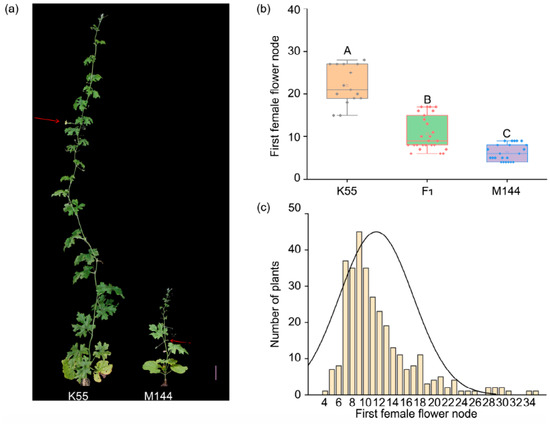
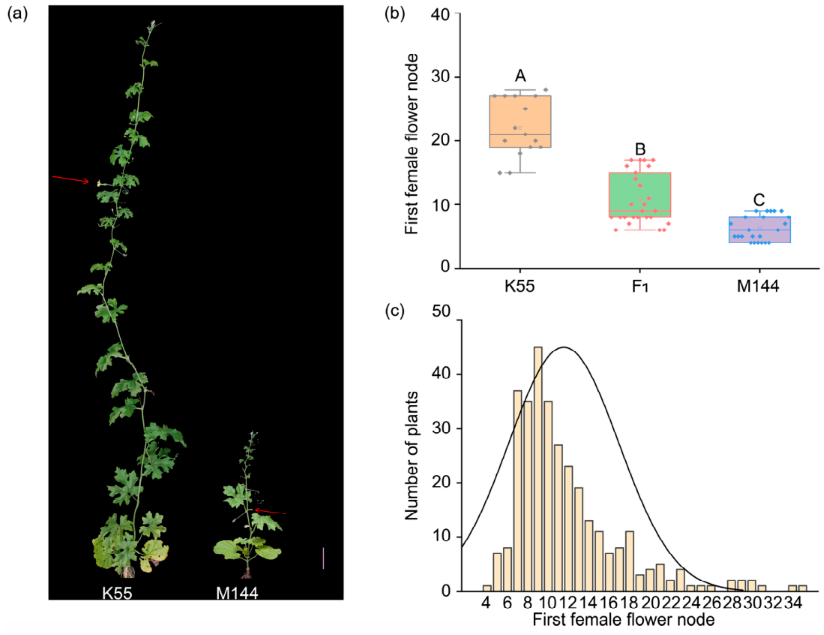
In this study, phenotypic identification and genetic analysis of the first female flower node were conducted using bitter gourd parents ‘M144’, ‘K55’ (Figure 1a), their F1 hybrid, and the derived F2 population. The results show that the average first female flower nodes of ‘M144’, ‘K55’, and F1 were 6.3, 22.0, and 10.7, respectively, with a significant difference between ‘M144’ and ‘K55’ (p = 7.89 × 10⁻¹⁷). The first female flower node of F1 was significantly higher than that of ‘M144’ but significantly lower than that of ‘K55’ (Figure 1b), indicating that the low node trait was incompletely dominant over the high node trait. The F2 population comprised 317 individuals, and the first female flower node ranged from 4 to 35, exhibiting a continuous distribution skewed toward low nodes (Figure 1c). These results further confirm that the first female flower node in bitter gourd was controlled by incomplete dominance inheritance.
Figure 1.
Phenotypic identification of first female flower node (FFFN). (a) Parents ‘K55’ and ‘M144’; bar = 5 cm; red arrows indicate FFFNs. (b) Average FFFNs of ‘M144’, ‘K55’, and F1. Different letters indicate statistical significance at the 0.01 level. (c) Phenotypic distribution of the FFFN trait in the F2 segregating population derived from ‘M144’ × ‘K55’.
3.2. BSA-Seq Analysis and Fine Mapping of the McFFFN4.1
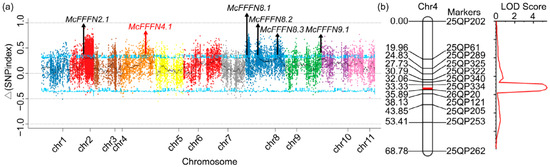
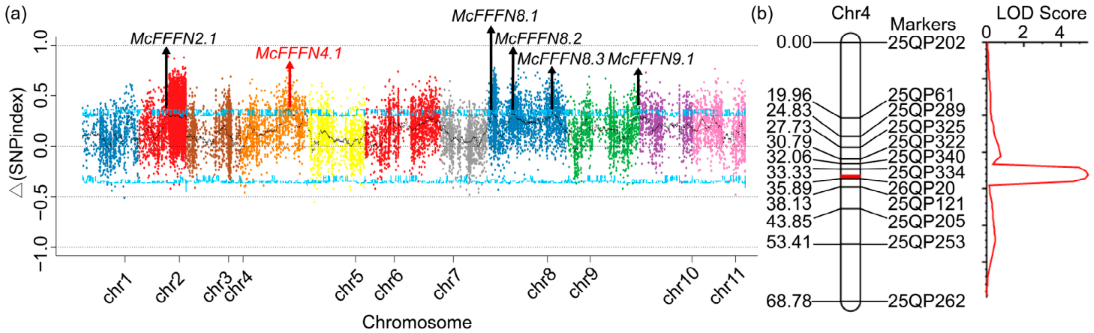
To rapidly map the gene controlling the FFFN in bitter gourd, a bulked segregant analysis combined with a whole-genome resequencing (BSA-Seq) strategy was adopted, using 317 F2 individuals derived from selfing of the F1 hybrid of ‘M144’ × ‘K55’ (detailed sequencing data are listed in Supplementary Table S2). The Δ(SNP-index) values were calculated and plotted against their genomic positions, with the Δ(SNP-index) between the low FFFN and high FFFN bulks assessed at a statistical significance threshold of p < 0.05. The results show that there were six candidate loci associated with the first female flower node on chromosomes 2, 4, 8, and 9 (Figure 2a). Since the phenotypic variance explained (PVE) by loci on chromosomes 2, 8, and 9 was all below 5.0%, we focused on the McFFFN4.1, which was located in the region of 18.8–22.5 Mb on chromosome 4 and explained 7.6% of the phenotypic variation.
Figure 2.
Mapping of first female flower node (FFFN) in F2 population. (a) The Δ(SNP-index) values were plotted against their corresponding genomic positions on chromosomes. The data are represented by a solid black line to enhance visualization. The blue line indicates the 95% confidence interval (CI) threshold (p < 0.05), established under the null hypothesis of no QTL. (b) Linkage-based QTL mapping. The X-axis represents the LOD scores, and the Y-axis shows the position of the genotyped markers and their corresponding genetic distances in cM. Marker names and their genetic positions (cM) are shown to the right and left of the chromosome, respectively, with the QTL position indicated by a thick red bar.
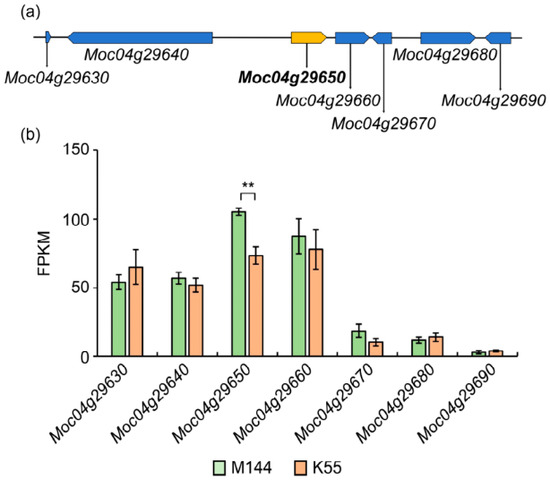
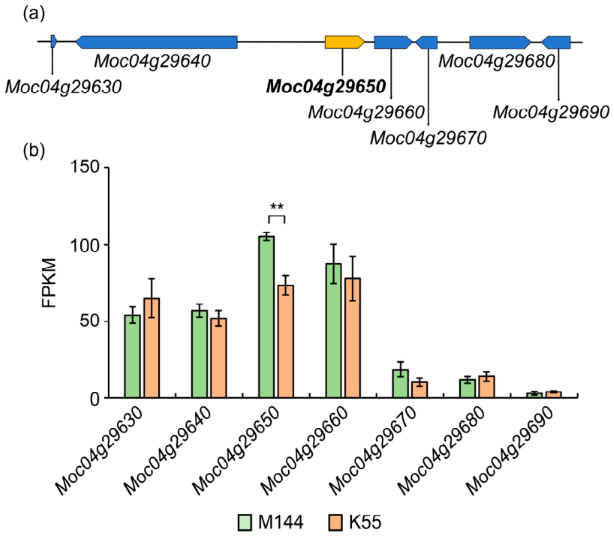
For fine mapping of McFFFN4.1, sequence variations between ‘M144’ and ‘K55’ were screened within the candidate region, and KASP markers were developed based on these variations (Supplementary Table S1). The 12 polymorphic KASP markers were used for genotyping of the F2 population. Integrated analysis of the phenotypic data and genotype data was performed using QTL IciMapping v4.2. This process ultimately fine-mapped McFFFN4.1 to a genomic interval of approximately 73.05 kb between markers 25QP334 and 26QP20 on chromosome 4, spanning a genetic distance of 33.33 cM to 35.89 cM (Figure 2b), an interval that contains seven genes (Bitter gourd (OHB3-1) v2 Genome, Table 1, Figure 3a).
Table 1.
Genes located within the mapping interval.
Figure 3.
Candidate gene analysis. (a) Annotated genes of McFFFN4.1 locus. Arrows indicate the direction of transcription. (b) Gene expression of predicted genes in the McFFFN4.1 locus by FPKM. ** indicates p < 0.01.
3.3. Candidate Gene Identification
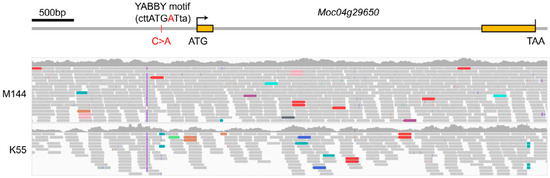
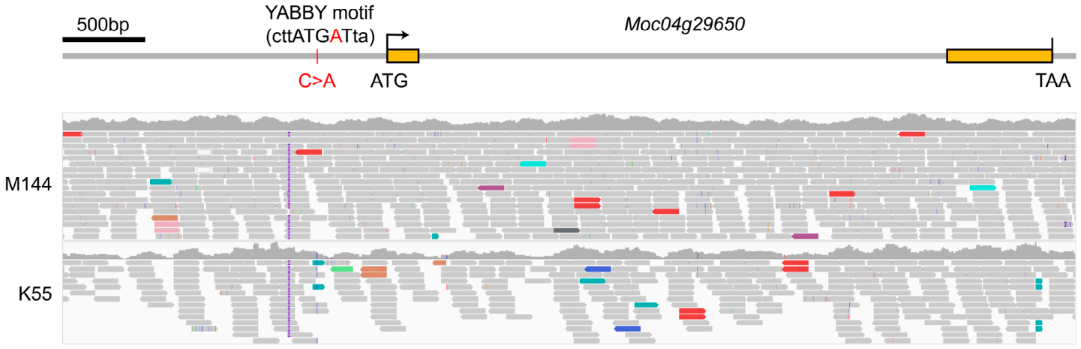
Transcriptome analysis of the 5th to 9th stem nodes of the parental lines indicated that only Moc04g29650 demonstrated differential expression within the mapping interval (Figure 3b). Comparative analysis of sequence polymorphisms between markers 25QP334 and 26QP20 only identified a single SNP (C > A) in the promoter region of the Moc04g29650 between the parental lines. To explore the molecular basis underlying the differential expression of Moc04g29650 between ‘M144’ and ‘K55’, we conducted cis-element analysis using promoter sequences. A putative YAB1/FIL-binding motif was identified at the mutation site (Figure 4). In Arabidopsis thaliana, FILAMENTOUS FLOWER (FIL) has been shown to be essential for inflorescence and floral meristem establishment, as well as floral development, acting in regulatory pathways that mediate floral transition and the expression of floral identity genes. In addition, gene annotation within the candidate interval indicated that Moc04g29690, annotated as LRR receptor-like serine/threonine-protein kinase RPK2, may be related to flower development. In Arabidopsis, mutations in RPK2 result in stem cell expansion and increased floral organ number, as seen in the other clv mutants [31]. However, no sequence variations or expression differences were detected for this gene between the two parental lines. Therefore, we suggest that Moc04g29650 is the most probable candidate gene for McFFFN4.1, which regulates the first female flower node.
Figure 4.
Moc04g29650 gene structure and comparison of DNA sequence in ‘M144’ and ‘K55’.
3.4. Development of Molecular Marker Linked to First Female Flower Node
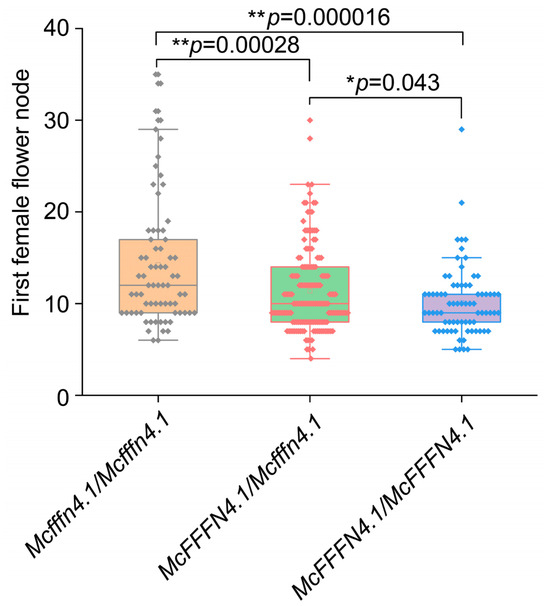
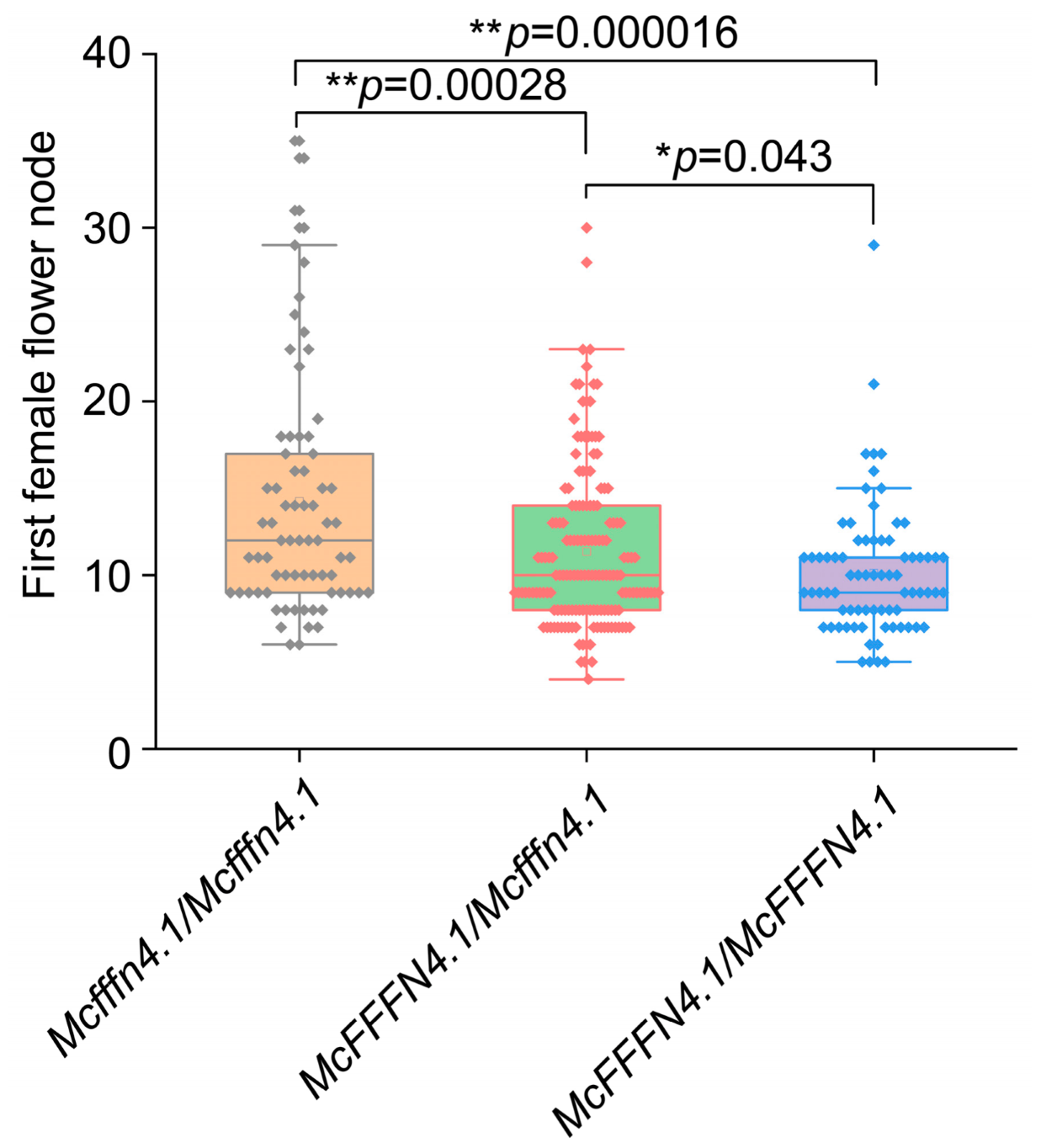
To validate QTL identified via BSA-seq, polymorphic SNPs were converted into KASP markers to flank and encompass the identified loci. The KASP markers 26QP20, located near Moc04g29650, showed the highest association with the first female flower node in the F2 population with a maximum LOD score of 5.45 (Figure 2b and Figure 5). This result demonstrates that this marker can be used for marker-assisted selection breeding in bitter gourd.
Figure 5.
Box plots of allelic effects of the highest associated KASP markers. Mcfffn4.1/Mcfffn4.1, McFFFN4.1/Mcfffn4.1, and McFFFN4.1/McFFFN4.1 show plants homozygous for the ‘K55’, heterozygous, and homozygous for the ‘M144’, respectively. Comparisons for pairs were made using Tukey–Kramer HSD Test. * and ** indicates p < 0.05 and p < 0.01, respectively.
4. Discussion
The first female flower node (FFFN) is a key agronomic trait affecting the earliness and yield of cucurbit crops [16,32,33]. In this study, phenotypic identification, genetic analysis, BSA-Seq, and fine mapping were performed to systematically analyze the genetic basis of FFFN and finely map the key candidate gene of McFFFN4.1. Genetic analysis of the parents (‘M144’ with low FFFN and ‘K55’ with high FFFN), F1 hybrid, and F2 population showed that the low FFFN trait was incompletely dominant over the high FFFN trait. The FFFN in the F2 population exhibited a continuous distribution skewed toward low nodes, which further confirm this genetic characteristic and also reflects the typical characteristics of quantitative traits. These results are consistent with the previous reports on the genetics of FFFN in bitter gourd, indicating that incomplete dominance is universal in the FFFN trait controlled by multiple genes [4].
DNA sequence comparison between ‘K55’ and ‘M144’ revealed that, among the seven genes in the mapping interval, only one SNP (C > A) was identified in the promoter region of Moc04g29650. Transcriptome analysis showed that only Moc04g29650 was differentially expressed between the two parents. Cis-element analysis indicated that this SNP was located within a putative YAB1/FIL-binding motif [34]. In Arabidopsis thaliana, the YABBY transcription factor FILAMENTOUS FLOWER (FIL) is involved in the establishment of inflorescences and floral meristems, as well as the regulation of floral development, mediating floral transition and the expression of floral identity genes [35,36]. The SNP is located within the putative YAB1/FIL-binding motif, suggesting that this mutation may affect the binding ability of FIL or other YABBY transcription factors to the Moc04g29650 promoter, thereby leading to differential expression of this gene between the parents and ultimately regulating FFFN. In cucumber, CsTFL1 regulates determinate growth and terminal flower formation by interacting with CsNOT2a [37]. In Cucurbita pepo, CpMYB62 acts upstream of the ethylene biosynthesis pathway to control female flower determination [38]. MC06g1112, an FT ortholog in bitter gourd corresponding to the Arabidopsis FT gene, serves as the major candidate gene, and a point mutation in it leads to a decrease in the first flower node of bitter gourd [4]. These studies, together with the present findings, reveal the complexity and conservation of the floral regulatory network in cucurbit crops and reflect species-specific adaptive characteristics. McFFFN4.1, mapped in this study, is located in a 73.05 kb interval on chromosome 4, which is not in the same chromosomal region or physical interval as the FFFN-related QTLs in bitter gourd reported in previous studies [4,25], suggesting that it is a new major QTL associated with FFFN. This locus enriches the genetic basis of the FFFN trait in bitter gourd, offers a new target for elucidating its early-maturity molecular mechanism, and deepens insights into the genetic basis of FFFN.
The FFFN trait in the F2 population showed a continuous distribution skewed toward low nodes. Combined with previous studies confirming that this trait is regulated by multiple genes and has a complex genetic basis, McFFFN4.1, mapped in this study, is not the only locus regulating this trait but an important locus within the complex quantitative genetic framework. It can significantly affect the phenotypic variation in FFFN, but it still needs to cooperate with other minor QTLs to jointly regulate the formation of the first female flower node in bitter gourd. Although Moc04g29650 is inferred to be the most probable candidate gene for McFFFN4.1, its functional annotation is cytochrome b-c1 complex subunit Rieske, which has no direct association with flowering. As a core component of the mitochondrial electron transport chain (Complex III), Moc04g29650 is essential for oxidative phosphorylation, ATP production, and the fine-tuning of mitochondrial reactive oxygen species (ROS) turnover. In Arabidopsis, anthesis involves high-energy metabolism and active transport of carbohydrates and amino acids, indicating that cellular energy status is tightly linked to flower opening [39]. In Nelumbo nucifera, mitochondrial biogenesis, ROS levels, and alternative oxidase (AOX) expression increase during thermogenesis [40]. Given that the Rieske subunit of Complex III is a major site of superoxide production, altered expression of Moc04g29650 may affect flowering by modulating mitochondrial ROS and cellular energy status. Although an earlier study demonstrated that Cytc-1 expression in root/shoot meristems and anthers is regulated by TCP-domain protein-binding site II elements and a telomeric repeat in its promoter, Cytc-2 is predominantly expressed in vascular tissues, with differential expression levels observed between flowers and leaves [41]. In situ hybridization studies have further revealed that expression in flowers is cell-type specific, and that the expression patterns of several mitochondrial genes [42] correlate well with that of the nuclear gene encoding cytochrome c [43], suggesting the existence of coordinated regulatory mechanisms [41]. Therefore, further functional verification through gene knockout, overexpression, and complementation experiments is still required. In addition to Moc04g29650, the fine-mapping interval contains six other genes, which require further functional analysis to rule out their possibility as candidate genes. In addition, this study was based on the F2 population derived from a single cross combination (‘M144’ × ‘K55’), and the QTL identified herein was validated within the same F2 population using KASP markers. Although this confirms the tight linkage between McFFFN4.1 and the FFFN trait, it does not constitute independent validation across germplasms with diverse genetic backgrounds or multiple environments. Accordingly, prior to more comprehensive independent validation, the breeding applicability of the KASP marker 26QP20 remains to be further verified. The molecular mechanism of the candidate gene (including its interaction with transcription factors such as FIL and its downstream regulatory network) is still unclear and needs further study. Since flowering time is known to be affected by factors such as photoperiod, temperature, and phytohormones, the stability of QTL under different environments and genetic backgrounds also needs further evaluation [44,45,46,47].
The KASP marker 26QP20 developed in this study is located near Moc04g29650 and is closely linked to FFFN in the F2 population (LOD = 5.45), which can be used for marker-assisted selection (MAS) in early-maturing bitter gourd breeding. Compared with traditional phenotypic selection, the use of this marker enables early selection of the low FFFN trait at the seedling stage, effectively shortening the breeding cycle, reducing costs, improving selection efficiency, and having good application prospects.
In conclusion, this study clarified the incomplete dominant inheritance pattern of FFFN in bitter gourd, mapped McFFFN4.1 to a 73.05 kb interval, and identified Moc04g29650 as the most probable candidate gene. The developed KASP marker 26QP20 provides an effective tool for molecular breeding of bitter gourd, laying an important foundation for further cloning of the McFFFN4.1 gene, analyzing its function, and improving the earliness of bitter gourd through molecular breeding.
5. Conclusions
In this study, we fine-mapped QTL McFFFN4.1, which controls the first female flower node in bitter gourd, to chromosome 4—a region which contains seven candidate genes—via BSA-seq combined with linkage analysis. Through an integrated analysis of sequence variation and gene expression profiles between parental lines, Moc04g29650 was identified as the prime candidate gene for this trait. A SNP mutation in the promoter region of Moc04g29650 led to the formation of a specific cttATGATta motif in the low first female flower node line M144; this motif is predicted to affect binding to YAB1, a key transcription factor regulating floral development. Overall, these findings demonstrate for the first time that Moc04g29650 is likely involved in the modulation of first female flower node formation in bitter gourd through transcriptional regulation mediated by the specific interaction between its promoter cttATGATta motif and the YAB1 protein. These results not only deepen our understanding of the molecular basis underlying floral initiation in cucurbits, but also provide a valuable gene target for breeding early-maturing bitter gourd varieties, which is of great significance for improving yield stability and production efficiency. Furthermore, the 26QP20 KASP markers developed in this study may be applied in modern molecular breeding programs to accelerate the breeding process of elite bitter gourd cultivars.
Supplementary Materials
The following supporting information can be downloaded at https://www.mdpi.com/article/10.3390/horticulturae12050520/s1, Table S1: Primers used in this study; Table S2: Quality evaluation for the BSA-seq data; Table S3: Phenotype and genotype of F2 population.
Author Contributions
Conceptualization, X.L., X.Z. and C.F.; methodology, Y.Z., G.Z., L.D. and X.W.; formal analysis, G.Z. and L.D.; investigation, H.G. and J.L. (Jianning Luo); resources, H.G.; data curation, J.L. (Junxing Li) and H.W.; writing—original draft preparation, X.L. and M.H.; writing—review and editing, X.Z. and C.F.; visualization, M.H.; funding acquisition, X.L., J.L. (Junxing Li) and C.F. All authors have read and agreed to the published version of the manuscript.
Funding
This research was funded by the Guangxi Science and Technology Key Project, grant number Guike AA23023001, Special Funding for the ‘Jinying Talents’ Project of the Guangdong Academy of Agricultural Sciences (R2026PY-TJ008) and the Guangdong Province Modern Vegetable Industry Technology System Project (2026CXTD08).
Data Availability Statement
The original contributions presented in this study are included in the article and Supplementary Materials. Further inquiries can be directed to the corresponding authors.
Conflicts of Interest
The authors declare no conflicts of interest.
References
- Matsumura, H.; Hsiao, M.C.; Lin, Y.P.; Toyoda, A.; Taniai, N.; Tarora, K.; Urasaki, N.; Anand, S.S.; Dhillon, N.P.S.; Schafleitner, R.; et al. Long-read bitter gourd (Momordica charantia) genome and the genomic architecture of nonclassic domestication. Proc. Natl. Acad. Sci. USA 2020, 117, 14543–14551. [Google Scholar] [CrossRef] [Scilit]
- Cui, J.; Yang, Y.; Luo, S.; Wang, L.; Huang, R.; Wen, Q.; Han, X.; Miao, N.; Cheng, J.; Liu, Z.; et al. Whole-genome sequencing provides insights into the genetic diversity and domestication of bitter gourd (Momordica spp.). Hortic. Res. 2020, 7, 85. [Google Scholar] [CrossRef] [Scilit] [PubMed]
- Yan, K.; Ning, Y.; Su, L.; Xu, H.; Lv, Z.; Wang, Y.; Chen, L.; Lian, H. Proteomic variation in two genotypes of bitter gourd during cold acclimation. Horticulturae 2026, 12, 123. [Google Scholar] [CrossRef] [Scilit]
- Zhong, J.; Cui, J.; Miao, M.; Hu, F.; Dong, J.; Liu, J.; Zhong, C.; Cheng, J.; Hu, K. A point mutation in MC06g1112 encoding FLOWERING LOCUS T decreases the first flower node in bitter gourd (Momordica charantia L.). Front. Plant Sci. 2023, 14, 1153208. [Google Scholar] [CrossRef] [Scilit] [PubMed]
- Fazio, G.; Staub, J.E.; Stevens, M.R. Genetic mapping and QTL analysis of horticultural traits in cucumber (Cucumis sativus L.) using recombinant inbred lines. Theor. Appl. Genet. 2003, 107, 864–874. [Google Scholar] [CrossRef] [Scilit]
- Gimode, W.; Clevenger, J.; McGregor, C. Fine-mapping of a major quantitative trait locus Qdff3-1 controlling flowering time in watermelon. Mol. Breed. 2019, 40, 3. [Google Scholar] [CrossRef] [Scilit]
- Wigge, P.A.; Kim, M.C.; Jaeger, K.E.; Busch, W.; Schmid, M.; Lohmann, J.U.; Weigel, D. Integration of spatial and temporal information during floral induction in Arabidopsis. Science 2005, 309, 1056–1059. [Google Scholar] [CrossRef] [Scilit]
- Corbesier, L.; Vincent, C.; Jang, S.; Fornara, F.; Fan, Q.; Searle, I.; Giakountis, A.; Farrona, S.; Gissot, L.; Turnbull, C.; et al. FT protein movement contributes to long-distance signaling in floral induction of Arabidopsis. Science 2007, 316, 1030–1033. [Google Scholar] [CrossRef] [Scilit]
- Zhang, X.F.; Wang, G.Y.; Dong, T.T.; Chen, B.; Du, H.S.; Li, C.B.; Zhang, F.L.; Zhang, H.Y.; Xu, Y.; Wang, Q.; et al. High-density genetic map construction and QTL mapping of first flower node in pepper (Capsicum annuum L.). BMC Plant Biol. 2019, 19, 167. [Google Scholar] [CrossRef] [Scilit]
- Cohen, O.; Borovsky, Y.; David-Schwartz, R.; Paran, I. CaJOINTLESS is a MADS-box gene involved in suppression of vegetative growth in all shoot meristems in pepper. J. Exp. Bot. 2012, 63, 4947–4957. [Google Scholar] [CrossRef] [Scilit]
- Borovsky, Y.; Sharma, V.K.; Verbakel, H.; Paran, I. CaAP2 transcription factor is a candidate gene for a flowering repressor and a candidate for controlling natural variation of flowering time in Capsicum annuum. Theor. Appl. Genet. 2015, 128, 1073–1082. [Google Scholar] [CrossRef] [Scilit]
- Jeifetz, D.; David-Schwartz, R.; Borovsky, Y.; Paran, I. CaBLIND regulates axillary meristem initiation and transition to flowering in pepper. Planta 2011, 234, 1227–1236. [Google Scholar] [CrossRef] [Scilit]
- Lu, H.; Lin, T.; Klein, J.; Wang, S.; Qi, J.; Zhou, Q.; Sun, J.; Zhang, Z.; Weng, Y.; Huang, S. QTL-seq identifies an early flowering QTL located near Flowering Locus T in cucumber. Theor. Appl. Genet. 2014, 127, 1491–1499. [Google Scholar] [CrossRef] [Scilit]
- Wang, S.; Li, H.; Li, Y.; Li, Z.; Qi, J.; Lin, T.; Yang, X.; Zhang, Z.; Huang, S. FLOWERING LOCUS T improves cucumber adaptation to higher latitudes. Plant Physiol. 2020, 182, 908–918. [Google Scholar] [CrossRef] [Scilit] [PubMed]
- Yang, A.; Xu, Q.; Hong, Z.; Wang, X.; Zeng, K.; Yan, L.; Liu, Y.; Zhu, Z.; Wang, H.; Xu, Y. Modified photoperiod response of CsFT promotes day neutrality and early flowering in cultivated cucumber. Theor. Appl. Genet. 2022, 135, 2735–2746. [Google Scholar] [CrossRef] [Scilit] [PubMed]
- Pradeepkumara, N.; Parkash, C.; Dey, S.S.; Bhatia, R.; Shekharappa, N.; Munshi, A.D.; Behera, T.K.; Bhattacharya, R.C.; Talukdar, A.; Tomar, B.S. Molecular mapping of flowering traits revealed a major QTL, qDFFF3.3.1 associated with early maturity in cucumber (Cucumis sativus L.). BMC Plant Biol. 2025, 26, 83. [Google Scholar] [CrossRef] [Scilit] [PubMed]
- Sun, Z.; Staub, J.E.; Chung, S.M.; Lower, R.L. Identification and comparative analysis of quantitative trait loci associated with parthenocarpy in processing cucumber. Plant Breed. 2006, 125, 281–287. [Google Scholar] [CrossRef] [Scilit]
- Sheng, Y.; Pan, Y.; Li, Y.; Yang, L.; Weng, Y. Quantitative trait loci for fruit size and flowering time-related traits under domestication and diversifying selection in cucumber (Cucumis sativus). Plant Breed. 2020, 139, 176–191. [Google Scholar] [CrossRef] [Scilit]
- Urasaki, N.; Takagi, H.; Natsume, S.; Uemura, A.; Taniai, N.; Miyagi, N.; Fukushima, M.; Suzuki, S.; Tarora, K.; Tamaki, M.; et al. Draft genome sequence of bitter gourd (Momordica charantia), a vegetable and medicinal plant in tropical and subtropical regions. DNA Res. 2017, 24, 51–58. [Google Scholar] [CrossRef] [Scilit]
- Fu, A.; Zheng, Y.; Guo, J.; Grierson, D.; Zhao, X.; Wen, C.; Liu, Y.; Li, J.; Zhang, X.; Yu, Y.; et al. Telomere-to-telomere genome assembly of bitter melon (Momordica charantia L. var. abbreviata Ser.) reveals fruit development, composition and ripening genetic characteristics. Hortic. Res. 2023, 10, uhac228. [Google Scholar] [CrossRef] [Scilit]
- Zhang, Y.; Wang, X.; Wang, Y.; Niu, Y.; Han, X.; Tan, J.; Ma, X.; Zhang, Q.; Liu, J.; Zhang, Z.; et al. Telomere-to-telomere genome assembly and comprehensive mutation library facilitate bitter gourd breeding and functional genomics research. Plant Commun. 2026, 7, 101779. [Google Scholar] [CrossRef] [Scilit]
- Gangadhara Rao, P.; Behera, T.K.; Gaikwad, A.B.; Munshi, A.D.; Jat, G.S.; Boopalakrishnan, G. Mapping and QTL analysis of gynoecy and earliness in bitter gourd (Momordica charantia L.) using genotyping-by-sequencing (GBS) technology. Front. Plant Sci. 2018, 9, 1555. [Google Scholar] [CrossRef] [Scilit]
- Kaur, G.; Pathak, M.; Singla, D.; Chhabra, G.; Chhuneja, P.; Kaur Sarao, N. Quantitative trait loci mapping for earliness, fruit, and seed related traits using high density genotyping-by-sequencing-based genetic map in bitter gourd (Momordica charantia L.). Front. Plant Sci. 2021, 12, 799932. [Google Scholar] [CrossRef] [Scilit] [PubMed]
- Zhong, J.; Cui, J.; Liu, J.; Zhong, C.; Hu, F.; Dong, J.; Cheng, J.; Hu, K. Fine-mapping and candidate gene analysis of the Mcgy1 locus responsible for gynoecy in bitter gourd (Momordica spp.). Theor. Appl. Genet. 2023, 136, 81. [Google Scholar] [CrossRef] [Scilit] [PubMed]
- Cui, J.; Luo, S.; Niu, Y.; Huang, R.; Wen, Q.; Su, J.; Miao, N.; He, W.; Dong, Z.; Cheng, J.; et al. A RAD-based genetic map for anchoring scaffold sequences and identifying QTLs in bitter gourd (Momordica charantia). Front. Plant Sci. 2018, 9, 477. [Google Scholar] [CrossRef] [Scilit] [PubMed]
- McKenna, A.; Hanna, M.; Banks, E.; Sivachenko, A.; Cibulskis, K.; Kernytsky, A.; Garimella, K.; Altshuler, D.; Gabriel, S.; Daly, M.; et al. The Genome Analysis Toolkit: A MapReduce framework for analyzing next-generation DNA sequencing data. Genome Res. 2010, 20, 1297–1303. [Google Scholar] [CrossRef] [Scilit] [PubMed]
- Wang, K.; Li, M.; Hakonarson, H. ANNOVAR: Functional annotation of genetic variants from high-throughput sequencing data. Nucleic Acids Res. 2010, 38, e164. [Google Scholar] [CrossRef] [Scilit]
- Meng, L.; Li, H.; Zhang, L.; Wang, J. QTL IciMapping: Integrated software for genetic linkage map construction and quantitative trait locus mapping in biparental populations. Crop J. 2015, 3, 269–283. [Google Scholar] [CrossRef] [Scilit]
- Kim, D.; Paggi, J.M.; Park, C.; Bennett, C.; Salzberg, S.L. Graph-based genome alignment and genotyping with HISAT2 and HISAT-genotype. Nat. Biotechnol. 2019, 37, 907–915. [Google Scholar] [CrossRef] [Scilit]
- Robinson, M.D.; McCarthy, D.J.; Smyth, G.K. edgeR: A Bioconductor package for differential expression analysis of digital gene expression data. Bioinformatics 2010, 26, 139–140. [Google Scholar] [CrossRef] [Scilit]
- Kinoshita, A.; Betsuyaku, S.; Osakabe, Y.; Mizuno, S.; Nagawa, S.; Stahl, Y.; Simon, R.; Yamaguchi-Shinozaki, K.; Fukuda, H.; Sawa, S. RPK2 is an essential receptor-like kinase that transmits the CLV3 signal in Arabidopsis. Development 2010, 137, 3911–3920. [Google Scholar] [CrossRef] [Scilit]
- Poland, J.A.; Balint-Kurti, P.J.; Wisser, R.J.; Pratt, R.C.; Nelson, R.J. Shades of gray: The world of quantitative disease resistance. Trends Plant Sci. 2009, 14, 21–29. [Google Scholar] [CrossRef] [Scilit] [PubMed]
- Robbins, M.D.; Staub, J.E. Comparative analysis of marker-assisted and phenotypic selection for yield components in cucumber. Theor. Appl. Genet. 2009, 119, 621–634. [Google Scholar] [CrossRef] [Scilit] [PubMed]
- Franco-Zorrilla, J.M.; López-Vidriero, I.; Carrasco, J.L.; Godoy, M.; Vera, P.; Solano, R. DNA-binding specificities of plant transcription factors and their potential to define target genes. Proc. Natl. Acad. Sci. USA 2014, 111, 2367–2372. [Google Scholar] [CrossRef] [Scilit] [PubMed]
- Sawa, S.; Ito, T.; Shimura, Y.; Okada, K. FILAMENTOUS FLOWER controls the formation and development of arabidopsis inflorescences and floral meristems. Plant Cell 1999, 11, 69–86. [Google Scholar] [CrossRef] [Scilit]
- Goldshmidt, A.; Alvarez, J.P.; Bowman, J.L.; Eshed, Y. Signals derived from YABBY gene activities in organ primordia regulate growth and partitioning of Arabidopsis shoot apical meristems. Plant Cell 2008, 20, 1217–1230. [Google Scholar] [CrossRef] [Scilit]
- Wen, C.; Zhao, W.; Liu, W.; Yang, L.; Wang, Y.; Liu, X.; Xu, Y.; Ren, H.; Guo, Y.; Li, C.; et al. CsTFL1 inhibits determinate growth and terminal flower formation through interaction with CsNOT2a in cucumber. Development 2019, 146, dev180166. [Google Scholar] [CrossRef] [Scilit]
- Segura, M.; García, A.; Gamarra, G.; Benítez, Á.; Iglesias-Moya, J.; Martínez, C.; Jamilena, M. The transcription factor CpMYB62 controls the genetic network that leads to the determination of female flowers in Cucurbita pepo. Hortic. Res. 2024, 11, uhae115. [Google Scholar] [CrossRef] [Scilit]
- Borghi, M.; Perez de Souza, L.; Tohge, T.; Mi, J.; Melandri, G.; Proost, S.; Martins, M.C.M.; Al-Babili, S.; Bouwmeester, H.J.; Fernie, A.R. High-energy-level metabolism and transport occur at the transition from closed to open flowers. Plant Physiol. 2022, 190, 319–339. [Google Scholar] [CrossRef] [Scilit]
- Li, R.; Li, J.; Wang, S.; Wang, R. Novel insights into floral thermogenesis: In vivo analyses of mitochondrial dynamics in Nelumbo nucifera flowers. Int. J. Mol. Sci. 2022, 23, 11950. [Google Scholar] [CrossRef] [Scilit]
- Welchen, E.; Gonzalez, D.H. Differential expression of the Arabidopsis cytochrome c genes Cytc-1 and Cytc-2. Evidence for the involvement of TCP-domain protein-binding elements in anther- and meristem-specific expression of the Cytc-1 gene. Plant Physiol. 2005, 139, 88–100. [Google Scholar] [CrossRef] [Scilit] [PubMed]
- Smart, C.J.; Monéger, F.; Leaver, C.J. Cell-specific regulation of gene expression in mitochondria during anther development in sunflower. Plant Cell 1994, 6, 811–825. [Google Scholar] [PubMed]
- Ribichich, K.F.; Tioni, M.F.; Chan, R.L.; Gonzalez, D.H. Cell-type-specific expression of plant cytochrome c mRNA in developing flowers and roots. Plant Physiol. 2001, 125, 1603–1610. [Google Scholar] [CrossRef] [Scilit] [PubMed]
- Hu, L.; Zhang, M.; Shang, J.; Liu, Z.; Weng, Y.; Yue, H.; Li, Y.; Chen, P. A 5.5-kb LTR-retrotransposon insertion inside phytochrome B gene (CsPHYB) results in long hypocotyl and early flowering in cucumber (Cucumis sativus L.). Theor. Appl. Genet. 2023, 136, 68. [Google Scholar] [CrossRef] [Scilit]
- Pan, Y.; Qu, S.; Bo, K.; Gao, M.; Haider, K.R.; Weng, Y. QTL mapping of domestication and diversifying selection related traits in round-fruited semi-wild Xishuangbanna cucumber (Cucumis sativus L. var. xishuangbannanesis). Theor. Appl. Genet. 2017, 130, 1531–1548. [Google Scholar] [CrossRef] [Scilit]
- Cebrián, G.; Iglesias-Moya, J.; Romero, J.; Martínez, C.; Garrido, D.; Jamilena, M. The ethylene biosynthesis gene CpACO1A: A new player in the regulation of sex determination and female flower development in Cucurbita pepo. Front. Plant Sci. 2021, 12, 817922. [Google Scholar] [CrossRef] [Scilit]
- Wen, H.; Pan, J.; Chen, Y.; Chen, G.; Du, H.; Zhang, L.; Zhang, K.; He, H.; Wang, G.; Cai, R.; et al. TERMINAL FLOWER 1 and TERMINAL FLOWER 1d respond to temperature and photoperiod signals to inhibit determinate growth in cucumber. Plant Cell Environ. 2021, 44, 2580–2592. [Google Scholar] [CrossRef] [Scilit]

Disclaimer/Publisher’s Note: The statements, opinions and data contained in all publications are solely those of the individual author(s) and contributor(s) and not of MDPI and/or the editor(s). MDPI and/or the editor(s) disclaim responsibility for any injury to people or property resulting from any ideas, methods, instructions or products referred to in the content. |
© 2026 by the authors. Licensee MDPI, Basel, Switzerland. This article is an open access article distributed under the terms and conditions of the Creative Commons Attribution (CC BY) license.